Environment News: November 2026 - Issue 660

Week Three November 2026: Issue 660 (Published Sunday November 15)

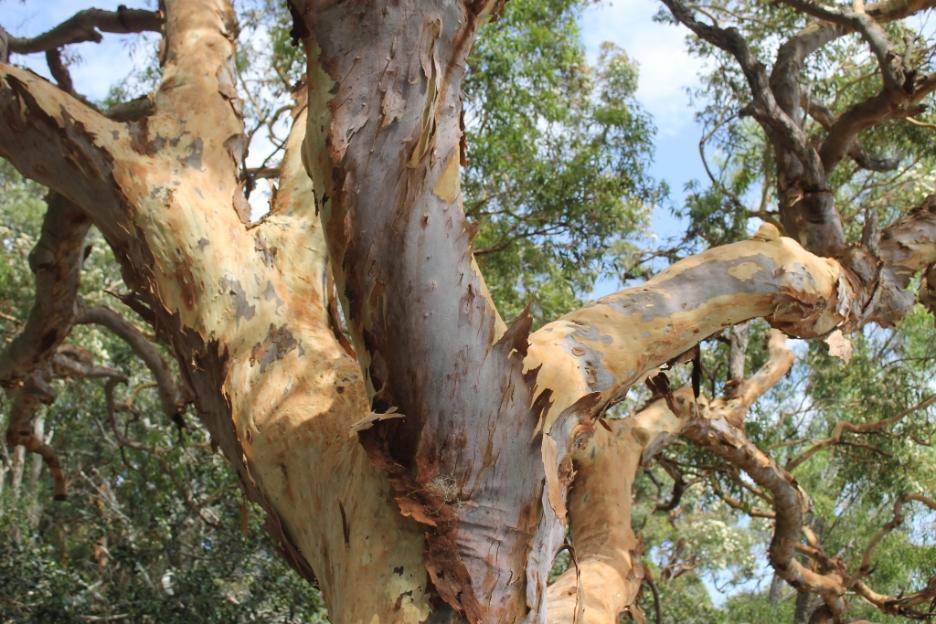
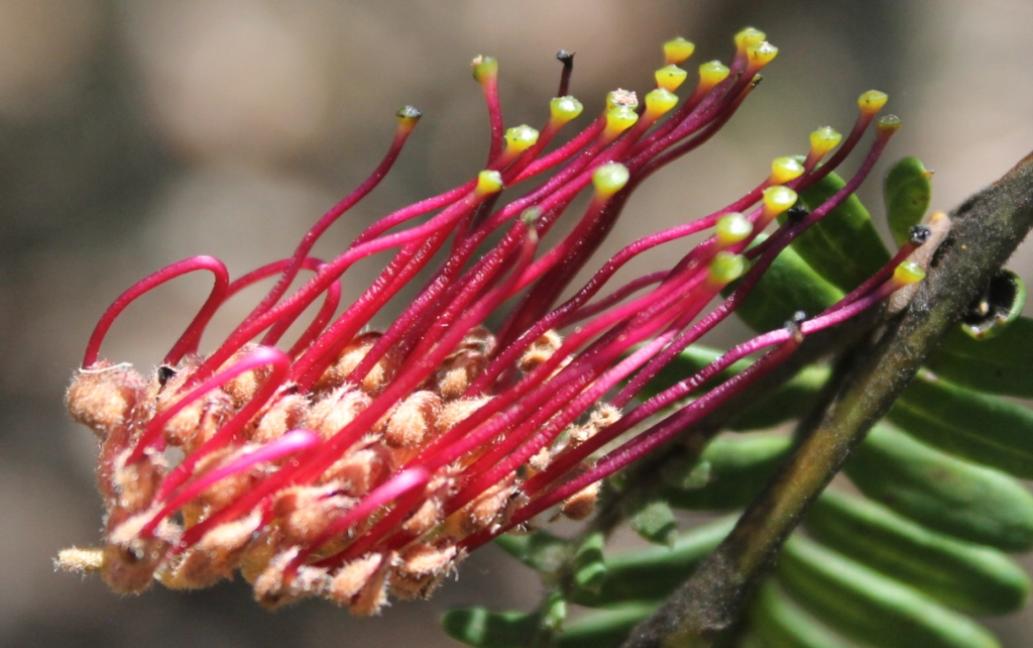
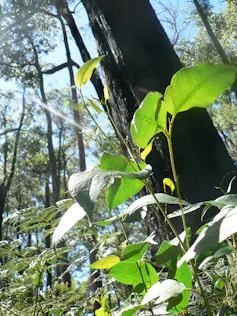
Flowering now in Pittwater: Angophora Costata. Photos: A J Guesdon, November 12 2026

Good News this week for the current generation of Pittwater's Tree Champions who supported their Mosman counterparts in this, see report in Nov. 15 published Issue: HMAS Penguin's angophora forest not to be sold off: Huge Community Win

Different red to pink colours in bottlebrushes (Callistemon), all within metres of each other + a lillipilli in bloom. Photos: AJG/PON


HMAS Penguin's angophora forest not to be sold off: Huge Community Win

On Sunday November 8 2026 the Hon. Anthony Albanese announced ''The Australian Government is acting on the independent Defence Estate Audit, and progressing the most significant reform to Australia’s Defence estate in our nation’s history.''

''Keeping Australians safe is the Government’s priority, and as part of that we must ensure the Australian Defence Force (ADF) has access to facilities that are fit for purpose.''

''In response to the independent Audit, the Government agreed to divest or partially divest 67 sites that were underutilised by Defence, not fit-for-purpose, and costly for Defence to maintain.''

''The Audit found many of these sites had no direct contribution to current or future capability outcomes for the ADF and that “urgent interventions are needed to correct the unsustainable trajectory that has resulted from decades of deferred decisions on contentious estate issues.”

''Today, the Government is providing the first significant update to the Defence Estate Audit since February, and announcing the next steps for a number of sites.''

''Defence has now transferred 11 sites to the Department of Finance for divestment, and the remaining sites are progressing towards transfer.''

''As previously announced, Defence will vacate each of these sites and hand them over to the Department of Finance as soon as practicable. By the end of 2026 Defence will have relocated the workforce from a total of six sites to suitable, alternative locations.''

''The Government has been working to identify optimal outcomes for sites, including those that should be maintained in public hands for broader community use as well as working with governments, stakeholders and communities to identify future use opportunities. This includes sites with limited ownership options or opportunities for community return.''

''While work is ongoing across many of the sites, the Government has made the following decisions in relation to the first phase of the divestment program.''

Custodians identified for sites 

HMAS Penguin in Mosman in Sydney was identified for partial divestment. While Defence retains ownership of parts of the site which support critical ADF capability, the Government will transfer the remaining site of the Angophora Forest to the Sydney Harbour Federation Trust, which will be responsible for its stewardship.

Additionally, the Stokes Hill Fuel Installation in the Northern Territory will be transferred back to the Larrakia people, the traditional owners of the lands. The southern portion of the site is a registered sacred site and is protected by the Northern Territory Aboriginal Sacred Sites Act 2012.

Maintaining public ownership at four sites

The Government was clear from the outset that preserving the history and heritage of sites would be closely considered as part of any future use and has listened to the views that have been raised.

Victoria Barracks Sydney, Victoria Barracks Melbourne, Fort Queenscliff (Victoria), and RAAF Williams – Point Cook (Victoria) hold deep significance for our nation, ADF members, both current and former, and local communities.

The heritage at all four will be protected by remaining in public hands.

The heritage of each of these sites is protected by law and public ownership will further guarantee this heritage is appropriately protected and preserved for current and future generations.

The Australian War Memorial will be engaged to help interpret and tell the history of these sites – a history that will be able to be shared with the Australian public.

Defence will continue to vacate these sites as planned and the Government will undertake a divestment process that protects their heritage through public ownership, under conditions that will ensure they are opened for community access and allowing opportunities for commercial use.

Due diligence on these sites, including specific assessments of environmental, heritage and contamination investigations, will continue.

The Government has also identified a preferred divestment pathway across a number of other sites undergoing due diligence (subject to final negotiations).

The Government will provided further updates as work progresses. The below table outlines key updates on intentions, discussions and plans for a number of sites.

Properties with significant historical importance or heritage value

Site: Key updates for site

Victoria Barracks Sydney, NSW:  The Government is committed to retaining the historical and heritage parts of this site in public ownership while maximising community, heritage and appropriate commercial opportunities. The Australian War Memorial will be engaged to tell the history of this historically significant site.

Victoria Barracks Melbourne, VIC: The Government is committed to retaining the historical and heritage parts of this site in public ownership while maximising community, heritage and appropriate commercial opportunities. The Australian War Memorial will be engaged to tell the history of this historically significant site.

Fort Queenscliff, VIC: The Government is committed to retaining the historical and heritage parts of this site in public ownership. Finance will consider alternate models for the site, including heritage trusts, concurrently with due diligence activities. The Australian War Memorial will be engaged to tell the history of this historically significant site.

RAAF Williams – Point Cook, VIC: The Government is committed to retaining the historical and heritage parts of this site in public ownership. Finance will consider alternate models for the site, including heritage trusts, concurrently with due diligence activities. The Australian War Memorial will be engaged to tell the history of this historically significant site.

Properties for divestment with cultural significance or a particular purpose

Site:  Key update for site

Stokes Hill, NT:  Transfer the site back to the Larrakia people, noting the Indigenous significance of the site.

Kowandi North, NT: The divestment pathways being explored for this site will support the delivery of more housing in Darwin.

HMAS Penguin, NSW: Defence will retain ownership of parts of the site which support critical ADF capability, the Government will transfer the remainder of the site comprising the Angophora Forest to the Sydney Harbour Federation Trust.

Fairbairn Golf Course, ACT: The Government intends for the site to continue operating as a golf course and will explore divestment pathways that support this outcome.

Swan Island Golf Course, VIC: The Government intends for the site to continue operating as a golf course and is exploring divestment pathways that support this outcome.

Sites for divestment on the open market

Site: Key update for site

Carlton Training Depot, VIC: The site will be listed on the open market in early 2027.

Geelong (Air Force Cadet Unit), VIC: The site will be listed on the open market in early 2027.

Kyneton Depot, VIC: The site will be listed on the open market in early 2027.

Bathurst Training Stores Depot, NSW: An open-market process to commence in 2027, subject to completion of due diligence and transition planning.

Sandringham Training Depot, VIC: An open-market process to commence at the end of 2027, subject to completion of due diligence activities and transition planning.

Scottsdale – Defence Nutrition Site, TAS: An open-market process to commence during the third quarter of 2027, subject to completion of due diligence and transition planning.

Sites for divestment in partnership with state or territory governments

Site: Key update for site

Derwent Barracks, TAS: In May 2026, the Prime Minister and Tasmanian Premier announced the plan to redevelop and transform Tasmania’s Dowsing Point to provide more housing, open space and community infrastructure.

Hampstead Barracks, SA: In September 2026, the Prime Minister and South Australian Premier announced formal negotiations to cooperatively progress the divestment of the site to support delivery of more homes in Adelaide.

Zali Steggall, MP for Warringah, stated:

''I am delighted and relieved that the Albanese government has announced HMAS Penguin will not be partially sold. This is a huge win for the thousands of people who campaigned relentlessly over many months for this precious public asset to remain in public hands.''

''Partial divestment will proceed only by way of divesting the angophora forest to the Sydney Harbour Federation Trust. This is a welcome move, and one that I have been strongly advocating for. We must ensure what little native vegetation remains on Sydney Harbour is conserved.''

''The final boundary of the naval base is to be determined. However, no part of it will be sold for profit.''

''I want to thank local residents, veterans, community groups, Mosman Council and everyone who pushed so hard to protect HMAS Penguin. Many people put in an enormous amount of time and effort to make this happen.''

''In particular, I acknowledge the efforts of Mosman Parks & Bushland Association, Headland Preservation Group and Mosman Mayor Ann Marie Kimber.''

''HMAS is a working Defence facility and an important part of our naval history. The area is also rich in ecological significance and Indigenous history.''

''As the Prime Minister himself has said in the past, the Sydney Harbour foreshore belongs to all Sydneysiders and all Australians. It should be preserved for public use and enjoyment, how and into the future. Once it is sold to private interests, it is lost forever.''

''This decision shows what can happen when a community stands up and makes itself heard. I will continue to fight to ensure HMAS Penguin and Middle Head are protected in the long term.''

For Background - See February 2026 report: Sale of Bulk of HMAS Penguin Site Approved - Pristine Angophora forest Likely to be destroyed, wildlife Killed, Another People's Parkland stolen: Pittwater Annexe will be retained


Angophora costata - mass tree and wildlife killing was to take place at Balmoral, for money - now rescinded. Pic: A J Guesdon/PON

Flowering now in Pittwater: Angophora Costata. Photos: A J Guesdon, November 12 2026


Underwater Photography Competition Winners Underline the Benefits of Local Aquatic Reserves

On November 4 2026 the council revealed its winners in its 2026 Underwater Photography Competition with all winners images being taken or filmed in either Cabbage Tree Bay, North Harbour (Sydney) and Long Reef Aquatic Reserves.

The winner in the Reels: Youth (12 – 17 years) category, ''Capturing the wonder of the biodiversity in our underwater world by videographers aged 12 – 17 years'' was Ezra Boulton's, ''Too Many Fish to Count'' taken at the Cabbage Tree Bay Aquatic Reserve at Manly.

The council announced ''A mesmerising image of a delicate marine organism has taken out the top prize in Northern Beaches Council’s sixth annual Underwater Photography Competition.''

Gerrad Kennedy received the prestigious Valerie Taylor Award for Excellence for Whispers in the Reserve, his striking close-up of a delicate, plant-like hydroid.

Judges praised the image’s outstanding composition and clarity of detail, saying: “The hydroid’s delicate, outstretched tentacles implore you to look closer. This showcases a small example of the diversity and beauty of life that can prevail when we provide protection through the creation of aquatic reserves.”

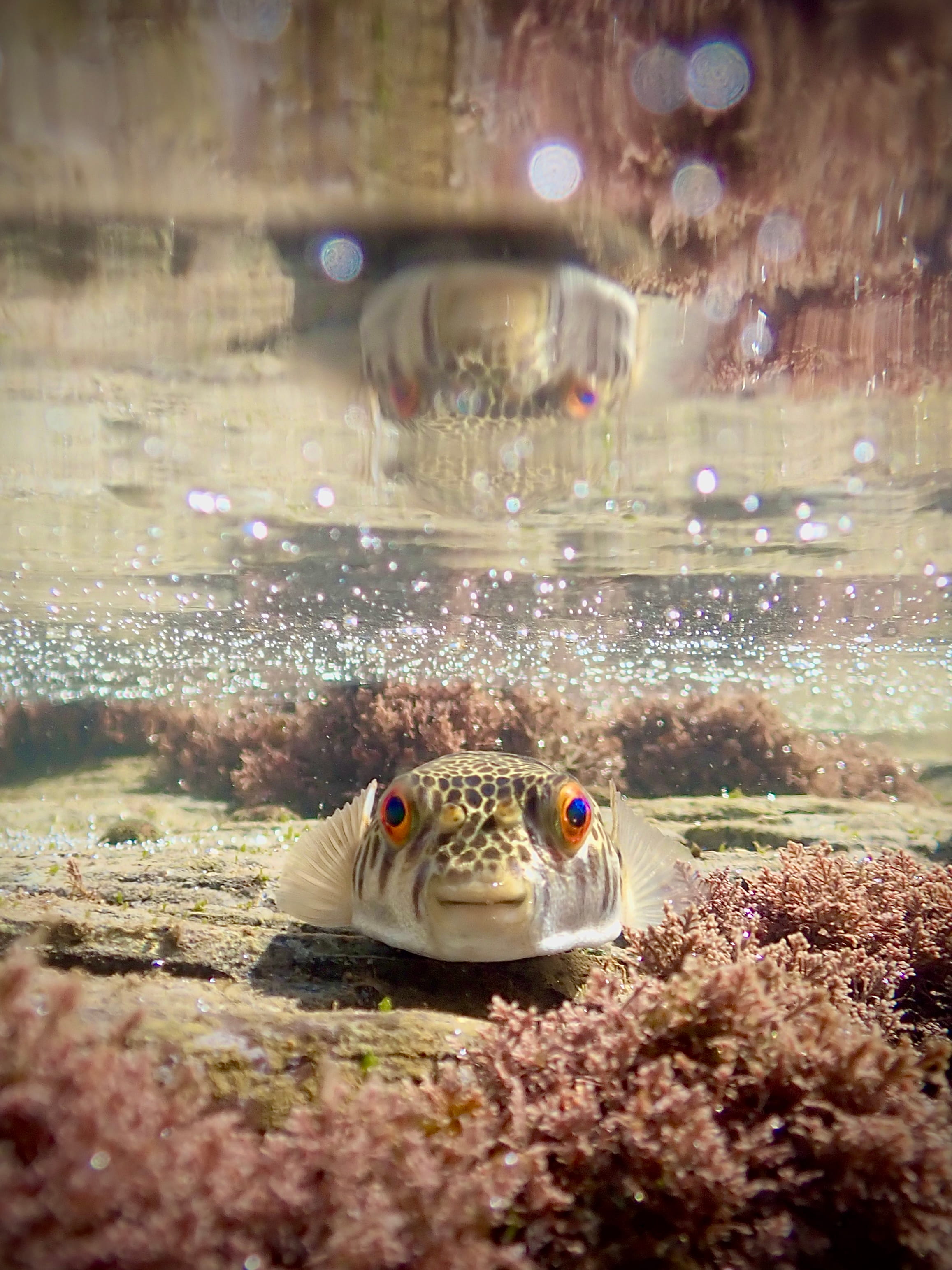
More than 550 people voted for the People’s Choice Award, won by Beverly Southern for I See You. The image captures a toadfish and its reflection as it hides in the shallows and peers towards the photographer.

Beverly Southern's image: ''I See You.'' Photo copyright Beverly Suther/supplied

Mayor Sue Heins congratulated Gerrad, Beverly and all the competition’s entrants, finalists and winners.

“Each year, I am impressed by the incredible images revealing the stunning underwater world along our coastline and the talent and passion of photographers in our community.

“I congratulate everyone who entered and helped us see our marine environment from a new perspective.

“Competitions like this celebrate our community’s strong connection to the natural environment and reinforce why it must be protected for generations to come,” Mayor Heins said.

The competition invites amateur and professional photographers of all ages and backgrounds to capture the beauty and diversity of the peninsula's five aquatic reserves, with a $3,500 prize pool on offer.

The winning images, including Gerrad’s Whispers in the Reserve and Beverly’s People’s Choice winner, I See You, can be viewed on council’s website or at Ruby Lane Café, Manly from Friday 6 November to Friday 20 November. 

The exhibition will then move to Mona Vale Library from 30 November 2026 to 2 February 2027 and at Manly Library from 8 February to 2 April 2027. 

Overall - Valerie Taylor Underwater Photography Award for Excellence 2026

Winner : Gerrad Kennedy - Whispers in the Reserve

Winners in the 8 categories are:

1. Behaviour: Capturing natural behaviour of marine life.

Winner: Peter McGhee - Smoke Screen         

Runner Up: Peter Hutchins - The Hunter Below

Highly Commended:                                                   

Alastair Pollock - Angel Shark Jaws

Talia Gries - Beneath the Bell        

2. Macro: Getting up close to the subject matter.

Winner: Gerrad Kennedy - Whispers in the Reserve   

Runner Up: Edward Midgely - A Splash of Colour      

Highly Commended

William Gladstone - Piano Fangblenny   

Lesley Spencer - Eye of the Eastern Fiddler Ray             

3. Threatened Species: Portraying the vulnerability of a threatened species found, for example: black rod cod, grey nurse shark, green turtle.

Winner: Darian Woods - Seagrass Sanctuary         

Runner Up: Thomas Hutton - Wandering Weedy            

Highly Commended: 

Terence Tong - Misunderstood     

Alizee Berger - In the Slipstream

4. Human Connection: Capturing the positive or negative connection between a person(s) and marine life (flora / fauna / megafauna). This could include monitoring citizen science projects or research undertaken in one of the local aquatic reserves.

Winner: Edward Midgely - Care Flight          

Runner Up: Xina Hudson - Eye to Eye with a Ghost

Highly Commended: 

Oscar Lo Lu - I’m a Sucker for a Tentacle                             

5. Seascapes (wide angle): Capturing the raw beauty of the underwater vista in one of the local aquatic reserves.

Winner: Rosie Richards - Shallow Passage         

Runner Up: Peter Hutchins - Between Stone and Sea       

Highly Commended

Daniel Sly - Shallow Giant                      

6. Youth: For the budding young photographers aged 12 to 17 years old. 

Winner – Underwater Youth Photographer of the year 2026: Evelyn Christopher - Rose Petal Bubble Shell

Runner Up: Ria Havlicek - Aspiring Model    

Highly Commended:          

Thomas Bryant - A Ray Among the Grass

Dan Parker - Mesmerising Movement        

7. Reels Capturing the wonder of the biodiversity in our underwater world. Reel length is 15 to 30 seconds duration.

Youth Reels (12 to 17 years): Winner - Ezra Boulton - Too Many Fish to Count

Open Reels (18+ years): Winner - Peter Hutchins - A World Beneath

Runner Up: Darian Woods - Beneath Cabbage Tree Bay

Highly Commended                  

Guy Fenton - Discovering Sydney’s Life Below                                       

Rosie Richards - Where the Wild Things Thrive

8. People’s Choice - Voted online

Beverly Southern - I See You 

The judging panel included Holly Williams, Public Art Curator at the council; John Sear, local author, underwater photographer and dedicated citizen scientist; and Robynne Millward, respected environmental educator and marine conservation advocate.

Visit the council's website to view all the winning entries. Ezra's Video runs below - Too Many Fish to Count!


$25 million gift to accelerate wildlife conservation part of $120 million given to 10 Conservation organisations from Wright Burt Foundation to protect Australia's Wildlife

November 5 2026

A landmark $25 million gift from the Wright Burt Foundation will accelerate Australian Wildlife Conservancy’s (AWC) plans to expand its conservation footprint and protect more of Australia’s threatened wildlife.

The gift forms part of a broader $120 million investment by the Foundation to 10 leading conservation organisations, responding to the urgent need for greater action to address Australia’s extinction crisis.

Tim Allard, AWC Chief Executive, welcomed the gift, saying it will enable AWC to accelerate its conservation efforts through strategic land acquisitions and increasing the organisation’s capacity to protect threatened species.

“The Wright Burt Foundation’s generous investment in Australian conservation will go a long way in helping to restore and protect critical habitat, reduce threats from invasive species such as feral cats, and support plans to increase our footprint across Australia before the next decade,” said Tim. 

“Furthermore, investments like this demonstrate the vital role philanthropy plays in conservation, and we hope this commitment inspires others, who are in a position, to support and join the growing effort to protect Australia’s extraordinary wildlife and wild places.” 

Bridled Nailtail Wallaby reintroduced to Scotia Wildlife Sanctuary - The $25 million gift will help fund AWC's expansion plans including the acquisition of new sanctuaries, increased management of threatened wildlife, and more.  Image credit: Brad Leue/AWC

AWC has worked closely with Julian and Alexandra Burt at Bullo River Station in the NT since 2018. The landmark partnership was the first of its kind between a conservation organisation and cattle station and involves the implementation of science and land management to improve the biodiversity values at Bullo River Station. 

Over the last eight years, the partnership has delivered significant conservation outcomes on the station, including the detection of rare species such as the Scaly-tailed Possum and Ghost Bat, and the restoration of previously degraded land into thriving native landscapes. 

Alexandra Burt, Wright Burt Foundation Director and co-founder said that like many Australians, her concern for the environment grew by the day.

“All our efforts, including those of philanthropy, business, government and the broader community need to increase to reverse this decline,” said Alexandra. 

Julian Burt, Wright Burt Foundation Director and co-founder said he dreaded to think where Australia’s native fauna would be without AWC.  

“AWC’s pioneering efforts, especially with feral predator-free enclosures, has meant, quite literally, the difference between many species of mammal becoming extinct or not. They have been the saviours of so many species and we are indebted to them,” said Julian.

AWC directly owns, manages or works in partnership across more than 6.8 million hectares of land for conservation across Australia including WA, SA, NSW, QLD, the NT, and more recently, TAS. Through strategic pastoral partnerships, the organisation is also influencing and growing conservation outcomes across a further 6.1 million hectares, bringing AWC’s contribution to conservation across approximately 1.7% of Australia.

By 2035, as part of AWC’s 2035 Strategic Plan, the organisation intends to extend its impact to over 5% of Australia’s landmass and increase the number of threatened species within its care. 

“We're already putting this funding to work out in the field, as we increase our conservation programs across the country including the acquisition of newest sanctuary, Boulder Wildlife Sanctuary on Tasmania's King Island,” said Tim. 

“We have ambitious plans to expand our conservation impact across Australia, and this gift will play an important role in helping us achieve them.”

The Wright Burt Foundation’s transformative gift to nature will make a meaningful contribution to conservation efforts however much more is needed to address Australia’s extinction crisis and secure the future of our unique wildlife. You can donate to AWC's Future Proof Appeal and help give Australia’s threatened wildlife the future they deserve.

Endangered plant Pomaderris mediora: Researchers Call out for sightings

Kurtis Lindsay BSc (Hons), Principal Ecologist ay Land Eco contacted the news service on Friday (Oct. 30) with a call out for sightings of Pomaderris mediora.

Kurtis explained: 
''I recently published a paper on Pomaderris mediora in the journal ‘Cunninghamia’ accessed here:

Pomaderris mediora is extremely rare and declining. It has been nominated for listing as ‘Endangered’ under the NSW Biodiversity Conservation Act 2016 (BC Act)

Photos of it available here: 

The Local Government Area supports the largest, and most significant population of this species in existence. 

All occurrences of the plant are considered extremely important for protection. We are interested in any records from the public.''
Read more about this species in the published paper:

Bell, S.A.J., Lamrock, P., Forge, T. and Frank, S. (2026) Pomaderris sericea (Rhamnaceae): Rediscovery of a critically endangered shrub that is almost, but not quite (yet), extinct. Cunninghamia 26: 55-63 doi:10/7751/

If you have spotted this plant please make a record of the location (GPS if possible) and take a photo and email: kurtis.lindsay@landeco.com.au


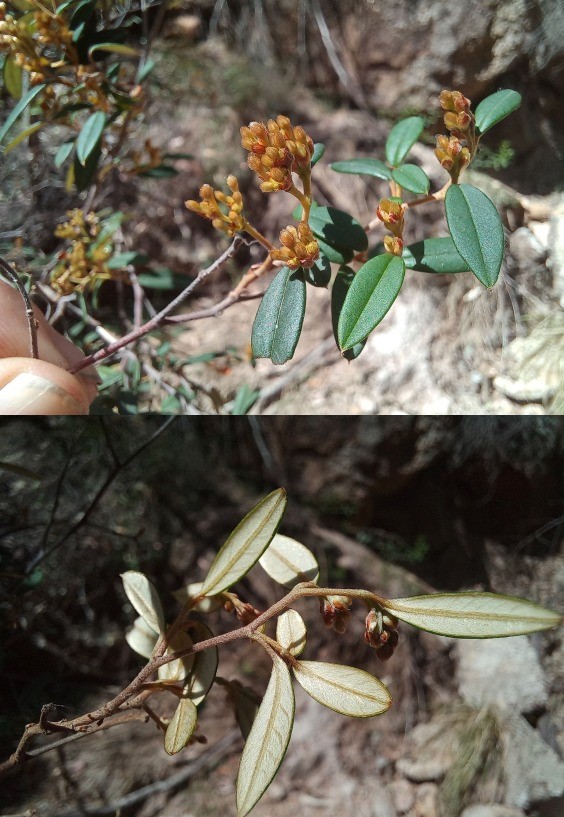
Pomaderris sericea, showing upper leaf surfaces and densely golden-villous buds (top), and leaf undersides (lower), Wollemi National Park (March 2025). Photographs: Stephen Bell.

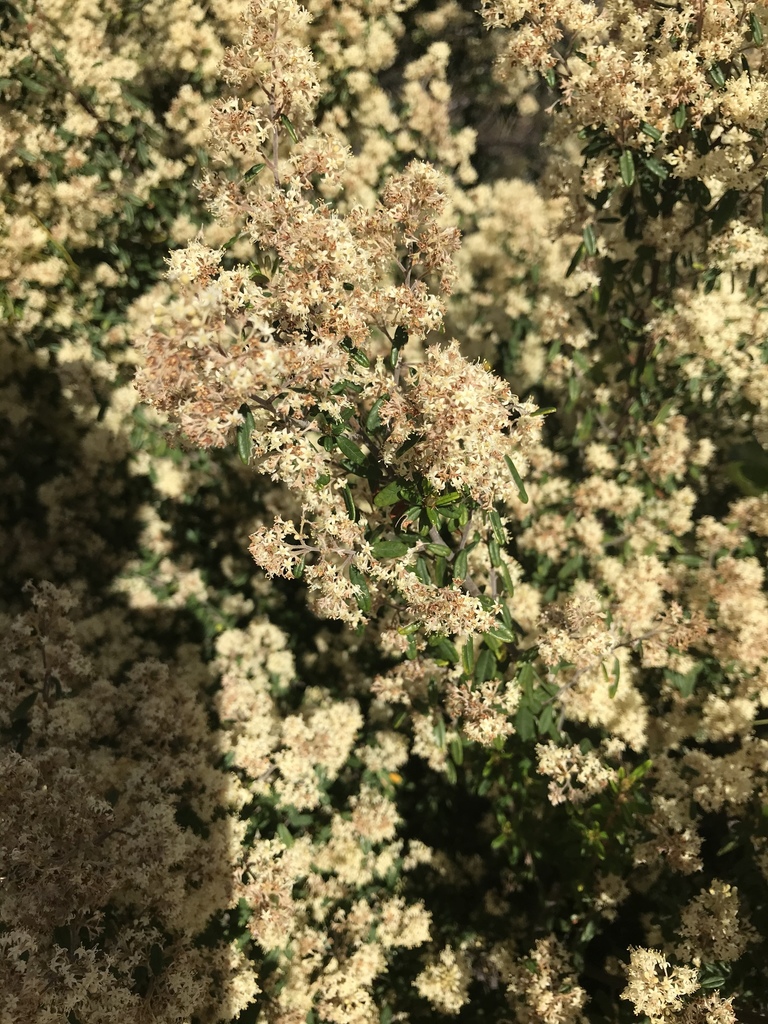
Pomaderris mediora flowering. Photo: Ciaran Nagle – (CC BY-NC)


Call-Out for Iconic Trees

The council is inviting the community to nominate remarkable public trees for inclusion on the new Iconic Tree Register, with nominations opening 25 September 2026.

The register will recognise significant public trees that contribute to the area’s natural beauty, biodiversity, history and sense of place.

Nominated trees must meet one or more criteria, including visual, ecological, historical,  botanic or social significance.

Most public native and exotic trees are eligible, including those exempt for removal under council or State Government controls if they demonstrate they meet the criteria.

The council stated it will launch the official Iconic Tree Register platform in January 2027, after the first nominations have been assessed. The interactive platform will contain images, locations and informative details of each tree.

A council chosen 'panel with expertise in biodiversity, arboriculture, heritage and landscape architecture will assess nominations against the Iconic Tree Register criteria' the statement out of the council says.

The first intake will allow approximately 30 eligible trees to be recommended for inclusion, with future assessment rounds happening on a regular basis.

Listed trees will be managed under the council’s ''Tree Management Policy'' and monitored for health and condition.

For more information and to nominate, visit the council webpage.

A magnificent Grey Gum (E. punctata) example on the hill heading down Riviera Avenue with a Spotted Gum (Eucalyptus maculata) growing alongside it. Pic: AJG/PON

New UNSW Sydney study examines chemicals that may persist in biosolids

Report by Neil Martin, UNSW

Research from UNSW Sydney has assessed a range of contaminants that may warrant closer monitoring to help protect the environment and maintain the benefits of biosolid reuse.

UNSW engineers have identified a number of chemicals that may merit closer scrutiny to ensure water utility companies and regulators can make informed decisions about the management of biosolids.

Biosolids are treated sewage sludge – that is, wastewater from household kitchens, laundries and bathrooms which has been processed to create a product suitable for beneficial use.

About 80% of biosolids produced in Australia are reused on farmland since it provides valuable nutrients and organic matter that can improve soil quality and support plant growth.

However, biosolids can also contain the remnant traces of chemicals entering the system from everyday household activities such as washing, cleaning and taking medicines.

A new study, led by UNSW researchers, has now examined what happens to some of those chemicals when biosolids are applied to farmland, including how long they can remain in the environment and whether their concentrations could potentially affect plants and animals.

Their findings, published in the Journal of Hazardous Materials, provides a framework for identifying contaminants that may need closer attention to ensure regulators can continue to utilise the benefits of biosolids.

Professor Denis O’Carroll, from the Water Research Laboratory, in UNSW’s School of Civil and Environmental Engineering, opens in a new window, said: “It is important that biosolids can continue to be applied to the land to act as a fertiliser and get nutrients into the soil.

“What this research has shown is that there are some potential contaminants of concern because of their concentration or how they persist in soil.

“And we hope this work can be the first step in a multi-staged plan to mitigate the problem.”

Environmental screening assessment

Importantly, the study is an environmental screening assessment. 

It does not demonstrate that the chemicals examined are causing harm on farms, that food grown using biosolids is unsafe, or that people are being exposed to harmful levels of contaminants.

However, the researchers did identify several chemicals that could persist in soil for months or even years. These include some per-and-polyfluoroalkyl substances (PFAS), carbamazepine (a medicine used to treat conditions such as epilepsy), triclocarban and triclosan (antimicrobial chemicals in personal care products) and galaxolide and tonalide (fragrance chemicals).

“Whenever people flush their toilet or their water goes down the sink, all of that ultimately ends up at a wastewater treatment plant,” says Dr Calvin He, author of the paper.

“That wastewater can be treated and the resulting biosolid can be applied to farmland as a fertiliser. But if there are still contaminants present then they can stay in the soil.

“Even though biosolids have a really amazing benefit of being full of carbon, nitrogen and phosphorus, there is also a downside in that you're potentially applying these contaminants.”

For their study, the UNSW team examined 47 chemicals, including pharmaceuticals, personal care products, industrial chemicals, hormones and other substances that have previously been detected in biosolids.

These included commonly used medicines, antimicrobial ingredients found in some personal care products, and chemicals used in industrial and consumer applications.

The 47 substances represent a small selection of the hundreds of chemicals known to have been detected in biosolids. The researchers focused on compounds that could be candidates for further investigation or regulation, rather than attempting to assess every possible contaminant.

Rather than conducting new experiments on farmland, the team brought together findings from existing scientific studies to assess the behaviour of the chemicals.

Three key questions

They investigated three main questions: where a chemical is likely to go after biosolids are applied to land; how long it is likely to remain in the environment; and whether the concentrations reported in biosolids could be of concern in relation to plants and animals.

Some chemicals are more likely to remain in soil, while others may dissolve in water and move into groundwater or nearby waterways. Their behaviour also depends on factors such as temperature, moisture and the presence or absence of oxygen.

Understanding these differences is important because it helps determine where monitoring should take place and which environmental pathways may need attention.

“The first question was what happens to these chemicals once they are applied to the land in the form of biosolids. Do they go into the groundwater? Do they evaporate into the atmosphere, or do they just stay in the soil?" Dr He said.

“The second was how long does each chemical stay in the environment?”

The study showed considerable variation between chemicals.

Some break down relatively quickly, while others can remain in soil or water for months or, in some cases, considerably longer. That is important to know since chemicals that persist may have more opportunity to accumulate if biosolids are applied repeatedly.

The researchers compared reported concentrations in biosolids with existing scientific benchmarks for effects on organisms, such as algae and small aquatic animals. These benchmarks indicate concentrations below which no measurable adverse effect was observed in particular tests.

The comparisons are intended as a conservative screening tool to identify chemicals that may warrant closer investigation. They are not measurements of human exposure or assessments of whether eating food grown on biosolids-treated land is safe.

The team found that concentrations varied considerably between wastewater treatment plants, reinforcing the need for site-specific monitoring rather than assuming all biosolids have the same chemical profile.

The researchers say further work, including testing actual biosolids and soils under local conditions, will be important to better understand which chemicals present a meaningful environmental concern.

Supporting the continued use of biosolids

The research is intended to help identify where further investigation and management may be most useful, rather than discourage the use of biosolids in agriculture.

Prof. O'Carroll says there are potential ways to manage contaminants if particular chemicals are found to pose a concern, including changes to wastewater treatment processes, how biosolids are applied to land, and reducing the use of certain chemicals at their source.

“There are management options that can potentially be applied. The design of wastewater treatment plants can be amended, or their operation can be changed slightly to optimise the removal of specific chemicals if required,” he said.

“If there are a few select contaminants of concern, those are the ones that we should figure out how to manage. There are a number of options, including minimising use of those chemicals in products in the first place, but also options further downstream.”

Calvin He, Richard Stuetz, Stuart J. Khan, Andrew S. Ball, Denis M. O’Carroll, Fate and persistence of emerging chemical contaminants after land application of biosolids: A screening-level risk assessment, Journal of Hazardous Materials, Volume 518, 2026, 143937, ISSN 0304-3894, https://doi.org/10.1016/j.jhazmat.2026.143937. 

Abstract: The presence of emerging chemical contaminants embodied in wastewater treatment plant residuals represents a potential barrier to the continued land application of biosolids given concerns about diffuse and long-term contamination of agricultural lands. Their diverse physiochemical properties, and uncertain environmental fate and persistence constitute chemical contamination risk for the health of soils, especially due to accumulation after repeat applications. This study aimed to quantify the risk posed by 47 emerging contaminants from a range of sources (e.g., pharmaceuticals, personal care products, industrial chemicals, hormones and nitrosamines). Risk was characterized as a combination of persistence and ecotoxicological effect, using the half-life and the hazard quotient, respectively, as the key metrics. Chemicals identified to be persistent in the environment included several per- and polyfluorinated alkyl substances (PFAS), carbamazepine, galaxolide, tonalide, triclocarban and triclosan. Wastewater treatment plant operational and environmental conditions that resulted in faster degradation for particular chemicals have been identified, so practices to minimise their persistence could be implemented. This work has developed a framework for identification of chemicals likely to be highly persistent and thus accumulate following repeat biosolids application, facilitating prioritization of chemical concentration monitoring, targeted treatment, and quantification of repeat biosolids application frequency to minimize emerging contaminant accumulation.

Indigenous-led project to bring Sydney's critically endangered coastal bushland back to life: Great News for Manly's ES Banksia Scrub

Announced: Tuesday November 10 2026

Eastern Suburbs Banksia Scrub (ESBS) is being brought back from the brink in a $6 million project to boost one of Australia's most endangered ecological communities while creating jobs, skills and cultural learning opportunities for young Aboriginal people.

The five-year ACHIEVE project will be led by lndigiGrow, an Aboriginal-owned and staffed not-for-profit native plant nursery and social enterprise based in La Perouse.

The initiative will help protect and restore the Eastern Suburbs Banksia Scrub, which has been reduced to just three per cent of its original extent.

Once covering around 5,300 hectares, ESBS has shrunk due to decades of urban development, invasive species and lack of traditional land management practices, leaving only around 146 hectares remaining.

ACHIEVE will establish a network of new living seedbanks, support culturally informed propagation of native plants, and train a specialised conservation and ecosystem management workforce on Country.

ACHIEVE combines nature restoration with Aboriginal-led Caring for Country, helping preserve and pass on cultural knowledge to younger generations while supporting the long-term health of Sydney's coastal landscapes.

The initiative will deliver environmental, social and cultural benefits by helping restore Eastern Suburbs Banksia Scrub, creating jobs and training opportunities for Aboriginal and Torres Strait Islander people, and building a skilled workforce to care for this unique ecological community long into the future.

This is one of five major environmental initiatives being delivered under the NSW Environmental Trust's 2024 to 2029 Strategic Plan and reflects a new approach to funding strategic, long-term initiatives addressing significant environmental challenges.

The NSW Environmental Trust is investing $39.1 million in the five projects, and when combined with partners' support, there will be more than $62 million in environmental, cultural and community benefits across NSW.

NSW Environmental Trust Director Katie Robinson said:

"Eastern Suburbs Banksia Scrub is a unique part of Sydney's natural heritage, but only a small fraction of it remains.

"This project will help restore this critically endangered ecological community while creating training, employment and cultural opportunities led by Aboriginal communities.

"Protecting our environment takes practical action, strong partnerships and smart investment, and that's exactly what each of the five major projects funded by the NSW Environmental Trust do."

lndigiGrow CEO Peter Cooley said:

"This funding gives us the opportunity to scale up our work in Caring for Country by increasing and protecting Eastern Suburbs Banksia Scrub for future generations.

"We will achieve social, cultural, environmental, and economic outcomes through Aboriginal employment and training, growing and supplying a broader range of local endemic native plants, and help restore habitat for local wildlife.

"The ACHIEVE project will also produce more local native seed through Living Seedbank patches for immediate use allowing us to significantly scale up production. Importantly, the ACHIEVE project will be self-sustaining after the life of the grant.

"In the years ahead, we hope communities across Sydney will see healthier landscapes, greater biodiversity and a stronger connection to the unique plants that belong here."

Background

Eastern Suburbs Banksia Scrub is listed as a critically endangered ecological community.

It once covered approximately 5,300 hectares of Sydney's coastal areas but only around 146 hectares remain.

Eastern Suburbs Banksia Scrub (ESBS) is an ecological community comprising around 200 plant species. Dominant plants include banksias, shrubs, heath species, sedges, grasses, and wattles. While primarily a heathland or shrubland, it can occasionally include low emergent eucalypts and bloodwoods.

If you walk along the clifftops from Manly to Royal National Park, you'll walk through coastal heathland that has grown there for millennia. It may look like it's all the same type of scrub, but it's not. Nestled among this coastal vegetation is a unique type of heath called Eastern Suburbs banksia scrub.

Eastern Suburbs banksia scrub, or ESBS as it's known in Western science, has Aboriginal cultural significance and is home to many animals. In 1788, when Europeans first reached the lands of the Bidjigal and Dharawal peoples, ESBS occurred throughout what is now known as eastern Sydney, North Head and parts of Royal National Park.

The ACHIEVE project will establish ESBS living seedbanks, support culturally informed propagation, and deliver conservation training and qualifications on Country.

The project aims to build a long-term community of practice with the skills and knowledge to protect, restore and expand Eastern Suburbs Banksia Scrub beyond the life of the grant.

lndigiGrow is an Aboriginal-owned, run and staffed not-for-profit native plant nursery based in La Perouse, Sydney.

The Environmental Trust had 4 other successful major grant recipients. 

They are:

  • Barkandji Native Title Prescribed Body Corporate and the Water, Wetlands and Coastal Science branch of the Department of Climate Change, Energy, the Environment and Water (DCCEEW) - Darling Baaka River Health project ($4 million): Improving river health decision-making by combining cultural indicators, joint monitoring and predictive modelling for the Darling Baaka River.
  • Natural Resources Commission - Whole-of-Country Management for Healthy Country project ($11.8 million): A seven-year initiative supporting seven NSW Aboriginal communities to lead cross-tenure natural resource management and care for Country.
  • Royal Botanic Gardens Domain Trust and Bundjalung Tribal Society - Seed and Culture Conservation project ($4.8 million): Establishing an Indigenous-led seed conservation system on Bundjalung Country to strengthen cultural knowledge, support ecological restoration and build climate resilience.
  • Western Sydney University - Climate Adaptation Trials ($12.5 million): Establishing large-scale trials across NSW to identify species, seed sources and genetic traits best suited to future climate conditions.

For more information, visit the Environmental Trust Major Projects webpage.

Eastern spinebill on grevillea, one of the birds which typically inhabit Eastern Suburbs Banksia Scrub.  Credit: DCCEEW

$12.5 million investment to help restore NSW grassy woodlands for a changing climate

Announced: Tuesday November 10 2026

A major research project led by Western Sydney University will help restore and future-proof NSW's grassy woodland ecosystems as the climate changes.

The NSW Government is investing $12.5 million in the project, with a further $9.6 million from project partners bringing the total to $22.1 million.

The project will establish large-scale trials across NSW to identify which native species, seed sources and genetic traits are best suited to future climate conditions.

NSW’s grassy woodland ecosystems have been extensively cleared over the past 250 years, leaving many areas with only small, isolated remnants of original vegetation. Clearing reduces habitat connectivity, limits species movement and genetic diversity, and increases vulnerability to climate change.

Restoring ecosystems is essential for protecting biodiversity, storing carbon and ensuring healthy seed supplies for future restoration projects.

By combining field surveys, genomic analysis, reciprocal transplant experiments and restoration trials, the team will develop practical tools and evidence to guide climate-resilient woodland restoration across NSW.

The project will generate new evidence on how species, traits and genetic diversity shape ecosystem resilience under climate change, helping improve seed selection and increase the success of large-scale restoration projects.

The research will support the restoration of healthy, functioning ecosystems that provide benefits for biodiversity, carbon storage and climate-ready seed production. It will also deliver practical guidance, partnerships and demonstration sites to inform policy, investment decisions and on-ground restoration.

It is one of the first five major environmental initiatives being delivered under the NSW Environmental Trust’s 2024 to 2029 Strategic Plan and reflects a new approach to funding strategic, long-term initiatives addressing significant environmental challenges.

Together with in-kind support, these projects will deliver more than $62 million in environmental, cultural and community benefits across NSW.

NSW Environmental Trust Director Katie Robinson said:

"Restoring our grassy woodlands is essential for protecting biodiversity, storing carbon and building resilience to climate change. This investment will help ensure restoration projects across NSW are guided by the best available science.

"By identifying the plants and seed sources most likely to thrive in future conditions, this research will help us restore healthier ecosystems that can support nature for generations to come.

“The five successful projects will deliver benefits across NSW by supporting biodiversity conservation, climate resilience, ecosystem restoration and better management of our landscapes and waterways.”

Western Sydney University Associate Professor Paul Rymer said:

"We're effectively building a platform for climate-smart restoration, helping communities, land managers and governments make better decisions about what to plant, where and why.

"The research will help unlock the adaptive capacity and knowledge needed to give restored ecosystems the best chance of thriving in a changing climate."

NSW grassy woodland.  Credit: Chaminda Alahakoon, Western Sydney University

$13.5 million to support Aboriginal-led Whole-of-Country planning across NSW

Announced: Tuesday November 11, 2026

Aboriginal communities will be supported to lead the protection and restoration of Country across NSW, backed by an $11.8 million investment from the NSW Government with a further $1.7 million from project partners.

The funding will support six Aboriginal communities to develop Whole-of-Country Management Plans, followed by 18 months of on–ground implementation, bringing together cultural knowledge, local experience and western science to improve biodiversity and deliver lasting benefits for Country and communities.

With biodiversity continuing to decline across NSW, the funding acknowledges the recognised need for Aboriginal-led, cross-tenure approaches to Caring for Country.

Led by the Natural Resources Commission and regional Aboriginal organisations, the project will develop Whole-of-Country plans in six areas to bring together communities, land managers and stakeholders across different land tenures.

It builds on a successful project with the Banbai Rangers and Guyra Local Aboriginal Land Council, which demonstrated Aboriginal-led planning can strengthen cultural authority, improve collaboration and deliver practical outcomes for Country.

Aboriginal communities will lead the planning, design, on-ground works and early implementation of local solutions that heal Country and protect nature for future generations.

The NSW Environmental Trust is providing $11.8 million in funding for the project, which is one of the first five major environmental initiatives being delivered under the NSW Environmental Trust’s 2024 to 2029 Strategic Plan and reflects a new approach to funding strategic, long-term initiatives addressing significant environmental challenges.

The NSW Environmental Trust is investing $39.1 million in the five projects, and when combined with partners’ support, there will be more than $62 million in environmental, cultural and community benefits across NSW.

NSW Environmental Trust Director Katie Robinson said:

“Aboriginal people have cared for Country for tens of thousands of years, and this investment will support communities to lead that work into the future.

“By backing Whole-of-Country planning, we're working at a cross-tenure landscape scale, combining cultural knowledge and science to deliver better outcomes for nature and communities across NSW.

"Protecting our environment takes practical action, strong partnerships and smart investment, and that's exactly what each of the five major projects funded by the NSW Environmental Trust do.”

Natural Resources Commission Bryce Wilde Executive Director said:

“The Natural Resources Commission (NRC) is proud to work alongside Aboriginal communities through the Whole-of-Country Management for Healthy Country Program.

“The program recognises the knowledge and leadership of Aboriginal land managers and supports communities to have a strong voice in how Country is planned for, invested in and managed.

“By bringing regional Aboriginal land managers together to share knowledge and shape cultural land management priorities and investment strategies, the program will help improve biodiversity, strengthen environmental resilience and support healthier Country for future generations.”

Cool burn for the Whole-of-Country management plans.  Credit: Natural Resources Commission

New $4 million project puts Barkandji knowledge at the heart of river health

Announced: Tuesday November 11, 2026

The health of the Darling Baaka will be better protected through a $4 million NSW Government investment that puts Barkandji cultural knowledge and smart monitoring technology at the heart of caring for the river.

The project brings together leading scientists from the NSW Department of Climate Change, Energy, the Environment and Water and the Barkandji Prescribed Body Corporate to strengthen river monitoring and build on the ongoing response to the Menindee fish deaths.

Using smart buoys, cultural indicators and joint river monitoring, the project will provide earlier warnings of river health risks and support better decisions for the Darling Baaka.

The initiative will help protect and strengthen Barkandji cultural knowledge, build the skills of Barkandji Rangers, and increase community understanding of river health and Caring for Country.

The project is helping create a new way of caring for rivers by bringing together the best of cultural and scientific knowledge, with lessons that could benefit waterways across NSW.

This is one of five major environmental initiatives being delivered under the NSW Environmental Trust's 2024 to 2029 Strategic Plan and reflects a new approach to funding strategic, long-term initiatives addressing significant environmental challenges.

The NSW Environmental Trust is investing $39.1 million in the five projects, and when combined with grantee and partners' support, they will deliver more than $62 million in environmental, cultural and community benefits across NSW.

NSW Environmental Trust Director Katie Robinson said:

"The Darling Baaka is one of NSW's most important river systems, and bringing together cultural knowledge and modern technology will better protect its future. By partnering with Barkandji people, we're supporting healthier rivers, stronger communities and better-informed decisions.

"Each of the five major projects funded by the NSW Environmental Trust will help restore nature, strengthen climate resilience and improve the health of landscapes and waterways across NSW."

The Barkandji Prescribed Body Corporate CEO Luke Driscoll said:

"Caring for the Baaka has always been part of who the Barkandji people are. This project gives the Barkandji people the opportunity to be on Country, share our knowledge, experience and take an active role in looking after the river.

"It also creates opportunities for the next generation to build their own knowledge, skills and connection to Country, so that responsibility continues into the future."

Darling Baaka.  Credit: DCCEEW

Vaucluse gets a much-needed flush as the NSW Government cleans up iconic coastline

Announced: November 10 2026

Cleaner waters are on the horizon for Sydney’s world-famous eastern beaches as the NSW Government announced it will get to work on a major project that will put an end to untreated wastewater discharges from Vaucluse, Diamond Bay and Parsley Bay.

''Sydney Water is beginning the final stage of the Refresh Vaucluse and Diamond Bay project, delivering one of the most significant improvements to wastewater flows in the area in 30 years.'' the government said

''For the first time, wastewater from the three coastal outfalls in Vaucluse will be diverted to the Bondi Water Resource Recovery Facility, where it will be treated before being discharged through the deepwater ocean outfall.''

''The first stage of project involved constructing a new pipeline to divert flows from the Vaucluse outfall to Bondi. This infrastructure is nearing completion.

The second and final stage is now underway, which involves construction of an underground pumping station in Dover Heights and connecting pipelines to redirect wastewater from the two remaining outfalls at Diamond Bay to the Bondi network.

Wastewater is then treated at the Bondi Water Resource Recovery Facility and discharged through the deepwater ocean outfall, 2.2 kilometres off the coastline.

The project will deliver cleaner waters and better protect marine environment for residents and visitors along one of Australia’s most recognisable stretches of coastline.'' the government stated

''Much of the new infrastructure will sit below the surface, including the new underground pump station at Eastern Reserve and the connecting pipelines to transfer wastewater from the clifftop communities into Sydney Water’s broader treatment network.''

''Community feedback has helped shape the project design, with a focus on reducing impacts on public spaces and maintaining the character of the surrounding area.

''During construction, Sydney Water and delivering partner Abergeldie Complex Infrastructure will use a range of measures including noise mitigation, approved heavy vehicle routes, trenchless technology and chemical rock excavation methods where possible to reduce disruption.''

''Work is expected to be completed by mid-2028, marking the end of untreated wastewater discharges and leaving a cleaner, healthier coastline for generations to come.'' the government said

Minister for Water Rose Jackson said:

“The days of dodging a Bondi cigar are long gone, so people may be surprised to know that there actually is some untreated wastewater still being discharged from the cliff-facing ocean outfalls in Sydney’s east. We’re flushing it into the history books.

“This significant upgrade will make one of the world’s most iconic coastlines even more beautiful, delivering cleaner waters for the people who live here, visit here and love this spectacular part of Sydney.

“Much of this infrastructure will be out of sight, but the benefits won’t be. By 2028 these untreated wastewater discharges will be a thing of the past, leaving a cleaner, healthier coastline for generations to come.”

Sydney Water Project Director Eddie Wu said:

“This is a significant and complex project that will help support the long-term growth and resilience of Sydney’s wastewater network.

“The project involves careful consideration of environmental, operational and community factors, as well as the coordination of construction activities across a number of locations.

“Through detailed planning and collaboration, we are ensuring the infrastructure can be delivered safely while minimising impacts on local communities and the surrounding environment.”

NSW Snapper Harvest Strategy: Have Your Say

The government is seeking feedback on a draft harvest strategy for NSW Snapper. Share your views on the draft harvest strategy and management framework, which will contribute to the sustainable management of Snapper in NSW.

Public consultation commenced on 1 September 2026 and was initially set to close on 18 October 2026. The consultation period has been extended until 15 February 2027 to ensure opportunity for all stakeholders to provide feedback.

A draft harvest strategy for NSW Snapper has been developed, along with a new stock assessment identifying the stock is at sustainable but low levels.

Documents

The government states on the consultation webpage:

'Harvest strategies are a best-practice way to manage fisheries. They provide a clear plan for balancing environmental, economic, social and Aboriginal cultural interests while helping to keep fish stocks healthy for future generations.

A new integrated stock assessment has estimated the NSW component of the Snapper stock to be approximately 23% of unfished biomass. The assessment indicates the NSW stock has been building from lower levels since the 1990s, so there is some confidence stock biomass will continue increasing under similar catch levels.

The harvest strategy sets clear goals to build the NSW stock to target levels. The first goal is to build the stock to 30% of its unfished biomass. Over time, the aim is to build the stock further to 50% of unfished biomass.

To help achieve this building goal, the harvest strategy sets initial total annual catch (fishing mortality) to 300 tonnes per year, and a defined share to the commercial and recreational sectors. Assessment modelling estimates building to 30% of unfished biomass in 2035 under this level of total catch.

Based on current data, the following management changes would be needed to keep Snapper catches at or below the target level, and within sector shares. These arrangements will be reviewed and updated before commencement and as new information becomes available:'

*Recreational and charter boat limits are not proposed for Snapper.

**Current data indicates a monthly limit of around 950 kg per endorsement holder. Limits will be recalculated before commencement and for each fishing period.

Have your say by filling in a submission form HERE

Consultation will be open from Tuesday 1 September until Monday 15 February 2027.

Your feedback will help to finalise the harvest strategy and management actions to improve the long-term health of the NSW Snapper stock. Please review the harvest strategy and FAQs for further information.

NSW Yellowtail Kingfish Harvest Strategy: Have Your Say

The Government is seeking feedback on a draft harvest strategy for Yellowtail Kingfish in NSW. Share your views on the draft harvest strategy and management framework, which will contribute to the sustainable management of Yellowtail Kingfish in NSW.

Public consultation commenced on 1 September 2026 and was initially set to close on 18 October 2026. The consultation period has been extended until 15 February 2027 to ensure opportunity for all stakeholders to provide feedback.

The government states on the consultation webpage:

'A draft harvest strategy for NSW Yellowtail Kingfish has been developed, along with a new stock assessment identifying the stock as depleted.

Harvest strategies are a best-practice way to manage fisheries. They provide a clear plan for balancing environmental, economic, social and Aboriginal cultural interests while helping to keep fish stocks healthy for future generations.

A new integrated stock assessment has estimated the NSW component of the Yellowtail Kingfish stock to be approximately 5.5% of unfished biomass. The assessment indicates the NSW stock has remained at a relatively consistent but unresponsive level over the past 2 decades.

The harvest strategy sets clear goals to rebuild the NSW stock to healthy levels. The first goal is to rebuild the stock to 30% of its unfished biomass. Over time, the aim is to rebuild the stock further to 50% of unfished biomass.

To help achieve this rebuilding goal, the harvest strategy sets initial total annual catch (fishing mortality) to 120 tonnes per year, which will be shared equally between the recreational and commercial sectors (60 tonnes each). Assessment modelling estimates rebuilding to 20% of unfished biomass in around 9 years, and 30% in around 12 years under this level of total catch.

Recent average total catches are around 250 tonnes per year. Based on current data, the following management changes would be needed to keep Yellowtail Kingfish catches at or below the target level, and within sector shares. These arrangements will be reviewed and updated before commencement and as new information becomes available.

*A recreational catch and release only season may be needed if the bag, possession and boat limits are not sufficient to reduce recreational catch to 60 tonnes for each fishing period. The duration would be assessed based on updated recreational data.

**Current data indicates a monthly limit of around 650 kg per endorsement holder to maintain catch to 60 tonnes for each fishing period. Limits will be recalculated before commencement and for each fishing period.

Lord Howe Island waters are currently excluded from the proposed management changes, recognising Yellowtail Kingfish are likely to comprise a distinct, self-recruiting component of the eastern stock.

Have your say by filling in a submission form HERE.

Consultation will be open from Tuesday 1 September until Monday 15 February 2027.

Your feedback will help to finalise the harvest strategy and management actions to improve the long-term health of the NSW Yellowtail Kingfish stock. Please review the harvest strategy and FAQs for further information.

NSW consulting on Australia's first mandatory solar panel recycling scheme: Have your say

Opened: Monday September 21 2026
Closes: Monday 16 November 2026

The Minns Government is consulting on Australia's first mandatory solar panel recycling scheme to ensure valuable solar panel materials are recovered, reused and recycled rather than sent to landfill.

The proposed regulation will help drive investment and jobs in the solar recycling industry and support the potential development of a solar panel remanufacturing industry in NSW.

NSW leads the nation in solar uptake, with more than 1.18 million rooftop solar systems across homes, businesses, schools and community facilities. As these systems age, increasing numbers of solar panels are ending up in landfill.

Around 14,000 tonnes of solar panel waste is generated in NSW each year. This is predicted to increase to 89,000 tonnes by 2045.

The proposed mandatory product stewardship scheme would require solar panel brand owners to take responsibility for the end-of-life management of their products, helping fund collection, recycling and resource recovery across NSW.

Recycling solar panels is not simply about reducing waste. It is also about capturing valuable resources and creating new economic opportunities.

Valuable materials such as aluminium, glass, silicon, copper and silver can be recovered and reused in new products and manufacturing industries. As larger volumes of materials are recovered, NSW will be better placed to build local supply chains, strengthen manufacturing capability, encourage innovation and create skilled jobs across the state.

To help shape this opportunity, the NSW Government has released an issues paper alongside the draft regulation, seeking feedback on how the state can support the growth of solar panel recycling, remanufacturing and manufacturing industries.

Consultation will seek views from unions, industry, recyclers, manufacturers, researchers, local government, workers and the community on the opportunities, challenges and investment needed to build a circular economy for solar panels in NSW.

Feedback will inform the design of the mandatory product stewardship scheme with the aim of establishing a system that reduces waste, recovers valuable resources and positions NSW as a leader in solar panel recycling and circular manufacturing.

Submissions on the draft regulation and issues paper are now open. For more information and to have your say, visit /yoursay.epa.nsw.gov.au/solar.

Minister for the Environment Penny Sharpe said:

“NSW has embraced rooftop solar, and now we’re making sure those panels don’t become tomorrow’s landfill problem. Solar panels contain valuable materials that can be recovered and put back to work.

“A mandatory product stewardship scheme can help build a circular economy for solar panels, while supporting new recycling and manufacturing opportunities here in NSW.” 

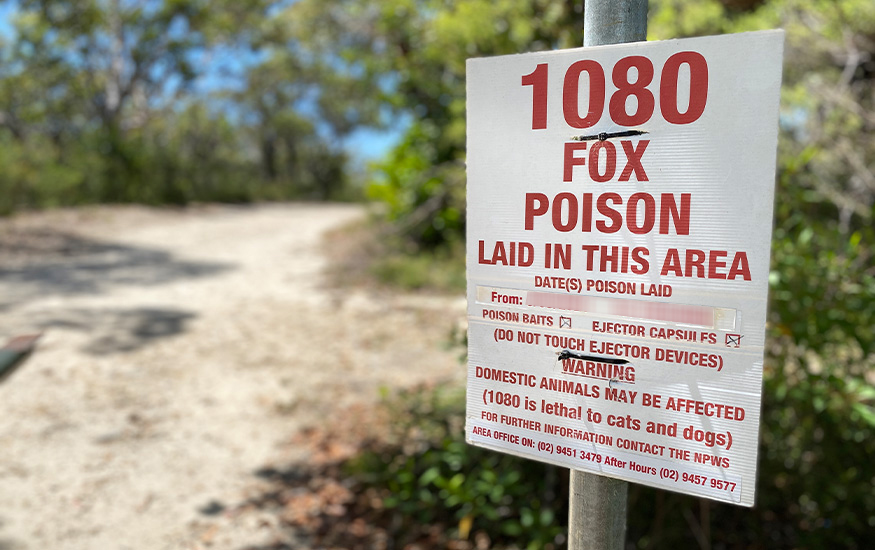
Garigal + Ku-ring Gai National Park: 1080 Operation

NSW National Parks and Wildlife Service will be conducting a baiting program using manufactured baits, fresh baits and Canid Pest Ejectors (CPEs) containing 1080 poison (sodium fluroacetate) for the control of foxes. 

The program is continuous and ongoing between 1 August 2026 and 31 January 2027 in Garigal National Park. Don’t touch baits or ejector devices. Penalties apply for non-compliance. 

Ku-ring Gai Chase Applies from Fri 31 Jul 2026, 10.25pm to Mon 01 Feb 2027, 2.26am. 

NSW National Parks and Wildlife Service will be conducting a baiting program using manufactured baits, fresh baits and Canid Pest Ejectors (CPEs) containing 1080 poison (sodium fluroacetate) for the control of foxes. The program is continuous and ongoing between 1 August 2026 and 31 January 2027 in Ku-ring-gai Chase National Park.

All baiting locations are identifiable by signs.

Domestic pets are not permitted in NSW national parks and reserves. Pets and working dogs may be affected (1080 is lethal to cats and dogs). Pets and working dogs must be restrained or muzzled in the vicinity and must not enter the baiting location. In the event of accidental poisoning seek immediate veterinary assistance.

Fox baiting in these reserves is aimed at reducing their impact on threatened species.

For more information, contact the local park office on:

  • Forestville 9451 3479 (business hours)
  • NPWS after-hours call centre: 1300 056 294 (after hours)

Public comment opens on industrial port and dredging proposal threatening Exmouth Gulf-Ningaloo

  • WA EPA has released Gascoyne Gateway’s environmental review documents for its proposed industrial port in Exmouth Gulf for public scrutiny. 
  • AMCS-Protect Ningaloo is campaigning to stop the port that would attract shipping through a critical humpback whale resting and nursing ground, require extensive dredging and cause other wide-ranging impacts.
  • Exmouth Gulf, Ningaloo will become WA’s newest marine park and is under formal assessment for National Heritage listing – AMCS-Protect Ningaloo maintains that an industrial port would be entirely incompatible with these vital conservation measures.

Australians have 12 weeks to voice their concerns about the industrialisation of Exmouth Gulf after Western Australia’s Environmental Protection Authority (EPA) today released the Environmental Review Document for Gascoyne Gateway’s port proposal for public comment. Submissions close 16 November 2026.

The Australian Marine Conservation Society states the proposal poses such widespread potential impacts to matters of national environmental significance that it has also triggered a federal assessment that will be part of this public comment period.

Gascoyne Gateway wants to build an industrial port 10km south of Exmouth town next to Qualing Pool – a rare freshwater oasis that the WA Government has earmarked as a class A nature reserve. The port would attract large vessels including fuel tankers, cargo ships, cruise liners and other heavy shipping into Exmouth Gulf, which the WA Government has earmarked for a marine park and which is under formal assessment by the Australian Government as a National Heritage treasure. 

This ecologically rich marine and coastal area is closely linked to the World Heritage-listed Ningaloo Coast and holds high conservation value. The area is home to many threatened and listed species, including dugongs, turtles, manta rays, sea snakes and dolphins, as well as corals, seagrass meadows, and sponge gardens. The proposed port would attract massive ships that would pass through a critical resting and nursing ground for one of the world’s largest humpback whale populations, posing serious threats of vessel strike and disturbance. 

Tens of thousands of people have joined AMCS-Protect Ningaloo, the Exmouth-based Cape Conservation Group and many local community members, in opposing the proposal since plans were first announced in 2020.  Over 20,000 emails have been sent to the current and past WA environment ministers calling for them to reject the proposal because it would fundamentally diminish the environmental values of Exmouth Gulf.

AMCS Chief Executive and Protect Ningaloo Director Paul Gamblin said: 

“The Gascoyne Gateway industrial port and dredging proposal is completely incompatible with the environmentally fragile Exmouth Gulf – Ningaloo’s Nursery – and would change this marine wonder forever.  

“An industrial port proposal, jutting nearly a kilometre into Exmouth Gulf and dredging of more than a million cubic metres of the seafloor in one of the world’s most important whale nursing grounds beggars belief.

“Tens of thousands of people have already made clear that industrialisation is unacceptable for Exmouth Gulf. People know that Exmouth Gulf obviously is no place for a port – its future is one of conservation and sustainable, light-touch economic activity, not industrialisation.

“Both the WA and federal governments have signalled that they are committed to protecting Exmouth Gulf so it’s time they made it clear that the future of this natural wonder is economic activity that treads lightly on its fragile environment. They must reject this proposal.

Cape Conservation Group Chair Denise Fitch said: “Exmouth Gulf is where Ningaloo’s whales rest and give birth, where our dugongs and manta rays feed. Dredging a port in the middle of this precious nursery goes against the spirit of stewardship that’s made Ningaloo the conservation and tourism success it has become. 

“Ningaloo is already under pressure from climate change. We’ve recently experienced unprecedented coral bleaching and seagrass damage from marine heatwaves, and further destruction from Cyclone Narelle. Now is not the moment to be adding industrial stressors to this fragile ecosystem. And this is no place for an industrial port. 

“We encourage those who know and love Ningaloo’s nursery to make a submission to the EPA and say no to this unwelcome proposal.”

Protect Ningaloo is calling on Gascoyne Gateway to do the right thing, as two other companies which pursued industrial projects in the Gulf have already done, and withdraw its proposal. 

Overview of Proposed Project

Gascoyne Gateway Ltd proposes to build, own and operate a multipurpose marine complex in Exmouth that will service a variety of vessels including but not limited to cruise liners and associated ecotourism activities, Defence and marine supply vessels. The project will not be utilised for livestock or iron ore.

The Proposal site is located 10 kilometres south of the Exmouth township and immediately south of the Ingram Street light industrial area; opposite the Exmouth landfill site and to the north of the Wilderness Estate residential area.

The proposal has a land-based component (including fuel storage and laydown, supporting marine facilities, desalination plant, renewables precinct, and access and utilities corridor), and a marine component (including marine infrastructure, vessel berths/channels, and anchorages).

An Environmental Review Document (ERD) has been prepared by Gascoyne Gateway Ltd in accordance with Environmental Protection Authority procedures and is released for public review.

The ERD describes the proposal, examines the likely environmental effects and the proposed environmental management procedures associated with the proposed development.

The Proposal includes a land based component (106.54 ha footprint within a 119.02 ha terrestrial development envelope) to support the marine infrastructure (61.63 ha marine footprint within and 79.44 ha marine development envelope) which includes a combination rock groyne and pylon steel construction to a berth-face. The berth face will require 13.5 m of cleared depth (at chart datum, equivalent to depth at LAT) to meet design vessel draughts, achieved by both natural depth and some dredging of sand and seabed limestone at the berth pocket. Marine construction includes piling and dredging, with dredge spoil used in the causeway construction. Three anchorage locations of 1nm diameter each are located in Exmouth Gulf approximately 9.5 km to the north east of the end of the causeway, within a nominal anchorage development envelope of 1153.14 ha. 

The ERD is available for download from Gascoyne Gateway Marine Complex | EPA Western Australia under 3. Assessment > Environmental Review.

The document is also available on the proponent’s website at Gascoyne Gateway Marine Complex.

Submissions should be made here: https://consultation.epa.wa.gov.au/assessment-and-compliance/gascoyne-gateway-marine-complex-per/

Submissions close November 16

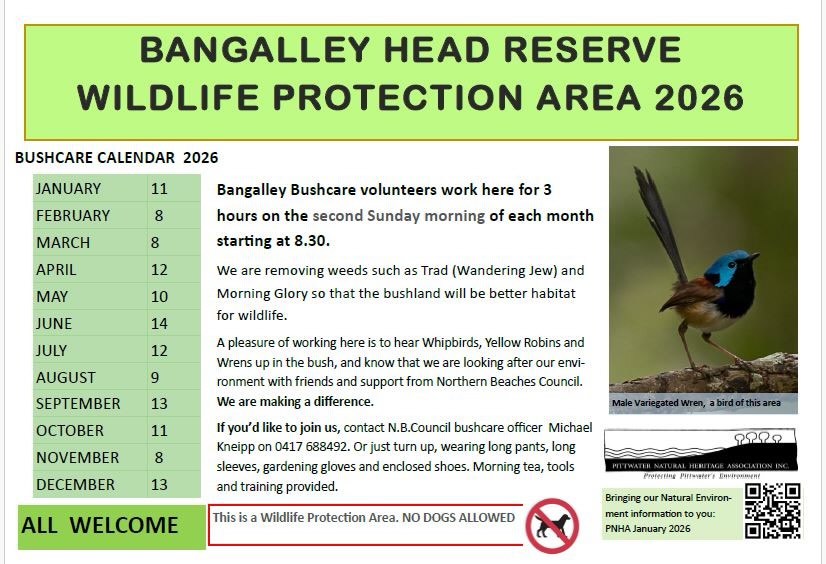
PNHA Activities 2026

Our walks for 2026 are listed below. 

You are very welcome to bring friends and older children on these outings. Please book by emailing pnhainfo@gmail.com and include  your PHONE NUMBER so we can contact you in case of changes because of weather etc. 

Looking forward to getting out and about in our lovely area! 

Your PNHA Committee

Pittwater Natural Heritage Association

The Pittwater Natural Heritage Association has been formed to act to protect and preserve the Pittwater areas major and most valuable asset - its natural heritage.

PNHA is an incorporated association seeking broad based community membership and support to enable it to have an effective and authoritative voice speaking out for the preservation of Pittwater's natural heritage.

Our Aims

  • To raise public awareness of the conservation value of the natural heritage of the Pittwater area: its landforms, watercourses, soils and local native vegetation and fauna.
  • To raise public awareness of the threats to the long-term sustainability of Pittwater's natural heritage.
  • To foster individual and community responsibility for caring for this natural heritage.
  • To encourage Pittwater Council and the NSW Government to adopt and implement policies and works which will conserve, sustain and enhance the natural heritage of Pittwater.

Some of our interests and concerns include:

  • Native Tree Canopy
  • "Wildlife Friendly" Gardens
  • Weed Infestation
  • Keeping our Waterways Healthy
  • Beaches and Dunes

Act to Preserve and Protect!

If you would like to join us, please fill out the Membership Form. Visit: https://pnha.org.au

Sunday September 27. Spring in the Bush: Terrey Hills

Meet 9am at corner of Mallawa Rd and Bulara St, Terrey Hills. Walk ends about 11am. With a focus on botany, we’ll see flowering plants in the Proteaceae plant family, waratahs, endangered Grevillea caleyi , and others in the major Australian Proteaceae plant family. You can choose to lengthen this walk which connects to the Perimeter Track. Birds, too.

Sunday October 25: Katandra by Night

Meet 6.45pm at Katandra Bushland Sanctuary on Lane Cove Rd Ingleside. Walk ends about 8.45pm. Sunset is about 7.15. The bush by night is wonderful. We hope to see fireflies again as on previous walks here in October. Bring a torch, or headtorch, preferably with a red light option so as not to dazzle possums. Moderate fitness needed for the bush track and steps. Limit: 15 people, so please book early. 

Sunday November 22: Deep Creek Reserve

Meet 9am in Deep Creek reserve, off Wakehurst Parkway. Walk ends about 11am. Birds and bushland. From the bridge across the creek we may see Dollarbirds, summer breeding migrants that nest in hollows, with their youngsters. Black Bitterns have been observed along the creek margins, so bring binoculars. 

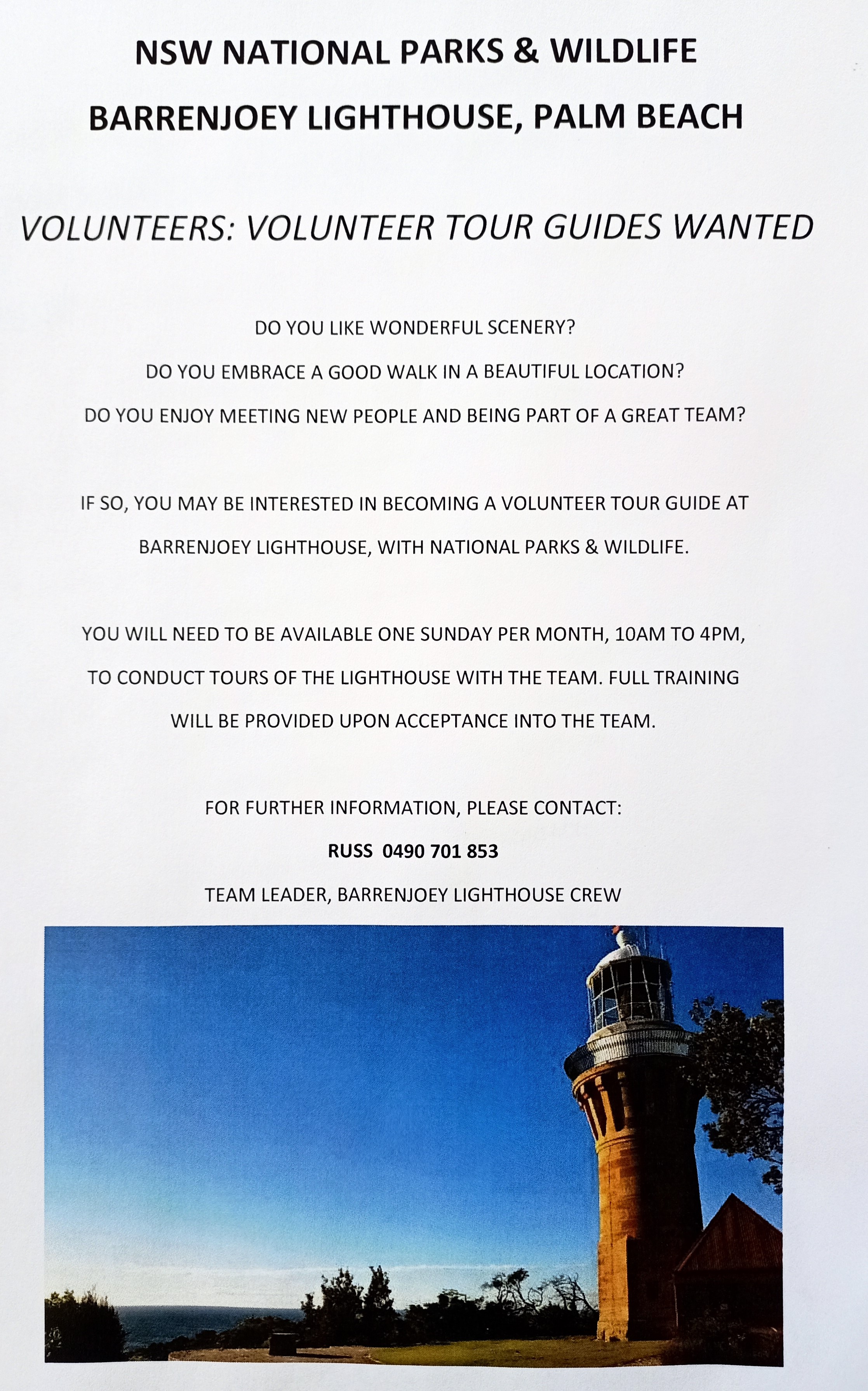
Barrenjoey Lighthouse Tours: every Sunday

Climb to Sydney’s northernmost point and step inside the beautifully restored Barrenjoey Lighthouse, built in 1881.


Perched above Palm Beach in Ku Ring Gai Chase National Park, the lighthouse offers sweeping 360-degree views across Broken Bay and the mighty Pacific Ocean.

Join a guided tour to hear stories of its past and discover what life was like for a 19th-century lighthouse keeper.

Tours run every Sunday, hourly from 11am - 3pm. 

National Parks and Wildlife Service
Photo: NPWS

Coming up at Kimbriki

Solar for apartment residents: Co-funding

Less than 2% of apartment buildings in NSW have solar installed, but the NSW Department of Climate Chnage, Energy, the Environment and Water are on a mission to change this.

Their Solar for Apartment Residents grant is co-funding shared solar panel installations on eligible apartment buildings and multi-unit dwellings and has already helped thousands of households.

They’ve extended the program to help more homeowners and renters reduce their energy bills and have also allocated extra funds through a separate Boost grant to help priority communities too.

Application closes: 4 December 2026, 5:00 pm

Share this with your Owners Corporation or Stata Manager and check your building's eligibility at: www.nsw.gov.au/grants-and-funding/solar-for-apartment-residents-soar-grant-program

Birdwood Park Bushcare Group Narrabeen

The council has received an application from residents to volunteer to look after bushland at 199/201 Ocean street North Narrabeen.

The group will meet once a month for 2-3 hours at a time to be decided by the group. Activities will consist of weeding out invasive species and encouraging the regeneration of native plants. Support and supervision will be provided by the council.

If you have questions or are interested in joining the group please email the council on bushcare@northernbeaches.nsw.gov.au

Sydney Wildlife (Sydney Metropolitan Wildlife Services) Needs People for the Rescue Line

We are calling on you to help save the rescue line because the current lack of operators is seriously worrying. Look at these faces! They need you! 

Every week we have around 15 shifts either not filled or with just one operator and the busy season is around the corner. This situation impacts on the operators, MOPs, vets and the animals, because the phone line is constantly busy. Already the baby possum season is ramping up with calls for urgent assistance for these vulnerable little ones.

We have an amazing team, but they can’t answer every call in Spring and Summer if they work on their own.  Please jump in and join us – you would be welcomed with open arms!  We offer lots of training and support and you can work from the office in the Lane Cove National Park or on your home computer.

If you are not able to help do you know someone (a friend or family member perhaps) who might be interested?

Please send us a message and we will get in touch. Please send our wonderful office admin Carolyn an email at  sydneywildliferescueline@gmail.com

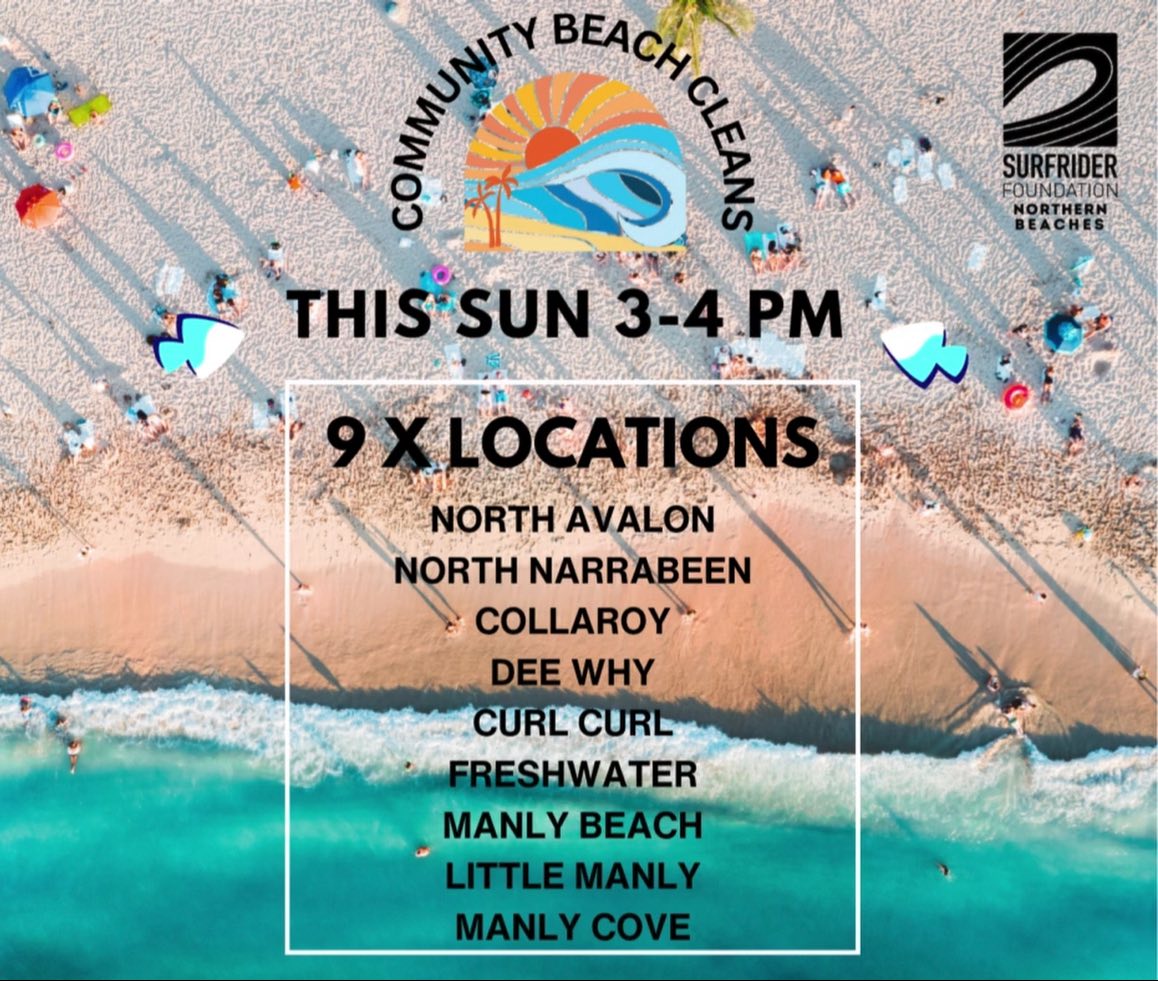
622kg of Rubbish Collected from Local Beaches: Adopt your local beach program

Sadly, our beaches are not as pristine as we'd all like to think they are. 

Surfrider Foundation Northern Beaches' Adopt A beach ocean conservation program is highlighting that we need to clean up our act.

Surfrider Foundation Northern Beaches' states:
''The collective action by our amazing local community at their monthly beach clean events across 9 beach locations is assisting Surfrider Foundation NB in the compilation of quantitative data on the volume, type and often source of the marine pollution occurring at each location.

In just 6 sessions, clear indicators are already forming on the waste items and areas to target with dedicated litter prevention strategies.

Plastic pollution is an every body problem and the solution to fixing it lies within every one of us.
Together we can choose to refuse this fate on our Northern beaches and turn the tide on pollution. 
A cleaner coast together !''

Join us - 1st Sunday of the month, Adopt your local for a power beach clean or donate to help support our program here. https://www.surfrider.org.au/donate/

Event locations 
  • Avalon – Des Creagh Reserve (North Avalon Beach Lookout)
  • North Narrabeen – Corner Ocean St & Malcolm St (grass reserve next to North Narrabeen SLSC)
  • Collaroy– 1058 Pittwater Rd (beachfront next to The Beach Club Collaroy)
  • Dee Why Beach –  Corner Howard Ave & The Strand (beachfront grass reserve, opposite Blu Restaurant)
  • Curl Curl – Beachfront at North Curl Curl Surf Club. Shuttle bus also available from Harbord Diggers to transport participants to/from North Curl Curl beach. 
  • Freshwater Beach – Moore Rd Beach Reserve (opposite Pilu Restaurant)
  • Manly Beach – 11 South Steyne (grass reserve opposite Manly Grill)
  • Manly Cove – Beach at West Esplanade (opposite Fratelli Fresh)
  • Little Manly– 55 Stuart St Little Manly (Beachfront Grass Reserve)
… and more to follow!

Surfrider Foundation Northern Beaches

This Tick Season: Freeze it - don't squeeze it

Notice of 1080 Poison Baiting

The NSW National Parks and Wildlife Service (NPWS) will be conducting a baiting program using manufactured baits, fresh baits and Canid Pest Ejectors (CPE’s/ejectors) containing 1080 poison (sodium fluoroacetate) for the control of foxes. The program is continuous and ongoing for the protection of threatened species.

This notification is for the period to 31 July 2026 at the following locations:

  • Garigal National Park
  • Lane Cove National Park (baits only, no ejectors are used in Lane Cove National Park)
  • Ku-ring-gai Chase National Park
  • Sydney Harbour National Park – North Head (including the Quarantine Station), Dobroyd Head, Chowder Head & Bradleys Head managed by the NPWS
  • The North Head Sanctuary managed by the Sydney Harbour Federation Trust
  • The Australian Institute of Police Management, North Head

DO NOT TOUCH BAITS OR EJECTORS

All baiting locations will be identifiable by signs.

Please be reminded that domestic pets are not permitted on NPWS Estate. Pets and working dogs may be affected (1080 is lethal to cats and dogs). Pets and working dogs must be restrained or muzzled in the vicinity and must not enter the baiting location. Penalties apply for non-compliance.

In the event of accidental poisoning seek immediate veterinary assistance.

For further information please call the local NPWS office on:

NPWS Sydney North (Middle Head) Area office: 9960 6266

NPWS Sydney North (Forestville) Area office: 9451 3479

NPWS North West Sydney (Lane Cove NP) Area office: 8448 0400

NPWS after-hours Duty officer service: 1300 056 294

Sydney Harbour Federation Trust: 8969 2128

Volunteers for Barrenjoey Lighthouse Tours needed

Details:

Johnson Brothers Mitre 10 Recycling Batteries: at Mona Vale + Avalon Beach

Over 18,600 tonnes of batteries are discarded to landfill in Australia each year, even though 95% of a battery can be recycled!

That’s why we are rolling out battery recycling units across our stores! Our battery recycling units accept household, button cell, laptop, and power tool batteries as well as mobile phones! 

How To Dispose Of Your Batteries Safely: 

  1. Collect Your Used Batteries: Gather all used batteries from your home. Our battery recycling units accept batteries from a wide range of products such as household, button cell, laptop, and power tool batteries.
  2. Tape Your Terminals: Tape the terminals of used batteries with clear sticky tape.
  3. Drop Them Off: Come and visit your nearest participating store to recycle your batteries for free (at Johnson Brothers Mitre 10 Mona Vale and Avalon Beach).
  4. Feel Good About Your Impact: By recycling your batteries, you're helping support a healthier planet by keeping hazardous material out of landfills and conserving resources.

Environmental Benefits

  • Reduces hazardous waste in landfill
  • Conserves natural resources by promoting the use of recycled materials
  • Keep toxic materials out of waterways 

Reporting Dogs Offleash - Dog Attacks to Council

If the attack happened outside local council hours, you may call your local police station. Police officers are also authorised officers under the Companion Animals Act 1998. Authorised officers have a wide range of powers to deal with owners of attacking dogs, including seizing dogs that have attacked.

You can report dog attacks, along with dogs offleash where they should not be, to the NBC anonymously and via your own name, to get a response, at: https://help.northernbeaches.nsw.gov.au/s/submit-request?topic=Pets_Animals

If the matter is urgent or dangerous call Council on 1300 434 434 (24 hours a day, 7 days a week).

If you find injured wildlife please contact:
  • Sydney Wildlife Rescue (24/7): 9413 4300 
  • WIRES: 1300 094 737

Plastic Bread Ties For Wheelchairs

The Berry Collective at 1691 Pittwater Rd, Mona Vale collects them for Oz Bread Tags for Wheelchairs, who recycle the plastic.

Berry Collective is the practice on the left side of the road as you head north, a few blocks before Mona Vale shops . They have parking. Enter the foyer and there's a small bin on a table where you drop your bread ties - very easy.

A full list of Aussie bread tags for wheelchairs is available at: HERE 


Stay Safe From Mosquitoes 

NSW Health is reminding people to protect themselves from mosquitoes when they are out and about.

NSW Health states Mosquitoes in NSW can carry viruses such as Japanese encephalitis (JE), Murray Valley encephalitis (MVE), Kunjin, Ross River and Barmah Forest. The viruses may cause serious diseases with symptoms ranging from tiredness, rash, headache and sore and swollen joints to rare but severe symptoms of seizures and loss of consciousness.

A free vaccine to protect against JE infection is available to those at highest risk in NSW and people can check their eligibility at NSW Health.

People are encouraged to take actions to prevent mosquito bites and reduce the risk of acquiring a mosquito-borne virus by:
  • Applying repellent to exposed skin. Use repellents that contain DEET, picaridin, or oil of lemon eucalyptus. Check the label for reapplication times.
  • Re-applying repellent regularly, particularly after swimming. Be sure to apply sunscreen first and then apply repellent.
  • Wearing light, loose-fitting long-sleeve shirts, long pants and covered footwear and socks.
  • Avoiding going outdoors during peak mosquito times, especially at dawn and dusk.
  • Using insecticide sprays, vapour dispensing units and mosquito coils to repel mosquitoes (mosquito coils should only be used outdoors in well-ventilated areas)
  • Covering windows and doors with insect screens and checking there are no gaps.
  • Removing items that may collect water such as old tyres and empty pots from around your home to reduce the places where mosquitoes can breed.
  • Using repellents that are safe for children. Most skin repellents are safe for use on children aged three months and older. Always check the label for instructions. Protecting infants aged less than three months by using an infant carrier draped with mosquito netting, secured along the edges.
  • While camping, use a tent that has fly screens to prevent mosquitoes entering or sleep under a mosquito net.
Remember, Spray Up – Cover Up – Screen Up to protect from mosquito bite. For more information go to NSW Health.

Mountain Bike Incidents On Public Land: Survey

This survey aims to document mountain bike related incidents on public land, available at: https://www.surveymonkey.com/r/K88PSNP

Sent in by Pittwater resident Academic for future report- study. 

Report fox sightings

Fox sightings, signs of fox activity, den locations and attacks on native or domestic animals can be reported into FoxScan. FoxScan is a free resource for residents, community groups, local Councils, and other land managers to record and report fox sightings and control activities. 

Our Council's Invasive species Team receives an alert when an entry is made into FoxScan.  The information in FoxScan will assist with planning fox control activities and to notify the community when and where foxes are active.


marine wildlife rescue group on the Central Coast

A new wildlife group was launched on the Central Coast on Saturday, December 10, 2022.

Marine Wildlife Rescue Central Coast (MWRCC) had its official launch at The Entrance Boat Shed at 10am.

The group comprises current and former members of ASTR, ORRCA, Sea Shepherd, Greenpeace, WIRES and Wildlife ARC, as well as vets, academics, and people from all walks of life.

Well known marine wildlife advocate and activist Cathy Gilmore is spearheading the organisation.

“We believe that it is time the Central Coast looked after its own marine wildlife, and not be under the control or directed by groups that aren’t based locally,” Gilmore said.

“We have the local knowledge and are set up to respond and help injured animals more quickly.

“This also means that donations and money fundraised will go directly into helping our local marine creatures, and not get tied up elsewhere in the state.”

The organisation plans to have rehabilitation facilities and rescue kits placed in strategic locations around the region.

MWRCC will also be in touch with Indigenous groups to learn the traditional importance of the local marine environment and its inhabitants.

“We want to work with these groups and share knowledge between us,” Gilmore said.

“This is an opportunity to help save and protect our local marine wildlife, so if you have passion and commitment, then you are more than welcome to join us.”

Marine Wildlife Rescue Central Coast has a Facebook page where you may contact members. Visit: https://www.facebook.com/profile.php?id=100076317431064


Watch out - shorebirds about

Pittwater is home to many resident and annually visiting birds. If you watch your step you won't harm any beach-nesting and estuary-nesting birds have started setting up home on our shores.

Did you know that Careel Bay and other spots throughout our area are part of the East Asian-Australasian Flyway Partnership (EAAFP)?

This flyway, and all of the stopping points along its way, are vital to ensure the survival of these Spring and Summer visitors. This is where they rest and feed on their journeys.  For example, did you know that the bar-tailed godwit flies for 239 hours for 8,108 miles from Alaska to Australia?

Not only that, Shorebirds such as endangered oystercatchers and little terns lay their eggs in shallow scraped-out nests in the sand, NSW National Parks and Wildlife Service (NPWS) Threatened Species officer Ms Katherine Howard has said.
Even our regular residents such as seagulls are currently nesting to bear young.

What can you do to help them?
Known nest sites may be indicated by fencing or signs. The whole community can help protect shorebirds by keeping out of nesting areas marked by signs or fences and only taking your dog to designated dog offleash area. 

Just remember WE are visitors to these areas. These birds LIVE there. This is their home.

Four simple steps to help keep beach-nesting birds safe:
1. Look out for bird nesting signs or fenced-off nesting areas on the beach, stay well clear of these areas and give the parent birds plenty of space.
2. Walk your dogs in designated dog-friendly areas only and always keep them on a leash over summer.
3. Stay out of nesting areas and follow all local rules.
4. Chicks are mobile and don't necessarily stay within fenced nesting areas. When you're near a nesting area, stick to the wet sand to avoid accidentally stepping on a chick.


Possums In Your Roof?: do the right thing

Possums in your roof? Please do the right thing 
On the weekend, one of our volunteers noticed a driver pull up, get out of their vehicle, open the boot, remove a trap and attempt to dump a possum on a bush track. Fortunately, our member intervened and saved the beautiful female brushtail and the baby in her pouch from certain death. 

It is illegal to relocate a trapped possum more than 150 metres from the point of capture and substantial penalties apply.  Urbanised possums are highly territorial and do not fare well in unfamiliar bushland. In fact, they may starve to death or be taken by predators.

While Sydney Wildlife Rescue does not provide a service to remove possums from your roof, we do offer this advice:

✅ Call us on (02) 9413 4300 and we will refer you to a reliable and trusted licenced contractor in the Sydney metropolitan area. For a small fee they will remove the possum, seal the entry to your roof and provide a suitable home for the possum - a box for a brushtail or drey for a ringtail.
✅ Do-it-yourself by following this advice from the Department of Planning and Environment: 

❌ Do not under any circumstances relocate a possum more than 150 metres from the capture site.
Thank you for caring and doing the right thing.


Sydney Wildlife photos

Aviaries + Possum Release Sites Needed

Pittwater Online News has interviewed Lynette Millett OAM (WIRES Northern Beaches Branch) needs more bird cages of all sizes for keeping the current huge amount of baby wildlife in care safe or 'homed' while they are healed/allowed to grow bigger to the point where they may be released back into their own home. 

If you have an aviary or large bird cage you are getting rid of or don't need anymore, please email via the link provided above. There is also a pressing need for release sites for brushtail possums - a species that is very territorial and where release into a site already lived in by one possum can result in serious problems and injury. 

If you have a decent backyard and can help out, Lyn and husband Dave can supply you with a simple drey for a nest and food for their first weeks of adjustment.

Mona Vale Dunes bushcare group: 2026 Dates

What’s Happening? Mona Vale Dunes Bushcare group catch-up. 

In 2026 our usual work mornings will be the second Saturday and third Thursday of each month. You can come to either or both. 

We are maintaining an area south of Golf Avenue. This was cleared of dense lantana, green cestrum and ground Asparagus in 2019-2020. 600 tubestock were planted in June 2021, and natural regeneration is ongoing. 

Photos: The site In November 2019, chainsaws at the ready. In July 2025, look at the difference - coastal dune vegetation instead of dense weeds. But maintenance continues and bushcarers are on the job. Can you join us?

(access to this southern of MV Dunes  - parking near Mona Vale Headland reserve, or walk from Golf Ave.) 

For comparison, see this image of MV dunes in 1969!, taken from atop the home units at the end of Golf Avenue. 

2026 Dates

Bangalley Headland WPA Bushcare 2026

Watch out for PNHA signs telling you about bush regeneration and our local environment. This is one of many coming up.

Bushcare in Pittwater: where + when

For further information or to confirm the meeting details for below groups, please contact Council's Bushcare Officer on 9970 1367 or visit Council's bushcare webpage to find out how you can get involved.

BUSHCARE SCHEDULES 
Where we work                      Which day                              What time 

Avalon     
Angophora Reserve             3rd Sunday                         8:30 - 11:30am 
Avalon Dunes                        1st Sunday                         8:30 - 11:30am 
Avalon Golf Course              2nd Wednesday                 3 - 5:30pm 
Careel Creek                         4th Saturday                      8:30 - 11:30am 
Toongari Reserve                 3rd Saturday                      9 - 12noon (8 - 11am in summer) 
Bangalley Headland            2nd Sunday                         9 to 12noon 
Catalpa Reserve              4th Sunday of the month        8.30 – 11.30
Palmgrove Park              1st Saturday of the month        9.00 – 12 

Bayview     
Winnererremy Bay                 4th Sunday                        9 to 12noon 

Bilgola     
North Bilgola Beach              3rd Monday                        9 - 12noon 
Algona Reserve                     1st Saturday                       9 - 12noon 
Plateau Park                          1st Friday                            8:30 - 11:30am 

Church Point     
Browns Bay Reserve             1st Tuesday                        9 - 12noon 
McCarrs Creek Reserve       Contact Bushcare Officer     To be confirmed 

Clareville     
Old Wharf Reserve                 3rd Saturday                      8 - 11am 

Elanora     
Kundibah Reserve                   4th Sunday                       8:30 - 11:30am 

Mona Vale     
Mona Vale Beach Basin          1st Saturday                    8 - 11am 
Mona Vale Dunes                     2nd Saturday +3rd Thursday     8:30 - 11:30am 

Newport     
Bungan Beach                          4th Sunday                      9 - 12noon 
Crescent Reserve                    3rd Sunday                      9 - 12noon 
North Newport Beach              4th Saturday                    8:30 - 11:30am 
Porter Reserve                          2nd Saturday                  8 - 11am 

North Narrabeen     
Irrawong Reserve                     2nd Saturday                   2 - 5pm 

Palm Beach     
North Palm Beach Dunes      3rd Saturday                    9 - 12noon 

Scotland Island     
Catherine Park                          2nd Sunday                     10 - 12:30pm 
Elizabeth Park                           1st Saturday                      9 - 12noon 
Pathilda Reserve                      3rd Saturday                      9 - 12noon 

Warriewood     
Warriewood Wetlands             1st Sunday                         8:30 - 11:30am 

Whale Beach     
Norma Park                               1st Friday                            9 - 12noon 

Western Foreshores     
Coopers Point, Elvina Bay      2nd Sunday                        10 - 1pm 
Rocky Point, Elvina Bay           1st Monday                          9 - 12noon

Friends Of Narrabeen Lagoon Catchment Activities

Bush Regeneration - Narrabeen Lagoon Catchment  
This is a wonderful way to become connected to nature and contribute to the health of the environment.  Over the weeks and months you can see positive changes as you give native species a better chance to thrive.  Wildlife appreciate the improvement in their habitat.

Belrose area - Thursday mornings 
Belrose area - Weekend mornings by arrangement
Contact: Phone or text Conny Harris on 0432 643 295

Wheeler Creek - Wednesday mornings 9-11am
Contact: Phone or text Judith Bennett on 0402 974 105
Or email: Friends of Narrabeen Lagoon Catchment : email@narrabeenlagoon.org.au

Gardens and Environment Groups and Organisations in Pittwater


Ringtail Posses 2023

‘A clear call for climate action’: Bowen defends Albanese at COP31

Miki Perkins, The Conversation

Australian Climate and Energy Minister Chris Bowen has downplayed widespread criticism of Prime Minister Anthony Albanese’s failure to mention fossil fuels in his speech at the UN climate summit COP31 in Turkey.

“In Dubai, [the COP28 summit in 2023], the call to transition away from fossil fuels in our energy system was an Australian suggestion,” Bowen told The Conversation in an interview at COP31 in the coastal city of Antalya. “The Prime Minister’s speech was […] a very strong and a very clear call for climate action.”

Bowen has the role of chief negotiator at the climate summit this year, which Australia is co-hosting with Turkey.

In his speech, Albanese did not mention fossil fuels, such as coal, oil and gas, which are the cause of human-induced global heating. Just minutes before he spoke, UN secretary general António Guterres had urged countries to make fossil fuels “go the way of the dinosaurs”. “The dinosaurs did not have a lobby. Fossil fuels do,” he said.

Guterres and leaders from several other countries including Brazil, Germany and the Netherlands are pushing for countries to develop roadmaps to transition their energy systems away from fossil fuels.

Asked if Australia should develop a national transition roadmap, Bowen pointed to Australia’s national net zero plan, which outlines how to achieve net zero emissions by 2050. “They’re called plans, but they could just as easily be called roadmaps. So I would say that we are we are doing that, and we have targets which are, in my view, ambitious and achievable,” he said.

Australia is the world’s second-largest exporter of coal for power stations and the largest exporter of coal for steel making. A fifth of the world’s exported liquid natural gas, or LNG, comes from Australia. Australia is on track to reach its 43% emissions reduction target by 2030. But current policies fall far short of what would be needed for more future goals, such as the 2035 target of a 62%–70% reduction.

Electrification has been a major focus of the climate summit this year. Australia and Turkey have launched a “35-by-35” electrification pledge, calling on other countries to join up. But the pledge does not specify how much of this electricity should be generated from renewable sources.

“Our work shows that almost all electrification is good,” said Bowen. “Obviously, it’s best when coupled with a big expansion of renewable energy […] but when you’re electrifying something, you’re reducing emissions.”

Electric technologies are more efficient than fossil-fuelled equivalents. An electric car converts more of its energy into movement than a petrol car, for example.

“We’re currently [producing] about 23% electricity in the energy mix,” said Bowen. “It’s been growing by 0.3% a year. We have no chance of keeping at 1.5°C if that rate of electrification continues.”

The numbers of fossil fuel lobbyists attending the summit will be public within the next few days. Around 1,600 attended the COP30 climate talks in Brazil last year.

Asked if lobbyists should be banned from COP climate summits, Bowen said he understood concerns about influence but that if the public wanted an open summit, lobbyists could not be barred.

“COP is negotiated by ministers, and ministers only. No one else, I can tell you. When I’m negotiating with other ministers, there’s no lobbyists in the room. Fossil fuels or renewable energy, they’re not allowed in,” he said.

This year, there’s a strong push for action to keep the target of no more than 1.5°C of global warming “within reach”. This means although the world will overshoot 1.5°C sometime in the next three years, emissions cuts and massive carbon removal could – theoretically at least – bring temperatures back down by the end of the century.

Asked if claiming it was possible to bring temperatures down by the end of the century was giving people unrealistic hope, Bowen said there were factual caveats.

“Overshooting 1.5°C does mean that more things need to be on the table,” he said. “I have a pragmatic approach to CCS [carbon capture and storage]. It’s expensive, but you know where it can play a role, fine. But it’s not the answer, and it shouldn’t take the emphasis off direct emissions reduction,” he said. “You can’t just say, ‘Oh, well, we’ll keep warming, and eventually, direct air capture will sort it out’.”

There are currently around 77 facilities operating worldwide which capture and store CO₂ in rocks underground, and in former oil and gasfields. This only accounts for about 0.01% of humanity’s emissions.

Asked if UN summits were too unambitious and slow-moving, Bowen acknowledged the COP process had not averted temperature rise about 1.5°C but had changed the trajectory of global gas emissions.

“The world was on course for more than four degrees of warming when the Paris agreement was struck. Now it’s 2.6°C. [And] 2.6°C isn’t good enough, but it’s a lot better than four,” he said.

“All countries are in this together. No country alone can tackle this. So, international cooperation is not an option. It’s a must-have.”

The US-Iran conflict and searing fuel prices had affirmed the role of renewables for many Australians, he said.

“People have always understood renewable energy can be reliable, but it’s just become a lot starker in the last six months,” Bowen said.

“There’s a polycrisis around the world – multiple crises on multiple fronts. The good news is the answer is often the same: renewable energy is more reliable, [and] it’s great for emissions. It’s the answer for climate and for energy security.”The Conversation

Miki Perkins, Environment & Energy Editor, The Conversation

This article is republished from The Conversation under a Creative Commons license. Read the original article.

Rural Australian communities are hosting the clean energy boom. Are they getting a fair say?

Simon Wright, Charles Sturt University

Australia’s transition to clean energy is happening at pace, with regional areas front and centre. Rural communities are being asked to host the wind farms, solar panels and transmission lines to power our biggest cities – sometimes hundreds of kilometres away.

Accommodating these large developments can be burdensome for small communities. Projects can impact farmland and load local roads. They can also pile more pressure on housing and essential services.

To sweeten the deal, affected communities are being promised a once-in-a-generation wave of investment, touted as an economic lifeline for many regional towns struggling to survive.

Not everyone is buying the promise. With a state election looming, Victoria offers some stark examples of how these tensions are playing out.

Some councils have been sidelined by the state government in key decisions. Planning laws have been changed to fast-track projects. In many areas, community backlash has been fierce.

These tensions point to questions that go beyond any individual project. Are regional communities being given a meaningful say in their economic future? And will they actually be left better off?

Big changes are coming

For regional Australia, the scale of change is enormous. So, too, is the economic opportunity it presents.

The Australian Energy Market Operator has estimated that achieving net zero emissions will require $106 billion in new investment (in today’s dollars) by 2050. This includes investment in 6,000 kilometres of new transmission lines across the country.

This money is already flowing. According to the Clean Energy Council, 141 clean energy projects worth about $32.5 billion were financed or already under construction in the first half of this year.

Various wind turbines parts are being unloaded at a commercial wharf.
Australia’s transition to renewable energy is well underway. Chris Gordon/Getty

A noisy, confusing picture

One of the biggest challenges for communities is navigating this rapidly evolving landscape. Each state and territory is taking a different approach to these developments – not only for renewable energy but also for critical minerals and mining more broadly.

Take Victoria, for example. VicGrid and the Department of Energy, Environment and Climate Action recently released community engagement and social value guidelines. These set minimum expectations for engagement with and benefits for communities and landowners who host projects, but (unlike in New South Wales) no minimum dollar-per-megawatt figure.

The guidelines only cover renewable energy and transmission projects, but exclude projects connecting to the local distribution network. Separate compensation arrangements apply to some transmission projects, adding to the complexity.

Initially voluntary, these guidelines only become mandatory in mid-2027, when the extent of collaboration between developers will also be assessed.

Importantly, and perhaps confusingly, they do not cover critical mineral projects. These are covered by separate legislation and still-to-be-determined community benefit payments.

In short, it is a noisy, confusing and dynamic landscape for communities and landowners.

Yet some regional communities are taking matters into their own hands and electing to shape their own energy destiny. In north-west Victoria, for example, Wimmera Southern Mallee Development has been working with energy developers and various government agencies through its Renewable Energy Collaboration partnership.

Not everyone is on board

Victoria again offers some striking examples of vocal community opposition.

There’s been sustained backlash from farmers against the Victoria to NSW Interconnector West (VNI West) transmission project in north-west Victoria, which the state opposition have vowed to scrap if elected.

And in the north of the state, intense community backlash recently convinced the government to abandon a plan to create a new renewable energy zone around Dookie.

This month, Australian Public Policy Institute research (of which I was a coauthor) casts light on some of these concerns for rural Australia more broadly.

This drew on workshops and interviews conducted with a broad range of stakeholders in three towns in regional NSW impacted by renewable energy development. We found affected communities broadly support the shift to clean energy.

However, key community concerns are already delaying the process. This threatens to to undermine the long-term energy transition.

Why communities are wary

Assessing these responses, we found three big challenges for the government and industry.

First, community consultation and engagement were seen as inconsistent and often inadequate. Further, there were limited opportunities for communities, including First Nations people, to meaningfully influence project planning and decision-making.

Second, communication and planning processes lacked transparency, clarity and a place-based focus.

And third, communities are experiencing significant social and economic impacts. Benefit-sharing and compensation arrangements were viewed as inequitable, insufficiently targeted and lacking long-term community value.

Bridging all of these challenges, we found trust in industry, government and the planning system was fragile.

What communities want

Encouragingly, however, we also found regional participants in NSW were keen to provide detailed policy solutions for governments to address many of these challenges.

They called for four key changes.

First, minimum, enforceable engagement standards should be required for all major energy projects. These standards should prioritise transparency, accountability and building trust.

Second, governments should work with communities to develop a framework on sharing of benefits. This should then be embedded into planning regulations.

Third, there should be more support and resources for communities to help with negotiating how project benefits are shared.

And fourth, at all levels of government, planning processes and governance should adopt a place-based approach tailored to local needs.

Building trust

Increasingly for Australia, the main barriers to a successful shift to renewable energy are not technical but social.

Many rural and regional communities feel excluded from decisions about how the transition will be achieved. Importantly, communities are not rejecting the transition. They are asking for better information and communication, fairer benefits, and a genuine role in shaping the changes that affect them.The Conversation

Simon Wright, Senior Research Fellow, Energy & Circularity, Gulbali Institute, Charles Sturt University

This article is republished from The Conversation under a Creative Commons license. Read the original article.

Concrete and steel – or mangroves and forests? When it comes to climate adaptation, nature is much cheaper

mangroves seen above and below the water level, roots in sea and leaves above.
woraput/Getty
Andrew Lowe, Adelaide University ; Jasmin Packer, Adelaide University , and Robert Nasi, Center for International Forestry Research – World Agroforestry (CIFOR-ICRAF)

What’s the best way to protect ourselves against climate change? The default is to reach for concrete and steel to build seawalls, dykes, dams and drainage systems. These can work. But they are expensive and inflexible.

There’s another, much cheaper option which gets vastly less attention. Mangroves, forests and urban trees can help protect humans and their homes, farms and cities from floods, droughts, rising seas and heat.

As our recent research shows, these methods aren’t fig leaves – they’re high-performance critical infrastructure.

Unlike grey infrastructure of steel and concrete, these living systems can adapt as the climate shifts. Mangrove forests can shift as the sea rises, for example.

Green infrastructure has proven itself cost-effective and functional in nations from Brazil to Kenya to Indonesia. But adoption could be much broader – if authorities properly considered nature as an infrastructure option.

The limits of concrete and steel

Many engineered assets were designed for a stable climate that no longer exists.

Coastal defences designed to repel mid-20th century level storm surges are being breached with growing regularity.

As rainfall patterns shift, a rise in extreme rainfall can overwhelm drainage systems built for the last century. In 2022, severe summer downpours caused the failure of water infrastructure in Jackson, Mississippi. This year, intense cloudbursts turned streets into raging rivers in Saitama, Japan.

Once built, concrete and steel do their job until they fail. But living systems can respond by adjusting to new patterns of temperature, rainfall and sediment deposition rather than simply failing.

The idea isn’t new. In the 1990s, New York City authorities spent roughly A$2.1 billion protecting forests and plants in the city’s watershed. As a result, they avoided the need to build a conventional filtration plant, which would have cost an estimated $8.6-11 billion.

Many other nations have embraced cheaper, more flexible green infrastructure.

Mangroves protect coastlines

Tropical nations face the worst risk from sea level rise, as they are home to more than 60% of the world’s low-lying coastlines.

Even if greenhouse emissions are drastically reduced, by 2100 seas will rise about 0.6 metres above 2000 levels. If emissions don’t fall sharply, sea level rise will be more like 2.2m.

Without efforts to adapt, encroaching seas could do more than $27 trillion in damage globally.

Governments often build seawalls and dykes to protect coasts. These can work, but they cost a great deal and can fail catastrophically under extreme conditions.

By contrast, fast-growing mangroves naturally dampen storm surges and inundation. Protection from the world’s existing mangrove forests is worth an estimated A$1.2 trillion over 100 years.

Planting mangroves typically cost less than 50% of the cost of concrete and steel equivalents for the same protection, while the value of avoided property damage can be 10 to 100 times greater than planting costs.

In the Mekong Delta, authorities are combining grey and green infrastructure, planting mangrove belts to give built embankments a longer lifespan and cut maintenance costs.

Forests are water infrastructure

It makes good financial sense to replant forests in city watersheds, as they naturally filter rainwater as it fills dams. Protecting intact forests – and the watersheds they protect – is also sensible, as these act as vital water infrastructure, recycling water and even generating rainfall.

The rainfall and water recycling produced by the Brazilian Amazon rainforest is worth about $20 billion a year. This supports agriculture, power generation and regional water supplies.

Forests can even boost energy security in nations reliant on hydroelectricity, such as Brazil. When forests are cut down, rain washes more silt into rivers where it can fill up hydropower dams and reduces power generation.

Trees cool cities

Concrete, bricks and tarmac trap heat and make cities hotter than their surrounding areas. This urban heat island effect can pose a severe risk to health, particularly in rapidly urbanising parts of the Global South.

Street trees and urban forests can make cities significantly cooler, avoiding heat-related deaths and cutting energy demand.

Singapore’s plan to plant a million trees by 2030 is predicted to cut outdoor heat stress by 3–5°C and reduce the energy used for air-conditioning in summer by 6–9%.

In Colombia, green corridors planted along roads and waterways have reduced average temperatures 2°C, returning $1.7 in avoided health costs for every $1 spent on the project.

green walkways in big city, train line and road cutting through.
Singapore is planting trees to provide shade and cut city heat. Michael Hausmann/Getty

Unlocking green infrastructure

The benefits of green infrastructure are well known. But investment in green infrastructure remains limited.

When governments want to build new infrastructure, their procurement rules typically favour traditional grey infrastructure, which come with established engineering standards and contractual certainty.

But these decisions often don’t weigh up green infrastructure fairly, because wider benefits such as avoided flood risks and water services aren’t typically included in the accounting framework used.

Four fixes

To solve this problem, governments, climate adaptation funds and development banks will have to adopt four fixes:

  1. Recognise green infrastructure as a capital asset in national planning frameworks, governed by the same mechanisms as grey assets
  2. Protect existing forests, mangroves and other green assets before new grey structures are built
  3. Ensure the value of ecosystems is included in project appraisals by switching to an accounting method which puts a value on intact ecosystems
  4. Ensure large development plans include both grey and green infrastructure designed for future climate scenarios.

These shifts are technically feasible and economically justified.

Politics and inertia are the biggest blockers. Grey infrastructure is the incumbent, while green infrastructure is the contender.

As damage from climate change intensifies, this will have to change. Green infrastructure is cheaper and more adaptable than grey. It’s not nice to have – it’s necessity.The Conversation

Andrew Lowe, Director, Environment Institute, Adelaide University ; Jasmin Packer, Research Fellow in Wildlife Conservation, Adelaide University , and Robert Nasi, Director General CIFOR, Director of Science CIFOR-ICRAF, Center for International Forestry Research – World Agroforestry (CIFOR-ICRAF)

This article is republished from The Conversation under a Creative Commons license. Read the original article.

The Cop31 climate summit is betting on electrification – but still needs a plan to ditch fossil fuels

Freddie Daley, University of Sussex and Peter Newell, University of Sussex

The latest UN climate summit, Cop31, will get underway in Antalya, Turkey, on November 9. One of its key objectives is to boost electrification across the global economy – replacing petrol and diesel vehicles, gas boilers and some industrial processes that burn fossil fuels with electric alternatives.

The summit’s host, Turkey, has set a target of 35% of energy demand being met by electricity by 2035, up from around 20% today. Announcing the “35-by-35” pledge, Cop31 president Murat Kurum described it as “one of the defining features” of Turkey’s presidency, highlighting the risks of continued dependence on imported fossil fuels.

Without doubt, electrification is essential to curtailing greenhouse gas emissions, and is already gathering pace. The International Energy Agency (IEA) has declared we are living in the “age of electricity”, and if stated policy pledges hold, global electrification rates will hit 31% by 2050. The Cop31’s focus on electrification hopes to build upon and accelerate this existing trend.

But electrification alone won’t deliver a clean energy transition. Two major challenges remain: the continued expansion of fossil fuel production, and growing geopolitical competition over clean technologies where the latter is increasingly shaping governments’ climate and energy policies, as they struggle to compete with dominant “electrostates” such as China.

Silence on supply

The Australian climate minister and Cop31’s president of negotiations has described electrification and fossil fuel reduction as “different sides of the same coin”. But they are not interchangeable. Electrification can reduce some demand for fossil fuels, but it won’t stop governments approving new projects and expanding supply.

By 2030, governments are planning to produce more than double the amount of fossil fuels than would be consistent with limiting warning to 1.5°C. More concerning is that this assessment was made before the conflict and disruption in the Middle East, which has caused the US, Brazil, Guyana, Argentina, Canada and other fossil fuel producers to increase output in the name of energy security. The UK, meanwhile, has approved the Jackdaw gasfield in a purported bid to protect jobs and keep homes warm.

The 35-by-35 target is also silent on where that additional electricity will come from. After all, a country could in theory increase its rate of electrification by burning more fossil fuels (imagine a country where every car was electric, but all that electricity came from coal).

A genuine energy transition

What’s needed is the two-pronged approach of electrifying economies while simultaneously phasing out fossil fuels and reducing their supply. This will ensure capital is reallocated to renewable energy for electrification. Governments can do this nationally or through international initiatives such as the Beyond Oil and Gas Alliance, the Clean Energy Transition Partnership and the Cop-adjacent conference on Transitioning Away from Fossil Fuels.

Skirting the fossil fuel issue is nothing new at these summits. It took 26 years for a formal resolution or agreement to explicitly name fossil fuels, in Glasgow in 2021. And even then it only passed with calls to “phasedown” unabated coal power and phase-out “inefficient” fossil fuel subsidies.

At Cop31, fossil fuels are entirely absent from the formal agenda. Brazil has published an extensive voluntary “roadmap” to guide governments’ phase-out efforts, but this sits outside the formal negotiations and lacks timelines.

This begs the question: is a focus on electrification a way to avoid the perennially thorny issue of fossil fuels?

Just electrify everything

Even growing demand for electricity does not guarantee a clean energy transition. The data centre boom in the US and beyond, for instance, is driving the use of gas and coal to generate electricity. The International Gas Union, a lobby group for natural gas producers, is explicitly positioning gas as a way to meet growing demand from data centres and AI.

Increasing electrification looks relatively straightforward: just encourage more renewable energy production and electric vehicles. Yet, for most of the world, this would mean overcoming security and trade tensions with China, whose dominance in clean technologies, manufacturing and rare earth processing makes it a lynchpin electrostate in a world hoping to electrify everything.

China’s dominance is near total. For the component materials of solar panels, in 2024 China controlled 93% of global polysilicon processing, 97% of wafer manufacturing – making the thin slices of silicon that form the basis of solar panels – 92% of solar cell manufacturing and 86% of solar module production. It also produced more than 80% of electric vehicle batteries in 2025. According to the IEA, China is dominant across 19 of 20 energy-related strategic minerals, averaging over 70% of processing control. Achieving global electrification targets will therefore require continued access to Chinese technologies, products and raw materials.

This runs counter to almost two decades of western policy aimed at protecting domestic industries from Chinese competition and restricting China’s technological development, most notably with semi-conductors. While these efforts have largely failed to contain Chinese innovation, an overreliance on Chinese clean technologies is increasingly seen as a “serious risk” to Europe’s economic and national security. European governments have responded with tariffs and restrictions on Chinese imports and investments, while seeking to build up their own manufacturing capacity.

Governments face a difficult dilemma. Opening their economies further to Chinese technologies could mean unpicking trade protections developed over years and create new dependencies, while refusing to cooperate with China risks slowing electrification and may even drive some governments to abandon climate and energy policies altogether because they cannot compete.

While the drive towards electrification at Cop31 is to be welcomed, it cannot be a substitute for the harder political task of securing binding commitments to phase out fossil fuels, fast and fairly.The Conversation

Freddie Daley, Research Associate, Centre for Global Political Economy, University of Sussex and Peter Newell, Professor of International Relations, University of Sussex

This article is republished from The Conversation under a Creative Commons license. Read the original article.

The world will soon shoot past 1.5°C. What does this mean?

Pep Canadell, CSIRO

Did you know that global heating will unavoidably soar past the 1.5°C temperature goal over the next three to four years? This is certain, despite our efforts to address the climate crisis.

In fact, a recent United Nations report found that with current climate and energy policies, the world is on track to heat 2.6°C above industrial levels by the end of this century. This is well beyond the Paris Agreement target of 1.5°C, and we know the dangerous consequences: more forest fires, extreme weather, loss of nature and rising seas.

Governments, scientists and communities affected by climate change are meeting this week in the Turkish city of Antalya for COP31, the annual UN climate conference. Australia is leading the negotiations as part of a compromise deal struck with Turkey at last year’s meeting.

At COP31, expect to see a strong push for action to keep 1.5°C “within reach”. This means that even if the world temporarily overshoots 1.5°C, emissions cuts and massive carbon removal could, theoretically at least, bring temperatures back down by the end of the century.

So, why is the 1.5°C target so significant? And how was this goal decided?

Where did 1.5°C come from?

In the 1990s and early 2000s, scientists and policymakers aspired to limit global warming to no more than 2°C above pre-industrial levels. But by the mid-2000s, there were concerns that limiting global warming to 2°C was going to be very challenging, if not unachievable.

Before 2015, the 1.5°C target received little attention in UN climate negotiations, with structured discussions only during 2013-15. In fact, its inclusion in the Paris Agreement – the international treaty to cut emissions — was pushed by an informal coalition of small island nations, supported most prominently by the European Union and the United States. Known as the High Ambition Coalition, this group said 1.5°C was the only target that could give citizens from their nations a future.

Following the Paris Agreement, the United Nations Framework Convention on Climate Change immediately requested a special report on the implications of the 1.5°C target. It found major differences in the risks to natural and human systems between 1.5°C and 2°C.

So this more ambitious 1.5°C target came largely as a condition of small-island states accepting the Paris Agreement. It was acclaimed by some as a target set by the people, which superseded the 2°C target that resulted from sustained scientific and policy discussions.

A pharmacy sign displays a 47°C temperature reading during a heat wave in July in Paris, France.
A pharmacy sign displays a 47°C temperature reading during a heatwave in July in Paris, France. For the first time, the French government has activated its ‘extreme heat’ emergency plan, opening dedicated cooling centres amid soaring temperatures. Pierre Crom/Getty Images

Overshooting 1.5°C

A recent UN report confirmed that global emissions reductions have not been enough to stop global warming passing 1.5°C in the next few years.

While calls for the 1.5°C target came from the coalition of small island states, UN assessment reports published after the Paris Agreement showed it would be largely impossible to prevent global warming passing 1.5°C. Instead, they predicted temporary overshoot scenarios, where 1.5°C was initially exceeded and large-scale carbon dioxide removal used to bring temperatures back down by the end of this century.

The fact we are soon to cross 1.5°C is consistent with science that has been developed over the past decade. But it remains devastating to small island nations around the world, which are feeling the impacts of climate change and sea-level rise.

Importantly, every additional degree brings us closer to potential “tipping points” – where the complex systems we rely on, such as climates and ecosystems, can abruptly shift once a critical threshold is crossed. These include changes in the ocean currents that bring warmth to northern Europe and increased emissions from thawing permafrost.

Is it realistic to remove that much carbon?

The only way to reverse temperature increases once we overshoot 1.5°C is through deep emissions cuts and large-scale carbon dioxide removal. If we overshoot beyond 1.8°C, the science suggests it will be very difficult, if not impossible, to engineer a temperature decline. This is because of the extraordinary quantities of carbon dioxide removal required.

There are clear limits to the amount of carbon that can be removed from the atmosphere. The UN’s Intergovernmental Panel on Climate Change estimated that for every 1,000 gigatonnes (billion metric tonnes) of carbon dioxide emitted, the global mean temperature increases by 0.45°C. This means, for example, we would need to remove 660 gigatonnes of carbon dioxide to correct an overshoot of 0.3°C. The more we go over our targets, the harder, longer and more costly it will be to return. At some point, damage becomes irreversible.

To put that in context, the global reforestation and the establishment of new forests captures and stores 2.2 gigatonnes of carbon dioxide each year, mainly in China, Europe and the US. This is equivalent to about a 5% carbon offset of current carbon dioxide emissions from fossil fuel.

It’s possible to increase forest area, but there are limits to how much land can be reforested without negative impacts on biodiversity, water availability and rural and Indigenous communities.

Meanwhile, technological solutions such as direct air capture provide only 0.002 billion tonnes of carbon removal annually. These technologies have the capacity to grow, but will need considerable development to reduce their cost and energy use.

The best chance we have

Over more than 30 years, the COP process has been central to making climate action a near-universal commitment. The Paris Agreement created a process for countries to continually strengthen their pledges to cut emissions, and improved transparency.

These annual summits have also created a crucial platform to pressure governments and foster cooperation, particularly between developed and developing nations. The exponential global growth in clean energy owes much of its success to government policies steered by UN summit negotiations.

While the UN’s climate agenda has not moved at the necessary speed, there is no alternative forum to these summits that offers a way to ratchet up global climate ambition.

This year, COP31 has the opportunity to turn the soon-to-be-crossed 1.5°C Paris Agreement target into more aggressive policies for faster emission cuts, and ensure the flow of finance to support sustainable development for all nations.The Conversation

Pep Canadell, Chief Research Scientist, CSIRO Environment; Executive Director, Global Carbon Project, CSIRO

This article is republished from The Conversation under a Creative Commons license. Read the original article.

5 ways countries stymie climate negotiations without actually saying ‘no’

A man holds his head in his hand as a group of people talk around him.
Advisers for COP30 President Andre Correa do Lago, center, talk after a Colombia delegate’s request to speak was overlooked at the U.N. summit in 2025. Pablo Porciuncula/AFP via Getty Images
Shannon Gibson, USC Dornsife College of Letters, Arts and Sciences

Nearly every country in the world has acknowledged that climate change is a serious problem. It’s hard to ignore, as billions of people suffer through increasingly destructive storms and extreme heat.

In response, most governments have promised repeatedly to cut greenhouse gas emissions that are driving global temperatures higher. Yet those emissions are still hitting record levels, and global negotiations over how to slow climate change routinely end with weak promises.

There’s a reason: All it takes to water down a deal during these negotiations – the 2026 U.N. climate conference started Nov. 9 – are a few voices obstructing progress, often without ever saying “no,” and all the while maintaining the appearance of being a climate leader.

As a professor of environmental studies and international relations at the University of Southern California, I’ve attended and observed international climate negotiations for over a decade. My research lab investigates climate justice concerns and the forces that obstruct progress at the global U.N. climate talks.

As world leaders and their negotiators meet for the latest climate talks, COP31, in Antalya, Turkey, Nov. 9-20, you can also pick out who is obstructing progress. Here are five tactics among many that powerful people at these conferences use to delay, weaken or redirect meaningful action while still appearing committed to addressing climate change:

1. Say we can’t afford it

“We don’t have the money” is a familiar refrain at U.N. climate negotiations.

At COP29 in Baku, Azerbaijan, in 2024, wealthy countries pointed to tight budgets, pandemic debt and rising inflation as reasons they could not meet the US$1.3 trillion in assistance that developing countries were demanding. They instead offered $300 billion annually by 2035 as a finance target.

Poorer countries that did little to cause climate change want longtime fossil fuel users to pay for the damage emissions have caused. The COP29 agreement itself estimated that developing countries’ climate needed $5.1 trillion to $6.8 trillion in total through 2030.

In reality, affordability is really about priorities.

For example, the International Institute for Sustainable Development found that governments around the world provided more than $1.2 trillion in public financial support for fossil fuels in 2024, about five times the $254 billion they provided for clean energy.

Military budgets tell a similar story. Over the decade from 2014 to 2024, the U.S. contributed $2 billion to the Green Climate Fund, meant to support poorer countries as they adapt to climate change, while Congress simultaneously approved at least $79 billion to help foreign countries by U.S. military weapons. Recent research points out that rising military spending makes climate goals even harder to reach because so much military activity runs on fossil fuels.

The money exists. The question is where governments choose to spend it.

2. Promise to fix it later

Another tactic is claiming that technological innovations will clean things up eventually, so drastic emissions cuts can wait or even be avoided.

This technological optimism has deep roots. In 2004, Princeton scholars Steve Pacala and Robert Socolow proposed the “stabilization wedge” approach to addressing climate change. It slices future emissions growth into 15 strategy wedges, each representing a way to cut 1 billion tons of carbon dioxide. Selecting from that menu, government could piece together a suitable emissions reduction strategy.

A cross-section of ground showing power plants and an oil rig and pipes going deep into the ground
Carbon capture and storage allows fossil fuel operations to continue by pumping their emissions underground. Congressional Budget Office

Renewable energy solutions such as solar and wind were proposed as wedges, but so were carbon capture and storage technologies – which would allow the burning of fossil fuels to continue.

Scientists, including one of the original authors, have claimed that the wedges approach makes a difficult problem look deceptively simple to solve. Recent reporting by ProPublica tracked money behind the wedges project back to the fossil fuel giant BP.

Yet the same logic is now present in agreements emerging from recent climate talks.

3. Water down the promise

Another tactic is to agree to something, then water it down over time until it is no longer binding.

At COP26 in Glasgow, Scotland, in 2022, early drafts of the agreement called for the “phasing out” of fossil fuels. It would have been a true milestone, as it was the first time the words “fossil fuels” had appeared in a climate agreement.

However, after a late push led by India, backed by China, South Africa and others, the final text was changed to “phasedown” of “unabated” coal power instead. Additionally, the pact said nothing of oil and gas, the fuels that wealthier countries depend on most.

A group of people huddle in a large conference room.
U.S. Climate Envoy John Kerry and other delegates huddle for final negotiating at the closing sessions of COP26 in Glasgow, Scotland, in 2021. Kiara Worth/UNFCCC, CC BY-NC-SA

The first fossil fuel language in a U.N. climate pact came out diluted. Four years later, at COP30, 88 countries backed a roadmap to move the world away from using fossil fuels, but the final decision left it out.

4. Make promises, then fail to deliver

Countries are really good at making pledges to help, but not so much at providing the funding.

In 2009, wealthy countries promised developing countries $100 billion annually to help them address climate risks. They missed that target for over a decade. Even when they did claim to hit the target, they relied largely on dubious accounting, with donors counting fossil fuel projects, airports and even ice cream shops as climate aid.

The Loss and Damage Fund created at COP27 in 2021 to help countries manage disaster damage shows a similar pattern. Only about half of the roughly $822 million pledged had been paid in five years later, and the fund has not paid out a single dollar to a country hit by a disaster.

Nepal has emerged as a critical test of the fund’s integrity. After a glacier collapse triggered a sudden flood that killed more than 1,400 people in Nepal in August 2026, the government estimated the country had suffered $2.7 billion in damage. Nepal requested $20 million, and, in a first, the fund’s board agreed in October to “provisionally set aside” $21.6 million, but that’s only the beginning of the paperwork.

5. Make decisions without everyone at the table

Decisions at the U.N. climate conference are taken by consensus, meaning they’re considered adopted when no country formally objects. This act is marked by the banging of a gavel.

At COP28 in Dubai, the conference president “gaveled through” a key decision before representatives of the Alliance of Small Island States had reached the room, meaning they had no chance to object. The lead negotiator for the islands’ group told the meeting that they would have objected, as they considered it too weak to keep warming to the agreed limit of 1.5 degrees Celsius (2.7 Fahrenheit) within reach.

In 2025, at COP30 in Belém, Brazil, a similar scene played out.

After swiftly gaveling through many decisions, the conference president failed to recognize Colombia’s request to speak until after the gavel had fallen. Colombia objected that the text of the formal decision failed to discuss a transition away from fossil fuels. The COP president later apologized but said the decision could not be reopened.

What to watch for at COP31

At COP31, my team and I will be watching for decisions about financial support, whether talk of technology crowds out reducing fossil fuel use, and who gets a voice.

Much of what matters at these conferences happens out of the spotlight. Plenary sessions, where decisions are formally adopted, are the part most people see. But the wording of those decisions is usually worked out in smaller rooms and closed-door huddles among a handful of delegations. Small delegations can’t staff every room, and some rooms are closed to observers.

My team will be tracking what happens, whose proposals survive, and what quietly drops out between drafts of the agreement text. We’ll also be paying attention to who, quietly or not, says “no.”

Ridwan Intisaar Mahbub, a graduate student in public diplomacy, and Richie Sanchez, an undergraduate student in environmental studies at USC, contributed research for this article.The Conversation

Shannon Gibson, Professor (Teaching) of Environmental Studies, Political Science and International Relations, USC Dornsife College of Letters, Arts and Sciences

This article is republished from The Conversation under a Creative Commons license. Read the original article.

Global carbon emissions may have peaked in 2026 – but only time will tell

A coal-fired power station in Australia's Latrobe Valley is seen in a car's revision mirror
Jesse Thompson/Getty
Roger Dargaville, Monash University

A new report suggests this year, carbon emissions may begin to trend downward for the first time.

But it’s important to take this with a grain of salt. While news reports have hailed this event, it will take years to confirm it wasn’t just a blip caused by the US-Iran war.

Carbon emissions are produced by the burning of coal, gas and oil in power stations, factories, vehicles and heating systems across the globe. To avoid the most dangerous consequences of climate change, the world must reach net zero emissions by mid-century. Worryingly, research shows CO₂ emissions have been on an upward trajectory for most of the industrial age, with 50% of all emissions produced since 1990.

But a new report offers some hope.

The Global Carbon Project collects data on fossil fuel emissions, as well as how much carbon is being absorbed and released by oceans, forests, grasslands and soils. This week it published its 2026 report, just as world leaders are gathering in Turkey, also known as Türkiye, for the COP31 climate conference.

It’s a momentous read if its central finding – that CO₂ emissions are now on the decline – proves true. After all, similar claims were made back in 2024.

A potential peak

The new report shows emissions from fossil fuels are set to fall slightly, from 38.4 gigatonnes (Gt) in 2025 to a projected 38.2 Gt. That’s a very modest decrease of 0.4%.

There are several reasons for this drop.

Conflicts

One key factor is the ongoing energy crisis, triggered by the wars in the Middle East and Ukraine.

Both conflicts have disrupted a significant portion of the world’s energy supply, in particular oil. Crude oil prices have surged from around US$60 (A$87) a barrel at the start of 2026 to the current figure of US$100 (A$145) a barrel.

In Australia, the average cost of petrol increased from 175 cents per litre to about 240c/L in October, and diesel prices from 186c/L to around 280c/L. Even at the low end of these prices, running an electric vehicle would save a typical Australian driver roughly A$2000 each year.

Cars

High oil prices are accelerating the uptake of EVs. A quarter of new cars sold in Australia in 2026 were fully electric. That’s quite a turnaround for Australia, which was an EV laggard compared to the rest of the world.

This trend is very likely to continue as the barriers to buying EVs – such as cost, range and charging infrastructure – are being overcome. Even if petrol and diesel prices return to pre-Iran war levels, EVs will likely be the preferred choice.

China

China is the world’s biggest fossil fuel emitter. Historically, China’s emissions have largely come from coal-fired power stations. But over the past few years, the country’s fossil fuel emissions have plateaued and even begun to slide as China installs wind, solar and hydropower infrastructure at a world-leading rate. In the first half of 2026, less than 50% of China’s electricity came from coal, putting it well on track to meet its net zero by 2060 target. This downward trend could make a major dent in global emissions.

Not the first time

It’s worth noting, global CO₂ emissions from fossil fuels have dropped several other times in history.

In the 1970s, the influential Organization of Petroleum Exporting Countries (OPEC) reduced oil production and cut exports to countries that supported Israel in the 1973 Yom Kippur War. The consequent oil shocks of the 1970s and 80s saw oil prices quadruple within months, triggering fuel rationing and economic chaos in major oil-consuming nations.

Global emissions also fell sharply after the collapse of the Soviet Union in 1991. Most recently, fossil fuel emissions dropped during the 2008 Global Financial Crisis and COVID pandemic. Both were major disruptions to the international economy that slowed travel, industrial production and general growth, leading to reduced fossil fuel emissions.

In each case, fossil fuel emissions returned to even higher levels once the economy recovered.

More work ahead

So assuming the current fuel crisis eases, will fossil emissions simply start to increase again?

It’s difficult to know for sure. It depends what policies and actions various countries put in place. For example, fossil fuel-driven economic growth in developing countries could offset the emission reductions in countries embracing renewables.

However, what’s certain is the world must keep working to curb fossil fuel emissions.

Take Australia, for instance. Data from the National Greenhouse Gas Inventory show our fossil emissions have slightly decreased since their peak of 415 megatonnes of CO₂ in 2017 to the present value of 374 megatonnes. This is almost entirely due to emissions reductions in the electricity sector, as wind and solar gradually replace coal-fired power stations.

Meanwhile, stationary energy – which includes burning coal and gas to heat buildings and run factories – has remained stagnant. In the case of transport, emissions have even increased between 2017 and now. This is because more fossil fuel-powered cars and trucks have hit the road in recent years, despite significant EV uptake.

On a global level, our oceans and terrestrial ecosystems – such as forests, grasslands and tundra – are increasingly under pressure from climate change. These systems absorb roughly half of the carbon we emit, but warmer seawater and heat- or water-stressed plants store carbon less efficiently.

So the future of our oceans, forests and entire planet depends on whether we meaningfully and rapidly reduce global emissions.The Conversation

Roger Dargaville, Assoc Prof. Renewable Energy, Monash University

This article is republished from The Conversation under a Creative Commons license. Read the original article.

COP31: Governments are failing to rein in emissions from their own power plants

A man sits on a chunk of cement near a road, with smoke stacks of a large coal-fired power plant in the background.
A South African worker waits for transportation near one of the government-owned utility Eskom’s coal-fired power stations in Kriel in 2024. Per-Anders Pettersson/Getty Images
Don Grant, University of Colorado Boulder

World leaders meeting at the annual U.N. climate summit in November 2026 are wrestling with a persistent challenge: how to get countries to follow through on their commitments to reduce greenhouse gas emissions that are warming the planet.

One of the biggest problems has long been fossil fuel power plants, but new research shows that one type of power plant in particular has been slowest to change: those owned by the very governments making the promises and writing the laws.

My colleagues and I examined carbon dioxide emissions from thousands of fossil-fueled power plants across 134 countries. What we found reveals an important hurdle to achieving the world’s goals for keeping climate change in check.

Although countries have adopted a variety of pricing, regulatory and subsidy measures designed to curb the emissions of the electricity sector, the effectiveness of these climate policies depends on utilities responding to them.

We found that power plants owned by governments had the highest emissions as a group and didn’t cut their emissions as quickly as investor-owned facilities did in response to most policies. That does not necessarily mean they are violating policy requirements, but they were slower to move.

This matters because governments control nearly two-thirds of the world’s electricity-generating capacity.

The results suggest that to limit global warming, governments need to do more than just enact climate policies – they need to ensure that all plants translate those policies into meaningful emissions cuts.

Who owns the plants matters for climate policy

Of the 13,661 power plants that my colleagues Minh Anh Ly and Musabber Ali Chisty and I studied, 5,149 were government-owned – about 38% of them.

But those government-owned plants were responsible for 69% of the carbon emissions, based on the plants we reviewed. Together, power plants are the largest source of climate-warming carbon pollution globally.

On average, we found that government-owned power plants emitted roughly 910,000 metric tons of carbon dioxide annually – three times the average of 290,000 tons for investor-owned plants and over eight times the average of 109,000 for cooperatively owned plants.

Part of the reason for the difference is that governments often invest in large power plants that burn the dirtiest fuel – coal.

However, we also compared the plants’ emissions in 2018 to their emissions a decade earlier and looked at different national policies that were applied over that time. We found some interesting results.

Several policies were statistically associated with investor-owned power plants cutting their emissions from 2009 to 2018, including:

But when it came to government-owned power plants, only renewable portfolio standards were associated with significant emissions cuts. The other policies had little effect on their emissions.

These differences also appeared when we examined the stringency of policies, meaning how demanding the policy is, and the amount of time utilities have had to adjust to the policies.

Why governments struggle to clean up

So, what might explain why government-owned utilities respond differently?

Government ownership creates competing pressures that other plants are less subject to. For example, state-owned utilities may be expected to provide affordable electricity, support job growth and generate tax revenue for governments. In countries dependent on payments from companies that extract fossil fuels, utilities may also face political pressure to keep coal and gas facilities operating.

South Africa’s state-owned utility, Eskom, is a prime example. It runs a fleet of aging coal-fired power plants that make it the country’s biggest polluter. But it also provides about 90% of South Africa’s power, and when the country has faced power shortages, it has at times violated emissions standards. Despite years of climate talks, Eskom’s emissions fell little in the 2010s. They have fallen about 16% since 2019, in part due to power outages and more people relying on home solar.

People hold signs reading 'Keep the lights on' while protesting in the streets.
South Africans chant during a political march in Pretoria in 2018, protesting energy giant Eskom’s planned electricity tariff hike that could help the company modernize but significantly raise energy costs for residents. Phill Magakoe/AFP via Getty Images

The extra pressure may make it harder for government-owned power plants to reduce their emissions than for private utilities that are accountable to fewer stakeholders and can respond more directly to financial incentives to shift toward cleaner production.

There is also a potential conflict when the same government both regulates and owns a utility. Officials may be reluctant to impose costs that could raise electricity prices or require public subsidies. Our study did not measure enforcement, so we couldn’t establish that publicly owned facilities receive special treatment or disregard legal requirements.

What world leaders can do differently

Our findings suggest that in addition to persuading governments to adopt and enforce more ambitious climate policies, negotiators at the U.N. climate talks will need to get governments to ensure that the power plants they own actually respond to those policies.

Here are three ways governments could do more to get their own power plants to cut emissions.

  • Governments could follow the example of Ireland and establish emissions-reductions targets specifically for publicly owned utilities and tie managers’ performance reviews, investment approvals and public reporting to measurable progress. Targets are more likely to get attention when managers are held accountable for meeting them. Ireland’s emissions from electricity production fell by more than a quarter from 2019, when it added emissions-reduction targets, to 2025.

  • They could also do more to address the financial and political constraints their utilities face. In Morocco, for example, international financing helped a state-owned agency expand solar power while limiting costs to electricity consumers. Similar measures, combined with assistance for communities affected by coal-plant closures, could make emissions reductions more feasible.

  • And governments could pay closer attention to emissions of individual plants as opposed to power sectors as a whole. Publishing comparable annual plant-level emissions and flagging facilities with persistently high pollution would reveal whether sector-wide gains are masking a lack of progress at specific plants.

None of this is to suggest that privatization is the answer to climate change. Government-owned power plants offer special advantages, like coordinating long-term investment and providing reliable electricity in underserved areas. The data shows, however, that for governments to meet their obligations, they need to look closely at their own plants’ emissions, as well.The Conversation

Don Grant, Professor of Sociology, University of Colorado Boulder

This article is republished from The Conversation under a Creative Commons license. Read the original article.

Yes, the COP climate talks are far from perfect. But they still hold the power for change

Two people, backs to the camera, stand side-by-side and stare at a wildfire.
Diego Radames/Getty
Wesley Morgan, UNSW

This week, around 80 world leaders – including Australian Prime Minister Anthony Albanese – will descend on the coastal Turkish city of Antalya for the annual United Nations climate summit, COP31. For the first time, the summit duties will be shared; Turkey will play host, while Australia leads negotiations.

At home, these national leaders have no shortage of issues to contend with: the challenges of AI, major wars and declining trust in democracy. Yet looming over all of them is the existential threat posed by a heating planet.

Climate change is a truly global challenge. Greenhouse gases have no respect for national boundaries, and the devastating impacts are being felt everywhere. We don’t have a world government, but we do have processes of international diplomacy to hammer out shared commitments. This is how the world is trying to deal with the climate crisis.

It can be easy to be pessimistic, but COP31 can still deliver real progress. In Antalya, countries will consider a global electrification target to hasten the shift from coal, oil and gas toward clean electricity.

If agreement can be found, this will be a major step forward.

Remind me, what is a COP?

When scientific consensus emerged on global warming in the 1980s, countries negotiated and signed a new framework on climate change in Rio De Janeiro in 1992.

Since then, diplomats and negotiators have met annually for the UN’s Conference of Parties (COP) to discuss how to address dangerous human-made climate change. These talks have become huge, attended by tens of thousands of delegates every year. This year, the 31st COP is being held in Antalya, Turkey.

After three decades of climate talks, countries are turning the tide on emissions. Many are transitioning away from fossil fuels, if not at the speed required. Overall, global emissions held roughly flat in 2025, though lower wildfire and land-use emissions masked continued growth from fossil fuels.

Yes, the annual UN climate talks are beset by challenges. The United States has withdrawn completely. Countries are not on track to limit warming to agreed levels. Governments can’t even agree when to release the next report on global warming to guide negotiations.

In some ways it’s a miracle these talks achieve anything. Agreements must be reached by consensus and endorsed by 190-plus countries, from petro-states in the Middle East to vulnerable island nations in the Pacific.

Consensus is both strength and weakness. When agreements are reached, they have great legitimacy. The 2015 Paris Agreement came after two decades of hard-fought negotiations. The agreement was a monumental achievement.

But consensus also means COP decisions tend to be “lowest-common-denominator” outcomes, representing incremental progress. Again and again, politics and diplomacy fall short of what the science says is required. Still, if we take a long view, we can see the UN climate talks have helped avoid the most catastrophic global warming and are transforming economies.

A demonstrator holds a banner showing the 1.5°C mark at a protest.
A demonstrator holds a banner showing the 1.5°C mark, as demonstrators march past the Reichstag building in Berlin, Germany, in April to protest for renewable energies. The UN has confirmed the world will overshoot 1.5°C in the next few years. Photo by Omer Messinger/Getty Images

How the Paris Agreement is working

At the heart of the Paris Agreement is the goal of limiting warming to 1.5°C above the long-term average. This requires the global economy to get to net-zero emissions by the middle of this century. To get there, countries agreed to set emissions targets and increase these every five years. While these targets are slowly cutting emissions and limiting warming they are still clearly insufficient.

Before the Paris Agreement, the world was on track for a cataclysmic 4°C degrees of warming this century. The first wave of emissions targets brought this below 3°C. The 2025 round of targets suggests countries may limit warming to 2.6°C.

Every fraction of a degree matters. With more ambitious policies, we could theoretically still peak warming at 1.8C and return below 1.5°C later this century through investment in carbon dioxide removal. However, this would take a radical step-change in ambition.

Since Paris, more than 130 countries have set long-term targets to achieve net-zero emissions. Countries have begun to signal the end of the fossil fuel era. At COP26 in Glasgow in 2021, countries agreed to “phase down coal”. At COP28 in Dubai in 2023 they agreed to “transition away from fossil fuels”. The task now is to make good on these promises.

Taken together, COP commitments act as a market signal. This year, global investment in clean energy hit A$3.2 trillion – twice as much as investment in coal, oil and gas. Renewables also overtook coal as the world’s biggest source of electricity.

A new age of electricity

For COP31, there is a push for an electrification target of “35 by 35”. Both Turkey and Australia are pressing for a global commitment to increase the share of the energy delivered to consumers by electricity, from just over 20% today to 35% by 2035. It sounds wonkish, but could usher in a new age of electricity.

A shift to electric vehicles, electric heating and cooling, and modernised heavy industry will cut emissions while slashing global fossil fuel import bills by $720 billion each year. An electrification target may also be easier to land than agreement to phase out fossil fuels.

Ironically, given his support for the oil industry, US president Donald Trump has made perhaps the clearest case for electrification. The US war on Iran has triggered the largest disruption of oil supply in history. Demand for clean energy technologies is surging as countries seek alternatives to volatile fossil fuel imports.

The exact form of an electrification target at COP31 will be subject to intense negotiations. Australian climate minister Chris Bowen will have his task cut out for him as chief negotiator.

In itself, COP31 can’t deliver a silver bullet for climate action. But if it reinforces international cooperation and moves the dial forward on global electrification, hope remains.The Conversation

Wesley Morgan, Research Associate, Institute for Climate Risk and Response, UNSW

This article is republished from The Conversation under a Creative Commons license. Read the original article.

It’s possible to predict some El Niños a year in advance. Here’s why that matters

Three women wearing colorful patterned clothing gather water from a shallow pond in Madagascar.
Emad aljumah/Getty
Nandini Ramesh, CSIRO and Mandy Freund, The University of Melbourne

A remarkably strong El Niño has formed in the Pacific.

This natural phenomenon drives variations in temperature, rainfall and winds across the globe. The ongoing El Niño has already contributed to sudden floods in eastern Africa, blistering heatwaves in Europe and intense hurricanes in the eastern Pacific.

Australia’s Bureau of Meteorology warned us of this El Niño in June, which is currently the earliest point at which reliable predictions can be made.

Our new study suggests it may be possible to accurately predict some El Niños up to 12 months ahead of time, buying valuable time for farmers, emergency services and disaster-prone communities.

How models predict El Niño and La Niña

Climate and weather forecasting largely relies on physics-based models of the Earth’s atmosphere and oceans. These models work by applying the laws of physics, such as Newton’s laws of motion, to Earth’s geography.

A model is given information like the shapes of continents, the locations of mountains and the speed of Earth’s rotation. The models then solve equations representing the laws of physics to simulate a version of our Earth, complete with its own storms, ocean currents, waves and wind patterns.

Clouds swirling over Australia in a model simulation
Clouds swirling over Australia in a model simulation. NASA/Goddard Space Flight Center Scientific Visualization Studio, CC BY

To make predictions of El Niños and La Niñas, forecasters supply these models with information about present conditions, including ocean temperatures, currents, winds and humidity. This data comes from a vast global network of satellites, weather stations, ocean buoys and moorings.

The models use this information about the present as a starting point. They then simulate the ocean and atmosphere’s movements and temperatures a few months into the future, showing whether an El Niño or La Niña is about to emerge.

Why is it difficult to make early forecasts?

In the 1960s, meteorologist Ed Lorenz and computer scientist Margaret Hamilton made a startling discovery. Using an early weather model, they found changing the starting conditions by a tiny amount, such as a millionth of a degree Celsius, could radically alter the model’s predictions.

This spawned the mathematical field of chaos theory, the idea that no matter how perfect a model is, there are some situations where the system being predicted is so sensitive to minuscule changes, it’s almost impossible to make correct predictions. This makes it extremely difficult to form accurate forecasts of weather more than a week or two in advance.

El Niños and La Niñas are largely shaped by the ocean, which moves much more slowly and takes longer to heat up and cool down, compared to the atmosphere. As a result, El Niño and La Niña predictions can be made over a longer period. These events typically peak around December and can be accurately predicted about six months ahead.

But these predictions also have limits. Forecasts made between March and May are notoriously unreliable. Because of the conditions in the atmosphere and ocean at this time of year, it becomes susceptible to the butterfly effect, with even small fluctuations preventing models from making accurate predictions. This period is like a Bermuda triangle for climate forecasting.

What we studied

Our latest study examined whether it’s possible to overcome this uncertainty to reliably predict future El Niños.

Chaotic systems are not unpredictable all the time. Sometimes the conditions are right for good predictions. A few studies of particular years suggest some El Niño and La Niña events might be accurately predicted before the March-May period.

But our research team wanted to know for sure if we should believe early forecasts. To do this, we used a massive dataset of 7,500 forecasts generated by nine models, developed in different countries. By analysing this data, we were able to check whether early predictions came true and search for patterns in early forecast performance.

Our findings suggest the conditions in which a forecast is made has a significant effect on its accuracy. We sorted forecasts based on what was happening in the Pacific when they were first initiated – La Niña, El Niño or neutral conditions.

A clear pattern emerged: forecasts that began during a La Niña were most successful in predicting what would happen a year later. By contrast, forecasts initiated in neutral conditions were very likely to be wrong.

These findings were consistent across all nine models we studied. This suggests La Niña conditions have a stabilising influence, meaning predictions are more likely to be reliable.

What next?

These findings are valuable for communities worldwide. During La Niña years, we have an opportunity to make early forecasts and issue early warnings so communities, emergency responders and governments can prepare for future El Niños.

However, we need more research to translate these findings into practice. Studies should focus on why La Niña events support better model performance and if there are particular ocean or atmosphere patterns that can tell us when a model is making correct predictions. Research should also investigate how best to apply these findings to interpreting real-time forecasts.

This information will allow scientists to distinguish between unreliable predictions and those that might protect communities from harm.The Conversation

Nandini Ramesh, Senior Research Scientist, CSIRO and Mandy Freund, Lecturer, Climate Science Geography, The University of Melbourne

This article is republished from The Conversation under a Creative Commons license. Read the original article.

The world needs to get serious about electrification – here’s why

A silhouette of an electric car with a blue background.
Arthur Debat/Getty
Anita Talberg, The University of Melbourne

To reduce climate emissions, the world needs clean electricity powering our industry, transport, homes, lighting and heating. However, much of the energy we use still comes directly from burning fossil fuels.

Cars burn petrol, gas heats buildings and industrial processes burn coal and gas. Currently, only 23% of global final energy demand – the energy that reaches the final user, such as households or factories – comes from electricity.

This week, at the UN climate summit COP31 in Turkey, there’s a strong focus on electrification. The COP presidency, which includes Australia’s climate and energy minister Chris Bowen and Turkey’s environment minister Murat Kurum, has launched a “35-by-35” electrification pledge. They want other countries to sign on. This would see 35% of global final energy use come from electrification by 2035.

This is significant, and goes beyond switching petrol cars for electric ones. Electrification changes how we use energy, replacing the direct use of fossil fuels across transport, buildings and industry with electricity, increasingly from renewables.

However, this pledge raises a number of questions. Is this target realistic? And where did the figure of 35% come from? My colleagues and I have published analysis that provides the answers.

Why 1.5°C remains crucial

The world has run out of time to limit global warming to 1.5°C without temporarily overshooting it. The latest climate scenarios suggest that even with decisive action to cut emissions, temperatures are likely to exceed 1.5°C for at least a decade.

The latest temperature scenarios show the best we can hope for is for warming to peak around 1.7°C in the 2040s, before returning to 1.5°C by 2100. This is known as “overshoot”.

The higher and longer temperatures remain above 1.5°C, the greater the risks to people and nature. Returning to 1.5°C also requires removing large amounts of carbon dioxide from the atmosphere, something we can’t do yet at the necessary scale.

This makes the rapid reduction of emissions crucial. Rather than hoping future technologies will be able to undo the damage, we need to rely on those already available.

Why electrification matters

Electric technologies are more efficient than fossil-fuelled equivalents. An electric car converts more of its energy into movement than a petrol car. Heat pumps can deliver several units of heat for each unit of electricity consumed.

As electricity generation shifts to wind, solar and other low-emissions sources, the benefits flow into every part of the economy that uses electricity. Renewable energy reduces the emissions used to create electricity, while electrification creates more demand for renewables.

The new 35-by-35 target is intended to work alongside existing global commitments made at COP28 in Dubai three years ago; to triple renewable energy capacity and double energy efficiency by 2030.

Where does 35% come from?

Our analysis of the latest global climate scenarios finds 35% is not an arbitrary political ambition. In fact, it is the median level of electrification in climate scenarios that gives us the best remaining chance to return global warming to 1.5°C by the end of the century. The median average is the middle value in the data set.

To understand whether 35% is a credible target, we examined newly published global climate scenarios developed by the international climate modelling community.

Among these, we focused on ten pathways with the lowest levels of warming. These would peak at around 1.7°C or less, and return to 1.5°C or below by 2100.

Across all of these projections, electricity’s share of global final energy rises from around 23% in 2025 to a median of 28% in 2030, and 35% in 2035. This shows that to align with scenarios that limit warming to 1.5°C, electricity needs to supply about 35% of the energy we use by 2035. Our research sets out the evidence.

However, the world is not yet on track. Under existing global climate policies, the International Energy Agency (IEA) projects electricity will supply just under 30% of final energy by 2035.

Of course, the climate benefit is reduced if petrol, coal and gas use is replaced with electricity generated by fossil fuels. However, the good news is that new climate scenarios show how renewable energy and electrification can work together. As renewable electricity expands, it becomes more economically viable to switch transport, buildings and industry from fossil fuels to electricity.

We have what we need

Much of the necessary technology already exists. One in four new cars sold globally in 2025 was electric according to the IEA, and up to three-quarters of global energy demand could be electrified using existing technologies.

The challenge is getting these existing technologies – such as heat pumps and electric industrial equipment – deployed. We need greater investment in electricity grids and storage, policies that encourage households and businesses to switch from gas to electrical devices, and access to affordable finance, particularly in developing countries.

There are compelling economic and security reasons to make the shift. Countries reliant on imported oil and gas are exposed when international prices spike, as we saw this year in the US-Iran conflict. Domestic renewable electricity can reduce that dependence, while efficient electric technologies lower overall energy demand.

A collective commitment

Electricity must become cleaner – reducing emissions and air pollution – as demand grows. Fossil fuel use must rapidly decline.

The 35-by-35 target is one part of a larger transformation, alongside renewable energy and energy efficiency.

The COP31 talks provide an opportunity to turn this scientific benchmark into a collective commitment. The evidence is clear that the world needs to electrify faster. The question at COP31 this week is whether governments are prepared to put the policies, investment and cooperation in place to make it happen.The Conversation

Anita Talberg, Honorary Fellow, Melbourne Climate Futures, The University of Melbourne

This article is republished from The Conversation under a Creative Commons license. Read the original article.

The pet and skin trades pose little threat to reptile species: new research

A man holds a bearded dragon lizard.
Dominic Jeanmaire/Getty
Rick Shine, Macquarie University; Daniel Natusch, Macquarie University, and Timothy J. Colston, University of Puerto Rico - Mayagüez

Reptiles are captivating creatures – so captivating that people keep them as pets, or wear clothes and carry handbags fashioned from their patterned skins.

At first glance, these practices may appear to be a major threat to reptile conservation. Every lizard, snake, turtle or crocodile taken for the pet or skin trade means one less reptile in the wild, right?

Actually, that’s far from the full story.

Our new research reveals the true impact of the commercial reptile trade – and why it may not be as worrying as we think.

Reptiles at risk

Globally, our ecosystems are rapidly becoming less rich and diverse. This has alarming consequences for the plants and animals that call them home – including reptiles.

In Australia, for instance, research shows the country’s most threatened reptiles and frogs are already disappearing, with their populations declining by 96% on average since 1985.

The reasons for this are many and complex, including habitat destruction, pesticide use, natural disasters, diseases, and invasive species such as cane toads and cats. However, human-induced climate change remains the foremost threat to wildlife worldwide.

What about the reptile trade?

You may have seen footage of people being arrested for smuggling reptiles, or harrowing images of wild animals being stuffed into shoes. These scenes may trigger feelings of anger, disgust, sadness or even shame. Coupled with strong regulation and enforcement, these emotions are key to combating illegal “wildlife crime”.

However, the vast majority of international trade in reptiles is legal and well-regulated, thanks to a series of traceability and on-the-ground monitoring systems.

More than meets the eye

Is the commercial reptile trade, both legal and illegal, actually threatening the world’s reptiles? To answer this question, we took a closer look at how reptile populations are faring.

First, we examined the trade in reptiles for leather. We collated data compiled by the International Union for the Conservation of Nature (IUCN) and various government agencies and conservation organisations. The Convention on International Trade in Endangered Species of Wild Fauna and Flora (CITES) keeps a careful count of how many individual animals and skins are being traded worldwide. Those not counted on the list are governed by national quotas.

A group of IUCN reptile experts led by Timothy Colston, co-author of this article, trawled through reptile skin trade data collected between 2000 and 2020. These researchers found more than 70 million reptile skins traded over that period came from fewer than 50 species – mostly crocodiles, snakes and lizards. This is only a handful of the more than 10,000 known reptile species globally.

Most surprisingly, wild populations of the most heavily traded reptiles still appear to be healthy. This may be because these reptile species are ecological generalists, meaning they thrive in a range of habitats and typically have high reproductive rates. These species also benefit from sustained research and population management efforts.

What about pet reptiles?

We observed similar trends in the reptile pet trade.

In 2026, a team of Australian researchers assembled and analysed data on more than 340,000 live reptiles and amphibians, put up for sale by commercial traders in the United States and United Kingdom between 1989 to 2004. This period marked the heyday of hard-copy published pricelists, which were soon to be replaced by online reptile sales.

The researchers found those pricelists were dominated by a handful of docile, colourful species of lizards and snakes. The most popular were the kingsnake, cornsnake and python, alongside the Australian bearded dragon and leopard gecko. These species generally mature quickly, reproduce rapidly and adjust well to captivity.

These data reveal most pet reptiles are born or hatched in captivity, instead of being taken from the wild. Many pet owners prefer captive-born animals as they are less likely to be stressed or diseased. Captive breeding also produces more vividly coloured reptiles.

It’s worth noting, wild reptiles and amphibians are still taken – using legal and illegal methods – for the pet trade. However, our analysis suggests these activities have little impact on the health of wild populations.

The exception is the handful of species that are either restricted to small islands or have very slow rates of growth and reproduction, such as turtles. For such a species, removing even a few adult females can have a major impact on the slowly reproducing wild population.

Where to from here

Some people oppose the trading of wild animals on ethical and animal welfare grounds. However, our analysis suggests far fewer wild reptiles are traded than are run over by cars, harvested for traditional medicines or killed by habitat destruction, invasive pests, disease or climate change.

When it comes to protecting our wild reptiles, it’s tempting to direct our resources and attention to the most visible threats. For example, authorities may confiscate smuggled lizards at an airport, but arresting someone hiding a few common lizards does nothing to protect wild populations of that lizard species.

Likewise, banning a sustainable skin trade may actually hamper conservation efforts by fostering illegal trade and removing incentives for locals to protect certain animals.

Instead, we must shift our focus to curbing the persistent threats of global warming, invasive pests and habitat destruction. To protect our precious reptiles, we need to tackle the most urgent threats – not just those that grab our attention.The Conversation

Rick Shine, Professor in Evolutionary Biology, Macquarie University; Daniel Natusch, Honorary Research Fellow, Macquarie University, and Timothy J. Colston, Associate Professor, Biology, University of Puerto Rico - Mayagüez

This article is republished from The Conversation under a Creative Commons license. Read the original article.

It’s possible to make great concrete without the huge emissions from cement. Why isn’t this common?

concrete mixer pouring.
StockSeller_ukr/Getty
Mariam Darestani, Western Sydney University; Bijan Markhali, Western Sydney University; Kazem Javan, Western Sydney University, and Pooja Kaur Chaggar, Western Sydney University

Concrete is the most used human-made material on Earth. Billions of tonnes are produced every year.

Unfortunately, concrete is responsible for 5-8% of global carbon dioxide emissions. Concrete is typically made of sand, gravel and cement, the binding agent. The manufacturing of cement is the main reason why concrete is so high-emitting.

For two centuries, cement makers have relied on the Portland cement method. This requires heating limestone to about 1400°C in kilns. At these temperatures, limestone breaks down, releasing carbon dioxide. Kilns often run on coal or gas, which release even more CO₂ when burned.

Low-emissions concrete is entirely possible and it depends on substituting limestone cement with another binder. One of the best alternatives is geopolymer concrete, which often uses industrial byproducts. Emissions from geopolymers are up to 80% less than for Portland concrete. Australia has one of the largest geopolymer cement project in the world – Queensland’s Wellcamp Airport near Toowoomba, which used about 40,000 cubic metres of geopolymer cement.

But over a decade after the airport was built, geopolymer cement hasn’t taken off. Here’s why – and what we can do about it.

three planes parked on airport concrete.
Queensland’s Wellcamp Airport is the largest geopolymer concrete project in the world. Kristian1108/Getty

How do you make geopolymer concrete?

A polymer is a long molecule made up of repeating smaller chemical units. Geopolymers is the term for polymers made from minerals. They’re typically produced from mining byproducts such as clay or industrial byproducts such as fly ash and slag from blast furnaces. Alkaline chemicals such as sodium hydroxide are used as activators to convert these byproducts into a ceramic-like material able to bind together.

Australia produces about 10-15 million tonnes of fly ash a year – comparable to its annual cement consumption of about 11-12 million tonnes. Fly ash is challenging to dispose of and can become a major waste problem. Geopolymers offer a clever way to convert it into something valuable.

Australian companies such as Wagners (Queensland) and Zeobond (Victoria) started commercialising geopolymer cement in the 2000s. The 2014 construction of Wellcamp Airport by Wagners showed concrete without cement could be deployed at commercial scale.

aerial view of large grey lake of ash with small area of blue water, trees surrounding.
Fly ash is a major waste stream left behind by burning coal. Ash dams like this one at New South Wales’ Eraring Power Station stores the ash. Ash Development Association of Australia, CC BY-NC-ND

So why hasn’t geopolymer scaled up?

Geopolymers have major advantages over traditional concrete. But there are major barriers to overcome.

One is a lack of long-term performance data. Cement concrete has 150 years of real-world evidence, while geopolymers have only been around since the 1980s. The construction industry can’t yet confidently guarantee or insure geopolymer structures.

Public infrastructure projects can help by trialling geopolymers and monitoring long-term performance. This would build the evidence base needed if the industry is to accept it.

In the meantime, there’s already enough evidence to show geopolymers are well suited for masonry, mortar, renders, plasters, paving and precast products.

Workability and handling is another challenge. Construction workers know how to handle cement-based concrete. But geopolymers have to be handled differently, as they can be corrosive until they set. This means they need extra safety measures and operator training. The way this concrete sets and hardens is also different to cement.

While Australia’s existing standards and operating procedures primarily focus on conventional concrete, geopolymer guidance has recently been released. More will need to be done to boost familiarity.

Variation in product quality is another major issue. Because geopolymers are often produced from industrial by-products, feedstock quality can vary significantly and give inconsistent results.

Fly ash is a good example. After coal is burned, it leaves this fine, powdery ash behind. But the ash itself differs depending on type of coal – brown coal (lignite) makes fly ash with more calcium while black coal (anthracite) produces ash with little calcium and more silica and alumina. These differences can lead to concrete with very different characteristics, from strength to setting time to durability.

Geopolymers can also be made from feedstocks such as mineral processing waste, which can give it useful properties such as resistance to acids.

For the industry to mature, it makes clear sense to classify geopolymers based on their precursor type. Kevlar and cling film are both made from plastic polymers, but it wouldn’t make sense to simply call them “polymers”.

Finding more feedstock options is sensible.

One final challenge is the local availability of feedstocks and chemical activators such as caustic soda and water glass (sodium silicate). Both of these can be produced in Australia, but supplies of fly ash depend on coal plants. As these retire, fly ash may become harder to source.

A chicken and egg problem

These technical challenges can be overcome. But large-scale adoption will mean overcoming a classic chicken-and-egg problem.

Concrete producers are reluctant to invest in large-scale geopolymer production if the demand isn’t there, while builders, developers and infrastructure firms are hesitant to rely on less familiar materials without established supply chains and a long-term history of performance.

Government procurement policies and demonstration projects could help solve the problem by creating early demand and building industry confidence.

Geopolymers are unlikely to replace cement any time soon. But as the construction industry seeks to reduce emissions, geopolymers have real promise.

With continued research, appropriate standards, targeted government support and stronger industry engagement, geopolymer concrete could play a significant role in Australia’s efforts to cut emissions, tackle industrial waste and make infrastructure more sustainable.The Conversation

Mariam Darestani, Senior Lecturer in Mechanical Engineering, Western Sydney University; Bijan Markhali, Postdoctoral Fellow in Environmental & Materials Engineering, Western Sydney University; Kazem Javan, Doctoral Student in Environmental Engineering, Western Sydney University, and Pooja Kaur Chaggar, Researcher, Western Sydney University

This article is republished from The Conversation under a Creative Commons license. Read the original article.

Overheating cattle: more and more dangerous heat is coming for northern Australia’s herds

Rachel Taylor, University of Southern Queensland

The Sunday roast and the backyard barbecue have long been Australian rituals. The country is one of the world’s biggest consumers of red meat. The average Australian ate about 22 kilos of beef in 2024.

But there’s a question mark looming over the future.

Australia is already about 1.5°C warmer than it was in 1910, when national records began. About half of the country’s 30.8 million cows graze the rangelands and paddocks of the tropical and semi-arid north, where they spend every day outdoors.

Cattle are built to make heat, not lose it. As they ferment grass in their complicated stomachs, cows produce a steady stream of internal warmth. They also sweat less effectively than humans can. To offload heat, they pant, seek shade or wait for cool nights. British breeds from cool European climates are especially bad at shedding heat.

Heat stress is already a problem for cattle in Australia’s north. In our new research, we found dangerous levels of heat will arrive more often. That will pose particular problems for British cattle breeds from the Bos taurus subspecies. Tropical breeds such as Brahmans from the Bos indicus subspecies will be more resilient, but not immune.

Building more shade structures could protect cattle from much of the extra heat.

herd of cows in northern territory, dry ground.
Cattle in Australia’s north will need more shade as temperatures rise. slovegrove/Getty

Months more dangerous heat

We used climate models to compare the 1990–2010 period with the heat levels expected by the 2050s and 2090s under both a low- and high-emissions futures. We mapped these conditions over the whole of northern Australia for both Bos indicus and Bos taurus breeds.

We used the Heat Load Index – which combines temperature, humidity, wind and sunshine – to estimate how much heat cattle are actually accumulating.

This index makes clear how much the breed of cattle matters. British breeds such as Angus and Hereford get into trouble at a heat load index value of 86.

But tropical breeds such as the Brahman can tolerate up to 96 without accumulating more heat than they can shed. Most northern graziers already rely on Brahman or Brahman-cross breeds.

For British breeds, days with dangerous levels of heat rise from 117 days at present to 143 by the 2050s (low emissions) to as high as 195 days a year by the 2090s (high emissions). These figures are averaged across the region.

In parts of the semi-arid interior, these cattle breeds would face dangerous heat on more than 300 days a year.

Brahman cattle cope better, but the number of dangerous heat days will rise from 17 to between 32 (low emissions) and 84 days a year (high emissions).

The effect will differ by region. At Dalby on Queensland’s Darling Downs, more than half the herd is comprised of British breeds. Dangerous days will climb from about 45 a year currently to 134 by the 2090s under a high-emissions scenario. Even with rapid emissions cuts, this figure will rise to about 70.

In the Barkly region in the Northern Territory’s east, tropical Brahman make up three in four cattle. But dangerous heat is coming for these hardy animals, too. Dangerous days will climb from the current 15 to 106 a year by the 2090s – roughly one day in three, under a high emissions scenario.

What does heat do to cattle?

Heat stress doesn’t often kill cattle outright. More often, the effects are cumulative – and costly.

Hot cattle eat less to reduce the heat caused by digestion. At an air temperature of 38°C, cows can eat 15–18% less feed. This means animals gain weight more slowly, take longer to reach market and become less fertile.

Dangerous heat above the British-breed danger threshold of 86 in the week before slaughter makes it more likely cattle will yield less-valuable “dark-cutting” beef.

After intense heat, cattle need cooler nights to recover. But nights are warming, too, adding to the strain.

What can graziers do?

Shade is vital.

Cattle can tolerate more ambient heat if they can wait out the hottest hours in good quality shade able to block 70% of sunlight.

Good shade would be enough to bring late-century heat exposure under a high emissions scenario roughly back to today’s unshaded levels for five of the six site and breed combinations we tested.

The catch is that providing this level of shade usually requires purpose-built structures, such as shade-cloth, near water points or open-sided sheds. Paddock trees don’t help as much. And no level of shade can avoid humidity and hot nights.

Graziers will have to think carefully about their choice of breed. Some producers are currently bringing more British breeds north, as these animals put on weight faster. Our results suggest this is risky, especially in the hottest regions.

Feedlot operations have already moved to build more shade structures, following a spate of cattle deaths.

Workers are at real risk

Dangerous heat affects workers, too. Mustering cattle on horseback is hard physical work. Under a high-emissions scenario, mustering during daytime hours in the Barkly region will become unsafe for 217 days a year, up from 134 at present.

Many Barkly cattle stations already start mustering at dawn to avoid the heat. By the 2090s under high emissions, even dawn musters would be unsafe on more days than full-day work is now.

cattle station worker watching Brahman herd.
Mustering cattle is hot, physical work. Lisa Maree Williams/Getty

Looking ahead

Northern Australia is no stranger to heat. But at some point, heat becomes intolerable. For the millions of cattle in the north – and the people who muster them – heat will become a defining pressure.

Cattle stations will have to build more shade structures and choose breeds able to handle heat better, as well as moving hard work to cooler hours.

Cutting emissions sharply could make the difference between a manageable problem and a serious blow to Australia’s most valuable farm export.The Conversation

Rachel Taylor, Research Fellow in Climate Extremes and Adaptation, University of Southern Queensland

This article is republished from The Conversation under a Creative Commons license. Read the original article.

Starling numbers are declining – we’re investigating whether their spectacular murmuration displays are changing too

starling flocks flying over brighton pier, orange autumn night sky, sea
Sarah-Louise Burns/Shutterstock
Adam Hart, University of Gloucestershire and Anne Goodenough, University of Gloucestershire

Every autumn, from city centres to wetlands, starling murmurations attract crowds of spectators. Thousands of birds fill the sky, twisting and turning in extraordinary waves as the sun sets. An entire flock moves as one, creating shapes that shift and dissolve as quickly as they appear.

But Britain’s breeding starling population has declined dramatically over recent decades, while changes in climate, migration and habitats are reshaping the lives of many birds. Could these wider changes also be affecting murmurations? By repeating a major citizen-science survey we carried out 12 years ago, we’re hoping to find out whether these spectacular displays are changing in size, timing or location.

According to the British Trust for Ornithology, the UK’s breeding starling population declined by 61% between 1995 and 2024. This is part of a wider pattern of bird declines: the UK’s farmland bird population index has fallen by 62% since 1970, with intensification of farming playing a major role. But that doesn’t necessarily mean individual murmurations are becoming smaller. Changes in where birds gather, when they arrive and how they behave could all influence the displays we see each winter.

Climate change may also be playing a part in shifting patterns and timings of murmuration displays. Britain’s winter starling population includes large numbers of birds arriving from continental Europe. As winter conditions change, so might their migration patterns, potentially affecting the timing, location and size of murmurations. Changes in food availability and roosting habitat could also be important.

Our original citizen-science project began in 2014. Working with the Royal Society of Biology, we harnessed people power to record murmurations between 2014 and 2016. Volunteer citizen scientists submitted more than 3,000 observations, noting the size, duration and location of murmurations, plus the presence of any birds of prey. Observations from 23 countries provided an unusually large dataset.

Back then, our main question wasn’t whether murmurations were changing, but why they happened at all. Over the last 20 years, scientists have made considerable progress in understanding how thousands of birds coordinate their movements, with each responding to its neighbours to produce those extraordinary patterns. But why do starlings gather in such spectacular formations in the first place?

two starling birds on reeds, blue sky background
Some starlings roost in reedbeds. Cristian Zamfir/Shutterstock

One explanation was that the displays helped attract birds to communal roosts, where gathering in large numbers might provide warmth. Another was that murmurations helped protect starlings from predators such as peregrine falcons and sparrowhawks. Moving together in a dense, constantly changing flock could make it harder for a predator to single out a specific bird, while providing more eyes to detect approaching danger.

Our findings, published in 2017, provided strong support for this predator avoidance explanation. Murmurations tended to be larger and last longer when predators were present, particularly when they approached or attacked the flock. Although we couldn’t establish cause and effect from these observations alone, the evidence suggested that avoiding predators was a major reason for these spectacular displays, with attracting birds to a warm communal roost on cold nights being a secondary factor.

Seasonal records

Our research also revealed a seasonal pattern in murmuration size and duration, with day length associated with how long displays lasted. Twelve years later, we are exploring whether those patterns have persisted, and whether the relationships between murmurations, predators and temperatures remain the same.

Once again, we’re asking the public to help. By recording where and when they see murmurations, how many birds are involved, how long the displays last and whether predators are present, observers can help us investigate whether this extraordinary behaviour is changing.

A starling murmuration isn’t just a feast for the eyes. As the birds sweep low overhead, you can hear the collective rush of thousands of wings. And there’s another sensory experience, too: a shower of starling droppings. Somehow, even that adds to the occasion, although we’d recommend taking an umbrella.

If you’re lucky enough to witness a murmuration this autumn or winter, take a moment to enjoy the spectacle and log what you see. Your observations could help reveal whether one of nature’s most extraordinary displays is changing.The Conversation

Adam Hart, Professor of Conservation Ecology, University of Gloucestershire and Anne Goodenough, Professor of Applied Ecology, University of Gloucestershire

This article is republished from The Conversation under a Creative Commons license. Read the original article.

Tiny crystals from volcanoes could reveal when they are about to erupt

A brightly coloured yellow and purple image showing a layered shape in close up.
Crystals from Tuzgle volcano, Argentina, 5mm long. Author provided
Daniela Parra-Encalada, The University of Queensland and Teresa Ubide, The University of Queensland

Thousands of millions of people live near active volcanoes along the Pacific Ring of Fire. This belt of seismic and volcanic activity arcs around the Pacific Ocean from Aotearoa New Zealand and the Pacific Islands through to Japan, and the Pacific coast of North and South America.

We can’t precisely predict volcanic eruptions, but we can try to understand what triggers them. We monitor active volcanoes and try to interpret warning signs such as earthquakes. But we can also look deeper.

In our new research published in Nature Communications, we found that the most abundant crystal in Pacific Ring of Fire volcanoes, a mineral called plagioclase, takes a specific shape and chemistry shortly before eruption.

These tiny crystals that grow inside volcanoes reveal a common chemical fingerprint that could help identify when magma is ready to erupt.

Volcanoes hold complex histories

Magma is molten rock stored beneath a volcano. It’s made of liquid, crystals (minerals) and gases, such as water vapour. Large volumes of magma can remain stored quietly under volcanoes for days, months, even years. If nothing upsets this magma, it may eventually cool down underground and never see the light of day.

However, when a critical event disturbs its peace, the magma will travel to the surface, causing a volcanic eruption. When it reaches the surface, it’s known as lava.

Bright red lava bursting out of a volcano at night.
An eruption at Mount Yasur, Vanuatu. Kurt F. Wieder

Luckily, not all disruptions of magma are powerful enough to trigger volcanic eruptions. Knowing when this will happen is a challenge, but the good news is that volcanoes have a memory – they tend to repeat their eruptive behaviour.

This means that exploring the past history of a volcano gives us clues to better understand its future eruptive behaviour, and perhaps even forecast it.

But how can we explore the past of volcanoes?

When a volcano erupts, the magma carries different types of crystals from different depths beneath the surface. These depths can vary by several kilometres. Because the crystals grow from magma rising from Earth’s interior, they might hold clues about what happened beneath the volcano that caused eruption.

The challenge is to read these deep stories, and get to know what caused the eruption. In our research, we use a new approach to separate these different signals, using a superb magmatic crystal storyteller: plagioclase.

A chameleon crystal

Plagioclase is one of the most abundant minerals in volcanoes along the Pacific Ring of Fire. Like a chameleon, it changes its appearance and chemical composition as magma conditions shift. This means it can record the history of the volcano before it erupts, from deep within Earth to the surface.

Plagioclase chemistry is largely defined by the chemical elements calcium and sodium. If the temperature or water content of the magma increases, plagioclase will increase its calcium content in response.

If the temperature change is considerable, it might also dissolve part of the plagioclase before regrowing around it with a different composition. This produces what geologists call “crystal zoning”, which makes plagioclase look different under the microscope.

In contrast with other crystals we find in magma, plagioclase shapes can be immensely diverse. Isolating the chemical and textural signatures of this crystal can unveil the complex history of a volcano.

In our work, we investigated plagioclase crystals across different Pacific Ring of Fire volcanoes, discovering that the final changes recorded before eruption are remarkably similar worldwide.

A new way to explore volcanic records

We collected volcanic rocks across the Andean Mountains in South America to explore one of the most active regions of the Pacific Ring of Fire. These volcanoes take different forms. Some are active. Some last erupted three million years ago. Some have erupted several times, others just once.

Our team in the Atacama Desert, Chile. In the back, the Socompa volcano. Daniela Parra-Encalada

We used microscopy to describe the different plagioclase crystals in these volcanoes. Then, we used a range of technologies including lasers to find out the chemistry of each plagioclase type. This allowed us to produce maps of the key elements the plagioclase crystals are made of.

We found that the tiniest plagioclase crystals, called “microcrysts”, which form just before eruption and directly from the final magma, share the same chemical composition across all volcanoes.

When we calculated the temperatures under which these plagioclase crystals grew, we found this unique signature means hotter magma was replenishing colder magma reservoirs. We found this not just in Andean volcanoes, but as a common feature across the Pacific Ring of Fire.

In contrast, we found that plagioclase crystals forming earlier than “microcrysts” with lower calcium contents reflect magma that can’t erupt – meaning it’s accumulating and cooling inside the Earth’s crust.

This non-eruptible magma is important because it can be a cradle for the accumulation of critical metals, such as copper. Also, it can only erupt in exceptional super-eruptions, such as the Yellowstone super volcano in the US.

Now, we are investigating if we can use plagioclase to identify specific magmas that can accumulate metals such as copper and gold, critical to renewable energy.

Our findings suggest that tiny versatile plagioclase crystals could become a powerful new tool to identify the potential for volcanic eruptions. Potentially, this could help us identify seemingly “quiet” volcanoes that might need a closer look.The Conversation

Daniela Parra-Encalada, PhD Candidate, Geology, The University of Queensland and Teresa Ubide, ARC Future Fellow and Associate Professor in Igneous Petrology/Volcanology, The University of Queensland

This article is republished from The Conversation under a Creative Commons license. Read the original article.

Week Two November 2026: Issue 660 (Published Sunday November 8)


Australian Local Conference of Youth 2026: Avalon's Next Generations Contribute to UN's National Child-Youth Statement 2026 Pre COP31

Statement Released: Friday November 6 2026

The 2026 Australian LCOY was designed and led by young people from UN Youth Australia, Australian Youth for International Climate Engagement (AYFICE), and supported by UNICEF Australia.

LCOY is a youth-led process that enables children and young people to contribute to national and international climate discussions. Held in 112 countries, LCOYs are endorsed under the umbrella of YOUNGO, the official child and youth constituency of the United Nations Framework Convention on Climate Change (UNFCCC).

The Australian LCOY is an opportunity to ensure that child and youth participation extends beyond the presence of a select number of young people at COP31 and associated climate events, providing a pathway for more voices to be heard in international climate conversations and negotiations.

What is an LCOY?  

Local Conference of Youth (LCOY) is a national consultation for children and young people that focuses on climate change. The overall goal of LCOY is to bring together young people in countries, including Australia, to network, explore and discuss issues affecting them that are related to climate change. It aims to collate young people’s ideas and experiences into a National Children and Youth Statement, which then contributes to the Global Youth Climate Statement that is submitted to the Conference of Parties (COP) climate negotiations.  

LCOYs happen worldwide under the umbrella of YOUNGO, the official youth constituency of the United Nations Framework Convention on Climate Change (UNFCCC). They are organised by local youths and youth-led organisations in the respective countries, chosen by YOUNGO.  

The 2026 Australian LCOY was designed and led by young volunteers from UN Youth Australia and the Australian Youth for International Climate Engagement (AYFICE), with support from UNICEF Australia. 

With climate change already shaping the lives and futures they will inherit, children and young people engaged in this consultation to ensure their experiences and priorities are heard - using Australia’s LCOY process as a pathway for those who may not otherwise have access to international climate forums to influence the priorities carried into COP31. 

UNICEF Australia Young Ambassador Hannah taking part in a group activity at the 2026 Sydney LCOY. © UNICEF Australia/Supplied

National Child and Youth Statement 2026

In 2026, the Australian LCOY reached young people across every state and territory through 1,166 responses, combining 30 consultations and online surveys. 

The Statement is more than a summary of consultations and survey inputs; it is a youth led mandate for advocacy and action. The Statement provides an evidence base for engagement with the COP31 Presidency, Australian negotiators, government departments, local and state governments and particularly the Presidency Youth Climate Champion, identifying shared concerns, different experiences and practical expectations for climate action.  

This Statement belongs to everyone who contributed to it, and we hope it helps bring those voices into the decisions that will shape our shared future. 

The National Child and Youth Statement was prepared after 30 consultations around Australia and online surveys. © UNICEF Australia/Supplied

How were young people involved in the design of the LCOYs and development of the final Statement? 

Every part of LCOY was youth-led, including the core partnership, consultation design, logistics, facilitation, consolidation of outputs and statement writing. The LCOYs were designed and led by young people from UN Youth Australia, Australian Youth for International Climate Engagement (AYFICE), and Young Ambassadors from UNICEF Australia, with support from UNICEF Australia staff.  

Several other organisations also supported and hosted LCOYs, including Climate Writers, Global Shapers Canberra, the Australian Institute of Aboriginal and Torres Strait Islander Studies (AIATSIS), Monash International Affairs Society, Brimbank Council, University of Western Australia, Pacific Youth Voice Australia, Oceania Youth Climate Negotiation Network (OYCNN), TAFE South Australia, and other youth and community organisations.  

We thank every child and young person who shared their experiences and ideas, supported LCOY consultations across Australia, helped make sense of what was heard, and shaped this Statement through their contributions and writing. 

Themes of the Local Conference of Youth 2026  

LCOY 2026 was Australia’s largest LCOY yet. Over 30 consultations, and several surveys, we explored these key themes:  

  • Climate justice  
  • Disaster risk reduction  
  • Adaptation and resilience  
  • Mitigation and a just transition  
  • Climate, heath and wellbeing  
  • Child and youth education and engagement  
  • Aboriginal and Torres Strait Islander climate leadership  
  • Pacific climate leadership, priorities and partnership 
  • Nature, biodiversity and the ocean 

UNICEF Australia Young Ambassador Adriel speaking with a group of young people at the Sydney 2026 LCOY. © UNICEF Australia/Supplied

Key Recommendations  

  1. Embed climate justice and equity in all climate decision-making through ambitious action, environmental rights, and inclusive just transition policies 
  2. Improve disaster preparedness through resilient infrastructure, culturally appropriate, community-led warning systems, and accessible mental health support 
  3. Accelerate equitable climate adaptation through resilient communities, coordinated planning and child and youth participation 
  4. Accelerate an equitable transition from fossil fuels to a clean, affordable and resilient low-emissions future 
  5. Strengthen investment in accessible mental health care and integrate climate-related impacts on young people and First Nations communities into health policy, and planning 
  6. Strengthen climate education and meaningful child and youth participation equitably across Australia 
  7. Centre Aboriginal and Torres Strait Islander leadership, rights and knowledge in climate action and decision-making 
  8. Centre Pacific leadership, sovereignty and priorities in climate action, adaptation and regional decision-making 
  9. Strengthen the protection and restoration of nature and oceans through increased investment, stronger environmental safeguards, ecosystem restoration, and sustainable ocean management 

Together, these recommendations set a clear child and youth mandate for fairer decarbonisation, resilient communities, climate justice, and genuine partnership with young people and First Nations peoples. 

"Our generation is united by the shared reality that the world is changing. This is the reality that this statement carries – the reality that the world is getting hotter, that brings floods and fires into our communities and that makes our homes increasingly unliveable. But young people still have hope. Hope that we can protect this country, build a sustainable future in which no community is left behind and that we can preserve the environment for generations to come." - Esther, She/Her, UNICEF Australia Young Ambassador

"As Australia leads the COP31 negotiations, the National Child and Youth Statement offers a clear account of the future young people are asking institutions to help build. It is an invitation and an expectation to include and work alongside young people as real stakeholders to demonstrate how their involvement has influenced what happens next." - Grace, She/Her, Chief Youth Representation Officer, UN Youth Australia

Read (and download) the Statement. (PDF: 3.28MB)

Cover of National Child and Youth Statement 2026 Australia. The 2026 Australian LCOY logo was designed by Vasil Samardzhiev. The front-cover art and graphic design are by the talented Bayley Misfud, Merindah-Gunya, a proud Whurrong woman of the Maar nation from Warrnambool in south-west Victoria. 

The Australian Local Conference of Youth on Climate Change is supported by: 

COP31

The 2026 United Nations Climate Change Conference(COP31) will take place in Antalya, Türkiye, from November 9 to 20, 2026. 

Host Country is Türkiye (hosted by the Ministry of Environment, Urbanization and Climate Change), with the conference presided over by Murat Kurum.

President of Negotiations is Australia, represented by the Hon Chris Bowen MP, Minister for Climate Change and Energy, (co-hosted a Pre-COP partnership with Pacific island nations including Fiji and Tuvalu). More Here.

Focus areas will be:

  • Clean Energy & Electrification: Pushing a voluntary target (the 35-by-35 pledge) to meet 35% of final energy demand from electricity by 2035.
  • Pacific & Ocean Action: Highlighting sea-level rise, blue carbon ecosystems (mangroves, seagrasses), and climate finance access for small island developing states.
  • Action Agenda: Expanding work on zero waste, methane reduction, climate-resilient cities, and the sustainability footprint of artificial intelligence.

In advance of COP31 in Antalya, there was a pre-COP meeting in Fiji from 5–8 October including a leaders' event in Tuvalu to enable world leaders "to see Pacific climate destruction" in advance. During COP31, heads of states will attend a World Leaders' Summit in Antalya on November 11 and 12. The summit will take place on day three and four for the conference, in contrast to summits at previous COPs held on the first two days or immediately prior to the COP.

Murat Kurum, the Turkish Minister of Environment, Urbanization and Climate Change will serve as the COP President. Minister for Climate Change and Energy for Australia Chris Bowen will be Vice-President and President of Negotiations. Although Australia chairs the formal negotiations Turkey is responsible for the Action Agenda. Turkey's Chief Climate Negotiator is Fatma Varank.

'Australia to advance practical action on climate change at COP31': Minister for Climate Change

The Hon Chris Bowen MP, Minister for Climate Change and Energy, also released a statement on Friday November 6 2026: -

Climate Change and Energy Minister Chris Bowen will today travel to Antalya, Türkiye, to lead the Australian delegation and international climate negotiations at COP31. 

At a time of global uncertainty and major challenges, Australia’s task as President of COP31 Negotiations, working with COP31 President and hosts Türkiye and our Pacific partners, is to try to bring more than 190 countries together and build agreement on practical climate action that benefits people and communities around the world. 

Since May 2022, we have been restoring Australia’s climate leadership at home and abroad – because when the world faces challenges, Australians step up and do their bit.  

We have restored Australia’s relationship with the Pacific, and proven we are a reliable, trustworthy partner – willing to work with partners on difficult challenges. 

Our region is at the frontline of the climate crisis, where the effects of climate change are real and immediate. COP31 will bring the focus of the world to the impacts, opportunities and priorities in our region. 

Global focus on the most pressing challenges facing our region will support investments in solutions which are fit for purpose for our region. 

Leading the COP31 negotiations in partnership with the Pacific will strengthen our ties with our closest neighbours, raising our region’s profile in support of shared prosperity, stability and security. 

Together, COP31 will accelerate practical action and investment to keep global temperatures to safer limits and help build resilience to climate impacts. 

As lead negotiator, Australia will seek to bring consensus to global climate ambition, including accelerating electrification, unlocking investment, improving access to climate finance and advancing ocean action. 

Collective action is making a difference. Since the Paris Agreement was signed in 2015, projected warming has fallen from over 4 degrees to 2.6 degrees. 

Momentum is building, with twice as much renewable capacity forecast to be installed globally between 2025 and 2030 as compared to the previous five years. 

Global clean energy investment is expected to reach US$2.2 trillion in 2026, almost twice the investment flowing to fossil fuels. Clean energy now supports 35 million jobs.


Man charged after allegedly shooting wildlife with bow and arrow: Cremorne

Tuesday, 03 November 2026: from NSW Police

A man has been charged following an investigation into alleged animal cruelty on Sydney’s North Shore.

Detectives attached to North Shore Police Area Command commenced an investigation after members of the public had located injured birds in the vicinity of Green Street, Cremorne.

Investigators were told between April 2025 and September 2026, members of the public found a number of brush turkeys that appeared to have allegedly been shot with an arrow and ball bearings.

On each occasion, the birds were taken to a wildlife hospital and euthanised due to the injuries sustained.

Following inquiries, about 7.30am yesterday (Monday 2 November 2026), investigators executed a search warrant at an address on Green Street, Cremorne.

During the search warrant, officers allegedly located and seized two slingshots and a number of metal ball bearings.

A 56-year-old man was arrested and taken to Chatswood Police Station where he was charged with three counts of recklessly beat and seriously injure animal and two counts of possess or use a prohibited weapon without permit.

He was granted conditional bail to appear before Manly Local Court on Thursday 26 November 2026.

Addendum (PON): All native birds, reptiles, amphibians and mammals (except the dingo) are protected in New South Wales by the Biodiversity Conservation Act 2016. The Department of Climate Change, Energy, the Environment and Water works to protect these species and their habitats.

Pics: AJG/PON


NSW SES Warringah / Pittwater Unit Calls in The Sydney Wildlife Goana Crew

Thursday November 5 2026: by NSW SES Warringah / Pittwater Unit

Possums in the roof?  Try 2 great big goannas!  Whilst we all know the fish that got away was thiiiiiiiis big, the team report that the bigger of the pair was at least 1.5m long.

Our team attended a job to find two cheeky goannas had broken out of the bush and into a roof space. During their 'break in' they moved the ridge cap tiles leaving the roof space open to all the rain that was about to descend.

Seeking assistance the team called in Sydney Wildlife Services. A day later our team where finally able to put in place some temporary repairs to keep the rain and goannas out until professional repairs could be made.

  • If you need emergency assistance due to flood or storm call 132 500.  
  • Sydney Wildlife and WIRES are your folk to call for goanna assistance 
  • 000 if it is life threatening.

Pics: NSW SES Warringah / Pittwater Unit


Spot a baby bird on the ground? Don’t be tempted to bird‑nap it

A pair of superb fairy wrens, one bright blue and the other brown, hidden in a leafy tree branch.
Holly Kirk
Holly Kirk, Curtin University

Spring is the season of blooming flowers and buzzing bees.

It’s also the time of year when birds are breeding and raising fluffy little chicks. Between September and November these baby birds, also known as fledglings, learn to fly and eventually leave the nest.

You may well have encountered one of these bedraggled, slightly confused birds on a neighbourhood stroll – perhaps a magpie lark, red wattlebird or willie wagtail.

You might instinctively try to rescue it, but this may do more harm than good.

What is fledgling season?

A small black and white bird perched on a brown cylindrical post, in front of a stripey green, blue and cream beach shelter.
A fledgling willie wagtail (Rhipidura leucophrys) sitting on a post, next to a busy beach path in Western Australia. Holly Kirk

In Australia, peak bird breeding typically falls between September and November. This is when food is most plentiful, making it easier for busy bird parents to feed their chicks.

We are now in fledgling season, the time when young birds leave the nest to learn to fly and forage. As spring rolls into summer, chicks of all species start to spread their wings. But many seem to start this journey before they’ve passed all their flying tests. Fledgling birds are like teenagers: they’re allowed to be out by themselves but still depend on mum and dad to provide meals and stay close by.

Fledgling birds have plumage that looks similar to adult birds. But they often have the odd fluffy patch of feathers and look a bit untidy. Much like pimply faced teenagers, this in-between stage is a natural part of bird development. When it comes to flying, fledgling birds generally have enough adult feathers to get off the ground but just need more practice.

The dangers of ‘bird-napping’

People often think fledgling birds need rescuing because they can pop up in unusual places – in front of your driveway or balancing on short shrubs, for instance. But not every young bird needs help. In fact, this can lead to “bird-napping”, where a person sees a young bird on the ground, assumes it is lost or injured, and takes it.

These birds are practising their flying and foraging behaviours for the first time. Given they are still a little clumsy or don’t have a good map of their neighbourhood, it can be hard for them to get back to their nests.

Bird-napping can be incredibly harmful to birds. Removing a fledgling from its habitat may disrupt its natural development and deprive it of much-needed food, as it is likely still being fed by its parents. Adult birds may think their chick has been eaten and even decide to breed somewhere else next year, changing the local bird population.

What to do instead

If you stumble across a fledgling bird, it’s generally best to leave it alone. This is because touching young birds can:

  • accidentally injure them

  • cause them undue stress, potentially disrupting their natural behaviour

  • attract unwanted attention from nearby predators such as larger birds, domestic cats and dogs or invasive carnivores like foxes

  • transmit diseases between people, pets and birds, including the deadly H5 bird flu spreading across Australia.

If a bird is sitting somewhere risky, such as on a road, path or near a park with pets, approach slowly and it will likely fly away.

If it doesn’t move, you can pick it up and place it in the nearest patch of vegetation, ideally off the ground. Make sure to use gloves or a soft cloth, washing your hands thoroughly before and after handling any birds.

If the bird appears to be injured, it’s best to call a wildlife carer or rescue organisation to first ask for advice.

A young Australian raven perched on a tree branch.
An Australian raven (Corvus coronoides) fledgling. Holly Kirk

What about nestlings?

If you see a bird covered only in very soft downy feathers or pin feathers resembling tiny spikes or quills, you have found a nestling.

Nestlings are younger birds that can’t fly, have few or no feathers and remain totally dependent on their parents for survival. These birds won’t last long outside the protection of the nest.

If you can see and reach a nestling’s nest, place the bird back in it, taking care with hygiene. If you can’t see a nest, the next best thing is to put the chick on a stable, wide branch as high as you can reach. This will allow its parents to find it. You can even make a substitute nest from a small box, or a food container lined with paper towel, to hang in a nearby tree.

It’s very likely its parents are hiding nearby, calling to their nestling or perhaps even scolding you. If this happens, try to place the bird as near to the calling birds as possible.

Importantly, don’t feed the bird or give it water, as this can damage their delicate mouths and throats. It may even suffocate and kill them.

For extra support, you can call a local wildlife carer, wildlife organisation or veterinarian for guidance. They can give you specific instructions for how to handle and transport a hatchling (a naked baby bird usually with closed eyes), nestling, fledging or injured bird. Support is available in different states and territories, including through:

Spring is the perfect time to learn about your local birds – and even witness them raising their young. In most cases, it’s best to let birds live and learn to fly by themselves. You can also help them thrive by growing native plants in your garden and being a responsible pet owner.The Conversation

Holly Kirk, Associate Professor and ARC Industry Fellow, Urban Ecology, Curtin University

This article is republished from The Conversation under a Creative Commons license. Read the original article.


Millions of bogong moths are blanketing our cities and they are still endangered

A bogong moth feeding on a bright red bottlebrush flower.
Ken Griffiths/Getty
Kate Umbers, Western Sydney University

In recent weeks, people across Australia have found fluttering bogong moths (Agrotis infusa) in their homes, cars and even bedrooms. These insects have embarked on their annual migration from breeding grounds across southern Australia to the cool caves of the Australian alps.

For entomologists, or insect scientists, like myself who have studied these moths for years, it’s been a hopeful sight. But it hasn’t changed the fact bogong moths remain endangered on the International Union for Conservation of Nature’s Red List of Species. Bogong moths are at risk of extinction due to climate change heating up their mountain boulderfields.

Several brown bogong moths gather on a white wall.
Bogong moths have taken up residence in gardens and homes across eastern Australia. Ken Griffiths/Getty

Why so many moths?

Scientists are keen to understand why bogong moth numbers have surged in cities this year.

More food, favourable breeding conditions and strong winds carrying moths towards the coast could all have contributed. It’s unclear whether the bogong population is rebuilding after years of decline or if we are just seeing them more in cities this year.

In many places, scientists can model and predict bird migrations. But we can’t do that for bogong moths until we learn more about their biology and movement patterns. Dedicated citizen scientists are helping fill these knowledge gaps.

When researchers like myself discover something new, we usually publish a scientific paper about it and then spend years trying to tell everyone what we’ve learnt. But this spring, it’s felt like we’ve gained millions of colleagues, with Australians recording hundreds of bogong moth sightings in a matter of months. These observations provide crucial information, such as how much bogong moths seem to prefer Callistemons (bottlebrushes) and Grevilleas (spider flowers), something unknown a month or so ago.

In 2000, when a vast cloud of moths famously engulfed the stadium where the Sydney Olympics closing ceremony was unfolding, we didn’t have many online platforms to document insect sightings. Today, this is as easy as taking a photo and sharing it on biodiversity platforms like iNaturalist and social media.

Close-up of a brown bogong moth feeding on wildflower nectar.
A bogong moth feeding on a wildflower. Ken Griffiths/Getty

An endangered species

Because bogong moths can be almost everywhere, the species may appear to be thriving. But it’s not that simple. A species’ extinction risk depends on access to high-quality habitat, which in this case is cool mountains.

On the Red List, which classifies species’ risk of extinction, a species only needs to meet one of five criteria to be considered endangered.

These include Criteria A and C, which refer to whether a species has a small and declining population, with few individuals left. This is simple to answer for animals that can be easily counted, such as rhinos or quolls, but not insects like bogong moths.

Criterion B, the criterion under which bogong moths are listed as endangered, is concerned with the amount and quality of habitat available to a species. Current research suggests bogong moths migrate because they don’t cope well with heat, seeking refuge in cool alpine caves. But the Australian Alps are rapidly warming due to climate change. Without this vital habitat, bogong moths may be less able to escape the summer heat and might not continue to complete their migration.

Where to from here

There’s so much left to learn about bogong moths, including how far they actually travel.

Bogongs are found as far west as Perth and as far north as southern Queensland. While visiting Uluṟu recently, my family and I spotted a bogong moth at our hotel, more than 2,000 kilometres from the alps. Where they fly from and to, and the routes they take to get there, are all still open questions.

Researchers are currently exploring whether weather radar could help us understand and track the travel patterns of bogong moths. People can also get involved in the Bogong Watch tagging program.

It’s been 26 years since bogong moths last blanketed Sydney and Canberra. That means many young and new Australians may have never experienced their mammoth migration. It’s my hope that after this year’s experience, the next generation will not only marvel at these migrating moths, but join us in protecting them.The Conversation

Kate Umbers, Associate Professor, Zoology, Western Sydney University

This article is republished from The Conversation under a Creative Commons license. Read the original article.

Endangered plant Pomaderris mediora: Researchers Call out for sightings

Kurtis Lindsay BSc (Hons), Principal Ecologist ay Land Eco contacted the news service on Friday (Oct. 30) with a call out for sightings of Pomaderris mediora.

Kurtis explained: 
''I recently published a paper on Pomaderris mediora in the journal ‘Cunninghamia’ accessed here:

Pomaderris mediora is extremely rare and declining. It has been nominated for listing as ‘Endangered’ under the NSW Biodiversity Conservation Act 2016 (BC Act)

Photos of it available here: 

The Local Government Area supports the largest, and most significant population of this species in existence. 

All occurrences of the plant are considered extremely important for protection. We are interested in any records from the public.''
Read more about this species in the published paper:

Bell, S.A.J., Lamrock, P., Forge, T. and Frank, S. (2026) Pomaderris sericea (Rhamnaceae): Rediscovery of a critically endangered shrub that is almost, but not quite (yet), extinct. Cunninghamia 26: 55-63 doi:10/7751/

If you have spotted this plant please make a record of the location (GPS if possible) and take a photo and email: kurtis.lindsay@landeco.com.au


Pomaderris sericea, showing upper leaf surfaces and densely golden-villous buds (top), and leaf undersides (lower), Wollemi National Park (March 2025). Photographs: Stephen Bell.

Pomaderris mediora flowering. Photo: Ciaran Nagle – (CC BY-NC)


Call-Out for Iconic Trees

The council is inviting the community to nominate remarkable public trees for inclusion on the new Iconic Tree Register, with nominations opening 25 September 2026.

The register will recognise significant public trees that contribute to the area’s natural beauty, biodiversity, history and sense of place.

Nominated trees must meet one or more criteria, including visual, ecological, historical,  botanic or social significance.

Most public native and exotic trees are eligible, including those exempt for removal under council or State Government controls if they demonstrate they meet the criteria.

The council stated it will launch the official Iconic Tree Register platform in January 2027, after the first nominations have been assessed. The interactive platform will contain images, locations and informative details of each tree.

A council chosen 'panel with expertise in biodiversity, arboriculture, heritage and landscape architecture will assess nominations against the Iconic Tree Register criteria' the statement out of the council says.

The first intake will allow approximately 30 eligible trees to be recommended for inclusion, with future assessment rounds happening on a regular basis.

Listed trees will be managed under the council’s ''Tree Management Policy'' and monitored for health and condition.

For more information and to nominate, visit the council webpage.

A magnificent Grey Gum (E. punctata) example on the hill heading down Riviera Avenue with a Spotted Gum (Eucalyptus maculata) growing alongside it. Pic: AJG/PON

Milestone achieved for North Coast’s $21 million Dorrigo Escarpment Great Walk

Wednesday November 4 2026

The NSW Government has announced the $21 million Dorrigo Escarpment Great Walk has reached a major construction milestone, with five bridges now installed across remote areas of Dorrigo National Park.

The bridge installations are one of the most complex construction stages of the project, with large structural components transported and positioned in rugged terrain using specialist helicopter operations.

The new crossings include four suspension-style bridges spanning between 20 and 35 metres and a 13-metre truss bridge across the Urumbilum River.

'Together, they will provide safe and reliable access across waterways along the 46-kilometre Grade 4 multi-day walk through Gumbaynggirr Country.' the government stated

Bridge 3, Never Never River, near Gleniffer Falls.  Credit: Tom Denman/DCCEEW

The walk will feature three overnight campgrounds offering bunk hut accommodation, tent platforms and a communal gathering space.

Delivering infrastructure in the remote escarpment environment required extensive preparation, with construction teams working closely to coordinate aviation operations, site access, environmental safeguards and Aboriginal heritage protections.

Construction is continuing across the walk, with tracks and infrastructure designed to blend into the surrounding landscape while withstanding the escarpment's high-rainfall conditions.

The walk is expected to open for bookings in 2028.

Once complete, the Dorrigo Escarpment Great Walk will offer a premium hiking experience that encourages visitors to spend more time in the region, supporting local communities and sustainable nature-based tourism.

The project forms part of the NSW Government's broader program to expand multi-day walking experiences across the state.

For more information on the Great Walk go to Dorrigo Escarpment Great Walk.

Minister for the North Coast, Janelle Saffin said:

"This is fantastic news for our local economy, putting the North Coast firmly on the map as a premier destination for hikers and nature lovers from across the state and beyond.

“By investing in world-class visitor infrastructure right here in our backyard, we are creating a major drawcard that will bring more tourists to the region, boost local businesses, and support jobs in our communities.

“The Dorrigo Escarpment Great Walk is going to be so great for the North Coast, ensuring visitors stay longer, spend more in our towns, and experience the very best our region has to offer."

Rainforest Centre roof render, September 2026.  Credit: DCCEEW

Gasfield residents and experts demand independent investigation into CSG impacts

Wednesday November 4, 2025

More than 65 gasfield residents and health and environmental experts have passed a resolution calling for the Queensland government to conduct a comprehensive, independent investigation into the health impacts of the gas industry. 

The resolution was passed at the second Coal Seam Gas & Public Health Conference in Chinchilla today, demanding action 15 years after the industry massively scaled up across Queensland’s Western Downs. 

University of Sydney health and safety expert Dr Shay Dougall said: “The gas industry has rapidly industrialised the Western Downs. There are now 6000 unconventional gas wells drilled across our landscapes, and further expansions are proposed close to people’s homes. 

"People who live in gasfields are affected by noise, construction, dust pollution, and the boom-and-bust industry. Gas infrastructure projects are assessed one at a time, but the impacts on the community add up.

"International studies have indicated risks, but right now there is no long-term, comprehensive monitoring of the social and health impacts of living in and close to Queensland gasfields.

"The Queensland government should invest in protecting the health of rural communities, not look the other way.”

Tara resident Jo Taghipour, who lives near Origin Energy’s Ironbark gasfield said: “We bought into Tara three years ago thinking it was residential enough to be safe from the gas industry, but now there is new infrastructure proposed close to our doorstep. 

"With no comprehensive, independent studies in place, how can we be sure that our health and wellbeing won’t be affected by this proposed expansion? 

"Our communities don’t get to choose whether the gas industry moves into our neighbourhoods. The very least the government can do is make sure our health is properly investigated and protected."

The resolution was passed during the conference held on Wednesday 4 November. 

Throughout the day, conference attendees heard from experts including Associate Professor Ian Wright of Western Sydney University on community-based rainwater testing, and Dr Louise Woodward of Community Healthy Air NT on community-led air pollution monitoring, as well as Western Downs residents with lived experience.

remember George Bender


The world promised to halt biodiversity loss by 2030 – now it needs to turn pledges into action

Lizard on rock
A lizard soaks up the sun in Armenia’s Zangezur Mountains. bieszczady_wildlife / shutterstock
Gabriella Santini, UCL; Emily Woodhouse, UCL, and Simon Chin-Yee, UCL

The UN’s main biodiversity summit, held every two years, wrapped up in Yerevan, Armenia, on October 31.

Biodiversity summits don’t attract the same fanfare as their climate change equivalents, yet loss of nature threatens food systems, water security, health, livelihoods and cultural traditions. Forests, soils, wetlands and oceans absorb around half the carbon dioxide humans emit, while climate change is itself one of the main drivers of biodiversity loss.

This summit, technically the 17th Convention on Biological Diversity (CBD) conference, or Cop17, was meant to take stock of progress and accelerate action on protecting biodiversity. Back in 2022, the same conference launched an ambitious framework to reverse biodiversity loss by 2030, a goal that will require closing an US$700 billion (£520 billion) per year finance gap.

Targets include protecting 30% of land and sea, restoring degraded ecosystems, and halting the extinction of threatened species. Yerevan was the halfway point, and the first time countries formally reviewed how they were doing.

So, how did they do?

The first global review of the framework, State of Biodiversity Action, showed how little progress has been made. Almost 90% of countries have set national targets, but fewer than half are on track. The targets lagging furthest behind – covering business impacts, unsustainable consumption, harmful subsidies and finance – are the ones that need action beyond environment ministries and conservation programmes.

Who pays?

It comes down to money: who should pay for biodiversity protection? The framework calls for US$200 billion a year from all sources by 2030, including US$30 billion per year through international finance.

Cop17 sign with cliff and tall buildings in background
The latest UN biodiversity summit was held in Yerevan, the capital of Armenia. Gabriella Santini

Two debates stood out. The first concerned who should manage the funds. Lower-income countries have argued for a new funding mechanism under the CBD’s control. Many high-income countries prefer the current Global Environment Facility, which critics say is bureaucratic and hard for local communities to access. Decisions on a new financial mechanism have been pushed to the next summit, Cop18, in Ecuador in 2028.

The second debate was about extending the list of countries expected to provide finance to developing countries. Emerging economies such as Saudi Arabia and Qatar resisted, as it would shift their contributions from voluntary to obligatory. In the end, it was agreed that countries that now want to contribute as donors can “signal interest” before Cop18.

The summit presidency announced that more than US$1.8 billion had been pledged from governments, philanthropic organisations and investors. That is welcome, but negligible compared with what is needed. Recent cuts to development aid have made the shortfall even harder to address.

The negotiations looked at alternative ways of valuing nature, such as natural capital accounting or treating nature as infrastructure. “Biodiversity is not just for tree-huggers,” said the CBD’s executive secretary Astrid Schomaker at a workshop in Yerevan, suggesting it should matter to business.

Cutting or redirecting US$500 billion a year in harmful subsidies would help fund all this. But though this is the framework’s target 18, little progress has been made.

Who benefits from genetic data?

So-called digital sequence information, or DSI, was another subject of contention. This is genetic data gathered from plants, animals and microbes, stored in online databases and used by companies to develop medicines, crops and cosmetics. However, the countries and communities where these organisms come from have rarely been paid for their use.

The 2024 biodiversity summit in Colombia created the Cali Fund to change this. Large companies using DSI are expected to pay 1% of their profits or 0.1% of their revenue to this fund. At least half of the money is meant to go to Indigenous peoples and local communities.

The fund was expected to raise at least US$1 billion a year. By the end of this year’s summit, just five companies had committed a total of just US$10,565.

Part of the problem is that contributions are voluntary. Negotiators debated who counts as a user of DSI, whether only large companies should pay, and how to avoid companies being charged twice under national and international schemes. After fraught discussions and delays, many of the key decisions were postponed to the next summit in 2028.

The role of Indigenous people

Indigenous peoples and local communities manage or hold rights over a large share of the world’s remaining biodiverse land. In 2024, parties created a permanent body to strengthen their role.

People presenting information on Indigenous people
Indigenous campaigners at the summit in Yerevan. Gabriella Santini

In Yerevan, discussions focused on how it should work: who leads it, and who chooses the representatives. Campaigners warned that governments were deciding how Indigenous peoples should be represented instead of letting them decide for themselves. In the 12-hour-long final plenary, the body’s rules of operation were agreed, but as an advisory body, its influence will depend on whether governments listen.

Women’s rights were another focus. The global progress review found that only about a quarter of countries’ national targets address women’s land rights or access, leaving women with little power in conservation decisions. The Yerevan summit encouraged governments to embed gender equity into national biodiversity strategies and data collection.

Halfway and behind

Finance, DSI and Indigenous rights may have been separate items on the agenda, but they raise the same questions: who pays to protect nature, who gets to decide, and who benefits?

The agreed Yerevan Pathway urges countries to take faster action on priorities including cutting subsidies that harm nature, providing financial and technical support to developing countries, and aligning national budgets with biodiversity goals. But it leans heavily on commitments already made.

Outside the main negotiations in Yerevan, Indigenous groups, campaigners and non-governmental organisations showcased their work protecting and restoring nature in spite of limited funding. The tension between biodiversity targets and the extractive industries was also visible in protests against a controversial gold mine, which recently began production in south-eastern Armenia.

Governments now need to back their commitments with money that reaches the people doing the work, an end to economic incentives that drive nature loss, and a meaningful say for Indigenous people and local communities.The Conversation

Gabriella Santini, Post-doctoral Researcher in Anthropology, UCL; Emily Woodhouse, Associate Professor in Interdisciplinary Environmental Anthropology, UCL, and Simon Chin-Yee, Lecturer in International Development, UCL

This article is republished from The Conversation under a Creative Commons license. Read the original article.

Draft Koala Conservation Strategy: Have Your Say

The Department of Climate Change, Energy, the Environment and Water is seeking feedback on the Draft Koala Conservation Strategy.

Consultation period: 12th October 2026 - 9th November 2026

The Draft Koala Conservation Strategy:

  • identifies key koala populations
  • outlines a toolbox of conservation actions that can be applied to address key threats to koalas.

What is changing?

The draft strategy adopts a landscape-scale approach to koala conservation. This approach recognises that, to protect koalas, we must protect and restore the ecosystems they depend on.

The strategy will be delivered through the Saving our Species framework, ensuring koala conservation is integrated with other threatened species conservation efforts across the state.

The strategy will be delivered through the Saving our Species framework, integrating koala conservation with other threatened species conservation efforts across NSW.

Your feedback will help shape the final strategy to ensure it is practical, effective and informed by local knowledge.

A separate Implementation Plan will translate the strategy’s priorities into targeted, on-ground actions, providing a roadmap for coordinated delivery by government agencies, conservation partners and local communities.

We are interested in what level of detail you think should be in the Implementation Plan.

Download the strategy: The koala: draft Saving our Species conservation strategy (PDF 2.47 MB)

Have your say

Have your say by 9am on Monday 9 November 2026.

There are 2 ways to submit your feedback.

Online - use the form here

Email - to koala.strategy@environment.nsw.gov.au

Draft Document cover: for ID when downloading

NSW Snapper Harvest Strategy: Have Your Say

The government is seeking feedback on a draft harvest strategy for NSW Snapper. Share your views on the draft harvest strategy and management framework, which will contribute to the sustainable management of Snapper in NSW.

Public consultation commenced on 1 September 2026 and was initially set to close on 18 October 2026. The consultation period has been extended until 15 February 2027 to ensure opportunity for all stakeholders to provide feedback.

A draft harvest strategy for NSW Snapper has been developed, along with a new stock assessment identifying the stock is at sustainable but low levels.

Documents

The government states on the consultation webpage:

'Harvest strategies are a best-practice way to manage fisheries. They provide a clear plan for balancing environmental, economic, social and Aboriginal cultural interests while helping to keep fish stocks healthy for future generations.

A new integrated stock assessment has estimated the NSW component of the Snapper stock to be approximately 23% of unfished biomass. The assessment indicates the NSW stock has been building from lower levels since the 1990s, so there is some confidence stock biomass will continue increasing under similar catch levels.

The harvest strategy sets clear goals to build the NSW stock to target levels. The first goal is to build the stock to 30% of its unfished biomass. Over time, the aim is to build the stock further to 50% of unfished biomass.

To help achieve this building goal, the harvest strategy sets initial total annual catch (fishing mortality) to 300 tonnes per year, and a defined share to the commercial and recreational sectors. Assessment modelling estimates building to 30% of unfished biomass in 2035 under this level of total catch.

Based on current data, the following management changes would be needed to keep Snapper catches at or below the target level, and within sector shares. These arrangements will be reviewed and updated before commencement and as new information becomes available:'

*Recreational and charter boat limits are not proposed for Snapper.

**Current data indicates a monthly limit of around 950 kg per endorsement holder. Limits will be recalculated before commencement and for each fishing period.

Have your say by filling in a submission form HERE

Consultation will be open from Tuesday 1 September until Monday 15 February 2027.

Your feedback will help to finalise the harvest strategy and management actions to improve the long-term health of the NSW Snapper stock. Please review the harvest strategy and FAQs for further information.

NSW Yellowtail Kingfish Harvest Strategy: Have Your Say

The Government is seeking feedback on a draft harvest strategy for Yellowtail Kingfish in NSW. Share your views on the draft harvest strategy and management framework, which will contribute to the sustainable management of Yellowtail Kingfish in NSW.

Public consultation commenced on 1 September 2026 and was initially set to close on 18 October 2026. The consultation period has been extended until 15 February 2027 to ensure opportunity for all stakeholders to provide feedback.

The government states on the consultation webpage:

'A draft harvest strategy for NSW Yellowtail Kingfish has been developed, along with a new stock assessment identifying the stock as depleted.

Harvest strategies are a best-practice way to manage fisheries. They provide a clear plan for balancing environmental, economic, social and Aboriginal cultural interests while helping to keep fish stocks healthy for future generations.

A new integrated stock assessment has estimated the NSW component of the Yellowtail Kingfish stock to be approximately 5.5% of unfished biomass. The assessment indicates the NSW stock has remained at a relatively consistent but unresponsive level over the past 2 decades.

The harvest strategy sets clear goals to rebuild the NSW stock to healthy levels. The first goal is to rebuild the stock to 30% of its unfished biomass. Over time, the aim is to rebuild the stock further to 50% of unfished biomass.

To help achieve this rebuilding goal, the harvest strategy sets initial total annual catch (fishing mortality) to 120 tonnes per year, which will be shared equally between the recreational and commercial sectors (60 tonnes each). Assessment modelling estimates rebuilding to 20% of unfished biomass in around 9 years, and 30% in around 12 years under this level of total catch.

Recent average total catches are around 250 tonnes per year. Based on current data, the following management changes would be needed to keep Yellowtail Kingfish catches at or below the target level, and within sector shares. These arrangements will be reviewed and updated before commencement and as new information becomes available.

*A recreational catch and release only season may be needed if the bag, possession and boat limits are not sufficient to reduce recreational catch to 60 tonnes for each fishing period. The duration would be assessed based on updated recreational data.

**Current data indicates a monthly limit of around 650 kg per endorsement holder to maintain catch to 60 tonnes for each fishing period. Limits will be recalculated before commencement and for each fishing period.

Lord Howe Island waters are currently excluded from the proposed management changes, recognising Yellowtail Kingfish are likely to comprise a distinct, self-recruiting component of the eastern stock.

Have your say by filling in a submission form HERE.

Consultation will be open from Tuesday 1 September until Monday 15 February 2027.

Your feedback will help to finalise the harvest strategy and management actions to improve the long-term health of the NSW Yellowtail Kingfish stock. Please review the harvest strategy and FAQs for further information.

NSW consulting on Australia's first mandatory solar panel recycling scheme: Have your say

Opened: Monday September 21 2026
Closes: Monday 16 November 2026

The Minns Government is consulting on Australia's first mandatory solar panel recycling scheme to ensure valuable solar panel materials are recovered, reused and recycled rather than sent to landfill.

The proposed regulation will help drive investment and jobs in the solar recycling industry and support the potential development of a solar panel remanufacturing industry in NSW.

NSW leads the nation in solar uptake, with more than 1.18 million rooftop solar systems across homes, businesses, schools and community facilities. As these systems age, increasing numbers of solar panels are ending up in landfill.

Around 14,000 tonnes of solar panel waste is generated in NSW each year. This is predicted to increase to 89,000 tonnes by 2045.

The proposed mandatory product stewardship scheme would require solar panel brand owners to take responsibility for the end-of-life management of their products, helping fund collection, recycling and resource recovery across NSW.

Recycling solar panels is not simply about reducing waste. It is also about capturing valuable resources and creating new economic opportunities.

Valuable materials such as aluminium, glass, silicon, copper and silver can be recovered and reused in new products and manufacturing industries. As larger volumes of materials are recovered, NSW will be better placed to build local supply chains, strengthen manufacturing capability, encourage innovation and create skilled jobs across the state.

To help shape this opportunity, the NSW Government has released an issues paper alongside the draft regulation, seeking feedback on how the state can support the growth of solar panel recycling, remanufacturing and manufacturing industries.

Consultation will seek views from unions, industry, recyclers, manufacturers, researchers, local government, workers and the community on the opportunities, challenges and investment needed to build a circular economy for solar panels in NSW.

Feedback will inform the design of the mandatory product stewardship scheme with the aim of establishing a system that reduces waste, recovers valuable resources and positions NSW as a leader in solar panel recycling and circular manufacturing.

Submissions on the draft regulation and issues paper are now open. For more information and to have your say, visit /yoursay.epa.nsw.gov.au/solar.

Minister for the Environment Penny Sharpe said:

“NSW has embraced rooftop solar, and now we’re making sure those panels don’t become tomorrow’s landfill problem. Solar panels contain valuable materials that can be recovered and put back to work.

“A mandatory product stewardship scheme can help build a circular economy for solar panels, while supporting new recycling and manufacturing opportunities here in NSW.” 

Garigal + Ku-ring Gai National Park: 1080 Operation

NSW National Parks and Wildlife Service will be conducting a baiting program using manufactured baits, fresh baits and Canid Pest Ejectors (CPEs) containing 1080 poison (sodium fluroacetate) for the control of foxes. 

The program is continuous and ongoing between 1 August 2026 and 31 January 2027 in Garigal National Park. Don’t touch baits or ejector devices. Penalties apply for non-compliance. 

Ku-ring Gai Chase Applies from Fri 31 Jul 2026, 10.25pm to Mon 01 Feb 2027, 2.26am. 

NSW National Parks and Wildlife Service will be conducting a baiting program using manufactured baits, fresh baits and Canid Pest Ejectors (CPEs) containing 1080 poison (sodium fluroacetate) for the control of foxes. The program is continuous and ongoing between 1 August 2026 and 31 January 2027 in Ku-ring-gai Chase National Park.

All baiting locations are identifiable by signs.

Domestic pets are not permitted in NSW national parks and reserves. Pets and working dogs may be affected (1080 is lethal to cats and dogs). Pets and working dogs must be restrained or muzzled in the vicinity and must not enter the baiting location. In the event of accidental poisoning seek immediate veterinary assistance.

Fox baiting in these reserves is aimed at reducing their impact on threatened species.

For more information, contact the local park office on:

  • Forestville 9451 3479 (business hours)
  • NPWS after-hours call centre: 1300 056 294 (after hours)

Public comment opens on industrial port and dredging proposal threatening Exmouth Gulf-Ningaloo

  • WA EPA has released Gascoyne Gateway’s environmental review documents for its proposed industrial port in Exmouth Gulf for public scrutiny. 
  • AMCS-Protect Ningaloo is campaigning to stop the port that would attract shipping through a critical humpback whale resting and nursing ground, require extensive dredging and cause other wide-ranging impacts.
  • Exmouth Gulf, Ningaloo will become WA’s newest marine park and is under formal assessment for National Heritage listing – AMCS-Protect Ningaloo maintains that an industrial port would be entirely incompatible with these vital conservation measures.

Australians have 12 weeks to voice their concerns about the industrialisation of Exmouth Gulf after Western Australia’s Environmental Protection Authority (EPA) today released the Environmental Review Document for Gascoyne Gateway’s port proposal for public comment. Submissions close 16 November 2026.

The Australian Marine Conservation Society states the proposal poses such widespread potential impacts to matters of national environmental significance that it has also triggered a federal assessment that will be part of this public comment period.

Gascoyne Gateway wants to build an industrial port 10km south of Exmouth town next to Qualing Pool – a rare freshwater oasis that the WA Government has earmarked as a class A nature reserve. The port would attract large vessels including fuel tankers, cargo ships, cruise liners and other heavy shipping into Exmouth Gulf, which the WA Government has earmarked for a marine park and which is under formal assessment by the Australian Government as a National Heritage treasure. 

This ecologically rich marine and coastal area is closely linked to the World Heritage-listed Ningaloo Coast and holds high conservation value. The area is home to many threatened and listed species, including dugongs, turtles, manta rays, sea snakes and dolphins, as well as corals, seagrass meadows, and sponge gardens. The proposed port would attract massive ships that would pass through a critical resting and nursing ground for one of the world’s largest humpback whale populations, posing serious threats of vessel strike and disturbance. 

Tens of thousands of people have joined AMCS-Protect Ningaloo, the Exmouth-based Cape Conservation Group and many local community members, in opposing the proposal since plans were first announced in 2020.  Over 20,000 emails have been sent to the current and past WA environment ministers calling for them to reject the proposal because it would fundamentally diminish the environmental values of Exmouth Gulf.

AMCS Chief Executive and Protect Ningaloo Director Paul Gamblin said: 

“The Gascoyne Gateway industrial port and dredging proposal is completely incompatible with the environmentally fragile Exmouth Gulf – Ningaloo’s Nursery – and would change this marine wonder forever.  

“An industrial port proposal, jutting nearly a kilometre into Exmouth Gulf and dredging of more than a million cubic metres of the seafloor in one of the world’s most important whale nursing grounds beggars belief.

“Tens of thousands of people have already made clear that industrialisation is unacceptable for Exmouth Gulf. People know that Exmouth Gulf obviously is no place for a port – its future is one of conservation and sustainable, light-touch economic activity, not industrialisation.

“Both the WA and federal governments have signalled that they are committed to protecting Exmouth Gulf so it’s time they made it clear that the future of this natural wonder is economic activity that treads lightly on its fragile environment. They must reject this proposal.

Cape Conservation Group Chair Denise Fitch said: “Exmouth Gulf is where Ningaloo’s whales rest and give birth, where our dugongs and manta rays feed. Dredging a port in the middle of this precious nursery goes against the spirit of stewardship that’s made Ningaloo the conservation and tourism success it has become. 

“Ningaloo is already under pressure from climate change. We’ve recently experienced unprecedented coral bleaching and seagrass damage from marine heatwaves, and further destruction from Cyclone Narelle. Now is not the moment to be adding industrial stressors to this fragile ecosystem. And this is no place for an industrial port. 

“We encourage those who know and love Ningaloo’s nursery to make a submission to the EPA and say no to this unwelcome proposal.”

Protect Ningaloo is calling on Gascoyne Gateway to do the right thing, as two other companies which pursued industrial projects in the Gulf have already done, and withdraw its proposal. 

Overview of Proposed Project

Gascoyne Gateway Ltd proposes to build, own and operate a multipurpose marine complex in Exmouth that will service a variety of vessels including but not limited to cruise liners and associated ecotourism activities, Defence and marine supply vessels. The project will not be utilised for livestock or iron ore.

The Proposal site is located 10 kilometres south of the Exmouth township and immediately south of the Ingram Street light industrial area; opposite the Exmouth landfill site and to the north of the Wilderness Estate residential area.

The proposal has a land-based component (including fuel storage and laydown, supporting marine facilities, desalination plant, renewables precinct, and access and utilities corridor), and a marine component (including marine infrastructure, vessel berths/channels, and anchorages).

An Environmental Review Document (ERD) has been prepared by Gascoyne Gateway Ltd in accordance with Environmental Protection Authority procedures and is released for public review.

The ERD describes the proposal, examines the likely environmental effects and the proposed environmental management procedures associated with the proposed development.

The Proposal includes a land based component (106.54 ha footprint within a 119.02 ha terrestrial development envelope) to support the marine infrastructure (61.63 ha marine footprint within and 79.44 ha marine development envelope) which includes a combination rock groyne and pylon steel construction to a berth-face. The berth face will require 13.5 m of cleared depth (at chart datum, equivalent to depth at LAT) to meet design vessel draughts, achieved by both natural depth and some dredging of sand and seabed limestone at the berth pocket. Marine construction includes piling and dredging, with dredge spoil used in the causeway construction. Three anchorage locations of 1nm diameter each are located in Exmouth Gulf approximately 9.5 km to the north east of the end of the causeway, within a nominal anchorage development envelope of 1153.14 ha. 

The ERD is available for download from Gascoyne Gateway Marine Complex | EPA Western Australia under 3. Assessment > Environmental Review.

The document is also available on the proponent’s website at Gascoyne Gateway Marine Complex.

Submissions should be made here: https://consultation.epa.wa.gov.au/assessment-and-compliance/gascoyne-gateway-marine-complex-per/

Submissions close November 16

PNHA Activities 2026

Our walks for 2026 are listed below. 

You are very welcome to bring friends and older children on these outings. Please book by emailing pnhainfo@gmail.com and include  your PHONE NUMBER so we can contact you in case of changes because of weather etc. 

Looking forward to getting out and about in our lovely area! 

Your PNHA Committee

Pittwater Natural Heritage Association

The Pittwater Natural Heritage Association has been formed to act to protect and preserve the Pittwater areas major and most valuable asset - its natural heritage.

PNHA is an incorporated association seeking broad based community membership and support to enable it to have an effective and authoritative voice speaking out for the preservation of Pittwater's natural heritage.

Our Aims

  • To raise public awareness of the conservation value of the natural heritage of the Pittwater area: its landforms, watercourses, soils and local native vegetation and fauna.
  • To raise public awareness of the threats to the long-term sustainability of Pittwater's natural heritage.
  • To foster individual and community responsibility for caring for this natural heritage.
  • To encourage Pittwater Council and the NSW Government to adopt and implement policies and works which will conserve, sustain and enhance the natural heritage of Pittwater.

Some of our interests and concerns include:

  • Native Tree Canopy
  • "Wildlife Friendly" Gardens
  • Weed Infestation
  • Keeping our Waterways Healthy
  • Beaches and Dunes

Act to Preserve and Protect!

If you would like to join us, please fill out the Membership Form. Visit: https://pnha.org.au

Sunday September 27. Spring in the Bush: Terrey Hills

Meet 9am at corner of Mallawa Rd and Bulara St, Terrey Hills. Walk ends about 11am. With a focus on botany, we’ll see flowering plants in the Proteaceae plant family, waratahs, endangered Grevillea caleyi , and others in the major Australian Proteaceae plant family. You can choose to lengthen this walk which connects to the Perimeter Track. Birds, too.

Sunday October 25: Katandra by Night

Meet 6.45pm at Katandra Bushland Sanctuary on Lane Cove Rd Ingleside. Walk ends about 8.45pm. Sunset is about 7.15. The bush by night is wonderful. We hope to see fireflies again as on previous walks here in October. Bring a torch, or headtorch, preferably with a red light option so as not to dazzle possums. Moderate fitness needed for the bush track and steps. Limit: 15 people, so please book early. 

Sunday November 22: Deep Creek Reserve

Meet 9am in Deep Creek reserve, off Wakehurst Parkway. Walk ends about 11am. Birds and bushland. From the bridge across the creek we may see Dollarbirds, summer breeding migrants that nest in hollows, with their youngsters. Black Bitterns have been observed along the creek margins, so bring binoculars. 

Coming up at Kimbriki

Solar for apartment residents: Co-funding

Less than 2% of apartment buildings in NSW have solar installed, but the NSW Department of Climate Chnage, Energy, the Environment and Water are on a mission to change this.

Their Solar for Apartment Residents grant is co-funding shared solar panel installations on eligible apartment buildings and multi-unit dwellings and has already helped thousands of households.

They’ve extended the program to help more homeowners and renters reduce their energy bills and have also allocated extra funds through a separate Boost grant to help priority communities too.

Application closes: 4 December 2026, 5:00 pm

Share this with your Owners Corporation or Stata Manager and check your building's eligibility at: www.nsw.gov.au/grants-and-funding/solar-for-apartment-residents-soar-grant-program

Birdwood Park Bushcare Group Narrabeen

The council has received an application from residents to volunteer to look after bushland at 199/201 Ocean street North Narrabeen.

The group will meet once a month for 2-3 hours at a time to be decided by the group. Activities will consist of weeding out invasive species and encouraging the regeneration of native plants. Support and supervision will be provided by the council.

If you have questions or are interested in joining the group please email the council on bushcare@northernbeaches.nsw.gov.au

Sydney Wildlife (Sydney Metropolitan Wildlife Services) Needs People for the Rescue Line

We are calling on you to help save the rescue line because the current lack of operators is seriously worrying. Look at these faces! They need you! 

Every week we have around 15 shifts either not filled or with just one operator and the busy season is around the corner. This situation impacts on the operators, MOPs, vets and the animals, because the phone line is constantly busy. Already the baby possum season is ramping up with calls for urgent assistance for these vulnerable little ones.

We have an amazing team, but they can’t answer every call in Spring and Summer if they work on their own.  Please jump in and join us – you would be welcomed with open arms!  We offer lots of training and support and you can work from the office in the Lane Cove National Park or on your home computer.

If you are not able to help do you know someone (a friend or family member perhaps) who might be interested?

Please send us a message and we will get in touch. Please send our wonderful office admin Carolyn an email at  sydneywildliferescueline@gmail.com

622kg of Rubbish Collected from Local Beaches: Adopt your local beach program

Sadly, our beaches are not as pristine as we'd all like to think they are. 

Surfrider Foundation Northern Beaches' Adopt A beach ocean conservation program is highlighting that we need to clean up our act.

Surfrider Foundation Northern Beaches' states:
''The collective action by our amazing local community at their monthly beach clean events across 9 beach locations is assisting Surfrider Foundation NB in the compilation of quantitative data on the volume, type and often source of the marine pollution occurring at each location.

In just 6 sessions, clear indicators are already forming on the waste items and areas to target with dedicated litter prevention strategies.

Plastic pollution is an every body problem and the solution to fixing it lies within every one of us.
Together we can choose to refuse this fate on our Northern beaches and turn the tide on pollution. 
A cleaner coast together !''

Join us - 1st Sunday of the month, Adopt your local for a power beach clean or donate to help support our program here. https://www.surfrider.org.au/donate/

Event locations 
  • Avalon – Des Creagh Reserve (North Avalon Beach Lookout)
  • North Narrabeen – Corner Ocean St & Malcolm St (grass reserve next to North Narrabeen SLSC)
  • Collaroy– 1058 Pittwater Rd (beachfront next to The Beach Club Collaroy)
  • Dee Why Beach –  Corner Howard Ave & The Strand (beachfront grass reserve, opposite Blu Restaurant)
  • Curl Curl – Beachfront at North Curl Curl Surf Club. Shuttle bus also available from Harbord Diggers to transport participants to/from North Curl Curl beach. 
  • Freshwater Beach – Moore Rd Beach Reserve (opposite Pilu Restaurant)
  • Manly Beach – 11 South Steyne (grass reserve opposite Manly Grill)
  • Manly Cove – Beach at West Esplanade (opposite Fratelli Fresh)
  • Little Manly– 55 Stuart St Little Manly (Beachfront Grass Reserve)
… and more to follow!

Surfrider Foundation Northern Beaches

This Tick Season: Freeze it - don't squeeze it

Notice of 1080 Poison Baiting

The NSW National Parks and Wildlife Service (NPWS) will be conducting a baiting program using manufactured baits, fresh baits and Canid Pest Ejectors (CPE’s/ejectors) containing 1080 poison (sodium fluoroacetate) for the control of foxes. The program is continuous and ongoing for the protection of threatened species.

This notification is for the period to 31 July 2026 at the following locations:

  • Garigal National Park
  • Lane Cove National Park (baits only, no ejectors are used in Lane Cove National Park)
  • Ku-ring-gai Chase National Park
  • Sydney Harbour National Park – North Head (including the Quarantine Station), Dobroyd Head, Chowder Head & Bradleys Head managed by the NPWS
  • The North Head Sanctuary managed by the Sydney Harbour Federation Trust
  • The Australian Institute of Police Management, North Head

DO NOT TOUCH BAITS OR EJECTORS

All baiting locations will be identifiable by signs.

Please be reminded that domestic pets are not permitted on NPWS Estate. Pets and working dogs may be affected (1080 is lethal to cats and dogs). Pets and working dogs must be restrained or muzzled in the vicinity and must not enter the baiting location. Penalties apply for non-compliance.

In the event of accidental poisoning seek immediate veterinary assistance.

For further information please call the local NPWS office on:

NPWS Sydney North (Middle Head) Area office: 9960 6266

NPWS Sydney North (Forestville) Area office: 9451 3479

NPWS North West Sydney (Lane Cove NP) Area office: 8448 0400

NPWS after-hours Duty officer service: 1300 056 294

Sydney Harbour Federation Trust: 8969 2128

Volunteers for Barrenjoey Lighthouse Tours needed

Details:

Johnson Brothers Mitre 10 Recycling Batteries: at Mona Vale + Avalon Beach

Over 18,600 tonnes of batteries are discarded to landfill in Australia each year, even though 95% of a battery can be recycled!

That’s why we are rolling out battery recycling units across our stores! Our battery recycling units accept household, button cell, laptop, and power tool batteries as well as mobile phones! 

How To Dispose Of Your Batteries Safely: 

  1. Collect Your Used Batteries: Gather all used batteries from your home. Our battery recycling units accept batteries from a wide range of products such as household, button cell, laptop, and power tool batteries.
  2. Tape Your Terminals: Tape the terminals of used batteries with clear sticky tape.
  3. Drop Them Off: Come and visit your nearest participating store to recycle your batteries for free (at Johnson Brothers Mitre 10 Mona Vale and Avalon Beach).
  4. Feel Good About Your Impact: By recycling your batteries, you're helping support a healthier planet by keeping hazardous material out of landfills and conserving resources.

Environmental Benefits

  • Reduces hazardous waste in landfill
  • Conserves natural resources by promoting the use of recycled materials
  • Keep toxic materials out of waterways 

Reporting Dogs Offleash - Dog Attacks to Council

If the attack happened outside local council hours, you may call your local police station. Police officers are also authorised officers under the Companion Animals Act 1998. Authorised officers have a wide range of powers to deal with owners of attacking dogs, including seizing dogs that have attacked.

You can report dog attacks, along with dogs offleash where they should not be, to the NBC anonymously and via your own name, to get a response, at: https://help.northernbeaches.nsw.gov.au/s/submit-request?topic=Pets_Animals

If the matter is urgent or dangerous call Council on 1300 434 434 (24 hours a day, 7 days a week).

If you find injured wildlife please contact:
  • Sydney Wildlife Rescue (24/7): 9413 4300 
  • WIRES: 1300 094 737

Plastic Bread Ties For Wheelchairs

The Berry Collective at 1691 Pittwater Rd, Mona Vale collects them for Oz Bread Tags for Wheelchairs, who recycle the plastic.

Berry Collective is the practice on the left side of the road as you head north, a few blocks before Mona Vale shops . They have parking. Enter the foyer and there's a small bin on a table where you drop your bread ties - very easy.

A full list of Aussie bread tags for wheelchairs is available at: HERE 


Stay Safe From Mosquitoes 

NSW Health is reminding people to protect themselves from mosquitoes when they are out and about.

NSW Health states Mosquitoes in NSW can carry viruses such as Japanese encephalitis (JE), Murray Valley encephalitis (MVE), Kunjin, Ross River and Barmah Forest. The viruses may cause serious diseases with symptoms ranging from tiredness, rash, headache and sore and swollen joints to rare but severe symptoms of seizures and loss of consciousness.

A free vaccine to protect against JE infection is available to those at highest risk in NSW and people can check their eligibility at NSW Health.

People are encouraged to take actions to prevent mosquito bites and reduce the risk of acquiring a mosquito-borne virus by:
  • Applying repellent to exposed skin. Use repellents that contain DEET, picaridin, or oil of lemon eucalyptus. Check the label for reapplication times.
  • Re-applying repellent regularly, particularly after swimming. Be sure to apply sunscreen first and then apply repellent.
  • Wearing light, loose-fitting long-sleeve shirts, long pants and covered footwear and socks.
  • Avoiding going outdoors during peak mosquito times, especially at dawn and dusk.
  • Using insecticide sprays, vapour dispensing units and mosquito coils to repel mosquitoes (mosquito coils should only be used outdoors in well-ventilated areas)
  • Covering windows and doors with insect screens and checking there are no gaps.
  • Removing items that may collect water such as old tyres and empty pots from around your home to reduce the places where mosquitoes can breed.
  • Using repellents that are safe for children. Most skin repellents are safe for use on children aged three months and older. Always check the label for instructions. Protecting infants aged less than three months by using an infant carrier draped with mosquito netting, secured along the edges.
  • While camping, use a tent that has fly screens to prevent mosquitoes entering or sleep under a mosquito net.
Remember, Spray Up – Cover Up – Screen Up to protect from mosquito bite. For more information go to NSW Health.

Mountain Bike Incidents On Public Land: Survey

This survey aims to document mountain bike related incidents on public land, available at: https://www.surveymonkey.com/r/K88PSNP

Sent in by Pittwater resident Academic for future report- study. 

Report fox sightings

Fox sightings, signs of fox activity, den locations and attacks on native or domestic animals can be reported into FoxScan. FoxScan is a free resource for residents, community groups, local Councils, and other land managers to record and report fox sightings and control activities. 

Our Council's Invasive species Team receives an alert when an entry is made into FoxScan.  The information in FoxScan will assist with planning fox control activities and to notify the community when and where foxes are active.


marine wildlife rescue group on the Central Coast

A new wildlife group was launched on the Central Coast on Saturday, December 10, 2022.

Marine Wildlife Rescue Central Coast (MWRCC) had its official launch at The Entrance Boat Shed at 10am.

The group comprises current and former members of ASTR, ORRCA, Sea Shepherd, Greenpeace, WIRES and Wildlife ARC, as well as vets, academics, and people from all walks of life.

Well known marine wildlife advocate and activist Cathy Gilmore is spearheading the organisation.

“We believe that it is time the Central Coast looked after its own marine wildlife, and not be under the control or directed by groups that aren’t based locally,” Gilmore said.

“We have the local knowledge and are set up to respond and help injured animals more quickly.

“This also means that donations and money fundraised will go directly into helping our local marine creatures, and not get tied up elsewhere in the state.”

The organisation plans to have rehabilitation facilities and rescue kits placed in strategic locations around the region.

MWRCC will also be in touch with Indigenous groups to learn the traditional importance of the local marine environment and its inhabitants.

“We want to work with these groups and share knowledge between us,” Gilmore said.

“This is an opportunity to help save and protect our local marine wildlife, so if you have passion and commitment, then you are more than welcome to join us.”

Marine Wildlife Rescue Central Coast has a Facebook page where you may contact members. Visit: https://www.facebook.com/profile.php?id=100076317431064


Watch out - shorebirds about

Pittwater is home to many resident and annually visiting birds. If you watch your step you won't harm any beach-nesting and estuary-nesting birds have started setting up home on our shores.

Did you know that Careel Bay and other spots throughout our area are part of the East Asian-Australasian Flyway Partnership (EAAFP)?

This flyway, and all of the stopping points along its way, are vital to ensure the survival of these Spring and Summer visitors. This is where they rest and feed on their journeys.  For example, did you know that the bar-tailed godwit flies for 239 hours for 8,108 miles from Alaska to Australia?

Not only that, Shorebirds such as endangered oystercatchers and little terns lay their eggs in shallow scraped-out nests in the sand, NSW National Parks and Wildlife Service (NPWS) Threatened Species officer Ms Katherine Howard has said.
Even our regular residents such as seagulls are currently nesting to bear young.

What can you do to help them?
Known nest sites may be indicated by fencing or signs. The whole community can help protect shorebirds by keeping out of nesting areas marked by signs or fences and only taking your dog to designated dog offleash area. 

Just remember WE are visitors to these areas. These birds LIVE there. This is their home.

Four simple steps to help keep beach-nesting birds safe:
1. Look out for bird nesting signs or fenced-off nesting areas on the beach, stay well clear of these areas and give the parent birds plenty of space.
2. Walk your dogs in designated dog-friendly areas only and always keep them on a leash over summer.
3. Stay out of nesting areas and follow all local rules.
4. Chicks are mobile and don't necessarily stay within fenced nesting areas. When you're near a nesting area, stick to the wet sand to avoid accidentally stepping on a chick.


Possums In Your Roof?: do the right thing

Possums in your roof? Please do the right thing 
On the weekend, one of our volunteers noticed a driver pull up, get out of their vehicle, open the boot, remove a trap and attempt to dump a possum on a bush track. Fortunately, our member intervened and saved the beautiful female brushtail and the baby in her pouch from certain death. 

It is illegal to relocate a trapped possum more than 150 metres from the point of capture and substantial penalties apply.  Urbanised possums are highly territorial and do not fare well in unfamiliar bushland. In fact, they may starve to death or be taken by predators.

While Sydney Wildlife Rescue does not provide a service to remove possums from your roof, we do offer this advice:

✅ Call us on (02) 9413 4300 and we will refer you to a reliable and trusted licenced contractor in the Sydney metropolitan area. For a small fee they will remove the possum, seal the entry to your roof and provide a suitable home for the possum - a box for a brushtail or drey for a ringtail.
✅ Do-it-yourself by following this advice from the Department of Planning and Environment: 

❌ Do not under any circumstances relocate a possum more than 150 metres from the capture site.
Thank you for caring and doing the right thing.


Sydney Wildlife photos

Aviaries + Possum Release Sites Needed

Pittwater Online News has interviewed Lynette Millett OAM (WIRES Northern Beaches Branch) needs more bird cages of all sizes for keeping the current huge amount of baby wildlife in care safe or 'homed' while they are healed/allowed to grow bigger to the point where they may be released back into their own home. 

If you have an aviary or large bird cage you are getting rid of or don't need anymore, please email via the link provided above. There is also a pressing need for release sites for brushtail possums - a species that is very territorial and where release into a site already lived in by one possum can result in serious problems and injury. 

If you have a decent backyard and can help out, Lyn and husband Dave can supply you with a simple drey for a nest and food for their first weeks of adjustment.

Mona Vale Dunes bushcare group: 2026 Dates

What’s Happening? Mona Vale Dunes Bushcare group catch-up. 

In 2026 our usual work mornings will be the second Saturday and third Thursday of each month. You can come to either or both. 

We are maintaining an area south of Golf Avenue. This was cleared of dense lantana, green cestrum and ground Asparagus in 2019-2020. 600 tubestock were planted in June 2021, and natural regeneration is ongoing. 

Photos: The site In November 2019, chainsaws at the ready. In July 2025, look at the difference - coastal dune vegetation instead of dense weeds. But maintenance continues and bushcarers are on the job. Can you join us?

(access to this southern of MV Dunes  - parking near Mona Vale Headland reserve, or walk from Golf Ave.) 

For comparison, see this image of MV dunes in 1969!, taken from atop the home units at the end of Golf Avenue. 

2026 Dates

Bangalley Headland WPA Bushcare 2026

Watch out for PNHA signs telling you about bush regeneration and our local environment. This is one of many coming up.

Bushcare in Pittwater: where + when

For further information or to confirm the meeting details for below groups, please contact Council's Bushcare Officer on 9970 1367 or visit Council's bushcare webpage to find out how you can get involved.

BUSHCARE SCHEDULES 
Where we work                      Which day                              What time 

Avalon     
Angophora Reserve             3rd Sunday                         8:30 - 11:30am 
Avalon Dunes                        1st Sunday                         8:30 - 11:30am 
Avalon Golf Course              2nd Wednesday                 3 - 5:30pm 
Careel Creek                         4th Saturday                      8:30 - 11:30am 
Toongari Reserve                 3rd Saturday                      9 - 12noon (8 - 11am in summer) 
Bangalley Headland            2nd Sunday                         9 to 12noon 
Catalpa Reserve              4th Sunday of the month        8.30 – 11.30
Palmgrove Park              1st Saturday of the month        9.00 – 12 

Bayview     
Winnererremy Bay                 4th Sunday                        9 to 12noon 

Bilgola     
North Bilgola Beach              3rd Monday                        9 - 12noon 
Algona Reserve                     1st Saturday                       9 - 12noon 
Plateau Park                          1st Friday                            8:30 - 11:30am 

Church Point     
Browns Bay Reserve             1st Tuesday                        9 - 12noon 
McCarrs Creek Reserve       Contact Bushcare Officer     To be confirmed 

Clareville     
Old Wharf Reserve                 3rd Saturday                      8 - 11am 

Elanora     
Kundibah Reserve                   4th Sunday                       8:30 - 11:30am 

Mona Vale     
Mona Vale Beach Basin          1st Saturday                    8 - 11am 
Mona Vale Dunes                     2nd Saturday +3rd Thursday     8:30 - 11:30am 

Newport     
Bungan Beach                          4th Sunday                      9 - 12noon 
Crescent Reserve                    3rd Sunday                      9 - 12noon 
North Newport Beach              4th Saturday                    8:30 - 11:30am 
Porter Reserve                          2nd Saturday                  8 - 11am 

North Narrabeen     
Irrawong Reserve                     2nd Saturday                   2 - 5pm 

Palm Beach     
North Palm Beach Dunes      3rd Saturday                    9 - 12noon 

Scotland Island     
Catherine Park                          2nd Sunday                     10 - 12:30pm 
Elizabeth Park                           1st Saturday                      9 - 12noon 
Pathilda Reserve                      3rd Saturday                      9 - 12noon 

Warriewood     
Warriewood Wetlands             1st Sunday                         8:30 - 11:30am 

Whale Beach     
Norma Park                               1st Friday                            9 - 12noon 

Western Foreshores     
Coopers Point, Elvina Bay      2nd Sunday                        10 - 1pm 
Rocky Point, Elvina Bay           1st Monday                          9 - 12noon

Friends Of Narrabeen Lagoon Catchment Activities

Bush Regeneration - Narrabeen Lagoon Catchment  
This is a wonderful way to become connected to nature and contribute to the health of the environment.  Over the weeks and months you can see positive changes as you give native species a better chance to thrive.  Wildlife appreciate the improvement in their habitat.

Belrose area - Thursday mornings 
Belrose area - Weekend mornings by arrangement
Contact: Phone or text Conny Harris on 0432 643 295

Wheeler Creek - Wednesday mornings 9-11am
Contact: Phone or text Judith Bennett on 0402 974 105
Or email: Friends of Narrabeen Lagoon Catchment : email@narrabeenlagoon.org.au

Gardens and Environment Groups and Organisations in Pittwater


Ringtail Posses 2023

Flying‑foxes are starving. Why are we still responding one crisis at a time?

grey-headed flying fox pups upside down in tree.
Justin Welbergen and Samantha Yabsley, CC BY-NC
Justin A. Welbergen, Western Sydney University and Jessica Meade, Western Sydney University

Once again, Australia’s flying-foxes are in trouble.

Wildlife carers have been overwhelmed by large numbers of distressed animals needing care. Banana and berry growers are reporting crop damage and sightings of weakened bats. New South Wales and eastern Victoria are the areas currently affected. Grey-headed flying-foxes seem to be the worst affected species.

The most likely cause is a food shortage. Australia had a very warm winter, which may have changed the flowering patterns of some trees and led to a nectar shortage. This isn’t yet confirmed, as investigations are continuing.

Unfortunately, this is only the latest in a string of mass deaths of flying-foxes, the world’s largest flying mammals. Over the 2019–20 Black Summer, extreme heat claimed tens of thousands, and thousands more died from the same cause over the 2025–26 summer. Climate change is steadily making their lives harder.

Australia is poorly placed to respond to wildlife emergencies affecting these important, highly mobile bats. In 2016, land managers, researchers, conservationists and industry backed a national approach to managing flying-foxes. A decade later, there’s still no sign of change.

A forest is not a supermarket

Many Australians call flying-foxes “fruit bats”.

But grey-headed flying-foxes actually prefer eucalypt nectar and pollen over cultivated fruit. They turn to orchards only when their preferred foods are scarce.

Eucalypt flowering is highly variable. Forests with plenty of flowering gums one month can offer little the next. Flying-foxes are good at finding these ephemeral sources of food. But food isn’t always available in a land of droughts and flooding rains.

Flying-foxes have long had to deal with food shortages. Between 1996 and 2020, researchers documented recurrent food shortages, as well as changes in flying-fox distribution and their increasing reliance on agricultural and urban areas. Land clearing and urban development have removed much of southeast Queensland’s native winter-flowering habitat, making winter nectar harder to find.

Planting, protecting and restoring native food trees help sustain the irreplaceable role of flying-foxes as long-distance pollinators and seed dispersers, boosting the economy and reducing the chance of disease spilling over.

Life on the move

Flying-foxes are among the most mobile animals on Earth, able to fly over 100 kilometres a night. They’re nomads, moving between a vast network of camps. It’s easy to spot a flying-fox camp – the squawking and constant bustle make it hard to miss.

Flying-foxes are nomads, travelling long distances for food. This map shows the movements of grey-headed flying-foxes released from the Royal Botanic Gardens in Sydney in 2012. Author provided, CC BY-NC-SA

Australian cities offer flying foxes an attractive, stable supply of food, due to a mix of exotic and native trees fruiting or flowering at different times, allowing the bats to spend more time at urban camps.

When the megafires of the Black Summer burned large areas of prime habitat, flying-foxes began foraging very differently, seeking out lower-quality unburned forests further inland.

How do people respond?

Flying-foxes are weird, wonderful and ecologically vital. But they are not universally loved.

Desperate flying-foxes have been reported damaging crops, while sudden changes in camp size can make local communities concerned about noise and smell.

We can’t overlook the effects they can have on communities. But it’s wrong to treat them as pests – or let landholders face the sudden arrival of a colony alone. Instead, we should aim to recognise flying-foxes as natural and ecologically invaluable – while protecting both their habitat and our human crops.

As reports of sick and hungry flying-foxes emerged this spring, local wildlife carers again stepped up. Their work is vital. But it comes at real cost – physically, financially and emotionally. These volunteers need much better support, across training, equipment, vaccinations, access to vets, and help to boost rehabilitation capacity.

four images showing wildlife carers and sick flying-foxes, as well as orphaned pups and dead bats.
Wildlife carers are responding to the ongoing crisis. Clockwise from top left: an adult grey-headed flying-fox is treated at the Shoalhaven Bat Clinic; dead grey-headed flying-foxes collected from the Shoalhaven area; grey-headed flying-fox pups being cared for by WIRES in Sydney; a dead grey-headed flying-fox found hanging from a trampoline in the Shoalhaven area. Trista Leigh, Shoalhaven Bat Clinic; Sarah Curran, WIRES, CC BY

‘No response to date’

When eucalypts flower en masse, thousands of flying-foxes can arrive rapidly. For local towns, this can create tensions.

These tensions even led to a federal parliamentary inquiry. The inquiry’s 2017 report called for a national or eastern-states flying-fox consultative body, and recommended dedicated funding for research, recovery and at least ten more years of monitoring. It also recommended decision-support tools for councils and community education.

Ten years later, the official outcome is “no response to date”. Meanwhile, national monitoring and crisis responses remain fragmented.

In late 2022, the long-running National Flying-Fox Monitoring Program was defunded. This left Australia without an up-to-date national picture of flying-fox populations, making crises much harder to understand and manage.

In good news, other government agencies, land managers and volunteers have continued to monitor these animals locally. For example, of the 476 known flying-fox camps in NSW, 52% are now being monitored. In 2019, that figure was 35%.

To help improve the situation, our team at Western Sydney University has recently released the Australian Flying-Fox Monitor, which holds population records, tracking and citizen science data collected for all Australian flying-fox species. Users can also report entanglements, electrocutions, starvation and bats affected by extreme heat.

Map showing recent flying-fox numbers on Australia's east coast.
Screenshot of the Australian Flying-Fox Monitor (AFFM), showing the latest available information on the location of flying-foxes and their numbers. AFFM, CC BY

National protection requires follow-through

Three of Australia’s five flying-fox species are considered threatened nationally. But federal recovery planning is falling well short for all three, reflecting a broader failure to deliver on recovery commitments.

The Christmas Island flying-fox is critically endangered, but has no national recovery plan. The spectacled flying-fox is endangered, but still relies on a 2010 plan, now six years beyond its intended timeframe. And the grey-headed flying-fox is vulnerable, but its 2021 recovery plan is past its mandatory five year review period.

State and federal laws can clash. Queensland still allows grey-headed flying-foxes to be shot to protect crops, despite promises to ban the practice. To our knowledge, it’s the only nationally threatened species routinely culled at state level other than the great white shark.

From crises to coordination

This year’s flying-fox crisis isn’t the first and it won’t be the last. In the absence of proper coordination, it’s been left to wildlife carers to respond.

But they cannot do it alone. Local commitment cannot substitute for national coordination. It’s time to stop managing flying-foxes one crisis at a time.The Conversation

Justin A. Welbergen, Professor of Animal Ecology, Western Sydney University and Jessica Meade, Postdoctoral Research Fellow and Lecturer in Movement Ecology, Western Sydney University

This article is republished from The Conversation under a Creative Commons license. Read the original article.

Humidity can make heatwaves more dangerous. It’s time to warn Australians about this threat

storm over red dirt and highway.
Totajla/Getty
Alyson Wright, Menzies School of Health Research; Mark de Souza, The University of Melbourne, and Sharon Campbell, University of Tasmania

It’s the build-up in northern Australia – the time of year when heat and humidity get worse ahead of the wet season. Common phrases such as “going troppo” or “mango madness” give a sense of the effects. Tempers fray and tensions rise.

There’s now emerging evidence that humidity makes heat more dangerous. Humid heatwaves – where high temperatures combine with high humidity – are potentially more dangerous than dry heatwaves.

Elsewhere in the world, humid heatwaves are already claiming lives. Over 1,300 pilgrims died in Saudi Arabia in 2024 due to lethal levels of humidity and heat, while India and Pakistan have also been hard hit.

Our recent research in the Northern Territory found more people came to emergency departments during intense humid heatwaves than comparable dry heatwaves.

The problem is, we’re not warning people about this combined threat. Australia’s heatwave warning systems focus only on temperature – not on humidity.

government-issued image of a thermometer showing the risks of heat
Official warnings about heatwaves often focus on the temperature but don’t yet include humidity. Northern Territory Government

Why humidity matters

Intense heat stresses the body. Humidity can make this worse.

The human body relies heavily on sweating to regulate temperature. When sweat evaporates from the skin, it removes heat and helps keep the body cool. When humidity is high, evaporation doesn’t work as well and it’s harder for the body to release heat and stay cool.

Humid conditions can boost the risk of heat-related illnesses such as heatstroke, worsen existing heart and lung conditions and put more strain on the bodies of people with chronic diseases.

High humidity can also contribute to poor sleep, reducing the body’s ability to recover during prolonged hot periods.

Hot and wet conditions also provide optimal conditions for mosquitoes, ticks and parasites, which are vectors for the spread of key tropical diseases. Mould, bacteria and viruses are more likely to grow in high humidity, increasing the risk of lung and skin disease.

What we found in the Northern Territory

The top third of the Northern Territory has a monsoonal coastal climate prone to humidity, while the two thirds inland is arid. This means we can analyse and compare humid and dry heatwaves across these environments.

Our study analysed more than two decades of emergency department data across the NT to see if dry heat or humid heat affected the numbers of people needing emergency care. We used a temperature-based index for dry heat and a combined temperature and relative humidity index to determine humid heat.

The results were clear. While more people sought emergency treatment during both dry and humid heatwaves, humid heatwaves were worse. Severe and extreme dry heatwaves led to 4.4% more hospital visits, while similar humid heatwaves saw 6.1% more people attending emergency departments.

When arid areas of the Territory were hit by humid heatwaves, the effect was even clearer – emergency visits rose 8.7%.

Where are the warnings?

In many parts of northern Australia, heatwaves are projected to become more frequent and intense due to global warming.

Every summer, Australia’s Bureau of Meteorology issues heatwave warnings to give people advance notice of three or more days of unusual heat over day and night. Warnings can be issued for mild, severe and extreme heatwaves.

These warnings are vital. They let people prepare for heat and change plans, while health services can boost staffing numbers.

The problem is, these warnings are largely based on temperature. Most people can tolerate a 35°C day with low humidity. But a 35°C day with high humidity is much harder for us to cope with.

This means the current system may not be warning Australians about a real risk to their health – especially those in tropical and coastal regions.

Preparing health services for humid heat

Health services in the NT are often ageing and under strain. Last wet season did significant damage.

Dry and wet heatwaves will put more pressure on health systems already struggling during extreme weather. Even a modest increase in patients will add more pressure on staffing, bed capacity and resources.

We’ve long known heat affects some people much more than others. Children, older adults, people with chronic diseases and those in disadvantaged communities are hit harder. In the Territory, low-quality housing, poor access to healthcare and outdoor work and recreation also boost risks from heat.

signs pointing to a hospital and cyclone refuge.
Authorities often focus on disasters such as cyclones and floods – but humidity and heat are an often overlooked threat. BJP7images/Getty

Time to redefine heatwaves

It’s no longer enough to define a heatwave using temperature alone. Across northern Australia, humidity directly affects how people experience a heatwave.

Climatologists are already exploring ways to include humidity in measures of dangerous heat.

To take the threat of humid heat seriously, we need to redefine heatwaves to include humidity and temperature. This will strengthen our early warning systems.

On a practical level, we need to prepare our health systems for more demand during severe humid heat, particularly in remote and tropical regions.

As the Top End prepares for another wet season, authorities will focus on the threats of cyclones, flooding and other visible weather threats. It’s time to look at a less visible danger – the combination of heat and humidity.The Conversation

Alyson Wright, Adjunct Fellow in Public Health, Menzies School of Health Research; Mark de Souza, PhD Candidate in Sustainable Healthcare, The University of Melbourne, and Sharon Campbell, Postdoctoral Research Fellow in Environmental Health Research, University of Tasmania

This article is republished from The Conversation under a Creative Commons license. Read the original article.

Climate change is undermining our health and the burden falls heaviest on women

A woman in Tuvalu waits to sell souvenirs to customers outside the Funafuti International Airport during the Pacific pre-COP31 summit.
Saeed Khan/Getty
Veronica Le Nevez, George Institute for Global Health and Laura Emily Downey, George Institute for Global Health

As sea levels creep higher in the Pacific, salt leaches into the soil, and reduces the land available to grow food. Ocean warming is damaging coral reefs, reducing fish stocks, and salinity has tainted fresh water supplies.

As a result, Pacific communities are being forced to turn to imported food, which is often high in calories but low in nutrients. And this, along with a myriad of intersecting social, cultural, and economic factors, has led to a rise in the rates of chronic diseases, such as diabetes and cardiovascular disease.

Ahead of the upcoming UN climate conference COP31, discussions by government ministers, civil society advocates, multilateral agencies, and academics at the pre-COP meeting in Fiji and Tuvalu last month emphasised the importance of health for those on the front line of the climate crisis.

Women in the Pacific are disproportionately responsible for family care, and the burden of food and water insecurity falls most heavily on their shoulders. Women at the pre-COP meeting told us replanting crops after extreme weather is increasing their domestic burden, contributing to exhaustion and mental ill-health.

But these women are not passive bystanders. Again and again in Fiji we heard incredible stories of women developing and implementing their own climate solutions. Australia can learn from their leadership and make health a central part of the global agenda at COP31.

What’s the focus of COP31?

This year’s summit is being promoted as the “implementation COP”: acting on existing promises (rather than making new ones) to keep the critical threshold of 1.5°C of warming within reach. There will be a push to increase climate finance – funding for activities to mitigate or adapt to the impacts of climate change.

But health needs to be higher up the agenda. Global warming is worsening chronic diseases such as heart disease, stroke, diabetes and cancer, which are the primary cause of death and disability, both in the Pacific and globally. As an amplifier of inequity, it is women who bear the greatest health burden.

The Pacific has the highest rates of these chronic diseases in the world. They are responsible for 87% of deaths in the Western Pacific region, with mortality rates in Kiribati five times those of Singapore, and yet they have largely absent from the wider COP agenda.

Throughout the pre-COP talks, Pacific leaders repeatedly emphasised the need for climate action to reflect the everyday health realities facing communities. Too often, conversations focus on disasters and emergencies and the acute injuries and infectious disease outbreaks that ensue. The less visible ways climate change is undermining population health are often overlooked.

Chronic disease prevention and treatment is shaped by interwoven systems, such as food, water, housing, gender equity and economic security. But policies designed to support the systems are fragmented across sectors and institutions.

There was a welcome focus on gender and women’s health at the Fiji meeting, including discussions about how extreme heat is making pregnancy more dangerous for mothers, and women are facing poorer health outcomes and heightened care giving.

Tuvalu prime minister Feleti Teo said it best:

Ensuring that gender and health are fully integrated into climate financing is not just an ambition; it is an urgent necessity for the survival and wellbeing of our island communities.

What needs to happen

Fortunately, many Pacific Island nations are making inroads at addressing these challenges.

The Pacific Resilience Facility, a climate finance mechanism owned and led by Pacific people, is funding women-led climate projects, such as installing community water tanks. One community leader at pre-CoP spoke about the value of having a clean and reliable water supply for their village in remote Fiji for the first time, for the modest cost of US$6,000 (A$8,600). Projects like this demonstrate climate adaptation can drive health and economic development that creates broader prosperity.

Other changes that should be reflected at the COP31 meetings in Turkey include:

1. chronic diseases should be included in national climate and health action plans

2. climate action must include strengthening primary health care

3. climate action must be gender-responsive, with women included in climate leadership

4. most importantly, emissions reduction must be accelerated to keep 1.5°C within reach.

The Pacific has shown the world what climate leadership looks like. Now the priorities discussed at Fiji must be taken up at COP31. Climate change is multi-faceted and our response must be the same; connecting climate action, health equity and sustainable development.The Conversation

Veronica Le Nevez, Co-Director, Impact and Engagement, The George Institute for Global Health, George Institute for Global Health and Laura Emily Downey, Associate professor, George Institute for Global Health

This article is republished from The Conversation under a Creative Commons license. Read the original article.

The worse climate change gets, the harder it becomes to stop it

Wildfire haze turns San Francisco orange, September 2020. hkalkan / shutterstock
James Dyke, University of Exeter

This year may be seen as a turning point in the climate crisis. The UN has accepted that global warming is going to exceed 1.5°C, while climate scientists have concluded that the rate of warming has effectively doubled over the past decade.

What’s worse, the world may be approaching climate tipping points that could trigger further heating and catastrophic environmental change.

Back in 2018, an international team led by Earth system scientist Will Steffen warned that continued greenhouse gas emissions and destruction of biodiversity could produce a cascade of warming that would culminate in the climate systems passing a threshold into a so-called “Hothouse Earth”.

The engine of this cascade would be individual tipping points in the climate. For example, the shutdown of certain Atlantic Ocean currents would not just plunge Europe into freezing winters, but could significantly starve the Amazon rainforest of water vapour. A drought that turns the Amazon to savanna would have huge consequences for the global carbon cycle and climate system. Further warming would accelerate ice sheet loss and ramp up temperatures.

As various tipping points are passed, the Earth system reaches a threshold that could produce a rise in temperatures greater than any for the past 1.2 million years. This would have devastating impacts on ecosystems and societies. Indeed, it’s hard to see how complex, industrialised civilisation would be able to exist in a world that has rapidly warmed beyond 4°C.

Are we responding to the risks?

To what extent the Earth system has the capacity to produce this sort of cascading warming is a topic of intense scientific research. We may be lucky, in that individual tipping elements such as Atlantic current collapse require much higher levels of warming, or more fundamentally the Earth’s current climate may prove to be more resilient than we think. Unfortunately, the opposite may be the case and a planetary threshold may lurk at lower levels of warming than Steffen and colleagues proposed.

Rainforest canopy from above
The Amazon rainforest may be approaching a tipping point. Manazir Khan / shutterstock

It seems reasonable to assume that a deepening climate crisis will focus minds and spur climate action. Unfortunately, new research by my coauthors and I suggests the exact opposite may happen: the worse climate change gets, the harder it could be to stop it. The end point of that process is a disastrous acceleration towards further warming.

Rather than being a purely theoretical exercise, we propose that we can begin to see signs of this slide away from climate action in the real world. For example, those nations most at risk from climate change can be caught in a sovereign debt “doom loop” whereby the damage caused by extreme weather reduces their abilities to repay loans and makes it harder to obtain desperately needed finance to both mitigate and adapt to climate change.

This feedback loop can derail climate policy over time: as debt servicing consumes growing shares of government revenue, climate investments are sidelined, and the country becomes increasingly exposed to climate change.

Increased warming can also increase conflict, thus undermining international cooperation required for mitigation. This is affected by a range of socioeconomic factors, such as inequality and political polarisation.

For example, see the increase in popularity of Spain’s far right-wing and climate-denying Vox party following the devastating Valencia floods of 2024. While the floods were made much more likely because of human-caused climate change, Vox argued that it was left-wing “ideological” environmental policies that made people more vulnerable to the intense rainfall.

The name we give to these dynamics is “derailment risk”, the situation where the consequences of climate change makes it harder to deal with the drivers of climate change, and so sustainability efforts end up being derailed.

Planetary stewardship

Given the potentially devastating consequences of a Hothouse Earth, it seems sensible to minimise the chances of it happening as much as possible. To that end, climate and Earth system scientists have argued that active management of this risk is required.

This “planetary stewardship” goes beyond phasing out the burning of fossil fuels to include strengthening forests, peatlands and other natural stores of carbon, along with behavioural changes, technological innovations, new ways of governing, and transforming social values. But derailment risks could undermine the political and social conditions needed to establish any sort of planetary stewardship.

How the planet could slide into a Hothouse Earth state. Steffen, Will, et al. , CC BY

A key concept here is agency – the capacity to produce change. In the original hothouse framework, agency is essentially one way. Humans affect the Earth system by destabilising it. But humans are not simply an external force acting on the Earth system: we are part of it, and our social and political forces can influence its stability and whether the planet slides into a hothouse state.

We argue that the feedback loops pulling us towards derailment can be stronger than those needed to establish planetary stewardship. That’s because collective action can be easier to destroy than build. At a psychological level, bad events affect people more strongly than good events. This is a factor in how trust within a society can be much easier to undermine than create. Increasing climate change impacts could therefore erode the social institutions needed to sustain effective mitigation and adaptation, just when they are most needed.

To respond to this risk we propose a three-stage framework for assessing and managing derailment threats. First, identify and map feedback loops between the human and natural world; second, anticipate disruption and build resilience; third, develop active responsive governance strategies for periods of escalating instability.

Humans are entirely responsible for the climate and ecological crisis, but we also hold the solutions. Maintaining our agency – the ability to put solutions into practice – may prove to be the keystone for all climate policies.The Conversation

James Dyke, Assistant Director of the Global Systems Institute, University of Exeter

This article is republished from The Conversation under a Creative Commons license. Read the original article.

As diesel from the Gulf and Russia dried up, Australia had to find new suppliers – at a cost

diesel tanker driving away from camera on empty highway.
Felix Cesare/Getty
Lurion De Mello, Macquarie University

Australia relies on diesel to move freight, run mines and harvest crops. We’re now the world’s top importer of seaborne diesel, importing around 28 billion litres of the fuel last year.

Diesel is the fuel most exposed to the ongoing US–Iran war as it’s the biggest export product for Persian Gulf refineries. Last year, Russia was the world’s biggest diesel exporter. But Ukrainian drones have now damaged many Russian refineries, making supplies scarcer. This year’s turmoil has shown the risks and costs of this dependency.

In Australia, diesel prices have gone as high as A$3.20 a litre this year. Prices remain very high at around $2.79 a litre – almost a dollar more than this time last year.

Between March and August, Australia paid an extra A$9 billion to import diesel, according to the Climate Council – more than twice as much as any other country, or about $324 for every Australian.

Wars in the Middle East and Eastern Europe have done more than drive prices higher. They have redrawn the global map of buyers and sellers.

My analysis of over 21,000 diesel shipments since January 2025 exposes the shift. Exports from the Gulf have largely vanished and Russian exports have collapsed. Refineries in the United States and Asia are filling the gap.

Two big suppliers knocked out

On February 28, Iran closed the Strait of Hormuz. This blocked most crude and diesel shipments through the Gulf.

Saudi Arabia was able to keep exporting diesel from its refineries on the Red Sea. But this lifeline is fragile, as recent drone strikes on its East-West pipeline proved.

Russia was the world’s largest diesel exporter in 2025, shipping about 734,000 barrels a day. But diesel exports began falling sharply in July as Ukrainian drone strikes took refineries offline. Moscow was forced to ban most diesel exports to preserve local stocks.

By October, Russia supplied just 2% of the diesel arriving at ports worldwide – a sharp fall from last year’s figure of 12%.

America stepped in, Asia stepped up

The gap in supply has largely been filled by the United States. My analysis shows the US exported about 50% more diesel between April and October than its 2025 average. As of October, the US is the world’s top diesel exporter.

Before the US–Iran war, Asian refineries, including India’s, shipped about 28% of seaborne diesel. In October, that figure had risen to almost 40%.

These refineries are also finding new customers.

In October, Asian refiners supplied about 38% of sub-Saharan Africa’s diesel imports, up from 22% before the war. Over the same period, the Gulf’s share of that market fell from 44% to 24%.

Europe has changed too. India and Saudi Arabia are now the largest suppliers of diesel to Europe and the Mediterranean after the United States.

Closer to home, China supplied almost half of Singapore’s diesel imports in October, up from about 12% before the war.

Asian refineries have had to change suppliers of crude oil to keep running. Before the war, 57% of Asia’s seaborne crude came from the Middle East. But that share has fallen to about 40%, while Russian, American and Latin American oil has filled the gap.

What do these shifts mean for Australia?

In 2025, Australia bought almost 8% of all diesel traded by sea. Arrivals have remained steady this year despite rapid shifts in suppliers. Between March and October, around 488,000 barrels per day have arrived (about 78 million litres a day).

Global disruptions this year have led to a narrower supply chain.

In 2025, about 46,000 barrels of Indian diesel arrived per day. But none has arrived since July this year, despite official efforts to shore up fuel security.

Australia is buying much more diesel from South Korea. In 2025, South Korea supplied 29% of diesel imports. By October 2026, that figure was almost half. Australia now buys over a third of all South Korean diesel exports.

This doesn’t reduce Australia’s vulnerability. South Korean refineries get more than half their crude oil from the Middle East, much of it loaded at ports outside the Strait of Hormuz. About 20% of South Korean crude is now imported from the US.

If Middle Eastern supplies tighten or Korean refiners find better prices elsewhere, Australia will feel it.

Questions remain about how reliable the US is as a diesel supplier, given President Donald Trump floated a possible diesel export ban in September to rein in soaring domestic prices, before ruling it out in October. Because the US is the world’s largest exporter, any pullback would tighten the market Australia buys from.

What about the Russia–US deal?

On October 9, Trump unexpectedly announced a deal with Russia’s president, Vladimir Putin.

In return for the lifting of US sanctions on Russian diesel, Russia would ship a total of 1.8 million tonnes (13 million barrels) of diesel to the US. The first cargo left on October 22.

This figure is less than three weeks of Russia’s pre-war exports. It’s unclear whether Russia can spare the diesel. Ukraine briefly paused its refinery strikes under US pressure, but resumed within days, hitting a major Russian refinery at Yaroslavl this week.

None of this diesel will come here: Australia has banned Russian oil imports since 2022.

But at present, Australia competes with European and Latin American buyers for diesel from Asian refineries. If more Russian diesel crosses the Atlantic, those buyers would compete less intensely for Asian cargoes, which could ease supply and prices here.

What’s next?

The past eight months show how fast supply chains can reroute. It took just weeks for the Gulf to lose its markets, while Asian refineries found new customers in Africa and the Mediterranean almost overnight.

Shipping through the Strait of Hormuz has picked up, but there were 29 attacks on merchant ships in the first three weeks of October – more than in any full month since March.

Australia can’t assume diesel suppliers will stay loyal – or reliable. It’s sensible to broaden suppliers and, as I’ve argued, rapidly boost diesel storage to buy time.

Policymakers and business leaders must rapidly reduce our reliance on diesel. Electric buses and delivery trucks are arriving, while some major miners are electrifying trains and haul trucks. Where batteries can’t yet do the job, Australian gas could. Reducing diesel demand is our best long-term protection.The Conversation

Lurion De Mello, Senior Lecturer in Finance, Macquarie University

This article is republished from The Conversation under a Creative Commons license. Read the original article.

Devices aren’t lasting as long as they should. Here’s why

A person wearing yellow gloves holds a mobile phone while sorting through other old devices.
baranozdemir/Getty
Margherita Feleppa, University of Wollongong

Is your new phone already slowing down or your expensive earphones acting up?

You’re not imagining it. Our products are no longer designed to last, with some barely working a few years before ending up in landfill.

Shortening the lifespan of a product is a strategy known as planned obsolescence.

My new research takes a closer look at this concept and argues that, by strengthening existing laws, it is possible to make products that last while reducing costs for consumers and the environment.

A pile of electronic waste, including computer circuit boards and cords.
The global population is on track to produce 82 million tonnes of e-waste by 2030. Ladislav Kubeš/Getty

Mountains of e-waste

Modern devices like laptops and smartwatches are made of a combination of rare materials, toxic substances and flammable batteries, such as mercury and arsenic. When released into the environment, these toxic chemicals can pollute the soil and waterways.

This should make us think twice about throwing out broken devices. Yet, Australians produce almost three times the global average of electronic waste, known as e-waste. Globally, we generated 62 million tonnes of e-waste by 2022. That amount could fill more than one million trucks, about enough to wrap around the earth’s equator. E-waste worldwide is set to rise by another 32%, reaching 82 million tonnes by 2030.

In Australia, reducing waste must be a priority if we’re to meet our net zero goal and transition to a circular economy, where our belongings are reused, repaired or recycled instead of piling up in landfill.

Faulty by design

Planned obsolescence is one way technology companies pull people into a loop of constant consumption. When our new device quickly breaks, we simply buy a new one.

But planned obsolescence is one problem with many facets.

For starters, companies can design products that aren’t sustainable. Think wireless earphones with batteries that quickly break down. Their design can make it very difficult to replace the battery, making them “disposable gadgets” once they’re unable to hold a charge.

Manufacturers may also make it harder to repair their products. For instance, parts of a device can be glued together so it can’t be taken apart and repaired. What’s more, some companies require a repairer to be “authorised” to get access to the parts, software locks or information needed to repair a specific product. You can try and fix a device yourself, but repair manuals can be subject to copyright and manufacturers may prevent third parties from sharing them online.

Beyond the actual product, there’s the behavioural side of planned obsolescence. Technology companies regularly update models so your current device quickly looks out of date, a strategy known as psychological obsolescence. Companies use advertising to convince you to buy their latest product and market newer devices as status symbols, such as a smartphone with accessories that are only compatible with the “new generation” of phones.

A systemic problem

Planned obsolescence is typically viewed as a company strategy.

In Europe, consumer associations launched a complaint against Nintendo for premature obsolescence, claiming its Nintendo Switch controllers were quickly becoming unresponsive. After the European Commission and other authorities contacted Nintendo, the company agreed to offer free repairs.

The federal court of Australia ordered Apple to pay A$9 million for making false or misleading representations to iPhone users affected by a software fault about their rights to have their device repaired or replaced under the Australian Consumer Law. These rights don’t simply stop applying because your phone has been repaired by a third party.

But planned obsolescence is not necessarily the fault of any one person or company. Rather, it’s the result of our current produce-and-consume system. Fixing such a complex, systemic problem will require intervention from various sectors, including product design, consumer law, competition law and intellectual property law.

We must also factor in consumer behaviour. After all, it’s ultimately the consumer who decides whether a broken product goes to a repair shop, in the junk drawer or straight in the bin. But consumers can’t always make an informed decision. For example, a person may be forced to replace a product because they can’t afford to repair it.

So, what can we do about it?

Stronger laws are key to ensuring products last. However, it’s difficult to change legislation. What’s more, lawmakers often fail to recognise the many aspects of planned obsolescence.

Consider Australia’s first right to repair law. This legislation aims to help people repair their vehicles more easily and at a lower price. This is a win for motorists, who would otherwise be forced to go to authorised dealerships.

The government recently asked for public feedback on whether the law should be expanded to agricultural machinery. But there has been no discussion about repairing devices and other everyday products. Importantly, this law doesn’t address what happens to products that simply can’t be fixed or help consumers tell if a product can be repaired before they buy it.

The European Union has made some progress. New rules aim at making all products placed on the EU market sustainable by design. It has also introduced a right to repair law with stronger rules around certain electronics, including mobile phones and washing machines, and a reparability score to help consumers choose fixable products.

We know our devices don’t last forever. But too often they break down in a few short years or even months, leaving consumers with little choice but to throw them away. It’s time Australia tightened its laws around planned obsolescence – for the sake of people’s hip pockets and the planet.The Conversation

Margherita Feleppa, Lecturer, School of Law, University of Wollongong

This article is republished from The Conversation under a Creative Commons license. Read the original article.

Worried you’re breathing unclean air? Here’s how to measure it

A man wears a face mask to protect himself against very dangerous level of air pollution, shown by a background a thick yellow fog.
Daniiielc/Getty
Margaret Davidson, Western Sydney University

A breath of fresh air does wonders for the body and mind.

In some areas, however, the air may not be as clean as it seems. This may be due to pollution or natural hazards such as bushfires and dust storms.

If you’re worried about air quality in your local area, there’s no shortage of apps and websites promising to help.

But which should you choose? And can you trust the information they offer?

Where to start

In Australia, the most reliable place to start is your state or territory Environmental Protection Authority website.

These sites publish air quality information in many formats, from technical data and colour coded advisory maps to emergency incident updates.

The data comes from government monitoring networks, which operate under the Australian National Environment Protection (Ambient Air Quality) Measure. This framework sets assessment standards to ensure air quality data is collected and interpreted in a consistent, accurate and transparent way.

At first glance, this data may look intimidating. The simplest way to interpret it is to check the air quality category for your location. These categories are colour coded based on a traffic light system, with green indicating “good” air quality and dark red identifying areas with “extremely poor” air quality.

To determine these categories, the government collects data on the pollutant concentration in an area, which is the amount of a harmful substance found in a volume of air. This data is quality checked and published as hourly updates.

What about phone apps?

Mobile phone apps provide air quality information on the go. These apps often re-purpose data from government websites, sometimes in combination with low-cost monitoring networks like IQAir and PurpleAir.

These networks typically use indicative data, which points to general trends without offering exact values. So while these apps are convenient, it pays to check where their data comes from and if it has been modified in any way.

Many mobile apps use a traffic light reporting system that looks similar to the government’s air quality categories. However, a handful use the Air Quality Index. This index ranks common pollutants – such as carbon monoxide and sulfur dioxide – on a scale from 0 to 500. The higher the number, the most “risky” the pollutant from an air pollution and human health perspective.

This numbers-based approach is useful for classifying air quality, but can hide important details. For instance, an app may not indicate which pollutant the air quality index is based on or whether measurements are taken hourly, daily or weekly. Just as weather apps can give varied forecasts, air quality apps can report different values for the same place and time because they use different models and data sources.

Grassroots solutions

To gather accurate air quality data, government monitoring systems rely on equipment known as reference instruments. These are highly precise devices that require regular maintenance, along with frequent checks and adjustments to ensure accurate readings. Given their complex design, reference instruments can be difficult to move and expensive to operate.

In contrast, indicative monitors are small, compact and affordable devices powered by batteries or solar. They estimate levels of dust, temperature and humidity. Some also measure gases and volatile organic compounds, which have been shown to harm human health.

Indicative monitors help fill gaps in official monitoring data and are widely used in community projects, such as OPENAIR and Air Watch. On a broader level, indicative networks can help identify and track pollution sources such as vehicle emissions and woodsmoke.

However, their data must be interpreted with caution. Without regular care and maintenance, the sensors in indicative monitors can become less accurate over time. What’s more, monitors can be placed in unsuitable locations – for instance, next to barbecues or outdoor smoking areas – where poor airflow can distort the readings.

So while indicative monitors can alert us to poor air quality, the data they provide is approximate, not exact.

What you can do

Air quality data from apps and websites can vary in quality and reliability.

Before trusting an air quality data app or website, it’s best to ask four simple questions:

  • Who runs it? This may be a government agency, university, research body, company or community network.

  • What data is it showing? Certain sources may present primary data collected by the organisation that operates the app or website, while others rely on secondary data repurposed from somewhere else.

  • What instruments do they use? This determines whether an app or website provides estimates, indicative data or reference grade data, which is the gold standard.

  • What quality control is in place? This includes measures such as regular maintenance and calibration, being placed in an appropriate location and transparent information about a system’s limitations.

If a platform cannot provide clear answers to these questions, it may still be useful. But it should not be treated as the final word on air quality.

So the challenge is not finding data, but knowing how to assess its quality and interpret it responsibly.The Conversation

Margaret Davidson, Senior Lecturer, Occupational Hygiene and Environmental Health, Western Sydney University

This article is republished from The Conversation under a Creative Commons license. Read the original article.

Two new bandicoot species discovered after trawling through museum drawers

Two small furry animals
An artist’s impression of the little brown bandicoot. Nellie Piese / WA Museum
Kenny Travouillon, Western Australian Museum; Curtin University; Matthew Phillips, Queensland University of Technology; Steve Cooper, South Australian Museum; Adelaide University , and Terry Bertozzi, South Australian Museum; Adelaide University

A ten-year scientific investigation of museum specimens has uncovered two previously unrecognised bandicoot species, expanded the known range of the iconic quenda (or southeastern brown bandicoot), and reshaped understanding of one of Australia’s native mammal groups.

Our new study examined hundreds of historical and modern specimens from museum collections around the world. The findings have led to the recognition of two additional species and several new subspecies within the genus Isoodon, commonly known as short-nosed or brown bandicoots.

Small marsupial
A subspecies of quenda (Isoodon fusciventer terrenus) from the Adelaide Hills. Mike Lee / South Australian Museum

What you need to know about bandicoots

Bandicoots are rabbit-sized marsupials found in Australia and New Guinea. They are distinguishable by their long-pointed snouts, large back legs and short tails. They gather food through digging with their front paws.

Most are omnivores, feeding on fungi, roots, insects and other small invertebrates. There are more than 20 living species of bandicoots, but in Australia, since European colonisation, several species have gone extinct.

The short-nosed or brown bandicoots are in the genus Isoodon. Until now, there were five living species known in Australia and New Guinea.

While some species remain widespread, others have suffered severe decline due to habitat loss, changing fire patterns and introduced predators. These include the golden bandicoot and the southern brown bandicoot, previously listed as vulnerable or endangered.

Small marsupial
Golden bandicoot (Isoodon auratus). WA Museum

How we found new species

In 2016, one of us (Travouillon) travelled through Europe and the United States to study bandicoot specimens collected more than 100 years ago. Comparing these specimens with material held in Australian museums showed that existing species classifications might not be quite right.

The discovery prompted three of us (Travouillon, Cooper and Bertozzi) to embark on a larger research project. We went to museums around Australia, collecting measurements and genetic samples from specimens from across the continent and New Guinea. We then found other collaborators via the OZ Mammals Genomics initiative.

Using DNA analysis and detailed skull measurements, we reassessed how different bandicoot populations were related. This let us identify previously overlooked species and subspecies.

Small marsupial
Southern brown bandicoot (Isoodon obesulus). Matt Phillips

Among the most significant findings was the recognition of the little brown bandicoot (Isoodon microtis), a newly described species from South Australia. We believe it became extinct around a century ago. Specimens had sat unnoticed in museum collections for generations, and we determined it was distinct enough from other bandicoots to warrant species status.

Our study also found that the New Guinea brown bandicoot (Isoodon moresbyensis), previously regarded as a subspecies of the northern brown bandicoot (Isoodon macrourus), was actually a species in its own right.

While the discovery of a new living species is cause for celebration, the identification of an extinct species carries mixed emotions. It is sobering to realise that a unique Australian mammal disappeared before science even recognised it.

Re-evaluating species boundaries

Our research also dramatically altered understanding of bandicoot diversity in South Australia. Previous classifications suggested that only one species, the southern brown bandicoot, occurred in the state.

However, the revision found that South Australia was once home to three species: the southern brown bandicoot (Isoodon obesulus), the newly recognised little brown bandicoot, and the quenda (Isoodon fusciventer).

Small marsupial
New subspecies of golden bandicoot (Isoodon auratus bundilarri). WA Museum

The quenda has long been regarded as a Western Australian species. However, we found it once lived around Adelaide, Kangaroo Island and the Nuyts Archipelago. This represents a major eastward extension of the species’ known historical range.

We also identified several new subspecies of already known species. We described two new subspecies of golden bandicoot, four of the quenda, and a new subspecies of the northern brown bandicoot from Cape York in Queensland.

Together, the findings show the continent once supported a richer array of bandicoot forms than scientists had understood.

Small marsupial
Quenda (Isoodon fusciventer). WA Museum

Conservation and why it matters

Maps of Australia showing distribution of bandicoot species
New species distribution for the seven species of the brown bandicoots. Travouillon et al. / Australian Journal of Taxonomy

The discoveries have important implications for conservation management. Taxonomy, the science of naming and classifying species, forms the foundation of conservation planning. Changes in these classifications can affect how we understand extinction risk, and how we allocate conservation resources.

For the quenda, the newly recognised broader range suggests the species may be less threatened overall than previously believed. However, we caution that South Australian populations remain small and require ongoing protection.

Conversely, the revised distribution of the southern brown bandicoot suggests its range is more restricted than once thought. Already listed as endangered, the species may face an even greater conservation risk under the new classification.

What’s next

With our work on short-nosed bandicoots now complete, we are turning our eyes to the next phase of our project: long-nosed bandicoots (the genus Perameles). Five species within that group have already disappeared since European settlement.

Remarkable discoveries are still waiting in museum drawers, in Australia and around the world. As we study them, we will continue to uncover hidden chapters in Australia’s natural history.The Conversation

Kenny Travouillon, Curator of Mammals, Western Australian Museum; Curtin University; Matthew Phillips, Lecturer in Evolutionary Biology and Zoology, Queensland University of Technology; Steve Cooper, Principal Researcher, South Australian Museum; Adelaide University , and Terry Bertozzi, Research Scientist, Bioinformatics, South Australian Museum; Adelaide University

This article is republished from The Conversation under a Creative Commons license. Read the original article.

Australia’s native bees have an unusual power that can fight antibiotic resistance

A spiral of brood cells at the centre of a native bee nest with shiny cells revealing honey.
Ros Gloag/University of Sydney
Kenya Fernandes, University of Sydney and Jasmin Li, University of Sydney

A grazed knee. A cut while gardening. A routine hip replacement. For most of the past century, these were minor worries. But in a world where antibiotics stop working, any of them could turn deadly.

Drug-resistant infections are on the rise, and developing new drugs is difficult, expensive and slow. This has researchers looking beyond conventional medicines for new ways to fight harmful microbes.

One place worth investigating is surprisingly close to home: the nests of Australia’s native stingless bees.

In our new study published in PLOS One, we tested honey and propolis (a sticky resin bees build their nests from) from the tiny native bee Tetragonula carbonaria against 16 types of bacteria and fungi that can cause disease in people.

The honey stopped every bacterium we tested. The propolis was more selective, but it hit certain fungi remarkably hard.

A different kind of bee

Australia is home to 11 of the world’s roughly 550 stingless bee species. Tetragonula carbonaria is a small black bee found along the east coast, from tropical Queensland to temperate New South Wales.

For thousands of years, Indigenous Australians have valued its honey, known as sugarbag, as food and medicine, including for itchy skin and sores.

Inside the nest, you won’t find the tidy wax combs of a honeybee hive. Stingless bees build almost everything from propolis, a blend of plant resin and their own wax. The honey sits in small, sealed pots made from this propolis, so every drop is stored in a container that fights microbes itself.

That is important because the honey is runny: about a quarter of it is water, compared with at most a fifth in honeybee honey. Wet food usually spoils, yet much of stingless bee honey stays remarkably free from harmful microbes.

Not all honey works the same way

In our tests, native bee honey packed a punch. Even diluted more than tenfold, it stopped golden staph and E. coli. It also worked against bacteria called Pseudomonas, Klebsiella, and Acinetobacter, which cause hard-to-treat wound, lung, and bloodstream infections in hospitals. And it stopped the fungi behind ringworm and athlete’s foot.

Most honey relies on hydrogen peroxide, a natural antiseptic produced by enzymes the bees produce. In honeybee honey, this burst of peroxide lasts only hours. Native stingless bee honey does something unusual: it can keep producing peroxide for up to a week.

Close-up of a bee nest with sticky honey seen among waxy layers.
Tetragonula carbonaria workers on honey pots made out of propolis. Ros Gloag/University of Sydney

But there is a second surprise. Very few honeys retain their antimicrobial activity when peroxide is removed. Manuka is the famous exception, thanks to a compound from manuka flowers. Native bee honey can do it too, but without the Manuka compound.

It stayed active after we heated it to destroy the peroxide. Samples kept in a fridge for 18 years had lost their peroxide entirely but still kept the rest of their punch.

So what’s doing the work? One possibility is what the bees forage on. Native bee honey is rich in plant compounds called phenolics, some of which fight microbes. Another is how the bees make their honey. Compared to honeybee honey, it contains a different mix of proteins, and some of these may attack microbes directly.

A precision weapon against fungi

If the honey is a shotgun, the propolis is a sniper.

Propolis extracts from eight nests stopped the ringworm and athlete’s foot fungi, plus a mould called Rhizopus behind rare but dangerous infections.

They worked at concentrations roughly equal to a pinch of salt in a ten-litre bucket.

Yet they did nothing at all against some other fungi. Every sample showed the same pattern.

Why would bees make something so choosy? Stingless bees live alongside complex microbial communities, and some species depend on beneficial fungi. One possibility is that their chemical defences help protect the nest from harmful microbes without disrupting useful ones.

The effect on human skin fungi may just be a lucky side effect.

Close-up of a native bee hive with smaller cells packed in a spiral surrounded by loose waxy layers.
Inside the hive of Tetragonula carbonaria, a spiral-shaped brood comb (which holds immature bees) is surrounded by honey pots on the outside. Ros Gloag/University of Sydney

From bee nests to new medicines?

Medical-grade honey is already used in wound care, giving honey-based products a head start over entirely new drugs.

But native stingless bee honey still needs further testing before it can be used routinely in medical products.

The next steps are practical: develop suitable formulations, investigate storage, and test safety and effectiveness for specific uses. Our laboratory results are promising, but they do not yet show that these products can treat infections in people.

Supply is another challenge. Stingless bee colonies produce relatively small amounts of honey, although growing interest in keeping native bees could create opportunities to increase production sustainably.

And the potential goes beyond using the honey and propolis themselves. Identifying the compounds behind these effects could reveal new molecules to inspire future antimicrobial treatments.

So the next treatment for a grazed knee gone bad might not come from a pharmaceutical lab, but from the nest of a tiny native bee.The Conversation

Kenya Fernandes, Research Fellow, Faculty of Science, University of Sydney and Jasmin Li, PhD Candidate, Fernandes Lab and Behaviour, Ecology and Evolution (BEE) Lab, University of Sydney

This article is republished from The Conversation under a Creative Commons license. Read the original article.

Fireworks provide a few minutes of joy, but the economic and environmental costs last much longer

sparklers close up with night sky in background
Rawpixel.com/Shutterstock
Narmin Nahidi, University of Exeter

Every Bonfire Night, people pay for a box of fireworks so their friends and family can enjoy the colourful display. Within a few minutes, it’s all over. But the price on the box doesn’t reflect the hidden costs. The smoke inhaled by neighbours, the animals disturbed or the public services called out when things go wrong.

It’s not a question about whether fireworks celebrations are enjoyable, but whether the people enjoying them are aware of – or actually paying for – their full cost. Economists call this a “negative externality”. A purchase benefits the buyer and seller, but some of its costs fall on people outside that transaction. Fireworks offer a particularly visible example because the enjoyment is concentrated in time while the consequences are spread among households, public services and wildlife. As a finance researcher, I think this concept is overlooked in the fireworks debate.

Consider injuries. Figures show that 123 hospital admissions in England attributed to fireworks in 2024–25. That is not a count of everyone injured: cases treated without hospital admission are excluded. Preventing such injuries may not cut the NHS budget, but it can free clinical time for other patients. In an overstretched health service, that is an economic benefit even if it never appears as a saving in the Treasury’s accounts.

Pollution creates another unpriced cost. The UK’s official air-quality monitoring has recorded short-lived spikes in fine particles around Bonfire Night, although bonfires also contribute and weather affects how quickly smoke disperses. The Department for Environment, Food and Rural Affairs assigns a central estimated damage cost of £114,411 per tonne of fine particulate emissions (known as PM2.5), expressed in 2025 prices to account for inflation. This is not a figure for fireworks: calculating that would require information about their emissions and who is exposed. It does show why a product can have an environmental cost that never appears on its receipt.

Nature belongs on the balance sheet

The damage is not limited to human health. In a peer-reviewed Dutch study, researchers found that approximately 1,000 times as many birds were flying during New Year’s Eve fireworks as on ordinary nights. The disruption extended several miles from the displays. The exact scale cannot be transferred to British Bonfire Nights, but the finding challenges the idea that fireworks affect only those who choose to watch.

Birds forced into sudden flight expend energy and lose opportunities to rest. Pets and livestock may also be distressed. Alongside noise and smoke, spent casings and other waste leave a physical footprint. Sustainability means considering these effects, not simply asking how much carbon a celebration emits.

Yet putting nature on an economic balance sheet requires care. The value of healthy ecosystems is real, but we should not invent a monetary figure for fireworks-related wildlife damage when credible national estimates are lacking. Some effects can be quantified; others must still inform decisions even without an exact price.

person setting up small box of fireworks on grass in garden
The key is to ask which forms of celebration produce the most enjoyment with the least harm. Cavan-Images/Shutterstock

The price of fireworks

Fireworks also create value. They support retailers, display organisers and cultural celebrations, including Bonfire Night, Diwali and New Year. The UK government’s 2026 consultation reports that fireworks imports averaged £27 million a year from 2021 to 2024. That is the value of imports, not total industry sales and certainly not what Britain would save by banning them.

If households bought fewer fireworks, they might spend on a local community event, food or another kind of entertainment instead. They might equally save the money. There is no basis for promising that fewer fireworks would automatically increase jobs, GDP or tax receipts.

But GDP and wellbeing are not the same thing. Treating avoidable injuries and clearing pollution may involve paid work without making society better off. The relevant comparison is between the enjoyment fireworks provide and the harm, resources and opportunities their use consumes.

The practical question is not simply whether to completely ban fireworks and take the joy out of Bonfire Night. It makes more sense to ask which forms of celebration produce the most enjoyment with the least harm. Organised displays, fewer private launches, predictable timings and wildlife-sensitive locations could change that balance. Drone and laser shows might offer alternatives, but they also require electricity and equipment; their sustainability should be assessed, not assumed.

This is especially timely. The government’s fireworks consultation closed in October 2026 after receiving more than 140,000 responses from members of the public, businesses, charities and other stakeholders.

Policymakers now have an opportunity to assess the social costs alongside safety, business impacts and cultural value. A credible assessment would be honest about what the evidence shows, and about the nationwide economic savings that cannot yet be calculated. Because when a fireworks celebration leaves a bill for people who never attended, its market price only tells part of the story.The Conversation

Narmin Nahidi, Assistant Professor in Finance, University of Exeter

This article is republished from The Conversation under a Creative Commons license. Read the original article.

From doctors and teachers to lawyers, every profession has a duty to align with climate goals

illustration of people in different job uniforms
NStafeeva/Shutterstock
Aaron Thierry, Cardiff University and Mario Veen, University of Applied Sciences Utrecht

A Dutch family doctor called Tibor Poelmann posted a petition on an online forum for GPs in 2021. He wanted their pension fund to stop investing in oil and gas. It quickly gathered 1,200 signatures.

Three years later the fund, which looks after €10 billion (£8.4 billion) for 25,000 doctors, decided to sell all its fossil fuel investments. The push came from the doctors themselves, through a council of GPs elected by the fund’s members.

Our new paper in the journal Frontiers in Education was inspired by cases like this. Research on who can act on climate change tends to sort the world into governments, markets and campaigners. Professionals fall between those groups. We treat them as a class of climate changemaker with their own means of influence.

Nearly everyone agrees something has to be done, yet on current policies the world is still heading for nearly 3°C of warming. Responsibility is scattered across governments, businesses and individuals, each able to point to someone else who should act first. Psychologists call this diffusion of responsibility. In everyday life, that sounds like “that’s not my job”.

A doctor’s focus is health, a lawyer’s is the rule of law, an engineer’s is structures that stand up and a teacher’s is the children in front of them. Climate change now threatens each of those. Doctors owe duties to patients, and lawyers to clients. Climate change has begun to harm those people, so acting on climate change as part of doing the job well.

Professionals also influence the institutions and decisions that shape how society responds. Doctors decide what gets prescribed and sit on the bodies that write clinical guidance. Lawyers advise the companies whose projects need permission. Engineers build to standards their own institution sets.

Each works inside an institution that needs to change and belongs to a profession that can rewrite its own rules. Health professionals also rank among the most trusted messengers on climate, whatever the listener’s politics. Governments still have to act, and professions are among the things that drive political change. It was doctors who turned smoking from a habit into a health problem, then the laws followed.

children in classroom holding hands out to model of Earth
Teacher training, if it covers climate at all, teaches the science of a warming planet and says little about its social and economic causes. Frame Stock Footage/Shutterstock

Yet professional authority can stall action too. Training instils standards and ethics, so that a patient or client can rely on the result, but those same standards and routines can make established ways of working difficult to challenge.

Without a push, professionals keep running the systems that cause the harm, competently and by the book. Healthcare has increased its greenhouse gas emissions by a quarter since 2016. Top American law schools send graduates into the oil and gas industry at well above the national rate. One student campaign calls this the fossil fuel lawyer pipeline. Teacher training, if it covers climate at all, teaches the science of a warming planet and says little about its social and economic causes.

Three stages

How can a profession begin to change? Our paper identifies three stages at which climate responsibility can become part of professional practice.

First, the profession needs to recognise climate change in its own terms. In medicine that has happened, with more than 200 medical journals jointly calling climate change the greatest threat to global public health. In law it is happening through pledges like Lawyers Are Responsible, whose signatories refuse work that undermines the 1.5°C warming limit agreed by the UN. Teachers can see how climate change undermines children’s learning, as hot classrooms sap concentration plus storms and wildfires close schools.

Second, recognition turns into duty, because it won’t automatically trigger action. The clearest case so far is in law. The Law Society, which represents solicitors in England and Wales, now tells them they have a duty to warn clients about climate risk, and advice that ignores climate looks less and less like competent advice.

Third, the duty is written into the rules and institutions a profession controls, from its codes of conduct and accreditation standards to its pension fund. This is where individual concern can become collective professional practice. That is what the Dutch GPs’ elected council did when it made divestment the fund’s policy. In Canada, the Royal College of Physicians and Surgeons is writing planetary health, the idea that human health depends on the planet’s health, into the framework that defines a competent Canadian doctor.

Where professions get stuck

Most professions have stalled before the third stage. Medicine has called climate change its greatest threat for years. Yet a student-run audit of 188 health schools in 21 countries, the Planetary Health Report Card, still finds many teaching little about it. Most bar associations have yet to say whether helping to expand fossil fuel production raises any ethical question.

The same questions extend beyond medicine, law and education. Engineers, accountants, planners, social workers and police officers all work under their own codes, regulators and training requirements. Climate change threatens what each profession is there to protect. A few have started to write it into their rules.

Canada’s government has set a target that by 2027, 70% of its engineers, planners, accountants and landscape architects should be able to help clients adapt to climate change. Adapting means preparing for the heat, floods and wildfires that are already here, whatever happens to emissions. Professions Advancing Adaptation Competencies is writing those skills into each profession’s standards.

If you belong to a professional body, ask it three questions. Does its code of conduct mention climate change? Does the training you need to stay qualified cover it? Where is your pension invested? If the answers are no, no and don’t know, our paper sets out how your profession could change them.The Conversation

Aaron Thierry, PhD Candidate, Social Science, Cardiff University and Mario Veen, Senior Lecturer, Psychology, University of Applied Sciences Utrecht

This article is republished from The Conversation under a Creative Commons license. Read the original article.

Massive sinkholes open up across Turkey as it struggles with drought and climate change

A large sinkholes in the Konya basin, Turkey.
Sinkholes are opening up across Turkey as farmers look for new sources of water. Yalcin Sonat/Shutterstock
Nima Shokri, United Nations University; Technical University of Hamburg

Turkey’s central Anatolian plateau is one of the country’s most important agricultural regions, producing wheat, maize, sugar beet and other crops. Yet beneath its cultivated fields, the ground is becoming increasingly unstable.

Large sinkholes, some tens of metres wide and deep, have appeared across the Konya basin, swallowing farmland, and threatening nearby roads and settlements.

These collapses can occur suddenly, sometimes in fields that have been cultivated for generations. Around 20 are opening up every year, according to a recent study.

Known locally as obruks, sinkholes are not a new geological phenomenon. They have existed in the Konya basin for thousands of years, but they have become far more frequent over recent decades.

Konya’s sinkholes are consequently both a geological hazard and evidence of a wider water-management problem. The cavities beneath the fields are the product of geological processes extending over thousands of years. Their recent instability, however, is occurring within a groundwater system profoundly altered by human activity and increasingly exposed to drought.

As representatives of countries all over the world prepare to head to Turkey to discuss climate change at the UN’s Cop 31 conference, Ankara continues to grapple with this escalating environmental disaster at home.

The nation’s disaster and emergency management authority (AFAD) has recently documented 684 sinkholes across Konya, Karaman and Aksaray in Turkey’s agricultural heartlands.

Why are they there?

The growing number of sinkholes is often attributed to drought and climate change. But intensive groundwater extraction for agriculture can also increase the risk of collapse.

Decades of intensive agricultural irrigation have altered the conditions beneath the basin’s surface. Groundwater, which is the layer of water below the Earth’s surface, is also not being replenished during long, dry periods, which adds to the problem.

Konya is a closed drainage basin. This means water entering the basin does not flow towards the sea. It is stored underground, and accumulates in lakes and wetlands, or returns to the atmosphere through evaporation and plant transpiration.

Rainfall is relatively low here, and much of it falls outside the main growing season. Groundwater has, therefore, become indispensable to agriculture, particularly for irrigated maize, sugar beet and fodder crops.

The difficulty is that demand for water has grown beyond the rate at which the aquifers, a body of porous rock or sediment saturated with groundwater, can recover. A recent regional study estimated an average annual loss of groundwater storage, equivalent to 3.4 centimetres of water. This figure clearly points to a system under sustained pressure.

Part of the problem is that Turkey experienced its most severe drought for decades in 2025, putting more pressure on farmers.

Farmers often respond by extracting more groundwater, causing underground water levels to fall. This reduces the pressure exerted by water within the pores and fractures of rocks and sediments, potentially destabilising existing underground cavities and increasing the risk of collapse.

The consequences extend beyond water scarcity, because groundwater also puts stress on underground geological formations. The Konya basin contains extensive carbonate rocks, including limestone. Over long periods, groundwater circulating through fractures dissolves minerals and enlarges openings. This process, known as karstification, can produce underground channels, caves and cavities. Sinkholes form when the material above such voids becomes unstable.

Lower groundwater levels can also change the movement of water and sediment through existing underground cavities, allowing loose material to shift downwards. Where the roof of a cavity is already weak, these changes may eventually lead to collapse.

But the response is highly dependent on local conditions. The depth and shape of underground cavities, the thickness and strength of the layers of rock and sediment above them, the distribution of fractures and the history of groundwater fluctuations all matter.

This helps explain an important finding from a study on sinkhole formation in the Konya basin between 2000 and 2024. The researchers identified a sharp increase in the annual formation rate, from approximately three sinkholes a year during 2000-10 to 32 during 2016-19. Yet the rate subsequently declined to around 22 a year after 2020, despite continuing groundwater depletion.

If falling groundwater is responsible, why would fewer sinkholes form while water levels continue to decline? One possible explanation is that the most vulnerable cavities in some areas have already collapsed. Sinkhole formation depends on the number of unstable underground structures, not simply on the volume of water extracted.

Sinkholes are opening up across the agricultural regions of Turkey.

Land is breaking down

The basin is also experiencing another type of ground deformation, known as land subsidence, in which the surface gradually sinks as underground sediments compact. This can cause cracks in the ground and damage to roads and buildings, although the sinking is often too gradual to notice without satellite measurements.

Satellite radar measurements revealed widespread land subsidence in the area, of up to 90 millimetres per year. Unlike sudden sinkhole collapse, this can develop as groundwater withdrawal increases stress on the land and compresses sediments in the ground.

The problem is not unique to Turkey. A global analysis estimated that over 6.3 million square kilometres of land are subsiding by more than five millimetres annually. The researchers identified groundwater extraction as the most influential factor worldwide.

In Konya, the pressure on groundwater is closely connected to agricultural production. Farmers cultivate crops for established markets and processing industries, often under policies that have favoured high levels of production, rather than water conservation.

Irrigation provides a way for farmers to maintain yields of crops during dry years, but it also allows production to continue at levels that the basin’s renewable water supply may not sustain.

However, restricting how much groundwater is extracted without providing support for farmers could impose substantial economic pressure on them, as well as on the nation’s food supply. But continued groundwater depletion could progressively undermine the agricultural production that made the region economically important in the first place.

More efficient irrigation could help, but is not enough. If water saved through improved technology is used to expand the area being irrigated, total groundwater consumption may remain unchanged or even increase.

A long-term response would require reliable monitoring of groundwater levels and withdrawals, enforceable extraction limits, agricultural incentives aligned with local water availability and detailed mapping of geological hazards. Satellite measurements can help identify areas under pressure.

The most immediate danger is that another field, road or building may collapse, putting lives at risk.

Preventing the next sinkhole is difficult. The government could address the problem. But it needs to introduce agricultural policies that treat groundwater as a finite resource, rather than a permanent substitute for rainfall.The Conversation

Nima Shokri, Adjunct Professor, Institute for Water, Environment and Health (UNU-INWEH), United Nations University; Technical University of Hamburg

This article is republished from The Conversation under a Creative Commons license. Read the original article.

US wildfire damage is on pace to triple by mid‑century, but there are affordable ways to lower the risk

People stand at the burned gates of a house.
A fast-moving fire burned hundreds of homes in Spokane, Wash., in August 2026. Mario Tama/Getty Images
Virginia Iglesias, University of Colorado Boulder

As temperatures rise and development expands, the number of homes and other structures damaged or destroyed by wildfires across the U.S. is on pace to triple by mid-century, my colleagues and I found in a study just published.

The 2026 wildfire season has been a sharp reminder of that risk and why making homes and properties less vulnerable to wildfires is increasingly crucial. Fortunately, strategies to lower the risk of losing a home to wildfire don’t have to be overly expensive.

The 2026 western fire season

The 2026 wildfire season began with historically low mountain snowpack, early snowmelt and exceptional warmth across much of the West. Even before the nation’s hottest summer on record intensified drought and dried vegetation, fires were breaking out.

Colorado’s Aspen Acres Fire destroyed hundreds of structures in June. Four firefighters died from injuries suffered when the fast-moving Knowles Fire overtook them near the Colorado–Utah border in July. In August, wind-driven fires swept into neighborhoods in Spokane, Washington, damaging more than 800 homes and forcing tens of thousands of residents to evacuate.

People look out over a field toward a fire
People watch from a police checkpoint as the Aspen Acres fire burns on July 1, 2026, near Pueblo, Colo. State investigators determined that a tree had fallen on a power line, starting the fire that grew to over 100,000 acres and burned more than 300 homes. Michael Ciaglo/Getty Images

In Colorado, the summer monsoon season brought rainfall, helping firefighters gain ground. Across the Rocky Mountain region, lightning continued to start fires, but rain helped keep many fires small in many areas despite above-average temperatures.

Despite this reprieve, Colorado fires had burned more than 318,000 acres by late October, nearly twice the annual average since 2000. Nationally, the total area burned was also well above average. The U.S. spent 48 consecutive days at Preparedness Level 5 – the highest level, indicating that firefighting resources were stretched nationally – compared with a 10-year average of 25 days annually.

Reasons for rising fire risk

Fire is a natural and often beneficial part of many ecosystems, shaping vegetation and supporting biodiversity. However, a century of fire suppression has allowed dry vegetation to accumulate in forests that historically had frequently burned.

Rising temperatures caused by human activities such as burning fossil fuels have increased the rate at which the atmosphere pulls moisture from the land, drying soils and vegetation. Researchers estimate that this drying nearly doubled the area burned in western U.S. forests between 1984 and 2015 compared with what would have burned without human-caused climate change.

More people also now live in and at the edges of wildland areas, raising the risk of fires reaching neighborhoods. Human activity has extended the fire season beyond summer, when most lightning-caused fires occur, too. Power lines, vehicles, machinery, burning of debris and campfires can spark fires year-round.

These interacting factors have helped nearly quadruple the annual area burned in the western United States since 2000.

They also contribute to the growing threat of fast-growing fires, which can overwhelm emergency response.

In a 2024 study, my colleagues and I used satellite imagery to measure daily fire growth across the contiguous United States from 2001 to 2020. “Fast fires,” defined as those that burned more than 4,000 acres in a single day, represented just 2.7% of fires analyzed but accounted for 78% of documented structures destroyed and 61% of reported firefighting costs.

A brief burst of growth, often fueled by strong winds or highly flammable materials, can matter enormously, even if a fire’s eventual size is relatively small. And in many ecosystems, fires are getting faster.

More homes in harm’s way

The number of people and buildings in harm’s way has also been increasing in the U.S., raising the risk of damage.

Between 1945 and 2015, development in regions of the country with the highest wildfire risk expanded tenfold, increasing the amount of human exposure to wildfires while also introducing ignition sources and buildings that can burn. Once embers enter a neighborhood, fire can spread quickly from building to building.

My team’s new research suggests that without further action to reduce wildfire risk, the annual number of structures damaged or destroyed nationwide could nearly triple by mid-century. That would mean up to 449,000 structures lost between 2026 and 2060.

How some basic steps to create defensible space can help make a home less likely to catch fire.

We used historical data about development patterns, wildfire area and the fires’ effects to reconstruct the past fire risk, then modeled future fire risk by incorporating weather, climate and housing-density expectations.

We found that roughly one-third of western neighborhoods facing the greatest future risk are low-income communities. In these communities, people may struggle to afford measures to protect their homes, maintain insurance coverage and recover financially after a fire.

How to lower your wildfire risk

These projections are sobering, but actual losses will depend partly on the choices people make now.

For example, homes can be made less likely to ignite with Class A fire-resistant roofs and ember-resistant vents that reduce the potential for burning particles to enter homes. Removing flammable debris, mulch, firewood and vegetation from around buildings also reduces the risk of fire spreading to the home. Community programs are available in many areas to help low-income homeowners reduce their home’s fire risk.

Building homes to be wildfire-resilient can also cost less than people may expect. In a study of new home construction, my colleagues and I found that meeting the two protection levels established by the Colorado fire code increased minimum construction costs by approximately 0.6% and 4.2%. Access to lower-cost materials and homeowner education can help make wildfire resilience more affordable.

What home-hardening looks like.

Wildfire-resilient construction can lower the risk of losing a home, but it does not completely eliminate it.

Beyond individual buildings, prescribed burning and appropriately designed forest-thinning operations can reduce fuels and alter fire behavior before flames reach neighborhoods. Utilities can strengthen infrastructure and reduce the probability of ignition while limiting disruptions from preventive power shut-offs. Insurance companies can reward measurable risk reduction and help sustain coverage in communities working to become safer.

These measures work best when they reinforce one another. The odds of losing a home to wildfire depend on its construction, its immediate surroundings and the broader neighborhood. There is no one-size-fits-all solution to wildfire risk. As the threat grows, strategies tailored to the environmental, social and economic realities of each community are more important than ever.The Conversation

Virginia Iglesias, Earth Lab Director, University of Colorado Boulder

This article is republished from The Conversation under a Creative Commons license. Read the original article.

Traces of dinosaur blood found in world‑first discovery

A fossil dinosaur bone
Curtin University
Kliti Grice, Curtin University

A 115-million-year-old fossil dinosaur bone encased in a dense mat of microbes found in Brazil contains tiny structures resembling red blood cells, and molecular traces of blood.

Along with colleagues from Brazil, Japan and the United States, we’re reporting the discovery today in the Proceedings of the National Academy of Sciences.

This is the first direct molecular evidence of compounds from dinosaur blood preserved within structures that look like red blood cells. The find offers an unprecedented window into the biology of extinct animals.

It also expands what we thought possible: that fossils can preserve soft tissues and biomolecules such as blood over millions of years.

A remarkable fossil from Brazil

We studied a fossil specimen of a small dinosaur called Aratasaurus museunacionali, found in the Romualdo Formation in northeast Brazil.

The Romualdo Formation is renowned for its exquisitely preserved fish, turtles, crocodile relatives and pterosaurs. It also contains rare dinosaur material. The site’s unique geochemical conditions have preserved fossils with fine anatomical detail rarely seen elsewhere.

Currently housed at a palaeontology museum in northeast Brazil, the dinosaur fossil consists of an exceptionally well-preserved partial hind limb.

The specimen was in Brazil’s National Museum until a catastrophic fire destroyed much of the museum’s irreplaceable collection in 2018. However, the building holding this fossil was not affected by the fire.

Its name reflects this extraordinary history. Aratasaurus combines the Tupi (an Indigenous Brazilian language) words ara (“born”) and atá (“fire”) with the Greek sauros (“lizard”). The species name museunacionali honours the museum itself.

Together, the name means “the dinosaur born from the National Museum fire”.

What we discovered inside the bone

A key question was whether the structures we saw were really biological remnants – that is, actual blood – or something that may have happened to the fossil later as the tissues were turning to stone.

Some of the most compelling evidence comes from the precise anatomical location of the structures. They are exclusively within vascular canals inside the bone – where red blood cells are found in living vertebrates.

At the same time, the sediment that surrounded the fossil didn’t have any of these structures. This makes it even less likely they came from some sort of external contamination.

We evaluated and ruled out several alternative explanations for the structures. In the end, we believe they’re most likely authentic fossilised red blood cell remains.

Chemical fingerprints of ancient blood

To further strengthen the claim, we also found two chemical “fingerprints” of blood. These had the structure of heme molecules – a key component of haemoglobin, the protein in blood which carries oxygen.

There was a dramatic difference when we analysed the chemistry of the sediment that surrounded the fossil, and the chemistry inside it. The sediment mostly contained compounds from plant and bacterial sources. The fossil bone contained a distinct signature dominated by the heme molecules.

Together, this evidence points to the conclusion that we’re seeing real preserved compounds derived from blood.

Other analysis techniques confirmed the presence of molecules from heme, as well as elements including iron, carbon and nitrogen. We also discovered amino acids associated with collagen, which is found in connective tissue.

How could this be preserved for 115 million years?

The dinosaur was rapidly buried in a low-oxygen environment which slowed down its decay. The blood did not remain fresh or unchanged. Instead, microscopic red blood cells turned into minerals during fossilisation.

Another crucial factor may be the presence of minerals such as hausmannite, which can act a bit like antioxidants. They could stabilise sensitive organic molecules and slow their breakdown.

Together, these conditions preserved biological information at a molecular level – blood and collagen – for far longer than expected.

A dinosaur, a bone, and a red blood cell.
Illustration shows a limb bone from the theropod dinosaur Artasaurus preserved red blood cells containing heme and heme breakdown products. Victor O. Leshyk

What the cells reveal

The fossil red blood cell-like structures appear a bit larger and more rounded than the cells found in modern birds and crocodilians.

This difference may be because they were deformed as the bone fossilised. Alternatively, it could suggest the red blood cells of dinosaurs not related to birds were shaped differently than those of birds, their modern relatives.

We’ll need further research to resolve this question. However, the discovery opens intriguing new possibilities for understanding dinosaurs’ bodies at a cellular level.

How sure are we it’s really blood?

Evidence from microscopy, mineralogy, spectroscopy and molecular geochemistry all points toward the same conclusion. We are convinced these are fossilised red blood cell structures containing traces of heme molecules.

Our discovery shows that blood-derived molecules can survive for more than 110 million years under the right conditions. It also provides a plausible explanation of how it happened.

Fundamentally, it suggests soft tissues in fossils are more likely to withstand time than researchers previously thought.

Perhaps the most exciting implication is that museums around the world already hold an enormous, largely untapped scientific resource. Many fossils are not spectacular display specimens. Even so, they may preserve remarkable molecular, chemical and environmental information.

Using modern analytical techniques, we can revisit specimens collected decades ago and ask completely new questions about ancient life.


The fossil was collected and curated through the efforts of researchers including Renan Bantim and Antônio Saraiva of the Regional University of Cariri, along with Juliana Sayão and Alexander Kellner from Brazil’s National Museum and the Federal University of Rio de Janeiro, who also contributed to the research and facilitated access to the specimen. Other collaborators include Yuta Isaji, Calum Fox, Nana Ogawa and Noa Ohkouchi from the Japan Agency for Marine-Earth Science and Technology and Jasmina Wiemann from Johns Hopkins University in the US.The Conversation

Kliti Grice, Founding Director of WA-Organic & Isotope Geochemistry Centre, School of Earth and Planetary Sciences, Curtin University

This article is republished from The Conversation under a Creative Commons license. Read the original article.

Week One November 2026: Issue 660 (Published Sunday November 1)


Blue-faced Honeyeaters Return: Spring in Pittwater

Photos taken: Wednesday October 28 - 31, 2026: Careel Bay, PON backyard

This juvenile Blue-faced Honeyeater (above) was spotted catching insects and then eyeing off the nest it was just about to fly back up to - to feed a baby bird.

We've been hearing an unfamiliar bird-call in recent weeks and wondering 'what bird is that?' and now we know.

This one may be related to the family of Blue-faced Honeyeaters photographed in January 2026 - returning to the trees that tower above us.

Both the male and female tend the young birds, sometimes with the assistance of helpers. The fledglings remain with the parents for some time after fledging.

On Saturday morning, October 31, one of the babies, with a shorter body and tail, was spotted out of the nest and calling for food - and a feeder bird was getting insects from the tree surfaces and bringing them to it. 

Although a little too high up for the camera we have, some fuzzy pics of one of this year's little ones shows the difference in size and the difference in the colour around the eye when they're this young - hopefully a few clear photos of this littlie being fed may be yours to be see over the next few Issues:

The Blue-faced Honeyeater, Entomyzon cyanotis, is a large black, white and golden olive-green honeyeater with striking blue skin around the yellow to white eye. The crown, face and neck are black, with a narrow white band across the back of the neck. The upperparts and wings are a golden olive green, and the underparts are white, with a grey-black throat and upper breast. 

The blue facial skin is two-toned, with the lower half a brilliant cobalt blue. Juvenile birds are similar to the adults but the facial skin is yellow-green and the bib is a lighter grey. This honeyeater is noisy and gregarious, and is usually seen in pairs or small flocks. It is known as the Banana-bird in tropical areas, due to its habit of feeding on banana fruit and flowers.

The Blue-faced Honeyeater forms breeding pairs, and may sometimes be a cooperative breeder, where immature birds help the main breeding pair to feed nestlings - and what may have been captured by this photo. 

Most nests are made on the abandoned nests of Grey-crowned Babblers, Noisy, Silver-crowned and Little Friarbirds, Noisy Miner, Red Wattlebird, Australian Magpie, Magpie-Lark and, rarely, butcherbirds or the Chestnut-crowned Babbler. Sometimes the nests are not modified, but often they are added to and relined. If a new nest is built, it is a neat round cup of rough bark, linked with finer bark and grass. 

On the morning of Friday January 30 2026 these two fledglings and their parents were spotted bathing and drinking then drying off in the PON yard at Careel Bay.

Marita Macrae of the Pittwater Natural Heritage Association (PNHA) who has hosted many Bird Walks in Pittwater for decades, stated that it’s very unusual to see those birds here, and breeding too!, but not the first time though.

Blue-faced honeyeater (Entomyzon cyanotis), juvenile/fledgling pair in PON yard, January 30 2026 - they're wet as they just had a bath/drink in one of the 4 birdbaths in the PON yard - each at a compass point and at least 1 under shade as sun shifts during the day. They are calling for food from parents birds it would seem.

The Blue-faced honeyeater (Entomyzon cyanotis), is a passerine bird of the honeyeater family, Meliphagidae. It is the only member of its genus, and it is most closely related to honeyeaters of the genus Melithreptus. 

Three subspecies are recognised.:

  • E. c. albipennis was described by John Gould in 1841 and is found in north Queensland, west through the Gulf of Carpentaria, in the Top End of the Northern Territory, and across into the Kimberley region of Western Australia. It has white on the wings and a discontinuous stripe on the nape. The wing-patch is pure white in the western part of its range, and is more cream towards the east. It has a longer bill and shorter tail than the nominate race. The blue-faced honeyeater also decreases in size with decreasing latitude, consistent with Bergmann's rule. Molecular work supports the current classification of this subspecies as distinct from the nominate subspecies cyanotis.
  • E. c. cyanotis, the nominate form, is found from Cape York Peninsula south through Queensland and New South Wales, into the Riverina region, Victoria, and south-eastern South Australia.
  • E. c. griseigularis is found in southwestern New Guinea and Cape York, and was described in 1909 by Dutch naturalist Eduard van Oort. It is much smaller than the other subspecies. The original name for this subspecies was harteri, but the type specimen, collected in Cooktown, was found to be an intergrade form. The new type was collected from Merauke. This subspecies intergrades with cyanotis at the base of the Cape York Peninsula, and the zone of intermediate forms is narrow. The white wing-patch is larger than that of cyanotis and smaller than that of albipennis. Only one bird (from Cape York) of this subspecies was sampled in a molecular study, and it was shown to be genetically close to cyanotis.

Adult bird of Subspecies cyanotis feeding, south-eastern Australia, feeding. Photo: Benjamin444

The Blue-faced Honeyeater is found in tropical, sub-tropical and wetter temperate or semi-arid zones. It is mostly found in open forests and woodlands close to water, as well as monsoon forests, mangroves and coastal heathlands. It is often seen in banana plantations, orchards, farm lands and in urban parks, gardens and golf courses.

The Blue-faced Honeyeater is found in northern and eastern mainland Australia, from the Kimberley region, Western Australia to near Adelaide, South Australia, being more common in the north of its range. They are considered sedentary in the north of its range, and locally nomadic in the south. It is not found in central southern New South Wales or eastern Victoria now. This species is also found in Papua New Guinea.

Around Wellington in central New South Wales, birds were once recorded over Winter months, and were more common in autumn around the Talbragar River. Birds were present all year round near Inverell in northern New South Wales, but noted to be flying eastwards from January to May, and westwards in June and July.

The Blue-faced Honeyeater feeds mostly on insects and other invertebrates, but also eats nectar and fruit from native and exotic plants. It forages in pairs or noisy flocks of up to seven birds (occasionally many more) on the bark and limbs of trees, as well as on flowers and foliage. These flocks tend to exclude other birds from the feeding area, but they do feed in association with other species such as Yellow-throated Miners and Little Friarbirds.

Their colouring reminds us of the Australasian Figbird Pair we've also seen nesting in our yard - although there are clear differences there too:

Australasian Figbirds(Sphecotheres vieilloti) pair

Males have bare, red skin around the eye, contrasting against a black crown and grey neck and throat. The remainder of the body is olive-green, except for a white under-tail area.  There are two distinct colour forms of the males of this species. Males north of Proserpine in Queensland have a yellow front.


Females have grey skin around the eye and lack distinctive head markings. They are brown-green above and dull-white below, streaked with brown. Both sexes have a blackish bill. 


Blue-faced Honeyeater leaping off the back fence this past week to take a feast of spider home


Southern Leaf-tailed Gecko Grows Bigger Here: Our Careel Bay Laundry Resident

Six years ago, in 2020, we shared a photo of a wild Southern Leaf-tailed Gecko, Phyllurus platurus, with younger readers. She (we think she's a girl) lives in our laundry - which is out the back of the house and faces on to trees and bush, and we leave it open so damp clothes don't get smelly before being washed.


On Wednesday, October 28 2026, we spotted the Southern Leaf-tailed Gecko again, still living in our laundry, and took another photo. She is much bigger then when we first saw her.

We sent the picture through to Marita Macrae of Pittwater Natural Heritage Association, our 'go to' lady for any plant, insect or animal we don't recognise, and Marita kindly confirmed, again, it is a Southern Leaf-tailed Gecko.

As you can see by the size of this gecko in the first and second pictures, when measured against the brick wall of the laundry, it has grown quite a bit in the last six years.

in 2020

in 2026

Southern Leaf-tailed Geckos are a native reptile and can live for 7 to 9 years in the wild (with an average of 8 years), and can live for 10 to 20 years in captivity (some people buy them and keep them as pets apparently).

The Field of Mars Environmental Education Centre tells us:

Southern Leaf-tailed Geckos are secretive native reptiles that hide among rocks, bark and leaf litter in forests and bushland along eastern Australia. The species most often called the southern leaf-tailed gecko in the Sydney region is Phyllurus platurus, also known as the broad-tailed gecko or Sydney leaf-tailed gecko. The Darug name for southern leaf-tailed geckos is bayagin. These geckos are well known for their flattened, leaf-shaped tails and excellent camouflage.

Southern Leaf-tailed Geckos are nocturnal, which means they are active at night. During the day they shelter in rock crevices, beneath loose bark or inside cracks in old trees. Their mottled brown and grey colours help them blend into bark, sandstone and leaf litter, making them difficult to spot.

Unlike many geckos, Southern Leaf-tailed Geckos do not have sticky toe pads for climbing smooth surfaces. Instead, they use sharp claws to grip rough bark and rocks. 

Their diet includes moths, beetles, cockroaches, spiders and crickets. They are ambush predators, meaning they usually wait quietly for prey before quickly striking and catching it.

These geckos play an important role in controlling insect populations in bushland ecosystems. By feeding on nocturnal insects, they help keep ecosystems balanced and also become food for larger predators such as owls, snakes and mammals.

Females do not have hemipenal bulges, making the base of the tail area relatively flat or smooth compared to the male. Females are typically larger and heavier than males. Mature females reach a mean snout-to-vent length of about 86.2 mm, with a maximum of around 97 mm. Adult males have a noticeable double bulge (hemipenal bulges) just behind the vent at the base of the tail.

So it looks like this one may be a girl - we'll keep an eye out for babies!

Females lay one or two eggs in sheltered crevices during warmer months and young geckos hatch after several weeks.

When they emerge from their eggs, hatchling southern leaf-tailed geckos typically measure between 4.8 cm and 6.4 cm (48 to 64 mm) in total length from snout to tail tip. Adults usually grow to about 15 centimetres long including the tail.

After hatching, young geckos are fully independent and begin hunting tiny insects within a short time. Juveniles gradually grow larger over several years before becoming adults. Like many reptiles, southern leaf-tailed geckos grow more slowly during colder winter months when activity levels decrease.

Southern leaf-tailed geckos have excellent camouflage that helps them blend into bark, rocks and leaf litter. Their flattened bodies and mottled patterns make them difficult for predators to detect during the day. Their broad tails look like dead leaves or pieces of bark, helping complete the disguise.

These geckos also have large eyes that help them see in low light while hunting at night. Strong claws allow them to grip rough surfaces such as sandstone and tree bark. If attacked, they can shed their tail to distract predators while escaping. Over time a new tail grows back, although it often looks different from the original.

These geckos are an important indicators of healthy bushland habitats. Because they rely on shelter such as old trees, sandstone crevices and leaf litter, their presence can show that native habitat is still supporting wildlife. Protecting bushland areas around Sydney helps protect species like the southern leaf-tailed gecko.

Australian Geckos

Australia is home to more than 190 native species of geckos. Famous native examples include:

• Marbled Gecko (Christinus marmoratus): Common across southern Australia and urban gardens.

• Thick-tailed Gecko (Underwoodisaurus milii): Known for its defensive barking sound and bulbous tail.

• Knob-tailed Geckos (Nephrurus species): Famous for their short, swollen "knob" tails and desert habitats.

The Border Beaked Gecko (Rhynchoedura angusta) - mostly found on dry open terrain. They occur in arid to semi-arid regions of central inland eastern Australia, from the Eyre Peninsula, SA, through the Lake Eyre basin to south-eastern NT and south-western QLD and also nocturnal (feed and run arond at night). Photo: Kym Nicolson - https://www.inaturalist.org/photos/62836079 CC BY 4.0

How can you help Southern Leaf-tailed Geckos?

People can help southern leaf-tailed geckos by protecting bushland habitats and leaving natural shelter such as rocks, logs and leaf litter undisturbed. These places provide safe hiding spots and hunting areas for geckos and many other native animals.

People can also help by staying on walking tracks in bushland areas, keeping cats indoors at night and reducing pesticide use around gardens and parks. Supporting native habitat restoration projects helps create healthier ecosystems for reptiles and other wildlife across Sydney.

Let's look after our Sydney Gecko!

Watch out - Ground Nesting Birds are about everywhere in Spring!: Masked Lapwing Plovers

Marita Macrae, PNHA, sent in:

Tuesday Oct. 27 2026 - saw these 2 in a very unsuitable area on corner of Catalina and North Avalon Road. But checked tonight and no sign of eggs:

The pair on the grass near Nth Avalon road bus stop have a tiny chick. There is a Council sign on post there asking people not to disturb nesting birds:

Earlier in October 2026 the RSPCA sent in a Notice asking people to show more kindness towards our species of ground nesting birds - especially those they encounter in these birds historical ranges - it's not the wildlife's fault humans are cutting roads through their habitats and ecosystems.

Pittwater is one of the few places in Sydney you will encounter aquatic, bush and field or wetland birds - everything from Bush Stone Curlews, Buff Banded Rails to Painted Button Quails and Bush Turkeys lives here and raises their bubs here, and a lot of those bubs are emerging from their eggs now. 

See: Pittwater's Ground Nesting Birds 

That RSPCA Notice reads:

Be plover lovers: RSPCA NSW calls for kindness during nesting season

RSPCA NSW is calling on the community to be plover lovers this nesting season, as interactions between people and protective plover parents increase. 

Sadly, since the start of nesting season, RSPCA NSW has received several reports of young people disturbing or harassing plovers in their local areas. 

Plovers, also known as masked lapwings, are native birds and protected under the Biodiversity Conservation Act. 

They are commonly found in large grassy areas, where they usually lay their eggs on the ground in open spaces to better spot potential predators. 

Plover eggs take about 28 days to hatch and while chicks become remarkably independent soon after hatching, their parents remain highly protective of their nests and young. 

This protective behaviour can sometimes include swooping at people who come too close, but it is generally a warning display, and actual physical contact is rare. 

Although swooping can be unsettling, it is important to remember that plover parents are simply trying to protect their chicks and should be treated with patience and respect. 

FUN FACT: Along with occasional swooping and loud calls, plover parents may also pretend to have a broken wing to draw predators away from their nest or chicks. 

RSPCA Australia Chief Science Officer Dr Suzie Fowler stressed that the right response to nesting birds like plovers is crucial.  

“Although these swoops can be alarming, they are typically brief and targeted, rather than random acts of aggression,” Dr Fowler said. “Approaching nests or attempting to harm an animal can increase future risk of swooping and is never an appropriate response.” 

If you come across a nesting plover, the best thing you can do is keep your distance, take an alternative route where possible, and allow the family the short period of protection they need until the chicks are safely on their way. 

Plovers are devoted parents doing their best to keep their chicks safe at a vulnerable stage of life and deserve the love of their local communities. 

If you have animal welfare concerns, please call RSPCA NSW to investigate on 1300 CRUELTY (1300 278 3589) or 9770 7555.

nesting Masked Lapwing Plovers - in their usual spot at Sydney Sports Academy, Narrabeen, again this year. Photo: Joe Mills

Endangered plant Pomaderris mediora: Researchers Call out for sightings

Kurtis Lindsay BSc (Hons), Principal Ecologist ay Land Eco contacted the news service on Friday (Oct. 30) with a call out for sightings of Pomaderris mediora.

Kurtis explained: 
''I recently published a paper on Pomaderris mediora in the journal ‘Cunninghamia’ accessed here:

Pomaderris mediora is extremely rare and declining. It has been nominated for listing as ‘Endangered’ under the NSW Biodiversity Conservation Act 2016 (BC Act)

Photos of it available here: 

The Local Government Area supports the largest, and most significant population of this species in existence. 

All occurrences of the plant are considered extremely important for protection. We are interested in any records from the public.''
Read more about this species in the published paper:

Bell, S.A.J., Lamrock, P., Forge, T. and Frank, S. (2026) Pomaderris sericea (Rhamnaceae): Rediscovery of a critically endangered shrub that is almost, but not quite (yet), extinct. Cunninghamia 26: 55-63 doi:10/7751/

If you have spotted this plant please make a record of the location (GPS if possible) and take a photo and email: kurtis.lindsay@landeco.com.au


Pomaderris sericea, showing upper leaf surfaces and densely golden-villous buds (top), and leaf undersides (lower), Wollemi National Park (March 2025). Photographs: Stephen Bell.

Pomaderris mediora flowering. Photo: Ciaran Nagle – (CC BY-NC)


Call-Out for Iconic Trees

The council is inviting the community to nominate remarkable public trees for inclusion on the new Iconic Tree Register, with nominations opening 25 September 2026.

The register will recognise significant public trees that contribute to the area’s natural beauty, biodiversity, history and sense of place.

Nominated trees must meet one or more criteria, including visual, ecological, historical,  botanic or social significance.

Most public native and exotic trees are eligible, including those exempt for removal under council or State Government controls if they demonstrate they meet the criteria.

The council stated it will launch the official Iconic Tree Register platform in January 2027, after the first nominations have been assessed. The interactive platform will contain images, locations and informative details of each tree.

A council chosen 'panel with expertise in biodiversity, arboriculture, heritage and landscape architecture will assess nominations against the Iconic Tree Register criteria' the statement out of the council says.

The first intake will allow approximately 30 eligible trees to be recommended for inclusion, with future assessment rounds happening on a regular basis.

Listed trees will be managed under the council’s ''Tree Management Policy'' and monitored for health and condition.

For more information and to nominate, visit the council webpage.

A magnificent Grey Gum (E. punctata) example on the hill heading down Riviera Avenue with a Spotted Gum (Eucalyptus maculata) growing alongside it. Pic: AJG/PON

NSW Government introduces fire ant Biosecurity Control Order to enable long term monitoring & compliance

Announced: Monday October 26 2026

The NSW Government is implementing a fire ant Biosecurity Control Order covering a two-kilometre radius zone around the Enfield Intermodal Logistics centre following an intensive public engagement program in the area to educate businesses and people on how the regulation of the movement of high-risk fire ant carrier materials would work.

Consultation with local government, businesses and the community has helped shape the Control Order, which will today come into effect.

So far, the NSW Government has not detected any more fire ants since the initial nest found in late September despite nearly 400 public reports to the hotline.

Surveillance has been intensive around the inner 500-metre inner zone of the two-kilometre fire ant zone of activity where the control order will come into effect.

The team of nine sniffer dogs and 60 personnel have not detected any more fire ant nests along the streets, parks, or schools.

Due to the unique mix of heavy industrial, business, parkland and concentration of people where English was a second language in the two-kilometre focus zone, the expert advice was that the first priority had to be to raise awareness of fire ants and educate people on how to treat high risk materials.

A significant number of sites within the zone have been visited by biosecurity officers to discuss, educate and inspect premises.

A permanent community information drop-in centre has been set up in at Strathfield Park with a live high security fire ants' tank, that is a “ant farm” with live fire ants to show people what they look like. This follows pop-up stands at Chullora Marketplace and Bunnings over the last two weeks.

Now that the local community have a good awareness and understanding of what is required, the next step the NSW Government could take was to introduce the control order.

The introduction of the control order sets up a long-term approach of monitoring and compliance for the next six to 24 months.

The Control Order will only apply to the movement of high-risk carrier material such as turf, mulch, soil, potted plants and heavy equipment.

Businesses will need to properly treat and handle these types of materials before they can transport the materials out of or through the Control Zone.

The Control Order will not limit the movement of people going about their daily business.

It will only apply if you plan to carry a defined fire ant carrier material out of or through the Control Zone. Movements within the zone are not included.

It is expected the conditions in the Order will be achievable and NSW Government experts will keep working closely with businesses to support them in meeting the conditions.

The NSW Government is continuing to ask the community and businesses, if you suspect the presence of fire ants:

  • LEAVE IT: Do not destroy or treat the nest or try to capture ants. Fire ants are prohibited matter in NSW. 
  • SNAP IT: Safely take a clear photo or video for identification.
  • CALL IT: Call the helpline on 1800 680 244 or submit an online form at www.dpi.nsw.gov.au/fire-ants

For information about red imported fire ants, visit the NSW Government’s website: nsw.gov.au/fireants

Minister for Regional NSW Tara Moriarty said:

"We've worked closely with local councils, businesses and the community to shape this Biosecurity Control Order so it is practical, targeted and based on the best available advice.

"Now that the community have that requisite understanding of what needs to be done it is reasonable and appropriate to now introduce the Control Order. This enables a longer-term approach to monitoring and managing the fire ant risk.

"For most people, daily life will continue as normal. People can go to work, visit friends and family, and move around the area as they always do. The restrictions only apply to the movement of specific high-risk materials that could carry fire ants.

"While there have been no further detections during the initial surveillance efforts, it is important we stay vigilant.

“Human movement of materials is the primary way fire ants spread, which is why we're asking everyone to stay alert and report anything suspicious."

Background on fire ants:

Fire ants are small, with ants in a colony varying between 2–6mm long, dark red-brown in colour with a darker brown-black abdomen.

You’re more likely to spot their nests before you see ants – nests appear as areas of bare, loose soil ranging from flat patches up to mounds reaching 40cm high with no visible entrance hole.

Fire ants thrive in humid, sunny regions and almost all of Australia is suitable habitat.

They are highly adaptable and nests are most commonly found in open, disturbed areas such as lawns, open parks and fields, garden beds, roadsides and medians, and utility pits.

More information available at: www.nsw.gov.au/regional-and-primary-industries/biosecurity/fire-ants-nsw

Fire ants - Pic: NSW Government

South Coast rail line to be electrified and duplicated in the largest investment in rail infrastructure in generations

Announced: Monday October 26 2026

A re-elected Minns Labor Government will deliver the largest single investment in heavy rail infrastructure in generations for the Illawarra and South Coast, committing $6.8 billion to the South Coast Rail Plan to electrify the Kiama to Bomaderry service and double the tracks at key bottlenecks, the government stated on Monday October 26.

'For over 100 years the South Coast Line has been the backbone of the Illawarra and Shoalhaven economies, but without significant investment it will not meet passenger and freight demand which is expected to grow by 29% and 26% respectively by 2041.

Communities in the Illawarra and Shoalhaven have been calling for improvements for decades, with reliability, capacity and speed constrained by steep terrain and single track sections.

The Minns Labor Government’s South Coast Rail Plan will deliver the rail infrastructure required to improve and increase services for the 7.6 million passengers who currently use it each year, and for the industry, tourism and jobs that the rail line supports.' the government said

Work already underway

'The people of the South Coast and Illawarra have heard promises of upgrades many times before.

This plan consists of an immediate investment of $621 million, with work already underway to upgrade critical infrastructure ahead of electrification and duplication work beginning.' the government stated

This includes:

  • Renewal and upgrade of power and signalling infrastructure.
  • Upgrading drainage, culverts and raising sections of track to reduce flooding impacts.
  • Strengthening embankments and stabilising slopes to prevent landslips and rockfalls between Waterfall and Wollongong.
  • Work to better protect critical rail infrastructure from bushfire and extreme heat conditions.

This work which has been informed by the Illawarra Rail Resilience Plan promised at the last election, is expected to reduce delays, increase frequency and reliability of services and reduce journey times.

Electrification and duplication

The government stated this investment will deliver increased track capacity, improved reliability and reduce journey times for the T4 Illawarra and South Coast lines. 

Key elements include:

  • Electrify the Kiama to Bomaderry line: this will facilitate the replacement of the ageing diesel trains with new electric trains, and allow a direct connection to Central, removing the need for passengers to interchange at Kiama.
  • Installation of additional tracks and passing loops between Wollongong to Kiama: this section is predominantly single track which limits capacity and reliability. Additional tracks will allow increased capacity, more frequent services with regular stopping patterns.
  • Removing South Coast bottlenecks: detailed planning work will address key issues including flat junctions, level crossings, and station and track locations.
  • Installing quadruple tracks between Hurstville to Sutherland: this section currently has two tracks which are shared by passenger and freight services on the South Coast Line and the T4 Illawarra Line. Doubling capacity will separate these two lines leading to increased frequency, capacity and reliability.

Detailed planning works for electrification and duplication will commence in 2027 and confirm the final scope and cost of the upgrades, with construction expected to be complete by the mid to late 2030s.

Investment in the South Coast

The government said 'the Minns Government has a strong record of delivering essential infrastructure on the South Coast, without privatising public assets.

After more than a decade of neglect under the former Government, this government is upgrading schools, hospitals and delivering critical road and transport projects the region needs.

We’re investing billions in major health infrastructure including upgrades to Shoalhaven Hospital, a new hospital for Shellharbour, a new Community Health Centre in Warrawong and upgrades at Wollongong Hospital.'

'The NSW Government is also delivering on our commitment to deliver Calderwood Public School and extend the Tripoli Way, a project neglected by the former government, which will ease congestion through Albion Park and Calderwood.

Major upgrades to Ulladulla High School and Milton Primary School are also ahead of schedule, and nine new fee-free public preschools are under construction.'

Premier of New South Wales Chris Minns said:

“We know that South Coast communities need faster, more frequent and more reliable trains which is why a re-elected NSW Labor Government will electrify and upgrade this train line through the largest investment in rail infrastructure in generations – all without privatising public assets.

“This isn’t just about better trains for commuters. It’s about backing local jobs, supporting industry and boosting tourism in the region.

“For too long, the Liberals only funded Sydney metros while regional communities missed out. We’re changing that by investing in regional communities up and down the Illawarra and South Coast.

“The South Coast have heard promises before, but they can judge us on what we’re delivering – new and upgraded schools that are being delivered ahead of schedule, Tripoli Way being delivered after decades of promises and the upgrade of Shoalhaven Hospital that is almost complete.”

Minister for Transport John Graham said:

“This is one of the biggest investments in South Coast rail since the steam trains first came down the line in the 1880s. The benefits of this will be felt from the Shoalhaven up to St George on the T4.

“If we don’t duplicate key sections of track, there’s no way to increase the capacity that this growing community will need.

“It’s 25 years since electric services were extended to Kiama, it’s now time to give the rest of those communities through to Bomaderry the same level of service as everyone else.

“While the transformational infrastructure is delivered, we’re starting work immediately to fix the key issues that affect the line on a day-to-day basis.”

Minister for the Illawarra and the South Coast and Member for Keira Ryan Park said:

"This is a generational investment in one of the most critical and historically under-serviced lines in the State.

"Our region has been calling for more investment and better services for decades. A re-elected NSW Labor Government will deliver that, with $6.8 billion to completely transform the South Coast rail line.

"This investment will mean more reliable services, faster journeys, and increased capacity, delivering better transport for more than 7.6 million passengers every single year.

"The Liberals and Nationals failed to invest in this region for more than a decade. Labor is delivering the essential services our communities rely on, without privatisation."

Minister for Regional Transport Jenny Aitchison said:

“We’re pleased to be delivering an investment of this size for passengers across the South Coast, ensuring they have a public transport network that is fit for purpose for generations to come.

“Communities have been calling for upgrades and improvements for decades, particularly electrification of the line from Kiama to Bomaderry. We have listened and are already getting on with essential infrastructure works.

“Not only will this investment see commuters receive the train network they deserve, but we’re also backing local jobs and regional industries in the process.

“We want to make it easier for people to travel to work and education and access healthcare across the state. This commitment of $6.8 billion is a massive investment in the communities of the South Coast.”

Member for South Coast Liza Buter said:

“This is an incredibly exciting announcement for the South Coast, delivering more frequent and reliable train services and finally allowing passengers to travel directly to Sydney without changing trains at Kiama.

“When I was elected, I made a commitment to fight for the infrastructure and essential services our community deserves. We are already seeing that commitment delivered through record investments in our hospitals, schools and roads, and now this extraordinary $6.8 billion commitment to transform our rail network.

“The South Coast has waited long enough. I make no apologies for continuing to fight for our fair share of investment, and I am incredibly proud that a re-elected Minns Labor Government is committed to delivering the modern, reliable rail network our community deserves.”

Member for Kiama Katelin McInerney said:

“This will be absolutely game changing for our community, building the public transport our growing region needs to get commuters out of their cars and onto a faster, reliable and a more frequent rail service. It will also be a game changer for tourism.

“This region was promised so much for 12 years, with nothing but broken promises by the previous Liberal leadership and this is the significant investment we need as we grow. I am so proud to be part of a government committed to making sure our regions get the investment we need and gets us ready for the future.”

As the section of the NSW South Coast Line between Kiama and Bomaderry runs on diesel-powered trains, the shift, should the South Coast Rail Plan progress in 2027, will also lessen reliability on a fossil fuel which has become increasingly expensive due to foreign politics, as well as be another step towards net zero in the state's transport system.

Inquiry Into Proposed Energy from Waste Facilities: NSW - Report Tabled

This Select Committee was established on 6 August 2025 to inquire into and report on proposed energy from waste facilities.

Background

Existing landfill capacity in Greater Sydney is expected to be reached by 2030, with advocates for incinerators highlighting the technology as a potential solution.

The amended SEARS for the proposed $1 billion Parkes Energy Recovery facility in the New South Wales central west was published by the NSW Planning Department on Tuesday October 20 2026 (Construction and operation of the Parkes Energy Recovery Facility to receive and process approximately 732,000 tonnes per annum of residual waste for the purpose of energy generation (electricity) via thermal treatment.) - the same day the Inquiry report was released.

Almost all of the waste processed would be transferred by rail from Sydney to the site, before being converted into up to 80 megawatts of base load power daily.

A recent ABC Landline report on proposed Energy from Waste (EfW) facilities highlighted deep-seated fears among regional Australian communities regarding potential long-term land, livestock, and crop contamination. 

As major Australian states like Victoria and New South Wales transition away from traditional landfills, regional areas are being selected to host massive rubbish incinerators. This has triggered immense friction between agricultural producers and project proponents.

October 20 2026:

A NSW Upper House committee has today tabled its final report for its inquiry into proposed waste-to-energy facilities in NSW.

The report considers the planning, assessment and regulation of such facilities, concerns about environmental and health impacts, regionally-restricted precincts and levels of community consultation.

It makes 22 recommendations to the NSW Government. Primary among these are that the currently designated facilities at Goulburn-Mulwaree and Parkes not be approved in the absence of critical elements including conclusive social licence. Other recommendations focus on the need for greater reinvestment into the waste sector for better future outcomes, and a moratorium on waste-to-energy proposals for an independent review to be undertaken on site selection criteria and processes.

Chair of the Committee, the Hon Nichole Overall MLC, said that ensuring affected communities have a meaningful role in decisions on large-scale, long-term infrastructure like waste-to-energy was paramount.

‘This inquiry has highlighted valid concerns from regional communities, particularly on the basis of thousands of tonnes of metropolitan waste being transported hundreds of kilometres to regional locations.

While potential environmental and economic benefits were presented, serious questions remain about site selection, cumulative impacts, regulatory oversight and community acceptance,’ Mrs Overall said.

‘Waste management must be well planned, environmentally responsible and above all, supported by host communities. Regulatory approval alone doesn’t establish social licence. Decisions must be informed by transparent processes, independent assessment and genuine opportunities for community input.’

Conducted over the past year, the inquiry received more than 1,400 submissions, held five public hearings and two public forums in Parkes and Goulburn-Mulwaree, and visited the Veolia Woodlawn Eco Precinct at Tarago. Evidence was heard from residents, farmers, councils, Aboriginal Land Councils, health and education professionals, industry, environmental groups, government agencies and technical experts.

‘I’m grateful to everyone who contributed to this inquiry, particularly the regional residents who shared their experiences and concerns about the proposed facilities. The evidence presented to the committee highlighted the importance of fairness, transparency and meaningful community engagement in determining how NSW manages its waste,’ Mrs Overall said.

Details concerning the inquiry, and a copy of the final report, can be found by the following links:

During the current parliament, the following reports and government responses have been tabled:

TERMS OF REFERENCE

(1) That a select committee be established to inquire into and report on proposed energy from waste facilities, and in particular:

(a) the performance of the technologies proposed for the Tarago and Parkes Energy Recovery Facilities as compared to leading thermal technologies employed in "state of the art" facilities internationally, noting such technologies as proposed are not employed anywhere else on the Eastern seaboard

(b) the spread of the emissions predicted and the quality of emissions to be generated

(c) health impacts from currently operating older technology waste incinerators as compared to the proposed newer technology

(d) impacts on human health including on regional town drinking water, rainwater harvesting and soil contamination

(e) the impact on agriculture locally and across the wider region

(f) alterations to the Parkes Special Activation Precinct specifically in relation to the proposed Energy Recovery Facility in that region

(g) impacts of waste-dumping over a number of decades in the Tarago region

(h) the methodology of emission monitoring employed by leading large scale waste-to-energy facilities in Australia and across the world

(i) alternative solutions to reduce and manage residual waste produced by Greater Sydney, and

(j) any other related matters.

The terms of reference for the inquiry were referred to the committee by the Legislative Council on 6 August 2025. 

Members

Chair: Nichole Overall (The Nationals, Legislative Council)

Deputy chair: Amanda Cohn (The Greens, Legislative Council)

Members:

Mark Banasiak (Shooters, Fishers and Farmers Party, Legislative Council)

Sarah Kaine (Australian Labor Party, Legislative Council)

Natasha Maclaren-Jones (Liberal Party, Legislative Council)

Peter Primrose (Australian Labor Party, Legislative Council)

Rod Roberts (Independent, Legislative Council)

Emily Suvaal (Australian Labor Party, Legislative Council)

Recommendations

Recommendation 1 

That, for any waste-to-energy projects, the NSW Government commission independent, multidisciplinary health and environmental impact assessments to establish robust baseline conditions and enable future impacts to be measured reliably.

Recommendation 2 

That, where waste-to-energy facilities are supported by councils and communities, the NSW Government establish independent community–scientist monitoring arrangements that provide communities with direct access to environmental and emissions data, with monitoring and reporting conducted transparently and that can be independently verified and support the incorporation of citizen science, and that are not solely reliant on information provided by project proponents or government agencies.

Recommendation 3 

That the NSW Government commission an independent review of the Woodlawn Eco Precinct examining its compliance history, regulatory breaches and rectification measures.

Recommendation 4 

That the NSW Government commit to dramatically increased direct reinvestment of the waste levy to councils and the waste sector for infrastructure, education, and circular economy initiatives and outcomes.

Recommendation 5

That the NSW Government, where necessary, expand and support improvements to landfill capacity to ensure safe and reliable continuity of waste management in the short-to-medium term while other waste management measures are assessed and developed.

Recommendation 6 

That the NSW Government immediately undertake and publish a comprehensive cost-benefit analysis of approaches to waste management, including environmental and emissions impacts, in New South Wales to provide greater clarity to communities, councils and industry.

Recommendation 7 

That the NSW Government impose a moratorium on all current waste-to-energy proposals and commission an independent, transparent review of all designated precincts, including the site-selection criteria and processes, the restriction to regional areas, and the inconsistencies of the current restricted regional precinct model, with the full findings and analysis publicly released.

Recommendation 8 

That the NSW Government review the existing precinct model and give consideration to an alternative model for potential various forms of waste-to-energy facilities, focusing on:

  • The need to evaluate proposals on their merits, including environmental performance, proximity to waste generation, infrastructure availability, cumulative impacts and community support
  • The opportunity for potential sites to be nominated and considered against strict criteria, including community acceptance and
  • The publication of results to ensure robust, consistent and comprehensive assessment.

Recommendation 9 

That the NSW Government establish clear minimum buffer distances between proposed waste-to-energy facilities, ensuring safe and appropriate distances from food production, schools and hospitals.

Recommendation 10 

That, where waste-to-energy facilities are supported by councils and communities, the NSW Government require clear financial transparency and contingency planning to minimise local government exposure to cost overruns, as well as prohibit contract terms that penalise councils for reducing waste sent to waste-to-energy facilities.

Recommendation 11 

That the NSW Environment Protection Authority establish a central, publicly accessible waste-to-energy compliance register to record breaches, incidents, audits, enforcement actions and outcomes. The register should be searchable by facility and date, distinguish alleged from confirmed breaches, and show whether matters have been resolved.

Recommendation 12

That, given the proposed facility at Woodlawn is located within the Sydney drinking water catchment, the NSW Environment Protection Authority, in consultation with WaterNSW, establish a regime of regular and independent site monitoring to ensure ongoing compliance with the facility's environmental protection licence and with the requirement that the development have a neutral of beneficial effect on water quality.

Recommendation 13 

That the NSW Government establish clear minimum requirements for consultation on large-scale infrastructure projects, ensuring engagement is not solely proponent-led, requires minimum thresholds for community engagement, consultation and provides host communities with access to independent technical, environmental and health information.

Recommendation 14 

That the NSW Government investigate and publicly report on the Peak Hill Local Aboriginal Land Council’s claim that the Aboriginal Land Rights Act 1993 has been breached in relation to the Parkes waste-to-energy proposal.

Recommendation 15 

That the NSW Government not proceed with approval of the current proposed regional New South Wales waste-to-energy facilities in the absence of numerous critical elements, but most significantly, the absence of conclusive social licence and community acceptance, including from local councils and Aboriginal Land Councils.

Recommendation 16 

That the NSW Government establish a consistent siting and community engagement framework for large-scale waste-to-energy facilities. The framework should establish minimum siting principles, require proponents to demonstrate that community and environmental impacts have been avoided or appropriately managed, mandate early and meaningful engagement with affected communities, local councils and First Nations peoples, and require proponents to identify tangible local community benefits.

Recommendation 17 

That, in addition to the measures proposed by the Plastic Reduction and Container Recycling Bill 2026, the NSW Government consider the most effective ways to disincentivise non-recycled plastic packaging.

Recommendation 18 

That the NSW Government strengthen upstream product stewardship measures to help reduce residual waste, including through extended producer responsibility, right-to-repair requirements, sustainable product design standards, restrictions on hazardous materials, and enhanced funding for the food organics and garden organics (FOGO) mandate.

Recommendation 19 

That, where waste-to-energy facilities are proposed, the NSW Government ensure they process only genuinely residual waste, so that waste-to-energy complements rather than displaces recycling.

Recommendation 20 

That the NSW Government undertake an independent review of the long-term impact of waste-to-energy technologies on recycling.

Recommendation 21 

That the NSW Government establish a dedicated agency with clear responsibility for the strategic planning, coordination and oversight of waste management services and infrastructure across New South Wales and establish an independent community advocate body to represent community interests in waste management decision-making.

Recommendation 22

That the NSW Government finalise and publish the NSW Waste and Circular Infrastructure Plan, setting out clear timelines, funding pathways and decision-making frameworks, before further consideration of waste-to-energy proposals. The Plan should also include a credible, transparent and measurable pathway to achieving the NSW Government’s target of an 80 per cent average resource recovery rate by 2030

Solar battery inspection results report

Last updated 20 October 2026 by Australian Government Clean Energy Regulator

This update provides an overview of the Small-scale Renewable Energy Scheme (SRES) inspections program for solar batteries installed from 1 July 2025.

The inspections program does not replace electrical safety regulations, or the inspection and compliance programs administered by relevant state and territory authorities. Instead, it complements these laws by using a cross-agency approach to communicate and address areas of concern.

We randomly select installations for inspection from the small-scale technology certificate (STC) applications we receive. We also conduct additional inspections on installations by installers who are found to be non-compliant.

We’ll inspect a statistically significant sample of all solar battery systems that claim STCs. We’ll closely monitor inspection results to identify potential safety issues early and work closely with industry to improve compliance. This includes working with state and territory electrical safety regulators who have the power to enforce standards.

This page will be updated regularly to reflect the latest results.

Overview and safety priorities

As a new inspections program under the SRES, our early results are tracking similar to other state and territory battery inspection programs. It’s too early to draw strong conclusions about the rate of technical compliance under the scheme.

As of 30 June 2026, 478,176 solar batteries have been installed across Australia since 1 July 2025, equating to 13.58 GWh of installed storage capacity. These solar batteries, distributed across households and businesses, represents a rapid acceleration of progress towards Australia’s target of 82% renewables by 2030.
Safety is a priority

By certifying the installation as compliant, installers are confirming that the installation is safe and eligible under the SRES. Where our inspections find unsafe and non-compliant systems, we won’t hesitate to use our compliance powers. This can result in installers being removed from the SRES. Our established systems that have supported over 4.4 million rooftop solar systems are now working to successfully support the growing number of solar battery installations. This includes identifying areas of non-compliance quickly and allowing us to drive continuous improvement through:

  • ongoing and targeted education for installers in collaboration with Solar Accreditation Australia based on the latest inspection findings
  • working with state and territory electrical safety regulators to update and refine the inspections program to better reflect emerging risks
  • taking appropriate enforcement action against installers where necessary, including to declare installers ineligible to participate in the SRES if installations repeatedly fail to meet requirements.

Installed products must be on the Clean Energy Council’s approved product lists and meet relevant standards to be eligible under the SRES. The ongoing safety of approved products is the responsibility of the CEC, state and territory regulators and, where required, the Australian Competition and Consumer Commission (ACCC) who manages a national recall system for electrical products. 

As of 17 December 2025, one eligible product under the SRES has been recalled. The Australian Competition and Consumer Commission (ACCC) issued a voluntary electrical safety recall for Sigenergy single phase 8/10/12 kW energy controllers on 19 November 2025. Sigenergy is committed to rectifying this issue and is working with the ACCC, state and territory electrical safety regulators and installers to ensure the ongoing safety of the affected product.

Inspection results

As of 30 June 2026, we have conducted 3,425 solar battery inspections on installations that have received STCs. A breakdown of the inspections across the states and territories is as follows:

  • 926 inspections in NSW
  • 718 inspections in QLD
  • 690 inspections in VIC
  • 467 inspections in SA
  • 392 inspections in WA
  • 154 inspections in ACT
  • 44 inspections in TAS
  • 34 inspections in NT.

Inspections program checklist items

The inspections program uses a checklist developed with industry experts. The checklist items reflect regulations, standards and industry requirements. The checklist has over 90 items* that review compliance and safety.

In total, our inspectors have reported on over 296,969 checklist items across the 3,425 inspections.

Of these:

  • 1.27% of checklist items have required rectification
  • 5.26% of checklist items have been identified as areas for improvement
  • 93.47% of checklist items have been found compliant.

* Not all checklist items apply to every installation. Relevant checklist items depend on the installation and battery type. Some installations may have more than one item marked.

Based on all inspections, the ratings are:

  • 0.93% have been found unsafe.
  • 61.78% have been found substandard but were safe to remain in operation.
  • 37.28% have been found adequate and safe.

No installations had issues with the solar battery itself. Instead, all issues were due to non-compliant installation practices and substandard workmanship.

The issues leading to the unsafe installations included:

Wiring

  • Loose connections in pre-assembled battery systems and associated wiring with signs of heat
  • Pre-assembled battery system electrical work not in line with Australian standards, constituting a safety hazard which poses imminent risk.

Protections

  • Neutral continuity was not maintained for all circuits operating on an alternative supply.
  • The most common reason for installations to have technical non-compliance was due to labelling issues.

Incorrect or missing warning label

A compliant warning label must be installed at the main switchboard and at any intermediate distribution boards where a multimode inverter with an alternative supply is connected. The label must include the shutdown procedure for safe isolation and the statement ‘Neutral and earth circuits may be live under fault conditions’.

Incorrect or missing warning labels are a common non-compliance observed during inspections. A common misunderstanding is what constitutes an intermediate distribution board. Where a battery is connected via a gateway that contains a protective device (for example, a circuit breaker) this is considered a distribution board, and the required warning label must be installed.

Incorrect labelling of backed-up circuits

Battery systems may include a back-up supply. This can leave some or all circuits energised, even when the main switch is off. Some systems may also re energise after a short delay.

Clear labelling is required to reduce the risk of electric shock. This helps electricians and other qualified professionals work safely. Incorrect or missing labelling is a common non-compliance.

Backed-up circuits must be grouped together at the switchboard. This makes it easier to identify any sources of back-up power.

Incorrect labelling for emergency services

An energy storage (ES) identification label must be installed on or next to the meter box and switchboard. The label must be clearly visible when approaching the site.

The ES label alerts emergency services that a battery system is installed. This supports a safe emergency response. Missing or incorrectly placed ES labels are a common non-compliance.

The label must:

  • be a green reflective sign marked ‘ES’, and
  • be installed where it can be easily seen.

The most common wiring issues for substandard – technical non-compliant installations are:

Incorrectly configured or missing residual current device (RCD)

RCDs are designed to protect against electric shock and fire by cutting off power when an electrical fault occurs. RCDs must be correctly configured and installed wherever alternate supply circuits exist.

Insufficient mechanical and fire protection

Mechanical protection is installed and fire protection requirements are met to protect the battery system from mechanical damage by impact or fire spread.

Inadequate overcurrent protection for inverter circuits

Overcurrent protection is installed and appropriately designed to protect inverter output cabling and connected circuits if electrical conditions change or a fault occurs, including situations where current may be supplied from more than one source. Protection is applied by considering the circuit as a whole, including where higher currents could originate and how the circuit would be safely interrupted under fault conditions.

Government confirms NSW's commitment to mining and critical minerals on the global stage

On Tuesday October 27 2026 the Minns Government stated it will highlight the state's vital mining and critical minerals sector this week as Sydney hosts the International Mining and Resources Conference (IMARC).

The conference attracted more than 12,000 attendees from 120 countries and highlights the strength of the mining sector.

Mining in NSW directly employs around 31,000 people, 7,500 businesses form part of the wider supply chain, and the industry invests more than $14 billion a year, largely in regional communities.

'Coal mining remains the state’s largest export, while gold, copper, silver and other critical minerals and high-tech metals are important economic contributors and employers.' the government said

'To further cement NSW’s place as a world-leader in critical minerals mining, the Minns Labor Government is today releasing the Critical Minerals Skills Plan. 

'An Australian-first, the Plan sets out actions to develop the critical minerals workforce of the future, inspire the next generation of geoscientists, engineers and trades, while expanding understanding of earth sciences.' the government said in a release

'NSW is already an attractive destination for mining investment because of our experienced skills base, and the Skills Plan will further enhance our reputation among global investors.

The Plan includes initiatives to grow awareness of career opportunities in the sector, provide university students and emerging professionals with work experience, project and research opportunities, and improve the ability for local companies to pitch to investors.

We are also strengthening one of our important international relationships, renewing our agreement with the Japan Organization for Metals and Energy Security (JOGMEC).'

'Japan is NSW’s largest market for coal, with around 71 million tonnes exported in 2025-26, accounting for almost half of all exports. The Hunter Valley provides Japan with high-quality thermal coal for electricity generation, while the Illawarra coal fields have long supplied metallurgical coal for steelmaking.'

'This week, the NSW Government signed a renewed memorandum of understanding with JOGMEC, recognising NSW’s importance to Japan’s energy security, and supporting Japanese investment in the state’s critical minerals sector.'

The Minns Government stated it ''continues to demonstrate its commitment to the sector, including through': 

  • The NSW Coal Industry 2026-50 policy document, recognising that coal mining will continue to play an important role in the NSW economy for decades to come, while providing certainty for workers, communities and industry. 
  • The NSW Critical Minerals and High-Tech Metals Strategy 2024-35, delivering targeted programs across the critical minerals supply chain, including the Australia-first $250 million royalty deferral scheme to help eligible projects move into production. 
  • Welcoming the Independent Planning Commission's approval of the Hunter Valley Operations coal mine, supporting 1,500 jobs and around $1 billion of investment in the coming year. 
  • Proposed legislation, due to be introduced to the NSW Parliament next month, to protect 400 coal workers at the MACH Energy Mt Pleasant mine, providing certainty while the project makes its way through the planning system. 
  • Providing $2.5 million in co-investment seed funding under the Critical Minerals Exploration Program, encouraging more exploration in the state and supporting companies to undertake drilling, geophysics and geochemistry.

'Developed following engagement with industry, education providers and unions, the Critical Minerals Skills Plan targets the skills required across the mining and exploration industry, including in geoscience, minerals processing, engineering, trades and environmental, social and governance practices.' the government said

'It positions the state to capitalise on the global shift to clean energy while creating long-term jobs and economic opportunities across regional communities. 

Critical minerals are essential for modern manufacturing, clean energy technologies and advanced industries. Finding and developing them in NSW means producing them in a stable jurisdiction with clear rules and strong environmental and regulatory standards.'

'NSW has the resources the world needs and the Minns Labor Government is making sure we have the skills, investment, and technology to turn that geological potential into jobs and economic opportunities.' the release states

To view the Critical Minerals Skills Plan visit www.nsw.gov.au/critical-minerals-skills-plan

Minister for Natural Resources Courtney Houssos said:

“NSW is a crucial part of the global supply chain for coal, gold, silver and copper, as this week’s conference showcases.

“The Minns Labor Government understands how important the mining industry is to the NSW economy – from its capacity to attract global capital to how it creates employment and economic opportunities in regional NSW.

“Mining has a long history in NSW and it will continue to play an important role in our economy into the future, particularly as global demand for critical minerals continues to grow.

“With the signing of a renewed JOGMEC agreement, we are demonstrating our long-term commitment to being a secure and stable jurisdiction, providing certainty to our international trading partners.

“Our new Skills Plan leans into what is already one of our key competitive advantages – that we have a broad and dynamic skills base for the mining industry. Continuing to invest in the critical minerals industry is good for workers, investors and regional communities.”

Re: MACH Energy Mt Pleasant coal mine See: October 2026 Environment News]

Draft Koala Conservation Strategy: Have Your Say

The Department of Climate Change, Energy, the Environment and Water is seeking feedback on the Draft Koala Conservation Strategy.

Consultation period: 12th October 2026 - 9th November 2026

The Draft Koala Conservation Strategy:

  • identifies key koala populations
  • outlines a toolbox of conservation actions that can be applied to address key threats to koalas.

What is changing?

The draft strategy adopts a landscape-scale approach to koala conservation. This approach recognises that, to protect koalas, we must protect and restore the ecosystems they depend on.

The strategy will be delivered through the Saving our Species framework, ensuring koala conservation is integrated with other threatened species conservation efforts across the state.

The strategy will be delivered through the Saving our Species framework, integrating koala conservation with other threatened species conservation efforts across NSW.

Your feedback will help shape the final strategy to ensure it is practical, effective and informed by local knowledge.

A separate Implementation Plan will translate the strategy’s priorities into targeted, on-ground actions, providing a roadmap for coordinated delivery by government agencies, conservation partners and local communities.

We are interested in what level of detail you think should be in the Implementation Plan.

Download the strategy: The koala: draft Saving our Species conservation strategy (PDF 2.47 MB)

Have your say

Have your say by 9am on Monday 9 November 2026.

There are 2 ways to submit your feedback.

Online - use the form here

Email - to koala.strategy@environment.nsw.gov.au

Draft Document cover: for ID when downloading

NSW Snapper Harvest Strategy: Have Your Say

The government is seeking feedback on a draft harvest strategy for NSW Snapper. Share your views on the draft harvest strategy and management framework, which will contribute to the sustainable management of Snapper in NSW.

Public consultation commenced on 1 September 2026 and was initially set to close on 18 October 2026. The consultation period has been extended until 15 February 2027 to ensure opportunity for all stakeholders to provide feedback.

A draft harvest strategy for NSW Snapper has been developed, along with a new stock assessment identifying the stock is at sustainable but low levels.

Documents

The government states on the consultation webpage:

'Harvest strategies are a best-practice way to manage fisheries. They provide a clear plan for balancing environmental, economic, social and Aboriginal cultural interests while helping to keep fish stocks healthy for future generations.

A new integrated stock assessment has estimated the NSW component of the Snapper stock to be approximately 23% of unfished biomass. The assessment indicates the NSW stock has been building from lower levels since the 1990s, so there is some confidence stock biomass will continue increasing under similar catch levels.

The harvest strategy sets clear goals to build the NSW stock to target levels. The first goal is to build the stock to 30% of its unfished biomass. Over time, the aim is to build the stock further to 50% of unfished biomass.

To help achieve this building goal, the harvest strategy sets initial total annual catch (fishing mortality) to 300 tonnes per year, and a defined share to the commercial and recreational sectors. Assessment modelling estimates building to 30% of unfished biomass in 2035 under this level of total catch.

Based on current data, the following management changes would be needed to keep Snapper catches at or below the target level, and within sector shares. These arrangements will be reviewed and updated before commencement and as new information becomes available:'

*Recreational and charter boat limits are not proposed for Snapper.

**Current data indicates a monthly limit of around 950 kg per endorsement holder. Limits will be recalculated before commencement and for each fishing period.

Have your say by filling in a submission form HERE

Consultation will be open from Tuesday 1 September until Monday 15 February 2027.

Your feedback will help to finalise the harvest strategy and management actions to improve the long-term health of the NSW Snapper stock. Please review the harvest strategy and FAQs for further information.

NSW Yellowtail Kingfish Harvest Strategy: Have Your Say

The Government is seeking feedback on a draft harvest strategy for Yellowtail Kingfish in NSW. Share your views on the draft harvest strategy and management framework, which will contribute to the sustainable management of Yellowtail Kingfish in NSW.

Public consultation commenced on 1 September 2026 and was initially set to close on 18 October 2026. The consultation period has been extended until 15 February 2027 to ensure opportunity for all stakeholders to provide feedback.

The government states on the consultation webpage:

'A draft harvest strategy for NSW Yellowtail Kingfish has been developed, along with a new stock assessment identifying the stock as depleted.

Harvest strategies are a best-practice way to manage fisheries. They provide a clear plan for balancing environmental, economic, social and Aboriginal cultural interests while helping to keep fish stocks healthy for future generations.

A new integrated stock assessment has estimated the NSW component of the Yellowtail Kingfish stock to be approximately 5.5% of unfished biomass. The assessment indicates the NSW stock has remained at a relatively consistent but unresponsive level over the past 2 decades.

The harvest strategy sets clear goals to rebuild the NSW stock to healthy levels. The first goal is to rebuild the stock to 30% of its unfished biomass. Over time, the aim is to rebuild the stock further to 50% of unfished biomass.

To help achieve this rebuilding goal, the harvest strategy sets initial total annual catch (fishing mortality) to 120 tonnes per year, which will be shared equally between the recreational and commercial sectors (60 tonnes each). Assessment modelling estimates rebuilding to 20% of unfished biomass in around 9 years, and 30% in around 12 years under this level of total catch.

Recent average total catches are around 250 tonnes per year. Based on current data, the following management changes would be needed to keep Yellowtail Kingfish catches at or below the target level, and within sector shares. These arrangements will be reviewed and updated before commencement and as new information becomes available.

*A recreational catch and release only season may be needed if the bag, possession and boat limits are not sufficient to reduce recreational catch to 60 tonnes for each fishing period. The duration would be assessed based on updated recreational data.

**Current data indicates a monthly limit of around 650 kg per endorsement holder to maintain catch to 60 tonnes for each fishing period. Limits will be recalculated before commencement and for each fishing period.

Lord Howe Island waters are currently excluded from the proposed management changes, recognising Yellowtail Kingfish are likely to comprise a distinct, self-recruiting component of the eastern stock.

Have your say by filling in a submission form HERE.

Consultation will be open from Tuesday 1 September until Monday 15 February 2027.

Your feedback will help to finalise the harvest strategy and management actions to improve the long-term health of the NSW Yellowtail Kingfish stock. Please review the harvest strategy and FAQs for further information.

NSW consulting on Australia's first mandatory solar panel recycling scheme: Have your say

Opened: Monday September 21 2026
Closes: Monday 16 November 2026

The Minns Government is consulting on Australia's first mandatory solar panel recycling scheme to ensure valuable solar panel materials are recovered, reused and recycled rather than sent to landfill.

The proposed regulation will help drive investment and jobs in the solar recycling industry and support the potential development of a solar panel remanufacturing industry in NSW.

NSW leads the nation in solar uptake, with more than 1.18 million rooftop solar systems across homes, businesses, schools and community facilities. As these systems age, increasing numbers of solar panels are ending up in landfill.

Around 14,000 tonnes of solar panel waste is generated in NSW each year. This is predicted to increase to 89,000 tonnes by 2045.

The proposed mandatory product stewardship scheme would require solar panel brand owners to take responsibility for the end-of-life management of their products, helping fund collection, recycling and resource recovery across NSW.

Recycling solar panels is not simply about reducing waste. It is also about capturing valuable resources and creating new economic opportunities.

Valuable materials such as aluminium, glass, silicon, copper and silver can be recovered and reused in new products and manufacturing industries. As larger volumes of materials are recovered, NSW will be better placed to build local supply chains, strengthen manufacturing capability, encourage innovation and create skilled jobs across the state.

To help shape this opportunity, the NSW Government has released an issues paper alongside the draft regulation, seeking feedback on how the state can support the growth of solar panel recycling, remanufacturing and manufacturing industries.

Consultation will seek views from unions, industry, recyclers, manufacturers, researchers, local government, workers and the community on the opportunities, challenges and investment needed to build a circular economy for solar panels in NSW.

Feedback will inform the design of the mandatory product stewardship scheme with the aim of establishing a system that reduces waste, recovers valuable resources and positions NSW as a leader in solar panel recycling and circular manufacturing.

Submissions on the draft regulation and issues paper are now open. For more information and to have your say, visit /yoursay.epa.nsw.gov.au/solar.

Minister for the Environment Penny Sharpe said:

“NSW has embraced rooftop solar, and now we’re making sure those panels don’t become tomorrow’s landfill problem. Solar panels contain valuable materials that can be recovered and put back to work.

“A mandatory product stewardship scheme can help build a circular economy for solar panels, while supporting new recycling and manufacturing opportunities here in NSW.” 

Garigal + Ku-ring Gai National Park: 1080 Operation

NSW National Parks and Wildlife Service will be conducting a baiting program using manufactured baits, fresh baits and Canid Pest Ejectors (CPEs) containing 1080 poison (sodium fluroacetate) for the control of foxes. 

The program is continuous and ongoing between 1 August 2026 and 31 January 2027 in Garigal National Park. Don’t touch baits or ejector devices. Penalties apply for non-compliance. 

Ku-ring Gai Chase Applies from Fri 31 Jul 2026, 10.25pm to Mon 01 Feb 2027, 2.26am. 

NSW National Parks and Wildlife Service will be conducting a baiting program using manufactured baits, fresh baits and Canid Pest Ejectors (CPEs) containing 1080 poison (sodium fluroacetate) for the control of foxes. The program is continuous and ongoing between 1 August 2026 and 31 January 2027 in Ku-ring-gai Chase National Park.

All baiting locations are identifiable by signs.

Domestic pets are not permitted in NSW national parks and reserves. Pets and working dogs may be affected (1080 is lethal to cats and dogs). Pets and working dogs must be restrained or muzzled in the vicinity and must not enter the baiting location. In the event of accidental poisoning seek immediate veterinary assistance.

Fox baiting in these reserves is aimed at reducing their impact on threatened species.

For more information, contact the local park office on:

  • Forestville 9451 3479 (business hours)
  • NPWS after-hours call centre: 1300 056 294 (after hours)

Public comment opens on industrial port and dredging proposal threatening Exmouth Gulf-Ningaloo

  • WA EPA has released Gascoyne Gateway’s environmental review documents for its proposed industrial port in Exmouth Gulf for public scrutiny. 
  • AMCS-Protect Ningaloo is campaigning to stop the port that would attract shipping through a critical humpback whale resting and nursing ground, require extensive dredging and cause other wide-ranging impacts.
  • Exmouth Gulf, Ningaloo will become WA’s newest marine park and is under formal assessment for National Heritage listing – AMCS-Protect Ningaloo maintains that an industrial port would be entirely incompatible with these vital conservation measures.

Australians have 12 weeks to voice their concerns about the industrialisation of Exmouth Gulf after Western Australia’s Environmental Protection Authority (EPA) today released the Environmental Review Document for Gascoyne Gateway’s port proposal for public comment. Submissions close 16 November 2026.

The Australian Marine Conservation Society states the proposal poses such widespread potential impacts to matters of national environmental significance that it has also triggered a federal assessment that will be part of this public comment period.

Gascoyne Gateway wants to build an industrial port 10km south of Exmouth town next to Qualing Pool – a rare freshwater oasis that the WA Government has earmarked as a class A nature reserve. The port would attract large vessels including fuel tankers, cargo ships, cruise liners and other heavy shipping into Exmouth Gulf, which the WA Government has earmarked for a marine park and which is under formal assessment by the Australian Government as a National Heritage treasure. 

This ecologically rich marine and coastal area is closely linked to the World Heritage-listed Ningaloo Coast and holds high conservation value. The area is home to many threatened and listed species, including dugongs, turtles, manta rays, sea snakes and dolphins, as well as corals, seagrass meadows, and sponge gardens. The proposed port would attract massive ships that would pass through a critical resting and nursing ground for one of the world’s largest humpback whale populations, posing serious threats of vessel strike and disturbance. 

Tens of thousands of people have joined AMCS-Protect Ningaloo, the Exmouth-based Cape Conservation Group and many local community members, in opposing the proposal since plans were first announced in 2020.  Over 20,000 emails have been sent to the current and past WA environment ministers calling for them to reject the proposal because it would fundamentally diminish the environmental values of Exmouth Gulf.

AMCS Chief Executive and Protect Ningaloo Director Paul Gamblin said: 

“The Gascoyne Gateway industrial port and dredging proposal is completely incompatible with the environmentally fragile Exmouth Gulf – Ningaloo’s Nursery – and would change this marine wonder forever.  

“An industrial port proposal, jutting nearly a kilometre into Exmouth Gulf and dredging of more than a million cubic metres of the seafloor in one of the world’s most important whale nursing grounds beggars belief.

“Tens of thousands of people have already made clear that industrialisation is unacceptable for Exmouth Gulf. People know that Exmouth Gulf obviously is no place for a port – its future is one of conservation and sustainable, light-touch economic activity, not industrialisation.

“Both the WA and federal governments have signalled that they are committed to protecting Exmouth Gulf so it’s time they made it clear that the future of this natural wonder is economic activity that treads lightly on its fragile environment. They must reject this proposal.

Cape Conservation Group Chair Denise Fitch said: “Exmouth Gulf is where Ningaloo’s whales rest and give birth, where our dugongs and manta rays feed. Dredging a port in the middle of this precious nursery goes against the spirit of stewardship that’s made Ningaloo the conservation and tourism success it has become. 

“Ningaloo is already under pressure from climate change. We’ve recently experienced unprecedented coral bleaching and seagrass damage from marine heatwaves, and further destruction from Cyclone Narelle. Now is not the moment to be adding industrial stressors to this fragile ecosystem. And this is no place for an industrial port. 

“We encourage those who know and love Ningaloo’s nursery to make a submission to the EPA and say no to this unwelcome proposal.”

Protect Ningaloo is calling on Gascoyne Gateway to do the right thing, as two other companies which pursued industrial projects in the Gulf have already done, and withdraw its proposal. 

Overview of Proposed Project

Gascoyne Gateway Ltd proposes to build, own and operate a multipurpose marine complex in Exmouth that will service a variety of vessels including but not limited to cruise liners and associated ecotourism activities, Defence and marine supply vessels. The project will not be utilised for livestock or iron ore.

The Proposal site is located 10 kilometres south of the Exmouth township and immediately south of the Ingram Street light industrial area; opposite the Exmouth landfill site and to the north of the Wilderness Estate residential area.

The proposal has a land-based component (including fuel storage and laydown, supporting marine facilities, desalination plant, renewables precinct, and access and utilities corridor), and a marine component (including marine infrastructure, vessel berths/channels, and anchorages).

An Environmental Review Document (ERD) has been prepared by Gascoyne Gateway Ltd in accordance with Environmental Protection Authority procedures and is released for public review.

The ERD describes the proposal, examines the likely environmental effects and the proposed environmental management procedures associated with the proposed development.

The Proposal includes a land based component (106.54 ha footprint within a 119.02 ha terrestrial development envelope) to support the marine infrastructure (61.63 ha marine footprint within and 79.44 ha marine development envelope) which includes a combination rock groyne and pylon steel construction to a berth-face. The berth face will require 13.5 m of cleared depth (at chart datum, equivalent to depth at LAT) to meet design vessel draughts, achieved by both natural depth and some dredging of sand and seabed limestone at the berth pocket. Marine construction includes piling and dredging, with dredge spoil used in the causeway construction. Three anchorage locations of 1nm diameter each are located in Exmouth Gulf approximately 9.5 km to the north east of the end of the causeway, within a nominal anchorage development envelope of 1153.14 ha. 

The ERD is available for download from Gascoyne Gateway Marine Complex | EPA Western Australia under 3. Assessment > Environmental Review.

The document is also available on the proponent’s website at Gascoyne Gateway Marine Complex.

Submissions should be made here: https://consultation.epa.wa.gov.au/assessment-and-compliance/gascoyne-gateway-marine-complex-per/

Submissions close November 16

PNHA Activities 2026

Our walks for 2026 are listed below. 

You are very welcome to bring friends and older children on these outings. Please book by emailing pnhainfo@gmail.com and include  your PHONE NUMBER so we can contact you in case of changes because of weather etc. 

Looking forward to getting out and about in our lovely area! 

Your PNHA Committee

Pittwater Natural Heritage Association

The Pittwater Natural Heritage Association has been formed to act to protect and preserve the Pittwater areas major and most valuable asset - its natural heritage.

PNHA is an incorporated association seeking broad based community membership and support to enable it to have an effective and authoritative voice speaking out for the preservation of Pittwater's natural heritage.

Our Aims

  • To raise public awareness of the conservation value of the natural heritage of the Pittwater area: its landforms, watercourses, soils and local native vegetation and fauna.
  • To raise public awareness of the threats to the long-term sustainability of Pittwater's natural heritage.
  • To foster individual and community responsibility for caring for this natural heritage.
  • To encourage Pittwater Council and the NSW Government to adopt and implement policies and works which will conserve, sustain and enhance the natural heritage of Pittwater.

Some of our interests and concerns include:

  • Native Tree Canopy
  • "Wildlife Friendly" Gardens
  • Weed Infestation
  • Keeping our Waterways Healthy
  • Beaches and Dunes

Act to Preserve and Protect!

If you would like to join us, please fill out the Membership Form. Visit: https://pnha.org.au

Sunday September 27. Spring in the Bush: Terrey Hills

Meet 9am at corner of Mallawa Rd and Bulara St, Terrey Hills. Walk ends about 11am. With a focus on botany, we’ll see flowering plants in the Proteaceae plant family, waratahs, endangered Grevillea caleyi , and others in the major Australian Proteaceae plant family. You can choose to lengthen this walk which connects to the Perimeter Track. Birds, too.

Sunday October 25: Katandra by Night

Meet 6.45pm at Katandra Bushland Sanctuary on Lane Cove Rd Ingleside. Walk ends about 8.45pm. Sunset is about 7.15. The bush by night is wonderful. We hope to see fireflies again as on previous walks here in October. Bring a torch, or headtorch, preferably with a red light option so as not to dazzle possums. Moderate fitness needed for the bush track and steps. Limit: 15 people, so please book early. 

Sunday November 22: Deep Creek Reserve

Meet 9am in Deep Creek reserve, off Wakehurst Parkway. Walk ends about 11am. Birds and bushland. From the bridge across the creek we may see Dollarbirds, summer breeding migrants that nest in hollows, with their youngsters. Black Bitterns have been observed along the creek margins, so bring binoculars. 

Coming up at Kimbriki

Solar for apartment residents: Co-funding

Less than 2% of apartment buildings in NSW have solar installed, but the NSW Department of Climate Chnage, Energy, the Environment and Water are on a mission to change this.

Their Solar for Apartment Residents grant is co-funding shared solar panel installations on eligible apartment buildings and multi-unit dwellings and has already helped thousands of households.

They’ve extended the program to help more homeowners and renters reduce their energy bills and have also allocated extra funds through a separate Boost grant to help priority communities too.

Application closes: 4 December 2026, 5:00 pm

Share this with your Owners Corporation or Stata Manager and check your building's eligibility at: www.nsw.gov.au/grants-and-funding/solar-for-apartment-residents-soar-grant-program

Birdwood Park Bushcare Group Narrabeen

The council has received an application from residents to volunteer to look after bushland at 199/201 Ocean street North Narrabeen.

The group will meet once a month for 2-3 hours at a time to be decided by the group. Activities will consist of weeding out invasive species and encouraging the regeneration of native plants. Support and supervision will be provided by the council.

If you have questions or are interested in joining the group please email the council on bushcare@northernbeaches.nsw.gov.au

Sydney Wildlife (Sydney Metropolitan Wildlife Services) Needs People for the Rescue Line

We are calling on you to help save the rescue line because the current lack of operators is seriously worrying. Look at these faces! They need you! 

Every week we have around 15 shifts either not filled or with just one operator and the busy season is around the corner. This situation impacts on the operators, MOPs, vets and the animals, because the phone line is constantly busy. Already the baby possum season is ramping up with calls for urgent assistance for these vulnerable little ones.

We have an amazing team, but they can’t answer every call in Spring and Summer if they work on their own.  Please jump in and join us – you would be welcomed with open arms!  We offer lots of training and support and you can work from the office in the Lane Cove National Park or on your home computer.

If you are not able to help do you know someone (a friend or family member perhaps) who might be interested?

Please send us a message and we will get in touch. Please send our wonderful office admin Carolyn an email at  sydneywildliferescueline@gmail.com

622kg of Rubbish Collected from Local Beaches: Adopt your local beach program

Sadly, our beaches are not as pristine as we'd all like to think they are. 

Surfrider Foundation Northern Beaches' Adopt A beach ocean conservation program is highlighting that we need to clean up our act.

Surfrider Foundation Northern Beaches' states:
''The collective action by our amazing local community at their monthly beach clean events across 9 beach locations is assisting Surfrider Foundation NB in the compilation of quantitative data on the volume, type and often source of the marine pollution occurring at each location.

In just 6 sessions, clear indicators are already forming on the waste items and areas to target with dedicated litter prevention strategies.

Plastic pollution is an every body problem and the solution to fixing it lies within every one of us.
Together we can choose to refuse this fate on our Northern beaches and turn the tide on pollution. 
A cleaner coast together !''

Join us - 1st Sunday of the month, Adopt your local for a power beach clean or donate to help support our program here. https://www.surfrider.org.au/donate/

Event locations 
  • Avalon – Des Creagh Reserve (North Avalon Beach Lookout)
  • North Narrabeen – Corner Ocean St & Malcolm St (grass reserve next to North Narrabeen SLSC)
  • Collaroy– 1058 Pittwater Rd (beachfront next to The Beach Club Collaroy)
  • Dee Why Beach –  Corner Howard Ave & The Strand (beachfront grass reserve, opposite Blu Restaurant)
  • Curl Curl – Beachfront at North Curl Curl Surf Club. Shuttle bus also available from Harbord Diggers to transport participants to/from North Curl Curl beach. 
  • Freshwater Beach – Moore Rd Beach Reserve (opposite Pilu Restaurant)
  • Manly Beach – 11 South Steyne (grass reserve opposite Manly Grill)
  • Manly Cove – Beach at West Esplanade (opposite Fratelli Fresh)
  • Little Manly– 55 Stuart St Little Manly (Beachfront Grass Reserve)
… and more to follow!

Surfrider Foundation Northern Beaches

This Tick Season: Freeze it - don't squeeze it

Notice of 1080 Poison Baiting

The NSW National Parks and Wildlife Service (NPWS) will be conducting a baiting program using manufactured baits, fresh baits and Canid Pest Ejectors (CPE’s/ejectors) containing 1080 poison (sodium fluoroacetate) for the control of foxes. The program is continuous and ongoing for the protection of threatened species.

This notification is for the period to 31 July 2026 at the following locations:

  • Garigal National Park
  • Lane Cove National Park (baits only, no ejectors are used in Lane Cove National Park)
  • Ku-ring-gai Chase National Park
  • Sydney Harbour National Park – North Head (including the Quarantine Station), Dobroyd Head, Chowder Head & Bradleys Head managed by the NPWS
  • The North Head Sanctuary managed by the Sydney Harbour Federation Trust
  • The Australian Institute of Police Management, North Head

DO NOT TOUCH BAITS OR EJECTORS

All baiting locations will be identifiable by signs.

Please be reminded that domestic pets are not permitted on NPWS Estate. Pets and working dogs may be affected (1080 is lethal to cats and dogs). Pets and working dogs must be restrained or muzzled in the vicinity and must not enter the baiting location. Penalties apply for non-compliance.

In the event of accidental poisoning seek immediate veterinary assistance.

For further information please call the local NPWS office on:

NPWS Sydney North (Middle Head) Area office: 9960 6266

NPWS Sydney North (Forestville) Area office: 9451 3479

NPWS North West Sydney (Lane Cove NP) Area office: 8448 0400

NPWS after-hours Duty officer service: 1300 056 294

Sydney Harbour Federation Trust: 8969 2128

Volunteers for Barrenjoey Lighthouse Tours needed

Details:

Johnson Brothers Mitre 10 Recycling Batteries: at Mona Vale + Avalon Beach

Over 18,600 tonnes of batteries are discarded to landfill in Australia each year, even though 95% of a battery can be recycled!

That’s why we are rolling out battery recycling units across our stores! Our battery recycling units accept household, button cell, laptop, and power tool batteries as well as mobile phones! 

How To Dispose Of Your Batteries Safely: 

  1. Collect Your Used Batteries: Gather all used batteries from your home. Our battery recycling units accept batteries from a wide range of products such as household, button cell, laptop, and power tool batteries.
  2. Tape Your Terminals: Tape the terminals of used batteries with clear sticky tape.
  3. Drop Them Off: Come and visit your nearest participating store to recycle your batteries for free (at Johnson Brothers Mitre 10 Mona Vale and Avalon Beach).
  4. Feel Good About Your Impact: By recycling your batteries, you're helping support a healthier planet by keeping hazardous material out of landfills and conserving resources.

Environmental Benefits

  • Reduces hazardous waste in landfill
  • Conserves natural resources by promoting the use of recycled materials
  • Keep toxic materials out of waterways 

Reporting Dogs Offleash - Dog Attacks to Council

If the attack happened outside local council hours, you may call your local police station. Police officers are also authorised officers under the Companion Animals Act 1998. Authorised officers have a wide range of powers to deal with owners of attacking dogs, including seizing dogs that have attacked.

You can report dog attacks, along with dogs offleash where they should not be, to the NBC anonymously and via your own name, to get a response, at: https://help.northernbeaches.nsw.gov.au/s/submit-request?topic=Pets_Animals

If the matter is urgent or dangerous call Council on 1300 434 434 (24 hours a day, 7 days a week).

If you find injured wildlife please contact:
  • Sydney Wildlife Rescue (24/7): 9413 4300 
  • WIRES: 1300 094 737

Plastic Bread Ties For Wheelchairs

The Berry Collective at 1691 Pittwater Rd, Mona Vale collects them for Oz Bread Tags for Wheelchairs, who recycle the plastic.

Berry Collective is the practice on the left side of the road as you head north, a few blocks before Mona Vale shops . They have parking. Enter the foyer and there's a small bin on a table where you drop your bread ties - very easy.

A full list of Aussie bread tags for wheelchairs is available at: HERE 


Stay Safe From Mosquitoes 

NSW Health is reminding people to protect themselves from mosquitoes when they are out and about.

NSW Health states Mosquitoes in NSW can carry viruses such as Japanese encephalitis (JE), Murray Valley encephalitis (MVE), Kunjin, Ross River and Barmah Forest. The viruses may cause serious diseases with symptoms ranging from tiredness, rash, headache and sore and swollen joints to rare but severe symptoms of seizures and loss of consciousness.

A free vaccine to protect against JE infection is available to those at highest risk in NSW and people can check their eligibility at NSW Health.

People are encouraged to take actions to prevent mosquito bites and reduce the risk of acquiring a mosquito-borne virus by:
  • Applying repellent to exposed skin. Use repellents that contain DEET, picaridin, or oil of lemon eucalyptus. Check the label for reapplication times.
  • Re-applying repellent regularly, particularly after swimming. Be sure to apply sunscreen first and then apply repellent.
  • Wearing light, loose-fitting long-sleeve shirts, long pants and covered footwear and socks.
  • Avoiding going outdoors during peak mosquito times, especially at dawn and dusk.
  • Using insecticide sprays, vapour dispensing units and mosquito coils to repel mosquitoes (mosquito coils should only be used outdoors in well-ventilated areas)
  • Covering windows and doors with insect screens and checking there are no gaps.
  • Removing items that may collect water such as old tyres and empty pots from around your home to reduce the places where mosquitoes can breed.
  • Using repellents that are safe for children. Most skin repellents are safe for use on children aged three months and older. Always check the label for instructions. Protecting infants aged less than three months by using an infant carrier draped with mosquito netting, secured along the edges.
  • While camping, use a tent that has fly screens to prevent mosquitoes entering or sleep under a mosquito net.
Remember, Spray Up – Cover Up – Screen Up to protect from mosquito bite. For more information go to NSW Health.

Mountain Bike Incidents On Public Land: Survey

This survey aims to document mountain bike related incidents on public land, available at: https://www.surveymonkey.com/r/K88PSNP

Sent in by Pittwater resident Academic for future report- study. 

Report fox sightings

Fox sightings, signs of fox activity, den locations and attacks on native or domestic animals can be reported into FoxScan. FoxScan is a free resource for residents, community groups, local Councils, and other land managers to record and report fox sightings and control activities. 

Our Council's Invasive species Team receives an alert when an entry is made into FoxScan.  The information in FoxScan will assist with planning fox control activities and to notify the community when and where foxes are active.


marine wildlife rescue group on the Central Coast

A new wildlife group was launched on the Central Coast on Saturday, December 10, 2022.

Marine Wildlife Rescue Central Coast (MWRCC) had its official launch at The Entrance Boat Shed at 10am.

The group comprises current and former members of ASTR, ORRCA, Sea Shepherd, Greenpeace, WIRES and Wildlife ARC, as well as vets, academics, and people from all walks of life.

Well known marine wildlife advocate and activist Cathy Gilmore is spearheading the organisation.

“We believe that it is time the Central Coast looked after its own marine wildlife, and not be under the control or directed by groups that aren’t based locally,” Gilmore said.

“We have the local knowledge and are set up to respond and help injured animals more quickly.

“This also means that donations and money fundraised will go directly into helping our local marine creatures, and not get tied up elsewhere in the state.”

The organisation plans to have rehabilitation facilities and rescue kits placed in strategic locations around the region.

MWRCC will also be in touch with Indigenous groups to learn the traditional importance of the local marine environment and its inhabitants.

“We want to work with these groups and share knowledge between us,” Gilmore said.

“This is an opportunity to help save and protect our local marine wildlife, so if you have passion and commitment, then you are more than welcome to join us.”

Marine Wildlife Rescue Central Coast has a Facebook page where you may contact members. Visit: https://www.facebook.com/profile.php?id=100076317431064


Watch out - shorebirds about

Pittwater is home to many resident and annually visiting birds. If you watch your step you won't harm any beach-nesting and estuary-nesting birds have started setting up home on our shores.

Did you know that Careel Bay and other spots throughout our area are part of the East Asian-Australasian Flyway Partnership (EAAFP)?

This flyway, and all of the stopping points along its way, are vital to ensure the survival of these Spring and Summer visitors. This is where they rest and feed on their journeys.  For example, did you know that the bar-tailed godwit flies for 239 hours for 8,108 miles from Alaska to Australia?

Not only that, Shorebirds such as endangered oystercatchers and little terns lay their eggs in shallow scraped-out nests in the sand, NSW National Parks and Wildlife Service (NPWS) Threatened Species officer Ms Katherine Howard has said.
Even our regular residents such as seagulls are currently nesting to bear young.

What can you do to help them?
Known nest sites may be indicated by fencing or signs. The whole community can help protect shorebirds by keeping out of nesting areas marked by signs or fences and only taking your dog to designated dog offleash area. 

Just remember WE are visitors to these areas. These birds LIVE there. This is their home.

Four simple steps to help keep beach-nesting birds safe:
1. Look out for bird nesting signs or fenced-off nesting areas on the beach, stay well clear of these areas and give the parent birds plenty of space.
2. Walk your dogs in designated dog-friendly areas only and always keep them on a leash over summer.
3. Stay out of nesting areas and follow all local rules.
4. Chicks are mobile and don't necessarily stay within fenced nesting areas. When you're near a nesting area, stick to the wet sand to avoid accidentally stepping on a chick.


Possums In Your Roof?: do the right thing

Possums in your roof? Please do the right thing 
On the weekend, one of our volunteers noticed a driver pull up, get out of their vehicle, open the boot, remove a trap and attempt to dump a possum on a bush track. Fortunately, our member intervened and saved the beautiful female brushtail and the baby in her pouch from certain death. 

It is illegal to relocate a trapped possum more than 150 metres from the point of capture and substantial penalties apply.  Urbanised possums are highly territorial and do not fare well in unfamiliar bushland. In fact, they may starve to death or be taken by predators.

While Sydney Wildlife Rescue does not provide a service to remove possums from your roof, we do offer this advice:

✅ Call us on (02) 9413 4300 and we will refer you to a reliable and trusted licenced contractor in the Sydney metropolitan area. For a small fee they will remove the possum, seal the entry to your roof and provide a suitable home for the possum - a box for a brushtail or drey for a ringtail.
✅ Do-it-yourself by following this advice from the Department of Planning and Environment: 

❌ Do not under any circumstances relocate a possum more than 150 metres from the capture site.
Thank you for caring and doing the right thing.


Sydney Wildlife photos

Aviaries + Possum Release Sites Needed

Pittwater Online News has interviewed Lynette Millett OAM (WIRES Northern Beaches Branch) needs more bird cages of all sizes for keeping the current huge amount of baby wildlife in care safe or 'homed' while they are healed/allowed to grow bigger to the point where they may be released back into their own home. 

If you have an aviary or large bird cage you are getting rid of or don't need anymore, please email via the link provided above. There is also a pressing need for release sites for brushtail possums - a species that is very territorial and where release into a site already lived in by one possum can result in serious problems and injury. 

If you have a decent backyard and can help out, Lyn and husband Dave can supply you with a simple drey for a nest and food for their first weeks of adjustment.

Mona Vale Dunes bushcare group: 2026 Dates

What’s Happening? Mona Vale Dunes Bushcare group catch-up. 

In 2026 our usual work mornings will be the second Saturday and third Thursday of each month. You can come to either or both. 

We are maintaining an area south of Golf Avenue. This was cleared of dense lantana, green cestrum and ground Asparagus in 2019-2020. 600 tubestock were planted in June 2021, and natural regeneration is ongoing. 

Photos: The site In November 2019, chainsaws at the ready. In July 2025, look at the difference - coastal dune vegetation instead of dense weeds. But maintenance continues and bushcarers are on the job. Can you join us?

(access to this southern of MV Dunes  - parking near Mona Vale Headland reserve, or walk from Golf Ave.) 

For comparison, see this image of MV dunes in 1969!, taken from atop the home units at the end of Golf Avenue. 

2026 Dates

Bangalley Headland WPA Bushcare 2026

Watch out for PNHA signs telling you about bush regeneration and our local environment. This is one of many coming up.

Bushcare in Pittwater: where + when

For further information or to confirm the meeting details for below groups, please contact Council's Bushcare Officer on 9970 1367 or visit Council's bushcare webpage to find out how you can get involved.

BUSHCARE SCHEDULES 
Where we work                      Which day                              What time 

Avalon     
Angophora Reserve             3rd Sunday                         8:30 - 11:30am 
Avalon Dunes                        1st Sunday                         8:30 - 11:30am 
Avalon Golf Course              2nd Wednesday                 3 - 5:30pm 
Careel Creek                         4th Saturday                      8:30 - 11:30am 
Toongari Reserve                 3rd Saturday                      9 - 12noon (8 - 11am in summer) 
Bangalley Headland            2nd Sunday                         9 to 12noon 
Catalpa Reserve              4th Sunday of the month        8.30 – 11.30
Palmgrove Park              1st Saturday of the month        9.00 – 12 

Bayview     
Winnererremy Bay                 4th Sunday                        9 to 12noon 

Bilgola     
North Bilgola Beach              3rd Monday                        9 - 12noon 
Algona Reserve                     1st Saturday                       9 - 12noon 
Plateau Park                          1st Friday                            8:30 - 11:30am 

Church Point     
Browns Bay Reserve             1st Tuesday                        9 - 12noon 
McCarrs Creek Reserve       Contact Bushcare Officer     To be confirmed 

Clareville     
Old Wharf Reserve                 3rd Saturday                      8 - 11am 

Elanora     
Kundibah Reserve                   4th Sunday                       8:30 - 11:30am 

Mona Vale     
Mona Vale Beach Basin          1st Saturday                    8 - 11am 
Mona Vale Dunes                     2nd Saturday +3rd Thursday     8:30 - 11:30am 

Newport     
Bungan Beach                          4th Sunday                      9 - 12noon 
Crescent Reserve                    3rd Sunday                      9 - 12noon 
North Newport Beach              4th Saturday                    8:30 - 11:30am 
Porter Reserve                          2nd Saturday                  8 - 11am 

North Narrabeen     
Irrawong Reserve                     2nd Saturday                   2 - 5pm 

Palm Beach     
North Palm Beach Dunes      3rd Saturday                    9 - 12noon 

Scotland Island     
Catherine Park                          2nd Sunday                     10 - 12:30pm 
Elizabeth Park                           1st Saturday                      9 - 12noon 
Pathilda Reserve                      3rd Saturday                      9 - 12noon 

Warriewood     
Warriewood Wetlands             1st Sunday                         8:30 - 11:30am 

Whale Beach     
Norma Park                               1st Friday                            9 - 12noon 

Western Foreshores     
Coopers Point, Elvina Bay      2nd Sunday                        10 - 1pm 
Rocky Point, Elvina Bay           1st Monday                          9 - 12noon

Friends Of Narrabeen Lagoon Catchment Activities

Bush Regeneration - Narrabeen Lagoon Catchment  
This is a wonderful way to become connected to nature and contribute to the health of the environment.  Over the weeks and months you can see positive changes as you give native species a better chance to thrive.  Wildlife appreciate the improvement in their habitat.

Belrose area - Thursday mornings 
Belrose area - Weekend mornings by arrangement
Contact: Phone or text Conny Harris on 0432 643 295

Wheeler Creek - Wednesday mornings 9-11am
Contact: Phone or text Judith Bennett on 0402 974 105
Or email: Friends of Narrabeen Lagoon Catchment : email@narrabeenlagoon.org.au

Gardens and Environment Groups and Organisations in Pittwater


Ringtail Posses 2023

Bottom trawlers do huge damage to life on undersea mountains. Could an end finally be in sight?

Elin Angharad Thomas, The University of Western Australia

Tens of thousands of underwater mountains dot the ocean floor around the world. A few break the surface, such as the Hawaiian island chain. The rest are seamounts, peaks and pinnacles rising from the deep seafloor. Some lie just a few metres below the surface, while others rest deeper.

For many creatures, a seamount is an oasis in the vast open ocean. Deep-ocean currents flow up their slopes, bringing cold, nutrient-rich water towards the surface. These undersea mountains are often home to colourful cold-water coral reefs and gardens of ancient sponges. Fish, turtles, sharks and whales use seamounts as breeding, feeding and migration sites.

But these biodiversity hotspots are at real risk. Their abundance of life has made them a magnet for the most destructive type of fishing – trawling. For decades, trawlers have targeted seamounts, towing heavy nets with weighted rollers across them.

This week, there’s a chance this highly destructive practice could be phased out across seamounts found in international waters, where no nation has exclusive rights.

deep sea corals and sponges on seamount.
Seamounts are vital oases in the open sea. NOAA, CC BY-NC-ND

What’s the problem with bottom trawling?

The goal of bottom trawling is to scoop up commercially valuable species, such as orange roughy and toothfish. But each catch comes at a direct cost to everything else living on the seamount.

Trawlers drag enormous fishing nets for kilometres across the slopes and summits of seamounts. These nets can be 80 to 200 metres wide and are held open by heavy metal doors weighing up to five tonnes.

Slow-growing deep-sea corals and sponges can live for centuries or even millennia. These species act like shrubs and trees on land, providing shelter, feeding grounds and nurseries. When they are destroyed, their vital ecological roles are lost.

More concerningly, scientists have found no evidence that any seamount has fully recovered after trawling stops – even 40 years later.

David Attenborough’s recent documentary, Ocean, gave a rare view of the damage trawling can do.

David Attenborough’s Ocean documentary captured the damage from trawling.

Where is seamount trawling still occurring?

It’s been 20 years since the United Nations first called for the protection of vulnerable marine ecosystems such as seamounts. But almost all seamounts in international waters remain exposed to what the UN has called the “greatest current threat to seamount ecosystems” – bottom trawling.

This week, nations are negotiating the UN’s Sustainable Fisheries Resolution. On the table is a proposal to phase out bottom trawling on seamounts in international waters by the end of 2027. The proposal is significant. It’s the first concrete measure – with a deadline – offering a pathway to protection.

Protecting seamounts is not only possible, but already progressing. Bottom trawling is no longer allowed on seamounts of fishable depths in the Northwest Atlantic. Seamounts have also been closed to trawling in other parts of the Atlantic and the Indian Ocean.

But these represent a small fraction – just 1.5% of known seamounts are currently protected. In the South Pacific, seamounts and underwater ridges such as the Lord Howe Rise, lying off the east coast of Australia, are still trawled.

trawler with nets extended, hauling in catch.
Bottom trawling catches lots of fish – but can damage entire ecosystems. Laura Ragsdale/Getty

Momentum has been building

Momentum has been building since nations signed the 2022 Global Biodiversity Framework, which set a goal of protecting 30% of the oceans by 2030.

Over the last two years, conservation authorities such as the International Union for Conservation of Nature have pushed for seamount protection. The UN Convention on Migratory Species responded by adopting a new resolution on seamount conservation. The High Seas Treaty (formally known as the BBNJ Agreement) also came into effect this year, ushering in better protection for marine life in international waters.

Scientific evidence has continued to accumulate. Over 400 scientists have signed the Seamounts Proclamation, urging governments to act on the science by ending bottom trawling on seamounts in international waters.

For major ocean nations such as Australia, these negotiations represent a rare chance to progress a phase-out. Australia has long taken a strong stance on bottom trawling in international waters, and has played an instrumental role in fisheries management in the South Pacific.

The question is whether this momentum and scientific evidence will translate into a firm agreement to phase out this destructive practice – and begin protecting these oceanic oases.


Dr Lissette Victorero, Deep-Ocean Stewardship Initiative Fisheries Working Group lead, contributed to this article.The Conversation

Elin Angharad Thomas, Adjunct Research Fellow & Communications Manager, Deep-Ocean Stewardship Initiative, The University of Western Australia

This article is republished from The Conversation under a Creative Commons license. Read the original article.

While some eucalypts are hard to kill, climate change may test the ability of others to survive

A forest with green shrubs in the foreground and blackened, smoking eucalypts in the background.
metriognome/Getty
Eli R. Bendall, Western Sydney University and Rachael Helene Nolan, Western Sydney University

There’s no tree like the humble eucalypt.

Eucalypts play a pivotal role in forests, cycling nutrients, storing carbon and providing hollows and shelter for animals, including the elusive yellow-bellied glider (Petaurus australis) and aptly named glossy black cockatoo (Calyptorhynchus lathami). In particular large, old eucalypts are critically important for thriving ecosystems.

A large tree growing in a forest, with the sun in the background.
A large eucalypt growing in wet forest. Eli Bendall

Tragically, eucalypt forests across the country have been ravaged by fire in recent years. In early 2019, fires in Tasmania killed many of Australia’s largest known eucalypts. A short time later, the horrific Black Summer bushfires of 2019-20 burned roughly seven million hectares of eucalypt forests across eastern Australia.

Our latest research examined eucalypt forests burnt by the 2019-20 bushfires. Our findings suggest large, old trees growing in wet forests were most affected. Our other research shows species growing at the dry edge of their natural range are most at risk of being wiped out by future severe fires.

From the ashes

More than 800 known species of eucalypts are found across Australia, from the arid deserts of Central Australia to Victoria’s high country. There are few environments to which they haven’t adapted.

Following fire, many species can resprout by growing new leaves. A tree’s “resprouting response” depends on several factors, including stem size, bark type, prior fire damage and fire severity.

A large tree with a burnt trunk appears to be growing new leaves.
A eucalypt seedling regenerating after a canopy fire. Rachael Nolan

However, existing resprouting classifications for eucalypts don’t account for these factors. This means some populations or individuals of “resprouting” species might not recover in the expected way. For example, they may have greater rates of tree mortality than expected, and be reliant on new seedlings for the forest to recover.

What’s more, scientists don’t fully understand how eucalypts cope with fire if they are at the limit of their “climatic range”. Consider a tree growing at the extreme low-rainfall edge of its distribution. Could it struggle to resprout? Might it fail to produce seedlings?

The 2019-20 Black Summer fires ignited off the back of three devastatingly dry years, ominously known as the “Tinderbox drought”. Our current climate change trajectory suggests the conditions necessary for fires to spread through the landscape may become increasingly common.

In the wake of the Black Summer, scientists studied the amount of forest impacted by fire, including the amount that was severely burnt. Our latest research examined how this “one-two punch” – record-breaking drought followed by severe bushfires – transformed eucalypt forests across eastern Australia.

What we studied

We measured several variables that signal change in eucalypt forests. These included:

  • seedling recruitment, or the process in which seeds successfully germinate and grow into new trees

  • tree mortality, meaning the complete death of trees in a forest

  • “topkill”, where a tree’s trunk and branches are killed and the tree only survives by resprouting new leaves from its base.

We surveyed multiple forest types, ranging from dry eucalypt forests on poor soils to wet eucalypt forests on more fertile soils. We also took measurements across the climatic range of several different species, with field sites stretching from far northern New South Wales to Victoria’s East Gippsland region.

Dry forests growing on poorer soils proved surprisingly tough. Fewer large trees died and more young trees survived, compared to forests growing on wetter, more fertile soils. Wet forests lost many of their biggest trees, which were either topkilled or wiped out completely.

Two species, Eucalyptus dalrympleana and Eucalyptus radiata, suffered higher mortality and topkill at the dry end of their range. But a third species, Eucalyptus dives, held firm across its range, experiencing average levels of damage irrespective of the climate it grew in.

Recruitment of new seedlings was generally lower in drier areas, though results varied across species.

Big trees most at risk

Some forests are at risk of losing their big trees, and more trees in general. We may want to pay more attention to these forests, particularly when it comes to managing fire in the landscape. Eucalypt forests may take decades to regain their structure and complexity, or be at risk of more permanent changes if severe fires become more common.

Very large fire scar on the lower trunk of a large old tree.
A large fire scar on the lower trunk of a tree, which appeared to be resprouting following the 2019-20 fires. Eli Bendall

Our research suggests large trees with fire scar injuries are particularly vulnerable to severe fires. Fire scars can damage the structural and conductive tissues that help trees survive. They also allow fire, fungi and insects to enter the tree, creating cavities and increasing the tree’s risk of collapse.

Some eucalypt species suffered higher rates of topkill among large trees. While these trees did not die, they will likely need a long time to recover.

Other species generally resprouted from their trunks and branches, suggesting they may be capable of coping with the worst nature throws at them.

More work ahead

Our findings suggest forests adapted to drier, challenging conditions may be more able to withstand severe disturbance, at least structurally. Forests adapted to more fertile, moist conditions appear less able to cope with the double whammy of severe drought plus fire, losing more large trees.

Importantly, if we identify species that respond poorly to fire at the edge of their climatic range, we can factor this knowledge into forest management. For example, we could aim for longer fire intervals and lower fire severity where appropriate, to minimise impacts on sensitive tree populations. We must also rethink how we classify resprouting behaviour to account for tree size, climate and the severity of fire or other disturbances.

There’s still much we don’t know about how eucalypts recover from fire. But every bit of research will help us protect them from future blazes.The Conversation

Eli R. Bendall, Postdoctoral Research Fellow, Plant Conservation and Climate Change Adaptation, Western Sydney University and Rachael Helene Nolan, Associate Professor, Hawkesbury Institute for the Environment, Western Sydney University

This article is republished from The Conversation under a Creative Commons license. Read the original article.

Climate change is killing the plants of Uluṟu‑Kata Tjuṯa. Aṉangu traditional owners are concerned

The red rock of Uluru
Sabina Aitken
Rita Okai, Indigenous Knowledge; Andy (Andrea) Leigh, University of Technology Sydney; Boyd Wright, The University of Queensland; Jaylen Nicholson, Australian National University, and Nyinku Jingo, Indigenous Knowledge

When we hear that climate change is damaging natural environments, it conjures images of rising seas eroding coastlines, or heatwaves bleaching the Great Barrier Reef. But what about deserts?

In Australia’s red heart, the World Heritage-listed Uluṟu-Kata Tjuṯa National Park hosts a spectacular array of unique plants and animals, admired by visitors from around the world. This week marks the 41st anniversary of the official handback of Uluṟu-Kata Tjuṯa to Aṉangu, its traditional custodians.

As joint managers of Uluṟu-Kata Tjuṯa with Parks Australia, Aṉangu bring tens of thousands of years of accumulated knowledge to caring for these lands. But lately, the local plants – and the animals that depend on them – are dying.

Aṉangu Muṯitjulu Mala Ranger Natalie Ray explains:

When we go out to look around, we see the numbers going down. We don’t know what’s going on in other places in Australia or around the world, but we can see our plants and animals suffering.

What is climate change doing to this special place?

A group of people walk through the desert looking at plants.
Participants in a drought workshop. Vicki Martin

Drought and soaring temperatures

Between 2018 and 2021, the most severe drought on record unfolded at Uluṟu-Kata Tjuṯa. While there are earlier records of very severe droughts – in the 1880s and mid-1950s to mid-60s – there is a key difference. Temperatures this century are much higher, bringing longer, hotter and more frequent heatwaves than any other period in recorded human history.

These hot droughts pose a serious risk to plants. Following record-breaking heatwaves in 2019-20, Aṉangu witnessed mass mortality of usually robust plants such as kurkaṟa or desert oak, Allocasuarina decaisneana, wanaṟi or mulga, Acacia aneura, and pukaṟa or desert heath myrtle, Aluta maisonneuvei.

In 2020, Parks Australia and the Aṉangu community held a workshop to talk about climate change, and concerns were raised about the effects of hot droughts. Since then, Aṉangu have been working with scientists from Parks Australia, CSIRO and a range of universities to determine how climate change is affecting plants at Uluṟu- Kata Tjuṯa. The Muṯitjulu Mala Rangers have been an important part of this partnership.

As Anangu elder Malya Teamay from the Muṯitjulu community has said:

We’re worrying about this a lot […] we’re here on Country and we can see that things are getting really bad.

Some plants coped better than others. Why?

Using novel 360-degree imaging, scientists and Muṯitjulu Mala Rangers found that plant dieback – characterised by the death of leaves, shoots or roots – covered hundreds of square kilometres within Uluṟu-Kata Tjuṯa National Park alone. Aṉangu and researchers co-designed and conducted a series of linked research projects to understand whether different plant species coped better than others. If so, why?

Following the hot drought, detailed on-Country surveys undertaken with Aṉangu found plant species had died at different rates. While 78% of kurkaṟa had survived, only 10% of pukaṟa had survived. Our most recent research, published this week, suggests that how plants use water during a drought might explain why some desert species are more likely to die than others.

We found that species with low rates of dieback tended to slow their growth and conserve water in their tissues. Those more likely to die were species that continued to use water for growth during summer, a strategy that might work in mild drought, but can lead to rapid water loss and death by dehydration during severe drought.

As Aṉangu Muṯitjulu Mala Ranger Michael Swan says:

We’ve been out here observing and learning, working with scientists, seeing that so many of our trees here are dying off. This is happening here at our home, Uluṟu, Muṯitjulu. We have to take care of our Country.

A large group of traditional owners and scientists standing together in a desert landscape.
The collaborative research team worked together to share knowledge about why plants are dying at Uluṟu-Kata Tjuṯa. Nunzio Knerr

Profound consequences

Aṉangu are concerned about what the mass death of plants means for their land. When certain native plants die, it clears a path for other species, often with profound consequences. The invasive weed buffel grass, Cenchrus ciliaris, is spreading rapidly through Uluṟu-Kata Tjuṯa, crowding out native plant species and choking waterholes.

Animals dependent on native plants are also feeling the heat, with Aṉangu observing hardy desert lizards dying and birds dropping from trees during extreme heatwaves.

Aṉangu are using these shared research findings to inform the management of Uluṟu-Kata Tjuṯa under increasing climate extremes. But the problem can’t be tackled alone: Aṉangu, scientists and governments must work together.

As Aṉangu Muṯitjulu Mala Ranger Natalie Ray says:

We feel that the changes need to be happening right now, that this air pollution has to stop for the sake of our children and the generations to come, so that the Country can remain healthy and strong for them too.’

Many representatives of the Mutitjulu Community and Muṯitjulu Community Mala Rangers have been actively collaborating in this research. This research was largely funded by Parks Australia, with substantial in-kind contributions from CSIRO, University of New England, The Australian National University and University of Technology Sydney.The Conversation

Rita Okai, Aṉangu Engagement Officer, Indigenous Knowledge; Andy (Andrea) Leigh, Professor, School of Life Sciences, University of Technology Sydney; Boyd Wright, Adjunct associate, The University of Queensland; Jaylen Nicholson, PhD Candidate in Plant Ecology, Australian National University, and Nyinku Jingo, Senior Aṉangu advisor, Indigenous Knowledge

This article is republished from The Conversation under a Creative Commons license. Read the original article.

The deep ocean’s protection against warming started to change in 2016. Nobody knows what happens now

Floating 'pancakes' of sea ice
Alberto C Naveira Grabato, CC BY
Bishakhdatta Gayen, The University of Melbourne; Alberto Carlos Naveira Garabato, University of Southampton, and Kaushik Mishra, Indian Institute of Science

Every southern spring and summer, sea ice around Antarctica melts with the change of season. The melt injects fresh water into the sea, where it mixes and sinks, then slowly spreads northward into the Atlantic, Pacific and Indian oceans.

The water forms a layer called the Antarctic intermediate water, which sits around 700 to 1,200 metres beneath the surface. It forms a barrier that limits how much surface waters can mix with the deeper body of the ocean – and how much heat absorbed at the surface can move into the depths.

For as long as we’ve had reliable measurements, the Antarctic intermediate water has been growing steadily lighter and fresher. But in 2016, sea ice levels around Antarctica began to plummet.

Our new research shows that over the past decade, the Antarctic intermediate water has rapidly become saltier and more dense, and sitting deeper in the ocean. As a result, more heat may reach the deeper waters – with unknown consequences for the world’s climate.

Diagram showing changes in Antarctic intermediate water.
Since 2016, Antarctic intermediate water has been becoming saltier, denser, and deeper. Kaushik Mishra, CC BY

Why should we care?

Antarctic intermediate water travels from near Antarctica out of the Southern Ocean and into the subtropics of the Atlantic, Pacific and Indian oceans. It forms part of the bigger circulation system of the world’s oceans.

Other parts of this system, such as the Atlantic’s overturning circulation, are also showing signs of change. Overall, we see that the ocean is changing faster than expected as the world gets hotter.

The ocean already holds more than 90% of the excess heat added to the climate system by rising greenhouse gases. Where that heat ends up will shape how the climate changes over the coming decades.

The end of a predictable rhythm

Antarctic intermediate water forms when sea ice melts each spring and summer, freshening the surface layer. Winter cooling and mixing also shape this water mass, which then sinks beneath the surface and spreads north into the Atlantic, Pacific and Indian oceans.

For decades, the seasonal cycle of sea ice freeze and melt made the Antarctic intermediate water a little fresher and a little lighter than the year before.

Animation showing changes in Antarctic sea ice.
The annual pulse of Antarctic sea ice has been weakening since 2016. Kaushik Mishra, CC BY

This pattern held from at least the 1970s through 2015. But in 2016, a dramatic decline in sea ice changed everything. The seasonal meltwater supply collapsed, and the trend it had sustained for decades reversed within a matter of years.

Reversals like the one we’ve now measured have happened before. Similar shifts show up in ocean sediment records from the end of past ice ages, tied to major changes in Antarctic sea ice deep in the geological past.

Things are happening much faster this time. Earlier shifts unfolded over centuries or longer, rather than in a single decade.

What we did

To make sure the observed changes were real, we drew on 20 years of data from the Argo programme. This is a global fleet of robotic floats that drift through the ocean measuring temperature and salinity, beaming the results back by satellite each time they surface.

We built three independent versions of the ocean record from the Argo data. Then we checked all three against satellite sea-ice observations and separate studies of ocean conditions from 2004 to 2024.

Every version showed the freshening through 2015, then a sharp reversal to saltier, denser, deeper water from 2016 onward. The change was strongest in the South Atlantic.

What’s next?

We don’t know whether this reversal marks a lasting shift in the Southern Ocean. It is possible the freshening trend could return in the near future.

To find out, we will need more observations. Programmes such as Argo allow us to track changes beneath the ocean surface which let us find out what are temporary fluctuations and what are persistent shifts. Keeping these measurements going will be essential to understanding what happens next.

We also need to figure out what this reversal means for ocean circulation and heat storage. Following the changing properties of Antarctic intermediate water as it spreads northward will help reveal how far the effects reach and whether they influence how the ocean exchanges heat with the atmosphere.

In the bigger picture, these changes emphasise the need for rapid, sustained cuts in greenhouse gas emissions to limit further warming and give Antarctic sea ice a better chance of recovery.The Conversation

Bishakhdatta Gayen, ARC Future Fellow & Associate Professor, Mechanical Engineering, The University of Melbourne; Alberto Carlos Naveira Garabato, Regius Professor of Ocean Sciences, University of Southampton, and Kaushik Mishra, PhD Student, PMRF, Center for Atmospheric and Oceanic Sciences, Indian Institute of Science

This article is republished from The Conversation under a Creative Commons license. Read the original article.

Unlike anything I’ve seen: why this whale season has marine scientists puzzled

Olaf Meynecke, Griffith University

Whales never cease to amaze me.

After nearly two decades of studying these majestic mammals, I’ve learnt every whale season is slightly different. Each migration along Australia’s east coast varies in its timing and the number of whale sightings.

But the 2026 whale season is unlike any other I’ve witnessed. Low humpback whale numbers and rare encounters with elusive false killer whales are just two reasons why.

Humpbacks changing patterns

Every year, humpback whales embark on one of the longest migrations of any mammal. After feeding on Antarctic krill throughout the southern hemisphere summer, they start travelling north between April and May. By the end of November, most have returned south again.

During their journey, whales socialise, compete and even sing. They perform courtship and mating behaviours, with female whales giving birth to and nursing calves as they travel.

For Indigenous Australians, the humpback whale migration is an ever-evolving songline, a word Indigenous Australians use to describe cultural pathways that connect traditional sites. Through this songline, older, more experienced whales share knowledge with younger whales, helping the next generation adapt to changing ocean conditions, including warming sea temperatures and changes in sea ice.

Two women holding binoculars look out at the ocean on a sunny day.
Citizen scientists undertaking whale surveys. Humpbacks and High-rises, CC BY-NC

Not a normal season

This whale season has been unusual for two main reasons.

Dwindling numbers

In the waters off eastern Australia, humpback whales have travelled much further away from the coast this year. On Queensland’s Sunshine Coast, whale-watching operators have observed distant offshore migrations and noticeably less surface activity. Similar reports have come from Coffs Harbour and the Whitsundays.

Operators have also seen fewer whales in Western Australia than previous years. The annual whale census, conducted each June at Cape Naturaliste in WA, indicated a sharp drop in whale numbers of up to 60% and high number of strandings.

A man sits in a boat on the ocean on a fairly cloudy day.
The author tagging whales as part of recent research. Olaf Meynecke

This seems to be the case among other humpback whale populations in the southern hemisphere. Researchers in northern Colombia recorded exceptionally low whale numbers outside the August peak, with mothers and calves particularly scarce later in the season. In French Polynesia, scientists observed fewer whales across multiple island populations.

One researcher from the Cook Islands reported remarkably low whale sightings, abnormal weather patterns and even an unusually early cyclone. She described 2026 as the most unusual season she’s experienced in her nearly three decade-long career.

These observations are largely anecdotal, recently shared among a group of about 100 whale researchers. But when scientists working across multiple ocean basins start reporting similar patterns, this is a sign of changing ocean conditions.

Record entanglements

The number of whale entanglements has risen by 20%, from about 50 in 2025 to nearly 60 this year. Whales can get entangled in man-made materials floating in the ocean, such as fishing gear and shark nets.

This problem isn’t unique to Australia. Along the eastern United States, 31 large whale entanglements have also been reported during 2026 so far.

Some whales can free themselves or are lucky to be one of those disentangled by trained response teams, which often perform dangerous rescue operations.

However, many entangled whales are never relocated, leaving us wondering if they survived or died from long-term injuries. Improved tracking technology, including satellite tags, drones and acoustic monitoring, could help us assess the health and recovery of entangled whales.

Spotting false killer whales

Another observation is puzzling marine scientists.

In early August, our research team onboard a Sea World Foundation vessel was looking for humpback whales off Queensland’s Gold Coast. We noticed some large, dark dorsal fins in the distance and soon realised hundreds of false killer whales were heading our way. Just six weeks later, we encountered another group of about 50 false killer whales having a feeding frenzy near the same place.

False killer whales are an elusive toothed whale from the dolphin family, which mainly feeds on fish and squid. These whales are more closely related to pilot whales than killer whales, with their name coming from the fact their skulls and teeth look similar to those of orcas.

It’s extremely unusual to encounter two groups of false killer whales, particularly in such large numbers, within a few hundred metres of a major coastal city. This could indicate they are searching for different types of prey or in different places due to changing ocean conditions or broader ecosystem dynamics.

False killer whales and bottlenose dolphins.

So, what can we do?

The strange 2026 season points to the need for a more collaborative, coordinated approach to monitoring whales across Australia’s coast and the southern hemisphere. Currently, most whale research relies on volunteer organisations and donations.

Practically, this involves combining whale sighting reports with data from acoustic monitoring, satellite tracking and oceanographic studies, as well as Indigenous knowledge. Together, this data will help us understand if these trends are short-term anomalies or signs of a more persistent shift in whale behaviour.

To prevent further whale entanglements, governments should improve reporting systems, expand rescue teams and invest in technologies that allow scientists to monitor whales after release. Historically, government agencies have offered scarce funding for whale research, but these captivating mammals are still in urgent need of protection.The Conversation

A researcher gets up and close with a whale, while sitting on a boat in the ocean.
The author gets up and close with a whale. Olaf Meynecke

Olaf Meynecke, Research Fellow in Marine Science and Manager Whales & Climate Program, Griffith University

This article is republished from The Conversation under a Creative Commons license. Read the original article.

The power of poo: why conservationists love animal scat

Wombat poo on a log, surrounded by grass.
Ken Griffiths/Getty
Elspeth McLennan, University of Sydney and Carolyn Hogg, University of Sydney

I never thought my shoelaces would get stolen.

As a wildlife researcher, I’m used to early alarms and long days out in the field. But one morning, before my team headed out to trap and monitor Tasmanian devils, I woke up to find my boots destroyed and stripped of their laces.

It didn’t take us long to find the culprit. In a trap not far from our campsite sat a cheeky older devil – and her scat that had several inches of shoelace curled up in it.

Scat is the scientific term for wild animal poo. Scat comes in all shapes and sizes, from the cube-like droppings of wombats to the tiny round pellets that rabbits leave behind.

Studying scat may help identify a shoelace thief, but it is also a vital part of species conservation. Let’s unpack why.

An image of animal scat with a bootlace tangled up in it.
Scat can contain curious items, including a researchers’ bootlaces! Carolyn Hogg

Searching for scat

While conducting research into the diet of Tasmanian devils, we have spent countless hours searching for scat, in order to pull it apart and study its contents.

Traditionally, researchers find scat by conducting systematic grid searches. This involves setting up transects, a type of narrow path, that stretch across a study area and allow scientists to pick up any scat they see.

More recently, researchers have enlisted the help of scat detection dogs. With their millions of olfactory receptors – the reason for dogs’ superior sense of smell – these dogs are trained to sniff out scat. In one study, these dogs found about 53% more koala scat than their human counterparts.

Why scat matters

But why are researchers searching for scat in the first place?

Scat is a waste product that most people would steer clear of. But for scientists, scat is a rich reservoir of information, particularly about our most vulnerable animals.

Population size

Threatened species exist in low numbers and can be quite elusive. This makes them difficult to find, let alone monitor.

However, studying scat allows scientists to not only determine if a species lives in a certain area, but estimate how many of them are present.

Gut health

Scat also gives us clues about what animals are eating and how healthy their gut microbiome is.

The gut microbiome is the collection of bacteria and viruses living inside an animal’s digestive system that supports digestion and immunity. An animal’s gut microbiome can change depending on where they live. For example, captive Tasmanian devils have significantly fewer bacteria in their scat than wild devils. But when released, these captive animals are able to gain new bacteria quickly and adjust to living in a wild environment.

An animal’s gut microbiome is largely shaped by what it eats. In the case of Tasmanian devils, that includes just about everything. From shoelaces and wetsuit zippers to frogs, fish and even sheep, devil scats are practically their own ecosystem. By tracking what devils eat, scientists can meet the nutritional needs of captive animals. They can also identify which species devils most commonly eat, including wallabies and birds, and take measures to protect these prey species, such as setting up exclusion fences.

A scat specimen placed on the ground next to a permanent marker, to compare size.
A Tasmanian devil scat specimen that is about the size of a permanent marker. Elspeth McLennan

Disease risk

Scientists most commonly monitor the spread of disease by trapping individual animals and taking blood or swab samples, similar to COVID tests for humans. But this type of testing can be uncomfortable for animals.

Studying scat is an easy way to detect infectious diseases. Scat collection is an alternative, non-invasive way of detecting any harmful bacteria, viruses and parasites. That’s because, like humans, animals’ bodies shed infectious material in multiple ways, including by producing scat. For instance, researchers can identify koalas with chlamydia just by examining their scat. The results are just as accurate as invasive swab samples.

Genetic health

As scat moves through an animal’s body, it collects cells that line its gut. Researchers can extract DNA from these cells to see how diverse that animal’s genes are. This variation is known as genetic diversity and is why no two animals – or humans – look and behave exactly the same.

In general, the more genetic diversity an animal or species has, the better. That’s because genetic variation allows animals to adapt to threats, such as disease and climate change, and ultimately survive.

Using scat DNA, researchers have successfully assessed the genetic diversity of the greater bilby, studied the breeding and movement patterns of ghost bats across remote northern Australia and identified that snow leopards do not travel across breeding sites in the Tibetan plateau.

The power of poo

Scat is a powerful, and perhaps unlikely, conservation tool. There is no other substance that can tell you so much about an animal you may never actually see.

However, studying scat does have limitations. When exposed to the elements, the DNA in scat can quickly degrade, making it harder to extract reliable data from it. Researchers are investigating ways to keep scat fresh out in the field. However, more work is needed before scientists can rely on scat collection alone, instead of blood and tissue samples.

Studying scat may not appeal to everyone. But for researchers like us, it is a fascinating and uniquely hands-on way of protecting our precious wildlife.The Conversation

Two women conduct research, looking at samples and taking notes.
Elspeth works alongside her then PhD supervisor Carolyn Hogg to conduct scat research. Carolyn Hogg

Elspeth McLennan, Postdoctoral Research Associate, Australasian Wildlife Genomics Group, University of Sydney and Carolyn Hogg, Professor of Biodiversity & Conservation and Co-Lead, Australasian Wildlife Genomics Group, University of Sydney

This article is republished from The Conversation under a Creative Commons license. Read the original article.

Calling species ‘invasive’ – and culling them – isn’t done lightly. But it matters to Australia’s threatened species

fox in grassland in Australia.
tracielouise/Getty
Euan Ritchie, Deakin University

It may sound abstract, but distinctions between “native”, “introduced” or “invasive” species can often be life or death. Species considered invasive in Australia – such as European rabbits and feral pigs – are often culled, while most native animals are generally left alone.

Debate over these terms doesn’t usually go mainstream. But this month was different. On October 13, independent Senator David Pocock brought a motion in federal parliament calling for a long-term plan to “protect Australia’s landscapes and wildlife from invasive species”.

In response, Greens Senator Mehreen Faruqi took aim at the term “invasive”, saying:

There’s no need for labelling introduced species as invasive in a way that blames animals for the man-made problems raised by this motion. Language matters. Animals are not villains to be shot or obstacles to be poisoned to death.

As an ecologist and conservation scientist, the debate spoke to me about how important it is to explain why “invasive” species are given this title, the damage they can do and why many need to be eradicated or their numbers greatly reduced.

If we stop trying to control some invasive species, we risk condemning even more native animals to extinction and worsening Australia’s environmental decline.


Every Australian knows common myna birds are bad, rabbits are worse and feral cats kill native animals unchecked. But how do we decide what makes an introduced species “good” or “bad” – and will we ever concede that some species are here to stay? Our new series on invasive species explores these questions.


Why do these terms matter?

Conservationists and authorities commonly use four words – introduced, feral, invasive and pest – to describe species present in Australia. Definitions can differ and there is debate over their exact meaning. But their broad meanings are clear:

Introduced species (also known as alien, exotic or non-native)

An introduced species has been moved by humans to areas outside their known natural historic range. This can be accidental (think black rats on ships) or intentional (deer species introduced for hunting). Native species – such as the superb lyrebird – can also be considered introduced when moved to new locations in the same country.

Feral

This term refers to introduced domesticated species that now have wild populations independent of people. Feral cats, goats, horses, pigeons, pigs and camels are common examples in Australia.

Invasive

Invasives are introduced species whose presence is concerning, either due to their clear (typically negative) impact on ecosystems or their rapid spread after introduction. Not all introduced species are considered invasive, but all invasive species are introduced.

Pest

A species is considered a pest if it damages things humans care about, such as crops. Typically, pest species are relatively abundant. Both native and non-native species can be pests.

While these terms have some overlap, they are generally not interchangeable. They help inform environmental decision-making and guide conservation efforts – including culling or biological controls.

Native species matter

For millions of years, Australia was relatively isolated. This shaped the evolution of the continent’s extraordinary array of native species. Most plants, animals and other lifeforms here are found nowhere else on Earth.

These species have a right to persist in the face of European colonisation, land clearing and waves of introduced species.

Native species are vital to healthy, functioning ecosystems. They support our economy and national identity, bring us immense joy and have deep cultural meaning for First Nations peoples.

Why do we need lethal control?

In her response, Faruqi stated:

Protecting our precious environment does not require inhumane treatment and cruelty to sentient animals, whether they’re native or introduced species. […] For decades, successive governments have culled and killed introduced species, and yet native species are in a worse position today.

She isn’t alone. Some people feel uncomfortable with killing some species to save others.

The problem with this is that if we do nothing, more and more native species will face extinction.

Globally, ecologists consider introduced and invasive species to be one of the greatest threats to nature’s wealth of species, alongside destruction or alteration of habitat, climate change, disease and pollution.

Two invasive predators – foxes and feral cats – have been implicated in the recent extinctions of many native Australian mammal species. Invasive rabbits are pests on farms, devastate many native plants and can bolster cat and fox populations.

Conservationists seek to do the least harm, maximising animal welfare while still keeping native species and ecosystems intact. But this brings a difficult choice. Sometimes, there’s a need to kill some species to save others.

If we have to make these decisions, we must ensure they have strong scientific justification. Any lethal control program must be able to clearly state its objectives prior to commencing, and measure and report its outcomes, so we can see if it worked or not, and why.

No control, no numbats

The numbat was once widespread across Western Australia. But predation by cats and foxes, habitat destruction via land clearing and changes in fire management drove the charismatic termite-eater to the brink of extinction in the 1970s.

But their numbers have now rebounded. Numbats are no longer endangered.

What saved the numbat was the difficult decision to use poison baits and traps to cut the numbers of feral cats and foxes in areas where numbats still survived, alongside establishing predator-free, fenced sanctuaries and breeding programs.

a numbat perched on a log.
In the 1970s, just 300 numbats were left in the wild. Concerted conservation effort – including lethal control of foxes and cats – has helped them bounce back. Lea Scaddan/Getty

Conservationists have had many similar successes across Australia. Scores of fenced sanctuaries and islands are helping many native species recover in the absence of non-native predators.

After the last foxes were removed from Victoria’s Phillip Island, little penguin numbers rose, while eastern barred bandicoots and bush stone-curlews were successfully brought to the island after being wiped out by predators and other pressures elsewhere.

When invasive species pressure lifts, native species can rebound

Faruqi’s claim that native species are in a worse position today is inaccurate, as Australia’s threatened mammal index shows.

Where authorities control invasive predator numbers and take other management actions, native mammals do far better. Populations of these species fell about 20% and largely stabilised between 2000 and 2022. By comparison, populations of threatened mammals without this management intervention fell more than 50% over the same period.

It’s true Australia’s overall conservation trajectory is dire and deteriorating. But that’s not a reason to stop controlling invasive species – quite the contrary.

Invasive species are only trying to live. But their success comes at a potentially very real cost to the survival of native Australian species.

We have a responsibility to try and solve the problems caused by the introductions of species by earlier generations. Letting cats, deer, foxes, horses, pigs, and other invasive species run riot is no answer.The Conversation

Euan Ritchie, Professor in Wildlife Ecology and Conservation, School of Life & Environmental Sciences, Deakin University

This article is republished from The Conversation under a Creative Commons license. Read the original article.

What makes a winning environmental campaign? We studied six decades of activism to find out

Protesters gather outside Parliament House in Brisbane holding signs opposing fracking.
Protesters gather outside Parliament House in Brisbane to oppose the fracking of the Lake Eyre Basin. Malcolm Paterson
Robyn Gulliver, Deakin University and Tracy Schultz, The University of Queensland

Before the High Court handed down its recent controversial decision on the proposed expansion of a New South Wales coal mine, many environmentalists were bracing for a loss. Time and again, courts have given coal and gas projects the green light over environmental concerns.

But not this time. With a split three-two judgement, the court ruled the approval for the Mount Pleasant mine expansion invalid, declaring that NSW planning authorities failed to properly consider the overseas emissions the project would generate.

The win capped a four-year campaign by a community group from NSW’s Upper Hunter region. However, the decision goes beyond this one mine, directly affecting the 17 other coal proposals in the NSW planning pipeline.

But it was not all good news. Critics argue the NSW government is trying to bypass the court ruling by pledging to change the law to allow the mining company to keep producing coal at its expanded rate of 16.5 million tonnes a year until 2032.

This begs the question: was this outcome a win or not?

Partial wins are the norm

It’s tempting to see environmental campaigns as wins or losses: either a mine is stopped or it isn’t, a law is passed or it isn’t.

Our latest research suggests most campaigns end up somewhere in between.

Our new study is the first to measure what an entire environmental movement achieves. We screened more than 3,700 environmental groups to build a database of 2,139 named campaigns, dating back to the 1960s.

For each campaign, we recorded the goal, the target and when it began and ended. We then checked published evidence, such as government decisions and news reports, to see whether each goal was fully achieved, partly achieved or not achieved at all.

Partial success was the most common outcome. Almost two thirds (62.5%) of the campaigns made at least some progress towards their goal. Only one in five fully achieved it.

However, the campaign to end native forest logging in Victoria shows these partial wins can add up. Beginning with anti-woodchipping activism in the early 1990s, campaigners won protections one forest at a time, from the rugged Wongungarra Valley to the rainforests of the Otways.

In 2023, the government announced native timber harvesting in state forests would end the following year, citing ongoing “litigation processes and increasingly severe bushfires” as the main reasons for its decision.

No single win ended native logging. Thirty years of partial gains eventually did.

Several people hold signs critiquing the climate costs of fossil fuel projects.
Several people hold signs critiquing the climate costs of fossil fuel projects. Malcolm Paterson

What makes campaigns more likely to succeed?

Campaigns come in every shape and size. Some aim for a single, concrete decision, like the demand to ban dumping dredge spoil – organic matter removed during dredging, including sand, soil and debris – in the Great Barrier Reef.

Others aim to change how people live, from eating less meat to growing beards or braids to fund tree planting.

Our research suggests there are two key factors that influence if a campaign achieves its main goal.

Clear and specific goals

Campaigns against mines and fossil fuel projects usually name a specific goal, such as ending fracking in Queensland’s Lake Eyre basin, so their outcomes are easy to measure. We could measure the success of 93% of the mining campaigns studied.

In contrast, sustainability campaigns often set broad goals, such as helping residents save energy. But a win that can’t be clearly measured is much harder to celebrate.

Examples of clear, specific goals for a conservation campaign are the protection of a specific forest or the declaration of a new national park.

Among the campaigns we could verify, 78% of conservation campaigns achieved at least some success, compared with 66% of climate campaigns. This was largely because climate campaigns more often pursue systemic goals, such as cutting national emissions by 75% before 2030. Such sweeping goals are difficult to achieve, with only 17% of verifiable climate campaigns achieving their goal in full.

The target matters

Campaigns aimed at banks were the most successful of those we studied, with 28 of 30 achieving some success.

For example, NAB stopped lending to Whitehaven Coal after campaigners put pressure on the bank by dropping into local NAB branches, sending emails and making phone calls.

Campaigns targeting superannuation funds, such as the pressure on HESTA to divest from fossil fuels, did nearly as well, with 16 of 19 achieving some success.

Campaigns aimed at politicians fared worse. Only 39% achieved their goal in part or in full, compared with 56% of campaigns aimed at government bodies such as departments, agencies or councils.

Small wins can make a difference

The world faces a triple planetary crisis of climate change, biodiversity loss and pollution. Environmental campaigns offer communities a way to come together and demand change.

But such change requires more of us to get involved. Research shows people are more likely to act when they believe action works. That’s why it’s crucial to celebrate every win, no matter how small or incremental.

The Mount Pleasant decision reminds us what a well-designed environmental campaign looks like: a clear goal, a specific decision to challenge and a community willing to stay the course. No single campaign will solve the planetary crisis. But win by win, even partial ones, environmental campaigners are proving change is possible.The Conversation

Two women hold signs advocating for environmental action.
Two women advocate for environmental action. Malcolm Paterson

Robyn Gulliver, Casual Research Fellow, School of Education, Deakin University and Tracy Schultz, Research fellow, The University of Queensland

This article is republished from The Conversation under a Creative Commons license. Read the original article.

Looking for bats after dark can help science – and change how we see them

Kelly Sheldrick, Murdoch University; Rochelle Steven, Murdoch University, and Trish Fleming, Murdoch University

What’s that chirping sound coming through the detector? Did you feel something whiz past?

Those are just some ways people react when they encounter microbats for the first time. Microbats are small, mostly nocturnal mammals that use ultrasonic sounds to navigate and hunt at night. They do this through echolocation, producing calls and listening to the echoes that bounce back from objects and prey.

Their nocturnal habits, small size and fast flight can make them uniquely difficult to find and study. Our latest research explored whether citizen science could help, while also asking what people themselves gain from taking part.

We entrusted bat detectors to a handful of curious volunteers from Western Australia. Bat detectors turn the ultrasonic calls of microbats into sound recordings humans can hear. These recordings also help us identify which bats are present, as different species produce calls that vary in their frequency, shape and timing.

Here’s what we found.

A bit about bats

Bats are found everywhere except Antarctica and make up around 22% of mammal species in the world. Australia is home to more than 80 species, ranging from the thumb-sized little forest bat (Vespadelus vulturnus) to the much larger grey-headed flying fox (Pteropus poliocephalus).

Bats are sometimes described as “microbats” and “megabats”. These aren’t formal scientific groupings, but the terms are still commonly used to distinguish smaller bats from larger species. In Australia, smaller bats are mostly insect-eaters while our larger flying foxes mainly feed on fruit, nectar and pollen.

Bats are captivating creatures. They are the only mammals capable of true flight, meaning they actively flap their wings instead of just falling or gliding. Bats also play a vital role in ecosystems. Flying foxes pollinate native plants and disperse seeds, while insect-eating bats help keep insect populations under control.

Yet, bats are often overlooked. Their nocturnal habits mean most people rarely encounter them up close, while misinformation and negative perceptions about bats persist.

What we studied

Studying bats can be challenging. Most species are active at night and roost during the day in tree hollows, caves and other places that are hard to access. To find them, researchers often rely on specialist equipment, such as ultrasonic bat detectors.

Our recent review investigated whether citizen science projects could help overcome these hurdles.

Our research team analysed 51 published bat citizen science studies from around the world. We found acoustic surveys, where ultrasonic detectors are used to record bats as they fly past, were the most common approach. However, few studies investigated what participants got out of being involved in citizen science projects.

That led us to conduct our own study. In 2025, we invited residents from the City of Wanneroo in Perth, Australia to go on a bat-finding mission. We recruited volunteers through social media and local environmental and citizen science networks.

We trained participants to use bat detectors connected to smartphones and taught them about local bat species. After dividing them into small groups, we asked participants to walk set routes through local bushland, listening for and recording bats along the way. Our volunteers recorded five bat species across 23 surveys.

The most common was Gould’s wattled bat (Chalinolobus gouldii), a widespread species that appears well adapted to urban environments. Our volunteers detected the Holt’s long-eared bat (Nyctophilus holtorum) for the first time within the City of Wanneroo, but didn’t find any chocolate wattled bats (Chalinolobus morio) at urban survey sites.

Together, these findings provide a clearer picture of which bats are using Perth’s urban landscapes and highlight questions for future research, including why some species appear better suited to urban areas than others.

A group of volunteers conducts research outside at night.
Citizen scientists are helping collect crucial data about nocturnal species. Kelly Sheldrick

From fear to fascination

As part of our study, we asked participants to complete in-person questionnaires about their knowledge of bats, their attitudes towards them and how connected they felt to nature. We did this three times: before training, immediately following training and after participants conducted their own surveys.

Participants knew more about bats and felt more connected to nature after taking part in our research project. We also observed positive changes in how participants viewed bats.

One participant said they previously didn’t appreciate bats because of “fear” and a “lack of exposure” to bat-related activities. After conducting their own survey, this participant emphasised how much they enjoyed seeing evidence of bats on the detector.

Many volunteers delighted in something simpler: the opportunity to safely observe animals at night. So much of Australia’s wildlife is nocturnal, yet few of us experience these animals for ourselves.

Two people look at a phone screen while conducting research at night.
Volunteers take part in a bat-finding mission after dark. Kelly Sheldrick

More to discover

There’s still much we don’t know about Australia’s bats, including where some species occur and how they use our urban and natural landscapes. Citizen science could help fill these gaps.

What’s more, our study shows participants also value the opportunity to discover little-known species and use scientific tools. They may even develop a newfound appreciation for animals they used to fear.

However, citizen science projects aren’t the only way to learn about nocturnal animals. On a warm, dry evening, try looking around rivers, parks or bushland, and you may spot a bat darting after insects. Local bat groups also run bat walks and other community events, while the Australasian Bat Society provides resources to help you learn more about bats and discover which species live in your area. The Conversation

Kelly Sheldrick, Bat Ecologist & PhD candidate, Murdoch University; Rochelle Steven, Lecturer, Environmental Management, Murdoch University, and Trish Fleming, Professor, Wildlife Conservation, Murdoch University

This article is republished from The Conversation under a Creative Commons license. Read the original article.

Australia is cracking down on e‑bikes and e‑scooters. But is that what the public actually wants?

person with hand on a rental e-bike, city street and trees behind.
urbazon/Getty
Milad Haghani, The University of Melbourne; Abbas Rajabifard, The University of Melbourne; Iman Taheri Sarteshnizi, The University of Melbourne, and Neema Nassir, The University of Melbourne

When was the last time you heard of a parliamentary inquiry into the road rules for cars in Australia? They’re not common.

But it’s a different story when it comes to e-bikes and e-scooters. These devices have become very popular, very quickly. But their rapid uptake has challenged regulators over where they should be ridden, who should be allowed to use them and how fast they can travel.

While the two devices serve similar purposes, they have often been treated differently under Australian road rules.

Authorities in Queensland and NSW have seized hundreds of non-compliant ebikes including devices with motors exceeding legal power limits or modified to travel at speeds beyond those permitted under e-bike regulations. Rising injury rates have fuelled public backlash. At times, this has prompted crackdowns or bans, such as the City of Melbourne’s 2024 decision to ban rental e-scooters, while continuing to allow rental e-bikes.

To find out what Australians actually think about e-bikes and e-scooters, we surveyed more than 2,000 people. As our new research shows, they gave some surprising answers.

How do we make good regulations?

When it comes to cars, there are internationally accepted regulatory standards supported by the World Health Organization. These draw on decades of research into how to make driving safer.

But we don’t have similarly well-established standards for e-bikes and e-scooters, because there’s not yet a large enough body of evidence to draw on.

As a result, public opinion carries considerable weight. A public vote in Paris in 2023 led to a ban on shared rental e-scooters.

In Australia, regulation has often been contentious, reactive or ad hoc.

Over the past two years, New South Wales, Queensland and Western Australia have held public inquiries into e-bikes and e-scooters.

Hundreds of people have made submissions to these inquiries, acting as a form of public opinion. But because it takes time and effort to put together a submission, it’s likely people with strong views are overrepresented.

The risk here is that policymakers may channel what they think the public wants – while actual public opinion may be more nuanced.

man riding e-scooter in city over tram tracks, no helmet.
In 2024, the City of Melbourne banned e-scooter rental schemes. But rental e-bikes are still allowed. William West/AFP via Getty

What does the public actually want?

To find out what Australians actually think about e-bikes and e-scooters, we surveyed 2,052 Australians. We wanted to know how they felt about these devices and which regulations they support.

We also wanted to know whether their attitudes differed between the two devices, and how easily those attitudes could be influenced.

We divided respondents into four equal groups. One group answered questions about e-bikes and another answered identical questions about e-scooters.

These responses showed Australians don’t view e-bikes and e-scooters all that differently. Neither had a clear advantage in public acceptance.

We showed respondents a series of fictional images depicting potentially annoying or unsafe situations, such as an e-bike or e-scooter obstructing a wheelchair user. Neither device consistently generated greater negative feelings.

We asked what level of regulation people would back for e-bikes and e-scooters, using a scale from 0 (strongly oppose) to 10 (strongly support).

The two devices received very similar ratings.

Support for outright bans was quite weak, averaging 5.0 out of ten for e-bikes and 4.8 for e-scooters. Banning them from public transport also attracted relatively weak support.

What Australians did favour was targeted regulations. Heavy fines for improper or illegal use received the strongest support, averaging 7.9 for e-bikes and 7.8 for e-scooters. Restrictions on riders under 16 followed closely, at 7.6 and 7.5.

For the other half of our respondents, we repeated the survey – with one important difference. Before answering, respondents were exposed to ten negative news headlines about the device they were being asked to evaluate.

These covered reports on issues such as rider injuries or deaths, pedestrian collisions, footpath obstruction, rule-breaking or battery fires.

Exposure to negative headlines was associated with a fall in favourable attitudes towards both devices. But the effect was significantly stronger for e-scooters.

cityscape, trees background and people in cars, e-bikes and scooters.
The best way to regulate e-bikes and e-scooters isn’t yet clear. Steve Waters/Getty

Why does this matter?

Around Australia, stricter rules often apply to e-scooters rather than e-bikes.

In NSW, compliant e-bikes are permitted on public roads and paths, while privately owned e-scooters are not.

In Victoria, e-scooter riders must be at least 16, but there is no equivalent minimum age for compliant e-bikes.

We don’t know why these differences exist. One reason might be because e-bikes resemble bicycles, a well-established transport form with their own advocacy groups.

But as our research shows, Australians don’t distinguish much between the two devices when it comes to public acceptance or regulations.

New evidence from the United States and Europe also suggests both devices have very similar safety risks.

We will need a bigger evidence base before we can authoritatively say what good regulations look like for e-bikes, e-scooters and other types of e-mobility. But this overseas evidence suggests a case for removing some distinctions between e-bikes and e-scooters in Australian laws.

Which way forward?

Ultimately, the best foundation for e-mobility regulation is empirical evidence, not public opinion.

After all, authorities didn’t set the legal blood alcohol limits for drivers by asking people their views. These limits are informed by decades of research.

It will take time to build the same body of evidence for e-bikes and e-scooters. While we wait, public opinion can help inform the decisions policymakers make.

What our survey shows is that public opinion is often more nuanced than some recent regulatory responses, such as outright bans. If we’re going to rely on public opinion, it’s important we capture what the broader public actually think.The Conversation

Milad Haghani, Associate Professor and Principal Fellow in Urban Risk and Resilience, The University of Melbourne; Abbas Rajabifard, Professor in Geomatics and SDI, The University of Melbourne; Iman Taheri Sarteshnizi, Research Fellow, Department of Infrastructure Engineering, The University of Melbourne, and Neema Nassir, Associate Professor in Transport Engineering, Department of Infrastructure Engineering, The University of Melbourne

This article is republished from The Conversation under a Creative Commons license. Read the original article.

El Niño is threatening California’s fragile coast again – the 1982‑83 El Niño opened eyes to the serious erosion risks

Homes sit precariously at the edge of a cliff where the sand has been eroded beneath them.
Storm waves eroded the dunes from beneath homes in Pajaro Dunes, Calif., on Monterey Bay, during the powerful 1982-83 El Nino. Gary Griggs
Gary Griggs, University of California, Santa Cruz

California’s coastal bluffs and beaches look rugged, but they can be surprisingly fragile in the face of a powerful El Niño.

The state saw that in 1982-83, when storms amid one of the most destructive El Niño winters in California history battered the coastline with powerful waves and torrential rain, leaving hundreds of millions of dollars in damage in its wake. The storms coincided with elevated sea levels, high astronomical tides and very large waves delivered by repeated storms.

Extreme waves that winter destroyed one-third of the Santa Monica Pier and tore off large sections of the Huntington Beach Pier and the Paradise Cove Pier, while also damaging the Seal Beach, San Clemente and Malibu piers. Numerous seawalls, decks and stairways were torn apart, and 33 oceanfront homes were destroyed.

Massive waves also stripped millions of cubic yards of sand from Southern California beaches, and sections of the Pacific Coast Highway suffered severe flooding, mudslides and washouts.

A person sits on a porch with stairs that end stop about 8 feet above the beach.
A powerful El Niño in 1978 was a wake-up call for coastal residents who had built homes on the beaches, sand dunes and fragile cliffs. These homes were on Pot Belly Beach, near Santa Cruz, Calif. Gary Griggs

Along the central coast, waves and high-tide flooding eroded bluffs. In Pacifica, just outside San Francisco, the edge of a sandy cliff lost over 65 feet as it failed, collapsing onto the beach and forcing the relocation of a two-story building and removal of an entire row of mobile homes. This area of high but weak bluffs continued to erode over the subsequent decades, forcing the demolition of bluff-top homes and apartments.

The El Niño now building in 2026-27 is forecast to be even stronger, and coastal homes are already seeing damage. I have studied coastal geology and oceanography in California for nearly six decades. With the conditions expected this year, coastal flooding, coastal erosion and landslides are likely, and more dramatic cliff collapses wouldn’t be a surprise, though every El Niño is different.

What is El Niño and why is it so destructive?

El Niño is one end of a climate pattern that swings from warm to cold every few years and can change weather patterns around the world. Normally dry areas can experience flooding rains, and wet areas can suffer droughts. The U.S. Pacific Coast in particular can take a beating from powerful atmospheric river storms with heavy downpours.

El Niños begin with a shift in wind patterns, which normally push warm waters from east to west along the equator. For reasons still not fully understood, the trade winds die and the warm pool of water in the western Pacific begins to flow back toward the coast of South America.

What is El Niño? Met Office.

Part of this warm mass moves north toward the coast of California as a pulse or bulge, known as a Kelvin wave, and it begins to have far-ranging impacts.

Seawater expands as it warms, which raises sea level along the Pacific Coast for weeks during these periodic events. While all El Niños are not created equal, during the very large 1982-83 event, sea levels were elevated above predicted high tides by about a foot in San Diego to nearly 2 feet in San Francisco.

These higher sea levels can reach higher elevations and last longer.

Two people stand on a remains of a damaged pier. Large slabs of the deck have fallen into the water.
The 1982-83 El Nino destroyed timber bulkheads and seawalls and damaged several piers along the California coast. Gary Griggs

The elevated sea levels also allow storm waves to break closer to the shoreline, eroding beaches and bluffs, leading to damage and destruction of both private oceanfront development and public infrastructure, including streets and highways, bridges and piers, and parks and recreational facilities.

Why California is vulnerable

Much of California’s coastal and shoreline development took place from the late 1940s to the late 1970s when the state’s population exploded.

Homes were built on beaches, bluffs and dunes during a period when the coastal storm climate was generally mild and there were no real concerns with coastal hazards and future sea-level rise.

Condo buildings right at the edge of a cliff.
The piers beneath these buildings on the cliff at Capitola, Calif., had little left to stand on after erosion from fierce El Niño-fueled storms. Gary Griggs

This changed quickly in 1978 when the first strong El Niño in recent memory arrived, raising alarm about the hazards ocean development was exposed to.

The extreme 1982-83 El Niño that followed a few years later caused about US$328 million (in 2025 dollars) in damage to oceanfront property, $87 million in losses to recreational facilities such as piers, parking lots and access stairs, and $66 million in damage to large engineering structures such as breakwaters and jetties designed to protect harbors from storm waves.

At least in the short term, the 1982-83 El Niño winter changed popular perceptions of the stability or security of oceanfront homes and other shoreline development. Building restrictions were tightened, insurance rates rose, and many requests for new seawall permits were submitted.

But then it was back to business as usual, as new arrivals to the coast outbid each other for the same oceanfront homes damaged a few years before.

Gary Griggs talks about erosion risks in the Santa Cruz area at the Seymour Marine Discovery Center.

Increased coastal armoring, such as seawalls and rock revetments, helped limit erosion during other very large El Niños that followed, in 1997-98 and 2015-16, along with lucky timing that large waves arrived at low points in the monthly tidal cycle, leading to significantly less property damage than in 1982-83.

The coast was not so fortunate in winter 2022-23, when high seas and waves alone caused an estimated $4.7 billion in economic losses along California’s coast. The simultaneous occurrence of large storm waves, high tides and elevated sea levels were almost identical to the El Niño conditions in early 1983, 40 years earlier.

The state’s latest climate assessment, released Oct. 19, 2026, warns of more intense storms and increased erosion as temperatures increase and sea level continues to rise.

The El Niño of 2026-27

What will California see in 2026-27?

The southern end of the state is already suffering wave damage from an exceptionally busy Pacific hurricane season, also fueled by El Niño. Swells have stripped away beaches and destroyed homes in Southern California. The state’s storm season, when powerful atmospheric rivers bring downpours, typically begins in October or November and runs through early spring.

The magnitude of the emerging 2026-27 El Niño, likely to be one of the strongest on record, is making clear that coastal communities need to adapt now to a very different future.

Water laps up against homes along the coast, including inside a temporary barrier created to protect them.
Pacific Ocean waves generated by Hurricane Marie crash over a seawall protecting homes in Long Beach, Calif., on Sept. 7, 2026. El Nino’s warm water was already fueling powerful storms in the Pacific. Mario Tama/Getty Images

How each coastal neighborhood, city and county responds will vary depending upon their local conditions and vulnerability to coastal erosion and flooding.

While many communities are stockpiling sandbags, clearing culverts and preparing evacuation plans, there are limits on what they can do to stop erosion. Building seawalls and rock revetments can provide some protection if well designed, but they can also create new problems, including leading to the loss of beaches over time as sea levels continue to rise. Putting more sand on beaches is costly and very short-lived.

Extensive shoreline development, eroding bluffs, aging infrastructure and increasing exposure to extreme weather are placing growing pressure on coastal communities and shorelines around the world. Some will eventually face the difficult transition from continued shoreline protection to retreating from the coast – either planned retreat or following repeated damage.

There is little that any developed coastal area can do at this point to minimize the impacts of the El Niño underway. What they can do is prepare to manage the risks and try to adapt to the changing future.The Conversation

Gary Griggs, Distinguished Professor of Earth & Planetary Sciences, University of California, Santa Cruz

This article is republished from The Conversation under a Creative Commons license. Read the original article.

Where humans build, mosquitoes follow – bringing dengue, West Nile and other diseases with them

A mosquito lunches on a human.
One of the leading spreaders of dengue fever, Aedes aegypti, feasts on a human through a tube known as a proboscis. James Gathany/CDC, CC BY-SA
Kylee Rae Noel, University of Illinois Urbana-Champaign and Sadie Jane Ryan, University of Florida

A mosquito buzzing in your backyard may seem like a minor annoyance. But these tiny insects, with their taste for human blood, are increasingly appearing in areas where they were once rare or absent, and that’s raising concerns about the spread of mosquito-borne diseases, including West Nile, Zika and dengue fever.

Florida’s struggles with dengue fever in 2026 should be a warning.

Hillsborough County, home to Tampa, had seen more than 350 dengue cases, at least one of them fatal, by late October. Miami-Dade County had reported more than 200 cases, and the statewide number was still rising in what has been described as the largest dengue outbreak in modern Florida history. More than 400 of the over 700 Florida cases, including many of those in Hillsborough County and at least seven in the Orlando area, were listed as locally acquired from mosquitoes in the area.

Climate change is part of the reason people in many parts of the country are seeing more mosquitoes. Rising global temperatures and shorter winters expand the area suitable for mosquitoes to live in and transmit viruses that cause diseases. Climate change also brings increasingly erratic storm systems, heat and rainfall patterns that leave standing water, creating conditions ideal for mosquitoes to breed.

The other major factor shaping where mosquitoes live, often overlooked, is humans themselves.

a map shows rising risk across the South, particularly Florida, Louisiana and Texas
Temperatures are becoming more conducive to disease-spreading mosquitoes. The map reflects the number of days in 2025 that a location was within temperature suitability range for dengue transmission by Aedes aegypti. Sadie Ryan, using gridMET data from Climatology Lab

We study entomology and medical geography, including the spread of mosquito-borne diseases. To understand why you may be seeing more mosquitoes, and why communities like Hillsborough County are spending millions of dollars on attempts to control them, start by looking close to home.

Mosquitoes follow when humans move in

Mosquitoes such as Aedes aegypti – the primary transmitter of pathogens that cause dengue fever, yellow fever, Chikungunya and Zika in the Americas – likely arrived in the U.S. with the slave trade. Both Aedes aegypti and Aedes albopictus, a transmitter of many of the same diseases but a more recent arrival in the U.S., are moved by the global shipping network, which can take them to new locations and reintroduce them in parts of their ranges where they may have been controlled in the past.

Aedes aegypti’s habits, including its ability to use household environments for living and breeding, have made it a very successful and established invader where climate conditions permit.

A chart showing lifecycle stage of a mosquito
The speedy lifecycle of Aedes mosquitoes. They don’t live long, but they reproduce quickly. CDC

A flowerpot saucer, clogged gutter, discarded tire, birdbath or even a bottle cap can collect enough water for mosquito larvae to develop. A single Aedes aegypti mosquito can lay more than 100 eggs at a time up to five times during its lifespan, which is only about a month.

As suburban neighborhoods expand, so do opportunities for mosquitoes to breed and find humans for their meals.

A chart show various ways humans unwittingly create mosquito habitat
How suburban growth can create mosquito habitat. Kylee Rae Noel

Across the United States, new housing developments create thousands of these small water-holding containers and bring together the two things these mosquitoes need: standing water and people.

This combination allows them to spread through transportation networks, establishing populations far from their original ranges, and explains why mosquito expansion is often linked to patterns of human movement and development.

A map of Pennsylvania
A map of Pennsylvania shows where mosquito traps were set (gray) and where Aedes albopictus was discovered from 2010 to 2018. The majority are in heavily populated areas around Philadelphia. Eliza A. H. Little, et al., 2022, CC BY
A map shows large population areas in southeastern Pennsylvania
A map of Pennsylvania’s population density in 2020 for comparison. Crossover1370/Wikimedia Commons, CC BY

Aedes albopictus, originally native to Southeast Asia and now found in all habitable continents, provides a striking example of this spread. These mosquitoes arrived in the U.S. mostly because of human actions. They stowed away on boats and other vehicles, often riding in used tires or lucky bamboo.

Their early dispersal in the U.S. has been linked to the interstate highway system. By 2017, Aedes albopictus was documented in 1,368 counties across 40 states, and it has continued to expand across much of the eastern and central U.S.

One of Iowa’s first established Aedes albopictus populations, for example, appeared in the Des Moines metropolitan area, where it has continued to grow and expand to other communities.

Its spread from southeast Asia all the way to the U.S. Midwest demonstrates how globalization and suburban growth can create opportunities for mosquitoes.

Global map shows broad dengue fever risk across South America, Africa and parts of South Asia, and spreading poleward in Australia and North America
A 2025 study led by Janey Messina found wide areas likely to be suitable for mosquitoes to transmit dengue by 2050 based on projections of future temperatures, rainfall and mosquito populations. Lauren Dauphin/NASA Earth Observatory; data from Janey Messina, University of Oxford

US’s most common mosquito threat: West Nile

West Nile virus remains the most widespread mosquito-borne disease in the continental United States. It is primarily transmitted by Culex mosquitoes, including common house mosquitoes, which are found in much of the country.

Culex mosquitoes can breed in a wide range of habitats, including storm drains, roadside ditches, retention ponds, wetlands and other standing water. Their ability to thrive in both urban and rural environments has helped make West Nile virus an enduring public health concern in many states.

Because Culex mosquitoes are already established across much of the country, climate change may not necessarily introduce them to new regions. Instead, research is increasingly focused on how changing temperatures and precipitation patterns could influence their abundance, seasonal activity and ability to transmit disease.

An illustration shows cycle from birds to mosquitoes to humans and horses
How mosquitoes transmit West Nile virus from birds to humans and other animals. California Department of Public Health

Researchers found that New York state’s season with temperatures suitable for mosquitoes to transmit West Nile virus lengthened by an average of 20 days between 1999 and 2024.

A study conducted by one of us, Sadie Ryan, showed that in Florida, all 67 counties had a suitable season for mosquitoes spreading West Nile virus for five or more months in 2000, and 2.33 million people in Florida experienced a nine-month-long season. By the 2030s, as temperatures warm, the study projects that around 70% of Florida’s population is likely to have a chance of getting West Nile nine months out of the year.

In 2025, for example, Florida took longer to cool down in the fall than usual, leaving moderate temperatures and enough standing water that Aedes mosquitoes could remain active late into the year. Florida saw a rise in dengue cases.

Longer warm seasons means mosquitoes will become a growing public health issue, and controlling them will become increasingly crucial.The Conversation

Kylee Rae Noel, Postdoctoral Research Associate in Entomology, University of Illinois Urbana-Champaign and Sadie Jane Ryan, Professor of Medical Geography, University of Florida

This article is republished from The Conversation under a Creative Commons license. Read the original article.

The greenest initiatives are often the most invisible – experts explain why that’s a problem

paper coffee cups and wooden stirrers
Katsiaryna Hurava/Shutterstock
Diletta Acuti, University of Bath and Giampaolo Viglia, University of Portsmouth

When a company wants to be more sustainable, adding an eco-friendly feature isn’t always better than taking something away.

People often favour “more”. Studies suggest that statements framed around “more” are easier to process and remember than those framed around “less”.

In experiments that involved modifying Lego structures, redesigning miniature golf courses and improving digital grids, it was found that participants routinely overlooked opportunities to improve outcomes through subtraction. People tended to add things rather than remove them, even when subtraction would work better. Recent consumption trends also show this tendency: the size of the average car is growing at a rate of 1cm every two years as larger models have become more popular.

One reason why people favour more is that additions are visible. When people judge a service or a product, they tend to focus on what is in front of them and overlook what is missing. It is easier to notice something a company has added than to value what it has deliberately removed.

lego bricks colourful on left side, yellow background on right side
One reason why people favour more is that additions are visible. esthermm/Shutterstock

That can distort how consumers judge sustainability. A hotel room with bamboo toiletries, a recycled plastic water bottle and other eco-friendly extras may look greener than a room with fewer items, even if removing unnecessary products means less waste. This tendency is known as the sustainable additive bias: people perceive environmentally friendly additions more favourably than reductions, even when reducing use or waste may bring greater environmental benefits.

This bias occurs because visible eco-friendly additions can signal that a company is making an effort and is committed to sustainability. A reduction leaves fewer obvious eco-friendly cues, so consumers may interpret it as “less effort” rather than as a considered attempt to reduce environmental harm.

We tested this bias across nine studies in different product and service settings in our latest study. In an experiment with 302 hotel guests, rooms with more eco-friendly amenities were judged more sustainable than rooms with fewer. Yet guests in those rooms generated a higher proportion of waste. Across the studies, consumers could recognise the benefits of removing conventional, less sustainable items. The bias arose when they compared adding and removing items presented as eco-friendly.

Why is this problematic? When hotels replace single-use toiletries with refillable dispensers, or companies remove unnecessary items from product bundles to cut waste, they may expect consumers to hail these changes as environmentally responsible. But the opposite may happen. Companies that genuinely want to reduce their impact on the environment may be misjudged.

This does not mean companies should avoid replacing less sustainable products with more sustainable alternatives. The concern is adding eco-friendly items that are unnecessary. Companies should explain why reducing these items benefits the environment, so customers do not mistake using less for making less effort.

So sustainable consumption needs a rethink and a cultural change.

Less is more

Companies should explain why less is more and make the work behind those decisions prominent, explaining the environmental logic: which items or resources are being reduced, why they are unnecessary, and how the change cuts waste or environmental impact.

A food delivery company, for example, could stop automatically including disposable bamboo cutlery and napkins with every order, and instead let consumers request them when needed. The company could explain that it changed its ordering and packing process to avoid sending items many consumers do not use, reducing unnecessary material without changing the meal itself. This helps consumers recognise the effort behind a reduction rather than interpreting it as a lower quality offer or a lack of commitment.

Italian circular-fashion brand Rifó offers an example of making reduction visible: its sustainability report explains how its pre-order model is designed to match production with demand and avoid making garments customers do not need. They also encourage consumers to repair rather than replace with new items.

By emphasising the effectiveness of simple solutions, policymakers can celebrate reduction as a virtue. They can showcase production and consumption practices that use fewer resources, offer fewer unnecessary items or prevent waste – thereby reducing their environmental impact. This approach may benefit consumers too: reducing consumption and materialism can improve people’s wellbeing, while minimalism enhances happiness and life satisfaction. Giving positive examples a visible platform can help challenge the assumption that progress always means adding another product or feature.

Sustainable production alone cannot solve the problem of overconsumption. We need to learn that less can be better. We are accustomed to seeing addition as improvement, but removing what is unnecessary does not mean reducing quality. Sometimes it creates a more efficient service and a genuinely better environmental outcome.The Conversation

Diletta Acuti, Senior Lecturer in Marketing, University of Bath and Giampaolo Viglia, Professor of Marketing, University of Portsmouth

This article is republished from The Conversation under a Creative Commons license. Read the original article.

Embrace lazy autumn gardening to protect wildlife

Hedgehog in autumn leaves
Serenity Images23/Shutterstock
Kat Hamill, Nottingham Trent University

As winter approaches, many of us start clearing leaves and tidying up our gardens. But these jobs can remove vital winter habitats for wildlife, particularly with increasingly volatile weather conditions.

Residential gardens cover 4.6% of Great Britain’s land area – over three times the size of the UK’s National Nature Reserves – so they are important refuges for our biodiversity, particularly in urban areas.

There are many things you can do to make your garden wildlife-friendly, from installing a pond to establishing a compost heap or planting native, flowering plants and trees.

However, research has shown that there are obstacles to householders engaging in wildlife-friendly gardening practices, such as costs and the level of effort or knowledge involved. The effort needed to maintain a garden appears to discourage people to such an extent that almost half (42%) of residential gardens in the UK are now paved over. It even appears a growing number would prefer to cover their gardens in plastic artificial grass rather than (heaven forbid) have an unkempt lawn.

Whether you’re motivated by the thought of encouraging more butterflies into your garden next year or just more time curled up on the sofa, wildlife-friendly gardening can involve less effort. Here is my argument for why you should do less in the garden this autumn.

Leave the leaves

Leave some leaf litter, raked into a pile in a quiet corner for hedgehogs to use as nesting material for hibernation. Beetles, spiders, and other invertebrates will also shelter in leaf litter – in turn, providing food for foraging birds like robins and blackbirds.

However, leaf litter doesn’t only provide shelter or hunting ground – it can also be an important food source itself. Detritivores, such as woodlice and millipedes, feed on decomposing plant matter and, in doing so, play a crucial role in nutrient cycling.

Winter refuge

Dedicate a patch to fallen twigs or a log pile.

Stacking logs creates nooks and crannies, with the centre and bottom of the pile staying wetter and rotting quicker while the top dries out. Although this does involve leaving the warm embrace of the living room, it could give you an easy place to abandon those leftover wood cuts and sweep loose twigs into.

Ladybirds sunbathing on wooden log
Ladybirds will appreciate log stacks left out in your garden. Alex Polo/Shutterstock

The damp conditions in a log pile are ideal for beetles and woodlice, while ladybirds and butterflies tend to occupy the drier parts. These invertebrates then act as prey for other species, such as amphibians, small mammals, and birds. In this way, a log pile provides a variety of niches, offering refuge and food for a whole wildlife community.

Deadwood habitats are also vital for Europe’s largest beetle: the stag beetle. They spend most of their life as a grub, feeding on rotten wood for several years, before emerging as an adult.

Finding cover as the temperature falls is particularly important for ectotherms, such as amphibians and reptiles, which rely on their surroundings to regulate their body temperature. Frogs, toads, newts, and lizards hide away under log piles, rocks, and vegetation – entering a state of dormancy known as brumation, which is similar to hibernation in mammals.

Procrastinate the pruning

Hang fire on deadheading spent flowers and cutting back perennial stems until the following spring. The seed heads are an important food source for birds, such as sparrows and finches, as well as small mammals like mice and voles. The hollow stems also provide shelter for solitary bees.

Ice forming on dried hydrangea flowers
Why deadhead the flowers when you can put it off til spring. MargJohnsonVA/Shutterstock

If you’re lucky enough to have a fruit tree in your garden, spare a few windfalls. Fallen apples and pears will be eaten by mammals, from small rodents through to badgers, and birds, like thrushes and tits. They are also a late-season source of sugar for butterflies, ants, and other invertebrates.

Resist the urge to tidy the garden on the first sunny day of spring. Many animals only emerge from dormancy once the days start to get longer or temperatures consistently rise. Early gardening may expose over-wintering wildlife to late-season frosts. This could also include delaying mowing the lawn, to leave the dandelions and clover as an early source of nectar for bees.

By simply doing less, we can promote habitat complexity and help increase species diversity in our gardens. So, we should embrace a “messy” garden as the new norm – and feel a little less guilty if we don’t get around to ticking the gardening off our weekend chore list.The Conversation

Kat Hamill, Senior Lecturer in Zoology, Nottingham Trent University

This article is republished from The Conversation under a Creative Commons license. Read the original article.

Indonesia’s El Niño‑driven peat fires are choking the region – and releasing centuries of stored carbon

Gareth Roberts, University of Southampton and Martin Wooster, King's College London

Right now, people in parts of Indonesia are inhaling what may be the most polluted atmosphere on Earth. As the historically large 2026 El Niño intensifies, parts of south east Asia have been plunged into an air quality crisis of catastrophic proportions.

Smoke from fires has driven concentrations of dangerous and tiny particulate matter, known as PM2.5, to extreme levels – creating a public health emergency threatening millions of lives.

The World Health Organization (WHO) stipulates a maximum breathable “safe limit” of 15 micrograms per cubic metre of PM2.5 across a 24-hour average. In haze affected parts of Indonesia, this year’s concentrations have routinely exceeded 500 micrograms, and even 1,000 in places – that’s more than 65 times the WHO maximum.

This is not the kind of polluted air you might find on a smoggy day in most parts of the world – it is a toxic atmosphere considered by the US Environmental Protection Agency to be “hazardous”. The delayed effects of breathing such air include increased risk of heart attack, stroke and a host of respiratory illnesses.

The roots of the crisis

The catalyst for this year’s crisis is a collision between meteorological events and decades of changes to Indonesia’s landscape. The historically intense El Niño has brought a punishing dry spell across the archipelago, leaving the landscape parched.

But the weather is only the match; land management practices provide the fuel.

Historically, lowland tropical forests growing on peat soils were naturally resistant to fire because of their moist conditions. However, deforestation for agriculture, forest fragmentation and peatland drainage have drastically altered the landscape and increased its flammability.

The effects can extend beyond the areas directly cleared or drained: even untouched forest close to degraded areas will have lost some of its natural fire resistance. The El Niño-driven drought has supercharged these changes, making it easier for fires to take hold and spread.

The hidden cost of peat fires

Fire is widely used across the region, to help prepare land for agriculture, clear low-lying vegetation, or to burn household waste. Yet, when fires are set during a drought, they can ignite the drained peatland soil and escape into the surrounding landscape.

Orangutan in hazy forest
An orangutan caught in forest fire haze (photo taken by one of the authors on a previous fieldwork trip). Martin Wooster

A peat fire does not simply flame and pass; it also smoulders downwards into the ground, sometimes burning for weeks or months. An alarming consequence of peat fires is the release of ancient carbon—organic matter that has been safely locked away for hundreds of years. This carbon generally won’t be reabsorbed by future forest growth, as the land has been repurposed for agriculture. It is a permanent transfer of carbon from land into the air.

This year alone, Indonesia’s fires have released an estimated 175 million tonnes of carbon, equivalent to three-quarters of the country’s annual fossil-fuel CO₂ emissions and exceeding the combined annual fossil-fuel and industrial CO₂ emissions of the UK and France.

The scale of the 2026 fire and haze marks a setback after some years of progress. There has been a promising downward trend in regional fire activity, due in part to improved fire management and efforts at “re-wetting” peatlands to make them less flammable.

The severity of the current El Niño has interrupted this good work. Satellite analysis indicates more than 120,000 fire hotspot detections across Indonesia so far – fewer than in 2015 (another El Niño year), but seven times as many as in 2025.

The human and economic cost of the resulting haze is staggering, and many will likely perish from the effects of the toxic smoke. The haze has also drifted beyond Indonesia, at times blanketing neighbouring Malaysia, Brunei, southern Thailand and Singapore.

The health effects of wildfire smoke extend around the world. Globally, exposure contributes to a million or more premature deaths each year, including almost one in ten deaths of children under five.

Firefighters in burned ground
Firefighters in the aftermath of forest fires in Indonesia (photo taken by one of the authors on fieldwork in 2019). Martin Wooster

From detection to prevention

Worryingly, the number of fires in Indonesia could actually be underestimated as satellites are less effective at detecting the lower temperatures of smouldering peat fires. New technologies designed to better detect these fires could help authorities identify them sooner and respond more quickly, provided the data can be rapidly delivered to those who need it.

But better detection and fire suppression can only do so much. In many areas, the key action is to restore drained peatlands so they are less vulnerable to fire in the first place. A new national peatland and mangrove management agency is being established with this remit.

For now, the immediate prognosis remains bleak. It is hard to extinguish underground peat fires once they have taken hold, and the 2026 El Niño is projected to intensify until the end of the year. The immediate crisis will eventually end, but reducing the risk of future disasters will require Indonesia to restore and protect its peatlands with renewed vigour.The Conversation

Gareth Roberts, Associate Professor, School of Geography and Environmental Science, University of Southampton and Martin Wooster, Professor of Earth Observation Science, King's College London

This article is republished from The Conversation under a Creative Commons license. Read the original article.

Careel Head Road Shops and the Bangalley- Burrowong Creeks: Some History 
Careel Bay Marina Environs November 2024 - Spring Celebrations
Careel Bay Playing Fields History and Current
Careel Bay Steamer Wharf + Boatshed: some history 
Careel Creek 
Careel Creek - If you rebuild it they will come
Church Point Public Wharf - 1885 to 2025: Some History 
Clareville Beach
Clareville/Long Beach Reserve + some History
Clareville Public Wharf: 1885 to 1935 - Some History 
Coastal Stability Series: Cabbage Tree Bay To Barrenjoey To Observation Point by John Illingsworth, Pittwater Pathways, and Dr. Peter Mitchell OAM
Community Concerned Over the Increase of Plastic Products Being Used by the Northern Beaches Council for Installations in Pittwater's Environment
Cowan Track by Kevin Murray
Crown Reserves Improvement Fund Allocations 2021
Crown Reserves Improvement Fund 2022-23: $378,072 Allocated To Council For Weed Control - Governor Phillip Park Gets a Grant This Time: full details of all 11 sites
Crown Reserves Improvement Fund Allocations 2023-2024
Crown Reserves Grants 2025 Announced: Local focus on Weeds + Repairs to Long Reef Boardwalk + some pictures of council's recent works at Hitchcock Park - Careel Bay playing fields - CRIF 2025
Curl Curl To Freshwater Walk: October 2021 by Kevin Murray and Joe Mills
Currawong and Palm Beach Views - Winter 2018
Currawong-Mackerel-The Basin A Stroll In Early November 2021 - photos by Selena Griffith
Currawong State Park Currawong Beach +  Currawong Creek
Deep Creek To Warriewood Walk photos by Joe Mills
Microplastic assessment report 2026: Dee Why Lagoon Among Most Polluted in New South Wales - 56.55% of Manly Lagoon's plastic pollution is Artificial Turf - Pittwater Least Polluted
Milton Family Property History - Palm Beach By William (Bill) James Goddard II with photos courtesy of the Milton Family   - Snapperman to Sandy Point, Pittwater
Mona Vale Beach - A Stroll Along, Spring 2021 by Kevin Murray
Mona Vale Headland, Basin and Beach Restoration
Mona Vale Woolworths Front Entrance Gets Garden Upgrade: A Few Notes On The Site's History 
Mother Brushtail Killed On Barrenjoey Road: Baby Cried All Night - Powerful Owl Struck At Same Time At Careel Bay During Owlet Fledgling Season: calls for mitigation measures - The List of what you can do for those who ask 'What You I Do' as requested
Mount Murray Anderson Walking Track by Kevin Murray and Joe Mills
Mullet Creek
Muogamarra Nature Reserve in Cowan celebrates 90 years: a few insights into The Vision of John Duncan Tipper, Founder 
Muogamarra by Dr Peter Mitchell OAM and John Illingsworth
Off-leash Dog in Long Reef Aquatic Reserve Attacks Seal
Out and About July 2020 - Storm swell
Out & About: July 2024 - Barrenjoey To Paradise Beach To Bayview To Narrabeen + Middle Creek - by John Illingsworth, Adriaan van der Wallen, Joe Mills, Suzanne Daly, Jacqui Marlowe and AJG
Palm Beach Headland Becomes Australia’s First Urban Night Sky Place: Barrenjoey High School Alumni Marnie Ogg's Hard Work
Palm Beach Public Wharf: Some History 
Paradise Beach Baths renewal Complete - Taylor's Point Public Wharf Rebuild Underway
Realises Long-Held Dream For Everyone
Paradise Beach Wharf + Taylor's Wharf renewal projects: October 2024 pictorial update - update pics of Paradise Wharf and Pool renewal, pre-renewal Taylors Point wharf + a few others of Pittwater on a Spring Saturday afternoon
Pictures From The Past: Views Of Early Narrabeen Bridges - 1860 To 1966
Pittwater Beach Reserves Have Been Dedicated For Public Use Since 1887 - No 1.: Avalon Beach Reserve- Bequeathed By John Therry 
Pittwater Reserves: The Green Ways; Bungan Beach and Bungan Head Reserves:  A Headland Garden 
Pittwater Reserves, The Green Ways: Clareville Wharf and Taylor's Point Jetty
Pittwater Reserves: The Green Ways; Hordern, Wilshire Parks, McKay Reserve: From Beach to Estuary 
Pittwater Reserves - The Green Ways: Mona Vale's Village Greens a Map of the Historic Crown Lands Ethos Realised in The Village, Kitchener and Beeby Parks 
Pittwater Reserves: The Green Ways Bilgola Beach - The Cabbage Tree Gardens and Camping Grounds - Includes Bilgola - The Story Of A Politician, A Pilot and An Epicure by Tony Dawson and Anne Spencer  
Pittwater spring: waterbirds return to Wetlands
Pittwater's Koalas Driven to Extinction: Some History
Pittwater's Lone Rangers - 120 Years of Ku-Ring-Gai Chase and the Men of Flowers Inspired by Eccleston Du Faur 
Pittwater's Great Outdoors: Spotted To The North, South, East + West- June 2023:  Palm Beach Boat House rebuild going well - First day of Winter Rainbow over Turimetta - what's Blooming in the bush? + more by Joe Mills, Selena Griffith and Pittwater Online
Reforms to reduce plastics and microplastics: Environmental Legislation Amendment (Plastic Reduction and Container Recycling) Bill 2026 passes Upper House + Pittwater Councillor's Attempt to Turn the Local Plastic Tide: October 2026 council meeting
Resolute Track at West Head by Kevin Murray
Resolute Track Stroll by Joe Mills
Riddle Reserve, Bayview
Threatened Species Day 2025 + A few insights into Pittwater's Past + Present Threatened Species 
$378,072 Allocated To Council For Weed Control: Governor Phillip Park Gets a Grant This Time: full details of all 11 sites - Crown Reserves Improvement Fund (CRIF) March 2023
Topham Track Ku-Ring-Gai Chase NP,  August 2022 by Joe Mills and Kevin Murray
Towlers Bay Walking Track by Joe Mills
Trafalgar Square, Newport: A 'Commons' Park Dedicated By Private Landholders - The Green Heart Of This Community
Tranquil Turimetta Beach, April 2022 by Joe Mills
Tree Management Policy Passed
Trial to remove shark nets - NBC - Central Coast - Waverly approached to nominate a beach each
Turimetta Beach Reserve by Joe Mills, Bea Pierce and Lesley
Turimetta Beach Reserve: Old & New Images (by Kevin Murray) + Some History
Turimetta Headland
Turimetta Moods by Joe Mills: June 2023
Turimetta Moods (Week Ending June 23 2023) by Joe Mills
Turimetta Moods: June To July 2023 Pictures by Joe Mills
Turimetta Moods: July Becomes August 2023 by Joe Mills
Turimetta Moods: August Becomes September 2023 ; North Narrabeen - Turimetta - Warriewood - Mona Vale photographs by Joe Mills
Turimetta Moods August 2025 by Joe Mills
Turimetta Moods: Mid-September To Mid-October 2023 by Joe Mills
Turimetta Moods: Late Spring Becomes Summer 2023-2024 by Joe Mills
Turimetta Moods: Warriewood Wetlands Perimeter Walk October 2024 by Joe Mills
Turimetta Moods: November 2024 by Joe Mills
Turimetta Moods: March 2026 by Joe Mills - includes new Sydney Fish Markets

Pittwater's Birds

Attracting Insectivore Birds to Your Garden: DIY Natural Tick Control - small bird insectivores, species like the Silvereye, Spotted Pardalote, Gerygone, Fairywren and Thornbill, feed on ticks. Attracting these birds back into your garden will provide not only a residence for tick eaters but also the delightful moments watching these tiny birds provides.
Aussie Backyard Bird Count 2017: Take part from 23 - 29 October - how many birds live here?
Aussie Backyard Bird Count 2018 - Our Annual 'What Bird Is That?' Week Is Here! - This week the annual Aussie Backyard Bird Count runs from 22-28 October 2018. Pittwater is one of those places fortunate to have birds that thrive because of an Aquatic environment, a tall treed Bush environment and areas set aside for those that dwell closer to the ground, in a sand, scrub or earth environment. To take part all you need is 20 minutes and your favourite outdoor space. Head to the website and register as a Counter today! And if you're a teacher, check out BirdLife Australia's Bird Count curriculum-based lesson plans to get your students (or the whole school!) involved

Australian Predators of the Sky by Penny Olsen - published by National Library of Australia

Australian Raven  Australian Wood Duck Family at Newport

A Week In Pittwater Issue 128   A Week In Pittwater - June 2014 Issue 168

Baby Birds Spring 2015 - Rainbow Lorikeets in our Yard - for Children 

Baby Birds by Lynleigh Greig, Southern Cross Wildlife Care - what do if being chased by a nesting magpie or if you find a baby bird on the ground

Baby Kookaburras in our Backyard: Aussie Bird Count 2016 - October

Balloons Are The Number 1 Marine Debris Risk Of Mortality For Our Seabirds - Feb 2019 Study

Bangalley Mid-Winter   Barrenjoey Birds Bird Antics This Week: December 2016

Bird of the Month February 2019 by Michael Mannington

Birdland Above the Estuary - October 2012  Birds At Our Window   Birds at our Window - Winter 2014  Birdland June 2016

Birdsong Is a Lovesong at This time of The Year - Brown Falcon, Little Wattle Bird, Australian Pied cormorant, Mangrove or Striated Heron, Great Egret, Grey Butcherbird, White-faced Heron 

Bird Songs – poems about our birds by youngsters from yesterdays - for children Bird Week 2015: 19-25 October

Bird Songs For Spring 2016 For Children by Joanne Seve

Birds at Careel Creek this Week - November 2017: includes Bird Count 2017 for Local Birds - BirdLife Australia by postcode

Black Cockatoo photographed in the Narrabeen Catchment Reserves this week by Margaret G Woods - July 2019

Black-Necked Stork, Mycteria Australis, Now Endangered In NSW, Once Visited Pittwater: Breeding Pair shot in 1855

Black Swans on Narrabeen Lagoon - April 2013   Black Swans Pictorial

Blue-faced Honeyeaters Breeding In Pittwater

Brush Turkeys In Suburbia: There's An App For That - Citizen Scientists Called On To Spot Brush Turkeys In Their Backyards
Buff-banded Rail spotted at Careel Creek 22.12.2012: a breeding pair and a fluffy black chick

Cayley & Son - The life and Art of Neville Henry Cayley & Neville William Cayley by Penny Olsen - great new book on the art works on birds of these Australian gentlemen and a few insights from the author herself
Crimson Rosella - + Historical Articles on

Death By 775 Cuts: How Conservation Law Is Failing The Black-Throated Finch - new study 'How to Send a Finch Extinct' now published

Eastern Rosella - and a little more about our progression to protecting our birds instead of exporting them or decimating them.

Endangered Little Tern Fishing at Mona Vale Beach

‘Feather Map of Australia’: Citizen scientists can support the future of Australia's wetland birds: for Birdwatchers, school students and everyone who loves our estuarine and lagoon and wetland birds

First Week of Spring 2014

Fledging - Baby Birds coming to ground: Please try and Keep them close to Parent Birds - Please Put out shallow dishes of water in hot weather

Fledgling Common Koel Adopted by Red Wattlebird -Summer Bird fest 2013  Flegdlings of Summer - January 2012

Flocks of Colour by Penny Olsen - beautiful new Bird Book Celebrates the 'Land of the Parrots'

Friendly Goose at Palm Beach Wharf - Pittwater's Own Mother Goose

Front Page Issue 177  Front Page Issue 185 Front Page Issue 193 - Discarded Fishing Tackle killing shorebirds Front Page Issue 203 - Juvenile Brush Turkey  Front Page Issue 208 - Lyrebird by Marita Macrae Front Page Issue 219  Superb Fairy Wren Female  Front Page Issue 234: National Bird Week October 19-25  and the 2015 the Aussie Back Yard Bird Count: Australia's First Bird Counts - a 115 Year Legacy - with a small insight into our first zoos Front Page Issue 236: Bird Week 2015 Front Page Issue 244: watebirds Front Page Issue 260: White-face Heron at Careel Creek Front Page Issue 283: Pittwater + more birds for Bird Week/Aussie Bird Count  Front Page Issue 284: Pittwater + more birds for Bird Week/Aussie Bird Count Front Page Issue 285: Bird Week 2016  Front Page Issue 331: Spring Visitor Birds Return

G . E. Archer Russell (1881-1960) and His Passion For Avifauna From Narrabeen To Newport 

Glossy Black-Cockatoo Returns To Pittwater by Paul Wheeler Glossy Cockatoos - 6 spotted at Careel Bay February 2018

Grey Butcher Birds of Pittwater

Harry Wolstenholme (June 21, 1868 - October 14, 1930) Ornithologist Of Palm Beach, Bird Man Of Wahroonga 

INGLESIDE LAND RELEASE ON AGAIN BUT MANY CHALLENGES  AHEAD by David Palmer

Issue 60 May 2012 Birdland - Smiles- Beamings -Early -Winter - Blooms

Jayden Walsh’s Northern Beaches Big Year - courtesy Pittwater Natural Heritage Association

John Gould's Extinct and Endangered Mammals of Australia  by Dr. Fred Ford - Between 1850 and 1950 as many mammals disappeared from the Australian continent as had disappeared from the rest of the world between 1600 and 2000! Zoologist Fred Ford provides fascinating, and often poignant, stories of European attitudes and behaviour towards Australia's native fauna and connects these to the animal's fate today in this beautiful new book - our interview with the author

July 2012 Pittwater Environment Snippets; Birds, Sea and Flowerings

Juvenile Sea Eagle at Church Point - for children

King Parrots in Our Front Yard  

Kookaburra Turf Kookaburra Fledglings Summer 2013  Kookaburra Nesting Season by Ray Chappelow  Kookaburra Nest – Babies at 1.5 and 2.5 weeks old by Ray Chappelow  Kookaburra Nest – Babies at 3 and 4 weeks old by Ray Chappelow  Kookaburra Nest – Babies at 5 weeks old by Ray Chappelow Kookaburra and Pittwater Fledglings February 2020 to April 2020

Little Penguin Killed on Warriewood Beach: Offleash Dog the likely murderer

Lion Island's Little Penguins (Fairy Penguins) Get Fireproof Homes - thanks to NSW National Parks and Wildlife Service and the Fix it Sisters Shed

Long-Billed Corella

Lorikeet - Summer 2015 Nectar

Lyre Bird Sings in Local National Park - Flock of Black Cockatoos spotted - June 2019

Magpie's Melodic Melodies - For Children (includes 'The Magpie's Song' by F S Williamson)

Manly's Little Penguins to be vaccinated Against H5 Bird Flu + Lion Island Little Penguins Update - (Week 1 September 2026 Report: published August 30) + Little Penguins at Manly begin receiving bird flu vaccine + Update on NSW Cases - Locations (Week 5 September 2026 Update published September 27)

Masked Lapwing (Plover) - Reflected

May 2012 Birdland Smiles Beamings Early Winter Blooms 

Mistletoebird At Bayview

Musk Lorikeets In Pittwater: Pittwater Spotted Gum Flower Feast - May 2020

Nankeen Kestrel Feasting at Newport: May 2016

National Bird Week 2014 - Get Involved in the Aussie Backyard Bird Count: National Bird Week 2014 will take place between Monday 20 October and Sunday 26 October, 2014. BirdLife Australia and the Birds in Backyards team have come together to launch this year’s national Bird Week event the Aussie Backyard Bird Count! This is one the whole family can do together and become citizen scientists...

National Bird Week October 19-25  and the 2015 the Aussie Back Yard Bird Count: Australia's First Bird Counts - a 115 Year Legacy - with a small insight into our first zoos

Native Duck Hunting Season Opens in Tasmania and Victoria March 2018: hundreds of thousands of endangered birds being killed - 'legally'!

Nature 2015 Review Earth Air Water Stone

New Family of Barking Owls Seen in Bayview - Church Point by Pittwater Council

Noisy Visitors by Marita Macrae of PNHA 

Pittwater Becalmed  Pittwater Birds in Careel Creek Spring 2018   Pittwater Waterbirds Spring 2011  Pittwater Waterbirds - A Celebration for World Oceans Day 2015

Pittwater's Little Penguin Colony: The Saving of the Fairies of Lion Island Commenced 65 Years Ago this Year - 2019

Pittwater's Mother Nature for Mother's Day 2019

Pittwater's Waterhens: Some Notes - Narrabeen Creek Bird Gathering: Curious Juvenile Swamp Hen On Warriewood Boardwalk + Dusky Moorhens + Buff Banded Rails In Careel Creek

Plastic in 99 percent of seabirds by 2050 by CSIRO

Plover Appreciation Day September 16th 2015

Powerful and Precious by Lynleigh Grieg

Red Wattlebird Song - November 2012

Restoring The Diamond: every single drop. A Reason to Keep Dogs and Cats in at Night. 

Return Of Australasian Figbird Pair: A Reason To Keep The Trees - Aussie Bird Count 2023 (16–22 October) You can get involved here: aussiebirdcount.org.au

Salt Air Creatures Feb.2013

Scaly-breasted Lorikeet

Sea Birds off the Pittwater Coast: Albatross, Gannet, Skau + Australian Poets 1849, 1898 and 1930, 1932

Sea Eagle Juvenile at Church Point

Seagulls at Narrabeen Lagoon

Seen but Not Heard: Lilian Medland's Birds - Christobel Mattingley - one of Australia's premier Ornithological illustrators was a Queenscliff lady - 53 of her previously unpublished works have now been made available through the auspices of the National Library of Australia in a beautiful new book

7 Little Ducklings: Just Keep Paddling - Australian Wood Duck family take over local pool by Peta Wise 

Shag on a North Avalon Rock -  Seabirds for World Oceans Day 2012

Short-tailed Shearwaters Spring Migration 2013 

South-West North-East Issue 176 Pictorial

Spring 2012 - Birds are Splashing - Bees are Buzzing

Spring Becomes Summer 2014- Royal Spoonbill Pair at Careel Creek

Spring Notes 2018 - Royal Spoonbill in Careel Creek

Station Beach Off Leash Dog Area Proposal Ignores Current Uses Of Area, Environment, Long-Term Fauna Residents, Lack Of Safe Parking and Clearly Stated Intentions Of Proponents have your say until February 28, 2019

Summer 2013 BirdFest - Brown Thornbill  Summer 2013 BirdFest- Canoodlers and getting Wet to Cool off  Summer 2013 Bird Fest - Little Black Cormorant   Summer 2013 BirdFest - Magpie Lark

Summer BirdFest 2026: Play antics of New Locals - Blue-faced Honeyeaters Breeding In Pittwater

The Mopoke or Tawny Frogmouth – For Children - A little bit about these birds, an Australian Mopoke Fairy Story from 91 years ago, some poems and more - photo by Adrian Boddy
Winter Bird Party by Joanne Seve

New Shorebirds WingThing  For Youngsters Available To Download

A Shorebirds WingThing educational brochure for kids (A5) helps children learn about shorebirds, their life and journey. The 2021 revised brochure version was published in February 2021 and is available now. You can download a file copy here.

If you would like a free print copy of this brochure, please send a self-addressed envelope with A$1.10 postage (or larger if you would like it unfolded) affixed to: BirdLife Australia, Shorebird WingThing Request, 2-05Shorebird WingThing/60 Leicester St, Carlton VIC 3053.


Shorebird Identification Booklet

The Migratory Shorebird Program has just released the third edition of its hugely popular Shorebird Identification Booklet. The team has thoroughly revised and updated this pocket-sized companion for all shorebird counters and interested birders, with lots of useful information on our most common shorebirds, key identification features, sighting distribution maps and short articles on some of BirdLife’s shorebird activities. 

The booklet can be downloaded here in PDF file format: http://www.birdlife.org.au/documents/Shorebird_ID_Booklet_V3.pdf

Paper copies can be ordered as well, see http://www.birdlife.org.au/projects/shorebirds-2020/counter-resources for details.

Download BirdLife Australia's children’s education kit to help them learn more about our wading birdlife

Shorebirds are a group of wading birds that can be found feeding on swamps, tidal mudflats, estuaries, beaches and open country. For many people, shorebirds are just those brown birds feeding a long way out on the mud but they are actually a remarkably diverse collection of birds including stilts, sandpipers, snipe, curlews, godwits, plovers and oystercatchers. Each species is superbly adapted to suit its preferred habitat.  The Red-necked Stint is as small as a sparrow, with relatively short legs and bill that it pecks food from the surface of the mud with, whereas the Eastern Curlew is over two feet long with a exceptionally long legs and a massively curved beak that it thrusts deep down into the mud to pull out crabs, worms and other creatures hidden below the surface.

Some shorebirds are fairly drab in plumage, especially when they are visiting Australia in their non-breeding season, but when they migrate to their Arctic nesting grounds, they develop a vibrant flush of bright colours to attract a mate. We have 37 types of shorebirds that annually migrate to Australia on some of the most lengthy and arduous journeys in the animal kingdom, but there are also 18 shorebirds that call Australia home all year round.

What all our shorebirds have in common—be they large or small, seasoned traveller or homebody, brightly coloured or in muted tones—is that each species needs adequate safe areas where they can successfully feed and breed.

The National Shorebird Monitoring Program is managed and supported by BirdLife Australia. 

This project is supported by Glenelg Hopkins Catchment Management Authority and Hunter Local Land Services through funding from the Australian Government’s National Landcare Program. Funding from Helen Macpherson Smith Trust and Port Phillip Bay Fund is acknowledged. 

The National Shorebird Monitoring Program is made possible with the help of over 1,600 volunteers working in coastal and inland habitats all over Australia. 

The National Shorebird Monitoring program (started as the Shorebirds 2020 project initiated to re-invigorate monitoring around Australia) is raising awareness of how incredible shorebirds are, and actively engaging the community to participate in gathering information needed to conserve shorebirds. 

In the short term, the destruction of tidal ecosystems will need to be stopped, and our program is designed to strengthen the case for protecting these important habitats. 

In the long term, there will be a need to mitigate against the likely effects of climate change on a species that travels across the entire range of latitudes where impacts are likely. 

The identification and protection of critical areas for shorebirds will need to continue in order to guard against the potential threats associated with habitats in close proximity to nearly half the human population. 

Here in Australia, the place where these birds grow up and spend most of their lives, continued monitoring is necessary to inform the best management practice to maintain shorebird populations. 

BirdLife Australia believe that we can help secure a brighter future for these remarkable birds by educating stakeholders, gathering information on how and why shorebird populations are changing, and working to grow the community of people who care about shorebirds.

To find out more visit: http://www.birdlife.org.au/projects/shorebirds-2020/shorebirds-2020-program