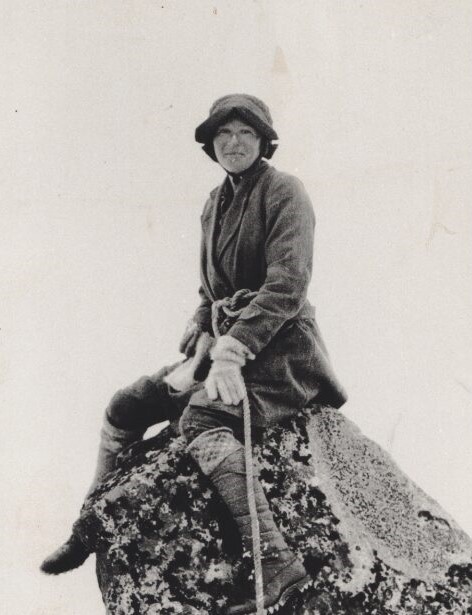
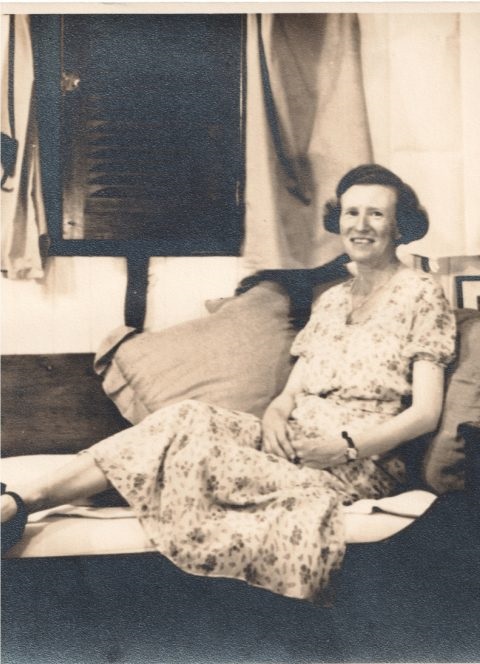
Marie Byles, mountaineer, hiker, bushwalker, explorer, journalist, women's champion, conservationist, lawyer, photographer, author. Photo courtesy National Trust of Australia and nSW
Described by some as ‘prickly’, ‘difficult’ and ‘intimidating’ of presence, Marie Byles remained a lady of strength whose actions and deeds are a truer manifestation of what lived in her heart.
As New South Wales’ first female solicitor Marie employed mostly women at a time when women working was considered unacceptable, even if they toiled all day and half the night as housewives, unpaid.
Marie encouraged and helped single mothers, when these were pariahs in our society, to find their own financial independence. To many she was refuge of common sense and decency. Her own refuge was the Bush and views of trees, miles and miles of trees. Her gift to subsequent generations is spoken quietest by her battles for our environment.
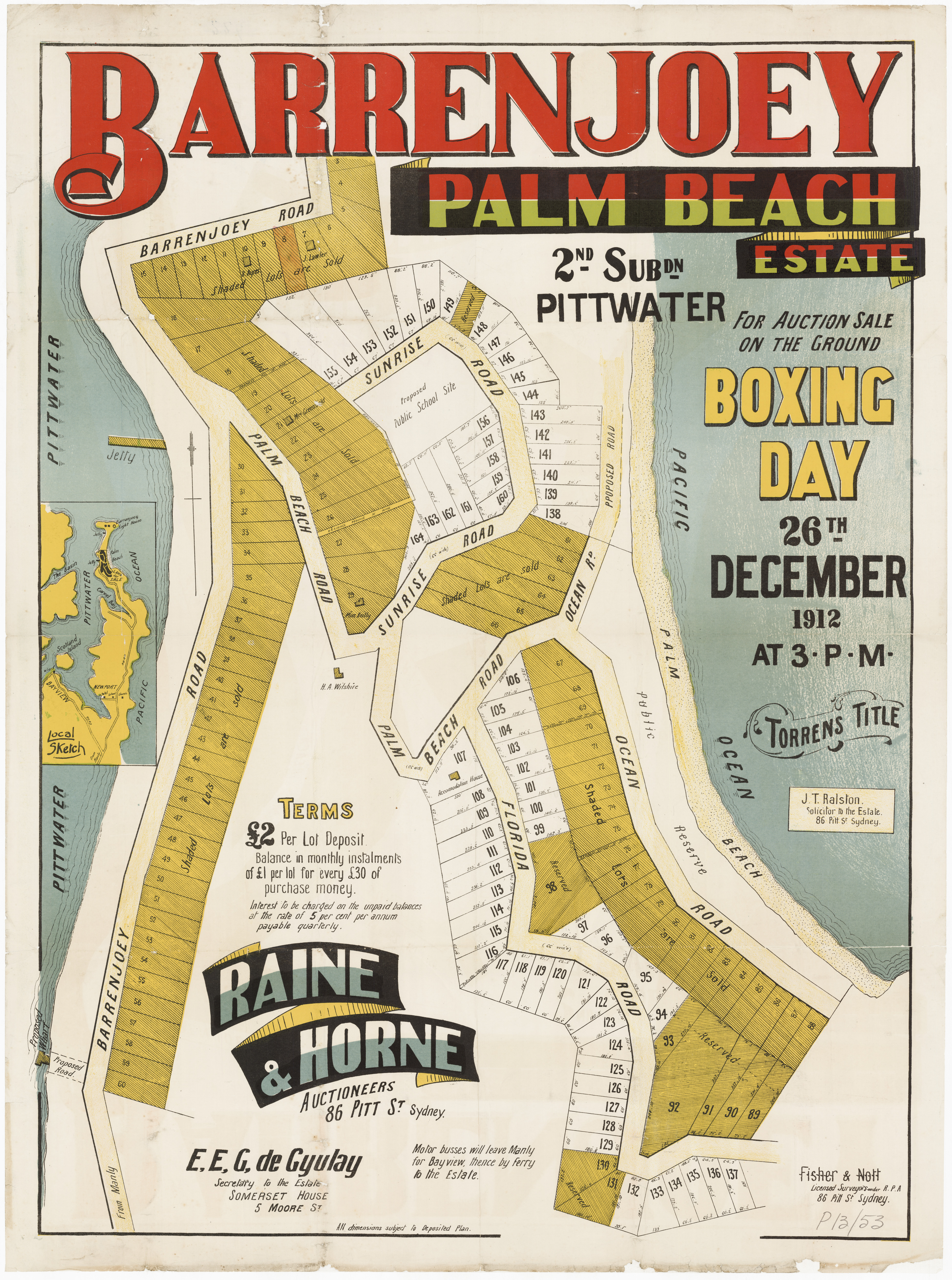
Her connection with Pittwater commences before November 26 1914, when her father, Cyril Beuzeville Byles officially purchased Lot 153 at 44 Sunrise road Palm Beach.
As the Barrenjoey Land Company was promoting the sale of the lots of lands on the Barrenjoey Peninsula through encouraging a deposit and easy terms and then organising to whom you would pay your mortgage some long time later, and all Lots sold in that January 1912 and second December 1912 land sale, including Lot 153, it is likely the Byles family had installed a holiday home by 1913-1914, as occurred with the Chorley home on the beachfront.
The first land sale saw the blocks available being snapped up by people such as Lucy Gullett (Sunrise road) or the members of the Brown family of doctors, on Ocean, Sunrise road and Pacific Roads, along with successful businessmen of that time such as Mr. Chorley, who did well selling cloth and uniforms during WWI and Thomas Peters, an engineer who was then engaged in building the Burrinjuck Dam.
The second December 1912 sales saw the remaining prime positions snapped up, including those alongside Hordern Park, named for one of the early benefactors in Palm Beach's landscapes, A J Hordern.
Byles land at Palm Beach in Vol-Fol: 2539-82:


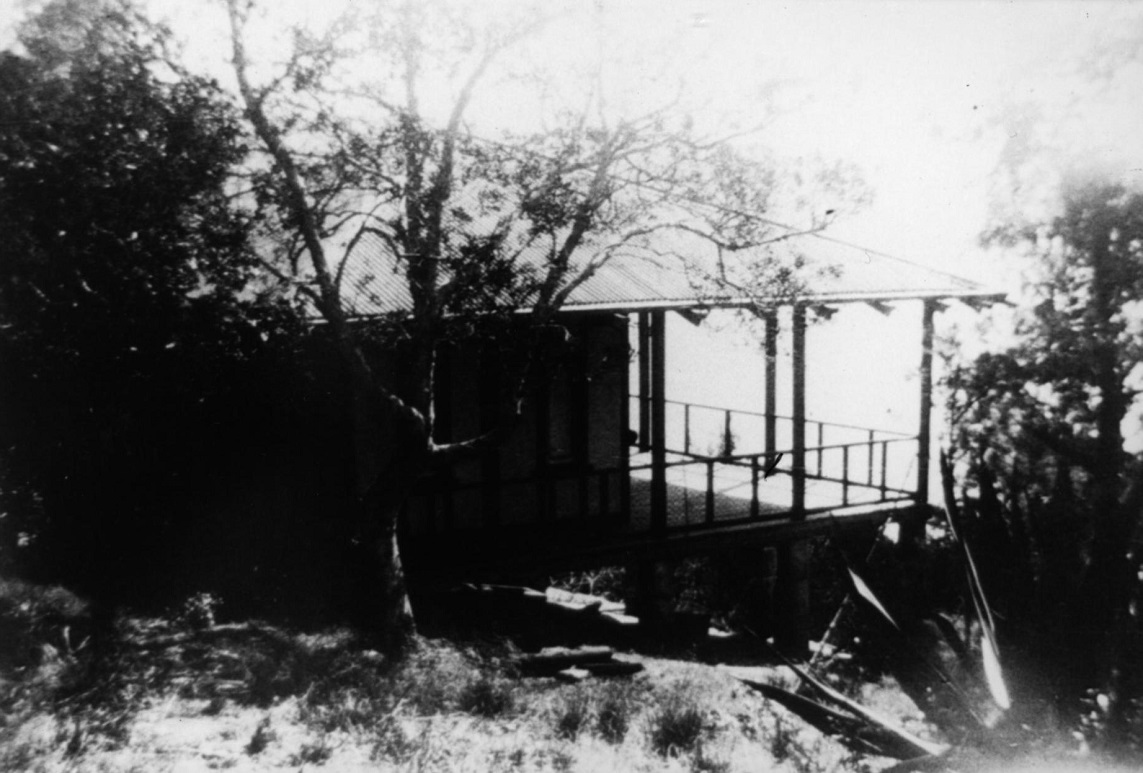
The holiday house, called 'Seawards', stayed the property of the family, being transferred to the eldest son of Cyril and Ida, David John Byles in February 1955 after both had passed away. The Lot was eventually split into 3 lots by their son.
Seawards was a simple cottage structure with open 12 foot verandas on which the family slept.
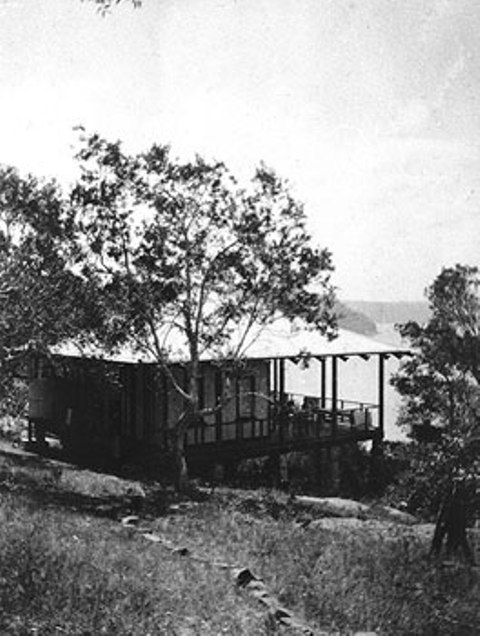
'Seawards', on Sunrise Road, Palm Beach, circa 1914
The eldest of three children, Marie was born in 1900 in Ashton upon Mersey in what was then Cheshire, England, to progressive-minded parents. Her younger brothers were David John Byles(1903-19850 and Baldur Unwin Byles (October 24 1904–1975).
Her parents were Unitarian Universalists, Fabian socialists and pacifists. Her mother Ida Margaret (24 May 1869 - 11 Sep 1953), née Unwin, was a suffragette and had studied at The Slade School of Fine Art, until "her artistic talents were lost to the drudgery of housekeeping", and who impressed upon her daughter the necessity of being financially independent of men. Her father, Cyril Beuzeville Byles (1871 - 19 Nov 1952), was a railway signal engineer. In England he involved his children in campaigns against fences that prevented public access for recreational walks.
The family moved to Australia in 1911 because Cyril Byles was appointed Chief Signals Engineer with the New South Wales Government Railways, to design the signal system for electrifying the railway system. They found a block of land in Beecroft and in 1913 built a house there which they named 'Chilworth'. The family spent Summers by the sea, and in 1913 they also built the small cottage 'Seawards' at Palm Beach, on Sunrise Hill facing the lighthouse and, towards the sea.
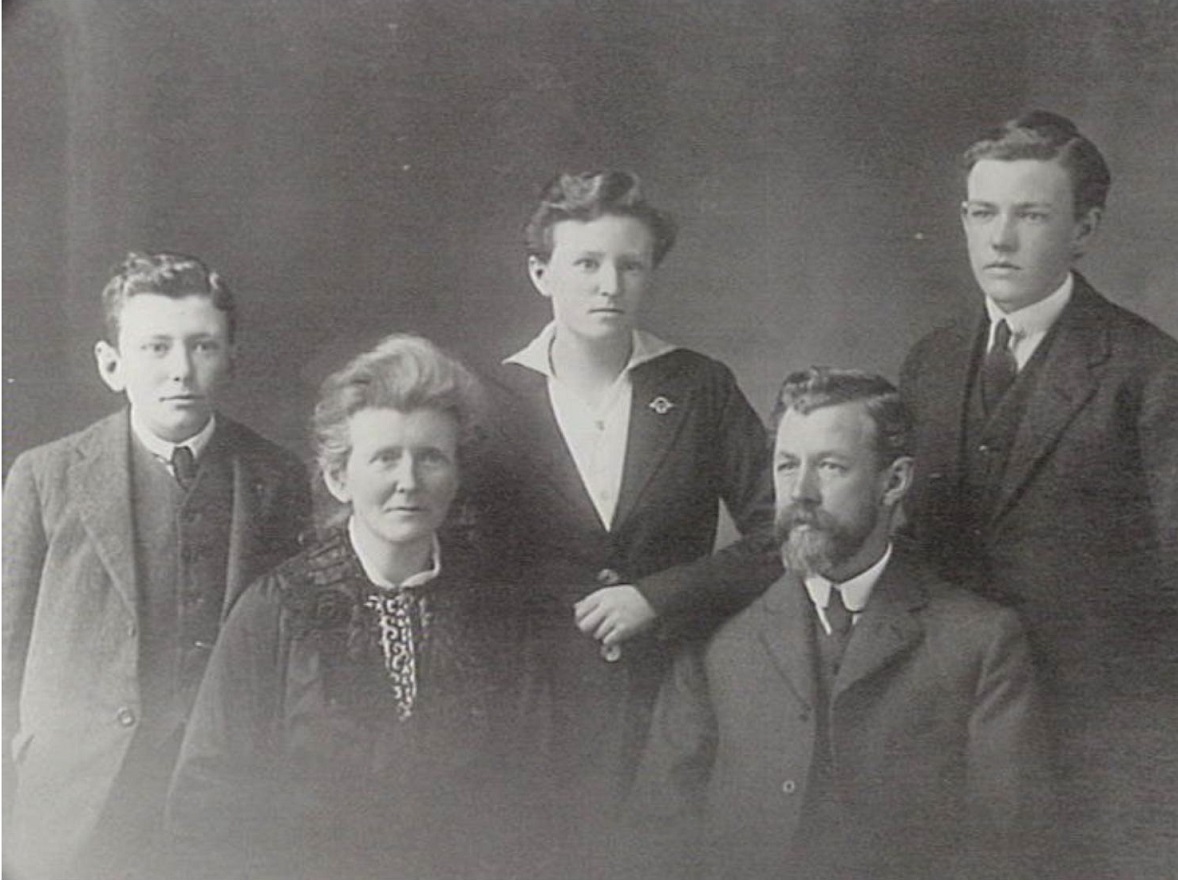
Byles family portrait: Marie Byles with her parents Ida and Cyril and her two brothers circa 1913. Courtesy Mona Vale Library Local Studies and the Byles family
Marie was excited to hear the Boy Scouts movement was coming to Australia, obtaining the Scouts rulebook and avidly devouring it, only to discover that they would not admit girls. So, Marie founded the Pirate Girls, barefoot and with a skull and crossbones flag, they rowed across Pittwater, camping and exploring the bush
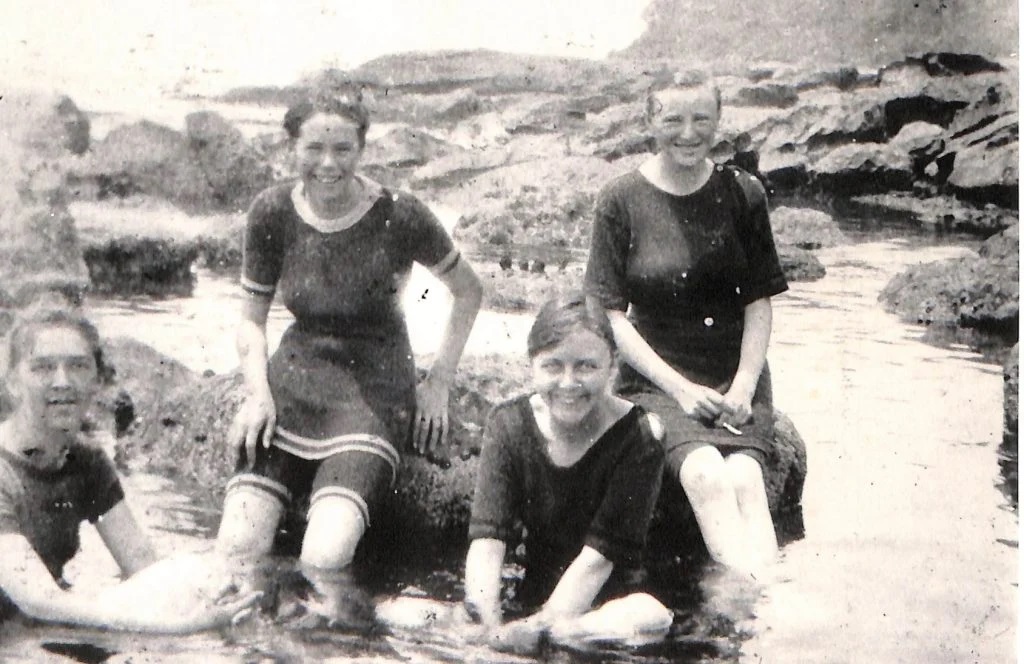
The 'Pirate Girls' pictured in their late teens, likely photographed by Marie - who is at right and back row. Photo courtesy of State Library of NSW Archives
Marie was educated at Beecroft Primary School, and at the Presbyterian Ladies' College, Sydney, at Croydon from 1914 to 1915, and in 1916 and 1917 at the new second campus of the school at Pymble (now known as Pymble Ladies' College). She excelled, and became a prefect and dux of the school in 1916, and Head Prefect and dux the following year. At matriculation, she won a scholarship to the University of Sydney.
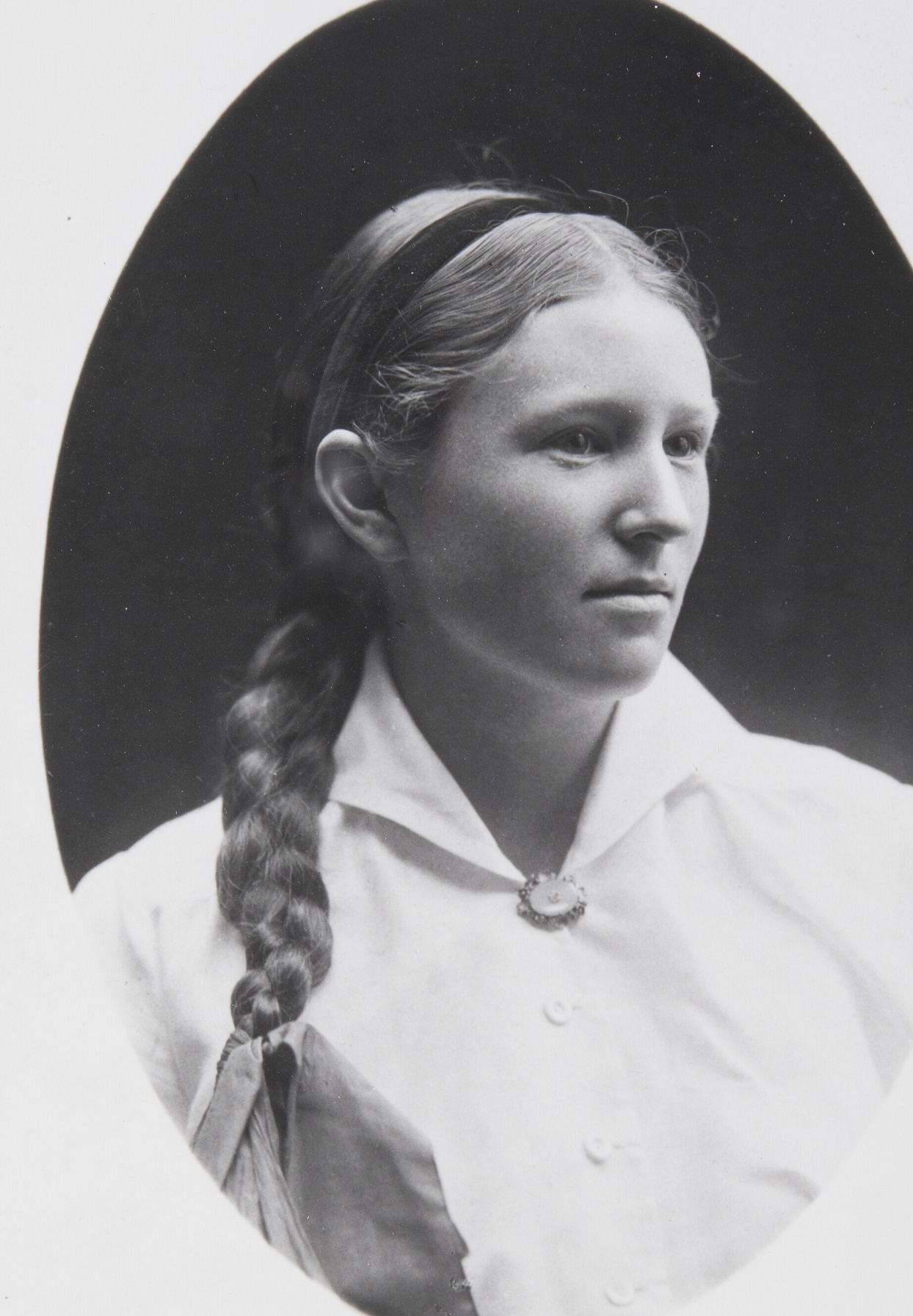

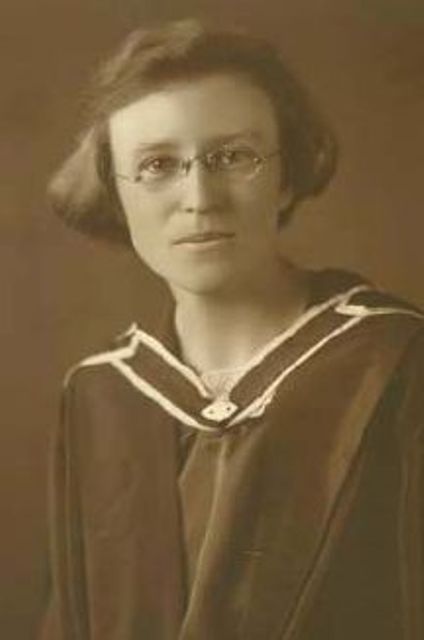
Byles was one of a small number of women to attend the University of Sydney. Here she met lifelong friend Dymphna Cusack, among other women peers.
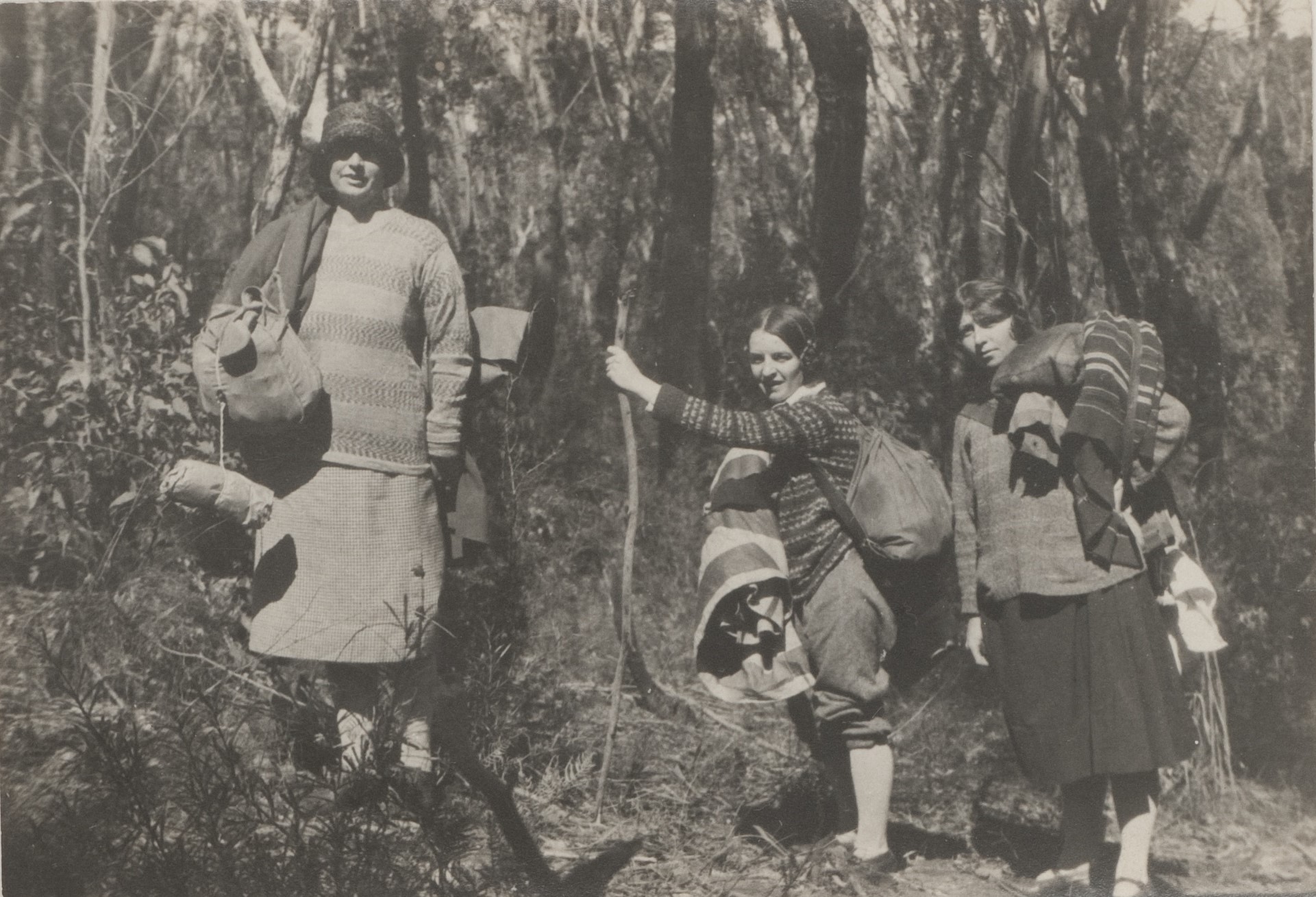
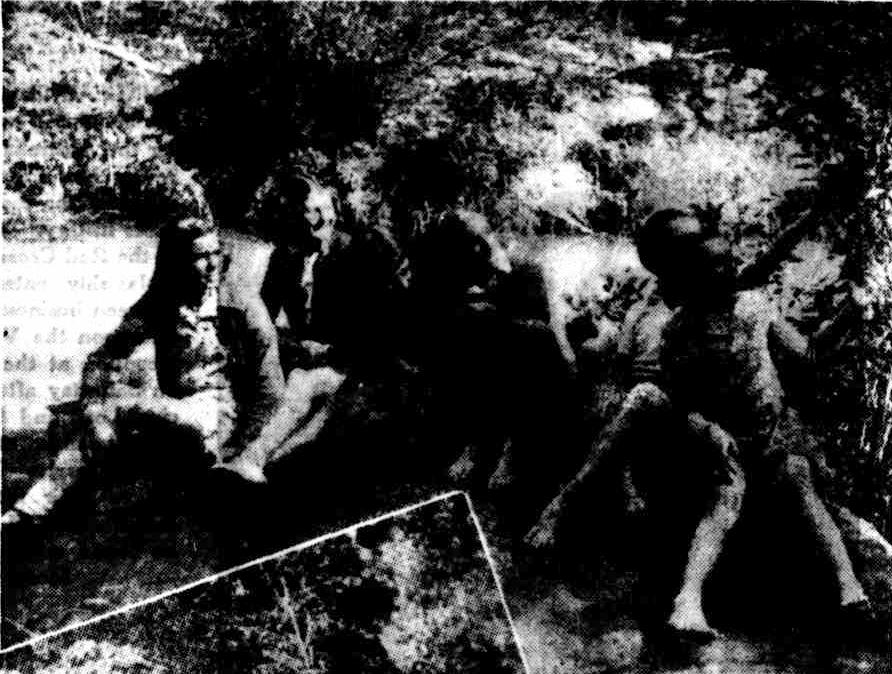
Bea Wines, Doreen Waine and Dymphana Cusack, Mount King George, Blue Mountains, 1925 / photographer Marie Byles. Item: SLNSW_FL306101, Titled on the reverse of the photographs in Cusack's hand, Presented by Miss Dymphna Cusack, 1976-1978, State Library of NSW
Ellen Dymphna Cusack AM (Nell) (September 21 1902 – October 19 1981) was a prolific Australian writer and playwright. She also wrote as Atalanta. Born in Wyalong, New South Wales, Ms Cusack was educated at Saint Ursula's College, Armidale, New South Wales and graduated from the University of Sydney with an honours degree in arts and a diploma in Education. She worked as a teacher until she retired in 1944 for health reasons. Her illness was confirmed in 1978 as multiple sclerosis. Survived by her husband, Nell died at Manly, on October 19 1981.
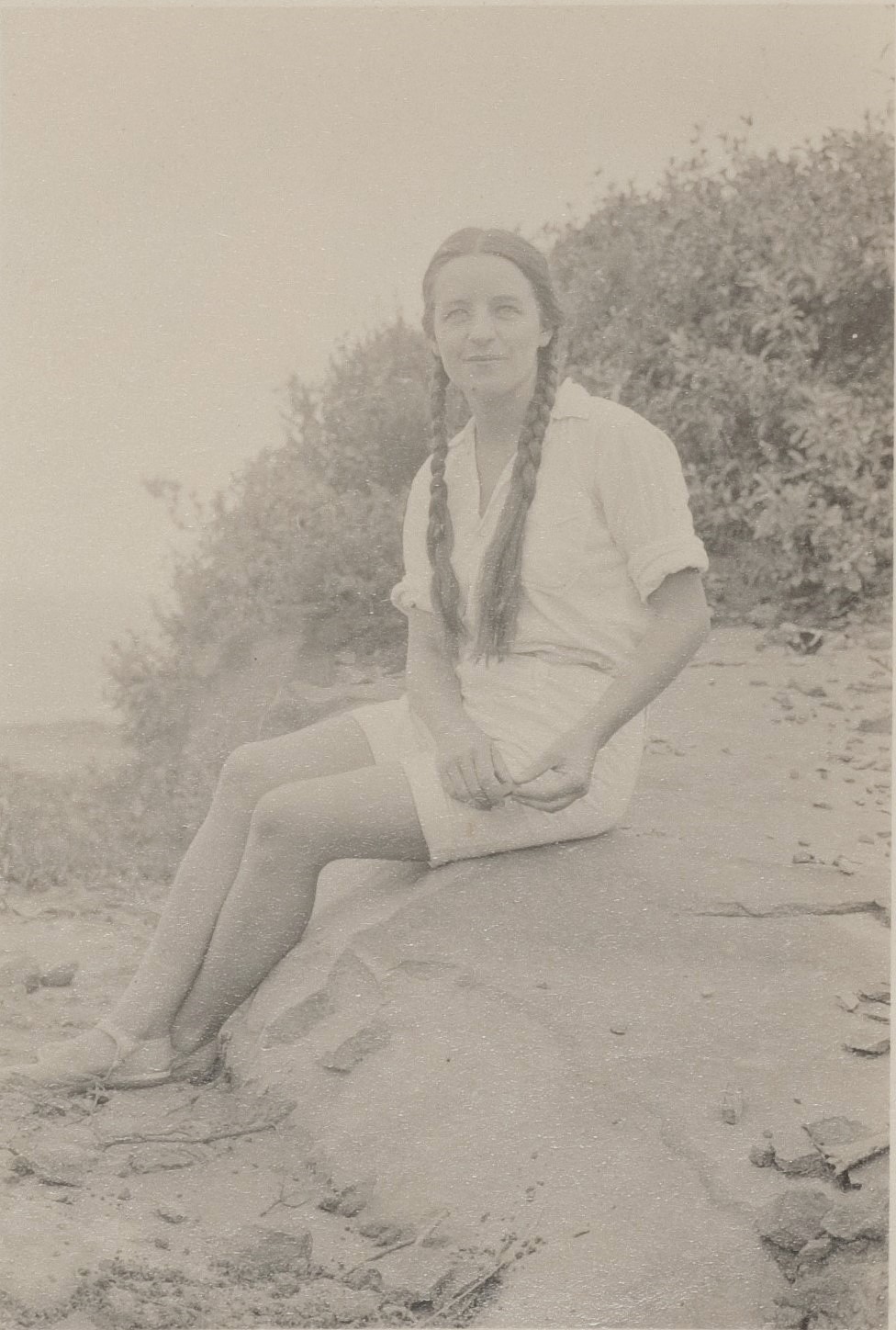
Cusack camping with Byles, 1932. photographer Marie Byles. Item: SLNSW_FL306101, Titled on the reverse of the photographs in Cusack's hand, Presented by Miss Dymphna Cusack, 1976-1978, State Library of NSW
Marie graduated with a Bachelor of Arts in 1921 and in 1924 she completed a Bachelor of Laws degree and became the first woman to be admitted as a solicitor in New South Wales. Although Ada Evans had graduated in law in 1902, it had been illegal for a woman to practise law in Australia until 1918.
The Evening News ran:
WOMAN SOLICITOR FIRST IN STATE LAW RECRUITS
One barrister and 17 solicitors were added to the roll, by the Full Court to-day. The barrister was Mr. John Joseph O'Brien. B.A., LL.B., and he was admitted on the motion of Dr. Evatt who stated that Mr. O'Brien had been librarian of the Supreme Court for the past few years.
One of the solicitors admitted was Miss Marie Beuseville Byles, B.A., LL.B., who, at the Sydney University, won the Rose Scott prize for international law. Miss Byles is the first woman solicitor in this State. The other solicitors admitted were: Messrs. K. TV. Aubrey, B.A., LL.B,. W. A. Cole, W. D. Dunn. R. J. Gibson, A. J. Peverley Hall, B.A., L.L.B., Roy Leverton Head, R. M. M. Houston, B.A.. IX.B., J. A. P. Ford Hughes, B.A., LL.B., A. A. Johnson, E. McGrady, J. P. McNamara, G.P. Osbourne, G. A. Prendergast. B.A. LL.B., B. Pursell, LL.B., L. W. Taylor, B.A., LL.B.. and W. G. Tester, B.A., LL.B. Miss Byles. WOMAN SOLICITOR (1924, June 4). Evening News (Sydney, NSW : 1869 - 1931), p. 9. Retrieved from http://nla.gov.au/nla.news-article119972540
The Sun ran:
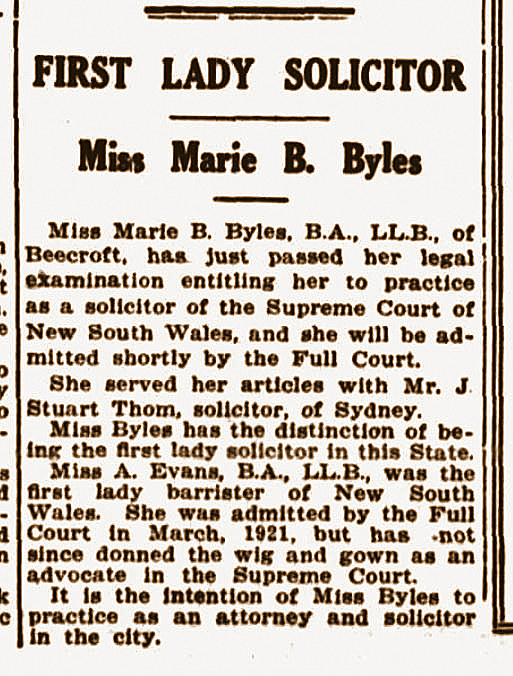
The Sun, 7 May 1924, p9 via Trove
In 1932 Marie joined The Women's Club, which was created in Sydney in 1901 to provide a place where women "interested in public, professional, scientific and artistic work" could meet.
After clerking for four years, in 1929 Marie set up a legal practice, the first woman to do so in New South Wales.
In 1952 Marie became the first female master solicitor when articled clerk Margaret Crawley joined her practice. By this time, the work premises were inappropriate and Marie created a private company to purchase land at 2A Hillview Avenue, Eastwood. Here she built the Berangie Chambers, an Aboriginal word meaning 'friend'. Marie designed the building to ensure the space was airy and filled with light. The practice moved here in 1953. In the late 1950s, she continued to consciously employ married women and promoted their professional development. Marie even offered to sponsor her law clerks to study for the Solicitors' Admission Board exams.
Byles operated two law practices – one in Eastwood and the other in the central Sydney. She gave young women opportunities to participate in the profession.
'The business in Eastwood built up because she had the reputation of getting things done so quickly and that was almost unknown in a legal office, she was notorious.' (Employee, Ruth Milton).
Marie worked mainly on conveyancing and probate, and also to ensure just divorce settlements for female clients. She retired and handed over the legal practice to a partner in 1970.
As a student, Byles wrote and published articles on legal, political, and environmental subjects. From 1927 to 1936 she had the position of legal correspondent for the Australian Women's Mirror. She wrote articles against women changing their name on marriage, so as to protect their financial assets. As legal correspondent she brought attention to laws and court practices that discriminated against women. She gave lectures for the Australian League of Nations Union and wrote pamphlets for The United Associations of Women.
EQUAL RIGHTS.
Loss to Women.
MISS BYLES VIEW.
Women In New South Wales would not gain much by having equal status with men was the contention of Miss M. B. Byles, who spoke at the second monthly conference of the Australian Federation of Women Voters yesterday.
As a lawyer, Miss Byles reminded those present that in this State women had practically equal rights, and that if they received equal rights they would lose the right to receive alimony or maintenance, and would have to bear the burden of supporting their children, which was now borne by the men.
Another privilege which women would lose would be their widows' pensions. The great drawback of the present situation, said Miss Byles, was that, when a woman married, she had to accept the status of the women of the country in which her husband lived.
Miss Ruby Rich presided at the conference, which dealt with the need to obtain equal rights for men and women, and she stated that the question had now become an international one instead of merely national. Equal pay for women and the right of a wife to retain her own nationality were points which the conference stressed as being the most necessary to procure.
Mrs. P. A. Cameron, president of the Feminist Club, said that "Few women realise until after their honeymoon that they have no right to touch one penny of their husband's money, and men did not under-stand how humiliating it was for a woman to have to ask for everything she wanted."
She thought it would be better for men and women If the husband were made to settle a certain percentage of his earnings on his wife as was the custom in Sweden. EQUAL RIGHTS. (1936, April 1). The Sydney Morning Herald (NSW : 1842 - 1954), p. 7. Retrieved from http://nla.gov.au/nla.news-article17336734
Marie also used her knowledge in our local community - newspaper reports record:
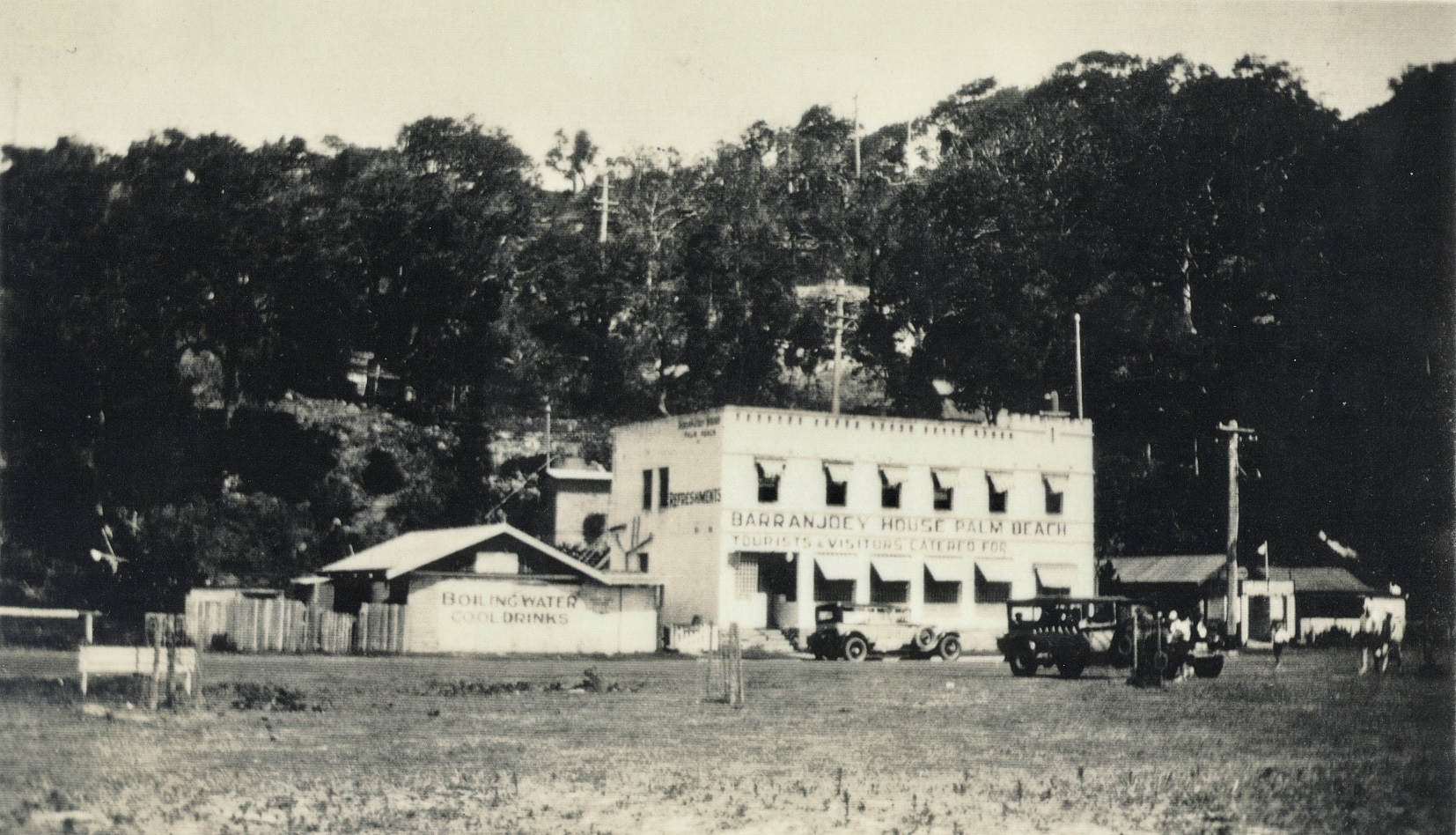
'Barranjoey House' circa 1925 - photo courtesy Avalon Beach Historical Society - note the castellated roofline.
3. Recommending that E G. Stone's offer to dredge a channel through the sand-bank in Narrabeen Lagoon at the entrance to Deep Creek be accepted on the conditions agreed to by him that the channel measurements shall be 27 to 30 feet wide at the top, with 3 to 1 slopes in the sides of the excavations: Resolved, _That the Engineer's recommendation be adopted. (Crs. Hewitt, Sheppard) ... 5. Submitting estimate for repairing Palm Beach wharf: Resolved, That consideration-of the report be deferred, and Mr. Goddard, Boatshed, Proprietor, of Palm Beach, be written to, inquiring what fee he would require for the use 'of his wharf. for the public for the next three months.'..(Crs. Hughes Hewitt) 34. Barrenjoey Peninsula Advancement League, 5/9/35, forwarding copy of letter sent to Minister for Transport, requesting deputation on matter of lack of up-to-date transport facilities facilities in the Shire, particularly to the northern portion of the Shire; requesting that the Council arrange to be represented on the deputation. Cr. Hughes moved, Cr. Sheppard seconding, that the President and Cr. Hewitt represent this Council on the proposed deputation. Cr. Nicholas moved, as an amendment, Cr. Ross seconding, that the letter be sent to the Warringah Transport League for consideration. The amendment was carried. The motion was amended was thereupon put and carried. 35. A.B.Byles, 6/9/35, further re condition of public wharf at Palm Beach, and urging that something, even of a temporary nature, be done to make it safe for use without delay. 35a. Palm Beach Progress Assoc., 11/9/35, re: same matter. (Dealt with in conjunction with Shire Engineer's report to this meeting.)
Conservationist and bushwalker
As a teenager at her family's holiday retreat at Palm Beach, Byles would look through her telescope across Broken Bay to the bushland beyond on the Central Coast. The area was marked on maps as Bouddi, an aboriginal name meaning 'nose'. It was a coal reserve visited only by fishermen. In 1920 Byles and some of her university friends set out to walk through the bush of Bouddi to Maitland Bay, then known as 'Boat Harbour', where they camped. It became a favourite spot for them. The only bushwalking club at the time was the Mountain Trails Club led by Myles Dunphy, which did not admit women.
By 1929, there was an increasing focus on organised recreation for the city and suburban population and Marie joined the two-year-old Sydney Bush Walkers Club. In 1930, a new name for Boat Harbour was proposed by the club; bushwalker Dorothy Lawry suggested "Maitland Bay" after the steamer that was wrecked at the northern end of the beach in 1889.
Over the next five years, with the support of the Federation of Sydney Bushwalkers Clubs, Byles successfully campaigned in the press for the area to be placed under public ownership. One example of her pen's work:
"MAITLAND" PARK.
A New Proposal.
(BY MARIE B, BYLES.)
From the popular seaside resort of Palm Beach you look across the mouth of Broken Bay to a long line of coast-cliff and sandy beach interspersed by rocky headlands and crowned by virgin bush. Many people wonder what beauties lie hidden In these fascinating far-away beaches, and few realise that they are within easy reach of the launch which runs from Woy Woy to Empire Bay.
It is this last remaining strip of unalienated coastline reaching from Wagstaff Point to MacMaster's Beach that the Federation of Bush Walking Clubs is seeking to have dedicated as a national park and preserved for posterity with all its pristine beauties. For In a country renowned for its lovely beaches this stretch of land contains some of the loveliest. There Is Putty Beach, an ugly name for a magnificent reach of sand and surf. And then there Is the secluded "Little Beach," rock-encircled with golden starred meadows dropping down to its silver sands, and many another sandy cove tucked away between rocky headlands and sea-battered cliffs. Behind the shoreline are forests of macrozamia or kurrawong, that living fossil unique In the botanical world, while from the tops there are wide views over ocean-bounded moors to the capes and inlets south of Barrenjoey.
But the most beautiful beach of this coast-line is Maitland Bay, on whose northern head-land still lies the remains of the wreck of the Maitland, which perished there in 1898, From the heights above Kilcare you drop down bv a fern-green path, round some boulders and the exquisite half-moon curve. of Maitland Bay lies blue and gold below you, while away on Its further headland you can see the rust ing boilers and tanks of that Ill-fated ship which have withstood the ceaseless beat of the ocean's surge for 30 years and more. And there they lie to remind one, perhaps of the helplessness of many before the fury of nature, perhaps of the bravery of man when faced with danger, for the coolness and courage of the officers and captain of that ship make one proud to belong to the human race. As the blue sea breaks calmly at low water on the flat brown headland it Is hard to Imagine the Inky blackness and the howling of the tempest as they stood at their posts through a day and a night, but walkers who have camped on that beach with a fierce southerly blowing right up the bay know that those peaceful waves can often sweep up in tempestuous fury fatal to any ship too close to land.
Sandy beaches, historic wreck, towering cliffs, and primaeval forest all lend their fascination to the proposed parkland which still lies unspoiled as in the days when the "Herald" reporter, sent out to gather news of the wreck, remarked ruefully-probably thinking of his torn trousers-that it was very rough country. It is the beauties of this primitive roughness that the Federation of Bush Walking Clubs Is hoping to preserve for all time to meet the needs of the growing population of a large city whose park lands are all too few.
[A photograph of Maitland Bay and Its fore-shores appears on the Illustrations page.] "MAITLAND" PARK. (1934, March 22). The Sydney Morning Herald (NSW : 1842 - 1954), p. 8. Retrieved from http://nla.gov.au/nla.news-article17067062
The creation of Bouddi Natural Park in 1935 was a landmark achievement for the early conservationists. The Lands Department set aside an even larger area than Byles had proposed. Byles was elected a trustee of the board that managed the park, and for many years organised volunteers to clear and maintain its walking tracks.
A lookout over Bouddi has been named after her; it is accessible by car, on The Scenic Road in Killcare Heights just south of the Bouddi National Park Visitor Centre.

The Marie Byles lookout. Photo: Foto Sleuth
In 1939, Byles was the co-founder, with her close friend Paddy Pallin, of The Bush Club. This was a bushwalking club with an emphasis on day-walks, which did not impose rigorous entry tests on prospective members and attracted many pre-war European refugees as members.
Photos taken by Mr. Pallin at and of Palm Beach views over the golf course and towards Lion Island are likely to have been taken on a visit to the Byles home at Palm Beach. Some of these date into the 1960's.
Some examples of her work to bring the beauty, serenity and knowledge of our own landscape to others are recorded in this items:
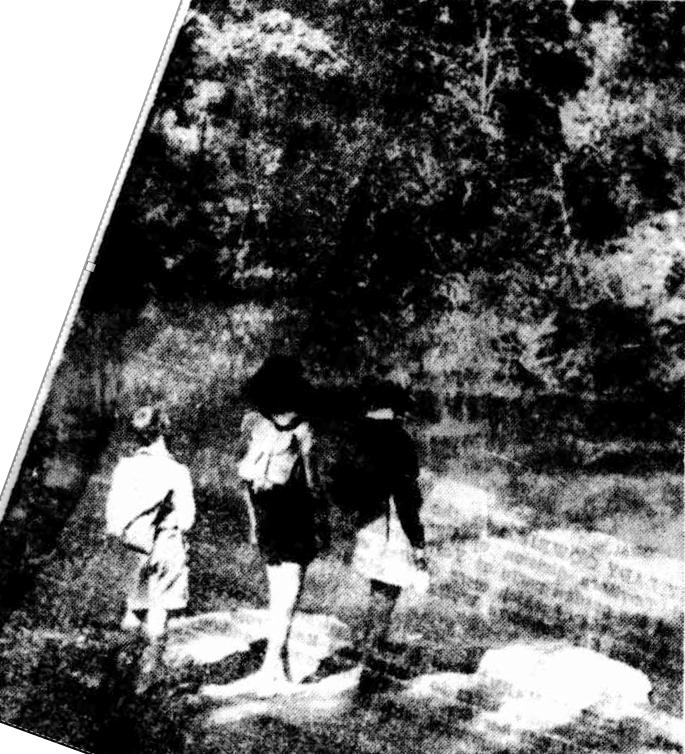
Marie was also opposed to the excise of land dedicated to the public put to private use and profit, just as her father had raised her years ago to defend access and peace for all decades before. For example, Governor Phillip Park being taken from everyone so the Warringah Shire Council could profit from camping fees - and this was not her first instance of speaking out against this kind of theft of public land and access for private profit, all progressed by councils and/or state governments:
Palm Beach Camp
Sir,—It is gratifying to read that there at last seems a possibility that Warringah Shire Council will put an end to the permanent camps on Phillip Park. Permanent camps on a public park have been a scandal for many years. They are instances of the filching of public lands by private individuals.
M. B. BYLES.
Eastwood.
Palm Beach Camp (1952, August 25). The Sydney Morning Herald (NSW : 1842 - 1954), p. 2. Retrieved from http://nla.gov.au/nla.news-article18278690
An earlier example:
PRIVATE SHACKS IN PUBLIC PARKS.
TO THE EDITOR OF THE HERALD.
Sir,—Some years ago there was a public outcry on account of the number of private cottages in National Park. As a result the Minister and the trustees gave their assurance that no new private residences or shacks would be permitted.
Since then the area south of National Park, known as Garawarra, has been set aside as a reserve for public recreation. It embraces Burning Palms Beach, a line of seashore and rocky headland you would search the world over to equal. Its beauty alone, apart from the Minister's assurance, should have caused its trustees to keep that beauty unspoilt by unsightly hovels. Yet since its reservation there have sprung into existence a whole series of ugly shacks every wit as bad as those complained of in National Park. But even if they were less ugly their presence would be unforgivable. What is the point of reserving land for public recreation if the trustees are to permit private residences on it.
I am. etc.. M. B. BYLES.
3 Castlereagh Street, Sept. 21.
PRIVATE SHACKS IN PUBLIC PARKS. (1937, September 23). The Sydney Morning Herald (NSW : 1842 - 1954), p. 5. Retrieved from http://nla.gov.au/nla.news-article17403059
A Spiritual Life
Marie became interested in the Quaker denomination of Christianity, but was refused membership. During her travels through Burma, China and Vietnam in 1938, she often chose to stay in temples, which brought her into direct contact with non-European cultures and religions. On her return, she renewed her interest in the teachings of Gandhi, and began exploring Buddhism. A collapsed foot arch meant that she was no longer able to hike long distances or climb, and she studied spirituality and meditation to find ways of dealing with her pain.
Over the following years Byles spent a year in India, including the Himalayas, and made three trips to Burma and two trips to Japan. In 1960 she formed a meditation group, inviting interested people from any religion or none to meet on Saturday afternoons to study meditation techniques. In later life she became particularly drawn to Mahayana Buddhism and the conscious practice of kindness and compassion. From these experiences she completed four books on Buddhism.
Byles was raised as a strict vegetarian by her mother, and in 1957 commented that she had never eaten meat.
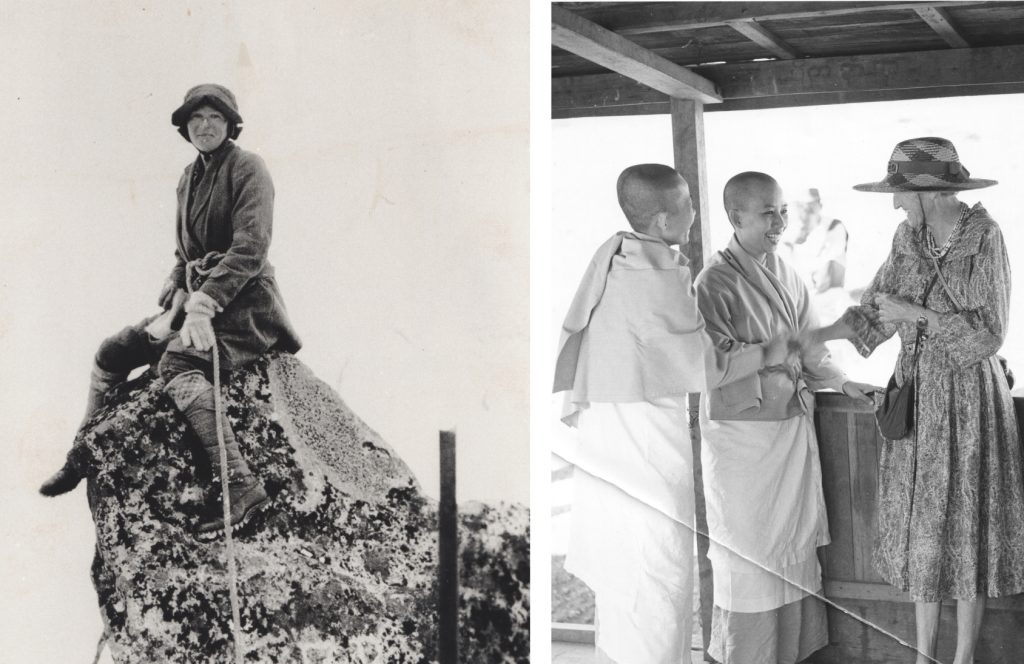
Left to right: Marie was an avid and adventurous traveller; pictured on Dyrhaugstind Mountain in Norway; greeting Buddhist nuns in Burma in 1957.
A Place of One's Own
By 1938 Byles left her family home in Beecroft and built her own house on around 3.5 acres of bushland she had bought in 1935 at the edge of nearby Cheltenham, adjacent to crown land. She named it 'Ahimsa' after the term used by Gandhi meaning "harmlessness". The four-room cottage is a simple design built of fibro and sandstone, and the large north-facing verandah is primarily where Byles slept and lived in preference to the interior rooms.
Marie said that her home:
“was over 10 minutes walk from the station so that there would always be a walk, right in the midst of bush clad hills which were reserve and out of sight of other houses. For many years I had been compiling the requisite of my dream cottage…it was imperative that it have a 12 foot verandah facing north.”
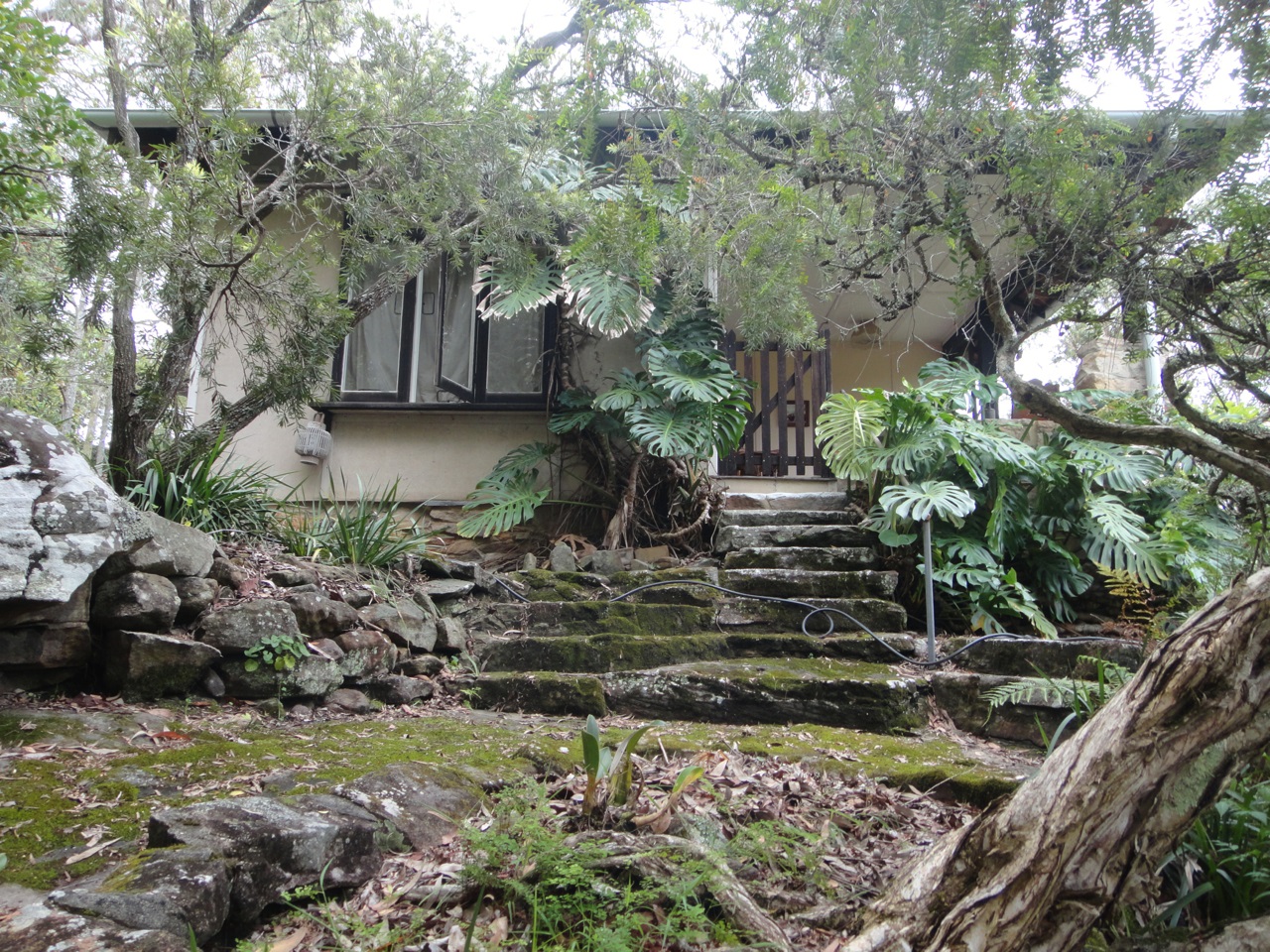
'Ahimsa', the house that Byles built on the edge of Cheltenham, as it looked in 2015. Photo: Nadiatalent
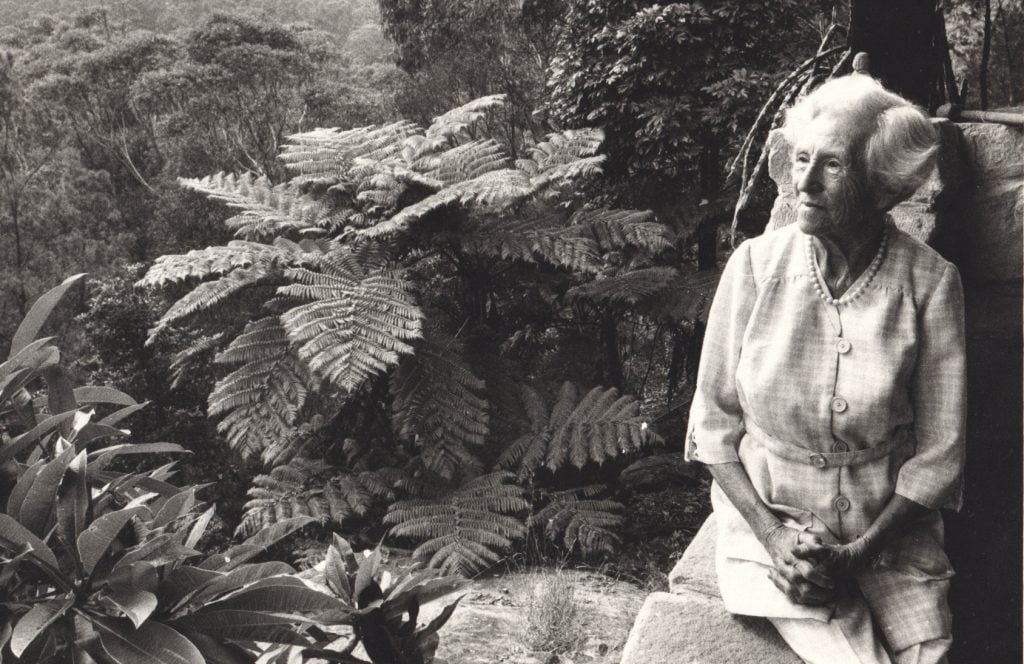
Marie Byles pictured in the garden at Ahimsa in 1972. Photo courtesy National Trust Archives
In addition to the cottage, Marie wanted to have a place on her land for groups to meet for discussions and meditation. By 1949, the 'Hut of Happy Omen' was complete, designed as an open sleepout with bunks and a large sandstone fireplace. She had another small house built next to 'Ahimsa' in 1975, called 'Sentosa' (a Malay language word meaning peace and tranquillity).
In 1970 Byles bequeathed her property to The National Trust of Australia (NSW), which she had helped in 1946 when she was the consulting solicitor who drafted the organisation's constitution.
This would be when she met another lady who worked to protect the environment of Pittwater, Annie Wyatt. Not only had Annie's family connections to Palm Beach (in Annie Wyatt Reserve) and to Mona Vale where her relative Robert Forsyth bought acreage which her husband Ivor Wyatt would later sell as a real estate agent, Annie, as a resident of Manly, recalled with devastation in her later years the Manly Wildflower Shows that impacted the local environment and caused the extinction of local species of flora and the wildlife that ate these plants.
See: Annie Wyatt Reserve: Palm Beach - Pittwater Fields of Dreams II
However, Annie was one of several like minded individuals who became firm friends with this Palm Beach Conservationist:
“Byles was friends with Clare Stevenson and Stella James who had a Burley Griffin home designed for them in bushland on Sydney’s northern beaches. According to Stephenson, the design of the Stella James house in Avalon reflected the relationship between these women as equal partners and their desire to fit in with their surroundings rather than dominate them.” (Cadzow, p.16, 2007).
Stella James House is in Avalon Beach - on the way up to Bilgola Plateau.
Legacy
Marie never married, had no children, and considered it a waste of potential when her friend Dot Butler chose to have children rather than continue with full-time mountaineering.
In 1966, like so many women before her and so many since, who stood on their own two feet and spoke out or defended other women and their rights, Marie was attacked inside her own home.
No one was ever charged.
The assailant assaulted her so badly her skull was fractured, and caused significant injuries and left her locked in a cupboard.
Marie never recovered and never returned to practice.
Anne McLeod in her biography for Marie in the The Australian Women's Register stated she was hospitalised and convalesced at the home of her friend, the writer and later Manly resident Florence James, in the Blue Mountains.
Florence Gertrude James (1902-1993) was a novelist, editor and reviewer. She was born in New Zealand and educated at Sydney University where she began her long association with Dymphna Cusack and Marie. James and Cusack wrote two books, Four Winds and a Family, a story for children, and Come in Spinner. The pair shared a rented cottage in the Blue Mountains during the writing of the first work as those were cheaper then.
Florence G. James died on August 25 1993 at Manly, survived by her daughters. Her life and work were commemorated by a plaque at the Woodford Quakers’ Cottage garden in the Blue Mountains where, as she had requested, her ashes were scattered.
'Suffering constant headaches, she learnt about the Alexander Technique and studied under the only teacher in Sydney. When he died Byles wrote a book on the exercises called Stand Straight Without Strain.'
The Alexander Technique is an educational method designed to retrain the mind and body, helping people recognize and release chronic muscle tension, improve posture, and move with greater ease and efficiency.
The technique was developed in the 1890s by Australian actor Frederick Matthias Alexander, who sought to resolve his own recurring voice loss during public speaking. Rather than acting as a medical treatment or an exercise regimen, it functions as a learning process where you study how you use your body in daily life.
In 1970, Marie sold her business to Helen Larcombe, who was the first female solicitor to practice in Newcastle in 1957. Ms Larcombe sold when she was appointed magistrate in 1976.
In 1974 Byles was honoured by the Women Lawyers Association for 50 years in the practice of law. Mary Gaudron and Elizabeth Evatt (recently Justices of the High Court) attended.
Marie Byles passed away at 'Ahimsa' in 1979.
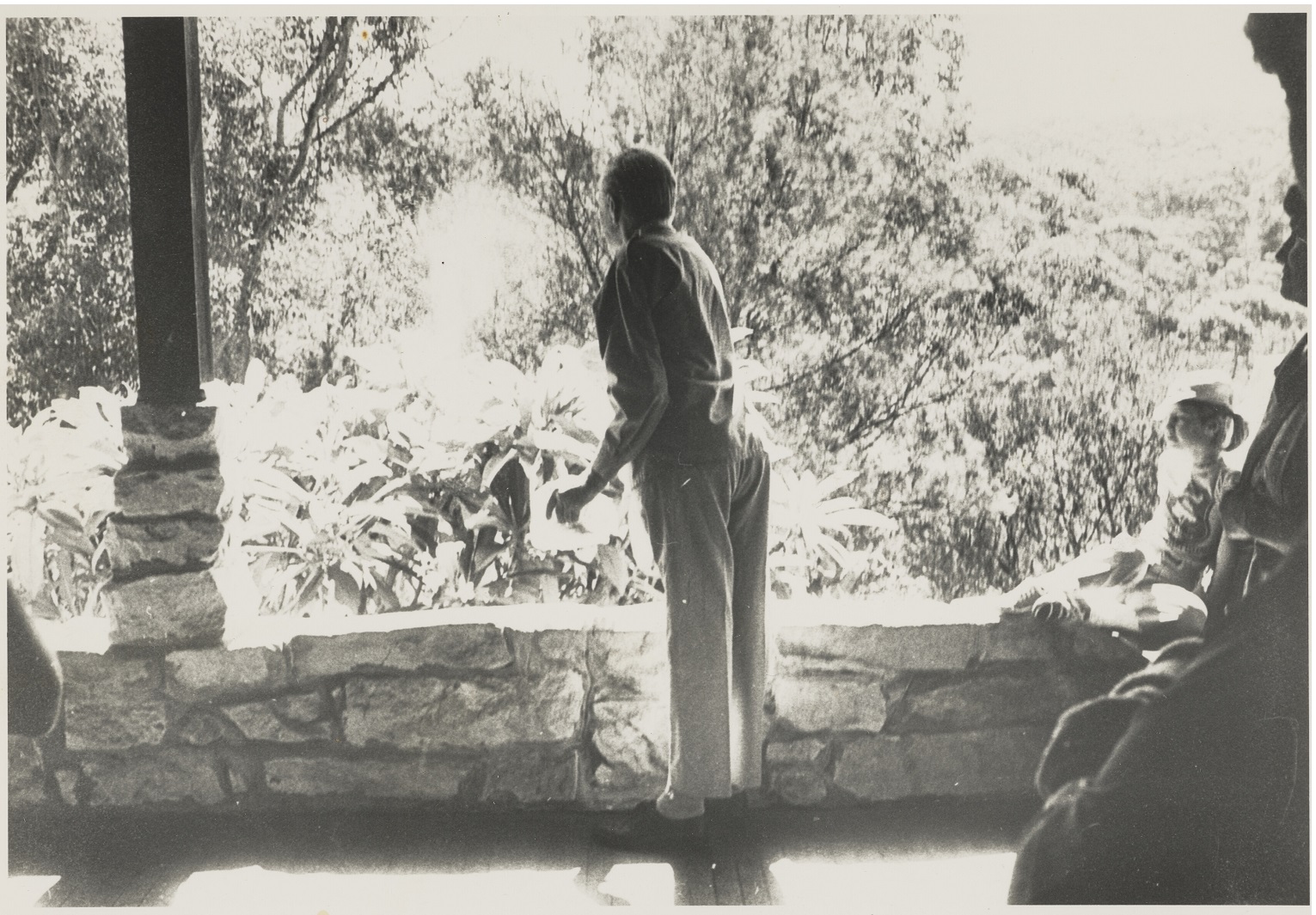
Marie Byles’ ashes being scattered from the verandah of her home, Ahimsa, Cheltenham, New South Wales - possibly by one of her brothers with a niece looking on. Photographer unknown. Susan Todhunter received this photograph from her mother, Patty Todhunter, who was a follower of Marie Byles’ teachings. It is possible that the photograph was taken by Patty. Signature / Inscriptions: Verso of photograph in pencil: "Ashes of Marie Byles scattered 12 April 1980 - 11 AM by". courtesy State Library of NSW
In 1985 a dramatized documentary, A Singular Woman, was made by Gillian Coote using text from an unpublished autobiography written by Byles, along with re-enactments and commentary by friends. Ms Coote's work is one of several tributes that now exist of Marie's life and works.
Her papers (1923–1982) are held in the State Library of New South Wales.
Byles Creek near her home is named in her honour, as are Byles Place, in the Canberra suburb of Chisholm, and the Marie Byles Lookout in Killcare Heights, N.S.W.
Her lifelong belief and practice of seeing the Bush as her Sanctuary, and Nature as a Healer, Marie versed as:
“There is something in the contact with the human being and Nature which is very hard to explain. (when) you lie on Mother Earth and look up at the stars, the life-force seems to bring a new health to your tired limbs and worried mind.” - Marie Beuzeville Byles.
Here in Pittwater you can gaze up to Sunrise Hill, across the Pittwater, or north over the estuary to Bouddi and honour and celebrate this 'Singular Woman' by enjoying what her work, alongside her like-minded peers, gained for us who are here today. Maybe even plant out a few native shrubs or trees or stand up when organisations like the National Trust ask you to defend your own and your children's heritage and these ark-like environment places, like Pittwater.