Spring's Winged Thing Continues: Bogong Weather Anomaly + Butterflies
Since our last Issue, and celebrating the return of the bogong moth, food for mountain pygmy possums and a sign of Spring that has recurred for thousands of years, others have been celebrating too.
See: Spring's Winged Thing 2026: Bogong Moths Are Back! On NSW South Coast + Pittwater + Butterflies this Season - Sunday 27 September 2026
sm.jpg?timestamp=1791918960014)
Bogong this week at Careel Bay. Photo: A J Guesdon
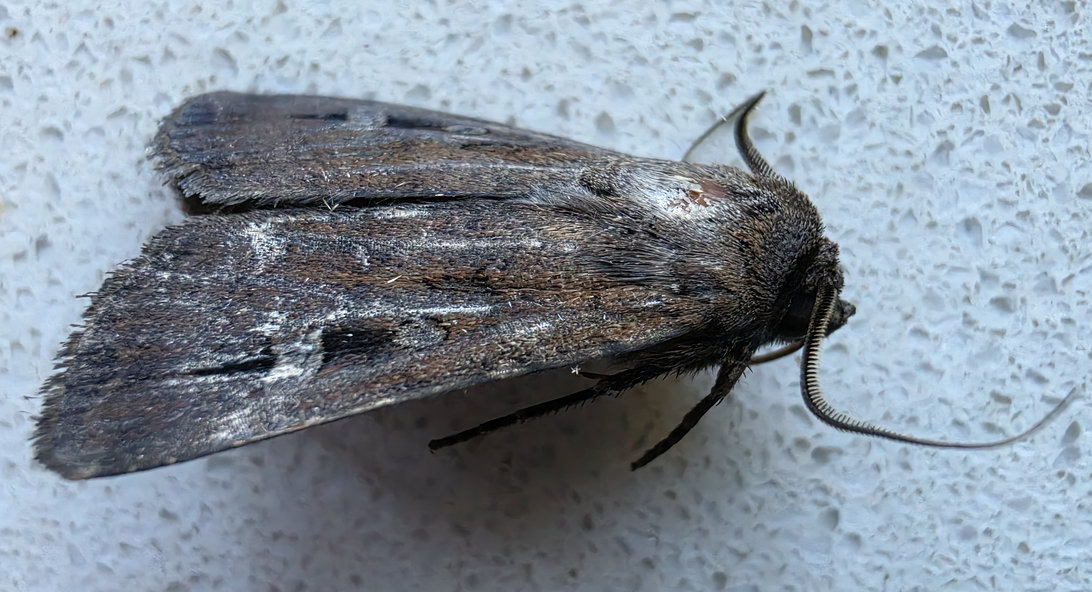
Bogong this week at Warriewood. Photo: Joe Mills
An estimated 4 billion Bogong moths are currently moving across New South Wales toward the cool alpine caves of the Snowy Mountains, pushed off course by strong westerly and northerly winds.
However, these massive swarms of migrating Bogong moths are creating false "rain" blobs on Bureau of Meteorology (BOM) weather radars across Sydney, Newcastle, and Wollongong. You may have noticed the radar showing widespread coverage but no mm of rainfall recorded - that's because this cloud is a cloud of Bogongs.
As the sun sets, millions of Bogong moths take flight from their daytime resting spots. The dense clouds of flying insects reflect the weather radar beams back to the station, showing up as 'light to moderate' rain showers on clear, cloudless nights.
The radar returns magically vanish around sunrise when the moths settle down for the day.
Scientists are noting this massive influx is a hopeful sign of recovery for the species, which suffered a 99.5% population crash during the 2017–2019 drought.
The Bogong moths are the main food source for the Mountain Pygmy Possum.
Zoos Victoria states:
Mountain Pygmy-possums were thought to be extinct until they were rediscovered at Mt Hotham in 1966. There are fewer than 2,000 endangered Mountain Pygmy-possums left in the wild. The possum is Australia’s only hibernating marsupial; it hibernates for up to seven months under the snow.
There are three populations of Mountain Pygmy-possums. They live in the alpine and subalpine rocks and boulders found in the Bogong High Plains, at Mount Buller in Victoria and Mount Kosciusko in New South Wales (NSW states it has two population areas - see below).
Climate change, the loss of habitat and predators, mainly feral cats and foxes, are all severe threats to the Mountain Pygmy-possum.
An emerging threat is the reduction in the possum's key food source over Spring, the Bogong Moth. This is currently a particular focus within the Mountain Pygmy-possum Recovery Team.
Each Spring, Mountain Pygmy-possums wake up from their annual hibernation, hungry for nutritious Bogong Moths to eat.
Bogong Moths usually fly to the possums' home in the billions, but their numbers have significantly decreased over recent years. This now means that there may not be enough food for these tiny possums to raise their babies. In December 2021, Bogong Moths were added to the IUCN Endangered Species list.
We need Australia's help finding these moths and guiding them to the possums!
It's simple: If you see a Bogong Moth, take a photo and upload it to Moth Tracker, even if you're not sure it's a Bogong Moth. This will help scientists better understand if the moths will make it to the mountains each year.
As well as drought and pesticide use, bright lights from towns and cities are thought to lure and trap the moths along their migration route.
The plan for fighting extinction
Zoos Victoria became involved in the Mountain Pygmy-possum Recovery Program in 2006. Healesville Sanctuary currently holds a large research and breeding population. We also assist with surveying wild populations, helping with habitat connectivity and revegetation, and developing new nutritious food sources like Bogong Bikkies.
Zoos Victoria also leads Moth Tracker, a citizen science project for recording Bogong Moths sightings.
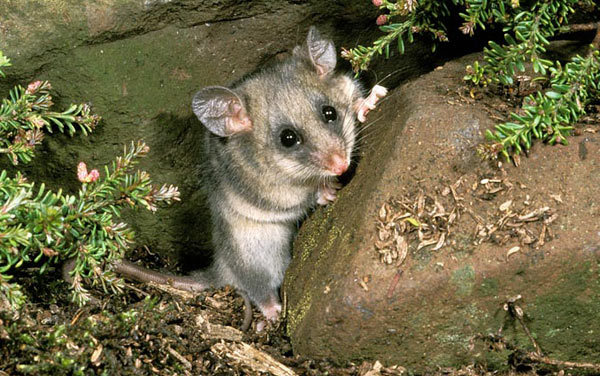
Mountain Pygmy-possum. Photo: Museums Victoria
How you can help
- Track any Bogong Moth sightings using Moth Tracker.
- Turn your unnecessary outside lights off in spring.
- Raise community awareness and support for the Mountain Pygmy-possum.
- Do what you can to decrease your carbon footprint.
- Visiting our zoos supports our work to fight extinction.
- Donate if you can. As a not-for-profit organisation, all donations go towards our important conservation efforts.
- Discover more about local conservation events and join the growing number of activists taking action for local wildlife.
Is your classroom learning about the Mountain Pygmy-possum?
Browse through our collection of animal teaching and learning resources for students. These include animal toolkits, e-books, Ask a Zoo Expert resources, video showcases and real-world examples to support the VCE Study Design. Learn more here
The NSW Department of Environment tells us Mountain Pygmy-Possums are listed as endangered by extinction in New South Wales.
Also:
Mountain Pygmy-possum adults average 40 grams but vary from 30 grams in spring up to 80 grams in autumn when they fatten for winter hibernation. Of the total length of 250 mm, over half is tail. The fur is dense and fine, grey-brown above and creamy to bright fawn under the body. The nose is pink and there are dark shadows around the eyes. The tail, which can be coiled, is furred for 2 cm at its base, then greyish-pink, with short, sparse hairs. In its mountain habitat, this species could only be mistaken for a House Mouse, but its larger size, part furry and coiled tail, 5 (not 4) front toes, and joined (syndactyl) second and third back toes should be enough to distinguish it.
- Scientific name: Burramys parvus
- Conservation status in NSW: Endangered
- Commonwealth status: Endangered
- Gazetted date: 16 Mar 2001
- Profile last updated: 27 Aug 2026
Distribution
The Mountain Pygmy-possum lives only in alpine and subalpine areas on the highest mountains of Victoria and NSW. In NSW there are two populations. The Southern population 30 km by 8 km area of Kosciuszko National Park between Thredbo and Kerries Ridge, where it occupies less than four square kilometres of habitat. In the North the population occurs at lower elevations from the Cabramurra area east to Happy Jacks.
Habitat and ecology
Lives on the ground in rocky areas where boulders have accumulated below mountain peaks; frequently associated with alpine heathland shrubs dominated by the Mountain Plum-pine (Podocarpus lawencei).
Survives Winter by fattening in late Summer and Autumn and hibernating for up to seven months, from Autumn until the snow melts in Spring.
Seventy percent of the diet is invertebrates such as the migratory Bogong Moth, caterpillars, beetles, spiders and millipedes; the remainder comprises fruits and seeds from species such as the Mountain Plum Pine and Snow Beard-heath.
One litter of four young are produced in Spring; young are independent by late Summer; breeds when one year old; average longevity is two to three years but females may live up to thirteen years and males five years.
Daily movements between habitat patches can be up to 1 km for females and 3 km for males; males and young animals disperse in autumn.
The mountain pygmy-possum experiences a long period of hibernation (torpor). At higher elevations it is dependent on winter snow providing insulation for its survival.
Butterflies
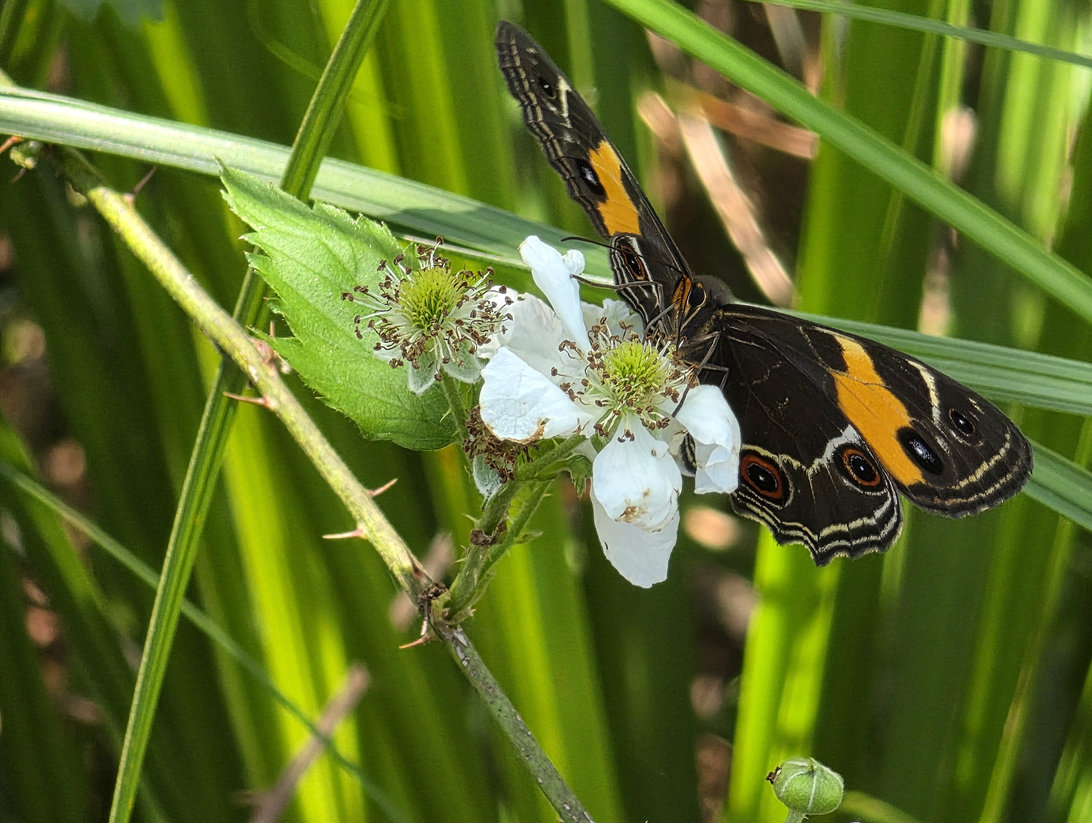
Of course, other moths and butterflies are moving across and through the landscape at present too - many of them feasting on nectar from all the plants currently in full Spring bloom. In the south end of Pittwater Joe Mills took this great specimen:
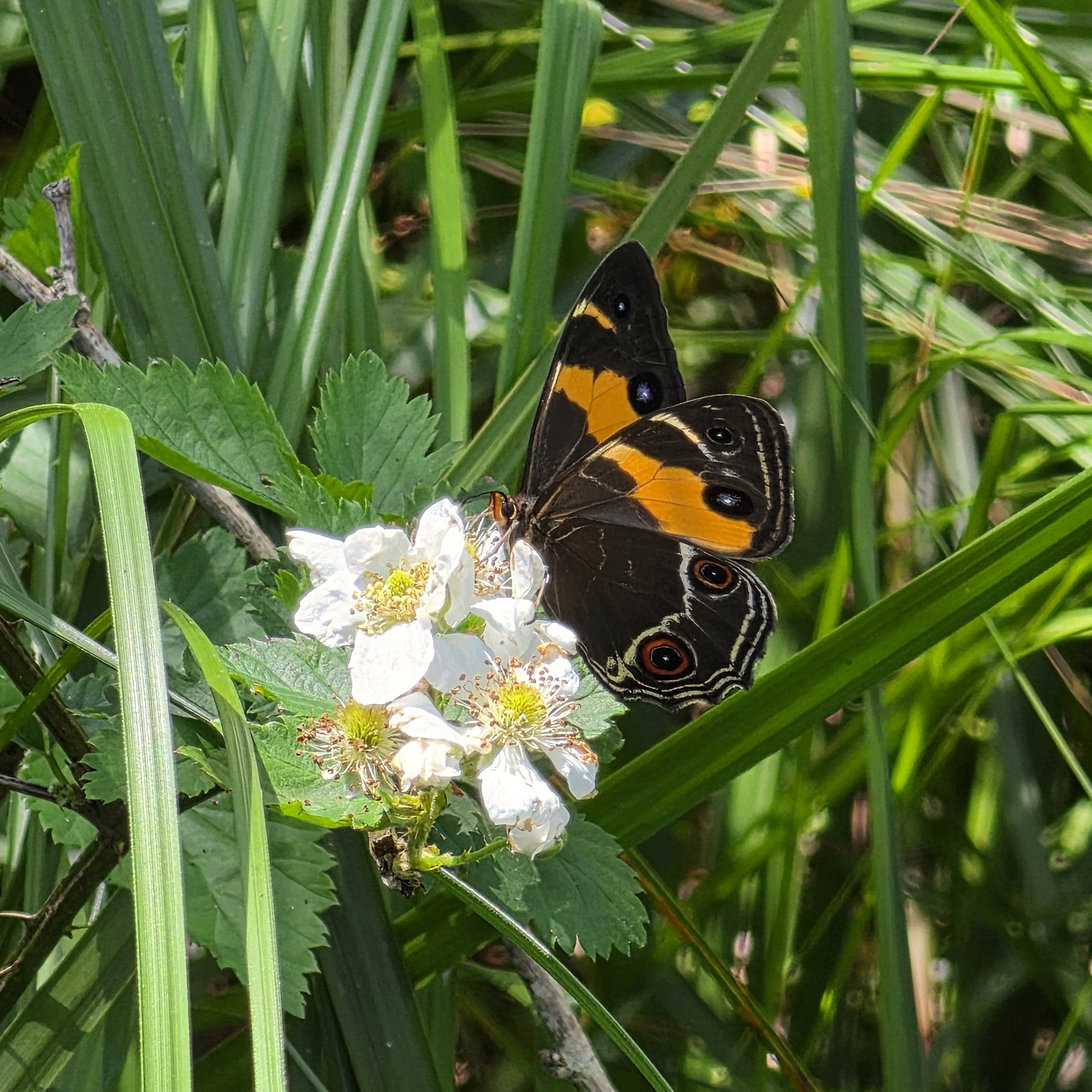
Warriewood Wetlands - Varied Sword-grass Brown Butterfly (Tisiphone abeona) on Blackberry Flowers Photos: Joe Mills
Tisiphone abeona, the swordgrass brown, is a nymphalid butterfly. It is endemic to Australia. The wings of the adult are brown and have a wingspan of about 60 mm. The larvae feed on Gahnia species.
Museums Victoria states:
General Description
Adult: Above: dark brown, forewing with orange bands and two blue-centred black eyespots; hind wing with a large blue-centred black eyespot ringed orange. Beneath: Brown, forewing as above but paler; hindwing, markings as above but eyespots more prominent in a narrow cream band. Wingspan 54-59 mm. Egg: Green, almost spherical, slightly roughened surface. 1.5 mm. Larva: Green with forked posterior projection. 62 mm. Pupa: Green, and smooth, yellow ridge along forewing. 18 mm.
Biology
Varied Sword-grass Browns are slow, graceful flyers, flying within a metre to the ground and close to their food plants. Adults will frequently land on Saw-sedges to bask in the sun with their wings open. Eggs are generally laid singly on the underside of young leaves. Larvae generally feed on Red-fruited Saw-sedge (Gahnia sieberiana) in Victoria but other Gahnia species have also been recorded as hosts outside Victoria. Larvae shelter near the base of the leaf during the day and ascend to feed at night, creating characteristic V-notches in the leaf. Pupation occurs deep within the plant, the pupa attached to the underside of the leaf and suspended head downwards. In Victoria there is one generation a year at high altitudes, but two generations in warmer areas.
Distribution
Six subspecies are recognised ranging from coastal South East Queensland to the south east corner of South Australia. One subspecies occurs in Victoria from Alpine areas, in the outer eastern suburbs of Melbourne, the Dandenong ranges and wet forest areas of the Grampians, Wilson's promontory and East Gippsland.
Habitat
Common in a range of habitats from alpine to suburban, including wet forests.
Flight Season: September to April
Field, R. (2022) Tisiphone abeona albifascia Varied Sword-grass Brown in Museums Victoria Collections https://collections.museumsvictoria.com.au/species/11399
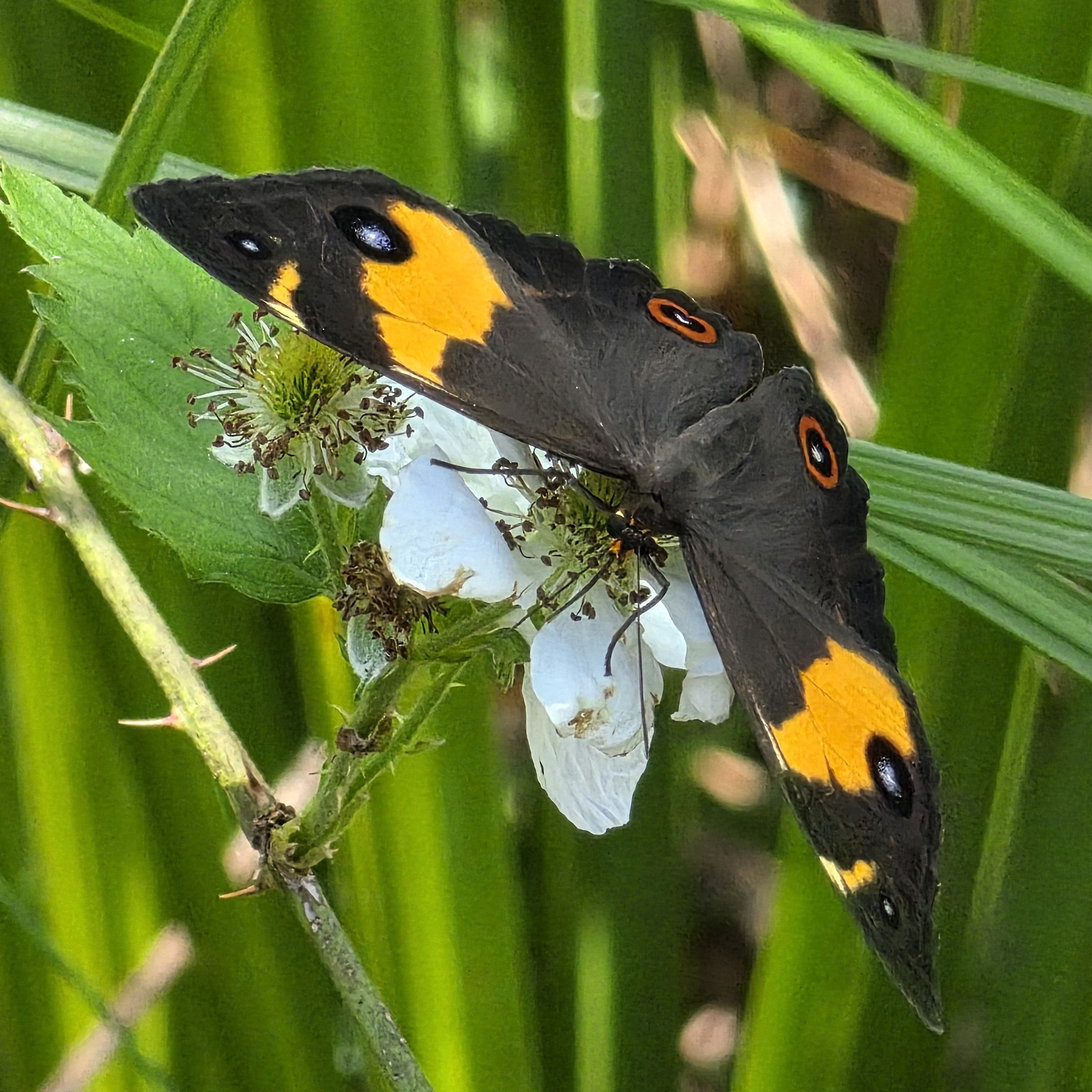
One we saw this week in the garden is a Papilio demoleus, a widespread swallowtail butterfly. The butterfly is also known as the lemon butterfly and chequered swallowtail, which refer to their host plants, usually citrus species such as the cultivated lime.
this%20one.jpg?timestamp=1791923754274)
Papilio demoleus at Careel Bay, Sunday October 11 2026. Photos: A J Guesdon
smaller.jpg?timestamp=1791923783954)
Wikipedia shares:
Unlike most swallowtail butterflies, it does not have a prominent tail. When the adult stage is taken into consideration, the lime swallowtail is the shortest-lived butterfly, with male adults dying after four days and females after a week. The butterfly is native to Asia and Australia.
The butterfly is tailless and has a wingspan 80–100 mm. Above, the background colour is black. A broad, irregular yellow band is found on the wings above, which is broken in the case of the forewing. Besides this, the butterfly has a large number of irregular spots on the wing. The upper hindwing has a red tornal spot with blue edging around it.
Detailed description as given by Charles Thomas Bingham in 1905:
"Upper side of wings has the ground colour black. The fore wing has the base below cell and basal half of latter so irrorated with yellow scales as to form more or less complete transverse dotted lines, two outwardly oblique yellow spots in cell and a curved spot at its upper apex; a spot at base and another beyond it in interspace 8; a discal transverse series of cream-yellow spots irregular in arrangement and size extends from interspace la to 8; the series interrupted in interspace 5 and the spot in interspace 7 double; this is followed by a sinuous postdiscal series of spots and an admarginal terminal series of smaller spots. In many specimens between the discal and postdiscal series the black ground-colour is irrorated with yellowish scales. Hind wing: base and an edging that decreases in width along the dorsal margin irrorated with yellow scales; followed by a broad medial yellow irregular band, a sinuous postdiscal series of outwardly emarginate yellow spots and a terminal series of smaller similarly coloured spots as on the fore wing. The inner margin of the medial band is curved inwards, the outer margin is very irregular and uneven; in the cell the band does not reach the apex, but beyond the cell there are one or more cream-yellow spots, and the black groundcolour is irrorated with yellowish scales; finally at the tornal angle there is an oval ochraceous-red spot emarginate on its inner side in the female and in both sexes surmounted by a blue lunule; while in interspace 7 between the medial band and the postdiscal spot there is a large ocellus-like spot of the black ground-colour more or less irrorated with blue scales."
"The underside has the ground-colour similar, the cream-coloured markings paler and conspicuously larger. The markings differ from those on the upperside in that the forewing has the basal half of cell and base of wing below it with cream-coloured streaks that coalesce at base; irregular ochraceous spots in interspaces 5 to 8 and the discal series of spots complete not interrupted in interspace 5. On the underside of the hind wing, the black at base of wing and along the dorsal margin centred largely with pale cream-colour; the ocellus in interspace 7, the apex of the cell and the black groundcolour between the medial band and postdiscal markings in interspaces 2–6 centred with ochraceous, margined with blue.
Antennae dark reddish brown, touched with ochraceous on the innerside towards the club; head, thorax and abdomen dusky black, the head and thorax anteriorly streaked with cream-yellow: beneath: the palpi, thorax and abdomen cream-yellow with lateral longitudinal black lines on the last."
This butterfly is an avid mud-puddler and visitor of flowers. It basks with its wings held wide open on tufts of grass and herbs, and generally keeps within a metre of the ground, even on cloudy days. It relies on its quick flight for escape. It has a number of modes of flight. In the cool of the morning, the flight is slow considering that it is an edible and unprotected swallowtail. As the day progresses, it flies fast, straight, and low. In the hotter part of the day, it may be found settling on damp patches, where it will remain motionless, except for an occasional flutter of wings, if not disturbed. It is also a frequent visitor of flowers in gardens, where it shows a preference for flowers of smaller herbs rather than larger plants such as the ubiquitous Lantana with its plentiful blooms. It can be found swarming in the groves of its food plants.
smaller.jpg?timestamp=1791923888828)
Papilio demoleus showing 4 wings, at Careel Bay, Sunday October 11 2026. Photos: A J Guesdon
smaller.jpg?timestamp=1791924026941)
smaller.jpg?timestamp=1791924159461)
The typical time for one generation of P. demoleus to mature in the field ranges from 26 to 59 days. In cold climates, the lime butterfly is known to pass the Winter as pupae. Typically, the butterfly undergoes five instars as a caterpillar.
The female butterfly goes from plant to plant, laying a single egg at a time on top of a leaf, which it holds onto with its legs, and flies off as soon as the egg is laid. The egg is round, light yellowish in colour, flattened at the base, smooth-surfaced, and about 1.5 mm in height. Fertile eggs develop a small red mark at the apex.
Captive breeding of P. demoleus in Riyadh has revealed these data about the lifespan of various stages at that locality:
- Number of generations per year: 8
- Duration of egg stage: 3.1 to 6.1 days
- Duration of larva stage: 12.9 and 22.7 days
- Duration of pupa stage: 8.0 to 22.4 days
- Duration of adult stage: 4 to 6 days with average of 5.1 days
In Australia and Papua New Guinea, the butterfly also feeds on host plants of family Fabaceae. They have been observed on:
Many species of Cullen: Cullen australasicum, C. badocanum, C. balsamicum, C. cinereum, C. patens (spreading scurf-pea, native verbine), C. pustulatum, and C. tenax (tough scurf-pea, emu-foot, emu grass), and C. leucanthum. Psoralea pinnata (fountain bush).