Summer BirdFest 2026: Play antics of New Locals
The fledglings from this years 'newbies' have begun turning up in local yards and trees as they learn to fly and feed, as taught by their parents - and even which branches in trees to land on so they don't slide down onto the trunk!
This family of galahs, where mum and dad have had two girls and one boy this Season, showed up in mid-January with the little boy grabbing a Norfolk Pine frond in his beak and waving at one of his sisters - who didn't seem that interested in either waving it around too, or playing tug-of-war - so he dropped it. He was also then seen peering down the umbrella hole in the outdoor table - clearly something of interest down there.
Check out this Norfolk Pine frond - Do you want to play?:
%20smaller.jpg?timestamp=1769645602951)
I spy, with my galah eye, something beginning with....:
%20smaller.jpg?timestamp=1769645638078)
%20smaller.jpg?timestamp=1769645668722)
Mumma galah patiently watching her youngsters - note the colour of her eyes:
%20mumma%20smaller.jpg?timestamp=1769645238812)
Witnessing young local wildlife playing is a great reminder of the other residents of Pittwater and that these other family units, and their individual members, all have personalities and a propensity for play, for living each other - as seen in the numerous sulphur-crested cockatoo 'tribes' that get around together and groom each other or even call warnings to each other when a sea eagle flies overhead.
It's a great time for birdwatching with all these kinds of bird families and family groups out and about - teaching young ones which are the food trees and where drinking water may be found, and seeing their children playing with each other.
BirdLife Australia states:
'Galahs form permanent pair bonds, although a bird will take a new partner if the other one dies. The nest is a tree hollow or similar location, lined with leaves. Both sexes incubate the eggs and care for the young.
There is high chick mortality in Galahs, with up to 50% of chicks dying in the first six months. Galahs have been recorded breeding with other members of the cockatoo family, both in the wild and captivity. These include the Sulphur-crested Cockatoo, C. galerita.
Breeding season is from February – July, in the north and from July – December, in the south.'
Female Galahs are easily distinguished from males by their distinct reddish-pink or light pink irises. In contrast, mature male Galahs have dark brown or blackish eyes. This colour difference is a reliable way to sex adult birds, though both sexes have dark brown eyes as juveniles. Females' eyes begin to lighten from brown to pink/red as they mature, typically around 6 months to 3 years old.
The term galah is derived from gilaa, a word found in Yuwaalaraay and neighbouring Aboriginal languages of southeast Australia. First Known Use: 1862.
Galahs are about 35 cm (14 in) long and weigh 270–350 g. They have a pale grey to mid-grey back, a pale grey rump, a pink face and chest, and a light pink mobile crest. Juveniles have greyish chests, crowns, and crests.
%20smaller.jpg?timestamp=1769644965301)
Juvenile plumage changes as they mature
.JPG?timestamp=1770080856787)
Little Corella juvenile pair:
.jpg?timestamp=1769645711165)
Both Galahs (Eolophus roseicapilla) and Sulphur-crested Cockatoos (Cacatua galerita)are known for their highly social, intelligent, and, above all, playful nature, which is central to their behaviour in the wild. Often seen in large, noisy flocks, these birds engage in frequent, acrobatic antics that have earned them a reputation as "clowns" of the Australian bush.
Key aspects of their playful and natural behaviour include:
- Acrobatic Play: Galahs and Cockatoos are known to hang upside down from branches, slide down wires, and perform complex aerial manoeuvres.
- "Playing the Fool": They often exhibit behaviours described as chaotic or mischievous, such as tumbling and wrestling with each other on the ground or, during windy conditions, playing in the branches.
- Social Interaction: As deeply social birds, they use these games to strengthen bonds within their flock, which can consist of hundreds or even thousands of individuals.
- Foraging and Foraging-related Play: They spend much of their time on the ground foraging for food, but also use their beaks to strip bark and leaves, which is believed to be a form of entertainment in addition to foraging.
- Lifelong Bonds: Both Cockattos and Galahs form lifelong, monogamous pairs and often perform synchronised movements and affectionate behaviours together. Additionally, flocks form a family and have been witnessed mourning a bird that has been killed. A flock usually stays in the same area year round.
- Intelligence: Their playful, curious, and often noisy nature is a sign of their high intelligence.
The 'galah' name has even entered the Australian vernacular as a term for a "silly person" or a "clown," directly referencing these clownish and chaotic antics.
Other unusual sightings of bird bubs and others movements across Pittwater and the peninsula and surrounds, per Eremaea Birdlines (Interesting and unusual bird observations) BirdLife Australia - include:
- Streaked Shearwater at Long Reef Aquatic Reserve: Highlight of a three and a half hour seawatch from Long Reef this morning was a Streaked Shearwater heading south with the large numbers of Wedge-tailed and Short-tailed Shearwaters,also a few Flesh-footed Shearwaters headlng south as well. - Michael Ronan 26/1/2026
- Glossy Black Cockatoo at Ku-ring-gai Chase National Park-Apple Tree Bay: Amazing count of 11 flew out of casuarinas ahead of us as we kayaked down the "north" side of Cowan Creek. They flew across the creek then headed downstream at height, all in quite close formation. Seen and heard well, their call being quite unmistakable. No camera with me in the kayak unfortunately. eBird checklist - Cameron Ward 15/1/2026
- Buff-banded Rail at Scotland Island: Adult and chick in yard of house not far from Tennis Court Wharf. - Ted Nxon 19/1/2026
- Glossy Black Cockatoos at Manly Warringah War Memorial Park--Incl Manly Dam: Three cockatoos. Looks like one is a juvenile. This is the second time we have seen this group in the last couple of weeks. - Ben Wicks 5/1/2026
- Red Knot, Tawny Grassbird at Long Reef Aquatic Reserve: Red Knot feeding on the edge of the sandspit with the smaller waders a bit after low tide (approx 2:30pm) but was flushed to the far end by some non-birders and did not come back to the sandspit. Tawny Grassbird was first heard singing and then seen skulking in scruffy shrubs just up the hill from the access track before it starts climbing. - Tom Wilson 1/1/2026
We were also very fortunate to play host to a family of Blue-faced honeyeaters in the PON yard this Summer - details below.
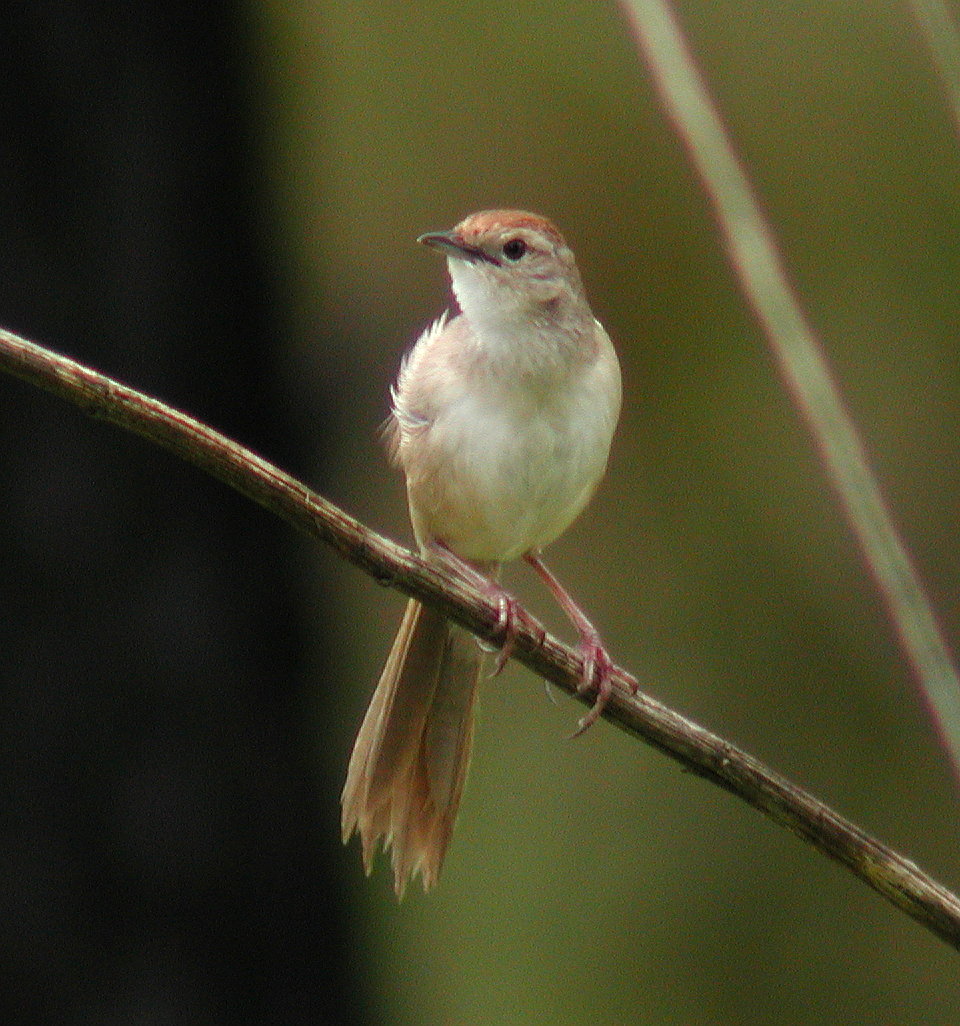
Tawny Grassbird, Megalurus timoriensis. Photo: Aviceda
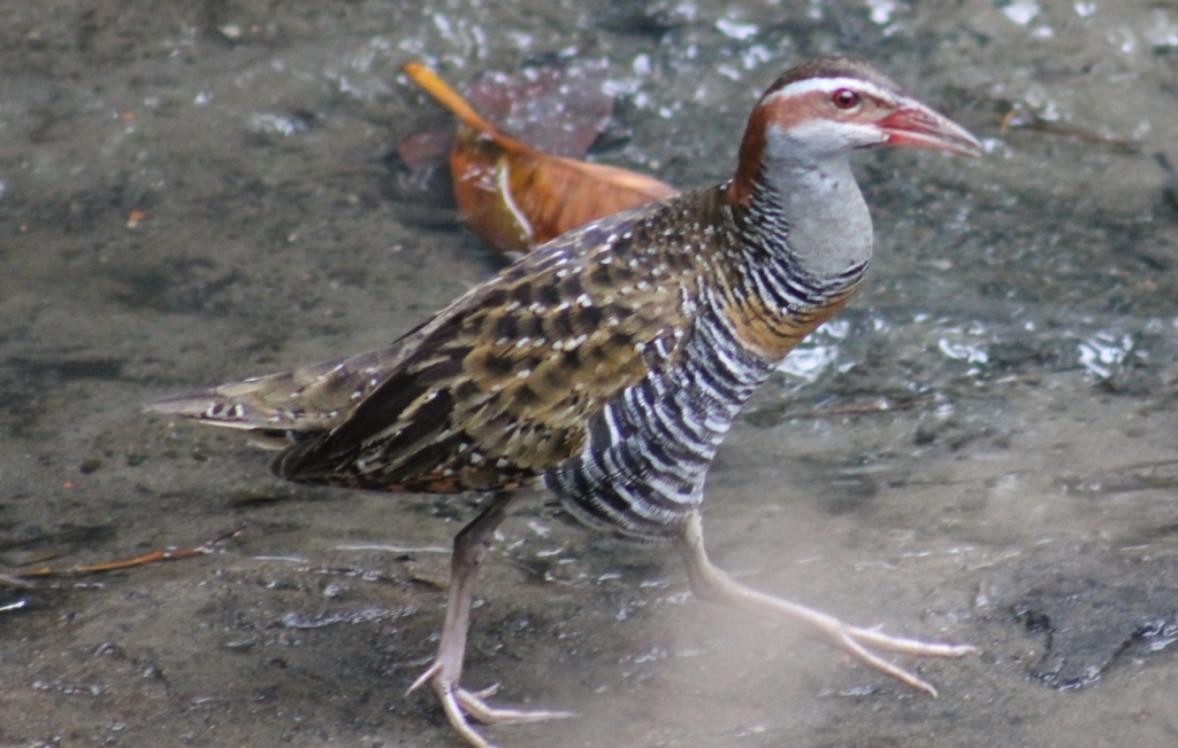
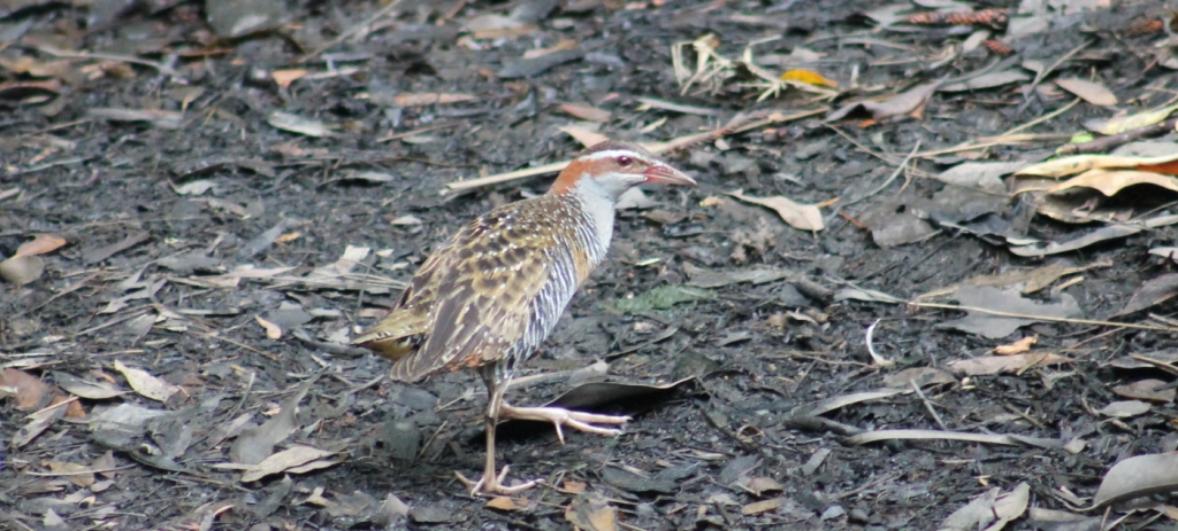
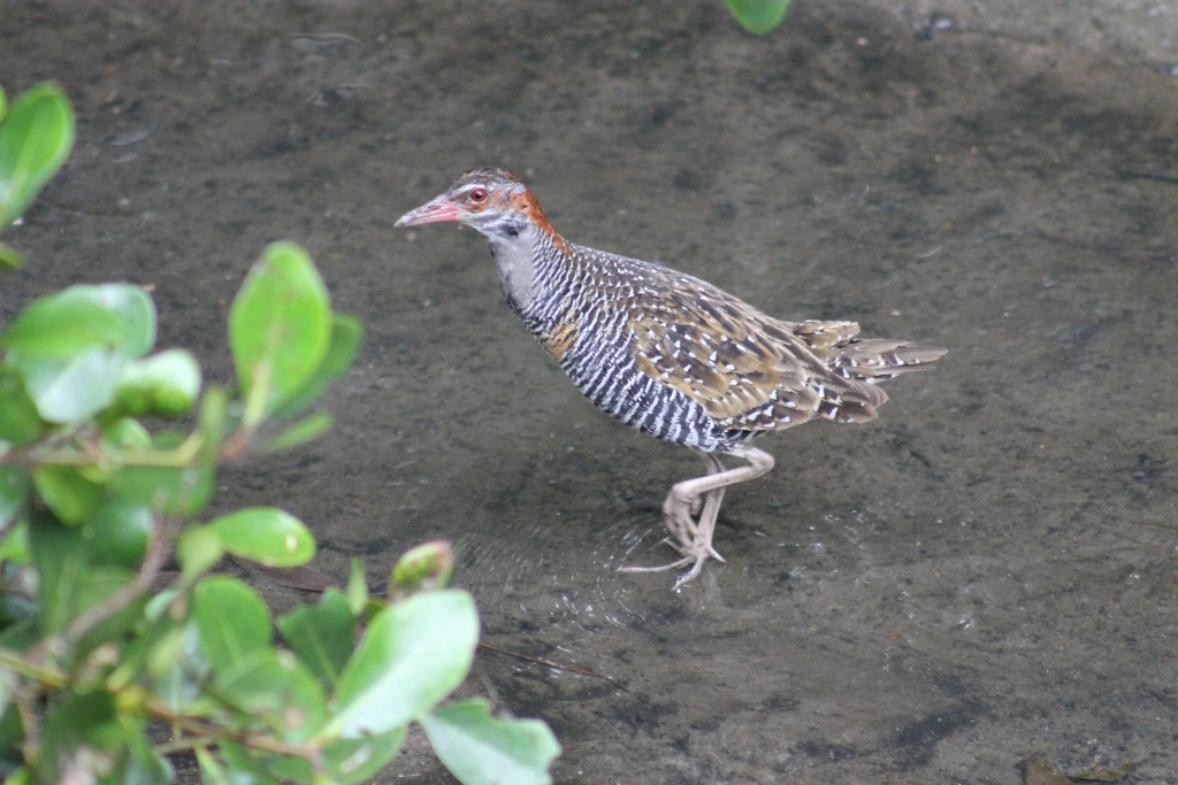
Cockatoo social contact takes the form of grooming: gently touching and cleaning the feathers of other cockatoos of the group:
%20smaller.jpg?timestamp=1769645775148)
Cockie yelling!:
.jpg?timestamp=1769645809209)
Rainbow lorikeets have had around 1-3 bubs this year in the PON yard tree hollows - there have been around 9-11 juveniles seen in recent weeks:
.jpg?timestamp=1769645866040)
Blue-faced honeyeaters Breeding In Pittwater
On the morning of Friday January 30 2026 these two fledglings and their parents were spotted bathing and drinking then drying off in the PON yard at Careel Bay.
Marita Macrae of the Pittwater Natural Heritage Association (PNHA) who has hosted many Bird Walks in Pittwater for decades, stated that it’s very unusual to see those birds here, and breeding too!, but not the first time though.
.JPG?timestamp=1769731947329)
Blue-faced honeyeater (Entomyzon cyanotis), juvenile/fledgling pair in PON yard, Jan. 30 2026 - they're wet as they just had a bath/drink in one of the 4 birdbaths in the PON yard - each at a compass point and at least 1 under shade as sun shifts during the day. They are calling for food from parents birds it would seem.
The Blue-faced honeyeater (Entomyzon cyanotis), also colloquially known as the banana-bird, is a passerine bird of the honeyeater family, Meliphagidae. It is the only member of its genus, and it is most closely related to honeyeaters of the genus Melithreptus.
The Blue-faced Honeyeater is a large black, white and golden olive-green honeyeater with striking blue skin around the yellow to white eye. The crown, face and neck are black, with a narrow white band across the back of the neck. The upperparts and wings are a golden olive green, and the underparts are white, with a grey-black throat and upper breast. The blue facial skin is two-toned, with the lower half a brilliant cobalt blue. Juvenile birds are similar to the adults but the facial skin is yellow-green and the bib is a lighter grey. This honeyeater is noisy and gregarious, and is usually seen in pairs or small flocks. It is known as the Banana-bird in tropical areas, for its habit of feeding on banana fruit and flowers.
Three subspecies are recognised.:
- E. c. albipennis was described by John Gould in 1841 and is found in north Queensland, west through the Gulf of Carpentaria, in the Top End of the Northern Territory, and across into the Kimberley region of Western Australia. It has white on the wings and a discontinuous stripe on the nape. The wing-patch is pure white in the western part of its range, and is more cream towards the east. It has a longer bill and shorter tail than the nominate race. The blue-faced honeyeater also decreases in size with decreasing latitude, consistent with Bergmann's rule. Molecular work supports the current classification of this subspecies as distinct from the nominate subspecies cyanotis.
- E. c. cyanotis, the nominate form, is found from Cape York Peninsula south through Queensland and New South Wales, into the Riverina region, Victoria, and southeastern South Australia.
- E. c. griseigularis is found in southwestern New Guinea and Cape York, and was described in 1909 by Dutch naturalist Eduard van Oort. It is much smaller than the other subspecies. The original name for this subspecies was harteri, but the type specimen, collected in Cooktown, was found to be an intergrade form. The new type was collected from Merauke. This subspecies intergrades with cyanotis at the base of the Cape York Peninsula, and the zone of intermediate forms is narrow. The white wing-patch is larger than that of cyanotis and smaller than that of albipennis. Only one bird (from Cape York) of this subspecies was sampled in a molecular study, and it was shown to be genetically close to cyanotis.
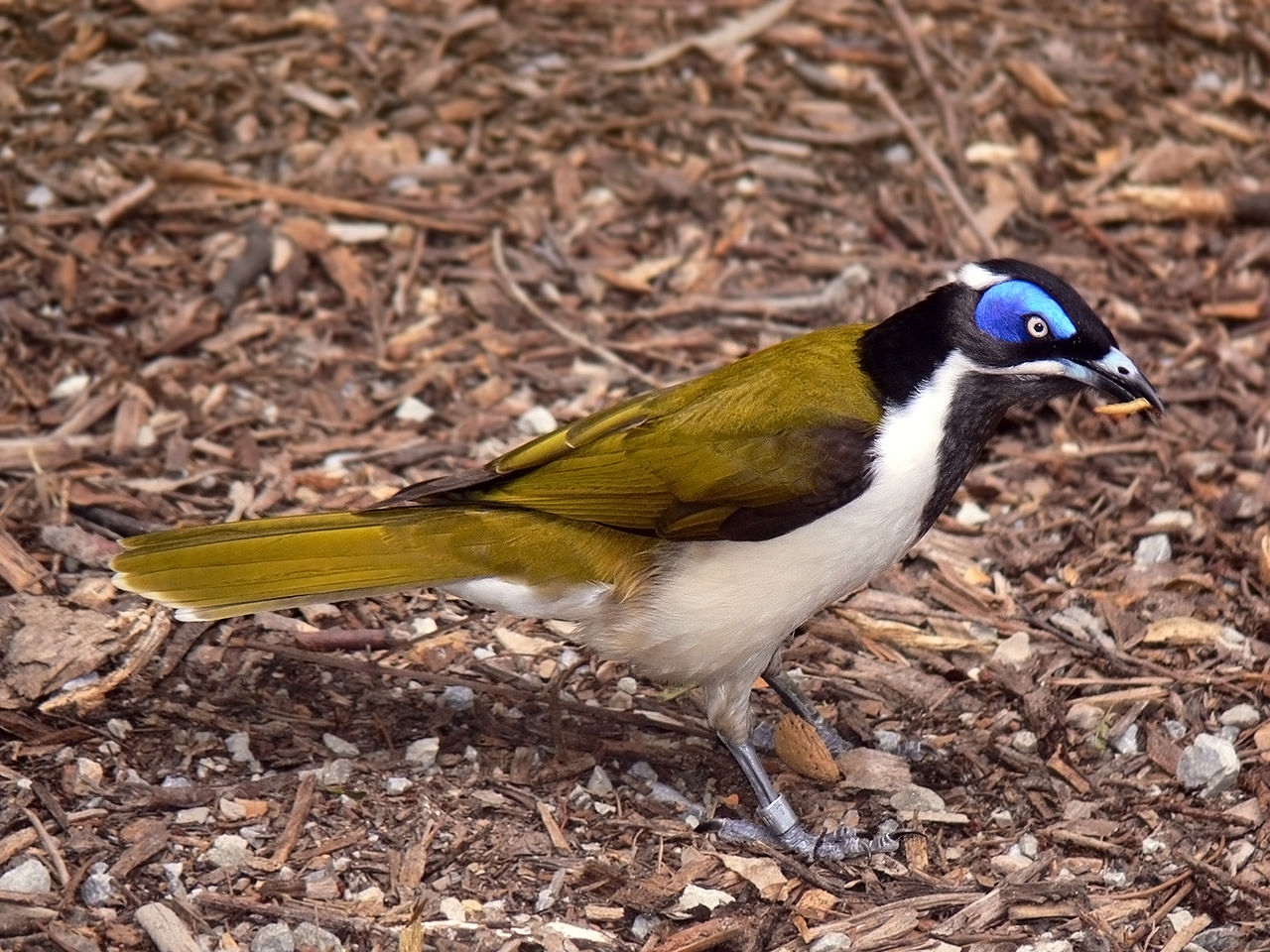
Adult bird of Subspecies cyanotis feeding, south-eastern Australia, feeding. Photo: Benjamin444
The Blue-faced Honeyeater is found in tropical, sub-tropical and wetter temperate or semi-arid zones. It is mostly found in open forests and woodlands close to water, as well as monsoon forests, mangroves and coastal heathlands. It is often seen in banana plantations, orchards, farm lands and in urban parks, gardens and golf courses.
The Blue-faced Honeyeater is found in northern and eastern mainland Australia, from the Kimberley region, Western Australia to near Adelaide, South Australia, being more common in the north of its range. They are considered sedentary in the north of its range, and locally nomadic in the south. It is not found in central southern New South Wales or eastern Victoria now. This species is also found in Papua New Guinea.
Around Wellington in central New South Wales, birds were once recorded over Winter months, and were more common in autumn around the Talbragar River. Birds were present all year round near Inverell in northern New South Wales, but noted to be flying eastwards from January to May, and westwards in June and July.
The Blue-faced Honeyeater feeds mostly on insects and other invertebrates, but also eats nectar and fruit from native and exotic plants. It forages in pairs or noisy flocks of up to seven birds (occasionally many more) on the bark and limbs of trees, as well as on flowers and foliage. These flocks tend to exclude other birds from the feeding area, but they do feed in association with other species such as Yellow-throated Miners and Little Friarbirds.
In late November- early December 2025 we began hearing an unusual call from the Norfolk Pine next door. Having heard a pair of Australasian Figbirds (Sphecotheres vieilloti) that return each Spring to nest ion that same tree, at first it was thought these had returned as we heard them calling each other in early November from the tree and across the perimeter of the Careel Bay Playing fields. However, soon after they arrived again, the male was found killed near the road alongside the Careel Bay dog park. The pair did not breed here this year - we're not sure what happened to his female mate.
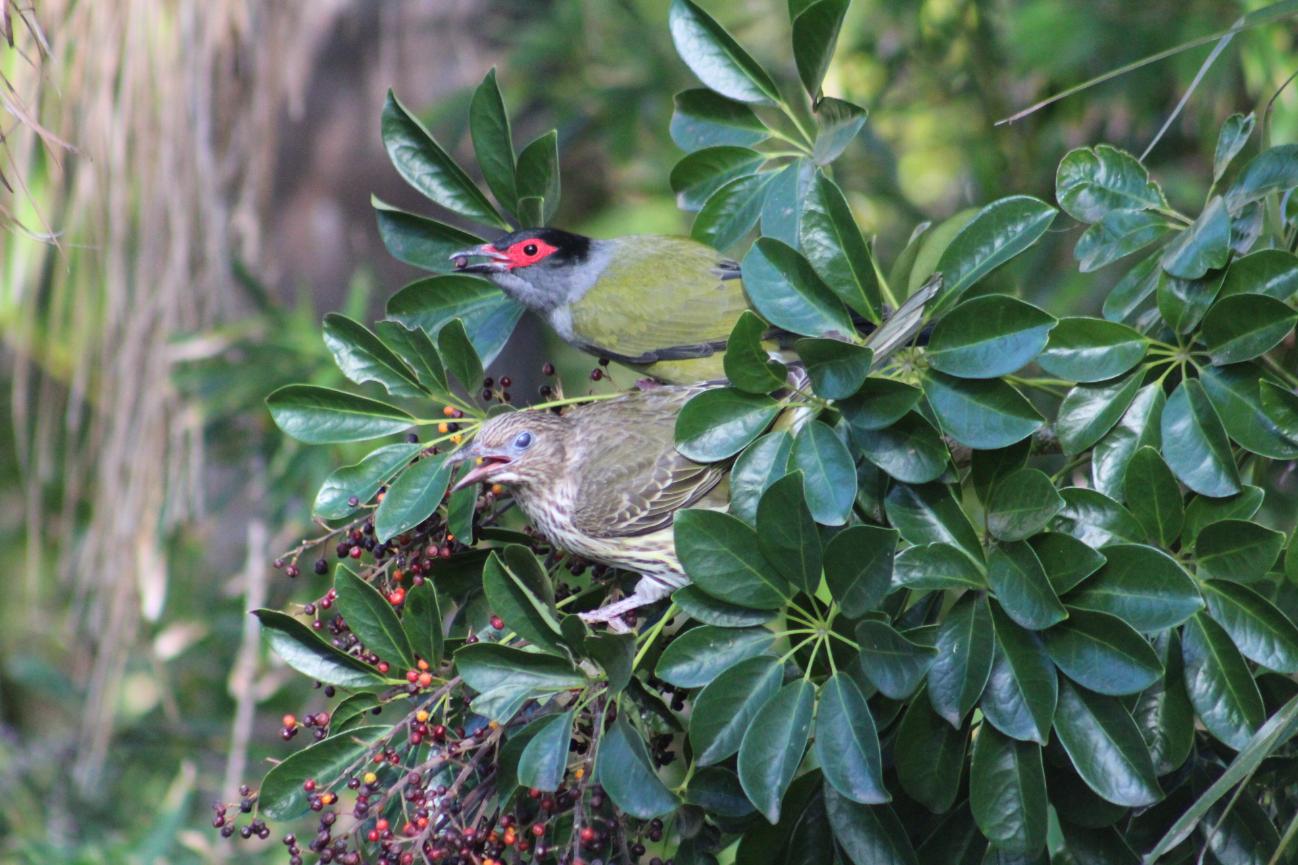
Each Spring this pair of Australasian Figbirds(Sphecotheres vieilloti) returned to build a nest and make babies in the Norfolk pine alongside us. There is food in our garden for them and no cats, at least none that can get that high up.
.JPG?timestamp=1696655546826)
Females have grey skin around the eye and lack distinctive head markings. They are brown-green above and dull-white below, streaked with brown. Both sexes have a blackish bill.
.JPG?timestamp=1696655730211)
Then we began hearing another pair of parents call across the yard and park trees, a bird call we hadn't heard before, and realise now it must have been the blue-faced honeyeater pair.
The Blue-faced honeyeater's call is a repeated, penetrating 'woik'; 'weet weet weet' at daybreak; also squeaks uttered during flight and softer 'hwit hwit' calls. Others who have heard them liken their calls to Miner birds songs.
The Blue-faced Honeyeater is one of the first birds heard calling in the morning, often calling 30 minutes before sunrise, although here it is joined by the magpie family that nests in the same tree.
Their nest was dislodged from that tree over the weekend of January 17-19, when hard winds accompanied the rain storms, and blew into the yard.
.JPG?timestamp=1769732384855)
Fortunately, the fledglings were strong enough to fly.
Most nests are made on the abandoned nests of Grey-crowned Babblers, Noisy, Silver-crowned and Little Friarbirds, Noisy Miner, Red Wattlebird, Australian Magpie, Magpie-Lark and, rarely, butcherbirds or the Chestnut-crowned Babbler. Sometimes the nests are not modified, but often they are added to and relined. If a new nest is built, it is a neat round cup of rough bark, linked with finer bark and grass.
Birding forums from the past 3 years state Blue-faced Honeyeaters (Entomyzon cyanotis) are increasingly sighted in the Sydney region, particularly in Western Sydney, the Barrenjoey peninsula, and near Hawkesbury, often in residential areas with flowering trees. While traditionally found further north, they are now resident in suburban Sydney, favouring areas like Ermington, Richmond, and Nurragingy Reserve - and clearly Palm Beach and Careel Bay this year - and a first for us!
.JPG?timestamp=1769733570652)