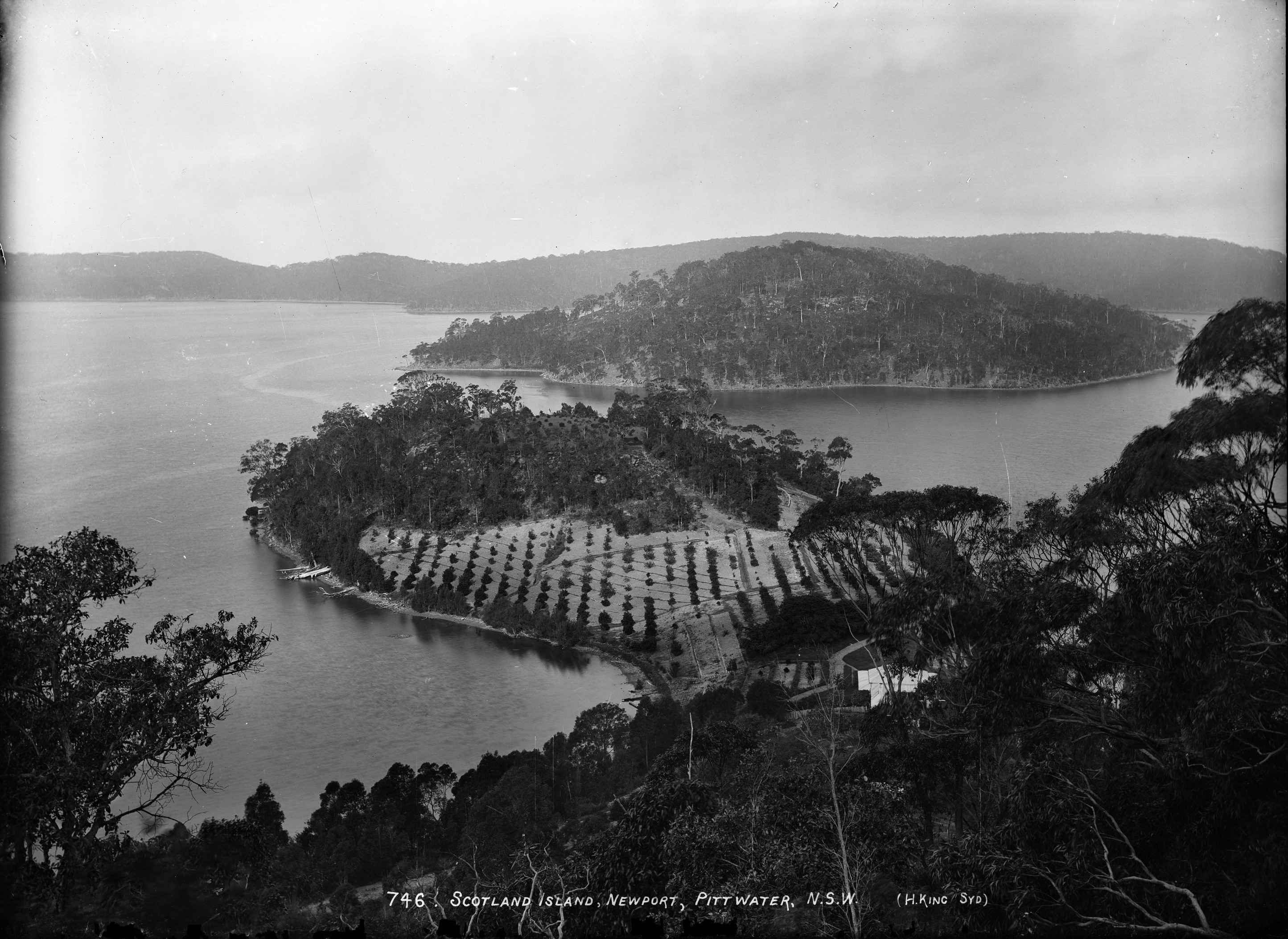
When you live on an island maintaining 'access to' its land is vital - you need a bit of low tide beach, a slipway, a boat ramp, a landing place, a jetty or wharf.
There are around 220 years between when Andrew Thompson used the north end of the island and current day site of Tennis Court Wharf as a place for salt pans and where the schooner Geordy was launched while another, in 1810, was 'in stocks', the 1884 application by former Mariners Joseph Benns and Charles Jenkins to 'Maintain a Jetty' facing west near today's Cargo Wharf site - which means there was already something there to land items on the island or take produce of some sort off the island, 'shipping' it - the 1924 subdivision of large blocks into suburban-sized blocks which saw Bells and Eastern wharves being built 'to provide access', and when Carols' Wharf was finished in 1978, to provide that same equitable 'access to' for residents.In between circa 1804/05, when a Land Grant to Thompson and the Autumn of 1978, legislation defined Permissive Occupancies and then a Special Lease. A permissive occupancy is a type of tenure that was issued under former legislation; this type of tenure was subsequently replaced by licences. Under the Crown Land Management Act 2016, existing permissive occupancies are referred to as licences.
It's also a place where for thousands of years no wharf was required. The shells shipped to Sydney Town by the boatload to make mortar were from middens on the west and north side of the island, with a remnant still adjacent to today's Catherine Park, mark feast places of shellfish and caught fish by the original custodians of this place. These peoples landed via bark canoes.
To open, the first known 'access to' place.
North - Tennis Court Wharf (from circa 1805)
The first European landing place for access is today's Tennis Court Wharf site and bay just west of Pitt Point and fronting Catherine Park.
Andrew Thomson born early in 1773, was the youngest of six children of John Thomson, a weaver, manufacturer, and dyer, and his wife Agnes, of Kirk Yetholm, Scotland. He was said to be '15 or 16' when found guilty of stealing some cloth and was sentenced on two counts of theft on 22nd September 1790 at the Jedburgh Court (a town and former royal burgh in the Scottish Borders). He was transported to Australia on the Pitt: Departing June-July 1791 for Sydney, and arrived on 14 February, 1792, days after his 19th birthday.
Here he became a respected chief constable in the Hawkesbury district, a successful farmer and businessman, and one of the wealthiest settlers in early colonial Australia.
Andrew, now spelt 'Thompson', like many others at this time, was assigned convict labour for properties and land grants that he began to accumulate. To get the produce from these to Sydney Cove he utilised the flowing past his estates Hawkesbury River and employed a boat builder to construct these vessels. The Sydney Gazette and New South Wales Advertiser, the first newspaper printed in Australia, records some of these vessels and their adventures;
Boats.—Came in from Hawkesbury on Saturday last, the 19th inst. the William and Mary, W. Miller owner, laden with wheat. On Tuesday came in from Hawkesbury the Raven, Thomas Raby owner, also laden with wheat; and same day the Hope of Hawkesbury, A. Thompson owner, with wheat barley, and oats. And on Thursday came in the Argument, Ward and Eaton owners, with wheat.—On Thursday the Hope sailed again for Hawkesbury. SHIP NEWS. (1803, March 26). The Sydney Gazette and New South Wales Advertiser (NSW : 1803 - 1842), p. 4. Retrieved from http://nla.gov.au/nla.news-article625468
Although Thompson wasn't officially recorded as having been grated Scotland Island until January 1st 1810, there are records indicating he was producing salt in the estuary from 1805 onwards - Salt Pan Cove at Newport, with a close by view of Scotland Island, stated to be one of these locations:
s’s assigned or employed people were the first Europeans located at the site, with remnant stonework that is heritage listed, stated to be associated with his salt works and ship building on this part of the island.
Here the good schooner Geordy was launched in the Spring time, and soon after he died on October 22 1810, and soon after sold as part of his estate. Thompson had assigned (Convict) servants; among these a Carpenter or those who could adapt to work on a road toll and punt works across waters, salt boiler works, the fields of farms where labour was by others, their kitchens and yards, a brewery, a place where he was magistrate at Windsor, or collected fees, in grain or fish, for the Sydney Gazette subscribers and was where you inquired to let houses in the district, an estate agent for the government and others. These Notices advises of the Builder of boats, built for his many enterprises – including boats collecting and transporting to Sydney grain crops of others (Hope, Nancy), a whaler (Speedwell) that he got off Lion Island when stranded there by the previous owners coasters hands, and sent to New Zealand to kill whales, was overseen by:
The New Hawkesbury Sloop, built at the Green Hills, Mr A Thompson, owner, came round for the first time on Monday 1st, with 1160 Bushels of Wheat, on from Cornwallis Farm, cultivated by Government, and could have taken in with safety 250 more. This vessel called the Nancy, was built under the sole management and direction of Mr. Kelly, formerly chief mate of the Eliza whaler, who also navigates her. Her computed burthen is 40 tons, carries 5 men, and has 4 swivels mounted on her quarter railing. Connoisseurs find no other fault with her than on account of her being rather "shallow in the Bow." SYDNEY. (1803, October 23). The Sydney Gazette and New South Wales Advertiser (NSW : 1803 - 1842), p. 2. Retrieved from http://nla.gov.au/nla.news-article625840
And on Thursday arrived the Nancy, A. Thompson owner, and the William from Hawkesbury, with wheat. The Nancy sailed from hence for Hunter's River on the 21st of October; took on board 40 logs of very fine Cedar, mostly measuring 20 feet and upwards, and squaring more than 3 feet; and arrived at Hawkesbury with the freight the 1st of the present month. SHIP NEWS. (1803, December 25). The Sydney Gazette and New South Wales Advertiser (NSW : 1803 - 1842), p. 4. Retrieved fromhttp://nla.gov.au/nla.news-article625948
The Nancy may have been ‘’shallow in the Bow." to navigate the Hawkesbury River tides and those of Pittwater. But who was she named for - who was ‘Nancy’, a relative or love interest of Andrew Thompson's or ?
Another handsome Sloop built by Mr. A. Thompson, was on Thursday launched from the Green Hills; her keel was laid by Mr. Kelly, now master of the Nancy, her burthen is computed at 30 tons, and in compliment to the spot of her nativity, she has received the name of the Hawkesbury. Bench of Magistrates. (1804, February 19). The Sydney Gazette and New South Wales Advertiser (NSW : 1803 - 1842), p. 4. Retrieved from http://nla.gov.au/nla.news-article626050
On Wednesday, the 14th of the present month, a launch took place at Scotland Isle, Pitt Water, of a vessel of 18 tons, said to be one of the finest of her burthen ever built in the Colony.—She makes part of the devised property of the late Mr. THOMPSON, who at the laying down of her keel gave her the name of the GEORDY. SYDNEY. (1810, November 24). The Sydney Gazette and New South Wales Advertiser (NSW : 1803 - 1842), p. 2. Retrieved from http://nla.gov.au/nla.news-article628130
The Geordy was quickly put up for sale:
BY MR GAUDRY, At the Warehouse of Messrs. Lord and Williams, on Thursday and Friday, the 17th and 18th instants, by Order of the Executors of the late ANDREW THOMPSON, Esq. The good schooner, entirely new, called the GEORDY, Burthen 20 Tons, with all her Masts, Yards, Sails, Rigging, and Stores, the Purchaser of which will receive a Register in his own Name.
Also the WHALE Sloop; together with a number of good Horses and Mares with Foals by their sides.
Several Tons of Salt. Likewise, a quantity of excellent Houshold Furniture, consisting of tables, chairs, beds, bedsteads, &c. harness, cedar, and a variety of other articles. For the accommodation of Purchasers, 3 Months Credit will be given on approved security, on all sums exceeding Ten Pounds. - A Deposit of 25 per Cent. to be paid at the Time of Sale in Cash, Govnment Bills, or other approved Sterling Money.
On Friday will be Let by Auction, for the Term of Two Years, those very valuable Salt Works at Scotland Isle, with a good Dwelling house and other requisite Buildings attached. - Security of the Renter will be required. At Twelve o'Clock of the same Day the Vessels will be put up.
To be Sold by Private Contract, One Half Share of the Good Schooner Endeavour, with her Masts, Yards, Rigging, Apparel, &c. compleit, belong to Mr. Henry Kable, now being in Sydney Cove. Every particular may be known on application at his House in George-street. - If not disposed of, the above One Half will be put up at Public Auction on Friday the 18th instant, by Mr. Wm. Gaudry. Classified Advertising. (1811, January 12). The Sydney Gazette and New South Wales Advertiser (NSW : 1803 - 1842), p. 1. Retrieved from http://nla.gov.au/nla.news-article628168
The Geordy became Henry Kables for a while:
Mr. Kable having two Vessels in the Hawkesbury River, wishes all Settlers and others who are indented to him, to take advantage of the same, as no better Opportunity can be afforded them of discharging the Claims he has upon them. The Masters of the Endeavour and Geordy, sloops are authorised to give Receipts for whatever may be intrusted to their Care. Classified Advertising. (1811, February 9). The Sydney Gazette and New South Wales Advertiser (NSW : 1803 - 1842), p. 2. Retrieved from http://nla.gov.au/nla.news-article628188
More about her in: The First Boat Builders Of Pittwater: The Short Life And Long Voyages Of Scotland Island Schooner The Geordy:
And a William Mason seems to have stationed workers on Scotland Island to keep the salt works working until this tragedy:
Last Thursday se'nnight, a man employed at the Salt Works of Mr. Wm. Mason, at Scotland Island, was killed on the spot by the fall of a tree. We can learn nothing farther than that his Christian name was Dennis. Sydney. (1812, August 8). The Sydney Gazette and New South Wales Advertiser (NSW : 1803 - 1842), p. 2. Retrieved from http://nla.gov.au/nla.news-article628523
Mr. Mason may not have paid the rent as soon after that August death:
At the same Time will be Rented, for the Term of One Year, the Farms of Agnes Bank, Creek Retreat, Wardel Bank, Killarney, West Hill, and Scotland Island. - From the difficulty that has been found in collecting the Rents of these Farms, proper Security will be required for the due Payment of the Rents when they become due, which must be paid in Cash, as no Grain will be received. Classified Advertising. (1812, October 17). The Sydney Gazette and New South Wales Advertiser (NSW : 1803 - 1842), p. 1. Retrieved from http://nla.gov.au/nla.news-article628555
By 1812 another boat is being crafted on the north end of the island:
Lot 10.— Scotland Isle, an Island situate in Pitt Water, Broken Bay; comprising One hundred and twenty Acres of good Land, fit for Grazing and Cultivation, with extensive Salt Works, a good Dwelling House and Stores, Labourers' Rooms, &c. and replete with every Conveniency for carrying on the Business of Salt Boiling, well situated for the Establishment of a Fishery, and Ship Building. Also, a Vessel of about 90 Tons, (partly built) on the Stocks, at the Island. Classified Advertising (1812, October 24). The Sydney Gazette and New South Wales Advertiser (NSW : 1803 - 1842), p. 4. Retrieved from http://nla.gov.au/nla.news-article628562
ADVERTISEMENT — On the 15th of January next, 1815, will be Sold by PUBLIC AUCTION, all those valuable and eligably situated HOUSES and LANDS, comprising the Estate of the late ANDREW THOMPSON, Esq. deceased, viz.
Lot 1. A Brick Building, of two Stories, comprising 8 Tenements of two Rooms each, situate in George street, Windsor.
2. One hundred and fifty Acres of rich arable Land, known by the Name of West hill, situate by the Town of Windsor — with a convenient weather boarded and shingled Dwelling house, brick built Granary of three floors, weather-boarded and shingled Stabling and Barn, detached Servant's Rooms, a fenced Garden of two Acres, extensive fenced Paddocks, and very useful Farm Offices ; secure from the highest Floods, and commanding the Range of a very extensive Common of excellent grazing Land.— Also, a convenient Tan yard, and a weather boarded and shingled House on the Premises ; forming a very desirable Acquisition for the Agriculturist and Grazier.
3. The Toll Bridge over the South Creek, Windsor, Leasehold from the Crown, of which six Years will be then to come and unexpired.
4. Two hundred and seventy eight Acres of Land, known by the Name of Agnes's Bank, two hundred of which felled, and sixty cleared ; in rich arable condition, and a full grown Peach Orchard of ten Acres, situated on the Banks of the River Nepean, within eight Miles of the Town of Windsor ; commanding an extensive common Right & high-building Land, secure from all floods.
5. Two hundred and sixty Acres of Land, 150 of which are felled, and about thirty cleared in a good state of cultivation, with a good Dwelling House, Barn, and other useful Conveniencies, secure from the highest Floods, known by the Name of Glasgow, on the Banks of the River Nepean, nine Miles from the Town of Windsor.
6. Eight Acres of very rich arable Land, all felled, and about twenty cleared, known by the Name of Wardel Bank, situate on the Banks of the River Nepean, within eighty Miles of the Town of Windsor.
7. Two hundred Acres of Land, thirty of which are cleared, known by the Name of Creek Retreat, on the Banks of the South Creek, eight Miles from the Town of Windsor, well situate for a grazing Farm, and commands the Range of a large Tract of good grazing Common Land.
8. Two hundred and sixty Acres of grazing Land, with a Brick House on the Premises, known by the Name of Kalarney, within two Miles of the Town of Windsor, and commands the Range of a very large Common, forming a very desira-ble grazing Farm.
9. Fifteen hundred and twenty Acres of good grazing Land, thirty of which are cleared and in rich arable Condition, with a House, Yards, &c. known by the Name of St. Andrew's, situate in the District of Minto, eight Miles from the Town of Liverpool, 20 Miles from Parramatta, 30 from Sydney, and 30 from Windsor.
10. Scotland Isle, an Island situate in Pitt-water, Broken Bay, comprising One hundred and twenty Acres of good Land, fit for grazing and cultivation, with extensive Salt works, a good Dwelling house and Stores, Labourer's Rooms, &c. and replete with every conveniency for carrying on the Business of Salt-boiling, Fishing, and Ship Building.
11. A handsome Brick Dwelling House, with good Stabling, Granary, &c. situate in Mac-quarie Place, Sydney, adjoining the Harbour, forming a very convenient and desirable Merchants' Residence.
12. At the same Time will be disposed of, a considerable Stock of Horned Cattle, which will be put up in small Lots for the conveniency of Purchasers.
13. An Allotment of Ground in the Town of Windsor, comprising an Acre and a Half, with a Brewery and Utensils for carrying on that line of Business.
The Terms of Sale will be One Half of the Purchase Money on the Day of Sale, and the Remainder in Six Months ; with Security on the Premises :— The Payments to be made in Sterling Money. H. C. ANTILL, }
THOS. MOORE. } Executors. Classified Advertising (1814, November 19). The Sydney Gazette and New South Wales Advertiser (NSW : 1803 - 1842), p. 2. Retrieved from http://nla.gov.au/nla.news-article629014
NOTICE. — Instead of the 15th of January, 1815, as advertised in a former Gazette, the following FARMS and HOUSES, the Property of the late Andrew Thompson, Esq. will take Place at Sydney, on Thursday the 19th of the same Month, at Eleven o'Clock, by Mr R. Jenkins, Auctioneer, at his Rooms in Macquarie Place ; viz.
The Dwelling House situate in Macquarie Place,- at present occupied by the Rev. Mr. Cowper.
The West Hill Farm... 150 Acres.
Agnes Bank ditto. 278
Glasgow ditto ........ 250
Wardel ditto .. 60
St. Andrew's ditto . 1520
Scotland Isle.. 120
A Considerable Stock of horned Cattle, which will be put up in small Lots.
And, at Windsor, on Tuesday the 24th of the same Month, by Mr. Howe, Auctioneer, at Eleven o'Clock in the Forenoon, the Residence of the said Property ; viz.
A Brick Building, situate in the Middle of the Town of Windsor.
The New Bridge over the South Creek.
Killarney Farm ............ 200Acres
An Allotment of Ground, with a Brewery and Utensils, &c.
A small House at the End of the Town of Windsor, with Ground for a small Garden ; and
About seventy Head of horned Cattle, in small Lots.
For a Description of the above Farms, and the Terms of Sale, reference may be had to a former Advertisment in November last, or to the Executors, or Auctioneers, at Sydney and Windsor.
H. C. Antill }
Thos. Moore, }Executors. Classified Advertising (1815, January 14). The Sydney Gazette and New South Wales Advertiser (NSW : 1803 - 1842), p. 1. Retrieved from http://nla.gov.au/nla.news-article629037
ADVERTISEMENT.
On the 1st of September next, if not previously Disposed of by Private Sale,
TO be SOLD by AUCTION, without Reserve, for Ready Money, those valuable and eligibly situated HOUSES and LANDS, comprising the Residue of the Estate of the late Andrew Thompson, Esq. ; viz. ,
For 1_A Brick Building of two stories, comprising Eight Tenements of two Rooms each, situate in George-Street, Windsor. .
Lot 2.-One Hundred and Twenty .Acres of rich Arable Land,' known by the name of West Hills situate by .the Town of Windsor, with a convenient weather-boarded and shingled, Dwelling-house, brick built, Granary of three floors weather boarded and shingled, Stabling and Barn, detached Servants-rooms, a Garden of two acres, extensive Paddocks, and all useful Farm Offices, secure from the highest floods, and commanding the range of a very extensive Com-mon of grazing land. Also, a convenient Tan Yard, with a weather boarded and shingled House on the Premises, forming a very desirable acquisition for the agriculturist and grazier.
Lot 3.-The New Toll Bridge over the South Creek, Wind∨ which has been erected at a considerable expence, Leasehold from the Crown, of which four years are yet to come and unexpired.
Lot 4.-Scotland Isle, an island situate in Pitt Water, Broken Bay; comprising One Hundred and Twenty Acres of good Land, fit for Grazing and Cultivation; with Salt Works, Dwelling House, and Stores, Labourers' Rooms, and well situated for the Establishment of a Fishery, and Ship Building.
Lot 5.-A handsome Brick House, with good Granary, detached Kitchen, &c. situate in Macquarie Place, Sydney, adjoining the Harbour, forming a very desirable and convenient Merchant's Residence.
Lot 6.-At the same Time will be Sold, about 112 Head of Horned Cattle of the first Breed in the Colony; which will be put up in small Lots, for the convenience of Purchasers.
Executors j ^.Antill, Sydney; ¿ 1. Moore, Liverpool.
For further Particulars enquire of the Executors, or the Auctioneer, at Mr. Lord's Auction Rooms, Sydney ; or to Mr. Howe, Windsor. Classified Advertising (1818, August 1). The Sydney Gazette and New South Wales Advertiser (NSW : 1803 - 1842), p. 1. Retrieved from http://nla.gov.au/nla.news-article2178106
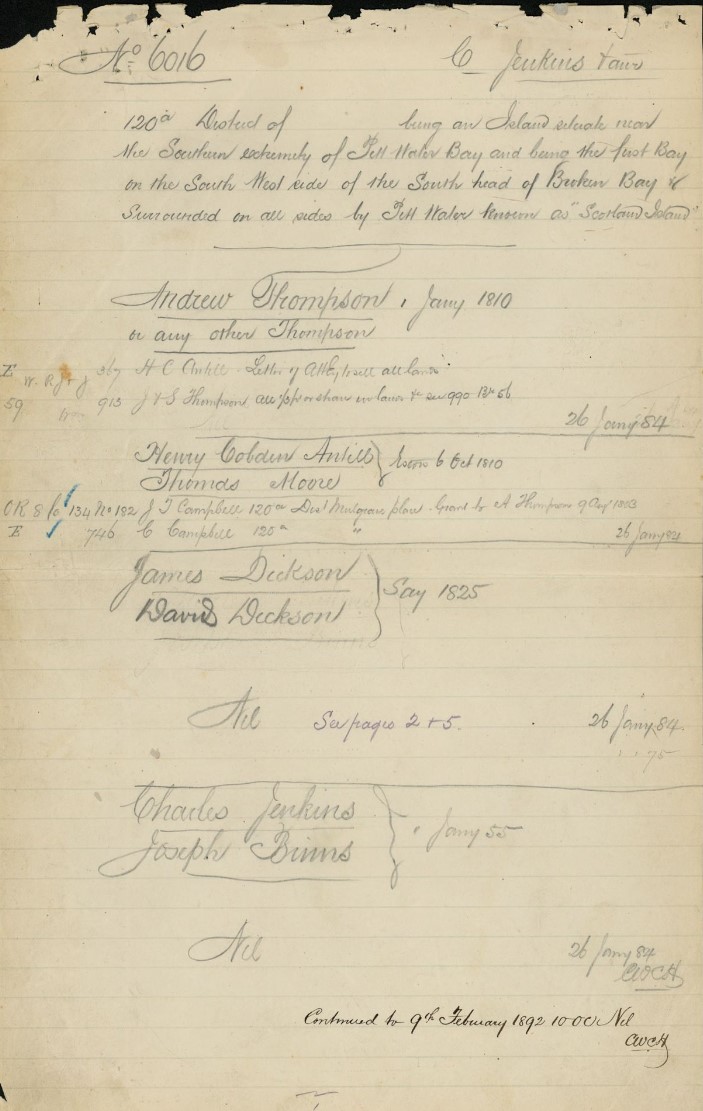
Primary Application 6016 states a James Dickson and David Dickson owned Scotland Island in 1825. The PA was the result of Joseph Benns and Charles Jenkins applying to own the island.
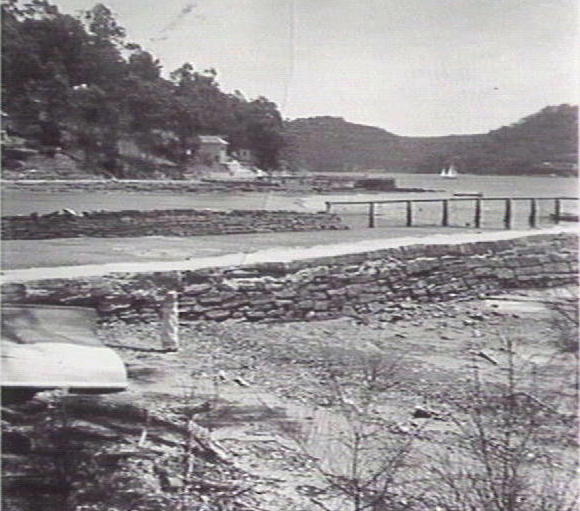
Tennis Court wharf - at north facing end of Scotland Island, and stonework. Photo is stated to be circa 1910, but looks later to us - the swimming pool piles, for example, would date this at at least 1923-1924. Image courtesy Manly, Warringah and Pittwater Historical Society.

Scotland Island - wood engraving by L Roy Davies, 1925
Certificates of Title were issued to Joseph Benns and Charles Jenkins on 8 February 1892 and they sold the island, which was onsold until the 1924 land sales under Herbert Fitzpatrick, with Mr. Ducker and family members as partners in Scotland Island Estates.
The North wharf site may have been a place to offload ponies for polo, as per Taylor family records from 1900 to 1906, and refurbished as a wharf for 1906 land sales and marked on Lithograph as ‘old wharf’ projecting from Lot 20.
The Tennis Courts version is named for Tennis court as per that marked on 1923/24 Lithograph for land sales, that was situated in current day Catherine Park. A 'bathing pool' was installed alongside the wharf then as well, initially from Turpentine sheeting, a fall-back from the originally slated wire meshing as a cost-saving measure after the original contractor installed sub-par works, according to a court case that ensued from the same arrangement.
Bob Blackwood and Charles Miller (Charlie), long-term residents of Scotland Island, recalled there were two tennis courts adjacent to where the wharf is and just above the wall and tidal area - where it is flat. These disappeared or fell into disrepair although some of the earliest aerials found show an imprint of where they once were. No one seems to know whether they were grass or concrete; grass courts seems to be the most likely. The council minutes of meetings from March 1924 record when they were about to be installed, or mowed. This is what gave the name to that wharf - 'Tennis Court wharf'.
Charlie also recalled there were Aboriginal fish traps near where the wharf is - in the flat areas - that had been there for generations, and middens from oyster shells. However, the midden at the north end of the island was nothing compared to that at Cargo wharf which measured at least 15 feet by 15 feet even when he lived there, and despite earlier residents like Joseph Cario, Benns and Jenkins carting off the same to sell for use in lime making, in town, prior to then.
Charlie says it was obvious people would sit there and have feasts and just toss the oyster shells downwards - and had clearly done so for many many generations.
The best time to harvest oysters is from Autumn through Spring - when you could still harvest oysters from the Pittwater estuary - so Scotland Island would have been a feast place most of the year, and later would become a place where oyster leases were run in adjacent water bodies: McCarrs Creek, Lovett Bay, Towler's Bay.
See: Oystering in the Pittwater Estuary -Oyster Kings and Pearl Kings and When Not to Harvest Oysters
A refurbishment was undertaken in 1923-24, possibly a cheap version as the records would indicate, would have needed repairs and a replacement as the materials it was built from wore out. The Turpentine sheeting may not have lasted the first mid-Winter storm.
As the name this wharf is known by wasn't always used in council records, searching for its position at the ''north end of the island'' also brings up results as to the necessary repairs and even whole replacements that would have been needed during the usual wear and tear of infrastructure that is part of the tides and seasons, along with access via ferry for those needing to gain access via the same. Although a ferry service had commenced in 1924 - it was short-lived:
The Meeting of Warringah .Shire Council-held May 13th, 1929:
42. M. Bryant. Respecting the disabilities 6/5/29. suffered by the ratepayers and residents of Scotland Island, Elvina Bay, Lovett Bay and Fowler Bay by the discontinuance of the ferry service and also by the absence of a store at Church Point. 42a.A.mos Corbett 8/5/29. On the need for a public boat-shed at Church Point. Consideration deferred till next meeting
The Meeting of Warringah Shire Council-held May 27th, 1929 records:
18. H. Bryant.. 16/5/29. Pointing out the need for provision for a boatshed and skids in Mr. Fitzpatrick's proposed building at Church Point. l8a.Miss E.A. Forster Urging the Council to take action to secure a re-establishment of the ferry service to Scotland Island, and a store for necessary goods at Church Point, 19, Clayton Utz & Co. Respecting H. Jensen's 14/5/29. application for a Special Lease at Church Point, and requesting to be advised of the Council's reasons for objecting to such application. 20. W.C. & H. Walsh. .20/5/29. Also on the lack of a ferry service to Scotland Island. Resolved (Crs. Hitchcock, Austin) - That Mr. H. J. Fitzpatrick be given a fortnight in which to furnish the Council with a satisfactory reply as regards his intentions for the re-erection of his store etc at Church Point, and he be informed that if no satisfactory reply is received by next meeting, the Council will support other applicants
The August 26 1929 WSC Meeting records:
A. Riding Councillors. 16/8/29. Reporting damage to fence and causeway at north wharf on Scotland Island. Referred to Overseer for report
The Meeting of Warringah Shire Council-held September 9th, 1929:
Overseers Brooks report read and dealt with as follows: ...18. Scotland Island ' Resolved (Crs. Austin, Hitchcock) That £10 be voted for repairs to the public baths at Scotland Island, and £12 for repairs to wharves and roads. 19. That £40 be voted for putting the rock baths in A. Riding in order.
So the wharves built in 1924 (Eastern and Bells - with Cargo and Tennis repaired/upgraded - and baths beside all but Cargo - for subdivisions) did not last for too long, nor did the repairs to the baths undertaken just a year beforehand, just prior to the Wall street stock market crash of October 29 1929, known as 'Black Tuesday'.
The Meeting of Warringah Shire Council-held October 20th, 1930 records:
27. Mrs. B. L. Rose 29/9/30 . Again requesting that repairs be effected to North Wharf and baths on Scotland Island. To be informed no funds available.
The council had done repairs to the Eastern wharf baths as a letter turns up in the records praising their work in the January 1930 records, and how quickly it had been done.
The Meeting of Warringah Shire Council-held December 19th, 1930 records:
53. L. Bower. 9/12/30. (1) Drawing attention to the 'disgraceful condition' of the shark-proof fence at the swimming pool on Scotland Island adjacent to the tennis wharf end (2) requesting that a track be cleared leading up from the tennis courts to the existing road. To be informed no funds available.
Minutes of Meeting of Warringah Shire t:L; Council held on Tuesday. 26th April. 1932 record:
31. G.J.Brandon, 1/4/32, respecting dangerous condition of steps at the Northern Wharf, Scotland Island, and of the baths adjacent thereto; complaining that the ratepayers of Scotland Island get nothing in return for rates paid, and requesting a statement Of receipts of rates, and of expenditure on the Island since the subdivision was effected. Resolved, - That £12 be voted for renewing the steps, in accordance with the Overseer's report, and he be informed there is no money available for the other work. (Crs. Austin, Hughes)
Minutes of Meeting of Warringah Shire Council held on 15th August 1932 record:
14. J. Willis, 29/7/32, reporting that the baths on the northern and eastern Sides of Scotland Island need some new palings. Resolved, That the Overseer be empowered to attend to the matter, provided the cost does not exceed £1. (Crs', Hitchcock, Austin)'
Minutes of Meeting of Warringah Shire Council held on 21st November 1932 record:
19. G. J. Brandon, 7/11/32, stating that it is impossible to use the public baths at the northern wharf, Scotland Island, owing to their dangerous condition, and asking that repairs be made an urgent matter. Referred to the Engineer.
Minutes of Meeting of Warringah Shire Council held on 5th December 1932 record:
12. John A. Burke, 21/11/32, drawing attention to the dangerous condition of the stakes enclosing the baths adjoining the eastern wharf on Scotland Island. Resolved,:-.That £9 be voted for repairing this bath and also the bath at the northern wharf, as recommended by the Overseer, (Crs, Austin, Hughes):
Minutes of Meeting of Warringah Shire Council held on July 31st 1933 record:
36. J.J.Rice, 12/7/33; complaining that no attention is given to the roads on Scotland Island. Resolved, - That the Overseer obtain estimates for repairs to the wharves, baths etc) as suggested by him.
Minutes of Meeting of Warringah Shire Council held on December 18 1933 record:
OVERSEER BROOKS' REPORT was read and dealt with as follows:- ... 10. Re: condition of wharves and pathways on Scotland Island: Resolved, - That £20 be voted for urgent repairs to the cargo wharf, and for clearing on the roads and pathways under the emergency relief work scheme. (Crs. Austin, Hughes) Rockbath track. Resolved, - That another £10 be voted for fixing the track to the rockbath at Palm Beach if the original £10 vote has been expended. (Crs. Hitchcock, Hughes) OVERSEER WILSON'S' REPORT was read and dealt with as follows:- ... 4. Re camp in Waterview Street, Mona Vale, occupied by a Mr. Stevens: Resolved, - That Mr. Stevens be notified to demolish and remove the camp from the area within 14 days. (Crs. Hughes, Austin) 5. Camping on Reserves generally: Resolved, - That charges for camping apply to McKillop Park and all other reserves along the coast to Palm Beach, except Griffith Park. (Crs. Barber, Hitchcock)
Minutes of Meeting of Warringah Shire Council held on July 2nd 1934 record:
57. E.A.Forster, 26/6/31, complaining of the condition the tracks on Scotland Island, pointing out that on holiday, he had to clear trees and scrub from the road to get to his land. Resolved, - That the expenditure of £20 vote be expediated. Austin, Sterland)
The times over the decades from 1804/1805 onwards were reflected in what was happening on Scotland Island - even here context of the 1930's economic depression, which brought so many homeless people to house their families in tents beside the sea, where they could fish to feed them - also turned up on the island.
The late Spring of 1936 records in the council minutes of meetings:
G. J. Brandon, 23/11/36, (a) reporting that a swagman or fisherman has taken possession of the small bathing shed, erected by voluntary workers on the reserve at the northern end of Scotland Island, has closed it against the residents, steals water from the residences in the locality, and has no sanitary arrangements; (b) reporting that the wire-netting on the baths has perished and the baths are no longer safe and requesting that the causeway leading to the wharf be repaired; and.. (c) complaining that damage is being done to property on Scotland Island by wandering horses owned by a baker at Mona Vale. Council's Decisions:. (a) that the person referred to he notified to vacate the bathing shed immediately, (Crs. Hitchcock, Campbell); (b) that £5 be voted for repairing the bathing enclosure, and the Overseer be instructed to use heavy gauge wire for the purpose, (Crs. Hitchcock, Ross); (a) referred to the Overseer for report; (d) that the baker referred to be notified to remove his stock. From Scotland Island. 41. G. Damyon, 23/11/36, also complaining of the misuse of the bathing shed mentioned above, and of the condition of the causeway leading to the north wharf on Scotland Island..
At the meeting held January 29th, 1936:
23. U. Oswald, and 4 other property owners at Scotland Island, complaining of damage to property and danger to life from two horses running wild on the island. Resolved, That the letter be 'received'.
At the meeting held May 4, 1937:
26. Re Parle, complaining of the Counci1'sneject of the roads, etc, on Scotland Island, and requesting to be given information as to expenditure on the Island during the past seven years, and what improvements the Council contemplates in future. Resoved letter be 'Received';
The Minutes of the Meeting of Warringah Shire Council, held Tuesday. 27th July, 1937 states:
22. U. Oswald, (a) drawing attention to the dangerous state of the causeway leading from North Wharf, Scotland Island; (b) again complaining of damage by straying horses on Scotland Island; (C) suggesting Council endeavour to have the Commonwealth establish a seaplane base established on Pittwater. Council;. (a) that £12 be voted for repairs to the wharf and causeway as recommended by the Overseer, (Crs, Hitchcock, Ross); (b); 'Received'. (c) that inquiries be made whether there is any report regarding the Council's previous representations to the Commonwealth Government on this matter, and that a letter be written to Sir Archdale Parkhill on the matter.
So, still horses a'wandering on the island in the 1930's - and council not worried about damage they may be causing, even months and years after the first letter drawing attention to the problem. That baker at Mona Vale may not have been the owner, as later records show.
At the meeting held October 5, 1937:
By Cr. Nicholas ; Could an inspection be made of the steps at a wharf on Scotland Island, said to be in a bad state, and a report made to the Council?: The President replied that the Overseer would make an inspection.
At the meeting held October 19, 1937:
7. Submitting estimate, £7, for necessary repairs to the North wharf, Scotland Island; Resolved, - That £7 be voted for the work. (Crs. Hewitt, Hitchcock)
At the meeting held April 26, 1938:
Mr. D. L. Rose; 20/4/33, requesting (a) that the path up to his cottage at Scotland island be cleared; (b) reporting that the shark-proof netting around the baths at the north wharf no longer exists; and (c) reporting that the wharf itself is very shaky. Referred to works Committee for reports
At the meeting held July 5th, 1938:
U. Oswald (a) reporting that during last summer and on recent public holidays a number of people camped on Scotland Island without sanitary conveniences, causing nuisance and inconvenience to property owners; (b) inquiring what the ratepayers, of Scotland Island pay rates for, as the roads are impassable, pointing out that the baths at Scotland Island's North wharf are in a state of disrepair, and are not shark-proof: Resolved- that £5 be voted for nee netting for the pool. and £7 be voted for clearing pathways, as recommended by the Overseer.
The January 24th, 1939 meeting records:
M. Oswald, 20/12/38, requesting that camping on Scotland Island be prohibited on account of the danger from fire and the lack of sanitary conveniences. Resolved, - That notice boards be erected, one at' the public wharf at the northern end of the Island, and one at the wharf on the southern side opposite 'Pasadena' prohibiting camping on the Island. (Crs. Latham, Nicholas)
At the meeting held June 27th 1939:
Building Inspector. No. 21 ** A. Innis, additions to dwelling, Lot 225, Scotland Island: That it be approved provided a block plan is submitted
The May 28th 1940 meeting records:
10. Submitting estimate, £100, for completely clearing and repairing all the roads on Scotland Island: Resolved, That £50 be voted for clearing and repairing the roads most in need of it. (Crs. Hitchcock, Sterland) 11. Submitting estimate, £65, for constructing a bridge over the creek in Monash Parade, Great Mackerel Beach, with a 6-ft. width, for pedestrian traffic only: Resolved, _That £65 be voted for the carrying out of this work. (Crs. Sterland, Hitchcock)
The February 18th 1941 Meeting records:
16. S. P. Baden, 31/1/41, complaining of R nuisance from straying horses on Scotland Island, breaking boundary fences and trampling gardens in search of water. Resolved, -He be asked whether he can give the Council any information as to the owner- ship of the animals. (Crs. Bathe, Savage)
The council was busy dealing with meeting repairs when and where it could - however, once World War Two required everything in materials to be put into the war effort, what they had been able to do during the fiscally strained 1930's must have seemed a great era compared to the 'nothing available' and residents trying to secure what was needed and do the work to support their and others efforts. Even after peace was regained the shortage of materials would persist, for everyone, not just councils trying to get works done. The Warringah Shire Council, in order to complete works, by 1947, had to wait for approval from the 'Building Materials Department'. One report shares:
LIMITS ON BUILDING
New Country Rules
From to-day, in country as well as city areas it will be illegal (unless a permit is obtained from the Department of Building Materials) to:
- Build a brick home of more than 1,250 square feet gross area (including walls);
- Build a timber-frame home of more than 1,200 square feet gross area (including walls);
- Carry out any maintenance, renovation or painting work costing more than £75.
The Minister for Building Materials, Mr. Matthews, announced the new restrictions yesterday after the Governor-in-Council had approved a recommendation to extend operation of the Building Operations and Building Materials Control Act to country districts.
MINISTER'S STATEMENT
Mr. Matthews said there had been many cases of abuse of permit free building in country districts, where needlessly large buildings had been erected.
"They have absorbed, in a wasteful way, valuable materials and manpower which could have been used to better advantage in the public interest," Mr. Matthews said.
"I shall ask shire and municipal councils to co-operate with my department in policing this control.
"This is only one step in the Government's programme of channelling labour and materials to housing. I am making a complete overhaul of legislation which gives me power to control building.
"I intend to take whatever additional powers are required for effective control, and a comprehensive amending bill will be submitted early in the session.
"NEW MEASURES"
"In the meantime new and vigorous measures are about to be introduced to ensure that any breach of the Act will not remain undiscovered. Offenders will be prosecuted without exception, and maximum penalties will be sought."
Mr. Matthews is endeavouring to arrange a full meeting of his newly appointed Production Advisory Committee for Friday, or next week at latest.
The committee consists mainly of executives of industries directly concerned with output of building materials. ... LIMITS ON BUILDING (1947, June 19). The Sydney Morning Herald (NSW : 1842 - 1954), p. 5. Retrieved from http://nla.gov.au/nla.news-article18031240
The June 19 1945 meeting records the first mention since 1941:
(12) Scotland Island Estates Ltd., 5/6/45, appealing to Council to put the roads on Scotland Island in order, pointing out that very little has been spent on the Island in return for the rates paid. Referred to the Works Committee.
The homelessness that had marked the 1930's continued. The November 20 1945 meeting records:
At this stage, a letter from Mr. Tully, Minister for Lands in regard to camping at Governor Phillip Park, Palm Beach, was submitted, the letter stating that unless the Council complied with the Minister's request that the ballotting for camp sites be held over for six months, the Park will be taken from the control of the Council. Cr. Forster moved, Cr. Walsham seconding, -That the Minister's request be complied with. Cr. Dunbar moved, Cr. Raffo seconding, - That the previous decision be affirmed, and the Minister urged to give consideration to the facts as set out by the Council. The amendment was carried on the casting vote of the President, and on becoming the motion, was again carried on the casting vote of the President.
The council lost this one; families were living in this campsite and a push by local residents to have them removed was not popular - this park, after all, is a 'people's park' and these areas had been turned over for camping, at a cost, earlier in the 1930's. Many of those who started out by living in these stayed, moved into homes, and contributed greatly to Pittwater, and Warringah and Manly for that matter. If it hadn't been for the affordable rent living under canvas gave, or the ability to catch your dinner, they may never have come here.
More in; Pittwater Summer Houses: A Tent At Palm Beach's Governor Phillip Park 'Neath Barrenjoey and Camping At Palm Beach
Campers To Stay
Because they are playing a useful part in the development of the area, "the Minister for Lands (Mr. Tully) does not intend to disturb all the campers at Palm Beach. Those whose camps are on the six acres which are to be made into a park will have to move, but others can remain on a weekly tenancy of 10s a week.
"I was asked to remove all the campers," Mr. Tully said today, "but I have found that these men are keeping orderly camps, which in no sense are an eyesore.
"Some of them are members of the local golf club, and others are prominent members of the life-saving club which saved six lives last year. Campers To Stay (1941, September 9). The Sun (Sydney, NSW : 1910 - 1954), p. 4 (LATE FINAL EXTRA). Retrieved fromhttp://nla.gov.au/nla.news-article231623359
Also in that November 1945 meeting:
CORRESPONDENCE was dealt with as follows:- (1) A. Gill,, 2/11/45, requesting that the swimming pool adjacent to his property on Scotland Island, and also the approach to the wharf, be given attention; stating that the pool is in a fair state of repair, except that it will be necessary to replace some piles and the wire netting. Resolved, - That the Engineer submit an estimate of the cost of putting the baths in order.
By 1947 the cheaper blocks of land in Pittwater were attracting new families and more people to the island. A few new jetties going in:
The meeting held February 2nd, 1947 records:
22) Public Trustee, 28/1/47, regarding offer of £150 for Lot 1, Section 129 Patrick Street, Careel Bay, advising that the Treasurer will not consent to the sale, as the valuation is only £55, and inquiring whther Council would accept an offer of £55.10.0. Resolved, - That the Council recommend acceptance of this offer of£55.1O.0. (Crs. Forster, Butcher) 29) Land Board Office, 21/1/47 inquiring wether there is any objection to the granting of a Permissive Occupancy to W. J. Wearn for a boat slip and reclamation below highwater mark at Scotland Island.. Resolved, - That Council raise no Occupancy objection. .
(10) Same, 17/3/47 inquiring whether there is any objection to the granting of an application by J. W. Muir for a Permissive Occupancy for a jetty fronting Lot 118, Scotland Island. Do. Resolved, - That Council raise no objection. (Cr5. Forster, Mclean)
Same, 29/4/47, inquiring whether there is any objection to granting an application for an unspecified tenure by J.F. & B. Daly for a boat-shed, baths, reclamation and jetty fronting Lots 107/108, Scotland Island. Resolved, - That no objection be raised to a Permissive Occupancy on the Council's usual access conditions. (Crs. Morrow, Butcher)
15/5/47 inquiring whether there are any objections to granting a Permissive Occupancy to Mrs. Mackenzie for a boat-house and jetty in front of Lot 102, Florence Terrace, Scotland Island. Resolved, - That no objection be raised subject to the usual access conditions.
10 land Board Office, 8/7/47, inquiring whether there is any objection to the granting of a Permissive Occupancy to Mrs. B. Hassett for wharf and swimming pool off Lot 15, Bona Crescent. Resolved That consideration be deferred pending submission of details of the proposed structure. (5) Same,8/7/47 inquiring whether there is any objection to granting a Permissive Occupancy to Mrs. E. Ireland for a jetty and boat shed fronting Lot 66 Scotland Island. Resolved, _That consideration be deferred pending the submission of details of the proposed structures (6)
The Meeting held September 2nd 1947 records: Correspondence; Land board 0ffice 21/8/47 complying with Councils request by forwarding plan showing position of proposed jetty slip and boat-shed in connection with Permissive Occupancy application by Mrs. E. Ireland at Lot 66 Florence Terrace, Scotland Island. Resolved _that no objection be raised under the usual access conditions. 2) R. J. Saunders, 12/8/47, forwarding precis of correspondence with the Council from January 1943 to date regarding drainage trouble at his property in Robson Road, Scotland Island, referring to damage to his property by stormwater, and urging prompt attention. Resolved _that the Shire Engineer' s report on the matter be considered by the Works Committee.
Same, 10/9/47, inquiring whether there is any objection to the granting of a Permissive Occupancy to Miss B. Gittoes for boat- shed, slipway and jetty fronting Lot 58, Scotland Island. Resolved, - That no objection be raised subject to the usual conditions regarding access, and that plans of the proposed buildings are submitted. (Crs.Butcher Dunbar) (1,) Same, 17/9/47, inquiring whether there is any objection to the granting of a Special Lease to J. Lamerand for obtaining sand from the eastern portion of Beeby Park adjacent to Mona Vale Beach. (5) Same, 19/9/47, inquiring whether there is any objection to the canting of a Special Lease to J. Lamerand for obtaining sand from an area of about 13 acres of the eastern part of Avalon Beach Reserve. (6) Same, 16/9/17, inquiring whether there is any objection to the granting of a Special Lease to J. Lamerand for obtaining sand from Deewhy Lagoon. (7) Same, 19/9/47, inquiring whether there is any objection to the granting of a Special Lease to J. Lamerand for obtaining sand from Narrabeen Lagoon. (8) J. Lamerand, 15/9/47, further regarding proposed brick-making operations, (a) requesting a 28 years lease, with the option of renewal, over land In the Centenary Estate and also over portion of the unmade esplanade which joins Waterview Street and Darwin Street, Mona Vale, pointing out that it would not be satisfactory to put heavy machinery on recently reclaimed land; and (b) drawing attention to his application to the Lands Department for about 10 acres of land at Bayview. Resolved, .- That these letters be taken In Coittee later.
The meeting held September 30, 1947 records:
(5) Submitting estimate, £50, for extending and deepening the topside drain above the cottage 'Yamba' in Robinson Road Scotland Island: Resolved, - That £50 be voted for this work..
R J Saunders was Ralph James Saunders, an Engineer who bought Yamba and owned it until the 1960's when he onsold - more on the original owner and subsequent owners under 'Bells and Eastern' wharves section below. The names 'Robinson' and 'Robson' road are of course Robertson road, and have been misheard by the transcriber, or they weren't pronounced clearly to begin with.
The November 11 1947 meeting records:
Questions answered in the affirmative... ;By Cr. Dunbar - Will the Works Committee make an inspection of Robinson Road, Scotland Island and the erosion at Tennis Court Point and the connecting roads? By Cr Dunbar - Will the Engineer inform Council when the garages at Church Point are to be erected, for which sums up to 150 have been lodged by ratepayers? The President replied that the approval of the Building Materials Department was awaited.
The November 25 1947 meeting records the council is aware a tent, shack or a even garage as shelter is better than none while waiting for building materials to catch up with demand:
(2) Scotland Island Progress Assoc., 6/11/47 submitting following requests _(a) clearing of lantana from reserve at Tennis Court 'Wharf' (b) linking of road-around the Island at the Tennis Court and the southern end; and (c) inspection of undesirable shacks which are being erected on the foreshores. Island Resolved, That items (a) and (b) be referred to the Works Committee, and Cc)to the Chief Health Inspector.
The meeting held January 20th 1948 records:
(Crs. Forster, Dunbar Scotland (32) 'P. L. Syine, 23/1/48, thanking the Council for promised work at Scotland Island, wharves, but (a) requesting the linking up of the road at the southern end near 'Bengalla'; (b) requesting that ... (3) Letter from E. R. Corben, 14/1/48 regarding the mooring of boats at the Taylor's Point wharf: Resolved, - That Mr. Cavanagh, the alleged offender, be informed of the statement that people have been ordered off the wharf, and it be pointed out to him that it is a public wharf and he be asked to desist from the practice of tying his boats to such wharf. (Crs; Kent Dunbar)
The meeting held February 3rd 1948 sees The Scotland Island Progress Association forwarding a copy of their Constitution and a list of their executive and still requesting the culvert at the tennis court reserve be attended to. And also a letter from Mr Cavanagh stating;
W. H Cavanagh, 28/1/48, denying statements that he has two boats tied to the Taylor's Point wharf also that he has ordered people off the public wharf, and stating he has knowledge of a person objecting to people tying their boats to the wharf, and would like to discuss the matter with the Council's Inspector. Resolved, - That the Engineer call on Mr.Cavanagh in-this connection. (Crs. Forster, Kent)
And Bayview residents objecting to the dredging at Bayview: (43) Attorney General's Department, 28/1/48 on behalf of P.G.Taylor and other residents, regarding dredging operations at Bayview, and submitting a protest against the granting of Dredging leases for this purpose. Resolved, - That the position, as outlined by the Engineer, be explained. (Crs. Dunbar, Forster)
The July 6 1948 meeting records:
Land Board Office, 28/6/1+89 inquiring-whether there would be any objection to the granting of an application by W.C.Tindale for a Permissive Occupancy in connection with his diving, salvaging and logging contract, fronting Lot 27, Scotland Island. Referred to Works Committee. (6+) A. T. Freeman 28/6/48 requesting, in view of the increase in rates, that some improvement be made to Cabarita Road Road from Stapleton's to Dr. Schlink's residence. Resolved. - That this road be given maintenance attention (65) Avalon District Ratepayers' Assoc., 29/6/118, stating the Association has been informed that Avalon Parade was ready for treeplanting, but that this is not correct, as on one side the footpath is too high and uneven and the other side is too low, and requesting that the Departments concerned be asked to lower the telephone and water mains in order to expedite the carrying out of this scheme. Resolved, - The Association be informed of the Engineer's report that that tees can be put in with little difficulty, and that the Departments concerned have been notified.
The February 17 1948 meeting is puzzling over the Palm Beach boathouse jetty built by Mr. Aub, which he didn't permission from the Crown for, and which had become the business of others by then:
...Stated had asked the Department for permission to construct the jetty, but there is no record of such application, that the Fisheries Branch has objected to the proposed construction of a jetty at Station Beach Pittwater and therefore it is considered that the jetty should not be extended beyond the limits of the area held under the Lease, and requesting to be informed of the Council's views on the objections of the Fisheries Branch-and of the jetty project in general. Resolved - That the Council apply for a Occupancy Permissive Occupancy for a jetty 480 feet in length, as essential to-the boat-hiring business. (Crs. Harris, McLean) Lands Department, 3/2/48 forwarding copy of Government Gazette notice in respect of the acquisition of land at Collaroy Beach and that the care control and management now devolve on the Council, stating that the Resumed Properties Department has arranged a tenancy agreement in regard to the shop and dwelling on Lot 69 Section 51 and that Department should be contacted for a refund of rental collected as from 23rd January. Resolved, - hat action be deferred pending receipt of the tenancy agreement, Beach and the Parks & Reserves Manager be instructed to have the area Erosion cleared of old fences debris, etc and make arrangements for the collection of parking fees. (Crs. Harris, Walsham)
Land Board Office, 13/5/11.9, inquiring whether there are any objections to the granting of W. C.Tindale's application for a Permissive Occupancy for a private jetty fronting Lot 27, Scotland Island. Resolved, ; That the Council object, as the jetty would bisect the only sand beach area in this part of Scotland Island, and it is considered that the public use of this beach should not be interfered with. (Crs. Butcher:, Bayliss)
The August 11 1948 meeting records:
A. J. Brown, 20/8/48, requesting that Council's staff be allowed to supply and drive four turpentine piles for him at Scotland Island, at his expense. Resolved, ; That the request be complied with, and the work carried out when the gang has completed work on wharves, etc. (Crs. Forster Kent)
In 1949:
Land Board Office, 11/4/49, inquiring whether Council has any objection to the granting of a Permissive Occupancy to 0. Hawkins for a boatshed fronting Lot 81 Scotland Island. Resolved, _That Council raise no objection subject to the provision of suitable access for the public between the Occupancy structure and the owner' s land, Same, 11/4/49, inquiring whether Council has any objection to the granting of a Permissive Occupancy to C.B.Orman for a boatshed fronting Lot 45 Scotland Island. Resolved, _That the Council raise no objection subject to the provision of access for the public between the structure and the owner's land, and that the plans of the boatshed aro approved.and that plans of the building are submitted and approved. (Crs. McKay, lrries)
The February 22nd 1949 meeting records a Scotland Island resident speaking up for keeping McCarrs creek free of oyster leases, as well as, the baths at Tennis Court wharf - by then named as such and no longer the 'north wharf':
(5) A S. Corbett, 7/2/49, stating that applications have been made to the Chief Secretary's Department for oyster leases at McCarrs Creek and requesting Council's co-operation in protesting against the granting of such applications, as they would completely spoil the area. Resolved, - That the Fisheries Branch of the Chief Secretary's Department be sent a copy of the letter and asked to have McCarr's Creek reserved against the granting of oyster leases. (Crs. McKay, Bayliss)7) B Gill, 8/2/49, requesting that urgent attention be given to the public swimming baths at the Tennis Court Wharf, Scotland Island, which are in a dangerous condition. Referred to ;A; Riding Councillors. Land Board Office, 29/7/49, inquiring whether there is any objection to the granting of a Permissive Occupancy to Dr. N.L,Brown of land below highwater mark of Lot 102 Scotland Island. Resolved, - That the Council raise no objection to the proposed extension of the jetty. (Crs. Butcher, Bayliss) (Clareville Reserves (6)A.J.Morgan & Son, on behalf of Mr. and Mrs. Judd 2/8/49, stating their clients are prepared to sell Lot 9, D.P. 3632, Clareville, to the Council for £500. Resolved, - They be informed the Council considers this offer excessive, and must proceed to resumption; and that the necessary notices be varied. (Crs. Butcher, Bayliss)
The May 17 1949 meeting records:
(2)Public Works Department., 28/4/49, requesting Council to undertake the erection of two beacon piles to mark sand-spits adjacent to Scotland Island and to furnish an estimate of the cost. Resolved, - That the Council agree to carry out the work, the estimated cost being £20 per beacon. (Crs. Bayliss, McKay)
The Minutes of the Meeting of Warringah Shire Council, held in the Shire Hall at Brookvale on Tuesday April 18th 1950 record:
The ENGINEER'S REPORT was dealt with as follows:- Pittwater (1) Scotland Island - Recommending the acceptance of quotations Baths from Mr. McTaggart, of Palm Beach, for repairs to the baths at Tennis Court Wharf and Bell Wharf: Resolved, - That the quotations of £261 and £179 respectively be accepted, as recommended. (Crs. McKay, Thomas)-(8) Whale Beach Surfbathing - Plans for proposed Clubhouse: Resol.ved, - That the report be adopted, with the addition of the Beach words ''but the Council give consideration to any proposal for Surfbathing financing the scheme which may be submitted by the Club''. (Crs. McKay, Thomas) Pittwater Baths: Paradise Beach Swimming_Pool: Resolved, - That the report Pittwater be adopted, subject to the addition of the works ;but no expenditure to be incurred on the repairs until a Permissive Occupancy has been obtained(Crs. McKay, Thomas)
The Ordinary Meeting, 8/8/50, records:
Scotland Island Progress Association, 24/7/50, stating that residents do not know why their rates should have gone up, as there are no roads or tracks on the Island usable, only ones through private property, the track from Tennis Wharf being covered with lantana and scrub, that it is impossible to even wheel a barrow to carry goods from the wharf, and requesting that something be done to enable them to reach their cottages without having to trespass on private property. Resolved; That maintenance attention be given when possible. (10) Great Mackerel Beach Progress Association, 24/7/50, (a) Great inquiring when repairs are to be effected to the wharf; and (b) Mackerel asking if there is any possibility of the promised shelter shed Beach being erected in the near future. Resolved, - That these matters be attended to as soon as possible. (10a) Same, 1/8/50, drawing attention to the silting up of sand at the end of the wharf, making it difficult to bring the ferry Do. 17.alongside the wharf. Resolved, - That the Association be informed of the Engineer's report that the Council has no plant that will remove this sand, which will dissipate with weather conditions. (11) Warriewood Beach Progress Association, 25/7/50, stating Street there are no lights in the following streets - Lakeview Parade, Lights Melbourne Avenue, Bruce Street, and Narrabeen Park Parade (from Hunter Street north to Cook Terrace) and that there is only one 18.light in Cook Terrace. Resolved, That this letter be referred to the Electricity Committee. (12) Same, 25/7/50, asking for the return of the £25 which was Shelter sent to the Council last year for the erection of a shelter shed, Sheds 19.and which has not been erected. ,Resolved, - That the Association be informed delay has occurred by the design of shelter sheds being changed, and asked whether it will withdraw its request for the return d the money if the Council will give an assurance that plans will be prepared and tenders called within one mon% and if no tenders are received, that the work be done by the Council's staff. (Cr. McKay)
The February 19 1951 meeting records:
A.N. Harding & Breden, Solicitors, 7/2/51, on behalf of R.J.Saunders, of 'Yamba', Scotland Island, regarding damage to his property during the recent rains, and requesting that immediate repairs be carried out on Robinson Road, and that if: this is done, his client will be prepared to overlook the damage already suffered, but otherwise he will take action for recovery of damages. Resolved, That this be referred to the Engineer action regarding the tracks above this property.
The April 2nd 1951 meeting records:
QUESTIONS: The following questions, submitted without notice by the Councillors named) were answered by the President in the affirmative unless otherwise stated. By Cr. Wheeler - Can pipes be supplied 'to B. Botham for laying on his land at Brown's Road, Church Point? By Cr. Quinlan - Will the matter of submarine cable which was to have been laid to Scotland Island be referred to the Electricity Committee? The Council hereupon went into Committee for the purpose of dealing with the following matters, the Minutes being taken by the Shire Clerk. (1) Shire Engineer: The President repthrted on an interview which he had had that day with the Shire Engineer (Mr. L. J. Botham), at which the Engineer had indicated that his indifferett health was of such concern as to impel, his Shire retirement from tho Council's service. Resolved, i- That Engineer acceptance of the Engineer's resignation be authorised for the reason stated, and that he be remunerated by payment of a gratuity in accordance with Section 97 of the Local 58. Government Act and Para. 2 of the Departmental Circular No. 1546 of 11/6/48,
The May 14 1951 meeting records:
Dr. U. Brown, 28/4/51, regarding (a) roads on Scotland Scotland Island, and asking that at least they be made reasonably trafficable, particularly that from the Tennis Court Wharf; and (b) the need for a public telephone on the north eastern corner of the Island. Resolved, - That (a) be referred to the Works Committee for evaluations and (b) referred to the Postmaster General's Department and the Federal Member.
The May 26, 1958 meeting records:
Maritime Services Board, 13/5/58, stating that a complaint has been received regarding the operation of the Church Point-Scotland Island ferry service, and forwarding copy of such complaint (from Mr. McMillan), he having been informed that a ferry would call at Tennis Court Wharf at 3.45 D.M., that he was at the wharf at 3.25 p.m., but had to wait until 4.45 p.m. 23. Resolved, - That the Board be advised that the Council is satisfied that the ferry proprietors are rendering a satisfactory service having regard to all the circumstances. (Crs. McClelland, Corkery)
The July 23 1951 meeting records:
(1) A. N. Harding & Braden, 17/7/51, on behalf of R.J.Saunders, regarding access to his land at Scotland Island, and stating that unless they are informed of the Council's intentions Island immediately, the matter will be brought before the notice of the Minister for Local Government. Resolved, - That this be referred to the Works Committee. (Crs. McKay, Fisher) County (2) AJV.H. Holley, 2/7/51, inquiring whether the Council proposes to take action to have the lands on the western shores of Pittwater withdrawn from the County Plan and reverted to 1''Living Areas'';.Cr.McKay moved; he be informed that the Council has no intention of making any change for the western shores of Pittwater. Cr. Fisher seconded. Cr. Corkery moved as an amendment, Cr. Berry seconding, that the Council take steps to preserve the private ownership of these lands. The amendment was carried, and on becoming the motion, was again carried. (3) Great Mackerel Beach Progress Assoc., 16/7/51, requesting to be supplied with a list of ratepayers at the Beach, in connection with the proposed protest to the Cumberland County Council regarding re-zoning. Resolved, - That the information be supplied so far as practicable. Cs.McKay, (Same) 16/7/51, thanking Council for repairs recently carried out to the footbridge at the wharf, and also for the shelter shed. 'Received', (5) Land Board Office, 12/7/51, regarding mooring piles adjacent to the public wharf at Queens Parade, Newport, which were part of the Permissive Occupancy previously held by Denver Public Trading Ltd., stating that the Maritime Services Board will not accept responsibility for the maintenance, and unless some responsible body will do so, the piles will have to be removed; therefore asking if the Council will undertake the maintenance. 13. Resolved, - That this be referred to the Parks & Reserves Manager for report. (Crs. Berry, McKay) (6) Mrs. M. Anderson, 12/7/51, inquiring whether the Council would erect a landing or small wharf at Coal & Candle for the use of residents in the Cottage Point area, in view of the fact that there appears to be no prospect of a road ever being constructed. Referred to Works Committee. Riverview (7) Careel Bay Progress Association) 7/7/51, regarding the Road proposed widening of Riverview and Cabarita Roads, Stokes Point, and requesting to be informed (a) what is going to be done; 1 .and (b).when the work ill be carried out. Resolved, - That the Association be informed in regard to the work, for which £2,000 has been voted, and that it will be carried out when the matter of resumption has been finalised. (Crs. McKay, Berry) Bayview (8) H.W. Horning & Co. Ltd., 28/6/51, offering to sell to the Road Council Lot nal D.P. 9606, Bayview Road, for £150, legal costs to be borne by the Council. Resolved, - That this matter be referred to the Finance & General Purposes Committee, following discussion with representatives of the Main Roads Department on 26th inst. (9) A. Riding Allied Progress Associations, 18/6/51, asking. for help and guidance in-the furtherance of a scheme for beautification of the district from Mona Vale to Palm Beach. W. C. Wentworth, M.P. 2/7/51, regarding the provision of a public telephone at Scotland Island, forwarding copy of a reply from the Department suggesting that as the submarine cable is fully allotted to existing services, a meeting of residents be held to ascertain whether it would be possible to establish a telephone office on the Island and for a local resident to act as Telephone Office Keeper. Resolved, - That the Council approve of this suggestion. (Crs. Fisher, Hewitt)
The WSC Meeting held 14/9/1953 records:
By Cr. Berry- Could a ‘walk’ (walkway) be constructed along one side of Tennis Court Wharf, Scotland Island? The President replied that this would be referred to the Engineer.
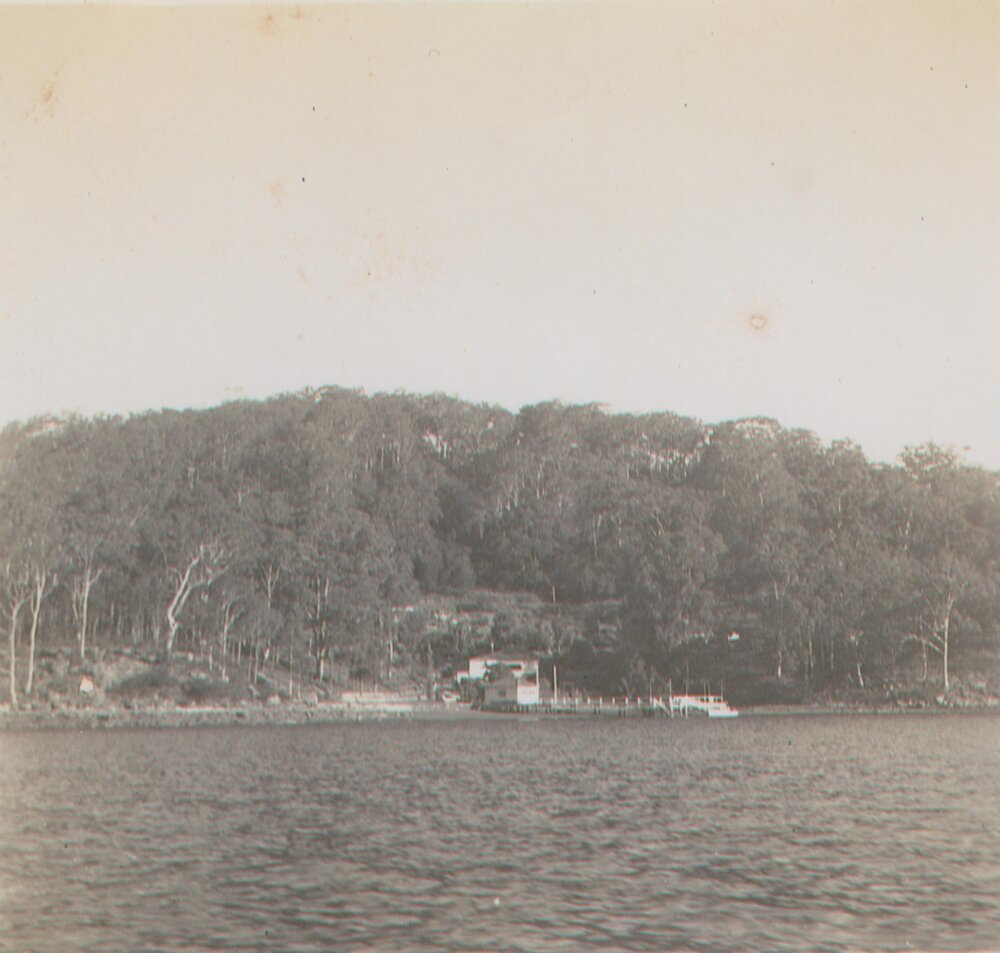
'Yamba' on Robertson's Bay, Scotland Island, circa 1955-1960. Photo: courtesy Gill family albums and Council's Local History Unit.
The October 11, 1958 meeting records:
Mackellar County Council, 7/10/58, requesting co-operation in approaching the Minister for Local Government to obtain Government financial assistance towards the cost of constructing extensions of electricity mains to Scotland Island and the western shores of Pittwater. 42.Resolved, _That this Council co-operate as requested, and the Minister be asked to reconsider the question of a rural subsidy. (Crs. Wilson, Reynolds)
The November 10, 1958 meeting records just one horse left on the island:
The HEALTH & BUILDING COMMITTEE'S REPORT, as contained in the Minutes of that Committee's meeting held on 7th inst. was dealt with as follows:- Paragraph 7 (a) - Straying horse at Scotland Island: Resolved; That the recommendation be adopted, and if competent, that the Council take proceedings against the owner. Bush Fire Committee, 24/10/58, stating the Committee has had under consideration proposals for enlisting the co-operation and good-will of employer organisations with respect to the granting of time-off to key Bush Fire Brigade personnel for the purpose of carrying out fire fighting operations at major bush fire outbreaks, that employer organisations have signified their agreement with the principles involved and that members will be asked to give their support in an endeavour to meet local requirements; and suggesting that each Council concerned furnish the respective employers with an official list of such accredited personnel, together with a communication assuring such employers that specific requests for the granting of time-off will be made only under the authority of the Council and will be confined to situations of an emergency nature. (ate: Lists have been received to date from Belrose Brigade (4 members), Terrey Hills (7 members) and Scotland Island Brigade (7 members). 53.Resolved, 7 That the desired information be supplied, and the Committee informed that specific requests will be made by the Council and will be confined to a situation of an emergency nature. 3 (Crs' Reynolds_Corkery)
The November 24, 1958 meeting records a kick to the teeth to all the fishermen and women the living on the island, engaged in the by then rural occupation of fishing for a living:
Minister for Local Government, per R.W.Askin, M.L.A.,13/11/58, replying re representations for granting of a subsidy for extension of the electricity supply to Scotland Island and Western Shores of Pittwater, that in the Government's Rural Electricity Subsidy Scheme subsidy is payable in respect of extensions to new consumers in rural districts and villages who form part of the rural community either by engaging in primary production or an ancillary service, settlements such as holiday resorts or premises for weekend or holiday occupation and other residential groups being excluded from the Scheme; that investigations have revealed that these extensions will serve premises the majority of which are used for weekend or holiday accommodation, and that the permanent residents do not directly engage in rural occupations and therefore are ineligible for subsidy. 35, Cr.Reynolds moved That this information be noted, and if the Council has had any representations from local Progress Associations such Associations be informed of the decision of the Minister; and that the Mackellar County Council be also informed. Cr. McClelland seconded. An amendment was moved by Cr. Fisher, seconded by Cr. Cooper, that this matter be set down as an Order of the Day for a meeting in February next, the Council to consider the advisability of subsidising the supply of electricity in this area, and that the Mackellar County Council be asked to have available for that meeting its plans and costs relevant to the scheme. The amendment was carried, and on becoming the motion, was again carried-(C) Lands Department, 11/11/58, replying that the area of the, bay in Pittwater proposed to be dredged by E.H. Stewart is 2 1/2 acres, the dredged material to be deposited on Council land adjacent; that the depth of dredging will be limited to 3 ft. below low water mark, and the purpose of the application is to improve the water access to adjoining allotments and abolish an undesirable mud flat. 36. ;Received; and noted. (D) Department of Government Transport, 7/11/58, stating that an examination of the patronage on Route 157 (Church Point) has disclosed that on Saturdays the service is suitable for one-man bus operation, and it is therefore proposed to convert this service as from 15/11/58, when opportunity will be taken to improve the existing timetable by providing an additional journey at 2.10 p.m. 37. from Manly Wharf. Resolved, _That this' information be noted, and the Depart_ment be informed the Council appreciates the improvement in the service. (Crs. Reynolds, Job)
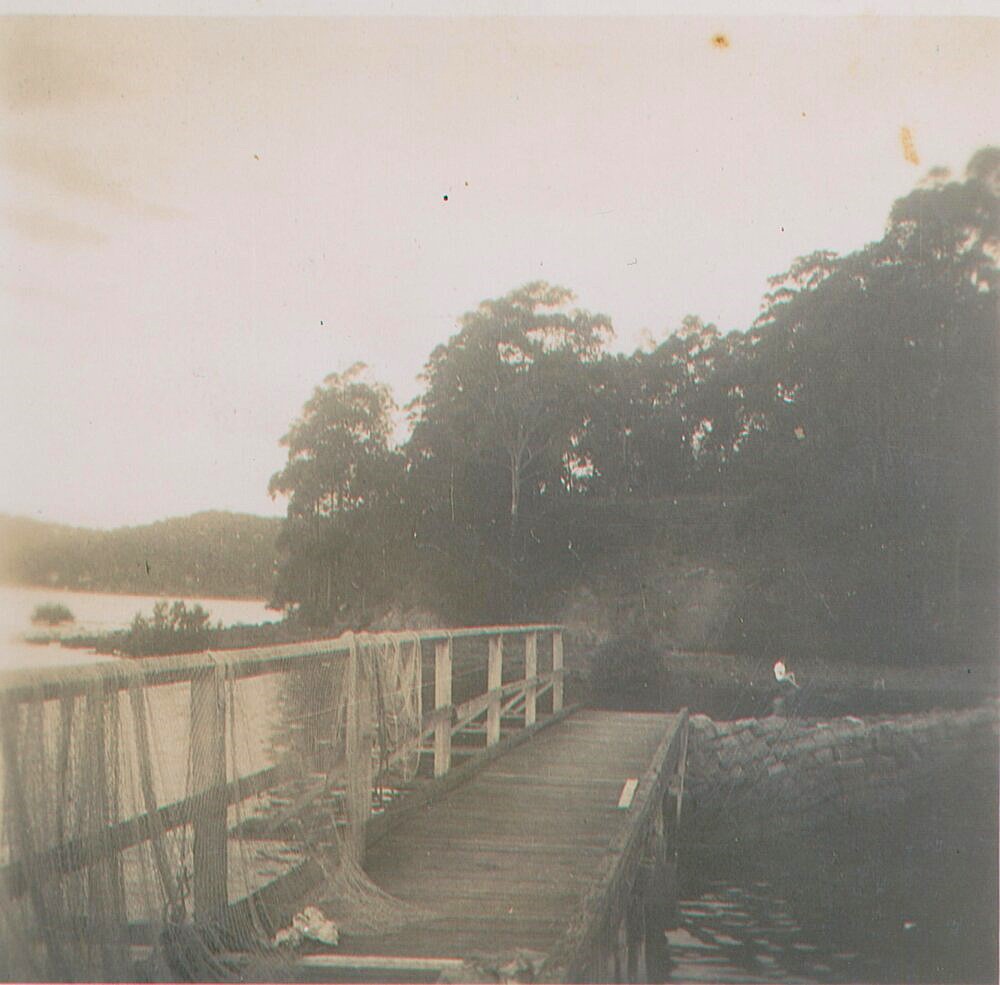
Tennis Court Wharf (?) with fishing nets draped over the rails, circa 1960. Photo: Gill family albums
Visit to the Island of Manly-Warringah and Pittwater Historical Society
“This took place on Saturday July 4th, 1959. It was a perfect day. Members of the Society were our guests for the afternoon. We left Church Point about 1.45 p.m. and tied up first at Bell Wharf from where we walked around to the rock sculptures. Our visitors were very interested in these and the opinion was expressed that they were of a much later period than convict days. In fact their visit brought to light initials on the carvings which could quite easily identify J. Benns as their originator. We then rejoined the ferry and went past Bangalla which was pointed out as the oldest house on the Island. We continued around the eastern side to Tennis Wharf where the ferry was tied up. The visitors were shown the site of Andrew Thompson’s shipbuilding yards and the old tennis court.
Following this the party proceeded to our fireshed, where the ladies of Scotland Island provided and served afternoon tea. At the conclusion the visitors passed a vote of thanks to the ladies for a very enjoyable repast.
An informal meeting followed to discuss the location and type of memorial that should be erected to commemorate the 150th Anniversary of the granting of Scotland Island to Andrew Thompson.
One speaker suggested that we should construct a dam to supply water to residents of the Island. This was considered to be quite beyond our combined means. Mr. Gledhill said that his Society’s idea of a suitable memorial was a stone block with a plate let into it. This plate would point out places of interest around Pittwater. In reply our President said that our Association would like to have a stone fireplace built for the use of picnickers. This would reduce the risk of bush fires. Finally it was decided that we should combine the two and it was decided that the celebrations and unveiling would take place on the afternoon of January 1st next. The visitors appeared to enjoy themselves so much that it was getting dark before they finally boarded the ferry to return to Church Point." From; Scotland Island News, October 1959.
During the WSC Meeting held on 27/6/1960:
(Collaroy) .. over the years been the subject of considerable erosion, some years ago a number of houses being completely undermined and had to be demolished. Requesting that the entrepreneur backing the erection of these flats should be told that the Council expressly denies giving any guarantee that any future erosion will be corrected at the expense of the Shire, that all risks in this regard shall be the responsibility of the owners, and that such clause shall be written into any contract of sale in respect of any change of ownership of individual flats in the buildings. Adding that if this was not done the ratepayers in future years could be put to intolerable expense, for, no doubt, the present application will be followed by dozens of others whore there is no guarantee of complete ocean front stability. 45. Noted. (The Solicitor, in reply to a question, stated that he did not think the Council would be responsible.) - Mackellar County Council, 15/6/60, re proposal to extend electricity services to Scotland Island and the western shores of Pittwater advising that Mackellar County Council has resolved ;This Council approves the scheme to provide electricity to Scotland Island, McCarr's Creek, Elvina Bay and Lovett 's Bay, subject to this Council requiring the Warringah Shire Council to subscribe by means of an electricity rate 50% of the revised cost and that, when 50% of the revised cost of the Scotland Island extension is available, this Council will provide the balance of capital expenditure and proceed with the first stage of the scheme, such work to be scheduled for commencement in the year 1961.; 47. Noted. (K) Mackellar County Council 20/6/1960, re venue of Local Government Conference Year 1961 _advising that the County Council will associate itself with either of the constituent Councils which may decide to make application for and succeed in having this County District appointed as the venue for the purpose of such conference. (Note: At Ordinary Meeting 30/5/60 _Minute 44(a) _the Council rTgived that it would like to nominate Wagga as the centre for the 1961 Local Government Conference. This has been communicated to the Local Government Association.) 48. Resolved, _That Council inform the Mackellar County Council that this Council does not offer to be host Council. (Crs. Fisher/ Job)
The Ordinary Meeting of 28/11/1960 states:
from Council's Solicitors, H. Wilshire Webb & Son, in regard to prosecution against Church Point Ferry Service Pty. Limited and Egan. (Crs. Fisher/Wade). On going into Committee this letter was duly considered and the Committee resolved to recommend that Messrs. H. Wilshire Webb & Son be and are hereby authorised and instructed to institute immediate proceedings in Equity for Injunctions (Interim and Final) against the Church Point Ferry Service Proprietary Limited and Mrs. Sylvia Egan or either of these parties in respect of their continued use of the Church Point Wharf for purposes other than those authorised by Ordinance 35k, this latter being evidenced by the removal of the licensed address of the Estate Agent Mrs. Egan from Scotland Island to the said Wharf. 83.The Committee of the Whole thereupon resolved to resume the Ordinary Meeting and, upon so doing, the Committee of the Whole's 84. recommendation was submitted, received and adopted on the motion of Councillor Fisher, seconded by Councillor Wilson.
The December 12 1960 meeting records:
A) West Pittwater Progress Association 25/11/60 concerning the provision of a monthly collection of rubbish from West Pittwater shores and Scotland Island, stating that a quotation is being obtained from the Church Point Ferry Pty. Ltd. for collection of rubbish' (which will be forwarded for approval in due course), and seeking Council's assurance that a satisfactory service will be given in the near future. 44. Resolved, _That the Association be informed that Council awaits further information from it. (Crs. Fisher/Wade.)
The January 23, 1961 meeting of the WSC recorded another delay on electricity for offshore residents:
Special Meeting, 23/1/1961. arising from representations by 'A' Riding Progress and Allied Associations wherein the Department was advised that Council believed nine (9) members were insufficient, but in view of intimations made by the Minister on a recent visit, it had taken no action and requested the Minister to declare his intentions as a matter of urgency). 44. Resolved, That because of consideration being given to this matter by Manly Council, that it be sot down for consideration by this Council 1 month from today, and that pending that debate, no further correspondence be entered into regarding it. (Crs. Fisher/Jones.) (M) Mackellar County Council, 3/1/1961, advising that the matter of providing electricity to Scotland Island and the western shores of Pittwater has been further discussed, and in view of the lack of finance brought about by Governmental restrictions on borrowing for capital works, it has been decided that the proposal be reviewed again in July, 1961. 45. Noted. (Crs. Jones/Wilson.)
At the Ordinary WSC Meeting held on 1/5/1961:
Scotland Island Progress Association addressed to the President, 26/4/61 bringing the-following matters before Council::(1) That Mr..R. Tonge of Scotland Island be appointed. an Honorary Ranger for ,ScotIand Island.L (2) Asking for immediate attention to repairs to Bell and Tennis wharves,; Pointing out there is no lighting on any wharf.in the area and if the decking etc. is in bad condition it increases a serious risk to those: using same at night:.(3) 'Asking for consideration be given to supplying a life buoy for each wharf;, (4)'-That Catherine. Park area, near Tennis Wharf, be placed under the care of the Parks-and Recreation Committee; The Fire Brigade Captain reports tat the undergrowth on roads will need to be cleared again before next Bushfire season,4. That council make some special arrangement to reserve space in the new parking area at provision at Church Point for the cars of residents of Scotland Island and Western Shores also that Council look after residents' interests in regard to alterations about to be made at Church Point, especially access to the cargo wharf, both by road and water; (7) Requesting that Council consider putting a small crane' on the cargo, wharf at Church Point, as with the possibility of electricity coming to the area, there will be some heavy equipment to be taken ever. 76.Resolved, _That (1) This matter be left in the hands of the Shire Clerk for interview and recommendation; (2) The Engineer be asked to inspect Bell and Tennis Wharves in regard to decking and report thereon; (3) A Life Buoy be installed on each wharf; (4) Owing to limitations of staff etc.,. Council respectfully suggests that residents take a personal interest in this Park and look to Council for some support in the future; (5) This matter be referred to the Engineer; (6) On completion of the parking area an inspection of the car park will be carried out by the Works Committee and a report will be made in due course; and (7) Council it is unable to comply with the request at this stage. (Crs. Brown/Jones)
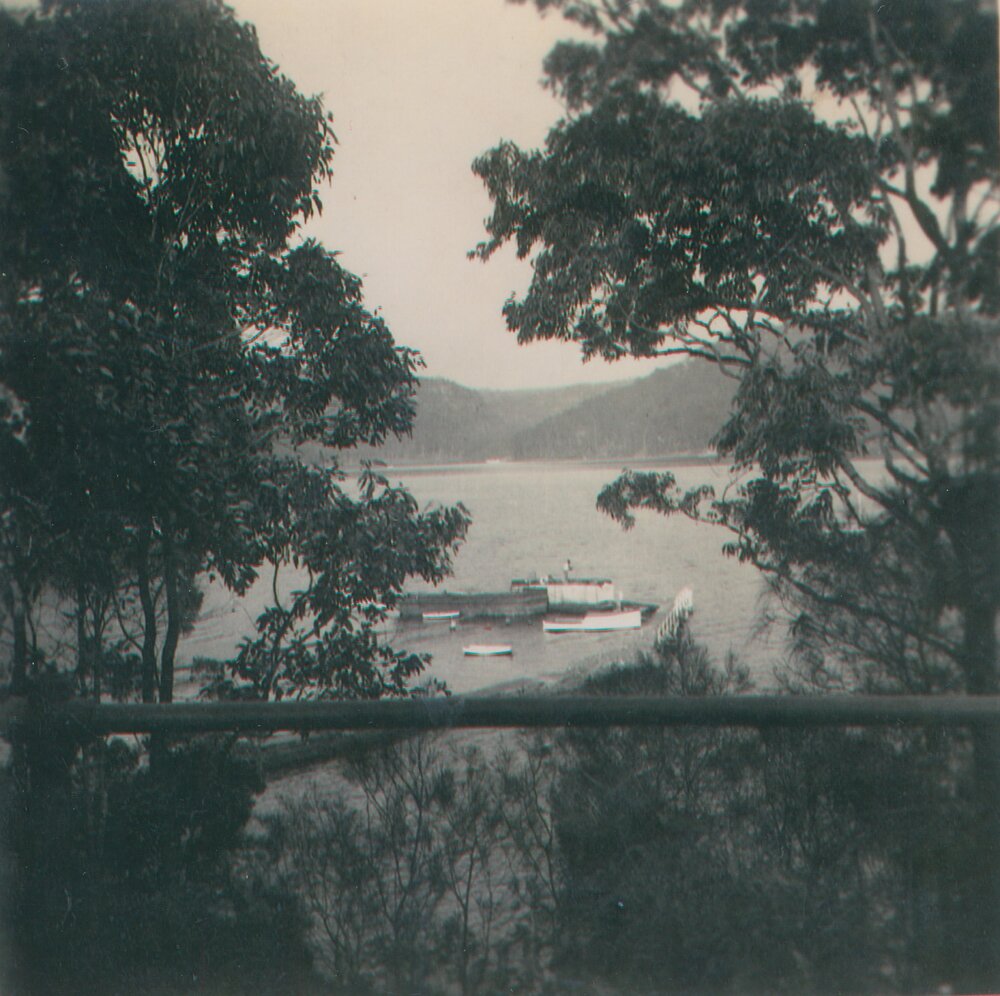
Repairs/construction at Tennis Court Wharf and Baths - a rebuild of one section, circa 1960. Photo: Gill family albums
The October 16 1961 meeting records:
List of applications refused under authority delegated to the Acting Town Planner _(b)-Rabbit Keeping ._Lots 117-1 19. Robertson road, Scotland Island, Reasons for refusal: Commercial Rabbit Keeping not permissible in this zone. 15.Resolved, that this application be refused as Commercial Rabbit Keeping is not permissible in 'A' Class Residential areas. (Crs. Jones/Bertram).
The October 30 1961 meeting records:
West Pittwater Progress Association, 8/10/61 addressed to the President advising its very great concern hat to date nothing has been done in the way of establishing some Method of garbage disposal for the Scotland Island and Western Shores of Pittwater area; it is not prepared to put up with further delays in this matter and unless something is done within the next few weeks, urgent representation, Will be made to the government authority. Adding it felt that little consideration is shown to residents of that area yet on, rate notices as received an amount for garbage collection is recorded. Resolved, That the President be invited, to interview a small representative group and 'he convey to them; Council's intention of considering ways and means of implementing a service when considering the Estimate in the next two months, (Crs. Fisher, Wilson)
The council meeting held November 13, 1961 states:
Item 44: Garbage Disposal Scotland Island and Western Shores of Pittwater - The Chief Health & Building Inspector submitted a specimen sample of a heavy weight paper container suitable for the use of household garbage storage which, when full, can be taken away by garbage removal service. ... 15.Resolved that Council investigates the Matter of installation of oil burning disposal units at representative points and the manning of these; the Chief Health & Building Inspector to secure plans and specifications of industrial models available, and this to be the subject of a special report to Council. (Crs. Fisher/Jones). re. Item 41 Church Point Stores Limited„Por.142 Pittwater Road, Church Point_II/C/0649/61) Application to convert existing premises known as 'Pasadena' into a guesthouse or boarding house. 16.Resolved; that this matter be referred, to the Town Planning Development Committee on the grounds that this constitutes under the Act, a change in use. (Crs. Fisher/Jones).
Let there be light!
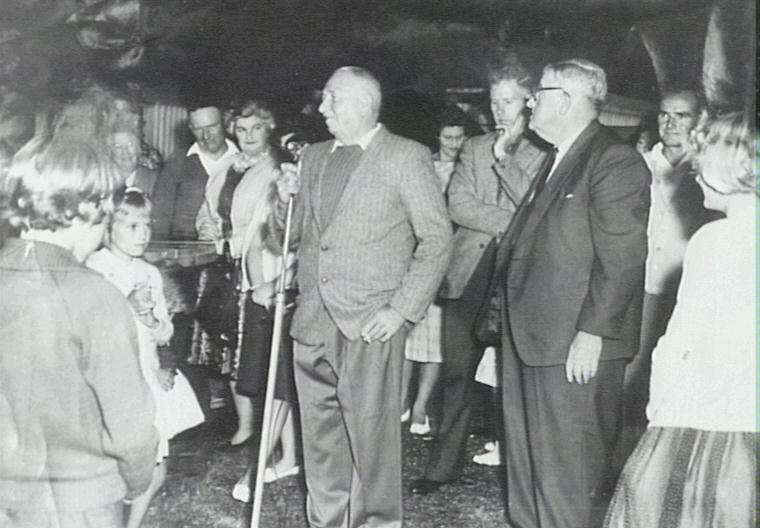
Photo: Ceremony to celebrate the connection of electricity to Scotland Island - 8 p.m. on Saturday, December 22nd 1962. The power was officially switched on by Councillor Gordon Brown of Warringah Shire Council and Mackellar County Council. Guests, including Councillors and the men who actually carried out the installation work, were welcomed by the Presidents of both Scotland Island and Western Shores Progress Associations. Image courtesy Library Local Studies - History Unit.
''By the time most people read this, electricity will be available on the Island, and to some parts of the Western Shores. The Mackellar County Council in conjunction with the Progress Associations of Scotland Island and Western Shores arranged a very special function in Catherine Park, Tennis Wharf, Scotland Island at 8 p.m. on Saturday, December 22nd.
The power was officially switched on by Councillor Gordon Brown of Warringah Shire Council and Mackellar County Council. Guests, including Councillors and the men who actually carried out the installation work, were welcomed by the Presidents of both Progress Associations.
This was the day that most of us had looked forward to since our Association was first founded nearly eight years ago.
In his address your President pointed out that it was very fitting that the Ceremony should be performed on such an historic spot… for it was here (near Tennis Wharf) that Andrew Thompson had his ship-building yards back in 1810. He also stressed the fact that the Ladies Committee had done most to get us electricity.. they had felt quite rightly that the men were not moving fast enough.
Within a few weeks power will be available to all houses on the Island, so if you have not already had your house wired, now is the time to get moving. Just think of the difference it will make!" - The Scotland Island News, Christmas 1962
The June 11, 1963 meeting records:
Collection of Hard Garbage from Scotland Island. .-Moved by Cr. Beckman seconded Cr.-Brown that the Chief Health & Building Inspector be requested to report to the next meeting of the Health & Building Committee on the methods of collection of-hard garbage, possibly by the use of hessian bags, collected at regular intervals by barge for collection by truck at-Church Point. CARRIED
The December 16 11, 1963 meeting records:
6 By Cr, Pickett-Heaps: Will the Chief Health and Building Inspector give Council a report through the Health and Building Committee on the results of tests on the Kitchener Garbage Disposal Unit and their recommendation, particularly in respect of Scotland Island, Lovett Bay, The Basin and Mackerel Beach? Yes. 77 By Cr. Beckman: Will you refer to the Police Traffic Branch the need for an additional pedestrian crossing at the shopping centre at Avalon between Old Barrenjoey 2d. and Bellevue Pde.? Yes.
At the meeting held 13/4/1964:
Scotland Island Progress Association, (undated and received on 8.4.64). expressing appreciation that a party of Councillors and. officers visited the Pittwater area on 25.1.64 last; advising that there was a number of more important requests made by the Association which have not yet been satisfactorily finalised. These are:(a) Disposal of rubbish from Scotland Island. (b) Modern toilets at Catherine Park, Scotland Island and also at Church Point. (c) Children's playground equipment for Catherine Park. (d) Assistant fence in manntence moo at Catherine Park. (e) General road maintenance and road improvement on Scotland Island with a particular reference to that section of road from Tennis Court wharf and the Fire Shed. (f) Maintenance of Tennis Court swimming enclosure with particular reference to provision of new ladders. (g) Removal of old piles from vicinity of public wharves on the Island. Also requesting Council to provide electric lighting on the three main public wharves and also more adequate lighting on the Church Point public wharf. Resolved, That the Scotland Island Progress Association be advised that 59. Council will provide modern toilet facilities this year at Church Point, toilet facilities will be considered at Catherine Park later this year; that road maintenance will be carried out on Scotland Island during the maintenance period; a report and estimate to be submitted to the Works Committee concerning (c), (f),. and (g) and the required lighting to the 3 main public wharves and the Church Point wharf.' (Crs.BeckMan/Pickett-Heaps).
The year 1967 is filled with reports of the council trying to secure fresh piped water for the island - and ongoing battle - just one example;
SHIRE ... REPORT _ORDINARY MEETING 11.9.67. PROPOSED 'GOVERNMENT-ASSISTED' WATER SUPPLY SCHEME FOR SCOTLAND ISLAND. The Council has been notified by the Metropolitan Water, Sewerage and Drainage Board that, upon receiving a recent request from the New South Wales Treasury to prepare particulars of schemes which qualify for ;Government assistance;, a proposal was prepared to serve Scotland Island. The present tentative estimated cost is $140,000, to serve an estimated population of 488. The tentative estimated initial revenue from the Board's rating would be approximately $2,810 per annuM, leaving Warringah Council to find the sum of $6,200 per annum to meet operating costs, together with interest and iede:vptian en t lean of approximately $70,000 (one half the estimated cost of $140,000: spread over it redemption period of 45 years. Warringah Council had previously decided in respect of a similar ;Government-assisted; rate-supply scheme for Terrey Hills that, in pursuance of Section 493 of the Local Government Act, it would levy a local rate on the unimproved capital value of Benefitting lands ratable by the Board to provide for the commitments that would be imposed pt. the Council by the Board under the special scheme, and doubtless the same procedure would be followed for the Scotland island project were it pursued. The Metropolitan Water, Sewerage and Drainage Board levies its water rates upon the ;Assessed Annual Value;, and consequently as development of the Island increases the Board's -utter rate revenue increases and the gap between revenues and outgoings correspondingly lessens. In the plan for Scotland Inland currently before the Council there are 312 lots subject tc water rating, the unimproved capital value aggregating $418,722. On the Board's tentative estimate of annual costs this Council would have to find $6.200 pins say $400 administration/accounting charges, or an annual total of $6,600. The Council would need to levy a rate of 1.576 cents in the dollar on the unimproved capital value to meet this cost, which would involve: On properties having a U.C.I of:_The water local rate would amount to: $1,000 $15.76 $1,500 $2,000 $2,500 :31911g 3,0.0 $0.28 $ This Counc41 levy would, of course, be additional to the usual Council rate levied, the normal'-levied by the Metropolitan Water, Sewerage ... expenditure in its initial stage,:,4hereas the Council's local rating would need to be geared to find the additional 62/90ths. It must be emphasised that-the figures'liven arc-based purely on ;TENIATIVE:. ESTIMATES; supplied by the-Bard', 'which are subject to adjustment._If it is decided to proceed with the scheme. In passing, it might-be Said that when the final figures for the Terrey Hills water scheme agreement were prepared they were considerably in excess of .the earlier *;tentative estimated' figures. Before considering this matter the Connell submitted full particulars of it to all Scotland Island property Owners who would become liable for water rating if the scheme proceeds, and invited them to indicate before 1st September,1967, whether or not they approved other proposal: Lots 175-180, 205-217; 239, 30,:34-31.7-34:.-335; 344:.354
However, there are a few items, like that in the December 18th 1967 meeting that shows the council is now 'supporting' looking after Catherine Park:
Scotland Island Tennis Court Wharf Reserve.' Grass cut and area generally tidied. BEACHES & RESERVES. Dunbar Park. 1500 sch.yds, parking area at rear of R.S.L. clubhouse prepared for seal using 100 tons of road base and area given two coat bitumen seal. Palm Beach. Stone deposited along beach6pnt to prevent further erosion of shoreline. Bungan Beach. Glass removed. Lake Park Camping Area. Gravelling formation of all avenues in extended area completed. Turfing completed, 290,0D0 turfs being cut and laid. Bitumen sealing of gravel avenues surrounding the Controller's cottage and amenity block carried out. Middle Creek Ski Club Area. Approcimately 200 c.yds. of gravel placed, graded and compacted. Elanora Reserve, Approximately 160 c.yds, of gravel used in process of maintenance to access track and inner area. Bayview Baths. Cleaned on 30.11.67 and 6.12.67. Dunbar Park, 6000 turfs laid, 8 cwt. fertilizer spread, 120 yds, soil spread and top dressed, area aerated. Cared& Bay Reserve. 7000 turfs laid.
Wharves-wise, the Shire Engineer's Report of 9th October 1967 records the allocations of funding for repairs:
W11. PITTWATER WHARVES - Quotation by E. R. Notting & Co. Pty. Ltd. for repairs to six public wharves in the Pittwater area, amounting to $4,641.88. Comments/ Insufficient funds are available for repairs to the six wharves , but funds are available for repairs to two wharves considered to be the more urgently in need of repair, namely Elvina Bay Wharf North, $1,013.88, and Scotland Island Tennis Court Wharf, $339.16. RECOMMENDATION. That the quotation of E.R. Notting & Co. Pty. Ltd. for repairs to Elvina Bay Wharf North, $1,013.88, and Scotland Island Tennis Court Wharf, $339.16, be accepted and the work charged to M7 - wharves and jetties
What was $340 in 1967 is worth $5,313.93 today. Still not much in comparison to the hundreds of thousands and even over 1.5 million the council must find through grants and residents being levied ever-rising rates today, and an indication of what amount of works were being done then, how cheaply the turpentine trees were valued (now having a 'critically endangered' listing for both the Sydney Turpentine-Ironbark Forest and Scrub Turpentine, Rhodamnia rubescens), and with many of these repairs or others having to be re-done a few years later. Even the $1,014 in 1967 for North Elvina wharf being worth $15,848.02 today doesn't inspire confidence the council escaped its running repairs patch-it-up cycle.
And what were the other four wharves that needed repairs - to the tune of a further 3 thousand dollars?
During 1967 Edward Russell Notting, contractor, of Lovett Bay, also submitted another quote for Palm Beach wharf - nothing else is recorded in what council minutes of meetings for 1967 are available. This may be because in 1967, Warringah Council was dismissed by the New South Wales government following the jailing of two councillors for bribery. Council records went missing during that period.
The extras for Palm Beach public wharf were not detailed either, just the cost.
19th June, 1967, W5. PALM BEACH PUBLIC WHARF _Quotation from E.R.Notting & Co. Pty. Ltd. for additional work found to be necessary to this wharf and not included in original contract No. 7/66, amounting to $1,473.25, less deductions from contract, $213 _nett addition to contract $1,260.25, and offering to supply to Council for $213 the 6''; x 3''; step treads, 6' long, which were supplied by the contractor, but now to be replaced by 6''; x 4''; step treads, 9' long. RECOMMENDATION. That E.R. Notting & Co. Pty. Ltd. be authorised to carry out additions to contract No. 7/66 for a nett value of $1,260.25, and that Council purchase the 6''; x 3''; step treads, 6' long, for $213, to be used for repair work to various wharves by Council's day labour staff; necessary funds to be voted from allocation for wharves and jetties maintenance and repair.
Also listed, and in the Shire Engineer's Report of 9th October 1967:
W5. CAREEL BAY PUBLIC WHARF - Careel Boat Services Pty. Ltd., advising that existing public facilities at Careel Bay Wharf are inadequate to handle the substantial increase in the numbers and types of vessels now using the wharf, complaining that resultant congestion causes obstruction of access to the Company's facilities adjoining and damage has been sustained to the Company's wharf, requesting extension of the wharf. Comments. Estimated cost of standard wharf construction of dimensions 16' x 32' and ancillary work is $7,000. RECOMENDATIOII. That an extension to the existing wharf of approximately 16' x 32' at an estimated cost of $7,000 be listed for consideration when preparing the 1968 works programme.
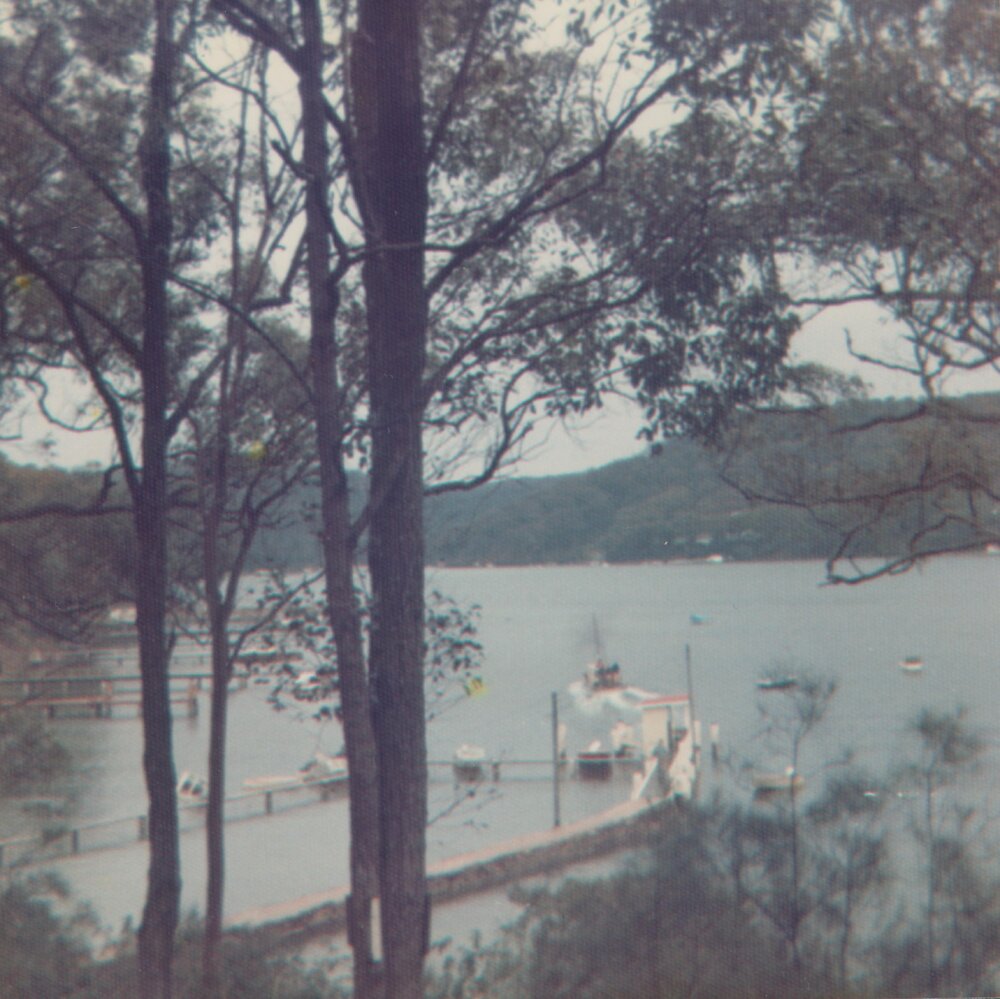
Tennis Court Wharf and baths, circa 1970. Photo: courtesy Gill family albums
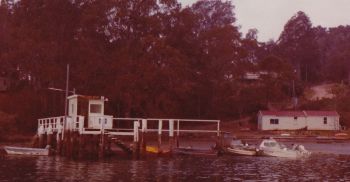
Old SIRFB shed - beside Tennis Court Wharf, 1979 - on the site of where the Tennis Courts were. Photo: SIRFB
The August 22 1977 meeting records yet another request for works:
PROJECTS PROPOSED FOR INCLUSION IN THE FUTURE WORKS LEDGER _NORTHERN DISTRICT -Progressive Provisional 9 Number Description of Project Estimate a 34 (File 446) at Bennett's Wharf, Coasters Retreat ; Installation of a second flight of steps at Bennett's Wharf, Coasters Retreat Note: The ferry moors across the existing flight of steps each night, so that the second flight of steps is requested by residents in case of emergency $5,300 35
(File 446) Mooring Facilities _Tennis Court Wharf, Scotland Island Provision of a shark proof fence and mooring facilities on the south-western side a of Tennis Court Baths, Scotland Island as requested by the Scotland Island Residents Association .. S 6,000
Tennis Court wharf features more than others throughout the Warringah Shire Council minutes due to it being around a lot longer - and being exposed to everything slamming from the northwest into it. The recurring call for repairs bears testament to the weather, tides, seasons and use.
Here is where there is a park for community events, just as had occurred in oyster feasts for thousands of years, there is a community hall, a place to do handstands and cartwheels, the Scotland Island NSW RFS fireboat is moored here, and this is where you can catch the ferry from the island's original public wharf.
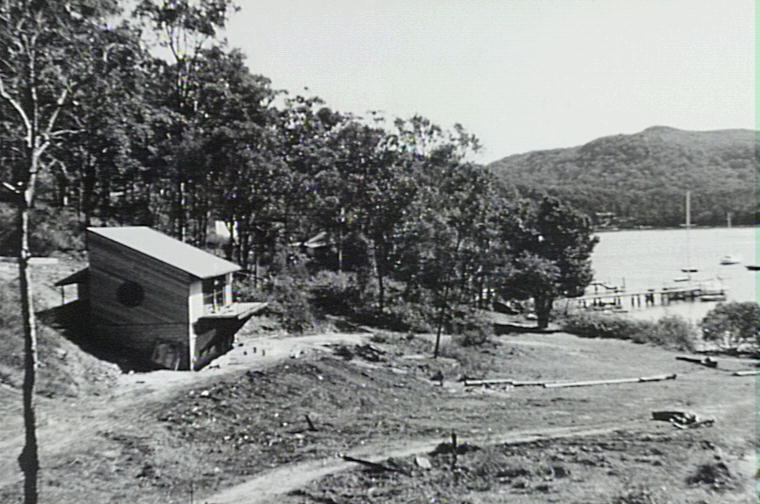
Newly completed community hall at Catherine Park, Scotland Island. Photo dated 1980, courtesy Local History Unit
History of the Community Hall
By SIRA
In 1976 Warringah Shire Council agreed to cover the cost of building materials for a new community hall, and the Scotland Island Progress Association provided the labour to build it. After four years spent sorting out ownership of the site in Catherine Park, in May 1980, the Association received approval for the plan by architect Eric Singer from Lovett Bay.
Bob Blackwood, nominated as builder, liaised with Council. Others were responsible for purchase, transport and storage of materials and organising site activities. Sixty supporters, men and women with a variety of skills, were organised into four work squads. They worked for four years, mostly on weekends, to complete the project on time and within budget, without any accidents or incidents. The hall was a community wish fulfilled. When the community hall opened in 1982, Council immediately insured the building for $125,000.
Since 2009, SIRA has been responsible for the hiring of the hall and is in charge of all hall matters. The responsible SIRAC body is the Hall Management and Hire Service Group. This group liaises with the Northern Beaches Council for repairs and renovations; for example, in 2012, it requested and was provided with a new kitchen by the former Pittwater Council.
Report to Ordinary Meeting, 23rd March, 1981
10. SCOTLAND ISLAND TENNIS CLUB The Club is seeking an allocation of $11,000 towards the construction of a synthetic tennis court with adjoining shelter and roller skating rink. This application has been rejected but will be forwarded to the Department of Sport and Recreation as approvals have not as yet been sought from Council for use of the public Reserve. Further, no plans accompany the application.. Total amount of this project is $14,842 with the Club not contributing any funds.
Report to... 7th February. 1989; SCOTLAND ISLAND COMMUNITY CENTRE Design in-house; labour; John Travers Building on day hire, supplemented with Property Branch personnel. The project is a timber kindergarten hall situated near Tennis Court Wharf on Scotland Islard. All pity_holes have been completed, piers have been positioned and structural work to the floor is commencing. PAGE 1 79 Minutes Special Meeting _Warringah Shire Council 7th February, 1989

Ferry CURLEW nears Scotland Island. Pittwater. Unique IDA-00080869, Series: Graeme Andrews Working Harbour Photograph Collection Date: Between 1st August 1984 and 31st August 1984, courtesy Graeme and the City of Sydney Archives

Ferry CURLEW at Tennis Court Wharf, Scotland Island. Pittwater. Unique IDA-00080867, Series: Graeme Andrews Working Harbour Photograph Collection Date: Between 1st January 1984 and 31st December 1984, courtesy Graeme and the City of Sydney Archives
The Pittwater Council June 2008 Plan of Management for Tennis Court Wharf describes:
''Tennis Court Wharf is one of the principle wharfs of Scotland Island. Its sheltered location, relative accessibility and proximity to the Scotland Island community facilities (children’s centre, community hall and rural fire service) promote high commuter use by private boat, ferry service and water taxi. The wharf is accessed from the island via Pitt View Street and Catherine Park with connections to Robertson Road, Thompson Street and Florence Terrace.
A description of the reserve, wharf structure, related features and management is summarised as:
Site name: Tennis Court Wharf Reserve
Address: Accessed from Pitt View Street, Scotland Island
Reserve: Crown Reserve: Tennis Court Wharf Reserve (R1010813), gazetted for Access on 13 May 2005, comprising Lot 7114.
Ownership: State of New South Wales as Crown Land administered by Department of Lands under Crown Lands Act 1989
Management: Tennis Court Wharf (R1010813) Reserve Trust (appointed 13 May 2005) charged with care, control and management
Trust Manager: Pittwater Council manages the affairs of the Trust
Area: Approx. 2425 square metres
Existing Uses: Public access – general public, commercial ferries, water taxis and commuter boats, Scotland Island Rural Fire Service – boat storage, Redundant mooring bay for Water Police, Passive & active recreation, Access Boat access from mainland, Stone groyne accessed from Pitt View Street (surfaced road) or foreshore footpath through Catherine Park
Zoning: Pittwater Local Environmental Plan 1993 6(a1) Waterways Recreation
Adjacent Zoning: Reservation local road (Pitt View Street) 6(a) Existing Recreation ‘A’ W2 Residential Waterways 2(a) Residential ‘A’
Condition: Generally good, minor wear to pile tops (cracked and rotten), broken fender timber and deterioration of shelter shed evident (Docker Smith Pty Ltd – 3rd April 2006)
Maintenance: Pittwater Council:
- Safety equipment maintenance
- Timber / structural repair
- Graffiti removal and painting
- Domestic waste removal
- General repairs to buildings, shelters
Assets: 50m stone groyne (concrete surfaced) with stainless steel handrail to one side, 15m timber jetty – railing to one side, timber jetty head (approx. 5x7m), 10m timber jetty arm to access ramp and pontoon, fixed timber access steps with landing off jetty head, weatherboard shelter shed (inc notice board, seating to 1 side), lighting, PLGA and emergency signage
Unattached Assets: Domestic waste skip.''
''A desk top study of the principle user group (Scotland Island residents)has been undertaken to ascertain the number of wharf users and specifically boat tie-up use levels. Results suggest approximately fifty (50) residences currently use Tennis Court Wharf as a tie-up facility for their commuter boats.
The wharf provides five (5) informal boat tie-up locations on the eastern side with approximately forty-five (45) commuter boats using the pontoon on the western side. A further twenty (20) boats / dinghies (varying condition) are tied to the shore line (timber retaining structure) /vegetation of the bay. Several kayaks / canoes and surf boards etc are beached between the stone groynes (6no) with additional dinghies / sail boats stored to the far side of the bay within Catherine Park (approx 12).
Commuter boats attached to the wharf are generally secured via a pulley system with access over the timber jetty handrail. Tie-up facilities at the existing pontoon are less organised with a ‘first come first in’ system whereby boat tie-up can often be 3-4 vessels deep with tie-up ropes, anchor ropes and access across many different vessels. Tennis Court Wharf maintains a high user demand for storage of commuter boats on the northern side of the island. Spaces are ad-hoc and where designated converted. Flexibility of boat users dictates the level of risk involved when selecting a tie-up, especially in inclement weather. Most of the users are generally passive but the proximity of the wharf to community facilities and Catherine Park impacts on user demand increasing pressure for boat tie-up space when functions /events take place.
Currently the informal provision of commuter vessel tie-up berths at Tennis Court Wharf Reserve is unsafe and does not accommodate the high user demand. The use of informal attachment to the wharf structure and pontoon will be phased out and designated vessel tie-up locations will be provided to improve safety and wharf management.
Proposals would include for the following, either as separate installations or a coordinated scheme:
- provide access ramp and pontoon to SIRFS boat mooring (improve user safety and emergency evacuation procedures) refer SIRFS Concept Sketch (Figure 29-4). Works to complement improved pedestrian (disability) access and safety, incorporating a ‘ferry compatible’ pontoon;
- provide tie-up rings / access ladders where appropriate to existing wharf structure;
- remove existing swimming enclosure net, allowance for additional wharf tie-ups (rings and access ladders) to inner side (dependent on marine survey and adequate water depth); and
- provide additional boat tie-up facilities incorporating pontoon /access ramp – refer Commuter Wharf Concept Sketch (Figure 29- 5) which includes potential allowance for visitor tie-ups in peak event times i.e. Scotland Island Festival (design dependent
Proposed improvements at Tennis Court Wharf will aim to alleviate the management and safety issues currently observed (refer Figure 29-5). The works include the installation of a pontoon system replacing the existing structure, but positioned further north to deeper water, with an access ramp. The proposed pontoon will accommodate a specific number of tie-up berths (approx 40 spaces – subject to detailed design) with the end sections designated as ‘No Tie-Up’ zones to allow for a ‘drop off / pick up’ facility. The facility will initially include provision for visitor moorings (time limited) to accommodate users of the community facilities in Catherine Park (visitor spaces will be subject to continued monitoring to assess utilisation / abuse).
The replacement pontoon in combination with tie-up rings (approx 8-10 spaces) / access ladders will allow for approximately fifty (50) total commuter boat tie-up berths at Tennis Court Wharf. It is envisaged the improvements at Tennis Court Wharf will coordinate with proposed improvements at Carols Wharf and Cargo Wharf providing a balanced dispersal of boat tie-up facilities around the island.
Subject to the proposed plan being adopted by Council, the Department of Lands has approved in principle amending the current reserve area to accommodate the proposed changes at Tennis Court Wharf Reserve.''
A few more photos of same from 2015 to 2016 (by AJG/PON) showing heritage listed stone wall:
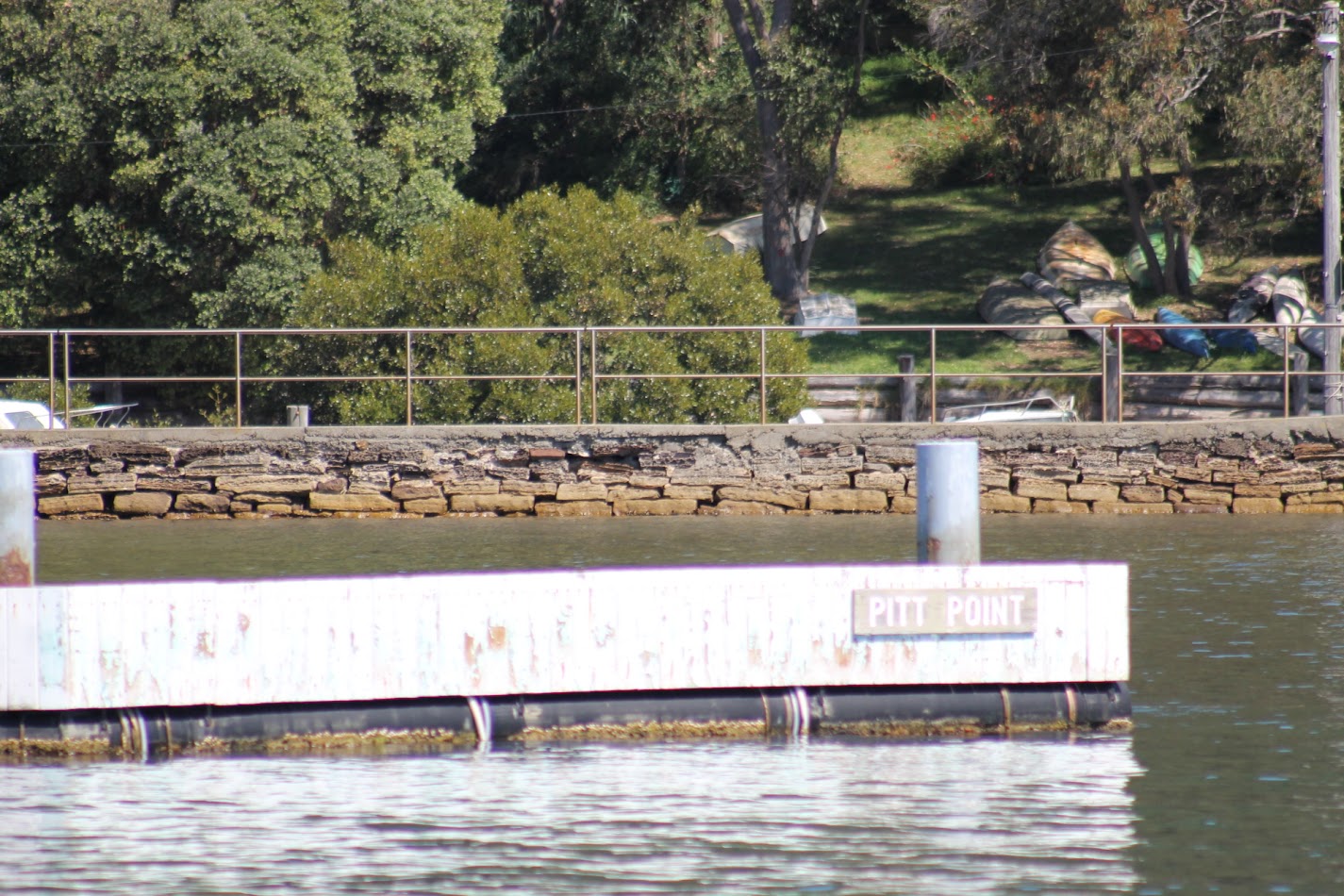
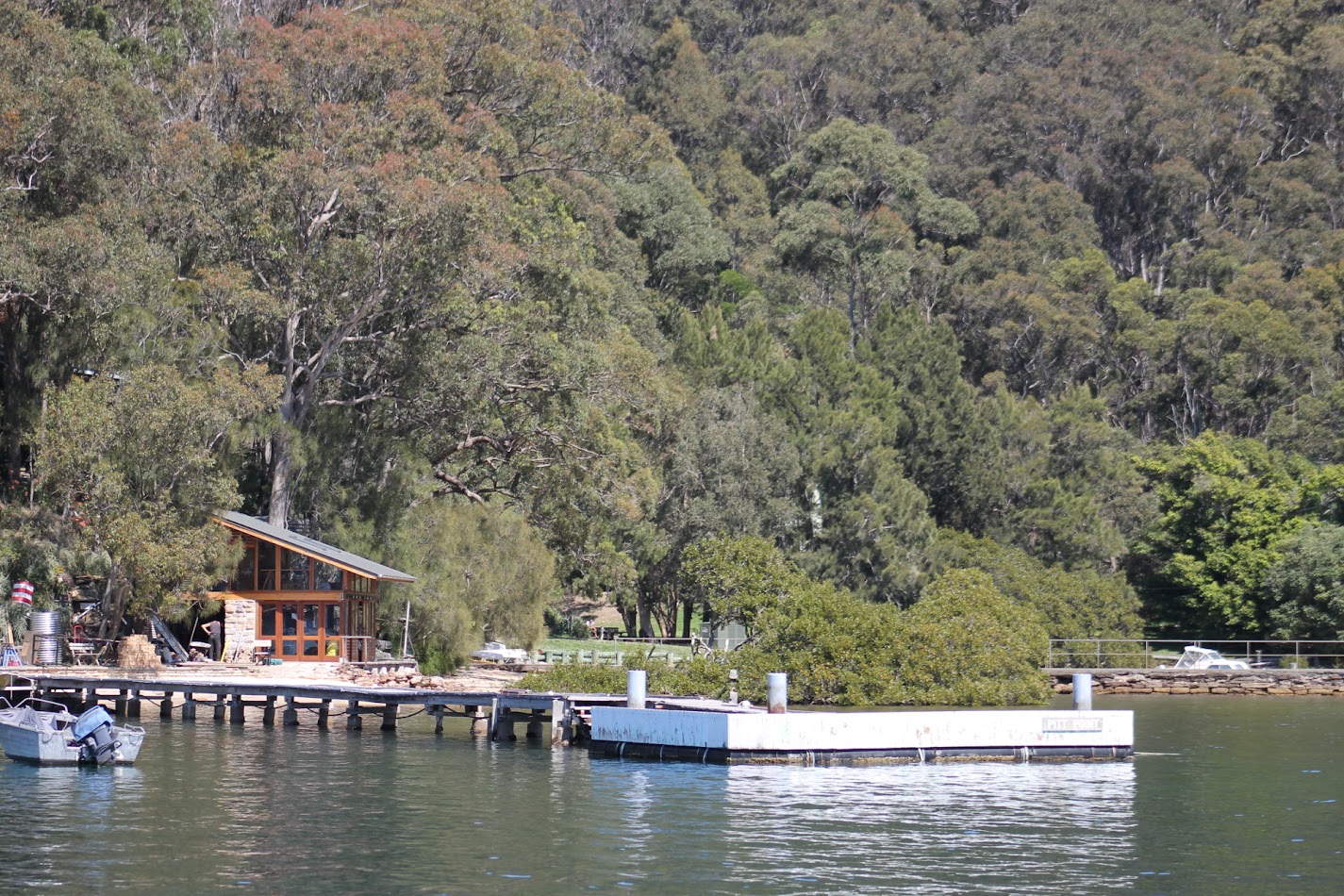
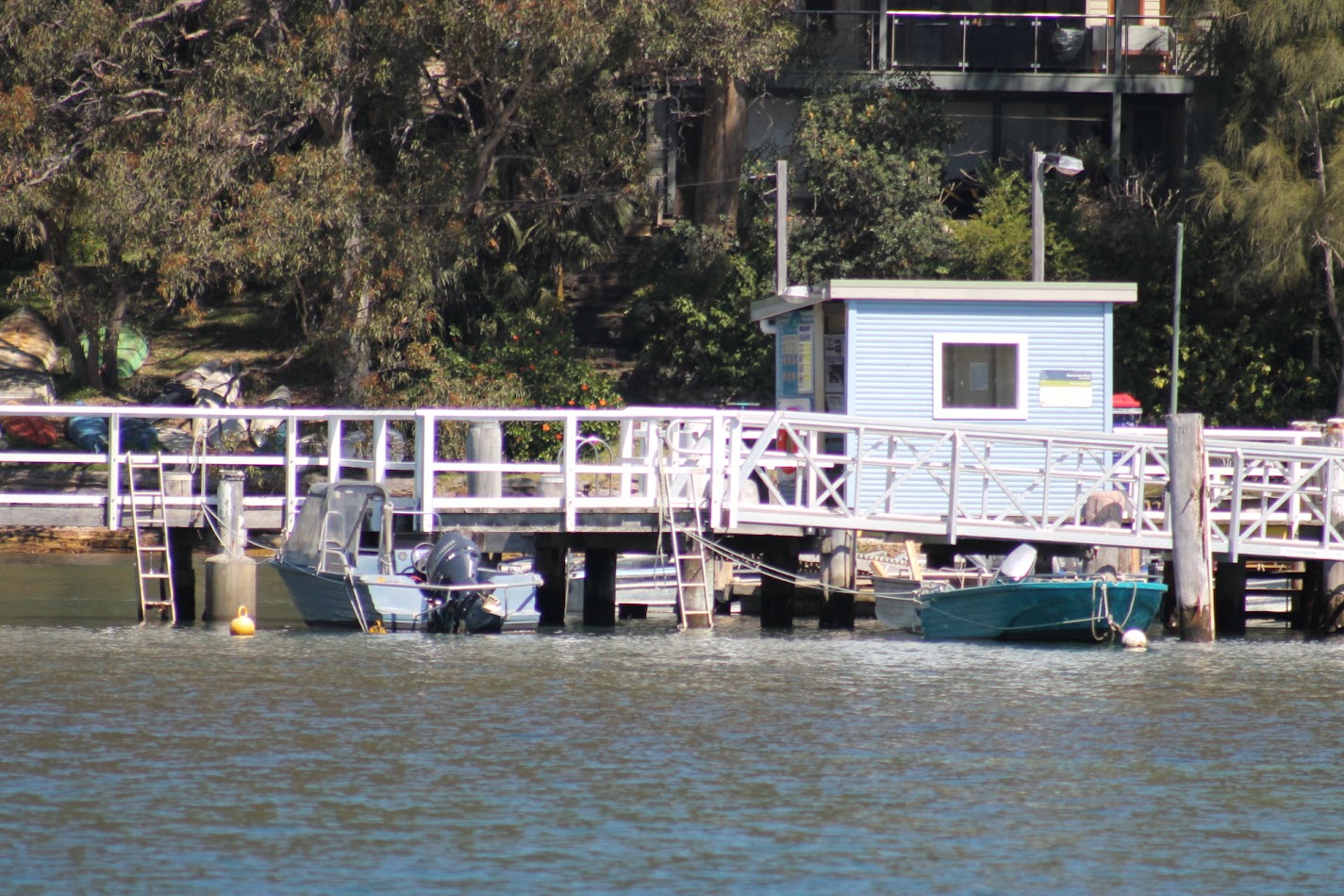
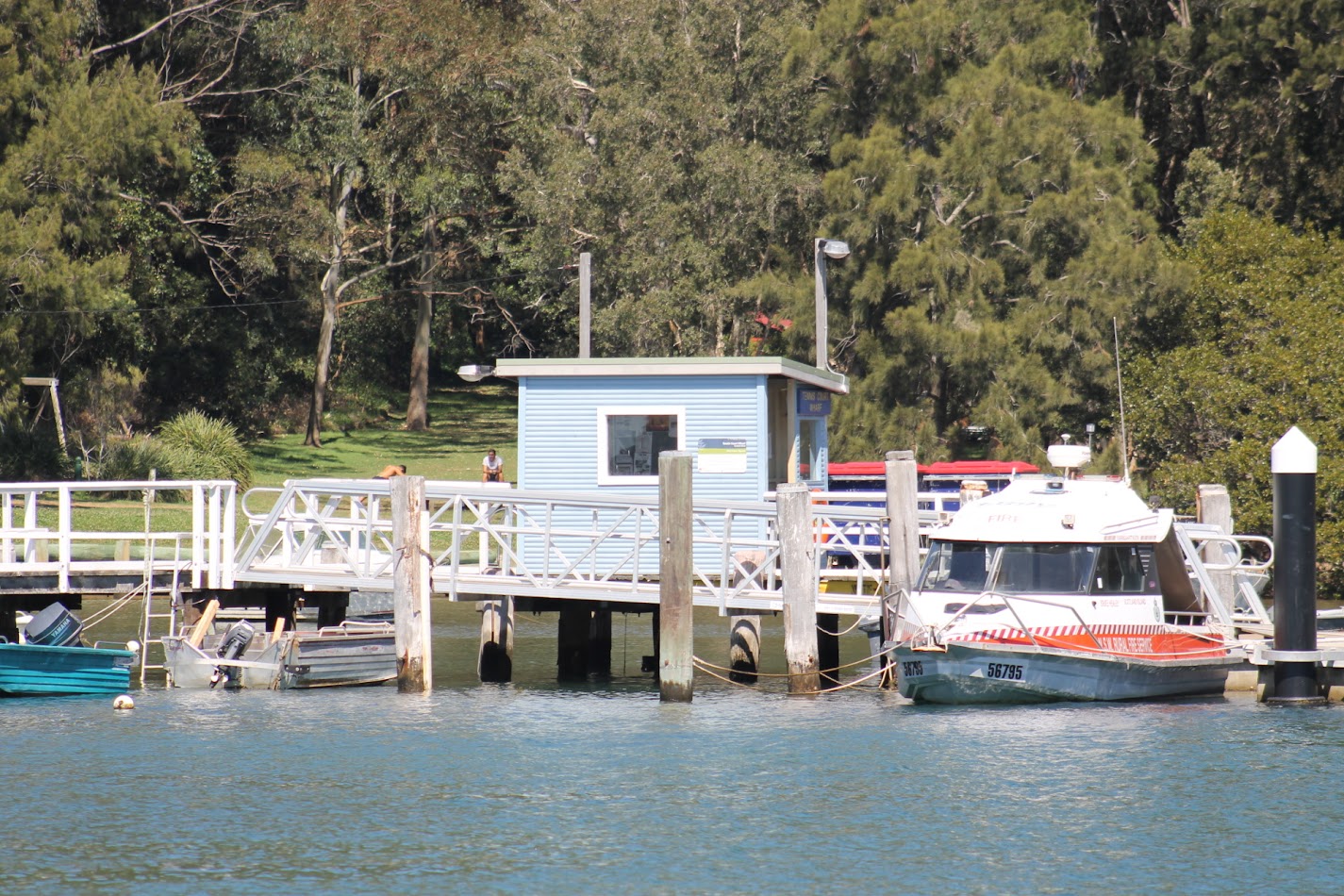
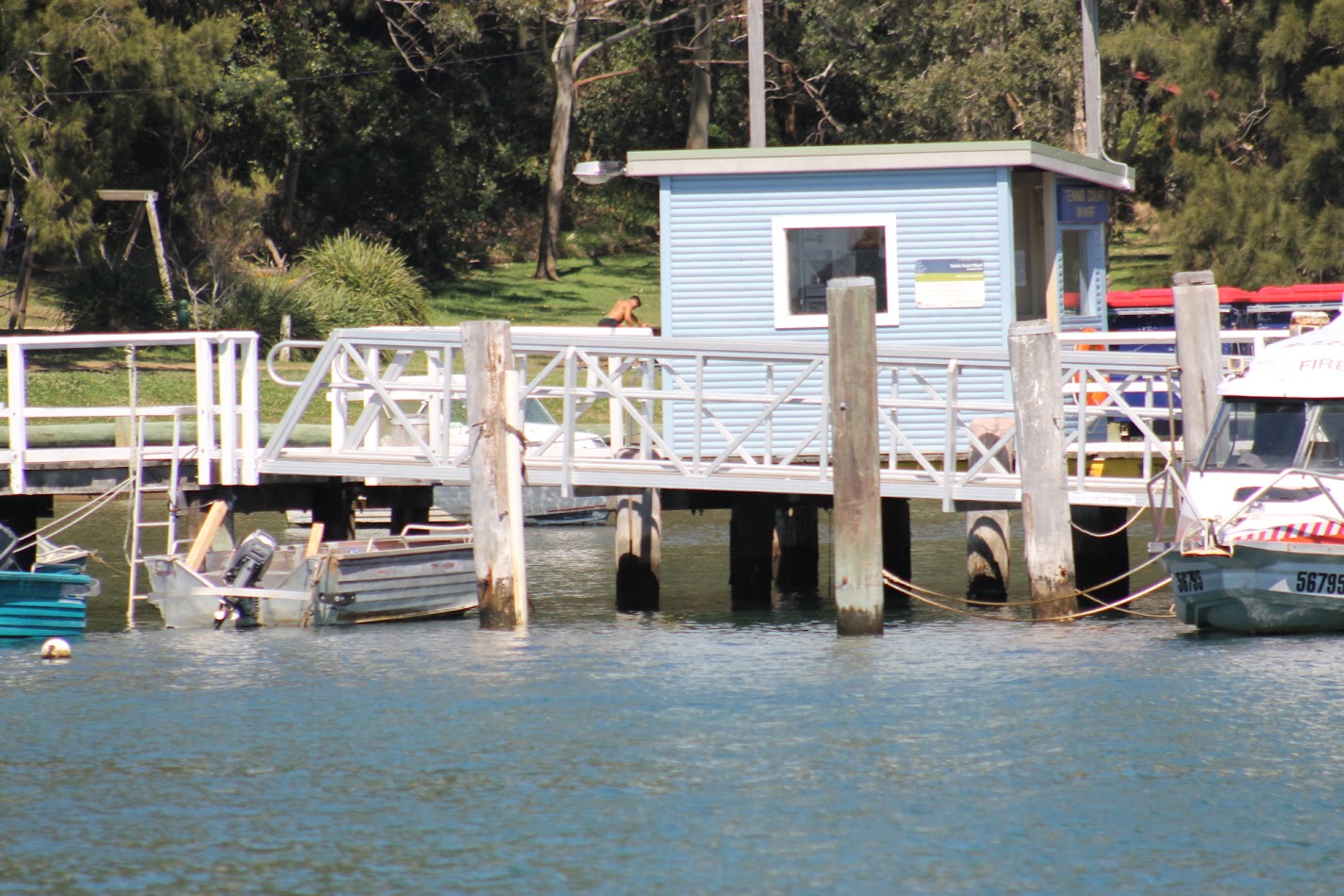
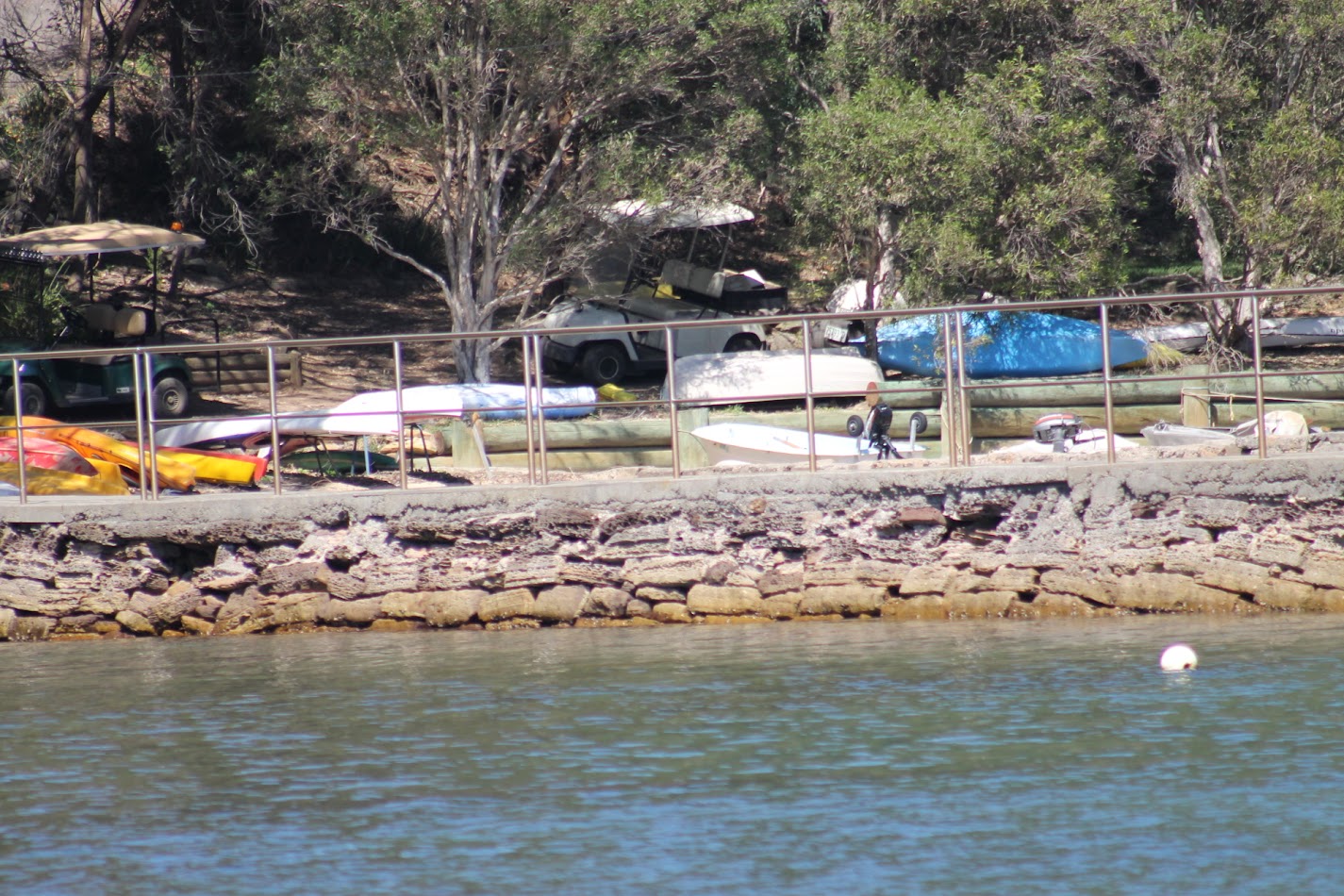
.jpg?timestamp=1763059129573)
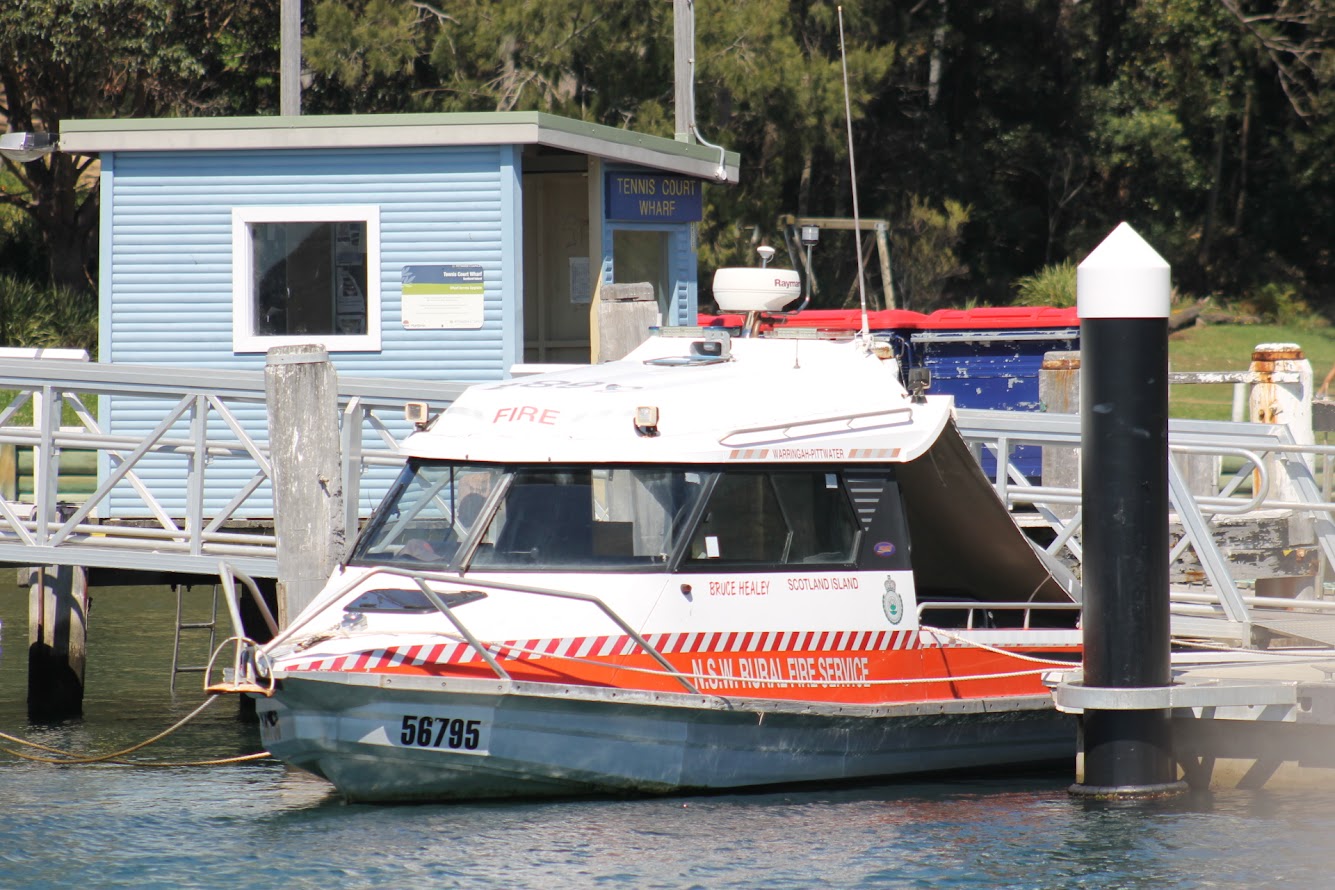
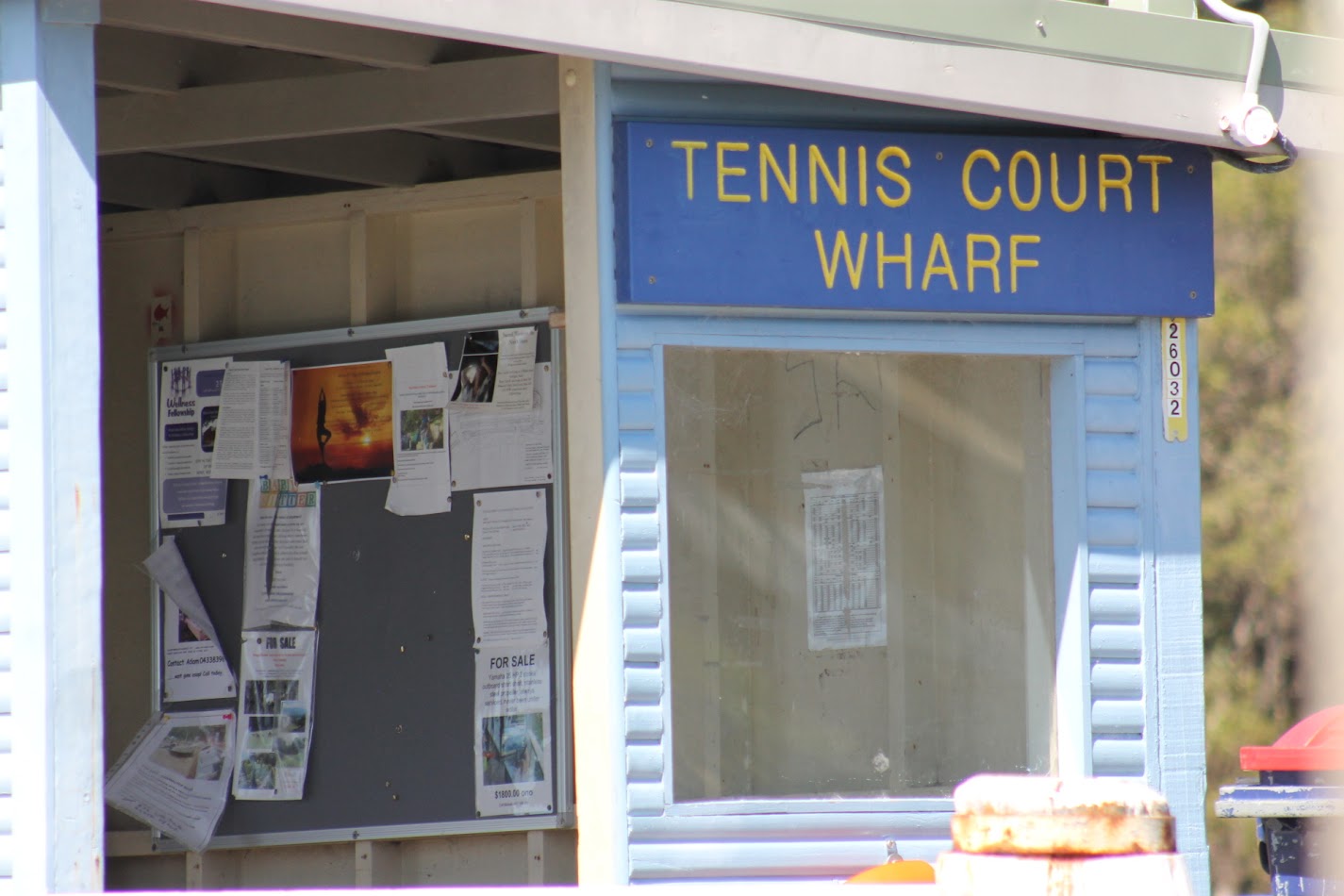
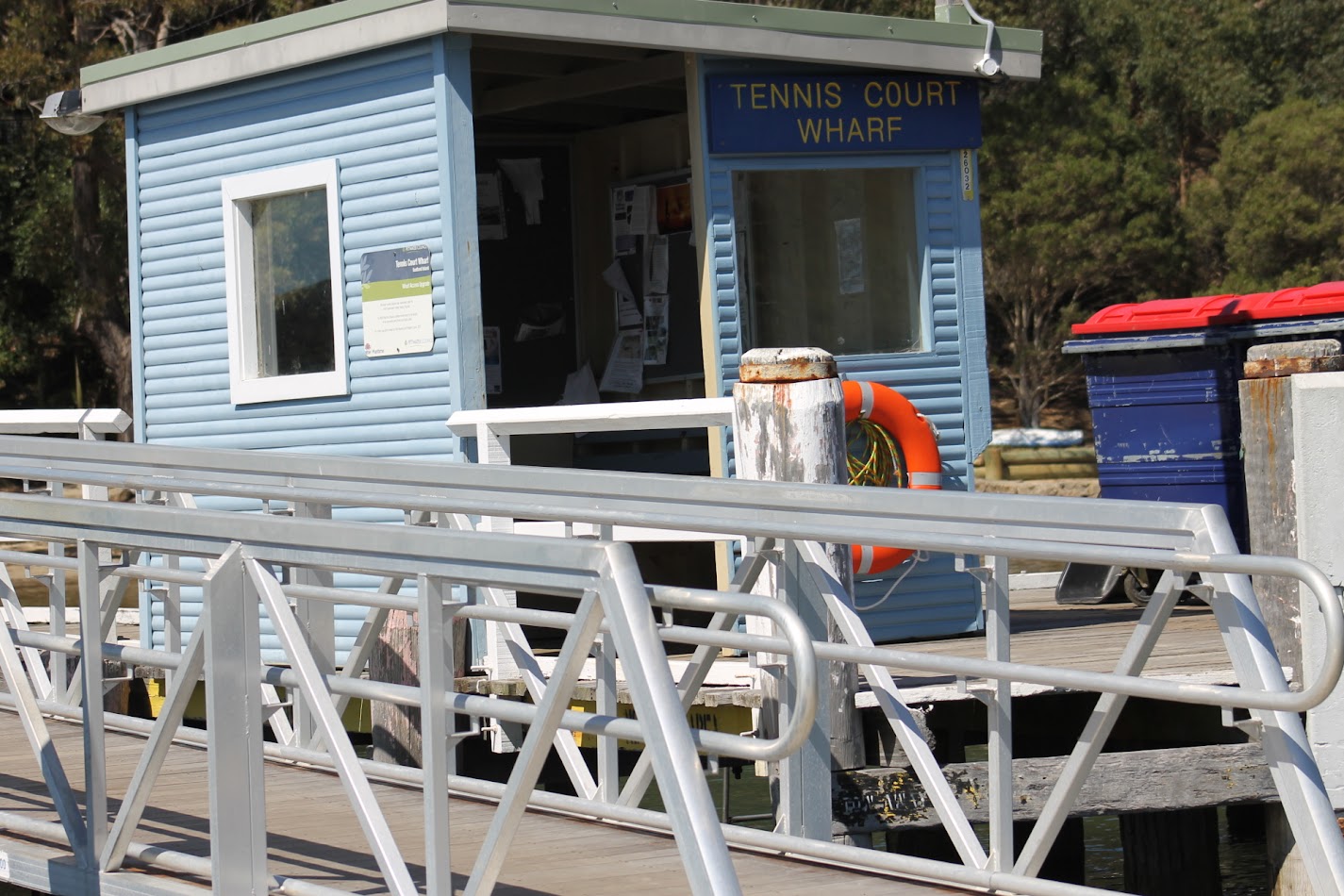
.jpg?timestamp=1763060023022)


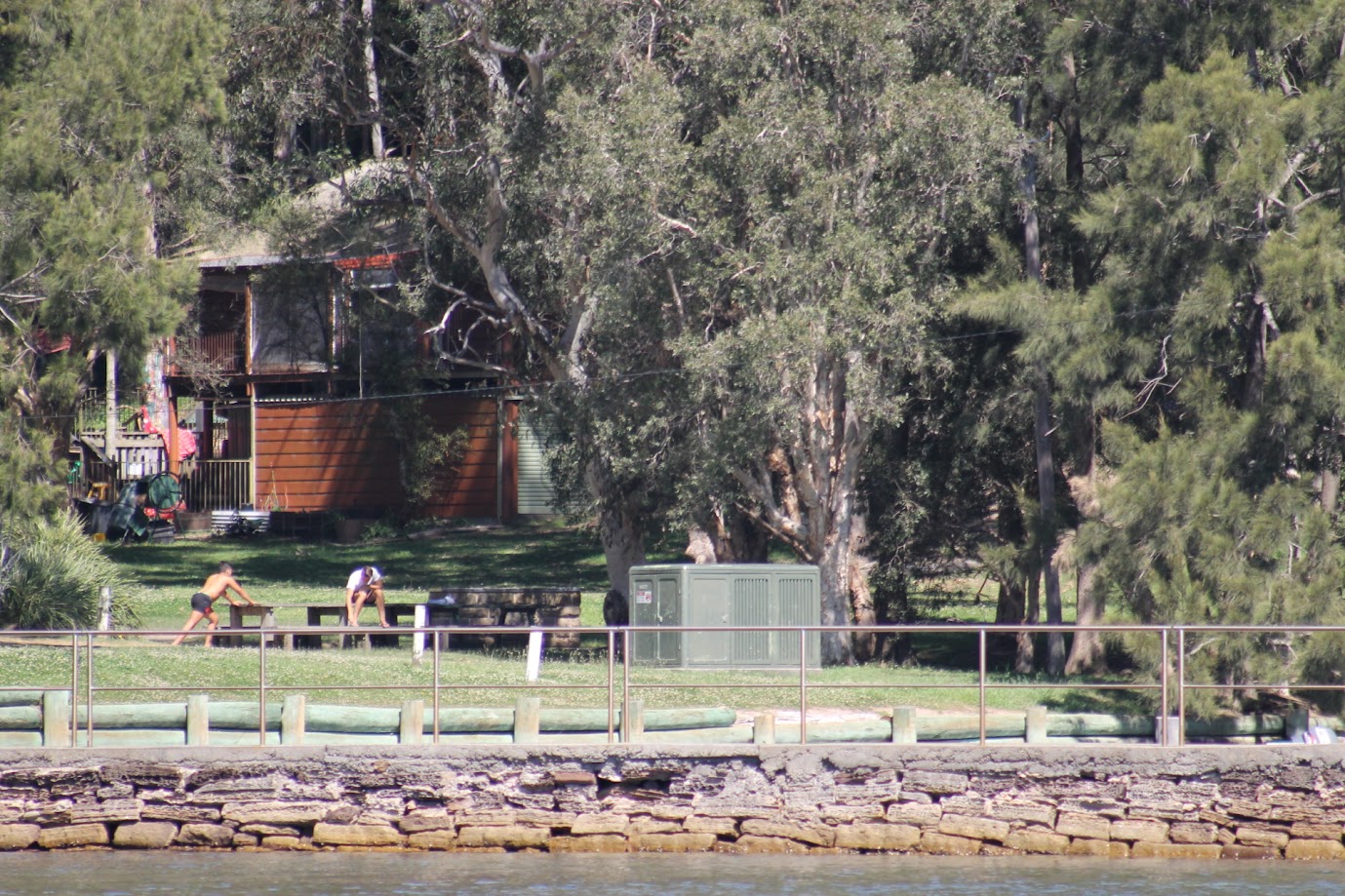
Scotland Island by Bea Pierce, Artist, Writer, Creator, Photographer - some beautiful images taken during a visit to see The Tempest by William Shakespeare on the island, in Catherine Park, adjacent to Tennis Court Wharf, March 2020:
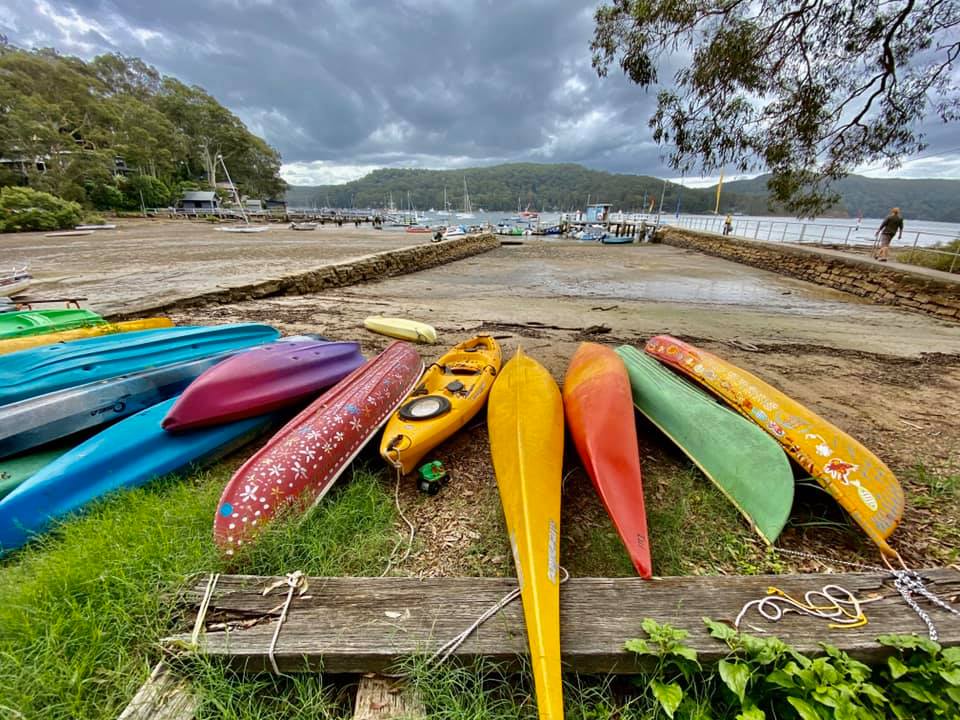
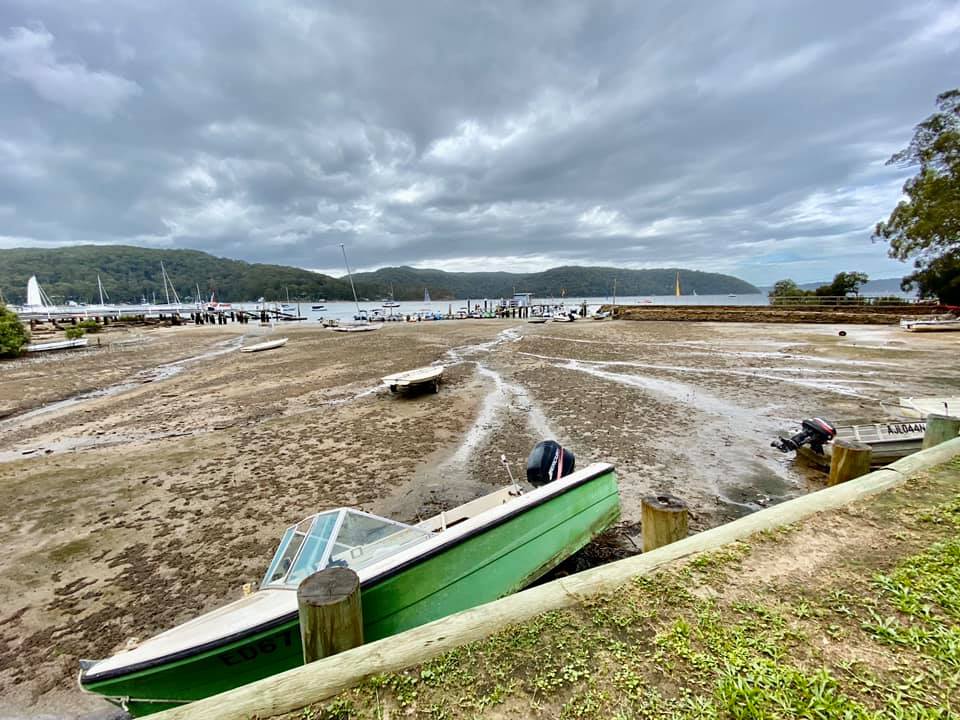
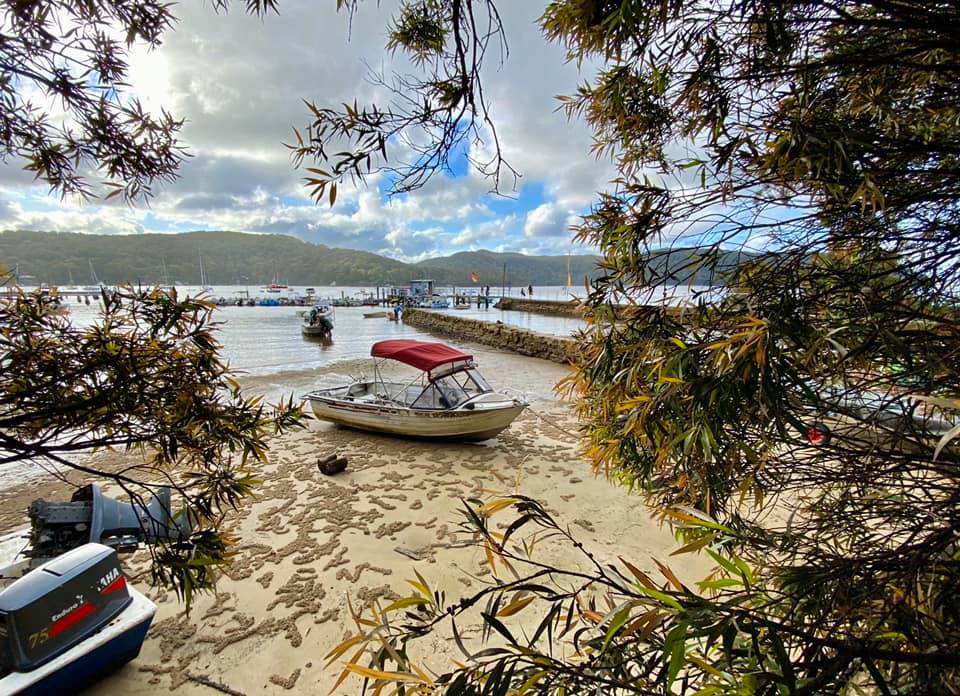
____________________________
West - Cargo Wharf (from at least circa 1884)
The ownership of Scotland Island had been assumed by John Dickson by 2 July 1833. He appointed trustees of his estate, including Scotland Island, for the benefit of his children, John, James and David Dickson. [LTO Book F No.169] New trustees were appointed in 1838, then John Dickson Senior died in London about 1843. John Dickson Junior also died, about 1850 or 1851.
The estuary of Pittwater was described in an article in the Sydney Morning Herald of 30 January 1850. “... Near the head there is a small island, which contains a large number of fruit-bearing peach trees, the remains of former cultivation.”
Joseph Benns, master mariner, was born about 1816 in Brussels, Belgium. He married Martha Catherine Sanville (or Lewis) when he was 66 years old. There was no issue of the marriage, however, Martha Catherine, born October 13, 1838, the fifth child of Sarah and John Lewis, gave birth to one child in 1862, a daughter Emily Mary Ann Elizabeth, whose father is said to be one Eugene Stevens, a water policeman. Although 'Sanville' appears as her surname, 'Stevens' is used when her daughter marries.
In 1874 Martha Catherine married Joseph Benns. He changed his name from Ambrol Josef Diercknecht, possibly due once again to people here being unable to pronounce names correctly (?) and leased Scotland Island for seven years in 1855.
Marriage 590/1874: BENS JOSEPH to SANVILLE CATHERINE - SYDNEY - NSW State Records - Births, Deaths Marriages
Emily Mary Ann Elizabeth (names of her Mother's sisters) married George Sigby Godbold in 1887. 3485/1887: GODBOLD, GEORGE and STEVENS EMILY - MANLY - NSW State Records - Births, Deaths Marriages
Mr Benns is credited with rebuilding the house of Andrew Thompson. He also owned the “William and Betsy” which foundered off Port Stephens and then “The Lady and the Lake” which was wrecked off Long Reef. Both of these traded up and down the Hawkesbury so that may have been how he first met Martha:
COASTERS OUTWARDS. March 10.-Rover, William and Betsy, and Bride, for the Hawkesbury.; Triumph, for Newcastle; Moonta Bay, for Shoalhaven. COASTERS OUTWARDS. (1855, March 12). The Sydney Morning Herald (NSW : 1842 - 1954), p. 4. Retrieved from http://nla.gov.au/nla.news-article12966620
COASTERS-JULY 21. Inwards.-Catherine, from Broken Bay, 250 baskets shells, 34,000 shingles, 200 dozen oranges ; William and Betsy, from the Hawkesbury, 7600 shingles, ..t bushels maize, half ton bark : SHIPPING RECORD. (1857, July 25). Empire(Sydney, NSW : 1850 - 1875), p. 5. Retrieved from http://nla.gov.au/nla.news-article64983263
Benns and Jenkins leased uninhabited Scotland Island from James and David Dickson of London, England, on 24 August 1855 for seven years. They cultivated part of the island and ran cattle on another part. They paid rent to the Dicksons’ agent until 1859, when they discovered that the Dicksons had no title to the island. They paid no more rent, but continued to live there and improve the place.
In 1883 they attempted to bring it under the provisions of the Real Property Act, but were unsuccessful at that time. They did secure an official place for a jetty to the west though, which was an application to 'maintain' a jetty, indicating it was already in place by the time this Notice was advertised:
Department of Lands,
Sydney. 18th November, 1884.
APPLICATION TO MAINTAIN A JETTY.
NOTICE is hereby given that application has been made by the parties hereunder mentioned to maintain a jetty in front of their property, particularized in the annexed description; and all persons interested are invited to state, within one month from this date, their objections, if any, why they should not be permitted to maintain the jetty in question.
JAMES S. FARNELL.
Registration No. Ms. 84-22637
Name of Applicants.
Joseph Benns and Charles Jenkins.
Description.
County of Cumberland, parish of Narrabeen, at Pitt Water, Scotland Island: Commencing on the high-water mark of Pitt Water, on the western side of Scotland Island; and bounded thence on the north by a line bearing westerly 168 feet; thence on the west by a line at right angles bearing southerly 5 feet; thence on the south by a line parallel to the first-mentioned boundary bearing easterly to to the aforesaid high-water mark ; and thence on the east by that high-water mark northerly, to the point of commencement. APPLICATION TO MAINTAIN A JETTY. (1884, November 25). New South Wales Government Gazette (Sydney, NSW : 1832 - 1900), p. 7906. Retrieved from http://nla.gov.au/nla.news-article221632993
.jpg?timestamp=1761686262206)
1881 to 1886 map - the cross (+) on the west side of the island marks where Benns and Jenkins jetty was. Map for Benns-Jenkins 'Cargo' wharf original location: New South Wales. Department of Lands. (1886). Parish of Narrabeen, County of Cumberland Metropolitan Land District, Eastern Division N.S.W Retrieved from http://nla.gov.au/nla.obj-233833505
Department of Lands,
Sydney. 19th May, 1885.
LEASES GRANTED FOR SPECIAL PURPOSES.
IT is hereby notified, for general information, that the undermentioned persons have been permitted to lease the land specified in the annexed Schedule, under the 38th clause of the Lands Acts Amendment Act of 1875, and 19th clause of the Lands Acts
Further Amendment Act of 1880.
The rent for each year must be paid in advance on or before the 31st December of the year preceding.
JAMES S. FARNELL.
Reg. No. I
85-1095 - Joseph Benns and Charles Jenkins. Situation of Land: Scotland Island, Pitt Water, Broken Bay. Area; 3 perches. Object of Lease; Jetty. Term of Lease From 1884. Jan. 1 to 1888. Dec 31. Annual Rent: £5. Conditions: The lease to confer no right of purchase, and the lessees to remove the structure without compensation whenever required by the Government to do so. LEASES GRANTED FOR SPECIAL PURPOSES. (1885, May 19). New South Wales Government Gazette (Sydney, NSW : 1832 - 1900), p. 3222. Retrieved from http://nla.gov.au/nla.news-article221692677
Worth noting in the same Notice:
Buckman & Christenson. Nambucca Heads, county of Raleigh. Area: 5 acres. Object of Lease: saw mill. Term: 1883 Jan 1 to 1887 Dec 31. Annual rent £10. Conditions: The lease to confer no right of purchase. A right-of-way 50 links above high water mark to be reserved for the use of the public, and any obstruction to the navigation of the channel of the river by discharging ballast from vessels trading in connection with the saw-mill to involve forfeiture of the lease.
They then lost this for non-payment of the rent:
Department of Lands,
Sydney, 29th July, 1887
CANCELLATION OF SPECIAL LEASES.
IT is hereby notified, for general information, (hat the undermentioned Special Leases have been cancelled, for non-payment of rent.
[Occ. 87-7,706] THOS. GARRETT.
Benns & Jenkins - Scotland Island, Pitt water for Jetty £5 annual rent CANCELLATION OF SPECIAL LEASES. (1887, July 29). New South Wales Government Gazette (Sydney, NSW : 1832 - 1900), p. 4991. Retrieved from http://nla.gov.au/nla.news-article222091093
David Dickson wrote from Adelaide on April 18 1889, stating that Scotland Island was the property of himself and his brother James, who was living in England and suffering from mental disability. However, he was unable to prove their ownership satisfactorily, and Certificates of Title were issued to Joseph Benns and Charles Jenkins on 8 February 1892, mainly on the grounds of continual possession. Land Titles Office Vol.1044 Fol.101 &102:
.jpg?timestamp=1761682937984)
.jpg?timestamp=1761682891889)
They had brought ten to fifteen acres under cultivation, grazed cattle, horses, goats and other live-stock over the whole island, and constructed a path-way right round the island, cut into the sides of the hill. [LTO PA 6016]
Four days later, on 12 February 1892, Benns and Jenkins transferred their ownership of Scotland Island to William Wallace Elmslie (Doctor of Medicine – who took a mortgage with Alfred George Milson and Richard Holdsworth and the Stephens-Godbolds), and Charles Bond (Tailor; same per mortgage) and Thomas Wilshire (Civil Servant). [Vol- Fol 1052- 249 and 250 And Vol-Fol 1053-1]
Soon after the transfer of ownership, Charles John Jenkins died on 11 August 1892, aged 65 years. He was buried on 12 August in St. John’s Cemetery, Mona Vale.
Charles Jenkins left his share to his partner and Benns’s family. Charles Jenkins, mariner, and farmer on Scotland Island, Pittwater, was not related to James Jenkins and family (of Warriewood to Long Reef).
Joseph Benns died on 29 March 1900 on Scotland Island, Pittwater, aged 84 years. His death certificate states that he was buried on 31 March 1900 in the Roman Catholic Cemetery, Bayview, by the Manly undertaker Thomas Waugh. The minister was Thomas Haydon of Manly, R.C. Priest, and witnesses to the burial were Samuel Morrison, J.P., the teacher at Pittwater Public School (located at Bayview), and John A. Ellison of Manly, cabinet maker.
There was no Roman Catholic Church at Bayview, and the small cemetery at Church Point was Protestant. Most of Bayview’s residents were Protestant, except for John Roche’s family, whose 80 acre property included the Bayview Post Office. The Roches were devout Roman Catholics. A grave apparently existed on this property for some years but was covered over when the road was made to Church Point. The evidence points to this site, on the Roches’ land, as being the most likely location of any Roman Catholic Cemetery at Bayview in 1900.
Elmslie has discharged his mortgage by May 21st 1894 – becomes Vol- Fol: 1142-36 - for all three holdings with William Wallace Elmslie issued the Certificate of Title in 1894, and then taking out a new Mortgage:
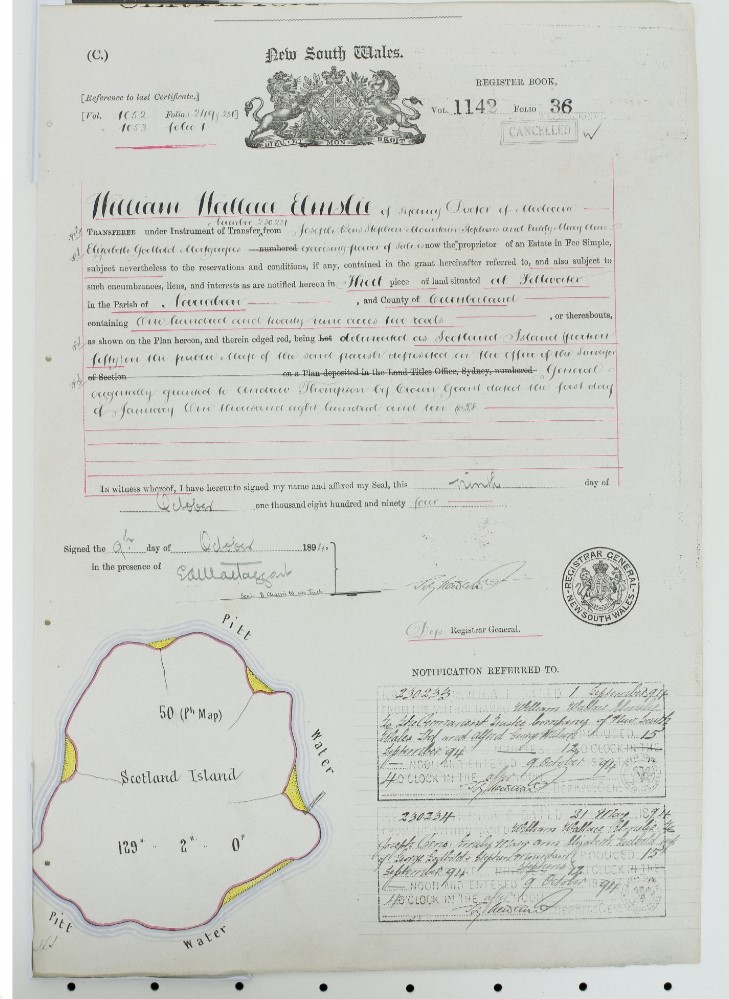
Although the island is once again placed on the market, it doesn't sell:
AN ISLAND OFFERED AT AUCTION. That picturesque spot at Pittwater known as Scotland Island, containing about 130 acres, was offered at auction yesterday by Messrs. Richardson and Wrench, Limited, by order of the mortgagee. After £1100 had been bid, the property was withdrawn, that price being much under the mortgagee's valuation. AN ISLAND OFFERED AT AUCTION. (1900, May 5). Evening News (Sydney, NSW : 1869 - 1931), p. 6. Retrieved from http://nla.gov.au/nla.news-article113717954
This is then transferred to The Permanent Trustee Company of NSW on August 17th, 1900 and becomes Vol-Fol: 1328-141 – wherein it is shown Patrick Thomson Taylor (of Mosman and Bayview) has been issued with a Certificate of Title registered on September 13th, 1900 from the Permanent Trustee Co and Alfred George Milson (mortgagees) which grants him a power of sale.
Family anecdotes from his grandchildren state Mr. Taylor ran polo ponies on the island, some of which took part in matches at Brock's 'The Oaks' at Mona Vale.
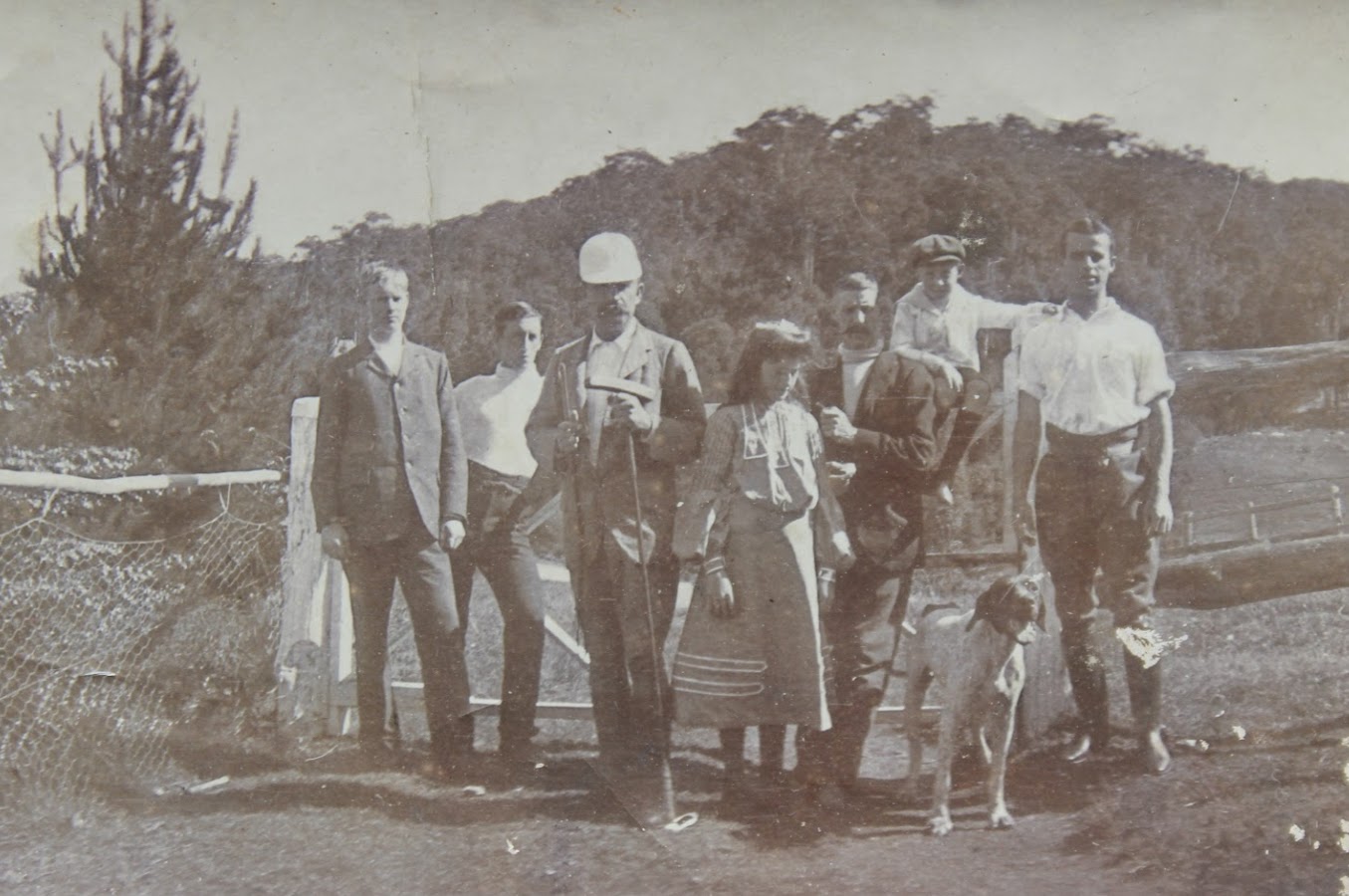
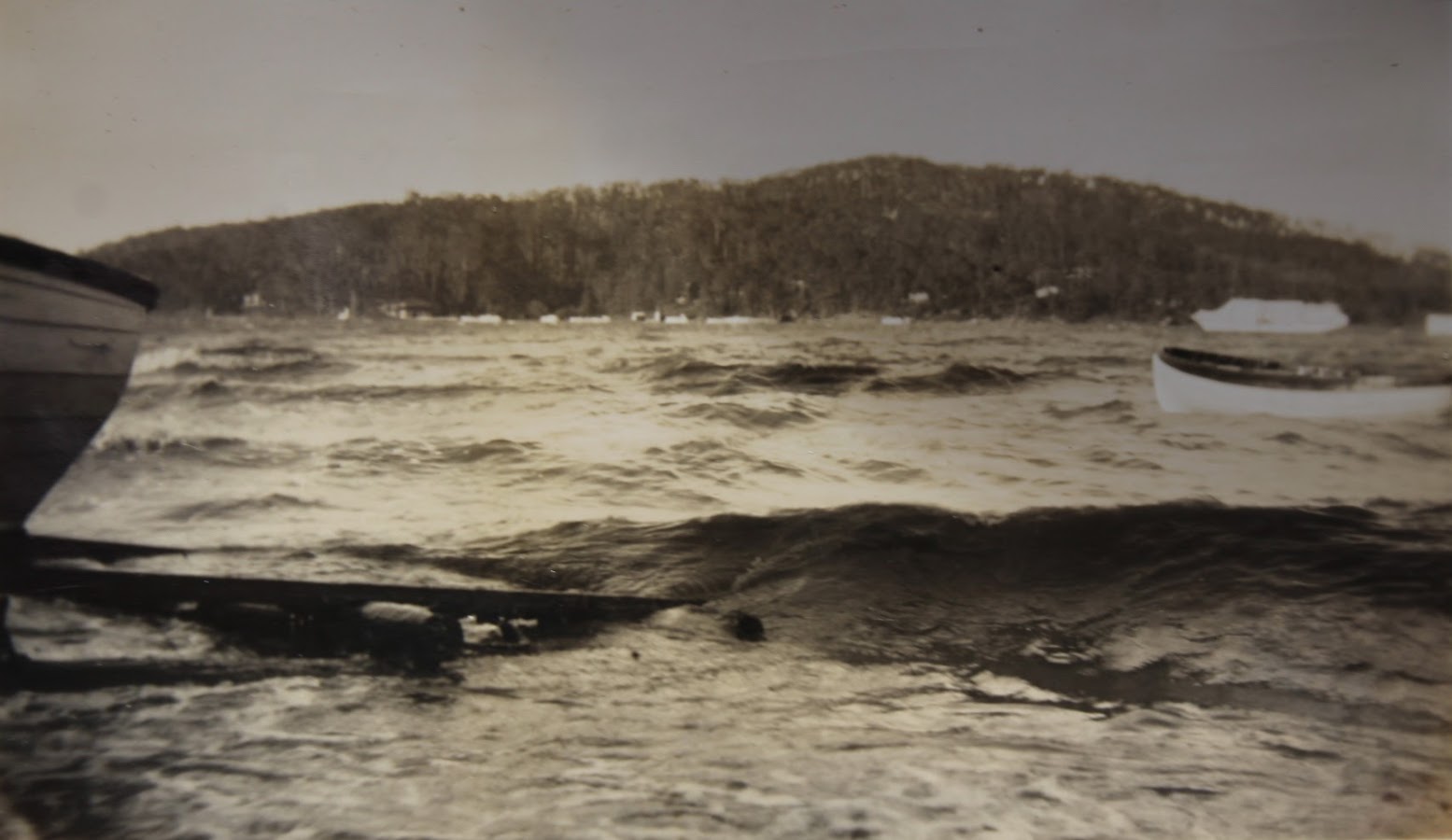
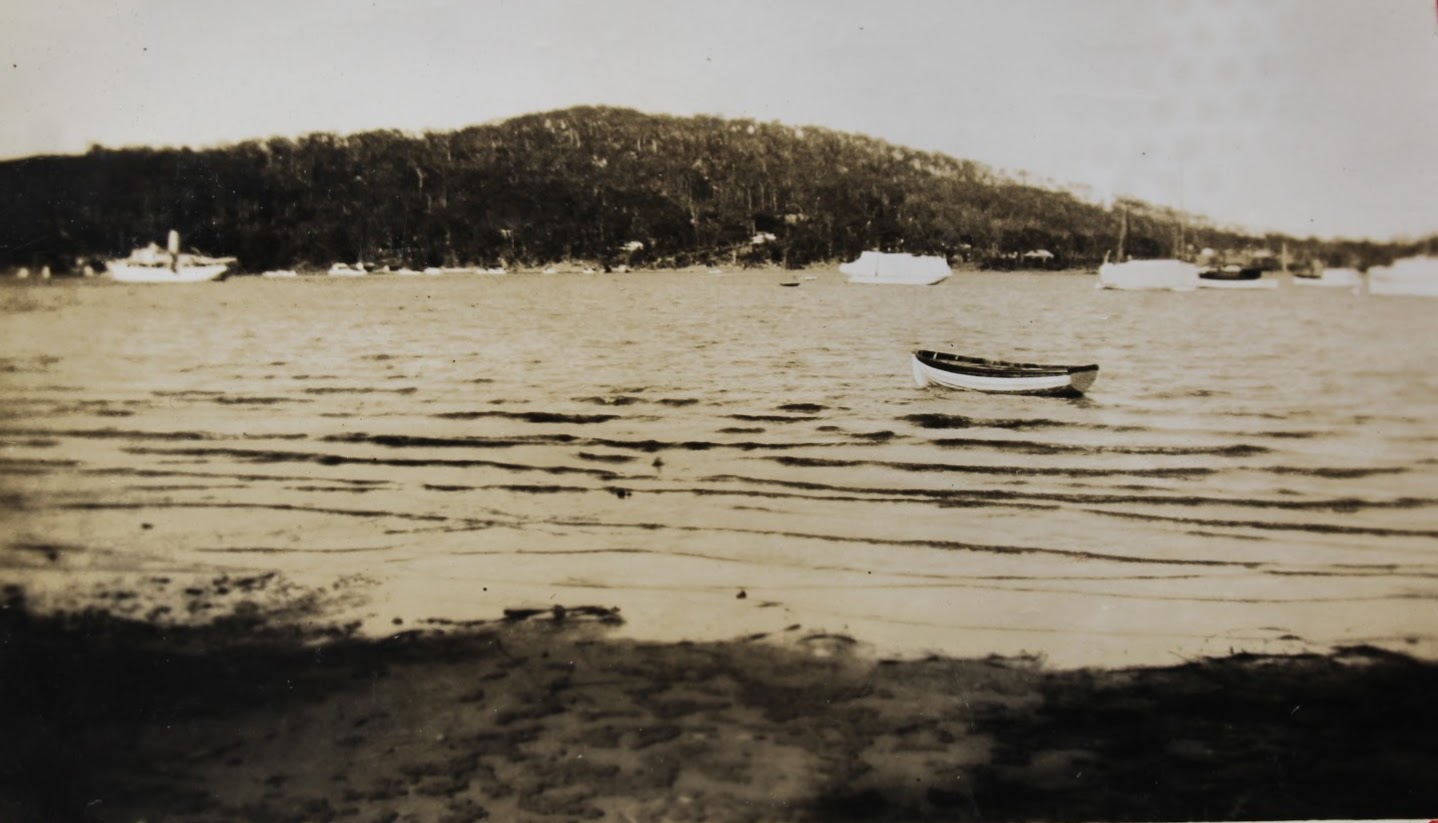
There is no granting of a Special Lease or a Permissive Occupancy registered or 'maintained' during this period, although a substantial projection to the east can be seen in the above Certificate of Title, dated 1900, and for Mr. Taylor's overseeing of the island for 6 years.
P T Taylor sells to Helen White (of Darling Point), widow, on May 25th, 1906. Mary Helen McMillan was born January 4th, 1857 to James Coutts Mcmillan and Mary (nee Overall). Her father was a draper, originally from Airntully in Scotland. The McMillans moved from Hobart to Launceston, setting up a new Drapers business there. James McMillan, after writing a Will leaving his assets to his wife and in trust for his daughters, was one of the 220 souls 'Lost At Sea on "London" in Bay of Biscay' on January 11th, 1866. It may be he as on a buying trip when this occurred.
Henry Charles White was a grazier from a formidable family of landowners, sheep developers and pedigree horse breeders. Family records indicate he, with his first wife, used to bring their children to holiday in Tasmania during hotter months. With wife Isabella Mary Anne (nee Lowe) he had four daughters and two sons. Tragically Isabella died in childbirth in 1875.
He was near Launceston soon after the passing of his wife buying a prize ram. He is supported vocally by the owner of a Launceston newspaper, and one time acquaintance of Mary's father. At age 20, as a 'Minor' according to her marriage certificate, Mary marries H. C. White:
WHITE—McMILLAN— On the 10th March, by the Rev. James Lindsay, at the residence of the bride's mother, H. C. White, of Glenalvon, Murrurundi, New South Wales, to Mary Ellen, eldest daughter of the late J. C. McMillan. Family Notices. (1877, March 13). Launceston Examiner (Tas. : 1842 - 1899), p. 2. Retrieved from http://nla.gov.au/nla.news-article37147181
March 13th, at her residence, “Fiona” Double Bay, Mrs. H C. White, of a daughter. Family Notices. (1878, March 16). The Maitland Mercury and Hunter River General Advertiser (NSW : 1843 - 1893), p. 1. Retrieved from http://nla.gov.au/nla.news-article18827987
They have Gwendolen Mabel White 1878–, Ivy Victoria White 1880–1971, Nea Vivien White 1882–1950, Roy Mordaunt White 1895–1921 and Hal Owena White 1901–1909.
Helen White would lose her husband in 1905 (passed away in Hobart) and go on to marry twice again, becoming a Swedish Countess and then a French Marquise.
Under her ownership the island is subdivided with subsequent 1906 land sales record (with balance in 5 years to settle) includes, by 1972 and 1978, the Water Board and Warringah Shire Council resumptions (Vol-Fol 1377-183 for WSC).
Among the earliest and few land sales from this subdivision is the still existing Bangalla, Scotland Island, where one of the first private jetties, baths and boatsheds for the island was. Importantly, the Lithograph for these sales shows the placement of wharves in order for people to access the island, even if no one seems to be giving the State government their Crown Lands/Waters rental dues:
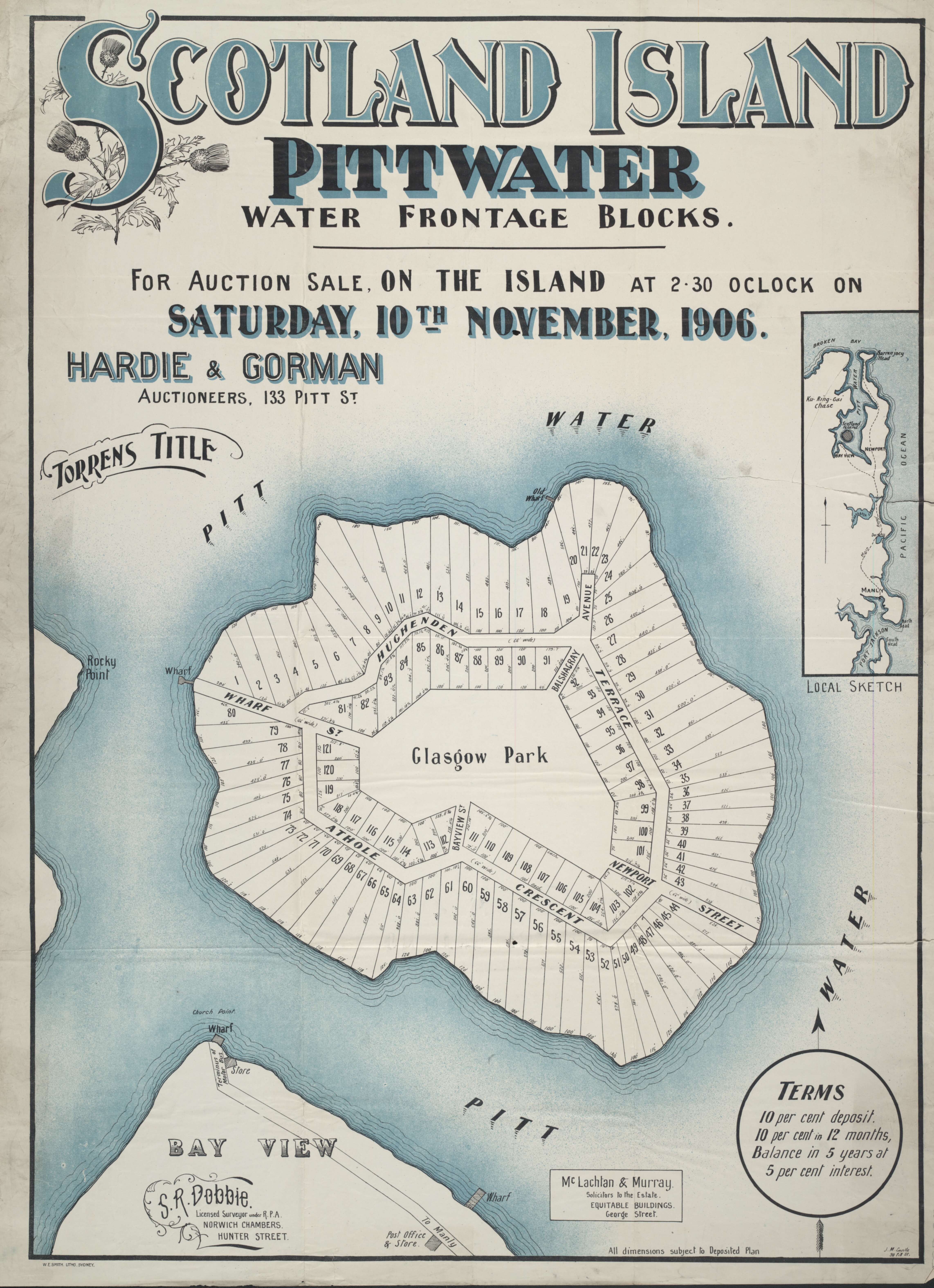
Hardie & Gorman Pty. Ltd & Cantle, J. M & Dobbie, S. R & Smith, W. E. (1906). Scotland Island, Pittwater water frontage blocks Retrieved from http://nla.gov.au/nla.obj-230480849
NB on Lithograph: today's Tennis Court Wharf is called the 'Old Wharf' and the placement of current 'Cargo Wharf' where Benns' and Jenkins' jetty was, officially being maintained by 1884.
SCOTLAND ISLAND. — Hardie and Gorman, on Saturday, November 10, will offer 100 water frontage blocks on Scotland Island. Pittwater, near Manly. The terms are 10 per cent., the balance over ten years. Plans are available. COMING SALES. (1906, October 28). Sunday Times (Sydney, NSW : 1895 - 1930), p. 2. Retrieved from http://nla.gov.au/nla.news-article126557176
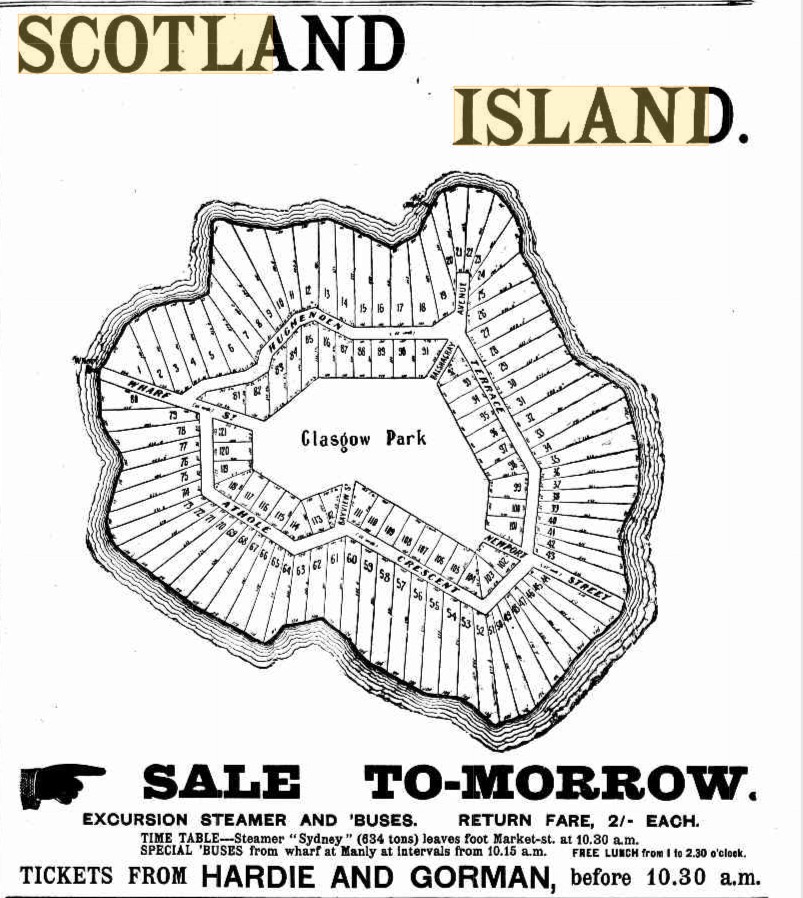
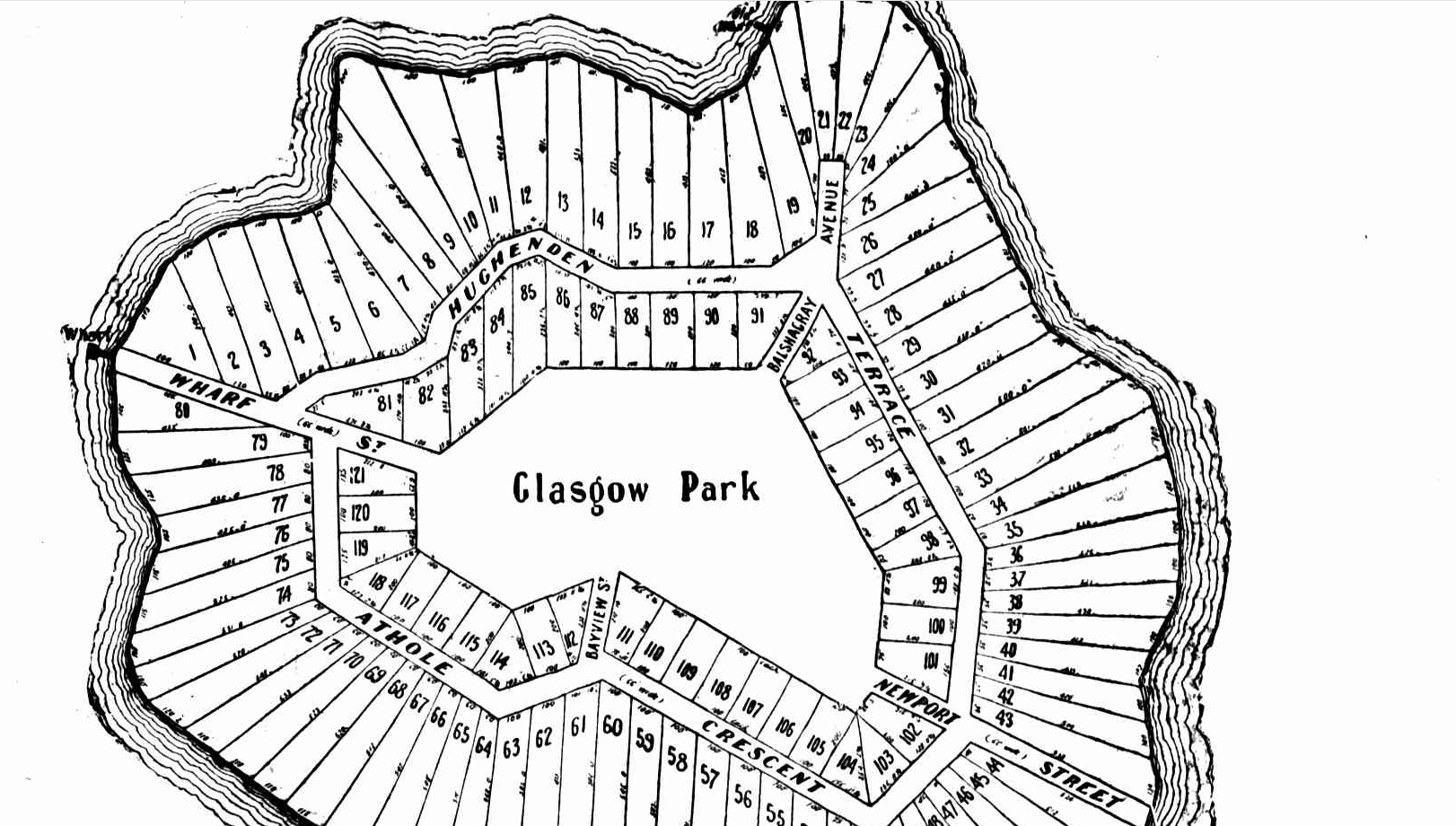
Advertising (1906, November 9). The Australian Star (Sydney, NSW : 1887 - 1909), p. 7. Retrieved from http://nla.gov.au/nla.news-article228493268
Sydney : Hardie & Gorman, [1906]. Mitchell Library copy transferred from Pittwater subdivision plans P13/84. Online images available via the State Library of NSW at: http://digital.sl.nsw.gov.au/delivery/DeliveryManagerServlet?embedded=true&toolbar=false&dps_pid=IE6669586; c05346
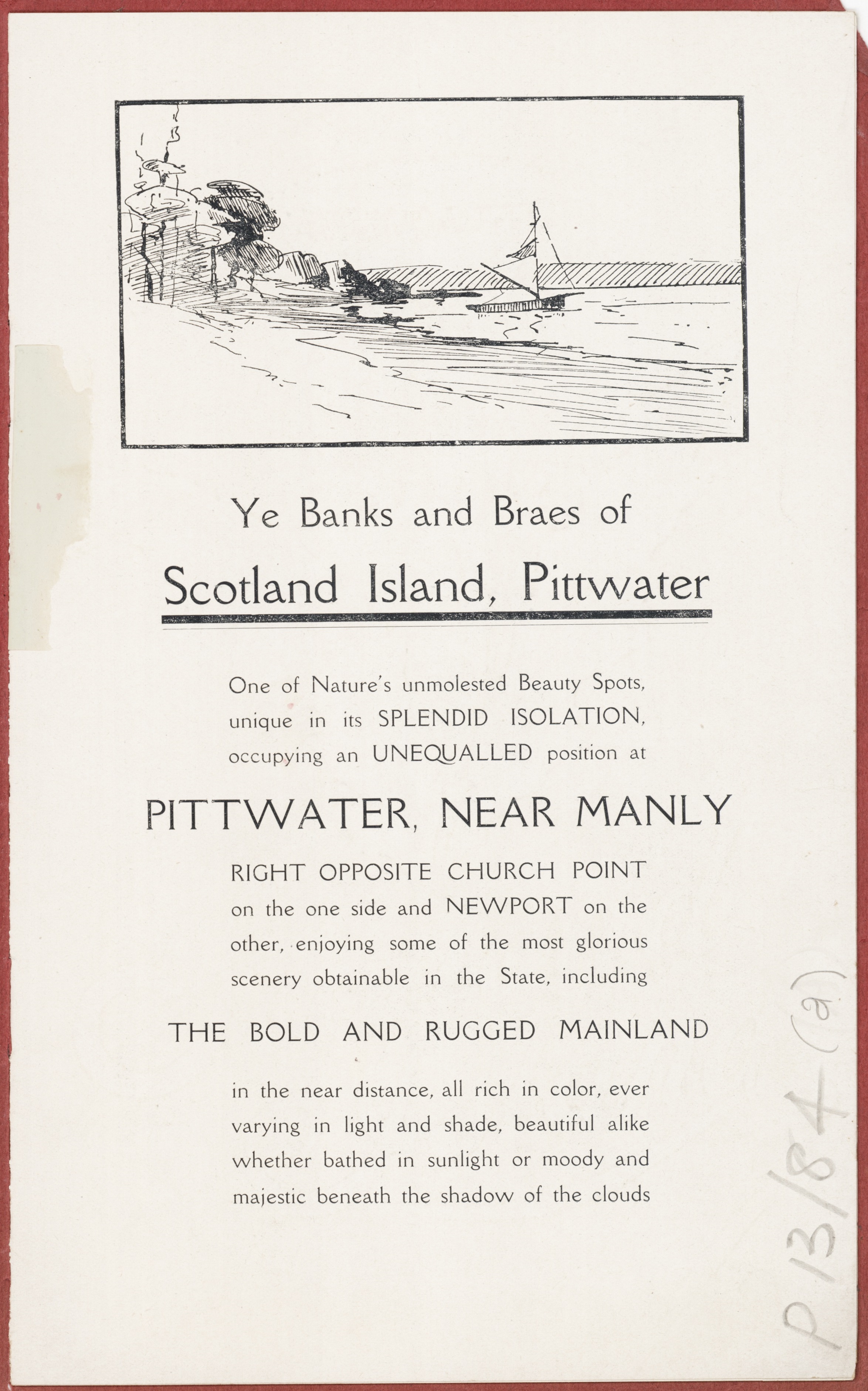
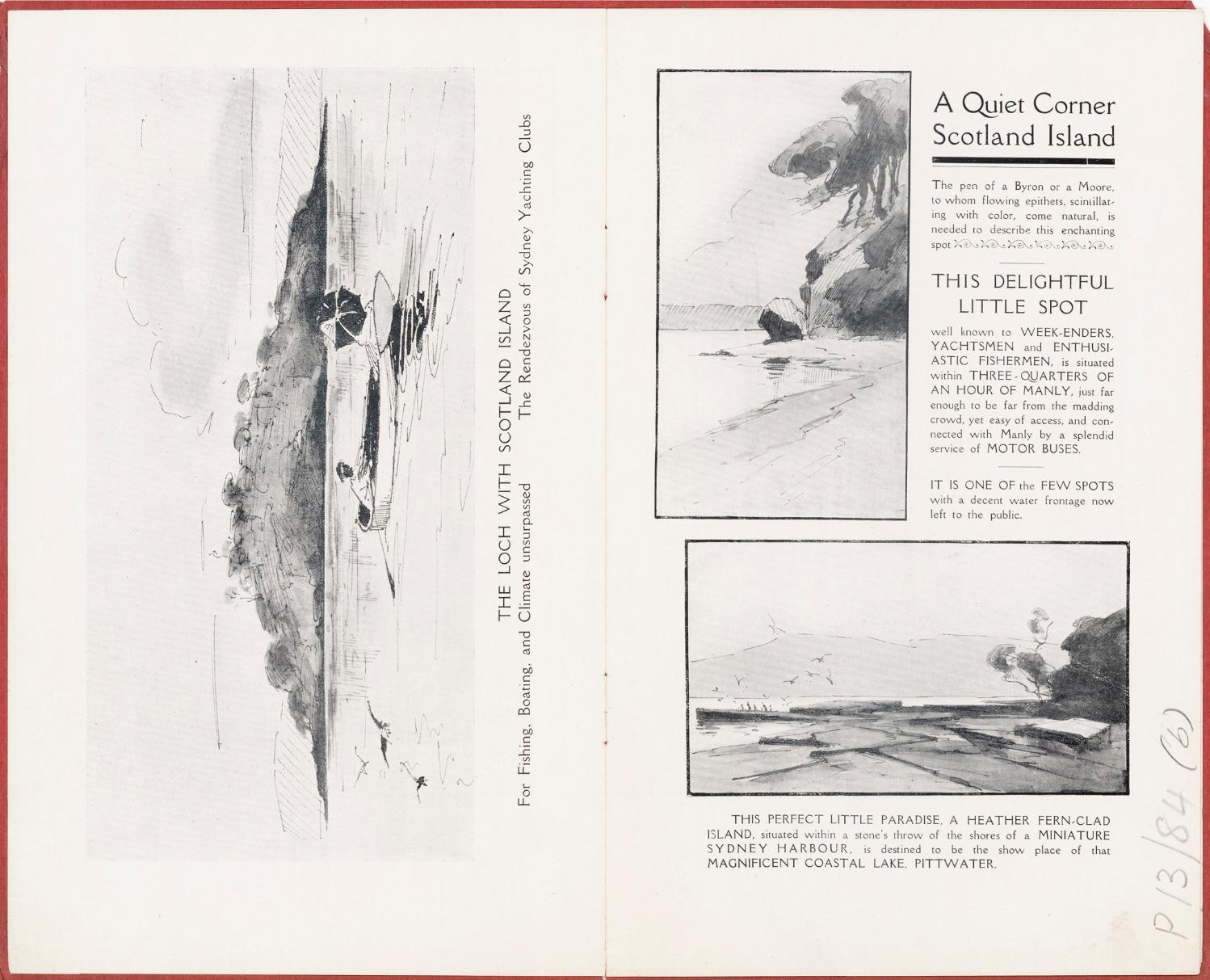
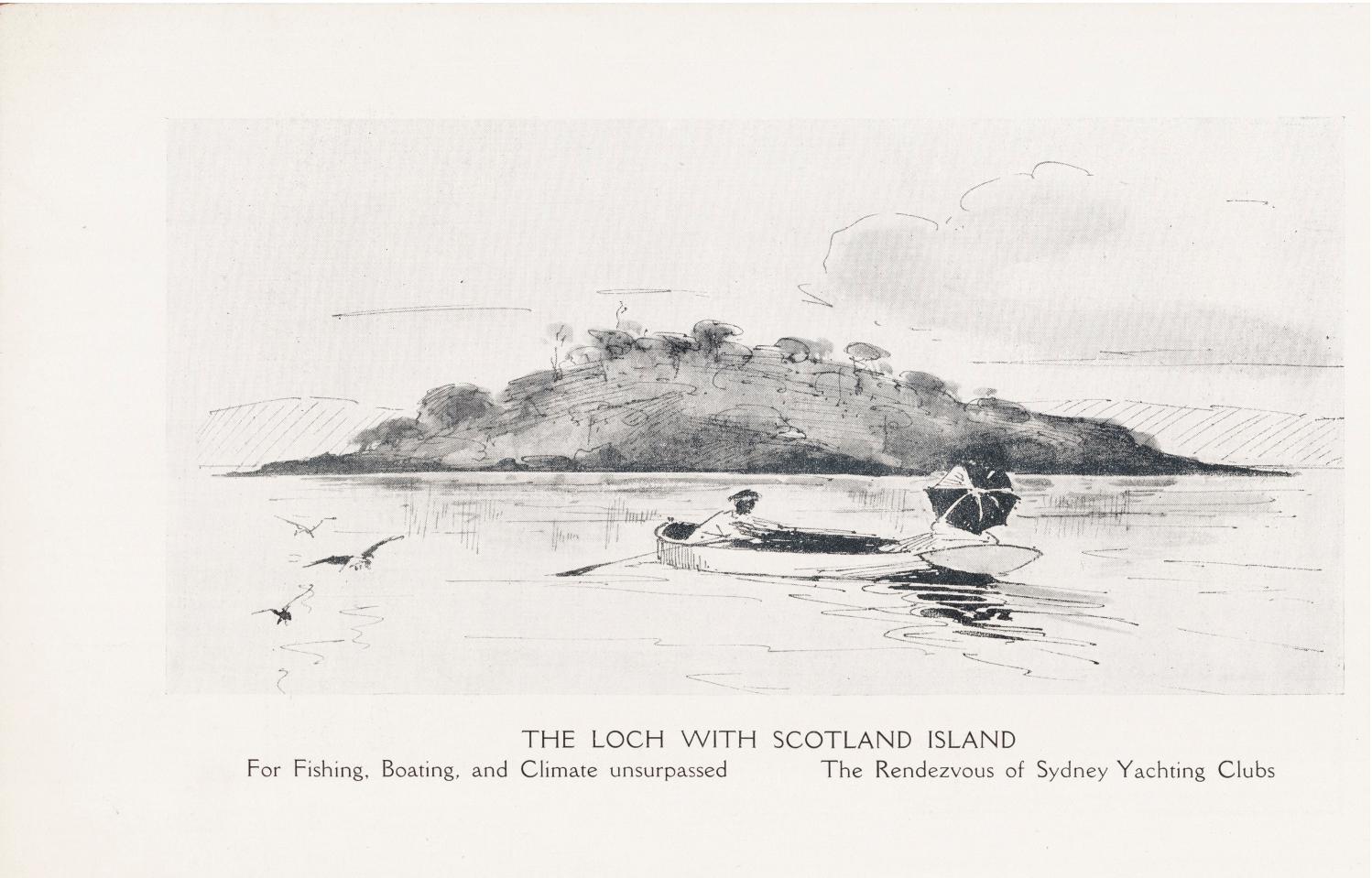
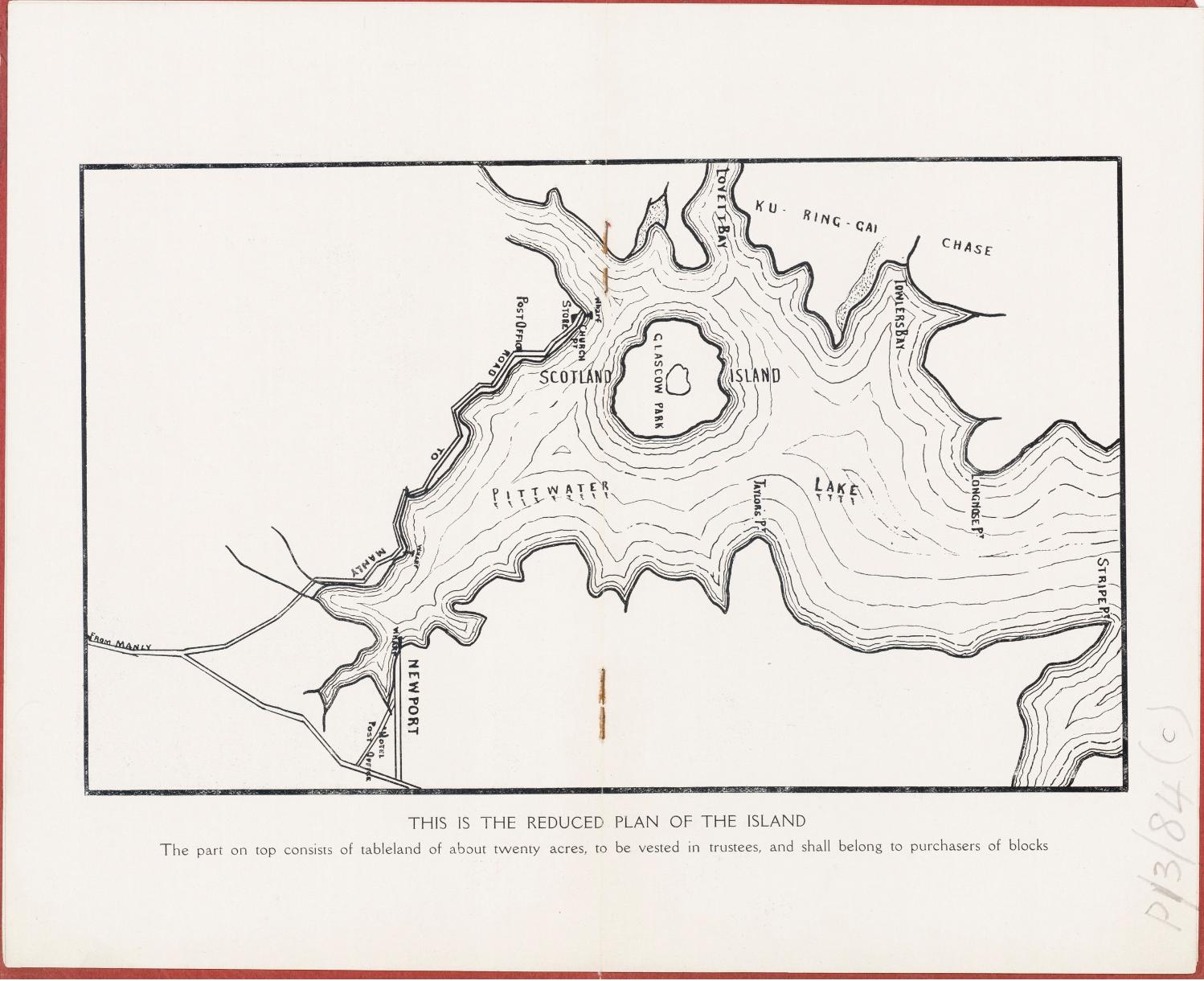
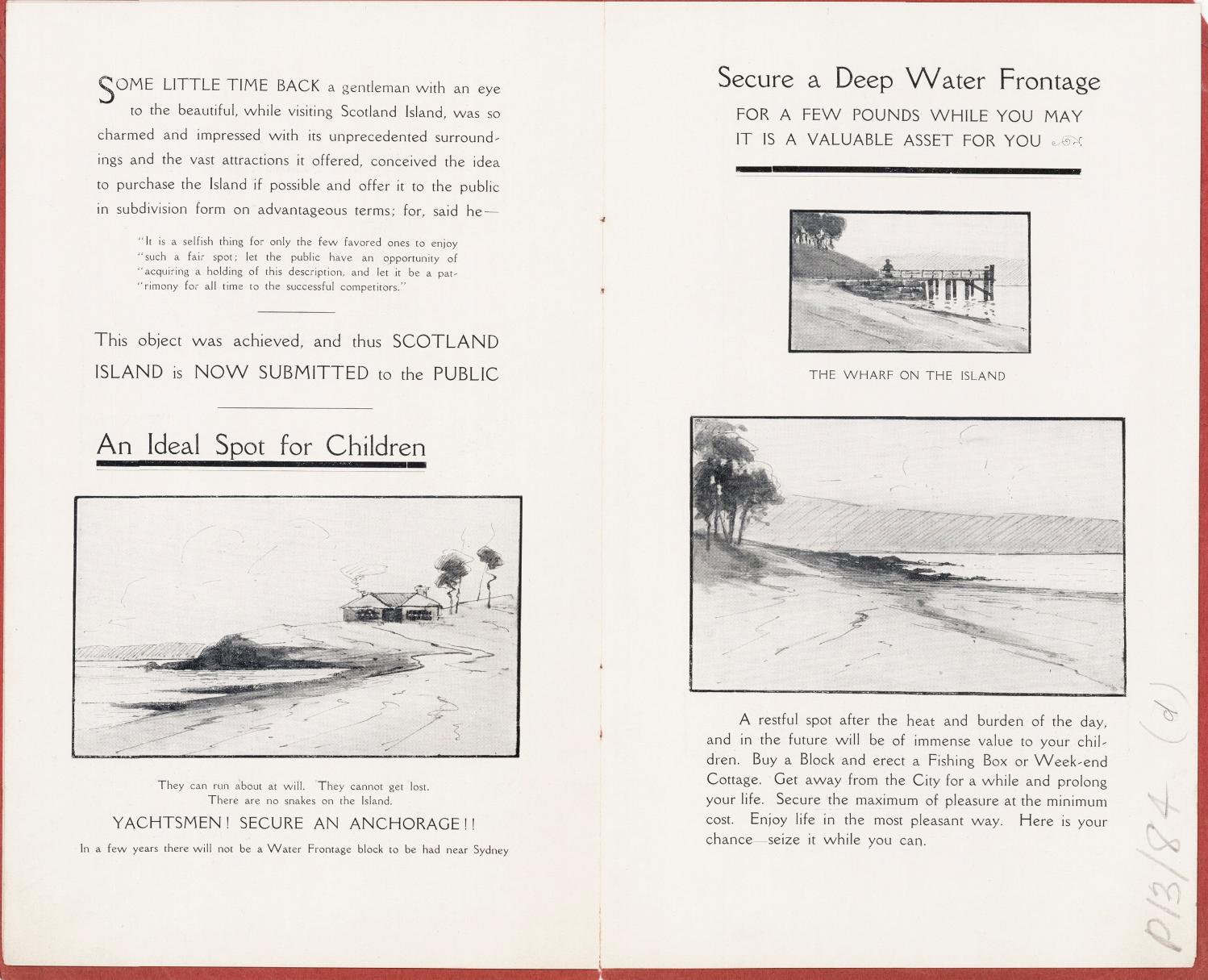
.jpg?timestamp=1639094043183)
Balsnacray: Balshagray Avenue (?) Glasgow
Hughenden: Hughenden is a town and locality in the Shire of Flinders, Queensland. The region in the vicinity of Hughenden was originally known as Mokana in the Yirandhali language. British occupation began in October 1861 with the expedition group led by Frederick Walker camping near the site of the future township of Hughenden. Pastoralists soon followed and in 1863 Ernest Henry and his cousin Robert Gray established the Hughenden sheep station. Hughenden was named after Hughenden Manor in Buckinghamshire, England, the home of former British Prime Minister Benjamin Disraeli. Robert Gray and Ernest Henry both had a family connection with Hughenden Manor. Mary Francis Norris, the daughter of John Norris of Hughenden Manor was Henry's mother and Robert's aunt.
Athole Crescent: Atholl or Athole (Scottish Gaelic: Athall; Old Gaelic Athfhotla) is a large historical division in the Scottish Highlands, bordering (in anti-clockwise order, from Northeast) Marr, Badenoch, Lochaber, Breadalbane, Strathearn, Perth, and Gowrie. Today it forms the northern part of Perth and Kinross, Scotland. In Scottish Gaelic the name is Athall, which derives from the Old Irish Ath-fhotla, or 'New Ireland' (Fotla being a traditional name for Ireland). This is thought to derive from the period of Gaelic settlement of Scotland, which was previously inhabited by the Picts.
Helen White land sales in Vol-Fol: 1328-141:
.jpg?timestamp=1761690240933)
.jpg?timestamp=1761690287888)
.jpg?timestamp=1761690326903)
As can be seen, very few sales took place of these large lots, and although there were subsequent sales in 1911, and 1912, and a few in between, despite all the singing or remonstrating in newspapers, the attractions of isolation and being part of a smaller community weren't enough to secure land sales.
SCOTLAND ISLAND.
Mr. A J. Vogan writes:—
"What Vesuvius is to Naples, Mount Eden to Auckland, or "Our Beautiful Harbor" to Sydney, so is Scotland Island to Pittwater. And this lovely 'Isle of Eden' is now to be handed over to the 'week-ender, who has desecrated what was once our peaceful and beautiful Middle Harbor, and rendered many of our other one-time holiday picnic spots wildernesses of uncouth huts where half-savage creatures give full play to their atavistic cravings, to the annoyance of civilised folk and to the destruction of the scenery.
"When In March, 1788, Captain-Governor Phillip, the first explorer of Broken Bay, wrote 'Immediately round the headland that forms the southern entrance to the port there is a third branch, which I think the finest piece of water I ever saw,' he was only voicing what was to be the general opinion of most of those who were to follow in his footsteps. It has been my privilege and business to visit many of the most beautiful places in the world, and I know every portion of Australia, and, with, perhaps the exception of Hinchinbrook channel and its neighbor, Mourillyan Harbor, Pittwater remains peerless to-day amongst Australian scenic gems. Yet we Sydney folk who have this at our doors are going to allow that vandal, the bachelor 'week-ender' to desecrate this pearl amongst places.
"This Island was reported on as the most suitable spot for the naval college; but land-agent wile and political pull erased the verdict of the experts. Better this far than to surrender this island to the fate of Middle Harbor with its huts, its dancing bells, its insanitary 'sanitary' depots pouring typhoid germs into its waters and its 'week-end' drunken bowlings and indecencies." "It is characteristic of your paper that the public was first made aware of this projected sacrilege through Its columns." SCOTLAND ISLAND. (1911, September 29). The Sun (Sydney, NSW : 1910 - 1954), p. 15 (LATEST EDITION). Retrieved from http://nla.gov.au/nla.news-article221546281
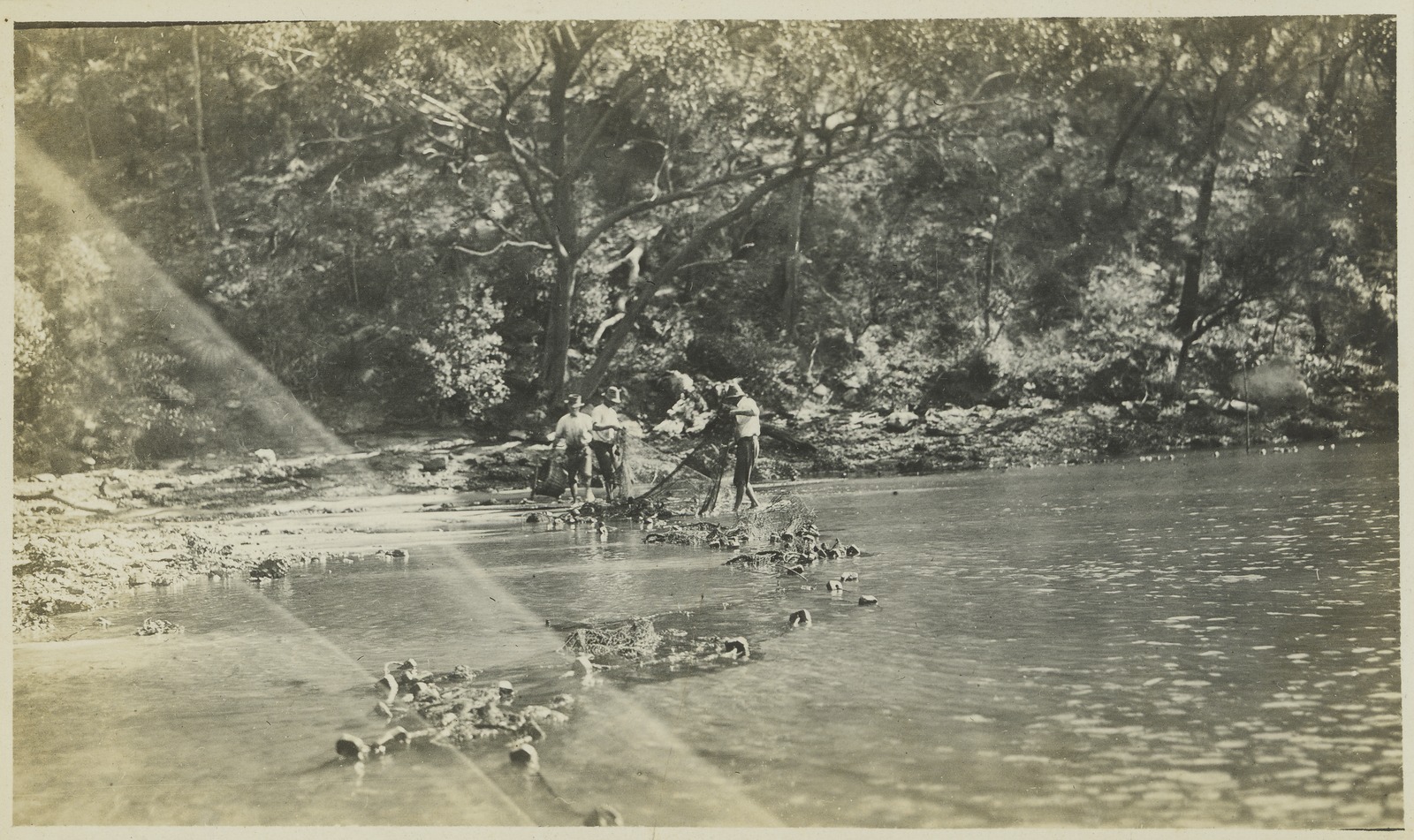
Subdivision of Scotland Island - Week-end Residences or Marine Homes.
The famous Scotland Island at the mouth of the Hawkesbury, a spot which the Government should never have sold, but preserved as a marine park, has now been subdivided and is for auction sale on Saturday, November 25, the auctioneers being Messrs. Stanton and Son, Pitt-street. This auction sale affords people an opportunity of securing a unique restful home in one of the most charming marine spots in Australia. For a century this has been the locality of fishing and marine excursions, and scores of times efforts were made to secure the purchase of the Island from the Government; but, as has already been announced, private success in this direction was only recently effected. When it was known that, so charming and isolated a marine spot as Scotland Island had been secured in private purchase, great efforts were made to induce the Government to resume possession; but it was decided not to disturb the people who had now become the owners. I ro'ii all this, the value of Scotland Island will be fairly well estimated, and it is satisfactory to find that a very liberal plan of subdivision has been decided on, ensuring the creation of many seaside homes in this delightful quarter. No doubt weekend residences on the bungalow line will prove a big boom to Sydney business men and other- who desire a change, or who need to recuperate, and certainly the terms of sale will facilitate the purchases. Subdivision of Scotland Island. (1911, November 11). The Newsletter: an Australian Paper for Australian People (Sydney, NSW : 1900 - 1918), p. 3. Retrieved from http://nla.gov.au/nla.news-article102805326
SCOTLAND ISLAND
Those who delight in yachting, sailing, boating, bathing, should be enraptured with Scotland Island Next Saturday, at 3 p.m., Scotland Island, aptly named "Pride of Pittwater," will be sold will be sold by auction on the ground by Messrs. Stanton and Son.
Special motor buses will run from Manly on the day of the sale. and a special steamer will also leave the Gosford Wharf at the foot of Erskine street for the scene. The Island is only a few miles from Manly, and with Church Point, Pittwater. on the one side, and Newport on the other, it is an ideal place for lovers of outdoor recreation. The Pittwater district has of late made great progress and the Government is now building a tram line to Narrabeen, and at an early date intends extending the line to Pittwater and Newport.. The Hornsby railway line may also be extended to Pittwater, and this will, of course, add greatly to the value of property in the vicinity. There are only 80 water front allotments to be submitted. and they are really fine blocks. being of two acres. The phenomenal demand for plans points to a record sale. Every allotment is to be sold practically without reserve. The terms are long and the title Torrens. SCOTLAND ISLAND. (1911, November 20). The Daily Telegraph (Sydney, NSW : 1883 - 1930), p. 12. Retrieved from http://nla.gov.au/nla.news-article239198390
Scotland Island. The Manly-Pittwater tram will very shortly now be opened to Narrabeen, and those desirous of securing week-end blocks in the delightful neighborhood of Pittwater will have an opportunity on Saturday next of bidding for the water frontages of one of the most unique positions on the coast. As Garden Island in Sydney Harbor, so is the historic Scotland Island to the Pittwater Lake. There is no doubt this beautiful island, which surely-should have been purchased by the Government, will, in this aristocratic quarter of the district, and those purchasing now will reap the benefit as soon as the tram opens. The areas are big, and so as to give the purchasers a real residential picnic block worth having, the averages being 100ft. frontage to deep water with a depth of 600ft. A special steamer leaves Gosford Wharf on Saturday and motor buses leave Manly in time for the sale at special excursion return rates. Tickets are printable from Messrs. Stanton and Son, the auctioneers, Pitt-street. Scotland Island. (1911, November 25). The Newsletter: an Australian Paper for Australian People (Sydney, NSW : 1900 - 1918), p. 9. Retrieved from http://nla.gov.au/nla.news-article102802821
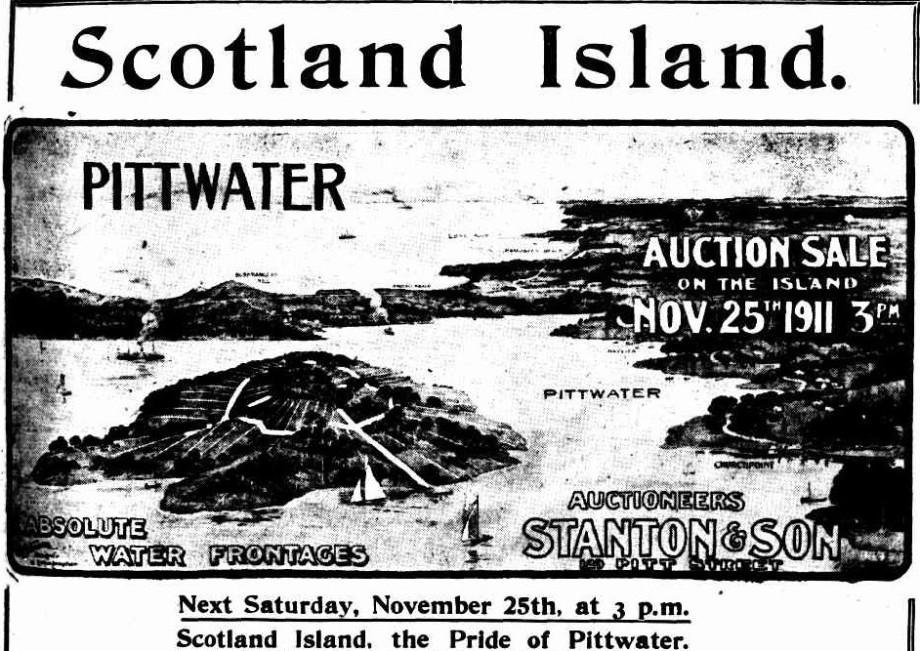
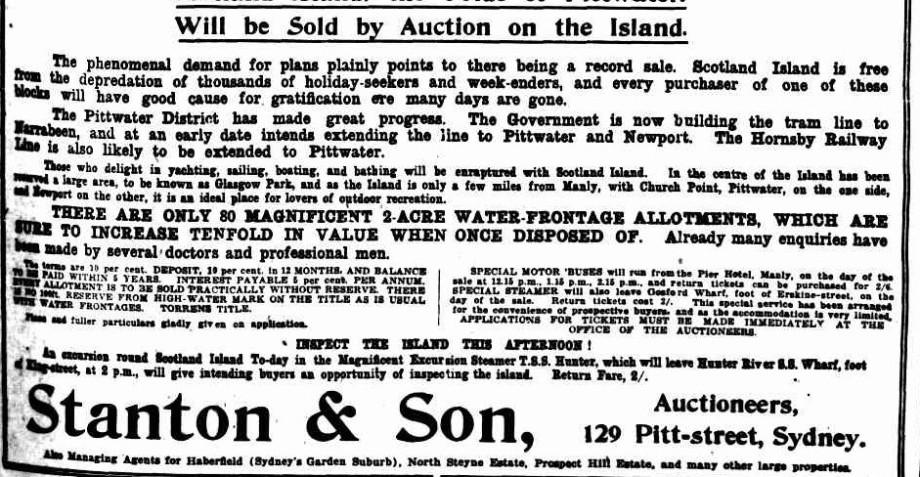
Judging by the tickets that have been sold, there will be a rush this afternoon for Scotland Island in the famous Pittwater district. The Island has been subdivided into 80 magnificent two-acre water frontage allotments, and these are to be sold by Messrs. Stanton and Son. Intending buyers have the choice of two routes to the sale to-day. Special motor 'buses are to run from the wharf at Manly, but for those who desire a sea trip a steamer will leave the foot of Erskine-street in time for the sale. In the centre of the island an area has been reserved to be known as Glasgow Park. REAL ESTATE. (1911, November 25). The Sydney Morning Herald (NSW : 1842 - 1954), p. 13. Retrieved from http://nla.gov.au/nla.news-article15291764
Lithograph and Pamphlet, Items: SLNSW_FL9057166 and SLNSW_FL9057285 courtesy State Library of NSW, Pittwater Subdivision Plans folder, once again showing the 'Old Wharf' site and the Benns/Jenkins site of their jetty:
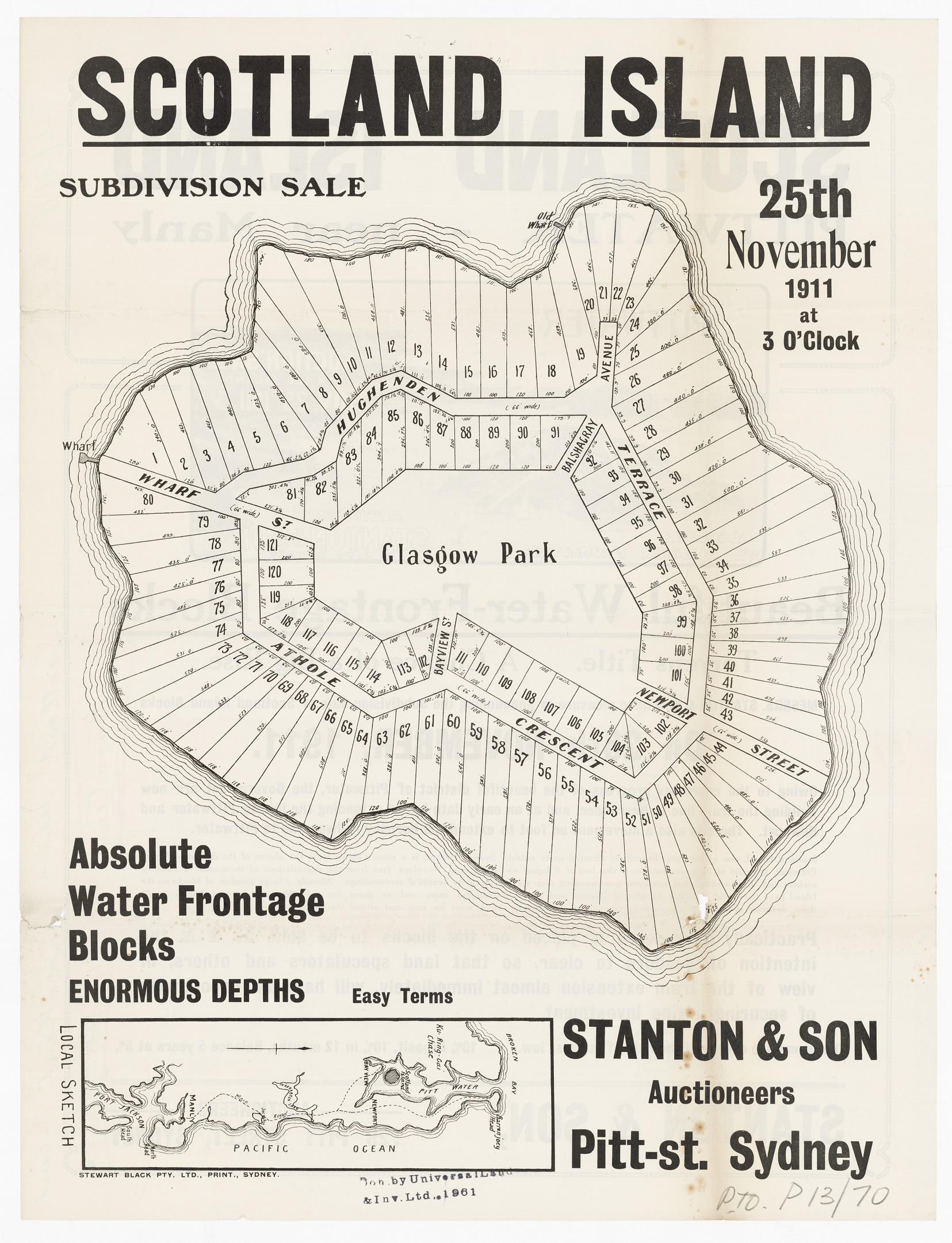

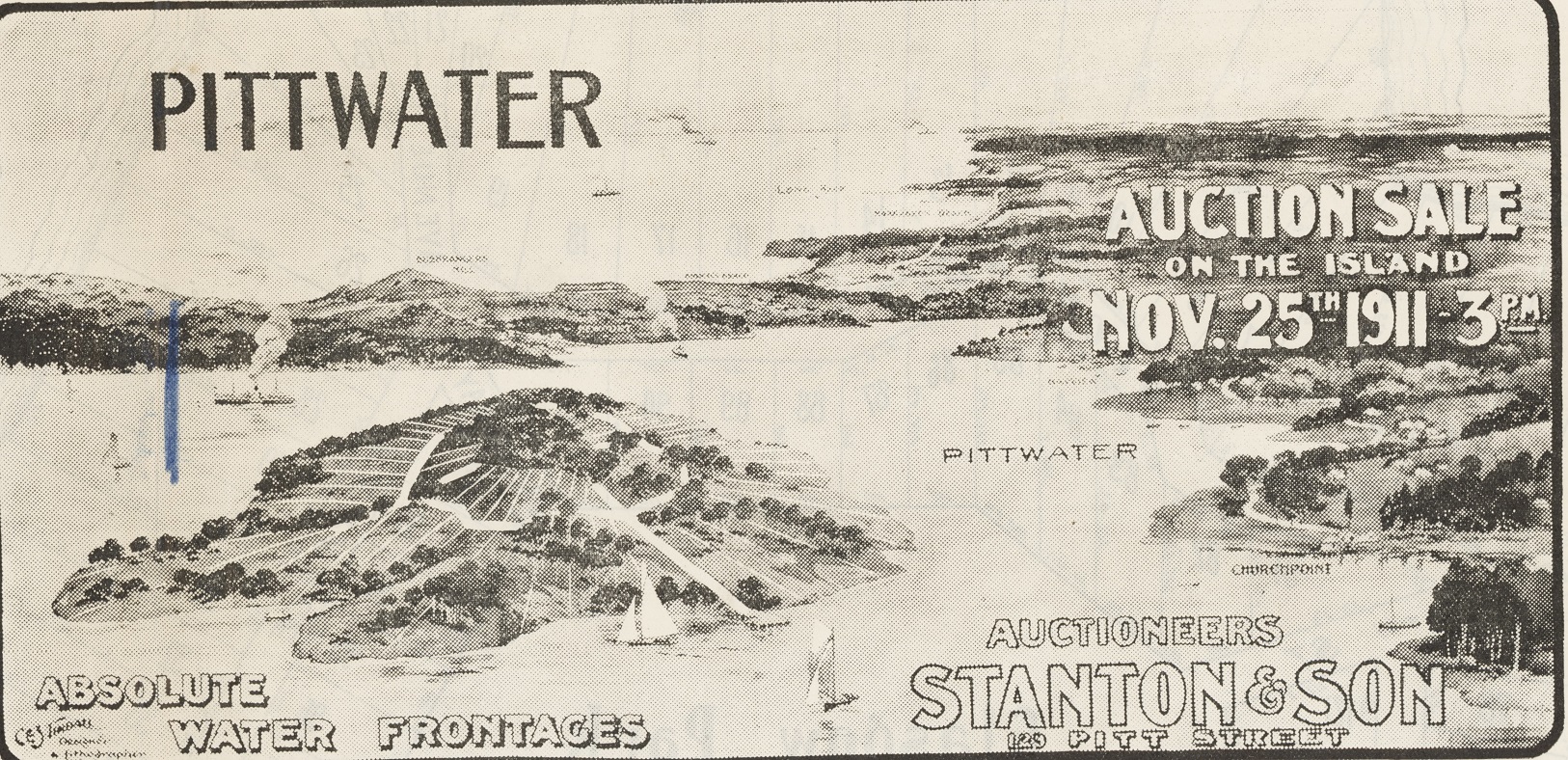
BY ORDER OF THE PERPETUAL TRUSTEE CO, LTD, Executors under the will of the late Mrs. P E. R Alston
SCOTLAND ISLAND, PITTWATER
Water frontage Camp Site Lot 44, area 3 roods 24 perches, 45ft to Athol crescent 524ft to Newport street and 110ft to the YVATERS OP PITTWATER. Torrens Title Plan on view at the Rooms. AUCTION SALE at the Rooms, 93 Pitt street, FRIDAY, 12th APRIL, at 11 30 a m RICHARDSON AND WRENCH, LTD. (6253). Advertising. (1912, March 20). The Sydney Morning Herald(NSW : 1842 - 1954), p. 15. Retrieved from http://nla.gov.au/nla.news-article15318639
 for Cargo Wharf section Scotland Island.jpg?timestamp=1761778250311)
A section from 'Ten Mile View, Pittwater' - a postcard, showing remnant and location of Cargo wharf and cleared area behind this. Full postcard - which is dated circa 1900 to 1910:
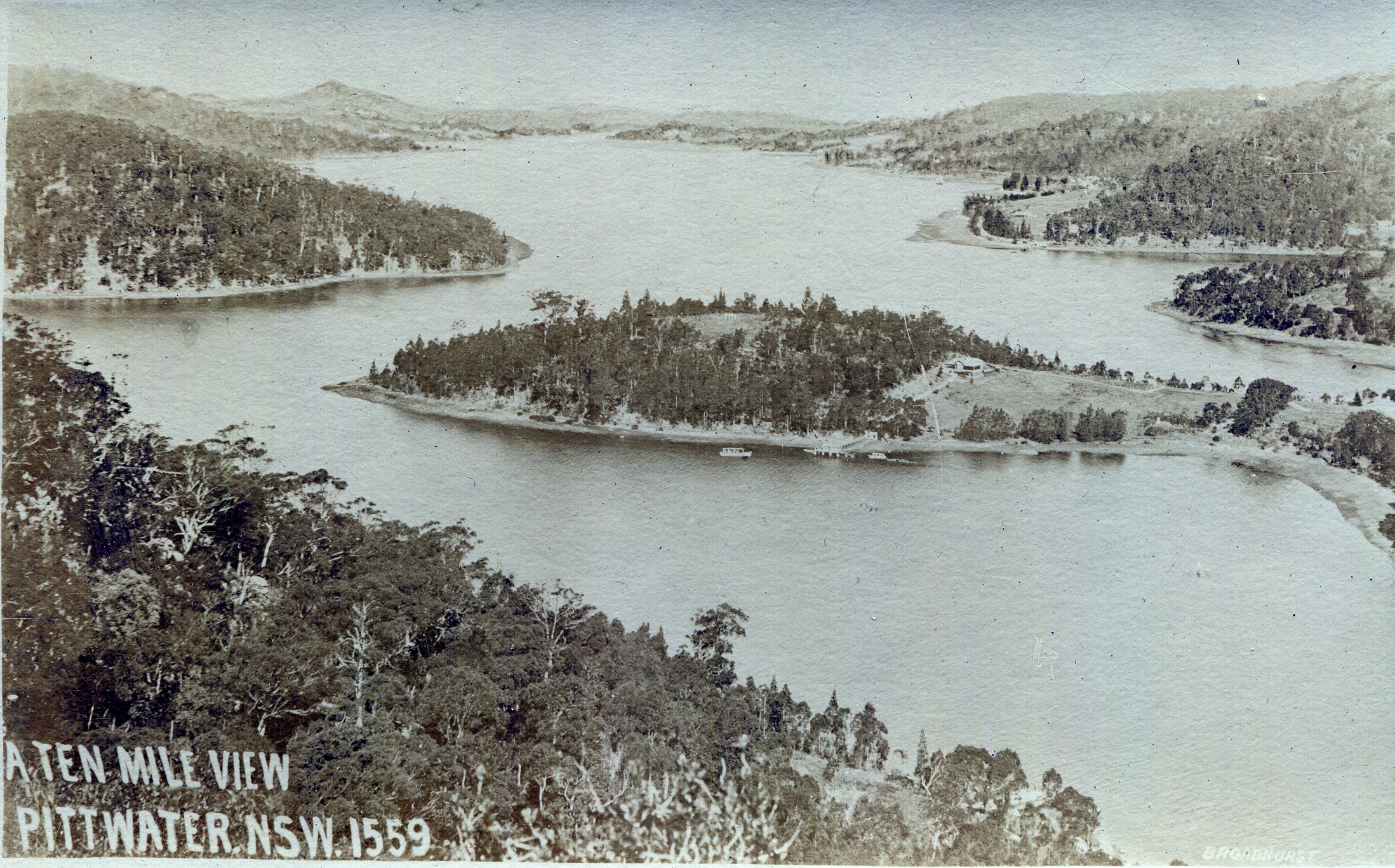
Pittwater from above Lovetts, Scotland Island to the left; 1900. Item: FL11281628, courtesy State Records of NSW- Cargo wharf may be seen a bit clearer in this one:
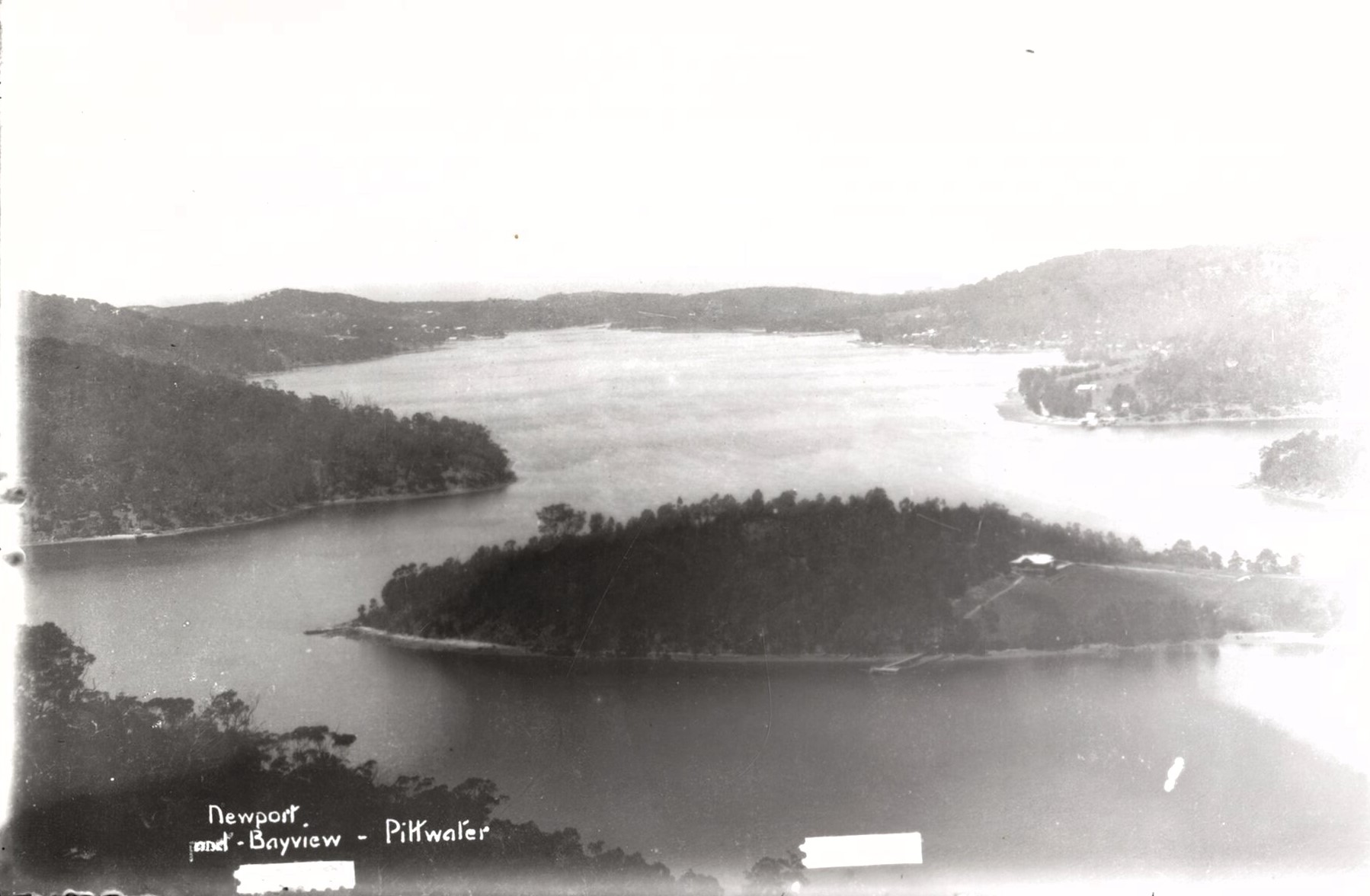
 copy.jpg?timestamp=1763003277298)
Helen was again in Sydney in the Winter of 1918:
GOSSIP FROM SYDNEY.BY "EVE."')The picturesque Countess Morner, whose last husband was Swedish Consul in Sydney a few years ago, is in Sydney again. She arrived from America a week or so ago. She has the veritable imprint of New York upon her "truly glad rags," and, as always, is a liberal education for the average woman in the manner of wearing the delectable garments. Countess Morner is staying at Beulah, Kirribilli, which is her own Venetian-like residence, but her sojourn in this city will be but brief, and is only for the purpose of putting her affairs in order before she takes her third plunge into the sea of matrimony. The Countess was Mrs. Havilah White before she espoused the late Consul, and she is now about to become the Marchioness de Rudidguy. The Marquis is a British subject, although his title is French. GOSSIP FROM SYDNEY. (1918, August 20). Goulburn Evening Penny Post (NSW : 1881 - 1940), p. 1 Edition: EVENING. Retrieved from http://nla.gov.au/nla.news-article99024256
ON SCOTLAND ISLAND, PITTWATER.
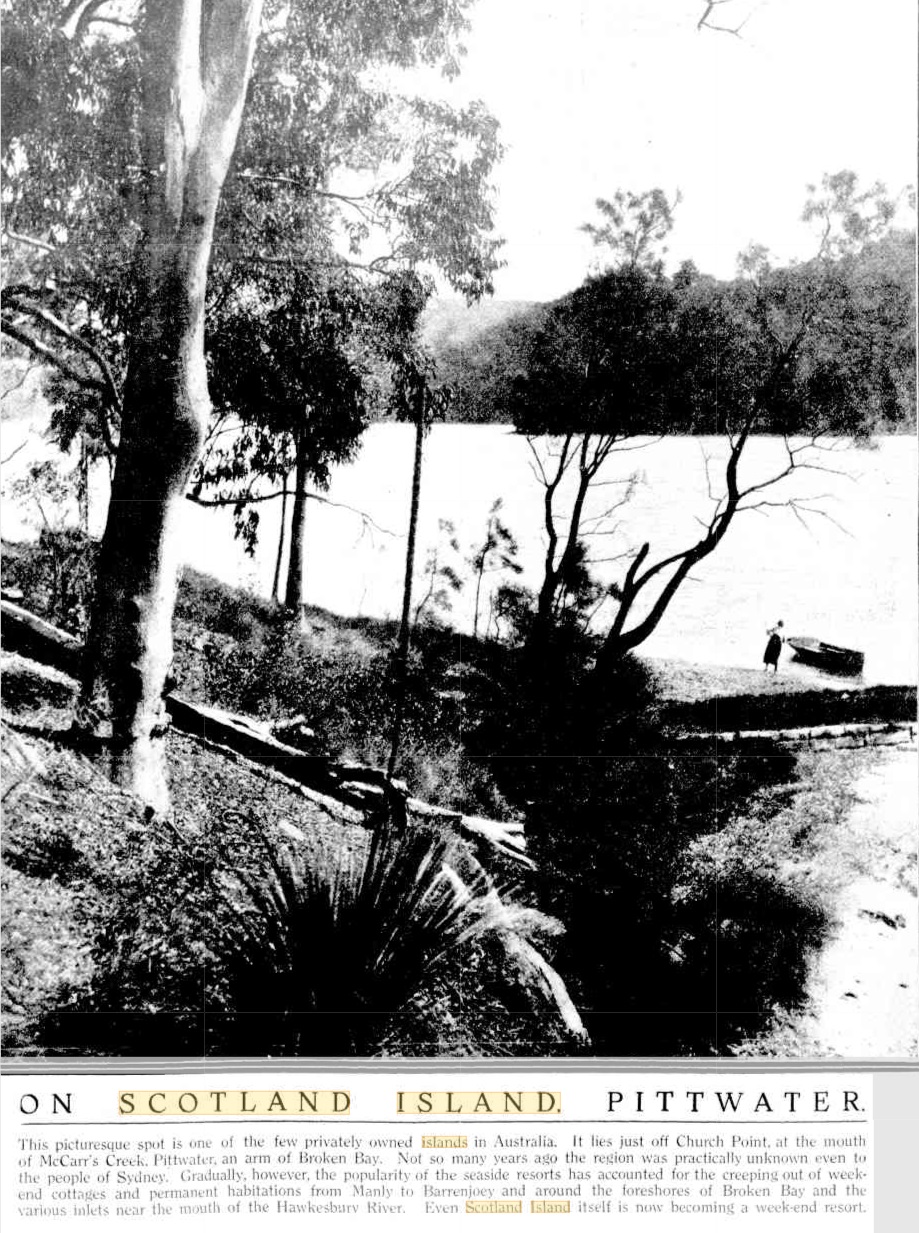
This picturesque spot is one of the few privately owned islands in Australia. It lies just off Church Point, at the mouth of McCarr's Creek, Pittwater, an arm of Broken Bay. Not so many years ago the region was practically unknown even to the people of Sydney. Gradually, however, the popularity of the seaside resorts has accounted for the creeping out of weekend cottages and permanent habitations from Manly to Barrenjoey and around the foreshores of Broken Bay and the various inlets near the mouth of the Hawkesbury River. Even Scotland Island itself is now becoming a week-end resort. ON SCOTLAND ISLAND, PITTWATER. (1920, April 21). Sydney Mail (NSW : 1912 - 1938), p. 5. Retrieved from http://nla.gov.au/nla.news-article159028427
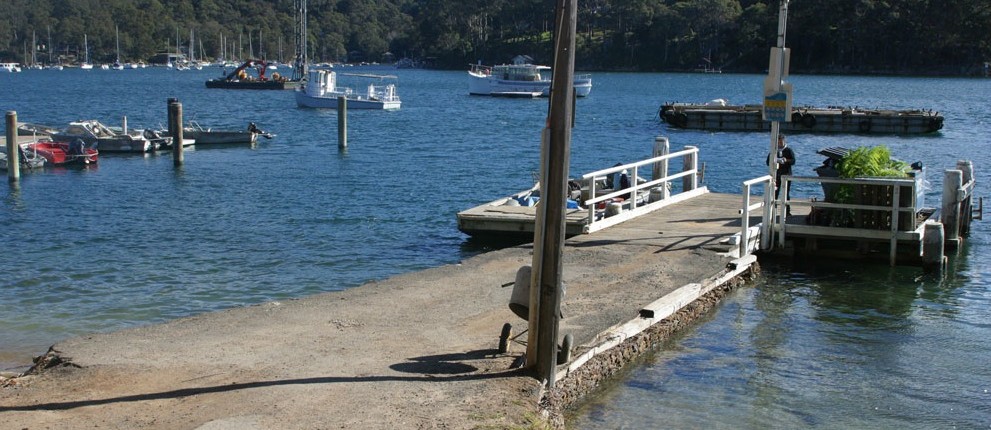
Cargo Wharf. Photo: courtesy Scotland Island Residents Association
Minutes of Meeting of Warringah Shire Council held on December 18 1933 record:
OVERSEER BROOKS' REPORT was read and dealt with as follows:- ... 10. Re: condition of wharves and pathways on Scotland Island: Resolved, - That £20 be voted for urgent repairs to the cargo wharf, and for clearing on the roads and pathways under the emergency relief work scheme. (Crs. Austin, Hughes)
REPORT OF THE SHIRE ENGINEER SUMMED TO THE ORDINARY MEETING OF WARRINGAH SHIRE COUNCIL HELD ON 30th JANUARY, 1968.... Footpath area cleared at No. 4. Bellevue Avenue-Barrenjoey Road, Avalon. Right-of-way cleared. Surfview Road, Mona Vale. Sand removed from driveway to No. 14, Careel Head Road, North Avalon. Emergency Drinking Water. 43 loads delivered. Cargo Wharf Scotland Island. Old timber removed and replaced with new.
Apart from the 20metre extension and repairs undertaken by Warringah Shire Council (see under Tennis Court Wharf council minutes of meetings above) - Scotland Island's Cargo wharf remained pretty much as it was from the 1880's.
The July 18 1977 meeting records:
Progressive Provisional Number - Description of Project Estimate t $ ;24. (File 446) 14 C - Commuter Moorings at Scotland Island t' ID Request by Mr. & Mrs. Ares, Robertson Road, that Council provide facilities at the Scotland Island Cargo Wharf for the mooring of commuter's boats. Construction of a 16 m timber decked mooring pontoon at Scotland Island cargo wharf .......... $15,000 I -x 25. (File ESF.3282)
Those who did build on this side of the island had access points via their own jetties or jumping off here to walk the tracks.
However, Pittwater Council did a complete renewal in 1999 and then were looking at ways to ease the amount of commuter tie-ups at other island wharves.
Pittwater Council consulted on providing residents with a tie-up facility and a complete renewal of the wharf to enable i to be ferry-compatible as another access point, or landing place. A report from the Spring of 2007 provides:
October 2007 Pittwater Council report - preliminary to installing commuter tie-up pontoon and improvements/upgrades:
Key Issues
- restricted pedestrian access at wharf head due to commercial use
- commercial use / operation influenced by tide
- pedestrian access to taxi / private / commercial vessels etc. via steps
- short wharf length / majority of wharf in shallow waters = limited opportunity for vessel tie-up
- vehicular access from barges problematical - existing access route to south of existing wharf informal and eroded
- shoreline boat tie-up and informal non-powered watercraft storage areas inhibit beach use - sheltered position
Concept Plan (indicative only)
- installation of safety equipment
- construction of concrete access ramp adjacent to southern edge of existing Cargo Wharf. Works include control measures such as: lockable gate (access via Council permit only) / time of use restrictions / limited users / vehicle use controls ie. no tracked vehicles
- construction of new timber jetty, ramp and pontoon (ferry compatible)
- construction of boat tie-up facility (pontoon) with berth dividers and access via jetty
- reinstate northern beach area including installation of picnic tables / seating
- non-powered watercraft storage area
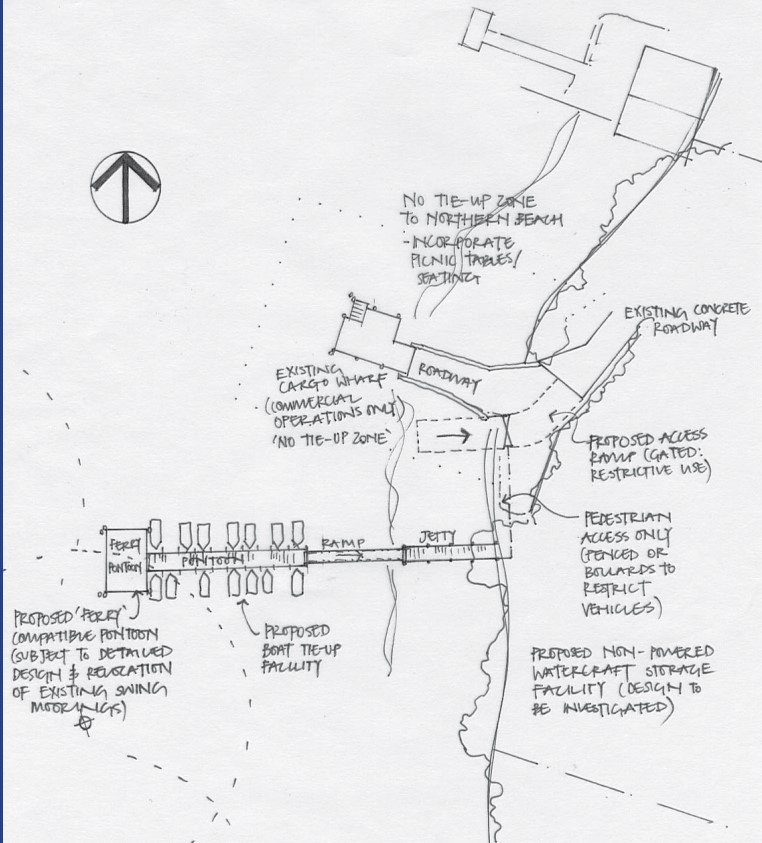
Sketch: Note: Indicative only - Concept subject to further detailed design development. Number of allocated boat tie-up spaces may vary from plan according to specific wharf composition. Via Pittwater Council's Reserves, Recreation & Building Services
The June 2008 Plan of Management for the same drafted by Pittwater Council states:
The wharf is a ‘heavy-duty' structure for loading and unloading barges. It is used by various service providers including, construction and demolition, retail and consumable deliveries, relocation services etc. and also waste service contractors, i.e. garbage / recycling. The wharf is accessed from the island via a concrete serpentine roadway that winds down Fitzpatrick Avenue from Robertson Road (an overall descent of 24m).
A description of the reserve, wharf structure, related features and management is summarised as:
''Site name: Cargo Wharf Reserve
Address: 1A Fitzpatrick Avenue, Scotland Island (off Robertson Road)
Reserve: Crown Reserve: Cargo Wharf Reserve (R1010811), gazetted for Access on 13 May 2005, comprising Lot 7112.
Ownership: State of New South Wales as Crown Land administered by Department of Lands under Crown Lands Act 1989
Management: Cargo Wharf (R1010811) Reserve Trust (appointed 13 May 2005) charged with care, control and management
Trust Manager: Pittwater Council manages the affairs of the Trust
Area: Approx. 900 square metres
Existing Uses: Public & commercial access – general public, mixed commercial services, water taxis and commuter boats. Passive & active recreation
Access: Boat access from mainland. Concrete access road (serpentine) on Fitzpatrick Avenue, through Leahvera Reserve
Zoning: Pittwater Local Environmental Plan 1993 - 6(a1) Waterways Recreation, 6(a) Existing Recreation ‘A’.
Adjacent Zoning: W2 Residential Waterways 2(a) Residential ‘A’
Condition: Rebuilt in 1999. Generally good, rust noted to access step handrail and steel channels, some timber damage to south-west end and fender timber (Docker Smith Pty Ltd – 3rd April 2006)
Maintenance: Pittwater Council: Timber / structural repair, Graffiti removal and painting. Domestic waste removal
Assets: Stone gabion and fill access road, 3.2 x 3m timber jetty, timber jetty head (approx. 6.5 x 6.5m) – railing to both sides , fixed timber access steps (no landing), no shelter shed, lighting, PLGA and safety signage
Unattached Assets: Rubbish skip (general building debris ie. timber pallets)''
The POM goes on to state some of the objectives for the plan:
''A desk top study of the principle user group (Scotland Island residents) has been undertaken to ascertain the number of wharf users and specifically boat tie-up use levels. Results suggest approximately fifteen (15) residences use Cargo Wharf as a tie-up facility for their commuter boats.
The wharf currently provides informal boat tie-up locations, with the majority of boats /dinghies tied to the shore line / vegetation (approx 12no) and the remainder tied to the wharf structure (approx 3no). Commuter boats are generally secured and accessed via a pulley system affixed to the shore / wharf. Commercial access to the wharf head and occasionally southern side precludes the ability to tie commuter boats to all sections of the wharf structure.
Additionally, the southern area adjacent to the wharf structure provides informal shore access to barges delivering goods / vehicles to the Island. The beach area of Leahvera Reserve to the north of the wharf provides further storage for a large number of canoes, kajaks, dinghys and kneeboards etc. Approximately twenty (20) vessels are stored on the shoreline and on a small timber rack. The beach is a favoured recreation area and also includes informal seating and barbeque facilities.
Cargo Wharf is currently a commercial wharf. The public ferry service does not use the wharf and commuter boat parking is limited or congregates on the adjacent beaches of Leahvera Reserve. Resident boat tie-up around the Island is generally concentrated at Tennis Wharf (north) and Carols Wharf (south). The shape of the island and residential subdivision suggest that Cargo Wharf could provide a valued commuter boat tie-up location / public ferry access location equi-distance between the heavily used Carols and Tennis Wharves.
The dispersal of commuter boat tie-up options around the island would be favourable to alleviate current overuse and safety issues identified at Tennis and Carols Wharves. In addition the creation of an alternative ferry access point would serve many west island residents and specifically provide a disabled accessible option via the existing access road and a preferred ramp / pontoon system.
Cargo Wharf Scotland Island at 1B Fitzpatrick Ave, Scotland Island, located off Leahvera Reserve is today mainly used for bulky material deliveries to the island for projects such as building works. There is a pontoon for commuter boats - this storage facility and its waitlist are at capacity.
Cargo Wharf Reserve is owned by the Department of Lands. On 13 May 2005 the reserve was gazetted (R1010811) with 10 metres each side and around the head of Cargo Wharf to approximately High Water Mark (refer Figure 12-2). The public purpose of the reserve is ‘Access’.
Pittwater Council was appointed Corporate Manager of Cargo Wharf Reserve Trust on 13 May 2005. The Trust is charged with the care, control and management of the reserve under s.92 of the Crown Lands Act, 1989 and Council manages the affairs of the Trust.
Land directly southeast of Cargo Wharf Reserve has been identified by preliminary archaeological investigations as a potential aboriginal site containing a Brachychiton populneus (Kurrajong tree) and associated shell accumulation (midden). The area is not located within the reserve boundary, but any future proposed wharf upgrade works would be required to consider the adjacent site and accommodate the conservation and protection of the site remnants. The site is currently subject to further investigation.
Following further investigations, it has been determined that the extent of the midden is much wider than visible in early 2008 and that the Kurrajong tree is a possible "bush resource tree". Council will consult the Department of Environment and Climate Change (DECC) to establish long term conservation measures for this Aboriginal Heritage Site.''
The middens at Cargo wharf and at Tennis wharf, Scotland island are estimated to be 3,500 years old. The Kurrajong tree as a "bush resource tree" in Aboriginal lore is a source of food, water, and materials for tools and shelter. Aboriginal people ate the roasted seeds and young roots, made twine from its fibrous bark for fishing nets and baskets, and could get emergency water from boring into the roots. The soft wood was used for making shields. They are also considered a 'beacon' tree with their colouring standing out from a distance and indicating a source of food, in season, at their location. Carrejun and carrejan were the indigenous names of trees in the foothills of the Blue Mountains near Sydney, and the bark was used for twine and fishing lines. The word in oroginal languages is stated to mean 'shade tree'.

B. populneus flowers and leaves. Photo: Mark Marathon
 smaller.jpg?timestamp=1763221448349)
Pittwater oysters, November 15, 2025. Photo: A J Guesdon

Cargo wharf, satellite image from Google maps, 2025
____________________________
Bells Wharf - Eastern Wharf (from August 1924)
Mary Helene de Massue Marquise de Ruvigny, of Tasmania, as she was by then known, passed away at sea in July 1920. After one person seemingly tried to take advantage of the situation, the vast amount of blocks of land were to be readied by her executors for sale.
(Before the Chief Judge, Mr. Justice Street.)
SCOTLAND ISLAND ALLOTMENTS.
Peek v Union Trustee Company of Australia, Limited.
Reserved Judgment was delivered in the suit In which the plaintiff, Rupert de Lacey Peek; asked, among other things, for a declaration that a certain agreement, which was subsequently modified, with respect to the sale of a number of allotments of land on Scotland Island, near Pittwater, ought to be specifically performed and carried into execution by the defendants, the Union Trustee Company of Australia, Ltd., and that the same be decreed accordingly.
Plaintiff claimed that on December 30, 1921, at the instance of Gwendoline Mab McLachlan, executrix of the will of the late Mary Helen de Massue, Marquise de Ruvigny, the defendants were appointed her attorneys for the purpose of obtaining letters of administration with the will annexed of the estate of the deceased. One of the assets in the estate consisted of a number of unsold allotments of land at Scotland Island. Messrs. McDonald and Watson, It was alleged, were the appointed agents for the purpose of the sale of the allotments. On September 6, 1922, McDonald and Watson wrote to the plaintiff, advising him that they had asked the defendants for an option In his name to purchase the allotments for £5000, on certain terms; and that the defendants had informed them that they were willing to dispose of the whole of the unsold portion of Scotland Island to him for £5250, on certain terms, including a cash deposit of £1000. On September 18 he paid to the defendants a preliminary deposit of £10 In connection with the purchase, for which he obtained a receipt. Subsequently the contract was modified in certain respects. He had always been ready and willing, and hereby offered to perform the agreement In all respects, but the defendants had repudiated it, and refused and neglected to perform it. Plaintiff also asked that In addition to, or in lieu of, specific performance of the agreement be modified, the defendants be ordered to pay him the damages he had sustained by reason of their refusal to perform the contract; and that the defendants be restrained by injunction from selling, mortgaging, or otherwise dealing with the lands, except under his direction.
The defendants denied that McDonald and Watson were their agents In the matter of the sale; and that the agreement was as alleged In the statement of claim- They asserted that the plaintiff did not pay the deposit within the time fixed by the agreement as mutually varied by him and them, where-upon they rescinded the contract, to which the plaintiff acquiesced. ' After the recession of the contract (If any) and the plaintiff's acquiescence In the same, they re-sold the allotments. They submitted that in the circumstances mentioned the plaintiff was not now entitled to a decree for specific performance of the agreement. Neither the contract alleged in the statement of claim as having been originally made, nor as ...., was in writing, and there was no written memorandum signed by them or anyone lawfully authorised by them to do so; and they submitted that the suit should be dismissed with costs. By way of counter claim the defendants pleaded that the plaintiff had filed a caveat forbidding any dealings with the lands. They were desirous of applying to have the lands transferred to them as administrators of the estate of the deceased, and so transferring the properties to purchasers from them. They asked that the plaintiff's caveat be rescinded, and that he be ordered to pay the costs of the counter-claim.
His Honor, after reviewing the facts, said it was clear that as the company broke off negotiations before it signed the formal document, there was no existing contract enforceable against it, and it was not really material to consider whether it acted reasonably or unreasonably in doing so. He thought, however, that the company had acted justifiably and reasonably in breaking off negotiations. It was obvious that the plaintiff was never in a position to carry out his purchase, and that his tactics all through really amounted to an endeavour to obtain what was in substance an option of purchase while he looked round to try and find someone to finance him in the matter. The company showed him a considerable amount of indulgence, but, in the position in which it stood, it could not allow that state of affairs to continue indefinitely, and his Honor thought that it was Justified In calling a halt when it did. He thought, therefore, that the suit failed, and must be dismissed, with costs. The counter claim, which asked that a caveat against dealings lodged by the plaintiff might be removed, would be allowed, with costs.
Mr. E. F. McDonald (instructed by Messrs. A. E. Whatmore and Lee) appeared for the plaintiff; and Mr. Maughan, K.C., and Mr. R. K. Manning (instructed by Messrs. Priddle and Gosling) represented the defendants. IN EQUITY. (1923, December 8). The Sydney Morning Herald(NSW : 1842 - 1954), p. 13. Retrieved from http://nla.gov.au/nla.news-article16124649
In the meantime, while that was being settled and the covenant lifted, the trees were being sold and tenders called for pathways, wharves and baths:
To Mine Owners and Others. TENDERS are invited for the Purchase of the Timber on Scotland Island, Pittwater; mostly spotted gum, of 6 ft.- 8 inches in diameter, all straight and good milling. Deep-water wharf for loading same. Tenders close 1st of March. Box 2892 GPO Sydney. Advertising (1923, February 19). The Newcastle Sun (NSW : 1918 - 1954), p. 8. Retrieved from http://nla.gov.au/nla.news-article163197818
Pittwater — Construction of three wharves and baths at Scotland Island .. .. .. .. . . . . .. .. .. August 14— Hardy, Busby & Norman. 375 George-street, Sydney. TENDERS. (1923, July 4). The Sydney Morning Herald (NSW : 1842 - 1954), p. 11. Retrieved from http://nla.gov.au/nla.news-article16078336
Scotland Island. Erection of chains of pathway In Scotland Island, Pittwater. Messrs. Hardy, Busby, and Norman, civil engineers, 375 George-street, city. TENDERS. (1924, January 2). The Sydney Morning Herald (NSW : 1842 - 1954), p. 7. Retrieved from http://nla.gov.au/nla.news-article16120773
Pittwater— Formation of about 120 chains of Pathway on Scotland Island .. .... .. .. January 12 — Hardy, Busby & Norman. 375 George-street, Sydney. Advertising (1924, January 9). Construction and Local Government Journal (Sydney, NSW : 1913 - 1930), p. 3. Retrieved from http://nla.gov.au/nla.news-article109759926
Union Trustee Helens Vol-Fol 3598-214:
.jpg?timestamp=1761695359044)
.jpg?timestamp=1761695461137)
.jpg?timestamp=1761695564242)
Still just two wharves associated directly with the estate:
.jpg?timestamp=1761695610383)
.jpg?timestamp=1761695687289)
.jpg?timestamp=1761695516460)
And even a land transfer taking place before the Executors arranged for Herbert Fitzpatrick and Mr. Ducker to take over.
This one is worth noting as it's where Robertson road on the island is derived from, and Robertson's Bay, and although registered in June 1925, and not in the above records until June 1928, Douglas Robertson had been there at Lot 7 at least a year prior to this and was helping Mr. Fitzpatrick and others out at Pittwater Regattas from at least 1924:
.jpg?timestamp=1761693001092)
.jpg?timestamp=1761693049131)
.jpg?timestamp=1761693396776)
.jpg?timestamp=1761697582562)
.jpg?timestamp=1761697620869)
.jpg?timestamp=1761697661750)
Douglas George Robertson, born 1888, was the only son of bookseller George (1860-1933) and his wife Elizabeth. He had two sisters, Bessie, born in 1882 (her parents married April 5th 1882), and Mary Douglas Robertson, born 1883. His eldest sister Bessie, active in the Church, married (Sir) John Alexander, son of Rev. John Ferguson.
Mrs Elizabeth Robertson died in 1908 and on 13 September 1910 his father married Eva Adeline Ducat, a family friend, at St Stephen's Church.
Rev. John Ferguson oversaw his own marriage as well to Louisa Werry:
ROBERTSON-WERRY.-January 17, at St. Stephen's Church, Sydney, by the Rev. John Ferguson, Douglas, only son of George Robertson, late of Ellamatta-avenue, Mosman, to Louie, youngest daughter of John Werry, Harwood Island, Clarence River. Family Notices (1914, April 4). The Sydney Morning Herald (NSW : 1842 - 1954), p. 22. Retrieved from http://nla.gov.au/nla.news-article15473813
Where Robertsons' original Lot 7 was, and showing a house called 'Yamda' on the sales lithograph is what locals today refer to as a home called 'Yamba', a place he seemingly didn't hold on to for very long, although his son, named George as well, born September 6 1917, lists his fathers' address as being as 'Reiwar', Newport, Pittwater when he enlists in the AIF in 1941, as well as listing his father's address as '134 Murriverie Road, North Bondi'. So, he still was a part of Pittwater.
He and his wife had another four children; NANCY E (born 1915) MARJORIE F (born 1916), FRANCIS D (born 1919) and JOYCE A (born 1921) births all registered at Waverly. His son George states in his military records he was born at Bondi. Either way, a lot of youngsters in a vey short time, and a lot of work and sleep deprivation.
Unfortunately Douglas and Louisa divorced in July 1926.
When Douglas's father passed away in August 1933 he left the entirety of his estate to his second wife. Douglas didn't attend the funeral, according to the papers, although his ex-wife and four of his children did:
LATE MR. GEORGE ROBERTSON
LARGE ATTENDANCE AT FUNERAL
Writers, authors, and other professional citizens attended In force the funeral yesterday of Mr. George Robertson, of Angus and Robertson, Ltd., at the Rookwood Crematorium. A service at St. Stephen's Church, Phillip Street, was conducted by aev J. S. Rapkins, of Blackheath, who said Mr. Robertson had done great work In moulding the literature of Australia The chief mourners were:— Mrs. Eva Robertson (widow). Mr. and Mrs. J. A. Ferguson, Mrs. M. B. Boyd, Mrs. L. Robertson, Mr. Geo. A. Ferguson, Mr Bruce Ferguson, Miss Margaret Ferguson, Master Colin Ferguson, Masters George and Frank Robertson, Misses Nancie and Marjorie Robertson. Representing the directors of Angus and Robertson. Ltd.. were: Messrs. R. Thompson, W. T. Jones, W. a. Cousins. A. A. Ritchie, W. T. Kirwan, and T. S. Russell. LATE MR. GEORGE ROBERTSON (1933, August 29). The Daily Telegraph (Sydney, NSW : 1931 - 1954), p. 9. Retrieved from http://nla.gov.au/nla.news-article248130639
A court case ensued in 1935:
PUBLISHER’S SON SEEKS HELP
Robertson Family's Affairs
SYDNEY, Thursday. — Douglas George Robertson applied today in the Equity Court for an order for maintenance from the estate of his father, George Robertson, former managing director of Angus and Robertson Ltd., who died last August leaving an estate valued at £11,073.
Robertson said he had begun work as a shop assistant in the book store ' at 14 for 7/6 a week. His father, in a letter, told him there was no vacancy ' on the staff and if there were one he would not give it to him. He was housing and keeping his wife and family, and he found that quite enough in these times. In the meantime, as the “weather was so rotten” and he might be unable to work, he enclosed a cheque for £5.
Stepmother’s Help
MRS. EVA ADELINE ROBERTSON, widow of George Robertson, said that Douglas Robertson, her stepson, had put his wife and family out of his house and, at her husband’s request, she had kept them at her cottage at Ettalong for nine weeks. Her husband told her that he had amply provided for his son during his lifetime, and he could not look to him for further assistance.
Mrs. Robertson said the son called to see his father, who told him to get out. adding: “I never want to see you in this world or the next.”
“Father Domineering”
ROBERTSON, in denying he had put his wife and family out of the house, attributed a good deal of his misfortune to his father’s domineering and adamant attitude in certain matters. The differences between his wife and himself were caused by his sister-in-law, Mrs. Ada Werry.
Mrs. Robertson, In reply, said Mrs. Werry, who was not largely responsible for her stepson's domestic troubles, had been kind to his wife and children, and assisted in every way in their care.
Mr. Kerrigan (for Robertson) said the estate was now worth £22,073 through the increased value of the shares of the company. The hearing is incomplete. PUBLISHER’S SON SEEKS HELP (1935, May 31). The Sun News-Pictorial (Melbourne, Vic. : 1922 - 1954; 1956), p. 12. Retrieved from http://nla.gov.au/nla.news-article276776473
PUBLISHER'S WILL
Son's Claim Against Estate
SYDNEY Friday-In the Equity Court before Mr Justice Long Innes. Douglas George Robertson of Newport made application under the Testators Family Maintenance Act for an order in respect of the estate of his late father George Robertson.
The testator formerly a director of Angus and Robertson Ltd booksellers and publishers died on August 27 1933 leaving an estate which was sworn for probate at £ 11 073. He left a widow and three children by a former marriage. The applicant was not a beneficiary under the will. He stated that he was aged 48 years. He married in 1914 but since 1926 had been living apart from his wife with whom the five children of the marriage remained. He had been employed by Angus and Robertson Ltd until 1926. He was receiving £8 10/ a week and had £4 300 shares in the company of which 2 000 had been given to him by his father and the remainder accrued on reconstruction. He had sold 2 300 of the shares to purchase a home in 1924 and before the separation from his wife had settled the remainder (2 000) to provide for his children the Income being payable to his wife for that purpose. The applicant added that he was in such bad health that he was unable to do any work. He had no means. In affidavits reference was made to differences and disputes The hearing was not concluded. PUBLISHER'S WILL (1935, June 1). The Argus (Melbourne, Vic. : 1848 - 1957), p. 26. Retrieved from http://nla.gov.au/nla.news-article12244302
Some of that purchase money derived from those shares would have been spent building 'Yamba', indicating the original home costs must have been substantial, as well as the wharf that would have given access to the property.
SON'S CLAIM FROM FATHER'S ESTATE
SYDNEY, Tuesday.
Mr. Justice Long-Innes, in the Equity Court to-day, granted Douglas George Robertson an order for the payment of £3/10/ a week from the estate of his father, the late George Robertson, former managing director of Angus and Robertson Ltd., book-sellers, who left an estate of' £11,073. The judge said that apparently the trouble between the father and son originally arose as the result of differences between the applicant and his wife. SON'S CLAIM (1935, June 5). Daily Advertiser (Wagga Wagga, NSW : 1911 - 1954), p. 1. Retrieved from http://nla.gov.au/nla.news-article144549521
The payment equates to around $385.00 a week in current terms, just below a pension or unemployment support benefit, before the extra £8 10/ a week for his shares referenced, or around another $993.00 a week in today's terms. Although possibly deemed by many not a huge amount for the only son of one of Australia's biggest publishers with 5 children to support, even without the full story of what caused the rift between he and his wife and how much of this was then used to support them. It was certainly more than most though with a good wage, which had dropped since the stock market crash of 1929, stated to be on June 30, 1934 being listed £4/1/7 for males and £2/3/10 for females, and the first increase since wages had declined. The house at Bondi certainly wasn't palatial, but neither were the wages of women who had children to support.
A Biography of Douglas' father states: ''As an employer he was autocratic and had a reputation for roaring at his staff. He could be blunt, quick-tempered and stubborn, but was also generous and always ready to publish a worthy book .. to help a needy author financially.''
The newspapers of then published reams about his father, many of them penned by the likes of A B Paterson, 'Banjo' Paterson, and even a dedicated poem by Henry Lawson, but little consideration was given to his only son, who must have been heartbroken too, or hs efforts from an early age, and even while still young, in supporting 5 children and his estranged former wife.
These Notices appear in 1927, when Louisa and Douglas' family had fallen apart, and he was losing 'Yamba', just north of today's Cargo Wharf on Scotland Island:
A petition was filed by S. Hoffnung and Co., Ltd., of Pitt Street, Sydney, merchants, against the estate of H. A Cameron-Collins, of New Brighton Hotel, Manly, the hearing being fixed for November 18, which was the date fixed for the hearing of a petition by Mary Janet Noble, of Brighton Boulevarde, Bondi, against the estate of Douglas George Robertson, of Yamba, Scotland Island, Church Point. Yesterday's Bankruptcy Business (1927, November 10). The Daily Telegraph (Sydney, NSW : 1883 - 1930), p. 16. Retrieved from http://nla.gov.au/nla.news-article246400928
Leave was given for the withdrawal of the petition by Mary Janet Noble against the estate of Douglas George Robertson. Yesterday's Bankruptcy Business (1927, November 29). The Daily Telegraph (Sydney, NSW : 1883 - 1930), p. 11. Retrieved from http://nla.gov.au/nla.news-article246395536
Although he'd paid off his original mortgage in 1927, he opened another with a lady living in Bronte, Janet Helen Anderson, who sold it in January 1928 to a Joseph Henry Stevenson who sold it later that year to Mildred Rosamund Deaton, wife of Robert, who onsold the property after her estate was probated in 1937, to Ralph James Saunders of Lindfield, Engineer, who held the home for a few decades.
Interestingly, David Mackenzie Angus who retired from Angus and Robertson due to ill health in 1899, sold his share in the firm was to Frederick Wymark, the father of Charles Wymark, who obtained permission to build over a part of Pittwater and which became 'The Pasadena'. He renewed that 26 perches until he sold:
WYMARK—LAWSON.—November 14, 1929, at St. Stephen's Church, Sydney, by the Rev. Dr. Scott West, Charles Frederick, son of Mr. and Mrs. F. V. O. Wymark, of Rose Bay, to Lennox Mary, youngest daughter of the late J. R. and Mrs. Lawson of Turramurra. Family Notices. (1930, February 1). The Sydney Morning Herald (NSW : 1842 - 1954), p. 16. Retrieved November 29, 2013, from http://nla.gov.au/nla.news-article16622395
Pittwater. THE young Charles Wymark pair are in the thick of entertaining at their perfectly new house at Pittwater, where, as yet, a cracked cup is not. Chief delight is a swimming pool to give background to 'those beach pyjamas.' Jottings of a Lady about Town. (1929, December 22). Truth(Sydney, NSW : 1894 - 1954), p. 16. Retrieved from http://nla.gov.au/nla.news-article169322253
Tenders Approved: Bayview. — Bungalow, Bay view Road. — C. Wymark, Church Point. COTTAGES. (1930, May 14). Construction and Local Government Journal (Sydney, NSW : 1913 - 1930), p. 2. Retrieved from http://nla.gov.au/nla.news-article133474365
Tenders Called. Church Point. — Construction of approximately 350ft. of 18 inch Reinforced Concrete Beam, and approx. 90 Reinforced Concrete Piers. All building material supplied, but supply own forms and to use not less than a one bag mixer.— C. Wymark, Church Point, via Manly. UNDATED. (1930, June 18). Construction and Local Government Journal (Sydney, NSW : 1913 - 1930), p. 9. Retrieved from http://nla.gov.au/nla.news-article133474807
Tenders Accepted. Church Point— Store, Cabaret, Garage and Boatshed.— C. Wymark, Church Point. - MISCELLANEOUS. (1930, February 19). Construction and Local Government Journal (Sydney, NSW : 1913 - 1930), p. 2. Retrieved from http://nla.gov.au/nla.news-article133475634
APPLICATIONS FOR LEASES FOR SPECIAL PURPOSES.
THE undermentioned applications have been received for Special Leases of the lands and for the purposes hereunder stated. It is the intention to grant leases should no sufficient objection be found to exist, after inquiry by the Land Board and consideration by the Minister.
Any objections will receive due consideration if lodged in writing with the District Surveyor for the Land Board District in which the land is situated, on or before the date hereunder specified.
E. A. BUTTENSHAW, Minister for Lands.
Parish Narrabeen, county Cumberland; Special Lease 27-9, Metropolitan, for boatshed. Land applied for— about 26 perches, below high-water mark of Pittwater, fronting Quarter Sessions road, Church Point. Applicant—Charles Wymark. Objections may be lodged at the Land Board Office, Sydney. (201). APPLICATIONS FOR LEASES FOR SPECIAL PURPOSES. (1937, February 19). Government Gazette of the State of New South Wales (Sydney, NSW : 1901 - 2001), p. 819. Retrieved from http://nla.gov.au/nla.news-article224742614
Warringah Shire Council minutes from meetings records provide an insight into the works being approved by the then council, and a few incidentals worth noting, that intersect with the advertised Tenders from February 1923, July 1923 for the wharves and baths, and January 1924 for the remaining pathway/road connections.
The Minutes of the Ordinary Meeting of 9th April,1923 record; Contd. – Barrenjoey – Lands Department .23/3/3, intimating that portion of the Barrenjoey Headland Reserve will be placed under the Council's control as a public recreation reserve. Received. Hardy, Busby & Norman, 28/3/23, agreeing to Council's requests respecting Scotland Island subdivision, but asking for modification of the requirement that the various Sub. sections of the new road be linked up through the intervening alienated lots; Agreed to, (Crs. Ellsworth & Corkery)
The April 23rd 1923 Meeting records:
S. R. Hummerston 9/4/23, submitting, for approval, specification of wharves which he has contracted to erect on Scotland Island for the owner of the estate: referred to Engineer.
Minutes of Meeting of 21st May. 1923 - Contd.- Resolved; - (Crs. McKillop, Ellsworth) That the amended plan of 'Scotland Island Subdivision submitted by Messrs. Hardy. Busby & Norman be approved provided (1) the minimum frontage of each Lot be increased to 33'ft.,; (2) where the middle road is not continued through the alienated lots, connection be made to the adjoining road, and (3) that roads and wharves be constructed to the Council's requirements. Resolved, - (Crs. McKillop, Atkins) That the report regarding the wharves of Scotland Island Estate be adopted. Resolved', - (Crs' Hewitt,' Hitchcock) That the steps at the Clareville Wharf be rebuilt and new pile installed and that the Engineer be authorised to arrange for the work to be done by a local contractor.
That report is not available and may have provided original widths, number of piles and materials required to be used - which in turn would have provided whether these were being built to last or just to long enough to sell land.
However, this June 1925 newspaper report indicates much of the work undertaken by Stanley Raymond Hummerston had to be re-done, and that shelter sheds were erected on these new wharves from the outset:
NO. 3 JURY COURT (DARLINGHURST). (Before Mr. Justice Campbell and jury.) FITZPATRICK V HUMMERSTON. Argument was concluded in the claim for'£500, made by Herbert James Fitzpatrick against Stan Hummerston, for alleged breach of agreement. According to the plaintiff, defendant was to execute certain work and supply the material in repairing and building certain wharves, baths, and sheds at Scotland Island, near Newport, for the price of £484/10/, within three months of a certain date.
The work was to be done to the satisfaction of plaintiff's and the Warringah Shire engineers, also to that of the works' committee of the council. Plaintiff contended that the work was not done In a workmanlike manner, nor to the satisfaction of the engineers mentioned. The work was defective, and of no value to the plaintiff, who alleges that he had to employ other persons and purchase other material at a higher price to remedy the-defective work of the defendant.
Defendant said that he did not promise as alleged, also that plaintiff failed to obtain the consent of the necessary authorities to the carrying out of the work, and refused to allow him to proceed with the work. He contended that the damages sustained by him were greater than those provable by the plaintiff. He was willing, however, to setoff the damages so sustained by him against those provable by the plaintiff. Mr. H. Manning and Mr. Monahan (instructed by Messrs Priddle, and Gosling) appeared for the plaintiff, and Mr. Brian Fuller(Instructed by Mr. G. TV. Connah) for the defendant. The jury found a verdict for the defendant. NO. 3 JURY COURT (DARLINGHURST). (1924, June 17). The Sydney Morning Herald (NSW : 1842 - 1954), p. 6. Retrieved from http://nla.gov.au/nla.news-article16132138
A few notes on Stanley Raymond Hummerston, who had taken over the store at Church Point just prior to these wharves builds, are under Extras.
 (2).jpg?timestamp=1762912582563)
Church Point circa 1924 'Boatsheds Pittwater' by John Barclay Godson, etching print (1882 - 1957) - note the lengths of lumber/posts
A later council meeting notice requests and approves the use of turpentine sheeting instead of wire for the three baths alongside and attached to Bells, Eastern and Tennis Court wharves for this subdivision. Turpentine trees are still the main Australian species for marine pilings, as its high silica content makes it resistant to Teredinidae marine borers - this problem appears in other council minutes of this era with Cr. Hitchcock requesting an inspection of all Pittwater wharves be undertaken and steps to ensure products/treatments are applied to reduce the amount of piles and boards that will need replacement and the timeframe for having to do so.
The Meeting held June 5th, 1923 shows the wharves, and this time the baths are being approved, this time with an addendum about them being public ones, following which the Tender is re-advertised in the first week of July 1923, so clearly the repairs or changes found unsatisfactory, commenced soon after that:
Scotland Island Estate., Resolved; Crs. Hitchcock, Campbell the plans of wharves and baths for Scotland Island Estate be approved, as recommended, provided that they be marked on the plan as ‘public wharves’ and ‘public baths’; respectively
At the Meeting held November 5th 1923:
John Hiller and Co,. 27/110/23; furnishing conditions under which the Lands Department will permit road through Kuring-gai Chase leading to West Head to be be opened up, namely; That the Council undertake, the construction and upkeep of the road established, and the writers pay all survey fees, &c. A letter was also read from A. G. O'Donnell, agent for the owner of the Estate, 3/11/ 23 (Commodore Heights), intimating that if the Council would assist in obtaining dedication of the road, and agreeing to the Lands Department's Conditions, his clients would improve the road at a cost of about £6 per chain for the whole length., and would maintain it for a period of two years. Resolved,(Crs. Hewitt, Commodore Heights Estate. Hitchcock) That they be informed the Council is willing to Ct . accept the offer for the construction of the road, and, when satisfactory agreements have been completed, the Council is ready to send on to the Lands Department an undertaking, as required by it, for the construction and maintenance of the road… 9. S. Emmett, submitting plan of subdivision of Lot 75, Scotland Island : resolved; (Crs. Hewitt, Ritckat he be informed the Council can only approve of the opening of a road through his allotment in conjunction with a road through all adjoining allotments, as proposed by the owners of the Estate,
The April 7th, 1924 sheds an insight into materials for the baths:
12. Hardy, Busby &Norman, re Scotland Island Subdivision and stating proposal to construct a pathway in Elvina crescent and a Tennis Court in Catherine Park: Resolved, - (Crs. Hewitt Capbell)'That the Council approve of the proposal. 13. Same. 24/3/24, re same estate, and stating proposal to substitute sawn turpentine sheeting for galvanised wire mesh in baths to be constructed : Resolved; (Crs. Hewitt,Campbell) That the Council approve;
The Meeting held April 14th 1924 records:
Item 8. Resolved, - (Crs.- Hitchcock, Hewitt) That in consideration of further work done, £250 of the guarantee lodged in respect of Scotland Island Subdivision, be refunded.
The June 19 1924 Minutes show the surveyors are done:
Hardy, Busby and Norman 4/6/24, submitting Deposited Plan of Scotland Island Estate for affixing of Council's Seal and also Memorandum of Dedication of portion of original Lot 7 of Scotland Island as on extension of the circular road. Resolved, (Crs. Hewitt, Hitchcock) That the Council accept dedication for the purposes of the public highway, of the piece of land edged red on the plan annexed to the Memorandum of Dedication by D. G. Robertson.
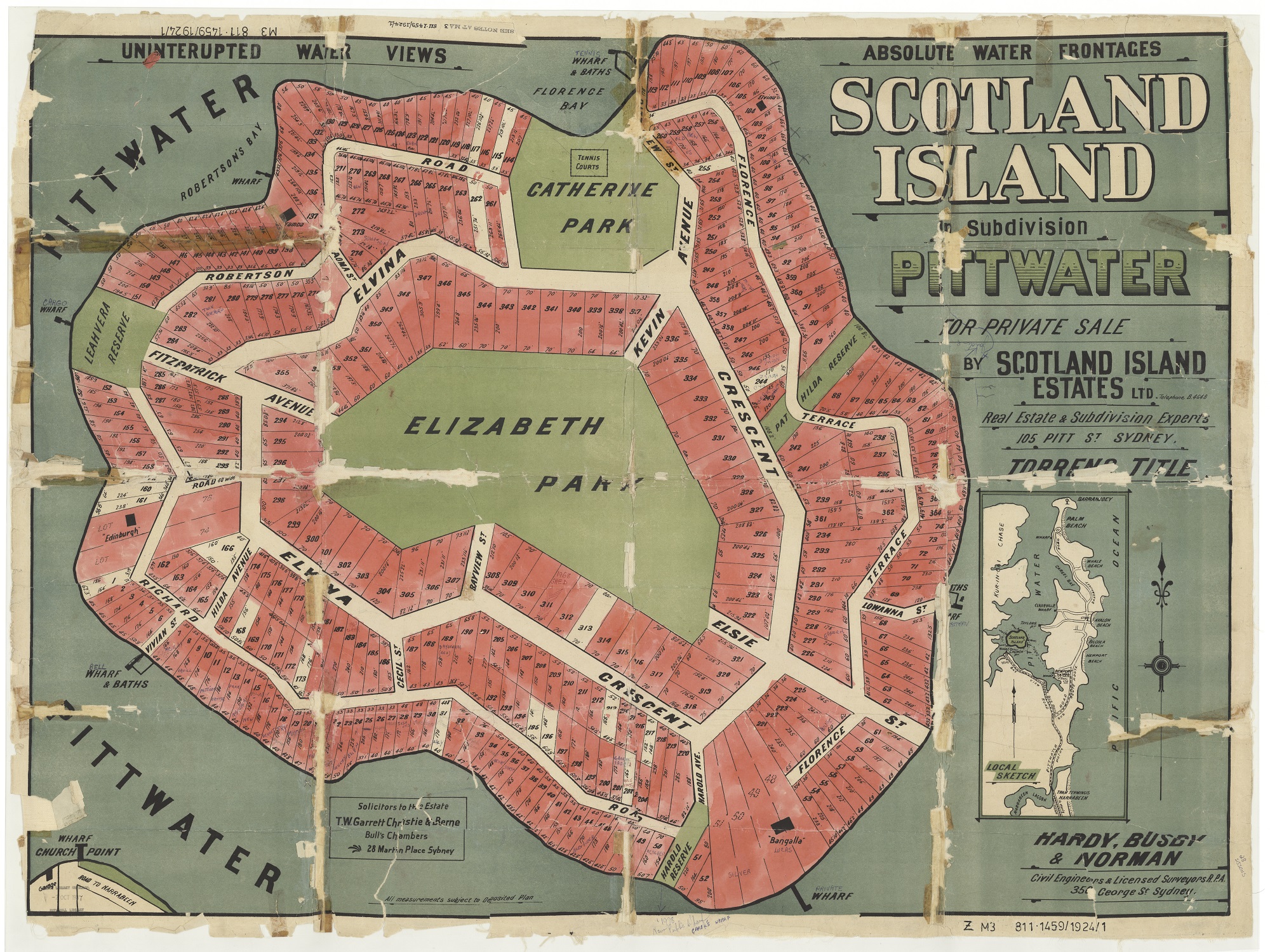
Deposited Plan Lithograph and sections from to show wharves and baths and the names of 'Florence Bay' and 'Robertsons' Bay'. Item: SLNSW_FL15224785 -courtesy State Library of NSW, Pittwater Subdivisions folder
.jpg?timestamp=1761697203020)
.jpg?timestamp=1761697372113)
.jpg?timestamp=1761697543924)
.jpg?timestamp=1761697729160)
The sales lithograph shows where Bells and Eastern wharves are to be built, along with an extension of today's Tennis Courts wharf and baths alongside each as well.
At this time Mr. Fitzpatrick and Mr. Ducker took over everything not yet sold. Scotland Island Estates Ltd. was registered in February 1924 and becomes the seller of all unsold Lots with the Certificates of Title being registered from May 6th, 1926.
REGISTERED COMPANIES.
“SCOTLAND ISLAND ESTATES, LIMITED”—Regd. 15.2.24. No. 99801. Capital: £10,000 in 5500 ordinary and 4500 cumulative preference £1 shares. Objects: To acquire by agreement all that piece of land situated in the Parish of Narrabeen, County of Cumberland, known as “Scotland Island.” Subscribers to Memo, of Assn.: Herbert James Fitzpatrick, Arthur R. W. Ducker, Florence A. Fitzpatrick, Elsie M. Fitzpatrick, Constance M. Ducker, Phillis C. Ducker, and Lawrence A. Ducker (1 share each 1 ). First Governing Directors: Herbert James Fitzpatrick and Arthur R. W. Ducker. Regd. Office: Sydney. Vol. 31 No. 8 (February 25, 1924). REGISTERED COMPANIES., Dun's gazette for New South Wales Retrieved from http://nla.gov.au/nla.obj-784521940
The last aspects were the dedication of the public areas on the island itself.
The June 24 1924 WSC meeting records:
Scotland Island Estate Ltd. stating that they bought only unsold allotments in the original Scotland Island subdivision and have no title to the park on the upper part. Resolved: - (Crs. McKillop, Campbell) That the Council's Solicitors be instructed to take the necessary steps to have the park on the upper part of Scotland Island dedicated and that final approval to the plan be deferred until such dedication is effected. 16, George Wheeler, offering Portion 45, Parish. Manly Cove, containing +20 acres as a public recreation reserve for £1500. Resolved, - (Crs.McKillop, Campbell) That he be thanked for his offer, but informed the Council has no funds for further acquisitions of parks at the present time.
By the July 7 1924 meeting discussions about the park are done via official correspondence and the wharves are almost complete, just a year after the Tender was first advertised, and ready to be used:
15. Union Trustee Co. of Australia Ltd. 30/6/24. Agents for the estate Marquise de Ruvigny, Deceased, stating they are prepared to execute any necessary document for the dedication of the Park on Scotland Island. Resolved, - (Crs. Rayner, Hewitt) That the Seal of the Council be affixed to the Deposited plan of Scotland Island Estate immediately, the Shire Solicitor be advised there will be no hindrance to the transfer going through, and the Solicitors be asked to expedite the matter. 16. Hardy, Busby and Norman, 2/7/24, intimating that the wharves and pathways on Scotland Island are almost completed, and asking that an early inspection be made, (Dealt with earlier in the meeting,) 53. Hardy, Busby and Norman. submitting plan of proposed subdivision by Mrs. Mcdougall's Lot 36 of Scotland Island (original.) Resolved: (Crs. Hewitt, Hitchcock) That approval be given.
Most of the original lots facing west were of one acre each in the original subdivision. E.G. Lot 76 of original 1906 subdivision, sold to Alexander Livingtsone Kerr (Vol-Fol 2065-49), while Lot 75 on May 10 1910 and backing onto Athole Crescent of then, were larger. This was sold on February 7 1913 to Nellie Allen, wife of Alfred Allen, Architect, of Sydney. She sold again on December 6 1920 to George Macquarie Paine of Narrabeen, Grazier. Solicitors John Williamson and Percy Leydon Williamson became those in charge on July 16 1923 and they sold to Ethel Harriet Emmet, wife of Samuel Emmett, Auctioneer of Narrabeen on September 3 1923 - who subsequently subdivided this acre and sold those lots – the plan for subdivision approved through the council in late 1925. The other aspect was some of those who owned these early larger Lots were required to dedicate a portion of their land to the council for residents to have access the ‘road’, such as Douglas Robertson did.
The September 15 1924 WSC meeting records:
53. T. W Garrett. Christie and Borne 8/9/24, submitting, for Council's acceptance, 'Memorandum of Dedication by Mrs. B. McDougall of a 40-ft. strip of original Lot 36 of Scotland Island Sub, for road purposes. Resolved; (Crs. Hewitt, Hitchcock) That dedication of the lots for the purposes of a public highway be accepted.
The minutes of the meeting held October 13, 1924 show:
At the request of Cr. Atkins, instructions were given to the Engineer to have the Ocean Street Jetty repaired immediately, and to attend to the dangerous projecting bolts under Narrabeen Bridge. 3. Scotland Island Estate, Ltd 26/9/24, requesting Council's approval to his application for a Special Lease for a Permissive Occupancy of about 1 perch at Church Point, opposite the roadway between Dando's Boat-Shed and Hummerston's Store: Resolved- (Crs. Hitchcock, Ellsworth) That the application be approved.
On November 10 1924 the WSC records:
Fitzpatrick Subdivision - Resolved,(Crs. Hewitt, Campbell) That the plan of subdivision of Portions 12 and 16, Parish of Broken Bay submitted by Hardy. Busby and Norman, be approved, subject to the fulfillment of the terms in Hardy, Busby and Norman's letter of 6th inst., subject also to the grades of the roads and the specification of the wharf being satisfactory to the Engineer.
Portion 16 was Arthur Branscombe Woods small 3 acre portion at Elvina Bay, and this notice provides the date for the South Elvina Bay wharf build, and through Herbert Fitzpatrick and his partner, Mr. Ducker, once more. More available in: Elvina Bay's Public Wharves: Some History and Pittwater Summer Houses: Rocky Point and Elvina Bay - A Place Of Holiday Songs and Operas In Ventnor, Fairhaven, Trincomalee and Maritana
The October 6 1925 meeting records another early Lot being subdivided:
A J . Hordern. 24/9/25, suggesting the erection of footbridge over the Creek in Palm Grove Reserve Palm Beach, and enclosing cheque for £6 to cover cost. (Crs. Hitchcock, Hewitt) That the offer be accepted, and the work be done under the Engineer's suervision. I 32. Sydney D. Horne. 22/9/25. requesting permission to cross Pittwater Road, with electric wires from ‘La Corniche; to A. C. Giles butcher's shop at Bayview Resolved, - (Crs. Hewitt, Hitchcock) That permission be granted, subject to the work being done to the Electrical Engineer's satisfaction, and that the applicant take all responsibility in the event of an accident occurring, E. A. O'Donnell. 24/9/25.subnitting plan of S. Emmett's plan of subdivision of original Lot 75, Scotland Island Estate, approved in 1923 :.. Received.
By the November 7 1925 meeting:
Scotland Island 6. Resolved, - (Crs. Hitchcock,. Rayner) That S. Emmett's plan of subdivision of Lot 75, Scotland Island Estate, be approved.
Hardy, Busby and Norman, were also used by Herbert Fitzpatrick for Elvina Bay works and subdivisions, and when he moved out of the store in October 1924 he handed the same to Mr. Fitzpatrick, along with overseeing the Postmaster works, so some accord must have been sustained during that time.
Herbert Fitzpatrick – Scotland Island Land Sales 1920’s
Number NRS-13022-2-[12/1117]-No. 2155. Title Memorandum and Articles of Association of Scotland Island Estates Limited. Contents Date Range 01-01-1924 to 31-12-1924
Even though they may have been selling Lots prior to that – theirs is registered in Vol-Fols 3898-58,59 and 60. Also Vol-Fol: 3898-58 (19 acres, one rood and 22 ¾ perches): Lots 1 to 31 inclusive and then Lots 152 to 191 inclusive and Lots 285 to 308 inclusive Plan 127419. Last land sale October 21st, 1963. These have all been retrieved from the HRLV and are listed under Extras, just as a point of interest as to whom bought these lots of land initially.
After World War One the Pittwater Regattas, furloughed as a mark of respect while so many served in that conflict, were renewed from 1921 on, with a depressed Sydney society willing to take part in something aimed at lifting the spirits, connecting people with the grounding energy of nature in a place still untouched by grubby developers hands, and being to submerge themselves in an aquatic environment - with many by then acknowledging the mental, physical and soul health benefits saltwater brings.
With the 1920 death of Marquise of Scotland Island, and the sorting out of the legal matter published by the SMH above, the island itself came under the stewardship of Herbert James Fitzpatrick, one time owner of the classic yacht Bona and originator of the Scotland Island Yacht Race. Many of these land sales show people connected to the Pittwater regattas either joining in buying a block together or buying several lots - so introducing the Scotland Island Cup as part of the races and attractions was a good marketing device, especially for an island - you do need a boat or a ferry to get there.
PITTWATER REGATTA
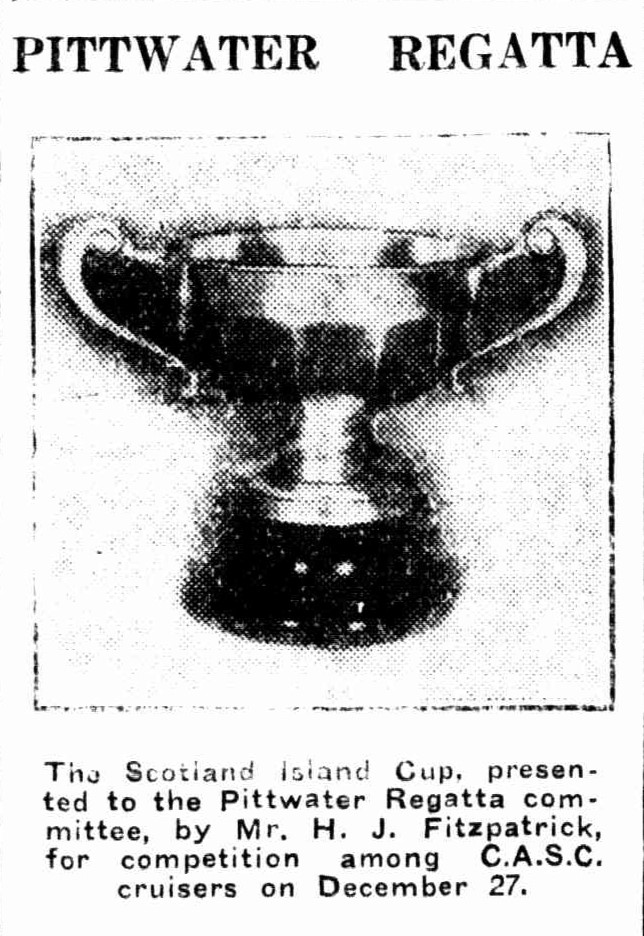
The Scotland Island Cup, presented to the Pittwater Regatta committee, by Mr. H. J. Fitzpatrick, for competition among C.A.S.C. cruisers on December 27. PITTWATER REGATTA (1924, November 6). The Daily Telegraph (Sydney, NSW : 1883 - 1930), p. 8. Retrieved from http://nla.gov.au/nla.news-article245475261
YACHTING
Many Trophies for Pittwater
(By Jackyard)
Pittwater Regatta committee ... In the past has been singularly fortunate in the matter of donation of trophies in addition to prize money at the popular annual fixture, and this year is no exception. At last year's presentation of prizes, when receiving the president's trophy for the success of his 21ft, Boomerang, Mr. Frank Albert promised a cup for this year's carnival, and this will be awarded to the winner of the 21ft. yacht race in the afternoon.- regatta president (Mr. Oscar Curtis) has given the Bona Cup for the all yachts race, while the winner of the cruisers' race will be entitled to the possession of the Scotland Island Cup, the gift of Mr. H. J. Fitzpatrick. Each member of the crew of the most successful 12-footor In the two races on the programme will receive a gold medal from Mr. E. P. Andreas, and Mr. Fred Young's cup will be competed for by the surf boats. The hon. secretary (Mr. John Roche) reports that matters in connection with the regatta are progressing favorably. YACHTING (1924, November 11). The Sun (Sydney, NSW : 1910 - 1954), p. 5 (FINAL EXTRA). Retrieved from http://nla.gov.au/nla.news-article223579116
AQUATICS.
Pittwater Regatta.
CORELLA'S DOUBLE WIN.
Notwithstanding the mixture of sunshine and rain on Saturday, one of the most successful regattas yet held was carried out at Pittwater. The breeze was of varying strengths, and during part of the afternoon fell very light, but again freshened.
Among the popular wins were those for the all yachts and the 21ft restricted class. In the former, the president of the regatta, Mr. Oscar Curtis, steered his yacht, Bona, for the first time in a race, and secured a victory in the competition for the cup which he had presented to the regatta, and which he is representing for next season's reg it to.
Two races were held for the restricted class, and each was won by Lord Forster's Corella, skippered by Mr. Don Taylor. Additional interest was given to the racing this year by the inclusion of events under the Rowing Association rules.
The success of the fixture was contributed to by Messrs J. V. Alexander, Lind and Mr H Fitzpatrick, of Scotland Island Estates, who provided launches for the conveyance of patrons of the regatta to and from the flagship. Mr. Douglas Robertson and the KuringGai Chase authorities provided splendid pontoons for the use of the committee.
The steamer Newcastle made an excellent flagship, from which the various events were viewed. The customary regatta dinner was held during the evening at the Newport Hotel, and was well attended. Trophies won at the regatta were presented by General Sir Granville Ryrie. Great credit was given to the president, Mr. Oscar Curtis, the hon. secretary, Mr. John Roche, and the members of the committee for the perfect way in which the function was carried out.
SCOTLAND ISLAND CUP.
GENERAL HANDICAP.
June Bird (E. C. Gale), 1m 1 Mavis (L. V. Buckingham), 16in . 2 Sea Rover (W. !.. Dandy), nor . 3 Other entries: Unana (Lex Buckle), 8in; Rana (R. H. C. Down),5m; Chance (Dr. Gordon Craig), 5: Caprice (A. J. Storm), 6m; Burraneer (Coates and Rest), 8m; Cutty Sark (H. B. Langley). Dm: Scarab (Dr. C. Shepherd), 12m; Mischief (C. Spain), 12m; Snowdrop (W. Rayment), trim; Wirraminna (Dr. P. G. Cooley), film. Won by 16secs; 1m 55s between second and third.
BONA CUP.
All Yachts.,
Bona (Oscar Curtis), 21m 1
Aoma (J. H. Palmer), 21m 2
Rawhiti (F. Albert), scr. 3 Other entries: Brand V, (J. R. Palmer), lOJm; Scotia (D. C. Brockhoff), 851; EunnaMara (Andrew Wilson), 40m. A splendid race, for the Hallett, Bona, securing the advantage of a milling match approach-ing the finishing line, scored a victory by 30 seconds. AQUATICS. (1924, December 29). The Sydney Morning Herald (NSW : 1842 - 1954), p. 9. Retrieved from http://nla.gov.au/nla.news-article16196217
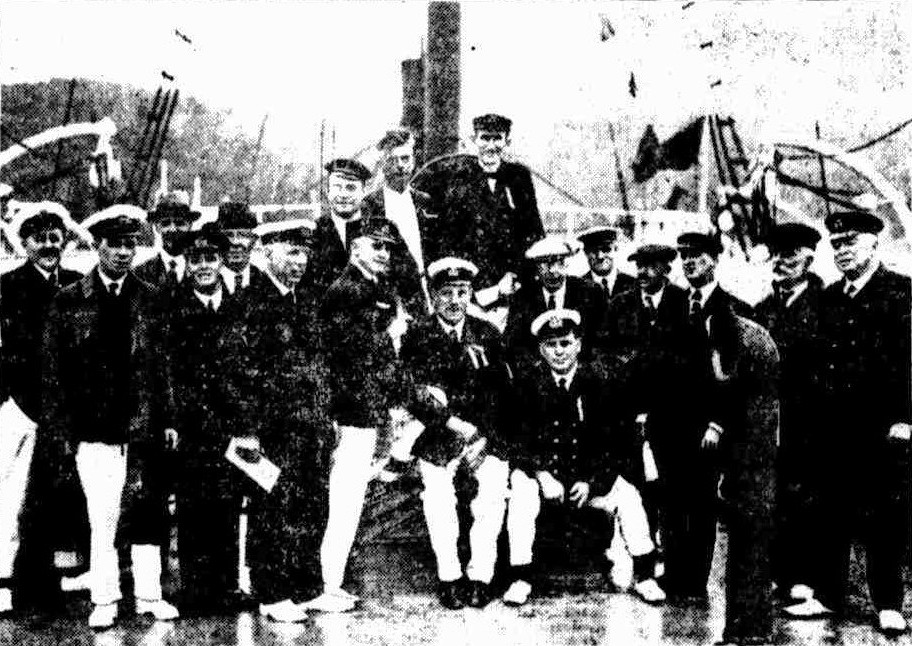
Some of the officials and yachtsmen who participated in Saturday's Pittwater regatta. They all had a merry time, and were downhearted when the two days and two nights' festivities cams to an end. Johnnie Roche, who organised the regatta, is to be seen standing in the background. Seated in the centre of the front row is Fred. J. S. Young, the vice-commodore, and a son of the founder of bowls in Australia. – Aboard the steamer Newcastle. PITTWATER NOT A PARADISE. (1924, December 30). Sydney Sportsman (Surry Hills, NSW : 1900 - 1954), p. 7. Retrieved from http://nla.gov.au/nla.news-article167169262
.jpg?timestamp=1763053679788)
.jpg?timestamp=1763053727630)
SCOTLAND ISLAND CUP. CHRISTMAS-TIDE: THE HOLIDAY SPIRIT ON LAND AND WATER (1924, December 31). Sydney Mail (NSW : 1912 - 1938), p. 18. Retrieved from http://nla.gov.au/nla.news-article169148297

Pittwater Regatta 1920's, from the Australian National Maritime Museum William Hall photographs collection - The vessels HOANA probably AOMA and RAWHITI on the far right. Another from the ANMM collection with the island in the background and two wharves - one at far right, the other to left of where three small yachts are:


What is also good about these 1920's and 1930's Pittwater Regattas is the photographs taken, especially those that have been digitised to the maximum by the State Library of NSW, which allow us to see in the background not the island, in zooming in, some of the wharves then in place. This one, originally 37MB, reduced in size, but sections taken out beforehand, and dated circa 1935, provides:
.jpg?timestamp=1762998082649)
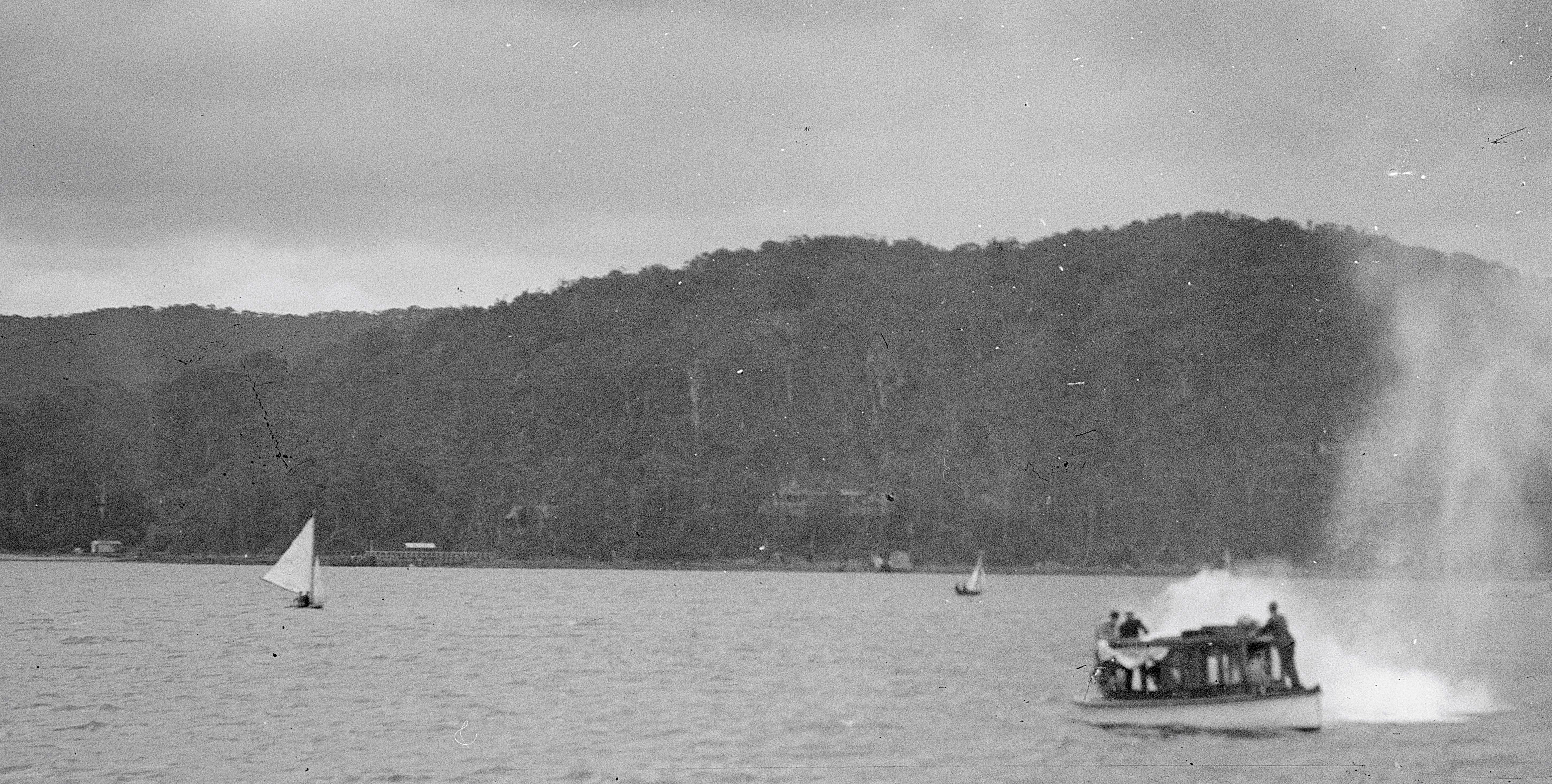
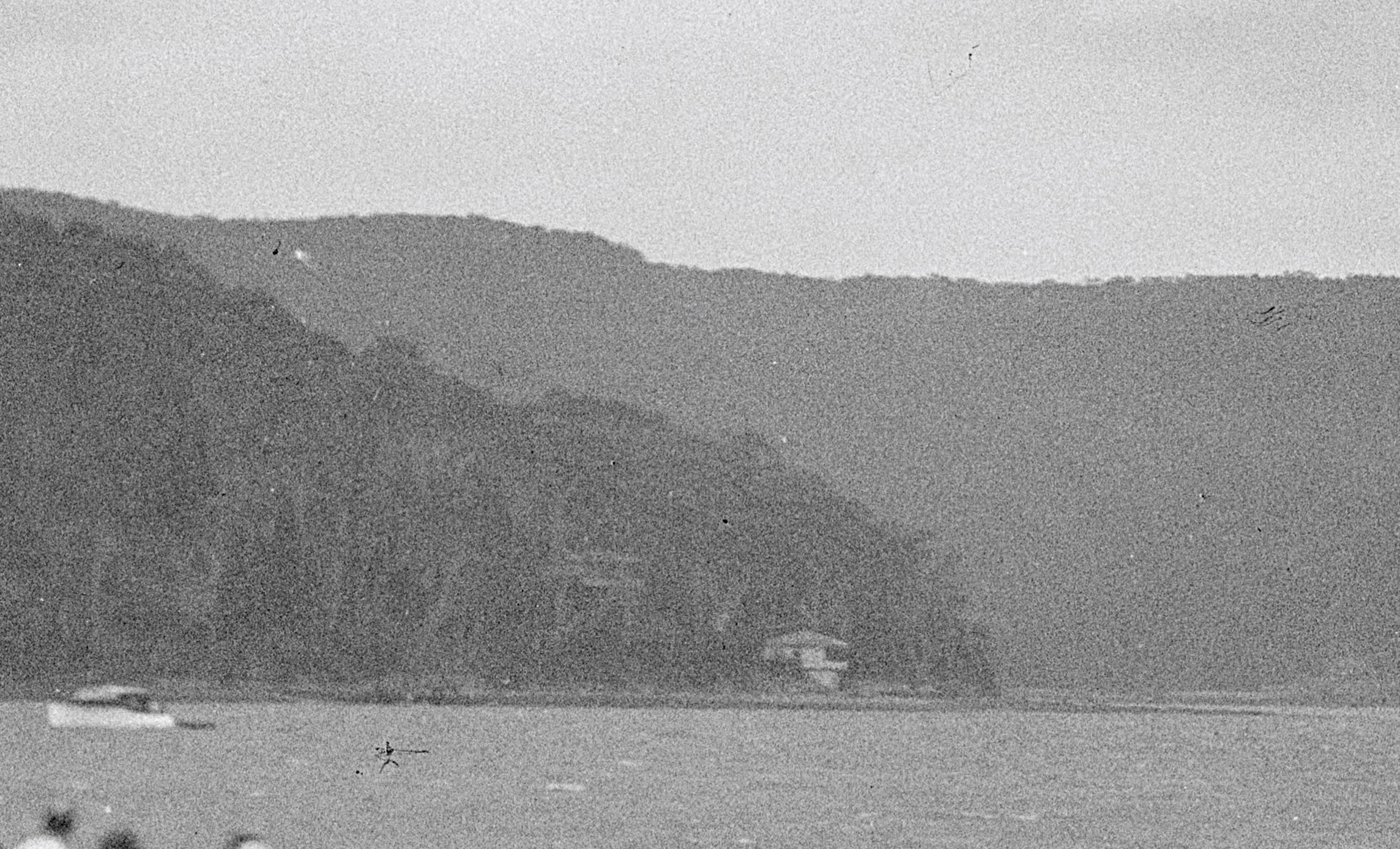
More in: The First Scotland Island Cup, Trophy and Race and the Gentleman who loved Elvina Bay
Although it still took time to sell these lots, once they commence in 1924, the best waterfronts quickly were snapped up while others bought lots in a row once the 1926 agreement had been reached and the larger lots cut up into smaller ones. For instance Joseph Henry Buckmaster, Grazier of Chatswood, bought Lot 153 to 157 (Vol-Fol: 3903-233) on May 18th, 1926 - all waterfront lots on Richard Road - and Emily Elizabeth Corbett, widow of Willoughby bought Lots 188 and 189 on January 12th 1927 (Vol-Fol: 3973-205), between Elvina Crescent and Richard road, and then bought Lots 296 and 313, backing on to Elizabeth Park, and both on Elvina Crescent.
A lot of these early Scotland Islanders also stayed, joined by their children and relatives, and are those who are relentless in expecting the council to fulfil its obligations to ratepayers to maintain the infrastructure that allowed them to reach the island - the wharves - and the baths that had been built alongside them as their only means of a safe dip when the summer meant cooling off in the estuary. Even into the 1950's residents spoke of how they could stand on the island and watch sharks, big ones, swim past - so a netted enclosed swimming area was important.
The first subdivision into 361 lots in 1924 appears as;
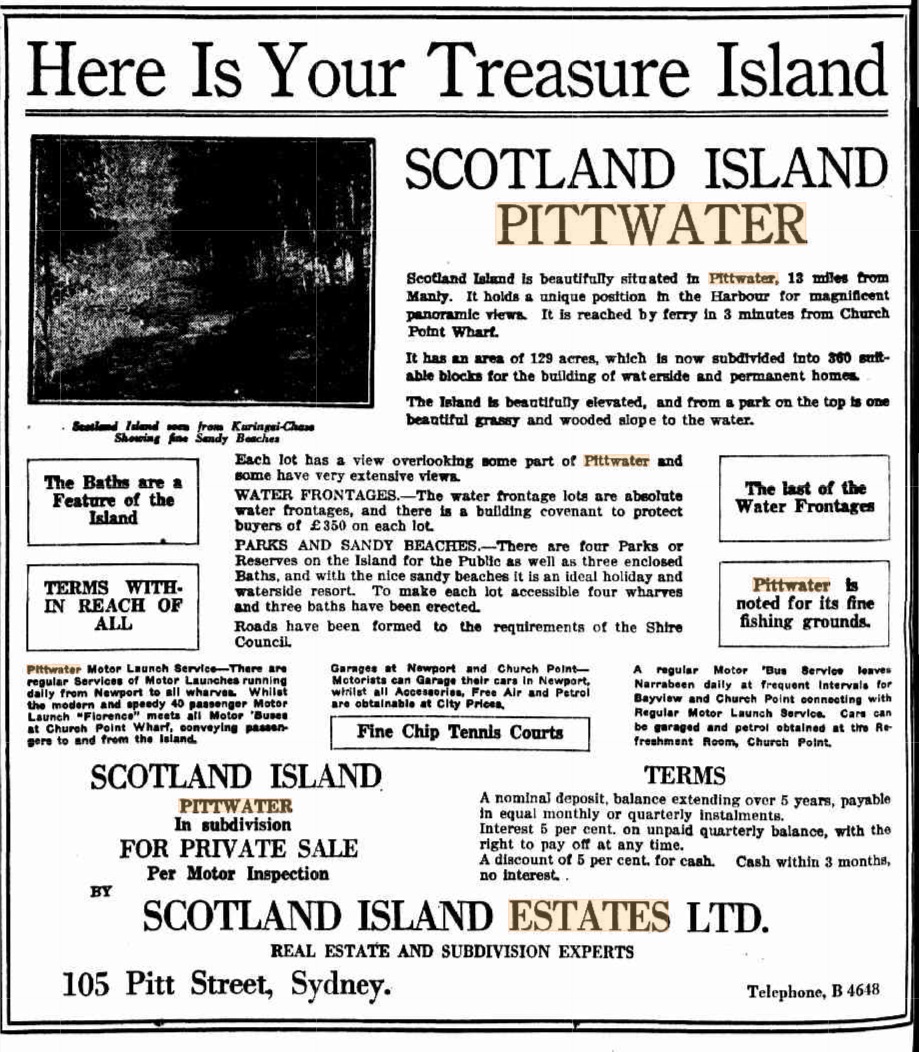
Advertising (1924, October 18). Smith's Weekly (Sydney, NSW : 1919 - 1950), p. 20. Retrieved from http://nla.gov.au/nla.news-article234428316

Bells wharf circa 1924 - courtesy Scotland Islanders and Pittwater/Mona Vale Library History Unit. Note stone causeway access area
Unnamed wharf at Scotland Island, circa 1924, courtesy Scotland Islanders and Pittwater/Mona Vale Library History Unit. Either Eastern or Cargo, the only 4 existing then.
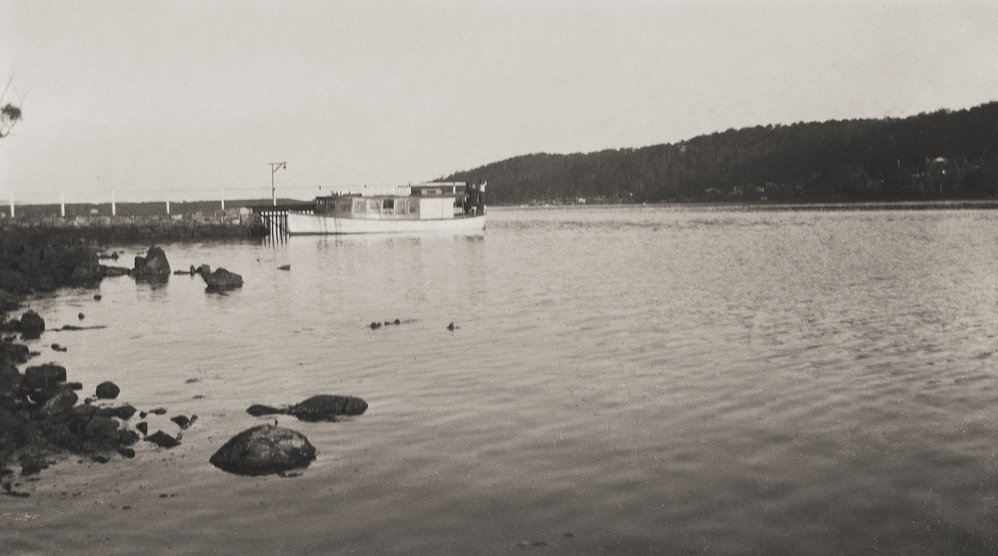
Bells wharf with Ferry resting alongside circa 1926, courtesy Pittwater/Mona Vale Library History Unit and Northern Beaches Council History Hub collection
Sections from Crown Lands Aerials, Commonwealth of Australia, dated 1.1.1947, sections from to show baths alongside Tennis Court Wharf, Bells - Eastern wharf seems to have lost its baths by then:
.jpeg?timestamp=1761776818208)
.jpeg?timestamp=1761776849675)
.jpeg?timestamp=1761776883402)
Cargo wharf, with 'Yamba' jetty and baths just to the north left in for context:
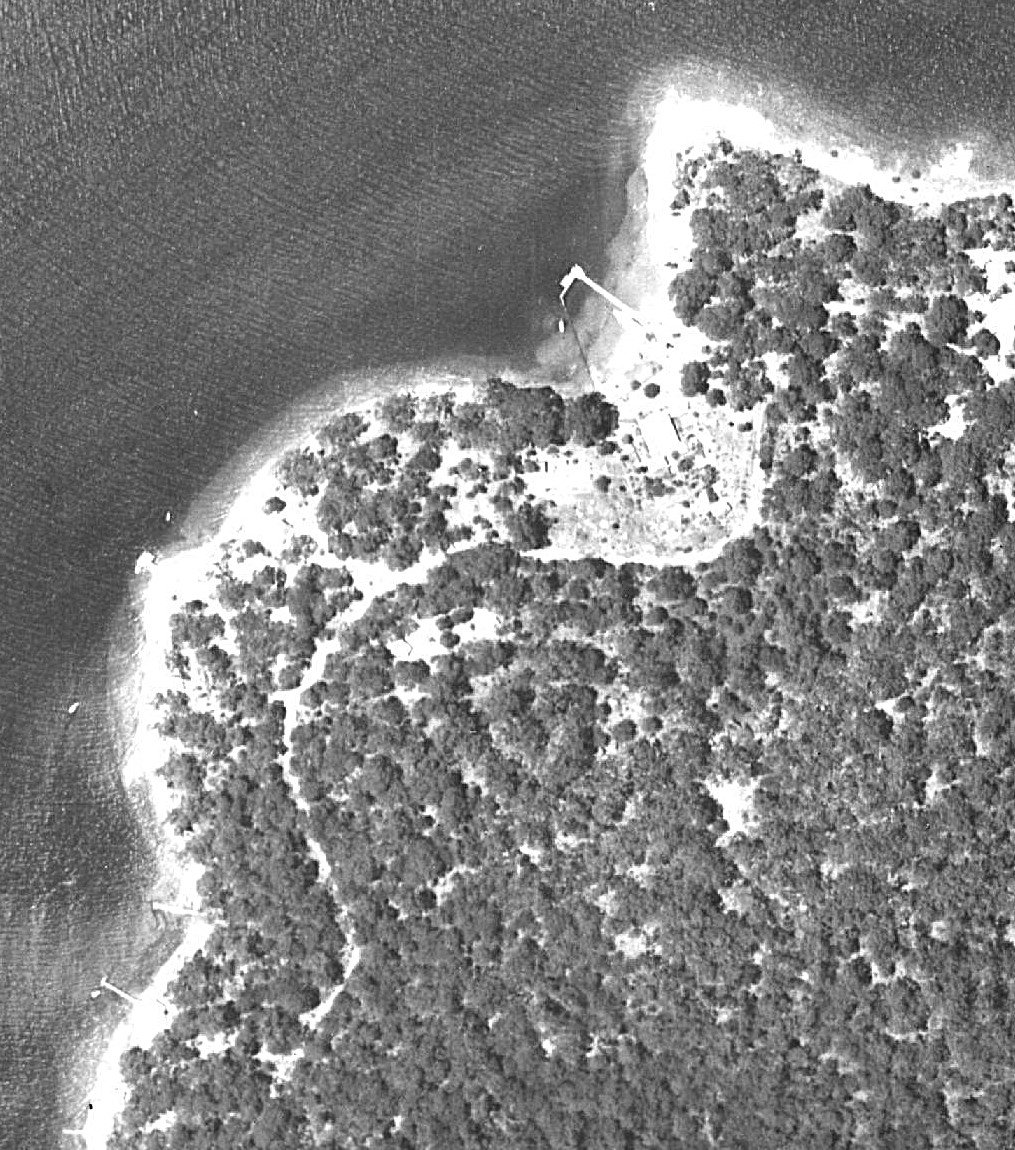
Full aerial of 2nd one taken for those who like to zoom in (NB: 6.25MB):
.jpeg?timestamp=1761776775790)
.jpg?timestamp=1761775166482)
 - Copy.jpg?timestamp=1761775220344)
View over Pittwater from The Pasadena's rear balcony, which faced towards Scotland Island and Newport from Album 'Pasadena waterside restaurant, Church Point (taken for Mr Teasdale-Smith)' by Sam Hood. Date: 1950, courtesy Mitchell Library, State Library of New South Wales - and section from - angled views towards west and east. Items now labelled: SLNSW_FL1466413 and SLNSW_FL1326125
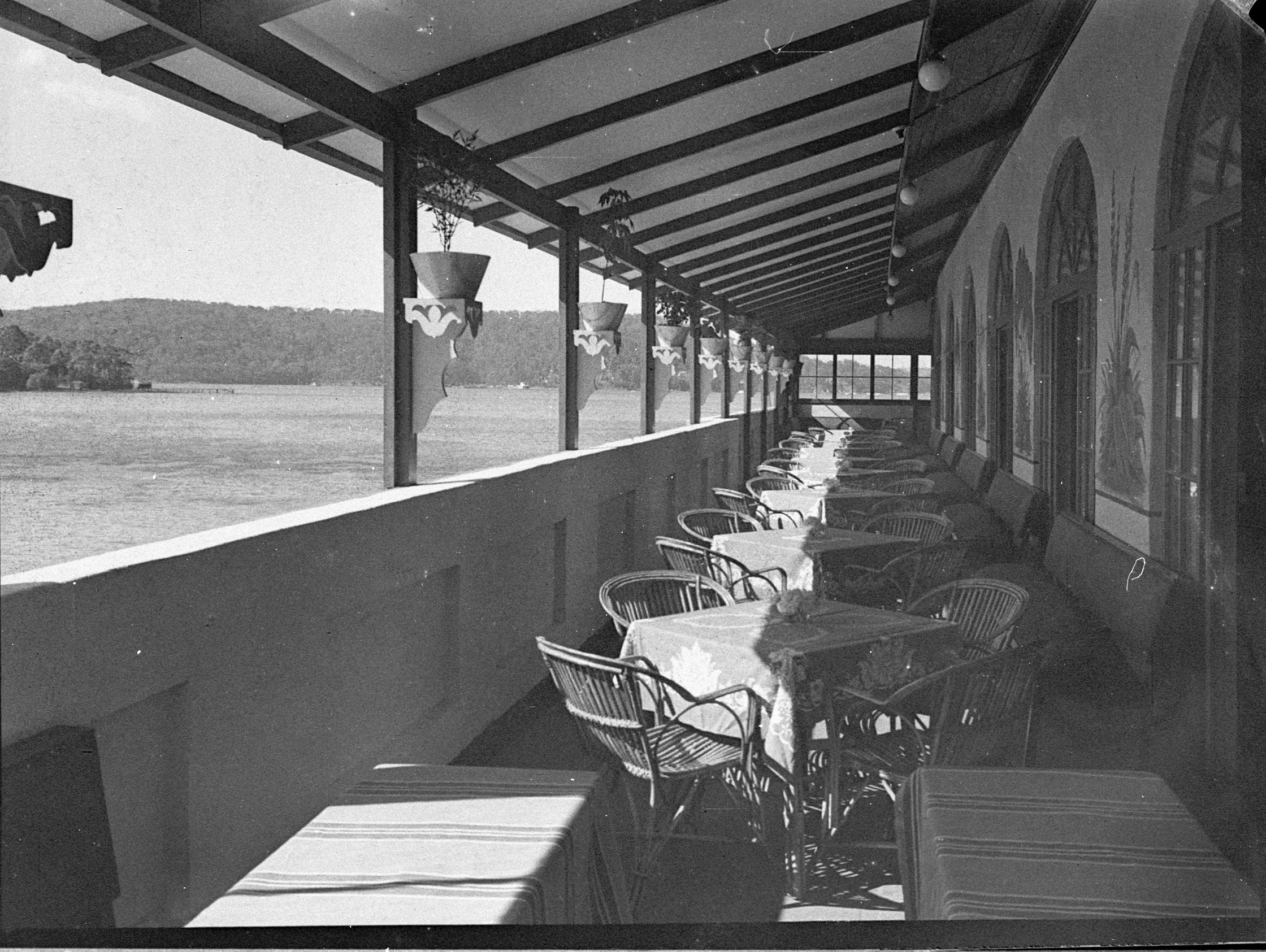
With the start of the new financial year in 1953 the wharves then built on Scotland Island were officially declared public wharves at State Government level as well. The Gazettal Notice:
LOCAL GOVERNMENT ACT. 1919.—PROCLAMATION.
(L.s.) J. NORTIICOTT, Governor.
1st July, 1953.
I, Lieutenant-General Sir John- Northcott, Governor of the State of New South Wales, with the advice of the Executive Council, and in pursuance of the Local Government Act, 1919, do hereby declare to be public wharves the wharves and lands described in the Schedule hereto and vest the control thereof in the Warringah Shire Council. (S. 53-787)
By His Excellency's Command, J. B. RENSHAW.
GOD SAVE THE QUEEN!
Schedule.
Salt Pan Wharf.
Being the wharf and appurtenances thereto and the adjoining land the property of the Crown necessary for the proper working thereof situated on the generally eastern shore of Pittwater about 100 feet easterly from the north-eastern corner of lot 28, deposited plan 13,457.
Taylor's Point Wharf.
Being the wharf and appurtenances thereto and the adjoining land the properly of the Crown necessary for the proper working thereof situated on the generally eastern shore of Pittwater at the northern extremity of Taylor's Point road, Avalon.
Wharves on Scotland Island.
Being the wharf and appurtenances thereto and the adjoining land the property of the Crown necessary for the proper working thereof situated on the generally western shore of Scotland Island at the north-western extremity of Fitzpatrick avenue.
Being the wharf and appurtenances thereto and the adjoining land the property of the Crown necessary for the proper working thereof situated on the generally southern shore of Scotland Island at the south-western extremity of Vivian street.
Being the wharf and appurtenances thereto and the adjoining land the property of the Crown necessary for the proper working thereof situated on the generally eastern shore of Scotland Island at the eastern extremity of Lowanna-street.
Being the wharf and appurtenances thereto and the adjoining land the property of the Crown necessary for the proper working- thereof situated on the generally northern shore of Scotland Island at the northern extremity of Pitt View street. (5781) LOCAL GOVERNMENT ACT, 1919.—PROCLAMATION. (1953, July 10). Government Gazette of the State of New South Wales (Sydney, NSW : 1901 - 2001), p. 2219. Retrieved from http://nla.gov.au/nla.news-article220066563
Sections from Crown Lands Aerials, Commonwealth of Australia, dated 24.6.1961, sections from to show Tennis Court Wharf, Cargo, Bells and Eastern wharves:
.jpeg?timestamp=1761780440950)
.jpeg?timestamp=1761780653670)
.jpeg?timestamp=1761780714638)
.jpeg?timestamp=1761780747127)
Full aerial for those who like to zoom in (NB: 3.8 MB and 3.47MB) - both versions:
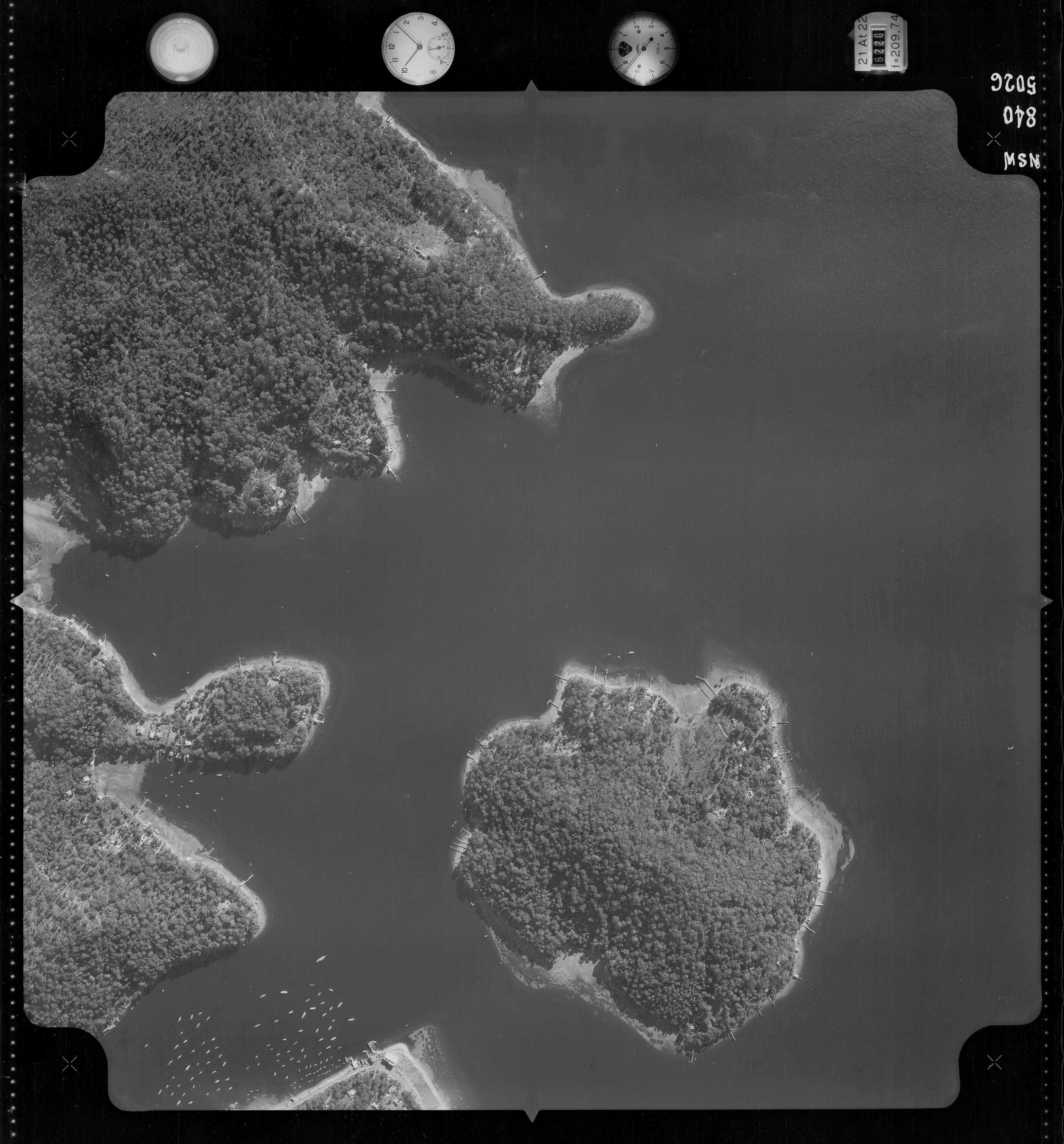
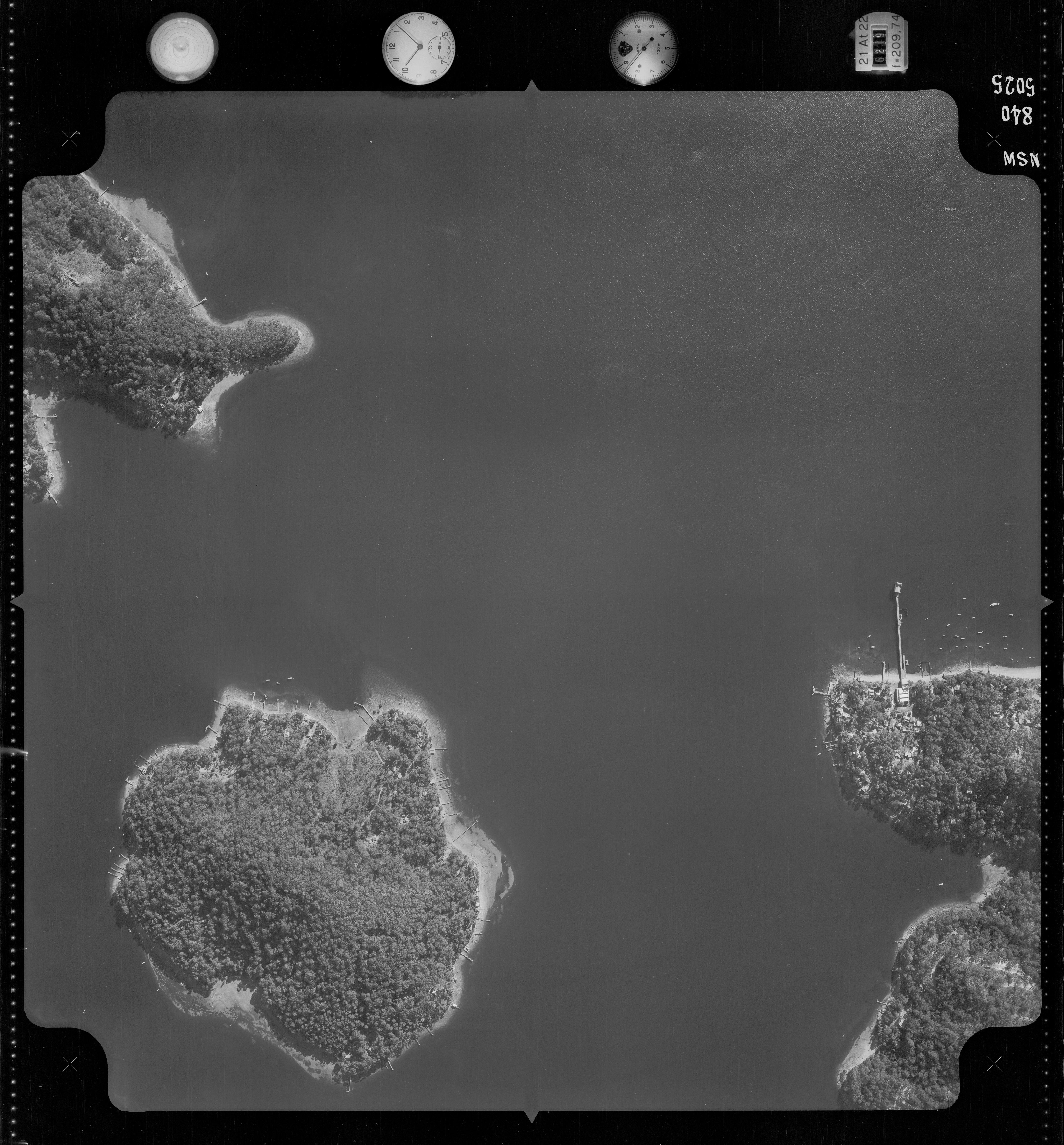
A description of the island from the late 1930's opines it is all bush and battlers - the council thinks there are only 4 people there - although clearly the numbers rose during Summer :
HISTORIC ISLAND DESERTED
Scotland Island, Pittwater, one of the first places to be explored by Governor Phillip, is now nearly as deserted as it was 150 years ago.
Waringah Shire Council has received a complaint about the neglect of the Island.
"It would not be worth our while spending a lot of money on the island," said the deputy-shire clerk (Mr. W. U. Gors) yesterday.
"The population at present numbers four. The place is almost deserted."
In pre-depression days land was worth £10-£12 a foot on the island, which was all subdivided for weekend locations. HISTORIC ISLAND DESERTED (1937, May 8). The Daily Telegraph (Sydney, NSW : 1931 - 1954), p. 7. Retrieved from http://nla.gov.au/nla.news-article247144986
Contented Crusoe Of Scotland Is.
THE loneliest man near Sydney is Mr. Richard Empey, sole inhabitant of Scotland Island, Pittwater, 20 miles from the city. He has lived alone as caretaker of an unoccupied house on the island for the last seven and a half years.
Two cats, Poodles, black, and Mick, mouse-colored, are his only companions.
"It's a treat to meet a human being," said Mr. Empey when visited yesterday.
Scotland Island was explored by Governor Phillip, and once, it is said, bushrangers buried stolen gold there.
Fruits Of Toil
While on Scotland Island, Mr. Empey has built a beautiful terraced garden.
"I grow all tropical fruits here, and get my water from tanks," he said.
A motor launch from Church Point calls daily at his small jetty. He said he had had the Daily Telegraph sent to him with his provisions and equipment every day of his exile.
No Modern "Contraptions"
"I have no radio, telephone, or any modern contraption, but I like to know how the rest of the world is getting on," he said.
Asked if he were happy as a modern Crusoe, he said: "I am perfectly happy here. I do not like the bustle, noise, and rushing of the cities."
There is a cloud on Mr. Empey's horizon.
The house which he looks after is for sale, and he does not know whether the new owner will want a caretaker. Contented Crusoe Of Scotland Is. (1937, May 10). The Daily Telegraph (Sydney, NSW : 1931 - 1954), p. 7. Retrieved from http://nla.gov.au/nla.news-article247141838
The Hebden place, called 'Bangalla' had been placed on the market in the 1920's, with little interest in purchasing it until 1959. Mr. Empey was safe. There were also others, who may well have been weekend and holidays-only visitors, but they wanted to be comfortable while there. This was one such 'improvement' - paid for by the owner:
Private Undersea Cable For Weekend Home
A PRIVATE submarine cable has been laid from the main-land to Scotland Island, Pittwater, to light a city business-man's weekend cottage.
The cable, which is half a mile in length, was installed by the owner of the cottage, Mr. H. W. Henderson, at his own expense. It is the first of its kind to be laid in Sydney by a resident for his own use. It was made In England by the Liverpool Electric Cable Company, and weighs three tons and a half. It connects with the Warringah Shire's electricity system at Church Point. Carrying 460 volts, the power is sufficient to light a small township, the installation has been inspected by officers of the Warringah Shire Council, Mr; Henderson will hold a private switching-on ceremony at his cottage. Private Undersea Cable For Weekend Home (1937, October 15). The Daily Telegraph (Sydney, NSW : 1931 - 1954), p. 7. Retrieved from http://nla.gov.au/nla.news-article247236794
At the council meeting held November 16, 1937:
Cr. Ross moved - That streets and roads be variously named 'The Strand'; 'Griffin Road';, 'Carrington Parade'; and any made or unmade portions of road between Deewhy Parade, and Evans Street, Harbord, be called 'Marine Parade';, and that appropriate notices be given. Cr. Nicholas seconded. Carried. (Cr. Campbell recorded his vote against the motion.) Cr. Ross moved - That it is not in the interests of the ratepayers of Warringah Shire or good Local Government that Council should concur in selling sand at 1d. per yard' and allow the purchaser to count the number of loads taken Cr. McPaul seconded. The motion Was defeated on division by seven votes to two, the minority consisting of the mover and seconder. Resolved, - That a letter be sent to Sir Archdale Parkhill thanking him for his past services to the Council and for his kind attention to the Council's various requests during his term of office as the Federal Parliamentary representative for the district. (Crs. Mcul, Green) CORRESPONDENCE was read and dealt with as follows:- 1. lands Department, 26/10/37, granting Council permission to carry out reclamation work, fronting Bayview Park, Pittwater, under certain specified conditions; requesting that the Department be informed when the work is completed, and stating that upon satisfactory completion, the area reclaimed will be reserved for public recreation, placed under the Council's control as trustee, and vested in the Council with power to lease, subject to the Minister's consent. 'Received'. 2 Same, 29/10/37, inquiring whether there are any objections to the granting of H.W. Henderson's application Permissive for a Permissive Occupancy within the bed of Pittwater from Bayview road near Church Point to Scotland Island, for, the purpose of a site for a submarine power cable. Resolved, - That the Department be informed the Council has no objection to the propos'al. (Crs. Hitchcock, Campbell)
However, all those who owned land and property on Scotland Island were paying rates to the council and expected the vital infrastructure that allowed access to the same to be maintained.
The September 3rd 1928 WSC Meeting records:
42., W.C. Walsh, 20/8/28. Drawing attention to a washaway at Eastern Wharf, Scotland Island. Referred to the Overseer.
The Meeting of Warringah Shire Council-held January 28th, 1930 records:
14.. J. A. Burke. 10.1.30. Expressing appreciation of the expeditious manner in which repairs were effected for the baths at the eastern wharf on Scotland Island. Received
Minutes of Meeting of Warringah Shire Council held on 5th December 1932 record:
12. John A. Burke, 21/11/32, drawing attention to the dangerous condition of the stakes enclosing the baths adjoining the eastern wharf on Scotland Island. Re A,:-.That £9 be voted for repairing this bath and also the bath at the northern wharf, as recommended by the Overseer, (Crs, Austin, Hughes):
The repairs of 1930 were either not too good or had been impacted by weather events, as by 1934 Minutes of Meeting of Warringah Shire Council held on December 19 1934 record:
22. W.Willis, 3/12/34, reporting that the baths at the eastern wharf on Scotland Island are in a dangerous condition. The Overseer's report that expenditure on the baths is unwarranted, and the money would be better spent on paths and Wharves was adopted.
Minutes of Meeting of Warringah Shire Council held on Thursday, 10th January. 1935 show some of what must have been replied to the Willis family:
Scotland Island19. J.Willis, 19/12/34,,again re baths' and wharf at Scotland Island, stating that the suggestion that these baths are only used three times during the year is almost an insult, and stating that his house is continually being used, especially in summer, and as at present the baths are in need of repair, a tragedy may occur. 20. J. A. Burke 21/12/34, drawing attention to the condition of the baths at the eastern wharf at Scotland Island,' and urging that they be repaired. Resolved, - That £7 be voted for repairing the baths; (Crs. Austin, McPaul)
The March 24th 1935 Meeting records:
15. L. Bower, 4/3/35, complaining of the almost impassable condition of the roads on Scotland Island. Resolved, - That application be made to the Minister for approval to the carrying out of the grading and cleaning of the pathways on Scotland Island under the emergency relief work scheme.
The June 11th 24th 1935 Meeting;
13. Ethel A. Forster, 22/5/35, complaining of the Council's neglect of roads on Scotland Island, particularly Vivian Street and Hilda Avenue, which are overgrown with scrub and obstructed by fallen 'trees. Resolved, - That the vote for the wharves and baths at Scotland Island be diverted towards effecting improvement to the roads on the island. (Crs. Hughes, Hewitt)
The February 6th 1940 WSC Meeting records:
25. T. HK Gibb, 19/1/40, drawing attention to the dangerous condition of the wharf and approaches on the eastern side of Scotland Island and to the useless condition of the baths. Referred to the Engineer for report. 28. Taylor's Point Protective Assoc., stating the Association is prepared-to provide 27.10.0-towards the cost of erecting Taylor's hand-rails and platform around the baths at Taylor's Point. Resolved, - That £15, as estimated by the Engineer, be voted for the work, provided the Association contributes £7.10.0. (Ors. Hitchcock, O'Reilly) 29.. C. W. Carpenter, 25/1/40, drawing attention to the condition of the bridge at the foot of Kobado Road across Mullett Creek, where an accident may occur. The Engineer's report that this bridge has been repaired was adopted. 30. Mrs. M. A. Yewen, again complaining of the 'disgraceful state' of Myola Road from her home to Little Reef Parade. Myola Rd. The Engineer's report that maintenance attention is to be given was adopted. F. P. Donohue 23/1/40, requesting' a Certificate of Compliance in regard to the Roxy Theatre, Narrabeen. Deferred, pending a report from the Inspector following receipt of a Surveyor's certificate requested by him.
WSC Meeting held 19 March 1940:
7. Re E.L.Waddy & Co's offer to sell to the Council nine lots facing the beach at Mona Vale at the southern end of the beach Beach reserve: Resolved, - That the Council make an offer of £125 for the whole Extension lots. (Crs. Campbell, O'Reilly) 8. Re Eastern wharf on Scotland Island: Adopted.
The April 30th 1940 meeting records:
Shire Engineer's Report: ....Scotland Island; Reporting that renewals at Bell's Wharf and baths, Scotland Island, would cost £54, that quotations for the work had been received, and recommending the acceptance of the quotation of Frank Fetus of Church Point at 54. Resolved; That the quotation of Frank Festus be accepted when the £100 rates referred to in the letter of Mr. Ducker of Scotland Island Estates Ltd., submitted to the last meeting, is received. (Crs. Sterland, Campbell).
There are more notes on repairs and replacements and requests for the same under Tennis Court wharf in council records, as found, above, along with the council's ability to meet those 'access to' maintenance works during the impacts of what was going on around the community, and Australia itself, throughout these eras.
The July 1st 1953 official Gazettal of Scotland Island's four wharves of then - as Public Wharves - was published July 10:
LOCAL GOVERNMENT ACT. 1919.—PROCLAMATION.
(L.s.) J. NORTHCOTT, Governor.
1st July, 1953.
I, Lieutenant-General Sir John- Northcott, Governor of the State of New South Wales, with the advice of the Executive Council, and in pursuance of the Local Government Act, 1919, do hereby declare to be public wharves the wharves and lands described in the Schedule hereto and vest the control thereof in the Warringah Shire Council. (S. 53-787)
By His Excellency's Command, J. B. RENSHAW.
GOD SAVE THE QUEEN!
Schedule.
Salt Pan Wharf.
Being the wharf and appurtenances thereto and the adjoining land the property of the Crown necessary for the proper working thereof situated on the generally eastern shore of Pittwater about 60 feet easterly from the north-eastern corner of lot 28, deposited plan 13,457.
Taylor's Point Wharf.
Being the wharf and appurtenances thereto and the adjoining land the properly of the Crown necessary for the proper working thereof situated on the generally eastern shore of Pittwater at the northern extremity of Taylor's Point road, Avalon.
Wharves on Scotland Island.
Being the wharf and appurtenances thereto and the adjoining land the property of the Crown necessary for the proper working thereof situated on the generally western shore of Scotland Island at the north-western extremity of Fitzpatrick avenue.
Being the wharf and appurtenances thereto and the adjoining land the property of the Crown necessary for the proper working thereof situated on the generally southern shore of Scotland Island at the south-western extremity of Vivian street.
Being the wharf and appurtenances thereto and the adjoining land the property of the Crown necessary for the proper working thereof situated on the generally eastern shore of Scotland Island at the eastern extremity of Lowanna-street.
Being the wharf and appurtenances thereto and the adjoining land the properly of the Crown necessary for the proper working- thereof situated on the generally northern shore of Scotland Island at the northern extremity of Pitt View street. (5781) LOCAL GOVERNMENT ACT, 1919.—PROCLAMATION. (1953, July 10). Government Gazette of the State of New South Wales (Sydney, NSW : 1901 - 2001), p. 2219. Retrieved from http://nla.gov.au/nla.news-article220066563
A name change during the same season:
Elvina-crescent, Scotland Island—Thompson-street. SHIRE OF WARRINGAH.—RENAMING OF ROADS.—Ordinance (1953, August 14). Government Gazette of the State of New South Wales (Sydney, NSW : 1901 - 2001), p. 2653. Retrieved from http://nla.gov.au/nla.news-article220067748
LOCAL GOVERNMENT ACT, 1919.—PROCLAMATION.
(L.s.) E. W. WOODWARD, Governor. 5th July, 1961.
ORDINANCE No. 35a, as proclaimed in the Government Gazette of 12th November, 1920, and subsequently amended, is hereby further amended in clause 1 under the heading "Shires" by inserting after the words "four wharves on Scotland Island" appearing opposite the word "Warringah" the words "; Careel Bay Wharf, Pittwater". (S. 61-1,433.)
By His Excellency's Command,
P. D. HILLS.
(5792) GOD SAVE THE QUEEN! LOCAL GOVERNMENT ACT, 1919.—PROCLAMATION. (1961, July 28). Government Gazette of the State of New South Wales (Sydney, NSW : 1901 - 2001), p. 2217. Retrieved from http://nla.gov.au/nla.news-article220282730
Warringah Shire Council was dismissed in 1967 after two councillors were jailed for bribery. There are scant records during this period regarding works done on the island. Claims documents were destroyed cannot be confirmed. Warringah Shire Council was dismissed again in 1985 due to corruption allegations - but came back listening to the community a little more than the deterioration of standards residents recall leading to that sacking. The June 16 1987 Meeting of the WSC records:
Riding – priority – - works needed- estimated cost (NB: priority ran 1 – 4)
A 3 KALINYA STREET, Newport - Concrete footpath construction adjoining Dearin Park $ 4,000
A 3 SCOTLAND ISLAND - Construction of footpaths to Carol's Wharf and Eastern Wharf. $ 5,000
Changes were made to Eastern wharf in the early 1990's:
DRAFT ASSESSMENT OF LANDS AT SCOTLAND ISLAND, PITTWATER UNDER PART 3 OF THE CROWN LANDS ACT, 1989 AND THE CROWN LANDS REGULATION 1990.
The Minister for Tourism, Lands and Forests has prepared a draft land assessment for Crown lands situated at Scotland Island. Pitt water being the land described hereunder.
Inspection of this draft assessment can be made at the Metropolitan Lands Office, 22 Main Street, Blacktown; Department of Lands, 23-33 Bridge Street, Sydney and Dee Why Civic Centre, Pitt water Road, Dee Why* during normal business hours.
Representations are invited from the public on the draft assessment. These must be made in writing for a period of 28 days from the date of this notice and should be forwarded to the Regional Director, Metropolitan Lands Office.
P. O. Box 878, Blacktown, 2148
Garry West, M.P.. Minister for Tourism. Lands and Forests.
Sydney, 30th November, 1990
Description
Parish -Narrabeen
County - Cumberland
Locality - Scotland Island
Shire * Warringah
Land District - Metropolitan
About 75.5 square metres of Crown land below mean high water mark of Pittwater fronting a public road known as Lowanna Street for the purpose of reconstruction and realignment of a public wharf known as "Eastern Wharf". MN83H634 DRAFT ASSESSMENT OF LANDS AT SCOTLAND ISLAND, PITTWATER UNDER PART 3 OF THE CROWN LANDS ACT, 1989 AND THE CROWN LANDS REGULATION 1990. (1990, November 30). Government Gazette of the State of New South Wales (Sydney, NSW : 1901 - 2001), p. 10517. Retrieved from http://nla.gov.au/nla.news-article231908196
Pittwater Council was, naturally, a bit more focussed on Pittwater needs and had the knowledge and team to deliver them because they all came from Pittwater as well. One of their General Managers, Angus Gordon OAM, explained during his Profile interview that when there was a problem or something needed fixing, or reserves mowed again due to high rainfall, he could just call those tasked with these and they could get it done that day as they were all locals looking after locals, or on-staff locals, or among the volunteer army Mayor Harvey Rose used to refer to as 'the highest rate of volunteers for any council area, ever'.
Another extract from that council's POM' for the public wharves:
Pittwater Public Wharves Plan of Management, June 2008
By Pittwater Council
The POM applies to ‘reserved’ Crown Land administered by the Department of Lands. To date Pittwater Council has been appointed Corporate Manager of seven (7) of a potential twenty eight (28) Public Wharf Reserve Trusts (refer listing). The Trust is charged with the care, control and management of the wharf reserves and Council manages the affairs of the Trust. The wharf reserves are designated for the public purpose of ‘Access’.
Pittwater Public Wharf Reserves included in the POM are:
• Bells Wharf, Scotland Island (R1010808)
• Bennets Wharf, Coasters Retreat (R1010809)
• Bonnie Doon Wharf, Coasters Retreat (R1010810)
• Cargo Wharf, Scotland Island (R1010811)
• Carols Wharf, Scotland Island (R1010812)
• Mackerel Beach Wharf, Great Mackerel Beach (R1004208)
• Tennis Court Wharf, Scotland Island (R1010813)
A summary of the capital works and indicative total cost at each Public Wharf reserve follows:
• Bells Wharf – extension of wharf head, provision of access ramp, pontoons, ‘ferry compatible’ pontoon and licensed boat tie-up spaces (approx 20-25): approx works cost $200,000
• Bennets Wharf – monitoring and replacement of White Ant infested timber, extension of wharf head (domestic waste storage area), pontoon and licensed boat tie-up spaces (approx 5-10): approx works cost $60,000 with allowance of $150,000 to White Ant infestation treatment
• Bonnie Doon Wharf – investigation of ramp access at wharf entry, structural review of heritage stone groyne, provision of timber screen to domestic waste storage area, pontoon and licensed boat tie-up spaces (approx 5-8): approx works cost $50,000 with allowance of $40,000 to heritage stone groyne investigations and works
• Cargo Wharf – construction of concrete access ramp, new timber jetty, ramp, pontoon and licensed boat tie-up spaces (approx 15-25) and ‘ferry compatible’ pontoon, picnic furniture / seating and non-powered watercraft storage: approx works cost $300,000
• Carols Wharf – installation of signage, community notice boards, provision of access ramp and ‘ferry compatible’ pontoon, two (2) pontoons with licensed boat tieup spaces (approx 50) and non-powered watercraft storage: approx works cost $210,000
• Mackerel Beach Wharf – extension of wharf head with additional licensed boat tieup spaces, construction of domestic waste bin area (determined at the detailed design stage), roof extension between existing shelter sheds and non-powered watercraft storage: approx works cost $95,000
• Tennis Court Wharf – provision of access ramp and ‘ferry compatible’ pontoon (dual function), pontoons with access ramp (south side of existing wharf) and licensed boat tie-up spaces (approx 40-45), and non-powered watercraft storage: approx works cost $450,000
Bell's wharf:
Bells Wharf is one of the principle wharfs of Scotland Island. Its proximity to the mainland and high commuter use by ferry services and water taxis are key factors. The wharf is accessed from the island via Vivian Street, a road is not evident instead a steep flight of steps extend from Richard Road down to the wharf jetty, a descent of approximately 18 metres.
A description of the reserve, wharf structure, related features and management is summarised as:
Site name: Bells Wharf Reserve
Address: Accessed from Vivian Street, Scotland Island
Reserve: Crown Reserve: Bells Wharf Reserve (R1010808), gazetted for Access on 13 May 2005, comprising Lot 7111.
Ownership: State of New South Wales as Crown Land administered by Department of Lands under Crown Lands Act 1989
Management: Bells Wharf (R1010808) Reserve Trust (appointed 13 May 2005) charged with care, control and management
Trust Manager: Pittwater Council manages the affairs of the Trust
Area: Approx. 890 square metres
Existing Uses: Public access – general public, commercial ferries, water taxis and commuter boats, Passive & active recreation, Access Boat access from mainland, Stone and in-ground timber steps (with narrow undulating asphalt ramp) and single timber handrail on Vivian Street
Zoning: Pittwater Local Environmental Plan 1993, W2 – Residential Waterways Adjacent Zoning: 6(a1) – Waterways Recreation 2(a) – Residential ‘A’
Condition: Generally fair, minor wear to access steps, some rot within timber joists at shore end and sideways movement of head of wharf observed (Docker Smith Pty Ltd – 3rd April 2006)
Maintenance: Pittwater Council: Timber / structural repair Graffiti removal and painting Domestic waste removal General repairs to buildings, shelters
Assets: 20m timber jetty – railing to one side, timber jetty head (approx. 5x7m), fixed timber access steps with landing, weatherboard shelter shed (inc notice board, seating to 3 sides), lighting, PLGA signage
Unattached Assets: Domestic waste skip to extended timber platform. Recycling bins (approx 3no)
There are currently no leases, licences or other estates applicable to Bells Wharf Reserve. Subject to the consent of the Minister and the relevant provisions of the Crowns Land Act 1989, this Plan authorises the future licensing to commuter vessel owners for tie-up berths located at and commercial operators using Bells Wharf.
It is anticipated approximately ten (10) commuter vessel tie-up berths available for licence, could be accommodated at Bells Wharf Reserve under the Temporary Licence Agreement. The provision of designated vessel tie-up spaces would be established in coordination with wharf improvements such as, provision of tie-up rings and access ladders and the potential future extension of the wharf structure, and/or addition of a purpose built commuter boat tie-up jetty.
Bells Wharf forms the principle ferry access location from the island with high pedestrian user demand. Currently the provision of commuter vessel tie-up berths at Bells Wharf
Reserve accommodates a medium user demand, space is limited and access awkward. The use of informal attachments to the wharf structure will be phased out and designated vessel tie-up locations will be provided to improve safety and wharf management. Improvement works in response to user concerns and to accommodate vessel tie-up licence schemes (refer Figure 7-4 Bells Wharf Reserve Concept Sketch) will include:
Description - Indicative Cost
- Install safety equipment (‘angel’ ring / signage) $500
- Boat tie-up facilities to existing wharf structure (approx 10-12 licensed spaces) – tie-up rings /access ladders / signage $12,000
- Extension of wharf head structure (to NW of existing shelter shed) to allow for increased user space and relocation of domestic waste skip $40,000
- Replace existing steps with ramp to boat tie-up facility (pontoon) with berth dividers (approx 10-15 licensed spaces) $60,000
- Construction of access pontoon to commuter pontoon (ferry compatible) – ‘drop off’ zone only $80,000
- Non-powered watercraft storage area (location and design to be further investigated and developed) $40,000
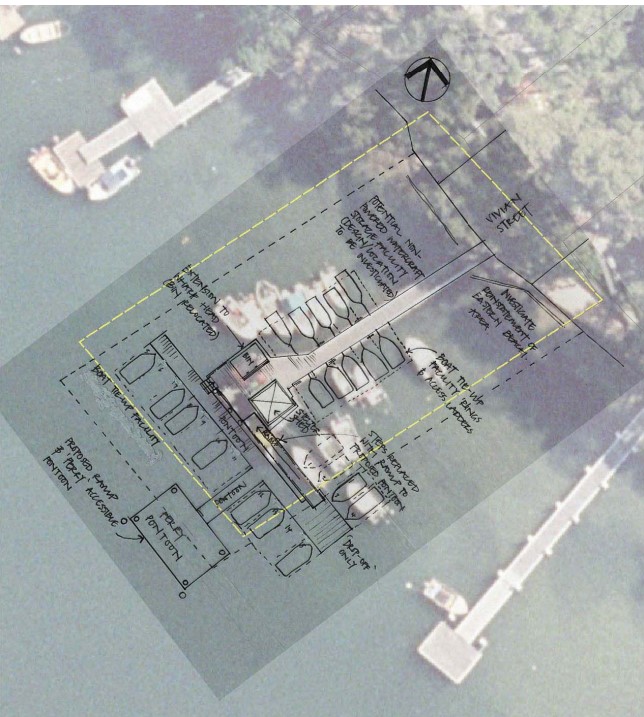
Figure 7-4 ⏐ Bells Wharf Reserve Concept Sketch.''
Bells Wharf in September 16, 2015:
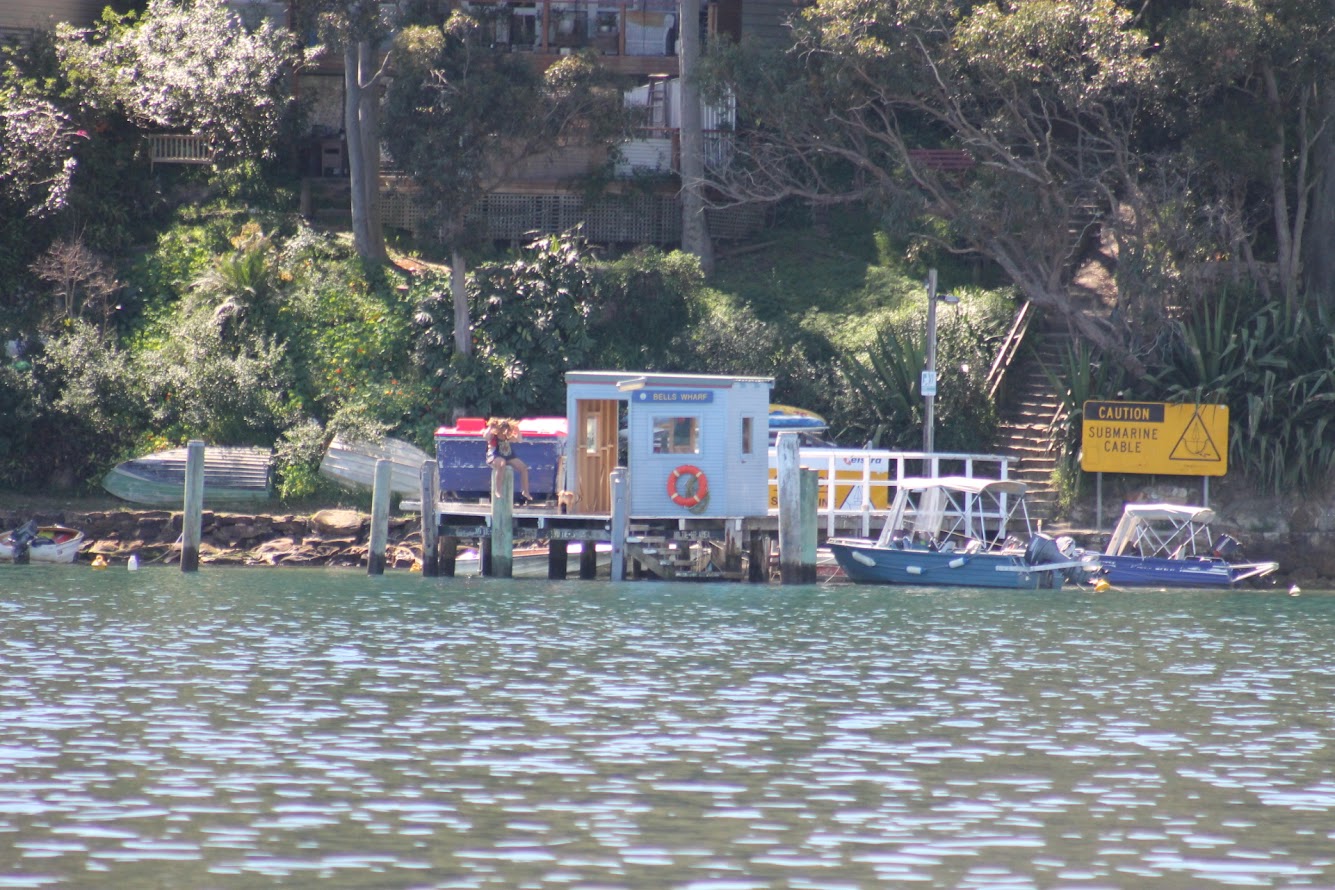
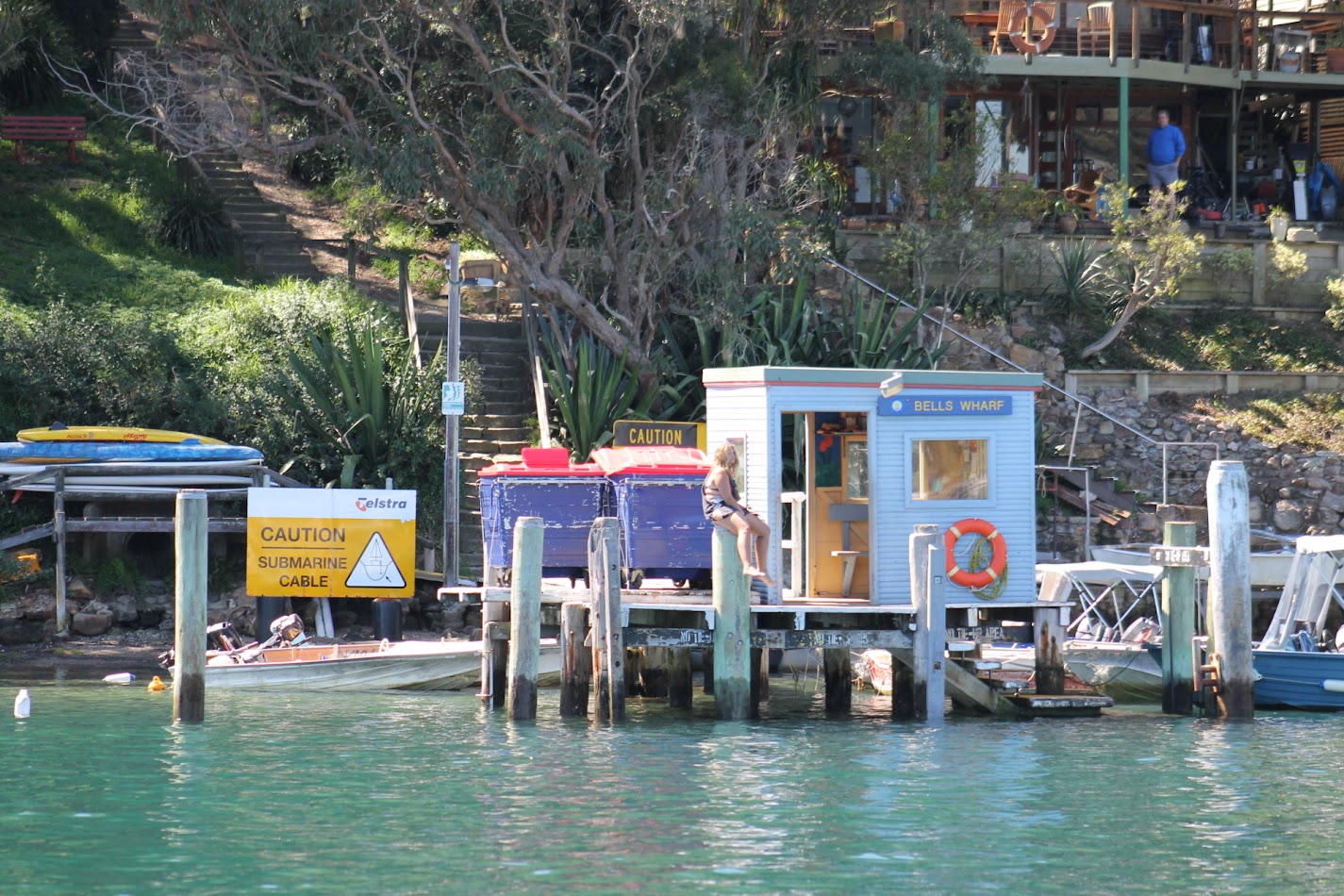
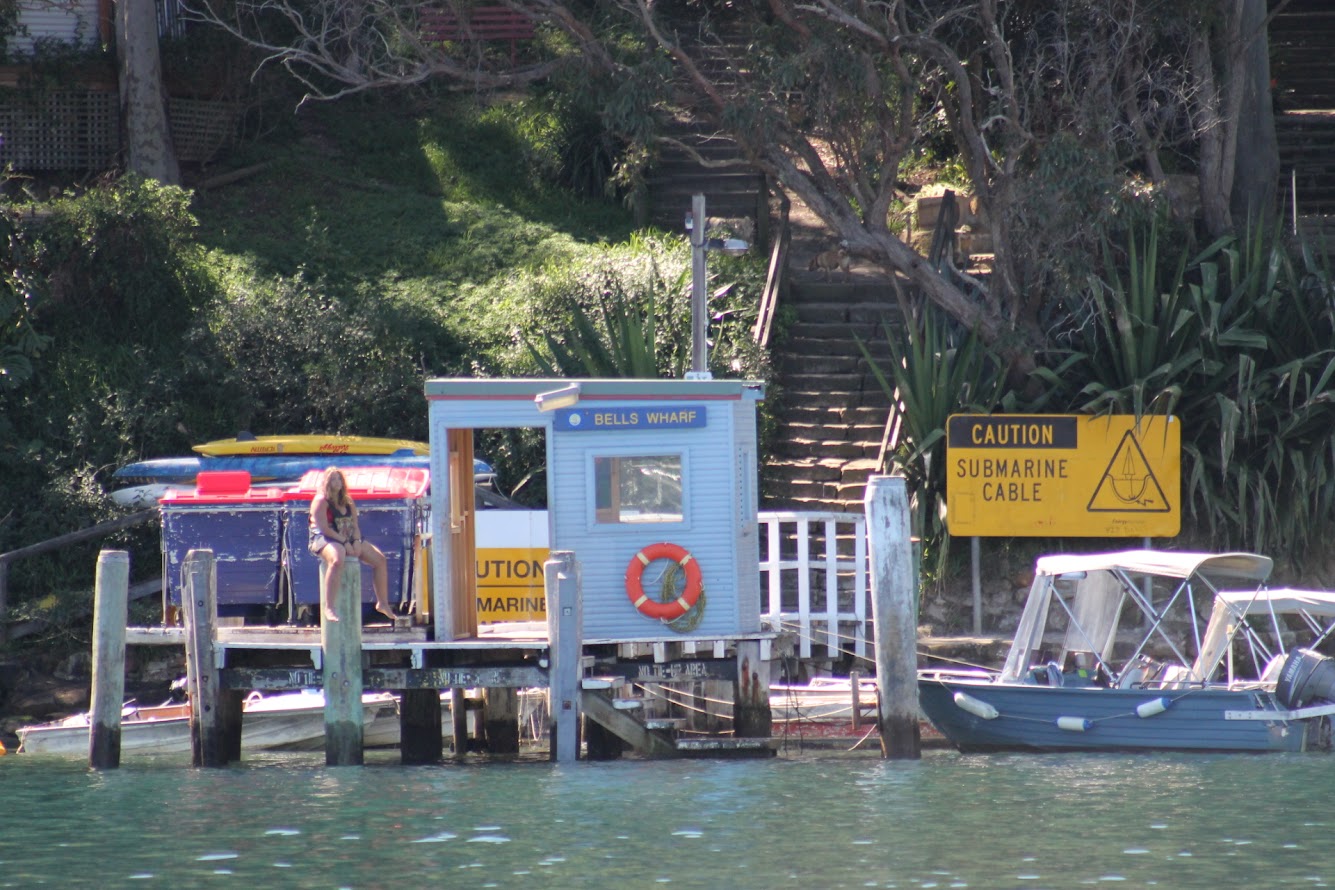
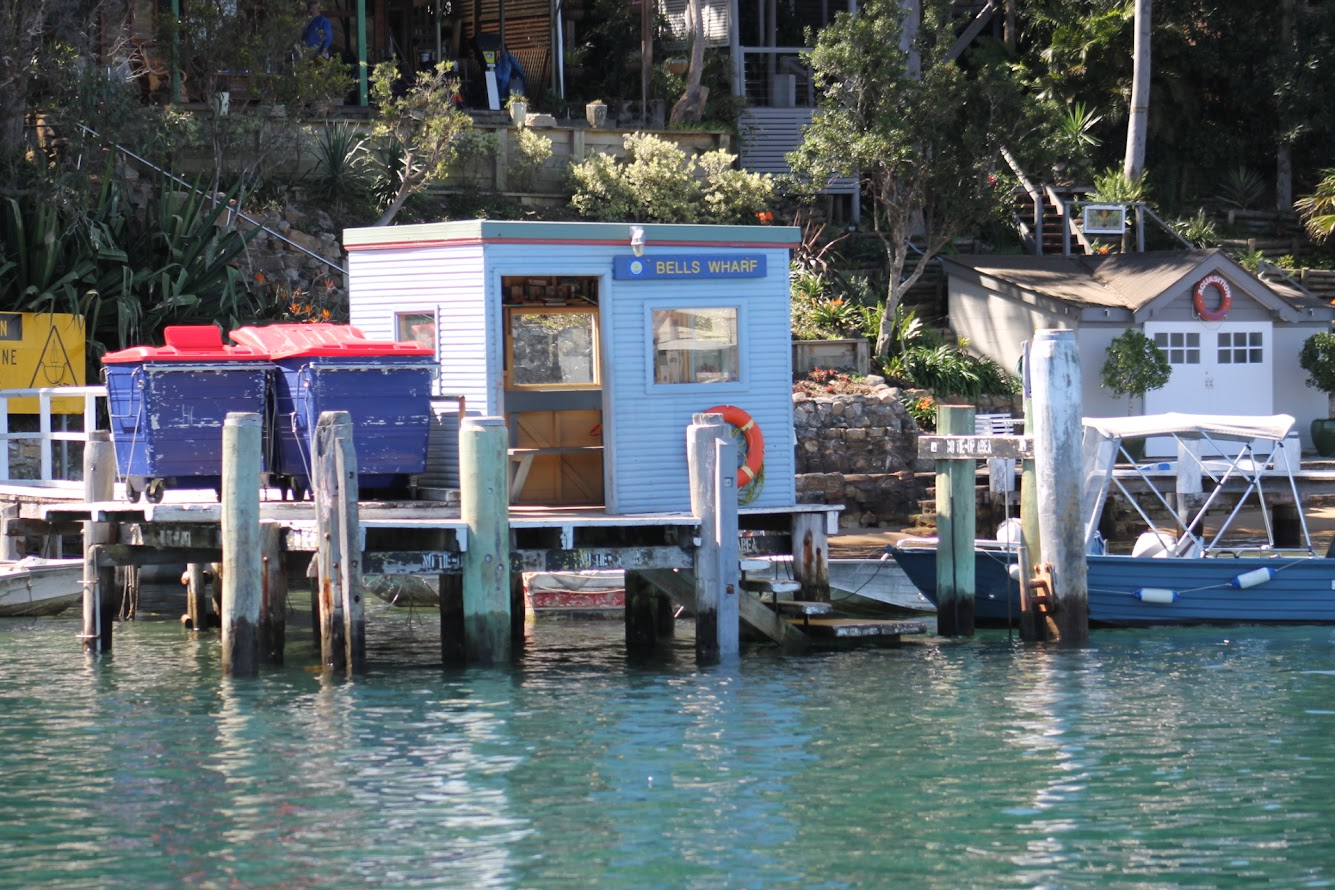


Eastern wharf on September 16, 2015:
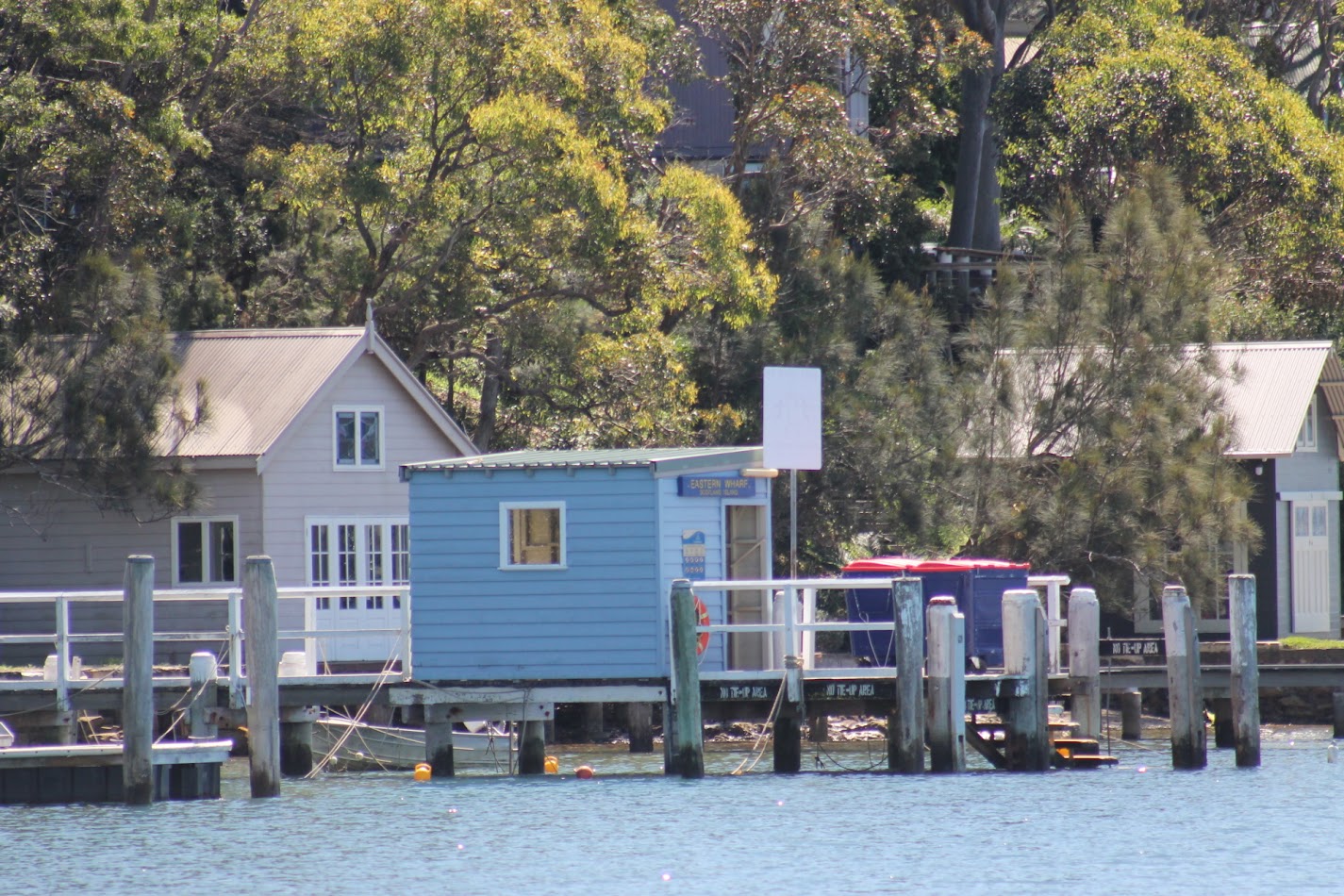
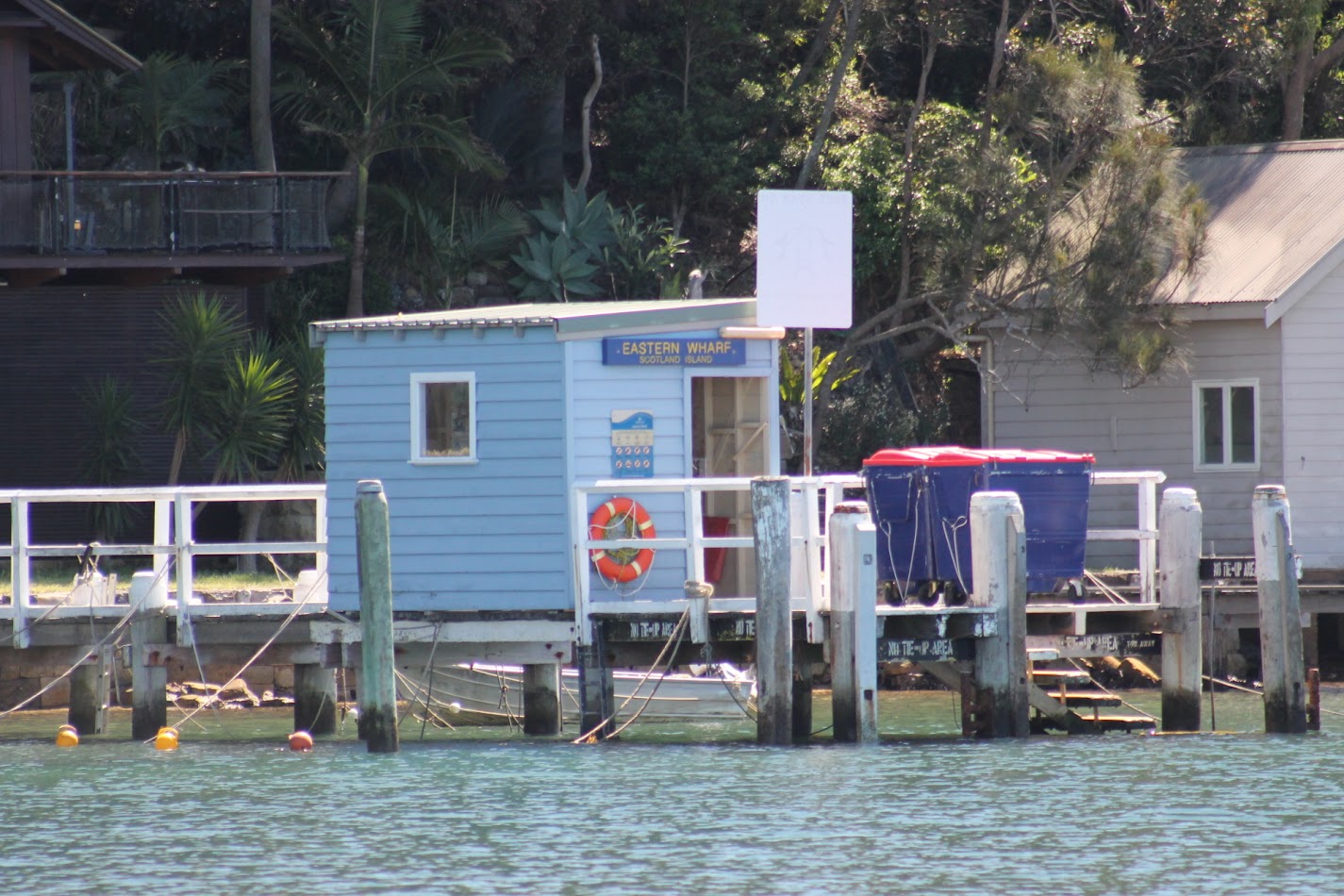
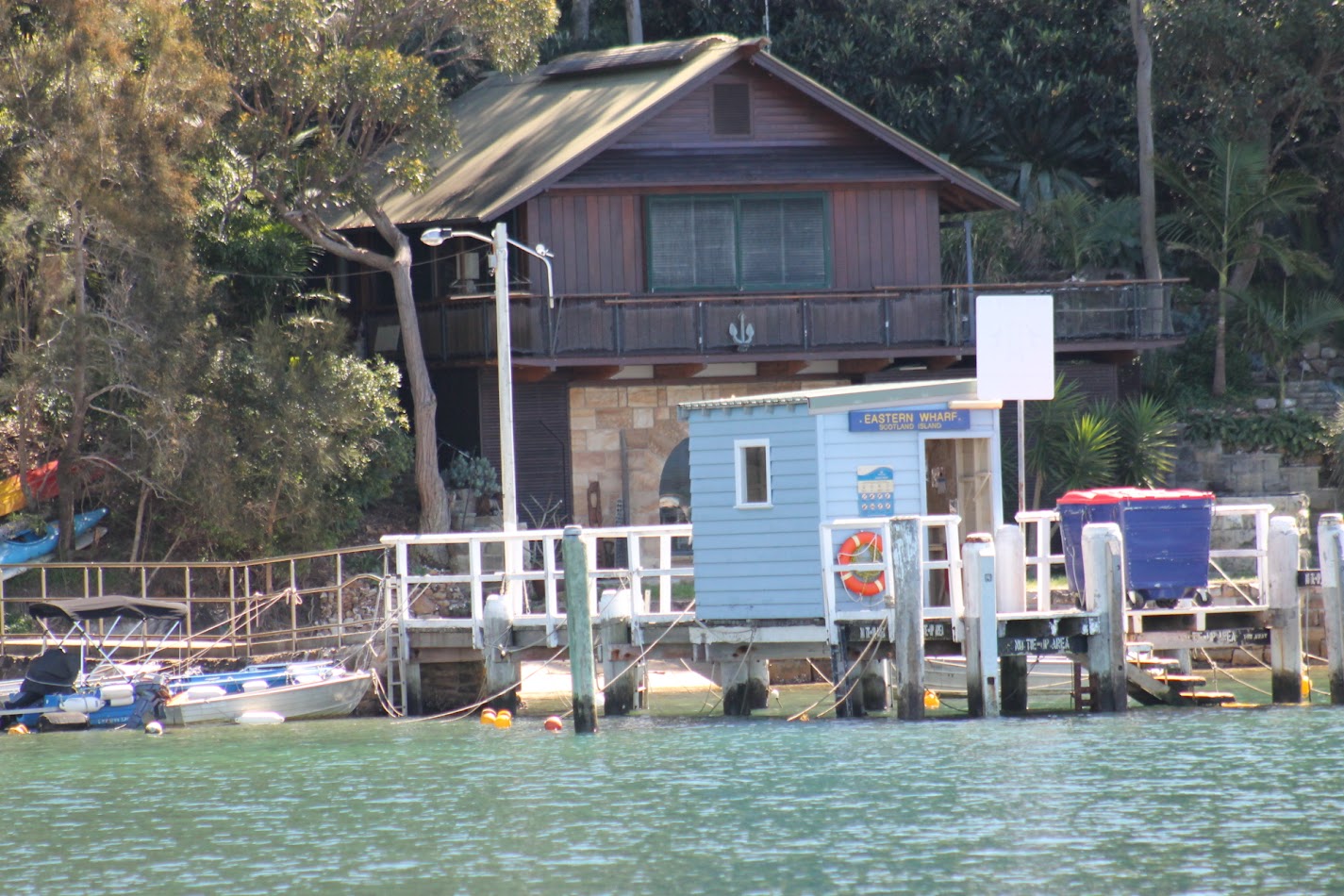
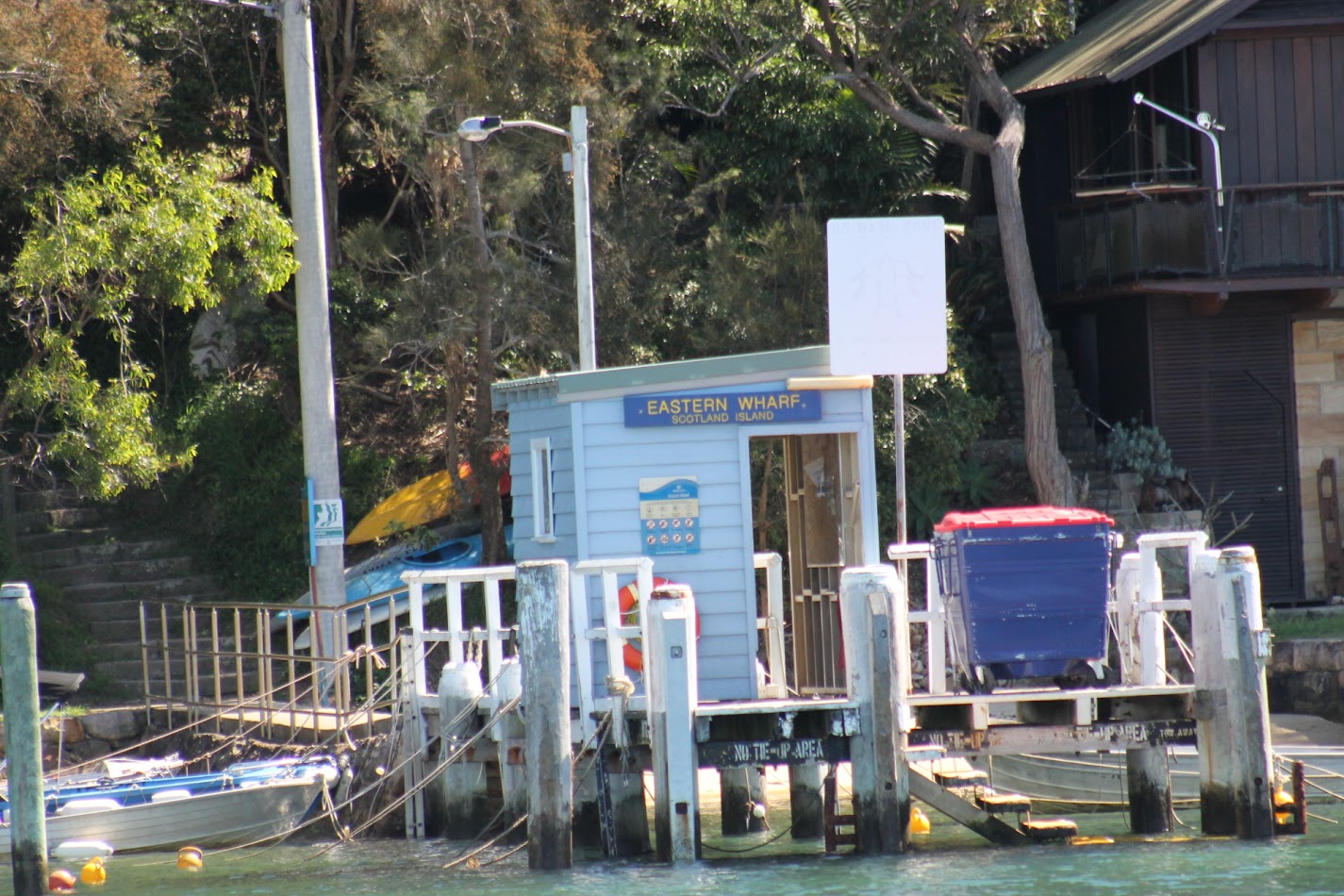
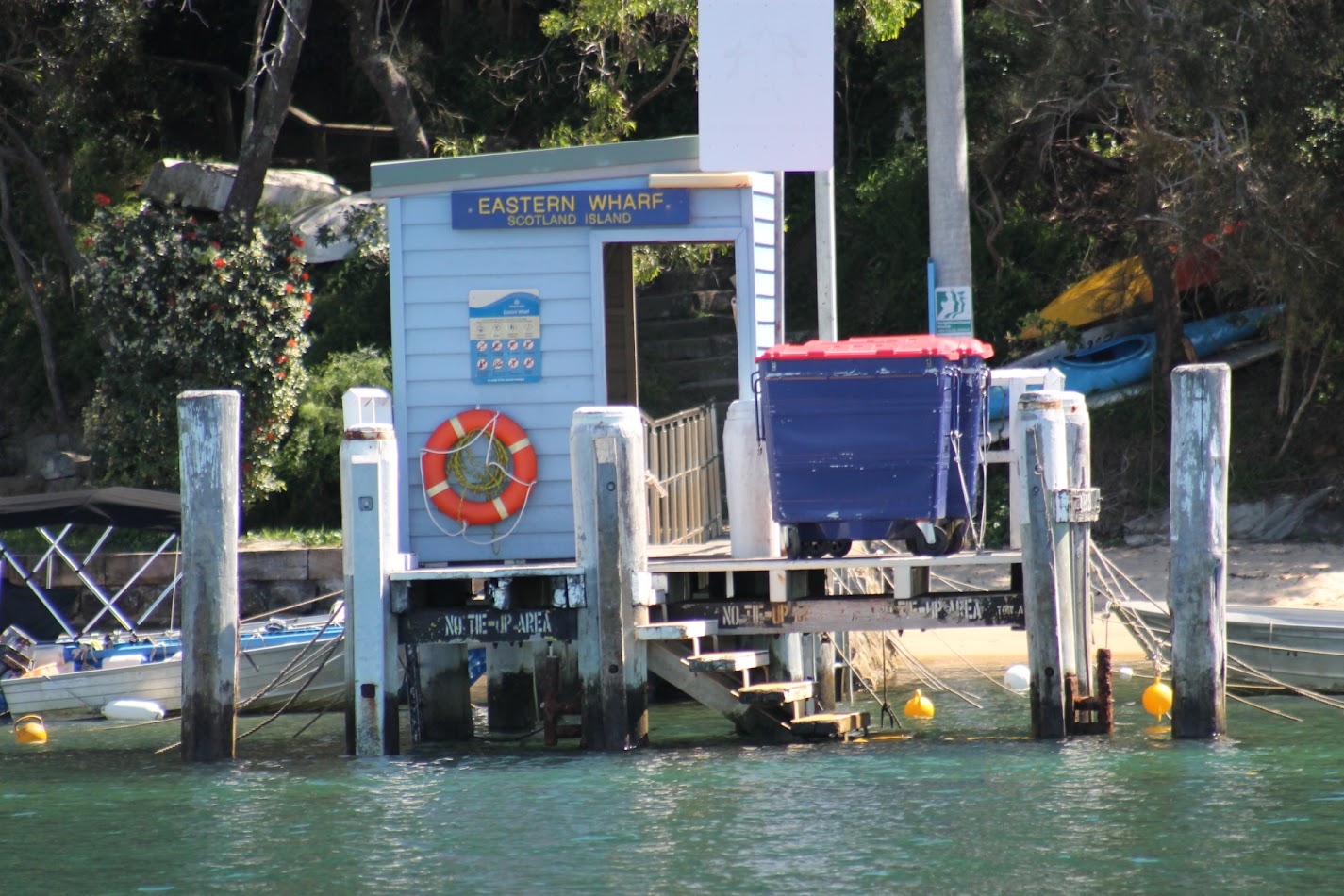
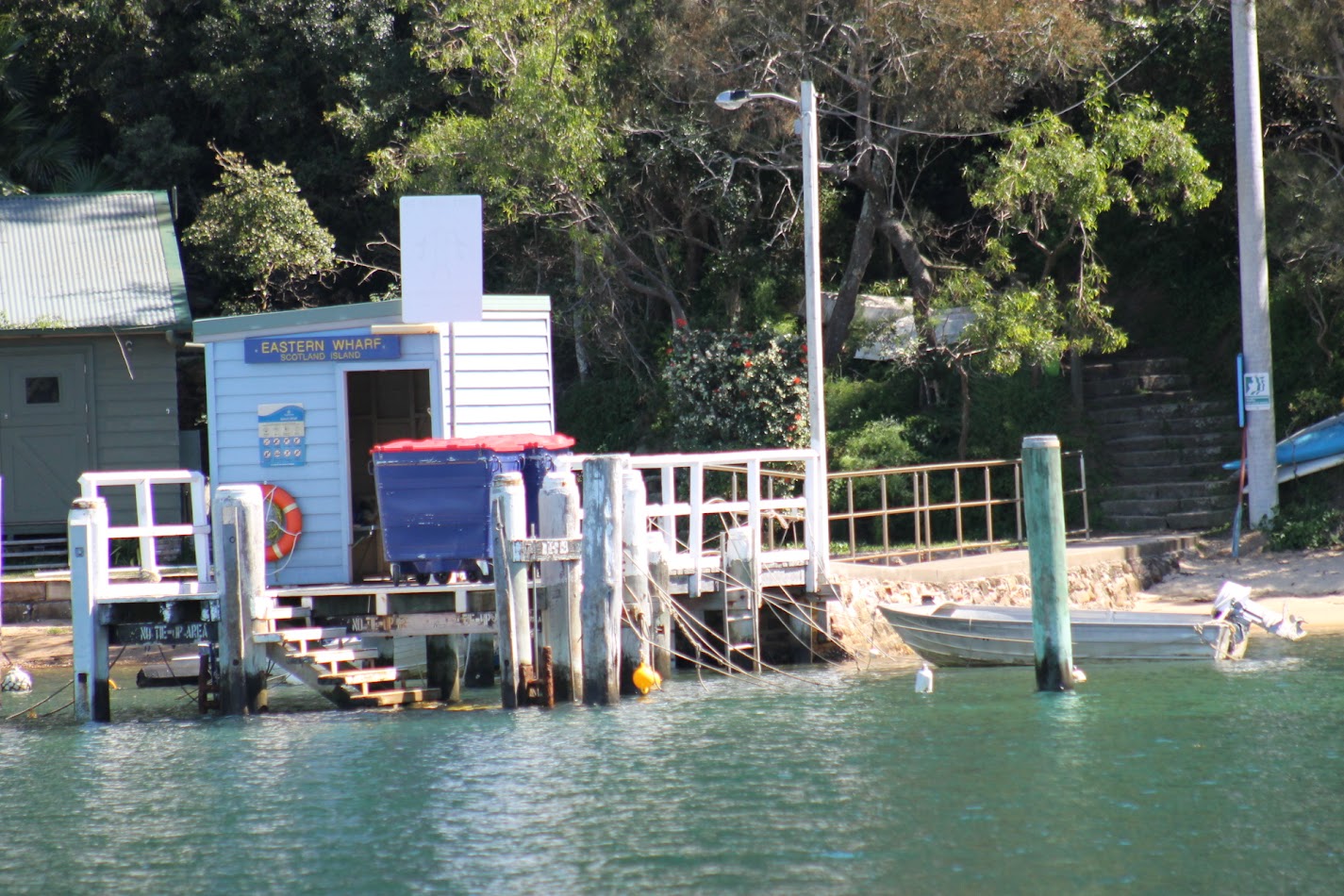
____________________________
South - Carols' Wharf (completed 1978)
Although Scotland Island now had wharves at the south, east, north and west, there was still a wide gap between Bells wharf, opposite Church Point, and Eastern wharf, around the other side of the island, for a growing and permanent residency.
Bob Blackwood recalls a lady living up the hill atop Harold's Reserve on Scotland Island began speaking to residents, and the council, for an access point for residents at this part of the island and extending from Harold's Reserve. She kept going for years, gathering support from residents and then the council.
Her first name was Carol.
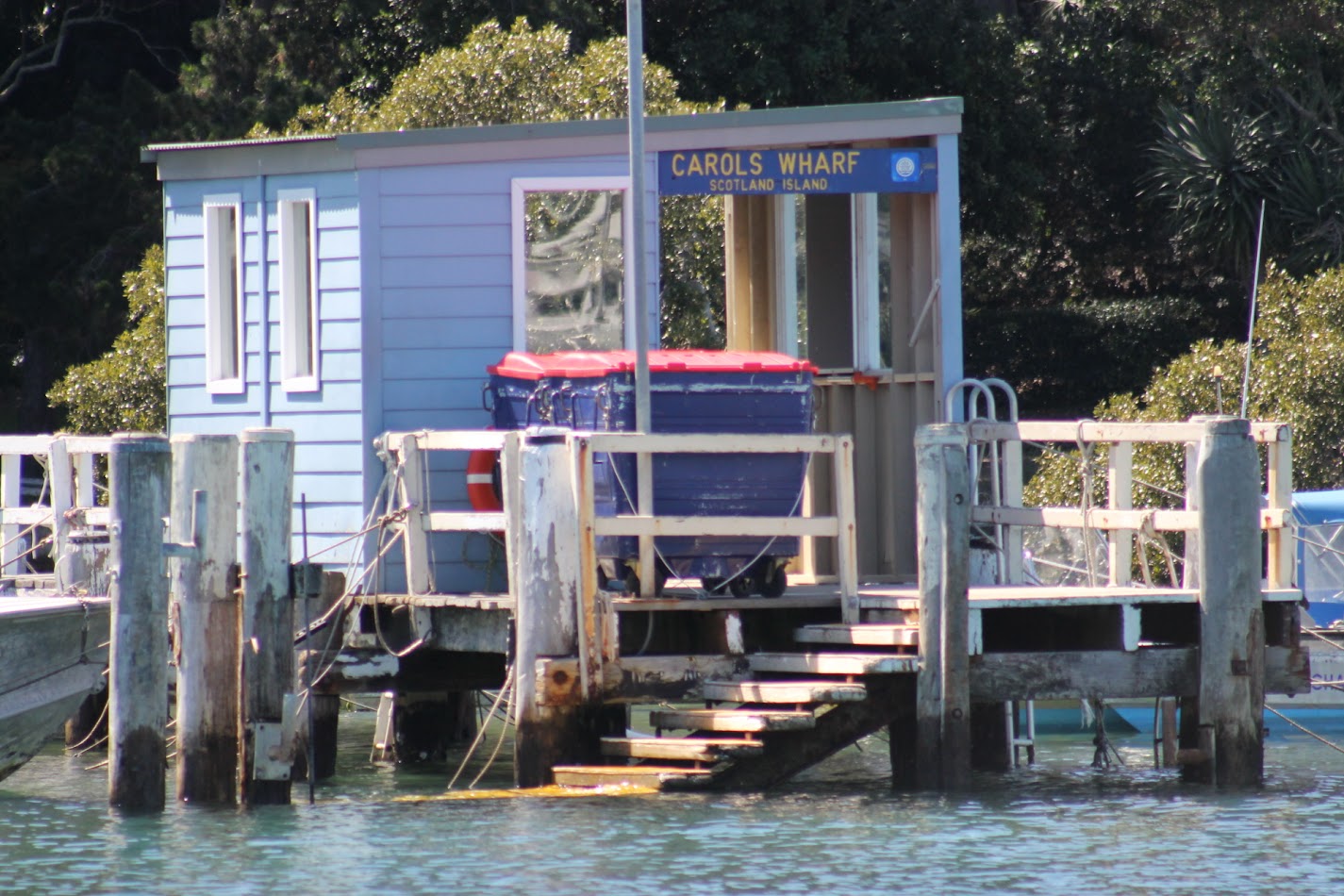
In the February 7, 1977 Warringah Shire Council Meeting, among the Questions and Replies, is:
Cr. Beckman: Could I be advised when tenders will be called for the proposed wharf at Scotland Island? I will seek the information from the Engineer - it is imminent.
At the council meeting held Monday 21st February, 1977, the records show:
8.13 SCOTLAND ISLAND PROPOSED PUBLIC WHARF (file No. 446) AT HAROLD RESERVE Report No 77/40. The preliminary estimate based on the length or adjacent private jetties (50m) was $15,000 in 1975 and an allocation was set at this figure in the 1977 loan funds works programme. The design and final estimate has now been prepared which indicates a final coat of $31,000 for a jetty 2m wide and 100m long as detailed on plan *1.5965. This provides for a draught of 1.0 a at a zero tide. (Low water Indian spring tide, -0.89 m standard date: RECOMMENDATION That (a) Tenders be called for the construction of the wharf as detailed on plan A1.5965. (b) An additional vote be considered when tender prices are known. COMMITTEE'S RECCOMENDATION: That the subject site be inspected by the Committee at a future meeting. COUNCIL'S DECISION (28/2/71): ADOPTED. FURTHER THAT the ‘A’ Riding Councillors also participate in the proposed inspection. (Crs. Carey/Dawson).
The May 16 1977 minutes of meetings record:
6.2 SCOTLAND ISLAND - PROPOSED PUBLIC WHARF (File 446) AT HAROLD RESERVE (Report No.A77/40) The preliminary estimate based on the length of adjacent private jetties (50 in) was $15,000 in 1975 and an allocation was set at this figure in the 1977 loan funds works programme. The design and final estimate has now been prepared which indicates a final cost of $31,000 for a jetty 2m wide and 100m long as detailed on plan A1.5985. This provides for a draught of 1.Qii at a zero tide. (Low water Indian spring tide, -0.89m standard dattmi.) Council's Decision 12.4.77: That the Scotland Island Residents Association be requested to submit further Information to its proposal in respect of location of the jetty.
Letter From the Scotland Island Residents Association 0 The Association wishes to confirm its desire that the proposed new public wharf to be constructed at Scotland Island, should be positioned at Harold Reserve - the south eastern corner of the Island. In all discussions at meetings of the Association and in all submissions to Council regarding this subject. Harold Reserve has always been the suggested site? RECOMMENDATION That (a) Tenders be called for the construction of the wharf as detailed on Plan A1.5986, (b) An additional vote be considered when tender prices are known. That the foregoing recommendation be adopted. COUNCIL'S DECISION (23.5.71): 968 ADOPTED
The August 22nd 1977 Warringah Shire Council Meeting adopted the Item that confirms the Scotland Island wharf that originated in residents expressing what was needed and that council working to meet that.
This is the sole Scotland Island wharf that originated with a council:
SCOTLAND ISLAND WHARF (FILE 446) Re Report No. A77/254 sit) Tenders were recently called for the construction of the public wharf at Harold Reserve, Scotland Island.
The following tender, were received (a) E.R. Notting and Co. Pty. Ltd, Newport $ 47,240 (b) Lane & Thompson, Pittwater $ 29,870 The contract does not include the construction of the approaches to the wharf which was estimated at $3,000; an additional item of $2,000 will need to be provided for extras to the contract should potting ' of the piles be required. The total estimated coat of the wharf will be: i) Contract for wharf construction $ 30,000 ii)Extras to contract 2,000 iii)construction of approaches 3,000 $ 35,000 Available funds $ 15,000 The proposals herein for voting of moneys or for the adjustment of votes, as the case may be, have been concurred with by the Treasurer. RECOMMENDATION (i) That the tender of Lane and Thompson be accepted for the construction of the Harold Reserve Wharf, Scotland Island for the sum of $29,970. (ii)That the matter be referred to the Finance Committee with a recommendation that an additional $20,000 be voted from contingencies for the construction of the wharf. PROCEEDINGS IN BRIEF: The Committee was advised that the tender of Lane & Thompson, Pittwater, was in accordance with Council's specification and close to Council's estimated cost of $30,000 for the work. At the time of the original estimate and the vote of $15,000. it was intended that the wharf be only half the now proposed length. COMMITEE'S RECOMMENDATION: That the foregoing recommendation be adopted. COUNCIL'S DECISION: Adopted
The Warringah Shire Council Finance Committee Meeting, Wednesday 24th August, 1977. Report records:
FILE 446. 1.2 SCOTLAND ISLAND WHARF. The Works Committee 22/8/77 considered the following report:*;Tenders were recently called for the construction of the public wharf at Harold Reserve, Scotland Island. The following tenders were received:(a) E. R. Notting and Co. Pty. Ltd., Newport $47,240 (b) Lane & Thompson, Pittwater $29,870 *;The contract does not include the construction of the approaches to the wharf which was estimated at $3,000; an additional Item of $20,000 will need to be provided for extras to the contract should potting of the piles be required. *;The total estimated cost of the wharf will be:
(I) Contract for wharf construction $30,000
(ii) Extras to contract 2.000
(iii)Construction of approaches 3,000
$35,000
Available funds $15,000.
*;The proposals herein for voting of moneys or for the adjustment of votes, as the case may be, have been concurred with by the Treasurer. The Works Committee was advised that the tender of Lane & Thompson, Pittwater was in accordance with Council's specifications and close to Council's estimated cost of $30,000 for the works. At the time of the original estimate and the vote of $15,000 it was envisaged that the wharf be only half the now proposed length.
The Works Committee recommended ;That the tender of Lane and Thompson be accepted for the construction of the Harold Reserve Wharf, Scotland Island for the sum of $29,870.; AND DIRECTED ;That the matter be referred to the Finance Committee with a recommendation that an additional $20,000 be voted from contingencies for the construction of the wharf.; Submitted for Committee's recommendation. COMMITTEE'S RECOMMENDATION: That the tender of Lane and Thompson be accepted for the construction of the Harold Reserve Wharf, Scotland Island for the sun of $29,870 and that an additional $2,000 be voted for contingencies for the construction of the wharf. COUNCIL'S DECISION (29.8.77): 1520 ADOPTED C. Dawson/Burg:
By the end of 1990 a rebuild/realignment of Eastern Wharf, and the crown waters required, is listed in the NSW Gazette Notices and describes:
DRAFT ASSESSMENT OF LANDS AT SCOTLAND ISLAND, PITTWATER UNDER PART 3 OF THE CROWN LANDS ACT, 1989 AND THE CROWN LANDS REGULATION 1990.
The Minister for Tourism, Lands and Forests has prepared a draft land assessment for Crown lands situated at Scotland Island. Pitt water being the land described hereunder.
Inspection of this draft assessment can be made at the Metropolitan Lands Office, 22 Main Street, Blacktown; Department of Lands, 23-33 Bridge Street, Sydney and Dee Why Civic Centre, Pitt water Road, Dee Why* during normal business hours.
Representations are invited from the public on the draft assessment. These must be made in writing for a period of 28 days from the date of this notice and should be forwarded to the Regional Director, Metropolitan Lands Office. P. O. Box 878, Blaektown, 2148.
Garry West, M.P.. Minister for Tourism. Lands and Forests.
Sydney, 30th November, 1990
Description Parish -Narrabeen
County - Cumberland
Locality - Scotland Island Shire - Warringah
Land District - Metropolitan
About 75.5 square metres of Crown land below mean high water mark of Pitt water fronting a public road known as Lowanna Street for the purpose of reconstruction and realignment of a public wharf known as "Eastern Wharf". MN83H634 DRAFT ASSESSMENT OF LANDS AT SCOTLAND ISLAND, PITTWATER UNDER PART 3 OF THE CROWN LANDS ACT, 1989 AND THE CROWN LANDS REGULATION 1990. (1990, November 30). Government Gazette of the State of New South Wales (Sydney, NSW : 1901 - 2001), p. 10517. Retrieved from http://nla.gov.au/nla.news-article231908196
Lane and Thompson were Gordon Thompson and Bruce Lane. They would go on to fulfil contracts for maintenance or complete rebuilds of Pittwater wharves for decades. One example is recorded in the Minutes of WSC Meeting held April 24 1992:
Finance & Personnel Committee Meeting 05/05/92 A.07 - WEST PITTWATER BUSH FIRE BRIGADE STATION - LOVETT BAY. Project: Replacement of existing shed. Design: In house. Funding: Council - $0.00 Organisation/Grant - $0.00 Status: Funding not approved for 1992. Repair work to rectify storm damage completed. SECTION R - PROJECTS CURRENTLY UNDER CONSTRUCTION 8.07 - PITTWATER WHARVES - JOB 4579J. P Project: Repairs and replacement of existing wharves - Scotland Island and Western Foreshores. (Bells, Eastern, Tennis Court and Elvina Bay South). Design: Jambin Pty Ltd. Contractor: Lane & Thompson. Funding: Council - $71, 863.00 Organisation/Grant - $69, 405.00 Status: Bells Wharf completed. Tennis Court Wharf completed. Elvina Bay south to commence 29.4.92. Total project 85% completed.
Worth remembering the WSC's work in 1991 to have the state government formally recognise public wharves they and residents through rates paid are expected to maintain, and replace once they'd gone beyond that, are used by more than just the local public and secure grants for their repairs or replacements.
That record stated:
The Local Government Act also has several other Ordinances relating to wharves most notably Ordinance 35(A) which applies to public wharves described in that Ordinance of which the following are included in Warringah Shire:-
A. Church Point Wharf
B. Bayview Wharf
C. Newport Wharf
D. Clareville Wharf (Paradise beach? – Clareville was demolished and removed in 1935)
E. Coal & Candle Creek
F. Palm Beach Wharf I.
G. Salt Pan Wharf
H. Taylor's Point Wharf
I. Great Mackarat Beach Wharf
J.4 Wharves on Scotland Island (being Tennis Court Wharf, Eastern Wharf, Bells Wharf & Carols Wharf)
K. Careel Bay Wharf ie 14 of the 28 wharves.
Ordinance 35A appears to be primarily concerned with the Council's powers to regulate wharves principally used for industrial activities involving the dispatch and unloading of cargoes. Warringah Shire is the only metropolitan Council included in Ordinance 35A and a perusal of the others included in that Ordinance would seem to suggest that those wharves have a substantial or primary cargo application as opposed to passenger embarkation and/or general recreation usage.
It is equivocal therefore whether the wharves in Warringah Shire should be included in Ordinance 35A and whether any special benefit is derived by inclusion of the Council's wharves in that Ordinance. However it would appear that the Metropolitan Lands Office places some significance on the inclusion of wharves in this Ordinance in as much as up until this time the Office has considered that wharves included in Ordinance 35A, being public wharves, require no separate or distinct tenure for the Crown Land they occupy.
The Metropolitan Lands Office has objected to the commuter wharf and cargo wharf at Church Point being included in Ordinance 35A for reason that they are not public wharves, being set aside exclusively for the use of Scotland Island and Western Foreshore residents. Such an interpretation would appear to be a very narrow interpretation of Ordinance 35A in as much as this Ordinance appears to allow the Council to determine the purposes for which wharves contained within Ordinance SSA may be used, how they will be used and the order they will be used ie to permit some exclusivity of use.
Further the powers permitted by Ordinance 35A would appear to be available to the Council through the provisions of Part XVI of the Local Government Act in as much as Section 415 permits Council to have full power to order and direct and do all things necessary in relation to the control of the berthing or removal of any vessel, the discharging and loading of cargo, the storage and removal of goods and generally in relation to the control of such wharf and any appliances connected therewith. - PAGE Minutes Ordinary Meeting - Warringah Shire Council 30th April 1991
(Item cont)
What is unclear however is whether the Council is separately required to have a tenure arrangement with the Metropolitan Lands Office in respect of the Crown Land occupied by such a wharf. For instance whilst Section 414(1A) of the Act appears to permit the Council to declare a wharf constructed by it to be a public wharf, Section 415 implies that whether or not a wharf has been appointed a public wharf under any Act Council may collect rates prescribed by an Ordinance. ie Section 415 appears to place work for Ordinance 35 by permitting the Council to charge dues in respect of those public wharves.
However the problem with that interpretation is that Ordinance 35 does not fix charges in relation to those public wharves unlike for instance Ordinances 35(C) - 35(T) concerning wharves within certain specific Local Government areas which do permit the collection of fees which may be fixed by the Council. There may be no benefit to Warringah Shire in the application of Ordinance 35(A) of the Local Government Act and the Council may be best to administer its wharves pursuant to the provisions of Section 414(1A) and 415 of the Local Government Act and Ordinance 35. It would appear appropriate that the Council seek legal advice on the effect of Ordinance 35(A), if any, to wharves in Warringah Shire; whether Section 414 and 415 and Ordinance 35 of the Local Government Act are sufficient to allow Council to regulate and administer its wharves and whether the Council requires any separate tenure from the Metropolitan Lands Office in relation to wharves within Warringah Shire.
SPECIFIC WHARVES
In 1985 the Council communicated with the Department of Local Government Act seeking to have Ordinance 35(A) amended to apply to all wharves in the Council's area. The Department of Local Government advised Council that the Metropolitan Lands Office objected to the status of a public wharf being given to the cargo and commuter wharf at Church Point for reason that these wharves were not available to the public and only available to residents of Scotland Island and the Western Foreshore. Further the Department advised Council that its request had been referred to the National Parks & Wildlife Services in respect of the Cottage Point Wharf which is wholly located within Kuring-gai Chase National Park. For some reason both the Department of Local Government and Council never pursued this original request to any finality. A number of issues need resolution: PAGE Minutes Ordinary Meeting - Warringah Shire Council 30th April 1991
(Item cont)
Other options associated with the administration of this wharf would be to appropriately fence the wharf such that operations outside the recommended hours of operation could only be permitted to commercial operators whose access to this wharf is required to coincide with certain tides but which operations would clearly involve an onus on the operator to ensure that the operations were conducted in such a way as to minimise their impact to surrounding residents ie access to the wharf for normal and public operations would be limited to the time of 7.00am to 6.00pm as proposed in the regulations but commercial operators who purchase a key to the wharf would be permitted extended hours for their operation on the basis that those operations did not cause intrusive noise to surrounding residents. In the event that any particular operator breached the agreement then the bond paid in respect of their key purchase would be forfeited to Council and their continued access to the wharf at extended times denied.
E. The Council may wish to consider whether all the remaining wharves are necessary. These wharves represent a considerable cost to Council as witnessed by the recent refurbishment cost associated with wharves on Scotland Island and the Elvina Bay South Wharf. Investigations are currently being undertaken into major maintenance required at the Palm Beach Wharf where substantial deterioration of the timber piles is apparent. It may be that the Council should seek to reduce the number of public wharves in Pittwater whose major function appears to be to provide for recreation boating and commercial boating operations and not for any commuter relation functions. One possibility is that the Council could either reduce the number of wharves or seek a direct commitment to funding from other Recreational Boating Authorities including the MSB whereby a percentage of mooring fees are paid for the capital replacement cost associated with wharves.
F. Increasingly the Council is being requested to increase the provision of services associated with public wharf, including lighting, fresh water, garbage receptacles, storage and shelter facilities. Some of these facilities should appropriately attract a fee if an effective - policing and enforcement arrangement can be put in place. Enforcement is the responsibility of Council's wharfinger, but is predetermined by Council:- (a)Accepting the principle of user pays in respect of commuter operations at these wharves. (b)The adoption of appropriate regulations. (c)The employment of appropriate staff and vehicle to enable regular monitoring - this was rejected as an expanded level of the 1991 estimates. PAGE Minutes Ordinary Meeting - Warringah Shire Council 30th April 1991 ( General Manager/Shire Clerk
Finance and Personnel Committee Meeting, 30th . April 1991, (Item cont) RECOMMENDATION OF DEPUTY SHIRE CLERK - CORPORATE SERVICES '
1.. That the Council instruct its solicitors to advise on:- A. The Council's legal obligation to obtain, formal tenure associated with the land occupied by public wharves. B.. The appropriate provisions of the Act for the adoption and enforcement of regulations associated with public wharves and whether Ordinance 35A has any significance to wharves in Warringah Shire and particularly whether all public wharves should be included. 2. That the Council enquire from the National Parks & Wildlife Services its willingness to accept the responsibility for provision and ongoing maintenance of wharves at Cottage Point, Illawong Bay and Morning Bay, and failing that Service's acceptance, a further report be submitted to the Council addressing the closure and removal of these wharves. 3. That the Council establish a Committee of Scotland Island and Western Foreshore Resident Associations with a view to the establishment of a body of local residents to administer and operate the commuter wharf at Church Point. 4.That the Council adopt the regulations appended to the report (Appendix II) associated with the operation of the cargo wharf and establish discussions with commercial water transport operators as to the feasibility of a bonded key system to enable extended commercial operations of the cargo wharf, Church Point. 5.That the future provision of wharves in Pittwater and the adoption of regulations associated with those wharves including the payment of fees associated with commuter vessel storage and commercial operations, be investigated and a further report be brought forward to the Council. RECOMMENDED TO COUNCIL by the General Manager/Shire Clerk PACE Minutes Ordinary Meeting - Warringah Shire Council 30th April 1991
COUNCIL DECISION
Corporate Services. Finance and Personnel Committee Meeting 30th April 1991 7 12 Attachment; BP Ref 117 1. That the Council instruct its solicitors to advise on:_A. The Council's obligation to obtain formal tenure associated with the land occupied by public wharves. B. The appropriate provisions of the Act for the adoption and enforcement of regulations associated with public wharves and whether Ordinance 35A has any significance to wharves in Warringah Shire and particularly whether all public wharves should be included. 2.That the Council enquire from the National Parks & Wildlife Services its willingness to accept the responsibility for provision and ongoing maintenance of wharves at Cottage Point, Illawong Bay and Morning Bay, and failing acceptance, a further report be brought forward addressing the closure and removal of tghese 3.That before resolving Recommending the matter to the Church Point L6. That the Council adopt the regulation (Appendix II) associated with the wharf and establish discussions with commercial operators as to the feasibility of a LO to enable extended commercial operations to the wharf, Church Point. 5. That the future provision of wharves in Pittwater and the adoption of regulations associated with those wharves including the payment of fees associated with commuter vessel storage and commercial operations, be investigated and a further report be brought forward to the Council. (Crs Dunn/Beckman) PAGE Minutes Ordinary Meeting Warringah Shire Council 30th April 1991
A Special Meeting held on 7th of May 1991 records:
WARRINGAH SHIRE COUNCIL PUBLIC WHARVES COUNCIL DECISION 423
1. That the Council instruct its solicitors to advise on:-
A. The Council's legal obligation to obtain formal tenure associated with the land occupied by public wharves. B. The appropriate provisions of the Act for the adoption and enforcement of regulations associated with public wharves And whether Ordinance 35A has any significance to wharves in Warringah Shire and particularly whether all public wharves should be included.
2.That the Council enquire from the National Parks & Wildlife Services its willingness to accept the responsibility for provision and ongoing maintenance of wharves at Cottage Point, Illawong Bay and Morning Bay, and failing that Service's acceptance, a further report be submitted to the Council addressing the closure and removal of these wharves:
3.That before resolving Recommendation Council first refer the matter to the Church Point Liaison Committee.
4.That the Council adopt the regulations appended to the report (Appendix II) associated with the operation of the cargo wharf and establish discussions with commercial water transport operators as to the feasibility of a bonded key system to enable extended commercial operations of the cargo wharf, Church Point. Minutes Special Meeting - Warringah Shire Council May 7 1991
In the Meeting held on June 25th 1991 the council made history! - details are:
The Corporate Services, Finance and Personnel Committee on the 18th December 1990 considered a report Concerning major maintenance and refurbishment to Bells Wharf, Tennis Court Wharf and Elvina Bay South Wharf. The Council resolved to make application to the NSW Department of Public Works for funding pursuant to the program with an estimated total cost of this work of $138,810. This program is on a 50/50 cost share basis. By letter dated the 23rd May 1990 Mr Jim Longley, MP Member for Pittwater advised Council that the Deputy Premier and Minister for Public Works had approved the Council's submission for financial assistance up to a maximum of $69,405.
The conditions of this grant are that all work be carried out by contract after the calling of open tenders and that the Council advise the Regional Engineer, Metropolitan North, of its acceptance of this subsidy. Further conditions of the grant involved a maximum period of 8 months for the completion of work and other conditions concerning the payment of money and supervision of the project. A further condition requires that, any revenue collected by way of charge for the use of these wharves shall not exceed the cost of maintenance and that such charge is applied equally to residents and non residents of the Warringah Shire Council.
The work proposed to be undertaken to these wharves is major maintenance work that is routinely required to wharves by virtue of the deterioration of these facilities in this marine environment. It does not suggest that the Council has neglected the wharves in terms of their maintenance nor that the wharves are in any way dangerous or dilapidated.
This grant is the first occasion on which the State Government has assisted in the provision of wharf infrastructure for recreational boating interests in Warringah Shire. Until now the burden for the provision and maintenance of these wharves has rested solely with the Council. The tender for the work has already been advertised and tenders will be reported in due course. The Council advise the Regional Engineer Metropolitan North of the NSW Public Works Department of its acceptance of the grant for the reconstruction upgrade of Bells Wharf, Tennis Court Wharf and Elvina Bay South Wharf pursuant to the NSW Waterways Infrastructure Development Program. RECOMMENDED TO COUNCIL by General Manager/Shire Clerk
This has grown through different mechanisms and allocations in the decades since, with the incumbent government focussed on providing wharves that allow improved access and usability for everyone and allocating funding for Projects that ensure disability standards compliance for Accessible Public Transport. Although millions have been allocated under the State Government's - 46 projects funded under the $23 million Boating Infrastructure for Communities Grant Program - and 3 local much-needed upgrades (and rebuild in the case of Bayview wharf), the choice of some products being chosen, which will pollute the estuary and surrounds with microplastics, killing what is in the water and wildlife, and selected due to their cheaper cost, attest to the rising costs of maintaining and replacing this vital infrastructure for an aquatic community and its millions of visitors.
It was expensive in 1924 and a hundred years on it has become prohibitively expensive. The Bells rebuild of 1991 was followed by the 2023 completion of a wharves at Bells and Carols, with the securing over a million once more in grants, equally met by ratepayers, for those upgrades. At the same time, Bayview wharf had been neglected to the point where it had collapsed, while the baths at the same place, the only safe accessible swimming spot for much of that side of Pittwater - Church Point to Bayview - had been neglected for over a decade and still won't be usable for this coming Summer.
This high cost means residents expect high-quality materials and non-toxic, non-pollutant products to be used. Correspondence and calls to the news service have stated that while cutting expenses by using cheaper products is efficient for saving funds, it can divert time and energy and disregards such actions have a much greater long-term financial and environmental impact that someone will be picking up the tab for, as well as degrading the pristine environment that ha attracted the funding in the first place.
See: Brilliant News: Bayview - Mackerel - Currawong Wharves Allocated $3,173,117 for Upgrades under Boating Infrastructure for Communities Grant Program - August 2025 and Scotland Island Wharf Upgrades For Bells and Carols Wharves - September 2021
Also available August 2025 report: Community Concerned Over the Increase of Plastic Products Being Used by the Northern Beaches Council for Installations in Pittwater's Environment and Currawong Wharf Upgrade: Draft REF Open for Feedback Closes October 6 2025 and Bayview Public Wharf + Baths Restoration: Feedback on Draft Documents now Open - Closed October 23 2025 and Bayview Public Wharf Gone; Public Baths not safe - Salt Pan Public Wharf Going - December 2024
Imagine where the community would be if the WSC hadn't shifted the narrative on who should also be included in those who contribute to the costs back in 1990 and 1991. More on this in: Bayview Public Wharf and Baths: Some History
The statement recorded in the June 1991 meeting as ''This grant is the first occasion on which the State Government has assisted in the provision of wharf infrastructure for recreational boating interests in Warringah Shire. Until now the burden for the provision and maintenance of these wharves has rested solely with the Council'' is not accurate. Bayview, Newport, Clareville and Station Beach wharves in Pittwater were provided by the State Government initially, and Clareville neglected under the WSC to the point where it was deemed defunct in 1935. Lovett Bay's first one and The Basin were through the Ku-Ring-Gai Chase Trust, and all the others were afforded by developers as a condition of approval of subdivisions.
In fact, Halls Wharf at the eastern end of Little Lovett Bay and alongside Woods' Point, in operation by December 1952, and Carol's wharf on the island, are among the few that originated through council meeting residents requests, and signalled a change from when the council could no longer get the developers to pay in full for everything.
That developer-contribution to WSC's community and town-planning vision, which accounts for most of the pubic parks today's residents still enjoy, was followed by the cash-strapped 'no money for that' 1930's financial depression years, the 'everything into the war effort' World War Two years, including steel wiring to rethread and make safe local baths, and the post-war shortages of all materials that resulted from supplies being diverted to that conflict. These were also decades when repairs were, as the records show, were expected to be met by rate-paying residents living alongside these public wharves, and when measuring how many non-residents were still using them to access public areas - the National Park for example - did not fall within the council remit to back up the claim of its early 1990's result.
There had been full replacement and rebuilds of some of the more exposed wharves between December 1952 and the Winter of 1977, but they were already in place vital infrastructure. That council's success in gaining funding from the state government for the first time, had followed discussions about not being responsible for the maintenance of any of that wharf infrastructure and even recording a discussion of abandoning doing so by 1991.
The new wharf at Harold's Reserve wasn't the only request regarding commuters and Scotland Island wharves in mid-1977. There were also changes to Church Point parks for cars, and the first commitments to a Community Hall for the island:
The meeting held April 12 1977 records:
Beckman ctRwfl: PROPOSED COMMUNITY CENTRE HALL, SCOTLAND ISLAND (File 82/200) QUESTION: 'Could a report be made to the next Reserves Committee on problems concerning the building of the proposed community centre hall at Scotland Island V ANSWER: *;I will ask for that to be done.'
In the records of the meeting held April 17 1977:
APPLICATIONS APPROVED/IEFUSED UNDER AUTHORITY DELEGATED TO TOWN PLANNER Period: 16.3.77 to 5.+.77. APPROVALS: Land Board Office: a) Slip. Lot 68, D.P.12749, Florence Terrace, Scotland Island. (Botham). b) Consent 79/48
Report to: Reserves Committee Meeting, Monday, 9th May, 1977 (1.17 continued) 4. such corner is a long-standing problem which merits an on-site inspection by the Reserves Committee. Comments by the Scotland Island Progress Association (Endorsed by the Western Shores Progress Association): 1. The Association adopts the plan 2. That provision be made for retaining the present trees and, if possible, the planting of additional trees and shrubs 3. The problem of sufficient car parking space for our residents will not be really solved until the boat launching ramps are dismantled or closed and that this should be carried out following completion of ramps at the Pittwater Quay area. RCIIENDATION: That Plan Al-5877A be adopted and the extension of the Church Point Car Park to maximise parking bays for the northern end of the parking area, at an estimated cost of $12,540, be listed for consideration for inclusion in a future Parks & Reserves Improvement Programme. COMMITTEE' S RECOMMENDATION: That the foregoing recommendation be adopted, but taking into consideration the Department of Main Roads proposed new road alignment. COUNCIL'S DECISION (23/5/71): 94 ADOPTED
PROJECTS PROPOSED FOR INCLUSION IN THE FUTURE WORKS LEDGER _NORTHERN DISTRICT - Progressive Provisional 9 Number Description of Project Estimate a
34 (File 446) Bennett's Wharf, Coasters Retreat o Installation of a second flight of steps at Bennett's Wharf, Coasters Retreat Note: The ferry moors across the existing flight of steps each night, so that the second flight of steps is requested by residents in case of emergency $5,300
35 (File 446) Mooring Facilities _Tennis Court Wharf, Scotland Island Provision of a shark proof fence and mooring facilities on the south-western side of Tennis Court Baths, Scotland Island as requested by the Scotland Island Residents Association $6,000
36 (File ESF.4481) a Footpath Connecting Golf Avenue & Surfview Road Mona Vale Construction of a concrete footpath joining Golf Avenue and Surfview Road, Mona Vale $1,500. Note: At present a gas cable warning strip is exposed and the western boundary fence ' - adjoining No. 60 Golf Avenue is unsupported for a third of its length. Residents' request for permanent stabilisation of the footpath against further erosion Vt C.
37 (File ESF.3987) _Queens Avenue, Avalon (Sec No. 43) **;3 Construction of kerb and gutter along the northern side of Queens Avenue between William Streetand Elvina Avenue $15,000
Extra Reduced Job E.t. Eat. % Vote Vote No. Item Vote Expend. Start Cc. Co,;. Recoin. Recorn. $ $
Scotland Island Wharf 15,000
Church Point Wharf Moorings 2,500
Scotland Island Community Hall 6.000
Sub-Total $ 24,013 – May to August budget minutes 1977
At a Special Meeting held October 5 1977 extra land add-ins to the Scotland Island reserves and parks, some adjacent to the wharves, were to be bought and/or resumed, mafioso style. That record shares:
Matters for discussion with Councils Solicitor (continued) in relation to Item (d) above, (i) that the conference referred to in Council's decision at Ordinary Meeting 29.8.1977, be not held; (ii) that in lieu, Council now seek an urgent deputation to the Minister for Planning and Environment, to be also attended by representatives of the National Parks and Wildlife Service, with a view to ascertaining whether the Minister will approve in principle, a suspension of the planning scheme so as to preclude subdivision of the land at Little Mackeral Beach, but so as to preserve the owners rights to compensation at Residential (a) values in the event of public acquisition of the land. in relation to Item (e) above. it be noted that the Town Planner is preparing a further report for consideration by the Town Planning and Building Committee; * in relation to Item (h) above, it be noted that the Shire Clerk reported that valuations as shown below had been obtained from Weight and Company for the parcels of land indicated - Harold Reserve $ 400 Pathilda Park $540 Catherine Park $1,250 Leahvera Reserve $800 Elizabeth Park $2,250
FURTHER THAT Council offers to acquire the land from the present legal owners for public reserves by transfer for a nominal consideration on the basis of Council meeting all legal and survey costs of the owners; that if the above offer is refused, application be made to the Minister for Local Government for approval for resumption of the land for the purpose of public recreation. * it be noted that the President proposes to arrange an Informal conference involving all Councillors, the Town Planner and his senior staff, for the purpose of discussing planning matters. (Crs. Dawson/Hummerston)
A ''Nominal consideration'' is defined as 'a very small, insignificant amount of money or value exchanged in a contract, such as "$1," to satisfy the legal requirement for consideration. It is a formal, contrived exchange intended to make a gratuitous promise look like a bargain, though modern courts often find sham or nominal consideration to be insufficient to create a legally binding contract'.
The Works Committee meeting, Monday 21st November, 1977 records:
6.15 CHURCH POINT COMMUTER MOORING - SCOTLAND ISLAND PROGRESS ASSOCIATION (FILE 446/11) Report No. N777335 (sit) The Scotland Island Progress Association seeks a 15 metre extension of the public marina which would increase its capacity from 80 boats to 100 allowing 1.5m per boat. The estimated cost in similar construction to the existing is $15,000 based on the original cost in 1972 including the rise in building cost index to date. A sketch plan accompanying the request shows the extension on the Mona Vale and of the marina with a small 1.2m extension in the centre for 5 minute commuter pick ups. The estimated cost is equivalent to $750 per mooring. The extension suggested will encroach into the Permissive Occupancy held by Mitchell Marine Pty. Limited but its usage of the area appears to have declined, the Company's activities being now on the western aids of the subject RECOMEMDATION That (i)The Association's proposals be approved in principle and listed in the future works ledger for consideration for inclusion in a future works programme. (ii)Approval be sought from the Land Board Office for the Council's Permissive Occupancy to be extended eastwards into the old Mitchell Marine Pty. Limited's area. (iii)The Association be advised in terms of (i) and (ii) That this matter be referred to the Standing Committee of the Town Planning & Building Committee, dealing with Western Foreshores, as a matter of urgency and the Scotland Island Progress Association be advised accordingly. COUNCIl'S DECISION (28.11.71): ADOPTED.
The Ordinary Meeting, Monday, 28th November, 1977 records:
2.1 (Conttd.) C. BUILDING & SERVICES. 1. CONSTRUCTION. Work is in progress on mobile caravans, Harbord Beech power boat- shed extension, Bilgola Surf Clubhouse, Civic Centre (shelving in printing room), preparation of Scotland Island wharves for installation of garbage containers, Newport Beach Surf Clubhouse (flooring). Work was completed on Snapperman's Beach (fencing on beach front), Darley Street/Barrenjoey Road (bus shelter), Collaroy Surf Clubhouse, Davidson Bush Fire shed (hose drying pole), B. MAINTENANCE. . Numerous items received attention from plumbers, carpenters, painters and glaziers. RECOMI'IENOAT ION That the foregoing information be noted. 2337 COUNCIL'S DECISION (28.11.7977): ADOPTED
The Ordinary Meeting held on December 19 1977 records the construction of Carol’s wharf has commenced:
2.11 CONTRACT FOR CONSTRUCTION OF SCOTLAND ISLAND WHARF (File 446/02) With Lane & Thompson for construction of the Scotland Island Wharf. RECOMMENDATION: That approval be given for the execution under Seal of documents relating to matters covered by the foregoing Items 2.1 to 2.11 Inclusive. COUNCIL'S DECISION (19.12.77): ADOPTED.
CONSTRUCTION. Work is in progress on Mona Vale Surf Clubhouse; Narrabeen Surf Clubhouse; Harold Reserve, Scotland lsland - wharf; mobile caravans. Work use completed on Avalon Surf Clubhouse; preparation of Scotland Island wharves for installation of garbage containers and installation of same; Civic Centres (alteration of desks and mounting of maps in Health & Being Department and additional shelving in print room); North Narrabeen Surf Club caretaker's flat; Newport Surf Clubhouse and Long Reef Surf Clubhouse. /Cont'd.)
ORDINARY MEETING _PRECIS OF CORRESPONDENCE 19.12.77 3.0 Category 'B' Correspondence _cont'd Item 3.15 _cont'd *;Then there was a wide ranging discussion dealing with various questions Including Council's concern over subdivisions, the need to preserve the present environment in the areas under discussion, the concern of ratepayers about the proposed change in zoning and the view of ratepayers that Council and its planners should further the views of the constituents of Councillors rather than Government policy on acquisition of land by the National Parks and Wild Life Service. *;
After further discussion it was MOVED by Mr. A. J. Macken of Bennetts Wharf, Coasters Retreat (postal address 7/75 Bradleys Head Road, Mosman, 2088); 'THAT this public meeting rejects the recommendations contained in Planner's Report 77/364 and calls upon Council to adopt as its policy to guide the work of its planning staff the principle that the ratepayers of Scotland Island, West Pittwater and Cottage Point are entitled to retain their present Residential 2(a) Zoning.' *;The motion was SECONDED by Mr. L.M. Stewart of 'Camelot' Bonnie Doon Wharf, Coasters Retreat (postal address 10/8 Waruda Avenue, Kirribilli, 2061) 'There followed further discussion and questions were addressed to the Chairman which he answered. It was then MOVED. 'That the question be put. This notion was carried on a show of hands, The Chairman suggested that the best method of voting on Mr. Mackens motion would be for the meeting to divide. The Chairman then put the motion and an attempt was made to count hands but this was soon abandoned and, in accordance with the Chairman's suggestion, the meeting divided. On a physical count of the ratepayers the motion was CARRIED by a MAJORITY of 211 to 16. *;The meeting was informed that 29 proxies were held and these were proposed to be cast in favour of the motion. The Chairman sought the opinion of the meeting on the question of acceptance of the proxies and the Chairman ruled the proxies accepted on the voices. *;The Chairman then announced that Mr. Macken's motion was carried by a majority of 240 to 16. *;There followed further discussion during which the Chairman sought approval of the meeting to the principle that ratepayers were opposed to any further large scale subdivision on the Western Foreshores of Pittwater. The Meeting agreed on the voices.
Report to: Ordinary Meeting, Monday, 19th December 1977. 2. 0 ENGINEERING MATTERS 2. 1 REPORT Or WORKS IN HAND OR COMPLETED DURING NOVEMBER, 1977. (rile 438) Report No.G77/111 (S/E) WORKS. 1. NORTHERN DISTRICT. Construction works are in progress an Hillside Road, Cabarita Road, Grandview Drive, Old Barrenjoey Road, Tennis Court Wharf Scotland Island, North Narrabeen High School (drainage). Work was completed on William Street, Palm Beach Road, Waratah Street Polo Avenue. Trees blown down in storm removed from streets 2 818. 32 tonnes of asphalt were used to resurface sections of George Street, section of Myola Road, access road to Avalon Sailing Club, Narrabeen Park Parade, King Edward Avenue, Alexandra Crescent, Waratah Street, Rickard Road and Wesley Street. Routine maintenance was carried out in zones 9,10, 11, 21 and 22.
The above refers, to some degree, to opposing the subdivision of the Currawong Beach area, then being supported by the incumbent state government. Council notes on same, from their records, under Extras.
The March 28 1978 council meeting minutes records:
CONSTRUCTION. Work is in progress on gangers' caravans, Library book trolleys, Belrose Oval practice cricket wicket, Avalon Community Hall re; roofing, fibreglass garbage containers and Harold Reserve wharf.
A Report to Works Committee Meeting, Monday, 17th April, 1978 provides an insight into the naming of 'Carol's Wharf' but not her surname - local lore has it that this name was forwarded due to a lady described as being fairly active in the Scotland Island Residents Association and relentless in putting her point of view, was sent in as a 'bit of a joke on the council' - which the islanders of then regarded as not looking after them as much and as fast as they could or should.
Taking the long view, Carol won! Even if no one can recall her surname.
That council record is:
4.25 HAROLD RESERVE WHARF, SCOTLAND ISLAND. - Report No. N78/98 (5/E) (file 446/02) Scotland Island Residents' Association, expressing approval for the construction of the new public wharf and suggesting Council might like to join the Association in organising an official opening ceremony.
 The Association recommends the new wharf be officially designated as ‘Carol’s Wharf’ based on its desire to maintain local flavour by paying tribute to ex-member of the Association (now residing elsewhere) whose efforts in the negotiation stage with Council was of great assistance.
As far as it is known none of the other public wharves on Scotland Island have been officially named and the designation of Bell wharf, Tennis Court wharf etc. have been adopted by popular usage.
RECOMMENDATION
1. That the Association be advised the Council has no objection to the new Scotland Island wharf being named Carol’s Wharf.
2. That the request for an official opening ceremony be referred for consideration to the ‘A’ Riding Councillors.
ADOPTED: 24.4.1978 – and recorded I Minutes of Meeting (Ordinary) held same date.
Also on April 24, 1978:
Reserves (Cont,) Vote Expend. Start COMP. Come. Recos. Recom. to 780
Scotland Island Wharf $27,907 Voted to Expend: $12,083
Dune 80 a -S 768 Rockbath Rd, Palm Beach (also 0 contra $1,530) 1,530 1,450 100 168 Grandview Drive. Also U.L.R. 5,755 4,9B1 June 50 U, ** a. Church Point Wharf Mooring 2,500 . ___a a. 1 _c Scotland Island Community Hall 6,000
The ordinary meeting held April 24th 1978 records:
Questions _continued Councillor F.M. Beckman:. _-. SUBJECT: PROPOSED COMMUNITY CENTRE, SCOTLAND ISLAND . (File 82/200) QUESTION: ;Could a report be submitted to the appropriate committee on the present position regarding the availability of land at Scotland Island for the proposed community centre?; ANSWER: ;Yes.
By this council works report the wharf has been named ‘Carol’s’ in the records kept:
Report to Works Committee Meeting, 22nd May, 1978 4.11 PUBLIC WHARVES (File 446)
Ordinance 35A should be extended to include the following wharves in Warringah Shire: 1.Church Point Cargo Wharf, Pittwater 2.Church Point Commuter Wharf, Pittwater 3.Carol's Wharf, Scotland Island 4.Paradise Beach Wharf, Pittwater 5.Currawong Wharf, Pittwater 6.Bonnie Doon Wharf, Pittwater 7.Bennett's Wharf, Pittwater 8.Towler's Bay Wharf, Pittwater 9.Hall's Wharf, Pittwater 10.Elvina Bay North Wharf, Pittwater 11.Elvina Bay South Wharf, Pittwater 12.Cottage Point Wharf, Cowan Creek
The main purpose of this extension is to enable the Wharfinger to regulate the delivery and storage of materials at the Church Point Cargo Wharf. The other wharves mentioned are used from time to time for these purposes, and it is desirable that the Ordinance be applied to them also to facilitate control when the need arises. RECOMMENDATION: That application.be made to the Department of Local Government for extension of Ordinance 35A to cover the various wharves listed above. COMMITTEE'S RECOMMENDATION: That the foregoing recommendation be adopted. 743 COUNCIL'S DECISION (29.5.1978): ADOPTED
The Report to Works Committee Meeting, Monday 19th June, 1978 records the works are done and a few extras to the contract:
4.16 CAROL'S WHARF, SCOTLAND ISLAND - CONTRACT No. 6/77 Report No. N78/168 (S/E) (FILE 446/02) Construction of Carol's wharf has now been completed and work additional to the contract was necessary by way of the relocation of five moorings and construction of extra length of wharf end abutments at the landward end of the wharf.
The cost of the additions to the contract Is $3192 and there are sufficient funds remaining in the allocation for this work to cover this amount. The proposals herein for voting of moneys or far the adjustment of votes, as the case may be, have been concurred with by the Treasurer. RECOMMENDATION That the construction of extra length of wharf and abutments on the landward end of Carol's wharf and the relocation of five moorings, at a cost of $3192, be treated as additions to Contract No. 677, and that the original contract price be increased by this amount. COMMITTEE'S RECOMMENDATION: That the foregoing recommendation be adopted. 927COUNCIL'S DECISION (26.6.1978): ADOPTED
The June 24th, 1978 meeting records:
acquisition of splay corners for road widening 4.16 Carol's Wharf, Scotland Island. Ref: 1132 4.17 Mona Vale Road - Dual Carriageway Standard Ref: 1133 4.18 Proposed Closure Part Pittwater Road, Ref: 1134 Mona Vale
If there was an official opening ceremony no photo or records exist in that available of this happening. However, Scotland Islanders love a celebration, especially the realisation of something that would have been worked towards for years by June 1978, and had to be constructed when the tides suited installation.
Scotland Island - courtesy Fairfax Archives/Getty images, photo taken on 26 April, 1979 - section from to show Carol's wharf to right of image, Bells wharf can just be seen on edge of left side:
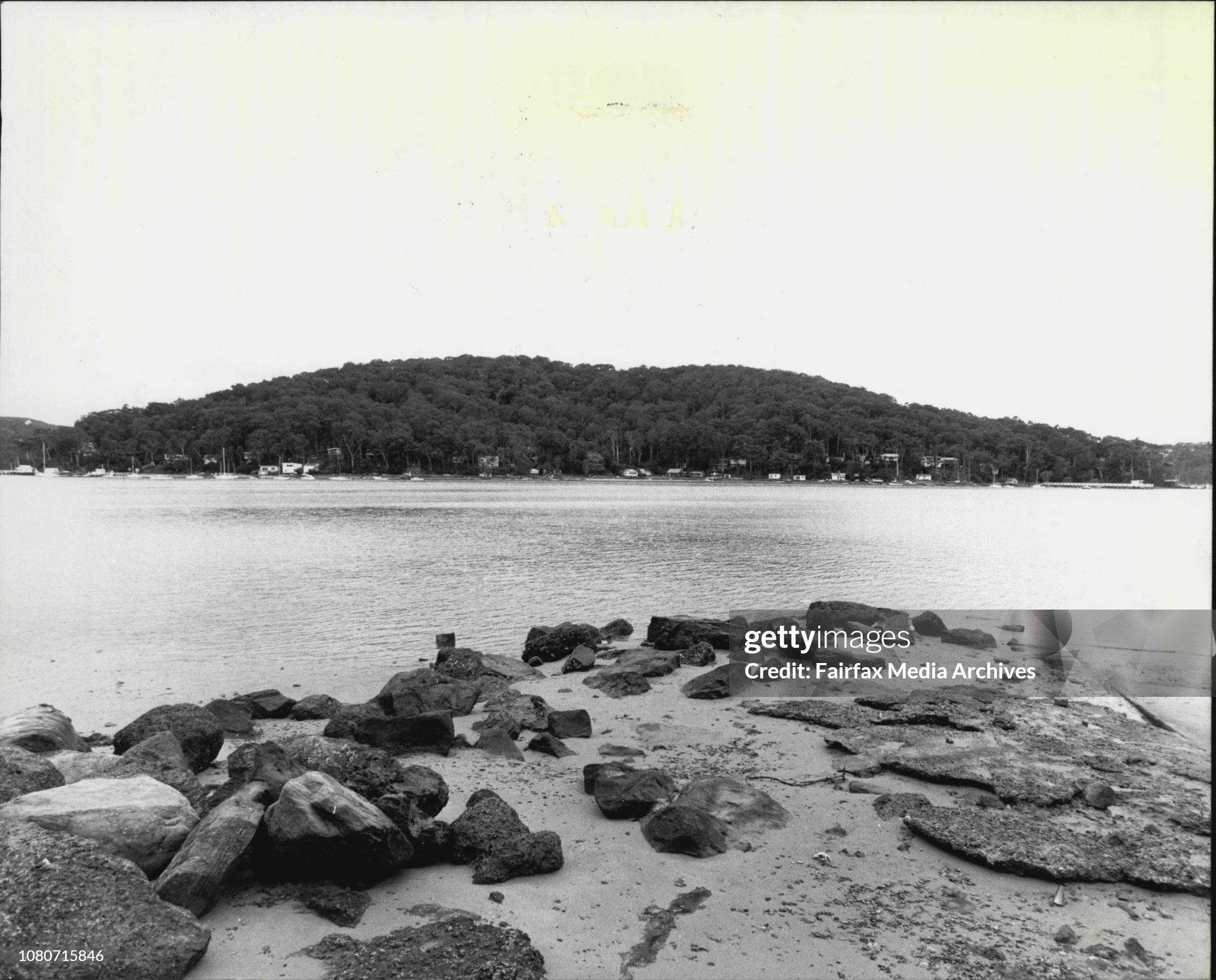
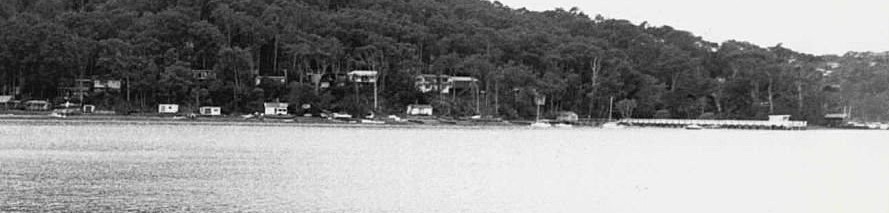
A Report to a Special Meeting, 1st July 1986 records:
20- 4. COASTERS RETREAT PROGRESS ASSOCIATION (Pres) K. Jones There is a need for: a. Floating pontoons positioned along West Pittwater to act as wharves for residents. b. Maintenance of public facilities (pathways to wharves, car parks, seating at wharves). c. Control of water pollution In Pittwater. 5. WEST PITTWATER ASSOCIATION (Sec) Mrs. Carol Marriott Represents approximately 170 families. Major Issues: a. Commuter wharf Church Point. b. Need to expand the Church Point car parking area. c. Acknowledgement of Church Point's focal role in the region. 6. BAYVIEW/CHURCH POINT PROGRESS ASSOCIATION (Pres) Robert Weilman Major issues: a. Lack of government environmental concerns. . b. SEPPS estates and State government policies are questionable. c. Local problems include: Water quality: McCarr's Creek and Mona Vale industrial area Brown's Bay - sediment build-up, erosion Congestion at Mitchell's Marina and the cargo wharf Church Point pressures from Scotland Island Car parking problems Public access to foreshore Bayview Baths mangroves area is dying Saturation situation of boat moorings Scenic road classifications and the issue of traffic congestion Medium density, townhouses, strata development; issue of public housing
The June 14, 1987 Meeting records items listed in the Public Works Committee meeting (to be done - for 87-88 Budget):
SCOTLAND ISLAND - Construction of $ 5,000 footpaths to Carol's Wharf and Eastern Wharf. .
The June 2008 Pittwater Council Plan of Management for Carol's Wharf states:
''Carols Wharf on the south side of Scotland Island forms a significant facility for commuter boat tie-up and maintains a high user demand. The wharf is accessed via Harold Street and a set of in-ground timber steps through Harold Reserve (an overall descent of approx 11m). The wharf is subject to inundation during the highest tides (king tides) which are generally infrequent.
A description of the reserve, wharf structure, related features and management is summarised in the table below.
Site name: Carols Wharf Reserve
Address: Accessed from Harold Street / Richard Road, Scotland Island
Reserve: Crown Reserve: Carols Wharf Reserve (R1010812), gazetted for Access on 13 May 2005, comprising Lot 7113
Ownership: State of New South Wales as Crown Land administered by Department of Lands under Crown Lands Act 1989
Management: Carols Wharf (R1010812) Reserve Trust (appointed 13 May 2005) charged with care, control and management
Trust Manager: Pittwater Council manages the affairs of the Trust
Area: Approx. 2275 square metres
Existing Uses: Public & commercial access – general public, commercial services, water taxis and commuter boats, Passive & active recreation, Access Boat access from mainland. Timber in-ground steps and handrail via Harold Reserve from Harold Street
Zoning: Pittwater Local Environmental Plan 1993 6(a1) - Waterways Recreation, W2 - Residential Waterways. Adjacent Zoning: 6(a) – Existing Recreation ‘A’ 2(a) – Residential ‘A’
Condition: Longest wharf in Pittwater and one of the oldest. Generally good, some wear to piles, specifically pile tops are rotten or in poor condition, minor rusting to bolts & nuts of capwales, repainting required. (Docker Smith Pty Ltd – 3rd April 2006).
Maintenance: Pittwater Council: Timber / structural repair, Graffiti removal and painting, Domestic waste removal. General repairs to buildings, shelters
Assets: 105m timber jetty – railing to two sides, timber jetty head (approx. 4x10m), fixed timber access steps (no landing), weatherboard shelter shed (inc seating to 2 sides (no general noticeboard)), lighting (1 column light to wharf head, 2no column lights to jetty length)
Unattached Assets: Domestic waste skip (large), ferry ‘call’ flag
Carols Wharf Reserve is owned by the Department of Lands. On 13 May 2005 the reserve was gazetted (R1010812), being 10 metres each side and around the head of Carols Wharf to approximately High Water Mark (refer Figure 13-2). The public purpose of the reserve is ‘Access’.
Pittwater Council was appointed Corporate Manager of Carols Wharf Reserve Trust on 13 May 2005. The trust is charged with the care, control and management of the reserve under s.92 of the Crown Lands Act, 1989 and Council manages the affairs of the Trust.
The reserve area is located within the Pittwater Local Government Authority and zoned under the Pittwater Local Environmental Plan (1993). Carols Wharf Reserve is zoned 6(a1) – Waterways Recreation and W2 – Residential Waterways and subject to the objectives specified in Part 1 of Schedule 11 and controls defined in Part II General Restrictions on Development of Land.
A desk top study of the principle user group (Scotland Island residents) has been undertaken to ascertain the number of wharf users and specifically boat tie-up use levels. Results suggest approximately forty- two (42) residences currently use Carols Wharf as a tie-up facility for their commuter boats.
The wharf currently provides approx. 18 (east side) and 24 (west side) informal boat tieup locations with additional boats / dinghies stored on the shoreline / in Harold Reserve (approx 7), canoes / surf boards / knee boards stored in a rack in Harold Reserve (approx 15) and a (1) sail boat stored as a permanent attachment at the jetty entry. Commuter boats are generally secured and accessed via a pulley system with ladder access (mixed types and condition) over the timber jetty handrail.
Carols Wharf maintains a high user demand for storage of commuter boats on the south side of the island. Available spaces are full which can cause frustration and arguments.
Use is generally passive but as residents leave and join the island community boat tie-up locations at Carols Wharf can be challenging.
Land adjoining the wharf reserve is Existing Recreation ‘A’ (zoned 6(a)) and residential housing, zoned 2(a) - Residential ‘A’ (PLEP 1993).
Currently the informal provision of commuter vessel tie-up berths at Carols Wharf Reserve does not satisfy the high user demand. The use of informal attachments to the wharf structure will be phased out and designated vessel tie-up locations will be provided to improve safety and wharf management. Proposals would include for the following, either as separate installations or a coordinated scheme:
- provision of tie-up rings / access ladders; and
- commuter boat tie-up facility - pontoons (east & west) with access ladders – refer Concept Plan (Figure 13-4.)
Carols Wharf Concept Plan
The proposed improvements at Carols Wharf aim to alleviate some of the management and safety issues currently observed. The works include the installation of pontoons or jetties perpendicular to either side of the existing wharf structure with inclined access ladders or ramps. Each ‘spur’ will accommodate a specific number of tie-up berths (approximately 14 eastside and 24 west side) with the end section of each designated ‘No Tie-up’ zones to allow for a ‘drop off / pick up’ facility.
The addition of pontoons or jetties will allow for approximately fifty-five (55) total commuter boat tie-up berths at Carols Wharf. It is envisaged the improvements at Carols Wharf will coordinate with proposed improvements at Tennis Wharf and Cargo Wharf providing a balanced dispersal of boat tie-up facilities around the island.
Subject to the proposed plan being adopted by Council, the Department of Lands has approved in principle amending the current reserve area to accommodate the proposed changes at Carols Wharf Reserve.
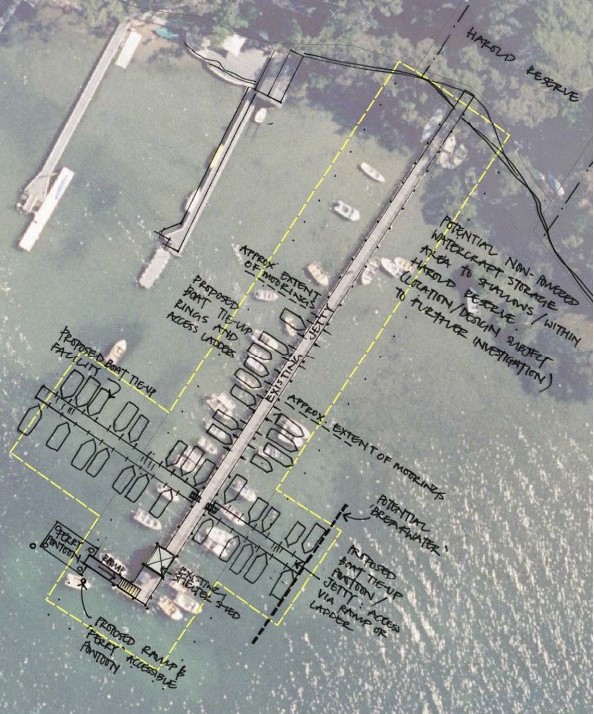
Figure 13-4 ⏐ Carols Wharf Reserve Concept Sketch
(Note: Indicative only – concept subject to further detailed design development / final location of proposed boat tie-up pontoons (east & west) to be reviewed following detailed water depth investigations)
Council will consult with the wharf representatives and Associations during the detailed design stage, following further investigations on water depth, environmental studies and issues relating to the wharf structure / footprint.
Works Programme
Improvement works in response to user concerns and to accommodate vessel tie-up licence schemes will include:
Description - Indicative Cost
- Install safety equipment (‘angel ring’ / signage) $500
- Install PLGA statutory signage $1000
- Install general community noticeboard $500
- Boat tie-up facilities to existing wharf structure (approx 30 licensed spaces) – tie-up rings / access ladders / signage Note: licensed spaces calculated without allowance for new pontoon facility $30,000
- Construction of access ramp and commuter pontoon (ferry compatible) – ‘drop off’ zone only $70,000
- Boat tie-up facility (pontoons) with berth dividers to east and west of existing wharf with access via ladders (refer Concept Plan) Note: allowance for approximately 50 licensed spaces (approx 35 pontoon licensed spaces and 15 tie-up ring licensed spaces on existing wharf structure) $80,000
- Non-powered watercraft storage area (location and design to be further investigated and developed) $25,000
Carol's wharf, September 16, 2015:
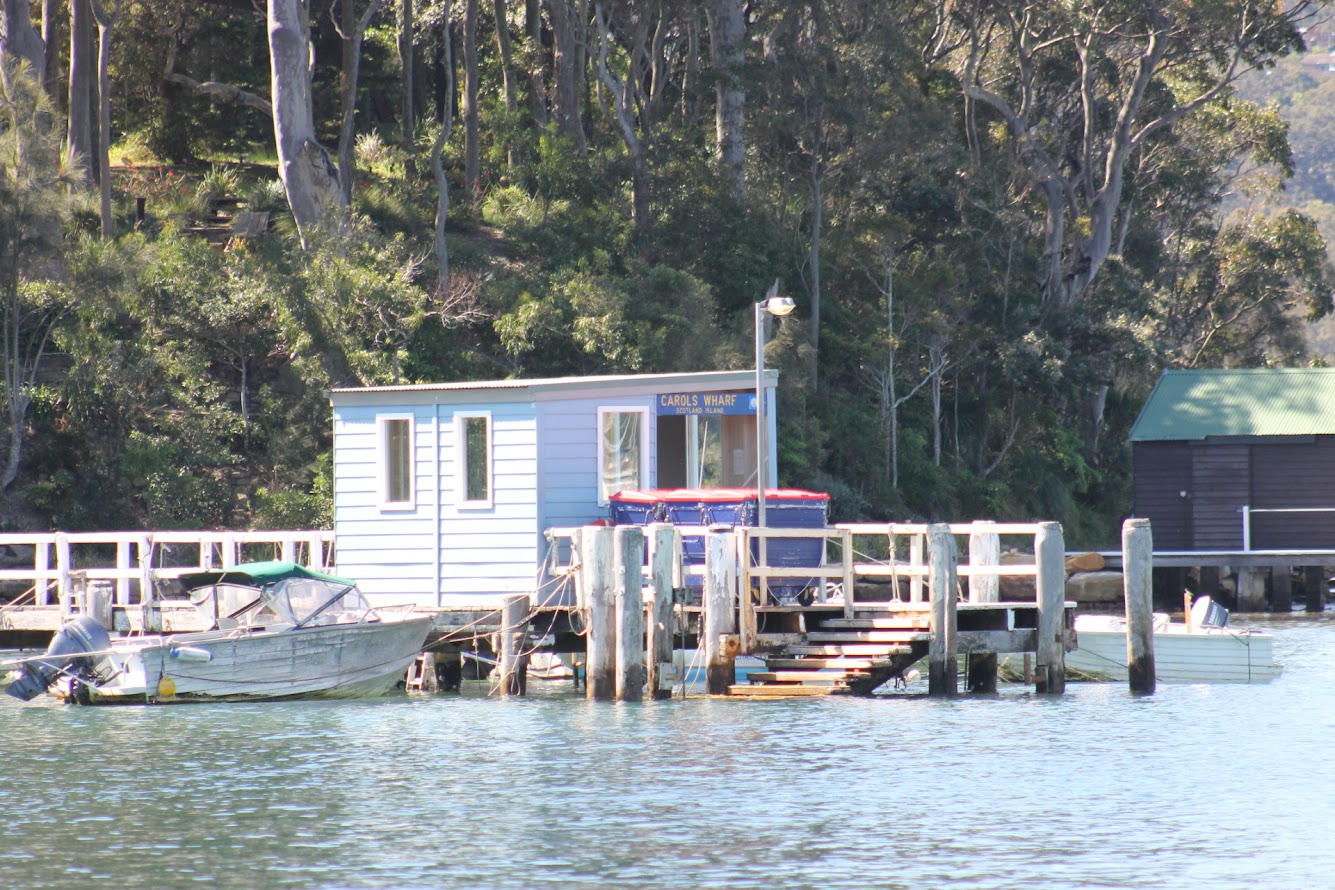
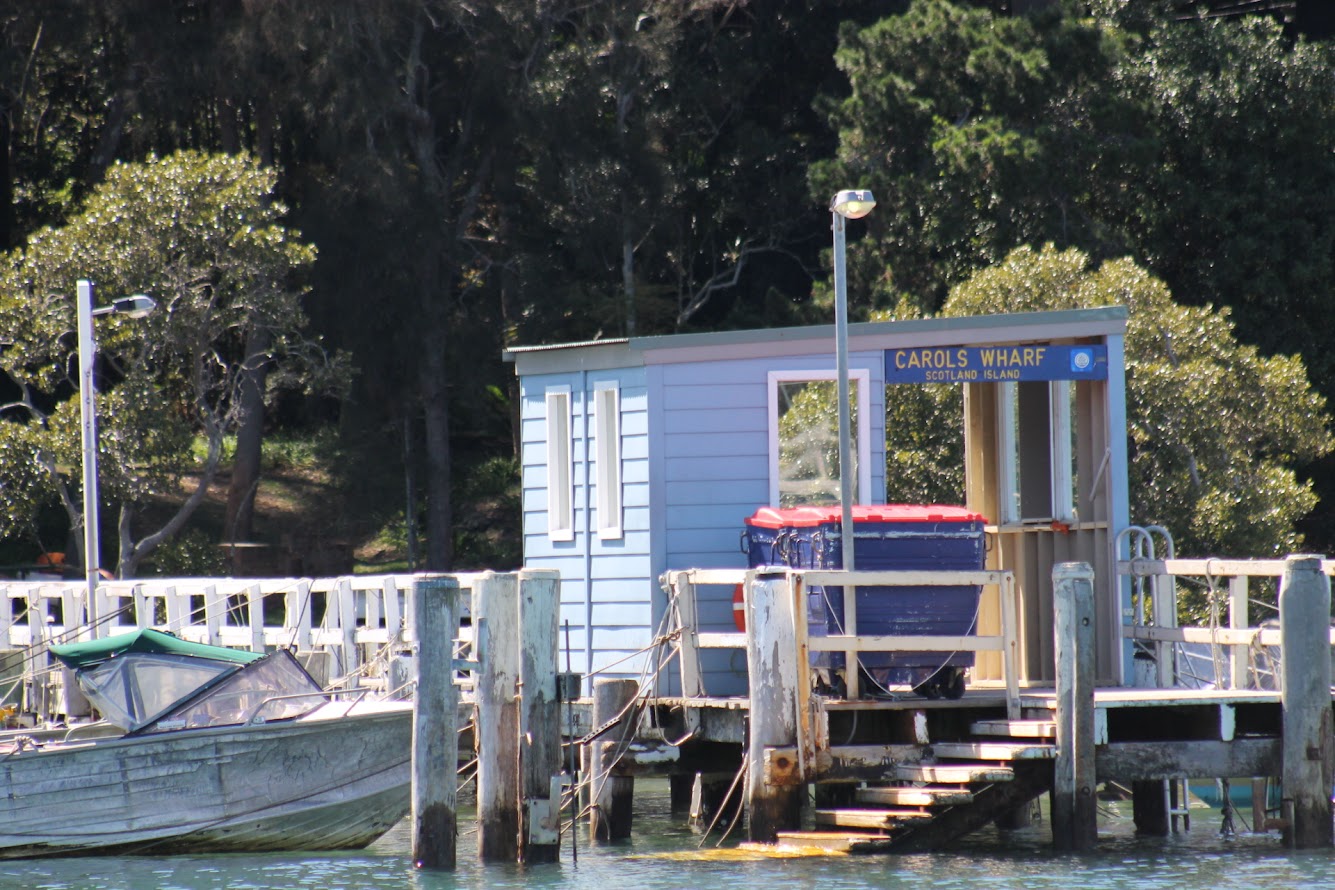
.jpg?timestamp=1762908517320)
.jpg?timestamp=1762908565056)
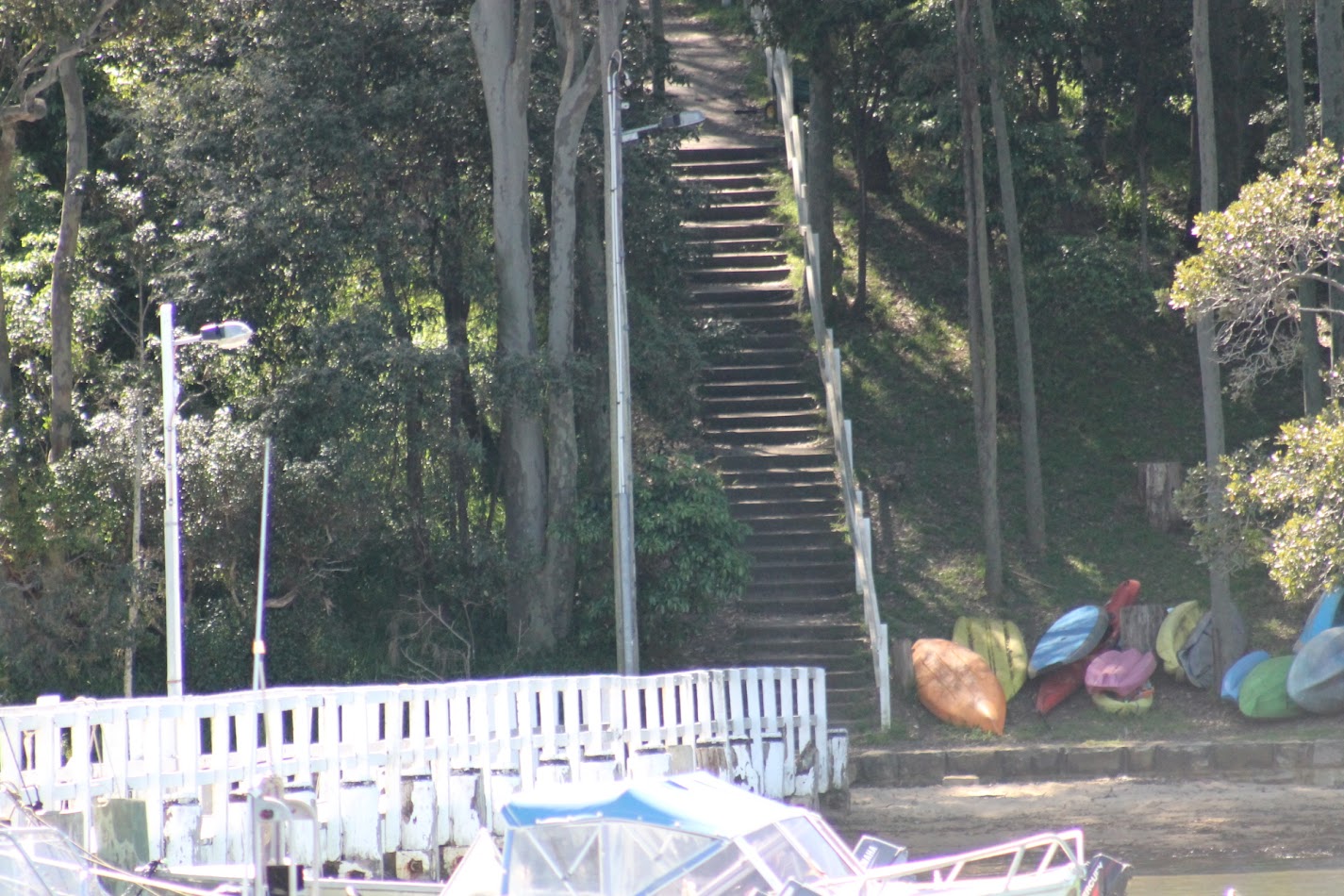
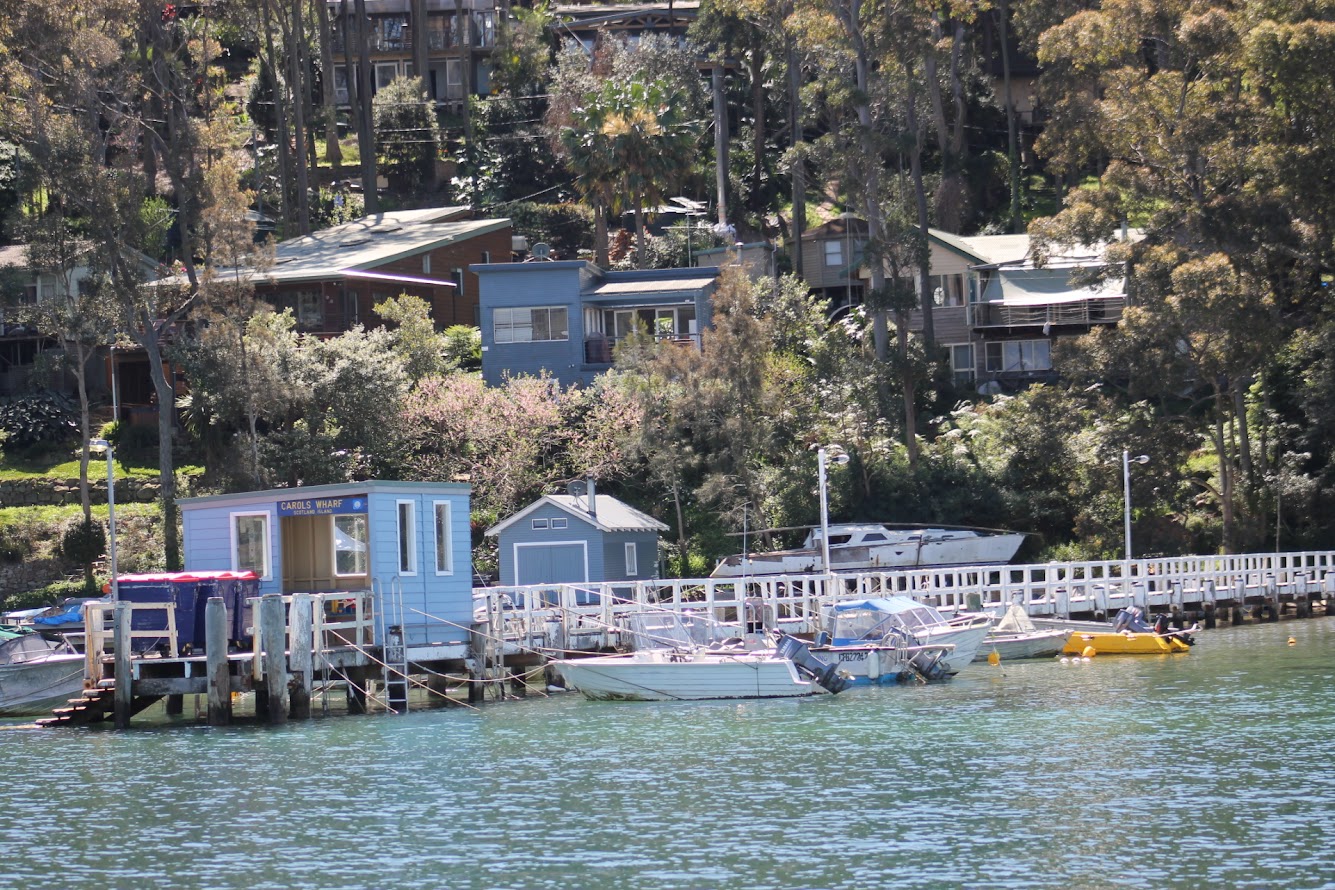
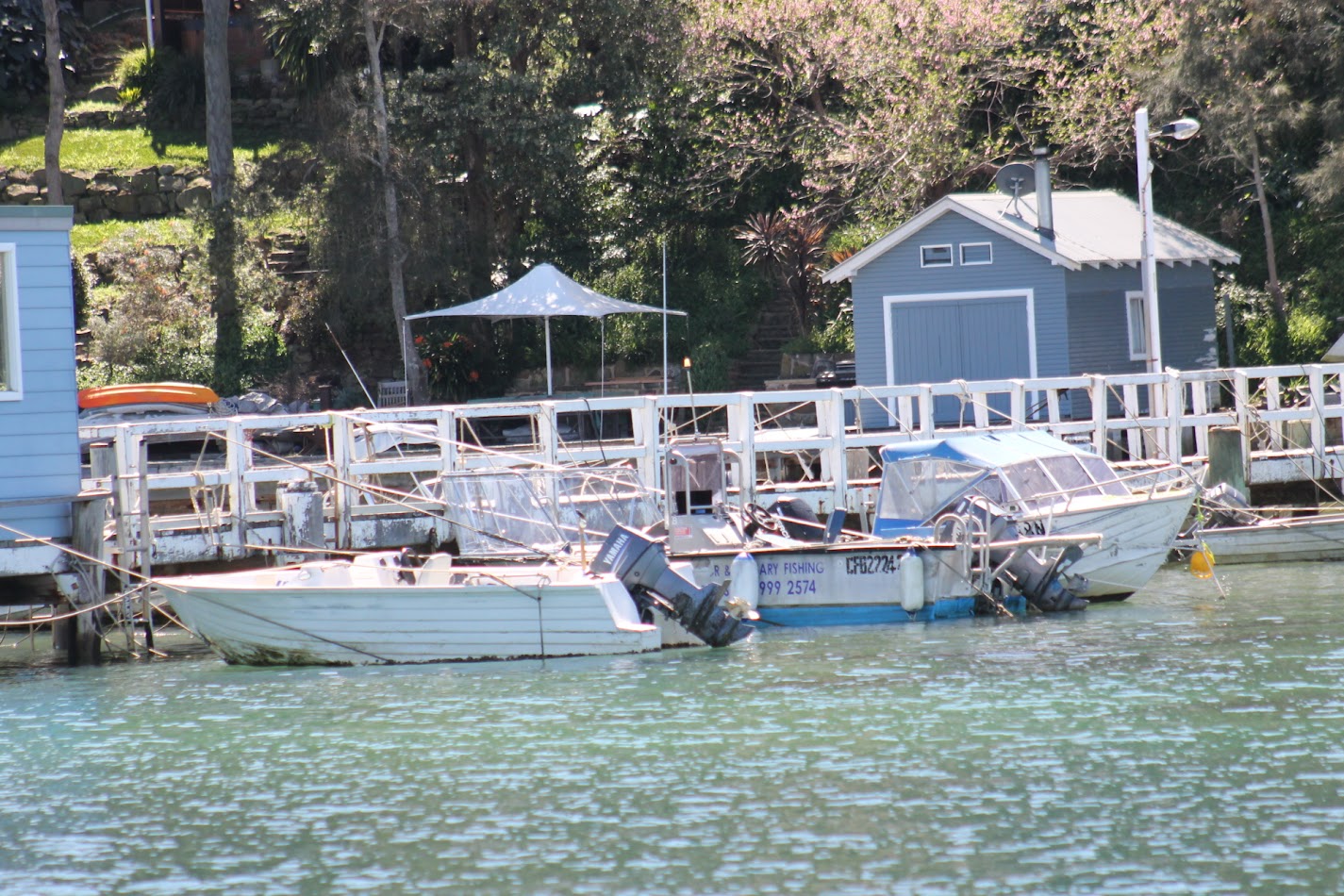
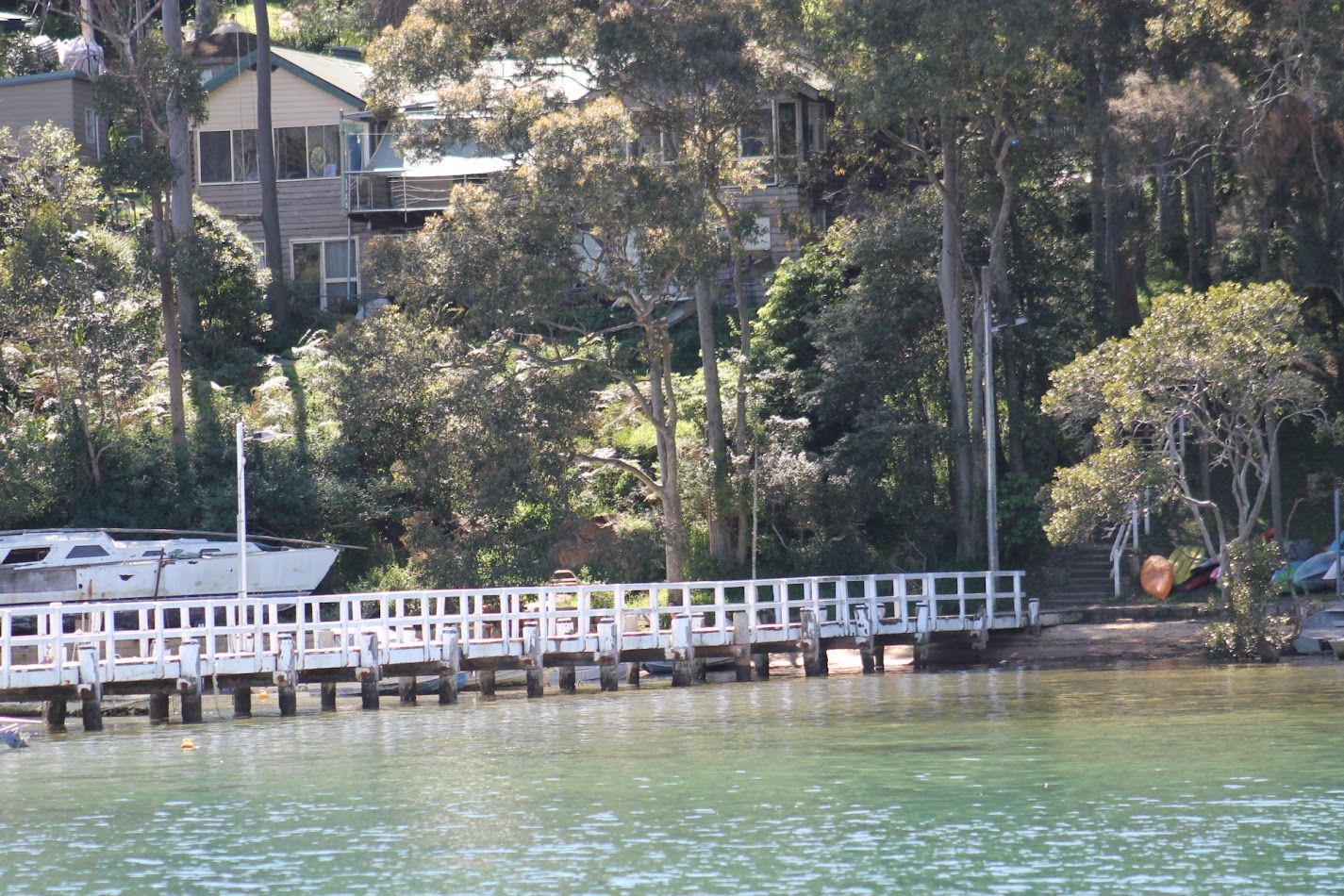


______________________________________________
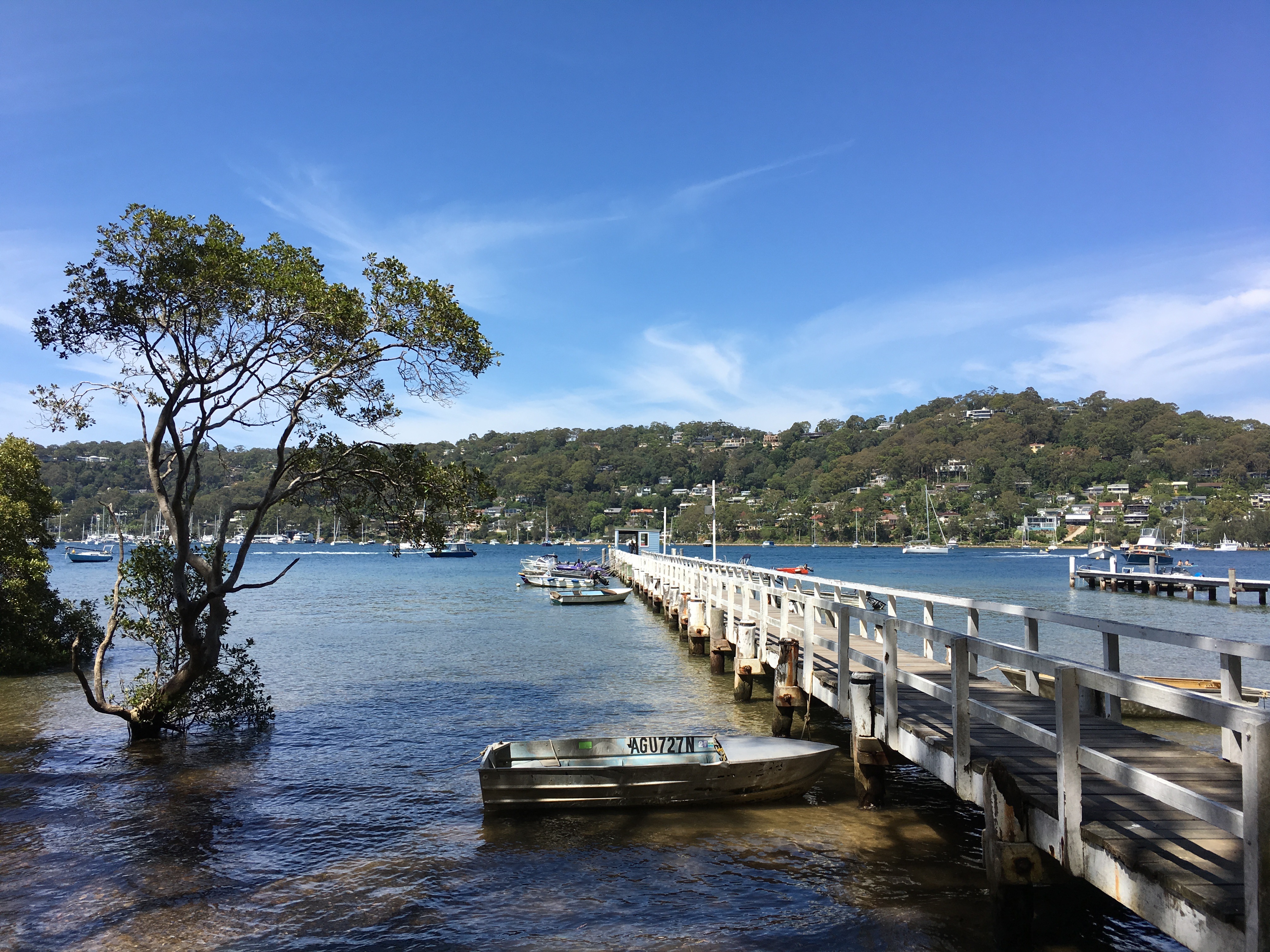
Carol's wharf Scotland Island, 27 December 2016, view from reserve. Photo by Phil Whitehouse from London, United Kingdom
Bell's and Carol's Changes 2020's
Other changes to the Church Point environs are those that have been constructed on Scotland Island with Bell and Carols wharves upgrades, which follow those drafted by Pittwater Council in June 2008, but with the west side of Carol's wharf pontoon deleted and the length of Bell's wharf reduced by 20metres from that originally proposed.
In 2017, residents formed the SIRA Wharves Working Group (team leader Alec Beckett), a working group of the SIRA Wharves and Watercraft Subcommittee, to lobby council for expanded tie-up facilities for residents. This was triggered by the then-approved expansion of Commuter Wharf tie ups (since reneged).
The working group designed plans, consulted with the community (including seeking feedback of neighbouring property owners) through several rounds of public forums, meetings and surveys. They then presented to council their proposed plans for expansions for Bell, Carols and Eastern wharves. Council agreed with the works for Bell and Carols and redrafted the plans and sought further community consultation in time for council to apply for NSW Boating Now grants – which were successfully obtained. Consultation on the design took place during 2020.
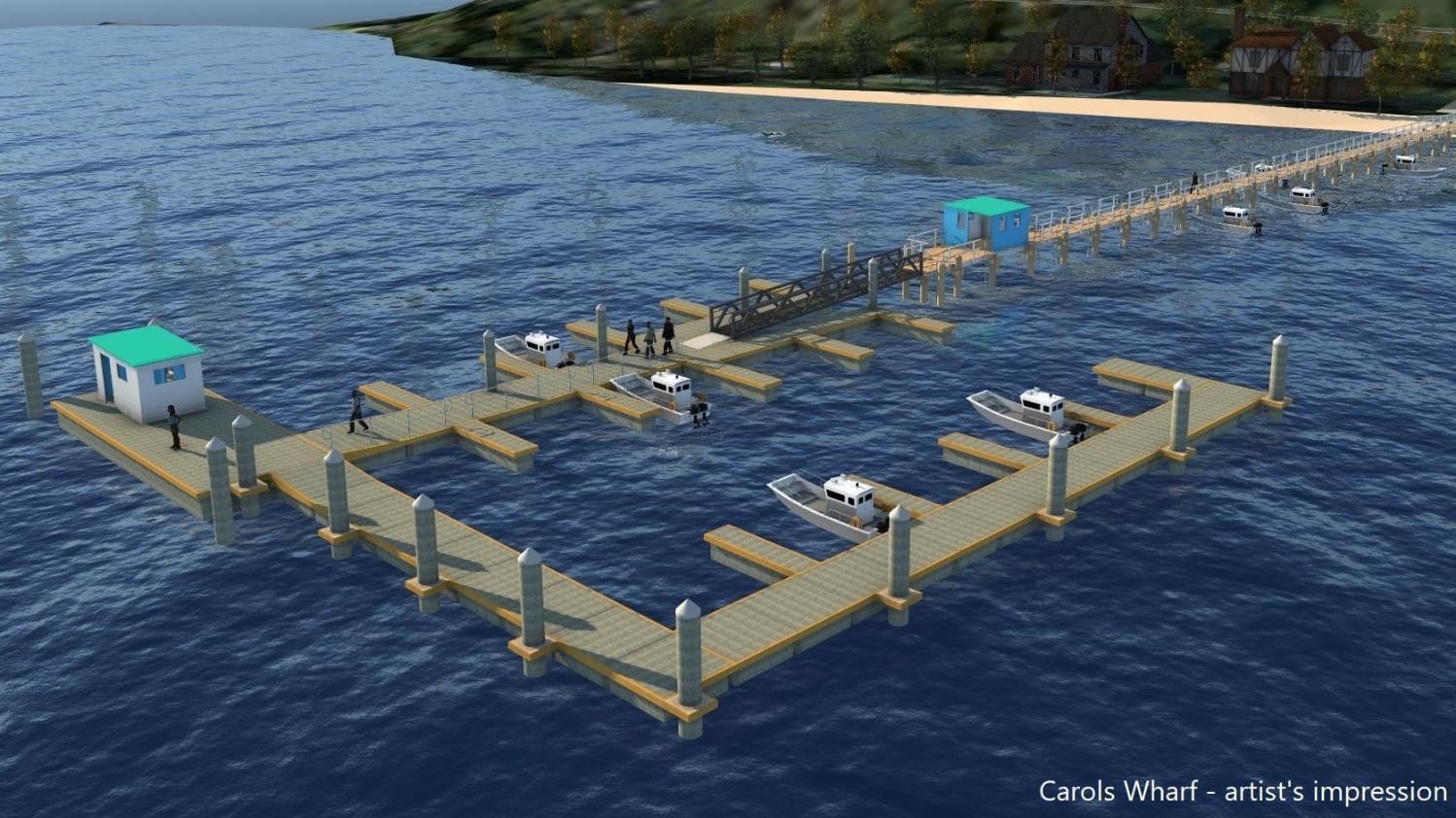
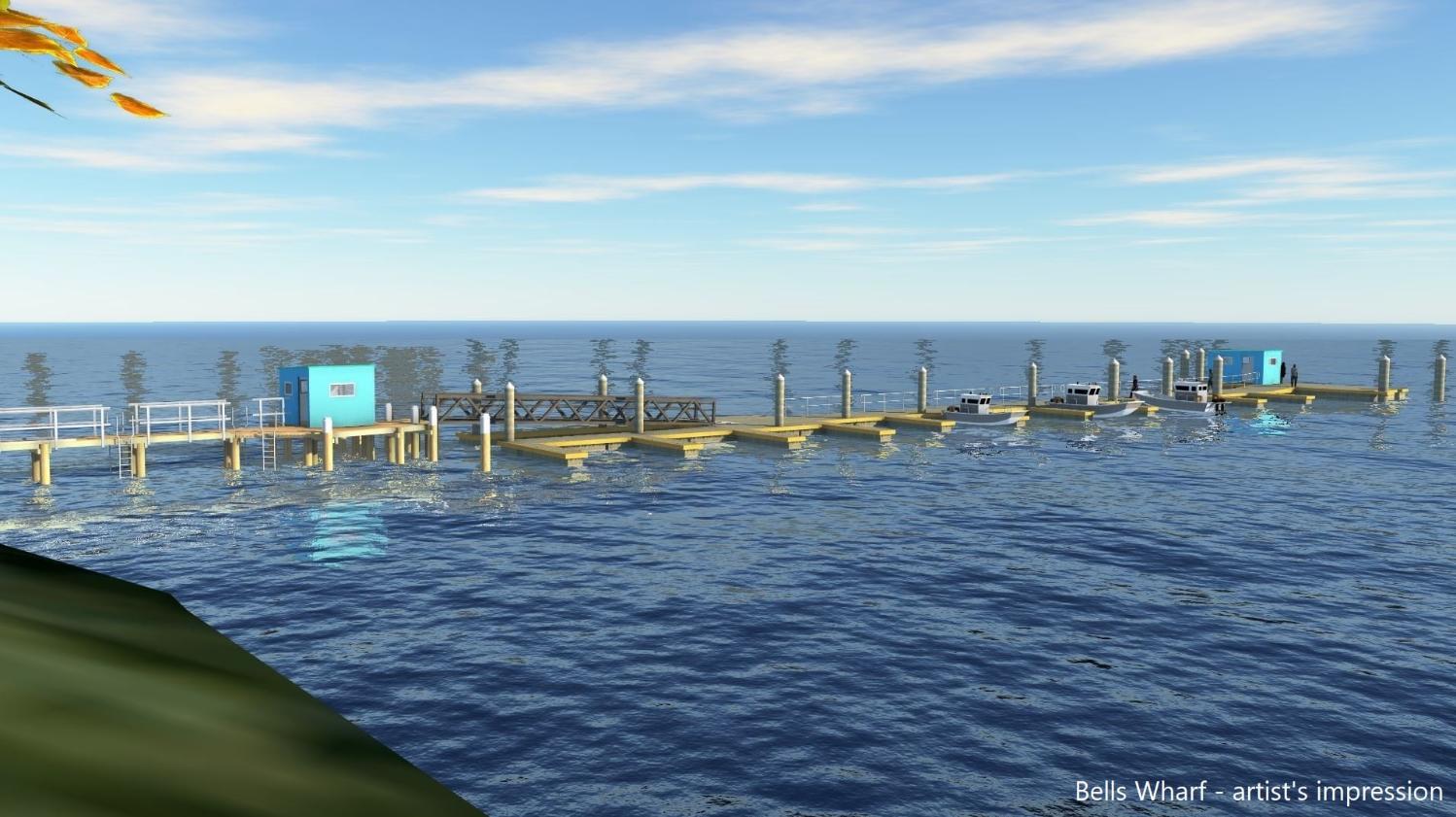
This project was jointly funded by Transport for NSW and the council as part of the Boating Now program, Round 2 which is the NSW Government’s $98 million program to support initiatives which improve the boating experience in NSW, including the delivery of recreational boating infrastructure such as boat ramps, jetties, pontoons and sewage pump-out facilities.
A total of 3,800sqm of additional Crown waterway was reserved to facilitate this $2.5 million project jointly funded by the NSW Government and Council.
Work at Carols Wharf and Bells Wharf was to include additional tie-up points (an additional 32 commuter berths at both Carols and Bells), new ferry shelters and wider boarding areas to improve access for commuters, including those with disabilities.
The upgrades also included the construction of a multi-purpose floating pontoon at both Bell Wharf and Carols Wharf as well as repairs to the existing fixed wharves.
The contractor for the 2021 Carols and Bells Wharf upgrades was GPM Marine Constructions Pty Ltd. The now named ‘Northern Beaches Council’ awarded the contract to the company in September 2020 to carry out the upgrade works.
- GPM Marine Constructions was awarded the contract in September 2020 for the sum of $2,220,608.90 (excluding GST - so the 2.5million all up).
- The works included the upgrade of both Carols and Bells Wharves
The council statement of Wednesday, 30 September 2020 was:
''‘Northern Beaches Council will soon begin upgrade work on the Bell and Carols wharves on Scotland Island. Council, at its meeting last night, approved the $2.2 million works, which will commence later this year.
This project is jointly funded by Transport for NSW and Council as part of the Boating Now program which is the NSW Government’s $98 million program to support initiatives which improve the boating experience in NSW, including the delivery of recreational boating infrastructure such as boat ramps, jetties, pontoons and sewage pump-out facilities.
The upgrades include the construction of a multi-purpose floating pontoon at both Bell Wharf and Carols Wharf as well as repairs to the existing fixed wharves.''
Scotland Islanders stated:
‘’ After years of continual agitation to ensure this project remained funded, the over $2M works were completed in 2022, giving all-tidal access to over 75 additional households.’’
GPM Marine Constructions was tasked with the upgrade of Bell and Carols Wharves. Established by Greg Stockley in 2000, GPM Marine has worked as a head-contractor on a multitude of jobs for many local councils and government clients, including RMS, Sydney Ferries, Public Works Advisory and Transport NSW. GPM Marine has a fleet of purpose-built marine barges, tugboats, and work boats and states they 'can deliver cost effective and timely marine and civil solutions for projects of all sizes and in all locations in NSW and Victoria'.
GPM Marine Constructions also won the contract for a complete renewal of the Paradise Beach baths and wharf, which was completed in November 2024. They've also installed Living Seawalls, demolished & rebuilt Manly Federation Boardwalk, did the repair works of McCarrs Creek Wharf; works included removal and replacement of existing dilapidated timber piles, critical emergency wharf repair works at Currawong Wharf; these works included replacement of existing piles, substructure timbers, new stairs and decking, and were completed successfully within an environmentally sensitive seagrass environment. GPM Marine reconstructed the dilapidated Little Manly Tidal Pools and also completed the refurbishment works for NSW Office of Sport at Broken Bay Wharf, located on the Hawkesbury River, and have been contracted by people across Pittwater for private wharves.
The proposed works were to provide approximately thirty-two (32) additional commuter berths at both Bell Wharf and Carols Wharf as well as upgrades to the ferry berthing facilities. Repairs and accessibility upgrades to the existing fixed wharves were also completed.
The wharf works commenced on the 23rd November 2020 and were scheduled to be completed mid-2021. The works started with wharf remediation at both wharves with works on the new floating pontoons to commence the following year.
More in: Scotland Island Wharf Upgrades For Bells and Carols Wharves - September 2021
GPM Marine states of the Bells wharf changes on their project webpage:
'GPM Marine Constructions completed refurbishment works at Bells Wharf, one of the main wharves at Scotland Island, highly serviced by public ferry and water taxis. These works included refurbishment of the existing deck substructure, as well as decking, ladders and hand-railing works. In addition, new pontoons were installed to increase the berthing capacity at this wharf. The works were co-ordinated with the public ferry to minimise impacts to the service.'
Some construction/installation photos by GPM Marine:

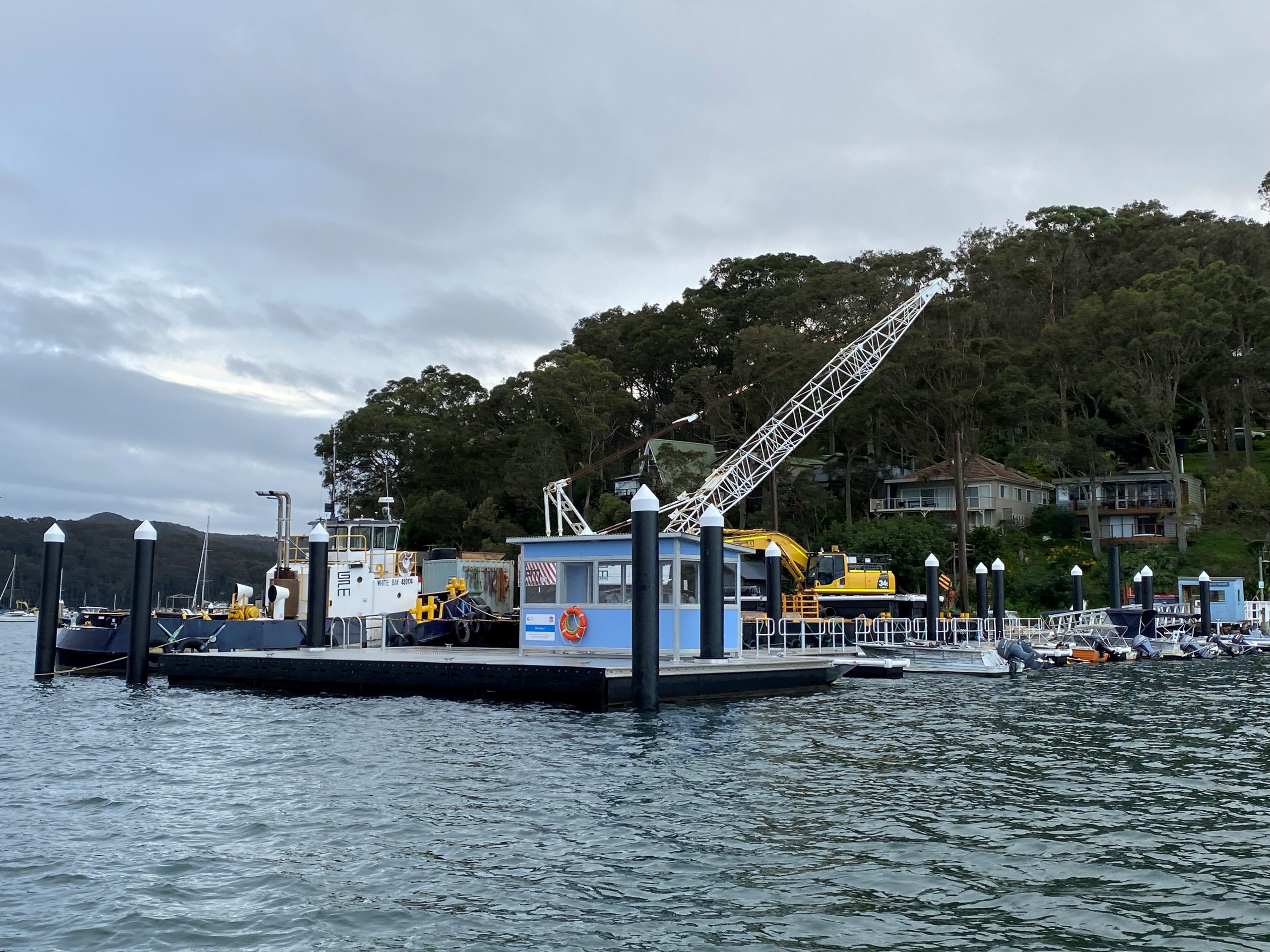

GPM Marine states of the Carols wharf changes on their webpage:
'GPM Marine Constructions completed the major refurbishment works at Carols Wharf, the longest public wharf in Pittwater which is predominantly used by commuters for informal boat tie-up.
These works include the major refurbishment of the existing deck substructure, as well as decking, installation of a new ferry terminal, ladders and hand railing works. In addition, new pontoons were installed to increase the berthing spaces available at this wharf. Works have been co-ordinated with the public ferry to minimise impacts to the service.'
Some of GPM's construction project completion photos - more on their project webpage:
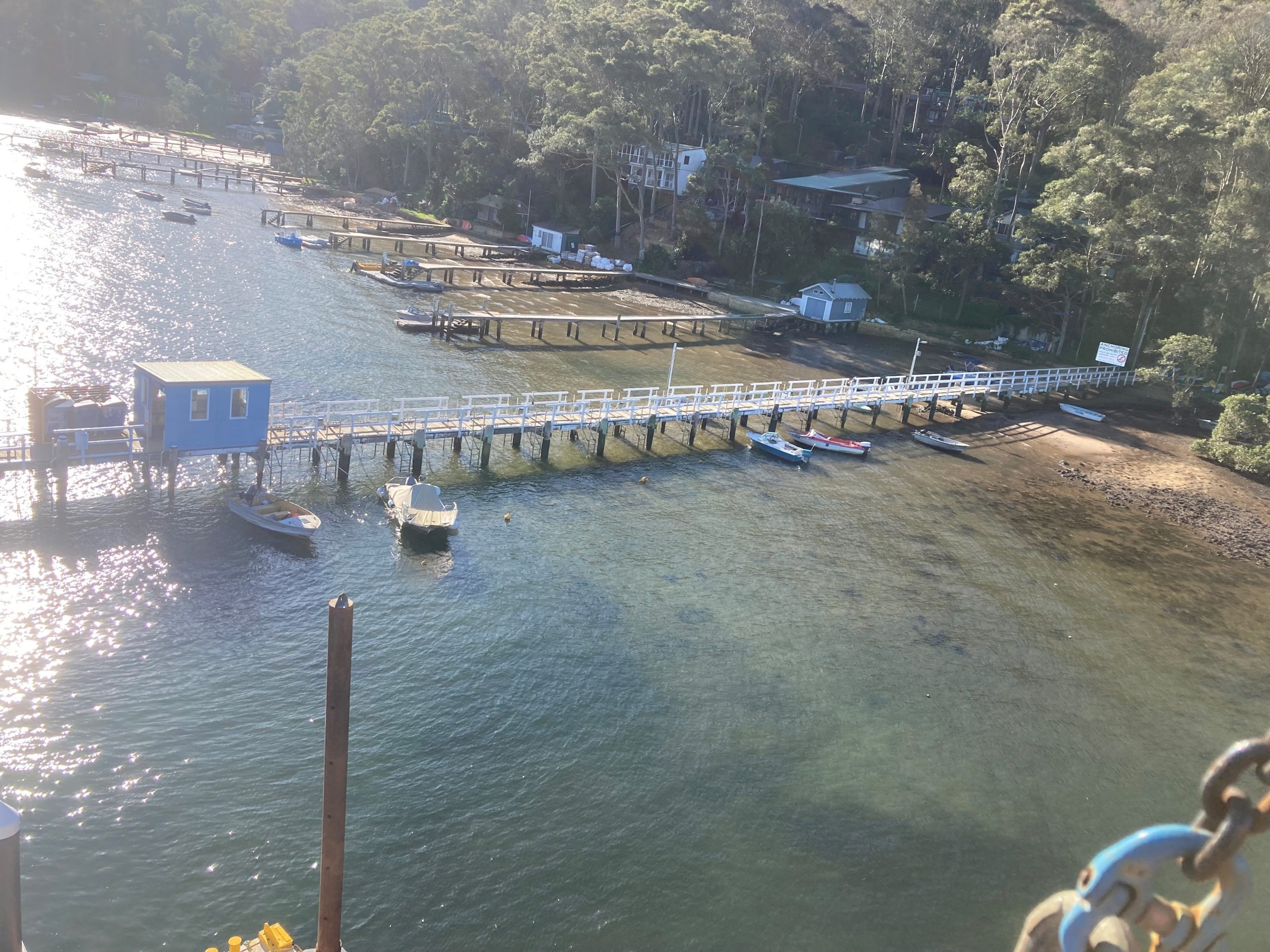
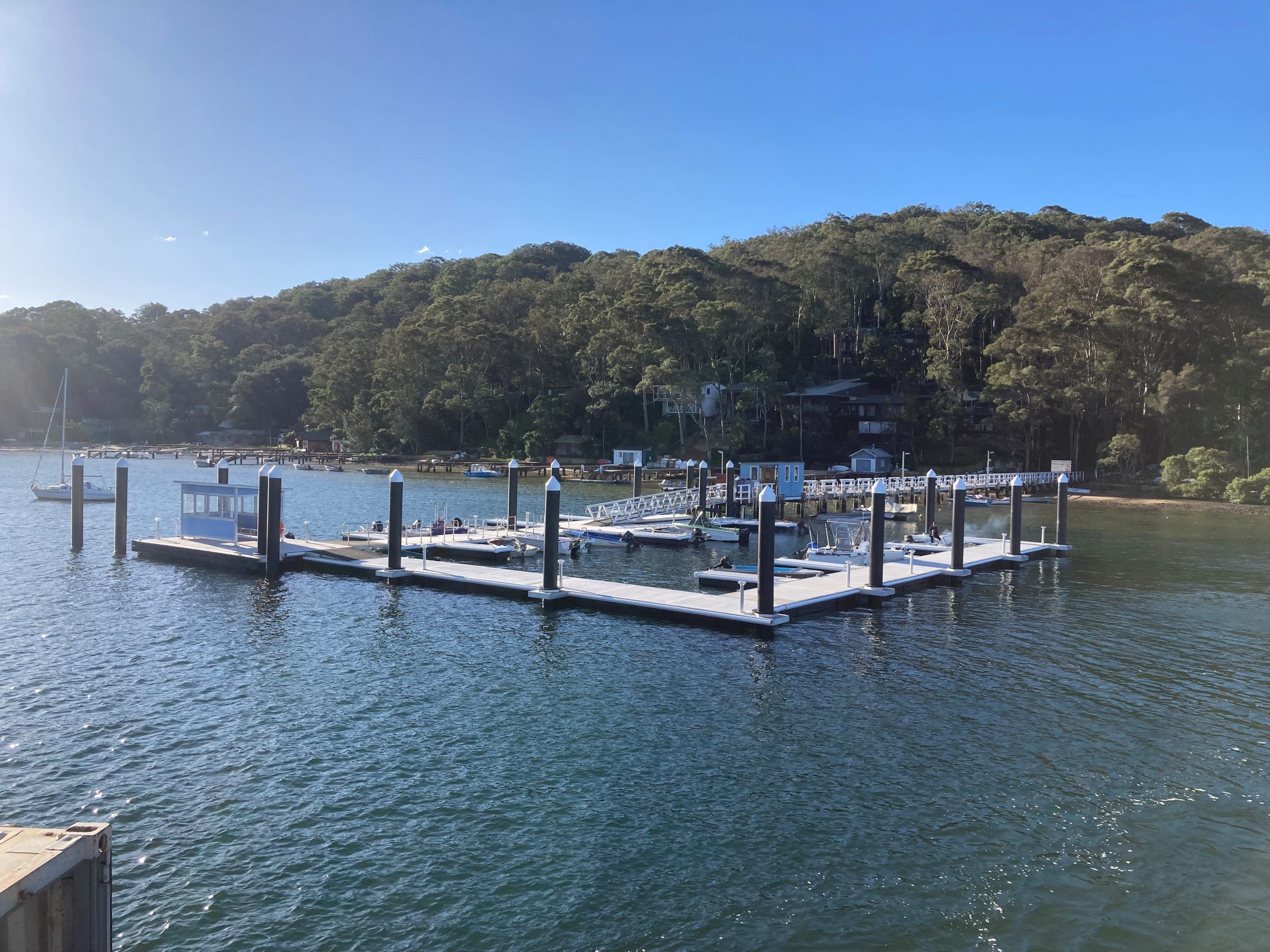
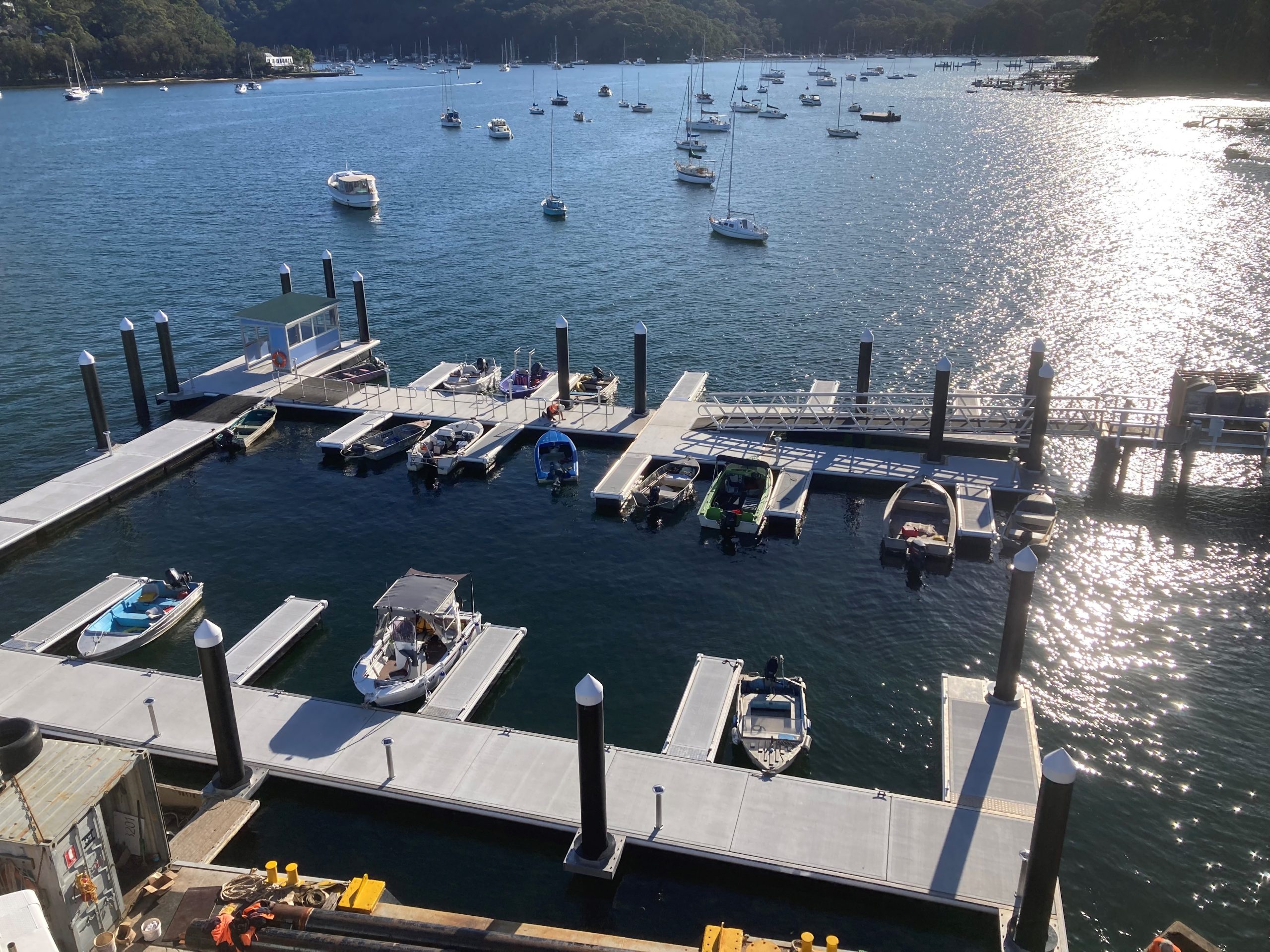
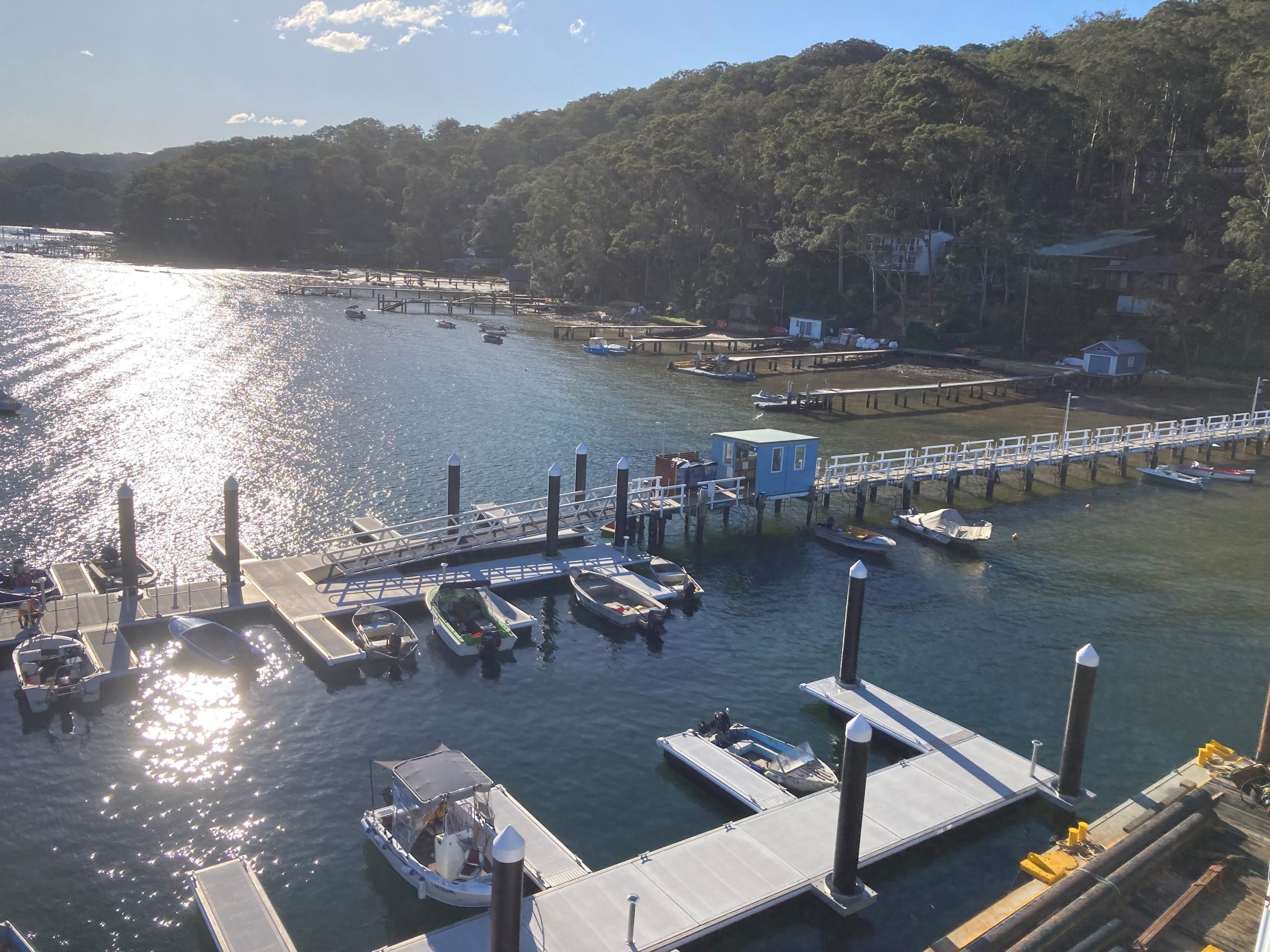
Carols Wharf in July 2023, taken from Church Point wharf - See:
- Church Point, Pittwater: Winter 2023 + Some Photos From The Past
- Church Point Precinct Upgrade Scheduled To Be Completed This Financial Year: Boardwalk Completed In December 2022 Now A Popular Suntrap For Residents + Visitors Beside The Estuary + Scotland Island Bells and Carol Wharf Upgrades Completed
- Scotland Island Wharf Upgrades For Bells And Carols Wharves, August 2021
.JPG?timestamp=1690490469777)
.JPG?timestamp=1690516265196)
.JPG?timestamp=1690516353936)
.JPG?timestamp=1690516385281)
.JPG?timestamp=1690516458041)
Bells Wharf in July 2023 - the design for here was reduced by 20m in final planning; -
.JPG?timestamp=1690503763556)
.JPG?timestamp=1690516539535)
.JPG?timestamp=1690516603485)
Residents have been pretty satisfied with these new wharves, and plans for new ones at Mackerel, Bayview and Currawong, co-funded through the state government and ratepayers, are currently being scrutinised.
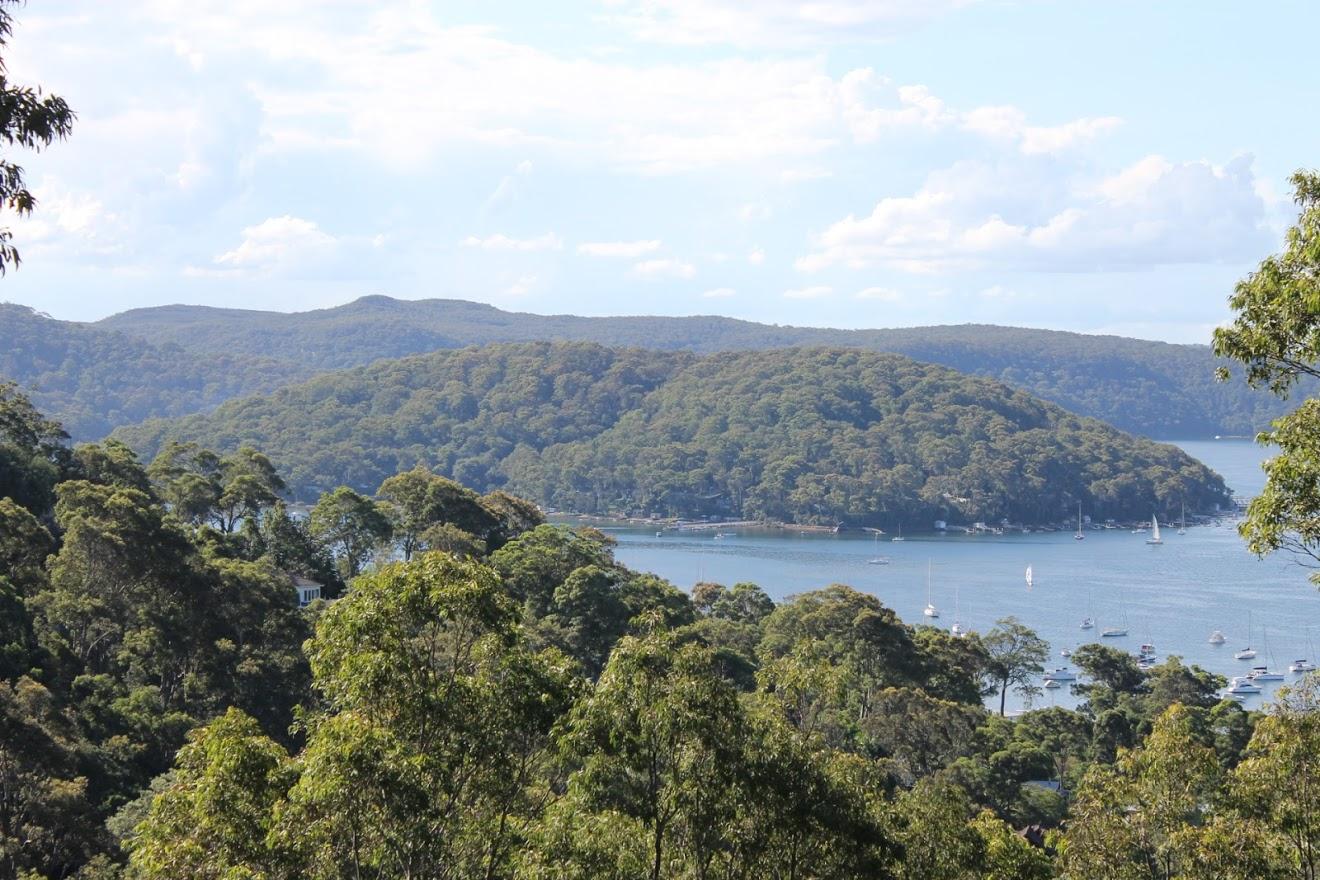

|
Andrew Thompson Scotland Island Research Notes.pdf Size : 2899.157 Kb Type : pdf |
|
|
Scotland island Wharves Resaerch Notes too.pdf Size : 1305.16 Kb Type : pdf |
References - Extras
- TROVE - National Library of Australia
- National Archives of Australia
- Andrew Thompson – ‘Long Harry’, January or early February 1773 – to October 22nd, 1810
- Salt Pan Cove Public Wharf on Regatta Reserve + Florence Park + Salt Pan Reserve + Refuge Cove Reserve: Some History
- A Glimpse Of The Hawkesbury. By Francis Myers. ILLUSTRATED BY J. C. HOYTE. (1883)
- The First Boat Builders of Pittwater: the Short Life and Long Voyages of Scotland Island Schooner the Geordy
- Sarah A. Biddy Lewis and her daughter Martha Catherine Benns - Pittwater Matriarchs
- Remembrance Day 2018 - 100 years From Armistice Day 1918: Some Pittwater Veterans from the First World War
- Pittwater Roads II: Where The Streets Have Your Name - Scotland Island
- Original Sales Pamphlets Of Scotland Island, Mona Vale, Great Mackerel Beach, Bungan, Offer Images Into Our Past – A Pittwater Summer Idyll
- The Oaks - La Corniche
- Oystering in the Pittwater Estuary -Oyster Kings and Pearl Kings and When Not to Harvest Oysters
- Some Recollections Of Early Bayview: Don Taylor, youngest son of W. D. M. Taylor, who was eldest son of P. T. Taylor and Margaret Tink (nee Andrews, whose mother was a Snow)
- The Tasmanian Countess and Marquise of Scotland Island
- Pittwater Summer Houses: Bangalla, Scotland Island
- Historic Photographers Of Pittwater: A. J. (Arthur James) Vogan, 1859-1948
- Pittwater Restaurants you could stay at: Pasadena Road House – Church Point
- Frederick Victor Grey Wymark, 6th October 1872 – 19th October 1942
- The First Scotland Island Cup, Trophy and Race and the Gentleman who loved Elvina Bay
- Church Point Public Wharf - 1885 to 2025: Some History
- Roads In Pittwater: The Bay View road
- Anthony Barker, 'Robertson, George (1860–1933)', Australian Dictionary of Biography, National Centre of Biography, Australian National University, https://adb.anu.edu.au/biography/robertson-george-8233/text14413, published first in hardcopy 1988
- Shelagh Champion OAM and George Champion OAM - Profiles of the Pioneers, Revised 2013
- Scotland Island - Tempest by William Shakespeare in Catherine Park, March 2020 by Bea Pierce
- Alan Corbett, Church Point and McCarrs Creek, the author, Sydney, 1987
- Jenny Cullen, Scotland Island Matters: rainwater, wastewater, native trees, Scotland Island Land Care Group, Church Point NSW, 1997
- P Gledhill, Manly and Pittwater, its beauty and progress, Robert Dey, Son & Co under the auspices of the Manly, Warringah and Pittwater Historical Society, Sydney, 1948
- SINEWS, Scotland Island News 1955–1998
- INX-106-170327. Title Subject: Scotland Island. Index Name Index to Colonial Secretary Letters Received. Description Map Showing Scotland Island. Name Subject: Scotland Island. Index Number 106. Ecommerce Category G. Start Date 01/01/1893. End Date 31/12/1893. Citation; [5/6117] Letter no 93/2358
- NRS-12576-7-[18/1853]-MD.2020/6 | Warringah Shire Council - Scotland Island Proposed Additional Public Wharf; 1977-1977 REQUEST; Details – Number; NRS-12576-7-[18/1853]-MD.2020/6. Title; Warringah Shire Council - Scotland Island Proposed Additional Public Wharf. Contents Date Range; 1977-1977
- Picnic Against Yamba Development Application on Scotland Island - 2105 report
- Pittwater Summer Houses: Rocky Point and Elvina Bay - A Place Of Holiday Songs and Operas In Ventnor, Fairhaven, Trincomalee and Maritana
- Church Point Precinct Upgrade Scheduled To Be Completed This Financial Year: Boardwalk Completed In December 2022 Now A Popular Suntrap For Residents + Visitors Beside The Estuary + Scotland Island Bells and Carol Wharf Upgrades Completed
- Church Point, Pittwater: Winter 2023 + Some Photos From The Past
Pittwater wharves history series 2024-2025:
- Palm Beach Public Wharf: Some History
- Clareville Public Wharf: 1885 to 1935 - Some History
- Boulton's Jetty on 'Old Mangrove Bay' + Newport hotel jetty + Newport Public wharf: Some history
- Salt Pan Cove Public Wharf on Regatta Reserve + Florence Park + Salt Pan Reserve + Refuge Cove Reserve: Some History
- Bayview Public Wharf and Baths: Some History
- Brown's Bay Public Wharf, on McCarrs Creek, Church Point: Some History
- Church Point Public Wharf - 1885 to 2025: Some History
- Elvina Bay's Public Wharves: Some History
- Lovett Bay Public Wharves: Some History
Herbert Fitzpatrick – Scotland Island Land Sales 1920’s
Number NRS-13022-2-[12/1117]-No. 2155. Title Memorandum and Articles of Association of Scotland Island Estates Limited. Contents Date Range 01-01-1924 to 31-12-1924
Even though they may have been selling Lots prior to that – theirs is registered in Vol-Fols 3898-58,59 and 60. Also Vol-Fol: 3898-58 (19 acres, one rood and 22 ¾ perches): Lots 1 to 31 inclusive and Lots 152 to 191 inclusive and Lots 285 to 308 inclusive Plan 127419. Last land sale October 21st, 1963.
Vol-Fol 2220-86 Lots 41 and 42 to Emma Elizabeth Benson on January 20 1912 (one acre 2 roods 11 perches) – sells to Ducker and Fitzpatrick on March 8 1923, becomes Vol-Fol 3432-40/341 which goes into Scotland Island Estates Limited on July 31 1924 and becomes Vol-Fol 3664-28 – Lot 23 and Lots 41 to 44 go into Vol-Fol 3682-189 which without any sale goes into Vol-Fol 3898-59/60.
Vol-Fol 3664-28:
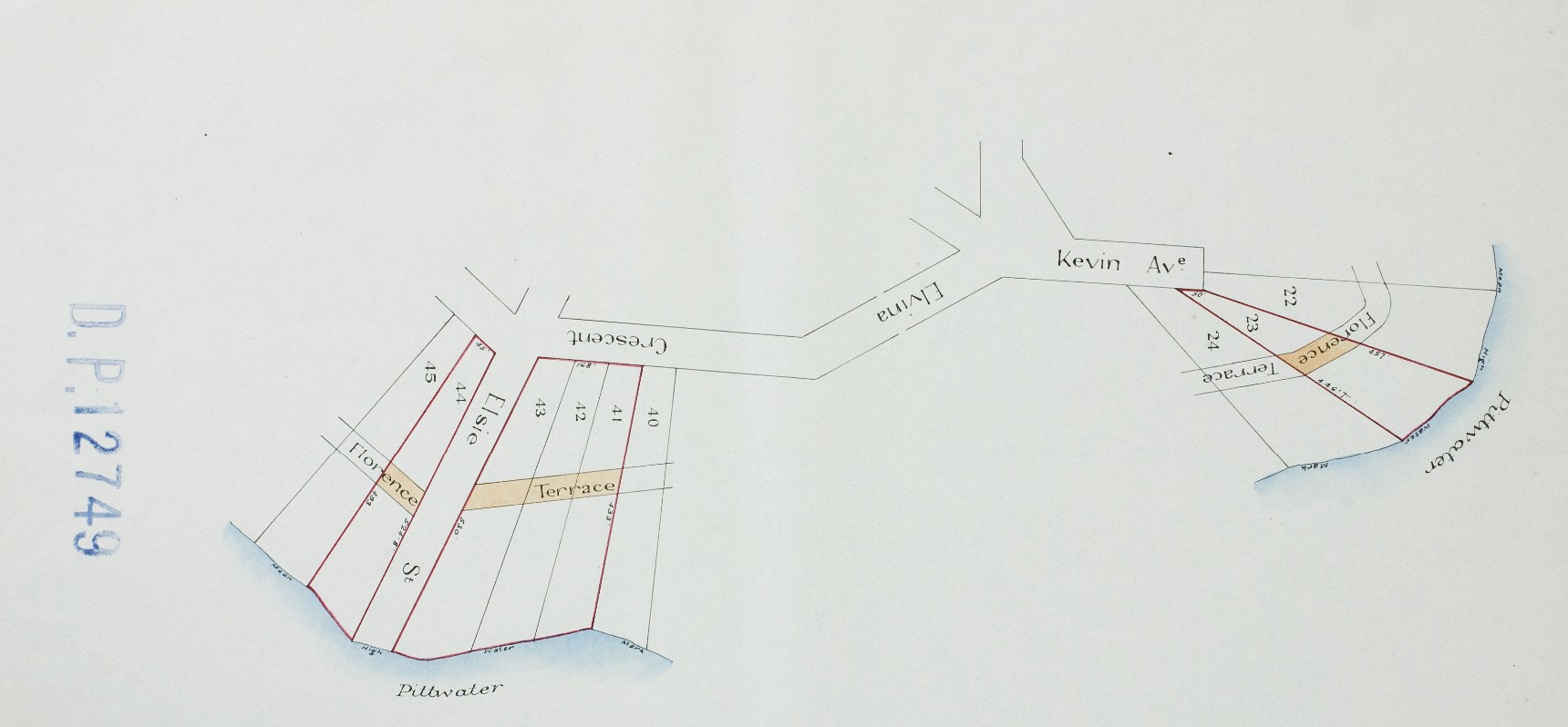
Some of the other blocks on the east and towards Tennis Court Wharf are also sold again/transferred into Scotland Island Estates, where they are cut into smaller Lots.
Scotland Island Estates Ltd. Vol-Fol 3898-59 is 25 acres 1 rood and 11 ¼ perches consisting of Lots 33 to 49, 51 to 63, 65 to 79, 81 to 87, 192 to 198, 202 to 230 and 232 to 238, Lot 242 and Lots 309 to 330 being part of Portion 50 of Parish consisting of 120 acres originally granted to Andrew Thompson by Crown Grant on January 1 1810.
The lots facing east are smaller than the original approx. one acre lots on the west side of the island, although these sold first in the 1906 divisions onwards, possibly due to the attractions of the Pittwater Regattas and morning sun. Pittwater Regattas, as with the Elvina Bay sales, also wre used as a lifestyle selling point, with the Scotland Island Cup and the race past Scotland Island to Elvina Bay for speedboats, featuring as part of these when the RMYC’s Herbert Fitzpatrick and his partner Ducker put up prizes for these promotional and hopeful sales boosters.
All blocks are split into smaller blocks through this subdivision from 1924 on. This sells until October 1948 as such and then the residue is put into Vol-Fol: 5934-95.
Lots 44 and 45 are put into Public Trustee on June 3rd 1931 Vol-Fol: 4489-116 – on Richard Road and handed to Warringah Shire Council on June 29, 1930 (C of T), measuring one rood 10 ¾ perches and measuring 80 feet by 170 to 171 feet, and on to Richard Road. It is sold to Percy Horace de Russett and Alfred de Russett, both of Balgowlah and Builders, on January 7th 1947.
Others bought multiple blocks:
Lots 51 and 52, as well as 219, were on the waterfront to north side of Harold Reserve, were bought by Helena Elizabeth Henderson, wife of Silk Merchant Henry William Henderson, on August 25 1926 – Vol-Fol: 3910-179. Permanent Trustee Comp. of NSW (Proctors) sold Lot 219 on May 18 1972 and the residue went into Vol-Fol: 17861-123/124 on June 16 1972. They also buy original Lot 57 from widow Eliza Seaborn (Vol-Fol: 2364-114 COT May 8 1913) October 17 1935 – which goes into Henderson Investment Company Limited and does not shift until June 27 1973 when it is acquired by Vivic Investments Ltd..
John Johnstone Mathieson buys Lots 77,78,79 Vol-Fol: 4718-182 September 9 1935
Elsie Egan lots 308 and 309, Vol-Fol: 4557-161
Lily Amy Harris Lots 81 and 82 Vol-Fol: 4527-51
Katie White Lots 42 and 43 Vol-Fol: 4467-221
Benjamin Heinrich Adolphe Feuerheerdt Lots 40, 41 Vol-Fol: 4544-73 august 29 1932
Cornelia Houton Lots 222,223 Vol-Fol: 4312-8 on June 10 1929
Agnes Mary Scott of Waverly, listed as ‘spinster’ on C of T and comprising Lots 206, 207, 208, 209 and 210 of DP12749 on December 20 1929 Vol-Fol: 4375-129 – is 3 roods and 18 perches on Elvina Crescent measuring 270 feet 8 ¾ inches lower side by 147 feet 9 ½ inches on south end and 171 feet 4 ¾ inches on north end and 260 feet on west side. Certificate of Title registered February 7 1930. This is sold to Naomi Fraser White of Bronte, Widow, on November 23 1960 who sells in 1963 – a caveat is put on Lot 207 in same year.
Vol-Fol 3898-59 (includes Vol-Fol for each sale at right side in red) from 1924 to 1948 - Herbert Fitzpatrick passed away during this and the sales/ and care of this work changed to Mr. Ducker et al:
.jpg?timestamp=1763081138617)
.jpg?timestamp=1763081419855)
.jpg?timestamp=1763081460474)
.jpg?timestamp=1763081605033)
.jpg?timestamp=1763081649796)
.jpg?timestamp=1763081695033)
.jpg?timestamp=1763081733086)
.jpg?timestamp=1763081769494)
.jpg?timestamp=1763081803637)
.jpg?timestamp=1763081876936)
.jpg?timestamp=1763081959772)
Vol-Fol 3898-58 (includes Vol-Fol for each sale at right side in red) from 1926 to 1963:
.jpg?timestamp=1762995212878)
.jpg?timestamp=1762995263987)
.jpg?timestamp=1763080316428)
.jpg?timestamp=1763080568514)
.jpg?timestamp=1763080484936)
.jpg?timestamp=1763080408601)
.jpg?timestamp=1763080609124)
.jpg?timestamp=1763080663242)
.jpg?timestamp=1763080710568)
.jpg?timestamp=1763080749885)
Warringah Shire Council Minutes of Meetings (a few extras)
Hardy, Busby &Norman, re Scotland Island Subdivision and stating proposal to construct a pathway in Elvina crescent - - and a Tennis Court in Catherine Park : Resolved, - (Crs.Hewitt Campbell)'That the Council approve of the proposal. - - 13. Same. 24/3/24, re same estate, -and stating proposed to substitute sawn turpentine sheeting for galvanised wire mesh in baths to be constructed : Resolved, 8212; (Crs. Hewitt, Campbell) That the Council approve;
April 14th, 1924 Crs. Hitchcock, Hewitt) That in consideration of further work done, of the guarantee lodged in respect of Scotland Island Subdivision, be refunded. Hardy, Busby and Gorman 4/6/24, submitting Deposited Plan of Scotland Island Estate for affixing of. Council's Seal and also Memorandum of Dedication of portion of original Lot 7 of Scotland Island as on extension of the circular road . Resolved, - (Crs. Hewitt, Hitchcock) That the Council accept dedication for the purposes of the public highway, of the piece of land edged red on the plan annexed to the Memorandum of Dedication by D G Robertson
24th June, 1924 . Scotland Island Estate Ltd. stating that they bought only unsold allotments an the original Scotland Island subdivision and have no title to the park on the upper part. Resolved: (Crs. McKillop, Campbell) That the Council's Solicitors be instructed to take the necessary steps to have the park on the upper part of Scotland Island dedicated and that final approval to the plan be deferred until such dedication is effected.
7th of July 1924: 15. Union Trustee Co. of Australia Ltd. 30/6/24. Agents for the Estate Marquise de Ruvigny, Deceased, stating they are prepared to execute any necessary document for the dedication of the Park on Scotland Island - Resolved, - (Crs. • Rayner, Hewitt) That the Seal of the Council be affixed to the Deposited plan of Scotland Island Estate, immediately 7) the Shire Solicitor advise there will be no further hindrance to the transfer going through, and the Solicitors be asked to expedite the matter. . 16. Hardy, Busby and Norman (2/7/24) stating that the wharves and pathways on Scotland Island are almost completed, and asking that an early inspection c made, (Dealt with earlier in the meeting,) Scotland Island in Pittwater.
Report by Shire Engineer -W19*- 5th June, 1967
(b) URGENT MAINTENANCE: Shore Brace, Avalon. Right-of-way cleared. Delecta Avenue, Avalon. Right-of-way cleared. Hillside Road, Newport. Right-of-way cleared. Prince Alfred Rarade, Newport. Right-of-way cleared. Hudson Parade, Newport. Lantana cleared from rear of No. 3 Delecta Avenue. Careel Head Road, Avalon. Drain behind Nos. 50, 52, 54, 56 cleared. Central Road, Avalon. Drainage easement at No. 73 cleared. Burrawong Road/Banxnjoey Road, Avalon. Drain cleared. Rubbish tips at Boondah Road,Careel Bay and Terrey Hills given regular maintenance with bulldozer and surrounding areas thoroughly cleaned. Old tip in Boondah Road closed and covered and further tip in Boondah Road now operating. Elvina Bay Wharf. Repairs to planking carried out. Pittwater Road & McCarrs Creek Road, Bayview - Church Point. Premix repair to previously prepared extensive pavement failures in progress. Auaba Place, Mona Vale. Pedestrian right-of-way to Ventura Place cleared. Cook Terrace, Mona Vale. Concrete footway from Pittwater Road to Melbourne Avenue cleared. Darley Street West, Mona Vale. Chipping of grass from kerb and clearing of deposited rubbish from Antway carried out. McLean Road, Ingleside. Scoured section of pavement repaired with gravel. Garden Street, North Narrabeen. 26 guide posts erected on curve adjacent to Irrawong Road. Gondola Road, North Narrabeen. Laneway to Rickard Road given road base and maintenance attention. Narrabeen Park Parade. Right-of-way between Nos..101 and 103 and extending to Warriewood Beach chipped and mown. Narrabeen Street, Mona Vale. Lantana growth removed from footway on eastern side. Barrenjoey Road, Mona Vale. Chipping of grass from concrete footway between Darley Street and Seabeach Avenue carried out. Alleyne Avenue, North Narrabeen. Lantana, scrub, etc. removed from boundary of No. 73 and rat poison applied. Vineyard Street, Mona Vale. Both sides of culvert adjacent to Macpherson Street:- cleared of silt and growth. - Cottage Point. Grading maintenance carried out to unconstructed section. Emergency Drinking Water. 90 deliveries made during this period. Mona Vale Cemetery. Sinking of graves for 10 interments carried out.
Report by Shire Engineer -W3- 4th July, 1967.: The following urgent maintenance was carried out during this period: ... Work commenced excavating new site for tip at Careel Bay. Palm Beach Public Wharf. Repairs to steps completed.' Pittwater Road & McCarrs Creek Road, Bayview - Church Point, Premix repair to potholes, clearing.of watertables and culverts carried17-during period.
Report by Shire Engineer 23rd October, 1967.BEACHES & RESERVES. Palm Beach. Beach erosion Works carried out to prevent further damage to dressing shed Waralo loads of stone placed along beachfront to prevent further erosion. Salt Pan Baths and Wharf. Repairs to palings and steps in progress.
Town Planner's Report 23.10.67: 11.PITTWATER ROAD, BAYVIEW _REQUEST FOR COUNCIL'S CONCURRENCE TO A DEVELOPMENT SCHEME FOR STORAGE OF 'STAR' CLASS YACHTS. (T.P.67/183) Crown Land below High Water Mark. Applicant: W.G. Toft & Partners for International Star Class Yacht Racing Assoc. Notes: 1. The applicants propose to apply to the Land Board Office for a Permissive Occupancy over the area if Council concurs in their proposal. 2. The site is within an area to be reclaimed to improve the Pittwater foreshore between Bayview and Church Point. 3. Two existing commercial businesses are established in the bay adjoining this site. Therefore, the introduction of Club activities on the lines proposed will not adversely affect the public amenity. The ugly boat racks to the east of the public wharf now used by the Association will be removed if this application is granted. In favouring such an application, Council must ensure that control is maintained over the area to limit future activities by the Association. RECOMMENDATION: The Star Class Yacht Rating Association be advised that the proposal is favoured by Council subject to:_a) The concurrence of the State Planning Authority; c structures; b) The Land Board Office issuing an occupancy for dredging reclamation and/ Y), The reclaimed area to extend from the western side of the 50' strip reclaimed by Mr, Baker for public purposes to the western side of the application; d) The Permissive Occupancy for the reclaimed land being granted to Council with an area of approx. 100' x 100' to be leased by Council to the S.C.Y.B. Association; this leapt to be developed in accord - ce with Plan S 67632/1.
REPORT OF THE. SHIRE ENGINEER SUBMITTED TO THE ORDINARY MEETING OF W9. WARRINCIAH SHIRE COUNCIL HELD ON 18th DECEMBER, 1967.: Repairs carried out to timber bridge. Salt Pan Public Wharf. Kerbing and steps painted. Iluka Road, Palm Beach. Posts erected to prevent parking at boat ramp.
February 8, 1978:
REPORT TO TOWN PLANNING & BUILDING COMMITTEE _8.2.18 2.3 contd. 2) That to permit the establishment and functions of the Joint Consultative Committee in an appropriate atmosphere, the resolution of the Town Planning and Building Committee on 7th September, 1977 be rescinded without prejudice to Council's right to re-examine the proposal then made when in a position to finally determine its attitude. 3) That the. Joint Consultative Committee be constituted by the Shire President or his nominee, the three Councillors of 'A' Riding, one representative of each residents1 association in the area affected and two representatives of an Investigative Committee previously set up by a public meeting. 4) That the Planning and Environment Commission be advised accordingly.*; (Crs. Baternan/Beckman) 1) In respect of Scotland Island, the Western Foreshores of Pittwater and Cottage Point, Council apply to the Minister for Planning and Environment to suspend the provisions of the Warringah Shire Planning Scheme in respect of all that land currently zoned Residential 2A on Scotland Island, the Western Foreshores of Pittwater and Cottage Point and introduce an interim development order providing (a) That Dwelling Houses be a purpose for which buildings or works may be erected or carried out or used, subject to such conditions as may be imposed by the Council, provided that the Council shall not be entitled to refuse its consent to such application, but may attach to its consent such conditions as it may think proper to impose relating to those matters listed for consideration hereunder: 1' (b) Hight Control. The maximum height of a dwelling measured at any point on the building directly above the natural ground level shall not exceed eight metres. N.B. Natural ground level means the actual physical level of the land at the time the building application is made. -. (c) Site Coverage. The following area of the site shall remain in its natural state: I) Not less than fifty percent where the site has an area of 700 square metres or less. Ii) Not less than sixty percent where the site has an area of . 700 to 1000 square metres. lii) Not less than seventy five percent where the site has an area of 1000 to 2500 square metres. iv) Not less than eighty percent where the site has an area in excess of 2500 square metres. (d) Building Quality. The general building design together with materials used for external roof and wall cladding shall be of acceptable architectural merit. Roof an4lor wall sheeting shall ….
REPORT TO TOWN PLANNING & BUILDING COMMITTEE _2.3 contd. v) (a) Council may propose a County Open Space reservation over the whole of the areas affected by the State Government's acquisition proposal, thus restricting any further residential development; (b) In relation to Scotland Island, Council may adopt the proposal contained in (iv)(b) above. 15) It is considered the inconsistency between Council's Planning Scheme and the State Government's acquisition policy cannot be ignored as a reconciliation Is necessary to enable the adequate planning of both the study areas and adjacent localities. RECOMMENDATION: 1) In respect of Scotland Island1Council apply to the Minister for Planning and Environment to suspend the provisions of the Warringah Shire Planning Scheme in respect of all that land currently zoned Residential 2(a) on Scotland Island and introduce an Interim Development Order providing (a)that Dwelling Houses be a purpose for which buildings or works may be erected or carried out-or used subject to such conditions as may be imposed by the Council provided that; the Council shall not be entitled to refuse its consent to such application but may attach to its consent such conditions as it may: think proper to impose relating to those matters listed for consideration in Clause (b)(vii) listed hereunder........ (b) (i) Height Control: ;A building shall not be erected within the area where the maximum height of such building measured at any point on the building directly above the natural ground level exceeds 8 metres;. N.B. ;Natural ground level means the actual physical level of the land at the time an application is made under this Order . for development consent relating to such land;. (U) Site Coverage: ;Within the area, not less than 50% of the site shall remain in its natural state, where the site has an area of 700 sq.m. or less; not less than 60% of the site shall remain In its natural state where the site has an area of .1 700 to 1,000 sq.m.; not less than 75% of the site shall remain In Its natural state where the site has an area of 1,000 sq.m. to 2,500 sq.m.; and not less than 80% of the site shall remain In its natural state where the site has an area in excess of 2,SOOsqm; (iii)Building Qua]j (a) ;Subject to paragraph (b), all external wall cladding, roofs and window frames of any building or any appurtenance thereto shall be of a dark tone colour and low reflective quality and shall, in Council's opinion, blend with the landscape of the site and its surroundings. (b) The Council may permit anodized window frames, or lightly coloured wall cladding, provided that not more than 10% of the total external wall area and appurtenances is covered by such material; (iv) Landscaping *;Any application for the erection or use of a building In the area shall be accompanied by plans and details showing proposed landscaping of the site, including the number and type of trees and shrubs to be planted, these trees and shrubs being of, native (Australian) variety.
REPORT TO TOWN PLANNING & BUILDING COMNITTEE _8.2.78 2.3 contd. __That the previous decision in regard to proposed rezoning to 2(e) and the present submission not be proceeded with, and that the Town Planner and Shire Health & Building Surveyor draft a building code as policy for Council for future development of residential cottages at Scotland Island, the Western Foreshores of Pittwater and Cottage Point, this policy to include requirements listed In Clause 1 (b) (I) to (viii) of Town Planner's Report 78/43 and submitted to a future Town Planning & Building Committee for consideration. FURTHER, that in the light of the Minister's recently reaffirmed policy in regard to the eventual acquisition of the Western Foreshores of Pittwater and Cottage Point properties and Council's seventeen (17) year old poicy of no further subdivisions on the Western Foreshores, that Council, in future planning of the area of Church Point and Palm Beach, not make provision for any population growth of the Western Foreshores, but take into account only the future development of Scotland Island. FURTHER, that a full report be supplied by the Town Planner on the available residential blocks not yet built upon the Western Foreshore areas and at -. Cottage Point. AND FURTHER THAT Council oppose the subdivision of Currawong strongly, on the basis of its long-standing policy of no further subdivision on the Western Foreshores and the Minister for Planning & Environment and the Senior Chairman of the Appeals Tribunal be advised accordingly. ! (Crs.Dawson/Couvret) 18 NOTE: The foregoing was carried on amendment after the following notions were successively superseded. *;Having regard to the overwhelmingly unfavourable response received from affected rate payers to the resolution of the Town Planning and Building Committee of 7.9.77 giving approval in principle to Planner's Report 77/364. _And having regard to the positive and productive communication which the circulation of that resolution has now established between Council and the rate payers of the Pittwater Western Foreshores, Scotland Island and Cottage Point which has made available data and material slot available to Council at the time when Planner's Report 77/364 was submitted; And having regard to the mutual interest which Council and the affected rate ' payers have in all proposals genuinely directed to preserving and enhancing the natural beauty of their freeholds and their retention in private ownership as at present; 1) That all affected rate payers and this Council be represented, on a joint consultative comittee to draw up detailed submissions for consideration by Council. The guidelines for the functioning of the joint consultative committee be as follows:(a) The report of the joint Consultative Committee be submitted for consideration by Council's meeting in June 1978. (b) The basis for deliberation to be detailed proposals for action 'either by Council or other authorities or of a voluntary character directed to preserving and enhancing the natural beauty of the property of rate payers, its retention in private ownership, its development in strict harmony with the existing environment and total opposition to any commercial development whether on existing freehold land or adjoining land in the ownership of either the crown or the National Parks and Wildlife Service;
REPORT TO TOWN PLANNING & BUILDING COMIIITTEE _8 2 78 2.3 REVIEW OF RESIDENTIAL ZONES _PITTWATER WESTERN FORESHORES, SCOThA1ID ISLAND AND C011AGE POINT. (File 531/1) TP78143. 1) At Town Planning Building Committee 7.9.77 Council considered Planner' Report 77/364 relating to this matter and resolved _;1) That Council support an application to the Minister for Planning and Environment to suspend the provisions of the Warringah Shire Planning Schene in respect of all those lands currently zoned Residential 2(a) on Scotland Island, the western foreshores of Pittwater, and Cottage Point, and the Implementation of zone Residential 2(e) on this land, except where allotments have been acquired for public recreation purposes, when the Existing 1icreation 6(a) is to be Implemented. This is detailed on Plan PA190. ii) That prior to the application being forwarded to the Minister, the proposal be advert used by newspaper advertisements, by the notification of all affected landowners by letter: and by exhibition of the proposal In the Civic Centre, for a period of 28 days. . .111) On the expiry of the advertising period, a further report be prepared to Council documenting any representations, for a final determination of o Council's attitude, with the application and representations then being forwarc.3d to the Minister for his consideration Iv). With regard to open space-zoned land to which Council has title, located ic -C 2: on the western foreshores of Pittwater, the National Parks and Wildlife Service be advised that Council favours the incorporation of this laid' Into Ku-ring-gal Chase National Park, pending legal advice from the. Planning and Environment Commission as to how this is to be achiever' 2) Planner's Report 77/364 came about as a result of (a)the refusal of the Local Government Appeals Tribunal to adopt Council's policy of restricting subdivision creating new blocks in this area; (b)Council's legal advice that to adequately enforce a prohibition of further subdivision creating new blocks an amendment-to the Planning Scheme would be i-equired;_1; (c)The rejection by the Minister for Planning and Environment of Council's request for suspension of the Planning Scheme in respect of the subject areas to effectively prohibit subdivision; (d)The advice of the Planning and Environment Commission that should the Council wish this matter to be reconsidered, then further detailed information would need to be furnished to the}Commission. / 3) At Ordinary Meeting 31 10 77 Council resolved to extend the period of exhibition of the proposal to 16.1.78 and to call a public meeting to explain the procedures 4) Exhibitions of the Planner's report together with appropriate plans were … at the Civic. Centre and Mona Vale Library. 5) A public meeting was convened by Council and chaired by the Shire -. _President at-the Mona Vale Memorial Hall on 29.11.77. _At this meeting the Shire ___President and the Shire Planner explained the suspension proposals and answered questions raised from the floor. Council has been advised of a motion which was moved and carried to the following effrct4' ;That this public meeting rejects recommendations contained in Planner's report 77/364 and calls upon Council to adopt as its policy to guide the work of its Planning staff the principle that the ratepayers of Scotland Island, Wett Pittwater and Cottage Point are entitled to retain their Present. Re;. dentia1 2(a) zoning*; REPORT TO TOWN PLANNING & BUILDING COMMITTEE _8.3.78 (Item b.3 cont'd) COMMITTEE'S DECISION (8.3.78): That Clauses A. and C. of the foregoing recommendation be adopted and that Clause B. be altered to read *;That membership of the Committee be altered by inviting:(I) in addition to the existing Government Department membership, one representative each from the Fisheries Department and the Maritime Services Board and the Vice Chairman of the Town Planning & Building Committee to be the co-ordinator. (ii) the Bayview/Church Point Progress Association be Invited to nominate three representatives; the Scotland Island Residents Association, one representative and the Western Foreshores Progress Association, one representative.
February 27 1978 - the council had to/chose to just keep rolling over requested works for Pittwater and list them 'for consideration' - part of this was attributable to Australia then emerging from the earlier 1973-1975 recession and experiencing ongoing issues with high inflation and unemployment, a period referred to as "stagflation". While the economy saw a temporary slowdown in 1977/78 which helped lower inflation, unemployment remained a significant problem.
PROJECTS PROPOSED FOR INCLUSION IN THE FUTURE WORKS LEDGER 'A' RIDING rt o Progressive Provisional j Number Description of Project Estimate $ C, 42. (rile 446/9) 0 Tennis Court Wharf - Scotland Island C. It be reaffirmed that the replacement of the existing shark proof C. fence, construction of a catwalk atop the new fence and dredging CD - CD of a channel adjacent to the fence at Tennis Court Wharf be included for consideration in a Future Works programme.... $8,000 -o - Note: a At O.M. 29.8.77 Council resolved that the above work be listed in the Future Works Ledger, However, the Scotland Island Residents Association has requested inclusion in the N 1978 Works Programme. C N CD (File 446/11) 43 'C Church Point Commuter Mooring cc It be reaffirmed that the 15m extension to the public marina at Church Point be included for consideration in a Future Works Programme $15,000 -Note: At 0.M 28.11.77 Council resolved-that the above work be listed - in the Future Works Ledger. However, the Scotland Island Residents Association has requested inclusion in the 1978 Works Programme. 44. (File ESF.1913) -o Golf Avenue, Mona Vale - 01 Sealing-of the carpark in Golf Avenue at the eastern end and the construction of a concrete footpath from Golf Avenue to the constructed section of Surfview Road $10,500
George Street, Avalon 47 g 3 Construction of kerb and guttering and pavement widening fronting the property of Careel Boat Services Pty. Ltd., George Street, Avalon and the entrance to the adjacent Public Wharf to prevent stormwater entering the premises and depositing silt...$4,000 . ti. 33. (File ESF. 1835) .Approach to Public Wharf, George Street, Avalon Spraying of Gunite on the western stone batter of the Approach Jetty to George Street Public Wharf ....$2,000 NOTE: Inspection of the Wharf approach jetty shows the stone batter on the western side to be in various stages of collapse along its length, eventuating in the erosion of the internal fill material. -a Spraying of Gunite along the face of the stone batter will resist the impact from tidal movements.
Report to Town Planning and Building Committee Meeting, Wednesday. 3rd May, 1978.
1.5JOINT REPORT BY SHIRE HEALTH AND BUILDING SURVEYOR AND TOWN PLANNER DRAFT BUILDING CODE FOR SCOTLAND ISLAND, WESTERN FORESHORES OF PITTWATER AND COTTAGE POINT - M/tlisc.2/12/78 - 1P78/43. (FILE 531/1/2) At the Town Planning and Building Committee meeting of 8.278, in considering a report from the Town Planner concerning the review of Residential Zones in the Scotland Island, Western Foreshores of Pittwater and Cottage Point area; and the introduction of a new 2(e) Residential Zone, Council resolved (inter alia) - ;That the previous decision in regard to proposed rezoning to 2(e) and the present submission not be proceeded with, and that the Town Planner and Shire Health & Building Surveyor draft building code as policy for Council for future development of residential cottages at Scotland Island, the Western Foreshores of Pittwater and Cottage Point, this policy to include requirements listed in Clause I (b) (i) to (viii) of Town Planners Report 78/43 and submitted to a future Town Planning & Building Committee for consideration; Senior staff of the Health & Building and Town Planning Departments have carried out general inspections from Pittwater of the subject areas and following detailed discussions, have prepared the following Draft Code. Contact has also been made with a representative of the Residents' Investigative Committee and it is proposed that if the Draft Code is adopted, the matter would then be further discussed with representatives of the Progress Associations and other interested parties, and then referred back to the Town Planning and Building Committee for final adoption. ,.. DRAFT BUILDING CODE FOR SCOTLAND ISLAND, THE WESTERN FORESHORES OF PITTWATER AND COTTAGE POINT INTRODUCTION. 1.1 This Code shall be known as the Scotland Island, Western Foreshores of Pittwater and Cottage Point Building Code. 1.2 ' This Code has been adopted by resolution of Council for application under Part XI of the Local Government Act. 1.3 This Code should be read in conjunction with other statutory requirements and attention is particularly directed to the 15metre Foreshore, and 6.5metre Street, building lines, 1.4. The philosophy of this Code is to ensure that future development within the Residential (a) zoning of Scotland Island, Western Foreshores of Pittwater and Cottage Point is carried out with the least effect on the natural setting, and is in harmony with the amenity of these areas. 0' 1.5*; Pursuant to the provisions of Part. II and in particular, Section 313 of the Local Government Act and Ordinance 70, the following Building code shall be applied in addition. (Cont 'C.
Report to Town Planning and Building Committee Meeting, Wednesday, 7th June, 1978.
1.7 PREPARATION OF DRAFT BUILDING CODE - SCOTLAND ISLAND, WESTERN FORESHORES OF -PITTWATER AND COTTAGE POINT - M/Misc.4/39/78. (FILE 531/1/2) Arising from the resolution of the Town Planning and Building Committee on 3.5.78, meeting was held at 2 p.m. on 25.5.78 at the Civic Centre and was attended by representatives from - Scotland Island Residents' Association, West Pittwater Progress Association, Cottage Point Progress Association, Coasters Retreat Progress Association, The Investigative Committee - the Shire Health Surveyor, Town Planner and Deputy Town Planner, and was chaired by Councillor Bateman. Apart from several issues which are to be redrafted and submitted to a later meeting, the representatives in attendance were generally in agreement, with two exceptions, with principles enunciated by the Draft Code. Minutes are to be distributed to the representative organisations for discussion at their, respective Associations and a further meeting is to be held at 2 p.m. on 6.7.78 at the Civic Centre. RECOMMENDATION: 143 That the information be noted. COMMITTEE'S DECISION (7.6.1978): That the foregoing recommendation be adopted. (Crs. Begaud/Power)
REQUIREMENTS OF WHARF LABOURERS.
A deputation, representing wharf labourers and seamen, introduce d by Mr D) O'Connor, M LA, accompanied by Messrs. Merriman and Kethel, M 'sL A and consisting of Messrs A S Kelly, R M'Killop, Rose, and Gilligan, waited upon the Hon. J Thomas Garrett (Minister for Lands), yesterday morning to ask the Government to grant a piece of land as a site for a building to be erected for the use of wharf - labourers. Mr O'Connor, in introducing the deputation said the Wharf Labourers Society desired the Government to grant a piece of land for the purpose of putting up a suitable building in which they might remain during the day and night, whilst having to wait about for work. He pointed out that then made of hung was very uncertain ships came into port at all hours of the day and a cart, and as the men had no place in which to restrain they had to stop about the wharfs or street corners, in the burning sun in summer, or in the cold and rain during winter There was a piece of land at the foot of the Flagstaff-hill which would be in every way suitable for the purpose The men would be able to erect their own building, if the Government could grant them a site.
Messrs Merriman and Kethel, Ms L A , also spoke in support of the request made on behalf of the deputation. Mr Garrett, in reply, said he was afraid there would be a great difficulty in the way of getting a piece of land for the purpose It they had a piece of land which was still available 01 suitable for the purpose, and there was no objection in the way of meeting it, he would be willing to grant a piece sufficient for the erection of a suitable building He would by Monday or Tuesday next, obtain an official report regarding two or three pieces of ground in Kent-street, and would then let them know what could be done in the matter. REQUIREMENTS OF WHARF LABOURERS. (1887, July 9). The Sydney Morning Herald (NSW : 1842 - 1954), p. 7. Retrieved from http://nla.gov.au/nla.news-article13658093
Andrew Thompson's Salt Works prior to Scotland Island:
First Ferry to the Island
in record of council Meeting held 15th of February, 1926: H J Fitzpatrick ,advising that plans and specifications are being prepared by his Architect for the proposed boat shed, &c, on his permissive occupancy at Church Point, and will be submitted to the Council later : Received.
And;: British Imperial Oil Co; 30.7.26 requesting permission to install a petrol tank under the road in front of H. J Fitzpatrick's Special Lease at Church Point, within three foot of the approved position for the pump: Resolved; - (Crs; Hope, Hitchcock) That the request be granted
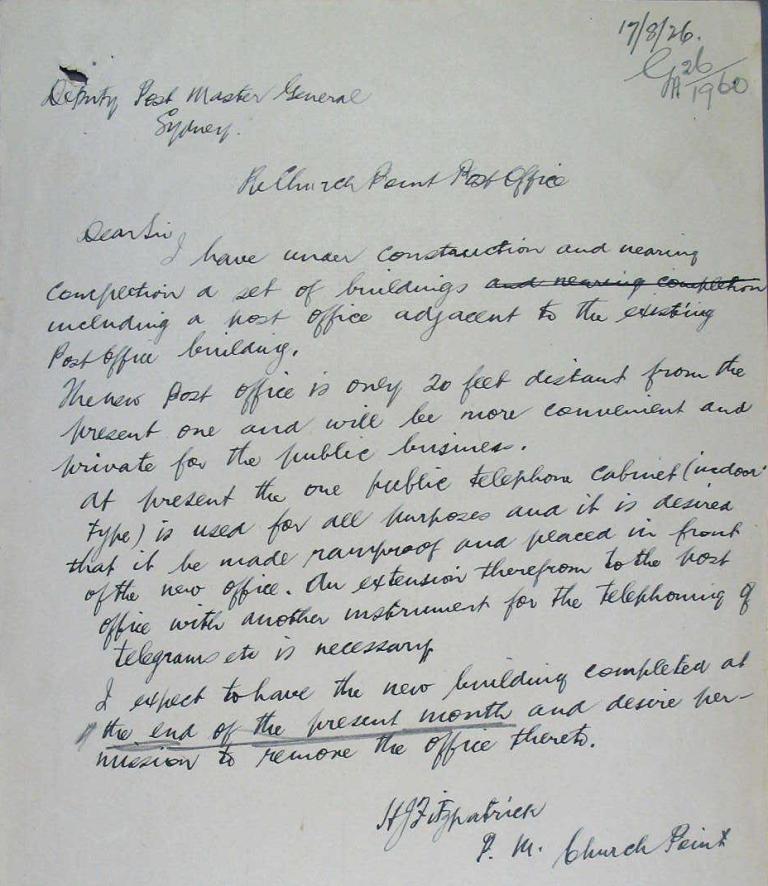
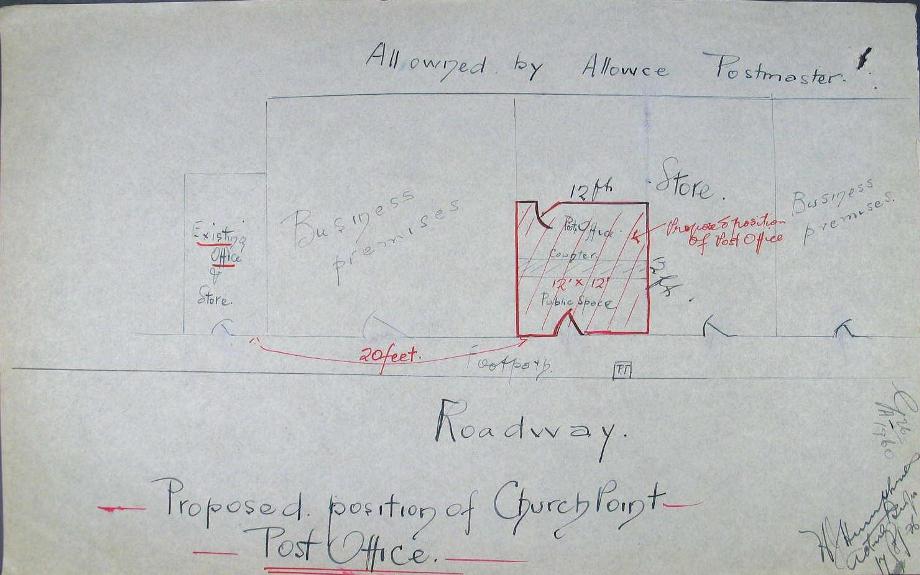
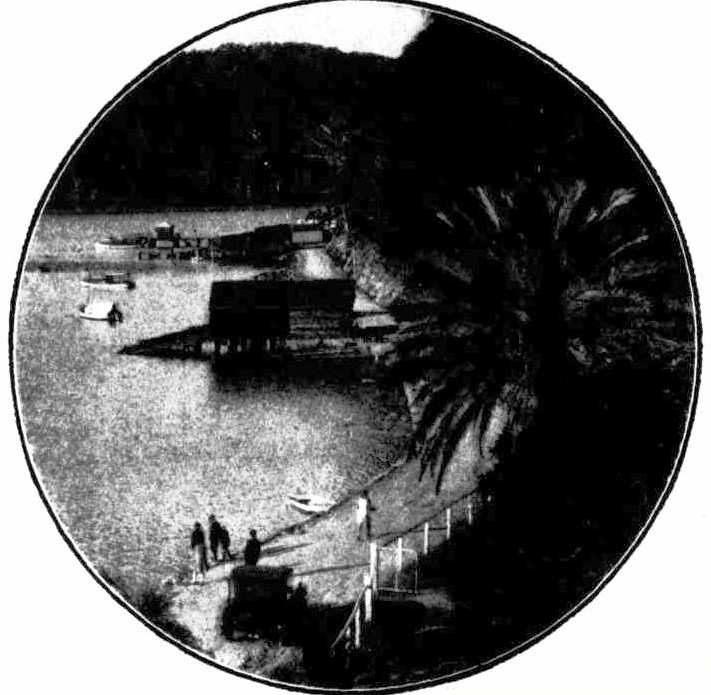
AT CHURCH POINT, PITTWATER. The scenery in this locality, which is a favourites' motor run from Sydney, is strikingly beautiful.The Beaches a Wonderful Asset. (1928, October 10). Sydney Mail (NSW : 1912 - 1938), p. 24. Retrieved from http://nla.gov.au/nla.news-article158402502
DISASTROUS FIRE. At Church Point. BUILDINGS AND BOATS DESTROYED.
A fire which broke out last night at Church Point caused extensive damage, the general store and post-office, tea-rooms, and garage, as well as a launch and several rowing boats, being destroyed. The residents of the well-known pleasure resort were unable to combat the flames, as no water supply was available.
The fire, it is stated, broke out first in Mr. H. Jensen's general store, a large wooden structure. The flames quickly devoured that building and spread to the adjoining tea-rooms. They razed this building to the ground, and enveloped a large motor garage, containing two or three cars. A motor launch, which was lying on slips at the rear of the garage, and several skiffs, which were tied up beneath It, also caught fire. The garage and Its contents were destroyed.
Mr. Jensen, the manager of the store, tea-rooms, and garage, was spending the evening with his family at a picture theatre in Collaroy. He was not aware of the fire until he returned home at a late hour to find the buildings in a state of ruin. Mr. Jenson Is also In charge of the post-office at Church Point.
The buildings were owned by Mr. H. J. Fitzpatrick, of Lennox-street, Mosman, and were leased by him to Mr. Jensen. The boats were the property of Mr. Jensen. One of the motor cars was owned by the local mailman.
The fire was discovered in peculiar circumstances. A resident of Newport, on the opposite side of the bay, noticed a brilliant glare In the direction of Church Point, and he communicated with the Mona Vale Telephone Exchange, and Inquired if any fire had been reported from that vicinity. The telephone operator got Into communication with a resident at Church Point, and this man discovered the fire. It is believed that the damage will amount to several thousands of pounds. DISASTROUS FIRE. (1928, November 22). The Sydney Morning Herald (NSW : 1842 - 1954), p. 13. Retrieved from http://nla.gov.au/nla.news-article16511092
At the June 19 1929 Meeting:
10. .:Clayton Utz &Co. 30/5/29. Further in regard to H. Jensen's application for a Special Lease at Church Point,; and requesting the Council to do all in its powers to enable Mr. Jensen to get the store running again. &1Oa. H. J. Fitzpatrick. 4/6/29. Furnishing reason for the delay in the re-erection of his store &c at Church Point. Decided that if Mr. Fitzpatrick's buildings be not commenced within one month, the Council support Mr. Jensen's Special lease application.
By the Meeting held 8th of July, 1929: Permissive Occupancies. resolved (Cs; Austin, Robertson) - That the Council withdrew its objection to H. Jensen's application for a Special Lease at Church Point wharf, and that Mr. Fitzpatrick and also the Land Board be advised of this.
Land Board. 27/9/29. Requesting that favourable consideration be given Dr. Fraser's application for Permissive Occupancies permission to erect a boat shed and garage on a Permissive Occupancy at Church Point held by him since 1921. Resolved, That the Council adhere to its previous decision in the matter and it be pointed out to the Department that Mr. H.J. Fitzpatrick has until February to erect a public boat shed on his Special Lease, that if the work be not done by that time, Dr. Fraser's application will then be dealt with on its merits.
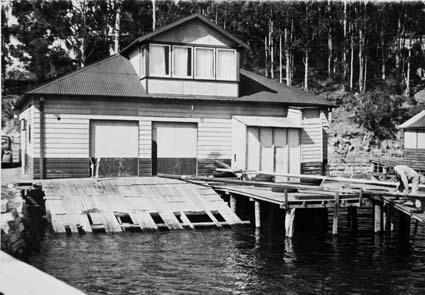
Church Point Post Office (general store), alongside public wharf, 1950 - City of Sydney Archives
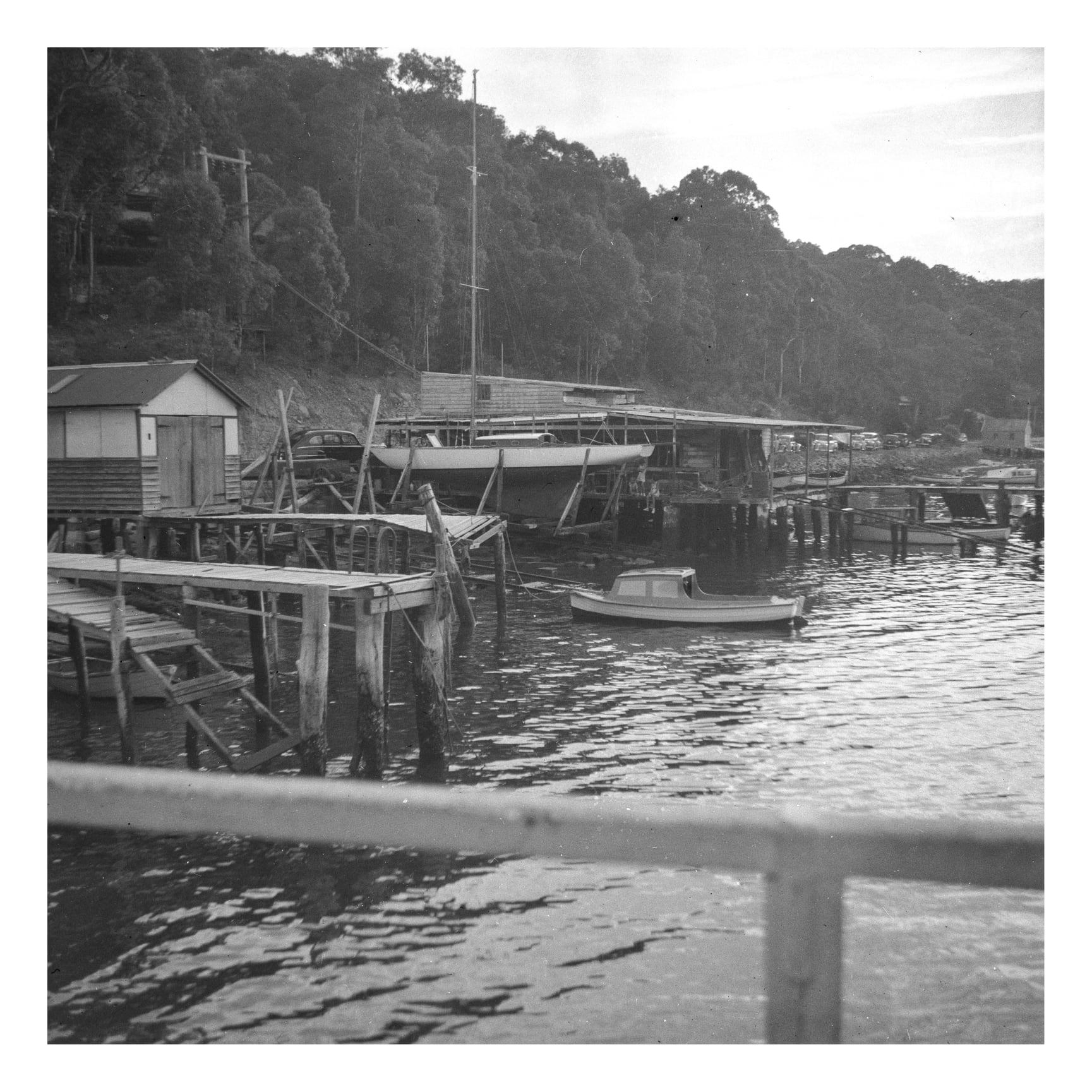
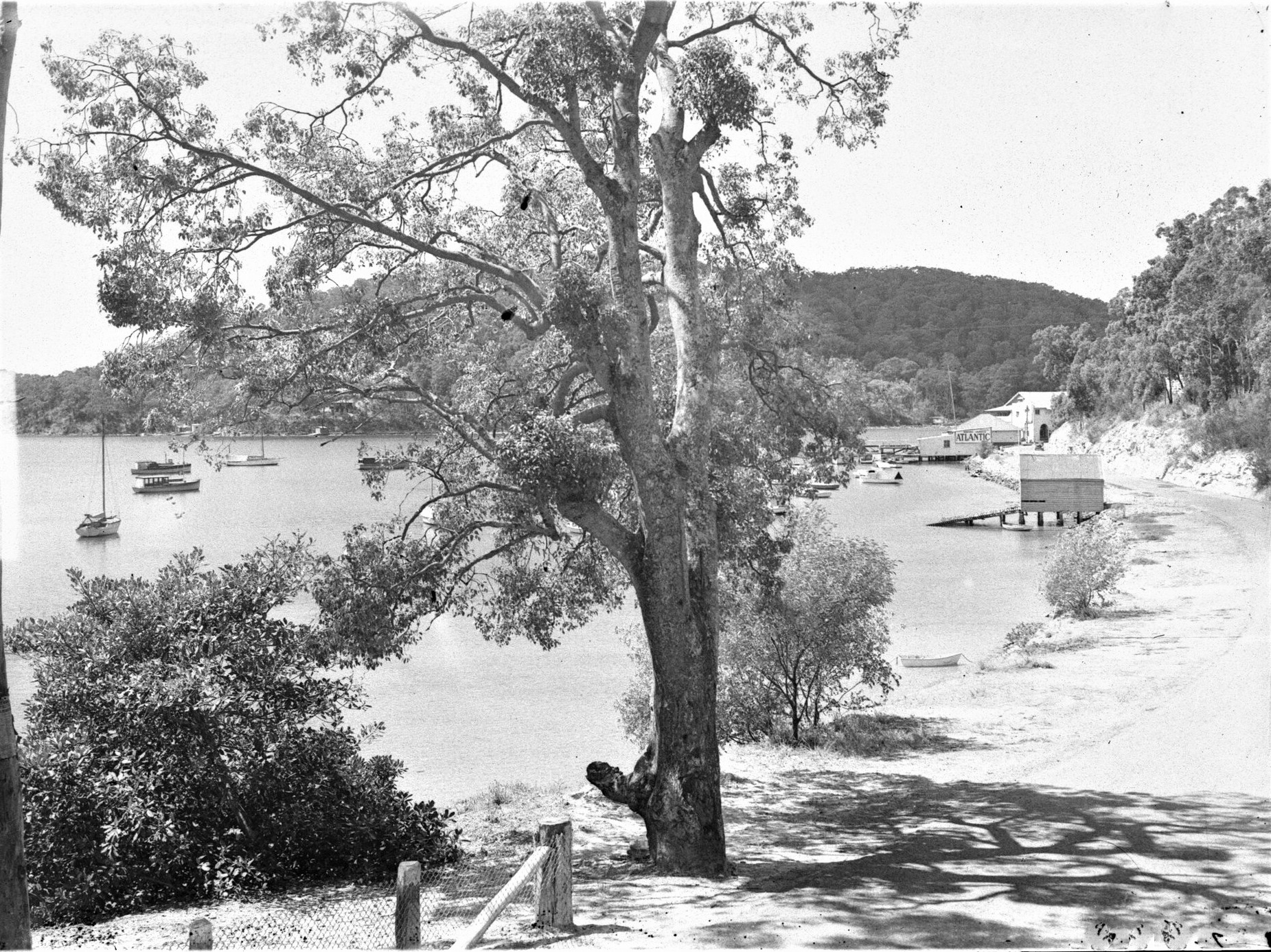
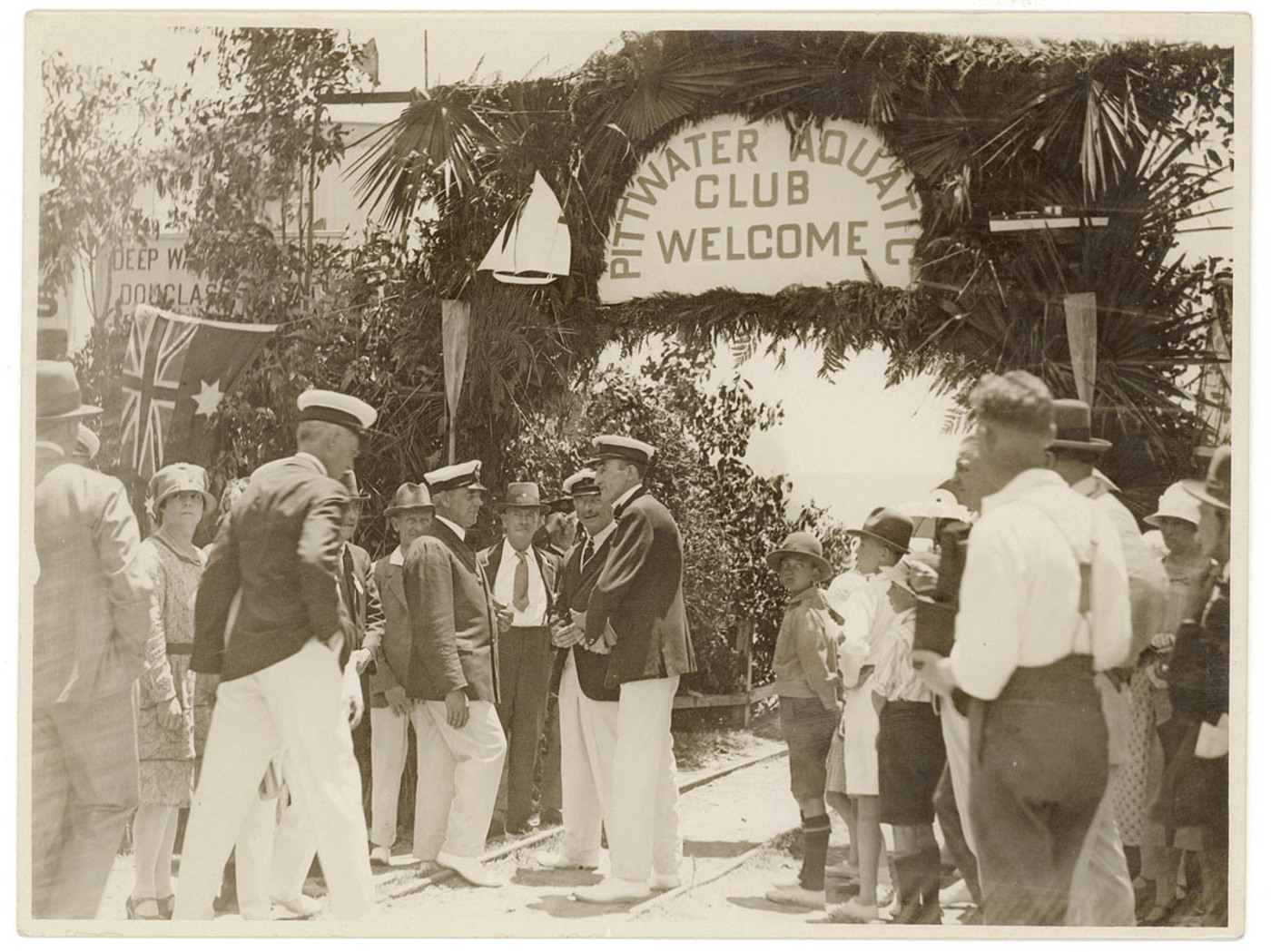
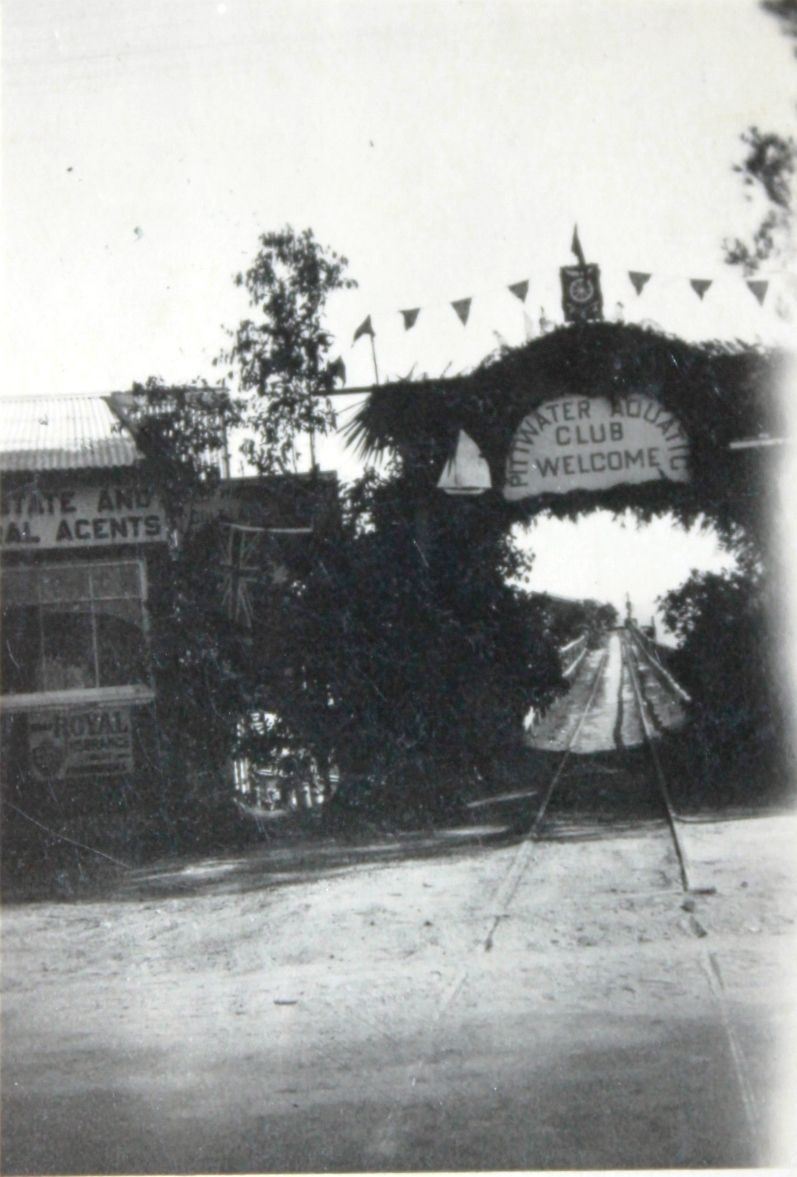
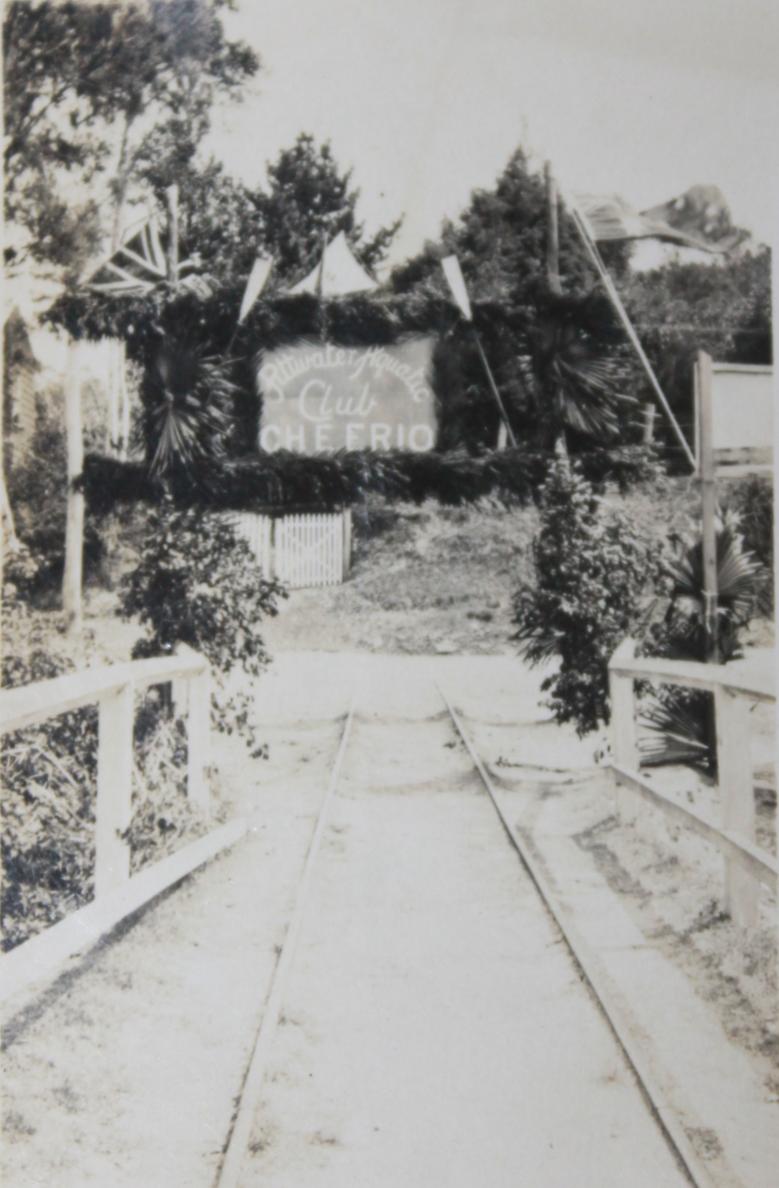
REAL WAGES.
INCREASE DURING DEPRESSION
Despite Nominal Decline.
FEDERAL STATISTICIAN'S FIGURES.
CANBERRA, Tuesday.
Figures prepared by the Common-wealth Statistician (Mr. E. T. Mc-phee), disclose the remarkable fact that during the last few years of the depression there was an increase, and not a decrease, in real wages.
Although nominal wage rates have declined, the fall in the prices of commodities has made their purchasing power greater than during the peak year, 1929.
The average nominal weekly rate of wage In Australia, based on an Investigation of the weekly rates for over 4000 occupations, was £5/1/5 for adult males, and £2/14/2 for adult females on September 30,1929, when peak rates were recorded. Since that date nominal wages have declined steadily. The corresponding rates were £4/6/10 and £2/7/5 at the end of 1931. £4/1/10 and £2/4/2 at the end of 1932. and, £4/0/6 and £2/3/5 at the end of 1933. On June 30, 1934, they were £4/1/7 for males and £2/3/10 for females, representing the first increase since the decline commenced in 1929.
The highest average rate was recorded for employees in the printing and allied trades, and the lowest In the agricultural Industry. Wage rates for the fourth quarter of 1933 were for the aggregate of the six States 21 per cent, below the 1929 level. In South Australia the fall amounted to 25 per cent., In Victoria 24 per cent., in New South Wales 21 per cent., In Western Australia 19 per cent., in Tasmania l8 per cent., and in Queensland 13 per cent. Notwithstanding the fall in nominal wages, all States show an increase in "real" wages over the rates for 1929, due to the greater fall in prices. All States show a slight increase on. rates for 1932, with the exception of New South Wales. During 1933 there was an increase In "real" wages for full work compared with the preceding year. Comparison with 1911 shows that the "real" wage for full-time work in' 1933 was 17.8 per cent, higher, but if allowance is made for unemployment, it was 7.4 per cent, lower.
The retail price index numbers for groceries (21 commodities) were lower in 1933 than in 1932 in all capital cities. Prices for dally produce (seven items) and meat (16 cuts) were also lower everywhere in 1933 than in 1932. In the six capitals, groceries were on the average 8.4 per cent, lower, dairy pro-duce 6.4 per cent, lower, meat .9 per cent, lower, and all food combined 5.7 per cent, lower. Prices rose in 1934, and had In-creased by 4.5 per cent, for food in June, 1934.
The cost of housing declined on the average 1.8 per cent, in 1933 below the 1932 level, but by June,' 1934, It had Increased by .4 per cent. The weighted average index number for the six capital cities, considered as a whole for the combined expenditure on food, groceries, and housing (four and 5 rooms) for 1933 was 4.4 per cent, lower than In 1932, but by June, 1934, it had increased by 3.1 percent.
The number of awards and determinations in force at the end of 1933 was 1363, and at the same date 653 industrial agreements were filed. The membership of trade unions in Australia at the end of 1933 was 739,398, Including 113,132 females. These figures show a decline In membership, as the total at the end of 1932 was 740,831. The number of unions registered under the provisions of the Commonwealth Conciliation and Arbitration Act was 137, with an approximate member-ship of 630,000, or 85 per cent, of the total membership of all trade unions in Australia.
On December 31, 1933, there were 521 employers' associations, with a membership of 132,188. The organisation of employers in numerically strongest in the agricultural and pastoral industries.
FEW INDUSTRIAL DISPUTES.
The number of industrial disputes during 1933 was 90-the lowest number ever re-corded by the bureau. The total loss in word-ing days during the year was 111,956, representing £95,045 In wages. Of the DO dis-putes, 52 involved employees in the <i coal-mining Industry. REAL WAGES. (1935, March 6). The Sydney Morning Herald (NSW : 1842 - 1954), p. 13. Retrieved from http://nla.gov.au/nla.news-article17143201
The ABS data gender pay gap
The national gender pay gap according to the Australian Bureau of Statistics is 11.5%.
As of May 2025, the full-time adult average weekly ordinary time earnings across all industries and occupations was $2106.40 for men and $1864.10 for women.
For every dollar on average men earned, women earned 88 cents. That's $242.30 less than men each week.
Over the course of a year, this difference adds up to $12,600.
This data was released on the 14th August 2025.
State gender pay gap data
Australia's base salary gender pay gap differs significantly by state.
As of November 2024, the gender pay gap is:
- 12.1% in New South Wales
- 11.1% in Victoria
- 9% in Queensland
- 8.5% in South Australia
- 19.6% in Western Australia
- 1.9% in Tasmania
- 12.4% in the Northern Territory
- 6.1% in the ACT
Scotland island wharves builder Contactor: Stanley Raymond Hummerston
On December 5th 1922, Stanley Raymond Hummerston, another Returned Soldier, took over the business of Post Masters position and store at Church Point from temporary postmaster Mr. T. Wilson, after Alfie E Burton took off in November 1922. Post Office records held by the National Archives of Australia, show Agnes Jensen, wife of Nfeils Holger Norup Jensen, a Danish sailor, and who take over and rebuild the store after the 1928 fire, had signed a declaration to act as a Post Mistress as well in 1924. Alan Mann also signed the declaration which shows S R Hummerston as outgoing postmaster as of October 31, 1924.
He had enlisted in the RAN in April 1913 as a 20 year old and been a Stoker before a Court Martial in March 1916 as a 23 year old for 'wilful disobedience of a lawful command' from the Chief Stoker when ordered to carry out his duties in the Stokehold. He'd also been charged with desertion in 1913 (From H.M.A.S. “Melbourne,” at Melbourne.) and 1914 (From H.M.A.S. "Tingira," at Sydney).
The year 1913 was a formative one for the Australian Royal Navy and something many young men would have wanted to be a part of. See: From Colonial Navy Brigades in Second Hand Ships to Where the Australian Navy was Born – The Practical Verses of William Rooke Cresswell’s Charter and The Arrival of Australia's Navy in Sydney Harbour: October 1913
His older brother Albert Sydney Hummerston was also up on the same charge on board the same ship, His Majesty's Ship the 'Psyche' at the same time. Albert refused to go to work - he was also a Stoker - and wanted to sit elsewhere drinking cocoa and eating biscuits; full files in National Archives.
There had been complaints about the food apparently, on February 12th 1924, and this caused trouble among the Stokers - 27 men were under arrest by the 14th when the incident occurred, and which is why the men had been issued with cocoa and biscuits.
Stanley had been ill on one day prior to coming on charges, but was not on the ill when he was ordered back to work due the ship being short-handed through those on sick leave or placed under arrest.
The report on the Court Martial indicates he was telling all of his superior officers what he would and wouldn't be doing, possibly emboldened by what had occurred on the 12th. The Court Martial took place aboard the Psyche while they were in Singapore, on the 'China Station' with both men represented by the best of the best.
Of note is that the A/Commander on the China Station during the Court Martial and Commander in Chief of Ships and Vessels on the China Station was H. J. Feakes, Creswell's right-hand man during the formation of the RAN.
HMAS Psyche was a Pelorus-class light cruiser built for the Royal Navy at the end of the 19th century. Initially operating on the North America and West Indies Station, the cruiser was transferred to the Australian Squadron in 1903, and remained there until the Royal Australian Navy (RAN) took over responsibility in 1913. After a stint in New Zealand waters and involvement in the occupation of German Samoa, Psyche was paid off in 1915.
At the recommendation of the Australian government, the ship was commissioned into the RAN in 1915, and assigned to patrol the coast of Burma, in response to the threat of a German-instigated uprising. Psyche operated in the Bay of Bengal and around Sumatra until 1916, when she was docked at Hong Kong for refit. During this, personnel from the ship were used to commission and man the river gunboat HMS Moorhen. After the refit's conclusion, Psyche patrolled in Chinese waters, before returning to the Bay of Bengal. Psyche returned to Sydney and was paid off in October 1917, but recommissioned a month later for patrols in Australia's northern waters. She was decommissioned for the final time in early 1918.
.jpg?timestamp=1761769311540)
HMS Psyche. Photo y Green, Allan C., 1878-1954, photographer. -courtesy State Library of Victoria
She had a displacement of 2,135 tons, was 313 feet 6 inches (95.55 m) long overall and 300 feet (91 m) long between perpendiculars, had a beam of 36 feet 6 inches (11.13 m), and a draught of 15 feet (4.6 m). Propulsion was supplied by inverted three-cylinder triple expansion steam engines, built by Keyham, providing 7,000 indicated horsepower (5,200 kW) to two propeller shafts. Psyche was capable of reaching 20 knots (37 km/h; 23 mph), although she normally operated at the more economical speedo of 8 knots (15 km/h; 9.2 mph).
The cruiser was armed with eight single QF 4 in (100 mm) guns, eight single QF 3-pounder guns, two 4.7-inch guns, two field guns, three Maxim machine guns, and two 14 in (356 mm) torpedo tubes sited above the waterline. Armour protection was limited to 50 mm (2.0 in) thick section of deck plating over vital areas. The ship's company initially stood at 220, but this was later reduced to 188; 12 officers, and 176 sailors.
Born August 11, 1892, Stanley was one of four Hummerston boys of Arthur and Sophie. They lost their father when they were quite young, and their grandfather on heir father's side was already deceased just months before Stanley was born. Their mother was pregnant with her last child when her husband died, and this child, William, died as a newborn. Their older brother Reginald was placed in state care while their mother was finishing her pregnancy, as she could not look after them all. Stanley's war records nominate his sister, and first born child, 'Alice' as his mother, not his actual birth mother. His mother remarried in 1901.
Stanley was married in 1917 to Dorothy Bushnell and moved over to the AIF once he'd served some of the time imposed through the CM, part of which stated both he and his brother were to be dismissed once they'd served their 12 months of punishment for his brother and 15 months for him.
Assigned to the 7th Light Horse Regiment during WWI as his previous occupation had been 'Horse Driver', there was a family connection to cab driving and racing horses going back a few generations, Mr. Hummerston was a Woolloomooloo gentleman with a tattoo of a butterfly on his left forearm, a man on a horse on his right forearm, and tattoos across his chest and shoulders that weren't described in his war service records other than to state they are there.
He enlisted in the AIF in February 1917, aged 24 and was sent to Moascar Isolation Camp (many soldiers were arriving from Australia with measles and other diseases) and on to El Fukhari. His war records indicate he too frequently was returned to Moascar Isolation Camp with one illness after another, so he may have come out of service weakened physically.
Mr Hummerston was returned to Australia in 1919 and was discharged on the 16th of April, 1919. He too may have struggled to 'just get on with it', but as his father died before he was 5 years of age, his post-war and post-Scotland Island wharves build supervision of his approved plans, read like a man on a mission. He took on every opportunity and was even involved in at least one remarkable adventure - a few Notes under Extras for him.
The lapse of a year between when his plans for the wharves and baths were submitted and those that were approved by the council and their completion in late July or August 1924, can be attributed to having to build the three wharves and their baths during tides that suited that construction, although the records do not indicate that it was actually he who built those wharves, more so as the Tender for the same was advertised in July 1923, after he had submitted plans to the council in April 1923, and had approval by June.
Given his successful pursuit through courts of others who did not honour their contracts with him during the same years, it is more than probable he did honour the contract he had won with Hardy, Busby and Norman, engineers of 875 George Street.
.jpg?timestamp=1762892389813)
Department of Mines,
Sydney, 25th November, 1938.
NOTICE is hereby given that the necessary evidence and report with reference to the undermentioned applications for dredging leases having been received, I have determined that leases may be granted of the areas specified therein, subject to the usual and the following conditions:—
Sydney No. 209, Pittwater Shell & Lime Company Limited, portion ML 7, county Cumberland, parish Narrabeen, 100 acres (ex Special Leases), dated 16th October, 1936.
Sydney No. 210, Pittwater Shell & Lime Company Limited, portion ML 6, county Cumberland, parish-Narrabeen, 100 acres (ex Special Lease), dated 16th October, 1936.
(1) The term of the leases shall be twenty years.
(2)' The lessee shall within nine months of. the grant of leases instal thereon dredging plant valued at not less than £1,000.
(3) The lessee shall observe, fulfil and perform the provisions of the Navigation Act, 1901-1935, and any Regulations made thereunder so far as they may be applicable.
(4) The lessee shall not conduct any dredging operations within 25 feet of any pile beacon and plant or machinery shall not be moored or placed in such a position a« to obscure any such pile beacon.
(5) The lessee shall not conduct any "dredging operation on Saturdays, Sundays or public holidays nor between the hours of 5 p.m. and 7.30 a.m. on other days.
(6) The lessee shall so conduct the operations hereby authorised in such a manner as not to cause any interference -with shipping.
(7) The lessee shall use such anchors only as are approved by the Maritime Services Board of New South Wales and all anchors, mooring posts and any like obstructions shall be removed immediately after operations are completed in the locality of such anchors, mooring posts or like obstructions.
(8) The lessee shall not conduct any dredging operations within 50 feet of any mooring already laid down or any mooring site which has been or which may be allotted by the Maritime Services Board of New South Wales.
(9) The lessee shall not conduct any operations within 150 feet of any improvement on shore or within 100 feet of any jetty or improvement off shore.
(10) In the event of electric or other cables being connected to the dredging plant from the shore such cables or the piles on which such cables are suspended shall be placed and maintained in such a position as not to interfere with navigation.
(11) The lessee shall not foul existing channels with grit, sand or mud and shall carry out dredging operations in such a manner to the satisfaction of the Secretary for Mines as not to cause potholes to be left or not to cause shoaling or erosion.
(12) The lessee shall, exhibit the uniform dredger signals and the regulation day and night signals on all plants punts and machinery.
(13) The Secretary for Mines may, upon written notice to the lessee, prohibit the continuance of dredging operations on any defined part of the area demised if, in the opinion of the said Secretary for Mines, it is desirable in the public interest so to do.
(14) The lessee shall so conduct the dredging operations hereby authorised to the satisfaction of the Secretary for Mines so as not to interfere with fish life, or with fishermen.
(15) The lessee shall at all times permit any landowner or holder of any Permissive Occupancy or Special Lease to have free and uninterrupted access to his or their land or holdings and such lessee shall observe, fulfil and perform any directions of the ^Secretary for Mines designed to protect the interests of any residents on neighbouring foreshores or any other persons.
(16) The lessee shall serve a notice in writing on the Metropolitan Engineer, Department of Works and Local Government, immediately after dredging operations have been commenced and shall serve a similar notice immediately after operations have been completed.
(17) Dredging operations shall be subject to surveys or inspections by any officer appointed by the Secretary for Mines or the Department of Public Works and Local Government at such times as the said Secretary for Mines or the said Department of Public Works and Local Government may determine, and the cost of such surveys or inspections shall be borne by the lessee.
(18) The lessee shall dredge or excavate such material only as shall be necessary to obtain sea shells and shall dispose of any surplus material in a manner satisfactory to the Secretary for Mines.
(19) The lessee shall not make any excavation of a greater depth than 10 feet from the-present bottom and the sides of any such excavation shall not be of a steeper grade than two in one.
(20) The dredging operations hereby authorised shall be conducted in such a manner that the bottom of Pittwater is not raised above the level existing at the date of this demise.
(21) The lessee shall indemnify and keep indemnified the Crown from and against all actions, suits, claims and demands or whatsoever nature and all costs, charges and expenses which may be awarded or brought against the lessee or which the4 lessee may incur in respect of any accident or injury to any person or property which may arise during the term of the leases through any cause whatsoever, or for any damage which may be consequent upon dredging operations on the leased area notwithstanding that the conditions and covenants contained or referred to in such leases shall in all respects have been observed by the lessee or that any accident or injury shall arise from any act or thing which the lessee may be--authorised or compelled to do in respect of the above conditions.
(22) The Governor with the advice of the Executive Council may cancel these leases without compensation to the lessee at any time during the currency of the said leases provided that the lessee shall be given not less than twelve months' notice of the intention to cancel such leases.
(23) The lessee shall not land any material nor erect any bins or similar structures between Williams' Boat shed and Church Point.
(24) The lessee shall not conduct any operations within 50 feet of a low-tension electric cable laid or to be laid in a position north of Bayview to the south-eastern point of Scotland Island. (1938-13,076 L.B.) Government Gazette Notices (1938, November 25). Government Gazette of the State of New South Wales (Sydney, NSW : 1901 - 2001), p. 4526. Retrieved from http://nla.gov.au/nla.news-article225068968