Environment News: February 2026 - Issue 651

Week One February 2026: Issue 651 (published Sunday February 1 2026)

The fauna bridge on Mona Vale Road East – will it be a bridge to nowhere?

A proposed change of zoning for land in Ingleside could jeopardise the future operation of a planned fauna corridor, including a fauna bridge and underpass on Mona Vale Road East.

This could isolate threatened fauna in Ingleside Chase Reserve, leading to long term decline and possible local extinction.

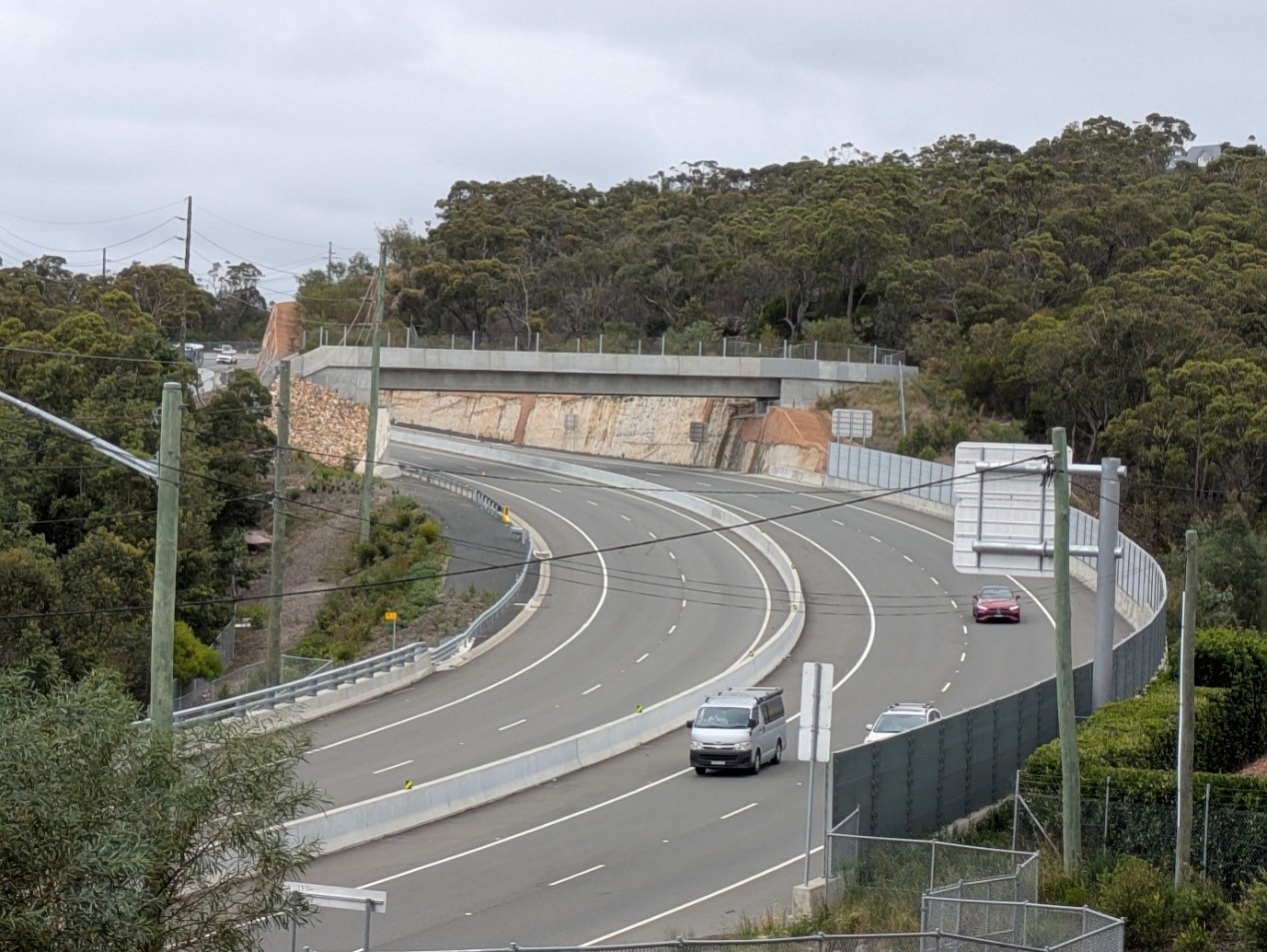
Fauna bridge on Mona Vale Road East. Ingleside Chase Reserve is on left. Photo David Palmer

The land is a critical element in the pathway for native fauna populations in Ingleside Chase reserve to cross Mona Vale Road east and disperse through bushland in Ingleside to Ku-ring-gai Chase National Park. 

The land was set aside in the 2016 Ingleside Precinct Structure Plan, and marked as a fauna corridor. This was part of an agreement between Transport for NSW, (then RMS) and the NSW Department of Planning to create a corridor, fauna underpass and fauna bridge over Mona Vale Road East which would link Ingleside Chase Reserve with Ku-ring-gai Chase National Park. 

However, in the new Local Environment Plan for the Northern Beaches this land has been zoned C3 which allows housing. If houses are built on it, then native animals which cross the fauna bridge or use the underpass will have nowhere to go.

Pittwater Natural Heritage Association secretary David Palmer is calling for action by the Department of Planning to remedy the situation. 

“Whilst RMS kept their side of the bargain and built the fauna bridge, the Department of Planning didn’t keep their promise to zone the land for conservation. So now we have a situation where sometime in the future housing could appear on this land and the fauna Bridge over Mona Vale Road would lead into residential back yards and fences, rendering it a useless waste of money.

“We would like Northern Beaches Council to ask the Planning Department for a solution to this problem,” he said.

Cr Miranda Korzy will put a motion to Northern Beaches Council calling on Council to liaise with the Department of Planning, which owns the land, and other agencies to identify ways to protect it.

PNHA hopes that her motion will be supported by other Councillors as the long-term viability of native fauna populations in Ingleside Chase Reserve, which is under Council’s control, will be affected.

PNHA President, Marita Macrae says Pittwater Natural Heritage Association has been advocating for protection of native fauna in Ingleside Chase Reserve since 1994 when much of it was privately owned and threatened by a plan to subdivide it. 

“Our campaign spurred Pittwater Council to take action to protect it which resulted in the creation of the nature reserve. We thought that with the creation of the fauna corridor and crossings over Mona Vale Road, our campaign would be over, but sadly our vision seems to have been thwarted,” she said. 

PNHA member Jacqui Marlow has been involved in rescuing native fauna in the area for many years. She says that protection of the fauna corridor land is critical for the long-term survival of native animals. 

She explained that “If native animals are not able to move between habitats, they will face gradual population decline leading to local extinction. We have many threatened mammals and birds in Ingleside Chase reserve including Eastern Pygmy Possums, which are listed as vulnerable in NSW. They depend on being able to move safely through the landscape to find food, shelter and mates.”

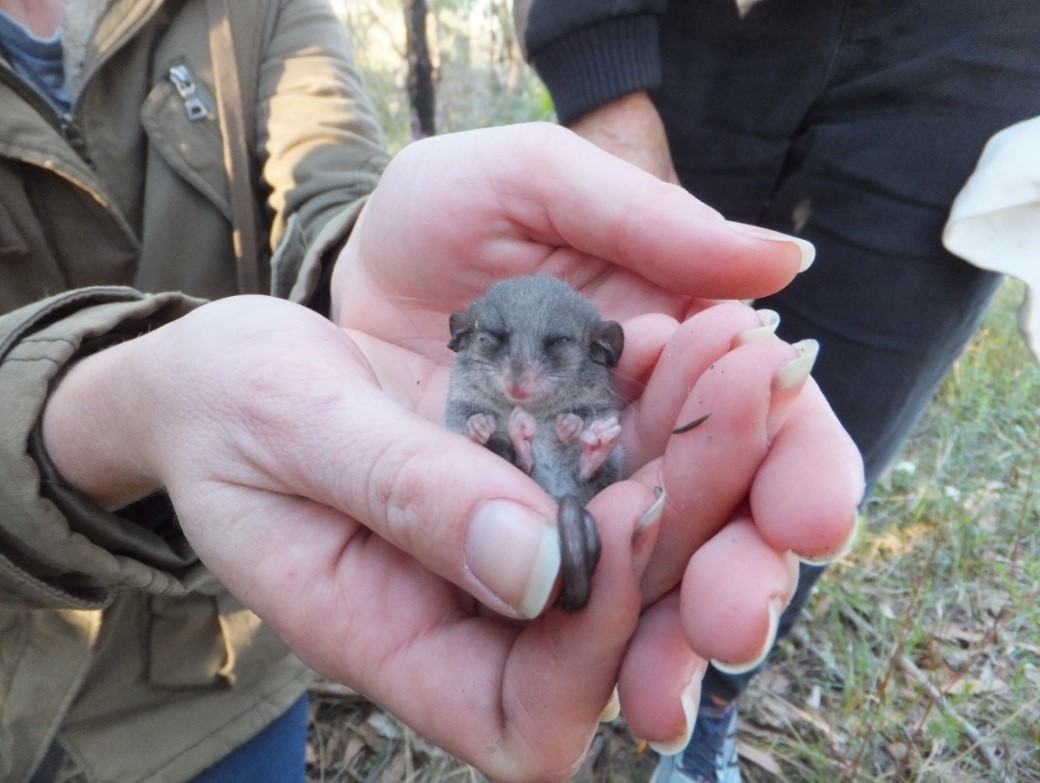
Eastern Pygmy possum near the fauna bridge on Mona Vale Road East. Photo David Palmer

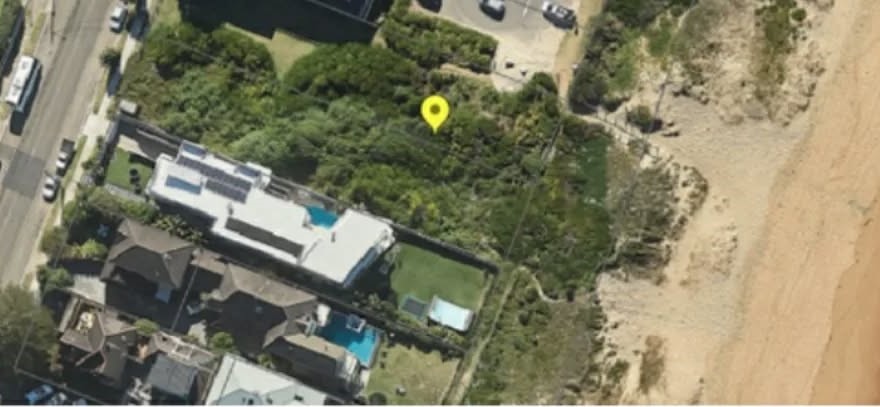
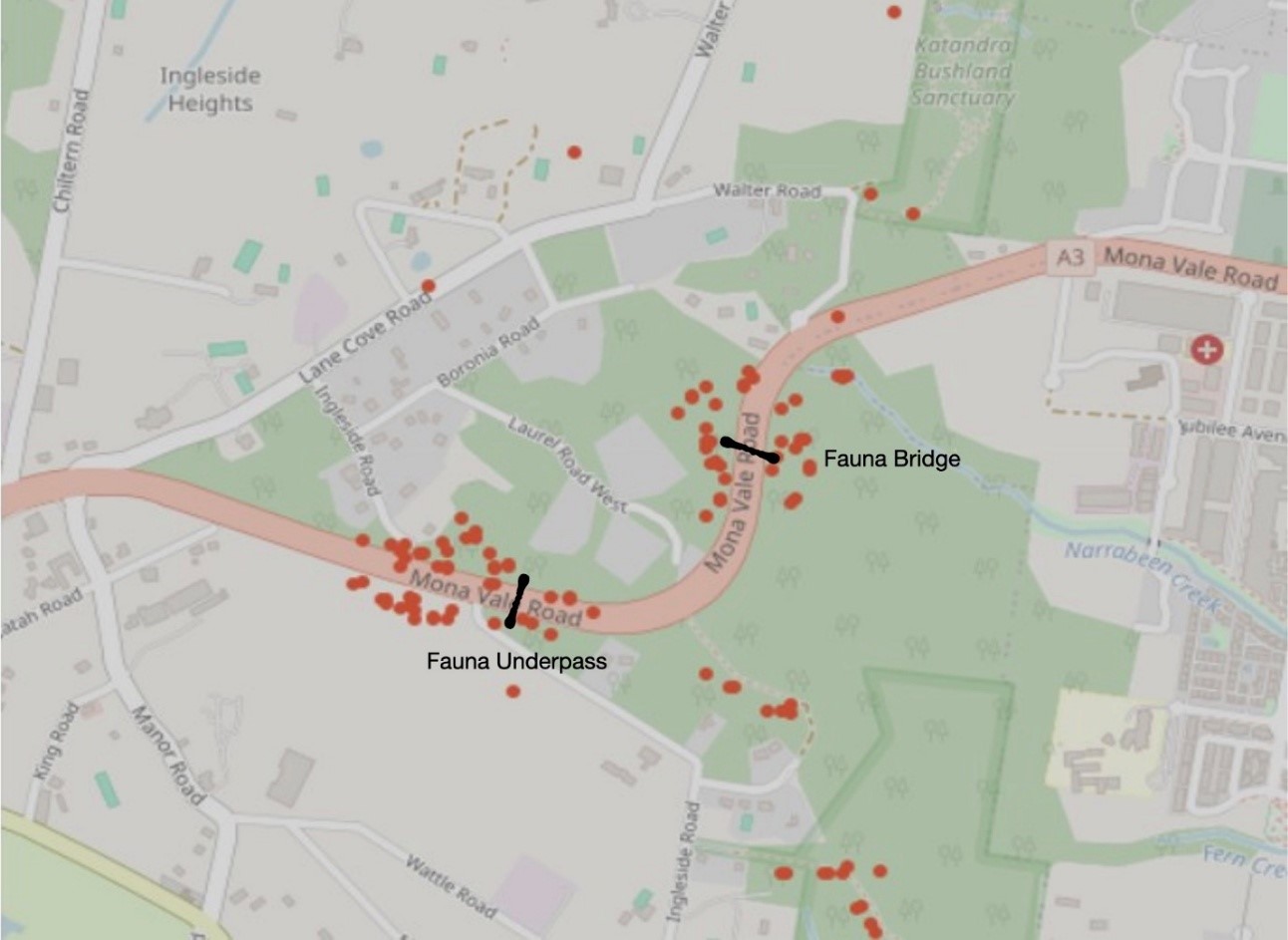
The map below shows recorded sightings of Eastern Pygmy Possums on both sides of the fauna bridge and underpass on Mona Vale Road East.

Eastern Pygmy Possum sightings near the fauna bridge and underpass on Mona Vale Rd east. Image: Atlas of living Australia 2025

Native animals have been photographed using the fauna bridge, showing that it is working, and as the vegetation on and around it grows thicker, more animals will use it. But if, after crossing the fauna bridge, animals encounter back yards, fences and domestic pets, then it will prove to be a bridge to nowhere.

PNHA has commissioned Pittwater Pathways to produce a three minute You Tube video titled “A Bridge to Nowhere?” explaining the issue. Click on this link or watch it below.


Synthetic grass fragments are increasingly prevalent microplastics in waterways across Metropolitan Sydney: Report finds Microplastics Have tripled in Sydney's waterways in three years - Manly Cove's 'very high' reading - NSW microplastics report 2026

A report based on seven years of citizen-led shoreline surveys has found that microplastic pollution is surging in Sydney's waterways.

The report names Port Hacking in Sydney's south, North Harbour, and lagoons on the northern beaches, such as Narrabeen and Dee Why, as the city's worst hotspots for microplastics.

AUSMAP's shoreline monitoring also provides some of the first site-specific evidence of an increase of synthetic grass fibres accumulating in Metropolitan Sydney waterways. 

The highest average concentration recorded to date was at Tower Beach (Gamay/Botany Bay), where up to 2,500 blades per m² were recorded in 2024. Local stormwater inputs, rainfall patterns, and nearby synthetic grass fields in the Botany Bay region likely contribute to the high and variable amounts seen at this site.

Synthetic grass installations are now commonplace across Australia, appearing everywhere from community and elite sports fields to school playgrounds, party boats, residential yards and public landscaping.

These surfaces have been associated with a range of concerns, including surface temperatures reaching up to 75 °C on hot days, increased player injury risk, reduced biodiversity, and intensified urban heat, particularly in Sydney's Western Suburbs.

This increasingly popular plastic product has the potential to release microplastics into surrounding drains, parks, and waterways, contributing to a growing and largely unmanaged source of urban plastic pollution. 

The Northern Beaches Council has been installing this product across Pittwater in playgrounds and parks and wetlands, in known flood zones, without consultation, without updating Plans of Management to state the product has been installed in these environments, for at least 5 years.

Microplastics pollution data

AUSMAP’s ongoing monitoring at Manly Cove has revealed consistently high levels of microplastic pollution, marking it as one of Australia's significant hotspots. Since mid-2018, AUSMAP researchers and community members have collected over 60 samples from Manly Cove, building one of the most comprehensive datasets on microplastic pollution in Australia, and potentially worldwide. This data reveals concerning trends that highlight the severity and persistence of microplastic contamination at this site.

The microplastic levels at Manly Cove frequently fall into the “High” (251-1,000 microplastics/m²) or “Very High” (1,001-10,000 microplastics/m²) categories on AUSMAP’s pollution scale, with a peak concentration recorded at 4,097 microplastics/m² in July 2024. This consistently elevated pollution suggests that Manly Cove is experiencing ongoing contamination from plastic debris.

Some of the highest recorded averages were in lagoons or smaller waterways (e.g. Dee Why Lagoon, Curl Curl Lagoon, Port Hacking and Manly Lagoon) suggesting these smaller, low-flushed estuaries accumulate microplastics. Additional sampling is needed to verify some of these findings.

In contrast, locations such as Middle Harbour, Pittwater, Southern Beaches and the Hawkesbury River, where the water is flushed by tides and floods, recorded low concentrations (<50 MPs/m²), and the Cooks River remained below hotspot thresholds despite its heavily urbanised catchment, and clear records of runoff into all these sites during rain events.

The composition of microplastics across Metropolitan Sydney from 2022 to 2025 revealed a broadly consistent pattern across estuaries, dominated by foam and hard fragments, though a few distinct deviations due to localised influences were apparent (e.g. Lower Hawkesbury River). 

For the coastal locations, there were different dominant microplastic types in each area, highlighting the localised nature of microplastic pollution. This variability likely reflects site-specific factors such as nearby stormwater outlets, beach use, coastal tourism, and ocean-driven transport. Smaller proportions of film, fibres, and synthetic grass were recorded sporadically across coastal sites, while pellets showed high variability in some sites but remained low elsewhere.

  • 67 % of Sydney sites recorded hard fragments and foam as the two most common microplastic types
  • 89 % of Sydney sites recorded pellets on the shoreline

The report states:

'Foam comprises the largest proportion of microplastics across most sampled Sydney locations, with several sites exhibiting overwhelming contributions from this material.

Foam specifically accounted for 74 % of microplastics recorded in Narrabeen Lagoon, 67 % in Parramatta River, 62 % in Port Hacking, 56 % in both Curl Curl and Manly Lagoons, and 52 % in Dee Why Lagoon. This reflects the widespread presence and persistence of expanded polystyrene (EPS) debris, a material that fragments readily and disperses through stormwater. 

While much of this foam originates from diffuse stormwater inputs, episodic pollution events can contribute to localised spikes, which have been increasingly observed at popular Sydney beaches. An example of this was seen at Bondi Beach in December 2023, with hundreds of thousands of foam balls washing onshore likely due to a polystyrene-based pontoon incident on the northern beaches of Sydney.'

Foam, Hard fragments and Pellets were also the primary sources of microplastic pollution in the Pittwater estuary as well. 

The same washes onto every Pittwater beach with each tide.

The whole NBC LGA beaches are rated as having 'moderate' pollution, indicating every area has increasing microplastics. The surveys found:

Avg. microplastic / m2 (SEM)

Pittwater 

  • Careel Bay - 41(13) - 3 surveys 2022-2025
  • Palm Beach 11(8) - 2 -
  • Riddle Reserve Bayview - 76 - 1surveys 2022-2025
  • Sandy Beach Palm Beach 51(12) - 3 surveys 2018-2021 
  • Narrabeen Lagoon 43(7) 190 10surveys 2018-2021 1 survey 2022-2025

Dee Why Lagoon 351(118) 839 8 1

Curl Curl Lagoon 101(32) 1175 4 1

Manly Lagoon 44 5056 1 1

North Harbour 

  • Collins Flat Beach 106(4) 12399 4 1
  • Little Manly Beach 109
  • Manly Cove 631(129) 1660(332) 35 surveys 2018-2021  43 surveys 2022-2025
  • Manly Cove East 342(142) 85 2 1

Middle Harbour 

  • Clive Park 129 - 1 -
  • Echo Point Beach 14(7) 1 4 2
  • Edwards Beach - 71

AUSMAP’s states the data on Manly Cove exemplifies the wider issue of plastic pollution and underscores the need for targeted actions and policies to address the root causes of microplastic pollution. 

''Once microplastics enter the ocean, they are exceedingly difficult to remove, making prevention at the source the most effective solution. Stronger regulatory protections, coupled with efforts to reduce plastic use and improve waste handling, are essential to protect marine ecosystems and mitigate the long-term impacts of plastic pollution.'' the organisation states

AUSMAP - Australian Microplastic Assessment Project - is a national group of high profile environmental groups, researchers, sustainable businesses and educators. They gather crucial new data about microplastic in aquatic environments: how much is out there, where it is and where is it coming from.

Download the 2026 report 'Australian Microplastic Assessment Project (2026). Do We Have a Microplastic Problem in Our Coastal NSW Waterways? A report of Total Environment Centre. 54 pp.; - Using citizen science as a data-driven, early warning system to identify microplastic hotspots'

Plastic Grass Increasing in Aquatic Environments

Shoreline surveys by AUSMAP demonstrate the presence of synthetic grass fibres in Metropolitan Sydney waterways dating back to 2019.

Synthetic grass microplastic fibres are released from their source, such as sporting fields, residential yards, playgrounds, and landscaped areas, through everyday wear, weathering and maintenance activities. Once mobilised, these fibres can enter the surrounding environment via the stormwater network. There, they persist in sediments and along shorelines, where they can act as sponges for other environmental pollutants and be ingested by wildlife. Importantly, this demonstrates that synthetic grass materials are not confined to their points of installation but are dispersed into the wider urban environment.

Recent AUSMAP data show that synthetic grass fragments are becoming increasingly common in Sydney’s waterways. At regularly monitored locations, such as Rose Bay in Sydney Harbour, synthetic grass debris has increased approximately tenfold between 2022 and 2025, reaching over 20 blades per square metre

Similarly, at Manly Cove, synthetic grass fragments were first detected in 2019. Concentrations have since tripled, despite natural year-to-year fluctuations.

Poulton Park was raised as an area of concern by the Oatley Flora and Fauna Society. The park consists of two synthetic fields situated next to Poulton Creek, which flows into the Georges River.

Core samples were taken at three distances (0, 4 and 8 metres) from the study sites. Results found that there were approximately 1 million pieces of rubber crumb or synthetic grass coming off those fields. These findings were presented to the local council and are being used to implement mitigation strategies.

AUSMAP completed toxicity studies to evaluate the impact of rubber crumb leachate on freshwater and marine species. Rubber crumb was leached for 18 hours. A freshwater water flea as well as larval marine mussel and sea urchin were exposed to diluted concentrations of the leachate.

Results found that concentrations of 1-3% affected 50 percent of the populations. This is likely due to concentrations of zinc which were significantly higher than the Australian Water Quality Trigger Value. Although other chemicals such as 6 PPD-q and HMMM were also recorded but further toxicity trials are needed to ascertain their impacts to local aquatic life.

Recently, AUSMAP has been working with Ku- ring- gai Council in Sydney’s north-west to quantify microplastic loss from a synthetic turf field and the efficacy of stormwater pit traps to reduce this loss. Results have highlighted that >100,000 particles of rubber crumb and synthetic grass are captured in most trap samples, representing 82% of the loss. However, sampling of the runoff water into a nearby creek found both crumb and synthetic grass to be prevalent. Key findings from this investigation highlight extreme microplastic loss from this surface that would enter the environment unabated without the presence of stormwater mitigation traps. The full impact of mitigation approaches is yet to be reported - and invariably, to date, are not common practice.

AUSMAP are calling for a 5-year moratorium on new planning and approvals for synthetic grass fields until further research and information on potential human and environmental harm from these fields is clarified.

The group are also calling for Enforcement of Australian Standards for pollution mitigation measures on synthetic grass fields and more detailed guidelines for field management to be implemented on all existing synthetic fields as soon as possible.

AUSMAP states investment in and a substantial effort into improving drainage and the condition of natural grass fields to avoid synthetic grass installation should be first choice.

They are calling on Local governments (councils) to provide a truly balanced cost-benefit analysis at the end-of-life of synthetic fields compared to those of natural turf.

Residents of Pittwater are calling on the Northern Beaches Council to consult with the community for approval where and when they have a plan to install plastic turf or plastic products, such as those now used in wharves, in the Pittwater environment area.

There are ongoing calls to either remove where it has already been installed already, especially when that is a known flood zone, wetland or the estuary, and to update the applicable POM's for these sites to state they have installed the product so these sites can be easily identified when it becomes obvious it should be removed.

Residents have pointed out that even when projects are listed under the 'have your say' section of the council website they are announcements, not consultations.

2025 reports: 
Also available:

References:

1. Katrina R. Bornt a b, Joshua W. Rule a, Peter A. Novak An undocumented source of plastic contamination in sensitive estuarine environments. Marine Pollution BulletinVolume 211, February 2025, 117369

Highlights

  • Plastic infrastructure is prevalent around the SCE, particularly decking on jetties.
  • Surface degradation was evident at all sites.
  • Various factors likely influence severity of degradation in estuarine systems.
  • Suitability of plastic infrastructure in estuaries requires further investigation.

Abstract

The degradation of plastic infrastructure installed along estuaries and coastal environments may constitute a significant source of plastic contamination. This study aimed to determine the prevalence of plastic infrastructure and the extent of surface degradation of these plastics in a case study system, the Swan and Canning Estuary, Western Australia. The severity of cracks, chips, deformation, and material loss were used to estimate a novel degradation index for the plastic components on structures. The most common plastic infrastructure was decking on jetties, predominantly fibre reinforced (70 %) and co-polymer recycled (20 %) plastics. Degradation was evident at every site and varied across structures and plastic materials. The severity of degradation was likely influenced by a range of complex interacting factors such as structure age, and wet-dry cycling, alkalinity, and high temperatures that are characteristic of estuarine environments and known to exacerbate degradation of plastic materials. This study revealed plastic infrastructure was common in the case study system, structures start degrading during installation and may constitute a significant, and hitherto undocumented, source of plastic to these environments.

The durability of plastics, purported resistance to degradation and lower installation costs (relative to some materials) means they are often recommended over traditional materials (e.g. timber, metal and concrete) for infrastructure applications. In estuarine and coastal environments plastic is used widely for shoreline infrastructure that frequently interacts with water such as decking, walkways, pontoons, boat pen and jetty chafer posts, pile sleeves and capping, and fenders, among other uses. Shoreline infrastructure is subject to a range of degradation factors that may challenge the durability, and therefore, longevity of plastic. Laboratory testing of a commonly used plastic in shoreline infrastructure, fibre reinforced plastic (FRP), showed susceptibility to increased degradation under high ambient air temperature (>40 °C) (Wu et al., 2023), frequent wetting and drying cycles (Aiello and Ombres, 2000; Wu et al., 2023), ultraviolet (UV) radiation (Cai et al., 2018; Dong and Wu, 2019; Sasaki and Nishizaki, 2012; Zhao et al., 2017) and alkalinity (i.e. high pH rather than total alkalinity) (Bazli et al., 2016). Furthermore, abrasion and wear from foot traffic can be a significant factor in the degradation of these structures (Sabry et al., 2022; Talib et al., 2021), with the degree of severity depending on the polymer type (including fibre reinforcement), and location of infrastructure (e.g. sandy shorelines). The ongoing use of plastic in shoreline infrastructure may represent a significant source of contamination to the environment and a legacy issue for decades to come, yet there is limited understanding of the degradation and potential shedding of plastic from these structures.

This study aims to document plastic infrastructure in estuarine environments as a potential source of plastic contamination by assessing the extent of plastic use and prevalence of surface degradation, and plastic shedding in a case study system, the Swan Canning Estuary (hereafter SCE) in Western Australia (WA). 

.....

To conclude, the surface of plastic shoreline infrastructure installed in estuarine environments starts degrading shortly after installation. This study did not assess structural integrity of plastic infrastructure, and therefore, they may still meet the 20–25 year structural lifespan often promoted by manufacturers. However, these structures start to shed plastic material through surface degradation far earlier than this intended lifespan. Once plastic shoreline infrastructure starts degrading and shedding plastics, it continues to do so throughout the lifespan of the product, therefore, constituting a constant source of plastic to sensitive environments for decades. In contrast to natural products, such as untreated timber, where the loss of material constitutes negligible environmental risks, contamination from plastic is known to cause long-term environmental harm (Andrady, 2011). The susceptibility of plastic infrastructure to a range of degradation factors that are inherent in the SCE and estuarine environments globally, or resulting from installation and purpose-built structures that absorb impact, would suggest they are currently unsuitable for these applications, particularly when environmental risk management is a key priority. Furthermore, the use of plastic infrastructure creates another waste stream of plastic material that will need to be resolved in the future. This work constitutes a baseline of plastic shoreline infrastructure prevalence in an estuarine environment and introduces and recognises, for the first time, these materials as another potentially significant source of plastic contamination to estuarine and coastal environments. Future investigations of differing plastic infrastructure across various environments would be beneficial in elucidating potential factors influencing degradation of such materials in these environments and provide further information on their suitability for installation in comparable circumstances. This study also intends to inform management about the potential environmental risk from contamination arising from plastic shoreline infrastructure whilst informing policy development relating to its use and ongoing monitoring.

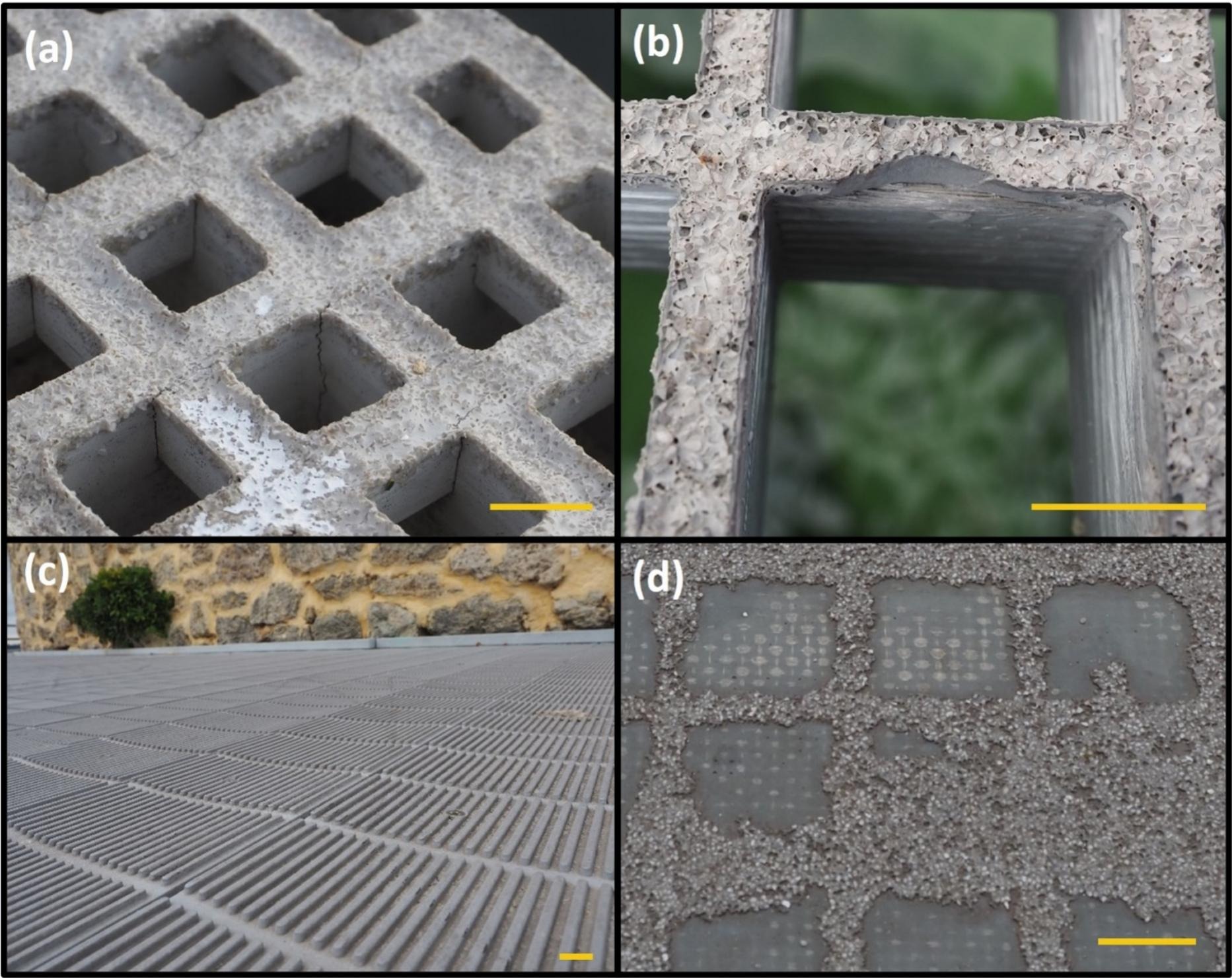
Fig. 3. Examples of each degradation criteria (a – cracking of micro/mini mesh fibre reinforced plastic, FRP); b – chipping of FRP with standard grating; c – deformation of recycled co-polymer; d – material loss on solid top FRP used for rapid visual condition assessments. Orange scale bars represent 1 cm.

2. Lourmpas N, Papanikos P, Efthimiadou EK, Fillipidis A, Lekkas DF, Alexopoulos ND. Degradation assessment of high-density polyethylene (HDPE) debris after long exposure to marine conditions. Sci Total Environ. 2024 Dec 1;954:176847. doi: 10.1016/j.scitotenv.2024.176847. Epub 2024 Oct 10. PMID: 39393706 at, https://pubmed.ncbi.nlm.nih.gov/39393706/

Abstract

The degradation of high-density polyethylene (HDPE) in marine environments was investigated under various weathering conditions. HDPE debris were collected from coastal areas near Korinthos, Greece which had been exposed to marine conditions for durations ranging from a few months to several decades; they were analysed alongside with laboratory-manufactured HDPE specimens subjected to controlled weathering exposure. Four (4) different cases were investigated, including exposure to different conditions, namely to (a) natural atmospheric and (b) sea weathering conditions, (c) accelerated ultraviolet (UV) radiation, and finally (d) submersion to artificial seawater for up to twelve (12) months. The degradation assessment was proposed based on performed tensile mechanical tests, while the chemical/microstructural changes were assessed through Fourier Transform Infrared (FTIR) spectroscopy and Scanning Electron Microscopy (SEM). FTIR spectroscopy indicated the emergence of carbonyl groups, with peaks appearing between 1740 cm-1 and 1645 cm-1, which are crucial indicators of photo-oxidative degradation. Key findings revealed that HDPE specimens experienced significant (8 %) ultimate tensile strength (σUTS) only after 3 months of atmospheric exposure, while this decrease can reach up to 60 % over the period of 35 years exposureA strong correlation was observed between the σUTS decrease between the (a) natural environment and (b) accelerated UV weathering exposure. It is noticed that 1½ month of accelerated UV exposure corresponded to similar ultimate tensile strength decrease for 6 months of natural atmospheric degradation. A linear correlation is proposed to assess the long-term materials' tensile properties degradation in marine environments.

3. Chowreddy, R.R., Fredriksen, S.B., Anwar, H. et al. Degradation behaviour of different polyethylene and polypropylene materials under long-term accelerated weathering conditions. J Polym Res 33, 45 (January 29 2026). https://doi.org/10.1007/s10965-026-04777-x

Abstract

Degradation is heavily influenced by the polymer’s molecular structure, morphology, and the presence or absence of additives. Long-term accelerated weathering experiments, lasting up to 10,000 h, were conducted on various commercial polyethylene (PE) and polypropylene (PP) resins in a Weatherometer (WOM). Dumbbell-shaped test pieces were produced from various resins, including both virgin grades with and without antioxidant additives, as well as recycled high-density polyethylene (HDPE). Throughout the experiment, test specimens were removed from the WOM at regular intervals of 2000 h and analysed for molecular weight, carbonyl index, additive content, and morphological changes. The results indicated the effectiveness of antioxidants and UV stabilisers in protecting polyolefins from significant degradation. In contrast, polyolefins with limited or no UV stabilisers and antioxidants exhibited severe degradation. The PP materials were found to degrade more rapidly than their PE counterparts. Among the virgin PE grades, low-density polyethylene (LDPE) experienced a higher rate of degradation than HDPE. Interestingly, HDPE with an adequate concentration of UV and antioxidant additives showed no signs of deterioration over the test period of 10,000 h. Notably, recycled HDPE containing antioxidant additives degraded more quickly than additive-free HDPE, possibly due to pre-existing free radicals in the recycled material. Oxidative degradation was characterised by a pronounced decline in molecular weight and a marked increase in carbonyl functionalities. Surface deterioration, especially the development of microcracks, was a clear indicator of weathering. The PE samples with microcracks demonstrated a significant drop in impact strength, suggesting that such cracks serve as stress concentrators or notches. This finding highlights the direct relationship between microcrack formation and diminished impact performance. The mechanisms of crack propagation in PE and PP resins appeared to differ, likely reflecting differences in their crystalline morphologies.

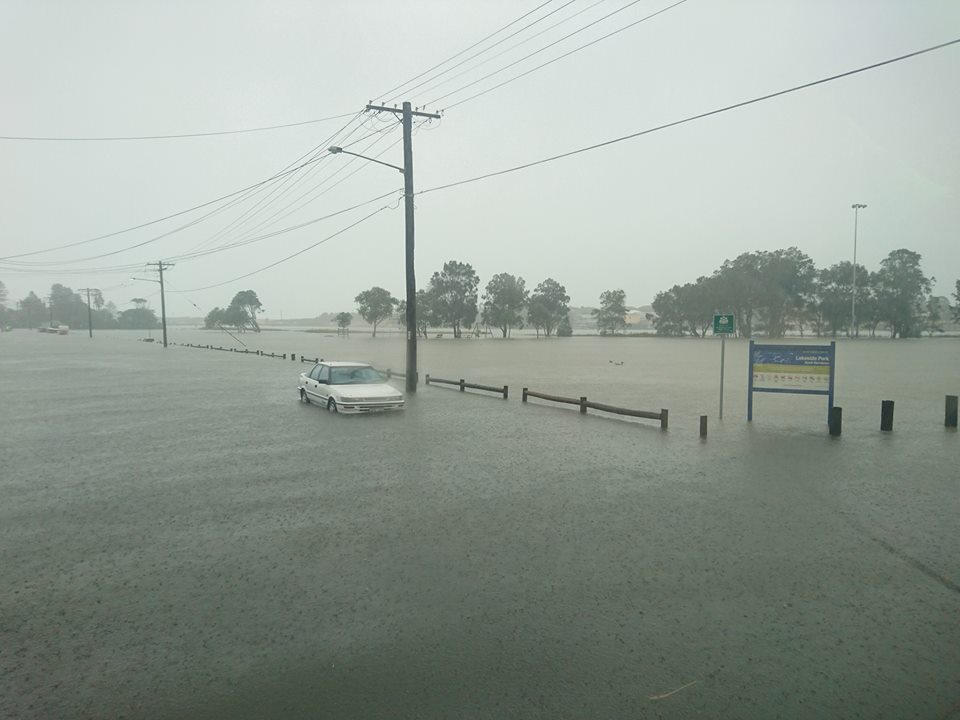
Lakeside park; the catchment claiming landfill areas back. MORE HERE

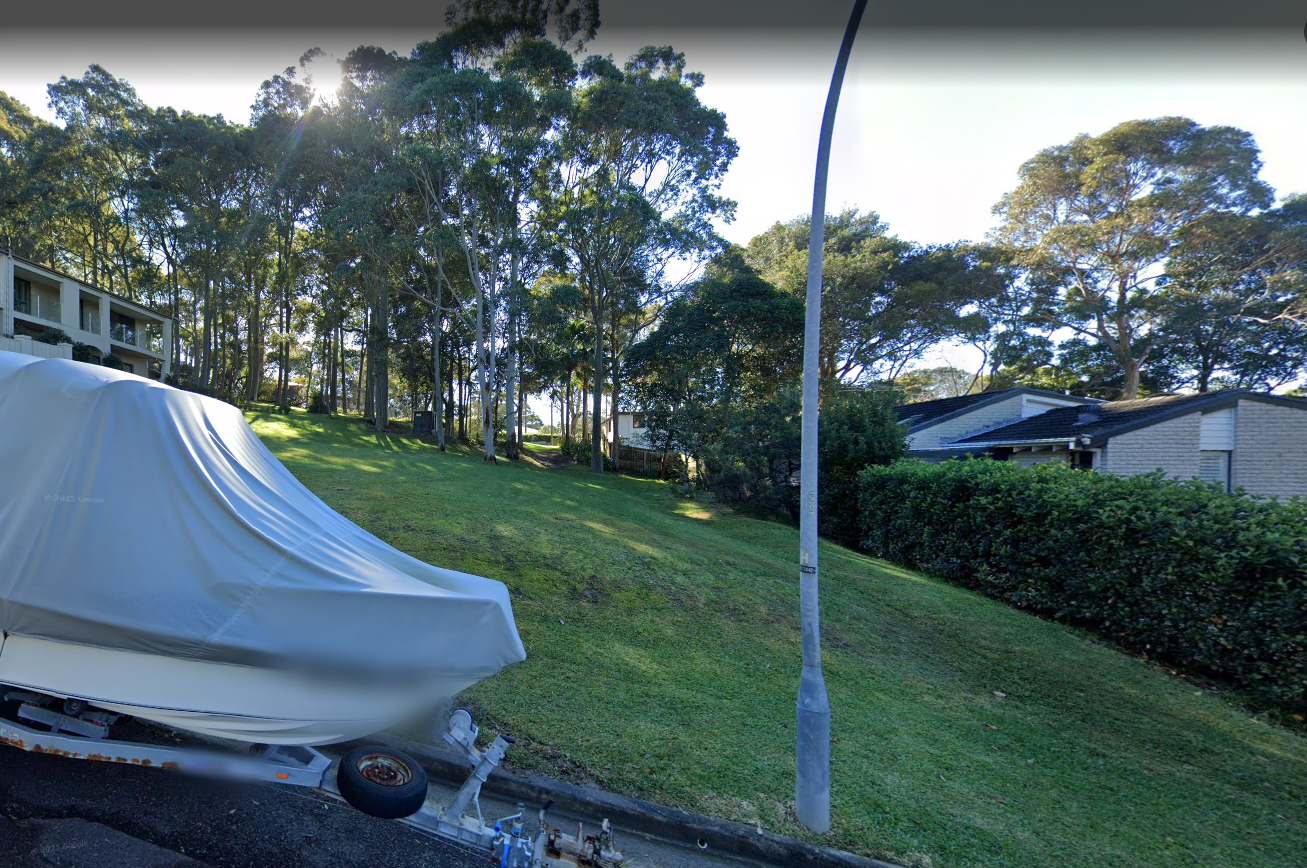
 Kamilaroi Park, Bayview - from the road - rain runoff drains straight into the Pittwater estuary at the bottom of this hill

Plastic grass installed in Avalon's Dunbar park where the creek floods during rain events - this wasn't listed as a product to be used in the Avalon Place Plan- residents were not consulted on whether they wanted this product in Pittwater. This area, where the Avalon Guide Hall once was, had been slated as a picnic table area under Pittwater Council

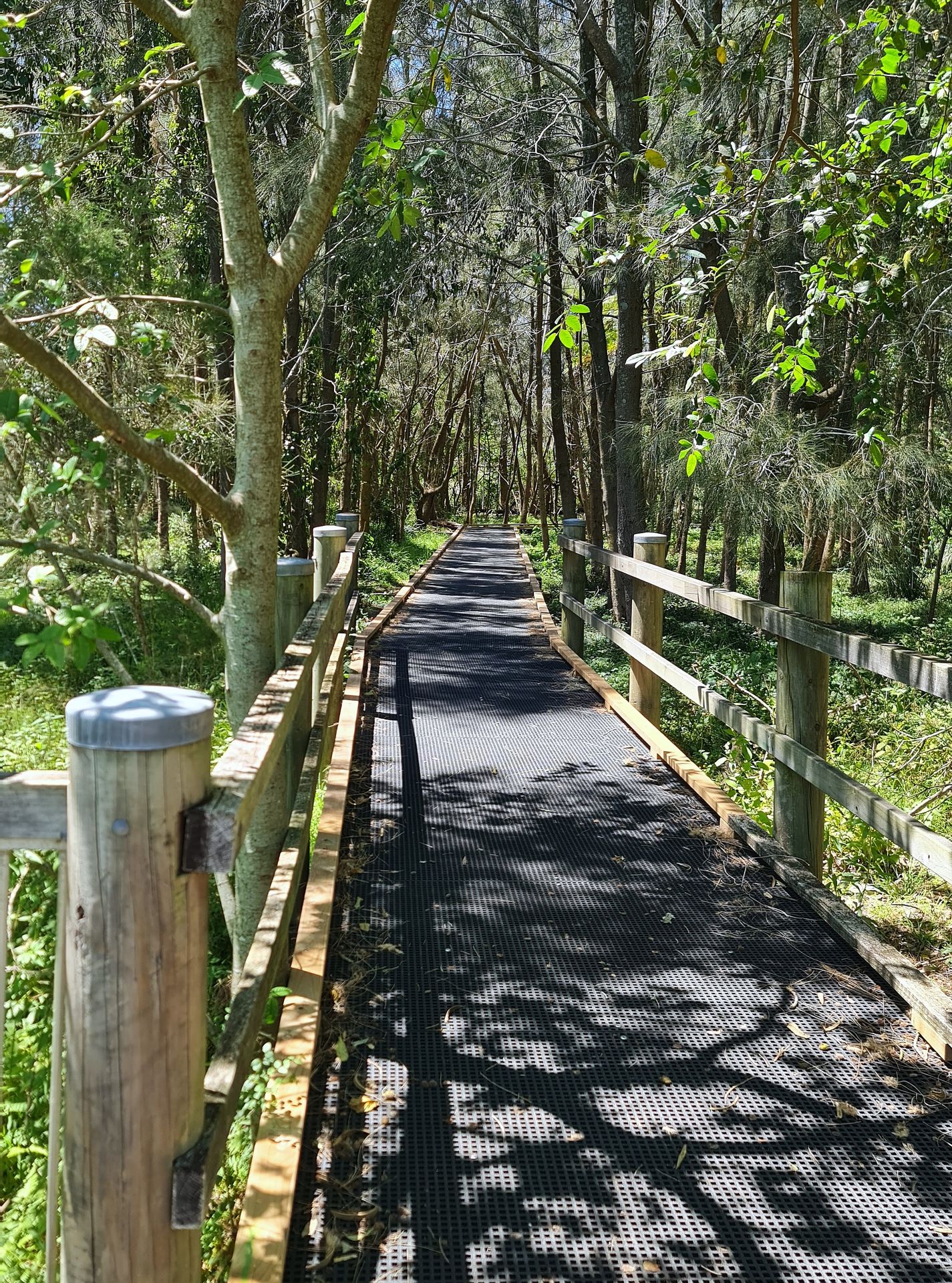
A plastic walkway has been installed in Warriewood Wetlands, again without consultation - once put into a marine/flood environment it becomes a pollutant, poisoning everything with microplastics - this product begins shedding pollutants as it is being installed.


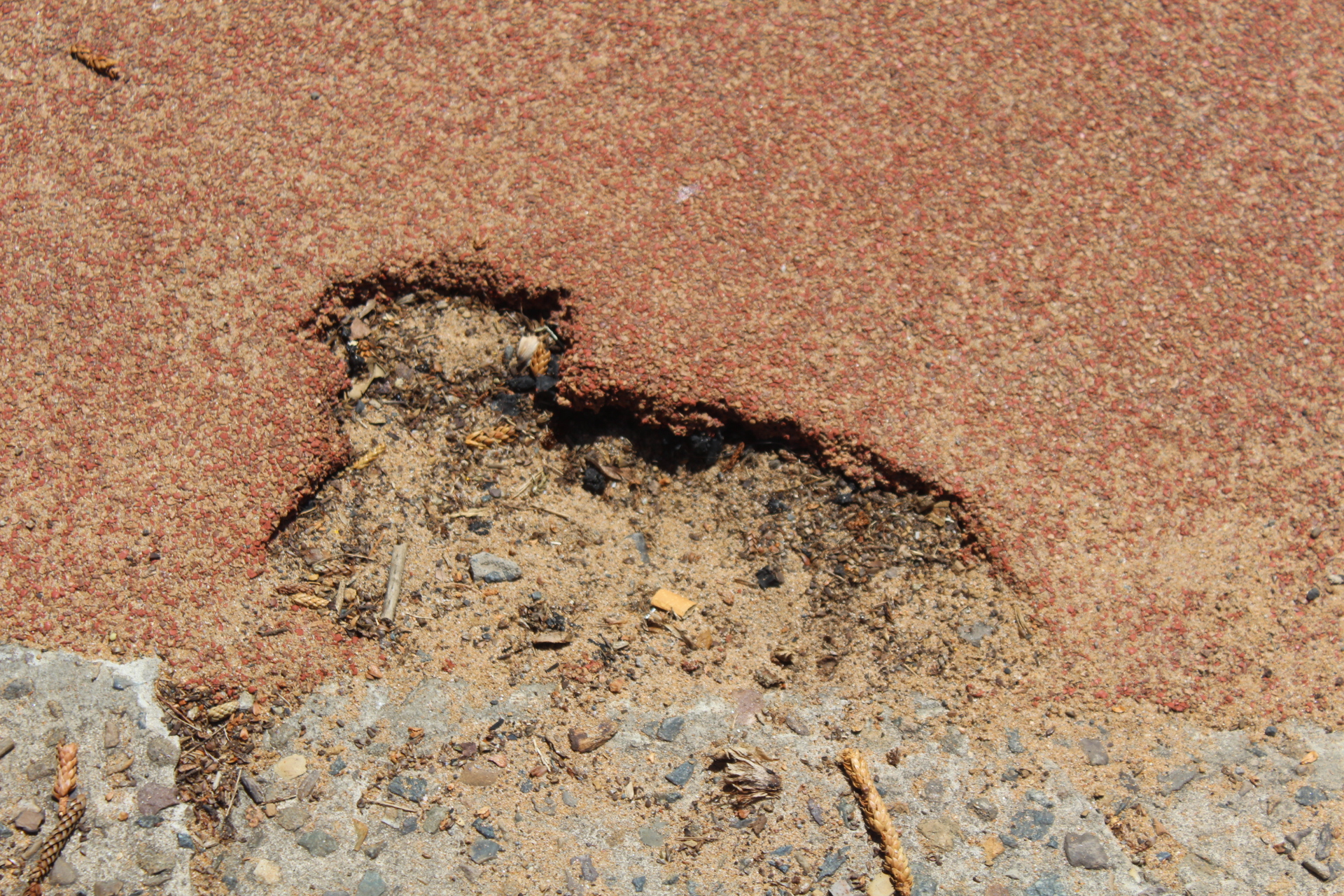
at Newport Beach November 2022, a year and a half on from installation, this  softfall/microcrumb area has holes in it

Summer BirdFest 2026: Play antics of New Locals

The fledglings from this years 'newbies' have begun turning up in local yards and trees as they learn to fly and feed, as taught by their parents - and even which branches in trees to land on so they don't slide down onto the trunk!

This family of galahs, where mum and dad have had two girls and one boy this Season, showed up in mid-January with the little boy grabbing a Norfolk Pine frond in his beak and waving at one of his sisters - who didn't seem that interested in either waving it around too, or playing tug-of-war - so he dropped it. He was also then seen peering down the umbrella hole in the outdoor table - clearly something of interest down there.

Check out this Norfolk Pine frond - Do you want to play?:

I spy, with my galah eye, something beginning with....:

Mumma galah patiently watching her youngsters - note the colour of her eyes:

Witnessing young local wildlife playing is a great reminder of the other residents of Pittwater and that these other family units, and their individual members, all have personalities and a propensity for play, for living each other - as seen in the numerous sulphur-crested cockatoo 'tribes' that get around together and groom each other or even call warnings to each other when a sea eagle flies overhead.

It's a great time for birdwatching with all these kinds of bird families and family groups out and about - teaching young ones which are the food trees and where drinking water may be found, and seeing their children playing with each other.

BirdLife Australia states:

'Galahs form permanent pair bonds, although a bird will take a new partner if the other one dies. The nest is a tree hollow or similar location, lined with leaves. Both sexes incubate the eggs and care for the young.

There is high chick mortality in Galahs, with up to 50% of chicks dying in the first six months. Galahs have been recorded breeding with other members of the cockatoo family, both in the wild and captivity. These include the Sulphur-crested Cockatoo, C. galerita.

Breeding season is from February – July, in the north and from July – December, in the south.'

Female Galahs are easily distinguished from males by their distinct reddish-pink or light pink irises. In contrast, mature male Galahs have dark brown or blackish eyes. This colour difference is a reliable way to sex adult birds, though both sexes have dark brown eyes as juveniles. Females' eyes begin to lighten from brown to pink/red as they mature, typically around 6 months to 3 years old.

The term galah is derived from gilaa, a word found in Yuwaalaraay and neighbouring Aboriginal languages of southeast Australia. First Known Use: 1862. 

Galahs are about 35 cm (14 in) long and weigh 270–350 g. They have a pale grey to mid-grey back, a pale grey rump, a pink face and chest, and a light pink mobile crest. Juveniles have greyish chests, crowns, and crests.

Juvenile plumage changes as they mature

Little Corella juvenile pair:

Both Galahs (Eolophus roseicapilla) and Sulphur-crested Cockatoos (Cacatua galerita)are known for their highly social, intelligent, and, above all, playful nature, which is central to their behaviour in the wild. Often seen in large, noisy flocks, these birds engage in frequent, acrobatic antics that have earned them a reputation as "clowns" of the Australian bush. 

Key aspects of their playful and natural behaviour include:

  • Acrobatic Play: Galahs and Cockatoos are known to hang upside down from branches, slide down wires, and perform complex aerial manoeuvres.
  • "Playing the Fool": They often exhibit behaviours described as chaotic or mischievous, such as tumbling and wrestling with each other on the ground or, during windy conditions, playing in the branches.
  • Social Interaction: As deeply social birds, they use these games to strengthen bonds within their flock, which can consist of hundreds or even thousands of individuals.
  • Foraging and Foraging-related Play: They spend much of their time on the ground foraging for food, but also use their beaks to strip bark and leaves, which is believed to be a form of entertainment in addition to foraging.
  • Lifelong Bonds: Both Cockattos and Galahs form lifelong, monogamous pairs and often perform synchronised movements and affectionate behaviours together. Additionally, flocks form a family and have been witnessed mourning a bird that has been killed. A flock usually stays in the same area year round.
  • Intelligence: Their playful, curious, and often noisy nature is a sign of their high intelligence. 

The 'galah' name has even entered the Australian vernacular as a term for a "silly person" or a "clown," directly referencing these clownish and chaotic antics. 

Other unusual sightings of bird bubs and others movements across Pittwater and the peninsula and surrounds, per Eremaea Birdlines (Interesting and unusual bird observations) BirdLife Australia - include:

  • Streaked Shearwater at Long Reef Aquatic ReserveHighlight of a three and a half hour seawatch from Long Reef this morning was a Streaked Shearwater heading south with the large numbers of Wedge-tailed and Short-tailed Shearwaters,also a few Flesh-footed Shearwaters headlng south as well. - Michael Ronan 26/1/2026
  • Glossy Black Cockatoo at Ku-ring-gai Chase National Park-Apple Tree BayAmazing count of 11 flew out of casuarinas ahead of us as we kayaked down the "north" side of Cowan Creek. They flew across the creek then headed downstream at height, all in quite close formation. Seen and heard well, their call being quite unmistakable. No camera with me in the kayak unfortunately. eBird checklist - Cameron Ward 15/1/2026
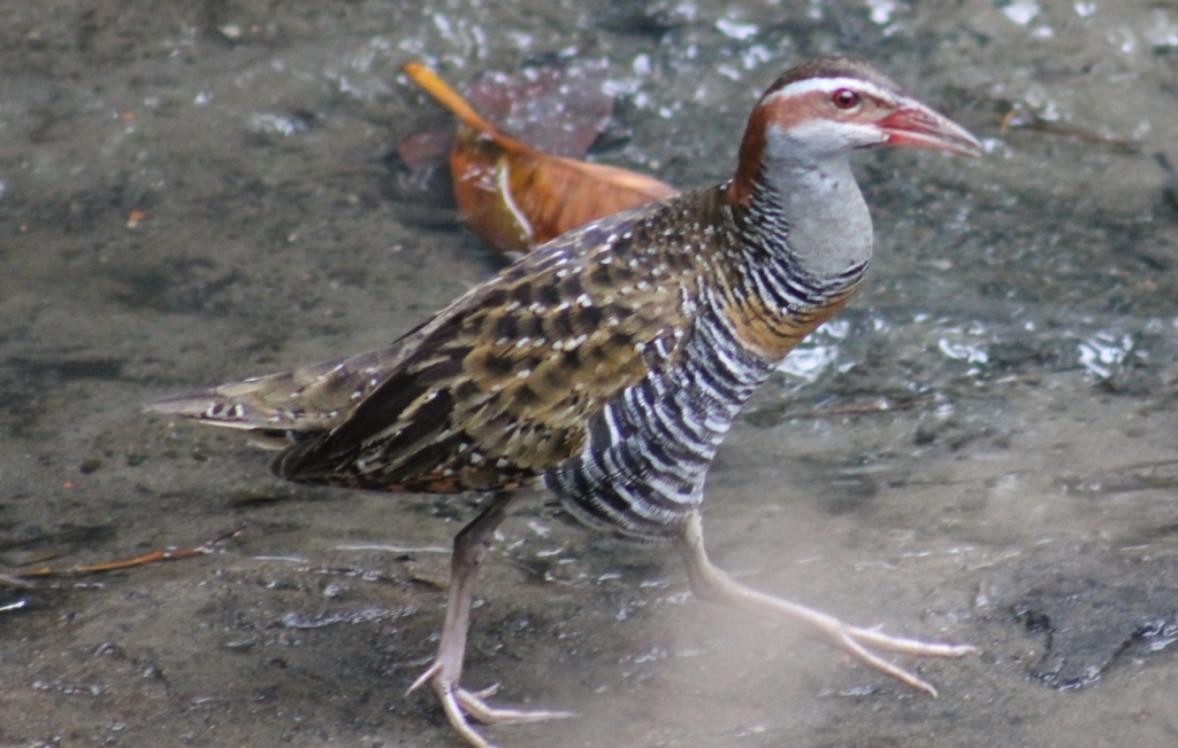
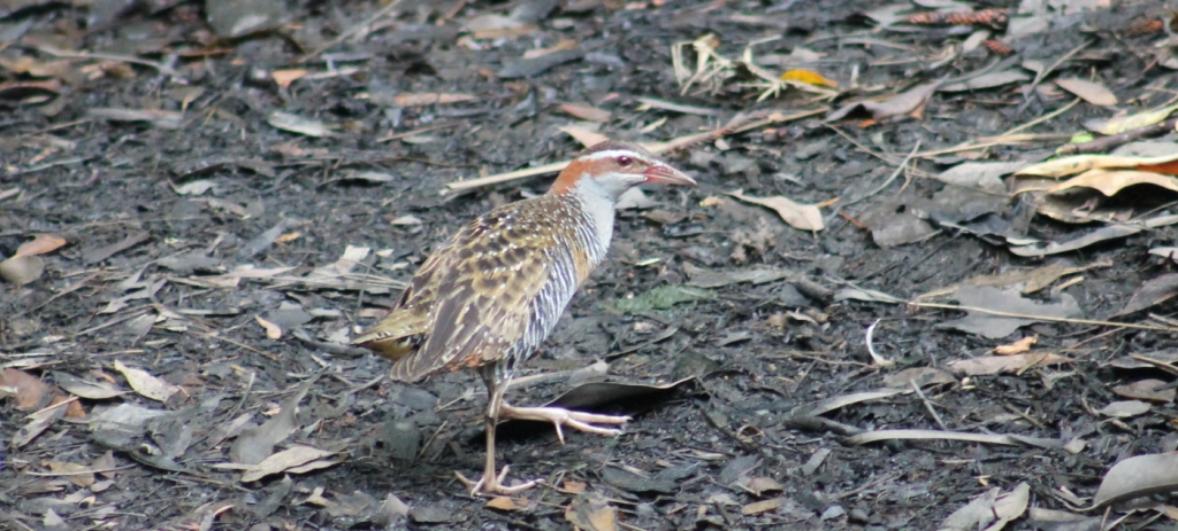
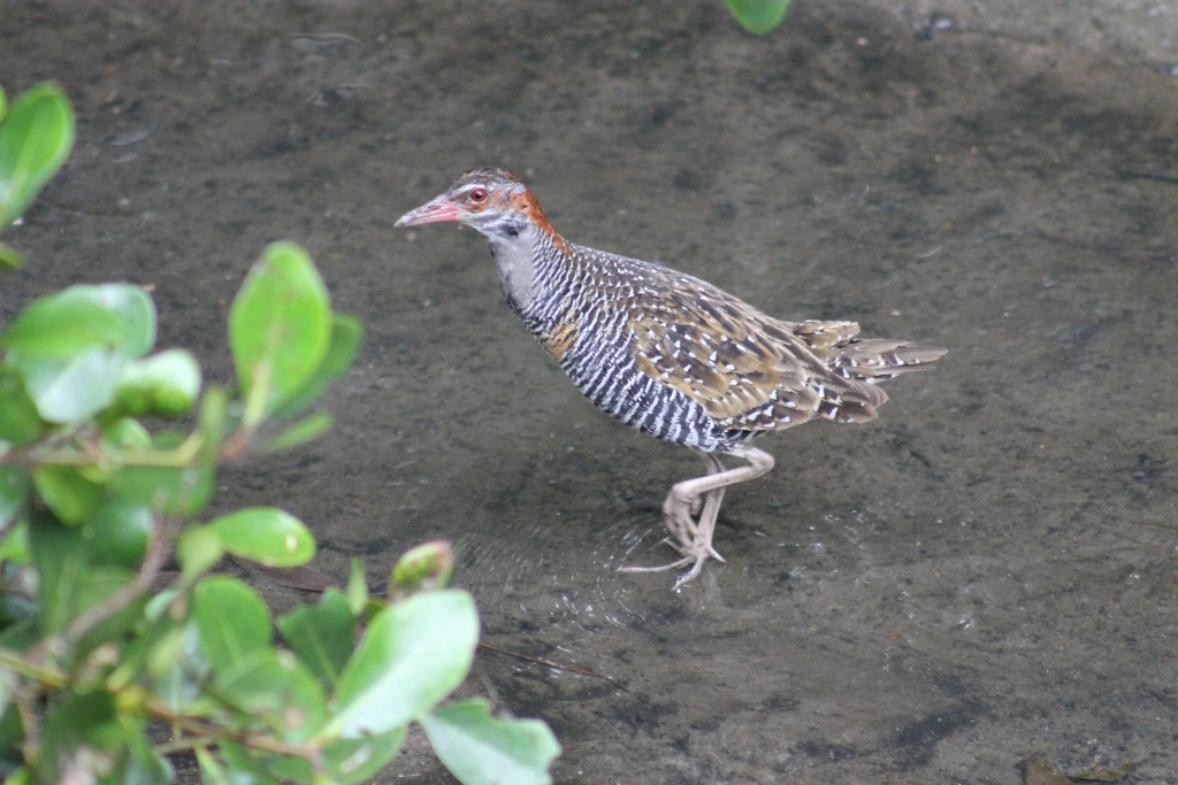
  • Buff-banded Rail at Scotland IslandAdult and chick in yard of house not far from Tennis Court Wharf. - Ted Nxon 19/1/2026
  • Glossy Black Cockatoos at Manly Warringah War Memorial Park--Incl Manly DamThree cockatoos. Looks like one is a juvenile. This is the second time we have seen this group in the last couple of weeks. - Ben Wicks 5/1/2026
  • Red Knot, Tawny Grassbird at Long Reef Aquatic ReserveRed Knot feeding on the edge of the sandspit with the smaller waders a bit after low tide (approx 2:30pm) but was flushed to the far end by some non-birders and did not come back to the sandspit. Tawny Grassbird was first heard singing and then seen skulking in scruffy shrubs just up the hill from the access track before it starts climbing. - Tom Wilson 1/1/2026

We were also very fortunate to play host to a family of Blue-faced honeyeaters in the PON yard this Summer - details below.

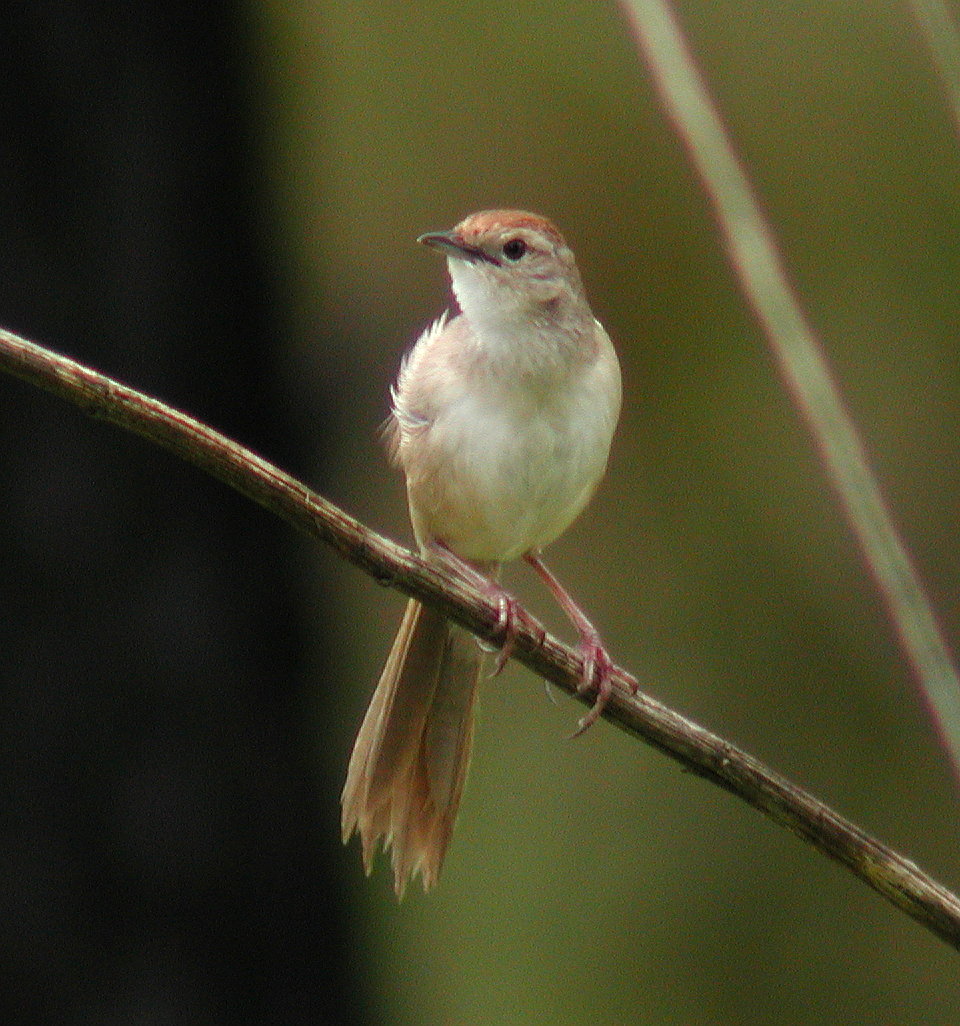
Tawny Grassbird, Megalurus timoriensis. Photo: Aviceda

Buff-banded Rail (Gallirallus philippensis), the mum, in Careel Creek

The dad. 

Cockatoo social contact takes the form of grooming: gently touching and cleaning the feathers of other cockatoos of the group:

Cockie yelling!:

Rainbow lorikeets have had around 1-3 bubs this year in the PON yard tree hollows - there have been around 9-11 juveniles seen in recent weeks:

Blue-faced honeyeaters Breeding In Pittwater

On the morning of Friday January 30 2026 these two fledglings and their parents were spotted bathing and drinking then drying off in the PON yard at Careel Bay.

Marita Macrae of the Pittwater Natural Heritage Association (PNHA) who has hosted many Bird Walks in Pittwater for decades, stated that it’s very unusual to see those birds here, and breeding too!, but not the first time though.

Blue-faced honeyeater (Entomyzon cyanotis), juvenile/fledgling pair in PON yard, Jan. 30 2026 - they're wet as they just had a bath/drink in one of the 4 birdbaths in the PON yard - each at a compass point and at least 1 under shade as sun shifts during the day. They are calling for food from parents birds it would seem.

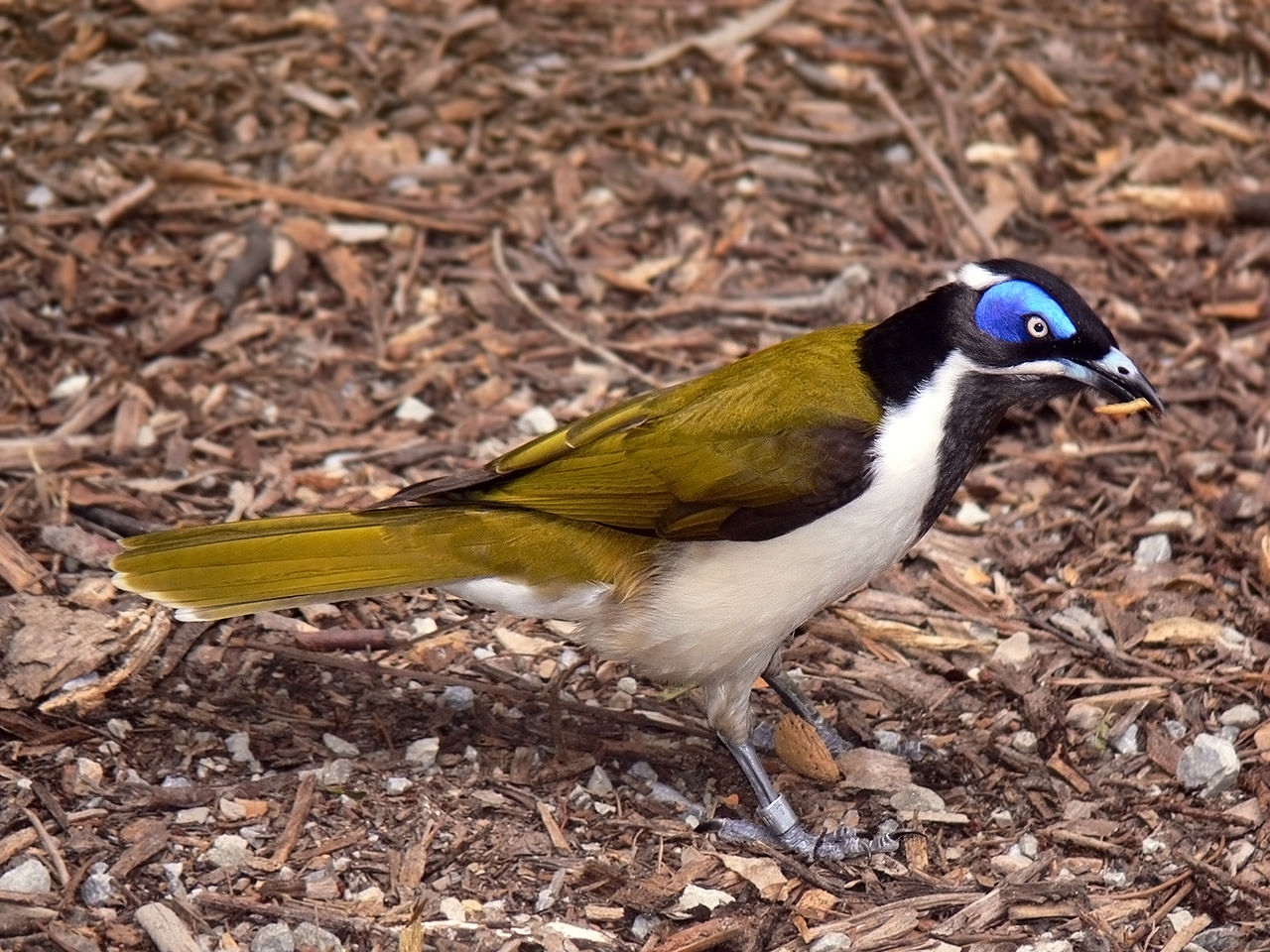
The Blue-faced honeyeater (Entomyzon cyanotis), also colloquially known as the banana-bird, is a passerine bird of the honeyeater family, Meliphagidae. It is the only member of its genus, and it is most closely related to honeyeaters of the genus Melithreptus. 

The Blue-faced Honeyeater is a large black, white and golden olive-green honeyeater with striking blue skin around the yellow to white eye. The crown, face and neck are black, with a narrow white band across the back of the neck. The upperparts and wings are a golden olive green, and the underparts are white, with a grey-black throat and upper breast. The blue facial skin is two-toned, with the lower half a brilliant cobalt blue. Juvenile birds are similar to the adults but the facial skin is yellow-green and the bib is a lighter grey. This honeyeater is noisy and gregarious, and is usually seen in pairs or small flocks. It is known as the Banana-bird in tropical areas, for its habit of feeding on banana fruit and flowers.

Three subspecies are recognised.:

  • E. c. albipennis was described by John Gould in 1841 and is found in north Queensland, west through the Gulf of Carpentaria, in the Top End of the Northern Territory, and across into the Kimberley region of Western Australia. It has white on the wings and a discontinuous stripe on the nape. The wing-patch is pure white in the western part of its range, and is more cream towards the east. It has a longer bill and shorter tail than the nominate race. The blue-faced honeyeater also decreases in size with decreasing latitude, consistent with Bergmann's rule. Molecular work supports the current classification of this subspecies as distinct from the nominate subspecies cyanotis.
  • E. c. cyanotis, the nominate form, is found from Cape York Peninsula south through Queensland and New South Wales, into the Riverina region, Victoria, and southeastern South Australia.
  • E. c. griseigularis is found in southwestern New Guinea and Cape York, and was described in 1909 by Dutch naturalist Eduard van Oort. It is much smaller than the other subspecies. The original name for this subspecies was harteri, but the type specimen, collected in Cooktown, was found to be an intergrade form. The new type was collected from Merauke. This subspecies intergrades with cyanotis at the base of the Cape York Peninsula, and the zone of intermediate forms is narrow. The white wing-patch is larger than that of cyanotis and smaller than that of albipennis. Only one bird (from Cape York) of this subspecies was sampled in a molecular study, and it was shown to be genetically close to cyanotis.

Adult bird of Subspecies cyanotis feeding, south-eastern Australia, feeding. Photo: Benjamin444

The Blue-faced Honeyeater is found in tropical, sub-tropical and wetter temperate or semi-arid zones. It is mostly found in open forests and woodlands close to water, as well as monsoon forests, mangroves and coastal heathlands. It is often seen in banana plantations, orchards, farm lands and in urban parks, gardens and golf courses.

The Blue-faced Honeyeater is found in northern and eastern mainland Australia, from the Kimberley region, Western Australia to near Adelaide, South Australia, being more common in the north of its range. They are considered sedentary in the north of its range, and locally nomadic in the south. It is not found in central southern New South Wales or eastern Victoria now. This species is also found in Papua New Guinea.

Around Wellington in central New South Wales, birds were once recorded over Winter months, and were more common in autumn around the Talbragar River. Birds were present all year round near Inverell in northern New South Wales, but noted to be flying eastwards from January to May, and westwards in June and July.

The Blue-faced Honeyeater feeds mostly on insects and other invertebrates, but also eats nectar and fruit from native and exotic plants. It forages in pairs or noisy flocks of up to seven birds (occasionally many more) on the bark and limbs of trees, as well as on flowers and foliage. These flocks tend to exclude other birds from the feeding area, but they do feed in association with other species such as Yellow-throated Miners and Little Friarbirds.

In late November- early December 2025 we began hearing an unusual call from the Norfolk Pine next door. Having heard a pair of Australasian Figbirds (Sphecotheres vieilloti) that return each Spring to nest ion that same tree, at first it was thought these had returned as we heard them calling each other in early November from the tree and across the perimeter of the Careel Bay Playing fields. However, soon after they arrived again, the male was found killed near the road alongside the Careel Bay dog park. The pair did not breed here this year - we're not sure what happened to his female mate. 

Each Spring this pair of Australasian Figbirds(Sphecotheres vieilloti) returned to build a nest and make babies in the Norfolk pine alongside us. There is food in our garden for them and no cats, at least none that can get that high up.


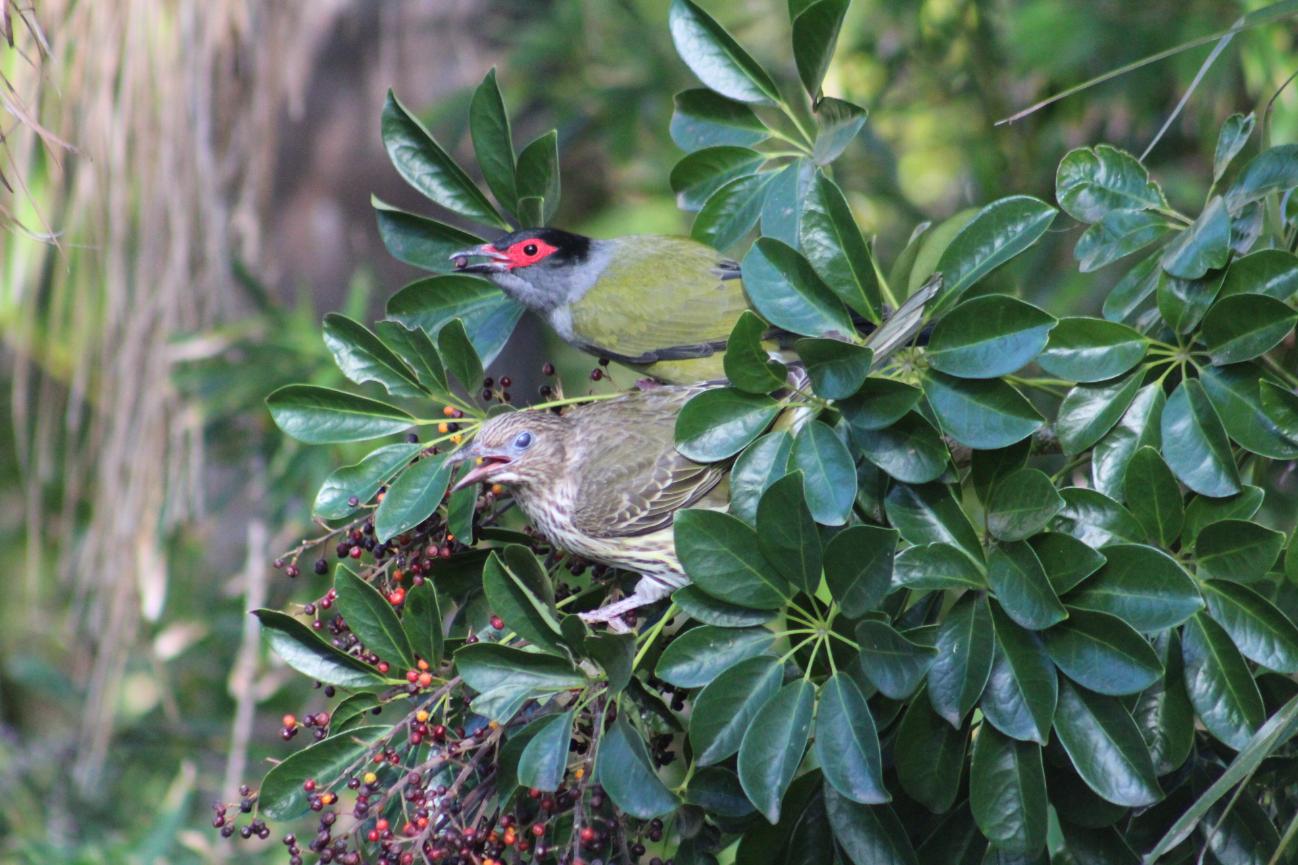
Females have grey skin around the eye and lack distinctive head markings. They are brown-green above and dull-white below, streaked with brown. Both sexes have a blackish bill. 

Then we began hearing another pair of parents call across the yard and park trees, a bird call we hadn't heard before, and realise now it must have been the blue-faced honeyeater pair.

The Blue-faced honeyeater's call is a repeated, penetrating 'woik'; 'weet weet weet' at daybreak; also squeaks uttered during flight and softer 'hwit hwit' calls. Others who have heard them liken their calls to Miner birds songs.

The Blue-faced Honeyeater is one of the first birds heard calling in the morning, often calling 30 minutes before sunrise, although here it is joined by the magpie family that nests in the same tree.

Their nest was dislodged from that tree over the weekend of January 17-19, when hard winds accompanied the rain storms, and blew into the yard. 

Fortunately, the fledglings were strong enough to fly.

Most nests are made on the abandoned nests of Grey-crowned Babblers, Noisy, Silver-crowned and Little Friarbirds, Noisy Miner, Red Wattlebird, Australian Magpie, Magpie-Lark and, rarely, butcherbirds or the Chestnut-crowned Babbler. Sometimes the nests are not modified, but often they are added to and relined. If a new nest is built, it is a neat round cup of rough bark, linked with finer bark and grass.

Birding forums from the past 3 years state Blue-faced Honeyeaters (Entomyzon cyanotis) are increasingly sighted in the Sydney region, particularly in Western Sydney, the Barrenjoey peninsula, and near Hawkesbury, often in residential areas with flowering trees. While traditionally found further north, they are now resident in suburban Sydney, favouring areas like Ermington, Richmond, and Nurragingy Reserve - and clearly Palm Beach and Careel Bay this year - and a first for us!

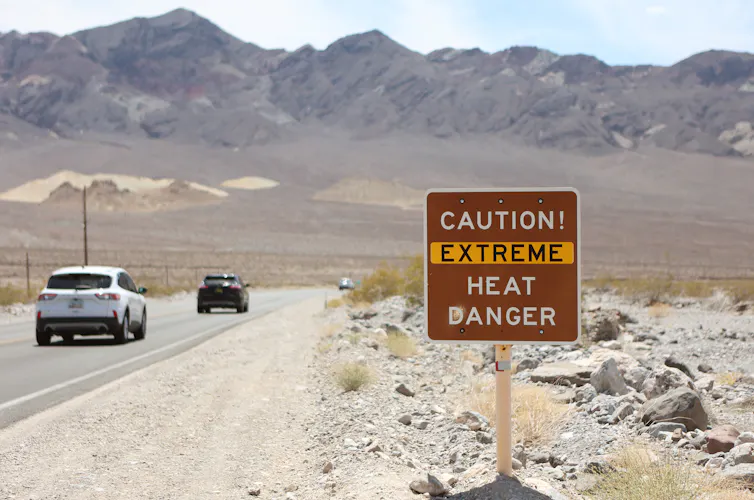
Wildlife Dies in Extreme Heat: Please put water out

A 2022 CSIRO Study found heatwaves linked to climate change have already led to mass deaths of birds and other wildlife. 

With the BOM continuing to record record levels of heat in inland areas this past week, 49 °C at Marree and Roxby Downs, with 48 °C and 47 °C quite common elsewhere, placing shallow dishes of water at ground level in the shade will help lizards and nocturnal wildlife such  as bandicoots, wallabies and possums have a drink while birdbaths will help owls and daytime birds get a drink and cool off.

That 2022 CSIRO report:

‘Sad and distressing’: massive numbers of bird deaths in Australian heatwaves reveal a profound loss is looming

Janet GardnerCSIRO and Suzanne ProberCSIRO

This article contains images that some readers may find upsetting.

Heatwaves linked to climate change have already led to mass deaths of birds and other wildlife around the world. To stem the loss of biodiversity as the climate warms, we need to better understand how birds respond.

Our new study set out to fill this knowledge gap by examining Australian birds. Alarmingly, we found birds at our study sites died at a rate three times greater during a very hot summer compared to a mild summer.

And the news gets worse. Under a pessimistic emissions scenario, just 11% of birds at the sites would survive.

The findings have profound implications for our bird life in a warming world – and underscore the urgent need to both reduce greenhouse gas emissions, and help animals find cool places to shelter.

Feeling the heat

The study examined native birds in two parts of semi-arid New South Wales: Weddin Mountains National Park near Grenfell and Charcoal Tank Nature Reserve near West Wyalong. At both locations, citizen scientists have been catching, marking and releasing birds regularly since 1986.

This has produced data for 22,000 individual birds spanning 37 species. They include honeyeaters, thornbills, fairy-wrens, whistlers, treecreepers, finches and doves.

Data from the past 30-odd years showed cold winters led only to a relatively small drop in survival rates. But it was a far starker picture in summer.

During a mild summer with no days above 38°C, 86% of the birds survived. But in a hot summer with 30 days above 38°C, just 59% survived.

We then used these real-life findings to model future survival, to the end of the century, for birds at our study sites.

Worryingly, climate projections for the sites we studied show the number of days above 38°C will at least double by the end of the century (or the year 2104). Meanwhile, days below 0°C will disappear during this time.

These projections are broadly similar for all arid and semi-arid regions across Australia.

As winters warm, we predict bird survival in winter would increase slightly by the end of this century. But this would not offset the many more birds killed by extreme heat as summers warm.

But to what extent will populations decline? To answer this question, we considered an optimistic scenario of rapid emissions reduction – resulting in about 1°C warming compared to pre-industrial levels. Under this scenario, we predict annual survival will fall by one-third, from 63% to 43%.

Under a pessimistic scenario, involving very little emissions reduction and 3.7°C warming this century, the survival rate falls to a shocking 11%.

Other lab-based studies around the world have made similar projections for bird populations. But our projections are unusual because they’re based on actual survival rates in wild populations measured over decades.

What happens to birds in heatwaves?

Some birds do manage to survive extreme heat. We then wondered: how does a bird protect itself from soaring temperatures? And can its habitat offer life-saving shelter?

We addressed these questions in a complementary study led by zoologist Lynda Sharpe. It involved comparing the behaviour of individual birds on mild and hot days.

We chose as our subject the Jacky Winter, a small robin common across Australia. Between 2018 and 2021 we followed the fates of 40 breeding pairs living in semi-arid mallee woodland in South Australia. There, the annual number of days above 42°C has more than doubled over the past 25 years.

As heat escalated, Jacky Winters showed a broad range of behavioural responses. This included adjusting their posture, activity levels and habitat use to avoid gaining heat and to increase heat dissipation.

As air temperatures approached 35°C, birds moved to the top of the highest trees where greater wind speeds cooled their bodies. The birds also began to pant, which can lead to fatal dehydration.

Once air temperatures climbed above 40°C, exceeding the birds’ body temperature, they moved to the ground to shelter in tree-base hollows and crevices. They remained in these “thermal refuges” for as long as it took for air temperatures to drop to about 38°C – sometimes for up to eight hours. But this made foraging impossible and the birds lost body mass.

We then examined what parts of the birds’ habitat offered the coolest place to shelter on extremely hot days. Hollows in tree bases were significantly cooler than all other locations we measured. The best of these cool hollows were rare and found only in the largest eucalypt mallees.

Even with their flexible behaviour, the ability of Jacky Winters to survive heatwaves was finite – and apparently dependent on whether large trees were available. Some 29% percent of adults we studied disappeared (and were presumed dead) within 24 hours of air temperatures reaching a record-breaking 49°C in 2019.

Similarly, during two months of heatwaves in 2018, 20% of adults studied were lost, compared with only 6% in the two months prior.

Eggs and nestlings were even more susceptible to heat. All 41 egg clutches and 21 broods exposed to air temperatures above 42°C died.

We found it distressing to witness such losses among birds we had followed for months and years. And it was deeply sad to see the breeding failures after the parent birds had invested so much effort in caring for eggs and tending to young.

We need to act

Our studies show extremely high temperatures are already killing troubling numbers of birds in Australia’s arid and semi-arid regions. These regions comprise 70% of the Australian continent and 40% of the global landmass.

Such losses will only worsen as climate change escalates. This has profound implications for biodiversity in Australia and more broadly.

Obviously, humanity must urgently reduce greenhouse gas emissions to limit global warming. But we must also better manage our biodiversity as the climate changes.

Key to this is identifying and protecting thermal refuges such as tree hollows by, for example, managing fire to reduce the loss of large trees.


The authors wish to acknowledge our colleagues, especially Lynda Sharpe and Tim Bonnet, for their important contributions to the research upon which this article is based.The Conversation

Janet Gardner, Adjunct Research Scientist, CSIRO and Suzanne Prober, Senior Principal Research Scientist, CSIRO

This article is republished from The Conversation under a Creative Commons license. Read the original article.

A January 30 2026 insight:

We know how to cool our cities and towns. So why aren’t we doing it?

A/Prof. Elmira JameiVictoria University

This week, Victoria recorded its hottest day in nearly six years. On Tuesday, the northwest towns of Walpeup and Hopetoun reached 48.9°C, and the temperature in parts of Melbourne soared over 45°C. Towns in South Australia also broke heat records.

This heatwave is not an outlier. It is a warning shot.

These weather conditions rival the extreme heat seen in the lead-up to the 2019–20 Black Summer, and they point to a future in which days like this are no longer rare, but routine.

What makes this summer so confronting is not just how hot it has been, but this: Australia already knows how to cool cities, yet we are failing to do it. Why?

Urban heat is not inevitable

Cities heat up faster and stay hotter than surrounding areas because of how they are built. Dense development, dark road surfaces, limited shade, and buildings that trap heat and rely heavily on air-conditioning create the “urban heat island” effect.

This means cities absorb vast amounts of heat during the day and release it slowly at night, preventing the city from cooling down even after sunset. During heatwaves, this trapped heat accumulates day after day and pushes temperatures well beyond what people can safely tolerate.

Future urbanisation is expected to amplify projected urban heat, irrespective of background climate conditions. Global climate change is making the urban heat island effect worse, but much of the heat we experience in cities has been built in through decades of planning and design choices.

Several air conditioner units and a transmission line, with a red arrow pointing upwards in the background.
Hot cities are not only a result of climate change, they are also a failure of urban planning. zpagistock/Getty

Heat is a health and equity crisis

Heatwaves already kill more than 1,100 Australians each year, more than any other natural hazard. Extreme heat increases the risk of heart and respiratory disease, worsens chronic illness, disrupts sleep and overwhelms health services.

Poorly designed and inadequately insulated homes, particularly in rental and social housing can become heat traps. People on low incomes are least able to afford effective cooling, pushing many into energy debt or forcing them to endure dangerously high temperatures. Urban heat deepens existing inequalities. Those who contributed least to the problem often bear the greatest burden.

Australia has expertise, but not ambition

Here is the paradox. Australia is a major contributor to global research on urban heat. Australian researchers are developing national tools to measure and mitigate urban heat, and studies from cities such as Melbourne have quantified urban heat island intensity and investigated how urban design can influence heat stress.

Additionally, Australia already has the technologies to cool cities, from reflective coatings and heat-resilient pavements to advanced shading systems. Yet many of our cities remain dangerously hot. The issue isn’t a lack of solutions, but the failure to roll them out at scale.

Internationally, we are lagging behind countries where large-scale heat mitigation projects are already reducing urban temperatures, cutting energy demand and saving lives.

For example, Paris has adopted a city-wide strategy to create “cool islands”, transforming public spaces and schoolyards into shaded, cooler places that reduce heat stress during heatwaves.

In China, the Sponge City program, now implemented in cities such as Shenzhen and Wuhan, uses green infrastructure and water-sensitive design to cool urban areas and reduce heat stress.

A row of green trees stand in front of the Eiffel Tower, in the background.
Paris has a city-wide strategy to create cool zones by transforming public spaces into shaded environments. 42 North/UnsplashCC BY

Symbolic change can’t meet the challenge

Too often, urban heat policy stops at small, symbolic actions, a pocket park here, a tree-planting program there. These measures are important, but they are not sufficient for the scale of the challenge.

Greening cities is essential. Trees cool streets, improve thermal comfort and deliver multiple health and environmental benefits. But greenery has limits. If buildings remain poorly insulated, roads continue to absorb heat and cooling demand keeps rising, trees alone will not protect cities from extreme temperatures in the coming decades.

Urban heat is a complex systems problem. It emerges from how cities are built, and is largely shaped by construction materials, building codes, transport systems and planning decisions locked in over generations. Scientists know a great deal about how to reduce urban heat, but many responses remain piecemeal and intuitive rather than systemic.

Designing an uncomfortable future

Research suggests that even if global warming is limited to below 2°C, heatwaves in major Australian cities could approach 50°C by 2040. At those temperatures, emergency responses alone will not be enough. Beyond certain temperature thresholds, behaviour change, public warnings and cooling centres cannot fully protect people.

The choices we make now about buildings, streets, materials and energy systems will determine whether Australian cities become increasingly unliveable, or remain places where people can safely live, work and age.

The battle against urban heat will be won or lost through design, technology, innovation and political will. Cities need to deploy advanced cool materials across roofs, buildings and roads, in combination with nature-based solutions. This will only work if governments use incentives to reward heat-safe design. Heat must be planned for systematically, not treated as a cosmetic problem.

With leadership and a handful of well-designed, large-scale projects, Australia could shift from laggard to leader. We have the science. We have the industry. We have the solutions. The heat is here. The only real question is whether we act, or keep absorbing it.The Conversation

A/Prof. Elmira Jamei, Associate professor, Victoria University

This article is republished from The Conversation under a Creative Commons license. Read the original article.

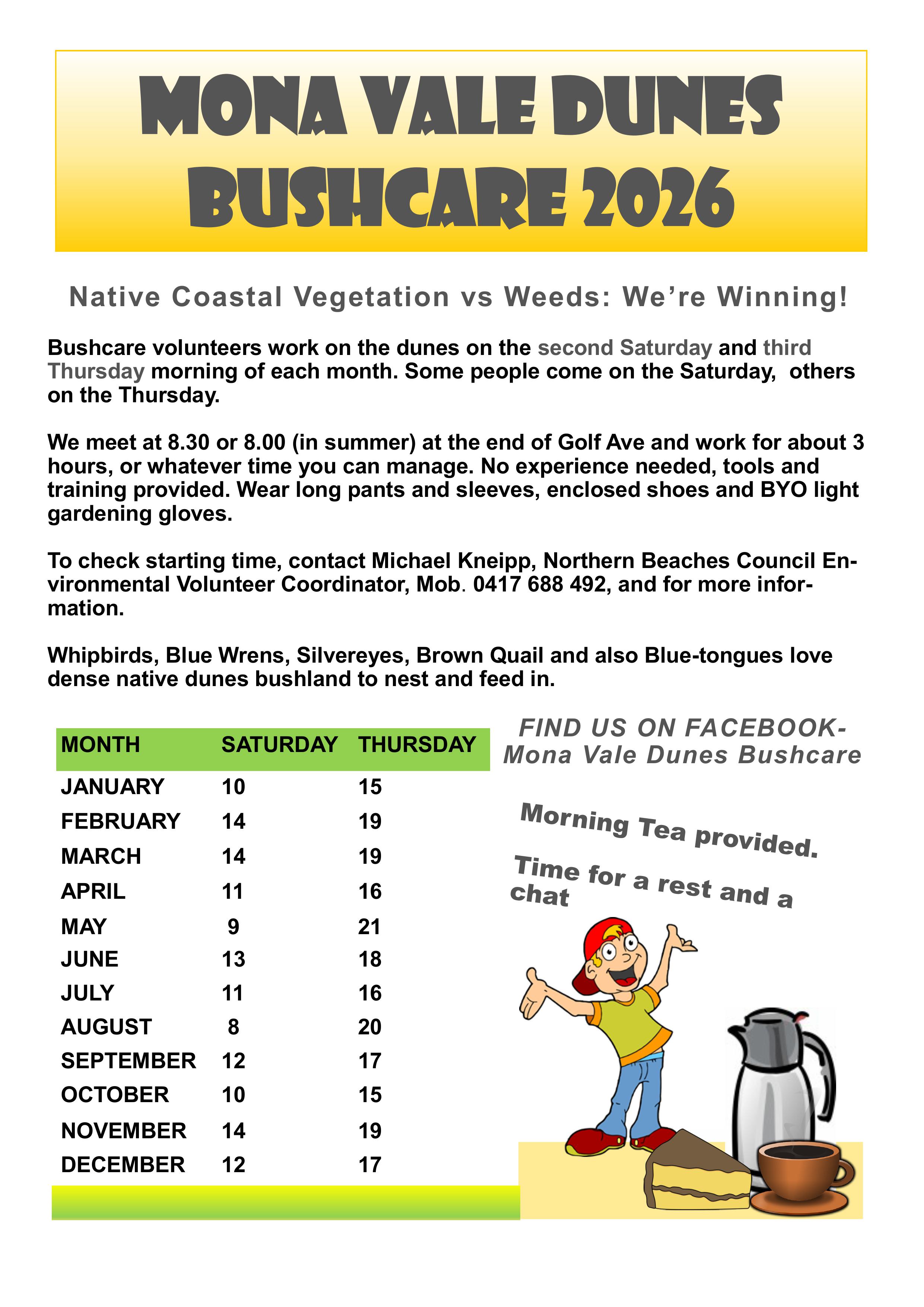
Mona Vale Dunes bushcare group: 2026 Dates

What’s Happening? Mona Vale Dunes Bushcare group catch-up. 

In 2026 our usual work mornings will be the second Saturday and third Thursday of each month. You can come to either or both. 

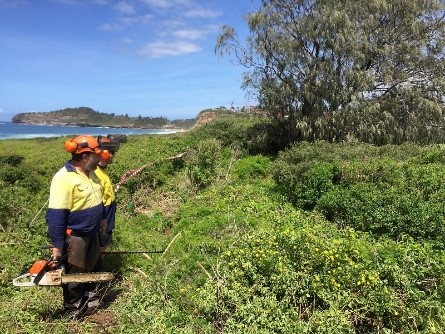
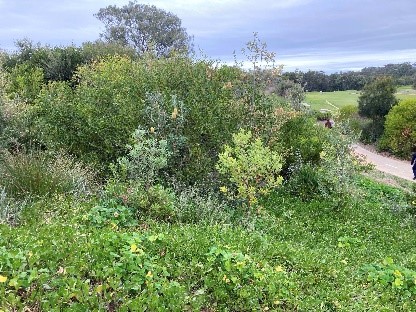
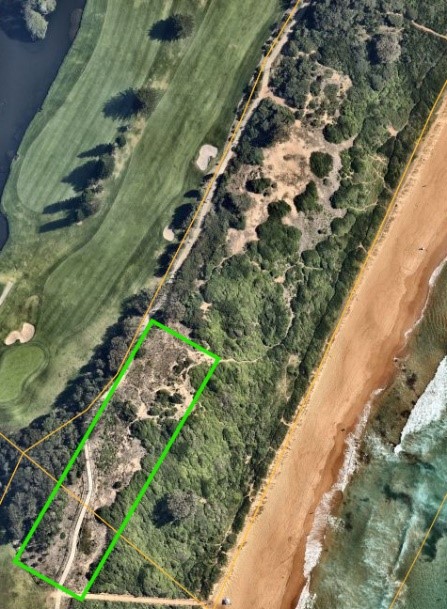
We are maintaining an area south of Golf Avenue. This was cleared of dense lantana, green cestrum and ground Asparagus in 2019-2020. 600 tubestock were planted in June 2021, and natural regeneration is ongoing. 

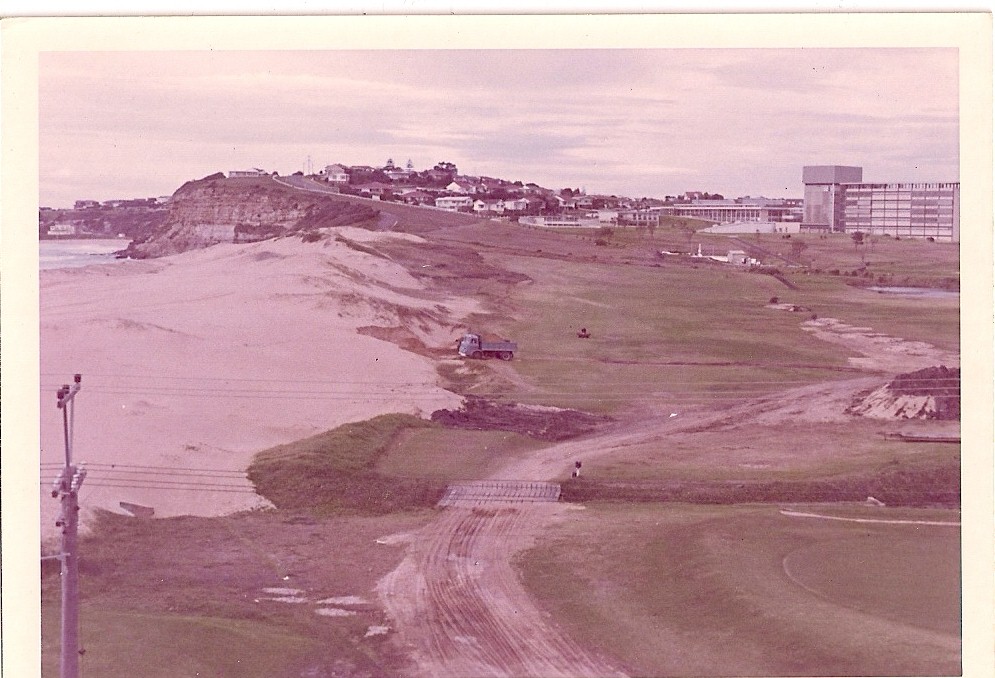
Photos: The site In November 2019, chainsaws at the ready. In July 2025, look at the difference - coastal dune vegetation instead of dense weeds. But maintenance continues and bushcarers are on the job. Can you join us?

(access to this southern of MV Dunes  - parking near Mona Vale Headland reserve, or walk from Golf Ave.) 

For comparison, see this image of MV dunes in 1969!, taken from atop the home units at the end of Golf Avenue. 

2026 Dates

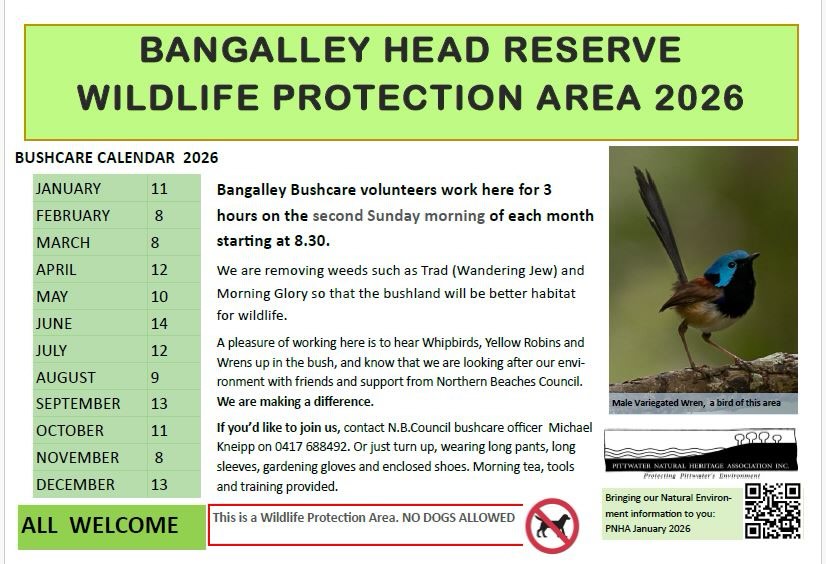
Bangalley Headland WPA Bushcare 2026

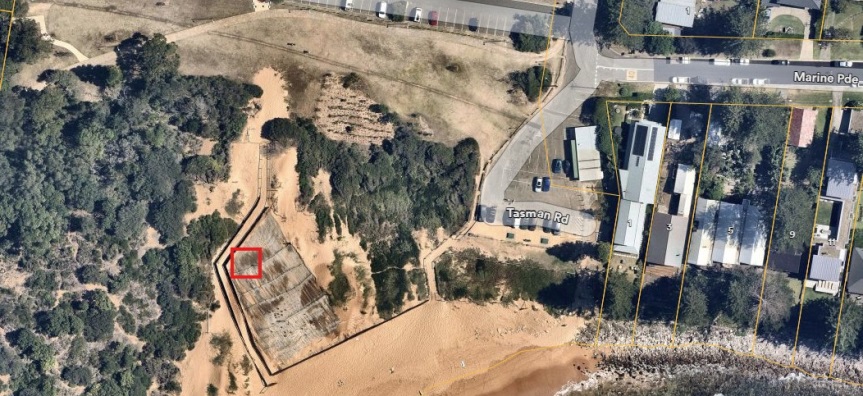
Watch out for PNHA signs telling you about bush regeneration and our local environment. This is one of many coming up.

North Head visitor access Changes

Consultation period: 28 January 2026 to 27 February 2026

The National Parks and Wildlife Service is seeking feedback about proposed works at North Head in Sydney Harbour National Park.

North Head, located in Sydney Harbour National Park, features some of Sydney's newest and most spectacular lookouts, Burragula and Yiningma, as well as the popular heritage-listed Quarantine Station.

This project aims to:

  • improve bus stops and pedestrian access
  • improve public transport and pedestrian access to Quarantine Station
  • repair drainage and road infrastructure
  • investigate the most appropriate pedestrian access to North Head and links to destinations.

Scope and purpose of works

NPWS is planning to carry out the following works to improve visitor pedestrian safety, public transport connections, whole-of-headland links and stormwater management along North Head Scenic Drive:

  • construction of a 1.8m wide footpath on Scenic Drive, connecting to the existing footpath networks; the works will improve all-abilities access throughout the headland
  • relocation of the northbound Q Station bus stop away from the roundabout and to a new bus bay in a safer location nearby with upgrade of the southbound stop
  • upgrade of existing in-lane bus stops to bus bay near the North Fort Road and Scenic Drive intersection
  • construction of raised pedestrian crossings to provide better linkages into the North Head Sanctuary precincts and walking tracks
  • construction of kerb and gutter along footpath to improve stormwater drainage and treatment.

NPWS has identified several safety concerns, with visitors using the gravel shoulders of North Head Scenic Drive as a walking path out to the lookouts, creating the potential risk for a pedestrian–vehicle collision.

The works will also address the unsafe configuration of bus stops at the Q Station entrance to improve visitor safety and traffic safety and visibility through the intersection.

The proposed drainage works will alleviate ongoing maintenance of potholes and water pooling on the Scenic Drive, improving safety for cyclists and drivers.

We will carefully manage the project to ensure there are no impacts on threatened vegetation or wildlife species. This includes the eastern suburbs banksia scrub threatened ecological community, bandicoots and other small mammals. We have conducted rigorous environmental assessment of the proposed works with input from relevant specialists, in accordance with NSW planning legislation.

Native vegetation

By utilising the existing gravel road shoulder as much as possible, the proposed footpath design minimises impacts to existing vegetation. NPWS has engaged an ecologist to undertake investigations and inform the plans. Monitoring will also be conducted during the construction process.

Bandicoot habitat

A project ecologist will undertake targeted surveys ahead of construction and will monitor and advise to avoid impacting bandicoot nests. Improved drainage along Scenic Drive will control and filter run-off, preventing erosion of their habitat.

Concept plans released

In the initial planning stages, we conducted investigations and assessments (environmental, engineering, heritage and geotechnical) to inform the project, leading to the development of concept plans.

These are now available for download at North Head Scenic Drive concept plans (PDF 13.5MB).

Any feedback or questions can be submitted via the online form on the project webpage below or email to npws.sydneynorth@dcceew.nsw.gov.au .

The consultation will be open until 27 February 2026.

Have your say by 5pm on 27 February 2026.

You can provide feedback in 2 ways.

  1. Online: North Head visitor access improvements webpage
  2. Email:  npws.sydneynorth@environment.nsw.gov.au

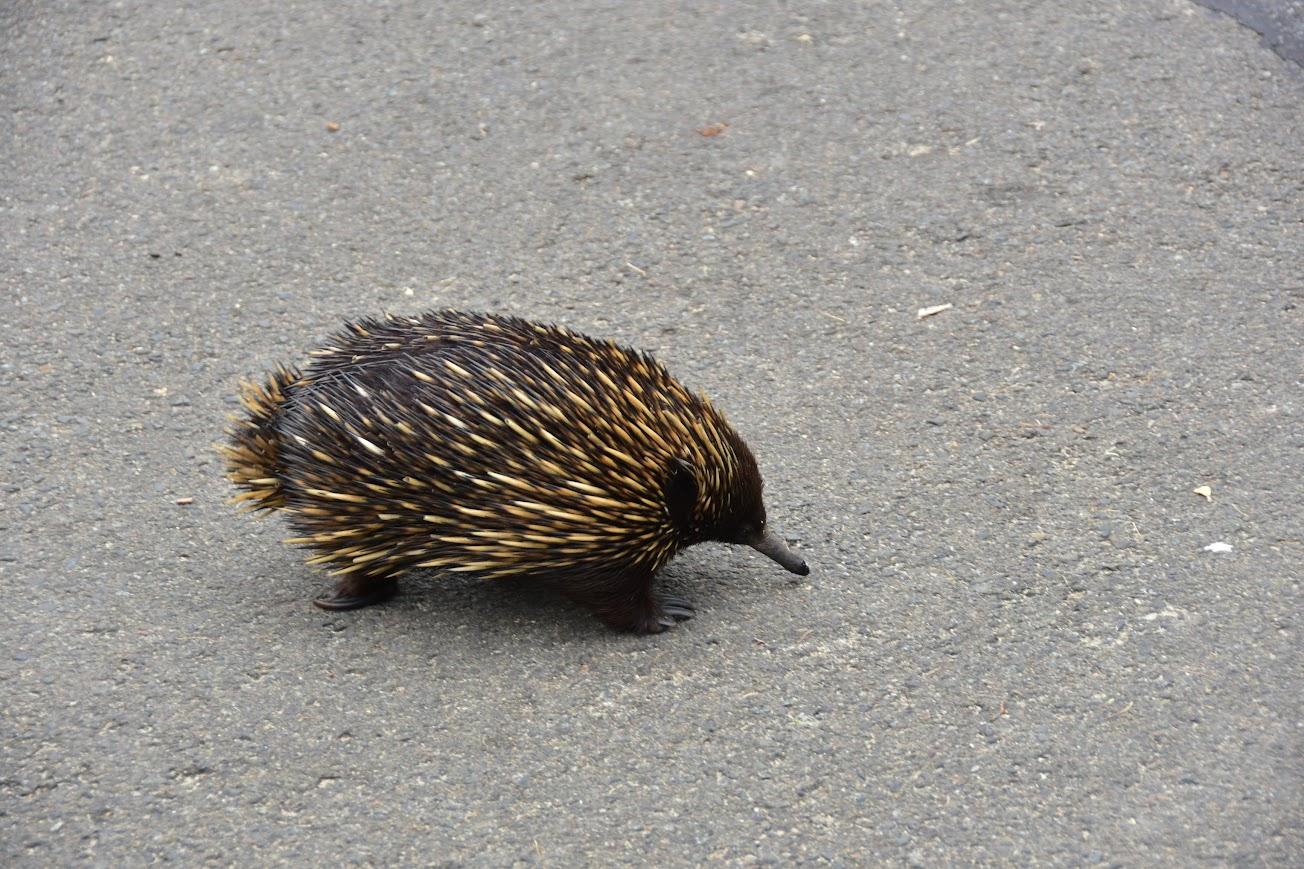
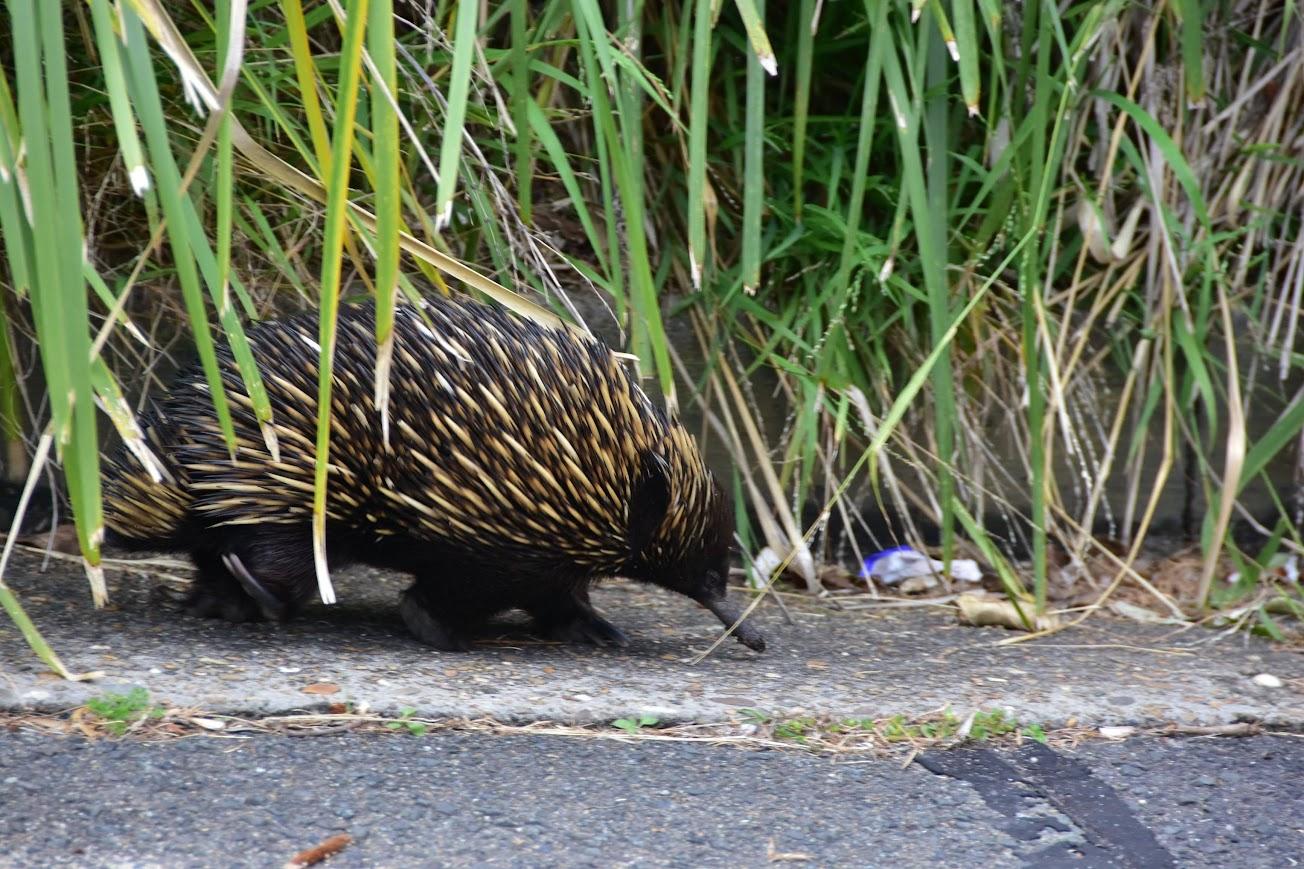
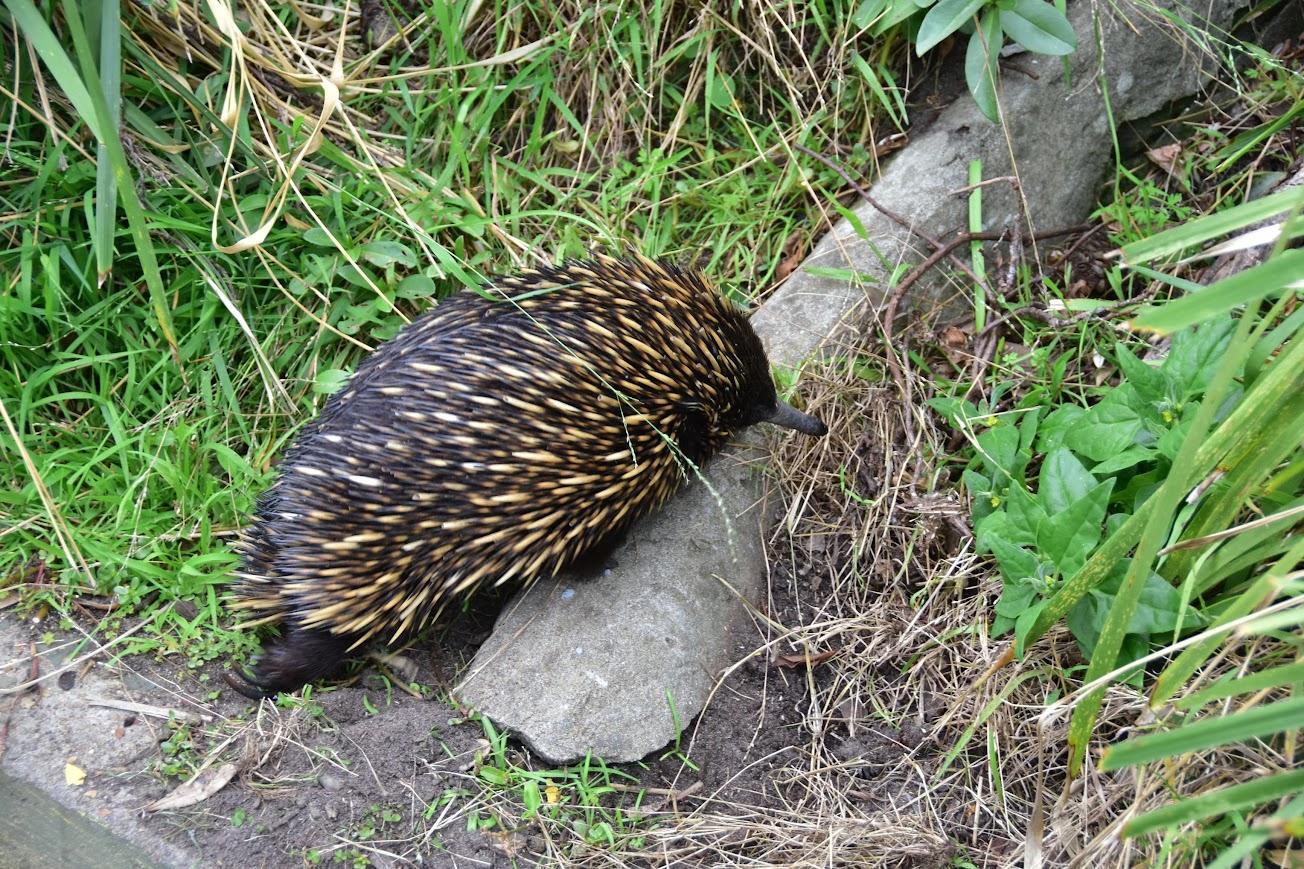
Shelly Beach Echidna

Photos by Kevin Murray, taken late May 2023 who said, ''he/she was waddling across the road on the Shelly Beach headland, being harassed not so much by the bemused tourists, but by the Brush Turkeys who are plentiful there.''

Shelly Beach is located in Manly and forms part of Cabbage Tree Bay, a protected marine reserve which lies adjacent to North Head and Fairy Bower.

Oil-Gas Exploration in Southern Seas reopened by Albanese Government

The Australian Federal Government have reopened 2.5 million hectares of Victorian and Tasmanian waters for oil and gas exploration. This latest release includes 5 exploration titles, stretching across some of Australia's most ecologically and culturally significant waters.

Your voice can help make a difference.

Join Surfrider's (@surfrideraus) Save the Southern Sea campaign as we fight to protect the coastal communities and marine ecosystems of the Southern Ocean. 

Head to the link https://southernsea.givee.app/ to use their simple letter writing tool to make a submission, it's quick and easy to have your say.

Public consultation on the proposed exploration closes February 6th.

Thank you

Surfrider Australia

community invited to have a say on recreational opportunities In Great Koala National Park

On January 16 the NSW Government announced it is seeking community input to shape recreational opportunities in the proposed Great Koala National Park on the NSW Mid North Coast.

The Minns Labor Government is delivering on an election promise to create a Great Koala National Park, which will provide habitat for more than 100 threatened species, including more than 12,000 koalas and 36,000 greater gliders.

In addition to boosting conservation, the park will also create opportunities for better visitor experiences and recreation, boosting tourism and local economies.

An online survey is now open on the NSW Have Your Say website to seek feedback on current use of the State forests and reserves within the planned area of the park. We also want to hear from people who haven’t been to the region but might like to in the future.

The survey complements ongoing wider consultation with community groups who have so far provided more than 300 responses on what matters most to them when they visit these areas.

Input from 4WD clubs, mountain biking clubs, hiking/bushwalking and trail runners’ clubs, horse riding and trail riding clubs, archery and gun clubs, sporting car clubs, local government, environment groups and Aboriginal communities is already feeding into the planning for future management.

The overarching park will comprise individual reserves, which will enable a range of different recreational activities. While legislation determines what activities are permissible in each reserve category, we are looking to build the Great Koala National Park as a place where conservation is balanced with the community’s recreational needs.

The Have Your Say survey is open from 7am today until Sunday, 1 March and is available online: www.haveyoursay.nsw.gov.au/great-koala-national-park.

Acting Minister for the Environment, Steve Whan said:

“The Great Koala National Park will protect more than 100 threatened species, but it’s not just about conservation. The park will be a recreational hotspot for locals and visitors alike.

“We want to hear from people who use and relax in the footprint of the forests and surrounding landscapes that make up the park.”

Minister for Jobs and Tourism, Steve Kamper said:

“We want the Great Koala National Park to be at the top of the must-see list for visitors to NSW and Australia.

“This major eco-tourism hub and unique NSW experience will attract domestic and international visitors all year round, which is a key component of our new Visitor Economy Strategy, while boosting local economies and creating jobs.”

Minister for the North Coast, Janelle Saffin said:

“The Great Koala National Park is an election commitment, and we want the community right at the centre of shaping what it becomes. Locals know this landscape best, and their ideas will help create a park people feel real ownership of and want to use.

“Done well, this park will also be a major tourism drawcard – supporting local businesses, creating jobs and delivering long-term economic benefits for communities right across the North Coast.”

Royal National Park plan draft amendment: Have your say

National Parks and Wildlife Service is seeking feedback on the Royal and Heathcote national parks and Garawarra State Conservation Area plan draft amendment.

The draft amendment proposes changes to accommodation options for walkers using the Great Southern Walk and updates to reflect recent track realignments and additions to the parks.

The draft amendment includes:

  • a proposal to enable hard-roofed/hiker hut accommodation at Garawarra Farm and to remove it as a permissible activity at Garie Beach
  • updated maps to reflect track realignments and recent additions to the parks.

The draft amendment does not propose changes to the management of Heathcote National Park or Garawarra State Conservation Area.

The draft amendment for the Royal National Park, Heathcote National Park and Garawarra State Conservation Area Plan of Management is on public exhibition until 20 February 2026.

By making a submission on the draft plan, members of the community can have a say about the future management of these parks.

Submissions received on the draft plan will inform the preparation of a final plan for adoption under the National Parks and Wildlife Act 1974. Once adopted, the plan of management will direct how these parks will be managed.

Download the Draft document here

Have your say by 5pm on 20 February 2026. 

You can provide feedback in 3 ways.

  1. Online Have your say on the consultation website 
  2. Email: npws.parkplanning@environment.nsw.gov.au 
  3. Post: Address: Manager, National Parks and Wildlife Service Planning and Assessment, Locked Bag 5022, Parramatta NSW 2124

Ku-ring-gai Council fined for water pollution incident from Legacy Landfill beneath North Turramurra Golf Course

December 10, 2025

Ku-ring-gai Council has been issued a $30,000 Penalty Infringement Notice after a leachate leak from a legacy landfill beneath the North Turramurra Golf Course in July 2025. 

The NSW Environment Protection Authority (EPA) was made aware of the incident on 10 July, when council reported that a pump used to manage leachate from the old landfill failed allowing contaminated water to enter a nearby unnamed creek.

EPA Executive Director Operations Steve Beaman said Council was fortunate the incident didn’t escalate further.

“The risk here for the surrounding environment was very high and real as the creek flows towards Ku-ring-gai Chase National Park,” Mr Beaman said.

“When our officers collected water samples from the creek, they found the slow flow of the leak meant polluted water was contained to around a 30-metre stretch of creek, so fortunately pollution did not reach the Park. 

“We expect all our licensees to maintain equipment and infrastructure properly to avoid incidents like this, and allowing a pump to leak into a waterway is not acceptable.”

Leachate is wastewater generated by landfills and when it enters a waterway, it carries pollutants like ammonia that reduce oxygen levels and can harm aquatic life.

When council reported the leak, EPA officers attended the site and issued clean up directions requiring council to stop the leak and clean up the creek. Council installed a replacement pump to stop the discharge.

Following the clean up, the EPA issued a Prevention Notice requiring Council to investigate and strengthen leachate management at the site. The EPA has received a report from Council with recommendations for the site and is considering the report.

Photo: Pollution incident into unnamed Creek which led to fine for Ku-ring-gai Council.Credit: NSW EPA

DNA breakthrough for elusive Rufous Scrub-bird in NSW

January 5, 2026

A ground-breaking collaboration between the NSW Department of Climate Change, Energy, the Environment and Water (DCCEEW) and Australian National University (ANU) has successfully captured and collected DNA from one of Australia’s most elusive birds - the endangered Rufous Scrub-bird.

Found only in isolated pockets of montane rainforest in subtropical NSW and south-east Queensland, the Rufous Scrub-bird is notoriously difficult to locate.

However, in August 2025, a dedicated team led by ANU and supported by DCCEEW staff managed to capture not one but three individuals in just two days across Werrikimbe, Oxley Wild Rivers, and Barrington Tops National Parks.

The high-quality DNA samples will unlock the species’ genetic blueprint, a crucial first step for scientists in assessing population genetics and informing future conservation action.

This work will also enable extraction of useful DNA from older museum specimens, deepening the knowledge of this rare bird’s history and resilience.

DCCEEW provided $35,000 funding for the project which is part of the Saving our Species program.

Completing the genetic assessment will require additional samples from other populations, but this milestone marks significant progress for the recovery team.

DCCEEW Senior Threatened Species Officer Brian Hawkins said:

"This is a major step forward for Rufous Scrub-bird conservation. These birds are rarely seen and extremely difficult to trap, so obtaining DNA samples is a remarkable achievement.

"Sequencing the genome will help us understand the population structure of the species, which is vital for its long-term conservation.

"We’re proud to work with ANU and other partners to deliver this important research under the Saving our Species program.”

ANU Researcher, Dr Dejan Stojanovic said:

“Rufous Scrub-birds are endangered and their incredibly secretive lifestyle means we know so little about them.

“Capturing three of these birds is a huge breakthrough because it shows us that our methods work and gives a starting point for improved conservation of the species.

“Collaboration, creativity and persistence are the key to working on rufous scrub birds - we hope that this new genetic information will help us understand the species’ needs and what we need to do to help them.”

Rufous scrub-bird. Credit: Elsie Percival/DCCEEW

Australian Government pilots national solar panel recycling program

January 16 2026: Release by
The Hon Dr Jim Chalmers MP, Treasurer 
The Hon Chris Bowen MP, Minister for Climate Change and Energy 
Senator The Hon Murray Watt, Minister for the Environment and Water

The Australian Government will pilot a national solar panel recycling program to reduce landfill, increase availability of valuable minerals and help drive the transformation to cleaner and cheaper energy.

This will mean less waste and more access to valuable metals, the government states.

The government has stated it will invest $24.7 million over three years to deliver a national pilot for recycling solar panels and establish up to 100 pilot collection sites nationwide.

'The need for this program is highlighted in a report from the Productivity Commission into circularity in Australia’s economy which has been released today and specifically recommends the establishment of a solar panel recycling scheme.'

The PC’s report found there was scope to boost Australia’s circular economy through better coordination, regulatory design and innovation - especially for high value, high risk waste streams like solar panels.

Australia leads the world in rooftop solar uptake, with more than one in three Australian homes now having solar panels installed.

Those panels contain valuable material and strategic minerals that can support the renewable energy transition, such as copper, silver and aluminium.

The program we’re piloting is all about building a sustainable and effective national solution to recycling end-of-life solar panels into the future.  

Only 17 per cent of solar panels are currently recycled, and increasing this could unlock up to $7.3 billion in benefits through reduced waste and reuse of materials.

The Government will consider the findings of the PC inquiry, and work with states and territories to improve sustainable solutions.

Treasurer, Jim Chalmers stated:

“Recycling solar panels and reusing the essential components will reduce costs and make our economy more productive and efficient.

“This means less waste and more access to valuable metals.

“Recycling solar panels and reusing our critical resources is an important part of the energy transformation and that’s what this is all about.”

Minister for Climate Change and Energy, Chris Bowen stated:

“Aussie households have embraced cleaner, cheaper solar energy, with one in three of us now benefitting from solar panels on our roofs.

“This pilot is an important step in ensuring we get the most out of our energy transition. Not only do solar panels create renewable energy – now they’ll be renewable themselves.

“By turning old solar panels into valuable resources, this scheme will create more local jobs, and power a future made in Australia, enticing greater investment in our booming solar industry.”

Minister for the Environment and Water, Murray Watt said:

“Only a small percentage of end-of-life solar panels are currently recovered for recycling with most panels are either stockpiled, dumped in landfill or exported for reuse.

“But we think solar panels are made up of materials that are too valuable to throw out.

“These materials can be repurposed to support the clean energy transition and help reduce what we send to landfill, improving out natural environment.”

Australia’s circular economy: unlocking the opportunities

Inquiry report

Released 16 / 01 / 2026

In this inquiry, the Productivity Commission (PC) examined Australia’s opportunities in the circular economy to improve materials productivity and efficiency in ways that benefit the economy and the environment. 

Our inquiry report identifies priority circular economy opportunities and advises on how best to measure progress and address barriers.

In undertaking the inquiry, the PC aimed to both contribute to the evidence base for policymaking about Australia’s circular economy transition and to provide practical policy advice for Australian governments.

The report was tabled in Parliament on 23 January 2026.

Download a copy of the report

$60,000 penalty to Forestry Corp NSW for Mogo State Forest water pollution: EPA

January 20, 2026

The NSW Environment Protection Authority (EPA) has issued two penalty notices totalling $60,000 to Forestry Corp NSW in response to continuing concerns about water pollution in Mogo State Forest.

In February 2025, EPA officers commenced a series of inspections at a crossing on Dooga Creek in Mogo State Forest used to move machinery between the eastern and western sides of a logging compartment within the forest.  

The inspections revealed that the crossing was not constructed in accordance with established best practice and sediment eroded from the crossing has moved into the Creek. 

NSW EPA Director of Operations Greg Sheehy said that despite being issued with a clean-up notice requiring improvements to be made, FCNSW has not completed this work and there is an ongoing risk to water quality and aquatic habitat. 

“The crossing concerned is located in a designated Environmentally Significant Area and Dooga Creek supports important freshwater and coastal habitats,” Mr Sheehy said. 

“While EPA inspections to date show the spread of sediment into the creek is limited, the ongoing failure to comply with the clean-up notice presents a clear and foreseeable risk of pollution as the crossing is progressively degraded. 

“We expect FCNSW to implement and maintain the required erosion and sediment controls and will continue to monitor activities in Mogo State Forest until all practicable steps have been taken to prevent pollution of waters in this environmentally sensitive area.”

In addition to the penalty notices, the EPA has also issued an official caution for a further alleged failure to comply with a Clean‑Up Notice.

Birdwood Park Bushcare Group Narrabeen

The council has received an application from residents to volunteer to look after bushland at 199/201 Ocean street North Narrabeen.

The group will meet once a month for 2-3 hours at a time to be decided by the group. Activities will consist of weeding out invasive species and encouraging the regeneration of native plants. Support and supervision will be provided by the council.

If you have questions or are interested in joining the group please email the council on bushcare@northernbeaches.nsw.gov.au

Sydney Wildlife (Sydney Metropolitan Wildlife Services) Needs People for the Rescue Line

We are calling on you to help save the rescue line because the current lack of operators is seriously worrying. Look at these faces! They need you! 

Every week we have around 15 shifts either not filled or with just one operator and the busy season is around the corner. This situation impacts on the operators, MOPs, vets and the animals, because the phone line is constantly busy. Already the baby possum season is ramping up with calls for urgent assistance for these vulnerable little ones.

We have an amazing team, but they can’t answer every call in Spring and Summer if they work on their own.  Please jump in and join us – you would be welcomed with open arms!  We offer lots of training and support and you can work from the office in the Lane Cove National Park or on your home computer.

If you are not able to help do you know someone (a friend or family member perhaps) who might be interested?

Please send us a message and we will get in touch. Please send our wonderful office admin Carolyn an email at sysneywildliferesxueline@gmail.com

2025-26 Seal Reveal underway

Photo: Seals caught on camera at Barrenjoey Headland during the Great Seal Reveal 2025. Montage: DCCEEW

The 2025 Great Seal Reveal is underway with the first seal surveys of the season taking place at known seal breeding and haul out sites - where seals temporarily leave the water to rest or breed.

The NSW Department of Climate Change, Energy, the Environment and Water (DCCEEW) is using the Seal Reveal, now in its second year, to better understand seal populations on the NSW coast.

Drone surveys and community sightings are used to track Australian (Arctocephalus pusillus doriferus) and New Zealand (Arctocephalus forsteri) fur seals.  Both Australian and New Zealand fur seals have been listed as vulnerable under the NSW Biodiversity Conservation Act 2016.

Survey sites
Scientific surveys to count seal numbers will take place at:
  • Martin Islet
  • Drum and Drumsticks
  • Brush Island
  • Steamers Head
  • Big Seal Rock
  • Cabbage Tree Island
  • Barrenjoey Headland
  • Barunguba (Montague) Island.
Seal Reveal data on seal numbers helps to inform critical marine conservation initiatives and enable better management of human–seal interactions.

Results from the population surveys will be released in early 2026.

Citizen science initiative: Haul-out, Call-out
The Haul-out, Call-out citizen science platform invites the community to support seal conservation efforts by reporting sightings along the NSW coastline.

Reports from the public help identify important haul-out sites so we can get a better understanding of seal behaviour and protect their preferred habitat.

The Great Seal Reveal is part of the Seabirds to Seascapes (S2S) program, a four-year initiative led by NSW DCCEEW and funded by the NSW Environmental Trust to protect, rehabilitate, and sustainably manage marine ecosystems in NSW.

NSW DCCEEW is a key partner in the delivery of the Marine Estate Management Strategy (MEMS), with the S2S program contributing to MEMS Initiative 5 to reduce threats to threatened and protected species.

622kg of Rubbish Collected from Local Beaches: Adopt your local beach program

Sadly, our beaches are not as pristine as we'd all like to think they are. 

Surfrider Foundation Northern Beaches' Adopt A beach ocean conservation program is highlighting that we need to clean up our act.

Surfrider Foundation Northern Beaches' states:
''The collective action by our amazing local community at their monthly beach clean events across 9 beach locations is assisting Surfrider Foundation NB in the compilation of quantitative data on the volume, type and often source of the marine pollution occurring at each location.

In just 6 sessions, clear indicators are already forming on the waste items and areas to target with dedicated litter prevention strategies.

Plastic pollution is an every body problem and the solution to fixing it lies within every one of us.
Together we can choose to refuse this fate on our Northern beaches and turn the tide on pollution. 
A cleaner coast together !''

Join us - 1st Sunday of the month, Adopt your local for a power beach clean or donate to help support our program here. https://www.surfrider.org.au/donate/

Event locations 
  • Avalon – Des Creagh Reserve (North Avalon Beach Lookout)
  • North Narrabeen – Corner Ocean St & Malcolm St (grass reserve next to North Narrabeen SLSC)
  • Collaroy– 1058 Pittwater Rd (beachfront next to The Beach Club Collaroy)
  • Dee Why Beach –  Corner Howard Ave & The Strand (beachfront grass reserve, opposite Blu Restaurant)
  • Curl Curl – Beachfront at North Curl Curl Surf Club. Shuttle bus also available from Harbord Diggers to transport participants to/from North Curl Curl beach. 
  • Freshwater Beach – Moore Rd Beach Reserve (opposite Pilu Restaurant)
  • Manly Beach – 11 South Steyne (grass reserve opposite Manly Grill)
  • Manly Cove – Beach at West Esplanade (opposite Fratelli Fresh)
  • Little Manly– 55 Stuart St Little Manly (Beachfront Grass Reserve)
… and more to follow!

Surfrider Foundation Northern Beaches

This Tick Season: Freeze it - don't squeeze it

Notice of 1080 Poison Baiting

The NSW National Parks and Wildlife Service (NPWS) will be conducting a baiting program using manufactured baits, fresh baits and Canid Pest Ejectors (CPE’s/ejectors) containing 1080 poison (sodium fluoroacetate) for the control of foxes. The program is continuous and ongoing for the protection of threatened species.

This notification is for the period 1 August 2025 to 31 January 2026 at the following locations:

  • Garigal National Park
  • Lane Cove National Park (baits only, no ejectors are used in Lane Cove National Park)
  • Ku-ring-gai Chase National Park
  • Sydney Harbour National Park – North Head (including the Quarantine Station), Dobroyd Head, Chowder Head & Bradleys Head managed by the NPWS
  • The North Head Sanctuary managed by the Sydney Harbour Federation Trust
  • The Australian Institute of Police Management, North Head

DO NOT TOUCH BAITS OR EJECTORS

All baiting locations will be identifiable by signs.

Please be reminded that domestic pets are not permitted on NPWS Estate. Pets and working dogs may be affected (1080 is lethal to cats and dogs). Pets and working dogs must be restrained or muzzled in the vicinity and must not enter the baiting location. Penalties apply for non-compliance.

In the event of accidental poisoning seek immediate veterinary assistance.

For further information please call the local NPWS office on:

NPWS Sydney North (Middle Head) Area office: 9960 6266

NPWS Sydney North (Forestville) Area office: 9451 3479

NPWS North West Sydney (Lane Cove NP) Area office: 8448 0400

NPWS after-hours Duty officer service: 1300 056 294

Sydney Harbour Federation Trust: 8969 2128

Volunteers for Barrenjoey Lighthouse Tours needed

Details:

Johnson Brothers Mitre 10 Recycling Batteries: at Mona Vale + Avalon Beach

Over 18,600 tonnes of batteries are discarded to landfill in Australia each year, even though 95% of a battery can be recycled!

That’s why we are rolling out battery recycling units across our stores! Our battery recycling units accept household, button cell, laptop, and power tool batteries as well as mobile phones! 

How To Dispose Of Your Batteries Safely: 

  1. Collect Your Used Batteries: Gather all used batteries from your home. Our battery recycling units accept batteries from a wide range of products such as household, button cell, laptop, and power tool batteries.
  2. Tape Your Terminals: Tape the terminals of used batteries with clear sticky tape.
  3. Drop Them Off: Come and visit your nearest participating store to recycle your batteries for free (at Johnson Brothers Mitre 10 Mona Vale and Avalon Beach).
  4. Feel Good About Your Impact: By recycling your batteries, you're helping support a healthier planet by keeping hazardous material out of landfills and conserving resources.

Environmental Benefits

  • Reduces hazardous waste in landfill
  • Conserves natural resources by promoting the use of recycled materials
  • Keep toxic materials out of waterways 

Reporting Dogs Offleash - Dog Attacks to Council

If the attack happened outside local council hours, you may call your local police station. Police officers are also authorised officers under the Companion Animals Act 1998. Authorised officers have a wide range of powers to deal with owners of attacking dogs, including seizing dogs that have attacked.

You can report dog attacks, along with dogs offleash where they should not be, to the NBC anonymously and via your own name, to get a response, at: https://help.northernbeaches.nsw.gov.au/s/submit-request?topic=Pets_Animals

If the matter is urgent or dangerous call Council on 1300 434 434 (24 hours a day, 7 days a week).

If you find injured wildlife please contact:
  • Sydney Wildlife Rescue (24/7): 9413 4300 
  • WIRES: 1300 094 737

Plastic Bread Ties For Wheelchairs

The Berry Collective at 1691 Pittwater Rd, Mona Vale collects them for Oz Bread Tags for Wheelchairs, who recycle the plastic.

Berry Collective is the practice on the left side of the road as you head north, a few blocks before Mona Vale shops . They have parking. Enter the foyer and there's a small bin on a table where you drop your bread ties - very easy.

A full list of Aussie bread tags for wheelchairs is available at: HERE 


Stay Safe From Mosquitoes 

NSW Health is reminding people to protect themselves from mosquitoes when they are out and about.

NSW Health states Mosquitoes in NSW can carry viruses such as Japanese encephalitis (JE), Murray Valley encephalitis (MVE), Kunjin, Ross River and Barmah Forest. The viruses may cause serious diseases with symptoms ranging from tiredness, rash, headache and sore and swollen joints to rare but severe symptoms of seizures and loss of consciousness.

A free vaccine to protect against JE infection is available to those at highest risk in NSW and people can check their eligibility at NSW Health.

People are encouraged to take actions to prevent mosquito bites and reduce the risk of acquiring a mosquito-borne virus by:
  • Applying repellent to exposed skin. Use repellents that contain DEET, picaridin, or oil of lemon eucalyptus. Check the label for reapplication times.
  • Re-applying repellent regularly, particularly after swimming. Be sure to apply sunscreen first and then apply repellent.
  • Wearing light, loose-fitting long-sleeve shirts, long pants and covered footwear and socks.
  • Avoiding going outdoors during peak mosquito times, especially at dawn and dusk.
  • Using insecticide sprays, vapour dispensing units and mosquito coils to repel mosquitoes (mosquito coils should only be used outdoors in well-ventilated areas)
  • Covering windows and doors with insect screens and checking there are no gaps.
  • Removing items that may collect water such as old tyres and empty pots from around your home to reduce the places where mosquitoes can breed.
  • Using repellents that are safe for children. Most skin repellents are safe for use on children aged three months and older. Always check the label for instructions. Protecting infants aged less than three months by using an infant carrier draped with mosquito netting, secured along the edges.
  • While camping, use a tent that has fly screens to prevent mosquitoes entering or sleep under a mosquito net.
Remember, Spray Up – Cover Up – Screen Up to protect from mosquito bite. For more information go to NSW Health.

Mountain Bike Incidents On Public Land: Survey

This survey aims to document mountain bike related incidents on public land, available at: https://www.surveymonkey.com/r/K88PSNP

Sent in by Pittwater resident Academic for future report- study. 

Report fox sightings

Fox sightings, signs of fox activity, den locations and attacks on native or domestic animals can be reported into FoxScan. FoxScan is a free resource for residents, community groups, local Councils, and other land managers to record and report fox sightings and control activities. 

Our Council's Invasive species Team receives an alert when an entry is made into FoxScan.  The information in FoxScan will assist with planning fox control activities and to notify the community when and where foxes are active.


marine wildlife rescue group on the Central Coast

A new wildlife group was launched on the Central Coast on Saturday, December 10, 2022.

Marine Wildlife Rescue Central Coast (MWRCC) had its official launch at The Entrance Boat Shed at 10am.

The group comprises current and former members of ASTR, ORRCA, Sea Shepherd, Greenpeace, WIRES and Wildlife ARC, as well as vets, academics, and people from all walks of life.

Well known marine wildlife advocate and activist Cathy Gilmore is spearheading the organisation.

“We believe that it is time the Central Coast looked after its own marine wildlife, and not be under the control or directed by groups that aren’t based locally,” Gilmore said.

“We have the local knowledge and are set up to respond and help injured animals more quickly.

“This also means that donations and money fundraised will go directly into helping our local marine creatures, and not get tied up elsewhere in the state.”

The organisation plans to have rehabilitation facilities and rescue kits placed in strategic locations around the region.

MWRCC will also be in touch with Indigenous groups to learn the traditional importance of the local marine environment and its inhabitants.

“We want to work with these groups and share knowledge between us,” Gilmore said.

“This is an opportunity to help save and protect our local marine wildlife, so if you have passion and commitment, then you are more than welcome to join us.”

Marine Wildlife Rescue Central Coast has a Facebook page where you may contact members. Visit: https://www.facebook.com/profile.php?id=100076317431064


Watch out - shorebirds about

Pittwater is home to many resident and annually visiting birds. If you watch your step you won't harm any beach-nesting and estuary-nesting birds have started setting up home on our shores.

Did you know that Careel Bay and other spots throughout our area are part of the East Asian-Australasian Flyway Partnership (EAAFP)?

This flyway, and all of the stopping points along its way, are vital to ensure the survival of these Spring and Summer visitors. This is where they rest and feed on their journeys.  For example, did you know that the bar-tailed godwit flies for 239 hours for 8,108 miles from Alaska to Australia?

Not only that, Shorebirds such as endangered oystercatchers and little terns lay their eggs in shallow scraped-out nests in the sand, NSW National Parks and Wildlife Service (NPWS) Threatened Species officer Ms Katherine Howard has said.
Even our regular residents such as seagulls are currently nesting to bear young.

What can you do to help them?
Known nest sites may be indicated by fencing or signs. The whole community can help protect shorebirds by keeping out of nesting areas marked by signs or fences and only taking your dog to designated dog offleash area. 

Just remember WE are visitors to these areas. These birds LIVE there. This is their home.

Four simple steps to help keep beach-nesting birds safe:
1. Look out for bird nesting signs or fenced-off nesting areas on the beach, stay well clear of these areas and give the parent birds plenty of space.
2. Walk your dogs in designated dog-friendly areas only and always keep them on a leash over summer.
3. Stay out of nesting areas and follow all local rules.
4. Chicks are mobile and don't necessarily stay within fenced nesting areas. When you're near a nesting area, stick to the wet sand to avoid accidentally stepping on a chick.


Possums In Your Roof?: do the right thing

Possums in your roof? Please do the right thing 
On the weekend, one of our volunteers noticed a driver pull up, get out of their vehicle, open the boot, remove a trap and attempt to dump a possum on a bush track. Fortunately, our member intervened and saved the beautiful female brushtail and the baby in her pouch from certain death. 

It is illegal to relocate a trapped possum more than 150 metres from the point of capture and substantial penalties apply.  Urbanised possums are highly territorial and do not fare well in unfamiliar bushland. In fact, they may starve to death or be taken by predators.

While Sydney Wildlife Rescue does not provide a service to remove possums from your roof, we do offer this advice:

✅ Call us on (02) 9413 4300 and we will refer you to a reliable and trusted licenced contractor in the Sydney metropolitan area. For a small fee they will remove the possum, seal the entry to your roof and provide a suitable home for the possum - a box for a brushtail or drey for a ringtail.
✅ Do-it-yourself by following this advice from the Department of Planning and Environment: 

❌ Do not under any circumstances relocate a possum more than 150 metres from the capture site.
Thank you for caring and doing the right thing.


Sydney Wildlife photos

Aviaries + Possum Release Sites Needed

Pittwater Online News has interviewed Lynette Millett OAM (WIRES Northern Beaches Branch) needs more bird cages of all sizes for keeping the current huge amount of baby wildlife in care safe or 'homed' while they are healed/allowed to grow bigger to the point where they may be released back into their own home. 

If you have an aviary or large bird cage you are getting rid of or don't need anymore, please email via the link provided above. There is also a pressing need for release sites for brushtail possums - a species that is very territorial and where release into a site already lived in by one possum can result in serious problems and injury. 

If you have a decent backyard and can help out, Lyn and husband Dave can supply you with a simple drey for a nest and food for their first weeks of adjustment.

Bushcare in Pittwater: where + when

For further information or to confirm the meeting details for below groups, please contact Council's Bushcare Officer on 9970 1367 or visit Council's bushcare webpage to find out how you can get involved.

BUSHCARE SCHEDULES 
Where we work                      Which day                              What time 

Avalon     
Angophora Reserve             3rd Sunday                         8:30 - 11:30am 
Avalon Dunes                        1st Sunday                         8:30 - 11:30am 
Avalon Golf Course              2nd Wednesday                 3 - 5:30pm 
Careel Creek                         4th Saturday                      8:30 - 11:30am 
Toongari Reserve                 3rd Saturday                      9 - 12noon (8 - 11am in summer) 
Bangalley Headland            2nd Sunday                         9 to 12noon 
Catalpa Reserve              4th Sunday of the month        8.30 – 11.30
Palmgrove Park              1st Saturday of the month        9.00 – 12 

Bayview     
Winnererremy Bay                 4th Sunday                        9 to 12noon 

Bilgola     
North Bilgola Beach              3rd Monday                        9 - 12noon 
Algona Reserve                     1st Saturday                       9 - 12noon 
Plateau Park                          1st Friday                            8:30 - 11:30am 

Church Point     
Browns Bay Reserve             1st Tuesday                        9 - 12noon 
McCarrs Creek Reserve       Contact Bushcare Officer     To be confirmed 

Clareville     
Old Wharf Reserve                 3rd Saturday                      8 - 11am 

Elanora     
Kundibah Reserve                   4th Sunday                       8:30 - 11:30am 

Mona Vale     
Mona Vale Beach Basin          1st Saturday                    8 - 11am 
Mona Vale Dunes                     2nd Saturday +3rd Thursday     8:30 - 11:30am 

Newport     
Bungan Beach                          4th Sunday                      9 - 12noon 
Crescent Reserve                    3rd Sunday                      9 - 12noon 
North Newport Beach              4th Saturday                    8:30 - 11:30am 
Porter Reserve                          2nd Saturday                  8 - 11am 

North Narrabeen     
Irrawong Reserve                     2nd Saturday                   2 - 5pm 

Palm Beach     
North Palm Beach Dunes      3rd Saturday                    9 - 12noon 

Scotland Island     
Catherine Park                          2nd Sunday                     10 - 12:30pm 
Elizabeth Park                           1st Saturday                      9 - 12noon 
Pathilda Reserve                      3rd Saturday                      9 - 12noon 

Warriewood     
Warriewood Wetlands             1st Sunday                         8:30 - 11:30am 

Whale Beach     
Norma Park                               1st Friday                            9 - 12noon 

Western Foreshores     
Coopers Point, Elvina Bay      2nd Sunday                        10 - 1pm 
Rocky Point, Elvina Bay           1st Monday                          9 - 12noon

Friends Of Narrabeen Lagoon Catchment Activities

Bush Regeneration - Narrabeen Lagoon Catchment  
This is a wonderful way to become connected to nature and contribute to the health of the environment.  Over the weeks and months you can see positive changes as you give native species a better chance to thrive.  Wildlife appreciate the improvement in their habitat.

Belrose area - Thursday mornings 
Belrose area - Weekend mornings by arrangement
Contact: Phone or text Conny Harris on 0432 643 295

Wheeler Creek - Wednesday mornings 9-11am
Contact: Phone or text Judith Bennett on 0402 974 105
Or email: Friends of Narrabeen Lagoon Catchment : email@narrabeenlagoon.org.au

Gardens and Environment Groups and Organisations in Pittwater


Ringtail Posses 2023

Where did southern Australia’s record-breaking heatwave come from?

Kevin Chen/PexelsCC BY-NC-ND
Steve TurtonCQUniversity Australia

Millions of people in southeastern Australia are sweating through a record-breaking heatwave. The heat this week is likely to be one for the history books. The heat began on Saturday January 24th. On Australia Day, three sites in South Australia and two in New South Wales broke their all-time temperature records. Ceduna reached a whopping 49.5°C in the shade – just 1.2°C off the highest temperature ever recorded in Australia.

Today, temperatures have topped 49°C in northwest Victoria and South Australia for the first time on record, and many towns face days of heat over 40°C. Regions such as the Otway Ranges in Victoria are facing extreme fire danger. Renmark in South Australia has reached 49.3°C and Walpeup in Victoria has reached 48.7°C.

This is shaping up as the worst heatwave since the Black Summer of 2019-20. The intense heat that summer contributed to catastrophic bushfires which burnt 21% of the continent’s forests, an area still considered globally unprecedented.

Independent analysis found the last heatwave between January 5 to 10 was made over five times more likely by global heating. This current heatwave is substantially worse, but we’ll have to wait for attribution studies to understand how much global heating has contributed to its overall severity.

The sustained heat hitting the southeast will be widespread and prolonged. It’s likely more all-time temperature records will be broken this week, as the body of hot air stagnates over the south and southeast. People in exposed areas should heed warnings from the Bureau of Meteorology and advice from health and emergency response authorities.

What’s driving this heatwave?

The Pilbara region in northwest Western Australia is sometimes called the nation’s “heat engine”. This large, sparsely populated area is very dry. When heat hits Pilbara rocks and sands, it can quickly build up. Weather conditions are very stable, and Pilbara heatwaves can last weeks.

But that doesn’t explain how the heat gets to population centres in Australia’s south and southeast.

Over summer, there are often active monsoonal troughs (areas of low atmospheric pressure) over northern Australia. As the monsoon brings heavy rain and low pressure systems to parts of northern Australia, it pushes high pressure systems, known as heat domes, further south. This directs intense heat thousands of kilometres towards the southern, central and eastern parts of the continent.

Tropical monsoonal low-pressure systems in the north often work in tandem with slow-moving high pressure systems in the Tasman Sea or Great Australian Bight. The result is a weather pattern able to shift hot air masses thousands of kilometres to reach the southern states.

Map of the heatwave affecting south east Australia in January 2026
Predicted temperature around 5pm at 2m above sea level from January 27 to January 31, 2026. NOAA Visualisation Lab

Blocking highs are strong high pressure systems which can sit in place for days or even weeks, blocking other weather systems from moving in. The blocking high pressure system responsible for the current heatwave is staying put in the atmosphere a few kilometres above New South Wales.

As winds blow from areas of high pressure to low pressure in the atmosphere, air is forced to flow down towards the surface. As the air descends, it compresses due to rising atmospheric pressure. Compression heats the air further, which can make heatwaves hotter and longer-lasting.

When conditions like this are in place, hot northerly winds often persist for days, funnelling more and more desert heat towards the coasts. This can cause temperatures to exceed 40°C in states such as South Australia, Victoria, New South Wales and southern Queensland.

During this extreme heatwave, maximum temperatures in some southern towns are approaching 50°C – the sort of temperature once restricted to famously hot towns such as Marble Bar in Western Australia.

The official Australian record for the maximum temperature in the shade is 50.7°C, recorded at Oodnadatta (South Australia) in 1960 and Onslow (Western Australia) in 2022. This shared all-time record may be broken at several southeast inland locations this week as atmospheric conditions are amplified by the steady drumbeat of global heating.

During severe, prolonged heatwaves, intense daytime heat is accompanied by hot nights. The humidity can sometimes also increase due to tropical moisture being transported south. The combination of heat and humidity (measured as heat indices) is particularly dangerous to humans, livestock and wildlife.

Should this heatwave be named?

For decades, tropical cyclones hitting Australia have been given names. Should heatwaves similarly be given names to encourage people to take them seriously? Names can make weather hazards more memorable, helping people recall warnings, share information with neighbours and prepare more effectively.

This week’s heatwave would be an excellent candidate for naming. It is severe, breaking all-time records, long-lasting and widespread. It is also threatening major metropolitan centres with high populations, as well as major regional centres and nationally important agricultural districts. To date, there’s no sign authorities plan to name it.

Responding to future heatwaves

Climate scientists now widely agree average global temperatures will permanently rise 1.5°C over pre-industrial levels by the early 2030s. They may reach 2.7°C by the 2090s if global carbon emissions do not fall sharply.

This means future heatwaves are likely to strike more often and hit harder when they arrive.

We need to adapt to the increasing threats posed by more and worse heatwaves even as we work to cut emissions. Extreme heat is a public health issue, to say nothing of the threats it poses to our wildlife and livestock who have no escape.

Correction: this article originally stated 21% of Australia burned over the Black Summer. It has been corrected as it was 21% of forested areas.The Conversation

Steve Turton, Adjunct Professor of Environmental Geography, CQUniversity Australia

This article is republished from The Conversation under a Creative Commons license. Read the original article.

Anatomy of a heatwave: how a cyclone, humid air and atmospheric waves drove brutal heat in the southeast

Andrew Merry/Getty
Tess ParkerCSIRO and Michael BarnesMonash University

Australia has always had heatwaves. But this week’s heatwave in southeastern Australia is something else. Temperatures in some inland towns in South Australia, New South Wales and Victoria were up to 20°C above average for the time of year, which meteorologists described as “incredibly abnormal”. Victoria’s heat record toppled after Walpeup and Hopetoun hit 48.9°C. The heat is set to continue until Saturday in some areas.

As global temperatures inch upwards, summer heatwaves form against a background of higher temperatures. Heatwaves (commonly defined as three or more days of unusual heat) and extreme heat (shorter periods of intense heat) are becoming more common and more intense.

Heatwaves kill more Australians than all other natural hazards combined. In the four years to 2019, more than 1,000 people died due to heatwaves.

Heatwaves emerge from atmospheric processes which largely take place in the upper atmosphere, around 5–10 kilometres above sea level. Perhaps counterintuitively, the southeast’s record-breaking heatwave is linked to masses of moisture-laden air in Western Australia and a tropical cyclone off the northwest coast.

That’s not all. Slow-moving high pressure systems in the southeast and the southern drought have likely also made this heatwave worse. Heatwaves are complex. As Australia gets hotter, understanding these dangerous phenomena is essential.

Meanders in the jetstream

Our research has shown heatwaves hitting Australia’s southeast have a clear link to the atmospheric phenomenon known as Rossby waves. These waves manifest as disturbances in the narrow, fast-flowing jetstream that flows from west to east in the atmosphere kilometres above the surface. The waves play a major role in the weather in the southern half of Australia.

As the jetstream wobbles, it pushes aside winds to the north and south to form regions of alternating high and low pressure. As the undulations grow and deepen, they amplify the weather we experience on the ground.

Air inside a high-pressure system (or ridge) descends towards the surface and is compressed by the increasing atmospheric pressure, heating it. The end result is higher temperatures near the ground. The slower these systems move, the more delayed the welcome cool change from a summertime cold front. If these systems move slowly enough, they can turn one hot day into several, or even a heatwave.

What makes these systems bigger or slower moving?

Several things can intensify or slow down these high pressure systems.

The first is tied to Rossby waves. Cold fronts form on the western edge of high pressure systems embedded in the atmospheric wave. Moist air flows along the cold front, moving humid air polewards and upwards between the two systems. This is known as a warm conveyor belt.

Processes within the conveyor belt of warm, moist air can make high pressure ridges even stronger and more likely to persist.

gif of weather systems associated with late January southeast heatwave.
The origins of this week’s heatwave are high in the atmosphere. ECMWF Integrated Forecasting SystemCC BY-NC-ND

This week’s heatwave was given an extra boost by Tropical Cyclone Luana, which made landfall on January 24 over the northwest coast near Derby. Luana moved inland and added even more moisture to the warm conveyor belt, bringing some rain to the Nullarbor.

Luana may have influenced the southeastern heatwave in a second way. Anticyclonic outflows from cyclones higher in the atmosphere can disturb the jet stream, amplifying the Rossby waves and strengthening the upper-level ridge, potentially lengthening the heatwave.

2009 redux?

There are clear similarities between this week’s heat and the intense, long-lasting heatwave starting in late January 2009. That heatwave broke records across the southeast of Australia and paved the way for Victoria’s devastating bushfires on February 7, now known as Black Saturday.

figure showing weather patterns during 2009 heatwave in southeastern Australia.
The 2009 heatwave has strong parallels with the current heatwave, such as a cyclone, Rossby waves and the warm conveyor belt. ECMWF Integrated Forecasting SystemCC BY-NC-ND

Both heatwaves are linked to a large-amplitude Rossby wave moving across the continent, with a persistent slow-moving high pressure ridge situated over the southeast. Both took place as a tropical cyclone hit the northwest and both have active moist airstreams intensifying the ridge.

These cyclone-heatwave events are known as compound events, where several types of extreme weather overlap in time, space or both, and can act to intensify each other. In both 2009 and 2026, ongoing drought might have been yet another compounding factor.

In 2009, southern Australia was still in the grip of the 1996-2010 Millennium Drought, which made the heatwave worse. That’s because when soil is moist, extra heat evaporates moisture in the soil first, slowing heating of the air. But if heat hits dry soil, it quickly boosts air temperatures.

Swathes of southern Australia have had periods of drought for several years. This may have intensified the current heatwave.

What’s next?

Heatwaves are often well forecast using current weather prediction models.

At least a week before the heatwave began, forecasts clearly showed extreme, prolonged heat was likely. The main culprits were visible on the charts: Rossby waves, the warm conveyor belt, the tropical cyclone and the high pressure ridge.

As people in inland towns prepare for more days over 40°C, many will wonder what the future holds.

What we know is that a hotter climate will mean heatwaves hit more often, more intensely and last longer. It will also make extremely hot days more likely. But some of these processes – particularly around how moisture and tropical cyclones affect heatwaves – are less well understood and modelled in climate projections.

In extreme weather, the details are critical. As we grapple with unprecedented heat, there’s much work to do to increase our understanding of extreme heat in the 21st century.The Conversation

Tess Parker, Research Scientist in Climate Variability and Hazards, CSIRO and Michael Barnes, Research Fellow, ARC Centre of Excellence for Weather of the 21st Century, Monash University

This article is republished from The Conversation under a Creative Commons license. Read the original article.

Fossil fuels are doomed – and Trump can’t save them

Wesley MorganUNSW Sydney

The past three years have been the world’s hottest on record. In 2025, Earth was 1.44°C warmer than the long-term average, perilously close to breaching the Paris Agreement goal of 1.5°C.

This warming is fuelling Australia’s current record-breaking heatwave. Other consequences are visible globally, from Iran’s crippling drought to catastrophic wildfires and unprecedented floods in the United States to deadly cyclones hitting southern Asia.

We know what to do to tackle the climate crisis: replace fossil fuels with clean energy technologies such as solar, wind, electric vehicles and batteries. We are well on our way. Globally, the power produced by renewables overtook coal last year.

Petrostates such as Saudi Arabia and the US have made trillions from oil and gas. Now they are fighting a rearguard action to prolong fossil fuels. The US is pushing European nations to buy its gas, for instance.

But most countries have seen the writing on the wall. In November, the COP31 climate talks in Turkey are expected to deliver a global roadmap away from fossil fuels. Dozens of countries will meet in Colombia in April to fast-track the transition. The road ahead is bumpy. But the end of fossil fuels may finally be coming into view.

No holding back clean energy

There’s no one trying harder to slow the clean energy transition than US president Donald Trump. During his bid to return to the White House, Trump pressed oil executives for US$1 billion (A$1.4 bn) in campaign finance, promising a windfall in return.

In 2025, he increased subsidies for fossil fuel producers, weakened environmental laws, gutted Biden-era support for clean energy and moved to block clean energy projects, even some near completion. The US is now one of the world’s biggest exporters of liquefied natural gas (LNG) and oil.

But clean energy growth has proved difficult to kill. Despite Trump’s efforts, domestic solar generation is still expected to grow 46% in the next two years while electricity output from fossil fuel plants falls.

Trump is betting fossil fuels are the key to future American power. He made no secret of the fact the US military raid on Venezuela earlier this month was aimed at increasing oil production. He has implored US oil companies to invest billions to revive the country’s battered oil infrastructure. The response was lukewarm. ExxonMobil CEO Darren Woods said Venezuela was “uninvestable”.

Developing Venezuela’s oil reserves assumes there will be demand for decades to come. But the world now faces an oversupply of oil, even as sales of electric vehicles grow strongly in many countries. Last month, battery electric vehicles outsold petrol cars for the first time in Europe.

Electrostates rising

While the US doubles down on 20th century fossil fuels, China is betting on an electric 21st century. It is emerging as the first electrostate, dominating production and export of solar, wind, batteries and EVs. China is now the world’s biggest car exporter. Most new Chinese cars are powered by batteries, not oil.

China’s manufacturing might has driven down the price of batteries, the main cost of EVs. As EVs get cheaper, emerging economies are finding they can leapfrog fossil fuels and move straight to solar panels and EVs – even if the national power grid is limited or unreliable.

Commodity price trends show surging global demand for copper, silver and other metals needed for mass electrification. Worldwide, investment in clean energy technologies first overtook fossil fuel investment ten years ago. In 2025, clean investment was more than double the investment in coal, oil and gas. Clean energy is where the world is headed, whether Trump likes it or not.

ChinaIndia and Pakistan are rapidly making the shift to renewable power. Developing nations from Nepal to Ethiopia are taking up electric transport to slash the cost of importing fossil fuels.

China dominates production of clean energy technologies such as solar, wind, batteries and EVs. CFOTO/Future Publishing via Getty Images

A new roadmap away from fossil fuels

This week, the US formally withdrew from the Paris Agreement. But no other country has followed.

For decades, the COP talks have focused on “cutting emissions” without dealing directly with the use of coal, oil and gas. But at the 2023 talks, nearly 200 countries agreed to “transition away from fossil fuels”.

At last year’s COP30 talks, host nation Brazil proposed a roadmap to phase out fossil fuels. More than 80 countries backed the idea, including Australia, but pushback from Saudi Arabia and Russia kept it out of the final outcomes.

In response, Brazil is working to develop a roadmap for phasing out fossil fuels. This – or something similar – may be formally adopted at the next climate talks in November.

While COP31 will be held in Turkey, Australian climate minister Chris Bowen will have a key role as “President of Negotiations” and will steer global discussion ahead of the summit.

Bowen plans to lobby petrostates to support a managed shift away from fossil fuels, drawing on Australia’s experience as a major exporter of coal and LNG facing its own transition. Korea – Australia’s third largest market for thermal coal – will retire its entire coal fleet by 2040.

Government modelling suggests Australia’s coal and gas exports could plummet 50% in value in five years as global demand falls. Independent modelling suggests the decline for coal could happen even faster if countries meet their climate targets. Policymakers must plan to manage this transition.

Coalitions of the willing?

Frustrated by slow progress, a coalition of nations is separately discussing how to phase out fossil fuels. The first conference will take place in April in Colombia. Here, delegates will discuss how to wind down fossil fuels while protecting workers and financial systems. Some nations want to negotiate a standalone treaty to manage the phase-out. Conference outcomes will also feed back into the UN climate talks.

Pacific island nations aim to be the world’s first 100% renewable region. Ahead of COP31, Australia and island nations will meet to progress this.

Progress is happening

In an ideal world, nations would rapidly tackle the existential threat of climate change together. We don’t live in that world. But it may not matter.

The shift to clean electric options has its own momentum. The question is whether the shift away from coal, oil and gas will be orderly – or chaotic.The Conversation

Wesley Morgan, Research Associate, Institute for Climate Risk and Response, UNSW Sydney

This article is republished from The Conversation under a Creative Commons license. Read the original article.

Will killing dingoes on K’gari make visitors safer? We think it’s unlikely

Line Knipst/PexelsCC BY
Bradley P. SmithCQUniversity Australia and Kylie M. CairnsUNSW Sydney

After the tragic death of Canadian backpacker Piper James on K’gari (Fraser Island) on January 19, a coroner found the 19–year–old had been bitten by dingoes while she was still alive, but the most likely cause of death was drowning.

Days later, the Queensland government announced it would cull the entire pack of ten dingoes seen near where Piper’s body was found. Most of those animals have now been killed.

Authorities justified the targeted cull on “public safety” grounds, while also signalling a strong desire to keep tourism moving. Queensland Tourism Minister Andrew Powell reassured tourism operators “the island is open” and urged people to continue to visit.

The cull took place without the knowledge or approval of the Butchulla people, the Traditional Owners of K'Gari. James’ parents also publicly opposed a cull, saying it was “the last thing” their nature-loving daughter would have wanted. There has been backlash from scientific experts, as well as the public.

So, does killing dingoes actually make K’gari safer for people?

The perfect storm

K’gari’s dingoes (called Wongari by the Butchulla) are a population of high conservation and cultural value on this World Heritage–listed sand island. Estimates put their numbers at between 70 and 200.

Huge visitor numbers (about 450,000 per year) to the roughly  1,600 square kilometre island means dingoes and humans share the same beaches and come into contact in ways they generally don’t on the mainland. Most encounters are harmless, even enjoyable. Less than 1% of visitors experience a negative interaction and many tourists visit the island specifically to see the dingoes.
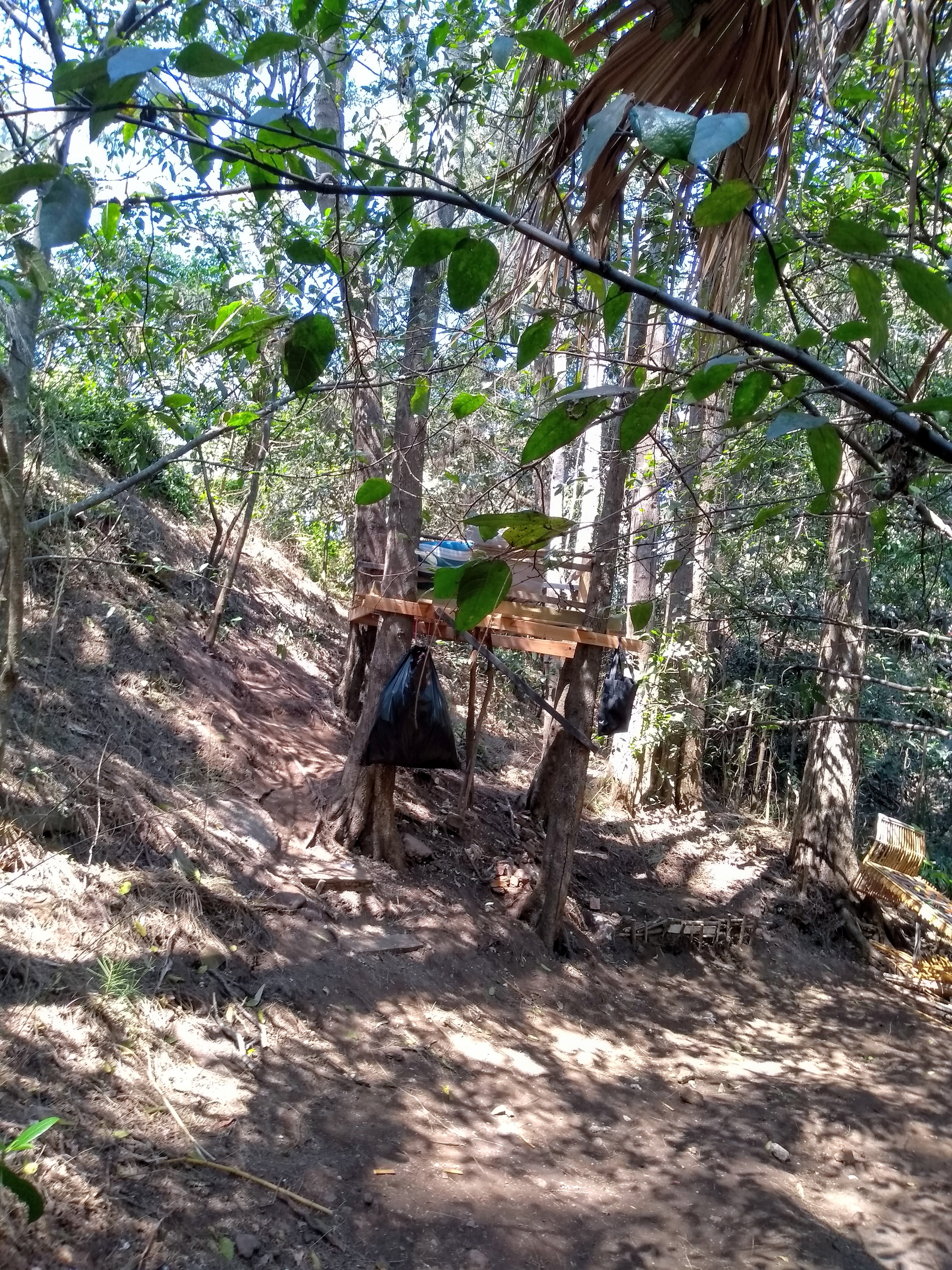
Of course, risk increases when dingoes and people are in close proximity. Dingoes are often deliberately or carelessly rewarded with food scraps or find rubbish, which encourages loitering.

Most injuries caused by dingoes are minor, such as nips, bites and scratches. Serious attacks by dingoes are rare on K'gari and the mainland. Children are most vulnerable given their smaller size.

The Queensland Parks and Wildlife Service has consistently worked to reduce incidents. Their “Be dingo safe” campaign includes education, signs, fenced areas and even “dingo sticks” to deter the animals from approaching. But too often these safety warnings are not heeded. People feed dingoes or leave food in their tents or bags, come too close to dingoes and let kids roam unsupervised.

For an apex predator, dingoes are relatively small and dog-like. To many visitors, they don’t look especially dangerous, and people forget dingoes are wild predators.

A wood and wire dingo-safe storage cage for visitors to secure food.
A “dingo-safe” storage cage for visitors to secure food and belongings on K’gari. Bradley SmithCC BY-ND

Decades of lethal control

Authorities have long relied on lethal control of dingoes on K'gari. Between 2001 and 2013, 110 dingoes were killed. In 2001, after the death of nine-year-old Clinton Gage, 28 were immediately killed. In a typical year, one to two are killed.

Removing up to ten dingoes carries serious costs for a small island population. Genetically, the K’gari population has low diversity and an effective population size of about 25 (meaning only about 25 animals are effectively passing genes on, even though more dingoes exist). Studies have found inbreeding, genetic isolation and declining genetic variation in K'gari dingoes over the past two decades.

High levels of inbreeding may lead to physical deformities, reduced breeding success and an increased risk of local extinction. On an island, there is limited scope for “new” dingoes and their genes to arrive, so every avoidable death is important.

That is why our 2025 population viability analysis was sobering. We found if the number of dingo deaths stays close to natural levels, the population could remain stable. But extra deaths due to mass culls or disease outbreaks expose the animals to higher extinction risk. This makes it more likely the island’s dingoes could die out. In the highest-risk scenarios we modelled (that includes several mass culling events), the risk of extinction becomes substantial in about 50 years. Survival can fall close to zero by 100 years.

A dingo becomes a photo opportunity for tourists on K’gari’s shoreline. Bradley SmithCC BY

Culling rarely solves safety problems

Records of dingo incidents on K'gari offer little evidence killing dingoes delivers lasting safety. Our analysis of the “highest severity” incidents reported found the island had an average of 10.7 reports a year from 2001 to 2015. There was no clear downward trend in incidents, even though more than 110 dingoes were destroyed in that period.

What we did find was a predictable seasonal pattern. About 40% of serious incidents took place during breeding season (March to May) and 30% during whelping (June to August). These are periods when dingoes are more active and social dynamics intensify. During breeding, dingoes (especially younger males) may range more widely and test boundaries. During whelping, adults can become more vigilant and take greater foraging risks to meet the demands of pups.
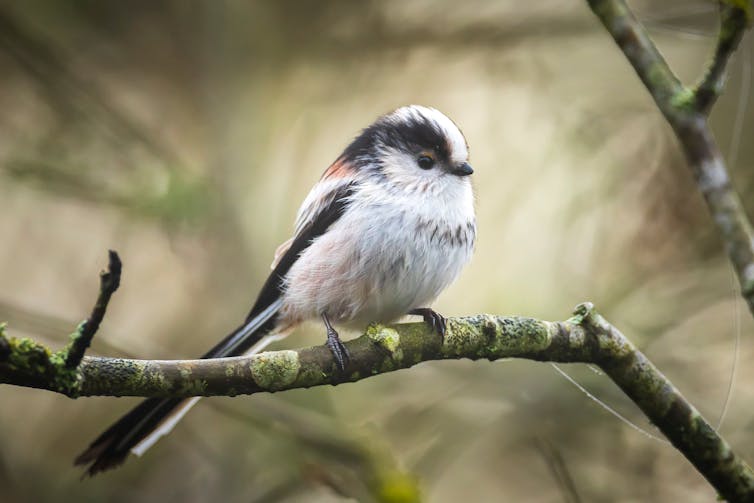
The chance of serious incidents rose and fell with dingo life history and behaviour, as well as what people did around them. Incidents are not explained by visitor numbers alone.

When a dingo approaches people or loiters near them, they can be labelled as “problematic” and are more likely to be culled. But these behaviours aren’t abnormal in a wildlife tourism setting. They are predictable responses to people, food and opportunity. Younger males are often the most persistent around people, but become less exploratory as they mature or disperse.

A dingo rests beside rubbish bins on K’gari. These bins have now been fenced. Bradley SmithCC BY-ND

A people problem, not a dingo problem

K’gari’s dingoes are doing what wild predators do, just as sharks and crocodiles do in Australia’s oceans and rivers.

Our safety depends on how we behave in wild places. To reduce risky encounters with wildlife, secure your food and waste, keep your kids close, don’t venture out alone, respect park guidelines and stop giving rewards such as food.

Killing dingoes won’t make K'gari safer. Changing human behaviour and attitudes will.The Conversation

Bradley P. Smith, Senior Lecturer in Psychology, CQUniversity Australia and Kylie M. Cairns, Research Fellow in Canid and Wildlife Genomics, UNSW Sydney

This article is republished from The Conversation under a Creative Commons license. Read the original article.

Red flowers have a ‘magic trait’ to attract birds and keep bees away

Joshua J. Cotten
Adrian DyerMonash University and Klaus LunauHeinrich Heine Universität Düsseldorf

For flowering plants, reproduction is a question of the birds and the bees. Attracting the right pollinator can be a matter of survival – and new research shows how flowers do it is more intriguing than anyone realised, and might even involve a little bit of magic.

In our new paper, published in Current Biology, we discuss how a single “magic” trait of some flowering plants simultaneously camouflages them from bees and makes them stand out brightly to birds.

How animals see

We humans typically have three types of light receptors in our eyes, which enable our rich sense of colours.

These are cells sensitive to blue, green or red light. From the input from these cells, the brain generates many colours including yellow via what is called colour opponent processing.

The way colour opponent processing works is that different sensed colours are processed by the brain in opposition. For example, we see some signals as red and some as green – but never a colour in between.

Many other animals also see colour and show evidence of also using opponent processing.

Bees see their world using cells that sense ultraviolet, blue and green light, while birds have a fourth type sensitive to red light as well.

A diagram showing a different wavelengths of light along a spectrum.
Our colour perception illustrated with the spectral bar is different to bees that are sensitive to UV, blue and green, or birds with four colour photoreceptors including red sensitivity. Adrian Dyer & Klaus LunauCC BY

The problem flowering plants face

So what do these differences in colour vision have to do with plants, genetics and magic?

Flowers need to attract pollinators of the right size, so their pollen ends up on the correct part of an animal’s body so it’s efficiently flown to another flower to enable pollination.

Accordingly, birds tend to visit larger flowers. These flowers in turn need to provide large volumes of nectar for the hungry foragers.

But when large amounts of sweet-tasting nectar are on offer, there’s a risk bees will come along to feast on it – and in the process, collect valuable pollen. And this is a problem because bees are not the right size to efficiently transfer pollen between larger flowers.

Flowers “signal” to pollinators with bright colours and patterns – but these plants need a signal that will attract birds without drawing the attention of bees.

We know bee pollination and flower signalling evolved before bird pollination. So how could plants efficiently make the change to being pollinated by birds, which enables the transfer of pollen over long distances?

Avoiding bees or attracting birds?

A walk through nature lets us see with our own eyes that most red flowers are visited by birds, rather than bees. So bird-pollinated flowers have successfully made the transition. Two different theories have been developed that may explain what we observe.

One theory is the bee avoidance hypotheses where bird pollinated flowers just use a colour that is hard for bees to see.

A second theory is that birds might prefer red.

But neither of these theories seemed complete, as inexperienced birds don’t demonstrate a preference for a stronger red hue. However, bird-pollinated flowers do have a very distinct red hue, which suggests avoiding bees can’t solely explain why consistently salient red flower colours evolved.

A bird eating nectar from red flowers.
Most red flowers are visited by birds, rather than bees. Jim Moore/iNaturalistCC BY

A magical solution

In evolutionary science, the term magic trait refers to an evolved solution where one genetic modification may yield fitness benefits in multiple ways.

Earlier this month, a team working on how this might apply to flowering plants showed that a gene that modulates UV-absorbing pigments in flower petals can indeed have multiple benefits. This is because of how bees and birds view colour signals differently.

Bee-pollinated flowers come in a diverse range of colours. Bees even pollinate some plants with red flowers. But these flowers tend to also reflect a lot of UV, which helps bees find them.

The magic gene has the effect of reducing the amount of UV light reflected from the petal, making flowers harder for bees to see. But (and this is where the magic comes in) reducing UV reflection from a petal of a red flower simultaneously makes it look redder for animals – such as birds – which are believed to have a colour opponent system.

A diagram showing the relative strength of red signals to birds, bees and humans.
Red flowers look similar for humans, but as flowers evolved for bird vision a genetic change down-regulates UV reflection, making flowers more colourful for birds and less visible to bees. Adrian Dyer & Klaus LunauCC BY

Birds that visit these bright red flowers gain rewards – and with experience, they learn to go repeatedly to the red flowers.

One small gene change for colour signalling in the UV yields multiple beneficial outcomes by avoiding bees and displaying enhanced colours to entice multiple visits from birds.

We lucky humans are fortunate that our red perception can also see the result of this clever little trick of nature to produce beautiful red flower colours. So on your next walk on a nice day, take a minute to view one of nature’s great experiments on finding a clever solution to a complex problem.The Conversation

Adrian Dyer, Associate Professor, Department of Physiology, Monash University and Klaus Lunau, Professor, Institute of Sensory Ecology, Heinrich Heine Universität Düsseldorf

This article is republished from The Conversation under a Creative Commons license. Read the original article.

Paying attention to birdsong while walking in nature can boost wellbeing, my research shows

Listening to the sounds of birdsong may help to reduce stress. BalanceFormCreative/ Shutterstock
Christoph RandlerUniversity of Tübingen

There’s no question that being in nature is good for wellbeing. Research shows that experiencing nature and listening to natural sounds can relax us.

A key reason for these benefits may be because of the appeal of birds and their pleasant songs that we hear when in nature.

Studies show that people feel better in bird-rich environments. Even life satisfaction may be related to the richness of the bird species in an area.

My colleagues and I wanted to better study the relationship between wellbeing and birdsong. We conducted an experiment in which 233 people walked through a park – specifically the University of Tübingen’s botanical garden. The walk took about half an hour.

Participants filled out questionnaires on their psychological wellbeing both before and after their walk. We also measured blood pressure, heart rate and cortisol levels (in their saliva) to get a better understanding of the physiological effects the walk had on wellbeing. Cortisol is considered an important stress hormone that can change within just a few minutes.

In order to get a good understanding of the effect birdsong had on wellbeing, we also hung loudspeakers in the trees that played the songs of rare species of birds – such as the golden orioletree pipitgarden warbler or mistle thrush.

To decide which additional bird songs should be played by the loudspeakers, we looked at the results of a previous study we had conducted. In that study, volunteers listened to more than 100 different bird songs and rated them based on how pleasant they found them to be.

We used the bird songs that had been most liked by participants in that experiment. However, to avoid annoying the birds living in the garden, we only chose bird songs that did not disturb the environment. We also mapped all resident species in the area and avoided broadcasting their songs.

Participants were randomly split into five distinct groups. The first and second groups went for a walk through the garden with birdsong being played on loudspeakers. The second group was also instructed to pay attention to birdsong.

The third and fourth groups also walked through the garden, but this time they only heard natural birdsong – we did not have additional speakers playing birdsong in the area. The fourth group was also instructed to pay attention to the natural birdsong.

A middle-aged woman walks through a forest alone, while looking up at the trees.
Those who focused on birdsong reported better mental wellbeing. edchechine/ Shutterstock

The fifth group was the control group. These participants went for a walk through the garden while wearing noise-cancelling headphones.

Benefits of birdsong

In all groups (even the control group), blood pressure and heart rate dropped – indicating that physiological stress was reduced after the walk. Cortisol levels also fell by an average of nearly 33%.

Self-reported mental wellbeing, as measured by the questionnaires, was also higher after the walks.

The groups who focused their attention on the birdsong saw even greater increases in wellbeing. So while a walk in nature had clear, physiological benefits for reducing stress, paying attention to birdsong further boosted these benefits.

However, the groups who went for a walk with the loudspeakers playing birdsong did not see any greater mental and physiological wellbeing improvements compared to the other groups.

This was a surprise, given previous studies have shown birdsong enriches wellbeing. Bird species diversity has also been shown to further improve restoration and relaxation.

One possible explanation for this finding may be that participants recognised the playback sounds as being fake – whether consciously or unconsciously. Another explanation could be that there might be a threshold – and having a higher number of bird species singing in an area does not improve wellbeing any further.

Appreciating birdsong

Our results show that a walk in nature is beneficial in and of itself – but the sounds of natural birdsong can further boost these wellbeing benefits, especially if you make a concerted effort to pay attention it.

You don’t even need to know a lot about birds to get these benefits, as our study showed. The positive effect was seen in everyone from casual birdwatchers through to bird nerds.

Our study’s results are a good message for everyday life. You don’t need a visit to bird-rich environments to make you happy. It seems more important to focus on the birds that are already there, listen to them and enjoy them.

The results also have implications for park design, showing that the sound of birdsong in general – rather than the number of species living there or how rare they are – is of key importance when it comes to wellbeing.

So even just a half hour walk outside while taking the time to notice birdsong could reduce your stress and improve wellbeing.The Conversation

Christoph Randler, Professor, Department of Biology, University of Tübingen

This article is republished from The Conversation under a Creative Commons license. Read the original article.

Welcome to the ‘Homogenocene’: how humans are making the world’s wildlife dangerously samey

Pigeons are well-suited to urban living, and are outcompeting distinctive local species around the world. Wirestock Creators / shutterstock
Mark WilliamsUniversity of Leicester and Jan ZalasiewiczUniversity of Leicester

The age of humans is increasingly an age of sameness. Across the planet, distinctive plants and animals are disappearing, replaced by species that are lucky enough to thrive alongside humans and travel with us easily. Some scientists have a word for this reshuffling of life: the Homogenocene.

Evidence for it is found in the world’s museums. Storerooms are full of animals that no longer walk among us, pickled in spirit-filled jars: coiled snakes, bloated fish, frogs, birds. Each extinct species marks the removal of a particular evolutionary path from a particular place – and these absences are increasingly being filled by the same hardy, adaptable species, again and again.

One such absence is embodied by a small bird kept in a glass jar in London’s Natural History Museum: the Fijian Bar-winged rail, not seen in the wild since the 1970s. It seems to be sleeping, its eyes closed, its wings tucked in along its back, its beak resting against the glass.

A flightless bird, it was particularly vulnerable to predators introduced by humans, including mongooses brought to Fiji in the 1800s. Its disappearance was part of a broad pattern in which island species are vanishing and a narrower set of globally successful animals thrive in their place.

It’s a phenomenon that was called the Homogenocene even before a similar term growing in popularity, the Anthropocene, was coined in 2000. If the Anthropocene describes a planet transformed by humans, the Homogenocene is one ecological consequence: fewer places with their own distinctive life.

It goes well beyond charismatic birds and mammals. Freshwater fish, for instance, are becoming more “samey”, as the natural barriers that once kept populations separate – waterfalls, river catchments, temperature limits – are effectively blurred or erased by human activity. Think of common carp deliberately stocked in lakes for anglers, or catfish released from home aquariums that now thrive in rivers thousands of miles from their native habitat.

Meanwhile, many thousands of mollusc species have disappeared over the past 500 years, with snails living on islands also severely affected: many are simply eaten by non-native predatory snails. Some invasive snails have become highly successful and widely distributed, such as the giant African snail that is now found from the Hawaiian Islands to the Americas, or South American golden apple snails rampant through east and south-east Asia since their introduction in the 1980s.

Homogeneity is just one facet of the changes wrought on the Earth’s tapestry of life by humans, a process that started in the last ice age when hunting was likely key to the disappearance of the mammoth, giant sloth and other large mammals. It continued over around 11,700 years of the recent Holocene epoch – the period following the last ice age – as forests were felled and savannahs cleared for agriculture and the growth of farms and cities.

Over the past seven decades changes to life on Earth have intensified dramatically. This is the focus of a major new volume published by the Royal Society of London: The Biosphere in the Anthropocene.

The Anthropocene has reached the ocean

Life in the oceans was relatively little changed between the last ice age and recent history, even as humans increasingly affected life on land. No longer: a feature of the Anthropocene is the rapid extension of human impacts through the oceans.

This is partly due to simple over-exploitation, as human technology post-second world war enabled more efficient and deeper trawling, and fish stocks became seriously depleted.

lionfish on coral reef
Lionfish from the Pacific have been introduced in the Caribbean, where they’re hoovering up native fish who don’t recognise them as predators. Drew McArthur / shutterstock

Partly this is also due to the increasing effects of fossil-fuelled heat and oxygen depletion spreading through the oceans. Most visibly, this is now devastating coral reefs.

Out of sight, many animals are being displaced northwards and southwards out of the tropics to escape the heat; these conditions are also affecting spawning in fish, creating “bottlenecks” where life cycle development is limited by increasing heat or a lack of oxygen. The effects are reaching through into the deep oceans, where proposals for deep sea mining of minerals threaten to damage marine life that is barely known to science.

And as on land and in rivers, these changes are not just reducing life in the oceans – they’re redistributing species and blurring long-standing biological boundaries.

Local biodiversity, global sameness

Not all the changes to life made by humans are calamitous. In some places, incoming non-native species have blended seamlessly into existing environments to actually enhance local biodiversity.

In other contexts, both historical and contemporary, humans have been decisive in fostering wildlife, increasing the diversity of animals and plants in ecosystems by cutting or burning back the dominant vegetation and thereby allowing a greater range of animals and plants to flourish.

In our near-future world there are opportunities to support wildlife, for instance by changing patterns of agriculture to use less land to grow more food. With such freeing-up of space for nature, coupled with changes to farming and fishing that actively protect biodiversity, there is still a chance that we can avoid the worst predictions of a future biodiversity crash.

But this is by no means certain. Avoiding yet more rows of pickled corpses in museum jars will require a concerted effort to protect nature, one that must aim to help future generations of humans live in a biodiverse world.The Conversation

Mark Williams, Professor of Palaeobiology, University of Leicester and Jan Zalasiewicz, Professor of Palaeobiology, University of Leicester

This article is republished from The Conversation under a Creative Commons license. Read the original article.

How to cut harmful emissions from ditches and canals – new research

Thijs de Graaf/Shutterstock
Teresa SilverthornUniversity of LiverpoolJonathan RitsonUniversity of Manchester, and Mike PeacockUniversity of Liverpool

Ditches and canals are the underdog of the freshwater world. These human-made waterways are often forgotten, devalued and perceived negatively – think “dull as ditchwater”. But these unsung heroes have a hidden potential for climate change mitigation, if they’re managed correctly.

We know that ditches and canals have a large global extent, covering at least 5.3 million hectares — about 22% of the UK’s total land area. However, no one has yet mapped all global ditch and canal networks robustly, so it’s potentially more.

These waterways are also hotspots of greenhouse gas emissions, which contribute to climate change. We have previously calculated that ditches emit 333 teragrams of carbon dioxide equivalents (a common unit to express the climate impact of all greenhouse gases), which is nearly comparable to the UK’s total greenhouse gas emissions in 2023.

Ditches often contain stagnant waters and are commonly found running through farmland or cities, where they receive high amounts of nutrients from fertilisers, manure and stormwater run-off. This creates the low-oxygen, high-nutrient conditions that are ideal for the production of potent greenhouse gases methane and nitrous oxide – both of which warm the atmosphere considerably more than CO₂.

However, ditches and their surrounding landscape can be managed (by farmers and landowners, for example) in ways that reduce nutrient inputs and therefore lower their greenhouse gas emissions. This makes them an untapped solution for reducing the effects of climate change.

Many nature restoration solutions focus on storing atmospheric carbon – by planting trees or mangroves, for example. But there are also immediate wins to be made simply by reducing greenhouse gas emissions. The importance of methane reduction has now been recognised by more than 160 countries, all of which signed the global methane pledge to cut human-caused methane emissions by at least 30% from 2020 levels by the end of the decade.

Our new study outlines the steps needed to reduce emissions from global ditches and canals. First, we need to better understand these systems by mapping their global extent. We also need to collect more measurements of greenhouse gas emissions from underrepresented regions like South America and Africa. Emissions from irrigation ditches in these understudied places could be large.

We also need to improve our understanding of how the potent greenhouse gas methane escapes the sediments in bubbles. This involves using sensors that monitor methane concentrations continuously, in order to capture “hot moments” when weather or human activity (such as fertiliser use on farmland) cause sudden pulses of emissions.

All of these strategies will improve estimates of global greenhouse gas emissions from ditches. From that new baseline, any progress in reducing emissions can be more accurately measured.

New directions for ditches

There are several ways to reduce greenhouse gas emissions from ditches and canals. These include reducing fertiliser application rates on farmland, excluding livestock from areas beside ditches to reduce the amount of manure that ends up in waterways (which has already been shown to be effective for ponds), and managing pollution sources like wastewater treatment plants.

In the Netherlands, researchers have tested the effects of dredging agricultural ditches to remove the nutrient- and organic matter-rich sediments that release greenhouse gases.

They found that dredging resulted in a 35% decline in ditch emissions after one year. However, this method isn’t perfect, as the emissions from the removed sediments still need to be accounted for at a later stage, and dredging disturbs aquatic habitats and organisms.

Planting vegetation alongside ditches helps intercept nutrients and sediments before they reach the ditch. This vegetation also provides shading, which reduces water temperature and rates of greenhouse gas emissions. A study across Denmark, Great Britain and Sweden found that riverside vegetation helped to considerably reduce nutrient inputs to rivers and streams, and improved habitats for stream organisms like bugs and frogs.

Introducing floating vegetation can also trap methane and create the conditions for its removal before it is released into the atmosphere. Current trials in the UK are looking at introducing Sphagnum moss to peatland ditches. Once a floating mat of this moss has been established, it can trap bubbles of methane in an oxygen-rich environment created by the photosynthesising moss.

When methane and oxygen are present together, methane-eating bacteria can convert methane to carbon dioxide, which has a much lower impact on the climate. Initial results showed a decrease in methane of approximately 40% when Sphagnum was present.

Some of these techniques might be too expensive to scale, and many are still at the early stages of research into their use in ditches. Nevertheless, ditches and canals can in future be climate heroes – we just need to give them the chance by managing them in smart and sustainable ways.


Teresa Silverthorn, Postdoctoral Research Associate, University of LiverpoolJonathan Ritson, Research Fellow, Geography, University of Manchester, and Mike Peacock, Lecturer in Biogeochemical Cycles, School of Environmental Sciences, University of Liverpool

This article is republished from The Conversation under a Creative Commons license. Read the original article.

PFAS are turning up in the Great Lakes, putting fish and water supplies at risk – here’s how they get there

PFAS are now found in all of the Great Lakes, including Lake Superior, pictured. Mario Dias/iStock/Getty Images Plus
Christy RemucalUniversity of Wisconsin-Madison

No matter where you live in the United States, you have likely seen headlines about PFAS being detected in everything from drinking water to fish to milk to human bodies.

PFAS, or per- and polyfluoroalkyl substances, are a group of over 10,000 synthetic chemicals. They have been used for decades to make products waterproof and stain- and heat-resistant – picture food wrappers, stain-resistant carpet, rain jackets and firefighting foam.

These chemicals are a growing concern because some PFAS are toxic even at very low levels and associated with health risks like thyroid issues and cancer. And some of the most common PFAS don’t naturally break down, which is why they are often referred to as “forever chemicals.”

Now, PFAS are posing a threat to the Great Lakes, one of America’s most vital water resources.

A view of the Chicago skyline and Lake Michigan shoreline,
Many cities, including Chicago, draw their drinking water from the Great Lakes. Franckreporter/E+ via Getty Images

The five Great Lakes are massive, with over 10,000 miles of coastline (16,000 kilometers) across two countries and containing 21% of the world’s fresh surface water. They provide drinking water to over 30 million people and are home to a robust commercial and recreational fishing industry.

My colleagues at the University of Wisconsin-Madison and I study how chemicals like PFAS are affecting water systems. Here’s what we’re learning about how PFAS are getting into the Great Lakes, the risks they’re posing and how to reduce those risks in the future.

PFAS’ many pathways into the Great Lakes

Hundreds of rivers flow into the lakes, and each can be contaminated with PFAS from sources such as industrial sites, military operations and wastewater treatment plants in their watersheds. Some pesticides also contain PFAS, which can wash off farm fields and into creeks, rivers and lakes.

The concentration of PFAS in rivers can vary widely depending on these upstream impacts. For example, we found concentrations of over 1,700 parts-per-trillion in Great Lakes tributaries in Wisconsin near where firefighting foam has regularly been used. That’s more than 400 times higher than federal drinking water regulations for PFOS and PFOA, both 4 parts-per-trillion.

However, concentration alone does not tell the whole story. We also found that large rivers with relatively low amounts of PFAS can put more of these chemicals into the lakes each day compared with smaller rivers with high amounts of PFAS. This means that any effort to limit the amount of PFAS in the Great Lakes should consider both high-concentration hot spots and large rivers.

A cargo ship moves through locks at St. Catharines, Canada.
The Welland Canal, part of the St. Lawrence Seaway, carries ships between Lake Ontario and Lake Erie. Rivers and other waterways are a major source of PFAS contamination in the Great Lakes. Jim Feng/E+ Getty Images

Groundwater is another key route carrying PFAS into the Great Lakes. Groundwater is a drinking water source for more than one-third of people in the U.S., and it can become contaminated when PFAS in firefighting foam and other PFAS sources seep into soil.

When these contaminated plumes enter the Great Lakes, they carry PFAS with them. We detected PFAS concentrations of over 260 parts-per-trillion in the bay of Green Bay in Lake Michigan. The chemicals we found were associated with firefighting foam, and we were able to trace them back to a contaminated groundwater plume.

PFAS can also enter the Great Lakes in unexpected ways, such as in rain and snowfall. PFAS can get into the atmosphere from industrial processes and waste incineration. The chemicals have been detected in rain across the world, including in states surrounding the Great Lakes.

Although PFAS concentrations in precipitation are typically lower than in rivers or groundwater, this is still an important contamination source. Scientists estimate that precipitation is a major source of PFAS to Lake Superior, which receives about half of its water through precipitation.

Where PFAS end up determines the risk

Much of the PFAS that enter Lake Superior will eventually make their way to the downstream lakes of Michigan, Huron, Erie and Ontario.

These chemicals’ ability to travel with water is one reason why PFAS are such a concern for drinking water systems. Many communities get their drinking water from the Great Lakes.

PFAS can also contaminate other parts of the environment.

The chemicals have been detected in sediments at the bottom of all the Great Lakes. Contaminated sediment can release PFAS back into the overlying water, where fish and aquatic birds can ingest it. So, future remediation efforts to remove PFAS from the lakes are about more than just the water – they involve the sediment as well.

PFAS can also accumulate in foams that form on lake shorelines during turbulent conditions. Concentrations of PFAS can be up to 7,000 times higher in natural foams compared with the water because PFAS are surfactants and build up where air and water meet, like bubbles in foam. As a result, state agencies recommend washing skin that comes in contact with foam and preventing pets from playing in foam.

A yellow perch swims under the ice in Sturgeon Bay in Door County, Wisconsin.
Fish, like this yellow perch spotted in Sturgeon Bay, Wis., can ingest PFAS through water and food. The chemicals are also found in the sediment of lake bottoms. Elizabeth Beard/Moment via Getty Images

Some PFAS bioaccumulate, or build up, within fish and wildlife. Elevated levels of PFAS have been detected in Great Lakes fish, raising concerns for fisheries.

High PFAS concentrations in fish in coastal areas and inland waters have led to advisories recommending people limit how much they fish they eat.

Looking ahead

Water cycles through the Great Lakes, but the process can take many years, from 2.6 years in Lake Erie to nearly 200 years in Lake Superior.

This means that PFAS that enter the lakes will be there for a very long time.

Since it is not possible to clean up the over 6 quadrillion gallons of water in the Great Lakes after they have been contaminated, preventing further contamination is key to protecting the lakes for the future.

That starts with identifying contaminated groundwater and rivers that are adding PFAS to the lakes. The Sea Grant College Program and the National Institutes of Water Resources, including the Wisconsin programs that I direct, have been supporting research to map these sources, as well as helping translate that knowledge into actions that policymakers and resource managers can take.

PFAS contamination is an issue beyond the Great Lakes and is something everyone can work to address.

  • Drinking water. If you are one of the millions of people who drink water from the Great Lakes, find out the PFAS concentrations in your drinking water. This data is increasingly available from local drinking water utilities.

  • Fish. Eating fish can provide great health benefits, but be aware of health advisories about fish caught in the Great Lakes and in inland waters so you can balance the risks. Other chemicals, such as mercury and PCBs, can also lead to fish advisories.

  • Personal choice. Scientists have proposed that PFAS only be used when they have vital functions and there are no alternatives. Consumer demand for PFAS-free products is helping reduce PFAS use in some products. Several states have also introduced legislation to ban PFAS use in some applications.

Decreasing use of PFAS will ultimately prevent downstream contamination in the Great Lakes and around the U.S.The Conversation

Christy Remucal, Professor of Civil and Environmental Engineering, University of Wisconsin-Madison

This article is republished from The Conversation under a Creative Commons license. Read the original article.

Octopus numbers exploded around the UK’s south-west coast in 2025 – a new report explores this rare phenomenon

Bryce StewartUniversity of PlymouthMarine Biological AssociationEmma SheehanUniversity of Plymouth, and Tim SmythPlymouth Marine Laboratory

Cold spray whipped off the ropes as a diesel engine throbbed in the background. One by one, empty shellfish pots came over the side of the fishing boat, occasionally containing the remnants of crab and lobster claws and carapaces. Something strange was going on.

Then the culprit revealed itself – a squirming orange body surrounded by a writhing tangle of tentacles. A few minutes later, three more of these denizens of the deep came up in a single pot, and then, incredibly, a final pot rose from the water completely rammed full of them, more than a dozen together in a squirming mass.

This was a familiar scene off the south coasts of Devon and Cornwall early last year, as a bloom of the common octopus (Octopus vulgaris) emerged, the first time anything like this had been seen for 75 years. In fact, commercial catches of common octopus in 2025 were almost 65 times higher than the recent annual average. A new report now sheds light on these blooms: their history, the causes and the consequences.

The common octopus, despite the name, is not normally common in British waters. Instead, it favours the warmer climes of southern Europe, the Mediterranean and north Africa. But, occasionally, such as in 1900, 1950 and now 2025, numbers explode off the south-west coast of England, changing marine food chains and disrupting the local fishing industry.

Common octopuses take the ultimate “live fast, die young” approach to life. Despite the large size they can attain, they generally only live for less than two years, with females dying after their eggs hatch. The males also die after breeding. This means octopus populations are highly affected by changes in environmental conditions.

Octopus blooms have previously been rare in the UK, but emerging evidence from long-term marine monitoring of the western Channel suggests that these episodes coincide with sustained periods of unusual warmth in both the ocean and atmosphere.

These “marine heatwaves” can stimulate rapid population growth, whether the octopus are locally established or newly arrived from the south. These warm conditions are often accompanied by unusually low salinity in coastal waters, a signal that points to fresher water entering the region. While salinity itself is unlikely to drive the outbreaks, it serves as a valuable tracer of the water’s origin.

The fresher conditions may stem from high river flow from major French Atlantic rivers such as the Loire, or from prolonged easterly winds over the Channel during the cooler months (October to March). These processes could help transport octopus larvae across the Channel from northern France and the Channel Islands.

Taken together, the combination of warmth, altered circulation and low-salinity signatures suggests that climate-driven shifts in ocean and atmospheric dynamics underpin these outbreaks.

From crisis to opportunity?

Those early scenes of octopus consuming catches in crab and lobster pots continued as 2025 rolled on. But they didn’t just stop at crustaceans. Piles of empty scallop shells were found in many pots, sometimes with remnants of flesh still attached.

Scallops don’t normally go into crab and lobster pots (unless they have lights in them, which these ones didn’t), so the only explanation is that octopus were actively putting scallops in pots to stock up their larder, consuming them at leisure later.

However, fishers are nothing if not adaptable. They soon realised that there was a lucrative export market for octopus and began targeting them. One boat fishing out from Newlyn in Cornwall brought home over 20 tonnes of octopus, worth £142,000, from just three days fishing.

Between £6.7 million and £9.4 million worth of common octopus was landed on the south coast of the UK from January to August 2025. However, not all fishers benefited, and for most boats, octopus catches suddenly dropped off in August. With other shellfish fisheries also declining dramatically last year – lobsters by 30% and brown crabs and scallops by over 50% – many fishers worry about a future in which there is nothing left to catch.

So, what does the future hold? Given the link with climate change, the extensive reports of octopus breeding and a recent appearance of juvenile octopuses in UK waters, the continued presence of the common octopus seems likely.

If a bloom the size of last year’s occurs again soon, future fisheries should be guided by sustainable and ethical principles that help diversify opportunities for fishing fleets, while leaving enough octopus in the sea to be enjoyed by the hundreds of divers and snorkellers who loved watching these amazing creatures last year.


Don’t have time to read about climate change as much as you’d like?
Get a weekly roundup in your inbox instead. Every Wednesday, The Conversation’s environment editor writes Imagine, a short email that goes a little deeper into just one climate issue. Join the 47,000+ readers who’ve subscribed so far.The Conversation


Bryce Stewart, Associate Professor, Marine Ecology and Fisheries Biology, University of PlymouthMarine Biological AssociationEmma Sheehan, Associate Professor of Marine Ecology, University of Plymouth, and Tim Smyth, Head of Group: Marine Processes and Observations, Plymouth Marine Laboratory

This article is republished from The Conversation under a Creative Commons license. Read the original article.

Pittwater Reserves: histories + Notes + Pictorial Walks

A History Of The Campaign For Preservation Of The Warriewood Escarpment by David Palmer OAM and Angus Gordon OAM
A Saturday Morning Stroll around Bongin Bongin - Mona Vale's Basin, Mona Vale Beach October 2024 by Kevin Murray
A Stroll Along The Centre Track At Ku-Ring-Gai Chase National Park: June 2024 - by Kevin Murray
A Stroll Around Manly Dam: Spring 2023 by Kevin Murray and Joe Mills
A Stroll Through Warriewood Wetlands by Joe Mills February 2023
A Walk Around The Cromer Side Of Narrabeen Lake by Joe Mills
A Walk on the Duffy's Wharf Track October 2024 by Kevin Murray and Joe Mills
America Bay Track Walk - photos by Joe Mills
An Aquatic June: North Narrabeen - Turimetta - Collaroy photos by Joe Mills 
Angophora Reserve  Angophora Reserve Flowers Grand Old Tree Of Angophora Reserve Falls Back To The Earth - History page
Annie Wyatt Reserve - A  Pictorial
Annie Wyatt Reserve, Palm Beach: Pittwater Fields of Dreams II - The Tree Lovers League 
Aquatic Reflections seen this week (May 2023): Narrabeen + Turimetta by Joe Mills 
Avalon Beach Reserve- Bequeathed By John Therry  
Avalon Beach This Week: A Place Of A Bursting Main, Flooding Drains + Falling Boulders Council Announces Intention To Progress One LEP For Whole LGA + Transport Oriented Development Begins
Avalon's Village Green: Avalon Park Becomes Dunbar Park - Some History + Toongari Reserve and Catalpa Reserve
Bairne Walking Track Ku-Ring-Gai Chase NP by Kevin Murray
Bangalley Headland  Bangalley Mid Winter
Bangalley Headland Walk: Spring 2023 by Kevin Murray and Joe Mills
Banksias of Pittwater
Barrenjoey Boathouse In Governor Phillip Park  Part Of Our Community For 75 Years: Photos From The Collection Of Russell Walton, Son Of Victor Walton
Barrenjoey Headland: Spring flowers 
Barrenjoey Headland after fire
Bayview Baths
Bayview Pollution runoff persists: Resident states raw sewerage is being washed into the estuary
Bayview Public Wharf and Baths: Some History
Bayview Public Wharf Gone; Bayview Public Baths still not netted - Salt Pan Public Wharf Going
Bayview's new walkway, current state of the Bayview public Wharf & Baths + Maybanke Cove
Bayview Sea Scouts Hall: Some History
Bayview Wetlands
Beeby Park
Bilgola Beach
Bilgola Plateau Parks For The People: Gifted By A. J. Small, N. A. K. Wallis + The Green Pathways To Keep People Connected To The Trees, Birds, Bees - For Children To Play 
Botham Beach by Barbara Davies
Brown's Bay Public Wharf, on McCarrs Creek, Church Point: Some History
Bungan Beach Bush Care
Careel Bay Saltmarsh plants 
Careel Bay Birds  
Careel Bay Clean Up day
Careel Bay Marina Environs November 2024 - Spring Celebrations
Careel Bay Playing Fields History and Current
Careel Bay Steamer Wharf + Boatshed: some history 
Careel Creek 
Careel Creek - If you rebuild it they will come
Central Trail: Ku-ring-Gai Chase National Park, Spring 2025 by Kevin Murray
Centre trail in Ku-ring-gai Chase National Park
Chiltern Track- Ingleside by Marita Macrae
Clareville Beach
Clareville/Long Beach Reserve + some History
Clareville Public Wharf: 1885 to 1935 - Some History 
Coastal Stability Series: Cabbage Tree Bay To Barrenjoey To Observation Point by John Illingsworth, Pittwater Pathways, and Dr. Peter Mitchell OAM
Community Concerned Over the Increase of Plastic Products Being Used by the Northern Beaches Council for Installations in Pittwater's Environment
Cowan Track by Kevin Murray
Crown Reserves Improvement Fund Allocations 2021
Crown Reserves Improvement Fund 2022-23: $378,072 Allocated To Council For Weed Control - Governor Phillip Park Gets a Grant This Time: full details of all 11 sites
Crown Reserves Improvement Fund Allocations 2023-2024
Crown Reserves Grants 2025 Announced: Local focus on Weeds + Repairs to Long Reef Boardwalk + some pictures of council's recent works at Hitchcock Park - Careel Bay playing fields - CRIF 2025
Curl Curl To Freshwater Walk: October 2021 by Kevin Murray and Joe Mills
Currawong and Palm Beach Views - Winter 2018
Currawong-Mackerel-The Basin A Stroll In Early November 2021 - photos by Selena Griffith
Currawong State Park Currawong Beach +  Currawong Creek
Deep Creek To Warriewood Walk photos by Joe Mills
Drone Gives A New View On Coastal Stability; Bungan: Bungan Headland To Newport Beach + Bilgola: North Newport Beach To Avalon + Bangalley: Avalon Headland To Palm Beach
Duck Holes: McCarrs Creek by Joe Mills
Dunbar Park - Some History + Toongari Reserve and Catalpa Reserve
Dundundra Falls Reserve: August 2020 photos by Selena Griffith - Listed in 1935
Elsie Track, Scotland Island
Elvina Track in Late Winter 2019 by Penny Gleen
Elvina Bay Walking Track: Spring 2020 photos by Joe Mills 
Elvina Bay-Lovett Bay Loop Spring 2020 by Kevin Murray and Joe Mills
Fern Creek - Ingleside Escarpment To Warriewood Walk + Some History photos by Joe Mills
Great Koala National Park Announced: Historic Win for Wildlife, Biodiversity, Community
Hordern Park, Palm Beach: Some History + 2024 Photos of park from top to beach
Iluka Park, Woorak Park, Pittwater Park, Sand Point Reserve, Snapperman Beach Reserve - Palm Beach: Some History
Ingleside
Ingleside Wildflowers August 2013
Irrawong Falls Walk May 2025 by Joe Mills
Irrawong - Ingleside Escarpment Trail Walk Spring 2020 photos by Joe Mills
Irrawong - Mullet Creek Restoration
Katandra Bushland Sanctuary - Ingleside
Killing of Ruskin Rowe Heritage Listed Tree 'authoritarian'
Long Reef Sunrise Headland Walk by Joe Mills
Lucinda Park, Palm Beach: Some History + 2022 Pictures
McCarrs Creek
McCarrs Creek Public Jetty, Brown's Bay Public Jetty, Rostrevor Reserve, Cargo Wharf, Church Point Public Wharf: a few pictures from the Site Investigations for Pittwater Public Wharves History series 2025
McCarr's Creek to Church Point to Bayview Waterfront Path
McKay Reserve
Milton Family Property History - Palm Beach By William (Bill) James Goddard II with photos courtesy of the Milton Family   - Snapperman to Sandy Point, Pittwater
Mona Vale Beach - A Stroll Along, Spring 2021 by Kevin Murray
Mona Vale Headland, Basin and Beach Restoration
Mona Vale Woolworths Front Entrance Gets Garden Upgrade: A Few Notes On The Site's History 
Mother Brushtail Killed On Barrenjoey Road: Baby Cried All Night - Powerful Owl Struck At Same Time At Careel Bay During Owlet Fledgling Season: calls for mitigation measures - The List of what you can do for those who ask 'What You I Do' as requested
Mount Murray Anderson Walking Track by Kevin Murray and Joe Mills
Mullet Creek
Muogamarra Nature Reserve in Cowan celebrates 90 years: a few insights into The Vision of John Duncan Tipper, Founder 
Muogamarra by Dr Peter Mitchell OAM and John Illingsworth
Narrabeen Creek
Narrabeen Lagoon Catchment: Past Notes Present Photos by Margaret Woods
Narrabeen Lagoon Entrance Clearing Works: September To October 2023  pictures by Joe Mills
Narrabeen Lagoon State Park
Narrabeen Lagoon State Park Expansion
Narrabeen Rockshelf Aquatic Reserve
Nerang Track, Terrey Hills by Bea Pierce
Newport Bushlink - the Crown of the Hill Linked Reserves
Newport Community Garden - Woolcott Reserve
Newport to Bilgola Bushlink 'From The Crown To The Sea' Paths:  Founded In 1956 - A Tip and Quarry Becomes Green Space For People and Wildlife 
Northern Beaches Council recommends allowing dogs offleash on Mona Vale Beach
Out and About July 2020 - Storm swell
Out & About: July 2024 - Barrenjoey To Paradise Beach To Bayview To Narrabeen + Middle Creek - by John Illingsworth, Adriaan van der Wallen, Joe Mills, Suzanne Daly, Jacqui Marlowe and AJG
Palm Beach Headland Becomes Australia’s First Urban Night Sky Place: Barrenjoey High School Alumni Marnie Ogg's Hard Work
Palm Beach Public Wharf: Some History 
Paradise Beach Baths renewal Complete - Taylor's Point Public Wharf Rebuild Underway
Realises Long-Held Dream For Everyone
Paradise Beach Wharf + Taylor's Wharf renewal projects: October 2024 pictorial update - update pics of Paradise Wharf and Pool renewal, pre-renewal Taylors Point wharf + a few others of Pittwater on a Spring Saturday afternoon
Pictures From The Past: Views Of Early Narrabeen Bridges - 1860 To 1966
Pittwater Beach Reserves Have Been Dedicated For Public Use Since 1887 - No 1.: Avalon Beach Reserve- Bequeathed By John Therry 
Pittwater Reserves: The Green Ways; Bungan Beach and Bungan Head Reserves:  A Headland Garden 
Pittwater Reserves, The Green Ways: Clareville Wharf and Taylor's Point Jetty
Pittwater Reserves: The Green Ways; Hordern, Wilshire Parks, McKay Reserve: From Beach to Estuary 
Pittwater Reserves - The Green Ways: Mona Vale's Village Greens a Map of the Historic Crown Lands Ethos Realised in The Village, Kitchener and Beeby Parks 
Pittwater Reserves: The Green Ways Bilgola Beach - The Cabbage Tree Gardens and Camping Grounds - Includes Bilgola - The Story Of A Politician, A Pilot and An Epicure by Tony Dawson and Anne Spencer  
Pittwater spring: waterbirds return to Wetlands
Pittwater's Lone Rangers - 120 Years of Ku-Ring-Gai Chase and the Men of Flowers Inspired by Eccleston Du Faur 
Pittwater's Great Outdoors: Spotted To The North, South, East + West- June 2023:  Palm Beach Boat House rebuild going well - First day of Winter Rainbow over Turimetta - what's Blooming in the bush? + more by Joe Mills, Selena Griffith and Pittwater Online
Pittwater's Parallel Estuary - The Cowan 'Creek
Pittwater Pathways To Public Lands & Reserves
Plastic grass announced For Kamilaroi Park Bayview + Lakeside Park
Project Penguin 2017 - Taronga Zoo Expo day
Project Penguin 2025 + Surfing with a Penguin in South Africa + Pittwater's Penguins
Resolute Track at West Head by Kevin Murray
Resolute Track Stroll by Joe Mills
Riddle Reserve, Bayview
Salt Pan Cove Public Wharf on Regatta Reserve + Florence Park + Salt Pan Reserve + Refuge Cove Reserve: Some History
Salt Pan Public Wharf, Regatta Reserve, Florence Park, Salt Pan Cove Reserve, Refuge Cove Reserve Pictorial and Information
Salvation Loop Trail, Ku-Ring-Gai Chase National Park- Spring 2020 - by Selena Griffith
Scotland Island Dieback Accelerating: November 2024
Seagull Pair At Turimetta Beach: Spring Is In The Air!
Shark net removal trial cancelled for this year:  Shark Meshing (Bather Protection) Program 2024-25 Annual Performance Report Released
2023-2024 Shark Meshing Program statistics released: council's to decide on use or removal
Shark Meshing (Bather Protection) Program 2022/23 Annual Performance Report 
Shark Meshing (Bather Protection) Program 2021/22 Annual Performance Report - Data Shows Vulnerable, Endangered and Critically Endangered Species Being Found Dead In Nets Off Our Beaches 
Shark Meshing (Bather Protection) Program 2020/21 Annual Performance Report 
Shark Meshing 2019/20 Performance Report Released
DPI Shark Meshing 2018/19 Performance ReportLocal Nets Catch Turtles, a Few Sharks + Alternatives Being Tested + Historical Insights
Some late November Insects (2023)
Stapleton Reserve
Stapleton Park Reserve In Spring 2020: An Urban Ark Of Plants Found Nowhere Else
Stealing The Bush: Pittwater's Trees Changes - Some History 
Stokes Point To Taylor's Point: An Ideal Picnic, Camping & Bathing Place 
Stony Range Regional Botanical Garden: Some History On How A Reserve Became An Australian Plant Park
Taylor's Point Public Wharf 2013-2020 History
The Chiltern Track
The Chiltern Trail On The Verge Of Spring 2023 by Kevin Murray and Joe Mills
The 'Newport Loop': Some History 
The Resolute Beach Loop Track At West Head In Ku-Ring-Gai Chase National Park by Kevin Murray
The Top Predator by A Dad from A Pittwater Family of Dog Owners & Dog Lovers
$378,072 Allocated To Council For Weed Control: Governor Phillip Park Gets a Grant This Time: full details of all 11 sites - CRIF March 2023
Topham Track Ku-Ring-Gai Chase NP,  August 2022 by Joe Mills and Kevin Murray
Towlers Bay Walking Track by Joe Mills
Trafalgar Square, Newport: A 'Commons' Park Dedicated By Private Landholders - The Green Heart Of This Community
Tranquil Turimetta Beach, April 2022 by Joe Mills
Tree Management Policy Passed
Trial to remove shark nets - NBC - Central Coast - Waverly approached to nominate a beach each
Turimetta Beach Reserve by Joe Mills, Bea Pierce and Lesley
Turimetta Beach Reserve: Old & New Images (by Kevin Murray) + Some History
Turimetta Headland
Turimetta Moods by Joe Mills: June 2023
Turimetta Moods (Week Ending June 23 2023) by Joe Mills
Turimetta Moods: June To July 2023 Pictures by Joe Mills
Turimetta Moods: July Becomes August 2023 by Joe Mills
Turimetta Moods: August Becomes September 2023 ; North Narrabeen - Turimetta - Warriewood - Mona Vale photographs by Joe Mills
Turimetta Moods August 2025 by Joe Mills
Turimetta Moods: Mid-September To Mid-October 2023 by Joe Mills
Turimetta Moods: Late Spring Becomes Summer 2023-2024 by Joe Mills
Turimetta Moods: Warriewood Wetlands Perimeter Walk October 2024 by Joe Mills
Turimetta Moods: November 2024 by Joe Mills

Pittwater's Birds

Attracting Insectivore Birds to Your Garden: DIY Natural Tick Control small bird insectivores, species like the Silvereye, Spotted Pardalote, Gerygone, Fairywren and Thornbill, feed on ticks. Attracting these birds back into your garden will provide not only a residence for tick eaters but also the delightful moments watching these tiny birds provides.
Aussie Backyard Bird Count 2017: Take part from 23 - 29 October - how many birds live here?
Aussie Backyard Bird Count 2018 - Our Annual 'What Bird Is That?' Week Is Here! This week the annual Aussie Backyard Bird Count runs from 22-28 October 2018. Pittwater is one of those places fortunate to have birds that thrive because of an Aquatic environment, a tall treed Bush environment and areas set aside for those that dwell closer to the ground, in a sand, scrub or earth environment. To take part all you need is 20 minutes and your favourite outdoor space. Head to the website and register as a Counter today! And if you're a teacher, check out BirdLife Australia's Bird Count curriculum-based lesson plans to get your students (or the whole school!) involved

Australian Predators of the Sky by Penny Olsen - published by National Library of Australia

Australian Raven  Australian Wood Duck Family at Newport

A Week In Pittwater Issue 128   A Week In Pittwater - June 2014 Issue 168

Baby Birds Spring 2015 - Rainbow Lorikeets in our Yard - for Children 

Baby Birds by Lynleigh Greig, Southern Cross Wildlife Care - what do if being chased by a nesting magpie or if you find a baby bird on the ground

Baby Kookaburras in our Backyard: Aussie Bird Count 2016 - October

Balloons Are The Number 1 Marine Debris Risk Of Mortality For Our Seabirds - Feb 2019 Study

Bangalley Mid-Winter   Barrenjoey Birds Bird Antics This Week: December 2016

Bird of the Month February 2019 by Michael Mannington

Birdland Above the Estuary - October 2012  Birds At Our Window   Birds at our Window - Winter 2014  Birdland June 2016

Birdsong Is a Lovesong at This time of The Year - Brown Falcon, Little Wattle Bird, Australian Pied cormorant, Mangrove or Striated Heron, Great Egret, Grey Butcherbird, White-faced Heron 

Bird Songs – poems about our birds by youngsters from yesterdays - for children Bird Week 2015: 19-25 October

Bird Songs For Spring 2016 For Children by Joanne Seve

Birds at Careel Creek this Week - November 2017: includes Bird Count 2017 for Local Birds - BirdLife Australia by postcode

Black Cockatoo photographed in the Narrabeen Catchment Reserves this week by Margaret G Woods - July 2019

Black-Necked Stork, Mycteria Australis, Now Endangered In NSW, Once Visited Pittwater: Breeding Pair shot in 1855

Black Swans on Narrabeen Lagoon - April 2013   Black Swans Pictorial

Brush Turkeys In Suburbia: There's An App For That - Citizen Scientists Called On To Spot Brush Turkeys In Their Backyards
Buff-banded Rail spotted at Careel Creek 22.12.2012: a breeding pair and a fluffy black chick

Cayley & Son - The life and Art of Neville Henry Cayley & Neville William Cayley by Penny Olsen - great new book on the art works on birds of these Australian gentlemen and a few insights from the author herself
Crimson Rosella - + Historical Articles on

Death By 775 Cuts: How Conservation Law Is Failing The Black-Throated Finch - new study 'How to Send a Finch Extinct' now published

Eastern Rosella - and a little more about our progression to protecting our birds instead of exporting them or decimating them.

Endangered Little Tern Fishing at Mona Vale Beach

‘Feather Map of Australia’: Citizen scientists can support the future of Australia's wetland birds: for Birdwatchers, school students and everyone who loves our estuarine and lagoon and wetland birds

First Week of Spring 2014

Fledging - Baby Birds coming to ground: Please try and Keep them close to Parent Birds - Please Put out shallow dishes of water in hot weather

Fledgling Common Koel Adopted by Red Wattlebird -Summer Bird fest 2013  Flegdlings of Summer - January 2012

Flocks of Colour by Penny Olsen - beautiful new Bird Book Celebrates the 'Land of the Parrots'

Friendly Goose at Palm Beach Wharf - Pittwater's Own Mother Goose

Front Page Issue 177  Front Page Issue 185 Front Page Issue 193 - Discarded Fishing Tackle killing shorebirds Front Page Issue 203 - Juvenile Brush Turkey  Front Page Issue 208 - Lyrebird by Marita Macrae Front Page Issue 219  Superb Fairy Wren Female  Front Page Issue 234National Bird Week October 19-25  and the 2015 the Aussie Back Yard Bird Count: Australia's First Bird Counts - a 115 Year Legacy - with a small insight into our first zoos Front Page Issue 236: Bird Week 2015 Front Page Issue 244: watebirds Front Page Issue 260: White-face Heron at Careel Creek Front Page Issue 283: Pittwater + more birds for Bird Week/Aussie Bird Count  Front Page Issue 284: Pittwater + more birds for Bird Week/Aussie Bird Count Front Page Issue 285: Bird Week 2016  Front Page Issue 331: Spring Visitor Birds Return

G . E. Archer Russell (1881-1960) and His Passion For Avifauna From Narrabeen To Newport 

Glossy Black-Cockatoo Returns To Pittwater by Paul Wheeler Glossy Cockatoos - 6 spotted at Careel Bay February 2018

Grey Butcher Birds of Pittwater

Harry Wolstenholme (June 21, 1868 - October 14, 1930) Ornithologist Of Palm Beach, Bird Man Of Wahroonga 

INGLESIDE LAND RELEASE ON AGAIN BUT MANY CHALLENGES  AHEAD by David Palmer

Issue 60 May 2012 Birdland - Smiles- Beamings -Early -Winter - Blooms

Jayden Walsh’s Northern Beaches Big Year - courtesy Pittwater Natural Heritage Association

John Gould's Extinct and Endangered Mammals of Australia  by Dr. Fred Ford - Between 1850 and 1950 as many mammals disappeared from the Australian continent as had disappeared from the rest of the world between 1600 and 2000! Zoologist Fred Ford provides fascinating, and often poignant, stories of European attitudes and behaviour towards Australia's native fauna and connects these to the animal's fate today in this beautiful new book - our interview with the author

July 2012 Pittwater Environment Snippets; Birds, Sea and Flowerings

Juvenile Sea Eagle at Church Point - for children

King Parrots in Our Front Yard  

Kookaburra Turf Kookaburra Fledglings Summer 2013  Kookaburra Nesting Season by Ray Chappelow  Kookaburra Nest – Babies at 1.5 and 2.5 weeks old by Ray Chappelow  Kookaburra Nest – Babies at 3 and 4 weeks old by Ray Chappelow  Kookaburra Nest – Babies at 5 weeks old by Ray Chappelow Kookaburra and Pittwater Fledglings February 2020 to April 2020

Lion Island's Little Penguins (Fairy Penguins) Get Fireproof Homes - thanks to NSW National Parks and Wildlife Service and the Fix it Sisters Shed

Lorikeet - Summer 2015 Nectar

Lyre Bird Sings in Local National Park - Flock of Black Cockatoos spotted - June 2019

Magpie's Melodic Melodies - For Children (includes 'The Magpie's Song' by F S Williamson)

Masked Lapwing (Plover) - Reflected

May 2012 Birdland Smiles Beamings Early Winter Blooms 

Mistletoebird At Bayview

Musk Lorikeets In Pittwater: Pittwater Spotted Gum Flower Feast - May 2020

Nankeen Kestrel Feasting at Newport: May 2016

National Bird Week 2014 - Get Involved in the Aussie Backyard Bird Count: National Bird Week 2014 will take place between Monday 20 October and Sunday 26 October, 2014. BirdLife Australia and the Birds in Backyards team have come together to launch this year’s national Bird Week event the Aussie Backyard Bird Count! This is one the whole family can do together and become citizen scientists...

National Bird Week October 19-25  and the 2015 the Aussie Back Yard Bird Count: Australia's First Bird Counts - a 115 Year Legacy - with a small insight into our first zoos

Native Duck Hunting Season Opens in Tasmania and Victoria March 2018: hundreds of thousands of endangered birds being killed - 'legally'!

Nature 2015 Review Earth Air Water Stone

New Family of Barking Owls Seen in Bayview - Church Point by Pittwater Council

Noisy Visitors by Marita Macrae of PNHA 

Pittwater Becalmed  Pittwater Birds in Careel Creek Spring 2018   Pittwater Waterbirds Spring 2011  Pittwater Waterbirds - A Celebration for World Oceans Day 2015

Pittwater's Little Penguin Colony: The Saving of the Fairies of Lion Island Commenced 65 Years Ago this Year - 2019

Pittwater's Mother Nature for Mother's Day 2019

Pittwater's Waterhens: Some Notes - Narrabeen Creek Bird Gathering: Curious Juvenile Swamp Hen On Warriewood Boardwalk + Dusky Moorhens + Buff Banded Rails In Careel Creek

Plastic in 99 percent of seabirds by 2050 by CSIRO

Plover Appreciation Day September 16th 2015

Powerful and Precious by Lynleigh Grieg

Red Wattlebird Song - November 2012

Restoring The Diamond: every single drop. A Reason to Keep Dogs and Cats in at Night. 

Return Of Australasian Figbird Pair: A Reason To Keep The Trees - Aussie Bird Count 2023 (16–22 October) You can get involved here: aussiebirdcount.org.au

Salt Air Creatures Feb.2013

Scaly-breasted Lorikeet

Sea Birds off the Pittwater Coast: Albatross, Gannet, Skau + Australian Poets 1849, 1898 and 1930, 1932

Sea Eagle Juvenile at Church Point

Seagulls at Narrabeen Lagoon

Seen but Not Heard: Lilian Medland's Birds - Christobel Mattingley - one of Australia's premier Ornithological illustrators was a Queenscliff lady - 53 of her previously unpublished works have now been made available through the auspices of the National Library of Australia in a beautiful new book

7 Little Ducklings: Just Keep Paddling - Australian Wood Duck family take over local pool by Peta Wise 

Shag on a North Avalon Rock -  Seabirds for World Oceans Day 2012

Short-tailed Shearwaters Spring Migration 2013 

South-West North-East Issue 176 Pictorial

Spring 2012 - Birds are Splashing - Bees are Buzzing

Spring Becomes Summer 2014- Royal Spoonbill Pair at Careel Creek

Spring Notes 2018 - Royal Spoonbill in Careel Creek

Station Beach Off Leash Dog Area Proposal Ignores Current Uses Of Area, Environment, Long-Term Fauna Residents, Lack Of Safe Parking and Clearly Stated Intentions Of Proponents have your say until February 28, 2019

Summer 2013 BirdFest - Brown Thornbill  Summer 2013 BirdFest- Canoodlers and getting Wet to Cool off  Summer 2013 Bird Fest - Little Black Cormorant   Summer 2013 BirdFest - Magpie Lark

The Mopoke or Tawny Frogmouth – For Children - A little bit about these birds, an Australian Mopoke Fairy Story from 91 years ago, some poems and more - photo by Adrian Boddy
Winter Bird Party by Joanne Seve

New Shorebirds WingThing  For Youngsters Available To Download

A Shorebirds WingThing educational brochure for kids (A5) helps children learn about shorebirds, their life and journey. The 2021 revised brochure version was published in February 2021 and is available now. You can download a file copy here.

If you would like a free print copy of this brochure, please send a self-addressed envelope with A$1.10 postage (or larger if you would like it unfolded) affixed to: BirdLife Australia, Shorebird WingThing Request, 2-05Shorebird WingThing/60 Leicester St, Carlton VIC 3053.


Shorebird Identification Booklet

The Migratory Shorebird Program has just released the third edition of its hugely popular Shorebird Identification Booklet. The team has thoroughly revised and updated this pocket-sized companion for all shorebird counters and interested birders, with lots of useful information on our most common shorebirds, key identification features, sighting distribution maps and short articles on some of BirdLife’s shorebird activities. 

The booklet can be downloaded here in PDF file format: http://www.birdlife.org.au/documents/Shorebird_ID_Booklet_V3.pdf

Paper copies can be ordered as well, see http://www.birdlife.org.au/projects/shorebirds-2020/counter-resources for details.

Download BirdLife Australia's children’s education kit to help them learn more about our wading birdlife

Shorebirds are a group of wading birds that can be found feeding on swamps, tidal mudflats, estuaries, beaches and open country. For many people, shorebirds are just those brown birds feeding a long way out on the mud but they are actually a remarkably diverse collection of birds including stilts, sandpipers, snipe, curlews, godwits, plovers and oystercatchers. Each species is superbly adapted to suit its preferred habitat.  The Red-necked Stint is as small as a sparrow, with relatively short legs and bill that it pecks food from the surface of the mud with, whereas the Eastern Curlew is over two feet long with a exceptionally long legs and a massively curved beak that it thrusts deep down into the mud to pull out crabs, worms and other creatures hidden below the surface.

Some shorebirds are fairly drab in plumage, especially when they are visiting Australia in their non-breeding season, but when they migrate to their Arctic nesting grounds, they develop a vibrant flush of bright colours to attract a mate. We have 37 types of shorebirds that annually migrate to Australia on some of the most lengthy and arduous journeys in the animal kingdom, but there are also 18 shorebirds that call Australia home all year round.

What all our shorebirds have in common—be they large or small, seasoned traveller or homebody, brightly coloured or in muted tones—is that each species needs adequate safe areas where they can successfully feed and breed.

The National Shorebird Monitoring Program is managed and supported by BirdLife Australia. 

This project is supported by Glenelg Hopkins Catchment Management Authority and Hunter Local Land Services through funding from the Australian Government’s National Landcare Program. Funding from Helen Macpherson Smith Trust and Port Phillip Bay Fund is acknowledged. 

The National Shorebird Monitoring Program is made possible with the help of over 1,600 volunteers working in coastal and inland habitats all over Australia. 

The National Shorebird Monitoring program (started as the Shorebirds 2020 project initiated to re-invigorate monitoring around Australia) is raising awareness of how incredible shorebirds are, and actively engaging the community to participate in gathering information needed to conserve shorebirds. 

In the short term, the destruction of tidal ecosystems will need to be stopped, and our program is designed to strengthen the case for protecting these important habitats. 

In the long term, there will be a need to mitigate against the likely effects of climate change on a species that travels across the entire range of latitudes where impacts are likely. 

The identification and protection of critical areas for shorebirds will need to continue in order to guard against the potential threats associated with habitats in close proximity to nearly half the human population. 

Here in Australia, the place where these birds grow up and spend most of their lives, continued monitoring is necessary to inform the best management practice to maintain shorebird populations. 

BirdLife Australia believe that we can help secure a brighter future for these remarkable birds by educating stakeholders, gathering information on how and why shorebird populations are changing, and working to grow the community of people who care about shorebirds.

To find out more visit: http://www.birdlife.org.au/projects/shorebirds-2020/shorebirds-2020-program