Members of SOS Mona Vale and residents have been busy since they released the findings of a comprehensive twelvemonth community investigation, formally demanding an immediate statutory moratorium on the Low and Mid-Rise Housing Policy across the Pittwater electorate north of Narrabeen Lagoon.
The findings, compiled into a technical evidentiary dossier, were delivered to Jacqui Scruby MP, Independent Member for Pittwater, during a grassroots mobilisation rally at NSW Parliament House on Wednesday, 21 October 2026 at noon.
Over the past two weekends they've been gathering enough signatures for a paper petition to enable this to be tabled in the NSW Parliament. Petitions that gather enough signatures require a formal response from the relevant government Minister within 35 calendar days (500+ signatures).
Petitions that gather 10,000+ signatures (Paper petitions) or 20,000+ signatures (ePetitions): In the Legislative Assembly, can trigger a debate in the House.
On Saturday November 7 they reached that number in Mona Vale, with volunteers and supporters in suburbs surrounding Mona Vale stating they too had hundreds more to add to the pile.
The Petition reads:
To the Speaker and Members of the Legislative Assembly of New South Wales
The petition of:
Residents of the Pittwater electorate.
Brings to the attention of the House:
1. In Legislative Assembly Question on Notice No. 5019, the Minister for Planning and Public Spaces confirmed that the Department has not undertaken detailed utilisation forecasts for individual centres, including Mona Vale. Actual development take-up remains unmodeled.
2. The Pittwater Basin and the Barrenjoey Peninsula's geography form a natural cul-de-sac where over 35,000 residents north and east of Mona Vale rely on a single, two-lane arterial corridor (Barrenjoey Road) for emergency evacuation. This creates a severe choke point (at the intersection of Pittwater Road, Barrenjoey Road and Mona Vale Road) that is highly vulnerable to bushfire and flooding isolation.
3. The 1996 Hiatt Coronial Inquiry into the 1994 bushfires explicitly warned against expanding urban density in peninsular corridors with singular arterial egress routes. Consequently, Section 9.1 Local Planning Direction 4.3 mandates that planning authorities avoid placing inappropriate developments in hazardous areas and satisfy the safe evacuation requirements of Planning for Bush Fire Protection 2019.
4. As per Sydney Water's servicing strategy, the Warriewood Wastewater Treatment Plant's 2026 projected load is 90,647 Equivalent Persons with an Average Dry Weather Flow of 17.5 ML/d. During heavy rainfall, bypasses discharge directly into the surf zone 80 metres off Turimetta Headland, posing immediate health and environmental risks.
The undersigned petitioner therefore asks the Legislative Assembly to call on the Government to:
1. Enact a temporary moratorium on the application of Chapter 6 of the Housing SEPP (Low and Mid-Rise Housing) and associated State Significant Development residential pathways for Mona Vale, until an independent, cumulative Infrastructure Capability and Emergency Evacuation Audit for the Pittwater electorate is completed.
2. Require Sydney Water to accurately monitor the quality of the outflow at Turimetta Headland 24 hours a day, 7 days a week, and report daily on Beachwatch NSW.
3. Ensure the independent infrastructure assessment is formally tabled in the NSW Parliament and made available to the public.
The 'one road in-one road out' concept is readily accepted by the incumbent government when the opposition resurrects an idea from their own catalogue. See Sunday November 1 report: Coalition 2027 Pledge: Long Bay delivery authority to unlock 12,000 homes - Labor: 'one road in, one road out' pushback
Residents of Pittwater will recall just last week when a gentleman had a road accident that brought down a power pole at Mona Vale, traffic stopped all the way to North Avalon and stayed stopped.
A trip to Mona Vale from Palm Beach that used to take 15 minutes now takes half an hour, even without school drop-off times, road works, or accidents. One road in and one road out means the peninsula of Pittwater is near or already at capacity.
At the SOS Mona Vale rally in July convenor John David pointed out that those who drive B-Line buses, the reason Mona Vale could be declared a 'town centre' where residential capacity could be increased, are required to limit by law the number of people the bus will hold. They are simply not allowed to let any more passengers on.
Local Infrastructure Contributions paid by Developers to be Permanently Deferred to Occupation Certificate stage
The day before the, Friday November 6, the NSW Government announced;
''A re-elected Minns Labor Government will make it easier to build more homes, cut red tape for small businesses and unlock infrastructure funding to deliver the roads, parks and community facilities growing communities need.
The reforms will reduce upfront costs for housing developments and support construction jobs by allowing developers to pay local infrastructure contributions later in the construction process, helping get more homes built sooner.
The Government will also take immediate steps to unlock more than $900 million in infrastructure contributions already collected by councils, bringing forward investment in local roads, parks and community facilities.''
''Small businesses will also spend less time filling out paperwork and more time running and growing their businesses, with a re-elected Minns Labor Government boosting productivity by removing the need for full development applications for common activities such as minor renovations, internal fit-outs, changes to trading hours and signage, and making planning approvals simpler where they are still required.''
The Minns Government stated:
''Under the reforms, local infrastructure contributions that are currently paid at the Construction Certificate stage will be permanently deferred to the Occupation Certificate stage of development.''
''The Minns Labor Government will also overhaul and simplify the framework governing how local infrastructure contributions are levied and spent, cutting unnecessary red tape, improving efficiency and making it easier for councils to turn collected contributions into shovel-ready infrastructure projects.''
''Councils across NSW are currently sitting on a collective balance of more than $4.6 billion in infrastructure contributions – money that could be supporting local jobs, construction activity and the delivery of infrastructure communities need.''
''As an immediate first step, the Minister for Planning and Public Spaces will issue directions allowing councils to spend more than $900 million currently sitting in their accounts that was collected under now-repealed contribution plans.''
''Unlocking this funding will help bring forward infrastructure investment, support local construction jobs and deliver the roads, parks, open spaces and community facilities needed to support new housing.'' the incumbents stated
''If re-elected the Minns Labor Government will remove outdated rules and unnecessary barriers that have prevented councils from putting infrastructure contributions to productive use, ensuring money collected from development is reinvested into communities faster.''
''Importantly as part of these reforms we will work alongside councils to manage the potential financial impacts and make sure they can still deliver the infrastructure their communities need.''
''The Government will ensure these councils that are efficient and effective with their contribution spending are not disadvantaged by the change in the timing of payments, including through the potential extension of financing facilities where needed to maintain a continuous pipeline of local infrastructure projects and construction jobs.''
''But once unnecessary barriers to spending contributions have been removed, councils will be expected get on with delivering the infrastructure their communities need.''
''Where councils continue to hold significant contributions for an unreasonable period, the NSW Government will step in and use those funds to directly deliver infrastructure for those communities.'' the government said
The Premier of New South Wales, the Hon. Chris Minns, said:
“Families across NSW are doing it tough, and we know housing is one of the biggest cost-of-living pressures they face.
“We came to government with a clear commitment to build more homes and make housing more affordable, and while our reforms are making a difference, we know there is much more work to do.
“We also know small businesses are doing it tough, and the last thing they need is unnecessary red tape getting in the way. We want small business owners spending less time filling out paperwork and more time growing their businesses and creating jobs.
“We don't want to become a state where the next generation has to move away because they can't afford a home. We want NSW to be a place where young people can build a life, raise a family and have a future.”
NSW Minister for Planning and Public Spaces, the Hon. Paul Scully, said:
“We’re slashing red tape and removing hurdles that have been holding back businesses, jobs and more homes.
“These are common sense changes that build on our existing reforms which are already delivering real jobs and housing results for the people of NSW.
“New home buyers contribute to their local infrastructure but the system can delay its delivery.
“These local contribution reforms will make sure communities across NSW get the infrastructure they needs as they are growing.
“The Minns Labor Government is committed to delivering homes, jobs and infrastructure together, these reforms will continue to do that while also boosting feasibility so more homes can be built faster.”
NSW Minister for Small Business, the Hon. Janelle Saffin, said:
“Whether it's opening a new café, renovating a shopfront or extending trading hours, small business owners shouldn't have to spend months navigating complex planning rules and filling out paperwork.
“These reforms will make it easier and cheaper to start and grow a small business, giving owners more time to focus on what they do best – serving their customers, growing their businesses and creating local jobs.”
Northern Beaches Council's Mayor, Councillor Sue Heins, stated on Friday (November 6):
''Affordable housing, as defined under current NSW legislation, is housing for very low, low and moderate income households who cannot afford to access the private housing market.
On the Northern Beaches, where property prices and rents are among the highest in NSW, this is a growing challenge for key workers and local families. ''
We live in one of the most unaffordable housing areas in the state and, without action, we risk our children leaving the area, our essential services struggling for staff and more members of our community being pushed out.
At the same time, developer contributions fund the roads, footpaths, parks and community facilities needed to support growth.
The claim that councils are sitting on these funds and causing the housing crisis is simply wrong. These contributions need to be collected upfront to ensure infrastructure projects are funded and delivered at the same time as development.''
The election pledge from the Minns Government has been met with caution by residents as it does not detail what happens when developers go broke and, like miners, run before what was committed to when getting a proposal approved and signed off is not fulfilled. Who picks up the bill the rehabilitation of land then?; the community through rising rates and rising taxes.
Expansion of Exempt Pathways for Small Business
In regards to the changes announced for Small Business, the Minns government stated:
''Currently, development applications in NSW can take up to 130 days to prepare and assess and can cost $30,000, sometimes requiring hundreds of pages of documentation and creating unnecessary costs and delays for small businesses looking to get started or expand.''
''The reforms will mean small businesses can spend less time filling out paperwork and waiting for approvals, and more time serving customers, growing their businesses and creating local jobs.''
Under the reforms, a re-elected Minns Labor Government will:
- Reducing the need for full development applications for many common business activities, including minor renovations, internal fitouts, changes of use, trading hours and signage, by expanding eligibility for exempt and complying development pathways.
- Cut the cost and complexity of development applications where they are still required, by clearly specifying what documents businesses need to submit and introducing page limits for reports.
- Remove unnecessary regulation by standardising the conditions that can be imposed on development approvals.
- Make planning rules easier to navigate by publishing clear, consolidated information on compliance, regulatory and reporting requirements for common business types.
''These changes will remove the need for lengthy development applications for more everyday business activities, while making applications faster, simpler and less expensive where approvals are still required.''
''The reforms are part of the Minns Labor Government's broader commitment to lift productivity, support small businesses and make NSW an easier place to invest, build and create jobs.'' the government said
Essential workers priced out of almost every rental home in Australia
The government's announcement the day after new research from Anglicare Australia found that essential workers are being priced out of almost the entire rental market, with even full-time workers struggling to find somewhere affordable to live.
Every year, Anglicare Australia tests if it is possible for people on low incomes to rent a home in the private market. They do this by taking a snapshot of the thousands of properties listed for rent on realestate.com.au. They test whether each property is affordable and suitable for people on low incomes, and for Australia’s essential workers
This year Anglicare Australia’s Rental Affordability Snapshot: Essential Workers Snapshot surveyed 48,776 rental listings across Australia, testing whether they were affordable for sixteen essential occupations. It finds that:
- Ten occupations surveyed could afford fewer than one percent of rental listings.
- Just 0.8 percent of rentals were affordable for cleaners, 0.9 percent for retail workers, and 0.7 percent for hospitality workers.
- Nurses could afford just 1.1 percent of listings, while aged care workers could afford 1.7 percent.
- Even teachers and firefighters, who fared better than other workers, could afford just 3.3 percent and 2.7 percent of listings respectively.
- Affordability fell or stagnated for thirteen of the sixteen occupations surveyed, despite increases in wages.
Pittwater is not a Place for 'Affordable Housing' - the data is 0.0%
Anglicare Australia's heatmaps for essential workers confirmed Mayor Heins statement that across this Local Government Area (LGA) the affordable rentals for sixteen essential occupations is 0.0%.
In Mona Vale, where the government's 'low to mid-rise' housing changes under allowing these to be classified as SSD's (State Significant Developments), proposals for towers up to 48.7m in height and 14 stories in known flood zones are being progressed under its own departments, or is hamstringing the council into passing DA's into that are 29 metres in height and 9 stories when a percentage is allocated to 'affordable housing' - developers are resubmitting what's already been approved to double the scale and bulk.
One example is a DA that had been approved prior to the scheme coming in for 159-167 Darley Street West, Mona Vale. Originally for 41 units and four storeys in a known flood zone passed under the previous Colaition government, despite community objections, became an SSD for 82 dwellings, over six stories and up to 21 metres in height with three levels of underground parking digging down into a creekbed. This 'SSD' got that percentage 'bonus' through 10 of these to be allocated to 'affordable housing' for 15 years. The State Significant Development comprises 26 x two -bedroom apartments and 56 x three-bedroom apartments, which will also increase the amount of cars on limited local roads.
The increase of 31 units represents a further huge profit margin uplift for this developer by incorporating affordable housing.
SOS Mona Vale said when this was being passed despite overwhelming community objection:
''After 15 years—a blink of an eye in urban planning—those "affordable" units can be flipped to market rates. The community is left with the permanent shadow of 3 x 6-7-storey towers, while the "affordable" benefit evaporates. The rest of the street is full of 2 level townhouses.''
Median prices in Mona Vale then were currently $2,765,000 for houses and $1,825,000 for units (although 3 bedrooms are selling for 2,900,000.00; June 18 2026, and some housing is selling for $2million per bedroom). The market records units in Mona Vale from July 2025 - June 2026 are having a 12 month growth of 35.2%.
The Median price for renting a unit in Mona Vale then was:
- 1 bed unit: $665 per week
- 2 bed unit: $850 per week
- 3 bed unit: $1,350 per week
In NSW “affordable” is defined as 80% of market rent, which would place these Darley street West units outside of the budget of the many of the people they are aimed at.
Many of the 71 empty properties listed yesterday, Saturday November 7, have risen in rental costs. People cannot afford $1000 per week two bedroom units if they want to eat.
On Thursday July 23 2026 Domain released their June 2026 House Price Report. This stated:
‘’ The broad-based upswing that defined the past three years has ended. In its place is a more fragmented and uneven market, where performance is increasingly driven by local conditions, affordability and buyer confidence.’
However, the same report embeds a mechanism for checking how much prices have ‘fallen’ locally, and records they haven’t, they've risen. This correlates with the data retrieved from RealEstate.com run in the July report; Affordable Housing In Mona Vale More an Uplift in Grift than a Home Solution
Domain's report lists prices in Mona Vale have risen over 17% in recent months and with a median price tag of $1.5million for a unit, is not 'affordable' for those trying to get their foot in the door of the housing market. These are high priced housing options aimed at those who can afford them. Domain listed:
Median: units
Mona Vale $1,492,500 YoY: +17.3% 5 Year: +22.3%
Newport $1,410,000 +14.6% +30.6%
Narrabeen $1,235,000 +5.1% +14.2%
Collaroy $1,359,500 +14% +39.3%
, purely for profit, and ruination of the suburb permanently - the data is also 0.0%.
“We’ve reached a point where the people who keep our hospitals, schools, aged care services and communities running can’t afford to live in them,” said Anglicare Australia Executive Director Kasy Chambers.
“When nurses can afford just one percent of rentals, and even teachers can afford fewer than four percent, it’s clear that Australia’s housing system is failing working people.
“What’s especially alarming is that the situation is getting worse. Thirteen of the sixteen occupations we surveyed have seen no improvement in rental affordability, even as their wages have increased.
“Some essential workers have won major pay rises, but those increases are being swallowed up by rent. Early childhood educators have seen their wages rise by ten percent, yet they can still afford just one percent of rentals.
“Workers need fair wages, but they also need homes they can afford. We can’t expect people to keep chasing higher pay just to stay in the same place while rents keep rising.
“Building more expensive homes in the private sector won’t solve this problem. We need governments to invest directly in public and community housing so that people have somewhere affordable to live.
“We also need limits on rent increases. Renters shouldn’t have to live with the constant fear that their next rent increase will force them out of their home or leave them unable to afford other essentials. “Australia’s essential workers shouldn’t have to choose between doing a job their community depends on and having somewhere affordable to live. When teachers, nurses, aged care workers and other essential staff can’t afford to live in the communities they serve, everyone pays the price.”
NSW Government's Low and Mid-Rise 'policy' now just a Guesstimate
On Tuesday November 3rd The Department of Planning, Housing and Infrastructure advised those signed up for email updates on SSD's that:
'The Department has issued the Secretary’s Environmental Assessment Requirements (SEARs) for the Residential Flat Building Mona Vale. The proponent will now prepare its Environmental Impact Statement (EIS) having regard to the SEARs.'
The non-descript 'for the Residential Flat Building Mona Vale' without an address or SSD number, when there are others lodged across Mona Vale, refers to 14-15 stories and around 48.75m Metres in height for 285 units for around 600 occupants at 6-14 Mona Vale Road & 8-10 Vineyard Street, Mona Vale.
This proposal currently has two Department of Planning webpages; SSD 150586490 and SSD-129265241, for reasons as yet unexplained. The community will be keeping an eye on both, despite their objections being irrelevant now, under the LMR Policy, and for other DA's under the same government's 'Community Participation Plan'.
See September 2026 report update: NSW Government's 'Community Participation Plan' (CPP) Entrenches-Expands Exclusion of Community-Individual Voices: runs from 1 September
When first announced, and when Mona Vale was designated as a 'town centre' that could be developed due to having a B-Line, what was to now be allowed was:
In R3 and R4 zones:
0–400 m from station/centre
- Floor space ratio: max 2.2:1
- Height of building: max 24 m
- Storeys: max 6
- No minimum lot size or width (LEP provisions switched off)
400–800 m from station/centre
- Floor space ratio: max 1.5:1
- Height of building: max 17.5 m
- Storeys: max 4
- No minimum lot size or width (LEP provisions switched off)
For Councils: 'A non-discretionary development standard, also known as a non-refusal standard, provides consistent development assessment guidelines for matters like building heights, floor space ratio or lot size. A non-discretionary standard can overrule a local environmental plan (LEP) or development control plan (DCP) standard. If the proposed development complies with the non-discretionary standard, a consent authority cannot refuse the application because it does not meet the LEP or DCP standard.'
However, the Mona Vale road-Vineyard Street SSD will be assessed and progressed by the governments Planning Department and HDA as it is slated to cost over $75m.
The Proponents hired agents immediately commenced the 'required community consultation' - which has been defined by the Proponents as 'prepare a Social Impact Assessment (SIA) in support of a proposed State Significant Development Application (SSDA) (SSD – 150586490)' - and have started sharing a flyer they've titled a 'Community Newsletter' and shared a link to a survey which will remain active until November 16.
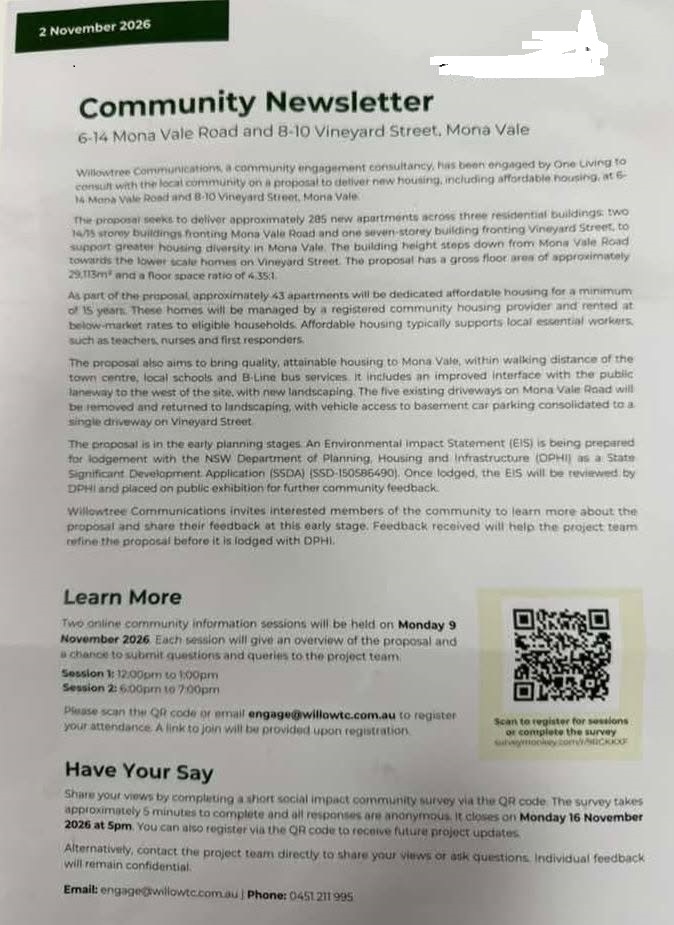
flyer supplied
Not limited to Town Centre limits anymore?
Residents have also observed that the 400-800 metres ratio for defining the connection to that transport (TOD; Transport Orientated Development) has seemingly been thrown out with the bathwater.
The Department has advised it has also issued SEARs for SSD: Residential Flat Building: 45-47 Elimatta Road and 1667-1671 Pittwater Road Mona Vale
- Rezone the site from R2 Low Density Residential to R3 Medium Density Residential; and
- Increase the maximum height of building to approximately 22m (7 storeys).