.JPG?timestamp=1678025647437)
Wakehurst MP Michael Regan. Pic: AJG/PON
Passed in November 2025, this aimed to streamline development, removed some bushfire provision language, and introduced a focus on "proportionate and risk-based" planning.
Prior to this, Section 4.14(1) required a consent authority to be satisfied that certain development on bushfire prone land conforms to Planning for Bushfire Protection, and for a NSW Rural Fire Certificate to be issued to attest to that conformity.
The replacement provision requires only that the guideline be considered during the assessment of a development (by s (1)). By s 1A, the requirement in s 4.14(1) will not apply to development for subdivision of land that could lawfully be used for residential or rural residential purposes, and for development for a special fire protection purpose.
Climate Change and Natural Hazards State Environmental Planning Policy (SEPP)
Cognisant community attitude to these changes was not all positive, in February 2026 the incumbent NSW Government announced it is 'further streamlining planning approvals, while making sure new homes and infrastructure are built to better withstand the extreme weather impacts and natural disasters caused by climate change'.
'A proposed Climate Change and Natural Hazards State Environmental Planning Policy (SEPP) introduces a clear, consistent planning framework for tackling current and future climate risks to help communities withstand future threats like bushfires, floods, coastal erosion, and urban heat.' the government said in a media release
'The Planning System Reform Bill 2025 passed through parliament in November 2025 with almost universal support, enabling the most substantive changes to the Environmental Planning and Assessment Act 1979 in a generation.' the release states
'The legislation historically made climate change resilience, housing delivery and proportionality objects of the act for the first time. However, under the current system, climate change and natural hazard requirements in planning decisions are scattered across multiple legislative and regulatory frameworks.
This fragmentation makes it harder for councils and consent authorities to assess risks clearly and confidently – leading to delays and uncertainty.
'By bringing all decisions surrounding hazards like bushfires, floods, coastal erosion and urban heat together in the one SEPP, councils and consent authorities will have the tools to make risk-informed decisions to safeguard lives, property and the environment so that homes and infrastructure are planned and built out of harm’s way.'
The proposed policy will help councils and other consent authorities assess climate and natural hazard risks upfront and make decisions based on tolerable risk levels agreed by Government and communities.
As part of the exhibition, the NSW Government was seeking feedback on:
- An explanation of intended effect of the Climate Change and Natural Hazard SEPP.
- Draft Climate Change Scenario Guidelines - climate scenarios for hazard planning.
- Draft Urban Heat Policy Statement - principles for building resilience to heat.
Alongside the proposed SEPP, two key resources were released to support disaster recovery and planning:
- The Build Back Better Guiding Principles, which provide 5 guiding principles to help councils, planning authorities and the community recover from natural disasters, and;
- The Tolerable Risk Guideline, which outlines risk factors and provides guidance for incorporating tolerable risk into land use planning.
The proposed SEPP will apply statewide and replace the existing State Environmental Planning Policy (Resilience and Hazards) 2021.
'The changes are part of a major overhaul of the State’s planning framework aimed at making it faster, fairer and modern to speed up the delivery of homes, jobs and infrastructure.' the government's statement said
The Climate Change and Natural Hazards – Explanation of Intended Effect was on exhibition from Tuesday, 17 February to Monday, 16 March in the NSW Planning Portal.
The consult webpage states the proposed Climate Change and Natural Hazards State Environmental Planning Policy (SEPP). is 'Under consideration' as the government reviews feedback, but again the focus seems to be on an 'acceptable risk level'.
Minister for Climate Change Penny Sharpe said:
“The effects of climate change are already apparent from the severity and frequency of floods, fires and heatwaves.
“This policy ensures our homes, businesses and infrastructure are built smarter and safer to withstand the extreme weather impacts we know are coming.”
Minister for Planning and Public Spaces Paul Scully said:
“This policy marks a major step toward smarter, climate-resilient planning for a safer future. We’ve seen the devastation caused by bushfires and flooding across our communities, and the impacts to families and local businesses cannot be ignored.
“We need to build homes and infrastructure in the right locations, so communities are resilient to future risks and natural hazards.
“This policy helps future–proof NSW against the challenges ahead by introducing a clear, consistent framework for climate and hazard planning.”
In 'Explanation of Intended Effect' document include, as stated:
- Coastal protection works that can be undertaken by public authorities are to be expanded, while matters for consideration in the assessment of coastal protection works in high-risk locations and on private land will be clarified. These changes will establish a clear and consistent approach to assessment and will enable removal of the varied coastal risk planning clauses in LEPs.
- It is proposed to move clause 5.21 flood planning of the SI LEP into the CC&NH SEPP, consolidating natural hazards provisions. It is also proposed to update the clause to support consent authorities’ consideration of shelter-in-place, in line with the Department’s Shelter-in-place guideline for flash flooding. It is also proposed to update the clause to support consideration of risk-based decision making relating to development type, the location of the development within the flood planning area and co-incident flood and coastal hazards.
- The CC&NH SEPP will include objectives to complement and support compliance with the relevant Bush Fire Protection Planning guide that could require consent authorities to:
- avoid inappropriate developments in high-risk bush fire locations or circumstances, in particular development of a higher vulnerability such as for a Special Fire Protection Purpose within the meaning of the Rural Fires Act 1997, where the level of bush fire risk is not considered appropriate
- ensure areas identified for population growth and development are planned and designed to improve resilience and minimise the risk of bush fires to life and property
- plan for the impact of changing climate conditions on bush fire behaviour in areas identified for population growth and development
- ensure development includes adequate evacuation capacity and capability for existing and future communities in the event of a bush fire
- consider bush fire risk in a landscape context and identify and consider the cumulative impacts of bush fire risk for existing and future communities
- consider whether development in high-risk bush fire locations or circumstances avoids or mitigates bush fire impacts on property and environment.
- It is proposed to consolidate provisions for bush fire assessment for urban release areas within the CC&NH SEPP ensuring early consideration of bush fire risk is prioritised and later stages are streamlined. Provisions may include an appropriate mechanism for the delivery of essential bush fire evacuation or mitigation infrastructure to be incorporated into the provisions for urban release areas.
And a provision for bolt-cutters to get through your roof when the water gets to the ceiling in your home...
And a provision for a helicopter pads so you can be flown out there when the fire storms come....
And a provision for oxygen when you find yourself living behind a seawall that is like you've been buried alive in a concrete tomb - where did the access to the beach, nay the beach itself, go?
In his second reading speech on Thursday Michael Regan stated:
My fundamental motivation to bring this bill to the House comes back to the following principles: protecting life and property, avoiding human suffering, listening to the experts and making evidence-based decisions in the public interest. I am concerned that we are moving away from those principles in New South Wales, and it turns out I am in good company. I have received letters of support for the bill from the Rural Fire Service Association and the Bushfire Protection Association. Significantly, I have also received a letter of support from eight former commissioners and deputy commissioners of the RFS and Fire and Rescue NSW. I thank those organisations and individuals for their support and commitment to bushfire protection. I particularly acknowledge Greg Mullins, AO, who was Fire and Rescue commissioner from 2003 to 2017.
I am disappointed that neither the Government nor the Opposition support this important bill. It is ironic that members who are wearing orange to support the SES at an event just outside oppose this bill.
Despite that, bringing the bushfire protection bill to the Parliament was the right thing to do for three reasons. Firstly, I believe that having these powers in the legislation is the right policy approach. Secondly, the Government is actively updating the policy framework for consideration of bushfire in planning decisions right now. Through the bill, I have sought to positively influence that work, which is being done by the Department of Planning, Housing and Infrastructure, completely removed from the Parliament. We are the elected representatives. Thirdly, for me, this is a matter of representing my community in Wakehurst and on the northern beaches. I will speak to those three points.
Many of the opposing contributions mentioned that elevating the status of the RFS would create inconsistencies in how multiple factors are considered in the planning system. It is true that the planning system is about balancing considerations that are often competing. But not all considerations are equal and there is a risk that, in trying to meet multiple objectives, you compromise on the one that really matters. Some considerations are not appropriate for compromise and trade-offs. For me, a very high risk of lives burning to the ground fits into that category. A high risk of homes being uninsurable in the future also fits into that category.
I thank the member for Pittwater for spelling out the serious risks for insurance premiums and accessibility of building new homes in areas with high natural hazard risk, a cost concentrated with individual policyholders but ultimately borne by everyone. Look at the newest government department, the Reconstruction Authority. Look at how much it is growing and the costs to taxpayers in this State and nationally. It is appropriate to have the powers for the RFS commissioner in legislation because the stakes are so high. The member for Balmain made that clear in her contribution, recalling the devastation of the 2019-20 bushfires and the need to learn from those tragedies, and highlighting the fact that, if we think the protections are essential, they should be in legislation. Fundamentally, it is the role of government to protect life and property, and we do that by having strong laws.
The Government says the role of RFS advice should be resolved at the policy level rather than in legislation, and that is why the timing of the bill is important. Right now, there is a lot of uncertainty around the policy framework for considering bushfire risk in planning decisions. The relevant State environmental planning policy [SEPP] and ministerial direction will be updated this year. The Minister, to his credit, addressed that in his contribution. The Climate Change and Natural Hazards State Environmental Planning Policy and Local Planning Direction 4.3 Planning for Bushfire Protection are the key instruments outlining how bushfire risk must be assessed and applied in both strategic planning and development assessment. With the policy window open and the Government's determined focus on delivering housing, there is a big risk that protections will be watered down. But there is also an opportunity to make them stronger, and that is what I ultimately want to see.
I have provided the Government with a comprehensive set of suggestions for what I think should be in the ministerial direction and the SEPP, which reflect the intent of the bill. Some of those have been mentioned today and in the contributions last week, and I sincerely welcome the Government's constructive engagement. This is not about development applications, which were mentioned in a few contributions. Crucially, this is about the ability of the RFS to say no to a rezoning proposal for new homes on bushfire-prone land. That must be maintained in the ministerial direction. The ministerial direction exhibited removes that ability, making it weaker. That is not right.
At the same time as those policy changes, following the planning system reforms bill last year, machinery of government changes established the Development Coordination Authority to centralise assessments, including for rezoning proposals. That involves taking staff from the RFS and other agencies and putting them in the Department of Planning, Housing and Infrastructure. In their letter of support for the bill, the ex-fire chiefs said:
Removing expert staff from the RFS to be embedded with the new Development Coordination Authority, under leadership focussed on speeding up housing approvals rather than on objective assessment of bushfire risk. Over time this will dilute expertise, and staff will immediately lose ready access to fire scientists and firefighting experts to advise on complex proposals.
Many members mentioned the Development Coordination Authority [DCA] and the Planning Systems Reform Act from last year as a reason not to support the bill at this time. But that is precisely why I introduced the bill—because there is an imminent risk of the role of RFS advice being diminished through the process. From my perspective, the fact that the mechanics of the DCA are being worked out right now behind closed doors is a reason to introduce the bill and help bring some scrutiny to that process and make clear the community's justified expectation that the RFS will not be steamrolled in the new governance structure. The Government right now is essentially saying, "Trust us." Believe me, I want to. But I struggle because I have a concrete example of when the planning department made its willingness to ignore RFS advice crystal clear. That example is the Patyegarang, or Lizard Rock, planning proposal.
In its submission to the planning panel, the planning department said the proposal complied with fire policies while the RFS said the risk is far too high—a very direct conflict. I understand the planning department's motivations in wanting to find ways for the Metropolitan Local Aboriginal Land Council to generate income from its lands. I really do. However, we cannot right past wrongs by committing new wrongs that deny the facts of escalating fire risk and put lives at risk, including those of volunteer firefighters. It is only because the current ministerial direction contains the authority for the RFS to say no and the Sydney North Planning Panel respected that decision that the Patyegarang Lizard Rock proposal has not progressed further. That ministerial direction is slated to change and remove that authority later this year.
Meanwhile, we have no answer on the Patyegarang Lizard Rock proposal nearly 18 months after the Sydney North Planning Panel made its determination that the proponents had to work to find a proposal that the RFS would agree to. Really? As far as I understand it, the RFS continues to oppose the rezoning on bushfire risk grounds. I fear that the Patyegarang Lizard Rock decision is being put on ice until the rules change, which will allow the planning department to facilitate its approval. That is completely intolerable for me and my community. I remind members of the tabled petition signed by 12,000 to 14,000 residents. That is why I was pleased to hear the Minister state clearly in his contribution that the DCA and the updated policies "will not weaken or remove bushfire protection considerations in planning assessments and decisions".
... My concern is not only for my area but also for the whole State. I am motivated by not wanting to put anyone in harm's way anywhere in New South Wales.
The northern beaches are covered in accurately mapped bushfire‑prone land. That is why, for me, the bill is about fulfilling my responsibility to represent my community and doing everything I can to stop a dangerous subdivision in Lizard Rock but also thinking about the future with the values and best interests of my constituents at heart. Given their opposition to the bill, the Liberals should think long and hard about that.
The reality is that, in 2022, then Coalition Minister for Planning Anthony Roberts was the one who led the charge on the Northern Beaches Aboriginal Land Development Delivery Plan, which identified six sites with the aim of facilitating their development. Lizard Rock is the first cab off the rank. It was only just before the 2023 election that local Liberal candidates flipped the Liberal position on Lizard Rock. As local representatives and candidates, our primary concern needs to be for current and future residents and local RFS volunteers. I quote the support letter for my bill from the NSW Rural Fire Service Association, which makes this point:
In addition to the community safety risks, inappropriate development on bushfire prone land also compromises firefighter safety …
Safety considerations in the planning system tend to focus on residents or other users of proposed developments. They should also take into account the risk to the firefighters who will be called to assist when there is an incident at the site of a proposed development. Their safety requires a greater focus in the planning process, especially when assessing larger developments.
I thank all the RFS volunteers on the northern beaches and across the State for what they do. I briefly address the contribution of the member for Oxley, particularly his suggestion that it was wrong to bring RFS members into the public gallery for a political debate. I think that really is an insult to the intelligence of those RFS volunteers. They are smart people who follow what is going on, think for themselves and are raising the alarm. For example, one of the gentlemen in the gallery last week works in insurance, including on climate risk, in addition to being an RFS volunteer. To suggest that I am somehow using them is pretty low, in my opinion, because those volunteers from my electorate and across the northern beaches fought fires, probably in the electorate of the member for Oxley—they were certainly very north, as well as south, in the Blue Mountains and across the State.
I am not anti-housing—far from it. In my area, there are many infill areas where I actively support significant housing uplift. I just think new homes need to be in sensible locations. Suggesting that concern is just a façade to oppose more homes in my area is a very lazy political critique that I reject. Out-of-control bushfires threatening lives and property may seem incongruous with comfortable suburban life in metropolitan areas but, in many areas—particularly on the northern beaches, where there are significant areas of urban-bushland interface—the threat is very real. We saw that in Gosford in December last year, when 16 homes were lost. And who could forget the 2019-20 bushfires that destroyed close to 2,500 homes and saw 26 people killed?
In September 2024 many in the Wakehurst electorate became all too aware of just how vulnerable to bushfires we are when a scheduled hazard reduction burn at Oxford Falls escaped containment lines and quickly gained pace towards homes in Cromer Heights. The situation quickly escalated and, by 3.00 p.m., residents in Cromer Heights were told that it was too late to leave and that they needed to actively monitor their properties for burning embers and put out spot fires. They were lucky that day: No lives or properties were lost, and the fire was quickly contained.
The reality is that bushfire risk in the area is worsening as a result of climate change, and the effectiveness of traditional mitigation tools, such as hazard reduction burning, asset protection zones and construction standards, are limited because of the increasing intensity of bushfires. As one of the long‑time RFS volunteers explained to me, "Just two weeks ago it was too wet to burn; this week there was a runaway fire. The window for hazard reduction burning is now so small, and getting smaller. On Saturday it was 24 degrees. Can you imagine a day of 44 degrees, Michael, and gale‑force winds?" The reality is that we have to confront the likelihood—perhaps inevitability—of that scenario. Putting more homes in new suburbs that effectively are bushfire traps is just irresponsible.
I absolutely do not doubt the intentions of any of the members who spoke during debate, and the Government and Opposition more broadly, in wanting to protect life and property from bushfire. But the laws and policy frameworks need to reflect that intention in a robust way, particularly with the current housing push. That is what my bill is about, full stop—no more, no less.''
All those who rose to contribute to the debate to state they opposed it, apart from the current MP for Pittwater Jacqui Scruby, another Independent, referenced the aforementioned 'Environmental Planning and Assessment Amendment (Planning System Reforms) Bill 2025.' they had voted for which this would be in conflict with.
Mr. Regan stated he was disappointed the Liberals and Labor members voted against this bill, saying:
''This bill was about protecting lives, homes and firefighters by ensuring the NSW Rural Fire Service retains strong powers to oppose unsafe rezonings for new homes on bushfire-prone land.
''The bill was backed by the NSW RFS Association, the Bushfire Protection Association and eight former Commissioners and Deputy Commissioners from the RFS and Fire and Rescue NSW. They understand the risks we face as our climate becomes more dangerous and fire conditions more extreme.
I brought this bill because I am deeply concerned that current planning reforms and policy changes could weaken the role of bushfire expertise in planning decisions, particularly around proposals like the Patyegarang/Lizard Rock subdivision.
The Lizard Rock subdivision has only been stopped so far because the Department of Planning hasn’t been able to steamroll the expert advice of the RFS. That authority is under threat. My bill was about preserving it. The Liberals voted against it, supported by the government.''
''I am not anti-housing, far from it. I support significant housing growth in appropriate locations with infrastructure and lower natural hazard risk. But putting new homes in areas vulnerable to catastrophic bushfire is just reckless and wrong.
I answer to the people of Wakehurst, not party bosses, and I will continue fighting to make sure bushfire protection is not watered down in the planning system.'' Mr. Regan said
Housing at any cost - Scruby Slams Major Parties For Failing to Support Bushfire Protection Bill
Member for Pittwater Jacqui Scruby has slammed both Labor and the Liberal Party for refusing to support the Environmental Planning and Assessment Amendment (Bushfire Protection) Bill 2025, introduced by Member for Wakehurst Michael Regan, warning both major parties are doubling down on a “housing at all costs” agenda while ignoring escalating bushfire risk, rising insurance costs and the economic consequences of building in high-risk areas.
Ms Scruby said - “This bill has caused the Liberals to join Labor in doubling down on pro-developer planning laws, locking in rising home insurance costs, underinsurance and future economic risk.”
The debate revealed both major parties remain committed to pro-developer planning laws and accelerated housing approvals despite growing natural disaster risks.
This is not just a human and property safety issue but an economic and cost of living issue.”
“Building homes in high-risk areas not only risks property and human life, but means homes risk being uninsurable from day one and if people can’t get insurance, they can’t get a mortgage,” said Ms Scruby.
The bill sought to elevate the Rural Fire Service Commissioner’s role in planning decisions affecting bushfire-prone land, including rezonings and developments such as the proposed Patyegarang (Lizard Rock) development.
“Skyrocketing home insurance is a major contributor to inflation and economists continue to warn of the risks of underinsurance to the economy as climate-driven natural disasters continue to rise.”
Out of numerous speakers, Ms Scruby was the only MP highlighting the cost-of-living and economic issues of building in bushfire areas and floodplains.
“In 2022 National Cabinet committed to implementing land-use changes to avoid building in floodplains and bushfire risk areas. One of the major levers we have for putting downward pressure on home insurance and the cost of disaster recovery is to stop embedding future risk.”
“Yet here we are, four years later, with both major parties pushing ahead with a housing-at-any-cost agenda, even when that cost is so high to the economy, cost of living and human life.”
“The number one thing we can do to reduce risk is to not build in high-risk areas,” she said.
“Northern Beaches LGA has recently had a disaster declaration and by the NSW Government’s own analysis faces the highest average annual losses from extreme weather by 2060 at nearly $1 billion per annum - and we must heed that reality. New buildings in known high bushfire risk areas and floodplains is costly stupidity.”
Ms Scruby also criticised the Liberal Party for backflipping on the Patyegarang (Lizard Rock) development, failing to support the bill despite previously opposing the proposal following community pressure after the 2019-20 bushfires and last general election.
Ms Scruby said there has been strong and justified opposition to the Lizard Rock proposal and warned that planning reforms centralising decision-making increase the risk of developments proceeding in dangerous locations.
“Notably, local Liberal MPs failed to speak on the bill at all, completely missing in action on one of the biggest planning, safety and cost-of-living issues facing our community while their party doubled down on risky developer-led planning laws.”
There has been a complete backflip from the Liberal Party, which committed to opposing the Lizard Rock development in 2023 and introduced amendments to legislation following the unprecedented bushfires,” Ms Scruby said.
'Acceptable Risk'
On what happens when homes in flood and fire zones are approved through 'acceptable risk' many of us can provide insights.
The 1967 Tasmanian Black Tuesday fires which saw 62 people lose their lives, 900 injured, and 7,000 left homeless is my own.
I survived because my mother, pregnant with my second brother, had prepared our home and grounds and had a neighbour who stood and hosed the house down, incessantly. Dad, who'd left work and raced home to save mum, a 19 months-year-old me, my older 3 and a half-year old brother, was prevented from coming back into the street by a blockade installed on the road by those fighting the fires. They didn't want any more loss of life.
South Hobart was ripped apart - only a few houses still stood after the firestorm came through on February 7 1967. Grant came early, February 20, 1967.
I dreamed of it for decades afterwards; the black air in the smoke filled house, the roaring sound outside the walls, and mum's face so white with worry she was luminous, determined. It's one of my earliest memories.
Even now we know just because you can survive a firestorm it doesn't mean you will - and nothing can stop a firestorm, even in high density urban areas.
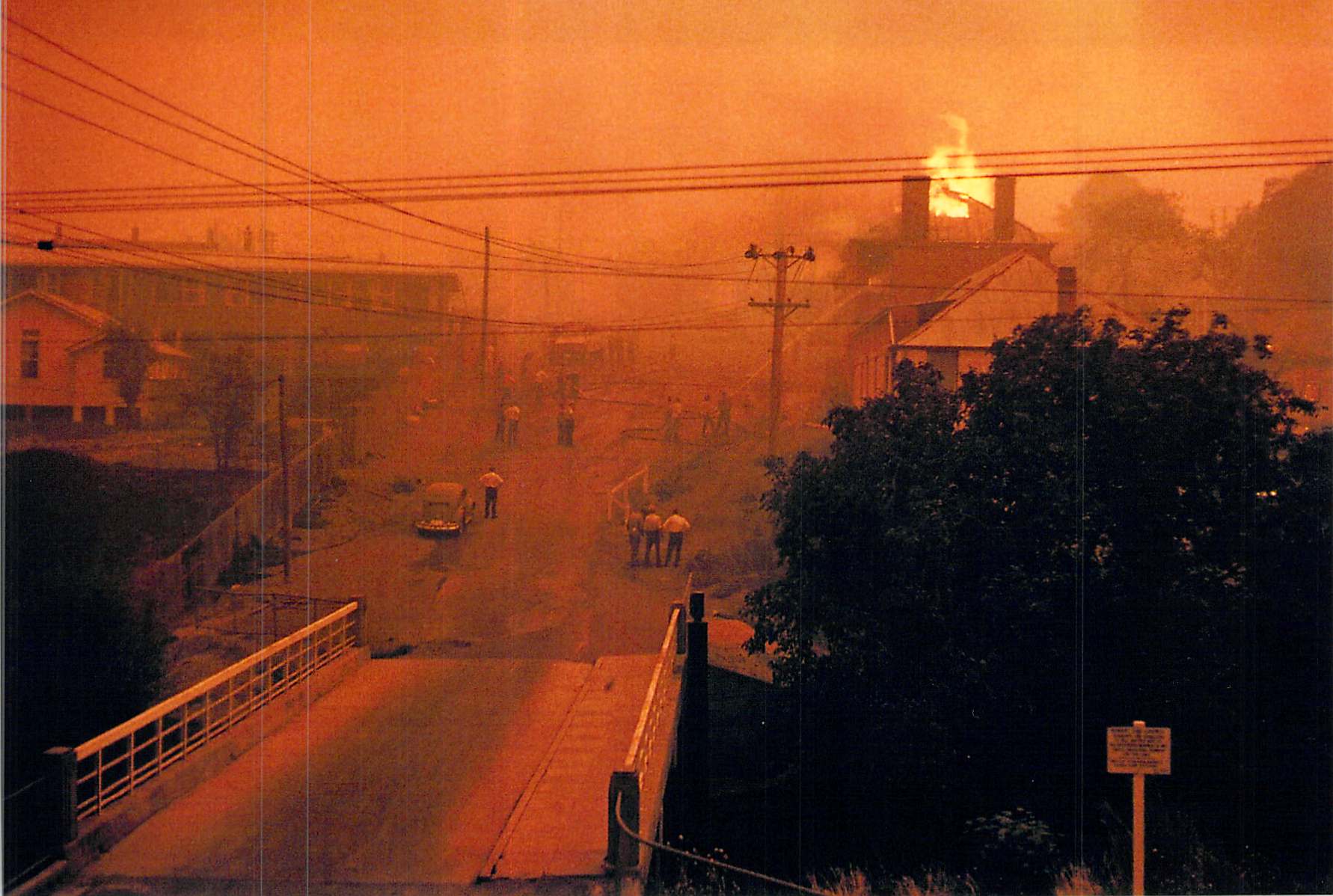
Taken from the intersection of Gore and McKellar streets, South Hobart; shows other husbands blocked from getting to their wives and children - courtesy Tasmanian Museum and a former fellow south Hobartian.
The Black Saturday fires in Victoria, which began on February 7 2009, with the devastating loss of 173 lives, and 414 injured are the most horrendous in Australian history. More than a million wild and domesticated animals were lost and 450,000 hectares of land were burned, 2029 homes burned to the ground.
The 27 December 1993 to 16 January 1994 Sydney and eastern seaboard bushfires will never be forgotten here - many of us either saw homes exploding in fire at Bayview from across the water (at Newport Hotel for instance), were fighting these fires on Pittwater's western shores, or watched from Palm Beach, waiting for a damp sea breeze to roll in and smoor the blaze before the embers landed - and then someone sang in the rain.
Those fires saw 800,000 hectares burnt in over 800 different, fire-related incidents.
.JPG?timestamp=1728146861622)
some of the PON/Family newspaper archives collection on the January 1994 fires in Pittwater and Sydney
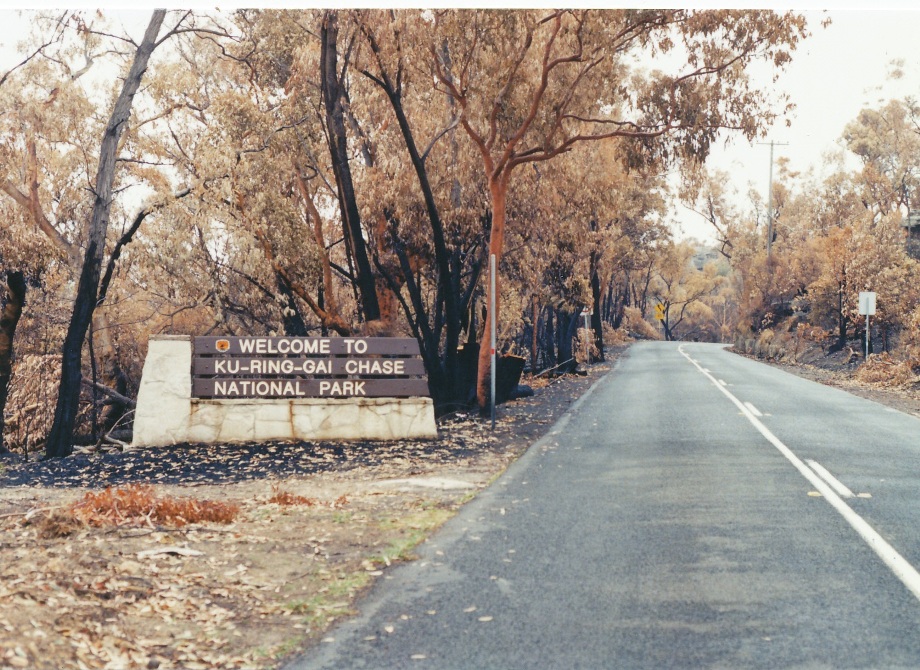
With the loss of 26 loved ones in New South Wales and 34 across the nation, the horrific injuries of those who were caught in firestorms, and which destroyed over 3,000 buildings, including 2,779 homes, in terms of the area of land burnt, an estimated 24.3 million hectares, billions of wildlife deaths, and damage to the environment, some of it permanent, such as the burning of remnant rainforest, the 2019–2020 fires became the longest burning and most devastating in Australian history.
Commencing in July 2019, the 2019-20 fires burnt over 5 million hectares of New South Wales, including 890,000 hectares of native state forest. On the NSW north coast, over 102,000 hectares of protected old growth in state forests was burnt, with around three quarters of this experiencing full or partial canopy burn.
A 2024 study of the 2019-2020 'Black Summer' bushfires revealed that the tourism industry nationwide took an immediate hit of $2.8 billion in total output to its broader supply chains and almost 7300 jobs disappeared nationwide.
So Australians know not to build in flood and bushfire zones by now.
We know people shouldn't put themselves or those who will come to rescue them at risk.
People should also consider - what happens if the firies can't get to you?
Who is going to save you?