
Photo: A J Guesdon
At: 173 Mona Vale Road, Ingleside
The Sydney Bahá’í House of Worship in Ingleside is temporarily closed for its first major refurbishment, known as the 'Dayspring of Light' project, which began in May 2026.
The main temple building is closed for approximately 18 months of restoration, and is scheduled to reopen in 2027. It’s the first time since the temple was completed that major renewals have been undertaken.
The project includes demolishing and rebuilding stairs and landings, upgrading 1950s-era electrical and water/fountain systems to current codes, waterproofing basement walls, and installing new gardens and water features.
Weekly public devotional services, Baha'i Holy Day services, and community events continue uninterrupted on-site inside a temporary marquee set up on the grounds. The surrounding sacred grounds remain open for personal prayer and reflection.
In 1955, 2.83 hectares (6.99 acres) at Ingleside just west of Waratah Farm and near Powderworks road, was purchased by the Baha’i community.
This site was chosen specifically because of its high elevation and visibility. Today the Baha’i Temple can be seen on the horizon of Ingleside from as far away as the Central Coast and sits as a beacon of peace.
The building’s initial concepts came from Charles Mason Remey, but the design and the construction supervision of the Ingleside temple was by the Sydney architect John R Brogan.
The builder for the Baha'i House of Worship was the construction firm Welch Bros, working alongside architect John Brogan.
The temple was constructed between 1957 and 1961.
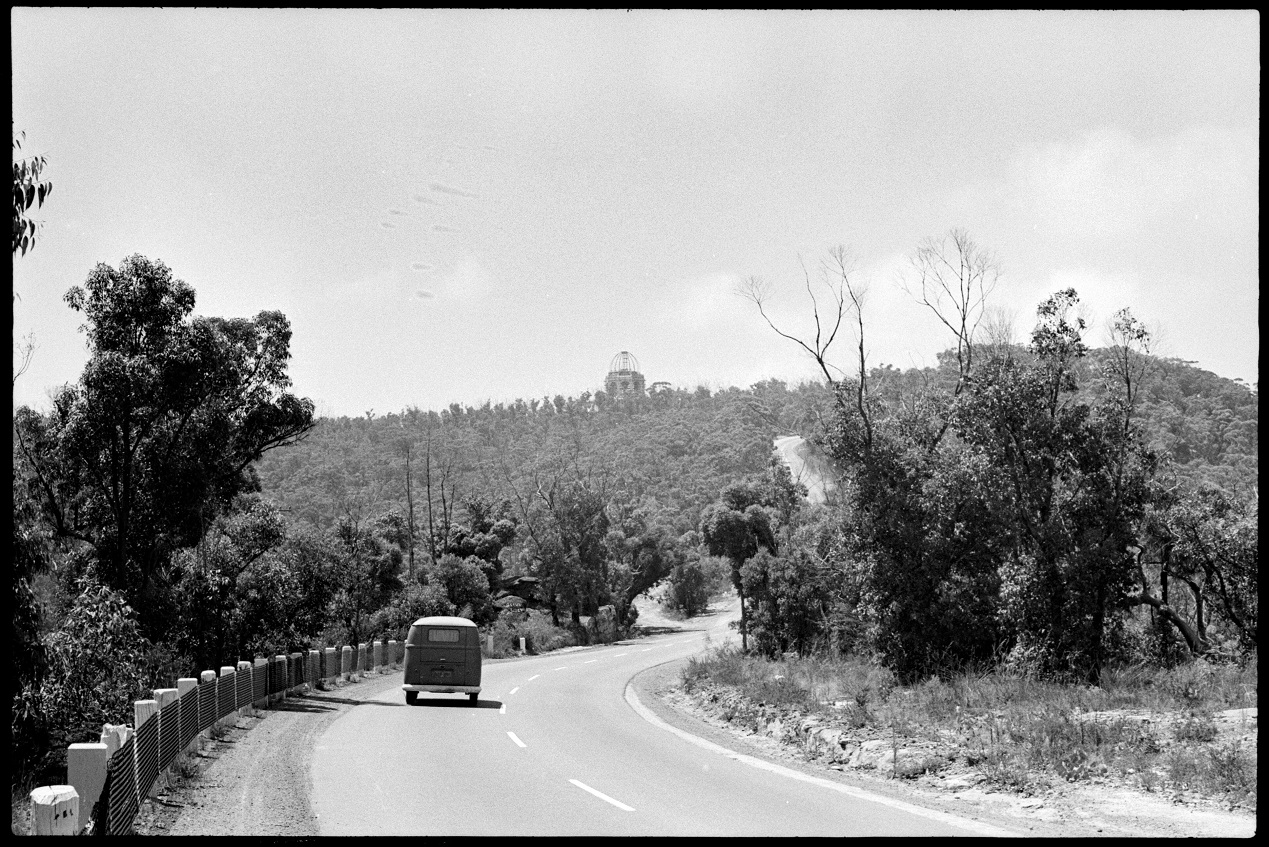
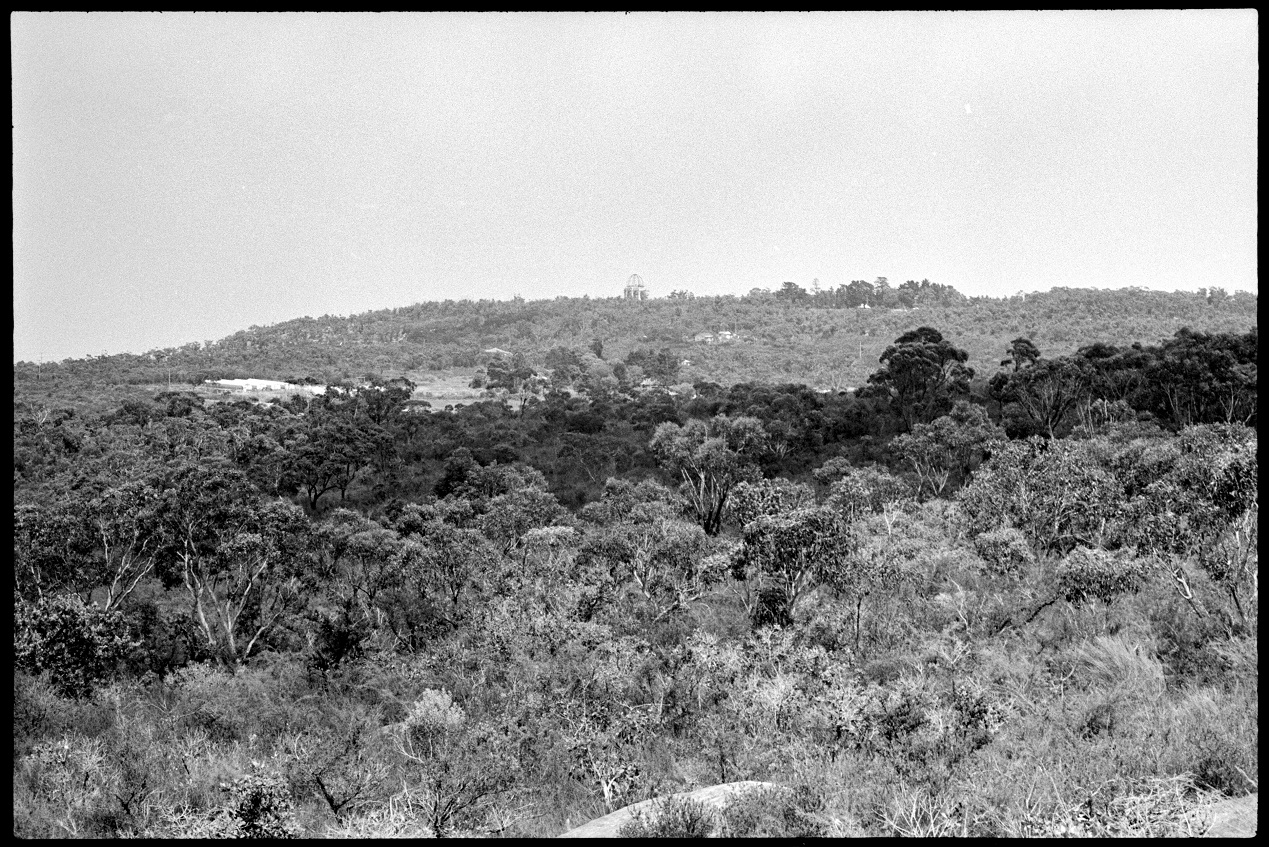
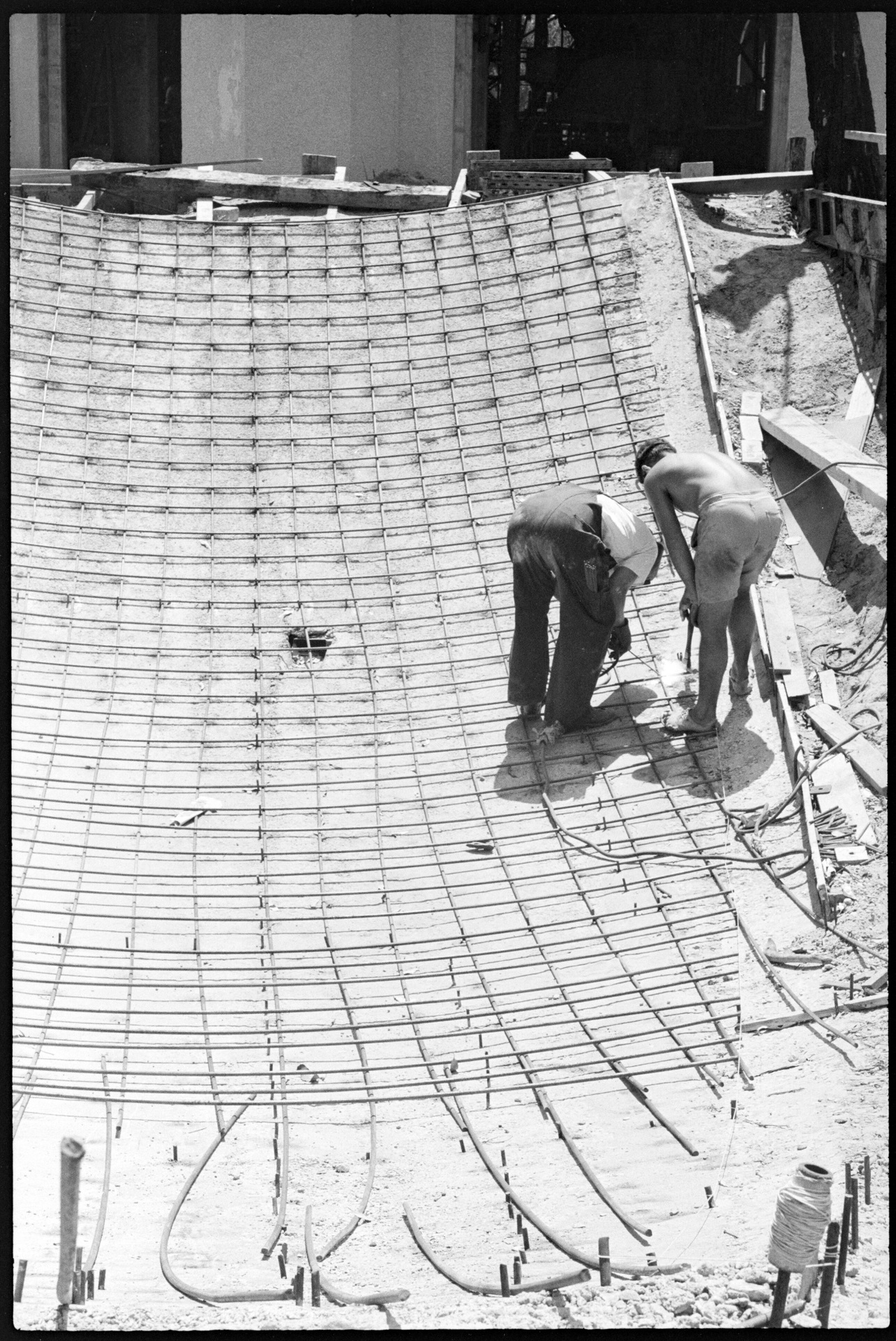
These photos from the Mitchell Library, State Library of New South Wales, taken by Cec Lynch on February 5 1960 for Pix magazine show some of the construction photos as the project was well advanced. The views towards Mona Vale, taken from the side of Mona Vale road, record the bush aspect of then for Ingleside:
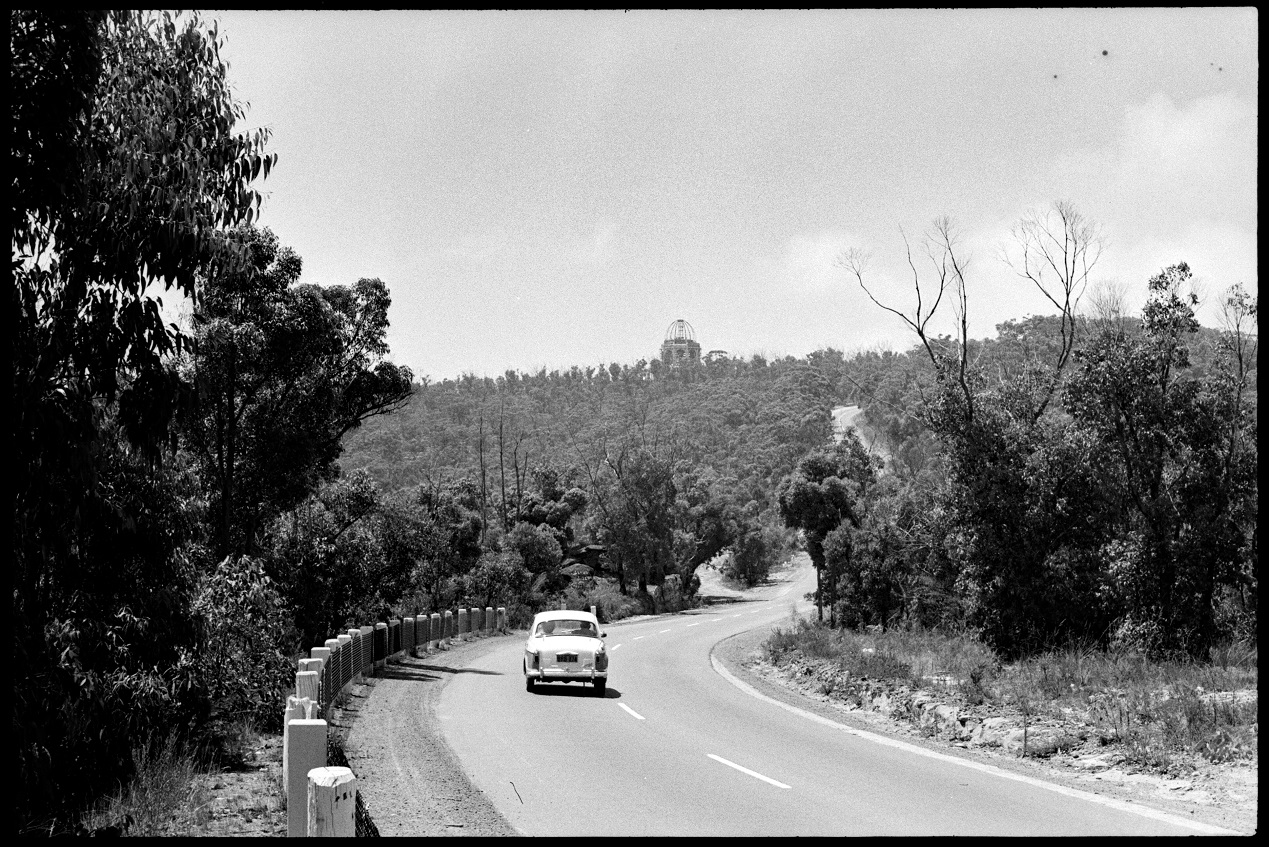
Photos from Album; Baha'i temple, Mona Vale, 5 February 1960 / photographs by Cec Lynch. Items: SLNSW_FL20597826 to SLNSW_FL20597831 and SLNSW_FL20597848 to SLNSW_FL20597854 and SLNSW_FL20597862, SLNSW_FL20597869 - also some below among text descriptions
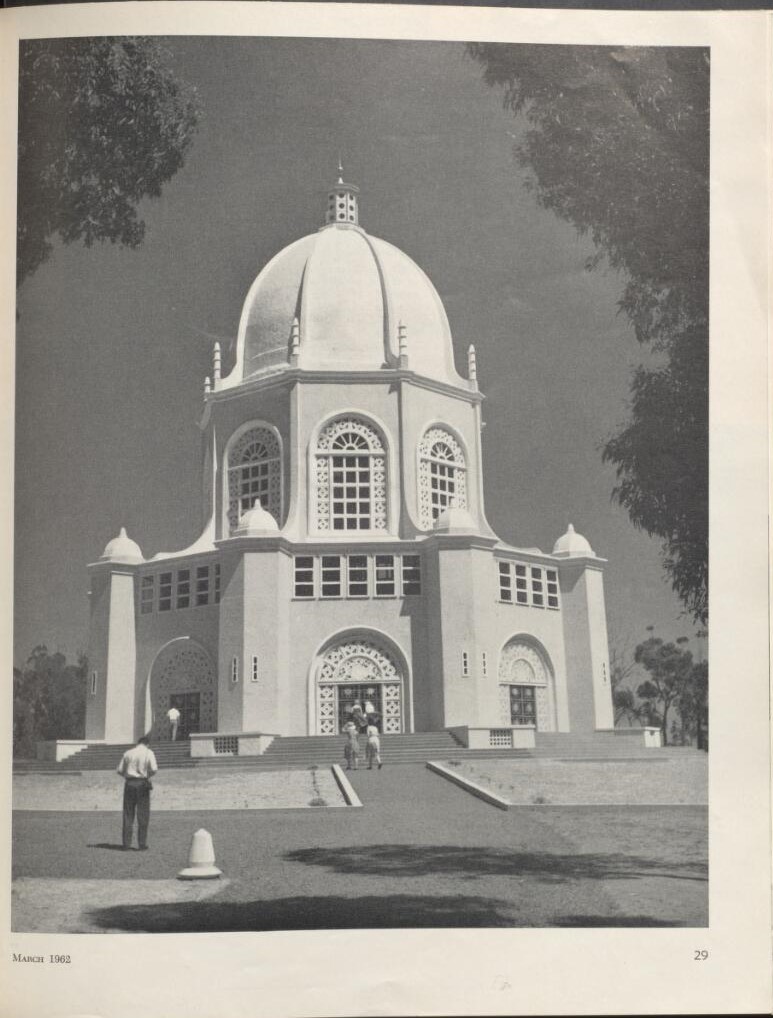
The structure has nine sides and nine entrances symbolising the gathering together of all mankind irrespective of race, religion, nation or class, according to the beliefs of the Baha’i faith. The importance of the number nine relates to it being the largest single digit number which symbolises comprehensiveness, oneness and unity. The nine sides of the temple with its nine entrances also are symbolic of providing access to the nine religions of the world. The scale of the temple is suggestive of a monument to be ‘viewed from afar’ with there being an exaggeration of certain elements; for example, the windows at the base of the dome measure 22 x 13 feet (approximately 6 x 4 metres), almost two-thirds the height of the surmounting dome.
Shoghi Effendi, known as the Guardian of the Baha’i faith, considered that the domes of three buildings—the Baha’i Temple in Haifa, the Shrine of the Bab (also located in Haifa) and St Peter’s in Rome—were beautifully proportion and suitable for his new temples. He personally supervised the design of the Sydney building with all plans sent to him for approval. Domes also represented the ‘Dome of Heaven’, and an invocation to God in Arabic script (translated as ‘O Glory of the All-Glorious’) lies within the apex of the dome in the Ingleside temple.
Brogan worked closely with his engineer, Peter Docker (of Docker and Smith) on finishes, structural concerns and the sequencing and methods of construction. As much of the construction of this building was experimental in nature, many architectural details were drawn up on site and, as such, besides the initial sketch plan, the engineer’s drawings remain the only representation of the Temple ‘as built’.
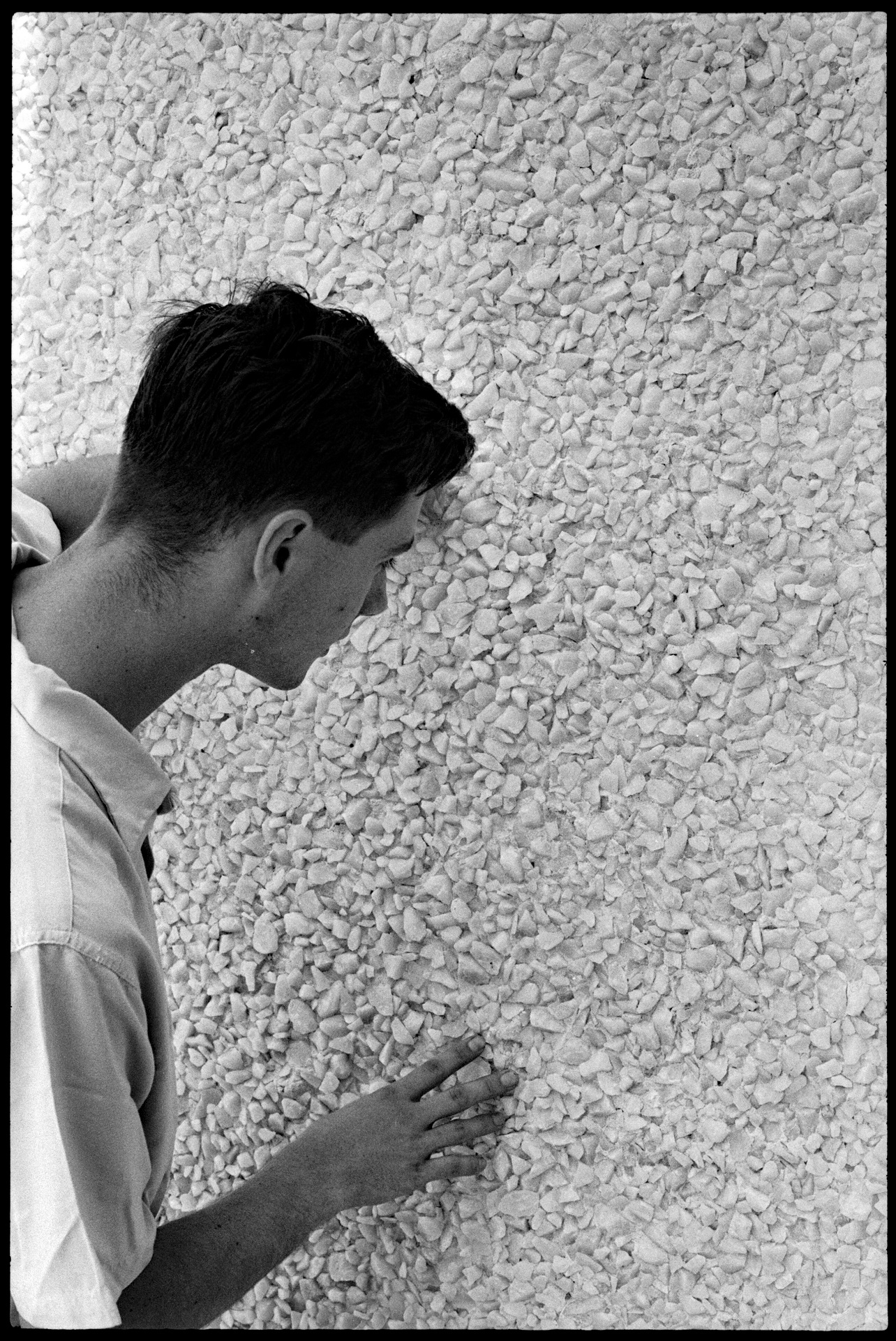
One of the innovative features involved in the construction of the temple was the method used to obtain an exterior surface finish of white quartz (in the form of a panel, pre-cast on site and fully integrated with the structure). This method, known as the ‘concrete aggregate transfer method’, had never been used in Australia before on such an expansive area.
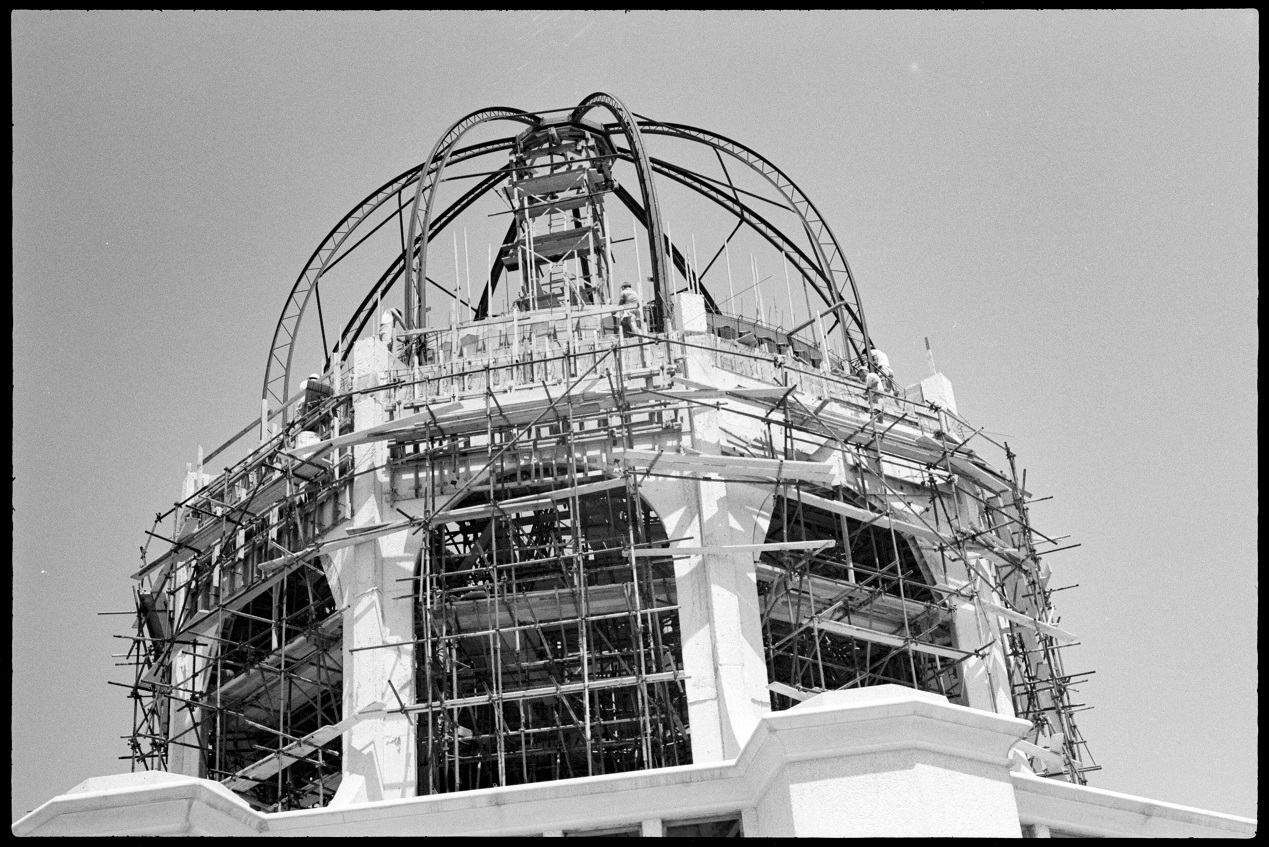
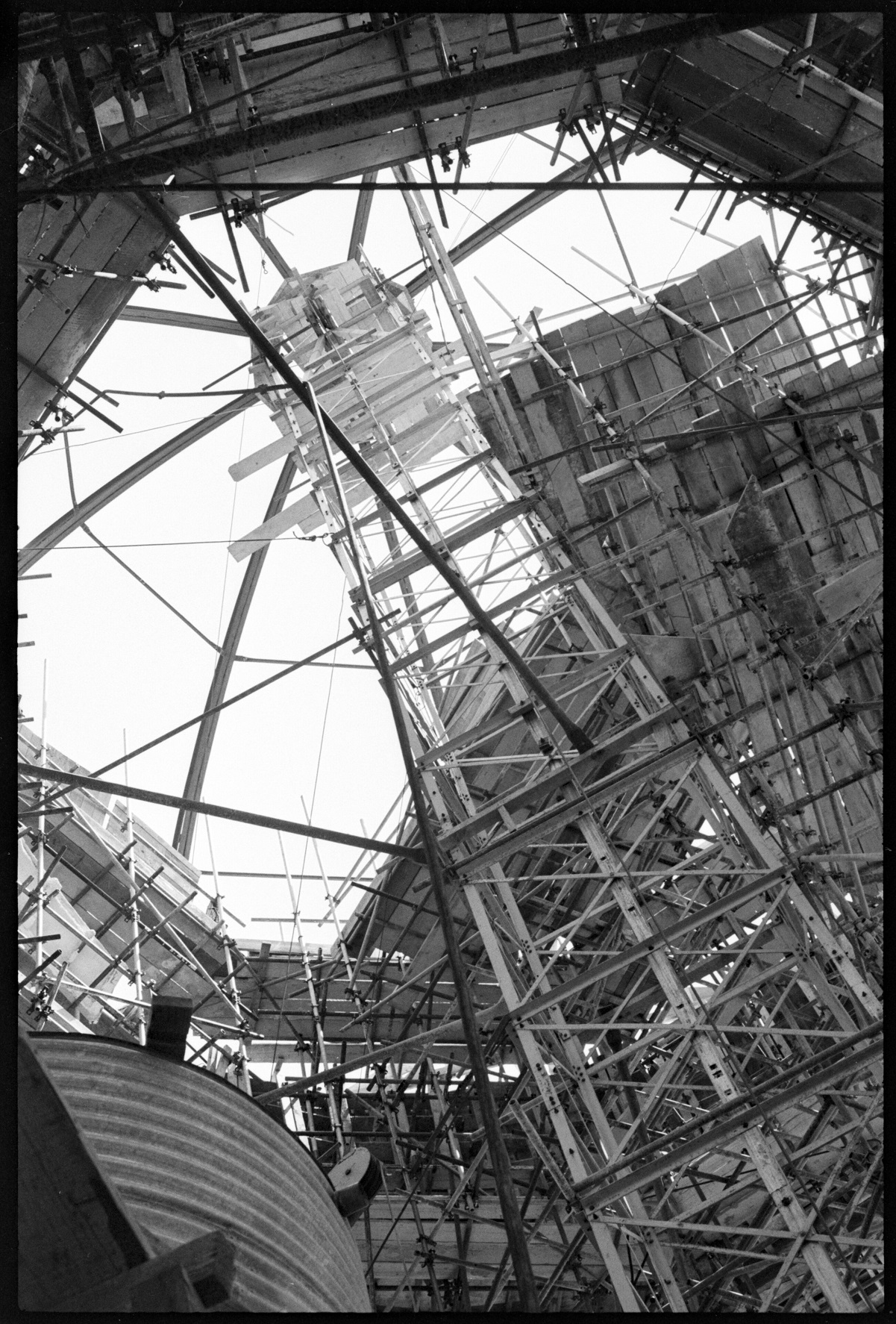
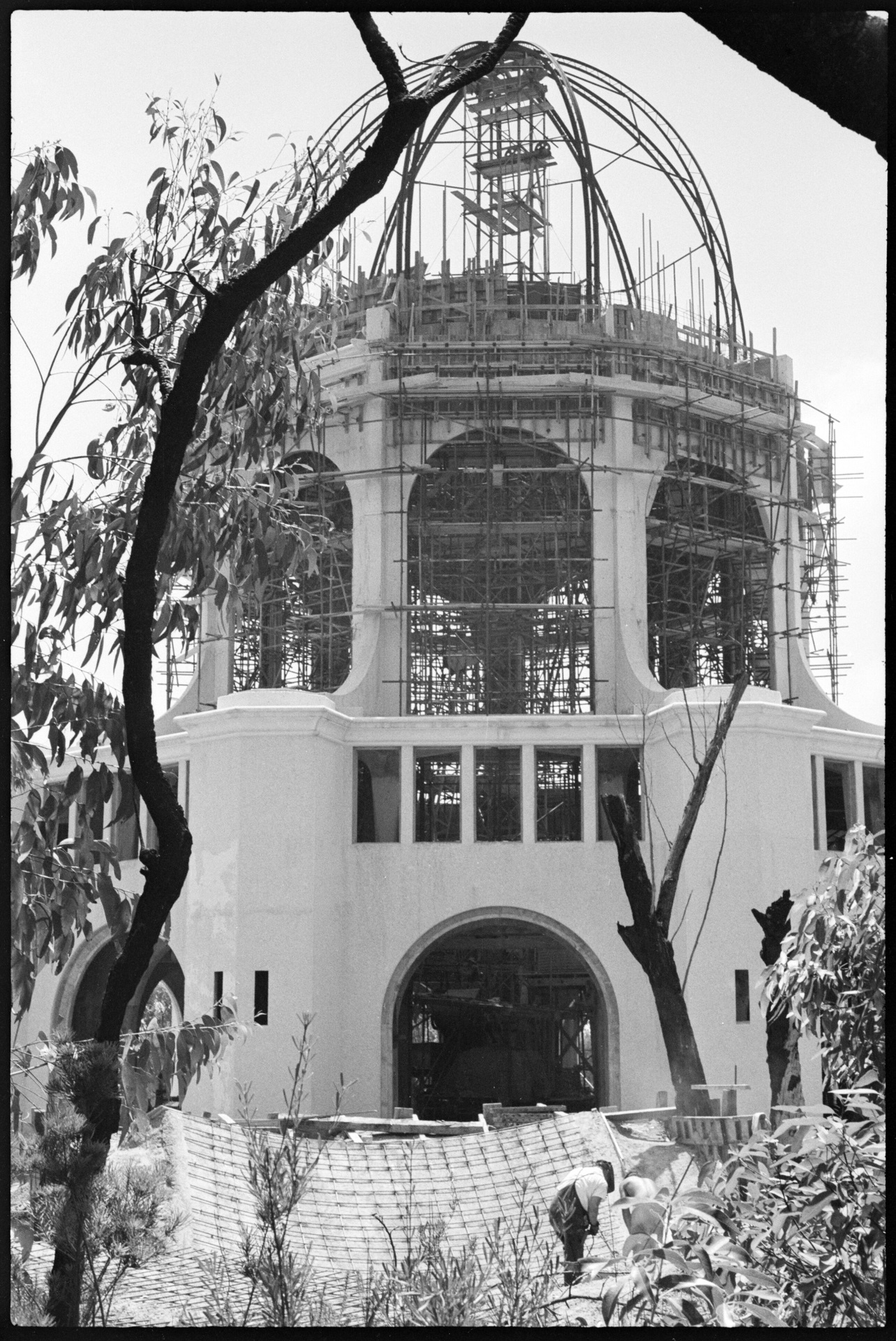
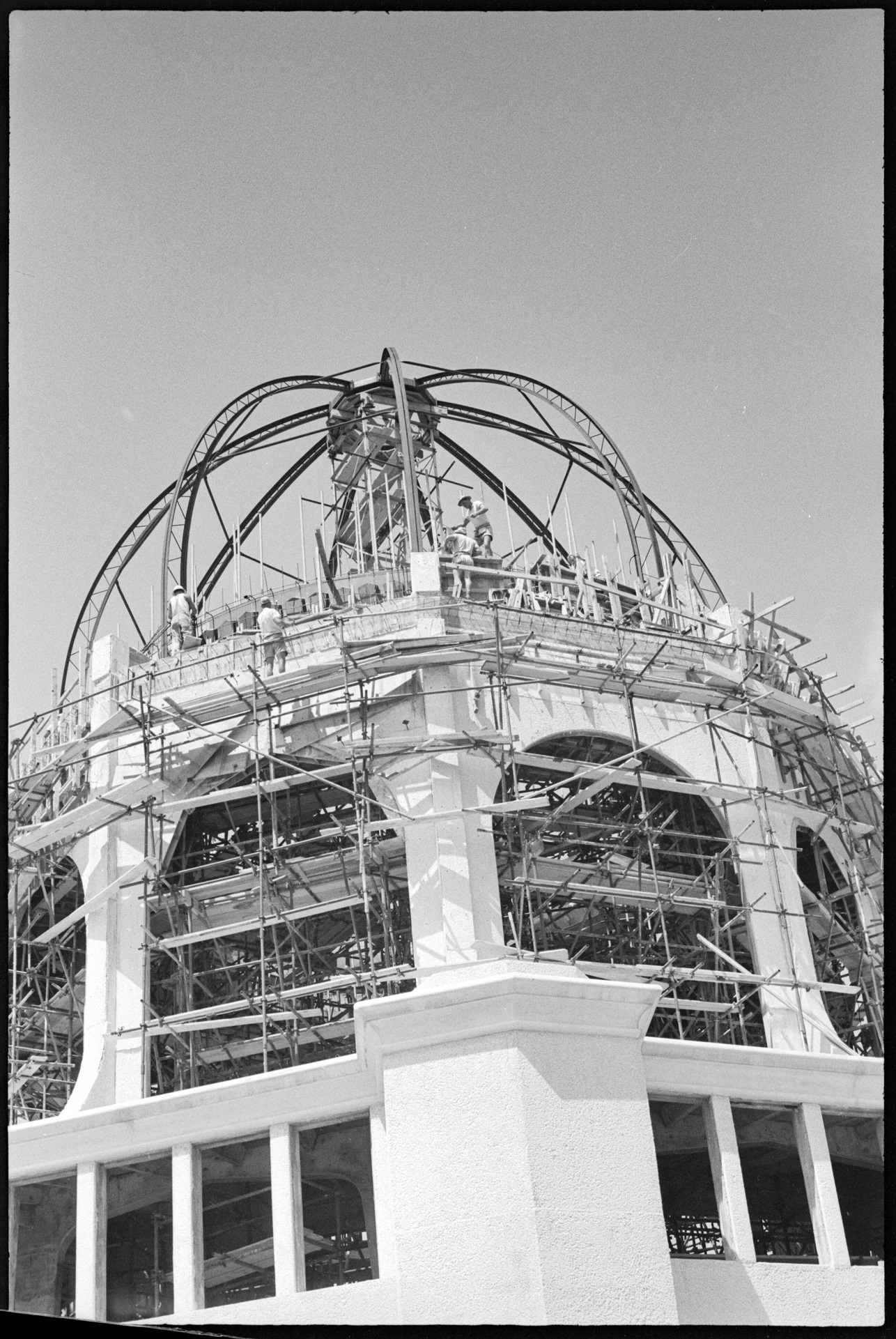

Following the construction of the concrete dome which reached almost 40 metres above the foundations, a lantern made of heavy gauge aluminium needed to be placed at the apex of the dome. This culminated in the historic placement by helicopter of the lantern on 27 April 1960. This was the first structure in Australia to have a building component positioned by an airborne machine.

This great photo is from Kim Harrington. This is a photo of her dad when they lifted the Baha’i Temple lantern structure in place on top of the dome by helicopter back in 1961. It was the first time a helicopter had been used in building construction in Australia and attracted a lot of attention and a great deal of publicity at the time.
The site had no water supply and so part of the design of the structure incorporates as 1.2 square cavity within the circumference of the dome which acts as a water storage tank with a capacity of several thousand litres.
The construction of the temple attracted the attention of the media, the building industry and university students. Local and Sydney papers printed articles on its progress and on August 1 1960, TCN9 showed three minutes of coverage on its local news broadcast.
A report by Beverley Clifford, published March 1962 in Walkabout magazine, which was produced by the Australian National Travel Association in Melbourne to laud and applaud all things Australian, tells us:
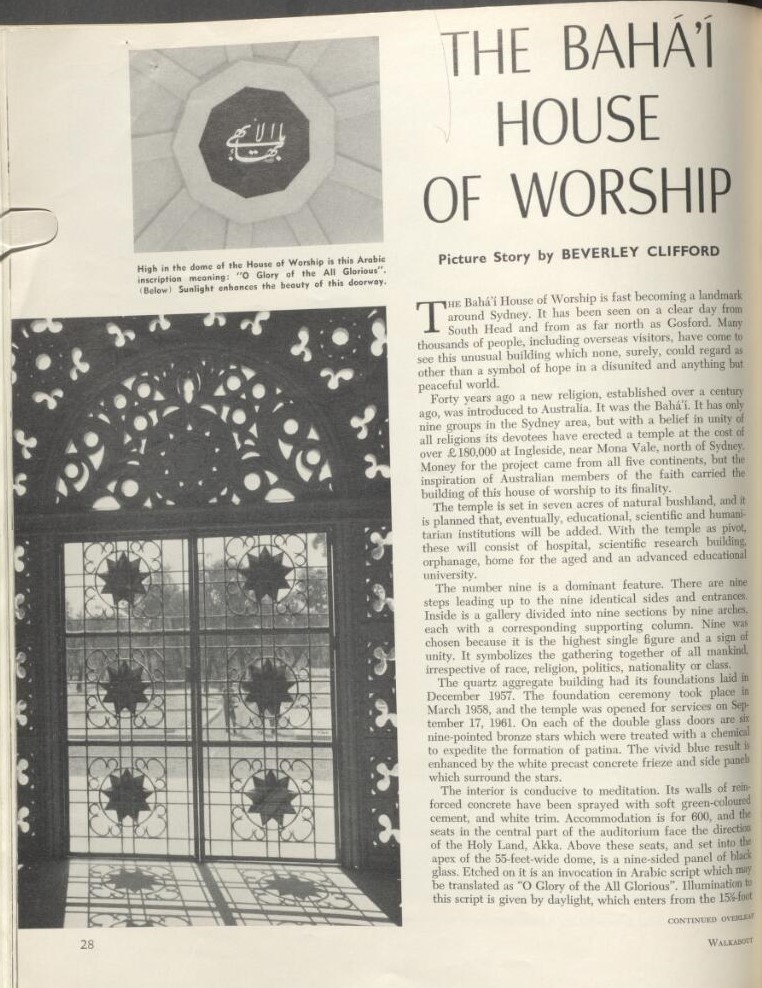
THE BAHA'I HOUSE OF WORSHIP
Picture Story
by BEVERLEY CLIFFORD
The Baha'i House of Worship is fast becoming a landmark around Sydney. It has been seen on a clear day from South Head and from as far north as Gosford. Many thousands of people, including overseas visitors, have come to see this unusual building which none, surely, could regard as other than a symbol of hope in a disunited and anything but peaceful world.
Forty years ago a new religion, established over a century ago was introduced to Australia. It was the Bahai. It has only nine groups in the Sydney area, but with a belief in unity of all religions its devotees have erected a temple at the cost of over £180, 000 at Ingleside, near Mona Vale, north of Sydney. Money for the project came from all five continents, but the inspiration of Australian members of the faith carried the building of this house of worship to its finality.
The temple is set in seven acres of natural bushland, and it is planned that, eventually, educational, scientific and humanitarian institutions will be added. With the temple as pivot, these will consist of hospital, scientific research building, orphanage, home for the aged and an advanced educational university.
The number nine is a dominant feature. There are nine steps leading up to the nine identical sides and entrances. Inside is a gallery divided into nine sections by nine arches, each with a corresponding supporting column. Nine was chosen because it is the highest single figure and a sign of unity. It symbolizes the gathering together of all mankind, irrespective of race, religion, politics, nationality or class.
The quartz aggregate building had its foundations laid in December 1957. The foundation ceremony took place in March 1958, and the temple was opened for services on September 17, 1961. On each of the double glass doors are six nine-pointed bronze stars which were treated with a chemical to expedite the formation of patina. The vivid blue result is enhanced by the white precast concrete frieze and side panels which surround the stars.
The interior is conducive to meditation. Its walls of reinforced concrete have been sprayed with soft green-coloured cement, and white trim. Accommodation is for 600, and the seats in the central part of the auditorium face the direction of the Holy Land, Akka. Above these seats, and set into the apex of the 55-feet-wide dome, is a nine-sided panel of black glass. Etched on it is an invocation in Arabic script which may be translated as “O Glory of the All Glorious”. Illumination to this script is given by daylight, which enters from the 15 ½ -foot spire. The height of the building from the floor to the top of the spire is 120 feet. A plaque in the centre of the 73-foot wide auditorium is nine-pointed and covers two silver casks embedded in the concrete. From the plaque starts the division the terrazzo floor into nine sections.
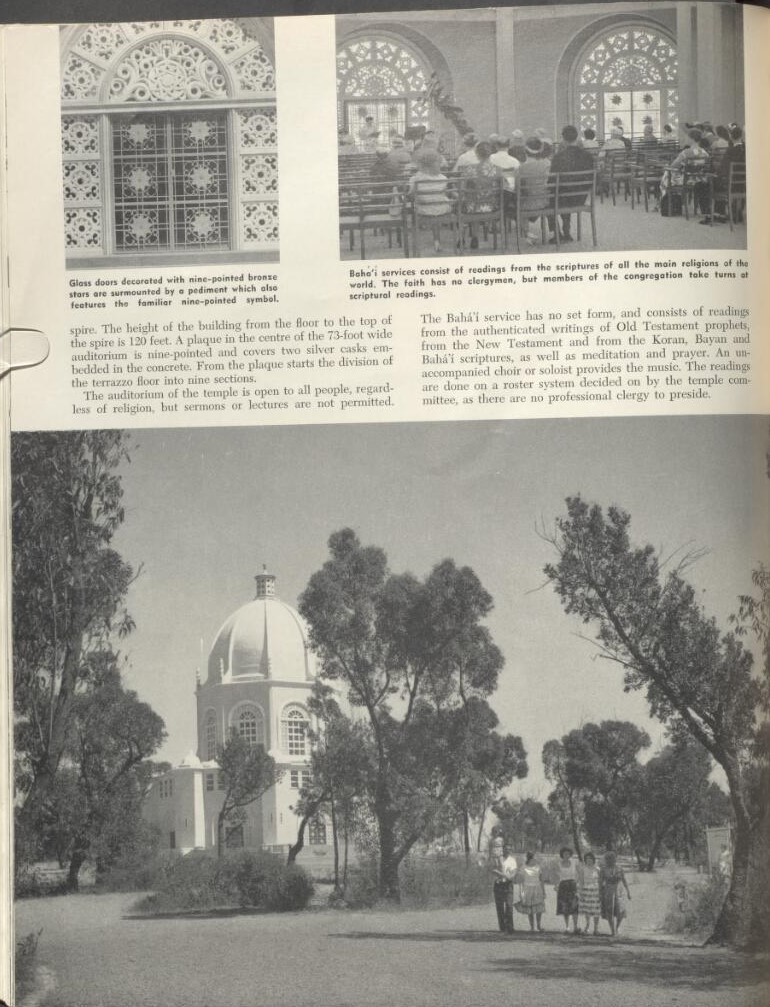
The auditorium of the temple is open to all people, regardless of religion, but sermons or lectures are not permitted.
The Bahai service has no set form, and consists of readings from the authenticated writings of Old Testament prophets from the New Testament and from the Koran, Bayan and Bahai scriptures, as well as meditation and prayer. An unaccompanied choir or soloist provides the music. The readings are done on a roster system decided on by the temple committee, as there are no professional clergy to preside.
High in the dome of the House of Worship is this Arabic inscription meaning: "O Glory of the All Golorious". (Below) sunlight enhances the beauty of this doorway.
Glass doors decorated with nine-pointed bronze stars are surmounted by a pediment which also features the familiar nine-pointed symbol. Baha'i services consist of readings from the scriptures of all the main religions of the world. The faith has no clergymen, but members of the congregation take turns of scriptural readings.
Australian Geographical Society & Australian National Publicity Association & Australian National Travel Association. (Vol. 28 No. 3 (1 March 1962). THE BAHA'I HOUSE OF WORSHIP by Beverly Clifford, Walkabout Retrieved from http://nla.gov.au/nla.obj-755706761
A few others were spreading the news across Australia so all could 'read all about it':
The Baha'i House of Worship at Ingleside on Mona Vale Road is a unique architectural development. Nine-sided with nine entrances, it symbolises the gathering together of all mankind, irrespective of race, religion, nation, or class. Formerly separated by prejudice, here the Jew, Buddhist, Christian, Muslim, and others are harmoniously united, for the concept of religion which Baha'u'llah has taught affirms the Oneness of God and the Oneness of His Prophets. The Baha'i Faith has no professional clergy; the worshipper entering the Temple hears no sermon and takes part in no ritual. Within this House of Worship, only the Holy Words of the Sacred Scriptures are read. THE BAHA’I HOUSE OF WORSHIP (1961, May 1). The Seasider (Christies Beach, SA : 1956 - 1963), p. 2. Retrieved from http://nla.gov.au/nla.news-article276854395
HOUSE OF WORSHIP
The Baha'i House of Worship at Ingleside, on Mona Vale Road, is a unique architectural development. Nine-sided with nine entrances, it symbolises the gathering together of all mankind, irrespective of race, religion, nation or class. Formerly separated by prejudice, here the Jew, Buddhist, Christian, Muslim and others are harmoniously united, for the concept of religion which Baha'u'llah has taught affirms the Oneness of God and the Oneness of His Prophets. The Baha'i Faith has no professional clergy; the worshipper entering the Temple hears no sermon and takes part in no ritual. Within this House of Worship, only the Holy Words of the Sacred Scriptures are read. HOUSE OF WORSHIP (1962, November 14). The Standard (Port Adelaide, SA : 1959 - 1969), p. 14. Retrieved from http://nla.gov.au/nla.news-article274965688
From the outset the Baha'i Temple has been embraced by locals and visitors to Pittwater. This 'Lantern of Peace', another name by which it has become known, and its community of faithful 'all are welcome, all belong' peoples, attracted those who came to stroll through the gardens and those who would venture inside.
The Baha'i House of Worship has also been a sustained beacon for the community in other ways. This report records:
Also in Sydney more than 200 peace banners which were to be part of a six kilometre peace ribbon stretching from the Baha'i Temple at Ingleside to Mona Vale beach, were stolen and burned over the weekend. The peace ribbon was to have been part of a nine day peace exposition, beginning on Saturday.
While it is not known who is responsible for such vandalism, political motives cannot be ruled out. There has been a concerted effort by reactionary forces to pull the ground from under the peace movement in other areas. Peace studies is one area that has particularly been under attack.
But the peace movement will not be distracted from its primary objective — to stop the nuclear arms explosion which could bring about the ultimate act of vandalism. Photo: There were strong calls for removal of US bases from Australia in Sydney's Palm Sunday rally. PEACE (1986, March 26). Tribune (Sydney, NSW : 1939 - 1991), p. 2. Retrieved from http://nla.gov.au/nla.news-article259552144
Pittwater residents may remember Mary Jones, a committee member of Northern Beaches Prostate Cancer Support Group, as the lady whose work saw the Baha'i Temple lit Blue for Prostrate Cancer Awareness Month in 2011. Mary would also send in details of Trivia Nights or those Family Fun Days and Big Aussie BBQ's at Rat Park with wonderful vehicles on display from members of the Pittwater Motor Enthusiast Association.

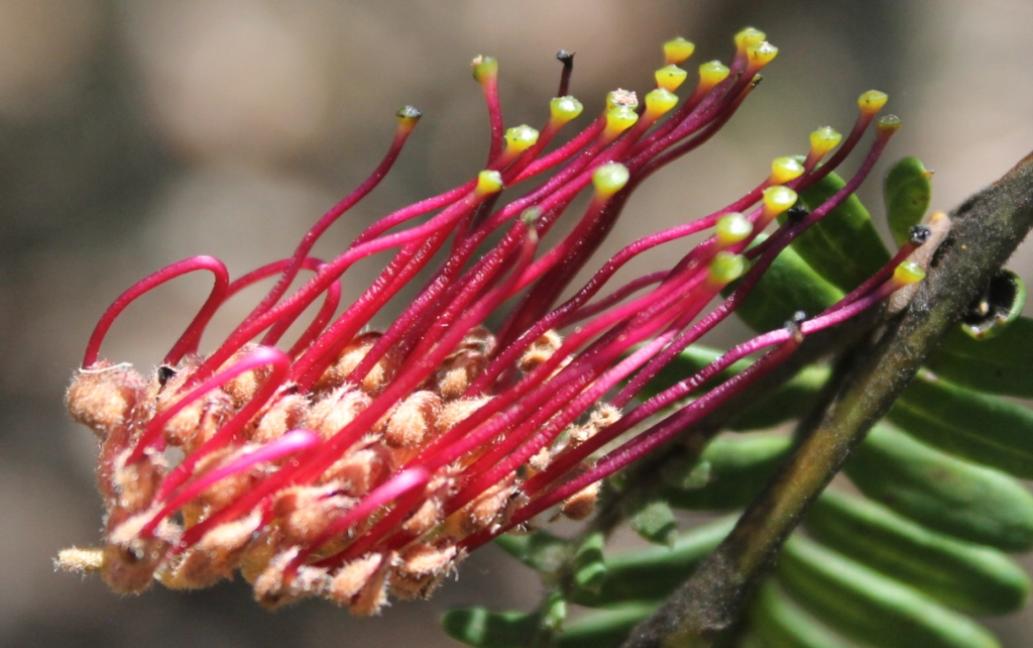
Saving Grevillea Caleyi
The beautiful gardens of the Bahá’í Temple feature another special gem - a critically endangered plant the community has worked for years to save - Grevillea Caleyi.
David Palmer of the Pittwater Natural Heritage Association, which have been involved in Saving Grevillea Calyei' long term, provided some background on this project for the Saving Grevillea Caleyi Bushcare Group profile a few years ago:
- establishes the extent of the current distribution of the species;
- favours in-situ protection and management of threats at G. caleyi sites; raises awareness of the species and provides the community with information that assists with its conservation; and
- provides a greater understanding of aspects of the biology and ecology of the species that will assist future management
- Loss and fragmentation of habitat through clearing and development.
- Inappropriate fire regimes.
- Habitat degradation by invasion of weeds and pathogens.
- People using remnant bushland for recreation (e.g. bike trails) and disturbing critical habitat, individuals and substrate.
- Small population sizes in highly fragmented remnants.
- Rubbish dumping.

That same year, 2019, the efforts of the group were supported by Greater Sydney Local Land Services through funding of up to $250,000 from the Australian Government’s National Landcare Program, will be run in partnership with the NSW Office of Environment and Heritage and local bushcare volunteers.
Project manager Rebecca Mooy said the funding would complement six years of restoration efforts to date at the Baha’i Temple site and at other locations in Terrey Hills where the species occurs.
“This project has focused on protecting vegetation on the grounds of the Baha'i Temple which is home to the endangered native plant which is only found in Northern Sydney,” she said.
“Ongoing work will focus on protecting the endangered plant’s habitat through weed removal by both professional contractors and volunteers, planting in buffer zones adjacent to core habitat, lessening disturbance through removal of dumped rubbish and installation of fencing, assessment of the habitat condition and vegetation monitoring.

A Centenary of Baha'i Peace gifted to Australia
The following year, 2020, then MP for Mackellar, Jason Falinski, celebrated led local and federal celebrations of a centenary of the Baha'i faith in Australia.
Despite the Covid restrictions then in place, on 10 November 10 2020, Jason Falinski MP, together with the Australian Baha'i Community co-hosted a reception at Parliament House in Canberra to mark the Birth of Baha'u'llah and the Centenary of the Baha'i Community in Australia. The occasion was attended in-person and online by Federal Members of Parliament and guests from across the country. The proceedings included remarks from representatives from both sides of Parliament; a brief account of the developments of the Baha'i Community over the past century by a representative of the National Spiritual Assembly; a live musical performance of "Rain over the Ashes"--a piece written as a tribute to the professional and volunteer firefighters who battled the 2019-20 summer bushfires; a chance to mingle and connect, including in online breakout rooms; and closed with a recording of "Song of Celebration", which was composed by the Ballarat Bahá’í Community and performed by a virtual choir.
The Baha'i community provided the following insights for their centenary celebrations:
The history of the Baha’i Faith in Australia began in 1920 with the arrival in Sydney of John Henry Hyde Dunn and Clara Dunn. Mr Dunn (1855-1941) was an Englishman and Mrs Dunn (1869-1960) was raised in Canada by Irish parents. Both had become Baha’is in the United States in the early twentieth century.
Mr and Mrs Dunn arrived in an Australia still reeling from the Great War, Australia’s costliest conflict in terms of deaths and casualties. The Baha’i message of universal peace and the oneness of humanity found a ready audience among those searching for alternatives that could prevent such a catastrophic conflict from occurring again.
The first Australians to become Baha’is were Oswald Whitaker, a Sydney optometrist, and Euphemia (Effie) Baker, a pioneering Australian woman photographer. Women were to play a leading role in the establishment and leadership of the Australian Baha’i community.
Gradually small Baha’i groups formed in Sydney, Melbourne, Adelaide and Perth. In 1934, Australian Baha’is combined with their counterparts in New Zealand to elect their first national governing body, the National Spiritual Assembly of the Baha’is of Australia and New Zealand (photograph above). Separate National Assemblies for Australia and New Zealand were formed in 1957.
Among the outstanding early Australian Baha’is was Harold Collis Featherstone (1913-1990), an Adelaide engineer who served as a member of the National Spiritual Assembly from 1949 to 1962. In recognition of his qualities he was appointed a “Hand of the Cause of God,” an honour given to only a few Baha’is worldwide whose responsibility it was to protect and propagate the Faith.
Post-war period
The Baha’i community gradually grew larger and more diverse as Australia expanded its post-war immigration program. Aboriginal people joined the community, among the first being Uncle Fred Murray in South Australia.
Extensive media coverage of the opening of the Baha’i Temple on a bush-clad property overlooking Ingleside in Pittwater in 1961 brought the Baha’i Faith to the attention of the public. The national headquarters of the Baha’i community is located in its grounds.
In a society where sectarian divisions remained deep, the inauguration of a place of worship where services drew on the scriptures of all the world’s religions was a radical departure. This attracted interest among people looking for religion to play a unifying role in society.
In the 1960s and 1970s the community absorbed new Baha’is inspired by the counter-culture to embrace a new religion with a focus on peace and the oneness of humanity.
The size and diverse composition of the community was further boosted in the 1980s when Australia opened its doors to Baha’is fleeing the resurgence of persecution of their faith in Iran. Their subsequent settlement, integration and contribution to Australian life has been a major success story.
In the 1990s, Baha’i centres were opened in Canberra, Sydney, Brisbane, Perth, Adelaide, Hobart and in some regional centres. Baha’i classes in State schools became popular with parents and children of families of a variety of backgrounds as well as with Baha’is.
Today increased resources have enabled the Baha’i community to enter into cooperation with organisations, groups and individuals working in neighbourhoods and at the national level towards aims that Baha’is share, such as equality, peace, human rights for all, and greater inter-faith understanding.
As someone who has visited this building, the sense of peace and calm within, along with the colourful illustrations in the books held within the temple, are equal to and surpass the peace and calm within other churches.
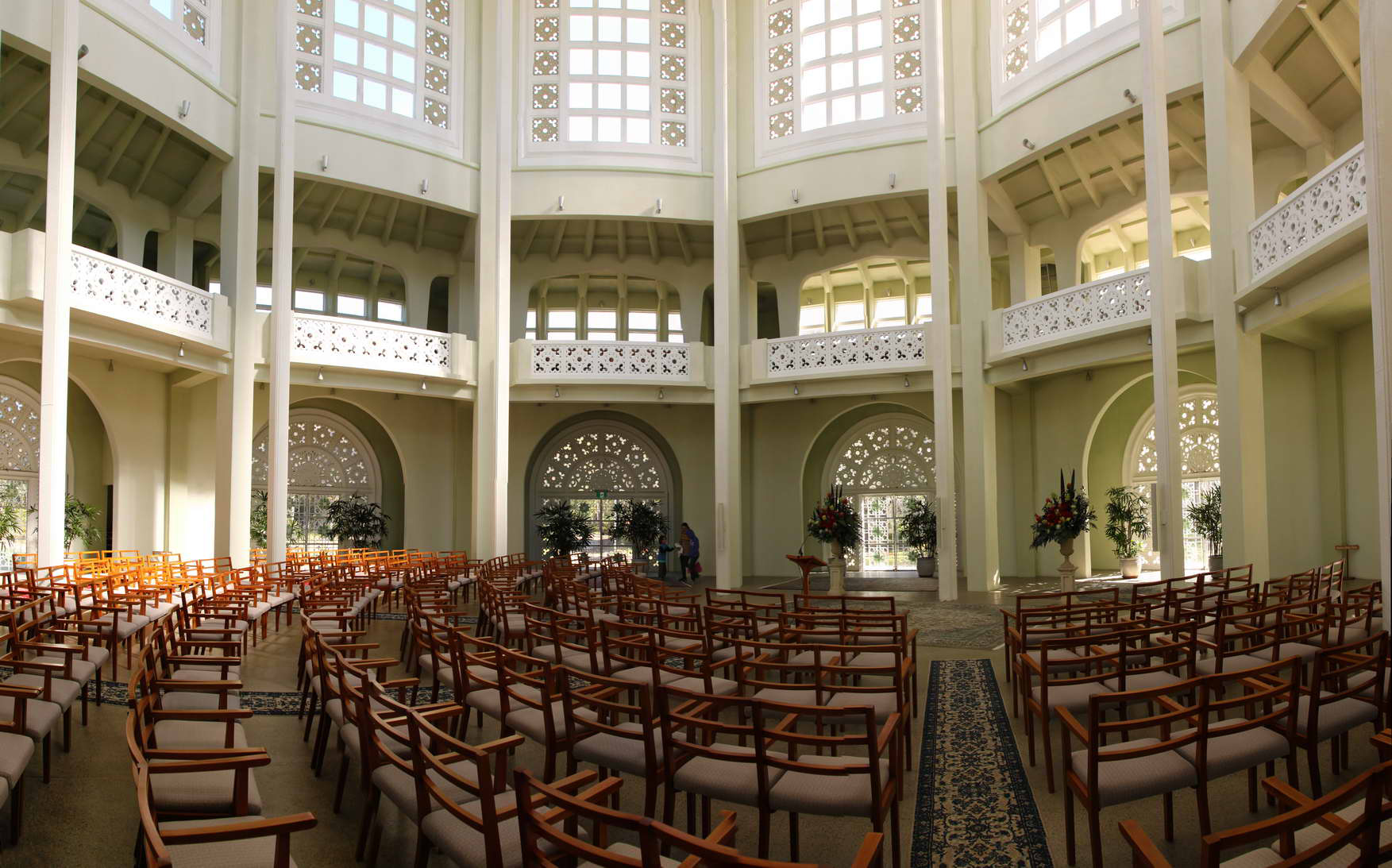
Inside the Baha'i Temple at Ingleside in 2013. Photo: Rufus Ferret
Locals and visitors look forward to the completion of these needed works, currently being undertaken during the 65th year this building has graced our horizons with a message of peace.
As part of sharing this news the Australian Baha’i Community released two videos, one in February 2025 and another in June 2025, about the Dayspring of Light project to renovate the Baha’i House of Worship in Ingleside. We hear remarks from the National Baha’i treasurer, Anton Jones, about the legacies of sacrifice of the early Baha’is towards building the House of Worship in 1961, and the opportunity all Baha’is have today to add to this enduring contribution to Australian society.
Designated as the “Mother Temple of the Antipodes” by Shoghi Effendi, this edifice “stands as a universal place of worship open to all the inhabitants of a locality irrespective of their religious affiliation, background, ethnicity, or gender and a haven for the deepest contemplation on spiritual reality and foundational questions of life, including individual and collective responsibility for the betterment of society.”
Those insightful films, including more history insights, run below.