Week One November 2026: Issue 660 (published Sunday November 1)
Blue-faced Honeyeaters Return: Spring in Pittwater
Photos taken: Wednesday October 28 - 31, 2026: Careel Bay, PON backyard
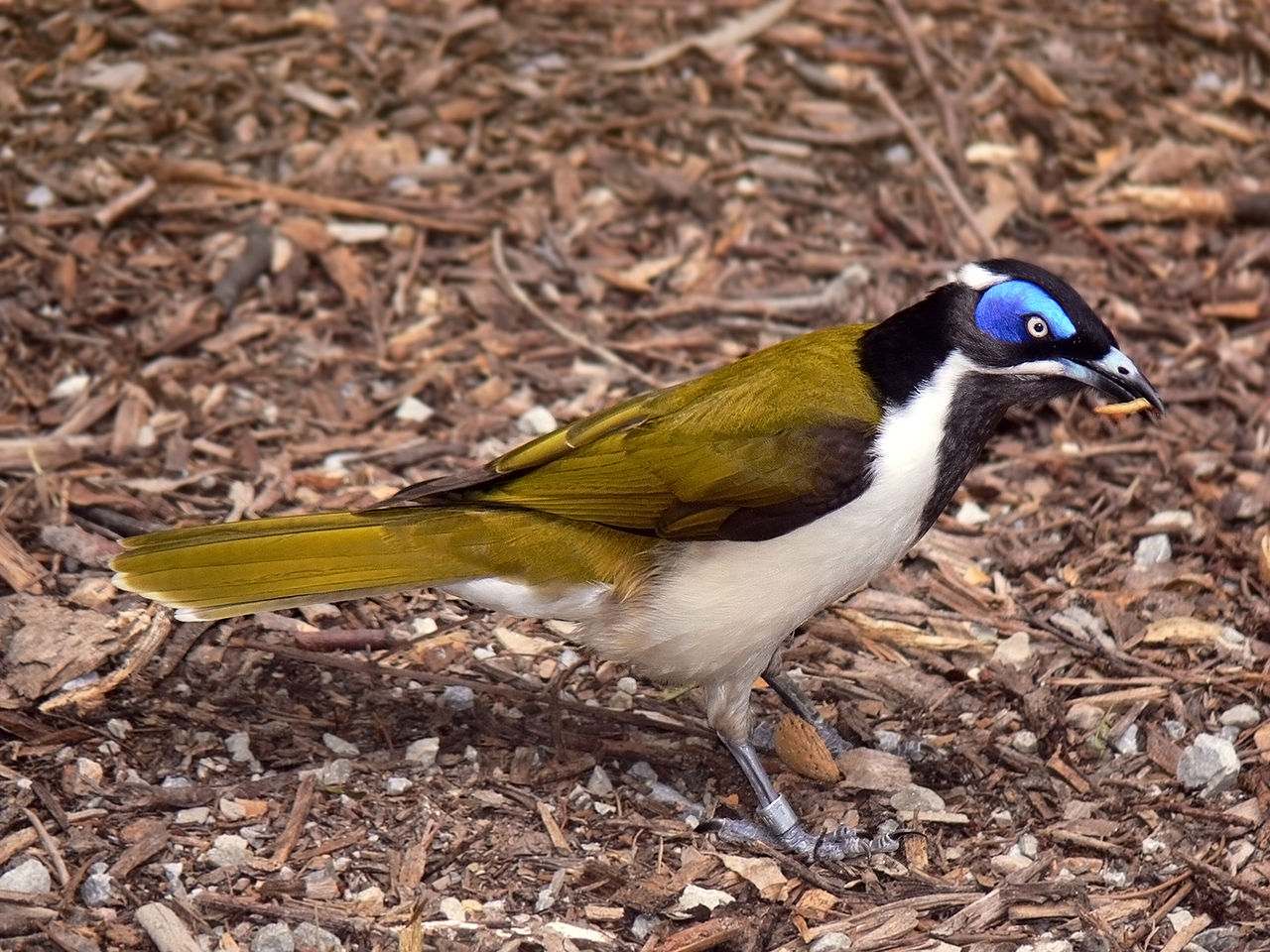
This juvenile Blue-faced Honeyeater (above) was spotted catching insects and then eyeing off the nest it was just about to fly back up to - to feed a baby bird.
We've been hearing an unfamiliar bird-call in recent weeks and wondering 'what bird is that?' and now we know.
This one may be related to the family of Blue-faced Honeyeaters photographed in January 2026 - returning to the trees that tower above us.
Both the male and female tend the young birds, sometimes with the assistance of helpers. The fledglings remain with the parents for some time after fledging.
On Saturday morning, October 31, one of the babies, with a shorter body and tail, was spotted out of the nest and calling for food - and a feeder bird was getting insects from the tree surfaces and bringing them to it.
Although a little too high up for the camera we have, some fuzzy pics of one of this year's little ones shows the difference in size and the difference in the colour around the eye when they're this young - hopefully a few clear photos of this littlie being fed may be yours to be see over the next few Issues:
The Blue-faced Honeyeater, Entomyzon cyanotis, is a large black, white and golden olive-green honeyeater with striking blue skin around the yellow to white eye. The crown, face and neck are black, with a narrow white band across the back of the neck. The upperparts and wings are a golden olive green, and the underparts are white, with a grey-black throat and upper breast.
The blue facial skin is two-toned, with the lower half a brilliant cobalt blue. Juvenile birds are similar to the adults but the facial skin is yellow-green and the bib is a lighter grey. This honeyeater is noisy and gregarious, and is usually seen in pairs or small flocks. It is known as the Banana-bird in tropical areas, due to its habit of feeding on banana fruit and flowers.
The Blue-faced Honeyeater forms breeding pairs, and may sometimes be a cooperative breeder, where immature birds help the main breeding pair to feed nestlings - and what may have been captured by this photo.
Most nests are made on the abandoned nests of Grey-crowned Babblers, Noisy, Silver-crowned and Little Friarbirds, Noisy Miner, Red Wattlebird, Australian Magpie, Magpie-Lark and, rarely, butcherbirds or the Chestnut-crowned Babbler. Sometimes the nests are not modified, but often they are added to and relined. If a new nest is built, it is a neat round cup of rough bark, linked with finer bark and grass.
On the morning of Friday January 30 2026 these two fledglings and their parents were spotted bathing and drinking then drying off in the PON yard at Careel Bay.
Marita Macrae of the Pittwater Natural Heritage Association (PNHA) who has hosted many Bird Walks in Pittwater for decades, stated that it’s very unusual to see those birds here, and breeding too!, but not the first time though.
Blue-faced honeyeater (Entomyzon cyanotis), juvenile/fledgling pair in PON yard, January 30 2026 - they're wet as they just had a bath/drink in one of the 4 birdbaths in the PON yard - each at a compass point and at least 1 under shade as sun shifts during the day. They are calling for food from parents birds it would seem.
The Blue-faced honeyeater (Entomyzon cyanotis), is a passerine bird of the honeyeater family, Meliphagidae. It is the only member of its genus, and it is most closely related to honeyeaters of the genus Melithreptus.
Three subspecies are recognised.:
E. c. albipennis was described by John Gould in 1841 and is found in north Queensland, west through the Gulf of Carpentaria, in the Top End of the Northern Territory, and across into the Kimberley region of Western Australia. It has white on the wings and a discontinuous stripe on the nape. The wing-patch is pure white in the western part of its range, and is more cream towards the east. It has a longer bill and shorter tail than the nominate race. The blue-faced honeyeater also decreases in size with decreasing latitude, consistent with Bergmann's rule. Molecular work supports the current classification of this subspecies as distinct from the nominate subspecies cyanotis.
E. c. cyanotis, the nominate form, is found from Cape York Peninsula south through Queensland and New South Wales, into the Riverina region, Victoria, and south-eastern South Australia.
E. c. griseigularis is found in southwestern New Guinea and Cape York, and was described in 1909 by Dutch naturalist Eduard van Oort. It is much smaller than the other subspecies. The original name for this subspecies was harteri, but the type specimen, collected in Cooktown, was found to be an intergrade form. The new type was collected from Merauke. This subspecies intergrades with cyanotis at the base of the Cape York Peninsula, and the zone of intermediate forms is narrow. The white wing-patch is larger than that of cyanotis and smaller than that of albipennis. Only one bird (from Cape York) of this subspecies was sampled in a molecular study, and it was shown to be genetically close to cyanotis.
The Blue-faced Honeyeater is found in tropical, sub-tropical and wetter temperate or semi-arid zones. It is mostly found in open forests and woodlands close to water, as well as monsoon forests, mangroves and coastal heathlands. It is often seen in banana plantations, orchards, farm lands and in urban parks, gardens and golf courses.
The Blue-faced Honeyeater is found in northern and eastern mainland Australia, from the Kimberley region, Western Australia to near Adelaide, South Australia, being more common in the north of its range. They are considered sedentary in the north of its range, and locally nomadic in the south. It is not found in central southern New South Wales or eastern Victoria now. This species is also found in Papua New Guinea.
Around Wellington in central New South Wales, birds were once recorded over Winter months, and were more common in autumn around the Talbragar River. Birds were present all year round near Inverell in northern New South Wales, but noted to be flying eastwards from January to May, and westwards in June and July.
The Blue-faced Honeyeater feeds mostly on insects and other invertebrates, but also eats nectar and fruit from native and exotic plants. It forages in pairs or noisy flocks of up to seven birds (occasionally many more) on the bark and limbs of trees, as well as on flowers and foliage. These flocks tend to exclude other birds from the feeding area, but they do feed in association with other species such as Yellow-throated Miners and Little Friarbirds.
Their colouring reminds us of the Australasian Figbird Pair we've also seen nesting in our yard - although there are clear differences there too:
Males have bare, red skin around the eye, contrasting against a black crown and grey neck and throat. The remainder of the body is olive-green, except for a white under-tail area. There are two distinct colour forms of the males of this species. Males north of Proserpine in Queensland have a yellow front.
Females have grey skin around the eye and lack distinctive head markings. They are brown-green above and dull-white below, streaked with brown. Both sexes have a blackish bill.
Blue-faced Honeyeater leaping off the back fence this past week to take a feast of spider home
Sydney scores the 2027 Super Netball Grand Final
On Sunday October 25 the NSW Government announced it has secured another major sporting event, with the 2027 Super Netball Grand Final set to come to Sydney for the first time since the Super Netball competition began.
The 2027 Super Netball Grand Final is expected to attract more than 8,000 visitors to Sydney and inject more than $4 million into the NSW visitor economy, supporting hotels, restaurants, pubs, retailers and local jobs.
The match will also showcase Sydney to a national broadcast audience, building excitement ahead of the 2027 Netball World Cup, which will be held exclusively in Sydney in August and September.
Sydney will host the biggest Netball World Cup in history, with 16 of the world’s best teams competing across 64 matches. Organisers are targeting more than 200,000 attendees as the Australian Diamonds look to defend their 2023 world title.
The Government announced it is also investing in the future of the sport through the $1.5 million Netball World Cup Legacy Program, helping players, coaches and officials across NSW benefit from hosting the tournament and supporting more people to participate in netball.
The 2027 Super Netball Grand Final adds to NSW’s blockbuster 2027 sporting calendar, which includes the Netball World Cup, Men’s Rugby World Cup, UFC Fight Night, Rugby Nations Championship, Bathurst 1000, TCS Sydney Marathon and the New Year’s Test Match.
The Super Netball Grand Final is proposed to take place on Saturday 31 July at Sydney Olympic Park.
Premier of New South Wales, the Hon. Chris Minns said:
“Netball is one of the biggest participation sports in NSW, with thousands of kids and adults taking to the court every week, and it deserves the same attention and support we give our other major sports.
“For too long, we haven’t invested enough in netball and we’re working to change that – from grassroots facilities and participation right through to bringing the biggest events in the sport to NSW.”
“2027 is shaping up to be an incredible year of sport for NSW, and securing the Super Netball Grand Final gives fans another great opportunity to see the best players in the country competing right here in Sydney.”
NSW Minister for Jobs and Tourism and Minister for, the Hon. Sport Steve Kamper, said:
“Netball is one of Australia’s most loved sports, and bringing the Super Netball Grand Final to Sydney for the first time is a major win for fans and our visitor economy.
“This Government is securing the big events that bring people to NSW. More fans through the gates means more visitors in our hotels, more customers in our restaurants and more business for our shops and tourism operators.
“With the Super Netball Grand Final and the Netball World Cup on the calendar, Sydney will be the centre of the netball world in 2027.
Chair of Netball Australia, Liz Ellis AO said:
“Bringing the Super Netball Grand Final to Sydney in 2027 is a fantastic moment for our game and a celebration of the incredible passion for netball across New South Wales and the country.”
“The Grand Final is the pinnacle event on our calendar. It showcases the very best athletes in the world competing on the biggest stage, and Sydney will provide a spectacular backdrop for players, members, fans and partners to come together and celebrate everything that makes our game so special.
“I’m thrilled to see our sport’s showpiece event heading to one of Australia’s great sporting cities. Sydney has a rich history of hosting world-class events and creating unforgettable sporting moments, and I have no doubt the netball community will embrace this opportunity with enormous enthusiasm.
“This is also about more than one match. It’s about inspiring the next generation of netballers, creating lasting memories for fans, and continuing to grow the profile and reach of Super Netball.
“We look forward to welcoming supporters from every corner of Australia to Sydney for what promises to be an outstanding Grand Final week in 2027.”
Graphic: Destination NSW/Netball Australia/NSW Government
Six years ago, in 2020, we shared a photo of a wild Southern Leaf-tailed Gecko, Phyllurus platurus, with younger readers. She (we think she's a girl) lives in our laundry - which is out the back of the house and faces on to trees and bush, and we leave it open so damp clothes don't get smelly before being washed.
On Wednesday, October 28 2026, we spotted the Southern Leaf-tailed Gecko again, still living in our laundry, and took another photo. She is much bigger then when we first saw her.
We sent the picture through to Marita Macrae of Pittwater Natural Heritage Association, our 'go to' lady for any plant, insect or animal we don't recognise, and Marita kindly confirmed, again, it is a Southern Leaf-tailed Gecko.
As you can see by the size of this gecko in the first and second pictures, when measured against the brick wall of the laundry, it has grown quite a bit in the last six years.
in 2020
in 2026
Southern Leaf-tailed Geckos are a native reptile and can live for 7 to 9 years in the wild (with an average of 8 years), and can live for 10 to 20 years in captivity (some people buy them and keep them as pets apparently).
Southern Leaf-tailed Geckos are secretive native reptiles that hide among rocks, bark and leaf litter in forests and bushland along eastern Australia. The species most often called the southern leaf-tailed gecko in the Sydney region is Phyllurus platurus, also known as the broad-tailed gecko or Sydney leaf-tailed gecko. The Darug name for southern leaf-tailed geckos is bayagin. These geckos are well known for their flattened, leaf-shaped tails and excellent camouflage.
Southern Leaf-tailed Geckos are nocturnal, which means they are active at night. During the day they shelter in rock crevices, beneath loose bark or inside cracks in old trees. Their mottled brown and grey colours help them blend into bark, sandstone and leaf litter, making them difficult to spot.
Unlike many geckos, Southern Leaf-tailed Geckos do not have sticky toe pads for climbing smooth surfaces. Instead, they use sharp claws to grip rough bark and rocks.
Their diet includes moths, beetles, cockroaches, spiders and crickets. They are ambush predators, meaning they usually wait quietly for prey before quickly striking and catching it.
These geckos play an important role in controlling insect populations in bushland ecosystems. By feeding on nocturnal insects, they help keep ecosystems balanced and also become food for larger predators such as owls, snakes and mammals.
Females do not have hemipenal bulges, making the base of the tail area relatively flat or smooth compared to the male. Females are typically larger and heavier than males. Mature females reach a mean snout-to-vent length of about 86.2 mm, with a maximum of around 97 mm. Adult males have a noticeable double bulge (hemipenal bulges) just behind the vent at the base of the tail.
So it looks like this one may be a girl - we'll keep an eye out for babies!
Females lay one or two eggs in sheltered crevices during warmer months and young geckos hatch after several weeks.
When they emerge from their eggs, hatchling southern leaf-tailed geckos typically measure between 4.8 cm and 6.4 cm (48 to 64 mm) in total length from snout to tail tip. Adults usually grow to about 15 centimetres long including the tail.
After hatching, young geckos are fully independent and begin hunting tiny insects within a short time. Juveniles gradually grow larger over several years before becoming adults. Like many reptiles, southern leaf-tailed geckos grow more slowly during colder winter months when activity levels decrease.
Southern leaf-tailed geckos have excellent camouflage that helps them blend into bark, rocks and leaf litter. Their flattened bodies and mottled patterns make them difficult for predators to detect during the day. Their broad tails look like dead leaves or pieces of bark, helping complete the disguise.
These geckos also have large eyes that help them see in low light while hunting at night. Strong claws allow them to grip rough surfaces such as sandstone and tree bark. If attacked, they can shed their tail to distract predators while escaping. Over time a new tail grows back, although it often looks different from the original.
These geckos are an important indicators of healthy bushland habitats. Because they rely on shelter such as old trees, sandstone crevices and leaf litter, their presence can show that native habitat is still supporting wildlife. Protecting bushland areas around Sydney helps protect species like the southern leaf-tailed gecko.
Australian Geckos
Australia is home to more than 190 native species of geckos. Famous native examples include:
• Marbled Gecko (Christinus marmoratus): Common across southern Australia and urban gardens.
• Thick-tailed Gecko (Underwoodisaurus milii): Known for its defensive barking sound and bulbous tail.
• Knob-tailed Geckos (Nephrurus species): Famous for their short, swollen "knob" tails and desert habitats.
The Border Beaked Gecko (Rhynchoedura angusta) - mostly found on dry open terrain. They occur in arid to semi-arid regions of central inland eastern Australia, from the Eyre Peninsula, SA, through the Lake Eyre basin to south-eastern NT and south-western QLD and also nocturnal (feed and run arond at night). Photo: Kym Nicolson - https://www.inaturalist.org/photos/62836079 CC BY 4.0
How can you help Southern Leaf-tailed Geckos?
People can help southern leaf-tailed geckos by protecting bushland habitats and leaving natural shelter such as rocks, logs and leaf litter undisturbed. These places provide safe hiding spots and hunting areas for geckos and many other native animals.
People can also help by staying on walking tracks in bushland areas, keeping cats indoors at night and reducing pesticide use around gardens and parks. Supporting native habitat restoration projects helps create healthier ecosystems for reptiles and other wildlife across Sydney. Let's look after our Sydney Gecko!
Lismore in Bloom: The Famous Floral Festival (1961)
from NFSA Film Australia
What made Lismore one of Australia's most colourful and admired regional cities? This 1961 edition of Australian Colour Diary takes viewers on a journey through the parks, gardens and floral displays that helped earn Lismore its reputation as a true garden city.
Filmed during Lismore's famous Floral Festival, the documentary showcases vibrant public gardens, award-winning private displays and the strong community spirit behind one of regional Australia's best-loved celebrations. Captured in beautiful colour, the film highlights the city's subtropical climate, civic pride and growing importance as the commercial heart of New South Wales' North Coast.
More than sixty years later, this film remains a fascinating record of Australian community life, regional identity and the enduring appeal of gardening and horticulture. It offers a rare glimpse into Lismore's history and the events that brought residents and visitors together each Spring.
Worried about your Year 12 exams? 3 ways to help anxiety
The high-stakes nature of Year 12 exams can bring out sudden anxiety in the best of students.
You might have felt this before or during an assessment. Sometimes it feels like a rising panic in your chest. Other times it’s like your mind has gone blank and you can’t remember anything. These feelings can make it difficult to focus.
The key to good exam performance is learning to manage your anxiety.
We are clinical psychologists who research academic stress. Here’s what can help.
Academic stress is common
Research shows one in six students experience extreme levels of stress during the final years of schooling. This involves unrelenting stress that disturbs sleep and wellbeing. While moderate stress is okay, too much stress can negatively impact academic performance.
In its simplest form, exam anxiety is a stress response like any other. It’s the activation of the body’s flight-or-fight response, which is triggered by the sympathetic nervous system. The sympathetic nervous system takes care of things like your blood pressure, heart rate and digestion – the things you don’t think about.
The flight-or-fight response occurs when our brain perceives we are in danger, whether it is physical danger, such as fear of being bitten by an angry dog, or psychological, such as stuffing up a speech.
What anxiety in an exam can feel like
The flight-or-fight response might lead to physical symptoms such as:
an increased heart rate
an increased rate of breathing
sweating
a feeling of unease in the stomach
tightness in the chest.
While these symptoms might seem handy if you need to flee or fight, it’s hard to see how they are helpful in an exam situation. Who needs dizziness and sweaty palms when trying to solve a quadratic formula?
Your brain can catastrophise the situation
As you head into the exam you might also face thoughts such as:
I’m going to fail. I won’t be able to remember anything. My mind will go blank.
But this sort of thinking increases the perceived danger of the situation.
Research shows thinking less catastrophically, and more realistically, about a situation can help reduce anxiety.
1. Challenge negative thoughts
To challenge these negative thoughts before or during an exam, it helps to ask yourself questions such as:
Is it realistic that I will completely fail the exam?
Is it realistic that I won’t remember anything?
Do I actually need to get a perfect score to get through this?
What would a friend say to reassure me right now?
2. Focus on your breathing
Another practical way to help reduce anxiety is by slowing down your breathing rate.
In an exam scenario, a full meditation session might be out of the question. But there are still exercises you can do.
For example, while you wait for the exam to begin, or during reading time, try to take a long breath in while counting to four in your mind. Then breathe out over a count of four. Repeat this while slowing down your counting. After a few rounds you will hopefully notice your anxiety start to lessen.
3. Make an exam plan
Look through the exam during reading time and find the questions you feel most comfortable with. Once reading time is over, aim to tackle these questions first. This can help build your confidence during an exam.
If you have long answer or essay questions, it can help to read over all the questions before writing so that while you are answering the “easier” question, your brain will be working in the background, bringing forward information you can use when you answer the harder questions.
This works because information is stored in our brain using networks, so reading questions repeatedly can activate the links between concepts in those networks. This means information might be more readily available when you come back to the harder question.
Stress isn’t always a bad thing
If you’re still feeling stressed, the good news is that mild to moderate levels of stress have actually been shown to improve academic performance. This is because the flight-or-fight response also increases mental alertness and motivation.
After the exam is over, you might feel relieved or devastated, or something in between. It is normal to ruminate over the questions and how you responded to them.
One way to bring yourself back down to a calmer state is to do some exercise. Take a walk or go for a run. This burns up the stress hormone, cortisol, and can help you recover more quickly.
If this article has raised issues for you or your child, you can call Lifeline on 13 11 14 or Kids Helpline on 1800 55 1800.
8 Student-Backed Study Tips To Help You Tackle The HSC
By University of Sydney: Last updated 6 July 2023
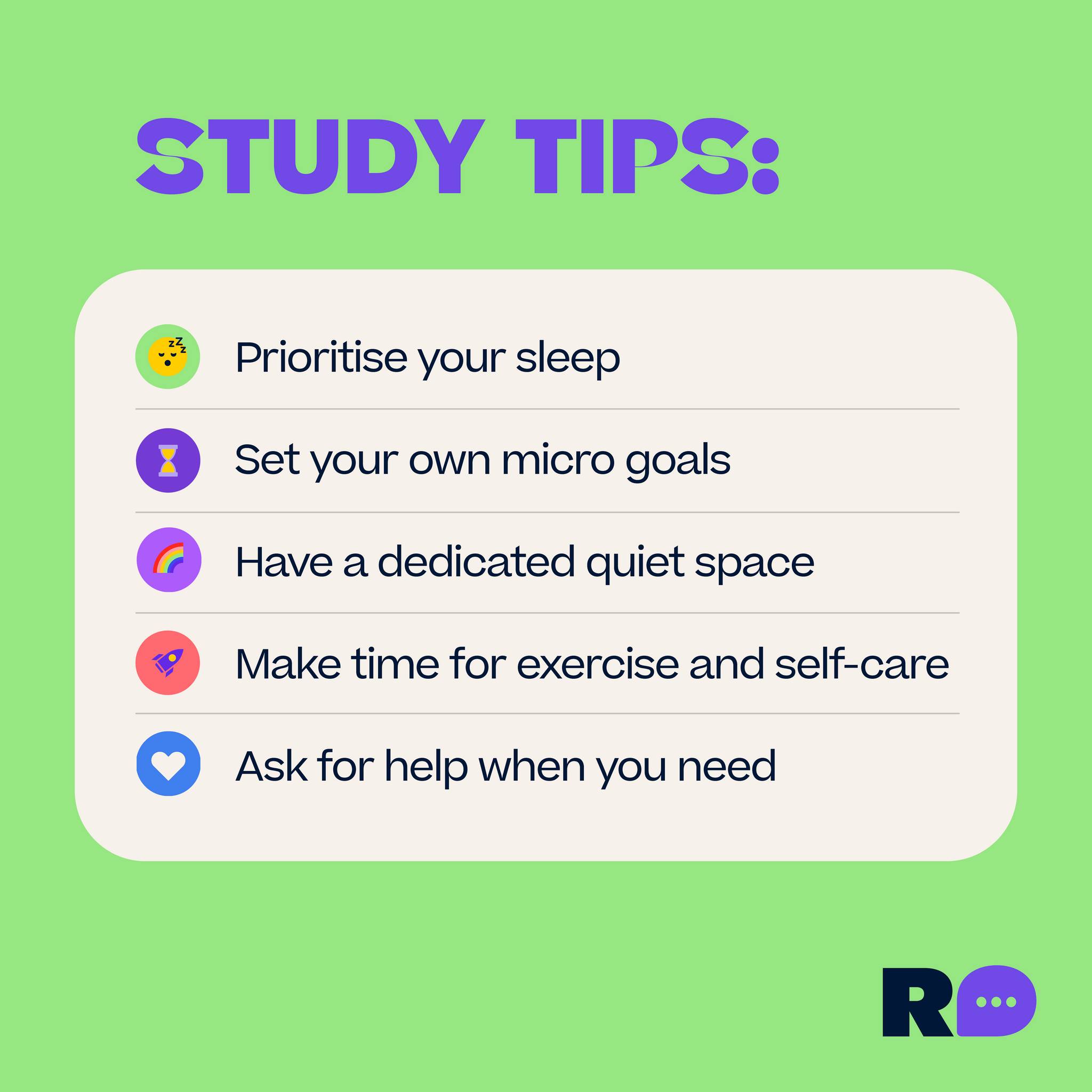
Our students have been through their fair share of exams and learned a lot of great study tactics along the way. Here they share their top study tips to survive and thrive during exam time.
1. Start your day right
Take care of your wellbeing first thing in the morning so you can dive into your day with a clear mind.
“If you win the morning, you can win the day,” says Juris Doctor student Vee Koloamatangi-Lamipeti.
An active start is a great way to set yourself up for a productive day. Begin your morning with exercise or a gentle walk, squeeze in 10 minutes of meditation and enjoy a healthy breakfast before you settle into study.
2. Schedule your study
“Setting up a schedule will help you organise your time so much better,” says Master of Teaching student Wesley Lai.
Setting a goal or a theme for each study block will help you to stay focused, while devoting time across a variety of subjects will ensure you've covered off as much as possible. Remember to keep your schedule realistic and avoid over-committing your time.
Adds Wesley, “Make sure to schedule in some free time for yourself as well!”
3. Keep it consistent
“Make studying a habit,” recommends Alvin Chung, who is currently undertaking a Bachelor of Arts and Bachelor of Laws.
With enough time and commitment, sitting down to study will start to feel like second nature rather than a chore.
“Do it every day and you’ll be less likely to procrastinate because it’s part of your life’s daily motions,” says Alvin.
4. Maintain motivation
Revising an entire year of learning can seem like an insurmountable task, which is why it’s so important to break down your priorities and set easy-to-achieve goals.
“I like to make a realistic to-do list where I break down big tasks into smaller chunks,” says Bachelor of Arts and Advanced Studies student Dannii Hudec.
“It’s also really important to reward yourself after you complete each task to keep yourself motivated.”
Treat yourself after each study block with something to look forward to, such as a cup of tea, a walk in the park with a friend or an episode of your latest Netflix obsession.
5. Minimise distractions
With so many distractions at our fingertips, it can be hard to focus on the task at hand. If you find yourself easily distracted, an “out of sight, out of mind” approach might do the trick.
“What helps me is to block social media on my laptop. I put my phone outside of my room when I study, or I give it to my sister or a friend to hide,” says Bachelor of Commerce and Bachelor of Laws student Caitlin Douglas.
While parting ways with your phone for a few hours may seem horrifying, it can be an incredibly effective way to stay on task.
“It really helps me to smash out the work and get my tasks done,” affirms Caitlin.
6. Beware of burnout
Think of the HSC period as a marathon rather than a sprint. It might be tempting to cram every single day but pacing out your study time will help to preserve your endurance.
“Don’t do the work for tomorrow if you finish today’s work early,” suggests Daniel Kim, who is currently undertaking a Bachelor of Commerce and Advanced Studies.
“Enjoy the rest of your day and save the energy for tomorrow,” he recommends.
Savouring your downtime will help you to avoid burning out before hitting the finish line.
7. Get a good night's sleep
Sleep is one of your greatest allies during exam season.
“I’ve found that a good night’s sleep always helps with concentration and memory consolidation,” says Bachelor of Science (Medical Science) student Yasodara Puhule-Gamayalage.
We all know we need to be getting around 8 hours of sleep a night to perform at our best, but did you know the quality of sleep also matters? You can help improve the quality of your sleep with some simple tweaks to your bedtime routine.
“Avoid caffeine in the 6 hours leading up to sleep, turn off screens an hour before going to bed, and go to bed at the same time every night,” suggests Yasodara.
8. Be kind to yourself
With exam dates looming and stress levels rising, chances are high that you might have a bad day (or a few!) during the HSC period.
According to Bachelor of Arts and Advanced Studies student Amy Cooper, the best way to handle those bad days is to show yourself some kindness.
“I know that if I’m in a bad state of mind or having a bad day, I’m not going to be able to produce work that I’m proud of,” she says.
For Amy, the remedy for a bad day is to take some time to rest and reset.
“It’s much more productive in the long run for me to go away, do some things I love, and come back with a fresh mind.”
Immerse yourself in a mentally nourishing activity such as going for a bushwalk, cooking your favourite meal, or getting stuck into a craft activity.
If you feel completely overwhelmed, know you're not alone. Reach out to a friend, family member or teacher for a chat when you need support.
Parents and carers can play an important role in helping their teens manage their sleep and exam and study stress. For tips, information and support parents and carers can visit ReachOut Parents.
If you are experiencing negative thoughts or feelings, there are services out there to listen and help you out. They are free, confidential, and available 24/7.
Please contact:
Lifeline – 13 11 14
Kids Helpline – 1800 55 1800
13YARN – 13 92 76 to speak with an Aboriginal & Torres Strait Islander crisis supporter
ReachOut is the leading online mental health service in Australia supporting young people during tough times.
ReachOut helps young people feel better about today and the future, no matter what challenge they’re facing. They provide a safe place where young people can openly express themselves, explore what’s happening in their lives, connect with people who understand their situation, and find the resources to help them manage their challenges now and in the future.
Anonymous, free and 100% online, ReachOut has been designed specifically for – and with – young people. From one-to-one support from experienced peer workers, to online forums, as well as tips, stories and resources, ReachOut offers a wide range of support options that allow young people to engage in the ways they want to, when they want to, and has been doing so for more than 20 years.
And, ReachOut Parents and ReachOut Schools provide valuable information, resources and advice to help parents, carers and educators to better understand the young people in their lives and to play an active role in their wellbeing.
Opportunities:
Avalon Beach SLSC: SRC Course
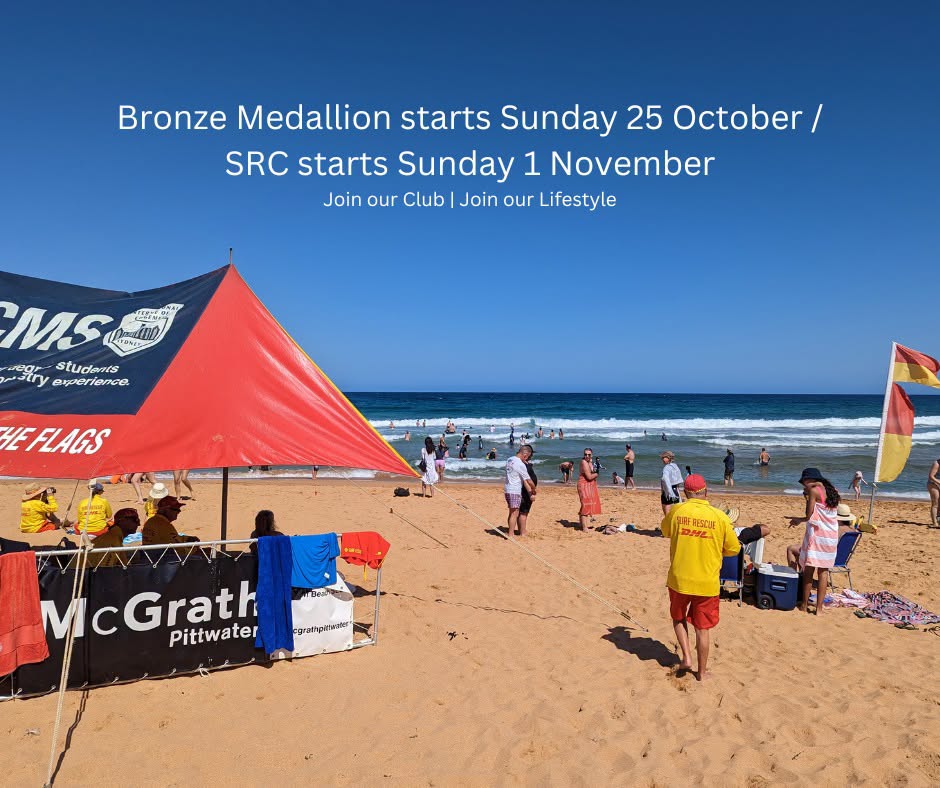
Ready for a new challenge? Join Avalon Beach SLSC for the upcoming Surf Rescue Certificate and become a surf life saver!
By signing up to the course and patrolling, you'll learn how to save lives and other valuable new skills, make lifelong friends by the sea and step up to a new challenge.
There is a place for everyone at Avalon Beach SLSC.
Club benefits include access to the surf club, amenities & hot showers, NBC parking permit (Council eligibility criteria applies), substantial discounts on CrossFit membership & use of club gym, opportunity to compete in various beach and surf competitions and continue advancing your lifesaving skillsets and networks.
🏁 SRC starts Sunday 1 November
🏊 Prerequisites: BM, swim 400m in under 9 minutes; SRC, swim 200m in under 5 minutes
***If you would like to meet our trainers prior to the courses and join us swimming laps in local ocean rockpools, please get in touch - we'd love to meet you and grow your swimming skills and confidence***
Register your expression of interest today via the links below:
Germany, Belgium, France named as destinations for the 2027 Premier’s Anzac Memorial Scholarship tour
On Thursday October 15 NSW Premier Chris Minns and Minister for Veterans David Harris announced the 2027 Premier’s Anzac Memorial Scholarship study tour will travel to Germany, Belgium and France, and called for teacher applications to accompany students on the trip.
The announcement follows the return of the 2026 study tour which saw 18 students tour Greece and Crete.
The two-week tour included participation in commemorations, visits to museums, war memorials and significant historical and cultural sites coinciding with the 85th Anniversary of the Greece and Crete campaigns in 1941.
In 2027, three teachers will join up to 18 students from around NSW, who will be given a unique opportunity to deepen their understanding of Australia’s military service and sacrifice during the First and Second World Wars.
Key locations on the tour include the Reichstag in Berlin, the Nuremburg Rally Grounds, the Normandy D-Day landing beaches in France, as well as 1917 battlefields on the Western Front, and the Menin Gate Memorial in Belgium, which marks its centenary in 2027.
Through visits to these historically significant sites students will gain a greater appreciation of Australia's wartime experience and reflect on the enduring legacy of those who served.
NSW teachers of Stage 5 History and/or Stage 6 Modern History are encouraged to apply for this unique professional development opportunity to enrich their understanding and teaching of Australian wartime history.
The 2027 tour will take place in the Term 3 school holidays, and applications for the role of Accompanying Teachers close on 23 November 2026.
Student applications for those in Year 10 or 11 and studying History or Modern History in 2027 are expected to open in February 2027. Students can register their interest here:www.surveymonkey.com/r/BFXMB5B
NSW Premier, the Hon. Chris Minns, said:
“Travelling to Germany, France and Belgium in 2027 will give teachers and students a unique opportunity to commemorate the Australians who served in Europe during the Second World War.
“By visiting places of historical significance, students will deepen their understanding of the challenges, sacrifices and legacy of those who served their nation abroad.”
NSW Minister for Veterans, the Hon. David Harris, said:
“The Premier’s Anzac Memorial Scholarship is a unique opportunity for NSW History teachers and students to travel to these significant sites in Australia’s Military History.
“Students and teachers will travel with a military historian and hear stories of those who served and sacrificed their lives in these campaigns during the Second World War.
“I highly recommend that teachers and students take the chance to apply for this once in a lifetime opportunity ensuring the legacy of our Second World War veterans is preserved.”
2026 PAMS Accompanying Teacher, Hans Mayerhoder, from Newtown High School of the Performing Arts teacher said:
“The PAMS tour has been an extraordinary and unique teaching experience. Being in the field and experiencing history rather than simply studying it has changed the way I understand the 1941 Greece and Crete campaigns. My understanding of the campaigns, commemoration and historical investigation has developed in ways that I know I will draw on throughout my teaching career.
“There is something very special about spending two weeks surrounded by students and teachers who share such a genuine fascination with history. I had little idea what to expect before applying, but I am so glad I didn’t let that uncertainty deter me. The PAMS experience has reminded me why I love teaching history, and I would encourage any teacher with a passion for the subject to apply.”
2026 PAMS Accompanying Teacher, Emily Shanahan, from Scots All Saints College, Bathurst said:
“For a History teacher, this is incredibly valuable professional learning. I will return to my classroom with a much deeper understanding of Australia’s experience in Greece and Crete, but also with new ways of approaching historical evidence, interpretation and commemoration with students. PAMS has reminded me that some of the richest historical learning occurs when we have the opportunity to question, discuss and reconsider what we thought we knew.
“The care that goes into creating this experience is also exceptional. The program is incredibly well organised, and both teachers and scholars are supported throughout by people who are genuinely invested in their learning, wellbeing and experience. That allows you to immerse yourself completely in the opportunity: to ask questions, engage with experts, learn from the places you visit and enjoy the company of an extraordinary group of young historians.
“PAMS has been intellectually challenging, enormously enjoyable and genuinely renewing as a teacher. I will return home with new knowledge, new questions and an enormous collection of stories and experiences to take back into the classroom. I would encourage any teacher with a passion for History to apply. Opportunities for professional learning of this depth and quality are exceptionally rare.”
Manly Warringah District Junior Rugby League Girls Tackle 2027 EOI Closes Sunday November 1
Any girls interested in playing tackle in 2027 season?
Register your interest (Expression of Interest) through the form - HERE
Financial help for young people
Concessions and financial support for young people.
Includes:
You could receive payments and services from Centrelink: Use the payment and services finder to check what support you could receive.
Apply for a concession Opal card for students: Receive a reduced fare when travelling on public transport.
Financial support for students: Get financial help whilst studying or training.
Youth Development Scholarships: Successful applicants will receive $1000 to help with school expenses and support services.
Tertiary Access Payment for students: The Tertiary Access Payment can help you with the costs of moving to undertake tertiary study.
Relocation scholarship: A once a year payment if you get ABSTUDY or Youth Allowance if you move to or from a regional or remote area for higher education study.
Get help finding a place to live and paying your rent: Rent Choice Youth helps young people aged 16 to 24 years to rent a home.
Explore the School Leavers Information Kit (SLIK) as your guide to education, training and work options in 2022;
As you prepare to finish your final year of school, the next phase of your journey will be full of interesting and exciting opportunities. You will discover new passions and develop new skills and knowledge.
We know that this transition can sometimes be challenging. With changes to the education and workforce landscape, you might be wondering if your planned decisions are still a good option or what new alternatives are available and how to pursue them.
There are lots of options for education, training and work in 2022 to help you further your career. This information kit has been designed to help you understand what those options might be and assist you to choose the right one for you. Including:
Download or explore the SLIK here to help guide Your Career.
School Leavers Information Kit (PDF 5.2MB).
School Leavers Information Kit (DOCX 0.9MB).
The SLIK has also been translated into additional languages.
Download our information booklets if you are rural, regional and remote, Aboriginal or Torres Strait Islander, or living with disability.
Support for Regional, Rural and Remote School Leavers (PDF 2MB).
Support for Regional, Rural and Remote School Leavers (DOCX 0.9MB).
Support for Aboriginal and/or Torres Strait Islander School Leavers (PDF 2MB).
Support for Aboriginal and/or Torres Strait Islander School Leavers (DOCX 1.1MB).
Support for School Leavers with Disability (PDF 2MB).
Support for School Leavers with Disability (DOCX 0.9MB).
Download the Parents and Guardian’s Guide for School Leavers, which summarises the resources and information available to help you explore all the education, training, and work options available to your young person.
School Leavers Information Service
Are you aged between 15 and 24 and looking for career guidance?
Call 1800 CAREER (1800 227 337).
SMS 'SLIS2022' to 0429 009 435.
Our information officers will help you:
navigate the School Leavers Information Kit (SLIK),
access and use the Your Career website and tools; and
find relevant support services if needed.
You may also be referred to a qualified career practitioner for a 45-minute personalised career guidance session. Our career practitioners will provide information, advice and assistance relating to a wide range of matters, such as career planning and management, training and studying, and looking for work.
You can call to book your session on 1800 CAREER (1800 227 337) Monday to Friday, from 9am to 7pm (AEST). Sessions with a career practitioner can be booked from Monday to Friday, 9am to 7pm.
This is a free service, however minimal call/text costs may apply.
Call 1800 CAREER (1800 227 337) or SMS SLIS2022 to 0429 009 435 to start a conversation about how the tools in Your Career can help you or to book a free session with a career practitioner.
Word of the Week stays a part of your page in 2026, simply to throw some disruption in amongst the 'yeah-nah' mix.
Noun
1. one who engages in a pursuit, study, science, or sport as a pastime rather than as a profession.
The term entered English around 1784 (with early references in the 1720s) to describe a person who cultivated an art, science, or hobby out of personal passion rather than for financial gain. In 18th-century French art sales, it often referred to a connoisseur or collector.
The meaning "one who cultivates and participates (in something) but does not pursue it professionally or with an eye to gain" (as opposed to professional) is from 1786; often with disparaging suggestions of "dabbler, dilettante," but not in athletics, where the disparagement shaded the professional, at least formerly. Used as an adjective, by 1838.
From Latin amāre (meaning "to love") and French amateur ("lover of"). From16c., restored from Old French ameour, from Latin amatorem (nominative amator) "lover, friend," agent noun from amatus, past participle of amare "to love" (see Amy).
Amateur shares its Latin word-roots with English words such as amorous, enamoured, and amiable. Amiable: Traces back to amīcus (meaning "friend") and the verb amō / amare (meaning "to love").
Compare: Amiable(adjective) - late 14c., "kindly, friendly," also "worthy of love or admiration," from Old French amiable "pleasant, kind; worthy to be loved" (12c.), from Late Latin amicabilis "friendly," from Latin amicus "friend, loved one," noun use of an adjective, "friendly, loving," from amare "to love" (see Amy).
The form and sense were confused in Old French with amable "lovable" (from Latin amare "to love"), and by 16c. the English word also had a secondary sense of "exciting love or delight," especially by having an agreeable temper and a kind heart. The word was subsequently reborrowed by English in Latin form without the sense contamination as 'amicable'.
Amy: fem. proper name, from Old French Amee, literally "beloved," from fem. past participle of amer "to love," from Latin amare "to love, be in love with; find pleasure in," Proto-Italic ama- "to take, hold," from a PIE root meaning "take hold of," also the source of Sanskrit amisi, amanti "take hold of; swear;" Avestan ama- "power;" Greek omnymi "to swear," anomotos "under oath;". According to de Vaan, "The Latin meaning has developed from 'to take the hand of' [to] 'regard as a friend'."
David Hockney: the celebrated artist is bigger in this immersive digital spectacle, but not closer
David Hockney is no stranger to Australia. In 2016, the National Gallery of Victoria staged a major exhibition of the British artist’s later works. In 1999, the National Gallery of Australia (NGA) acquired one of Hockney’s most ambitious works, A Bigger Grand Canyon. Earlier this year, the NGA showcased its significant holdings of his work in the exhibition David Hockney: Portraits in Print.
Now the “immersive experience” David Hockney: Bigger and Closer (not smaller and further away) has found its way to Sydney’s Carriageworks.
Created by Hockney in collaboration with London production house and venue Lightroom, where it debuted in 2023, Bigger and Closer (not smaller and further away) is a four-screen documentary that traverses Hockney’s oeuvre, career and philosophy over roughly 50 minutes, featuring massive whole-of-room digital projections, a soundtrack of original music by American composer Nico Muhly and narration by the artist himself.
Hockney was an early adopter of digitally-assisted drawing, using the iPad and iPhone.Jacquie Manning/Carriageworks
The relatively recent death of Hockney, in June, gives this event a melancholy new context, though the work itself is far from melancholy in mood or tone.
Indeed, it invites visitors to “Love Life”, a saccharine slogan also deployed in the show’s merchandise.
Portrait of a prolific artist
Hockney in 50 minutes is a tall order. Across seven decades he was prolific and restless; at various points a draftsman, painter, stage designer, printer, poster-maker, photographer, writer and multimedia artist.
He was a big and contradictory character, too. Till the end, he was simultaneously flat cap and bigger splash: the proud working class Yorkshireman and the sophisticated Los Angeles transplant, pop artist and globetrotting dandy.
The diversity and experimentation at the heart of Hockney’s work are captured in both the form and the content of Bigger and Closer. Inside the show’s large rectangular space, enormous projected artworks and imagery unfurl and repeat across the space.
We are reminded of Hockney’s versatility and creativity across genres at every turn. One particularly effective section features Hockney’s brilliant and witty stage designs for productions of Stravinsky’s The Rake’s Progress and Puccini’s Turandot.
Audiences get glimpses of Hockney’s process in Bigger and Closer.Jacquie Manning/Carriageworks
Celebratory rather than probing
Other sections are less convincing.
Hockney delivers what feels like a wilfully un-fact-checked TED Talk on the use of perspective in the history of painting. It recalls his fascinating but irritating book Secret Knowledge: Rediscovering the Techniques of the Old Masters, which made extravagant, disputed claims about the role of the camera obscura in the work of various painters.
This whole section contributes little to our understanding of Hockney or perspective.
Across the narration we hear Hockney’s voice from different periods of his life, and his tone and timbre are familiar and engaging. But what he says is sometimes grating. We are treated to bland remarks (“By putting more in you get more reality”) and dubious assertions (he claims “nobody had painted LA” before he did).
Even when Hockney is on firmer ground, inviting us to look closely at nature, he presents this as a new idea – as if other great artists, photographers and designers hadn’t also urged us to do exactly this over the long tradition of art-making.
Hockney himself narrates the entirety of Bigger and Closer.Jacquie Manning/Carriageworks
Frustratingly, we get no sense of Hockney’s engagement with the fraught politics of his times. Was he an advocate for the gay community that he painted and to which he belonged, in its struggles for equality and against oppression through the ‘60s and '70s? How did his art chronicle the AIDS crisis that affected his personal circle so profoundly? How did the social and demographic changes and struggles of his adopted city impact his work?
The answers to these complex questions might take more time and critical distance to unravel and aren’t to be found in Bigger and Closer, which is celebratory in its approach.
I was certainly moved at points by the sheer ambition and beauty of Hockney’s work, and this is a sophisticated and attractive technical spectacle, with its multi-screen design, digital effects and lively colour palette.
But Bigger and Closer left me unsatisfied. I wanted other voices and critical views. Most of all, I yearned to encounter an artist, a body of work and a world in all their materiality and complexity.
This digital spectacle is no substitute for contemplating Hockney’s sketchbooks, or encountering '70s paintings such as Mr and Mrs Clark and Percy, with their unique combination of stillness and charge, renaissance allusion and hip modernity.
For those not familiar with Hockney, this is an inventive gateway to his oeuvre. But while the artist is certainly bigger, we emerge no closer to truly understanding his life, his work or its place in culture.
When students choose their Year 11 and 12 subjects, they are deciding more than their pathway to university. They are choosing the kinds of learning and experiences available to them.
Why might this be happening? And what are young people losing if these opportunities disappear?
What are the figures?
An analysis of national figures shows between 2015 and 2023, Year 12 enrolments fell by 39% in drama, 38% in dance, 16% in music and 14% in visual arts.
We also know there are different patterns across different states and school systems.
For example, earlier this month, The Sydney Morning Herald reported NSW public school enrolments in drama fell from 2,403 in 2016 to 1,441 last year (a drop of about 40%).
Across private and Catholic schools, enrolments dipped from 2,321 to 1,751 (a drop of about 25%) over the same period.
Why are students turning away?
There is no single explanation, but curriculum priorities and university entrance pressures provide some clues.
Education policy has increasingly emphasised science, technology, engineering and mathematics (STEM), sometimes positioning these disciplines as more “valuable” when it comes to employment than the arts.
A 2024 NSW parliamentary inquiry identified the prioritisation of STEM subjects, job-readiness and perceptions of future earnings as factors contributing to the devaluing of creative arts education.
Students’ ATAR concerns compound the problem. The NSW inquiry also heard some students and parents believe that drama or music will not scale well and disadvantage university entrance:
students are dissuaded or discouraged from pursuing their passions […] for fear of being scaled poorly and the pressures around achieving a high ATAR.
The committee recommended a “myth busting” campaign targeted at students, parents and schools to provide accurate information about how creative arts subjects are scaled.
There have also been curriculum changes to drama and music, which teachers have argued limit student choice and creativity.
These can all have a compounding effect. Falling enrolments mean smaller classes, which lead to subject closures and fewer choices for the next group of students coming through.
What are students losing?
An analysis of national figures shows between 2012 and 2022, the proportion of male Year 12 students taking an arts subject fell from 22.2% to 15.8%. For female students, it fell from 37.6% to 26.9%.
These represent broadly comparable proportional declines of around 29% each. So this is not simply a story about boys abandoning the arts. But the gender dimension should not be ignored here.
Subjects such as drama offers opportunities to explore emotion, vulnerability and perspectives different from one’s own. Through characterisation, collaborative performance and negotiating creative differences, students can practise empathy, emotional communication and shared responsibility. These experiences can help challenge toxic masculinity and restrictive expectations that frame vulnerability as weakness.
Research on senior secondary drama classrooms shows students can negotiate gender expectations through dramatic characters and classroom practice.
Drama cannot dismantle these attitudes by itself, but it creates valuable spaces in which they can be explored and challenged.
These are demanding subjects
Drama, music and visual arts are also academically demanding disciplines. They require interpretation, analysis, experimentation, critical judgement and sustained practice. They also require performance under pressure.
These are not alternatives to academic learning – they are forms of academic learning. A systematic review of educational drama research, for example, found it can have potential benefits for students’ critical thinking, creativity, communication and collaboration.
These skills particularly matter in an age of artificial intelligence, where students need to learn how to question and evaluate information and exercise creative judgement. In the arts, the process of making and revising is itself an important part of learning.
What needs to change?
Reversing this decline requires more than encouraging individual students to choose creative subjects. Governments and education authorities must reconsider curriculum and funding priorities, challenge misconceptions about ATAR scaling, support specialist teachers and facilities, and strengthen arts education in teacher preparation.
The question is not whether every student should study drama, music or visual arts. It is whether young people should lose access to these important forms of learning because our education system signals that other forms of knowledge matters more.
Exercise, avoiding alcohol or even getting enough sleep aren’t the factors most connected to college students’ well-being.
Spending face-to-face time with friends and other people is the strongest predictor of their mental health, according to a 2026 study of nearly 80,000 students that I conducted with the help of my students.
This finding matters because young people are spending less time together in person and more time communicating through screens.
Between 2010 and 2022, the percentage of U.S. high school seniors who reported seeing friends face-to-face almost every day declined from 44% to 32%.
Against this backdrop, mental health challenges among young people have become an increasing public health concern.
But mental health is about more than the absence of mental illness. My student researchers and I wanted to ask a somewhat different question: What helps young people flourish?
To answer that question, we created a broad measure of well-being that captured more than the lack of mental health problems, such as psychological distress. It also included positive aspects of life, such as having supportive relationships, hobbies and a sense of meaning and purpose.
Students celebrate Holi, an Indian holiday of colors, at Stanford University in May 2026.Zhu Ziyu/VCG via Getty Images
A range of measures to determine well-being
Our research team analyzed responses from 79,246 college students across the United States and Canada.
We examined 51 aspects of students’ lives, including their substance use, the discrimination they encountered, their financial stress, any sleep problems and different relationship challenges.
We also examined how students spent their free time, whether that meant exercising, studying, socializing, meditating, playing video games or scrolling on social media.
We used statistical methods that allowed us to compare dozens of potential influences on student well-being simultaneously, helping us identify which factors were most strongly associated with flourishing.
Among the dozens of factors we examined, six stood out as the most important and influential.
Time spent with others pays off
The strongest factor connected to student flourishing was remarkably ordinary: spending time with other people. Students who spent more hours socializing with friends, attending student organizations and participating in cultural events tended to report feeling an overall sense of well-being.
The second most important factor surprised us. Students who spent more time on obligations, including paid work and unpaid family responsibilities, also tended to report a greater sense of well-being.
Our results raise an intriguing possibility: Well-being may come not only from leisure and self-care but also from contributing to something larger than oneself.
While problematic substance use, passive screen time and sleep problems tended to compromise well-being, these factors weren’t the biggest detriment. It was difficulty navigating interpersonal relationships, including problems with friends, romantic partners and roommates.
Making friends, maintaining healthy relationships and working through conflicts requires practice, and some of that practice time now competes with communication mediated by screens.
Notably, the contributors to student flourishing were similar among students diagnosed with anxiety or depression and those without these diagnoses. That suggests these everyday experiences may matter across a broad spectrum of mental health.
Supporting students’ mental and emotional health is not simply a matter of reducing screen time. It also means making it easier for young people to spend time together in person, whether through clubs, recreation programs, community events or other welcoming spaces.
Counseling and educational programs can likewise help students build friendships, communicate effectively and navigate conflict in healthy ways.
None of this means mental illness can be solved by telling a struggling young person to put down their phone, join a club or get more sleep. Mental health conditions are complex, and people experiencing them need access to effective professional care.
But our findings suggest that helping young people thrive requires more than treating symptoms. It also requires cultivating supportive relationships, healthy sleep and meaningful engagement in work, school and family life.
Making an album might seem like a strange project in an age of streaming, when so many listeners rarely listen to albums from start to finish.
For Raye, however, the album is not merely a selection of individual singles: it is a piece of highly personal storytelling. This Music May Contain Hope – the album that won her the Mercury Prize – is a one-hour-and-13-minute magnum opus. It sweeps from old-Hollywood jazz and big-band productions to cinematic orchestral flourish, guided by a voice that is by turns conversational and theatrical. It is a musical statement of what Raye can do when given free rein.
As she says by way of introduction in Girl Under The Grey Cloud, “allow me to set the scene”. It is 2023, and after seven long years of struggling to convince her former label to let her release an album, Raye independently releases her debut album, My 21st Century Blues.
Three years later, she has taken home the coveted Mercury Prize for her follow-up, This Music May Contain Hope. “Being able to even create an album is a privilege I will never take for granted”, she wrote on Instagram (below), posting a selfie that shows the singer smiling as she clutched her golden trophy at the awards show in Newcastle on October 22.
Director’s cut
Over 17 tracks on the album, Raye directs a genre-bending musical experience that is anything but minimalist. The production is opulent, with lush brass, layered vocals and even includes voice notes from Raye’s loved ones. Its most ambitious moment is Click Clack Symphony, a spectacular collaboration with film composer Hans Zimmer, bringing together emotional release with a cinematic soundscape.
Seeing Raye as a creative director does not mean she is a lone genius. Like any director, she leads a cast and crew, and she makes sure that her fans know who they are. She offers a heartfelt introduction to soul legend Al Green on Goodbye Henry, and at the end of I Hate The Way I Look Today, she sends the band off with the affectionate line: “alright everyone, have a cup of tea now.”
These personal little asides and reverential mentions all go in the mix as part of the singer’s M.O. On the six-minute-long closing track Fin, Raye names every contributor to the album. It is a rare gesture in pop, where credits usually stay hidden in the small print.
But what marks Raye out as a creative director is her insistence on contrast. On I Hate The Way I Look Today, raw, confessional lines about body image are set against the glamour of an old Hollywood big-band arrangement. And The WhatsApp Shakespeare, whose title alone pairs the modern with the classic, opens on a contemporary R&B beat before bursting into up-tempo swing and ending with James Bond-esque music that fades into a haunting outro.
By bringing the old and the new together, Raye shows us what makes up her musical DNA, as well as her respect for musical tradition. But she does it without slipping into nostalgia; rather, she pushes it into something new.
Setting the scene
Raye is, without a doubt, an incredible vocalist. What is most remarkable, though, is not just her ability to belt out tunes, but the range of vocal styles she uses on the album. From operatic highs to soulful ad-libs and playful scatting, it is the way she uses her voice that directs listeners through the melodrama of her stories.
Reviewers of her live shows have criticised her “tendency to overshare” in long spoken passages between songs. On the album, however, these spoken moments have a clear purpose. On Beware.. The South London Lover Boy, she sets the scene as a narrator, opening with a prologue in a distinctly posh accent, warning us about its title character.
When I first heard the opening of Nightingale Lane – “This is a song about the greatest heartbreak I’ve ever known” – I was struck by the boldness of the confession, bracing myself for the catharsis that was coming.
Like the title character of comedy-drama Fleabag, Raye’s spoken intros and outros break the fourth wall, creating a sense of intimacy with her listeners. The result is an album that is conceptually rich and musically bold yet vulnerable and therapeutic. But Raye’s vulnerability is never self-absorbed. She turns it outwards, offering a final promise to the listener on Happier Times Ahead before the credits roll: “Just hold on to happier times, alright darlin’?”
Some critics have found the result “overstuffed with musical ideas” and at times “over-indulgent and messy”. Yet I hear an artist making full use of the freedom long denied to her, and to many women in music.
Increasingly, women are seizing creative control of their music. Some of the most acclaimed albums of recent years have been ambitious, story-driven records by women. Most prominently, these include Beyoncé’s 2025 Grammy-winning Cowboy Carter, a reclamation of the black female lineage in country music, and Rosalía’s Lux, a stunning meditation on female divinity sung in 13 languages.
These artists are not only powerful vocalists and performers, but creative directors of conceptually rich musical worlds. On This Music May Contain Hope, Raye claims that role for herself.
In recent days, the Australian government made an offer to the European Space Agency (ESA) to send Australia’s first astronaut on a mission to the International Space Station.
Katherine Bennell-Pegg is the first astronaut trained under the Australian flag. She completed her basic training with ESA in April 2024. She serves as director of space technology at the Australian Space Agency, and was named the 2026 Australian of the Year.
Some have questioned whether such a steep price tag is worth it for a “ticket to space”. But we must look at this more broadly.
Sending Bennell-Pegg to space is about far more than one Australian reaching orbit. It’s about opening doors to international partnerships, research and opportunities that can help shape Australia’s future. In short, we can get a lot in return for the money paid.
Why do we have to pay?
Why does Australia have to pay to send an astronaut to space? The simple answer is because we are not a member state of the ESA, NASA, or any other agency capable of sending humans to space and back.
Member states pay the ESA a mandatory annual contribution based on their GDP. The agency’s total budget is around €7.69 billion (A$12.2 billion) with two thirds of that coming from the 23 member states.
The exact details of Australia’s counteroffer to the ESA are currently not public, but Science Minister Tim Ayres has said we were asked for a sum “well north of $100 million”. Essentially, it’s the cost of a seat on a space mission at market rate. But we can get much more in return.
More than a trip to space
Across the world, we see nations using their space programs – especially those where humans take part in space flight – to strengthen domestic industries and create highly skilled jobs while developing technologies that benefit people here on Earth.
A great example is when Canada invested over C$300 million (A$305 million) to develop specialised robotic arms, first for shuttle missions in the 1970s and later the International Space Station in 2001.
The latest robotic arm is still in operation and provides critical docking services to the station. But the research also led to robotic arm development for precision surgery in hospitals.
So what has Canada seen in return? The investment secured a permanent partnership in the International Space Station, enabling Canadian astronauts, like Chris Hadfield, to get access to space.
With that reputation, Canada became one of the world leaders in space robotics, easily earning back its original investment 100 times over.
The Canadian space tech company MDA Space has now been granted a contract valued at over US$1 billion (A$1.4 billion) to develop a new robotic arm for NASA’s Artemis program. That contribution also secured two Canadian astronaut flights, including the historic Artemis II crewed Moon mission earlier this year.
Would Australia actually reap the returns?
The ESA operates under a principle known as geographical return, which ensures that participating countries receive industrial contracts broadly proportional to their financial contributions to the agency’s programs.
In other words, investment in space is designed to flow back into domestic businesses, supporting local jobs, advanced manufacturing, research and technological development.
This means a nation can use space exploration to build national industrial capability and economic opportunity – a sort of “space stimulus package”.
Australia has the opportunity to use its bid to the ESA as an investment in Australian grown businesses, researchers and technologies that could benefit from our participation. They can then bring benefits to everyday Australians.
An opportunity for home-grown tech
Here’s just one example of how space research can benefit Australians on the ground.
For people living in rural and remote communities, accessing critical services, from maternal health care and emergency surgery to domestic violence support, can mean travelling hundreds of kilometres. Many of these communities are also highly exposed to natural disasters, which can sever vital transport and communication links.
Keeping astronauts healthy in space demands cutting-edge remote medicine, from portable diagnostic tools and AI-powered health monitoring to technologies that allow doctors to treat patients thousands of kilometres away.
These are the very challenges facing Australians in rural and remote communities. Human spaceflight opens doors to groundbreaking biomedical research, from testing new medical technologies to studying drug development in microgravity.
Through Australian human spaceflight participation, continued engagement with the ESA and stronger international partnerships, we can open new pathways for Australian researchers, universities and businesses to design, test and commercialise these innovations.
And it’s not just about the tech. More space technology demand and Earth-based spin-off companies mean many more jobs for Australia.
So can we expect an Australian flag in space?
For now, we await ESA’s reply. If the offer is accepted, a mission could happen as early as 2028, and Australia will likely look to leverage local expertise through Australian Space Agency-led programs or calls for proposals.
One astronaut flight buys Australia a valuable connection into one of the richest space ecosystems in the world. That means more economic opportunity for Australians, including our best and brightest who are often left with no choice but to work overseas.
So perhaps the question isn’t whether Australia can afford to invest in space. It’s whether we can afford not to.
At the end of Star Trek: Generations (1994), surveying the wreckage of the crashed USS Enterprise he captained for nearly a decade, Jean-Luc Picard (Patrick Stewart) muses to his first officer, William Riker (Jonathan Frakes):
… time is a companion that goes with us on the journey, reminds us to cherish every moment, because it will never come again. What we leave behind is not as important as how we’ve lived.
Smiling, he quips to Riker, “After all, Number One, we’re only mortal.”
Passing away this week at 86 years old, we are sadly reminded of that mortality with the death of Sir Patrick Stewart: actor, dramaturge, Shakespearean exemplar, mutant professor, and distinguished Starfleet captain.
From humble beginnings
Born in Mirfield, England, in 1940, Stewart grew up poor during the worst days of the second world war.
He found his calling to theatre as a child, thanks to a keen-eyed English teacher and a copy of Shakespeare’s plays.
He left school at 15 to become a working actor in community theatre.
His extraordinary talent would lead to a stay at the Bristol Old Vic Theatre School, membership with the Royal Shakespeare Company, and a host of acclaimed theatre performances.
Despite the many screen roles for which Stewart would later be known, his Shakespearean roots are indelibly intertwined with almost every performance he gave.
They would also give him – and many of us – something to lighten the load of COVID lockdowns. Stewart used social media in 2020 to read the internet a Shakespearean sonnet each day, later turning his delightful orations into an audiobook.
For most, Stewart will best be remembered as a kaleidoscopic titan of film and television.
From his storied body of work, two roles loom largest.
He was the telepathic mutant and academic Charles Xavier of the X-Men film series – a role he played for more than 25 years, including a posthumous appearance in Avengers: Doomsday (released this December).
As Professor X, Stewart embodied a beloved superhero with paternal warmth and secretive, calculating intellect. He was an empathetic leader of a team of extraordinary people who had been shunned, threatened and harmed by the world for their differences.
In this role, Stewart acted alongside his long-time friend Sir Ian McKellen, who played the mutant antagonist and master of metal Magneto. Ironically, McKellen had once warned Stewart not to forsake the theatre for the screen, advising that a career in film and television would go nowhere.
Stewart and McKellen’s endearing friendship and acclaimed X-Men performances became the stuff of internet legend, particularly when McKellen officiated Stewart’s wedding to US singer Sunny Ozell in 2013.
Stewart’s work in Star Trek as Jean-Luc Picard – captain (later admiral) of the USS Enterprise – is equally revered.
As Stewart’s first major American television role, he took the captain’s chair in Star Trek: The Next Generation in 1987. He would eventually appear in seven seasons, four theatrical films, and the recent sequel series Star Trek: Picard.
Despite initial reservations – including an infamous on-set incident where he stoically told his rambunctious Next Generation colleagues that “we are not here to have fun” – Stewart later embraced the role of Picard. He will be remembered as one of Star Trek’s most acclaimed and legendary performers.
As Picard, Stewart created a potent role model in a franchise focused on an inclusive, utopian future.
Stewart’s Picard was a respected leader, intergalactic explorer, keen orator, Shakespeare enthusiast, thoughtful diplomat, archaeology aficionado, and prolific tea-drinker – as he and other characters famously said, “tea, Earl Grey, hot”.
This captain was an inspiring beacon of hope, curiosity and discovery. He advocated Starfleet ideals of exploration and community, but encouraged his crew – and, by extension, all of us – to seek out knowledge. He urged us all to solve problems with rationality and empathy, and work toward a better future for humanity.
An enduring inspiration
Like many others who grew up in the 1990s with Picard on the television, I still find the character’s ethos and Stewart’s performance have a profound impact on me as a scholar and educator who strives to live and teach by those ideals.
Were it not for the inspiration Picard and Stewart provided me as a child, I may not have become an academic.
Stewart lived the kind of important life that Picard would admire, and leaves behind a cherished body of work, as well as a legacy of dedicated social advocacy.
Now, he boldly goes where you and I have not gone before.
First awarded by France Football magazine in 1956, the Ballon d’Or has grown from a relatively modest sporting honour into football’s most prestigious individual accolade. Its recent history has been dominated by the superstar rivalry between Argentina’s Lionel Messi and Portugal’s Cristiano Ronaldo, who combined have won 13 Ballon d'Or awards between 2008 and 2023.
I hate what it has become. The glitz and glamour. The simpering, Oscar-esque campaigning. Above all, I hate how it reduces football, that most beautiful of collective endeavours, to a procession of individual superstars competing for their place in some manufactured celebrity hierarchy of greatness.
So imagine my surprise when I found myself lying in darkness, laptop propped on my chest, glued to the BBC’s coverage. And imagine my even greater astonishment when, as England’s Harry Kane was named this year’s men’s winner, I found myself experiencing a genuine swell of emotion.
Why had an award that seemed to embody everything I despised about modern football moved me so profoundly?
My research examines football support as a form of living cultural heritage. One of my central arguments is that football heritage is about far more than historic stadiums, trophies or great players immortalised in bronze.
Instead, heritage lives in the relationships, shared memories, traditions and values that supporters sustain and transmit across generations. Heritage, in other words, is not simply about celebrating what has gone before. It is about deciding what we value from the past and present, and what we want to carry into the future.
In this sense, Kane’s significance goes beyond sporting achievements or the memories he has created for football fans. The heroes we choose to celebrate help shape our understanding of what football represents, and what we believe it ought to be.
Kane’s win points towards the future of football I and many fans would like to see. We spend so much time worrying about what modern football is becoming, Harry Kane reminds us of what it can still be. And for one glorious evening, the qualities and values I cherish most in football seemed to have won too.
Yet, statistics barely capture his brilliance. A genuine footballing artist, Kane combines terrifying finishing ability with exquisite technique, spatial awareness and an extraordinary passing range. His genius is understated: his trundling style makes his shattering performances of the last year for his current club Bayern Munich seem deceptively routine. His leadership style is through relentless self-improvement, personal discipline and an unwavering commitment to the collective cause.
We live in an era when football seems increasingly consumed by celebrity, conspicuous wealth and the relentless cultivation of personal brands. Take the two most awarded players in Ballon d'Or history. In 2025, Cristiano Ronaldo and Lionel Messi earned an estimated US$120 million (£90 million) between them from off-field commercial activities alone.
But the consequences run deeper than money. My research looks into football supporters’ ideas of authenticity in the game. Speaking with fans, I have explored how the game’s transformation into a global entertainment product can leave supporters feeling marginalised. Traditionally, football has been an intergenerational cultural tradition rooted in collective identity, shared values and community relationships; however, it is increasingly repackaged around individual celebrity and consumption.
The danger is not commercialisation itself, but that football’s identity as an entertainment product increasingly threatens to overshadow its significance as a living cultural tradition.
Against this backdrop, Kane feels like a glorious throwback. Grounded, sensible, quietly charming and refreshingly unostentatious, he seems almost defiantly ordinary for someone possessing such extraordinary talents.
There was something wonderfully incongruous about watching him collect football’s most ostentatious individual award. His shiny-eyed awe, his impish grin, his apparent lack of interest in the celebrity circus surrounding this most deserved of accolades.
Kane has spent his career quietly perfecting his craft, allowing his football to speak more eloquently than any carefully cultivated public persona. He is no celebrity; he is a sportsman.
In his humility, professionalism, quiet leadership and extraordinary dedication to his craft, Kane embodies precisely the values I would love future generations of footballers and supporters to inherit. His Ballon d'Or victory is therefore a wonderfully paradoxical triumph: a seemingly old-fashioned footballer conquering the most conspicuous symbol of modern football’s celebrity culture.
Gulliver’s Travels, first published on October 28 1726, is a masterpiece of satire that continues to have the power to provoke, to amuse, and to shock. Most readers familiar with it will know that its author, Jonathan Swift, was not only Irish-born but was Dean of St Patrick’s Cathedral in Dublin when he wrote what is unquestionably his greatest work.
What they may not know, however, is that the text is shaped in fundamental ways by Swift’s experience as a member of Ireland’s Protestant elite.
This group was a minority whose identity was constructed on the assumption that they were to bring order and civilisation to a wild and benighted country. They believed they would “improve” Ireland through their superior grasp of reason and their cultivated manner of living.
This civilising mission was from the start complicated by the irreconcilable contradictions for Ireland’s Protestants, who originally described themselves as “the English people of Ireland”“. They believed their role was to represent and model a superior culture to the inhabitants of Ireland. But, as they discovered, living in Ireland meant accepting that they were in fact considered inferior themselves. As Swift’s contemporary William Molyneux acutely observed:
If the English in Ireland be treated as Englishmen, they will be Englishmen still in their hearts and inclinations, but if they be oppressed, they will turn Irish, for fellowship in suffering begets love and unites interests.
In his Drapier’s Letters, a series of political pamphlets published in 1724 as he was working on Gulliver’s Travels, Swift likewise expressed his frustration at the anomalous position and unstable status of the Anglo-Irish:
Am I a freeman in England, and do I become a slave in six hours by crossing the Channel?
Jonathan Swift at the Deanery of St Patrick’s (1905).Wikimedia
The focus here on travel as the means by which a free man is transformed into a slave is suggestive of the extent to which the dizzying disorientation and defamiliarisation that characterises Gulliver’s Travels has its roots in the complexities of Swift’s Irish identity.
The increasingly popular genre of travel literature in the 18th century functioned, broadly speaking, to establish the perspectives of western European travellers as definitive and authoritative. In contrast, Gulliver’s Travels works to question and radically undermine that position.
Part I sees Gulliver as a giant in Lilliput, with much of the satirical humour generated by the fact that the tiny Lilliputians are unaware of the comic incongruity between their size and their sense of their own importance. The "most mighty Emperor of Lilliput” for example – who is about six inches tall – is described as the “delight and terror of the universe” whose dominions “extend five thousand blustrugs (about 12 miles in circumference) to the extremities of the globe”.
Although Gulliver’s size suggests that he’s in a dominant position relative to the Lilliputians, this dominance is undermined by the monstrous nature of his huge body. Fearing that simply satisfying his basic need for sustenance will drive their country to famine, the Lilliputians consider killing him. However, they decide against it on the grounds that his immense, rotting corpse would be a source of disease.
Part II then sees Gulliver utterly humbled and stripped of authority through the simple device of making him tiny in Brobdingnag, a world of giants. In this situation, it’s Gulliver who fails to recognise the absurd figure he presents as he seeks to convince the king of Brobdingnag of England’s greatness. The king’s damning response to his lengthy account is to pronounce the English “the most pernicious race of little odious vermin that nature ever suffered to crawl upon the surface of the earth”.
Swift’s savage delight in undermining English claims to power and superiority, driven by his experiences as a disenchanted member of the Irish Protestant establishment, is further emphasised in Part III. Here, he visits the flying island of Laputa, where commonsense has been abandoned in favour of the fanciful experiments developed by the “Academy of Projectors”. This group is a satiric take on England’s Royal Society, which was founded in London in 1660 with the aim of promoting scientific enquiry and “improving natural knowledge”.
Gulliver Presented to the Queen of Brobdignag by Charles Robert Leslie (1835).National Trust, CC BY-NC
Swift’s contempt for projectors (close in meaning to the modern word innovators or speculators) is also evident in his Modest Proposal (1729). In this satirical essay, the great innovation of the self-styled projector is to solve Ireland’s social and economic problems by selling its surplus infant population for human consumption.
The profoundly shocking conjunction of rational method and barbaric cruelty that characterises A Modest Proposal is foreshadowed in the final book of Gulliver’s Travels. In this conclusion, the Houyhnhnms, a race of hyper-rational horses, calmly deliberate whether or not to exterminate the Yahoos. This oppressed group are reluctantly recognised by Gulliver as human, but are treated as a bestial subspecies by their horse masters. This chilling episode is rendered all the more disturbing by Gulliver’s agonised unwillingness to acknowledge his kinship with the Yahoos, and his self-abasement to the Houyhnhnms.
Gulliver’s deranged insistence on identifying with the Houyhnhnms sees him, when he returns home, take to living alongside his horses rather than his own wife and children. Gulliver’s final madness can be read on one level as a metaphor of the Anglo-Irish dilemma – a portrayal of a colonial population that remains stubbornly allied with a power that actually despises and oppresses them. However, Swift’s achievement is much more far reaching than this.
His unique dual perspective within the prevailing power structures of his time enabled him to grasp the folly of believing that one frame of reference is the only one possible. It is this that makes Gulliver’s Travels vitally relevant to contemporary readers 300 years since its first publication.
This article features references to books that have been included for editorial reasons, and may contain links to bookshop.org. If you click on one of the links and go on to buy something, The Conversation UK may earn a commission.
There are two lighthouses on Lady Elliot Island, at the southernmost tip of Australia’s Great Barrier Reef. The first was built in 1873, but was decommissioned in 1995 when the second took over the job of warning ships off the reef.
Visitors to the island, however, regularly report seeing signs of a third lighthouse. At night the beams of a non-existent phantom lighthouse are seen far off, shining on the horizon.
This “phantom lighthouse illusion” is so well known it even gets a mention in the island’s guide for tourists. It’s not unique to Lady Elliot Island, either: the earliest known report of this phenomenon was published in 1937, and it documented the illusion off the coast of Brittany in France.
What’s going on here? One of us travelled to Lady Elliot Island to find out, then we recreated the illusion in a virtual reality environment to make sure we understood what was happening.
Like many illusions, this one seems to happen when our brains add our expectations to evidence from our senses and arrive at the wrong result.
What the illusion looks like
To start, at night, stand at least 70 metres away from the lighthouse between the lighthouse and the sea. Look up at the lighthouse and you’ll clearly see a rotating beam of light shining from where you’d expect.
Now, turn around with your back to the lighthouse and look out to sea. You know the light is coming from behind you but you’ll be convinced what you’re looking at is the light emanating from the horizon.
It won’t matter you know this is wrong. No matter how many times you turn around to check the source, the phantom lighthouse is still there when you gaze again at the horizon.
The video below – from our virtual reality recreation – gives some sense of what the experience is like. In reality, the beam is generated by a lighthouse located 300m behind the observer. The video makes it appear as if the beam is generated by a moving source that lies in front of the observer.
A virtual reality simulation of the view standing 300 metres from a lighthouse looking away from it.Simon Cropper, CC BY
Why a lighthouse fools our brains
For our recent study, we first examined the natural illusion “in the wild” on Lady Elliot Island. Then we managed to replicate it in a fairly simple virtual reality environment – the lab results matched the real-world observations remarkably well.
Our work suggests that what people actually see is a combination of what they expect to see and the evidence provided by their senses.
At night, few distance cues are available so the evidence is sparse. This means the visual system needs to rely on expectations about the distance of different parts of the lighthouse beam.
As an analogy, imagine you are in a room that is completely dark except for a small glowing disc at eye level. The disc could be a small object that is relatively close, or a much larger object far away. Because the evidence is ambiguous, your interpretation of the scene will be mostly determined by what you expect to see.
Our study suggests the phantom lighthouse illusion works the same way. People expect points along the lighthouse beam to be much closer than they actually are.
In reality, the far end of the beam is both very distant and moving extremely fast. But another possible interpretation is that this part of the beam is not so far away and is moving relatively slowly.
If the far end is perceived as moving slower than the nearer end, the natural interpretation is that the source of the light is somewhere in front of the observer.
Prediction machines
Our account of the illusion made a novel prediction. Earlier observers reported experiencing the illusion at distances between 1–4 kilometres from a lighthouse.
By contrast, our theory predicts that a distance of around 70m should be enough for the illusion to emerge. This prediction was confirmed by our virtual study and our own experience on Lady Elliot Island.
The phantom lighthouse illusion highlights the operation of the brain as a “prediction machine” that combines expectations and current data to make inferences about the world. Normally these expectations allow us to make accurate inferences about what we see.
Astronomers are alert for the famous “crater illusion”, for example, which occurs because we normally expect that light in an image will be coming from above.
This expectation is useful in interpreting ambiguous scenes, but it can sometimes lead us astray: a photograph of a crater can easily be mistaken for one of a dome or hill instead, depending on the direction of the light.
The same picture rotated at different angles can look like a hill (left) or a crater (right), because our brains expect light is coming from the top of an image.NASA / GSFC / Arizona State University
Illusions are so fascinating to us because they are times when our brains make a mistake. By the same token, they show us how the brain actually gets things “right” most of the time.
We may get the location of a lighthouse wrong by tens of kilometres, but we do it for the same reason we correctly understand our environment almost all the rest of the time.
Lyndall Patterson inducted into Australian Sailing Hall of Fame
Lyndall Patterson Nee Coxon | 2026 Australian Sailing Hall of Fame Inductee: Announced at Australian Sailing National Awards, Held Friday October 30, 2026.
Five decades. Six world titles. One unstoppable competitor. Lyndall Patterson, a trailblazer in women’s sailing whose passion for racing has never faded. From her first Australian title at just 11 years old to winning the inaugural Women’s World Championship in 1977 and 1978, Lyndall has spent nearly five decades pushing boundaries and chasing the win. Her incredible journey has continued across generations, with world titles, podium finishes and a recent victory in the Great Grand Masters women’s division in Athens.
At every stage, Lyndall has shown that true champions never stop competing. Six world titles across five decades. A remarkable legacy on the water.
Whether competing overseas, interstate, or locally on Pittwater, Lyndall is a role model for club sailors, showing where the sport can take you and that it is a for-life sport of leisure.
Congratulations, Lyndall, on being inducted into the Australian Hall of Fame.
Dr Lyndall Patterson grew up on Sydney’s north shore and began sailing with her younger brother, Michael Coxon, an accomplished sailor and Sydney-to Hobart racer, at the Hunters Hill junior sailing club. At age 11, she won her first Australian title in a sabot dinghy at Gosford in 1966. In 1977, she won the inaugural World Women’s Sailing Championship.
Lyndall was Australian Yachtswoman of the Year in 2010-2011 and was also the winner of the 2010 Laser Grand Master Worlds sailed at Hayling Island, UK.
The wins have kept coming including at the 2026 ILCA 6 Masters World Championship in Athens, Greece, securing podium finishes against some of the world’s best masters sailors.
Hosted by the Nautical Club of Kalamaki from 30 May to 7 June, the championship attracted more than 400 competitors from around 40 nations, racing on the waters of the Saronic Gulf.
Congratulations Lyndall - everyone here is absolutely thrilled - with many 'well deserved!' comments coming in.
The Royal Prince Alfred Yacht Club's Lyndall Patterson was also a Finalist in the Female Sailor of the Year category, which went to another lady associated with the RPAYC this year - Stacey Jackson, a fairly regular part of sailing on all classes of yachts with Pittwater's own Katie Spithill.
Female Sailor of the Year: Stacey Jackson
Stacey Jackson and Matt Wearn OAM OLY were named Female and Male Sailor of the Year, respectively, at the 2026 Australian Sailing Awards in Sydney on Friday night, with Royal Freshwater Bay Yacht Club making history as the first club to win back-to-back Club of the Year – Category A awards.
It was a landmark year for women’s sailing globally, with two finalists making history this past year. Ms Jackson took out the Female Sailor of the Year award ahead of Jiang Lin, who became the first woman to skipper an overall winner of the Rolex Sydney Hobart Yacht Race, and 2025 Australian Female Sailor of the Year Zoe Thomson OLY.
Jackson made sailing history as part of the first all-female crew to complete a non-stop, unassisted circumnavigation of the globe in pursuit of the Jules Verne Trophy. The crew completed the race in 57 days, 21 hours and 20 minutes, making Jackson the fastest Australian to sail non-stop around the world.
Stacey Jackson. Photo Credit: David Hossack
Reflecting on an extraordinary year and her first Female Sailor of the Year award, the Queenslander said:
“It’s a huge achievement for me to finally win the award. I’ve been a finalist before, but to get the recognition for my offshore sailing, in particular competing in the Jules Verne Trophy, I’m hugely proud of it. I’m also so happy to have the discipline of offshore sailing promoted on a national level.”
Western Australian Matt Wearn OAM OLY claimed Australian Male Sailor of the Year honours for a fourth time, following an outstanding return to ILCA sailing. Wearn enjoyed a dominant season, winning three Sailing Grand Slam events and securing his seventh Australian National Championship title.
“It’s been great getting back into the ILCA,” said Wearn. “Having eighteen months away from it after Paris gave me the perspective I needed to come back into the Olympic world.”
Goolwa Regatta Yacht Club was named Club of the Year – Category B, following an impressive 30 per cent increase in membership.
The SheSails Award also saw a back-to-back winner, with the South Australian Women’s Keelboat Regatta recognised for continuing to build momentum in women’s participation and racing.
Tasmanian Emma Hooper was named Volunteer of the Year in recognition of her outstanding commitment to sailing at Sandy Bay Sailing Club, as well as her contributions to the Cadet Class at both national and international levels. Like the thousands of other volunteers at sailing clubs around Australia, Hooper gives her time to ensure others can experience the joy the sport can bring.
“I get involved with grassroots sailing because I’ve had a fantastic experience growing up as a young sailor and I want to pass on that love of sailing to the next generation. Sandy Bay is a club overwhelmingly made up of volunteers, so I feel like this trophy might have my name on it, but it really belongs to all the other volunteers.”
Australian Sailing extends its sincere congratulations to all 2026 Australian Sailing Awards recipients and thanks all finalists for their significant contributions to the sport and the broader Australian sailing community.
The Australian Sailing Hall of Fame (ASHoF) was established In 2017 to recognise the greats of the sport, those who have achieved at the highest level and contributed to make sailing what it is today. The Hall of Fame showcases the inductees, their achievements and impact.
The ASHoF acknowledges exceptional performance and contribution at the highest level, by an individual or a team, both past and present, and covers all disciplines of the sport, including those in supporting roles such as coaches and designers.
2026 Australian Sailing Award Winners:
Female Sailor of the Year - Stacey Jackson (Royal Queensland Yacht Squadron, QLD)
Male Sailor of the Year - Matt Wearn OAM OLY (Royal Perth Yacht Club/Fremantle Sailing Club/Australian Sailing Team, WA)
Team of the Year - Kairos Racing (Cruising Yacht Club of Australia, NSW/ACT)
Para Sailor of the Year - Genevieve Wickham (Royal Perth Yacht Club, WA)
Noakes Group Male Youth Sailor of the Year - Rory Meehan (Royal Queensland Yacht Squadron/Australian Sailing Squad, QLD)
Noakes Group Female Youth Sailor of the Year - Mia Austin and Zara Marks (Woollahra Sailing Club, NSW/ACT)
Coach of the Year - Rafael Trujillo OLY (Royal Queensland Yacht Squadron/Australian Sailing Team, QLD)
Club of the Year - Category A - Royal Freshwater Bay Yacht Club (WA)
Club of the Year - Category B - Goolwa Regatta Yacht Club (SA)
Innovation Award - Southport Yacht Club – Summer on the Lake (Southport Yacht Club, QLD)
Instructor of the Year – Ian Fox (Royal Yacht Club of Victoria, VIC)
Official of the Year - Malcolm Hughes (Adelaide Sailing Club, SA)
SheSails Award - South Australian Women’s Keelboat Regatta (Cruising Yacht Club of South Australia, SA)
Sport Professional Award - Greg Rowlings (Royal Yacht Club of Tasmania, TAS)
Sport Promotion Award - Sail Port Stephens (Newcastle Cruising Yacht Club, NSW/ACT)
Volunteer of the Year - Emma Hooper (Sandy Bay Sailing Club, TAS)
Ombudsman findings reinforce urgent need for human oversight of aged care assessments: COTA Australia
October 27, 2026
The Federal Government must act on the Commonwealth Ombudsman’s findings into the aged care assessment system and ensure experienced assessors can override automated decisions when they don’t reflect an older person’s care needs, COTA Australia says.
The Ombudsman today released a damning report into the Integrated Assessment Tool, finding serious problems with its reliability and fairness that have left older Australians without the support they need.
COTA Australia Chief Executive Officer Patricia Sparrow said the findings validated concerns older Australians and their advocates have been raising since the system was introduced, many of which have also been the subject of recent Senate inquiries and parliamentary scrutiny of the Integrated Assessment Tool (IAT).
“The Ombudsman’s findings are deeply concerning, but unfortunately won’t come as a surprise to the many older Australians who have experienced problems with the system,” Ms Sparrow said.
“We’ve been saying from the start that experienced assessors need to be able to use their professional judgement when an automated decision doesn’t reflect the needs of the person that has been assessed.
“It’s disappointing that the Government has stopped short of accepting the Ombudsman’s recommendations to give assessors those powers.
“The Government’s recent changes are a positive step, but they create an additional escalation pathway rather than giving the assessment team those powers.
“The independent review announced by the Government must now properly consider the Ombudsman’s recommendations, including legislative changes to allow assessors to override automated decisions.”
Ms Sparrow said the report also reinforced COTA’s longstanding concerns about the independence of the complaints process.
“Older Australians need confidence that when something goes wrong, there’s a fair and independent process to put it right.
“It’s crucial that complaints about aged care assessments be handled by the independent Aged Care Complaints Commissioner, rather than the department responsible for the system.
“We welcome work underway to introduce a clearer My Aged Care complaints policy by April 2027 and look forward to contributing to that process.
“At the end of the day, these decisions determine whether older Australians get the care they need to live safely and independently in their own homes. It’s crucial we get them right.”
David Pescud OAM to Be Inducted into the NSW Hall of Champions
In related sailing news, a gentleman Pittwater has a long-term connection with, David Pescud OAM, is set to be recognised for his outstanding contribution to the sport of sailing with the announcement of his induction into the NSW Hall of Champions.
Long-term readers will remember Palm Beach Sailing Club raising money for 'Faceboat' back in 2013. The wonderful Linda Renouf sent in some photos, telling us we had to let our community know:
'Sailors with disAbilities is receiving $325 from Palm Beach Sailing ClubSailors and there will be 13 new crew members on the side of their Sydney to Hobart racing yacht!'
Since 2010, the Sailors With Disabilities team has been sailing the TP52, Wot Eva (the former Wot Yot, which was generously donated to SWD by wotif.com co-founder Graeme Wood), in the Sydney to Hobart Yacht Race. This year, the crew is back to sailing the Lyons 54 that won PHS in the 2007 Hobart after winning PHS in the 2006 Sydney Mooloolaba race and scoring second in the inaugural Sydney Mackay Yacht Race in 2006. David Pescud, owner, and crew famously also won PHS overall in the fatal 1998 Hobart with a former yacht.
This year, SWD came up with a very clever plan, launching its ‘Face Boat’ campaign. For a tax deductible $25.00, donors can have their photo appear on the hull of the boat. Patron, Malcolm Turnbull, launched this novel campaign in September to help raise funds for SWD. There is space for more than 3,800 photos on the Lyons 54, which has contested every east coast regatta and offshore race since being launched in 2000. In July 2003, with this yacht, the disabled SWD crew shattered the monohull circumnavigation of Australia record, a record it still holds today.
Grace, the 19 year girl sailing with SWD to Hobart that year, stated;
"Sailing with all the faces on the boat feels amazing. I'm really blown away by family, friends and community support. The Faceboat sea of faces will help me find the courage to face the mighty seas of Bass Strait."
Grace with Shane Withington at RMYC's Timber Boat Festival 2013. Photo: Linda Renouf
What the Faceboat would look like when everyone is aboard - picture by and courtesy Sailors With disABILITIES.
This was followed support from across the Pittwater when Bayview's Team Windcraft back in July 2014 to raise funds to support what was then called 'Sailors with disABILITIES', a not-for-profit organisation, that brings a lot of joy to a lot of people through sailing. They raffled of a yacht and sales for the tickets meant a substantial investment in Mr. Pescud's mission to share the joy of being on the water.
By October 2014 Windcraft's MD Peter Hrones said he "Felt like Father Christmas" as he handed over the keys of a brand new Hanse 345 yacht to raffle winner John Scott and a cheque for $174,550.37 to David Pescud the founder of Sailors with disAbilities (SWD).
Left to right: Allan Bridge (Windcraft GM) John Scott - (raffle winner) Mary Bickley (Windcraft Bayview), David Pescud (SWD Founder) and Peter Hrones (Windcraft MD) at Bayview in October 2014. Photo supplied
This was the second time the Windcraft team have raffled a yacht in support of a much loved Australian charity. Three years prior to 2014 it was Bear Cottage who benefitted from their support and then Windcraft chose SWD.
The Windcraft Team had the privilege of then Premier of NSW Mike Baird visiitng Middle Harbour Yacht Club to officially name the prize Hanse 345 in the 'Amazing Grace' raffle.
The yacht was named 'Amazing Grace' after Grace Kennedy who has Spina Bifida and was just 19 when she competed in the 2013 Sydney to Hobart yacht race. Mike Baird spent time chatting to Grace before the ceremony, learning about the skills and courage needed to race to Hobart.
In a short speech Mr Baird praised Grace's determination and dedication. Mr Baird also took time to recognise David Pescud and the opportunity the organisation had by then offered to over 3000 children and adults living with disability or at disadvantage each year.
L to r: Grace Kennedy, David Pescud, Mary Bickley and 2014 Premier Mike Baird. Photo supplied.
Pittwater residents would have seen Grace Kennedy, alongside Em Dieters as part of Australian Surfing's Irukandjis para-surfers cohort in recent years - Grace won bronze last year and represents Australia in California this November again - go girls!
Even then David was using sailing as a tool to build the confidence and self-esteem of participants whilst learning the thrill and freedom of sailing in a team environment, and the results and progression of Grace is testament to that.
Pittwater's own Royal Motor Yacht Club of Broken Bay (at Newport) is continuing their own tradition of supporting David Pescud and his team with both the Making Waves Foundation and Marine Rescue NSW fundraising at their 2026 Timber Boat Festival, running next weekend, November 7-8, with LOADS on (Interactive Displays, On Water Action, a Family Fun Zone). The RMYC is making it easy to get there and back too with the Club hosting free park and ride bus.
The announcement made by Sport NSW recognises Mr. Pescud's commitment to increasing inclusion and accessibility within the sport of sailing. His pioneering work includes a dedication towards creating opportunities for people with disabilities to experience the freedoms of sailing.
David Pescud founded the Making Waves Foundation (formerly Sailors with disAbilities) and skippered the first boat crewed by people with disabilities in the 1994 Sydney to Hobart yacht race. His crews have twice won their division in the Boxing Day Classic and the team still hold the World Sailing Speed Record for the fastest circumnavigation of Australia by a monohull yacht, set in July 2003 aboard KAZ.
In 2022 David Pescud was recognised with a Lifetime Achievement Award in the NSW/ACT Sailing Awards.
Australian Sailing's NSW/ACT division said then:
''David founded Sailors with Disability back in 1994 as President of the organisation, now known as the Making Waves Foundation. That year he put together a team of disabled sailors to contest the 50th Sydney Hobart Yacht Race.''
''This was the first time ever a fully disabled crew had competed in a Sydney Hobart Yacht Race. Earlier in the same year, competing in the Sydney Southport Race MWF was the first fully disabled crew to compete in an ocean race.
''MWF has since competed in 20 Sydney to Hobart yacht races. The foundation has provided sailing opportunities to more than 64,000 disabled and disadvantaged people. 2,500 people partake in their programs each year. He went to a lot of trouble to make boats for the disabled to sail on even with wheelchairs. It’s an experience they just wouldn’t get anywhere else. He felt it was important to get them out in an environment that they would never have dreamed of, and that expanded their horizons.
David is a great advocate for the disabled and disadvantaged in yachting, and very widely respected for this. This has very effectively demonstrated to the sailing community that sailors with a disability can seriously compete on their level, often to their surprise and amazement.
Looking at what has been achieved we have a great deal to celebrate as a result of one man’s vision as a catalyst for change in the sport of racing and sailing – the list of sailing achievements is significant, but more importantly it demonstrates the sailing community’s ability to put aside fear and prejudice and move forward inclusively acknowledging difference rather than hiding it.''
Malcolm Page OAM, CEO Australian Sailing recognised Pescud’s decades of contribution to the sport of sailing and congratulated him on the announcement.
"David’s contribution to sailing extends far beyond the water, making a meaningful difference in the lives of people living with disability. His dedication to making sailing accessible to everyone is helping create a more inclusive sport, where everyone has the opportunity to experience the freedom and enjoyment of sailing," said Page.
"On behalf of Australian Sailing we thank him for his significant contribution to our sport and congratulate him on his induction into the NSW Hall of Champions."
Mr. Pescud is being inducted this year alongside Stephen Davies (Hockey), Jennifer Luff (Rowing), Rick McCosker OAM (Cricket) and Kathleen Shannon-Bazzano (Cycling).
NSW Sport Hall of Champions Committee Chair, Alan Whelpton AO, congratulated the five inductees adding their distinguished careers earned them worthy selection.
“The five inductees are very worthy additions to the Hall of Champions. Each are recognised for their outstanding sports careers which saw them represent their country, state, sport, and themselves with distinction,” said Mr Whelpton.
“Their contribution to sport goes beyond the field of play. Through their unwavering dedication and steadfast commitment, they have shown the next generation of athletes the pathway to unleashing their potential and enjoy success at the highest levels,” added Mr Whelpton.
Sport NSW Chief Executive, Ellie Laing-Southwood paid tribute to the new inductees.
“Stephen, Jennifer, Rick, David and Kathleen exemplify the hallmarks of being a sports champion and we are thrilled to see them join an illustrious cohort of outstanding athletes. They have served their sport and the wider sports community with honour and distinction,” said Ms Laing-Southwood.
Hall of Champion inductees are approved by the Minister for Sport following recommendations from the Hall of Champions Selection Committee and NSW peak sporting bodies.
The NSW Hall of Champions is located at the Quaycentre, Sydney Olympic Park.
These five athletes will be inducted into the NSW Hall of Champions at the prestigious NSW Champions of Sport ceremony at The Star Event Centre on Monday, November 23.
Congratulations David - so much done for so many for so long.
UNSW and Black Dog Institute agree to an expanded 10-year affiliation
October 30, 2026
The renewed agreement will see the university and the mental health research institute continue to collaborate on a range of high impact initiatives over the next decade.
UNSW Sydney and the Black Dog Institute have signed a new and expanded 10-year Affiliation Agreement cementing their commitment to improve global mental health outcomes.
The renewed agreement, starting 30 October 2026, builds on a longstanding relationship which began in September 2003 and will progress the extensive work already happening in research, innovation and education projects.
The collaboration brings together Black Dog Institute’s strengths in clinical and digital mental health research, suicide prevention and implementation with UNSW’s academic expertise, world-class research infrastructure, education and higher degree research training.
With mental ill-health and suicide continuing to present significant challenges across Australia, UNSW Vice-Chancellor and President Professor Attila Brungs said, sustained collaboration spanning prevention, early intervention, treatment and system-wide improvements is essential.
“Through this renewed affiliation, we will work together to advance research that makes a difference, turn discoveries into better care and services, support researchers and clinicians and strengthen our partnerships across health, government, communities and industry,” Prof. Brungs said.
“The renewed agreement gives us a strong platform for the next decade. It confirms our shared commitment to research excellence, innovation, education and translation. It will help us make the most of our complementary strengths, including through closer connections across the Randwick Health and Innovation Precinct."
The renewed agreement enhances governance and strategic oversight with the establishment of an Affiliation Council comprising senior leaders from both organisations. The Affiliation Council will guide and review joint initiatives, monitor collaborative outcomes and align shared priorities to maximise impact.
The agreement builds on the significant work UNSW and Black Dog Institute have already delivered, including:
a joint Student Mental Health Research Group that develops and evaluates approaches to improve university student mental health and wellbeing.
the National Emergency Worker Support Service, providing confidential, trauma-informed mental health support to emergency workers and volunteers.
collaborations between Black Dog Institute and UNSW Founders to advance mental health innovation through forums, hackathons and virtual pitch nights to foster student startup innovations in digital mental health.
CORE-DEP, a $2.5 million NHMRC-funded centre launched in 2024 to advance personalised depression treatment using AI and digital technologies.
the MRFF-funded Healing Our Spirit project (2025–2027), led by Professor Maree Toombs, alongside UNSW's Blakademy to strengthen First Nations research capability, education and workforce development.
Black Dog Institute Executive Director and Chief Scientist Professor Samuel Harvey said the increasing rates of mental ill-health among the global population is one of the great challenges of our time, and we will only be able to turn the tide on this trend through collaboration.
“The combined strength in mental health research between UNSW and Black Dog Institute is formidable and significant on an international scale. (It) has already led to transformative pioneering new treatments for depression and advances in our understanding of youth mental health, suicide prevention and how to create more mentally healthy workplaces,” Prof. Harvey said.
“Together, we have built a strong foundation of research excellence, but our greatest opportunity lies in ensuring those discoveries translate into real-world solutions that make a meaningful difference to people's lives."
“This renewed agreement is an opportunity to build on one of the most successful collaborations in Australian mental health research and to accelerate the next round of breakthrough discoveries in how to better prevent and treat mental ill health for all Australians.”
Dean of UNSW Medicine & Health Professor Cheryl Jones welcomed the renewed agreement, highlighting the opportunities it would create for continued collaboration in mental health research.
“Over the next decade, we look forward to continuing our work with the Black Dog Institute to advance world-class mental health research and improve mental health outcomes for people across Australia,” Prof. Jones said.
“From supporting the mental health of children and young people to improving prevention and treatment across adulthood, this partnership will help translate research into meaningful benefits for individuals, families and communities.”
Black Dog Institute Chairman Peter Joseph, AM, Black Dog Institute Executive Director and Chief Scientist Professor Samuel Harvey, Dean of UNSW Medicine & Health Professor Cheryl Jones, UNSW Vice-Chancellor and President Professor Attila Brungs, and UNSW Pro-Vice-Chancellor Research Professor Dane McCamey at the signing ceremony on Friday Oct. 30 2026. Photo: UNSW
Catching waves - building connections with Silver Surfers
October 26, 2026: Northern Sydney Local Health District News
A group of locals aged 55 and over are proving that you’re never too old to catch a wave, make new friends and embrace a healthy, active lifestyle with the Silver Surfers program.
Funded by Northern Sydney Local Health District (NSLHD), the popular community initiative brings together movement, ocean adventure and social connection in a fun and supportive environment.
Delivered by MWP Care, Manly Surf School and Surfers for Climate, Silver Surfers is designed to help older people stay active, build confidence and improve their wellbeing through a unique mix of bodyboarding, beach-based exercise, breathwork and social engagement.
It's about creating opportunities for people to stay active, connected, and engaged in the things that enrich their lives.
Simon Radmore, NSLHD executive director of strategy and office of the chief executive
Donning a pink rashie to launch the initiative was Simon Radmore, NSLHD executive director of strategy and office of the chief executive.
“We know that good health is about more than treating illness or injury. It is also about creating opportunities for people to stay active, connected, and engaged in the things that enrich their lives,” he said.
The program aims to support a range of health and wellbeing outcomes, including increased physical activity, improved mobility and fitness, better mental wellbeing, greater ocean confidence and stronger social connections.
Screen savvy webinars prove to be a hit with local families
Local parents and carers are turning to NSLHD’s Screen Savvy webinars for help managing their children’s screen time, with almost 2,000 registrations for each of the online sessions.
The district’s Population Health Promotion School Years team is delivering the webinars in partnership with eight local councils across the Northern Sydney region as part of the team’s Screen Savvy support project.
The webinar are presented by experts and cover topics such as the impact of screens on children’s brains, sleep and development, whilst offering practical advice to help families find a balance.
Translated closed captions and promotional flyers in simplified Chinese have also been made available to help more families across the community access the webinars.
For one participant of a recent session, the advice provided a welcome starting point for managing their child’s screen time.
“I now have a clear pathway to move forward, and I will continue to educate myself as research develops,” they said.
This sentiment has also been shared by nearly all participants, with 99 per cent of respondents reporting greater knowledge and motivation to try different ways of managing their children’s screen use.
A further 98 per cent said they felt more confident to do so.
Screen Savvy Support
Access your FREE Screen Savvy Support: Use our free Screen Savvy Support pack, that has been developed in consultation with local parents, to support families in creating a balanced screen use approach.
The support pack includes:
Parent vetted messages for your communication platforms
The Residents’ Experience Survey captures the experiences of older people living in residential aged care across the country.
The 2025 Residents’ Experience Survey shows more residents feel heard, respected and involved in decisions about their daily lives. Overall satisfaction is at its highest level since the survey began in 2022.
More than 44,000 residents across 2,589 aged care homes took part in the survey.
Key highlights:
89% would recommend their aged care home to others, up from 85% in 2023.
93% said they have a say in daily activities, up from 87% in 2023.
96% said they are treated with respect, feel safe and find staff kind and caring.
85% were satisfied with staff follow-up when they raised issues.
Food and dining remained the lowest-scoring area, with 69% of residents reporting positive experiences, similar to 2023.
The survey results can help providers understand what matters most to older people and where care can be improved.
The survey makes up one-third of a home's Overall Star Rating. Star Ratings provide older people, their families and carers with information about the quality of aged care, helping them make informed decisions.
At the end of Star Trek: Generations (1994), surveying the wreckage of the crashed USS Enterprise he captained for nearly a decade, Jean-Luc Picard (Patrick Stewart) muses to his first officer, William Riker (Jonathan Frakes):
… time is a companion that goes with us on the journey, reminds us to cherish every moment, because it will never come again. What we leave behind is not as important as how we’ve lived.
Smiling, he quips to Riker, “After all, Number One, we’re only mortal.”
Passing away this week at 86 years old, we are sadly reminded of that mortality with the death of Sir Patrick Stewart: actor, dramaturge, Shakespearean exemplar, mutant professor, and distinguished Starfleet captain.
From humble beginnings
Born in Mirfield, England, in 1940, Stewart grew up poor during the worst days of the second world war.
He found his calling to theatre as a child, thanks to a keen-eyed English teacher and a copy of Shakespeare’s plays.
He left school at 15 to become a working actor in community theatre.
His extraordinary talent would lead to a stay at the Bristol Old Vic Theatre School, membership with the Royal Shakespeare Company, and a host of acclaimed theatre performances.
Despite the many screen roles for which Stewart would later be known, his Shakespearean roots are indelibly intertwined with almost every performance he gave.
They would also give him – and many of us – something to lighten the load of COVID lockdowns. Stewart used social media in 2020 to read the internet a Shakespearean sonnet each day, later turning his delightful orations into an audiobook.
For most, Stewart will best be remembered as a kaleidoscopic titan of film and television.
From his storied body of work, two roles loom largest.
He was the telepathic mutant and academic Charles Xavier of the X-Men film series – a role he played for more than 25 years, including a posthumous appearance in Avengers: Doomsday (released this December).
As Professor X, Stewart embodied a beloved superhero with paternal warmth and secretive, calculating intellect. He was an empathetic leader of a team of extraordinary people who had been shunned, threatened and harmed by the world for their differences.
In this role, Stewart acted alongside his long-time friend Sir Ian McKellen, who played the mutant antagonist and master of metal Magneto. Ironically, McKellen had once warned Stewart not to forsake the theatre for the screen, advising that a career in film and television would go nowhere.
Stewart and McKellen’s endearing friendship and acclaimed X-Men performances became the stuff of internet legend, particularly when McKellen officiated Stewart’s wedding to US singer Sunny Ozell in 2013.
Stewart’s work in Star Trek as Jean-Luc Picard – captain (later admiral) of the USS Enterprise – is equally revered.
As Stewart’s first major American television role, he took the captain’s chair in Star Trek: The Next Generation in 1987. He would eventually appear in seven seasons, four theatrical films, and the recent sequel series Star Trek: Picard.
Despite initial reservations – including an infamous on-set incident where he stoically told his rambunctious Next Generation colleagues that “we are not here to have fun” – Stewart later embraced the role of Picard. He will be remembered as one of Star Trek’s most acclaimed and legendary performers.
As Picard, Stewart created a potent role model in a franchise focused on an inclusive, utopian future.
Stewart’s Picard was a respected leader, intergalactic explorer, keen orator, Shakespeare enthusiast, thoughtful diplomat, archaeology aficionado, and prolific tea-drinker – as he and other characters famously said, “tea, Earl Grey, hot”.
This captain was an inspiring beacon of hope, curiosity and discovery. He advocated Starfleet ideals of exploration and community, but encouraged his crew – and, by extension, all of us – to seek out knowledge. He urged us all to solve problems with rationality and empathy, and work toward a better future for humanity.
An enduring inspiration
Like many others who grew up in the 1990s with Picard on the television, I still find the character’s ethos and Stewart’s performance have a profound impact on me as a scholar and educator who strives to live and teach by those ideals.
Were it not for the inspiration Picard and Stewart provided me as a child, I may not have become an academic.
Stewart lived the kind of important life that Picard would admire, and leaves behind a cherished body of work, as well as a legacy of dedicated social advocacy.
Now, he boldly goes where you and I have not gone before.
Complex factors behind affordability of specialist fees cannot be ignored: AMA
October 26, 2026
The Australian Medical Association says action on excessive specialist fees must be targeted and evidence-based, warning broader affordability problems can only be resolved through greater investment in Medicare rebates and insurer fee schedules; creating more specialist training places, and expanding specialist services in public hospitals.
In a submission to the Department of Health, Disability and Ageing’s consultation on Specialist Affordability: Options to Address Excessive Fees the AMA says there is a mismatch between solutions proposed in the department’s paper and the complex causes of access and affordability issues.
AMA Vice President Associate Professor Julian Rait said patient out-of-pocket costs were influenced by many factors including Medicare rebates, private health insurer benefits, the complexity of cases, geography and workforce supply.
“The profession is keen to work with the government to tackle excessive fees, and we have put forward constructive ideas for consideration,” A/Prof Rait said.
“However, the government must rule out several options in this paper, including the idea that Medicare rebates can be used as a benchmark given how far these have fallen behind the costs of delivering care.
“Several years of Medicare freezes and years of below Consumer Price Index indexation should see this idea consigned to the dustbin. There’s been no top-up funding after years of rebate freezes, no investment plans, and no signs of reform, with our Medicare Gap campaign highlighting just how far behind reality Medicare specialist consultation funding has fallen.”
A/Prof Rait said the department’s paper detailed limitations in its analysis but then failed to address those limitations when considering policy.
“The department acknowledges the Medicare Benefits Schedule fee may not reflect contemporary costs and has a different relationship to charged fees across items. Despite this concession, the same benchmarks, distributions and specialty rankings continue to support the paper’s proposed options.
“The government must rebuild its analysis to compare genuinely comparable services and practitioners, excluding bulk-billed services when establishing benchmarks for privately billed care.
“The proposal to remove a patient’s Medicare rebate should also be dropped because it would leave the patient worse off without reducing the provider’s fee.”
The AMA has proposed a statistical threshold to identify cases for further examination, with serious, repeated and unexplained cases proceeding to specialist peer review, with appropriate procedural fairness and appeal rights.
The AMA’s submission to a parliamentary inquiry looking into access to and affordability of medical specialists in Australia, says workforce shortages, inadequate public outpatient capacity, declining Medicare support, and weaknesses in private health insurance arrangements are all contributing to worsening patient access and rising out-of-pocket costs.
AMA Vice President Associate Professor Julian Rait said too many Australians were facing long waits for specialist care, with growing numbers delaying or forgoing treatment altogether.
“Patients are rightly concerned about the cost and availability of specialist care, but the answer is not to reduce a complex health system challenge to a debate about specialist fees,” A/Prof Rait said.
“If governments are serious about improving affordability, they must look at the whole picture, including Medicare rebates that have failed to keep pace with the cost of providing care, growing workforce shortages, under-resourced public outpatient services and the role private health insurers play in determining what patients ultimately pay.”
A/Prof Rait said public commentary had increasingly focused on specialist fees while largely ignoring the declining contribution made by Medicare.
“Patients don’t pay specialist fees in isolation,” he said. “Their out-of-pocket costs are determined by the interaction between the specialist fee, the Medicare rebate and, for many services, private health insurance benefits.
“When Medicare falls further behind the real cost of delivering care, patients are left carrying more of the burden. Any inquiry into rising patient gaps that examines practitioner fees without examining the declining contribution made by Medicare is only examining one side of the affordability equation.”
The submission highlights evidence from the Independent Health and Aged Care Pricing Authority which reveals that the cost of delivering specialist outpatient services has risen substantially over recent years, while Medicare benefits have failed to keep pace with the costs of providing private specialist consultations.
“Affordability and excessive billing are not the same thing, and they require different policy responses,” A/Prof Rait said.
“The overwhelming majority of specialist care is provided appropriately and professionally. If governments want to improve affordability, they need to address the structural drivers of costs across the entire system rather than searching for a single cause or a single solution.”
The AMA says workforce shortages are a major contributor to the access problem, with federal government modelling projecting a significant national shortfall of specialist doctors over coming decades unless training capacity is expanded. The AMA is calling for a substantial increase in specialist training positions, greater investment in regional and rural training pathways, and coordinated national workforce planning.
The submission also calls for nationally consistent reporting of public outpatient waiting times, noting that governments currently do not measure a large part of the patient journey between referral by a GP and assessment by a non-GP specialist.
“Patients deserve affordable care, but they also deserve timely access to a specialist when they need one,” Professor Rait said. “Achieving both requires serious reform across the entire health system, not simplistic solutions to a highly complex problem.”
The AMA’s submission was informed by extensive consultation with members, including a survey seeking advice on the options put forward by the department.
Pittwater/Narrabeen Parkinson's Support Group 2026 Meetings
Thursday, 10 December 2026 - 12:30 pm to 02:30 pm
We meet every 2nd month, on the second Thursday, at 12:30pm at Dee Why RSL, Level 3. Meetings are informal and friendly, with guest speakers on various topics, and new members are always welcome.
We also have a Carers Coffee, Third Thursday of every month at Dee Why RSL AQUA and we have a BYO Morning Tea, at Jamieson Park every Fourth Thursday of every month (weather permitting).
Narrabeen Girls High School and Narrabeen Boys High School 50 Years Reunion
It has been 50 years since Narrabeen Girls High School and Narrabeen Boys High School became Cromer High and Narrabeen High co-ed schools. This November a Reunion is taking place. Details are:
50 YEARS ON
NARRABEEN & CROMER REUNION WEEKEND
Saturday 21 and Sunday 22 November 2026
Fifty years later, it is time to reconnect with the people who shared an important chapter in our school years.
This reunion celebrates the cohort who began Year 7 in 1971 and were in Year 10 in 1974, together with former teachers and staff.
Everyone from our year is warmly welcome, whether you continued at Narrabeen High, transferred to the newly opened Cromer High, or left Narrabeen Boys’ or Narrabeen Girls’ before completing school.
Saturday 21 November
Main Reunion Celebration
At: Pittwater RSL, Mona Vale
Sunday 22 November
Relaxed Reunion Catch-Up
At: The Sands Hotel, Narrabeen
Choose whichever gathering suits you best, or make a weekend of it and join us for both.
Booking and payment details for Saturday will be available shortly.
For reunion news and updates, join our Facebook group:
Aerial view looking south over Warriewood, Turimetta Beach and Narrabeen Headland, Northern Beaches (1976) Credit: National Archives of Australia Via: retrosydney. This aerial view from December 1976
Friday essay: forget Big Brother, propaganda is now a form of hybrid warfare
In early October, British Prime Minister Andy Burnham made the categorical assertion that Russia had interfered in the 2016 Brexit referendum. He did not specify whether he had new evidence. Levels of influence on actual voting outcomes are difficult to identify with any accuracy. Early studies on the Brexit vote had tracked relevant bot activity, but provided no clarity on its relationship to voter intention.
Burnham also claimed that disinformation was “emanating from Russia into German politics”. Judging by the performance of extremist parties in recent elections, Russian strategies would seem to be working all too well. When the German far-right AfD Party came out far ahead of its rivals in the Saxony-Anhalt election on September 6 this year, shock waves spread across Europe.
This was not just a win for a particular party, but for propaganda itself. In an address to the Lithuanian parliament the following day, Kaja Kallas, the European Union’s High Representative for Foreign Affairs, linked the result to “Russia’s increasingly brazen and reckless hybrid attacks”.
She was echoing the terms of German Foreign Minister Johann Wadephul, who described an August 4 attack on Leipzig airport involving two drones, one armed with explosives that failed to detonate, as part of a campaign of “destabilisation, disinformation, threats, sabotage and aggression” on the part of the Russian Federation – which in turn accused Germany of planting the evidence.
Federal President Frank-Walter Steinmeier, speaking on Germany Unity Day (October 3), warned of “the never-ending omnipresence and intrusiveness of every conceivable message” on the internet, and “the slick presentation of the most absurd nonsense the shrill emotionalisation, the uncertainty as to whether a human being or a machine is writing, whether a person or a bot is posting”.
Burnham claimed German Chancellor Friedrich Merz had expressed concerns to him about the AfD party’s ties to Russia, including financial ties. “I think we’ve been too much on the back foot,” Burnham said, “and we haven’t informed people sufficiently about the extent to which people are seeking to disrupt the political process from overseas.”
Similar claims have been made about unrest in other European countries. French Foreign Minister Jean-Noël Barrot claimed that the recent student protests were being “exploited by hostile narratives emanating from Russia, China, Iran, and the MAGA community”. According to Italian Defence Minister Guido Crosetto, recent riots in Milan were also manifestations of a “hybrid war” being waged against European nations.
A new form of propaganda
Propaganda has increasingly become a complicated transnational problem. It is more than a question of hostile foreign actors interfering in the politics of other nations. The goal of disinformation campaigns is not simply to mislead, but to generate antagonism, damage the social fabric of a nation and weaken sovereignty by undermining confidence in institutions of law and government.
In the definition adopted by the EU, hybrid threats are “coordinated harmful activities that are planned and carried out with malign intent”. The aim is to undermine a state or institution through varied and combined means, threatening democracy by “targeting its core values and aiming to fracture society and undermine political decision making”.
Hybrid warfare can be seen as an evolution of the propaganda wars of the 20th century. But it is no longer the top-down mind control of an Orwellian Big Brother regime. It works from the bottom up, through networks of allure rather than systems of command, gaining influence through online platforms, its disinformation campaigns amplified through bot farms and AI generated images.
The hooks are grievance and a sense of thwarted entitlement, and they work at the upper and lower ends of the socio-economic ladder. Citizen enragement is being weaponized to serve agendas of which most citizens are unaware. Even tech billionaires participate in what US journalist Kara Swisher calls “the grievance industrial complex”.
It is difficult to defend against because it is generally conducted at a remove from violent action and does not involve direct electoral sabotage. It works through influencing the terms on which elections are fought and assisting the voices of preferred candidates.
This new evolution calls for new counter-strategies. European leaders are explicitly framing these as matters to be aligned with national defence. Burnham opened his debut speech at the UN General Assembly in New York on September 22 with the announcement of a new National Centre for Information Defence, led by security chiefs with responsibility to detect and intercept “hostile state information attacks”.
“There is no national security without a strong, cohesive society,” Burnham said. Russia, he claimed, was spending £1.3 billion (A$2.45 billion) a year on influencing campaigns. Such interventions aimed to sway the electorate in ways that could be disastrous to its own interests. Brexit was a case in point.
Politicians and legacy media
There is a prevalent view that the outrage climate is created by social media, but the public sphere is compromised in other ways.
Politicians and legacy media remain prime movers, often playing the role of “useful idiots” – a Cold War term to describe those who disseminated communist propaganda without any idea of the realities behind it. Populist leaders with little experience in policy and government align themselves with the views of Trump or Putin, while appealing to a domestic audience with alarmist claims about immigration as the great national threat.
Journalists looking for “the story” will often prefer these exaggerated personalities over more sober parliamentarians.
A finding by the Pew Research Centre that 67% of Americans get their news from social media has been widely cited, including in climactic scenes from the recent film The Social Reckoning, the sequel to Aaron Sorkin’s The Social Network about the founding of Facebook. But news on those platforms is generally not spontaneously generated. It has sources in television and print media, which is often where it gets its initial spin.
When Burnham announced his new centre for information defence, his advisors must have been aware that there are no free kicks in this arena. In April 2022, for example, the Biden administration announced the US Department of Homeland Security was establishing a Disinformation Governance Board, the purpose of which was to protect the integrity of the democratic political process against the threat of coordinated disinformation campaigns. Within 24 hours, a headline in the National Review rebadged it as “Biden’s Ministry of Truth”.
Burham’s replacement of “governance” with “defence” and “board” with “centre” goes some way to heading off this kind of attack, as does the strategy of nominating unspecified “security chiefs” rather than a named individual as responsible for its direction.
Nevertheless, when Burnham made his announcement, Reform leader Nigel Farage had the playbook in hand. Farage posted a video on X claiming “Andy Burnham is setting up a Ministry of Truth to clamp down on free speech”. Burnham’s allusions to Russian interference were a “ruse”, Farage asserted. What he had learned, he declared, “whether it’s funding of parties, whether it’s cancelling elections, is never ever trust this authoritarian government”.
There are no grounds for suggesting that the prospect of cancelling elections is anywhere on Burnham’s horizons. The insinuation was a bid to raise the stakes.
The specific tactic here is mirror politics: charge your opponent with your own failings, crimes and misdemeanours, and do so with such shrill insistence they are forced to waste air time on weak denials.
The practice is known as “semantic hijacking”. It seeks to transfer ethically loaded terms from one side to another. In September, for example, US Vice President JD Vance defended the expulsion of several major news organisations from the White House press pool – including CNN, Politico and MS NOW – by accusing them of “propaganda”.
This tactic does deeper mischief than disinformation. Humpty Dumpty, in Lewis Carroll’s Through the Looking-Glass, declares that words mean what he tells them to mean. Issuing ethical denunciations becomes counterproductive in such an environment. Rhetorical weaponry almost always backfires in a propaganda war.
Furious opponents point fingers at each other, shouting identical accusations. Because the grievance dynamic is born of a sense of moral dispossession, those delivering lectures from the moral high-ground are effectively throwing gasoline onto the flames.
Protecting democracy
In Australia, there is a tendency to treat a geopolitical problem as a domestic one. In the wake of the recent attack on federal MP Helen Haines, politicians around the country have been speaking about living with the constant threat to their safety and that of their families in a climate of intensifying political rage.
Though the Haines incident itself may not be symptomatic of the larger forces at work, it has drawn attention to questions at the heart of national security. Interviewed on ABC Radio National Breakfast, John Coyne, director of National Security Program at the Australian Strategic Policy Institute (ASPI), said that the number of threats had drastically increased and that the challenge faced by ASPI was more than about protection of politicians, it was “about protection of the democratic fabric of our nation”.
An ASPI report, issued in March 2026, flags the dangers posed by foreign interference. Social fractures provide fertile ground for manipulation and covert influencing operations, it states, “because fear and cynicism make it easier to coerce, recruit and launder narratives”.
Its recommendations include the appointment of “national resilience communications lead” in the Department of Prime Minister and Cabinet and the creation of a unifying national story large enough to hold disagreement.
The report is concerned with extremist views as a security and public order problem. But it does not address the role played by foreign influencers, or the rise of parties and leaders who deliberately stir up divisive hostilities in order to create the impression of a country heading towards chaos.
When protests in France turned violent in October, US President Donald Trump declared “France is burning!” and blamed the crisis on out-of-control immigration. In remarks made in Kansas on the campaign trail, he widened the claims. “When I look at France, when you look at Italy, when you look at the turmoil and the hatred,” he said, “[…] that’s about people coming into the countries that hate the country.”
French President Emmanuel Macron responded with a condemnation of “leaders who are in campaign mode”, referring to Trump and Israeli Prime Minister Benjamin Netanyahu, who had made inflammatory comments about Hamas involvement.
What the ASPI report terms the “outrage economy” is not primarily created through the manipulation of facts. Disinformation is weaponised when it is installed in motivational narrative.
That, first and foremost, is where we should direct attention. Claims that migrants are stealing our jobs, or that equity and inclusion policies are designed to disadvantage white males, are forms of grievance phishing. Naming them accordingly could have more impact than serving up corrective statistics.
The information problem
According to propaganda analyst Peter Pomerantsev, we have misunderstood the information problem. Targeting instances of disinformation, he argues, has little effect when we are dealing with “an abuse of the information space that makes democratic practice impossible”.
A Ukrainian-born journalist who lived in Russia from 2000 to 2010 and worked as a producer for Russian Television, Pomerantsev is in a unique position to offer a perspective on the radical change in the culture of propaganda that accompanied Vladimir Putin’s ascension to the presidency.
His recent work as a fellow at the Institute for Global Affairs at the London School of Economics, and then at the Agora Institute at Johns Hopkins University, has involved working on counter-strategies with teams of journalists and focus groups in Ukraine, and providing advice to major international bodies, including NATO, the EU and the UK Foreign Office.
In his 2017 book, Nothing is True and Everything is Possible (the title is a devastating synopsis of the new doctrine), Pomerantsev describes his first meeting at the new headquarters of Russian Television. It’s a precinct rather than a building – the size of five football fields – established by Putin to serve as, in Pomerantsev’s words, “the battering ram of Kremlin propaganda”.
Pomerantsev’s job, as an English-speaking producer, was to help bring the reality show to Russia. One of the projects he worked on was a Russian version of The Apprentice. Unlike the American version, it had a star who actually understood how to run a business. Though it was a sleek production, it bombed, because “in Russia that is not how you make money”. The joke hits back: that is not how Donald Trump makes money either.
Peter Pomerantsev.Jindřich Nosek, via Wikimedia Commons, CC BY-SA
While Russian moguls were trying out the commercial principles of American television, American television was sliding towards the political culture of Russia. Russian Television and Fox News, founded four years previously in 1996, were learning from each other. The former was serving up propaganda narratives as exuberant social chat between glamorised celebrity presenters; the latter was creating a culture of adulation around political figures they supported, while portraying their opposition as crazed ideologues.
Make no mistake, Pomerantsev warns, this is not about infotainment. This is propaganda as “an abuse of the information space to make democratic practice impossible”. The goal is “to take over the machinery of the state”. What is being spread is not misinformation or disinformation as identifiable modules of communication, but a form of comprehensive information pollution.
Television remains a primary vehicle for propaganda: the source of its personality appeal, its narrative drive and its dramatic tension. The role of national broadcast organisations should come under more scrutiny. The BBC has been criticised for giving disporportionate air time to Nigel Farage’s Reform party. In Australia, the ABC is quick to report every inflammatory statement made by One Nation.
The principle of according airtime to all representatives of political opinion is disingenuously applied to warrant prioritising airtime for voices that will stir up strong reaction. When foreign influence is at work, frequency and level of exposure in all media is critically at issue.
The ballot box is the front line in a propaganda war, and the feedback loop from media coverage to opinion polls and back to media coverage of the polling is a vicious circle.
Responding to the danger
Alarm in Europe over the Saxony-Anhalt result in Germany is an indication of the slide from concerns about national security to the realisation there is a clear and present danger to national sovereignty.
Finland, with a neighbouring superpower constantly working to erode its political stability, has taken a lead in recognising and responding to this danger. It was one of the first countries in Europe to introduce civic education programs to counter political manipulation, starting in early childhood. Its national policies on media literacy received a major update this year, in response to the intensified risk environment created by the ongoing Russian assault on Ukraine.
Finland’s comprehensive approach is designed to build social unity and civic consciousness through core values of trust, openness, sustainability and equality. Policy statements stress that literacy across all forms of public media and communications is a key civic competence to be foregrounded from the earliest to the most advanced stages of education.
The thinking is strikingly different from common assumptions about the role of education in countering political extremism.
University education is no magic pill. Over 30% of the AfD vote in Saxony-Anhalt came from graduates and the party was founded by two professors of economics. Leading propaganda influencers in America and Russia, such as Steve Bannon and Alexander Dugin, are well versed in the sophistries of critical theory.
You don’t need a degree in linguistics to challenge Humpty Dumpty’s bid for mastery over the relationship between words and meanings. You need common sense and a commitment to plain speaking.
The Finnish view is that the common values required to build and sustain a nation begin with the simpler, more fundamental, and more practical modes of social understanding. And that these are instilled over time, through a process of maturation from childhood to adulthood.
Inflammatory propaganda appeals to the infantile dimensions of human personality. Don’t insult people. Don’t claim what isn’t yours. Don’t be greedy. Don’t tell lies. We should heed Finland’s insight that measures of redress must start at the age of six.
Dementia, including Alzheimer's disease, accounted for just over 10 per cent (19,019) of all deaths in 2025, according to data released today by the Australian Bureau of Statistics (ABS).
Lauren Moran, ABS head of mortality statistics, said: "Deaths due to dementia increased after becoming the leading cause of death in Australia in recent years".
“This is the first time that dementia has accounted for more than 10 per cent of all deaths in Australia and is almost double its share in 2006, when dementia was the fourth leading cause of death at 5 per cent of all deaths.”
The other leading causes of death in 2025 were: ischaemic heart diseases, cerebrovascular diseases, lung cancer and chronic respiratory diseases.
For females, there were almost twice as many deaths from dementia (11,628) as from ischaemic heart diseases, the second leading cause of death for women (5,965 deaths).
Dementia deaths have been the leading cause of death for females for a decade, since 2016. In 2025, 61.1 per cent of all deaths from dementia were in females.
Mortality rates return to long-term trends
Mortality rates declined overall in 2025, with Australia's mortality patterns now back around their long-term pre-pandemic trajectory.
The age-standardised death rate for males fell to a record low of 581.3 deaths per 100,000 people in 2025. The death rate for females was the second lowest on record, with 418.4 deaths per 100,000 people.
"With an ageing population, we expect the number of deaths to increase over time, even as death rates decline relative to population size.
“The COVID-19 pandemic temporarily disrupted that pattern, but these rates indicate that Australia’s mortality patterns are returning to the long-term trend of declining death rates," Ms Moran said.
Drug-induced deaths continue to increase
Drug-induced deaths remained a public health issue in 2025, rising to 2,063 deaths from 2,007 deaths in 2024.
"The mortality rate for drug-induced deaths was 7.4 deaths per 100,000 people in 2025, and the median age at death was 48.2 years. When this mortality rate previously peaked in 1999, the median age at death was 33.8 years," Ms Moran said.
"While opioids and benzodiazepines continue to be the most common drug classes involved in these deaths, there has been substantial growth in deaths involving stimulants, including methamphetamine."
There were 779 drug-induced deaths involving stimulants in 2025, compared with 504 deaths in 2021.
Suicide remains leading cause of premature death
Suicide remained the leading cause of premature death for both males and females in 2025.
There were 3,283 deaths due to suicide, equivalent to 11.9 deaths per 100,000 people. Men accounted for almost three-quarters of these deaths.
People who died by suicide had a median age of 45.0 years.
If you or someone you know requires assistance or support, please call Lifeline (13 11 14) or Beyond Blue (1300 224 636).
NSW Mental Health Hubs: easier to find - open longer
Announced: Sunday October 25, 2026
People experiencing suicidal distress will have greater access to peer-led support, with the Minns Labor Government investing an additional $2.5 million to strengthen services across NSW Mental Health Hubs.
The funding will allow Hubs across the state, from North Ryde and Newcastle to Penrith and Parkes, to increase staffing, extend opening hours or improve facilities based on local needs.
The services, previously known as Towards Zero Suicides Safe Havens, are also being renamed NSW Mental Health Hubs to make them easier for people to recognise and understand when searching for support.
NSW Mental Health Hubs provide free, peer-led or peer-partnered mental health support for people experiencing suicidal crisis or distress.
There are 24 Hubs across NSW, which play a key part in the NSW Government's response to suicide prevention, backed by $40 million in annual funding.
The new statewide name responds to consultation findings that people are often unsure where to seek help when they need it and can struggle to understand the support options available.
While the name is changing, the model of care is not. People will continue to receive support from trained peer workers who provide compassionate, non-clinical support grounded in lived experience.
The new name has been informed by consultation with people with lived experience, peer workers, local health districts, peak bodies and other key stakeholders.
NSW Health will support the transition through updated branding, communications, and consumer information resources to ensure a consistent and coordinated statewide rollout in early 2027.
This change is part of a suite of reforms to improve suicide prevention in NSW, underpinned by the world-leading Suicide Prevention Bill 2025 which places suicide prevention at the centre of government decision making.
If you, or someone you know, is in a life-threatening situation please seek help immediately by calling Triple Zero (000). For those contemplating suicide or experiencing severe distress, the following helplines are available 24/7:
Lifeline: 13 11 14
13 YARN: 13 92 76
Beyond Blue: 1300 224 636
Suicide Call Back Service: 1300 659 467.
Additionally, the NSW Mental Health Line (1800 011 511) is a free 24/7 service staffed by mental health professionals who can offer advice and make recommendations for appropriate care, including referral to NSW Health mental health services.
Statewide Intellectual Disability Mental Health Hubs
Two Statewide Intellectual Disability Mental Health Hubs have been established to help people with intellectual or developmental disability access appropriate mental health care. One hub is for children and young people, and one hub is for adults. Both are funded by NSW Health.
The hubs offer:
a combination of face-to-face support and virtual care
specialised assessment, care planning, reporting and recommendations
education, training and support for mental health clinicians and disability workers providing care to people with intellectual disability.
The NSW Mental Health Commission reports that approximately 125,000 people in NSW live with intellectual disability and up to 40 per cent of this population will experience a mental health condition within their lifespan.
How do the hubs work?
Referrals are needed to access hub services and can be made by paediatricians, child psychiatrists or a Child and Adolescent Mental Health Services (CAMHS) clinician.
Consumers and carers work closely with their referring clinician when accessing the hubs, and the consumer's referring clinician is responsible for ongoing care.
What services do the hubs offer?
There are different types of help at the hubs, based on the teams and the consumer's or clinician's needs:
Joint consultation - assessment, diagnosis and short term treatment with referrer, patient and family.
Clinical consultation - assessment, diagnosis and short-term treatment with patient and family, with advice to referrer.
Case-based discussions - Hub psychiatrist to referring doctor or hub allied health clinician to the treating allied health clinician.
Advice - advice on referral pathways or resources over the phone.
Capacity building and professional development opportunities - kids webinar series, scholarships and other opportunities.
Mental Health Intellectual Disability Hub - children and young people
The hub is run by the Developmental Psychiatry Team within the Department of Psychological Medicine at the Children's Hospital at Westmead. It is under the governance of Sydney Local Health District.
Find more information about how to access this hub, eligibility and referral forms on:
The hub is based at Concord Repatriation General Hospital, with a clinical space for assessments located at Croydon Community Health Centre. It is under the governance of Sydney Local Health District.
Priority for services will be given to consumers who do not have access to a Specialist Intellectual Disability Health Team or other specialist Intellectual Disability Mental Health Services.
Find more information about how to access this hub, eligibility and referral forms on:
How the hubs differ to other mental health services
Mental health practitioners will work closely with the consumer, their families and carers to adapt the communication style to meet the needs of the consumer.
In specialist services for people with intellectual disability, communicating needs can be much more complex and may rely on subtle behavioural and nonverbal cues. These skills enable the clinicians to work and communicate directly with the person, as well as their carers and support networks.
Additionally, information may be presented in different ways, evidence based adaptive therapies are used and specialist skills in positive behaviour management are available.
NSW Minister for Mental Health, the Hon. Rose Jackson, said:
"Asking for help can be incredibly hard, and we need to make it as easy as possible for people to find the right support when they’re ready to take that step.
"NSW Mental Health Hubs are places where people experiencing distress can be met by someone who understands, listens without judgement and can support them through an incredibly difficult moment. That's why we're investing another $2.5 million to strengthen these services across NSW.
"The name is changing, but what makes these services special isn't. People will continue to be welcomed by trained peer workers who understand what they’re going through and can provide compassionate, non-clinical support.”
Labor Candidate for Ryde Lyndal Howison said:
“Mental health challenges can affect anyone and I want families in Ryde to know that there is somewhere close to home they can turn in a moment of crisis.
“The North Ryde Hub gives young people aged 12 to 17 a welcoming place to turn when they’re going through an incredibly difficult time, supported by peer workers who understand what that experience can feel like.
“A clearer name might seem like a small change, but if it helps even one person recognise where they can go for support, it matters.”
Paige, peer worker at North Ryde, said:
"The strength of these services has always been their warm, welcoming and non-judgemental approach.
"The new name makes it easier for people to understand what the services offer, while maintaining the values of trust, connection and lived experience that have made the model so successful."
Will Woods, peer worker and councillor for Health Services Union, said:
“Lived experience peer work is grounded in inclusivity. Everyone deserves to feel welcomed, heard and supported, regardless of the nature of their mental health distress.”
“Renaming Safe Havens as Mental Health Hubs sends an important message: mental health support should be accessible to everyone, whatever challenges they may be facing.
“It's a positive step towards a genuine no-wrong-door approach that keeps lived experience and human connection central to these services.”
Gerard Hayes AM, NSW/ACT/QLD Secretary for Health Services Union, said:
“When people are at a low ebb, they’re often unaware of the support that’s on offer, and even less aware that if they use that support they can turn a corner and rebuild.
“Health workers know that whatever the level of desperation there is always hope, and initiatives like this are crucial to helping people get back on their feet and enjoy a full and purposeful life.”
About the service
Community mental health services are divided into three age groups. Infant child youth and family mental health services (0 to 24 years), adult mental health (25 to 64 years) and older persons mental health (65 years+). Your local team will be able to help you navigate who you should see.
If you're looking for mental health assistance or support, a good place to start is your GP. They can ensure your physical health is also taken care of and assess your potential need for a mental health care plan.
How we help
Our teams offer a range of supports and referral options. You will be able to discuss the best plan of care for you with a clinician which may include face to face and/or virtual care.
Support may include:
conducting a mental health assessment
providing support and care to a person who may be suicidal
suicide prevention
providing care coordination and a range of supports
working with psychiatrists, inpatient services and GPs
helping with admission to an inpatient mental health unit
working with your family or carer (with your consent)
working with other services who may be involved in your care (with your consent)
crisis support
support from an Aboriginal Mental Health Drug and Alcohol clinician or trainee
offer support from a peer worker with lived experience
providing support following discharge from a mental health inpatient unit
referral to other health care or support services
link you to drug and alcohol services
pregnancy and parenting support for women experiencing mental distress or illness
eating disorder support (PDF 502.91KB) through case management and therapy
providing mental health services for older people, in a community setting. Download and print our brochure (PDF 1.73MB).
Access, referrals and contacts
You can refer yourself by contacting your local service.
You can be referred by your GP.
You can phone ahead to make an appointment.
You can walk in to speak with a clinician, if you come without an appointment you may need to wait.
In smaller towns clinicians visit regularly but may not be available every day, please phone ahead to make an appointment.
If at any time you are unable to reach your local Community Mental Health Team and you require urgent assistance, please call the NSW Mental Health Line on 1800 011 511.
Bring any information that could be helpful such as a list of medications you are taking, the name of your GP, information about other health problems and any recent discharge summaries.
You can make a list of questions to bring with you, and ask any questions for more information.
Mental Health Line
At times when you call the Mental Health Line, they may transfer your call to your local Community Mental Health Team, as they have the best service information that may be able to assist you.
If you present to your local Community Mental Health Team and a Mental Health Clinician is not available to see you in person, you may be seen by a clinician from the Mental Health Line who will see you over a video link. This often happens in your local Emergency Department.
You may hear the hospital staff refer to the Mental Health Line as MHEC (Mental Health Emergency Care) which is the video link component of the Mental Health Line.
You can reach this team on 1800 011 511.
Visit the Community drug and alcohol services page for information on their support options.
Community living programs
The NSW Ministry of Health (Ministry) and Commonwealth fund a suite of Mental Health Community Living Programs aimed at supporting adults with severe mental illness and psychosocial disability to live and participate in the community in the way that they want to.
Community-based psychosocial support is a strong component of each of these programs. Psychosocial support is increasingly recognised as critical to mental health recovery and prevention of acute crises, hospital admissions and presentations to emergency departments.
The programs support consumers to:
connect with clinical care and other services they need
build capacity in managing day-to-day activities
strengthen social skills, friendships and relationships with family
increase educational, vocational and training skills.
Supporting frontline domestic and family violence workers with fully subsidised TAFE
The NSW Government has announced it aims to boost the skills and qualifications of the specialist domestic and family violence workforce with fully subsidised training through TAFE NSW.
Delivered in partnership with TAFE NSW, the DFV Sector Growth and Capability Uplift Program will support 50 existing domestic and family violence specialist workers to complete a Diploma of Community Services (Case Management and Responding to Family Violence).
Specialist domestic and family violence workers do important but incredibly challenging work, so it’s vital they feel supported through better training and opportunities.
This program is part of the wider work the Minns Labor Government is doing to strengthen the workforce and stabilise the sector, so that victim-survivors continue to receive the best care and support in their time of need.
Specialist workers from across New South Wales, including Orange, Wagga Wagga, Griffith, the Central Coast, Newcastle and Ballina, are starting the program in Term 4 and will receive personalised support throughout their studies, helping them build their skills.
By creating a pipeline of well-trained specialist domestic and family violence workers, victim-survivors can continue to receive consistent, safe, trauma-informed support that improves their safety and long-term recovery.
This work follows the launch of the first NSW Domestic and Family Violence Sector Workforce Development Strategy 2025-2035 last year. Its focus is on bringing together government, employers and the domestic and family violence sector to build workforce skills, address workforce challenges and meet growing demand for services across the state.
It includes developing and rolling out specialised coercive control training for youth, multicultural and settlement, disability and childcare workers, helping them recognise and respond to that form of abuse.
To provide greater certainty for workers and service providers, the NSW Government also introduced five-year funding agreements for domestic and family violence programs from 1 July this year, helping ensure victim-survivors can continue to access the support they need.
The Minns Labor Government continues to build a safer New South Wales for women and children, investing $184.1 million in our most recent Budget to boost funding for six core domestic and family violence programs by 50 per cent. This is the largest increase to the sector in decades, and this funding will expand supports while also growing the frontline workforce and strengthening long-term sustainability of the sector.
Minister for the Prevention of Domestic Violence and Sexual Assault Jodie Harrison said:
“Specialist domestic and family violence workers are the crucial supports victim-survivors rely on to stay safe when they escape violence.
“The Minns Labor Government is backing this workforce by helping them gain a recognised qualification and specialist skills to do the work.
“By partnering with TAFE NSW, we are creating clearer pathways into the sector and building a workforce that can meet demand now and into the future.”
Minister for Skills, TAFE and Tertiary Education Steve Whan said:
“Many domestic and family violence workers have built a wealth of knowledge and experience through years of supporting their communities, and they deserve training pathways that recognise and build on that expertise.
“Through practical, industry-focused training, this partnership between TAFE NSW and the Department of Communities and Justice is helping workers gain a nationally recognised qualification while continuing to support their communities.
“The Minns Labor Government is investing a record $3.46 billion in skills, TAFE and training because we believe in delivering the skills that work. Participants will build on their expertise in areas including domestic and family violence prevention, respectful relationships, bystander skills and trauma-informed practice essentials.
“By making training more accessible and available closer to home, we’re helping strengthen the sector’s workforce and ensure victim-survivors can access the support they need, when they need it.”
Domestic Violence NSW Deputy CEO Pia Birac said:
“Domestic Violence NSW welcomes this practical response to workforce challenges identified through the NSW Domestic and Family Violence Sector Workforce Development Strategy 2025–2035.
“Fully subsidised training helps remove barriers to professional development, while the focus on regional and rural workers supports more equitable access to opportunities.
“We welcome an approach that recognises workers’ existing expertise while ensuring training reflects the realities of frontline practice. This is an important step in turning what the sector has told the government it needs, into practical action.”
Support:
If you or someone you know are in immediate danger, call the Police on Triple Zero / 000.
For confidential advice, support, and referrals, contact 1800 RESPECT or 13 YARN.
If you or someone you know is experiencing domestic and family violence, call the NSW Domestic Violence Line on 1800 65 64 63 for free counselling and referrals, 24 hours a day, 7 days a week.
If you or someone you know has experienced sexual violence, call the Sexual Violence Helpline on 1800 424 017 for free counselling and referrals, 24 hours a day, 7 days a week.
For information on Men’s Behaviour Change Programs operating in your local area, contact the Men's Referral Service on 1300 766 491.
There are risks when children use AI chatbots. Does Australia’s new ‘digital duty of care’ address them?
We know many children and teens are turning to AI chatbots to answer tricky questions, seek help and even find companionship. An eSafety survey of 1,950 Australian children aged 10 to 17 found 78% had used an AI chatbot and, of those, 54% used them for personal or social reasons.
But is this safe? And will the new digital duty of care bill, currently before federal parliament, help protect young people online from chatbots?
But many risks emerge through repeated interaction, rather than individual chatbot responses. Chatbots can encourage excessive reliance, reinforce dangerous beliefs or manipulate users emotionally. Researchers have even documented chatbots guilt-tripping users who try to end conversations.
Data and privacy issues
Another problem is the power imbalance between chatbot users and providers. Users disclose intimate details about themselves and others, while providers can profit from subscriptions, engagement, profiling or advertising. This creates opportunities for manipulation through relationships that feel intimate to users but are commercial for AI chatbot providers.
Children can be particularly vulnerable. This month, the US-based AI companion company Character.AI filed for bankruptcy. As a result, years of intimate conversations, including those involving Australian children, could be transferred to a new owner. Abrupt changes or shutdowns of AI companion services can also cause grief and distress among users attached to their companions.
Australia already has legally enforceable online safety protections that apply to AI chatbots and is on the verge of strengthening them.
Industry-developed codes, registered under the Online Safety Act, require AI chatbot providers to assess risks of their technology generating harmful content. This includes pornography, self-harm material or instructions for violence.
Higher-risk AI services must use age checks and access controls to prevent under-18s accessing restricted material or services, where technically feasible and reasonably practicable. Moderate-risk services can choose between these restrictions and measures that prevent harmful outputs. These measures include adjusting how chatbots are trained or the instructions governing their responses.
The codes also require relevant AI providers to test their safeguards and maintain processes for reporting and handling harmful content complaints.
But Australia’s existing protections still rely heavily on “locks and blocks” – locking out children, and blocking a narrowly defined range of content deemed to be harmful. These measures matter, but cannot address every risk.
Will the new digital duty of care bill help?
Labor’s new digital duty of care bill combines a duty to provide a “safe online environment” with obligations for tech companies to assess and manage foreseeable risks. A safe online environment is defined as one in which all users are protected from “seriously harmful” material and conduct, and children from harmful design features.
The bill lists examples of harmful design features for children. This includes pornography and material that encourages or instructs disordered eating. At the same time, the list is also left open-ended, which allows lawmakers to respond to risks that emerge in the future.
This means, in its current form, the bill would do a good job of protecting children from harmful design features and content. However, it’s not clear whether it would protect children from harms from repeated interactions with chatbots. This is the same for adults.
The bill also includes several measures for independent oversight of AI products. This includes monitoring by eSafety and testing by researchers.
What next?
The challenge is to keep the duty flexible enough to address emerging harms, without allowing that flexibility to excuse weak enforcement.
This means the bill should be amended to make clear that tech companies must assess and proportionately manage all reasonably foreseeable risks, not just those covered by the definition of a “safe online environment”. This would better address risks that arise through sustained relationships with chatbots, such as unhealthy dependency, manipulation, abrupt system changes that disrupt emotional attachments and intimate data transfers.
For instance, a chatbot’s response doesn’t need to contain prohibited content for the overall interaction to be considered harmful. AI providers should do more than just filter for harmful content and should be required to:
test how conversations with users develop over time
recognise signs of serious distress in people
avoid reinforcing harmful beliefs, and
guide users towards appropriate human support.
But an open-ended duty doesn’t mean regulatory intervention would be unrestricted. Requiring AI providers to take proportionate steps to manage reasonably foreseeable risks would provide a clear standard while leaving room for autonomy, privacy and innovation.
Australia already has the foundations for a sophisticated approach to online safety. The challenge now is to make it broad enough to address emerging risks and enforceable enough to protect everyone, including children, from foreseeable harm.
The NSW Government states it has intervened to expedite overdue endoscopy procedures with a $17 million funding boost.
The intervention follows engagement with clinicians and patients about endoscopy wait times prompted NSW Health to collect data from across the health system, as it is not centrally monitored.
Preliminary estimates found about 20,000 endoscopy procedures may be overdue, with final figures still to be validated.
Timely access to endoscopy procedures has been a longstanding challenge for the health system, driven by several factors, including growing demand, an ageing population, and increasing referrals through the National Bowel Cancer Screening Program and via other channels.
The funding will enable NSW Health to increase endoscopy capacity beginning with the most urgent, with some of these endoscopies now underway.
Endoscopy is used to investigate, diagnose and monitor a range of health conditions. This includes examining symptoms affecting the digestive system and investigating possible bowel disease, including cancer.
Approximately 350,000 endoscopies are performed in NSW each year across public and private facilities, including 160,000 through NSW Health.
In addition to this funding boost, work is now underway to centrally monitor endoscopy wait times.
NSW Minister for Health, the Hon. Ryan Park, said:
“To patients and clinicians who have spoken of endoscopy wait times, you’ve been heard and NSW Health is acting.
“Our priority has always been ensuring we improve access to health care. When this came to light, we immediately took action to make sure communities are getting the care they need as quickly as possible.
“I know that Health has been working over several months to collect this data and undertake the necessary planning to accelerate through these procedures, and now I want to see this funding opening up endoscopy appointments as quickly as possible.
“More than this, centrally monitoring endoscopy appointments will help the health system not only to get ahead of these overdue procedures, but to stay ahead.”
Professor Tracey O’Brien, Chief Executive of Cancer Institute NSW and Chief Cancer Officer, stated:
“We want more people screening for bowel cancer because finding cancer early can make an enormous difference to treatment and outcomes.
“With the screening age now lowered to 45, and as our population ages, more people will be eligible for screening, so we need to make sure access to timely colonoscopy keeps pace with demand.
“This investment will help build the capacity across our health system.”
Sarah Hosking, Chief Executive of Cancer Council NSW, said:
“Cancer Council NSW welcomes the action taken by the NSW Government to help patients receive these important procedures sooner, now and into the future.
“We have heard the concerns of people facing lengthy waits for a colonoscopy and have raised these concerns with the NSW Government, advocating for timely and equitable access. We are pleased to see action being taken to address these delays.
“The National Bowel Cancer Screening Program has been enormously important in supporting the early detection of bowel cancer, while also contributing to increased demand for endoscopy services.
“We know that early detection is vital. Bowel cancer is one of the most treatable cancers when detected early, so people who receive a positive screening result need timely access to the follow-up care they need.”
You’re supposed to turn Bluetooth off when you don’t need it – how risky is it really?
You wake up and your smartwatch has already synced with your phone. On the way to work, your phone connects to your car. Later, you put in wireless earbuds. On a crowded bus, dozens of other Bluetooth-enabled devices may be just metres away from yours.
You may not think about Bluetooth at all – it has become an almost invisible part of everyday life.
So what is actually happening when we leave Bluetooth switched on all day? And should we follow official advice that it’s best to turn it off when you’re not using it?
How does Bluetooth work?
Bluetooth is a short-range wireless technology that allows nearby devices to communicate without cables. Your phone might use it to send audio to earbuds, exchange information with a smartwatch or connect to your car.
Before many devices communicate, they go through “pairing”. This means when Bluetooth is on, your phone constantly sends out tiny digital handshakes, basically asking “is there anything I know nearby?”
This establishes a relationship between devices.
Sometimes these relationships can be compromised, although modern Bluetooth security can include authentication, encryption and protection against unauthorised access to information shared between devices. This means having Bluetooth switched on does not normally mean a stranger nearby can simply connect to your phone.
Modern operating systems add further controls. Android, for example, requires apps targeting Android 12 or later to request permission to connect with nearby Bluetooth devices.
What’s the official advice?
The Australian Cyber Security Centre recommends switching Bluetooth off when it is not being used because this removes a potential avenue for attack.
The reasoning is straightforward: if you do not need a wireless connection, disabling it removes a potential threat.
That does not mean leaving Bluetooth enabled will result in your phone being hacked. Cybersecurity advice often aims to reduce unnecessary risk rather than suggest an attack is likely.
For many people, however, switching Bluetooth off throughout the day is becoming less practical. Watches, hearing devices, wireless headphones, cars and other accessories increasingly rely on persistent connections.
The Bluetooth Special Interest Group – an international not-for-profit that oversees the development of Bluetooth technology – continues to publish security notices and recommends users install manufacturers’ latest software updates.
What happens if you leave it on all day?
Leaving Bluetooth on means your phone remains capable of using Bluetooth services, including communicating with devices you have already paired. This means scanning happens in the background. So when you walk through an airport or a crowded street, your phone is quietly announcing its presence to the environment.
This creates another possible security risk, because attackers could potentially exploit weaknesses in Bluetooth technology to access your device.
A useful comparison is your front door. Having Bluetooth enabled is not like leaving the door wide open. It is more like having another door to your house – modern security can make that door difficult to get through but removing the door altogether removes one possible way in.
The technology is getting better – but also more complicated
Modern Bluetooth incorporates security features many older versions lacked. Our Bluetooth ecosystem is also expanding – and the phone may not always be the weakest link.
Researchers found some could be accessed by a nearby attacker through Bluetooth without a password. The attacker could potentially control the glasses and access stored photos and videos.
The problem was not Bluetooth suddenly becoming insecure – it was the devices that had been poorly secured.
The case has since attracted regulatory attention. Australia’s Privacy Commissioner has launched an investigation into the Chinese company behind the app used by some of the glasses following concerns about its handling and security of personal information.
As more everyday objects acquire Bluetooth connections, security increasingly depends not just on your phone but on the quality of everything you connect to it.
So should you turn Bluetooth off?
You don’t need to stop using Bluetooth completely but a few simple habits can reduce unnecessary exposure:
Turn Bluetooth off when you don’t need it, particularly for extended periods
Keep your phone and Bluetooth accessories updated so known security vulnerabilities are patched
Reject unexpected pairing requests from devices you don’t recognise
Remove old or unused Bluetooth connections, including rental cars or shared devices
Check which apps have Bluetooth permission and disable access for apps that don’t need it.
For everyday users, leaving Bluetooth on does not mean strangers will access your phone.
But keep your phone and connected devices updated, reject unexpected pairing requests, remove devices you no longer use and switch Bluetooth off when you do not need it.
Meena Jha, Associate Professor, College of Information & Communication Technology, School of Engineering and Technology, CQUniversity Australia
Whether the rate rise happens then, or at a future meeting, most of the media focus will be on the higher cost of mortgages.
But that’s just one of the ways higher rates dampen demand across the economy and help bring down inflation. Let’s look at some of those other avenues.
Why is the RBA raising rates?
Inflation has been stubbornly above the RBA’s target range of 2-3% for most of the past five years.
Data this week showed annual inflation has continued to rise, up to 4.3% in September from 4.0% in August. While the RBA’s favoured measure of underlying inflation was 3.7% in the September quarter, this, too, remains well above the central bank’s target.
RBA officials have been increasingly vocal about the need to bring down inflation. Deputy Governor Andrew Hauser warned recently that “the inflation outlook looks materially worse than we projected in the August report”.
Hauser was also worried that an increasing share of businesses are losing confidence in the central bank’s commitment to the inflation target. He called it the “central banker’s nightmare”.
Another RBA official, Assistant Governor Sarah Hunter, even went on 60 Minutes to explain the bank’s approach. She emphasised: “higher interest rates will work.”
Raising interest rates to slow the economy is how the RBA lowers inflation. Yet many people — perhaps a majority — are sceptical about this.
Higher mortgage payments will leave these households with less money to spend on other things. This is known as the “cash flow” effect. It attracts attention as it is very tangible.
But this is only one channel, and maybe not the largest. It is also partially offset by some households, such as retirees, who benefit from higher interest on their savings.
The other ways that interest rates work, which affect the broader community rather than just households with mortgages, are:
Higher interest rates make saving more attractive, which reduces spending.
Higher borrowing costs flow through to all forms of debt. It makes borrowing by consumers to buy cars, furniture and whitegoods less attractive, deferring spending on these items. Companies facing higher borrowing costs may undertake fewer investment projects.
Higher interest rates also tend to lower the value of assets, such as shares and houses. In the first half of 2026, house prices have fallen by 5% in Sydney and Melbourne. This makes households feel less wealthy and less likely to spend.
Higher interest rates can also push up the value of the Australian dollar. A higher return on Australian assets makes them more attractive to overseas investors. Since the RBA started raising interest rates in February, the official cash rate has increased by 0.75% more than the equivalent in the United States. And thus far this year, the Australian dollar has appreciated from 67 to 70 US cents, although it is still below its high of 72 US cents.
The Australian dollar has also appreciated against many other currencies. The trade-weighted index, which measures the Aussie dollar against a basket of currencies, is at 65, up from around 60 during 2025.
A stronger dollar makes imports (including petrol) less expensive for Australian consumers, directly lowering prices.
A stronger Australian dollar can also weaken domestic economic activity because people may buy cheaper imports over locally made goods. Less demand for locally made goods means less money going into local manufacturers and jobs.
How big is the impact?
The RBA has done modelling that shows the peak effect of a rate move on economic activity and inflation occurs around one to two years after the rate change.
The models suggest real gross domestic product (GDP) could be 0.4% to 0.5% lower, and inflation 0.1 to 0.2% lower, than otherwise following a 1% interest rate hike.
What are the most important channels?
Some recent RBA research suggests the cash flow channel (via mortgages) “plays a relatively small role […] instead, the exchange rate is an important channel”.
RBA Governor Michele Bullock recently commented that “the most important channel is the exchange rate channel”. Hauser has gone further, calling the exchange rate channel “by far the most important in Australia”.
Because the impacts on the exchange rate are less visible to households, they also receive less attention. But they are still helping to slow the economy, and combat inflation.
It’s worth noting that mortgages in the US and other countries are fixed and priced off long-term interest rates, not the central bank’s official rate. And yet, as Bullock pointed out, “we know monetary policy works overseas”.
Higher interest rates have damaging side effects
One of the ways in which higher interest rates slow the economy is by deterring, or deferring, some business investment.
Unfortunately, that could also be making Australia’s productivity performance worse, because business investment to boost productivity has been weak in recent years.
As higher interest rates slow the economy, unemployment rises. Some people lose their jobs and those joining the labour force find it harder to get a job. We’ve already seen the unemployment rate rise from 4.3% in February to 4.7% in September.
The Reserve Bank will be hoping it can get inflation back within its target band fairly quickly so that interest rates do not have to stay higher for too long.
When you have a migraine, anything that might ease the pain can become very appealing. On social media, that might mean ordering chips and a Coke or pressing a cold spoon against your forehead. As someone who experiences migraine, I understand the willingness to try something that promises relief.
As a neuroscientist and author of Splitting, a book about headaches including migraine, I want to know what supports that promise. An explanation that sounds plausible needs testing before it becomes reliable treatment advice.
Understanding what happens during an attack helps explain why some remedies might offer comfort, while others promise more than the evidence can support.
Prodrome
Migraine can affect how you feel and function long before your head starts hurting. For me, repeated yawning is a warning sign. Researchers have documented symptoms before the headache, including tiredness and difficulty concentrating. This early phase, called the “prodrome”, can begin hours or even days beforehand.
Food cravings can also occur. That creates a problem when trying to identify triggers: something you eat because an attack has already begun may subsequently get blamed for causing it.
Chocolate is a good example. A review of research found insufficient evidence to recommend that everyone with migraine avoid it. The authors noted that eating chocolate before a headache might reflect a craving during the early phase of an attack, rather than chocolate triggering it. Of course, that does not establish chocolate as a treatment, either.
Aura
Some people also experience aura: temporary changes in vision or other sensations. Around a third of people with migraine experience it. Visual symptoms can include flashing lights or missing patches in the visual field.
I once experienced a striking visual disturbance while visiting Saltburn beach. Part of my visual field disappeared, and I expected a headache to follow. It never arrived, and it never does for some people who experience these ocular migraines.
Aura is associated with a slowly spreading wave of altered electrical activity across the brain’s outer surface. Depending on the area affected, people may experience flashing lights, tingling or other symptoms. Migraine aura can occur without a headache, although unfamiliar visual disturbances should be medically assessed because they can have other causes.
When headache develops, it can be accompanied by nausea and sensitivity to light and sound. Untreated or unsuccessfully treated attacks typically last four to 72 hours. Symptoms vary, so being able to carry on with some activities does not rule out migraine.
Postdrome
The end of the pain may not mean the end of the attack. During the recovery phase, called the “postdrome”, people can feel exhausted or struggle to concentrate. An electronic diary study documented these lingering symptoms. The comparison with a hangover is understandable, although there has been no night out to account for it.
This complexity is one reason to be cautious about simple explanations for headache hacks. Migraine has sometimes been explained as a problem of blood vessels widening. But it also involves networks that process pain and sensory information, including signalling between nerves and blood vessels around the brain.
Consider the chips-and-Coke suggestion. Caffeine has a legitimate place in some headache medicines. A Cochrane review, which systematically assessed results from clinical studies, found that adding caffeine to common painkillers modestly improved pain relief across several conditions, including headache.
Caffeine affects chemical signalling in the nervous system as well as blood vessels, but its pain-relieving effects are more complicated than simply narrowing widened vessels. And studies of caffeine added to medicines cannot establish that a fast-food meal treats migraine, or that its salt and sugar “rebalance” the brain.
Caffeine also complicates the picture because suddenly stopping regular consumption can trigger headache. A small randomised trial involving ten people with migraine who regularly consumed substantial amounts of caffeine found that abrupt withdrawal triggered migraine attacks in several participants.
Cooling treatments have some supporting research. A systematic review found evidence of short-term pain relief from cooling interventions, although the six studies used different methods and the certainty of evidence varied. That offers some support for cooling as a comfort measure; it does not establish that holding a cold spoon against your forehead will relieve migraine.
Established treatments deserve attention, too. Triptans, such as sumatriptan, are medicines designed to treat migraine attacks. They act on receptors for serotonin, a chemical messenger involved in nerve signalling, and generally work best when taken early in the headache phase, while pain is still mild.
If attacks are frequent or disabling, discuss preventive treatment with a clinician. Options include medicines targeting CGRP, a chemical messenger involved in migraine.
Between attacks, a headache diary can help you and your clinician understand the pattern. Record symptoms and medication use, alongside possible influences such as changes in sleep and diet. Look for repeated associations before deciding that a particular food must go.
A sudden, extremely painful headache, new weakness, difficulty speaking or sudden loss of vision needs emergency assessment. Do not assume an unfamiliar symptom is migraine.
Understanding your own migraine patterns can help you recognise early warning signs and make informed decisions about care. It will not make every attack preventable, but it may help you act sooner when symptoms begin.
Strange Health is hosted by Katie Edwards and Dan Baumgardt. The executive producer is Gemma Ware, with video and sound editing for this episode by Anouk Millet. Artwork by Alice Mason.
If you’ve got a question about a viral trend or video you’ve seen and you’d like us to delve into the science behind it in a future episode, please email us at strangehealth@theconversation.com.
Listen to Strange Health via any of the apps listed above, download it directly via our RSS feed or find out how else to listen here. A transcript is available via the Apple Podcasts or Spotify apps.
Aboriginal and Torres Strait Islander men have a life expectancy of 71.9 years – 8.8 years less than non-Indigenous men.
Rates of potentially avoidable deaths in men under the age of 75 is almost three times higher for Aboriginal and Torres Strait Islander men.
The reasons for these health disparities are complex. One is limited access to culturally appropriate health care, as well as language barriers, racism and discrimination when seeking care.
Our new paper outlines what’s needed for Aboriginal and Torres Strait Islander men to have more equitable access to primary care – the care people receive in their community before they need a hospital.
This goes beyond merely having Aboriginal or Torres Strait Islander artwork in waiting rooms.
What does the evidence say?
Aboriginal and Torres Strait Islander men are not simply “hard to reach”, nor are they uninterested in their health.
Our research has found Aboriginal and Torres Strait Islander men engage in health care when it is accessible, relevant and delivered in an environment where they feel culturally safe and respected.
The barriers are often much more practical and structural: long waiting times, difficulty getting appointments, lack of male health professionals, concerns about confidentiality, previous negative experiences, shame or embarrassment, culturally inappropriate environments and services that simply do not feel designed with men in mind.
Those barriers can look different for everyone.
A man in a remote community may face long distances to access health care and a shortage of health workers.
Someone in a regional town may have a doctor’s clinic nearby but not feel culturally safe using the service.
Another man may have previously had a poor experience with his local service and decides he will only return when he is really sick.
They are governed by Aboriginal communities and provide holistic care combining health care with prevention, social support, cultural knowledge and community priorities.
As such, they can reduce barriers to access and deliver strong health outcomes.
We have also seen this with individual programs. The Enough Talk, Time for Action men’s health and wellbeing program created a men’s group in an Aboriginal primary health care service.
The program was built on existing relationships, culturally safe engagement and men’s own priorities as a pathway into health care. The program not only provided culturally safe health checks. It created an environment in which men wanted to engage.
Enough Talk, Time for Action also supported the establishment of a men’s group in the Daly River community of Nauiyu, where men requested a male-only pop-up clinic that came to them.
Coordinated with NT Health, a mobile clinic of male health staff now provides regular visits. This has been welcomed by local men who, as one Naiyu men’s group member told us, “have been asking for years for this”.
What makes these approaches work is community control, trusted relationships, cultural safety, flexibility and continuity of care.
What practical changes can all clinics make?
As we outline in our recent paper, every health clinic can take action to better engage Aboriginal and Torres Strait Islander men. They can:
ask local Aboriginal and Torres Strait Islander men what makes the service easy or difficult to use, and listen to what they want and need
employ Aboriginal and Torres Strait Islander health workers and, where possible, male staff
provide genuine cultural safety training to ensure all staff, not just clinical staff, are trained to provide safe, appropriate and respectful care
review the waiting room, appointment system and ensure patient confidentiality
offer longer or more flexible appointments to make time for discussing complex or multiple health conditions
build relationships with local Aboriginal and Torres Strait Islander organisations and groups
make annual health checks easy to access and invite men to participate
have flexible hours and set up outreach clinics, where services come to community spaces
measure success by whether men come back, build relationships and receive ongoing care – not simply by how many appointments are processed.
That means designing services for and with Aboriginal and Torres Strait Islander men.
What practical changes can governments make?
Governments can:
extend funding timeframes for Aboriginal and Torres Strait Islander men’s health programs from two to three years to at least five years. Short-term funding leads to staff turnover, disrupts relationships and forces organisations to spend enormous energy repeatedly applying for funds
properly fund male health workforce positions
strengthen Aboriginal and Torres Strait Islander community control in decision-making and governance
undertake evaluationsthat measure health, wellbeing, engagement and learning, rather than simply counting activities.
Australia has spent decades asking what works. In many areas, we already know the answer. We need to embed what works into the health system rather than continually funding them as exceptions and add-ons.
Thanks to Celina Gaweda (JCU) and James Smith (Flinders University) for their co-authorship of the research on which this article is based.
As the nation ages, and children make up a smaller proportion of the population, the country is confronted with one of its biggest policy and economic challenges: how do we care for the elderly?
Despite increased focus on the quality and funding of residential aged care in recent years, there’s been insufficient discussion about how we address this complicated problem.
That’s likely because there are no easy solutions. It’s not something a single election cycle, or even a single government, can alleviate overnight.
But we can unpack how we got to this point, what it means for Australia and what might help.
From birth to death, we all need to be cared for, but as years of headlines have shown, Australia’s care economy faces big challenges. In this four-part series, experts examine how the country’s increasingly for-profit models of care and the government policy that spurred them on are failing those they’re supposed to protect – and what can be done about it.
A national success story
Technological advancements and increased gender equality have contributed to increased longevity and improvements in reproductive health access. Our social success has led to demographic consequences.
Australians are living longer and not replacing themselves, leading to an ageing population.
People aged 65 and over now comprise 18% of the Australian population, making the nation’s population aged and on its way to super aged.
Super aged, declining fertility
Forty-five years ago, older people represented 10% of the Australian population. The pace of ageing has accelerated faster than expected. It is also expected to continue at speed.
Ageing isn’t new for Australia and has been discussed as early as the 1930s. This was when the proportion of the population aged 65+ first reached the 7% threshold for an ageing population and declining birth rates were seen as a threat to national security.
Australians can expect to live 81.1 years (men) and 85.1 years (women), an increase of nearly ten years for men and seven years for women over the 45 years since 1981.
Australians tend to lead healthier lives than ever before too, particularly into older ages.
Total fertility rates (TFR) – the average number of births per woman – have declined steadily since the post-war baby boom peak of 3.55 births in 1961.
TFR has been below the 2.1 threshold for replacement since the mid 1970s, now at its lowest level of 1.48 births per woman.
Australians are increasingly not achieving their much-wanted families due to socioeconomic hurdles, including housing affordability, economic security, gender equality and climate change.
Australia risks irreversibly low fertility rates that may never recover, making population decline a real prospect in the not too distant future.
Shrinking working-age population
An ageing population presents serious economic issues due to changes in the working-age population.
For the first time in Australia’s history, people aged 65 and over outnumber children (those under 15 years). The nation has passed the maximum number of children it will ever see and the working-age population is declining.
Workers fuel government accounts
Fewer people of working age means fewer people paying taxes.
Individual income tax is the biggest contributor to government finances in Australia. Fewer individual taxpayers relative to those needing government support and services means spreading the national accounts thinner across more budget items.
Women’s labour force participation has often been touted as a way to increase productivity and as means to help balance adverse economic consequences of an ageing population.
But with women still doing the vast majority of unpaid care work, and with more people needing that care, the future looks challenging.
Letting older people down
Older Australians contribute to care through caring for elderly parents and partners, grandparenting of young children, and volunteering. Ageing yields dividends for the caring side of the unpaid care economy.
Yet older Australians are slipping through the cracks. More than 3,600 elderly people are stuck in hospitals across Australia due to bed block in aged care facilities.
Nearly 6% of Australians report needing help with everyday activities, with most aged 65 and over.
Older Australians are expected to self-fund retirements through superannuation in increasing numbers, taking pressure off age pension costs.
The aged-care workforce in Australia is nearly 500,000 strong, and expected to increase. Many of the aged-care workers in Australia are migrants and women.
Fewer offspring means more formal care for the elderly. While globally there have been innovations in in-home aged care, Australia has been slow to such government-supported progress.
What might help?
The Australian government is confident artificial intelligence (AI) will aid productivity in an ageing population. But AI cannot care for the elderly.
Migration and women are increasingly being relied on to help meet the needs of an ageing population. Without serious structural reform, population pressures will place unreasonable burdens on mothers and families. Burdening mothers and families adds to already high strain, constraining family formation and childbearing even further.
Taxation changes could be one way to help balance declining workers and increasing pressures on government spending. Increasing business tax might be one part of the solution to help care for Australia’s elderly.
But broadly speaking, policymakers need to put a lot more thought into how to help address this problem. Too many are already shouldering too much, or are being left behind, and time will only compound it.
We will all be older and in need of care at some point. What future do we want?
Feelings matter. That’s why for over 25 years, the Australian Unity Wellbeing Index has asked Australian adults how satisfied they feel about their lives and life in Australia. It’s a simple but powerful way to understand how we are faring as a country.
This year’s index tracked Australians’ wellbeing in a challenging year at home and abroad. We also set out to understand how Australians see life playing out for future generations.
More than 10,000 Australians took part in the survey in April and May, just before the federal budget. In September, we went back to almost 1,500 of the same people to see what had changed.
How Australians feel about personal wellbeing in 2026
Compared with 2025, personal wellbeing held steady.
In April–May, the average score on the Personal Wellbeing Index was 67.2 out of 100. This assesses satisfaction across seven areas of personal life:
standard of living
health
achieving in life
relationships
safety
community connectedness, and
future security.
By September, however, the index had slipped 1.1 points.
Satisfaction with personal safety and future security, which had already dropped in April-May, fell further. Satisfaction with standard of living also declined.
The survey moved from phone to online in 2024. Online scores tend to be lower because people answer differently in private than when speaking to an interviewer. Trends are best read within each survey method.
Feelings about national wellbeing took a hit
We also surveyed people about their feelings about life in Australia more generally, via a different measure we call the National Wellbeing Index. This assesses satisfaction across six areas:
the economic situation
state of the natural environment
social conditions
government
business, and
national security.
Compared to personal wellbeing, Australians’ feelings about national wellbeing took a bigger hit. In April-May, the National Wellbeing Index fell 3.2 points from 2025 to 54.8 out of 100.
Last year’s survey saw a rise in national wellbeing. This was driven mainly by higher satisfaction with the economy and the government.
This year, however, those were the areas that dropped most, and they hadn’t recovered by September.
Averages can hide who is doing it toughest
Australians experiencing unemployment or those on low incomes reported some of the lowest wellbeing of any population groups.
This gap isn’t new. The index has documented it for over 25 years, and it has only meaningfully narrowed once: during the pandemic, when income support payments were doubled.
Young adults are also struggling. We also found that
56.1% of 18- to 24-year-olds reported high or very high psychological distress
45.7% felt lonely at least some of the time.
How will future Australians fare?
This year we also asked Australians to look ahead.
We asked about five societal challenges that closely map to the transitions identified in the government’s latest Intergenerational Report:
housing costs
artificial intelligence
access to healthcare
climate change, and
global political instability.
People saw every challenge as hitting future generations harder than themselves.
Housing stood out, with more than four in five (83.4%) believing housing costs would have a high negative impact on future generations.
Younger Australians expect to feel it, too: seven in ten of those aged 18 to 34 expected housing costs to negatively affect their own lives.
The May federal budget included reforms aimed at intergenerational equity, particularly by addressing housing costs and availability.
But when we asked again in September, views on housing hadn’t shifted.
What did shift was the share of people expecting AI to negatively impact their lives. This rose 9.3 percentage points in four months, and by 15.1 points among people aged 65 and over.
A vision for the future
We also asked Australians to tell us, in their own words, what kind of Australia they want for future generations.
Across almost 10,000 responses, a broadly shared vision emerged. Australians want a country that is safe and socially connected, environmentally sustainable, fair, affordable and economically secure.
Almost six in ten (58.1%) wrote about at least one of four themes:
safety
environmental and climate action
improved cost of living and financial security, or
a strong economy.
That share held steady regardless of age, income, gender, location, education or language spoken at home. It is a genuine reminder that there is more connection between us than disconnection.
Australians also feel this future is partly theirs to shape; almost two in three (62.7%) said they feel responsible for the wellbeing of future generations.
That’s a striking result in these challenging times when, as Treasurer Jim Chalmers recently put it, Australians face a test of whether we “turn on each other” or “change and adapt and reform and prosper together through all of this uncertainty”.
But that responsibility doesn’t sit with individuals alone. The challenge for policymakers, communities, and institutions is to match Australians’ forward-looking outlook with legislated mechanisms to turn this much needed long-term thinking into reality.
The federal government’s Measuring What Matters framework already tracks much of what Australians described to us, from safety and sustainability to financial security and a strong economy.
But measuring wellbeing isn’t the same as acting on it, and there’s currently no mechanism to ensure the framework is used in decision-making.
Australians have been clear about the country they want to hand on. Now we need to make sure the decisions that shape it are measured against that vision.
Navigation apps such as Waze, Google Maps and Apple Maps offer drivers many useful functions, but one of them is sometimes controversial: advance notice of police or speed cameras ahead.
In new research, my colleagues and I ran experiments to see how these alerts affect driver behaviour in the real world.
We found drivers slow down when they get a warning, which came as no surprise. But the more worrying part is what drivers do when the app stays quiet.
Who gives speed camera warnings – and who sees them
Drivers warning each other about police ahead is nothing new. Whether it’s truck drivers putting out a radio call or car drivers flashing their headlights, giving other drivers a heads up about police presence is often seen as a courtesy.
Today, the warning comes from your phone. Waze, a Google-owned navigation app with more than 150 million monthly users, lets drivers report police and speed cameras with a tap, warning other users nearby. Google Maps and Apple Maps do the same.
A 2020 study found up to one in three Australian drivers used these apps while driving, and this number has likely increased since.
What we discovered
We wanted to know how drivers respond to these alerts in the real world. So we parked an unmarked car at 33 roadside sites across southeastern Queensland and measured passing car speed with a handheld laser device, the same type used by Queensland Police.
After we set up, drivers reported us to the Waze platform as police enforcement in an average time of about 14 minutes. We didn’t check Google Maps or Apple Maps.
We then kept measuring for the same amount of time again. Across more than 9,000 vehicles, the change was stark.
Before the alert appeared, 55% of drivers were speeding. Afterwards, 26% were.
The biggest drop was in 100km/h zones, from 64% of drivers speeding to 12%. We couldn’t see inside passing cars, so we can’t confirm every driver who slowed down had seen the alert. But the alert was the only external change we observed, and the drop appeared consistently at all 33 sites.
This suggests drivers were slowing down because of the app alert, not simply to observe the speed limit.
Even in active school zones, almost two thirds of drivers were over the 40km/h limit before an alert appeared. Even after the warning, more than a third were still speeding.
How speed cameras make drivers slow down – or not
Road policing is built on the idea of deterrence. People are less likely to break a rule if they think they may be caught and punished. Research shows that having a greater certainty of being caught matters more to the deterrent effect than the size of a fine or other punishment.
So speed enforcement works best when drivers feel a camera could be anywhere, at any time. Apps like Waze turn this on its head, so speed checks start to feel like a predictable risk that is easy to dodge.
Every time a driver gets an alert, slows down, passes police, then speeds back up, they learn they can speed and get away with it. Criminologists call this “punishment avoidance”.
People who get away with breaking the rules come to believe they are less likely to be caught next time, so they offend more often. In effect, drivers learn that the alert means “slow down” – but when there is no alert, they have the all-clear to speed.
In one recent survey of Queensland drivers, more than three in four admitted to speeding, and almost half didn’t expect to get caught.
Why it matters
Driving a few kilometres per hour over the limit may seem harmless. However, even small increases in speed raise the risk of being involved in a crash, as well as making crashes more severe.
Navigation apps can tell you where police have been reported, but they can’t warn you about a child stepping out between parked cars, or from behind a school bus. The lack of an enforcement alert doesn’t mean it is safe to speed on the road ahead.
What now?
We shared our findings with highway patrol officers. Rather than taking the results as a defeat, they saw them as an opportunity to change how they operate.
Alerts appear quickly and linger, so officers could treat one as a signal to move on and start again with drivers who haven’t been warned. A single speed camera crew that moves often could show up on the app in several places, spreading the sense of risk across a wider area without extra resources.
Our research does not suggest these apps or their alert features should be banned, in the way that radar detectors already are.
Instead, we see it as a catalyst to rethink how road policing works in a connected world – and a reminder to drivers to drive to the speed limit and the local conditions, not what’s on their phone.
Disclaimer: These articles are not intended to provide medical advice, diagnosis or treatment. Views expressed here do not necessarily reflect those of Pittwater Online News or its staff.