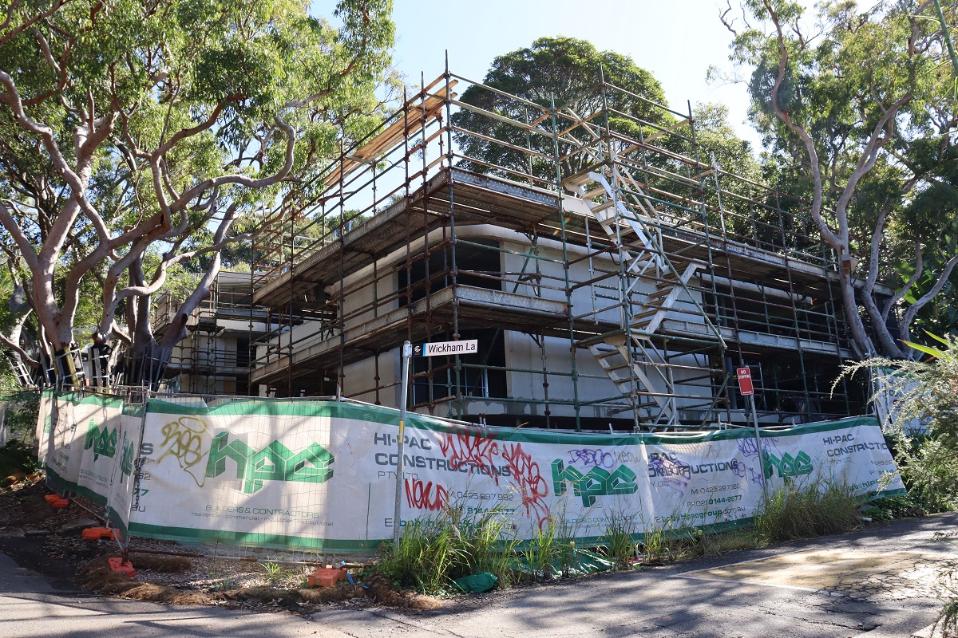
Scruby Sounds Warning on NSW Government's 'Community Participation Plan': Flats, Shop-top housing, New Dwellings, secondary dwellings even trees to be exempt from Exhibition-consultation
For flats and shop-top housing developments, neighbours only need to be notified 7 days before work commences, under the proposed changes.
''This is under the 'guise' of streamlining.'' the MP for Pittwater stated
''In Pittwater, we already know how deeply people are affected when major planning decisions are made without proper local input. The short time frames are being felt heavily this week with the War Vets proposal.
We have also seen this with proposals like Indigo by Moran in Narrabeen, where residents raised serious concerns about scale, traffic, flooding, evacuation, local infrastructure and the impact on surrounding streets.
That is why consultation matters.
Local residents understand the real impacts of development: which roads already fail in peak hour, where stormwater backs up, where bushfire evacuation is constrained, where parking is already at capacity, and how new buildings will affect the character of our villages.
I support more homes in the right places, with the right infrastructure. But reducing community consultation is not the answer.
Good planning should mean listening earlier, being more transparent and making better decisions with local knowledge on the table.
Make sure you have your voice heard and Have Your Say on the new consultation being proposed until 3 June 2026 on the Statewide Community Participation Plan.'' Ms Scruby said
Development to be exempted from public exhibition and notification
Under the Discussion Paper for the 'Community Participation Plan' it is proposed to exempt certain development types from public exhibition and notification where the development:
- is permissible in the relevant zone and,
- meets the relevant planning controls in a local environmental plan, development control plan and/or state environmental planning policy and,
- does not include a 4.6 variation
The lists include, under each heading:
Residential and related uses:
- Residential flat buildings*
- Shop top housing*
- Boundary adjustment
- Rural workers dwellings
- Demolition (excluding heritage items)
- Secondary dwellings
- Exhibition homes and villages
- Strata and Stratum subdivision
- Group homes
- Tree removal where they are not heritage items
- Heritage item – minor works that does not impact item and is located behind the front façade
- Home business and/or home occupation
- Alterations - Internal alterations
- Moveable dwellings
- Alterations and additions to existing dwellings
- New single and two storey dwellings, dual occupancies and attached dwellings
- Ancillary development (such as pools, sheds, farm buildings)
- Temporary structures
*a pre-commencement of works notification to adjoining neighbours is required 7 days before works commence
Primary production and rural development:
- Agritourism
- Extensive agriculture
- Commercial farm
- Farm buildings
Commercial development:
- Alterations and additions
- Kiosks
- Change of use
- Roadside stalls
- Take away food and drink premises
- Signage
Industrial development:
- Change of use
- Industrial retail outlets
Community, health, education, recreational and other infrastructure:
- Alterations – internal and external
- Environmental protections works
- Environmental facility
Tourist and Visitor accommodation:
- Bed and Breakfast accommodation
- Farm stay accommodation
Other:
- Modifications involving minimal environmental impact
- Applications made under section 4.55(1) of the EP&A Act.
- Applications made under section 4.55(1A) of the EP&A Act.
- Applications made under section 4.56 of the EP&A Act with minimal environmental impact
- Application for the review of a determination or decision of a consent authority (Division 8.2 Reviews)
- Reviews where the application has not been amended pursuant to section 8.3(3) of the EP&A Act.
Public exhibition of division 8.2 reviews
The Discussion paper states that:
'To support the NSW Government’s Planning Systems Reforms, and increase the uptake of internal reviews, the draft Community Participation Plan proposes changes to the public exhibition period of certain types of reviews. Currently, review applications are to be exhibited for 14 days unless the Community Participation Plan specifies otherwise.
To resolve unnecessary exhibition, in the draft Community Participation Plan the Department is proposing:
- that an application for review that has not been amended pursuant to section 8.3(3) will be exempt from public exhibition. The consent authority will consider submissions made on the original application in determining the review. Notification to previous submitters may still be made.
- where an application has been amended under section 8.3(3), the public exhibition period is to be the same as the original application.
Residential flat buildings and shop top housing
Residential flat buildings and shop top housing are development types which are proposed to be exempt from standard public exhibition and notification across NSW where:
- residential flat buildings or shop top housing are permissible in the relevant zone, and,
- the development meets the controls under a local environmental plan, development controls plan and/or a state environmental planning policy, and,
- does not include a 4.6 variation.
To ensure communities are still being informed, a new pre-commencement notification that requires written notice to adjoining neighbours 7 days prior to works commencing is proposed.
Targeted assessment
The targeted assessment pathway introduced as part of the planning system reforms allows certain steps in the development assessment process such as public exhibition to be turned off where those matters have already been addressed through earlier planning processes. This would be implemented through the introduction of a state environmental planning policy.
Public exhibition requirements for the targeted assessment pathway are detailed in the Environmental Planning and Assessment Act 1979 and included in the draft Community Participation Plan.
Higher impact development
The current minimum 28-day public exhibition timeframe for high impact development such as development that requires an environmental impact statement, designated development, and nominated integrated development will remain unchanged under the proposed changes.
Pittwater MP Speaks Up
On Thursday May 14 Pittwater MP Jacqui Scruby rose in the Parliament of New South Wales to point out the government and opposition supported planning reforms do not take into account the constraints of the areas they have been enforced on.
Ms Scruby pointed out that, ''Both the Liberal and Labor Party have worked together to reform our planning scheme to be developer-led, rather than community-led - including Mona Vale as low and mid-rise. … even last week in parliament they doubled down on it when they voted against allowing RFS to veto developments like Lizard Rock in high bushfire risk areas.''
Ms Scruby was referring to what a Liberal party member stated during the Second Reading for Mr Regan's Bushfire Protection Bill:
“The Opposition is pro-housing supply, and Opposition members were proud to support the planning system reforms bill assented to on 24 November 2025.”
Ms Scruby stated in her May 14 speech to the House:
Today I speak for the residents of Mona Vale, in particular the SOS Save Our Suburb Mona Vale group that has over 650 members and 1,200 supporters. It is a community group that cares deeply, and understands the privilege of living in beautiful Pittwater and the responsibility it has to protect the suburb while also respecting the need to meet housing targets. However, we want to meet housing targets in the way they should be met, by using local planning controls and being council led rather than developer led. Council-led planning means nuanced planning. It means we do not consider a one‑size‑fits‑all blanket planning approach but one that takes into consideration the constraints of our area, including our high risk of natural disasters. Yet Mona Vale has been declared a low- and mid‑rise town centre under the new developer-led housing reforms introduced by the Government and supported by Liberals members, who doubled down on their support of that planning reform in the sitting fortnight just past.
Mona Vale is a suburb of 11,000 residents but services a daily regional load of some 66,000 people as a business hub for the northern beaches. That puts it in the company of suburbs like Strathfield or Blacktown. But the big catch is that we are constrained, by not only infrastructure but also natural geographical considerations like a peninsula. In terms of infrastructure, we have roads currently unfit for purpose and a wastewater treatment plant that overflows and is reaching capacity. We also have geographical constraints and natural disaster risks. I note that the Government committed a grand total $200 million over three years as part of the Faster Assessments Incentive Program to assist with infrastructure for 171 town centres across New South Wales. That is $3,898 for each low- to mid‑rise town centre each year.
Although I appreciate that the money will be skewed to those councils that approve development applications quickly, that figure is effectively nothing for infrastructure improvement for low- to mid‑rise town centres. This is an error in good planning. Mona Vale has been blanketed by the State Government's rezoning—effectively just circles on a map—to the extent that 20 of its 40 streets have been rezoned to allow apartments of up to eight storeys. If developers have their way, that would mean rows of them—a potential to transform the entire suburb to what residents fear will be a Gold Coast‑style concrete jungle with a lack of infrastructure. How did Mona Vale qualify for this transformation? Apparently, it has a big supermarket, which sounds absurd but was one of the major criteria for assessing low- to mid-rise town areas.
I understand and appreciate that the State Government was given a clear mandate to deal with the housing crisis, but that should have been through incentivising councils and developers to plan and build in a way that honoured local planning controls, such as local environmental plans, and that would deliver more net housing. That is not the case for every development Mona Vale that. One‑bedroom and two‑bedroom apartments are being demolished for mega penthouse‑style apartments, which are selling into the millions, delivering fewer apartments and less diversity than existed before. Residents have been robbed of their voice, with 14 days allowed for them to review planning documents, environmental impact statement proposals running into thousands of pages and other documents that they cannot really get their heads around.
Local councils, which know the area well and understand the nuance of planning, have also been robbed of their decision‑making powers. That is cynical and dismissive of the people who elected us to this place. Our electorates expect considered, nuanced and intelligent solutions to the housing crisis, not a one-size-fits approach that puts at risk the places we love. I also add a human dimension to those bland numbers. We should not take an approach of housing at all costs. Recently we heard that those numbers are considered unachievable. In January the Beyond Bricks report coined the term "infill myth". The report identified that retrofitting perfectly sustainable existing buildings and sites is more expensive than greenfield developments.
People in their eighties in my area are now being pressured by others in their blocks to sell. In blocks with strata renewal schemes, residents can be forced out due to the 75 per cent rule, which does not exist in other States. These people thought they were moving into their homes forever. They are not only being forced out of their homes but also at risk of not being able to buy in the area and having to move away. That is because the apartments replacing the ones coming down are simply too expensive and not diverse. Some people are too old to move. Another example is of nine affordable apartments being lost and people like nurses having to move out and relocate completely out of the area. My area condemns the low‑ to mid‑rise planning controls of the Government.
See report running this week: Council's whole of LGA Development Control Plan - Local Environment Plan Consultation Imminent
Local and state environment groups state the Climate Change and Natural Hazards SEPP supports more buildings to go in areas that should not be built in, which creates more hazards and greater impact again on the natural environment.
Concurrently, the government opened feedback on its Draft Sydney Plan, where, once again, not destroying the environment is not a high priority. In fact it is listed as 5th out of 7 Priorities. This was made available December 12 2025, when most people had clocked off for the year. Visit: www.planningportal.nsw.gov.au/draftplans/exhibition/sydney-plan
- June 2018: Golf Avenue Mona Vale Now A Car Park Due To B-Line Commuter growing Pains
- April 2023: Clear Breach Of Height Limit in DA Recommended For Approval on Old Palm Beach Fish & Chip Site + Rezoning of Pittwater plans Ignite Renewed Calls for a Return of Pittwater Council +
- July 2024: Over-development at Palm Beach general Store land: Palm Beach Whale Beach Association for residents encourages all to attend on site hearing
- February 2025: Non-Compliant DA for Palm Beach General Store Site Now supported by council
- February 2025 report: Mona Vale Set to Become Dee Why of Pittwater Under NSW Government's Low and Mid-Rise policy
- May 2025: Pittwater MP slams the Government’s Low and Mid-Rise Housing Policy for turning on the tap for developers
- November 2025: Scruby slams government and opposition teaming up to make it easy for developers as NSW Planning System Reform Bill passes - community asks: who are these elected Representatives actually representing?
- November 2025: Regan Tables Development on Bushfire Prone Land Protection Bill 2025
- November 2025: Over the Top Narrabeen DA Draws Large Crowd to Peaceful Protest: 'This is about Community Standing up For Community'
- November 2025: Community Calls for Narrabeen Seniors Proposal to be Referred to IPC - Mona Vale Save Our Suburb Residents Group Formed - 2 Motions passed at council meeting
- November 2025: Council Stands With Community on Objections to State Significant Development at Ocean Street Narrabeen - Culturally Significant Black Bean Trees to be destroyed - Site is Adjacent to Former grave of 'Narrabeen Man'
- January 2026: Doubling of prior Bassett Street Mona Vale DA proposal under NSW government SSD's provides stark illustration of impact on local environment of laws written 'for developers' (Feedback closes Feb 2, 2026) - Community Objections Being silenced or Ignored - Dec, 2025 Address to Council by Secretary of Protect Pittwater
- February 2026: SOS (Save Our Suburb) Mona Vale: New Residents Group Launched
- February 2026: Wakehurst MPs Bushfire Bill Lapse Date extended: Concerns persist Over DA's in High-Risk Fire Zones
- May 2026: Regan's Bushfire Protection Bill Voted Down
- May 2026: ANZAC Village Seniors Housing SSD to Remove almost 500 Trees from Narrabeen area - allow for 1600 vehicle spaces