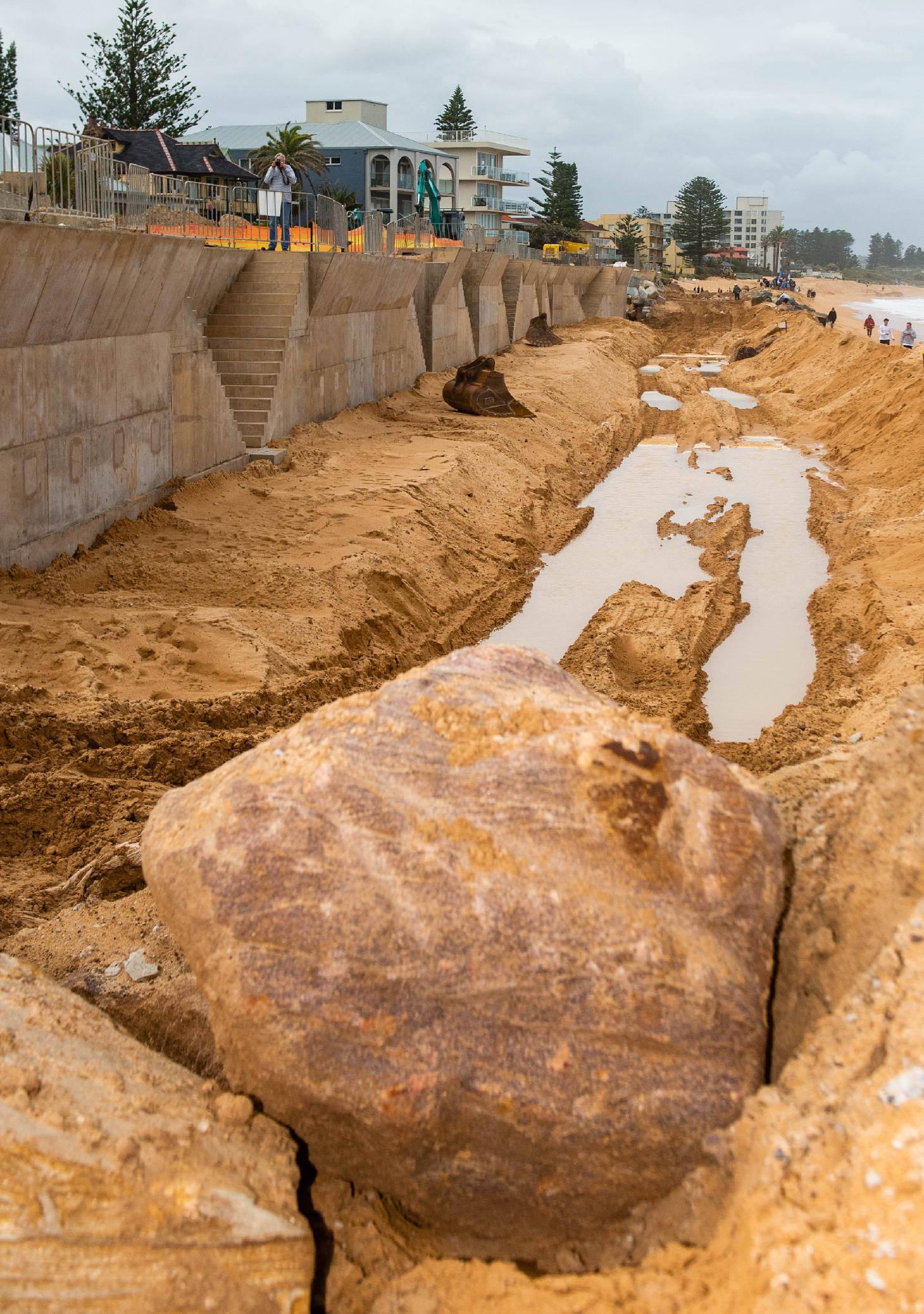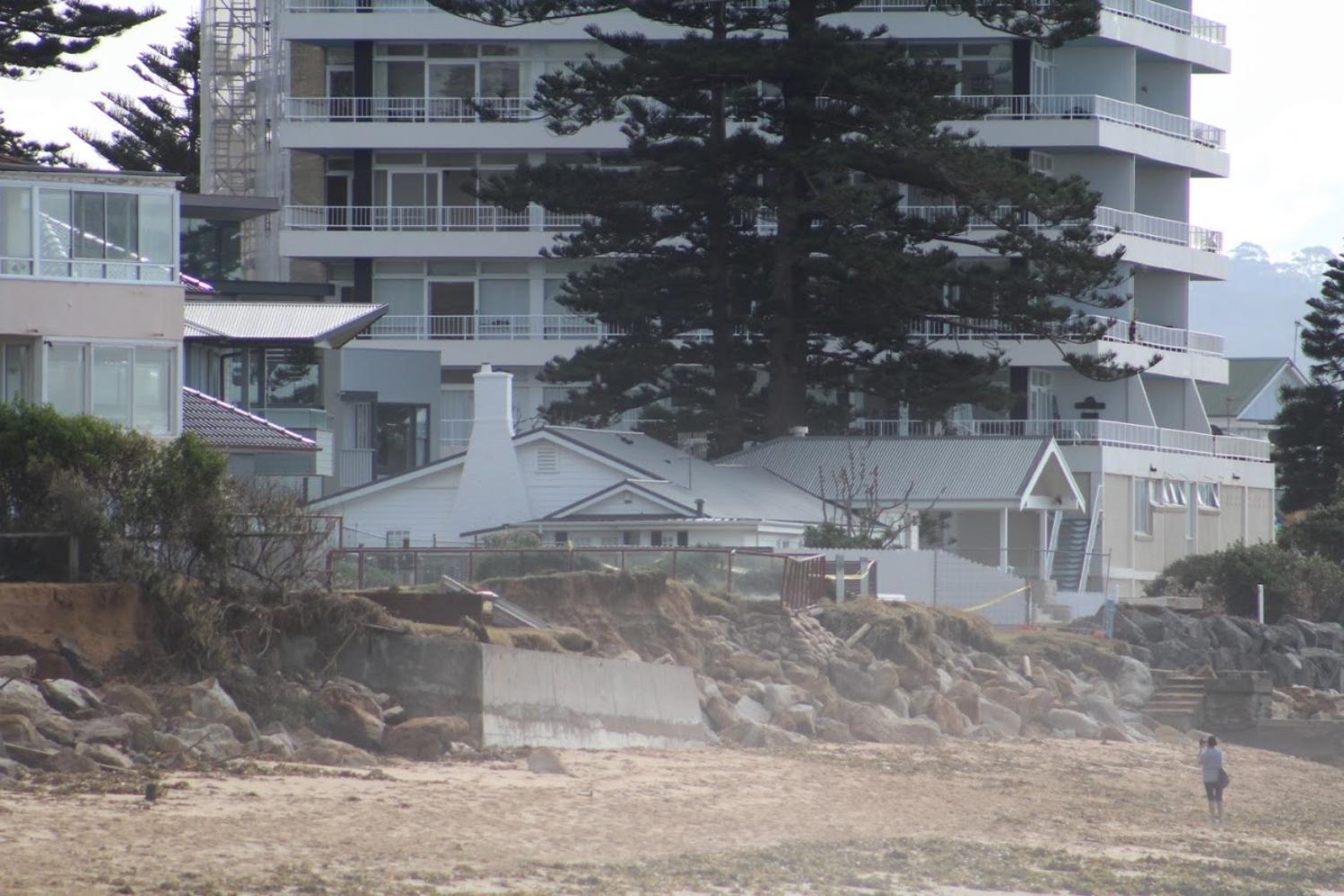
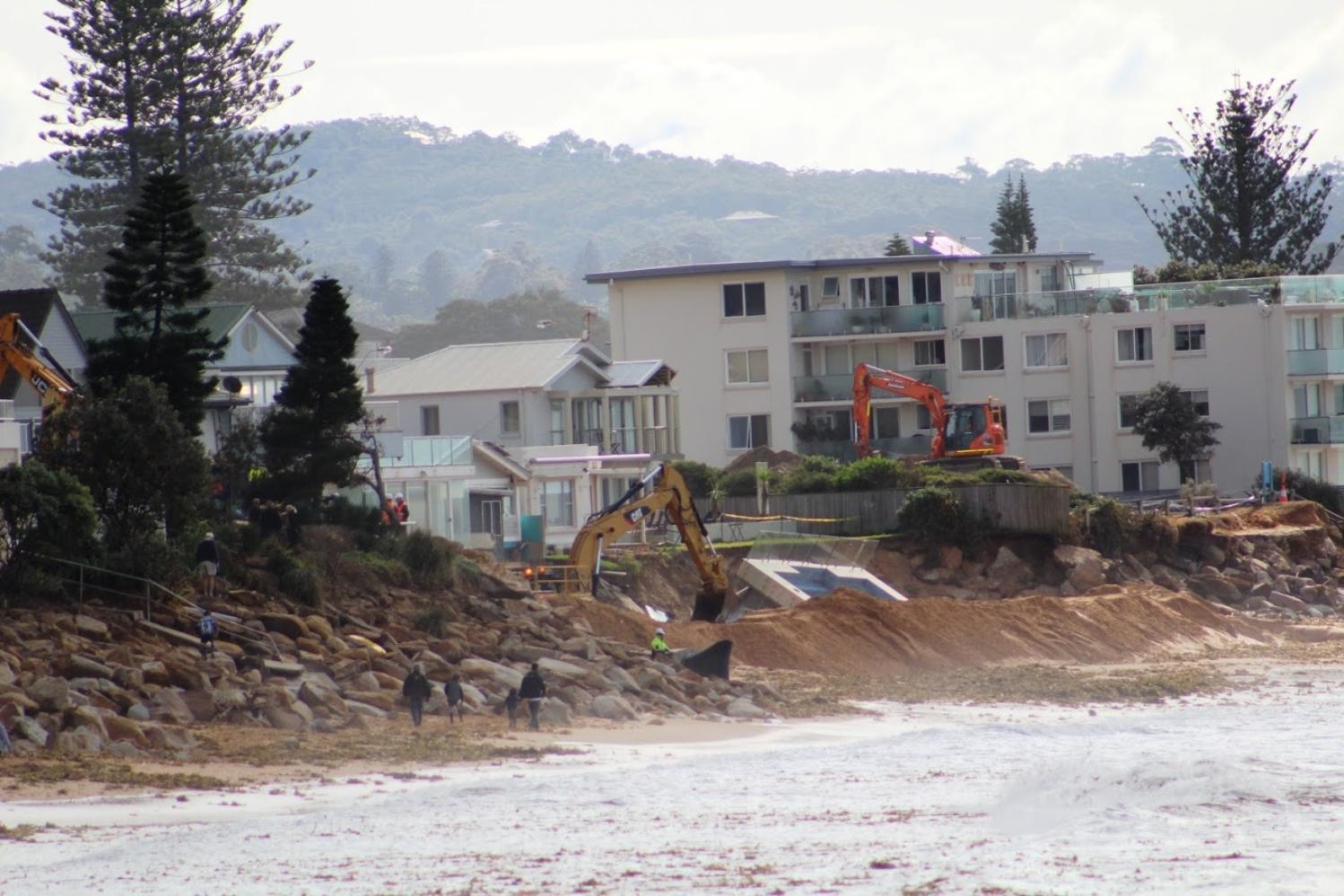
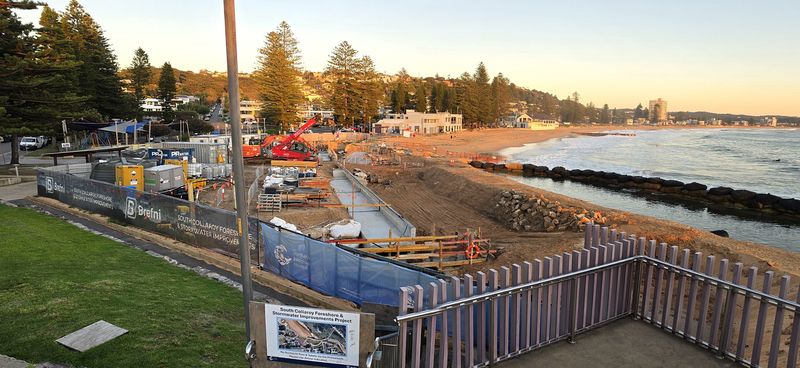
Collaroy beach - south end wall and stormwater works underway.
South Collaroy Foreshore & Stormwater - council's project webpage
At the council meeting held December 16 2025 the council accepted the tender of Brefni Pty Ltd for RFT2025/064 for South Collaroy Foreshore & Stormwater Improvements for the sum of $4,740,886 excluding GST.
The project is Jointly funded by the NSW Government under the Disaster Recovery Funding Arrangements in association with Northern Beaches Council.
Works encompass: 70 metres of damaged seawall reconstructed, 112 metres of stormwater reconstructed (rock pool to surf club), Beach access stairs rebuilt, New junction pit with wet weather surcharge slot.
The latest update of September 24 2026 states: 'Due to unforeseen conditions on site, works will continue into Summer with completion now expected in early 2027, weather permitting. Alternative access to the pool will continue to be provided throughout and we hope to progressively reopen access to parts of the foreshore reserve.'
These works follow on from the installation of 'rock revetments at Stuart St and Ramsay St; installation of new stairs to improve public access' - contract awarded January 28 2025 to Coastwide Civil Pty Ltd of Albion Park for the sum of $1,563,729.55 excluding GST.
Earlier this year $2.1million was revealed as the cost of replacement works at Long Reef for a boardwalk and other coastal works. Part of that sum had been allocated as Crown Reserves Grants for the LGA in 2025 ($500k) - Hazardous surf conditions damaged the timber boardwalk connecting Long Reef Beach and headland in May 2023. The council put in intermediate works to maintain access and commenced working towards a permanent replacement of the timber boardwalk.
At the July 15 2025 council meeting the councillors voted to accept the tender of Whittaker Civil Pty Ltd for RFT 2024/182 - Long Reef Boardwalk for the sum of $1,205,710 excluding GST. The 500k listed above will meet some of these costs.
The finalised plans included moving two golf tees and installing a 2 metre wide Fibre-reinforced Plastic, or plastic, walkway into the environment, and a new 6m span aluminium bridge, along with cutting into the dunes. Large sandstone boulders were to be installed to stabilise the bank. The council webpage for the project provided details and was to be updated as the works commence and progress. That page has since been removed.
The April 2026 PON Report, with statements sent in, was:
$2.1 Million for path at Collaroy’s Griffith Park
April 9 2026The Minns Labor Government is funding and delivering better communities, with investment through the Crown Reserves Improvement Fund helping complete a $2.1 million upgrade of the Griffith Park boardwalk at Collaroy, now open to the public.
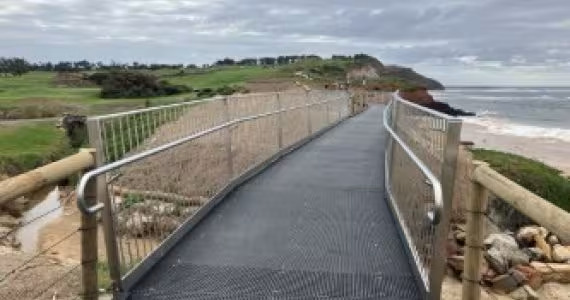 plastic boardwalk alongside the ocean installed at Collaroy. photo: NSW Government
Part of the iconic Long Reef Headland coastal loop loved by walkers, families and visitors year-round and a well-known whale-watching spot. The project replaced and realigned around 110 metres of boardwalk and bridge and upgraded a 20-metre beach access ramp. The work restores a vital link previously vulnerable to storm damage and erosion, improving safety and access for the community.
Delivered by Northern Beaches Council, the project included relocating the structure further inland, along with design, site investigations and construction.
From Griffith Park and the adjacent Long Reef Headland, visitors can take in dramatic 230‑million‑year‑old red claystone cliffs, often known locally as ‘chocolate shales’, sweeping panoramic views across Dee Why and Collaroy beaches, and at low tide, extensive rock platforms rich with fossils and marine life.
Long Reef Reserve is a popular destination for walking, whale watching and enjoying the coastline, as well as swimming and surfing. The upgraded boardwalk supports continued enjoyment of this remarkable headland for locals and visitors alike.
Crown reserves play an important role in providing access to valued public places, and the NSW Government continues to invest in maintaining and improving these shared spaces so communities can enjoy them now and into the future.
Minister for Lands and Property Steve Kamper said:“This upgrade is a fantastic boost for the local community, making it safer and easier for people to enjoy one of the most loved coastal walks.
“It’s great to see NSW Government funding delivering real improvements that help locals and visitors make the most of these incredible public spaces.”
Member for Wakehurst, Michael Regan said:“I am wrapped with the result and the positive feedback I’ve received thus far. A great partnership that had Council and State Govt working closely together on this world-class destination. Glad to have played my part in delivering this for all to enjoy.”
Mayor Sue Heins said:“Long Reef Headland remains one of our best-loved coastal walks, and this upgrade ensures it is now safer, more accessible and enjoyable for everyone.
“We have worked closely with our community and stakeholders to deliver a solution that protects the environment, honours cultural heritage, and enriches the experience for all who enjoy this stunning stretch of coastline.”
No One can Hold back the OceanThese works follow on from the Collaroy Seawall works further north, part of which was paid for by the ratepayers of Pittwater and excised 20 metres of public land from public ownership in order to fulfil this project.
The Collaroy seawall was forecast to cost $24.85 million. Of that, the protection of private property totals $17.3 million covering 49 private property owners - average of $282,000 to $300,000+ per resident/property - with the rest of the tab met by ratepayers and taxpayers. A further allocation was made by the council on behalf of the ratepayers of Pittwater, Warringah and Manly atop this.
The Council had a further application for an extension of this wall towards North Narrabeen (DA2021/1612) between Clarke Street and Mactier, which its subsequently approved.
The cost of this section of works was listed as $ 2,047,433.00 of which 10% will be met by council and 10% by the state government - or 20% by taxpayers and ratepayers in real terms.
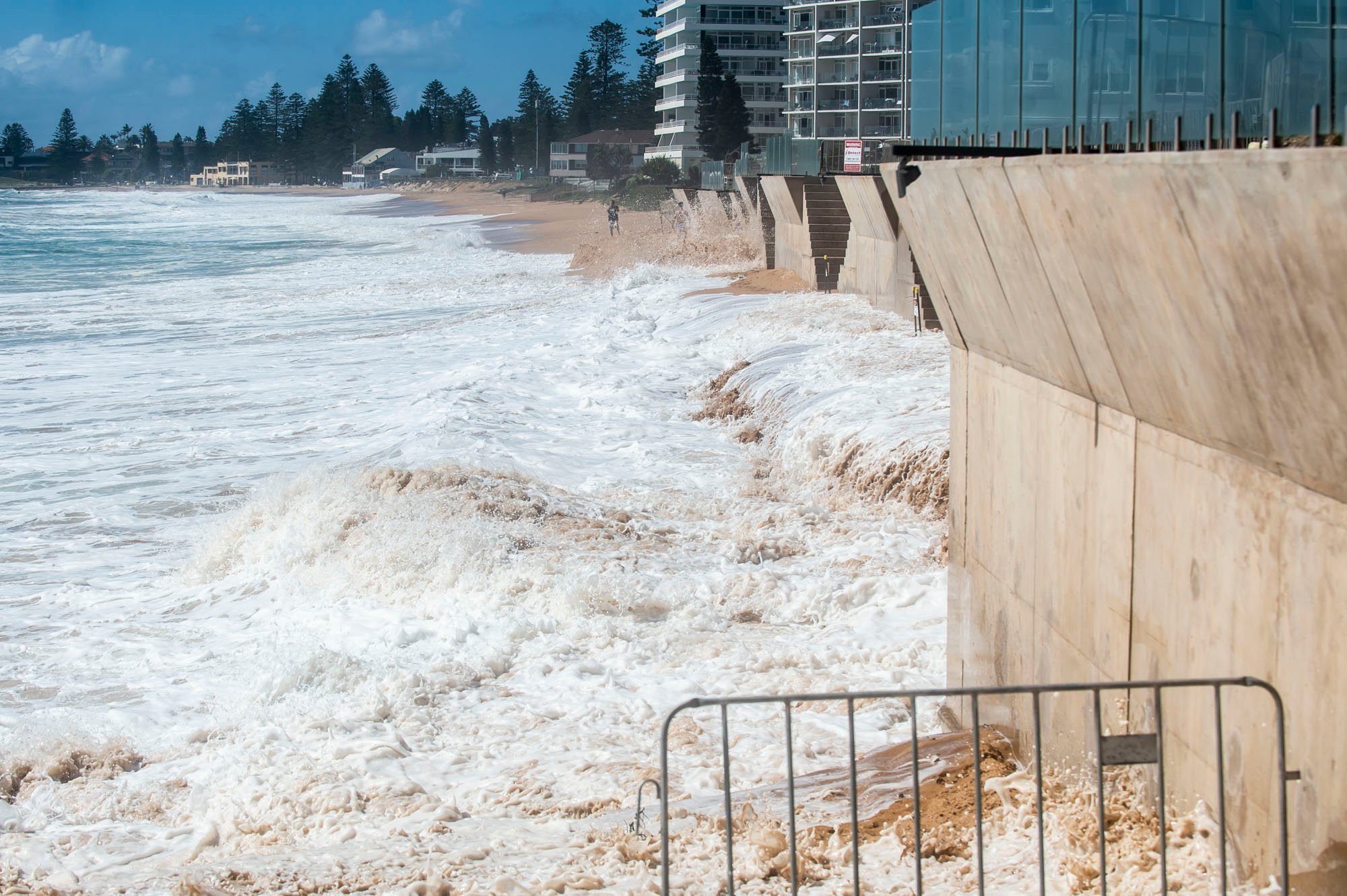
Collaroy seawall on January 4th 2022. Image: Ian Bird Photography.
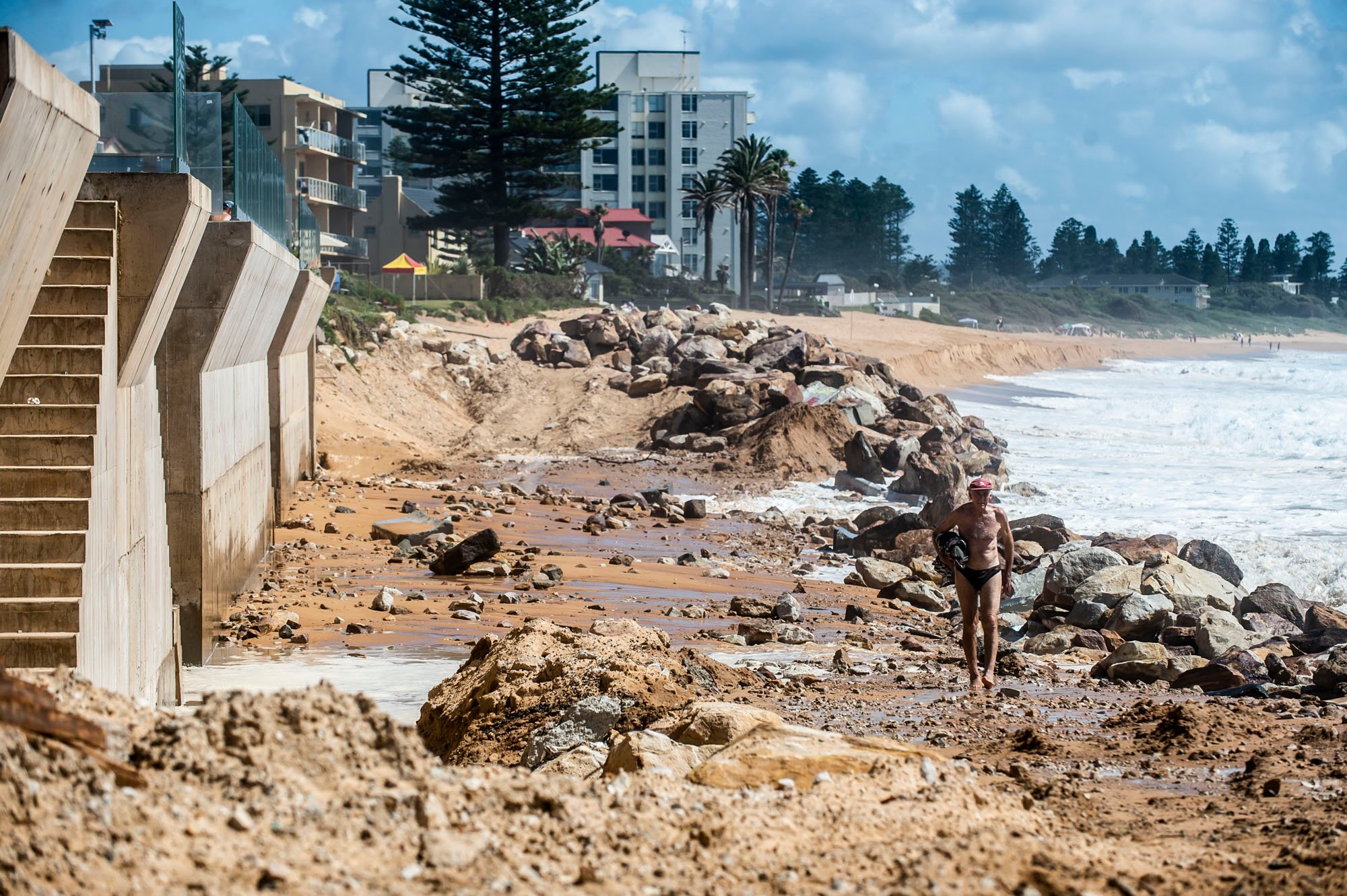
Collaroy beach on January 4th 2022. Image: Ian Bird Photography.
The Collaroy seawall works lock in perpetually moving sand eroded from the Long Reef to Collaroy to Narrabeen stretch of beach and shifted into Narrabeen Lagoon for ratepayers to the tune of some $22+million according to the initial report by the Administrator when Pittwater was forcibly merged with Warringah Council again.
Locals along with coastal engineers state the works are also a contributing factor to coastal erosion increasing at Turimetta Beach due to the sweep of the tides and ocean off the Collaroy to Narrabeen to Turimetta beaches. Studies have found that anywhere a hard development is placed in a sand dune area it will cause erosion to the north and south of that structure.This is not the sole reason for works dredging Narrabeen Lagoon at its entrance being required more frequently in recent years.At the 2026 Friends of Narrabeen Lagoon Catchment AGM and August Forum, renowned and respected Coastal Engineer Angus Gordon OAM outlined how increased development upstream in the lagoon, at Frenchs Forest and Forestville, along with road upgrades, is causing more runoff into the lagoon itself.

Narrabeen Lagoon dredging works,. October 2025. Photos: Joe Mills
NBC Carrying $8 Million Climate Change Deficit
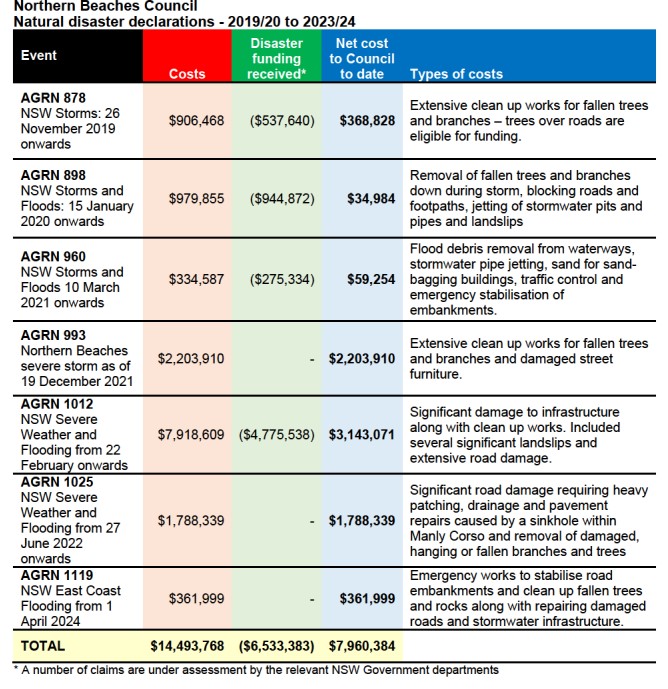
During the 2025 ‘Ability of local governments to fund infrastructure and services’ NSW Parliament Inquiry a question to the Chief Financial Officer, Northern Beaches Council, revealed a deficit of almost $8million in costs sustained by weather events.
The CFO's Answers to Questions on Notice the response to 'What types of costs are incurred in response to a natural disaster?' was:
The Northern Beaches is highly exposed to a raft of natural hazards with current data indicating:
- Over 22,000 properties are affected by flood;
- 19,000 properties are bush fire prone;
- 63,000 properties exposed to moderate to high geotechnical risk, and
- close to 5000 properties affected by coastal hazards.
The recently released NSW State Disaster Mitigation Plan estimates that by 2060 the Northern Beaches will have the highest Total Average Annual Losses in NSW by 2060, with estimated losses of close to $1 billion dollars per annum to the built environment alone.
The following table sets out the types of costs incurred by Council in the past 5 years for natural disasters. Northern Beaches Council Natural disaster declarations - 2019/20 to 2023/24:
However, the council is still approving DA's in known flood zones, as is the state government under its SSD (State Significant Development) program - which has been extended to housing, with community consultation reduced to 14 days and further made irrelevant under its 'Community Participation Plan' (CPP), which actually served to entrench and expand the complete exclusion of any community voice from September 1st 2026 for a long list of proposed developments that will impact residents.
These works follow on from the Collaroy Seawall works further north, part of which was paid for by the ratepayers of Pittwater and excised 20 metres of public land from public ownership in order to fulfil this project.
The Collaroy seawall was forecast to cost $24.85 million. Of that, the protection of private property totals $17.3 million covering 49 private property owners - average of $282,000 to $300,000+ per resident/property - with the rest of the tab met by ratepayers and taxpayers. A further allocation was made by the council on behalf of the ratepayers of Pittwater, Warringah and Manly atop this.
Narrabeen Lagoon dredging works,. October 2025. Photos: Joe Mills
NBC Carrying $8 Million Climate Change Deficit
During the 2025 ‘Ability of local governments to fund infrastructure and services’ NSW Parliament Inquiry a question to the Chief Financial Officer, Northern Beaches Council, revealed a deficit of almost $8million in costs sustained by weather events.
The CFO's Answers to Questions on Notice the response to 'What types of costs are incurred in response to a natural disaster?' was:
The Northern Beaches is highly exposed to a raft of natural hazards with current data indicating:
- Over 22,000 properties are affected by flood;
- 19,000 properties are bush fire prone;
- 63,000 properties exposed to moderate to high geotechnical risk, and
- close to 5000 properties affected by coastal hazards.
The recently released NSW State Disaster Mitigation Plan estimates that by 2060 the Northern Beaches will have the highest Total Average Annual Losses in NSW by 2060, with estimated losses of close to $1 billion dollars per annum to the built environment alone.
The following table sets out the types of costs incurred by Council in the past 5 years for natural disasters. Northern Beaches Council Natural disaster declarations - 2019/20 to 2023/24:
However, the council is still approving DA's in known flood zones, as is the state government under its SSD (State Significant Development) program - which has been extended to housing, with community consultation reduced to 14 days and further made irrelevant under its 'Community Participation Plan' (CPP), which actually served to entrench and expand the complete exclusion of any community voice from September 1st 2026 for a long list of proposed developments that will impact residents.
Draft NSW coastal management manual: Have your say
The Department of Climate Change, Energy, the Environment and Water is seeking feedback on the draft NSW coastal management manual.
Consultation period: 12th October 2026 - 30th October 2026
What’s this about?
The NSW Government is seeking feedback on a draft NSW coastal management manual. The current manual was published in 2018 and provides the requirements and guidance used to prepare, certify, implement and review coastal management programs across New South Wales. The draft manual responds to recommendations from the NSW Audit Office's Coastal management performance audit (2025) and feedback from councils, public authorities and coastal practitioners.
The proposed changes aim to:
- make the manual easier to use
- provide clearer requirements and practical guidance
- improve the processes for preparing and certifying coastal management programs.
The draft manual does not amend the Coastal Management Act 2016 or fundamentally change the statutory process for preparing and certifying coastal management programs. Existing certified programs will remain valid.
Following consultation, we will review the feedback and use it to finalise the draft manual. The updated manual will then be considered by the Minister for the Environment. If approved, once published in the NSW Government Gazette, the updated manual will replace the current manual and commence in late 2026.
NSW coastal management manual
Date: 12 Oct 2026 - PDF 22.29 MB / Pages 90 download here
Mandatory requirements and guidance for a coastal management program
The draft manual sets out mandatory requirements and supporting guidance for preparing, adopting, implementing, reviewing and amending coastal management programs under the Coastal Management Act 2016.
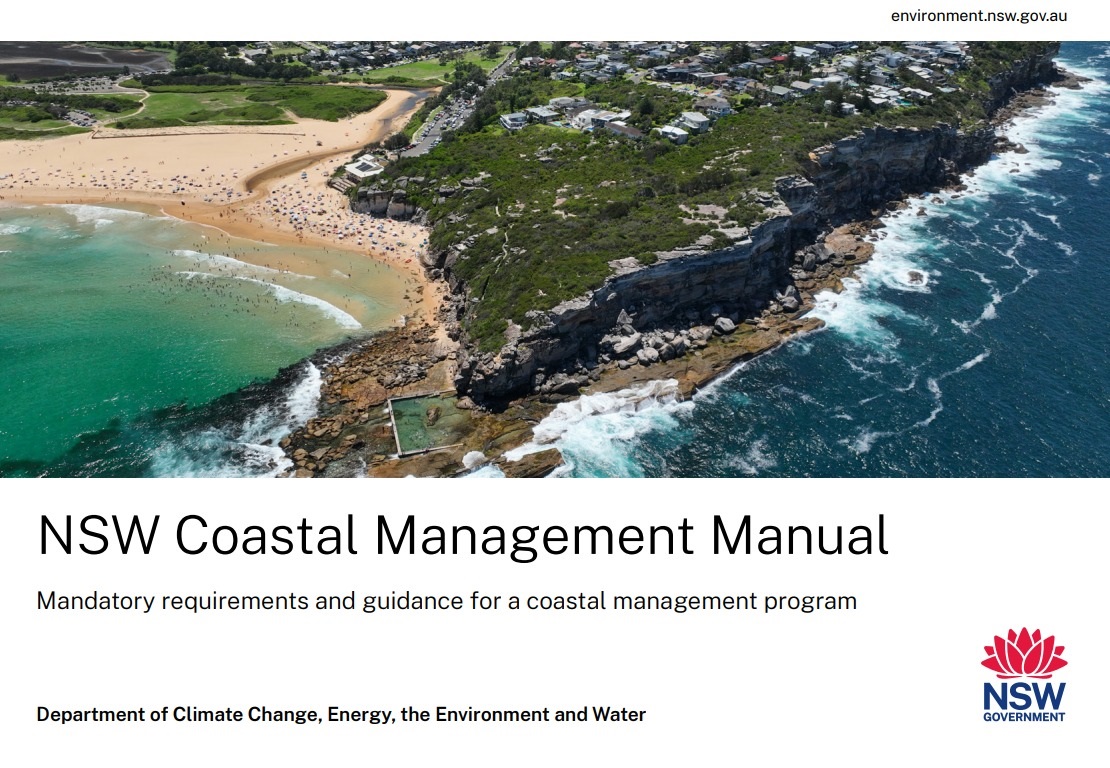
Draft Document cover: for ID when downloading
Proposed changes to the NSW coastal management manual consultation summary (PDF 1.59 MB / Pages 10)
This document summarises the main proposed changes and explains how they respond to recommendations from the NSW Audit Office and feedback from councils, government agencies and coastal practitioners.
The proposed changes aim to make the manual easier to use, provide clearer requirements and practical guidance, and improve the processes for preparing and certifying coastal management programs. The draft manual also supports a more proportionate and risk-based approach to coastal management planning, stronger implementation and review, and improved recognition of Aboriginal cultural values, knowledge and participation.
We are particularly interested in whether the draft manual:
- clearly identifies mandatory requirements
- provides practical guidance
- improves coastal management program preparation and certification
- supports a proportionate and risk-based approach
- provides clearer expectations for implementation and review
- is easier to navigate and use than the current manual
- allows for a simple transition for existing and in-train CMPs
- could create any unintended practical consequences.
We invite councils, coastal practitioners, government agencies, community organisations and interested members of the public to review the draft manual and provide feedback. Your feedback will help inform the final manual before it is considered by the Minister for the Environment.
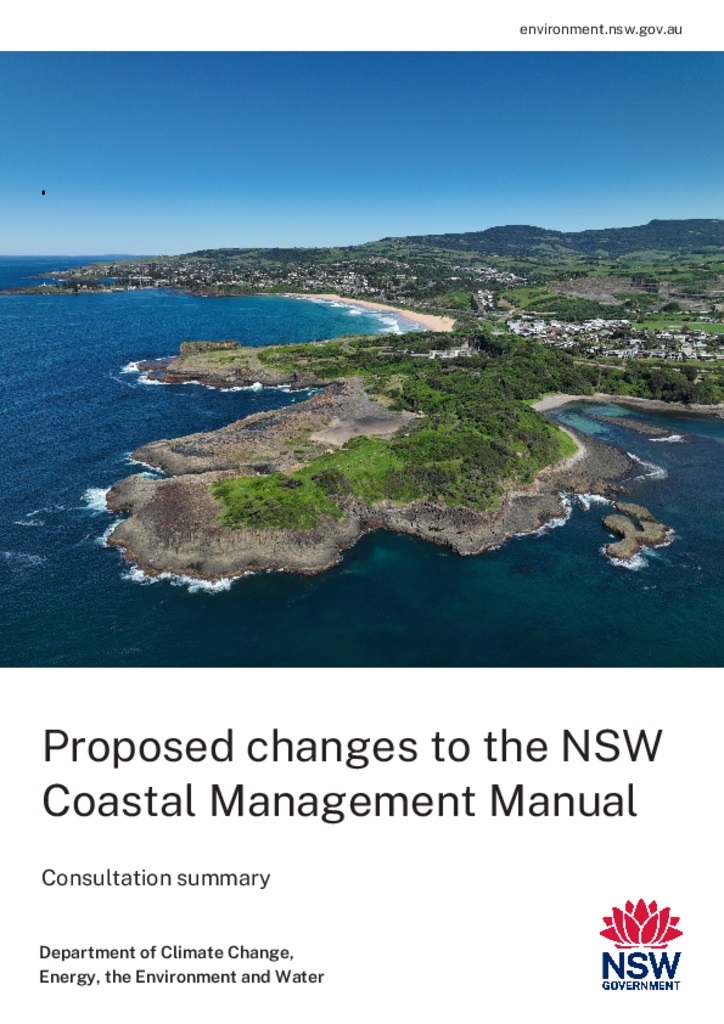
Draft Document cover: for ID when downloading
Have your say
Have your say by 11:59 pm Friday 30 October 2026.
There is one way to submit your feedback. - Online
Draft coastal management manual online feedback form
Complete this short survey to provide feedback on the draft coastal management manual and help identify any improvements needed before it is finalised.
Contact us
Marine, Coast, Estuary and Flood team - Email: coastandestuary@dcceew.nsw.gov.au
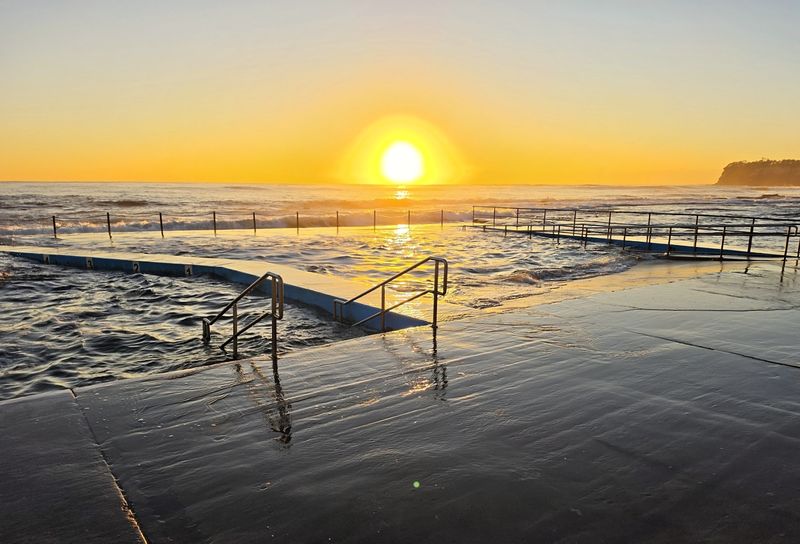
Collaroy rockpool at high tide, Friday October 9 2026
The Department of Climate Change, Energy, the Environment and Water is seeking feedback on the draft NSW coastal management manual.
Consultation period: 12th October 2026 - 30th October 2026
What’s this about?
The NSW Government is seeking feedback on a draft NSW coastal management manual. The current manual was published in 2018 and provides the requirements and guidance used to prepare, certify, implement and review coastal management programs across New South Wales. The draft manual responds to recommendations from the NSW Audit Office's Coastal management performance audit (2025) and feedback from councils, public authorities and coastal practitioners.
The proposed changes aim to:
- make the manual easier to use
- provide clearer requirements and practical guidance
- improve the processes for preparing and certifying coastal management programs.
The draft manual does not amend the Coastal Management Act 2016 or fundamentally change the statutory process for preparing and certifying coastal management programs. Existing certified programs will remain valid.
Following consultation, we will review the feedback and use it to finalise the draft manual. The updated manual will then be considered by the Minister for the Environment. If approved, once published in the NSW Government Gazette, the updated manual will replace the current manual and commence in late 2026.
NSW coastal management manual
Date: 12 Oct 2026 - PDF 22.29 MB / Pages 90 download here
Mandatory requirements and guidance for a coastal management program
The draft manual sets out mandatory requirements and supporting guidance for preparing, adopting, implementing, reviewing and amending coastal management programs under the Coastal Management Act 2016.
Draft Document cover: for ID when downloading
Proposed changes to the NSW coastal management manual consultation summary (PDF 1.59 MB / Pages 10)
This document summarises the main proposed changes and explains how they respond to recommendations from the NSW Audit Office and feedback from councils, government agencies and coastal practitioners.
The proposed changes aim to make the manual easier to use, provide clearer requirements and practical guidance, and improve the processes for preparing and certifying coastal management programs. The draft manual also supports a more proportionate and risk-based approach to coastal management planning, stronger implementation and review, and improved recognition of Aboriginal cultural values, knowledge and participation.
We are particularly interested in whether the draft manual:
- clearly identifies mandatory requirements
- provides practical guidance
- improves coastal management program preparation and certification
- supports a proportionate and risk-based approach
- provides clearer expectations for implementation and review
- is easier to navigate and use than the current manual
- allows for a simple transition for existing and in-train CMPs
- could create any unintended practical consequences.
We invite councils, coastal practitioners, government agencies, community organisations and interested members of the public to review the draft manual and provide feedback. Your feedback will help inform the final manual before it is considered by the Minister for the Environment.
Draft Document cover: for ID when downloading
Have your say
Have your say by 11:59 pm Friday 30 October 2026.
There is one way to submit your feedback. - Online
Draft coastal management manual online feedback form
Complete this short survey to provide feedback on the draft coastal management manual and help identify any improvements needed before it is finalised.
Contact us
Marine, Coast, Estuary and Flood team - Email: coastandestuary@dcceew.nsw.gov.au
Collaroy rockpool at high tide, Friday October 9 2026
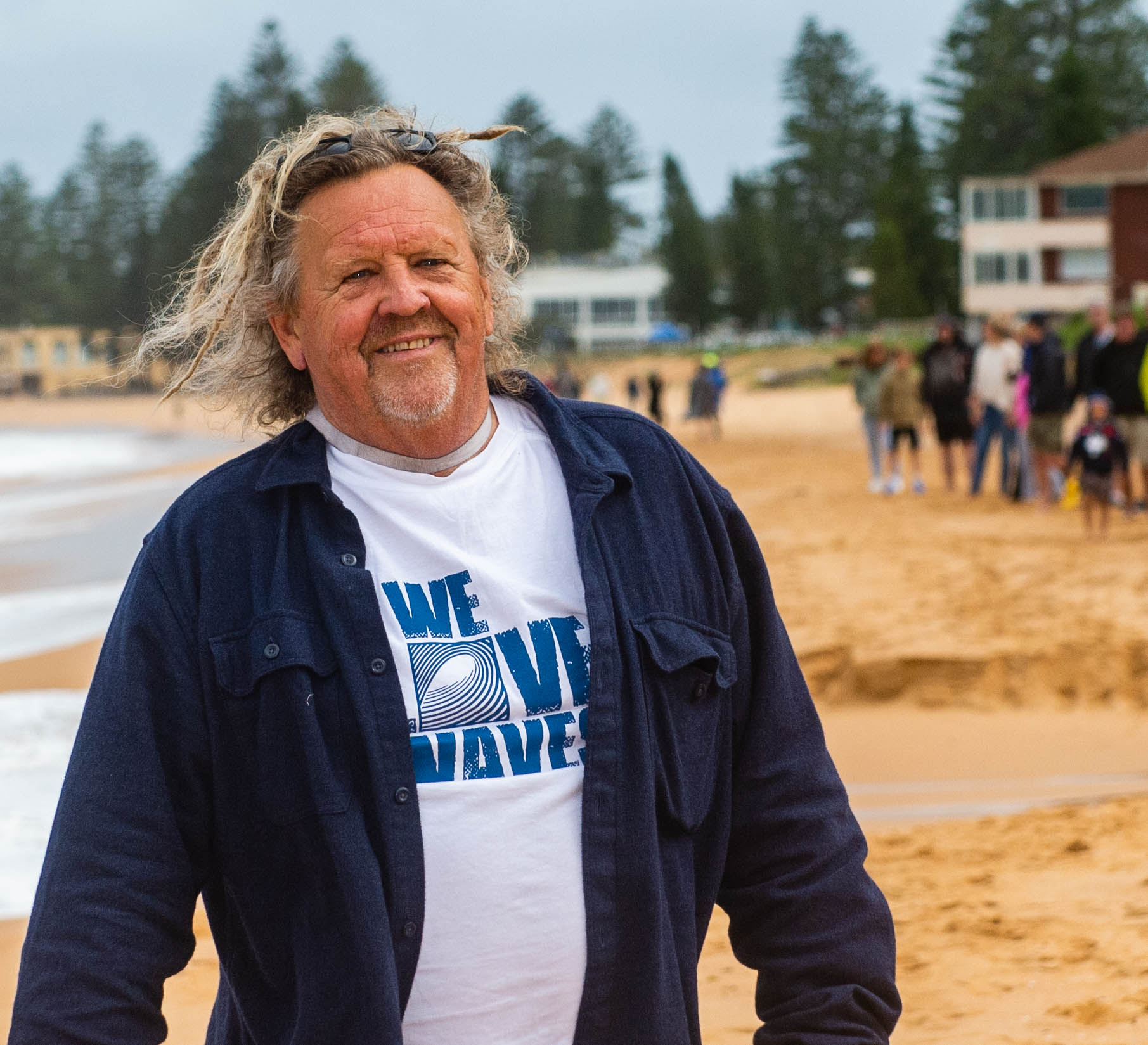
Brendan Donohoe, President of Surfrider Foundation Northern Beaches, at Line in the Sand 2021 at Collaroy-Narrabeen. Mr. Donohue, along with others, has and is still working to introduce facts and logic to seawalls being installed under the NBC. Photo: Michael Mannington, Community Photography