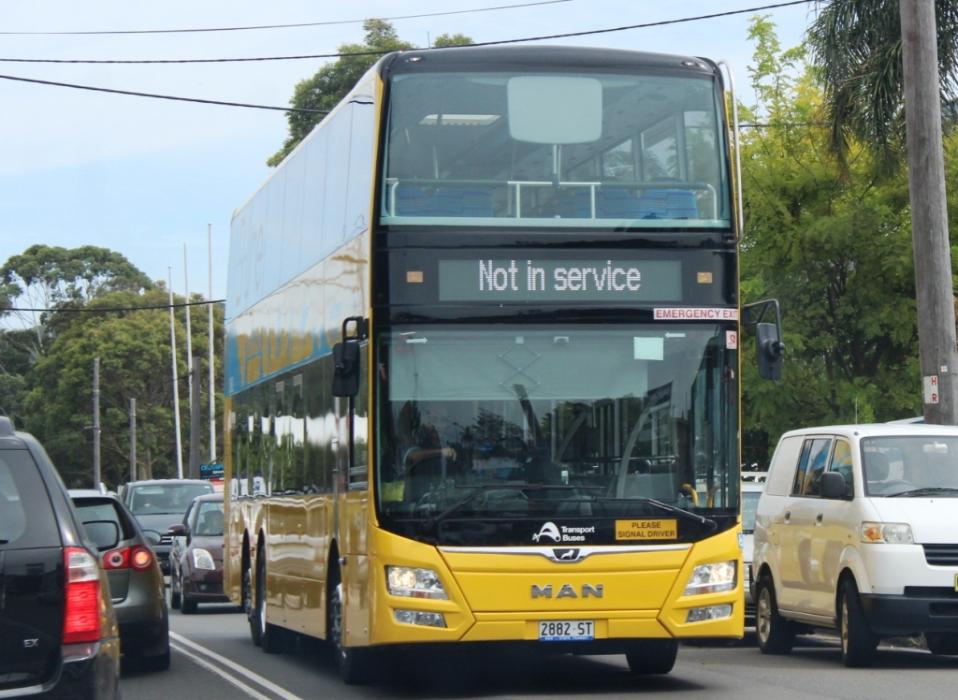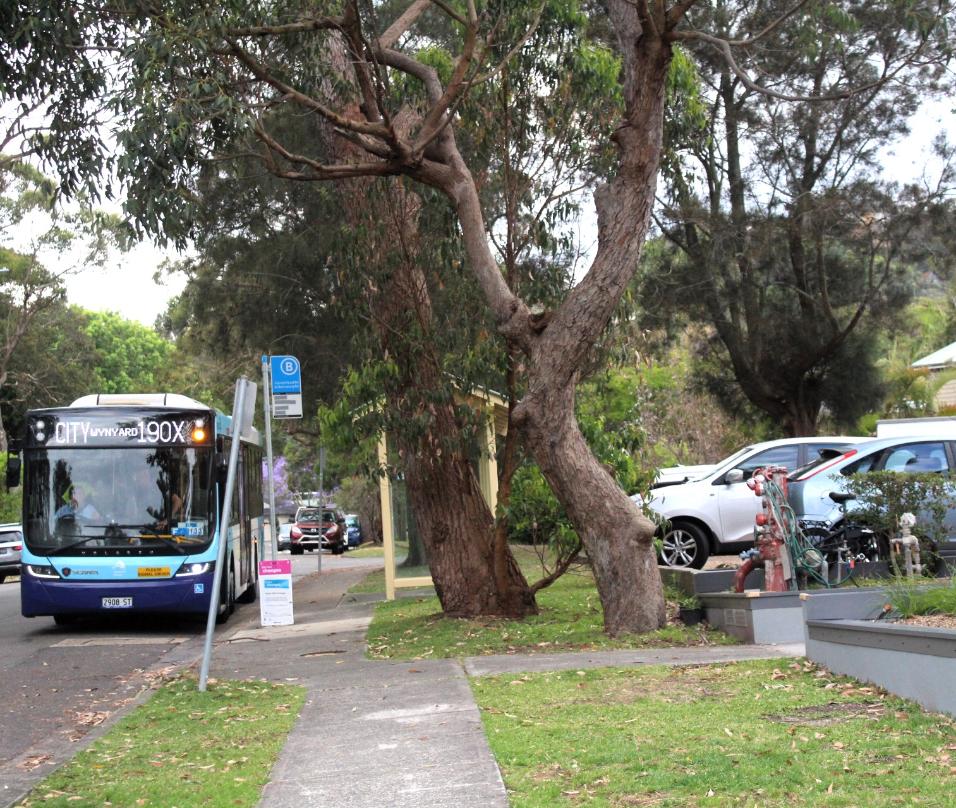
190x start point. Photo: A J Guesdon/PON
The funding boost will be tied to increases in pay that will keep more bus drivers behind the wheel after years of driver shortages across Sydney and outer metropolitan areas which resulted in regular service cancellations for passengers.
The NSW Government said it expects bus operators to also contribute to the pay rise, with government funding contingent on unions and operators reaching an agreement.
The NSW Government stated it respects the right of workers to bargain, but urges all parties to avoid industrial action that unfairly disrupts commuters and the millions of people who rely on public transport to get to work, school and appointments.
See June 2026 report: Bus disruptions due to industrial action
Under the privatised model inherited from the Liberals, the NSW Government is not party to ongoing enterprise agreements between private bus operators, drivers and unions, but the funding will be made available and will be tied directly to the wage rise outcome.
Today, just six per cent of Sydney bus drivers are women and this funding will also be tied to improved access to part-time work for drivers, as well as better training opportunities and workplace improvements like more practical meal breaks.
The government stated on Friday July 10 this will address the persistent bus driver shortage that blew out past 500 drivers under the former Liberal-National government.
Bus services in parts of Sydney, like the Barrenjoey Peninsula, are regularly let down by last-minute cancellations because many drivers can’t afford to live and work in the area due to housing costs.
As of last week, the overall bus driver shortage was down to 168.
The Minns Labor Government’s Bus Industry Taskforce identified bus driver recruitment and retention as the single biggest challenge to delivering reliable bus services.
Of the latest recruits, nine out ten bus drivers who are trained and start working leave the industry within six months.
Bus drivers are paid an average $33 an hour, or $1254.00 per week before being taxed. Earning $1,254 per week equates to a gross annual salary of roughly $65,208. If you are an Australian resident claiming the tax-free threshold, your weekly take-home pay will be about $1,055 after approximately $199 per week in income tax and the Medicare levy is taken out.
In the Pittwater region, average rents range from $750 to over $1,200 per week, depending on the property type and exact location. Region-wide median rents for the northern beaches are $1,350/week for houses and $750/week for units or apartments. However, coastal areas like Avalon Beach and Palm Beach often command upwards of $1,500 to $2,500+ per week for larger family homes, while denser hubs like Warriewood and Mona Vale can provide more entry-level pricing, although even there the best price is around $650 per week for a 1 or 2 bedroom unit, leaving little for utilities, food and other necessary items, such as shoes or school uniforms.
Scruby Calls it Out
Independent Pittwater MP Jacqui Scruby welcomed the NSW Government's $200 million commitment to support higher wages for the state's bus drivers, but says it also confirms what local commuters have known for years; privatisation of the bus network has failed residents.
The funding, announced by the Minns Government, is intended to help end industrial action and secure a wages agreement between bus operators and drivers, including on the Manly to Barrenjoey peninsula, where Keolis is currently in contract negotiations with its drivers.
Ms Scruby said the announcement was genuinely good news for drivers and commuters, but is also an admission that the privatised model imposed on the local populace by the former Liberal Government was not working as promised.
"This is very positive news in one way. In another, it confirms the failure of yet another privatisation contract impacting residents," Ms Scruby said.
"Our buses were privatised under the former Liberal Government. The whole point of privatisation was supposed to be saving taxpayers money, with private companies delivering more for less. Instead, we're now offering a private company that won a competitive tender further financial assistance, funded by taxpayers, just to deliver on the contract it signed up to.
"It's a bit rich, in one sense. But in another, it's a practical, partial solution to lift the pay of drivers who deserve it, and to reduce the disruption commuters have been putting up with. It was a key recommendation of the Bus Industry Taskforce to improve services for passengers.
"It's not simple. Private operators also need to chip in, and it's up to unions and operators to reach their own agreement. Hopefully this funding will help bring about a swifter resolution for drivers and for the passengers stuck waiting at cancelled stops."
Ms Scruby is calling on Keolis to take up the Government's offer and invest further in driver wages, to help end industrial action and meet both its contractual obligations and commuter expectations.
"Keolis's contract with the NSW Government runs until 2030 - Keolis needs to deliver on the contract it signed and at the moment it is failing Pittwater residents. We've seen huge investment in more buses, new electric buses and now driver wages but the elephant in the room is this contract.
Ms Scruby said she would continue to push for accountability from Keolis and the NSW Government to ensure Pittwater residents get the reliable bus services they are paying for.
Since winning office, the Minns Labor Government has:
- Added 5,910 new bus services in Greater Sydney.
- Restored the popular M52 Parramatta to CBD via Ryde service and the 301 Roseberry to Eastgardens service.
- Introduced five new permanent bus routes connecting Campbelltown, Leppington, Oran Park, Penrith, Mount Druitt to each other and the new Western Sydney International Airport.
- Reduced the bus driver shortage down from over 500 to 168.
- Ordered 1089 new buses, including 50 new articulated (bendy) buses and 10 new double decker buses.
- Increased local content to over 50% of over half the buses ordered.
- Upgraded more than 30 bus driver facilities such as meal rooms and bathrooms, including the first ever female bathroom facilities in Parramatta.
Minister for Transport John Graham said:
“We value our bus drivers who get millions of passengers safely to their destination each week, often in the challenging conditions of our most traffic-congested parts of Sydney.
“Tying funding to better wages will send an unequivocal message that we respect your work, and we want to retain drivers for the long-term.
“The former government privatised bus services, cut routes, created the driver shortage, failed to order new buses and sent bus manufacturing jobs offshore.
“This investment is part of the ongoing U-turn we are doing on their entire approach. Including new routes to suburbs that have never seen a bus and almost 6,000 new bus services in the schedule.”
Transport Secretary Josh Murray said:
“This agreement brings fairness and consistency to the bus network by recognising drivers as skilled professionals, no matter where they work across Greater Sydney and the outer metropolitan areas.
“When drivers feel safe, supported and fairly paid, they stay in the industry and that stability is critical to reducing cancellations and improving day to day reliability for passengers.
“This funding assistance provides certainty for drivers and operators alike, supporting long-term workforce planning and a more sustainable bus system overall.
“By helping to lift pay, and making the job safer, the NSW Government is making bus driving a career where people can confidently build their lives around, not just a job, but a profession. We encourage operators and the transport unions to dive into negotiations and bring about a fast and fair deal.”
The Rail, Tram and Bus Union NSW Branch stated:
''The announcement of $200M for bus drivers is a big step forward in our fight for fair wages and conditions in a broken, privatised, bus system.
Not one cent of $200 million announced by the NSW Government for bus driver wages should flow into the corporate coffers of private multinational operators, the Rail, Tram and Bus Union.
The entire package must be quarantined for permanent wage increases and be fully traceable to drivers’ payslips - not swallowed by management fees, corporate overheads or other accounting tricks''.
RTBU NSW Tram and Bus Division President Peter Grech said the funding was an overdue acknowledgment low wages and poor conditions were driving experienced drivers out of the industry.
“This is a direct result of bus drivers on the northern beaches and in Newcastle standing together and taking action over wages and conditions that are driving people out of the industry,” Mr Grech said.
“This is a win for drivers but the job is not finished for us. We must make sure every cent reaches workers’ pay packets and is not siphoned off by private operators.
“These cowboy outfits will rip money out anywhere they can and the Government would be incredibly naïve to hand them another $200 million without iron-clad safeguards guaranteeing it goes directly to drivers.
“Taxpayers already hand billions of dollars to these companies to operate our public bus network. They should be assured this money will not disappear into multinational profits.
“Our bus drivers carry enormous responsibility. They work long and irregular hours, navigate congested roads and deal with everything from abuse to emergencies while safely carrying millions of passengers every week.
“There is a simple reason 90 per cent of newly trained drivers are quitting within six months: a wages and conditions crisis created by privatisation.
“The long-term solution remains bringing bus services back into public hands. Until then, every cent of public funding must improve the lives of the workers who actually keep the buses moving,” Mr Grech said.
See February 2023 report: Cancellation of Bus Services continues to impact local commuters - students: drives residents to take to their cars again, residents state this will be reflected in how they vote in the 2023 state election
See April 2023 report: Millions Left Stranded By Cancelled Bus Services: New Labor Government Transport Minister Delves Into Privatisation Contracts - finds companies make more by leaving you on the side of the road
See April 2024 report: Keolis Downer Northern Beaches Having Payroll Problems: is a 'living wage' leaving people struggling or homeless as large companies seek to expand profits?
See April 2026 report: Kiwis recruited for Local bus driver drought: Scruby eyes 2030 contract renewal
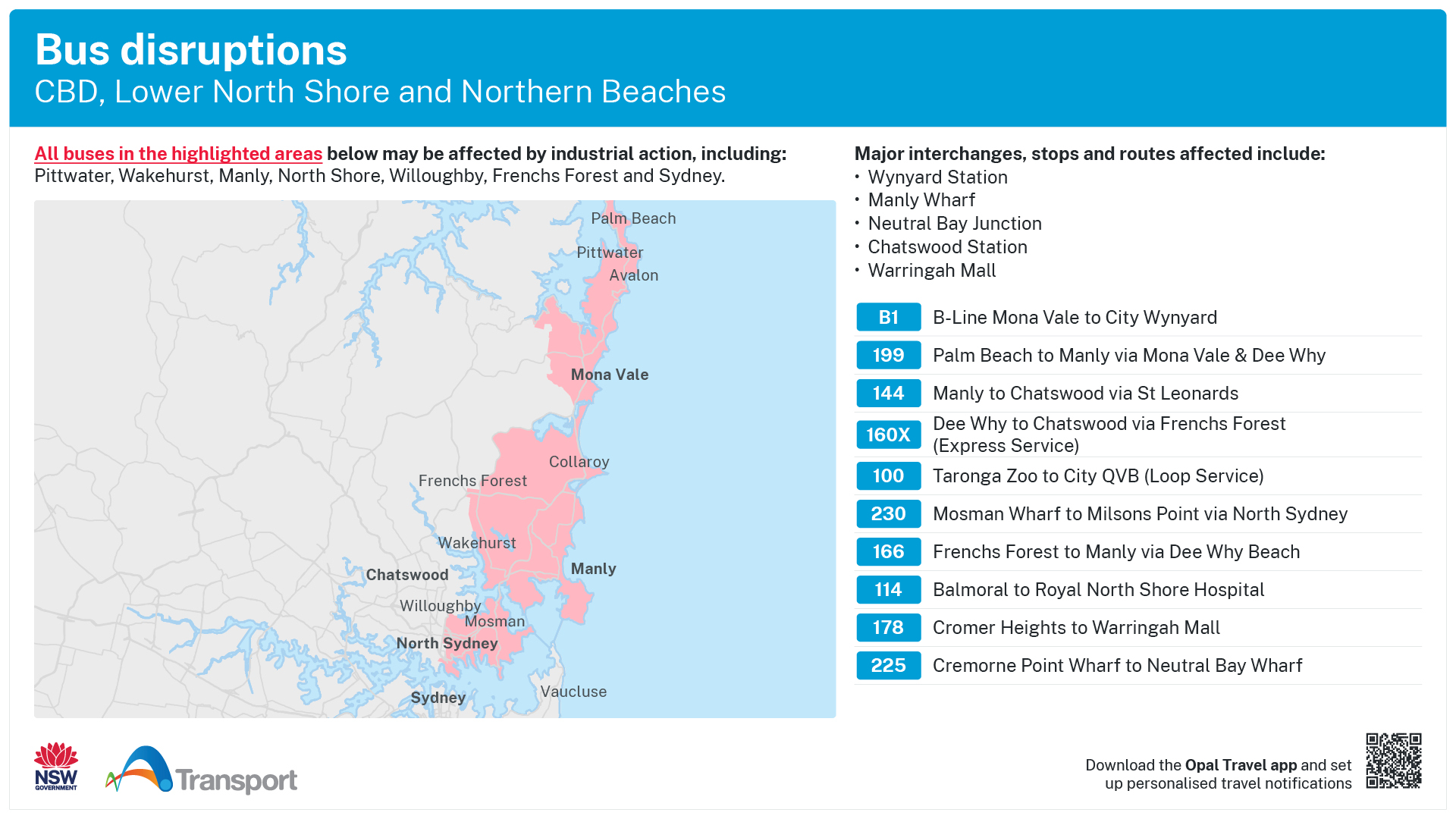
Sydney Bus disruptions due to industrial action
Friday 03 July 2026: from Transport for NSW
Transport for NSW has been advised of planned industrial action by the Rail, Tram and Bus Union (RTBU) which may affect some bus services across the Northern Beaches and lower North Shore from 12:01am on Monday 6 July until 23:59pm on Friday 10 July.
While buses are expected to continue operating, industrial action relating to vehicles displaying mechanical or electrical warning alerts may result in some services being disrupted, delayed or cancelled.
Passengers are urged to plan ahead and allow extra travel time. They can also download the Opal travel app and set up trip notifications.
The disruption is expected to affect services across Sydney’s Northern Beaches and the lower North Shore, including buses starting and finishing in the CBD. The operator of this region is Keolis Northern Beaches.
Transport is working closely with the bus operator to minimise the impact where possible.
Maps