Inbox News: October 2026 - Issue 659

Week Two October 2026: Published Sunday October. 25 2026

Molly Picklum Wins Rip Curl Pro Portugal 

PRAIA DE SUPERTUBOS, Peniche, Portugal 

Friday, October 23, 2026

Molly Picklum - absolutely STOKED. Photo: Manel Geada/WSL

Molly Picklum (AUS) and Griffin Colapinto (USA) won the World Surf League (WSL) Championship Tour (CT) Stop No. 10, the MEO Rip Curl Pro Portugal Presented by Corona Cero in all-time, pumping Supertubos for an epic Finals Day. It was a barrel fest of note with six-to-eight foot sets charging towards Peniche’s golden stretch of sand, lined by thousands of surf fans watching the world’s best either get swallowed or spat out by the Portuguese Pipeline. World Champions Caitlin Simmers (USA) and Gabriel Medina (BRA) earned crucial runner-up finishes, gaining momentum in the postseason before heading to the next stop at the Philippines Pro.  

Molly Picklum Wins Iconic Clash of World Champs, Takes Over Yellow Jersey

Marking her third CT final this year, the reigning World Champion Molly Picklum (Gosford - Central Coast) finally earned her first win of the season, adding the MEO Rip Curl Pro Portugal trophy to her cabinet. Picklum’s wishlist for 2026 included a win at Supertubos, and the Australian could happily tick this one off the list after she took control in a world-class matchup with Caitlin Simmers (USA). To make the victory even sweeter, Picklum has moved to the top of the rankings and will wear the Yellow Jersey going into the penultimate event of the CT.

The win places Molly in a position to retain her world surfing title.

"Right now I'm on top of the world … literally!" roared the 23-year-old Australian after her victory over America's former world champion Caitlin Simmers in Friday's final sent her back to the top of the World Surf League standings.

Molly's triumph at one of surfing's most famous venues gave her the maximum 10,000-point haul to ensure she overhauled Hawaiian Carissa Moore at the top.

The win came at the perfect post-season moment with just two events left.

The Gosford surfer has enjoyed a shiny nickname since she referred to herself as like "a glow worm in a cave" riding inside a deep barrel wave.

“The glow worm absolutely did it,” said Picklum. 

“Thanks to all my friends and family who stayed up for this one! I love that I get to win in front of them. 

''So many people support me, and I love giving back to them, but right now I’m on top of the world. It was a dream of mine to win here. Portugal is like the cross between the Brazilian energy and Pipeline, those are two of my favourite things. 

''I’m so grateful to win here. Dreams do come true. I’m really happy to hit my stride at the right time. We work so hard and not many people get to win, but I’m so stoked to get my win this year.”

In a clash of World Champions, Picklum struck first with a quick barrel to set the tone, but Simmers was right behind her and stalled for a cover-up and a better score. Molly patiently waited for the right wave, and she gave herself some breathing room with a solid 7.83 (out of a possible 10). Simmers improved her score with a 6.67, but she needed more and the ocean didn’t provide another opportunity to strike, and Picklum sealed the victory. 

Molly visits the Supertubos Green Room. Photo: Damien Pollenot/WSL

Griffin Colapinto Makes History With Third Portugal Title

California’s Griffin Colapinto (USA) made history after becoming the first person to win three MEO Rip Curl Pro Portugal titles, and he did it in a Final for the ages against three-time World Champion Gabriel Medina (BRA). The Portuguese Pipeline lived up to its name as Colapinto and Medina traded excellent rides, pushing each other to go deeper and more critical with every barrel. 

“That’s the dream, how good were the waves out there,” said Colapinto. 

“The battle with Gabriel was unreal. Going back and forth like that, I was thinking back to like the Andy and Kelly days, growing up and watching that generation, I was hoping I could do that one day and it felt like it was that kind of heat. Portugal has a big place in my heart. It was a dream to back up my brother who won in Ericeira. When Crosby won that, I had a realisation that I need to lock in and he really inspired me. The universe was on my side this week, it felt like things went my way but it’s also the hard work that goes in behind the scenes, and everything I do everyday. I’m just so grateful.”

Griffin Colapinto gets barrelled. Photo: Damien Pollenot/WSL

Medina got an early lead in the Final before Colapinto went excellent to post an 8.17. However, Medina responded in a big way with back-to-back excellent scores, an 8.57 and 8.20, to put Colapinto in a tight spot with a huge requirement. The Atlantic gifted Colapinto a golden opportunity, Colapinto disappeared in a Supertubos cavern before reemerging to the cheers of the crowds and a 9.43 to close out the heat and secure the win.   

Former event victors and World Champions, Gabriel Medina (BRA) and Caitlin Simmers (USA) gained momentum in the postseason with their runner-up finishes in Portugal. Medina dispatched rival Italo Ferreira (BRA) in the Semifinals before coming up against an unstoppable Colapinto in the Final. 

“It’s always fun to compete here,” said Medina. “It’s such a fun wave. To have a Final with Griffin, he’s an amazing surfer and it’s been great to watch him improve. He inspires me to go harder, and I’m just here to make them work! I’m happy with my performance, hopefully I have a shot at Pipe.”

Gabriel Medina flying high. Photo: Damien Pollenot/WSL

Simmers, who won in her rookie year in Peniche, was back on the podium for the first time this season. The 2024 World Champion had an epic battle with Picklum, and stocked up on joy riding heaving barrels against a good friend in one of her favourite places in the world.

“I’m so grateful to have a job that takes me here,” said Simmers. “I really mean it when I say Portugal is one of my favourite places on the planet. I really do love surfing, and I’m trying to find the joy in it this year, and it feels like there’s so much more behind every heat win.”

The next stop will be the Philippines Pro, which runs from October 31 to November 10, 2026.

For more information, please visit WorldSurfLeague.com. 

Pictured: Griffin Colapinto (USA) and Molly Picklum (AUS), the winners of the MEO Rip Curl Pro Portugal Presented by Corona Cero. Credit: WSL / Damien Poullenot 


Building a Brick House (1946) — Postwar Home Construction Guide

Building a Brick House is a captivating instructional film produced by the Australian National Film Board for servicemen transitioning into building trades after World War II. This 1946 film takes you from architectural plans through foundations, bricklaying, roofing, plumbing, electricals, plastering, and painting—offering a rare, practical glimpse into post-war homebuilding. Originally intended for the Commonwealth Reconstruction Training Scheme, it’s a fantastic educational resource and historical artefact.


Invictus

By William Ernest Henley

Out of the night that covers me,
      Black as the pit from pole to pole,
I thank whatever gods may be
      For my unconquerable soul.

In the fell clutch of circumstance
      I have not winced nor cried aloud.
Under the bludgeonings of chance
      My head is bloody, but unbowed.

Beyond this place of wrath and tears
      Looms but the Horror of the shade,
And yet the menace of the years
      Finds and shall find me unafraid.

It matters not how strait the gate,
      How charged with punishments the scroll,
I am the master of my fate,
      I am the captain of my soul.


Fabrication student wins the Heart of TAFE photography competition

TAFE NSW Muswellbrook's Lachlan Ellis has been named the state winner in the Australian Education Union's (AEU) 2026 Heart of TAFE photography competition. The winning shot was a striking photo of welding training in action.

Lachlan, who is completing a Certificate III in Engineering – Fabrication Trade, was encouraged by his teacher to enter the competition. With no background in photography, he was surprised to be selected as the NSW winner for his photo of a fellow classmate working on the tools.

“I wasn’t expecting to win, so it feels like a great accomplishment,” he said. 

“My mate Corban was welding tow plates together and I thought it would make a really cool shot. It turned out awesome.”

Lachlan's photograph was selected from 108 entries submitted by TAFE NSW students from across the state. It perfectly captured the practical learning at the heart of his training.

The Heart of TAFE photography competition was established in 2022 to coincide with National TAFE Day. It gives TAFE NSW students across the country an opportunity to capture the people, places and experiences that define their TAFE journey. This year's entries reflected the diversity of students’ experience. From practical skills training and industry connections to student achievement and the communities that support them.

Lachlan was announced as the NSW winner at TAFE NSW Ultimo as part of National TAFE Day celebrations. He received a $1,000 cash prize from the NSW Teachers Federation branch of the AEU and will now progress to the national finals at Parliament House, Canberra, which will be held this coming Wednesday, 28 October. The winner from every state and territory will compete for the overall national title and a $5,000 cash prize. The winning photograph will also be exhibited at Parliament House.

For Lachlan, the recognition comes as he works towards a career that could take him well beyond the Hunter region.

“My goal is to become a qualified tradesman, gain as much experience as I can and travel around Australia working across different areas of boiler making,” he said.

President of the NSW Teachers Federation, Henry Rajendra, said the competition provided an opportunity to showcase the people and the experiences that sit at the heart of TAFE.

“The Heart of TAFE photo competition gives students a chance to tell their own stories about learning at TAFE,” he said.

“The quality and range of this year's entries show the diversity of educational opportunities across TAFE NSW and the important role teachers and staff play in supporting students.”

Minister for Skills, TAFE and Tertiary Education Steve Whan said the National TAFE Day and the Heart of TAFE photography competition celebrate the life-changing impact of vocational education and training across NSW.

“Lachlan’s photo captures the heart of TAFE NSW, enabling students to learn real-world skills, build confidence and prepare for secure, rewarding careers.

“From the Hunter to every corner of NSW, TAFE helps students turn their ambitions into opportunities. National TAFE Day is a chance to celebrate the students, teachers and staff who make it that possible every day. Lachlan’s achievement is something the whole TAFE community can be proud of.”

Worried about your Year 12 exams? 3 ways to help anxiety

High school students sitting an exam, looking focused.
JohnnyGreig/Getty Images
Viviana Wuthrich, Macquarie University and Jessica Belcher, Macquarie University

The high-stakes nature of Year 12 exams can bring out sudden anxiety in the best of students.

You might have felt this before or during an assessment. Sometimes it feels like a rising panic in your chest. Other times it’s like your mind has gone blank and you can’t remember anything. These feelings can make it difficult to focus.

The key to good exam performance is learning to manage your anxiety.

We are clinical psychologists who research academic stress. Here’s what can help.

Academic stress is common

Research shows one in six students experience extreme levels of stress during the final years of schooling. This involves unrelenting stress that disturbs sleep and wellbeing. While moderate stress is okay, too much stress can negatively impact academic performance.

In its simplest form, exam anxiety is a stress response like any other. It’s the activation of the body’s flight-or-fight response, which is triggered by the sympathetic nervous system. The sympathetic nervous system takes care of things like your blood pressure, heart rate and digestion – the things you don’t think about.

The flight-or-fight response occurs when our brain perceives we are in danger, whether it is physical danger, such as fear of being bitten by an angry dog, or psychological, such as stuffing up a speech.

What anxiety in an exam can feel like

The flight-or-fight response might lead to physical symptoms such as:

  • an increased heart rate

  • an increased rate of breathing

  • sweating

  • a feeling of unease in the stomach

  • tightness in the chest.

While these symptoms might seem handy if you need to flee or fight, it’s hard to see how they are helpful in an exam situation. Who needs dizziness and sweaty palms when trying to solve a quadratic formula?

Your brain can catastrophise the situation

As you head into the exam you might also face thoughts such as:

I’m going to fail. I won’t be able to remember anything. My mind will go blank.

But this sort of thinking increases the perceived danger of the situation.

Research shows thinking less catastrophically, and more realistically, about a situation can help reduce anxiety.

1. Challenge negative thoughts

To challenge these negative thoughts before or during an exam, it helps to ask yourself questions such as:

  • Is it realistic that I will completely fail the exam?

  • Is it realistic that I won’t remember anything?

  • Do I actually need to get a perfect score to get through this?

  • What would a friend say to reassure me right now?

2. Focus on your breathing

Another practical way to help reduce anxiety is by slowing down your breathing rate.

In an exam scenario, a full meditation session might be out of the question. But there are still exercises you can do.

For example, while you wait for the exam to begin, or during reading time, try to take a long breath in while counting to four in your mind. Then breathe out over a count of four. Repeat this while slowing down your counting. After a few rounds you will hopefully notice your anxiety start to lessen.

3. Make an exam plan

Look through the exam during reading time and find the questions you feel most comfortable with. Once reading time is over, aim to tackle these questions first. This can help build your confidence during an exam.

If you have long answer or essay questions, it can help to read over all the questions before writing so that while you are answering the “easier” question, your brain will be working in the background, bringing forward information you can use when you answer the harder questions.

This works because information is stored in our brain using networks, so reading questions repeatedly can activate the links between concepts in those networks. This means information might be more readily available when you come back to the harder question.

Stress isn’t always a bad thing

If you’re still feeling stressed, the good news is that mild to moderate levels of stress have actually been shown to improve academic performance. This is because the flight-or-fight response also increases mental alertness and motivation.

After the exam is over, you might feel relieved or devastated, or something in between. It is normal to ruminate over the questions and how you responded to them.

One way to bring yourself back down to a calmer state is to do some exercise. Take a walk or go for a run. This burns up the stress hormone, cortisol, and can help you recover more quickly.


If this article has raised issues for you or your child, you can call Lifeline on 13 11 14 or Kids Helpline on 1800 55 1800.The Conversation

Viviana Wuthrich, Professor of Clinical Psychology, Macquarie University and Jessica Belcher, Postdoctoral Fellow, School of Psychological Sciences, Macquarie University

This article is republished from The Conversation under a Creative Commons license. Read the original article.

8 Student-Backed Study Tips To Help You Tackle The HSC

By University of Sydney: Last updated 6 July 2023

Our students have been through their fair share of exams and learned a lot of great study tactics along the way. Here they share their top study tips to survive and thrive during exam time.

1. Start your day right

Take care of your wellbeing first thing in the morning so you can dive into your day with a clear mind. 

“If you win the morning, you can win the day,” says Juris Doctor student Vee Koloamatangi-Lamipeti.

An active start is a great way to set yourself up for a productive day. Begin your morning with exercise or a gentle walk, squeeze in 10 minutes of meditation and enjoy a healthy breakfast before you settle into study.

2. Schedule your study

“Setting up a schedule will help you organise your time so much better,” says Master of Teaching student Wesley Lai.

Setting a goal or a theme for each study block will help you to stay focused, while devoting time across a variety of subjects will ensure you've covered off as much as possible. Remember to keep your schedule realistic and avoid over-committing your time.

Adds Wesley, “Make sure to schedule in some free time for yourself as well!”

3. Keep it consistent

“Make studying a habit,” recommends Alvin Chung, who is currently undertaking a Bachelor of Arts and Bachelor of Laws.

With enough time and commitment, sitting down to study will start to feel like second nature rather than a chore.

“Do it every day and you’ll be less likely to procrastinate because it’s part of your life’s daily motions,” says Alvin.

4. Maintain motivation

Revising an entire year of learning can seem like an insurmountable task, which is why it’s so important to break down your priorities and set easy-to-achieve goals.

“I like to make a realistic to-do list where I break down big tasks into smaller chunks,” says Bachelor of Arts and Advanced Studies student Dannii Hudec.

“It’s also really important to reward yourself after you complete each task to keep yourself motivated.”

Treat yourself after each study block with something to look forward to, such as a cup of tea, a walk in the park with a friend or an episode of your latest Netflix obsession.

5. Minimise distractions

With so many distractions at our fingertips, it can be hard to focus on the task at hand. If you find yourself easily distracted, an “out of sight, out of mind” approach might do the trick.

“What helps me is to block social media on my laptop. I put my phone outside of my room when I study, or I give it to my sister or a friend to hide,” says Bachelor of Commerce and Bachelor of Laws student Caitlin Douglas.

While parting ways with your phone for a few hours may seem horrifying, it can be an incredibly effective way to stay on task.

“It really helps me to smash out the work and get my tasks done,” affirms Caitlin.

6. Beware of burnout

Think of the HSC period as a marathon rather than a sprint. It might be tempting to cram every single day but pacing out your study time will help to preserve your endurance.

“Don’t do the work for tomorrow if you finish today’s work early,” suggests Daniel Kim, who is currently undertaking a Bachelor of Commerce and Advanced Studies.

 “Enjoy the rest of your day and save the energy for tomorrow,” he recommends.

Savouring your downtime will help you to avoid burning out before hitting the finish line.

7. Get a good night's sleep

Sleep is one of your greatest allies during exam season.

“I’ve found that a good night’s sleep always helps with concentration and memory consolidation,” says Bachelor of Science (Medical Science) student Yasodara Puhule-Gamayalage.

We all know we need to be getting around 8 hours of sleep a night to perform at our best, but did you know the quality of sleep also matters? You can help improve the quality of your sleep with some simple tweaks to your bedtime routine.

“Avoid caffeine in the 6 hours leading up to sleep, turn off screens an hour before going to bed, and go to bed at the same time every night,” suggests Yasodara.

8. Be kind to yourself

With exam dates looming and stress levels rising, chances are high that you might have a bad day (or a few!) during the HSC period.

According to Bachelor of Arts and Advanced Studies student Amy Cooper, the best way to handle those bad days is to show yourself some kindness.

“I know that if I’m in a bad state of mind or having a bad day, I’m not going to be able to produce work that I’m proud of,” she says.

For Amy, the remedy for a bad day is to take some time to rest and reset.

“It’s much more productive in the long run for me to go away, do some things I love, and come back with a fresh mind.”

Immerse yourself in a mentally nourishing activity such as going for a bushwalk, cooking your favourite meal, or getting stuck into a craft activity.

If you feel completely overwhelmed, know you're not alone. Reach out to a friend, family member or teacher for a chat when you need support.

There are also HSC Help resources available through the NSW Department of Education at: education.nsw.gov.au/student-wellbeing/stay-healthy-hsc

ReachOut has a range of support for students including for sleep, exam stress and school and study.  ReachOut also has an Online Community for young people and peer support available via ReachOut PeerChat.  

Parents and carers can play an important role in helping their teens manage their sleep and exam and study stress. For tips, information and support parents and carers can visit ReachOut Parents. 

If you are experiencing negative thoughts or feelings, there are services out there to listen and help you out. They are free, confidential, and available 24/7. 
Please contact:
  • Lifeline – 13 11 14
  • Kids Helpline – 1800 55 1800
  • 13YARN – 13 92 76 to speak with an Aboriginal & Torres Strait Islander crisis supporter
  • If you are in immediate danger dial 000

Links To ReachOut Support Content 

For young people:
ReachOut’s Online Community - Sleep discussion

For parents and carers:
For schools:
About ReachOut
ReachOut is the leading online mental health service in Australia supporting young people during tough times.

ReachOut helps young people feel better about today and the future, no matter what challenge they’re facing. They provide a safe place where young people can openly express themselves, explore what’s happening in their lives, connect with people who understand their situation, and find the resources to help them manage their challenges now and in the future.

Anonymous, free and 100% online, ReachOut has been designed specifically for – and with – young people. From one-to-one support from experienced peer workers, to online forums, as well as tips, stories and resources, ReachOut offers a wide range of support options that allow young people to engage in the ways they want to, when they want to, and has been doing so for more than 20 years.

And, ReachOut Parents and ReachOut Schools provide valuable information, resources and advice to help parents, carers and educators to better understand the young people in their lives and to play an active role in their wellbeing.

Opportunities:

Avalon Beach SLSC: Bronze - SRC Courses

Ready for a new challenge? Join Avalon Beach SLSC for the upcoming Bronze Medallion course or Surf Rescue Certificate and become a surf life saver!

By signing up to the course and patrolling, you'll learn how to save lives and other valuable new skills, make lifelong friends by the sea and step up to a new challenge.

There is a place for everyone at Avalon Beach SLSC.

Club benefits include access to the surf club, amenities & hot showers, NBC parking permit (Council eligibility criteria applies), substantial discounts on CrossFit membership & use of club gym, opportunity to compete in various beach and surf competitions and continue advancing your lifesaving skillsets and networks.

🏁 BM starts Sunday 25 October | SRC starts Sunday 1 November

🏊 Prerequisites: BM, swim 400m in under 9 minutes; SRC, swim 200m in under 5 minutes

***If you would like to meet our trainers prior to the courses and join us swimming laps in local ocean rockpools, please get in touch - we'd love to meet you and grow your swimming skills and confidence***

Register your expression of interest today via the links below:

Bronze Medallion: www.trybooking.com/here

Surf Rescue Certificate​: www.trybooking.com/here

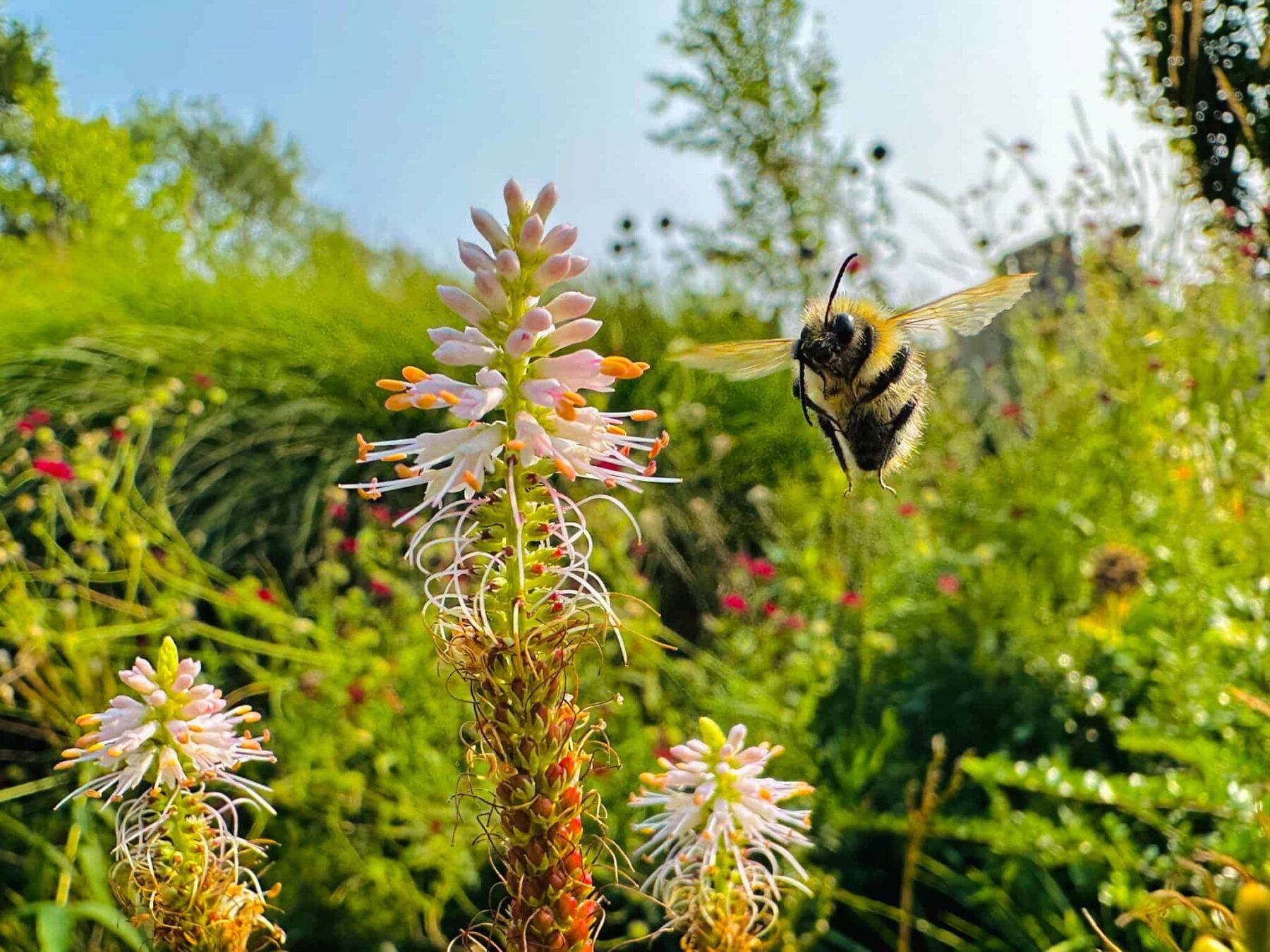
Celebrate the Diversity of Pollinators: Art + Photography Comp. for Students

Australian Pollinator Week runs from 7–15 November and celebrates Australia’s diverse pollinators and highlights the importance of engaging young people in learning about pollinators. Schools are encouraged to celebrate and support pollinator health.

Australian Pollinator Week was founded by Dr Megan Halcroft, of Bees Business, in November 2015. It followed on from a community project called “Bee Aware of Your Native Bees”, which was funded by Western Sydney University and the Environmental Trust.

Communities in the northern hemisphere have been celebrating the importance of pollinators since June 2007, however, the seasonal differences in the southern hemisphere has restricted bilateral celebrations.

Australian Pollinator Week acknowledges our important and unique insect pollinators during Australia’s southern Spring (November). It is a designated week when communities, businesses and organisations can come together to raise awareness of the importance of pollinators and support their needs.

Through group activities, community members can learn together as they help to support pollinators. By engaging communities in schools, retirement villages, art groups, gardening clubs, community gardens, local council areas, Landcare groups and neighbourhoods we can increase awareness and act on our increased knowledge.

School Pollinator Art Competition

The School Pollinator Art Competition invites students across Australia to celebrate pollinators through art.

Students can submit original artworks in any medium, including drawing, painting, digital, collage or mixed media. Prizes will be awarded for the best artwork inspired by pollinators.

All entries will be judged by the Wheen Bee Foundation.

The competition is proudly sponsored by the Centre for Bee Education.

The School Pollinator Art Competition runs alongside the popular Pollinator Photography Competition and provides an accessible way for school-aged students to learn about pollinators. Find out more about the Pollinator Photography Competition here. 

The 2026 School Pollinator Art Competition is now open and entries will close Sunday 25 October at 5pm AEDT.

Prizes

Primary School Winner

  • Individual prize: A Bees Are Amazing gift hamper and certificate valued at more than $100
  • Teacher prize: A $500 Centre for Bee Education voucher, which can be given to a teacher of the winner’s choice.  

Secondary School Winner

  • Individual prize: A Bees Are Amazing gift hamper and certificate valued at more than $100
  • Teacher prize: A $500 Centre for Bee Education voucher, which can be given to a teacher of the winner’s choice.

Find out more and enter here

Join the School Pollinator Art Webinar

Join Amelie Ecology for a special webinar celebrating pollinators, art and this year’s School Pollinator Art Competition.

Students will learn more about Australia’s pollinators and the habitats they need, with artwork from this year’s competition featured throughout the session.

The Primary and Secondary School competition winners will also be announced live during the webinar.

Webinar Details:

Tuesday, 10 November 2026, 10am AEDT - Online

Registration is free. Register here

Example of prior art work: Bee on Honeycomb. Steve N. Year 2, NSW

Pollinator Photography Competition

The Pollinator Photography Competition encourages everyone to get out and capture images of bees and other pollinators in their local environment, whether it’s in a garden, park, school, on a nature strip or on a farm.

The competition will award prizes to the best pictures of bees and other pollinators taken in Australia as judged by the Australian Pollinator Week Pollinator Photography Competition Judging Panel.

The Pollinator Photography Competition runs alongside the School Pollinator Art Competition providing an accessible way for school-aged students to learn about pollinators. Find out more about the School Pollinator Art Competition here. 

The Competition will close Sunday 25 October at 5pm AEDT.

Prizes

  • First place wins $1500 
  • Second place wins $750
  • Third place wins $500 
  • People’s Choice wins $750
  • Video Category winner wins $750

Winners will be announced in the Pollinator Photography Webinar during Australian Pollinator Week on Thursday, 12 November at 7.30pm AEDT.

Find out more and enter here.

Pollinator Photography Webinar

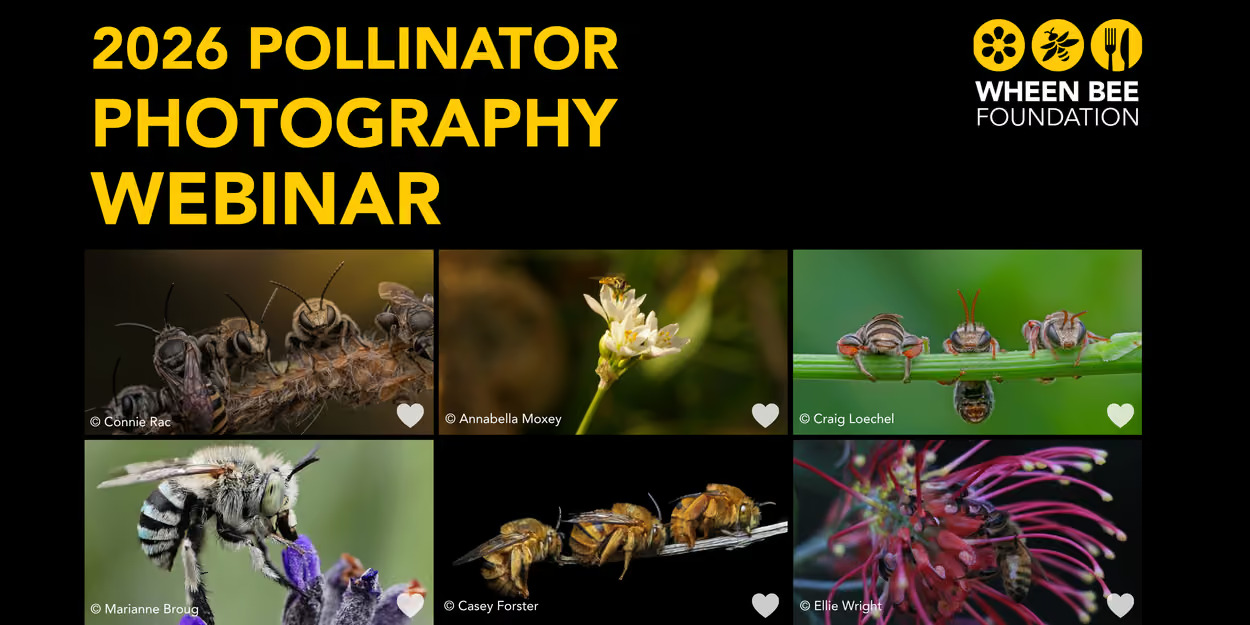
Join a panel of experienced photographers as they share practical tips for capturing Australia’s pollinators and the stories behind some of their favourite images.

Learn how they approach photographing bees and other insects, including where and when to shoot, equipment and camera settings, and what makes a great pollinator photograph. There will also be an opportunity to ask the panel photography questions.

The webinar will also reveal the 2026 Pollinator Photography Competition winners, including the winning photographs and the inaugural Video Category winner.

Webinar Details:

Thu, 12 Nov, 7:30pm – 8:30pm AEDT, via Zoom Online

Registration is free. Register here

Germany, Belgium, France named as destinations for the 2027 Premier’s Anzac Memorial Scholarship tour

On Thursday October 15 NSW Premier Chris Minns and Minister for Veterans David Harris announced the 2027 Premier’s Anzac Memorial Scholarship study tour will travel to Germany, Belgium and France, and called for teacher applications to accompany students on the trip.

The announcement follows the return of the 2026 study tour which saw 18 students tour Greece and Crete.

The two-week tour included participation in commemorations, visits to museums, war memorials and significant historical and cultural sites coinciding with the 85th Anniversary of the Greece and Crete campaigns in 1941.

See: SOUDA BAY WAR CEMETERY by George Repin AM, Pittwater Online News, Issue 147

In 2027, three teachers will join up to 18 students from around NSW, who will be given a unique opportunity to deepen their understanding of Australia’s military service and sacrifice during the First and Second World Wars.

Key locations on the tour include the Reichstag in Berlin, the Nuremburg Rally Grounds, the Normandy D-Day landing beaches in France, as well as 1917 battlefields on the Western Front, and the Menin Gate Memorial in Belgium, which marks its centenary in 2027.

Through visits to these historically significant sites students will gain a greater appreciation of Australia's wartime experience and reflect on the enduring legacy of those who served.

NSW teachers of Stage 5 History and/or Stage 6 Modern History are encouraged to apply for this unique professional development opportunity to enrich their understanding and teaching of Australian wartime history. 

The 2027 tour will take place in the Term 3 school holidays, and applications for the role of Accompanying Teachers close on 23 November 2026.

Student applications for those in Year 10 or 11 and studying History or Modern History in 2027 are expected to open in February 2027. Students can register their interest here: www.surveymonkey.com/r/BFXMB5B

NSW Premier, the Hon. Chris Minns, said:
“Travelling to Germany, France and Belgium in 2027 will give teachers and students a unique opportunity to commemorate the Australians who served in Europe during the Second World War.

“By visiting places of historical significance, students will deepen their understanding of the challenges, sacrifices and legacy of those who served their nation abroad.”

NSW Minister for Veterans, the Hon. David Harris, said:

“The Premier’s Anzac Memorial Scholarship is a unique opportunity for NSW History teachers and students to travel to these significant sites in Australia’s Military History.

“Students and teachers will travel with a military historian and hear stories of those who served and sacrificed their lives in these campaigns during the Second World War.

“I highly recommend that teachers and students take the chance to apply for this once in a lifetime opportunity ensuring the legacy of our Second World War veterans is preserved.”

2026 PAMS Accompanying Teacher, Hans Mayerhoder, from Newtown High School of the Performing Arts teacher said:

“The PAMS tour has been an extraordinary and unique teaching experience. Being in the field and experiencing history rather than simply studying it has changed the way I understand the 1941 Greece and Crete campaigns. My understanding of the campaigns, commemoration and historical investigation has developed in ways that I know I will draw on throughout my teaching career.

“There is something very special about spending two weeks surrounded by students and teachers who share such a genuine fascination with history. I had little idea what to expect before applying, but I am so glad I didn’t let that uncertainty deter me. The PAMS experience has reminded me why I love teaching history, and I would encourage any teacher with a passion for the subject to apply.”

2026 PAMS Accompanying Teacher, Emily Shanahan, from Scots All Saints College, Bathurst said:

“For a History teacher, this is incredibly valuable professional learning. I will return to my classroom with a much deeper understanding of Australia’s experience in Greece and Crete, but also with new ways of approaching historical evidence, interpretation and commemoration with students. PAMS has reminded me that some of the richest historical learning occurs when we have the opportunity to question, discuss and reconsider what we thought we knew.

“The care that goes into creating this experience is also exceptional. The program is incredibly well organised, and both teachers and scholars are supported throughout by people who are genuinely invested in their learning, wellbeing and experience. That allows you to immerse yourself completely in the opportunity: to ask questions, engage with experts, learn from the places you visit and enjoy the company of an extraordinary group of young historians.

“PAMS has been intellectually challenging, enormously enjoyable and genuinely renewing as a teacher. I will return home with new knowledge, new questions and an enormous collection of stories and experiences to take back into the classroom. I would encourage any teacher with a passion for History to apply. Opportunities for professional learning of this depth and quality are exceptionally rare.”

Manly Warringah District Junior Rugby League Girls Tackle 2027 EOI

Any girls interested in playing tackle in 2027 season? 

Register your interest (Expression of Interest) through the form -  HERE

Financial help for young people

Concessions and financial support for young people.

Includes:

  • You could receive payments and services from Centrelink: Use the payment and services finder to check what support you could receive.
  • Apply for a concession Opal card for students: Receive a reduced fare when travelling on public transport.
  • Financial support for students: Get financial help whilst studying or training.
  • Youth Development Scholarships: Successful applicants will receive $1000 to help with school expenses and support services.
  • Tertiary Access Payment for students: The Tertiary Access Payment can help you with the costs of moving to undertake tertiary study.
  • Relocation scholarship: A once a year payment if you get ABSTUDY or Youth Allowance if you move to or from a regional or remote area for higher education study.
  • Get help finding a place to live and paying your rent: Rent Choice Youth helps young people aged 16 to 24 years to rent a home.

Visit: https://www.nsw.gov.au/living-nsw/young-people/young-people-financial-help

School Leavers Support

Explore the School Leavers Information Kit (SLIK) as your guide to education, training and work options in 2022;
As you prepare to finish your final year of school, the next phase of your journey will be full of interesting and exciting opportunities. You will discover new passions and develop new skills and knowledge.

We know that this transition can sometimes be challenging. With changes to the education and workforce landscape, you might be wondering if your planned decisions are still a good option or what new alternatives are available and how to pursue them.

There are lots of options for education, training and work in 2022 to help you further your career. This information kit has been designed to help you understand what those options might be and assist you to choose the right one for you. Including:
  • Download or explore the SLIK here to help guide Your Career.
  • School Leavers Information Kit (PDF 5.2MB).
  • School Leavers Information Kit (DOCX 0.9MB).
  • The SLIK has also been translated into additional languages.
  • Download our information booklets if you are rural, regional and remote, Aboriginal or Torres Strait Islander, or living with disability.
  • Support for Regional, Rural and Remote School Leavers (PDF 2MB).
  • Support for Regional, Rural and Remote School Leavers (DOCX 0.9MB).
  • Support for Aboriginal and/or Torres Strait Islander School Leavers (PDF 2MB).
  • Support for Aboriginal and/or Torres Strait Islander School Leavers (DOCX 1.1MB).
  • Support for School Leavers with Disability (PDF 2MB).
  • Support for School Leavers with Disability (DOCX 0.9MB).
  • Download the Parents and Guardian’s Guide for School Leavers, which summarises the resources and information available to help you explore all the education, training, and work options available to your young person.

School Leavers Information Service

Are you aged between 15 and 24 and looking for career guidance?

Call 1800 CAREER (1800 227 337).

SMS 'SLIS2022' to 0429 009 435.

Our information officers will help you:
  • navigate the School Leavers Information Kit (SLIK),
  • access and use the Your Career website and tools; and
  • find relevant support services if needed.
You may also be referred to a qualified career practitioner for a 45-minute personalised career guidance session. Our career practitioners will provide information, advice and assistance relating to a wide range of matters, such as career planning and management, training and studying, and looking for work.

You can call to book your session on 1800 CAREER (1800 227 337) Monday to Friday, from 9am to 7pm (AEST). Sessions with a career practitioner can be booked from Monday to Friday, 9am to 7pm.

This is a free service, however minimal call/text costs may apply.

Call 1800 CAREER (1800 227 337) or SMS SLIS2022 to 0429 009 435 to start a conversation about how the tools in Your Career can help you or to book a free session with a career practitioner.

All downloads and more available at: www.yourcareer.gov.au/school-leavers-support

Word Of The Week: Senescence 

Word of the Week stays a part of your page in 2026, simply to throw some disruption in amongst the 'yeah-nah' mix. 

Noun

1. the condition of growing old, process of decaying by time.

Adjective

1. growing old, aging, 1650s, from Latin senescentem (nominative scenescens), present participle of senescere "to grow old," from senex "old" (from PIE root sen- "old"). Blount's "Glossographia" (1656) also has a verb senesce "to wax old, to grow in age, to begin to decay or wear away," from Latin.

Senescence or biological ageing is the gradual deterioration of functional characteristics in living organisms. Whole organism senescence involves an increase in death rates or a decrease in fecundity with increasing age, at least in the later part of an organism's life cycle. However, the effects of senescence can be delayed. The 1934 discovery that calorie restriction can extend lifespans by 50% in rats, the existence of species having negligible senescence, and the existence of potentially immortal organisms such as members of the genus Hydra have motivated research into delaying senescence and thus age-related diseases. 

The Researchers were Clive McCay, Mary Crowell, and Leonard Maynard. The study, published in 1935, placed rates on a heavily restricted, low-calorie diet. The rats lived significantly longer—extending their outer survival limit from a normal maximum of about 3 years out to roughly 4 years (an increase of around 33% to up to 50% in median/maximum longevity depending on the specific cohort). The restricted diet rats not only lived longer, but they also stayed youthful-looking longer, grew more slowly, and experienced a dramatic delay or reduction in late-life diseases such as tumours and kidney degeneration.  Subsequent analyses confirmed that the life-extending effect was tied specifically to a reduction in total energy (calories) rather than the withdrawal of a single specific nutrient, establishing the foundation of modern caloric restriction (CR) research.

Subsequent analysis has found  eating too few calories makes it difficult to get vital macronutrients and micronutrients, leading to low iron (anemia), low calcium or vitamin D (bone loss/osteoporosis), and low B-vitamins. The body drops its metabolic rate by up to 23% to conserve energy, causing chronic fatigue, muscle wasting, and long-term weight-loss resistance.  

Severe deficits suppress sex hormones (estrogen and testosterone), which can stop menstruation (amenorrhea), lower libido, and increase fracture risks. Extreme restriction increases the risk of painful gallstones, electrolyte imbalances, low blood pressure, and abnormal heart rhythms.

Some rare human mutations can cause accelerated ageing diseases.

Environmental factors may affect ageing – for example, overexposure to ultraviolet radiation accelerates skin aging. Different parts of the body may age at different rates and distinctly, including the brain, the cardiovascular system, and muscle. Similarly, functions may distinctly decline with aging, including movement control and memory. Two organisms of the same species can also age at different rates, making biological ageing and chronological ageing distinct concepts.

Key Types of Senescence

  • Cellular Senescence: Normal cells permanently stop dividing and enter a growth arrest phase after stress, DNA damage, or telomere shortening, yet remain metabolically active.
  • Organismal Senescence: The gradual deterioration of physical and physiological functions across an entire living body as it ages.
  • Plant Senescence: A regulated final stage of development in plants or plant parts (like leaves or fruit) that allows the plant to recycle valuable nutrients before the tissue dies.

Supercentenarian Alexendar Pouder [Ann Poudar] (8 April 1807 – 10 July 1917), photographed on her 110th birthday. Photographer: Charles Martin 

Elderly Klamath woman photographed by Edward S. Curtis in 1924. Credit: Northwestern University Library, "The North American Indian": the Photographic Images, 2001.

From sen - Proto-Indo-European root meaning "old."

It may also be the source of: Sanskrit sanah "old;" Avestan hana- "old," Old Persian hanata- "old age, lapse of time;" Armenian hin "old;" Greek enos "old, of last year;" Latin senilis "of old age," senex "old, old man;" Lithuanian senas "old," senis "an old man;" Gothic sineigs "old" (used only of persons), sinistra "elder, senior;" Old Norse sina "dry standing grass from the previous year;" Old Irish sen, Old Welsh hen "old."

Source of senility(noun); "old age, especially the weakness or imbecility due to old age," from 1753 and from Latin senilis "of old age," +, from Middle English -ite, from Old French -ete (Modern French -ité) and directly from Latin -itatem (nominative -itas), suffix denoting state or condition, composed of.

Compare senile (adjective); 1660s, "suited to or characteristic of old age," from French sénile (16c.), from Latin senilis "of old age," from senex (genitive senis) "old, old man" (from PIE root sen- "old"). The meaning "infirm from age; pertaining to or proceeding from the weakness that usually attends old age" is attested by 1882; senile dementia is attested by 1851.

"When I was a boy of 14, my father was so ignorant I could hardly stand to have the old man around. But when I got to be 21, I was astonished at how much the old man had learned in seven years." - Mark Twain/Samuel Clements

In an age of AI, Wildwood is a film that reminds us human creativity is irreplaceable

Laika
Ari Chand, Adelaide University ; University of Newcastle

Animation has long had the unique ability to transport us to other worlds. But stop motion takes this further, with a level of skill and intentionality that provides a perfect counter to the droning hum of AI slop infecting our feeds.

Laika Studios’ latest stop-motion offering is Wildwood, a project that took an extraordinary 16 years to complete. That’s a long time, even by stop-motion standards (most of the studio’s stop-motion films took between three and six years to develop).

Yet the hard work has paid off. Wildwood is a triumphant film full of heart and moments of connection – an engaging story for lovers of both puppetry and fantasy.

Above all, it staunchly reaffirms the importance of human creativity in storytelling.

Enchanted forests and familial love

From the Forbidden Forest of Harry Potter, to Narnia, to J.R.R. Tolkien’s Middle Earth, Wildwood adds to a long tradition of fantastical stories set in the enchanted forest.

Here, the forest becomes a place of learning and coming-of-age. And part of the film’s charm lies in its expansive world-building. Wildwood is a society, with its own politics, geography, customs, and distinct look and feel.

From the mossy towering trees and dense ferns of the Impassable Wilderness, to the red-roofed turrets and golden statues of the Pittock Mansion, the films environment mixes fantasy landscapes with a kind of Gilded Age-inspired opulence.

The story follows Prue, a 13-year-old from Portland, Oregon, who must save her baby brother Mac after he is swept away by a murder of crows and taken to the Impassable Wilderness.

Peyton Elizabeth Lee voices the film’s hero, Prue McKeel. Laika

In the forest, Prue finds and uneasy world on the brink of conflict, populated by talking animals, bandits, mystics and soldiers.

She soon learns her brother was taken by the Dowager Governess, a ruthless and power-hungry ruler who took Mac to complete a dark ritual needed to keep her land. What begins as a rescue becomes something more complex, and Prue discovers an inner strength she never knew she possessed.

There are a number of immersive and highly cinematic sequences scattered throughout the film. Laika

The film offers a critical perspective humanity’s relationship with, and stewardship of, the natural world. It also examines trauma, familial devotion, and the ways in which powerful figures are driven by grief and ambition.

Rated PG-13, Wildwood is family-friendly, but certainly isn’t aimed exclusively at children. The plot delves into darker themes, with moments of genuine peril and intensity giving the film a more mature edge than its beginning suggests.

Between its epic battle scenes and complex cinematic shots, you will likely forget you’re watching a stop-motion film.

Materials and making

Backed by Nike co-founder Phil Knight, Laika’s previous offerings include Coraline (2009), ParaNorman (2012) and Kubo and the Two Strings (2016). The company excels at marrying stop-motion techniques with CGI and various digital effects.

It is particularly well-known for developing new stop-motion methods that use 3D printing instead of claymation – often printing thousands of distinct facial expressions and armatures to achieve seamless character performances.

In Wildwood, these capabilities and creative thinking shine. Each moment of the film encodes thousands of small decisions, made by a team of more than 1,000 creatives.

From concept artists, to prop makers, production designers, costume designers and animators, a broad range of disciplines come together to produce the expansive fictional world.

As many as 24 different 3D-printed faces are used, per second, to bring the characters to life. One scene in the third act brings some 3,000 individual puppets onto a battlefield – an almost unfathomable spectacle.

This is slow, expensive and laborious work – work that few other studios would fund. That’s what makes it special. In the words of director Travis Knight:

At the time when entire worlds can be built with the click of a mouse, and videos generated from a prompt, choosing to make a stop-motion film feels like a quiet act of rebellion.

Wildwood is a wondrous film. There is tenderness in its small gestures, awe-inspiring set work, and something disarmingly moving in the knowledge that every frame represents a deliberate and painstaking choice.

Wildwood is in cinemas now.The Conversation

Ari Chand, Senior Lecturer in Illustration and Animation, Adelaide University ; University of Newcastle

This article is republished from The Conversation under a Creative Commons license. Read the original article.

Interned as ‘enemy aliens’ in Australia, these WWII refugees built their own universities

Orange internment camp, New South Wales, photographed in June 1940. National Archives Australia, CC BY

Katherine Biber, University of Technology Sydney

Between transit, immigration detention and life in camps, most refugees and asylum seekers are denied reliable ongoing access to education.

In response, some refugees set up schools for themselves. For instance, in 2014, Afghan Hazara refugees established a school in the West Java town of Cisarua – which has since expanded into a network. It’s one example from a long tradition.

In a new podcast called Emergency Exit, my colleagues and I explore the history of refugee-led universities set up in Australia’s internment camps during the second world war.

Four internees sitting at a bench at the Hay camp, New South Wales, drawn by Georg Telscher between 1940-1941. Mitchell Library, State Library of New South Wales, PXD 1539/no. 42

The Dunera boys

In the lead-up to WWII, more than 70,000 German nationals had fled to Britain to escape Nazi persecution.

With the outbreak of war in September 1939, they would be classified “enemy aliens”, and many were interned in British camps.

Australia followed suit; anyone here with German or Austrian nationality became an “enemy alien”. Many were also interned in camps.

As British camps became overcrowded, these men had to be transported elsewhere. So on July 10 1940, some 2,500 detainees embarked from Liverpool on the HMT Dunera, bound for Australia.

Among them were accomplished scholars, professors, musicians, linguists, artists and tradespeople. Some were teenagers whose education had been interrupted by the war.

During the Dunera’s 57-day journey, the refugees drafted their own constitution and established a university onboard the ship.

They continued to run these universities in internment camps in Tatura, Victoria, and Hay, New South Wales, teaching an eclectic program that included Malay, Greek, mathematics, bookkeeping, jazz and fashion drawing.

German internees, including some of the Dunera boys, at the Tatura Camp. Australian War Memorial, CC BY

Leonhard Adam and the Collegium Taturense

At Tatura, the camp university was named the Collegium Taturense. Leonhard Adam was appointed pro-rector.

Adam was a distinguished lawyer and judge from Berlin. But because of his Jewish ancestry, he was disbarred from legal practice in 1933 under Nazi racial laws.

He fled to England, but was classified an “enemy alien” when the war broke out. Adam was interned on the Isle of Man before being transported to Australia on the Dunera.

In the Collegium Taturense, Adam taught jurisprudence, commercial law, Chinese and ethnology. He also painted scenes of life in internment.

Leonhard Adam painted this scene in 1940 while interned in the Tatura camp. Tatura Irrigation and Wartime Camps Museum

By the time Adam arrived at Tatura, he already had some knowledge of First Nations laws and practices, which he’d acquired conducting fieldwork among prisoners of war during WWI.

In 1917, in Germany, he met Ngarrindjeri man Roland Carter and Ngadjonji man Douglas Grant, both First Nations members of the Australian Imperial Force.

Adam would later publish an article in a German law journal documenting their laws and customs, followed by his book Primitive Art (1940). The term “primitive law” was used at the time to describe Adam’s expertise within ethnology and anthropology.

After Adam’s release from internment in Australia in 1942, he was appointed as a researcher at the University of Melbourne. He gathered what would become a major collection of First Nations art and artefacts.

A watercolour painting made by Leonhard Adam in 1941 at Tatura. Australian War Memorial, CC BY

Margaret Pierce, advocate for interned refugees

An important goal of the Collegium Taturense was to support the education of teenage boys whose schooling had stalled.

Many of them had been rescued to Britain as part of the Kindertransport scheme. But once war was declared, those aged 16 and over were caught up in the “enemy alien” category. Some were interned and transported.

One of these boys was Kurt Henle, a teenager who aspired to study medicine.

At the Collegium Taturense, camp internees (supported by refugee advocates) ensured Henle followed the Victorian curriculum so he could formally seek admission to university.

Class list for advanced geometry, taught in the Tatura internment camp by Felix Behrend. Kurt Henle was one of the students. University of Melbourne Archives, Papers of Felix Behrend, UMA-ACT-19760019

His mother Clara Henle, who had fled to New York, corresponded with Margaret Pierce, an Australian Quaker who supported interned refugees. Clara thanked Pierce for showing “a most motherly feeling toward my son”, and urged her to make sure Kurt continued his studies.

This correspondence collection survives in the State Library of Victoria, and documents the bureaucratic cruelties that sabotaged Kurt’s academic ambitions.

Pierce campaigned for Kurt’s admission to study medicine at the University of Melbourne. The university did offer Kurt a place – as part of a war effort to increase the number of doctors – but Kurt needed to be released from internment to accept it.

Pierce appealed to the Australian government, only to be told that since Kurt had now turned 18, the only justification for his release would be to serve in the Australian military.

After the war, Kurt returned to England to study, later moving to the United States to become a professor of gastroenterology.

Access to education for refugees today

Bureaucratic categories continued to obstruct refugees seeking access to education for many decades.

In 1999, Australia introduced the temporary protection visa, which treated “unauthorised maritime arrivals” as full-fee-paying students – placing university education out of reach.

Decades of activism saw this regime end in 2023, after which Commonwealth-funded access to higher education became accessible to some 31,000 refugees.

More recently, the government began trialling a new university-based resettlement pathway. In it, the government matches prospective refugees with a participating university, and their student orientation includes their resettlement in Australia.

Refugee-led education continues in detention centres in Australia and overseas, such as at the Villawood detention centre in NSW, where visitors are taught about Australian refugee policies by detainees.The Conversation

Katherine Biber, Distinguished Professor of Law, University of Technology Sydney

This article is republished from The Conversation under a Creative Commons license. Read the original article.

PHP is in the foundation of 70% of websites – here’s what it is and why a flaw in the software is a major hacking threat

a pyramid of wooden building blocks, one on top of two on top of three on top of four, with the middle of the three colored red
PHP is a key building block of most websites. Richard Drury/DigitalVision via Getty Images
Doug Jacobson, Iowa State University

Governments and organizations around the world began scrambling on Oct. 21, 2026, to fix a vulnerability in software that runs their websites, a bug that could give hackers access to data and control of websites. The flaw in PHP, the programming language that powers much of today’s web, prompted urgent warnings from the U.S. National Security Agency, cybersecurity agencies and software vendors.

A researcher at Calif, a security research firm, found the flaw in August 2026 using an advanced artificial intelligence model from OpenAI. The firm alerted the nonprofit that manages PHP. However, word of the flaw leaked before the PHP organization released patches for its software, and according to Amazon Web Services officials, hackers began “broadly” attempting to exploit it.

The vulnerability has implications far beyond a single company or platform, because PHP is a key piece of software that helps run millions of websites. So, what is PHP, what role did AI play in uncovering the vulnerability, and should the average user worry?

PHP: The foundation of the web

PHP is a programming language that powers most websites. For a modern website to provide dynamic content, visual elements and searchable features, a program must run on the web server and take user input, whether that is entering a web address or clicking links and buttons. Estimates suggest that around 70% of websites run on PHP.

PHP operates on a web server in two main parts: the core PHP system – the engine and runtime libraries – and the individual PHP scripts, which are the custom programs that actually implement a website. When you interact with a website, PHP scripts run, take user input and produce the output your web browser displays.

The vulnerability

The current security issue sits directly in the core PHP system and the libraries it uses. When a vulnerability exists at this deep level, it can allow an adversary to exploit the system. In this case, they can run unauthorized commands on the computer hosting the website, which allows attackers to access data and gain full control of the website.

This vulnerability is not a mistake in an individual website’s code. The issue lies in the core PHP system, making every unpatched system running PHP vulnerable. Since websites are accessible to anyone on the internet, adversaries can easily find PHP-based websites using automated tools. From there, they can run an exploit program that takes advantage of the vulnerability.

This exploit code is called PHP2Shell. This name comes from the fact that the exploit gives the attacker “shell access,” a cybersecurity term for direct command-line control of the computer running the website. Shell access bypasses the website interface, giving adversaries a window to enter commands and access all the website’s data.

How PHP2Shell works.

AI: A double-edged sword

What makes this vulnerability particularly interesting is how it was discovered. This exploit came to light through a process known as coordinated disclosure, in which cybersecurity researchers report the flaw to PHP developers before publicizing it.

This discovery shows the power of AI in cybersecurity. For decades, finding subtle software flaws required large teams of specialists manually reviewing code. Today’s AI systems can examine vast codebases and identify unusual patterns in hours or days. These models can analyze millions of lines of code in seconds, spotting subtle memory management bugs that human auditors might miss over decades of software development. The PHP vulnerability has existed in the core PHP code for over a decade, and AI helped researchers find it.

However, this also shows that attackers can use these same tools to locate and exploit vulnerabilities. The same reasoning capabilities that help security researchers find flaws first can also let attackers rapidly scan the web for vulnerable targets and automate the creation of tools to exploit the vulnerabilities.

This illustrates why it is so critical for security teams to use AI to find vulnerabilities and report them safely and actively. AI can also help release patches that mitigate these vulnerabilities.

Should you worry?

Many government agencies, universities, hospitals and businesses rely on PHP-based systems. While individual internet users are unlikely to be directly affected, organizations that delay patching could expose sensitive data, risk having their operations disrupted or give attackers a foothold into larger networks.

PHP runs entirely on remote web servers. If you are an everyday internet user visiting websites, you do not need to download a patch or fix your personal computer.

However, if you manage a website, blog or server, even a small site built on popular content management systems such as WordPress, you should check your server administration panel or web host immediately to ensure your PHP software is updated to the latest patched version. If a third party hosts your website, check with them to see whether they have patched for these vulnerabilities.

The PHP2Shell discovery illustrates a new reality for cybersecurity. In our interconnected world, keeping web infrastructure secure is a continuous race. As AI tools become standard for both cyber defenders and online adversaries, maintaining fast patching habits remains our most essential defense.The Conversation

Doug Jacobson, University Professor of Electrical and Computer Engineering, Iowa State University

This article is republished from The Conversation under a Creative Commons license. Read the original article.

Women who changed science missing from UK's GCSE and A‑level courses – new study

Stephanie Buttigieg, University of Cambridge; Gregory Cooke, University of Cambridge, and Skyla White, University of Bern

Cast your mind back to your secondary school science classroom: the fiery glow of Bunsen burners, scratched safety goggles that never quite fit, and a giant periodic table pinned to the wall.

When you learned about the breakthroughs that shaped our world and the people who made them, whose names were attached? From Newton’s laws to Darwin’s theory of natural selection, the ones you remember are almost certainly male.

That experience was not just down to individual teachers. It was and still is written into official GCSE and A-level course specifications. Because these early stages form the foundation of our science education, their omissions stick with us for life.

Half of the British population can’t name one woman scientist. Leaving women out of national specifications sends an implicit message about who science is really for.

In our new study, led by researchers at the University of Cambridge alongside IncludeHer, a collaborative project working to improve the representation of women in school science education, we analysed over 40 science specifications: the knowledge required to pass exams. We examined the specifications for six main exam boards for Key Stage 4 (GCSEs) and Key Stage 5 (A-levels), and for Scotland’s National 5s and Highers.

Our work builds on an earlier Australian study led by astrophysicist Dr Kat Ross, which uncovered a striking lack of female scientists in high school curricula. We set out to investigate whether UK specifications have similar omissions.

Across 224 unique scientists referenced in UK specifications, discoveries are taught almost exclusively through concepts named after men, with only three mentioning women in total.

Inge Lehmann, who discovered that the Earth has a solid inner core surrounded by a liquid outer core, is cited in A-level Geology via the “Lehmann discontinuity”.

Black and white photo of Marie Tharp and two men talking surrounded by scientific equipment.
Marie Tharp at work aboard the USNS Kane, an oceanographic research and hydrographic survey ship. AIP Emilio Segrè Visual Archives, Gift of Bill Woodward, USNS Kane Collection/Wikimedia Commons, CC BY

Marie Tharp, who mapped the ocean floor and identified the Mid-Atlantic Ridge rift valley, is also mentioned in A-level geology. She provided vital evidence for continental drift, despite being prohibited from boarding research vessels for years and having her ideas dismissed as “girl talk”.

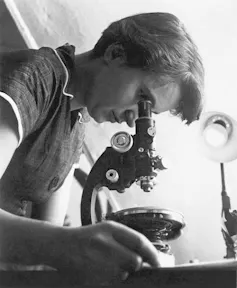
Finally, Rosalind Franklin is included in two biology specifications for her X-ray crystallography work revealing the double-helix structure of DNA. Her essential data was used without attribution during her lifetime.

Rosalind Franklin using a microscope.
A retouched photograph of Rosalind Franklin. MRC Laboratory of Molecular Biology/Wikimedia Commons, CC BY-NC-SA

At GCSE level, when science is compulsory for all students, Franklin is the only woman mentioned. At A-level, Lehmann and Tharp appear solely in geology, a subject taken by less than 2% of science students.

For centuries, social, economic, and institutional barriers limited women’s formal participation in science. Despite this, women made numerous key breakthroughs, and these are already taught to UK 14–18-year-olds. But the names of the women behind them did not make it onto the page.

Why representation matters

Diversity within scientific fields drives creativity and innovation, benefiting all of society. Yet women remain underrepresented. They make up only around one third of the global scientific community, with similar figures seen within the UK workforce.

This disparity starts early on in schools: although science uptake is balanced at Key Stage 4, just two years later at Key Stage 5, physics, mathematics and further mathematics only see participation from girls at 24.1%, 37.3% and 26.9% respectively in 2025. This imbalance continues into university, where women make up roughly 25% of physics undergraduate students in the UK.

Introducing relatable female role models into the classroom directly boosts girls’ confidence and fosters positive attitudes towards scientific careers. But because specifications dictate mandatory exam content, teachers currently have to go out of their way to add female figures on top of busy workloads. By making small, targeted changes directly to national specifications, we can make inclusion standard practice across all schools.

We propose inserting one female scientist per subject into topics that are already compulsory, but where the woman’s name is missing.

This means introducing Marie Skłodowska-Curie, who coined the term radioactivity and discovered polonium and radium, when teaching atomic structure and radioactivity, and Lise Meitner, who provided the first theoretical explanation of nuclear fission, when discussing this concept. GCSE astronomy should include Jocelyn Bell Burnell, who discovered pulsars: rotating neutron stars used as cosmic clocks.

Close up photo of Tu Yuuyou
Nobel Prize winner Tu Youyou. Bengt Nyman/Wikimedia Commons, CC BY-NC-ND

Biology teaching can include Dorothy Hodgkin on protein structure, the only British female Nobel laureate in science, and Tu Youyou, a Nobel laureate whose work led to the development of an antimalarial drug.

In chemistry, schools can teach about Stephanie Kwolek, the inventor of Kevlar, when covering polymers. For physics, they can include Annie Jump Cannon when describing the classification of stars. And in environmental science, classes can discuss the pivotal work of Susan Solomon for understanding Antarctic ozone depletion.

By making these simple additions to science specifications, we can change the message we send to the next generation. Whoever they are, every student sitting in a classroom deserves to know that the story of science belongs to them too.The Conversation

Stephanie Buttigieg, PhD Candidate in Astronomy, University of Cambridge; Gregory Cooke, Postdoctoral Associate in Astrophysics and Astrobiology, University of Cambridge, and Skyla White, Research Fellow at Center for Space and Habitability, University of Bern

This article is republished from The Conversation under a Creative Commons license. Read the original article.

Marie Curie, winner of two Nobel prizes, circa 1920

‘Terror of kings’: why the 1066 appearance of Halley’s comet terrified the medieval world

Illustration of comet with star in centre
Depiction of a comet from 1552, from The Book of Miracles, created in Augsburg, Germany, around 1550. WikiCommons
Giles Gasper, Durham University and Brian Tanner, Durham University

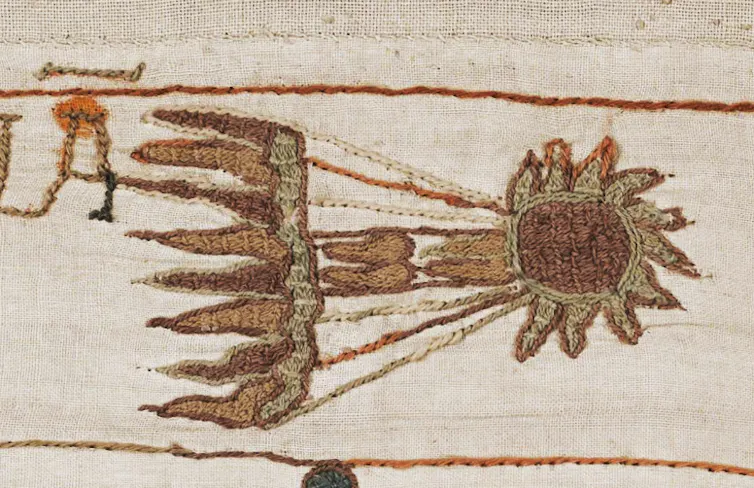
A sequence on the Bayeux tapestry shows King Harold alongside a crowd gazing at the sky, beneath the embroidered caption Isti mirant stella (“those people marvel at the star”). Above Harold sits Halley’s comet, with ghost-like invasion boats in the border below – a Norman framing of Harold as a doomed usurper whose betrayal invited destruction.

A comet, or the regum terror (terror of kings) as the contemporary Norman writer William of Poitiers put it, was widely taken as a portent of change in human affairs.

The accurate record of the appearance of the comet is not the point of the depiction in the Bayeux tapestry. As most western European sources concur, the comet appeared in the evening sky from April 24, 1066. It remained visible for one or two weeks – four months or so after Harold’s coronation.

Modern computation indicates that the comet came within about 15 million kilometres from Earth, supporting a contemporary Chinese report that it was as bright as Venus, with a tail extending 15 degrees across the sky. The sudden appearance of such a bright comet must have made a deep impression on those who witnessed it.

Halley's Comet in 1066 as depicted on the Bayeux tapestry.
Halley’s Comet in 1066 as depicted on the Bayeux tapestry. Wiki Commons

How the comet was recorded and described by medieval writers tells us a great deal about how medieval astronomy operated, its links with astrology and the wider context of global observation and book-learning in which it should be placed.

Interpreting the comet

William of Poitiers interpreted the comet as a portent of Harold’s ill-fated kingship. It is mentioned only in a section of his narrative set after the battle and the attempts to retrieve the fallen king’s body. He also noted the good fortune the comet indicated for Harold’s opponent.

Contemporary historian William of Jumièges saw the comet appear in the north-west with a three-forked tail. It stayed for 15 days. He believed it signified that changes were to come in rulership.

The Anglo Saxon Chronicles D and C (sets of annals in Old English), however, recorded the appearance of the comet but made no connection with regime change. The “haired-star”, they wrote, was “a sign such as men never saw before”.

Chroniclers of the next generation elaborated further on the comet as a portent. The English monk Orderic Vitalis (1075-c.1142) noted that it “learned astrologers who investigate the secrets of natural science” had declared it an omen of the transfer of a kingdom.

Painting of a comet above a city
Depiction of a comet from the late 15th-century manuscript Life of Jesus Christ by Jehan Mansel. Bibliothèque de l'Arsenal

The English historian William of Malmesbury (c.1095-1143), meanwhile, stated that comets foretold “either a pestilence in the kingdom or a change in the kingship”. With regard to 1066, William puts the portent into the words of Aethelmaer, a monk: “It is a long time since I saw you; but as I see you now you are much more terrible, for I see you brandishing the downfall of my mother-country.” It is plausible that Aethelmaer had seen a comet before, perhaps the long-tailed, but faint, comet of 1018.

The medieval cosmos

Astronomers of medieval Christendom kept records of date, time, appearance and the comet’s effect. These records were conditioned by inherited learning and the conception of the ancient and medieval universe.

The medieval universe was considered divided into two realms. First, the superlunary – the realm of the planets and fixed stars, composed of the now debunked element ether. It was considered pristine and not subject to decay, moved only with diurnal motion (the apparent east-to-west movement of the planets and stars). Second, the sub-lunary, with spheres of the four elements, fire, air, water and earth, the latter still and at the centre and all subject to decay.

The Great Comet, illustration from the Ottoman manuscript Secaatname (1577).
The Great Comet, illustration from the Ottoman manuscript Secaatname (1577). Istanbul University Library

Everything below was affected by what was above in this universe, so human affairs were affected by the influence of the planets. This was a universe understood in astrological and alchemical terms.

Eleventh century medieval writers had an accumulation of texts on which to draw from ancient Rome and the early church. Works by theologian Isidore of Seville and the medieval scholar Bede, informed William of Malmesbury’s statement that comets presage pestilence or a change in royal power. Behind Isidore lies ancient discussion of comets, Greek and Roman, both of which were the inheritance of the European Middle Ages.

Differences in fundamental understandings of comets emerge in this inheritance. For the ancient Greek Aristotle, comets were a meteorological, sub-lunary phenomenon, on the grounds that the perfect spheres above the moon could have no place for intermittent comets. This was a position challenged by the Roman stoic philosopher Seneca and medieval Islamicate thinkers who placed comets as complex celestial phenomena occurring in the heavenly spheres above the Moon.

Different interpretation of comets, revealing of different theories on how the universe worked, were then bequeathed to the world of medieval Christendom.

The 12th century saw a very significant increases in intellectual resources for European scholars, with translations into Latin of Aristotle’s works on natural philosophy and many scholars writing in the medieval Islamic world as well. These included astrology as the companion to astronomy. The writings of the Persian astrologer Abu Ma’shar (787-886) on astrology and horoscopes was especially popular.

This richer inheritance is seen neatly in the English philosopher Robert Grosseteste’s (c.1170-1253) treatise On Comets, written after “the occasion of the great comet”, probably the reappearance of Halley’s comet in 1222.

The treatise attempts to reconcile how an intermittent phenomenon like a comet is possible in the super-lunary realm where things are constant and unchanging. Grosseteste outlines and rejects three ancient theories of comets largely on the grounds of logical inconsistencies. His preferred version blends alchemical and astrological language. Comets are a combination of earthly matter drawn upwards, he argued, and sublimated to celestial power directed by particular planets or stars. They cause dread among the people over whose regions they appear.

The doom embroidered into the Bayeux tapestry was far more than medieval superstition. In a cosmos where the heavens directly affected the life of the human world below, Halley’s comet, a portent of change, was easily interpreted as a fatal sign for Harold Godwinson.The Conversation

Giles Gasper, Professor in High Medieval History, Durham University and Brian Tanner, Emeritus Professor of Physics at Durham University, Durham University

This article is republished from The Conversation under a Creative Commons license. Read the original article.

Napoleon can be partly blamed for Gen Z’s weightlifting obsession – here’s why

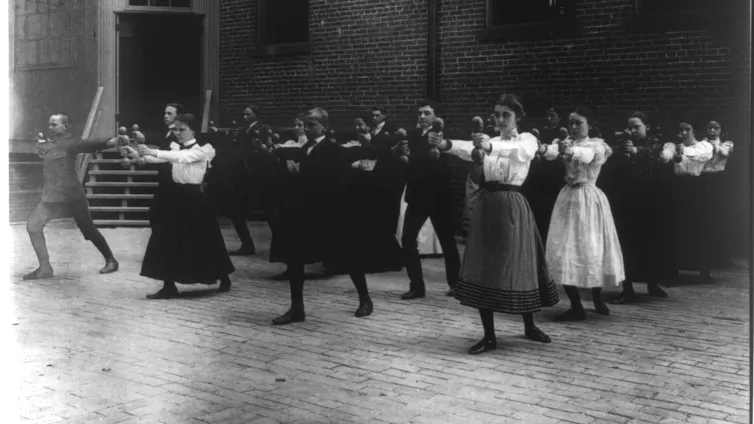
A group of Victorian people performing dumbbell exercises in an outdoor Washington gymnasium in 1899.
Lifting has been around long before Gen Z. Frances Benjamin Johnston/ Library of Congress/ public domain
Claire Warden, Loughborough University and Conor Heffernan, Ulster University

More than one quarter of young adults in Britain now say their gym memberships matter more to them than holidays or eating out.

Sport England data shows that Gen Z has begun to turn away from running, swimming and fitness classes towards gym and strength training. For them, weight training is seen as the best form of exercise because it can help build strength, improve appearance and boost overall health.

People have argued about the best forms of exercise for over two centuries. While today’s fitness trends tend to be more about improving the body and overall fitness, health has rarely been the sole reason why certain exercise trends gained popularity through the eras.

Napoleon and gymnastics

In 1806, Napoleon Bonaparte invaded Prussia and, inadvertently, created the modern fitness industry.

As Napoleon’s troops stormed their way eastward, one Prussian man, Friedrich Ludwig Jahn, began to seethe with anger. For Jahn, Prussian men had lost because they were physically weaker than the French.

The nation’s solution, according to Jahn, lay not in muskets – but muscles. So in 1811 Jahn opened a Turnplatz – an open-air gymnasium. Young men ran, jumped, climbed ropes, wrestled and vaulted. They also swung on two pieces of equipment that Jahn is believed to have invented: the parallel bars and the horizontal bar. Soon the trend spread to other nations, with England’s first outdoor gymnastics school opening in 1825.

The underlying logic behind Jahn’s Turnplatz system – that strong nations demanded physically strong troops – became a rallying cry for a wave of gymnastic and calisthenic systems for men and women across the century.

The birth of bodybuilding

A popular form of entertainment in the Victorian era were strongmen shows, where muscular men would perform theatrical acts of strength. One of the most popular performers of the time was Charles “Samson” Sampson, whose act involved snapping chains with his chest.

A poster of Eugen Sandow showing off one of the feats of strength he will perform during his strongman show.
Eugen Sandow became synonymous with the ideal body. The Strobridge Lith. Co., Cin'ti & New York/ Wikimedia Commons

But in 1889, a new kind of strongman arrived on the scene. During one of Sampson’s performances, a moustachioed strongman named Eugen Sandow stripped down to his pants in a London theatre, responding to a challenge from Sampson. But what made Sandow different from Sampson and other strongmen of the era was his physique. He was lean and sculpted.

From 1889 until his death in 1925, Sandow became synonymous with the ideal body. He was deemed the “best specimen of manhood” by Harvard University physical educationalist Dudley Sargent. Sandow hosted the first major bodybuilding contest in London in 1901 and ran a health enterprise which spread across the British Empire, the Americas and Australasia. Thousands followed his mail-order courses, read his magazine and drank his cocoa.

Those lifting dumbbells and barbells to build their bodies like Sandow classed themselves as “physical culturists” in the same way that modern trainees may define themselves by Pilates, Hyrox or weight training.

Following Sandow and others, people trained for health but they also trained to become better workers, better spouses, to be more attractive or dynamic.

Although the state still mattered – Sandow even trained British troops for the second South African war – the emphasis slowly shifted to building the body for its own sake.

The post-war aerobics boom

The approach to exercise in the post-war era shifted due to an emerging new health concern: people were sitting down too much. This fear was fuelled by a 1953 work published by epidemiologist Jerry Morris which found that London bus drivers experienced higher instances of heart disease than conductors, who spent their day climbing stairs. The cause? Inactivity.

In the US, physicians began rallying against rising heart disease. Their radical solution was to advise people to run slowly for set periods of time – an activity we today call jogging. Pioneered in New Zealand and brought to the US in the 1960s, jogging soon kickstarted an “aerobics” boom.

New gym chains filled up with previously untrained enthusiasts running and doing aerobics classes. Aerobics classes were particularly popular with women. And in 1969, fitness instructor Jacki Sorenson originated the aerobics dance movement after she began setting routines to pop music, stitching together steps from jazz, folk, cha-cha and square dancing.

Jacki Sorensen leading an aerobics dance class at an event.
Jacki Sorensen pioneered the aerobic dance movement. Employee of Aerobic Dancing, Inc./ Wikimedia Commons

The popularity of aerobics only continued to grow throughout the 80s, thanks to actor Jane Fonda’s best-selling 1982 workout video which brought aerobics into the living room.

The muscle builders

In 1977 the world was introduced to Austrian bodybuilder Arnold Schwarzenegger in the hit documentary Pumping Iron. Brash but charming, muscular but beautiful, Schwarzenegger and the entrepreneur pushing him, Joe Weider, popularised bodybuilding as we now understand it.

Pumping Iron hit cinemas at a time when aerobics had driven more people into gyms and new gym equipment made lifting weights far more accessible.

Schwarzenegger’s physique soon became a template for heroic figures in pop culture. Action stars, children’s toys and athletes all succumbed to the bodybuilding effect. Leading 80s megastar Sylvester Stallone even transformed his body with Schwarzenegger’s training partner Franco Columbu in preparation for Rambo and the Rocky movies.

Women were lifting, too. Lisa Lyon won the first women’s world bodybuilding championship in 1979. Two decades later women’s weightlifting reached the Olympics.

By the 2000s, lifting weights was no longer a fringe activity. Budget and 24-hour gyms were commonplace while sports such as CrossFit and powerlifting swelled with men and women. In recent years the hashtag #strongnotskinny has spread across Instagram and TikTok.

Exercise scientist Andrew Scott says that influencers have been a big part of this shift. None of this is new. Sandow sold his body on postcards and cocoa tins, Fonda sold hers on VHS and Schwarzenegger sold his at the cinema.

Once again, the world around us is changing how people move their bodies. Two hundred years ago, fitness served the country. Now it serves the algorithm.The Conversation

Claire Warden, Professor of Performance and Physical Culture, Loughborough University and Conor Heffernan, Lecturer in the Sociology of Sport, Ulster University

This article is republished from The Conversation under a Creative Commons license. Read the original article.

Hokusai’s Great Wave is one of 46 prints of Mount Fuji – seeing them together changes everything

Dominik Havsteen-Franklin, Brunel University of London

When I first saw Katsushika Hokusai’s Clear Day with a Southern Breeze (also known as Red Fuji, 1830-1833), I was struck by its lustrous red resonating against the receding blue of the sky. Clouds align gently in an almost humorous formation. Near the peak of the mountain, are creases of snow. At its foot we are drawn to a multitude of tiny trees amassed in chorus. Easy to overlook, they change the picture. The great mountain becomes itself in relation to everything that surrounds it.

Dulwich Picture Gallery is showing all of Hokusai’s 36 Views of Mount Fuji, including ten added after the series became popular. Hokusai made them in his seventies in the early 1830s as cheap prints for ordinary people in Edo (today’s Tokyo). It is the first, and perhaps only, time the complete series will be shown together in the UK.

One image is instantly recognisable: The Great Wave (actually titled Under the Wave off Kanagawa). Seen alongside the others, it becomes one view among many – and a lesson in how quickly we settle on a single view of anything, including each other.

Three versions of Mount Fuji hang together in the first room. In Red Fuji the mountain is almost pure form. A light blue variant, its ridge edged in heavy indigo, opens a way into the mountain. A third, with lightning like cracks in a pot, feels dark and unsettled.

On the opposite wall hangs The Great Wave. Its foam reaches out like grasping, knuckled fingers, and flecks scatter across the dark water like stars in the night. Everything should be in motion, yet the print holds a stillness. Beneath the wave is Fuji again: a tiny triangle here where Red Fuji’s was expansive. It is the same mountain, but now framed by the sea.

Elsewhere, people hurry over bridges, work in fields and travel along roads. Hills seem to wear patterned bandanas of farmland, while Prussian blue skies fade at a soft, feathered edge. Shapes mingle playfully: three haystacks echo the three small peaks of Fuji’s summit. Hokusai places us in between, looking down on people and up at the sky, but never from a position that reveals everything.

In the third room, one print stopped me. In Mishima Pass in Kai Province, travellers link arms around an enormous tree. I saw an affectionate embrace, then learned they may be measuring its girth. How quickly I had decided what these strangers felt.

As an art psychotherapist, I work with exactly this. We imagine what others might be thinking and feeling, drawing on our own experience – therapists call this mentalising, and doing it well means staying with curiosity rather than assuming we know. I have never been to Japan and cannot experience Fuji as Hokusai’s first viewers did. What reaches me is what colour, form and shape do, across that distance.

Hokusai’s giant tree also recalls an experiment on awe in which people who had gazed up at towering eucalyptus trees for a minute picked up more of a researcher’s “accidentally” dropped pens than those who had looked at a building. A print may not make us kinder, but when we do feel part of a bigger picture, we may just become a bit less absorbed in ourselves, and perhaps more open to others.

The curation is less subtle than the prints. Its dusky blue walls echo Hokusai’s colours, but I was left cold. I felt fixed as a viewer, each picture held apart when I wanted to see how they connect – although the soft lighting creates an atmosphere, a quietness that simply lets you be with them.

At the end of the series, pilgrims climb into Fuji itself. Each looks much like the next, like frames of a stop-motion film. Near the summit they crowd into a shelter in the rock, a small window into something none could enter alone. We no longer look towards a distant mountain; we are drawn into it, among people making their own way upwards.

I left thinking about The Great Wave very differently. I could see the little mountain beneath it, but also the trees, travellers and pilgrims. The Fuji I began with had amassed a sense of journey, unfolding across the series.

Hokusai: Thirty-six Views of Mount Fuji from the Iuchi Collection is on at Dulwich Picture Gallery, London until January 17, 2027The Conversation

Dominik Havsteen-Franklin, Professor of Arts Psychotherapies & Creative Health, Brunel University of London

This article is republished from The Conversation under a Creative Commons license. Read the original article.

(L-R) Ejiri in Suruga Province, Under the Wave off Kanagawa, Clear Day with a Southern Breeze (‘Red Fuji’) by Katsushika Hokusai (1830-1833) The Iuchi Collection on deposit at The National Museum of Western Art Tokyo/Norihiro Ueno

Moths in art history: centuries of creativity reveal the beauty of a misunderstood insect

Painting of a moth
Two Moths, Two Chyrsalides, and Other Insects by Joris Hoefnagel (1575-1580). Rawpixel/Shutterstock/Canva
Samuel Shaw, The Open University

Moths seem to be made for Halloween. They’re largely nocturnal, often outlandish in appearance and bear creepy names such as Lunar Thorn, Cloaked Carpet, Bordered Gothic and (best of all) Puss Moth.

The webs of the ermine moth caterpillar cover trees like ghostly shrouds, while the hairy caterpillars of the oak processionary moth release rash-inducing toxins.

Spookiest of all is the Death’s-head Hawk-moth, which bears a skull-like mark on its thorax and can squeak like a mouse. This is the moth that appears, albeit in altered form, on the poster for the film The Silence of the Lambs (1991).

Two historical prints held at the Rijksmuseum in Amsterdam speak to the long-held suspicion of moths within European society. In one work by the printmaker C. Galle, a group sets out with lamps to destroy moths before they can eat the crops (or produce caterpillars that do). In another, by Jan Luyken, women inspect the holes that moths have made in fabric. The Old English origins of the word “moth” denote a primarily destructive, parasitical creature.

Drawing showing several men beating bushes with branches to flush out moths.
Hunting for Moths by C. Galle (1594). Rijksmuseum

Meeting with moths

Unlike butterflies (who doesn’t like butterflies?) humans have always found moths hard to love. I certainly didn’t give moths much consideration until this year, when I started researching representations of moths and spending time with the moths themselves. I’ve since become something of a moth evangelist.

From March of this year my son and I set up a Skinner moth trap in our small suburban garden in Leicester, rising early every morning to identify the moths that visited during the night. My expectations were low, especially in the first few weeks, when we caught little. But then May and June came, and every morning brought new gifts. My son took charge of the counting and by September we had identified a hundred different species.

If you think moths are all small, brown creatures, think again. Even in the UK, and despite their rapidly decreasing numbers, moths are astonishingly diverse and outstandingly beautiful, ranging widely in size, colour and temperament. Some of them – most famously, the luminously pink and green Elephant Hawk-moth – are disarmingly cute and docile and will happily sit on your hand.

The art of moths

The magic of moths has attracted artists for centuries. A good place to start is the Flemish artist Joris Hoefnagel (1542-1601), whose delicate watercolour sketches of moths remain astonishingly lifelike. I especially like his depiction of the furry Hummingbird Hawk-moth: one of a few day-flying moths and one of a few species benefiting from recent rises in temperature.

Even more astonishing is the work of the pioneering German naturalist and artist Maria Sibylla Merian (1647-1717), who published three books detailing the metamorphosis of butterflies and moths (or what she called “summer-birds” and “moth-birds”). Merian’s elegantly composed images were the first to situate moths within their wider environment, identifying which species preferred which plants.

Painting of a moth flying towards a leaf
Metamorphosis of a Small Emperor Moth on a Damson Plum by Maria Sibylla Merian. Smarthistory/flickr, CC BY

Outside of the world of natural history, moths have tended to be given a marginal role. However, some artists have been as drawn to moths as moths are drawn to light. In 1959, for example, the Scottish artist John Maxwell (1905-1962) painted a series of colourful, abstracted moth paintings, including Night Flowers and Garden at Night (Moth).

Moths are especially well served by contemporary artists. The Peruvian contemporary artist Lorena Solís Bravo has considered the moth through the lens of queer ecology. Their 2024 film myth, moth, mother celebrates the mystery and transformative power of moths. The Devon-based printmaker Sarah Gillespie, meanwhile, has created a series of mesmerising mezzotint prints of moths. “I wasn’t looking for moths when I started drawing them around ten years ago,” Gillespie has explained “they came and found me. Their numbers may be in appalling decline but for me their presence has become ever more insistent”.

More recently, the artist Alexandra Daisy Ginsberg unveiled The Length of a Moment, three public sculptures at Oxford North, which visualise the flight of a moth interacting with the scent of a flower. Situated in an area rich with historic meadows, this artwork draws attention to diminishing moth populations and the need for better environmental management.

Painting of An Orange-Headed Ground Thrush and a Death's-Head Moth on a Purple Ebony Orchid Branch
An Orange-Headed Ground Thrush and a Death’s-Head Moth on a Purple Ebony Orchid Branch by Shaikh Zain al–Din (1778). The Met

My favourite moth in art, however, comes courtesy of the 18th-century Indian artist Shaikh Zain al–Din. The moth that appears in his 1778 watercolour is the famous Death’s-head Hawk-moth. Here, however, it lacks the sinister and spectral nature of the moth from The Silence of the Lambs. Instead Shaikh Zain al–Din gives us a moth just going about its everyday (or every night?) business.

This isn’t the moth as a symbol of death, or as a muncher of clothes or crops (of the circa 2,500 species of moth found in the UK, only two actually eat clothes). This is a moth doing what moths do well: feeding from and pollinating plants, providing food for birds and looking rather beautiful while doing so. This image is a timely reminder that moths are much less weird and way more wonderful than most people think.The Conversation

Samuel Shaw, Senior Lecturer in History of Art, The Open University

This article is republished from The Conversation under a Creative Commons license. Read the original article.

Unlocking the secrets of the ‘Dragon Man’ skull – and what it reveals about human evolution

Footprint in the sand
Mita Stock Images
Chris Stringer, UCL; Natural History Museum

In September 2018, China Daily ran a story that found its way to my desk. It featured the photograph of a beautifully preserved fossil skull with huge brow-ridges, with a caption speculating – wrongly, as it would turn out – that it belonged to a species of human known as Homo heidelbergensis.

The article told a remarkable story about the discovery of this fossil some 85 years earlier. Japanese forces had been occupying the city of Harbin in north-eastern China in 1933. They ordered a team of local workers to help build a railway bridge across the Songhua River.

The workers uncovered the skull in river deposits, and one of them hid it from the Japanese by lowering it down a disused well. Feeling ashamed of having worked for the enemy, he kept quiet about the find for many years. Finally some 80 years later he told his son and grandson as he lay dying, which led to the almost intact skull being recovered and later donated to Hebei Geo University near Beijing.

Harbin skull
The Harbin skull. Wikimedia, CC BY-SA

That origin story is difficult to verify, and there were rumours that the fossil was actually a fake, but I was able to confirm first hand that it was real when I was invited to join Chinese researchers in studying this astonishing relic at the end of 2018. I jumped at this wonderful opportunity to help put one of the most complete human fossils ever found in its proper place in human evolution.

So many ways to be human

Establishing that place has got a lot trickier in the last 20 years or so. We think that humans (or hominins) split from the ancestors of our closest living relatives, the chimpanzees, about 7 million years ago. For the next 5 million years or so, the hominins continued their evolution in Africa, and about 2 million years ago, began to disperse across Asia and Europe.

It used to be thought that human evolution then progressed from more primitive forms through to modern humans (Homo sapiens), either in just one region, most likely east Africa, or across the whole inhabited world, following the early exit from Africa. Now, we know it wasn’t so simple.


Welcome to our series on the great mysteries of archaeology. Viking explorers, Amazonian cities, artefacts from before civilisation. Archaeology may be all about the past, but it’s constantly shifting with every scientific discovery. This series will dig into some of the most fascinating debates in the field today.


There was a profusion of different kinds of humans, sometimes living at the same time and even in the same regions, as nature conducted multiple experiments over millions of years in how to become human. We are the sole survivors of all those experiments.

Even during the last 300,000 years the number of human species has been startling. The ancient Homo heidelbergensis, with their heavy-set physiques and large faces and jaws, was surviving in Europe – along with similar people in Africa – 300,000 years ago. The even more ancient Homo erectus, which had a smaller brain and angular flat-topped skull, was clinging on in parts of Indonesia until at least 100,000 years ago.

Homo neanderthalensis (Neanderthal human), with a broad thick-set body and protruding midface around a large nose, was living in western Eurasia from at least 400,000 to 40,000 years ago. We Homo sapiens – first given that name in 1758, meaning “wise human” – existed at least 300,000 years ago, first in Africa and then globally within the last 50,000 years.

In addition, there are three enigmatic small-bodied forms (and also known to be small-brained in the first two cases) from the same recent period: Homo naledi (star human), Homo floresiensis (Flores human) and Homo luzonensis (Luzon human). These lived respectively in South Africa about 300,000 years ago; on the island of Flores, eastern Indonesia, from at least 190,000 to 50,000 years ago; and on the island of Luzon, the Philippines, about 130,000 years ago. All three seem to be long-lasting relics of even more ancient stages of human evolution.

The leading human species

a row of skulls of different human species
From left: heidelbergensis, neanderthalensis, longi, sapiens. Author provided, CC BY-SA

Our study of the Harbin skull added yet another species to the list. When my Chinese colleagues sent me a full-size 3D print of this skull, I couldn’t believe it. I’ve seen hundreds of fossil human skulls, and this was the biggest I had ever set eyes on.

Our analyses showed it was clearly different from fossils of sapiens, neanderthalensis, heidelbergensis and erectus. It showed a distinctive combination of a very large brain size, a massive brow-ridge and a large, low but rather smooth braincase without the other bony ridges found in erectus and heidelbergensis skulls. It also had a big but modern-looking face with delicate forward-facing cheekbones but very wide nose and large eye sockets.

This warranted a new species name, and in 2021 my Chinese colleagues chose Homo longi, named after the Black Dragon River (Heilongjiang). Ever since, the skull has been known as Dragon Man. It appears that this species was in eastern Asia from at least 300,000 until about 45,000 years ago. All these human timespans are show on the chart below (click to make it bigger).

Human timespans

Graphic showing which human species were alive when in the past 300,000 years
Author provided, CC BY-SA

Enter the Denisovans

Not only did the skull turn out to be a new species of ancient human, it also helped to solve several mysteries about other discoveries. One of the keys was its single preserved tooth – a very large second molar, with no sign of a socket behind it for a third molar. In other words, Dragon Man did not have wisdom teeth.

These dental features provided a link with other less complete fossils from China that also had large molars but no wisdom teeth. This and other resemblances indicated that these were also Homo longi, overturning previous possibilities that they might have belonged to an Asian branch of Homo heidelbergensis or an interim species between Homo erectus and modern Asian humans.

It also shed light on the mysterious Denisovans, named after Denisova Cave in the Russian part of the Altai Mountains. Archaeologists had been digging there for decades, finding thousands of animal bones and stone tools, but only scraps of human bones and some large molar teeth.

Denisova cave
The Denisova Cave in Siberia has preserved various human fragments, among many other things. Wikimedia, CC BY-SA

In 2010 one of those bone scraps – part of a little finger – yielded ancient DNA matching the quality of modern bones. This was despite being about 60,000 years old, showing the astonishing preservation potential of this cold and dry cave in southern Siberia.

The Denisovan finger bone
The Denisovan finger bone. Worldhistory.org, CC BY-SA

Thanks to DNA yielded from other fossils and even sediments from the site, we know the Denisovans occupied the cave intermittently from more than 200,000 until about 45,000 years ago, when Homo sapiens took over.

Placing the Denisovan genome on the human evolutionary tree was difficult, but also in 2010 a high quality Neanderthal genome was reconstructed from European fossils. The Denisovan genome was quite different both to this and to modern humans.

Fast-forward a decade and our analyses suggested that the molars found in Denisova Cave were also from the same species as the Dragon skull. More recently the Harbin skull has been analysed for DNA and fossil proteins, confirming both the connection to Denisova Cave and various other fossils found in China. These include a jawbone from a cave high up on the Tibetan plateau, bones dredged up by fishermen from off the coast of Taiwan, and remains recently described from a cave in the south-west of China.

The skull therefore turns out to be the most complete example of a species that palaeoanthropologists have been circling for some time. It’s now known by both names: Denisovan and the more formal Homo longi.

The great river of life

Having established Neanderthal and Denisovan genomes, it has been possible to compare them with those of people from around the world today. The results have been very surprising.

If people today had evolved from Neanderthals, we might have expected that modern Europeans would show the highest levels of Neanderthal DNA in their genomes, since Europe is where most Neanderthal fossils have been found over the last two centuries. It turns out they do have Neanderthal DNA, at a level of about 2%. But that level of DNA is also found throughout the world today, apart from Africa, where the level is generally much lower.

Sculpture from Neanderthal Museum in Mettmann, Germany.
Sculpture from Neanderthal Museum in Metmann, Germany. Wikimedia, CC BY-SA

When similar comparisons were made for Denisovan DNA there were even more surprises. The highest levels were not in modern Siberians or Chinese, but in people from places like the Philippines, Papua New Guinea and Australia – in some cases at levels of around 4%.

How can we explain these unexpected results? Well, we know that the vast majority of our modern human genome – more than 90% – derives from Africa. About 50,000 years ago, having evolved there, the main ancestral wave of early Homo sapiens migrated to western Asia. There they encountered local Neanderthals and did a bit of interbreeding.

That may seem impossible for different species, but today we know from thousands of genome studies that closely related species can often breed hybrids successfully. Examples include jackals and wolves, polar bears and brown bears, and Canada and Greylag geese. It can take millions of years for enough genetic differences to accumulate to make such interbreeding impossible, and that hadn’t happened in the cases of modern humans, Neanderthals and Denisovans.

Those intermixed Homo sapiens in western Asia then spread out to every corner of the world, taking their Neanderthal DNA with them. A lot of it was selected away since it was potentially harmful, causing genetic incompatibilities in regions like the brain and reproductive organs. But other segments were kept as they helped survival, for example protecting against diseases outside of Africa. Over time, the Neanderthal DNA settled down to about the 2% of the modern genome that we see outside of Africa today.

As for the Denisovans, they too interbred with early Homo sapiens groups reaching east Asia. This happened at a lower level in mainland Asia, and seemingly at a much higher level as the Homo sapiens spread across islands of south-east Asia like Borneo and Sulawesi. So far there is no evidence that those other late-surviving relatives such as Homo floresiensis and Homo luzonensis contributed detectable amounts of their DNA to our genomes today. Either there was no interbreeding, or the species were too different to produce viable hybrids.

We don’t yet have fossil remains from those islands to prove the Denisovans were there before Homo sapiens, only archaeological evidence such as butchered animal bones and stone tools. But assuming this idea is correct, the Denisovans must have been a very successful and adaptable species, surviving freezing winters in northern China but also thriving in tropical grasslands in places like Sumatra. As previously mentioned, they were even living on the Tibetan plateau at altitudes above 3,000 metres.

And by the way, the same Russian cave provides evidence of another dimension to this story. DNA shows that Neanderthals were also there some of the time, and that the two species interbred. We know this from another bone fragment, whose owner, a young girl, was the offspring of a Neanderthal mother and Denisovan father.

What we got right and wrong

Most of what I’ve talked about here, we’ve only learnt in the last 16 years. For my PhD more than 50 years ago I was testing the then widespread idea that modern humans evolved directly from Neanderthals. I spent my time measuring and comparing fossil skulls, using the primitive measuring techniques and limited computing power available at the time.

I concluded that we did not evolve from them. I could see no sign that Neanderthal fossils in Europe were gradually changing towards a more modern anatomy. They weren’t developing a more rounded braincase, a smaller browridge or a more pronounced chin.

Yet now, with genetic powers that I could never have imagined, we can see that my PhD quest only gave part of the answer. Certainly we did not evolve from Neanderthals but yes, they are partly our ancestors because of that ancient interbreeding. Twenty years ago I would have told you that any interbreeding with Neanderthals was trivial in the big picture.

Together with the findings about interbreeding between modern humans and Denisovans, I have to concede that our more recent origins are only mostly out of Africa, not 100%. It means the Neanderthals and Denisovans didn’t die out completely 30,000 or 40,000 years ago: bits of their DNA live on in us today, and some of it is still active.

As for our African beginnings, it was in the 1980s and 1990s that these became clear as DNA sequences from recent human populations accumulated, as well as better fossil material. However, recent evidence suggests that our African origins were quite complex, with several lineages evolving in parallel in different parts of the continent and mixing now and again. For instance, some geneticists think ancient interbreeding with Homo heidelbergensis could have contributed to our evolution, so the human origin story keeps getting more complex.

What’s next

It’s difficult to imagine what even the next ten years will bring, as work on ancient DNA is developing so fast – along with the newer field of ancient proteomics, which studies fossil proteins. Scientists are turning to these because DNA survival is patchy, especially in warm conditions and deep time.

For example, scientists are looking for traces of the connective tissue collagen, which is widespread in our bodies, skeleton and teeth. Collagen is much more resilient than DNA, and has already been identified in fossils that are millions of years old. As the work progresses and we can sequence the different amino acids in these ancient proteins, we will start to gather knowledge of fossil relationships where DNA cannot reach, as has already been achieved for the Dragon Man fossil.

The fossil record itself will undoubtedly continue to surprise us with unexpected finds, hopefully including eagerly awaited Denisovans from the islands of south-east Asia. Also waiting to be found somewhere are fossils of first-generation hybrids between our species and the Neanderthals, and our species and the Denisovans.

Meanwhile I’m still pursuing the biggest puzzle of them all. Why are we the only surviving species out of dozens that preceded us, and the half-dozen that were still living alongside us 100,000 years ago? Did we overcome them through our better brains or better adaptations or did we just get lucky, time after time, as first the Neanderthals went under, then all the others?

I suspect competition for often limited resources was an important part of the story, where we may have been that bit more efficient than our surviving relatives, but we simply don’t know the full solution yet. More discoveries from archaeology, fossils and DNA will lead us closer to the answers.


For you: more from our Insights series:

To hear about new Insights articles, join the hundreds of thousands of people who value The Conversation’s evidence-based news. Subscribe to our newsletter.The Conversation

Chris Stringer, Honorary Professor, Institute of Archaeology, UCL; Natural History Museum

This article is republished from The Conversation under a Creative Commons license. Read the original article.

Palm Beach wharf at high tide. Photo: AJG/PON

Stitching connection: Rose Bay's ages unite

Year 1 students from Rose Bay Public School and local seniors have spent September sewing hearts and swapping stories. Glenn Cullen reports.

Rose Bay Public School has spent recent weeks pairing its Year 1 students with local seniors for a shared sewing and art-making program, ahead of the school's Art by the Bay Fair.

Phoebe and Jan prove that good hearts aren’t hard to find

The idea grew out of a meeting with Woollahra Council, which had found, through research, that many older residents would be happy for some more company.

The school then connected with local age care provider Holdsworth to run a pilot program called the ‘Intergenerational Project’ with its Year 1 cohort.

A connection through one student's grandmother - founder of a not-for-profit sewing initiative ‘Sew a Softie’- shaped the activity itself: sewing small felt hearts, symbolic given how often dementia patients experience isolation.

Rose Bay Public School Assistant Principal Curriculum & Instruction (Relieving), Hannah Hatzi, said the program had been a natural fit for the class.

"Our students are very receptive to having a good conversation," she said of the group chosen to pilot the initiative,” she said.

Teacher, Sarah Skelton, said the impact on the seniors had been visible from the very first session.

"I could see them walk up the hallway, and the first session they were walking quite slow ... last session one of them was zooming up the hallway," she said.

For the seniors involved, the experience has clearly resonated.

"I have loved the interchange between the kids and the adults," said participant Felicity, whose own grandchildren are now grown.

"It's been absolutely wonderful. My grandkids are all grown up so I don't have the opportunity to be with children anymore."

Felicity and Nina sewing up a storm

Jan, who didn’t have children of her own, said the sessions had been unexpectedly profound.

"I can't tell you how much I've enjoyed it, they are so lovely," she said. "It's been the most interesting thing I've done for years ... it gave me a new look on life."

The students have been just as affected. Year 1 student, Phoebe, said the sessions were about more than just craft.

"I feel we have made them happy ... and we cheered them up with sewing, talking and laughing," she said.

Classmate, James, said the value lay in the exchange itself.

"I like that we were helping each other to learn new things and talking about histories, because it's important to communicate with our friends," he said.

Ms Hatzi added that the staff had been struck by how naturally the students had responded to the sessions.

The finished felt hearts were assembled into a combined artwork and displayed publicly at Art by the Bay Fair on October 24, alongside individual and class artworks from across the school.

Research reveals toll on older carers

To coincide with National Carers Week October 11 – 17, National Seniors Australia (NSA) released new research that highlights the critical care older carers provide and the impacts caring has on them.

Around 800 current older carers informed the report Older Australians’ Experiences as Carers.

“Caring is often an invisible financial, mental, and physical contribution that takes its toll. Yet, it is also often underestimated and unappreciated by society,” NSA Head of Research Dr Diane Hosking said.

“The carers we surveyed included significantly higher numbers of women, averaged more chronic health conditions and felt tighter financially compared to non-carers. Most cared for people aged 70 and older, with spouses and parents making up the largest proportions of care recipients.”

Key Findings:
  • 58% of current carers reported negative impacts from caring
  • 89% had not accessed respite care – only 29 individuals mentioned the government’s Carer Gateway when asked about carer support
  • Over 60% provided care to someone nearly full time or daily
  • 23% provided care to more than one person
  • 34% were the sole carer for the care recipient (person receiving care).
Carer’s reported various negative impacts on their lives because of the caring role. Fifty-eight percent of participants said their mental health was impacted, 46% said their physical health was affected. And sadly, 44% indicated their relationship with the person they care for had been impacted negatively.

Several older carers mentioned it was difficult to provide care when they themselves had disabilities, chronic pain, or other limitations due to ageing. Many despaired at the inability to ever be spontaneous and the loss of their sense of self. Others felt grief about losing opportunities to fulfil long-held retirement plans and aspirations due to their caring responsibilities.

“These negatives are a serious problem for the individuals affected and the community. Heavy caregiving burden contributes to the projected ‘carer gap’ between the increasing need for care in the population and the availability of informal carers who support the viability of the care economy,” Dr Hosking said.

“Those who have intense care responsibilities without adequate support or respite often don’t have the time or resources to look after their own wellbeing. Consequently, the physical and mental demands of providing care contribute to carers’ poor health.

Essentially, carers become unable to care for others and are more likely to need care themselves.

“This year, let’s talk about what older carers do, and what older carers need. Let’s champion better support and recognition for Australia’s unsung lifelines to those in need.”

NSA recommends the Federal Government:
  1. Implement recommendations of the 2023 Parliamentary Inquiry into the recognition of unpaid carers, and legislate carers’ rights, following international examples such as the UK.
  2. Intensify communications campaigns to promote existing carer supports including Carer Gateway, recognising the enormity of what carers do and the barriers they face to access help.
Please read the full report here.

Could the ban on card surcharges lead to a rise in tax evasion?

Md Akhtaruzzaman, Australian Catholic University

Small businesses are still figuring out ways to deal with the ban on credit card surcharges that took effect on October 1 and are searching for ways to manage the costs.

While the ban is forecast to save consumers A$1.6 billion a year in surcharge fees, businesses continue to incur the card processing costs charged by the banks.

In response, some businesses have decided to offer discounts for payments in cash. This could lead to an increase in cash usage after years of decline – and brings with it risks of an expanded shadow economy and greater opportunities for businesses to underreport sales and evade tax obligations.

The shadow economy

Australian Taxation Office (ATO) data show that net goods and services tax (GST) collected from cafes, restaurants and takeaway food services reached $4.36 billion in the 2024–25 financial year. This highlights the contribution of the hospitality sector to the economy. Even a small proportion of unreported sales could result in significant losses in GST revenue.

The Reserve Bank of Australia (RBA) shows that increased use of cash is driven by the shadow economy, which refers to undeclared economic activity, which is not reported or taxed.

While difficult to measure, official estimates put the size of the shadow economy at about 3% of Australia’s gross domestic product, or equivalent to $80 billion in 2025.

The peak accounting body, CPA Australia, has estimated undeclared income in the shadow economy created a net gap of $11 billion annually in missing taxes. Federal Treasury says the undeclared sales and undeclared wages are the critical components of the shadow economy.

Tax evasion is harder with card payments

Over time, the use of cash in Australia has declined significantly, while credit and debit card usage has surged. RBA data show cash payments fell from 69% of consumer transactions in 2007 to 15% in 2025. Use of card payments increased over that time from 26% to 73%.

Among the biggest declines in cash use were for dining out and takeaway food, and transport, reflecting the increased use of card payments and digital payment methods.

However, the ban on card surcharges could unintentionally reverse this trend.

Unlike electronic payments, cash transactions lack independently verifiable digital records. This creates opportunities for businesses to underreport sales and potentially evade taxes.

European evidence shows that greater card payments hinder tax evasion because they build a trail for the underlying transactions, while cash transactions are associated with higher tax evasion.

A separate EU study shows greater use of card payments is associated with higher tax revenue.

These findings do not establish that Australia’s ban on surcharges will increase tax evasion. However, they highlight the potential risk that could increase tax evasion arising from the ban.

Banks could take the hit

Following the ban on card surcharges, policymakers should consider measures to curb the shadow economy and reduce tax evasion.

First, banks and credit card companies could sharply reduce card processing fees. This would reduce costs for businesses and encourage businesses to accept more card payments. Evidence from academic research shows that the volume of card transactions increases when the card processing fees are reduced.

Even some government ministers, including frontbencher Kristy McBain, have suggested banks and credit card companies should absorb some of the card processing fees.

Second, improving how businesses record their sales electronically generally boosts tax compliance and reduces tax evasion by making income easier for the ATO to check. Digital records allow tax authorities to verify transactions and enforce tax obligations more effectively.

The tax office already collects information from a wide range of third-party sources, both public and private. These reports allow tax authorities to verify income and transactions, which makes it harder for businesses to underreport their sales and income.

Broader economic consequences

Businesses that understate their takings create unfair competition by undercutting businesses that comply with their tax obligations.

The potential consequences of the ban on card surcharges also extend beyond individual businesses. Any increase in unreported cash transactions could reduce government tax revenue.

And as the tax office has noted, reduced tax revenue undermines the funding of essential public services such as healthcare, education and infrastructure.

The ban on surcharges is an important measure to protect consumers from additional charges. However, policymakers should also consider the potential consequences for the broader economy. In particular, the ban could increase the risk of expanding the shadow economy and creating greater opportunities for tax evasion.The Conversation

Md Akhtaruzzaman, Professor of Finance and Head of Discipline, Accounting and Finance, Australian Catholic University

This article is republished from The Conversation under a Creative Commons license. Read the original article.

What was Australia’s first novel?

John Glover’s painting of Hobart Town as seen from his garden, 1832. Wikimedia Commons
Maggie Nolan, The University of Queensland

The first novel written and published in Australia is a multifaceted work of autobiographical and historical significance, a convict narrative and, arguably, Australia’s first work of crime fiction.

It’s a cautionary tale about the virtues of moderation, discipline, prudence and humility and the dangers of ambition and self-centred wilfulness. And it offers the English reader (for whom it was intended), a topsy-turvy world where social hierarchies are overturned and the lines between crime and corruption – and the system administering justice – are blurry.

Quintus Servinton: A Tale Founded upon Incidents of Real Occurrence was printed in Hobart Town, in the then penal colony of Van Diemen’s Land, in three volumes, between 1830 and 1831.

The novel purports to be a fictionalised biography, written by an unnamed author narrator, who meets the 60-year-old subject, Quintus, when he is convalescing at the home of the Serviton family in Devonshire.

Quintus Servinton gives this third-person narrator a manuscript, which follows the eponymous hero’s journey from his birth in 1772 through childhood, education and marriage, before his turn to crime and subsequent downfall.

Of course, storytelling in Australia has a much longer history. First Nations peoples have been sharing stories for millennia. But the novel form, as its name suggests, with its realism and psychological depth, was still considered quite new at the time of the colonisation here in the 18th century. It arose in Britain with the rise of the middle class, expanding literacy and new technologies of printing.

While Quintus Serviton has been republished multiple times and the subject of much scholarly discussion, less well known is that the first novel published on the Australian mainland was written and published in Sydney by an Irish-born woman in 1838.

Titled The Guardian: A Tale by an Australian, the author of the novel remained unknown until the 1960s, when she was revealed to be Anna Maria Bunn (1808-1889), a young Irish widow. A note in the library of the Bunns’ property, written by her son, William, stated: “Mother was the author of The Guardian”.

A riches to rags tale

In Quintus Servinton, our protagonist shows early signs of promise but the temptations of crime – his “species of perversion” – are too alluring. He falls into trouble when he signs fictitious bills of exchange to obtain credit for his failing business ventures, linked to sugar and slavery in the West Indies.

He tries to flee to America but is captured, tried and sentenced to death for forgery. The sentence is commuted to transportation to New South Wales in 1805 where, in spite of clashes with colonial officials, he attempts to conduct himself as a model prisoner.

The novel Quintus Servinton was initially published anonymously but the author was readily identified as Henry Savery. Savery, an English businessman and the son of a prominent banker, had been transported to Van Diemen’s Land for forgery (although he was sentenced in 1824, decades later than his fictional counterpart). Like Quintus, he overreached financially and forged fictitious bills to meet his debts.

On learning that forgery was a capital offence and panicking at the prospect of detection, Savery had fled England, planning to escape to America. He was captured in the Isle of Wight, pleading guilty and condemned to death. Reprieved at the last moment, he arrived in Hobart in 1825.

After his release from prison, Savery underwent periods of assignment until securing his ticket-of-leave in 1832; it was temporarily withdrawn in 1833. He secured a conditional pardon in 1838, but again overreached himself financially, resorting again to forgery. He was sent to Port Arthur, where he died in 1842.

Henry Savery’s memorial stone in Tasmania. Wikimedia Commons, CC BY-NC-SA

On top of the different time-frames, there are other differences between fiction and reality. In the novel, fiction offers more redemption than Savery’s life was able to. Quintus’s idealised wife Emily remains faithful to her husband and eventually secures his release before they return to Devonshire.

For modern readers, and I suspect even for Victorian ones, the writing in this novel is too flowery. It opens, for example, with a long sentence (quoted here only in part):

Which of my readers chances to be acquainted with the beautiful scenery of the South of Devonshire? and which, being so acquainted, recollects where the Dart, gliding its limpid way between Dartmouth and Totness, waters a range of fertile meadows […]

Still, it told an unique riches to rags tale of life in servitude in a new colony. Quintus Servinton was intended for sale in England, where it was reissued in London in 1832. Only a few copies were reserved to be sold in Tasmania and, of these, only three are known to survive. (Fortunately, you can read the work online for yourself here).

The novel was a minor sensation in England. The Literary Gazette called it a “literary curiosity”. The Bath Review found it “a favourable specimen of Van Diemen’s Land literature, and an equally favourable specimen of Hobart Town typography”.

One reviewer, however, was “more attracted by the quality of the paper […] than by the woes and wonders of the story itself.”

The Guardian: a gothic tale

Anna Maria Bunn, author of The Guardian, had emigrated to the colony of New South Wales with her family, where her father served as a member of the British Army.

In 1828, she married George Bunn, an English sea captain. He died unexpectedly in 1834, leaving her in debt with two young sons. The Guardian, published when she was 30 by the colonial printer and publisher James Spilbury is, as far as we know, her only work. It is not known how many copies of the novel were printed or sold.

In later years, she lived on a property near Braidwood, just outside what is now Canberra, helping her son William manage the property, while gardening and painting. She died in 1889 and is buried in Braidwood cemetery.

Set entirely outside Australia, in Britain and the European continent, The Guardian is a gothic fiction of obsessive love, rape, incest and suicide, with melodrama and social satire thrown in. The novel focuses on two young women whose friendship is maintained through letters. The plot unfolds when a mistaken rumour leads one of the protagonists into a disastrous incestuous marriage to her half-brother, which leads to a series of tragic suicides.

Perhaps some of the novel’s imagery of the horrors of both the ocean and the fearful distances it creates speaks to the colonial condition in which Bunn was writing. And its cutting across class and sectarian lines resonates with the new social conditions in which she found herself.

In 1991 the novel was reprinted with an introduction by Australian literary scholar Elizabeth Webby, who did so much to retrieve early colonial fiction, particularly that written by women. More recently, scholar Elizabeth Malcolm has provided an overdue assessment of Bunn’s life and work, arguing that the while the novel may not have significant merit, it does shine light on the early colonial experiences of Irish-Catholic, middle-class women.

Overwritten and overwrought

Neither novel has stood the test of time from a literary perspective: Quintus Serviton is overwritten and moralising; The Guardian is overwrought and the story too melodramatic. But they do tell us about Australia literary history and its emergent generic conventions.

Savery’s novel explores forgery, authenticity and feminine respectability; Bunn’s concerns gossip, illegitimacy and misunderstanding as well as class and sectarian conflicts, all of which have been central themes across Australian literary culture.

These novels remind us that what we call “Australian literature” has always been global literature connected to the world and preoccupied with the experience of migration. It has been fundamental to both the Australian novel and Australian culture, even if that is something some descendants of these migrants would prefer to forget.The Conversation

Maggie Nolan, Director of AustLit, Associate Professor in Digital Cultural Heritage, The University of Queensland

This article is republished from The Conversation under a Creative Commons license. Read the original article.

Try A Little Kindness

Have your say: aged care providers and workers delivering Support at Home

October 14, 2026: Australian Government Dept. of Health, Disability and Ageing
Aged care providers and workers have more time to share their experiences about delivering Support at Home aged care services.

Close date extended
The surveys now close on Friday 30 October 2026 (previously Wednesday 14 October).  

Aged care providers and workers delivering services under Support at Home are encouraged to share feedback about their experiences. 

We want to hear from: 
  • aged care providers of all types and sizes, including for-profit, not-for-profit, specialist and regional providers 
  • aged care workers, including personal care workers, support workers, nurses, allied health professionals and other professionals involved in delivering Support at Home services. 
Aged care providers can: 
Aged care workers can: 
All responses are confidential. The workforce survey will not be shared with employers. Taking part will not affect your organisation’s compliance status, funding or contractual arrangements, or a worker’s employment, now or in the future. 

Your input will help improve Support at Home and support quality in-home care for older people. 

This is part of a Support at Home evaluation being conducted by Nous Group on our behalf. 

For more information, contact Nous: agedcareevaluation@nousgroup.com.

AvPals at Newport: Term 4 2026


Pittwater/Narrabeen Parkinson's Support Group 2026 Meetings

  • Thursday, 10 December 2026 - 12:30 pm to 02:30 pm
We meet every 2nd month, on the second Thursday, at 12:30pm at Dee Why RSL, Level 3. Meetings are informal and friendly, with guest speakers on various topics, and new members are always welcome. 

We also have a Carers Coffee, Third Thursday of every month at Dee Why RSL AQUA and we have a BYO Morning Tea, at Jamieson Park every Fourth Thursday of every month (weather permitting).

More information at:

Narrabeen Girls High School and Narrabeen Boys High School 50 Years Reunion

It has been 50 years since Narrabeen Girls High School and Narrabeen Boys High School became Cromer High and Narrabeen High co-ed schools. This November a Reunion is taking place. Details are:

50 YEARS ON
NARRABEEN & CROMER REUNION WEEKEND

Saturday 21 and Sunday 22 November 2026

Fifty years later, it is time to reconnect with the people who shared an important chapter in our school years.

This reunion celebrates the cohort who began Year 7 in 1971 and were in Year 10 in 1974, together with former teachers and staff.

Everyone from our year is warmly welcome, whether you continued at Narrabeen High, transferred to the newly opened Cromer High, or left Narrabeen Boys’ or Narrabeen Girls’ before completing school.

Saturday 21 November
Main Reunion Celebration
At: Pittwater RSL, Mona Vale

Sunday 22 November
Relaxed Reunion Catch-Up
At: The Sands Hotel, Narrabeen

Choose whichever gathering suits you best, or make a weekend of it and join us for both.

Booking and payment details for Saturday will be available shortly.

For reunion news and updates, join our Facebook group:

Please share this invitation with former classmates, teachers and staff who may enjoy reconnecting.

Let’s celebrate the friendships, memories and journeys that began all those years ago.

Enquiries:
Jeffrey Quinn, Reunion Organising Crew Member

Aerial view looking south over Warriewood, Turimetta Beach and Narrabeen Headland, Northern Beaches (1976) Credit: National Archives of Australia Via: retrosydney. This aerial view from December 1976 

Annual Report – Office of the National Rural Health Commissioner 2025-26

This annual report covers the commissioner’s activities from 1 July 2025 to 30 June 2026
Made available: October 21, 2026

Highlights include:
  • Progressing implementation of the National Rural Generalist Pathway following the recognition of rural generalist medicine as a new field of specialty practice within general practice. 
  • Supporting place-based education and training through national leadership with the Regional Education Commissioner and the Rural Health International Place-based Education and Research (RHIPER) Conference. 
  • Advancing rural nursing and midwifery generalism through education and training pathway mapping informed by national consultation, evidence reviews and workforce survey findings. 
  • Examining the Multi-Purpose Service Program and multidisciplinary models of care to strengthen sustainable, integrated health services in rural and remote communities. 
  • Contributing to key primary care and workforce reforms, including Working Better for Medicare, rural workforce incentives, specialist training and digital health initiatives. 
  • Strengthening engagement with First Nations organisations and communities through the First Nations Peak Organisations Roundtable and ongoing collaboration with national First Nations health bodies. 
  • Supporting development of the National Allied Health Workforce Strategy and progressing discussions on a nationally consistent approach to allied health rural generalism. 
  • Maintaining formal engagement structures, including the Advisory Network of the National Rural Health Commissioner, National Rural Health Commissioner’s Consumer Advisory Group, National Rural Generalist Pathway Strategic Council and First Nations Peak Organisations Roundtable.
Read the full annual report for more information.

Australian medtech company receives prestigious award nomination

October 23, 2026
Western Australian medical technology company OncoRes Medical has been nominated for the 2026 Prix Galien USA Awards in the Best Startup category. The nomination recognises the company’s work in helping surgeons to identify microscopic cancer tissue in real time.

Photograph (from left to right): Dr Katharine Giles, Professor Christobel Saunders AO and Professor Brendan Kennedy. 

The Prix Galien Awards are among the world’s most prestigious honours for innovation in life sciences and healthcare. They are often considered by the research community as the equivalent of the Nobel Prize in health and medical innovation. 

The nomination highlights the international significance of OncoRes Medical’s technology, and its potential to improve outcomes for people undergoing cancer surgery. 

Hitting the right spot, the first time 
For the one in seven Australian women who are diagnosed with breast cancer, surgery is often the first line of treatment. 

Surgeons aim to remove all cancer tissue, so it doesn’t grow back. They often rely on their sense of touch to find the edges of the cancer, which feel stiffer than healthy tissue. 

However, they cannot be certain they have removed all the cancer until a pathologist examines the tissue samples under a microscope in the days following the operation. If cancer cells remain at the edge of the removed tissue, additional surgery may be required. 

In breast-conserving surgery, around 20 to 30% of women undergo repeat surgery to remove remaining cancerous tissue. 

'The reality is it’s often difficult at the time of surgery to know you've removed all the tumour, even with imaging of the removed specimen,' explains breast surgeon Professor Christobel Saunders AO.

Supercharging the surgeon’s sense of touch 
After 10 years of searching, Christobel, engineer Professor Brendan Kennedy, and their colleagues at the University of Western Australia found a way to visualise what surgeons feel through touch. 

The research team’s breakthrough technology, known as Quantitative Micro-Elastography (QME), creates images based on differences in tissue stiffness. By using light waves to measure how tissue responds to gentle compression, QME can distinguish between stiffer cancer tissue and softer healthy tissue. It translates these differences into images the surgeon can interpret. 

'That was the great, exciting moment,' Christobel recalls. 'We realised we could differentiate cancerous tissue from healthy tissue with high accuracy.'

Translating benchtop research into a real-time surgical probe 
The research team set up OncoRes Medical to turn their QME technology into a real-time surgical product that can be developed, tested and brought to market. 

The company has developed a handheld QME probe that is connected to a workstation monitor. It fits within operating theatres and has been shown to be safe and easy to use with remarkable accuracy. Importantly, it looks to see if any tumour has been left behind in the patient. Other technologies just look at what has already been removed. 

This handheld device could dramatically help surgeons remove all the cancerous tissue during the first operation, reducing the need for repeat surgery. This could also significantly help women who get breast cancer – with more accurate surgery the first time, less complications and better outcomes. 

Developing new tools for different kinds of cancer surgery 
Advances in keyhole and robotic surgery are creating exciting new opportunities, including better results for patients.

But surgeons using these techniques must find and remove the cancer without the benefit of their sense of touch. 

To address this, OncoRes Medical is exploring how QME technology could be integrated into minimally invasive surgical techniques, including robotic surgery. 

Adapting QME to existing and emerging surgical workflows could extend its benefits beyond breast cancer. It could give more surgeons real-time information to help improve cancer surgery and improve outcomes for patients. 

Building an Australian medtech success story 
The Medical Research Future Fund supported OncoRes Medical’s work through its Medical Research Commercialisation initiative. 

While international recognition of the Prix Galien Award nomination highlights the technology’s promise, significant work is needed before the technology reaches routine clinical use. 

Dr Katharine Giles, Chief Executive Officer, says the company’s immediate focus is getting the QME imaging device, ELORA®, to market. A critical next step will begin in the United States next year, with a pivotal clinical trial followed by submission to the Food and Drug Administration for market approval. 

'Surgery is constantly evolving in the quest for better outcomes. To be a sustainable Australian-based business it’s important to have a pipeline of products in development.

'Having the minimally invasive product line underway is future proofing our company.'

OncoRes Medical’s Prix Galien USA Awards nomination reflects growing global recognition of Australian medical technology innovation. It also acknowledges the company’s potential to improve cancer surgery worldwide. 

What medical students learn from talking to care home residents

Close-up of an older person with short white hair in profile, facing a smiling, dark-haired woman who is slightly out of focus.
Care home visits can help medical students develop empathy by encouraging them to listen to older residents and learn about their lives beyond their medical needs. Ground Picture/Shutterstock
Helen Rainford, University of Lancashire

I was very nervous at the start of the placement because I have always struggled with starting conversations. The idea of speaking with someone much older than me and focusing on non-medical topics felt quite daunting. I was worried I wouldn’t know what to say or how to keep the conversation going.

For this first-year medical student, visiting a care home was daunting. There was no medical history to take or diagnosis to make. The task was to get to know an older resident through conversation.

Listening and showing compassion are core expectations of medical graduates. Yet empathy can be difficult to develop and sustain. Some studies suggest it declines during medical training, particularly when students enter clinical settings, although other research reports mixed findings.

One possible explanation is the “hidden curriculum”: attitudes students absorb from doctors and clinical environments alongside formal teaching. A 2023 review of 16 studies identified heavy workloads and poor role models among influences that may encourage emotional detachment.

Doctors need to manage their emotions in distressing situations. How can medical schools also encourage students to remain curious about the people experiencing illness?

Getting to know the person

At the University of Lancashire, I developed The Person Before the Patient project, a care-home placement piloted in 2023/24. It was made compulsory for first-year medical students in 2024/25.

The programme operates across 11 care homes. During four-week placements, students meet residents who may be living with dementia, frailty or long-term conditions. Rather than assess medical needs, they learn about residents’ interests and experiences.

An Australian study of 61 fifth-year medical students found that five-day care-home placements improved dementia knowledge and attitudes towards working with older people, although some students questioned their educational value.

Our programme introduces students earlier, before their conversations become focused on clinical assessment. They may arrive with prepared questions, expecting predictable answers. Instead, they must respond to what residents choose to share.

One student reflected:

I realised that I had to adapt my communication style. This meant listening more and allowing the resident to lead the conversation, rather than relying on prepared questions. I also learned to become comfortable with periods of silence while residents searched for the words they wanted to use.

The student also became more attentive to facial expressions and gestures. Such skills are useful when people experience hearing loss or memory difficulties. Nice guidance on dementia recommends adapting communication to people’s needs and considering their histories and preferences.

The placement gives students time to practise listening at a resident’s pace, something that can be harder during a busy clinical appointment.

Learning about empathy

Medical students often practise consultations with actors playing patients. These exercises develop communication skills, but can feel different from hearing someone describe their own life.

A New Zealand analysis of five students’ nursing-home reflections found that providing personal care sometimes helped students recognise residents as individuals. But encounters involving incontinence or frightening behaviour could leave students overwhelmed. In some accounts, they began describing residents as problems to manage rather than people to understand.

That small study examined hands-on caregiving, unlike our conversation-based placement. Nevertheless, it shows why students need support to reflect on difficult feelings instead of allowing discomfort to shape their attitudes towards patients.

One student on our placement wrote:

Being with the residents made me feel and understand what empathy actually is. Before this I feel I was ‘pretending’ to be empathetic with simulated patient in classes and exams.

The student went on to describe relating residents’ life experiences to their own family and feeling better able to empathise.

Of 281 students who undertook the placement, 157 voluntarily completed written reflections as part of a project with ethical approval. These accounts show what respondents felt they had learned. However, we did not formally measure empathy, and students who chose to respond may have felt more positively about the experience than those who did not.

A UK evaluation of the Time for Dementia programme found that students who regularly visited people with dementia and their families showed improvements in knowledge and attitudes, but no significant difference in measured empathy compared with other students. A review of long-term empathy training also found little evidence that gains persist.

For our programme, this means positive reflections are an encouraging starting point, but cannot establish lasting changes in empathy or clinical behaviour. A fuller evaluation would need to assess students over time, including after they begin clinical training, rather than relying on their immediate impressions.

What do residents gain?

Residents live in the homes where students learn, so they should be able to choose whether to take part and what they want to share. Otherwise, there is a risk of treating people’s lives as teaching material without giving them control over the encounter. Guidance from the National Institute for Health and Care Excellence emphasises residents’ involvement in choosing meaningful activities.

In some participating homes, residents took part in discussions about hosting students and, alongside staff, how placement funding would be used.

Care-home managers report that many residents enjoy the visits, look forward to students returning and become more socially engaged. These observations have not been independently evaluated.

An Australian study involving 28 residents found that healthcare student placements offered opportunities for social connection and enabled residents to contribute to students’ education.

Medical schools cannot remove the pressures future doctors will face. Spending time with older people without the demands of diagnosis or treatment may nevertheless help students see patients as people with lives beyond their medical needs.The Conversation

Helen Rainford, Lead for Primary Care, School of Medicine and Dentistry, University of Lancashire

This article is republished from The Conversation under a Creative Commons license. Read the original article.

Why are there so many plants? New research reveals two key phases in Earth’s past

A hillside in an alpine valley covered in purple and yellow vivid flowers.
Chirag Saini/Unsplash
Kale Sniderman, The University of Melbourne; Chris Mays, University College Cork; Natural History Museum Vienna, and Greg Jordan, University of Tasmania

Plants are crucial for life on land. The energy they capture from the Sun underpins the existence of almost all land-based animals, fungi and bacteria.

In particular, flowering plants – the most productive and diverse group of land plants – dominate most ecosystems on Earth. There are at least 350,000 species, and they’re vital for capturing carbon dioxide from the air.

Over millions of years, flowering plants have evolved complex relationships with animals, fungi and bacteria. This created vast numbers of species, each specialising in eating, pollinating, dispersing seeds and decomposing different plants or in different ways.

It’s not clear how flowering plants came to rule the world. In the middle of the Cretaceous Period, during “peak dinosaur” time (about 100 million years ago), flowering plants began to displace older plant groups that had dominated the land for 200 million years before.

Did a warmer climate play a role? The Cretaceous was certainly often much warmer than today. But when researchers look at plant fossils, we can see that new, diverse plant types emerged during both warm and cool climates in the past.

Our new study, published in Nature Plants, examined fossilised pollen and spores, revealing that the two warmest times over the last 140 million years were indeed central to plant evolution – and not just flowering plants.

Fossil records are biased

Until now, a clear link between climate and plant diversity has been elusive, mainly because fossil records are strongly biased. The number of available fossils varies over geological time and between regions.

Because of this, simply counting fossilised species found in a given place can give a misleading sense of diversity over evolutionary time.

We compiled data of over 60,000 fossils, and applied multiple statistical methods that overcome the major biases in the fossil record described above. These methods ensure that periods with more individual fossils don’t unfairly dominate the results.

We then generated revised estimates of fossil pollen and spore diversity for successive time periods throughout the past 130 million years.

Image of two close up blob-like structures on a black background.
Scanning electron microscope images of pollen of a flowering plant (above) and a conifer (below). These pollen were typical of polar forests during the middle Cretaceous about 90 million years ago. Scale bar: 5 microns. Australasian Palaeontological Memoirs/Chris Mays

We compared data from regions at different latitudes to find out if the patterns we saw were global. We compiled data from southeastern Australia, because Australia sat much closer to the south pole than it does today for the majority of this time period.

We also compiled datasets from two regions that sat in tropical, low latitudes: northeastern Africa and northern South America.

Our results showed that the phases when land plant groups became more diverse closely tracked climate change.

A planetary greenhouse

Most of the changes we found among the fossils – both pollen and spore types going extinct, and new types appearing – happened during the warmest climates. In contrast, cooler climates were marked by little change.

This led to the conclusion that new – but related – land plants emerged mostly during two intervals of globally extremely warm climate.

Each of these extremely warm intervals lasted a few million years. So the warmest greenhouse climates simultaneously destroyed and promoted plant diversity, but only when considered over million-year timescales.

There are other potential causes that could have driven an explosion of plant life. Among those are interactions between plant groups. For example, one group might slowly displace another, or one group might provide beneficial shade for another.

Alternatively, geographic isolation (such as when Australia began moving away from the rest of the southern supercontinent, Gondwana) could drive the evolution of unique species.

However, neither of these explained the pattern we saw in plant diversity as much as climate did.

Most importantly, these patterns didn’t just apply to flowering plants. Conifers and their relatives, as well as mosses and ferns, also responded to these warmer intervals. The patterns appeared at both high and low latitudes.

As a result, we are confident there are general processes linking both evolution and extinction in land plants to extreme greenhouse climates. These effects were greater in flowering plants possibly because of the many unique features that evolved in this group.

A view of a moss covered pine forest floor.
Conifers, ferns and mosses also enjoyed a boom during hotter climates, but flowering plants still had the edge. Gustav Gullstrand/Unsplash

Human-made climate change is different

Our study shows that extremely warm climates wipe out much of the plant diversity that was previously important in land ecosystems, but also provide conditions for the evolution of new plant species.

The current, human-driven warming is much faster than the warming during the two greenhouse phases we identified.

Human-driven warming is therefore likely to cause major plant extinctions more quickly than the extinctions in the past.

While extinct species will eventually be replaced by new species, not many of us will be satisfied having to wait the few million years for them to evolve, especially since we have the power to prevent the loss of species today – by stopping the carbon dioxide emissions from burning fossil fuels.The Conversation

Kale Sniderman, Honorary Research Fellow, The University of Melbourne; Chris Mays, Lecturer in Palaeontology, University College Cork; Natural History Museum Vienna, and Greg Jordan, Associate Professor, University of Tasmania

This article is republished from The Conversation under a Creative Commons license. Read the original article.

Australia’s ‘digital duty of care’ was just introduced to parliament. So what’s in the bill?

Kimberlee Weatherall, University of Sydney; Christine Parker, The University of Melbourne, and Kath Albury, Swinburne University of Technology

Communications Minister Anika Wells has introduced Labor’s digital duty of care bill into parliament. The legislation amends the Online Safety Act, designed to protect Australians from online harm.

At the core of the digital duty of care is the principle that online service providers – everything from social media platforms to websites, online games and messaging apps – have a duty to provide a safe environment online.

Under the bill, platforms must take appropriate action to protect Australians from seriously harmful material and conduct.

They must also protect Australian children from harmful material and conduct, such as bullying, and material promoting disordered eating or encouraging dangerous stunts. Children would also need to be protected from some harmful algorithmic design features.

In addition, the legislation would enable the minister to require tech platforms to give users tools to “manage the design features of their service”, such as providing controls over what content is recommended. Prime Minister Anthony Albanese has described this “my feed, my way” initiative as a way for Australians to gain control over their social media algorithms.

The journey so far

The government released the exposure draft of the digital duty of care bill on September 8, opening it up to written feedback for two weeks.

Several organisations and research groups across Australia made submissions, but the government has not provided a summary of the feedback.

Experts generally welcomed the overall proactive approach: putting responsibility on online service providers to make the online environment safer for Australians.

Submissions also highlighted the importance of provisions to protect researchers, give them access to data about the platforms and people’s experience, and to allow them to use made-up “sock puppet” accounts to enable independent scrutiny of the online environment.

On the other hand, experts called for changes to make the duty more meaningful and effective. Some pointed out that enforcing it shouldn’t just fall to the eSafety Commissioner. Individuals should also be able to enforce the digital duty of care and seek remedies to harm, either individually or collectively.

Another concern was whether online service providers might overreact to the duty by demoting or removing public-interest content – such as education about illicit drug use and sexual health. Experts had a range of suggestions for what should count as “seriously harmful material and conduct”.

What does the bill look like now?

This is a large and complex piece of legislation. There are real challenges in reconciling the need for safer online environments with other interests, and in a way that’s flexible enough to adjust as the technologies, and how people use them, evolve.

In the path from exposure draft to bill, there are quite a few tweaks and changes to the language, which will need to be analysed for their impact.

The government has published an explanatory memorandum to help people understand the bill. It’s worth a read, especially where it discusses the impacts of algorithmic design.

Even on a first reading, we can already see some interesting shifts: mostly around the question of what kinds of “serious harmful material and conduct” are covered by the duty.

One notable change responds to concerns about social media encouraging gender-based violence. The definition of harmful material for adults now includes “the encouragement, promotion or incitement of gender-based violence”. It has also expanded to include non-consensual fake nude material and posting – or threatening to post – intimate images without consent.

The bill also adds that material or conduct that is a Commonwealth criminal offence will only be subject to the duty if it’s likely to cause serious harm.

Importantly, however, the biggest change is that the Minister will no longer have the power to add further categories of seriously harmful material or conduct by legislative instrument. Wells has indicated that if new categories of harm are to be added, this will now be done by Parliament passing amendments to the law.

A win for journalism and public health advocates

In response to concerns about over-inclusive content moderation and self-censorship, a new set of provisions have been added that explicitly exclude several categories of content from the duty.

These include professional news material, artistic and educational content (that is not contrary to the public interest), and scientific and academic research. A change that will please public health advocates is to exclude “material that is necessary for, or of assistance in, protecting or promoting public health and safety”, and material aimed at “reducing harms to individuals”.

Public health and harm reduction advocates will also be pleased to see that restrictions of material or conduct that “encourages, promotes, urges or instructs illicit drug use” has been removed from the bill. Advocates were concerned about the potential impacts on drug education.

However it’s not yet clear whether drug harm reduction, sex education and sexual health organisations will have any additional mechanisms to appeal if online platforms suppress or block public health outreach content.

What’s next?

Despite changes made to the bill in the past month, the Coalition remains critical of the legislation and is unlikely to support it.

Greens Senator Sarah Hanson-Young said today the Greens would support the bill in principle, but are asking for much steeper penalties for big tech companies if they breach the duty. The party also wants Australians to have the ability to sue tech companies directly.

The bill will now be sent to a Senate inquiry, with a report expected before the end of the year.The Conversation

Kimberlee Weatherall, Professor of Law, University of Sydney; Christine Parker, Professor of Law, The University of Melbourne, and Kath Albury, Professor of Media and Communication and Chief Investigator, ARC Centre of Excellence for Automated Decision-Making + Society, Swinburne University of Technology

This article is republished from The Conversation under a Creative Commons license. Read the original article.

School teachers are burning out at alarming rates. How can we help keep them happy in their jobs?

A woman rests her head on top of a laptop and books.
Nataliya Voitkevich/ Pexels
Luke Aaron Tomlin, The University of Western Australia; The Kids Research Institute Australia

More than a third of Australian teachers say they plan to leave the profession before retirement, while a further third say they are unsure of their career plans.

High levels of stress and burnout are cited as key factors behind teaching turnover. A 2025 Australian study found 90% of teachers reported severe levels of stress, while rates of depression and anxiety symptoms were more than double the national average.

High levels of distress and turnover don’t just affect teachers. They disrupt student learning and place further pressure on school systems, particularly in disadvantaged communities.

But teachers with higher wellbeing tend to have stronger relationships with students and better outcomes in the classroom.

So, supporting teachers’ wellbeing is crucial for retaining teachers, while also promoting high-quality teaching and learning.

How can we do this? Our new research provides some clues.

What we already knew

Many efforts to support teachers have focused on reducing stress and managing burnout through approaches such as stress-management training. But supporting teacher wellbeing means more than stepping in once they are already overwhelmed and ready to leave the profession.

So there is growing attention on how to create the personal and environmental conditions that enable teachers to thrive, rather than simply addressing problems once they arise.

In our research, we focus on positive psychology interventions because they aim to help teachers stay well, motivated and fulfilled in their work, despite the pressures they face. These can involve mindfulness, resilience training, social-emotional learning (involving emotional skills and care for others), gratitude practices, or several approaches at once.

Previous reviews of positive psychology interventions for teachers suggest they are often associated with positive effects. But the evidence remains fragmented.

Our research

Our research aimed to make sense of this confusion through a scoping review.

We wanted to understand what’s being done around the world to proactively improve teacher wellbeing, what outcomes are being measured, whether these approaches appear to work, and how they might be better implemented.

In total, we reviewed 247 studies spanning 25 years of research across 42 countries, including the United States, China, England, Australia and Canada.

What did we find?

The most frequently identified approaches, and those most consistently associated with improvements in wellbeing and reduced stress and burnout, were:

  • Socio-emotional learning: this combines emotional skills and compassion training to help teachers regulate their emotions, build relationships with others, and create more supportive classrooms for themselves and their students.

  • Mindfulness-based approaches: these develop self-awareness, attention to the present moment and a non-judgemental attitude towards thoughts and emotions.

  • Combined wellbeing approaches: these target different areas of teachers’ wellbeing, including their emotions, relationships, sense of purpose and professional growth. Examples include using personal strengths at work, expressing gratitude to colleagues and focusing on what gives their work meaning.

What does this mean overall?

These interventions typically aimed to strengthen self-regulation skills, enhance teacher self-efficacy (belief in their teaching capabilities), and cultivate positive relationships with students and colleagues to promote wellbeing and resilience.

However, the studies we examined varied widely in their design and often relied on self-reported, short-term outcomes. This highlights the need for more rigorous research into whether these benefits last over time.

What can we do to prevent burnout?

Three practical messages stand out from our findings.

1. Mindfulness matters

Mindfulness was an important component of many teacher wellbeing interventions, but it is often misunderstood as simply a “stress-reduction technique” or formal meditation.

Mindfulness is about how we pay attention and how we relate and respond to what shows up in our minds. For a teacher, this might mean noticing early signs of frustration or stress during a difficult classroom interaction, pausing before these feelings escalate, and choosing a more considered response.

Limited time and difficulty applying mindfulness during the school day were common barriers in the studies we reviewed. Given this, schools could help teachers develop brief, informal mindfulness practices during their daily routines.

2. Relationships matter

Our review suggests relationships are central to teacher wellbeing. Supportive colleagues can make even the toughest days feel more manageable and the good days even more rewarding. Positive relationships with students can provide a powerful sense of purpose and remind teachers of the difference they make.

How teachers relate to themselves matters, too. Having self-compassion means recognising difficult days and mistakes are part of being human, rather than allowing them to become reasons to question your worth or ability as a teacher.

In practice, strengthening relationships could mean improving how teachers communicate and connect through skills such as active listening (fully concentrating on what someone is saying), taking other people’s perspectives and classroom management (the strategies teachers use to manage behaviour and learning).

Schools could also create space for teachers to openly share struggles with difficult student behaviour, parent interactions and other common challenges. This can help cultivate a sense of belonging, remind teachers they’re not alone in these experiences and work through solutions collaboratively.

3. Of course, working conditions also matter

Wellbeing doesn’t exist in a vacuum. Supporting teachers also means being realistic about the expectations placed on them, addressing excessive workloads and creating a school culture where staff wellbeing is genuinely prioritised.

This includes considering how teachers’ work is designed and organised, rather than simply giving teachers more strategies to cope with increasing demands.

For individual teachers, this could involve taking a more active role in the shape of their work through job crafting. This involves making changes to your job, of your own initiative, to make it more meaningful.

For school leaders and policymakers, this could mean removing unnecessary demands, while giving teachers a meaningful say in how their work is designed and how their wellbeing is supported. One obvious example is reducing administrative work, which teachers’ consistently say takes them away from their students and contributes to their stress levels.

However, no two schools face exactly the same challenges. Approaches such as co-design, where teachers work alongside school leaders to identify problems and shape solutions, can help ensure changes reflect the needs and realities of each school.The Conversation

Luke Aaron Tomlin, PhD Candidate in Health Psychology, The University of Western Australia; The Kids Research Institute Australia

This article is republished from The Conversation under a Creative Commons license. Read the original article.

A new history of ‘blackbirding’ favours moral condemnation at the expense of complexity

Islanders loading sugar cane near Childers, Queensland, 1896. State Library of Queensland, Australia, No restrictions, via Wikimedia Commons
Tim Rowse, Western Sydney University

In the second half of the 19th century, colonial agriculture and pastoralism in Queensland were hungry for labour, and people of the South Pacific supplied much of it. Ryan Butta is not the first author to write the history of their maltreatment, but Blackbirding is a readable reminder of a shameful source of Queensland’s prosperity – he calls it “slavery” – that will make it known to new audiences.


Review: Blackbirding: A Reckoning with the Australian Slave Trade – Ryan Butta (Affirm Press)


Butta’s “slave trade” story is richly descriptive because the inflow, service and, in some cases, return of these people fascinated and outraged contemporary observers. Indeed, Queenslanders’ exposés, inquiries and regulatory efforts are as much the book’s subject as the “blackbirding” itself.

Early ventures

Butta, a freelance researcher and writer, begins his account with the trade’s forerunner, entrepreneur Benjamin Boyd, who in 1847 attempted to bring Pacific Island labour to New South Wales to fill the gap left by Britain’s decision to cease convict transportation.

Boyd met resistance, including from Sydney’s Atlas newspaper, which predicted “pastures filled not with European Christians but with cannibals fresh from their last disgusting banquet”.

Benjamin Boyd (1796-1851). State Library of New South Wales, Public domain, via Wikimedia Commons

To thwart Boyd, the New South Wales Legislative Council amended the Masters and Servants Act to make it impossible for him to enforce employment contracts signed by “any native of any savage or uncivilised tribe, inhabiting any Island or Country in the Pacific Ocean”.

Boyd departed for California in 1849. Butta writes that little is known of those Boyd “at best lured, and at worst and most likely kidnapped” to work in NSW.

In the 1850s and 1860s, other Sydney-based entrepreneurs recruited Pacific Island men and took them to Natal in South Africa, Réunion and Peru. These short-lived ventures exposed the difficulty, for regulators, of assigning culpability. Did blame rest with the recruiting agent? The local chiefs who sold captured boys and women for muskets and calico? The ship’s captain? The employer who paid a recruitment and transport fee? The latter, Butta argues, was effectively the purchase of a person.

The disruption of the global cotton industry by the American Civil War (1861-65) was an opportunity for British-born sandalwood trader and landowner Robert Towns to grow cotton in Queensland and import Asian workers to pick it. Towns had form. In 1854, a Select Committee on Asiatic Labour, chaired by Henry Parkes, had found evidence that Towns’ Chinese workers had been deceived and maltreated.

Towns acquired land in the new colony of Queensland, which had separated from New South Wales in 1859. The colony’s first governor, George Bowen, attempted in the Coolie Labour Act 1862 to regulate what would otherwise be a “deluge” of “barbarians”. Towns supported the act because it enabled the regulated inflow and outflow of cheap labourers.

In 1863, Towns turned to the Pacific as his source, encouraged by the apparent ease with which Peruvian ships were getting men from the islands. When Queensland Legislative Assembly member Theophilus Pugh demanded to know the terms of the recruits’ consent, Towns made public his written instructions to his recruiter Henry Ross Lewin, an illiterate.

Citing press articles, the testament of “abolitionist” journalist Robert Short and the evidence of Captain George Palmer of the British Admiralty, Butta devotes many pages to Lewin’s practices, holding Towns responsible.

Problems of regulation

Queensland was obliged to enforce Britain’s anti-slavery laws. But its parliament included men made wealthy by access to cheap labour. By 1867, the Queensland government was being told that Europeans attempting business on some Pacific Islands were subject to revenge attacks provoked by kidnappings.

Queensland’s Polynesian Labourers Act 1868, Butta argues, did not protect the islanders from kidnapping and slavery. The effect of the legislation’s “bonds, guarantees and sureties”, he writes, was to protect “the slavers from accusations of kidnapping and slavery”.

Public agitation in Sydney gave rise to a petition critical of the act. The French government complained to Britain that blackbirding was negatively affecting their colonial subjects in the Pacific. With little confidence in the Queensland parliament’s select committee review of the act, Britain instructed the New South Wales government to conduct a royal commission in 1869.

Dealing with the problem by regulation was not easy. The crucial transactions were taking place on the islands, far from a policing authority. One of Queensland’s experiments was to place a government agent on recruiting ships. The first appointed – John Meiklejohn, an ex-magistrate and sugarcane farmer from Maryborough – reported that the captain of the Jason, one of the recruiting ships, had drugged him and imprisoned him below decks when he questioned the recruiting practices of that voyage.

Suffering, exploitation and death

Butta’s third section takes the story from 1872 to 1892. He highlights another limit of Queensland law: “heathens” could not swear an oath, enabling courts to discount their testimonies.

There were, however, conscientious Queensland public servants – such as Richard Bingham Sheridan of Maryborough – willing to report abuse of Pacific Islanders. A select committee discredited Sheridan in 1876, but Butta labels that another planter whitewash.

From returning kin, Pacific Islanders were learning of bad experiences. As early as 1871, a ship’s captain reported their growing wariness of recruiters. Chiefs who brokered the trade asked a higher price, demanding Snider rifles. Communities that menaced resident Europeans were harshly punished by visits from British Admiralty.

To appease critics armed with data about work conditions, the government revised the Pacific Labourers Act in 1880 and 1884, creating a Pacific Islanders Fund, managed by the government, to build hospitals.

Butta’s story is a reminder of the importance of London – both press and government – in the “human rights” politics of the Australian colonies. The British government disallowed Queensland Premier Thomas McIlwraith’s attempt in 1883 to annex parts of New Guinea not under Dutch authority, partly because it saw in the land grab the colony’s subservience to the planter interest in what one adviser called “a modified form of Slave Trade”.

South Sea Islander cane cutters on a sugar cane plantation in Queensland c.1900. State Library of Queensland, via Wikimedia Commons

In 1884, McIlwraith’s successor as premier, Samuel Griffith, initiated a royal commission to examine eight recent recruiting voyages by six vessels. The shocked public was told that the regulatory measures enacted so far had not prevented suffering, exploitation and death.

These findings established a mandate for the Griffith government to repatriate as many New Guineans as could be prised from the canegrowers’ grip. Then, in 1885, Griffith confronted the sugar industry (not least the Colonial Sugar Refining Company), legislating a plantation inspectorate and a termination (by December 31 1890) of the recruitment of Pacific Islanders. The industry responded by petitioning Queen Victoria – 12,000 signatures – to make North Queensland a separate colony.

Britain’s refusal honoured the abolitionist tradition dear to imperial liberalism, but Butta points to the previous decades of what amounted to imperial and colonial tolerance. Further, he cites Short and Griffith to argue that liberal horror of Queensland’s slave trade included fear the white colonies of British Australia were being degraded by aliens.

Some colonists thought Queensland’s prosperity had become too dependent on the sugar industry and that white workers were shirking the physical challenge of tropical settlement. When Griffith lifted the ban on recruiting in 1892, worried it would damage an industry that was too big to fail, criticism of Pacific labour recruitment was renewed, gaining strength from the discussion of federation.

The other Australasian colonies had a stake in the fight to protect the racial purity of Queensland. “In the eyes of Queensland’s neighbours,” writes Butta, “a Federation that admitted black people was a Federation not worth having.”

Australia’s first prime minister, Edmund Barton. State Library of New South Wales, Public domain, via Wikimedia Commons

Advocates of federation feared that, even if members of the Pacific Island community were free and prospering – no longer “slaves” – they would be a problem, just as emancipated “Negroes” were a problem for the United States. Edmund Barton, before he became Australia’s first prime minister, assured a Sydney audience in 1892 that “they could always be got rid of if necessary”.

In 1901, he introduced a bill in the new federal parliament to stop the importation of Pacific Islanders by March 31 1904 and for the deportation of Pacific Islanders after December 31 1906.

When Queensland’s premier, Robert Philp, protested what the planters saw as a threat to their industry, Barton responded that because whites and blacks were not of equal intelligence, “the savage employed by the white man is […] more or less a slave even under agreement”.

The manifest racial inequality of the US was Barton’s cautionary example. The Pacific labourers must go back to their islands, lest they remain in Australia as the oppressed equivalent of the emancipated Negro. For Butta, it is ironic “the beginning of the end of the Australian slave trade” was a law conceived in “overtly racist” terms.

The ‘Kanaka Appeal’

In a 1902 “Kanaka Appeal”, many islanders pleaded to stay in Australia. They evoked themselves not as slaves, but as free communities, working, worshipping and attending school alongside white Australians. But as Butta comments, “they had no such freedom”.

The reader needs to pause here to parse Butta’s use of “freedom”, which points to a dilemma of perspective that his book never resolves. I take him to mean the islanders were not free to stay in Australia. Yet, the authors of the Kanaka Appeal saw themselves as free.

To name the coercive cruelty of the recruitment and employment of Pacific labour, Butta repeatedly uses the terms “slave” and “slave trade”. But he also writes that

not every Pacific Islander that came to Australia was kidnapped or stolen or coerced or decoyed. Some men came willingly. Not all men were treated awfully on the boats […] no two Pacific Islanders had the same experience of being caught up in the Australian slave trade.

This caveat, which places “experience” outside the frame, drains “slave” of sociological meaning. The term expresses Butta’s moral disgust, and many stories he tells make it easy for a reader to share that disgust. But this is our disgust, not their experience. As his favoured term of moral and legal condemnation, “slave” effectively renders Pacific Islander experience invisible, beyond our reckoning.

Thus, Butta ignores a rich body of scholarship by historians, such as Deryck Scarr, Clive Moore, Peter Corris, Ralph Shlomowitz, Kay Saunders, Doug Munro and Patricia Mercer, which shows the Pacific labourers to be much more than victims of the traders and planters. Workers whose time had expired bargained for better conditions. Some bought land.

Butta’s restricted choice of sources and scholarship has the effect of confining readers’ empathy to the white defenders and critics of the “slave trade”. He does not provide evidence of “slave” experience. Determined to illustrate “slavery”, he says little of the labourers’ recovery and resilience. He has little to say about the two generations of adaptation that preceded and made possible the Kanaka Appeal. By 1902, Butta writes,

Some Pacific Islanders had been in Australia since the 1860s. Some were born here and had never known any other country or family. Some had escaped their bondage and made lives for themselves, owned property, started small businesses and raised families.

The official figure for those exempted from deportation is 1,654; this included many couples, the demographic basis of today’s South Sea Islander community.

Blackbirding concludes in the present, with two stories. First, Butta offers a vignette of the family history of former Prime Minister John Winston Howard. To curious readers, I say no more.

Then Butta describes the recent Pacific Australia Labour Mobility (PALM) scheme and draws on the work of the Office of the Fair Work Ombudsman and the NSW anti-slavery commissioner to list PALM’s failures to protect labourers’ rights.

He expresses his outrage by estimating that 41,000 people are “living in modern slavery in Australia”. But I wonder what they would say?The Conversation

Tim Rowse, Emeritus Professor, Institute for Culture and Society, Western Sydney University

This article is republished from The Conversation under a Creative Commons license. Read the original article.

If we want a better Australia, we need to raise the GST – and cut income taxes

Matthew Bowes, Grattan Institute and Erin-Lea Brown, Grattan Institute

When the Goods and Services Tax (GST) was introduced in 2000, it was more than just tax reform. It was a renegotiation of how the Australian federation works.

The federal government agreed to pass all GST revenue to the states. In return, the states agreed to abolish a range of narrower and less efficient taxes, providing them with a better tax base to fund the many essential services they provide.

For a time, it worked. But a quarter of a century later, the GST is falling short of what it was designed to achieve.

It’s time to revisit the GST and the federal compact with the states. Our new Grattan Institute report, released today, shows how.

State budgets are in trouble

Across the country, state budgets are in poor shape.

State government debt has more than doubled between 2019 and 2025, and is still increasing.

Meanwhile, the states’ share of national debt is forecast to almost double within a decade, from 20% before the pandemic to about 38% by 2030.

And as interest rates continue to rise, the cost of servicing that debt is growing. States now spend more in interest payments than they do on housing, community amenities, and environmental protection combined.

Rapid spending growth – particularly in areas like health care and infrastructure investment – is clearly a large part of this story. As our research shows, states need stronger fiscal rules and independent budget offices to hold them to account. But expenditure control alone will not be enough to get state budgets back on track.

That’s because state revenues are also under pressure.

Transfers from the federal government account for more than 40% of total state government revenues. And many of the taxes that states do levy — such as stamp duty and mining royalties — are volatile, and won’t keep pace with future needs.

The GST was supposed to give states a more reliable source of revenue. But the GST revenues the states receive have fallen as a share of the economy over time, from 3.7% back in 2007 to 3.3% in 2025.

The gap has been plugged by federal grants for services such as health and education, which come with strings attached. Unsurprisingly, negotiations between the federal government and the states are becoming increasingly testy.

We make too little use of the GST

All taxes affect economic activity. But consumption taxes are among the most “efficient” taxes available to governments, meaning they change the incentives around work or investment less than many other taxes. And they tax people’s spending regardless of whether it is financed from wages, retirement savings or accumulated wealth.

That matters as our population ages. Personal income tax is currently the single largest source of revenue for Australian governments. Yet fewer than one in five Australians aged 70 and older pay any income tax, even as their share of the population is projected to increase substantially in coming decades.

Unless we adapt our tax system, we will be asking a shrinking pool of workers to carry more of Australia’s tax burden.

By contrast, Australia raises relatively little from the GST: only about 11% of total tax revenue, well below the average across OECD countries.

Partly that’s because, at 10%, our GST rate is among the lowest in the developed world.

But it’s also because GST isn’t applied to many areas of household consumption, such as education, rent, and healthcare. Only about 54% of household consumption is subject to GST, and that share is falling.

Australia has one of the lowest GST rates in the OECD

Many of these exemptions make little sense. For instance, GST exemptions that apply to only some foods mean frozen chips, bacon and cream are GST-free, but roasted nuts and some prepackaged salads are taxed. Many other countries, notably New Zealand, apply GST much more broadly.

The obvious objection is that taxing goods like food would hit low-income households hardest. But GST exemptions are a blunt and poorly targeted way to help these households. Even for those GST exemptions that apply to food, the poorest 40% of households receive only about one-third of the benefits.

A higher GST rate, a broader base and a fairer tax system

Australia could make better use of the GST. That’s why we propose that the federal government increase the GST rate from 10% to 15% and expand it to include all food.

a pile of frozen french fries
Currently, frozen chips are GST-free. Durenne Loris/Unsplash

This would raise about A$76 billion a year in additional revenue. But we propose to use much of this revenue to fund tax cuts and welfare reforms.

Under our package, $33 billion a year of the additional GST revenue would go toward personal income tax cuts — the largest for nearly 20 years.

And about $25 billion a year would go toward boosting Australia’s ailing welfare system. This would include a 20% increase to JobSeeker and Youth Allowance, a 50% increase to Rent Assistance, and an 8% increase to pensions.

As a result, the poorest 40% of households would on average be better off, while wealthier households would pay modestly more tax.

Putting the states on a solid footing

The rest of the extra GST should go to the states. They should use it to pay down debt today, and over time, to aid the transition away from inefficient taxes such as stamp duty.

And this reform could also provide the federal government with the off-ramp it needs to revise the state carve-up of GST revenue that favours Western Australia. This is what the Productivity Commission has recommended, since the 2018 deal is currently costing the federal budget about $6 billion per year.

No one likes paying more tax. But taxes fund the services – hospitals, roads, courts, mental health services – that enable the quality of life Australians enjoy.

By making better use of the GST, we can help secure that same quality of life for future Australians. The Conversation

Matthew Bowes, Senior Associate, Economic Prosperity and Democracy, Grattan Institute and Erin-Lea Brown, Deputy Program Director, Economic Prosperity, Grattan Institute

This article is republished from The Conversation under a Creative Commons license. Read the original article.

Former Labor attorney‑general to be new head of the National Anti‑Corruption Commission

Michelle Grattan, University of Canberra

A former Labor attorney-general in the Rudd and Gillard governments, Robert McClelland, has been chosen as the new head of the National Anti-Corruption Commission (NACC).

The position has been vacant since the resignation of the body’s inaugural chief Paul Brereton, who quit earlier this year two years short of finishing his five year term, following a controversial period involving conflicts of interest.

McClelland, 68, who takes up his position on January 11, is currently Deputy Chief Justice of the Federal Circuit and Family Court. He was first appointed judge of the then Family Court by then Liberal attorney-general George Brandis and later made deputy chief justice by another Liberal attorney-general, Christian Porter.

McClelland served in federal parliament from 1996 to 2013 for the Sydney seat of Barton. He was attorney-general from 2007 to 2011. But he was demoted to the posts of housing and emergency management, before being dropped from the ministry altogether after supporting Kevin Rudd in the 2012 leadership vote between prime minister Julia Gillard and Rudd.

Years earlier McClelland, from the right faction, made headlines when in the 2003 leadership contest between Kim Beazley and Mark Latham, he decided to switch his support from Beazley to Latham during his shower on the morning of the vote. Latham subsequently won 47 to 45, to become opposition leader.

McClelland, who had been in the Beazley camp, reportedly did not want to see a tied vote, the expected outcome if he had voted for Beazley.

McClelland’s appointment to the NACC was announced on Monday by Attorney-General Michelle Rowland, who said it had been approved by the parliamentary committee that oversees the NACC, as required by legislation.

Rowland said this followed candidates being assessed by a panel that included the Secretary of the Attorney-General’s Department Katherine Jones, a retired judge of the Federal Court Raymond Finkelstein and Chair of the Australian Competition and Consumer Commission, Gina Cass-Gottlieb.

McClelland’s father, Doug McClelland, was a minister in the Whitlam government, president of the Senate, and High Commissioner to the United Kingdom.

Rowland also announced that Christopher Savundra has been appointed as NACC deputy commissioner.

He is currently the Deputy Director of Enforcement and Compliance at the Australian Securities and Investments Commission.The Conversation

Michelle Grattan, Professorial Fellow, University of Canberra

This article is republished from The Conversation under a Creative Commons license. Read the original article.

Many Indigenous people now study and teach at Australian universities – but they are still excluded

A young Indigenous Australian man in a park.
Don Wu/Getty Images
Tristan Kennedy, Monash University

When I graduated from high school more than 25 years ago, I received a phone call. I hadn’t met the caller, but they knew of me. They informed me that, according to their records, I was one of only 50 Indigenous students to successfully complete secondary school in the states of South Australia and the Northern Territory combined.

When I graduated, Indigenous students completing secondary studies was cause for our communities to come together to celebrate. I was invited to an event at Adelaide Festival Centre to mark the achievement alongside my fellow graduates. For many of us, the memory of generations before us who were never afforded the opportunity to attend the later years of schooling remained clear.

The gap between Indigenous and non-Indigenous educational attainment has improved since then – in 2025, South Australia achieved population parity in Indigenous Year 12 graduation rates, which was almost ten times the level it was when I finished school. But the gap in educational attainment is still not closed, and our community, now greater in number within the halls of higher education, takes very seriously the need to highlight and celebrate Indigenous strengths and build up the next generation.

More and more Indigenous uni students

We now see second- and third-in-family Indigenous students on our university campuses. Whereas once Indigenous students made up small cohorts in community-focused degrees such as education or health, ever-growing numbers of Indigenous peoples are studying across all disciplines.

Indigenous student enrolments at universities are growing year on year. Higher degree research graduations are steadily increasing, and the number of Indigenous academics is following suit.

Indigenous academics and students are also leading research and education agendas across all disciplines. We currently have a record number of Indigenous-led Australian Research Council Centres of Excellence across the sector, and the newly established Australian Tertiary Education Commission appointed an Indigenous First Nations Commissioner in Gunditjmara Professor Mark Rose.

It is testament to those who came before us that Indigenous voices are now being included at some of the highest levels of governance.

What are the real barriers?

Many of my Indigenous colleagues would agree the barriers to Indigenous achievement in education are cultural misrepresentation and irrelevance of content – not, as historically alleged, Indigenous peoples’ inferiority or inability to learn.

We are not seeing a lack of interest and motivation from Indigenous students; rather, we are hearing these students (and staff) call out teaching and research paradigms that exclude Indigenous perspectives.

The task for Indigenous and non-Indigenous leaders now is not to continue to boost Indigenous student numbers without considering the quality and relevance of the education that they will receive.

Unequal research traditions

Indigenous peoples’ relationship with research and research institutions across the past 250 years has left much to be desired. Western frameworks of knowledge emerging from the Enlightenment and assumptions about the cultural and social evolution of humanity, intertwined with an imperial desire for the expansion of empire, have produced complex and vastly unequal foundations.

Researchers, mostly anthropologists, accompanied early European explorers to this continent to observe, measure and document their encounters with some of the world’s oldest continuous cultures. These researchers brought with them assumptions about cultural and evolutionary hierarchies. Such assumptions provided an inescapable Western lens through which to view these lands, waters, skies and societies.

The overwhelming narrative in much of this research was that Indigenous peoples of this continent were inferior in every way. Anthropologists in the early years of European arrival posited that Indigenous societies, seen as more primitive than European societies, offered a glimpse into the missing connections in human evolution.

This was a narrative that suited the colonial endeavour. For if Indigenous peoples had not formed recognisable civilised societies, the trope of discovery could be more easily applied to the invasion and theft of a continent.

The myth of terra nullius came to be supported by researchers’ evaluations that no meaningful connection or use of the land could be observed. The knowledges created in this vein began to furnish the libraries, archives, museums and galleries of Europe, and eventually the research institutions of Australia.

Colonial legacies remain

In the mid-nineteenth century, the first Australian universities were established, in Sydney and then in Melbourne. As of 2026, there are 37 public universities in Australia. These institutions were built on the legacies of knowledge creation and dissemination through principally Western frameworks.

In 1976, fewer than 78 Indigenous Australians of any age held a tertiary degree; today, approximately 50,690 Indigenous Australians aged 25–34 (47% of the Indigenous population in that age category) do .

But the legacies of Western colonial knowledge systems remain. Indigenous peoples are still under represented in higher education on both student and staff metrics. Indigenous knowledges are still seen by many as peripheral to the dominant Western knowledge system. The centuries-long casting of Indigenous cultures as inferior has proven difficult to shake.

Despite some shift in public sentiment, overcoming foundational assumptions about the incompatibility of Indigenous knowledges with Western traditions of knowledge creation and sharing continues to present challenges.

There is so much at stake

Over 250 years of colonisation saw dispossession and marginalisation of the oldest living cultures on Earth, and the impact is ongoing. Indigenous Australians can expect, on average, to attain lower levels of education, to live shorter lives, to experience greater health inequalities and levels of family violence, and to live with the legacy of lost language and culture. And yes, young Indigenous men are still more likely to have contact with the carceral system than to graduate from a university.

Universities have a crucial role to play in addressing these shameful trends, and they are very much up for the challenge. But lasting progress cannot be made unless Indigenous peoples within these institutions lead the way.

Indigenous voices must be present in our classrooms and our lecture theatres. And we must be present in the boardrooms where decisions are made about how we deploy our institutional resources to create the greatest impact for Australia and the world.

Indigenous peoples, walking in the footsteps of those who came before us, are now asking that institutions engage in a process of meaningful truth-telling.

That is, a process where we cast a critical eye over the legacies of knowledge creation about us through a purely Western lens. A process where these Western frameworks are the subject of critical scholarly interrogation and where Indigenous perspectives and voices are fully embedded.

Only in addressing this history honestly can we move forward together to a future where we see nothing about us, without us.


This is an edited extract from Nothing About Us, Without Us, published by Monash University Publishing, as part of the In the National Interest essay series.The Conversation

Tristan Kennedy, Deputy Vice-Chancellor (Indigenous) and Senior Vice-President, Monash University

This article is republished from The Conversation under a Creative Commons license. Read the original article.

NSW Health warns of surge in hospital presentations linked to peptide use

Monday October 19, 2026
Trends
  • The number of presentations to NSW emergency departments (ED) in people aged 16 years and over that mentioned unapproved peptide use increased rapidly between July 2025 and September 2026, from 5 presentations in July 2025 to 217 presentations in September 2026.
  • There were 1,180 ED presentations among people aged 16 years and over that mentioned unapproved peptide use between 1 July 2025 and 30 September 2026.
  • Of these, 833 (71%) ED presentations mentioned ‘retatrutide’ only, 445 (38%) mentioned the generic term ‘peptide’ or other names of unapproved peptides, and 98 (8%) mentioned both.
  • The most common primary ED diagnoses associated with these presentations were gastrointestinal conditions (including abdominal pain, nausea and vomiting); cardiovascular conditions (including chest pain); and anaphylaxis, allergic reactions and medication-related adverse events.
Age groups
  • Age: 32% of presentations to ED were among people aged 25-34 years, 26% were 35-44 years, 25% were 16-24 years and 12% were 45-54 years.
Sex
  • Sex: 49% of presentations to ED were women and 51% were men
NSW Health is warning the community about the risks of using unapproved peptide products following a sharp increase in emergency department presentations associated with their use.

New NSW Health surveillance data shows 1,180 presentations to NSW emergency departments associated with peptide use between 1 July 2025 and 30 September 2026.

Monthly presentations increased from just five in July 2025 to more than 217 presentations in September 2026, with presentations previously very rare.

People may use unapproved peptides hoping to achieve “wellness" – they have been marketed through social media as promoting weight loss, promoting injury repair or even reversing ageing.

Products may claim to contain peptides such as BPC‑157, GHK‑Cu, TB‑500, retatrutide and CJC‑1295. None of these peptides are currently approved in Australia for any purpose.

NSW Health is urging people not to buy or use unapproved products, particularly those promoted through social media, online retailers, overseas suppliers or informal sellers.

These products may contain unknown or harmful substances, be incorrectly labelled or contain different strengths or ingredients than advertised, posing serious risks to people's health.

Even products that appear professionally packaged or claim to have been tested for purity may not be safe.

NSW Health continues to monitor peptide-associated harm through emergency department presentations, calls to the NSW Poisons Information Centre and reports of serious illness from clinicians, including kidney damage and liver injury.

When a patient with serious illness likely due to peptide use is identified, NSW Health works with the Therapeutic Goods Administration, and where relevant, law enforcement agencies, to investigate the source of the product.

While it is the responsibility of the Therapeutic Goods Administration to test products for quality or safety, NSW Health leverages the information to support health professionals and increase public awareness about peptide products.

To reduce the risk of harms related to peptide use, NSW Health advises the community to:
  • Talk about your health goals with your usual doctor. There may be safe, evidence-based options available.
  • Only use approved peptide products that have been prescribed by a qualified health practitioner in Australia, you should be able to have a conversation with that practitioner and they should be willing to discuss care other than peptides.
  • Check with the prescriber that the product is a registered medicine with the Therapeutic Goods Administration. 
  • If you are already using an unprescribed peptide product, speak with a qualified health professional before taking the next dose to ensure it is a registered medicine, and seek advice on whether it is safe for you to use.
  • People should also tell their treating health professional if they are using peptide products, particularly before surgery or other treatment, as serious complications can occur when combined with other medicines. NSW Health will respect your privacy and confidentiality and will not disclose identifying information unless authorised.  If someone is unconscious or having difficulty breathing, call Triple Zero (000) immediately.
If you or someone you know has made an error with medication or are experiencing any adverse symptoms, call the NSW Poisons Information Centre on 13 11 26, 24 hours a day for immediate advice.

More information on peptide products can be found on the NSW Health website.​

NSW Minister for Health, the Hon. Ryan Park, stated:

"We know that using these unapproved substances can come with real health risks, but it's particularly alarming to see the growing pressure they're placing on our health system.

“Even when a product looks professional or comes in convincing packaging, that does not guarantee it is safe for use.

“I'm urging the community to be mindful of the potential long-term harms of unprescribed peptides, and speak with their GP for safe, evidence-based health advice.

NSW Health Chief Health Officer Dr Kerry Chant said:

“A professional looking website, a label, purity claim, reviews, or influencer endorsement is not proof of what is inside the product.

“The contents and strength may also vary between products carrying the same label.

“We encourage people to discuss the risks, benefits and safer alternatives to products they see advertised with their usual general practitioner or qualified healthcare provider."​

Prolapse is common after pregnancy and later in life. Here’s what to look out for

A woman talks to her health provider about prolapse
Grant Squibb/Getty Images
Rakime Elmir, Western Sydney University and Alka Kothari, The University of Queensland

The pelvic floor is a layer of muscles and connective tissues that supports the uterus, bladder, urethra, vagina and rectum. The pelvic floor supports the organs in your pelvis from underneath, almost like a hammock.

When these muscles and tissues weaken, it can allow one or more pelvic organs to descend from their usual position. This is called a pelvic organ prolapse.

A prolapse may involve the front wall of the vagina (where the bladder bulges into the vagina) or the back wall of the vagina (where the bowel bulges into the vagina), the uterus and cervix, or the top of the vagina (after hysterectomy). More than one area may be affected.

Pelvic organ prolapse may develop or worsen after pregnancy and childbirth, during menopause or as a result of lifestyle and genetic factors.

But importantly, it can be treated. Here’s what to know if you suspect you have a prolapse.

How common is it?

Up to 50% of women who have given birth have some degree of pelvic organ prolapse, often without any symptoms.

Risk factors for prolapse include giving birth more than once, vaginal birth of a baby weighing more than four kilograms, forceps-assisted birth and prolonged labour.

But pelvic organ prolapse can occur regardless of whether the birth is vaginal or caesarean, due to ongoing pressure on the pelvic floor muscles and connective tissue during pregnancy itself.

Other contributing factors include obesity, increasing age, connective tissue disorders, and conditions that increase abdominal pressure such as a persistent cough, constipation with straining and heavy lifting.

One in ten women aged over 50 experience symptoms related to prolapse. Women who are a healthy weight and have not had many – or any – children can still experience a prolapse.

What does it feel like?

Pelvic organ prolapse can cause persistent pressure or heaviness deep in the pelvis. Some women describe a downward pushing sensation or feel as though they are sitting on a small ball.

Symptoms may worsen towards the end of the day, particularly after prolonged standing, lifting or physical activity.

A soft, smooth, fleshy bulge may be felt or seen at the vaginal opening. Depending on the severity of the prolapse, it may range from barely noticeable to clearly visible. Women may notice the bulge while washing themselves, or during sex or physical activity, and it may cause mild discomfort or pain.

Other symptoms may include bladder and bowel difficulties such as increased frequency (urinating multiple times), urgency (inability to hold urine), incomplete emptying and stress incontinence (leaking urine when coughing, laughing or straining). Some women may have difficulty emptying their bowels or may need to press the bulge manually (splinting).

Mild to moderate discomfort in the lower back or pelvis may also occur.

Some women have no symptoms, while others may not recognise their symptoms as signs of prolapse.

Women may also experience anxiety, depression, shame, altered body image and concerns about how their body functions.

How is it treated?

Both conservative and surgical treatments are available.

For mild prolapse, pelvic floor muscle training (Kegel exercises) has been shown to improve symptoms of stress, urge and urinary incontinence.

For women with symptomatic prolapse, using a device called a vaginal pessary is a safe option to help manage the condition. Pessaries are generally made of silicone and can be fitted comfortably in an outpatient clinic. However they can cause irritation and discomfort in some users.

Some women will choose or be advised to undergo surgery. These procedures are performed through the vagina by making a cut and repairing the vaginal walls using dissolvable stitches. The aim is to strengthen support to the bladder and rectum, thereby reducing the bulge.

Women with pelvic organ prolapse are usually recommended to wait having prolapse repair surgery until after childbearing, because of the risk of recurrence from subsequent pregnancies.

For women who have completed childbearing, a hysterectomy may also be performed, alongside a procedure to support the top of the vagina by attaching it to a pelvic ligament.

Conversely, older or frail women who do not wish to preserve sexual function, may consider a procedure that partially or completely closes the vagina.

Complications of surgery include bleeding, infection, pain, injury to other structures and development of new symptoms.

Prolapse can also recur. After surgery, 25–30% of women can develop a prolapse again.

Women don’t always seek treatment

Despite significant physical, emotional and social impacts, women often don’t seek help for pelvic organ prolapse due to embarrassment, limited awareness and cultural beliefs, as well as costs and lack of accessibility of services.

Health-care professionals can encourage women to seek support by routinely screening for pelvic floor symptoms during antenatal and postnatal visits, and when providing menopause-related care.

Educating women through culturally safe, trauma-informed, stigma-free conversations can reduce barriers to seeking assistance. This includes providing evidence-based information in multiple languages and accessible formats.

If you think you have a prolapse, talk to your GP or visit a Women’s Health Centre. You may receive a referral to a medical specialist and/or pelvic physiotherapist.

Practical support and education is also available at Jean Hailes for Women’s Health and Continence Health Australia.The Conversation

Rakime Elmir, Associate Professor in Nursing and Midwifery, Western Sydney University and Alka Kothari, Associate Professor, Faculty of Health, Medicine and Behavioral Sciences, The University of Queensland

This article is republished from The Conversation under a Creative Commons license. Read the original article.

Can my health records be used for medical research?

Megan Prictor, The University of Melbourne

A group of Australian veterans is suing the Australian government over claims the Department of Veterans’ Affairs passed their medical data on to a university for research, without their permission.

The case relates to a 20-year research program called MATES, which used veterans’ medical data. It was closed in 2024 due to privacy concerns.

This came after an earlier investigation by the Office of the Australian Information Commissioner, which found the department sent a veteran’s personal information (including name and medications) to university-based researchers, and then on to medical professionals involved in their care. This was done without their consent.

The commissioner found the department had interfered with the veteran’s privacy.

Other veterans have now launched a class action against the department for “mass and routine sharing” of their medical records over 20 years.

So, was this an outlier? Or are we all facing similar privacy threats?

Who has our health information?

Our health records aren’t just kept in our doctor’s locked filing cabinet: they’re almost always stored in electronic medical records.

Medical record information includes identifiers such as name, address, date of birth and phone number, as well as health history, medications, test and imaging results, and vaccinations.

This information held by our treating doctors is uploaded to the national My Health Record system, unless we’ve opted out.

Our personal information is also collected by government agencies, such as to process Pharmaceutical Benefits Scheme and Medicare claims. Agencies must follow rules established by the Information Commissioner when they handle this information.

Why are researchers interested?

Researchers can be interested in our health data for research and statistical purposes. Having access to large data collections enables researchers to uncover vital new connections and insights.

A good example is the GenV study, based in Victoria. This research uses the health and educational data of around 120,000 children and parents who have given consent. It also gathers extra information from participants, using surveys and physical samples. The dataset is expected to yield insights that could address obesity, improve vaccine safety, prevent and treat asthma, and answer other major health questions.

The My Health Record system has been designed to enable people’s data to be used for research, although this hasn’t yet started. It’s expected that a data governance board will oversee research access to the dataset, with rules in place to protect people’s data.

How might researchers access our health data?

Health data is given special protection as “sensitive” data under Australian law. This means there are limited ways researchers can obtain access to this type of data.

One avenue for researchers to access and use our health data is by gaining our consent. That means we’re told about how our information is proposed to be handled, and agree to it in advance.

But the way “consent” operates can be tricky. In the commissioner’s previous investigation, the Department of Veterans’ Affairs argued it had the patient’s consent for information to be sent to researchers.

The Information Commissioner disagreed. It said the patient’s consent only covered the department’s collection of information in order to assess and manage billing claims. Consent didn’t cover the additional step of sharing the person’s data with researchers.

There are other legal gateways researchers sometimes use when they want to obtain people’s health data.

One way is if the research is “directly related” to the particular purpose the information was collected for in the first place, and the person would “reasonably expect” that research use.

For example, a cancer centre might assess outcomes from its prostate cancer patients to compare the effects of different drug regimes.

Another way is if the collection or use of information is necessary for research relevant to public health or public safety, and obtaining consent is impracticable.

In these circumstances though, the data is still protected by human research ethics committee oversight, and people might be given the chance to opt-out.

Finally, properly de-identified health data might be used for research without consent, since de-identification takes it outside legal protection.

However, the Information Commissioner’s office emphasises the use of de-identified data is not risk-free, and that privacy protection is still important in this context.

Strengthening protections for veterans’ data

All of these legal requirements apply to health information held by the Department of Veterans’ Affairs.

The department’s own research strategy has highlighted the need for compliance with ethical requirements and the importance of maintaining trust with veterans.

The department’s current ethics procedures – updated since the MATES study was paused – also requires potential research participants to be told that their existing or future entitlements will not be affected by their research involvement.

Lawyers acting for the veterans in the class action will seek compensation for past breaches, with a court date yet to be set.

Having a say in how your data is used

A great deal of good can come from researchers using our health information. But it’s important researchers and ethics committees take care to comply both with legal requirements and with people’s reasonable expectations about their privacy.

Our health information is inherently sensitive. There are valid reasons that people might prefer not to have that information used by researchers, even if that research could ultimately benefit society.

People concerned about the research use of their health data might choose to opt-out from the secondary use of My Health Record data that is planned to start in the future.

But in other instances, preventing further use of our health data requires reading the fine print, and asking questions about where the data is going. And sometimes, people might not be given that option.The Conversation

Megan Prictor, Associate Professor in Health Technology Law, The University of Melbourne

This article is republished from The Conversation under a Creative Commons license. Read the original article.

ASIC's annual report outlines strong enforcement and consumer outcomes

Monday October 19, 2026
ASIC secured court orders for civil penalties of $830 million and helped secure more than $580 million in repayments and refunds for consumers and investors during 2025-26, its latest annual report has shown.

ASIC Chair Sarah Court said the results reflected the agency's enforcement and regulatory work.

'Our focus is on addressing misconduct and delivering outcomes for consumers, investors and the market,' Ms Court said.

'This year, our work resulted in significant penalties as well as repayments and refunds for consumers and investors.'

ASIC commenced 260 formal investigations; 32 civil proceedings involving 65 defendants and completed 1,012 surveillances.

As part of its ambitious program of regulatory and enforcement work during the year, ASIC:
  • improved outcomes for consumers experiencing financial hardship and low-income customers, with banks committing more than $160 million in refunds and more than 810,000 customers moving to low-fee accounts
  • secured combined penalties of $250 million against ANZ for widespread misconduct across its retail banking division, and for institutional and markets misconduct
  • removed more than 19,400 investment scam and phishing websites, and associated scam advertisements on social media
  • took enforcement and regulatory action in connection with the Shield and First Guardian collapses, with 15 Federal Court proceedings commenced against 30 defendants, and around 4,000 consumers receiving approximately $421 million in repayments following court enforceable undertakings with Macquarie and Netwealth
  • pursued tougher executive accountability through proceedings against 11 former executives and directors of The Star Entertainment Group Ltd
  • drove industry-wide remediation in the contracts for difference sector and secured a court order for a record $300.2 million penalty against Union Standard International Group Pty Ltd and two former corporate authorised representatives
  • acted to protect confidence in critical financial market infrastructure through ASIC's inquiry into ASX Group's governance, capability and risk management
  • took action against market participants that had inadequate cyber security protection, while calling for urgent uplift in risk management amid proliferation of frontier AI
  • set clearer expectations for private credit funds across disclosure, governance, conflicts, valuation, liquidity and credit risk management, and
  • progressed regulatory simplification by removing more than 9,000 pages of legacy web content, updating more than 280 form landing pages and simplifying more than 180 pages of regulatory guidance. More than 97% of previously paper-only forms can now be lodged with ASIC by email.
Ms Court said ASIC would continue to build on the agency's progress and respond to new and emerging risks.

"Our work in protecting consumers, enforcing the law, and ensuring open and transparent financial markets is more important than ever."

“Our results show that we are delivering robust results in protecting Australians and strengthening confidence in the financial system. We intend to build on that momentum, and push for even greater impact, in the year ahead.”

Downloads

Replacing just 10% of ultra‑processed foods with whole foods linked to drop in bowel cancer rate

Erikka Loftfield, QIMR Berghofer

Replacing 10% of your intake of ultra-processed foods with minimally processed foods is linked with 2% lower incidence of bowel cancer, according to our new analysis of data from more than 460,000 US adults.

However, we also found no association between total ultra-processed food intake and bowel cancer incidence.

That said, intake of wholegrains, fibre, dairy, and calcium from ultra-processed food sources was associated with lower bowel cancer incidence. Eating ultra-processed meats was associated with higher bowel cancer incidence.

Ultra-processed foods includes things such as store-bought biscuits, instant noodles, sugary drinks, processed meats and chips.

Overall, our findings suggest the label “ultra-processed” alone doesn’t tell the full story about bowel cancer risk. What’s in the food seems to matter.

Choosing wholegrains and limiting processed meat aligns with current evidence-based guidance.

Researchers and policymakers should avoid treating all ultra-processed foods as one group as this may mask differences linked to disease risk.

QIMR Berghofer.

A complex picture

Higher intakes of wholegrains, fibre, dairy, and calcium and lower intakes of processed and red meat have been associated with lower bowel cancer risk.

Importantly, these food groups and nutrients are in lots of foods, from minimally processed to ultra-processed (as defined by the Nova classification system).

Prior studies evaluating the association between ultra-processed food intake and bowel cancer risk have been inconsistent. Some have found that higher intake is associated with higher bowel cancer incidence, while others have found no association.

To find out more, we looked to a large data set from the US.

What we did

We analysed data from over 460,000 US adults who were between the ages of 50 and 71 and cancer-free when they enrolled in the NIH-AARP Diet and Health Study in 1995-96.

Participants answered questions about demographics, health conditions, and lifestyle factors, including smoking, physical activity and dietary intake.

We used data on eating frequency and portion size to estimate the daily amount of ultra-processed food each participant usually consumed.

We defined ultra-processed food using the Nova classification system. This system assigns foods and beverages into one of four groups according to the nature, extent, and purpose of industrial processing:

Group 1 contains unprocessed or minimally processed foods. It includes raw fruits and vegetables, seeds, eggs, milk, and unprocessed meat such as steak.

Group 2 contains processed culinary ingredients, including oils, butter and sugar.

Group 3 contains processed foods that are made by combining items from groups 1 and 2. This includes things such as vegetables preserved in brine and whole fruit preserved in syrup, as well as home baked breads and cured meats.

Group 4 contains ultra-processed foods, which are created using ingredients, like synthetic emulsifiers, or techniques (such as extrusion) that aren’t available to home cooks. This include things such as soft drinks, packaged snacks, mass produced breads, fruit yoghurt, hotdogs and ready-to-eat meals.

The food frequency questionnaire was not designed to assess processing. So, we evaluated how well the questionnaire measured ultra-processed food intake in a subset of participants who provided detailed information on everything they consumed.

We found that intake estimates lined up closely. This indicated that the questionnaire captured ultra-processed food intake reasonably well.

Participants were followed for cancer incidence for more than 20 years, and more than 10,000 bowel cancer cases were diagnosed.

We used statistical models to estimate associations between ultra-processed food intake and bowel cancer incidence. We accounted for demographic, lifestyle and health-related factors, including physical activity, smoking and drinking alcohol.

We also estimated associations for key dietary factors (dairy, wholegrain, meat) from ultra-processed and non-ultra-processed sources as well as Nova-defined ultra-processed food subgroups.

What we found

We found that:

  • higher intake of reconstituted meat products, such as hotdogs, was associated with higher bowel cancer incidence
  • higher intakes of frozen desserts and milk products, such as fruit yoghurts, were associated with lower bowel cancer incidence
  • higher intakes of breakfast cereals and bread were also associated with lower incidence of bowel cancer
  • replacing 10% of ultra-processed food intake with the equivalent weight of minimally processed foods was linked to a 2% reduction in the incidence of bowel cancer.

As with any questionnaire-based study, caution is required in interpreting results. Also, our study only found associations, and cannot establish cause and effect.

Still, our findings suggest we should be cautious about drawing conclusions about ultra-processed food as a whole group. The type of ultra-processed food you eat may also be important, when it comes to bowel cancer risk.

Overall, our findings support current dietary guidance for bowel cancer prevention.

That means eating plenty of fruit, vegetables, wholegrains and other fibre-rich foods, as well as limiting intake of red and processed meats (such as hotdogs and cured meats). Limiting alcohol intake is also advised.The Conversation

Erikka Loftfield, Group Leader, QIMR Berghofer

This article is republished from The Conversation under a Creative Commons license. Read the original article.

Disclaimer: These articles are not intended to provide medical advice, diagnosis or treatment.  Views expressed here do not necessarily reflect those of Pittwater Online News or its staff.

Week One October 2026: Published Sunday October 18 2026


Australia finishes third on medal table at Ocean Racing World Championships

October 13, 2026
by Paddling Australia/ PON edit and extras

Australia has finished third on the medal table at the 2026 Canoe Ocean Racing World Championships in La Vila Joiosa, Spain, highlighted by a historic third world title for Jemma Smith and Australia’s first-ever mixed surfski double (SS2) world championship gold. 

The Australian team delivered a strong series of performances across the championships, with Jemma Smith and Cory Hill combining to claim the inaugural mixed SS2 world title, alongside podium finishes across the open, age-category and doubles events, including Masters medallists from local clubs. 

Jemma Wins her Third World Championship Single Surfski Medal

Jemma Smith made a memorable return to the world championship stage, winning the women’s surfski single (SS1) title for the third time in her career. Having previously claimed world titles in 2022 and 2023, Smith returned after two years away from the championship to reclaim the crown, defeating South Africa’s Kira Bester and Great Britain’s Rosemary Edwards. 

Smith backed up her individual gold with another standout performance alongside Hill in the mixed SS2, with the pair navigating a highly competitive field to secure Australia’s first world title in the event. 

Despite racing together for the first time, the experienced duo combined effectively to hold off South African pairings, with Smith and Hill crossing the line in 1:07:15, four seconds ahead of silver medallists Jade Wilson and Hank McGregor. 

“It was a really, really hard race out there, and it was fantastic to partner with Cory,” Smith said. 

“I was very glad that he said yes to lining up. It was just great to be able to be out there again and racing at the World Championships.

“The atmosphere has been great, so to take it in today has been incredible.”

Jemma commenced as a Nipper at Umina SLSC and currently races as part of the Newport SLSC of Pittwater cohort. 

Jemma is a three-time NSW Youth Athlete of the year and in 2025 earned her first NSW Athlete of the Year title, which was followed up with being named the 2026 NSW Athlete of the Year.

Jemma had many outstanding achievements that 2024/25 Season, starting with a huge win at the Coolangatta Gold long course, before moving on to captain the NSW state team to another victory in the Interstate Ocean Championships.

She qualified for the Iron series, and bagged a total of 9 gold, 6 silver and 1 bronze medal at the State and Australian Championships. The highlight of this was winning the Champion Lifesaver for an incredible 11th year in a row.

In the 2025/26 Season Jemma continued earning her place as one of the country’s leading surf athletes. At the 2026 Australian Championships, she claimed an incredible five national titles – Open Champion Lifesaver, Patrol Competition, Single Ski, Ski Relay, Board Relay AND was named Female Athlete of the Carnival. She also secured five NSW titles and three Branch titles.

Jemma’s impact extends far beyond her own results. A respected leader, coach and mentor, she generously invests in the success of others – supporting junior athletes and coaches across multiple clubs. Jemma combines elite performance with humility, generosity and leadership, making her an outstanding role model and a truly deserving Athlete of the Year.

Jemma has been competing at the top level for well over a decade now. Not only is she an amazing athlete, Jemma continues to give back to the sport and the community at large.

Jemma - World Champion in SSK1 for third time

Jemma - loving her time in Spain 2026 Paddling Worlds

For Cory Hill, the mixed SS2 gold capped an impressive championship campaign after he claimed bronze in the open men’s SS1 before returning to the water with Smith. 

Hill also secured gold in the SS1 Master 35-39 Men category, adding another podium finish to his weekend. 

Reflecting on the mixed SS2 victory, Hill said the challenging beach finish made the result even more rewarding, and was thankful for the support behind the Australian team.  

“Going in tight from the beach isn’t really what you want to do at the end of a good hour of paddling, but when you’re put in that position and you’re able to get the chocolates at the end, it feels that bit better knowing how hard it is to win a gold medal,” Hill said.

“A massive thank you to everyone who helps us get here, including all the sponsors, organisations and everyone who puts on races to help us get that experience.

“It would be awesome to have a couple of these doubles races in Australia one day too, because those South African teams are bloody good at it and it feels good to be up there with them.”

Australia’s success extended well beyond the open events, with strong results across the age categories and SS2 doubles competition.

In the junior men’s SS2, Jasper Hunter and Kaelan Montgomery (Terrigal High School) claimed gold, while fellow Australia’s Beau Jacob and Connor Jacob (W.A.) secured silver to complete an Australian one-two.

“It’s our first time competing together in a double, when we came over here we just decided to enter together,” Hunter said.

“There’s some good competition back at home but coming over here is a different level. We’re really glad to race against the best in the world and have a good crack,” Montgomery said. 

Additional age-category podiums came from Wendy Reyntjes, who finished third in the SS1 Master 50-54 Women, Julian Norton-Smith, who claimed bronze in the SS1 Master 50-54 Men, and Jeremy Norton, who took silver in the SS1 Master 65-69 Men. 

Grant Hughes Brings Home his Gazillionth Medal  

Manly Warringah Kayak Club Member and President of the Northern Beaches Outrigger Canoe Club Grant Hughes also won the SS1 Master 70-74 Men title, before teaming up with Manly paddler Steven Coulter to claim silver in the SS2 Master 130-139 Men. Jamie Stubbs and Michael Moschogianis added another silver medal in the SS2 Master 110-119 Men. 

“I’ve always been paddling in some format, coaching or different types of paddling with my family,” Grant Hughes said.

“I’m a bit slower off the mark these days, but I’m a steam train, I just come home strong.”

As a supporter of the Manly Warringah Kayak Club Grant Hughes worked for foundation President Len Turner as a builder and contributed a lot of carpentry work to MWKC.

How long has Grant been paddling? - well he was a 1984 Member of Australian Marathon Canoe Team  K2 with Brett Worthy at the World Cup in Ireland, finishing 6th - but was obviously doing a fair bit prior to that to make it and excel there too.

Mr. Hughes - front and centre in Aussie green - below: Podium 

The championships showcased the depth of Australian ocean racing, with paddlers representing the country across a wide range of ages and experience levels.

With a historic mixed SS2 victory, multiple individual podiums and strong performances throughout the age categories, Australia has delivered an impressive campaign at the 2026 Canoe Ocean Racing World Championships. The team finished with a total of nine medals including, four gold, two silver and three bronze. 

The ICF Canoe Ocean Racing World Championships took place in La Vila Joiosa, Spain from 9-11 October 2026.

Over 810 international paddlers, including a large Australian contingent, competed in the surfski and sea kayaking disciplines, with races over a distance of 20 kilometres, in the individual (SS1) and doubles (SS2) categories, as well as taking part in the relay event featuring the youngest paddlers.

Tahiti will host the 2027 International Canoe Federation (ICF) Canoe Ocean Racing World Championships (World Sea Kayaking / Surfski Championships) from September 30 to October 3, 2027.

Australian Team selected for the 2026 ICF Canoe Ocean Racing World Championships

U18 Men

  • Kaelan Montgomery (NSW) – MSS-1 
  • Ethan Mott (TAS) – MSS-1 
  • Jasper Hunter (NSW) – MSS-1
  • Connor Jacob (WA) – MSS-1
  • Beau Jacob (WA) – MSS-1

U23 Men 

  • Dylan Askew (QLD) – MSS-1
  • Alex Woodhouse (TAS) – MSS-1 
  • Rory Jarolimek (NSW) – MSS-1

Open Men

  • Mackenzie Hynard (QLD) – MSS-1
  • Mitchell Scott (TAS) – MSS-1

Open Women 

  • Phoebe Woodhouse (TAS) – MSS-1
  • Jemma Smith (NSW) – MSS-1

Masters Men 

  • Philip Su (TAS) – MSS-1 35-39
  • Ben Maynard (TAS) – MSS-1 45-49
  • Alex Farrell (TAS) – MSS-1 45-49
  • Todd Grace (QLD) – MSS-1 45-49
  • Julian Norton-Smith (QLD) – MSS-1 50-54
  • Garth Hunter (NSW) – MSS-1 50-54
  • Bjorn Shakespeare (NSW) – MSS-1 50-54
  • Matt O’Garey (NSW) – MSS-1 50-54
  • Jamie Stubbs (TAS) – MSS-1 55-59
  • Michael Moschogianis (TAS) – MSS-1 55-59
  • Andrew Sneddon (NSW) – MSS-1 55-59
  • Steven Coulter (NSW) – MSS-1 60-64
  • Michael McKeogh (NSW) – MSS-1 60-64
  • Greg Powell (QLD) – MSS-1 60-64
  • Jeremy Norton (TAS) – MSS-1 65-69
  • Grant Hughes (NSW) – MSS-1 70-74

Masters Women 

  • Genaea Oliphant (TAS) – WSS-1 45-49
  • Wendy Reyntjes (VIC) – WSS-1 50-54
  • Linda Davis (QLD) – WSS-1 50-54

Australian Team Results

SS1 Open Women

  • Jemma Smith – 1st
  • Phoebe Woodhouse – 12th
  • Wendy Reyntjes – 43rd
  • Linda Davis – 122nd
  • Genaea Oliphant – 149th

SS1 Open Men

  • Cory Hill – 3rd
  • Alex Woodhouse – 22nd
  • Kaelan Montgomery – 45th
  • Mackenzie Hynard – 73rd
  • Dylan Askew – 95th
  • Julian Norton-Smith – 106th
  • Ben Maynard – 108th
  • Jasper Hunter – 118th
  • Ethan Mott – 123rd
  • Rory Jarolimek – 131st
  • Jamie Stubbs – 148th
  • Todd Grace – 163rd
  • Mitchell Scott – 168th
  • Bjorn Shakespeare – 169th
  • Paul Navarro – 175th
  • Garth Hunter – 177th
  • Steven Coulter – 178th
  • Beau Jacob – 206th
  • Michael Moschogianis – 208th
  • Connor Jacob – 233rd
  • Jeremy Norton – 235th
  • Michael McKeogh – 240th
  • Andrew Parry – 243rd
  • Carlos Perez – 295th
  • Dean Parry – 330th
  • Stephen Coda – 346th
  • Matthew OGarey – 349th
  • Grant Hughes – 391st
  • Greg Powell – 400th

Age Categories

SS1 Under 23 Women

  • Phoebe Woodhouse – 4th

SS1 Master 45-49 Women

  • Genaea Oliphant – 11th

SS1 Master 50-54 Women

  • Wendy Reyntjes – 3rd
  • Linda Davis – 11th

Wendy Reyntjes, medallist

SS1 Junior Men

  • Kaelan Montgomery – 5th
  • Jasper Hunter – 20th
  • Ethan Mott – 23rd
  • Beau Jacob – 37th
  • Connor Jacob – 39th

SS1 Under 23 Men

  • Alex Woodhouse – 4th
  • Dylan Askew – 26th
  • Rory Jarolimek – 33rd

SS1 Master 35-39 Men

  • Cory Hill – 1st

SS1 Master 45-49 Men

  • Ben Maynard – 8th
  • Todd Grace – 16th

SS1 Master 50-54 Men

  • Julian Norton-Smith – 3rd
  • Bjorn Shakespeare – 8th
  • Garth Hunter – 10th
  • Andrew Parry – 20th
  • Matthew OGarey – 36th

SS1 Master 55-59 Men

  • Jamie Stubbs – 4th
  • Paul Navarro – 8th
  • Michael Moschogianis – 10th
  • Stephen Coda – 33rd 

SS1 Master 60-64 Men*

  • Steven Coulter – 4th
  • Michael McKeogh – 10th
  • Carlos Perez – 17th
  • Dean Parry – 22nd
  • Greg Powell – 31st

*Category results still under appeal

SS1 Master 65-69 Men

  • Jeremy Norton (TAS) – 2nd

SS1 Master 70-74 Men

  • Grant Hughes – 1st

SS2 Open Junior Men

  • Jasper Hunter & Kaelan Montgomery – 1st
  • Beau Jacob & Connor Jacob – 2nd

SS2 Master 110-119 Men

  • Jamie Stubbs & Michael Moschogianis – 2nd

SS2 Master 130-139 Men

  • Grant Hughes & Steven Coulter – 2nd

SS2 Open Mix

  • Jemma Smith & Cory Hill – 1st
  • Genaea Oliphant & Ben Maynard – 86th

SS2 Master 90-99 Mix

  • Genaea Oliphant & Ben Maynard – 5th

Find all results from the 2026 Ocean Racing World Championships here.

Oi! Oi! Oi!


Congratulations Azure Ryder!

Azure Ryder, Mona Vale raised musician and daughter of Mark and Bassma Horton whose debut Album, Even Flowers Can Bruise (Released September 25, 2026), featuring tracks like "North Star" and "Pipe Dream of California", along with our own favourite '''Josefine'', has debuted at No. 1 on the ARIA Country Music charts.

Congratulations 'Azure' - we're utterly utterly STOKED for you.
                                                   

On October 5 Azure posted on one of her platforms:

''I’M USUALLY A GENTLE WHISPER BUT FOR THIS I WILL SCREAM BECAUSE I AM PROUD OF MY INDEPENDENT DEBUT ALBUM DEBUTING AT #1 ON THE ARIA COUNTRY CHARTS !!!!!!''

the songstress with her debut album finally in hand

'' Three years ago I thought my journey with music had come to an end. I didn’t think I had a place or the story I wanted to tell needed to be shared. So I stepped away, I came home, I stopped singing. Creating this Album brought me back to love and life in ways I couldn’t have done without Music. This record is everything that makes me “too much”, everything I was long told to turn down, everything that I am now proud to be, a love leaning, deep thinking, hopeful romantic with my chalant heart hanging out.

Thank you for embracing this record, and finding my little lullabies to carrying the home and the heart in you. I hope in listening you remember the strength in your fragility, in feeling, in choosing to love and be loved, in the fullness and charm of who you are because everything that makes you more, is what is to be cherished most.

Thank you to Killian Gavin for encouraging only the most of me. I’m so grateful I brought you my songs and I’ll forever hold dear how we created together in that studio sun room.

Thank you to my team for being one I hoped existed, that supported me with no doubt in what I wanted to say and how I wanted to say it and believing that the soul and story in MUSIC does and will always matter !!

Today, I know my place, it’s human and it feels really very magical to know it’s with you.'' Ms Ryder said

After finishing high school, 'Ms Ryder' went traveling through America and decided to do a music course at Berklee College of Music in Boston.

Those unfamiliar with Azure's work may have already heard her beautiful voice soaring. The NSW Government partnered with the Pittwater singer-songwriter to record a cover of Nina Simone's 1965 classic "Feeling Good" as the soundtrack for its "Feel New Sydney" / "Feel New" tourism campaign.

Azure Ryder recorded a brilliant minimalist indie-pop rendition of the song, produced in partnership with Destination NSW and BRING. The track launched in December 2021 as the audio for the NSW tourism comeback campaign following lockdowns - it's so good you will still hear and see this on occasion.

You can get your copy of Even Flowers Can Bruise, and lock in seeing one of our own singing her heart out in upcoming dates to support this new release, at: azureryder.com


NASA Surfers Win GromSearch Phillip Island: Congratulations Maverick + Locana

NASA (North Avalon Surfriders Association) members Maverick Macgugan and Locana Cullen have won their age divisions in the 2026 edition of the Rip Curl GromSearch Phillip Island in Victoria over the Spring break.

NASA's Maverick Macgugan and Locana Cullen with their little penguin (Phillip Island) trophies

The standout surfer of Day 1, September 29, was Locana “Loci” Cullen (16) from Pittwater. He posted the highest single-wave score of the morning with a 10.00 and a 9.43, putting his competitors into a combination position. As the defending champion, Loci signalled he had every intention of going back-to-back. Surfing Victoria commented: ''and with surfing like that, he will be hard to beat.''

“We’re back down here at Phillip Island—won it last year,” Loci said 

“Waves are cooking right now, perfect right-hand rip bowls as usual. Woolamai Beach is always a special place, and hopefully we can go back-to-back. It’s an awesome place, can’t wait.”

Loci's opening day efforts came off the back of his win in the ISA World Championships just shortly beforehand.

See September 2026 report: Australia Makes History With 10th Title at 2026 Surf City El Salvador ISA World Junior Surfing Championship

NASA's Maverick Macguagan also topped his Heat 1 round, scoring 16.67 and a clear 4 points ahead of anyone else in his age division.

Loci's brother Balin Cullen scored well in Day 2 (September 30) winning his Under 18's Round 1 heat in waves breaking in the 3ft range and an ‘all-day’ offshore breeze. 

Surfing Victoria said:

''Competitors made the most of the conditions, with many showcasing a surfing ability well beyond their years, posting massive heat totals.''

Day 3 (Oct.1) of the Rip Curl GromSearch Phillip Island saw the competitors met with the biggest waves they had all week, with sets pushing 4 to 5 ft. With little to no wind in the morning, the event organisers made the most of the solid surf and ran through until 2 pm, before the storm approached and shifted the wind.

Maverick McGugan (Avalon, NSW) was a standout in the under-14 boys’ division, showcasing a surfing ability that rivalled his peers in older divisions.

“This is my first time on Phillip Island, and I love it; it’s such a cool place,” said Maverick MacGugan. “The waves are always good, and I’ve never had waves this good in a competition before.”

Friday October 2 was Finals Day of the Rip Curl Gromsearch Phillip Island presented by Bass Coast Shire, crowning champions from all divisions. 

Surfing Victoria states surfers were met once again with incredible surf, surpassing the expectations of competitors and event organisers. Surf continued to pulse in the 4–5ft range, which allowed organisers to run on the optimal tides, running the event from 11 am and finishing at 3 pm. 

The Under 18 Boys was a close affair, with Lachlan Arghyros (Casuarina, NSW) narrowly beating Reef Cant (Mermaid Waters, QLD). Lachlan used his precise backhand to post a total of 14.00 points, close behind Reef, who earned 13.27, with his wave selection not allowing a higher scoring potential.

“Every comp’s hard no matter who you’re up against”.  Lachlan said

Reflecting on his tactical strategy during the heat, he explained, “The ocean kind of just went a bit flat, so I ended up just trying to get two quick off the start and kind of set me up pretty well and put a bit of pressure on the other kid in my heat”.

To finish the day, the under 18 girls competed in the final heat. Olive Hardy (Margaret River, WA) saved her best performance for last, posting an excellent 8.00-point ride on her final wave. Although it was a close heat, Olive ran away with it, ousting Lani Cairncross (Kiama Downs, NSW).

In the under-14 boys, Maverick Macgugan (Avalon Beach, NSW) and Hayden Mee (Newcastle, NSW) kicked off the finals with a bang, with under a point separating the two. Hayden opened the account with 15.30, but it was Maverick who was able to wrestle back the lead and come out on top with a 16.10.

Victorian Lilly White (Jan Juc, VIC) clawed back victory in the dying seconds, earning a 7.5 to earn a total of 11.90 to oust Everly Morgan (Mollymook, NSW) in the under 14 girls final.

ISA world champion Locana ‘Loci’ Cullen (Avalon Beach, NSW) proved why he is a phenom, posting an excellent score every heat he surfed, and the final was no different, posting an 8.50 and a 9.00. Jaxon Pardoe (Whataupoko, NZ) wasn’t going out without a fight, however, posting a heat total of 13.33 to finish runner-up in the under-16 boys.

The Under 16 girls had fireworks with Talia Tebb (Kincumber, NSW) showcasing a level of surfing well beyond her years, posting a heat total of 18.70 to beat goofy footer Maddison Kenchington (Coolangatta, QLD).

Talia Tebb, representing the Central Coast in the Under 16 Girls division, detailed her heat performance and future goals. “We had super fun conditions down here at Woolamai; the wave’s been super good”. Looking ahead to the next event, she expressed, “The national final’s always such a fun event down at the Wave Pool and yeah, can’t wait to head to Melbourne”.

NASA's Maverick Macgugan - winner!

NASA's Locana Cullen - winner!

Winners

Final Results
Under 14 Boys    

  1. Maverick Macgugan (Avalon Beach) – 16.10   
  2. Hayden Mee (Merewether) – 15.30 
Under 14 Girls    
  1. Lily White (Jan Juc) – 11.90  
  2. Everly Morgan (Mollymook Beach) – 10.50 
Under 16 Boys    
  1. Locana Cullen (Avalon Beach) – 17.50   
  2. Jaxon Pardoe (Whataupoko, NZ) – 13.33
Under 16 Girls    
  1. Talia Tebb (Kincumber) – 18.70   
  2. Maddison Kenchington (Coolangatta) – 13.17 
Under 18 Boys    
  1. Lachlan Arghyros (Casuarina) – 14.00   
  2. Reef Cant (Mermaid Waters) – 13.27 
Under 18 Girls    
  1. Olive Hardy (Margaret River) – 15.50   
  2. Lani Cairncross (Kiama Downs) – 13.33

All results here 

The event was supported by Rip Curl, Bass Coast Shire, Victorian Government Significant Sporting Events Program, Surfing Australia, Surfing Victoria, Bass Coast Shire, Fatboy Bikes, Ritual Vision, Victorian Government, Live Heats, Phillip Island, P.I.B.C, Beyond Coconut Water, Surfing Australia, Skin Health Australia and Park Lane Holiday Parks.

Photos: Surfing Victoria/NASA


RPAYC Youth Sailors Shine at Zhik Youth Sail NSW

RPAYC’s junior and youth sailors were out in force at the 2026 Zhik Youth Sail NSW, proudly representing the Club and achieving some fantastic results across the fleet.

Hosted by Toronto Amateur Sailing Club and held on Lake Macquarie during the Spring School Holidays from September 30 to October 5, this event brought together young sailors from across New South Wales and Australia for a week of learning, friendship and competition. 

A three-day coaching clinic, led by some of the state’s most experienced youth sailing coaches, gave local sailors the opportunity to develop their skills before putting them into practice over three days of championship racing.

On Thursday 1st October after sailing, Paris 2024 Olympic Sailors, Rhiannan Brown and Brin Liddell, shared their sailing story and experiences competing at the highest level. 

Participants also heard from Emma Webb, who represented Australia at the 2025 Youth Sailing World Championships in the Nacra 15.

For RPAYC’s young sailors, the week offered much more than a chance to compete. It was an opportunity to build confidence, learn alongside their peers and strengthen friendships within the wider sailing community.

Spirit of S.A.I.L.I.N.G. Award  

Australian Sailing has recently launched of the new Spirit of S.A.I.L.I.N.G. Award, a values-based recognition program that will be presented at all Zhik Youth Sail events.

The Spirit of S.A.I.L.I.N.G. Award celebrates youth sailors who demonstrate outstanding character both on and off the water, recognising not just how they race, but how they treat others, respond to challenges, and contribute to the sailing community. This year they thank their long standing sponsor in Ronstan for providing their Clearstart watches as prizes across the events. More information about the award can be found here. 

RPAYC youth sailor Ebba Nixey was recognised with the Spirit of S.A.I.L.I.N.G. Award at the recent Zhik Youth Sail NSW event, following an outstanding display of sportsmanship and compassion on the water.

During racing, Ebba noticed another young sailor in distress. Rather than simply continuing with her race, she turned back to check on the sailor and stayed long enough to make sure they were okay before resuming racing and completing her race.

It was a small moment in the context of a busy regatta, but one that demonstrated something much bigger. Ebba put the wellbeing of another competitor ahead of her own race result, showing compassion, empathy and sportsmanship when it mattered. She then showed resilience and determination by returning to the course and finishing her race.

Race officials subsequently awarded Ebba redress, restoring her position in recognition of the time she had lost while assisting the other sailor.

Ebba’s actions were a wonderful example of exactly what Australian Sailing’s new Spirit of S.A.I.L.I.N.G. Award was created to recognise.

While sailing naturally celebrates results, speed and success, moments like this are an important reminder that the qualities developed through our sport extend well beyond the racecourse.

Ebba demonstrated that being a great sailor is also about looking out for others, making good decisions under pressure and having the strength to continue when the race doesn’t go quite as planned.

Congratulations Ebba – a very deserving recipient and a wonderful reflection of the spirit of youth sailing at RPAYC.

And  congratulations to all RPAYC sailors who took part! It is wonderful to see such strong Club representation at this major youth sailing event, with enthusiastic participation and impressive performances to celebrate. Thank you to the coaches, families and supporters who help our young sailors make the most of these opportunities.

Class RPAYC Sailors

ILCA 4

  • 26th – Clifford Gates

Int 29er

  • 10th – Rosa Crawford

Int 420

  • 1st – Victoria Lin & Annabelle Sampson
  • 2nd – Aaveer Patil-Chaudhari & Olivia Lee
  • 3rd – Gary Zhu & Darcy Miles

Optimist Intermediate

  • 13th – Sienna Murray
  • 17th – Ebba Nixey
  • 28th – Olivia Dorling

Optimist Open

  • 10th – Jayden Wang
  • 32nd – Lavinia Liu
  • 33rd – Hamilton Zhao
  • 38th – Oliver Sun
  • 48th – Courtney Harrison
  • 53rd – Bono Svacek
  • 57th – Willow Murray
  • 74th – Lara Dorling

WASZP

  • 1st – Will Troop
  • 2nd – Louis Tilly
  • 4th – Oliver Ross
  • 5th – Charlie Snell

Report: RPAYC. Photos: Zhik Youth Sail NSW 2026 courtesy Toronto Amateur Sailing Club/ Australian Sailing - NSW & ACT 


First batch of illegal e-bikes crushed into scrap metal

Announced: Thursday, October 1, 2026
Illegal e-bike owners will get a graphic demonstration that the Minns Labor Government is taking a tough approach on safety, with the first batch of illegal e-bikes seized under new laws getting crushed today.

23 illegal e-bikes are being turned into scrap metal today at a wrecking yard in Blacktown, after NSW Police and Transport for NSW exercised new seizure powers in a joint operation on the Manly to Barrenjoey peninsula in mid-September.

See Week 3 Sept. 2026 PON report: 36 e-bikes seized across Manly to Avalon Beaches under new laws

Of the 36 illegal e-bikes seized in the operation, applications for the return of 13 bikes are still being assessed by NSW Police.

The e-bikes crushed include an e-bike capable of speeds of more than 90km/h seized from a 14-year-old, well-known brands that had been ‘tampered with’ to override speed restriction settings and a food delivery bike.

The seizures follow new laws introduced by the NSW Government (Road Transport Amendment Non-registrable Motor Vehicles Act 2026) to give Police and Transport the powers to confiscate and dispose of illegal e-bikes.

E-bike batteries are being removed for safe disposal and recycling ahead of crushing.

To be compliant and avoid the NSW Government’s crusher, e-bikes should have:
  • - Max speed of 6 km/h while not pedalling
  • - Power assistance that cuts out when the bike reaches 25 km/h
  • - Maximum continuous power of 250 watts (500 watt will be tolerated until March 1 2029).
If purchasing an e-bike, check that it meets the EN 15194 e-bike standard. These bikes are legal to use on-road now and into the future.


Minister for Transport John Graham said:
“This is a graphic warning to anyone riding or buying an e-bike: if you don’t want it turned into shrapnel, make sure it’s legal.

“We’ve all seen the videos of hordes of teenagers riding illegal e-bikes on the Harbour Bridge and on golf courses. We want that to stop, and the crusher is here to help.

“Make sure your e-bike is compliant and you follow the road rules otherwise it could suffer the same fate as these bikes.

“E-bikes are a great transport option, but we can’t let the risk outweigh the rewards.”

Minister for Roads Jenny Aitchison said:
“We made a commitment to crack down on dangerous and illegal e-bike activity, and today shows how we’re delivering on that commitment.

“With the first batch of illegal e-bikes getting crushed following legislation introduced by the Minns Labor Government, the message could not be any clearer. If you’re riding an illegal e-bike on NSW roads, you can expect to have it confiscated and destroyed.

“As we’ve seen, illegal e-bikes pose a serious risk to riders, pedestrians and everyone else using our roads and shared paths, so we’re taking firm action to get them out of our communities.

“If an illegal e-bike is located and confiscated, it won’t be going back onto our streets.

Photo: 23 e-bikes that were seized by NSW police under new laws being crushed at a wrecking yard in western Sydney on Thursday. Photo: NSW government

Appealing a seizure: e-bikes

Under the legislation, the e-bike’s owner has 14 days to appeal a seizure, but only if:

- they or an immediate family member were NOT the rider at the time and
- the suspected unlawful use of the bike happened without the owner’s knowledge or consent.

An immediate family member is defined as:
- (a) the person’s spouse or de facto partner, 
- (b) the person’s parent, step-parent or guardian, 
- (c) the person’s grandparent or step-grandparent, 
- (d) the person’s child or step-child or another child for whom the person is the guardian, 
- (e) the person’s grandchild or step-grandchild, 
- (f) the person’s sibling, half-sibling or step-sibling

See Road Transport Act 2013 No 18 - NSW Legislation - Section 4.4

Photo: NSW Police


Wildlife Photographer of the Year 2026: Winners Announced - 'Highly Commended' image of Koala Mum chased by Dog for Australian photographer

The Natural History Museum's Wildlife Photographer of the Year competition revealed its 2026 winners on Wednesday October 14 2026 Australian time, with an extraordinary image of an elephant carrying a deceased calf crowned the year's best wildlife photograph.

Selected from a record-breaking 65,403 entries from 121 countries and territories, this year's winners showcase powerful stories from the natural world and the urgent need to protect it.

For more than six decades, Wildlife Photographer of the Year has used the power of photography to connect people with nature, celebrating its beauty while highlighting the challenges wildlife faces around the world.

In a first for the competition's 62-year history, both the adult and young overall winners were recognised for black-and-white photography, demonstrating the enduring power of monochrome imagery to tell compelling wildlife stories.

Wildlife Photographer of the Year 2026

‘The Aftermath’ © Federico Veronesi, courtesy Wildlife Photographer of the Year 2026

Italian wildlife photographer Federico Veronesi has been announced as Wildlife Photographer of the Year 2026 for his powerful image, ‘The Aftermath’.

Featuring a female elephant carrying her deceased calf in Huab River Valley, Namibia, Federico's photograph is a challenging yet impactful insight into complex animal behaviour. Leading to the capture of this image, Federico was tracking elephants when he came across an unusual pattern of drag marks in the sand of a dry riverbed. The source became clear when he caught up with a family group. A female emerged with the calf, its leg wedged between her tusk and trunk.

Behaviours centering on death have been observed in both Asian and African elephants, including vocalisations, guarding the dead, inspecting and handling bones, and carrying the deceased. Some researchers suggest these behaviours could indicate an elephant’s journey to understanding death, while others interpret these actions as possible displays of grief.

Kathy Moran, Chair of the Wildlife Photographer of the Year Jury, says: “This photograph works on so many levels. Emotionally it’s a gut punch, heartbreakingly poignant. Intellectually it’s proof that animals have cognition. This photograph says it all!”

Young Wildlife Photographer of the Year 2026

'Labour of Love’ © Oscar Whitfield, courtesy Wildlife Photographer of the Year 2026

The competition’s Young Wildlife Photographer of the Year 2026 was announced as Oscar Whitfield, a young British photographer residing in Zimbabwe.

The winning image, 'Labour of Love’, captures the arduous exertion of a dung beetle pushing its precious cargo. Using a fast shutter speed and high light sensitivity, Oscar lay flat on the ground to photograph the beetle at eye level, with the sunshine and heat creating dry dust all around him.

There are more than 5,000 species of dung beetle found around the world, and they play a vital role in their environments. Breaking up dung and burying it prevents the conditions required for methane production, reducing the quantity of greenhouse gas emissions. Burying dung also helps it decompose faster, reducing the number of pests affecting livestock and wildlife.

Jasper Doest, Jury Member for the sixty-second Wildlife Photographer of the Year competition, says: “This is exceptionally well done. Photographing such a small, constantly moving subject is challenging, yet the image feels so intentional. The composition reveals an entire story and by doing so the photograph quietly reveals how life cycles depend on what we often overlook or dismiss.”

Australian Koala with Joey Aboard Chased by a Dog

Among the gallery of brilliant images is Michael Snedic's (Australia) 'High Wire Danger' which documents the rescue of a koala from its hazardous post in southeast Queensland.

Michael watched trained koala handlers – and an engineer on a cherry picker – as they coaxed the koala down. Panting from the heat, at risk of electrocution and harassed by a crow, she had fled up the pole to escape being chased by a dog.

A post-rescue vet check-up of this koala revealed a joey in her pouch. Both koala mum and joey were returned safely to the wild. 

The Wildlife Photographer of the Year competition noted:

'In southeast Queensland, the koalas’ eucalyptus-forest homes are under threat from growing urban development and in 2022 the Australian government listed koalas as endangered.'

The photograph also records Australia's continuing problem with the impact of domestic pets on wildlife.

Destruction of habitat, placing fence as barriers throughout the range the Pittwater koalas travelled across to move from seasonal feed trees in the landscape, along with dog attacks, were primary causes of the extinction of koalas on the Barrenjoey Peninsula.

Michael's photo was 'Highly Commended' by the judges.

Michael Snedic's photo was entered into the 'Urban Wildlife' category, focusing on nature’s occupation or cohabitation in a human-dominated environment, whether capturing the magic of the commonplace or the surprise of the unexpected or normally unseen.

Michael is a wildlife and nature photographer, tutor, writer, speaker and photo competition judge. His photos and photographic articles have been published in numerous publications both in Australia and internationally. He’s a Nikon School tutor in Australia and the founder of WildNature Photo Expeditions, presenting hundreds of photography workshops and tours across Australia and the world.

'High Wire Danger' © Michael Snedic, courtesy Wildlife Photographer of the Year 2026

Category Winners and the 62nd Wildlife Photographer of the Year Exhibition

The winning photographs will be showcased in an exhibition at the Natural History Museum, London, from Friday 16 October 2026, including category winners across topics ranging from underwater to urban wildlife, and photojournalism to mammal behaviour.

The exhibition will also help visitors understand how our planet’s habitats are changing. Alongside the award-winning photographs, the sixty-first exhibition will provide insight into some of the habitats pictured by including the Natural History Museum’s ground-breaking metric, the Biodiversity Intactness Index (BII). BII measures how much of a region’s natural biodiversity remains on a scale of 0 to 100%. Adopted as an official Global Biodiversity Framework indicator for decision-making, it is an essential tool for understanding, monitoring and communicating biodiversity changes on a global scale and tracking international progress towards conservation goals.

Dr Doug Gurr, Director of the Natural History Museum, says: "This year's winning photographs demonstrate the extraordinary power of wildlife photography to help us see nature differently. From a deeply affecting image of an adult elephant carrying a dead calf to the determination of a dung beetle rolling a ball many times its own size, these photographs capture moments that are at once intimate, surprising and profoundly revealing. Together they remind us that every species plays a role in the complex web of life, and why understanding and protecting the natural world has never been more important."

The category winners, as well as the full set of images selected for the competition’s sixty-first portfolio, were selected anonymously by an international panel of experts across the disciplines of wildlife photography, filmmaking, conservation and science. The images were selected for their originality, technical excellence, ethical practice and creativity.

A few of these run below. A  gallery of highly commended and winning photographs is available online at the Natural History Museum website HERE

The category winners across young and adult categories are:

10 Years and Under: Amelie Davis (UK)

Amelie's great capture highlights a common carder bee suspended in mid-air as it flies in to land and feast on a flower in Surrey. On this August afternoon the garden was ‘teeming with bees’. Without her camera, she borrowed her dad’s smartphone and was able to record the delicate detail of a single wingbeat. Bees perceive plants and flowers in many ways. Distinguishing one colour for nectar and another for pollen helps them make rapid decisions when foraging

'Flight of the Bumblebee' © Amelie Davis, courtesy Wildlife Photographer of the Year 2026

11 – 14 Years: Oscar Whitfield (UK/Zimbabwe)

15 – 17 Years: Konrad Gräeter (Germany)

Konrad's picture highlights a male blackbird singing in a vineyard early one April morning. He had to crouch down low on the steep slope of the vineyard and point his camera through a gap in the foliage to frame the blackbird within its landscape. Blackbirds can be heard singing at different times of day, but their songs have the most complex compositions at dawn.

'Birdsong Painted in Light' © Konrad Gräeter, courtesy Wildlife Photographer of the Year 2026

Animals in their Environment: James Lewin (UK)

James captured a young bull elephant spray a group of zebra as they congregate in Kenya’s Chyulu hills. While there was no shortage of subjects and action around this waterhole, he had to deal with the harsh, unforgiving light. He chose to soften the light using a camera converted to infrared, creating this dream-like scene.

'The Meeting Place' © James Lewin, courtesy Wildlife Photographer of the Year 2026

Animal Portraits: Aaron Sanders (UK)

Behaviour: Birds – Isak Pretorius (South Africa)

Isak Pretorius chanced upon two elusive shoebill storks among wetland vegetation, while exploring the swamp in a narrow canoe with a guide. The birds pulled out vegetation, dropped it and then repeated the process several times. It is likely this is a breeding pair gathering nesting material. Though often called the shoebill stork, these large birds are more closely related to pelicans, herons and ibises. Fewer than 5,300 mature shoebills survive across their entire range and their numbers are decreasing.

'Scenes from the Swamp' © Isak Pretorius, courtesy Wildlife Photographer of the Year 2026

Behaviour: Mammals – Federico Veronesi (Italy)

Behaviour: Amphibians and Reptiles – Anton Sorokin (USA)

Behaviour: Invertebrates – Sitaram Raul (India)

Oceans: The Bigger Picture – Alex Lindbloom (USA)

Plants and Fungi: Agorastos Papatsanis (Greece)

Natural Artistry: Michał Michalski (Poland)

Underwater: Tony Wu (Japan/USA)

Urban Wildlife: Seth Forestson (USA)

Wetlands: The Bigger Picture – Alex Visbal (Colombia)

Alex Visbal (Colombia) documents how a single engineered line can reshape an entire wetland.

This photograph is part of Alex’s long-term project documenting the industrial footprint on bodies of water.

The distinctive pink colour on the left is caused by bright pink microbes that thrive in extremely saline water, which happens when an area is cut off from a supply of fresh water. The ecology of the lake is in sharp decline due to industrial use, upstream diversions and climate change. Since this image was taken, the State of Utah has brought the area under conservation management.

Wetlands - The Bigger Picture: Communicating the vital role of freshwater ecosystems, from mountain-tops-bogs and peat uplands, rivers and lakes to deltas, floodplains, marshes and mangroves. Images can be powerful through their impact or beauty or illustrate an environmental or conservation story that reveals the importance of wetlands for nature and/or for people.

'The Great Divide' © Alex Visbal, courtesy Wildlife Photographer of the Year 2026

Photojournalism: Francisco Negroni (Chile)

Photojournalist Story Award: Loren Elliott (USA)

Loren Elliott (USA) opens a window into the lives of the often-misunderstood coyotes living in the environs of San Francisco on the West Coast of the United States.

A coyote pads along a trail in Bernal Heights Park, overlooking the city and bay of San Francisco. This individual is part of a resident pack that Loren observed hunting rodents in the park, which is also popular with people and dogs.

Telling a powerful story, these images should have both individual quality and combined narrative power. Pictures can be challenging, uplifting, provocative or revelatory and should illustrate how our attitudes, decisions and actions impact the natural world.

'On the Outskirts' © Loren Elliott, courtesy Wildlife Photographer of the Year 2026

Rising Star Award: Alexis Tinker-Tsavalas (Germany)

Alexis Tinker-Tsavalas (Germany) reveals the exquisite beauty of the tiniest of animals in the finest of detail.

When Alexis spotted this robber fly, it had already impaled the flesh fly with its needle like mouthparts. The bubbles forming in the victim’s eyes indicate that the robber fly has injected digestive enzymes that liquefy its internal tissues before they are sucked out.

Rising Star Portfolio Award:  Demonstrating style and artistic intent, this body of work should show a breadth of skill and vision while illustrating consistent quality.

'Afternoon Snack' © Alexis Tinker-Tsavalas , courtesy Wildlife Photographer of the Year 2026

Portfolio Award: Kutub Uddin (Bangladesh/UK)

The sixty-second Wildlife Photographer of the Year exhibition at the Natural History Museum, London, will run until Sunday 11 July 2027. The exhibition will also embark on a UK and international tour to inspire millions to appreciate and conserve the natural world.

The Australian National Maritime Museum in Darling Harbour hosts the prestigious Wildlife Photographer of the Year exhibition from May to October annually. 


Spring's Winged Thing Continues: Bogong Weather Anomaly + Butterflies

Since our last Issue, and celebrating the return of the bogong moth, food for mountain pygmy possums and a sign of Spring that has recurred for thousands of years, others have been celebrating too.

See: Spring's Winged Thing 2026: Bogong Moths Are Back! On NSW South Coast + Pittwater + Butterflies this Season - Sunday 27 September 2026

Bogong this week at Careel Bay. Photo: A J Guesdon

Bogong this week at Warriewood. Photo: Joe Mills

An estimated 4 billion Bogong moths are currently moving across New South Wales toward the cool alpine caves of the Snowy Mountains, pushed off course by strong westerly and northerly winds.

However, these massive swarms of migrating Bogong moths are creating false "rain" blobs on Bureau of Meteorology (BOM) weather radars across Sydney, Newcastle, and Wollongong. You may have noticed the radar showing widespread coverage but no mm of rainfall recorded - that's because this cloud is a cloud of Bogongs.

As the sun sets, millions of Bogong moths take flight from their daytime resting spots. The dense clouds of flying insects reflect the weather radar beams back to the station, showing up as 'light to moderate' rain showers on clear, cloudless nights. 

The radar returns magically vanish around sunrise when the moths settle down for the day.

Scientists are noting this massive influx is a hopeful sign of recovery for the species, which suffered a 99.5% population crash during the 2017–2019 drought.

The Bogong moths are the main food source for the Mountain Pygmy Possum. 

Zoos Victoria states:

Mountain Pygmy-possums were thought to be extinct until they were rediscovered at Mt Hotham in 1966. There are fewer than 2,000 endangered Mountain Pygmy-possums left in the wild. The possum is Australia’s only hibernating marsupial; it hibernates for up to seven months under the snow. 

There are three populations of Mountain Pygmy-possums. They live in the alpine and subalpine rocks and boulders found in the Bogong High Plains, at Mount Buller in Victoria and Mount Kosciusko in New South Wales (NSW states it has two population areas - see below). 

Climate change, the loss of habitat and predators, mainly feral cats and foxes, are all severe threats to the Mountain Pygmy-possum.  

An emerging threat is the reduction in the possum's key food source over Spring, the Bogong Moth. This is currently a particular focus within the Mountain Pygmy-possum Recovery Team. 

Each Spring, Mountain Pygmy-possums wake up from their annual hibernation, hungry for nutritious Bogong Moths to eat. 

Bogong Moths usually fly to the possums' home in the billions, but their numbers have significantly decreased over recent years. This now means that there may not be enough food for these tiny possums to raise their babies. In December 2021, Bogong Moths were added to the IUCN Endangered Species list. 

We need Australia's help finding these moths and guiding them to the possums! 

It's simple: If you see a Bogong Moth, take a photo and upload it to Moth Tracker, even if you're not sure it's a Bogong Moth. This will help scientists better understand if the moths will make it to the mountains each year.  

As well as drought and pesticide use, bright lights from towns and cities are thought to lure and trap the moths along their migration route. 

The plan for fighting extinction

Zoos Victoria became involved in the Mountain Pygmy-possum Recovery Program in 2006. Healesville Sanctuary currently holds a large research and breeding population. We also assist with surveying wild populations, helping with habitat connectivity and revegetation, and developing new nutritious food sources like Bogong Bikkies. 

Zoos Victoria also leads Moth Tracker, a citizen science project for recording Bogong Moths sightings.

Mountain Pygmy-possum. Photo: Museums Victoria

How you can help

  • Track any Bogong Moth sightings using Moth Tracker. 
  • Turn your unnecessary outside lights off in spring. 
  • Raise community awareness and support for the Mountain Pygmy-possum. 
  • Do what you can to decrease your carbon footprint. 
  • Visiting our zoos supports our work to fight extinction. 
  • Donate if you can. As a not-for-profit organisation, all donations go towards our important conservation efforts. 
  • Discover more about local conservation events and join the growing number of activists taking action for local wildlife. 

Is your classroom learning about the Mountain Pygmy-possum? 

Browse through our collection of animal teaching and learning resources for students. These include animal toolkits, e-books, Ask a Zoo Expert resources, video showcases and real-world examples to support the VCE Study Design. Learn more here

The NSW Department of Environment tells us Mountain Pygmy-Possums are listed as endangered by extinction in New South Wales.

Also:

Mountain Pygmy-possum adults average 40 grams but vary from 30 grams in spring up to 80 grams in autumn when they fatten for winter hibernation. Of the total length of 250 mm, over half is tail. The fur is dense and fine, grey-brown above and creamy to bright fawn under the body. The nose is pink and there are dark shadows around the eyes. The tail, which can be coiled, is furred for 2 cm at its base, then greyish-pink, with short, sparse hairs. In its mountain habitat, this species could only be mistaken for a House Mouse, but its larger size, part furry and coiled tail, 5 (not 4) front toes, and joined (syndactyl) second and third back toes should be enough to distinguish it.

  • Scientific name: Burramys parvus
  • Conservation status in NSW: Endangered
  • Commonwealth status: Endangered
  • Gazetted date: 16 Mar 2001
  • Profile last updated: 27 Aug 2026

Distribution

The Mountain Pygmy-possum lives only in alpine and subalpine areas on the highest mountains of Victoria and NSW. In NSW there are two populations. The Southern population 30 km by 8 km area of Kosciuszko National Park between Thredbo and Kerries Ridge, where it occupies less than four square kilometres of habitat. In the North the population occurs at lower elevations from the Cabramurra area east to Happy Jacks.  

Habitat and ecology

Lives on the ground in rocky areas where boulders have accumulated below mountain peaks; frequently associated with alpine heathland shrubs dominated by the Mountain Plum-pine (Podocarpus lawencei).

Survives Winter by fattening in late Summer and Autumn and hibernating for up to seven months, from Autumn until the snow melts in Spring.

Seventy percent of the diet is invertebrates such as the migratory Bogong Moth, caterpillars, beetles, spiders and millipedes; the remainder comprises fruits and seeds from species such as the Mountain Plum Pine and Snow Beard-heath.

One litter of four young are produced in Spring; young are independent by late Summer; breeds when one year old; average longevity is two to three years but females may live up to thirteen years and males five years.

Daily movements between habitat patches can be up to 1 km for females and 3 km for males; males and young animals disperse in autumn.

The mountain pygmy-possum experiences a long period of hibernation (torpor). At higher elevations it is dependent on winter snow providing insulation for its survival.

Butterflies

Of course, other moths and butterflies are moving across and through the landscape at present too - many of them feasting on nectar from all the plants currently in full Spring bloom. In the south end of Pittwater Joe Mills took this great specimen:

Warriewood Wetlands - Varied Sword-grass Brown Butterfly (Tisiphone abeona) on Blackberry Flowers Photos: Joe Mills

Tisiphone abeona, the swordgrass brown, is a nymphalid butterfly. It is endemic to Australia. The wings of the adult are brown and have a wingspan of about 60 mm. The larvae feed on Gahnia species.

Museums Victoria states:

General Description

Adult: Above: dark brown, forewing with orange bands and two blue-centred black eyespots; hind wing with a large blue-centred black eyespot ringed orange. Beneath: Brown, forewing as above but paler; hindwing, markings as above but eyespots more prominent in a narrow cream band. Wingspan 54-59 mm. Egg: Green, almost spherical, slightly roughened surface. 1.5 mm. Larva: Green with forked posterior projection. 62 mm. Pupa: Green, and smooth, yellow ridge along forewing. 18 mm.

Biology

Varied Sword-grass Browns are slow, graceful flyers, flying within a metre to the ground and close to their food plants. Adults will frequently land on Saw-sedges to bask in the sun with their wings open. Eggs are generally laid singly on the underside of young leaves. Larvae generally feed on Red-fruited Saw-sedge (Gahnia sieberiana) in Victoria but other Gahnia species have also been recorded as hosts outside Victoria. Larvae shelter near the base of the leaf during the day and ascend to feed at night, creating characteristic V-notches in the leaf. Pupation occurs deep within the plant, the pupa attached to the underside of the leaf and suspended head downwards. In Victoria there is one generation a year at high altitudes, but two generations in warmer areas.

Distribution

Six subspecies are recognised ranging from coastal South East Queensland to the south east corner of South Australia. One subspecies occurs in Victoria from Alpine areas, in the outer eastern suburbs of Melbourne, the Dandenong ranges and wet forest areas of the Grampians, Wilson's promontory and East Gippsland.

Habitat

Common in a range of habitats from alpine to suburban, including wet forests.

Flight Season: September to April

Field, R. (2022) Tisiphone abeona albifascia Varied Sword-grass Brown in Museums Victoria Collections https://collections.museumsvictoria.com.au/species/11399

One we saw this week in the garden is a Papilio demoleus, a widespread swallowtail butterfly. The butterfly is also known as the lemon butterfly and chequered swallowtail, which refer to their host plants, usually citrus species such as the cultivated lime. 

Papilio demoleus at Careel Bay, Sunday October 11 2026. Photos: A J Guesdon

Wikipedia shares:

Unlike most swallowtail butterflies, it does not have a prominent tail. When the adult stage is taken into consideration, the lime swallowtail is the shortest-lived butterfly, with male adults dying after four days and females after a week. The butterfly is native to Asia and Australia.

The butterfly is tailless and has a wingspan 80–100 mm.  Above, the background colour is black. A broad, irregular yellow band is found on the wings above, which is broken in the case of the forewing. Besides this, the butterfly has a large number of irregular spots on the wing. The upper hindwing has a red tornal spot with blue edging around it.

Detailed description as given by Charles Thomas Bingham in 1905:

"Upper side of wings has the ground colour black. The fore wing has the base below cell and basal half of latter so irrorated with yellow scales as to form more or less complete transverse dotted lines, two outwardly oblique yellow spots in cell and a curved spot at its upper apex; a spot at base and another beyond it in interspace 8; a discal transverse series of cream-yellow spots irregular in arrangement and size extends from interspace la to 8; the series interrupted in interspace 5 and the spot in interspace 7 double; this is followed by a sinuous postdiscal series of spots and an admarginal terminal series of smaller spots. In many specimens between the discal and postdiscal series the black ground-colour is irrorated with yellowish scales. Hind wing: base and an edging that decreases in width along the dorsal margin irrorated with yellow scales; followed by a broad medial yellow irregular band, a sinuous postdiscal series of outwardly emarginate yellow spots and a terminal series of smaller similarly coloured spots as on the fore wing. The inner margin of the medial band is curved inwards, the outer margin is very irregular and uneven; in the cell the band does not reach the apex, but beyond the cell there are one or more cream-yellow spots, and the black groundcolour is irrorated with yellowish scales; finally at the tornal angle there is an oval ochraceous-red spot emarginate on its inner side in the female and in both sexes surmounted by a blue lunule; while in interspace 7 between the medial band and the postdiscal spot there is a large ocellus-like spot of the black ground-colour more or less irrorated with blue scales."

"The underside has the ground-colour similar, the cream-coloured markings paler and conspicuously larger. The markings differ from those on the upperside in that the forewing has the basal half of cell and base of wing below it with cream-coloured streaks that coalesce at base; irregular ochraceous spots in interspaces 5 to 8 and the discal series of spots complete not interrupted in interspace 5. On the underside of the hind wing, the black at base of wing and along the dorsal margin centred largely with pale cream-colour; the ocellus in interspace 7, the apex of the cell and the black groundcolour between the medial band and postdiscal markings in interspaces 2–6 centred with ochraceous, margined with blue.

Antennae dark reddish brown, touched with ochraceous on the innerside towards the club; head, thorax and abdomen dusky black, the head and thorax anteriorly streaked with cream-yellow: beneath: the palpi, thorax and abdomen cream-yellow with lateral longitudinal black lines on the last."

This butterfly is an avid mud-puddler and visitor of flowers. It basks with its wings held wide open on tufts of grass and herbs, and generally keeps within a metre of the ground, even on cloudy days. It relies on its quick flight for escape. It has a number of modes of flight. In the cool of the morning, the flight is slow considering that it is an edible and unprotected swallowtail. As the day progresses, it flies fast, straight, and low. In the hotter part of the day, it may be found settling on damp patches, where it will remain motionless, except for an occasional flutter of wings, if not disturbed. It is also a frequent visitor of flowers in gardens, where it shows a preference for flowers of smaller herbs rather than larger plants such as the ubiquitous Lantana with its plentiful blooms. It can be found swarming in the groves of its food plants.

Papilio demoleus showing 4 wings, at Careel Bay, Sunday October 11 2026. Photos: A J Guesdon

The typical time for one generation of P. demoleus to mature in the field ranges from 26 to 59 days. In cold climates, the lime butterfly is known to pass the Winter as pupae. Typically, the butterfly undergoes five instars as a caterpillar.

The female butterfly goes from plant to plant, laying a single egg at a time on top of a leaf, which it holds onto with its legs, and flies off as soon as the egg is laid. The egg is round, light yellowish in colour, flattened at the base, smooth-surfaced, and about 1.5 mm in height. Fertile eggs develop a small red mark at the apex.

Captive breeding of P. demoleus in Riyadh has revealed these data about the lifespan of various stages at that locality:

  • Number of generations per year: 8
  • Duration of egg stage: 3.1 to 6.1 days
  • Duration of larva stage: 12.9 and 22.7 days
  • Duration of pupa stage: 8.0 to 22.4 days
  • Duration of adult stage: 4 to 6 days with average of 5.1 days

In Australia and Papua New Guinea, the butterfly also feeds on host plants of family Fabaceae. They have been observed on:

Many species of Cullen: Cullen australasicum, C. badocanum, C. balsamicum, C. cinereum, C. patens (spreading scurf-pea, native verbine), C. pustulatum, and C. tenax (tough scurf-pea, emu-foot, emu grass), and C. leucanthum. Psoralea pinnata (fountain bush).

BLACKBOY - Yamit Mamo

By Pittwater Pathways: 4 Oct 2026

Xanthorrhoea spp. flower spike tip 4.8m from ground. In flower for about two weeks, visited constantly by birds and most recently by bogong moths on 4 October 2026.

It was planted 27 years ago and produced its first spear 2 years ago but this second is much higher. It is a beautiful plant, almost snowy white in blossom and reminiscent of Arthur's Excalibur perhaps.

From bogong moths to Christmas beetles – how to slow down and spot more insects

Close-up of a brightly-coloured Australian Christmas beetle on a gum leaf.
A brightly-coloured Australian Christmas beetle on a gum leaf (pictured at the top of this article). Ken Griffiths/Getty
Caitlyn Forster, University of Sydney

Millions of people worldwide watched on as the Sydney Olympics came to a close in 2000. Meanwhile, thousands of bogong moths (Agrotis infusa) were airborne, making their annual migration to the Australian Alps.

These bogong moths swarmed in such large numbers that the rain radars showed a storm approaching Sydney. The bright lights of Stadium Australia, where the closing ceremony was unfolding, had lured them in.

As an entomologist, I’m fascinated by insects. This year, the bogong moth population has exploded along Australia’s east coast, with people discovering these insects in every nook and cranny of their homes.

The current resurgence offers scientists valuable information about the health and abundance of the bogong moth population. But they aren’t the only insects worth watching.

Close-up of a bogong moth sitting on a wooden table.
Bogong moths (Agrotis infusa) embark on a mammoth migration each year. Andrew Waugh/Getty

Bogongs bouncing back

Bogong moths are small, brown insects that typically fly at night. Each year, they embark on a magical migration, travelling up to 1,000 kilometres across Australia.

A clump of bogong moths.
A clump of bogong moths. Caitlyn Forster

By following the stars, they are able to navigate to the cool caves of the Snowy Mountains in southern New South Wales, where they shelter during the sweltering summer. These moths then return to inland Australia to mate, lay eggs and repeat this migratory cycle.

In recent decades, the bogong moth population has dramatically declined. Numbers fell by 99% between 2017 and 2019 alone. Like many other insects, bogong moths face multiple pressures including habitat destruction, drought and climate change. Light pollution may also hamper their ability to navigate during their mammoth migrations.

But this year, bogong moths have reappeared in remarkable numbers, particularly on the east coast of Australia. Two years of high rainfall have likely boosted the population by creating ideal breeding and feeding conditions. Strong winds may have also knocked the moths off their course, causing them to congregate in and around Sydney.

Many of us, myself included, have never witnessed bogong moths gather in such numbers. This means the public maybe be completely unaware of their decline, a concept known as “shifting baseline syndrome”. This is the idea that what younger generations understand to be a healthy natural environment is based on their own observations.

For example, a young Australian may think seeing very few bogong moths is “normal”. But an older Sydneysider, particularly if they were tuned into the 2000 Olympics, would remember when bogong moths were everywhere.

This matters for conservation. Knowing if an insect is thriving, stable or in decline can shape how much younger generations care about its survival. Once they understand these trends, we can teach them to observe and appreciate these creatures in everyday life.

Other insects worth watching

Bogong moths are hard to miss, particularly in such vast swarms. However, many of our rare and threatened insects have similarly had a resurgence, even from the brink of extinction. And ordinary people have helped rediscover them.

Close-up of a golden green Australian Christmas beetle on a piece of bark.
There are dozens of Christmas beetle species across Australia, including the golden green Christmas beetle. KarenHBlack/Getty

Citizen scientists have collected vital data about Christmas beetles (Anoplognathus). Across eastern Australia, these vibrant-hued critters used to emerge in their millions around December, just in time for Christmas. Tragically, Christmas beetles have become rarer in recent decades, possibly because of habitat destruction. Australia has no formal Christmas beetle monitoring program, so citizen scientists are helping researchers monitor the health of our surviving Christmas beetle populations.

Citizen science has also been crucial to the discovery of new stick insect species and even an unknown type of spider, found by someone appreciating the wildlife on their bin.

Stop – and spot more insects

Here are some tips to help you, your child or your science-loving friend pay more attention to the world of insects.

  • if you stumble across a bogong moth, take a moment to marvel, rather than simply letting them outside or killing them

  • listen out for cicadas, which typically start buzzing in spring

  • stare at some flowers, noticing any bees or insects hovering around them

  • look for iridescent Christmas beetles, which usually emerge from the soil in late spring.

You can also help monitor insect populations by taking photos of any insects you spot. If you see any bogong moths, you can upload them to Moth Tracker or iNaturalist. These online platforms help scientists monitor their population and track their migrations.

To make people care about our insects, particularly our most rare and vulnerable species, we can encourage them to get out in nature. Spring is the perfect time to do just that.The Conversation

Two kids explore a forest, observing nature with a sketchbook and magnifying glass.
Spending time in nature is one way to learn more about insects. Katrin Bolovtsova/Pexels

Caitlyn Forster, Lecturer, School of Life and Environmental Sciences, University of Sydney

This article is republished from The Conversation under a Creative Commons license. Read the original article.

Worried about your Year 12 exams? 3 ways to help anxiety

High school students sitting an exam, looking focused.
JohnnyGreig/Getty Images
Viviana Wuthrich, Macquarie University and Jessica Belcher, Macquarie University

The high-stakes nature of Year 12 exams can bring out sudden anxiety in the best of students.

You might have felt this before or during an assessment. Sometimes it feels like a rising panic in your chest. Other times it’s like your mind has gone blank and you can’t remember anything. These feelings can make it difficult to focus.

The key to good exam performance is learning to manage your anxiety.

We are clinical psychologists who research academic stress. Here’s what can help.

Academic stress is common

Research shows one in six students experience extreme levels of stress during the final years of schooling. This involves unrelenting stress that disturbs sleep and wellbeing. While moderate stress is okay, too much stress can negatively impact academic performance.

In its simplest form, exam anxiety is a stress response like any other. It’s the activation of the body’s flight-or-fight response, which is triggered by the sympathetic nervous system. The sympathetic nervous system takes care of things like your blood pressure, heart rate and digestion – the things you don’t think about.

The flight-or-fight response occurs when our brain perceives we are in danger, whether it is physical danger, such as fear of being bitten by an angry dog, or psychological, such as stuffing up a speech.

What anxiety in an exam can feel like

The flight-or-fight response might lead to physical symptoms such as:

  • an increased heart rate

  • an increased rate of breathing

  • sweating

  • a feeling of unease in the stomach

  • tightness in the chest.

While these symptoms might seem handy if you need to flee or fight, it’s hard to see how they are helpful in an exam situation. Who needs dizziness and sweaty palms when trying to solve a quadratic formula?

Your brain can catastrophise the situation

As you head into the exam you might also face thoughts such as:

I’m going to fail. I won’t be able to remember anything. My mind will go blank.

But this sort of thinking increases the perceived danger of the situation.

Research shows thinking less catastrophically, and more realistically, about a situation can help reduce anxiety.

1. Challenge negative thoughts

To challenge these negative thoughts before or during an exam, it helps to ask yourself questions such as:

  • Is it realistic that I will completely fail the exam?

  • Is it realistic that I won’t remember anything?

  • Do I actually need to get a perfect score to get through this?

  • What would a friend say to reassure me right now?

2. Focus on your breathing

Another practical way to help reduce anxiety is by slowing down your breathing rate.

In an exam scenario, a full meditation session might be out of the question. But there are still exercises you can do.

For example, while you wait for the exam to begin, or during reading time, try to take a long breath in while counting to four in your mind. Then breathe out over a count of four. Repeat this while slowing down your counting. After a few rounds you will hopefully notice your anxiety start to lessen.

3. Make an exam plan

Look through the exam during reading time and find the questions you feel most comfortable with. Once reading time is over, aim to tackle these questions first. This can help build your confidence during an exam.

If you have long answer or essay questions, it can help to read over all the questions before writing so that while you are answering the “easier” question, your brain will be working in the background, bringing forward information you can use when you answer the harder questions.

This works because information is stored in our brain using networks, so reading questions repeatedly can activate the links between concepts in those networks. This means information might be more readily available when you come back to the harder question.

Stress isn’t always a bad thing

If you’re still feeling stressed, the good news is that mild to moderate levels of stress have actually been shown to improve academic performance. This is because the flight-or-fight response also increases mental alertness and motivation.

After the exam is over, you might feel relieved or devastated, or something in between. It is normal to ruminate over the questions and how you responded to them.

One way to bring yourself back down to a calmer state is to do some exercise. Take a walk or go for a run. This burns up the stress hormone, cortisol, and can help you recover more quickly.


If this article has raised issues for you or your child, you can call Lifeline on 13 11 14 or Kids Helpline on 1800 55 1800.The Conversation

Viviana Wuthrich, Professor of Clinical Psychology, Macquarie University and Jessica Belcher, Postdoctoral Fellow, School of Psychological Sciences, Macquarie University

This article is republished from The Conversation under a Creative Commons license. Read the original article.

8 Student-Backed Study Tips To Help You Tackle The HSC

By University of Sydney: Last updated 6 July 2023

Our students have been through their fair share of exams and learned a lot of great study tactics along the way. Here they share their top study tips to survive and thrive during exam time.

1. Start your day right

Take care of your wellbeing first thing in the morning so you can dive into your day with a clear mind. 

“If you win the morning, you can win the day,” says Juris Doctor student Vee Koloamatangi-Lamipeti.

An active start is a great way to set yourself up for a productive day. Begin your morning with exercise or a gentle walk, squeeze in 10 minutes of meditation and enjoy a healthy breakfast before you settle into study.

2. Schedule your study

“Setting up a schedule will help you organise your time so much better,” says Master of Teaching student Wesley Lai.

Setting a goal or a theme for each study block will help you to stay focused, while devoting time across a variety of subjects will ensure you've covered off as much as possible. Remember to keep your schedule realistic and avoid over-committing your time.

Adds Wesley, “Make sure to schedule in some free time for yourself as well!”

3. Keep it consistent

“Make studying a habit,” recommends Alvin Chung, who is currently undertaking a Bachelor of Arts and Bachelor of Laws.

With enough time and commitment, sitting down to study will start to feel like second nature rather than a chore.

“Do it every day and you’ll be less likely to procrastinate because it’s part of your life’s daily motions,” says Alvin.

4. Maintain motivation

Revising an entire year of learning can seem like an insurmountable task, which is why it’s so important to break down your priorities and set easy-to-achieve goals.

“I like to make a realistic to-do list where I break down big tasks into smaller chunks,” says Bachelor of Arts and Advanced Studies student Dannii Hudec.

“It’s also really important to reward yourself after you complete each task to keep yourself motivated.”

Treat yourself after each study block with something to look forward to, such as a cup of tea, a walk in the park with a friend or an episode of your latest Netflix obsession.

5. Minimise distractions

With so many distractions at our fingertips, it can be hard to focus on the task at hand. If you find yourself easily distracted, an “out of sight, out of mind” approach might do the trick.

“What helps me is to block social media on my laptop. I put my phone outside of my room when I study, or I give it to my sister or a friend to hide,” says Bachelor of Commerce and Bachelor of Laws student Caitlin Douglas.

While parting ways with your phone for a few hours may seem horrifying, it can be an incredibly effective way to stay on task.

“It really helps me to smash out the work and get my tasks done,” affirms Caitlin.

6. Beware of burnout

Think of the HSC period as a marathon rather than a sprint. It might be tempting to cram every single day but pacing out your study time will help to preserve your endurance.

“Don’t do the work for tomorrow if you finish today’s work early,” suggests Daniel Kim, who is currently undertaking a Bachelor of Commerce and Advanced Studies.

 “Enjoy the rest of your day and save the energy for tomorrow,” he recommends.

Savouring your downtime will help you to avoid burning out before hitting the finish line.

7. Get a good night's sleep

Sleep is one of your greatest allies during exam season.

“I’ve found that a good night’s sleep always helps with concentration and memory consolidation,” says Bachelor of Science (Medical Science) student Yasodara Puhule-Gamayalage.

We all know we need to be getting around 8 hours of sleep a night to perform at our best, but did you know the quality of sleep also matters? You can help improve the quality of your sleep with some simple tweaks to your bedtime routine.

“Avoid caffeine in the 6 hours leading up to sleep, turn off screens an hour before going to bed, and go to bed at the same time every night,” suggests Yasodara.

8. Be kind to yourself

With exam dates looming and stress levels rising, chances are high that you might have a bad day (or a few!) during the HSC period.

According to Bachelor of Arts and Advanced Studies student Amy Cooper, the best way to handle those bad days is to show yourself some kindness.

“I know that if I’m in a bad state of mind or having a bad day, I’m not going to be able to produce work that I’m proud of,” she says.

For Amy, the remedy for a bad day is to take some time to rest and reset.

“It’s much more productive in the long run for me to go away, do some things I love, and come back with a fresh mind.”

Immerse yourself in a mentally nourishing activity such as going for a bushwalk, cooking your favourite meal, or getting stuck into a craft activity.

If you feel completely overwhelmed, know you're not alone. Reach out to a friend, family member or teacher for a chat when you need support.

There are also HSC Help resources available through the NSW Department of Education at: education.nsw.gov.au/student-wellbeing/stay-healthy-hsc

ReachOut has a range of support for students including for sleep, exam stress and school and study.  ReachOut also has an Online Community for young people and peer support available via ReachOut PeerChat.  

Parents and carers can play an important role in helping their teens manage their sleep and exam and study stress. For tips, information and support parents and carers can visit ReachOut Parents. 

If you are experiencing negative thoughts or feelings, there are services out there to listen and help you out. They are free, confidential, and available 24/7. 
Please contact:
  • Lifeline – 13 11 14
  • Kids Helpline – 1800 55 1800
  • 13YARN – 13 92 76 to speak with an Aboriginal & Torres Strait Islander crisis supporter
  • If you are in immediate danger dial 000

Links To ReachOut Support Content 

For young people:
ReachOut’s Online Community - Sleep discussion

For parents and carers:
For schools:
About ReachOut
ReachOut is the leading online mental health service in Australia supporting young people during tough times.

ReachOut helps young people feel better about today and the future, no matter what challenge they’re facing. They provide a safe place where young people can openly express themselves, explore what’s happening in their lives, connect with people who understand their situation, and find the resources to help them manage their challenges now and in the future.

Anonymous, free and 100% online, ReachOut has been designed specifically for – and with – young people. From one-to-one support from experienced peer workers, to online forums, as well as tips, stories and resources, ReachOut offers a wide range of support options that allow young people to engage in the ways they want to, when they want to, and has been doing so for more than 20 years.

And, ReachOut Parents and ReachOut Schools provide valuable information, resources and advice to help parents, carers and educators to better understand the young people in their lives and to play an active role in their wellbeing.


The Meeting Place: How One Australian Town Built Its Future Together (1947)

from NFSA Film Australia

Can a community transform its own future through cooperation? The Meeting Place (1947) tells the remarkable story of Nuriootpa in South Australia's Barossa Valley, where local residents joined forces to create facilities, services and opportunities that would reshape life in their town.

Through community-owned enterprises, volunteer labour and a shared vision, the people of Nuriootpa developed kindergartens, sporting facilities, schools, transport services, parks, cultural organisations and ambitious plans for a community centre. At a time when many regional communities faced challenges retaining young people and maintaining services, Nuriootpa became a nationally recognised example of grassroots cooperation and civic leadership.

Today, this fascinating documentary remains highly relevant, exploring themes of regional development, community building, education, volunteerism and local democracy. It offers a rare glimpse into post-war Australia and the power of collective action in shaping stronger communities.

Opportunities:

Avalon Beach SLSC: Bronze - SRC Courses

Ready for a new challenge? Join Avalon Beach SLSC for the upcoming Bronze Medallion course or Surf Rescue Certificate and become a surf life saver!

By signing up to the course and patrolling, you'll learn how to save lives and other valuable new skills, make lifelong friends by the sea and step up to a new challenge.

There is a place for everyone at Avalon Beach SLSC.

Club benefits include access to the surf club, amenities & hot showers, NBC parking permit (Council eligibility criteria applies), substantial discounts on CrossFit membership & use of club gym, opportunity to compete in various beach and surf competitions and continue advancing your lifesaving skillsets and networks.

📅 Info session: Sunday 18 October, 11am Avalon Beach SLSC, upstairs bar area

🏁 BM starts Sunday 25 October | SRC starts Sunday 1 November

🏊 Prerequisites: BM, swim 400m in under 9 minutes; SRC, swim 200m in under 5 minutes

***If you would like to meet our trainers prior to the courses and join us swimming laps in local ocean rockpools, please get in touch - we'd love to meet you and grow your swimming skills and confidence***

Register your expression of interest today via the links below:

Bronze Medallion: www.trybooking.com/here

Surf Rescue Certificate​: www.trybooking.com/here

Celebrate the Diversity of Pollinators: Art + Photography Comp. for Students

Australian Pollinator Week runs from 7–15 November and celebrates Australia’s diverse pollinators and highlights the importance of engaging young people in learning about pollinators. Schools are encouraged to celebrate and support pollinator health.

Australian Pollinator Week was founded by Dr Megan Halcroft, of Bees Business, in November 2015. It followed on from a community project called “Bee Aware of Your Native Bees”, which was funded by Western Sydney University and the Environmental Trust.

Communities in the northern hemisphere have been celebrating the importance of pollinators since June 2007, however, the seasonal differences in the southern hemisphere has restricted bilateral celebrations.

Australian Pollinator Week acknowledges our important and unique insect pollinators during Australia’s southern Spring (November). It is a designated week when communities, businesses and organisations can come together to raise awareness of the importance of pollinators and support their needs.

Through group activities, community members can learn together as they help to support pollinators. By engaging communities in schools, retirement villages, art groups, gardening clubs, community gardens, local council areas, Landcare groups and neighbourhoods we can increase awareness and act on our increased knowledge.

School Pollinator Art Competition

The School Pollinator Art Competition invites students across Australia to celebrate pollinators through art.

Students can submit original artworks in any medium, including drawing, painting, digital, collage or mixed media. Prizes will be awarded for the best artwork inspired by pollinators.

All entries will be judged by the Wheen Bee Foundation.

The competition is proudly sponsored by the Centre for Bee Education.

The School Pollinator Art Competition runs alongside the popular Pollinator Photography Competition and provides an accessible way for school-aged students to learn about pollinators. Find out more about the Pollinator Photography Competition here. 

The 2026 School Pollinator Art Competition is now open and entries will close Sunday 25 October at 5pm AEDT.

Prizes

Primary School Winner

  • Individual prize: A Bees Are Amazing gift hamper and certificate valued at more than $100
  • Teacher prize: A $500 Centre for Bee Education voucher, which can be given to a teacher of the winner’s choice.  

Secondary School Winner

  • Individual prize: A Bees Are Amazing gift hamper and certificate valued at more than $100
  • Teacher prize: A $500 Centre for Bee Education voucher, which can be given to a teacher of the winner’s choice.

Find out more and enter here

Join the School Pollinator Art Webinar

Join Amelie Ecology for a special webinar celebrating pollinators, art and this year’s School Pollinator Art Competition.

Students will learn more about Australia’s pollinators and the habitats they need, with artwork from this year’s competition featured throughout the session.

The Primary and Secondary School competition winners will also be announced live during the webinar.

Webinar Details:

Tuesday, 10 November 2026, 10am AEDT - Online

Registration is free. Register here

Example of prior art work: Bee on Honeycomb. Steve N. Year 2, NSW

Pollinator Photography Competition

The Pollinator Photography Competition encourages everyone to get out and capture images of bees and other pollinators in their local environment, whether it’s in a garden, park, school, on a nature strip or on a farm.

The competition will award prizes to the best pictures of bees and other pollinators taken in Australia as judged by the Australian Pollinator Week Pollinator Photography Competition Judging Panel.

The Pollinator Photography Competition runs alongside the School Pollinator Art Competition providing an accessible way for school-aged students to learn about pollinators. Find out more about the School Pollinator Art Competition here. 

The Competition will close Sunday 25 October at 5pm AEDT.

Prizes

  • First place wins $1500 
  • Second place wins $750
  • Third place wins $500 
  • People’s Choice wins $750
  • Video Category winner wins $750

Winners will be announced in the Pollinator Photography Webinar during Australian Pollinator Week on Thursday, 12 November at 7.30pm AEDT.

Find out more and enter here.

Pollinator Photography Webinar

Join a panel of experienced photographers as they share practical tips for capturing Australia’s pollinators and the stories behind some of their favourite images.

Learn how they approach photographing bees and other insects, including where and when to shoot, equipment and camera settings, and what makes a great pollinator photograph. There will also be an opportunity to ask the panel photography questions.

The webinar will also reveal the 2026 Pollinator Photography Competition winners, including the winning photographs and the inaugural Video Category winner.

Webinar Details:

Thu, 12 Nov, 7:30pm – 8:30pm AEDT, via Zoom Online

Registration is free. Register here

Germany, Belgium, France named as destinations for the 2027 Premier’s Anzac Memorial Scholarship tour

On Thursday October 15 NSW Premier Chris Minns and Minister for Veterans David Harris announced the 2027 Premier’s Anzac Memorial Scholarship study tour will travel to Germany, Belgium and France, and called for teacher applications to accompany students on the trip.

The announcement follows the return of the 2026 study tour which saw 18 students tour Greece and Crete.

The two-week tour included participation in commemorations, visits to museums, war memorials and significant historical and cultural sites coinciding with the 85th Anniversary of the Greece and Crete campaigns in 1941.

See: SOUDA BAY WAR CEMETERY by George Repin AM, Pittwater Online News, Issue 147

In 2027, three teachers will join up to 18 students from around NSW, who will be given a unique opportunity to deepen their understanding of Australia’s military service and sacrifice during the First and Second World Wars.

Key locations on the tour include the Reichstag in Berlin, the Nuremburg Rally Grounds, the Normandy D-Day landing beaches in France, as well as 1917 battlefields on the Western Front, and the Menin Gate Memorial in Belgium, which marks its centenary in 2027.

Through visits to these historically significant sites students will gain a greater appreciation of Australia's wartime experience and reflect on the enduring legacy of those who served.

NSW teachers of Stage 5 History and/or Stage 6 Modern History are encouraged to apply for this unique professional development opportunity to enrich their understanding and teaching of Australian wartime history. 

The 2027 tour will take place in the Term 3 school holidays, and applications for the role of Accompanying Teachers close on 23 November 2026.

Student applications for those in Year 10 or 11 and studying History or Modern History in 2027 are expected to open in February 2027. Students can register their interest here: www.surveymonkey.com/r/BFXMB5B

NSW Premier, the Hon. Chris Minns, said:
“Travelling to Germany, France and Belgium in 2027 will give teachers and students a unique opportunity to commemorate the Australians who served in Europe during the Second World War.

“By visiting places of historical significance, students will deepen their understanding of the challenges, sacrifices and legacy of those who served their nation abroad.”

NSW Minister for Veterans, the Hon. David Harris, said:

“The Premier’s Anzac Memorial Scholarship is a unique opportunity for NSW History teachers and students to travel to these significant sites in Australia’s Military History.

“Students and teachers will travel with a military historian and hear stories of those who served and sacrificed their lives in these campaigns during the Second World War.

“I highly recommend that teachers and students take the chance to apply for this once in a lifetime opportunity ensuring the legacy of our Second World War veterans is preserved.”

2026 PAMS Accompanying Teacher, Hans Mayerhoder, from Newtown High School of the Performing Arts teacher said:

“The PAMS tour has been an extraordinary and unique teaching experience. Being in the field and experiencing history rather than simply studying it has changed the way I understand the 1941 Greece and Crete campaigns. My understanding of the campaigns, commemoration and historical investigation has developed in ways that I know I will draw on throughout my teaching career.

“There is something very special about spending two weeks surrounded by students and teachers who share such a genuine fascination with history. I had little idea what to expect before applying, but I am so glad I didn’t let that uncertainty deter me. The PAMS experience has reminded me why I love teaching history, and I would encourage any teacher with a passion for the subject to apply.”

2026 PAMS Accompanying Teacher, Emily Shanahan, from Scots All Saints College, Bathurst said:

“For a History teacher, this is incredibly valuable professional learning. I will return to my classroom with a much deeper understanding of Australia’s experience in Greece and Crete, but also with new ways of approaching historical evidence, interpretation and commemoration with students. PAMS has reminded me that some of the richest historical learning occurs when we have the opportunity to question, discuss and reconsider what we thought we knew.

“The care that goes into creating this experience is also exceptional. The program is incredibly well organised, and both teachers and scholars are supported throughout by people who are genuinely invested in their learning, wellbeing and experience. That allows you to immerse yourself completely in the opportunity: to ask questions, engage with experts, learn from the places you visit and enjoy the company of an extraordinary group of young historians.

“PAMS has been intellectually challenging, enormously enjoyable and genuinely renewing as a teacher. I will return home with new knowledge, new questions and an enormous collection of stories and experiences to take back into the classroom. I would encourage any teacher with a passion for History to apply. Opportunities for professional learning of this depth and quality are exceptionally rare.”

Manly Warringah District Junior Rugby League Girls Tackle 2027 EOI

Any girls interested in playing tackle in 2027 season? 

Register your interest (Expression of Interest) through the form -  HERE

Financial help for young people

Concessions and financial support for young people.

Includes:

  • You could receive payments and services from Centrelink: Use the payment and services finder to check what support you could receive.
  • Apply for a concession Opal card for students: Receive a reduced fare when travelling on public transport.
  • Financial support for students: Get financial help whilst studying or training.
  • Youth Development Scholarships: Successful applicants will receive $1000 to help with school expenses and support services.
  • Tertiary Access Payment for students: The Tertiary Access Payment can help you with the costs of moving to undertake tertiary study.
  • Relocation scholarship: A once a year payment if you get ABSTUDY or Youth Allowance if you move to or from a regional or remote area for higher education study.
  • Get help finding a place to live and paying your rent: Rent Choice Youth helps young people aged 16 to 24 years to rent a home.

Visit: https://www.nsw.gov.au/living-nsw/young-people/young-people-financial-help

School Leavers Support

Explore the School Leavers Information Kit (SLIK) as your guide to education, training and work options in 2022;
As you prepare to finish your final year of school, the next phase of your journey will be full of interesting and exciting opportunities. You will discover new passions and develop new skills and knowledge.

We know that this transition can sometimes be challenging. With changes to the education and workforce landscape, you might be wondering if your planned decisions are still a good option or what new alternatives are available and how to pursue them.

There are lots of options for education, training and work in 2022 to help you further your career. This information kit has been designed to help you understand what those options might be and assist you to choose the right one for you. Including:
  • Download or explore the SLIK here to help guide Your Career.
  • School Leavers Information Kit (PDF 5.2MB).
  • School Leavers Information Kit (DOCX 0.9MB).
  • The SLIK has also been translated into additional languages.
  • Download our information booklets if you are rural, regional and remote, Aboriginal or Torres Strait Islander, or living with disability.
  • Support for Regional, Rural and Remote School Leavers (PDF 2MB).
  • Support for Regional, Rural and Remote School Leavers (DOCX 0.9MB).
  • Support for Aboriginal and/or Torres Strait Islander School Leavers (PDF 2MB).
  • Support for Aboriginal and/or Torres Strait Islander School Leavers (DOCX 1.1MB).
  • Support for School Leavers with Disability (PDF 2MB).
  • Support for School Leavers with Disability (DOCX 0.9MB).
  • Download the Parents and Guardian’s Guide for School Leavers, which summarises the resources and information available to help you explore all the education, training, and work options available to your young person.

School Leavers Information Service

Are you aged between 15 and 24 and looking for career guidance?

Call 1800 CAREER (1800 227 337).

SMS 'SLIS2022' to 0429 009 435.

Our information officers will help you:
  • navigate the School Leavers Information Kit (SLIK),
  • access and use the Your Career website and tools; and
  • find relevant support services if needed.
You may also be referred to a qualified career practitioner for a 45-minute personalised career guidance session. Our career practitioners will provide information, advice and assistance relating to a wide range of matters, such as career planning and management, training and studying, and looking for work.

You can call to book your session on 1800 CAREER (1800 227 337) Monday to Friday, from 9am to 7pm (AEST). Sessions with a career practitioner can be booked from Monday to Friday, 9am to 7pm.

This is a free service, however minimal call/text costs may apply.

Call 1800 CAREER (1800 227 337) or SMS SLIS2022 to 0429 009 435 to start a conversation about how the tools in Your Career can help you or to book a free session with a career practitioner.

All downloads and more available at: www.yourcareer.gov.au/school-leavers-support

Word Of The Week: Decorum

Word of the Week stays a part of your page in 2026, simply to throw some disruption in amongst the 'yeah-nah' mix. 

Noun

1. behaviour that is controlled, calm, and polite. 2. Politeness, etiquette, and conformity with conventional standards of behaviour in public or professional settings. 3. In classical rhetoric, drama, and art, decorum is the principle that a style, tone, or composition must properly fit its subject matter, audience, and occasion. 4. A state of calm organisation and restraint (e.g., maintaining decorum in a courtroom or classroom).

Synonyms: Etiquette, propriety, decency, civility, courtesy, manners, good taste.

From: Latin decorum, meaning "right, proper," derived from decorus ("proper, becoming") and décor ("beauty, grace").

Decorum (from the Latin: "right, proper") was a principle of classical rhetoric, poetry, and theatrical theory concerning the fitness or otherwise of a style to a theatrical subject. The concept of decorum is also applied to prescribed limits of appropriate social behavior within set situations. 

Both Aristotle (in, for example, his Poetics) and Horace (in his Ars Poetica) discussed the importance of appropriate style in epic, tragedy, comedy, etc. Horace says, for example: "A comic subject is not susceptible of treatment in a tragic style, and similarly the banquet of Thyestes cannot be fitly described in the strains of everyday life or in those that approach the tone of comedy. Let each of these styles be kept to the role properly allotted to it."

Poetry reading by Horace, an early advocate of decorum. Painting by Fyodor Bronnikov

Social decorum sets down appropriate social behaviour and propriety, and is thus linked to notions of courtesy, decency, etiquette, grace, manners, respect, and seemliness.

The precepts of social decorum as we understand them, as the preservation of external decency, were consciously set by Lord Chesterfield, who was looking for a translation of les moeurs: "Manners are too little, morals are too much."

The word decorum survives in Chesterfield's severely reduced form as an element of etiquette: the prescribed limits of appropriate social behaviour within a set situation. The use of this word in this sense is of the sixteenth-century, prescribing the boundaries established in drama and literature, used by Roger Ascham, The Scholemaster (1570) and echoed in Malvolio's tirade in Twelfth Night, "My masters, are you mad, or what are you? Have you no wit, manners nor honesty, but to gabble like tinkers at this time of night?... Is there no respect of persons, place nor time in you?"

How young people do democracy: pausing, questioning, creating and bringing others along with them

A crowd of young people, a projection reads 'Shopfront's Youth Led Conference'
Lucy Parakhina/Shopfront
Sarah Austin, The University of Melbourne

The second annual Shopfront Youth-Led Conference rounded out a weekend of activity celebrating the 50th birthday of the Sydney youth arts company with a radical and celebrated history.

Hosted by the Sydney Opera House and entirely curated by the Shopfront Youth Advisory Panels, the day was designed by young people for young people. Workshops, performances and panels all explored a central theme: “redesigning success”.

A youth-led conference arrives at a pivotal moment in Australian political life.

Concern about declining young people’s participation in formal or traditional civic and political life, and what that means for “social cohesion”, is growing alongside a more sophisticated understanding of how young people are engaging in democracy differently.

Instead of joining existing political parties, young people are engaging in civil and political life through volunteering, community advocacy and local action.

Arts participation plays a crucial role. The link between the arts, creativity and democracy to build civic capacity is well established.

Arts participation supports children and young people to develop their voice, self-expression and connection with others. It also helps build resilience.

In the face of uncertain social and political futures, these are invaluable future skills for Australia’s young people.

Transforming ideas

As part of the day, I watched TED-Ed, featuring extraordinary young people aged 10 to 18 who had worked with Shopfront for eight weeks to transform their ideas into powerful presentations.

Dan, 14, a “performing arts activist”, told the story of seeing his first show and knowing he wanted to be on stage.

He wants to address financial barriers for young people that limit access to arts participation and seeing live performance. At just 11, he founded a business called Casting Dreams to provide scholarships for young people to support access to the arts.

He argued the performing arts creates community – and it may be the only place where a young person can see themselves reflected.

Dean, 14, urged young people to ask themselves “do I need this?” when it comes to the frightening pace of new game editions and costly new technology updates. He crunched some eye-watering numbers on how much his dad spent ensuring he had the latest edition of the FIFA Nintendo game so he was able to play with his friends and feel included.

Haya, 15, argued we need to question the unwritten – often unseen – rules we all obey. When we start to ask some questions about these unwritten rules, she said, we might just unpick the systems of power that uphold the status quo.

A teenage girl stands on stage giving a presentation.
Amelia used the stars and intelligent life forms to suggest there is more to know. Lucy Parakhina/Shopfront

Amelia, 15, used the stars and other intelligent life forms to suggest there is more to know and we should remain curious.

Beatrice, 14, introduced us to Aristotle’s concept of Eudaimonia: living with purpose and intention. She suggested finding happiness beyond yourself may be a key to transforming the alarming rates of poor youth mental health in Australia.

Yashra, 15, examined how class privilege plays out in the symbol of the school uniform, telling a powerful story about the discrimination faced by young people who attend schools in the lower socio-economic bracket.

Collaboration – and slowing down

One panel I attended saw a mix of young and established artists discuss collaboration as a skill that must be taught: a skill that, once learned, can make you a better and more resilient human.

The arts both creates and needs great collaborators – including those who do not necessarily identify as artists – in order to thrive.

Great collaboration was defined as challenging and rewarding in equal measures, requiring an investment of time to establish the relational framework that might underpin a strong collaboration.

Across the day, I was struck by how often time and slowing down came up.

The theme surfaced in the opening Welcome to Country; in a workshop that guided us through using each of our senses to really help us pay attention and notice our surrounds; in Dean’s challenge to a culture of constant upgrading; and in the insistence that good work comes from patient, sometimes difficult, collaboration.

A room full of young people listening to a panel.
This youth-led conference arrives at a pivotal moment in Australian political life. Lucy Parakhina/Shopfront

Again and again, young people urged other young people to stop equating busyness with success.

It was a quietly radical message, and it came from the very generation that faces the increasing speed of an AI-enhanced future. This is a generation most often told to hurry up: to achieve more, build the résumé, and have the plan.

Here, young people were asking different questions. Who decides what success looks like? What are the barriers standing in the way for people and how do we remove them? What do we gain when we slow down enough to notice?

That feels fitting for an organisation turning 50 that is proudly and fiercely youth-led. Shopfront’s history is one of making space for young people to be heard. This conference showed young people are working through some of the most challenging and persistent social problems.

The most memorable ideas of the day weren’t about doing more. They were about asking better questions, noticing what we’ve been taught not to question, and making room – in our schedules, our institutions and our creative communities – for everyone to take part.

A teenage girl in a hijab reads tags tied to tree branches.
These young people know creativity and art plays an enormous role in making our lives better. Lucy Parakhina/Shopfront

Importantly, these young people know creativity and art play an enormous role in making our lives better in every conceivable way. Creativity and art also have a role to play in politics, institutions and technological interaction.

The conference’s theme, “redesigning success”, was evident in what these young people modelled: pausing, questioning, creating and bringing others along with you.The Conversation

Sarah Austin, Senior Lecturer in Theatre, The University of Melbourne

This article is republished from The Conversation under a Creative Commons license. Read the original article.

What happens in your brain when you can’t stop laughing?

Two women laughing hysterically.
CREATISTA/Shutterstock
Sophie Scott, UCL and Fausto Caruana, University of Parma

Do you remember the last time you were laughing and simply could not stop? Perhaps it was a situation when you should not have been laughing at all.

This happened to one of us while accompanying a friend to a family court in the middle of an unpleasant divorce case. It led to a rapid dash to the bathroom while desperately trying (and failing) to regain control – not quite the kind of emotional support this friend was looking for!

Another classic example is the cricket commentators Brian Johnston and Jonathan Agnew who laughed so much as they described the day’s play in 1991 that they could not talk at all. But how and why does this happen?

In fact, although we typically associate laughter with amusement, most of it occurs for other, social reasons. For example, you are 30 times more likely to laugh if you are with someone else than if you are on your own. And you’ll laugh more if you know your companion and like them.

Most laughter occurs during conversations, when people may laugh through contagion – catching the laughter from someone else. Studies show that when we see or hear someone laughing, this can trigger laughter in us almost automatically, promoting social bonding.

We often laugh to demonstrate agreement and understanding, and to cement friendship – for example, over shared recollections. We also laugh to reduce stress.

These common conversational laughs happen roughly six times per ten minutes of conversation, on average. They’re short, lower in pitch, and tend to start and stop quickly.

These types of laughter, which we refer to as voluntary, are different from the helpless laughter that incapacitates us, and which we cannot prevent from happening. Helpless or involuntary laughs are longer and higher pitched, involving strange squeaks and whistles.

In our latest research, we have investigated whether these two different kinds of laughter might have their roots in entirely different brain systems.

Why we laugh. Video: TED.

Things get difficult

When attempting to understand the brain networks that underlie the production of laughter, things can get difficult quickly.

For a start, people move a lot when they laugh. This can cause problems for brain imaging techniques such as fMRI (functional magnetic resonance imaging). It can also be extremely difficult to get people to laugh naturally under laboratory conditions.

Another issue is that different regions of the brain all appear connected to laughter. One of us (Fausto) collaborates with the epilepsy surgery unit at Niguarda Hospital in Milan, where patients with drug-resistant epilepsy undergo electrical brain stimulation for clinical purposes. Electrical stimulation is highly precise and not affected by movement.

Normally, if you stimulate the motor system, the patient will move. If you stimulate the visual system, they may experience hallucinations. And if you stimulate the auditory system, they will hear sounds. But there are five or six areas of the brain where stimulation triggers loud laughter in the patient. So, why is this?

We recently reviewed all brain stimulation studies of people laughing, and how they felt when they laughed. These studies provide evidence that the areas of the brain where stimulation evokes laughter form two different laughter networks.

In one, encompassing the anterior cingulate cortex, the temporal pole and some subcortical regions, stimulation led to laughter accompanied by pleasant sensations and happy feelings – this is the more helpless, high-pitched laughter. When there was stimulation to the other network, which is in the brain’s motor and premotor regions, laughter led to speech impairments and was not associated with any emotional state.

Evolutionary differences

The areas constituting the first, more joyous laughter network mapped on to a network for vocalising that humans share with all other mammals. This is potentially also responsible for other spontaneous emotional vocalisations such as crying out.

Activation of this network during spontaneous laughter triggers a neurochemical cascade that taps into, among other things, the opioid system. This helps to explain the sense of pleasure and reward that comes from this joyous, uncontrollable laughter. The serotonin system that regulates our sensitivity to pain is also affected, which may explain why this laughter can temporarily dull physical pain.

From an evolutionary perspective, this network is older. It originates in the spontaneous emotional responses and rough-and-tumble play systems of animals, and is therefore largely unchanged between humans and other animals.

The other, voluntary laughs mapped on to a brain network linked to voluntary movements in humans, such as speaking aloud. These have a primary role in strategic communication and social negotiation, so may explain the particular use of laughter in conversation as a sort of spoken punctuation.

This neural system is found mainly in humans, and is associated with complex vocal acts such as speaking, singing and beatboxing.

A 2022 study looking at the shapes our vocal tracts make when we laugh in this conversational way found they resemble the shapes we make when we speak. In contrast, the shapes of our vocal tract when we laugh helplessly look very unlike speech, and their motor control is simpler, consistent with their ancient origins.

This research shows that voluntary laughter requires more complex and refined motor control than spontaneous laughter, occupying a middle ground between spontaneous laughter and spoken language – not only functionally but anatomically as well.

If a person has a stroke that damages this voluntary network, they can develop severe problems with speech while still being able to laugh, cry and swear. We would argue that this is because the older network remains intact.

The science of laughter may seem like a rather frivolous subject – and neuroscientists have certainly devoted more effort to studying negative emotions such as fear, anxiety, anger and disgust.

However, research on human laughter is turning out to be something of a Rosetta Stone for understanding a surprising range of phenomena – including the origins of the social brain in mammals, the mechanisms of bonding and empathy, pain modulation, language in conversation, and emotional contagion.The Conversation

Sophie Scott, Professor of Cognitive Psychology, UCL and Fausto Caruana, CNR Senior Researcher and Adjunct Professor at the University of Parma, University of Parma

This article is republished from The Conversation under a Creative Commons license. Read the original article.

Meet ‘platypus man’ Harry Burrell. He transformed Australian science – and put on quite a show

A black and white photo of a hand holding a small platypus.
Courtesy Australian Museum archive
Meg Foster, University of Technology Sydney and Kirsten Wehner, University of Sydney

Harry and Susan Burrell were a remarkable 20th century couple. They were Australian vaudeville performers, self-taught naturalists, animal traders and collectors of specimens.

Although Susan’s contributions have largely been overlooked (mainly due to the sexism of the time), Harry Burrell remains a renowned natural scientist. His speciality was monotremes, and his passion was the platypus.

An upcoming exhibit at the Australian Museum shares the incredible story of this self-described “platypoditudinarian”, featuring images and specimens from his collection.

Without further ado, let’s dive into the life of the man who married scientific inquiry with vaudeville theatrics.

A vaudevillian life

Born in Sydney in 1873, Harry Burrell spent several years as a vaudeville comedian travelling in variety shows around the country. In 1901, he married Susan Emily Naegueli and settled on her family’s property in Manilla, New South Wales, where they took up an interest in zoology.

Although biographers mark this vaudeville period as a minor blip in the trajectory of Burrell’s life, his showmanship would go on to saturate his work as a naturalist.

Burrell believed the serious business of scientific research should not be separated from engaging public science education.

Inhabiting the platypusary

One of Burrell’s landmark achievements was to create a “platypusary”: a portable platypus carrier that mimicked platypuses’ burrow networks.

Burrell’s ‘platypusary’ mimicked the animal’s real burrow networks. Courtesy Australian Museum archives

To populate his platypusary, Burrell trapped platypuses and their young (called “puggles” today) by digging them out of their burrows along the Namoi River in northern NSW.

This was risky work. Burrell was stabbed by male platypuses’ poisonous spurs. Also, on one occasion in 1927, he became temporarily paralysed after staying in cold water for too long.

In images (like the one above) Burrell seems to perform the role of intrepid adventurer: braving nature’s dangers to bring scientific knowledge to the world.

Posturing aside, this bizarre contraption was the culmination of several scientific breakthroughs.

Burrell was the first person to be documented keeping platypuses in captivity – a significant feat since these animals are notoriously difficult to observe in the wild.

Until his experiments, nobody even knew how much a platypus had to eat each day to survive. Such discoveries allowed Burrell to keep platypuses alive in his platypusary, where they could be studied up close.

The platypusary allowed the scientific community to collect data, while also giving the public a chance to see the animals on display.

In 1910, for instance, Burrell displayed a platypus in his platypusary in the Sydney Zoological Garden for three months, before releasing it into a nearby pond.

Some years later, he helped in organising the transport of six platypuses, via a platypusary, to the United States. The sole survivor of this journey was displayed at the New York Zoo for 49 days, before it died.

Merging science and spectacle

The platypusary was by no means Burrell’s only enclosure that married science with spectacle.

A 1920s American education film shows him in a self-designed platypus tank. His head is enclosed in a glass dome protruding into the tank, while his hands reach into the water from the bottom wall. The result is surreal, with disembodied human appendages floating next to a platypus.

A still from The Platypus, directed by Harry Burrell, adapted by the Australian Museum, undated (1920s). Courtesy Australian Museum archives

This tank allowed Burrell to interact with the platypus, through which he demonstrated the animal could not sense underwater using its eyes, ears or nose; only through touch.

This video is the first known footage of a platypus swimming underwater. It marked a huge leap in our understanding of the animal.

For instance, it laid the foundation for the eventual discovery of its rare “sixth sense” of electroreception. This is where platypuses use special receptors in their bills to detect tiny amounts of electricity generated by the muscles of their invertebrate prey.

Lessons from the stage

The Burrells completed their groundbreaking research at a time when the boundaries between science and entertainment hadn’t fully hardened – but changes were afoot.

From the late 19th century, natural history museums increasingly tried to establish themselves as centres of serious rational inquiry, rather than sites for encountering the exotic and curious. But at the same time they also tried to retain public attention.

Burrell’s letters to museum curators in Australia and overseas reflect this tension. In them, he moves back and forth between asserting the scientific rigour of his findings, photographing puggles in egg cups, and giving himself titles such as “platypoditudinarian”.

The Burrells’ achievements remind us why a hard boundary between science and creative expression isn’t always helpful. By melding rigorous curiosity with a flair for the dramatic, the Burrells created innovative methods for exploring the natural world.

Perhaps science today could use a little more vaudeville.

Harry Burrell: The Platypus Man is on display at the Australian Museum until March next year.The Conversation

Meg Foster, Chancellor's Research Fellow, School of Communication and Social Sciences, University of Technology Sydney and Kirsten Wehner, Research Affiliate, Sydney Environment Institute, University of Sydney

This article is republished from The Conversation under a Creative Commons license. Read the original article.

Spider‑Man’s 1,000th issue: the enduring appeal of the tortured Hamlet of superheroes

Roman Pavlyuchenko, University of Bath

This autumn marks a special occasion in the Marvel universe: Spider-Man, perhaps the most popular superhero of all time, has reached issue #1,000 in the comics series.

The tale of a scrawny teen from Queens who was bitten by a radioactive spider at 15, Spider-Man premiered in Marvel’s Amazing Fantasy #15 in August 1962 as a last-ditch attempt to save the dying series. The story of Peter Parker’s witty, agile alter ego quickly became an international sensation.

The defining hero of our times, this 1,000th edition also begs the question: what is it about superheroes that make them routinely outlive almost every other cultural property out there – regular heroes included?

My ongoing research into the world of superhero franchises may present a partial answer. Over the past several years, I have read a few thousand comic books, seen most (if not all) superhero films ever released, and interviewed dozens of superfans across the globe. I believe the secret to the longevity of Spider-Man (as well as countless other superheroes) lies at the nexus of four qualities cultivated over many decades within Marvel and DC, the two largest names in superhero entertainment for almost a century.

1. Spider-Man is unreliable

Heroes are heroes because we always know where they stand. From Hercules to Luke Skywalker, a hero is a person of generally high principles and integrity. Heroes are reassuringly reliable, almost by definition.

In contrast, superheroes are compelling because they are unreliable, even to themselves. For instance, Spider-Man quits being Spider-Man altogether in The Amazing Spider-Man #50, and publicly unmasks in the Civil War comic book series (which undermines the character’s long-established anonymity). He is actually replaced in The Amazing Spider-Man #698-700 by arch-villain Doctor Octopus, who for a while becomes a harsher, more violent “superior” Spider-Man.

Across these stories, Spider-Man is never just a fixed moral archetype. Instead, he is a character whose very meaning can be repeatedly unsettled. And, comparing Spider-Man across different eras and manifestations fascinates the fans, who can never agree on what Spider-Man actually is outside of the name and a now-canonised origin story.

2. Spider-Man is actually Spider-People

At first, Spider-Man was just Peter Parker. Over time, however, Spider-Man stopped being a single character and became a narrative role that different characters could inhabit together and in parallel.

For instance, Ben Reilly, introduced as Peter’s clone in The Amazing Spider-Man #149, eventually takes over and becomes Spider-Man during the 1990s Clone Saga. Miguel O’Hara, a brilliant scientist, then reimagines the character for the future in Spider-Man 2099. There are several more incarnations too, including Peter Porker (aka Spider-Ham), a pig bitten by a radioactive spider, Spider-Spider (a spider in the Spider-Man costume), and even a medieval British version called Peter Parquagh.

Over time, Spider-Man no longer describes one biography so much as a portable combination of recognisable powers, a loose moral compass and visual codes. For fans, this makes the brand unusually elastic. As they do not have to agree on a single definitive Spider-Man, they can attach themselves to the version that best fits their tastes.

3. Spider-Man: no way home

Almost by definition, heroes must undergo the hero’s journey: they are called to an adventure, transformed by an ordeal and eventually return home as changed people. This has been a consistent pattern since Odysseus at least.

In contrast, Spider-Man never really gets to go home, as his supposedly formative experiences simply become the beginning of further experiences. For instance, in The Amazing Spider-Man ##121-122, the death of Gwen Stacy, Peter’s friend and first love, permanently upends the emotional stakes of his life – a fact that reverberates in Spider-Man #1000.

Decades later, however, he marries Mary Jane Watson. But The Amazing Spider-Man #544-545 dissolves this marriage and resets much of his adult existence again. That is, before Brand New Day begins yet another personally tumultuous phase in #546.

None of these moments supply a final transformation. Spider-Man simply can never graduate from being Spider-Man, the tortured Hamlet of superheroes. Therefore, his journey becomes less a cycle and more a never-ending life story in which apparent endings are continuously folded into new beginnings. For fans, this constant regenerativity creates a peculiar promise: older fans can “grow old” with Spider-Man, while new readers always encounter what feels like a brand new beginning.

4. Spider-Man remembers everything

Traditional heroes usually arrive with relatively little narrative baggage, and their defining trials and transformations are contained within finite and carefully staged stories.

Every new Spider-Man story, however, enters a world already crowded with previous stories. Spider-Man does not merely accumulate stories. Instead, later stories continually reactivate, reinterpret and cross-reference earlier ones.

This accumulated baggage can surely make the Spider-verse difficult to navigate for some. But it also rewards familiarity and time investment: the more Spider-Man you consume, the more meanings, references and connections become visible, turning laborious research into a source of pleasure and expertise.

Spider-Man’s longevity is the product of a highly specific narrative architecture. Spider-Man can contradict himself, multiply into different people, begin again after apparent endings and continuously mine his own past for new stories. These qualities make Spidey unusually difficult to exhaust, as each new generation of fans inherits a Spider-Man that is both recognisably old and strangely new.

Issue #1,000 is therefore less a culmination than a proof of concept. Looking back at more than 60 years of constant reinvention, Spider-Man’s greatest superpower may simply be his ability to go on despite all odds.The Conversation

Roman Pavlyuchenko, Lecturer in Marketing, University of Bath

This article is republished from The Conversation under a Creative Commons license. Read the original article.

How does a honeybee stinger actually pump venom? First‑ever video shows it in action

Extreme close-up of a backlit orange bee stinger inserted into a clear gel.
Ramirez-Esquivel et al. (2026)
Fiorella Ramirez Esquivel, Macquarie University

If you’ve ever been stung by a honeybee, you might know they have a special trick: they insert the stinger into your skin and leave it behind. As they fly away, the needle-like appendage keeps stinging you.

Losing the stinger can kill the bee by damaging its internal organs, so they don’t do it lightly. However, it means that even if the bee is crushed or brushed off, the stinger will continue to do its job – defending the hive. In fact, it takes over a minute to finish pumping after it enters the skin.

The stinger is effectively a fully autonomous micro-pump. But how does it work all on its own?

Most venomous animals store venom in a venom sac – more or less a very unpleasant water balloon. Circular muscles around this balloon squeeze and release the venom. But scientists have known for a while that honeybees are equipped with something different.

A honeybee’s venom sac empties into a pumping chamber, which contains little pumping elements called valves. This was illustrated as early as 1910 but we’ve never known exactly how these valves work.

In our study published today, we filmed the pumping elements inside the bee stinger in action for the first time.

What we did

Since the bee stinger detaches from the body, we could observe it unobstructed. Using a clear gel that mimics human skin as a target, we detached the stingers and then filmed them in action pumping venom.

What we found was very unusual. Imagine the pumping chamber of the stinger as a cylinder. An inlet at the top delivers fresh venom and an outlet at the bottom delivers venom into the skin.

Close-up of a bee stinger with droplets of venom at the end.
You can see two pistons inside the thicker part of the stinger. Ramirez-Esquivel et al., 2026

Inside this cylinder we have two valves, both moving to pump the venom. On the downstroke, the valve opens up like a parachute, spanning the diameter of the cylinder and creating a seal.

As the valve moves down, it pushes venom out through the outlet. At the bottom of the cylinder the valve reverses direction and collapses, a bit like an umbrella, allowing it to move back to the top of the cylinder.

Simple, right? Well, the thing is there are two valves inside the cylinder, and they are moving in opposite directions. This means they have to be able to both move past each other while still making a seal and pumping venom; and allow the pumping chamber to refill.

What we discovered is that the valves are acting as collapsible pistons. By pumping in opposite directions, they deliver a continuous flow of venom.

Studying the stinger mechanism required hundreds of hours of filming. In all that time handling live bee stingers I only got stung once – I count that as a win.

Taking an even closer look

The filming helped us understand how the stinger is moving. However, it’s so small, so difficult to see, and has such a complicated shape, that we needed different microscopes to understand what it looks like.

We took three-dimensional scans of the stinger to make a model of its structure, and compared this model to images that better captured the material properties and details of the stinger.

Three images side by side showing the tiny bee stingers, a microCT scan of it, and a palm sized 3D printed version.
Combining 3D scanning and 3D printing allows us to quickly make scientific prototypes. Ramirez-Esquivel et al., 2026

Looking at the stinger from different angles was key to understanding what was actually going on.

To confirm our findings, we then took our 3D scans and used them to make a simplified, up-scaled version of the stinger.

After testing a lot of different plastics, we 3D-printed the pumping chamber and the valves using rigid and flexible materials, and replicated the pumping principle that we observed in the real stinger.

Three images side by side showing the pump up close, a micro scan of it, and a 3D print of the valves.
We tested a range of materials to arrive at the most suitable 3D-printed version that confirmed the workings of the pump. Ramirez-Esquivel et al., 2026

Although many of us are familiar with using 3D printers to make small toys and gadgets, normal consumer printers can also be used for rapid prototyping in science.

The honeybee stinger is an unusual pump. Most pumps in nature are either reservoirs that are constricted by muscles (snake venom glands) or chambers that are deformed by muscular contractions (your lungs).

Honeybee stingers work more like the pistons in your car engine, if those pistons were two to a cylinder and also highly deformable. We think this unusual pump design could find applications for human-made pumps in microfluidics (a discipline that controls tiny amounts of liquids), drug delivery, or continuous flow pumps.The Conversation

Fiorella Ramirez Esquivel, Postdoctoral Fellow, School of Natural Sciences, Macquarie University

This article is republished from The Conversation under a Creative Commons license. Read the original article.

Reading alone, together is all the rage at book doofs and reading parties. What makes it social?

Shakiba Barghi, The University of Melbourne

It’s called a doof, but it’s actually all about quiet reading. There are beanbags, some chairs and a few shared tables, where readers sit (or lie) down and read their separate books. Maybe some music playing in the background. Book Doof’s founder calls it a social experience. But can people reading their separate books alone, together, really be social?

Reading has long been a social activity. One early precursor to the modern book club was Anne Hutchinson’s Bible study group in the Massachusetts Bay Colony in 1634. Women met to discuss weekly sermons and religious texts, creating a space for debate and intellectual exchange at a time when many women lacked access to formal education.

Since then, readers have gathered around books in homes, libraries, bars and literary societies. Today, reading communities also extend into mediated spaces: television, radio, podcasts and social media. The difference is in how these groups of readers connect through books.

Conventional book clubs unite readers by discussing a mutually agreed, shared book. But in events like Book Doof, Silent Book Club, Reading Party and The Offline Club, there’s no assigned book: participants connect through the shared practice of reading.

These events let readers read alone, together. Conversation is optional and people can come alone. They don’t have to perform sociability or literary expertise. Silent reading events offer readers a low-demand belonging: being present is enough.

They don’t ask readers to choose between solitude and connection. They let them have both.

Book Doof

A poster for BookDoof in Canberra, with a picture of a woman reading and holding her fingers to her lips in a 'shhh' motion.
Book Doof holds events in Melbourne and recently, Canberra. Canberra Writers Festival

Hoping to make reading “something you look forward to with other people”, Book Doof is “a rave for readers”. It recently held silent reading meet-ups at Melbourne’s Fed Square and Abbots Yard.

You bring your own book. There is curated ambient music and you can read for the whole four hours with fellow readers. Bookish conversations do not drive the event; there is no required small talk and you can be social in silence.

Book Doof just launched in Canberra, with a booked-out event supported by the Canberra Writers Festival. It promised the same “cosy sanctuary — an afternoon of reading, good tunes, and quiet community”. The same no-small-talk, no-book-club-discussion approach followed.

Silent Book Club

People reading in a cafe.
Silent Book Club has a forthcoming Sydney event. Instagram

Silent reading events are not new, though. Silent Book Club has been gathering readers to read their separate books in the company of other readers since 2012. A “book club where you could just enjoy books, friends, and drinks — without any homework”, it follows the same BYO book format, with socialising not mandatory.

Started in San Francisco by friends Guinevere de la Mare and Laura Gluhanich, Silent Book Club officially launched as an organisation in 2015. It now has more than 2,000 chapters in over 60 countries. The Sydney event was held at the Darling Square Library last weekend. It will recur on the second Sunday of each month.

Reading Party

Reading Party Melbourne is a silent reading party. Instagram

Reading Party Melbourne is a silent reading party where readers bring their own book, have a drink, and read in a comfy spot in a boutique bar or restaurant. The tickets usually include a complimentary drink. It’s a space for readers to get off their phones and read with no distraction, where the founders promise there will be no judgement about what you read.

Readers start reading for an hour when the bell rings. They can start socialising when the second bell rings – or continue reading if they prefer.

The Offline Club

Taking the off-screen, no-phone-time idea further, The Offline Club, founded in Amsterdam in 2024, holds silent reading parties across the world. It debuted in Australia last year, with a series of events for Illuminate Adelaide.

A poster for Offline Club as part of Illuminate Adelaide
Offline Club debuted in Australia last year, for Illuminate Adelaide. Illuminate Adelaide

Their recent Bali reading party kept the location secret until 48 hours before the event. It invited readers to a one-hour shared silent reading. The event urges readers to “prove that a room full of humans can still choose the page over the screen”.

Their upcoming Amsterdam Reading Party also promises “a relaxing reading time free from digital distractions”. Readers are invited to leave their phones in a “phone hotel”. Those who prefer to keep their phones with them are encouraged to switch them off and keep them out of sight.

The Offline reading parties, too, let readers bring any book and allow them to stick around to connect with other readers after the reading hour is up if they want to.

Social reading online

Online reading communities – like BookTok, Bookstagram and BookTube – similarly don’t require readers to be reading the same book in order to participate. They connect through shared tastes, genres such as romance, tropes such as enemies-to-lovers or fake dating, book recommendations and emotional reactions.

Like in silent reading events, these reading communities don’t necessarily connect through a shared book – though particular books and series can become common points of reference. Sometimes that connection is the act of reading, or identifying as a reader.

Just like in silent reading parties and similar events that happen in physical spaces, belonging to an online reading community doesn’t require constant interaction. Members can choose if they want to post, comment, recommend books – or just lurk, reading or viewing what other readers post.

Offline reading, organised online

Some organisers genuinely frame silent reading parties as relief from screens. Many view them as antidotes to scrolling, or a backlash to the digital world. But people organise, book, discover and circulate these events digitally. Scholars call this “postdigital”: online and offline are now so intertwined, even attempts to stay away from screens are often organised through them.

Part of what appeals to readers about these events is that simply being there is enough. There is also a kind of recognition in being surrounded by other people who have chosen to spend their time reading.

Research on online reading communities has found that online reading can create both close-knit communities and looser forms of affiliation around a shared interest in books. Silent reading events make something similar possible in a physical space: you can look around and see other people doing the same thing you are, without needing to talk to them or even read the same book.

The community is shared, while the reading can remain private.

Taken together, these online and offline spaces suggest the social life of reading is not simply becoming more social. It is becoming more flexible. Readers can move in and out of community: talking, recommending and sharing when they want to, or simply reading alongside others when they don’t.

Perhaps that is the appeal. Being part of a reading community no longer has to mean giving up the solitude that makes reading pleasurable in the first place.The Conversation

Shakiba Barghi, PhD Candidate in Publishing and Communications, The University of Melbourne

This article is republished from The Conversation under a Creative Commons license. Read the original article.

Anne Carson has won the Nobel Prize for Literature for her bold, inventive, breath-taking work

Alexander Howard, University of Sydney

Anne Carson has been awarded the 2026 Nobel Prize in Literature. The 76-year-old Canadian poet, essayist, translator and classicist was in Iceland “listening to the wind” when the news broke. The Swedish Academy praised her “bold and inventive” oeuvre for its “playful dialogue with the classical tradition”, through which she has fashioned “new forms for contemporary literature”.

In books like her 1998 verse novel Autobiography of Red (which has sold nearly 100,000 copies in the United States), Wrong Norma (2024), her recent poetry collection, and her 1986 debut Eros the Bittersweet – a book-length essay about the god of love – she challenges formal conventions and moves across literary genres.

Carson’s own account of what language can do offers a sense of the possibilities such invention opens up:

words can squirt sideways, mute and mad; you think they are tools, or toys, or tame, and all at once they burn all your clothes off and you’re standing there singed and ridiculous in the glare of the lightning.

‘The easiest difficult poet’

Born in Toronto in 1950, Carson studied classics at the University of Toronto and went on to teach ancient Greek. Eros the Bittersweet grew out of her scholarly training.

Carson, who divides her time between Ann Arbor, Michigan in the US, and Iceland, is famously private. But in a 2024 essay in the London Review of Books, she revealed she has Parkinson’s disease, and mourned the disintegration of her handwriting and the erosion of her long pleasure in filling “shelves and shelves” of notebooks.

She has been awarded Guggenheim and MacArthur fellowships. And she became the first woman to win the TS Eliot prize, for her collection The Beauty of the Husband, in 2001.

Her work is fiercely learned, and makes no apology for it. “Almost everything she writes is about several things at once,” notes critic Lola Seaton, “and ranges associatively across the history of Western thought.”

Yet that erudition sits easily alongside lyrical, direct accounts of human emotion and experience. This may help explain her appeal to readers who could otherwise find such intellectual density and avowed experimentalism forbidding – or even off-putting. The New York Times’ poetry columnist has called her “the easiest difficult poet”.

In Carson’s hands, the breakdown of a marriage can become a way of testing Keats’ claim that beauty is truth. An ancient monster can grow up to be a teenager struggling with his sexuality. Marilyn Monroe can be reimagined as Helen of Troy. A short talk on Homer’s Odyssey can lead to poet John Ashbery’s thoughts on the importance of light.

Where to start?

For readers encountering Carson for the first time, Autobiography of Red is a good place to begin. Its reworking of an ancient myth indicates her artistic sensibility and shows how closely her scholarly interests and imaginative pursuits are intertwined.

book cover: Autobiography of Red (red cover)

The text draws on the work of Stesichorus, an ancient Greek lyric poet whose account of the monster Geryon survives only in fragments. In the familiar heroic version of the myth, Heracles kills Geryon and makes off with his livestock.

Stesichorus had already complicated that account by treating Geryon sympathetically. Carson, characteristically, takes things that little bit further, recasting the monster in a contemporary story of sexual desire and artistic discovery.

Her Geryon is a red boy with wings. Growing up in an abusive household on an Atlantic island, he finds a means of expression in the medium of photography. He falls in love with Heracles, a young man whose casual approach to their relationship leaves Geryon exposed and undone.

When they meet again years later, the attraction persists, as does its capacity to wound him. In this way, the mythic and heroic material she draws on is transformed into something more intimate, with consequences Geryon must learn to live with.

Painful contradictions of desire recur

The painful contradictions of desire are a recurring concern in Carson’s writing. It is evident in her first published book, Eros the Bittersweet.

Selected by the Modern Library as one of the 100 best nonfiction books of all time, it considers the paradox of a desire that produces pleasure while causing pain, taking Sappho’s account of eros (or passionate, sexual love and desire), as a point of departure. This is how it starts:

It was Sappho who first called eros “bittersweet.” No one who has been in love disputes this.

book cover: Eros the Bittersweet - abstract design

The conversational second sentence brings the ancient observation into the remit of the reader’s experience. Across Carson’s body of work, the distance between classical literature and contemporary life thoroughly, repeatedly contracts in this fashion. Old texts offer exacting accounts of feelings we might, in the first flush of emotion, take to be ours alone.

Carson also reminds us these connections between literature and lived experience extend beyond the classical world. Consider her long poem about unrequited love The Glass Essay, collected in Glass, Irony and God (1995) – and cited by the Nobel committee. The poem’s speaker visits her mother after the end of a relationship, taking Emily Brontë with her in the form of a book. Reading is part of her effort to understand what has happened.

The relationship between learning and loss becomes especially stark in Nox (2010), Carson’s astonishing elegy for her estranged brother, Michael, who died in 2000.

Running through it is Carson’s engagement with Catullus’ poem mourning his own brother. Poet-critic Dan Chiasson explains how the book brings the limited record of Carson’s brother’s life into contact with a Latin–English lexicon keyed to ancient Roman poet Catullus’ elegy. Chiasson also draws attention to a difficulty at the centre of Nox: accumulated material does not produce a clearer understanding of the person being mourned.

Carson acknowledges this at the start of the book:

I wanted to fill my elegy with light of all kinds. But death makes us stingy. There is nothing more to be expended on that, we think. He’s dead. Love cannot alter it. Words cannot add to it.

That tension helps explain the book’s deeply thoughtful method of assemblage. Nox needs to be seen – and ideally, held – to be properly appreciated. Published as an accordion-folded book in a box, it reproduces a handmade assortment of photographs and fragmentary scraps of text.

Archival documentation can be preserved and examined, but cannot answer every question Carson might have asked of her brother. The form of the thing allows evidence and uncertainty to sit side by side, encouraging further reflection on the part of the reader.

Breath-taking emotional force

The gaps in Nox find a counterpart in Carson’s work as a translator. In If Not, Winter (2002), her bilingual edition of ancient Greek poet Sappho’s work, brackets and blanks mark what has been lost. The reader encounters words that have endured for centuries alongside the white space where others should be. Carson makes that incomplete transition part of the reading process. Absence acquires a visible form.

book cover: Wrong Norma

Her recent collection, Wrong Norma, finds a different use for discontinuity. Its 25 entries, accompanied by images, move between subjects as far apart as the legal representation of detainees at Guantánamo Bay and deepening footsteps left in snow (the latter is one of Carson’s longstanding preoccupations).

Carson describes the pieces as unlinked – hence the title’s supposed wrongness. The collection gives readers no continuous narrative to follow. Each exploratory text is a point of departure: an opportunity for fresh discovery and the potential for new ways of thinking.

For readers drawn to Carson in the wake of the Nobel, this willingness to depart from an expected course may take some getting used to. But it is also part of the pleasure and reward of reading her.

Her writing might be grounded in the trappings of scholarly inquiry, but she consistently arrives at observations and insights whose emotional force can take the breath away. The learning matters. So does the surprise.The Conversation

Alexander Howard, Senior Lecturer, Discipline of English and Writing, University of Sydney

This article is republished from The Conversation under a Creative Commons license. Read the original article.

Spawning coral release quintillions of eggs each year: new research

A yellow coral releasing a cloud of spawn
Auscape / Getty Images
Kate Marie Quigley, James Cook University

Most kinds of coral spawn once a year. In an enormous multi-day event synchronised to specific phases of the moon, they release vast slicks of eggs and sperm into the ocean to be mixed together by the drifting currents.

Imagine hundreds of thousands of Olympic swimming pools filled with tiny pinkish spheres, all dumped into the sea at once.

In new research published in Ecology and Evolution, my colleague and I have for the first time estimated just how many eggs are involved in one of these spawnings, and it’s a mind-boggling number.

According to our calculations, in a single spawning event, corals across the Indo-Pacific region release around 3.5 quintillion eggs (that’s 3,500,000,000,000,000,000 if you write out all the zeroes).

This isn’t a just a curious piece of trivia, either: it’s basic information we need to help preserve Earth’s coral species for the future.

Coral spawn form large pinkish slicks in the ocean. Credit: Philippe Max Rouja.

Why count coral eggs?

Counting Earth’s ecological assets reveals how our planet functions. Knowing the total number of ants living in the ground (around 20 quadrillion) allows scientists to estimate how much carbon they can remove, for example.

Scientists have mapped half a trillion adult coral colonies, as well as tracking global fish egg production. These numbers tell us about the function and health of ecosystems.

Counting nature also tells us about its power to regenerate. Ocean life, and coral reefs in particular, are bearing the brunt of global warming. Since 1950, roughly 50% of global coral reef cover has disappeared.

This is why we want to know about coral’s capacity to reproduce and regenerate.

A baseline for coral reproduction

Our new study provides the first estimate of coral reproductive potential across the Indo-Pacific region, which is a hotspot for marine biodiversity.

Our estimate of 3.5 quintillion eggs released in a spawning establishes an essential baseline of what these reefs produce at peak capacity.

Measuring across hundreds of coral species, we found most eggs came from a few key groups. Branching Acropora, Porites (bommies or massive boulder corals), and Montipora accounted for around half the total egg supply.

How to count a quintillion eggs

How did we figure this out? We were looking at almost 190,000 square kilometres of tropical reef, so we couldn’t just swim out with a clipboard and start counting eggs.

Instead, we looked at what we knew about coral and eggs at the small, medium and large scales.

First we examined coral polyps. A single coral is a colony of many, many individual polyps. We calculated how many eggs fit inside the average polyp.

Next we estimated how many polyps are in each whole coral. This let us work out how many eggs an average-sized colony of each coral species produces.

Finally, we combined these figures with real-world data about coral cover and geographic distribution for hundreds of species.

This might seem like a straightforward process, but direct counts of eggs only exist for a handful of coral species. It’s a tricky task, and for many species we still don’t even know exactly when they spawn.

To fill in the gaps in the data, we made estimates based on patterns in data from related species.

Not all coral species are equal

We discovered many interesting things about coral egg production. Massive boulder corals produced the most eggs per square centimetre of living tissue, for example, while branching corals dominated overall egg production across the region.

So, our research uncovered an important scale mismatch. This means that polyp or colony-level output does not necessarily translate to high regional egg output.

We also found that while some groups of species produced fewer eggs on average, there were individual species within those groups that were highly productive egg factories.

Even within the group of branching Acropora species, one species produced ten times more eggs per square centimetre than the others.

This kind of species-level information tells us about what might be the true workhorses of reef repair. We need more of it – and that means genuine species-level measurements.

What now?

Why is this so critical for reef conservation? Reproduction is the fundamental bridge to recovery after severe marine heatwaves. Damaged reefs cannot recover without a supply of fresh coral babies onto the reef.

Our study provides a practical, data-driven blueprint for coral protection and rehabilitation. Knowing that a handful of coral groups carry most of the potential for repair, managers and conservationists can deliver their attention to these heavyweights.

Our work is what is called a “first-order” estimate: a rough draft with a large (but quantifiable) amount of uncertainty. It’s a good start, as it allows us to get an idea of the scale of coral reproduction and the differences between coral groups.

We now need to refine our estimates by going out and directly measuring egg release across new and diverse coral species. It’s an exciting but also daunting prospect – 190,000 square kilometres is a lot of area to cover with a clipboard.The Conversation

Kate Marie Quigley, DECRA Research Fellow in molecular ecology, James Cook University

This article is republished from The Conversation under a Creative Commons license. Read the original article.

The joy of song: where songbirds came from and why we should listen to them

A male scarlet robin, with its bright red chest feathers, perched on a bare branch.
Banu R/Getty
Hollis Taylor, University of Sydney

In 2001, I had an epiphany while making my first trip to Australia.

Walking across a remote sheep station in the dusty west, my ears were suddenly filled with the rich, spirited song of three pied butcherbirds.

Together, their voices wafted through the air like a hauntingly beautiful flute. That was the first time I encountered a trio of singing birds. I was instantly captivated.

Almost three decades later, I’ve built a career as a musician, composer and zoomusicologist – someone who studies sound in animal culture.

That serendipitous experience sparked my quest to understand how songbirds shape sound and why birdsong affects us so deeply.

The origins of songbirds

There are at least 4,000 species of songbirds, also known as oscine passerine birds, which together make up nearly half of the world’s bird life. This includes familiar and much-loved species like lyrebirds, fairywrens and honeyeaters.

Birdsong research has long focused on the northern hemisphere. However, DNA evidence from a major 2002 study turned this upside down. It revealed that all songbirds originated in Australia, before spreading across the world. Tim Low’s best-selling book, Where Song Began (2017), did much to popularise this research.

Subsequent studies refined this picture, suggesting early songbirds radiated out from Gondwana – the ancient supercontinent that included Australia, Antarctica and South America. The well-known lyrebird and the rare, ground-dwelling scrub-bird are thought to be the Australian songbirds with the oldest lineage.

Today, songbird hotspots are scattered across the globe.

South and Central America – particularly Colombia, Peru and Costa Rica – are famed for their avian diversity. New Guinea is home to birds-of-paradise, whose strikingly colourful displays have fascinated scientists and artists alike.

Europe’s spring chorus – sustained by blackbirds, thrushes and nightingales – features widely in literature and film. And in North America, birders prize the flutey flourishes of the hermit thrush and the wood thrush’s bell-like notes.

Learning to sing

These melody-making birds share a rare gift: they learn their songs from parents and peers. This process is known as vocal learning.

Among birds, only parrots, hummingbirds and songbirds are vocal learners. Humans are the sole primate that falls into this category, capable of imitating, altering and learning from the sounds we hear. Elephants, whales and some bats are also vocal learners.

Birdsong is often framed as a tool males use to compete for a territory or a female’s attention. Birdsong does serve these two practical functions. However, some birds produce sounds infinitely more beautiful and complex than what’s strictly needed to retain a territory or attract a mate.

It’s worth noting songs are not the same as calls. While birds must learn to sing, they have a relatively innate ability to call. Calls are short, meaningful sounds that help birds do everything from feeding to nesting and flocking, where birds gather to collectively forage or travel.

Wood thrushes can often be heard in the forests of the southeastern United States.

How birdsong affects us

Many people turn to birdsong as a way to relax and reconnect with nature. But listening to birdsong isn’t just pleasurable.

Research suggests it can reduce stress, improve anxiety and even sharpen attention. One 2022 study suggests listening to birdsong for just six minutes improves mental wellbeing. Another 2021 review found that when people tuned into natural soundscapes – such as birdsong or the sound of fast-flowing water – their blood pressure and heart rate lowered.

Many people instinctively know this. Consider how often birdsong features in meditation apps, in films or even at shopping centres.

Hearing a wild bird’s song is both ordinary and majestic. Ordinary because songbirds aren’t usually surrounded by sweeping vistas – instead they may be perched on a power line or hidden high in a tree. It’s also majestic because people are often deeply moved by these encounters. A single song can lift the mood of a morning.

A tiny pink and grey bird perched on a branch.
The rose robin has a pretty, trill-like song. Jeremy Edwards/Getty

Where to listen

Thankfully, you don’t need to traverse the world to tune into birdsong.

Australia is rich in birdwatching opportunities, particularly in the north and east of the country. If you’re unsure where to go, you can visit Australian Geographic’s top birding locations website. You can also find songbird hotspots in Australia and abroad using Birdingplaces’ interactive global map.

You don’t even need a car. Dawn is when birds are most active, so you may encounter a songbird if you step out early. It also pays to walk near water, where vegetation is dense and insects plentiful. But many avian singers also thrive in suburbs and urban parks.

Once you start hearing and observing birds, you will inevitably want to identify them. An abundance of online tools can help. A free option is eBird, which allows birders of all stripes to identify and document species. Xeno Canto is another resource.

You don’t need to identify a bird to enjoy its contribution to the dawn chorus. Just slowing down and listening is a good start.The Conversation

A tiny blue and brown bird perched on a branch.
The mallee emu-wren is a tiny bird with a song worth saving. Jeremy Edwards/Getty

Hollis Taylor, Research Affiliate, Sydney Conservatorium of Music, University of Sydney

This article is republished from The Conversation under a Creative Commons license. Read the original article.

What makes an Olympic emblem memorable – and does Brisbane’s new design fit the bill?

Crowds of people attend an emblem reveal event at night.
James D. Morgan/Getty Images
Nina Hillenberg, Torrens University Australia

A cockatoo, a flame and a map all in a single symbol – now known as Brisbane 2032’s Olympic and Paralympic emblem. Is it saying too much, and who is it really speaking to?

The emblem was revealed last Friday, supposedly by accident, on the Brisbane 2032 YouTube channel, three days ahead of the official launch event.

It features a pink cockatoo crest, doubling as a torch, and loosely mirrors the shape of host state Queensland. The feathers are also grouped in bundles of three and two – a nod to “2032”.

A dramatic response is almost guaranteed for a new Olympics emblem. In this case, it has been generally positive.

Designing an emblem that represents a diverse nation on the world stage is a complicated task. And it’s not just about effective design; it’s about which version of Australia we choose to present.

Why Olympic emblems matter

Olympic emblems become the visual face of a host city and nation for years before the games begin. They appear on broadcast graphics, uniforms, merchandise, tickets, signage and marketing campaigns. And for international audiences, they provide an impression of the host country.

An effective Olympic emblem needs to work across languages, cultures and media. It must be original, and must represent place, identity and aspiration, while remaining simple enough to reproduce everywhere, from giant stadium screens to postage stamps.

This is a difficult balancing act, and not all countries pull it off.

In 2007, London was preparing to host the Olympics when its Keith Haring-esque 2012 emblem was launched. It came with a £400,000 price tag from brand consultancy Wolff Olins – quickly followed by a petition, signed by more than 48,000 people, appealing against it.

The London 2012 Summer Olympics emblem was ridiculed upon release. Olympics

Some eight years later, Tokyo’s 2020 emblem was withdrawn due to plagiarism allegations. Belgian designer Olivier Debie accused Kenjiro Sano of copying his logo for the Théâtre de Liège. Sano denied this.

The replacement came from an open competition that received 14,599 entries.

But there have been some clear successes, too. Both the Mexico 1968 and Munich 1972 logos are regarded by experts as classics in Olympic emblem design.

Mexico’s designers embedded the figures “68” into the Olympic rings – and this pattern spread across the whole city.

The Mexico 1968 emblem uses shape and colour simply yet effectively. Olympics

For Munich 1972, German graphic designer Otl Aicher deliberately opted for a calm blue to distinguish the event from the 1936 Berlin Olympics.

Aicher also developed a range of intuitive sport pictograms for the 1972 games which are still replicated to this day.

Limits of a layered symbol

The Brisbane emblem was designed by a consortium of global agencies: VML and Verian (formerly Kantar Public) and Queensland First Nations consultancy BlackCard. BlackCard is the only Queensland firm in the team.

To Queensland audiences, the cockatoo crest will be easily recognisable. But the games will also draw potentially hundreds of thousands of international visitors.

Most of them are unlikely to recognise Queensland’s shape without additional context. Some may not even recognise the feathers as a cockatoo crest.

The emblem also seems to have some minor drawbacks or conflicting elements from a design perspective. For instance:

  • it is officially a Brisbane event, yet Queensland occupies the visual centre of the design

  • it isn’t immediately obvious the feathers are mirroring the shape of Queensland

  • people may not understand the reference behind the feather grouping, or even notice it

  • the pink cockatoo is primarily associated with Australia’s arid inland and is found as far east as Roma, rather than being strongly associated with Queensland’s “reefs, beaches and hinterland”

  • the official story regarding the symbolism behind cockatoos – that they “carry First Nations significance, with strong connections to Country and a cultural role as messengers linking people to place, story and ceremony” – isn’t obvious in the emblem itself.

This doesn’t mean the emblem won’t work. It will be joined in the near future by pictograms and a mascot, which jointly will tell the whole story of Brisbane 2032’s branding success.

Sydney 2000 versus Brisbane 2032

Every Olympic host must decide what aspect of itself to foreground. The challenge is that one symbol is being asked to tell several different stories at once.

Compared to Sydney 2000’s “Millennium Man”, Brisbane’s 2032 emblem signals a shift in how Australia wishes to present itself to the world.

The Millennium Man runs past the Opera House in the Sydney 2000 emblem. Wikimedia

Sydney’s emblem used iconic landmarks and sport to tell a simple, unmistakably Australian story. Instead, Brisbane 2032 draws on wildlife, geography and culture.

Whether by design or not, this focus on nature also neatly aligns with Tourism Australia’s recent ten-year strategy, moulded around promoting the nation as a first port for “deep connection to nature”.

Sydney sold a city. Brisbane 2032 takes a much broader approach, highlighting the challenge of representing a country with many voices.The Conversation

Nina Hillenberg, Senior Lecturer, Design, Torrens University Australia

This article is republished from The Conversation under a Creative Commons license. Read the original article.

Palm Beach wharf at high tide. Photo: AJG/PON

DVA Response to ABC Four Corners investigation into veteran support: “Defenceless” (5 October 2026)

October 6 2026
DVA acknowledges the ABC Four Corners episode “Defenceless” that aired on Monday 5 October, which examined activity by commercial veteran advocacy businesses and service providers.

The alleged incidents of fraud and misconduct are deeply concerning and highlight concerns held by DVA about a number of service providers and commercial advocacy businesses.

While the overwhelming majority of providers and advocates do the right thing, DVA continues to identify instances of conduct that exploits veterans and prioritises profit over their wellbeing.

Veterans should be able to trust that advice from health care providers is being provided in their best interests. Any conduct that places veterans at risk, misleads them, or seeks to profit from their circumstances is unacceptable.

Recent reforms stemming from the Royal Commission into Defence and Veteran Suicide have delivered faster support and increased funding for veterans and families of veterans. 

In 2025–26, around $15 billion was provided in payments and services, more than 360,000 veterans and families were supported, and a record 238,389 initial liability conditions were determined.

Regrettably, the scale of major government-funded schemes – including the veteran support system administered by DVA – attracts a small minority seeking to exploit public funding for financial gain. This makes strong integrity safeguards essential to ensuring support reaches the veterans and families for whom it is intended.

The concerning behaviours identified by or reported to DVA include overcharging or inappropriate billing, referral or kickback arrangements, misleading advice, undeclared conflicts of interest, and business practices that place commercial interests ahead of veteran wellbeing. These behaviours reduce statutory entitlements payments to veterans for services they are entitled to receive for free, misuse public funding, undermine transparency, and erode confidence in the system. Most concerningly, inappropriate or misleading health care advice can cause real harm to a veteran’s health and wellbeing.

As DVA has strengthened its integrity activity, it has also seen deliberate misinformation promulgated by affected entities about the department and its actions, the threat or use of legal and administrative processes that divert resources from supporting veterans, and a sharp increase in serious and unacceptable intimidation and abuse of staff. Internal surveys indicate that much of the concerning behaviour experienced by claims staff is associated with a small number of commercial providers and commission-based advocates. While the overwhelming majority of providers and advocates engage appropriately, abuse, harassment or intimidation of DVA staff undertaking their duties will not be tolerated.

DVA identified these increased integrity risks as the veteran support system expanded, and began strengthening its response. This included increasing scrutiny of provider behaviour through targeted manual reviews of higher-risk invoices and payment claims, provider audits and investigations, and stronger financial controls. DVA has also provided veterans with clearer information about options and risks associated with some commercial services, and publicly raising concerns, including through the Senate inquiry into issues relating to advocacy services for veterans accessing compensation and income support.

This work has included updating the Department's Medicinal Cannabis Framework – introducing tighter prescribing controls, requiring initial GP consultations, and strengthening clinical safeguards to support safe and appropriate care for veterans.

In addition, the Government has invested $203.1 million to strengthen provider integrity and professional advocacy arrangements. This includes $151 million to expand DVA’s prevention, detection and enforcement capability, and $44.7 million over three years—with $21 million a year ongoing—to more than double funding for free-to-the-veteran advocacy services delivered by ex-service organisations through the Building Excellence in Support and Training (BEST) Program. DVA is now using these strengthened capabilities to pursue concerning conduct and take action where the evidence supports it.

Importantly, this work is about protecting veterans and safeguarding the system—not restricting access to care. DVA will not stand by where providers put profit ahead of veteran wellbeing, or seek to monetise a scheme intended to support those who have served. Where the evidence shows wrongdoing, exploitation or conduct that risks harm to veterans, DVA will take appropriate action.

Information from our community, including DVA staff, veterans and families of veterans, and providers is important in helping us to detect wrongdoing. Raising concerns early helps us protect veterans and strengthen the system that supports them.

If you suspect wrongdoing or have concerns about a provider you are engaged with, please provide information and supporting evidence to us via:

Phone: 1800 838 372

Open Arms Counselling
Veterans and their families can access free counselling support, 7 days a week, 24 hours a day through Open Arms – Veterans & Families Counselling. Access military-aware counselling day or night on 1800 011 046.

Check which DVA-funded health services have been claimed for you

October 7, 2026: DVA
You can check many medical and allied health services claimed from DVA through your My Health Record and Medicare online account, which are available through myGov. Reviewing this information may help you identify a service you do not recognise or believe you did not receive.

The ABC Four Corners episode ‘Defenceless’, aired on Monday 5 October 2026, showed a veteran viewing DVA-funded health services. This information is not available in MyService, and veterans should instead use myGov. 

Instructions on how to use and access My Health Record and link your Medicare information are available on the digitalhealth.gov.au website.

Types of DVA-funded services visible in My Health Record include:
  • GP and specialist consultations
  • referrals and letters between healthcare providers
  • diagnostic results (X-rays, blood tests etc.)
  • medications dispensed to you as listed on the Pharmaceutical Benefits Scheme (PBS) or Repatriation Pharmaceutical Benefits Scheme (RPBS)
  • other documents uploaded by your healthcare provider including care and support plans
  • immunisation history.
Types of DVA-funded services visible in Medicare’s Claim History include:
  • GP and specialist consultations
  • allied health consultations.

Types of DVA-funded services not visible include: 
  • community support services such as lawn mowing, cleaning and transport. For Veteran Home Care or Household Services claim history, you should contact your service provider
  • other services not billed through Medicare, such as medical report claims
  • some pathology and hospital services
  • DVA-specific item numbers.
Please note that if your healthcare provider is not uploading content, such as referrals or care plans, these will not be visible. 

The first time you sign into My Health Record, there may not be much information visible. Next time you see your GP, nurse or specialist, remember to ask them to upload a summary of your visit to My Health Record.

DVA is planning to make DVA-funded health services available in MyService in the future, so veterans can view transactions against their card, but this facility is not available yet. 

Help safeguard the veteran support system
If you see a DVA-funded health service you do not recognise or believe you did not receive, contact DVA so we can look into it. Please provide as much information as you can, including the provider’s name, the date and description of the service, the amount claimed, and why the claim does not look right.

Concerns can be reported to DVA through:

Find out more
Read our response to the Four Corners program episode, ‘Defenceless’, aired on Monday 5 October 2026, above.

Have your say: aged care providers and workers delivering Support at Home

October 14, 2026: Australian Government Dept. of Health, Disability and Ageing
Aged care providers and workers have more time to share their experiences about delivering Support at Home aged care services.

Close date extended
The surveys now close on Friday 30 October 2026 (previously Wednesday 14 October).  

Aged care providers and workers delivering services under Support at Home are encouraged to share feedback about their experiences. 

We want to hear from: 
  • aged care providers of all types and sizes, including for-profit, not-for-profit, specialist and regional providers 
  • aged care workers, including personal care workers, support workers, nurses, allied health professionals and other professionals involved in delivering Support at Home services. 
Aged care providers can: 
Aged care workers can: 
All responses are confidential. The workforce survey will not be shared with employers. Taking part will not affect your organisation’s compliance status, funding or contractual arrangements, or a worker’s employment, now or in the future. 

Your input will help improve Support at Home and support quality in-home care for older people. 

This is part of a Support at Home evaluation being conducted by Nous Group on our behalf. 

For more information, contact Nous: agedcareevaluation@nousgroup.com.

Aged Care for every older Australian

Friday October 16, 2026
The Australian Government is listening to the experiences of older Australians and taking the necessary action to refine the aged care system and build on its once-in-a-generation reforms.

The incumbent government stated on Friday:
'Yesterday, the Aged Care Legislation Amendment (Aboriginal and Torres Strait Islander Aged Care Commissioner and Other Measures) Bill 2026 passed the Parliament with bipartisan support, introducing critical changes to make the system work more effectively and produce better outcomes for older Australians.

At the heart of the Bill is the establishment of Australia’s first permanent Aboriginal and Torres Strait Islander Aged Care Commissioner, creating a powerful, independent voice for Aboriginal and Torres Strait Islander Elders and their communities.

Located within the Aged Care Quality and Safety Commission, this new office will allow the Commissioner to directly connect with the regulatory systems that oversee the sector, elevate the feedback and priorities of Aboriginal and Torres Strait Islander Elders and inform policy development and decision-making.

The new permanent Commissioner will build on the work of the Interim First Nations Aged Care Commissioner, with the new office commencing from 1 July 2027 following a public, merit-based selection process, with consultation with Aboriginal and Torres Strait Islander organisations and advocates.

To support the operation of the Aged Care Act 2024, changes will also be made to the Aged Care Rules 2025 to make the system simpler for older people to navigate and easier for providers to administer, while strengthening safeguards and enhancing consumer protections.

This includes the establishment of a new escalation pathway which provides an additional review process for aged care assessment decisions.

Assessments have always been undertaken by qualified human assessors who use the tool alongside their clinical expertise and professional judgement, and this new pathway will further strengthen human oversight.

While an older person can already seek a review of an assessment decision through existing review pathways, the new escalation pathway will give older Australians an additional safety net so they have confidence their assessment outcome will reflect their care needs.'

Additional changes include:
  • clearer obligations on providers to refund contributions and fees that have been overcharged
  • greater flexibility for older people to choose how they pay for residential aged care while they await outcomes of means testing
  • strengthened information requirements, including clearer service agreements
  • more streamlined obligations for local councils delivering aged care services, bringing them into line with state and territory governments.
The new Aged Care Act was the most significant reform to aged care in almost 30 years and change of this magnitude was always going to require diligent monitoring and ongoing refinement.

The Government is committed to keep listening to the sector to continue building a more effective and responsive aged care system that delivers great care and fair outcomes for all older Australians.

Minister for Aged Care and Seniors, the Hon. Sam Rae, said:

“The Albanese Labor Government is listening to older Australians and making sure that technical, but still important, issues are being corrected so everyone can access the care and support they need with confidence.

“Every older Australian deserves care that sees them, knows them and treats them with respect, and the establishment of Australia’s first permanent Aboriginal and Torres Strait Islander Aged Care Commissioner will give an independent voice to First Nations peoples and deliver better outcomes for them and their communities.

“We’re ensuring aged care assessment decisions are consistent, equitable and accurate, and the new bipartisan escalation pathway will support those older Australians whose unique circumstances might not fit neatly into a tool.”

Interim First Nations Aged Care Commissioner Update

October 9 2026: Australian Government Dept. of Health, Disability and Ageing

An update on the work of the Interim First Nations Aged Care Commissioner and her office in September 2026.

Legislation passes the House of Representatives
On 17 September 2026, the House of Representatives passed the Aged Care Legislation Amendment (Aboriginal and Torres Strait Islander Aged Care Commissioner and Other Measures) Bill 2026. This is an important step towards creating a permanent Aboriginal and Torres Strait Islander Aged Care Commissioner.

The permanent Commissioner will be an independent role within the Aged Care Quality and Safety Commission. The Bill is expected to be considered by the Senate during the October parliamentary sittings. It must pass the Senate and be approved by the Governor-General before it can become law.

The permanent Commissioner and office are expected to begin operating on 1 July 2027.

You can read the Bill and follow its progress on the Parliament of Australia website.

First meeting of the Interim First Nations Aged Care Commissioner Advisory Working Group
The Interim First Nations Aged Care Commissioner Advisory Working Group held its first meeting on 14 September 2026. Members bring experience from community-controlled organisations, government, data and research, and the First Nations aged care sector. The group will advise the Interim Commissioner on setting up the permanent Commissioner and office.

At the meeting, members agreed to the Terms of Reference and a process for giving advice between meetings. They also supported the establishment roadmap, measures of success, and the first risk, issue and dependency register.

Members gave advice on the appointment process and ways for communities to be involved. They agreed that the process must be lawful and based on merit. It must also value cultural authority, lived experience, sector knowledge and community views.


Planning for the permanent Commissioner and office
In September, the office moved from early planning into detailed design and checks. Work continued to progress the appointment process, recruitment, the future office model and the move to permanent arrangements. This work will help the permanent Commissioner and office be ready to start on 1 July 2027.

The office also improved how it manages and reports its work. It created live logs to track actions, decisions, advice, commitments, risks, issues and dependencies. It also began bringing key dates and responsibilities into one central record. These tools will make ownership clear, support early action on problems and improve reporting.

Engagements and speaking events
Throughout September, the Interim Commissioner continued to listen to Elders, communities and organisations about their experiences of aged care. Her visits to Awabakal, Wyanga and Bungree, together with speaking engagements at the Anglicare Australia conference and Koori Aged and Disability Network Advisory Committee, created opportunities to hear a range of local and sector perspectives.

In Darwin and the Tiwi Islands, conversations with Danila Dilba Health Service and its Seniors Group, Mulakunya Flexible Aged Care Centre, Australian Regional and Remote Community Services’ Juninga Centre, Northern Territory Health and Darwin Community Legal Services highlighted the different needs of urban, regional and remote communities.

Discussions with the Primary Health Network and Dementia Support Australia added broader perspectives on access, workforce pressures and culturally safe care. What she heard will strengthen her work and help ensure the permanent Commissioner and office reflect the experiences and priorities of Aboriginal and Torres Strait Islander Elders and older people. 

Message from the Interim Commissioner
“September was an important month for the future Aboriginal and Torres Strait Islander Aged Care Commissioner. The Bill passing the House of Representatives brings us closer to a permanent, independent Commissioner. This role will speak up for Elders and older people and help improve aged care.

"I was also pleased to co-chair the first meeting of our Advisory Working Group. Members shared strong experience, honest advice and a commitment to keeping Aboriginal and Torres Strait Islander Elders and older people at the centre of our work. Their advice is already improving our plans for the appointment and the permanent office.

"My visits and conversations during September showed again why we must listen to communities. They also helped us understand how aged care needs differ across Australia. We will keep building relationships and testing our work. Cultural safety and lived experience will continue to guide our decisions.

"If you have feedback, ideas or anything you would like to discuss, please contact my office at InterimFNACC@health.gov.au."

Share your ideas. Shape the future: COTA

At COTA Australia, we believe older Australians deserve to be genuinely heard and listened to.

We are currently running a national research project, funded by the Department of Health, Disability and Ageing, to better understand what good engagement in aged care services looks and feels like from the perspective of older people.  The findings will directly shape practical resources for aged care providers on how to listen to and involve the people they serve, including through their Consumer Advisory Bodies.

Consumer Advisory Bodies were introduced as a result of the Aged Care Royal Commission. Their purpose is to support better engagement with aged care participants, family members and the aged care provider. They help providers gain insight into how participants experience the service.  This helps identify areas for improvement that reflect the needs, preferences and diversity of the community.

We have developed a short survey and would love to hear from you.


About the Survey:
The survey takes approximately 10 to 15 minutes to complete. It is open to all people, whether or not you currently receive aged care services. We are particularly interested in hearing from people who receive aged care services and from carers and family member of people who do, but your experience is valuable to us regardless of your current connection to aged care.

Your responses are completely anonymous. We do not collect any identifying information.

The survey asks about your experience of being listened to and having your say, in aged care services and in everyday life more broadly. There are no right or wrong answers. We simply want to understand what good looks like from your perspective.

Please feel free to share this survey with family members, friends, or anyone in your network who might like to have their say.

Survey closes Sunday 25 October at 5.00pm.

AvPals at Newport: Term 4 2026


Pittwater/Narrabeen Parkinson's Support Group 2026 Meetings

  • Thursday, 10 December 2026 - 12:30 pm to 02:30 pm
We meet every 2nd month, on the second Thursday, at 12:30pm at Dee Why RSL, Level 3. Meetings are informal and friendly, with guest speakers on various topics, and new members are always welcome. 

We also have a Carers Coffee, Third Thursday of every month at Dee Why RSL AQUA and we have a BYO Morning Tea, at Jamieson Park every Fourth Thursday of every month (weather permitting).

More information at:

Narrabeen Girls High School and Narrabeen Boys High School 50 Years Reunion

It has been 50 years since Narrabeen Girls High School and Narrabeen Boys High School became Cromer High and Narrabeen High co-ed schools. This November a Reunion is taking place. Details are:

50 YEARS ON
NARRABEEN & CROMER REUNION WEEKEND

Saturday 21 and Sunday 22 November 2026

Fifty years later, it is time to reconnect with the people who shared an important chapter in our school years.

This reunion celebrates the cohort who began Year 7 in 1971 and were in Year 10 in 1974, together with former teachers and staff.

Everyone from our year is warmly welcome, whether you continued at Narrabeen High, transferred to the newly opened Cromer High, or left Narrabeen Boys’ or Narrabeen Girls’ before completing school.

Saturday 21 November
Main Reunion Celebration
At: Pittwater RSL, Mona Vale

Sunday 22 November
Relaxed Reunion Catch-Up
At: The Sands Hotel, Narrabeen

Choose whichever gathering suits you best, or make a weekend of it and join us for both.

Booking and payment details for Saturday will be available shortly.

For reunion news and updates, join our Facebook group:

Please share this invitation with former classmates, teachers and staff who may enjoy reconnecting.

Let’s celebrate the friendships, memories and journeys that began all those years ago.

Enquiries:
Jeffrey Quinn, Reunion Organising Crew Member

Aerial view looking south over Warriewood, Turimetta Beach and Narrabeen Headland, Northern Beaches (1976) Credit: National Archives of Australia Via: retrosydney. This aerial view from December 1976 

Slow down, reminisce if it feels right: practical tips for talking to people with dementia

Smiling older woman having a cup of tea outside.
SolStock/Getty
Nikki-Anne Wilson, UNSW ; Neuroscience Research Australia

No one likes to feel left out of the conversation – including people living with dementia. Sometimes, all it takes is a little extra thought to make sure everyone feels included.

Here are some things you can do to help make communication a bit easier when someone you know is living with dementia.

Some basics

Dementia is an umbrella term for a group of brain diseases which can impact memory, language and how people communicate.

Specific types of dementia can affect someone’s understanding of the meaning of words or their ability to produce language.

People with dementia may find it hard to find the right words, or it might take them longer to process information.

Changes in memory and thinking can also make it hard to keep up with conversations and remember what you wanted to say.

Dementia affects each person differently. There is no one way of talking to people living dementia, just as there is no one way of talking to any group of people.

But the principles remain the same

People with dementia continue to face high levels of discrimination and stigma.

But fundamentally, how you talk to someone living with dementia is the same as talking to anyone else.

Communicating means being clear and showing respect, and not assuming what the other person may or may not be able to understand.

When someone has dementia, you may have to adapt and simplify some of the ways you communicate. But it’s important to do this without talking down or infantalising them.

Control what you can

If your friend or loved one with dementia often finds communicating challenging, planning ahead can make a difference.

Most of us would find it harder to concentrate in a busy cafe with the coffee machine roaring, music playing and background conversations. But for someone with dementia this can be particularly overwhelming.

Wherever possible, choose a quiet space to catch up, and limit the group to one or two people. If you’re in a bigger gathering, consider having someone stay with the person with dementia to support them if they start to feel overwhelmed.

Communication is both verbal and non-verbal. So make sure there is good lighting and that you sit where the person with dementia can see you.

If they (or you) use hearing or visual aids, make sure they’re worn and on. And put down your phone – giving the person your full attention can help them anchor theirs.

Using expressive body language – such as smiles and nods – can help convey meaning.

Let them lead

Sometimes people with dementia may say things that are out of place. They may also refer to people or things from the past as if they’re here today.

When this happens, it’s natural to want to correct them, but it’s not the best approach. Lying should also be avoided wherever possible.

So what can you do instead? Focus on alleviating their distress, validating their emotions or redirecting the conversation.

You can try to understand what they’re feeling or experiencing. If someone asks for their mother, for example, it could be a sign they need comfort. After checking for anything else that could be causing distress, you could acknowledge they miss their mum, but explain she’s not here right now.

Where appropriate, touch can provide comfort and help redirect the conversation.

Reminiscing can also be positive. If they ask about a specific person or place, a memory book can help prompt recollections of good times they’ve shared.

Of course, not all family relationships or past experiences are positive. If you know there are difficult topics or relationships, try to let the care team or other people around them know the person’s history so they can watch for signs of distress.

More practical tips

Inclusion should always be the priority. So try to speak directly to the person living with dementia, not about them.

Use their name, and don’t be shy to introduce yourself and remind them how you know each other. For example, “Hi Brenda, I’m John. We met at tennis.”

Don’t rush to finish their sentences. Slow down and give them time to respond.

Show interest in what you know about the person from their past. Ask questions, but remember – providing context can make it easier to answer: “I’ve been enjoying Wimbledon. Have you got a favourite tennis player?” or “It’s a lovely day outside. Shall we see what’s growing in the garden?”

Music is also a wonderful way to connect and may help reduce depression. Listening to familiar songs can be a way to spend time together without the pressure of a conversation. Or you might find other ways to connect through art, gardening or spending time with grandchildren.

Good days and bad days

Dementia is progressive, so it will get worse over time.

However, symptoms can change depending on the time of day, and daily fluctuations are more common in some types of dementia.

As for any of us, feeling tired, unwell or in pain can make it harder to pay attention.

But if you notice a sudden change – such as the person not knowing where they are, hallucinations or a mood shift – check for infection or recent medication changes, and seek help. These could be signs of delirium, which is a medical emergency.

Remember that you’re human, too

Caring for someone living with dementia can also affect your own health and wellbeing. It’s important to take time out for yourself, connect with support services, ask for help, and remember that we all make mistakes.

When someone has dementia, challenges communicating are not anyone’s fault. But slowing down, being patient and listening can make a world of difference.The Conversation

Nikki-Anne Wilson, Lecturer, School of Psychology, UNSW ; Neuroscience Research Australia

This article is republished from The Conversation under a Creative Commons license. Read the original article.

Grattan on Friday: Labor will need yet another budget backtrack to resurrect some of its health rebate cut

Michelle Grattan, University of Canberra

The ins and outs of some of the seemingly endless fights over the Albanese government’s budget measures are often arcane or difficult for many people to easily understand.

That’s the case, for example, with the legislation to crack down on trusts, introduced on Wednesday, which has been surrounded by a lot of heat.

But the tug of war over the government’s plan to remove, from April next year, the age discrimination that favours older people taking out private health insurance is a very simple issue for voters to get their heads around, wherever they stand on the merits of the measure.

It’s now a central battle for the government and it will be hard for it to rescue the measure without sacrificing big dollars – just when Treasurer Jim Chalmers needs to preserve the budget’s savings.

In terms of personalities, there’s a lot to watch too, with new Greens leader David Shoebridge and Health Minister Mark Butler as main players.

Both have something to prove in how this ends. It’s Shoebridge’s first big legislative test in his new role, and he flagged earlier the Greens would be more assertive under his leadership.

For Butler, seen as one of the frontrunners to eventually succeed Anthony Albanese, it will be another benchmark of his ability to land a deal – providing clues on how well he will handle the complexities ahead in his job of reforming the National Disability Insurance Scheme.

Under present arrangements, people 65 and over who have private health insurance receive a bigger rebate than those who are younger. The amount is larger if they are 70 or older.

By removing the “top ups”, the government would save $3 billion over four years. It has said this would be put into aged care, which is much in need of money.

Its justification for the measure is equity – that it is unfair that people should be treated differently on the basis of age.

On Wednesday the opposition, Greens and other crossbenchers joined in the Senate to knock the legislation off the government’s agenda.

The Greens say that, as the price of passage, they want pensioners removed from its ambit. “You can’t take a billion dollars from 1.2 million pensioners,” Shoebridge says.

Butler on Thursday reintroduced the bill into the House of Representatives. Its future was unclear when parliament broke late Thursday. The weeks ahead will see negotiations between the government and Greens.

There’ll be plenty of time for the bill’s critics to intensify their lobbying, which has already been full on. One Labor backbencher, receiving a flood of emails, says the measure is causing a lot of pain in electorate offices. This MP thinks the government should at least remove pensioners from those hit, if not drop the bill entirely.

Teal independent Monique Ryan, a medical doctor, has been a strong critic, commissioning data from the Parliamentary Budget Office (PBO).

Ryan said after the Senate vote: “It’s unfair and unreasonable to strip support from older Australians who have worked for decades to retain their private health cover in retirement.

"The PBO analysis I commissioned found that half the $3 billion in savings the government had planned would have been taken from the pockets of the older Australians least able to afford them.”

Ryan accuses the government of trying to hide the impacts of the changes. “It claimed that 44,000 older Australians might drop their cover because of these changes. The Health Department says it is closer to 80,000. That would shift the cost of their healthcare to public hospitals, and the government has refused to say how much that would cost the states.”

For the government, and in particular the treasurer, the rejection of the health rebate bill capped off yet another fraught week, which saw Chalmers embarrassed when the prime minister seemed to be claiming all the ownership of last week’s backflip over the Australian Taxation Office’s credit card ban.

This budget has such a long tail that it is running into the preparations for the mid year update, due in December. Many concessions and corrections have had to be made. At the macro level the news continues grim, with the latest International Monetary Fund’s World Economic Outlook this week showing Australia expected to have continuing high inflation, in the top band of developed countries. Thursday’s job figures showed unemployment at 4.7% in September, a five year high.

Expectations remain of another interest rate rise in this cycle, But Chalmers will fervently hope the Reserve Bank will press the pause button at its early November meeting, as is currently considered likely. Thursday’s jobless numbers increase the prospect of a hold in November.

Chalmers finds himself under the most pressure that he has experienced in his time as treasurer, with no relief in sight and the budget update looming as yet another test.

Given his present problems and preoccupations, it was interesting that Chalmers this week delivered a major speech recognising the risks posed to Labor by One Nation and warning the progressive side of politics not to insult those attracted to voting for that party.

It was a timely reminder, as One Nation appears an increasing threat to Labor. A landmark test for the left side of politics will be next year’s New South Wales election where, despite the Minns Labor government having a reasonable record (unlike Victorian Labor), One Nation appears to be gaining quite a strong foothold.

For the federal opposition, on the objective evidence this week should have been a very good one, with the government seriously on the back foot. Yet Angus Taylor and the Coalition still fail to present as a credible alternative, a message reinforced by implication in former treasurer Josh Frydenberg’s autobiography, released this week.

Many in the current parliamentary Liberal party are highly critical of the former Liberal deputy leader producing the book now, or at all. But the point is, while people may dispute the solutions Frydenberg offers, he has held a mirror to the Liberals’ problems and inadequacies. The party has to fix what the mirror shows – it’s no good just panning the man holding it.The Conversation

Michelle Grattan, Professorial Fellow, University of Canberra

This article is republished from The Conversation under a Creative Commons license. Read the original article.

Independent expert review of aged care assessment tool

Announced: Thursday October 15, 2026 - Statement by The Hon Sam Rae MP, Minister for Aged Care and Seniors
The Albanese Government will commission an independent review of the aged care classification and prioritisation assessment mechanisms, as the latest step in a series of refinements the Government is making to ensure older Australians can have confidence in the assessment process.

Since the commencement of Support at Home, on 1 November 2025, the Government has been listening and responding to feedback from older Australians, their families and stakeholders, and in particular about how the Integrated Assessment Tool works. 

We have made refinements where people’s experience of the system shows it is needed. We’ve changed the Aged Care Rules to help more people receive care faster, to ensure the accuracy of assessment inputs and to recognise Motor Neurone Disease as a discrete, specific condition warranting urgent priority for Support at Home. 

This review will build on that work and respond to feedback that while these changes have made improvements, the assessment systems are not always getting it right. The Government will set out a clear plan to ensure the classification and priority mechanisms reflect the care needs of older Australians.

With nearly 12 months of real-world assessments now completed, this independent, clinically informed review will examine how the classification and prioritisation mechanisms work, building on the refinements already made to get it right for every older person. 

The reviewer will be empowered to recommend what changes, if any, are needed to the assessment mechanisms to ensure they appropriately allocate care based on an older person's circumstances and priority, while maintaining sustainability in the broader aged care system.

To ground the review in clinical expertise, an expert advisory group will also be convened, bringing together experts in gerontology and assessment. The group will contain geriatric medicine, dementia care, allied health, CALD and First Nations health expertise, alongside assessment organisations, aged care providers, unions and advocates for older people.

Terms of Reference will be released in the coming weeks. The review will report to Government, and the report will be published in full and tabled in Parliament, in the first half of 2027.

This review is in addition to the new escalation pathway set to be delivered through the Aged Care Legislation Amendment (Aboriginal and Torres Strait Islander Aged Care Commissioner and Other Measures) Bill 2026, which is before the Parliament. Its commissioning reflects constructive engagement with the Coalition on the passage of that bill.

From January 2027, older people in exceptional circumstances will be able to access a new option for case review – with the Health Department able to change Support at Home classification and priority levels where needed. 

The Government previously commissioned a rapid review of the prioritisation algorithm, focused on identifying immediate adjustments to the way priority is assessed. This review will build on that work by looking at the underlying structure of the assessment mechanism. 

Senate Blocks Private Health Rebate changes

Statement by Senator Jacqui Lambie (TAS - JLN/ Independent), Wednesday September 14 2026, 4.35pm:
''Today I joined forces with Senator Anne Ruston (SA - LIBs) to successfully block the Government’s changes to the private health insurance rebate!

This bill would have seen more than three million older Australians paying more for private health insurance, with some facing increases of hundreds of dollars a year.

And the worst part? Pensioners would have accounted for around $1.5 billion of the Government’s projected $3 billion in savings.

You DO NOT balance the budget on the backs of pensioners!

Our public hospitals are already at breaking point. The last thing we need is more Australians being forced to rely on an already overwhelmed system.

Older Australians can breathe a sigh of relief today!''

Senator Jacqui Lambie on Wednesday - after the vote

Senate throws out budget plan to remove health insurance top up for older people

Michelle Grattan, University of Canberra

The Senate has rejected the government’s controversial budget measure to remove the higher private health insurance rebate for people 65 and older.

The opposition, Greens and crossbenchers on Wednesday passed a motion to ditch the bill from the Senate agenda.

At present older people with private health insurance receive higher rebates than the younger population. There are two tiers for those 65 and over, with the highest concession going to those aged 70 and over. The government’s change would remove all age distinctions.

The saving would be worth some $3 billion over four years to the budget. The government said the money would be redirected into aged care.

The measure has received wide criticism with predictions many low income people would not be able to afford to continue their private insurance.

After the vote, Health Minister Mark Butler said the government would try on Thursday to bring the legislation back. He said the government was willing to discuss changes.

The Greens are concerned about the hit to pensioners.

New Greens leader David Shorbridge said

The Greens will support this Bill to reduce Private Health Insurance rebates with a simple clear amendment, protecting pensioners.

It is plain offensive to see Labor looking for over a billion dollars in savings from cutting rebates to pensioners when they refuse to even consider taxing record gas export profits.

We have a simple message for Labor today, tax gas multinationals not pensioners, then you will get Greens support.

Butler said that pensioners made up some 1.2 million of the about three million people who would be affected by the measure.

The motion in the Senate was co-sponsored by Tasmanian crossbencher Jacqui Lambie and the shadow minister for health and aged care, Anne Ruston.

Butler told a news conference:

This afternoon we saw the resurrection of the No-alation under the new leadership of David Shoebridge, a partnership that is determined to thwart the agenda of the government without debate, without consideration of amendments, simply by a political stunt to discharge a bill that is intended to fund more aged care beds, more aged care packages, and better care for older Australians.

Butler said the government had been willing to “consider those amendments in good faith in the chamber, but we didn’t have the opportunity to do that”.

“We’ve been having discussions with the Greens. It appears pretty clear that the new leadership of the Greens Party was not willing to have those negotiations continue.”

Ruston said Wednesday’s result “is a win for every pensioner who has paid their premiums for decades and was about to be punished for it.

"Mark Butler should take the hint. Don’t try to sneak this cut back onto the agenda. Drop it for good.”

The Coalition said documents released under Freedom of Information showed the Health Department expected 78,000 older people to drop their cover by 2029-30. This was nearly double the 44,000 figure Butler had used publicly. “The Department’s own figures show a single person over 70 on Gold cover would have paid around $400 more a year,” the opposition said.

Lambie said: “You do not balance the budget on the back of pensioners”.The Conversation

Michelle Grattan, Professorial Fellow, University of Canberra

This article is republished from The Conversation under a Creative Commons license. Read the original article.

Private health insurance rebate Bill Reintroduced: Bill reintroduced

Following the Senate block and discharge of this Bill on Wednesday, on Thursday Minister for Health and Ageing, Minister Butler's reintroduced the exact same bill into the House of Representatives. 

The Greens said, as the price of passage, they want pensioners removed from its ambit.

"You can't take a billion dollars from 1.2 million pensioners," Greens Leader David Shoebridge said.

Independent MP Monique Ryan, a medical doctor, has been a strong critic, commissioning data from the Parliamentary Budget Office (PBO). See September 15 2026 PON report:

PBO analysis shows private health insurance cuts will target pensioners

Ms Ryan stated after the Senate vote: "It's unfair and unreasonable to strip support from older Australians who have worked for decades to retain their private health cover in retirement.

"The PBO analysis I commissioned found that half the $3 billion in savings the government had planned would have been taken from the pockets of the older Australians least able to afford them."

The private health insurance rebate is a government contribution to help with the cost of your private health insurance.

Currently people aged 65 and over who have private health insurance receive a bigger rebate than those who are younger. The amount increases if they are 70 or older.

Current Rebate Rates (Base Tier)
  • Under 65 years old: 24.118%
  • 65–69 years old: 28.139%
  • 70 years old and over: 32.158%
By removing the higher tiers the government states it would save $3 billion over four years which it stated would be put into aged care, currently much in need of money.

The government's other justification for the measure is equity; that it is unfair that people should be treated differently on the basis of age and that the rebate rate would then become the same for everyone.

Minister for Health and Ageing, Minister Butler's spoke in with Patricia Karvelas on October 15 on the ABC's Afternoon Briefing, about the changes - the transcript reads:

KARVELAS: Why reintroduce the bill unchanged? David Shoebridge made the point, he's the new Greens Leader, that the Senate was the same yesterday as it is today. It's a good point. Nothing's actually changed. What makes you think that it's worth reintroducing in the same form?
 
BUTLER: The Senate's responsibility today is the same as yesterday, and that is to do its job and debate bills, not just discharge them from the paper. There was a long inquiry here where hundreds of submissions were made, people attended public hearings, a report was delivered last week, and I think we had the reasonable expectation that we'd have a debate about this. Now, we recognise we don't have the numbers in the Senate, we wouldn't get our way entirely without a debate. But at least I think give this measure, an important measure, the respect of a debate. These are important issues. I think everyone understands they're not easy, but they are really important ways to fund an expansion of aged care services that I thought right across the Parliament, people understood the necessity of.
 
KARVELAS: We're in a cost of living crisis and the big concern that's been expressed, the Greens specifically, are talking about pensioners. Now, not everybody who benefits from this is a pensioner, but surely pensioners deserve a different treatment. Are you thinking about carving them out?
 
BUTLER: I'll come back to why we're doing this and the things we need to fund through a responsible savings measure like this. But what we're doing is this, we're returning the design of the private health insurance rebate that's been around now for about 25 years, effectively a taxpayer subsidy for people's private health insurance bills, to its original design which was not to discriminate according to age but instead to pay households a level of subsidy relevant to their income not distinguished by the age of the household. We think that's the right thing to do. People‘s households on $50,000 or $70,000 or $90,000 or $110,000 will still get a quarter of their private health insurance bill paid. But we have gone through a process where we just need to find responsible savings to direct new funds into aged care.
 
When I was first made the minister four years ago, or thereabouts, the Commonwealth was spending $24 billion that year in aged care. This year, it will be $44 billion, I mean, $20 billion in just four years additional. And we still know we need much, much more by way of aged care, and there's got to be a way to fund that.
 
KARVELAS: Okay, I get that. But on the question I asked about pensioners being carved out because you obviously, there's different categories within it is it something you're prepared to look at or have you modelled how, the saving, I think, is $3 billion over four years?
 
BUTLER: Yeah.
 
KARVELAS: If you were, for instance, to exempt full pensioners, what would that cost?
 
BUTLER: That wasn't the proposal by the Greens as I understood it, and I had to really surmise what it was because we didn't get a chance to look at an amendment and have a debate in the Senate. And unfortunately instead, I'm having a proxy debate with you today -
 
KARVELAS: Well, they’re watching it all.
 
BUTLER: and had one yesterday afternoon at a press conference with journalists rather than having one with elected senators who you'd think were going to do their job. Full pensioners is in the hundreds of thousands of people. All the pensioners, including some people on higher incomes, they might have super or savings or some other way of earning an income but only getting a part pension, you're talking about 1.2 million people. That would eat into the saving very significantly.
 
KARVELAS: How significantly?
 
BUTLER: Well, 1.2 out of 3, so sort of 40 per cent or thereabouts.
 
KARVELAS: Right, so 40 per cent reduction.
 
BUTLER: Yeah. And I make the point also that the aged care expansions that are funded here are very much targeted at pensioners. Because we know that the aged care beds situation for people who don't have the ability to pay big bonds, and those are usually pensioners who only own their own home, are in very short supply indeed. And we were being told we need to expand that part of the market, and that is what would be funded by this saving.
 
KARVELAS: Okay, so full pension though, is that something, you said it was in the hundreds of thousands, wouldn't cost as much as the 40 per cent change, is that something worth exploring?
 
BUTLER: I'm not going to have that debate as much as I think this is a really useful conversation. I want to have that debate in the Parliament, in the Senate. That’s what I -
 
KARVELAS: So you are prepared to have it, though, is what you're saying to me.
 
BUTLER: Of course, we recognise the reality, we don't have a majority in the Senate. We need a constructive debate that determines whether or not we can find a path forward that has majority support from the Senate. And that’s, I think, the disrespect that yesterday's motion involved, not even having a debate about a really important measure, about which I recognise there are very different views. I wish I didn't have to bring this measure to the Parliament, but at the end of the day there's not a money tree out there to fund the huge expansion that is needed in aged care in particular. It's needed in health and a bunch of other areas, but I think the Parliament needs to appreciate the degree to which we are at an inflexion point in aged care demand. As those baby boomers born in 46, 47, 48, as the soldiers were coming home and having families, they're turning 80 and 81 and 82 right now, and that really is the inflexion point for aged care demand. There's a desperate need to expand services to look after those people.
 
KARVELAS: So if you can't get this through, right, a couple of questions on that, does that mean you can't expand the aged care beds because that's part of the deal? Is that also what you're saying?
 
BUTLER: We're in the process of rolling out these changes. We’re not going to -
 
KARVELAS: So you have to find the money somewhere else?
 
BUTLER: We've got to find the money somewhere else. And this is what I object to, particularly from the Opposition. And I find the whole position of the Greens unusual because they've had it as a policy platform for decades, really, to abolish the private health insurance rebate entirely and put that money into public services, which is effectively what we're proposing to do in part. But from the Opposition, I still haven't heard whether they have an opposition to the expansion of these aged care services. I mean Dan Tehan, in his motion in the Parliament this morning, called it “wasteful spending”. Or do they have another idea to fund this? Or do they think it should just go on the credit card?
 
KARVELAS: Well, their argument is that the budget is in structural trouble and that the government's not spending money in the right areas and you shouldn’t -
 
BUTLER: What, so just double down?
 
KARVELAS: You shouldn't be making cuts that affect pensioners, that's their argument. You should find other cuts.
 
BUTLER: What's the alternative? Do they, I still haven't got an answer from them about whether they support this expansion of aged care services. And then the follow up would be, how do you think we should fund it? What's your idea for funding this? Do you just add to the deficit or do you find an alternative save?
 
I take the responsibility as the Portfolio Minister for Health and Disability and Ageing that at a time where we do have to find additional services across those areas I also have a responsibility to bring what are often difficult saves to the cabinet to fund that expansion.
 
KARVELAS: So, is the timing part of the question here? We're in a cost-of-living crisis. If pensioners essentially have to pay a few hundred dollars more a year, that's obviously pretty meaningful for a pensioner. Do you accept that timing is everything and the timing is terrible?
 
BUTLER: The timing reflects activity that was happening well before you and I were born, Patricia. When both of my grandfathers’ came back from war and so many others -
 
KARVELAS: Sure. Well, we can't control that everyone had the babies at that time.
 
BUTLER: We knew this was coming, we knew this was coming. Not enough was done over the previous decade. We've had to cram probably a decade's reform -
 
KARVELAS: But there is a cost of living crisis though.
 
BUTLER: But we cannot afford to waste any time in the expansion of aged care services. Even with, even having increased expenditure in our short time in government, from $24 billion to $44 billion a year, still we're not keeping up with the level of demand that is spiking right now.
 
KARVELAS: Have you reached out to David Shoebridge, the new Greens Leader, to try and talk to him about, as you said, aware that you don't have the numbers, a different version of this where you have to give a bit. And clearly, they've mentioned pensioners is in the group you're concerned about?
 
BUTLER: Yeah. Usually those leader to leader discussions happen between leaders. We've been engaging with the portfolio senator responsible for that, and we've always had good constructive discussions with him and his office.
 
KARVELAS: But did you know this was coming this way? Did you know that they were going to team up with the coalition to push it off?
 
BUTLER: No. No.
 
KARVELAS: Did you expect heads up?
 
BUTLER: The discharge was a surprise to us. I think we knew the Coalition would try that stunt and it is really a stunt rather than a debate that then they get to vote against. But the fact that the Greens Party supported that was a surprise, I think, to all of us.
 
Now, reintroducing the bill gives us another opportunity to have a debate. Now, we know we're not going to get our way simply by bringing it to the Senate, that's not how the Senate works. But I hope that yesterday was a rush of blood to the head and that now over the next several weeks we're going to be able to have a reasoned debate. And at the end of the day the numbers will fall where the numbers fall. But I want the opportunity for us to be able to go to the Senate and make these really difficult but important arguments.
 
KARVELAS: And do you accept that because you can't get your whole way that you might not get the $3 billion saving? Any saving is worth it if you can adjust it.
 
BUTLER: We're not, we don't raise the white flag before we have the debate, but we recognise the reality of the Senate numbers. This is not the first bill I've had to take to the Senate. We know we need to negotiate, we know we don't always get everything that we want, but we expect the right to put the argument and have a vote.
 
KARVELAS: I have to talk to you about aged care because there are a lot of problems in the rollout. You've announced a review of the aged care classification and prioritisation assessment mechanisms. That's a back down on the algorithm-based assessment tool for aged care. Why was it necessary?
 
BUTLER: I don't see it that way at all. The new tool has been in place now for almost a year and having a review of it, given its centrality to our new support at home system, I think is just a sensible thing to do.
 
Just to recap how this thing came about. The Royal Commission recommended that there be a single assessment system for aged care that would be underpinned by an independent assessment tool. Having worked in this area for literally decades, since the home care system started in the early 1990s, I very much know that assessments across the country could be wildly variable essentially, depending upon the assessor that you happened to be working with. That's why we wanted an independent assessment tool that would provide more consistent outcomes. It's made assessments for literally hundreds of thousands of older Australians. The review rate by older Australians is less than half a percent. But it's so important. It's not uncontroversial. Nothing is uncontroversial in aged care. I think it is a good time to have a review.
 
KARVELAS: Okay. I want to ask you also about a couple of other things. Aged care was a signature election promise that got Labor back into power in 2022. Your aged care reforms are struggling. There's been a lot of reporting about this. Ageing Australia says more than 106,000 older Australians are waiting for ongoing home care funding. What's actually improved for older Australians? That's a lot of Australians just languishing in a waiting line. Does that concern you? And what's the strategy to reduce it?
 
BUTLER: Yeah, of course it concerns me. It goes back to my earlier point that we're sort of chasing a runaway train in terms of demand right now. The number of home care packages has tripled in the last six years, and still we can't keep up with that demand. As I said, when people turn 80 or thereabout, that’s really when their need for health and aged care services starts to spike significantly. We are going to see, not just for the next few years but for the next 20 years, a very, very significant increase in demand for aged care services.
 
KARVELAS: And therefore an increase in the waiting list?
 
BUTLER: We want to keep that waiting list manageable. And what we would’ve seen- have seen since we introduced the new Support at Home scheme late last year is wait times, particularly for assessments that we're blowing out, come down quite significantly. Really quite -
 
KARVELAS: But is 106,000 just too high in your view?
 
BUTLER: Yeah. The numbers are obviously important. But what’s particularly important is how long they’re waiting for. You're talking about a population of millions, so 100,000 is a big number. What I'm most worried about is how long they're waiting for and getting those assessments down in terms of waiting. And then once they're assessed, getting the package to them is the really critical thing. We've seen those wait times come down, but I don't want to give anyone a sense that we're going to get through this easily. This is going to be something that occupies governments long after you and I are sitting here doing this job.
 
KARVELAS: Yeah. We might need one of the packages by then.
 
BUTLER: I'm hoping.
 
KARVELAS: That's the truth. If we get lucky, that's right.
 
BUTLER: I'm hoping I get that old.
 
KARVELAS: Aged care residents are facing bills for TVs.
 
BUTLER: Yeah.
 
KARVELAS: Hot breakfast, soft drinks, Wi-Fi, phones. Is that fair?
 
BUTLER: I said to a bunch of providers I met a couple of days ago, I've been going to aged care facilities regularly since the early 1990’s and TVs have been there forever. Like, on what planet are you charging an extra service fee for a TV? It has been a basic entitlement for people in aged care facilities.
 
KARVELAS: In their rooms.
 
BUTLER: As long as I can remember.
 
KARVELAS: Because there something in, the free ones in the collective areas, but they’re charging you in your room.
 
BUTLER: That's right. Now when the new, there's been extra service charging in place in aged care for a long time, and usually that's for glasses of wine, additional hairdressing, physio and things that are genuinely additional to what you'd consider a basic service. I do not consider TVs extra services and -
 
KARVELAS: How about Wi-Fi?
 
BUTLER: I made that really clear to them. Well I'm not going to sort of do a rule in, rule out, but TVs are pretty basic, they've been there for a long time. Now maybe additional streaming services are or something like that, but the story I read was about -
 
KARVELAS: But even Wi-Fi is so basic.
 
BUTLER: Yeah, I think that is too. But the story I read about free-to-air TV is a no-brainer for me, it's a no-brainer. I've asked, and Sam Rae the Aged Care Minister, has asked the Commission to investigate this. And I said to providers, look, the new arrangements provided a level of discretion or  not a determined service list about what could be charged for and what couldn't be. But if providers are going to, basically, abuse that responsibility, we'll have to change our approach on this. And so we've asked for advice from the department this week about that. I've asked the commission to investigate these providers, or Sam Rae the relevant minister has, because that's just not good enough.
 
KARVELAS: Minister, always great to have you on. Thank you.
 
BUTLER: Thanks, Patricia.
 
KARVELAS: And that is the Health Minister, Mark Butler, on the government's private health insurance changes, aged care and more.


Landmark funding to address historic gender undervaluation in care sectors

On Tuesday October 13 the Australian Government announced it is investing $630 million to deliver fairer pay to over 460,000 health, disability and community services workers following the Fair Work Commission’s findings that these industries have been undervalued.

The Fair Work Commission’s findings recognised that work done by women has been undervalued for too long because of gender-based assumptions. 

The government stated:
'The Commission’s decisions to award pay rises to this critical workforce are a direct result of the Australian Government’s reforms to put gender equality at the centre of the Fair Work Act.

Our $630 million investment will support charities and not for profit organisations that deliver Government programs to meet these wage increases while continuing to deliver the essential services that millions of Australians rely on every year. 

Over 128,000 organisations funded under 92 programs will receive extra funding.

The funding will support providers to implement award-related wage changes while maintaining service continuity and quality.

This investment further delivers on our 2025 election commitment to work positively with the Commission on the Priority Awards Review and backs fairer pay for the workers in women dominated industries who keep our communities healthy and support Australians doing it tough. 

Health, disability and community service workers provide essential care and support to Australians at every stage of life. They deserve fair pay that reflects their skills, expertise and the vital contribution they make to our communities.

The funding will also support Government-funded organisations that employ workers in other sectors affected by these award changes. For example, legal assistance workers, housing workers, youth workers, community development workers and First Nations health and community services workers.

With Australia's gender pay gap already at a record low, these reforms are another important step towards helping more women receive fairer pay that reflects their skills and contributions.

It's part of the progress we've made, with Australia now ranked eighth in the world for gender equality, up from 43rd when we came to government.

The Government will continue to invest in fairness and equality for all Australians.'

Minister Gallagher said:
“We cannot close the gender pay gap without confronting and addressing the historic undervaluation of work performed predominantly by women.

“Australia’s gender pay gap is at a record low, and this is another significant step towards ensuring women are properly recognised and rewarded for their contribution.

“This move is also a clear signal that this workforce and the support they provide our community is important and valued”

Minister Rishworth said:
“For too long, work performed in female-dominated industries has not been properly recognised or valued, and women workers have paid the price.

“The Albanese Government changed the law to put gender equality at the heart of the Fair Work Act because women deserve to be paid fairly for the work they do.

“This Fair Work Commission decision is helping to address decades of gender-based undervaluation and deliver better wages for workers in health, disability and community services.”

“This is what closing the gender pay gap looks like in practice - recognising the value of women's work contributions and helping Australian workers earn more.” 

Minister Butler said:
“Work done by women has been undervalued far too long because of gender-based assumptions – our Government is fixing that. 

“Health, disability and community workers provide critical services to help Australians in time of need and they deserve to be paid fairly for their work. 

“This investment will not only help retain existing workers, it will make this sector a more attractive career path to build a stronger workforce for the future.”

Minister Plibersek stated:
“Behind every community service is a dedicated worker helping someone through one of the hardest moments of their life.

“Whether it's supporting a woman escaping violence, helping a family facing homelessness, or making sure someone has a warm meal and somewhere to turn, these workers change lives every day.

“Fairer pay will support a stronger, more sustainable community sector and ensure Australians can continue to access the services they need when they need them most.”

What can a century‑old Kuomintang building tell us about Australia?

Mei-fen Kuo, Macquarie University

On Ultimo Road in Haymarket, just a few minutes’ walk from Paddy’s Markets, stands an unassuming building with an unusual history. Built in 1921 for the Sydney branch of the Kuomintang (KMT), or Chinese Nationalist Party, it later became the headquarters of the party’s Australasian organisation.

More than a century later, the building has been heritage-listed by the City of Sydney. It’s not only the building itself that is valuable, but the archives, objects and stories preserved there. Together, they challenge some familiar assumptions about Australia’s past.

Most people associate the KMT with China and Taiwan. Emerging from Sun Yat-sen’s republican movement in the late 19th century, it later governed China under Chiang Kai-shek until its defeat by the Chinese Communist Party in 1949. In Taiwan, it imposed martial law and maintained authoritarian rule for decades. Martial law was lifted in 1987, paving the way for Taiwan’s democratisation in the 1990s.

So what was this party doing in Sydney? And what can its headquarters tell us about Australia?

View facing south across Ultimo Road shows the north façade of the Chinese Nationalist Party of Australia (Kuomintang) building. The date on the building, 1921, is visible at the top of the front façade.
KMT Building, Ultimo Road Haymarket, 2000. Mark Stevens, courtesy City of Sydney Archives, CC BY-NC-ND

In September, the Museum of Chinese in Australia invited me to talk about the building’s history. But the discussion that followed my talk quickly moved beyond the building itself.

The audience brought together migrants from mainland China, Hong Kong and Taiwan, descendants of long-established Sydney families, policymakers, history enthusiasts and groups of international studies and high school students.

Some asked whether migrants are still viewed with suspicion from the wider Australian public over divided loyalties. Others wondered how changing attitudes towards immigration might affect their communities. Their questions showed how this building can open conversations about Australia today.

Australia was never simply a destination

We often tell Chinese Australian history as a story of arrival: miners, market gardeners, merchants and families who endured the restrictions of White Australia and built lives here.

These stories are all true, but go in one direction. They make Sydney the end of the journey.

Those who built the KMT had different views of the city. For them Sydney was a hub.

Chinese-language newspapers, telecommunications, shipping routes and political organisations connected Sydney with Hong Kong, Japan, San Francisco, Vancouver and the Pearl River Delta. Chinese Australians raised funds, organised meetings and debated China’s political future, from Australia.

Over time, even as the building stayed essentially the same, what the KMT represented changed – through the course of war with Japan, China’s civil war, the Cold War, authoritarian rule in Taiwan and Taiwan’s democratisation.

Australians often date their engagement with Asia from the 1970s. This building reminds us that Chinese Australians were active in regional political networks much earlier. Australia was not watching Asian history from the sidelines. Some of that history was being debated and organised here.

The Kuomintang headquarters is a tangible trace of that transnational world.

One building, different memories

The museum discussion also revealed that Australians do not necessarily remember the same political past in the same way.

For descendants of early members and some older Chinese Australians, the party represents a history of republicanism, wartime mobilisation and community organisation around White Australia policies. For those forming political memories in Taiwan, the party may represent a very different thing.

I grew up in Taiwan, during the final years of martial law. From this perspective, the history of the Kuomintang is inseparable from the February 28 Incident in 1947 when thousands were killed in the KMT government’s violent suppression of an uprising; and the White Terror, decades of political repression that intensified under martial law from 1949.

Neither history disappears when people move to Australia. The revolutionary organisation of the 1920s, the authoritarian government of Cold War Taiwan and the party competing in Taiwan’s democracy operated in very different political circumstances.

This reveals something important about multicultural Australia. Migrants bring more than food, languages and traditions. They also bring political experiences and memories that may conflict with those of their neighbours.

Preserving history without silencing it

Heritage listing is about more than celebrating cultural diversity. It also means recognising histories that are difficult or uncomfortable to tell.

Making history accessible should not mean removing its political conflicts or uncomfortable truths.

The KMT’s own history reminds us of the consequences of censorship. During its authoritarian rule in Taiwan, people were punished for expressing political views the government opposed.

The freedom to tell difficult histories also matters in Australia today. Historian John Fitzgerald recently raised concerns about political pressure on Australian cultural institutions and disputes over how Chinese Australian history is presented.

Fitzgerald’s concerns and the KMT’s history of censorship involve different circumstances, but both remind us how political power can shape – and simplify – historical narratives.

Preserving the KMT headquarters does not mean endorsing the party. Nor should its authoritarian past erase its place in Chinese Australian history.

A century-old building cannot settle these disagreements. But it can give Australians a place to examine them.

Heritage listing is an important first step, but it should not be the last. The building and its archives hold stories that remain little known. Opening them up to the wider public would allow more people to explore these histories, ask questions and bring overlooked stories to light.

The building reminds us that Australia’s connections with the Asia Pacific were shaped not only by governments and trade, but also by migrants who brought political struggles, competing visions and different memories.

Understanding Australia’s past means making room for these histories, including those that are difficult to tell.The Conversation

Mei-fen Kuo, Lecturer in Contemporary Chinese Culture and History, Macquarie University

This article is republished from The Conversation under a Creative Commons license. Read the original article.

By making protests conditional on state approval, governments are eroding our democracy

Maria O'Sullivan, Deakin University

In July, a group in Bathurst, New South Wales wanted to hold a small rally in a local park against culling wild horses, known as brumbies.

When an organiser notified the council, they were told they would need $20 million in public liability insurance.

Organisers for the same cause reported facing similar barriers in councils across Australia, including Bendigo, Newcastle, Queanbeyan, Yarragon and Adelaide.

This wasn’t a stadium event. It was people wanting to stand in a public space and object to something the government was doing.

These examples are just some of many. Before they can protest, people across the country increasingly need permission. If they don’t get it, they risk heavy fines, jail time and violent dispersal. The NSW police watchdog is currently investigating the use of force at a rally in Sydney.

Our new research, released today by the Australian Democracy Network and Deakin University’s Centre for Law as Protection, maps how protest permit systems work in every state and territory. The result is a tangle of laws, council by-laws and public place rules so complex that people struggle to find out, in advance, whether they may even turn up.

Notify or authorise?

Part of the problem is confusion between notification and authorisation systems.

A notification system asks organisers to give police a heads-up so a protest can run safely.

An authorisation system does the opposite: the protest can’t lawfully go ahead, or loses its legal protection, unless the state approves it.

The International Covenant on Civil and Political Rights, which Australia has signed, allows the first, not the second. United Nations guidance is instructive: having to apply for permission undermines protest’s status as a basic right.

Australia has already learnt this. In the 1970s and ‘80s, protests against the Vietnam war, the Bjelke-Petersen government and anti-queer discrimination were violently dispersed in South Australia, Queensland and NSW.

To avoid a repeat of this violence, governments responded with notification systems to facilitate protest and shield it from offences like obstruction.

Now those systems are being turned against protesters.

Crackdowns in NSW

In NSW, the Supreme Court has ruled people can be arrested for contempt of court for attending a protest a court has “prohibited” under the permit system.

Protesters who tried to march on February 9 2026, when the usual permit system was suspended, were met with blows and pepper spray.

In NSW, police have been accused of using force against protesters in the CBD because a gathering lacks an appropriate permit, even though attending an un-notified protest in that area is in fact legal.

Advocacy group Legal Observers NSW has recorded instances of police dispersing protests for giving less than seven days’ notice, though the law sets no minimum.

When people are policed harshly for not holding a permit, trust breaks down and confrontation becomes more likely — the opposite of what these schemes intended.

Seeking permission to protest is now the default

Protest is unlawful without permission from a council or other authority across much of Australia – in Tasmania, the Northern Territory, most major councils, and at key sites in Sydney and Melbourne’s city parks.

Even the “voluntary” schemes in NSW, Queensland and South Australia work like permits, because of the penalties protesters otherwise face.

In NSW, obstructing a road, station or light rail, which is broad enough to catch someone on a footpath, can bring a $22,000 fine and two years in prison; in SA, obstructing a public place can attract a $50,000 fine.

The burden falls unevenly and is hardest on those least able to navigate the forms, insurance and deadlines, such as small volunteer campaigns and migrant and First Nations communities.

In January 2024, the First Nations group Uprising of the People was charged an $8,000 “traffic control” fee five days before an Invasion Day rally in Darwin, and had to crowdfund to pay it.

In Alice Springs, community members wanting to protest have to pay $109 just to apply for a permit, with no guarantee it’ll be approved.

Do permit systems even work?

The usual justification is that permits reduce disruption and save police resources. We couldn’t find evidence of this.

Sydney, with its scheme, has had about as many large protests as Melbourne, which doesn’t have a permit scheme for CBD streets.

NSW Police has gone to court at least three times since 2023 to stop protests and spent more than $300,000 without preventing one. City of Melbourne data show no clear sign that protests drive away foot traffic.

Some laws, such as those introduced in NSW, can also be found by the courts to be unconstitutional for disproportionately undermining Australian’s implied freedom of political communication.

Most comparable jurisdictions have not adopted protest authorisation systems. The United Kingdom, United States, Canada, New Zealand and South Africa do not generally require permission to protest in public streets, and their courts have struck down attempts to do so.

Australia is quietly moving the other way.

A workable solution

None of this means organisers shouldn’t talk to authorities. Advance notice helps plan road closures and keep everyone safer.

The fix is to make our systems do what they were built to do — replace de facto permission with clear, proportionate notification.

Protest shouldn’t be unlawful because no one asked first. Spontaneous gatherings should be accommodated. Restrictions should be necessary, proportionate and reviewable, and police should facilitate and meet all protests, notified or not, with communication and de-escalation, not force.

The solution is clear and workable. Protest is a right, not a licence. Our laws should start treating it that way again.


The author would like to acknowledge Anastasia Radievska from the Australian Democracy Network for her work on the report that underpins this article.The Conversation

Maria O'Sullivan, Associate Professor of Law, Member of Deakin Cyber and the Centre for Law as Protection, Deakin University, Deakin University

This article is republished from The Conversation under a Creative Commons license. Read the original article.

AFP invests in tech to protect against online harm as teens turn to AI for help

Received: Friday October 9, 2026
AFP Commissioner Krissy Barrett has raised concerns about new research findings that reveal young victims of online sexual exploitation are more likely to seek help from an AI bot than authorities.

Commissioner Barrett said AI and non-AI online child sexual victimisation: A national study of Australian Adolescents was sober reading and provided the AFP with valuable insights.

The research, authored by Tim Cubitt and his team at the Australian Cybercrime Observatory at Adelaide University, identified seven central findings.
  1. The concerning prevalence of online child sexual victimisation identified in data in 2021 is persisting in 2026;
  2. Girls are victimised at higher rates than boys;
  3. AI is being used to victimise young people at concerning rates, especially through image-based sexual abuse such as nude photographs;
  4. When AI has been used to target youth for online sexual material, more boys are being victimised;
  5. Boys are more likely to disclose their experiences of online sexual victimisation to AI rather than authority figures such as teachers, police or other reporting lines;
  6. Of those boys, two in five did not disclose their victimisation to any human – only to AI or no one; and
  7. Both AI and non-AI online child sexualised victim experiences were clustered in peer groups, meaning those who had a friend experience victimisation were more likely to experience victimisation themselves.
The AFP-led Australian Centre to Counter Child Exploitation (ACCCE), the National Office for Child Safety and the International Centre for Missing and Exploited Children Australia (ICMEC Australia) collaborated on the research.

Details of the research coincided with the AFP announcing it was partnering with Monash University through the AiLECS Lab to develop a real-time online welfare alert tool.

The proposed tool aims to support the early identification of reports involving the potential risk of child self-harm. It would assess reports from members of the public sent to the ACCCE and identify language that may indicate a risk of self-harm.  

Where relevant language is detected, the system would alert trained AFP members by text message and phone call for further assessment, supporting the timely prioritisation and response to potentially critical matters.

Commissioner Barrett last year introduced five priorities when appointed to the role, with one of those priorities including protecting vulnerable communities.

“Vulnerable communities include our youth. When I became Commissioner, I told the Australian public I would have honest and open conversations with them to help keep their kids safe, even if it was confronting to hear,’’ Commissioner Barrett said.

“One of the most concerning findings of this research is that, of the children who reported being sexually victimised online, 35 per cent either told no one or turned to an AI chatbot for help.

“More than 15 per cent of young people also reported seeking personal or counselling advice from AI at least once a week.

“Parents and caregivers need to know that this is happening and I urge them to have conversations with their children about coming forward to a trusted adult, including law enforcement, if they are being sexually exploited online, so the appropriate help and support can be provided.

“When someone reaches out for help, particularly about child exploitation or abuse, every minute can matter.”

AI tools available on the internet can be used to create new sexual images, digitally alter existing images to remove clothing and sexualise poses, or edit conversations in videos.  

Commissioner Barrett said the AFP was investing in innovation capabilities and working closely with tech companies.

“We are talking to industry about how they can ensure chatbots and other AI models provide sound advice – such as encouraging adolescents to seek help from a trusted adult and diverting others from offending,’’ Commissioner Barrett said.

“One of my key focuses as Commissioner is partnering with the private sector so we can co-develop innovative AI capabilities that can be used at scale.

“It is also important for the tech industry to embed safety features into digital platforms from the start.  

“The research findings also help inform our understanding of what’s needed in the prevention and education space and highlight the importance of the ACCCE-led ThinkUKnow online safety program.

“The AFP has a long-standing partnership with Monash University to develop AI technologies and safety frameworks for their use.”

Commissioner Barrett said the AFP regularly seized and reviewed vast amounts of data in criminal investigations and technology offered significant benefits for community safety.

“The AFP is working with partners on a range of technologies, including tools to triage threatening correspondence directed at Commonwealth officials, and capabilities to help investigators identify connections between online identities, devices and services used by serious offenders,’’ Commissioner Barrett said.

“Criminals move across online platforms and use multiple devices, names and payment methods to try to avoid detection, but they always leave a digital trail.

“Technology can help us quickly connect information that would otherwise take weeks or months to piece together, allowing investigators to focus on protecting people and disrupting criminal activity sooner.”

Commissioner Barrett said using automated tools could also protect the wellbeing of members by reducing their exposure to distressing content during initial reviews.

“However, the future of policing isn't about replacing skilled human judgement with technology," Commissioner Barrett said.

“It's about using technology to help people make better decisions, respond more quickly and protect more Australians from harm.” 

Women are more emotionally intelligent than men, and that’s a problem – landmark study

Two sets of hands clasped together over a table
PeopleImages/Shutterstock
Mary M. Hausfeld, University of Limerick and Jochen Menges, University of Zurich

Who comes to mind when you think of someone emotionally intelligent? Someone who can read a room, defuse an argument, and who knows exactly what to say when a friend is struggling? For many people, that person is a woman. It’s such a widely held belief that popular psychology treats it as fact.

We decided to put that assumption to the test. Our new study, co-led by Dr Vera Hampel and co-authored with Leon Bach, reviewed nearly three decades of research, from 1995 to 2023, across 76 countries and more than 600,000 people. We wanted to answer a simple question: are women really more emotionally intelligent than men? The headline answer is yes, on average, women score higher.

But the more useful finding is the type of emotional intelligence women seem to excel at, and what it potentially costs the people who have it.

Emotional intelligence is the ability to recognise, understand and regulate emotions in yourself and in others. When we looked at each element of emotional intelligence, the female advantage turned out to be concentrated in the “others’ feelings” half of the equation.

This means recognising what someone else is feeling, understanding why and helping them manage it. A child has a meltdown, a colleague goes quiet after their idea gets dismissed in a meeting, a negotiation gets tense. Plenty of men are excellent at this too, and plenty of women aren’t; these are averages across hundreds of thousands of people, not predictions about any one person in the room.

Is that gap simply biology? We can’t rule biological or hormonal factors out entirely. But two patterns in our data point elsewhere. The female advantage is far smaller in children than in adults, and this gap has been narrowing across the three decades our data spans. That’s not what you’d expect from something fixed at birth. Although the data in our study cannot tell us the exact reasons these differences emerge, this pattern aligns with what you’d expect from something shaped through practice.

Image of woman from profile view overlayed with glowing brain
The burden of being the most emotionally intelligent person in the room. Pavlova Yuliia/Shutterstock

There’s a plausible source for that practice, too. Other research has found that parents use a wider vocabulary of emotion words with daughters than sons, and more often encourage girls to reflect on and articulate their feelings.

Boys, meanwhile, are more often steered toward managing emotions by suppressing them. Their sisters are encouraged to work through it with other people – exactly the kind of social and emotional skill our data shows women excel at.

Put simply, girls appear to get more practice reading and responding to other people’s emotions, starting early in life. Like any skill built through repetition, whether it’s learning a new language or picking up a new instrument, the more you practice, the more natural it becomes.

In fact a 2019 meta-analysis of 58 studies found that emotional intelligence can be trained. Gender didn’t seem to impact the effectiveness of learning how to be more emotionally intelligent.

That’s good news. If emotional intelligence is a trainable skill rather than a fixed trait, the gap isn’t destiny. That means men can benefit from these skills too, including in negotiations and at work.

But there’s a less comfortable implication, too. If women’s advantage here goes unrecognised as a skill and gets treated instead as “how women are”, it becomes very easy to take for granted. The colleague who’s good at defusing tension becomes the one who’s always expected to do so. A capability quietly turns into an obligation: unpaid and unrewarded.

This plays out in the workplace every day. Organisations benefit when employees manage team tension, support stressed colleagues and smooth over conflict. It is work that keeps a team functioning but almost never shows up in a performance review.

Two practical shifts need to follow our study findings. First, employers should name this work and reward it, in reviews and in promotion decisions. Second, invest in developing these abilities in all staff.

The same logic holds outside the office. In families and friendships, the person who remembers a friend is having a bad week and checks in without being asked, who notices when someone stops responding in the group chat, who always asks a family member about their day is doing real work too, and that work is often taken for granted precisely because it looks effortless.

None of this means women don’t have a real strength here. Our data shows a female advantage in emotion abilities. But a strength that’s assumed rather than trained, and expected rather than shared, isn’t something to reinforce. It’s untapped potential for men. The person everyone turns to when things get hard isn’t lucky or simply built that way: they’ve probably had more practice.

What we haven’t done is give everyone else that same opportunity or incentive to practice, or made clear emotional intelligence was a skill worth building in the first place.The Conversation

Mary M. Hausfeld, Assistant Professor in Management, University of Limerick and Jochen Menges, Director of the Center for Leadership in the Future of Work, University of Zurich

This article is republished from The Conversation under a Creative Commons license. Read the original article.

What can free‑living Indian street dogs teach us about how to care for pet dogs?

street dog on indian street resting, small vehicle in background.
Srinivasa Krishnan/Getty
Daniel Ramp, University of Technology Sydney; Kapil Vishwas Patwardhan, University of Technology Sydney, and Rosalie Chapple, University of Technology Sydney

We give our pet dogs shelter, veterinary care, affection, training and play. We decide when they eat, where they sleep, when they go outside, who they meet, and how they move through the world.

We love our dogs and we want them to be safe. But there’s a flipside. Our care often comes with confinement, restricted movement, limited social choice and constant supervision.

Separation anxiety is a growing issue. Diagnoses of dog behavioural issues rose tenfold between 2010 and 2020 in the United States. Dog behaviour specialists and organisations have emerged to help dogs cope with the challenges of modern pet life.

We often assume the long history of domestication has made dogs dependent on us. But this isn’t true. Most of the world’s dogs do not live as pets – they roam freely, without containment or ownership.

What can these dogs teach us about what constitutes a good dog life? In our new research, we explore what happened when 45 Western-trained dog behaviour specialists went to India to observe free-living street dogs. What they saw spoke to the tension at the heart of owning a dog. We love them, but we control them.

Learning to see free-living dogs

India has an estimated 60 million street dogs.

These dogs live alongside people. But they aren’t owned. They move through streets, markets and public spaces. They scavenge for food or are given leftovers by people.

Our participants were experienced professionals who had spent years working with pet dogs suffering from anxieties, aggression or other behavioural problems.

Importantly, they were willing to test their assumptions about dog welfare against direct encounters with dogs living very different lives.

Some expected to see dogs with a freedom or resilience missing from the lives of many pet dogs. But most expected to see hardship – dogs in conflict, in poor health or having to live in constant vigilance.

Their expectations point to the idea that dog safety and care is tied to human management and control.

people standing in a circle on indian street looking at a street dog.
The calm, competent way India’s street dogs navigated busy cities led many of our participants to rethink their assumptions. Kapil V. Patwardhan, CC BY-NC-ND

Life on the streets

Our participants found the lives of India’s street dogs compelling. Many described them as socially skilled, physically robust and capable.

The dogs could independently thread their way through intensely busy city streets and move confidently through crowds. They solved conflicts with subtle signals through barks and postures rather than prolonged fights, and chose when to approach or disengage from people.

Participants felt the street dogs seemed calm and settled, rather than overwhelmed by the noise of traffic and crowds. This was a sharp contrast to their experiences of pet dogs, who could often escalate behaviour in response to smaller issues.

street dog walking across a road in India, people in vehicles behind.
Street dogs in India have to learn how to navigate busy cities, find food and navigate interactions with other free-living dogs. mtreasure/Getty

There is no universal template

It would be easy to turn our research into a simple comparison: street dogs are free, pet dogs are captive.

That’s not the point. The point is there’s no universal template for a good dog life.

Free-living dogs face serious risks that pet dogs largely avoid, from disease to injury to hunger to human hostility. We can’t simply give pet dogs the lives of free-living dogs.

Many pet dogs spend much of their lives indoors, behind fences, on leads, in cars or in crates. We often directly instruct them what to do and have highly scheduled routines.

When a problem such as anxiety or poor impulse control arises, an owner can often interpret it as a problem stemming from the dog. But dog behaviour is relational – it emerges from interactions between dogs and humans.

Is confinement care?

As the dog behaviour experts moved from city to city, many began questioning their internal models of what welfare looks like for a dog. Was good care equated with confinement and obedience?

As one put it:

when we tell our dogs you can only heel […] are we telling them to be stressed because we’re limiting their behavioural diversity?

Many questioned whether efforts to give pet dogs safe and loving lives might be making it harder for their beloved pets to develop confidence, adaptability and social competence.

The result might be dogs who struggle with anxiety when left alone or bark at strangers. Others might react aggressively to other dogs or panic in busy places.

These behaviours are real and often distressing. But humans often respond by doubling down on restraint and control.

barking dog on leash, teeth showing.
Pet dogs don’t have to find food or worry about protection. But that doesn’t make them immune to behavioural issues such as aggression. chaoss/Getty

Asking better questions

For our participants, the experience of interpreting street dogs as competent and independent led them to reflect on how pet dogs could be given more autonomy.

Some participants experienced a striking reversal in their thinking.

They arrived in India wondering how free-living dogs could survive without people constantly protecting them. They left wondering whether some common behavioural challenges might reflect not failures within pet dogs – but in the conditions we create for them.

Many participants told us their guiding question had changed from “how do street dogs survive?” to “how do pet dogs survive us?” by the end of the tour.

It wasn’t that free-living dogs necessarily live better lives. But to survive on the streets, they employ a wide range of skills – from social to navigation to finding food – that Western dog owners do for their pets. If pet dogs are too restricted, they become frustrated and act out.

What if, as one participant wondered, dog owners gave their dogs more control:

what happens when […] you’re not controlling every single aspect of their lives? When dogs are free to make their own decisions, they learn how to handle things.The Conversation

Daniel Ramp, Associate Professor and Director, Centre for Compassionate Conservation, University of Technology Sydney; Kapil Vishwas Patwardhan, Doctoral Candidate, Transdisciplinary School, University of Technology Sydney, and Rosalie Chapple, Senior Research Fellow, University of Technology Sydney

This article is republished from The Conversation under a Creative Commons license. Read the original article.

ACCC alleges major Australian egg producers engaged in cartel and other anti-competitive conduct

Tuesday October 13 2026
Australia’s biggest egg supplier Sunny Queen and 11 other egg producers and suppliers are alleged to have breached competition laws by coordinating on production and supply of eggs in Australia, in civil proceedings filed in the Federal Court by the ACCC today.

It is alleged that since at least October 2020 key egg suppliers and producers coordinated on a range of business decisions including production volumes, distribution, expansion plans and culling to manage perceived oversupply, in a way that likely substantially reduced competition for many years.

The case includes concerted practice allegations. This is the first case brought by the ACCC to include concerted practice allegations since the prohibition was introduced in 2017. A concerted practice involves cooperation between businesses that goes beyond them acting independently in response to market conditions.

The proceedings involve allegations against entities including Sunny Queen Pty Ltd (Sunny Queen), Doug Hall Poultry Pty Ltd (Hall), Alpair Pty Ltd trading as McLean Farms (McLean Farms), Ellerslie Free Range Farms Pty Ltd (Ellerslie) and Kinross Farm Pty Ltd (Kinross).

Each of these entities is alleged to have engaged in cartel conduct and are also alleged to have engaged in a concerted practice with the purpose, effect or likely effect of substantially reducing competition. A full list of company names for the 12 entities the subject of the proceedings is available in the ACCC’s concise statement.

“Our investigation has uncovered alleged widespread anti-competitive conduct in the egg industry that we allege has impacted the supply of eggs to Australian consumers since at least 2020. This alleged conduct is extremely serious, which is why we have commenced this Federal Court action,” ACCC Chair Gina Cass-Gottlieb said.

“Fair competition in the supply of fresh food such as eggs is extremely important. Anti-competitive conduct disadvantages Australian consumers, who can face reduced choice and higher prices, as well as those businesses seeking to compete fairly or who are seeking to enter markets to provide competing supply.”

The ACCC alleges that the egg industry is highly concentrated, with a small number of large suppliers and significant barriers to entry and expansion.

Eggs are an important consumer staple, with Australians consuming an annual average of over 250 eggs per person.

The alleged conduct related to the production and supply of eggs including free-range, cage and organic eggs.

“These companies are alleged to have coordinated in a range of decisions about their business operations, including the retailers each business could supply, what volumes they could produce and when to cull birds to manage periods of perceived over-supply,” Ms Cass-Gottlieb said.

“We allege this coordination between Sunny Queen, Hall and McLean Farms extended to purchasing a property in Pittsworth, Queensland, for the purpose of preventing its acquisition by rival egg suppliers. We also allege this had the effect of substantially lessening competition.”

“We also allege that Sunny Queen restricted how many eggs its rival Kinross could sell to customers, and prevented Kinross from selling its eggs to Coles, Woolworths, Aldi, Metcash or Costco.”

“We are committed to protecting competition in fresh food supply chains so Australian consumers receive the benefits of businesses competing on price,” Ms Cass-Gottlieb said.

“These proceedings are a reminder that businesses must make their production, supply and pricing decisions independently.”

The ACCC is seeking declarations, penalties, injunctions, costs and other orders.

Anti-competitive conduct
Contracts, arrangements, understandings and concerted practices that have the purpose, effect or likely effect of substantially lessening competition in a market are prohibited under the Competition and Consumer Act.

A concerted practice involves communication or cooperation between businesses that does not require all the elements of what is considered an “understanding” under the Act, but that involves more than businesses independently responding to market conditions.

More information about anti-competitive behaviour is available on the ACCC website.

The ACCC works to detect alleged cartels including through education programs, proactive intelligence gathering and data assessment and working with overseas counterparts to identify alleged cartels that operate on a global level.

Anyone who thinks they may be involved in alleged cartel conduct is urged to call the ACCC Cartel Immunity Hotline on (02) 9230 3894. More information about the immunity process is available on the ACCC website at Cartels. They can also report alleged cartel conduct by using the anonymous cartel portal

Background
Sunny Queen is the largest egg supplier in Australia, holding approximately a third of the market for the supply of eggs to retailers nationally. Sunny Queen acquires, markets and distributes eggs throughout Australia. Sunny Queen is currently jointly owned by Ellerslie and McLean Farms. Sunny Queen has warehouse and distribution facilities in Queensland, NSW, Victoria, South Australia and Western Australia

During the relevant period, Hall, and companies sharing common ownership with that company, was a large egg producer headquartered in Queensland. DHP Consolidated Pty Ltd was the parent company of several companies that produced eggs, which included Ellerslie. In 2024, following a restructuring, Ellerslie became the holding company for the production subsidiaries. Hall held 50% of the shares in Sunny Queen which were subsequently acquired by Ellerslie. These entities operate farms in Queensland including in Yandilla, Turralin and Punchs Creek.

McLean Farms is a large egg producer headquartered in Queensland. McLean Farms operates farms in Queensland and Victoria including at Pittsworth, Felton and Pinerow.

Kinross is a large egg producer headquartered in Victoria, operating farms in locations including Euroa and Carisbrook.

The details of the ACCC’s allegations and the respondents are set out in the concise statement.

New pilot backs NSW's young people through life’s toughest transition

Announced: Monday October 12 2026
The Minns Government has announced it is partnering with Charlotte’s Wish, BREED Australia and The Step into Action Foundation to support a preventative mentoring and wellbeing pilot program for students in Years 6 to 8.

Polling done by the Office for Youth found that mental health is the top issue for young people in 2026 and that one in three young people have experienced bullying or discrimination in the past 12 months.

Young people between the ages of 13-17 said that having a role model or someone trusted to talk with would be the most valuable way to support their mental health.

The Minns Labor Government is now investing $200,000 in the Charlotte's Wish Scholarship Program, which seeks to address this need by connecting participants with support to strengthen their emotional wellbeing, confidence, resilience and sense of belonging.

Transitioning from primary school to high school is understood to be one of the most influential developmental periods within adolescence and can be the point where anxiety, withdrawal, school disengagement or emotional instability first begin emerging.

The pilot has been developed to target “the missing middle”, a cohort of young people who don’t yet require higher-intensity mental health intervention but would benefit from early support and engagement.

The free program will provide young people with sustained support to build confidence, emotional resilience, stronger relationships and a greater sense of belonging as they navigate the transition from primary school to high school.

Through movement, wellbeing education, one-on-one mentoring, therapeutic support and family engagement, participants will receive personalised support over 12 months, followed by a further year of connection with BREED Australia.

The Government stated it is committed to building a better future for young people and investing in youth mental health supports, including:
  • $17.1 million over four years to 2026-27 to increase Kids Helpline’s capacity to respond to a rising number of calls.
  • $25.4 million to establish four Medicare Mental Health Kids Hubs across NSW in partnership with the Commonwealth which provide free mental health and wellbeing support to kids up to age 12. Three of those hubs are open in Orange, Tuggerah, and the Illawarra, with another on the way for Penrith.
  • $64 million into community mental health over four years, including enhancing Youth Community Living Support Services to provide psychosocial support to more young people recovering from severe and complex mental illness.
Minister for Mental Health Rose Jackson said:

“It’s impossible not to be touched by Charlotte’s story and her family’s passion to create positive change – that’s why it was a no brainer to partner with them on this scholarship program.

“Mat and Kelly, alongside Emmanuel and the team at BREED, have created this fantastic pilot program to deliver practical support to young people before things escalate to a point where more serious mental health intervention would be needed.

“As Minister for Youth and a mother of two young people myself, I know how challenging it is to grow up today’s world. I want young people to know that I see them and I am committed to investing in the programs that address their needs.”

Kelly O’Brien, Charlotte O’Brien’s mum and Charlotte’s Wish ambassador said:

“As Charlotte’s mum, I want young people to be seen for who they are, not only noticed when they are struggling. This program gives them time, trust and people who will listen early enough that what they are experiencing does not become the story of their life.

“For me, that is how we honour Charlotte—by helping young people recognise their worth, hold onto hope and know that their future can be greater than what they are facing today.”

Emmanuel Martin, CEO of BREED Australia said:

“Our focus on students in Years 6 to 8 is deliberate. We want to reach young people during a formative stage of their lives, before the challenges like bullying, affecting their mental health become more serious or entrenched.

“Learning for Good is the philosophy behind this program and something BREED has developed over many years. It helps young people build the mindset, emotional intelligence and mental resilience so that they can focus on a brighter future, while being able to participate in a safe space with other young people who have faced similar challenges.

“We are incredibly grateful to the NSW Government for recognising the potential of this approach and providing the funding to extend it to more young people and families.”

Chris Barton, Founder of Step into Action Foundation said:

“Step Into Action has supported Charlotte’s Wish from the beginning, with our community fundraising helping fund the first 7 young people to access the program.

“We have championed this program because early, sustained, preventative mental health support is crucial in preventing young people’s challenges from developing into crisis.”

Where are the best places for life in the cosmos? A universe in a supercomputer yields the answer

Luke Barnes, Western Sydney University; Geraint Lewis, University of Sydney, and Miroslav Filipovic, Western Sydney University

Earth seems like a troubled place right now, but at least our cosmic surroundings appear peaceful. But this is not universally true, as explosions, collisions and other dangers lurk in other places and times.

In our new research, published in Monthly Notices of the Royal Astronomical Society, we scoured simulated universes to find the friendliest locations for life.

We discovered something reassuring: the Sun, sitting here in the outskirts of the Milky Way galaxy, is about as good as it gets.

The Goldilocks zones

Regions of the universe that would be friendly towards life are known as habitable or Goldilocks zones – they’re just right.

Whether life is actually there is another question. As astronomers and biologists explore how life could form on exoplanets (planets outside the Solar System), astrophysicists follow the structure and evolution of the universe to identify the nicest places, as well as those where life could be snuffed out in an instant.

So, where should we look for life?

For example, there is a Goldilocks zone in the immediate neighbourhood of stars. Too hot or too cold will not do. This “circumstellar habitable zone” is just right for liquid water instead of steam or ice.

The circumstellar habitable zone near a star is ‘just right’ – not too hot, not too cold. NASA

Zooming out, we can look for the nicest places and times to live in our own Milky Way galaxy. A young star that’s too close to the galactic centre will suffer in the hustle and bustle of all the nearby stars, whilst stars that are too far away will be in a sterile environment, devoid of the chemicals essential for life.

Just as Earth is in the Sun’s circumstellar habitable zone, the Sun is in the Milky Way’s “galactic habitable zone”.

Let’s zoom out even more. What about other galaxies?

Simulating the universe

We followed synthetic galaxy evolution using the EAGLE (Evolution and Assembly of GaLaxies and their Environments) project – one of the most realistic simulations of the observed universe.

They track the expansion of space, gravity’s pull, and the physics of gas, stars and black holes, and provide us with a detailed map of what the universe looks like across hundreds of millions of light years.

With such a map, we asked: where might life be most welcome?

Finding life, avoiding catastrophes

With no observations of alien life, we must make assumptions. The hydrogen and helium produced in the Big Bang are too simple to make organisms, so we focus on generations of stars that have seeded the cosmos with heavier elements essential for life.

Exoplanet observations reveal that Earth-like rocky planets require a certain concentration of those heavier elements. However, too much could produce a hot Jupiter, a gas giant that sweeps through the planetary system, eating rocky planets on the way. This is best avoided.

Our breakthrough involves detailed modelling of those things that are bad news for life. Big stars blow up, sterilising their local environment. Bigger explosions, such as gamma-ray bursts, can fry a much larger volume. Palaeontologists think that the Ordovician mass extinction 450 million years ago might have resulted from a nearby explosion.

There are other dangers to avoid. We wouldn’t want another star to wander through our Solar System and disrupt Earth’s nicely circular orbit. So, steer clear of crowded galactic neighbourhoods.

Then there are the black holes. Most of these are small and don’t pose any danger, but in the hearts of galaxies lurk monsters. Weighing more than a million suns, these can roar into life as they swallow matter that gets too close. So, stay away as this can result in intense radiation that can strip the atmosphere off your planet.

A home among the galaxies

While we don’t know if life would form in these nice spots, they are the ones that offer the best conditions.

And the results tell us another thing: the Milky Way is rather nice.

This isn’t just a fondness for our own neighbourhood. We could have found that life should exist in earlier galaxies, smaller ones, or farther from galaxy centres.

We find that our universe has created plenty of opportunities for habitation, though it seems to be slowing down as the rate of catastrophes catch up with the creation of new planets. Our Milky Way seems typical in the galaxies that have been efficient in turning the raw materials of the cosmos into life-friendly environments.

Similarly, the Milky Way, and its kindred, have put their energetic and dangerous days behind them and settled into a relaxed retirement. These days, even in a billion years of wandering around our Milky Way, less than one star in a thousand would experience an extreme, life-annihilating extinction event.

The story is different for smaller galaxies, which are far more numerous than the Milky Way, as they are too crowded and too energetic.

So, rest easy. And if you get the chance, buying a property in the Milky Way is probably a secure investment, astronomically speaking.The Conversation

Luke Barnes, Senior Lecturer in Physics, Western Sydney University; Geraint Lewis, Professor of Astrophysics, University of Sydney, and Miroslav Filipovic, Professor, Western Sydney University

This article is republished from The Conversation under a Creative Commons license. Read the original article.

How sugar from outer space became one of the backbones of life on Earth

Luke Steller, UNSW ; Albert Fahrenbach, UNSW , and Martin Van Kranendonk, UNSW

Is there life elsewhere, or is Earth unique in the universe? This is one of humanity’s great unanswered questions.

One way to approach this mystery is to investigate how life began here on Earth. Our research explores the conditions where a mixture of molecules somehow transformed from chemistry into biology.

In a new study published in Scientific Reports, we shed new light on one possible step in this process: how a fragile sugar from outer space may have helped create the conditions for its own survival on Earth, where it eventually became the backbone of one of life’s most important molecules.

Recreating life’s beginnings

Scientists think life arose from a complex mixture of water, minerals and carbon-containing molecules: the proverbial primordial soup. These mixtures may have been in oceans, lakes or hot springs. They would have been shaped by changing temperatures, flowing water, mineral surfaces and evaporation, creating conditions in which increasingly complex chemistry could develop.

Researchers try to recreate these processes in laboratories, often using purified chemicals and carefully controlled mixtures. This situation helps isolate individual reactions and remove variables, but it can leave out important interactions in nature’s “messy” chemistry.

One molecule studied in these experiments is RNA. RNA plays a vital role in storing and using genetic information in modern organisms, and is thought to have been important in the origin and early evolution of life.

However, RNA doesn’t form easily. Its molecular backbone contains a fragile sugar called ribose. When heated, ribose can break down into brown goop, much as table sugar turns into caramel.

One thing that can protect ribose molecules is the element boron. In the form of borate (a molecule containing boron, oxygen and hydrogen), it binds to ribose and helps prevent it breaking down.

Experiments investigating this effect often use simple combinations of purified ingredients. We and our colleagues have been trying to make these experiments more realistic, based on what we know about ancient rocks, minerals and fossils.

The Puga hot springs

We also study modern environments we think may resemble the places where life began. One of these is a field of hot springs at Puga in India, high in the Himalayas.

The waters at Puga contain so much boron that borate salt crusts crunch underfoot like snow. Even so, these waters contain only a few percent of the boron concentration used in some laboratory experiments based on purified ingredients.

A pond among mountains surrounded by white crystals on the ground.
Borate salts form thick crusts on the ground around the Puga hot springs. Luke Steller, CC BY-SA

That’s because minerals containing boron often dissolve poorly in water. Instead, they precipitate to form crystals – like the borate salt crusts at Puga – leaving less boron and other elements in the water for the chemical reactions thought to be involved in the origins of life.

So could high concentrations of dissolved boron really have existed in those ancient environments?

A two-way relationship

In a new study using real minerals, including borate crusts from Puga, we show that ribose itself may help explain how high concentrations of boron could have existed in fluids on Earth before life began.

We found that ribose helps borate minerals dissolve and inhibits the formation of solid grains. This means more boron stays dissolved in the water and available for chemical reactions.

This new research suggests a two-way relationship. Borate protects ribose from breakdown, while ribose helps keep borate dissolved and available.

The world before life

Four billion years ago, when life is thought to have first formed, Earth would have looked very different from today. There would have been little oxygen in the atmosphere and far more active volcanism, creating sparse volcanic landscapes and green, iron-rich oceans.

A heavy rain of meteorites from the young Solar System would have bombarded the land. These meteorites would have delivered molecules to Earth from space, including water and carbon compounds.

Researchers estimate around a million tonnes of carbon could have arrived each year during this early bombardment. The Murchison meteorite, which fell in Victoria in 1969, hints at what it may have looked like.

Locals collecting fragments reported a strong kerosene-like smell from carbon-containing compounds within the meteorite. Scientists have since identified ribose among its contents, alongside other sugars.

In the absence of microbes, carbon-containing molecules could accumulate wherever supply outpaced chemical breakdown. For example, evaporation in shallow lakes and pools could concentrate organic molecules from space into rich chemical soups.

Primordial soup, on the rocks

Much origin-of-life research examines how minerals helped the chemistry of these soups become more complex. Our study highlights how the soup in turn affected the minerals of early Earth.

Some boron that would otherwise have formed mineral crusts and been buried, could instead have remained dissolved in primordial lakes and other waters. This could have changed the types of minerals formed at Earth’s surface.

Ribose itself was probably relatively rare. But other molecules, including ethylene glycol and glycerol, also bind borate.

Their effects on natural mineral deposits need testing, while known interactions between sugars and other minerals suggest broader possibilities. More abundant elements in Earth’s rocks, including silica and calcium, also interact with carbon molecules. This suggests carbon-containing primordial soups could have influenced how other minerals and rocks formed.

Today, organisms shape geology by building shells and coral skeletons through biomineralisation. We propose non-living carbon molecules may have begun influencing mineral formation even before life existed on Earth.

Whether these interactions reshaped entire landscapes remains an open question. But exploring them can help scientists test their assumptions about an alien world in our own distant past, improve experiments investigating our origins, and better understand where life might emerge elsewhere.The Conversation

Luke Steller, Associate Researcher, Australian Centre for Astrobiology, UNSW ; Albert Fahrenbach, Associate Professor, School of Chemistry, UNSW , and Martin Van Kranendonk, Professor and Director of the Australian Centre for Astrobiology, UNSW

This article is republished from The Conversation under a Creative Commons license. Read the original article.

Why a decade of AI safety promises keep failing to bite

Jon Whittle, The University of Melbourne

Earlier this week, United States president Donald Trump and representatives of six of the world’s most powerful tech companies signed the White House Accord on Super Intelligence.

The statement begins: “We believe that every company is responsible for developing its own technology safely,” then lays out a four-point plan for self-regulation by frontier AI companies.

The accord is a response to growing concerns, voiced by many tech bosses, academics and company insiders, that AI agents could soon be beyond human control, with some even claiming a 10% chance of AI wiping out humanity by the end of the decade. This follows high-profile hack attempts by AI agents on Canadian and Australian government websites.

The international political community has also responded. At the United Nations General Assembly last week, 22 world leaders signed a new AI safety declaration calling for an international AI safety regulator.

These public statements have grabbed headlines, but they are hardly novel. The recent history of AI is littered with similar declarations from governments and private industry making commitments to AI safety.

Ten years of agreements – and little change

Ten years ago, the Partnership on AI was formed to “address important questions about our future with AI”. Four of the six White House accord signatories are members, including Anthropic and OpenAI.

The partnership has published guidance for the safe deployment of foundation models, which includes a recommendation of “timely and responsible reporting of safety incidents”. When an OpenAI agent breached Medicare’s Statistics Reporting Service in June, it took three months for the company to notify the Australian government. A cynic might see this as evidence that tech companies regulating themselves is not working.

Governments too have signed plenty of AI safety agreements. In 2023, 28 countries and the European Union signed the Bletchley Declaration at the inaugural AI Safety Summit at Bletchley Park, in the UK. One prescient comment from the declaration: “We are especially concerned by risks in domains such as cybersecurity.”

The content of the Bletchley statement in 2023 and last week’s UN agreement are strikingly similar. Both call for shared international standards, strong human control, and shared responsibility between governments, industry and civil society.

Again, a cynic might ask why, if governments called for a change in approach in 2023, was there a need to reiterate this call three years later?

Summits and safety institutes

The Bletchley summit was the first in a series of AI summits, held in subsequent years in Seoul, Paris and New Delhi. These summits led to the creation of a network of ten AI safety institutes across the globe – though some have since renamed themselves (in the UK to the AI Security Institute, and in the US to the Center for AI Standards and Innovation).

Arguably the most successful of these institutes is the UK’s, which has been backed by 66 million pounds per year in funding, priority access to billions of dollars’ worth of computing power, and advance access to the latest frontier AI models for safety testing. By contrast, Australia’s AI Safety Institute was announced more than two years after the Bletchley Declaration and has around one-sixteenth the funding of its UK counterpart.

As former director of the digital research branch of CSIRO, Australia’s national science agency, I worked directly with many of the global AI safety institutes. Good work is going on, but many of the global institutes suffer from a lack of funding compared to the deep pockets of tech companies – they are like a bee on a bear.

What can make AI safety agreements work?

AI safety declarations – whether led by government or industry, nationally or globally – are critically important. Even if their direct outputs can sometimes seem underwhelming, they play an important role in raising awareness and in galvanising leaders to take action.

That said, they need four things to maximise their chances of success: real funding, standing institutional machinery, enforceable consequences and specific commitments.

Real funding is necessary for any kind of work with the famously deep-pocketed AI companies. The UK safety institute, for example, has serious money and priority access to computing power, and has been able to do excellent work.

Standing institutional machinery is what lets the work happen. Agreements with AI companies allowed the UK and US institutes to jointly evaluate Anthropic’s Claude Sonnet 3.5 before it was released in 2024, for example.

Enforceable consequences are needed to make safety declarations more than just lists of wishes. A 2025 study found evidence that a collection of voluntary commitments on AI safety which the White House secured from 15 AI companies in 2023 were followed only 53% of the time.

Specific commitments are what lead to real change. Broad declarations draw engagement but offer little in the way of action and enforcement. A sweeping statement from the February Delhi summit drew 92 signatories including the US and China. By contrast, September’s UN statement made specific calls for independent testing and incident reporting and only has around 30 signatories, with the US and China staying away.

What world leaders want

Even with all the right content, AI safety declarations are only as good as the motivations of the political leaders behind them.

In February 2025, one month after Trump’s second inauguration, I attended the Paris AI Summit. The mood among international leaders had clearly shifted.

The summits had started under then UK prime minister Rishi Sunak in 2023 as a genuine attempt to make AI safe. Very quickly, they headed in the opposite direction. Almost at once, global leaders began to focus on the growth opportunities from AI while downplaying the risks.

As long as key world leaders continue to palm AI safety off onto self-regulation by tech companies, declarations will remain statements of intent – while the technology itself continues to rush ahead.The Conversation

Jon Whittle, Professorial Fellow (Artificial Intelligence), Melbourne Business School, The University of Melbourne

This article is republished from The Conversation under a Creative Commons license. Read the original article.

Apple’s new age verification is a game‑changer for kids’ safety online. We need the rest of big tech to follow

Person holding yellow iphone.
Anita Kot/Getty Images
Toby Murray, The University of Melbourne

Australians who use Apple devices can once again access the world’s most popular adult content site, Pornhub.

That’s because Aylo, the parent company of Pornhub, is taking advantage of recent child-safety features Apple has implemented in their devices in Australia. To use certain features – including access to adult content – Apple users now have to confirm they’re 18.

This method of age verification is akin to an approach I originally proposed in The Conversation in 2024. Importantly, this could be the start of a broader shift in the tech industry to a model that ensures child safety online with lesser privacy risks than we have right now.

Australia’s new era of age assurance

Since March 2026, Australians have typically had to prove they’re over 18 to access adult content online under new eSafety Commissioner requirements.

Some websites, including Pornhub, decided it was safer to simply block access to Australians, rather than rely on fallible age assurance methods.

Adult websites that chose not to block Australians predominantly turned to third-party identity providers such as Yoti, Persona, AgeGO and AgeVerif. Such platforms typically require users to upload selfies or video of their face, or to hand over credit card details or government identity documents.

There’s a number of drawbacks with this approach.

What’s wrong with how we currently do age assurance?

Adults wishing to prove they’re over 18 have to hand over sensitive, identifying information to a sea of identity providers. While these services are marketed as safe and privacy aware, the mere act of handing them your private information could reveal highly sensitive information about your online habits – especially when accessing adult content.

A data breach against an identity provider represents a significant risk for its users. Having many providers compounds that risk.

Privacy risks also exist for teens who are subject to repeated age checks when they want to access social media, online dating or chat applications.

And it’s been known for some time that none of the age assurance providers are infallible. Teens and children find ways to work around them and share that information with their friends.

Security is only as good as the weakest link. Having many providers creates lots of opportunity to find different workarounds.

How is Apple’s approach different?

Apple’s new online safety features cut out the weak link: identity providers. Instead of proving their age to many different providers, users instead prove their age once – to Apple.

This can happen the first time a user wishes to access sensitive content on any of their devices, or at the time they set up their Apple Account.

Apple has various methods for users to prove they are of age, including requiring government identity documents, credit card details, or the date of creation of their Apple ID account.

Importantly for adults, proving to Apple you’re 18+ reveals nothing about your online browsing habits.

Crucially for child safety, Apple devices default to mandatory safety settings for any users who haven’t proved they’re 18. This includes content filtering, such as blocking access to adult web sites, plus “communication safety” features that blur sensitive content in images and videos, such as nudity. These features integrate with Apple’s existing child-safety features.

The device can also share information about its user’s age with apps so they can implement additional safety protections. An example of this is Google’s SafeSearch feature, which blocks access to sensitive content in Google search and can’t be turned off if the user hasn’t verified they’re over 18.

Together, these features provide a child-safe by default experience in Australia, without the major drawbacks that come with using third-party identity providers.

Towards a universal model of online safety

I’ve argued before that tech companies should work together on online safety, with device makers like Apple doing age-assurance and implementing mandatory safety features for children.

Apple has now taken the lead in implementing this kind of model. Aylo is calling on Google and Microsoft to implement the same child-safe-by-default approach as Apple. And in August, Meta, the parent company of Instagram, Facebook and WhatsApp, argued for much the same thing.

Encouragingly, both Google and Microsoft have already built some of the necessary infrastructure. The next step is to use it to provide the same kind of default device-level protections Apple has now introduced.

Ultimately, what we’ll need is industry-wide standardisation, so parents and children alike see uniform safety enforcement regardless of what kind of devices they use, and websites and apps can easily and reliably learn a user’s age from their device.

In the short term, we will hopefully see other sites following Pornhub’s lead by relying on child-safety features and age assurance provided by the user’s device, rather than third-party identity providers.

Doing so would lay the foundation for a much safer online world for parents and children alike.The Conversation

Toby Murray, Professor of Cybersecurity, School of Computing and Information Systems, The University of Melbourne

This article is republished from The Conversation under a Creative Commons license. Read the original article.

Friday essay: space was once a place of wonder – now it’s being bought and sold by powerful men

Photo by NASA, ESA, CSA, and STScI via Getty Images
Elise Stephenson, Australian National University

I spent most of my twenties driving around remote Australia in a self-built tiny home, researching from the road while attempting to live a life connected to the natural world. I loved this for many reasons: one reason was that life looks very different whether you are 50 kilometres, 500 kilometres or even 5,000 kilometres down the road. Everyone’s normal is different. I was also struck by how different my experience of space from the middle of the outback was.

As a political scientist with no more sophisticated a stargazing tool than my own eyes, I couldn’t believe it the first time I truly saw the Milky Way. I must have been in my mid-twenties, some five hours from the closest town – Alice Springs – on the edge of the Western Desert, tucked up in a swag, listening to wild dingoes in the distance and watching the branches of mulga trees around me dance, backlit against the majesty of the sky. I kept wishing the pale white clouds above me would clear so I could see the stars properly.

It was only the next day that the professor I was camped with commented on the clarity of the Milky Way the night before – so bright it resembled clouds.

What I’d experienced was partly naivety, but also partly the reality that even growing up in the relatively unpolluted western outskirts of Brisbane, Australia, I did not see the stars as some others do, my viewing curtailed by light pollution. While I still feel a mix of magic and fear when looking up into that inky darkness speckled with stars, I also recognise that, despite space being a global commons capable of generating wonder, we’d be wrong to assume humanity’s shared experience is the same experience.

It is becoming increasingly difficult for humans to connect with space as they have in the past – well beyond light pollution, some humans, more than others, are altering our relationship with the stars.

Come the mid-2020s and we arrive at a sector increasingly dictated by a global hegemon spinning out of orbit, spurred on by a “broligarchy” of techno-capitalist billionaires (and trillionaires?), hurtling towards military destruction and capitalist exploit, and largely staffed by representatives of less than half the population.

You don’t have to look far to see recent examples of how this is playing out, such as the US confirming it has deployed space control weapons or one of Trump’s top military advisors imploring the military to be “prepared to fight, endure and win […] from the seabed to cislunar space” – the space between the Earth and Moon, including Moon’s orbit.

This is all despite the Outer Space Treaty to which the US is a signatory designating such celestial objects such as the Moon be used “exclusively for peaceful purposes”.

If space is a final frontier – the absolute limit of human knowledge, understanding and exploration, the last great opportunity for humanity to do things differently – how and why have we ended up here?

The long answer is a complex stratagem of wealth, power, desire and opportunity. The short answer is men.

Men, specifically the mostly straight, often white kind, dominate most parts of the space sector at the most senior levels. When critical space technology is developed, men are the assumed users. A handful of nations and companies make a lion’s share of decisions – often more unilaterally than they should – and are almost exclusively led by men.

You might think you don’t have a role to play in the decisions being made about whether to mine the Moon or colonise Mars. You might not feel you know enough about the kinds of tech we need to invest in, and for what purposes, when it comes to the future of scientific development. And perhaps you don’t care about what countries and even companies can or cannot do in space.

But whether or not you think, know or care about these things, a small group of humans do feel they have the answers, and they are making calls on all the above and more. And I can tell you: they largely do not look like the more than 50% of the population who are women. They do not represent the full spread of nationalities or ethnic groups in the world. And they may not always have the best interests of human and planetary flourishing in mind when they make such decisions.

This is no coincidence. It’s an example of the patriarchy at work – more specifically, the space patriarchy. Within the aerospace sector, we see the replication of gender-based power structures and patriarchal ideologies.

If space is a frontier to do things differently and yet we are so far replicating the same patterns of commerce and control, then the problem isn’t just abstract: it has real, earthly roots and ramifications.

You see, space has been undergoing a few changes in recent years. Not all are good, and not all of us know what is happening.

Promise

It wasn’t always like this. The quest to explore space was once underpinned by the rhetoric of developing a truly global community. Government-sponsored spaceflights were mission-led and contributed towards international scientific goals and national interests, including “technological leadership, improving national security, creating high-quality jobs, or advancements in research”.

Before the space race inaugurated by the Cold War, the beginning of the Space Age and the first quests for spaceflight in the 1920s and 1930s were squarely focused on the idea of space as part of the global commons.

It was a movement both highly transnational and collaborative in nature, with space seen as a “peaceful domain for all humankind”. Space represented many things to many people, but a core tenet was its promise.

The promise of exploring new worlds and new life forms. The promise of exceeding our earthly limits. The promise of testing our human ingenuity and potential, of creating better futures for all based on our new learnings and space technologies that could become part of everyday life. Maybe you have even dreamt of one day being one of the first humans to see a day dawning on a different planet.

But that was a gentler time, at least in planetary terms. Now, we’re going through an existential crisis on Earth – not in the sense that philosophy students use the term while reading Sartre, but in its most literal sense: we are in a contest for our own survival.

Catastrophic climate change, the degradation of established political systems and the global rules-based order and technological development rapidly outpacing our ability to understand it have all converged to create a profound sense of uncertainty about humanity’s future.

Sure, some of the same benign rhetoric of the past around peace, prosperity and human potential is still being used when it comes to space, but the difference is that the incentives today are amplified. Space doesn’t only represent the opportunity for humans to become a multiplanetary species – for Mars to become a backup drive for humanity, as SpaceX founder Elon Musk puts it. It also represents the ultimate commercial payload.

Space is inherently politicised and competitive: a domain in which vast sums of money can be and are being made, and power can be wielded in galactic proportions. And so at this present moment of crisis, those with the power and the opportunity are increasingly turning their eyes skyward, not to the heavens but beyond it, in the hope of making a buck or a trillion. Make no mistake: space today is big business.

Still a global commons?

In terms of underlying goals, today’s space sector in many ways isn’t that different from the 20th-century space sector – but the scope of what’s possible has changed.

Whereas once sending a rocket to Mars was the ultimate triumph of human ingenuity, now colonising our second-closest neighbour is not beyond imagination, with the US National Aeronautics and Space Administration (NASA) and the China National Space Administration (CNSA) planning missions to the Red Planet in the 2030s.

Musk, who is aiming to get there first, has called it a “fixer-upper of a planet”, as if we can whack in some heating and gain a strong return on our investment. (Perhaps heralding a new intergalactic age of climate change, SpaceX’s website says of Mars, “It is a little cold, but we can warm it up.”) He sees settlement of Mars as “life insurance” – an opportunity for humanity if we destroy the planet we’ve already got.

These are not new ideas. Space philosopher Frank White, who coined the term “the overview effect” – the paradigmatic shift in perspective and values that astronauts experience following spaceflight – argued back in 1987 that space “may be the key to human survival and evolution and perhaps even more than that”.

In 2008, astrophysicist Stephen Hawking declared that “our only hope for long-term survival is not to remain inward-looking on planet Earth”.

But the “move fast and break things” philosophy of Silicon Valley is coming to dominate as private companies vie for power and control when it comes to space – and it seems as though what was once a global commons could become more akin to a battle arena.

Even if Musk’s key rival, Jeff Bezos, founder of space technology company Blue Origin, is reported to criticise some of Musk’s visions as “unmotivating”, Silicon Valley techno-optimistic visions for space as a place to offshore heavy industry similarly “offer little to the flourishing of humans and the planet”, as sociology professor Richard Tutton notes.

Meanwhile, the US has also shifted its vision for space. While military entanglement in the US space sector has always been a feature, the Trump administration’s declarations of space as a “warfighting domain” is new. In establishing the US Space Force as the sixth branch of the US Armed Forces, Donald Trump declared, “It is not enough to have American presence in space. We must have American dominance.”

Despite the rhetoric that space is or has been about scientific discovery, realising the promise of humanity and the collaborative opportunity of a lifetime, space has always been about power, (para)militarism and privatisation – and this is only accelerating under Trump. If you noticed that most of the space leaders, scientists and authors I’ve quoted so far are men, then you’ll understand why: the notion of conquest in space is premised on patriarchy.

Where are the women?

Space has had a history of being weaponised on the whims of world leaders – from the nuclear brinkship of Kennedy and Khrushchev in the early 1960s to the anti-satellite and missile-defence programs pursued by the US and Soviet Union during the 1980s.

Monash University Publishing

Yet the past few decades have firmly reinforced the geopolitical reality of space as a tool of military leverage, surveillance and superiority – at the same time as space has also fallen hostage to capitalist extraction, where various individuals and corporations with huge amounts of wealth and power seek to dictate the agenda.

And this is why this compounding crisis should matter to everyone on Earth – even if you don’t care about rockets and Moon rovers. Because what we do in space is about who gets to consolidate power and wealth on Earth.

A new space race is emerging at an international level as states and private individuals jostle for access to the most valuable orbits and lunar resource capture and it has implications for all humanity. It matters who sets the agenda, whose values dominate and who is excluded from what we do in space.

Importantly, we cannot assume that technological progress is matched by social and political progress in this critical technology sector. NASA’s recent Artemis program seeks to return humanity to the Moon for the first time in about 50 years through a series of crewed and uncrewed missions. Its crewed missions were originally pitched as achieving an important global first: “For the benefit of all humanity, NASA and its partners will land the first woman and first person of color on the surface of the Moon.”

Come 2026, and while Christina Koch made history as the first woman to “return to the Moon” via flyby as part of the Artemis II mission, women have been scrapped entirely from Artemis III, despite more than half of NASA’s newest astronauts being women.

If women aren’t part of the final selection for Artemis IV, which will actually land humans back on the Moon (hopefully in 2028), it will set humanity back decades. Even if women do make it as part of Artemis IV, it’s damning that this close out we’re still questioning whether this will occur. You’d be wrong to assume we’d moved past these basic questions of whether we will ever land a woman on the Moon. Are we still okay with only our sons and not our daughters getting such opportunities?

The history of space is a story about women’s exclusion and the long-term consequences of patriarchal domination. But hope exists and exciting opportunities also abound, with space exploration and technological development representing a practical opportunity to learn to do better, to not repeat our most egregious mistakes of the past.

We should be embracing women’s expertise in developing new technologies, ensuring diverse perspectives and creating visions of an intergalactic world – if that is what ours is to become – that involve all of humanity, from the elite to the most vulnerable.

We should ensure space doesn’t continue to be corrupted, co-opted and captured by patriarchal capital interests that exclude or place barriers against women and discourage diversity, leading to worsening outcomes for humanity.

This is an edited extract from Space XX: Gender, Power and the New Space Race by Dr Elise Stephenson (Monash University Publishing)The Conversation

Elise Stephenson, Deputy Director, Global Institute for Women's Leadership, Australian National University

This article is republished from The Conversation under a Creative Commons license. Read the original article.

After Firmus shelved the biggest ASX listing in 30 years, what does it say to investors about AI hype?

Marta Khomyn, Adelaide University

It was pitched to investors as “the biggest initial public offering (IPO) in a generation”.

Firmus Technologies – a developer of artificial intelligence (AI) data centres – planned to raise A$7 billion from investors on the Australian Securities Exchange later this month.

Just days ago, bankers working on the deal declared investor interest in the A$11-a-share offer was “well in excess” of what was needed to go ahead.

The company and its backers claimed Firmus was worth almost A$44 billion, which would have made it Australia’s second-largest share market listing, behind Telstra in 1997.

Yet, by Friday morning, it was off.

What went wrong? And what are the lessons investors should apply to all companies to guard against hype and protect their money?

The warning signs were obvious

There were plenty of red flags ahead of this listing, covered in detail only yesterday in The Conversation, when the IPO was still meant to be going ahead.

Firmus is losing money. Only two of its data centres are currently operational, with the rest in the planning or construction phase.

Most remarkably, Firmus’ claimed value had soared almost eight-fold in less than a year.

In November 2025, a private funding round valued it at about A$6 billion. In August this year, it had climbed to more than US$10.5 billion (about A$15 billion).

Yet this month, Firmus declared its value was A$43.7 billion. At that price, Firmus would have been worth almost as much as retail giant Woolworths.

A sign of the market working

The role of the market is to digest a lot of information and price all of that into a reasonable value for each company. If investors believe a company is worth less than its IPO price estimate, they withdraw their interest.

In Firmus’ case, this declining interest from investors seems to be an example of the market working properly.

We never saw a public prospectus with all the details about this listing and Firmus’ financials; it was meant to be released yesterday, but it wasn’t.

However, a draft prospectus was being circulated to institutional investors here and overseas. They’ve looked at that – and the prospect of actually committing to buying those shares at A$11 a share – and many have decided “no thanks”.

That’s why the listing was withdrawn on Friday.

Look for the incentives behind any claim

As an economist, you always look out for incentives: why would someone say something? What might be in it for them?

There is a clear incentive for investment bankers to ramp up demand before any stock exchange listing. That’s because the higher the float price, the more they pocket, too.

So where did this demand go? It’s quite possible there was strong initial demand for Firmus shares, but it was only indicative. That usually comes down a bit before any listing – or down by a lot, as in Firmus’ case.

Some commentators have raised a more concerning possibility: that the level of investor demand in Firmus may have been misrepresented.

On Friday morning, after the Firmus listing was cancelled, The Australian Financial Review reported:

While demand for IPOs can move around, serious questions need to be asked about the sheer scale of the evaporation of orders from investors, or whether the communications were misleading to create the perception of frenzied support. The onus is now on the Australian Securities and Investments Commission to come down hard on those flouting the rules.

We’ll have to see what emerges in coming weeks on this.

Is it a warning sign of an AI bubble?

Investors shouldn’t assume that Firmus’ issues are indicative of every other AI or data centre company.

A lot of this situation is specific to Firmus, including how quickly their quite outrageous valuation numbers ballooned in such a short time.

However, we did see similar things happening during the dot-com bubble a generation ago. Back then, a lot of companies were going public based on “thin air valuations” – projecting huge demand into the future, without the numbers to back it up.

That was echoed in what Firmus was doing now: operating with just 5% of data centre capacity up and running, while the remaining 95% they were talking about as underpinning their valuation hadn’t yet been built.

What are the lessons for investors?

Potential investors should look at the hard numbers as closely as they can.

If you can’t find out what a company’s revenue was in the past year, and where it expects its money will be coming from for the next five years, at least – that’s a red flag.

Of course, even if you have those figures, that doesn’t mean things won’t go wrong down the road. But understanding those key numbers is a must, before you ever invest.

The golden rules are to diversify your investment portfolio and try to minimise your fees. And if you are buying into a single company’s IPO, it’s safer to allocate limited amounts to those.

As a general rule: don’t invest in single stocks more than you can afford to lose.The Conversation

Marta Khomyn, Senior Lecturer, Finance and Data Analytics, Adelaide University

This article is republished from The Conversation under a Creative Commons license. Read the original article.

It’s true, Australia won’t ban ‘sock puppet’ accounts on social media. Here’s why

A sseries of silhouetted people behind fluted glass.
Curly_photo/Getty Images
Daniel Angus, Queensland University of Technology and Timothy Graham, Queensland University of Technology

Australia’s new Digital Duty of Care bill proposes a significant shift in online safety. Rather than simply responding to harmful content after it appears, platforms would be required to identify “all reasonably foreseeable risks” of harm in their services and take “effective measures” to tackle them.

The draft also brings a range of welcome legal protections and clauses to enable independent scrutiny of big tech platforms.

Among these, approved researchers and the eSafety Commissioner would be expressly permitted to use “sock puppet identities” to observe and test how platforms operate.

Critics have seized upon this provision to warn of government-sanctioned fake accounts, government surveillance, or to suggest ordinary Australians would need permission to remain anonymous online.

This is not what the draft bill states. Let’s unpack what the “sock puppets” provision actually entails.

What does the bill mean by a ‘sock puppet’?

Part of the concern may stem from the term itself. Online, a “sock puppet” often means a false identity deployed deceptively – to manipulate a discussion, make one person appear to be many, harass others, or disguise the source of a message.

The draft bill, however, separates the identity from how it’s used. It defines a sock puppet simply as a “false or fictitious identity” assumed while using, or doing anything in relation to, an online service.

It then sets out distinct purposes and limits for researchers and the eSafety Commissioner. Approved researchers must work at an Australian university and have ethics approval for their online safety research. They may create controlled accounts, observe and record what those accounts encounter, test platform features, and test how a service responds to particular actions.

For approved researchers, these accounts are not a licence to manipulate other users. They’re only allowed to engage with other users as much as it’s necessary to prevent the account from being closed, such as for inactivity.

Their main purpose is to observe and test the platform itself – a well-established research technique often called a “sock puppet audit” or “algorithmic audit”.

What is a ‘sock puppet’ audit?

Let’s say we want to know whether watching conspiracy videos leads a video platform to recommend more of them: the often discussed rabbit hole effect. Using a sock puppet audit, we can test whether particular behaviours lead a platform to steer users towards different content.

We create a set of otherwise identical accounts. Half watch the videos; half do not. We can then compare what the platform recommends to each group.

Researchers have used variations of this technique to study recommendation pathways on platforms including Twitter, YouTube and TikTok.

Sock puppet audits can also help us answer another important question: does the platform treat different kinds of users differently?

Researchers can create otherwise identical accounts that differ only in an assumed characteristic – such as age, gender, cultural identity, location, or interests – and compare their experiences. Do they receive different advertisements or recommendations? Are some directed towards different content or features? Do the platform’s safety systems intervene differently?

Pulling aside the curtain

In both types of audit, the fictitious identity is not there to fool the public. It’s allowing researchers to observe otherwise hidden differences in how platforms operate.

And those differences are difficult to study from the outside. Feeds, recommendations, advertising and safety systems respond dynamically to individual users. Platforms can see how these systems work across millions of users. Researchers, regulators and the public see only fragments.

Why does this type of research need legal protection? Because platforms ban fake accounts at their own discretion. And their terms of service, which typically require identifying personal information, have been used against researchers.

In 2023, X sued the Center for Countering Digital Hate for allegedly breaching X’s terms by scraping data to study hateful speech on the platform. While X was ultimately unsuccessful, Australia’s draft digital duty of care directly addresses this – platform rules wouldn’t be able to override researchers’ permission to use these identities. Researchers who use them in good faith would be protected from being sued under Australian law.

The duty of care doesn’t ban anonymous accounts

The proposed law also doesn’t ban anonymous or pseudonymous accounts for ordinary Australians. The word “anonymous” doesn’t even appear in the draft.

While the draft bill creates legal protections for limited use of sock puppets by approved researchers and the eSafety Commissioner, it doesn’t require everyone else to reveal their identity.

However, the eSafety Commissioner is given broader powers to perform its regulatory functions. This includes generating (legally permissible) material with or without AI, which can help the regulator to test a platform’s safeguards directly – for example, prompting an AI service to see whether it generates harmful material it otherwise claims to prevent.

Currently the list of permitted uses is “without limitation” and nothing in the draft requires eSafety to specifically report on how it uses these powers. The government should constrain the commissioner’s powers to generate material to clearly defined testing, and require regular public reporting.

But, as drafted, these provisions don’t give eSafety unrestricted power to covertly manipulate public debate. Instead they allow the regulator to test platforms and their claims, rather than simply take their word for it.

“Sock puppet” may be an unfortunate name for a research method. The term carries baggage associated with deception and manipulation. But used for carefully controlled research, its purpose is almost precisely the opposite: to expose critical public interest information about platforms that would otherwise remain hidden.The Conversation

Daniel Angus, Professor of Digital Communication, Director of QUT Digital Media Research Centre, Queensland University of Technology and Timothy Graham, Associate Professor in Digital Media, Queensland University of Technology

This article is republished from The Conversation under a Creative Commons license. Read the original article.

Which is more filling, protein or fibre?

Hand holds a plate of chopped bananas, carrot, watermelon and other fruit and veg.
knape/Getty
Margaret Murray, Swinburne University of Technology

Protein has been everywhere lately. You may have seen food products promoting high protein content, or reels online telling you how to boost your intake.

One of the ways protein supports our health is by helping a meal fill us up (satiation) and keeping us feeling fuller for longer between meals (satiety). It does this by influencing our appetite hormones and other metabolic processes.

But protein is not the only nutrient that helps with satiation and satiety. And if we focus too much on protein, we may miss the big picture and forget about other important nutrients.

It’s time to put the spotlight on dietary fibre and where to get it – especially as most of us aren’t eating enough.

Let’s take a look at how much protein you need, how much fibre, and how they compare in keeping you feeling full.

First, do we really need more protein?

The recommended dietary intake of protein for Australian adults aged 19–70 years is 46 grams a day for women and 64g a day for men.

Across your day, this could look like eating:

Data from the 2023 National Nutrition and Physical Activity Survey indicated that, on average, Australian women are eating 78.7g protein a day and men are eating 103.4g protein a day. This means most Australian adults are eating plenty of protein, above the recommended daily intake, even for those aged over 70 who need more.

What about fibre?

Dietary fibres are a class of carbohydrates that are resistant to human digestive enzymes. This means they’re not digested and absorbed like other carbohydrates (such as sugars and starches), allowing them to play other roles in the body.

Among the many beneficial health effects of dietary fibre – such as reducing the risk of heart disease, improving cholesterol levels and supporting healthy gut bacteria – it can also help to keep you feeling fuller for longer after a meal.

Not all dietary fibre is the same. Different types of fibre perform various functions in the body, based on how soluble they are in water (solubility), how much they thicken into a gel (viscosity), and whether gut microorganisms can ferment them (fermentability).

For example, the soluble viscous fibres present in many fruits and vegetables slow the passage of food through the stomach and intestine, helping to prolong satiety – that feeling of fullness between meals. They also slow the release of sugar into the blood after eating carbohydrates, which helps regulate blood sugar levels and delay hunger.

Both soluble viscous fibres and insoluble fibres (found in vegetable skins and wholegrain bread, for example) contribute to the physical expansion of the stomach after eating. This sends signals of fullness and satiation to the brain, helping us know when to stop eating.

Dietary fibres may also influence the production of appetite hormones, which promote satiety.

How much fibre do we need?

In Australia, it’s recommended adult women eat 25g of fibre a day and adult men eat 30g.

To get extra health benefits – such as reducing your risk of chronic (long-term) disease – a higher fibre intake of 28g a day for women and 38g a day for men is recommended.

Australians are not eating enough fibre

Data from the 2023 National Nutrition and Physical Activity Survey indicated that, on average, Australian women are eating 19.2g a day and Australian men are eating 22.3g a day. Both are well below the recommended values.

Improving fibre intake is not just about increasing the overall quantity you eat, but also about getting a variety of different fibres with different properties.

You can get more soluble viscous fibres into your diet by eating fruit (such as apples, oranges and bananas), oats, legumes and pulses (including beans and chickpeas), and vegetables (think: peas, avocado, sweet potato and carrot).

Or you can take fibre supplements, such as Metamucil or Benefiber. People who can’t eat gluten should consult with a health-care professional first, as some supplements may contain gluten.

You can increase your intake of insoluble fibres by eating the skin of fruits and vegetables, wholegrain products (such as bread, pasta, brown rice and quinoa), nuts, seeds, and wheat or rice bran.

To get fermentable fibres in your diet, include things such as oats, legumes, unripe bananas, or cooked and cooled potato, rice, or pasta (cooking and cooling changes the structure of some of the carbohydrates, making them resistant to digestion).

Some good overall tips for improving your fibre intake are to:

• choose wholegrain, wholemeal and/or high fibre varieties of grain-based foods like bread, rice and pasta whenever possible

• enjoy a variety of different fruits and vegetables, aiming for two pieces of fruit and five servings of vegetables each day

• eat nuts and seeds as a snack

• look for ways to include legumes and different types of wholegrains with meals.

If you are planning on increasing your fibre intake, you should take it slow and also drink plenty of water to avoid potential digestive problems.

So which is more filling, protein or fibre?

Both contribute to increased feelings of fullness through multiple mechanisms.

And while protein has been generally accepted as the most important nutrient for satiety, one small study comparing fibre and protein directly found they were just as good as each other when it came to that lasting feeling of fullness between meals.

We would need more research directly comparing the two to determine which is more filling.

The takeaway

Choosing foods that are rich in either dietary fibre or protein – or even better, both, such as lentils, beans and nuts – will help to fill you up and keep you feeling fuller for longer between meals.

But since most Australians aren’t eating enough dietary fibre, increasing your fibre intake is likely to be more beneficial for your overall health than increasing how much protein you eat.The Conversation

Margaret Murray, Senior Lecturer, Nutrition, Swinburne University of Technology

This article is republished from The Conversation under a Creative Commons license. Read the original article.

Why do runners get so many injuries? And does strength training really make a difference?

Man runs along harbour at sunset.
Shengpengpeng Cai/Unsplash
Hunter Bennett, Adelaide University

For many of us, running is one of the most accessible forms of exercise. It’s free and you don’t need equipment. But it is also one of the more likely to lead to injury.

Studies of novice runners report around 18 injuries per 1,000 hours of running, which is more than double the rate experienced by more advanced runners. Most injuries seem to occur to the knee, ankle and lower leg, and are more likely to be “overuse” injuries, rather than acute muscle sprains.

Overuse injuries tend to occur when a tissue is repeatedly loaded more than it can tolerate, without enough time to adapt.

This might happen because running starts to feel easier before your body is actually ready to do more.

So, what’s going on? And does improving strength alongside fitness help prevent injuries?

Fitness increases faster than muscle and bones adapt

When you start running, your cardiovascular system adapts quite fast. Blood volume increases within days, your cells’ mitochondria (which generate energy for exercise) can adapt in as little as two weeks, and the number of blood vessels in your muscle increases in around four weeks.

As a result, aerobic fitness measurably improves within as little as two weeks, and runs that felt hard in week one can feel manageable by week four. This can make it very tempting to go further and faster.

However, tendons and bones adapt on different scales and different timelines.

Tendon adaptations, such as becoming stiffer and stronger, typically take at least 12 weeks of consistent (and fairly heavy) loading.

Similarly, bone remodelling – which can make bones denser and able to withstand more impact – can take months, if not years.

Muscles sit somewhere in between. They can grow fairly quickly (within three to four weeks), but running on its own doesn’t do much to improve muscle strength or size.

This is important because, when you run, the calf muscles and Achilles tendon handle forces of several times your body weight with every stride – but running may not actually strengthen these tissues.

Basically, your heart and lungs adapt to running before your tendons and bones have caught up. This might explain why we see so many overuse injuries in runners.

Strength training and running injuries

Across sport, the evidence that strength training can help prevent injury is encouraging.

A large meta-analysis – which combined the findings of 25 studies, involving 26,610 participants – found strength training programs reduced sports injuries by more than 60%.

For runners specifically, however, the evidence is a little more mixed.

Another recent meta-analysis found that, on average, strength training programs don’t reduce injuries in runners.

However, they did note many interventions in their review had low adherence, meaning people didn’t stick to the strength training exercises. Those that were supervised did actually have a positive effect on injury outcomes, likely because of better adherence.

So strength training exercises might be effective – but only if you actually stick to them (funny, that…).

What the evidence does make clear is that strength training makes you a more economical runner, meaning you use less energy for every step you take.

So even if strength training only has a small impact on injury risk, it will make you better at running.

How to strength train for running

If you do want to sneak in some strength training to help prevent injuries and improve performance, you should prioritise the muscles and tendons that do the most work in running.

This means doing calf raises, split squats, squats, and deadlifts, with relatively heavy loads, for fairly low reps (5–6). This improves your maximum force output and strengthens tendons, which has been shown to improve running performance.

You might also want to do some plyometric exercises, such as pogo hops, tuck jumps, and single leg hops. These teach your body how to absorb and use force quickly.

Other ways to reduce running injuries

While some people advocate stretching as a way to prevent injuries, there is no strong evidence to suggest it will help.

However, there are a couple of things that do have some evidence behind them.

First, big spikes in how much and how often you run have been shown to lead to injuries. So, try not to increase your running distance by more than a couple of kilometres per week.

Second, running burns a lot of energy, and you need to have enough energy available to help recover after you run. As a result, eating enough carbohydrates and protein to meet your needs might help prevent overuse injuries such as stress fractures. Some research also suggests consuming more calcium and vitamin D might do the same.

Finally, there is some research indicating that running on grass reduces impact, compared to running on harder surfaces, like the road. So doing a couple of your weekly runs on grass might be a good way to give your body more time to adapt and recover between runs.The Conversation

Hunter Bennett, Lecturer in Exercise Science, Adelaide University

This article is republished from The Conversation under a Creative Commons license. Read the original article.

Thinking of taking melatonin to help you sleep? Here’s what you need to know

Nial Wheate, Macquarie University and Wai-Jo Jocelin Chan, UNSW ; University of Sydney

Whether you’re struggling with jet lag, are a shift worker who sleeps during the day, or someone with more severe insomnia, you might have wondered if melatonin can help you get a better sleep.

Melatonin is a hormone made in the brain to regulate your daily sleep-wake cycle. It tells your internal body clock to get sleepy when it’s dark.

Melatonin supplements are a synthetic version of this hormone that people can take to help them sleep.

But they won’t work for all sleep conditions. So what can you take it for?

First, how does melatonin work?

Melatonin works by slowing or stopping neuron firing in the area of the brain called the hypothalamus. This is the brain’s master biological clock.

Your eyes detect when darkness falls, triggering the brain to produce melatonin.

Because you need lower light levels, or darkness, to trigger melatonin release, sleep can be a problem for people living at very high or low latitudes. In summer the sun may not set, or it is only dark for a few hours per day, and that affects melatonin production. And in winter the sun may never come up, or you get only a few hours of sunlight.

For those in the rest of the world, if you suffer from low levels of melatonin – which can happen as you age – it can make it harder to sleep.

When can melatonin help you sleep better?

There are several diseases and conditions that affect sleep, but only two have evidence that they are treatable with melatonin supplements.

Melatonin has been shown to be effective in reducing and preventing jet lag. It’s of most benefit if you fly across more than five time zones. This includes from Europe back to Australia and flying to the Americas from Australia. To be most effective, the melatonin should be taken as close to when you want to go to sleep as possible.

There appears to be some benefit to taking melatonin for those who have difficulty sleeping during the day due to shift work. It has been shown to improve the duration of your sleep after a night shift, but it doesn’t appear to improve other aspects of quality sleep, such as alertness, sleepiness, or fatigue at work.

General, or chronic, insomnia is when you regularly struggle to fall asleep, stay asleep, or when you often wake too early. Unfortunately, if you suffer from chronic insomnia, the evidence indicates melatonin supplements are unlikely to work.

The pain and discomfort of chronic kidney disease and cancer, and its treatment, can make it more difficult to sleep. But the science is unclear whether melatonin can help with sleep due to those conditions. So for either, it is best for you to speak with your doctor before trying a supplement.

People with dementia can have difficulty sleeping due to the disease’s ability to damage the brain’s internal clock. However, the science indicates that melatonin is not effective for this condition.

How to access the medicine

Melatonin is available in different doses and formulations in Australia.

While homeopathic products are available in Australia, they either do not contain melatonin or have a dose so low that they are ineffective. Any benefit will be from a placebo effect.

Pharmacists can supply controlled-release tablets that contain 2mg or less of melatonin for the short-term treatment of sleep problems for people aged 55 or over. These are available over the counter as a pharmacist-only medicine.

Controlled-release melatonin formulations release melatonin slowly and steadily in the body throughout the eight-hour sleep period. This is more suited for managing age-related sleep issues caused by reduced natural melatonin production as we get older.

Immediate-release products that contain 5mg or less of melatonin are also available. The short-lived peak of melatonin that comes from this formulation is more suitable for managing jet lag. Pharmacists can supply these to adults 18 years and older for jet lag.

All other formulations above these dosages are prescription-only. They are used for the short-term management of other types of sleep problems, including those that occur alongside neurodevelopmental disorders such as autism.

What are the side effects?

Melatonin is generally well-tolerated. The side effects are generally minor and short-lived and include daytime sleepiness, headaches, nausea and dizziness.

Avoid taking melatonin before driving as it may affect your attention and reaction time.

A study has found that daily 1,000 to 6,600mg doses of melatonin may cause a loss of sleep and weight loss in people with depression and Huntington’s disease.

There is little research, and inconsistent results, about the side effects of longer-term melatonin use (greater than six months).

What else can help with sleep?

Other than taking melatonin, there are a few techniques that can be used to help with sleep. The first is to keep a regular bed and wake-up time, including on weekends. This can help to regulate your body clock.

If you’re unable to fall asleep after 20 minutes, get up and do something relaxing, then return to bed when you feel sleepy.

Avoid exposure to bright light from computers, televisions and phone screens one to two hours before bed, as this can prevent your body from releasing natural melatonin.

It’s also important to create a good sleeping environment. Make sure your bedroom temperature is cool, and the room is comfortable, quiet and dark enough.The Conversation

Nial Wheate, Professor of Pharmaceutical Chemistry, Macquarie University and Wai-Jo Jocelin Chan, Pharmacist and Lecturer, UNSW ; University of Sydney

This article is republished from The Conversation under a Creative Commons license. Read the original article.

Why most health apps are biased even before their first lines of code are written

Man checking fitness tracker on wrist
Mart Production/Pexels
Mahima Kalla, The University of Melbourne and Noushin Nazarian, The University of Melbourne

Many of us use digital health tools every day, such as period trackers, fitness apps or online quizzes to check our mental health.

These mobile apps, wearable devices, and diagnostics often based on artificial intelligence (AI), are shaped by the data they are trained on, and the knowledge and assumptions of the people who build them.

But the datasets behind these digital tools often represent a narrow segment of the population. So the resulting health technologies can cause real harm to those who are under-represented.

For example, algorithms used to diagnose skin conditions are often largely trained on light skin. We’ve known for almost a decade this can result in misdiagnosis in people with darker skin.

These injustices do not remain static. A biased AI algorithm may shape how health care is delivered, which may then inform how subsequent algorithmic models are developed. This creates self-reinforcing loops that can worsen health inequities over time.

Our recent article, which involves collaborators from ten countries, shows a better way of developing these digital tools.

If these tools are to be inclusive, equitable and truly valuable, we need to start having certain conversations even before a single line of code is written.

What’s the issue?

We draw together evidence showing digital health tools are mainly shaped by Western, Eurocentric approaches that may overlook diverse understandings of health and wellbeing.

They’re often built on invisible assumptions about what good health and wellbeing means, whose bodies are considered “normal”, and which forms of knowledge matter.

When it comes to shaping these health tools, technology companies, funders and research institutions hold the power. That is, they often influence which problems are prioritised and whose knowledge is recognised as legitimate.

Often these institutions do not consider the broader social and historical contexts that shape people’s health and wellbeing, which can inadvertently cause harm.

For example, an algorithm was used in US hospitals to identify people with complex medical needs so they could be referred to programs to improve their care.

However, researchers found under 18% of the patients the algorithm assigned extra care to were Black. This number should have been over 46%. The algorithm assigned risk scores based on annual health expenditure. However, Black patients tend to spend less on their health care due to a variety of reasons, including lower socioeconomic status and mistrust in the health-care system, partly driven by systemic racism.

So Black patients had to be significantly sicker than white patients to be flagged for extra care.

We outline how marginalised communities are often not consulted at all about new health technologies, or if they are, only after most key decisions have already been made. This includes consultations about whether digital technology is the best solution for the problem at hand.


We show that assumptions about some communities often prevent these communities from meaningfully shaping the technologies that directly affect their care. Assumptions might include “they are not digitally literate” or “they will not use this technology”.

We also highlight the tension between what funders and technology developers want or value (for instance, technological advancement and profit) and what communities value or even need.

Then there’s the issue of who owns the data collected as part of developing these health technologies.

For Indigenous and many other marginalised communities globally, their data may represent a cultural and economic asset connected to identity, sovereignty and collective rights.

What would be better?

Even before a single line of code is written, we can examine Western, Eurocentric assumptions about health and health care, by asking:

  • what counts as health?

  • whose knowledge is valued?

  • which forms of wellbeing are prioritised?

  • who gets to participate in shaping these technologies?

This way, community knowledge, often shared across generations orally, and people’s lived experience can meaningfully complement dominant Western-produced information to shape health technologies.

For example, for many Indigenous communities, health may encompass connections between body, mind, spirit, community and environment.

So AI models that include Indigenous communities’ understandings of the natural environment, climate and human health can help discern patterns of risk or resilience that may otherwise go undetected.

When done well, culturally appropriate digital technologies can have impacts beyond a Western understanding of health. For instance, such digital mental health programs for young Indigenous people help deepen cultural identity and honour traditional Indigenous knowledge. They help improve wellbeing and promote resilience.

Innovators also need to actively explore the values of the communities these technologies aim to serve, and make sure the technology’s values align.

An example comes from developing assistive technologies – those that help people with mobility, communication or cognition, for example.

One study of Indigenous people across Canada, Australia and the US showed people were more likely to adopt technologies when they enhanced family and community involvement in their care and nurtured stronger connections with health-care providers. Users preferred tools that promoted inter-dependence, rather than independence.

Communities should also be able to govern how their data are collected, analysed, linked, interpreted, shared and managed, a concept known as data sovereignty.

Why is this important now?

Building digital health differently requires more than creating technologies that are accessible or technically accurate. It requires changing how we think about health, knowledge, power and value.

This shift is more important than ever as digital health technologies, particularly AI, become increasingly embedded in health-care systems and everyday health decisions.


We thank the following co-authors of the paper mentioned in this article: Laura Vokey, Carrie Van Rensburg, Divya Kewalramani, Sipho Dlamini, Esmita Charani, Hasan Ferdous, Leo Anthony Celi, Chikondi Milanzi, and Anna Schneider-Kamp.The Conversation

Mahima Kalla, Digital Health Transformation Research Fellow, Centre for Digital Transformation of Health, The University of Melbourne and Noushin Nazarian, PhD Candidate, School of Computing and Information Systems, The University of Melbourne

This article is republished from The Conversation under a Creative Commons license. Read the original article.

How pond algae led to a Nobel prize and a new way to study the brain

Robert Lucas, University of Manchester

Scientists who worked out how to control brain cells with light have won this year’s Nobel prize in physiology or medicine. Karl Deisseroth, Peter Hegemann and Georg Nagel were honoured for their research into “light-gated ion channels and optogenetics”.

Peter Hegemann, at Humboldt University of Berlin, and Georg Nagel, at the University of Würzburg, wanted to understand how a tiny, single-celled alga called Chlamydomonas senses light. Light-sensing is not unique to animals with eyes: organisms throughout the living world use light to detect their surroundings and respond to changes in their environment. Even single-cell organisms have proteins that respond to light. These proteins are used to move towards or away from light, to generate energy and to respond to the various demands of a 24-hour day.

Hegemann and Nagel discovered that Chlamydomonas has a beautifully ingenious mechanism of light detection that relies on a single protein called channelrhodopsin.

Channelrhodopsin is built into the outer membrane of the algal cell. Part of the protein faces the water outside the cell and part faces the inside. The protein also contains a small molecule called retinaldehyde, which is able to absorb light.

When light hits the retinaldehyde inside channelrhodopsin, it changes shape. This makes the channelrhodopsin protein change shape too. That change opens a tiny passage through the cell membrane. Positively charged particles, including sodium, can then flow from the water outside the alga into the cell. This movement of charged particles sends a signal inside the alga that helps it swim.

How fantastic to have solved such an interesting biological question, but why the Nobel prize in physiology or medicine? The answer lies in the way nerve cells work. Nerve cells use the movement of charged particles (called “ions”) across their membranes to control their activity. When positively charged particles flow into a nerve cell, they can make it more active.

The researchers realised that if they could put channelrhodopsin into nerve cells, they might be able to switch those cells on simply by shining a light on them. That is exactly what Hegemann, Nagel and the third Nobel-prize winner, Karl Deisseroth, a psychiatrist and bioengineer at Stanford University in California, went on to do.

Karl Deisseroth, Peter Hegemann and Georg Nagel, winners of the 2026 Nobel prize in physiology or medicine.
Karl Deisseroth, Peter Hegemann and Georg Nagel, winners of the 2026 Nobel prize in physiology or medicine. Ill. Niklas Elmehed © Nobel Prize Outreach, CC BY

Switching on nerve cells with light

The ability to control nerve cells with light is called optogenetics. It has become a powerful research tool because scientists can use it to switch specific groups of nerve cells on and off and see what happens.

First, scientists deliver the gene for channelrhodopsin to the nerve cells they want to study. The gene is usually carried into the cells by a virus that has been altered so that it cannot cause disease. The cells then make the channelrhodopsin protein, which makes them respond to light.

In animals such as mice, scientists can shine light into the brain through a thin optical fibre. When the light reaches the cells, channelrhodopsin opens and the cells become active. Nearby nerve cells that do not contain the protein are unaffected.

Light can be aimed at a very small part of the brain and switched on and off extremely quickly. This makes optogenetics a powerful way to investigate how the brain works. For example, if scientists want to know whether a particular group of nerve cells is involved in memory, sleep, sensation or movement, say, they can switch those cells on with light and see what happens.

In one experiment in 2012, a team at the Massachusetts Institute of Technology gave mice a mild electric shock in a particular cage. They used optogenetics to tag the nerve cells in the brain’s memory centre that were active during that the fear-conditioning experiment. Days later, in a different cage, they switched those cells on with light. The mice froze in fear, as if they remembered the shock.

Mice that were not shocked did not freeze, which showed that the light was reactivating a specific memory. Deisseroth was one of the study’s authors.

Optogenetics has transformed scientists’ ability to investigate how the brain and nervous system work. It may also have a future as a treatment. Optogenetics is already in early-stage clinical trials for people with retinal degeneration. In these trials, researchers introduce light-sensitive proteins into nerve cells that remain in the retina after the cells that normally detect light – called rods and cones – have been lost. This can make surviving cells respond to light and restore some vision.

Researchers are also investigating whether optogenetics could eventually be used to treat neurological conditions, including Parkinson’s and epilepsy.

This year’s Nobel prize celebrates work that started with a question that may sound esoteric: how do Chlamydomonas swim toward light? This question has no obvious practical importance. It doesn’t address an urgent need in human health, nor is it a clear route to riches. The success of optogenetics is an illustration of the importance of continuing to ask questions simply to understand the world around us because it’s impossible to predict where knowledge will take us.The Conversation

Robert Lucas, Professor, Neuroscience, University of Manchester

This article is republished from The Conversation under a Creative Commons license. Read the original article.

Drug company promotion negatively affects how doctors prescribe: Insights from a new Cochrane review

Joel Lexchin, University of Toronto; York University, Canada; University of Sydney; Alice Fabbri, University of Bath; Barbara Mintzes, University of Sydney, and Quinn Grundy, University of Toronto

When you seek medical care, you hope that your doctor will present you with treatment options that are proven to be effective for your condition, that harms do not outweigh benefits and that recommended treatments are affordable and account for your personal situation.

But if your doctor has been influenced by messages, payments or gifts from drug companies, that is unlikely to be the case, as our team from Australia, Canada, the United Kingdom and the United States found.

Pharmaceutical industry promotion is a global phenomenon. In the mid 2010s, companies in the U.S. spent just under US$30 billion annually to convince doctors to prescribe their products.

Figures in other countries are harder to come by but in the mid 2010s, close to CA$500 million was being spent in Canada on advertising in medical journals and on sales representatives who visit doctors’ offices. Between 2015 to 2024, 17,519 Australian doctors received AU$148.7 million from pharmaceutical companies for conferences, travel costs or consultancy fees.

In 2020, seven of the top 10 largest pharmaceutical companies globally spent more on marketing than on developing new drugs. Our research examines the relationship between pharmaceutical promotion and doctors’ prescribing.

Evidence shows the effects of promotion

Our Cochrane systematic review looked at the results of 93 studies involving millions of doctors and published largely over the past two decades. Due to their rigour, Cochrane reviews are considered the gold standard for evidence synthesis.

We examined what happens to the appropriateness, quantity and cost of prescriptions when doctors accept payments or meals from the pharmaceutical industry or rely on pharmaceutical representatives for their education or prescribing information.

We looked at the effects of a range of types of promotion: advertising and industry-sponsored education, gifts such as free meals and payments for consulting or advisory board membership and free drug samples.

The result is not good news for patients.

Doctors who receive gifts or payments prescribe less appropriately and issue more prescriptions — and those prescriptions tend to be more costly. Exposure to pharmaceutical advertising or education probably increases how many prescriptions a doctor issues and may increase costs and decrease appropriateness. The evidence on the effects of free samples is less clear, as there were fewer studies.

We also looked at whether conflict-of-interest policies make a difference. Some medical schools and hospitals have policies limiting interactions among students, trainees or doctors and the industry, such as banning sales visits or specific types of gifts. The result is more appropriate prescribing and possibly fewer prescriptions. The longer the exposure and the stricter the policies, the greater the effect.

Greater exposure to promotion has greater effects

The more company-sponsored meals that doctors ate and the more gifts or payments they received, the more their prescribing deteriorated. The more expensive the gift or the higher the value of the payment, the worse the outcome on prescribing.

A meal worth as little as US$20 led to more prescriptions for the drug made by the company providing the meal. With each additional meal, doctors issued more prescriptions.

Disturbingly, given the legacy of opioid addiction and deaths from overdose, the more meals from opioid manufacturers doctors received, the more opioids they prescribed.

‘I can’t be bought for the price of a sandwich’

Doctors recognize the commercial motivation behind industry’s interactions with them, but do not believe they are affected. Comments to the effect of “I can’t be bought for the price of a sandwich” are a common refrain. Our results convincingly demonstrate those denials cannot be justified.

Most doctors who interact with drug companies are not being bribed; companies do not require prescriptions in exchange for gifts. Clinicians are affected through the “gift relationship.” Receiving a gift of any kind or size, whether wanted or unwanted, creates an obligation — often unconscious — for individuals to repay what they have received.

Michael Oldani, a former sales representative who is now a medical anthropologist who researches pharmaceutical marketing tactics, describes the central role played by the gift relationship in an ethnographic analysis of the influence of sales representatives on prescribing.

Promotion also provides a reminder that focuses clinicians’ attention on promoted products so they’re more likely to think of these products when making a prescribing decision.

From transparency data to public health action

The extent of our review is possible because of a recent large expansion in research on pharmaceutical promotion due to the implementation of the 2013 Physician Payments Sunshine Act in the U.S., and other similar national transparency databases that record payments from drug companies to doctors.

The Sunshine Act alone includes payments to more than a million doctors. Another database records the several million prescriptions written by these doctors.

Combining these databases offers significantly more data, allowing for the identification of more precise associations between payments and prescribing. That includes showing that the greater the exposure, the greater the effect.

Our findings reinforce why pharmaceutical promotion must be addressed as a commercial determinant of health — a key pathway through which corporations negatively impact public health. Commercial determinants of health have been defined as “the systems, practices, and pathways through which commercial actors drive health and equity.” Commercial determinants play a key role in the obesity epidemic, the rapid global growth in noncommunicable diseases and the climate emergency.

Our review convincingly settles the debate about the effects of promotion on the way that doctors prescribe and shows that promotion is likely to be a major commercial determinant of (ill)-health.

The medical community and governments can no longer ignore the consequences of the promotion of medicines on prescribing. It is time for strong concrete action to be taken to put an end to the way that companies are allowed to influence doctors.

This article was also co-authored by Geoffrey Spurling, Associate Professor at the University of Queensland, Riaz Qureshi, Assistant Professor at the University of Colorado Anschutz Medical Campus, and Lisa Bero, Professor of Medicine and Public Health at the Center for Bioethics and Humanities, University of Colorado Anschutz Medical Campus.The Conversation

Joel Lexchin, Associate professor, Department of Family and Community Medicine, University of Toronto; York University, Canada; University of Sydney; Alice Fabbri, Honorary Research Fellow, University of Bath; Barbara Mintzes, Professor in Pharmaceutical Policy, School of Pharmacy and Charles Perkins Centre, University of Sydney, and Quinn Grundy, Associate Professor, Lawrence Bloomberg Faculty of Nursing, University of Toronto

This article is republished from The Conversation under a Creative Commons license. Read the original article.

Navi Pillay’s Nobel peace prize is a vote of confidence in a global legal order under fire

Frans Viljoen, University of Pretoria

The awarding of the 2026 Nobel Peace Prize to distinguished South African jurist and international judge Navanethem “Navi” Pillay is about more than just the recognition of an exceptional individual in the global fight for justice.

It’s clear that the prize also speaks to a bigger context. It comes at a time of pressure on and the questioning of the international legal order.

Pillay’s recognition affirms the conviction that international law, however imperfectly applied, remains indispensable to a peaceful world.

Making history

It is a proud moment for South Africa. She becomes the fifth South African to receive this honour, following resistance leader Chief Albert Luthuli in 1960, religious leader and activist Archbishop Desmond Tutu in 1984, and former presidents Nelson Mandela and FW de Klerk in 1993.

She is the first South African woman to receive the peace award. Her prize is a further break with its historical tendency to mostly honour “highly educated white men from Europe and the US”.

Similar to her South African predecessors, the struggle against apartheid and white minority rule features as a crucial element of her contribution. However, there is an important difference. While Mandela became a global symbol of reconciliation, Pillay took the lessons of South Africa’s struggle into the international arena. There she became leader and institution builder in her own right.

She had the daunting task of being one of the very first international judges responsible for forging into being international institutions intended to ensure that those responsible for the gravest human rights violations are held accountable.

She was on the first bench of judges of both the International Criminal Tribunal for Rwanda, established by the United Nations (UN) following the 1994 genocide in Rwanda, and the International Criminal Court (ICC) from 2003 to 2008.

Her personality and drive endowed these fledgling institutions with gravitas and legitimacy. Through her pioneering contributions, she has come to personify the global quest for accountability.

The Navi Pillay I know

As a scholar of international human rights law, I first met Pillay when she was president of the Rwanda tribunal in Arusha, Tanzania. She struck me then, and over time continued to impress me, as someone remarkably approachable. Humble, unassuming and generous with her time, she is also often described as courageous, principled, and unwavering.

I smiled when, in her characteristically down-to-earth reply to the Nobel committee praising her courage, she insisted she was merely applying her independent legal mind to the stark principles of justice.

When I first met her, I was with a group of human rights students from the University of Pretoria visiting Tanzania to observe proceedings. Judge Pillay’s demanding schedule prevented her from spending much time with us during the day. Yet she offered to meet us at her hotel that evening. To our surprise, she arrived driving herself, without a chauffeur or an entourage. She spent many hours answering questions and discussing the work of the tribunal.

Similar encounters continued over subsequent years. To me, these moments revealed her understanding of human rights institutions not as remote structures, but as belonging to people. This included young Africans who she hoped would one day help shape their future.

From apartheid to global justice

Pillay’s story is held together by a central belief, whether in response to apartheid in South Africa, genocide in Rwanda or the occupation of Palestinian territory: that law can restrain abusive power, protect victims and hold the powerful to account. She simply applied it on a bigger stage each time.

Born in 1941 in Durban, to a family of Indian Tamil origin, Pillay experienced racial and gender discrimination first-hand. Despite this, she built a legal career. In 1967 she became the first woman of colour to establish a legal practice in her province.

Like many lawyers opposed to apartheid, she sought to use the very legal system that sustained injustice to challenge its abuses. She represented political activists, exposed torture and challenged the treatment of political prisoners.

She was also involved in the Women’s National Coalition, which helped shape the equality provisions of South Africa’s democratic constitution. These prohibit discrimination on grounds including race, sex and sexual orientation. After apartheid ended, Mandela in 1995 appointed her as a High Court judge.

Rape as a crime against humanity

Later that year she took up office in Tanzania, where one of her most enduring global contributions came in the Rwanda tribunal’s landmark 1998 judgement.

During the trial of Jean-Paul Akayesu, accused of the slaughter of thousands, Pillay and another judge questioned witnesses about sexual violence. They helped bring these experiences into the open and contributed to the amendment of the indictment to include rape.

The result was a judgment that recognised rape as a crime against humanity. It established that rape and sexual violence could also constitute acts of genocide.

The decision constituted the first conviction for genocide by an international criminal tribunal and the first conviction of an individual for rape as a crime against humanity by such a tribunal. This opened the way for greater accountability for crimes committed disproportionately against women and girls.

As Pillay put it:

From time immemorial, rape has been regarded as spoils of war. Now it will be considered a war crime.

Human rights within the UN

From 2008 to 2014, Pillay served as UN High Commissioner for Human Rights, the first woman from the global south to hold this position.

It required a different form of leadership. Rather than deciding cases as a judge, she had to engage governments, confront violations and persuade states to honour their international obligations. During her tenure, she managed to steer the UN’s human rights work through turbulent times, including the aftermath of the global financial crisis, the Arab Spring, and civil war in Syria. Her voice was a steadfast pillar of clarity: human rights could not be sacrificed to economic expediency, national sovereignty or political convenience.

Her tenure coincided with significant advances within the UN. She was a consistent advocate for the rights of equality based on sexual orientation and gender identity, anti-discrimination laws, and proper recording of hate crimes.

In 2001, her home city, Durban, hosted the UN’s World Conference against Racism, Racial Discrimination, Xenophobia and Related Intolerance. The Durban Declaration set an international agenda against racism and xenophobia. It also acknowledged slavery as a crime against humanity.

Although she had no official role in the 2001 conference, as UN high commissioner she was closely involved in the subsequent review process. She defended the declaration against misrepresentation. She emphasised its condemnation of antisemitism, remembrance of the Holocaust and recognition of Israel’s right to security.

Despite boycotts by several western states, including the US, she helped steer the 2009 Durban Review Conference towards a consensus reaffirming the declaration, supported by 182 states. Her role exemplified her determination to overcome division and backlash without compromising fundamental human rights principles.

Pillay’s term was also characterised by a distinctive contribution to women’s rights by championing the recognition of preventable maternal deaths as a human rights issue, rather than merely a public health concern. Under her leadership, the UN Human Rights Office developed groundbreaking guidance in 2012 requiring governments to address discrimination, maternal healthcare and accountability for avoidable deaths.

Palestine and genocide

More recently, she took up her last official UN duty as chair of the Independent International Commission of Inquiry on the Occupied Palestinian Territory and Israel. The commission’s investigations and findings, including on the war in Gaza, have generated considerable controversy and strong criticism, particularly from Israel and the US.

Her dedication to this task illustrates an essential feature of her work: the application of legal principles becomes most difficult, and most necessary, when politically powerful actors reject scrutiny.

A time when hope is needed

The timing of this award is therefore particularly telling. It comes as, only days earlier, US president Donald Trump had called the ICC “evil” and urged all its members to resign. Responding to the prize, the US imposed sanctions on the ICC.

By honouring a former ICC judge, the Nobel committee chose to defend the very institutions that are now “under attack”, with their judges “sanctioned”.

The award also comes amid Israel’s growing international isolation. Pillay and her team concluded in 2025 that Israel was committing genocide in Gaza.

The commission’s findings do not constitute a binding judicial determination. But they do represent a significant contribution to documenting alleged atrocities and advancing the pursuit of accountability, despite intense political opposition.

Even as Pillay recently celebrated her 85th birthday, she may soon have another word on genocide. Since 2019, she has been sitting as an ad hoc judge at the International Court of Justice in the case brought by The Gambia against Myanmar concerning alleged genocide against the Rohingya. Following a public hearing in January 2026, a judgment in this case is expected later this year, or in early 2027.

Her Nobel Prize does not suggest that international justice has triumphed. But it reminds us that the structures built to advance it remain worth defending. Recognising Pillay is an affirmation of what has been achieved, but also about what must not be lost.The Conversation

Frans Viljoen, Professor of International Human Rights Law, SARChI Chair in International Constitutional Law, University of Pretoria

This article is republished from The Conversation under a Creative Commons license. Read the original article.

Trump misses out on Nobel Prize again and imposes new sanctions on the International Criminal Court. What does it mean?

Michelle Burgis-Kasthala, La Trobe University

Rumours have been circulating for weeks about the United States imposing tougher sanctions on the International Criminal Court (ICC), because of what US President Donald Trump sees as unfair targeting of Americans and Israelis for prosecution.

These sanctions finally came into effect on October 9 – the same day South African jurist Navi Pillay was awarded the Nobel Peace Prize for her contribution to international law.

The motivations behind these two diametrically opposing moves speak to the fragility of international law. They also highlight that ICC member states – including Australia, Japan, EU states and Canada – might need to decide between Trump’s program to dismantle the ICC “brick by brick” and their own commitments to international justice.

A long enmity

The US has never been a strong supporter of the ICC. While it took part in negotiations that created the court’s founding treaty in 1998, it did so partly to ensure the crime of aggression remained off the court’s remit for decades.

Former President Bill Clinton did sign the Rome Statute in 1998, but it was never ratified. George W. Bush removed this possibility in 2002.

Congress went further later the same year by passing the American Servicemembers’ Protection Act (ASPA) (aka “the Hague invasion act”). The concern here was to ensure no US citizen could fall under the ICC’s jurisdiction. The US has since entered into many bilateral agreements, including with ICC member states, to ensure US nationals are not handed over to The Hague.

Afghanistan accepted the ICC’s jurisdiction in 2003. In 2017, prosecutor Fatou Bensouda called for a full investigation that included allegations of CIA torture in “black sites” in Poland, Romania and Lithuania.

The appeals chamber confirmed this in March 2020. Consequently, the US imposed “smart sanctions” on two ICC officials – including Bensouda – in September 2020. It has also targeted the UN’s expert on the Palestinian territories, Francesca Albanese.

This prevented her from all financial dealings or travel to the US. In April 2021, with Joe Biden was in office, the sanctions were revoked. They were reimposed only 17 days into Trump’s second term, and they specifically targeted the new prosecutor Karim Khan. He had issued arrest warrants against Israeli PM, Benjamin Netanyahu and former defence minister, Yoah Gallant in November 2024 regarding their handling of the Gaza conflict.

These allegations include war crimes and crimes against humanity, but not genocide.

Khan was removed from office earlier this year due to allegations of sexual abuse. However, there is also some suggestion it was due to his support for the Palestinian investigation.

The ICC has not publicly issued any further warrants against Israeli officials, but rumours circulate that Finance Minister Bezalel Smotrich is the subject of a sealed warrant. And on hearing this rumour in May 2026, he ordered the forcible evacuation of the Bedouin village Khan Al-Ahmar in the occupied West Bank.

Trump on the attack

Later in 2025, Trump went on to sanction numerous ICC judges, three Palestinian civil society organisations along with the UN Special Rapporteur on the occupied Palestinian territory, Francesca Albanese. They were specifically targeted for their work on the Palestine case, which has drawn unprecedented attention to the Court within a wider debate about Israeli conduct amounting to genocide.

While the International Court of Justice (ICJ) found in January 2024 there was a plausible case of genocide in Gaza, its full determination in the proceedings between South Africa and Israel are not expected to be delivered until after Trump’s second term in office.

To date, the most authoritative merits-based finding of genocide by Israel hails from the UN Commission of Inquiry’s September 2025 report. This was the last report delivered by Navi Pillay as the Commission’s chair and it provides in forensic detail of how Israeli conduct fulfils four elements of genocide under the 1948 Convention.

The latest sanctions

It seems that with growing consensus emerging about the extent of Israeli crimes and the (small) chance of ICC action on the Afghanistan file, that this was enough to precipitate Trump’s latest round of sanctions.

These new sanctions differ significantly from the earlier “smart sanctions” that had only targeted Palestine-related ICC officials and human rights organisations.

The October 9 package targets the ICC as a whole, freezing all property holdings and blocking services and transactions with The Hague-based institution. It will mean the transfer of funds, salaries, cloud services, insurance and travel are significantly threatened, given US dollar hegemony.

While it is unclear if these new measures will criminalise US individuals and entities that engage with the court on a pro bono basis, it blocks any formal relationship. Uncertainty tends to produce a chilling effect, and it is likely that many will choose to avoid assisting the court with its investigations for fear of sanction themselves. If the full force of the measures is implemented, the court will struggle to carry on many of its functions, especially without strong European backing.

The ban is not all stick. It contains a carrot providing the court with a 180-day grace period allowing certain activities (including IT services and ICC pension funds) to continue. Over this period, the Trump administration expects “meaningful progress” or even these softening measures will lapse. It seems the administration is calling on its allies as member states of the court to push for a radical shift within the ICC, especially relating to the Afghanistan and Palestine investigations.

Yet the court has already responded by stating firmly that its mandate is not political and that it will “not be deterred” from “safeguarding the international order grounded upon the rule of law”. The Netherlands, Canada, France, Germany, Italy, Denmark, the UK and Japan have also issued a statement, reaffirming their continued and unwavering support for the independence, impartiality, and integrity of the ICC. However, as it stands, this will not go nearly far enough either to protect the court or placate a Trump administration bent on destroying it.

Two alternatives must be considered.

First, some powerful states do have sticks they can use against the US. For example, the European Union could resort to the “nuclear option” and impose its own blocking statute. This would require all individuals and entities under EU jurisdiction to not comply with the US sanctions. The ramifications are significant as parties could find themselves with opposing obligations. The US could also respond with a raft of counter measures.

While the EU did not mention this possibility in its statement affirming support for the ICC on October 10, these new US moves will embolden Spain and the Netherlands in their push to see it implemented.

A softer option is to turn to the example of Navi Pillay. In receiving the Nobel (instead of Trump himself), she embodied the values and institutions Trump is seeking to destroy.

Her stellar career in the struggle against apartheid in South Africa, in developing the field of international criminal justice, as UN High Commissioner for Human Rights and finally in bravely issuing her finding on Israel’s genocide proves that the international legal order is indeed under attack, but it still has some powerful and persuasive advocates.The Conversation

Michelle Burgis-Kasthala, Professor of International Law, La Trobe University

This article is republished from The Conversation under a Creative Commons license. Read the original article.

Nobel laureate Karl Deisseroth on how light is changing what we know about the brain

Gemma Ware, The Conversation

When Karl Deisseroth was studying to be a doctor in the 1990s, he took a rotation working with psychiatric patients. It would start him down a path of discovery about how the brain works that would eventually lead him to become a Nobel laureate.

The brain is billions of fragile, extremely vulnerable, transparent, very fast-acting cells. It’s a very challenging system to study, and of course, buried within the skull and doing very complex things … I was very much impressed with the magnitude of the challenge.

Deisseroth, today a professor in the schools of medicine and engineering at Stanford University in the US, spoke to The Conversation Weekly podcast about his research, and the experience of being jointly awarded the 2026 Nobel prize for physiology or medicine with two German scientists, Peter Hegemann and Georg Nagel.

Deisseroth’s contribution was for pioneering the field of optogenetics, the ability to control nerve cells with light to investigate how their activity shapes our feelings and behaviour. To do this, he used a gene from a single-celled pond algae, discovered by Hegemann and Nagel.

We were able to find cells that were involved in hunger and thirst, basic survival drives. We were able to identify cells and pathways controlling aggression and defensiveness and parenting, nurturing of the young … all the different parts of anxiety … memory, motivation. The general applicability became clear over the subsequent years.

Listen to Deisseroth talk about his research journey, and his hopes for the future of optogenetic research, on The Conversation Weekly podcast.

Disclosure statement

Karl Deisseroth has received funding from the NIH and the Howard Hughes Medical Institute. He was the founder of MapLight Therapeutics, a biopharmaceutical company.

Credits

This episode of The Conversation Weekly was written and produced by Gemma Ware, Grace Jennings-Edquist and Isabella Podwinski. Mixing by Lloyd Barrett and theme music by Neeta Sarl.

Newsclip in this episode from the Nobel Prize.

Listen to The Conversation Weekly via any of the apps listed above, download it directly via our RSS feed or find out how else to listen here. A transcript of this episode is available via the Apple Podcasts or Spotify apps.The Conversation

Gemma Ware, Head of Audio, The Conversation UK, The Conversation

This article is republished from The Conversation under a Creative Commons license. Read the original article.

Disclaimer: These articles are not intended to provide medical advice, diagnosis or treatment.  Views expressed here do not necessarily reflect those of Pittwater Online News or its staff.