
Avalon Beach RSL Sub Branch had about 130 people attend its Remembrance Day 2026 Commemorative Service, including MP for Mackellar, Dr. Sophie Scamps and Cr. Miranda Korzy
This was a great turnout to honour those who have served and those who serve still.
Services conducted by Pittwater RSL Sub Branch and Palm Beach RSL Sub Branch were attended by Pittwater residents who wished to remember and honour loved ones and those still engaged in the defence services of Australia.
Richard Menhinick, AM, CSC, Commodore, RAN ret'd. and President, Avalon Beach RSL Sub Branch, kindly provided his 2026 Remembrance Day Address.
Remembrance Day Address 2026
Given by Richard Menhinick, AM, CSC
The first Armistice Day commemoration was in 1919, when King George V called on all countries in the British Empire to observe it.
After World War II, the Australian Government agreed to the United Kingdom's proposal to rename Armistice Day to 'Remembrance Day', to commemorate and remember those who were killed in both World Wars. Today, we remember the loss of Australian lives from all wars, conflicts, operations, peacekeeping and in training or Defence service.
Almost 2 million men and women have worn with pride the uniforms of the Royal Australian Navy, Australian Army and Royal Australian Air Force or served in our Merchant Navy in in wars, conflicts, and peacekeeping and humanitarian operations.
Tragically, over 103,000 names are listed on the Roll of Honour at the Australian War Memorial.
In researching for today, I went back over the last 4 years of my Remembrance Day speeches to see if there was a common theme that I could focus in on.
There was. Some is uplifting and beautiful, reflecting on the best of humanity and local life, and some sadly is not very good at all.
My first speech was in 2022, as we emerged from COVID, impacting so heavily on us all started by noting that: Australia was at the centre of a dynamic, uncertain and dangerous strategic environment. There is increasing instability, the erosion of international rules and the rise of authoritarian powers. This means that Australia is faced with persistent and adversarial competition.
I also said we should reflect on the fact that the world institutions that are underpinned by the United Nations arose out of the holocaust that was World War Two. In the main, the generation of men and women who fought for our freedom in that conflict and which then helped shape the significant conferences, agreements and then established the institutions that shaped the current global order have passed away.
Therefore, all of us should re-affirm our focus on honouring their legacy and their vision, on preventing the scourge of war and efforts by some states and organisations to weaken the current global order, weaken or subvert the United Nations, challenge our ability to resolve disputes through peaceful means, hinder free and open trade and deny unfettered access to the global commons and the resultant economic development.
In 2023 we witnessed a murderous assault on mainly young people at a music festival followed by conflict in the Middle East, and we also approached the 2nd anniversary, of Ukraine’s brave struggle for freedom against Russian tyranny. Our government, industries and Defence Force were striving for fairness, human rights, access to sea lanes on the High Seas and simply to uphold international agreements and laws with China. This when Australian nationals had been locked up and our press expelled.
Noting this, it is certainly worth all of us privately, in families and here today to pause for a few moments and consider not just how fortunate we are to be Australian, but also the responsibility we have to preserve a civilised dialogue and respect for each other.
In 2024, I was recovering from an operation and my youngest daughter Charlotte, who is a Lieutenant in the Royal Australian Navy, spoke instead, much to the relief of many, I am sure, and she noted that all of us here today, are fortunate to live in a democratic country where our government is decided at regular intervals via orderly queues of citizens, pieces of paper with names of candidates on them and a cardboard voting box with a pencil supplied; not by guns, secret police, or government terror.
She also noted that the fact we can all enjoy a democracy sausage, is due in large part to the sacrifices of those who have gone before us, who have fought and defeated regimes who have sought to impose totalitarian rules on us. We have the right to make up our own opinions based on the wealth of information available. This right is because of those who have gone before us to protect our liberal values.
And last year I focused in on community and family, naming some eminent locals, who served in the Navy, Army, Air Force and Merchant Navy, then contributed decades and decades as upstanding citizens to this local area, Sydney, NSW and Australia.
This included Roy Smith, a resident of North Avalon, who is now 102 and a half years old, a bomber pilot who then literally built Roselands Shopping Centre in 1964 the first shopping mall in Australia, and the MLC Centre in Sydney, amongst about 90 others in NSW. A life as important to our nation after the war, as it was in the war.
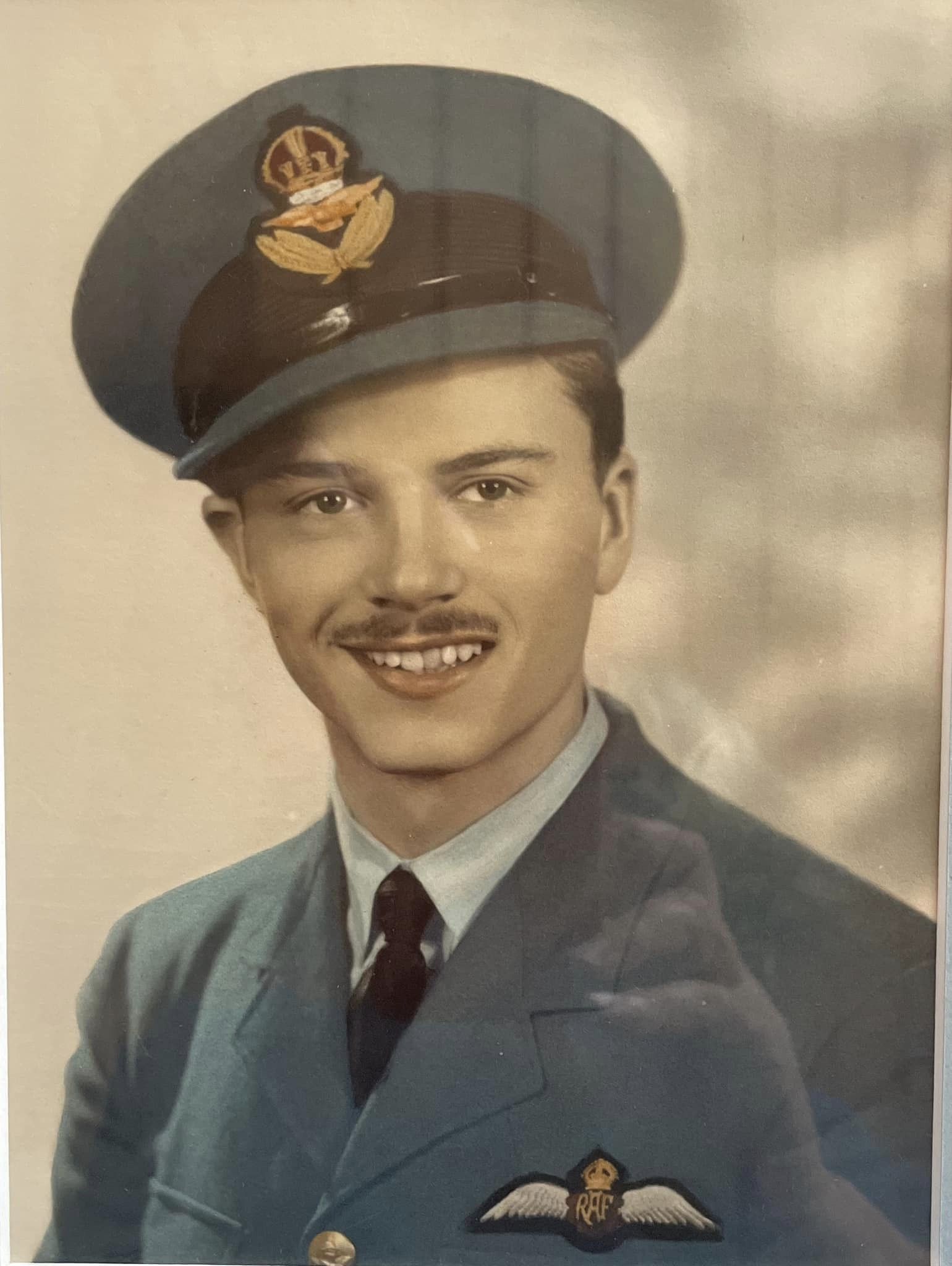
Roy Smith in uniform with his RAF wings
I also focused in on the Ryder family of Newport, whose links to us included a grandfather being the 4th man ashore at Gallipoli and an Uncle who died when the British submarine HMS Trooper was lost in the Mediterranean in 1943. Our bugler, Sam Morgan – is a Ryder. It’s nice to have Bill and some members of the Ryder family with us again today.
This year, I am struck that as the years pass, despite so many things changing, so much stays the same.
Since last Remembrance Day, as a community we have experienced the horror of the Bondi Massacre, the attack on a member of Federal Parliament, Helen Haines, who I know from Sophie Scamp’s recent email on this, is a personal friend and much loved colleague of hers. Both these crimes are just so sad, heinous and shocking to civilised people. We often wonder why it seems to be that it is always the truly nice people who seem to be victims in these unfathomable acts.
As horrendous as these and other numerous attacks in the last 12 months have been, there have been equally hugely heroic and community focused and loving responses, not just in these two incidents, but around the country. These responses and interventions, and indeed brave actions by members of the community, we can hold up in hope. People who just happened to be present, did things that speak to the humanity and love that overwhelmingly unites us here in Australia.
On the world front, sadly, the issues continue along the same sad trajectory for yet another year. Ukraine continues to battle Russian aggression, its innocent civilians, including many children continue to die by criminal Russian attacks on civilian infrastructure and houses, while Putin is feted by those who should know better.
China continues to ride roughshod over international law in the South China Sea, while nation sponsored cyber-attacks seem only to increase on a daily basis. And I haven’t even mentioned the United States and Iran, Yemen or Gaza, the West Bank and Israel. But the fact is the whole Middle East and surrounds seem to go from bad to worse.
Remembrance Day isn’t the day to debate these issues more deeply, but we can’t mourn and honour the sacrifice of so many without considering and acknowledging that their acts defeated evil in their days, in their time, not sadly forever, as the traits of man, and sadly it does seem to be men, not women, to seek power through violence, is older than time itself. You need powerful levers, powerful morals and belief systems, based on love, a true love for individuals to counter evil and the evil one.
The prayers and poem said today resonate deeply, I reckon, with truth hope and love.
Days like today call us to pause, to reflect and to consider in our own minds, lives and actions what each of us can do from today forward to better honour the sacrifices of those who have come before us and who today serve us in our Defence Forces, including their families.
It may well be 108 years since 11 am on the 11th November 1918 when the guns on the Western Front, in the Middle East and the seas and oceans of the world and in the air, fell silent after more than four years of continuous warfare and literally millions of lives lost or destroyed, but the things that were important then remain important now. Hope for a better world has not been diminished in us.
Technology has changed but we haven’t. The men and women of the two World Wars of the 20th century were united in trying to stop another one occurring, but that generation has now almost left us. The hard won lessons seem to be lost on current leaders, both domestic and foreign.
Whatever your political persuasion, the sad fact is that humans are flawed, power, total power remains the aim of sadly far too many national leaders, narcissism is an ever present problem.
If you look just at the Middle East, the issue is framed around the United States and Israel and Iran and its proxies. It sounds like 1914 before a League of Nations or its successor; the United Nations existed. Our leaders and commentary is all about the need for the war in the Middle East to stop. Impotent pleas, spoken for public consumption, but backed with no power.
Where is the United Nations in this?
Where are the attempts to impose international law over Iran for the illegal closure of the Strait of Hormuz an international transit strait or to place restraint on the actions of great powers? The Strait has been closed for 255 days, just 4-8% of normal vessel numbers are transiting it. Our media doesn’t even canvass this issue. It is absent in the conversation. Have any of you heard the UN mentioned in this in the news? Academia? Or even casual conversation? No, and the reason is, it is increasingly powerless and irrelevant – meaning the hard won lessons of WWII and the Cold War are lost. Power and power alone is sadly what seems to mean most again.
As an excellent article by the Juris Centre recently pointed out:
The legal regime governing the Strait of Hormuz is not merely a matter of academic debate; it is a flashpoint for geopolitical tension. The primary instrument of modern maritime law, the United Nations Convention on the Law of the Sea (UNCLOS), provides a framework for transit passage through international straits. However, the application of this framework is complicated by the fact that Iran, a key coastal state, has signed but not ratified the Convention.” Neither by the way has the United States, though it at least does uphold it as customary law.
Nevertheless, despite the cost of diesel and petrol today, the question for us, is not so much about the Strait of Hormuz, but what does the impotence of the United Nations on this issue mean for us more generally? Where has the aspiration for better world governance gone?
Today we need to reinvigorate the understanding of people across the world on this. Europe as always is tragically absent from shaping world events, and things can’t improve without Europe playing a major role internationally.
A total failure to enforce the international law of the sea in one strait, and a vital one for oil, means that vital straits near us, on which Australia’s economic viability depend, such as the Sunda Strait, the Malacca Strait, the Taiwan Strait, even the Torres Strait are much more vulnerable to closure by rogue actors and nations.
Distance and isolation has never actually been a barrier. Those of us who have sailed the oceans and seas know that the seas and air surrounding us actually allow unfettered geographic access to our shores, while today’s technologies permit radicalisation and extreme views to fester. Artificial Intelligence also means we have ceded control of our thoughts, actions and societies to organisms borne out of a technological laboratory, loyal to no particular creed, country or belief system.
Those who have fought, sacrificed, died and been injured in wars, operations and Defence Force service and training, whose family’s lives have irrevocably been affected by war and this service, have done so, so that we have the chance to sit here today in a vibrant democracy. But the sad reality that the absence of international action on these and other issues in 2027 and onwards, will inevitably lead to trouble for us in the future.
It is therefore timely, that we rededicate ourselves to do our bit as well. We cannot sit here passively, we all must pass on a belief in love, democracy and community to families and friends, including especially those we disagree with.
On this Remembrance Day, while these issues swirl around us, we can at least be reassured that the generations that came before us, and the current generation of sailors, soldiers and aircrew are dedicated to keeping us as safe as they possibly can, through their sacrifice, dedication and service. And we can’t thank them enough for that.
A day that commemorates those who died so that we could live in a better, freer, and more inclusive world, is perhaps the best day to consider this.
Lest we Forget.
 Richard Menhinick, AM, CSC, Presidenmt of Avalon Beach RSL Sub Branch