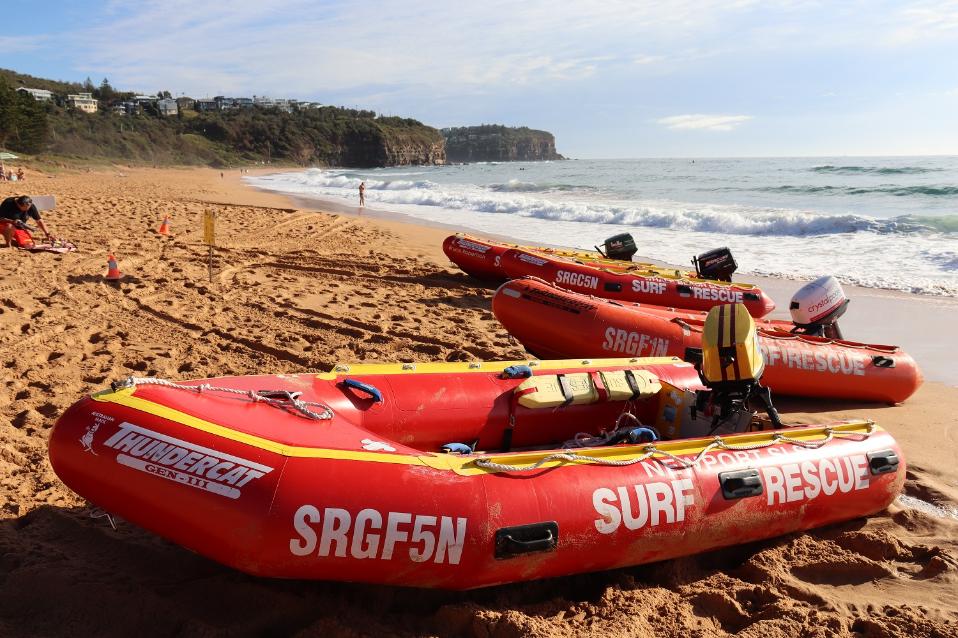
This investment follows an unprecedented number of attacks over the previous week and the need for better education and community safety messaging on shark behaviour, especially in the lead up to and following significant weather events that can increase the risk of attacks.
Avalon Beach SLSC closed the beach on Saturday January 10 due to a shark encounter, stating; ‘’Avalon Beach is closed today following a shark that came in to contact with a surfer off Little Av at 7am. It’s a good day for cricket but best to swim in the pool or choose another beach for an ocean swim.’’
Toby Play posted on Instagram: ’Local Paul ‘Bass’ Stanton got bumped. Tooth in the thumb and 2 in the fin. Still 5 fingers. He is fine.’
A12-year-old boy, Nico Antic, who suffered serious leg injuries after being bitten by a shark in Sydney's east on Sunday January 18, passed away in hospital.
In a statement issued on Saturday January 24, his parents Lorena and Juan said they were "heartbroken" to share the news of their son's passing.
"Nico was a happy, friendly, and sporty young boy with the most kind and generous spirit. He was always full of life and that's how we'll remember him," the statement says
"We would like to sincerely thank the first responders and the teams at Sydney Children's Hospital, Randwick for everything they did to care for Nico.
"We would also like to thank everyone in the community for their support and kind messages.
We ask you please respect our privacy during this exceptionally difficult time."
The family said they would not be providing further comment.
The 12-year-old was attacked by what authorities believe was a bull shark while jumping off a rock ledge near Shark Beach.
NSW Police stated:
"Emergency services were called to Hermitage Foreshore Walk on Steele Point Road at Vaucluse, about 4.15pm Sunday (18 January 2026), following reports a boy had suffering critical injuries after being bitten by a shark.
The 12-year-old boy was assisted by his friends, as well as officers attached to Eastern Suburbs Police Area Command and Marine Area Command, before he was taken by NSW Ambulance paramedics to The Children’s Hospital at Randwick in a critical condition.
This afternoon (Saturday 24 January 2026), police can confirm the boy has died in hospital.
A report will be prepared for the information of the Coroner."
On Monday January 19 a shark bit an 11-year-old’s board at Dee Why Point. Witnesses say they saw what looked like a bull shark possibly 4 or 5 foot long, but this has been unconfirmed.
Fortunately he was unhurt, with the boy’s father, who was paddling back out at the time, able to meet him in the water, where an older bot had come to his aid.
The 11-year-old Dee Why local said he was kicked off his board when the shark lunged up then a few bites were taken out of the board - one removing a section of the board entirely.
Further north on that Monday January 19, Adriaan van der Wallen, at Avalon Beach once again, reported:
''Surfing “Off Rocks” late morning today - A large black fin came towards us, at speed, then disappeared. Several of us saw it. Couldn’t tell what it was but it didn’t surface again. I’m a surfer and keen fisherman, yesterday afternoon two guys caught 4 sharks.''
On the same day, about 6.20pm, January 19, emergency services were called to North Steyne Beach, Manly, following reports a surfer had been bitten by a shark.
Andre de Ruyter, 27, was pulled from the water by members of the public who commenced first aid before the arrival of emergency services.
Andre was treated for serious leg injuries by NSW Ambulance paramedics and taken to Royal North Shore Hospital in a critical condition. Andre remains in hospital, on the road to healing, but doctors have removed a leg.
All beaches on the peninsula were closed until further notice, with many closed several times since due to an increased monitoring of sharks, including Mona Vale Beach and Manly, Saturday January 31, 2026 - as we go to press.
Prior to this the 2026 Big Swim, scheduled for Sunday January 25, was cancelled while the Bilgola and Mona Vale Ocean swims, scheduled for January 11 and 18 respectively, had already been postponed until March 1 and 8 due to adverse weather conditions.
Big Swim organisers stated:
‘’The Big Swim Planning Committee at Whale Beach SLSC has made the difficult decision to cancel the Big Swim and the Little Big Swim scheduled for Sunday, 25 January.
This decision was not made lightly. After receiving advice from SLS Sydney Northern Beaches, SLS NSW, and closely monitoring current conditions, increased shark activity and water pollution levels mean we cannot safely proceed. This is only the second time in the event’s 52-year history that the Big Swim has been cancelled.''
Drone monitoring prior to and throughout the Newport Pool to Peak Oceans Swims on January 4 2026, which has become the usual practice in recent years for all Pittwater Ocean Swims, went ahead again this year.
 for shark encounters report jan 2026.jpg?timestamp=1769820922884)
7 a.m. Newport Beach on January 4, checking all the waters offshore
Pittwater MP Launches Shark Survey
Pittwater MP Jacqui Scruby stated on January 20:
''The shark attacks over the last few days have shaken our community.
My thoughts are with the young men and their families impacted. I want to thank the first responders, life guards, paramedics and members of the public who heroically came to their aid.
With all northern beaches now closed until further notice as a precaution, I urge all surfers and swimmers to follow the safety advice provided.
I am aware there is growing concern in the community about an increase in shark encounters locally, so I have requested a meeting with the Department of Primary Industries to understand the changing behaviour and numbers of sharks in Sydney.
We have recently had $2.5m further investment in drone surveillance at NSW beaches and I am pushing for more. I also encourage beach goers to download the Shark Smart App which provides real-time shark alerts and information for NSW ocean beaches.''
See November 2025 report: Jacqui Scruby - Council - Long Reef Boardriders - Maria Psillakis Call for Expanded Drone Surveillance to Improve Safety at Beaches
Ms Scruby welcomed the additional funding announcement on January 25, stating:
''An increase in $4.2m NSW State Government funding to improve shark protection and safety measures including a significantly expanded drone program across the northern beaches, is what I have been advocating for.
It also includes More research on bull sharks, installing shark listening stations in Sydney Harbour and strengthening community education and awareness.
This is in addition to the extra $2.5m allocated in December. Thank you to everyone who has been working together to push for more modern shark awareness and protection measures, including the Psilakas family,'' Ms Scruby said
The Pittwater MP is also keen to hear from surfers, fishermen and the community generally about their views, experience and local knowledge about Sharks in and around Pittwater and has launched a survey for responses.
The Shark Survey is available at: www.jacquiscruby.com.au/pittwater_shark_survey
Residents, along with shark monitoring stations, have been reporting an increase in shark encounters since the Autumn of 2025, with some attributing sharks staying in the estuary and along the peninsula beaches instead of migrating north during cold water seasons to an increase in sea temperatures, driven by climate change.
See March 2025 report: It's a 'Bit Sharky' out there: 5 Tagged Bull Sharks Pinged at North Narrabeen on Same Day - Bull Shark spotted at Bayview
Community News February 2020: Sharks in Pittwater Estuary and Narrabeen Lagoon
Bull sharks (Carcharhinus leucas) generally breed and give birth during the Summer months, with pupping seasons often peaking between December and February in the Southern Hemisphere. Females are viviparous, with a gestation period of 10-12 months, and migrate to shallow coastal estuaries and river mouths to give birth to litters of up to 15 live, free-swimming pups.
Young bull sharks remain in these, sheltered, low-salinity harbour, river and estuary systems for several years to grow while avoiding larger predators. Bull sharks are known for this unique reproductive strategy, using these environments as nurseries, which increases the likelihood of interactions with humans during Summer.
The Shark Management Program, administered by the Department of Primary Industries and Regional Development (DPIRD) and delivered by the Australian UAV Service (AUAVS) – a service arm of SLSNSW – will grow from 50 patrolled locations to 80 under the proposed scope of funding, with 19 new locations across Sydney and 11 regional beaches among those set to benefit from eyes in the sky.
Under the existing program, drone surveillance at the 50 DPIRD Shark Management Program locations would transition from daily to weekend-only patrols at the end of January until the end of March.
However, thanks to the new funding, drone patrols will continue daily at all 80 new and existing locations until the end of the April school holidays.
The new drone locations across the Manly to Barrenjoey peninsula include:
- The Avalon/Bilgola Headland (covering Avalon, Bilgola and Newport)
- Mona Vale (covering Mona Vale and Warriewood)
- North Narrabeen (covering Turrimetta and Narrabeen)
- Collaroy (covering Collaroy and Fishermans')
- Freshwater Headland (covering Freshwater, North and South Curl Curl)
- Long Reef
- North Steyne (covering North Steyne, Queenscliff and Manly)
Already covered: Palm Beach, South Narrabeen, Dee Why.
 shark mitigation jan 2026.jpg?timestamp=1769821150782)
Palm Beach, January 3 2026 - this beach has had drone surveillance since 2019
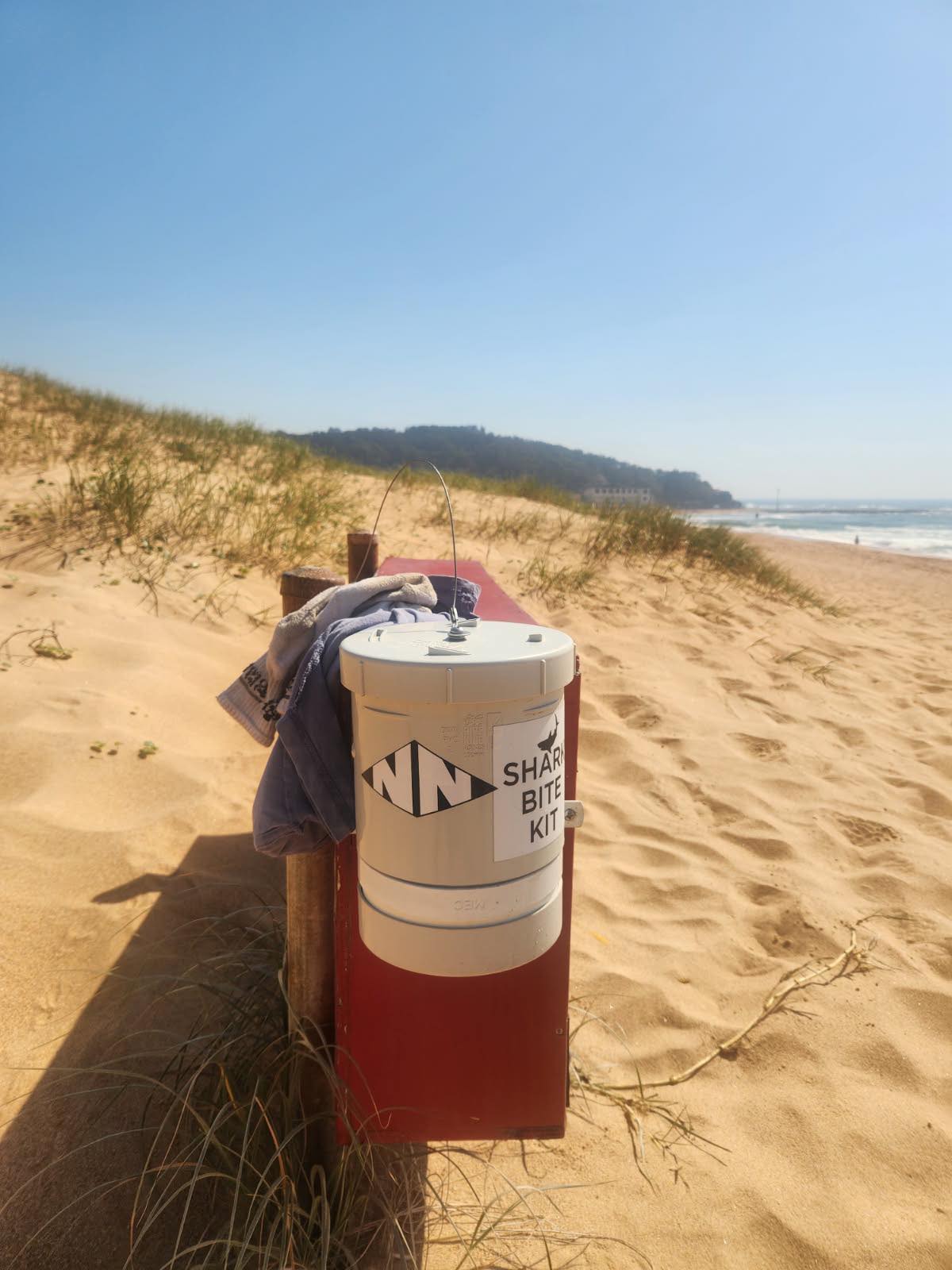
Some local surf lifesaving clubs also installed shark bite kits prior to Summer commencing.
North Narrabeen SLSC shark bite kit
The Harbour-focused research and monitoring will help build a clearer picture of where Bull Sharks are, how they move and when risks are higher, particularly after significant weather events, and will directly inform future shark mitigation strategies for 2026/27 and beyond.
That improved understanding will support better awareness for swimmers, clearer warnings and more practical advice for people using the water.
At the same time, Surf Life Saving NSW shark surveillance drone coverage will be significantly expanded, with an additional 30 beaches added from 24 January, including 19 new locations in Sydney and 11 regional beaches.
Drones will also increase operations to seven days a week through to the end of the April school holidays.
The additional funding follows heightened community concern after recent shark incidents and recognises the importance of clear, evidence-based safety messaging for swimmers and surfers, particularly after storms and heavy rainfall, which can increase risk.
As part of the $4.2 million package, the NSW Government will:
- Expand drone patrols at more beaches - increasing Surf Life Saving NSW drone operations to an additional 30 locations from 24 January, including 19 new Sydney beaches and 11 regional sites - with flights operating seven days a week through to the end of the April school holidays, alongside the existing fleet covering up to 50 beaches during school holiday periods.
- Carry out focused research on bull sharks in Sydney Harbour and other estuaries, including tagging and monitoring led by the Department of Primary Industries and Regional Development’s (DPIRD) shark scientists to build clearer insights into the number of bull sharks in the harbour, their movements, residency patterns and higher-risk periods.
- Install shark listening stations in Sydney Harbour, allowing faster detection of tagged sharks so harbour users can be alerted when sharks are nearby.
- Strengthen community education and awareness, with an expanded SharkSmart education campaign, an additional mobile education van, new and updated signage, and increased social media alerts and community warnings during periods of elevated risk.
These measures sit alongside the 2025/26 Shark Management Program already operating across NSW including:
- 305 SMART (Shark Management Alert in Real Time) drumlines in 19 local government areas for year-round coverage
- Shark nets at 51 beaches across eight LGAs between Newcastle and Wollongong, deployed 1 September to 31 March
- Tracking the movements of tagged sharks via 37 tagged shark listening stations, with at least one station in every coastal local government area for year-round coverage.
In December, the Government announced an additional $2.5 million enhancement to its 2025/26 program, with drones staring a week earlier than normal in summer, weekend flights from February to April, an expedited rollout of additional drones and training for Surfing NSW, as well as tripling funding for an additional 150 community shark bite kits in regional coastal areas. These kits will be rolled out progressively.
See: Sunday December 7 announcement: Minns Government announces $2.5 million boost to summer beach safety with immediate extra shark surveillance drones
Minister for Agriculture, Regional and Western NSW, Tara Moriarty said:
“Keeping people safe is our priority, which is why we’ve committed an additional $4.2 million in to strengthen shark safety measures.”
“Recent shark incidents following storms and heavy rainfall have highlighted the importance of clear, practical information for people using the water.
“This funding will help expand drone surveillance, improve education and ensure timely warnings, so swimmers and surfers can make informed decisions about when to enter the water.
“There’s no single solution, and no government can ever promise to make the water completely safe, which is why we’re using a range of tools to keep people informed and as safe as possible.”
Surf Life Saving NSW CEO Steve Pearce said:
"This new package represents a 90% increase on our current shark surveillance drone program – a significant enhancement that will see more drones flying at popular beaches along our coast, representing an additional 35,000 flying hours from 24 January to 26 April.
"We know our SLS drones are an effective eye in the sky when it comes to early shark detection and warning beach users.
"So far in 2025/26, 50 Surf Life Saving NSW drones from Tweed to Bega have completed 29,431 flights over 8044 flying hours. During that time 461 sharks were sighted.
"Our lifeguards and lifesavers enacted 170 countermeasures including beach evacuations, beach siren, drone siren, and rescue vessels."
Shark safety: How to reduce the risk of an encounter with a shark
- Swimming after storms in a murky fresh water mix a definite no as the wash out attracts sharks.
One of the simplest safety routines to follow is to only swim at patrolled beaches and to stay between the flags. This is the safest place to swim because lifesavers and lifeguards are there to monitor beach and water conditions and maximise the safety of all beach goers. Pay attention to the advice of the lifesavers and safety signs. Patrolled beaches may also sound shark alarms. You should leave the water as soon as an alarm is sounded or a shark is spotted.
The following SharkSmart points provide tips on how to reduce your risk of an encounter with a shark.
SharkSmart swimmers and surfers:
- Tell an on-duty lifesaver or lifeguard if you see a shark.
- Stay close to shore when swimming.
- Stay out of the water with bleeding cuts or wounds.
- It's best to swim, dive or surf with other people.
- Avoid swimming and surfing at dawn, dusk and night – sharks can see you but you can’t see them.
- Keep away from murky, dirty water, and waters with known effluents or sewage.
- Avoid areas used by recreational or commercial fishers.
- Avoid areas with signs of bait fish or fish feeding activity; diving seabirds are a good indicator of fish activity.
- Dolphins do not indicate the absence of sharks; both often feed together on the same food, and sharks are known to eat dolphins.
- Be aware that sharks may be present between sandbars or near steep drop offs.
- Steer clear of swimming in canals and swimming or surfing in river/harbour mouths.
- Avoid having pets in the water with you.
- Keep away from shark nets and other shark mitigation measures.
- Consider using a personal deterrent:
- There are several commercially available shark deterrent products but the NSW Government recommends investing in a device that has been independently tested and verified. As a part of the NSW Shark Management Strategy, funding was provided to independently test a number of shark deterrent products. Read the Flinders University report (PDF, 1624.03 KB).
SharkSmart divers, snorkellers and spearfishers:
- Understand and respect the environment. Find out which species of shark you are most likely to encounter and what behaviour to expect from them.
- Realise that diver safety becomes increasingly difficult with decreasing visibility, such as at night or in turbid water and with increasing depth and current.
- Discuss dive logistics and contingency plans such as hand signals, entry and exit considerations and separation procedures with your dive partner before you enter the water.
- Be aware that using bait to lure fish may attract sharks.
- Don't chase, grab, corner, spear or touch a shark.
- Don't use bait or otherwise attempt to feed a shark while underwater. Feeding may radically change the shark's behaviour and may lure other sharks.
- Observe and respond to a shark's behaviour. If it appears excited or agitated, exhibiting quick, jerky movements or other erratic behaviour, leave the water as quickly and calmly as possible. Try to minimise splashing and noise.
- Be aware of the behaviour of fish. If they suddenly dive for cover or appear agitated, leave the water as quickly and calmly as possible. A shark may be nearby.
- Do not attach speared fish to your body or keep them near you; use a float and line to keep your catch well away.