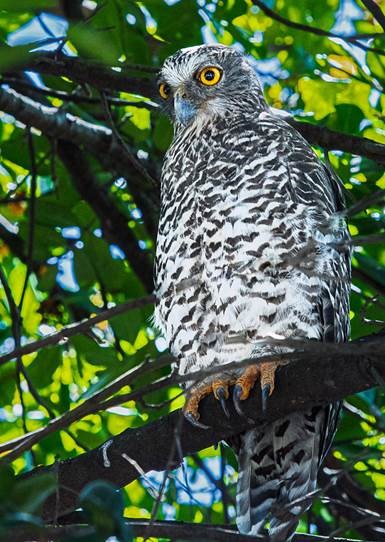
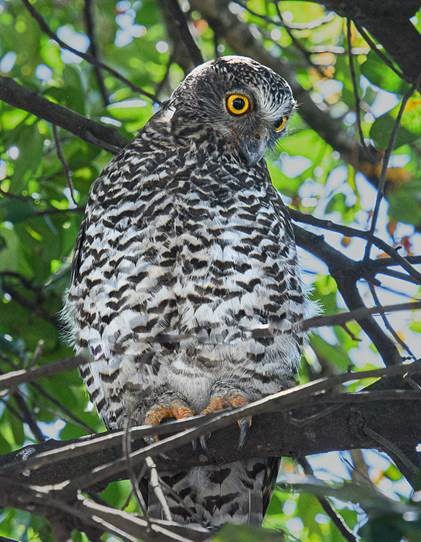
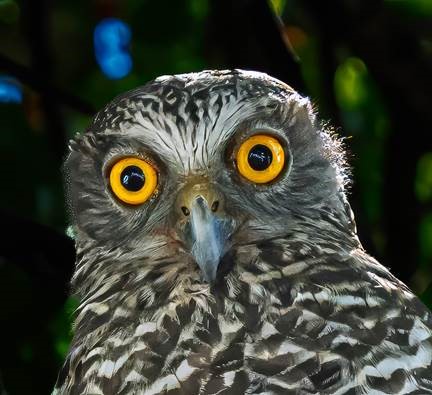
Pittwater residents, including our local Vet, have been hearing lots of owls at night of late, a classic end-of Summer nocturnal music as these juvenile birds begin finding their way in the world, having grown out of their birth nests.
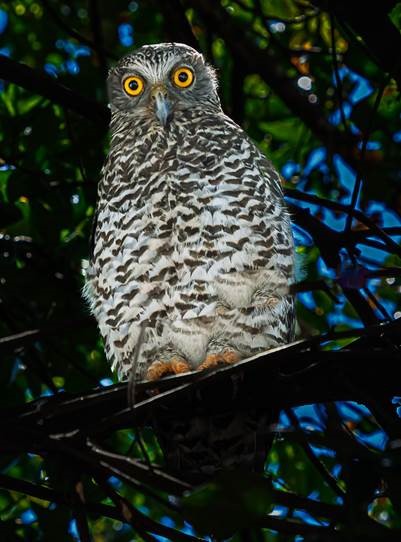
This Powerful, photographed by PON's Features Photographer Michael Mannington OAM of Community Photography, was spotted in Mona Vale this week.
He's a boy and has been checked by Sydney Wildlife volunteers a few times over recent days. Apparently there are possums in the vicinity and he’s waiting for a dusk feed. He also ranges through Kitchener park as part of his new domain.
Another nocturnal music being heard by those still working late are Flying Foxes feasting on what is blooming - in the PON yard at present that's Pittwater Spotted gums - and they're joined in nocturnal flight by the microbats pair that also live in these same trees.
The birds watched growing up this past Summer are also dispersing or have already gone - off into the greater expanses of blue hills meeting green hills meeting blue skies.
See: Summer BirdFest 2026: Play antics of New Locals - Blue-faced Honeyeaters Breeding In Pittwater or All February 2026 Environment News
It's all classic end-of Summer in Pittwater stuff.
Please slow down at Dusk and Dawn
 The powerful owl (Ninox strenua), a species of owl native to south-eastern and eastern Australia, is the largest owl on the continent. It is found in coastal areas and in the Great Dividing Range, rarely more than 200 km (120 mi) inland.
The powerful owl has a long tail and a small head, giving it an atypical silhouette for an owl and imparting a more hawk-like appearance than any other large owl. The protruding bill and distinct brow ridges enhance the hawk-like appearance of the species.
This species measures 45 to 65 cm (18 to 26 in) in length and spans 112 to 135 cm (44 to 53 in) across the wings. Unlike in a vast majority of owl species, the male is slightly larger than the female on average. Body mass in males has been reported at 0.99 to 2.22 kg (2.2 to 4.9 lb), with 13 males averaging 1.45 kg (3.2 lb), while females can weigh from 1.04 to 1.6 kg (2.3 to 3.5 lb), with an average in 9 females of 1.25 kg (2.8 lb). Among all the owls in the world, the powerful owl is the ninth longest from bill-to-tail, the tenth heaviest and the eighth longest winged. - From Wikipedia and BirdLife Australia
''Majestic is the suitable description.'' - Michael Mannington OAM, February 17, 2026
Generally, this species lives in primary forests with tall, native trees, but can show some habitat flexibility when not nesting. The powerful owl is a typically territorial raptorial bird that maintains a large home range and has long intervals between egg-laying and hatching of clutches. Also, like many types of raptorial birds, they must survive a long stretch to independence in young owls after fledging.
They are an apex predator and are often opportunists, like most predators, but generally are dedicated to hunting arboreal mammals, in particular small to medium-sized marsupials. Such prey can comprise about three-quarters of their diet.
As insects also form part of their diet, residents are asked to slow down at dusk and dawn as they will frequently feed at the sides of roads and this can lead to impacts with cars - please slow down!
If you do come across wildlife that has been injured or needs help, please contact:
Sydney Wildlife: For 24/7 Emergency Rescue or Advice CALL 9413 4300
WIRES: For emergency rescue support 24/7 please call 1300 094 737
Both operate 24/7 with local volunteers ready to help our other local residents - the feathered, furry and scaled. Their mission is to rescue and care for sick, injured, and orphaned native wildlife and to safely release them back into the wild
More of MM's photos: