September 1 - 30, 2026: Issue 658


Fifteen additional H5 bird flu events in NSW, Including a Myna bird, Sea Eagle

Notification: Wednesday September 16- 18, 2026

The NSW Government states it is responding to eight new events of H5 bird flu after samples were taken from Greater Crested Terns at Randwick, Cronulla, Port Botany, Milton, Berry, Kiama and Forster, and a Myna in Berry.

As this Issue goes to publication the NSW Government has advised a further 7 new H5 bird flu events were confirmed in terns found at Eden, Wallagoot, and Pambula on the Far South Coast, and Coledale in the Illawarra, and in silver gulls at Tathra and Edrom, as well as a sea eagle at Potato Point.

NSW has now recorded 52 H5 bird flu events.

Surveillance is continuing across the state so any further cases can be detected early.

These include a Greater Crested Tern at Warriewood and another at Dee Why. This brings the number of reported deaths due to H5 bird to 560 across Australia.

See: Crested Tern at Warriewood is Pittwater's First H5 Bird Flu Fatality

Additional H5 bird flu events in NSW: One at Dee Why - a Greater Crested Tern + How to Look After Your Pets

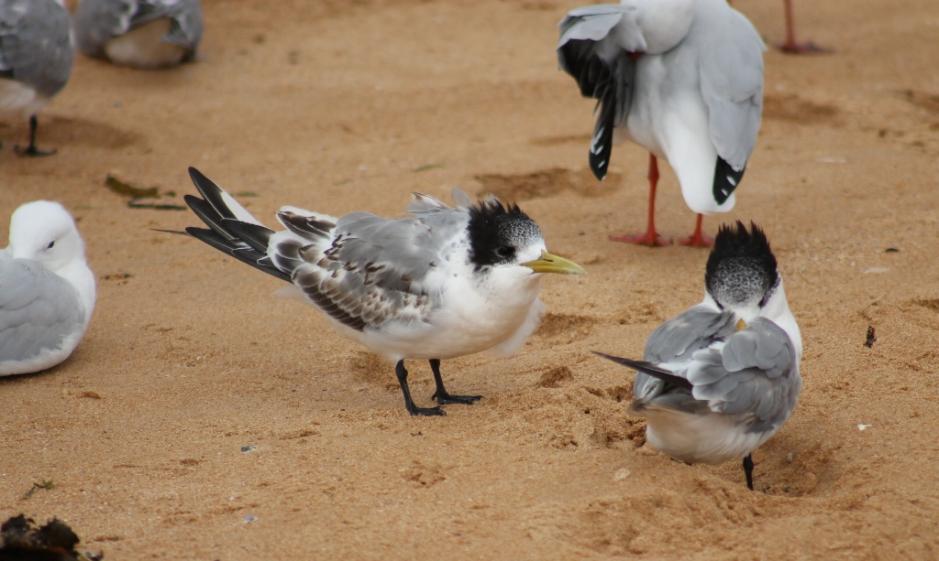
                                  Fledgling Crested Tern and parent at south Mona Vale Beach, picture: A J Guesdon, 2014

A national surveillance plan is in operation to monitor for any further detections and facilitate rapid, coordinated response.

Bird flu has not been detected in commercial poultry flocks or captive birds and the risk to human health remains low.

These events are not unexpected, and the NSW Government states it is 'well prepared for H5 bird flu'.

Most detections have been in various species of terns, and this is likely because they gather in large groups along the NSW coast, making it easier for bird flu to spread between the birds.

The NSW Government is reminding people with backyard poultry and pet birds to:

  • maintain clean housing for birds
  • provide clean, chlorinated domestic water and keep birds away from natural water sources
  • limit wild bird contact and place food and water inside shelters
  • quarantine new birds.

The NSW Government is reminding dog and cat owners they should also undertake biosecurity measures such as:

  • keepings dogs on a leash in wildlife areas where birds are found (or out of wildlife areas altogether - as per NSW LAWS)
  • keeping cats indoors or in secure enclosures
  • reducing contact between pets and wildlife
  • washing your hands with soap and water before and after handling birds or other animals.

The NSW Government said it is continuing to receive many calls and online reports to the Emergency Animal Disease hotline and key stakeholders are being briefed regularly.

If a person sees sick or dead wild birds, domestic birds, marine mammals or other wildlife showing signs of H5 bird flu - AVOID contact, RECORD what you see, REPORT it via the online reporting form or Emergency Animal Disease Hotline - 1800 675 888.

The NSW Government continues to work closely with Australian and State and Territory governments to roll out the plans developed with industry, agriculture and wildlife organisations.

The Chief Veterinary Officer has advised the poultry industry that at this stage there is a housing recommendation for poultry.

Given the extent of the spread of bird flu across Australia, NSW now reports detections under the nationally consistent event system, where a single investigation may involve one or more birds and considers factors such as location, timing, species and other findings.  

For more information about H5 bird flu visit the NSW Government’s dedicated webpage:  Bird Flu (H5 avian influenza)

Minister for the Environment, Penny Sharpe said:

“H5 bird flu will continue to pose a serious challenge for native bird populations.

“The NSW Government is continuing targeted vaccination of vulnerable species, as well as surveillance and preparedness to reduce the risk of further impacts on our native wildlife.

“If you see a sick or dead bird, do not approach it. Record the details from a safe distance and report it through the Emergency Animal Disease Hotline.”

Minister for Agriculture, Regional and Western NSW, Tara Moriarty said:

“Pet owners can help protect their animals by keeping cats contained, keeping dogs on a leash around wildlife, and avoiding situations where pets may come into contact with wild birds or animals.

“If you keep backyard chickens or birds, make sure feed and water are not accessible to wild birds, keep birds separated from wild birds where possible, and maintain good hygiene around enclosures.

“The most important thing is to stay alert for signs of illness in your birds and report any unusual sickness or deaths promptly to the Emergency Animal Disease Hotline, helping to protect your own animals and the wider community.”

National H5 bird flu site and species planning

On August 28, to prepare for H5 bird flu, the Australian Government announced it is supporting state and territory environment agencies with $2.15 million to develop plans for wildlife.

Place-based plans focus on wildlife at priority sites, with some covering multi-site regions. These include:

  • important wetlands
  • internationally significant migratory bird sites
  • areas that provide a range of important habitats for susceptible birds and mammals.

Species plans focus on high priority species or group of species, and may span several locations, outlining preparedness, response and recovery actions.

Each state and territory is taking a planning approach that best works with their broader planning for H5 bird flu.

'These plans are living documents; their content and coverage may be updated over time as we learn more about how H5 bird flu is likely to impact.' the government stated

Read the department’s statement on the sharing of H5 bird flu site and species preparedness plans.

The allocation for New South Wales was $300,000

Place-based plans cover:

  • coastal wetlands
  • large and key inland wetlands
  • NSW islands
  • unregulated western wetland and river systems

Species plans cover:

  • Lion Island and Manly little penguin populations
  • Australian and New Zealand fur seals

On the same day, August 28, the NSW Government announced ''A combination of insurance populations in captivity and wild populations of birds will be vaccinated. This includes the Little Penguins in Manly and Barunguba Montague Island.''

See: Manly's Little Penguins to be vaccinated Against H5 Bird Flu + Lion Island Little Penguins Update

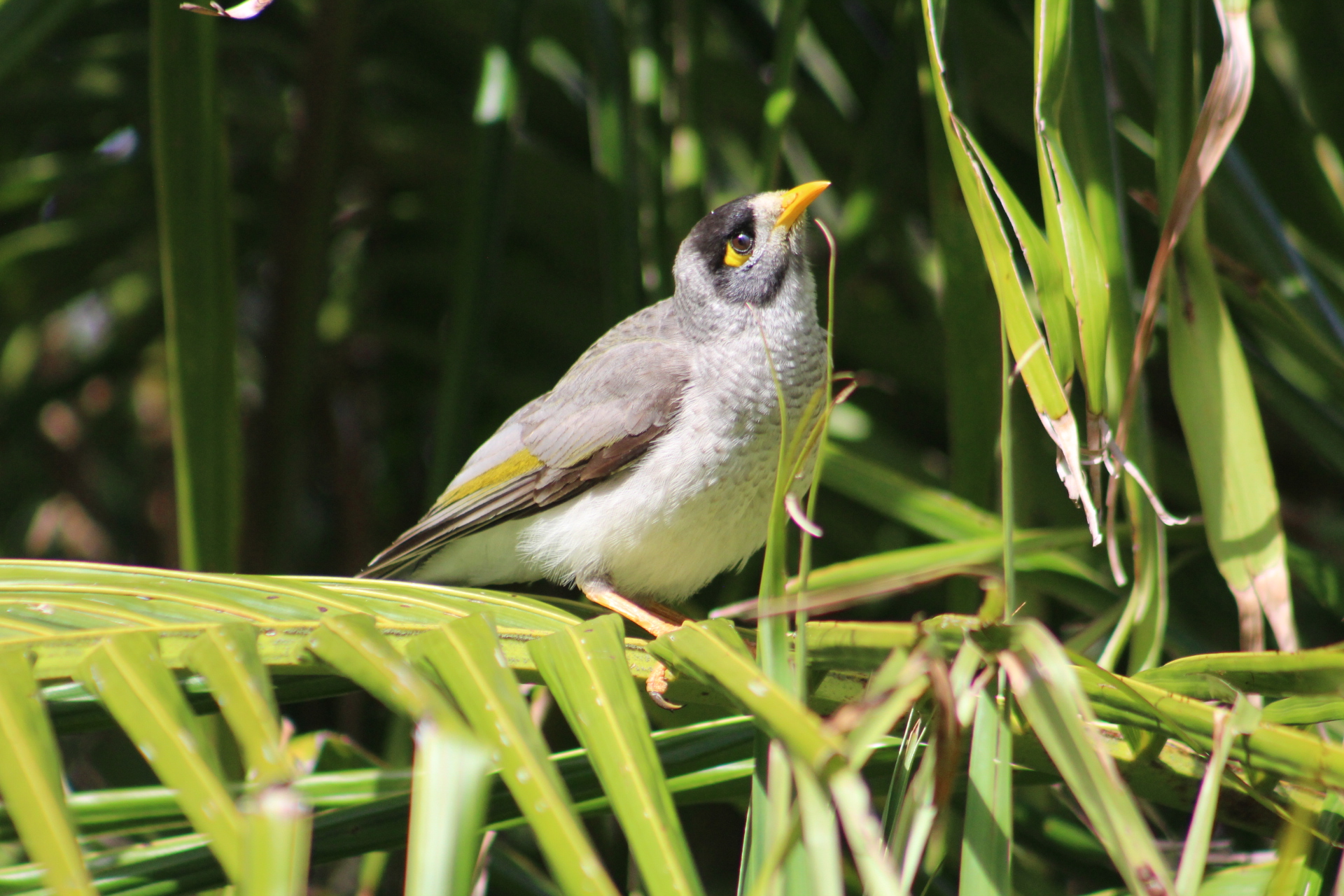
The myna birds' death at Berry records the disease is jumping between species in NSW now too. Although official biosecurity releases have not detailed the exact scientific species name beyond "myna", in the Illawarra and Shoalhaven region where Berry is located, the common introduced myna species is the Indian Myna (Acridotheres tristis), and native honeyeaters like the Noisy Miner (Manorina melanocephala) are also frequently called "mynas''.

This week, a rare Australian sea lion (Neophoca cinerea) on Kangaroo Island has been confirmed to have died from H5N1 bird flu. The sea lion had recently been attacked by a shark, weakening it. Testing revealed the cause of death was the virus. Another dead sea lion is also being tested.

An insight on this loss runs below, as does information on an Information Session for the Community at Warriewood on Wednesday September 30 2026.


Myna, Manorina melanocephala, bird in Pittwater. Photo: A J Guesdon

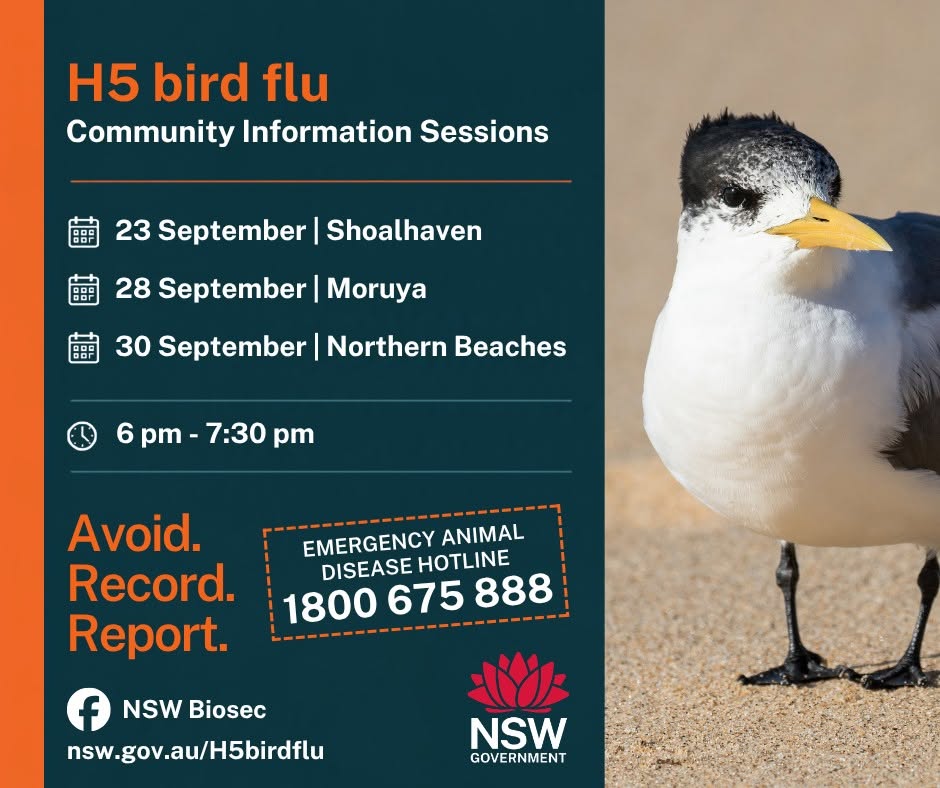
Bird Flu Info Session at Warriewood: Wednesday Sept. 30

With recent H5 bird flu detections in NSW, we're partnering with NSW Health, Local Land Services, National Parks and Wildlife Service and local councils to bring the latest information to communities affected by these events.

These free information sessions are a chance to find out what’s happening, what’s being done in response and what you can do to help reduce the risk of spread.

There’ll also be plenty of time to ask questions and chat with the people working on the response. 

Join us at an information session near you:
30 September: Warriewood Community Centre, 6 pm - 7:30 pm FREE:  Tickets 

If you see sick or dead birds: Avoid, Record, Report. Use the online form https://forms.bfs.dpi.nsw.gov.au/forms/23970 or call the Emergency Animal Disease Hotline on 1800 675 888.

Bird flu has claimed its first Australian sea lion and dolphin. How does the virus get into these animals?

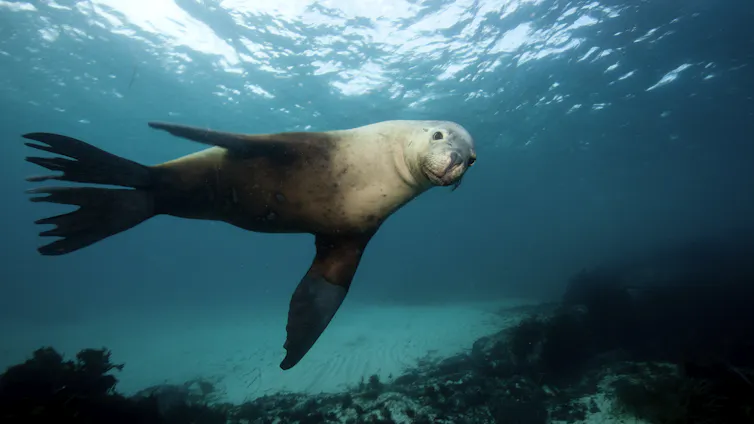
sea lion looking at the camera while swimming in the ocean.
Stephen Frink/Getty
Bill Bateman, Curtin University

A rare Australian sea lion (Neophoca cinerea) on Kangaroo Island has been confirmed to have died from highly pathogenic H5N1 bird flu. The sea lion had recently been attacked by a shark, weakening it. Testing revealed the cause of death was the virus. Another dead sea lion is being tested.

The first confirmed H5N1 death recorded for this species in Australia marks a significant and worrying moment for Australian wildlife. These sea lions are the rarest pinniped to breed on our coasts. They’re considered endangered, as their population is under 12,000. This species of sea lion breeds slowly, meaning even a limited outbreak of bird flu could be very bad news for breeding colonies.

The strain of bird flu now circulating in Australia and New Zealand has evolved to infect some mammal species as well as birds. Since 2021, it has decimated some seals and sea lion species overseas, especially in South America.

The virus is even capable of infecting and killing dolphins.

But how does the virus pass between these animals? How do seals and dolphins actually get the infection?

There’s much we don’t know. But here’s what we do.

Bird (and mammal) flu?

The highly pathogenic H5N1 strain of bird flu (avian influenza) was first detected in 1996. Highly pathogenic means it is capable of causing severe disease.

In 2020, the virus mutated into a new, more deadly variant capable of infecting more species. It is no longer just a threat to birds.

Since 2021, this strain has caused mass die-offs in pinnipeds (seals, sea lions, walruses and so on). In Argentina, more than 17,000 southern elephant seal pups died. After the virus reached Australia’s Heard Island, drone surveys identified more than 13,000 dead pups from the same species.

Some pinnipeds were able to catch older bird flu strains. But these mainly affected their respiratory tracts. The newer highly pathogenic H5N1 strain can also invade the brain and nervous system of mammals.

Sea lions have been found with encephalitis, brain inflammation and other neurological signs before death.

In Florida, a bottlenose dolphin infected with H5N1 was found to have the highest concentration of virus in its brain.

How do pinnipeds catch the virus?

The way the virus gets into pinnipeds is likely from birds. When sick seabirds infected with the virus die on the islands used by sea lions for breeding, the virus can jump across to the mammal. This can be through direct contact, scavenging carcasses or exposure to contaminated sand, rocks, water, faeces or mucus. Sick birds can and do sneeze and cough, spreading viral particles.

Direct transmission from mammal to mammal is suspected, though not yet conclusively proven in most wild marine mammal die-off events.

But the fact so many elephant seal pups died rapidly suggests the virus is able to spread between them. Transmission between elephant seals is suspected to have occurred in Argentina. It’s highly likely that the virus can spread faster in dense seal and sea lion colonies.

Pinnipeds, too, can sneeze and cough, which would help spread the virus. One researcher testing transmission reportedly had a seal sneeze in their face. They then contracted severe conjunctivitis in the eye. The bird flu virus was detected.

sea lions on the beach, seagulls flying near them.
Sea lions may be getting infected by contact with sick or dead birds and their excretions. atosan/Getty

But what about whales and dolphins?

So far, so logical. But how can dolphins and other cetaceans contract the virus?

After a dolphin washed up dead near Goolwa, South Australia, it tested positive for H5N1 – the first case in Australia.

How did it happen? SA chief veterinary officer Dr Skye Fruean told the ABC it was likely the dolphin had “eaten a bird or interacted closely with a wild bird”.

This is possible, but we don’t know for sure. What we do know is that this H5N1 strain has been found in a range of dolphin species around the world.

So far, there’s little evidence of large whales being infected with bird flu. A juvenile dead whale washed ashore at Victor Harbour was found not to have the virus.

dolphin swimming next to pelican.
Dolphins are likely to get infected by contact with sick birds. Damian Lugowski/Getty

How long can the virus survive in the environment?

Viruses can survive outside a host, though typically not for long.

The H5N1 influenza virus generally survives longest in cool, moist conditions. It can remain infectious for days and sometimes weeks in water, depending on temperature, salinity and sunlight.

In hot, dry environments, survival is much shorter.

Carcasses can act as temporary reservoirs of the virus while tissues remain fresh.

This is one reason why beaches and breeding colonies can be transmission hotspots during an outbreak.

What can we do?

There’s no real way to stop the spread of H5N1 now that it’s here. But there are many ways we can reduce its impact.

Removing carcasses safely is crucial, as it removes these viral reservoirs and stops it getting into Australia’s many scavenging animals.

Investing in better monitoring and detection is essential if we are to slow the spread by helping us to target affected populations.

We must ramp up protection for endangered species, reduce human pressures such as disturbance of seal colonies and plan to help depleted populations recover.

Ultimately, the death of this sea lion shows us that the burden of bird flu will reach far beyond birds. This strain of the virus is a wide-ranging threat able to affect entire ecosystems. We must do what we can to protect them.The Conversation

Bill Bateman, Associate Professor of Behavioural Ecology, Curtin University

This article is republished from The Conversation under a Creative Commons license. Read the original article.