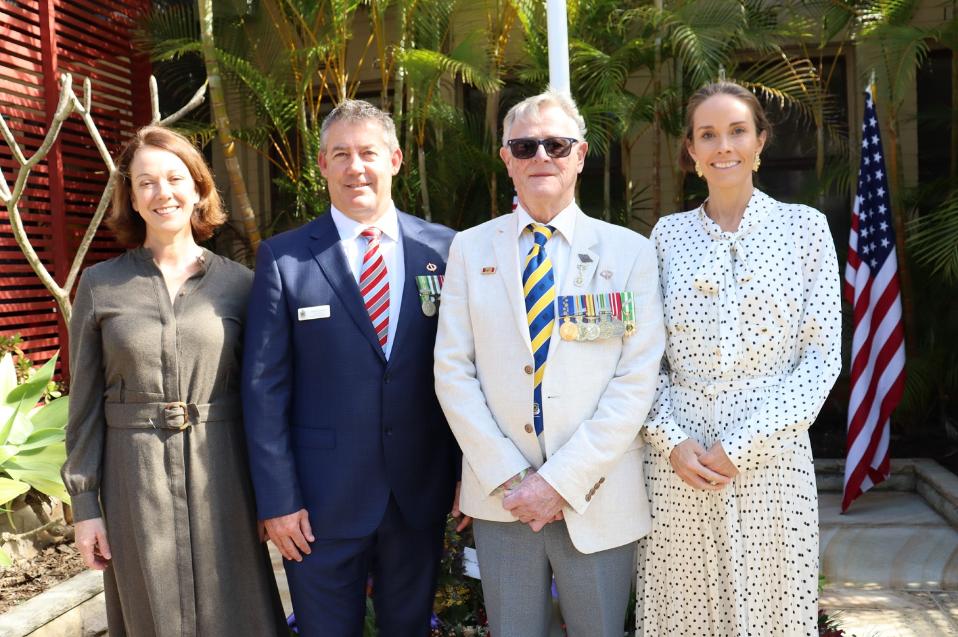
On Sunday August 16 a combined service of the local Sub-Branches to honour the courage, service and sacrifice of Australians who served during the Vietnam War and commemorate the 60th anniversary of the Battle of Long Tan, one of the most significant engagements in Australia's military history, was held at Palm Beach RSL.
On 18 August 1966, soldiers from D Company, 6th Battalion, Royal Australian Regiment, faced overwhelming odds and engaged a much larger Viet Cong and North Vietnamese force in a rubber plantation near Long Tan, in Phuoc Tuy Province, South Vietnam.
After three hours of intense fighting in difficult conditions, 18 Australians were killed and 24 were wounded.
The Battle of Long Tan has become an enduring part of Australia's military history and remains a defining moment for those who served in the Vietnam War.
Sixty years later, the legacy of Long Tan continues to resonate across generations. Vietnam Veterans' Day provides an opportunity to recognise not only those who served on the battlefield, but also the families, loved ones and communities who supported them during and after the conflict.
Around 80 representatives and Vietnam Veterans mustered at the corner of Iluka and Barrenjoey roads Palm Beach to march, led by the Knox Old Boys Pipe Band and Pittwater House Cadets, to the Palm Beach RSL Cenotaph.
The marchers were welcomed by Mark Ferguson OAM, President of the Sub-Branch and a Vietnam Veteran, with the Commemorative Service MC’d by Sub-Branch member David Good.
Doug McGrath, President of the 9 RAR Association, gave the Commemorative Address:
.jpg?timestamp=1787269080818)
Doug McGrath, President of the 9 RAR Association
Honoured guests, serving and former ADF members, your families, ladies and gentlemen. I'm deeply honoured to represent all Vietnam Veterans at our service here today on the 60th anniversary of the Battle of Long Tan. In this presentation I will offer an insight into the life of an infantry combat soldier, particularly that of a National Serviceman.
Australian military personnel served in Vietnam from 1962 until the last were pulled out in 1973. In this time, all three services of the Australian Defence Force; Army, Navy and Air Force, supported each other by executing their specialised role. National Service played a major role in the Vietnam War.
As the war escalated, regular Army was supplemented from 65 to 73 by 60,000 men who were called up at 20 years of age to serve two years of National Service in the Army. Along with others present here today, I was one of those Nashos. These young Nashos were plucked from civilian life, they came from every conceivable background.
In my company alone, I served with uni graduates, former miners, farmers, truckies, tradies, policemen, teachers, posties, salesmen and everything in between. I've no doubt that this eclectic group of young Australian men of such diverse backgrounds, when combined with regular soldiers, greatly enriched the Army. Of these National Servicemen, 40,000 completed their two years in Australia, but almost 20,000 were deployed for their 12-month service in Vietnam.
There were 521 Australians who paid the ultimate sacrifice in Vietnam. 521 young men who never had a chance to marry, raise a family, hold a grandchild or have a career. Those of us who returned are eternally grateful.
Of those who returned, over 3,000 were wounded, and almost all came home carrying undetectable scars. The Vietnam War saw the extensive use of helicopters, which revolutionised warfare at the time. Vietnam Veterans can never forget the unmistakable sound of a Huey in flight, which invokes a flood of memories and extremes of mixed emotions.
The Vietnam War was the first media war, with war footage being broadcast into Australian lounge rooms the night after it was filmed. This formed the anti-war protest movement, both in the US and Australia, and created a hostile environment for the soldiers when they returned home.
There's a lot of traditions in the military.
I'm a third-generation military veteran, as are many of the veterans here today. We inherited from our forefathers the military traditions of courage, commitment, resilience, service, mateship and larrikinism, which was forged and delivered in the Western Front, cemented in Britain in the Middle East and the Pacific in World War II and then Korea. So these qualities were in our DNA when we were deployed as soldiers in Vietnam.
We have continued to serve our communities, care for our mates and their families, display resilience and courage, particularly when faced with medical challenges, and there are still plenty of larrikins amongst us. I was only in the Army for two years, but I've continued to serve the Veteran and wider community for over 50 years, service and more so.
The transition from civilian to combat soldier follows a similar path.
Everyone that enters the Army does three months recruit training to learn the Army's basic skills of teamwork. This is followed by another three months to learn the specific skills that you need for the different corps, such as artillery, signals, engineers, catering, whatever you went into. I completed my infantry corps training with the 9th Battalion in South Australia.
Then to hone our skills, we engaged in a series of extensive training exercises across Australia, including that of the Jungle Training Centre in Queensland, which was compulsory for everyone preparing for deployment in Vietnam. Once combat ready, each battalion sailed to Vietnam as guests of the Navy, on board the Converted Aircraft Carrier, the HMAS Sydney. Those who went as reinforcements, which we called RIOs, flew in with Qantas.
In my case, this process from civilian to soldier took nine months. We had just nine months of Army training to transform from a civilian to a combat-ready soldier in a war zone. On reflection, this is incomprehensible.
The training was intense, professional, and minutely detailed and drilled. We were taught a multitude of new skills and practised literally until we could do them blindfolded. We trained by working together to develop trust and understanding of the unit.
Efficient teamwork was critical as we prepared for what lay ahead. The instructors drove us to achieve standards of excellence in our training previously unimagined as preparation for combat. We were driven by the chilling incentive to stay alive and to keep others alive.
If we look at the sporting arena, we constantly see mistakes made under pressure, mistakes which might result in the loss of a game, a premiership, even a test match. Simply, if we made mistakes, someone could die.
There were massive challenges in Vietnam. Physical, mental, and emotional challenges to overcome. Operations in the jungle extended for a month, every day of which we carried up to 50 kilos depending on our role. It's no wonder all Vietnam infantry Veterans suffered from bad backs, knees, and hips.
Our jungle uniforms consisted simply of a pair of armoured marines in pants and a shirt, a floppy hat, a pair of boots with a steel inserted in the sole as protection against booby-trap. No socks or underwear were worn to avoid skin diseases which we all got anyway. After two weeks in the jungle heat and humidity, we were resupplied with a change of uniform for the next two weeks.
There was no chance of a shower for a month unless we could secure a river to give the men a tub. The steamy climate had two distinct seasons. It was bad enough in the dry season with the uniform soaked in sweat every day through fear, extreme heat, and energy- sapping humidity. But in monsoon season we were drenched for days. Each day we continued patrolling, eating, sleeping, ambushing, all in the monsoon rain which never seemed to stop.
The jungle itself was inauspicious. Bamboo had ripped at your clothes, a canopy so dense at night that you couldn't see your hand in front of your face. It was total blackness. Snakes, scorpions, spiders, and leeches were everywhere and hard to avoid.
The odd water buffalo and tiger caused moments of anxiety. Antimalarial tablets were taken daily. Despite that, many of us caught malaria, suffered prickly heat, tropical ulcers and skin disorders, and we were all exposed to Agent Orange, a deadly insecticide.
Almost all Vietnam veterans died of cancer, much of which can be linked to Agent Orange. Mentally we had to face death and fear which stalked us every day. Every day on operations in the jungle we wondered ‘would this one be our last’.
We had to deal with it, whether it was the loss of your mate who had been killed or the trauma of taking another man's life. It just had to be dealt with. No matter the situation, you just had to stay focused and committed, do your job and keep the unit safe.
The unbreakable bonds that still exist were created by experiencing these horrors together, supporting each other and doing what we were trained to do to the best of our ability. In these situations it is critically important to keep up morale among the men who could be suffering a multitude of emotional issues such as a mate's death or a dear John letter from his wife or girlfriend saying she's leaving him. Nothing was more uplifting than mail from home, especially when we were in the bush.
We wrote and sent voice tapes to our family as often as we could so that they knew we were still alive. I always felt sorry for the orphan boys who got no mail. The Army was their family.
We tend to think leadership is the realm of those in rank or authority, but this is not so. Private soldiers and junior non-commissioned officers constantly demonstrated examples of leadership. Every forward scout bore the responsibility of keeping everyone behind and safe.
You hold their lives in your hands, they trust you. Trust that through your intense concentration, diligence and experienced attention to minute detail, you will silently guide them through the jungle and keep them alive.
Once promoted to section commander, I was driven by the need to keep all my men alive. This was their right to expect of me and my commitment to them and their families. Every man on sentry duties shoulders the same responsibility. If you go to sleep or get slack on sentry, you put everyone at risk.
Many a radio operator became separated from his platoon commander under fire. He then ran the contact, communicating with company headquarters, other units, calling in artillery and choppers to get killed and wounded.
Life's greatest form of service is to serve your country.
We returned home to a hostile public and ran straight into anti-war protest marches. This took a heavy toll on these young veterans, resulting in many suicides and extensive post-traumatic stress disorder, which most Vietnam veterans still suffer from.
Once you have experienced this level of service and taken responsibility for the lives and welfare of others, it becomes part of your soul. It really never leaves you. So as years passed and the animosity subsided, many veterans took leadership roles with community groups such as schools, sporting clubs, scouts, cadets and the RSL, as many here today have done.
There were good times. After each month-long operation, we were granted two days leave in the coastal city of Bang Tao. These were wild times as men unwound together and let go of the burdens they all carried. Each man had a six-day R&R to Asia.
Hong Kong's Bangkok, for example, was seven days if he came back to Australia, which basically the married men had to do. This was often experienced alone or with a mate. Best of all, though was rugby.
Our devastating company rugby team won the Battalion trophy. It was a very hot side and included a fearsome back rower, who was later to serve as the Governor-General, Sir Peter Cosgrove. Our Battalion team went through our international tour undefeated, which included the previously unbeaten Kiwis, providing a welcome distraction from the horrors we faced in the war.
The mateship we developed and the memories we created together can never be replicated. There were extraordinary characters from every corner of Australia in every walk of life.
My funniest memory.
There was a recruit training battalion in rural Victoria called Puckapunya, or Pucka for short, and Melbourne's most notorious high security prison was called Pentridge. I tell you this because a lateral thinking Melbourne magistrate found a novel way to help bolster the army recruitment. If he found a fit young man guilty of a petty crime such as car stealing, drunkenness etc, he would offer them a choice; ‘I find you guilty. Pucka or Pentridge?’ I had three soldiers in my platoon who chose Pucka. Our battalion was made up of men from all over Australia, sons of migrants from all the British countries, most European countries, Lebanon and more.
We had Aboriginal men and men of diverse religious backgrounds, regular soldiers, national servicemen, original battalion members and others who joined us during the tour as leaders. But as soldiers we never cared about where they came from, what education they'd had, where they had trained, what their race or religion was. We saw ourselves as equals.
We only cared that they would fit in and do their job to the best of their ability and keep us all alive. I feel that as infantry soldiers in combat we were deeply indebted to many support elements without whom we would never survive. The courageous chopper crews who flew us in and out of operation, took out our dead and wounded, brought in ammunition and resupplies and laid down support and fire when we needed it.
Both the Australian and Kiwi artillery battalions whose fire support kept us alive when the fighting became so intense. Our Kiwi brothers also had a company of infantry in one of our battalions which was known as the Anzac Battalion. The tanks and the APCs we thank for their firepower, transport and support.
I recognise the incredible skills and bravery of the SAS, the combat engineers who were known as the Tomolads. The Australian Army Training Team Vietnam who won all four Victoria Crosses which were awarded in Vietnam. And of course the dedicated medical teams in the units and hospitals who saved so many wounded men's lives.
And you can't forget the leadership of our officers, the non-commissioned officers who guided us through this experience.
So what did I learn from all this? I learned a lot about myself. I learned a lot about other men who I would never have met in normal circumstances.
I learned what can be achieved with courage, commitment, commitment to a cause and to each other, resilience and good leadership. And that ordinary men can achieve extraordinary things in times of crisis and adversity.
You who are here today can be proud of these ordinary men who represented you with distinction as soldiers in Vietnam.
Thank you.
General Sir Peter Cosgrove served as the 26th Governor-General of Australia (2014–2019), played competitive rugby during his youth and military days, and led an infantry platoon in combat during the Vietnam War where he was awarded the Military Cross.
An insight into the October 3rd 1987 Welcome Home Parade for Vietnam Veterans is available in the PON 2023 report: Vietnam Veterans Day (Northern) 50th end of the War March at Palm Beach - All Welcome, All Belong Anniversary
Four members of the Australian Army Training Team Vietnam (AATTV) won the four Victoria Crosses awarded to Australian soldiers during the Vietnam War.
The four recipients are: Major Peter Badcoe, Warrant Officer Class 2 Keith Payne, Warrant Officer Class 2 Rayene Simpson, Warrant Officer Class 2 Kevin Wheatley
Profiles with local Vietnam Veterans are also available. Please use the search function in the contents page to access these - a continued thank you to those who have shared their experiences during the years the news service has honoured this day annually.
.jpg?timestamp=1787269177797)
'Digger' - Narrabeen War Veterans Village therapy dog, 'at ease' during Commemorative Service
Vietnam Veterans Certificates – presented by MP for Mackellar, Dr. Sophie Scamps:
Palm Beach RSL
- Mark Leeds Ferguson OAM
- John Ray Oliver
- Bryan Christie Webster
Avalon Beach RSL Sub-Branch
- Robert 'John' McInerney
- Quentin Fuller
- Van Minh 'Tony' Le
- Garry Luscombe
- Jouko Berg
Pittwater RSL Sub-Branch
- Dennis Frank De Silva
- Anthony Michael Guiffre
- Richard George Ling
- Fedor 'Theo' Cherepandoff
- John Brian Cicolini
- Raymond Paul Cicolini
- George Lindsay Parsons
- Brian Desmond Leary
- Graeme Cecil Keats
- Gary Ronald Everitt
- Graham Anthony Stenner
- Frank Lindsay Best
- Rodney Grahame Alexander
- Guy Briant (USA)
- Stan Juracich (USA)
- Bernard Earl O'Neill (USA)
Balgowlah-Seaforth-Clontarf RSL Sub-Branch
- Mervyn John Youl
- Graham Reginald Cook
Dee Why RSL Sub-Branch
- Robert Kevin Ferrari OAM
- Douglas William Sewell
- Peter Carl St John
- William Joseph Minnett
- Norman Frederick Lewis
- Noel Joseph Markham
- Paul William Kerridge
- Ronald Richard Giveen OAM
Collaroy RSL Sub-Branch
- Trevor James Murdoch
- Graham Cook
- Douglas John McGrath Guest speaker and State President 9RAR Association’
Narrabeen War Vets
- Adam Feleppa
- Trevor Lennon Davis
Narrabeen RSL Sub-Branch
- Wayne John Edwards
- Trevor John Frearson
Forestville RSL Sub-Branch
- John Malcolm Finlay
- Robin Geoffrey Tapp
.jpg?timestamp=1787269495574)
Dr Scamps presenting a Certificate of Appreciation to Richard Ling of Pittwater RSL Sub-Branch
Wreaths and books were laid at the Palm Beach RSL Cenotaph by:
- MARK FERGUSON OAM, PRESIDENT PALM BEACH SUB BRANCH /VIETNAM VETERANS
- BRYAN WEBSTER, PAST PRESIDENT, PALM BEACH CLUB LTD
- BOB LUNNON, PRESIDENT NBDC
- DR SOPHIE SCAMPS, FEDERAL MEMBER FOR MACKELLAR
- JACQUI SCRUBY, MEMBER FOR PITTWATER
- AMERCIAN LEGION, BERNIE O’NEILL
- BELINDA SHARP, ON BEHALF SECOND LIEUTENANT GORDON SHARP KIA
- NARRABEEN WAR VETS, PRESIDENT- GEOFF SEIS
- PITTWATER HOUSE CADETS, RSM CADETS
- CHRISTOPHER HENDRIKSON, PALM BEACH RSL SPORTING CLUBS
Music and Bugler: Avalon Public School
Prayers: Reverend Neil Soutar
Pipers: Knox Old Boys Pipes and Drums band
Colour Party: Pittwater House Cadets
.jpg?timestamp=1787269818562)
.jpg?timestamp=1787269851573)
.jpg?timestamp=1787269893697)
.jpg?timestamp=1787269947989)
On August 18, the official Vietnam Veterans Day 2026, a Service was held at Martin Place Cenotaph to pay respect to the more than 60,000 Australian service men and women who served in the Vietnam War. Of those, 523 made the ultimate sacrifice and nearly 2,400 were wounded.
NSW Minister for Veterans David Harris said:
“Today, on this 60th anniversary of the Battle of Long Tan, is an opportunity for Australians to pause, remember and acknowledge the service and sacrifice of a generation of Australians who served, and their families.
“The Battle of Long Tan stands as a powerful reminder of the service and sacrifice of diggers during the Vietnam War – a conflict that spanned more than a decade and saw Australians serve on land, in the air and at sea.
“On this 60th anniversary, we honour all who served, remember those who made the ultimate sacrifice, and acknowledge the lasting impact of their service. We will remember them.”
Photos from the 2026 Vietnam Veterans Commemorative Service hosted by Palm Beach RSL Club run below - a PON album for families or Sub-Branches who want a copy for themselves, is available HERE
Our sincere thanks to President of Pittwater RSL Sub-Branch Deborah Carter for her work in helping put this day and record together.
.jpg?timestamp=1787272454443)
Bob Lunnon, President NBDC, Deborah Carter, President Pittwater RSL Sub-Branch, Doug McGrath, President of the 9 RAR Association and Collaroy Sub-Branch Member
.jpg?timestamp=1787270514592)
.jpg?timestamp=1787270555335)
.jpg?timestamp=1787270759541)
.jpg?timestamp=1787270816087)
.jpg?timestamp=1787270849293)
.jpg?timestamp=1787270880423)
.jpg?timestamp=1787270938168)
.jpg?timestamp=1787271018631)
.jpg?timestamp=1787271080656)
.jpg?timestamp=1787271118147)
.jpg?timestamp=1787271149628)
.jpg?timestamp=1787271267013)
.jpg?timestamp=1787271303275)
.jpg?timestamp=1787271334777)
.jpg?timestamp=1787271361796)
.jpg?timestamp=1787271450978)
.jpg?timestamp=1787271491413)
.jpg?timestamp=1787271524882)
.jpg?timestamp=1787271552811)
.jpg?timestamp=1787271582312)
.jpg?timestamp=1787271617469)
.jpg?timestamp=1787271644127)
.jpg?timestamp=1787271703672)
.jpg?timestamp=1787271736288)
.jpg?timestamp=1787271765892)
.jpg?timestamp=1787271964291)
.jpg?timestamp=1787272000110)
.jpg?timestamp=1787272030689)
.jpg?timestamp=1787272111460)
.jpg?timestamp=1787272223560)
.jpg?timestamp=1787272258930)
.jpg?timestamp=1787272291304)
.jpg?timestamp=1787272509893)
.jpg?timestamp=1787272654159)