Is the 2.5 million reasons not to vandalise trees limited by the Paradox embedded in Community 'Participation' Plan that commenced first day of Spring 2026? Can the Council's 1 replacement tree for every 5 killed be addressed?
The NSW Government announced on Wednesday November 18 2026 it is arming councils with tougher powers and penalties to crack down on illegal tree clearing in urban areas under new laws that passed NSW Parliament on November 17.
The Environmental Planning and Assessment Amendment (Vegetation) Bill 2026, Long Title: 'An Act to amend the Environmental Planning and Assessment Act 1979 in relation to vegetation clearing; and for related purposes', changes which passed Parliament without amendment and with near unanimous support, will allow councils to pursue tree vandals in civil court for the first time.
Through these new civil penalties individuals could face penalties up to $500,000 and organisations up to $2.5 million.
While councils already had the option to pursue criminal charges for serious tree clearing offences, the requirement to prove such an offence beyond reasonable doubt means successful prosecutions have been rare and any fines imposed minimal in comparison to that lost through this practice - in fact, residents cited the small fine as a reason developers didn't worry about incurring a fine to raze a block for views, or any other purpose to limit obligations.
See May 2023 report: Council Victory In Court Over Illegal Clearing Of Trees = 10k For 14 Killed Trees: 'A Poor Outcome' Residents State
Prior to that it became apparent developers were razing blocks prior to any DA being submitted to circumvent rules and requirements that applied once they had.
The government states the updated rules apply to clearing trees and vegetation on public and private land.
Under the newly announced rules, according to the NSW government webpage for the same, ''Roles and responsibilities - Protecting our urban trees and vegetation'', are as follows:
Developers and landholders
Check what approvals you need
If you plan to clear trees or vegetation, check if you need a permit, approval or development consent to clear.
If you also plan to do building works, check the necessary approvals for both the building and clearing works.
This includes checking whether your site qualifies for complying development by reviewing the section 10.7 planning certificate or liaising with the local council. Please note, that some sites may not qualify, such as those in conservation areas, where illegal clearing has occurred or developments proposing complex clearing. In these cases, you must submit a development application.
Get the required approvals before you start
You must get all permits, approvals or development consent before you clear any vegetation. This may include completing any necessary landscape or vegetation reporting, such as arborist reports or biodiversity development assessment reports (BDARs).
Follow all approval conditions
You must follow all permit, approval or consent conditions before, during and after clearing. This may include requirements to use qualified professionals, protect existing vegetation, or both.
Apply tree protection measures
You must follow relevant Australian Standards when you protect trees on development sites or clear them.
Plant or replant vegetation as necessary
You must plant or replant in line with applicable policies, such as the State Environmental Planning Policy (Exempt and Complying Development Codes) 2008, section 3C.37(4), council DCPs and any permit conditions.

The government states the reforms are a 'common-sense fix that will make sure vandals are facing consequences for illegally clearing trees and other vegetation'.
''The legislation was a direct response by the Minns Labor Government to community anger over a spate of tree clearing and poisoning incidents.''
The government states the changes are expected to come into effect in April 2027 and build on recent regulatory changes including:
- Double on-the-spot fines from $3,000 to $6,000 for individuals and triple fines for businesses from $6,000 to $18,000 for clearing trees and vegetation without necessary approvals.
- Allow councils to issue orders to stop tree clearing works and enforce replanting.
- Introduce permit requirements for removing dead and dying trees to eliminate incentives to poison trees.
''The reforms build on the Minns Government’s $60 million investment to green urban areas and increase tree canopy to reduce heat and improve local amenity.'' the government stated
Research shows trees can reduce ground-level temperatures by up to six degrees, while communities with more than 30 per cent canopy-cover experience improved mental and physical health outcomes.
For more information about the changes and your responsibilities visit Protecting our urban trees and vegetation.
Minister for Planning and Public Spaces, Paul Scully said:
“For too long councils and communities have seen trees poisoned and ripped out of their neighbourhoods for someone else’s convenience or profit without consequence.
“Today we’ve given vandals 2.5 million reasons to cut out this illegal and selfish behaviour.
“The Minns Labor Government is putting a stop to this delivering tougher penalties and for the first time allowing councils to pursue tree vandals in civil court to stop this vegetation vandalism and better protect the trees and vegetation.
"We cannot afford to lose trees and vegetation for selfish reasons– they don’t just make our communities greener, they reduce urban heat, build biodiversity and make our neighbourhoods more liveable.”
A Community 'Participation' Plan Paradox
However, how this will apply under the same government's commencing September 1 2026 'Community Participation Plan' wherein people are allowed to clear trees from their properties as one of the long list of 'Development types excluded from public exhibition', is unclear - worded as such, it is only community scrutiny which may cause Tree Vigils that has been ousted.
The NSW Planning System Reforms Act 2025 changed the EP&A Act to add housing supply, productivity, proportionate risk, and climate resilience alongside environmental protection.
Under the 2025 EP&A Act reforms, decision-makers focus on significant likely impacts rather than minor or certain excluded matters, and bushfire provisions under section 4.14 were narrowed, although not completely removed.
In New South Wales, the State Environmental Planning Policy (SEPP) and State Significant Development (SSD) do not automatically wipe out all environmental laws, although they do override conflicting local council planning rules and narrow certain assessment requirements under the Environmental Planning and Assessment Act 1979 (EP&A Act).
NSW has also exhibited proposals for a Climate Change and Natural Hazards SEPP (to consolidate flood, coastal, urban heat, and bushfire controls) and passed the Environmental Planning and Assessment Amendment (Vegetation) Bill 2026 to strengthen urban tree and illegal clearing penalties.
The Development Coordination Authority (DCA), which commenced full operation on 1 July 2026, was established as a single front door for referrals, concurrences and issuing General Terms of Approval across all development types.
To simplify the development approval process, the Government has rearranged assessments into three pathways:
1. Expanded scope of deemed approvals
Development that would be complying development but for some minor variations now will no longer need assessment under a full DA. These applications will generally be deemed approved if the consent authority does not make a decision within 10 days.
2. Targeted assessment (new pathway)
Targeted assessment sits as an intermediary pathway between complying and full development assessment. It ‘switches off’ the public interest, site suitability, and likely impacts from the section 4.15 application evaluation criteria by replacing them with a set of rules in a SEPP. This reduces the need for expert reporting on matters that have already been strategically assessed.
3. Full development assessment
For developments continue to be assessed as a traditional full DA, section 4.15 of the EPA Act has been amended to require assessment of only ‘significant likely impacts’ (rather than just ‘likely impacts’). This is intended to prevent unduly extensive assessment of all matters touching upon a project.
Then you must add in the what has been called the 'developer-led planning'. The Community 'Participation' (exclusion) Plan (CPP) states under 'Table 6: Development types excluded from public exhibition9' and lists:
- Ancillary development to existing residential accommodation (such as but not limited to pools, sheds, pergolas and carports)
- Bed and breakfast accommodation
- Change of use (excluding a change of use to a registered club or pub, and excluding any development that adjoins, or is located on, land in a residential zone)
- Demolition
- Dual occupancy (up to two storeys)
- Attached dwelling (up to 5 dwellings)
- Dwelling house (up to two storeys)
- Multi dwelling housing (up to 5 dwellings)
- Secondary dwelling
- Exhibition home
- Extensive agriculture
- Farm building
- Home business
- Home industry
- Home occupation
- Industrial retail outlet
- Infrastructure facility in the Alpine region10
- Internal and external alterations and additions (excluding residential accommodation)
- Internal and external alterations and additions to existing residential accommodation resulting in no more than two storeys
- Kiosk
- Repair and maintenance of recreation infrastructure, lifting facility, or snow-making infrastructure in the Alpine region
- Roadside stall
- Rural worker’s dwelling
- Signage (excluding where it adjoins or is in a residential zone)
- Subdivision of land resulting in no more than 5 new lots
- Subdivision of land that is subject to an existing development consent for its current use.
- Temporary structure
- Tree removal on private land
- Applications to modify a development consent made under section 4.55(1) of the EP&A Act
- Applications to modify a development consent made under section 4.55(1A) of the EP&A Act
- Applications to modify a development consent made under section 4.56(1) of the EP&A Act with minimal environmental impact
- Applications to modify a development consent made under section 4.55(2) of the EP&A Act where the development the subject of the consent is specified in this Table
9: Where a word or expression used in the Table is defined in the Dictionary to the standard instrument set out in the Standard Instrument (Local Environmental Plans) Order 2006, that definition applies to the word or expression as used in the Table.
10: As defined in Schedule 4A to State Environmental Planning Policy (Precincts—Regional) 2021.
The Document states under 'Key points to note about public exhibition'
• Timeframes are measured in calendar days and include weekends.
• The period between 20 December and 10 January (inclusive) is excluded from the calculation of a period of public exhibition period as outlined in Schedule 1 to the EP&A Act.
• In certain circumstances there may be merit appeal rights for a person who makes a submission to object during the public exhibition of a development application for designated development and some state significant development projects.
• Public authorities are not required to make available for inspection any part of an environmental impact statement where this publication would, in the opinion of the public authority, be contrary to the public interest due to its confidential nature or for other reasons defined in relevant legislation, such as the Government Information (Public Access) Act 2009.
• Sections 287 and 287A of the EP&A Regulation require submissions on State significant projects and other development applications where the Minister for Planning and Public Spaces, Planning Secretary or Independent Planning Commission is the consent authority, to be made through the NSW Planning Portal.
1 Replacement for every 5 Killed
The CPP changes meant developers and councils won't have to deal with those members of any community who will wrap themselves around a tree and refuse to let you kill it, and the koala/possum/bird nest filled with eggs obviously living in it, although these, too, persist in standing up and speaking out - especially during Spring.
A Central Road Avalon Beach Pittwater Tree Champion recently saved from council destruction, during nesting season, what was left of a Tallowwood tree (Eucalyptus microcorys; these typically live for 300 to 400 years, though exceptional specimens in undisturbed forests can survive for over 800 years - tree hollows used by nesting birds take 170-200 years to appear), which had been used by successive generations of kookaburras for decades.
In July 2025 the Northern Beaches Council passed its 'Tree Management Policy'. This required those removing trees on private land to give 7 days notice of their intention to do so, but no such requirement for the council itself. No stipulation for how many trees will replace any taken out by the council is listed either - in actual 1 for 1 or greater number terms.
Calls during this process to increase canopy were responded to with a council statement that 5000 trees have been planted across the LGA by the council since 2019.
When residents wondered 'where?' a discussion about 'greening' Brookvale ensued and how it is far more important to direct any planting of trees paid for residents to be installed there - as the council's priority. The council, in collaboration with Western Sydney University, stated it had ''completed the most detailed microclimate and urban heat mapping of Brookvale ever and the findings were 'hot' -''. The study revealed that the diverse land uses and varying levels of tree canopy coverage in Brookvale create stark temperature differences of nearly 5°C across the suburb.
In June 2024 it was revealed over 30,000 trees had been removed since the council was installed by the previous state government in 2016 over the Pittwater LGA, and that the trees the council planted are seedlings or saplings, often left to thrive or die after the planting, are easily pulled out or destroyed if, for example, they get in the way of a view.
In the few streets near the PON office 10 medium to large trees have been destroyed by the council, no wildlife officer in sight on any of these occasions, and have been replaced by 2 saplings and 1 rootstock scale plant - 1 of which has already died (rootstock).
This is a 5 to 1 de-greening of Pittwater taking place.
Tree coverage is measured by tree canopy percentage, which was reported at 59% in Pittwater in 2020, one of the highest canopy rates in New South Wales alongside Hornsby Council. A parallel report from the same source and year stated ''The most significant canopy loss was in Pittwater Council - down 13.2%.'' in canopy cover between 2009 and 2016.
In the first four months after the NSW Rural Fire Service 10/50 Code launched in August 2014, Pittwater Council estimated that roughly 250 trees were removed. As the scheme did not require homeowners to notify councils before clearing, no exact total exists of how much was lost - although Pittwater Council recorded a 'significant reduction in canopy'.
Pittwater Council listed in its 2010-2011 Annual Report under ''Valuing & Caring for our Natural Environment'' it had spent our rates on:
- maintenance of 42 foreshore parks and 7 ocean rock pools
- maintenance and raking of 9 coastal beaches
- support for 265 active volunteer bush regenerators
- around 2,000 individual trees inspected annually on private & public property
- management of 14km of coastal walkway, 3 wetland boardwalks and 50 bush tracks
- organisation of a community water quality monitoring program
- management of 12 endangered ecological communities
- fox and rabbit baiting in reserves
- management of bushfire and natural hazard risks
- management of domestic animals, including 4,500 dogs
- management and weeding of over 400 hectares of bushland reserves
- collection of 11,630 tonnes of recyclable material and 10,893 tonnes of domestic waste
- collection of 1,136 tonnes of waste from parks & reserves
- collection of 2,809 tonnes of vegetation
- calculation of greenhouse gas emissions and abatement actions
- hosted over 40 environmental walks/talk
Pittwater Council included tree planting days and community planting days being undertaken. The same report recorded ''Installation of Street Trees in Avalon village Centre completed''.
And:
''The trend in the total number of trees approved for removal reflects a number of issues, such as the aging of trees and increased awareness about trees and their management. Climate and weather conditions can also influence the number of applications received. In terms of the distribution of native plants, a substantial number - over 28,000 - have been distributed in recent years. However, the recent fall in the number distributed in 2010/2011 reflects the funding position of this program during the financial year.''
Indicator 2007/08 2008/09 2009/10 2010/11 4 Year Trend
Total trees approved for removal on private land 221 237 258 272 up
Total number of native plants distributed
(including grasses, shrubs and trees)
to volunteers, contractors and residents 6,715 10,166 11,009 5001 down
1. Reduction in the number of native plants distributed in 2010/11 reflects the budget position for this program
According to the Northern Beaches Council, the combined region (which includes Pittwater, Warringah, and Manly) contains an estimated 12 million trees, the highest of any urban council in metropolitan Sydney, which would infer more than 30 thousand trees have been lost since the Northern Beaches Council was placed in charge of Pittwater, Manly and Warringah.
Some of these trees have had their integrity undermined by the requirement to lop branches away from powerlines for safety reasons. These contractors just appear on the streets and start cutting those trees on council reserves.
These trees then fail - fall over.
Ausgrid states:
'As part of Ausgrid’s Vegetation Management Program, we trim dead or dying trees and limbs that could potentially impact the network. We publish monthly tree trimming schedules for our activities across Sydney, Central Coast, Newcastle and Hunter regions. We share tree trimming schedules one month ahead. Check tree trimming locations.'
'Clearances are 0.5 to 6m plus a regrowth allowance depending on species, location and bushfire risk.'
Those listed and witnessed lopping away in November included street trees in: Narrabeen, Collaroy, Cromer, Dee Why, Wheeler Heights, Beacon Hill, Frenchs Forest, Forestville, Belrose, Davidson, and Oxford Falls.
The area also loses vegetation and habitat along main road corridors for safety reasons once more, as well as the scouring of drains alongside sections that flood and silence the chorus of frogs that had sung from these ditches as they are buried alive.

one section of Careel head road in 2017 - 2 x red bottlebrushes that fed local wildlife had already been removed in Spring 2026 on this section - the larger trees had been cut away from powerlines

what remains in 2026

where the failed rootstock tree was for a few weeks

this branch of this coastal banksia fell July 19 2026 - the whole tree was removed and the stump ground down - it was the last of 3 banksias that had been on this section of road reserve - the other 2 were perfectly healthy but were removed without any notice or reason in July 2025, and 2 others had been removed prior to that - the 5 were replaced by 1 sapling:


stump of coastal banksia already killed in this section of Burrawong road, North Avalon - 1

stump of coastal banksia already killed in this section of Burrawong road, North Avalon - 2 - the other two, removed under the NBC, had their trunks ground out and all evidence they once existed removed - equating to 1 replacement for 5 killed
This poor ledger in 1 for every 5 replacement would be less distressing if residents in the vicinity hadn't witnessed successive generations of resident bird and marsupial families feeding from these trees.
Residents also point out that a 2 month year old rootstock plant cannot replace a 200 year-old tree as shelter or a home for wildlife.
Residents state 'The 1 for 5 replacement is not passing the pub test'.
Under the previous Coalition government, when trees were being killed in Mona Vale Village Park in 2017 to facilitate the installation of a B-Line bus shelter, there was a commitment to replace every 1 tree killed with 3 new ones, equating to 118 trees for the 26 destroyed, as the then incumbent government's 'policy'. When the community asked, afterwards, 'where are they?', their query fell on deaf ears. No one knows, still, where those 118 tree replacements were placed.
Under the Minns Government's updated NSW clearing rules, replacement trees must generally meet local requirements (or at least 1:1 with trees capable of reaching at least 5 metres at maturity where applicable) and remain planted and alive before an occupation certificate is issued.
These reforms reinforce the incumbent NSW Government's stated 'commitment to greener, cooler and more liveable communities'. They also respond to concerns that the previous framework required clearer rules and stronger consequences to deter illegal clearing.
Changes to the vegetation clearing rules for complying developments
The following changes apply under the State Environmental Planning Policy (Exempt and Complying Development Codes) 2008:
- Permit requirements clarified: a permit must be obtained for vegetation clearing before a complying development certificate can be issued, unless all clearing authorisation criteria are met
- New clearing authorisation criteria: trees or vegetation protected under council development control plans can be cleared without a permit if all of the following criteria are met:
- the tree or vegetation is less than 6 m tall (height threshold lowered)
- the tree is not hollow-bearing (new)
- the development includes building at least one new dwelling on the site (new)
- the tree or vegetation is within 3 m of the dwelling that is more than 25 m² (no change)
- any tree removed is replaced in accordance with local replanting requirements, or at a minimum 1:1 replacement ratio, with replacement trees capable of reaching at least 5 metres in height at maturity (new)
- Replacement vegetation must be planted and still alive before an occupation certificate can be issued
- Development applications required in some circumstances: where vegetation clearing involves trees on significant tree registers, clearing that triggers the Biodiversity Offset Scheme thresholds or vegetation that requires development consent to clear.
- New restrictions will make sites where illegal tree or vegetation clearing has occurred ineligible for complying development for at least five years, removing incentives to unlawfully clear vegetation to facilitate development.
With the 'Tree Vandals' laws being passed, residents now wonder; will the Community 'Participation' Plan be leveraged as a defence by any prosecuted in court for killing the last trees in what was left of a patch of locally endemic or critically endangered habitat?
With so many overlapping Bills, rules and local and state government departments overseeing the above, local tree defenders, although welcoming the state government's announcement and its intention, already doubt the efficacy of the new Bill.
'Clear as mud' comments came in via emails to the news service this week.
- See the NSW Government's finalised - Community Participation Plan (PDF, 13.9 KB).
- See NBC's 'Tree Management Policy' - did the 'CPP' overrule having to provide 7 days notification of tree killing?
- NB Council's webpage for their Tree Management Policy
Iconic Trees Register
Concurrently, the council is currently inviting the community to nominate local iconic trees.
The council states on its webpage for this:
''The Iconic Tree Register recognises and celebrates significant public trees across the Northern Beaches, helping to raise awareness of their environmental, cultural and community value while supporting their protection for future generations. Community nominations are an important part of this program, providing residents with an opportunity to share stories, identify trees that hold special significance and contribute to the recognition of the trees that help make [here] such a unique and valued place to live. By participating, the community can help ensure these exceptional public trees are celebrated and appreciated for generations to come.''
Criteria
- Public tree nominations must meet one, or more, of the following criteria:
- Outstanding visual or aesthetic significance
- Significant ecological value
- Historical or commemorative significance
- Botanic or scientific significance
- Social significance
This inspires sharing an example recently cited by the Pittwater Natural Heritage Association of what is 'iconic' to the Barrenjoey and Pittwater area. PNHA is encouraging residents to nominate trees and not be limited in their estimations of what is truly iconic in Pittwater;
'''Trees can be "iconic" for many reasons. For PNHA, we really value our native trees. For instance, this one in Binburra Avenue Avalon is not spectacular as trees go, but it is Narrow-leafed Scribbly Gum, Eucalyptus racemosa, once common in lower lying areas of Mona Vale and Avalon. By contrast the Scribbly Gum Eucalyptus haemastoma is common in higher dryer areas such as the top of Angophora Reserve.'' PNHA said in an email to members
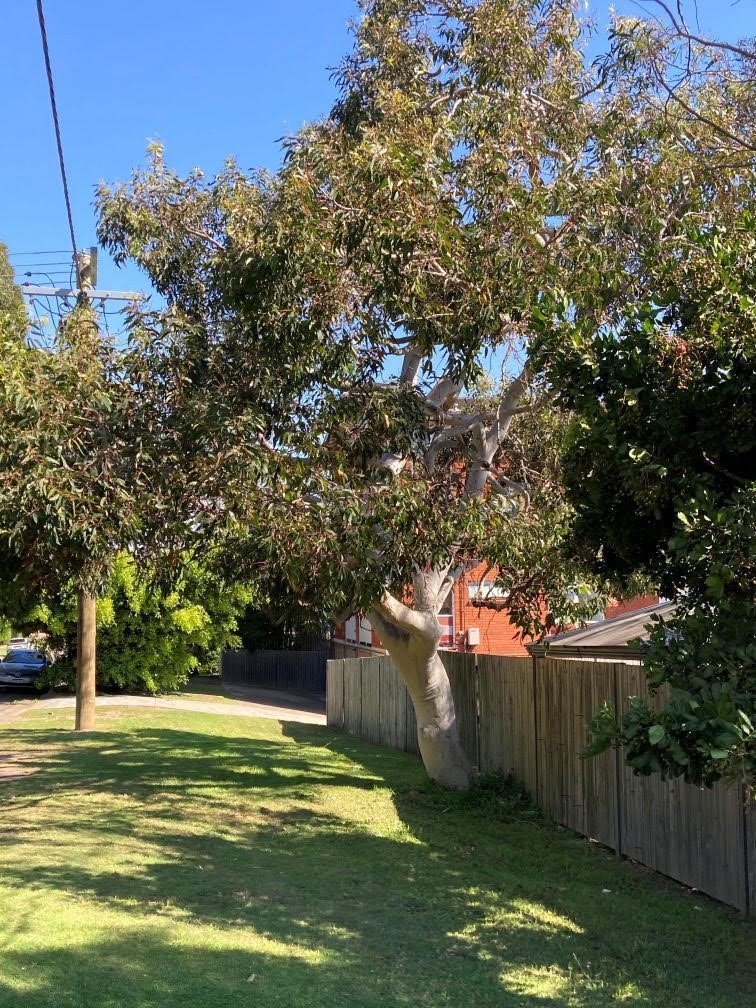
Narrow-leafed Scribbly Gum, Eucalyptus racemosa in Binburra. Photo: PNHA

Koala feed tree - Pittwater. Photo: AJG/PON
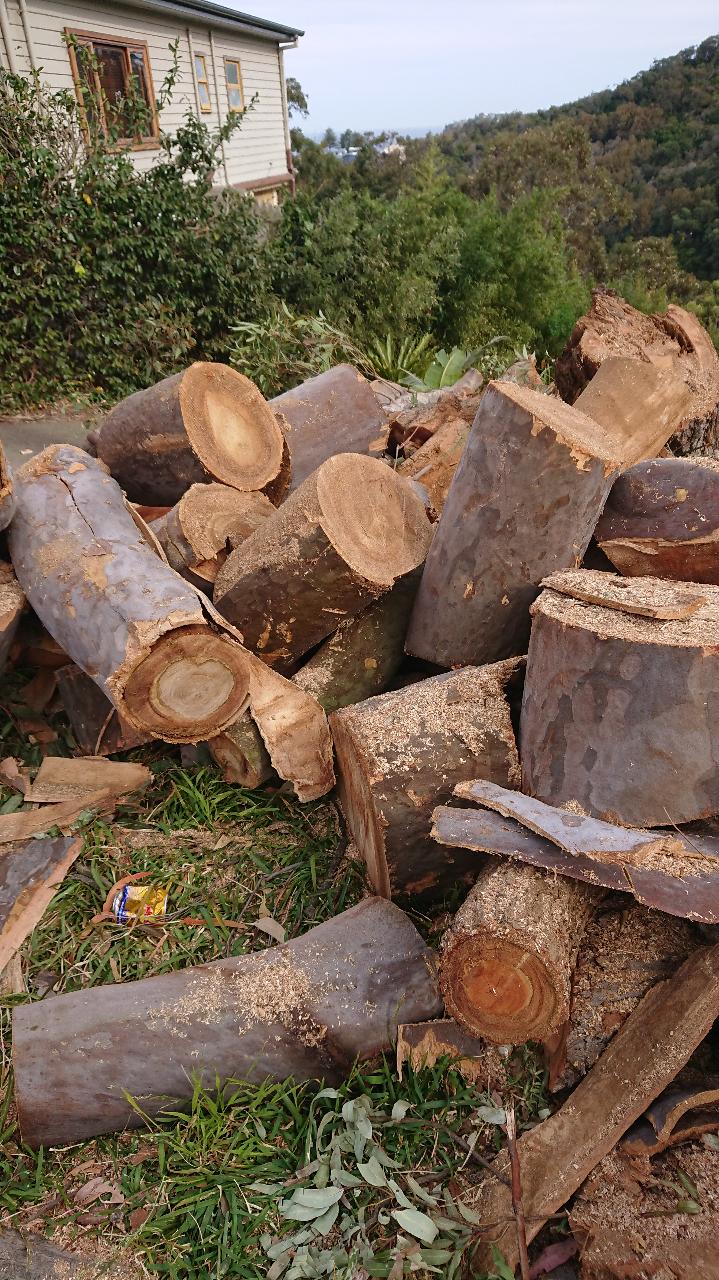
The NB Council gave DA approval to remove 18 trees in 2020 at Bilgola Plateau, most tree species locally endangered

Ruskin Rowe tree vigil, June 2024. photo supplied. See August 2025 report: Killing of Ruskin Rowe Heritage Listed Tree 'authoritarian'

Tree stump of a Ruskin Rowe tree giant destroyed by the Northern Beaches Council. Photo supplied