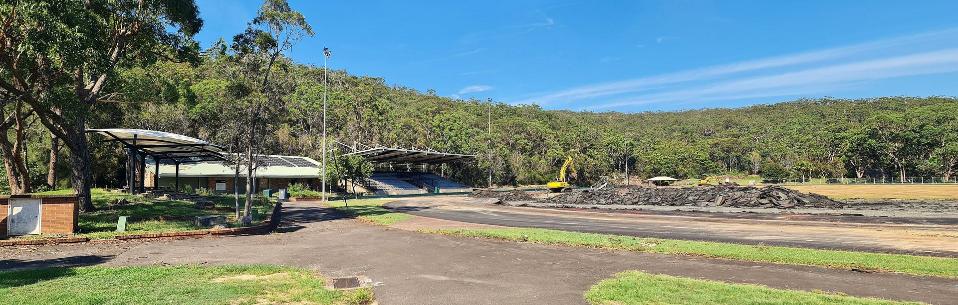
Work is officially underway on the redevelopment of the Sydney Academy of Sport’s Athletics Track at Narrabeen, marking a strong start to the year for the local athletics community.
The track was closed in December 2023 due to damage to the track surface making the track unsafe for use.
Office of Sport Deputy Secretary Adam Berry joined Member for Pittwater Jacqui Scruby MP, Member for Wakehurst Michael Regan MP, CC Pines Pty Ltd Executive Chairman Ben Pines and NSW athletics representatives to turn the first sod on the $6.7 million project in late January 2026.
The project scope includes:
- A new World Athletics (WA) compliant synthetic athletics track with moisture-resilient track surface
- New asphalt sub-base
- Improved drainage and stormwater system upgrades
- Accessibility improvements
A World Athletics (WA) compliant synthetic athletics track is a high-performance running surface certified to meet strict, international standards for safety, uniformity, and durability. Typically constructed using full-pour polyurethane (PUR) or prefabricated rubber sheets over an asphalt or concrete sub-base, they are designed to be durable and, in many cases, moisture-resistant.
This ensures consistent shock absorption, force reduction, and energy return for athletes, allowing them to train and compete at elite levels. The track must also extend beyond the competition area, particularly at throwing arcs, to prevent injury.
SPORTENG, the Principal Design Consultants for the project, state they placed a strong focus on engineered drainage improvements and highly porous surface systems that could rapidly shed and release water. This approach ensures the track remains stable, minimises waterlogging, and reduces the likelihood of surface bubbling after heavy rain, the consultants stated.
CC Pines Pty. Ltd were appointed to lead the delivery of the project in December 2025 with the support of specialist athletics track surface consultants Polytan GmbH.
Although no details have been released on what has been done with the old rubber track, Polytan GmbH, state they are a leading manufacturer of synthetic sports surfaces, and have established a comprehensive, sustainable approach to disposing of old materials, particularly focusing on recycling old artificial turf and running tracks through its sister company, FormaTurf.
Instead of disposing of old, worn-out surfaces in landfills or incinerating them, Polytan and FormaTurf state they offer a process that reintegrates these materials into the production cycle (circular economy).
The Preparation of a Review of Environmental Factors (REF) for the Narrabeen athletics track site and preliminary site investigations were completed in July 2025. In December 2025 the REF, not released publicly, was approved.
However, it is common knowledge that high-performance, durable synthetic athletics tracks often utilise polyurethane (PUR) systems with rubber granules for optimal performance. Concerns about leaching and particle loss concerns from the old track into surrounding environments, including Narrabeen Lagoon, have persisted among local residents.
A January ground-breaking ceremony occurred as more new research stated the “safe” playground surface used in playgrounds and athletic tracks may leak cancer-causing chemicals into the environment was published.
In the study, published in Environmental and Biogeochemical Processes, researchers analysed rubber granulate of different particle sizes produced from recycled vehicle tires. They found that all tested materials contained high levels of polycyclic aromatic hydrocarbons, or PAHs, a group of toxic organic compounds known for their persistence in the environment and potential health effects. Importantly, smaller rubber particles released higher amounts of these chemicals in forms that living organisms can absorb.
“Recycling tires into rubber granulate is often viewed as an environmentally friendly solution, but our results show that particle size plays a critical role in how hazardous these materials can be once they are used outdoors,” said Patryk Oleszczuk, the study’s corresponding author. “Fine rubber particles contain more toxic compounds and release them more easily into water and soil.”
The research team examined three size fractions of rubber granulate, ranging from less than 1.5 millimetres to 6 millimetres in diameter. Chemical analyses revealed that total PAH concentrations were extremely high, reaching more than 100 milligrams per kilogram in the smallest particles. These concentrations decreased as particle size increased, but even the largest granules still contained substantial amounts of PAHs.
Beyond measuring total contamination, the researchers focused on the freely dissolved fraction of PAHs. This fraction represents the portion of chemicals that can move into water and be taken up by organisms. The study found that smaller particles released the highest concentrations of bioavailable PAHs, indicating a greater potential for ecological and biological impact.
“Looking only at total chemical content can underestimate real environmental risk,” Professor Oleszczuk explained. “The freely dissolved fraction tells us what organisms are actually exposed to, and in this case, those values were surprisingly high compared with many contaminated soils and sediments.”
To assess biological effects, the researchers conducted a series of ecotoxicological tests using soil invertebrates, plants, and microorganisms. Rubber granulate proved toxic in all test systems. Springtails, which are important soil organisms, showed reduced survival and reproduction. Plants experienced inhibited root growth, and aquatic bacteria exhibited strong toxicity responses when exposed to water leachates from the granulate. Once again, the strongest effects were associated with the smallest particle sizes.
The study also found that rubber granulate released potentially toxic metals, including zinc and copper, into water at concentrations exceeding drinking water limits. These metals contributed further to the observed toxicity, especially in leachate tests.
The results suggest that the widespread use of tire derived rubber granulate in public spaces may have unintended environmental consequences. Prolonged exposure to weathering, sunlight, and moisture could increase the release of harmful substances over time.
“Our findings do not mean that all recycled rubber products are unsafe,” said Oleszczuk. “But they do highlight the need for size specific regulations, careful material selection, and the development of safer alternatives, especially for applications where children are in direct contact with these materials.”
The authors emphasise that recycling remains an important goal for waste tire management. However, they argue that environmental safety should be evaluated not only by the origin of recycled materials, but also by their chemical behaviour and biological effects once they are placed into real world environments.
The study, Toxicity and polycyclic aromatic hydrocarbons bioavailability in recycled tire rubber granulate of varying particle sizes, published online on 29 December 2025, states:
''The rubber granulate was toxic to all tested organisms. Larger granulate particles caused a reduction in toxic effects on the organisms studied. These findings suggest that using rubber granulate in the environment, especially in public areas such as playgrounds, sports fields, and running tracks, may lead to the release of toxic organic compounds into soil and surface waters. Prolonged exposure could disrupt soil ecosystem functions and pose potential health risks, particularly for children who come into direct contact with the granulate. The results highlight the need for cautious use of tire-derived granulate and the development of guidelines to ensure its safe application.''
The concern for small children using these areas is the hand-to-mouth activity.
The $6.7 million Sydney Academy of Sport’s Athletics Track project is anticipated to be completed during Q3 2026 in time for the 2026-27 athletics season.
While the new track is being built the temporary grass athletics track at the Sydney Academy of Sport continues to be available to the athletics community.
Minister for Sport Steve Kamper said after the sod-turning in January:
“The Sydney Academy of Sport Athletics Track is a vital piece of sporting infrastructure that provides hundreds of athletes, from Olympians to fun runners, with a place to hone their skills and improve their times.
“The turning of the first sod is a symbolic milestone that will give the athletics community renewed hope that the finish line on the return of the track is within sight.
“I’d like to thank the Member for Pittwater and Member for Wakehurst for their ongoing commitment to this project.”
Member for Pittwater Jacqui Scruby said:
“The commencement of construction is great news [and what our] athletics community had been hoping for.
“It will be great to see athletics training and school carnivals back where they belong, and I look forward to joining Minister Kamper later this year to fire the starting gun on the first race at the new track.”
Member for Wakehurst Michael Regan said:
“Today’s milestone is fantastic news for local athletes. Once completed, the new World Athletics (WA) compliant synthetic athletics track will see athletes from the Northern Beaches and across NSW set personal bests and break records.”
Australian Paralympian and NSW Institute of Sport scholarship holder Marli Lovell said:
“I’m very excited that work is about to begin on the new synthetic athletic track at the Sydney Academy of Sport.
“This resource will be well-used by athletes of all standards, but on a personal level I look forward to using the track to prepare for future events, including the Brisbane 2032 Paralympic Games.
“I know my fellow athletes will join me in thanking the NSW Government for ensuring athletes on Sydney’s northern beaches will have access to a world class track to train and compete on. It will help us fulfil our dreams.”
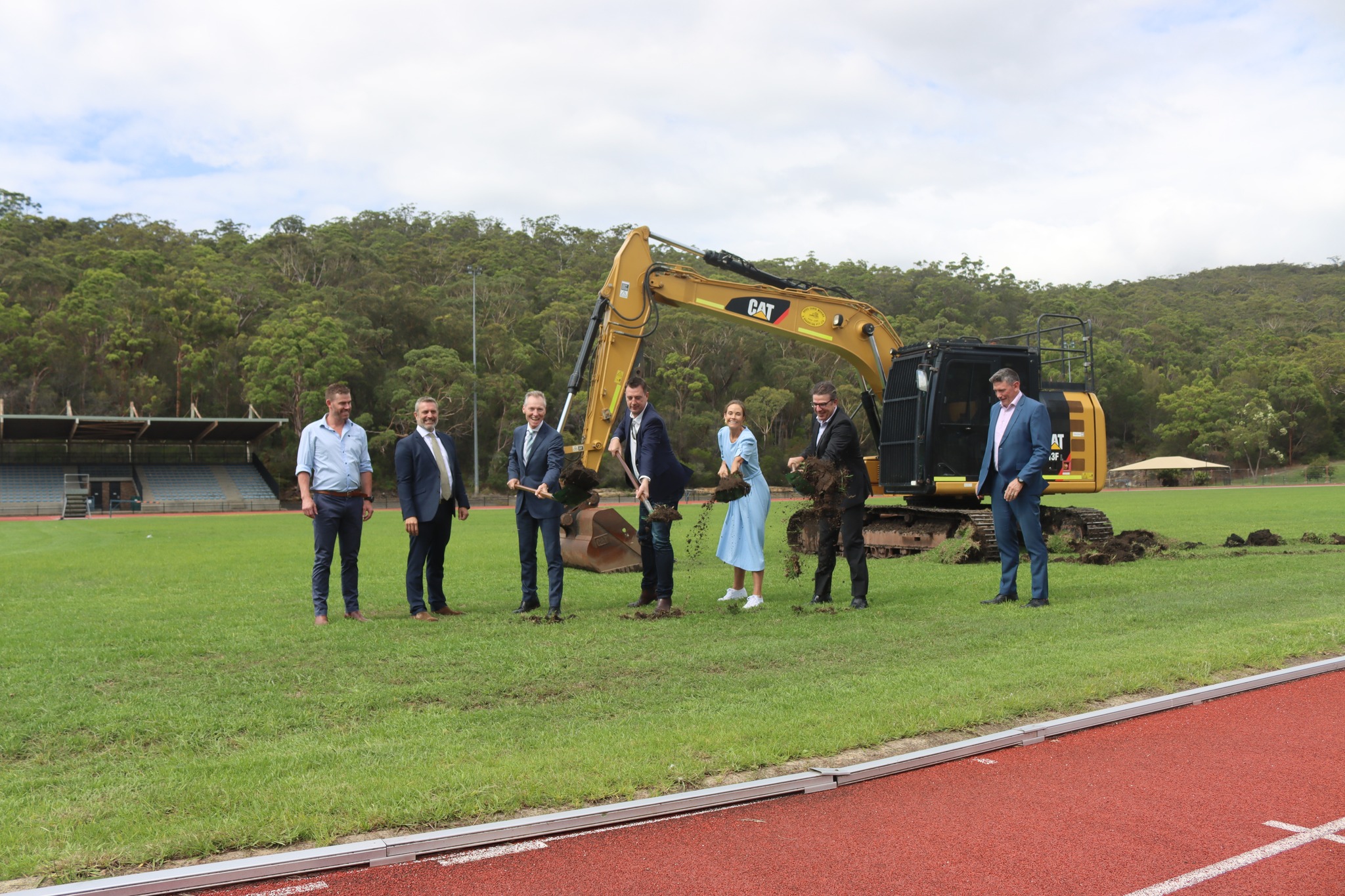
Sod turning/ground-breaking L-R: Ben Pines, Christian Renford, Jeffrey Wrightson, Chris Giles, Jacqui Scruby, Michael Regan, Adam Berry. Photo: NSW Government, supplied
The existing track, infield and all associated amenities—including the grandstand—are closed for the duration of the redevelopment.
The temporary six lane, 400metre grass track on Oval 1, along with the designated throwing and jumping areas located adjacent to the closed athletics track, will remain available throughout construction (subject to weather, maintenance requirements and field conditions). View map of temporary facilities (PDF, 148.48 KB)
Dedicated access arrangements to the throwing and jumping areas have been established; however, these may change over the coming months due to construction activity. Please look out for signage on site and ongoing updates from the Centre.