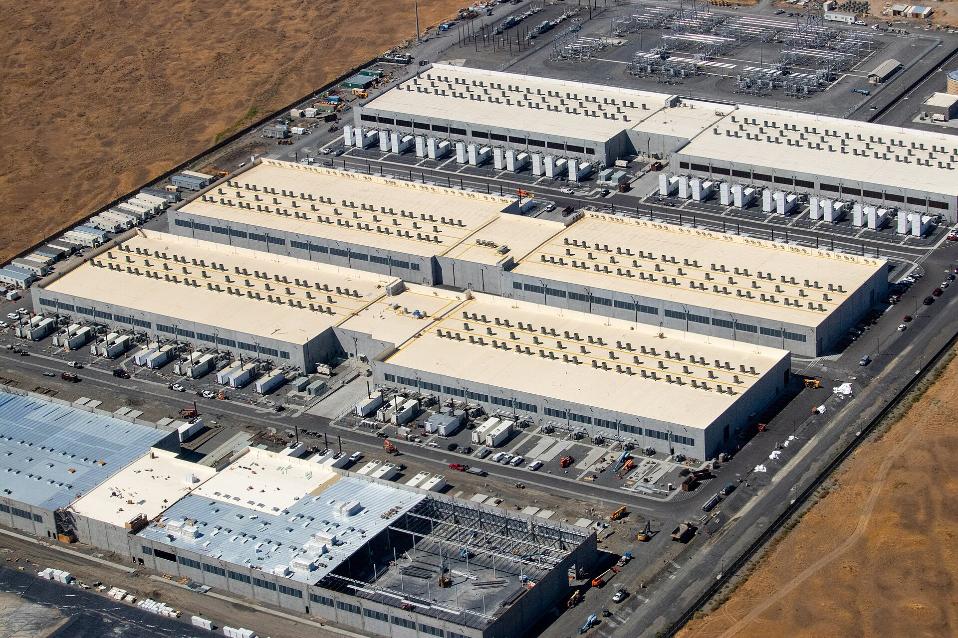
A Sydney Data Centre Map states there are 106 in Sydney - with the nearest one to our area, NEXTDC, being located at Macquarie Park among a hub of others.
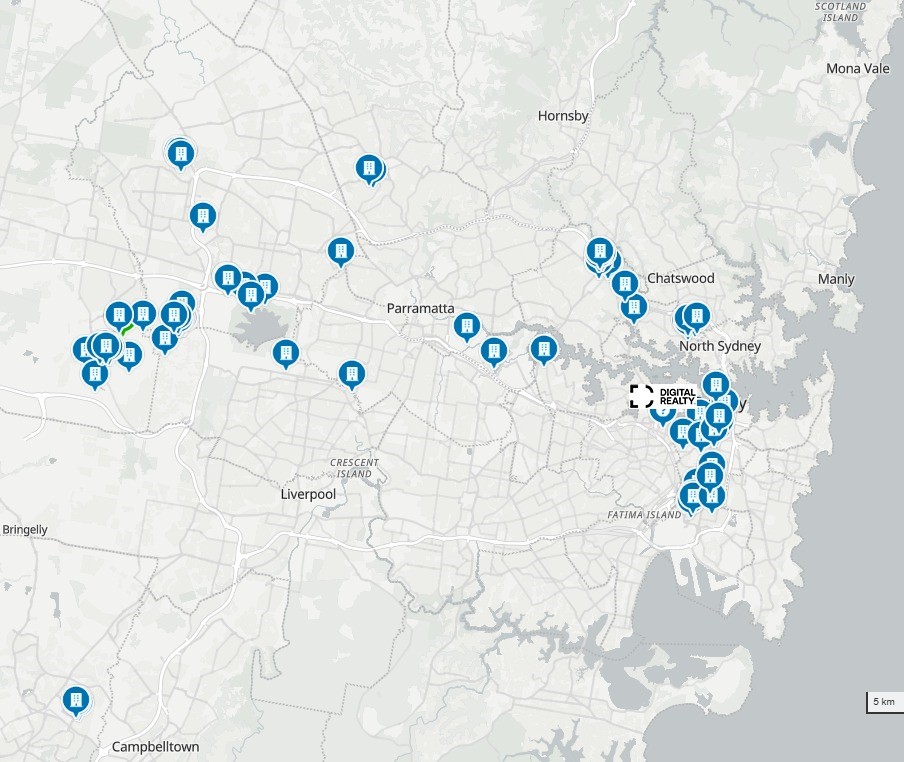
Sydney Data Centre Map - screenshot showing clusters of data centre hubs
On March 27 2026 the Minns Government announced 15 data centre projects will progress through the Investment Delivery Authority (IDA), as it released its 'NSW Data Centre Consultation Paper' to steer what it called 'the sustainable development' of the sector in New South Wales.
As of July 2026, there were 19 projects in the State Significant Development (SSD) planning pipeline valued at $50.3 billion.
The government stated data centres now account for 12% of all non-residential building investments.
Once built, data centres benefit the NSW Government's finances primarily through avoided public infrastructure costs, direct and indirect state taxes, and developer-funded utility augmentations rather than direct operational subsidies.
Ongoing financial benefits are limited. Operational staffing needs are relatively small because modern facilities are heavily automated.
A consensus on community platforms notes that because most major operators are foreign-owned, the majority of net corporate profits leave the domestic market.
Senator David Pocock stated in June 2026['We Cannot let Data Centres be a repeat of the Great Gas Scam']:
''Data centre construction is sucking up our already scarce construction industry workforce, which will no doubt further hamper efforts to hit our housing targets. While they do generate employment in the construction phase, the ongoing direct employment benefits are minimal which is a huge concern given that every time I’ve questioned the responsible cabinet minister about AI job losses he has pointed to investment in data centres. AirTrunk employs just 259 people on a permanent basis, CDC Data Centres 356 people and NextDC 381 according to their own reports.
We also need to ask the question - what is this all for? There are undoubtedly many exciting applications of AI. But it’s also a technology that has the potential to totally disrupt society, and even poses an existential risk to us as a species.
AI job losses in Australia have already topped the tens of thousands and Jobs and Skills Australia Commissioner Barney Glover has said job losses are expected to be more than 600,000.
The AI boosters will say that these hundreds of thousands of unemployed Australians will quickly find other newly-created jobs in the new AI-powered economy. But from what I’ve heard listening to experts this may be wishful thinking as AI and robotics combine to replace human labour.
Why are we rushing to embrace data centres and the AI future they enable without answering these questions and ensuring we will actually benefit from them?
Australia should embrace new technology that improves our lives and helps us live within the bounds of ecological limits. We should welcome investment that creates value and helps build our future economy, but we should also learn from our past.
If multinational tech giants are going to use Australian land, Australian energy, Australian water and Australian workers to build the infrastructure that powers the AI revolution, then Australians deserve a fair return.''
Australians state their concerns long-term operations will put continuous pressure on local water supplies and electricity grids, and cause higher utility costs for local communities and a reduction in available water if not properly regulated, have also not been clearly addressed.
By late 2025 data centres were using approximately 3.5 billion litres of Sydney's drinking water supply per year, which was less than 1 per cent of total demand, but still a high amount in a country known for its droughts and in a city which has experienced water restrictions during prolonged drought periods in the past.
Residents want to know; when that scenario arises again, will the data centres have priority, or communities?
With climate change adding extra impetus for access to water during bushfire periods, which have commenced in July in NSW since the 2019-2020 Black Summer fires, and as many have witnessed the firestorms impacting Europe, the US and Canada in recent weeks, with locals and NSW equipment deployed to assist, residents of New South Wales wish to scrutinise any state or commonwealth plans for Australia's use as a data centre hub, especially in regards to water use.
The UN stated on June 4 2026:
''Data centres, the global infrastructure powering AI, could consume 945 terawatt-hours of electricity annually by 2030 – nearly triple the combined annual electricity use of Pakistan, Bangladesh, and Nigeria, countries collectively home to more than 650 million people.
On top of the carbon footprint, every unit of electricity used by data centres also carries a “water footprint” for cooling and energy production, and a “land footprint” associated with power generation and supply chains.
According to a new study from UN University (UNU), AI-related water consumption could equal the basic annual domestic needs of 1.3 billion people by the end of the decade, while its land footprint may exceed 14,500 square kilometres — roughly twice the size of the Jakarta metropolitan area.''
''The NSW Data Centre Policy Framework will make sure future data centre investment is matched with increased investment in renewable energy and water infrastructure.'' the government said on Monday
''It establishes clear expectations for data centre proponents, with world-class energy, water and environmental standards, meaningful community consultation and appropriate contributions towards the infrastructure needed to support growth.''
''The framework sends a clear signal that NSW supports data centre investment that creates jobs, fosters innovation, grows the economy and delivers benefits for communities.''
''Beyond powering technologies used in the home and workplace, their computing power and storage also drive many of the services that communities rely on every day, including healthcare, emergency services and banking.''
''Investment in the sector in NSW has been increasing at around 75 per cent per year on average over the three years to December 2025. This growth, combined with the transformation of NSW’s energy system, is a key reason we have avoided recession.'' the government stated
The NSW Data Centre Policy Framework states under 'Forecast energy and water demand from data centres:
'The Australian Energy Market Operator (AEMO) forecasts that energy consumption from data centres will double from 5% of NSW’s grid-supplied energy in 2026 to 11% by 2030. This growth is forecast during the same timeframe that around 7 gigawatts (GW) of coal-fired generation is scheduled to retire in NSW.
Oxford Economics, which prepared AEMO’s forecast on data centres, estimates 6 in every 7 megawatts (MW) of data centre connection requests are phantom demand.
Consultation with energy utilities suggests 20% of data centre applications in their connections pipeline are likely to proceed. While these figures differ slightly, they highlight that the share of data centre proposals likely to proceed to construction is low.
Water demand is also expected to rise in the coming decade, but the extent of this increase is uncertain. There is agreement that modelling approaches between the water and energy sectors need to be aligned, including in relation to ramp up periods and phantom demand.
Most investors in data centre development also have targets to reach net zero emissions for their operations by 2030 or 2035. This implies that there is an opportunity to collaborate with industry to increase the supply of renewable energy and lower carbon emissions.'
The government's 'NSW Data Centre Policy Framework' outlines how this growing digital investment will be used to drive the energy transition and support the state economy. The framework includes:
The NSW Data Centre Guidelines
Under the new framework, the government states data centre builders wanting access to a streamlined assessment process will need to comply with the NSW Data CentreGuidelines.
They require specific performance measures to achieve six principles:
- Apply world-class environmental and efficiency standards
- Impose no net cost to consumers and communities
- Fund additional supply of water and energy
- Enhance local community infrastructure and amenity
- Invest in future industries across the supply chain
- Demonstrate a commitment to training and skills to support jobs.
''Projects that meet the performance measures associated with the above principles will receive a commitment to have their proposed developments assessed within 75 days, while still meeting all planning, environmental and community consultation standards'. the government said
'This commitment is supported by concurrent changes being made to Independent Planning Commission processes to further streamline key project assessment.
The Investment Delivery Authority will also convene an industry collaboration event to connect energy and data centre investors.''
The government stated the Guidelines will be reviewed annually to ensure they remain fit for purpose and reflect advances in technology and changes in the industry.
Regulatory reform to ensure equitable cost recovery for energy infrastructure
Under the second pillar of the framework, the NSW Government will make regulatory changes to:
- ensure that data centres pay for the electricity network upgrades they require, so that extra costs aren’t shifted to households and small businesses,
- support more coordinated and efficient planning of the electricity network, and
- support implementation of the measures in the Guidelines.
The government stated ''We have introduced legislation to enable these reforms and begin consultation on the detailed implementation today.''
An IPART review to consider the full recovery of costs of water provision to data centre customers
''The NSW Government is commissioning IPART to undertake a review of the water pricing framework for data centres.'' the government said
''The review will consider how water pricing can reflect the full costs associated with servicing data centres, ensuring other water users on the network are protected and the impacts of drought and water scarcity are appropriately managed.''
Office of AI
Alongside the NSW Data Centre Policy Framework, the Government will establish the new Office of AI in The Cabinet Office to strengthen and accelerate the response to the opportunities and challenges presented by artificial intelligence.
The new Office of AI will work closely with Digital NSW, which will continue to lead coordination of government investment in the digital, cyber and data foundations needed to support AI adoption. It will also work with public sector unions to ensure AI supports workers, strengthens capability and is implemented responsibly across the public sector.
The NSW Government will continue working closely with the Australian Government and other states and territories to ensure future reforms establish a nationally coherent policy framework.
There are 19 data centre projects valued at $50.3 billion in the State Significant Development pipeline. This is in addition to more than 60 data centres that are already operating or under construction.
Minister for Climate Change, Energy and the Environment, Penny Sharpe said:
“As demand for data centres increases, NSW will ensure the infrastructure needed to support them grows with it.
“These reforms will make sure data centre growth drives investment in renewable energy, while holding operators to the highest air quality standards.”
Treasurer Daniel Mookhey said:
“The scale of data centre investment being considered in NSW presents a unique opportunity.
“Data centres need power and there are renewable projects seeking investment.
“Connecting the two means this booming digital industry can help pay for the new energy and water infrastructure that our economy needs.
“This world-class framework provides the certainty that both investors and – importantly – the community need.
“NSW is a premium destination, so we are setting a high bar.”
Minister for Planning and Public Spaces Paul Scully said:
“Data centres are the enabling infrastructure for modern economies and communities.
“These Guidelines provide clear expectations, improving transparency and providing certainty for both communities and investors.
“We’ve struck the right balance, maintaining strong environmental standards to safeguard our water and energy future while supporting faster and more certain planning assessments for data centres which protect the interests of communities while delivering them benefits.”
Minister for Customer Service and Digital Government Jihad Dib said:
“Artificial intelligence is increasingly part of our everyday lives and we have a strong framework within the NSW Government to ensure it is used safely and responsibly.
“We are building on these strong foundations through a whole of government approach and Digital NSW will work closely with the new Office of AI to support NSW to safely navigate emerging AI technologies and harness new opportunities to benefit the community.”
Minister for Industry and Trade Anoulack Chanthivong said:
“Data centres are a vital part of the digital economy and NSW must remain an attractive destination for this growth.
“These Guidelines provide greater certainty for investors while making clear that major projects need to contribute to the infrastructure and resources they rely on.
“The opportunity goes well beyond the construction of new facilities. Data centres can help grow future industries, from education and cybersecurity to advanced manufacturing, medical technology and renewable energy.”
Minister for Water Rose Jackson said:
“Data centres are becoming an increasingly important part of our economy, but we need to make sure their growth is supported in a way that protects the long-term security of our water system.
“These Guidelines direct data centres to use water efficiently, prioritise recycled water where possible, and contribute to the additional water supply needed to support future growth in NSW.
“By preserving drinking water supplies for communities and ensuring the costs of servicing new demand are not placed on other customers, we can support investment while maintaining confidence in the sustainability of our water resources.”
Background: Electricity and Water Use - Water Cooling Or Closed-loop Coolants
With the NSW Government saying it will require data centre investment to be matched with increased investment in renewable energy, the Climate Council was calling for mandatory standards so data centre proposals that fall short don’t go ahead.
The state’s new guidelines are another step forward, in line with the Albanese Government’s commitment to legislate national standards – despite resistance from Queensland and the Northern Territory, the Climate Council stated.
On July 15 2026 the Prime Minister's office stated in a press release:
''The Albanese Labor Government will introduce a world-leading artificial intelligence framework to ensure Australia can capture the opportunity, share the benefits and keep Australians safe.
We will do that the Australian way – without undercutting conditions, dividing communities or damaging our environment.
The Government will introduce a set of Australian Standards for AI, building on the Data Centre Expectations, with our values as the benchmark to ensure AI works in Australia’s interests.
The new standards will set out clear rules for large data centres— including a legal obligation to underwrite their own new power supply, pay their full share of connection costs so energy bills are not impacted, reduce power when needed to strengthen the grid, and be as water efficient as possible.
The Federal Government will also work with State and Territories to ensure large data centres are built in the most appropriate locations, and with input from local communities.
Effective today, the Office of AI will be established within the Department of Prime Minister and Cabinet to accelerate implementation of the Australian Standards on a national level.
The Government’s approach will be considered by National Cabinet in August, with standards expected to be legislated early next year.
The implementation of these standards will deliver a simple, consistent regulatory framework for large data centres and AI training and be the first to be legislated by a government worldwide.
The Government’s approach will help further grow Australia’s economy, strengthen our sovereignty, secure benefits consistent with our national interests, and lift our standard of living.
The AI Standards will deliver greater clarity, speed up approvals and streamline the process for verifying compliance with energy, water, safety and other requirements.
The Government will also ensure the strongest possible protection for Australian artists and media.
Our approach will ensure Australian writers, artists and journalists retain ownership over their work, meaning no company should use Australian creative works to train AI without the artist’s control.
The Government will also outline its whole-of-government AI consumer safety priorities in coming weeks, building on the recent establishment of the AI Safety Institute.
The Government has every confidence that Australia can seize this moment of technological advancement and make it our own, while ensuring AI stands for Australia’s interests.''
The NSW Government's and Commonwealth standards are expected to require data centres to supply their own additional renewable power, no matter where they are built around Australia.
Climate Council Senior Advisor Ben McLeod said:
“Australians are rightly asking: Where is the power for the data centre boom going to come from? Guidelines like these set us on the path to making sure the answer won’t push up household bills, or climate pollution. The NSW Government should be decisive in shielding its citizens and make these expectations mandatory.
“All states and territories should get on board with similar rules under the proposed national guidelines. Governments must set the bar higher, and require data centres to be powered by new wind, solar and storage, otherwise Australians will pay the price of higher power bills and more climate pollution.”
Neither the 'where possible use of recycled water' in NSW, nor the 'be as water efficient as possible' statement from the Albanese Government have allayed concerns water usage by data centres will not impact on water and electricity availability and prices.
The inclusion of the 'extent of this increase is uncertain' statement in the policy framework, when each project would be able to determine the scale of water use required for it to operate successfully prior to being built, also perpetuates concerns over increased unsustainable water use.
Data centres must be kept cool as the thousands of packed-together servers generate intense heat and without proper thermal management, this heat causes hardware damage, permanent system crashes, data loss, and severe fire hazards. Keeping equipment cool ensures continuous, reliable operation.
Data centre cooling relies on closed-loop liquid systems or open evaporative water cycles.
Most NSW data centres, clustered in tech hubs like Macquarie Park, Artarmon, and industrial western areas like Eastern Creek, are not directly next to dedicated recycled water mains. While Sydney Water prioritises recycled water, building dedicated pipelines to distant treatment plants is difficult. For instance, a massive 612MW Eastern Creek project dropped its recycled water cooling plan because it could not secure a pipeline permit.
S7 is NEXTDC's 612MW campus at Eastern Creek in Western Sydney, developed with OpenAI under a December 2025 memorandum of understanding as part of the OpenAI for Countries program, with the first phase due in the second half of 2027.
NEXTDC switched the campus's cooling from recycled water to a waterless method after it could not secure planning permission for the pipeline needed to carry treated sewage to the site, a decision reported by Reuters on 23 July 2026.
The waterless method circulates liquid coolant around the chips and rejects the heat with fans, which data centre analysts say uses no water but more energy than the evaporative cooling recycled water would have supplied.
Since late 2025 NSW has required data centre applicants to disclose water use and meet a fixed power usage effectiveness (PUE) cap of 1.3, at the efficient end of global averages; S7 is one of six projects faced with meeting the rule, and NEXTDC has not disclosed a target PUE for it.
NEXTDC says it still favours recycled water where the infrastructure exists, and Sydney Water and coNEXA remain possible suppliers if a pipeline is approved, while Transgrid says Sydney's network is near its connection limit.
Closed Loop Coolant Systems use: Replacement of products
In a 'Closed Loop System' dielectric fluids, mineral oils, or water-glycol mixtures move across server cold plates or immersion baths, absorbing heat in a sealed circuit without direct loss. Data centre coolants rely on specific chemical and thermal properties depending on whether they are used in closed-loop water systems (like cold plates) or direct immersion baths.
The primary fluid families are water-glycol mixtures, hydrocarbon/mineral oils, and engineered fluorochemicals, each chosen for distinct heat transfer, electrical, and safety traits.
Coolants like water, glycol, or synthetic fluids cycle continuously to absorb server heat, undergoing on-site filtration, heat exchange, or chemical treatment before ultimate disposal or repurposing via municipal recycling channels.
MassedCompute, which works to meet demand for GPU (Graphics Processing Unit) - a specialised electronic circuit designed to process data in parallel [While a standard CPU handles complex tasks one after another, a GPU uses thousands of smaller cores to run many simple calculations at the exact same time] - states Coolant replacement frequency in a data centre liquid cooling system depends on several factors, including the type of cooling architecture, the coolant chemistry, system design, and operating conditions.
Those that use fluorochemicals need replacement every 2-4 years. Their table for replacements provides:
General Replacement Intervals by System Type
Cooling System Type Typical Replacement Interval Coolant Examples
Direct-to-Chip Cold Plate (Single-Phase) Every 1 to 3 years Deionized water, glycol mixtures
Rear Door Heat Exchanger Every 2 to 4 years Water-based coolants
Immersion Cooling (Single-Phase) Every 3 to 5 years Mineral oil, synthetic fluids
Immersion Cooling (Two-Phase) Every 2 to 4 years Dielectric fluorocarbons
Facility Chilled Water Loops Every 1 to 2 years Treated water, glycol blends
Dielectric fluorocarbons are chemical compounds composed of carbon and fluorine that act as highly effective electrical insulators while offering extreme chemical and thermal stability.
In the June 2026 study 'Methods for the recycling of fluoropolymers: A review' it is stated:
''Fluoropolymers (FP) are speciality polymers that have permeated into a variety of industries and uses due to their desirable properties such as high thermal stability and high chemical resistance. However, with the demand for their use ever increasing, the recycling of FP has become an area of research focus with many papers reporting recycling methodologies which limit the release of per- and polyfluoroalkyl substances (PFAS) into the environment.''
''Currently, incineration is reported to be a potential option for the complete indiscriminate degradation of FP waste and remains the most technologically ready method. Meanwhile, other methods such as mineralisation have reported the degradation of FP into high value products such as CaF2 which has the potential to bring fluorine chemistry full circle.''
The European FluoroCarbons Technical Committee, which states its main objectives are to provide up to date information about applications, safety, health and environmental effects for HFCs HFOs HCFOs and the relevant European and international legislation, says:
''Dielectric fluorocarbons can be both reused and recycled, though strict environmental regulations govern their handling due to global warming and PFAS concerns. Reusing involves filtering and drying recovered fluids for direct application, while recycling and chemical reclamation strip out impurities to restore them to original factory standards.''
''In regions with extreme weather conditions (hot climate, water scarcity), weather fluctuations or where seismic events are regular occurrences, the immersion cooling is the solution of choice for data centers as traditional air cooling cannot maintain performance and reliability.
The composition of the dielectric liquid depends on the cooling technology (single-phase, two-phase or direct-to-chip cooling). Single-phase and two-phase technologies use dielectric liquids which are based on fluorocarbons (HFOs/ HCFOs) blended with other technical fluids. Direct-to-chip cooling is not an immersion cooling per se (even though it is promoted as such) and it can use non-dielectric fluids (e.g. glycols) because the coolant never comes in contact with the component. However, the use of glycols poses major risks in case of leaks and direct contact with the system components, thus dielectric fluids are sometimes used with this technology.''
In a 16 July 2026 article 'What AI data centres really mean for Australia's water supply' by Dr M. Reza Hosseini, University of Melbourne, he points out that 'Farming alone accounts for roughly two-thirds of the water Australia uses each year'.
Under past state and federal governments, rural irrigators water extraction licences have seen water for these prioritised before communities and even river systems themselves, leading to residents of Pittwater, in an initiative led by the Aboriginal Support Group Manly Warringah Pittwater, running water water to them for drinking and for health reasons from late 2018-2019, and campaign for change from 2019-2020 and onwards.
See:
2019: Yamma Ngunna Baaka - From the Northern Beaches to Bre: Our Sister City Shares its Water Woes
2020: Narrabeen Bridge protest demands water for rivers
Residents are wondering what guarantees there will be in licences granted to data centres that don't prioritise their profits before people as well.
Regarding data centres, he states, vis-à-vis Sydney Water:
''...has fielded applications from data centre developers wanting connections of up to 40 million litres a day for a single facility. That's roughly 16 Olympic swimming pools, every day.
But that's a worst-case number. It’s the maximum a connection could supply, not what any centre actually uses today.
Developers often apply for more than they end up building or operating; utilities call this ‘phantom demand’. Even so, it explains why water companies along Australia's east coast are paying close attention.
But if we pull back to look at the national picture, the story shifts.
Industry-commissioned analysis puts direct on-site water use by Australia's data centres, mostly for cooling, at about 5.5 gigalitres (or 5.5 billion litres) a year.
....In Sydney, data centres currently account for about 0.7 per cent of local water supply; in Melbourne, about 0.2 per cent.
Industry forecasts suggest that could rise to about 1.9 per cent in Sydney and 0.9 per cent in Melbourne by 2030. Nationally, direct demand could more than triple from 5.5 gigalitres a year to around 17.
Those are forecasts, not guarantees – and they're contested.
The industry's own modelling can make the numbers look modest. The utilities, with connection applications piling up, see something starker.''
''Sydney Water has told a New South Wales parliamentary inquiry into data centres that if proposed facilities go ahead with water-intensive cooling, cumulative demand could hit 250 megalitres – that’s 250 million litres – a day by 2035.
That's a high-growth scenario, but it's the one utility companies must plan for.
The utilities are upfront that these scenarios are built on the number of connection applications, not confirmed demand that translates into actual consumption.
But what worries them is the shape of it: large customers drawing water continuously in growth corridors already stressed by drought.''
A credible proposal should have to answer five questions before it gets approved:
- Where is the water coming from? Drinking supply, recycled water or something else because the source matters as much as the volume.
- What happens in a drought? When restrictions hit households, what does the facility do?
- What's the peak daily demand? Annual averages hide the days that actually stress the network.
- Who pays for the upgrades? New pipes and connections cost money. Is it the developer or everyone else's water bills?
- Will the numbers be public? Water use, energy use and above all how much drinking water is being consumed
E-Waste Generated
Data centres generate massive electronic waste (e-waste) as high-density servers, GPUs, and storage drives are replaced every 3 to 5 years. Accelerated upgrades driven by generative AI push this fast-growing waste stream upward, risking millions of metric tonnes of toxic heavy metals and hardware debris globally by 2030.
Human-I-T states:
'Traditional recycling can’t keep pace with data centre e-waste — only 22.3% of global e-waste is properly collected and recycled, and recycling itself perpetuates the production cycle by turning old equipment into new products destined for eventual disposal. Data centre operators should prioritise refurbishment and reuse over recycling to reduce costs, protect the environment, and move toward a genuine circular economy. Contact a certified ITAD provider like Human-I-T that prioritises giving equipment a second life.'
Upper House Inquiry Into Data Centres in NSW
On 4 February 2026 an Upper House inquiry has been established to inquire into and report on data centres in New South Wales. The Public Accountability and Works committee will scrutinise whether New South Wales is adequately equipped for the scale and pace of data centre development occurring now and into the future.
The Committee Chair, Ms Abigail Boyd MLC, said: 'Data centres over the last few years have expanded significantly, bringing with them an increased demand for energy and water, as well as concern about their environmental, social and economic impacts.'
'The NSW Government is encouraging more and more new data centre developments, and offering them fast-tracked planning assessments, without any plan for the social and environmental impacts', the Chair added.
'This inquiry is about ensuring plans for data centre growth in New South Wales are guided by a coherent and integrated NSW Government strategy that takes into consideration the immediate and long-term impacts of data centres on energy systems, water resources, climate targets and communities', the Chair concluded.
The Committee Report is due by November 3 2026.
The Terms of References are:
(1) That the Public Accountability and Works Committee inquire into and report on data centres in New South Wales including:
(a) the scale and trajectory of data centre development in New South Wales, including:
(i) the current and proposed scale of data centre development in New South Wales, including geographic clustering
(ii) the extent to which New South Wales planning, infrastructure and resources are prepared for projected growth
(iii) the interaction between data centre development and other state economic, digital and industrial strategies.
(b) the planning framework enabling data centre developments, including:
(i) the classification of data centres as State Significant Development (SSD) and the use of power-consumption thresholds as a trigger for SSD assessment
(ii) the role of fast-track and facilitation mechanisms, including the Investment Delivery Authority and other whole-of-government coordination processes
(iii) whether current planning arrangements adequately address cumulative and precinct-level impacts.
(c) electricity demand, grid impacts and implications on emissions reduction targets, including:
(i) impacts on electricity networks, generation planning, transmission and distribution investment and cost recovery
(ii) the role of on-site backup generation, including diesel and gas, and associated emissions and health impacts
(iii) alignment of data centre development with New South Wales emissions reduction targets and climate commitments
(iv) the electricity demand profile of data centres, including continuous load, peak demand and firming requirements
(v) the extent to which strategic colocation of data centres within Renewable Energy Zones may assist the renewables roadmap.
(d) water usage and cooling, including:
(i) current and projected water use by data centres in New South Wales, including reliance on potable water
(ii) risks to water security under drought and climate change scenarios
(iii) the availability, feasibility and uptake of non-potable water, recycled water, or alternative cooling systems
(iv) water pricing, cost recovery and the allocation of water-related infrastructure costs
(v) oversight, monitoring and transparency of water use commitments.
(e) local environmental and community impacts, including:
(i) impacts on surrounding communities, including noise, air quality and heat, traffic and construction impacts, land-use conflicts and amenity
(ii) the distribution of impacts across regions, in particular Western Sydney and other growth corridors.
(f) land use and housing, including:
(i) the opportunity cost of allocating industrial and services land to data centres
(ii) interactions with housing supply, employment-intensive industries and other strategic land uses
(iii) whether current planning frameworks appropriately balance data centres against competing social, environmental and economic needs
(iv) the extent to which the resource demands of data centres impinge on the development of new housing supply.
(g) economic and distributional outcomes of data centre developments, including:
(i) the economic benefits of data centre development, including employment, investment and local economic activity
(ii) the distribution of costs and benefits
(iii) the extent of public subsidies, concessions or state directed facilitation provided to the sector.
(h) governance, transparency and accountability
(i) the adequacy of public reporting on data centre resource use, emissions and environmental performance
(ii) the transparency of approval processes, conditions and negotiated outcomes
(iii) potential conflicts of interest or governance risks arising from accelerated approval frameworks like the Investment Delivery Authority
(iv) the impact of lobbying and donations on government policy settings surrounding data centre developments.
(i) workforce considerations, including:
(i) employment conditions across construction, operations and contracted services
(ii) workforce development, skills and training pathways
(iii) the role of labour standards, procurement and compliance in large-scale data centre projects.
(j) lessons from other jurisdictions:
(i) approaches adopted internationally and interstate to managing data centre growth
(ii) applicability of alternative models to New South Wales, and
(k) any other related matters.
(2) That the committee report by 3 November 2026.
The terms of reference for the inquiry were self-referred by the committee on 29 January 2026.
There have also been discussions about the use of desalinated water, although costs associated with this would impact profits, whil an insight out of the US discussion this past week may see them placed in the ocean - leading residents to ask 'is that a discussion locals need to include as well?' - and if so, where would they be placed?