INbox News: January 2026

January 1 - 31, 2026: Issue 650

farewell to the old Forest High School: New Forest High School Set to be ready for February 2 2026

In December 2021 The NSW Department of Education made available drawings and artists' impressions of the new Forest High School. With the school set to be ready for students on February 2nd an overview of the project is timely. 

Through the years of construction there have been a few mishaps, notably concerns over runoff from the site impacting the creeks down hill from the build site, and pollution of Manly dam. 

In a Pittwater Online report of February 2024, Ancient Fish Habitat Despoiled: Curl Curl Creek Choked With Silt - Runs Into Manly Creek - Manly Dam, Manly Dam, with a reservoir extending into Allambie Heights, was being despoiled by run-off from the new Forest High School site on Allambie Rd, several people had reported extensive amounts of mud in the creek. 

On June 23, 2024 the SMDCC reported another incidence of run-off of uncontained silt from the construction site, into the creeks and dam.

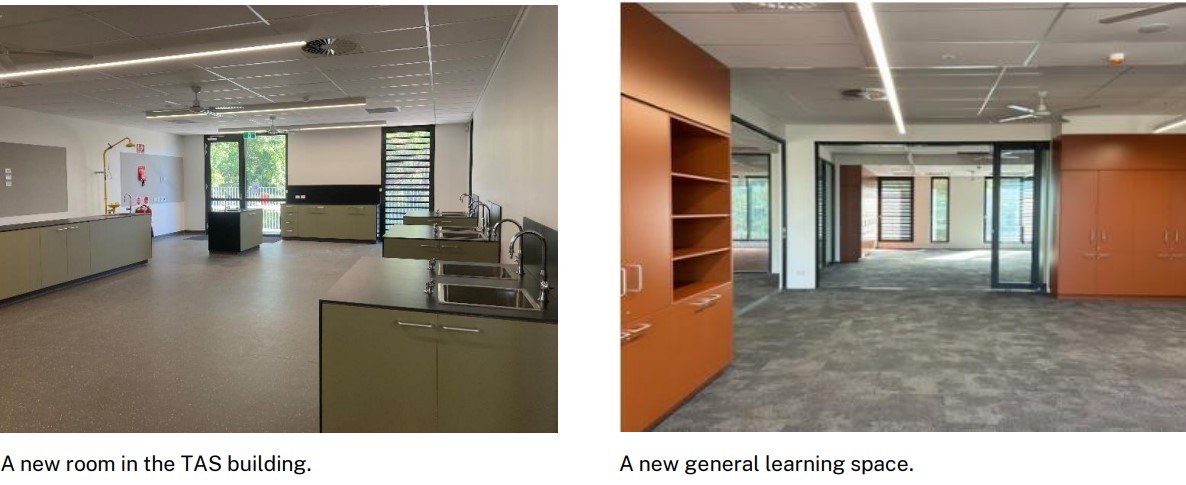
In December 2025 Students and staff bid adieu to the old Forest High School while looking forward to ‘amazing, state-of-the-art’ facilities at a newly built school in 2026. Jim Griffiths reports. The December 2025 Update from School Infrastructure NSW is also included, with a map of the new school grounds and a few photos from inside the new rooms.

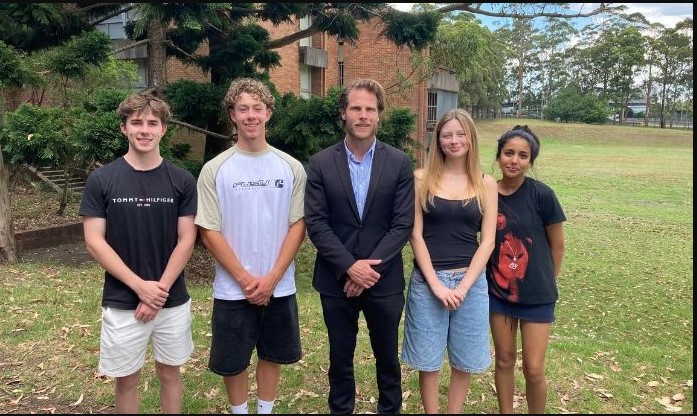
L-R: Student leadership team James Dry, Oliver Burn, Isobel Pacholski and Aishwarya Kalra with Principal Nathan Lawler

Staff and students left The Forest High School’s 1961 site for the last time in December 2025, as the school prepares to move into a brand-new site at the beginning of the 2026 school year.

For all concerned, the old school carries fond memories, from making new friends to sporting and artistic events.

School captain Isobel Pacholski said being at the school since Year 7 had created many memories.

“While we've all been looking forward to the new site since we got here, I think, as we've grown with the school, we've grown fond of it as well,” she said.

School vice-captain James Dry said his best memories involved playing team sports for the school but is looking forward to the new facilities at the Allambie Road site.

“The new facilities look amazing, like all the sports facilities and new classrooms,” he said.

“There’ll be so many opportunities for future students, and it's definitely a very supportive environment, so I’m looking forward to that.” 

Isobel Pacholski notes the Festival of Lights and school musicals have created very fond memories for her, and she looks forward to the new facilities.

“The new state-of-the-art facilities and performance spaces definitely cater towards performers and people who want to perform for larger groups of people,” she said.

“I think it will help us in preparing for performances, especially the dance studios. I know the dancers are really looking forward to that. 

“Any time where we've been able to represent the school on stage and share my love for music with the greater community is just amazing.”

Principal Nathan Lawler said he also had fond memories of performance alongside students learning in classrooms, as well as the sounds that follow different spaces around the school.

“My fondest memories are the everyday routines that you build,” he said. “For me it’s walking the playground in the morning and hearing the band rehearsing in the hall, then looping past our sports academy and hearing the instructions from the coaches.

“Along with hearing the music playing because the music classrooms were directly above my office. You'd be sitting in a meeting and then, all of a sudden, you've got music elective students playing upstairs.” 

However, Mr Lawler believes the new school will offer more opportunities for students, whether that’s in the classroom, state-of-the-art gym and playing surfaces, performance spaces or vocational education facilities.

“We have high expectations of our students, and we'll have the facilities to match the effort they're putting in and what we're expecting from them,” he said.

“For example, I see how much work goes into rehearsing a performance before and after school, now they'll actually have a theatre to match the quality of performance.”

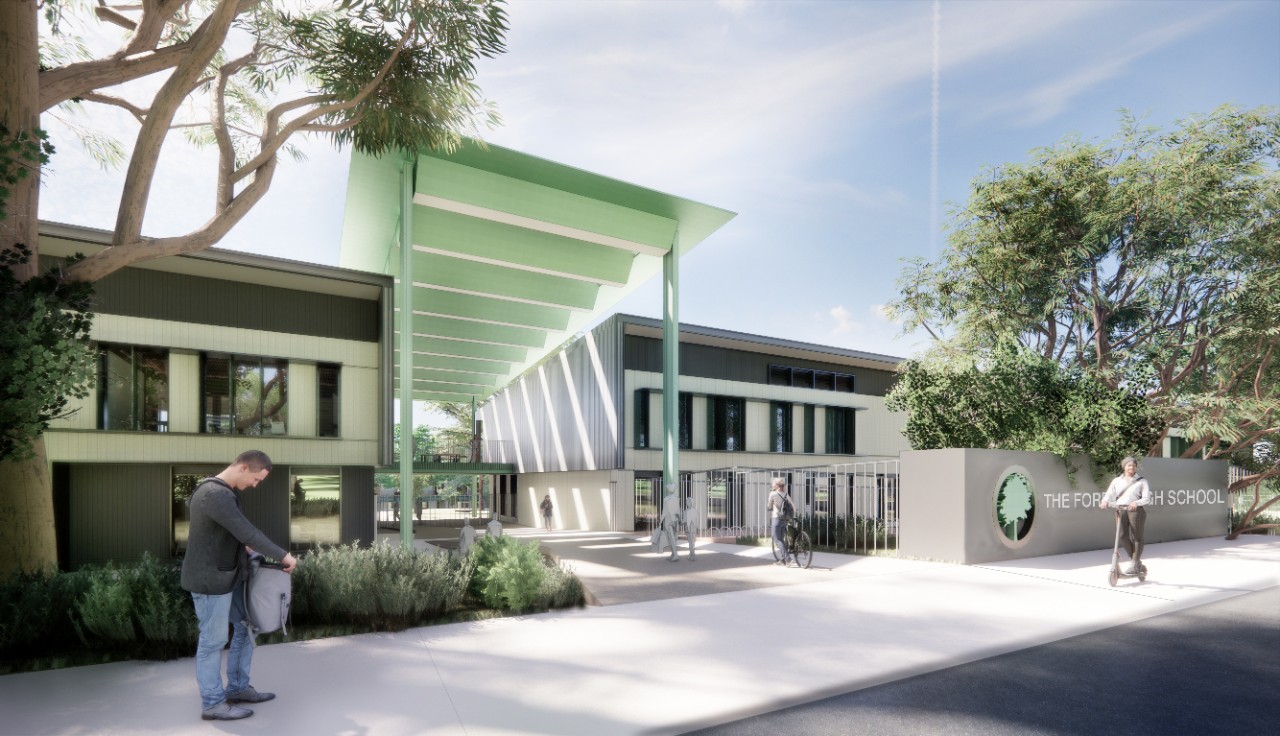
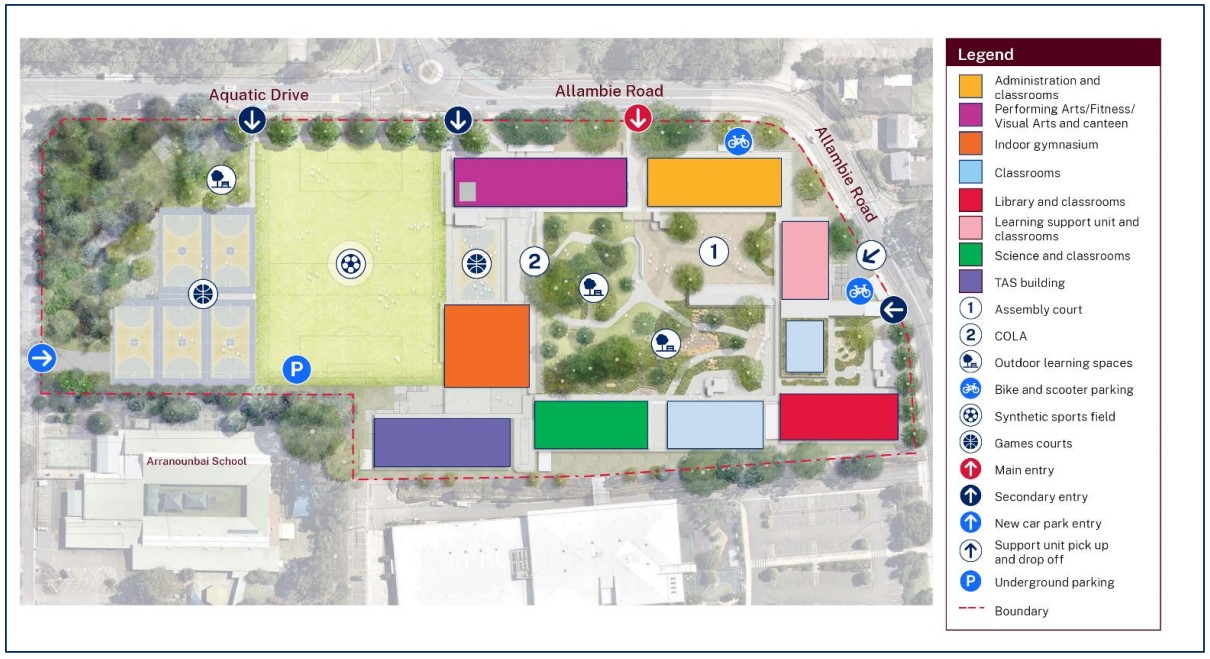
Features of the new school include a new library, canteen and administration spaces, a multi-purpose sports and performance hall, new outdoor sports courts, landscaped recreation and outdoor learning spaces, and over 180 parking spaces for bicycles and scooters. A continuous accessible circulation path will link classrooms with the landscape around the internal edges of the campus buildings. 

The project is part of an expansive plan to establish a new dynamic town centre for the Frenchs Forest community. 

The new school location remains within the current intake area for The Forest High School. It is a local school of choice where its supportive and inspiring environment helps every student thrive.

Mr Lawler said The Forest High School had a strong sense of community and values and a commitment to realising the potential of our students.

“Every student is inspired to reach their full potential and confidently shape their future,” he said.

“Through high expectations, continuous growth, and strong community engagement, we equip students with the knowledge, skills, and character to thrive and unlock opportunities for success and wellbeing throughout their lives.”

December 2025 Update on New Forest High School

The Forest High School is part of the re-zoning and planning framework for Frenchs Forest to create a new town centre for the community. The Forest High School will be relocated to 189 Allambie Road, Allambie Heights.

The Forest High School relocation project provides 73 modern classrooms and 3 Special Support Units for up to 1500 students; a new library, canteen and administration spaces; a multi-purpose sports and performance hall; new outdoor sports courts and landscaped recreation and outdoor learning spaces.

Main construction works are nearing completion, and the school is on track to open for Day 1 Term 1 2026. The internal fit out, landscaping, and boundary works are in the final stages.

The concrete pours for the sports facilities slabs are continuing and will be finished in early December, weather and site conditions permitting.

The process of relocating equipment and resources will start during the school holiday period. We will work with the teachers and school staff to minimise the impact on school operations.

New intake areas – 2026

From 2026, intake areas across the Manly to Warringah end of the northern beaches are changing. The updates provide improved alignment between primary schools and high schools, enabling more students to move from primary to high school with their peers.

The changes will apply to new enrolments from 2026. To view the new local intake area for The Forest High School, please click on the 2026 button displayed on the School Finder website.

Frequently Asked Questions

1. I have a child already attending at The Forest High School. Can they stay there if I am now in a different school’s intake area?

Yes, they can. There is no change for students already attending The Forest High School.

2. I have a child already attending The Forest High School. This is currently our local intake area school but from 2026 we will be designated to a different school. Can I enrol my other children at the same school?

Families with a child currently enrolled at their local designated school will retain the entitlement to enrol siblings at the same school, even if there are changes to the local intake area boundaries that make their home address out-of-area.

3. How were the new intake areas developed?

The new intake areas have been developed through a consultative process with schools and communities. A number of relevant factors were considered to inform the development of the new intake areas including enrolment trends; opportunities to align with primary school local intake areas; public transport access; the size and utilisation rate of schools; the number of students living in each proposed intake area; and the physical capacity of schools to enrol students.

State Significant Development Application – modification 3

A modification (3) to the State Significant Development Application (SSD), to split the public domain works into two stages has been approved.  This allows the opening of the school with interim arrangements to ensure safe travel and pedestrian access arrangements.  Works will include the upgrade and movement of the bus stops on Aquatic Drive, provision of the kiss and drop zone and a new pedestrian crossing. The exhibition for this modification (3) closed on Thursday 17 July 2025.

State Significant Development Application – modification 4

A modification (4) to the State Significant Development Application (SSD) has been submitted. This proposes the retention and upgrade of the existing roundabout at the intersection of Aquatic Drive and Allambie Road, rather than replacing the roundabout with a signalised intersection as previously approved. The upgrade to the existing roundabout will ensure the intersection can accommodate the projected increase in traffic in future years. This will achieve the same or better outcomes as the original proposal for traffic lights, without the additional construction timeframes or disturbance to utility infrastructure. The exhibition for this modification (4) closed on Thursday 28 August 2025.

A modification (3) to the SSD application (SSD-26876801) to split the public domain works into 2 stages has now been approved. This will allow the opening of the school with interim arrangements to ensure safe travel and pedestrian access arrangements.

Next steps

• Continue the sports facilities construction, landscaping and tree planting.

• Progressively remove site hoarding and shade cloth to begin works on the site boundary.

• Begin external works to footpaths and pedestrian crossings.

Map of the new school site.

Transport options

The Forest High School is easily accessible via a range of transport options. We recommend accessing the school via foot, bicycle, scooter or bus where possible.

Bike and scooter parking is available near the secondary entrance on Allambie Road.

From mid-January 2026, students catching buses will be able to use the Transport for NSW Trip Planner transportnsw.info/trip to plan their trip.

Transport for NSW has developed a fact sheet for families of The Forest High School to outline the available bus services. Please contact the school for a copy.

Front Entrance - Artists drawing. Credit: NSW Education Infrastructure

Aerial - East. Artists drawing. Credit: NSW Education Infrastructure

Term dates for NSW public schools: 2026

2026 school term dates

Term                       First day for students             Last day for students
Term 1 
(Eastern division) Monday 2 February 2026 Thursday 2 April 2026
Term 1 
(Western division) Monday 9 February 2026 Thursday 2 April 2026
Term 2 
(Eastern and Western division) Wednesday 22 April 2026 Friday 3 July 2026
Term 3  
(Eastern and Western division) Tuesday 21 July 2026 Friday 25 September 2026
Term 4 
(Eastern and Western division) Tuesday 13 October 2026 Thursday 17 December 2026

NSW school holiday dates: 2026 school year

Season                    Division
Autumn holidays Eastern and Western divisions
Tuesday 7 April to Friday 17 April 2026
Winter holidays Eastern and Western divisions
Monday 6 July to Friday 17 July 2026
Spring holidays Eastern and Western divisions
Monday 28 September to Friday 9 October 2026
Summer holidays
Eastern division
Friday 18 December to Wednesday 27 January 2027
Western division
Friday 18 December to Wednesday 3 February 2027


Surfing Australia Announces 2026 National Titles

CASUARINA, New South Wales (5th January, 202): 

Surfing Australia is proud to announce its 2026 National Events Calendar, featuring a full year of competition across Australia’s most iconic surf locations and spanning every major surfing discipline – from juniors and boardriders to para surfing, longboarding, bodyboarding, SUP and shortboard.

The 2026 calendar highlights Surfing Australia’s commitment to delivering world-class events, inclusive pathways, and clear performance outcomes, with select national champions earning selection opportunities on the Australian Irukandjis Team to represent Australia at ISA World Championships.

The year begins online in January with the Australian Junior Online Surf Championships presented by FCS, before moving into a packed national schedule that showcases coastal destinations across Queensland, New South Wales, Victoria and Western Australia.

Surfing Australia’s Chief of Sport – Events & Partnerships, Luke Madden, said the 2026 calendar reflects the strength and diversity of Australian surfing.

“The 2026 National Calendar showcases the best of Australian surfing – iconic locations, stand-alone national championships for each discipline, and clear pathways from grassroots through to international representation,” Madden said.

“Each event has been purposefully placed to suit the discipline, the athletes and the community, while continuing to strengthen partnerships with host regions and event partners across the country.”

A National Calendar Across Iconic Locations

In 2026, Surfing Australia National Titles will be staged at some of the country’s most recognisable surfing destinations, including Burleigh Heads, Byron Bay, Kingscliff, the Tweed Coast, Wollongong, Newcastle, Phillip Island and Margaret River.

Key national events include the Australian Indigenous Surfing Titles at Bells Beach. The calendar concludes in Western Australia with the Australian Junior Surfing Titles in Margaret River, bringing together the nation’s best emerging surfers at one of Australia’s most iconic high-performance locations.

National Titles & International Representation

Winners from select divisions across the Australian Para Surfing Titles, Longboard, Shortboard, SUP and Junior Surfing Titles will earn places on the Australian Irukandjis Team, representing Australia at their respective ISA World Championships.

2026 Australian National Titles Schedule

Australian Junior Online Surf Championships
Presented by FCS – Online
January 1–31, 2026
https://australianjunioronlinesurfchampionships.com/

Buildcare Australian Para Surfing Titles
Presented by Siblings Care Services – Byron Bay, NSW
March 23–24, 2026
https://australiansurfchampionships.com/para/

Australian Interschools Surfing Championships
Presented by Breaka – Gold Coast, QLD
May 13–15, 2026
https://australianinterschoolssurfchampionships.com/

Australian Indigenous Surfing Titles 
Bells Beach, VIC
May 29–31, 2026
https://australianindigenoussurfingtitles.com/

Australian Longboard Titles 
Tweed Coast, NSW
July 24–30, 2026
https://australiansurfchampionships.com/longboard/

Australian Bodyboard Titles 
Newcastle, NSW
August 20–22, 2026
https://australiansurfchampionships.com/bodyboard/

Australian Shortboard Titles 
Wollongong, NSW
August 24–30, 2026
https://australiansurfchampionships.com/shortboard/

Australian SUP Titles 
Phillip Island, VIC
November 17–21, 2026
https://australiansuptitles.com/

Australian Junior Surfing Titles 
Margaret River, WA
November 30 – December 8, 2026
https://australianjuniorsurfingtitles.com/

2025 Australian Junior Surfing Titles. Photo: Andrew Shields/ Surfing Australia


Nautical Words And Phrases Transposed Into Other Uses: Can You Fathom That?!

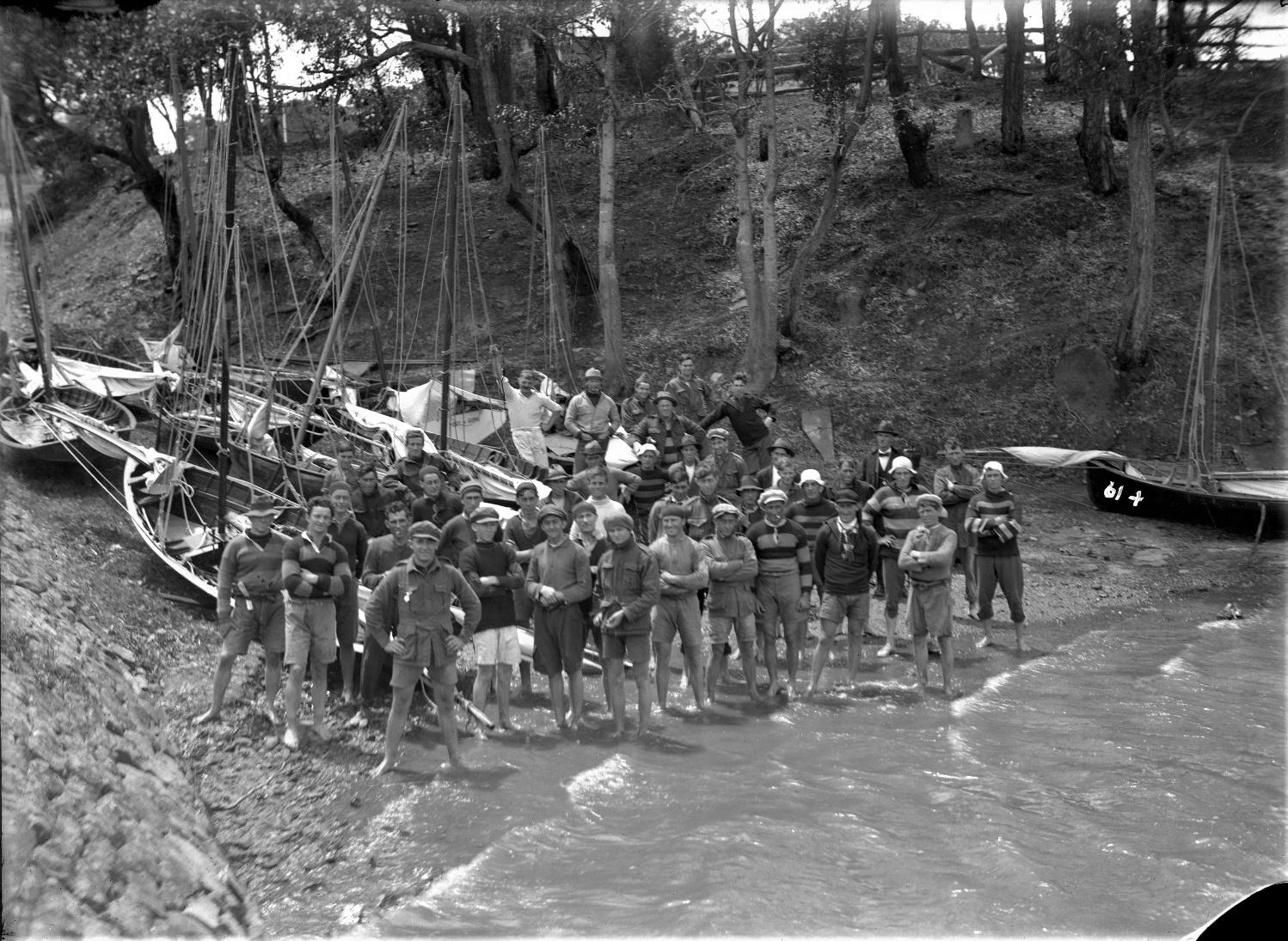
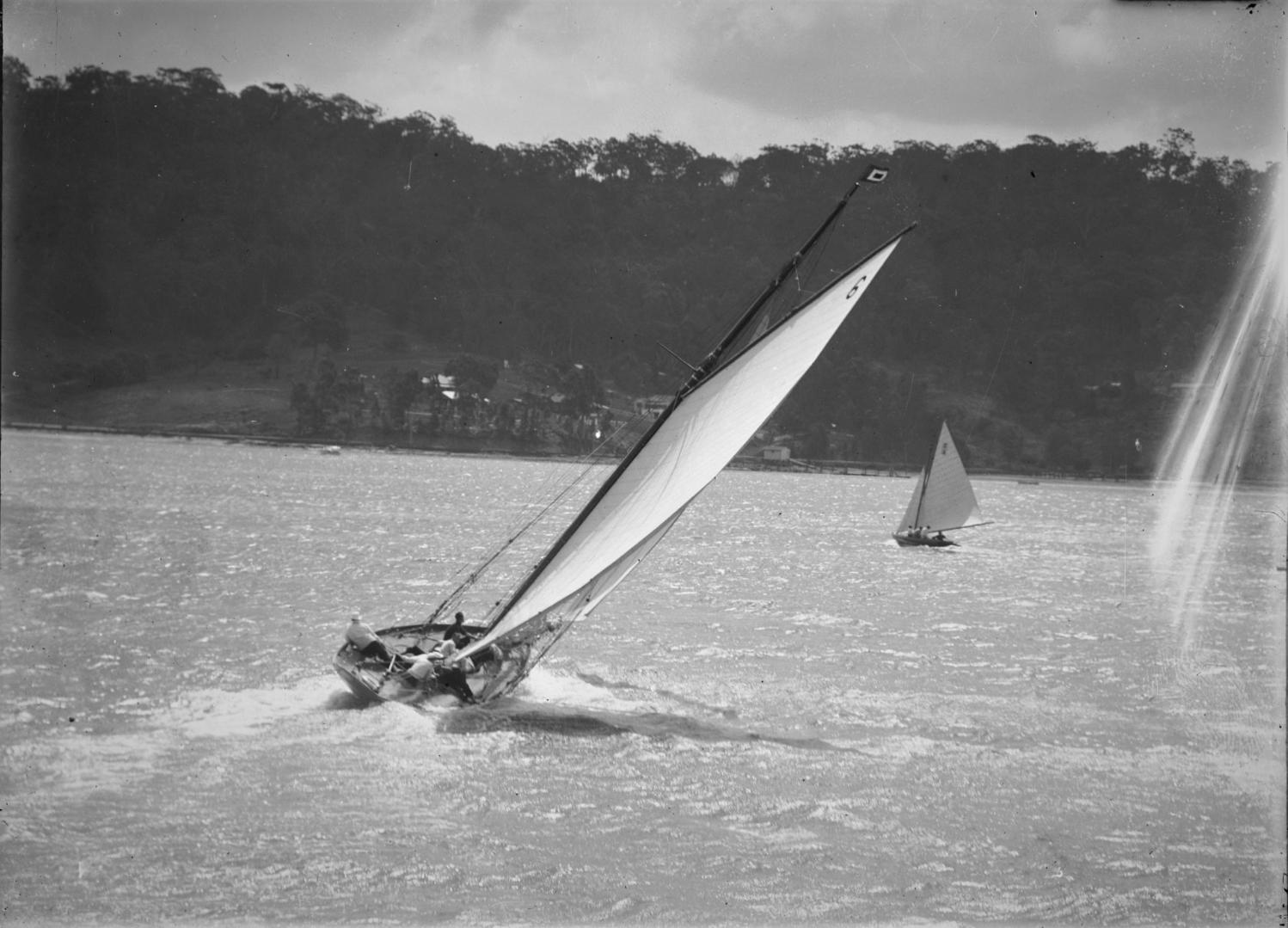
Crew and yachts at Newport waiting for the weather to clear during the Pittwater Regatta. This image appears in The Sydney Mail4 January 1922, page 18. Image courtesy Australian National Maritime Museum, image no: 12163. They are alongside the then Newport Wharf
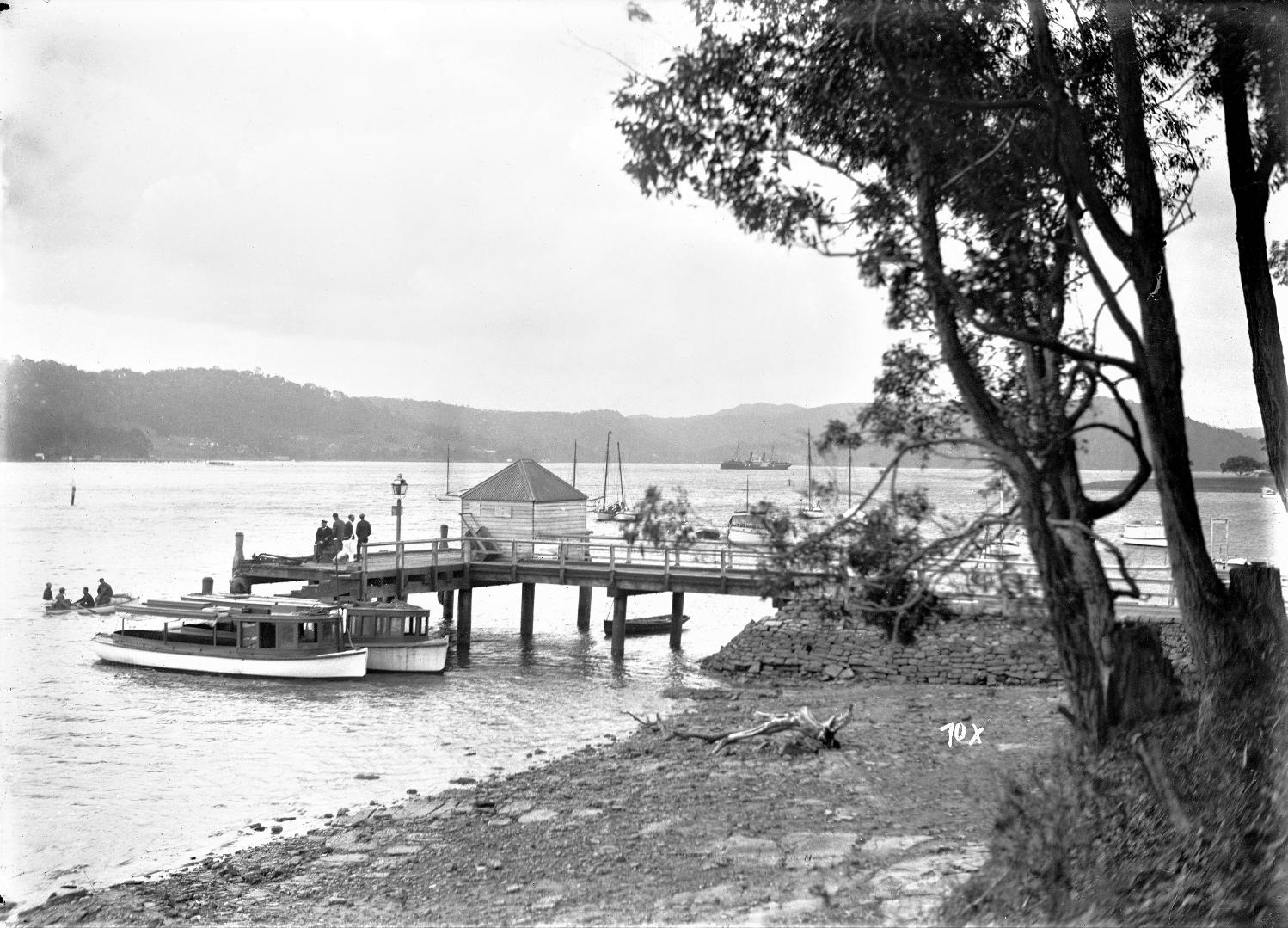
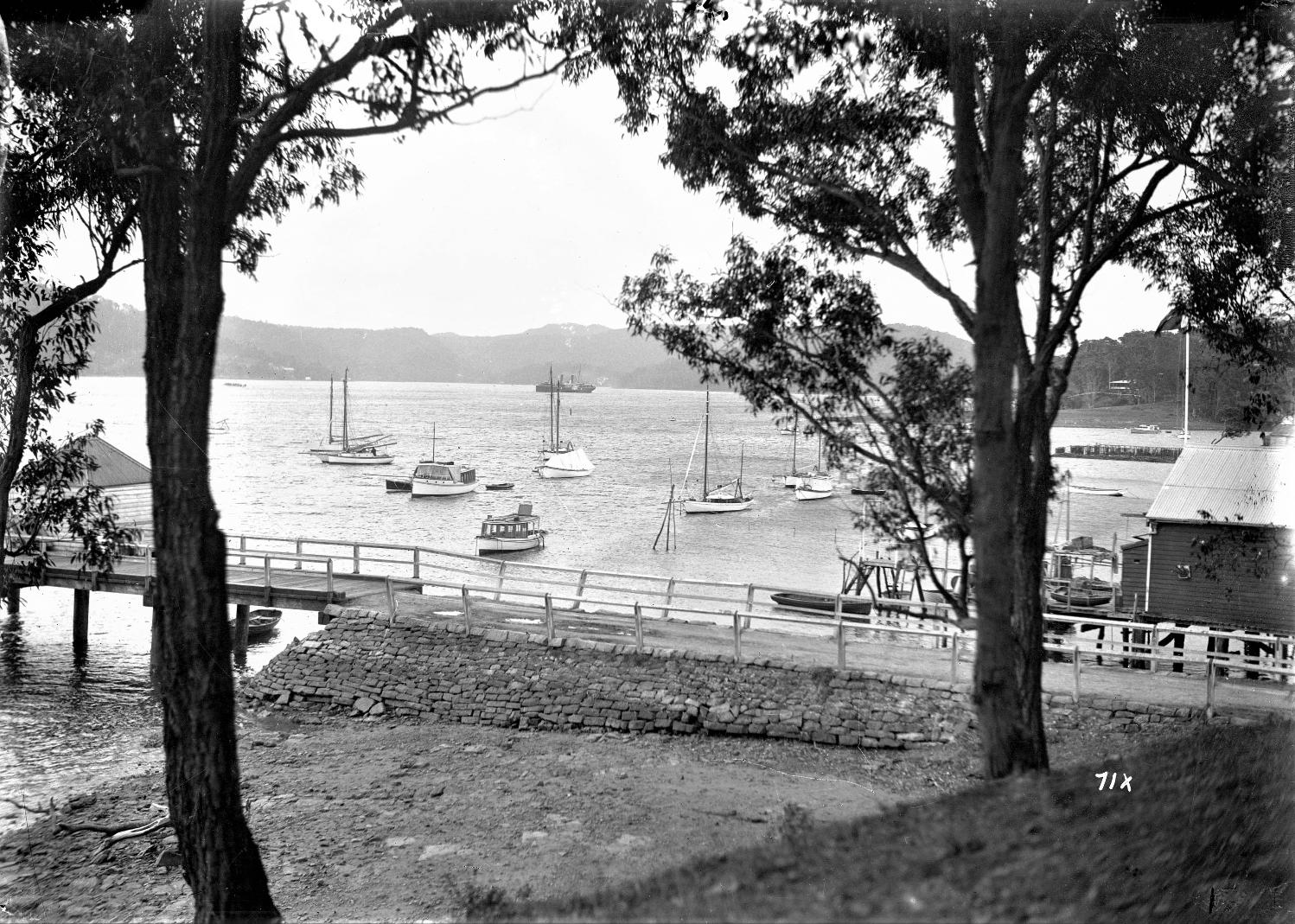
Launches and yachts moored at Newport Public Wharf, during a Pittwater Regatta - that's the SS Archer in the background. This photo is part of the Australian National Maritime Museum’s William Hall collection. The Hall collection combines photographs from both William J Hall and his father William Frederick Hall. Object number 00012150

“Some years ago - never mind how long precisely - having little or no money in my purse, and nothing particular to interest me on shore, I thought I would sail about a little and see the watery part of the world. It is a way I have of driving off the spleen, and regulating the circulation. Whenever I find myself growing grim about the mouth; whenever it is a damp, drizzly November in my soul; whenever I find myself involuntarily pausing before coffin warehouses, and bringing up the rear of every funeral I meet; and especially whenever my hypos get such an upper hand of me, that it requires a strong moral principle to prevent me from deliberately stepping into the street, and methodically knocking people's hats off - then, I account it high time to get to sea as soon as I can. This is my substitute for pistol and ball. With a philosophical flourish Cato throws himself upon his sword; I quietly take to the ship.” 
Herman Melville, Moby Dick

Years ago the wonderful Norm Field of Avalon Sailing Club applied himself to attempting to teach a few sailing terms and the great sport of sailing itself to your hapless reporter. It was a great day and brilliant fun, inspiring an exploration of nautical terms themselves that has continued to the present day. 

For those who have a passion for words, and even where those words stem from historically, along with applying some etymology, nautical terms are a boon that never ceases to surprise and delight.

These phrases, words and their application elsewhere has inspired songs, poetry stories and a way to say what you mean without being too rude about when something needs to be said. Similarly Sea Shanties, shanty, chantey, or chanty is a genre of traditional folk song that was once commonly sung as a work song to accompany rhythmical labour aboard large merchant sailing vessels. They were found mostly on British and other European ships, and some had roots in lore and legend.

But let’s begin with a single word that is apt - did you know the nautical term ‘fathom’, which once meant to me I may ‘understand’ something, and is a unit of length equal to six feet (1.8 metres), chiefly used in reference to the depth of water, stems from the longest of many units derived from an anatomical measurement, the fathom originated as the distance from the middle fingertip of one hand to the middle fingertip of the other hand of a large man holding his arms fully extended. The name comes from the Old English faedm or faethm, meaning outstretched arms. The name derives from the Old English word fæðm, cognate to the Danish (via the Vikings) word "favn" meaning embracing arms or a pair of outstretched arms. Cognate maybe also via the Old High German word "fadum" of the same meaning. In Middle English it was fathme.

Conversely, a burial at sea, (where the body is weighted to force it to the bottom) requires a minimum of six fathoms of water, is the origin of the phrase "to deep six" as meaning to discard, or dispose of. 

The phrase is echoed in Shakespeare's The Tempest, where Ariel tells Ferdinand, "Full fathom five thy father lies".

Pretty cool stuff. 

Of course, I’m not the only one who has had to resort to a nautical dictionary when out on the briny to fathom what is actually being said as these instructions fly fast around by poor dim head, as this example from 1884 amply illustrates; - 

NAUTICAL TERMS.

' How are you getting along -with - your new yacht ?' said an old settler to another old settler who is having steam yacht built in the country for use on one of the lakes. ' When do you launch her ?' 

' O, they are getting along all right I guess,' said the yacht owner, ' but I don't know what you mean by ' lunching' her. I didn't know as any lunch went with a yacht.' ' Who said lunch ?' remarked the first old party, who knew something about a sea-faring life. ' I said launch, that is, to get her into the water.' 

' O, you mean when we going to slide her in?’ ‘ Yes, yes. But I had no thought about that. I supposed they would put castors under the roof on the bottom, and roll her around on land. Say, Jim,' said the yacht owner, calling his friend one side, 'In strict confidence I want to tell you I don't know any more about yachting than I do about religion. The fact is, the boys told me I ought to have a yacht; and so I ordered one, but I have nearly driven the gentlemen crazy that is building it for me, by my landsman remarks. I try to pretend that I know all about the different things he speaks of but its all Greek to me. "What's a rudder, anyway ? He wrote to me the other day to send him a rudder shoe, and I sent-a pair of them by express, and do you know, he kicked terribly when he opened the package, and found a pair of rubber overshoes. How did I know what a rudder shoe was ? He sent out for a windlass, and I found where some fellows had been digging a well, and bought the windlass they had been rising for a dollar and a half, and sent it out, and it came back on the next train with indignant remarks about my intelligence. He sent for a binnacle, and I never was so stuck in my life. I thought maybe a binnacle might be something that went with the rudder shoe, and I went to the stocking counter in a dry goods store, and asked the girl in charge, if she would let me have a look at some of their binnacles. She was a real spry looking girl, and did not look as though she would deceive an old man, but I could see she was surprised. She asked me what size I wanted, and I told her I should think about number eight or nine. Then she told me I would have to go to the corset counter, and I went there and asked the girl how she was off for binnacles, and she said she was not off for binnacles, as she knew of, and then the stocking counter girl came up and whispered to her, and she asked me if I wanted a binnacle for myself or my wife; Do yon know, the cold perspiration raised right np on my forehead, but I told her I wanted, a binnacle that would do for either myself or any of the family, a sort of combination binnacle as it were. O, you don't catch the old man on any cross examination! The girls held a consultation and called a floor-walker, and talked with him, and then one of them asked me if I wanted a binnacle that laced up on one side, or hooked in front; and I told her I didn't want either, I wanted one that buttoned up. They said then I better go to the glove counter, and I went there, and when I said I wanted a binnacle, the girl asked me what color, and I told her I wanted a terra cotta binnacle." She said the nearest she had was lavender, "and that she couldn't sell me a single one. She said I would have to take a pair. I didn't want a pair, and she asked me if I was' buying a what do you call it, for a one armed man, that If so, which hand, right or left. I was stuck, then, and asked her, with some indignation, if she knew what a binnacle was, anyway, and she said she would be blessed if she did. I like frankness, but I was really in hopes she did know what a binnacle was, but just then the floor-walker  came up with three other girls,' and he asked me what a binnacle was for, and I told him it was for use on a yacht ' Then he said that was – all right, and I could find it at the underwear counter, so I went there and told the girl, a real intelligent person, that I wanted a binnacle for a yacht, and one of the girls said, ‘he wants a combination binnacle that he or any of  his family can wear,' and the other girl said 'one that buttons up,' and the girl above the glove counter said, 'give him a terra cotta coloured one.' 

‘Well, I pledge you my word the binnacle business was becoming serious. The underwear girl opened several boxes, and said she didn't believe they had terra cotta, but they had brown, and lisle thread, and silk. I told her to give me a silk one as quick as she could, and if she didn't pull out a silk undershirt, a female one, I hope to die, and I took it. I was glad to get out of the store, because all the girls were laughing at me I suppose I sweat a pailfull. But that was nothing to what I suffered when I took the binnacle up to where they are building the boat.

The captain asked me about the binnacle, and I told him it was in the small package, and he opened it. I knew when he was opening it that he had doubts as to whether I knew what a binnacle was, and when he pulled out that female undershirt out and held it up by one arm, I shall never forget the look on his face. Well, an old sailor shouldn't expect too much of a man who has never been to sea any more than to join the Baptist church. I gave the binnacle to a hired girl at the hotel, and squared myself with the captain by saying that I ordered a binnacle and they had probably sent that thing by mistake, and had sent the binnacle to some lady that had ordered the shirt. The captain said he would like to see the lady when she tried to put the binnacle on. I have found out that a binnacle is a thing that they put a compass in, for use in the pilot house; but I don't see why they don't call it something that a man can understand. 

I came near getting my neck broke when I was up there. Everything is called by some other name about a ship. A rope is called a ' painter.' The captain throwed a rope over the side, and told me to fasten it to the end of the painter on the ground Well, there was a Dutch fellow painting the side of the yacht, and I made a slip noose and fastened it to the slack of the painter's pants. He didn't understand our language, and I thought it was done for a purpose, and just then the captain asked me if I had made it fast, and I said, 'aye, aye, sor,' and he shouted to one of the men to ' hoist away,' and I am blessed if they didn't jerk that painter right over the side, by the seat of the pants, and half way up the mast, and he yelled murder in a foreign language, and spilling a bucket of paint on deck. They let him down, and then the captain explained that a painter was a small rope. The painter was mad, and chased me all over the shipyard with an axe. I had to buy him a new pair of pants, but I don't care for t expense, as I am learning something every day. Say, what is the tiller rope? ' 

‘Oh, I don't know, said the first old citizen, ' you better go up to the dry goods store and ask the girl at the corset counter,' and they separated, the yacht owner to go and consult the encyclopedia, and the old man to take a drink…— Pecks Sun NAUTICAL TERMS. (1884, July 26). Hamilton Spectator (Vic. : 1870 - 1918), p. 1 (SUPPLEMENT TO THE HAMILTON SPECTATOR). Retrieved from http://nla.gov.au/nla.news-article226051509 

RAWHITI sailing at the 1921 Pittwater Regatta - image taken on December 26th, 1921.  This image appears in The Sydney Mail, 4 January 1922, page 18. The yacht in the background is most likely to be CORELLA. ANMM photo.

What remains fascinating is the reuse of these words and phrases in other ways as we and our language evolves.

For example when your boat is ‘in irons’ it refers back to people being ‘shackled’, since prisoners ‘in irons’ were unable to move – just like a boat caught with its sail up that has lost wind power.

There are many other phrases used every day that originate from the nautical world.

Some examples:

Chock-a-block - When something is ‘very full’ it’s chock-a-block. This is thought to originate from ‘chock-full’ (choke-full), which means ‘full to choking’. Later, the term was used to identify wood wedges used to stop objects moving around. ‘Chocks’ were often found on ships, and are referenced as far back as 1769 by William Falconer in An universal dictionary of the marine, which defines it as a, ‘sort of wedge used to confine a cask or other weighty body… when the ship is in motion.’ The Block component, according to Meriam Webster Dictionary, a ‘block and tackle’ is a type of pulley used on ships to hoist up sails. When the sail was pulled all the way up, with no leeway in the rope and the blocks jammed tight, they were considered ‘chock a block’. That’s why we say something is ‘chock a block’, when it can’t go any further or is really full.

Groggy, today, means feeling weary, perhaps a little bleary after a long hard night - right? We also align it with having had too much alcohol (AKA grog) in that you get groggy. Grog is meant to be a simple alcoholic drink containing water and spirits. However,  an Admiral Edward Vernon (1684 to 1757) had a penchant for wearing grogram jackets, made from a coarsely woven material called ‘grogram’ (originally, ‘gros-grain’). Admiral Vernon also had a penchant for watering down his crew’s rum to stop them from getting too drunk at sea. Hence the term, ‘groggy’. The word itself was first used in print in The Gentleman’s Magazine in 1770. The piece, titled, 80 names for having drunk too much said: Groggy; this is a West-Indian Phrase; rum and water, without sugar, being called grogg.

That, naturally, brings in recollection of the phrase ‘the sun is over the yardarm’ which was a Naval officers’ expression meaning "It is time for a drink", as it is bad form to have a drink on board before sun is over the yardarm, i.e. approaching noon, or in aquatic-speak and more correctly ‘Foreyard that Yardarm’.

And all that may lead to being cranky’, from the Dutch krengd, a crank was an unstable sailing vessel. It has come to mean irritable. 

Another phrase still in use, Devil to pay, Devil and the deep blue sea, also have aquatic origins. In traditional wooden ships, the sailors had to caulk or pay the seams with hot tar between the planks of the deck to prevent leakage into the bilge. The devil seam was topmost on the hull next to the scuppers at the edge of the deck and the longest and most difficult seam to caulk. Hence, if there was the "devil to pay," then this was the most difficult and dangerous job since the sailor might be knocked down  by a large wave and find himself between the "devil and the deep blue sea." Today, the expression "devil to pay" is used to mean that there will be a big price to pay, and "devil and the deep blue sea"  refers to being in a difficult or unpleasant position like being "between a rock and a hard place." 

The cut of your jib –  liking the ‘cut of one’s jib’ refers to liking another person’s manner, style or personality is another phrase with nautical origins. As you know, the jib is the triangular sail typically used at the front of a sail boat. In the past, different countries had different styles of sails, so the origin of a ship could be worked out by the kind of jib it had. As a result, sailors could identify and proffer their opinions on the nationality of a sail boat, based on its jib. The idiom was made popular in the 19th Century by Sir Walter Scott, who used it in the 1824 novel St Ronan’s Well.  Sir Scott wrote: If she disliked what the sailor calls the cut of their jib.

All fair and above board is another now commonly used expression of nautical origin meaning "utterly fair nothing hidden". Things "above board" were on or above the upper deck and so open for all to see.

Adrift, another word that stems from the nautical world, is now applied to people and things - they cast that policy adrift. Brings to mind 'all at sea' doesn't it?

The word ‘webs’ is Sailor’s slang name for his feet. A now defunct from our language phrase ‘to have a weed on’ was Sailor’s slang for having a grievance and expanding on it to the point where you’re now annoying others too.

Avast! means ‘Hold! Enough! Finish!’ It comes from the Italian word "Basta".

Here’s one our local Builders may recognise – backing and filling, which had nothing to do with excavating in this instance. This was a common expression, of maritime origin, for constantly changing ground in a decision or argument.

The ‘dead reckoning’ stems from aquatics as well, not a zombie movie. Originally, the practice of keeping a log based on estimated speed was called 'deduced' reckoning. Over time, this turned into dead reckoning. Dead reckoning is the process by which the position of the ship at any moment is found (without any observation of the sun or stars) based upon the last well-determined position and the run that has been made since that last position.  For this purpose, the ship's course indicated by its compass, the distance indicated by the log, and drift and leeway were all taken into account. 

Aloof is a nautical order to keep the ship's head to the wind, thus to stay clear of a lee shore or some other quarter.  The front part of the sail which meets the wind is called the luff. A sailing vessel that could point higher to windward and hold its speed better than another was said to stand apart or to sail a-luff that later became aloof. Today the word is used to describe a person who is distant or stands apart from the others.

The verb to ‘bale’ out, meaning to remove water, comes from the old name "boyle" for a bucket.

Similarly, ‘bear up’ is a sailing expression, meaning to bear the tiller up to windward in order to keep the vessel’s head away from the wind. Today it remains in common use, with the metaphorical meaning of "Keep your spirits up!"

At a rate of knots is now used by many and stems from being on the water, meaning there to go at top speed. This is used to describe someone who is traveling or driving very fast.

A ‘Clean Bill of Health’ is a now widely used term which originates from the "Bill of Health", a document issued to a ship showing that the port it sailed from suffered from no epidemic or infection at the time of departure. 

Port and starboard still confuse some …. ‘Left, no left... LEFT! Ok; the other right!’ remains an instruction mum, a sailor from her earliest years, still gives me… In the earliest ships there was no rudder and the ship was steered by a "Steerboard" (large car or sweep) sited over the right-hand side of the stern; hence that side of the ship came to be known as the Starboard side. The other side of the ship was in consequence used for going alongside for embarking or disembarking cargo through the ‘load-ports’; the left hand side of the ship therefore became known as the "Loadboard" side, the "Larboard". As the use of this latter word inevitably caused confusion with the word Starboard, the word Port came to be used instead. By some authorities, the Venetians are given the credit for the origin of "the word" - ‘board’ comes from the Italian ‘Borda’ meaning side; the side with the steering oar was ‘Questa borda’: the other side was ‘Quella boarda’; these two expressions would rapidly become adapted into Starboard and Larboard.

Simplest for us simpletons is A1, the accepted synonym for first-class has a nautical bent. In Lloyd’s Register, A1 is the mark of a wooden ship of the first class, A referring to the quality of her hull and "1" to the quality of her equipment. Generations on Frank Sinatra would use this as a way to sing about being in New York New York ... - ok; that may be wrong.

Locally we have the Palm Beach Sailing Club which names one of its annual Regattas after a nautical word. The name for the regatta 'Beware The Bullets' stems from the sailing course area near Barrenjoey Headland. The sand spit connecting it to the mainland allows the traditional nor-east sea breeze to blow over the sand spit, but also bend around the headland. At times there are freak gusts that bounce down onto the water in short bursts that can catch the sailors by surprise. These unexpected gusts are called 'Bullets'. When sailing close to Barrenjoey Headland you therefore need to be careful or 'beware of the bullets'. 

These are just a few examples of our long love of being nautical intermingling with how we express that in other spheres and the value with which it has enriched our language thereby. The places those sourced here were found are listed under references should you wish to explore further when next lost for words or would like to wish someone fair winds and following seas

Of course, it’s good to know you’re not the only nautically linguistic ignoramus among so many adepts – but as we here in Pittwater, although still churning out world sailing champions, don’t take ourselves too seriously, a note of levity from a fellow ‘expert’ closes this insight into being Matelot Mad - Now that will put a smile on your dial!

HISTORY MADE AGAIN AT PITTWATER
(BY GUM)

ADMIRAL CHEWN GUM, my illustrious ancestor, is quoted as having said,
'He who cannot sail a boat, will sink unless he keeps afloat.'
Yachting and boating and sailing and rowing are things which have been in our family for years.
At the age of sixteen I knew how to handle an oar.
At eighteen, I was an apprentice to a bow-sprit manufacturer.
At nineteen, I was foreman of a spinnaker works, and at 21 I could tack down carpets. 
The salt water is in my blood. You ask the barman!
Nothing suits me better than to see the keel filling bravely before a following wind. The surge of the mainsail as it cleaves the briny deep is music to me.
You should have seen me taking my turn at the wheel during the Pittwater Regatta! I was captain of the sixteen-footer, Noogooloowoo.
Pacing up and down the bridge, I snapped my orders out into the teeth of the gale.
'Avast! Belay a bit on the port; that's all the port we've got. All hands make fast! Reef in the starboard helm and buckle it down. All hands to the pumps. Women and children first. Yes, I don't mind if I do. Not too much soda. Throw in your clutch!'
And other nautical terms.

* * *

The crew responded immediately. 'Ring-bark the main-mast!' I cried; 'we're getting too far in front!'
Rounding the buoy, the chief steward leaned over and hauled it aboard. We were the only boat to round the buoy.
The waves lashed themselves into fury, the sky was, overcast, dark, and lowering, the lightning crashed and struck four of the crew stone dead on the promenade deck. The seas were mountains high.

'Everybody get off the boat!' I cried. 'Throw over the bulwarks! Smash in the stern!!
Somehow, the boat had to be lightened. 
I could hear the timbers groaning and creaking as I went below, to save the papers. I remember no more, until I heard a voice saying, 'Captain Gum, you have had a most signal success.'
'I see no signals,' I replied, putting the glass up to my blind eye.
I then fainted again. 

DRESSING ROOM ECHOES (1931, December 30). Referee (Sydney, NSW : 1886 - 1939), p. 12. Retrieved from http://nla.gov.au/nla.news-article136750458 

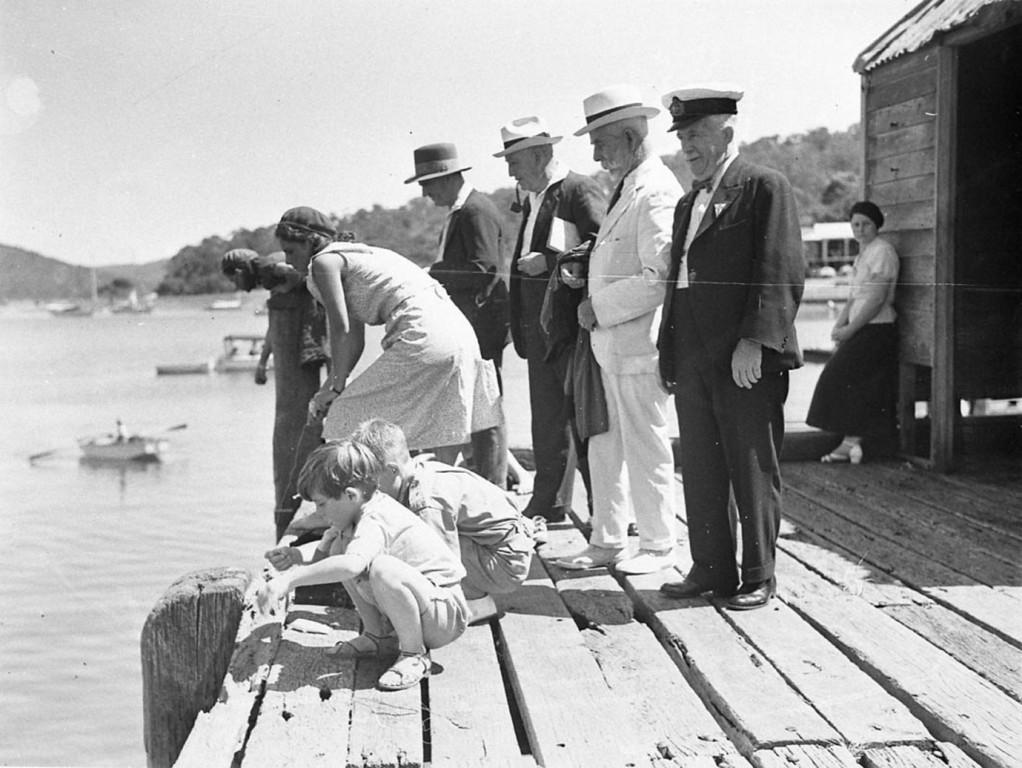
Top: 'Fishing from a jetty at Taylor's Point' - taken by Sam Hood during Pittwater Regatta, Broken Bay - possibly officials ensuring Taylors Point mark for races is rounded. Image No.: hood_06542, circa 1930's, courtesy State Library of NSW
References

  1. TROVE – National Library of Australia
  2. Jack Speak, a Matelots Dictionary, at: http://www.gunplot.net/traditions/Navalterminology.html 
  3. Nautical language at: https://www.see-the-sea.org/nautical/naut-body.htm 
  4. Wikipedia contributors. (2021, July 1). Glossary of nautical terms. In Wikipedia, The Free Encyclopaedia. Retrieved from https://en.wikipedia.org/w/index.php?title=Glossary_of_nautical_terms&oldid=1031469134
  5. Avalon Sailing Club Teaches A Novice To Sail
  6. Pittwater Regattas Dates and Flagships Part I – Steamers And Ferries Of Pittwater
  7. Binnacle in Royal Motor Yacht Club – Broken Bay foyer - presented by Commodore Allan G Leslie
  8. Ships Biscuits - The At Sea Necessity That Floated William Arnott’s Success
Newport Public Wharf, during a Pittwater Regatta - that's the SS Archer in the background. This photo is part of the Australian National Maritime Museum’s William Hall collection. The Hall collection combines photographs from both William J Hall and his father William Frederick Hall. Object number 00012150

Haul Away Joe

Lyrics: original
When I was just a little lad or so me mammy told me,
(Away haul away, we'll haul away Joe.)
That if I didn't kiss the girls me lips would grow a-moldy.
(Away haul away, we'll haul away Joe.)

Away (Ho!) haul away! we'll haul away together!
Away haul away, we'll haul away Joe.
Away (Ho!) haul away! we'll haul for better weather.
Away haul away, we'll haul away Joe.

I used to have an Irish girl, but she got fat and lazy
(Away haul away, we'll haul away Joe.)
But now I've got a Bristol girl, and she just drives me crazy
(Away haul away, we'll haul away Joe.)

Away (Ho!) haul away! we'll haul away together!
Away haul away, we'll haul away Joe.
Away (Ho!) haul away! we'll haul for better weather.
Away haul away, we'll haul away Joe.

Old Louis was the king of France before the revolut-i-on.
(Away haul away, we'll haul away Joe.)
But then he got his head chopped off it spoiled his constitut-i-on.
(Away haul away, we'll haul away Joe.)

Away (Ho!) haul away! we'll haul away together!
Away haul away, we'll haul away Joe.
Away (Ho!) haul away! we'll haul for better weather.
Away haul away, we'll haul away Joe.

You call yourself a second mate, you cannae tie a bowline,
(Away haul away, we'll haul away Joe.)
You can't even stand up straight, when the packet she's a rollin'
(Away haul away, we'll haul away Joe.)

Away (Ho!) haul away! we'll haul away together!
Away haul away, we'll haul away Joe.
Away (Ho!) haul away! we'll haul for better weather.
Away haul away, we'll haul away Joe.

Well now can't you see the black clouds a-gatherin'.
(Away haul away, we'll haul away Joe.)
Well now can't you see the storm clouds a-risin'.
(Away haul away, we'll haul away Joe.)

Away (Ho!) haul away! we'll haul away together!
Away haul away, we'll haul away Joe.
Away (Ho!) haul away! we'll haul for better weather.
Away haul away, we'll haul away Joe.

Noël Coward: Matelot

National Youth Choir of Australia - published October 2017

Lyrics
Jean Louis Dominic Pierre Bouchon,
True to the breed that that bore him,
Answered the call that held in thrall
His father's heart before him.

Jean Louis Dominic sailed away
Further than love could find him
Yet through the night he heard a light
And gentle voice behind him say:

Matelot, Matelot,
Where you go my thoughts go with you
Matelot, Matelot,
When you go down to the sea

As you gaze from afar on the evening star
Wherever you may roam
You will remember the light through the winter night
That guides you safely home.

Though you find womenkind to be frail,
One love cannot fail, my son,
'Til our days are done....

Matelot, Matelot,
Where you go my thoughts go with you
Matelot, Matelot,
When you go down to the sea.

Jean Louis Dominic Pierre Bouchon
Journeyed the wide world over
Lips that he kissed could not resist
This loving roving rover.

Jean Louis Dominic, right or wrong,
Ever pursued a new love
Till in his brain, there beat a strain
He knew to be his true love song:

Matelot, Matelot,
Where you go my heart goes with you
Matelot, Matelot,
When you go down to the sea

For a year and a day you may sail away
And have no thought of me,
Yet through the wind and the spray you will hear me say
No love was ever free.

You will sigh when horizons are clear,
Something that is dear to me
Cannot let me be,

Matelot, Matelot,
Where you go my heart goes with you
Matelot, Matelot
When you go down to the sea.

Matelot, Matelot,
Where you go my heart will follow
Matelot, Matelot,
When you go down to the sea

When there's grief in the sky and the waves ride high
My heart to yours will say
You may be sure that I'm true to my love for you
Though half the world away.

Never mind if you find other charms,
Here within my arms you'll sleep,
Sailor from the deep....

Matelot, Matelot,
Where you go my heart will follow
Matelot, Matelot,
When you go down to the sea

Nautical Words And Phrases Transposed Into Other Uses: Can You Fathom That?! - A J Guesdon, 2021

Lena (2025) - Surfing Nazaré.

Published January 12 2026 by Lena Kemna and Luigi Rapanelli

L E N A documents the journey of the first German female big wave surfer. Led by the fascination for the biggest waves of her life, and guided by the sombre respect for the power of the ocean, this film does not shy away from the complexities in telling her story of purpose and persistence in Nazaré.

Opportunities:

Fix our Feeds

The social media feeds that once connected us are now driving us apart. Social media algorithms are flooding young men’s feeds with radical misogynistic content, inciting real-world harm.

We’re calling on the Australian Government to act, and introduce an opt-in feature for social media algorithms so we can bring affirmative consent to our screens, and turn our feeds on and off at will.

Add your name to the Open letter, and more information available at: www.teachusconsent.com/fix-our-feeds

This has already been signed by Mackellar MP, Dr. Sophie Scamps, Warringah MP Zali Steggall and Wentworth MP Allegra Spender.

Independent MP Allegra Spender states:
''Great to see Chanel Contos in Sydney, and talk about the “Fix Our Feeds” campaign by @teachusconsent.

It’s simple but brilliant idea - social media algorithms should be opt-in, not forced upon us - so we have a real choice over what we’re shown.

Giving people the ability to switch off the algorithm would help reduce the spread of misinformation, misogyny, extremism and harmful body image content.

If this is something you would like to support, sign the open letter to Anthony Albanese at teachusconsent.com and share their campaign with your friends.''

The Teach Us Consent site states:

Systematic radicalisation
It takes just 23 minutes for a social media  mimicking a 16-18 year old boy to be fed misogynistic content, regardless of the account’s viewing preferences.

Misogynistic content is rife
73% of Gen Z social-media users have  misogynistic content online, with 70% saying they believe misogynistic language and content are increasing. This rises to 80% for women.

Sexual violence is increasing
Instances of reported sexual assault have  by 10% in the last year in Australia. This accompanies a  in the overall reporting rate.

Chanel explains:

Play Women's Social or Competitive Cricket with Cromer!

Cromer Cricket Club is now seeking women, aged 16+, who want to play cricket in the February 2026 commencing CNSW Women's Metro Competition. This is the only peninsula cricket club that offers an opportunity for girls who can no longer play in the junior clubs due to being almost all grown up.

CCC states their Women's Cricket division is fun for all ages, and a great way to make new friendships or rekindle your old ones, no skills or experience required, just fun!

''Cromer Cricket Club currently fields teams in the Twilight Women's Cricket League. It's a fun social competition with soft balls and no pads required, perfect for beginners!

We are also fielding a team in the new CNSW Women's Metro Competition, a senior traditional cricket competition for female players, the first of its kind. Register now to be part of history!''

Contact Kelvin (registrar@cromercricket.com.au) or Nick (president@cromercricket.com.au) for more info.

CNSW Women's Metro Competition

  • Senior Women's competition for ages 16+ 
  • Sunday afternoon games
  • Mix of 30 over and T20 games
  • Registration includes playing shirt and hat
  • Free for Saturday players
  • Half-season registration available
  • Whether you're 16 or 60, we've got a place for you!
  • A great opportunity to make new friends!
  • A whole heap of fun! 
  • Register now for 2026!

Register here: www.cromercricket.com.au/womens

To inspire you to get involved, a few notes form the past on women's cricket in Australia, with local connections, including the first Australia-England matches.

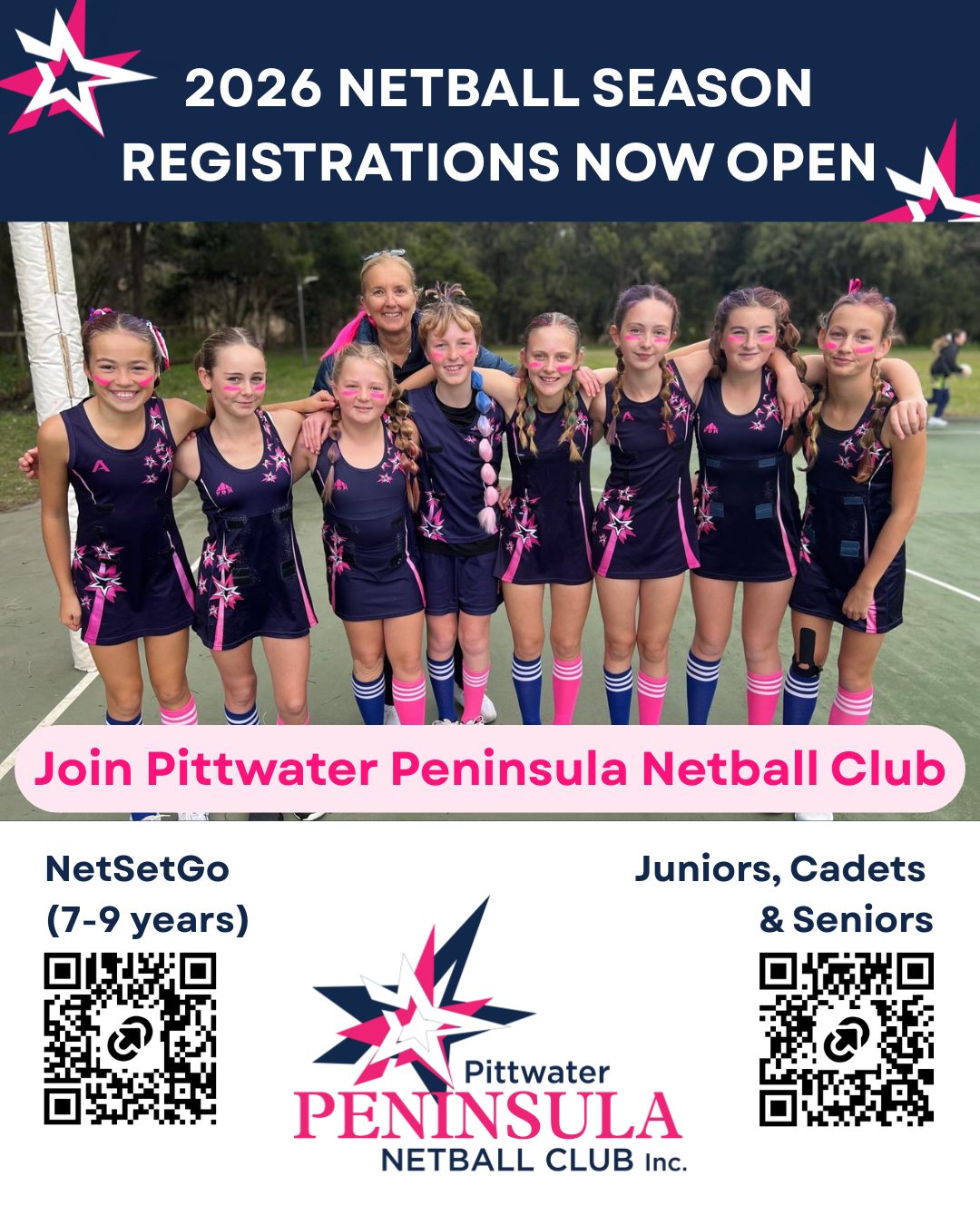
Pittwater Peninsula Netball Club

2026 season - let's go! Registrations are open until early February.


Netball NSW Online Privacy Policy: Don't Post Pictures of Others without asking 

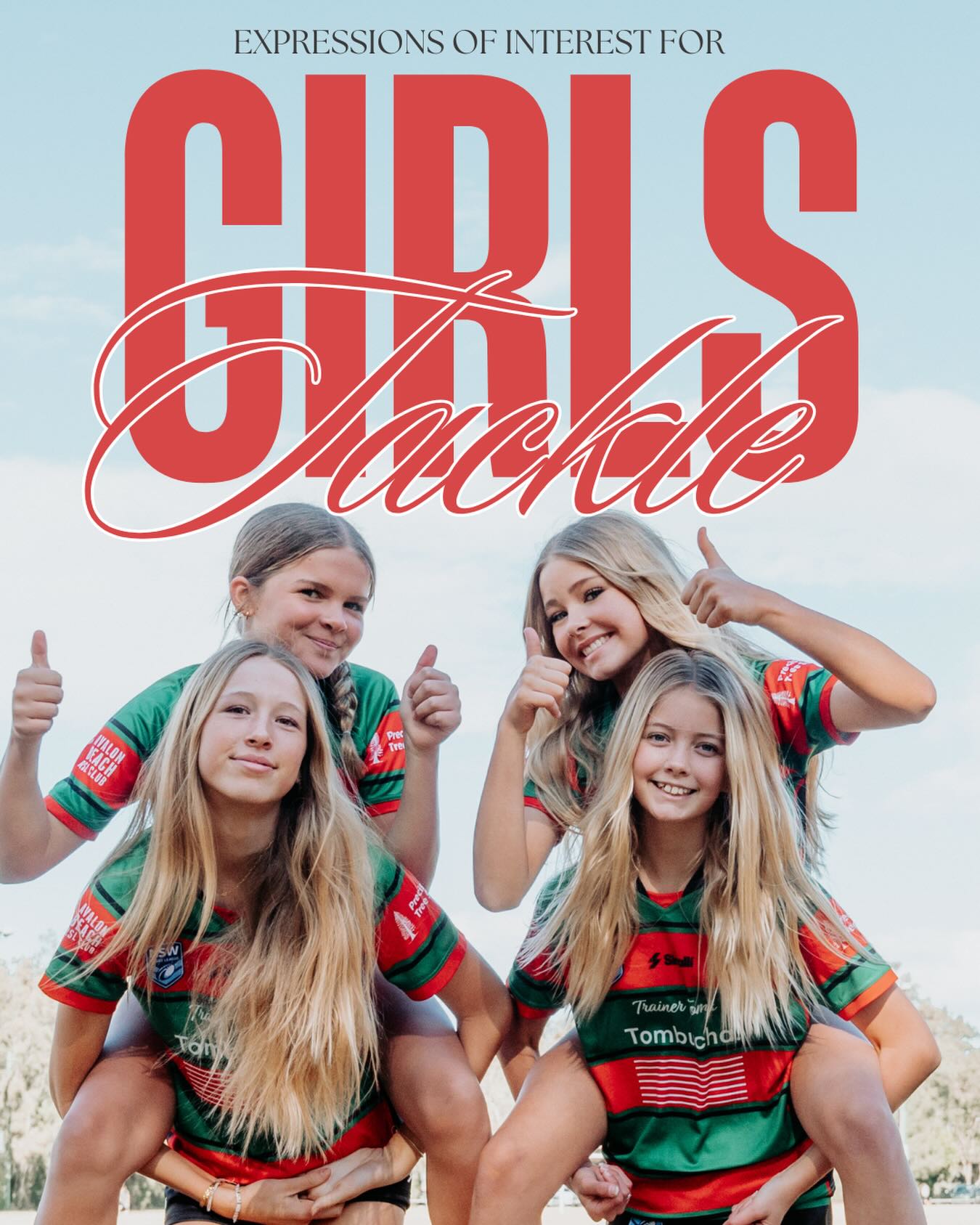
Avalon Bulldogs Announcement: Female Tackle Teams Kicking Off in 2026!

After huge growth in our Girls Tag program, the Doggies are looking at launching our first-ever female tackle teams  and we’re calling for Expressions of Interest now!

Players: U13s, U14s, U15s, U17s & Opens (Possible U11s if we get the numbers)
Staff Needed: Coaches, Managers, League Safe / First Aid
This is your chance to be part of a massive moment for the Bulldogs and help build the future of women’s footy on the Beaches.
Email; info@avalonbulldogs.com.au with heading 'Female Tackle Teams'.

Get involved. Make history. Go the Doggies!

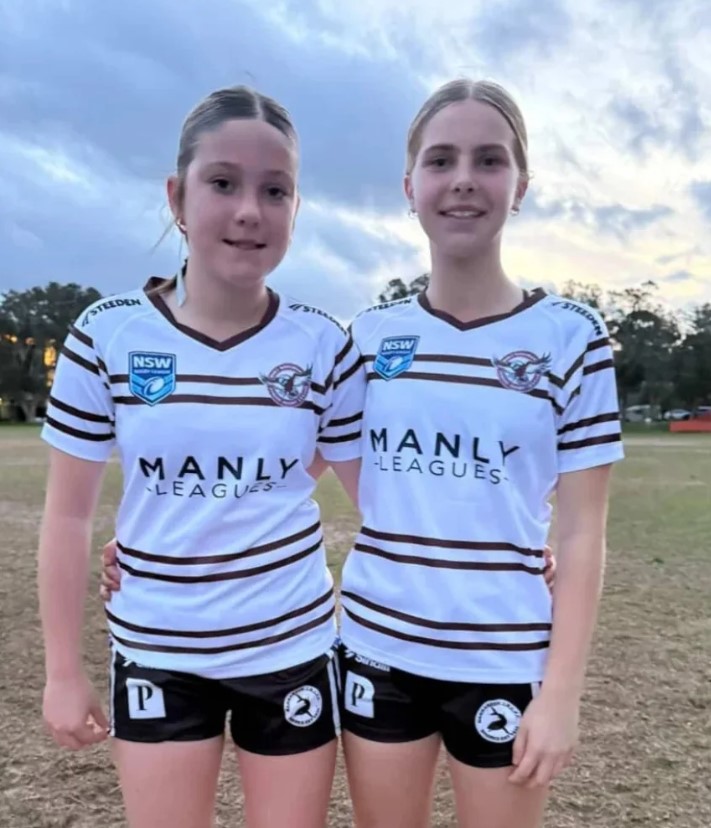
History in the Making: Female Tackle Coming to the Sharks in 2026! 

We’re excited to announce the Narrabeen Sharks’ first-ever female tackle teams for 2026!
After the success of our girls’ tag program, we’re ready to take the next step — creating pathways for female players from grassroots to the NRLW. 

We’re calling for Expressions of Interest for:
Players – U13s, U14s, U15s, U17s & Opens (plus a possible U11s if enough interest)
Coaches, Managers & Trainers (Level 1, League First Aid, League Safe)

This is your chance to be part of club history and help grow the women’s game at the Sharks!
Contact: president.narrabeensharks@gmail.com to register your interest today.

Financial help for young people

Concessions and financial support for young people.

Includes:

  • You could receive payments and services from Centrelink: Use the payment and services finder to check what support you could receive.
  • Apply for a concession Opal card for students: Receive a reduced fare when travelling on public transport.
  • Financial support for students: Get financial help whilst studying or training.
  • Youth Development Scholarships: Successful applicants will receive $1000 to help with school expenses and support services.
  • Tertiary Access Payment for students: The Tertiary Access Payment can help you with the costs of moving to undertake tertiary study.
  • Relocation scholarship: A once a year payment if you get ABSTUDY or Youth Allowance if you move to or from a regional or remote area for higher education study.
  • Get help finding a place to live and paying your rent: Rent Choice Youth helps young people aged 16 to 24 years to rent a home.

Visit: https://www.nsw.gov.au/living-nsw/young-people/young-people-financial-help

School Leavers Support

Explore the School Leavers Information Kit (SLIK) as your guide to education, training and work options in 2022;
As you prepare to finish your final year of school, the next phase of your journey will be full of interesting and exciting opportunities. You will discover new passions and develop new skills and knowledge.

We know that this transition can sometimes be challenging. With changes to the education and workforce landscape, you might be wondering if your planned decisions are still a good option or what new alternatives are available and how to pursue them.

There are lots of options for education, training and work in 2022 to help you further your career. This information kit has been designed to help you understand what those options might be and assist you to choose the right one for you. Including:
  • Download or explore the SLIK here to help guide Your Career.
  • School Leavers Information Kit (PDF 5.2MB).
  • School Leavers Information Kit (DOCX 0.9MB).
  • The SLIK has also been translated into additional languages.
  • Download our information booklets if you are rural, regional and remote, Aboriginal or Torres Strait Islander, or living with disability.
  • Support for Regional, Rural and Remote School Leavers (PDF 2MB).
  • Support for Regional, Rural and Remote School Leavers (DOCX 0.9MB).
  • Support for Aboriginal and/or Torres Strait Islander School Leavers (PDF 2MB).
  • Support for Aboriginal and/or Torres Strait Islander School Leavers (DOCX 1.1MB).
  • Support for School Leavers with Disability (PDF 2MB).
  • Support for School Leavers with Disability (DOCX 0.9MB).
  • Download the Parents and Guardian’s Guide for School Leavers, which summarises the resources and information available to help you explore all the education, training, and work options available to your young person.

School Leavers Information Service

Are you aged between 15 and 24 and looking for career guidance?

Call 1800 CAREER (1800 227 337).

SMS 'SLIS2022' to 0429 009 435.

Our information officers will help you:
  • navigate the School Leavers Information Kit (SLIK),
  • access and use the Your Career website and tools; and
  • find relevant support services if needed.
You may also be referred to a qualified career practitioner for a 45-minute personalised career guidance session. Our career practitioners will provide information, advice and assistance relating to a wide range of matters, such as career planning and management, training and studying, and looking for work.

You can call to book your session on 1800 CAREER (1800 227 337) Monday to Friday, from 9am to 7pm (AEST). Sessions with a career practitioner can be booked from Monday to Friday, 9am to 7pm.

This is a free service, however minimal call/text costs may apply.

Call 1800 CAREER (1800 227 337) or SMS SLIS2022 to 0429 009 435 to start a conversation about how the tools in Your Career can help you or to book a free session with a career practitioner.

All downloads and more available at: www.yourcareer.gov.au/school-leavers-support

Word Of The Week: Prow

Word of the Week remains a keynote in 2025, simply to throw some disruption in amongst the 'yeah-nah' mix. 

Noun

1. the pointed front part of a ship; the bow. 2. the pointed or projecting front part of something such as a car or building.

From: mid 16th century: from Old French proue, from Provençal proa, probably via Latin from Greek prōira, from a base represented by Latin pro ‘in front’.

Astronaut Katherine Bennell-Pegg is 2026 Australian of the Year

Michelle GrattanUniversity of Canberra

The first Australian to qualify as an astronaut under Australia’s space program, Katherine Bennell-Pegg, is the 2026 Australian of the Year.

Bennell-Pegg, 41, who has yet to go to space, graduated from Basic Astronaut Training in 2024 as part of a class of six trained by the European Astronaut Centre in Germany. She was the first international candidate to do so. She had been picked for the program from more than 22,500 applicants.

Prime Minister Anthony Albanese presented the Australian of the Year awards on Sunday night.

The Senior Australian of the Year is Professor Henry Brodaty, a pioneer in dementia treatment.

Young Australian of the Year is Nedd Brockmann, an ultra-marathon runner who has raised large sums to help the homeless.

The winner of the Local Hero section is Indigenous construction leader Frank Mitchell.

Bennell-Pegg, from South Australia, is an active promoter of Australia’s space program, and had the ambition of becoming an astronaut since she was a child. She regularly makes presentations to school children to inspire the next generation.
National Australia Day Council CEO Mark Fraser said she was “forging new frontiers for Australian space engineering, research and exploration.

"She leads by example, openly sharing her story to inspire the next generation and reminding us all of the power of a dream, and where determination can lead,” he said.

Bennell-Pegg was appointed director of space technology at the Australian Space Agency in 2022.

She has said “I have always dreamed of being an astronaut. When I was young, it was for the adventure, but after more than a decade working in space it’s now because I know the role it plays in tackling real-world problems and developing new knowledge that can benefit our society, environment, and science.”

The work of Brodaty, from New South Wales, is hailed as transformative in the diagnosis, care and prevention of dementia.

Momentum for his work came from the experience of his father, who was diagnosed in 1972 with Alzheimer’s disease, aged just 52. Back then, dementia was much more poorly understood than now.

In 2012, Brodaty co-founded the Centre for Healthy Brain Ageing and led internationally-significant research that improved understanding of the risk and prevention of dementia.

His Maintain Your Brain large trial showed cost-effective and targeted intervention could delay the onset of dementia and even prevent it.

“Henry, 78, is a leader who has reshaped dementia care from every angle as he navigates toward a future where dementia is better treated and prevented,” the council said.

Brockmann, now 27 and from NSW, became concerned about homelessness when, as a young electrician from Forbes, on his regular trips to TAFE saw how many people were sleeping rough on Sydney’s Eddy Avenue. He wanted to highlight the problem.

In 2022, he ran from Cottesloe beach in Perth to Bondi beach in Sydney, a journey of 3,952 kilometres which he completed in 46 days, setting a record. He raised more than $2.6 million from 37,000 contributions.

He then established Nedd’s Uncomfortable Challenge in 2024 and with his team has raised more than $8 million to help the homeless.

Mitchell, 43, from Western Australia, a Whadjuk-Yued Noongar man, is co-director of Wilco Electrical and co-founder/director of Kardan, Baldja and Bilyaa in the trades and construction industry.

He was influenced by early experiences of suicide and the loss of best friends.

“As a young single father, being offered an electrical apprenticeship felt like a profound opportunity. When he became a business owner in 2015, he pledged to create the same opportunities for Mob.”

“Starting with just eight staff and $1.5 million turnover, Frank and his partners have created over 70 Aboriginal upskilling positions in the electrical and construction industry, including 30 electrical apprenticeships and awarding over $11 million to Aboriginal subcontractors.

"Today, all four companies collectively employ over 200 full-time staff.

"His story embodies a vision that integrates cultural values with business leadership, strengthening his ties to community while reshaping the construction industry and creating lasting impact and social justice,” the council said in its statement.The Conversation

Michelle Grattan, Professorial Fellow, University of Canberra

This article is republished from The Conversation under a Creative Commons license. Read the original article.

Beauty in ordinary things: why this Japanese folk craft movement still matters 100 years on

A thrown tea bowl made by Hamada Shōji. WikimediaCC BY-SA
Penny BaileyThe University of Queensland

On January 10 1926, Yanagi Sōetsu and the potters Hamada Shōji and Kawai Kanjirō sat talking excitedly late into the night at a temple on Mt Kōya, in Japan’s Wakayama Prefecture.

They were debating how best to honour the beauty of simple, everyday Japanese crafts. Out of that conversation came a new word, mingei, and a plan to found The Japan Folk Crafts Museum in Tokyo. Later, Yanagi would describe what emerged that night as “a new standard of beauty”.

A view of the front of a traditional Japanese building with a dark roof and large wooden doors. There is a short stone fence in the foreground.
The Japan Folk Crafts Museum in Meguro Ward, Tokyo, is dedicated to collecting, preserving, researching, and exhibiting the hand-crafted works of the Mingei movement. WikimediaCC BY-SA

A century on, Yanagi’s ideas feel strikingly relevant. His message was simple: beautiful things need not be rare or expensive – they can be well-designed objects that we use every day.

In an age of fast fashion, disposable products and growing concerns about waste, his approach offers an important reminder to think about the objects we choose to have around us.

How mingei was born

Yanagi (1889–1961) was an art critic and collector who believed beauty was not solely the preserve of famous artists or rare treasures. He and his friends were drawn, instead, to well-made and functional objects: bowls, baskets, fabrics and tools created for daily use, rather than to display.

A black and white image of a Japanese man in a traditional robe, holding a bowl.
Yanagi was an art critic, philosopher and founder of the Mingei movement. Wikimedia

To Yanagi, these simple things shaped the rhythm of daily life – yet had gone unnoticed in a world rushing toward modern mass production.

The attraction came from looking closely. Yanagi described it as “seeing with one’s own eyes before dissecting with the intellect”. He admired the work of anonymous craftspeople who repeated familiar forms, refining them through long periods of practice.

These makers did not seek fame; their goal was to create objects that balanced beauty and function so completely that they were inseparable.

Japan in the 1920s was changing fast. Mass-produced goods were replacing handmade ones, and many local craft traditions were in decline. Yanagi worried this shift would erase skills and weaken the bond between beauty and everyday life. Mingei aimed to bring this connection back into view.

Yanagi, Hamada and Kawai agreed they needed a new word for the kind of objects they wanted to celebrate. From minshuteki kōgei, meaning “craft of the people”, they coined the shorter term mingei. It describes objects made for use rather than prestige, and by hand rather than by machine. Yanagi believed these objects formed the true heart of Japanese craft.

A year after their Mount Kōya conversation, the group held their first folk craft exhibition in Ginza. None of the works carried signatures. The exhibition aimed to encourage a new way of looking at humble objects, suggesting that everyday things held artistic value when viewed with care.

Close-up shot of a grey-ish hand-made bowl.
A thrown bowl by Bernard Leach. WikimediaCC BY

How mingei shaped Japanese design

Yanagi’s ideas went on to shape Japanese craft and design throughout the 20th century, influencing not only craftspeople but also designers.

His son, Yanagi Sōri, adopted mingei principles in his famous 1954 Butterfly Stool, made from two curved pieces of plywood that meet like wings. Simple, balanced and light, the stool is now an icon of modern design, showing how mingei could take form in new materials and contexts.

A stool made with two curved pieces of wood, against a white background.
The maple veneer Butterfly stool designed by Yanagi Sōri. David Wong/South China Morning Post via Getty Images

The movement also shaped the work of Hamada and Kawai, and many other makers including Tomimoto Kenkichi, Serizawa Keisuke, Munakata Shikō and the Englishman Bernard Leach. They showed how traditional craft practised with care and humility could remain vital in a rapidly changing world.

Another branch of Yanagi’s legacy emerged with the rise of seikatsu kōgei, or “lifestyle crafts”, in the 1990s. These makers turned to simple, functional objects to reconsider how we live. After Japan’s economic bubble burst in the 1980s, many began to question the habit of buying and discarding.

Why Yanagi’s ideas matter today

The influence of mingei continues in contemporary design. Fukasawa Naoto – one of Japan’s most influential designers and the current director of The Japan Folk Crafts Museum – aims to create objects which work so naturally that they seem to disappear into daily life.

He describes this as “without thought” design: things that feel right in the hand, fit their purpose and do not demand attention. His long collaboration with MUJI, known for its pared-back products, shows how closely his work follows the mingei spirit.

This way of thinking sits in sharp contrast to how many goods are made today. A culture of fast buying and quick disposal has left people feeling disconnected from the act of making, from materials and from the things they own.

An older Japanese man and woman look at some folk art on panels inside a gallery.
Former Japanese Emperor Akihito and Empress Michiko visiting The Japan Folk Crafts Museum, during a 2017 exhibition commemorating the 80th anniversary of the museum. Yomiuri Shimbun/AP

Mingei offers an alternative way of thinking. It invites us to look closely at the objects we use each day – to notice their shape, feel and purpose. It suggests beauty should be part of everyday life, not an escape from it.

Yanagi believed if we change how we see and choose ordinary things, we might also change how we live. A century later, his call to value simple and well-made objects offers a steady guide through our profit-driven, disposable world.The Conversation

Penny Bailey, Lecturer in Japanese Studies, The University of Queensland

This article is republished from The Conversation under a Creative Commons license. Read the original article.

Jewelled eels, beards of gold and unfathomable cruelty: 5 of ancient Rome’s most eccentric leaders

Peter EdwellMacquarie University

Ancient Roman political leaders could be violent and cruel. Some had odd tastes and were out of touch. Others had wildly eccentric habits that might seem amusing today.

But eccentric behaviour combined with almost unlimited power, made some Roman leaders dangerous and unpredictable.

Hortensius

One oddball was the orator and politician Hortensius (114–50 BCE) of the late Roman republic.

He loved the plane trees on his estate so much he watered them with wine. Receiving news that one of them was dying, Hortensius hastily adjourned a legal case to be by its side.

Crassus

Marcus Licinius Crassus, a contemporary of Hortensius, was a powerful Roman general and politician who kept pet eels in an expensive fishpond.

He adorned his favourite eel with jewellery. When the eel died, Crassus held a funeral and mourned it for three days.

Ancient accounts of eccentric behaviour weren’t just for entertainment. Crassus’ intense devotion to his favourite eel satirised his aristocratic vanity.

Crassus later died in Mesopotamia (southern Turkey) in a disastrous battle against the Parthians (rulers of ancient Iran) in 53 BCE. The Parthian generals lured Crassus into a hot and waterless plain where they destroyed his army. Due to Crassus’ impetuosity, 20,000 men died along with him and his son.

The orator and statesman, Cicero, lampooned the piscanarii (fishpond lovers), of whom Hortensius was also one, for their obscure indulgences. They should have focused more on affairs of state, he believed.

Caligula

The eccentricities of Roman leaders continued under the emperors, after the era of the republic ended. Now, however, almost unlimited power meant eccentricities could easily devolve into violence and cruelty.

The notorious emperor Caligula (ruled 37–41 CE) toyed with appointing his horse as consul. The horse, named Incitatus, was lavished with splendidly appointed stables and its own slaves.

Caligula was known for other unique tastes. He often dressed in the garb of four different divinities, including Venus. Sometimes he wore a beard of gold and held a thunderbolt in his hand to emulate Jupiter.

Increasingly paranoid, perhaps after a breakdown, Caligula held treason trials. Senators and at least one potential imperial rival were executed on trumped up charges. Some claimed he even sexually abused his sisters.

But reports of Caligula’s personal excesses were probably exaggerated. His strong disagreements with the senate got him offside with the class that often wrote the histories.

Caligula’s reputation for eccentric leadership and paranoia saw his assassination in 41 CE.

Nero

Nero is perhaps the most (in)famous Roman politician of all. The nephew of Caligula, Nero’s reign (54–68 CE) was known for brutality, excess and indulgence.

The legend of Nero singing and playing the fiddle (probably a stringed instrument called a cithara) while Rome burned in 64 CE remains strong.

A bust of Nero
The nephew of Caligula, Nero was known for brutality, excess and indulgence. The Met, Bequest of Phyllis Massar, 2011

Many doubt this actually happened but what we do know is that after the fire Nero built a 300-room palace – the Golden House (Domus Aurea) – on land cleared of buildings by the fire.

Nero’s penchant for singing and playing the cithara on stage was mocked during and after his reign. He even established a festival called the Neronia and competed on stage as a singer.

In 59 CE, Nero hatched a plan to murder his mother, Agrippina. At first he sent her to sea on a pleasure cruise in a collapsible boat. She survived and swam ashore but was killed soon after by one of Nero’s agents.

For these reasons, and many more, Nero was declared a public enemy in 68 CE and took his own life. He discovered there was a limit to what political elites and the public would accept.

Commodus

Over a century later, emperor Commodus expressed some wildly eccentric behaviour. Known to many of us from the Gladiator movies, Commodus actually did appear in the Colosseum. One (likely exaggerated) ancient source claimed he appeared in the arena 735 times.

Commodus liked to dress up as Hercules, his favourite mythological hero. A famous sculpture in Rome depicts him as such.

Commodus’ reputation for cruelty and erratic behaviour was widespread. The murder of his sister Lucilla in 182 CE on suspicion of involvement in a coup struck fear into many. Commodus was eventually strangled in the bath after all his allies abandoned him.

Elagabalus

Perhaps the most eccentric of all Roman emperors came to power a few decades later. Elagabalus, only 14 on becoming emperor in 218 CE, scandalised Rome with his religious and personal life.

Elagabalus broke time-honoured Roman customs. He married one of the Vestal Virgins, traditionally sacred in Roman religious traditions.

He built a temple in Rome to the god Elagabal whom he was named after. A black stone (probably a meteorite) was central to the god’s worship. Elagabalus brought the stone to Rome from Emesa (modern Homs), his family’s home town in Syria.

The historian Cassius Dio claimed Elagabalus’ fifth spouse was a man named Hierocles – an ex-slave and charioteer – and that Elagabalus liked to be called “wife, mistress, and queen.”

The emperor reportedly played some of the traditional roles of women in this marriage, including spinning wool. It is possible that Elagabalus was transgender but the bias of ancient sources makes this difficult to judge.

Ultimate power

Depictions of the eccentricities of Roman leaders were (and remain) interesting. But such leaders were often also dangerous, unpredictable and out of touch.

With the power of life and death often in their hands, a reign of terror was possible. In some cases, it was a frightening reality.The Conversation

Peter Edwell, Associate Professor in Ancient History, Macquarie University

This article is republished from The Conversation under a Creative Commons license. Read the original article.

What were books like in ancient Greece and Rome?

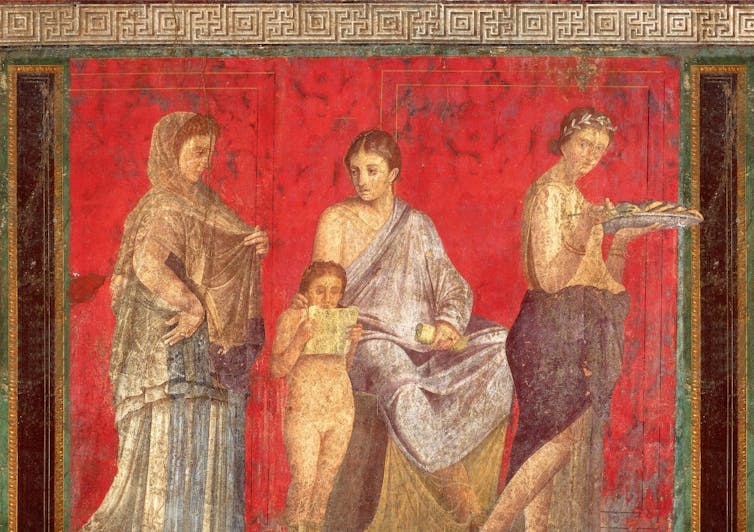
Roman fresco, Pompeii. Public domain, via Wikimedia Commons
Konstantine PanegyresThe University of Western Australia

If you were to visit a bookshop in the ancient world, what would it be like?

You don’t just have to imagine it. The ancient Roman writer Aulus Gellius, who lived in the 2nd century CE, gives us a number of descriptions of his adventures at bookstores. In one passage, he describes an encounter at one in Rome, which he was visiting with a poet friend:

I chanced to be sitting in a bookshop in the Sigillaria with the poet Julius Paulus […] There was on sale there the Annals of Quintus Fabius Pictor in a copy of good and undoubted age, which the dealer maintained was without errors.

Gellius then tells us that, while they are sitting there, another customer enters the shop. The new customer has a disagreement with the dealer. He complains that he “found in the book one error”. The dealer says that’s impossible. Then the customer brings out evidence to prove the dealer wrong.

In different passage, Aulus tells us about some bookstalls he came across when he arrived by ship at the port of Brundisium on the Adriatic coast. The books, he records, were “in Greek, filled with marvellous tales, things unheard of, incredible […] The writers were ancient and of no mean authority”.

The volumes themselves, however, were filthy from neglect, in bad condition and unsightly. Nevertheless, I drew near and asked their price; then, attracted by their extraordinary and unexpected cheapness, I bought a large number of them for a small sum.

Engraving of Aulus Gellius (1706). Draughtsman: Jan Goeree. Engraver: Pieter Sluyter, Public domain, via Wikimedia Commons

Aulus goes on to describe in excited language all the weird facts he derived from these books – like how people in Africa can “work spells by voice and tongue” and through this witchcraft cause people, animals, trees and crops to die.

The origins of writing

These sorts of stories bring us close to how ordinary people in ancient Greek and Roman times obtained books and engaged with books. But if we read stories like this it might lead us to want to know more. How did books and writing come into existence? And how were books written and produced?

Many people in the ancient world thought that writing had been invented by gods or heroes. For example, the ancient Egyptians believed the god Thoth was the first to create signs to represent spoken sounds.

The origins of writing are certainly mysterious. It’s unclear when writing began and who invented it.

The earliest written text is a wooden tablet radiocarbon dated to before 5000 BCE. This is known as the Dispilio tablet, because it was discovered at a neolithic lakeside settlement at Dispilio in Greece. It is carved with strange linear markings. These have not been deciphered, but most scholars think they are a form of writing.

Model of the Dispilio Tablet. Мико, via Wikimedia CommonsCC BY-SA

Evidence for writing appears early in different parts of the world. In Mesopotamia and Egypt, the oldest texts, such as the Kish limestone tablet at Uruk or the Narmer Palette at Hierakonpolis, date to before 3000 BCE. In the Indus Valley, the Harappan script, which remains undeciphered, appeared around the same time. In China, the earliest characters, the Dawenkou graphs, also date to around 3000 BCE.

One of the most interesting aspects of early writing is that there is such a variety of different scripts. For example, the earliest known texts in the Greek language are written in the Linear B script, which was used from around 1500-1200 BCE, and wasn’t deciphered until 1952. Linear B is not an alphabet, but a syllabary of more than 80 different signs. A syllabary is a kind of writing system where each sign represents a syllable.

By around the 8th century BCE, most Greeks had starting using an alphabet instead of a syllabary. Unlike a syllabary, in an alphabet each letter represents a vowel or consonant. The Greeks adapted their alphabet from the Phoenician alphabet, probably via interactions with Phoenician traders. The Phoenician alphabet had only 22 letters, making it much easier to learn than the 80-plus syllabary signs of Linear B.

Our English alphabet comes from the Romans, who in the 8th and 7th century BCE also got their alphabet from the Phoenicians, via the Greeks.

A papyrus document from ancient Egypt, written in hieratic script. The text describes anatomical observations and the examination, diagnosis, treatment and prognosis of numerous medical problems (c.1600 BCE) Jeff Dahl, Public domain, via Wikimedia Commons

The origins of books

People in ancient times used many different things as writing materials.

The Roman writer Pliny the Elder (23-79 CE) tells us that the earliest people in the world

used to write on palm-leaves and then on the bark of certain trees, and afterwards folding sheets of lead began to be employed for official muniments, and then also sheets of linen or tablets of wax for private documents.

However, the most popular writing material in the ancient Mediterranean was papyrus, from which we get our word “paper”.

To make papyrus, you get the pith of the papyrus plant (Cyperus papyrus), cut it into slender strips, then press it together. Once dried, it forms a thin sheet that you can write on.

Papyrus sheets were usually glued together into rolls. These rolls could be very long. Some of the most lavish Egyptian papyrus rolls were more than 10 metres long, such as the recently discovered Waziri Papyrus containing parts of the Book of the Dead.

When papyri were rolled up they were stored in shelves or boxes. Labels were attached to the handles of the papyri so you could identify their contents. In his play Linus, Greek playwright Alexis (c. 375-275 BC) has one character tell another how to look through a bunch of rolls to find what he wants:

go over and pick any papyrus roll you like out of there and then read it… examining them quietly, and at your leisure, on the basis of the labels. Orpheus is in there, Hesiod, tragedies, Choerilus, Homer, Epicharmus, prose treatises of every type…

Papyrus seems flimsy to the eye, but it is a durable writing material, stronger than modern paper. Many papyri have survived for thousands of years stored in jars or sarcophagi or buried under the sand.

The oldest surviving papyrus text is the so-called Diary of Merer (which you can listen to here), the logbook of a man named Merer, who was an inspector during the construction of the Great Pyramid of Giza under Pharaoh Khufu. This papyrus, which dates to around 2600 BCE, gives a day-by-day account of how Merer and his team of about 200 men spent time hauling and transporting stone and doing other work.

Papyrus was susceptible to being eaten by insects or mice. But there were ways to prevent this. Pliny the Elder, for example, advises that sheets of papyrus soaked in citrus-oil won’t be eaten by moths.

How to write a book in antiquity

If you were living in ancient Greece or Rome and wanted to write a book, how would you do it?

First, you would buy sheets or rolls of papyrus to write on. If you couldn’t afford it, you’d have to write on the back or in the margins of papyri you already owned.

If you didn’t own any papyri already, then you would have to write on other materials. According to the Greek historian Diogenes Laertius (3rd century CE), the philosopher Cleanthes (c. 331-231 BCE) “wrote down lectures on oyster-shells and the blade-bones of oxen through lack of money to buy papyrus”.

Second, you would get your ink. In the ancient world, there were many varieties of ink. Normal black ink was made from the soot of burnt resin or pitch mixed with vegetable gum. When buying ink, it would come in powder form, and you would need to mix it with water before using it.

Third, you would get your pen. It would be made from reed, hence it was called the “calamus” by Greeks and Romans (“calamus” is the Greek word for reed). To sharpen your pen you would need a knife. If you made a mistake, you would erase it with a wet sponge.

Now you have all the materials you need. However, you don’t need to use the pen and papyrus yourself. If you want, you can get a scribe to write down your words for you.

The Greek orator Dio Chrysostom (c.40-110 CE) even advised writers not to use the pen themselves:

Writing I do not advise you to engage in with your own hand, or only very rarely, but rather to dictate to a secretary.

If you needed to consult other books while writing, you could get friends to send them to you or ask book dealers to make you a copy. In a papyrus from the 2nd century CE found at Oxyrhynchus, Egypt, and written in Greek, the writer asks his friend to find the books that he needs and make copies of them. Otherwise, you would go to a library, though the best libraries at Alexandria, Rome and Athens might be far away.

When you finished drafting your book you would need to revise and correct it. You could then publish it by having many copies made by scribes and delivering these copies to friends and booksellers.

When all this was done, your book would be out in public. Perhaps someone like Aulus Gellius would stumble across it in a busy Roman bookshop. Maybe he’d even buy it.The Conversation

Konstantine Panegyres, Lecturer in Classics and Ancient History, The University of Western Australia

This article is republished from The Conversation under a Creative Commons license. Read the original article.

OpenAI will put ads in ChatGPT. This opens a new door for dangerous influence

OpenAI, The Conversation
Raffaele F CirielloUniversity of Sydney and Kathryn BackholerDeakin University

OpenAI has announced plans to introduce advertising in ChatGPT in the United States. Ads will appear on the free version and the low-cost Go tier, but not for Pro, Business, or Enterprise subscribers.

The company says ads will be clearly separated from chatbot responses and will not influence outputs. It has also pledged not to sell user conversations, to let users turn off personalised ads, and to avoid ads for users under 18 or around sensitive topics such as health and politics.

Still, the move has raised concerns among some users. The key question is whether OpenAI’s voluntary safeguards will hold once advertising becomes central to its business.

Why ads in AI were always likely

We’ve seen this before. Fifteen years ago, social media platforms struggled to turn vast audiences into profit.

The breakthrough came with targeted advertising: tailoring ads to what users search for, click on, and pay attention to. This model became the dominant revenue source for Google and Facebook, reshaping their services so they maximised user engagement.

Large-scale artificial intelligence (AI) is extremely expensive. Training and running advanced models requires vast data centres, specialised chips, and constant engineering. Despite rapid user growth, many AI firms still operate at a loss. OpenAI alone expects to burn US$115 billion over the next five years.

Only a few companies can absorb these costs. For most AI providers, a scalable revenue model is urgent and targeted advertising is the obvious answer. It remains the most reliable way to profit from large audiences.

What history teaches us about OpenAI’s promises

OpenAI says it will keep ads separate from answers and protect user privacy. These assurances may sound comforting, but, for now, they rest on vague and easily reinterpreted commitments.

The company proposes not to show ads “near sensitive or regulated topics like health, mental health or politics”, yet offers little clarity about what counts as “sensitive,” how broadly “health” will be defined, or who decides where the boundaries lie.

Most real-world conversations with AI will sit outside these narrow categories. So far OpenAI has not provided any details on which advertising categories will be included or excluded. However, if no restrictions were placed on the content of the ads, it’s easy to picture that a user asking “how to wind down after a stressful day” might be shown alcohol delivery ads. A query about “fun weekend ideas” could surface gambling promotions.

These products are linked to recognised health and social harms. Placed beside personalised guidance at the moment of decision-making, such ads can steer behaviour in subtle but powerful ways, even when no explicit health issue is discussed.

Similar promises about guardrails marked the early years of social media. History shows how self-regulation weakens under commercial pressure, ultimately benefiting companies while leaving users exposed to harm.

Advertising incentives have a long record of undermining the public interest. The Cambridge Analytica scandal exposed how personal data collected for ads could be repurposed for political influence. The “Facebook files” revealed that Meta knew its platforms were causing serious harms, including to teenage mental health, but resisted changes that threatened advertising revenue.

More recent investigations show Meta continues to generate revenue from scam and fraudulent ads even after being warned about their harms.

Why chatbots raise the stakes

Chatbots are not merely another social media feed. People use them in intimate, personal ways for advice, emotional support and private reflection. These interactions feel discreet and non-judgmental, and often prompt disclosures people would not make publicly.

That trust amplifies persuasion in ways social media does not. People seek help and make decisions when they consult chatbots. Even with formal separation from responses, ads appear in a private, conversational setting rather than a public feed.

Messages placed beside personalised guidance – about products, lifestyle choices, finances or politics – are likely to be more influential than the same ads seen while browsing.

As OpenAI positions ChatGPT as a “super assistant” for everything from finances to health, the line between advice and persuasion blurs.

For scammers and autocrats, the appeal of a more powerful propaganda tool is clear. For AI providers, the financial incentives to accommodate them will be hard to resist.

The root problem is a structural conflict of interest. Advertising models reward platforms for maximising engagement, yet the content that best sustains attention is often misleading, emotionally charged or harmful to health.

This is why voluntary restraint by online platforms has repeatedly failed.

Is there a better way forward?

One option is to treat AI as digital public infrastructure: these are essential systems designed to serve the public rather than maximise advertising revenue.

This need not exclude private firms. It requires at least one high-quality public option, democratically overseen – akin to public broadcasters alongside commercial media.

Elements of this model already exist. Switzerland developed the publicly funded AI system Apertus through its universities and national supercomputing centre. It is open source, compliant with European AI law, and free from advertising.

Australia could go further. Alongside building our own AI tools, regulators could impose clear rules on commercial providers: mandating transparency, banning health-harming or political advertising, and enforcing penalties – including shutdowns – for serious breaches.

Advertising did not corrupt social media overnight. It slowly changed incentives until public harm became the collateral damage of private profit. Bringing it into conversational AI risks repeating the mistake, this time in systems people trust far more deeply.

The key question is not technical but political: should AI serve the public, or advertisers and investors?The Conversation

Raffaele F Ciriello, Senior Lecturer in Business Information Systems, University of Sydney and Kathryn Backholer, Co-Director, Global Centre for Preventive Health and Nutrition, Deakin University

This article is republished from The Conversation under a Creative Commons license. Read the original article.

Valentino shaped the runway – and the red carpet – for 60 years

Jye MarshallSwinburne University of Technology

Valentino, who died on Monday at 93, leaves a lasting legacy full of celebrities, glamour and, in his words, knowing what women want: “to be beautiful”.

The Italian fashion powerhouse has secured his dream of making a lasting impact, outliving Karl Lagerfeld and Yves Saint Laurent.

Valentino was known for his unique blend between the bold and colourful Italian fashion and the elegant French haute couture – the highest level of craftsmanship in fashion, with exceptional detail and strict professional dressmaking standards.

The blending of these styles to create the signature Valentino silhouette made his style distinctive. Valentino’s style was reserved, and over his career he built upon the haute couture skills he had developed, maintaining his signature style while he led his fashion house for five decades.

But he was certainly not without his own controversial views on beauty for women.

Becoming the designer

Born in Voghera, Italy, in 1932, Valentino Clemente Ludovico began his career early, knowing from a young age he would pursue fashion.

He drew from a young age and studied fashion drawing at Santa Marta Institute of Fashion Drawing in Milan before honing his technical design skills at École de la Chambre Syndicale de la Couture Parisienne, the fashion trade association, in Paris.

He started his fashion career at two prominent Parisian haute couture houses, first at Jean Dessès before moving to Guy Laroche.

He opened his own fashion house in Italy in 1959.

His early work had a heavy French influence with simple, clean designs and complex silhouettes and construction. His early work had blocked colour and more of a minimalist approach, before his Italian culture really came through later in his collections.

He achieved early success through his connections to the Italian film industry, including dressing Elizabeth Taylor fresh off her appearance in Cleopatra (1963).

Black and white photograph.
Elizabeth Taylor wearing Valentino while dancing with Kirk Douglas at the party in Rome for the film Spartacus. Keystone/Getty Images

Valentino joined the world stage on his first showing at the Pritti Palace in Florence in 1962.

His most notable collection during that era was in 1968 with The White Collection, a series of A-line dresses and classic suit jackets. The collection was striking: all in white, while Italy was all about colour.

He quickly grew in international popularity. He was beloved by European celebrities, and an elite group of women who were willing to spend the money – the dresses ran into the thousands of dollars.

In 1963, he travelled to the United States to attract Hollywood stars.

The Valentino woman

Valentino’s wish was to make women beautiful. He certainly attracted the A-list celebrities to do so. The Valentino woman was one who would hold themselves with confidence and a lady-like elegance.

Valentino wanted to see women attract attention with his classic silhouettes and balanced proportions. Valentino dressed women such as Jackie Kennedy, Audrey Hepburn, Julia Roberts, Gwyneth Paltrow and Anne Hathaway.

His aristocratic taste inherited ideas of beauty and old European style, rather than innovating with new trends. His signature style was formal designs that had the ability to quietly intimidate – including the insatiable Valentino red.

Red was a signature colour of his collections. The colour provided confidence and romance, while not distracting away from the beauty of the woman.

French influence

Being French-trained, Valentino was well acquainted with the rules of couture.

With this expertise, he was one of the first Italian designers to be successful in France as an outsider with the launch of his first Paris collection in 1975. This Paris collection showcased more relaxed silhouettes with many layers, playing towards the casual nature of fashion.

A woman in a polka-dot dress.
A model in the Valentino Spring 1976 ready to wear collection walks the runway in Paris in 1975. Guy Marineau/WWD/Penske Media via Getty Images

While his design base was in Rome, many of his collections were shown in Paris over the next four decades. His Italian culture mixed with the technicality of Parisian haute couture made Valentino the designer he was.

Throughout his career, his designs often maintained a classic silhouette bust, matched with a bold Italian colour or texture.

Unlike some designers today, Valentino’s collections didn’t change too dramatically each season. Instead, they continued to maintain the craftsmanship and high couture standards.

Quintessentially beautiful” is often the description of Valentino’s work – however this devotion to high beauty standards has seen criticism of the industry. In 2007, Valentino defended the trend of very skinny women on runways, saying when “girls are skinny, the dresses are more attractive”.

Critics said his designs reinforce exclusion, gatekeeping fashion from those who don’t conform to traditional beauty standards.

The Valentino runways only recently have started to feature more average sized bodies and expand their definition of beauty.

The $300 million sale of Valentino

The Valentino fashion brand sold for US$300 million in 1998 to Holding di Partecipazioni Industriali, with Valentino still designing until his retirement in 2007.

Valentino sold to increase the size of his brand: he knew without the support of a larger corporation surviving alone would be impossible. Since Valentino’s retirement, the fashion house has continued under other creative directors.

Valentino will leave a lasting legacy as the Italian designer who managed to break through the noise of the French haute couture elite and make a name for himself.

The iconic Valentino red will forever be remembered for its glamour, and will live on with his legacy. A true Roman visionary with unmatched craftsmanship.The Conversation

Jye Marshall, Lecturer, Fashion Design, School of Design and Architecture, Swinburne University of Technology

This article is republished from The Conversation under a Creative Commons license. Read the original article.

Inside scoop: the 2,500-year history of ice-cream

Alison Pang/Unsplash
Garritt C. Van DykUniversity of Waikato

We all scream for ice-cream, especially as temperatures soar in the summer. Ancient civilisations had the same desire for a cold, sweet treat to cope with heat waves.

There are plenty of contenders claiming credit for the first frozen desserts, from Italy and France in the 17th century to China in the first century.

But before you can make ice-cream, you need a reliable source of ice. The technology to make and store ice was originally developed in Persia (modern-day Iran) in 550 BCE.

Ancient ice makers

These ancient Persians built large stone beehive shaped structures called yakhchal (“ice pit”). They were constructed in the desert, with deep, insulated subterranean storage, making it possible to store ice all year.

High domes pulled hot air up and out, and wind catchers funnelled cooler air into the base. The yakhchal was not just an ancient ice house, it was also an ice maker.

Goats in front of a dome building.
A yakhchal still standing in the Iranian desert. Jeanne Menj/Wikimedia CommonsCC BY

Canals filled shallow ponds, shaded from the sun, with fresh water during the winter. Overnight temperatures dropped, and in the dry desert air the water would cool through evaporation.

Some yakhchals have survived centuries of desert erosion, and are found across Iran in areas where it is cold enough to produce ice in the winter, or close to mountains where ice could be harvested.

study of one 400-year-old yakhchal, still standing in Meybod, estimated its annual production at 50 cubic metres – about 3 million ice cubes.

Early frozen desserts

Stored ice was used to make frozen desserts such as fruit sorbets, sharbats, and faloudeh (frozen rosewater and vermicelli noodles) sweetened with honey syrup.

After the Arab conquest of Persia circa 650 CE, the Persian method for ice production and storage spread across the Middle East.

The new technology was used to freeze milk and sugar mixed with salep flour (powdered orchid root) and mastic (dried sap from an evergreen bush) to make stretchy forms of ice-cream in Syria, like booza and bastani, in Persia.

A man chips ice, another man holds out a bowl.
This illustration dating to the Ming dynasty (1368 – 1644) depicts an ice vendor in the summer. Wellcome Collections

A frozen dessert, sushan, (literally “crispy mountain”) was also developed in China in this period, during the Tang Dynasty (618–907). Goat’s milk curd was melted, strained and poured into metal moulds shaped like mountains.

The final texture was described by poet Wang Lingran as being somewhere between a liquid and a solid, melting in his mouth.

Discovering the science of freezing

Freezing techniques changed when a popular book on “natural magic” – meaning everything from natural science to astrology and alchemy – was first published by Giambattista della Porta in Naples in 1558.

Magia Naturalis included instructions on how saltpetre (potassium nitrate) could be added to ice to rapidly chill wine for summer feasts:

cast snow into a wooden vessel, and strew into it Salt-peter, powdred, or the cleansing of Salt-peter, called vulgarly Salazzo. Turn the Vial in the snow, and it will congeal by degrees.

This method meant it was much easier to freeze liquids, because potassium nitrate dissolved in water draws heat out of the surrounding environment.

Two pairs of lovers sitting in an open loggia, attended by a black page, with wine bottles, six ices, and a discarded napkin at the head of the table, and silver dish of peaches and figs.
In this painting by Philippe Mercier, dated between 1744 and 1747, two young couples eat over ices in the middle of the table. Yale Center for British Art

Experiments in the 17th century revealed a similar reaction occurs with mixture of ordinary salt, water and ice. Smaller quantities of stored ice could now be used to freeze and chill mixtures to create frozen desserts on demand.

This technology was combined with supplies of cheaper sugar sourced from European plantations in the Caribbean. Sugar is an important element of frozen desserts because it keeps mixtures from freezing into impenetrable ice blocks.

France v Italy in the claim for first ice-cream

Two claims for the “first” ice-cream recipes emerge at almost the same time in France and Italy in the 1690s.

Earlier attempts produced granular, slushy confections. Recipes that produced results we would recognise today were introduced by men who managed households for noble patrons.

Alberto Latini, working for Cardinal Barberini (nephew of Pope Urban VIII), had access to expensive and novel ingredients, like chocolate and tomatoes. His recipe for a new “milk sorbet” aligned with the cutting edge cooking methods in the 1694 edition of his bookLo Scalco alla Moderna (The Modern Steward).

This recipe used milk, sugar, water and candied fruits, and is considered a precursor to Italian gelato.

Various cooks and connoisseurs in an ice-cream shop.
Scene in kitchen of an ice-cream restaurant, by Jean-Charles Develly, 1819–20. Cooper Hewitt Museum

The other contender for first ice-cream is Nicolas Audiger, who had worked for Jean-Baptiste Colbert, chief minister to Louis XIV, who helped prepare feasts at Versailles.

He published a handbook on running noble households, La maison réglée, in 1692 with numerous recipes for fruit sorbets, and one for ice-cream sweetened with sugar and flavoured with orange blossom water.

While both claims have merit, Audiger’s recipe included detailed descriptions of the techniques for stirring and scraping to ensuring a better texture and even distribution of sugar throughout the mixture. He wrote his volume after spending 18 months in Italy, so he probably learned Italian techniques and refined them, leading to the creamy delights we now enjoy.

The ice-cream paradox?

In the northeastern United States, the original Ben and Jerry’s ice-cream factory in Vermont used to run a promotion where prices changed as the weather got colder. As temperatures dropped below freezing, ice-cream cones got cheaper.

A huge crowd, jetty is decorated with a patriotic archway, Chinese lanterns and coloured lights.
Summer crowds at Semaphore beach, South Australia, around 1916, with F. Maggi’s horse drawn ice-cream cart. State Library of South Australia

This might lead you to think that people in the hottest climates eat more ice-cream, but the highest per capita consumption in the world is in Aotearoa New Zealand, followed by the US and Australia. The next four countries are famous for being cold: Finland, Sweden, Canada and Denmark.

Maybe the answer to this apparent paradox is that when it is hot you need ice-cream to cool you down, and when you are cold and miserable you need it to cheer you up.The Conversation

Garritt C. Van Dyk, Senior Lecturer in History, University of Waikato

This article is republished from The Conversation under a Creative Commons license. Read the original article.

Shakespeare reinvented: how Chloé Zhao blends East and West philosophies in Hamnet

Agata Grzybowska © 2025 Focus Features
Yanyan HongAdelaide University

In Hamnet, Agnes Hathaway (Jessie Buckley) asks William Shakespeare (Paul Mescal) to introduce himself by telling her a story. It is her way of seeing who this man really is.

Here, storytelling becomes a mirror held up to the heart. Are we, as human beings, moved by the same things? Are our hearts shaped from the same material?

Chloé Zhao knows how to make people feel. Hamnet sees a new phrase in her artistry, turning a Western literary classic into a quiet meditation on grief, love and the enduring power of art.

From Beijing to the world

Born in Beijing in 1982, as a child Chloé Zhao (赵婷, Zhào Tíng) loved manga, drawn to Japanese Shinto ideas, where every object carries a spirit.

She wrote fan fiction, went to movies and fell in love with Wong Kar-wai’s Happy Together (1997), a life-changing film she still rewatches.

At 14, she was sent to a boarding school in England, speaking almost no English. The isolation forced her to look beyond language. “A smile is a smile, a touch is a touch,” she later told the BBC. That attentiveness to gesture and silence became a signature of her filmmaking.

Allured by Hollywood, Zhao moved to Los Angeles for high school, then studied political science at college. She eventually found her way to cinema at New York University, where Spike Lee encouraged her to trust her own voice.

Open landscapes to inner lives

In 2015, Zhao started directing small-scale, slow-burn features set in the American heartland.

Songs My Brothers Taught Me (2015) and The Rider (2017) capture the vast, lunar beauty of South Dakota’s badlands and the dignity of the people who live there. She often used non-professional actors, achieving a documentary-like naturalism.

Nomadland (2020), her third film, brought this style to a global audience. The story is about a stoic, hard-working widow in her early 60s who loses everything in the Great Recession and finds a new life on the road.

Receiving the Oscar for best director, she quoted a classic Chinese text teaching Confucian morality, history and basic knowledge: “people at birth are inherently good (人之初,性本善)”.

By focusing on nomads, cowboys and Indigenous communities, her first three films make space for those who are rarely seen.

“I’ve spent my whole life telling stories about people who feel separated, who feel they don’t belong,” she said, linking that to her own experience as “an outsider”.

With Hamnet, that sensibility turns inward. The immense skies and wide-open landscapes are replaced by forests, quiet rooms and the raw inner world of parental grief.

Through East and West

That Shakespeare, the wellspring of Britain’s national mythology, is being reinvented by an Asian director is striking.

Zhao initially turned down adapting and directing Hamnet, as she neither grow up with Western reverence for Shakespeare nor felt a cultural connection to his grief-filled family life. But after reading Maggie O’Farrell’s book, she felt something intimate and universal that drew her in.

Her approach to demystifying that feeling reflects a sensibility shaped equally by Eastern and Western philosophy.

Zhao discusses a shot with Zai.
Director of photography Lukasz Zal, director Chloé Zhao and actors Jessie Buckley and Paul Mescal on the set of Hamnet. Agata Grzybowska © 2025 Focus Features

From the Chinese practice of qi (气, life force), Zhao shows life flowing through wind, breath and Agnes’s bond with the forest, where she gives birth to her first child.

From the Hindu Tantra, she blurs the line between the actors and their surroundings, showing the world as an extension of the self.

From the ideas of Carl Jung, she explores opposing forces within the self, guiding the actors to reveal both masculine and feminine qualities in Agnes and William.

All three of these philosophies talk of accessing deeper wisdom within the self and the symbolic nature of creation.

Zhao also assigns chakra colours to Hamnet’s protagonists. In Hindu and Buddhist traditions, chakras are energy centres in the body, each linked to a colour and connected to physical, emotional and spiritual wellbeing.

In Zhao’s telling, Shakespeare often appears in blue, echoing the colour of throat and third-eye chakras, which symbolises openness, clarity and intuition. Agnes appears in red, reflecting the root chakra: the beating heart of the earth. This visual language also draws from Taoist philosophy, which understands humans as existing within nature.

Like Ang Lee, Zhao brings an East Asian sensitivity to interiority and emotional restraint. Both filmmakers have bridged art-house cinema and mainstream Hollywood, achieving rare critical recognition while remaining deeply focused on human experience.

The deeply human

Hamnet imagines the world surrounding Shakespeare and his wild-hearted wife, Agnes, and the tragic death of their 11-year-old son from the plague.

In the final sequence of the film, we watch the first performance of Hamlet. Their son returns on stage as the prince, speaking lines Shakespeare has written out of loss.

As Hamlet is poisoned, the audience inside the theatre – nobles and labourers alike – break into tears. They do not know the child behind the character, but they feel loss all the same.

Overhead shot: audience hands reach out to Hamlet.
In a crowded audience, only Agnes sees the boy onstage as her son. Focus Features

Among them stands Agnes. Through her eyes, we see how art turns personal sorrow into something others can share. She alone recognises that the story being told is a memory. The woman history remembers merely as “Shakespeare’s wife” becomes the very soul of Hamnet.

Hamnet, in Zhao’s retelling, is not an escape from pain but a way of living with it. Buckley’s stirring performance feels not only Oscar-worthy, but emblematic of Zhao’s humanist cinema.

Her cinema reminds us of what cannot be automated: the deeply human capacity to feel, to grieve and to love.The Conversation

Yanyan Hong, Adjunct Fellow in Communication, Media and Film Studies, Adelaide University

This article is republished from The Conversation under a Creative Commons license. Read the original article.

5 things to make with mangoes that aren’t smoothies

Roman Odintsov/Pexels
Margaret MurraySwinburne University of Technology

It’s mango season. They’re cheap, delicious, in the shops or you can buy trays at roadside stalls.

But what can you actually do with a trayful?

Sure, smoothies are great, but what if you want to try something else?

I’ve collected mango recipes from super simple to those for more confident cooks. These versatile recipes range from nutritious main meals to delicious sweet treats.

Try out these top five sweet and savoury mango recipes this summer.

Well done for choosing mangoes

Mangoes are not only a delicious summer treat, they are packed full of essential vitamins and minerals.

Eating just one mango provides roughly:

Choosing seasonal produce, such as mangoes in summer, not only helps to increase diversity in your eating habits, but can also help save you money at the checkout.

5 recipes to try

  1. Fresh prawn mango avocado summer salad is an alternative to the classic “prawn on the barbie”. This high-protein, high-fibre salad works perfectly as a side dish or a light meal. However, the sodium content is high, so I’d suggest reducing the salt by half, especially for those watching their blood pressure. With lots of options for variations, this is an easy recipe to make your own way, including serving it with couscous or rice.

  2. Thai mango chicken curry is another great way to get mangoes (pureed and diced) into your meal. This gluten-free, dairy-free recipe is high in iron, potassium and vitamin C. However, it’s also high in sodium and saturated fat. I suggest filling half of your plate with this delicious curry and the other half with your favourite veggies to balance out the meal.

  3. Toasted muesli, mango and yoghurt breakfast parfait works for breakfast, dessert or a snack at any time of day. This nutrient-dense recipe provides fibre, protein, calcium and lots of other vitamins and minerals. You can layer the ingredients in a glass and serve the parfait at a party, or make it just for one. This recipe is easy to tailor to whatever ingredients you have at hand. For example, you could swap the toasted muesli for granola, nuts or seeds, or go for untoasted muesli or rolled oats for a slightly leaner option.

  4. Mango melba is a twist on a classic Aussie summer dessert that you can cook in a pan or on the barbecue. This recipe perfectly showcases summer fruits as the centrepiece of the dish. Including fruit, such as mangoes, in desserts is a great way to add flavour and nutritional value to boost your daily vitamin and mineral intake. The mangoes and raspberries in this recipe are packed full of vitamin C and other antioxidants.

  5. Mango ice cream is a perfect sweet treat for summer. To get the best flavour, make this with Kensington Pride, Honey Gold or Pearl varieties, rather than Calypso. This recipe is high in saturated fat and sugar, so it should be enjoyed in small quantities as a special treat. Of course, you are still getting the vitamin A, vitamin C and potassium from the mango.

Can you have too much of a good thing?

Adults are recommended to eat two serves of fruit a day. For children and adolescents the recommended intake ranges from half to two serves of fruit a day, depending on the age.

Half a mango is equivalent to one serve of fruit, so eating one whole mango would fulfil an adult’s daily fruit needs.

For people with irritable bowel syndrome (IBS), the fructose (a type of sugar) in mangoes may contribute to symptoms such as bloating, stomach pains, constipation or diarrhoea. If you have IBS, you should seek advice from a dietitian on how to manage your diet.

In rare cases, contact with mangoes can cause a skin rash known as dermatitis. If you are affected by mango dermatitis it is best to avoid handling mangoes. However, you may still be able to eat the flesh if someone else prepares it.

Otherwise, enjoy this seasonal fruit over summer and try out one of these delicious recipes.The Conversation

Margaret Murray, Senior Lecturer, Nutrition, Swinburne University of Technology

This article is republished from The Conversation under a Creative Commons license. Read the original article.

Horses really can smell fear, new study claims, and it changes their behaviour

Inna photographer/Shutterstock
Roberta BlakeAnglia Ruskin University

Humans have long believed horses can “smell fear”. Nervous riders are often told to “relax, or the horse will feel it”. Until recently, though, there was little scientific evidence to show whether this was anything more than folklore.

A new study has found that this belief is no myth. Its results show that horses can detect chemical signals linked to human emotions, and that these signals can influence their behaviour and physiology.

Previous research has pointed to a form of emotional contagion between humans and horses. This is a phenomenon in which the emotional state of one person or animal influences the emotional state of another. But this is the first study to find evidence horses can detect human fear using their sense of smell.

Horses rely heavily on their sense of smell to understand the world around them. Their olfactory system is far more sensitive than ours, allowing them to detect subtle chemical differences in the environment.

There is scientific evidence that horses can select the most nutritious food by smelling it. A 2016 found that horses select foods based on nutrient content (such as protein), not just flavour, and that the way their body responds after eating influences future choices they make about food.

So how can horses smell our fear? Well, human emotions come with physiological changes. When people experience fear or stress, their body, face and voice changes. Their body also releases hormones such as adrenaline and cortisol, heart rate increases, and their sweat composition changes. These changes alter the chemical profile of a person’s body odour, which can carry information about their emotional state.

The scent of fear

The new study found evidence horses not only detect but also respond to human emotional odours. Horses in the study were exposed to human body odours collected via cotton pads wiped under the armpits of people.

These research participants watched either an excerpt from the 2012 horror movie Sinister (to induce fear) or clips, like the Singing in the Rain’s dance scene (to induce joy). The researchers also collected control odours with no emotional association.

The horses showed distinct behavioural and physiological changes when exposed to fear-related odours through the cotton pads, which were secured by a nylon mask on the horses’ noses. They were more alert, more reactive to sudden events and less inclined to approach humans.

And they showed increases in maximum heart rate, which indicates stress, during the exposure to the fear smell from sweat. Crucially, these responses happened without any visual or vocal cues from humans displaying fear.

Close up of dark horse's lower face, human hand reaching out to pat it.
Horses have sensitive noses. Jaromir Chalabala/Shutterstock

This finding shows that smell alone can influence a horse’s emotional state. Horses were not reacting to tense body language, facial expressions or nervous movements – they were responding to chemical signals carried in human scent.

Previous research has shown horses seem to be sensitive to humans’ emotional states. In a May 2025 study, horses were shown videos of humans expressing fear, joy or neutral emotions in their facial expressions and voice.

Researchers measured the horses’ heart rate, behaviour and facial expressions while they watched the videos. The horses showed increased heart rates when exposed to fearful or joyful human expressions compared with neutral ones, which indicates heightened emotional arousal.

Fearful expressions depicted in the videos were associated with alert postures in the horses, like holding their head high and pointing their ears back and stress-related facial movements, like wide eyes. Joyful expressions depicted in the videos were linked to patterns associated with positive emotional states, like relaxed nostrils and ears.

Together, these findings are consistent with emotional contagion. Emotional contagion has been documented between humans and dogs, for instance, and these results suggest horses may also be affected by human emotions.

What this does – and doesn’t – mean

These studies do not suggest that horses understand fear in the same way humans do, or that they know why a person is afraid. Instead, the evidence shows horses are highly sensitive to the chemical, visual and vocal cues associated with emotional states.

Smell is probably just one part of a broader physiological system. Horses are adept at reading human posture, muscle tension, breathing patterns, heart rate and movement – all of which change when a person is anxious. These cues shape how a horse perceives and responds to a human.

Understanding how horses perceive human emotions has important implications for welfare, training and safety. Riders, handlers and therapists working with horses may unintentionally influence an animal’s emotional state through their own stress or calmness.

More broadly, the research challenges outdated assumptions about animal perception. Horses are not passive responders to human commands, as equine professionals and researchers thought until recently. They are sensitive social partners, finely tuned to the emotional signals we give off.

Horses evolved as social prey animals living in large herds on open grasslands, where survival depended on detecting danger quickly. Although humans began domesticating horses around 5,500 years ago, this is evolutionarily recent, meaning modern horses still retain highly sensitive sensory systems adapted for vigilance and social awareness.

So, when people say horses can smell fear, science now suggests they may be closer to the truth than we originally thought. And next time you are close to a horse, try to relax, and make the interaction more enjoyable for both of you.The Conversation

Roberta Blake, Professor of Animal Performance Science, Anglia Ruskin University

This article is republished from The Conversation under a Creative Commons license. Read the original article.

How to get managers to say yes to flexible work arrangements, according to new research

Diva Plavalaguna/Pexels
Melissa A. WheelerRMIT UniversityAnne BardoelSwinburne University of TechnologyAsanka GunasekaraRMIT University, and Lindsie ArthurThe University of Melbourne

In the modern workplace, flexible arrangements can be as important as salary for some. For many employees, flexibility is no longer a nice-to-have luxury. It has become a fundamental requirement for staying in the workforce, especially after COVID.

Reports – from the Chartered Institute of Personnel and Developmentprofessional services firm Aon and UNSW – indicate while a substantial number of workers prioritise flexibility, many of their requests are still being declined.

This leaves many employees with a stark choice: either conform to standard, rigid office hours or look for better conditions elsewhere.

The stakes of these negotiations are remarkably high. For the employee, a successful deal can mean the difference between professional growth and total burnout. For the employer, it is a major lever for retaining top talent.

Yet, many employees approach these conversations as simple “asks”, unaware that the success of their requests often hinge on invisible factors that have little to do with their actual job performance.

In our new research, published in the Journal of Occupational and Organizational Psychology, we wanted to provide an evidence base for how to negotiate for flexible work, so both employers and employees can benefit.

Request for approval

To understand why some flexible work requests are approved and others are rejected, we ran two studies with more than 300 participants.

Two office workers in a meeting
Successfully negotiating flexible working arrangements with a manager can be tricky. charlesdeluvio/Unsplash

Instead of asking people what they think influences flexible work approvals, we asked them to make real decisions on a series of requests presented to them.

To strengthen our findings, all participants had management experience.

In both studies, participants read short requests from hypothetical employees asking to work flexibly.

Each request was designed to look realistic, but was given a focus on one of four different things:

  • caring responsibilities
  • improved productivity
  • greater wellbeing via work-life integration
  • task completion instead of hours worked.

In the second study, we varied both the gender of the requester and how much flexibility they asked for: either two or four days working from home.

What we found

Across both studies, a clear pattern emerged. Requests related to caring responsibilities and improved productivity had the greatest success. Requests which focused on improved personal wellbeing or greater autonomy over their time were less successful.

However, contrary to what we expected, we found men and women were equally likely to be approved for flexible work.

This suggests that, at least at the approval stage, “gendered flexibility stigma”, or bias against workers (usually women) who access flexible work arrangements, may be less pronounced than earlier research has suggested.

Overall, we found managers have a clear preference for fewer days of flexible working. Requests for two days of flexible work were much more likely to be approved than requests for four days.

Some good news for parents

Remote work, normalised in the pandemic, allowed fathers to become more engaged in caring.

Our results indicate fathers won’t be penalised for asking for flexible work to provide care to their children. However, there’s an important caveat. While their requests were just as likely as women’s to be approved, our research cannot speak to the impact on men’s (or any workers’) careers after they take up flexible work.

The stigma against those who cannot be seen in the office or workplace – a perceived lack of commitment, judgements about decreased productivity, reduced likelihood of getting promoted – may still be present.

A father works on a laptop, his son sits on a couch in the background
Workplace changes caused by the pandemic allowed fathers to become more engaged in caring. Vitaly Gariev/Unsplash

Other ways to make a strong case

Flexible work debates often focus on and even favour parents. That can leave non-parents with fewer options. Our research provides good news for those without caring responsibilities who still want to embrace the benefits of flexible work.

We found the business case was equally as effective as the child-care argument. Non-carers should strongly consider the mutual benefits to their employers and to themselves and be sure to make a strong case for how the company will reap the rewards.

For example, workers could highlight the possibility for increased productivity or fewer sick days.

Resources and tools are available to help employees construct their business cases, such as the Workplace Gender Equality Agency’s page on legal requirements in Australia and evidence for a business case.

What the law says

Anyone can ask for flexible working arrangements; your boss might say no, but it’s worth a shot. At a national level, in Australia where this study was conducted, employers cannot unreasonably refuse flexible working arrangements for people in certain circumstances, including those who have worked for the same employer for more than 12 months and who are:

  • pregnant
  • a person with disability
  • have various caring responsibilities
  • 55 or older
  • experiencing family and domestic violence
  • providing care for someone who is experiencing family and domestic violence.

Employers are legally required to respond to such flexible work requests in writing within 21 days, and make their approval decisions based on “reasonable business grounds”.

Room to make things fairer

Together, our findings show that flexible work is still not doled out fairly. Because these negotiations often occur on a one-on-one basis, they are highly susceptible to individual bias, favouritism, and assumptions about who deserves to work flexibly.

One factor outside an employee’s control is their manager’s attitude. Our research found managers who held positive views about flexible work were more likely to approve requests of any kind. Those with negative attitudes were more likely to say no, regardless of how the request was framed.

Ultimately, success depends on how the request is framed, how much flexibility is asked for, and who is making the decision.The Conversation

Melissa A. Wheeler, Senior Lecturer, Graduate School of Business and Law, RMIT UniversityAnne Bardoel, Adjunct Professor of Human Resource Management, Swinburne University of TechnologyAsanka Gunasekara, Senior Lecturer in Human Resource Management/People Analytics, RMIT University, and Lindsie Arthur, Postdoctoral Researcher, Melbourne School of Psychological Sciences, The University of Melbourne

This article is republished from The Conversation under a Creative Commons license. Read the original article.

New year: same old scams

Criminals continue to target seniors in many ways. Make sure you know how to spot a financial scam and what to do if you fall victim.

A lot of us are looking forward to this year and all it has to offer. But it’s important to remember that some things never change – including the fact that some unscrupulous people want to separate you from your money. 

Financial scams are on the rise – and older Australians are often the prime targets. 

Scammers know that many retirees have savings and may be less familiar with the latest technology, making it easier to exploit trust and goodwill. 

These criminals use clever tactics to create a sense of urgency or emotional pressure, hoping you’ll act before thinking things through. 

One common scam involves someone pretending to be a family member in distress, claiming to need money urgently for an emergency. 

Others impersonate government agencies such as Medicare or Services Australia, asking for your personal details or payments. 
Investment scams promise high returns with little or no risk, while romance scams prey on loneliness, building emotional connections before requesting money.  

Tech support scams are also widespread, with fraudsters claiming your computer has a virus and asking for remote access. 

In all these cases, the best defence is to pause and think. If you receive an unexpected call, message, or email asking for money or personal information, stop immediately. 

Scammers rely on panic and secrecy, so take time to check. Contact the person or organisation directly using official details, not those provided in the message. Ask a trusted friend or family member for advice – because if something feels wrong, it probably is. 

Protecting yourself also means being proactive. Keep your devices secure with updated software, use strong passwords, and never share banking details over the phone or online unless you are certain of who you’re dealing with. 

If you suspect you’ve been scammed, act quickly: contact your bank to freeze accounts, change passwords, and report the incident to Scamwatch at scamwatch.gov.au

Emotional support is available through services such as Lifeline or Beyond Blue, because the impact of scams is not just financial, it can be deeply personal. 

Remember, scammers are skilled at sounding convincing, but you have the power to protect yourself. 

Trust your instincts, stay informed, and never be afraid to say no. By taking a moment to Stop. Check. Reject, you can keep your money safe. 

Cash Mandate a 'baby step'

National Seniors Australia (NSA) has described the government's Cash Mandate, implemented from January 2026, as a "baby step" towards required stronger regulations.

NSA Chief Executive Officer Mr Chris Grice said the mandate is a step towards much needed further reform given there is currently no obligation for retailers to accept cash.

“NAS has been campaigning for the need to keep cash accessible and accepted for two-and-a-half years now,” Mr Grice said.

“While we welcome the important mandate applied to fuel and grocery retailers as well as the continued payment of bills at Australia Post, we were disappointed to see so many limitations and caveats.

“The ability for retailers to refuse cash for transactions above $500, outside the hours of 7am and 9pm, or with annual turnovers less than $10 million, make it complex and confusing for consumers.
“NSA believes the mandate should be strengthened to uphold consumer expectations.

“We would like to see the mandate monitored to ensure it is effective, and for government to be prepared to go further in a period less than the proposed three-year review if the mandate does not benefit the Australian community.

“We would also like to see more genuine effort towards ensuring cash remains accessible through our banking system, especially in regional and remote areas where access to cash is becoming increasingly difficult. This could be achieved by applying a Community Service Obligation (CSO) on banks, as detailed in our submission.

“Keeping cash both accessible and accepted is important to ALL Australians as a means of basic payment, a backup in emergencies, and for the stability of the broader financial system.

“We thank our growing NSA community for supporting our keep cash campaign – for helping to bring about this mandate – a small but important step to help ensure cash remains accessible and accepted."

Valentino shaped the runway – and the red carpet – for 60 years

Jye MarshallSwinburne University of Technology

Valentino, who died on Monday at 93, leaves a lasting legacy full of celebrities, glamour and, in his words, knowing what women want: “to be beautiful”.

The Italian fashion powerhouse has secured his dream of making a lasting impact, outliving Karl Lagerfeld and Yves Saint Laurent.

Valentino was known for his unique blend between the bold and colourful Italian fashion and the elegant French haute couture – the highest level of craftsmanship in fashion, with exceptional detail and strict professional dressmaking standards.

The blending of these styles to create the signature Valentino silhouette made his style distinctive. Valentino’s style was reserved, and over his career he built upon the haute couture skills he had developed, maintaining his signature style while he led his fashion house for five decades.

But he was certainly not without his own controversial views on beauty for women.

Becoming the designer

Born in Voghera, Italy, in 1932, Valentino Clemente Ludovico began his career early, knowing from a young age he would pursue fashion.

He drew from a young age and studied fashion drawing at Santa Marta Institute of Fashion Drawing in Milan before honing his technical design skills at École de la Chambre Syndicale de la Couture Parisienne, the fashion trade association, in Paris.

He started his fashion career at two prominent Parisian haute couture houses, first at Jean Dessès before moving to Guy Laroche.

He opened his own fashion house in Italy in 1959.

His early work had a heavy French influence with simple, clean designs and complex silhouettes and construction. His early work had blocked colour and more of a minimalist approach, before his Italian culture really came through later in his collections.

He achieved early success through his connections to the Italian film industry, including dressing Elizabeth Taylor fresh off her appearance in Cleopatra (1963).

Black and white photograph.
Elizabeth Taylor wearing Valentino while dancing with Kirk Douglas at the party in Rome for the film Spartacus. Keystone/Getty Images

Valentino joined the world stage on his first showing at the Pritti Palace in Florence in 1962.

His most notable collection during that era was in 1968 with The White Collection, a series of A-line dresses and classic suit jackets. The collection was striking: all in white, while Italy was all about colour.

He quickly grew in international popularity. He was beloved by European celebrities, and an elite group of women who were willing to spend the money – the dresses ran into the thousands of dollars.

In 1963, he travelled to the United States to attract Hollywood stars.

The Valentino woman

Valentino’s wish was to make women beautiful. He certainly attracted the A-list celebrities to do so. The Valentino woman was one who would hold themselves with confidence and a lady-like elegance.

Valentino wanted to see women attract attention with his classic silhouettes and balanced proportions. Valentino dressed women such as Jackie Kennedy, Audrey Hepburn, Julia Roberts, Gwyneth Paltrow and Anne Hathaway.

His aristocratic taste inherited ideas of beauty and old European style, rather than innovating with new trends. His signature style was formal designs that had the ability to quietly intimidate – including the insatiable Valentino red.

Red was a signature colour of his collections. The colour provided confidence and romance, while not distracting away from the beauty of the woman.

French influence

Being French-trained, Valentino was well acquainted with the rules of couture.

With this expertise, he was one of the first Italian designers to be successful in France as an outsider with the launch of his first Paris collection in 1975. This Paris collection showcased more relaxed silhouettes with many layers, playing towards the casual nature of fashion.

A woman in a polka-dot dress.
A model in the Valentino Spring 1976 ready to wear collection walks the runway in Paris in 1975. Guy Marineau/WWD/Penske Media via Getty Images

While his design base was in Rome, many of his collections were shown in Paris over the next four decades. His Italian culture mixed with the technicality of Parisian haute couture made Valentino the designer he was.

Throughout his career, his designs often maintained a classic silhouette bust, matched with a bold Italian colour or texture.

Unlike some designers today, Valentino’s collections didn’t change too dramatically each season. Instead, they continued to maintain the craftsmanship and high couture standards.

Quintessentially beautiful” is often the description of Valentino’s work – however this devotion to high beauty standards has seen criticism of the industry. In 2007, Valentino defended the trend of very skinny women on runways, saying when “girls are skinny, the dresses are more attractive”.

Critics said his designs reinforce exclusion, gatekeeping fashion from those who don’t conform to traditional beauty standards.

The Valentino runways only recently have started to feature more average sized bodies and expand their definition of beauty.

The $300 million sale of Valentino

The Valentino fashion brand sold for US$300 million in 1998 to Holding di Partecipazioni Industriali, with Valentino still designing until his retirement in 2007.

Valentino sold to increase the size of his brand: he knew without the support of a larger corporation surviving alone would be impossible. Since Valentino’s retirement, the fashion house has continued under other creative directors.

Valentino will leave a lasting legacy as the Italian designer who managed to break through the noise of the French haute couture elite and make a name for himself.

The iconic Valentino red will forever be remembered for its glamour, and will live on with his legacy. A true Roman visionary with unmatched craftsmanship.The Conversation

Jye Marshall, Lecturer, Fashion Design, School of Design and Architecture, Swinburne University of Technology

This article is republished from The Conversation under a Creative Commons license. Read the original article.

Older people are more vulnerable in heatwaves. Here’s why – and how to stay safe

solidcolours/Getty
Aaron BachGriffith University and Fergus O'ConnorGriffith University

Southeast Australia is enduring a record-breaking heatwave, with temperatures rising above 40ºC in many areas.

For vulnerable people, particularly older Australians, this heat is not only uncomfortable but dangerous. High temperatures can worsen existing health problems and in some cases even prove fatal.

So as the mercury climbs, it’s important to understand why some people are more at risk.

Here’s how to tell if someone is not coping with the heat – and how to stay safe.

Why is it harder for older people to keep cool?

Our bodies have a number of processes to regulate temperature.

First, the heart directs blood toward the skin, delivering heat from the body’s core to the surface.

Second, when we sweat and it evaporates off our skin, this allows excess body heat to escape into the air.

But as we age, these processes become less efficient. Older people’s blood flow and sweating are reduced compared to younger people. This means their bodies store more heat for longer.

Why this is dangerous

Often, the real danger isn’t simply overheating – it’s the strain heat puts on the cardiovascular system (the heart, blood and blood vessels) trying to serve two masters.

During hot weather, the heart works significantly harder. It diverts blood to the skin to shed excess heat, while still trying to satisfy the oxygen demands of other vital organs.

This helps explain why, during heatwaves, hospitals are not overrun with older people suffering from heatstroke. Instead, the overwhelming surge in emergency department admissions is mostly due to underlying health conditions that get much worse, such as diabetes and heart, lung or kidney diseases.

Older adults are more likely to have at least one chronic condition, and in heatwaves that last for days without a break these conditions can rapidly worsen.

The more chronic conditions someone has, the more likely they are to be hospitalised during hot weather.

Common medications can also interfere with the body’s cooling mechanisms.

Diuretics increase the risk of dehydration, while beta-blockers and some antidepressants can impair sweating, as can anticholinergic drugs (found in some medications for bladder problems, allergies and Parkinson’s disease).

Social factors can also make things worse

While the number of air conditioners has soared in Australia in the past two decades, rising energy costs mean many older adults may be reluctant to run their units.

Others may live alone or be less mobile. Conditions which affect thinking and memory, such as dementia, can also make it difficult for someone to assess their own risk and remember to drink fluids.

What to look for

Keep an eye out for signs you or your loved ones are not coping with the heat.

For older adults, these can be subtle. Early signs of heat stress include:

  • being unusually tired or lethargic
  • losing balance
  • feeling confused
  • feeling short of breath
  • urinating less or dark urine (this can indicate dehydration and kidney strain).

In those with chronic conditions, watch for any worsening of usual symptoms.

Heat exhaustion is more serious, and requires fluids and rest in a cool environment. Signs of heat exhaustion include very heavy sweating, nausea, headache and muscle cramps.

Heat stroke has similar symptoms but is a medical emergency – it requires immediate medical attention.

Heat stroke is also characterised by hot and dry skin as the body’s heat regulation system fails.

This happens when the body’s core temperature exceeds 40ºC, and can lead to loss of consciousness and organ failure.

Heat exhaustion vs heat stroke venn diagram
The Conversation. CC BY-SA

How to stay safe

Beyond the usual advice to stay hydrated, seek shade and reduce physical activity, there are some simple strategies that can also help the impact of extreme heat for older adults.

Air conditioning remains the most effective defence against the heat. If you don’t have air conditioning at home, consider going somewhere such as a shopping centre or library during the hottest part of the day.

If you do have an air conditioner, setting it to 26–27ºC and using a pedestal fan can result in a 76% reduction in electricity consumption and improves comfort.

For those without air conditioning, fans alone can help. Wetting the skin or clothing in combination with a fan boosts evaporative cooling without requiring your body to produce more sweat.

However, for older adults (who sweat less) the effectiveness of fans begins to diminish between 33 and 37ºC. Above 37ºC, fans may actually make the body hotter faster than sweating can compensate for.

So for older adults it’s important to keep the skin moist or find other ways to cool down if using a fan when temperature is above 37ºC.

Even something as simple as immersing your hands and forearms in cool tap water – for ten minutes every half hour – has been shown to meaningfully lower body temperatures and stress on the heart.

The bottom line

Heat doesn’t discriminate, but its consequences do. In a heatwave, look out for older family members and neighbours.

If you or someone you know has symptoms of heat stroke such as slurred speech, confusion, fainting, or hot, dry skin, call 000 immediately.The Conversation

Aaron Bach, Researcher and Lecturer in Exercise Science, Griffith University and Fergus O'Connor, Research Fellow in Exercise Science, Griffith University

This article is republished from The Conversation under a Creative Commons license. Read the original article.

Silver Surfers: at Manly + Palm Beach

Who is this lesson for?
Taking place at either Palm Beach or Manly Beach, Seniors and over 55s are invited to join a Bodyboarding and Ocean Safety Clinic, designed to help you connect with the ocean and boost your confidence in the water. This is a fantastic opportunity to learn from the best and join a welcoming community of ocean lovers.

What’s Included:
  • Lessons: Learn bodyboarding and essential ocean safety skills from experienced instructors.
  • All Equipment Provided: Wetsuits and bodyboards will be supplied for the session.
  • Morning Tea: Enjoy a delightful morning tea and connect with others after the session.
Important Info:
Arrive 30 minutes early to change into the provided wetsuits before the session starts.

Sponsored by Surfers for Climate, MWP Community Care, and Manly Surf School, you don’t want to miss these bi-weekly bodyboarding sessions. This is a great chance to meet others in the community, enjoy the surf, and embrace the ocean with confidence.


Cost: FREE!

Your experiences matter – please share them with us

National Seniors have stated, January 23, 2026:
''If you live in Australia and you’re aged 50 years and over, we are inviting you to participate in the new National Seniors Social Survey (NSSS).''

Every year the NSSS asks thousands of older people for their thoughts, feelings, and experiences on a range of important topics. 

A report summarising the survey outcomes goes straight to our primary funder, the Commonwealth Department of Health, Disability and Ageing, to inform government policy. 

The outcomes also inform NSA’s own advocacy and policy work and come back to you in the form of research reports, articles, infographics, and media coverage.  

This year’s NSSS includes modules on: 
  • Contributing to society 
  • Experiences as a carer
  • Hospital experiences.
The survey has been reviewed and approved by the Bellberry Human Research Ethics Committee. Your responses will be completely confidential. 

As well as making a valuable contribution to knowledge and social change by sharing your views, you will have a chance to win one of 10 Woolworths or Coles eGift Cards worth $50 each.  

Find the survey here. It is open until 6 February 2026.

COTA Australia welcomes new members of the Aged Care Council of Elders

January 2026
COTA Australia welcomes the appointment of nine new members to the Aged Care Council of Elders, and notes the critical role the Council will play as Australia implements the new Aged Care Act and associated reforms.

The newly appointed members are Ms Marilyn Beaumont OAM, Mr Fred (Federico) Marrone, Mr Warren Martens, Ms Ann Robinson, Mr Bruce Nelson, Ms Pam Hegarty, Ms Robyn Abrahams, Dr Barbara Buzzard and Ms Roberta (Bobbie) Kidd.

They will join returning members Council Chair Ms Anne Burgess AM, Dr Ponniah Anandajayasekeram, Associate Professor John Cullen AM, Mr William (Uncle Benny) Hodges, and Mr Russell Westacott.

COTA Australia Chief Executive Officer Patricia Sparrow said the Council of Elders has an important role to play in ensuring the voices and lived experiences of older Australians are embedded in government decision-making when it comes to aged care – something which will be particularly important at a time of such significant reform and the issues that older people are experiencing as they are implemented.

“As the new Aged Care Act comes into effect, it is more important than ever that the voices of older Australians are heard within government,” Ms Sparrow said.

“Good policy depends on listening directly to the people who understand the impact most.

“We’re looking forward to seeing the new members bring their own experience and knowledge to the role and seeing their perspectives shape how aged care reform is implemented on the ground.”

COTA Australia also acknowledged the significant contribution of outgoing members Valma (Val) Fell OAM, Gwenda Darling, Gillian Groom AO, Aunty Lyn Cullinane, Dr John Davis, Anna Harrison AM JP, Julie Rankin and Lyn Whiteway, thanking them for their commitment and service.

“The outgoing members have made an important contribution to improving outcomes for older Australians, and their leadership has helped strengthen the role of the Council as a trusted advisory body,” Ms Sparrow said.

UNSW secures $8.8 million to take on cancer and prevent falls

Friday January 23, 2026
report by Stefanie Menezes
From world-first cancer trials to video-game therapy for Parkinson’s, UNSW researchers will lead three major clinical trials aimed at some of Australia’s most urgent health challenges.

UNSW Sydney researchers have been awarded $8.79 million in Federal Government funding to drive three new clinical trials addressing critical gaps in healthcare.

Awarded through the Medical Research Future Fund (MRFF), the funding will support trials targeting a highly resistant form of leukaemia, test novel falls-prevention therapy using interactive video games and explore an innovative pancreatic cancer treatment.

“Congratulations to our exceptional researchers whose work is addressing some of the most pressing health challenges facing Australians today,” said Dean of UNSW Medicine & Health, Professor Cheryl Jones.

“These grants will support vital projects in cancer treatment and falls prevention, and they highlight the strength, impact and life-changing potential of UNSW’s health and medical research.”

World-first trial to test new ways to treat leukaemia
Professor John Pimanda from UNSW Medicine & Health and the Lowy Cancer Research Centre secured $2.99 million to conduct a first-of-its-kind clinical trial for an aggressive form of blood cancer.

TP53-mutant acute myeloid leukaemia (TML) is highly resistant to standard treatments, and patients have a poor prognosis and survival rates.

“The current treatment recommendation for patients with this type of blood cancer is that they are enrolled into a clinical trial, but there are currently no trial options available to them. Our ASTRA trial aims to fill this gap,” Prof. Pimanda said.

Built on years of laboratory research at the Lowy Cancer Research Centre, the ASTRA trial will test a new drug combination to exploit weaknesses in leukaemic cells carrying this genetic mutation.

“We hope to establish the safety and efficacy of a new drug combination in patients with TP53-mutant acute myeloid leukaemia,” Prof. Pimanda said.

“If the combination proves safe and effective, it will pave the way for the next trial aimed at registering this drug combination as a safe and effective therapy.

“We hope it brings us one step closer to providing a treatment option for these patients who desperately need it.”

Targeting pancreatic cancer’s protective shield
Conjoint Professor Marina Pajic from The Garvan Institute was awarded $2.9 million to lead a trial which will explore a radically different approach to treating pancreatic cancer.

Rather than targeting tumour cells directly, the trial will focus on breaking down the dense, fibrous tissue surrounding pancreatic tumours. The aim is to make one of Australia's deadliest cancers more responsive to treatment.

“Pancreatic cancer builds a fortress of scar-like tissue around itself that acts like armour, blocking drugs and immune cells from reaching the tumour cells,” Prof. Pajic said.

“We’ve identified ways to weaken this protective barrier that have shown remarkable results in laboratory models, and now we’re ready to test these approaches in patients with advanced disease.”

Pancreatic ductal adenocarcinoma - the most common form of pancreatic cancer - remains one of modern medicine’s toughest challenges, with five-year survival rates below 13 per cent. The fibrous tissue, or stroma, that characterises these tumours not only blocks drug delivery but also promotes tumour growth and spread, while also preventing the immune system from attacking and removing the cancerous cells.

The early phase trial will test two different approaches to dismantling these defences, marking the first time these specific stromal-targeting strategies will be tested in the clinic for pancreatic cancer.

In-depth analysis of patient samples will also be conducted to understand exactly how these drugs work and who they work best for.
“By analysing how different patients’ tumours respond to these treatments at the molecular level, we can then identify so-called ‘signatures’ that predict therapy success,” Prof. Pajic said. “In future, this knowledge will help us personalise the treatment strategy based on each tumour’s unique characteristics.”

The approach could also inform strategies for other cancers characterised by fibrous barriers, including certain breast, liver and lung cancers.

Using video games to reduce falls in people with Parkinson’s
Conjoint Associate Professor Jasmine Menant from NeuRA has received $2.81 million to trial an innovative approach to falls prevention for people living with Parkinson’s disease, using exercise-based video games or ‘exergames’.

More than 200,000 Australians live with Parkinson’s, and over half experience a fall each year. These falls often leading to serious injuries and hospitalisations and cost an estimated $45 million annually.

Research from A/Prof. Menant’s team has demonstrated that using interactive exergames that concurrently train balance and cognition can significantly reduce falls in older adults.

“We anticipate StepSafe will reduce falls by at least 35%, improve quality of life and offer a cost-effective solution to a growing health challenge,” said A/Prof. Menant. “The StepSafe trial is a falls prevention project for people with Parkinson’s disease that is using exergames in a cognitive-motor step training intervention. It builds on previous research that has demonstrated the benefits of training balance and cognition concurrently with home-based interactive games for fall prevention.”

The randomised controlled trial will involve 380 people with Parkinson’s across Sydney, Melbourne, Hobart and Perth. The program will deliver a six-month, home-based cognitive-motor step training intervention using exergames for 80–120 minutes per week.

Researchers will measure falls, mobility, balance and cognitive function, while evaluating cost-effectiveness.

The project is a collaboration between researchers and clinicians in fall prevention and Parkinson’s, people with lived experience of Parkinson’s, along with organisations including Parkinson’s Australia, Parkinson’s NSW and Fight Parkinson’s.

“In people with Parkinson’s, we have found that this type of training can be undertaken safely at home and leads to improvement in proxy measures of fall risk,” A/Prof. Menant said. 

“This project has the potential to transform fall prevention in people with Parkinson’s, reducing personal, family and healthcare burdens nationwide.” 

Albanese takes safe course, appointing defence chief Greg Moriarty to replace Kevin Rudd

Michelle GrattanUniversity of Canberra

Prime Minister Anthony Albanese has appointed the Secretary of the Defence Department, Greg Moriarty, to be Australia’s new ambassador to Washington, succeeding Kevin Rudd, who leaves the position in March.

The highly-respected senior bureaucrat is a safe choice, and his defence background gives him special qualifications for the post when the further development of AUKUS will be a major preoccupation in coming years.

Moriarty will not be surrounded by any of the controversy that came with the appointment and tenure of Rudd, who had vehemently attacked US President Donald Trump in the years before becoming ambassador. In an embarrassing moment when Albanese had his first formal meeting with Trump last year, the president said to Rudd, “I don’t like you either, and I probably never will”.

Both sides of politics have tended to choose political appointments for the Washington post. Although there was some speculation Albanese might name a Labor figure as next ambassador, it always seemed likely he would opt for a more cautious choice this time around.

Albanese told the ABC while the appointment was his to make, he had discussed widely as to who was the appropriate person. The Trump administration had also been consulted.

Moriarty, 61, has headed the defence department since 2017, appointed under the Coalition government.

He served in the headquarters of the United States Central Command in the Persian Gulf during Operations Desert Shield and Desert Storm.

In a career extending across defence and diplomacy, he was ambassador to Indonesia in 2010-14 and ambassador to Iran in 2005-08.

Earlier he served in Papua New Guinea and as Senior Negotiator of the Peace Monitoring Group on Bougainville.

In 2015 he was appointed Australia’s first Counter Terrorismn Coordinator in the Prime Minister’s department .

He is well regarded by both sides of politics, and was international and national security advisor and then chief of staff to Malcolm Turnbull when Turnbull was prime minister.

The departure of Moriarty also gives the government more opportunity to shake up the top layers of the defence establishment, which it has begun to do.

The opposition welcomed the appointment.

In a statement opposition leader Sussan Ley and foreign affair spokeswoman Michaelia Cash said: “The Liberal Party has always stood for a strong alliance with the United States and Mr Moriarty has a proven track record of advancing Australia’s national interest under both Labor and Liberal governments.

"In this period of global uncertainty a strong alliance with the United States of America is more important than ever. Mr Moriarty is a safe pair of hands to advance Australia’s interest, build this relationship and ensure AUKUS reaches its full potential.”

Turnbull and former ambassador to Washington Arthur Sinodinos also praised the choice of Moriarty.

Canadian PM to address parliament in March

Canada’s Prime Minister Mark Carney will visit Australia and address federal parliament in March, Albanese said on Sunday.

Last week at the World Economic Forum in Davos Carney made an splash with a speech in which he declared the international rules-based order was undergoing a “rupture, not a transition”. He said middle powers “must act together, because if we’re not at the table, we’re on the menu”.

Asked about Carney’s comments Albanese told the ABC: “I agree with him and it’s consistent with what I said at the United Nations and with our engagement as well with middle powers”.The Conversation

Michelle Grattan, Professorial Fellow, University of Canberra

This article is republished from The Conversation under a Creative Commons license. Read the original article.

How to protect yourself from bushfire smoke

Brian OliverUniversity of Technology Sydney

The distinctive smell of smoke in summer is often all you need to know there is a bushfire burning.

Even if the fire is many kilometres away, the drop in air quality can be harmful for your health. Some of us – including older people and those with pre-existing health conditions – are particularly vulnerable.

There is no safe level of exposure. So here’s what to know and how to minimise your risk.

How can smoke affect your health?

Bushfire smoke contains a mix of particles (including fine particulate matter, or PM2.5) and vapours and gases, such as carbon dioxide and nitrogen oxides.

Breathing in this toxic mixture can affect how much oxygen our lungs can absorb and how well the cells in our bodies work.

Being exposed to smoke can affect your health immediately and in the long term. The risks increase with the amount you’re exposed to – usually related to how close the fire is – and for how long.

In the short term, you might have itchy eyes, a runny nose or sore throat, and wheezing or coughing.

In healthy people, these symptoms often clear up away from smoke. But in vulnerable people, breathing in smoke can be serious and even fatal.

At-risk groups include children, the elderly, people who are pregnant, and those with diabetes or pre-existing heart and lung conditions, such as asthma.

If you experience difficulty breathing, or chest pain or tightness, you should call 000.

The long-term risks are also serious

But these often get less attention.

Sustained exposure to bushfire smoke has been linked to lung diseases such as chronic obstructive pulmonary disease. It can also increase your risk of cardiovascular diseases, which affect the heart and blood vessels, and other diseases such as dementia and lung and brain cancers.

Short-term exposure can also exacerbate existing lung and heart conditions and lead to hospitalisations and, in some cases, deaths.

Smoke exposure during pregnancy is also risky, as it can reduce birthweight and increase the risk the child will later develop diseases such as asthma. The increased risk of pregnancy loss is very small, but devastating.

How can I tell if air quality is poor?

Often, we can see or smell smoke in the air. But air that seems clear can still pose health risks.

Luckily in Australia we have several reliable sources for information about air quality. These are managed by state, territory and local governments, for example Air Quality New South Wales.

You can find information about where you live by checking the the federal government’s air quality website.

How can I stay safe indoors?

You should avoid breathing in smoke as much as possible. Of course, this can be tricky – but there are some ways to minimise exposure.

If you can, stay indoors with the doors and windows closed.

Set air conditioners to recirculate mode – this stops any any outdoor air from entering the building.

If you have an indoor air purifier, turn it on. Most air purifiers use a physical filter to remove particles from the air. So the more efficient its filtration is, the better it will protect you.

High efficiency particulate air (HEPA) filters are among the best available. To qualify as a HEPA filter, it must remove at least 99.97% of very small airborne particles.

Make sure to check the manufacturer’s information for efficiency and how it was tested. Look for filters that are certified as “true” HEPA, or H13 or H14 HEPA filters.

And beware of marketing jargon such as “HEPA-style” filter or “99% HEPA” – this designation doesn’t exist and these filters will likely be less effective.

Remember, even HEPA filters are only effective if they are replaced regularly – generally at least every 12 months – and fitted according to the manufacturer’s recommendations.

Most air conditioners will contain a more basic filter, and sometimes these can be upgraded to a HEPA filter. It’s best to talk to your service agent as not all filters are compatible with all air conditioning units.

Indoor plants can also improve air quality. Research has shown they can help remove the toxic gases found in bushfire smoke. But they can’t remove particles from the air, so it’s best to use them along with an air purifier.

If you have to go outside

Wear a mask, especially if you have to be outside for long periods.

Masks that have good filtration (N95, P3 or higher) are the best at preventing you breathing in particles. But these type of masks only work if they form a tight seal on your face.

Selection of N95 masks.
You need to wear a mask with good filtration and make sure it forms a tight seal on your face. CDC/Pexels

And while N95 or P3 masks reduce risks by removing smoke particles from the air, they do not stop toxic gases from entering your lungs.

People working outdoors close to the bushfire may need a respirator or a gas mask. These filter toxic gases and/or provide clean air.

The best way to know what mask is right for you is to get professionally fitted. Your employer may pay for a “fit test”.

Wearing a surgical mask or pulling a t-shirt or scarf over your face offers very little protection. It’s better than nothing, but should only be done as a last resort.

If you are close to the fire, a mask won’t be enough. You need to take extra precautions such as those outlined by the rural fire service to protect you from smoke as well as heat and embers.

The takeaway

If you’re concerned about smoke, it’s important to talk to your health-care provider – especially if you’re pregnant or have a pre-existing health condition. In an emergency, call triple 000.The Conversation

Brian Oliver, Professor, School of Life Sciences, University of Technology Sydney

This article is republished from The Conversation under a Creative Commons license. Read the original article.

u3a at Newport Community Centre: 

About Our Courses and Activities
Sydney u3a comprises seven regions covering the greater Sydney metropolitan area. The local one is U3A Northern Beaches Region.

Sydney u3a is managed and run entirely by volunteers who contribute time and energy to provide life-long learning and social activities for everyone.  Join in to enjoy the benefits of membership!  At the one affordable annual membership fee of $85.00 (less than $2 per week), you’ll get:
  • access to a wide range of courses and presentations
  • friendly and inviting social events in your region

Members can attend any course in any of the seven regions
  • Volunteers lead and administer the courses and talks
  • A wide range of topics is covered – from learning foreign languages to table tennis to history to book/movie clubs to philosophy to science related issues. There’s something for everyone!
  • Courses are held in a variety of local venues and via Zoom
  • Events, visits, tours and social activities are also offered
  • Full details of activities are listed each semester in the Course Book and on individual regional pages
From time to time there are changes to course details after publication of the Course Book. Please keep checking your region’s website or the website home page for updates.

u3a Northern Beaches Region
Our current newsletter includes up to date information on courses, events and any changes to the program.  Previous newsletters are available here if you missed any information or wish to refresh your memory.

Please note:  The newsletter is distributed to members by email at the end of each month. If you haven’t received the latest copy please check as it may have been captured in your Junk email folder. If this is the case, please adjust your settings so that you receive future newsletters as soon as possible. We also take this opportunity to issue a friendly reminder to contact us with your updated details if you change your home or email address. Thank you.

Walk & Talk: Narrabeen

The Belong Club invites anyone to come and participate in the Belong Club Walking Group!

Every Tuesday we walk along the pathway beside the Narrabeen Lagoon, from the Tramshed Arts and Community Centre to Jamieson Park and back. The route is about 1.8km each way, and is estimated to take 45 minutes.

The up and back walk allows for people of any walking speed to participate and enjoy the walk at their own comfortable pace. Walkers often split into smaller groups naturally along the route allowing everyone to go at their preferred pace. The aim here is for everyone to be included and to have an enjoyable walk.

Our meeting spot is to the right of the Tramshed Community Centre, between the basketball court and kids playground.

Northern Beaches Hospital to Transition to  Northern Sydney Local Health District (NSLHD) on April 29 2026 - Bed Block High in NSW Hospitals 

ED performance improves but more to do

Bed block in state hospitals has surged by over 50 per cent over the past year. Despite this, emergency department (ED) treatment times are continuing to show signs of turning around with the state achieving another yearly improvement in T2 emergency treatment times.

As of early 2026, NSW Health Minister Ryan Park has highlighted a major "bed block" crisis, reporting that approximately 1,200 to 1,300 patients who are ready for discharge are occupying beds in NSW public hospitals while waiting for Commonwealth-funded aged care or NDIS placement.

Minister Park stated that this backlog effectively removes the equivalent of two major hospitals (such as Westmead and Mount Druitt) from the system, placing immense pressure on emergency departments.

Figures cited in late 2025 indicated that of these patients, over 680 were waiting for aged care, and over 530 were waiting for NDIS placements.

Mr. Park has strongly criticised the Federal Government over these delays, calling it "not acceptable" for hospital beds to be tied up long-term due to a lack of, or slow, NDIS and aged care support.

This crisis has created a stalemate in negotiations over a new National Health Reform Agreement, with state health ministers demanding better solutions from the Commonwealth.

While addressing the bed block, the Minns Labor Government has announced the appointment of builders for additional beds at hospitals like Blacktown to help relieve pressure, with projects being brought forward to 2026. 

Data released on December 10 2025 in the latest Australian Institute of Health and Welfare (AIHW) MyHospitals update reinforces this improvement, showing that despite having the highest demand for emergency care in the country, NSW hospitals had the shortest emergency care wait times in the country for 2024-25.

T2 emergency treatment times continue to turn around
The latest Bureau of Health Information (BHI) quarterly report shows ED treatment times are turning around during this same period.
NSW hospitals recorded a third consecutive increase in a quarter of the number of T2 emergency patients being treated within ten minutes, when compared to the same quarters in 2024. 

It follows increases in the number of T2 patients being treated within ten minutes in the March 2025 quarter as well as the June 2025 quarter, compared to the same quarters in the previous year.

T2 emergency patients are among the most unwell including those suffering from chest pain, difficulty breathing, severe fractures, serious abdominal pain and sepsis - and need to be treated within ten minutes.
Some of the state’s busiest hospitals saw significant increases in the proportion of T2 emergency patients being treated within ten minutes when compared to the same quarter the previous year:
  • Bankstown Hospital – increasing by half (from 31.6 per cent to 47.4 per cent)
  • Blacktown Hospital – increasing by over a half (from 22.4 per cent to 35.2 per cent)
  • Campbelltown Hospital – more than doubling (from 11.8 per cent to 30.1 per cent)
  • Liverpool Hospital – almost doubling (from 33.6 per cent to 61.9 per cent)
It is particularly noteworthy given the July-September quarter is generally regarded as the busiest of the year, as winter illnesses circulate the community.

The NSW Government stated this improvement is part of the Minns Labor Government’s broader work to rebuild essential health services, by recruiting more health workers, delivering more  beds, expanding urgent care options, and fixing the problems too long ignored.

Improvements in ED performance come as the number of semi-urgent and non-urgent presentations to EDs have decreased by almost 20,000 in the July-September 2025 quarter compared to the same quarter the previous year.

In addition, half a million people called Healthdirect in the year to September 2025 – almost 55 per cent of these or 222,000 were referred to an alternative pathway to an emergency department, which includes GPs, virtual care, urgent care or allied health. This is a direct result of the Minns Labor Government investing into more pathways to care outside the ED through Healthdirect and the expansion of urgent and virtual care.

The Bureau of Health Information also released its survey results for the patients’ experiences in emergency departments in 2024-25. Around one in 10 patients (11%) said they thought their condition ‘definitely’ could have been treated by a GP or other health professional. The most common reasons for not seeing a GP or health professional included that the service was closed or they couldn’t get an appointment within a reasonable time.

The ED performance improvements are a result of over half a billion dollars in major initiatives by the Minns Labor Government to relieve pressure on our hospitals, including:
  • Completing the rollout of nurse safe staffing ratios at 18 hospital EDs and recruiting for nurse safe staffing ratios at a further 28 hospital EDs;
  • Expanding virtual care across the entire state;
  • Establishing more short stay units and expanding hospital in the home; and
  • Freeing up more GPs by empowering pharmacists to treat less complex conditions.
The Minns Labor Government stated it  is getting on with the job of delivering the hospitals the community needs and deserves, after the Liberals failed to build Rouse Hill and Bankstown hospitals; and failed to deliver enough beds for Blacktown and Mount Druitt.

Commonwealth bed block surges 
The number of patients exceeding their estimated date of discharge in NSW public hospitals because they are waiting to access a Commonwealth aged care or National Disability Insurance Scheme (NDIS) placement increased from 747 to 1,151 in the year to 30 September 2025.

The number of these patients increased by 5.6 per cent in the September quarter alone.
The biggest yearly increases have occurred at some of the state’s largest hospitals:
  • Westmead – from 33 to 60
  • Wyong – from 28 to 48
  • Campbelltown – from 26 to 42
  • Calvary Mater – from 6 to 42
  • Nepean – from 25 to 41
  • Gosford – from 12 to 39
  • St George – from 5 to 30
  • Blacktown – from 7 to 18
  • Shoalhaven – from 6 to 16
  • Wollongong – from 5 to 14
Minister for Health Ryan Park said on 10 December 2025:
'“Commonwealth bed block has surged in NSW hospitals by over 50 per cent in just a single year, and this is simply not sustainable. 

“Commonwealth bed block has serious consequences for our state hospitals – from wards, to surgeries that can’t be conducted, to people waiting for beds in the ED. Imagine if Westmead and Mount Druitt hospitals were ripped out from our health system, that’s what Commonwealth bed block is doing to NSW right now.

“I want to thank our health workers for delivering another yearly improvement in ED T2 emergency treatment time performance.
“This is a result of fewer people presenting with semi-urgent and non-urgent conditions, thanks to people contacting Healthdirect and receiving treatment through virtual and urgent care.

“I do want to reiterate, if you have less urgent conditions, you can expect longer wait times, and you can spare yourself a wait in an ED by phoning Healthdirect on 1800 022 222, where you can speak to a registered nurse who will advise you of your pathways to care outside of the hospital.

“No one will forget that the Liberals decimated the health system by planning to sack over 1,100 nurses; refusing to implement safe staffing ratios in EDs; failing to build Rouse Hill and Bankstown Hospital; failing to deliver enough beds for Blacktown and Mount Druitt; and planning to privatise six acute public hospitals across the state.”

Government to clean up the Liberals’ Blacktown Hospital beds failure, a year ahead of schedule

On 20 January 2026 the Minns Labor Government stated it is one step closer to cleaning up the Liberals' failure to build Blacktown Hospital with enough beds, with a builder appointed to deliver the additional beds and services in late 2026, a year ahead of schedule.

As part of the $120 million investment to further upgrade Blacktown and Mount Druitt Hospitals, the project will provide expanded and contemporary acute inpatient capacity with a total of 60 additional beds across both Hospitals, relieving pressure and improving patient flow to support the hardworking hospital staff. 

Bringing forward the delivery of these additional beds is part of the Minns Labor Government's commitment to better meeting the healthcare needs of the growing western Sydney community, while working closely with the Commonwealth to address growing bed block caused by aged care and NDIS patients stuck in public hospitals across NSW.

Building contractor, Icon has been awarded the contract following a competitive tender process and work is set to begin in the coming weeks. The 30 new beds will be added across existing wards within expansion zones at Blacktown Hospital.       

Blacktown's Emergency Department sees more than 64,000 patients each year, with emergency (triage category 2) patient presentations having doubled since 2015. 

The bed expansion project at Blacktown Hospital will include new patient rooms, along with expanded clinical and non-clinical support service spaces. 

Construction will be carried out in stages to minimise disruption, with hospital services remaining operational throughout the redevelopment.          

A planning application was also lodged in late 2025 for additional beds at Mount Druitt Hospital. This project will increase medical and surgical capacity.

The Minns Labor Government is investing in more staff, more hospitals and more beds with $1.3 billion of additional funding in the 2025-26 budget to support the delivery of health facilities and services across Western Sydney including:

an additional $700 million for the new Bankstown Hospital, increasing the total investment in the new hospital to $2 billion
a new Rouse Hill Hospital which will feature an emergency department as well as birthing suites;
$492 million for a Statewide Pathology Hub on the Westmead campus;
A $40.1 million boost to the new Paediatric Services Building at Westmead in partnership with the Sydney Children's Hospitals Foundation.
$22.3 million to establish a new paediatric hospice at the Children's Hospital at Westmead.
Other projects in the western Sydney region include upgrades at Nepean, Liverpool, Canterbury, Fairfield, Camden and Campbelltown hospitals and the new Integrated Mental Health Complex at Westmead.

The NSW Government stated ''We are working to reverse the health failures of the NSW Liberals who:
  • Failed to build enough beds for Blacktown and Mount Druitt hospitals;
  • Promised to build Rouse Hill Hospital at three elections, and failed;
  • Failed to select a site for a new Bankstown Hospital; and
  • Planned to privatise six acute public hospitals across NSW.''
Commonwealth b​​ed block
''The additional beds for Blacktown Hospital come at a time when NSW grapples with a sharp increase in the number of patients unable to be safely discharged because they are waiting to access a Commonwealth aged care or National Disability Insurance Scheme (NDIS) placement.

At Blacktown Hospital, this number has almost tripled in the year to October 2025, from 7 to 18 patients.

The NSW Government is working constructively with the Commonwealth Government to settle on a new National Health Reform Agreement to help address these challenges.''

Minister for Health Ryan Park stated on January 20 2026:

“We're cleaning up yet another Liberal hospital failure by delivering the additional beds for Blacktown Hospital that western Sydney needs and deserves – and we're going to deliver it faster than planned.

“The people of western Sydney are right to be sceptical after the Liberals failed to build Rouse Hill or a new Bankstown Hospital.

“Labor is focused on delivering more hospitals and more beds, more quickly to lower wait times and better meet the health needs of the community – and we will do it without privatisation.

“With rates of bed block from NDIS and aged care patients at Blacktown Hospital more than doubling in 2025, these new beds will play a vital role in helping improve patient flow and relieving pressure on our emergency departments.

“We are having constructive conversations with the Federal Government and hopefully we can work through this with in an updated agreement soon."

Member for Blacktown, Stephen Bali said:
“There's more work to do but getting these new beds online ahead of schedule will relieve pressure and improve the patient experience after the Liberals left Blacktown Hospital in disarray."

Member for Mount Druitt, Edmond Atalla stated:
“I am delighted that the Minns Labor government has been able to deliver these additional beds earlier than planned. With delays in NDIS and aged care placements increasing bed block at Blacktown Hospital this past year, these extra beds are absolutely crucial and will result in improved patient flow and will relieve pressure on our emergency department. Delivering them early will make a real difference for patients, families and staff across western Sydney."​

New reports provide insights on emergency department demand and patients’ experiences of care

Released: 10 December 2025
The Bureau of Health Information (BHI) has released two reports:
  • Results from the Emergency Department Patient Survey 2024–25, reflecting the experiences of more than 23,000 patients who attended one of 78 emergency departments (EDs) in NSW public hospitals from July 2024 to June 2025.
  • Healthcare Quarterly, July to September 2025 – tracking activity and performance for public hospital and ambulance services in NSW.
Emergency Department Patient Survey 2024–25
The majority of patients were positive about the care they received in NSW EDs – almost nine in 10 (87%) said, overall, the care they received was ‘very good’ or ‘good’.

More than one-quarter of patients (28%) said they ‘definitely’ or ‘to some extent’ thought their condition could have been treated by a GP or other health professional. The most frequent reasons given for not going to a GP or other health professional were that the service was closed (50%) or they couldn’t get an appointment within a reasonable time (35%).

BHI also analysed issues related to patients returning to the ED within 48 hours of discharge. BHI A/Chief Executive Hilary Rowell said: “Our analysis shows that patients who are better informed when they leave are less likely to come back to the ED.”
Patients were less likely to return to an ED within 48 hours if they said:
  • they did not receive conflicting information about their condition or treatment from the health professionals (47% less likely than those who did)
  • they received the ‘right amount’ of information about their condition or treatment during their ED visit (41% less likely than those who did not)
  • they were ‘definitely’ given enough information about how to manage their care at home (37% less likely than those who were not).
Healthcare Quarterly, July to September 2025
The number of ED presentations in the non-urgent (triage 5) category was the lowest since BHI began reporting in 2010. However, presentations in the highest priority triage categories (1, 2 and 3) were the highest since 2010.

More patients started treatment on time in EDs – 64.2% of all patients started on time, up 2.8 percentage points compared with the same quarter a year earlier. However, the median time from arrival to leaving the ED was 3 hours and 54 minutes, the longest since 2010.

There were 62,829 elective surgeries performed – up 6.8% (up 4,017) from the same quarter a year earlier, and the number of patients on the overall waiting list at the end of September 2025 was down 4.5% (down 4,476) compared with the same time a year earlier. The number of patients who had waited longer than clinically recommended at the end of September 2025 (4,164) increased compared with the end of June 2025 but was down 51.5% (down 4,424) from the end of March 2025.


Northern Beaches Hospital: Jul-September 2025 from BHI Report


Northern Beaches Hospital to Transition to  Northern Sydney Local Health District (NSLHD) on April 29 2026

Northern Beaches Hospital will officially transition from a public-private partnership to full public ownership under NSW Health on 29 April 2026. The 494-bed facility, previously operated by Healthscope, is being taken over by the state in a $190 million deal to improve public access and experience, with all staff offered roles within NSW Health. 

In late November 2025 Anthony Schembri AM, Chief Executive of the Northern Sydney Local Health District (NSLHD) and Kathryn Berry, Chief Executive Officer of NBH held a 'town hall' in the Education Centre, Level 4 at Northern Beaches Hospital on Friday 12 December 2025 to update and go through details with NBH workers.

The update states 'Letters of offer were sent to most NBH staff before Christmas 2025. The valued medical staff, including junior medical officers, staff specialists and visiting medical officers, will receive their offers early this year (2026) to align with clinical training terms and allow for a safe, expedited credentialling process for staff specialists and visiting medical officers.

The Northern Beaches Hospital Clinical Services Plan update aims to integrate NBH into the NSLHD network and future planning. This process will confirm role delineation for each specialty, assess service capacity, and identify opportunities for innovation and private service delivery.

The update will also support NBH’s transition as a level 5 public facility, ensuring sustainable models of care and improved patient flow across the district.'

A further January 16 2026 Update for staff provides:
NSW Health will recognise personal (sick and carer’s) leave balance. Your balance will be transferred across to your new role with Northern Sydney Local Health District (NSLHD) and HealthShare NSW (HSNSW). Healthscope will not deduct any pay-as-you-go (PAYG) tax from your personal leave balance that is transferred to NSW Health.

NSW Health will recognise long service leave balance. Your balance will be transferred across to your new role with NSW Health.
Healthscope will not deduct any PAYG withholding tax from your long service leave balance that is transferred to NSW Health. 

Annual Leave
There are two options with your annual leave balance:
1) To transfer your annual leave, or
2) To have your annual leave paid out.

You cannot choose a combination of the two options, you must choose one or the other. Each option has tax implications. NSW Health strongly recommend you obtain financial advice about which option is best for you. Healthscope will write to you with instructions about making your annual leave choice. If you do not indicate your choice, your annual leave will be paid out and you will commence NSW Health with a zero annual leave balance.

More detailed information about the annual leave options is available in the Annual Leave Factsheet.

NSW Health will recognise unbroken past service and continuity of service with Healthscope for the purpose of service-based entitlements (including in relation to your entitlement to parental leave), arising under applicable NSW industrial instruments and legislation, except where Healthscope has already paid out those entitlements to you upon the termination of your employment with Healthscope.

Those employed by a contractor, not Healthscope will remain employed by your current employer. As part of the transition, NSW Health and Healthscope will engage with contractors and third-party providers to discuss the terms of agreements and leases. Your employer will provide further advice following those discussions.

Healthscope and NSW Health believe the transition of the NBH workforce will deliver the best outcomes for our patients, our team and the Northern Beaches community. We encourage you to accept the offer of employment made to you by NSW Health. If you decide not to accept NSW Health's offer, Healthscope will look to transfer you to another role in the Healthscope hospital network before 29 April 2026.

MP for Pittwater Welcomes Finalisation of Northern Beaches Hospital agreement

On December 22, 2025 Pittwater MP Jacqui Scruby stated she welcomed finalisation of the Northern Beaches Hospital agreement  between Healthscope and the NSW Government, to return Northern Beaches Hospital to public ownership.  

Ms Scruby said: “This is an important milestone for care in the northern beaches and is a win for patients, staff and the Pittwater community who faced significant uncertainty with the hospital being placed into receivership and for sale following Healthscope’s collapse. However, the government must deliver on its promise of retaining private hospital services.” 

Under the agreement, the 494-bed hospital will return to public ownership and be integrated into the NSW public health system, with staff offered ongoing employment and their leave entitlements preserved.

“Confirmation of these details provides better clarity and stability for public hospital staff which will be welcome news before Christmas as many have faced months of uncertainty about their futures. However, private doctors and staff continue to be left in limbo,” she said.

“Public hospitals should be public and now ours will be. No more profits before patients. But we must fight for our private hospital services. The government has promised to deliver but has failed to confirm key details, including transition arrangements and whether doctors can book lists beyond April.”

“The majority of residents hold private health insurance and want choice between public and private healthcare, so it is vital that the government ensures that private services at Northern Beaches Hospital are maintained into the future.”

“Today’s agreement is a significant step towards restoring confidence, stability and trust in our local hospital so that it may deliver the care our community deserves, but I continue to put weekly pressure on the government to give certainty to our private doctors and ensure we don’t lose our outstanding private services.”

STATEMENT FROM AMA (NSW) PRESIDENT, DR. KATHRYN AUSTIN

December 22, 2025:
''AMA (NSW) is seeking clarity following today’s NSW Government announcement on the future of Northern Beaches Hospital. Hospital staff and community members were given commitments that that it would be “business as usual” at Northern Beaches Hospital in 2026.

Yet, today’s announcement makes no mention of whether the hospital will continue providing private services to residents. More than 20,000 private surgeries are performed at Northern Beaches Hospital each year. If these services are reduced or removed without a clear, funded replacement, the result will be longer waiting lists, reduced access and patients being forced to seek care outside their community.

More than 200 senior doctors at Northern Beaches Hospital voted unanimously to retain private services to protect access, continuity of care and patient choice. Many of those doctors are now questioning whether they can continue practicing at the hospital.

Minister Park has yet to explain whether Northern Beaches Hospital will retain its Level 5 capability, how its 494 beds will be sustainably funded, or how lost private capacity will be replaced. These are fundamental questions that go to patient safety and service delivery, and the continued failure to answer them is unacceptable.

The people of the northern beaches were promised certainty, transparency and choice. Instead, they are being left with confusion and broken commitments.

AMA (NSW) is calling on the NSW Government to provide certainty and transparency and to honour its original commitment to the northern beaches community.''

Sydney Lunar Festival 2026: Year of the Fire Horse

Runs 14 February - 1 March 2026
Sydney Lunar Festival is a celebration of the Lunar New Year, with the 2026 festival celebrating the Year of the Horse.
Our Sydney Lunar Festival program is one of the biggest Lunar New Year celebrations outside of Asia.
Welcome a new year of good fortune and prosperity with lion dances, lanterns, street parties, cultural performances and lots of delicious food.


Photo: Lion dancing at Sydney Town Hall steps (runs Tuesday 17 February from 1pm to 1:10pm, Tuesday 17 February from 1:30pm to 1:40pm, Tuesday 24 February from 1pm to 1:10pm, Tuesday 24 February from 1:30pm to 1:40pm) Photo credit: City of Sydney Council

Year of the Horse
Each year is represented by one of twelve animals in the Chinese zodiac, and 2026 ushers in the Year of the Horse. In Chinese tradition, the horse is a symbol of strength, vitality, and freedom. It represents speed and perseverance, and is often associated with success and progress. People born in Horse years are thought to be hardworking, warm-hearted, and independent. On the other hand, Horses are famous for being impatient, impulsive, and easily frustrated when things are slow

Under the Chinese zodiac, 2026 will be the year of “Hinoe-uma” (Fire Horse). Astrologers state a Fire Horse year favours bold action, visibility and growth. With double fire in play, 2026 favours visibility, creativity and breakthroughs but cautions maintaining balance to avoid burnout.

There is a superstition that "a woman born in the year of the fire horse has a strong temperament and shortens her husband's life". It is said that the superstition in the early Edo period that "there are many fires in the year of the fire horse", changed to a superstition about women's marriage because Yaoya Oshichi was believed to have been born during the fire horse.

Oshichi, ukiyo-e by Tsukioka Yoshitoshi, 19th century

Yaoya Oshichi (c. 1666 – 29 March 1683), literally "greengrocer Oshichi", was a daughter of the greengrocer Tarobei, who lived in the Hongō neighborhood of Edo at the beginning of the Edo period. She was burned at the stake for attempting to commit arson. The story became the subject of joruri plays.

The year of the fire horse (Hinoe Uma), recurs every 60 years. 

This superstition continued even into the Meiji era, and in 1906 the number of births decreased by about 4% from the previous year. In some cases, the births of boys were reported to have been shifted to the year before or after they were actually born.

This superstition remained strong in the Shōwa era, and the birth rate in 1966 dropped 25% from the previous year.  Many couples avoided having children or had abortions, especially in rural and regional areas[b] and the number of births was extremely low compared to other years, with only 1,360,974 births.

Taking paracetamol in pregnancy doesn’t increase your baby’s risk of autism or ADHD – new review

Anya ArthursFlinders University

If you’ve been pregnant in the past few months, you may have faced a dilemma. You wake up with a fever, a pounding headache or back pain – and then pause. Is it safe to take paracetamol?

That hesitation isn’t surprising. In September last year, the United States government sowed widespread doubt and anxiety by linking paracetamol use in pregnancy to autism and attention-deficit hyperactivity (ADHD).

But now a major new international study, published today in The Lancet, provides some much-needed clarity.

The research confirms that taking paracetamol – also known as acetaminophen, or by brand names such as Panadol and Tylenol – does not increase a baby’s risk of autism, ADHD or intellectual disability when used in pregnancy.

Paracetamol remains a safe and effective way to treat fever and pain at any stage of pregnancy.

What the new study looked at

The researchers carried out a large systematic review and meta-analysis, meaning they didn’t just study one group of people. Instead, they pulled together results from many previous studies.

In total, they reviewed 43 studies that focused on whether children exposed to paracetamol in the womb were more likely to later be diagnosed with autism, ADHD or intellectual disability.

Crucially, the authors prioritised sibling-comparison studies. Sibling studies compare siblings from the same family, where one used paracetamol during pregnancy and another didn’t.

This approach produces higher-quality results for comparison. It helps researchers isolate what they’re studying – in this case, paracetamol.

Siblings’ shared genetics, home environment and family background mean there won’t be differences in these factors, which could distort results (known as “confounding factors”).

The authors used extensive statistical methods to ensure their results were accurate.

So, what did they find?

Across these higher-quality studies, the researchers found no meaningful increase in the risk of autism, ADHD, or intellectual disability in children whose mothers used paracetamol during pregnancy.

This was true when the authors (a) looked only at sibling studies, (b) focused on studies with low risk of bias and (c) examined children followed for more than five years.

In other words, when the strongest methods were used, the earlier alarming links simply didn’t hold up. The study concludes that paracetamol, when used as directed, remains safe during pregnancy.

These results echo those of another landmark study in 2024, conducted in Sweden and including almost 2.5 million children (born between 1995 and 2019).

This Swedish study illuminated the need for good controls in scientific research.

It showed when studies didn’t use sibling comparison as a way to control confounding factors, there appeared to be a small increased risk of autism and ADHD associated with using paracetamol while pregnancy.

However, when the researchers used rigorous statistical methodology in sibling studies to account for the confounding factors between people – differences such as genetics or living conditions – these associations disappeared.

The Swedish study, just like the current Lancet study, also concluded there was absolutely no evidence of increased risk of autism, ADHD or neurodevelopmental disability with paracetamol use in pregnancy.

Why this is important

Paracetamol isn’t just another medication. It’s often the only recommended option for treating pain and fever in pregnancy.

The Therapeutics Goods Administration, responsible for regulating medication safety and quality in Australia, maintains that paracetamol remains a pregnancy “Category A” drug. This means it is safe for use in pregnancy when used according to directions.

Being able to rely on a safe drug to reduce fever is really important for pregnant people.

Leaving fever untreated during pregnancy can be harmful for both the fetus and the mother. Fever in pregnancy has been linked to miscarriage, pre-term birth and birth complications.

So avoiding paracetamol “just in case” in fact isn’t a cautious choice. The risks of not treating pain or fever may be greater than the risks of the medication itself.

For pregnant people weighing up whether to take a tablet for a feverish night or pregnancy aches, this study should help reassure them taking paracetamol is safe and evidence-based.

Paracetamol remains, as it has for decades, the first-line option.

If you have concerns, speak to your health-care provider.The Conversation

Anya Arthurs, Research Fellow in Cell and Molecular Biology, College of Medicine and Public Health, Flinders University

This article is republished from The Conversation under a Creative Commons license. Read the original article.

Period pain and heavy bleeding cost the Australian economy billions every year in lost productivity: study

Photo by Karola G/Pexels
Michelle O'SheaWestern Sydney University and Mike ArmourWestern Sydney University

While period pain and heavy menstrual bleeding are common, they’re often dealt with privately. Yet they take a profound toll on a person’s health – and finances.

Now, our new study has calculated how much these menstrual symptoms cost the broader Australian economy.

Our study was based on a survey of 1,796 Australian working women and is published today in The Australian Journal of Social Issues. We found period pain and heavy bleeding costs the Australian economy about A$14 billion every year in lost productivity.

Women aged 35–44 reported significantly higher lost productivity than their younger counterparts.

Our findings highlight the substantial economic rationale for government and workplace policies to help people manage menstrual symptoms.

Periods can be debilitating

In Australia, girls experience their first period (menarche) around 12 years of age.

Periods (menstruation) typically happen every 21–34 days. Most women (and those who menstruate) have regular periods until around 45–55 years of age. Then, menstrual cycles become less regular before stopping altogether at menopause.

Most women will experience around 400–600 periods over their lifetime, unless their menstrual cycles are suppressed by hormonal contraception.

For the majority of women, periods often have significant negative impacts on overall wellbeing.

Two common causes of problematic periods are dysmenorrhea (period pain) and heavy menstrual bleeding.

The most common type of period pain (primary dysmenorrhea) affects around 90% of young women under 25 in Australia.

This type of period pain is often worst during the first two days of bleeding. It is primarily caused by high levels of prostaglandin hormones, which are responsible for cramps. Many women also feel fatigue, dizziness, back pain and headaches.

Heavy menstrual bleeding is when the period is so heavy that excessive blood loss affects health and quality of life. This affects 20–25% of women of reproductive age in Australia.

People with heavy menstrual bleeding often also experience moderate to severe period pain.

Excessive iron loss due to heavy bleeding also contributes to fatigue.

The stigma and taboo associated with menstruation means many women feel they must work very hard to conceal period problems at work. This labour is usually invisible and exhausting. Some women quit work altogether.

Pain inquiry finds gender bias.

What we did and what we found

Our research aimed to investigate:

  • how common period pain and other menstrual symptoms are for Australian women in paid employment over 18 years and
  • the impact of menstruation on work productivity (via presenteeism and absenteeism).

Presenteeism accounts for productivity losses at work while an employee is present but not working at full capacity. It’s like going to work with a migraine: you might be physically present but you aren’t doing your best work.

Absenteeism is being away from work on paid or unpaid sick leave.

We collected data via an online survey of 1,796 Australian working women.

Survey participants were over 18, currently living in Australia and had had at least one period in the last three months. They were in paid employment (including self-employment) and/or volunteering for at least three months.

Our study found that 97% of women who responded had period pain in the last three months, and 75% said they always have period pain when menstruating. Previous research in Australia has found that over 90% of young women report period pain and around 71% worldwide.

Because of this we used more conservative estimates of 90% of women experiencing period pain (high) and 70% experiencing period pain (low) to calculate our range of economic figures for the population.

We estimated lost productivity in Australia associated with menstrual symptoms at A$7,176 per person annually, with an estimated total annual economic burden of $14.005 billion.

Together, presenteeism and absenteeism accounted for 46% of total productivity loss.

And remember, our study only looked at paid employment among full‑time and part‑time workers. The implications for unpaid labour, particularly women’s unpaid care work and its profound economic and social importance, demands further study (which we are progressing).

We also note that the impact of menstruation on the Australian economy is more complex than is established through our current data set, which doesn’t account for things such as the economy-wide costs of medical care and treatment.

In other words, our estimate is conservative.

Why does this matter?

Given the substantive economic impacts demonstrated through our study, menstrual symptom management in the workplace is not a private concern to be managed by individual workers.

Menstrual symptoms affect the broader economy and society. Workplace policies and guidelines are needed to support employees experiencing period pain, fatigue and associated symptoms.

At the workplace level, employers have an opportunity to start a dialogue with staff about changes to workplace conditions that could enhance employee productivity, health and wellbeing.

This could, for instance, include things such as reproductive leave (on top of the usual sick leave provisions), remote and hybrid work arrangements and flexible time management policies (including rest periods).

Our study findings also highlight the significant economic rationale for government to address this workplace issue with laws and policies.

Enshrining minimum standards for workplaces to support employees impacted by menstrual symptoms reduces the burden on individual workplaces to formulate policies and eliminates reliance on senior management’s interest.

If governments and employers want to increase productivity, our research shows the answer could be hiding in plain sight.The Conversation

Michelle O'Shea, Senior Lecturer, School of Business, Western Sydney University and Mike Armour, Associate Professor at NICM Health Research Institute, Western Sydney University

This article is republished from The Conversation under a Creative Commons license. Read the original article.

ACCC refers Ampol's acquisition of EG Australia to Phase 2

January 21, 2026
The ACCC has decided that Ampol Retail Holding Pty Ltd’s (ASX:ALD) acquisition of EG Group Australia and EG AsiaPac Holdings (together, EG Australia) requires further in-depth assessment by the ACCC.

This means the ACCC has not approved the acquisition in its Phase 1 assessment and the transaction will move to a Phase 2 review.

Ampol and EG Australia both retail fuel, including petrol and diesel, and convenience products in all Australian states and territories.

The ACCC is satisfied that the acquisition could substantially lessen competition in the retail supply of petrol and diesel in several markets in Australia.

“The acquisition would combine two major fuel retailers in Australia,” ACCC Commissioner Dr Philip Williams said.  

“We have identified 115 EG sites where the acquisition could substantially lessen competition in the relevant local market, and also consider that the acquisition could substantially lessen competition in the metropolitan areas of Brisbane, Canberra, Melbourne and Sydney.”

Ampol’s offer to divest 19 retail fuel sites does not adequately address these local or metropolitan wide issues which is why we have decided to conduct a further in-depth competition assessment.

The ACCC has not reached a conclusion on the issues and will continue to consider the acquisition in Phase 2.

The ACCC invites submissions in response to its Phase 2 Notice by 4 February 2026. Parties can contact the ACCC via mergers@accc.gov.au.

This is the first assessment to be subject to a Phase 2 review under the new merger control regime, which became mandatory on 1 January 2026.

More information and the Phase 2 Notice will be available on the ACCC’s acquisitions register today here: Ampol – EG Australia.

Background
Merger control regime
From 1 January 2026, it is mandatory for businesses to notify the ACCC of any acquisition that meets the notification thresholds set by the Minister. They must wait for ACCC approval before they can proceed. 

Once notified, the notification is listed on the ACCC’s Acquisitions Register and stakeholder consultation is invited. The ACCC is required to make a decision in 15 to 30 business days in its Phase 1 assessment, subject to any extensions, to either approve the acquisition or refer it to a Phase 2 review.

The ACCC can decide a notification is to be subject to a Phase 2 review if the ACCC is satisfied that the acquisition to which the notification relates, if put into effect, could, in all of the circumstances, have the effect, or be likely to have the effect, of substantially lessening competition in any market.

Under the Competition and Consumer Act, a Phase 2 assessment can take up to 90 business days, unless extended under specific circumstances.

More guidance on the new merger regime can be found on the ACCC’s website: Guidance documents for the merger control regime

Lead, arsenic and other toxic metals abound in tattoo inks sold in Australia – new study

Lucas Dalamarta/Unsplash
William Alexander DonaldUNSW Sydney and Jake P. VioliUNSW Sydney

In recent decades, millions of Australians have embraced body art – an estimated 30% of adults have a tattoo. Over a third of those with tattoos have five or more pieces.

Trend reporting from industry and lifestyle sources suggests designs are becoming increasingly large, colourful and complex. Although tattoos have become more common, less attention has been paid to what’s in the inks being injected into people’s skin.

In a study published today in the Journal of Hazardous Materials, our team analysed tattoo inks available in Australia. We found they contain carcinogenic organic chemicals and toxic metals at levels that wouldn’t meet existing European safety standards.

Tattoo ink regulations

Injected into living tissue, tattoo inks are designed to last essentially permanently. Once in the body, pigments can persist, migrate through the lymphatic system or slowly break down over time.

Concerns about tattoo ink composition are not new. In Europe, early guidance on such inks emerged more than a decade ago, and was initially non-binding. As tattooing became more widespread, regulators moved towards stricter controls.

Since 2022, the European Union has enforced binding chemical limits on tattoo inks, restricting metals including arsenic, cadmium and lead as well as specific organic compounds that are known or suspected to be carcinogenic. Tattoo inks that don’t comply cannot be legally sold in EU member countries.

Australia doesn’t have an equivalent national framework for regulating tattoo ink. There’s minimal routine oversight of what tattoo inks contain in Australia, and consumers have limited information available. There’s no requirement to perform routine batch testing of inks sold in Australia.

Oversight relies on voluntary compliance, with one government survey released in 2016, and updated in 2018. That survey found many inks wouldn’t meet European guidelines, which at the time were less restrictive than the current EU framework.

Similar issues with tattoo inks have been found in the United StatesSweden and Turkey. Problems included inaccurate labelling, elevated metal concentrations, and in some cases evidence of cellular toxicity in lab tests. While people sometimes have acute reactions to tattoo ink, detecting potential long-term or chronic exposures is much harder.

What we did and what we found

The project began with an interesting question from a high school student. As part of her senior year research project, Bianca Tasevski, then at St Mary Star of the Sea College in Wollongong, contacted the School of Chemistry at UNSW Sydney to ask what was actually in tattoo inks.

To answer the question, we analysed 15 tattoo inks including black and coloured inks sold in Australia. The inks were all from major, established international brands widely used by tattoo artists.

This analysis provides a snapshot of inks currently sold in Australia, and was not intended to monitor batches across locations as a surveillance exercise, which is a role arguably more suited to regulators. Thus, specific brands are not disclosed.

With two standard, widely used laboratory approaches, we measured the concentrations of metals in the inks and screened for a broad range of organic chemicals.

Every ink we tested would have failed at least one EU safety requirement. We detected multiple toxic metals at concentrations exceeding EU law. These include arsenic, cadmium, chromium and lead. Although detected at trace levels, these concentrations are considered unacceptable for tattoo inks by EU regulators.

We also identified organic compounds in some inks, including aromatic amines restricted in EU countries because of their carcinogenic potential.

Some patterns emerged across ink types. Black inks contained a broader range of regulated metals, while brightly coloured inks often contained high levels of specific pigment-associated metals.

Tattoo artist pouring black ink from a large bottle into small containers.
Black inks contained a broader range of regulated metals. Pavel Danilyuk/Pexels

Why pigments often contain metals

Ideally, tattoo pigments should be bright, stable and resistant to fading. Metals are particularly important in obtaining such properties.

Metals are not always intentionally included in inks. They can be residues or impurities from pigment manufacturing, or byproducts from incomplete purification.

In our study, we found extremely high concentrations of some pigment-associated metals including titanium, aluminium and zirconium in specific coloured inks.

These metals aren’t currently restricted in tattoo ink under EU legislation, but their presence at such high levels is notable because of long exposure times, unknown chemical forms, and unknown effects of chronic exposure.

Ink chemistry is not the same as health risk

We’re not toxicologists, and our study doesn’t assess health effects. Our work was limited to analysing the chemical composition of tattoo inks. We didn’t measure how much of these substances are absorbed into the body, how they behave over time, or whether they cause any harm.

Health effects will depend strongly on many factors including chemical form, dose, exposure time and individual biology. Cancer Council Australia advises tattoos have not been shown to cause cancer, but notes concerns about ink composition.

number of epidemiological studies have examined potential links between tattoos and health outcomes. However, such studies are challenging to interpret without directly measuring ink chemistry or exposure.

We need better regulation

The findings point to a clear regulatory gap in consumer protection. Many tattoo inks available in Australia wouldn’t meet current EU standards and there’s no routine system in place to identify or address this blind spot.

A sensible, practical step would be increasing the monitoring of tattoo inks and reviewing Australian standards to align with international best practice. This would improve transparency, provide clearer information to consumers, and reduce unnecessary exposure to hazardous substances.

Tattoos are a form of self-expression that many Australians value. As with other products that are injected into the body, knowing what they contain is a reasonable starting point for oversight and informed decision-making.The Conversation

William Alexander Donald, Professor of Chemistry, UNSW Sydney and Jake P. Violi, Postdoctoral Fellow, School of Chemistry, UNSW Sydney

This article is republished from The Conversation under a Creative Commons license. Read the original article.

Humanity’s oldest known cave art has been discovered in Sulawesi

Supplied
Maxime AubertGriffith UniversityAdam BrummGriffith UniversityAdhi OktavianaBadan Riset dan Inovasi Nasional (BRIN), and Renaud Joannes-BoyauSouthern Cross University

When we think of the world’s oldest art, Europe usually comes to mind, with famous cave paintings in France and Spain often seen as evidence this was the birthplace of symbolic human culture. But new evidence from Indonesia dramatically reshapes this picture.

Our research, published today in the journal Nature, reveals people living in what is now eastern Indonesia were producing rock art significantly earlier than previously demonstrated.

These artists were not only among the world’s first image-makers, they were also likely part of the population that would eventually give rise to the ancestors of Indigenous Australians and Papuans.

A hand stencil from deep time

The discovery comes from limestone caves on the island of Sulawesi. Here, faint red hand stencils, created by blowing pigment over a hand pressed against the rock, are visible on cave walls beneath layers of mineral deposits.

By analysing very small amounts of uranium in the mineral layers, we could work out when those layers formed. Because the minerals formed on top of the paintings, they tell us the youngest possible age of the art underneath.

In some cases, when paintings were made on top of mineral layers, these can also show the oldest possible age of the images.

Faint outlines of a hand on a limestone rocky surface.
The oldest known rock art to date – 67,800-year-old hand stencils on the wall of a cave. Supplied

One hand stencil was dated to at least 67,800 years ago, making it the oldest securely dated cave art ever found anywhere in the world.

This is at least 15,000 years older than the rock art we had previously dated in this region, and more than 30,000 years older than the oldest cave art found in France. It shows humans were making cave art images much earlier than we once believed.

Photograph of the dated hand stencils (a) and digital tracing (b); ka stands for ‘thousand years ago’. Supplied

This hand stencil is also special because it belongs to a style only found in Sulawesi. The tips of the fingers were carefully reshaped to make them look pointed, as though they were animal claws.

Altering images of human hands in this manner may have had a symbolic meaning, possibly connected to this ancient society’s understanding of human-animal relations.

In earlier research in Sulawesi, we found images of human figures with bird heads and other animal features, dated to at least 48,000 years ago. Together, these discoveries suggest that early peoples in this region had complex ideas about humans, animals and identity far back in time.

A rocky surface with hand stencils surrounded by red pigment, fingers narrow.
Narrowed finger hand stencils in Leang Jarie, Maros, Sulawesi. Adhi Agus Oktaviana

Not a one-off moment of creativity

The dating shows these caves were used for painting over an extraordinarily long period. Paintings were produced repeatedly, continuing until around the Last Glacial Maximum about 20,000 years ago – the peak of the most recent ice age.

After a long gap, the caves were painted again by Indonesia’s first farmers, the Austronesian-speaking peoples, who arrived in the region about 4,000 years ago and added new imagery over the much older ice age paintings.

This long sequence shows that symbolic expression was not a brief or isolated innovation. Instead, it was a durable cultural tradition maintained by generations of people living in Wallacea, the island zone separating mainland Asia from Australia and New Guinea.

A man in a dark cave using a special flashlight to reveal finger marks on a rocky wall.
Adhi Agus Oktaviana illuminating a hand stencil. Max Aubert

What this tells us about the first Australians

The implications go well beyond art history.

Archaeological and genetic evidence suggests modern humans reached the ancient continent of Sahul, the combined landmass of Australia and New Guinea, by around 65,000 to 60,000 years ago.

Getting there required deliberate ocean crossings, representing the earliest known long-distance sea voyages undertaken by our species.

Researchers have proposed two main migration routes into Sahul. A northern route would have taken people from mainland Southeast Asia through Borneo and Sulawesi, before crossing onward to Papua and Australia. A southern route would have passed through Sumatra and Java, then across the Lesser Sunda Islands, including Timor, before reaching north-western Australia.

The proposed modern human migration routes to Australia/New Guinea; the northern route is delineated by the red arrows, and the southern route is delineated by the blue arrow. The red dots represent the areas with dated Pleistocene rock art. Supplied

Until now, there has been a major gap in archaeological evidence along these pathways. The newly dated rock art from Sulawesi lies directly along the northern route, providing the oldest direct evidence of modern humans in this key migration corridor into Sahul.

In other words, the people who made these hand stencils in the caves of Sulawesi were very likely part of the population that would later cross the sea and become the ancestors of Indigenous Australians.

Rethinking where culture began

The findings add to a growing body of evidence showing that early human creativity did not emerge in a single place, nor was it confined to ice age Europe.

Instead, symbolic behaviour, including art, storytelling, and the marking of place and identity, was already well established in Southeast Asia as humans spread across the world.

A vibrant image of a man in a white hard hat perched on rocks in a cave with large artworks above him.
Shinatria Adhityatama working in the cave. Supplied

This suggests that the first populations to reach Australia carried with them long-standing cultural traditions, including sophisticated forms of symbolic expression whose deeper roots most probably lie in Africa.

The discovery raises an obvious question. If such ancient art exists in Sulawesi, how much more remains to be found?

Large parts of Indonesia and neighbouring islands remain archaeologically unexplored. If our results are any guide, evidence for equally ancient, or even older, cultural traditions may still be waiting on cave walls across the region.

As we continue to search, one thing is already clear. The story of human creativity is far older, richer and more geographically diverse than we once imagined.


The research on early rock art in Sulawesi has been featured in a documentary film, Sulawesi l'île des premières images produced by ARTE and released in Europe today.The Conversation

Maxime Aubert, Professor of Archaeological Science, Griffith UniversityAdam Brumm, Professor of Archaeology, Griffith UniversityAdhi Oktaviana, Research Centre of Archeometry, Badan Riset dan Inovasi Nasional (BRIN), and Renaud Joannes-Boyau, Professor in Geochronology and Geochemistry, Southern Cross University

This article is republished from The Conversation under a Creative Commons license. Read the original article.

How realistic is Mattel’s new autistic Barbie?

Aimee GrantSwansea University and Rebecca EllisSwansea University

Autistic people are so rarely depicted in media and entertainment, it’s no wonder most people don’t really understand much about the neurotype.

So we were pleased to see the launch of autistic Barbie.

Autism is a life-long neurodevelopmental difference, meaning autistic children grow into autistic adults. As autistic researchers, who advocate for the increased meaningful representation of our community, it was a good sign that multinational toy company Mattel worked with an autistic-led advocacy organisation based in the US, the Autistic Self Advocacy Network, in creating this new toy.

We have seen mixed reviews from autistic people since the launch, with some praising representation while others have been more critical of the doll.

Here are some considerations about her features to help you make up your own mind.

The tablet

Autistic Barbie is shown with a tablet with an augmented and alternative communication (AAC) application, which speaks aloud when buttons are pressed.

Some autistic people find communicating extremely challenging, and around a third cannot communicate reliably by speaking. This leads to needs going unmet, feeling misunderstood and often significant distress.

That is, unless an alternative mode of communication is available. Applications available on tablets, such as Proloquo2Go and Coughdrop, are helpful for some autistic people to communicate their needs and preferences.

Although some non-speaking autistic people find it easier to communicate with non-digital options such as printed cards, or using a low-tech signboard with letter tiles alongside a skilled communication partner, we think it’s great that this Barbie comes with a tablet.

The headphones

Sensory sensitivities are a core element of autistic lived experience. Autistic people are commonly sensitive to noise, light, smells, textures and taste. To represent this, autistic Barbie comes with noise-cancelling headphones which can be vital for some autistic people with noise sensitivities. However, other autistic people may find them too uncomfortable to wear and prefer in-ear options. For this reason, autistic people should be allowed to wear ear protection any time it is safe.

Eye contact

The development team reportedly gave Barbie a sideways glance, which aimed to show that eye contact may be uncomfortable and thus avoided in autistic people. An additional way to strengthen autistic Barbie could be to show the potential of visual distress, and to provide her with a coloured glasses accessory. Coloured lenses are a helpful tool to reduce the pain some autistic people feel in response to light, movement and colours. In reality, a specialist test can be used to help autistic people figure out what colour is best for them.

The outfit

Mattel seem to have invested thought in making Barbie’s outfit comfortable from a sensory point of view. Her outfit does not come with labels sewn in – a common cause of irritation to autistic people.

Her dress is loose and flowing, which may appeal to those with tactile hypersensitivity. We didn’t have an autistic Barbie to hand, so we aren’t sure what the fabric is like, but soft and comfortable fabric is a must for many autistic people.

It is worth noting that autistic people often have individual clothing preferences, and some may prefer tight – or even restrictive – clothing as it provides proprioceptive feedback, which can be comforting. It can also support hypermobile joints, which are at least three times as common in autistic people compared to non-autistic people. Furthermore, many autistic people are gender non-conforming, so may not see themselves represented in this outfit.

Autistic Barbie is wearing Mary Jane-style flat shoes, rather than Barbie’s typical high heels. Many autistic people struggle with shoes and rigid slim shoes may be uncomfortable for some. Almost half of autistic young people also walk on their tiptoes as a way of stimming, so allowing a movable ankle would have allowed this to be visible.

The stim tool

Stimming is an important way for autistic people to stay comfortable and regulated. It can undo some of the pain and discomfort of an unsuitable sensory environment. For this reason, we were really pleased to see that Barbie has two opportunities to stim. First, she has bendable elbows and wrists – many autistic people do some form of repetitive movement of their arms and hands as part of stimming. Also, Barbie holds a fidget spinner. This is a small toy that creates an interesting tactile and visual response.

Although not all autistic people will like fidget spinners, most engage in stims with their hands, so this is a good representation of one object that autistic people use to stim.

So how did Mattel do?

Social science researchers have claimed that Barbie – regardless of neurotype – has historically been reductive and problematic. Barbie is unachievably thin, extremely feminine and all too often white. It is important not to ignore these criticisms, however, Barbies are very popular toys and have a reach beyond other brands, and their range of disabled Barbies feels important to raise awareness.

There is no single “look” to being autistic, so the Barbie Mattel created can’t represent everyone, especially as her design is limited to visual elements. Despite these issues, we think, in general, that Mattel and the Autistic Self Advocacy Network have done a great job of creating the autistic Barbie doll.

Her existence is an overall positive. Her inclusion creates a much-needed opportunity for representation, education and normalises the use of disability accommodations.The Conversation

Aimee Grant, Associate Professor in Public Health and Wellcome Trust Career Development Fellow, Swansea University and Rebecca Ellis, Assistant Researcher in Public Health, Swansea University

This article is republished from The Conversation under a Creative Commons license. Read the original article.

An autistic Barbie is not the measure of progress for autistic Australians

On January 13, 2026, Nicole Rogerson, CEO and founder of Autism Awareness Australia stated in an opinion update on the Autism Awareness Australia website:

''I probably need to go on the record and say that 1980s Nicole was a devoted Barbie fan. The Christmas I received Peaches n' Cream Barbie AND the Barbie Corvette still ranks as one of the great moments of my childhood. Barbie mattered to me.

So when Mattel releases an autistic Barbie, I understand why many autistic people and families feel genuinely pleased. Being seen in mainstream culture matters. Representation can be powerful, particularly for children who rarely see themselves reflected in positive ways. For some autistic people, especially those who experience their autism as a strength or a core part of their identity, this will feel affirming and welcome. And that response is entirely valid.

Mattel is also not the first organisation to attempt this. In 2017 Sesame Street debuted their autistic character, Julia. In 2018, Lottie Dolls released Hayden, an autistic astronaut. In 2022, Thomas and Friends introduced, Bruno the Brake Car, and in 2024, Lego debuted their hidden disabilities mini figures. For many autistic people and autism families, that kind of thoughtful, visible inclusion has helped build understanding and reduce stigma. In that sense, an autistic Barbie will undoubtedly be received as a positive step by a portion of the community. It will spark conversations, prompt curiosity, and for some children, offer a sense of recognition that has been missing.

But it is also true that there will be many families quietly rolling their eyes. Not out of malice or cynicism, but out of fatigue. For families supporting autistic children with more significant disability, or navigating systems that feel relentlessly hard, a doll can feel peripheral. This is not a rejection of representation. It is a recognition of proportion.

Right now in Australia, autism is being pulled into public debate in ways that carry real consequences. We are in the middle of the most significant structural changes affecting autistic children since the introduction of the NDIS in 2014. The redesign of the scheme and the proposed shift of many autistic children into the new foundational support program, Thriving Kids, will fundamentally change how support is accessed and delivered. For families with young children, this is not an abstract policy. It will shape daily life.

At the same time, autism continues to be surrounded by a global ecosystem of misinformation and disinformation. Families are trying to make decisions in an environment that is often noisy, confusing, and emotionally charged. Against that backdrop, it is understandable that some people view the public attention given to an autistic Barbie as trivial when compared to the challenges they are facing.

The bigger question we should be asking is not whether a doll is good or bad. It is whether life is actually getting better for autistic Australians.

For a significant group of autistic people, particularly those with higher support needs, the answer is far from clear. We know that too many families still face long delays to diagnosis. Access to good-quality early intervention remains uneven and, in many cases, unaffordable. Our school system continues to do a poor to middling job of genuinely including autistic students, understanding how they learn, and making appropriate adjustments. Too often, families are left to fight battles they should not have to fight.

As autistic children grow into adults, the picture does not improve. Australia’s disability employment services system is failing to deliver meaningful work outcomes for autistic people. Unemployment and underemployment rates remain unacceptably high, despite autistic people having skills, strengths, and a strong desire to contribute. These are not marginal issues. They go to dignity, independence, and quality of life.

This is why it matters that we keep our eye on the prize. While representation can be meaningful, it should not be mistaken for progress on the complex structural issues that determine whether autistic Australians are actually supported to live good lives.

We now have a National Autism Strategy in Australia. That is not nothing. It represents an opportunity to focus on outcomes rather than symbolism, on systems rather than gestures. The real work ahead is making sure it is implemented in a way that delivers practical, measurable improvements for autistic Australians across the lifespan.

So by all means, let people enjoy the autistic Barbie if it resonates with them. There is room for that. But let us not allow ourselves to be distracted by it. The measure of progress is not whether autism appears on a toy shelf. It is whether autistic Australians can access timely diagnosis, effective support, inclusive education, meaningful employment, and a support system that actually works.''

Twelve years after the NDIS began, the jury is still very much out on whether life is better for autistic Australians. That is where our attention needs to stay.''

New NSW Crime Commissioner appointed

January 21, 2026
Stephen Dametto has been appointed as the new Commissioner of the NSW Crime Commission, to lead its important work of tackling serious and organised crime.

Mr Dametto has almost three decades of policing experience, holding senior positions in the Australian Federal Police, working in the UK Metropolitan Police’s Counter Terrorism Command and providing operational leadership in numerous joint taskforces targeting terrorism and organised crime.

The incoming Commissioner is currently the Assistant Commissioner, Eastern Command with the Australian Federal Police. Eastern Command is the AFP’s largest regional command and Mr Dametto oversees almost one thousand staff.

Prior to his appointment as Assistant Commissioner, Mr Dametto was the AFP’s Commander Counter Terrorism Investigations East – overseeing AFP’s role within counter terrorism joint teams across Australia’s eastern states.

He has also practiced as a barrister in NSW, practicing in the areas of criminal law, proceeds of crime and inquests, and has practiced as a chartered accountant.

The key role of the NSW Crime Commission’s is to investigate serious crime and criminal activity in NSW.

It also administers the Criminal Assets Recovery Act 1990 – investigating and confiscating the ill-gotten proceeds of crime.

Mr Dametto’s appointment follows an extensive recruitment process and is for a five-year term.

He will begin the role on 24 February 2026.

Acting Minister for Police and Counter-terrorism Paul Scully said:

“I would like to congratulate Mr Dametto on his appointment. His exceptional law and order expertise make him a strong choice to lead the Crime Commission into its next chapter.

“He brings decades of high-level experience across complex investigations and senior leadership skills which are invaluable to the ongoing work of the Commission in preventing and disrupting organised crime in our community.

“On behalf of the NSW Government, I want to thank outgoing Commissioner Michael Barnes for his significant contribution and service over the past five years.”

Incoming NSW Crime Commission Commissioner Stephen Dametto said:

“It’s a great honour to be appointed as the next Commissioner of the NSW Crime Commission.

“I look forward to working with the Commission’s dedicated investigators and experts to disrupt serious and organised crime.”

$120 million for research to improve prevention, diagnosis, treatment and care

On January 21, 2026 the Australian Government announced it is investing $120.1 million in 60 groundbreaking health research projects. Funding is from the Medical Research Future Fund (MRFF).
This investment will support:
  • 27 projects under the 2024 Clinical Trials Activity grant opportunity for new clinical trials and to test treatments for rare cancers and rare diseases. Funding is from the Clinical Trials Activity initiative
  • 13 projects under the 2024 Post-Acute Sequelae of COVID-19 grant opportunity to better understand and treat long COVID. Funding is from the Emerging Priorities and Consumer-Driven Research initiative
  • 12 projects under the 2024 Chronic Respiratory Conditions grant opportunity to improve the detection, diagnosis and treatment of these conditions. Funding is from the Preventive and Public Health Research initiative
  • 8 projects under the 2025 Incorporating Patient Data in Health Technology Assessment Decision Making grant opportunity to make better use of patient insights. This funding is also from the Preventive and Public Health Research initiative.
The Hon Mark Butler MP, Minister for Health and Ageing and Minister for Disability and the National Disability Insurance Scheme announced researchers and clinicians are joining forces to help hospital patients move more and recover faster.

One example is the University of South Australia’s 'Vital Steps' project, which is launching Australia’s first large-scale trial using wearable activity trackers in rehabilitation services.

Led by Professor Carol Maher, the trial will introduce trackers across seven rehabilitation sites in Southern Adelaide as part of routine care. The aim is to make patient movement a vital sign that’s regularly monitored, helping patients regain independence sooner and improving recovery outcomes.

For hospitals, the benefits could be significant, with more active patients likely to mean shorter stays, reduced costs and more efficient services.

The $120.1 million investment will span four critical areas of health research including; chronic respiratory conditions, clinical trials to address unmet needs, understanding and treating long COVID, and making better use of patient insights in health technology decisions.


Minister Butler said:

“Medical research is critical to tackling the health challenges of today and tomorrow.

“The Albanese Government is driving world-class medical research which improves lives and strengthens our health system.

“This funding will spark innovation and deliver better health outcomes for Australians.

“From improving care for people with chronic lung disease to finding new treatments for rare cancers and helping patients in rehab recover faster, these projects will make a real difference.”

Professor Carol Maher, Professor of Population and Digital Health UniSA Allied Health & Human Performance said:

“A lot of people lose strength and confidence in hospital simply because they’re not moving enough. The Vital Steps project treats mobility as a vital sign for better hospital care.

“In the same way we routinely track heart rate and blood pressure, wearable technology – like watches or sensors – can show clinicians a clear view of a patient’s movement and whether they are actually up and about.

“Even small increases in activity can help patients speed up recovery, which means shorter stays, fewer complications, and more beds available.”

$4.7 million for UNSW researchers to investigate long COVID

Friday January 23, 2026
Three UNSW Sydney projects have been awarded funding under the Medical Research Future Fund (MRFF) to improve the quality of care for people affected by long COVID. The newly funded initiatives will work on developing new diagnostic and monitoring tools and therapies.

Long COVID, also known scientifically as post-acute sequelae of COVID-19 (PASC), refers to the long-term symptoms, such as fatigue, brain fog and breathlessness that some people experience after having COVID-19. It’s a chronic and often debilitating condition that can affect many body systems, and the causes are yet to be fully understood.

Dean of UNSW Medicine & Health, Professor Cheryl Jones, said the grants would drive critical research into long COVID and help transform patient care.

“Long COVID remains a significant challenge, and research is essential to developing innovative treatments and interventions,” Prof. Jones said. “These projects will deepen our understanding of the condition and pave the way for therapies that improve recovery and quality of life for people living with persistent symptoms.”

Innovative treatments and therapies
Dr Carolina Sandler from the School of Health Sciences at UNSW Medicine & Health was awarded $2,998,859 to support better education and training for health professionals treating patients with long COVID. Called the SAGE Trial – Scalable Allied Health and General Practitioner Responses to Long-COVID in primary care – it will upskill GPs, practice nurses, allied health professionals and patients in diagnosing and caring for long COVID.

Symptom-focused physical rehabilitation and psychological support strategies have been shown in international studies to improve quality of life and function and reduce symptoms of long COVID. However, these strategies are yet to be trialled as an integrated, holistic intervention.

“SAGE addresses a critical gap in care for Australians living with long COVID by developing and evaluating a multidisciplinary model of care in primary care with the goal of improving function, quality of life, and confidence in care,” Dr Sandler said. “The trial has the potential to transform national guidelines and provide a framework that can be scaled nationally, ensuring the health system meets the needs of people with PASC.”

Dr Chan Phetsouphanh from the Kirby Institute and UNSW Medicine & Health was awarded $984,531 for investigating biomarkers and driver mechanisms of long COVID. The project will seek to identify biological signs and understand underlying processes in the body that lead to long-lasting symptoms after infection.

“Understanding the pathogenesis of long COVID is crucial for developing rational and evidence-based therapies, which will ultimately help to alleviate the burden of disease caused by long COVID,” said Dr Phetsouphanh.

Associate Professor Lucette Cysique from the Kirby Institute and UNSW Medicine & Health was awarded $725,482 for a project aiming to identify key factors contributing to the incidence and prognosis of long COVID in large international and national cohort studies.

“There is strong evidence to indicate long COVID is essentially another example of Post-Infective Fatigue Syndrome (PIFS),” said A/Prof. Cysique. “Like PIFS, the main symptoms of long COVID are fatigue, post-exertional malaise, cognitive difficulties, often referred to as ‘brain fog’, sleep disturbance, and breathlessness.

“There is ongoing debate among the community and some researchers about whether PIFS is the best framework for understanding long COVID.

“Our project will directly address this question, providing unique insights into similarities and differences in the syndromal conditions and identify common factors that impact prognosis.”

The NHMRC is administering the grants on behalf of the Australian government Department of Health, Disability and Ageing.

NDIA Board Chair reappointment for 3-year term

On January 17 2026 the Australian Government announced it has reappointed Mr Kurt Fearnley AO as Chair of the National Disability Insurance Agency (NDIA) Board.

Mr Fearnley, an accomplished Australian Paralympian and disability advocate, became the first person with disability to serve as Chair of the NDIA Board when he was appointed to the role in September 2022.
 
Since then, Mr Fearnley has lent his extensive experience and insight as a government director to the Board, offering strong leadership and strategic guidance during a pivotal time in the National Disability Insurance Scheme’s (NDIS) history.
 
His dedicated stewardship of the NDIA Board has helped ensure the scheme remains on track, meets its objectives and continues to deliver for the more than 750,000 NDIS participants across Australia.
 
Under the NDIS Act 2013, the NDIA Board is responsible for overseeing the strategic direction, governance and performance of the NDIS.
 
Mr Fearnley’s new term as NDIA Board Chair will commence on 17 January 2026 for a period of 3 years.
 
For more information on the NDIA Board, visit the NDIA website.
 
Minister Butler stated:
 
“For the past three years, Mr Fearnley’s steadfast leadership of the NDIA Board has helped guide and safeguard the scheme during a time of significant change.
 
“It is not a responsibility to be taken lightly, and Mr Fearnley has shown great stewardship  ensuring  the needs of NDIS participants, their families and carers are at the heart of the scheme.
 
“I would like to congratulate Mr Fearnley on his reappointment and look forward to continue working alongside him and the NDIA Board as we pave the way for a better, more inclusive future for all Australians.”
 
Minister McAllister said:
 
“As a tireless advocate for the disability community, Mr Fearnley has used his platform to champion the voices and experiences of people with disability, ensuring the scheme continues to deliver for those who need it most.
 
“His work demonstrates the importance of disability leadership at all levels of decision-making and reinforces the importance of working alongside people with disability, their families and carers to drive meaningful change.”
 
Mr Kurt Fearnley AO, Chair of the NDIA Board said:
 
“The NDIS is a world-leading system of support for people with disability. I’m proud to work with the Board, disability community and the government to ensure this scheme is delivering for Australians today and for generations to come.”

A stronger focus on prevention could help governments rein in health care and social spending

Deb Cohn-Orbach/UCG/Universal Images Group via Getty Images
Angela JacksonUniversity of Tasmania

At the start of the new year, many of us will commit to joining a gym, eating healthier or cutting back on drinking and smoking. We do this knowing that investing in our health today will pay off into to the future – that prevention is better (and cheaper) than the cure.

It’s advice the Productivity Commission thinks federal and state governments should also follow to improve Australia’s finances and productivity.

Late last year, my co-authors and I gave the federal government the final report of our inquiry on delivering quality care more efficiently.

We found preventative investments could save taxpayers billions of dollars in health and social care costs. But to achieve these gains, the way we think about investing in prevention needs to change.

Investing in early intervention

Australia’s spending on health and social care is growing as a share of the economy and now makes up five of the top seven fiscal pressures facing the federal budget. The care sector is also absorbing more of our workforce – close to one-third of new jobs since the pandemic have been in the care sector.

In many respects this reflects changing preferences. As the nation has become wealthier, we care more about our health and wellbeing. But making the most of this spending is one of Australia’s key productivity challenges.

That means investing early to save costs later. Take for example the SunSmart skin cancer awareness campaign, which is estimated to have prevented more than 43,000 skin cancers from 1988 to 2010.

Investments like this save lives and money. We estimate that an investment of A$1.5 billion across all prevention programs over five years could be expected to save governments $2.7 billion over ten years. Factoring in the broader health, social and economic benefits, the total benefits would be about $5.4 billion.

Other countries are ahead of the game: Canada, the UK and Finland spend over twice as much of their health budgets on prevention as Australia.

Australia’s own health prevention strategy recommends that we increase spending on prevention from 2% to 5% of the health budget.

The big picture

Prevention goes beyond just health care. Investments in youth justice, out of home care and homelessness improve outcomes in a range of other areas, improving Australians’ quality of life and governments’ bottom lines.

For example, when people experiencing homelessness get stable housing, they tend to end up in hospital less often, make fewer trips to the emergency department, and in some cases, even avoid incarceration. It’s also easier to look for and hold down a job when you have a stable place to call home.

Such investments can also address systemic inequities in both access and quality of care.

One early childhood education program in outer Melbourne led to improved IQ and language development among socially disadvantaged Australian children, with participants reaching the same level of development as their peers within three years.

Evaluations of similar initiatives in the United States suggest that benefits can persist well into adulthood and even intergenerationally, through improved lifetime education attainment, employment and health, and reduced criminal behaviour.

A whole of government approach

Unfortunately, the way our government is structured can work against these investments. While it’s often one agency or level of government that needs to put up the money for these investments, they only enjoy part of the benefit.

The way governments think about and invest in prevention and early intervention needs to change. The Productivity Commission’s proposed solution is for a National Prevention and Early Intervention Framework to support strategic investments in programs that improve outcomes and reduce demand for future services.

The framework’s consistent approach to assessing interventions would bring all levels of government to the table, so that worthwhile investments no longer fall between the cracks.

It offers a practical way to put into operation the government’s Measuring What Matters framework. By directing funding towards outcomes and tracking progress against them, it would give federal and state governments confidence that they are investing in effective programs.

Like a person struggling with a new year’s resolution, policymakers often find it hard to delay gratification.

But given health and social care spending is only set to grow further, we need to start thinking long term to ensure we can afford to give future generations the standard of care we enjoy today. With a greater focus on prevention and early intervention, we can better care for future generations and put our care sector on a more sustainable path.The Conversation

Angela Jackson, Social Policy Commissioner, Productivity Commission, and Adjunct Associate Professor, University of Tasmania

This article is republished from The Conversation under a Creative Commons license. Read the original article.

Trump sows ‘chaotic cruelty’ while Canadian PM Carney reminds the world it doesn’t have to play along

Emma ShortisRMIT University

In what has become a familiar, exhausting cycle, the rest of the world is left with the futile task of trying to dredge meaning from the wreckage left behind by US President Donald Trump.

As Trump departed the World Economic Forum meeting in Davos, Switzerland, much was made of the content of his rambling, hour-long speech because the president had so escalated his rhetoric over Greenland.

Trump had said the United States would take the semi-autonomous Danish territory “whether they like it or not”. He had threatened direct tariffs on NATO allies that opposed him. Europe was considering reciprocal tariffs and had even gotten to the point of sending troops to Greenland as a demonstration of resolve.

NATO itself seemed on the verge of collapse.

While some analysis suggests a reprieve, there is no permanence to Trump’s statements. This president plays with lives, and the future of entire countries, with no care for the consequences.

‘Big, beautiful piece of ice’

Those who seek clarity in the chaos may have been relieved to hear the president make what may seem, on the face of it, a definitive statement of his position on Greenland:

I don’t have to use force. I don’t want to use force. I won’t use force.

That may well seem a clear statement of intent. But attempting to impose clarity by stripping sentences of their context risks dramatically misinterpreting that intent.

Even the sentences around this one hint that Trump has far from given up on acquiring that “big, beautiful piece of ice”.

In a speech riddled with inaccuracies, the president continued:

All the United States is asking for is a place called Greenland. Where were we already had it as a trustee but respectfully returned it back to Denmark not long ago after we defeated the Germans, the Japanese, the Italians and others in World War Two. We gave it back to them. We were a powerful force then, but we are a much more powerful force now.

Never mind that Greenland was never the US’ to “give” or “take” back – this is a president who has long demonstrated himself impervious to fact checking.

Trump went on to describe, in detail, his plan to build new battleships for the US Navy. The implication is fairly straightforward. Trump’s United States may not have to use force, but it can if it wants to.

Be grateful, or else

In this same section of the speech, Trump fell back on a familiar theme – that the US bears all the burden of global security, with none of the benefits. As he put it,

We’ve never gotten anything except we pay for NATO.

(Never mind the hundreds of NATO troops who died fighting with the Americans in Afghanistan after September 11, the only time Article 5 of the NATO alliance has been invoked).

That Trumpian resentment was only fuelled, unsurprisingly, by a striking speech by Canadian Prime Minister Mark Carney.

Carney’s excoriation of the Trump administration’s attacks on the world order was unlikely to be met with anything else from Trump.

Canada gets a lot of freebies from us, by the way. They should be grateful also. But they’re not. I watched their prime minister yesterday. He wasn’t so grateful, they should be grateful to us. Canada, Canada lives because of the United States. Remember that Mark [Carney], the next time you make your statements.

The Trump administration is seeking “ownership” of the western hemisphere – that is, all of the continents of north and south America and surrounds. By implication, that leaves the other hemispheres to other great powers and strongmen, with whom Trump “has always had a very good relationship”.

This is the violent world Trump wants to create – a world divided into fiefdoms run by Mafia-style bosses paid simpering tributes by their weaker supplicants.

The rhetoric of white supremacy

Trump went to Europe to give a speech dripping with disdain for the people who live there. In contrast to those leaders with whom he has a “great relationship” (Putin, XiKim Jong Unet al), the Trump administration sees Europe and European leaders not just as weak, but as responsible for the demise of western civilisation – something only he can reverse.

After a racist rant directed at Somali immigrants, Trump claimed:

The explosion of prosperity and conclusion and progress that built the West did not come from our tax codes. It ultimately came from our very special culture. This is the precious inheritance that America and Europe have in common.

Trump’s talk of inheritance, of his pure European bloodlines, of the “mass import of foreign cultures” reveal, once again, the ideological drive behind his administration and its attempt to radically remake not just the US but the world.

While the president may have softened his rhetoric on Greenland specifically, this drive is a constant for the administration.

Live the truth

This is why Carney’s speech was so striking. It identified, in clear language, the truth of what the Trump administration is doing.

We knew the story of the international rules-based order was partially false. That the strongest would exempt themselves when convenient. That trade rules were enforced asymmetrically. And we knew that international law applied with varying rigour depending on the identity of the accused or the victim.

This fiction was useful. And American hegemony, in particular, helped provide public goods: open sea lanes, a stable financial system, collective security and support for frameworks for resolving disputes.

So, we placed the sign in the window. We participated in the rituals. And we largely avoided calling out the gaps between rhetoric and reality.

This bargain no longer works.

Trump may have temporarily “backed down” on Greenland, but as Carney put it, the “rupture in the world order” cannot be undone. But what comes next is not inevitable, and it does not have to be left up to Trump.

Carney’s speech is a clear indication that while the American president will not break his constant cycle of chaotic cruelty, the rest of the world may be attempting to step outside it.

There is meaning in that.The Conversation

Emma Shortis, Adjunct Senior Fellow, School of Global, Urban and Social Studies, RMIT University

This article is republished from The Conversation under a Creative Commons license. Read the original article.

Grattan on Friday: Coalition split is massive blow for Ley but the fault lies with Littleproud

Michelle GrattanUniversity of Canberra

Sussan Ley may pay the price for the implosion of the Coalition, but the blame rests squarely with Nationals leader David Littleproud. He’s the one whose leadership should be on the line.

When you stand back from it, the behaviour of the Nationals has been extraordinary and, many would argue, reprehensible.

What was the issue the Nationals chose to make their stand on? It was the provision in the government’s legislation that will enable the banning of hate-spruiking groups, notably the Islamist extremist group Hizb ut-Tahrir, and neo-Nazi groups.

The Nationals said this was too broad, and endangered free speech. However important the principle of free speech is, dealing with these purveyors of hate outweighs it in this instance. Also, the measure as passed is surrounded by reasonable guardrails.

The Nationals’ claims they want radical Islamists dealt with are hollow when they oppose this measure – which is also attacked, it should be noted, by some on the progressive side of politics, in the name of free speech. The antisemitism issue has produced a convergence of sections of the right and the left, aligned against the pragmatic centre.

In the run up to the Coalition crisis, a Sunday night meeting of shadow cabinet, which included Littleproud, decided to seek changes to the hate crime legislation; on Monday the opposition obtained concessions from the government.

Ley says that was the proper end of the process, clearing the way for the opposition to support the bill, and therefore the Nationals frontbench senators who voted against it had broken shadow cabinet solidarity.

Littleproud argues there should have been further processes. He claims it was “persecution” to insist on the resignation of the three frontbenchers who voted against the bill, who were following the orders of their party room.

Regardless of the argument over process, Ley ended up with no choice but to discipline the three senators. Liberals (some with reservations) who had stayed in line with the decision to vote for the bill would have been appalled if their leader had then turned a blind eye to the Nationals’ action. That is especially the case given many of the Liberals are enduring blowback on social media for their stand.

Occupying the same kennel requires give and take. Liberals point out that some of their frontbenchers would have preferred to vote for the government’s gun reform bill. But they accommodated the Nationals, and their own rural members, by opposing it. There was no quid pro quo from the Nationals.

If Littleproud had wanted, he could have found a middle course over the hate-crime legislation, potentially avoiding a crisis: he could have had the Nationals abstain on the vote. That may perhaps have allowed a skate-through for both leaders. But Litteproud and his party chose to be as provocative as possible.

The Nationals showed poor judgement in deciding to oppose the legislation. Their subsequent breaking of the Coalition is a massive blow for an already enfeebled opposition. Moreover, Littleproud’s announcement on the day of national mourning over the Bondi massacre was completely tone deaf. Sources said Ley had counseled him all media should be paused for 24 hours, advice he did not take.

The Nationals are self-indulgent. They have become more overbearing in recent times, preempting the Liberals on the Voice and insisting they agree to demands after the election. Littleproud likes to point out the Liberals can’t reach government without them (which is true).

His lack of respect for Ley goes back a long way. In Thursday’s comments, he painted Ley as the villain in the crisis and declared, “Sussan Ley has put protecting her own leadership ahead of maintaining the Coalition”. He made it all as personal as possible, and essentially told the Liberals to get a new leader. “There is no [Nationals] shadow minister that wants to be ultimately serving in Sussan Ley’s shadow ministry,” he said.

But the Nationals are not just self-indulgent – they are deeply frightened. They’re spooked by the One Nation vote surge and the defection of Barnaby Joyce. The Newspoll published at the weekend had One Nation on 22%, with the Coalition 21%.

Given Joyce couldn’t lead the Nationals again, he is trying to make One Nation the replacement for his old party in regional Australia. He responded to the Littleproud announcement by saying:

David just hasn’t thought this through. It is going to be a cartwheel cluster. […] Maybe they’re on a recruitment drive for One Nation. Of course, it’s going to help us.

The Liberals are furious with Littleproud, and scathing in their personal descriptions of him. But that doesn’t mean they will stick by their leader, reluctant as some might be to appear to reward the Nationals, whose departure has left the official opposition with just 28 in the House of Representatives and forced Ley into yet another reshuffle.

Even before this crisis it was generally accepted Ley would not survive for long. This has made the prospect of her demise as leader even more likely, although the timing is uncertain. That could be influenced by the opinion polls to come.

But where do the Liberals turn? The alternatives, Andrew Hastie and Angus Taylor (who has been overseas and missed the crisis), are both deeply flawed as potential leaders. Taylor, though a conservative and a poor performer as shadow treasurer last term, may have more appeal to moderates who fear some of Hastie’s hard right views. But Hastie could appeal to the younger Liberals, looking for generational change.

To replace Ley, the Liberals first need to agree on a contender. If both Hastie and Taylor ran, and Ley (who doesn’t lack guts) contested too, she might come through the middle. That would just prolong the agony.

While timelines are totally unclear, this week’s events will trigger numbers-counting by supporters of the aspirants.

With little fix on what will or should happen now, or when the next eruption might come, many shell-shocked Liberals are comforting themselves by unloading their feelings about Littleproud and his band of bomb throwers.The Conversation

Michelle Grattan, Professorial Fellow, University of Canberra

This article is republished from The Conversation under a Creative Commons license. Read the original article.

Nationals break Coalition, declaring it ‘untenable’ and blaming Ley

Michelle GrattanUniversity of Canberra

The federal Coalition is dead, with Nationals leader David Littleproud on Thursday morning declaring it “untenable” after Liberal leader Sussan Ley stared down the Liberals’ minor partner.

This followed all Nationals frontbenchers resigning from the shadow ministry on Wednesday night, in protest at Ley’s retaliation against three Nationals senators, Bridget McKenzie, Ross Cadell and Susan McDonald, breaking shadow cabinet solidarity.

In a statement, Littleproud said Ley “has put protecting her own leadership ahead of maintaining the Coalition”.

“We can not be part of a shadow ministry under Sussan Ley”, Littleproud told a news conference early Thursday.

“No one in our ministry could work in a Sussan Ley ministry.”

This leaves the Liberals alone as the opposition, with the Nationals as a crossbench party with no role in the official opposition.

Littleproud said the parties would be “two different armies” going forward for “the time being”.

The crisis dramatically increases the threat to Ley’s leadership, which was already unstable and not expected to last. Although Littleproud would not acknowledge it explicitly, the Nationals are encouraging a change in the Liberal leadership.

Most immediately, Ley will have to reshuffle her frontbench with Liberal members only.

Littleproud said the “sovereign position of the National party had been disrespected” and the three senators had been “courageous”.

“We were not going to stand by and have three of our senators be made scapegoats. We were going to stand with them because they did the right thing.”

The senators voted against the government’s hate crimes legislation, which passed with Liberal support. Their action was in accord with the Nationals’ decision to oppose the legislation. The Nationals disagreed in particular with the bill’s provision to enable the banning of hate-spruiking organisations. The party argued it was too wide and would endanger free speech.

Ley insisted there had been a shadow cabinet decision to obtain changes to the bill and then support it. Littleproud said a final decision on the legislation had not been made by the shadow cabinet or the joint parties.

Littleproud accused Ley of mismanaging the situation.

He stressed he had warned Ley of the consequences if she accepted the three senators’ resignations.

He spoke to her again early Thursday morning before announcing the decision. She held to her position.

This is the second break in the Coalition since the election.The Conversation

Michelle Grattan, Professorial Fellow, University of Canberra

This article is republished from The Conversation under a Creative Commons license. Read the original article.

View from The Hill: Coalition crisis explodes after Sussan Ley wields the whip against defiant Nationals

Michelle GrattanUniversity of Canberra

The federal Coalition was imploding on Wednesday night, with all Nationals frontbenchers, including leader David Littleproud, quitting the shadow ministry.

They were retaliating against Opposition Leader Sussan Ley’s insistence three Nationals senators must resign for defying shadow cabinet solidarity.

The Nationals ratified the mass walkout in a special party hook up at 6pm. This followed Ley accepting the resignation of the trio – Bridget McKenzie, Ross Cadell and Susan McDonald – who voted, in accordance with their party’s decision, against the government’s hate crime bill, which passed with Liberal support on Tuesday night.

The chaos deepened further when Ley declined to accept the latest batch of resignations.

As she desperately tries to hold the disintegrating opposition together, she said in a 9pm statement:

This evening, I spoke with Leader of the Nationals, David Littleproud, and strongly urged him not to walk away from the Coalition.

I have received additional offers of resignation from National Party Shadow Ministers, which I and my Liberal Leadership Group have determined are unnecessary.

The Liberal Party supports the Coalition arrangements because they deliver the most effective political alliance for good government. I note that in David’s letter, he has not indicated that the Nationals are leaving the Coalition.

No permanent changes will be made to the Shadow Ministry at this time, giving the National Party time to reconsider these offers of resignation.

The crisis plunges Ley’s leadership into fresh turmoil, and is also putting Littleproud under pressure.

While the resignations do not automatically break the Coalition, its future appears untenable in the present circumstances. Ley sent Littleproud a message on Wednesday evening, asking him to pass it on to Nationals colleagues, in which she said maintaining a strong and functional Coalition “is in the national interest”.

Early Wednesday, Littleproud warned Ley of the walkout if the Senate trio was forced off the frontbench.

The Nationals had put the Liberal leader in a diabolical position. The party’s Senate frontbenchers had defied the principle of shadow cabinet solidarity, and convention would indicate they should resign or be sacked. As Cadell told Sky early Wednesday, “I understand if you do the crime you take the time”.

But the question for Ley was: should she press the convention, or let the “crime” go unpunished to avoid a blow up?

To turn a blind eye, however, would be seen as weakness and further harm her fragile leadership. To let the Nationals get away with their defiance would be interpreted as a dramatic case of the tail wagging the dog.

Liberals, who are now getting blowback for voting for the hate crime legislation, would have been infuriated if the Nationals had been shown lenience.

Former Liberal prime minister John Howard backed Ley, telling The Australian, “She had no choice. She behaved absolutely correctly.”

After hours of public silence in which she consulted with her senior colleagues, Ley issued a statement just before 3pm, indicating the three Nationals would pay the price for their action.

“Shadow cabinet solidarity is not optional. It is the foundation of serious opposition and credible government,” she said.

She said shadow cabinet had on Sunday night examined the government’s hate crime legislation. “The unanimous shadow cabinet decision was to negotiate specific fixes with the government and having secured those amendments, members of the shadow cabinet were bound not to vote against the legislation.”

Ley said that when the Coalition re-formed after last year’s brief split, “the foundational principle underpinning that agreement was a commitment to shadow cabinet solidarity”.

She said she’d made it clear on Tuesday to Littleproud “that members of the shadow cabinet could not vote against the shadow cabinet position”.

Littleproud understood action was now required, she said.

But a letter Littleproud sent Ley early Wednesday made it clear the Nationals’ leader disputed her version of events.

He wrote that there was “also a conventíon of shadow cabinet that a final bill position must be approved by shadow cabinet”.

“This did not take place for this bill, nor was the position presented to the joint party room,” he said.

Littleproud wrote that, “If these [three] resignations are accepted, the entire National Party ministry will resign to take collective responsibility.

"Opposing this bill was a party room decision. The entire National Party shadow ministry is equally bound.”

In her statement Ley said the three senators had offered their resignations from the shadow cabinet, “as is appropriate, and I have accepted them”.

“All three Senators have written to me confirming that they ‘remain ready to continue serving the Coalition in whatever capacity you consider appropriate,’” and she’d asked them to continue serving “in the Coalition team”, outside the frontbench.

She’d also asked Littleproud to nominate replacements.

Last year, Ley was seen as emerging well in her post-election tussle with the Nationals, even though Littleproud extracted concessions.

Prime Minister Anthony Albanese, who a week ago had been on the defensive over his legislation, has now had passed much (albeit not all) of what he initially wanted, and had the additional advantage of seeing the opposition thrown into chaos. The political wheel can turn very fast.The Conversation

Michelle Grattan, Professorial Fellow, University of Canberra

This article is republished from The Conversation under a Creative Commons license. Read the original article.

Disclaimer: These articles are not intended to provide medical advice, diagnosis or treatment.  Views expressed here do not necessarily reflect those of Pittwater Online News or its staff.