February 1 - 28, 2026: Issue 651


Illegal e-bikes will be seized-crushed in NSW: e-bike injury Presentations to Hospitals doubles + That e-bike you bought your teen might be an illegal electric motorbike – and the risks are real

Announced: Monday February 9, 2026

Illegal e-bikes will be seized and crushed to stop the use of high-powered and doctored bikes that perform more like motorbikes than bicycles.

The Minns Labor Government has stated it is determined to remove illegal electric motorbikes masquerading as e-bikes from NSW roads and paths, and is giving NSW Police expanded powers to do so.

''This reform draws a clear line: we want young people outdoors, active and enjoying their communities but we will not tolerate illegal, high-powered e-motorbikes putting lives at risk.'' the government said

'Strengthened seizure and crushing powers for NSW Police will target the growing number of throttle-only, high-powered e-motorbikes that are fuelling anti-social behaviour, community frustration and serious injuries.

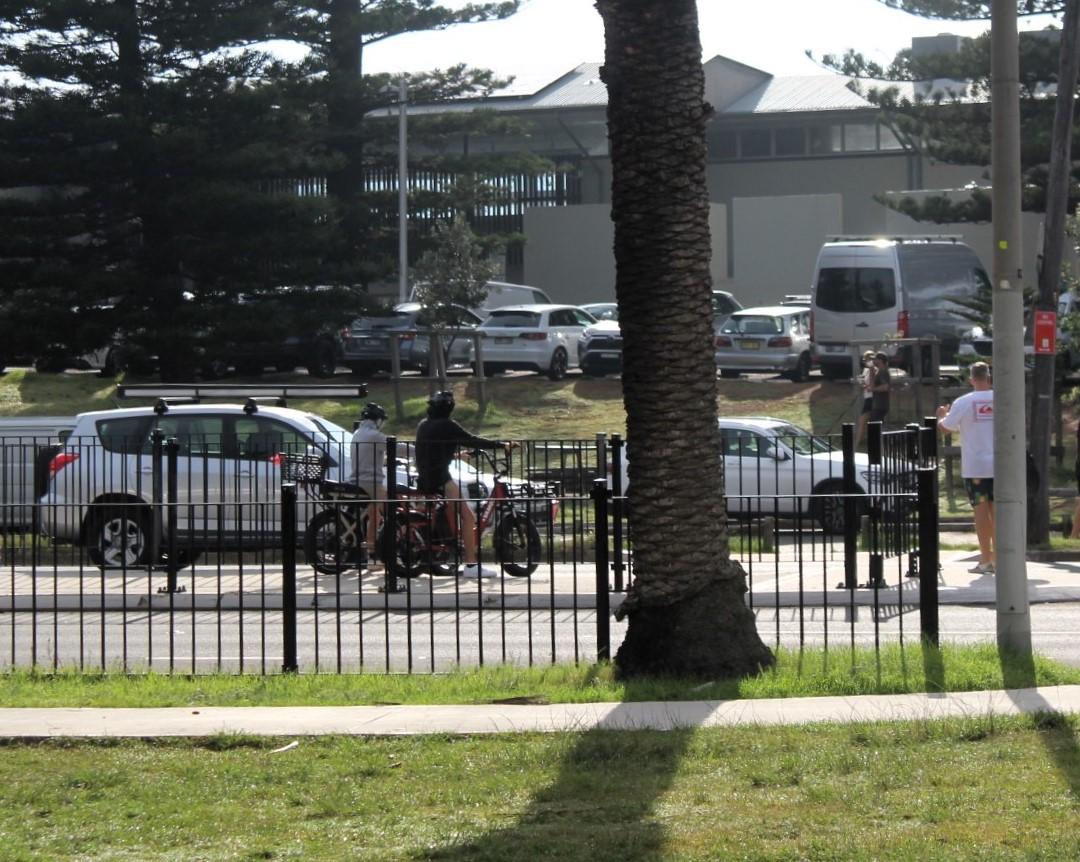
So-called “fat bikes” and other throttle-only devices like those ridden across the Sydney Harbour Bridge in a recent social media stunt are not legal e-bikes under NSW law and will be able to be seized and crushed under this new legislation.'

The Minns Labor Government is also investing in a number of ‘dyno units’ that measure whether the power output of an e-bike is beyond the legal maximum.

The portable test units can determine whether the e-bike’s power assistance cuts out completely at 25km/h as per the current law in NSW.

If an e-bike is found to be non-compliant at the roadside, Police will be empowered to crush the bike to ensure it does not return to the road.

This will simplify the current seizure laws, which were designed with high-powered cars and motorbikes in mind, and require a lengthy and resource-intensive court process to remove them permanently.' the government stated

As Transport for NSW and NSW Police develop the new seizure laws, they will be looking at the simple seizure and disposal laws already in place in Western Australia.

Police in WA have confiscated and crushed dozens of bikes since adopting tougher laws.

Parents urged to check it's not an illegal electric motorbike

Not all e-bikes sold in shops are legal on our streets. The NSW Government is asking parents to double-check before buying an e-bike for their child.

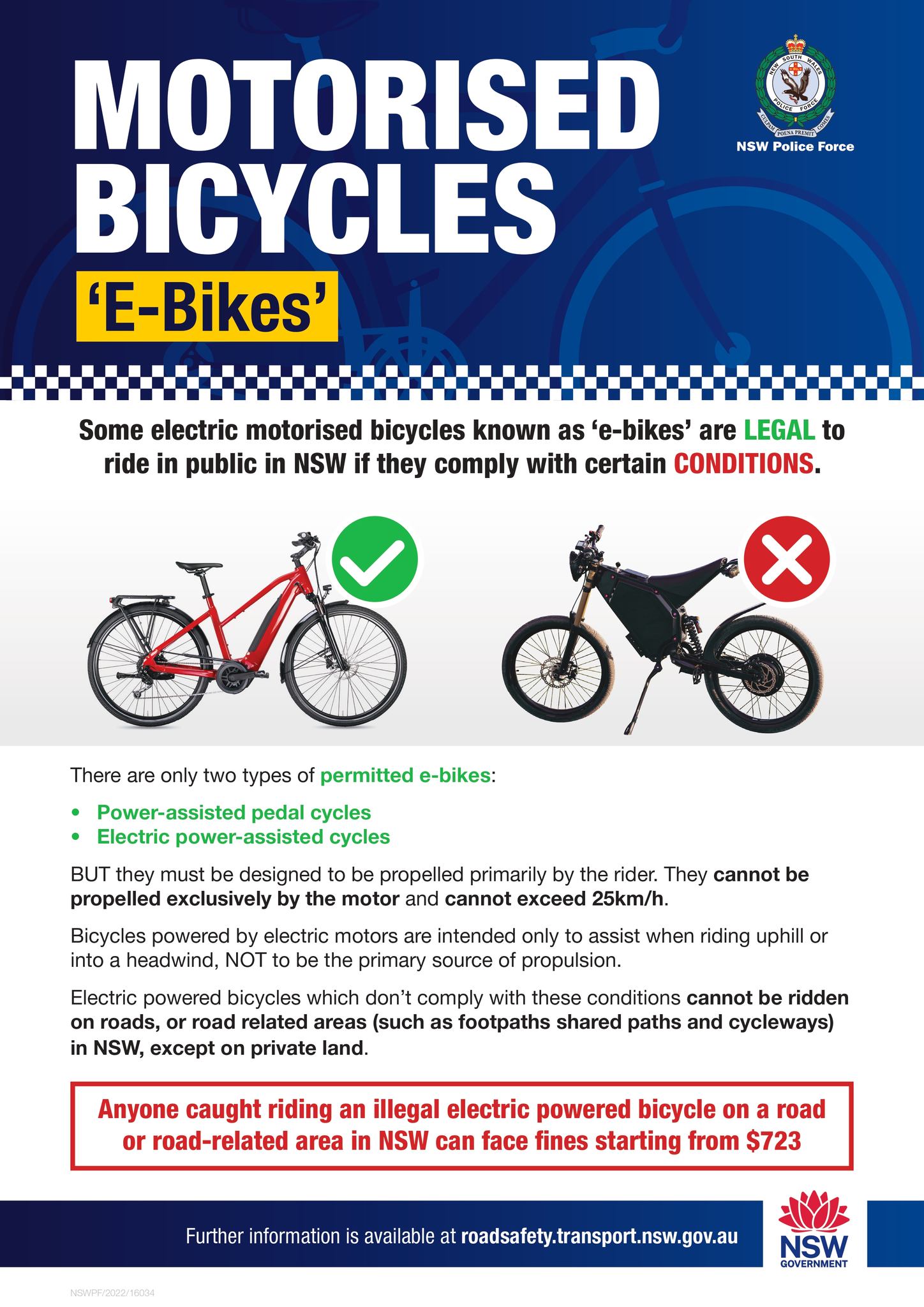
Many devices being marketed as e-bikes are in fact illegal electric motorbikes, with throttle operation without pedalling above 6km/h, excessive power output or modified speed limiters.

If a device does not meet NSW’s legal definition of a pedal-assisted e-bike, it can be seized and crushed even if it was bought in error.

These changes are the start of a broader package of reforms to make sure e-bikes are safe, legal and fit for use on public roads and paths, while still supporting responsible riding and active transport.

This can only happen when bikes behave like bikes, not motorbikes.

Further measures will be announced in coming weeks to strengthen safety, improve enforcement and give parents, riders and communities a clear and safe set of rules they can have confidence in.

Minister for Transport John Graham said:

“We’ve heard loud and clear the concern in the community about souped-up e-bikes and the anti-social behaviour that seems to go hand in hand with them.

“Riders and owners of illegal e-bikes should now hear us loud and clear: If you are breaking the rules, and your bike does not meet the very clear specifications of a pedal-assisted e-bike, expect it to be removed from your possession and crushed.

“Illegal bikes will end up as a twisted wreck so they can’t rejoin the road.  We will ensure e-bikes behave as bicycles not motorbikes.

“This reform goes far past the NSW Liberals’ idea for tiny number plates that validates and entrenches the most dangerous e-bikes..

“Labor will ban these dangerous electric motorbikes while the Liberals have pledged to licence them.”

See December 2025 report: NSW Coalition Announces it will introduce license plate scheme for e-bikes if elected: Pittwater MP Scruby Urges they back her Bill for same

On June 5 2025 Pittwater MP Jacqui Scruby had tabled a Notice in the NSW Parliament to move—

That a bill be introduced for an Act to amend the Road Transport Act 2013, the Road Rules 2014 and other legislation to provide for the regulation of the sale, ownership and use of e-bikes; and for related purposes.

Ms Scruby's Road Legislation Amendment (E-Bike Regulation) Bill 2025 Long Title reads:

An Act to amend the Road Transport Act 2013, the Road Rules 2014 and other legislation to provide for the regulation of the sale, ownership and use of e-bikes; and for related purposes.

See: Scruby-Scamps Bring Community Together to Tackle E-Bike Safety - August 2025

Ms Scruby reiterated the community-asked for approach when the state government backed up changes the federal government  announced

See: Maximum legal power output of e-bikes in NSW to be reduced to 250 watts - Federal Government reinstating EN-15194 standard: Scamps Welcomes changes, Scruby calls for NSW to lead with e-bike licensing and registration

The Coalition stated in a release in December: ''In an Australian first, this election commitment will mandate low-cost registration for specific categories of e-bike riders, enabling better enforcement against unsafe behaviour and addressing mounting community concern.''

''This commitment follows months of extensive consultation by the NSW Liberals and Nationals, including last year’s Parliamentary inquiry into e-bike safety. ''

''Stakeholders such as local councils, police and community groups have consistently raised concerns around the risks posed by the unregulated use of these devices along with the inability to enforce standards in a practical way.''

''The Government’s recent reforms are a start but have focused solely on e-bike technology while failing to address genuine concerns around rider behaviour.

The NSW Liberal and Nationals state they have identified two key considerations for any reform: 

  1. Improving the quality and safety of e-bikes, and 
  2. Addressing rider behaviour. 

The proposed licensing scheme would require a government issued license plate to be attached to an e-bike when used by: 

  • Riders who are under the age of 18; 
  • Riders who use e–bikes for a commercial purpose; and 
  • Commercial shared service schemes. 

Riders aged 18 and over who use a privately-owned e-bike be exempt from the scheme.

The Coalition plan also includes new penalties for non-compliance, alongside expanded safety education to ensure young riders understand the risks associated with e-bike technology and how to use these devices safely in the community.

On Monday incumbent NSW Police Minister Yasmin Catley said:

"Today, we’re drawing a line in the sand. Illegal, high-powered e-bikes aren’t harmless fun and anyone thinking they can slip under the radar should take this as their final warning. If your bike does not meet the rules, it will be destroyed.

"We’re backing police with the tools they need. These safeguards are about making sure the e-bikes on our roads are legal and safe, and about stopping dangerous bikes from being handed back only to pop up again next week. If a bike breaks the rules, it’s gone for good.

"I want to remind people that this isn't just a police responsibility. We all have a role to play, especially parents, in making sure kids are riding legal e-bikes and not being put at risk.

"If you buy, or allow a child to ride, a high-powered e-bike that doesn’t meet the rules, you’re not just gambling with their safety, you’re gambling with the bike too and there will be no exceptions."

Minister for Roads Jenny Aitchison said:

“This is a crackdown, plain and simple.

“Let’s not forget, this is not just a problem for the city, communities across regional NSW are dealing with illegal e-bikes being ridden at dangerous speeds on footpaths, local roads and town centres, and too many people are being seriously injured.

“People deserve to feel safe walking, riding or driving in their own communities – whether they live in Sydney, the Hunter, the North Coast, Riverina or the Far West – and that means drawing a hard line between a bicycle and an illegal e-bike.”

E-bike Emergency Department presentations double in 12 months

On Wednesday February 11 2026 new data released by St Vincent’s Hospital Sydney showed serious injuries from e-bikes doubled in 2025 compared to the previous year and jumped 350 per cent since 2023.

There were 200 e-bike related presentations to the Sydney Emergency Department (ED) last year, up from 103 in 2024 and 45 in 2023. 

The figures only include injuries serious enough to trigger a response from the St Vincent’s trauma team, with presentations for lesser injuries such as scrapes and minor soft tissue damage not included. 

The trauma team is engaged for serious injuries such as bone fractures, deep tissue wounds, and severe head injuries. More than half of 2025’s patients had to be admitted to hospital, and of these, almost 10 per cent required admission to intensive care.

St Vincent’s Hospital Sydney’s Director of Trauma, Dr Tony Grabs, said e-bike injuries are more severe than traditional bikes, often involving high-speed collisions with cars or fixed objects.

He said more than half of the cases presenting to the St Vincent’s ED had self-reported speeds of more than 25 kph.

“E-bikes are heavier and faster than regular bikes and many have been illegally modified to go even faster, which only increases the severity of the injuries,” he said.

The St Vincent’s ED data also shows more than half of injuries occurred at night with alcohol and other drugs often a factor. Both the Australian and NSW governments took action towards the end of 2025 and early 2026 to make e-bikes safer, including a major tightening of e-bike import regulations to align with the European EN-15194 standard. These regulations require e-bikes to cut off the motor at 25kph, have a 250-watt continuous power limit, and an anti-tampering requirement to stop users modifying bikes for higher speeds.

“We welcome the steps taken by the authorities aimed at reducing e-bike related injuries. We hope it will deliver some positive impact on our ED numbers in the months ahead,” Dr Grabs said. 

Safety and In place Rules

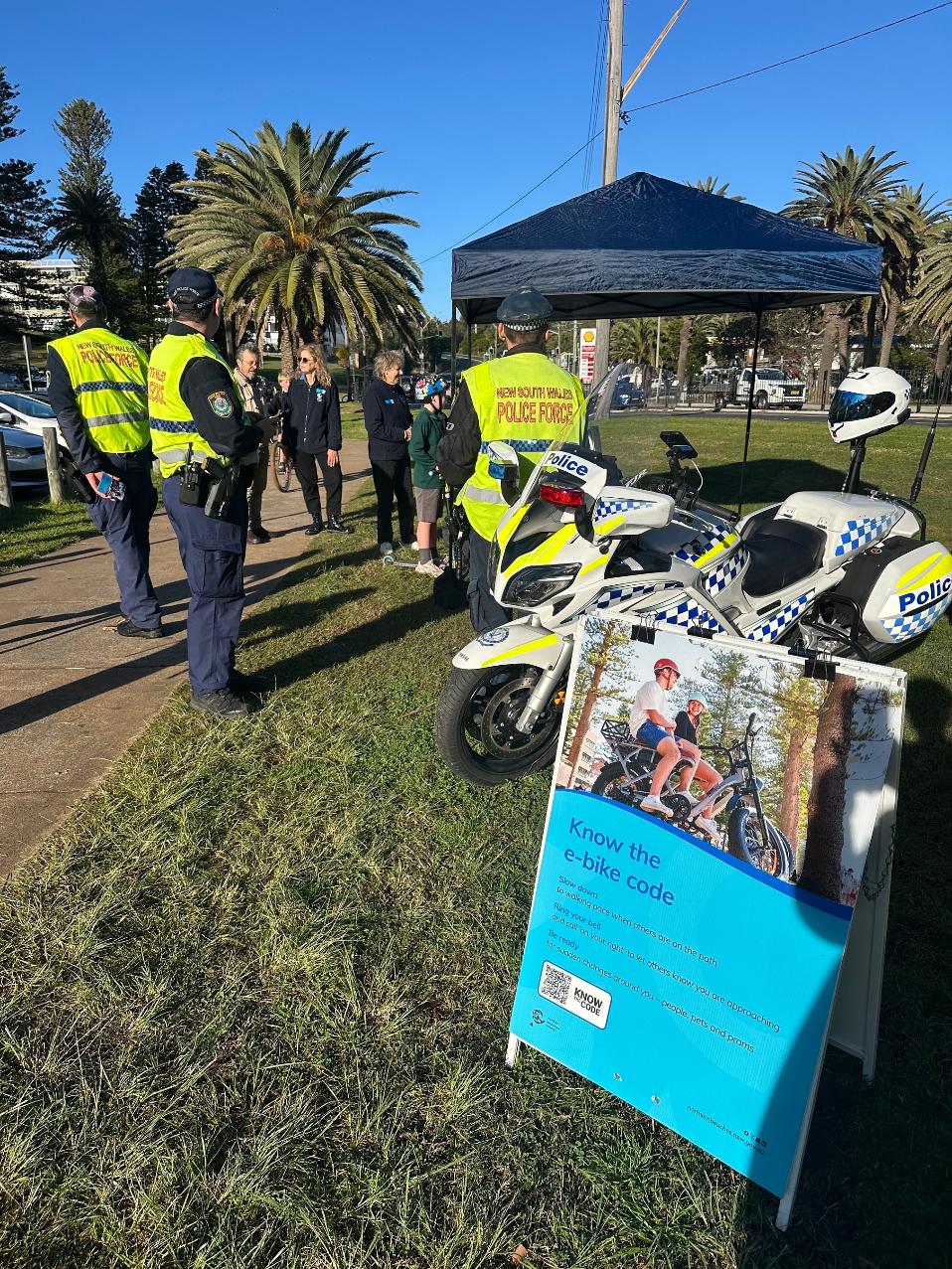
There is e-bikes safety information and more available at: www.transport.nsw.gov.au/roadsafety/bicycle-riders/ebikes

That e-bike you bought your teen might be an illegal electric motorbike – and the risks are real

Dorina Pojani, The University of Queensland and Richard J. Buning, The University of Queensland

A “health emergency”. A “total menace”. “Take them away and crush them”.

E-bikes are in the news for all the wrong reasons. A spate of deaths and injuries linked to e-bike crashes have led to widespread concern. Hundreds of serious injuries have been recorded over the past two years in New South Wales, Victoria and Queensland. High-speed rideouts across Sydney Harbour Bridge and through golf courses have infuriated authorities.

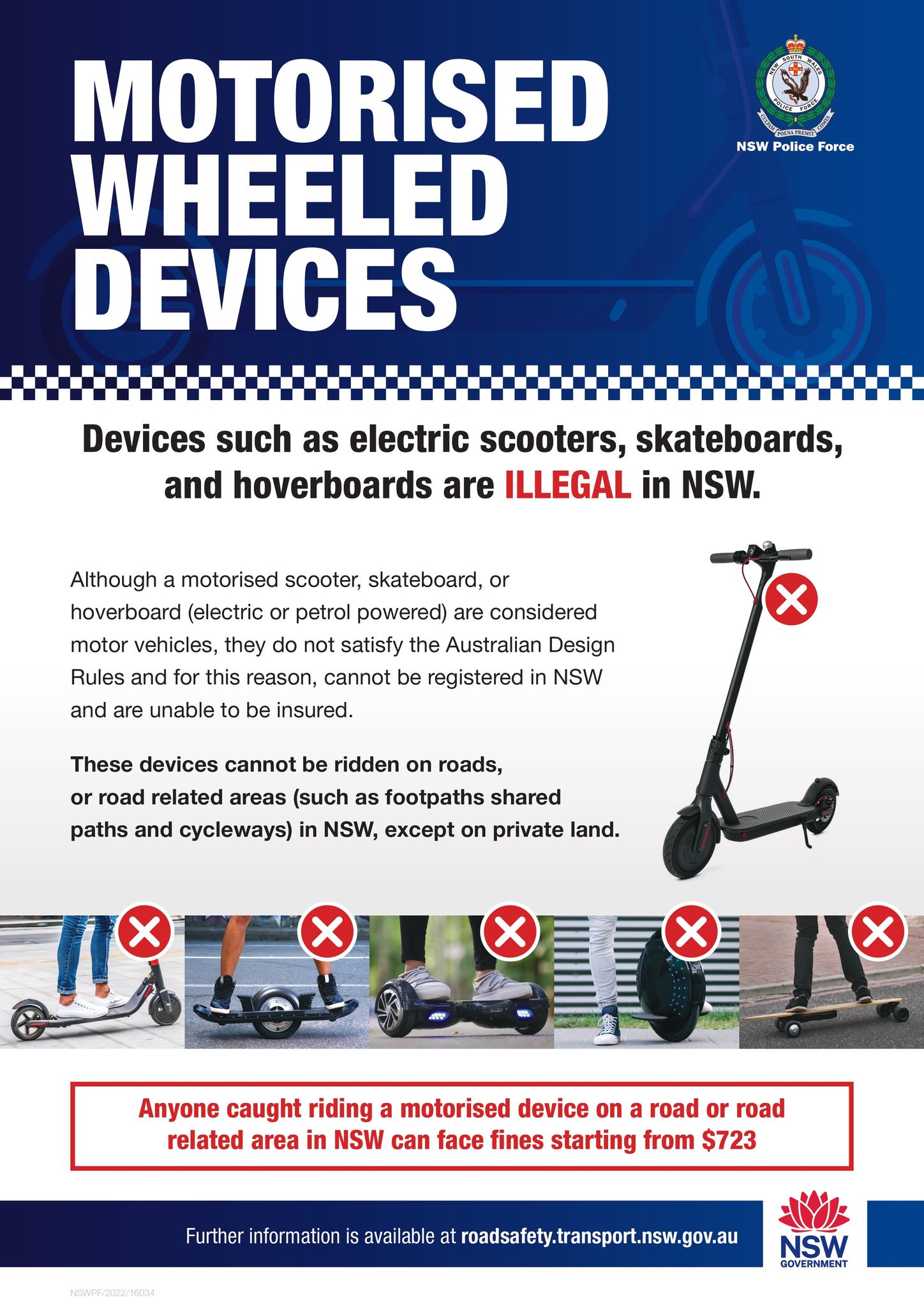
The vehicles authorities are concerned about aren’t really e-bikes at all. They’re effectively illegal electric motorbikes, able to accelerate rapidly — some to more than 100 kilometres per hour — and often without the safety standards of a legal motorbike. For years, these vehicles were imported through a loophole allowing them to be used on private land. But once in Australia, most end up on roads, bike paths and public space.

The thrill of these vehicles can be a potent cocktail for young people. Their range and speed gives teens more independence before they can legally get a car. That’s great. But teens are also generally more likely to take risks and test boundaries, and less likely to comply with rules. Unsurprisingly, injury and death rates among younger e-bike riders are rising given widespread access to cheap, fast, unlicensed vehicles – often by their well-meaning parents.

a first person image showing the hands and handlebars of an e-bike rider at high speed on a road
A looming crackdown on overpowered e-bikes comes after a spate of injuries and controversial ride-outs, such as last week’s ride across Sydney Harbour Bridge. Sur Ronster/Youtube, CC BY-NC-ND

How did we get here?

Many people associate e-bikes with parents ferrying kids around on electric cargo bikes, or commuters in business attire zipping to work without raising a sweat. These types of legal vehicles are pedal-assisted and limited to 25km/h.

But the term “e-bike” covers a huge range of vehicles in a booming sector. In 2017, around 9,000 e-bikes were sold across Australia. This year, sales are tipped to be close to 300,000, worth A$1.3 billion.

One reason for the boom: national import standards on high-powered models were loosened in 2021 to reduce red tape at the border.

In late 2025, a more stringent import standard was reintroduced. But because thousands of overpowered vehicles are already here, this won’t be an overnight fix.

If we think of non-compliant e-bikes as illegal electric motorcycles, the risks make more sense. Legal motorbikes, whether electric or petrol, are notoriously dangerous. In 2024, 278 riders died, representing 21% of Australia’s road fatalities despite being just 4.5% of registered vehicles. This is one reason the licence test and safety requirements for motorbikes are rigorous. By contrast, riders of these electric motorbikes don’t sit any test and don’t have to register their vehicle.

Australia doesn’t collect national statistics on e-bike injuries and deaths. What we do know suggests young, usually male e-bike riders are more likely to be injured. Data from the Netherlands and China indicates e-bike riders are more likely to be injured or die than riders of unpowered bikes.

In the United States, e-bike injuries tend to be much more severe, more like motorbike rider injuries than pedal bikes: pelvic fractures, brain injuries, concussion. When pedal bike riders are injured, just 0.3% die. When e-bike riders are injured, the US figure is 11%.

High powered e-bike ride-outs have become popular in Australian cities.

How are young people getting access?

One way young people have been getting these bikes is as gifts from parents.

Why? Reasons include a lack of knowledge about how fast the bikes can go and the risks they present. E-bikes broadly promise more independence for teens and less driving for parents, a benefit many “chauffeur” parents appreciate. The blanket term “e-bike” can make parents think of the overpowered models as just bicycles with a boost.

The spike in popularity means peer pressure is reportedly a factor. “Rideouts” organised and popularised through social media can draw many riders. On TikTok, these vehicles have become status symbols – “tools of identity and rebellion”.

Closing Pandora’s box?

Coverage in recent months has verged on moral panic. But it’s not helpful to think of e-bikes as a threat. The challenge is protecting the excellent uses of e-bikes while weeding out unsafe models.

As we have argued, the word “bike” in “e-bike” is misleading. E‑bikes should be treated as a separate category to pushbikes.

To help parents and other buyers, we should distinguish between street-legal pedal-assisted e-bikes capped at 25km/h, and illegal electric motorcycles with a throttle and much higher top speeds.

What should authorities do?

To get illegal electric motorbikes off the roads, police would benefit from the ability to test the voltage or top speed of e-bikes, as their UK counterparts do.

On the legal front, enforcing the newly adopted standard will be essential – not only at the border, but also at points of sale.

But this won’t be enough, given riders can overclock legal e-bikes by removing built‑in speed restrictions.

Here, authorities could require importers to ensure e-bike software can’t be altered without manufacturer authentication. We already have models for this, such as Queensland’s anti-tampering laws for regulated vehicles such as heavy freight trucks.

E-bike sellers should be required to display prominent, standardised labels and advise buyers that tampering with speed limiters will void their warranty, insurance and legal road access. It must be clear responsibility falls on the owner and rider.

New laws could be useful to restrict higher-powered e-bikes to adults, while teens aged 13–17 could access lower-powered pedal-assist models, ideally with mandatory training or licensing.

Real safety requires infrastructure

E-bikes are here to stay. Even if authorities successfully clamp down on the illegal electric motorbikes, there’s much to be done to use these vehicles safely and effectively.

It might make sense for slower e-bikes to be able to access shared paths and bike lanes, while legal higher-powered e-bikes can use roads.

But in most parts of most Australian cities, bike infrastructure is poor. Bike lanes peter out into traffic and gaps are common. Cycling infrastructure has long been grossly underfunded.

If we are to keep everyone safe on roads, trails and bike lanes, it won’t be enough just to ban overpowered e-bikes. Safety requires careful laws – and real infrastructure.The Conversation

Dorina Pojani, Associate Professor in Urban Planning, The University of Queensland and Richard J. Buning, Research Lead, UQ Micromobility Research Cluster, The University of Queensland

This article is republished from The Conversation under a Creative Commons license. Read the original article.