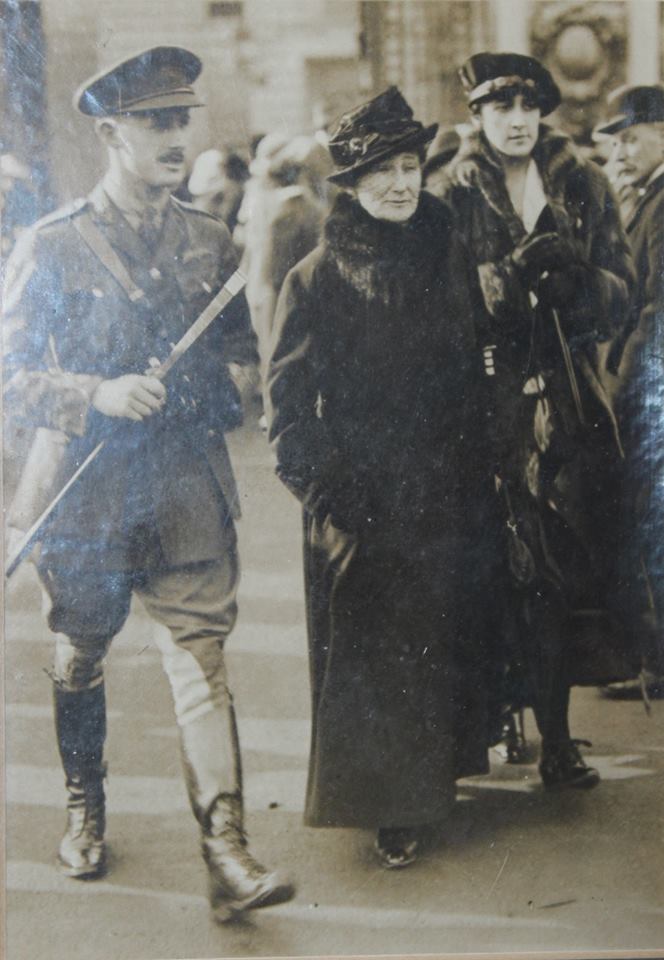
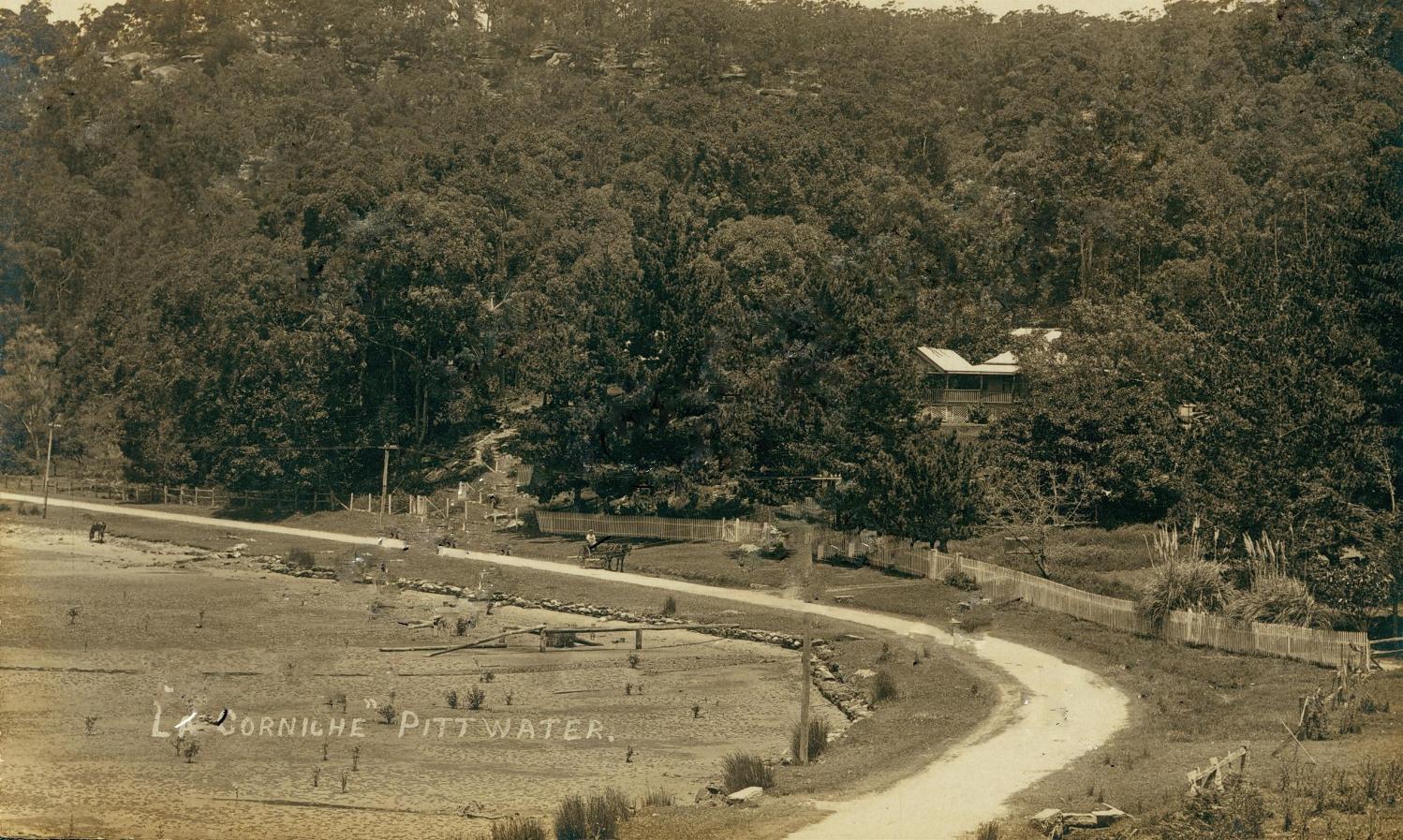
Members and guests who attended the recent meeting of the Avalon Beach Historical Society were treated to a screen display of a fascinating collection of photo postcards.
Most of the postcards were photographed and produced by HESKETH GEORGE HENRY SWINEY, before he left Australia around April in 1916 after enlisting for war service overseas.
Geoff Searl OAM and Manly Daily historian John Morcombe, have been members of the New South Wales Postcard Collectors Society for over 30 years and have amassed between them a collection of 40 postcards produced by Swiney.
They cover the area from Narrabeen to Barrenjoey Headland and a couple of them initially appeared rather obscure – after all, the postcards were 110 years old.
Geoff reproduced some of the views to illustrate their location more convincingly.
Swiney had a small stamp which he printed on the reverse of the postcards which read ‘The Vale Studios – Narrabeen’.
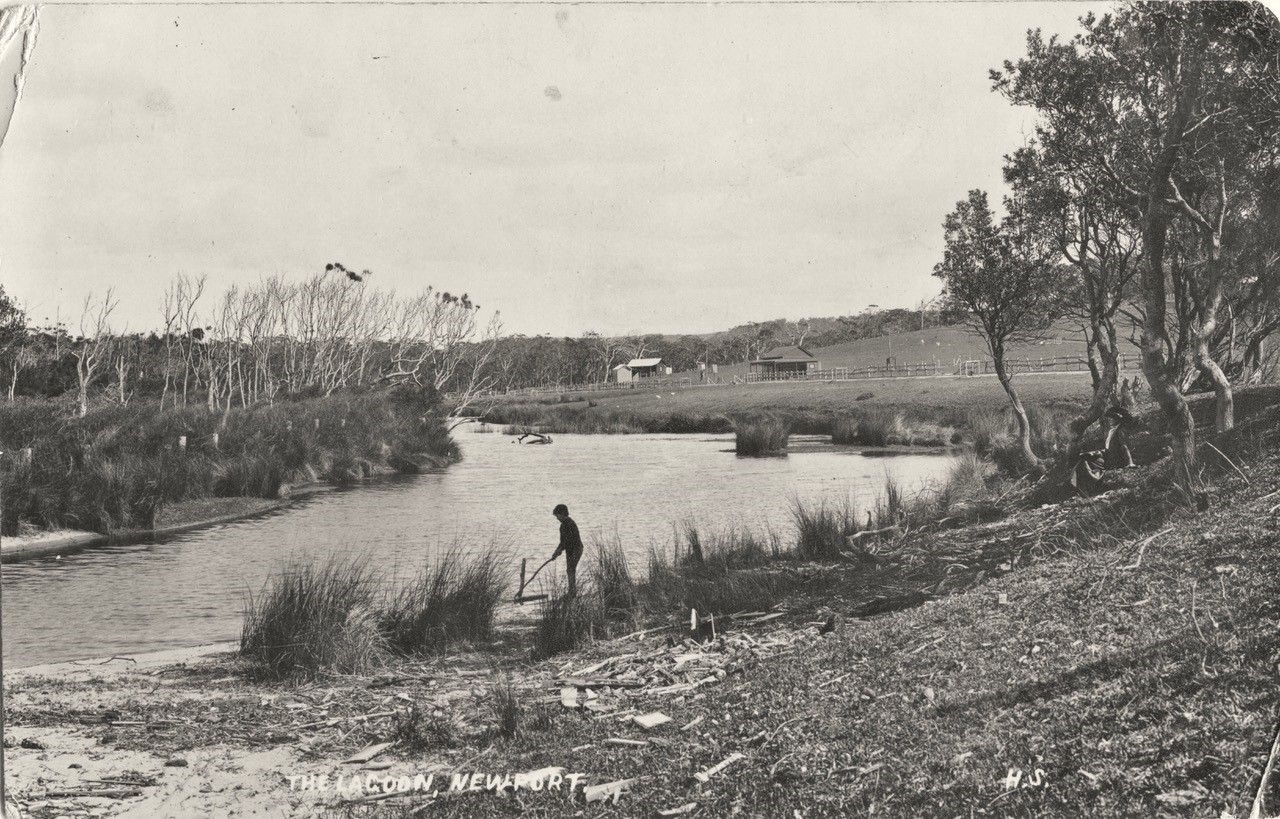
This great photo shows the view south along the ‘Newport Lagoon’ (written on the postcard) which these days approximates the Bramley Street Car Park, under which flows the watercourse originally known as the Newport Lagoon!
Behind the young fisherman is Barrenjoey Road with 2 huts on the opposite side to the current ‘Honest Chicken’.
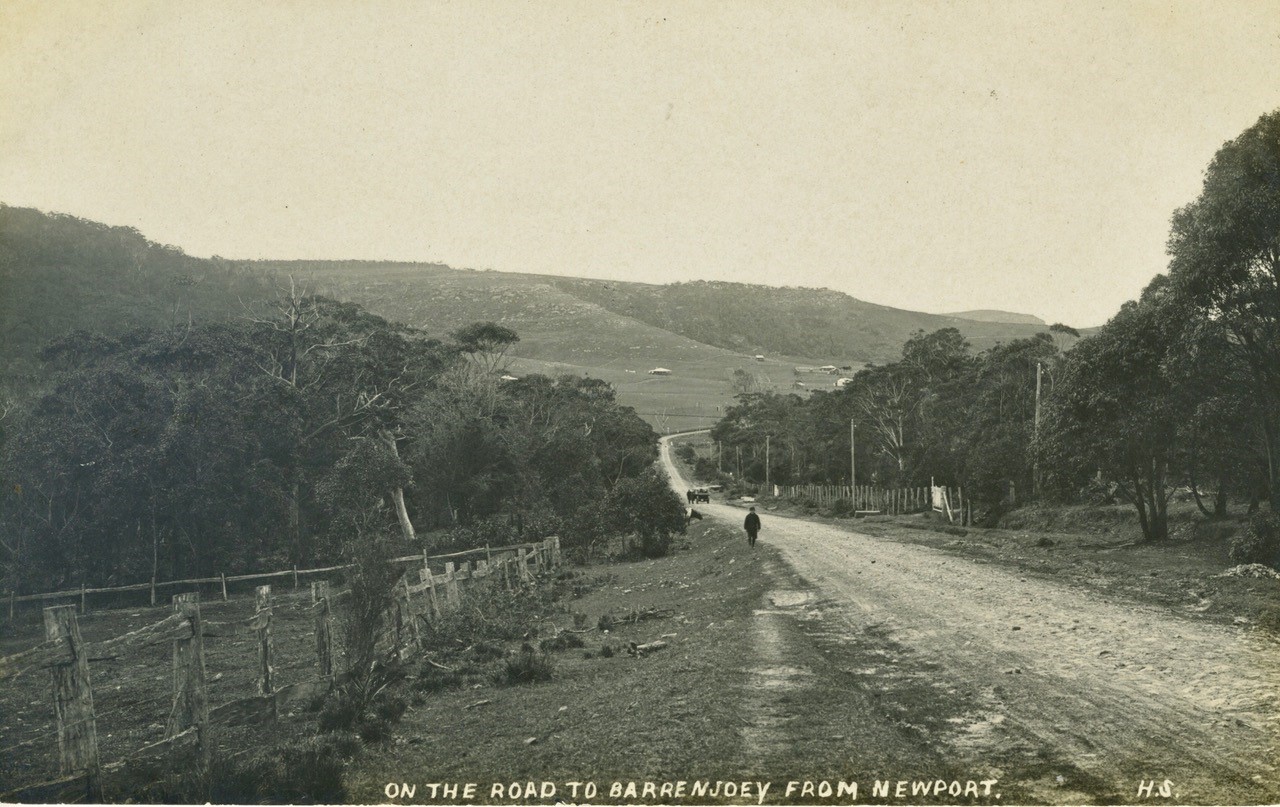
This photo shows the view north down Newport Hill with a very barren Bilgola Plateau in the distance. Gotta love the road surface and the forequarter of the cow just protruding from the trees and scrub halfway down the hill on the left.
This photo was simply labelled ‘Road gang working on the road to Palm Beach’.
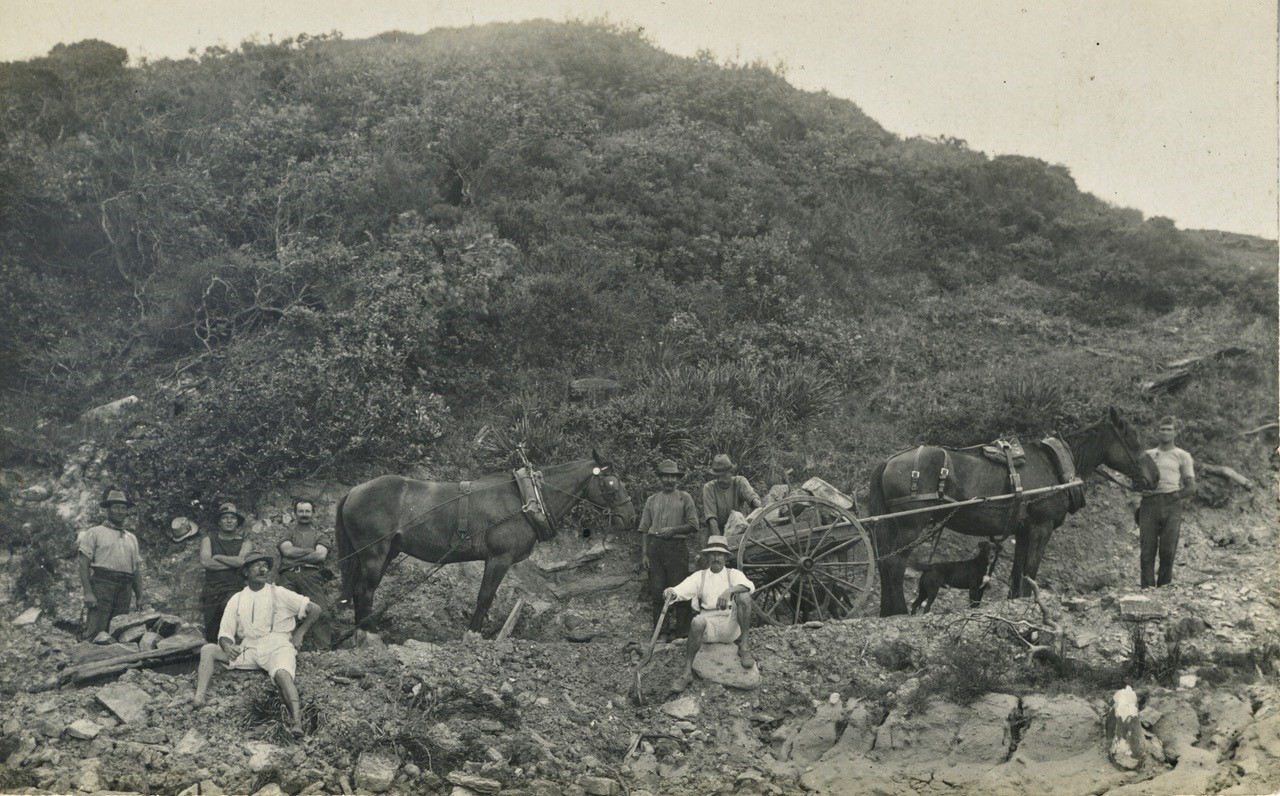
The location could be several sites – just south of the present Kamikaze Corner on the original Barrenjoey Road (now called The Serpentine). It could also be the climb up Palm Beach Road, which was the original access to Palm Beach, before Beach and Ocean Roads were made and Black Rock was split.
Any other suggestions will be considered!
The next meeting of the ABHS will be held on Tuesday 8 September 2026 in The Annexe on Dunbar Park via the Bowling Green Lane. As they say, ‘Stay tuned for further information’.
Please note there are no stairs from the car park to the Annexe, just gentle shallow ramps.
In the meantime, check out our website at: abhs.org.au
Hesketh George Henry Swiney was born February 15 1874 in Chennai District, Tamil Nadu, India, the second son and one of six children of Major-General John Swiney, I.S.C (born February 9 1832 at Kolkata District, West Bengal, India - died May 17 1918, interred in St. Peter's churchyard, Cheltenham Borough, Gloucestershire, England) who was the second son of General George Swiney, Colonel Commandant 19th Brigade RA and Maria Arabella Haigh, and a descendant of Major Matthew Swinney of Co. Donegal, Ireland, and Rosa Frances Emily (née Biggs April 21 1847, born in India - May 2 1922, also interred in St. Peter's). Rosa was a writer and women's rights activist, the daughter of Ensign John Biggs of HM 8th regiment, later to become a Major in the 4th Royal Irish Dragoon guards, and his wife, Frances Charlotte Malden.
A biography of Rosa, known by her middle name 'Frances', states she relocated to Cheltenham, Gloucestershire, in 1877, in order to send three of her children to school in England. She described Cheltenham later in her life as "the town of no ideals", where her husband joined her ten years later.
Hesketh was originally a place name, specifically associated with the Lancashire region, formed from the Old English words "hǣse" (nut) and "sceatt" (corner or corner). This means Hesketh literally denotes "corner of nuts". The place name later developed into a surname, and in some cases, has also been used as a first name.
Known siblings:
- Major Gilbert Mars Reginald Alexander MacSwiney (December 27 1872– November 29 1948 - educated at Cheltenham College) - THE LONDON GAZETTE, OCTOBER 4, 1892 - 4th Battalion, the Cheshire Regiment, Gilbert Mars Reginald Alexander Swiney, Gent., to be Second Lieutenant. Dated 5th October, 1892.
- Sidney Bree Williams Swiney (March 27 1877, at Chennai – February 3 1943)
- Rev. Arundel John Edward MacSwiney (March 7 1881 at Cheltenham – December 30 1940 at Auckland New Zealand)
- Violet Maud Julia Swiney
- Gladys Swiney born 1887
Mr MacSwiney's photographs of our area would date between circa 1910 and circa 1915 - when he left, having served in the British Defence Forces prior to then and considering himself English/Irish first, to serve in World War One.
In late 1911 Hesketh Swiney and James Searle gave evidence about an insolvent named Macpherson and his farm at Warriewood, which he was being paid to look after. This would infer he had already moved to the Warriewood-Mona Vale district, then also called 'Rock Lily', and his association with our area commenced prior to this.
This advertisement from May 1910 states he wanted to clear two acres of bushland in the 'Rock Lily District', then another name for the Mona Vale - North Warriewood valley area:
Wanted - Price clearing about 2 acres land Rock Lily Dist, Pittwater, H. Swiney P.O. Mona Vale. Advertising (1910, May 20). The Sydney Morning Herald (NSW : 1842 - 1954), p. 5. Retrieved from http://nla.gov.au/nla.news-article15153151
N INSOLVENCY JURISDICTION.
Before his Honour Mr. Justice Chubb. EXAMINATION OF WITNESSES.
An examination of witnesses was con-ducted on Wednesday in the matter of the insolvency of William Douglas Macpherson, clerk, late of Warwick, but now residing at East Brisbane. Mr. Henchman appeared for the trustee (Mr. Frederick F. C. Emmott) and Mr. Thorn, for the insolvent, who deposed that between February, 1910, and February, 1911, he was employed by the Federal Timber Co., Ltd., Warwick, as secretary at £2/10/ per week. He was adjudged insolvent on his own petition at the request of the company. While in the employ of the latter he made away with a large amount of the company's money. He was convicted at the District Court at Warwick in March last on a charge of stealing as a clerk. He did not know the amount he took, but the amount alleged by the Crown Prosecutor was about £850. He was surprised to find that the amount was so large.
The sum of £100 was given to him by his wife's aunt, and that money went in instalments towards the purchase of a farm on the Rock Lily Estate, near Sydney, the cost of which was about £135. He had paid Hesketh George Henry Swiney £9 per month to supervise it. He had been in prison, and found recently that the land had been transferred to his wife. The agreement was that if the instalments were not paid the land could be forfeited. He had written to the trustee on the 15th that he would hand over the farm to the creditors. He also told the prosecuting solicitor that he was willing to have the farm transferred to the trustee.
Hesketh George Henry Swiney and James Taylor Searle (interstate transfer clerk at the Queensland Government Savings Bank, Brisbane) also gave evidence. The latter stated that to his knowledge there was no record of any account of the insolvent Macpherson. The examination then closed. IN INSOLVENCY JURISDICTION. (1911, December 2). The Brisbane Courier (Qld. : 1864 - 1933), p. 15. Retrieved from http://nla.gov.au/nla.news-article19750250
A March 1911 report states he stole £89 6s 11d, so the above may be incorrect. William Douglas Macpherson (May 18 1885 - April 16 1962) was the son of Lachlan and Jessie (nee McIntosh), married 1872 - registered in Queanbeyan. He married Ethel Margaret Matilda Pearson (1888-1929) in 1910. There appears to be no connection between this Macpherson and the family of the same name whose patriarch Edward Augustus Macpherson purchased 419+ acres from Francis Abigail on July 3rd 1889 (Vol-Fol: 867-24).
It is likely Mr. Swiney was leasing the above property, or land alongside it, as he is already showing some of his prize poultry in the Easter Show of 1911.
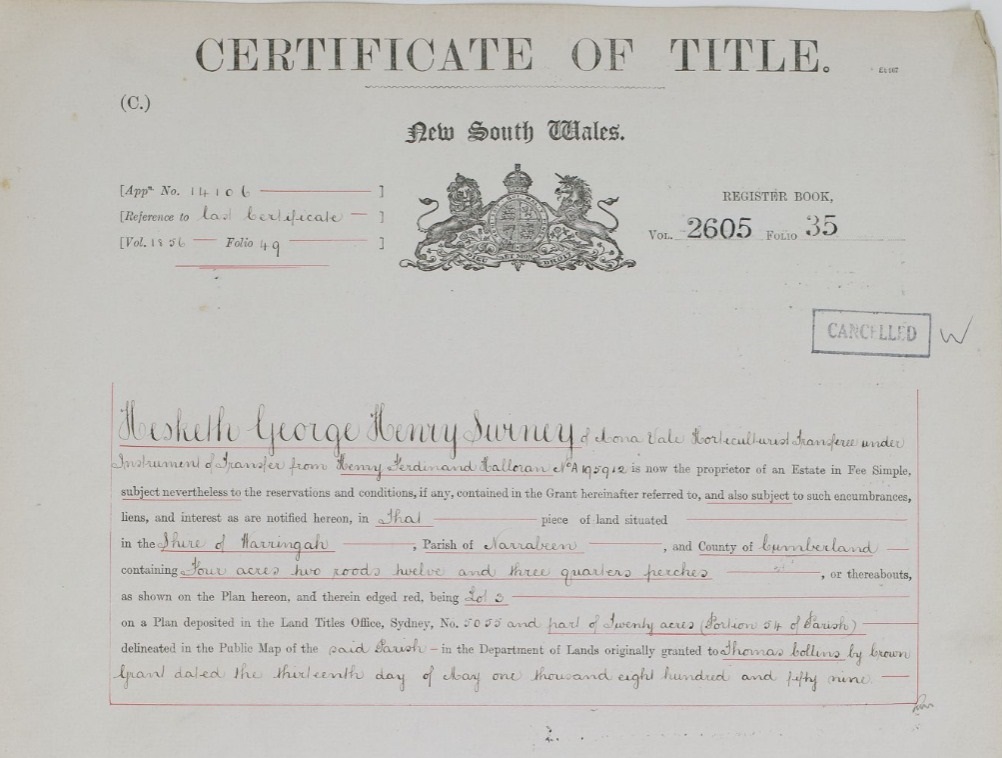
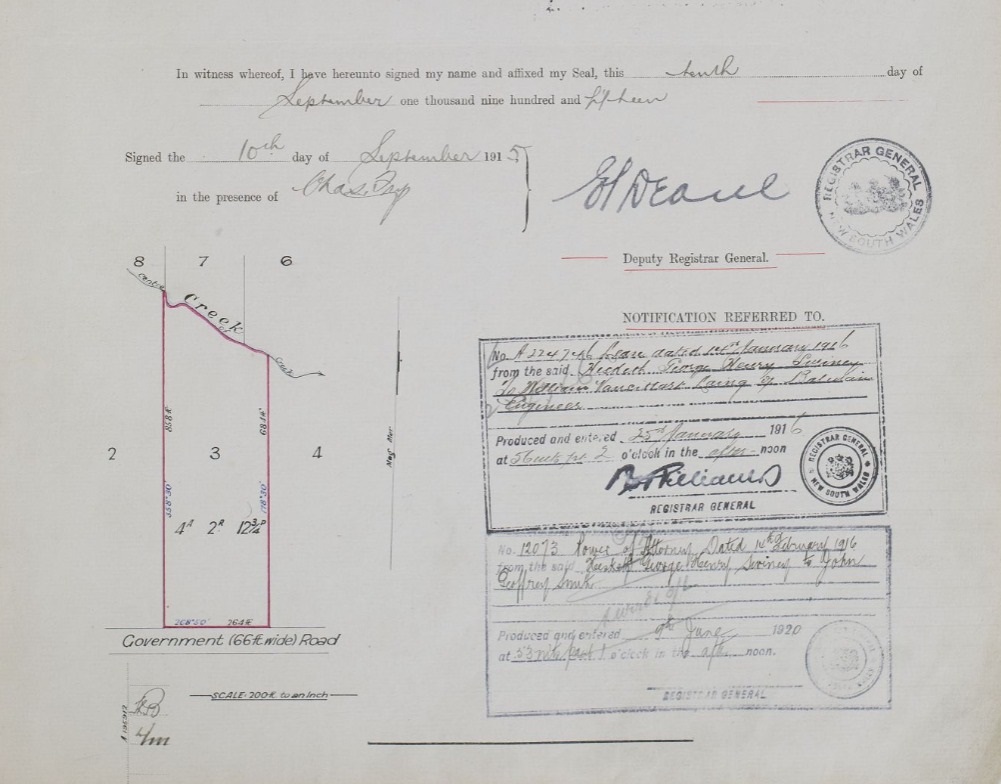
In August 1915 he bought acreage there from Henry Halloran's 'Great Warriewood Estate'. The Historical Land Record Viewer (HRLV) shows Hesketh Swiney - buys Lot 3 DP 5055, at 4acres, 2 roods and 12 3/4 perches, backing on to Fern Creek, which would have been a source of fresh pristine water in those days
Hesketh Swiney's land at Warriewood in Vol-Fol: 2605-35:
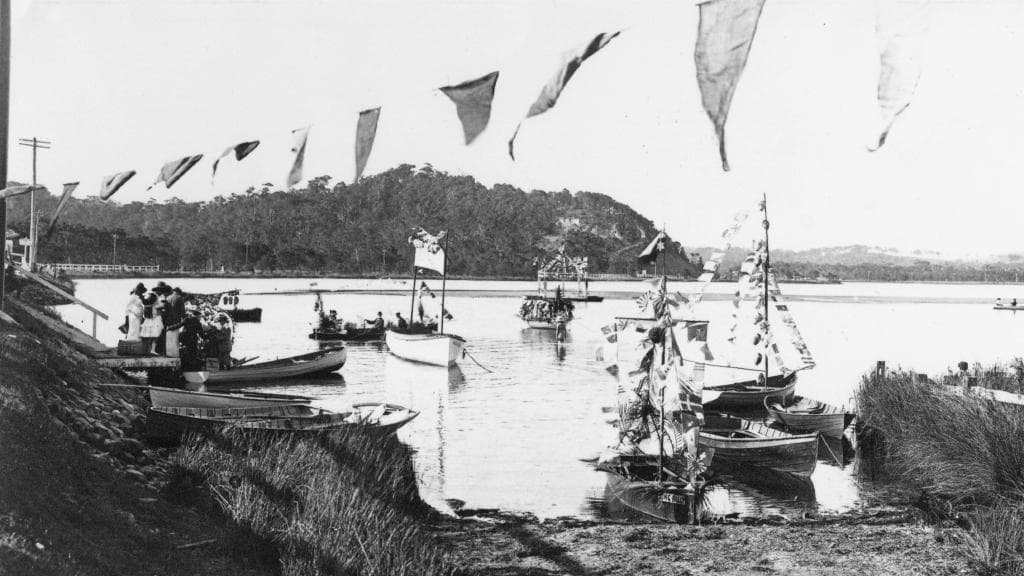
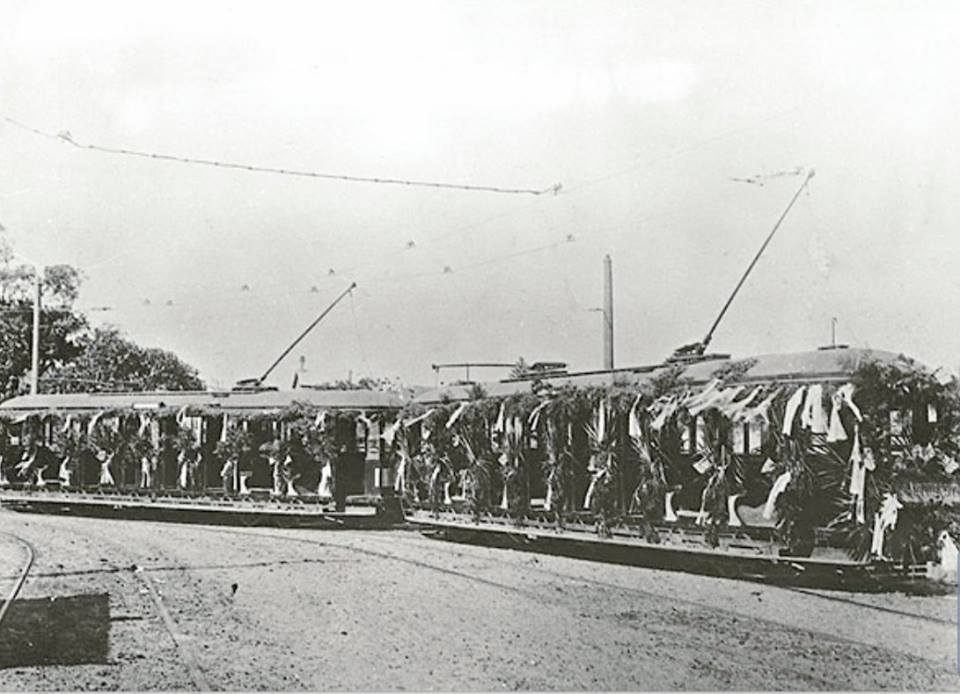
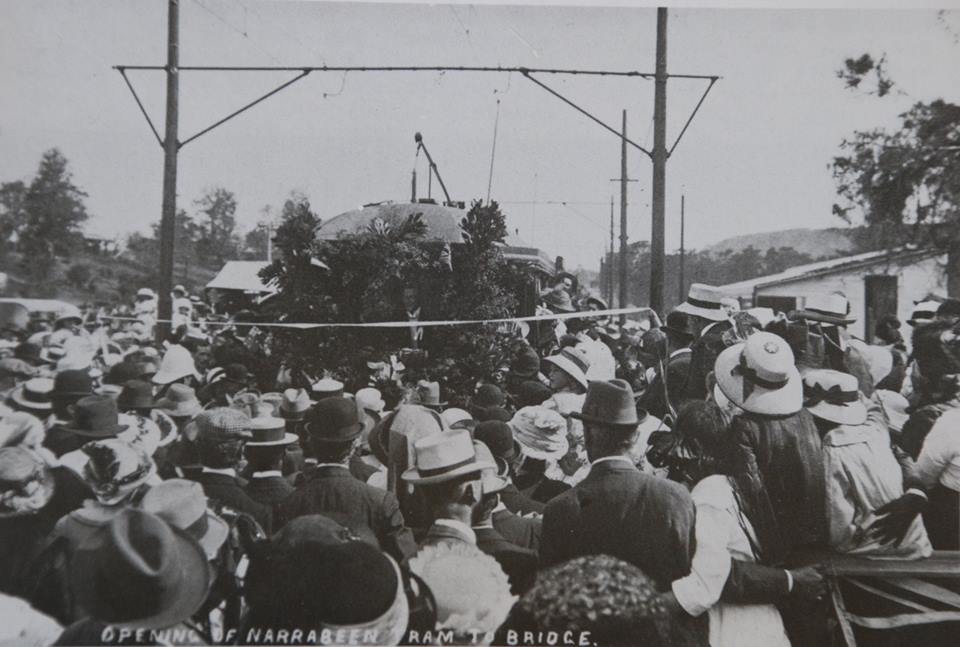
Hekseth Swiney took photographs of local events as well as landscapes - the Venetian Carnival held at Narrabeen, for instance, as well as the crowds, on the opening of the tram extension to the Narrabeen bridge of then.
His photographs were used in local newspaper reports, providing an extra form of income for his work. The official opening of the tram extension to Narrabeen took place on Saturday December 13th, 1913, and included this carnival.
Tracking down the events and reports associated with his pictures allows some dating to occur for when the images were taken:
NARRABEEN TRAM OPENING.
The official opening of the Narrabeen tram extension will be performed on Saturday next, at 3.30, by Mrs. Arthur Griffith, wife of the Minister for Works. The Warringah Shire Council and a committee are making arrangements to suitably celebrate the occasion.
A Venetian carnival on the lakes will be held at night, and there will also be a display of fireworks. The Pittwater tramway and transit committee has arranged to take the official party for a trip through the Pittwater district, including Newport, Bay View, and Church Point. Refreshments will be partaken of at the latter place, after which the party will journey back through Narrabeen for the purpose of witnessing the evening carnival.
The tram has been running since Monday last on the route, and the traffic on the line is regarded as satisfactory. Passengers are now landed right at the Narrabeen Lakes, and within easy distance of the beach and other adjoining tourist resorts. NARRABEEN TRAM OPENING. (1913, December 12). The Daily Telegraph (Sydney, NSW : 1883 - 1930), p. 7. Retrieved from http://nla.gov.au/nla.news-article238960637
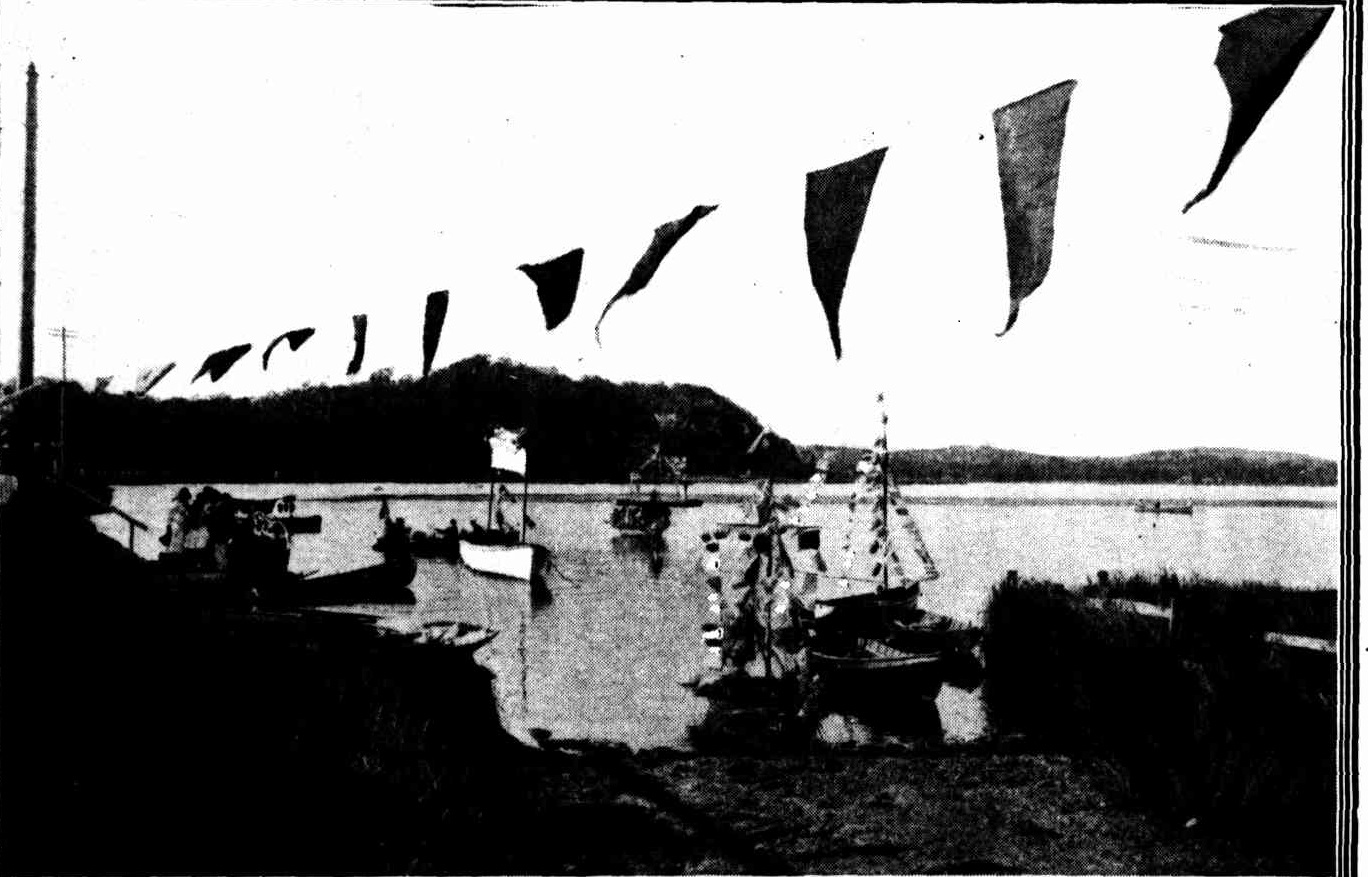
A Holiday at Narrabeen, between Manly and Newport. This view was taken on the occasion of the recent carnival at Narrabeen Lake in honour of the extension of the tramline to the bridge. OUTDOOR AUSTRALIA. (1914, January 7). Sydney Mail (NSW : 1912 - 1938), p. 10. Retrieved from http://nla.gov.au/nla.news-article158397083
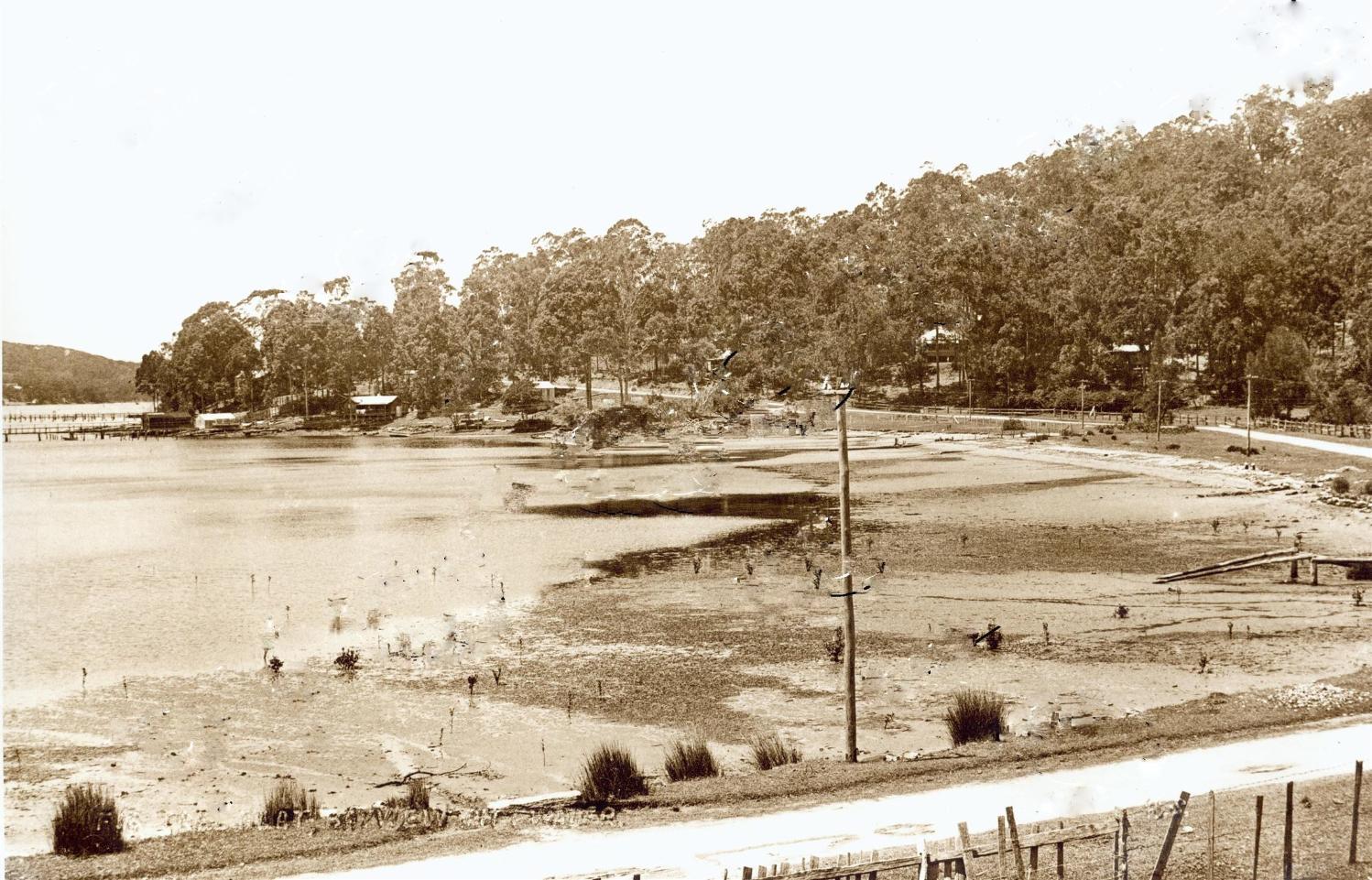
There is also another which may be his further back towards the Bayview wharf end of the Pittwater road:
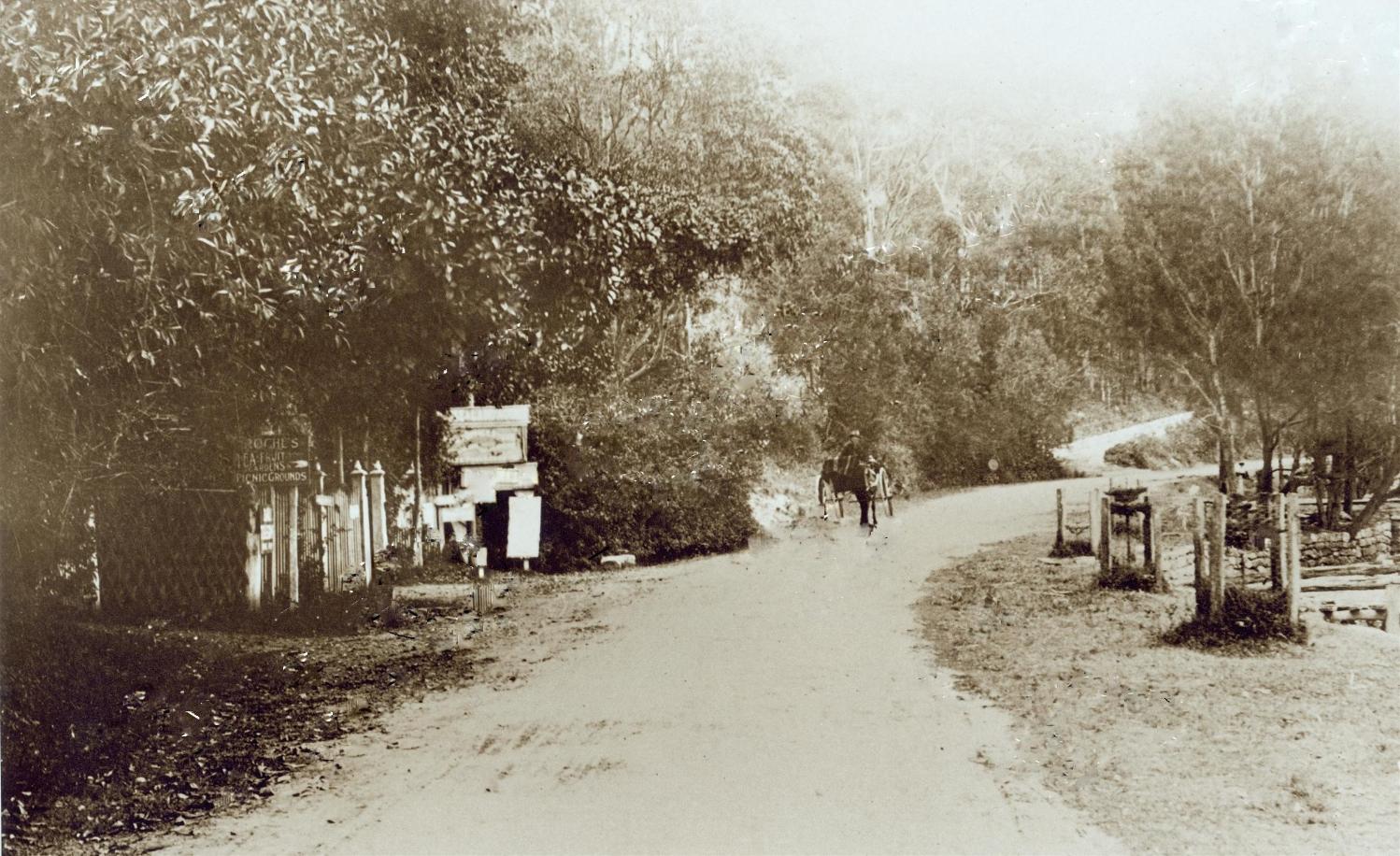
'Roche's Corner' - circa 1895-1910
Another example is identified as this postcard of Scott's Guest House on Crystal Bay at Newport:
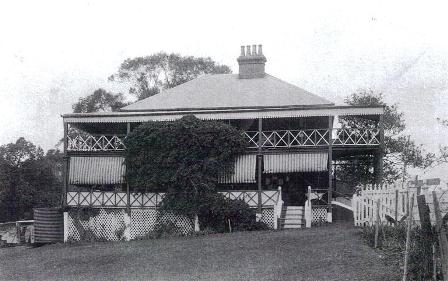
Black and white postcard of Scott's, circa 1910-14. Photo courtesy of Pittwater Image Library, Mona Vale Library History Unit.
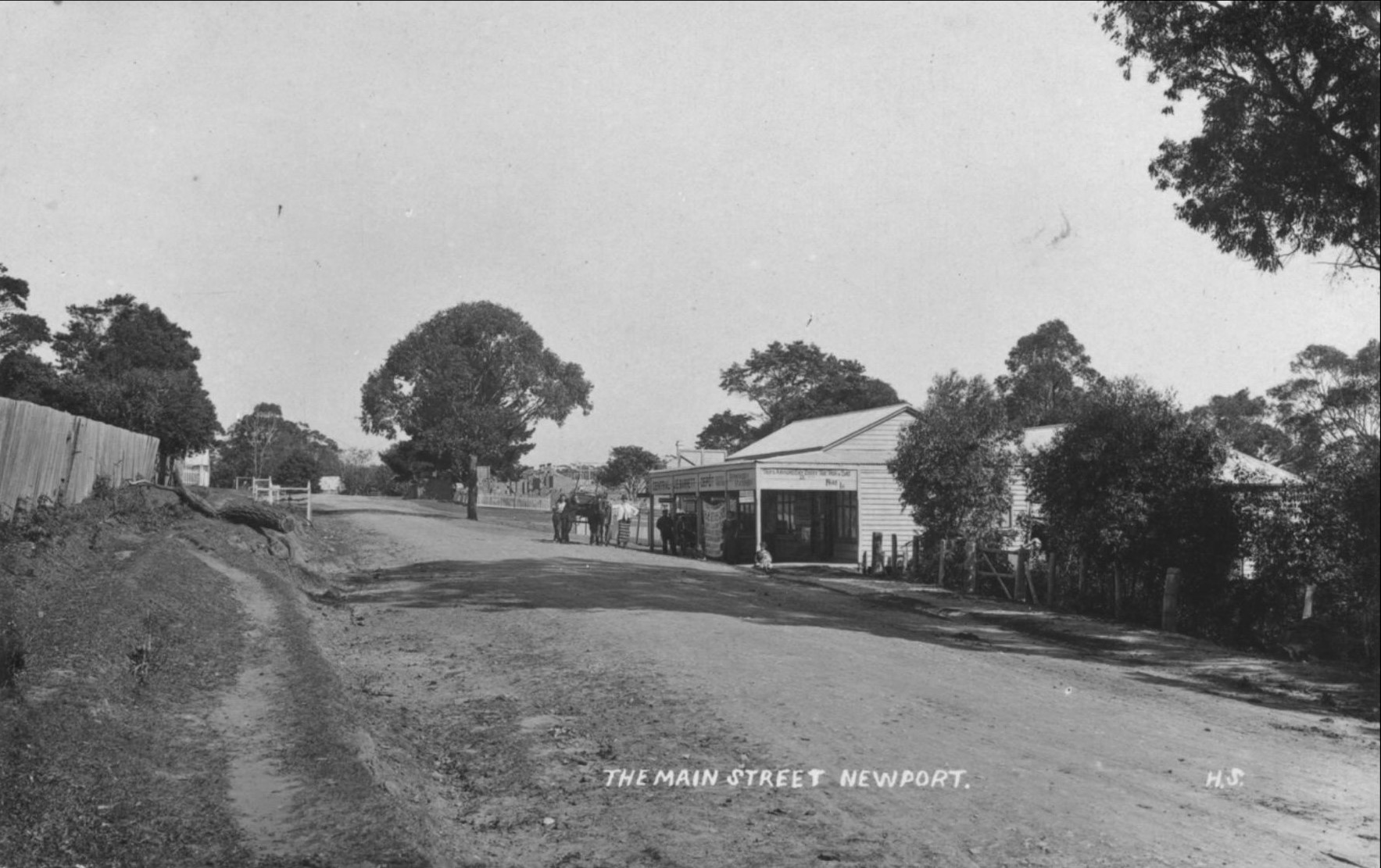
Kalinya Street Newport, circa 1912-13. Photo: postcard collection of John Morecombe. From Barrett Family of Pittwater history page by W J Goddard (II) - link under References
So, although John and Geoff have only found around 30 of his postcards so far, it is likely more views, reports in newspapers, and more postcards will turn up at some stage. All of these would demonstrate Hekseth Swiney's passion for photography and attempts to turn this into a further source of income - but there were also other elements to his pursuit of telling stories through pictures that would have inspired other actions in his life.
The Sydney Mail (1860-1938) a weekly sister publication to The Sydney Morning Herald, pioneered early Australian press photography and was highly regarded for publishing extensive photo-essays, portraits, and pictorial records documenting Australian life, agriculture, society, and global events - although clearly a bit lackadaisical in getting names spelled correctly - which happens in publishing - but it was paid work for a new generation of photographers. The Sydney Mail was keen to showcase photography as a means of sharing news, and using the locals to do so, which means this feature of the 'Beautiful Shire of Warringah', also published in April 1915, may also be Hesketh Swiney's work - uncredited:
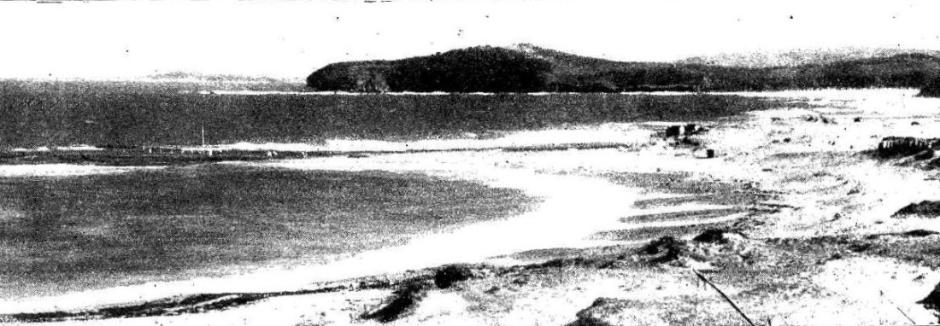
THE BEAUTIFUL SHIRE OF WARRINGAH.
Top: MONA VALE BEACHES, With rock-bath shown in left-centre of picture. A regular hourly service of motor buses takes 'trippers' to this beach.
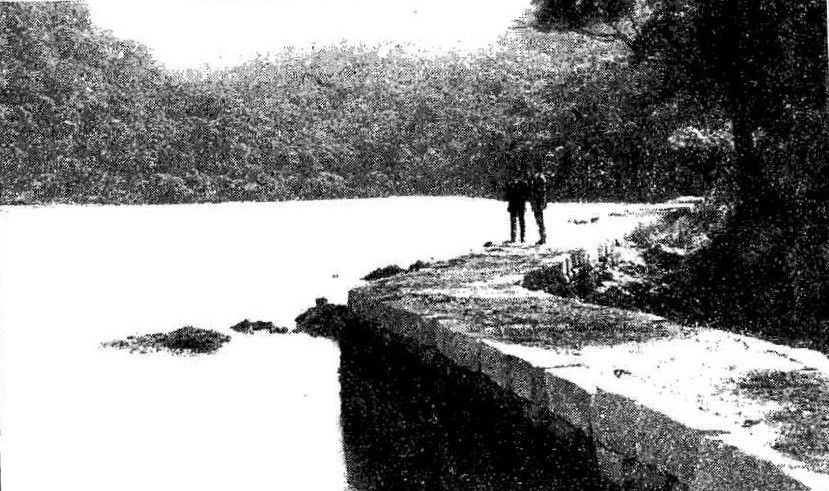
Lovett Bay, Pittwater. A charming inlet in the Ku-ring-gai Chase, which may, be reached by motor launches, to be hired at Newport, Bay View, or Church Point. (This is now known as 'Little Lovett Bay' - remnants of this causeway are where passengers of Church Point Ferry Service disembark when visiting the YHA at Towlers Bay)
The Pretty Little Curl Curl Beach, With a part of Manly showing in the distance.
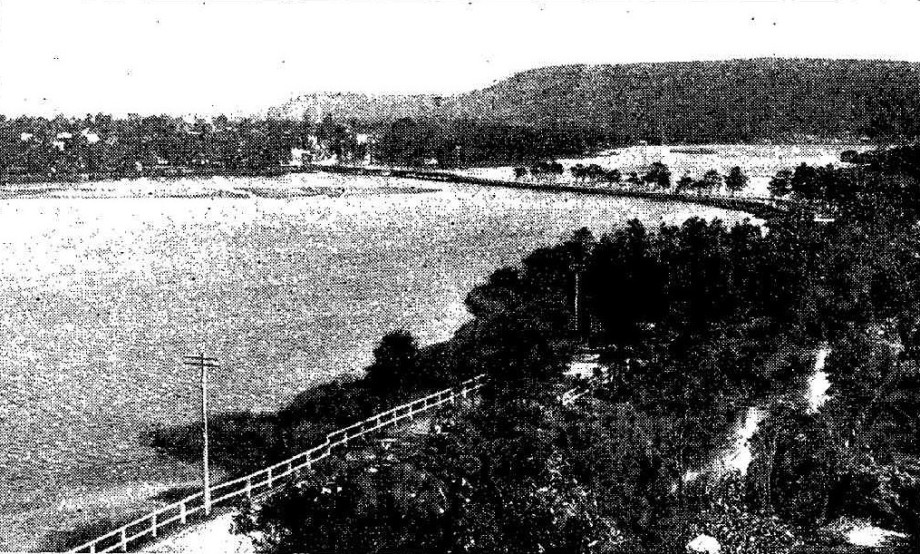
Picturesque Narrabeen. The lower lake and bridges. Narrabeen has become wonderfully popular in recent years. It is easily accessible, and its charms are all-appealing.
.jpg?timestamp=1781806152764)
.jpg?timestamp=1781806176362)
THE BEAUTIFUL SHIRE OF WARRINGAH. (1915, April 7).Sydney Mail (NSW : 1912 - 1938), p. 34. Retrieved from http://nla.gov.au/nla.news-article166255867
And this too is a possible example of his work in the same publication:
MANLY RECRUITS=MEMORIAL SERVICE.=FRENCH FOREIGN LEGION.
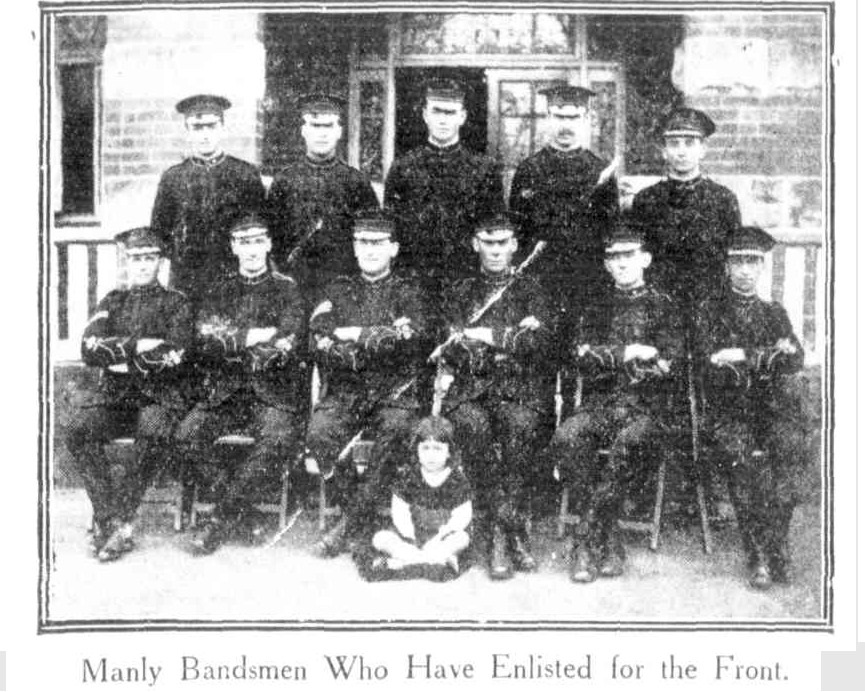
Manly Bandsmen Who Have Enlisted for the Front.
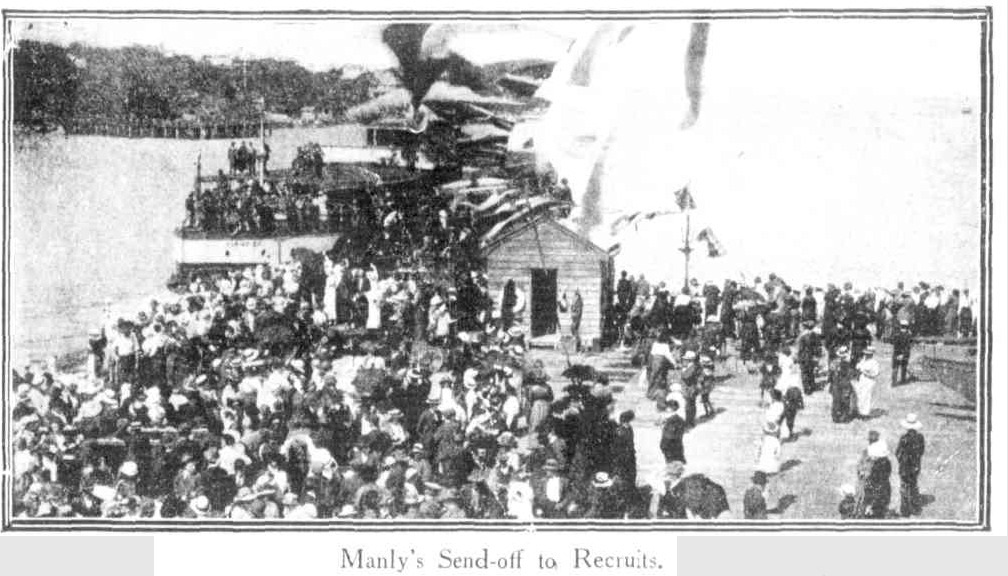
Manly's Send-off to Recruits.
LAST week Manly sent another batch of recruits into camp. They marched through "the village" with banners inscribed: "Manly Still Answering the Call," "Freshwater Boys Answering Duty's Call," and "Warringah Shire to Lend a hand, Fall in and Swell the Ranks, Please." The procession aroused great interest and enthusiasm in Manly, and the steamer bearing the contingent was "cock-a-doodle-dooed" all down the harbour. Many wives, sisters, and sweethearts accompanied the volunt- teers, and hung on to the flanks of the procession until it reached Victoria Barracks.
MEMORIAL SERVICE FOR OUR FALLEN HEROES.
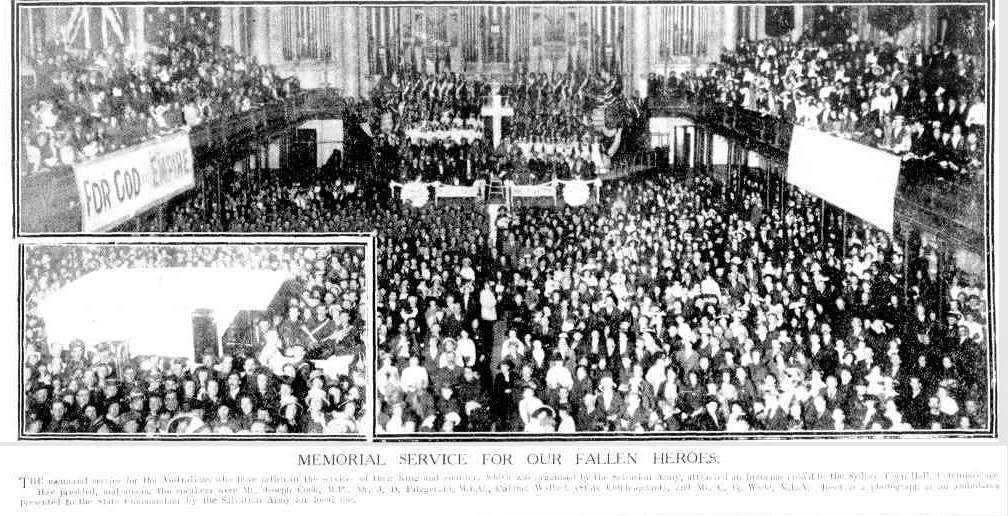
THE memorial service for the Australians who have fallen in the service of their King and country, which was organised by the Salvation Army, attracted an immense crowd to the Sydney Town Hall. Commissioner Hay presided, and among the speakers were Mr. Joseph Cook, M.P., Mr. J. D. Fitzgerald, M.L.C., Colonel Wallak (State Commandant), and Mr. C. G. Wade, M.L.A. Inset is a photograph of an ambulance presented to the State Commandant by the Salvation Army for local use.
MEMBERS OF THE FRENCH FOREIGN LEGION.
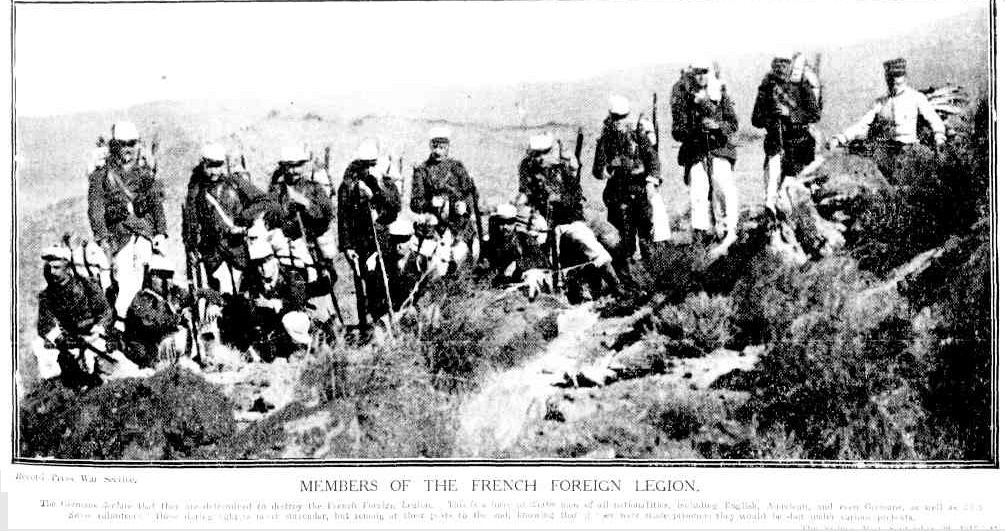
The Germans declare that they are determined to destroy the French Foreign Legion. This is a force of 35,000 men of all nationalities, including English, American, and even Germans, as well as 3000 Swiss volunteers. These daring fight is never surrender, but remain at their posts to the end. knowing that if the were made prisoners they would be shot under various pretexts. Record: Press War Service. MANLY RECRUITS.—MEMORIAL SERVICE.—FRENCH FOREIGN LEGION. (1915, September 29). Sydney Mail (NSW : 1912 - 1938), p. 15. Retrieved from http://nla.gov.au/nla.news-article162493367
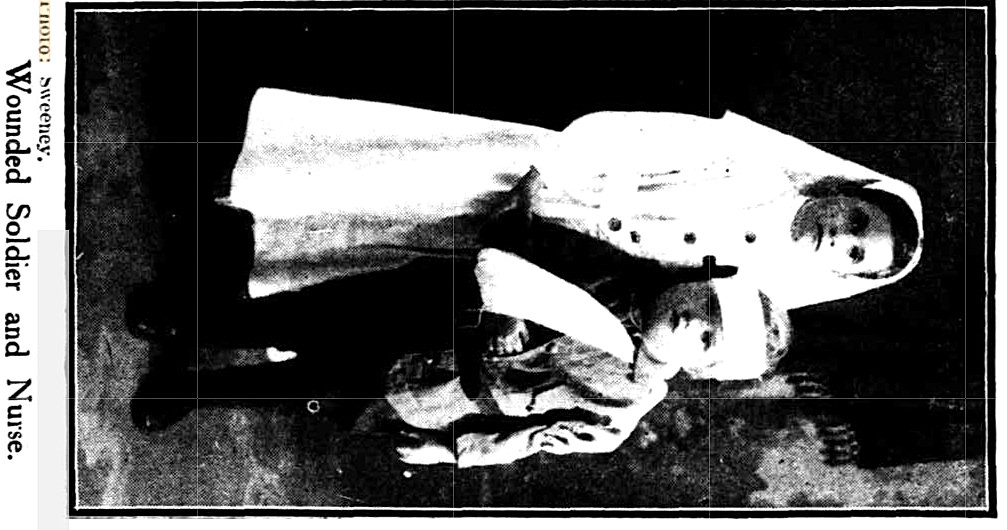
Having been brought up in a military focused family, and having taken the photo above at the fundraiser for those by then starving during World War One in Belgium, and potentially present taking photos when that march through Manly occurred, with all that cheering and calling on others to sign up, it should be no surprise Hesketh would soon decide he too must serve his mother country. Considering his obvious liking for photography it should come as no surprise he enlisted in the fairly new at that stage Royal Flying Corps - an outfit Bilgola's Captain Oswald Watt was also connected with earlier on, although he would fly with the French before joining the Australian Flying Corps.
The Royal Flying Corps (RFC), established by Royal Warrant on April 13 1912, was the air arm of the British Army before and during the First World War until it merged with the Royal Naval Air Service on 1 April 1918 to form the Royal Air Force. During the early part of WW1 the RFC supported the British Army by artillery co-operation and photographic reconnaissance.
A number of Australians received commissions in the RFC and were stationed in England, training at the Brooklands Aviation School, and Scotland prior to being sent to the Front, Bayview's Gordon Taylor among them.
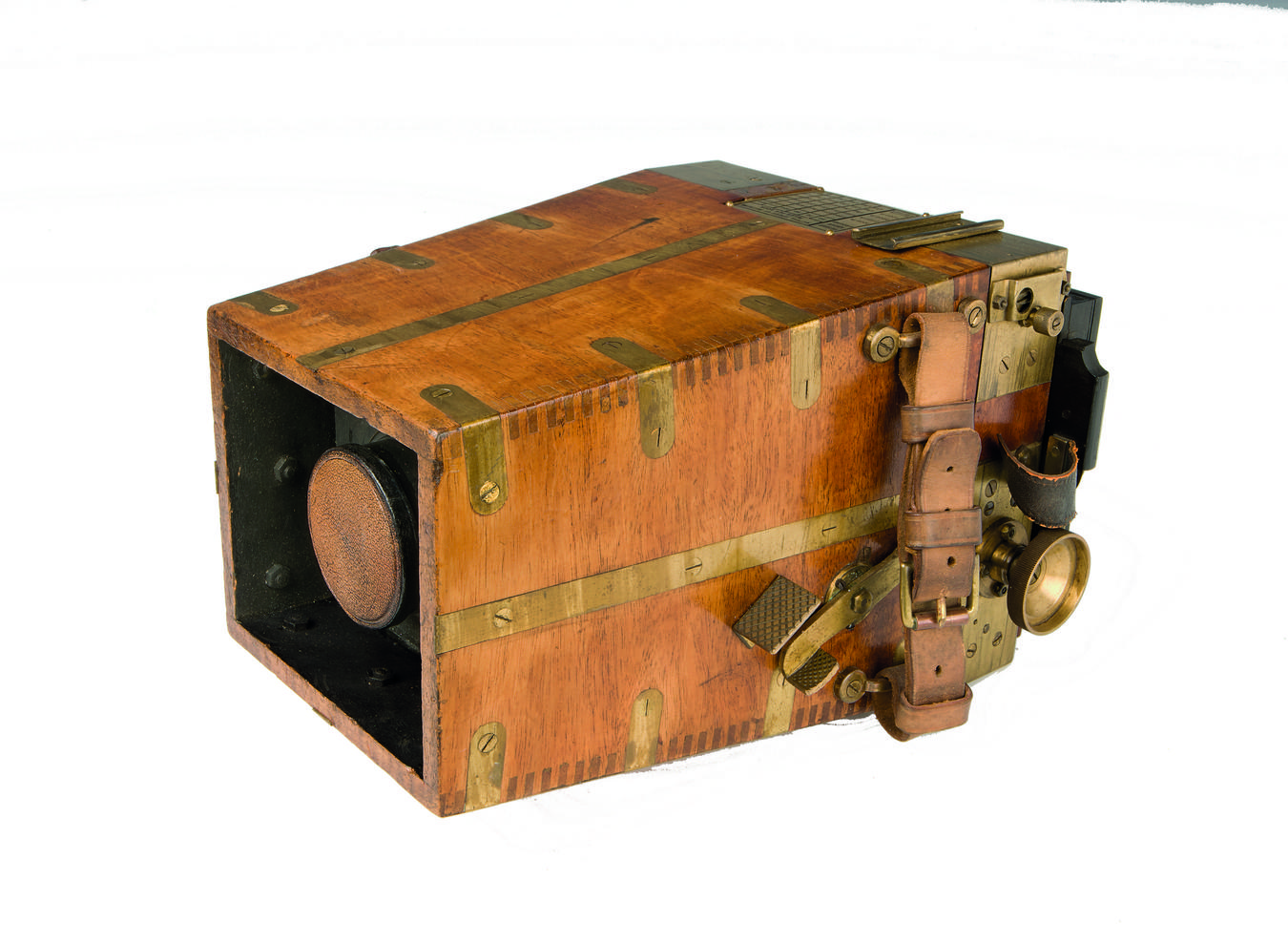
Royal Flying Corps Type A Camera. Photo courtesy Royal Airforce Museum, London.
The Royal Airforce Museum states:
'This hand-held, glass plate camera was designed by the Royal Flying Corps (RFC) and manufactured by the Thornton Pickard Camera Company for aerial photography. The importance of photographic reconnaissance was realised soon after the outbreak of the First World War and a suitable camera was urgently needed by the RFC. The Type A Camera was designed and built quickly but when it entered service in 1915 observers found it heavy and cumbersome to use. The complexity of changing the glass plates after each exposure was a major disadvantage. Date in use: 1915-1918'
In September 1915 the first advertisement for the farm is placed by Mr. Swiney with the news outfits he was then photographing local people for:
LEAVING for Front Poultry Farm, Orchards, 5 ac., Mona Vale, to Let. H. G. Swiney. Narrabeen P.O. Advertising (1915, September 18). The Sydney Morning Herald (NSW : 1842 - 1954), p. 24. Retrieved from http://nla.gov.au/nla.news-article15614354
MONA VALE Five Acres 4 room cottage, stables, orchard, poultry runs, stock, £115 Rent 10 rs. Owner leaving for front, must get away; splendid dogcart turnout, van tools GRAIN, Brookvale. Advertising (1915, October 30). The Sydney Morning Herald (NSW : 1842 - 1954), p. 22. Retrieved from http://nla.gov.au/nla.news-article15621943
The October ad would indicate he has passed the leasing of the property to agents and has already left for the U.K., his camera in his kit bag. The farm was leased to William V Laing of Balmain, Engineer, on January 25 1916, for 56 months.
A lot of men lost their lives serving in the RFC, which Hesketh would have been a witness to or have known them. This snippet tells us in the 12 months to February 1917:
ROYAL FLYING CORPS.
Official figures published of the number of fatal accidents to-members of the R.F.C. show that during the last 12 months no fewer than 98 flying men were killed by accidents, and two fatalities recently brought the number to 100. One of these latter accidents was brought about by an aeroplane colliding with the chimney of a house at Montrose and. remaining fixed fast to the roof. ROYAL FLYING CORPS. (1917, February 12). The Globe and Sunday Times War Pictorial (Sydney, NSW : 1914 - 1917), p. 14. Retrieved from http://nla.gov.au/nla.news-article102215660
Power of Attorney is given to John Geoffrey Smith on June 9 1920 and a surrender of the Lease occurs. The Swiney farm is sold to Blanche Marion Ryan, wife of Walter Widdulph Ryan of Warriewood, Orchardist, on same date.
A year later Blanche sells the property to Francis Michael Earley of Narrabeen, Store Keeper, on June 21st 1921 with the record of transfer dating July 14 1921.
Hekseth Swiney had returned to New South Wales but did not return to Warriewood, purchasing a farm on the Central Coast at Wyoming in September 1920:
Messrs Wilkinson Bros, report the sale of Mr. Murphy's orchard property at Wyoming, the purchaser being Mr. MacSwiney, late of the Aero Corps, England, and ' Mona Vale,' Manly. Items. (1920, September 23). The Gosford Times and Wyong District Advocate (NSW : 1906 - 1954), p. 1. Retrieved from http://nla.gov.au/nla.news-article166832573
This insight into his and his brother's war service published in 1926:
Echoes of the War.
Mr. H. G. MacSwiney, of Wyoming, Gosford, is expecting a visit in March from his brother, the Rev. A. J. E. MacSwiney, who will be en route from South Africa to New Zealand. Like Gosford's Mr. MacSwiney, who served with the Royal Flying Corps, his brother served in the Great War. Prior to its outbreak he was on H.M.S. Hercules, an Admiral's flagship, as Chaplain, and served with her in the North Sea and elsewhere till 1916. Then the Rev. Mac Swiney was transferred to H.M.S. Cliallenger (well-known years ago on the Australian' station), flagship of the naval forces in action on the east coast of Africa.
Returning to England in 1919, the Chaplain resigned from the Navy, and was appointed to a living at Southwell, Notts. After six months there he was selected for special work in South Africa, being appointed Rector of Eshowe, Zululand. Here his aptitude for work among young people led to his being made District Commissioner for the Boy Scouts in Zululand, and some particularly good pbotograplis record the keen interest shown in the movement there by the Prince of Wales, who is shown, with the Rev. MacSwiney, at a big review of Scouts. The ex-Chaplain has now been detailed for work in New Zealand, and Zululand papers show that he was regretfully farewelled at a rally of Scouts of his district, and at a public dinner at Eshowe. Mrs. MacSwiney, while her husband was on war service with the Navy, interested herself actively in women's war work, and held rank as Captain in one of the auxiliaries conducted under the aegis of the Royal Family. Mr. H. G. MacSwiney expects that his brother will reach Sydney on March 14th. Echoes of the War. (1926, January 21). The Gosford Times and Wyong District Advocate (NSW : 1906 - 1954), p. 8. Retrieved from http://nla.gov.au/nla.news-article161114345
He again was an Orchardist and land holder:
Re-subdivision of Lot 30, Section 11, Wyoming Estate (H. G. MacSwiney). Subdivision not recommended owing to insufficient frontage to Day Street. — Adopted. Engineer's Reports. (1927, July 28). The Gosford Times and Wyong District Advocate (NSW : 1906 - 1954), p. 14. Retrieved from http://nla.gov.au/nla.news-article161288552
Proposed Subdivision, Lot. 30, Sec 11, Wyoming Estate, Ph. of Gosford, into Lots 1 and 2 (H. McSwiney owner) — Approval recommended, provided as per plans are submitted in triplicate and provided certain portions are consolidated. — Adopted. Engineer's Reports. (1927, August 18). The Gosford Times and Wyong District Advocate (NSW : 1906 - 1954), p. 10. Retrieved from http://nla.gov.au/nla.news-article161286369
This 1922 Obituary for his mother sheds more light on the family, and surviving children:
OBITUARY.
MRS. SWINEY.
Advice has been received in Sydney of the death of Mrs. Rosa F. E. Swiney (whose family name is MacSwiney), of Sandford Lawn, Cheltenham, England, who has won distinction as artist, author, and lecturer. Mrs. Swiney was the daughter of Major John Biggs 4th Royal Irish Dragoon Guards, and married in 1870 John Swiney, Major-General, M.S.C..
Mrs. Swiney studied art under James Danby, and exhibited in Birmingham, Simla, and Madras. On returning from India to England in 1877 she did active political work during the Home Rule controversy, and was also associated with the Primrose League in the Unionist cause. Mrs. Swiney was one of the founders of the Cheltenham Women's Suffrage Society.
Mrs. Swiney's best-known books are "The Awakening of Woman", "The Cosmic Procession," "Woman and Natural Law," "The Bar of Isis," and "The Mystery of the Circle and the Cross." Her last two books "The Esoteric Teaching of the 'Gnostic," and "The Ancient Road," have created great interest.
Mrs. Swiney leaves four sons and one daughter-Major MacSwiney (late 20th Hussars), Mr H. MacSwiney (who had a commission in the R.F.C., and is now farming in Australia), Mr. S. MacSwiney (who was an officer with the New Zealand Artillery, and is now in Brisbane), the Rev. A. MacSwiney (who was chaplain of H. M.S. Challenger), and Miss Gladys MacSwiney (who was attached to the honours department at the War Office, and later received a commission in the Queen Mary's Army Auxiliary Corps). OBITUARY. MRS, SWINEY. (1922, June 15). The Sydney Morning Herald (NSW : 1842 - 1954), p. 6. Retrieved from http://nla.gov.au/nla.news-article16007674
In 1929 he married, at St. Giles church, Lane Cove:
MAC SWINEY-TATE-November 23, 1929, at St Gile's Church Greenwich, by the Rev A Lawford. Hesketh, George Mac Swiney, second son late Major General John I.S.C. and Mrs Swiney, of Sandford Lawn, Cheltenham, England, to Eileen Mary daughter of Mrs L G Tate, Springfield, Canterbury, New Zealand. Family Notices (1930, January 11). The Sydney Morning Herald (NSW : 1842 - 1954), p. 14. Retrieved from http://nla.gov.au/nla.news-article16617051
Tragically, Eileen passed away on July 5 1935.
A year later he remarried:
MacSWINEY-DODD.-At St. Peter's Church, Hornsby, on August 22 by Bishop Wilton, Hesketh George Henry MacSwiney, son of the late Major-General Swiney, I.S.C., and Mrs Swiney of Sandford Lawn, Cheltenham, England, to Clare, widow of Dr Sydney Dodd, late Captain, 10th Hussars, and of Sydney University. Family Notices (1936, August 29). The Sydney Morning Herald (NSW : 1842 - 1954), p. 16. Retrieved from http://nla.gov.au/nla.news-article17265209
He was farming oranges if Notices in the Gosford Packing House during the 1920's are correct - and had strong opinions about looking after Australians and Australian farmers:
'GOSFORD, WAKE UP!'
To the Editor.
Sir, — I read with interest in last Thursday's issue of the 'Gosford Times ' Mr. L. B. Rae's letter headed, 'Growers, Wake Upl ' referring to. the importation of American navel oranges into this country, and the 'Daily Guardian's', praise of,- this fruit, and its comparison with Australian grown oranges. The picture in the ''Daily Guardian'' I consider most misleading, the Australian orange not being a true representative of a navel orange; and anyhow, who could produce a choice navel this time of the year, except a second crop orange, which is not a true comparison. There is no doubt that the Australian orange was placed downwards with its stalk end uppermost, and as Mr. Bae infers, it may be anything.
Apart from this, why let American oranges come into this country? It means that £2500 goes out of Australia to America by every Matson liner, money that should be kept in this country for circulation. There are plenty of good second crop oranges grown in Australia to satisfy the public until our main crop comes in in May; why buy this American imported fruit ? The orange may look nice wrapped in paper but when cut, I am told is almost devoid of juice. Some people may argue, why bother? We shall be able to send our oranges to America when they have none — it cuts both ways! I don't think Americans will ever allow our oranges into their country. They can grow all they want and more, and probably can grow oranges nearly all the year round, having as much of variable climate as Australia — upper and lower California on the west, and Florida on the east of the continent. The growers should take some action to stop these American oranges and Italian lemons, which come into this country; and Mr. Bae's suggestion regarding the forming of a Fruitgrowers' Union is a step in the right direction. — Yours, &c., H. G. H. MacSWINEY "GOSFORD, WAKE UP!" (1927, March 24). The Gosford Times and Wyong District Advocate (NSW : 1906 - 1954), p. 18. Retrieved from http://nla.gov.au/nla.news-article161285304
Small oranges are selling at five for a shilling in Auckland, says a letter received by Mr. H. G. McSwiney, Wyoming, from his brother in New Zealand. Accompanying the letter is a column extract from the 'New Zealand Herald,' featuring strong criticisms in Sydney of the N.Z. Government's restrictions on N.S.W. fruit, issued by the Fruit growers' Federation. PARS AND PERSONS (1937, July 22). The Gosford Times and Wyong District Advocate (NSW : 1906 - 1954), p. 1. Retrieved from http://nla.gov.au/nla.news-article167869621
This marriage didn't last with divorce proceedings commenced in May 1939 and finalised in 1940. Mr. Swiney won a small 'joke of the week' competition in 1939, which may be an insight into what was happening in the union. This had been preceded by his new wife giving knitted baby clothes to a local organisation - so perhaps they lost a child during her term of carrying the baby and the marriage didn't survive this loss. No record of death for a child is listed in the NSW Births, Deaths, and Marriages register.
Hesketh sued for the separation with the Issue listed as 'conjugal rights' and requiring a Restitution Order- the privileges and obligations implied by the marriage bond. Historically and legally, this includes the right to companionship, affection, and sexual relations between spouses. In 1939, a Restitution Order (or Decree for Restitution of Conjugal Rights) was a legal mechanism used in common law jurisdictions, such as Australia, England, and Wales, to force a separated spouse to return to the matrimonial home. So Clara has clearly already left the family home.
NARARA SUNSHINE CLUB
Annual meeting of the Narara Sunshine Club was held last Tuesday afternoon. Officers elected were President, Mrs. Jeaneret; Vice Presidents, Mrs. Haynes and Mrs. Nichols; Secretary, Mrs Sharpe; Treasurer, Mrs. C. O'Neill; Publicity Officer, Mrs. T. O'Neill. It was decided to hold a 'flannel dance' in March. Arrangements are also being made by tbe club for a garden party to be held soon in the beautiful grounds at the home of Mr. and Mrs Mosse-Robinson, to raise funds for the Ambulance. A parcel of beautifully knitted baby garments was received with thanks from Mrs. McSwiney, of Wyoming. NARARA SUNSHINE CLUB (1938, February 24). The Gosford Times and Wyong District Advocate (NSW : 1906 - 1954), p. 6. Retrieved from http://nla.gov.au/nla.news-article167866474
This week's winning joke: —
A little boy was sent by his mother to his father's office, with a message. On his arrival his father was busy with his typist, and he was told to wait in the next room. At tea time the boy asked his mother, 'Do hens have lips?' The mother told him to be quiet, and not ask silly questions. The boy persisted, and his father said, 'Why don't you answer the boy; he will never learn unless you answer his questions?' The mother said, 'What is it John, you want to know'? 'Do hens have lips?' Of course they don't; why do you ask?' 'Because I heard father say to Miss. Evans, 'I wish my old hen had lips like yours'!' H. G. MacSWINEY, Wyoming, Gosford. Advertising (1939, March 7). The Gosford Times and Wyong District Advocate (NSW : 1906 - 1954), p. 7. Retrieved from http://nla.gov.au/nla.news-article166934995
Hesketh George Henry MacSwiney v Clara Annie MacSwiney; IN DIVORCE. DECREES ABSOLUTE (1940, November 29). The Sydney Morning Herald (NSW : 1842 - 1954), p. 5. Retrieved from http://nla.gov.au/nla.news-article17697195
Undeterred, he married again in 1945, this time to May Ashley Hughes Forster at Wahroonga, who was a widow and had children - this Notice also gives us the name of the farm at Wyoming:
BARLOW—HUGHES.—The Engagement is announced of Vera, only daughter of the late Herbert Hughes, St. John' s Wood, London, and Mrs. MacSwiney, Bemersyde, Gosford, to Walter, only son of Mr. and Mrs. R. M. Barlow, Dulwich Hill, New South Wales. Family Notices (1947, April 19). The Sydney Morning Herald (NSW : 1842 - 1954), p. 38. Retrieved from http://nla.gov.au/nla.news-article18022242
NSW BDM's record:
14495/1945 MACSWINEY, HESKETH GEORGE HENRY to FORSTER, MAY ASHLEY HUGHES - registered at CHATSWOOD
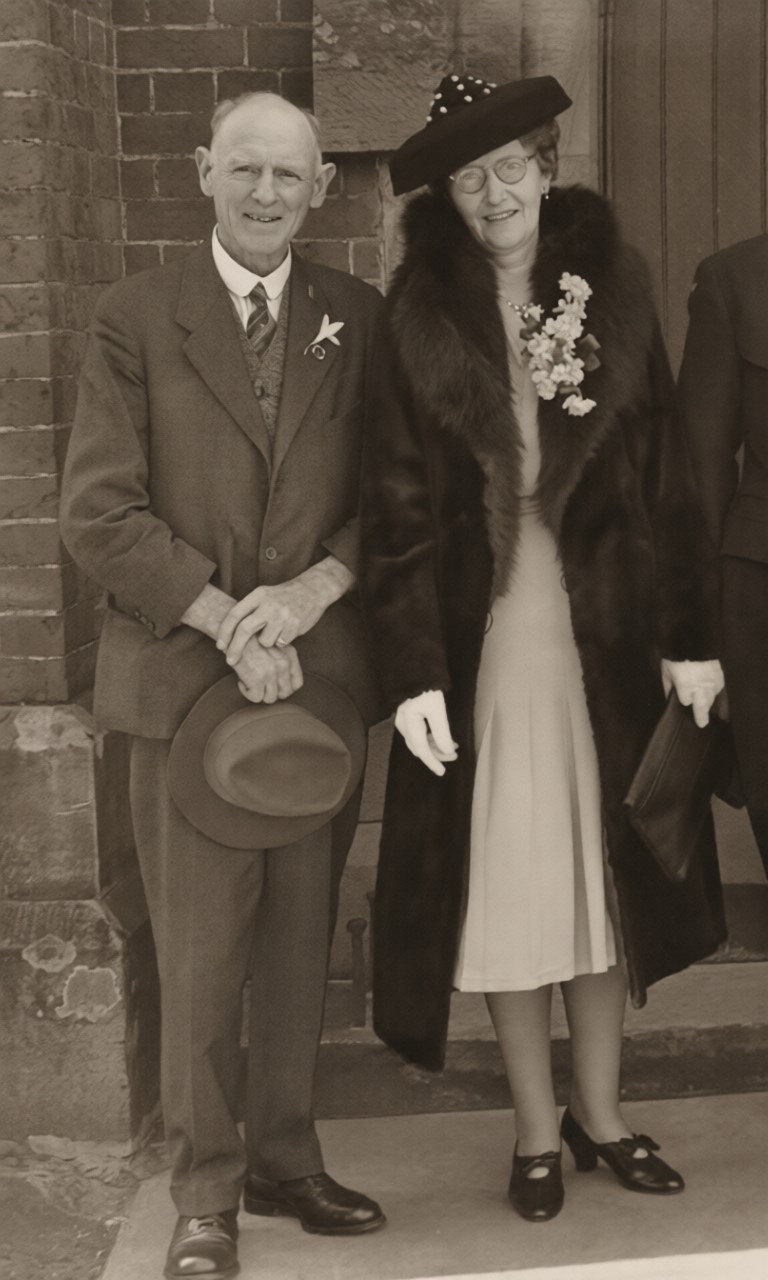
Photo of Hesketh George Henry Swiney (MacSwiney) and 'Minetta May' Gellett (Third Wife) at her son's wedding, Anthony (Peter) Ashley Forster, who was married on September 8, 1945, in Camden, New South Wales, Australia. Photo supplied by and courtesy of the Gellett family, by Stuart Armstrong.
Bemersyde is a hamlet in the Mertoun parish of Berwickshire, in the Scottish Borders. It sits on the left bank of the River Tweed, about three miles east of Melrose.
The third Mrs Hesketh MacSwiney lived at Wyoming Valley until at least 1949 but they separated, after which Hesketh moved to Burwood in Sydney.
Hesketh Swiney passed away in 1964 and was interred in Rookwood General Cemetery in the Church of England section.
Hesketh George Henry MacSwiney, late of Burwood, N.S.W., retired nurseryman, died 1st August, 1964; an election to administer, with the will dated 10th November, 1955, annexed, was filed on 14th April, 1965. IN the matter of the estates of the undermentioned deceased (1965, April 23). Government Gazette of the State of New South Wales (Sydney, NSW : 1901 - 2001), p. 1382. Retrieved from http://nla.gov.au/nla.news-article220391573
No further photographs outside of those taken here between 1910 and 1915 could be found, not even in Gosford Library's History sections. Perhaps his own camera was broken when flying as part of the RFC or perhaps being a photographer, following his mother's own artistic nature, no longer suited him.
Those he did take while here, to supplement an income that could be variable when engaged in growing produce, provide treasured insights into how this place looked and how a photographer-farmer went about boosting his income outside of harvest times.
References - Extras
- Tram Memorabilia - Historic daylight run for Sydney light rail begins 80 years after last tram to Narrabeen closed
- Remembrance Day 2016: War Memorials - Mona Vale, November 14, 1926
- Collin’s Retreat, Bay View House, Scott’s Sanatorium, Guest and Boarding House: Crystal Bay, Newport
- Roads In Pittwater: The Bay View road
- La Corniche, Bayview
- The Oaks - La Corniche
- Brock's The Oaks - La Corniche from 1911 to 1965: Rickards, A Coffee King, A Progressive School, a WWII Training Ground
- Mona Vale Training Grounds: From Lancers on Horses to Lasses on Transport Courses
- Pittwater Roads II: Where The Streets Have Your Name- Warriewood
- Walter Oswald Watt 11 February, 1878 – 21 May, 1921
- Sir Patrick Gordon Taylor 21 October 1896 - 15 December 1966
- Barrett Family of Pittwater: History by William (Bill) James Goddard
- John Morecombe, Geoff Searl OAM, Bill Goddard
- TROVE - National Library of Australia
- Historical Land Records Viewer, NSW Government
- NSW Records and Archives
Cheltenham: Cheltenham College, 1928; The Gloucestershire Echo, “Cheltenham and County,” 4. Col. Swiney himself was born in Cheltenham and went to the College as a day boy from 1841 to 1848. His father and his uncle, John Swiney, were two of the first directors of the college. As Buettner examines in Empire Families, Cheltenham College and similar schools ‘not only attracted a substantial imperial clientele but also played central roles in perpetuating this identity into the next generation by training their pupils for imperial careers’ .
He had visited the family in 1879, when he was granted furlough for 14 months on medical certificate. Their fourth son, Arundel Swiney, was born in 1881, followed by their surviving daughter, Gladys Swiney, in 1887.
The Gloucestershire Echo, “Death of Mrs. Rosa Frances Swiney,”; His sons followed in his footsteps; all of them went to Cheltenham College as Day Boys. Afterwards, the first two served in India, the third in Australia, and the last one became a Reverend, like his great-uncle, and then Naval Chaplain.
From: Albrecht, Jessica A. (2021), Hale, Amy (ed.), "Mrs. Rosa Frances Swiney: Imperial Feminism and Eugenics in Theosophical Evolutionist Thought", Essays on Women in Western Esotericism: Beyond Seeresses and Sea Priestesses, Cham: Springer International Publishing, pp. 21–44, doi:10.1007/978-3-030-76889-8_2, ISBN 978-3-030-76889-8
Since 1890, Rosa Frances Swiney was a feminist activist, lecturer, and writer in Cheltenham. She co-founded the Cheltenham Women's Suffrage Society (Cheltenham WSS) in 1896;[3] was Vice President of the Cheltenham Food Reform and Health Association;[citation needed] and lectured in organisations such as the Higher Thought Centre in London, Theosophical lodges and Ethical Societies. Swiney was also a member of the Theosophical Society (TS), the Sociological Society, the National Union of Women Workers (NUWW), the Eugenics Education Society, the Secular Education League, the Primrose League, the Woman's Freedom League (WFL), and the National Woman's Social and Political Union (WSPU), as well as of the council of the Woman's Branch of the International Neo-Malthusian League. In 1913, Swiney was assaulted during a speech to a crowd in Cheltenham, and again the next day, for speaking up for women in Cirencester.
Swiney was personally connected to various prominent figures of her time, such as Charlotte Despard, Harriet McIlquham, Charlotte Stopes, Margaret Sibthorpe, Elizabeth Clarke Wolstenholme-Elmy, and Annie Besant.
Since 1910, her books were co-published by the League of Isis, which she founded in 1909. The League of Isis aimed to bring about "the betterment of the Race, by individual observance of the Natural Law of reproduction (...) for the building up of the Higher Self".[4] This organisation, together with her writings, reflects a deep engagement in theosophical teachings: the belief in a spiritual evolution and in the Divine Mother (Isis), as well as the convincement that Theosophy can overcome the boundaries between science and religion.
Frances Biggs spent most of her childhood in Ireland, returning to India apparently in early adulthood; she studied under James Danby, son of Francis Danby RA, and specialised in pictures of Indian scenery and life, exhibiting at Simla, Madras, and Birmingham, having even intended taking up painting as a profession, but on 1 June 1871 she married Major John Swiney (1832-1918), of Donegal, and became a full-time wife and mother; in 1877 Swiney returned to Britain and settled in Cheltenham, Gloucestershire, where her husband finally joined her ten years later (he retired in 1890); she soon became involved in political activity, first through the Primrose League; her main political and philisophical interest was feminism and became involved with the Women's Emancipation Union, and in 1896 joined with Harriet McIlquham and others to form the Cheltenham Women's Suffrage Society, of which she remained the president until it merged with the local Women Citizens' Association in 1920; her writing increasingly reflected her interest in a theosophical matriarchalism, and an evolutionary philosophy of feminism.
Frances MacSwiney
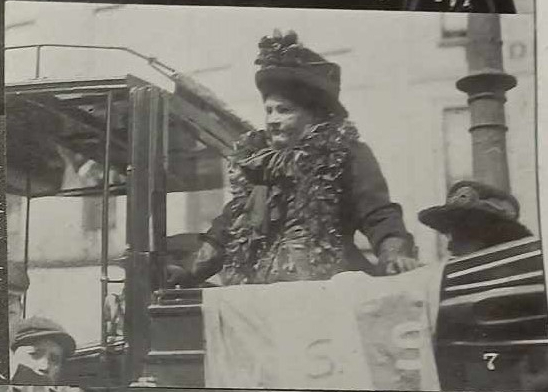
Rosa Frances Swiney in the Cheltenham Chronicle and Gloucestershire Graphic, 29 April 1911
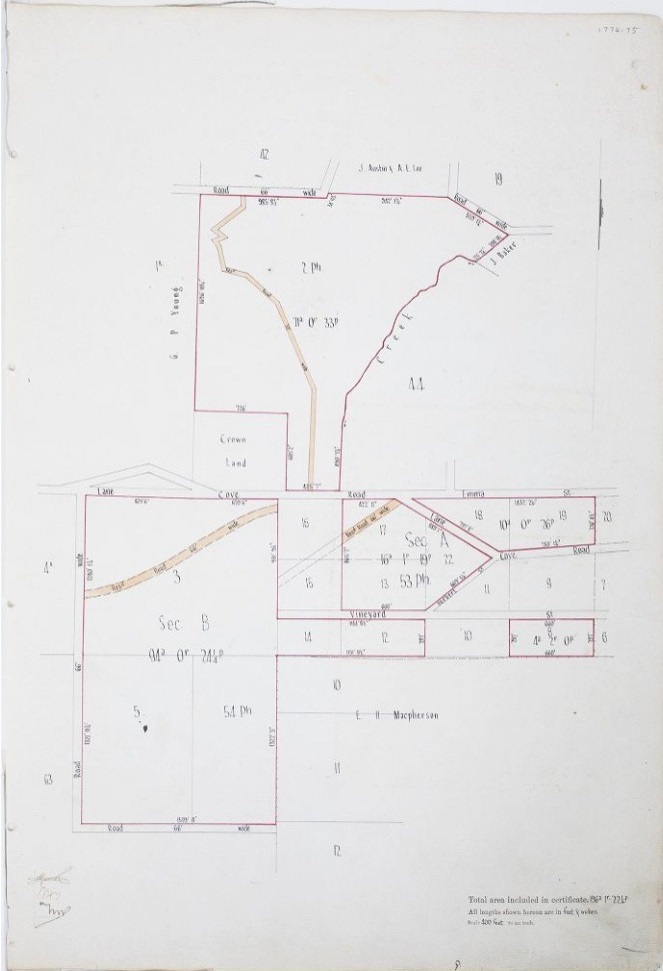
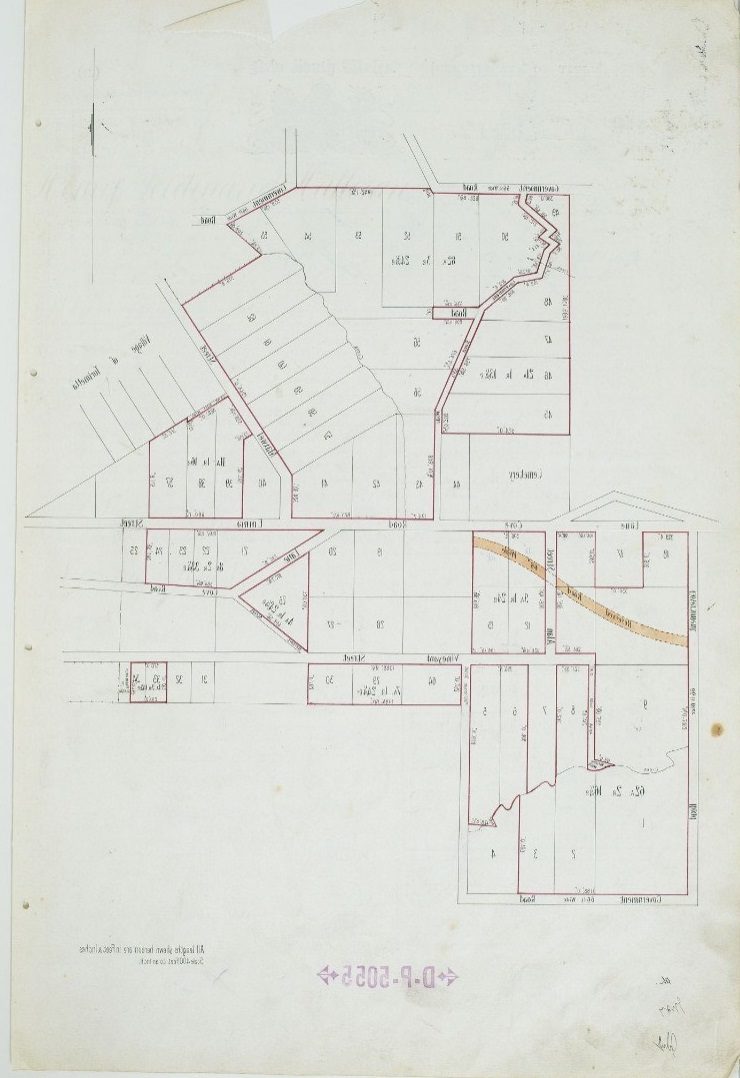
NOTICE UNDER REAL PROPERTY ACT.
APPLICATIONS having been made to bring the lands hereunder described under the provisions of the Real Property Act, Certificates of Indefeasible Title will issue, unless Caveats be lodged in accordance with the Third Schedule to the said Act, ON OR BEFORE THE 30TH MAY, 1906
No. 14,106. APPLICANT Henry Ferdinand Halloran, Sydney. LAND:—County of Cumberland, parish of Narrabeen, 4 acres 2 roods, 7 acres 3 roods 16 1/2 perches, 17 acres 32 perches, 10acres 26 perches, 71 acres 33 perches, and 86 acres 1 rood 8 perches, situated in Vinevard-street, Herbert-street, Emma-street, and Lane Cove Road, near Pitt Water,—being lots Nos. 8, 12, 14, 13, 17, 22, 18 and 19 of section A, lots Nos. 1 to 18, the sites of Vineyard-street, Alfred-street, and Orchard-street, and reserves of section B of the Collingwood Estate, and is the whole of 40 acres, portion No. 3, 26 acres portion No 5, and 20 acres (portion No. 54 of parish) granted to Thomas Collins, and part of 115 acres 2 roods (portion No. 53 of parish) and part of 80 acres (portion No. 2) granted to the said Thomas Collins, exclusive of the roads 1 chain wide and 50 links wide, the areas of which have been deducted from the total areas; adjoining the properties of J. Austin and A.E.Lee or D. Macpherson, J. Baker, Union Bank of Australia, J. F. Duffy, E. H. Macpherson, C. P. Harrington, land owners unknown, and Crown Land. NOTICE UNDER REAL PROPERTY ACT. (1906, April 11). Government Gazette of the State of New South Wales (Sydney, NSW : 1901 - 2001), p. 2352. Retrieved from http://nla.gov.au/nla.news-article226476104
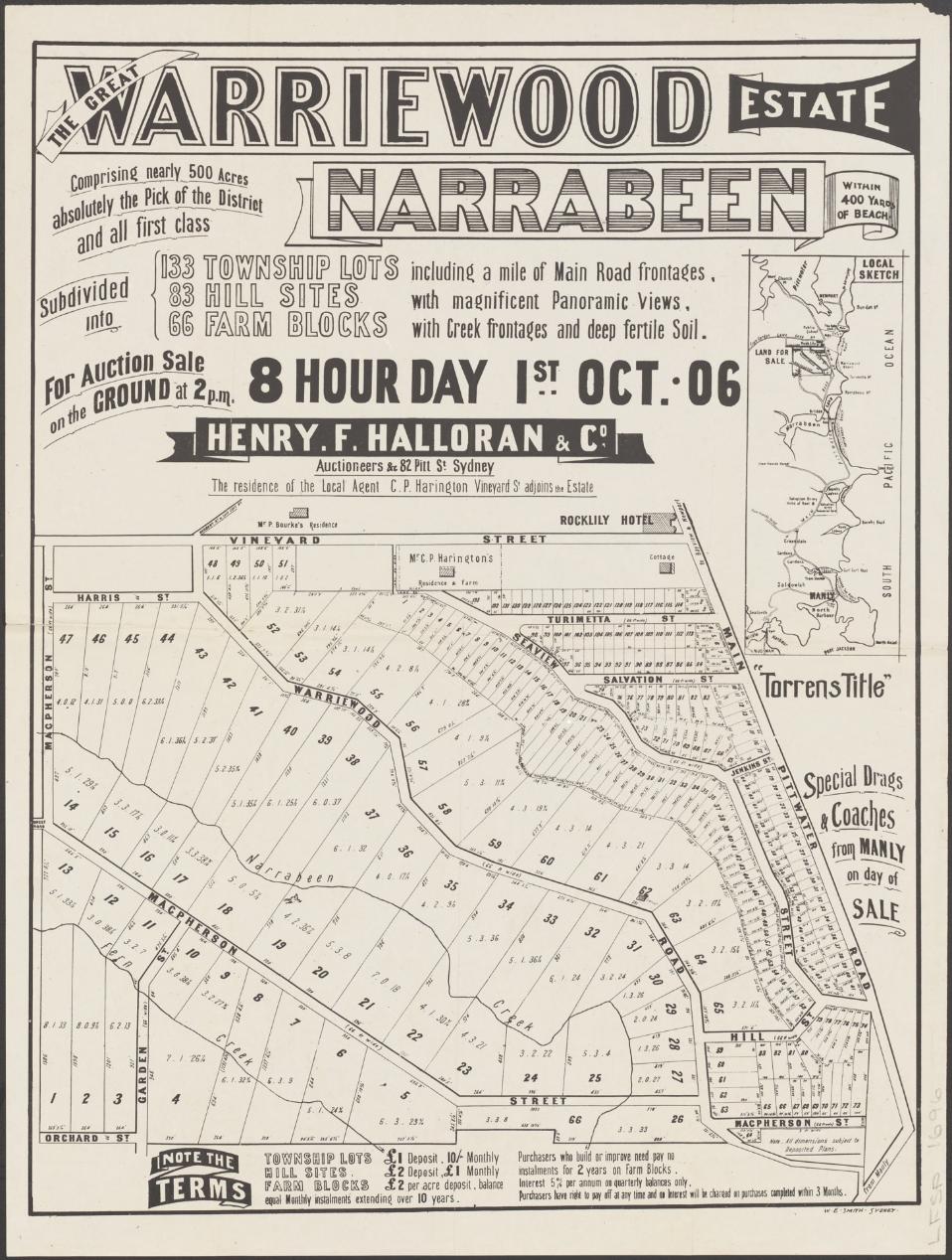
EIGHT-HOUR DAY. KEEP IT OPEN. TO BE AUCTIONED BY HALLORAN. ON THE GROUND. AT 2. THE GREAT WARRIEWOOD ESTATE, NARRABEEN. A PERFECTLY NEW ESTATE (NO REMNANTS), COMPRISING 160 LARGE TOWNSHIP LOTS, WITH A MILE OF MAIN-ROAD FRONTAGES, 80 MAGNIFICENT ELEVATED HILL SITES, AND 70 SPLENDID FARMS, MOSTLY WITH CREEK FRONTAGES. HUNDREDS OF ACRES TO SELECT FROM OF COASTLANDS, UNEQUALLED EITHER. NORTH OR SOUTH. SPECIAL DRAGS FROM MANLY. EASY TERMS.TORRENS TITLE. PLANS. FULL PARTICULARS IN FUTURE ISSUE. ' HENRY F, HALLORAN AND CO., Auctioneers, 52 Pitt-street. Advertising. (1906, August 18). The Sydney Morning Herald(NSW : 1842 - 1954), p. 20. Retrieved from http://nla.gov.au/nla.news-article14809570
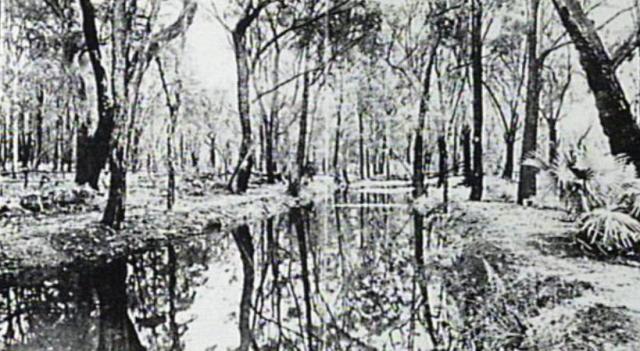
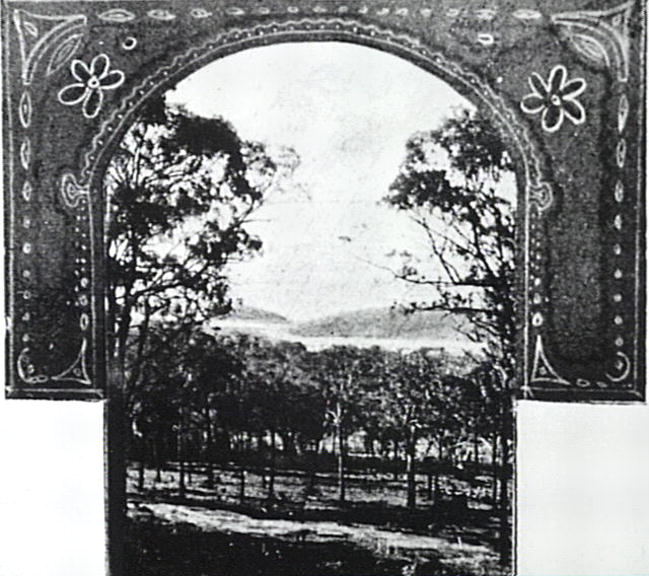
Photograph of Narrabeen Creek and surrounding land that appeared in the brochure advertising sale of land in the Warriewood Estate by Henry F. Halloran & Co. 1906. Image No: WW\WW-004. Courtesy of Mona Vale Library's Historical Images.
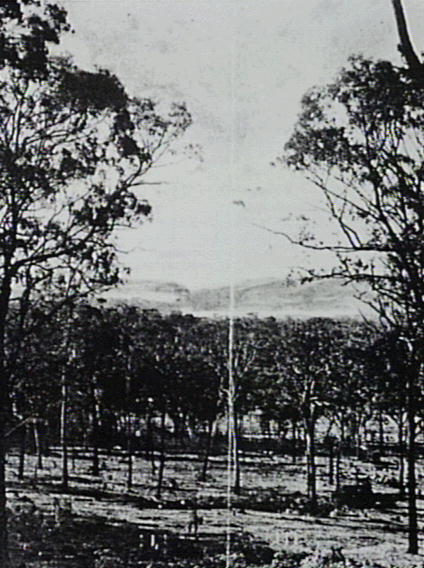
Below: Photograph of Warriewood Valley that appeared in the brochure advertising sale of land in the Warriewood Estate by Henry F. Halloran & Co. 1906. Image No: WW\WW-006. Warriewood (N.S.W.); 1906. Courtesy of Mona Vale Library's Historical Images.
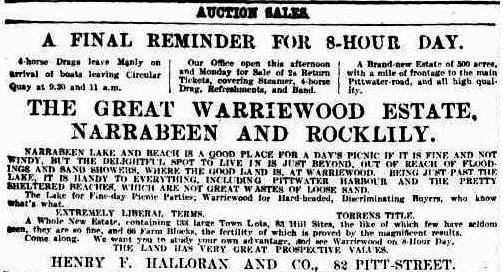
Sales were a day's ‘outing’ and included refreshments and a band ! The 8 Hour Day is now known as Labour Day.
Advertising. (1906, September 29). The Sydney Morning Herald(NSW : 1842 - 1954), p. 22. Retrieved from http://nla.gov.au/nla.news-article14821059
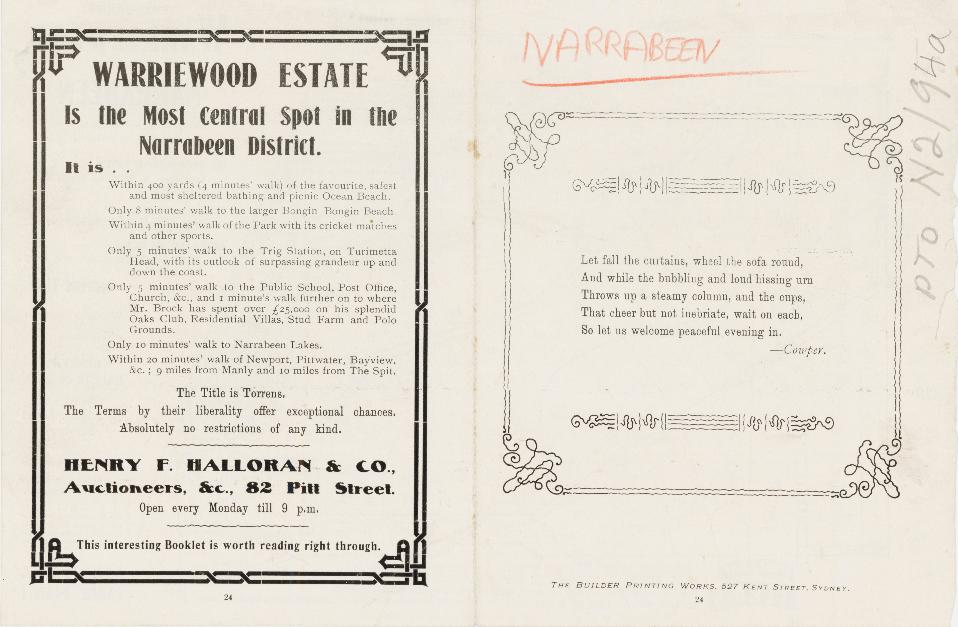
The climate is so salubrious, and the temperature so mild and even, that all plants and flowers flourish with luxuriance and come to maturity and bear some weeks earlier than in other districts around Sydney, with the consequent high prices always paid for early products of good quality.
There is almost an entire absence of frost, as proof of which it may be stated that as many as three crops of potatoes have been obtained in one year from the same piece of land.
…Fine timber, including Ironbark, Stringybark, Grey Gum, Turpentine, Mahogany, Forest Oak and others are available in plenty for building, fencing, firewood and other purposes. Many of the trees are very fine and were pushing their leaves to the sunlight long before Captain Cook landed.
The fine coastal rainfall here is ample for all requirements, and the excellent loamy soil possesses that grand characteristic of retaining the moisture for much longer than ever happens between rains; the surface never cakes or bakes, so that even in what might be termed a dry season all vegetation continues to flourish, and droughts as experienced in the country districts are quite unknown." From Brochure Henry Halloran & Co, The Great Warriewood Estate, 1906.

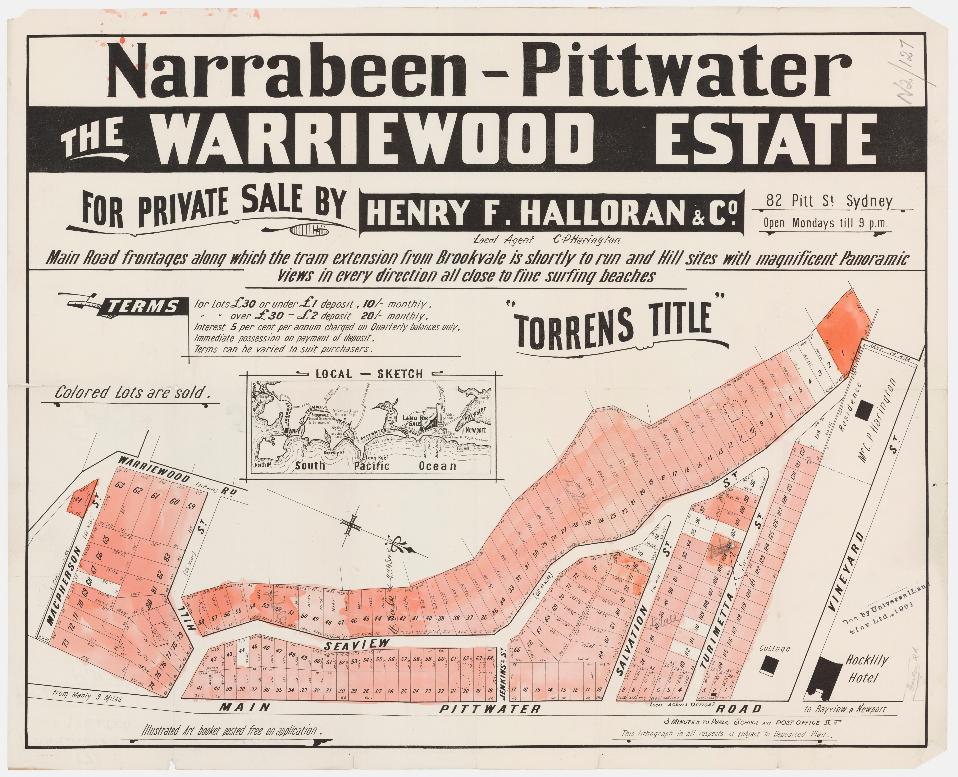
Photograph of Warriewood Beach that appeared in the brochure advertising sale of land in the Warriewood Estate by Henry F. Halloran & Co. 1906
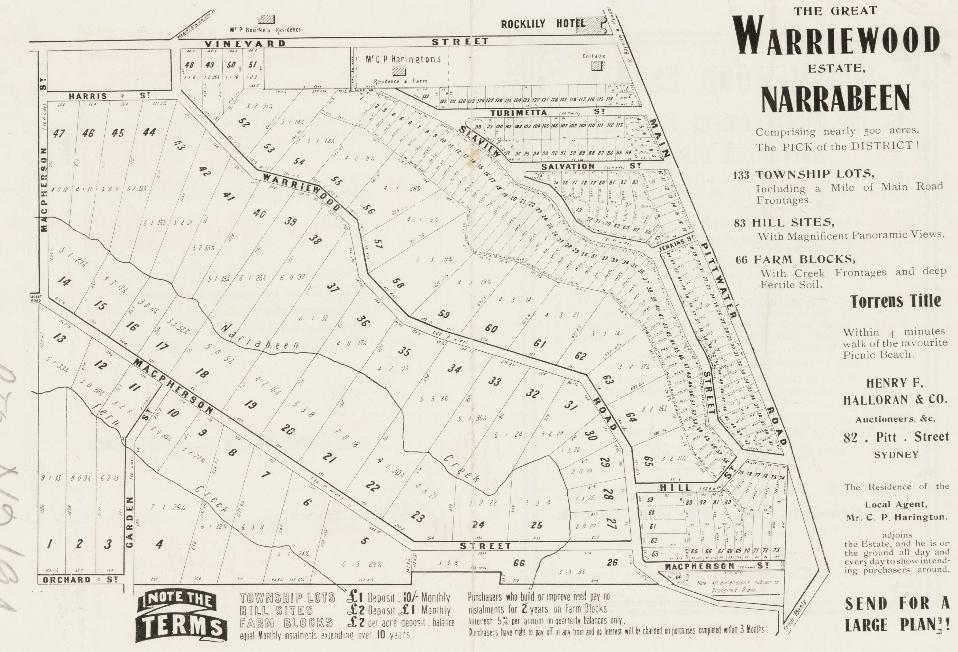
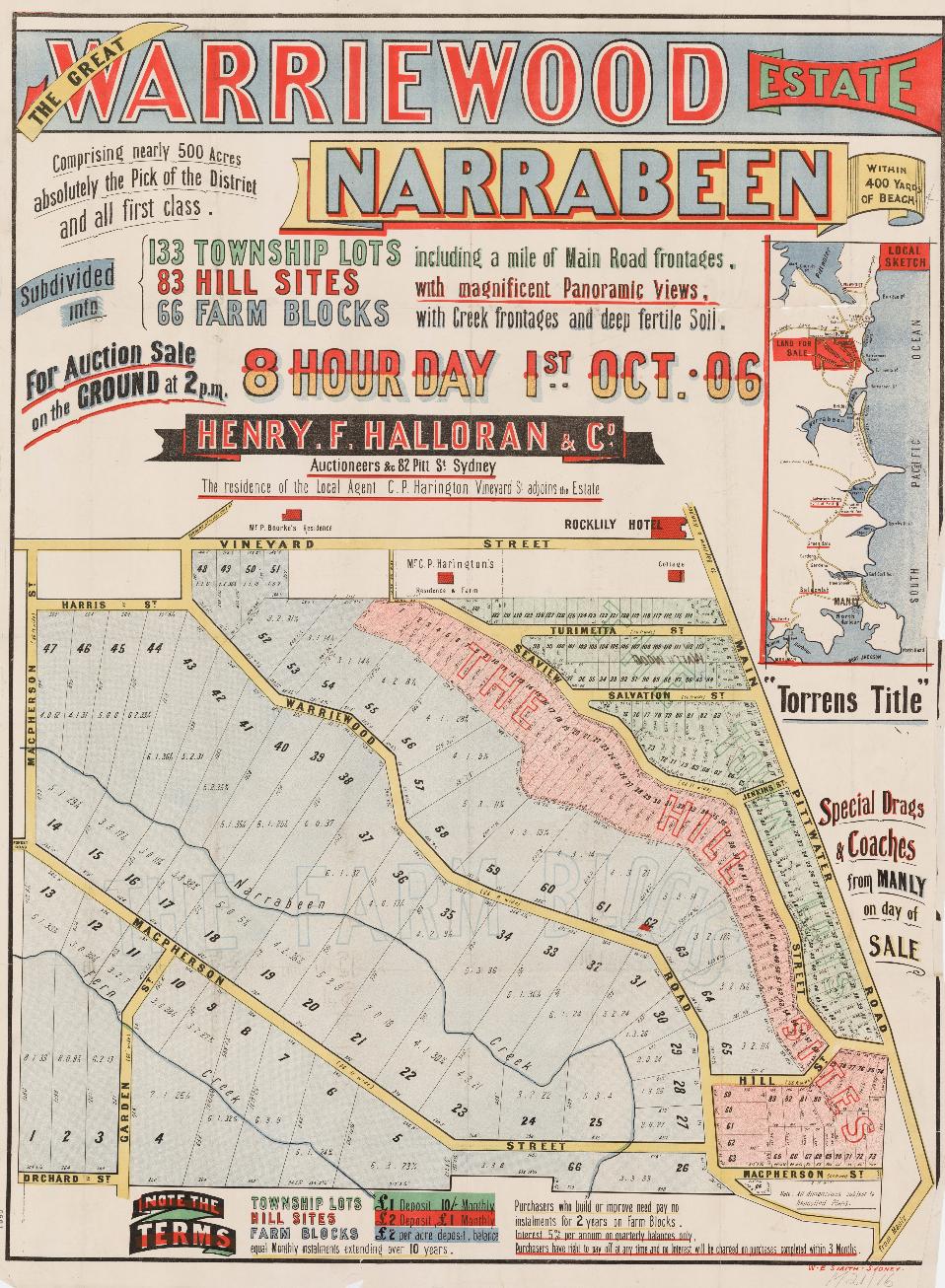
The Great Warriewood Estate - Narrabeen - Macpherson St, Vineyard. Item No.: c046820014, courtesy State Library of NSW.
The Sales; PROPERTY MARKET. Messrs. Henry F. Halloran and Co. report a successful sale of the Warriewood Estate on the ground at Narrabeen and Rocklily, on Monday, when there was an excellent attendance and fair competition. 25 township lots were sold at from 11s to 25s per foot, 13 hill sites at from £00 to £72 10s each, and13 farm blocks at from £20 10s to £35 per acre. Total sales. £3571. PROPERTY MARKET. (1906, October 3). The Sydney Morning Herald (NSW : 1842 - 1954), p. 11. Retrieved from http://nla.gov.au/nla.news-article14803817
After that first 8 Hour Day sale, the sales pitch continued - focused on
ON THE LAND. HOW TO GET A FIRST QUALITY BLOCK. LARGE CAPITAL NOT NECESSARY. NO INSTALMENTS REQUIRED FOR TWO YEARS. NO IRRITATING GOVERNMENT ROUTINE. THE WARRIEWOOD FARM BLOCKS.
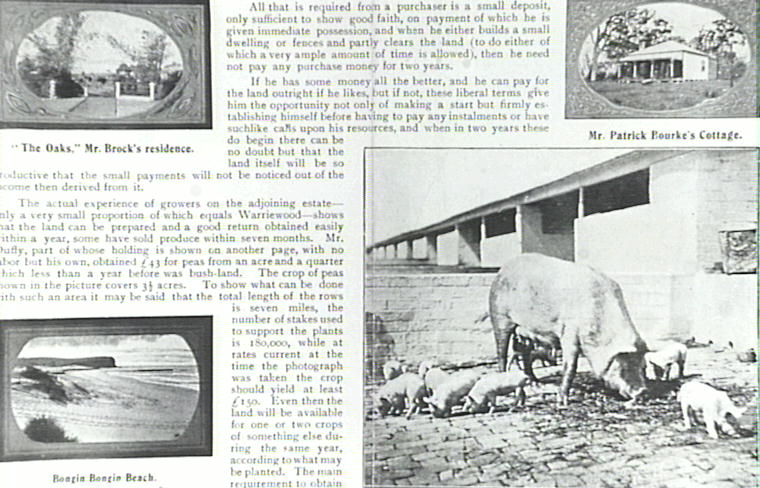
At a time like the present, when the above question is of absorbing- interest, the placing of such an Estate as Warriewood en the market must attract widespread interest, as it solves a great difficulty for those searching for land who do not possess a large amount of ready-money, and where not only can possession of the land be obtained without any delay, but the return of some profit is yielded from the land within a few months. The Warriewood Farms contain soil of an extremely high quality, suitable for the most approved and successful schemes of intense culture, therefore the farms range from about two acres, but a block of 100 acres can be made up if required. Official analyses of the soil by the New South Wales Department of Agriculture show it to be richer in fertilising ingredients than the famous Richmond River soil. All that is required from a Purchaser is a small deposit, only sufficient to show good faith, on payment of which he is given immediate possession, and when he either builds a small dwelling or fences and partly clears the land (to do either Dfwbich, a very ample amount of time is allowed), then he need not pay any purchase money for two years. If he has some money all- the better, and he can pay for the laud outright it' he likes, but if not, These liberal terms give him the opportunity not only of making a start, but firmly establishing himself before having to pay any instalments or have such like calls upon his resources; and when in two years these do begin, there can be no doubt but that the land itself will be so productive -that the small payments will not be noticed out of the income then derived from it. The 'actual 'experience 'of growers on the adjoining Estate — only a very small proportion of which equals Warriewood— shows that the land can be ' prepared- and a good return obtained easily within a year. Some have sold produce within 7 months. Mr. Duffy, with no labor but his own,' obtained £43 for peas from an acre and a quarter, which, less than a year, before, was bush land. Even then the land is available for one or two crops; of something else during the same year, according to what may be planted. The main requirement to obtain this result is health, and strength, for the expense outside labor is exceedingly small.
Another grower right on the Warriewood boundary has actually received £22 from almost a quarter of an acre of peas, and other crops have given exceedingly good returns. From this it must be clear that this land is something out of the common and well able to - support a man and his family; and it is certain the lenders could not offer such easy terms unless they felt certain of purchasers finding it to their advantage to remain on the land once they got there.
It may be added that the terms of payment extending in all over a period of ten years, while purchasers have the option of paying off the whole or any part at any time, and here, again, it may be said, that the Vendors in allowing so long a period, know full well the desire : of nearly all men to make their holdings free as soon as possible, and are certain the wonderful fertility of the land will enable them to do this in much under ten years if they care to do so. All the Farm Blocks are situated in a sheltered vale, intersected by the Narrabeen and Fern Creeks, being protected from the easterly and northerly winds by the Ridge on which the Hill Lots are situated, and from the westerlies and southerlies (.the worst winds) by a high range of rocky hills a short distance away from the Estate boundaries. The climate is so salubrious and the temperature so mild and even that all plants and flowers nourish with luxuriance, and come to maturity and bear some weeks earlier than in other districts around Sidney, with the consequent high prices always paid for early products of good quality. There is almost an entire absence of frost, as proof of which it may be stated that as many as three crops of potatoes have been obtained in one year from the same piece of land. The.- soil is a very rich black, deep, slightly Sandy loam of the land so prized by nurserymen, and easily worked. So rich is it that even in its virgin: uncultivated state the verdure is almost tropical, as can be seen by the natural Palm Groves, on the Estate. The subsoil is of a very porous nature for a considerable depth, affording natural drainage. The Estate being so handy to the City by a first-class road, growers can take their own produce to market, thereby saving all freight and agency charges, and getting the full benefit of prices obtained, without having to employ or trust any agent or dealer. At the same time all necessaries can be purchased at the best and cheapest City shops. Fine, timber, including iron bark, stringy bark, grey gum, turpentine, mahogany, forest oak, and others are available in plenty for building, fencing, firewood, and other purposes. The fine coastal rainfall here is ample for all requirements, and the excellent loamy soil possesses that grand characteristic of retaining the moisture for much longer than ever happens between rains the surface never cakes or bakes, so that even in what might be termed a dry season all vegetation continues to flourish and droughts as experienced in the country districts are quite unknown.
The Rocklily Estate, adjoining Warriewood, which was recently subdivided, giving the first opportunity for land to be secured in this district, was'- nearly all snapped up within an incredibly short space of time. Some parts of it adjoining Warriewood are good lots, but a large portion is inferior to Warriewood, which is all good. A large number of families are already settled on the Rocklily Estate, but now that Warriewood, with 70 Farms, in addition to the Township and the Hill Lots, is available, rapid progress is assured.
Even the development of the smaller Rocklily Estate caused the Public School to be removed from Bayview to hard by the Estate, and resulted in the Post-office being placed in a higher class. The powers that be have realised the possibilities of this hitherto locked-up but magnificent district, and nothing can now bar it from making rapid strides along the path of progress. The Estate was tested for water during the driest known season by a well sunk at random on one of the easy slopes well away from creeks, &c, and a plentiful supply of good fresh water obtained. It has been said with much truth that 5 acres here is better, easier, more satisfactory, and more profitable than 500 in the back country, and it affords as well all the advantages and occasional pleasures of the healthy suburban life so desirable for the proper rearing of a family. There are also some fine main road Town Lots for sale, and beautiful elevated Hill Sites most suitable for week-end and holiday residences, close to fine ocean beaches, Narrabeen Lake, Pittwater, Harbor, &c, &c. A postcard will bring a free plan,, .illustrated Art Booklet, and price list by 'return post. A Representative of the Auctioneers, Messrs. Henry F. Halloran and Co., 82 Pitt-street. Sydney, Is on the Estate every day and all day, to show purchasers around. Run down by Motor Bus at the weekend. ON THE LAND. (1906, October 7). Sunday Times (Sydney, NSW : 1895 - 1930), , p. 2. Retrieved from http://nla.gov.au/nla.news-article126562172
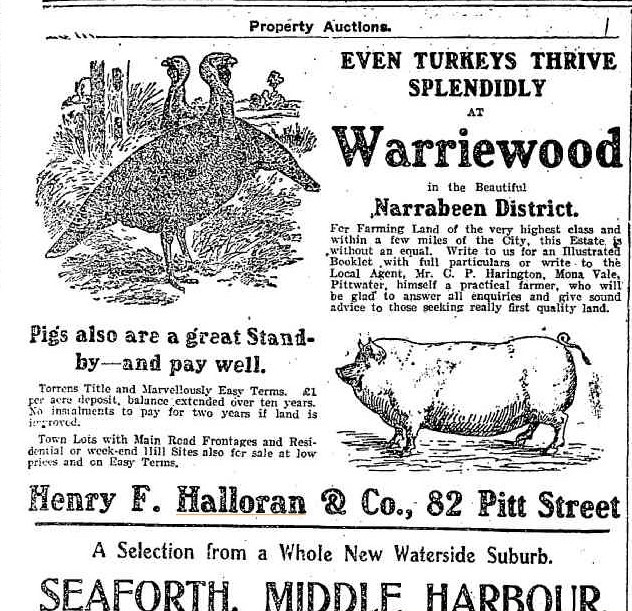
Sunday October 14th, 1906 Sunday Times advertisement