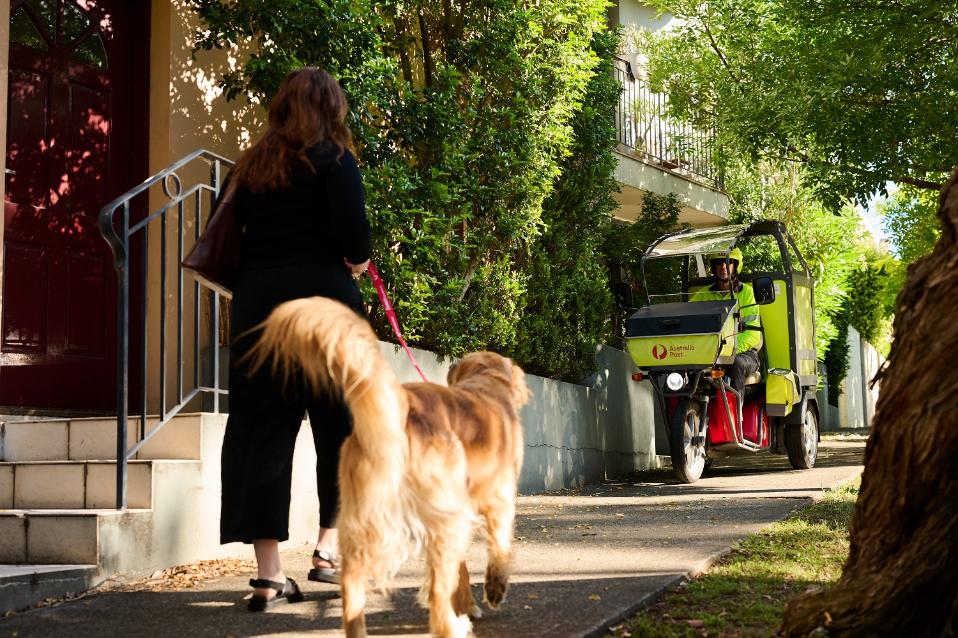
On June 16 2026 Australia Post issued a statement urging dog owners to take action as new alarming data reveals 47 Posties are encountering an aggressive or unrestrained dog each week, an average of nine incidents every day.1
In the past six months, more than 1,200 dog-related incidents have been reported nationwide — a 5% increase on the same period last year, raising serious concerns for the safety and wellbeing of frontline team members. New South Wales remains the worst offender for dog-related incidents involving Posties in the country, accounting for more than a third of all cases.
NSW saw 410 dog-related incidents in the last 6 months, with Tamworth, Ingleburn, Moree and Penrith recording the most incidents, Australia Post General Manager Safety, Russell Munro said
Despite repeated warnings, the majority of incidents occur when dogs are not properly secured during deliveries. Almost two-thirds of incidents happen on the street after a dog escapes a property or is roaming freely, with over a third of those incidents involving Posties being chased down the street. More than a third of all incidents take place on a customer’s property, often as a Postie approaches or leaves the front door after making a delivery.
These encounters can escalate quickly, with Posties suffering injuries including bites, puncture wounds, scratches and lacerations. In more serious cases, Posties have been knocked off their vehicles or required hospital treatment.
Australia Post General Manager Safety, Russell Munro said dog-related incidents remain a serious and persistent safety risk for Posties.
“Posties encounter multiple dogs every day while delivering, and some can pose a real safety risk. What seems like a routine delivery can quickly escalate, and our Posties can’t predict how a dog may react, regardless of breed or temperament.
“Our Posties are working hard to deliver parcels safely and on time, and it’s worrying to see the number of incidents increasing. With 9.8 million Aussies shopping online2, deliveries and interactions at the front door are more frequent, creating highly stressful situations for dogs and increasing the risk for our team,” Mr Munro said.
One year on from introducing citronella spray as a last-line-of-defense measure, it continues to play an important role in protecting Posties from aggressive dog encounters. The non-toxic, water-based spray is designed to briefly distract dogs, giving team members time to move to safety, and has proven effective in 95% of cases in the past six months. Posties have reported feeling safer on their rounds, knowing they have an additional tool to protect themselves if faced with an imminent threat.
“While citronella gives our team members an extra layer of protection, prevention remains the most effective solution. If you’re expecting a delivery, make sure your dog is securely contained in another room, behind a locked gate or safely restrained. If you’re unable to do so, we encourage customers to consider using a 24/7 free and convenient Parcel Locker as a safer alternative,” said Mr Munro.
Australia Post reports all dog-related incidents to local councils to support enforcement and mitigate risk, and may suspend deliveries to a property or street where it is unsafe. Australia Post continues to work with local councils and state governments to strengthen animal management laws that better protect our team members.
Prevention in the first instance is key. Australia Post advises dog owners to follow the three PAWS for delivery steps: Sit, Stay, Secure
- Sit your dog safely in a contained place, separate room, or behind a locked gate at the back of the home when expecting a delivery.
- Make sure it’s somewhere the dog can Stay while your Postie delivers your parcel.
- Keep your dog Secure behind your door or gate, allowing the Postie safe access to make the delivery and leave the property.
- If you are unable to properly secure your dog, consider using your nearest Parcel Locker.
Growing Frustration with Dogs Offleash where they shouldn't be
Residents have also recently expressed a growing frustration with what they call 'entitled ones' - those who take their dogs offleash into public areas, and even Barrenjoey Headland, a National Park and 'no dogs' area, putting residents and wildlife at risk.
People see dogs being taken onto the shores of Narrabeen Lagoon offleash, where they frighten birds fishing for food, and being chased off their feed areas, as well as throughout all parks and on the beaches.
On January 16 2026 at 6.15am a swamp wallaby, clearly terrified and highly distressed, was filmed racing from Collaroy to Narrabeen on the beach, as though trying to get away from something chasing it. At one stage those filming it drove it into the surf, where an incoming wave toppled the poor creature before it recovered and raced further north.
Two days beforehand, on January 14 2026 at 9.20 a.m. a Pittwater Online staff member was at south Avalon Beach and witnessed a dog offleash, 10 metres behind its owner who was not even watching it, nip at a toddler walking beside his pram and 5 year-old sister, down to Avalon Beach children’s pool. The owner came back long enough to verbally abuse the mother and then continued, with the dog still at least 10-20 metres behind him as he headed towards the busy main Barrenjoey road, and still offleash.
It was one of 4 dogs seen offleash at the same area within half-an-hour, and among numerous dogs, on leads, being taken down to the children’s pool area, one of the few safe pools parents can take little children to cool off.
Wallabies have been photographed at Palm Beach and across Pittwater. One resident took issue with a dog offleash going into Barrenjoey Headland National Park on Tuesday June 9. Dogs have also been seen in the dunes at North Palm Beach where it is known wallabies live and have been photographed. The amount of dog faeces left on the trail indicates dogs are either allowed to roam here unmonitored or their owners don't pick up after them.
In fact dogs are seen offleash on all beaches on a daily basis - taken there by the same owners.
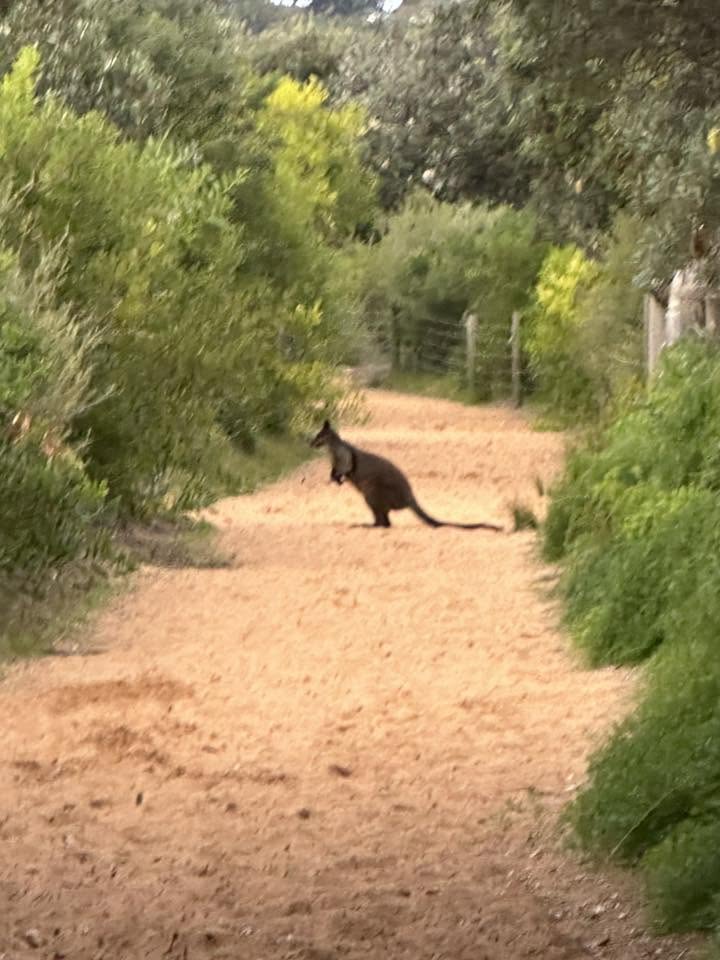
Wallaby on the central North Palm Beach dunes trail. Photo supplied
A wildlife carer with WIRES explains the impact of dogs being taken into wallaby home grounds, stating:
''I mainly do macropods these days and it frustrates the crap out of me that people presume that their dogs are friendly and wouldn’t do any harm….. seriously! Firstly we have lots of wallabies on the northern beaches!!! Trust me! They are very shy and are not mob animals like kangaroos, secondly they have more right to be here than our pets, that are fed and looked after!!
They should be respected and protected which I and many others try to do. Please take your dogs to appropriate areas. I’m a dog lover and have one myself, always have, but I will not allow her to run wild off leash simply to protect our wildlife.
Macropods die just from the stress of being chased! It’s an awful slow death and gut-wrenching to watch and try and save. Please try an help them as they only have us to protect them.''
On the oceanside, at North Palm Beach, lifesavers have rescued turtles coming ashore, while at Barrenjoey itself, a colony of seals resides.
A dog taken offleash onto Warriewood beach is the likely killer of a little penguin found dead there on January 30 2026.
See: Little Penguin Killed on Warriewood Beach: Offleash Dog the likely murderer
That January 2026 report also shared the Dog Attack Statistics July 2024 to June 2025 finally released: 247 attacks reported in NBC LGA for Year
The data recorded states 45 of these were serious attacks on people on the northern beaches, requiring hospitalisation or medical treatment.
The same data records 146 animals were attacked during the July 2024 to June 2025 quarters, not other dogs, other animals.
Overall NSW recorded the deaths of 1204 animals through these being attacked by dogs from July to June 2024/25.
Dog attack data for NBC LGA: first two quarters of 2025-2026
The first two quarters of the Dog Attack statistics for 2025-2026 has recently been released by the NSW Government's Office for Local Government records the data for the Northern Beaches Council LGA and an increase in dog attacks on people, other dogs and other animals - wildlife.
This states:
Number of dog attack incidents reported 1 July 2025 to 30 September 2025 (1st Quarter 2025/26)
Office of Local Government - Number of dog attack incidents reported by all councils from 1 July 2025 to 30 September 2025 (1st Quarter 2025/26)
Northern Beaches Council
Total dog attack incidents reported: 58
No of people involved in serious attacks: 11 - These are attacks where a person was involved AND where the injury resulted in medical treatment, hospitalisation or death.
No of people involved in less serious attacks: 22
Total number of people attacked: 33
Total animals attacked: 32
Number of Microchipped dogs in LGA: 78,445 - The number of dogs microchipped in an LGA may not reflect the total number of dogs residing in that LGA
This is an increase from the same quarter the previous year.
Compare Central Coast Council
Total dog attack incidents reported: 46
No of people involved in serious attacks: 7
No of people involved in less serious attacks: 21
No of people involved in less serious attacks: 28
Total number of people attacked: 38
Number of Microchipped dogs in LGA: 174,131
Number of dog attack incidents reported from 1 October 2025 to 31 December 2025 (2nd Quarter 2025/26)
Northern Beaches Council
Total dog attack incidents reported: 57
No of people involved in serious attacks: 11
No of people involved in less serious attacks: 24
Total number of people attacked: 35
Total animals attacked: 30
Number of Microchipped dogs in LGA: 78,784
This was a decrease from the previous same quarter report dog attacks total of 73 but still more than the Central Coast where there are more than twice the number of microchipped dogs registered within that LGA. The data lists ‘reported’ dog attacks as not all residents report these to the council.
The Central Coast Council’s reported dog attacks statistics were:
Total dog attack incidents reported: 47
No of people involved in serious attacks: 12
No of people involved in less serious attacks: 22
Total number of people attacked: 34
Total animals attacked: 25
Number of Microchipped dogs in LGA: 174,934
Dog attack incidents reported by all councils from 1 July 2025 to 30 September 2025 (1st Quarter 2025/26)
Total number of dog attack incidents reported to council in the 1st Quarter of 2024/25 1,297
Adult: 724
Child: (Child is up to 16 years) 108
Dog: 676
Cat: 66
Livestock: 235
Other (animal): 79
Number of injuries on people:
Medical treatment required 169
Hospitalisation 63
Death 1
In September 2025 17-year-old girl, Annalyse Blyton, died at John Hunter Hospital after being mauled by a 10-year-old mixed-breed dog in Singleton, in the NSW Hunter region. Paramedics treated her at a friend's residence before she was airlifted to the hospital, where she later passed away.
Number of injuries on animals:
Medical treatment required 199
Hospitalisation 54
Death 266
Dog attack incidents reported by all councils from 1 October 2025 to 31 December 2025 (2nd Quarter 2025/26
Total number of dog attack incidents reported to councils in the 2nd Quarter of 2025/26: 1,116
Minor injury 203
Medical treatment required 167
Hospitalisation 77
Adult 625
Child (Child is up to 16 years) 106
Dog 567
Cat 60
Livestock 161
Other (animal) 62
Number of injuries on animals - Death 208
Number of Attacking Dogs by Breed (Top 20)
- American Staffordshire Terrier 194
- Bull Terrier (Staffordshire) 68
- German Shepherd Dog 64
- Australian Cattle Dog 56
- Australian Kelpie 32
- Border Collie 32
- American Staffordshire Terrier Breed not identified 25
- Rottweiler 24
- Bull Terrier (Staffordshire) Breed not identified 21
- Jack Russell Terrier 20
- Mastiff 17
- Siberian Husky 16
- Mastiff Breed not identified 13
- Bulldog (American) 12
- Australian Kelpie Breed not identified 11
- Bullmastiff 11
- Bull Terrier (English) 10
- Bulldog (French) 10
- Bullmastiff Breed not identified 10
- Breed not identified 383
Let Council Know
The council encourages residents who have been attacked by a dog to contact them immediately, not simply lodge a report.
If the matter is urgent or dangerous call Council on 1300 434 434 (24 hours a day, 7 days a week).
If you find injured wildlife please contact:
- Sydney Wildlife Rescue: (24/7): 9413 4300
- WIRES: 1300 094 737