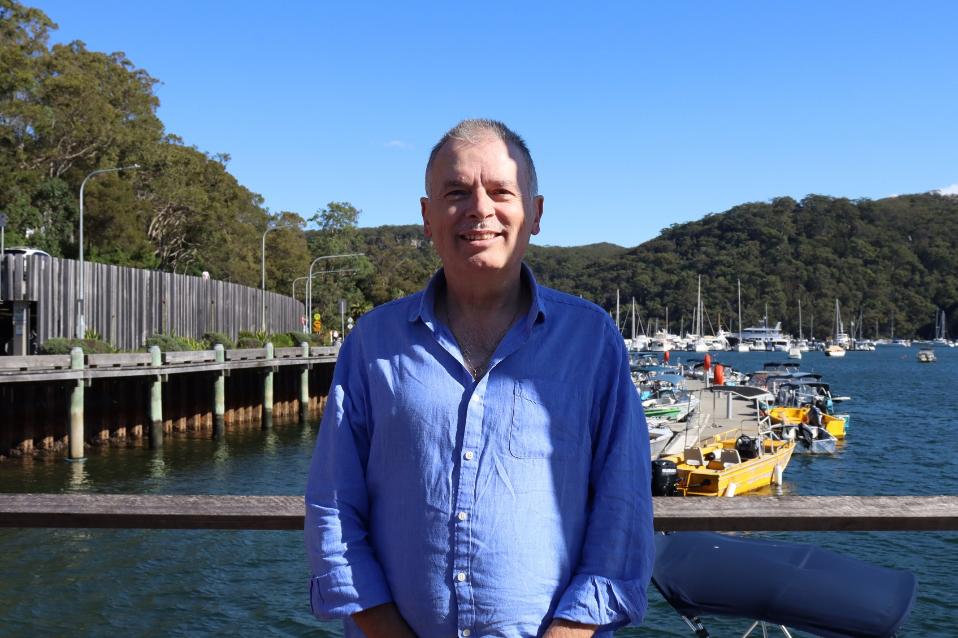
The 2026 Anzac Day Commemoration Address at the Dawn Service of Pittwater RSL this year was given by Darren Crabb.
Darren stated in closing his Address:
I’d like to leave you today with three challenges, especially for the young generation that will be our Australia of the future:
1 Take an active interest in your family history, and if military sacrifice occurred, remember it daily,
2 Take an active interest in world history and politics. You must ensure you are independently informed so you can help steer Australia in the future, and not repeat mistakes of the past,
3 If you can combine your passion with service to your country, I commend you to it. This helps ensure that all of the sacrifices, of all who served before you were not in vain, and help to safeguard the democratic freedoms that we enjoy in Australia.
Given this June we celebrate and honour the 110th anniversary of the formation of the Returned Services League of Australia, which commenced locally in old sheds and scout halls just so those who had been through the same experience together, and came home, unable to speak, could spend time with those equally struck speechless, Darren's record in serving Pittwater RSL as a Vice President at the Pittwater RSL Sub-Branch from 2015 to 2019, and being elected as an RSL Director 2020–2026 (Senior VP 2022-2024 and Junior VP 2025-2026) testifies to the fact he is committed to supporting the veteran community with integrity and a strong work ethic.
Darren served 15 Years in Canadian Air Force flying Tutors, CF-5, Operational F-18s in Germany, then as an F-18 Instructor. He transferred with BAE to Saudi Arabia before joining the RAAF, again as an Instructor, before serving three years in the RAAF as a Macchi lead in Fighter Instructor, then Operational F-18s again.
Darren commenced flying Corporate and Warbirds in 1999 and has been Chief Pilot of the Temora Aviation Museum since October 2000.
After a cumulative two decades in the Canadian and Royal Australian Air Force, and 27 years as a Corporate Pilot, Mr. Crabb knows planes.
One for all who LOVE the planes, all the planes all the time, and for all Returned and currently serving Defence personnel - a reminder of who has got your back in your community - your local RSL Sub-Branch.
Thank you for your Service.
Where and when were you born?
I was born in Saskatoon, Saskatchewan, Canada, 17th of September, 1961.
You grew up there before moving to Germany when you were 11?
We were posted to a few Canadian bases until 1972, when my father was posted to Germany, which was West Germany at the time. That was the first time we went there. Cumulatively, I spent 12 years in Germany. My dad had three postings there, and I had my posting there from 1988 to 1991. This was an amazing posting as I was there for the ‘Fall of the Berlin Wall”, and both of my children were born in Germany.
Your dad was a Fighter Pilot in the Royal Canadian Air Force?
Dad joined the Air Force and got his wings in 1963. He initially did jet instructing, like myself. In 1972 he was posted to Baden- Soellingen, West Germany flying the CF-104 Starfighter. He wound up having two tours on Starfighters in Germany, commanding both 421 and 441 Tactical Fighter Squadrons.
Was he your inspiration to join the Air Force or did you have a passion for aircraft from a young age?
A little bit of both. According to my mother the first words out of my mouth were along the lines of ‘air plane’ instead of mum and dad. It’s one of those things where I always knew I wanted to be a pilot. I was going to high school in Germany, and in 1979 a Career Councillor visited our school and made a presentation on the Defence Forces. At the time, I was also in the Air Cadets and was awarded a Gliding Scholarship. I was sent back to Canada for Air Crew Selection, and I believe out of the 54 of us in our course only two of us were selected for Air Crew Training.
So, it’s not as easy as people think?
No it certainly isn’t easy. When I was selected, each year around 1400 people would apply to become pilots. Out of that, only 100 would gain their wings and of that about two people would become Fighter Pilots.
What were they looking for, your mental state, physical fitness….?
It was a well-rounded selection process. You had to do reasonably well in school, concentrating on mathematics and physics, but also English. There were physical aspects to it, so you had to meet minimum standards for the Canadian Forces, and then in terms of aptitude there were a lot of quick reaction time problems. Also, you would be given pictures of four aircraft instruments and you would have to decide within a short time frame, what position the aircraft was in, so special interpretations.
You came to Australia in 1996 to fly the one everyone wants to fly – the F/A-18 Hornet – how did that happen?
In 1995, I retired from the Canadian Air Force with a view to working for British Aerospace in Saudi Arabia as a flying instructor. However, I am left-handed, and in the Arab culture utilising your left hand for everything is bad as this is the hand they use for sanitisation, and not for writing or eating. The Saudi flight commander said, “You won’t fit in here”. Thankfully, an Australian mate who was part of our multinational crew, said that Australia was looking for F/A-18 pilots as the Royal Australian Air Force were drastically short. I returned to Canada, submitted my RAAF application and was accepted.
My family were sponsored by the Australian Defence Force, specifically the RAAF, to come and fly Hornets for between three years and six years. From the Australian RAAF perspective, they were getting a fully trained F/A-18 Pilot for the cost of a move overseas.
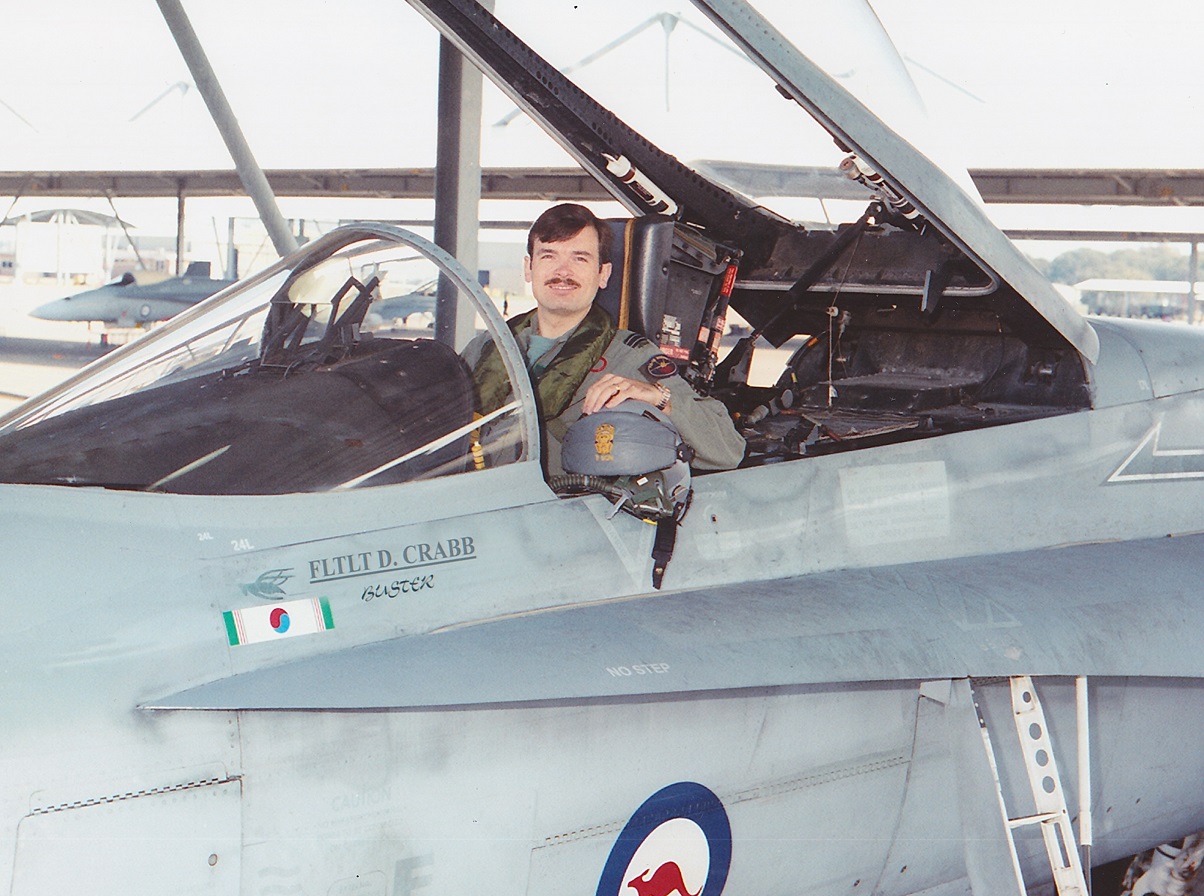
Darren 'Buster' Crabb in his 77 Squadron F/A-18 Hornet, 1998
You have also had the privilege of doing 18 fly pasts over Sydney, and along George Street, for Anzac Day? What is that like?
When I was with 77 Squadron at RAAF Williamtown, we’d get tasked to do that. We’d take four F/A-18’s down the coast to meet a ‘time-on-target’ (TOT) over the Cenotaph. We would take off out of Williamtown and exit out over the water by Tomaree Heads at Port Stephens and then transit down the ocean coastline, and then once we’d finished our task we’d exit back out via the harbour and then transit back up the coastline to Williamtown. The TOT was accomplished holding off Sydney Harbour and then at a certain time, commence our 4-ship run in. I remember vividly when we were coming across the harbour, pointing at Sydney Harbour Bridge, making the left turn and coming in around the AMP tower (now Westfield tower) and then down George Street. It was pretty amazing looking down and seeing all of the people, not only veterans marching, but all of the supporting spectators lining the street, all the way from Sydney Harbour down George Street.
You have a great passion for history, working as Chief Pilot of the Temora Aviation Museum (TAM) – what was that like?
It was really an honour to be part of the formation of and in at the start of TAM, when my boss had the idea to form a flying museum, and be appointed as Director of Flying Ops. Over the years, we built up the collection from one aircraft to thirteen aircraft, all relating to Australian Military Aviation. I had 44 pilots under my command and we were all responsible for flying and displaying the mixture of jet and piston engine aircraft.
At the outset, we would conduct two-day air shows every 6 to 8 weeks, and we were quite good at it, and then every 2 years we would host Warbirds Downunder (WDU), which was a two day event. This was the largest gathering of Australian Warbird operators and vintage aircraft, supported by the RAAF with their modern aircraft. I was ‘Air Boss” for all 5 WDU that we ran and I would have upwards of 65 aircraft to put into a 5 hour air show. Also, I was responsible for air show orchestration and aircrew safety briefings, so everyone knew exactly what they were going to do within our governing rules and permits. Ultimately, it was my responsibility was for the safety of the entire air show and all spectators.
Did you have any favourite aircraft among those – and if so which ones and why?
Because I’ve always flown jets, I flew TAM’s five vintage jets – the Vampire, Meteor, Canberra, Sabre and A-37B Dragonfly.
From a nostalgic point of view, the F8 Meteor was always a grand one, especially for Australia. 77 Squadron flew the Meteor in combat operations during the Korean conflict. For me it was as close as I’ll get to flying a World War Two aircraft, although ours dates from about 1951. The TAM Meteor is painted in the livery of Sergeant George Hale, who flew with 77 Squadron in Korea, and I actually got to meet him. We brought George out to Temora to reintroduce him to his aircraft and I got to display it for him and his daughter, which was rather special.

Sgt. George Hale, Darren and the F8 Meteor
For elegance, there’s our CAC Sabre, which served from the Korean conflict up to being replaced by the Mirage III. Australia utilised the Sabre as its main frontline fighter, also up in the Ubon, Thailand. The Sabre is the quintessential, classic looking jet with super performance. The Sabre was very exciting to fly in that regard.
My favourite jet at the museum was the A-37B Dragonfly, which is a twin engine Vietnam era jet used for close air support. When Australian SAS troops were in contact with the enemy requiring fire support, the A-37B had the ability to loiter behind the front line and rapidly get up to attack speed, delivering weapons when and where required. It has an excess of thrust, which is fabulous. To put this in context, both engines produced 6000 pounds of thrust and the aircraft only weighs 5700 pounds plus fuel. So on take-off, when I select the throttles to full power, I accelerated from zero to 150 kilometres per hour in four and a half seconds, which was my take-off speed. We limited the top speed to 600 kph to preserve the engines. It’s a fantastic little aircraft, super agile, and I certainly enjoyed displaying that for the public.
You’re also a student of Military History and have traced your own family’s stories, including how some have been lost – what can we learn from studying Military History – what benefits can this provide to today’s generations?
I said in my Anzac Day address, we regrettably we take a lot of things for granted here in Australia. When you realise that during WW1, WW2 and Korea, we had young men and women from age 16 to 18 patriotically enlisting to defend Australia and the Commonwealth from all enemies. Today, you would have a hard time convincing any 16 year old to get off their electronic device or phone and contribute to society or defend our country. My main Commemorative Address point was that if you fail to study history then you are doomed to repeat it, regrettably just relearning the same old lessons. Today, we can see this is happening again, and I believe our politicians certainly lack historical study!
You’re still working today as a pilot?
Yes, I’m am flying the Gulfstream 650 as a corporate pilot for world-wide operations.
What’s that like to fly?
It’s wonderful. The Gulfstream 650 is a top-class business jet and we have more modern equipment than most of the commercial airliners. We have what’s called a ‘glass cockpit’ utilising only flat screens. We also use a heads-up display (HUD) for all of our flight information, just like I had in the F/A-18. We have infrared capability, so especially at night, it allows us to see storm clouds or other hazards and avoid them, plus when landing it helps you to see the airfield in very poor light conditions. The plane also has synthetic vision, which builds a 3D picture of the earth’s surface, and while we’re not allowed to land solely with reference to it, in a dire emergency, you probably could as it is that accurate.
This is decades of flying around like a bird – why? What was the spark and how did it keep going?
It’s just something I’ve always known that I wanted to do – it’s a personal passion. I joined the Air Force directly out of high school, so flying is the only thing I’ve ever known for my profession. Flying is a lot of fun, yet you’re always striving for perfection. You must continue evolving your skills and knowledge as you develop, especially when you convert to newer and better aircraft. You must stay sharp and no matter how long you’ve been flying you must continue to learn. Aviation is rewarding but unlike other professions, it is also very unforgiving: if you have momentary lapses it rapidly ends in tragedy, thus you are always striving to become better at what you do and that seems to suit my nature.
When you have time off do you sit around at home watching birds?
(laughs) No, it’s not quite like that, one must remain engaged. I do professional development for aviation, reading, family tree research and enjoy a couple of hobbies.
Just checking…
My interest in Military history is a passion and hobby that’s been with me since moving to Germany in 1972. From my military history hobby, I’ve collected artefacts from different countries and eras. These items lend themselves to further research. Currently, I have an interest in military wrist watches. The research for these involves determining if it’s related to a service veteran. From there you delve into finding out their service history and what they have accomplished or contributed.

Front cover of Darren's RCAF Chronograph book
So you’re honouring others who have served just as a hobby?
Correct. I’ve been collecting since the age of 11, when we first went to Germany in 1972. My next door neighbour then, whom I’m still friends with, was a history mentor to me and he gave me a bayonet that he’d dug up on the battlefield of Waterloo. That sparked my interest, and I still have that bayonet as my first piece of militaria. Through that start I’ve collected helmets, medals, uniforms, and the plethora of items people go through. I’ve now settled on wrist watches because I can wear them, swap them out daily, and a lot of them do have a significant historical value. I even wrote a book, which was published, documenting RCAF Pilot Chronographs.
And they are still alive in our hearts when we remember them in that way...?
Most definitely, I get a sense of keeping the person relevant through the admiration of their artefacts.
You are also a Member of the Pittwater RSL sub Branch – how important is it for people to have access to others with a similar experience of service to others through the defence forces?
It’s very important. As you’re probably aware the RSL started in June 1916 to look after those returned service personnel. What we find, even today, that members of our defence forces can’t easily move back into society. Veterans occasionally find that their families can’t relate to them as they don’t have the shared experience of what the veteran has been through. This is quite prevalent today now that we have a better understanding of PTSD and mental illness. So, to have a venue where veterans could get together and spend time with people who have been through similar experiences and understood what they were on about, became important. The RSLs we see today are a legacy of that; and we have a mixture of Army, Navy and Air Force and this promotes camaraderie, while providing the knowledge and information as to where veterans may access the support they may need. We want to get more people involved because we’re now seeing a lot of our Vietnam era members getting quite elderly and frail. We do understand that the younger veterans are involved with family and kids sports, so it can make it difficult to attend, but it still remains very important that as many people as possibly do join and share their experiences and get that opportunity to bond with like-minded people.
What are your favourite places in Pittwater and why?
In 2006, I came to Pittwater, met my wife, and I haven’t left since. Coming home after work away, when I crest the top of the hill at Terrey Hills and glimpse the ocean it makes you feel you’ve left Sydney behind you and you’re almost home. I enjoy the Pittwater peninsula, but importantly meeting Sandra through friends at the Newport Arms: I came across the bridge and I found a wife. We married in 2007, so we’re celebrating 19 years married. At that time the Newport Arms was a favourite meeting place for that reason! We also enjoy numerous little out of the way pockets from Palm Beach down to Mona Vale, but no one specific spot. It is a wonderful area and much better than being in Sydney.
What is your ‘motto for life’ or a favourite phrase you try to live by?
What I always try to do is what is described as ‘let’s front load this and don’t delay’, so I guess that would be Carpe Deim – Seize the day!
%20this%20one.jpg?timestamp=1781312312612)
Sandra and Darren at a recent outing to a Church Point eatery
A few Notes
Formation of the Returned Services League of Australia
On the 6th of June 1916, a meeting held in Melbourne became the genesis of the Returned & Services League of Australia as we know it today. The meeting was attended by delegates from Victoria, South Australia, NSW and Queensland who agreed to name the organisation The Returned Sailors and Soldiers Imperial League of Australia (RSSILA). Although Tasmanian Delegates could not attend as they were unable to afford the expense of travelling to Melbourne, Tasmania did join Victoria, South Australia and Queensland as the Founding members of the League. New South Wales and Western Australia joined the League in May 1917, and the ACT in 1927.
Prior to the League’s establishment, Returned Service Associations had formed in various states and were lobbying for support and services for returned men in their respective States. The lack of repatriation facilities had distressed returned soldiers who were in need of aid so the Associations formed to help returned servicemen obtain benefits. Retrieved from: www.rslaustralia.org/about-us
Today, it remains Australia's largest veterans' charity, operating across a national network of nearly 1,100 sub-branches and representing roughly 153,000 members.
The RSL's ongoing mission and commemoration efforts include several specific programs:
Strategic Evolution: The League has focused on contemporising to support all veterans, modernising advocacy capabilities, and expanding mental and physical health services in light of recent Royal Commission recommendations.
State Operations: State branches like RSL NSW have been conducting regional Listening Tours to engage members directly and shape strategic plans for the next chapter of the charity.
ANZAC Day: The League led national commemorations for the 2026 ANZAC Day under the theme "The ANZAC Spirit Lives Here". It is also actively reviewing and addressing unacceptable community behaviour at recent commemorations to ensure services remain inclusive.
Awards: In 2026, the RSL continued its tradition of recognising community and military dedication through its awards, including the ANZAC of the Year Awards.
CD: Canadian Forces’ Decoration. Awarded to officers and non-commissioned members of the Canadian Armed Forces for 12 years of good service.
PLSC: Primary Leadership and Support Course and also Principal Leadership Selection. Often seen on resumes of graduates from Canadian military colleges (such as the Royal Military College of Canada and the Canadian Land Forces Staff College).
Fall of the Berlin Wall
The Berlin Wall fell on 9 November 1989 during the Peaceful Revolution, marking the beginning of the destruction of the figurative Iron Curtain, as East Berlin transit restrictions were overwhelmed and discarded. Sections of the wall were breached, and planned deconstruction began the following June. It was one of the series of events that started the fall of communism in Central and Eastern Europe. The fall of the inner German border took place shortly afterward. An end to the Cold War was declared at the Malta Summit in early December, and German reunification took place in October the following year.
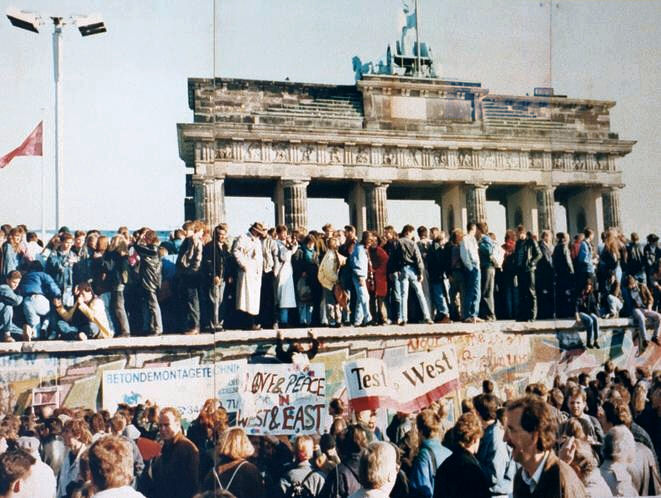
The Fall of the Berlin Wall; West and East Germans at the Brandenburg Gate in 1989. The photo shows a part of a public photo documentation wall at the Brandenburg Gate, Berlin. The photo documentation has been permanently placed in the public domain.
No. 77 Squadron (RAAF)
by Australian War Memorial
77 Squadron was initially formed during the Second World War, operating throughout the Pacific. After the war the squadron was sent to Japan as part of the occupation force. In 1950, while the squadron was preparing to return to Australia, North Korean forces invaded South Korea. 77 Squadron was quickly committed to support the United Nations forces in Korea and for the next three years it served with distinction. 77 Squadron remained in Korea until 1954 and upon returning to Australia it was based at Williamtown, New South Wales. In November 1956 the squadron was re-equipped with new, Australian-built Sabre fighters, replacing the outdated British Meteors, which the squadron had flown since 1951.
In 1958 Australia's air commitment to the Malayan Emergency increased and 2 Squadron, a bomber squadron, was sent to Malaya, followed later by 3 Squadron, and then 77 Squadrons in February 1959. Both 3 and 77 Squadrons were fighter squadrons and flew Sabres.
By 1959 the air war during the Emergency had virtually ceased and 77 Squadron only occasionally participated in air operations, flying ground attack missions against jungle covered targets. Stationed at the RAAF Base Butterworth, in Province Wellesley, north Malaya, 77 Squadron carried out its first operation on 13 August, a joint bombing raid with 3 Squadron against three communist terrorist camps. The strike was perfectly coordinated but of little value, as the only visual results were, as one pilot described it, "several rubber trees severely damaged and thousands of monkeys scared fartless". 3 and 77 Squadrons took part in two more strikes in June 1960. On 22 July two Sabres collided in a mid-air accident. Both pilots, Flight Lieutenant Worth and Flying Officer Bartrop, were able to eject successfully. Bartrop was rescued almost immediately and Worth was rescued three days later.
Although the Emergency ended in 1960, the tensions in south-east Asia kept the squadron in Malaysia until 1969. In September 1964, during the Indonesian Confrontation, Indonesian aircraft dropped paratroopers into Jahore, which increased tensions; following riots in Singapore, a state of emergency was declared. On 3 September, 77 Squadron placed four aircraft on five-minute alert and its remaining aircraft on one-hour alert. All aircraft were armed with Sidewinder missiles and guns, and were fitted with drop tanks. On 7 September, 3 Squadron moved six aircraft to Royal Air Force Base Changi, on Singapore, and the rest of the squadron came under 77 Squadron's command, before also going on to Singapore. An extra 15 aircraft and 52 ground crew were ferried in from Australia to help maintain the seven-day-a-week alert. By the end of the month, tensions were easing, with only two aircraft on standby. However, in November fears again escalated, when 90 Indonesians attempted to land at Malacca; both squadrons were placed on high alert. The squadron's unit history describes 1964 as a year of "heightened unease". The Confrontation came to an end the following year.
77 Squadron returned to Williamtown, where it is still based, in early 1969.
The RAAF celebrated its centenary in 2021. More in PON Celebration:
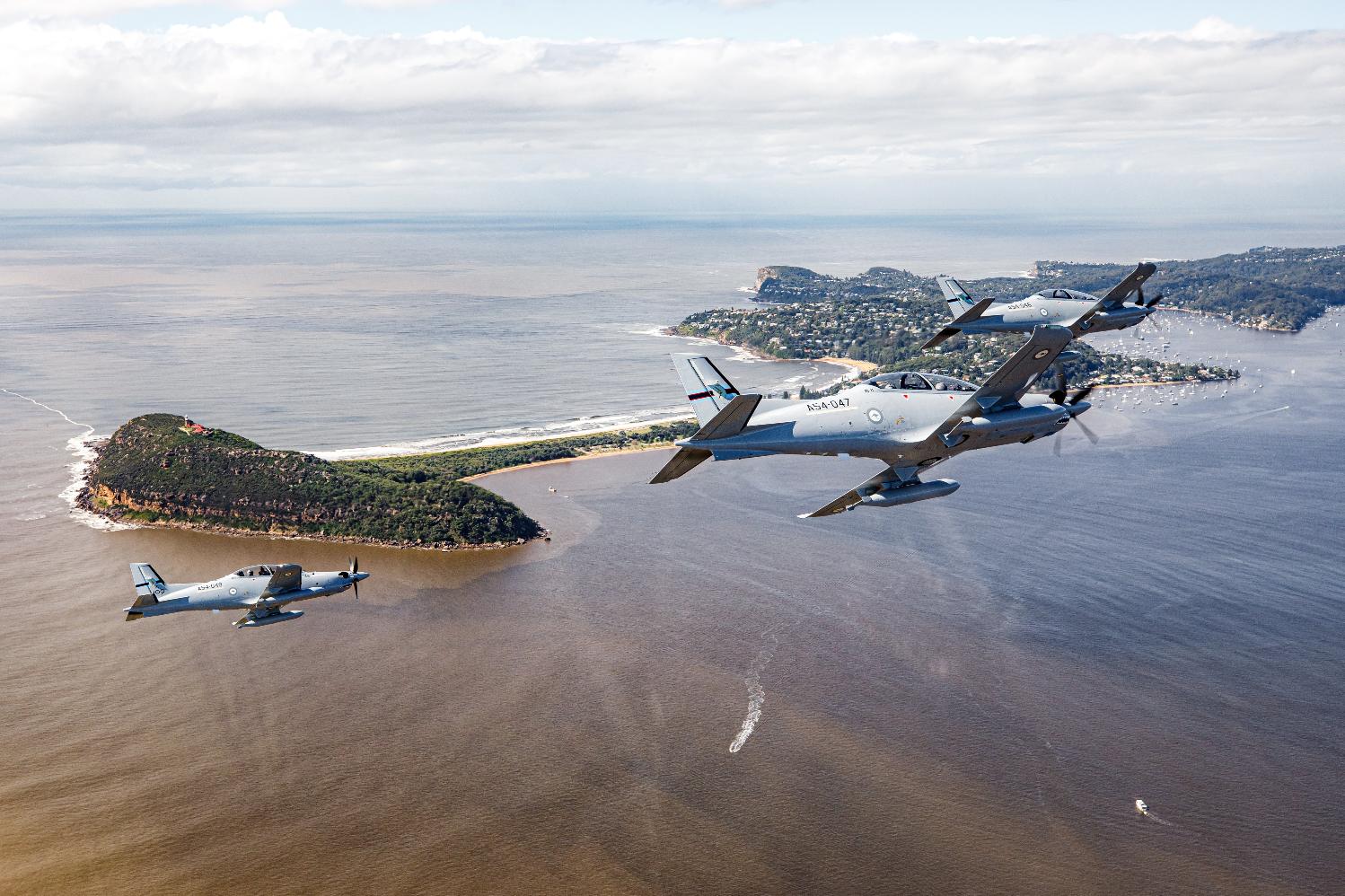
- RAAF Re-Establishes No. 100 Squadron Ahead Of Centenary Commemorations - Pilatus PC-21A 's over Pittwater
- Pittwater Aviatrixes on the eve of the RAAF's 100th: A NSW Women's Week - Women of Aviation Week Celebration
Temora Aviation Museum
When Sydney businessman David Lowy AM decided to create an aviation museum honouring the aircraft and pilots who defended Australia, Temora Aerodrome stood out. It offered a rich aviation history, friendly community, supportive local council, favourable weather, flat terrain, and unrestricted airspace below 20,000 feet.
The Temora Aviation Museum was incorporated in late 1999, with construction beginning soon after. A Governing Committee of experienced and diverse individuals was formed. The first hangar was completed in February 2000, with David Lowy AM donating the initial aircraft for the collection. The Museum opened to the public in June 2000.
Construction began on stage two, which included the exhibition buildings. These new additions now feature display spaces, a small theatre, an admission entrance, a gift shop, a children’s playground, and a picnic area. We were thrilled to open this to the public in August 2001.
Stage three of the Museum Complex was finished in November 2002 with the launch of a spacious 1980 square meter display hangar. This new hangar became the home for all our aircraft, while the original hangar was transformed into a specialised restoration and maintenance facility.
On Monday, July 1, 2019, we embarked on an exciting new chapter. The Royal Australian Air Force (RAAF) and the Temora Aviation Museum formed a strategic alliance, with the RAAF taking ownership of 11 of our aircraft. As David Lowy, our President and Founder, shared, “The alliance with the RAAF deepens and broadens ownership of the Museum’s aircraft beyond one individual, which is important for the long-term future of these historically significant national assets.” Rest assured, these aircraft remain on display for our visitors to enjoy, and the Museum is open 361 days a year for everyone to explore.
Retrieved from: www.aviationmuseum.com.au/about-us/museum-history
Find out more about visiting Temora Aviation Museum at: www.aviationmuseum.com.au
.jpg?timestamp=1777126940907)
Meteor, Temora 2006
Last air to air combat involving the RAAF
27 Mar 1953
Two Gloster Meteor Mk8 jets of No 77 Squadron, flown by Sergeants George Hale and David Irlam, were conducting a road reconnaissance over North Korea near Sinmak when Hale saw what he thought was a lone MiG-15. It was only as he dived into the attack that he realised he was opposed by three enemy aircraft. In the ensuing dogfight, Hale’s cannon fire sent one MiG down on its back, belching black smoke and shedding bits of fuselage as it dropped from view. Immediately confronted by another pair of MiGs, he scored hits on one of these also and saw it trailing white smoke as it climbed away from him. Having expended all his ammunition, Hale broke off contact. This was the last time that 77 Squadron aircraft engaged in aerial combat in Korea, and indeed the last time that any RAAF unit has been involved in air-to-air fighting since.
by RAAF
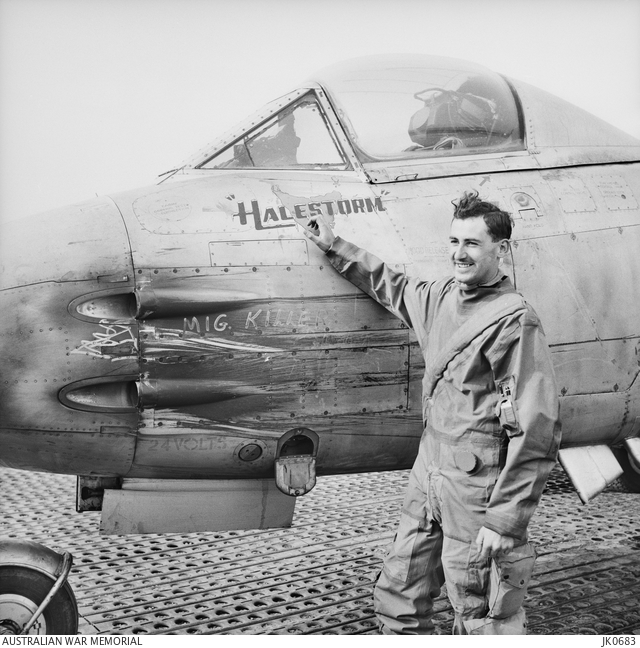
Sergeant George Hale with his Meteor Mk 8 after a brush with MiG-15s over North Korea in March 1953. Sgt. Hale scored several hits and is credited with one MiG probably destroyed and another damaged. AWM JK0683
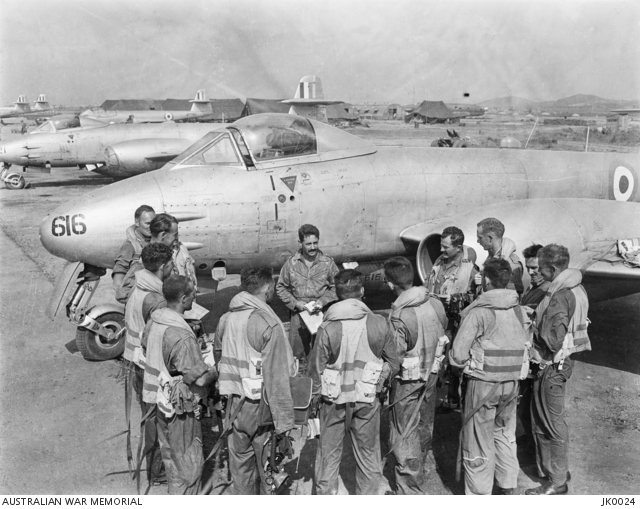
Pilots of 77 Squadron are briefed by their commanding officer, Squadron Leader Dick Cresswell, before a mission over North Korea, August 1951. AWM: : JK0024
Last action hero now showing
12 October 2023: By Flight Lieutenant Karyn Markwell and Flight Lieutenant Julia Ravell
The last RAAF aircraft to have engaged in combat in a conflict has been restored and is now on display at the RAAF Williamtown Heritage Centre (WLM AHC).
Restoration of the Meteor A77-851 (aka ‘Halestorm’), in which Sergeant George Hale shot down a MiG-15 in the final air-to-air engagement of the Korean War, was overseen by Air Force’s History and Heritage branch (HH-AF).
Warrant Officer Stan Lawler from the Directorate of Air Force Heritage said RAAF Williamtown is the right spot for ‘Halestorm’ as it was an aircraft of 77 Squadron and 77 Squadron is based at Williamtown.
“The ranks of Korean War veterans are getting thin, so it’s good to have Halestorm completed to honour them – especially since this year is the 70th anniversary of the Armistice of the Korean War,” Warrant Officer Lawler said.
On March 27, 1953, Sergeant George Hale from 77 Squadron flew ‘Halestorm’ on a routine reconnaissance mission over North Korea. He engaged with, and shot down, an enemy MiG-15 fighter in the last air-to-air engagement of the Korean War.
Sergeant Hale returned to Australia after his period of duty.
Following the Korean War, Air Force converted ‘Halestorm’ into a remotely piloted aircraft and used it to conduct aviation trials at Woomera in South Australia. Volunteers from the South Australian Aviation Museum later recovered and refurbished ‘Halestorm’s cockpit/forward fuselage and put it on display. In early 2022, the museum gifted the cockpit/forward fuselage to Air Force.
The restoration of ‘Halestorm’ took about 18 months, which included merging the cockpit/forward fuselage to another Meteor to create the aircraft now being showcased at WLM AHC.
“We managed to get a lot of unique components, making the aircraft almost identical to the one that flew in Korea,” Warrant Officer Lawler said.
“We were very lucky to find parts that had been in storage at the RAAF Museum at Point Cook. These included a long-range fuel tank to fit to the underbelly, three out of the four cannons and rocket rails that went underneath the wings.
“The aircraft just bolts together like a Meccano kit.”
Wing Commander Linda New, the officer in charge of WLM AHC, was pleased to receive such an important heritage aircraft into the heritage centre’s collection.
“‘Halestorm’ complements our display of artefacts commemorating 70 years since the cessation of hostilities in Korea, and honours the service and sacrifice of those RAAF members who served in Korea; particularly the members of 77 Squadron,” she said.
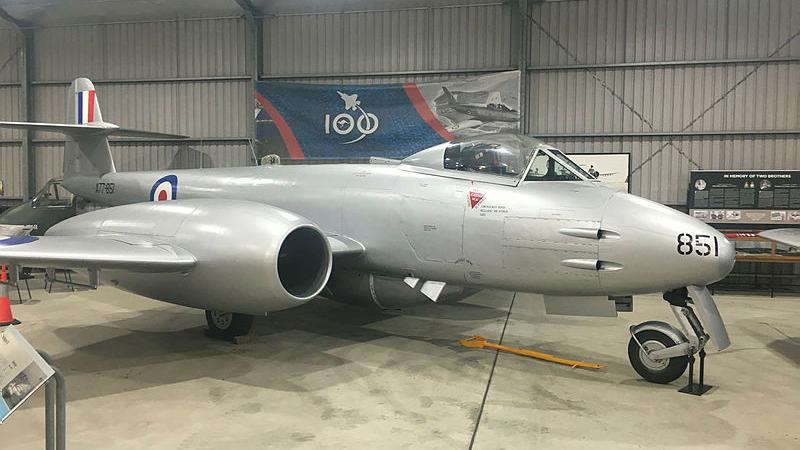
Meteor A77-851 (aka ‘Halestorm’) on display at the RAAF Williamtown Aviation Heritage Centre. Photo: Group Captain Peter Norford