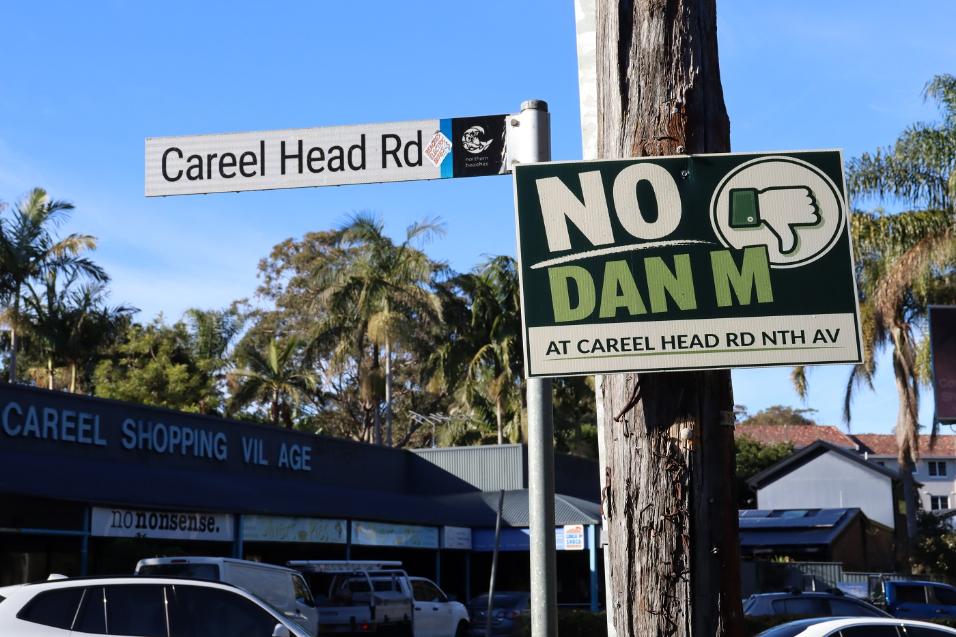
these signs have been placed near the site
- Locked out by the sign they never saw: Avalon fights for a hearing on Dan Murphy's
- A community that says it was never properly notified is now being told it can't be heard — unless NCAT says otherwise on 7 September.
Residents fighting a Dan Murphy's packaged liquor outlet planned beneath a childcare centre on Careel Head Road say they're not being denied on the merits — they're not even being let in the room.
Before the Careel Bay Residents Association, Palm Beach & Whale Beach Association and local families can appeal the Independent Liquor & Gaming Authority's decision to approve the licence, NCAT first has to decide whether they have standing to be heard at all. ILGA — represented by the state's own Crown Solicitor — says some objectors live too far from the site to qualify.
The residents say the real story is simpler: there was no letterbox drop. The only notice of a liquor licence application was a sign on a fence and in a shop window on a strip so quiet it now has just one remaining tenant. 20% of households within the notification zone — and, residents suspect, plenty more beyond it — say they never knew the application existed.
“This was never about being anti-business,” a CBRA spokesperson said.
“It's the wrong fit for this site, and the wrong fit for a liquor licence — sitting under a childcare centre, next to youth orientated playing grounds and facilities, in a quiet coastal residential area. But right now we can't even make that argument, because the very process that failed to notify us is being used to say we shouldn't be heard.”
If the group wins standing, its appeal will argue the licence fails the public interest test, breaches the objects of the Liquor Act, sits in the wrong location, adds to an already oversupplied area, lacks adequate harm-minimisation measures, and ignores strong community opposition — and will ask the Tribunal to set the decision aside and refuse the licence outright.
Residents also say Dan Murphy's own risk assessment claimed the store would deliver a “measurable, positive impact” and reflect community “needs and aspirations” — despite never consulting residents and being aware of strong opposition.
“Dan Murphy's claimed to know what the community wanted without ever asking the community,” a spokesperson said.
“The question shouldn't be whether the community can stop another liquor licence — it should be whether the applicant has produced enough evidence to justify one.”
Residents and community organisations are seeking to overturn the approval of a proposed Dan Murphy's liquor licence in Avalon Beach, arguing that key claims in the company's Statement of Risks and Potential Effects (SoRPE) were not fully supported by evidence.
The SoRPE, which is intended to help decision-makers assess whether a licence is in the public interest, claimed the store would generate a "measurable, positive impact", improve local amenities, support the "expectations of the entire community", and align with community "needs and aspirations".
Community groups say those claims were made despite Dan Murphy's acknowledging it had not consulted the community or stakeholders before lodging the application. They also note the company was aware of significant opposition during the development application process, including concerns raised by residents, community organisations and NSW Health.
Residents are asking NCAT to examine whether ILGA was provided with a complete and accurate assessment of the proposal and whether the public interest test could properly have been satisfied when key claims about community benefit and support were not backed by evidence.
The case also raises a broader question being asked by communities across Australia: how much is too much when it comes to the expansion of large alcohol retailers?
"This isn't just about Avalon. It's about whether there comes a point where community concerns outweigh corporate expansion plans. The public interest test is supposed to determine what is best for the community, not simply whether a powerful retailer wants another store."
Community groups say the proceedings have also become a test of community participation in the liquor licensing system, with ILGA's legal representatives reportedly challenging whether residents and community organisations have the right to seek a review of the Authority's decision in NCAT.
"If people directly affected by a liquor licensing decision cannot seek an independent review, then serious questions arise about accountability, transparency and access to justice."
Community members say the Avalon case highlights a broader flaw in the liquor licensing framework, where communities are often left to explain why a licence should not be granted rather than applicants proving why it should.
"Why should residents have to prove why a new liquor licence shouldn't be approved? The onus should be on the applicant to demonstrate, with evidence, why it is needed and how it serves the public interest."
"The question shouldn't be whether the community can stop another liquor licence. The question should be whether the applicant has produced enough evidence to justify one. Communities deserve a system that places evidence ahead of expansion and public interest ahead of corporate ambition."
“We relied on the notice actually given to us”
According to material filed with the Tribunal, the applicant did not carry out the letterbox drop normally required for an application of this kind. Instead, the only notice of a liquor licence application was a single sign posted in a shop window at the site — a small strip that has, over recent years, become a near-ghost stretch of shopfronts, with only one lease holder still trading there. A notice tucked into the window of a largely empty strip is easy to miss even for people walking past regularly, let alone the wider neighbourhood the outlet would actually affect. That notice, on its face, invited anyone to make a submission and said nothing about any 100-metre cut-off.
CBRA says that when it ran its own letterbox drop to test whether residents had in fact been told, 20% of households within the notification area confirmed they had never been notified of the application at all.
“People did what any reasonable resident would do — they read the notice that was actually put up, and assumed that was the invitation to have their say,” a CBRA spokesperson said. “It doesn't seem right that the same process that failed to reach 20% of households — and probably the other 80%, given how flawed the notification process seems to have been — is now being used to argue those residents shouldn't be heard.”
Why standing is the fight that matters right now
If the Tribunal finds the group doesn't have standing, the community's objections to the liquor licence — its location next to a childcare centre, its scale, traffic and safety impacts, and the public health concerns raised by NSW Health and FARE — will never be tested at a substantive hearing at all. The licence would stand, not because a Tribunal weighed the community's case and rejected it, but because the community was never allowed to make that case in the first place.
That is why the residents describe this as a fight for a seat at the table, not a technical dispute about addresses and radii. Every part of their standing application — the failed letterbox drop, the residents who came forward once they learned they'd missed out, the co-applicants with planning, safety and traffic expertise — is aimed at the same outcome: getting the substantive appeal against the Dan Murphy's licence in front of the Tribunal.
Residents also point out that ILGA is being represented in these proceedings by the NSW Crown Solicitor — the state's own legal office. For a community that says it was never properly notified in the first place, they see something pointed in the fact that it is now the government's own lawyers opposing their bid simply to be heard on a decision affecting their own streets and homes.
What the community wants to argue, once it has that seat
If standing is granted, the residents say their appeal against the liquor licence itself will rest on six main points:
- The Authority could not have been satisfied the licence would not harm the community, given increased alcohol availability, exposure of children, and cumulative social impact.
- The decision is inconsistent with the objects of the Liquor Act — it does not minimise alcohol-related harm, ensure responsible supply, or protect community amenity.
- The location is inappropriate: the outlet sits on the same site as a proposed childcare centre and near other youth-focused facilities, risking the normalisation of alcohol in a child-focused environment.
- The area is already served by multiple liquor outlets — this proposal adds oversupply and cumulative harm without any demonstrated community need.
- The harm-minimisation measures on offer don't adequately address the specific risks created by the childcare co-location and youth exposure.
- The application faces strong, sustained community opposition and no evidence of unmet demand.
On that basis, the community will be asking the Tribunal to set aside the Authority's decision and refuse the licence application outright.
Questions raised over the evidence behind the approval
Community groups say the case has also exposed a deeper problem with the evidence ILGA relied on to approve the licence in the first place. Dan Murphy's own Statement of Risks and Potential Effects (SoRPE) — the document meant to help decision-makers assess whether a licence is in the public interest — claimed the store would deliver a “measurable, positive impact”, improve local amenity, and align with the “needs and aspirations” of the “entire community”.
Residents say those claims were made despite Dan Murphy's own acknowledgment that it had not consulted the community or stakeholders before lodging the application, and despite being aware of significant opposition raised during the earlier development application process, including from residents, community organisations and NSW Health.
“Dan Murphy's claimed to know what the community wanted without ever asking the community,” a spokesperson said. “At the same time, it was aware of strong opposition to the liquor licence yet continued to tell ILGA the proposal reflected community expectations and aspirations.”
As part of the standing application, residents are asking NCAT to examine whether ILGA was given a complete and accurate assessment of the proposal — and whether the public interest test could properly have been satisfied when key claims about community benefit and support were never actually tested against the community itself.
A test case for community participation in liquor licensing
Community groups say the case raises a broader question being asked in neighbourhoods across Australia: how much is too much when it comes to the expansion of large alcohol retailers.
“This isn't just about Avalon,” a spokesperson said. “It's about whether there comes a point where community concerns outweigh corporate expansion plans. The public interest test is supposed to determine what is best for the community, not simply whether a powerful retailer wants another store.”
The proceedings have also become a test of community participation in the licensing system itself, with ILGA's legal representatives reportedly challenging whether residents and community organisations have the right to seek a review of the Authority's decision at NCAT at all. “If people directly affected by a liquor licensing decision cannot seek an independent review, then serious questions arise about accountability, transparency and access to justice,” a spokesperson said.
Advocates argue the case highlights a broader flaw in the framework, where communities are routinely left to explain why a licence should not be granted, rather than applicants having to prove why it should. “Why should residents have to prove why a new liquor licence shouldn't be approved? The onus should be on the applicant to demonstrate, with evidence, why it is needed and how it serves the public interest,” a spokesperson said. “The question shouldn't be whether the community can stop another liquor licence. The question should be whether the applicant has produced enough evidence to justify one. Communities deserve a system that places evidence ahead of expansion, and public interest ahead of corporate ambition.”
Why the location matters to the community
The proposed store sits directly beneath a planned childcare centre — a combination that has drawn sustained objection from residents, Northern Sydney Local Health District, and the Foundation for Alcohol Research and Education (FARE), who point to alcohol-related hospitalisation rates well above the state average in the area and to research linking outlet density to community harm.
Local voices in the standing application include a nearby resident with safety and risk-management experience; a resident with urban planning experience examining whether the outlet fits the character of North Avalon; and residents living on the streets that would carry the store's delivery and customer traffic, who say the impact on already-congested roads has not been properly addressed.
A longer-term goal: reforming the 100-metre rule itself
Beyond this individual case, the group says the dispute has exposed a deeper problem with how the Liquor Act treats geography as a proxy for genuine community impact. Residents point out that a packaged liquor outlet's effects — traffic, noise, safety, alcohol-related harm — do not stop at an arbitrary 100-metre line, and routinely extend into the wider community well beyond it.
The Careel Head Road site illustrates the point starkly: residents say a significant share of the land captured within the 100-metre radius — around a quarter of it — is not residential at all, but playing fields and public roadway. A rule intended to capture the people genuinely affected by an outlet ends up, in practice, drawing much of its circle over open space and streets rather than homes, while still excluding streets and households just outside the line who face exactly the same traffic, delivery and amenity impacts.
The group's longer-term objective is law reform: amending the NSW Liquor Act so that a fixed radial distance is no longer the test for who can be heard on a packaged liquor licence application. They argue the community genuinely affected by an outlet — not simply the households that happen to fall inside a circle drawn on a map — should have the right to have its concerns considered, and that this case will be used to make that argument to lawmakers regardless of the outcome at NCAT.
What happens next
NCAT has listed an interim hearing for 7 September 2026 at the John Maddison Tower in Sydney, at which the Tribunal will decide whether the Avalon group — and a related group of Palm Beach and Whale Beach residents pursuing a similar challenge — have standing to bring their appeal against the Dan Murphy's licence. Only if that threshold is met does the case move to a substantive hearing on whether the licence should have been granted at all.
“This was never just about winning a technical argument over notification distances,” a CBRA spokesperson said. “It's about earning the right to actually put our case — about the childcare centre, about traffic, about a community that says it doesn't need or want this outlet — in front of the Tribunal. That's what standing gets us. Without it, none of the rest of this gets heard.”
Longer term, the group wants the 100-metre rule itself gone — pointing out that a quarter of the current radius is playing fields and public road, not homes, while equally affected neighbours just outside the line are shut out entirely.
A grassroots community up against the NSW Crown Solicitor, ILGA and Dan Murphy's own legal resources faces a steep cost imbalance. The group has launched a GoFundMe appeal to raise a fighting fund to help meet legal costs as the case proceeds - residents can help out at: HERE
____________________________
See Community News page for updates and July 2026 report: 100 Metres From Your Front Door: The Loophole Trying to Silence a Whole Community: NCAT Review on Careel Bay Liquor Licence - Update: Call for assistance
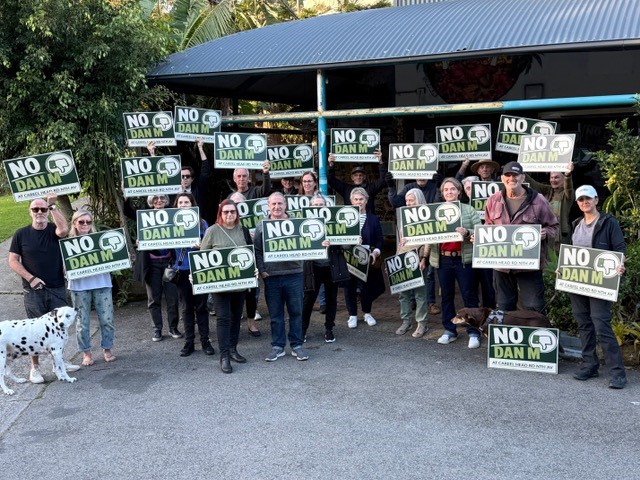
Careel Bay Residents Association and Palm Beach and Whale Beach Residents Association - some of whom live 101 metres away