Blue-faced Honeyeaters Return: Spring in Pittwater
Photos taken: Wednesday October 28 - 31, 2026: Careel Bay, PON backyard

This juvenile Blue-faced Honeyeater (above) was spotted catching insects and then eyeing off the nest it was just about to fly back up to - to feed a baby bird.
We've been hearing an unfamiliar bird-call in recent weeks and wondering 'what bird is that?' and now we know.
This one may be related to the family of Blue-faced Honeyeaters photographed in January 2026 - returning to the trees that tower above us.
Both the male and female tend the young birds, sometimes with the assistance of helpers. The fledglings remain with the parents for some time after fledging.
On Saturday morning, October 31, one of the babies, with a shorter body and tail, was spotted out of the nest and calling for food - and a feeder bird was getting insects from the tree surfaces and bringing them to it.
Although a little too high up for the camera we have, some fuzzy pics of one of this year's little ones shows the difference in size and the difference in the colour around the eye when they're this young - hopefully a few clear photos of this littlie being fed may be yours to be see over the next few Issues:
.jpg?timestamp=1793445433704)
.jpg?timestamp=1793445469560)
The Blue-faced Honeyeater, Entomyzon cyanotis, is a large black, white and golden olive-green honeyeater with striking blue skin around the yellow to white eye. The crown, face and neck are black, with a narrow white band across the back of the neck. The upperparts and wings are a golden olive green, and the underparts are white, with a grey-black throat and upper breast.
The blue facial skin is two-toned, with the lower half a brilliant cobalt blue. Juvenile birds are similar to the adults but the facial skin is yellow-green and the bib is a lighter grey. This honeyeater is noisy and gregarious, and is usually seen in pairs or small flocks. It is known as the Banana-bird in tropical areas, due to its habit of feeding on banana fruit and flowers.
The Blue-faced Honeyeater forms breeding pairs, and may sometimes be a cooperative breeder, where immature birds help the main breeding pair to feed nestlings - and what may have been captured by this photo.
Most nests are made on the abandoned nests of Grey-crowned Babblers, Noisy, Silver-crowned and Little Friarbirds, Noisy Miner, Red Wattlebird, Australian Magpie, Magpie-Lark and, rarely, butcherbirds or the Chestnut-crowned Babbler. Sometimes the nests are not modified, but often they are added to and relined. If a new nest is built, it is a neat round cup of rough bark, linked with finer bark and grass.
On the morning of Friday January 30 2026 these two fledglings and their parents were spotted bathing and drinking then drying off in the PON yard at Careel Bay.
Marita Macrae of the Pittwater Natural Heritage Association (PNHA) who has hosted many Bird Walks in Pittwater for decades, stated that it’s very unusual to see those birds here, and breeding too!, but not the first time though.

Blue-faced honeyeater (Entomyzon cyanotis), juvenile/fledgling pair in PON yard, January 30 2026 - they're wet as they just had a bath/drink in one of the 4 birdbaths in the PON yard - each at a compass point and at least 1 under shade as sun shifts during the day. They are calling for food from parents birds it would seem.
The Blue-faced honeyeater (Entomyzon cyanotis), is a passerine bird of the honeyeater family, Meliphagidae. It is the only member of its genus, and it is most closely related to honeyeaters of the genus Melithreptus.
Three subspecies are recognised.:
- E. c. albipennis was described by John Gould in 1841 and is found in north Queensland, west through the Gulf of Carpentaria, in the Top End of the Northern Territory, and across into the Kimberley region of Western Australia. It has white on the wings and a discontinuous stripe on the nape. The wing-patch is pure white in the western part of its range, and is more cream towards the east. It has a longer bill and shorter tail than the nominate race. The blue-faced honeyeater also decreases in size with decreasing latitude, consistent with Bergmann's rule. Molecular work supports the current classification of this subspecies as distinct from the nominate subspecies cyanotis.
- E. c. cyanotis, the nominate form, is found from Cape York Peninsula south through Queensland and New South Wales, into the Riverina region, Victoria, and south-eastern South Australia.
- E. c. griseigularis is found in southwestern New Guinea and Cape York, and was described in 1909 by Dutch naturalist Eduard van Oort. It is much smaller than the other subspecies. The original name for this subspecies was harteri, but the type specimen, collected in Cooktown, was found to be an intergrade form. The new type was collected from Merauke. This subspecies intergrades with cyanotis at the base of the Cape York Peninsula, and the zone of intermediate forms is narrow. The white wing-patch is larger than that of cyanotis and smaller than that of albipennis. Only one bird (from Cape York) of this subspecies was sampled in a molecular study, and it was shown to be genetically close to cyanotis.
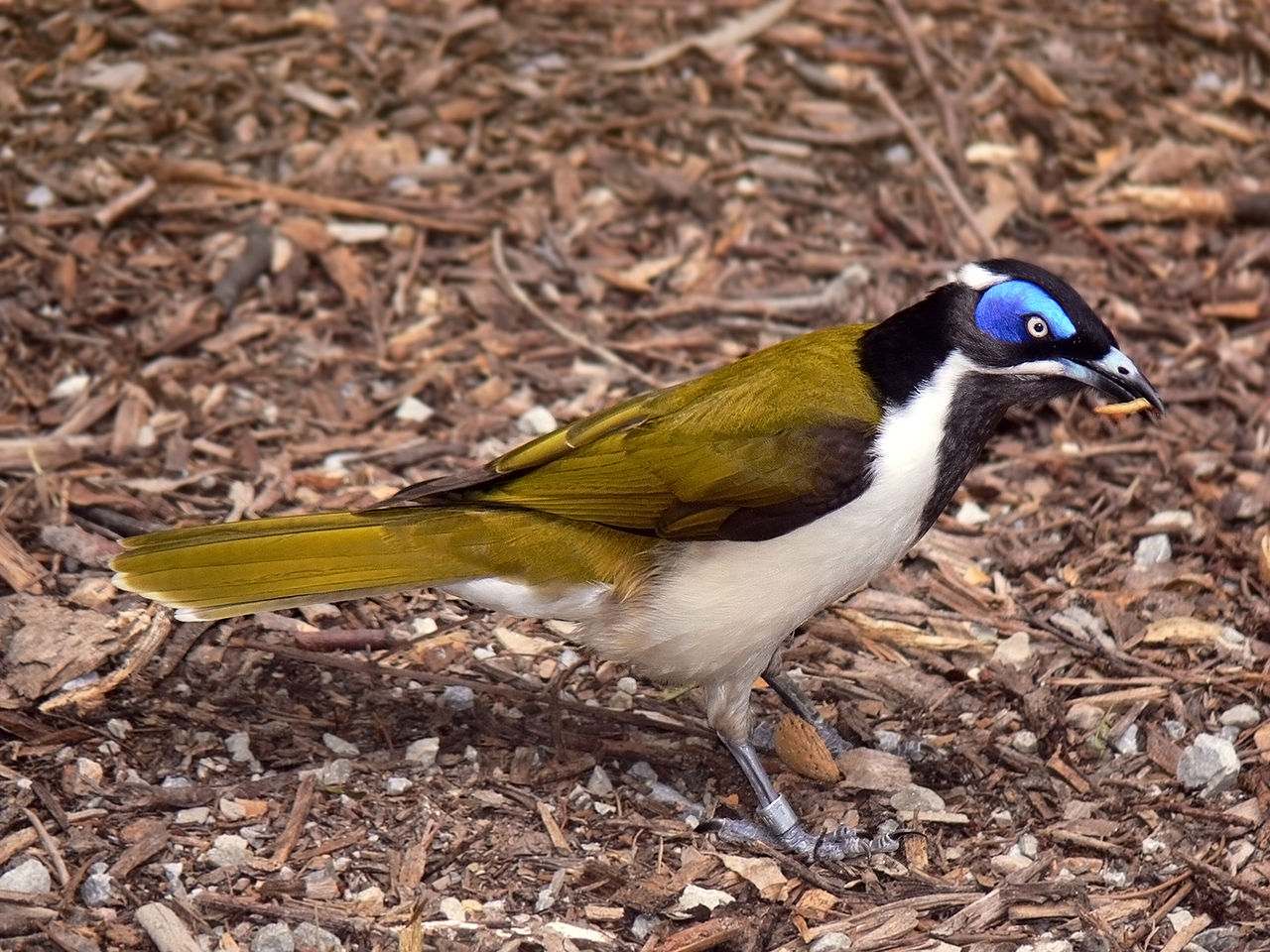
Adult bird of Subspecies cyanotis feeding, south-eastern Australia, feeding. Photo: Benjamin444
The Blue-faced Honeyeater is found in tropical, sub-tropical and wetter temperate or semi-arid zones. It is mostly found in open forests and woodlands close to water, as well as monsoon forests, mangroves and coastal heathlands. It is often seen in banana plantations, orchards, farm lands and in urban parks, gardens and golf courses.
The Blue-faced Honeyeater is found in northern and eastern mainland Australia, from the Kimberley region, Western Australia to near Adelaide, South Australia, being more common in the north of its range. They are considered sedentary in the north of its range, and locally nomadic in the south. It is not found in central southern New South Wales or eastern Victoria now. This species is also found in Papua New Guinea.
Around Wellington in central New South Wales, birds were once recorded over Winter months, and were more common in autumn around the Talbragar River. Birds were present all year round near Inverell in northern New South Wales, but noted to be flying eastwards from January to May, and westwards in June and July.
The Blue-faced Honeyeater feeds mostly on insects and other invertebrates, but also eats nectar and fruit from native and exotic plants. It forages in pairs or noisy flocks of up to seven birds (occasionally many more) on the bark and limbs of trees, as well as on flowers and foliage. These flocks tend to exclude other birds from the feeding area, but they do feed in association with other species such as Yellow-throated Miners and Little Friarbirds.
Their colouring reminds us of the Australasian Figbird Pair we've also seen nesting in our yard - although there are clear differences there too:
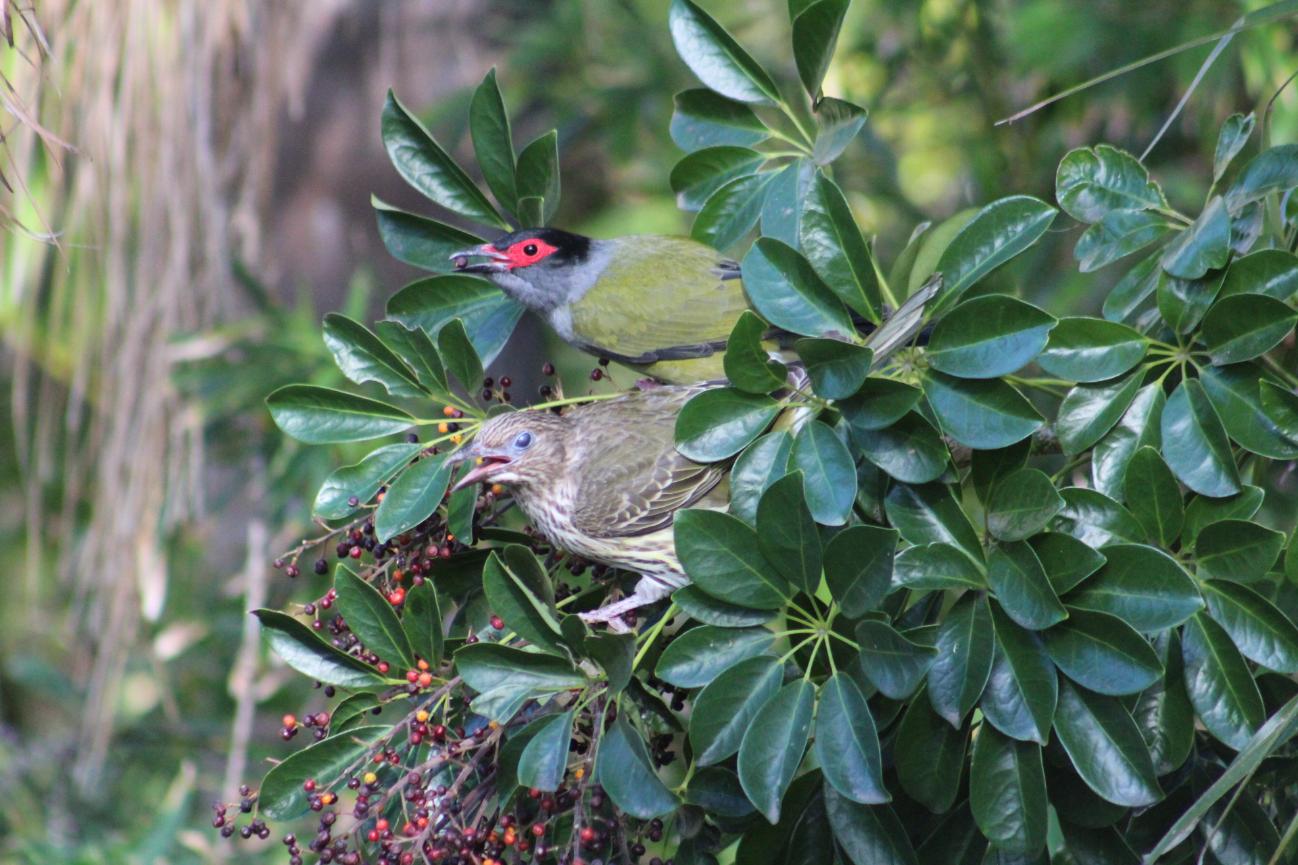
Australasian Figbirds(Sphecotheres vieilloti) pair
Males have bare, red skin around the eye, contrasting against a black crown and grey neck and throat. The remainder of the body is olive-green, except for a white under-tail area. There are two distinct colour forms of the males of this species. Males north of Proserpine in Queensland have a yellow front.


Females have grey skin around the eye and lack distinctive head markings. They are brown-green above and dull-white below, streaked with brown. Both sexes have a blackish bill.


Blue-faced Honeyeater leaping off the back fence this past week to take a feast of spider home