NSW Government invests $1 million to fund biocontrol research to manage weeds: pittwater's 2020-2021 Connections
On Tuesday February 10 2026 the NSW Government announced it has granted $1 million to Australia’s national science agency CSIRO to carry out biocontrol research to help control invasive weeds.
'Biocontrol reduces weeds by deploying natural biological agents, such as fungi or insects, and is increasingly important as an environment-friendly, self-sustaining and cost-effective weed-management tool.' the government said in a released statement
The funding is good news for threatened species, primary producers and supporting healthy Country.
Invasive weeds cost Australian agriculture industries close to $4.9 billion each year through crop loss and weed-management costs. On average, biocontrol returns $23 in benefits for every $1 invested and significantly reduces reliance on herbicides.
This $1 million investment by the NSW Environmental Trust for the 2025–26 financial year will support new research initiatives led by CSIRO in partnership with the NSW Department of Primary Industries and Regional Development (DPIRD) and NSW Department of Climate Change, Energy, the Environment and Water (DCCEEW).
The initiatives will target 11 weeds across diverse ecosystems from arid lands to moist forests. For example, mass-rearing and releasing a cochineal insect to tackle Hudson pear, while a leaf-smut fungus will manage wandering trad – each tailored to the specific environment and species.
Native to South America, wandering trad is a fleshy-leaved creeping plant that grows as a ground cover.
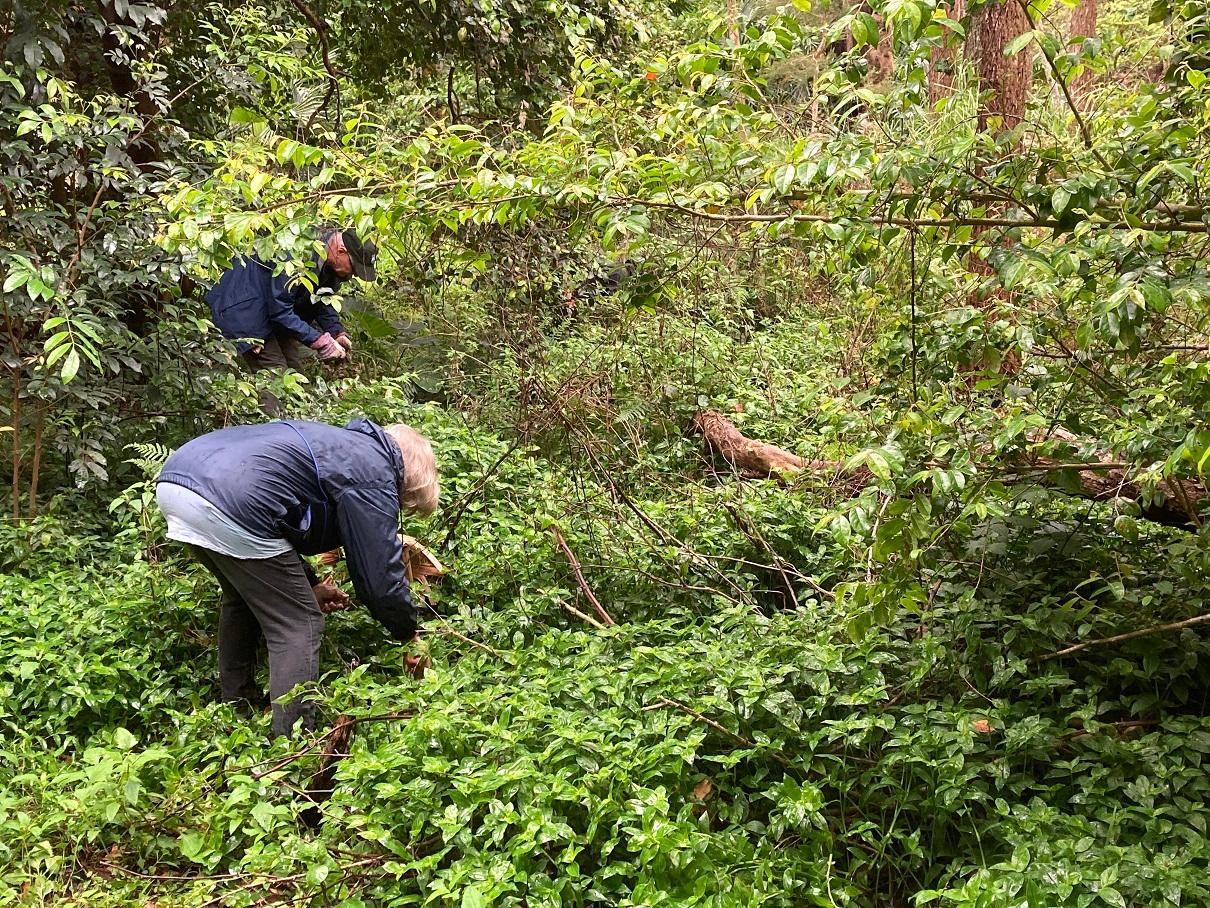
When it escapes into bushland, wandering trad smothers and crowds out native plants. It is considered a major environmental weed in subtropical and temperate rainforests. It has become a major problem in Pittwater.
Wandering trad has infested native forests across eastern Australia, from eastern parts of NSW and south-east Queensland, to the Dandenong Ranges in Victoria where the biocontrol agent was first released in 2019.
A CSIRO-Pittwater Natural Heritage Association project, co-funded by CSIRO and the New South Wales Government through its Environmental Trust, facilitating stakeholders’ releases of the fungus across the range of wandering trad in New South Wales, commenced in Pittwater in 2020.
Members of PNHA placed pieces of Trad infected with the fungus Kordiana were planted among healthy Trad beside the track to the Irrawong waterfall at Narrabeen, in McCarrs Creek Reserve Church Point and in Bangalley Head Reserve near the track on Whale Beach Rd.
The fungus may take a while to spread to healthy Trad. The effect will be to suppress its growth by damaging its leaves rather than kill it completely. This release is just the first of many to come.
Don't worry, it's not another Cane Toad. It has been carefully tested by the CSIRO and only infects Trad and not its close native relative Commelina which has blue flowers.
An April 2021 update from PNHA showed the project was working.
Trad biocontrol in Ingleside Chase Reserve: Success! Trad biocontrol smut takes off
From Pittwater Nature, Issue 5 April 2021:
You’ll have read about our October 2020 smut releases in PNHA Newsletter 86.
We’re excited to announce that Trad next to where we planted some infected stems along the track to the Irrawong waterfall is looking yellow and sick. The spores of the smut, a type of fungus, have started spreading and infecting healthy Trad. We were advised to wait for up to a year for results, so to see Trad dying after only six months is wonderful.
We receive boxes of infected stems from the CSIRO in Canberra. In February this year we planted stems amongst dense Trad along Narrabeen Creek at Warriewood. This April we planted in the Avalon reserves Toongari, Palmgrove Park and Plateau Park and in Crescent Reserve Newport. A few stems were also planted in the Avalon Community Garden. McCarrs Creek Reserve had been planted in October, but in April we planted more in other areas there.
Click here: https://blog.csiro.au/smut-to-the-rescue/ to read about the CSIRO’s Wandering Trad biocontrol program.
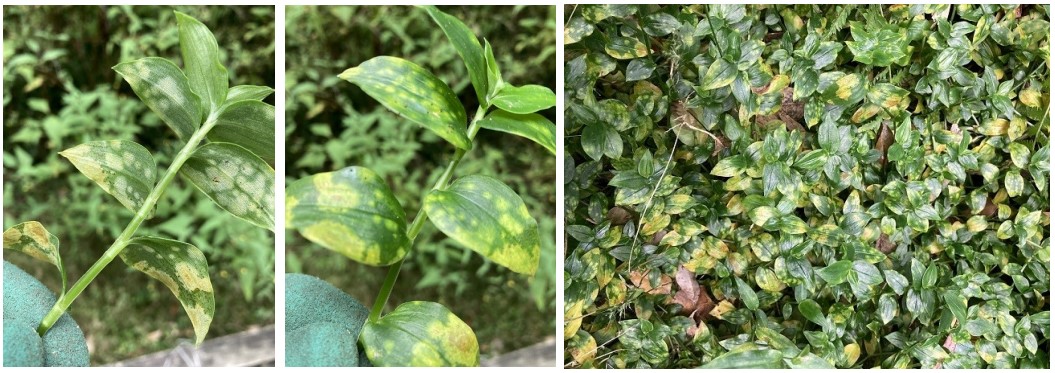
Left: Smut spores form on the lower surface of the leaf. Centre: Yellow dying cells from upper surface. Right: Infected area. Leaves will die, the plant will collapse, native vegetation can get light. Bush regenerators and gardeners, rejoice!
Next Steps
The state government states the next steps to manage weeds are to ensure all approved biocontrol agents are easy and safe for the community to use.
Following biocontrol agent releases, monitoring programs will evaluate their impacts on weeds and the recovery of native ecosystems, and findings will be shared through a statewide network.
The project includes a co-designed Aboriginal Engagement Plan ensuring Traditional Custodian knowledge and values guide biocontrol efforts and strengthen outcomes on Country.
The Trust has already invested $3.4 million to date. Previous projects have reduced the impacts of serious environmental weeds such as the coastal invader sea spurge, helping native species to recover.
Dr Ben Gooden, CSIRO Senior Research Scientist said:
"This project unites cutting-edge science and ecological knowledge to tackle one of our most persistent environmental challenges – restoring landscapes impacted by invasive weeds.
"Biocontrol offers a sustainable, long-term solution to managing invasive weeds, helping native ecosystems recover and thrive without the need for repeated chemical intervention.
"Successful biocontrol reduces the burden on land managers, improves biodiversity, and supports more resilient landscapes for future generations."
NSW Environmental Trust Director, Katie Robinson said:
“This funding is part of the NSW Government’s Environmental Trust’s support to tackle invasive weeds across NSW.
“Invasive weeds threaten 40 per cent of threatened species and 89 per cent of endangered ecological communities in NSW.
“Weeds are a serious threat to our environment and economy. Biocontrol is another tool to manage weeds in the future.”