It’s 11:55 pm on a Saturday night. I have just got into bed and was drifting into a deep sleep.
Ring ring, ring ring—the phone rings.
“Hello,” I say.
The person on the other end of the line says, “Are you the person who rescues raptors?”
“Yes,” I say, as I struggle to wake up.
“We’ve got another raptor caught in the nets at Terrey Hills. It’s trapped in the 40 m tall netting to prevent golf balls from getting into the national park.”
“Okay,” I say. “I’m on my way.”
Before I set off, I ring the Rural Fire Brigade, who rescue birds and animals trapped high in trees. They are the only ones who have the ladders and the skills to reach animals caught high above the ground.
I arrive at the Terrey Hills driving range. The Rural Fire Brigade has come out immediately. They have already rescued the trapped falcon.

Peregrine falcon caught in the 40 m high netting to trap golf balls. Photo: courtesy NSW RFS

Peregrine Falcon caught in the net. Photo: courtesy NSW RFS
A fireman hands me a bird neatly wrapped in a towel. He holds it very gently. It looks like a taco, the way it’s wrapped up.
I have a quick glance at it, but I can’t examine it properly because we’re standing in an open field. If it is injured, I don’t want to have to try to capture it again if it escapes.

The peregrine falcon being held most tenderly by the fireman.
I ring Northside Emergency Vets (NEV). This is now about 12:30 am. They say, “Bring it in, and we will look at it.”
I drive to NEV and take the bird in. NEV is very apologetic. In the interim before I arrive, they have had two animal emergencies admitted due to car accidents. Triaging gives these animals precedence, as they are highly likely to die. They say, “Come back at 3 am, and we will deal with the bird then.”
I go back to the car park. I am torn. Do I drive over to Five Dock to another experienced carer, or do I take the bird home?
I decide that by the time I get to Five Dock, it will be well after 1:30 am, and I really don’t want to drag another wildlife carer out of bed. I decide to take the bird home.
When I get home, I have a good look at the bird. It is a beautiful peregrine falcon. It seems relatively alert, even though it had been hanging upside down, caught in a net, for up to four hours.
Hanging upside down for several hours usually leads to the death of any animal.
I carefully examine the bird. It’s still got some netting wrapped around its feet. I know that I have to remove the netting; otherwise, it could get compression damage to the blood supply in its feet. This could cause it to lose its feet.

The peregrine falcon‘s feet.
Very, very carefully, with special surgical scissors, I cut away the netting.
All of a sudden, the bird gives a huge start—and dies.
I look at it in horror.
What have I done? We, wildlife carers, have been trained by many experts on how to deal with raptors. I have meticulously followed every protocol that we have been taught.
I look at the bird. It’s stretched out, dead. Its feet have gone floppy.
It is now around 2 o’clock in the morning, and I am very tired and so, so upset that I have killed this beautiful bird. Very carefully, I wrap the body in a towel, put it back into the cage, and crawl off to bed.
I lie there for hours, tossing and turning, trying to work out what I had done wrong. What caused the bird to die?
I finally dropped off to sleep at about 4:30 am.
The next morning, I wake up early. I think I’d better go and deal with the dead body. I walk into the room and look in the cage where I had left the bird, all wrapped up.
The bird looks at me.
It’s standing upright, looking remarkably alive.
I am amazed. I ring another raptor coordinator and tell her the whole story. She starts to laugh. Apparently, it is a well-known trick carried out by raptors to evade predators.
They play dead!
I drive the falcon to Five Dock, where it is given fluids and food. After a day in care, it is released in the bush 500 m from where it was caught.
Many thanks to the NSW Rural Fire Brigade volunteers and Northside Emergency Vets for their help so many times with our wonderful wildlife.

RFS vehicle involved in the rescue of the peregrine falcon. Thank you SO much local NSWRFS volunteers.
About the Peregrine Falcon
Scientific name: Falco peregrinus
The Peregrine Falcon is one of the fastest birds of prey, swooping down at speeds of up to 300 km/h.
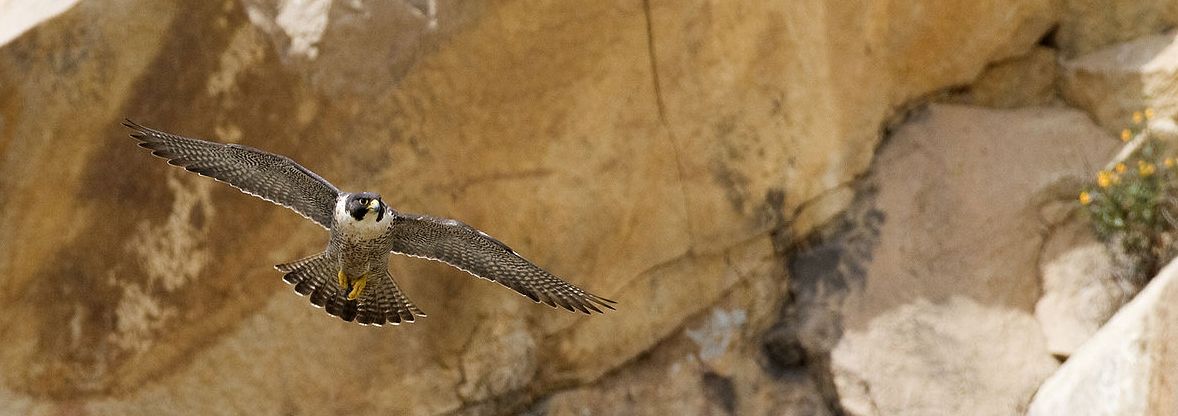
Peregrine Falcons are large, powerfully built raptors (birds of prey), with a black hood, blue-black upperparts and creamy white chin, throat and underparts, which are finely barred from the breast to the tail. The long tapered wings have a straight trailing edge in flight and the tail is relatively short. The eye-ring is yellow, with the heavy bill also yellow, tipped black. Although widespread throughout the world, it is not a common species.
The Peregrine Falcon mates for life and pairs maintain a home range of about 20 km to 30 km square throughout the year. Rather than building a nest, it lays its eggs in recesses of cliff faces, tree hollows or in the large abandoned nests of other birds. They will sometimes nest on artificial structures such as the window ledges of high buildings.
The female incubates the eggs and is fed by the male on the nest. When the young have hatched, both parents hunt to provide food. Young Peregrine Falcons disperse widely, but often return to their original home area to breed when mature.
Pesticides have been found to thin the eggshells of Peregrine Falcons, decreasing their nesting success in some areas.
The Peregrine Falcon is found in most habitats, from rainforests to the arid zone, and at most altitudes, from the coast to alpine areas. It requires abundant prey and secure nest sites, and prefers coastal and inland cliffs or open woodlands near water, and may even be found nesting on high city buildings.
The Peregrine Falcon is found across Australia, but is not common anywhere. It is also found in Europe, Asia, Africa and the Americas.
Calls
Loud, shrill, repeated: 'hek-ek-ek', with females lower-pitched than males.
Facts and Figures
- Research Species: No
- Minimum Size: 38cm
- Maximum Size: 48cm
- Average size: 43cm
- Average weight: 765g
- Breeding season: August to December
- Clutch Size: 2 to 4, usually 3
- Incubation: 30 days
- Nestling Period: 35 days

The Peregrine Falcon is one of the fastest birds of prey, swooping down at speeds of up to 300 km/h. Image: Nic Trott
Information: BirdLife Australia Birds In Backyards series, and Australian Museum