October 1 - 31, 2026: Issue 659


Vale Phil Colman: the Barefoot Aquatic Naturalist

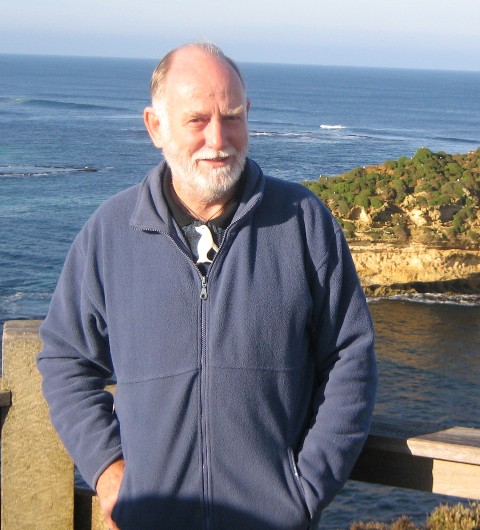
Our area has lost one of the best recently. Phil Colman, known to many as a 'barefoot naturalist', was a gentle man who spent decades sharing his love of the ecosystems between tidelines with generations of locals and visitors to our shores.


Mayor Sue Heins, in tabling a Mayoral Minute to the October 2026 council meeting to honour Phil, stated:

A lifelong resident of Collaroy, Phil devoted countless hours to studying, protecting and promoting the natural environment of our region. His commitment to conservation, education and community service has left an indelible mark on the northern beaches.

Phil was a respected naturalist and marine educator whose career included many years with the Australian Museum, working in its Department of Malacology (the study of shells and molluscs). Earlier in his career he also worked as a field associate in entomology in Papua New Guinea for the B.P. Bishop Museum in Honolulu.

In recognition of his scientific work, species have been named in his honour, including the deep-water tusk shell Rhomboxiphus colmani, commemorating his contributions to natural history and museum science.

Phil was one of the key figures who campaigned for the protection of Long Reef in the 1970s. Alongside pioneering marine biologists Isobel Bennett AO and Elizabeth Pope, he helped lead efforts that ultimately resulted in the declaration of Long Reef Aquatic Reserve in 1980, ensuring the area's rich biodiversity would be protected for research and education.

For decades he conducted educational walks and school excursions across the Long Reef rock platform. Thousands of schoolchildren, scout groups and community members learned about marine ecology through his engaging field tours. He spent more than 40 years guiding groups over Long Reef's intertidal habitats and sharing his passion for conservation. He was also a founding executive member of the Narrabeen Lagoon Committee in 1977 and played a leading role in environmental campaigns across the northern beaches.

In addition to his amazing environmental work, Phil also served as a Councillor with the former Warringah Council, combining his deep commitment to the environment with his passion for his local community.

Phil was deservedly recognised by Council with the Individual Lifetime Achievement Award at the 2021 Northern Beaches Eco Awards for his lifelong contribution to environmental conservation, particularly his work protecting and educating people about Long Reef Aquatic Reserve.

Those who knew Phil speak not only of his remarkable knowledge, but also of his generosity in sharing it. Of course they will always remember his humility, his bare feet, his sense of humour – he was a true gentleman.

He will be greatly missed by many as he has given so much for our community and leaves behind a legacy that will continue to influence conservation efforts across the northern beaches for many years to come.  I ask Council to work with Phil’s family and Friends of Long Reef to find a fitting tribute to recognise his long-standing contribution.

Our thoughts are with his family and friends at this very difficult and sad time and on behalf of my fellow Councillors and the northern beaches community, I extend our deepest sympathies.

Friends of Long Reef stated:

With sadness we share the passing of our friend, mentor and leading member, Phil Colman. Phil was a marine scientist with the Australian Museum, and a champion of nature and Long Reef for most of his life. He was instrumental in having the Aquatic Reserve declared, along with Dr Peter Mitchell and Dr Isobel Bennett OAM. 

Beyond the science, his strengths included being a great communicator of complex things, and a warm way of bringing people together to develop solutions. We loved his humour and ability to talk with anyone from a curious child, to fishers, eminent scientists and politicians. We will miss you, our friend, and wish you well strolling new shores.

One of the last conversations the news service had with Phil was a request from him to type up a 'large bundle' of handwritten notes. Unfortunately, doing 100+ hours per week before you get to family, home and other commitments, does not leave much time to do anything other than the work on your own plate. A recommendation and outline on how to use all the great computer programs now available to help with such tasks as transcribing or converting squiggles into text was met with 'well, get back to me if you can'.

Phil must have 'had a go' in some other way as last year he sent in a lovely missive about a new work; - Phil and Peter Mitchell had revisited and expanded their original 2011 self-published book, Exploring Tidal Waters on Australia’s Temperate Coast, with an updated and expanded second edition: A Field Guide to the Marine Life of Coastal Reefs and Rock Pools, launched in early 2025. 

What a boon for all us fellow tide-paddlers and marine rockshelf shufflers - more knowledge to help us know 'what sea creature is that?'

Years ago Phil share a few insights about himself when the news service ran a Profile about his and Dr. Mitchell's first work together -  in his words:

Phil on Phil:

''Marine life has been on our rocky shores forever. Well almost, geologists tell us there was none when the oceans first formed but in a human context it has always been there but it is forever changing in any time frame you like to observe, between the tides, through the seasons, over decades and over millennia. It is both the diversity of life forms and the dynamics of change that make coastal shore platforms so fascinating. The rocky shore is one place where you can observe a totally different world on any visit and always come away with new knowledge.

I have walked and waded over Long Reef, or Newport headland, or Fairlight; or Flinders Is., or Mornington all my life, and wherever I go I’ve asked myself why? Why is that shellfish doing that? Why is that seaweed that shape? Why is that crab avoiding that pool? For 40 years I have been taking groups of all ages over those platforms, and every time many questions have been asked. Finally, calling on my co-author Peter Mitchell, we wrote a book to answer just some of those questions.

But before that, I’ll chart, briefly, my life so far. 

Born in Inverell, I came to Narrabeen when I was three, and the northern beaches have been my home ever since. From Narrabeen Primary School, I graduated to what was then affectionately known as Shacktown, or officially Balgowlah High, but when the newly built Manly Boys High opened, I moved there. That was the end of formal study but degrees and diplomas are superfluous when enrolled in the University of Life. In later years, while I was not fossicking on Long Reef or beach fishing (with, of course, my own caught beach worms) I worked with Dad in a printing/price-listing/advertising business.

In 1966 I was enticed away from the coast and worked for the B.P. Bishop Museum of Honolulu in their Field Station in New Guinea, where for four years I never saw the sea but chased vertebrates and insects mainly in the highlands. Then back in Sydney, I joined the Australian Museum (in the shell department) where I worked until I retired about 30 years later.

The book started out as a small set of notes I drew up to give to people I took out on rock platforms. I know nothing of geology and welcomed Peter who could talk rocks the way I couldn’t. What we originally thought would be a small, localised booklet certainly surprised us when a 128 page, 200 colour photos publication eventuated, nearly all photos taken by Peter.

The title Exploring tidal waters on Australia’s temperate coast incorporates the word ‘temperate’, as we both realised that what occurs here on the northern beaches also occurs right round non-tropical Australia. In fact, I sent a copy to a colleague in South Africa, who replied that he could take it down to his local rocky shore and feel really at home with it. We could sell this book around the world – if only we had the resources of a major publishing house!

The Coastal Environment Centre at Narrabeen (Pittwater Council) has been running a very successful programme called Coastal Ambassadors “Prepared for the communities of NSW who care about the coast”. I have been recently involved, and may play a larger role in coming years. Open to all, most participants so far have been from surf clubs who are keen to know and understand more about their local marine environment. In 2012 the programme has been extended to the State.

My favourite place on the northern beaches? Well it would have to be Long Reef wouldn’t it?

And a philosophy for life? Well if I have one it is that understanding biological life is a never-ending learning experience. '

Peter Mitchell, who explained during their first Profile, ''I first encountered Phil when we both served on a Scientific Advisory Panel for Manly Council. This ran for more than ten years and often dealt with coastal issues. At some stage Phil gave me copies of his notes and the idea of a joint book was born, I confess it did a have a long gestation but we are very pleased with the end product and are already talking about the next one.

A motto for life? 
Walk lightly on the Earth, you only get one turn and be guided by Kipling’s ‘Six Honest Men’. Keep asking – what, why, when, how, where, and who.''

Peter and John Illingsworth have put together the following tribute to Phil - and below that, the compiled work Pittwater Online ran last year. If you can get your hands on a copy of their work - we suggest you do. 

Thank you Phil - we'll miss you and your never-ending curiosity and generous open-hearted sharing of where us paddlers loving being - between the tides and along the seashores. We'll miss your brilliant smile, laugh and your ability to keep it real by deflating those swollen with self-importance by your disarming kindness.

Our sincere condolences to his family and friends.

Rambles with the barefoot naturalist Phil Colman.


A Field Guide to the Marine Life of Coastal Reefs and Rock Pools: by Phil Colman - Peter Mitchell An expanded + updated 'Exploring Tidal Waters on Australia’s Temperate Coast' for all who live here

Phil Coleman with both his and Dr. Mitchell's books. Photo: Reef Care, Long Reef.

Have you ever wandered along a local aquatic rock shelf at low tide, marvelling at the vibrant marine life, and wondered how these creatures survive the changing tides? 

Or spotted a moving shell and thought, what is that? If you’ve ever had these questions, this book is for you.

Phil Colman and Peter Mitchell have revisited and expanded their original 2011 self-published book, Exploring Tidal Waters on Australia’s Temperate Coast, with an updated and expanded second edition: A Field Guide to the Marine Life of Coastal Reefs and Rock Pools, launched in early 2025. 

This  version features even more species, colourful photographs, and a lively, engaging style—sprinkled with humour—to make learning about marine life both accessible and enjoyable.

The original book was inspired by Phil’s 25 years of leading groups through Long Reef Aquatic Reserve, answering countless questions about the intertidal zone. Since then, Phil and Peter have discovered their guide is relevant to temperate intertidal zones worldwide, sparking interest even in South Africa.

Author Phil Colman explains he had been taking people over the Long Reef Shore platform for the best part of half a century and the original purpose of the book was to provide plain English answers to questions he met time and again.

The idea grew and Phil wrote short accounts on many topics then it became a joint effort when co-author Peter Mitchell turned up with geological knowledge and suggested that it should all be run together and illustrated. Just like the organisms we talk about the book grew, drafts came and went and it got bigger. 

''We drew most of our examples from Long Reef because we knew it well and then we slowly found ourselves talking about places in Victoria and New Zealand where the stories were very similar.

A South African friend wrote to say that he was quite happy to use our book with his students on rocky shores and we realised that Long Reef was just a convenient example of most of the processes and relationships that can be seen almost anywhere in the temperate inter-tidal world. 

Patterns of species distribution, life strategies, dispersal methods, modes of communication, and species survival stories are much the same in the Americas, Africa, Asia, Australia, New Zealand, and even in the Mediterranean. The individual species are different but the same families occupy the same niches in all those places. Littorinids are always 'up there', barnacles cluster at the same levels of the tide and waves, and similar looking kelp lives just below the low tide level.''

Beyond its appeal to nature enthusiasts, Phil hopes this guide will serve as a valuable resource for university students, helping to answer the many mysteries of the marine world and inspire further research into intertidal ecosystems.

About the Authors

Phil Colman prefers to call himself a naturalist. He has dabbled in Australian orchidology, and native plants; was a field associate in entomology in Papua New Guinea for the B.P. Bishop Museum of Honolulu for four years, and then spent many years in the Department of Malacology (shells) at the Australian Museum. Phil's knowledge is a consequence of an enquiring mind and a lifetime of experience. He has lived most of his life close to Long Reef, and knows its rock pools, its flotsam and jetsam, its birds, its marine fauna, and its moods well. 

Peter Mitchell doesn't know what he is anymore. He spent the first half of his life fossicking for minerals and bush walking, began his professional life as a geological assistant in the Snowy Mountains and then went searching for gold mines in the NT. In the second half of his life he somehow became an academic and taught geomorphology, soil science and environmental management to thousands of students at Macquarie University in Sydney and the University of Canterbury in New Zealand. This was followed by three decades as an environmental consultant and in the third half of his life he spends time trying to correct the environmental mistakes he contributed to along the way.

The book is now available, including at Bookocino and all great local bookshops. 

Don’t miss the opportunity to dive deeper into the fascinating life of coastal reefs and rock pools!

Below runs a combination of insights into their previous runs in the news service so you can see how adding A Field Guide to the Marine Life of Coastal Reefs and Rock Pools to your home library will enrich your understanding of where we live.

 

Phil Colman, Peter Mitchell - 'Exploring Tidal Waters On Australia’s Temperate Coast'


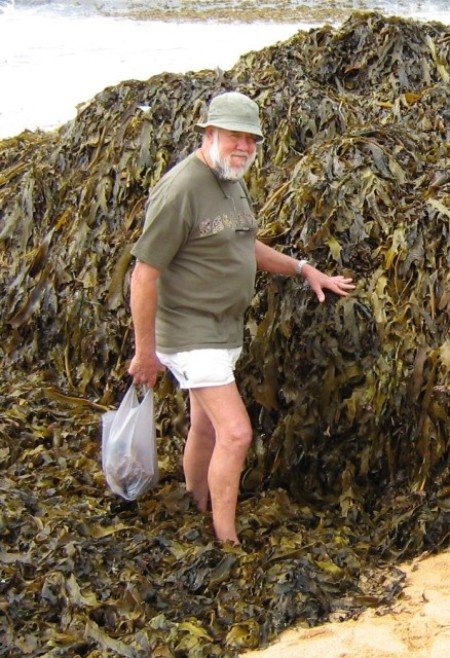
Phil Colman searching for marine treasure in a big kelp stranding on Collaroy Beach.  Peter Mitchell above the cliffs near Port Campbell, his favourite bit of coast.


Screenshot from John Illingsworth's Film - Off Cuts - Long Reef

What On Earth Are Cunjevoi? Is It A Plant Or An Animal?
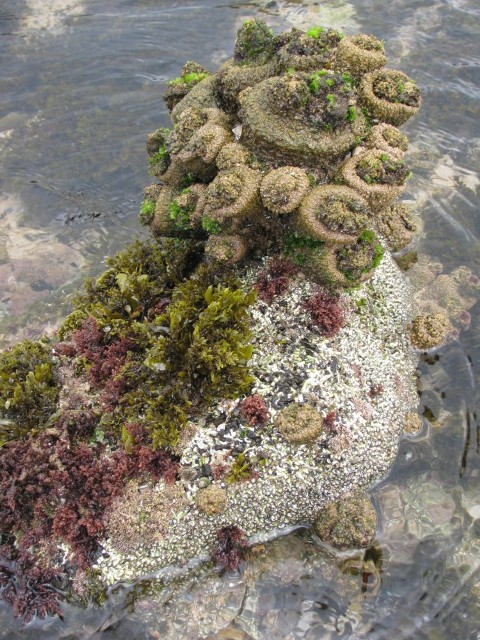
Well there are actually two different things using this Aboriginal word in Australia. Sea squirts or acsidians found on the east coast temperate shores, and a large lily that grows in subtropical Queensland.

We don’t know why these organisms have the same name, in fact we are not even certain from which Aboriginal language the word is derived but surmise it was probably first used by Europeans near Sydney.

The plant Alocasia brisbanensis, resembles an arum lily and is also known as spoon lily. All parts of the plants are extremely toxic but young shoots were eaten by indigenous people after careful pre-treatment and thorough cooking.

On the coastal rock platforms we find dense clusters of marine sea squirts, Pyura stolonifera at and below low tide level. Once a favoured food of Aboriginal people and still collected as bait by rock fishermen, cunjevoi are sessile (attached) organisms that squirt a quantity of water into the air from one of two body siphons on the top of their leathery coat (tunic and hence tunicate) if touched or disturbed when exposed.

Adult cunjevoi stand about 150 to 200mm high and in rough water conditions can be very crowded on the rocks. They are not very attractive to look at, are often coated in sea weed, and a lot of people imagine them to be plants but in fact they have been placed in the Sub-Phylum Urochordata because their tadpole like free swimming larvae have gill clefts, a tail, a nerve cord, and a notochord which we think is a precursor of a vertebrate spine. 

Adults however bear no resemblance to vertebrates! The larvae have a fairly short life as free individuals, maybe 24 to 36 hours and apparently detect the presence of adults from some chemical signal in the water and attach themselves head down in an existing colony. There they spend the rest of their days, probably a few years, functioning like a glued down vacuum cleaner pumping seawater through the body to filter feed, to obtain oxygen, and to dispose of wastes.

Only one species of cunjevoi is found around Australia. Pyura stolonifera extends from Shark Bay on the Western Australia coast, around the south coast and Tasmania, and up past Sydney to Noosa. If adult cunjevoi cannot move and the larvae only have such a short period of free movement then how does the population maintain a single gene pool across such a great distance and in different water bodies? That’s a question to which we don’t have an answer.

On a global scale the same animal is found on the shores of South Africa from Cape Town to Natal, and as a small population spread over 70km of coast in the Bay of Antofagasta in Chile. The first thoughts of biologists looking at this pattern were that cunjevoi evolved when the southern continents were joined as Gondwana. More recently the DNA of the species has been examined and it is clear that the African and Australian populations are rather different and that one of them should be given a new name. The Chilean population however is virtually identical to the animals in Sydney and for that there is a simple explanation. In the early 20th Century Antofagasta was an important port shipping nitrate fertiliser to Australia and cunjevoi undoubtedly crossed the Pacific on the hulls some of those ships.

In Chile the cunjevoi invasion has disturbed the inter-tidal zonation by displacing a native mussel upwards. Cunjevoi seem to grow taller in Chile and they certainly grow in denser clumps than we normally see. Exotic species often have a competitive advantage in new environments and the absence of their usual predators often allows a change in body form or habit. 

Remarkable how far a simple question can take you isn’t it?

“Guides have taken groups of people, or school children, or church or sporting groups over places like Long Reef for many years.  Why?  Television and newspapers and books have opened a door recently to a life  - or should we say ‘lives’ - that have been there forever but which few of us have ever seen.  Children, and now adults, have come to visit a shore platform today and gone home to remember that day as something special, something magic right on their doorstep.


 We challenge you to visit a shore platform during low tide and discover some of that magic.  And take this book as a guide.  No!  It will get wet.  Go home with this book and relive your adventure, again and again.”
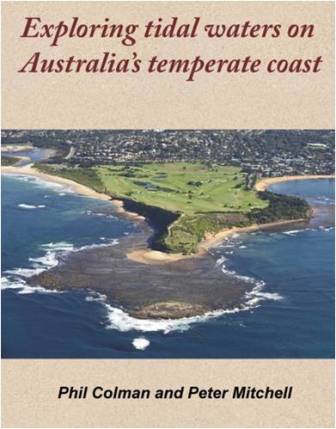

The senior author, Phil Colman, has been taking groups of people over the rock platforms of the northern beaches for about 40 years.  As a marine biologist, formerly of the Australian Museum, he is well equipped to explain the very rich and bio-diverse life of the intertidal zone there.
 
This book is designed to answer, in simple language, the many questions he has been asked over the years – What is it?  He describes the book as scientifically accurate but not scientifically boring.  Co-author Peter Mitchell, a retired professor, added not only substantially to the written word but supplied all the many excellent photos, nearly all of which were taken locally.
 
The title indicates that the facts in the book apply equally to the whole of the non-tropical coast, so readers in say Tasmania would feel equally at home.
 
Available at Berkelouw Books Mona Vale, or Dee Why; or The Coastal Environment Centre in Narrabeen, (all $22), or
groundtruthmitchell@gmail.com ($25 incl. postage).

OFF-CUTS: Long Reef

Published March 19, 2020 by Pittwater Pathways

A pilot film is prospective. It might be to show a sponsor so as to get funding for a series, or perhaps it was a test run. Often the project doesn't go ahead but it's too good to throw away. I call such films 'Off-Cuts'. The 'Long Reef' pilot, despite minor technical flaws, is worth a look. Phil Colman and Peter Mitchell produced an excellent book 'Exploring Tidal Waters on Australia's Temperate Coast'.