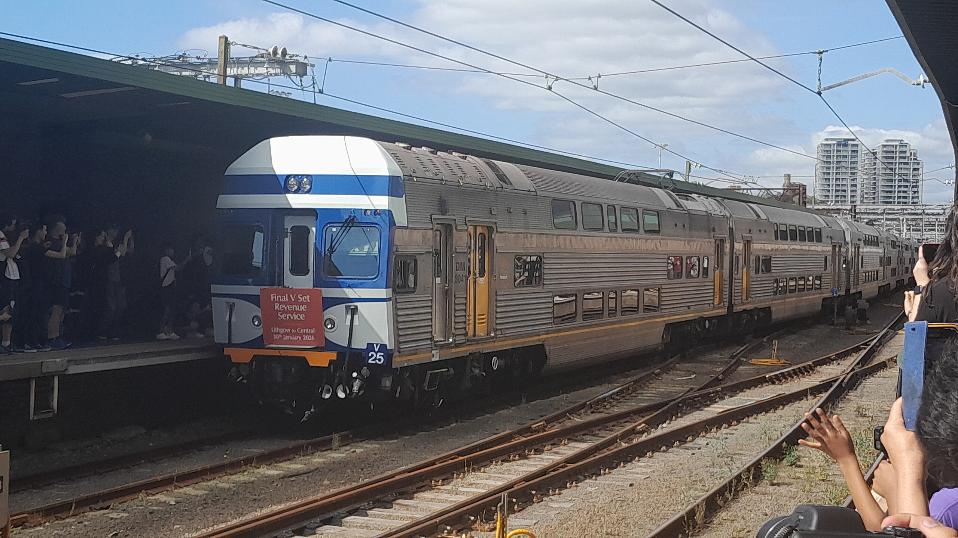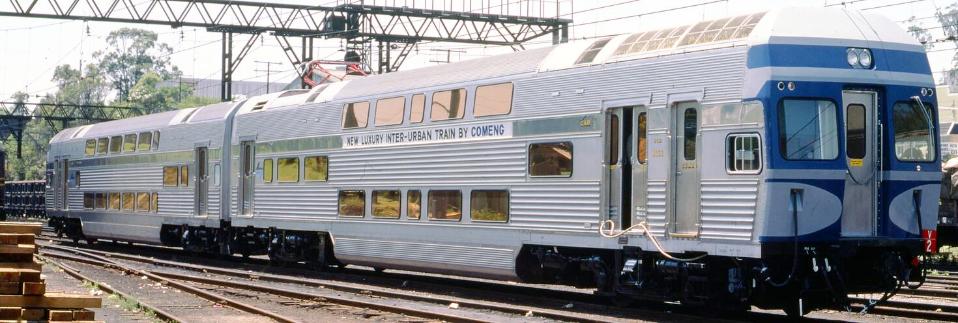
The trains we caught north were the V-set train - which have been retired after half a century serving the people of NSW.
On Friday January 30 2026, the last V-set train pulls into Central Station for the final time after five and half decades in service. Train lovers had the opportunity to join the historic final timetabled V-Set passenger service when it rolled out of Lithgow Station headed for Central in the morning.
The New South Wales V sets are a class of electric multiple units (EMU) that formerly operated on Sydney's surrounding intercity network from 1970 up until 2026. Built by Comeng between 1970 and 1989 and first delivered under the Department of Railways, the sets are of stainless steel construction.
The workhorse fleet of V-sets have travelled the equivalent distance of 298 times to the moon since hitting the tracks in 1970, serving millions of Sydney Trains passengers.
Notable for their stainless steel panelled exterior and distinctive ‘bush plum’ coloured seats and interior, the final V-set has been freshly sprayed in the classic ‘Blue Goose’ livery of royal blue and grey for its final run before entering retirement among the heritage fleet.
The final run left Lithgow at 5.47am to arrive at Central at 8.32am.
When it pulled into platform two it marked the full introduction of the modern intercity Mariyung fleet on the Blue Mountains Line.
Mariyungs began taking over from the V-sets on the Central Coast and Newcastle Line in December 2024 and were then introduced on the Blue Mountains Line from October last year.
The government and Transport for NSW states the introduction of the modern Mariyungs will improve reliability for passengers on these lines, part of a $458 million push by the Minns Labor Government to bring rail reliability up to scratch.
With extra leg room, high seat backs, tray tables for laptops, charging ports for mobile devices, accessible toilets and designated spaces for wheelchairs, bikes and prams, the Mariyung has been warmly received this year by intercity commuters.
Since the Mariyung replaced the V-sets on the Central Coast-Newcastle Line, there has been a decrease in security and vandalism incidents thanks to the enhanced safety and design features of the newer Mariyung fleet in conjunction with the retirement of the V-sets.
When the V-sets first entered service, between Sydney and Gosford and later to Newcastle and the Blue Mountains, their sturdy double-deck design marked a new era in high-capacity rail travel and were lauded as a smooth ride on the longer intercity routes.
At least four carriages of the ‘Blue Goose’ V-set used for the final service will be retained for heritage purposes, while the future of the remaining 81 retired V-set carriages is still being determined.
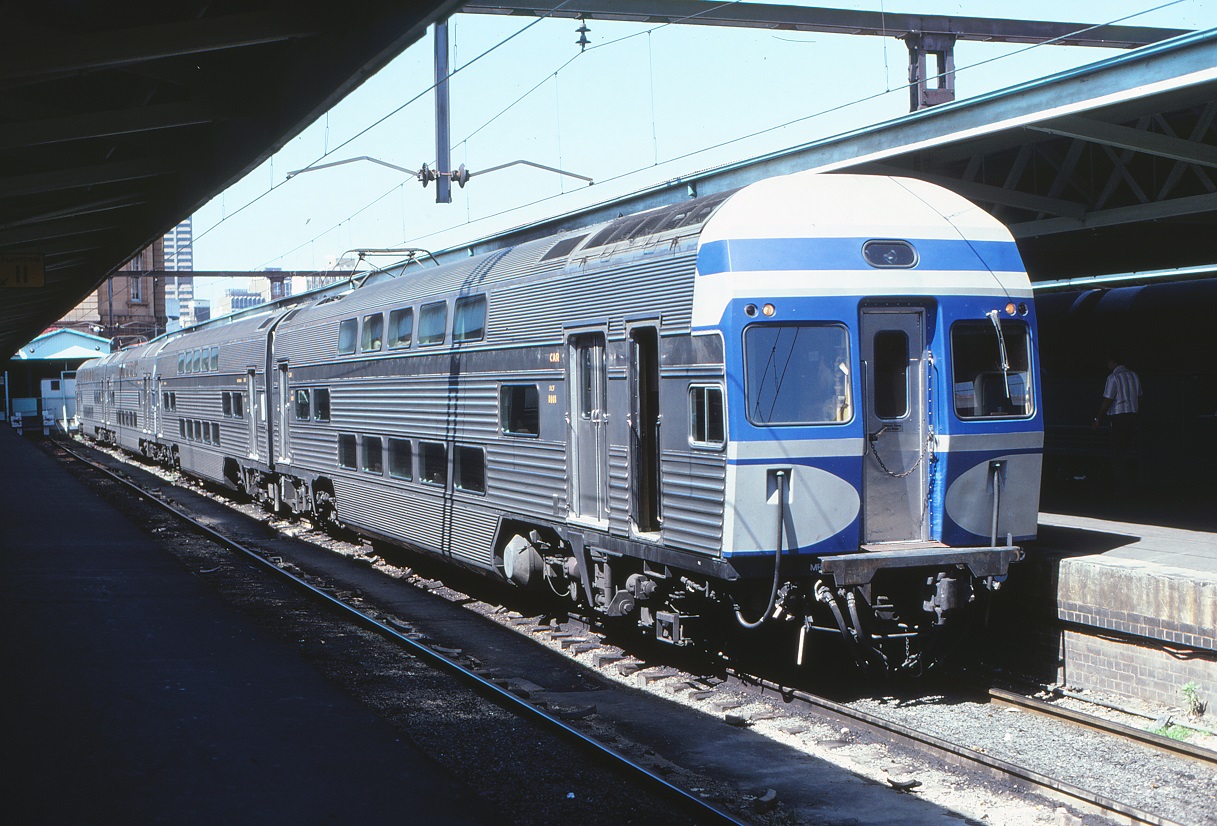
V-Set in original livery at Sydney Station, 30 November, 1979. Photo: credit to ARHS archives
In July 1968, the Department of Railways New South Wales placed an order for the first batch 16 cars with Commonwealth Engineering. The first 4 cars debuted on the Sydney to Gosford route on 22 June 1970, targeted as F111. All 16 cars were in operation by September 1970.
These cars had many similar features to the later-built cars, including the one-piece moulded glass reinforced plastic end in royal blue and grey livery (earning them the Blue Goose nickname), semi-automatic doors, electronically controlled brakes and double-glazed windows. They had a different style of headlight and interior lighting to subsequent builds.
There were:
- 8 Power Cars – DCF 8001–8008 – Economy Class
- 4 Driving Trailer Cars – DDC 9001–9004 – 1st Class upper deck, Economy Class other seats
- 4 Trailer Cars – DTF 9011-9012 – Economy Class; DTC 9021–9022 – 1st Class upper deck, Economy Class other seats
The configuration of these cars was unsuccessful. The cars were fitted with AEI electrical equipment, using similar traction motors to the 1955 electric single deck train stock (U sets and New South Wales Sputnik suburban carriage stock) but with a then brand new "Camshaft controller", for controlling power to the traction motors. The electrical equipment was split between the power and trailer car, the motor-alternator suffered from numerous failures, preventing the air-conditioning system and the air brake compressors from working.
One class travel was introduced in September 1974, so the seating was all economy class. This led to the refurbishment of the DDIU sets with the original luggage racks above the seating in the single deck section being removed. During this time the sets were targeted as U sets, the plates used on the single deck interurbans.
In the early 1980s, it was decided to convert these to trailer cars hence 16 power cars were ordered with no matching trailers. Between March and December 1982 the cars were rewired at Electric Carriage Workshops, and the driver compartments removed and replaced by passenger toilets and luggage space. The reinforced plastic ends remained, albeit with the blue removed.
From October 1977, the second batch began to enter service, with many differences from the first batch. The electrical equipment was all mounted on the power car, using Mitsubishi Electric equipment; they had stainless steel underframes; were fitted with vacuum retention toilets, and had gold as opposed to green tinted windows. These cars were the first of the V sets, with the V indicating two-car double decker sets, as opposed to 4-car and 6-car double decker U sets. These cars operated separately from the 1970 cars, as the two types were not compatible with each other.
The cars built were:
- Power Cars – DCM 8021–8036
- Driving Trailer Cars – DCT 9031–9044
The driving trailers were not used that much, due to driver complaints about an uncomfortable "kick" when the power car started to push the trailer. The controls in the DCTs were gradually stripped and used to replace defective controls in the DCMs. In 1990 DCT 9034 was refurbished by CityRail as a lounge car with lounge chairs and a kitchen for use as a charter car named Contura. It was not a success, not helped by poor marketing, and it was rebuilt as a conventional trailer (without controls) in 2000 and renumbered DET 9216. During the Citydecker refurbishment carried out by A Goninan & Co in the 1990s, DCT 9031–9036 had their driver controls reinstated and were recoded as DTDs allowing CityRail to introduce The River, a two-car service from Wyong to St Marys. At the same time the DCMs were refurbished, receiving destination indicators and ditchlights. The refurbishment also saw the installation of air-conditioning in the driver's cabs of the DCMs, their lack of air-conditioning had a union ban preventing them being used as leading cars since 1995.[6] DCM 8032–8036 were modified to have wheelchair seating, and recoded as DTMs. The DCMs that had destination indicators eventually had them removed and replaced with a metal blanking plate, after a decision not to use them on Interurban services. Some were withdrawn in 2011, and were scrapped in November – October 2021.
From May 1981, DIM Power Cars and DIT trailers started to be delivered. These cars had increased seating compared with the DC series, up from 88 to 96 for the power cars, and from 92 to 112 for the trailers. Like earlier cars, these were targeted as U sets, indicating 4-car sets. However, later on, all double decker sets were retargeted as V sets (the V originally used only for 2-car sets) in order to distinguish them from single deck U sets.
The cars built were:
- Power Cars – DIM 8037–8092
- Trailer Cars – DIT 9101–9184
DIM 8037–8068 and were the last cars to be delivered with the Blue Goose moulded fibreglass ends, cream and wood veneer interiors and green seats.
DIM 8069–8092 were built with a white moulded fibreglass end incorporating the State Rail Authority's corporate colours of red, orange and yellow, yellow interiors, newer air conditioning technology and ditchlights. These can be distinguished from the earlier DIMs by the air-conditioning grille cover.
From 1985, DJM power cars and DIT trailer cars entered service. Technological advances saw a thyristor chopper system fitted to the next batch of power cars, coded DJM. The chopper cars gave a smoother and quieter ride. The chopper cars can be distinguished from the earlier camshaft cars by a large open grille at the pantograph end of the power car, and by different hatch coverings over the driver's side of the power car. DJM 8123–8137 had even larger open grilles on the pantograph end. DJM 8101 had its Candy livery moulded fibreglass end repainted into CityRail blue and yellow in 1990 to form a special set, with the commemorative wording "celebrating 20 years of double-deck intercity services to Gosford" applied near the driver's cab window. In 2009, DJM 8101's front was repainted into standard Intercity livery.
The final V sets were introduced in 1989, and they were the last carriages to be built by Comeng's Granville factory.
These cars were coded DKM and DKT and are permanently coupled. There were several changes: the cars were finished in corrugated steel, instead of the previous inserted Budd fluting. Seating had separate seat backs. Instead of the push-pull doors inside the previous V sets, the DKs were fitted with an electronically operated vestibule door, and no door was installed at the gangway. The State Rail Authority wanted to order an extra 50 but funding was not available.
When introduced, the V sets operated interurban services from Sydney Central on the Main Northern line to Gosford and on the Main Western line to Mount Victoria. It was not until the Ten Tunnels west of Clarence were lowered in 1978 that they were able to operate to Lithgow.
Following the extension of the electrified network, their sphere of operation was extended to Wyong (April 1982), Newcastle (June 1984), Port Kembla (February 1986), Dapto (January 1993) and Kiama (November 2001). From January 2012, V sets ceased operating South Coast services.
The V set carriages are notably the largest electric carriages commissioned for the New South Wales railway network with a length of 23 metres and with the trailer cars weighing 40 tonnes, and the power cars weighing a further 61 tonnes at most. [1.]
Sydney Trains recently completed an Expression of Interest open to the public - including heritage groups and private collectors - to acquire the retired carriages, with applications currently being assessed.
Mariyung trains are currently targeted to be launched on the South Coast Line by the first half of this year.
Minister for Transport John Graham said on Friday:
“These are the trains that for over two generations have carried visiting tourists, weary commuters and train lovers alike.
“In those more than five decades on the tracks, the distance the fleet has travelled is the equivalent of going to the moon about 298 times.
“We all know these trains, whether that’s by their distinctive stainless-steel exterior with the ‘blue goose’ livery or the ‘bush plum’ coloured seats inside, often referred to as 'eggplant'.
“Happily, this farewell marks the full introduction of the intercity Mariyungs on the Blue Mountains Line bringing a major step up in comfort and accessibility.
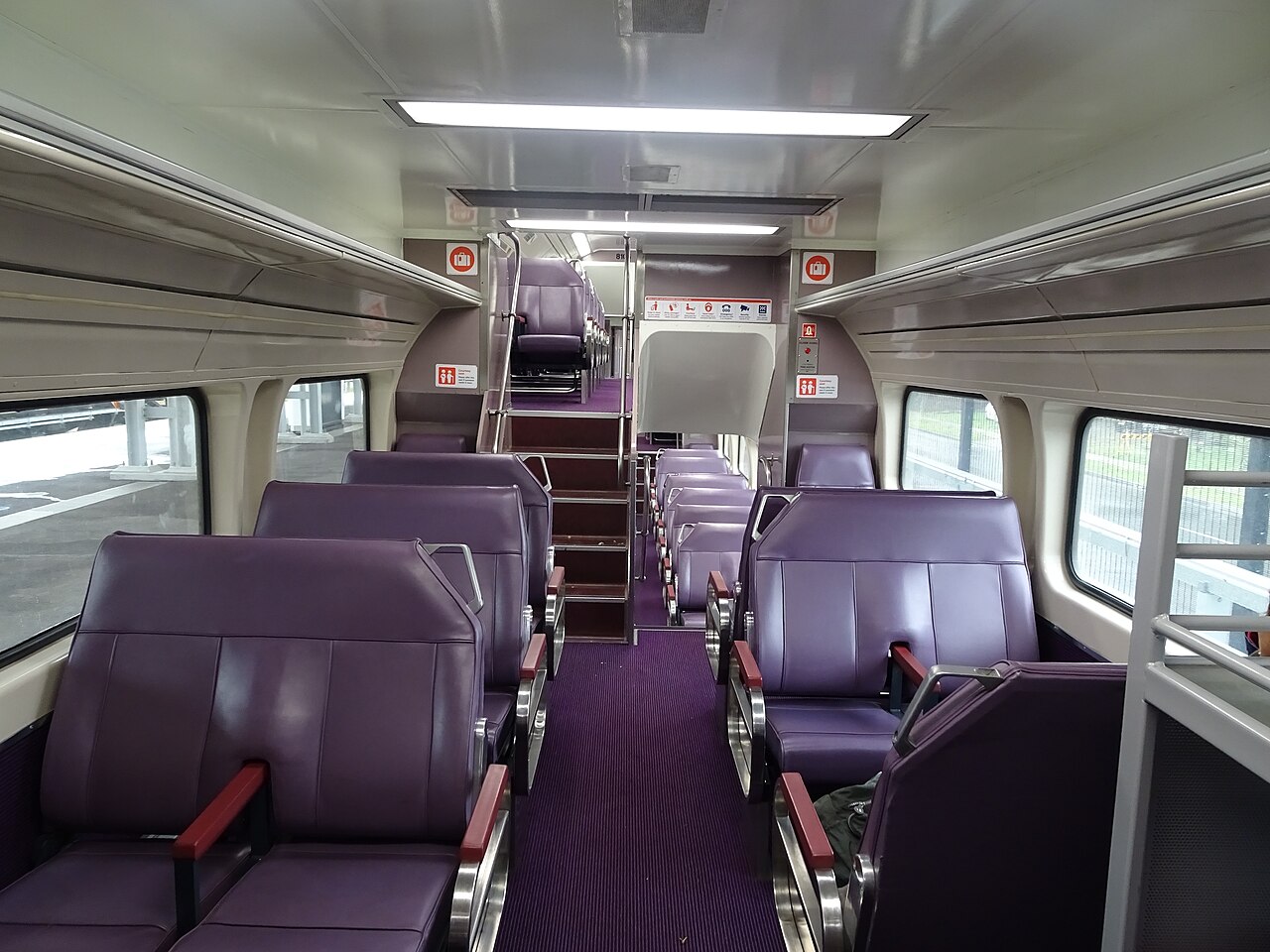
The standard class vestibule of Driving Power Car No.DIM 8092 of NSW Train Link 'V set' (Srs 4) 1,500 V dc overhead Interurban 4-car emu No.V8 at Newcastle Interchange Inter City on a Sydney Central service, NSW, 3 October 2018. Comeng (Sydney) built 61 sets in 1970-89 in 8 series. The 4th Srs was built of inserted Budd fluting. Photo: Hugh Llewelyn
Minister for Regional Transport Jenny Aitchison said:
“The V-sets were described as luxurious when they first hit the tracks in the 1970’s, and over the decades they have become a much-loved and iconic part of travel between Sydney, Newcastle, Lithgow and Wollongong.
“Now it’s time to say final farewells to the trains affectionately known as the ‘steel rattlers’ and deliver the full complement of Mariyungs to the Blue Mountains Line.
“The Mariyung trains represent a major upgrade – offering improved comfort, safety and accessibility features.”
Chief Executive of Sydney Trains Matt Longland said:
“It will be emotional when the Blue Goose heads down the Blue Mountains for the last time, and we will give the V-sets a fitting farewell for their 55 years of service at Central Station.
“While it’s a day for nostalgia, it’s also important we modernise our fleet for the benefit of the millions of train passengers that use the intercity network every year.
“So, it’s exciting to be delivering on the full Mariyung rollout on the Blue Mountains Line, and we look forward to launching these more modern, comfortable and accessible trains on the South Coast Line soon.”
On 30 January 2026, the final revenue V set service ran from Lithgow to Sydney Terminal (Central) with sets V25 and V10.