May 1 - 31, 2026: Issue 654
UN General Assembly backs historic World Court climate crisis ruling: Obligations of States in respect of Climate Change + Australia violated Torres Strait Islanders’ rights to enjoy culture and family life, UN Committee finds + The Australia-Tuvalu Falepili Union
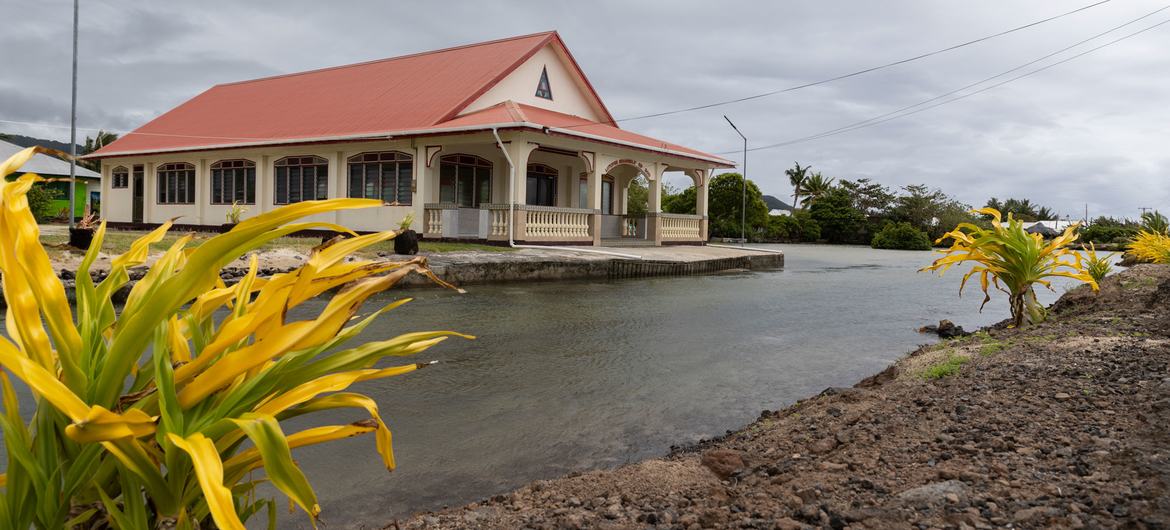
Sea-level rise is affecting Pacific island nations like Samoa (pictured). Photo: United Nations/Kiara Worth
A landmark General Assembly resolution adopted on Wednesday May 20 2026 is “a powerful affirmation” of international law, climate justice and science, according to UN chief António Guterres.
The Secretary-General said it makes clear Member States’ responsibility to protect their own people from what is an “escalating climate crisis”.
The resolution drawn up by Vanuatu - a Pacific island nation on the frontline of the climate crisis, and several other countries - was adopted after intense discussion including multiple proposed amendments with 141 votes in favour, eight against and 28 abstentions.
Those voting against were Belarus, Iran, Israel, Liberia, Russia, Saudi Arabia, the US and Yemen.
When the International Court of Justice (ICJ), the UN’s principal judicial body, ruled in July 2025 that States have an obligation to protect the environment from greenhouse gas (GHG) emissions, the decision was hailed as a breakthrough. The UN chief described it simply as “a victory for our planet”.
‘Legal duty’
The Court also ruled that if States breach these obligations, they are legally responsible and may be legally required to stop the wrongful conduct, offer guarantees that it won’t happen again, and make full reparation, depending on the circumstances.
Although the ICJ’s advisory opinions are not binding, they carry significant legal and moral authority – helping to clarify and develop international law by defining States’ legal obligations.
Wednesday’s General Assembly adoption following up on the ruling, sends a strong message that tackling the climate crisis is a legal duty under international law, and not just a political choice. “The world’s highest court has spoken,” responded Mr. Guterres. “Today, the General Assembly has answered.”
What’s in the resolution?
The resolution calls on all UN Member States to take all possible steps to avoid causing significant damage to the climate and environment, including emissions produced within their borders, and to follow through on their existing climate pledges under the Paris Agreement.
Governments are urged to cooperate in good faith and continuously coordinate efforts to tackle climate change globally and ensure that climate policies safeguard the rights to life, health, and an adequate standard of living.
In a statement released after the General Assembly vote, Mr. Guterres declared that those least responsible for climate change are paying the highest price, and that the path to climate justice “runs through a rapid, just, and equitable transition away from fossil fuels towards renewable energy.”
The UN Secretary-General noted that renewables have proved to be the cheapest and most secure form of energy and that the goal of keeping global temperature rises to no more than 1.5 degrees above pre-industrial levels is still within reach.
Statement by the Secretary-General on the adoption of the General Assembly resolution on the Advisory opinion of the International Court of Justice on the obligations of States in respect of climate change
I welcome today’s adoption of the General Assembly resolution following up on the International Court of Justice’s Advisory Opinion on the obligations of States in respect of climate change.
The world’s highest court has spoken. Today, the General Assembly has answered.
This is a powerful affirmation of international law, climate justice, science, and the responsibility of states to protect people from the escalating climate crisis.
I commend the leadership of Pacific Island countries and other Small Island Developing States — together with the young people whose moral clarity helped bring the world to this moment.
Those least responsible for climate change are paying the highest price. That injustice must end.
The science is clear: fossil fuels are the principal driver of the climate crisis. The path to climate justice runs through a rapid, just, and equitable transition away from fossil fuels towards renewable energy.
Renewables proved to be the cheapest and the most secure form of energy supply.
The task ahead is clear— keep 1.5°C within reach and build a safer, fairer, and more resilient future for all.
Obligations of States in respect of Climate Change
THE HAGUE, 23 July 2025.
The International Court of Justice has today given its Advisory Opinion on the Obligations of States in respect of Climate Change.
It is recalled that, on 29 March 2023, the General Assembly of the United Nations adopted resolution 77/276 in which, referring to Article 65 of the Statute of the Court, it requested the International Court of Justice to give an advisory opinion on the following questions:
“(a) What are the obligations of States under international law to ensure the protection of the climate system and other parts of the environment from anthropogenic emissions of greenhouse gases for States and for present and future generations?
(b) What are the legal consequences under these obligations for States where they, by their acts and omissions, have caused significant harm to the climate system and other parts of the environment, with respect to:
(i) States, including, in particular, small island developing States, which due to their geographical circumstances and level of development, are injured or specially affected by or are particularly vulnerable to the adverse effects of climate change?
(ii) Peoples and individuals of the present and future generations affected by the adverse effects of climate change?”
The request for an advisory opinion was transmitted to the Court by the Secretary-General of the United Nations by a letter dated 12 April 2023. During the written phase of the proceedings, 91 written statements and 62 written comments were filed in the Registry by States and international organizations. The Court held public hearings in the proceedings from 2 to 13 December 2024, during which 96 States and 11 international organizations presented oral statements. This is the highest level of participation in a proceeding in both the history of this Court and that of its predecessor, the Permanent Court of International Justice. The Court adopted today’s Advisory Opinion unanimously — only the fifth time in its nearly eighty-year history that it has done so. To date, the Court has issued 29 advisory opinions.
In its Advisory Opinion, the Court responds to question (a) posed by the General Assembly as follows:
The climate change treaties set forth binding obligations for States parties to ensure the protection of the climate system and other parts of the environment from anthropogenic greenhouse gas emissions. These obligations include the following:
(a) States parties to the United Nations Framework Convention on Climate Change have an obligation to adopt measures with a view to contributing to the mitigation of greenhouse gas emissions and adapting to climate change;
(b) States parties listed in Annex I to the United Nations Framework Convention on Climate Change have additional obligations to take the lead in combating climate change by limiting their greenhouse gas emissions and enhancing their greenhouse gas sinks and reservoirs;
(c) States parties to the United Nations Framework Convention on Climate Change have a duty to co-operate with each other in order to achieve the underlying objective of the Convention;
(d) States parties to the Kyoto Protocol must comply with applicable provisions of the Protocol;
(e) States parties to the Paris Agreement have an obligation to act with due diligence in taking measures in accordance with their common but differentiated responsibilities and respective capabilities capable of making an adequate contribution to achieving the temperature goal set out in the Agreement;
(f) States parties to the Paris Agreement have an obligation to prepare, communicate and maintain successive and progressive nationally determined contributions which, inter alia, when taken together, are capable of achieving the temperature goal of limiting global warming to 1.5°C above pre-industrial levels;
(g) States parties to the Paris Agreement have an obligation to pursue measures which are capable of achieving the objectives set out in their successive nationally determined contributions; and
(h) States parties to the Paris Agreement have obligations of adaptation and co-operation, including through technology and financial transfers, which must be performed in good faith.
Customary international law sets forth obligations for States to ensure the protection of the climate system and other parts of the environment from anthropogenic greenhouse gas emissions.
These obligations include the following:
(a) States have a duty to prevent significant harm to the environment by acting with due diligence and to use all means at their disposal to prevent activities carried out within their jurisdiction or control from causing significant harm to the climate system and other parts of the environment, in accordance with their common but differentiated responsibilities and respective capabilities;
(b) States have a duty to co-operate with each other in good faith to prevent significant harm to the climate system and other parts of the environment, which requires sustained and continuous forms of co-operation by States when taking measures to prevent such harm.
States parties to the Vienna Convention for the Protection of the Ozone Layer and to the Montreal Protocol on Substances that Deplete the Ozone Layer and its Kigali Amendment, the Convention on Biological Diversity and the United Nations Convention to Combat Desertification in Those Countries Experiencing Serious Drought and/or Desertification, Particularly in Africa, have obligations under these treaties to ensure the protection of the climate system and other parts of the environment from anthropogenic greenhouse gas emissions.
States parties to the United Nations Convention on the Law of the Sea have an obligation to adopt measures to protect and preserve the marine environment, including from the adverse effects of climate change and to co-operate in good faith.
States have obligations under international human rights law to respect and ensure the effective enjoyment of human rights by taking necessary measures to protect the climate system and other parts of the environment.
The Court responds to question (b) put by the General Assembly as follows:
A breach by a State of any obligations identified in response to question (a) constitutes an internationally wrongful act entailing the responsibility of that State. The responsible State is under a continuing duty to perform the obligation breached. The legal consequences resulting from the commission of an internationally wrongful act may include the obligations of:
(a) cessation of the wrongful actions or omissions, if they are continuing;
(b) providing assurances and guarantees of non-repetition of wrongful actions or omissions, if circumstances so require; and
(c) full reparation to injured States in the form of restitution, compensation and satisfaction, provided that the general conditions of the law of State responsibility are met, including that a sufficiently direct and certain causal nexus can be shown between the wrongful act and injury.
Reasoning of the Court
The Court first establishes that it has jurisdiction to render the requested opinion and concludes that there is no compelling reason for it to decline to give the opinion requested (paras. 37-49). The Court then turns to the general context within which resolution 77/276 was adopted and the relevant scientific background (paras. 72-87), before examining the meaning and scope of the questions put before it.
With regard to question (a), the Court notes that the unqualified reference to obligations “under international law” indicates the intention of the General Assembly to seek the Court’s opinion on the obligations incumbent upon States under the entire corpus of international law, and not to limit the Court’s reply to any particular source or area of international law. With regard to the scope of question (b), the Court considers that it has been requested to address legal consequences in a general manner, and that it is not called upon to identify the legal responsibility of any particular State or group of States. The determination of such responsibility requires an in concreto assessment that must be undertaken on a case-by-case basis. In relation to question (b), the Court finds that it is only called upon, first, to establish the applicable legal framework of State responsibility in respect of
States that have breached their obligations to protect the climate system, and, second, to outline in general terms the legal consequences flowing therefrom (paras. 94-108).
As for legal consequences with respect to certain categories of States that are “specially affected” or are “particularly vulnerable”, the Court notes that the application of the rules on State responsibility under customary international law does not differ depending on the category or status of an injured State. Thus, “specially affected” States or States that are “particularly vulnerable” are in principle entitled to the same remedies as other injured States. The challenges faced by certain States, owing to their geographical circumstances and level of development, are governed by the relevant primary rules of international law. The Court observes that the second part of question (b) enquires about the legal consequences with respect to peoples and individuals of the present and future generations affected by the adverse effects of climate change. The Court considers that whether or not individuals have any entitlement to invoke the legal responsibility of States, or to make a claim in a particular circumstance involving injury or harm arising from climate change, is dependent on the relevant primary obligations of States (paras. 109-111).
Having defined the scope and meaning of the questions posed by the General Assembly, the Court then addresses question (a), and begins by determining the most directly relevant applicable law. The Court identifies the following as such: the Charter of the United Nations; the three climate change treaties, namely the United Nations Framework Convention on Climate Change, the Kyoto Protocol and the Paris Agreement; the United Nations Convention on the Law of the Sea; the Vienna Convention for the Protection of the Ozone Layer; the Montreal Protocol on Substances that Deplete the Ozone Layer; the Convention on Biological Diversity; the United Nations Convention to Combat Desertification in Those Countries Experiencing Serious Drought and/or Desertification, Particularly in Africa; customary international law, and specifically the duty to prevent significant harm to the environment and the duty to co-operate for the protection of the environment; the core human rights treaties, and the human rights recognized under customary international law. It further determines that the principles of sustainable development, common but differentiated responsibilities and respective capabilities, equity, intergenerational equity and the precautionary approach or principle are applicable as guiding principles for the interpretation and application of the most directly relevant legal rules (paras. 113-161).
The Court then turns to the question of whether any of the rules identified above are excluded by virtue of the interpretative principle of lex specialis. The Court considers that the argument according to which the climate change treaties constitute the only relevant applicable law cannot be upheld and finds that the principle of lex specialis does not lead to a general exclusion by the climate change treaties of other rules of international law. The Court emphasizes that it has determined only the applicable law which is most directly relevant for answering question (a), and that this determination is without prejudice to other rules of international law that may also be relevant under various circumstances in the context of climate change (paras. 162-173).
The Court then sets out the obligations of States under the climate change treaty framework, under customary international law relating to climate change, under other environmental treaties, under the law of the sea and related issues, and under international human rights law (paras. 174-404).
With respect to question (b), the Court considers that this question concerns the legal consequences arising for States that have breached any of the obligations identified in relation to question (a). It finds that its task is to identify, in a general manner, the legal framework under which the conduct of States can be assessed in order to determine whether a State, or a group of States, is responsible for a breach of its obligations pertaining to the protection of the climate system and the remedies that are available to the injured State or States in case of such a breach (paras. 405-406).
The Court concludes that responsibility for breaches of obligations under the climate change treaties, and in relation to the loss and damage associated with the adverse effects of climate change, is to be determined by applying the well-established rules on State responsibility under customary international law. The Court then addresses the questions of attribution and causation. In the Court’s view, the well-established rule of international law that the conduct of any organ of a State must be regarded as an act of that State is applicable in the context of climate change. Failure of a State to take appropriate action to protect the climate system from greenhouse gas emissions — including through fossil fuel production, fossil fuel consumption, the granting of fossil fuel exploration licences or the provision of fossil fuel subsidies — may constitute an internationally wrongful act which is attributable to that State. The Court also emphasizes that the internationally wrongful act in question is not the emission of greenhouse gases per se, but the breach of conventional and customary obligations identified under question (a). In relation to private actors, the Court observes that the obligations it has identified under question (a) include the obligation of States to regulate the activities of private actors as a matter of due diligence. Therefore, attribution in this context involves attaching to a State its own actions or omissions that constitute a failure to exercise regulatory due diligence. Thus, a State may be responsible where, for example, it has failed to exercise due diligence by not taking the necessary regulatory and legislative measures to limit the quantity of emissions caused by private actors under its jurisdiction.
The Court further notes that some participants in the proceedings submitted that it is difficult to invoke responsibility in the context of climate change given that the wrongful conduct is cumulative in nature, involving different States over a period of time, and involving a plurality of States that cause injury to a plurality of injured States. In this respect, the Court observes that while climate change is caused by cumulative greenhouse gas emissions, it is scientifically possible to determine each State’s total contribution to global emissions, taking into account both historical and current emissions. What constitutes a wrongful act is not the emissions in and of themselves but actions or omissions causing significant harm to the climate system in breach of a State’s international obligations.
In this context, the Court considers that each injured State may separately invoke the responsibility of every State which has committed an internationally wrongful act resulting in damage to the climate system and other parts of the environment. And where several States are responsible for the same internationally wrongful act, the responsibility of each State may be invoked in relation to that act (paras. 410-431).
With regard to causation, the Court begins by observing that causation of damage is not a requirement for the determination of responsibility as such. The Court recalls that the fact that the damage may be the result of concurrent causes is not sufficient to exempt a State from any obligation to make reparation. The Court is of the view that the required legal standard of “a sufficiently direct and certain causal nexus” between an alleged wrongful action or omission and the alleged damage is flexible enough to address the challenges arising in respect of the phenomenon of climate change.
The Court observes that causation involves two distinct elements. First, whether a given climatic event or trend can be attributed to anthropogenic climate change; and second, to what extent damage caused by climate change can be attributed to a particular State or group of States. While the second element must be established in concreto in respect of specific claims brought by States in respect of damage, in many cases the first element may be addressed by recourse to science. The scientific evidence adduced in these proceedings establishes that significant harm to the climate system has been caused as a result of anthropogenic greenhouse gas emissions. In light of the foregoing, the Court concludes that while the causal link between the wrongful actions or omissions of a State and the harm arising from climate change is more tenuous than in the case of local sources of pollution, this does not mean that the identification of a causal link is impossible in the climate change context; it merely means that the causal link must be established in each case through an in concreto assessment (paras. 433-438).
The Court then turns to the question of whether the character of certain obligations identified under question (a) results in any special legal consequences for States. The Court considers that all States have a common interest in the protection of global environmental commons like the atmosphere and the high seas. Consequently, States’ obligations pertaining to the protection of the climate system and other parts of the environment from anthropogenic greenhouse gas emissions, in particular the obligation to prevent significant transboundary harm under customary international law, are obligations erga omnes. In the treaty context, the Court recalls that the Framework Convention and Paris Agreement seek to protect the essential interest of all States in safeguarding the climate system, which benefits the international community as a whole. As such, the Court considers that the obligations of States under these treaties are obligations erga omnes partes. As a result, all States parties have a legal interest in the protection of the main mitigation obligations set forth in the climate change treaties and may invoke the responsibility of other States for failing to fulfil them (paras. 439-441).
As for the legal consequences arising from wrongful acts, the Court finds that it cannot, in the context of these advisory proceedings, specify precisely what consequences are entailed by the commission of an internationally wrongful act of breaching obligations to protect the climate system from anthropogenic greenhouse gas emissions, since such consequences depend on the specific breach in question and on the nature of the particular harm. As a general observation, the Court notes that breaches of States’ obligations under question (a) may give rise to the entire panoply of legal consequences provided for under the law of State responsibility. The Court also notes that breaches of States’ obligations do not affect the continued duty of the responsible State to perform the obligation breached. It then proceeds to set out the legal consequences resulting from the commission of an internationally wrongful act (paras. 445-455).
The Court concludes by noting that through this Opinion, it is participating in the activities of the United Nations and the international community represented in that body, with the hope that its conclusions will allow the law to inform and guide social and political action to address the ongoing climate crisis (para. 456).
Australia violated Torres Strait Islanders’ rights to enjoy culture and family life, UN Committee finds
GENEVA (23 September 2022) –
In a ground-breaking decision, the U.N. Human Rights Committee has found that Australia’s failure to adequately protect indigenous Torres Islanders against adverse impacts of climate change violated their rights to enjoy their culture and be free from arbitrary interferences with their private life, family and home.
The Committee today issued its Decision after examining a joint complaint filed by eight Australian nationals and six of their children. They are all indigenous inhabitants of Boigu, Poruma, Warraber and Masig, four small, low-lying islands in Australia’s Torres Strait region. The Islanders claimed their rights had been violated as Australia failed to adapt to climate change by, inter alia, upgrading seawalls on the islands and reducing greenhouse gas emissions.
“This decision marks a significant development as the Committee has created a pathway for individuals to assert claims where national systems have failed to take appropriate measures to protect those most vulnerable to the negative impacts of climate change on the enjoyment of their human rights,” Committee member Hélène Tigroudja said.
In their complaint brought to the Committee, the Islanders claimed that changes in weather patterns have direct harmful consequences on their livelihood, their culture and traditional way of life. The Islanders indicated that severe flooding caused by the tidal surge in recent years has destroyed family graves and left human remains scattered across their islands. They argued that maintaining ancestral graveyards and visiting and communicating with deceased relatives are at the heart of their cultures. In addition, the most important ceremonies, such as coming-of-age and initiation ceremonies, are only culturally meaningful if performed in the community's native lands.
The Islanders also argued that changes in climate with heavy rainfall and storms have degraded the land and trees and have consequently reduced the amount of food available from traditional fishing and farming. On Masig Island, for example, the rising sea level has caused saltwater to seep into the soil and coconut trees to become diseased, subsequently killing off the fruit, and its coconut water, which are part of the Islanders’ traditional diet.
The Committee took into account the Islanders’ close, spiritual connection with their traditional lands, and the dependence of their cultural integrity on the health of their surrounding ecosystems. It therefore found that Australia’s failure to take timely and adequate measures to protect the indigenous Islanders against adverse climate change impacts led to the violation of their rights to enjoy their own culture and to be free from arbitrary interferences with their private life, family and home.
“States that fail to protect individuals under their jurisdiction from the adverse effects of climate change may be violating their human rights under international law,” Tigroudja added.
In the same decision, the Committee indicated that despite Australia’s series of actions, such as the construction of new seawalls on the four islands that are expected to be completed by 2023, additional timely and appropriate measures were required to avert a risk to the Islanders’ lives, since without robust national and international efforts, the effects of climate change may expose individuals to a violation of their right to life under the Covenant.
As remedies, the Committee asked Australia to compensate the indigenous Islanders for the harm suffered, engage in meaningful consultations with their communities to assess their needs, and take measures to continue to secure the communities’ safe existence on their respective islands.
The Australia-Tuvalu Falepili Union
Under this bilateral treaty, signed in 2023, Australia allows up to 280 Tuvaluans to migrate permanently each year.
The first arrived in Australia in December 2025.
More than a third of the nation's 11,000 citizens applied for the new climate visa — a deal forged between the two countries to preserve Tuvaluan culture as the atolls disappear.
Tuvalu, one of the countries at greatest risk from climate change because of rising sea levels, is a group of low-lying atolls scattered across the Pacific between Australia and Hawaii.
Tuvalu, Kiribati and the Marshall Islands are three of the four lowest lying countries in the world.
On Tuvalu's main atoll of Funafuti, the land is barely wider than the road in many stretches. Children play football on the airport runway due to space constraints, the UN and the ABC Pacific reports
An International Court of Justice ruling in 2025 clarified that loss of its physical territory due to sea-level rise does not automatically result in the loss of its statehood or sovereignty, allowing Tuvalu to remain a nation state with rights over its ocean resources and a seat at the UN, even if its islands are underwater.
By 2050, NASA scientists project daily tides will submerge half of Funafuti atoll, home to 60 per cent of Tuvalu's residents, where villagers cling to a strip of land as narrow as 20 metres.
The forecast assumes a one-metre rise in sea levels, while the worst case, double that, would put 90 per cent of the country's main atoll under water.
Sea level rise is already impacting Tuvalu residents, with high tides rising straight under their feet and flooding homes.
It is also important to note that climate displacement is an issue within Australia's own borders. Extreme weather events, such as the unprecedented bushfires, have caused significant internal displacement, highlighting the vulnerability of the domestic built environment and local communities to the climate crisis.
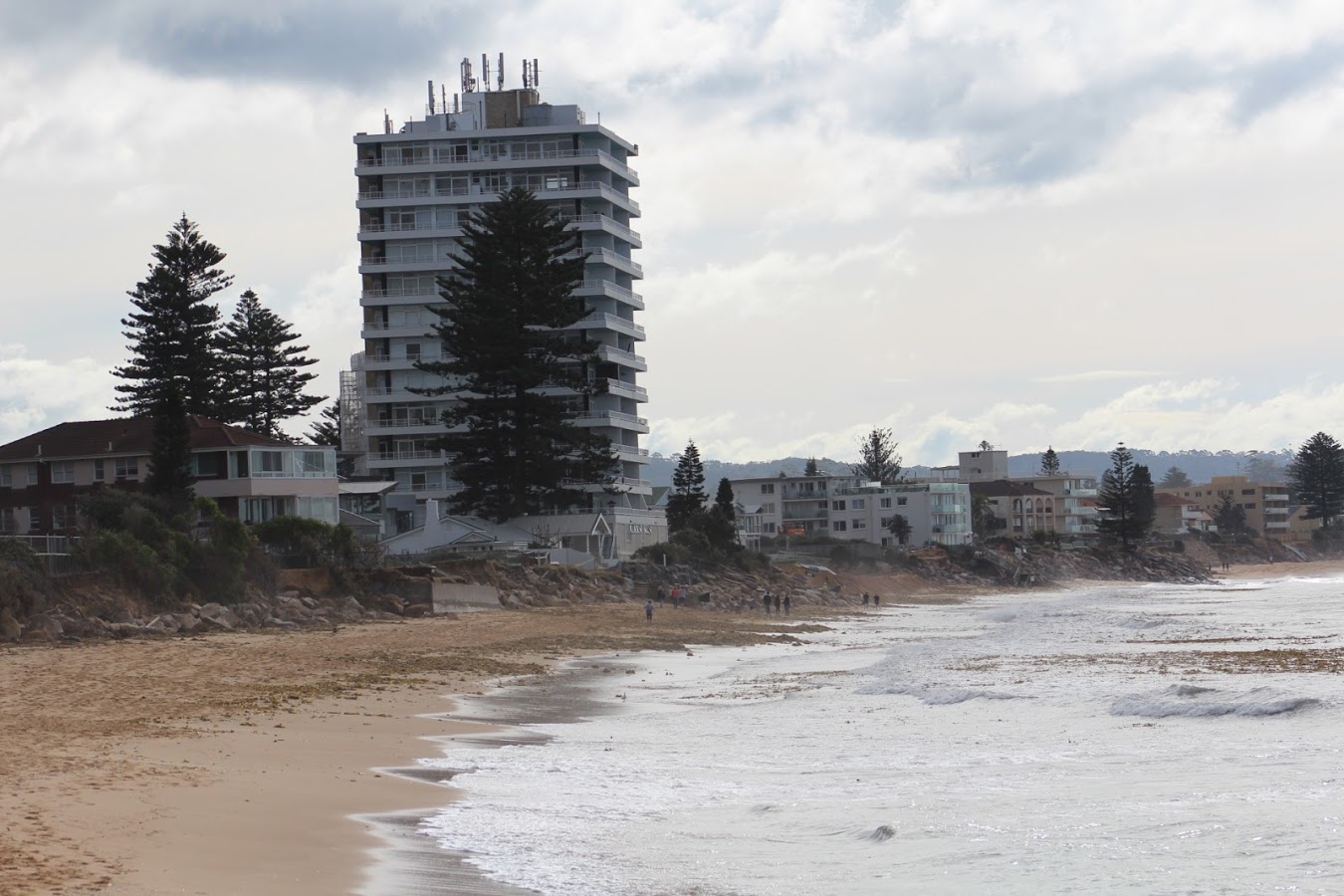
Collaroy beachfront after June 2016 storms - A J Guesdon photo