The Avenue Newport DA Approved through Land and Environment Court
On March 12 2026 Commissioner Horton upheld the appeal for the proponents in 57 The Avenue Pty Ltd v Northern Beaches Council [2026] NSWLEC 1125.
The Court orders that Development application DA2024/1409 for the partial demolition and removal of an existing marina, subdivision into eight lots, construction of a six berth marina on Lots 1-6, and construction of two water recreation structures (piers) on Lots 7 and 8, associated landscaping, works to the existing seawall and reinstatement of the natural foreshore within the W1 Zone is determined by the grant of development consent, subject to those conditions of consent at Annexure A.
To the south east of Pittwater lies the waters of Winji-Jimmi Bay of Newport. An existing commercial marina formerly known to some as the Newport Marina was proposed to be demolished to make way for the construction of a new 9-berth marina, floating pontoon walkways, a new seawall, landscaping works and subdivision into 8 lots at a site known as 122A Crescent Road, Newport.
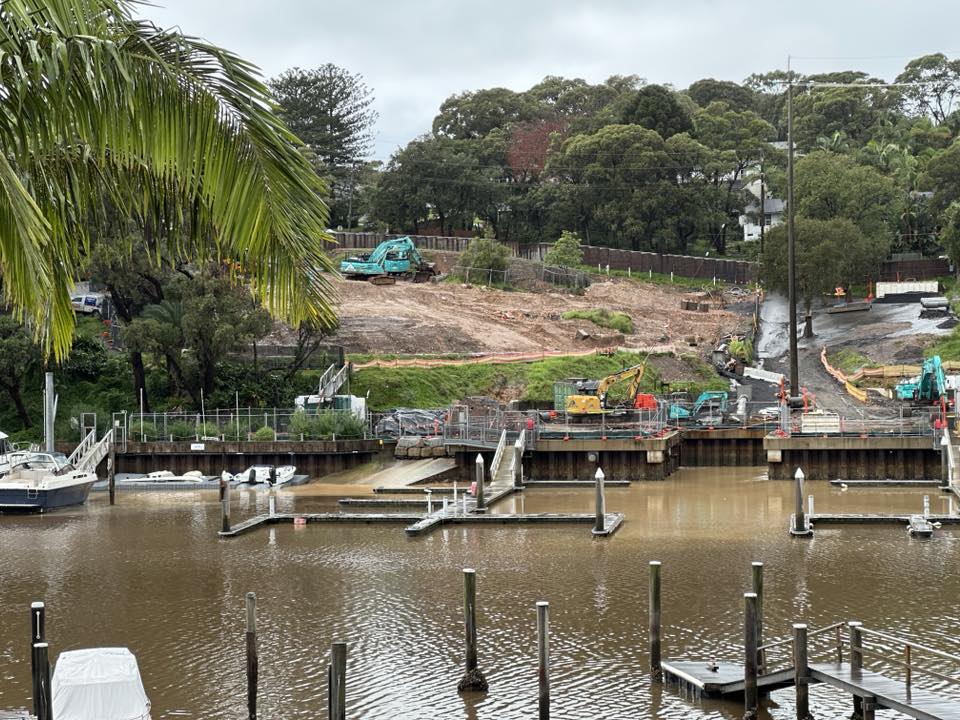
August 1 2025 runoff - photo supplied - details below
Commissioner Horton found it is relevant to note at the outset that the Newport Marina has been operating on land adjoining the subject site, known as Nos 122, 124, 126, 128 Crescent Road and 55 and 57 The Avenue (the adjoining site), also in the ownership of the Applicant in these proceedings, 57 The Avenue Pty Ltd (The Avenue).
On 6 December 2023, Northern Beaches Council granted consent to development application DA/2022/2152 for demolition works and subdivision of the land into 8 lots, tree removal and infrastructure works on the adjoining site.
The development, the subject of these proceedings, is that development described in development application DA2024/1409, lodged by The Avenue with Northern Beaches Council on 21 October 2024 seeking consent for the following:
- Reconfiguration of the existing Marina to a nine-berth marina and subdivision into 8 lots;
- Concept building envelopes for boat sheds on Proposed lots 5 and 6;
- Associated landscaping and demolition removal of existing vertical slipway and boat ramp and extension to an existing seawall; and
- Subdivision of the site.
The Council notified the development application in accordance with the relevant Community Participation Plan from 31 October 2024 to 28 November 2024, in response to which several submissions from residents were received.
The Council also provided preliminary feedback to The Avenue in February 2025. However, as the development application was otherwise undetermined, The Avenue appealed its deemed refusal on 19 March 2025 under s 8.7 of the Environmental Planning and Assessment Act 1979 (NSW) (EPA Act).
On the eve of the hearing, The Avenue sought to further amend the development the subject of the development application by Notice of Motion that sought, unopposed, to amend the proposal as follows:
- Reduce number of berths from 9 to 8 – 6 of which are to be marina berths and 2 identified as water recreation structures.
- Reduce the size of boat proposed, and reduce the lateral extension of structures into the waterway to reduce the development footprint and increase the area of rehabilitation of the foreshore.
- Improve foreshore treatment and enhance visual amenity due to smaller hardstand area and foreshore repatriation, creation of intertidal benches and coastal riparian planting.
The Court granted The Avenue leave to amend the development application by relying on the following amended plans and other documents contained in the Notice of Motion:
- Amended Draft Plan of subdivision (Exhibit B).
- Amended architectural plans prepared by Scott Carver (Exhibit C).
- Amended Landscape Plans prepared by Site Image (Exhibit D).
- Amended Aboricultural Impact Assessment prepared by RainTree Consulting (Exhibit E).
- Materials Investigation Report prepared by BG&E (Exhibit F).
In opening submissions, the Council advised the Court that 'as a result of the amendments to the development, being more than minor, those matters originally contended for by the Council in the Statement of Facts and Contentions filed 2 May 2025 are resolved other than the impacts on overhead electricity wires and a power pole located nearby but not within the site the subject of these proceedings'.
Development is, therefore, permitted with consent
The Council initially contended that the proposed development was not permissible as is it located partly within Zone W1 Natural Waterways zone within the Pittwater Local Environmental Plan 2014 (PLEP) and therefore constitutes prohibited development.
However, in its opening submissions, the Council took the Court to Sch 1 of the PLEP in which Additional Permitted Uses are identified within an area marked Area 23. Clause 23(2) of Sch 1 provides that, within Area 23:
23 Use of certain land in Zone W1 Natural Waterways
…
(2) Development for the purposes of boat sheds, jetties or water recreation structures is permitted with development consent.
The two proposed structures within the W1 zone are nominated as water recreation structures, defined in the Dictionary of the PLEP in the following terms:
water recreation structure means a structure used primarily for recreational purposes that has a direct structural connection between the shore and the waterway, and may include a pier, wharf, jetty or boat launching ramp.
As such, it was held that the two water recreation structures proposed within the W1 zone are development permitted with consent.
The site is located in an area identified in the PLEP as part W1 Natural Waterways and W2 Recreational Waterways. The site adjoins, and is generally surrounded by, land zoned C4 Environmental Living.
The objectives for development in the W1 zone are as follows:
1 Objectives of zone
- To protect the ecological and scenic values of natural waterways.
- To prevent development that would have an adverse effect on the natural values of waterways in this zone.
- To provide for sustainable fishing industries and recreational fishing.
- To ensure development does not adversely impact on the natural environment or obstruct the navigation of the waterway.
- To provide opportunities for private access to the waterway where these do not cause unnecessary impact on public access to the foreshore.
The objectives for development in the W2 zone are as follows:
1 Objectives of zone
- To protect the ecological, scenic and recreation values of recreational waterways.
- To allow for water-based recreation and related uses.
- To provide for sustainable fishing industries and recreational fishing.
- To provide for amateur and professional recreational yachting or boating clubs and the like that serve Pittwater and the wider region.
- To ensure development does not adversely impact on the enjoyment and use of the waterway or adjoining land.
- To provide for a variety of passive and active recreational pursuits and water-based transport while preserving the environmental setting of the waterway.
- To ensure that public access to the waterway and foreshore areas suitable for public recreational and transport purposes is maintained.
The site is identified at Section A4.15 of the Pittwater 21 Development Control Plan (Pittwater DCP) to be within the Waterways Locality, in which the following desired future character is described:
“The Waterway locality will remain primarily a recreational boating area. Waterfront businesses, yacht clubs and the like will meet the waterway recreational and boating needs of the community.
Future development is to be located so as to be supported by adequate infrastructure, including roads, water and sewerage facilities, and public transport.
Future development should ensure that access is available at all times to public boating facilities, such as launching ramps. Future development will not restrict public access adjoining the foreshore, or pedestrian access along the foreshore.
Future development will maintain a building height limit below the tree canopy and minimise bulk and scale. Existing and new native vegetation, including canopy trees, will be integrated with the development. Contemporary buildings will utilise façade modulation and/or incorporate shade elements, such as pergolas, verandahs and the like. Building colours and materials will harmonise with the natural environment. Development will be designed to be safe from hazards. Development will co-exist with adjoining residential areas. Development will not restrict public access adjoining the foreshore, and will not obstruct navigation within the waterway.
A balance will be achieved between maintaining the landforms, landscapes and other features of the natural environment, and the development of land. As far as possible, the locally native tree canopy and vegetation will be retained and enhanced to assist development blending into the natural environment, and to enhance wildlife corridors. Future development will include measures to ensure protection of the water quality and estuarine habitats of the locality, including mangroves, sea grasses, intertidal sand/mud flats, rocky shorelines, and beaches.
Heritage items and conservation areas indicative of the Guringai Aboriginal people and of early settlement in the locality will be conserved.”
Section D15.1 of the Pittwater DCP sets out the following outcomes for development sought in this locality when viewed from the public domain:
“To achieve the desired future character of the Locality.
To ensure new development responds to, reinforces and sensitively relates to the spatial characteristics of the existing built and natural environment. (En, S, Ec)
To enhance the existing streetscapes and promote a scale and density that is in scale with the height of the natural environment.
To ensure the visual impact of the built form above mean high water mark is secondary to landscaping and vegetation, or in commercial areas and the like, is softened by landscaping and vegetation. (En, S, Ec)
High quality buildings designed and built for the natural context and any natural hazards. (En, S)
Buildings do not dominate the streetscape or waterway and are at human scale. (S)
To preserve and enhance district and local views which reinforce and protect the Pittwater's natural context.
To enhance the bushland vista of Pittwater as the predominant feature of the landscape with built form, including parking structures, being a secondary component.
To ensure that development adjacent to public domain elements such as waterways, streets, parks, bushland reserves and other public open spaces, compliments the landscape character, public use and enjoyment of that land. (En, S)
Built structures are minimised below mean high water mark. (S)
A balance between use of the waterway and conservation of the natural environment is achieved. (En, S, Ec)”
For development on the seaward side of the MHWM, Section D15.12 contains controls that relevantly provide:
“Controls
…
Only structures associated either with the accommodation, servicing or provision of access to boats shall be permitted seaward of mean high water mark.
In instances where it is proposed to alter, extend or rebuild existing buildings seaward of mean high water mark, any further encroachment of such buildings onto the waterway is to be minimised. Where development seaward of mean high water mark is proposed to occur, especially during the refurbishment of existing structures, proponents need to ensure that the structure will not harm marine vegetation, and must consult with the Department of Primary Industries.
…”
To ensure that fair and equitable enjoyment of the waterway is achieved between neighbouring waterfront landowners, controls at Section D15.13 of the Pittwater DCP apply to what is termed the lateral limits and setbacks, including the setback of any vessel in the water.
Controls relating to waterfront development at Section D15.15 state that ramp and pontoon structures are preferred in place of jetties, where practicable, and provide for berthing areas and orientation.
Section D15.18 of the Pittwater DCP is also relevant to the development proposing seawalls. For completeness, these provisions at Section D15.18 are in the following terms:
“Outcomes
Any adverse impact upon the marine flora, fauna or water quality of the locality is minimised. (En)
Development has due regard for other existing water based activities in the locality, particularly those which have recreational, residential or economic significance. (S, Ec)
Alienation of public foreshore land below mean high water mark is minimised. (S)
The impact of development may on the physical processes acting in the locality is minimised. (En)
Development is sympathetic to the natural character of the Pittwater Waterway. (En, S)
The occurrence of dredging in the Pittwater Waterway other than for general navigation purposes is minimised. (En)
Controls
Seawalls shall not be permitted.
Variations
Council may consider the construction of seawalls where there is potential for erosion from coastal process and protection of property is necessary.
In such instances, the following criteria shall apply:
i. where possible, maintain the curvature of the existing shoreline;
ii. incorporate low profile walls, battered or stepped back from the foreshore wherever practicable, with a maximum recommended height of 1 metre above mean high water mark. (1.5 metres AHD);
iii. constructed of or faced in rectangular shaped sandstone, being either dressed or rough-cut in order to promote a uniform treatment along the foreshore. Alternative building materials, such as reconstructed sandstone concrete blocks or similar, which reflect a sandstone character shall also be suitable, particularly where greater structural strength may be required. Materials such as timber, concrete (including nylon mattress structures) gabions or other materials not in keeping with the character of the area shall not be permitted. Concrete/nylon mattress structures may be suitable for public drainage and associated bank stabilisation works where it can be demonstrated that such structures will not detract from the visual amenity of the locality.
iv. only clean fill is to be used behind sea walls.
v. where practicable, sandy beach areas should be incorporated in front of seawalls.
vi. be designed so that the existing footprint is maintained (i.e. does not encroach any further into the intertidal zone) and the seawall is sloped back towards the property. There must be no additional reclamation of water land (requires a permit from the Department of Primary Industries) or replacement of the existing wall with a vertical seawall;
vii. that there is no mortaring of the seawall and a geotextile fabric is used behind the seawall to prevent loss of sediment through the seawall;
viii. should be rock rip rap, boulders or similar complex structures, and where possible incorporate further vertical and horizontal complexity.
ix. maximise the incorporation of native riparian and estuarine vegetation;
x. create low sloping seawalls and/or incorporate changes of slope; and
xi. it is recommended that proponents consult with both the Coasts & Estuaries section of the Office of Environment and Heritage, and with the Aquatic Habitat Protection unit of the Department of Primary Industries.
xii. compliance with Environmentally Friendly Seawalls – A Guide to Improving the Environmental Value of Seawalls and Seawall-lined Foreshores in Estuaries (2009) available at the Office of Environment & Heritage website.
Within the Crystal Bay Foreshore area, the following controls shall specifically apply:
i. only dwarf seawalls shall be permitted along the foreshore of the Bay.
ii. be wholly constructed or faced in regular dressed sandstone blocks, reconstructed sandstone face blocks or reconstructed sandstone tiles; and
iii. have a battered slope located in front of it constituting the intertidal beach zone; and
iv. be flush to the top of the seawall with the reclamation located behind it (Diagram 1); and
v. not have a height greater than 0.75 metres above mean high water mark (1.26 AHD); and
vi. be aligned generally in a position which accords with the physical high water mark (Diagram 2) and form a continuous and uniform alignment with any existing adjoining, approved seawall.”
Foreshore Impacts are considered
A number of the contentions initially pressed by the Northern Beaches Council dealt with the likely environmental impacts of development proposed on or in the vicinity of the foreshore of Winji-Jimmi Bay.
In considering those contentions, the Court was assisted by experts in planning, Mr Stephen Gouge on behalf of The Avenue and Mr Nic England on behalf of the Council who conferred, along with Mr Rohan Dickson, expert on visual impact on behalf of the Applicant, in the preparation of a joint expert report filed with the Court on 17 February 2026.
The Court was also assisted by Mr Mark Kokot, expert in arboriculture on behalf of The Avenue and Mr Torin Calf, Landscape expert on behalf of the Council who conferred in the preparation of a joint expert report filed with the Court after close on 12 February 2026.
In considering those matters in respect of the environmental impacts on, and natural character of, the Pittwater waterway, the Court was assisted by Ms Katie Smythe, expert in ecology on behalf of The Avenue and Mr David Hellot, water management expert on behalf of the Council who conferred in the preparation of a joint expert report filed with the Court on 13 February 2026.
The judgement states that 'In short, the experts reached agreement on all matters in contention'.
And that 'In broad terms, the experts agree the demolition of the existing concrete hardstand and the alternative interface with the water by means of low-sloping rock revetment incorporating intertidal benches, varied rock sizes, habitat features and estuarine vegetation is an appropriate treatment when regard is had to the provisions at ss 2.10 and 2.11 of State Environmental Planning Policy (Resilience and Hazards) 2021 (Resilience and Hazards SEPP) that apply to the development (Exhibit 4, pars 46-47).
In particular, Mr England considers the reinstatement of around 28m of the foreshore, measured at the MHWM, to be an enhancement consistent with the objectives of the W2 zone that allow for water-based recreation and related uses (Exhibit 4, pars 49-51).
Likewise, the amendments summarised at are agreed to be both an appropriate footprint and lateral extension into the waters of Winji-Jimmi Bay and serve to improve the potential access to the foreshore by the public (Exhibit 3, par 62).
The reduction of that extension and in the number of berths, and the configuration of the berth areas to accommodate smaller vessels perpendicular to the shoreline, also significantly reduce the visual impact such that the objectives and outcomes sought by relevant provisions at Section D15 of the Pittwater DCP are achieved.'
The Council initially contended that fill associated with a retaining wall proposed to the north of the site would adversely impact three trees within the foreshore area, requiring their removal contrary to provisions dealing with development on foreshore area at cl 7.8 of the PLEP.
However, the Council also accepts that no development in this application is proposed between the foreshore building line and the MHWM. As such, the provisions of cl 7.8 do not apply to the proposal. This is because foreshore area is defined as the land between the foreshore building line and the MHWM of the nearest natural waterbody shown on the Foreshore Building Line Map.
Nevertheless, the affected trees are identified in the Amended Arboricultural Impact Assessment Report prepared by Raintree dated 20 February 2026 (Exhibit E) as follows:
- Tree 64: a Eucalyptus capitallata or Brown Stringbark (T64).
- Tree 66: Eucalyptus pariculata, or Grey Ironbark (T66).
- Tree 69: Eucalyptus pariculata, or Grey Ironbark (T69).
The experts considered amended plans that showed the removal of proposed fill and retaining structures, and the area naturalised instead using soil, plantings, rocks and boulders. As a result of the amended plans, the experts agreed that the impacts on Tree 64 are minor and acceptable and while the impact on Tree 66 is classified as major, it is not necessary to remove it.
However, the experts agree the impact on Tree 69 is such that it will need to be removed. The Avenue proposes to replace it with two of the same species, Eucalyptus pariculata, or Grey Ironbark.
In respect of the estuarine habitat, the experts agree that the amendments incorporate measures that collectively enhance the habitat value of the site by virtue of the rock revetment mimicking natural shoreline conditions, providing intertidal benches to allow the colonising of this area by various ‘biodiverse assemblages’ and because of the enhanced visual amenity and stability of the shoreline provided by the riparian planting proposed.
In respect of the natural character, the judgement stated the experts once again rely on the rock revetment and riparian vegetation as the basis for agreement that the visual presentation is a significant improvement on the existing presentation and so improves the natural appearance of the foreshore.
In respect of the seawall design and slipway, the judgement found 'the experts cite conformity with a document titled Environmentally Friendly Seawalls: A Guide to Improving the Environmental Value of Seawalls and Seawall-lined Foreshores in Estuaries, Office of Environment and Heritage on behalf of Sydney Metropolitan Catchment Management Authority (June 2009) as the basis for agreement that the proposal is consistent with the provisions of Section D15.18 of the Pittwater DCP'.
A recurring concern of residents arises from what is described by them as poor design and technical compliance of the berth locations and layout, and the risks associated with variables like wind, tide, depth and turning circles of vessels in the vicinity of the proposed berths.
One submission expressed concern at the proximity of the proposed development to that of the berthing area at 50 The Avenue. However, Commissioner Horton noted the Navigation Report includes this vessel in its assessment and that subsequent amendments propose vessels of no more than 9m x 5m to those water recreation structures at Lots 7 and 8.
In respect of safety concerns held by a resident opposite the site, the Court observed that 'fire service requirements are contained in Section 6 of AS3962:2020, and the Court is advised the Rural Fire Service operates fire fighting vessels'.
Inconsistency of the development with the residential character of the area and overdevelopment of the site, impacts of the development upon significant trees, traffic and parking impacts along with vehicular access, remain contentious points with residents.
The full judgment and decision may be accessed here.
The modified documents may be found on the council webpage for Section 455 Modifications Mod2025/0220 here
Developments are now often approved by the Land and Environment Court, bypassing community objections. Local residents associations state that the detailed judgement and amended plans should go on the Council website.
However, it is part of the legal process that both parties need to agree to the publication of these documents as they are not Court documents which are generally made available. Therefore, the modifications referred to in the above judgement are not, as yet available on the council website.
Modifications to development applications are normally not notified to nearby residents even though they might have a considerable impact on neighbouring houses. Many state that they should be treated in the same way as the original development application and neighbours notified. At present, only those who have made a submission are advised of a modification by the council posting them a letter.
Worth noting is this item sent in last August:
Newport job site: run off into Pittwater
Dear Editor
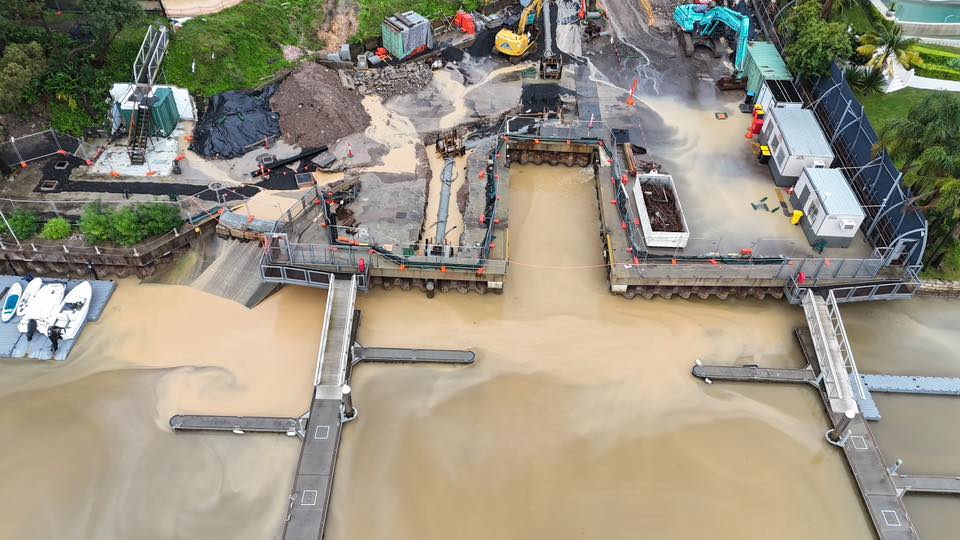
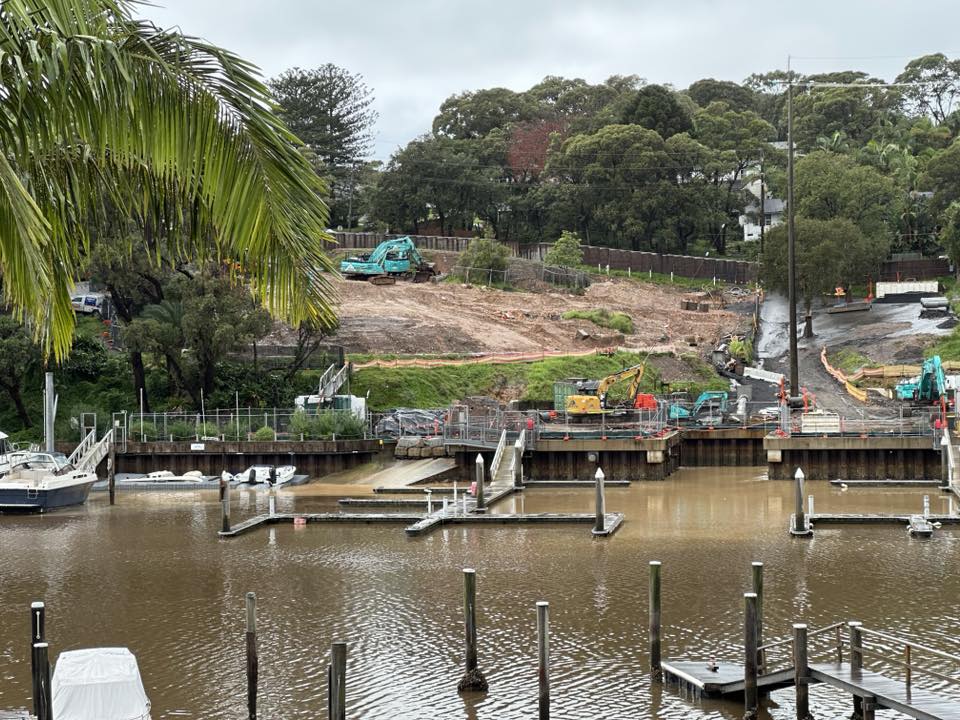
This is the old Sirsi Marina at the Crescent Road Newport on August 1 2025 - every time it rains this is what washes into the Bay. Council have warned them but still it happens. This affects all the fish, people, kayaks, dragon boats, sailors, and birdlife that enjoy the bay. And the development that they are still trying to get approved is for 8 houses with 9 x 22 meter boats that will intrude further into the bay past these original pens.
Pittwater Resident, August 2, 2025
Dear Editor
This is the old Sirsi Marina at the Crescent Road Newport on August 1 2025 - every time it rains this is what washes into the Bay. Council have warned them but still it happens. This affects all the fish, people, kayaks, dragon boats, sailors, and birdlife that enjoy the bay. And the development that they are still trying to get approved is for 8 houses with 9 x 22 meter boats that will intrude further into the bay past these original pens.
Pittwater Resident, August 2, 2025