Report by Wayne Lazarides, Editor West Pittwater Community Association's News updates, Pittwater photos courtesy Sandra Lazarides
Something special is taking shape beneath the waters of Pittwater, almost entirely out of sight.
A chance meeting in Elvina Bay
The weather had finally come good in Elvina Bay. It was cool, bright and sunny, the sort of winter’s day we quietly hope will fill the bays at this time of year, but which has been sadly absent of late.
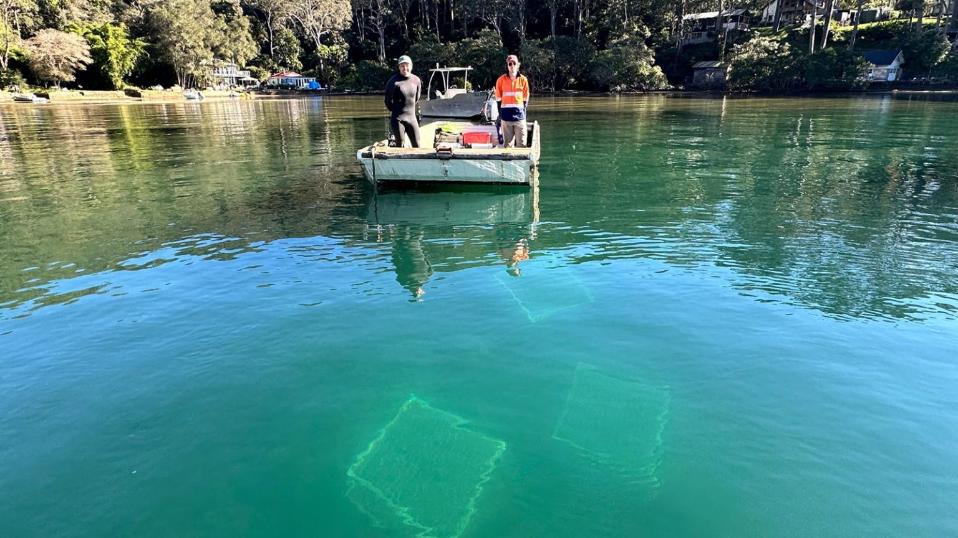
In a workboat near the jetty, two divers were preparing their gear. Jacob Broom and Oscar Borschman appeared to have landed one of those rare jobs that allows a person to spend a glorious morning on Pittwater and call it work.
“You must have the best job in Pittwater,” I called across to them.
They laughed, and we got talking.
It turned out they were waiting for the ferry. Not to catch it, but for it to come through the bay and be on its way, so they could slip into the water and get on with “the job”, whatever that might be.
Now I was curious. What exactly was the job?
More wharf maintenance? Treasure?
The answer was not what I expected. They were in fact, on the seabed below, installing hotels… for seahorses.
It turns out Jacob and Oscar work with Marine Pollution Research, a business based on Scotland Island and undertaking contract work for Northern Beaches Council. (Who knew we had a marine research business operating in our midst?)
The new seahorse hotels are being installed at locations around Pittwater: Tennis and Bells wharves on Scotland Island, Elvina Bay, Bennett’s Wharf at Coasters Retreat, and Morning Bay.
From the jetty, the task might look straightforward. Take a metal frame beneath the surface, lower it onto the seabed and secure it in place.
In reality, installing a seahorse hotel involves much more than dropping a crate over the side.
The chosen site has to work through every stage of the tide. Will the hotel remain safely submerged when the water is at its lowest? How does the current move through the site? Is it sheltered from excessive swell while still receiving enough water movement? Is it clear of ferry and recreational boat traffic? Is there suitable seagrass or sponge habitat nearby?
These are among the questions considered when seahorse hotels are placed at other NSW sites. They turn an apparently simple dive into a careful reading of the underwater landscape.
By the time a hotel reaches the seabed, much of the important work has already taken place.
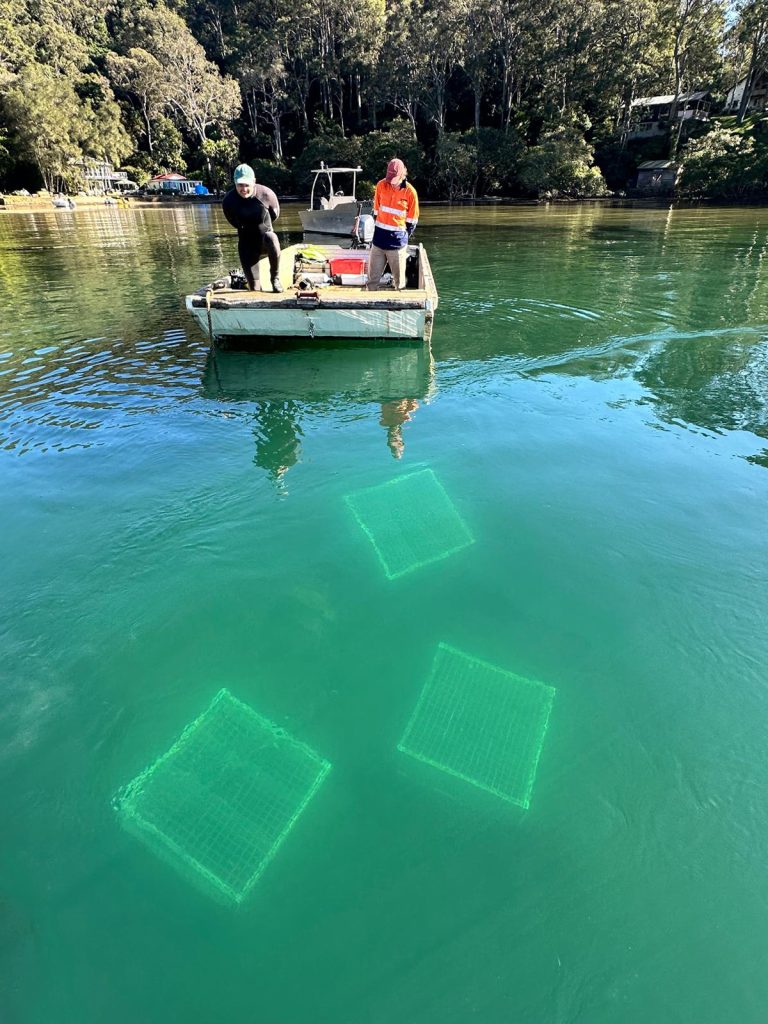
Diver Jacob Broom and Oscar Borschman during the installation in Elvina Bay.
The sea – natures interior designer
The name conjures up something grand, but a new seahorse hotel looks more like a sturdy metal crate than boutique accommodation.
Each of the Pittwater hotels measures about a metre square and half a metre high. Comparable installations elsewhere in New South Wales have been made from galvanised steel mesh supported by a reinforcing bar frame.
There are no tiny beds or neatly folded towels. At first, there is not much there at all.
Then the sea takes over.
Experience at other NSW hotels shows that a fine film of microscopic algae begins to gather across the surface. Seaweeds follow, along with sponges, corals and other small marine creatures.
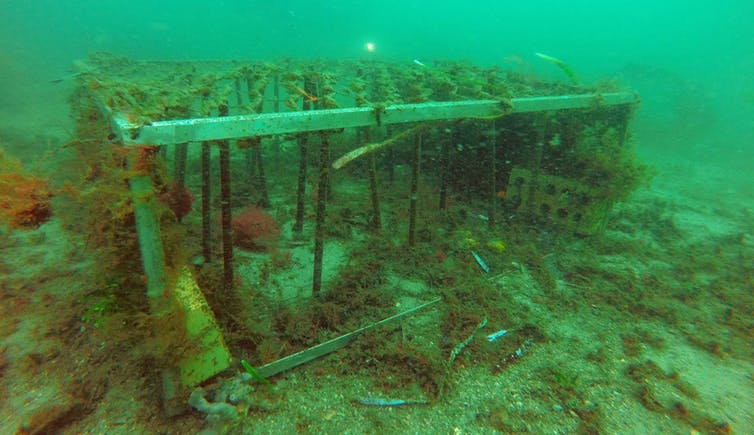
What the hotels look like 3 weeks after installation
Anyone who has peered beneath a Pittwater jetty, or at the bottom of many a tinny, will have seen how quickly the underwater world claims a hard surface. Piles and ladders that look plain above the water become shaggy gardens below it.
That same transformation is intended for the Pittwater hotels. Month by month, their hard lines should soften beneath a living coat of marine growth. In other NSW projects, the metal gradually corrodes as this growth develops, leaving behind the habitat it helped create.
The sea is not simply filling the hotel. It’s building it.
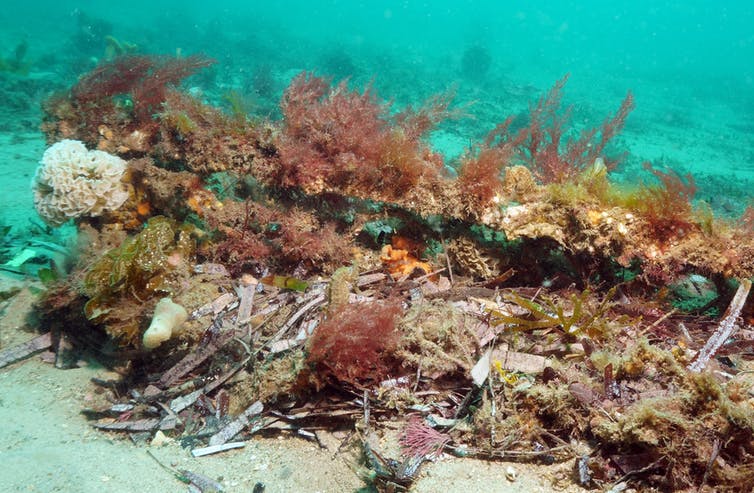
18 Months after installation
A seahorse’s grand design wish list
For a seahorse, the attraction is not luxury. It is something to hold on to.
Seahorses are not strong swimmers. They use their curling tails to grasp seagrass, seaweed, sponges and other structures, anchoring themselves against currents and flowing water.
As marine life settles on a hotel, it creates more places to grip, hide and feed. Small crustaceans move among the growth, giving seahorses a convenient source of food. The structure can become a shelter, a hunting ground and a place for seahorses to gather.
The hotels are intended to support local seahorses, particularly the endangered White’s seahorse. This remarkable marine creature has been recorded in Pittwater and is one of six seahorse species known to occur in New South Wales waters.
White’s seahorses favour shallow estuaries and sheltered coastal bays. Their natural homes include seagrass meadows, sponge gardens and soft corals. They are also found around jetties, swimming enclosures and other structures that have developed a generous covering of marine growth.
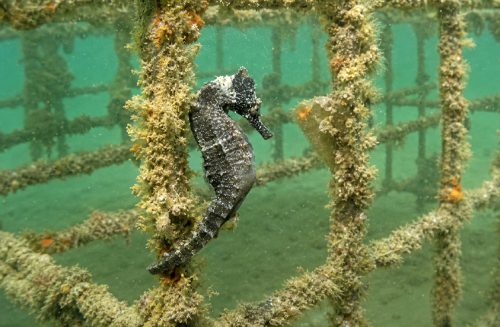
A male White’s seahorse
Their small fins give them a gentle, almost drifting way of moving through the water. Rather than racing after food, they settle in one place, blend into their surroundings and wait for tiny prey to come within reach.
They are masters of disguise. A White’s seahorse can change colour to suit its surroundings, helping it disappear among seagrass, sponges and seaweed. There may be one beneath a Pittwater wharf while people walk, fish and wait for ferries just above it, never knowing it is there.
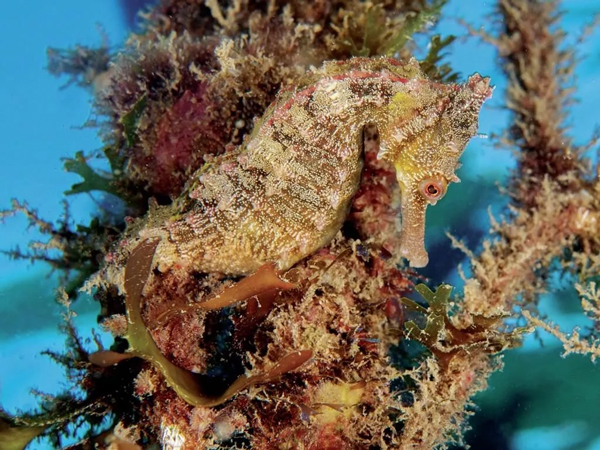
Masters of disguise
A simple idea with serious science behind it
The name “seahorse hotel” may sound whimsical, but the idea is supported by serious research.
The structures were first tested in Port Stephens as temporary habitat for White’s seahorses. Research published in the journal Marine Environmental Research found that the hotels supported a substantial population.
Pregnant males were also observed living in the hotels during breeding season. One of the most interesting things I discovered was that the female places her eggs inside the male’s brood pouch. It is the father who carries the developing young and later gives birth.
Nothing is a given, of course. Lowering a hotel into the water does not mean a seahorse will immediately move in. The structure must first be colonised by marine life, and the conditions must be right.
Each hotel is an invitation. The sea prepares the rooms and, if conditions suit, the guests may arrive.
Pittwater’s marine gardens
Pittwater already has a rich and varied underwater landscape.
Its important seagrass meadows include eelgrass, also called ribbon weed, along with delicate paddleweed and the broad leaves of Posidonia australis, commonly known as strapweed.
Although we sometimes speak about seagrass and seaweed as if they are the same thing, seagrasses are actually flowering plants. They have roots, leaves and flowers, and they form underwater meadows across the sandy floor.
Those meadows do an extraordinary amount of work. Their roots help bind the seabed. Their leaves slow the movement of water and trap sediment. Among them, juvenile fish, prawns, crabs and countless other creatures find food and shelter.
Pittwater’s Posidonia population is listed as endangered. Narrow seagrass beds have been recorded around Scotland Island and Elvina and Lovett Bays, making this habitat a very local part of the story.
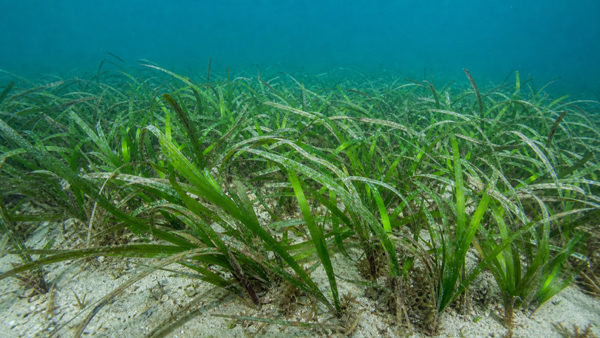
Posidonia-australis
Around the meadows are many forms of algae and seaweed. Fine green, red and brown algae grow across rocks and other hard surfaces, although the exact mix varies with location, depth, light and water movement.
Add the sponges, soft corals and strange little communities living beneath our wharves, and an underwater neighbourhood begins to appear. It is colourful, crowded and wonderfully complex, even if most of us rarely see it.
Custodianship
The seahorse hotels are clever, but they are not a replacement for natural habitat.
No metal structure can do everything an established seagrass meadow does. The hotels are a helping hand, offering additional shelter while the larger work of protecting seagrass, maintaining water quality and caring for the foreshore continues.
It is tempting, on a clear morning in Pittwater, to imagine the bay will always look after itself. Yet the life beneath the surface is vulnerable. Pollution, sediment, careless anchoring, damaged seagrass and changes to the shoreline can all reduce the places where marine creatures feed, shelter and breed.
Living alongside Pittwater is a gift. With that gift, I feel, comes a responsibility to notice what is happening both above and below the surface. Its beauty has taken millennia to form, yet parts of it can be lost in a far shorter time.
Custodianship can begin simply with paying attention.
What began as a chance conversation on a sunny winter’s day left me looking at the familiar waters of Elvina Bay a little differently.
Beneath the ferries, tinnies and jetties, a new underwater refuge is taking shape. For now, the hotels sit below the tide with their rooms still mostly bare. Most people passing above them will never know they are there.
The sea has already begun its work. Somewhere in those green waters, a future guest may already be waiting.
Extra Images: Courtesy Pittwater Online News (2020 report 'To Save These Threatened Seahorses We Built Them 5-Star Underwater Hotels: Hippocampus whitei - 'Whites seahorse' by David Harasti, Southern Cross University; Michael Simpson, University of Sydney; Rebecca L. Morris, University of Melbourne, and Ross Coleman, University of Sydney), and ABC News
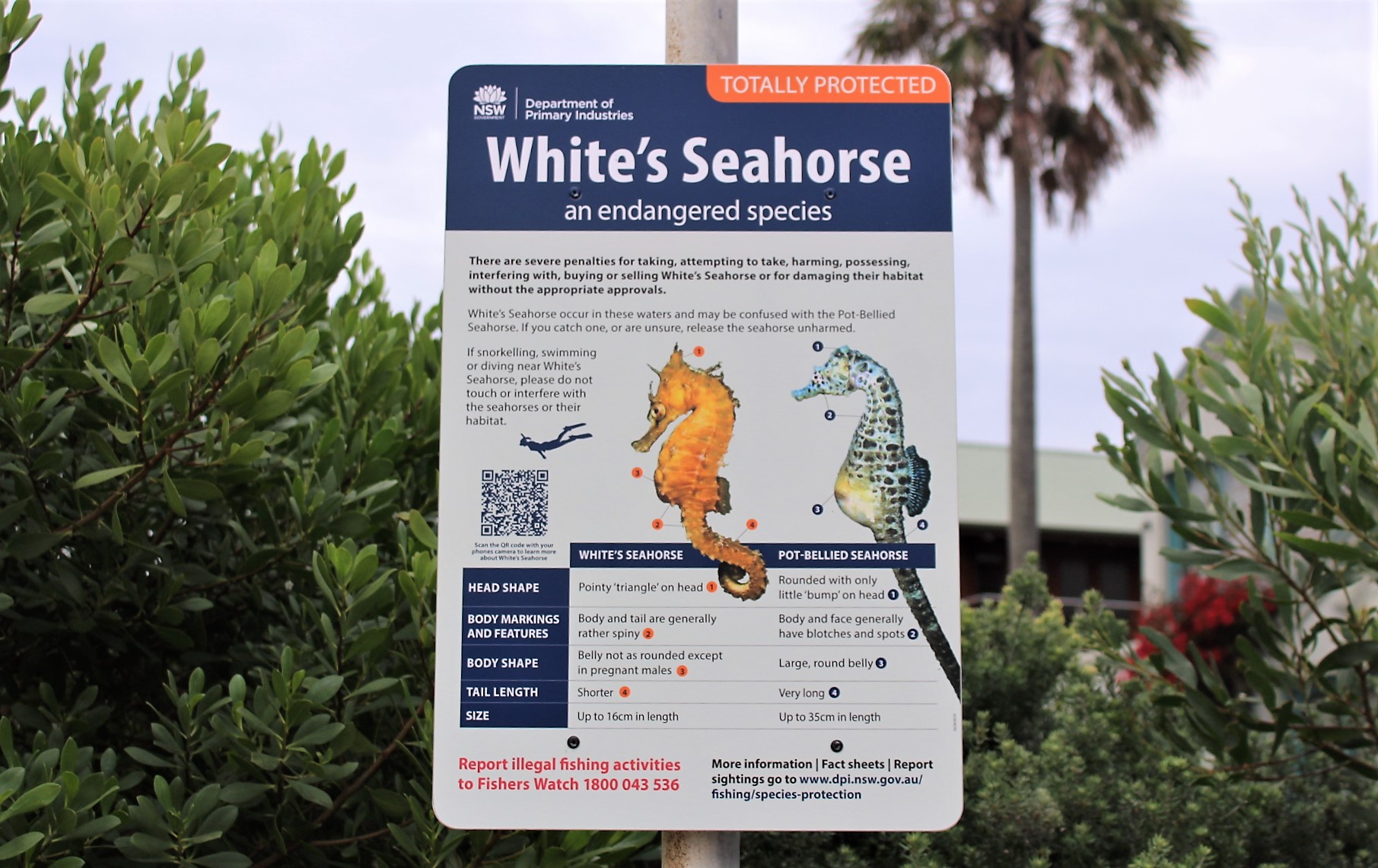
At Church Point Public Wharf:
.JPG?timestamp=1750463796119)
See Spring 2024 report: Study shows what stresses Pittwater's seagrass meadows (and the fish that love this estuary habitat) + Jetty design review to protect seagrass
Federal Listing:
Posidonia australis seagrass meadows of the Manning-Hawkesbury ecoregion(external link) - This guide is designed to assist coastal developers and land managers, water users, as well as environmental assessment officers and consultants, to identify, protect and manage the Posidonia australis Seagrass Meadows of the Manning-Hawkesbury Ecoregion as a nationally protected ecological community; to explain what it is, why it is threatened, what national protection means for people in the region and what locals can do to help conserve and recover it. - Listed as Endangered (Date effective 07-May-2015)
From Australian Government Dept. of Environment and Energy Doc: ’Posidonia australis Seagrass Meadows of the Manning-Hawkesbury Ecoregion: A Nationally Significant Ecological Community’ :
The seagrass meadows provide habitat, shelter and food resources for a large diversity and abundance of fauna. The fauna that are part of the ecological community may be classified into four major groups:
• Infauna – animals living in the sediment amongst the rhizomes (stems) of the seagrass.
• Motile epifauna – smaller, mobile animals associated with the surface of the sediment, often amongst seagrass debris, or on seagrass stems or leaves.
• Sessile epifauna – permanently attached animals living on seagrass stems or leaves.
• Epibenthic fauna – larger, mobile animals which are broadly associated with seagrass meadows rather than with individual seagrass plants. Polychaete worms, crustaceans (e.g. Striped Shrimp (Palaemon intermedius)) and molluscs (e.g. Sydney Cockle (Anadara trapezia)) dominate the infauna and motile epifauna of the ecological community.
These faunal groups process a significant portion of the primary production of the ecological community (energy from the seagrass) and provide an important food source for larger animals. The majority of epibenthic fauna associated with the ecological community only use it for a small part of their life history, as a temporary foraging area or refuge from predation.
The ecological community provides nursery habitat to the commercially important Yellowfin Bream (Acanthopagrus australis), Black Bream (A. butcheri), Sea Mullet (Mugil cephalus), Luderick (Girella tricuspidata), Fanbelly Leatherjacket (Monacanthus chinensis), Six-spine Leatherjacket (Meuschenia freycineti) and Yellowfin Leatherjacket (Meuschenia trachylepis). The most commonly found fish within the ecological community are from the families Syngnathidae (including the Weedy Seadragon), Clupeidae (herrings and ilishas), Latridae (trumpeters), Monacanthidae (leatherjackets), Gobiidae (gobies), Kyphosidae (drummers and sweeps), Hemiramphidae (garfishes) and Mugilidae (mullets).
Pittwater is also home to another seahorse scientists are asking for citizen scientist help with.. See May 2023 report: Weedy Seadragons Citizen Scientist Project Needs More Eyes On The Seas, Sands + Shores: The SeadragonSearch Project
Extra notes added in by AJG/PON