Surf Life Saving Australia (SLSA) released the 2025/26 Summer Coastal Drowning Report on Monday March 2, with one coastal drowning death every two days over summer, serving as an urgent reminder of the need for continued vigilance and safer behaviour on Australia’s coastlines.
Despite this tragic loss of life, the report revealed a welcome decrease in coastal drowning deaths from the five-year average, thanks to the intervention of surf lifesavers and lifeguards on our beaches each Summer.
Click here for the full report.
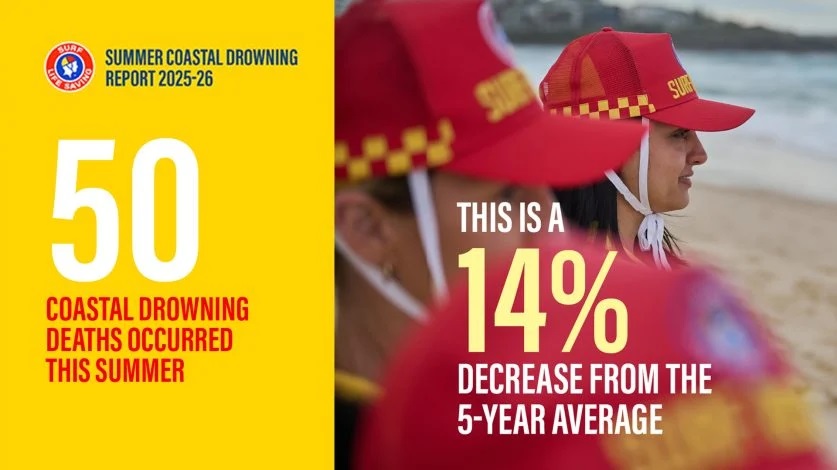
Since December 1, one coastal drowning death was recorded every two days, with 50 lives tragically lost due to coastal drowning over summer, underscoring the critical importance of reducing risk-taking behaviour and making safer choices when visiting the coast.
With coastal drowning accounting for 62% of the national summer drowning burden, the Summer Coastal Drowning Report highlights the serious dangers associated with coastal recreation away from surf lifesaving services at regional and remote locations that are typically unsupervised and hard to reach with emergency response services.
Beachgoers can find their closest patrolled beach and scheduled patrol times via the Beachsafe app or website (beachsafe.org.au).
Every coastal drowning death is preventable, with the loss of life each summer having enduring impacts on families, responders and communities. Summer is the peak period of drowning risk and historically accounts for 40% of the annual coastal drowning burden.
However, this summer SLSA welcomes a 14% decrease in coastal drowning deaths from the five-year average, with substantial declines also observed this summer at beaches (-34%), for swimmers (-42%) and of incidents involving rip currents (-43%).
Males, who continue to be overrepresented in coastal drowning numbers this summer (92%), have also seen a decrease from the five-year average (-8%), marking a small, yet critical step forward in this high-risk population.
Key summer coastal drowning statistics:
- 50 coastal drowning deaths were recorded in 2025/26 – a 21% decrease from last year (n=63) and 14% below the five-year average (n=58).
- 66% coastal drowning deaths occurred greater than 1km from a SLS service.
- Males accounted for 92% of summer coastal drowning deaths.
- The highest proportion of coastal drowning deaths occurred with the 65+ year old age group (36%), with 55+ year olds accounting for 46% of coastal drowning deaths.
- 48% of summer coastal drowning deaths occurred at beaches.
- of rescues – 3,989
- of preventative actions – 994,946
- of first aid treatments – 17,221
- Value to community – $ 4.19 billion
- Additional lives saved – 697
- Additional critical injuries prevented – 418
The report also highlighted the ongoing hard work and commitment of volunteer surf lifesavers and the Australian Lifeguard Service across the country, with a significant number of rescues and preventative actions undertaken over these high-risk summer months.
Since December 1, surf lifesavers and lifeguards have performed more than 3,900 rescues, 990,000 preventative actions and provided over 17,000 first aid treatments nationwide.
Modelling estimates that these actions alone equate to an additional 697 lives saved and more than 418 critical injuries prevented, providing more than $4 billion in value to the Australian community and reinforcing how without this incredible service, our coastal drowning fatalities would have been significantly higher.
The release of these summer statistics comes just days ahead of the first Red & Yellow Day, set to be held on Wednesday, March 4.
A new national day of celebration and recognition, Red & Yellow Day is an opportunity for Australians to show their appreciation for the work of surf lifesavers across the country and raise vital awareness for water safety education.
Red & Yellow Day is an opportunity to say thank you to the thousands of volunteers who dedicate their time to keeping our beaches safe over the holiday periods and the summer months.
Surf Life Saving Australia’s National Research Manager, Dr Jaz Lawes said:
“This summer has been a challenging one for the beachgoing community with many tragic incidents occurring along the coast, that has meant 50 people who were spending a day out on our beautiful coast, did not return home to their families.
“No one plans to get into trouble and conditions can change in an instant. The biggest tragedy is that this happens every summer and each of these coastal drowning deaths could have been prevented by making water safety a priority and taking a minute to make the safest choice.
“We urge Australians to STOP before you head out to the beach or enter the water, to LOOK at the conditions and consider your own abilities, so that you and your loved ones STAY ALIVE. The decrease that we have seen this summer in coastal drowning numbers is encouraging, especially while swimming at beaches, and we thank the Australian beachgoing community for making safer choices.
“We are extremely lucky here in Australia with a nationally integrated network of volunteer lifesavers who patrol our beaches over summer. One of the best choices you can continue to make to keep yourself and your family safe is to swim at a patrolled beach between the red and yellow patrol flags.
“This incredible workforce clocks on so that we can clock off, and this is something Australians need to celebrate – and Red & Yellow Day gives the Australian community an opportunity to support the red and yellow and to say thank you.”
Minister for Sport, Anika Wells said:
“As the summer season draws to a close, we extend our thanks to the thousands of volunteer surf lifesavers who have stood watch over our beaches. Our surf lifesavers embody the very best of community service and their dedication and service has kept countless people safe across the summer months.
“The loss of life this summer is tragic, and we acknowledge with great sadness the drowning deaths that have occurred. These figures serve as a stark reminder for all of us to remain vigilant and make safe choices when visiting our coastlines.”
Safety Messaging
STOP:
Before you enter the water
Wear a lifejacket when boating, rock fishing or paddling
Don’t go alone
LOOK:
For the red and yellow flags, if they’re on the beach swim between them
For signs and warnings about the area
At the conditions and weather forecast
For rip currents and other dangers
Always supervise children in, on and around water
STAY ALIVE:
Assess the conditions based on your own ability
If it’s unsafe, don’t swim
Avoid alcohol and drugs around water
Complete the online Beach Passport for basic training and education on water safety and visit beachsafe.org.au to find a patrolled beach and for the latest safety advice.
State Summer Coastal Drowning Statistics:
New South Wales
- 19 coastal drowning deaths were recorded in 2025/26 – a 5% decrease from last year (n=20) and the five-year average (n=20).
- 53% NSW coastal drowning deaths occurred greater than 1km from a SLS service.
- Males accounted for 89% of summer coastal drowning deaths.
- The highest proportion of NSW coastal drowning deaths occurred with the 50–64-year-old age group (24%).
- 37% of summer coastal drowning deaths occurred at beaches.
- of rescues – 1,307
- of preventative actions – 395,248
- of first aid treatments – 4,391
- Value to community – $1.58bn
- Additional lives saved – 263
- Additional critical injuries prevented – 157
Queensland
- 9 coastal drowning deaths were recorded in 2025/26 – a 25% decrease from last year and 18% below the five-year average (n=11).
- 67% QLD coastal drowning deaths occurred greater than 1km from a SLS service.
- Males accounted for 89% of summer coastal drowning deaths.
- The highest proportion of QLD coastal drowning deaths occurred with the 65+ year old age group (35%).
- 56% of summer coastal drowning deaths occurred at beaches.
- of rescues – 1,508
- of preventative actions – 235,870
- of first aid treatments – 9,788
- Value to community – $1.16bn
- Additional lives saved – 193
- Additional critical injuries prevented –116
Victoria
- 6 coastal drowning deaths were recorded in 2025/26 – a 14% decrease from last year and 45% below the five-year average (n=11).
- 67% Victorian coastal drowning deaths occurred greater than 1km from a lifesaving service.
- Males accounted for all (100%) of Victorian summer coastal drowning deaths.
- The highest proportion of VIC coastal drowning deaths occurred with the 65+ year old age group (33%).
- 83% of summer coastal drowning deaths occurred at beaches.
- of rescues – 564
- of preventative actions – 259,797
- of first aid treatments – 1,214
- Value to community – $949.41M
- Additional lives saved – 158
- Additional critical injuries prevented – 95
Western Australia
- 8 coastal drowning deaths were recorded in 2025/26 – a 43% decrease from last year and 11% below the five-year average (n=9).
- 63% WA coastal drowning deaths occurred greater than 1km from a SLS service.
- Males accounted for 88% of summer coastal drowning deaths.
- The highest proportion of WA coastal drowning deaths occurred with the 65+ year old age group (40%).
- 75% of summer coastal drowning deaths occurred at beaches.
- of rescues – 503
- of preventative actions – 97,938
- of first aid treatments – 1,364
- Value to community – $445.10M
- Additional lives saved – 74
- Additional critical injuries prevented – 44
South Australia
- 4 coastal drowning deaths were recorded in 2025/26 – a 43% decrease from last year and equal to the five-year average (n=4).
- 100% SA coastal drowning deaths occurred greater than 1km from a SLS service.
- Males accounted for all (100%) SA summer coastal drowning deaths.
- The highest proportion of SA coastal drowning deaths occurred with the 65+ year old age group (60%).
- 0% of summer coastal drowning deaths occurred at beaches.
- of rescues – 85
- of preventative actions – 5,148
- of first aid treatments – 369
- Value to community – $40.98M
- Additional lives saved – 7
- Additional critical injuries prevented – 4
Tasmania
- 3 summer coastal drowning deaths were recorded in 2025/26 – equal to last year and 50% above the five-year average (n=2).
- 100% TAS coastal drowning deaths occurred greater than 1km from a SLS service.
- Males accounted for all (100%) of TAS summer coastal drowning deaths.
- The highest proportion of TAS coastal drowning deaths occurred with the 65+ year old age group (75%).
- 33% of summer coastal drowning deaths occurred at beaches.
- of rescues – 18
- of preventative actions – 337
- of first aid treatments – 73
- Value to community – $6.42M
- Additional lives saved – 1
- Additional critical injuries prevented – 1
Northern Territory
- 1 coastal drowning death was recorded in 2025/26 – an increase from last year and the five-year average (n=0).
- 100% NT coastal drowning deaths occurred greater than 1km from a SLS service.
- Males accounted for all (100%) NT summer coastal drowning deaths.
- The highest proportion of NT coastal drowning deaths occurred with the 65+ year old age group (100%).
- 0% of summer coastal drowning deaths occurred at beaches.
- of rescues – 4
- of preventative actions – 608
- of first aid treatments – 22
- Value to community – $3.03M
- Additional lives saved – 1