Friday October 23 2026 - updated Sunday October 25 2026 (to include ESMO images): via media release by and from the Melanoma Institute Australia
In a world-first international trial, adding a therapeutic cancer vaccine to standard immunotherapy after surgery for high-risk melanoma reduced the risk of recurrence or death by 42%.
Trial findings herald a foundational shift in how cancer is treated. Proven in melanoma, these results establish a new personalised approach, opening the door for potential new treatments for other cancers.
Intismeran is an mRNA-based individualised neoantigen therapy, a type of personalised therapeutic cancer vaccine. It is designed specifically for each patient, based on the unique identity of their tumour, to train and activate the immune system to recognise and fight cancer.
Adding intismeran to pembrolizumab immunotherapy after surgery for high-risk melanoma reduced the risk of melanoma recurrence or death by 42% compared with pembrolizumab alone.
An entirely new type of cancer treatment, proven for the first time in a large international clinical trial, the highest standard of clinical evidence.
Two world firsts: the first mRNA cancer treatment, and the first individualised neoantigen therapy made from each patient’s own cancer, to be proven in a trial of this scale.
Professor Georgina Long AO, Medical Director at Melanoma Institute Australia (MIA) and Chair of Melanoma Medical Oncology and Translational Research at The University of Sydney, presented the results of the phase 3 INTerpath-001 clinical trial at the ESMO (European Society for Medical Oncology) Congress 2026, October 23-27 in Madrid, on Saturday October 24.
“These findings are a foundational shift in our approach to cancer: harnessing the immune system in a more personalised way to reduce the risk of melanoma recurrence or death. This has not been achieved before in the history of cancer drug development. It is the coming together of technology, our biological understanding of cancer and the immune system, and the courage to take this idea into the clinic.” – Professor Georgina Long said
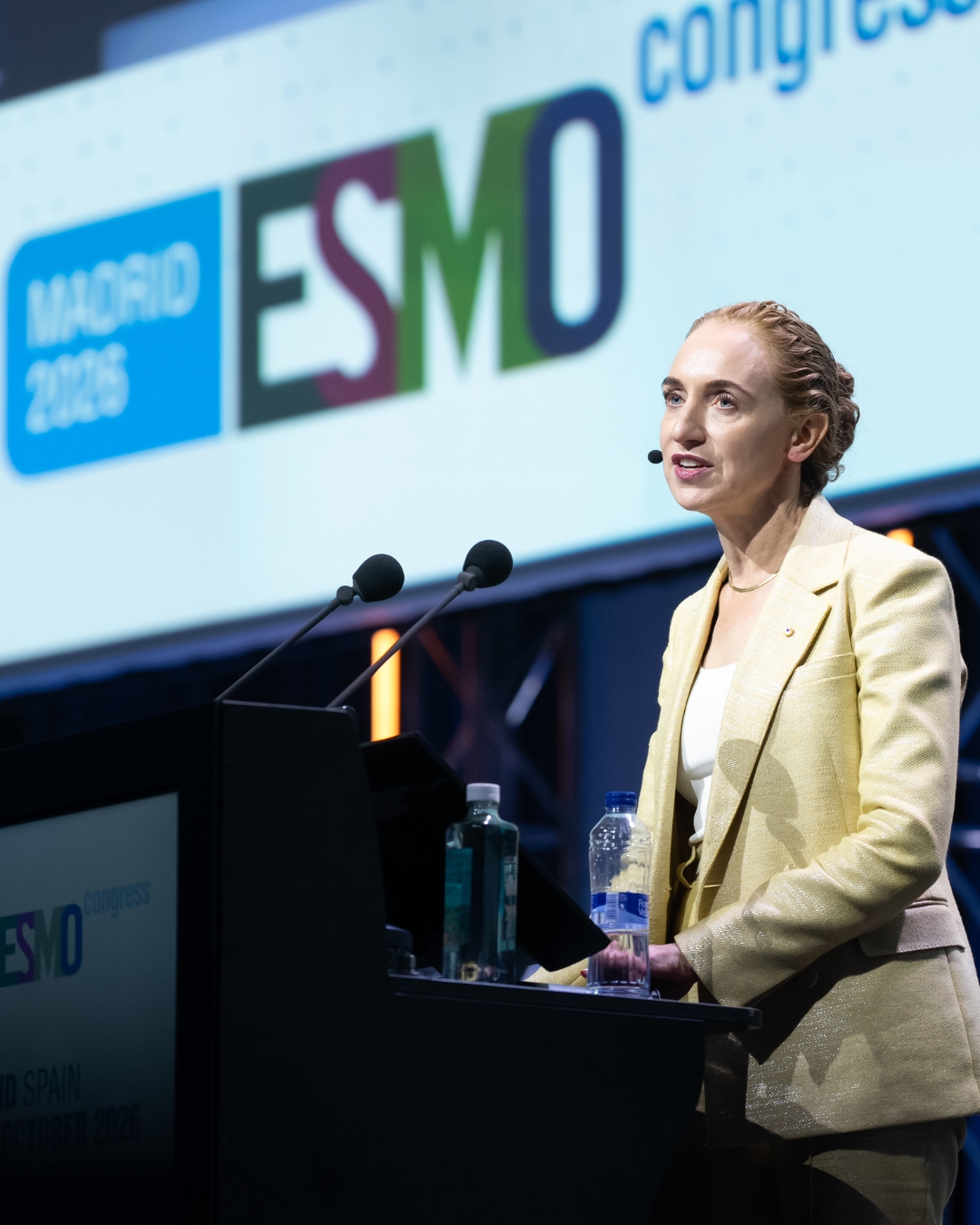
Georgina Long, Sydney, Australia during the ESMO Congress 2026 (23-27 October, Madrid, Spain). Photo credit: ESMO
This clinical trial included 1137 patients whose melanoma had been surgically removed, but who were at very high risk of it returning (stage IIB to IV). These patients had not previously received any cancer drug treatment. The trial compared treatment with a type of personalised therapeutic cancer vaccine, intismeran, given with pembrolizumab immunotherapy versus treatment with pembrolizumab alone.
Unlike a traditional vaccine that prevents disease in healthy people, intismeran is a therapeutic vaccine, designed for people after a cancer diagnosis who are at high risk of the cancer returning after surgery. It helps the immune system find and kill melanoma cancer cells, so the cancer is less likely to return or to spread to an advanced stage.
A melanoma is considered high risk if it has invaded a deeper layer of skin, has spread to nearby tissue and structures such as lymph nodes, or has metastasised to other areas of the body such as organs.
ESMO report/news (Oct 24,2026):
Patients with resectable melanoma remain at risk of recurrence despite surgery and adjuvant pembrolizumab treatment (N Engl J Med. 2018;378:1789–1801; Lancet. 2022;399:1718–1729 ). Results from the phase III INTerpath-001 study, presented at today’s Presidential Symposium at the ESMO Congress 2026 (Madrid, 23–27 October), now show that adding the individualised neoantigen therapy intismeran autogene to pembrolizumab can reduce this risk (LBA1 ).
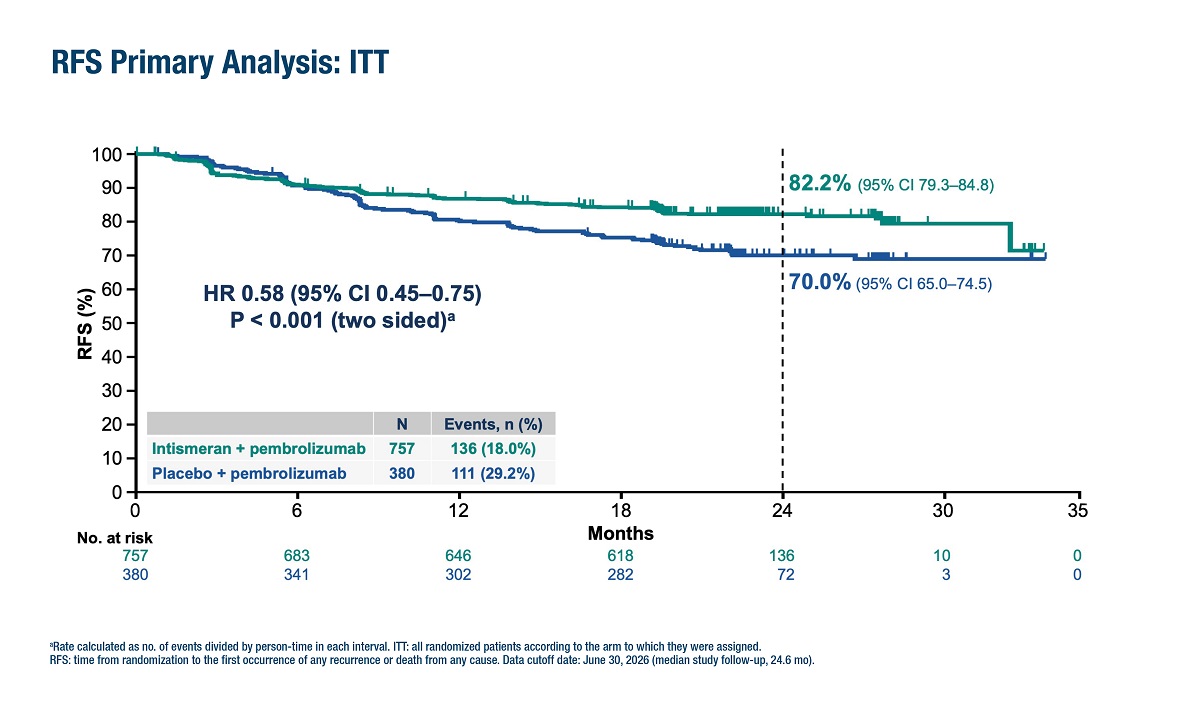
In this large study, recurrence-free survival (RFS), the primary endpoint, at 24 months was 82.2% in 1,137 patients treated with intismeran plus pembrolizumab versus 70.0% in those treated with placebo plus pembrolizumab (hazard ratio [HR] 0.58; 95% confidence interval [CI] 0.45–0.75; p<0.001). The study also met a key secondary endpoint, with respective 24-month distant metastasis-free survival of 88.5% versus 80.2% in the intismeran and placebo arms (HR 0.62; 95% CI 0.45–0.85; p=0.002). These results are consistent with the positive results for intismeran reported in the proof-of-concept phase IIb KEYNOTE-942 trial in patients with resected melanoma (Lancet. 2024;403:632–644 ).
Figure. Intismeran significantly improved RFS compared with placebo in patients with resectable melanoma treated with adjuvant pembrolizumab in the phase III INTerpath-001 trial (ESMO Congress 2026, LBA1)
A 42% reduction in risk
The phase 3 INTerpath-001 results are a landmark moment for cancer treatment. The trial showed adding intismeran to pembrolizumab reduced the risk of melanoma recurrence or death by 42% (hazard ratio [HR] 0.58; 95% confidence interval [CI] 0.45–0.75; p<0.001) compared with pembrolizumab alone. For patients who remained recurrence-free beyond six months from the start of treatment, the reduction in the risk of recurrence or death was even greater, at 58% (HR 0.42) compared with pembrolizumab alone.
Importantly, pembrolizumab side effects were not increased by the vaccine. Treatment was generally well tolerated in patients, with the vaccine causing transient low grade side effects (injection site pain, headache, and chills in some patients).
“These results showed that patients with earlier-stage melanoma can be treated after surgery in a fundamentally new way. But these results are more than a landmark for melanoma, they mark a foundational shift for cancer medicine. The INTerpath-001 trial shows that treatment built from the unique signature of a patient’s own tumour, working alongside checkpoint inhibitor immunotherapy, can sharpen the immune system to find and destroy any remaining cancer cells. Just as email transformed how we communicate, individualised neoantigen therapy has the potential to transform how we treat cancer.” Professor Georgina Long said
How does this new treatment work?
Abnormal proteins, called neoantigens, give every melanoma its own unique identity, like a fingerprint. The vaccine (also known as individualised neoantigen therapy) is created using mRNA technology.
“We analyse a sample of each patient’s tumour to read its unique neoantigen fingerprint, then create a ‘wanted poster’ of the cancer. This is delivered as mRNA, so the body’s own cells display the poster to the immune system, showing it exactly what to look out for and attack.” Professor Georgina Long said
The vaccine helps the immune system to identify the individual patient’s tumour cells. Meanwhile pembrolizumab releases the brakes the tumour places on immune cells.
“Cancer can fool the immune system with a fake friendly handshake, so the immune system thinks the cancer cell is normal. Pembrolizumab blocks the handshake, allowing immune cells to recognise the cancer and attack it, but it is the same drug for everyone. The vaccine gives a patient’s immune cells a personalised wanted poster of their cancer, so the combination works in more patients.” Professor Georgina Long said
The investigational mRNA-based individualised neoantigen therapy (also known as intismeran autogene, intismeran, V940, mRNA-4157, or personalised therapeutic cancer vaccine) is being jointly developed by MSD (tradename of Merck & Co) and Moderna, and is used in combination with MSD’s anti-PD-1 checkpoint inhibitor immunotherapy pembrolizumab.
An international trial
The INTerpath-001 phase 3 clinical trial was an international trial across 157 sites around the world. This included several Australian centres: Melanoma Institute Australia, Westmead Hospital NSW, One Clinical Research WA, Princess Alexandra Hospital QLD, Paula Fox Melanoma & Cancer Centre VIC, and Peter MacCallum Cancer Centre (Parkville Cancer Clinical Trials Unit) VIC.
Professor Georgina Long AO was the global Principal Investigator of this international trial and Chair of the Trial Steering Committee.
“This is the first phase 3 study to show that a treatment built from the unique ‘fingerprint’ of a patient’s own tumour can reduce the risk of recurrence or death from cancer. That fingerprint is read by sequencing the tumour, then a ‘wanted poster’ of the cancer is made as mRNA, showing the immune system exactly what to look for and attack. Having succeeded in melanoma, this proof of concept could mark the beginning of a foundational shift in how we treat cancer, helping patients remain cancer-free for longer.” Professor Georgina Long said
Professor Matteo Carlino, medical oncologist and member of MIA faculty, led the trial at Westmead Hospital.
“It has been an incredible opportunity to be part of this Australian and international collaboration, contributing to the development of intismeran from its early phase development through to this groundbreaking trial. Intismeran has the potential to revolutionise the management of melanoma, and also multiple other types of cancer.” Professor Matteo Carlino said
Professor Alex Menzies, medical oncologist and senior researcher, and MIA’s medical oncology and clinical trials teams played a pivotal role in the trial’s success.
“This trial demonstrates that the addition of a personalised mRNA-based vaccine to current standard immunotherapy treatment leads to a major improvement in recurrence-free survival for those with high-risk, resected melanoma. The hope for the near future is that it may not only improve outcomes for melanoma patients with advanced disease, but also those with other types of cancer where current immunotherapies are poorly effective.” Professor Alex Menzies said
The 1137 patients who volunteered for this trial have helped change the future of cancer treatment for others.
Melanoma leading the way for new cancer treatments
Australia has one of the highest melanoma rates in the world, with one person diagnosed every 30 minutes and one person dying every 6 hours from the disease. It is also the most common cancer in Australians aged 20 to 39.
Progress in melanoma treatment over the past decade has been extraordinary, driven by research led by Melanoma Institute Australia.
Fifteen years ago, survival after a stage IV advanced melanoma diagnosis, where the melanoma has spread to other parts of the body, was measured in months. Today nearly 55% of patients with advanced melanoma are effectively cured.
First came BRAF-targeted drug therapies, followed by checkpoint inhibitor immunotherapies, which harness the body’s own immune system to fight cancer. A recent ground-breaking advance was neoadjuvant immunotherapy, giving immunotherapy before surgery rather than after. Breakthroughs, such as immunotherapy, have transformed outcomes not only for melanoma, but also for cancers such as lung and kidney cancer.
What’s next?
These results now enter a regulatory review process which may take several years, depending on the country.
Until then the treatment is not available. Patients with melanoma who want to know more should talk to their medical oncologist.
Results will be published in the New England Journal of Medicine (NEJM).
NB ESMO: European Society For Medical Oncology
Personalised cancer vaccines - ready for prime time?
Editorial by John Haanen - on ESMO website
Published: 24 Oct 2026
For cancer vaccines, the ESMO Congress 2026 (Madrid, 23-27 October) represents a particularly significant turning point. After decades of largely disappointing results in the field, a personalised mRNA-based neoantigen therapy, in combination with the anti-PD-1 antibody pembrolizumab, reported positive survival outcomes in patients with stage IIB-IV resected melanoma. Findings from the phase III INTerpath-001 study are not entirely unexpected, yet they come from years of advances in oncology research, from basic tumour immunology to a thoughtful application of biomedical technologies and artificial intelligence. While these findings mark a new era in immunotherapy, the role of mRNA-based cancer vaccines is unlikely to be universal. Whether they will be able to prove their efficacy across different tumour types or not, current knowledge inform that they may work best as adjuvant treatment for patients with minimal residual disease who are at risk of developing progressive disease (Nat Med 2026;32, 828–840 ).
Personalised cancer vaccines therefore illustrate a broader tension in advanced immunotherapies: the more precisely a treatment is tailored to an individual, the harder it may be to deliver at scale.
Professor Georgina Long AO
BSc PhD MBBS FRACP FAHMS AAHMS FAA FASCO
Medical Director & Medical Oncologist
Professor Georgina Long AO, BSc (Hons1, UM) PhD MBBS (Hons) FRACP FAHMS AAHMS FAA FASCO, is Medical Director of Melanoma Institute Australia (MIA), and Chair of Melanoma Medical Oncology and Translational Research at MIA and Royal North Shore Hospital, The University of Sydney. She leads an extensive clinical trials team and laboratory at MIA, with a focus on immuno-oncology and targeted therapies in melanoma. She is principal investigator on phase I, II and III clinical trials in (neo)adjuvant and metastatic melanoma, including trials in patients with active brain metastases. She is the chief investigator on NHMRC funded research into the molecular biology of melanoma, with a particular interest in clinical and tissue biomarker correlates of systemic therapy sensitivity and resistance.
In recognition of her ground-breaking research and work, Professor Long was named 2024 Australian of the Year and was awarded prestigious Fellowships with the American Society for Clinical Oncology (2025), the Australian Academy of Science (2024) and the Australian Academy of Health and Medical Sciences (2017), the latter awarding her the Outstanding Female Research Medal (2021). Professor Long was appointed as an Officer of the Order of Australia (2020) and has received numerous awards, including Fulbright U.S. Mission Australia Award for Leadership Excellence (2024), Estela Medrano Melanoma Award (2024), ESMO Women for Oncology Award (2023), Sydney Local Health District/Sydney Research 2022 Research Excellence Award (2022) the prestigious Ramaciotti Medal for Biomedical Research (2021), Vice Chancellor’s Award for Excellence Award for Outstanding Research (2021), University of Sydney (2021), Research Australia GSK Research Excellence Award (2018) and the Sir Zelman Cowen Universities Fund Prize for Discovery in Medical Research (2016). She has a number of CINSW Premiers Awards, including: the Outstanding Cancer Researcher (2018), the Excellence in Translational Cancer Research Award (2017), the Wildfire Award for the most highly-cited, original, peer-reviewed article published (2011, 2014, 2016, 2017, 2018, 2019 & 2020), and in 2013 she was named the Outstanding Cancer Research Fellow. She is a Clarivate highly-cited Researcher from 2017, with an H index of 155.
Professor Long is the author of over 610 peer-reviewed publications in clinical and translational research in melanoma, including the New England Journal of Medicine, Lancet, Lancet Oncology, Science, Nature, Nature Medicine, Journal of Clinical Oncology and Cancer Discovery. Professor Long has presented her work at international conferences and meetings on more than 300 occasions. She was President for the prestigious international Society for Melanoma Research (President 2018-2020), is a member and Chair of the ASCO (2015-2017) and ESMO (2017-2020 & 2026 – 2029) Scientific Committee for Melanoma/Skin cancer, is medical oncology lead for the Australian Melanoma Management Guidelines Committee, and is member of both the ASCO Plenary Series and ASCO AGM Education committees (2021-2024), Scientific Co-Chair for ESMO Asia (2024) and EADO (2026), she is on the editorial boards of several high-impact journals, and is a member of the Melanoma Expert Panel for AJCC Cancer Staging System 8th edition.
Professor Long was awarded the University Medal in Organic Chemistry. She subsequently completed her PhD in Chemistry in the field of anti-cancer agents and their binding to DNA. She then moved to the USA to take up a Fulbright Postdoctoral Fellowship at Scripps Research Institute, exploring nanotechnology in cancer treatment, before returning to Australia to complete her MBBS (Hons). Professor Long became a Fellow of the Australasian College of Physicians in January 2008, specialising in medical oncology.