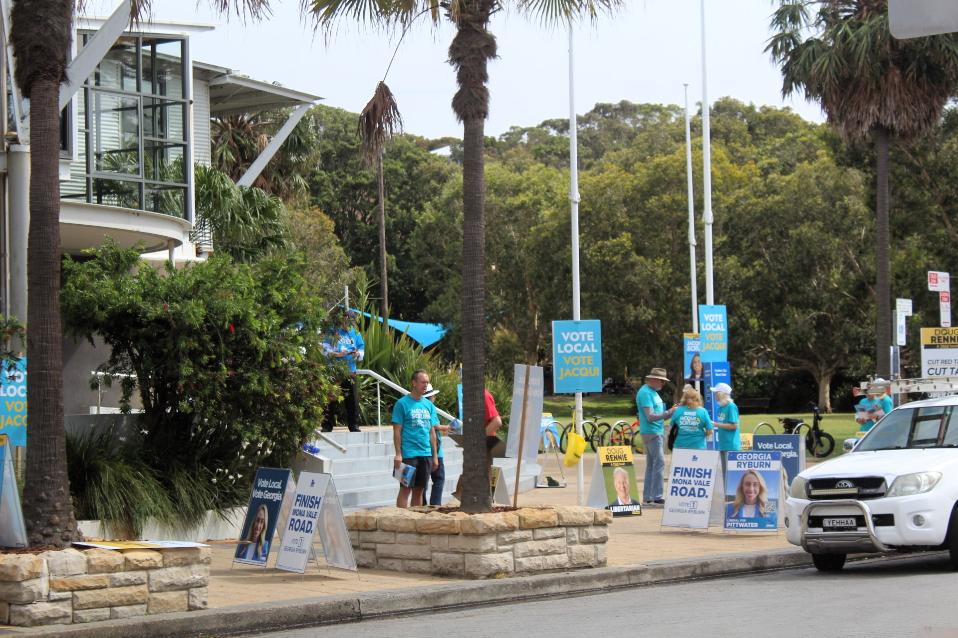
On Thursday 12 November the Legislative Assembly debated a petition asking the incumbent Government to stop misleading advertisements at next year's election.
The ePetition, presented by Jacqui Scruby MP, Member for Pittwater, was signed by 31,537 residents of New South Wales called on the Government to legislate truth in political advertising laws before the next election, like those already in place in South Australia and the ACT.
The petition is an initiative of NSW resident Michelle Millner and The Australia Institute, with independent MLA Jacqui Scruby as its parliamentary sponsor.
“Truth in political advertising is vital to restoring public trust that has been greatly eroded. Without laws around this our democracy is broken,” said lead petitioner Michelle Millner.
“There’s no place for misinformation in politics, particularly at a time when trust in our democratic system is critically low and highly polarised,” said Jacqui Scruby, Independent MP for Pittwater.
“Election campaigns should be a contest of ideas, where good policy rises to the top, not a race to the bottom driven by rage bait, scare tactics and misleading claims. NSW recently passed laws limiting digital deepfake abuse but reform has not gone far enough. South Australia has proven what’s possible and NSW should follow its lead. It’s time for truth in political advertising in NSW.”
“With so much misinformation and “alternative facts” being shared so far and wide, including through AI, it is critical for our democracy that we urgently implement truth in political advertising laws,” said Alex Greenwich, Independent MP for Sydney.
“With the emergence of AI, the risk of misinformation spreading is at an all-time high, especially with an election on the horizon. People simply don’t know what to believe. This erodes trust in politics and, if left unchecked, it ultimately undermines our democracy,” said Kobi Shetty, MP for Balmain and Greens Spokesperson on Democracy.
“If we want to rebuild community trust we need to legislate for truth in political advertising. The Greens are ready to work with the government to get this done.”
“Now more than ever, it is vitally important that political advertising is factually correct and accurate, especially more-so with the rise of AI. If we want to ensure public confidence and trust in our democracy this begins by ensuring that political advertising is honest. How can you trust a candidate or party who deliberately spreads misinformation and lies?” said Phil Donato, Independent MP for Orange.
“Honesty and integrity are essential to democracy and at a time when truth can be threatened and trust can be undermined, we must do what we can to protect both,” said Dr Joe McGirr, Independent MP for Wagga Wagga.
“Applying the highest standards of accountability and transparency to our to political representatives, political leaders and their parties is one way of doing that. I’m proud to support this petition and urge anyone who wants to hear the truth in political advertising to add their name to it.”
“Truth in political advertising laws have transformed campaigning in South Australia, leading political party directors to scrutinise all political ads for accuracy,” said Bill Browne, Director of The Australia Institute’s Democracy & Accountability Program.
“NSW voters are entitled to the same standard of rigour and honesty, but currently there is no guarantee they will get it. Trust in politics is already low. Allowing politicians to knowingly spread falsehoods during election campaigns is indefensible.”
Misinformation - Disinformation
The primary difference between misinformation and disinformation, as currently defined, comes down to intent.
Misinformation is false, inaccurate, or misleading information that is shared by mistake, ignorance, or error, without the intent to deceive or cause harm; for example, accidentally repeating a wrong opening time for a local shop.
Disinformation is knowingly false or misleading information that is created and spread deliberately to deceive, manipulate, or cause harm; for example, coordinated propaganda campaigns or fabricated documents meant to destabilise institutions. When used during political campaigns it is defined as false or misleading information that is deliberately created and spread with malicious intent to manipulate, deceive, or undermine trust. It is weaponised on purpose - such as coordinated propaganda, fake news websites, or AI-generated deepfakes - to sway elections or damage a candidate's reputation
Malinformation is information that is based on truth, but is deliberately twisted, taken out of context, or leaked with the specific intent to cause harm or damage someone's reputation.
Parliamentary Debate
Having reached well over 20,000 signatures from NSW residents, MPs debated the issue in Parliament, opening the door for reforms to be introduced before the next state election, due in March next year.
Jacqui Scruby, Independent MP for Pittwater, stated in her address to the chamber:
''Businesses cannot lie to consumers when they sell a product, yet politicians and political parties can lie to voters to get their vote. Voters deserve the same rights as consumers. That is the premise of the debate. I am sure a lot of members will support it, but I am most interested to hear if there are any counterarguments.
Some 31,537 citizens signed the ePetition, making it the fifth largest in New South Wales, and 89 per cent of residents have indicated that it is time to outlaw deliberate lies in political advertising before the next election. That data comes from research of the Australia Institute. Just last week the McKinnon Institute revealed that while three-quarters of Australians believe in our democratic system, public trust in State politicians has plunged to just 32 per cent. The issue has been before the Parliament before. Donald Page, the former member for Ballina, introduced a bill about truth in advertising, based on South Australia's framework. At the time, there were arguments in this place suggesting it was too subjective or that the Electoral Commission and courts could never properly regulate it, and that bill did not pass.
Since 1985 South Australia has had legislation that works to prevent lying in political advertising. Since 2008, when the truth in advertising bill slipped through this House, the Australian Capital Territory [ACT] passed similar laws as South Australia in 2020. That was done with unanimous, tripartisan support from Labor, the Liberals and The Greens. It was not contentious. If South Australia and the ACT can now hold candidates and third parties to provide facts to voters, then why should the voters of New South Wales be subjected to dirtier and more deceitful campaigns? Look at what has filled the vacuum since this Parliament rejected Donald Page's bill. In 2011 voters were fed the Coalition's claims of a hidden $5.2 billion blackhole that was not founded on fact. There have been multiple other examples.
I also acknowledge that we are entering a new era of misinformation and disinformation being spread, predominantly through social media and online. Voters are crying out to hear the truth when making decisions at the ballot box. Both major parties have previously weaponised scare campaigns, but the only real losers in the situation are citizens trying to cast an informed vote at the ballot box. In March this year New South Wales passed legislation to prevent AI deepfakes at elections. That is ground-breaking legislation. We have seen the need for that kind of legislation at the Victorian election with the use of deepfakes. It is now an offence and is prohibited to distribute deceptive deepfakes during an election.
While we have tackled AI deepfakes, without truth in political advertising, the job is only half done. The way the Acts work in South Australia and the ACT is that their electoral commissions can pull up and identify those who have provided false information. It does not prevent free speech. It does not concern everything a politician says; it is just what has been authorised. It is similar to what happens at the moment, with something as simple as putting the printer's address on authorised material. The Electoral Commission can pull up and identify election material that is not adequately authorised.
By the same token, if a complaint is made to the Electoral Commission—and this is how it works in South Australia and the ACT—it can be disputed whether a claim is made that is not factual. If that is contested, it can go to the Supreme Court to be determined. We already have that in all other areas, including in consumer law. Like the ACT, let us get it done. It is not a left or right issue. There was tripartisan support in the ACT. Let us end the legal right of politicians to mislead and take advantage of the public. I call on the Government and the Opposition to respect the 31,500 people who signed the petition and legislate truth in political advertising.''
The MP for Pittwater was supported during the debate by speeches from Dr Joe McGirr, Independent MP for Wagga Wagga, Kobi Shetty, MP for Balmain and Greens Spokesperson on Democracy, and Alex Greenwich, Independent MP for Sydney.
Watching and listening in the gallery were Daniel Tetlow from the Better Politics Foundation, Bill Browne and Michelle and Ian Milner from the Australia Institute.
In response the MP for Maitland and NSW Minister for Roads, and Minister for Regional Transport, the Hon. Jenny Aitchison, stated the Government progressed significant legislative reforms through the Electoral Legislation Amendment (Elections) Act 2026., which include amendments to safeguard elections in New South Wales from the spread of misinformation and disinformation generated by artificial intelligence through the creation of new offences relating to the printing, publication, distribution and display of certain electoral material generated using artificial intelligence.
Ms Aitchison also cited the NSW Electoral Commission's disinformation register and the Stop and Consider campaign to reduce disinformation ahead of the 2023 State election, both of which will still be in place for the March 2027 NSW State election.
Ending Lies in Political Advertising
The call to end lies in political advertising was spoken to by the Liberal MP for Willoughby, Tim James, who stated that the Parliament's Joint Standing Committee on Electoral Matters, of which he is a member, examined in its inquiry into the 2023 election that laws for truth in political advertising would be difficult to implement and would not effectively address campaign misinformation.
''Extending regulation to the substance of political debate raises different questions that go to the heart of political discourse. Freedom of political communication is fundamental to our democracy and has constitutional protection. Therefore, any proposed restriction requires careful scrutiny. There are verifiable facts in politics, and all of us should be accountable for getting them right.'' the MP for Willoughby stated
Mr James continued:
''But the political process also involves opinions, predictions and competing interpretations of evidence. Will a policy increase costs? Will a proposal deliver its promised benefits? Is a funding commitment adequate? Reasonable people can reach different conclusions. Even a law confined to factual claims must draw lines between fact, inference and opinion. That brings us to the question of who decides. Who will be the arbiter of the truth? Who could be the overarching judge of objectivity and fact? The NSW Electoral Commission has raised significant concerns about the risks of taking on this responsibility. Its independence is precious, and drawing it into disputes over political claims could undermine public confidence in its impartiality.
Establishing another body or relying on the courts raises questions about cost, timely decisions and a fair opportunity to respond. During a campaign, these questions become particularly pressing. Could the complaints process be weaponised against political opponents? A complaint lodged just before polling day could produce damaging headlines before anyone assesses its merits. Candidates could spend their time and limited resources on defending proceedings. Smaller campaigns would be particularly exposed. The threat of proceedings could also discourage legitimate criticism that voters deserve to hear. We must distinguish deliberate falsehoods from honestly made commitments that may later become unworkable. If regulation extended to future promises, it should not encourage governments to persist with bad policy when circumstances change. They should explain that change and answer to voters for it.''
Electoral Legislation Amendment (Elections) Act 2026
The Electoral Legislation Amendment (Elections) Act 2026; An Act to make miscellaneous amendments to the Electoral Act 2017, the Electoral Funding Act 2018, the Independent Commission Against Corruption Act 1988 and the Local Government Act 1993,.was assented to on April 7 2026.
During the March 2023 NSW state election, comprehensive statutory bans specifically targeting AI deepfakes in campaign posters or advertising were not yet in place.
In March 2026, New South Wales passed the Electoral Legislation Amendment (Elections) Act 2026, making NSW the second Australian jurisdiction to enact specific penalties and a ban on publishing or distributing AI-generated deepfakes during an election period.
This formalised some protections against deepfakes. The laws ban electoral material that depicts “a simulated person performing an act that the real person depicted did not perform” and require labelling any digitally generated material “that depicts a digitally created person, event or place that a reasonable person would think is an actual person, event or place”.
However, these changes only apply for the period from about three weeks before election day, by which point most of the damage caused by concocted or false materials will have been done.
The Bill introduced a new offence to prohibit the printing, publishing or distribution of digitally generated electoral material unless it carries a statement to that effect. "Digitally generated electoral material" is defined in the bill as electoral material containing audio-visual, visual or audio content that is "generated substantially, or modified or altered significantly, by artificial intelligence". The definition expressly excludes a cartoon or animated drawing. The bill also introduces a new offence to prohibit the printing, publishing, distribution or public display of digitally generated electoral material where it depicts a simulated person performing an act that the real person depicted did not perform. It will be a defence if the written consent of the real person was obtained.
Under this, it will be a defence to both new offences if the defendant took no part in determining the content and could not reasonably be expected to have known that the content contravened the offence provision. The existing defences and exceptions in section 190 of the Electoral Act will also apply to these new offences, including that a person is not guilty of an offence if the breach was not material or not intended or not likely to mislead an elector in relation to the casting of their vote.
The Bill also made changes to postal voting, requiring these clearly state the application must be submitted directly to the Electoral Commissioner, rather than be returned to a political office or candidate, as has happened in the past, and that no additional information or matter appears on the application.
Privacy of voter enrolment information
The bill made a number of amendments to better protect the privacy of voter enrolment information. Prior to the amendments, candidates in an election may request a list of electors from the Electoral Commission under section 49 of the Electoral Act. The bill implemented the committee's recommendation to ensure that candidates can only make such a request within 48 hours before the close of voting.
During previous elections the news service received a number of phone calls and emails from residents regarding robocalls, and their content, and campaign emails which they never signed up for, and those people asking 'how did they get my information?'.
The changes under Electoral Legislation Amendment (Elections) Act 2026 are to ensure that voter enrolment information is used only for election-related purposes. Where persons other than parties, members and candidates apply for enrolment information under section 50 of the Electoral Act, the bill provides that the Electoral Commissioner may not make a finding that could result in the release of voters' personal information on the electoral roll unless the Electoral Commissioner has first consulted with the NSW Privacy Commissioner and identified a public interest in providing the requested information that outweighs the public interest in protecting the privacy of personal information in the circumstances.
This amendment was in response to the Joint Standing Committee on Electoral Matters' recommendation 19 in its report on voter engagement, participation and confidence, and follows consultation with the Information and Privacy Commission. The bill increases safeguards in relation to the provision of electoral information that the Electoral Commissioner is required to provide to registered parties and elected members following an election under section 222 of the Electoral Act by enabling the commissioner to require an undertaking that the party or member's systems and procedures will be adequate to preserve the security of the information.
The bill also increased protections for silent electors by expressly prohibiting the publication of a silent elector's address in the register of parties, and it makes changes to protect the residential addresses of elected members and registered candidates from public disclosure.
The Bill did not address deliberate falsehoods being used in campaigns.
NSW Electoral Commission's Disinformation Register
The NSW Electoral Commission commenced a campaign to help reduce the spread of disinformation ahead of the NSW State election to be held that in 2023.
As part of that, the NSW Electoral Commission launched a disinformation register which rebuts prominent false and misleading statements about electoral processes in NSW.
The register already contains examples of disinformation which have been identified.
“We do not comment on whether campaign claims made by political participants (or their supporters) are true or false. As the independent administrator and regulator of elections in NSW, our focus is on the integrity of the electoral process itself.” the Commission stated
The Commission states:
'False information about elections that circulates in the community via various information and media formats, channels and platforms can undermine confidence in the integrity of democratic processes and have broader consequences for society.
In the lead-up to each state-wide election, our Disinformation register tracks and rebuts prominent false and misleading statements about electoral processes in New South Wales. The register also notes any action we take in response to these statements.
We do not comment on whether claims about policy issues or about political participants in an election are true or false. Our focus, as the independent administrator and regulator of elections in New South Wales, is on the integrity of the electoral process itself.''
The NSW Electoral Commission is encouraging voters to think about three things when they encounter electoral communications:
- Reliable: Is the information from a reliable source?
- Current: When was it published?
- Safe: Could it be a scam?
Pittwater MP will persist with calling for reforms if re-elected
In reply Ms Scruby acknowledged and thanked those who spoke: the member for Sydney, the member for Balmain, the member for Wagga Wagga, the member for Willoughby, and the Minister for Roads, representing the Special Minister of State and acknowledged the member for Wakehurst, who wanted to speak but was not able to.
Ms Scruby reiterated that voters don't want to be lied to, they want to make informed decisions.
''I appreciate all of the arguments put today.'' the MP for Pittwater stated, continuing;
''Frankly, I think that any views against this petition are a bit of a cop‑out, given that we have good examples in the Australian Capital Territory, and in South Australia since 1985. Some of the arguments put against this include that the Electoral Commission does not want to be the arbiter of truth. I will get into that. It really shows that we are not being brave and not addressing what 31,000‑plus people want us to do, which is to bring truth into political advertising in a way that works.
I also mention a practical example of how this would work. A third‑party campaigner said to me, "We were actually guilty of putting something untruthful in electoral material in South Australia. We got a phone call from the Electoral Commission. We also got a phone call from the party that we were targeting. We acknowledged it. We withdrew it. It was a very simple process." That goes to the point that this is actually a preventative measure, and it will deter people from lying in political advertising. It will be in very rare circumstances that these things will get challenged. If they do and the Electoral Commission pushes back and they are escalated to the courts, we already have discussions about what is truth and fact in courts every day, especially in consumer law.
I acknowledge Zali Steggall, who is pushing this at a Federal level. This should be an issue for the next Parliament. I agree with the member for Willoughby that we need to further interrogate it. I look forward to members' support in doing that in the next Parliament should we all be lucky enough to be re-elected.''