The Northern Beaches Council has been named the most complained about local council in New South Wales. According to the state government's Office of Local Government (OLG) 2024/25 statistics, the council exceeds the state average of 15 per council. The Northern Beaches Council has had 153 complaints lodged against it across all but one category.
Despite these figures, Northern Beaches Council maintains that its internal data shows "record customer satisfaction levels" for their general services. Residents spent time during the November meeting for 2025 listening to some councillors speak about how nice the ‘well-presented’ annual report looked and 'how great' the forcibly amalgamated council is doing.
Major community concerns include the special rate variation, which increased the levy from some Pittwater properties by thousands annually while others saw a rise of just a few hundred, deteriorating roads and infrastructure, and alleged excessive spending on staff/executives.
Concerns have also been raised regarding a perceived lack of transparency, with allegations of management being too bureaucratic, slow, and unresponsive to residents.
The council has experienced internal conflict, with accusations of "reckless" financial decisions and contentious debates at council meetings.
Ongoing misuse of public land and creating scenarios where residents and pristine environments are put at risk, such as the pushing through of dogs offleash on Mona Vale beach, and the subsequent killing of wildlife and rise of dogs offleash in all public spaces and on all beaches, has also been unpopular. The rise and rise in reported dog attacks across the LGA, now more than dog-attack prone Central Coast Council, also points to a council failure to meet its responsibility for administering and enforcing the Companion Animals Act 1998.
Under the NSW Companion Animals Act 1998 (CAA), local councils are the primary authority responsible for the management of stray and roaming companion animals.
Under the Companion Animals Act 1998 (NSW), councils are responsible for managing stray, roaming, or dangerous animals that threaten wildlife.
Although the council enforces strict cat prohibitions in designated wildlife protection areas, the same has not occurred regarding dogs in the same areas. Residents state the messaging has been the opposite.
The NSW Office of Local Government states:
‘The complaints we receive about councils help us to proactively monitor council operations and identify emerging issues and trends. Analysis of this information enables us to better direct our resources. Analysis also helps us to identify the need for changes to local government legislation or policy or a need for training, guidance or other best practice advice.’
Regarding the Complaint statistics for the period 1 July 2024 to 30 June 2025, released late February 2026:
‘It is important to recognise that the volume of complaints does not necessarily reflect the seriousness of the issues raised. Additionally, complaint numbers may be influenced by coordinated campaigns targeting councils or individual councillors, often centred around a single contentious matter.
Where there is no evidence of serious misconduct or maladministration, and concerns relate primarily to the merits of a council decision, the Office of Local Government (OLG) will generally not pursue an investigation.
An investigation may arise from a single complaint or from multiple complaints relating to one or more issues. It can also cover complaints made across a broad timeframe, including those lodged over a number of years.
The Local Government Act 1993 allows councils a significant degree of autonomy in their day-to-day activities. Under the legislation, neither the Minister for Local Government nor OLG has the power to intervene in the day-to-day operations of councils.’
Rise in Complaints
The OLG received 1801 complaints in 2024-25, compared to 1242 in 2023-24.
These complaints were spread over 115 councils. There has been a substantial increase in complaints about councils this year compared to previous years, with 20% of complaints relating to financial management concerns.
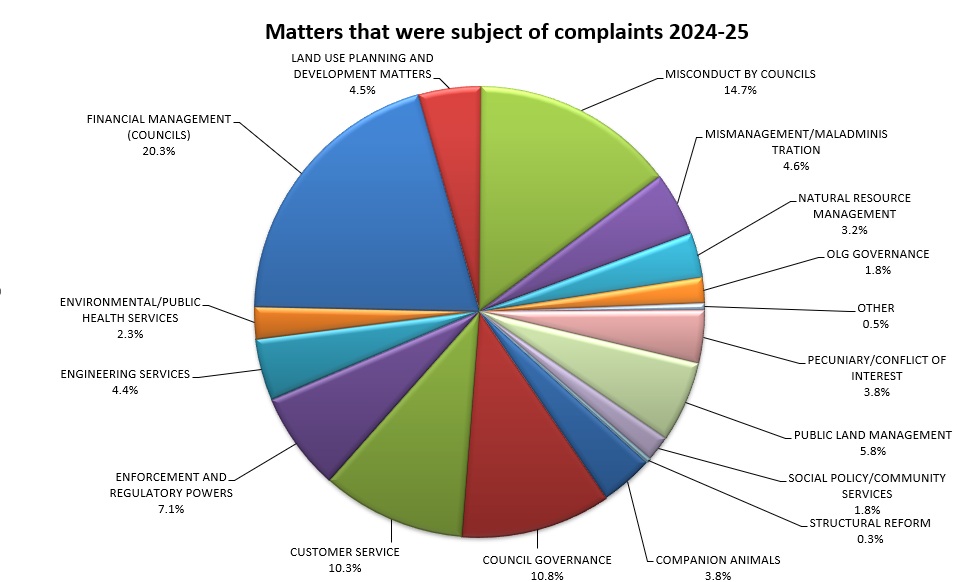
Chart of complaints received by OLG about councils during the 1 July 2024 to 30 June 2025 period by subject. Image: OLG
Councillor misconduct
Pecuniary interest
In 2024-25 OLG received 40 allegations concerning breaches of the pecuniary interest provisions outlined in Councils’ codes of conduct.
Of these, 1 allegation was referred to the OLG by a third-party integrity agency.
Other councillor misconduct complaints
In 2024-25 OLG received 40 complaints alleging misconduct (other than that relating to pecuniary interest matters) by councillors. Of these, seven allegations were referred to the OLG by third-party integrity agencies.
Three investigations were initiated under the misconduct provisions during the 2024-25 period. Two investigations resulted in findings of misconduct against the councillor. One investigation remains ongoing.
Two misconduct matters were determined by the Deputy Secretary during the 2024-25 period. One matter resulted in the suspension of a councillor for a period of three months, and an order to apologise for the misconduct. The councillor appealed the Deputy Secretary’s decision at the NCAT. On 10 July 2025, the NCAT confirmed the Deputy Secretary’s decision.
The second matter also resulted in the suspension of the councillor for a period of three months, and an order to apologise for the misconduct. The councillor appealed the Deputy Secretary’s decision at the NCAT. On 19 February 2026, the NCAT issued a decision, which is being examined by OLG.
Political donation complaints
In 2024-25, OLG received one allegation of breaches of the political donation provisions of Councils’ codes of conduct. A review of the evidence determined that the complaint did not constitute a breach.
The Northern Beaches Council appeared in every category, bar one.
Complaints by category
COMPANION ANIMALS Total 104 - Northern Beaches Council 1
COUNCIL GOVERNANCE Total 293 - Northern Beaches Council 39; Highest Snowy Monaro Regional Council 56
CUSTOMER SERVICE Total 281 - Northern Beaches Council 22
ENFORCEMENT AND REGULATORY POWERS Total 192 - Northern Beaches Council 6
ENGINEERING SERVICES Total 192 - Northern Beaches Council 5
ENVIRONMENTAL/PUBLIC HEALTH SERVICES Total 62 - Northern Beaches Council 1
FINANCIAL MANAGEMENT (COUNCILS) Total 552 - Northern Beaches Council 151, Compare North Sydney Council 48
LAND USE PLANNING AND DEVELOPMENT MATTERS Total 123 - Northern Beaches Council 5
MISCONDUCT BY COUNCILS Total 399 - Northern Beaches Council 6
MISMANAGEMENT/MALADMINISTRATION Total 125 - Northern Beaches Council 21 – equal highest with Clarence Valley Council
NATURAL RESOURCE MANAGEMENT Total 88 - No mention in this category, but may have appeared in 'Council not specified – 3'.
Central Coast Council topped here with 26 complaints.
However in the PUBLIC LAND MANAGEMENT Northern Beaches Council had 2 complaints lodged against it.
Another 1 complaint fell into the SOCIAL POLICY/COMMUNITY SERVICES category.
The STRUCTURAL REFORM, where only 8 councils had complaints lodged against them, also shows the Northern Beaches Council was one of these.
OTHER also lists 1 complaint about Northern Beaches Council
The Grand Total of all complaints against all councils was 2723 an increase. The OLG received 1242 complaints in 2023-24, compared to 1143 in 2022-23.
2024-2025 percentages are in the following:
Keyword Category Total
- COMPANION ANIMALS 3.8%
- COUNCIL GOVERNANCE 10.8%
- CUSTOMER SERVICE 10.3%
- ENFORCEMENT AND REGULATORY POWERS 7.1%
- ENGINEERING SERVICES 4.4%
- ENVIRONMENTAL/PUBLIC HEALTH SERVICES 2.3%
- FINANCIAL MANAGEMENT (COUNCILS) 20.3%
- LAND USE PLANNING AND DEVELOPMENT MATTERS 4.5%
- MISCONDUCT BY COUNCILS 14.7%
- MISMANAGEMENT/MALADMINISTRATION 4.6%
- NATURAL RESOURCE MANAGEMENT 3.2%
- OLG GOVERNANCE 1.8%
- OTHER 0.5%
- PECUNIARY/CONFLICT OF INTEREST 3.8%
- PUBLIC LAND MANAGEMENT 5.8%
- SOCIAL POLICY/COMMUNITY SERVICES 1.8%
- STRUCTURAL REFORM 0.3%
Grand Total 100.0%
The data for total complaints against all councils shows the NBC tops the list by a large margin.
Number of Complaints by Council ordered by Number of complaints: Count of Doc ID
- Northern Beaches Council 153
- Clarence Valley Council 114
- Snowy Monaro Regional Council 86
- Central Coast Council 83
- Council not specified 74
- Liverpool City Council 65
- Shoalhaven City Council 57
- Mid-Coast Council 45
- North Sydney Council 40
- Newcastle City Council 39
- Canterbury-Bankstown Council 37
- Bayside Council 33
- Tamworth Regional Council 33
- Sydney, City of 28
- Ku-ring-gai Council 26
- Woollahra Municipal Council 26
- Glen Innes Severn Shire Council 26
- Inner West Council 26
- Hawkesbury City Council 26
- Tweed Shire Council 26
- Georges River Council 23
- Sutherland Shire Council 23
- Hornsby Shire Council 22
- Parramatta Council, City of 22
- Cumberland Council 21
- Blacktown City Council 20
- Lithgow City Council 20
- Bathurst Regional Council 19
Forced amalgamations no fix for improving financial performance of councils
In 2017 Professor Brian Dollery from the University of New England Centre for Local Government published a study in which they stated they have proven amalgamations are no quick fix for improving the financial performance of councils.
Professor Dollery, in a similar commissioned for Pittwater Council prior to it being forcibly amalgamated with Warringah and Manly council, found Pittwater would be worse off being put back under Warringah, and that it was a council that was financially viable, socially strong and had empowered and engaged the community to shape how it wanted Pittwater to look, feel and be.
The 2013/2015 "Bigger is not always Better" study by Professor Brian Dollery (UNE), strongly opposed the forced amalgamation of Pittwater, Manly, and Warringah councils. It concluded that financial savings claims were not plausible, no "community of interest" existed, and that a the merger would be detrimental for Pittwater.
Professor Brian Dollery’s 2017 study found Clarence Valley Council in northern New South Wales was 'worse off' financially since it was created in 2004.
The Clarence Valley Council was created after the merger of the Copmanhurst, Maclean, Pristine Waters and Grafton councils.
"If you take the Carr Government's claims that it made at the time, which was that New South Wales local government was in a financially hopeless state, basically the magic silver bullet or the magic way of saving it would be forced amalgamation," Professor Dollery said then.
"If you take the Clarence council for an example, that just isn't true. Clarence Valley has been through quite tough financial times since the amalgamation."
Professor Dollery and former PhD student Siew King Ting assessed the financial health of the Clarence Valley Council by comparing it to 11 other councils using Office of Local Government data from across 10 years, as well as Independent Pricing and Regulatory Tribunal (IPART) Fit for the Future assessments.
"A decade down the track, Clarence Valley Council was in worse shape that many of its peers," Professor Dollery said.
"The amalgamation did not lead to lower rates and annual fees, and the council failed to meet benchmarks in terms of its operating performance, debt service, asset renewal, infrastructure backlog, and asset maintenance."
The NSW Government abandoned forced council amalgamations of some councils in July 2017 after an 18-month battle including public outcry and several court challenges. Pittwater Council, which had voted to join with Mosman and North Sydney Councils to retain the Pittwater LGA, had that vote reversed in an emergency meeting called when those who supported fighting to retain Pittwater Council were out of the area for 24 hours.
The Government had planned 35 mergers, cutting the states 152 councils to 112.
Professor Dollery said in 2017 the case study involving the Clarence Valley proved that amalgamations were not always financially beneficial.
"The moral of the story is that amalgamation doesn't work and its important to record that and get it down," he said.
Residents of Pittwater continue to state:
‘’NBC is an arrogant organisation, and has been since day one! Give us Pittwater Council back! It was well run, within budgets and had cash reserves. All that’s happened since is a corrupt rip-off of the ratepayer.’’
See report from last week: Sell Off of Pittwater Residents Asset at Vuko Place 'On the Nose' Residents State
Fourth Petition to Reinstate Pittwater gathering more signatures
Protect Pittwater has been in contact with the news service this week, stating the Minister for Local Government, The Hon. Ron Hoenig, has stated they need another 2000 signatures from Pittwater residents for their 4th petition (the others disappeared, were ‘lost’ or were ‘filed’ where they could not be found’).
Residents of Pittwater may see them out and about in local shopping precincts over the next few weeks.