February 1 - 28, 2026: Issue 651
Menzies Oration 2026: Social Cohesion and the Future of Australia: Leadership, Civility, and the Greater Good
President of the Australian Human Rights Commission Hugh de Kretser's 2026 Menzies Oration on the theme 'Social Cohesion and the Future of Australia: Leadership, Civility, and the Greater Good' and calls for an Australian Human Rights Act
Given at Federation University's SMB Campus, at Ballarat, Wednesday February 18, 2026
SMB is where Federation University started way back in 1870 – known then as School of Mines Ballarat. The site is right in the heart of Ballarat. The Menzies Leadership Foundation and Federation University first partnered in 2022, sharing a commitment to impactful education, public dialogue and community-based leadership.
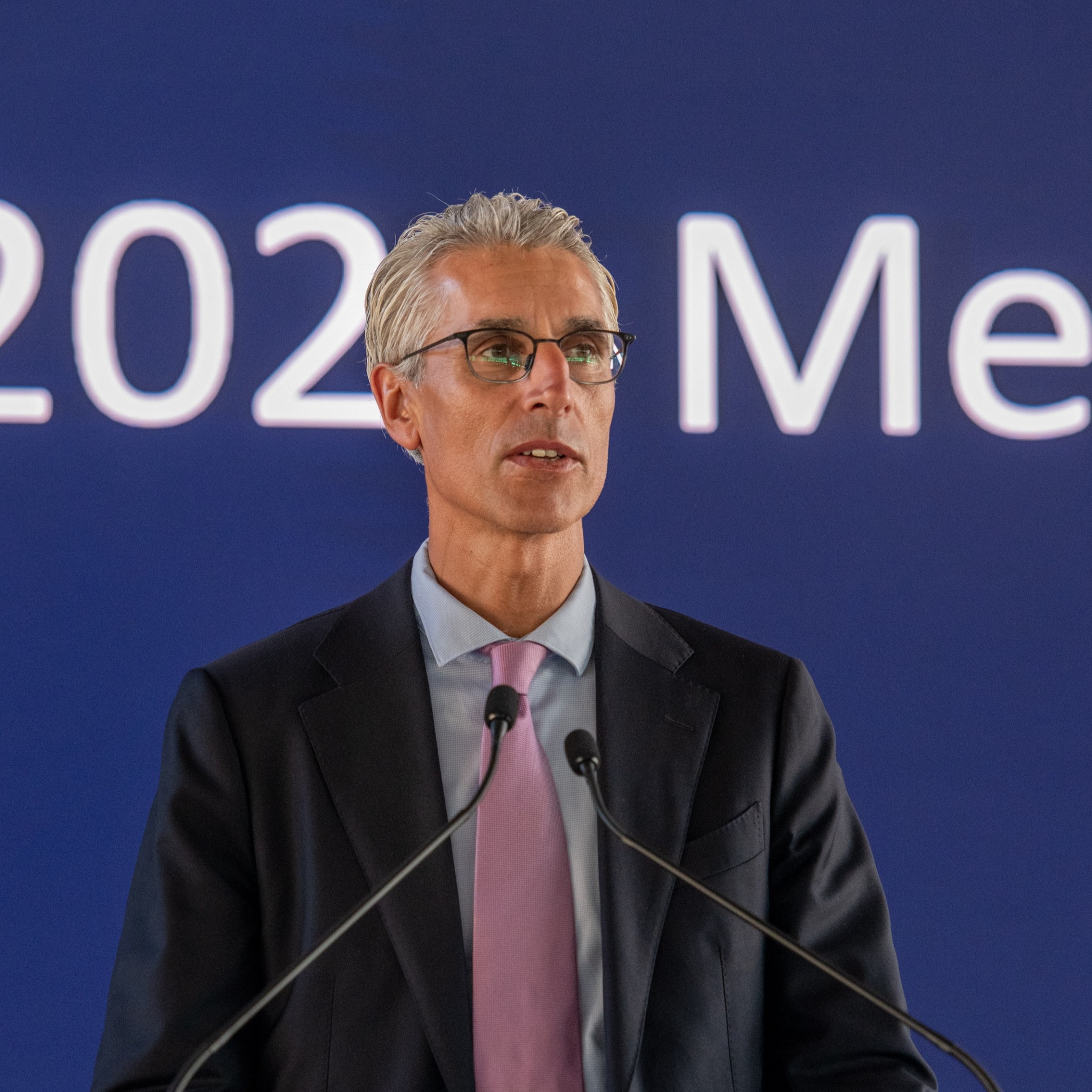
President of the Australian Human Rights Commission Hugh de Kretser. Photo: Federation University Australia
General Sir Peter Cosgrove, Dr Philip Freir, Professor Duncan Bentley, Peter Jopling KC, Liz Gillies distinguished guests and friends here and online.
It’s wonderful to be here tonight at Federation University and to reconnect with the University after working together on a number of projects to get community legal centres online when I was at the Federation of Community Legal Centres.
Thank you to the Menzies Leadership Foundation for the invitation to address you tonight.
Tonight I’ll be talking about social cohesion, democracy, trust, listening and of course, human rights.
I want to ask you to first think about these words from the perspective of Aboriginal and Torres Strait Islander peoples – the First Peoples of this land.
We say ‘peoples’ of course to reflect that fact that before colonisation there were hundreds of sovereign nations with distinct language groups and traditional country in this land we now call Australia. Nations who lived sustainably with sophisticated culture, law, language and knowledge.
The land we are on here is Wadawurrung country. I acknowledge their elders and ancestors and their continuing, deep and unbroken connection to this country. I acknowledge their Kulin nation neighbours, the Dja Dja Wurrung.
For many years after the First Fleet’s arrival, colonisation was distant for the Wadawurrung and Dja Dja Wurrung people. Disease in the form of smallpox likely came first. And then, after the first permanent European settlements were set up in Portland and then Melbourne in the 1830s, an illegal squatting land rush brought thousands of Europeans and millions of sheep.
The discovery of gold in 1851 rapidly accelerated the theft of their land as hundreds of thousands of miners surged in from around the world. From 1851 onwards, we know from the work of the Yoorrook Justice Commission that some 2400 tonnes of gold has been taken from Aboriginal land in Victoria - roughly $290 billion of gold in today’s value.
In the course of just two decades, the world of the Wadawurrung and Dja Dja Wurrung was destroyed. Their people were decimated by violence and disease. The survivors were forced into missions and reserves where language and culture were suppressed.
Under a guise of protection, colonial policies sought not only to control but to erase First Peoples. Victoria led the way with legislation known as the Half-Caste Act that gave powers to forcibly remove Aboriginal children with European blood from their families and communities in an attempt to assimilate and erase their identity.
Across the country, so-called government protectors of Aboriginal people actively pursued child removal and controlled-marriage policies to ‘breed out’ Aboriginal people.
This is history. But it is living history that is connected to and that shapes our present and future. For First Peoples, in many ways the past is present as historic injustice has shape shifted into contemporary ongoing injustice.
Facing this history can be uncomfortable. But it is part of how we build a better future together.
And I ask that you hold it in mind as we talk about social cohesion in Australia.
Tonight I’m going to talk about 6 things:
- Defining social cohesion – what it is and what it isn’t
- Assessing whether social cohesion in Australia is getting better or worse
- The power of truth telling in building shared understanding and connection
- The importance of seeing and hearing
- What defines us as Australians
- Why justice and human rights must be at heart of social cohesion
What is social cohesion?
I want to start by talking about what social cohesion is and what it isn’t.
This is important because social cohesion can be a contested term that means different things to different people.
It’s a term that needs to be handled with care.
The term has been around for many decades.
This is the Menzies Oration. I couldn’t find any references to Sir Robert Menzies using the term social cohesion. He did speak about a concept of tolerance – of religious tolerance, political tolerance and social tolerance and a ‘…mutual understanding, forbearance, a desire to assemble ourselves every time there is a common cause to be served.’
Emeritus Professor Andrew Jakubowicz, an expert in this area, points to an early use of the term in 1972 in a campaign speech delivered by Menzies political opponent Gough Whitlam.
Whitlam used the term social cohesion to highlight the connection between community life and community identity - and people’s mental and physical wellbeing.
In this context, social cohesion is like a social glue that connects us in our communities and supports our wellbeing.
The usage of the term has risen significantly in recent years and these days it seems to be in the news almost every day.
Social cohesion is commonly defined to cover a range of things like:
- a shared sense of belonging and attachment
- trust in each other
- trust in our government and institutions
- a shared vision and a willingness to participate in it.
It is often used in connection with terms like our social fabric, social inclusion and social capital.
Minister for Multicultural Affairs, Dr Anne Aly described it in a recent radio interview as:
- trust between people
- trust between people and institutions
- the ability of all to participate – in jobs, education, healthcare and so on.
Social cohesion, understood this way, is a good thing.
It’s generally accepted that societies with higher levels of social cohesion are healthier, more resilient to external shocks and experience greater economic growth.
The Scanlon Foundation is one of the leading organisations in this space. The Foundation has developed an index to measure social cohesion in Australia – the Scanlon Monash Social Cohesion Index.
It’s made up of 5 indicators: belonging, worth, social justice, participation and acceptance.
- Belonging: the sense of pride and belonging people have in Australia and in Australian life and culture, and the belonging they feel in their neighbourhoods
- Worth: the degree of emotional and material wellbeing
- Social inclusion and justice: perceptions of economic fairness and trust in government
- Participation: involvement in political activities and participation in social, community, and civic groups
- Acceptance and rejection: attitudes to immigrant diversity, support for minorities and experiences of discrimination
What social cohesion isn’t
The critique of social cohesion is that it can be a loaded and coded term.
Loaded because it sounds like a positive unifying concept but it can be used to mean conformity and assimilation.
And coded, because when some people say social cohesion, they use it as an implied instruction to not talk about things that make people uncomfortable – like racism and other injustice.
As my colleague Race Discrimination Commissioner Giridharan Sivaraman recounts, he was once told to stop talking about racism because you’re harming our social cohesion.
So for some people outside of the Western European English language mainstream, social cohesion is a negative concept that means erasing difference, shedding culture and language and not talking about injustice.
So let me be clear - our desire for social cohesion must not come at the expense of talking about, and achieving, justice and human rights.
A society where injustice is prevalent but not talked about or let alone addressed is not a socially cohesive one.
Acknowledging and addressing injustice promotes social cohesion.
Protecting human rights promotes social cohesion.
I’ll come back to some of these concepts but for now, my point is that when I talk about social cohesion today I’m referring to the positive framing of the concept.
Is social cohesion getting better or worse in Australia?
Many people are pointing to declining levels of social cohesion both over the long term and in recent years.
Many years ago I read Robert Putnam’s influential 2000 book Bowling Alone which described the decline in what he called social capital in the USA. Andrew Leigh’s 2010 book Disconnected has a similar analysis in Australia showing Australians are living lonelier, less connected lives.
The Scanlon Monash Social Cohesion Index now has close to 20 years of data showing declining levels of social cohesion. The index has been stable over the last 3 years but those scores are at the lowest levels since the index began in 2007.
Other measures show declining levels of trust in government, rising anti-migrant sentiment and rising racism and prejudice particularly against First Nations, Jewish, Muslim and Palestinian Australian people.
Wealth and income inequality is widening. There has been growing concern around housing affordability and cost of living issues.
Few of the Closing the Gap targets to address Aboriginal and Torres Strait Islander inequality are on track.
There is a human rights divide between the cities and bush, particularly in relation to health, education, jobs and exposure to the impacts of climate change.
Our public debates and our politics are becoming more caustic and polarised. Our media and social media compete for attention and advertising dollars. The more eyeballs on their content the more advertising they can generate. This incentivises stirring up controversy and conflict. This drives further polarisation as it feeds a harsher political cycle. Social media algorithms monetise division and outrage. People say things online and often anonymously that they would never say to someone face to face.
There is a search for outrage. Assuming the worst of possible meanings. Twisting words out of context.
Attacks increasingly target people instead of policies and ideas.
And there has been a rise in misinformation and disinformation – false information that is deliberately spread. Truth is being eroded.
This is a grim picture.
So against this backdrop it’s worth pointing out some positives.
Support for multiculturalism remains strong at over 80%. Most Australians recognise that diversity makes our nation better.
Trust in many public institutions remains reasonably high and compares favourably with OECD averages.
On a world scale, socially and economically Australia is faring better than many similar countries.
But, it’s undeniable that in recent times our social cohesion – our social fabric – has been fraying.
Two very recent events underscore this.
Two men in December opening fire on a Jewish gathering in Bondi celebrating a religious festival, killing 15 people including a 10-year-old girl.
And then on Australia Day, a man throwing a homemade bomb into a crowd of Aboriginal people and allies protesting Australia Day in Perth. Thankfully the bomb did not detonate.
And we remember in 2019, an Australian man attacked Muslim worshippers in Christchurch killing 51 people.
This violence underscores the importance of promoting a more socially cohesive society where all people can be safe and proud in their identity, faith and culture.
I’ll now offer some thoughts on how to strengthen our social cohesion drawing first on some personal experiences and then some broader themes.
Truth telling
Prior to this job, I worked for 2 years as the CEO of the Yoorrook Justice Commission, the first formal truth telling inquiry into historic and ongoing injustice against Aboriginal people in Victoria.
It was the hardest and most rewarding work I’ve done.
It profoundly changed me.
I was constantly out of my comfort zone as a non-Aboriginal person learning – imperfectly and incompletely - about Aboriginal culture, language, history, politics, injustice, sorrow, despair, survival, strength and brilliance.
Yoorrook engaged with thousands of Aboriginal people across the state – in yarning circles, roundtables, formal hearings, meetings, submissions and more.
It was a privilege to work with talented, proud Aboriginal colleagues and to spend 2 years learning.
I am a law and policy reformer at heart and anyone in this field knows it is littered with reports documenting injustice affecting Aboriginal and Torres Strait Islander people with recommendations that are often ignored, delayed or poorly implemented.
We were constantly worried about Yoorrook becoming yet another inquiry where Aboriginal people were asked to share their traumatic stories of injustice, only for them and their calls for reform to be ignored by people with power to address that injustice.
We spoke often about intergenerational trauma: for many non-Aboriginal communities in Australia, wealth is handed down between generations. For many in Aboriginal communities, trauma is handed down.
In our office, as often as I could I sat with the social and emotional wellbeing team and asked them about their observations about the impact of truth telling on the people were engaging with.
I was heartened by what I heard from them and what I witnessed myself.
I saw the power in the process of truth telling.
I saw how done properly, listening with care, respect and humility to stories of trauma and injustice, truth telling can bring healing and transformation.
Yoorrook empowered people to document their stories in their own words and sometimes in other mediums like artwork.
It then helped to communicate those stories to people with the power to address that injustice – and to the broader public.
60 years ago, the anthropologist William Stanner talked about ‘the great Australian silence’ and a ‘cult of forgetfulness’ practiced on a national scale to describe the way our society wilfully failed to acknowledge and attempted to erase past injustice against First Peoples.
First Peoples have been highlighting and advocating against injustice for generations.
People like Stanner helped to highlight their advocacy to shift broader public understanding.
The Australian Human Rights Commission’s Bringing Them Home report contributed to this shift. It raised public awareness of policies of forced removal of First Peoples children from their families and communities known as the Stolen Generations. It helped to lead to Kevin Rudd’s Apology.
Yoorrook was a further and major step in the right direction.
Yoorrook was set up by the democratically elected First Peoples Assembly of Victoria and the Victorian Government.
Critically it was First Peoples’ led – with 4 of 5 Commissioners Aboriginal, led by Chair and Wergaia Wamba Wamba Elder Aunty Eleanor Bourke.
At Yoorrook, I saw how truth telling built bridges between Aboriginal and non-Aboriginal Victoria.
We saw this in our hearings and meetings with politicians, heads of agencies, the Chief of Commissioner of Police, public servants, religious leaders and others – all who through Yoorrook’s processes came to confront and reckon with history and commit to change.
We saw this with the descendants of those who had benefitted from colonisation who were reckoning with their family histories and the histories of the lands they owned.
The transformation that happened to me personally, was happening on a broader scale within government and slowly, across Victorian society – something of a collective journey of shared understanding.
Understanding doesn’t fix the injustice, but it is a precondition to it.
And when there’s shared understanding of one group’s history there is deeper social connection.
The brilliant US civil rights lawyer Bryan Stevenson talks about the need for proximity - getting close to the people and places that experience suffering to build understanding and empowerment.
This is what truth telling does – provided we are willing to listen.
Truth telling is an invitation to listen respectfully and walk together toward a brighter shared future in these lands we all call home.
Yoorrook’s success shows the transformative power of truth telling and provides a model that can be drawn on across the country.
Being seen and heard
I left Yoorrook to start my job as President of the Australian Human Rights Commission around 18 months ago in July 2024 – some 10 months after Hamas’ 7 October attack on Israel and Israel’s response.
The impact of that overseas violence on communities here in Australia and the racism connected with it has been the most significant issue I have dealt with in this job.
I think for many people in Australia, when they think about declining social cohesion, they think about the rise in antisemitism, Islamophobia and anti-Palestinian racism connected with that conflict.
They think about the hardening of positions, the social media vitriol, the news cycle, the politics, the protests over injustice, the discrimination and the violence.
The polarisation in Australia that followed 7 October 2023 has revealed how ill-equipped we are to navigate difficult issues, to try and find common ground and to recognise our common humanity.
Against this backdrop the Australian Human Rights Commission has been quietly conducting a unique and important project, funded by the Australian Government to support communities in Australia facing increased racism after 7 October – Jewish, Israeli, Palestinian, Muslim and Arab communities.
The central component of the project was meeting with affected communities and listening to and documenting their experiences.
Drawing on this, our diverse staff team came up with an appropriate – and powerful name for the project: Seen and Heard.
The team conducted more than 150 meetings with 167 people from 78 organisations.
In partnership with community organisations, we held 27 consultations across the country with more than 450 people from affected communities.
I have learned a lot from this project and my own engagements with affected communities over the past 18 months.
The harm caused by the impact of the war on communities here has been profound.
The rise in racism, connected to events overseas, has caused immense distress.
Each community’s experience of racism has been unique, shaped by distinct histories and dimensions.
Acknowledging the harms experienced by each community does not equate them.
Nor does recognising one community’s experience of harm diminish the significance of another.
And while there are unique aspects to each community’s experience, there have also been many common aspects.
Communities have felt unsafe. They have felt pressure to shed aspects of their cultural and religious identity to avoid racism and harm. They have felt pressure to retreat from public life. Their sense of belonging in our country has been eroded. They have felt let down by institutions meant to support them and to be safe for them.
I worried about this project because of the sensitivity of issues, the polarised public debate and the distress and trauma experienced by the different communities.
But it has been worthwhile.
The feedback from participants in our consultations – both anecdotally and in survey responses – has been overwhelmingly positive.
When the public debates are fractured and divisive, there is a power in creating safe spaces where community members can share their experiences of racism and injustice.
There is a power in respectfully listening to and acknowledging the harms they experienced.
There is a power in being seen and heard.
In the coming weeks we will be publishing a report documenting what communities told us and we will share it with government and the Bondi Royal Commission which is looking into social cohesion as part of its terms of reference.
It will be an important contribution to the evidence base around the harms of racism.
It will highlight how globally connected we are and how events overseas can reverberate here.
And it will reinforce the need for action to address racism.
Thankfully, the roadmap for addressing racism in this country is on hand. In November 2024, the Australian Human Rights Commission, after extensive consultations, published our National Anti-Racism Framework with 63 recommendations across government and society to address racism in our nation.
We stand ready to work with government to implement the recommendations.
Human rights are Australian values
I want to finish by talking about Australian values and outlining a unifying vision for human rights to be recognised and protected as an integral part of our Australian identity.
At the start of this speech I spoke about social cohesion involving a sense of belonging and a shared vision.
It is in this context that I want to talk about Australian values.
I firmly believe in the concept of Australian values and a shared sense of identity.
A shared sense of identity does not require the erasure of difference into a Western, English-language monoculture.
We should embrace difference within a unifying concept of what it means to be Australian.
People must be able to retain their cultural, linguistic and religious identity while proudly being Australian.
So what might this look like?
What is it that unites us as Australians?
How do we define what we stand for as a nation?
At Federation, our identity as a nation was closely linked to Britain. Our laws and policies sought to keep “Australia for the white man” as the Bulletin magazine proclaimed.
The drafters of our Constitution consciously rejected including guarantees of equal rights for all people, not wanting to grant them for First Nations or non-white people.
Yet, while seeking to exclude non-white people from our society, Australia led the world in many social advances like workers’ rights and democratic reforms including women’s voting rights, the secret ballot, compulsory voting and preferential voting.
We should be proud of this democratic DNA.
Right now, we’re not far from the Eureka Stockade. The violent suppression of the miners’ uprising by the colonial government was a catalyst for progressive democratic reforms in the Victorian Parliament.
Prime Minister Billy Hughes told a British audience in 1916 that Australia was “the most democratic government in the world” - ignoring of course the disenfranchisement of First Nations peoples.
During WW2, the language of rights emerged more strongly in Australia and with our allies.
The leader of the United States at the time, President Franklin Roosevelt delivered his famous 4 freedoms speech in 1941.
He outlined a vision for a world founded upon essential human rights: freedom of speech, freedom of worship, freedom from want and freedom from fear.
Australia was an original signatory to the 1942 United Nations Declaration which sought to define what the allies were fighting for. The signatories declared, “complete victory … is essential to defend life, liberty, independence and religious freedom, and to preserve human rights and justice in their own lands as well as in other lands”.
Sir Robert Menzies in his Forgotten People lectures during the war referenced Roosevelt’s four freedoms speech. And when he founded the Liberal Party, key aspects of the party’s platform reflected Menzies’ deep commitment to religious freedom, freedom of speech, freedom of association and liberal democracy.
Australia was a leading force in drafting the 1945 UN Charter and the 1948 Universal Declaration of Human Rights.
Australia’s Doc Evatt, William Hodgson and Jessie Street were central to debates and pushed for stronger rights guarantees including an international court to enforce the Declaration. Successive Australian governments signed and ratified the major international human rights treaties that followed the Declaration.
Fast forward to today, and our booklet for new citizens talks about our shared values as Australians.
What are these values?
The booklet says: Australians believe in shared values such as the dignity and freedom of each person, equal opportunity for men and women, and the Rule of Law. Australian citizenship is about living out these values in everyday life.
It goes on to describe other “core” values including freedom of speech, freedom of association and freedom of religion.
New Australian citizens must make a pledge saying:
I pledge my loyalty to Australia and its people,
whose democratic beliefs I share,
whose rights and liberties I respect, and
whose laws I will uphold and obey.
What do we make of all of this?
I suggest that in this nation which is the traditional country of Aboriginal and Torres Strait Islander people…
Where our liberal democratic traditions and institutions draw on British heritage…
And where, following the abolition of the White Australia policy, our people come from across the globe and around a quarter of us were born overseas and half have at least one parent born overseas…
I suggest that human rights are at the heart of what it means to be Australian.
And the foundations of our shared Australian identity are the values at the heart of human rights - equality, freedom, respect, dignity, kindness, thinking of others and looking out for each other.
We can strengthen social cohesion by better protecting human rights
And so to strengthen social cohesion in Australia under a shared national identity, we should strengthen our understanding, support and protection of our human rights.
The best way to do this is by protecting our human rights in an Australian Human Rights Act – a piece of legislation passed by the Australian Parliament which protects in law the human rights that belong to all people in Australia.
Repeated inquiries have highlighted the gaps in protection of people’s rights in Australia and problems this creates.
A Human Rights Act would help to address this.
It would require our governments and public servants to properly consider and act compatibly with our human rights when they are making decisions, developing policies and delivering services.
This would create a culture of thinking about people’s rights which would help to prevent breaches of rights.
It would provide a framework, drawing on well-established principles, to help governments, parliaments and our community to navigate differences and resolve issues where rights conflict.
It would promote human rights education and understanding by listing in one place, in Australian law, all the human rights that belong to all of us.
And if governments did breach someone’s rights, it would give people the power to take action to address the breach.
For me, a Human Rights Act would be like a reverse citizenship pledge where Australian governments and parliaments legally promise to protect the human rights of all Australians.
It would strengthen people’s trust in our government and our parliament.
The Australian Human Rights Commission has proposed a model for a Human Rights Act in our Free and Equal project. In 2024, the Australian Parliament’s Human Rights Committee recommended establishing a Human Rights Act based on our model.
We already have Human Rights Acts operating effectively in the ACT (2004), Victoria (2006) and Queensland (2019) applying to their respective state and territory governments.
There are so many examples of the differences, big and small, they are making in people’s lives.
Stopping families from being evicted into homelessness.
Securing dignity for people with disabilities.
Helping women fleeing family violence.
Across the country, support for a national Human Rights Act is strong. It grew under COVID when there was a deeper appreciation of the lack of protection afforded to rights in Australia.
An Australian Human Rights Act is a long overdue missing piece of the foundations of Australian democracy.
It would translate our values into legal protections to improve people’s lives. It would help make our society fairer for all. And that will strengthen social cohesion.
Conclusion
So to end let me go back to the beginning.
I’m grateful for the opportunity to speak to you tonight because social cohesion, properly understood, is important and it is fraying.
We need to respond in a range of ways including:
- Building shared understanding and connection
- Acknowledging the experiences of others – seeing and hearing with respect, looking for common ground and recognising our common humanity
- Building a unifying vision of what it means to be Australian with human rights as an essential part of that
- Strengthening the understanding and protection of human rights including through an Australian Human Rights Act.
By doing this, we can strengthen social cohesion in Australia and build a society together which is stronger, fairer, safer and more prosperous for all.
Federation University Australia stated:
'We were honoured to hear from Hugh de Kretser, President of the Australian Human Rights Commission, who spoke about the importance of building trust, strengthening connections and working together to shape the kind of society we want to live in.
The evening also marked the launch of the Civility Exchange, a new community-led initiative that will begin its work in Ballarat, building on the region’s strong civic culture and commitment to constructive dialogue.'
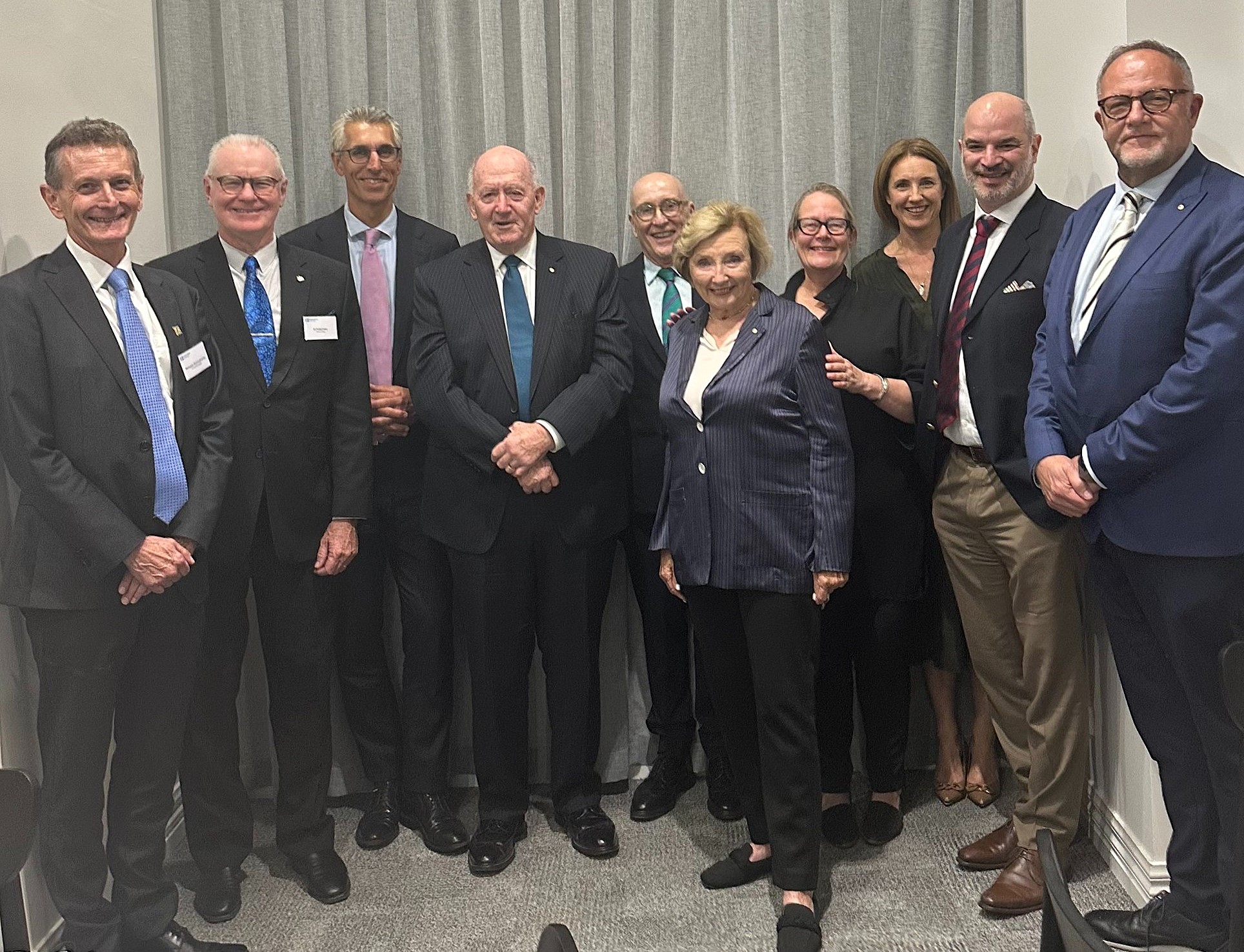
Photo: Federation University Australia