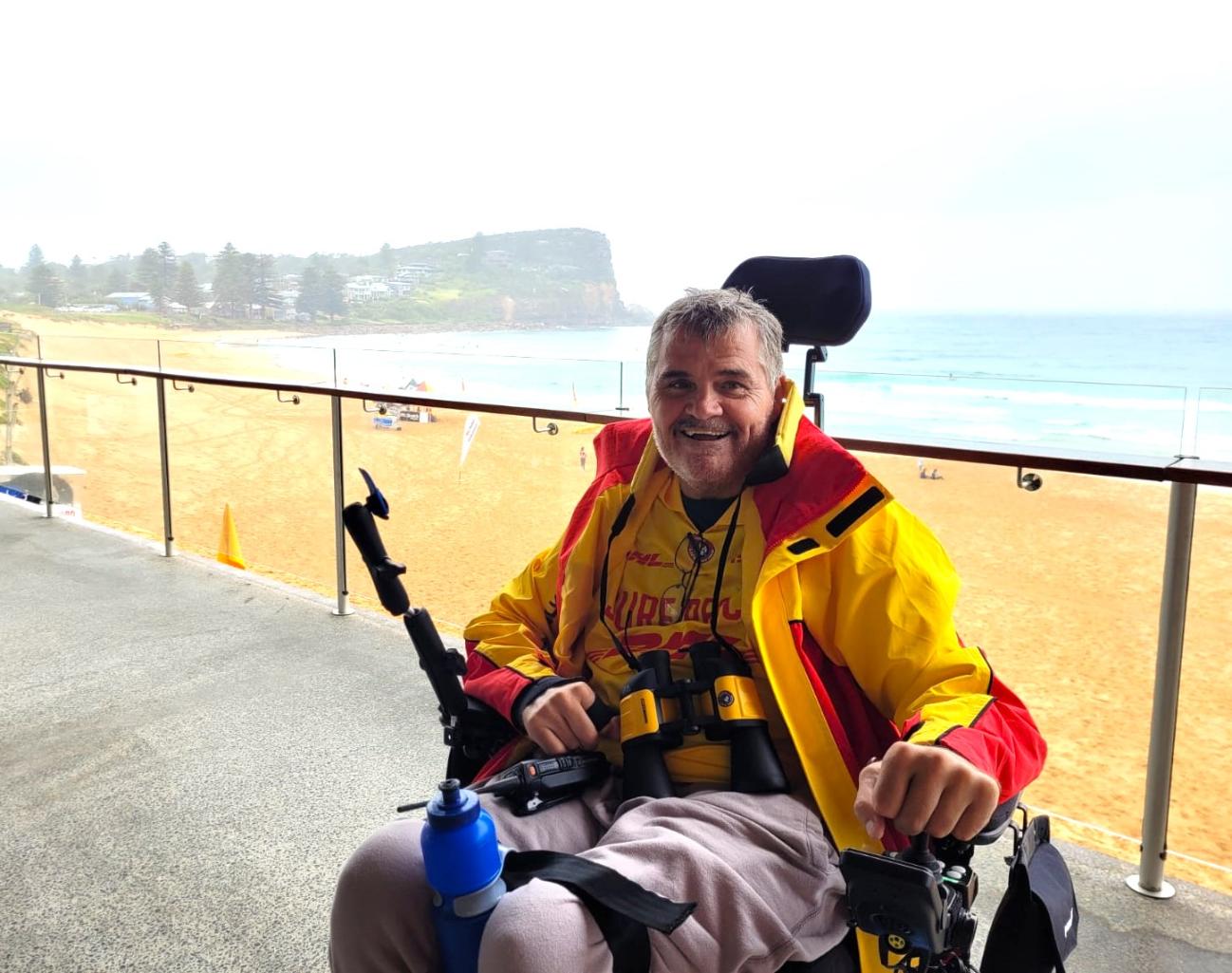
Avalon Beach SLSC member Mark Head was named ‘Surf Lifesaver of the Year’ at the recent SLS SNB Branch Awards of Excellence.
The Surf Lifesaver of the Year award recognises an active patrolling member who has made an outstanding, sustained contribution to the delivery and development of surf lifesaving frontline services. Nominees must demonstrate excellence in lifesaving operations, leadership, club development, and community education.
Winners at the Branch Awards of Excellence progress to the State Awards.
The Surf Life Saving NSW Awards of Excellence bring our surf lifesaving community across New South Wales together to honour the members who give their time, passion and heart to making surf lifesaving stronger. Every year, we celebrate the people whose dedication shapes their clubs, supports their fellow members and enriches their local communities.
This year, they will gather at the Hyatt Regency Sydney on Saturday August 22 to recognise outstanding achievements in the service of others and their communities.
Those who are named the winners of these awards at the state level will then be progressed to the national Surf Life Saving Australia Awards, also to be held in Sydney this year, on Saturday 7 November, 2026 at the Shangri-La Hotel, 176 Cumberland St, The Rocks.
In compiling Mark’s Nomination to Branch, Giles Stoddard, Director of Life Saving at Avalon Beach SLSC, stated:
''Mark Head is the epitome of the Surf Life Saving spirit - a dedicated leader, educator, and pillar of resilience at Avalon Beach SLSC.
Serving as an active SLS member for over 40 years, Mark has continuously stepped into critical operational roles while at Avalon Beach SLSC including Patrol Captain and Bronze Medallion Trainer. He is a standout member who leads by example, consistently pursuing his own professional development while actively mentoring others to step up into leadership positions within the club.
In 2023, Mark faced a life-altering crisis when he suffered a severe concussion and subsequent cardiac arrest during challenging board training. Thanks to the swift, heroic actions of his fellow club members and an off-duty medic, he was rescued and resuscitated.
Mark’s long road to recovery was further complicated by a spinal cord injury that left him medically bound to a wheelchair. Throughout this arduous journey, Mark has modelled an extraordinary attitude of courage and determination. Rather than stepping away from the movement, he has utilised the profound support of the SLS community as a catalyst to return to active service, demonstrating an unmatched commitment to Avalon Beach SLSC. This season Mark won the Patrol Member of the Year at Avalon Beach SLSC and we think he is a strong candidate for the SNB Surf Lifesaver Member of the Year.
Following his injury, Mark identified a dual need; a personal requirement for mission-driven purpose, and an organisational need for experienced, calm mentorship on the beach. By refocusing his vast lifesaver skill set, Mark achieved an extraordinary full time return to frontline service during the 2025/2026 season.
Overcoming severe physical limitations, Mark adapted his role to serve as the core Communications and Radio Operator for two separate patrols Patrol 3 his former squad and Patrol 9 a newly formed cohort of young Bronze Medallion lifesavers. Mark’s presence on Patrol 9 provided critical, steadying mentorship to the young recruits, bridging the gap between their Nipper development and senior beach operations.
Mark’s operational output this season was nothing short of elite. He demonstrated an unmatched commitment to his roster, accumulating over hours of active patrol time and ranking in the top highest patrol hour contributors across the entire club. While on duty, his vigilance and professional ocean scanning directly enhanced beach safety, ensuring rapid communication and seamless coordination between the SurfCom, the Patrol Captain, roaming patrols, and Inflatable Rescue Boats IRBs.
Furthermore, Mark identified a resource bottleneck during the club's Skills Maintenance proficiency and Bronze Medallion training pathways. Recognising that other trainers were stretched thin by updated CPR protocols, Mark took ownership of the radio communications training modules. This strategic division of labour allowed the club to process new and returning lifesavers through the new protocols for Lifesaving CPR efficiently, ensuring zero compromise on training quality.
Beyond his operational achievements, Mark actively rebuilt patrol culture. Drawing on his years of leadership experience, he deliberately fostered social cohesion, bringing the team together over shared meals, mentorship, and genuine engagement. Mark did not just return to patrol to fill a seat; he successfully redefined what an active, high-performing surf lifesaver looks like, proving that capability is measured by dedication, vigilance, and heart.
Mark’s return to the club has had a profound, transformative impact on both new recruits and seasoned lifesavers, fundamentally shifting how our members perceive capability, inclusivity, and resilience.
Mark used his skills and experience as a trainer to teach and mentor the new Bronze members to help them understand how to continue to stretch themselves to improve their skills on patrol. This included clear communications over the radio as well an attentive watch of the ocean and swimmers that showed indications that they may not have the required skill or experience for the conditions.
Mark never lets a challenge overcome him. This resilience shines through every day and makes others think "If Mark can do this, then I've got no excuse not to". An example of this is how Mark coordinated the patrol team to help him to overcome soft sand, which is a significant obstacle for his wheelchair. This was adapted when the younger members of patrol became bogged in the ATV/SSV, as the challenge and solutions are very similar.
Mark's positivity has been described as "Through the roof" and I'd steal a line from Buzz Lightyear to say it's "to Infinity and beyond!" He is absolutely determined to walk again, despite medical experts saying it's not possible, he's making incredible progress with astounding movement in his legs last month. I truly believe that with support from Mark's friends and strong purpose with Avalon Beach SLS not only saved his life in but have given him a clear reason to push himself way beyond what should be possible.''
Pittwater Online had a chat with Mark last week about his win at Branch's Awards of Excellence for the 2025-2026 Patrol Season.
Congratulations, on winning the Branch Surf Lifesaver of the Year award Mark – how does that feel?
Very humbling, but also a little bit embarrassing considering I didn't even get my big toe in the water all summer. I'm not sure how much of the background you've got, Al, but I am in a wheelchair.
I know, I was there that day, and we've run a follow-up story when your mates and the club won the SLSA National award for that rescue and resus, and then Roger sent in the great news that you were back on patrol. I was one of those fretting at the side there, and then praying as the ambulance drove away.
Well, thank you, dear friend. They seem to have worked.
Everyone was pretty determined. They just would not stop and our community has you and your gorgeous smile because of these locals.
I was very lucky that day. I had all the right people around me.

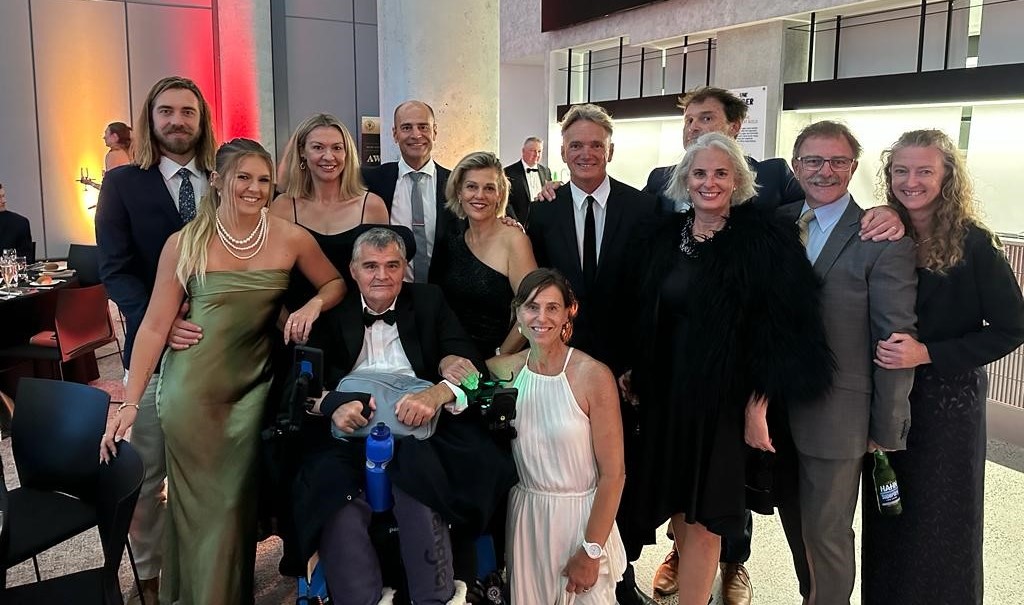
It was amazing to be with them when they received the award.
As I said, I didn't step my big toe in the water, but it made me realise there's still a lot of other responsibilities that go towards patrolling the beach, apart from riding a rescue board or swimming out with a rescue tube or driving the IRB, and I was a patrol captain at Newport for 15 years and a patrol captain at Avalon for the last 20 years, but I've been a lifesaver for over 40 years.
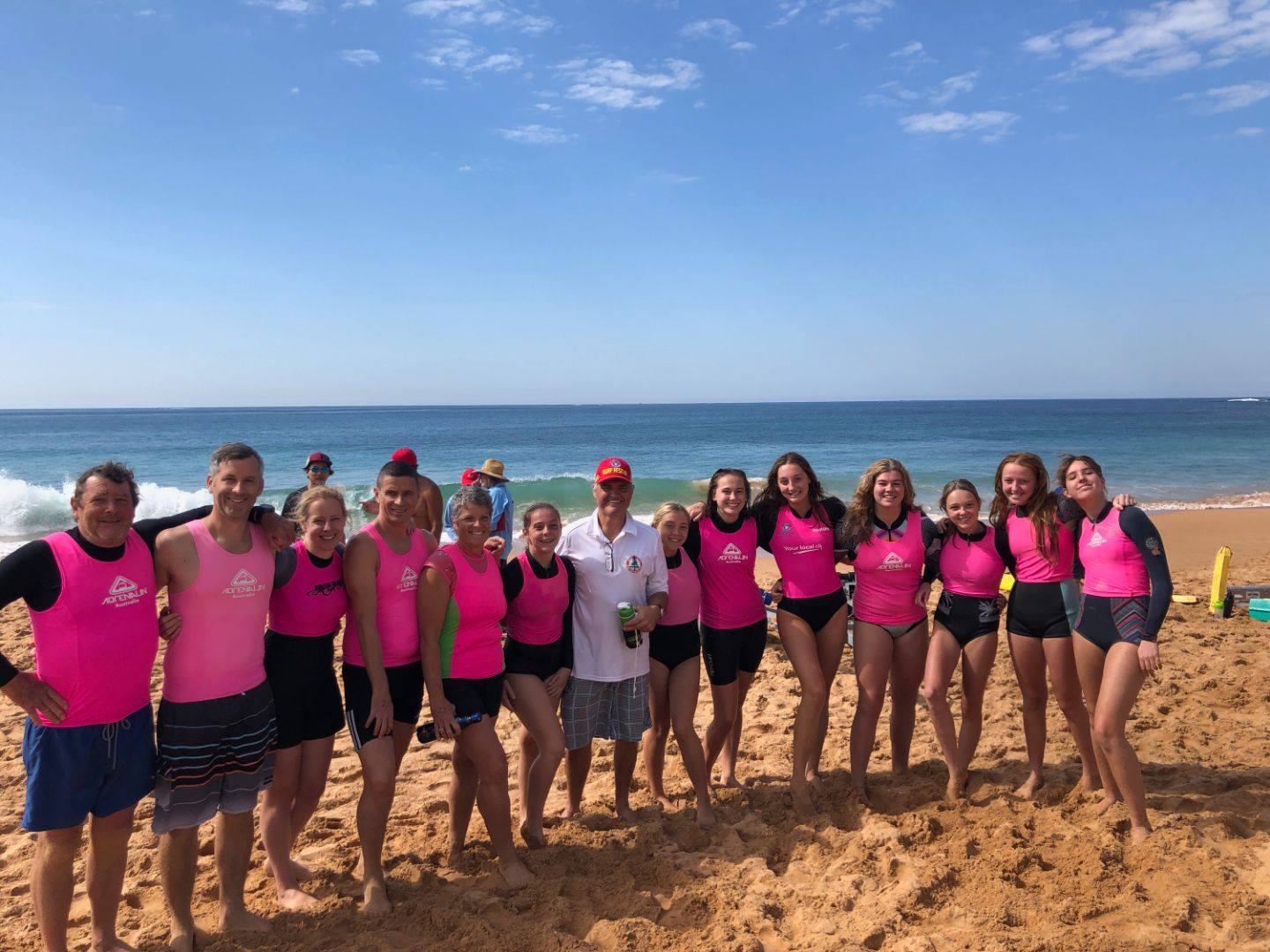
Mark (centre with white shirt) with a new squad of Avalon Beach SLSC Bronze holders - April 2019. Photo: ABSLSC
I'm very much aware of the importance of communication lines and that every time we do a rescue, the one bit of equipment that's essential but often gets overlooked is the radio, so I volunteered to be the radio operator for my patrol, and my good friends in the surf club knew I missed the beach so much they put me down for doing two patrols. My regular patrol, patrol number three, and also another patrol with my best mate Mike Stanley-Jones. I ended up doing twice as many patrols as everyone else and that's what got me nominated partly.
We've had several incidents where we had a few rescues. When you get on the radio it's not like having a chat on a mobile phone. The people at the other end, SurfComms., are always after specific information in a specific order. They want to know first of all the location, the problem, the patient's details, and what the current progress is, and you've got to give them the exact details so they know what emergency services to call, and they pass that information on. So I was able to do that.
We also had a lot of young members in the patrol, so I was able to do a fair bit of mentoring. I was a bit unsure about at this at first, because I thought 'who wants to take advice off a guy who broke his neck while riding the rescue board?' That's the last person you want to seek advice from. The surf club has been incredibly supportive, and encouraged me to mentor the young ones, and also the mature adult members who have recently joined have also appreciated that I've got 40 plus years experience they've been able to draw on.
I help the patrol captains decide where to set up the flags in the morning. I tell them where the rips are because they may not be fully aware. They may have been in a surf club for one or two seasons, or they've been put into a patrol captain position for the first time, and a lot of them confess they're a bit nervous about it, and want as much help as they can get, and so I'm glad to go down there and offer any advice I can.
You've also helped out with the proficiency in the pre-season with the CPR protocols? What's involved in doing that, Mark?
That's correct.
Every year, every one of those people you see on the beach in Summer with a red and yellow shirt, patrolling the beach, they don't do their bronze one year and then just go down the beach for the next 20 summers and expect to be able to do a rescue. Every pre-season they have to renew their lessons that they've learned in doing their surf bronze. That includes all aspects of first aid, CPR, defib, oxy-viva, the radio communications and the like.
So, yes, I've been involved with helping with the proficiencies also. The other main aspect of the annual proficiency is we also do water-based activities where they have to practise doing board rescues, tube rescues. They have to keep up their fitness and do run-swim runs.
Whilst I'm not going in the water, I'd be the timekeeper and setting out the run-swim-run distances, etc., and communicating with the IRB where to put the buoys out in the surf. In addition to that, that's the regular annual proficiency training, but this year I was also involved with training a few new bronze squads, new members of the surf club with no experience at all, and going through that same lot of training, which starts with first aid, radio usage, doing signals to flags, IRB, oxy-viva, defib, etc., all those skills they will need.
It's very comprehensive, I think, it sets people up with skills that they can use everywhere else in their lives. It's actually growing great human beings, I think, the surf life-saving movement. Well, that's what we say, particularly to the young ones doing their surf bronze.
We're teaching them life-saving skills that are not just designed to be used down at the beach when they're on patrol, but they could be in Woolworths and somebody could just fall over and have a heart attack in the frozen meat section or something, or they could be playing footy during the Winter with their mates and someone all of a sudden has broken their neck. They need to know how to treat a spinal patient, or someone's pulled a muscle or a hammy or something, what kind of treatment to do for that. And again, you could be at home in the kitchen and mum falls over and faints and you don't know why.
It could be a family member, and we say this to the adults as well; they might have their mother-in-law or their own parents who might be getting on in years and all of a sudden they have a heart attack in the kitchen. They want to know how to rescue their parents or their in-laws, or whoever it may be.
It's a skill that you learn that can save anyone's life. But we don't expect you to learn it once and then remember it every detail for the next 40 years. They get refreshed every year.
You were at Newport Surf Club for 15 years and then you've been at Avalon for 20?
No, I was actually at Newport for 20 years, but I was a patrol captain for 15 years at Newport. The reason I was at Newport in the first place, was I was in Avalon Nippers first of all.
Through your dad, Bob Head?.
Through Bob, that's right. And for no other reason other than I was a teenager and I was rebelling against my parents, I thought, ''I'm not going to be in the same surf club as my dad''.
But your dad is such a legend. I mean, look what he did for surfing locally.
That's exactly right, but teenagers are teenagers. So I did 20 years with Newport. When my daughter was born, she was four or five actually, and she wanted to do Nippers and was going to Avalon Public School. So she wanted to do Nippers with her friends, who were obviously going to Avalon. So I thought, well, if I'm going to be part of Avalon Nippers, I might as well change surf club. So I came back to Avalon Surf Club.
I ended up being the president of the Junior Surf Club for a number of years and ran the Nippers and did all that. And then, yes, I went on to do 20+ plus years with Avalon Surf Club as well. So I've had 40 years plus in the surf clubs between Newport and Avalon, and dad's just completed his 70 years at Avalon Surf Club.
So that's over a century of service between the two of you giving back to the community?
We tallied my exact number up recently and together we've got 113 years between the two of us.
That's amazing. Obviously you've given a lot to the community through being a member of the surf club, but can you tell us what the surf club's given to you through being part of that community, Mark? Have you made any friends?
I think that's an understatement.
They say people join the surf club and they volunteer to provide a duty and a volunteer service. But for me, I've always lived at the beach. And as I said, I did Nippers. My brother and I grew up doing Nippers at Avalon. And dad was always a member, so my family always grew up spending our weekends at the beaches.
To me, it's just more of a lifestyle than anything else; going on patrol. Apart from and as part of that, you learn life-saving skills, you learn to keep fit, you meet a great bunch of friends, you learn all different skills. And if you're lucky enough to become a trainer like I have, you get the reward of also passing on that knowledge and training people who you then get to see save other people's lives.
When they come up to you and they say, 'I saved a life because of what you taught me' or 'I remember, you know; I had to do a third of chest compressions because I remember you, Mark, barking at me at training saying, do a third, you've got to do a third, you've got to do a third'. And so they did that and they were able to save someone's life.
When they come back to you and say, 'oh, I had to do CPR on someone on the weekend, and I only could because of what you taught me, Mark', it's incredibly rewarding.
Plus, we're down at the beach, but socialising with our friends, both in the patrol and friends that just come down to the beach for a swim anyway. We get to go swimming and board riding. You know, pristine beaches and beautiful views.
The icing on the cake is, yes, you're there to help the public, and they are so appreciative. Whether or not it's as simple as pulling someone out of a rip, or someone that's cut their femoral artery with a fin chop, and they've lost half their blood, and it's a life and death situation, you're there helping them on what can be a pretty bad day for them.
Through my years in the surf club, I've actually done CPR five times. I've had three successes and two failures. But the fact is that those three successes were because of the skills I learned from the surf club.
And by going on to be a trainer and assessor, you learn those skills for life. They get much more embedded into your brain when you start teaching people the same skills rather than being taught.
Even though you're facing your own challenges at the moment, the club members tell us you're determined to be back doing cartwheels and handstands eventually?
[laughs] This wheelchair is a part-time thing only, temporary. I fully intend, not to get back walking or swimming, but I intend to get back surfing.
So what are your favourite breaks?
Avalon, Avalon, Avalon; South Av, North Av, Little Av. and Mona Vale.
Where in Mona Vale? Near the break south of the pool?
Yes; Mona Vale Point, beside the pool. I did a lot of my younger years surfing there with my schoolmates. People who went to Pittwater high school were able to go surfing before and after school. So I did a lot of my surfing there and I've still got a lot of good mates from there.
The surf clubs are starting to put out their call for members to renew their membership at the moment and as you know, even outside of the Patrol Season, there's a lot that goes on during Winter. There's training, there's education, there's repairing gear. Are you getting caught up in that at the moment?
Absolutely. The training goes all year round. So I volunteer to help with training in as far as doing the stuff that's on land anyway, like the CPR, the defib, advanced resus, the radio communications, the signals, those kind of things.
I still help with the training in the off-season. Also, maintenance of any of the equipment that I can help with, even if it means getting my dad to transfer one of the rescue boards down at the shop to fix a ding repair. The equipment gets used all year round because there's people who are able bodied, not like myself, and then they just are quite happy to go paddling on the rescue boards.
I've used bits of surf rescue equipment all year round.
Also, I'm not sure if you're aware, but all the beaches now have on the outside of them a defib and beside the defib a shark bite kit. So I make it a point of going through the shark kit with other members. When members decide 'I'll wait till Summer' before they find out about the new shark kits, I say, 'look, learn now, right now. You can be surfing tomorrow and there's a problem and you need the shark kit ,and you'll need to know how to use it'.
So, I've still been going through with some of the members what's included in the shark bite kit and making sure that the defibs always charged and the batteries operated. Our defib in Avalon, coincidentally, has only ever been used two times. The first time it got used was by me on a local surfer at LA. That was Bobby, who everyone knew, you guys ran a Tribute and Celebration for Bobby. I did the CPR on him with two fellow members. Unfortunately, Bobby didn't make it.
And the second time the defib got used was when my mates used it on me. But unfortunately, I didn't have a rhythm to kind of shock. So whilst they had the defib on me, he didn't actually have to do anything, but it was there just in case.
Are you looking forward to going to the SLS NSW Awards of Excellence? They're pretty flash, aren't they? Put your suit on, wash the saltwater out of your hair and give it a brush....
That's exactly right. It is very flash. I had the privilege back in 2018 when Avalon Beach Surf Club won Australia's best surf club that year. A group of us got in a bus and we went into the NSW Art Gallery where the presentations were held that year, and that was very, very ritzy affair with a lot of dignitaries there.
It was an excellent night, and Avalon Beach SLSC winning that award, amazing. We didn't think we were in with a chance, and to come away with possibly the most prestigious award a club could get through Surf Life Saving in Australia. And now having had a nomination for Lifesaver of the Year in the Branch, that in itself is one of the higher awards that the club's got.
I keep on saying 'we' because I wouldn't have been able to get the branch award without the help of everyone in the surf club. So, I consider it a joint mission, and if I'm lucky enough to get the state one, it will be because of the whole surf club, not just because of me.

What are your favourite places in Pittwater and why?
Obviously Avalon Beach, Mona Vale Beach, and Newport. I've got a lot of favourite places here. I actually went to up to Barrenjoey lighthouse in my wheelchair on Sunday with one of my carers. I've got a buggy style wheelchair that lets me go full driving. So we went up there and yes, it's one of my favourites, but it's so hard to say which ones are favourite; it's unlimited, it's all of it, the whole of Pittwater.
When I grew up, our family always had boats, so we spent a lot of time on the Pittwater estuary as well - all those beaches and bays and over to The Basin.
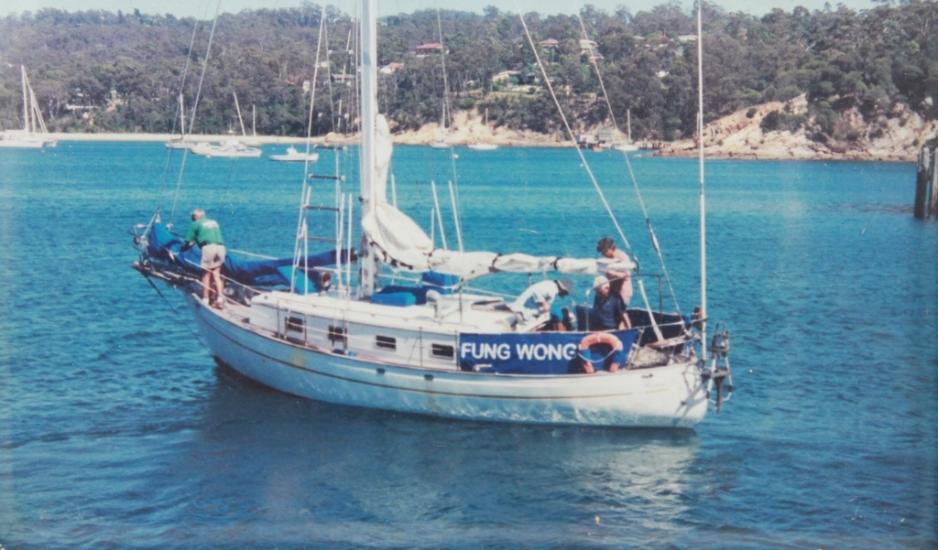
And I surfed between Palm Beach and Narrabeen for years, so it's pretty hard to say I've got a favourite. I suppose it would be again, Mona Vale because even though I'm not a local out there anymore, whenever I went surfing out there, even if it was a five year gap, I'd still see the same blokes or so that were out there years ago when I last surfed there, and you just get chatting like you saw each other yesterday.
What is your motto for life or a favourite phrase that you try to live by?
I do have a couple; I'm here for a good time, not a long time.
And; If you're sitting on the fence, you're taking up too much space. So jump in, jump down and get into it.
And when anyone says hello to me, how are you going? My answer is always the same; I'm living the dream, and I said that before my accident, I still say it because, living on this peninsula, I'm lucky that I can appreciate how lucky we all are, and it's amazing. I've travelled a lot in my life and this, without a doubt, is still the best place in the world to live.
You never take it for granted, every day I wake up and go take a whiff and have a look around. We're living in the best place on the planet.