Australian Local Conference of Youth 2026: Avalon's Next Generations Contribute to UN's National Child-Youth Statement 2026 Pre COP31
Statement Released: Friday November 6 2026
The 2026 Australian LCOY was designed and led by young people from UN Youth Australia, Australian Youth for International Climate Engagement (AYFICE), and supported by UNICEF Australia.
LCOY is a youth-led process that enables children and young people to contribute to national and international climate discussions. Held in 112 countries, LCOYs are endorsed under the umbrella of YOUNGO, the official child and youth constituency of the United Nations Framework Convention on Climate Change (UNFCCC).
The Australian LCOY is an opportunity to ensure that child and youth participation extends beyond the presence of a select number of young people at COP31 and associated climate events, providing a pathway for more voices to be heard in international climate conversations and negotiations.
What is an LCOY?
Local Conference of Youth (LCOY) is a national consultation for children and young people that focuses on climate change. The overall goal of LCOY is to bring together young people in countries, including Australia, to network, explore and discuss issues affecting them that are related to climate change. It aims to collate young people’s ideas and experiences into a National Children and Youth Statement, which then contributes to the Global Youth Climate Statement that is submitted to the Conference of Parties (COP) climate negotiations.
LCOYs happen worldwide under the umbrella of YOUNGO, the official youth constituency of the United Nations Framework Convention on Climate Change (UNFCCC). They are organised by local youths and youth-led organisations in the respective countries, chosen by YOUNGO.
The 2026 Australian LCOY was designed and led by young volunteers from UN Youth Australia and the Australian Youth for International Climate Engagement (AYFICE), with support from UNICEF Australia.
With climate change already shaping the lives and futures they will inherit, children and young people engaged in this consultation to ensure their experiences and priorities are heard - using Australia’s LCOY process as a pathway for those who may not otherwise have access to international climate forums to influence the priorities carried into COP31.
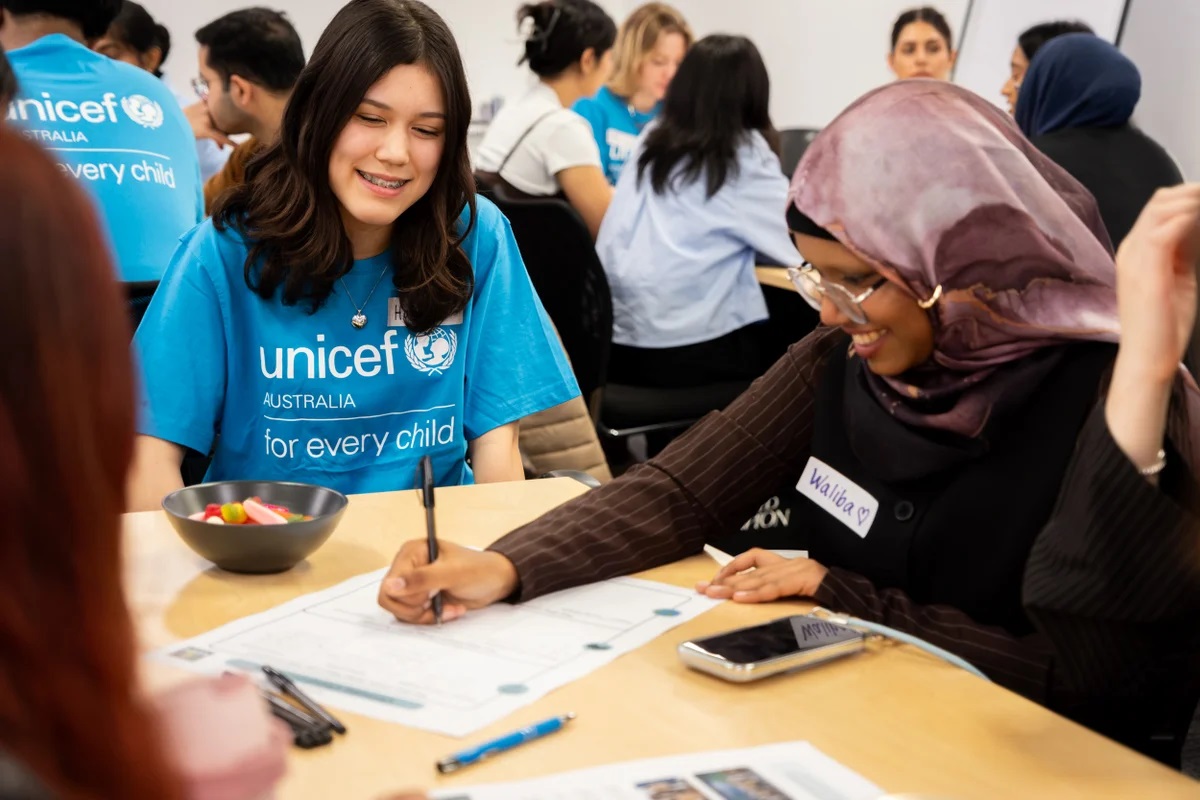
UNICEF Australia Young Ambassador Hannah taking part in a group activity at the 2026 Sydney LCOY. © UNICEF Australia/Supplied
National Child and Youth Statement 2026
In 2026, the Australian LCOY reached young people across every state and territory through 1,166 responses, combining 30 consultations and online surveys.
The Statement is more than a summary of consultations and survey inputs; it is a youth led mandate for advocacy and action. The Statement provides an evidence base for engagement with the COP31 Presidency, Australian negotiators, government departments, local and state governments and particularly the Presidency Youth Climate Champion, identifying shared concerns, different experiences and practical expectations for climate action.
This Statement belongs to everyone who contributed to it, and we hope it helps bring those voices into the decisions that will shape our shared future.
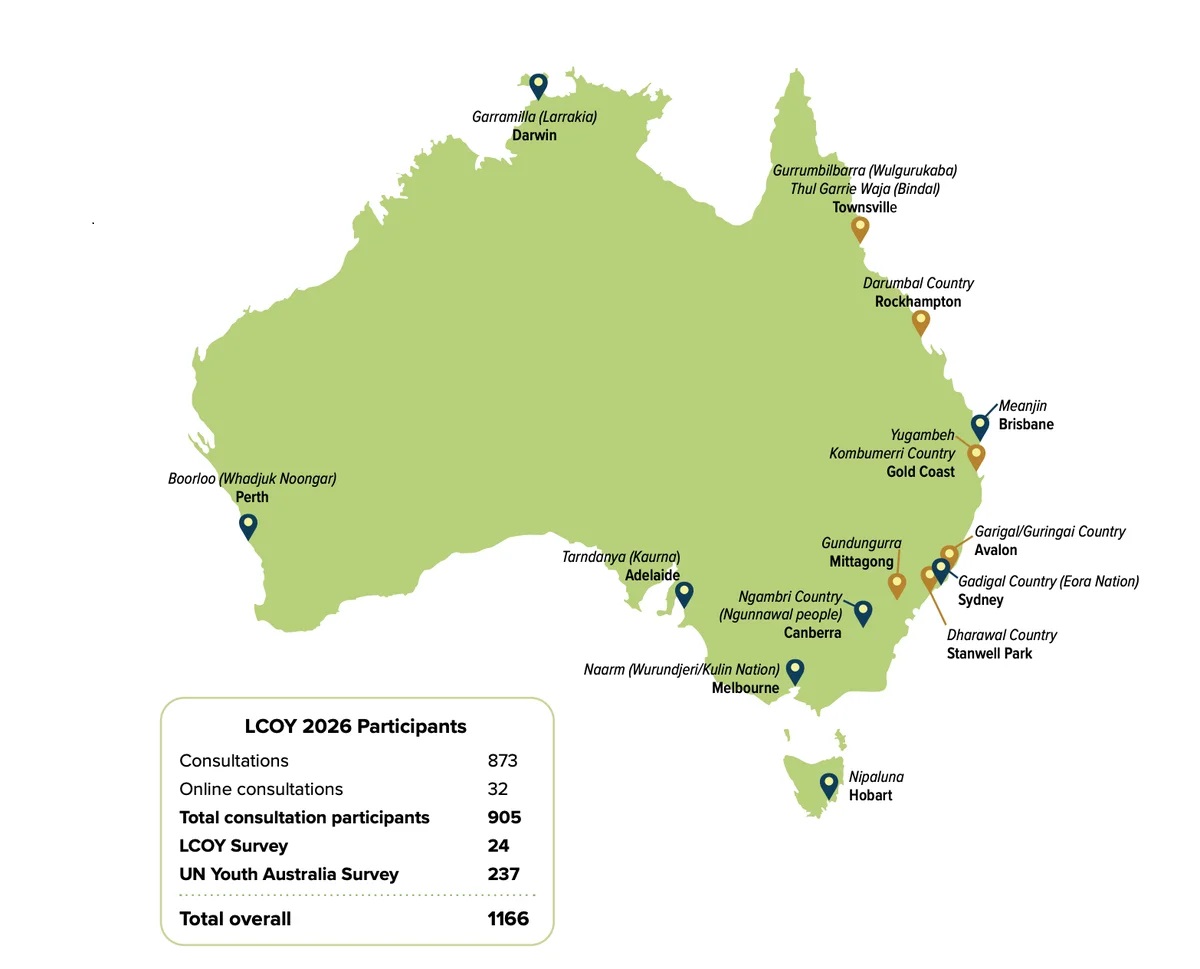
The National Child and Youth Statement was prepared after 30 consultations around Australia and online surveys. © UNICEF Australia/Supplied
How were young people involved in the design of the LCOYs and development of the final Statement?
Every part of LCOY was youth-led, including the core partnership, consultation design, logistics, facilitation, consolidation of outputs and statement writing. The LCOYs were designed and led by young people from UN Youth Australia, Australian Youth for International Climate Engagement (AYFICE), and Young Ambassadors from UNICEF Australia, with support from UNICEF Australia staff.
Several other organisations also supported and hosted LCOYs, including Climate Writers, Global Shapers Canberra, the Australian Institute of Aboriginal and Torres Strait Islander Studies (AIATSIS), Monash International Affairs Society, Brimbank Council, University of Western Australia, Pacific Youth Voice Australia, Oceania Youth Climate Negotiation Network (OYCNN), TAFE South Australia, and other youth and community organisations.
We thank every child and young person who shared their experiences and ideas, supported LCOY consultations across Australia, helped make sense of what was heard, and shaped this Statement through their contributions and writing.
Themes of the Local Conference of Youth 2026
LCOY 2026 was Australia’s largest LCOY yet. Over 30 consultations, and several surveys, we explored these key themes:
- Climate justice
- Disaster risk reduction
- Adaptation and resilience
- Mitigation and a just transition
- Climate, heath and wellbeing
- Child and youth education and engagement
- Aboriginal and Torres Strait Islander climate leadership
- Pacific climate leadership, priorities and partnership
- Nature, biodiversity and the ocean
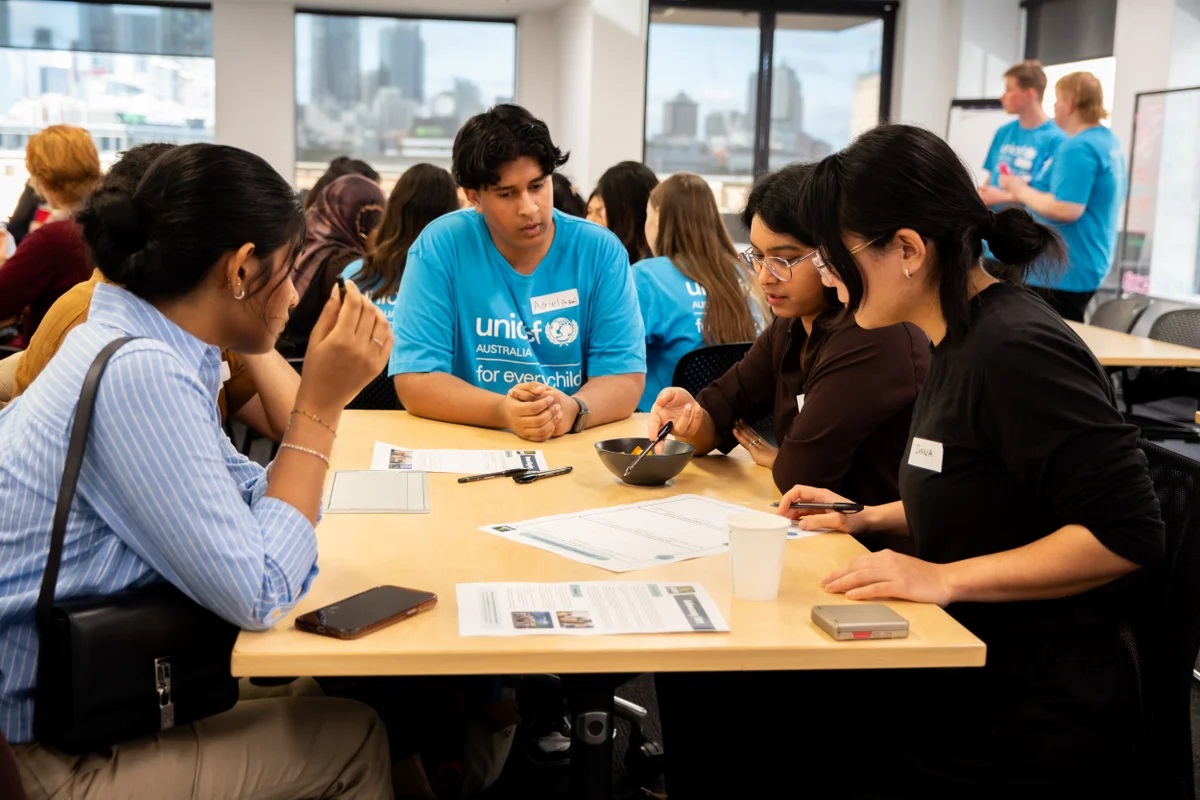
UNICEF Australia Young Ambassador Adriel speaking with a group of young people at the Sydney 2026 LCOY. © UNICEF Australia/Supplied
Key Recommendations
- Embed climate justice and equity in all climate decision-making through ambitious action, environmental rights, and inclusive just transition policies
- Improve disaster preparedness through resilient infrastructure, culturally appropriate, community-led warning systems, and accessible mental health support
- Accelerate equitable climate adaptation through resilient communities, coordinated planning and child and youth participation
- Accelerate an equitable transition from fossil fuels to a clean, affordable and resilient low-emissions future
- Strengthen investment in accessible mental health care and integrate climate-related impacts on young people and First Nations communities into health policy, and planning
- Strengthen climate education and meaningful child and youth participation equitably across Australia
- Centre Aboriginal and Torres Strait Islander leadership, rights and knowledge in climate action and decision-making
- Centre Pacific leadership, sovereignty and priorities in climate action, adaptation and regional decision-making
- Strengthen the protection and restoration of nature and oceans through increased investment, stronger environmental safeguards, ecosystem restoration, and sustainable ocean management
Together, these recommendations set a clear child and youth mandate for fairer decarbonisation, resilient communities, climate justice, and genuine partnership with young people and First Nations peoples.
"Our generation is united by the shared reality that the world is changing. This is the reality that this statement carries – the reality that the world is getting hotter, that brings floods and fires into our communities and that makes our homes increasingly unliveable. But young people still have hope. Hope that we can protect this country, build a sustainable future in which no community is left behind and that we can preserve the environment for generations to come." - Esther, She/Her, UNICEF Australia Young Ambassador
"As Australia leads the COP31 negotiations, the National Child and Youth Statement offers a clear account of the future young people are asking institutions to help build. It is an invitation and an expectation to include and work alongside young people as real stakeholders to demonstrate how their involvement has influenced what happens next." - Grace, She/Her, Chief Youth Representation Officer, UN Youth Australia
Read (and download) the Statement. (PDF: 3.28MB)
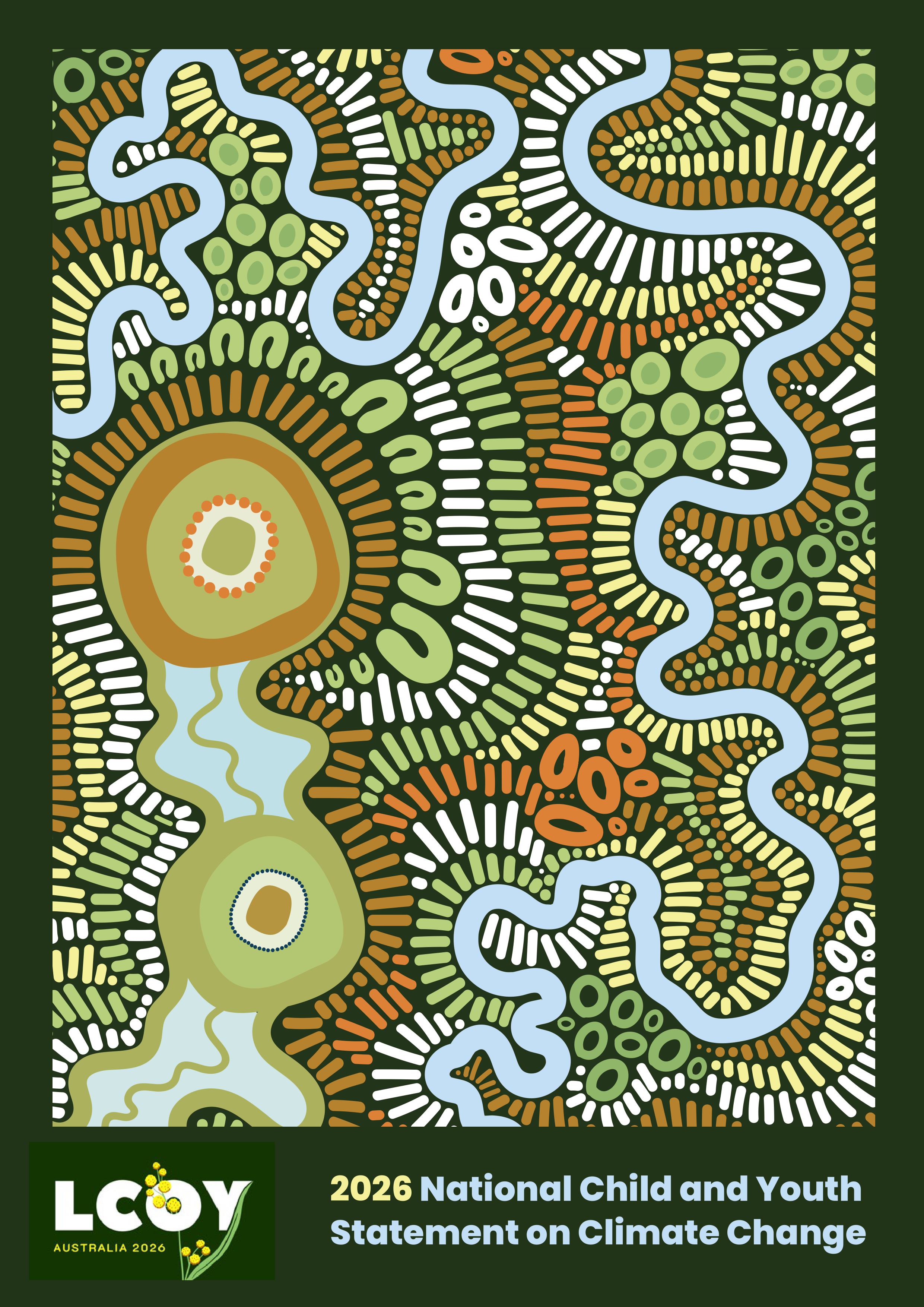
Cover of National Child and Youth Statement 2026 Australia. The 2026 Australian LCOY logo was designed by Vasil Samardzhiev. The front-cover art and graphic design are by the talented Bayley Misfud, Merindah-Gunya, a proud Whurrong woman of the Maar nation from Warrnambool in south-west Victoria.
The Australian Local Conference of Youth on Climate Change is supported by:
COP31
The 2026 United Nations Climate Change Conference(COP31) will take place in Antalya, Türkiye, from November 9 to 20, 2026.
Host Country is Türkiye (hosted by the Ministry of Environment, Urbanization and Climate Change), with the conference presided over by Murat Kurum.
President of Negotiations is Australia, represented by the Hon Chris Bowen MP, Minister for Climate Change and Energy, (co-hosted a Pre-COP partnership with Pacific island nations including Fiji and Tuvalu). More Here.
Focus areas will be:
- Clean Energy & Electrification: Pushing a voluntary target (the 35-by-35 pledge) to meet 35% of final energy demand from electricity by 2035.
- Pacific & Ocean Action: Highlighting sea-level rise, blue carbon ecosystems (mangroves, seagrasses), and climate finance access for small island developing states.
- Action Agenda: Expanding work on zero waste, methane reduction, climate-resilient cities, and the sustainability footprint of artificial intelligence.
In advance of COP31 in Antalya, there was a pre-COP meeting in Fiji from 5–8 October including a leaders' event in Tuvalu to enable world leaders "to see Pacific climate destruction" in advance. During COP31, heads of states will attend a World Leaders' Summit in Antalya on November 11 and 12. The summit will take place on day three and four for the conference, in contrast to summits at previous COPs held on the first two days or immediately prior to the COP.
Murat Kurum, the Turkish Minister of Environment, Urbanization and Climate Change will serve as the COP President. Minister for Climate Change and Energy for Australia Chris Bowen will be Vice-President and President of Negotiations. Although Australia chairs the formal negotiations Turkey is responsible for the Action Agenda. Turkey's Chief Climate Negotiator is Fatma Varank.
'Australia to advance practical action on climate change at COP31': Minister for Climate Change
The Hon Chris Bowen MP, Minister for Climate Change and Energy, also released a statement on Friday November 6 2026: -
Climate Change and Energy Minister Chris Bowen will today travel to Antalya, Türkiye, to lead the Australian delegation and international climate negotiations at COP31.
At a time of global uncertainty and major challenges, Australia’s task as President of COP31 Negotiations, working with COP31 President and hosts Türkiye and our Pacific partners, is to try to bring more than 190 countries together and build agreement on practical climate action that benefits people and communities around the world.
Since May 2022, we have been restoring Australia’s climate leadership at home and abroad – because when the world faces challenges, Australians step up and do their bit.
We have restored Australia’s relationship with the Pacific, and proven we are a reliable, trustworthy partner – willing to work with partners on difficult challenges.
Our region is at the frontline of the climate crisis, where the effects of climate change are real and immediate. COP31 will bring the focus of the world to the impacts, opportunities and priorities in our region.
Global focus on the most pressing challenges facing our region will support investments in solutions which are fit for purpose for our region.
Leading the COP31 negotiations in partnership with the Pacific will strengthen our ties with our closest neighbours, raising our region’s profile in support of shared prosperity, stability and security.
Together, COP31 will accelerate practical action and investment to keep global temperatures to safer limits and help build resilience to climate impacts.
As lead negotiator, Australia will seek to bring consensus to global climate ambition, including accelerating electrification, unlocking investment, improving access to climate finance and advancing ocean action.
Collective action is making a difference. Since the Paris Agreement was signed in 2015, projected warming has fallen from over 4 degrees to 2.6 degrees.
Momentum is building, with twice as much renewable capacity forecast to be installed globally between 2025 and 2030 as compared to the previous five years.
Global clean energy investment is expected to reach US$2.2 trillion in 2026, almost twice the investment flowing to fossil fuels. Clean energy now supports 35 million jobs.