November 1 - 30, 2026: Issue 660


‘The Lucky Country’ is now ‘The Hungry Country’ as Foodbank Hunger Report 2026 shows food insecurity now “systemic” in Australia: 3.6 million hungry households

Kylea Tink – Foodbank Australia CEO and former Independent MP for North Sydney.. Photo supplied

The Foodbank Hunger Report 2026, released Monday 26 October, reveals that food insecurity and hunger is deeply entrenched, systemic, and “part of the Australian story”.

  • 1 in 3 households experienced food insecurity in the last 12 months – that’s 3.6 million households (100,000 more than in 2025)
  • Food insecurity is now impacting middle-income Australia – with 37% of households earning between $33,800 - $90,999 experiencing food insecurity
  • Households with children (families) are among the hardest hit – with nearly half (45%) experiencing food insecurity
  • Single parents are doing it even tougher – with nearly two-thirds (60%) of single parent households experiencing food insecurity
  • Nearly half (48%) of young people (aged 18-34), over-half (51%) of renters and Indigenous households (57%) are also among the hardest hit 
  • Food insecurity is also more severe in regional Australia – 36% of regional households experienced food insecurity compared to 32% of metropolitan households. 
  • With inflation continuing to surge, Foodbank Australia CEO Kylea Tink is worried food insecurity will only get worse in the months ahead

The Lucky Country has become The Hungry Country, Foodbank Australia has warned, with the Foodbank Hunger Report 2026 finding one in three households have experienced food insecurity in the past 12 months. This equates to 3.6 million households going hungry – 100,000 more than in 2025 – according to Foodbank Australia’s research.  

The Foodbank Hunger Report 2026 shows food insecurity is now not only seemingly entrenched across Australia, but is also increasingly systemic, impacting middle income households.  

"We call ourselves the Lucky Country, but for one in three households, Australia is now the Hungry Country," said Kylea Tink – Foodbank Australia CEO and former Independent MP for North Sydney. 

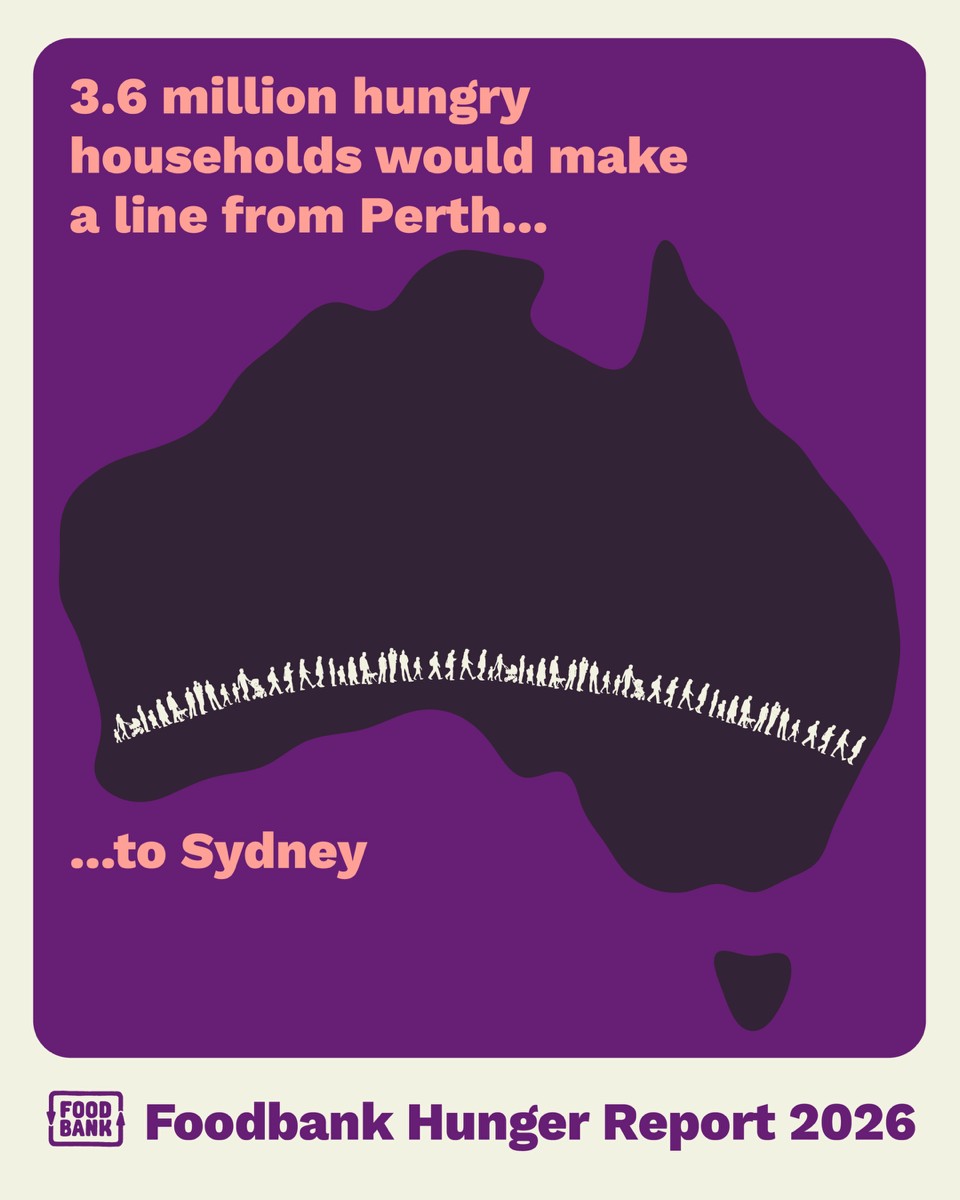
"Sadly, hunger has become part of the Australian story. If one person from every food insecure household stood in a queue one metre apart, that line would stretch from Sydney to Perth. In a country like Australia, we should not accept this as our new normal,” Ms Tink said. 

Concerningly, the Foodbank Hunger Report 2026 reveals that the profile of hunger in Australia is changing. The research shows 37% of middle-income households, earning between $33,800 - $90,999 per year, are food insecure with 23% of this cohort severely food insecure. Meanwhile, households with children are among the hardest hit (with 45% reporting they had experienced food insecurity in the past 12 months).  

Overall, Australians are also pessimistic about the future, with more than a third (35%) expecting their finances to get worse over the next 12 months, rising to 61% among those already finding it very difficult to get by. 

“Foodbank research shows that hunger is no longer confined to the margins, it is impacting middle Australia. A wage used to be what kept food on the table, but for a growing number of working Australians their pay packet no longer stretches that far. These are our friends, colleagues and neighbours, and many never imagined they would need a helping hand to feed their families,” Ms Tink said.

Among the report’s most alarming findings:

  • Nearly seven in ten (69%) food-insecure households experienced food insecurity for the first time in the past year.
  • Almost half of all households with children (45%) and of younger households aged 18 to 34 (48%) are food insecure - with 60% of single parent households reporting food insecurity.
  • One in two renting households (51%) are food insecure, compared with 12% of households that own their home outright.
  • More than half (53%) of all households earning $33,799 or less are food insecure, with more than a third (37%) being severely food insecure: the highest level ever recorded for this group.
  • Food insecure households, with a part-time or casual worker, have reached a new historical high of 42%, showing a steady upward trend since 2024.
  • Regional households are harder hit than those in the cities, with almost one in four (23%) reporting they experienced severe food insecurity, compared with 18% in metropolitan areas.
  • More than half of First Nations households (57%) are food insecure, including 40% in the severe category. 

“People should not have to choose between putting a roof over their head or putting food on the table. We’re hearing of parents going without just to make sure their children can eat. This is unacceptable and we must do something about it,” Ms Tink said. 

Foodbank Australia has welcomed the Federal Government’s $700,000 in surge funding, announced on 11 October. 

“We thank Minister Plibersek and the Federal Government. This surge funding means more food will reach the people who need it most. Importantly, this funding will not add to inflation as it will help Foodbank Australia redirect surplus food that has already been produced to households struggling to put food on the table,” said Ms Tink. 

Foodbank Australia is calling on the Federal Government to work alongside state and territory governments to establish a national minimum standard for school breakfast programs, ensuring every Australian child has access to a nutritious breakfast at school by 2030. 

While many of the numbers were bleak, there were positive findings in the Foodbank Hunger Report 2026 clearly supporting the value and impact of School Breakfast Programs across the country.  

The Foodbank Hunger Report 2026 shows school breakfast programs are reaching more children than ever before and are working well in some parts of the country. Participation among food insecure households with school-aged children in Foodbank’s school breakfast programs has risen from 36% to 45% in the last 12 months.  

“One of the best ways to tackle Australia’s hunger problem is to look after our most vulnerable. A national school breakfast program would mean one less meal for food insecure families to worry about, and parents can be confident their children are starting every school day with a nutritious meal. Importantly, we know this works with Foodbank breakfast programs across the country proving a success. We need all governments to now work together to ensure no child starts a school day hungry,” Ms Tink said. 

Foodbank is also calling on corporate Australia and philanthropy to act. 

“In a nation as prosperous as Australia, one in three households going hungry simply doesn’t pass the pub test. The findings in this report demand more than concern from corporate Australia. One dollar can put two meals on the table. Food relief organisations cannot solve this alone, we need government, business, philanthropists and communities to step up to the plate. Together, we must invest in immediate relief while addressing the structural causes of food insecurity,” Ms Tink said. 

Now in its 14th year, the Foodbank Hunger Report 2026 is the nation’s most comprehensive snapshot of food insecurity, based on a nationally representative survey of Australians. 

To read or download the full report go to reports.foodbank.org.au/foodbank-hunger-report-2026

Food insecurity is on the rise in Australia. We need more effective responses

David A. Fleming-Muñoz, La Trobe University; Andrea Arratia-Solar, The University of Melbourne, and Chandana Maitra, University of Sydney

Food insecurity is a growing problem in Australia. As food costs rise amid national and international pressures, affordability is becoming a growing concern for many Australians. However, we still have limited evidence on how widespread food insecurity is, how it changes over time, and who is most affected.

Our analysis of data in the Household, Income and Labour Dynamics in Australia (HILDA) annual survey shows that severe food insecurity increased nationally by around 40% between 2020 and 2024.

This matters because food insecurity is not only a sign of financial hardship; it can have lasting consequences for health and wellbeing. We identify that single-parent families with children are especially exposed, but risks have also increased for other families. Understanding these changes, and where they occur, is essential for targeting support and policy effectively.

How do we measure food insecurity?

Food insecurity is difficult to measure because people experience it in different ways. Some worry about not having enough food, while others cut back on some foods, skip meals or go without eating altogether.

There are a range of measures. Foodbank estimated one in three Australian households experienced some degree of food insecurity in 2025. The Australian Bureau of Statistics’ national nutrition survey estimated 13.2% of Australian households experienced food insecurity in 2023, but its survey has not been updated since.

Our analysis uses an internationally comparable measure developed by the United Nations’ Food and Agriculture Organization (FAO). This consists of eight questions about people’s experiences with food insecurity. It has been included in the 2020 and 2024 HILDA surveys, with responses from around 15,000 people.

Because HILDA follows the same people over time, it can also help us understand who becomes food insecure, who moves out of food insecurity and what factors are associated with these changes.

Following previous research on the 2020 HILDA data, we define severe food insecurity as answering “yes” to at least seven of the eight questions.

The proportion of people experiencing severe food insecurity increased from 2.1% in 2020 to 3.0% in 2024, an increase of around 40%. This category captures people who may be cutting back on food, skipping meals or sometimes going without eating.

Food insecurity is increasing in most cities and regions

The increase was not the same across the country.

Among major cities, severe food insecurity increased substantially in Perth, more than doubling from 1.35% in 2020 to 2.79% in 2024. Adelaide recorded the highest level in 2020 and 2024, at 3.11% and 4.70%, respectively. Severe food insecurity also increased in Sydney and Melbourne. Brisbane was the only city where the rate fell slightly, from 2.63% to 2.49%.


Food insecurity generally increases with remoteness in the country. Many of these regional areas are agricultural hubs, showing that food insecurity does not affect all regional communities in the same way.

The exception is Victoria. In 2024, severe food insecurity affected 2.82% of people in Melbourne, compared with just 2.00% in inner regional Victoria.

In outer regional Victoria, however, the rate was higher, resembling what is also observed in other states. Although HILDA surveys people in regional areas, its small sample could underestimate people’s experience of food insecurity in those areas.


These differences may reflect the different pressures people face in different places. Housing costs, job opportunities, food access and prices, transport and services can all affect whether people can consistently afford enough food.

Single parent families most at risk

These figures show that food insecurity is not distributed evenly across Australian households.

The highest levels were among families in single-parent households. Severe food insecurity increased from 11.57% to 13.68% among people living in single-parent families with children.

Among people living in single-parent families with older children over 15, it increased sharply from 1.73% to 4.42%.

Single parents often rely on one income to cover housing, utilities, food, childcare and other expenses. Solo-caring responsibilities also make it harder to increase working hours.

For couples with children, food insecurity jumped almost 87%. The increase was smaller for those with older children.

Couples with children may have more resources to draw on, but they can still face food insecurity when housing costs, debt, job insecurity or illness put pressure on the household budget.

Better evidence for better action

The increase in severe food insecurity is a warning sign for Australia, and we cannot respond effectively to a problem that we do not properly observe, understand and measure.

To address food insecurity, the data in the HILDA survey is valuable because it shows how many people experience food insecurity, how severe their experiences are and how the situation is changing.

Nationally representative surveys such as this and the ABS survey, and research to support more detailed data for regional communities, are critical steps to support policy intervention and design. This includes the National Food Security Strategy, which aims to address the multiple challenges affecting food insecurity in the country.

Local organisations, charities, food banks and government services play an important role in supporting people who are struggling, but they cannot address the underlying causes on their own.

Understanding who is most affected, and where, is an important first step. Better data can help ensure that support reaches the people and communities facing the greatest risks.The Conversation

David A. Fleming-Muñoz, Professor of Agricultural and Resource Economics, La Trobe University; Andrea Arratia-Solar, Research fellow, Faculty of Architecture, Building and Planning, The University of Melbourne, and Chandana Maitra, Senior lecturer, University of Sydney

This article is republished from The Conversation under a Creative Commons license. Read the original article.