NSW OLG's complaints About Councils statistics: 2025-2026 + NSW Ombudsmen's Top 10 Councils in Complaints data 2025-2026
The Office of Local Government (OLG) received 1,912 complaints concerning councils during 2025–26. This is a small increase from 1,801 complaints received in 2024–25, and well above the 1,242 complaints received in 2023–24.
Complaint volumes provide insight into issues raised by the community, but they do not necessarily reflect the seriousness of those issues complained about or the performance of individual councils against which complaints have been made.
No data listing a breakdown of the numbers of complaints per council was made available for this annual marker, the first time this has occurred since the 2010-11 reporting period. No explanation has been provided as to why that data has not been released.
NSW Ombudsman's Annual report: Complaints lodged
The NSW Ombudsman's Annual Report 2025-2026, released October 29 2026, records the Northern Beaches Council in the 'top 10' at number 5 with 76 complaints lodged with the NSW Ombudsman.
The NSW Ombudsman, 'An independent integrity agency pursuing fairness for the people of NSW', manages complaints relating to unfair treatment by most NSW Government agencies, local councils, or NSW Government funded community service providers.
The NSW Ombudsman can escalate complaints into formal investigations, push for system-wide reform, or refer serious matters to other integrity and enforcement bodies when issues go beyond routine administrative mistake.
Outcomes can include apologies, compensation, reversed administrative decisions, or changes to agency policies and procedures. Criminal or corrupt conduct, or other specific statutory breaches, may be referred to bodies such as NSW Police, the Independent Commission Against Corruption (ICAC), or the Law Enforcement Conduct Commission (LECC).
Residents often turn to the NSW Ombudsman after raising concerns with a local council that go unanswered, or remain unresolved. The office reviews conduct for unlawfulness or unreasonableness, usually within 30 business days.
The Central Coast Council is listed in this report as having had the most complaints against it lodged with the NSW Ombudsman, with 164 complaints received. The NSW Government revealed on Tuesday November 24 the full impact of Central Coast Council stopping payments at Australia Post outlets, with documents showing a huge spike in people forced to travel to Customer Service Centres.
Newly released council documents show from September to November 2026, Council recorded a 236% increase in over-the-counter payments at their Customer Service Centres compared with the same period last year. More than 370 payments were recorded in just four days at Lake Haven Library, including 104 payments on a single day on Thursday November 12.
The documents, obtained by Labor Councillor Margot Castles, also show council has received 244 formal complaints regarding the removal of Australia Post as a payment option. This is in addition to the over 3,000 signatures obtained on the petition run by local MPs. Ending rates and water payments at AusPost outlets was touted as a budget saving measure, the NSW Government stated this past week.
The Council has now been forced to increase staff at Lake Haven, The Entrance and Erina service centres to assist customers and manage wait times, the documents reveal.
Central Coast Labor MP offices continue to be inundated with ratepayers angry at Council’s decision, not knowing where to pay their bills, and some saying they have never been notified about the change, apart from it being noted at the bottom of their rate and water accounts (in size 6 font).
Labor MPs wrote to newly appointed Mayor, Mr John McNamara, last month calling for the service to be reinstated.
Minister for the Central Coast and Member for Wyong, David Harris said:
“This measure has taken away a key service – the convenience of using a local post office to pay rates and water bills. The consequences for our community have become clear, and we urge council to revisit this issue.
“Council needs to listen to what the ratepayers are telling them on this, especially the more than 3,000 who put their name to the petition.”
Member for Swansea, Yasmin Catley said:
“With more than one in four Swansea residents aged over 65, we cannot take away the services people have relied on their entire lives.
“We’re already seeing Commonwealth Bank shut up shop in Swansea. People still need these face-to-face services and taking them away doesn't make that need disappear. It just makes life harder.
“More than 3,000 people have put their names to a petition calling for this decision to be reversed. Council needs to take seriously what its own ratepayers are telling them.”
Member for The Entrance, David Mehan said:
“244 formal complaints directly to Council since the service ceased, together with over 3,000 signatures obtained on the petition run by local MP’s should paint a crystal-clear picture that this was the wrong decision.
“Having to now increase staff at Council Customer Service Locations to meet demand shows this was the wrong move. Other budget saving measures should have been explored, and this now needs to be a priority.
“I urge council to reinstate payment of rates and water accounts at Post Offices across the Central Coast.”
Member for Gosford, Liesl Tesch said:
"It's obvious to much of our community that banning rates payments at Australia Post is costing ratepayers both time and money. Council should have expected the spike in complaints. Thousands of Central Coast residents have signed our petition against this ban.
"Many of the residents worst affected are elderly, disabled or vulnerable. They relied on their local post office because they can't easily pay online or travel to a Council office.”
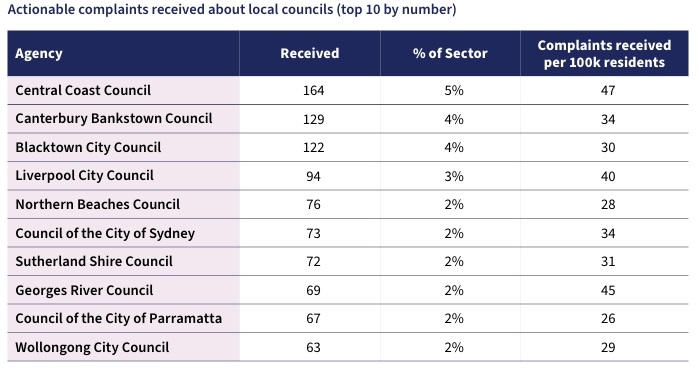
NSW Ombudsmen's Annual Report 2025-2026 complaints received about councils. Image: Screenshot from page 110 of Report
2025-2026 Complaints to the NSW OLG
On the 2025-2026 Complaints to the NSW OLG, the NSW Office of Local Government states:
''In 2025–26, around 84% of complaints did not warrant formal investigation because they were either outside OLG's jurisdiction or related to council decisions rather than serious misconduct or maladministration.
Many were matters for councils or other bodies, such as the NSW Ombudsman, to address.''
The complaints remain an important source of information about community concerns and local government wellbeing.
OLG's regulatory efforts remained focused on matters involving significant governance, integrity or public interest concerns.
Under the Local Government Act 1993, councils are largely responsible for managing their day-to-day operations. Neither the Minister for Local Government nor OLG has a general power to intervene in routine council decision-making or operational matters.
Recurring themes
Complaints received in 2025–26 most commonly related to:
- misconduct by councils (25.1%)
- financial management practices (11.4%)
- council governance (8.9%)
- mismanagement and maladministration (7.3%)
- enforcement and regulatory decisions taken by council (6.9%)
Complaints received by OLG 2025–26 (by category)
Complaint category - Percentage
- Misconduct by councils -25%
- Financial management practices - 11%
- Council governance - 9%
- Mismanagement and maladministration - 7%
- Enforcement and regulatory decisions - 7%
- Customer service - 6%
- Engineering services - 6%
- Other - 5%
- Public land management - 4%
- Land use and development - 4%
- Social policy and community services - 4%
- Companion animals - 3%
- Pecuniary and conflict of interest - 3%
- Natural resource management - 3%
- Environment and public health services - 2%
Complaint numbers varied significantly across councils. In several cases, higher complaint numbers reflected multiple complaints about the same issue or coordinated community campaigns regarding a particular matter, rather than a range of unrelated issues.
Both an individual complaint and a series of complaints over an extended period have the same merit in potentially triggering an OLG investigation.
Councillor misconduct
OLG received 38 misconduct referrals during 2025–26 and commenced 5 misconduct investigations. It also continued work on 2 ongoing misconduct investigations, and concluded 2.
OLG investigates serious allegations of councillor misconduct where there is evidence suggesting potential breaches of the misconduct provisions of the Model Code of Conduct for Local Councils in NSW. Complaints relating to disagreement with council decisions, rather than misconduct or maladministration, are generally not investigated.
Pecuniary interest and political donation matters
During 2025–26, OLG received 26 allegations relating to pecuniary interests and political donations, and investigated 2 of them.
Allegations were assessed under the legislative framework governing councillor and council official conduct, with investigations undertaken where supported by the available evidence.
Section 430 Investigations
Section 430 investigations look at serious breakdowns of council operations. They are usually triggered when a council’s conduct is having a serious impact on the local community.
Reports on completed section 430 investigations can be found at inquiries and investigations.
In 2025–26, OLG continued its section 430 investigation into Liverpool City Council and was authorised to begin new section 430 investigations into New England County Council and Shoalhaven City Council.
Public Inquiries
The Minister for Local Government may appoint a commissioner to conduct a public inquiry into a council. A public inquiry is required before a council can be dismissed and may be ordered at any time, including following a section 430 investigation.
In 2025–26 the Public Inquiry into Liverpool City Council continued and no new public inquiries were authorised.