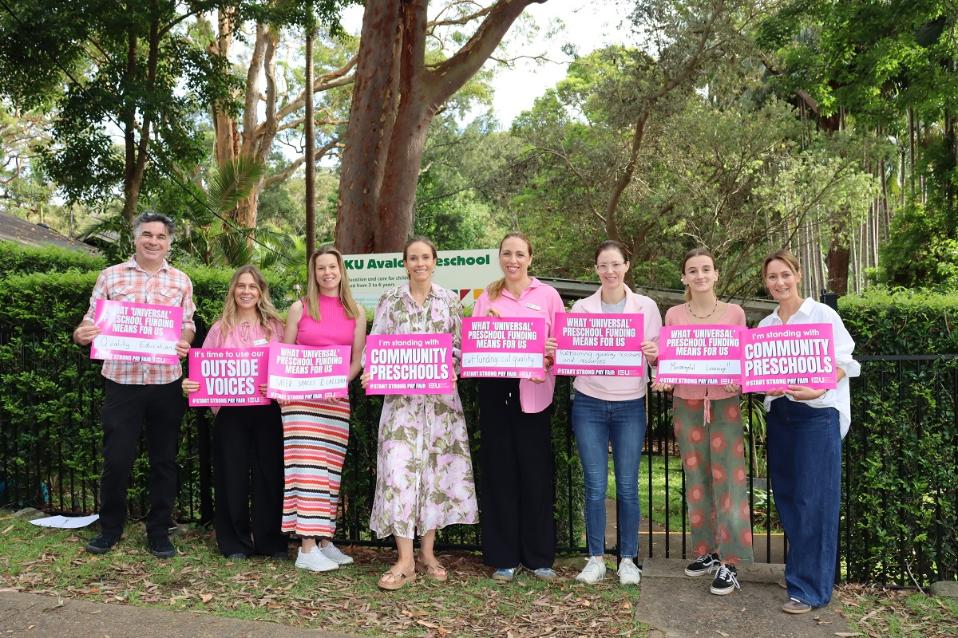
There are 10 Community preschools in the Pittwater electorate, ranging from the Palm Beach War Memorial Kindergarten in Iluka Park. to Narrabeen, Elanora Heights and up to Terrey Hills.
Many community preschools were historically established on single suburban blocks donated by local councils, community trusts, or converted from single residential dwellings, keeping them embedded directly within residential neighbourhoods. They were made for and by their communities where no such services existed before, and have thrived in looking after their communities for decades.
All of these are licensed by the NSW Early Learning Commission for a maximum number of children per day based on an assessment of environment, equipment, and staffing. It is illegal for them to have even one child over that license limit.
Because they are small-scale, not-for-profit services catering specifically to children aged 3 to 5, their physical footprint is much smaller than primary schools or commercial long day care hubs. This also physically limits their ability to increase capacity for more children, even if their license requirements were modified.
Under the National Quality Framework and the NSW Child Care Planning Guideline, centres require at least 3.25m² of indoor space and 7m² of outdoor play space per child. For a typical 30-to-40-place community preschool, this easily fits within a single standard residential or community-zoned lot.
All of the local ones have been independently assessed by the NSW Department of Education and are rated as Exceeding the National Quality Standard. Community preschools are the good news story operating in the Early Childhood Education and Care sector.
Community preschools are places where children learn, play, make friends and develop a sense of belonging. For many families, they are an essential and accessible early learning option, particularly those on limited budgets - which is everyone raising a family.
Inclusive community preschools give children with and without disability the opportunity to learn and grow together. If these services are lost, they are not easily replaced.
Community preschools in NSW are funded primarily through government grants and subsidies, which are supplemented by parent-paid fees and local fundraising.
Universal Preschool Funding Replacing Start Strong, Inclusion Funding Program Replacing High Learning Support Needs
In October 2026, the NSW Government released new funding guidelines for community preschools, set to commence January 1 2027. Two new programs were to replace the current ones:
Universal Preschool Funding - Replacing Start Strong for Community Preschools
Inclusion Funding Program - Replacing High Learning Support Needs funding
Under the new model, community preschools would be asked to maximise places in their centres to create capacity for more than 10,000 additional children.
The Universal Preschool Funding Program, as announced, aimed to; for the first time, fully fund 3-year-old places, expand access to community preschools and helping services maximise enrolments for the benefit of more children and families, and an increase of funding for children with inclusion support needs in community and mobile preschools.
Families with preschool-aged children in long day care will be eligible for up to $2,625 per child in 2027 through the Fee Relief for Long Day Care program, a $255 million initiative. The guidelines would require Long Day Care centres to provide preschool programs.
Other benefits of the new Universal Preschool Funding guidelines announced include: Out-of-pocket fees capped at $20 per day for community preschools that charge them, with existing charges above $20 frozen at their current level and funding for an additional day of preschool for eligible children in priority cohorts, increasing access from two to three days a week for eligible children.
Community preschools who used the financial modelling provided found the new funding arrangements would not cover the full cost of delivering safe, quality preschool education, even with a proposed one-year transition payment.
The Universal Funding Program increases funding for community preschools from $584 million to $642 million, an increase on the 2026 total of $540 million to $625 million, however, individual centres would have to take on more enrolments to maximise their allocation.
Independent educators, the Independent Education Union of Australia NSW/ACT Branch, and regional community preschools raised alarms that initial workforce calculations under the new model risked funding drops or underpaid staff.
The education minister said "transitional funding" would be available to help centres adapt to the changes and the directors of centres that did not have the physical space to increase enrolments should contact the Department of Education, so they can be assessed on a case-by-case basis.
Taking it to the Streets
On November 2 a NSW Parliamentary e-petition was launched, "Protect funding for community-based preschools", which had more than 40,000 signatures by the time it was presented by the Independent MP for Wollondilly, Judy Hannan, on November 11.
In speaking to a Motion tabled by the opposition, Ms Hannan, after completely revising the same, stated:
'I want to take the politics out of this. I am an Independent and I do not give a stuff about either side of politics. We just want this fixed. Universal preschool is a worthy ambition. But this funding model threatens the viability of existing community preschools and fundamentally undermines that ambition. I acknowledge the outstanding leadership of Mittagong Preschool, whose advocacy was instrumental in initiating the e-petition that has now attracted over 39,000 signatures, as well as stakeholders for bringing their concerns to statewide attention. I thank the preschool educators, directors, volunteer management committees, parents, employee unions and my parliamentary colleagues on both sides of politics, including the Independents, who have expressed their support for community preschools to me. Their advocacy demonstrates what can be achieved when communities stand together.
Together, we call on the Minns Government and the Minister for Education and Early Learning to reverse the preschool funding changes, restore the Start Strong funding framework and increase funding for preschools to support fair wages and quality early learning in New South Wales. The Government has had considerable time to develop this funding model. Yet the sector has faced unacceptable delays in obtaining information. When the guidelines were finally released, many services discovered projected funding reductions of tens and, in some cases, hundreds of thousands of dollars. Sector research involving more than 140 preschools indicates that 51 per cent face projected annual losses exceeding $100,000, putting more pressures on the cost of living and stopping the affordability, quality and viability of community preschools.
How can a government claim to be strengthening early childhood education when its own funding arrangements risk destabilising the very services delivering it? I have two concerns. The first is the absence of meaningful consultation with the sector. Consultation after decisions have effectively been made is not genuine consultation. My other concern is perhaps the most serious: the apparent absence of the human factor in the funding formula. Community preschools are not simply numbers on a spreadsheet. Many are not‑for‑profit organisations, supported by volunteers, that reinvest every available dollar into children, educators and their communities. They must meet staffing costs, maintain buildings, manage fluctuating enrolments and support children with additional needs.
When funding falls short, the consequences are deeply personal. Educators face reduced hours or redundancy. Parents face closures of community preschools, increased fees due to choosing from a narrower range of preschools and enrolling children at long day care centres or even ending up staying at home. Children lose enrolment days. It may reduce hours for children with disabilities and from different backgrounds. We might lose services altogether. And the greatest consequences may fall on those least able to absorb them. Early intervention and inclusive education are investments in children's futures, not discretionary expenses to be removed when budgets become difficult.
There is a fundamental contradiction here. The Government wants more children attending preschool. Yet its funding model risks making that harder. The changes hinder educational equity and the most vulnerable communities will face the greatest disadvantage. That is not the outcome universal preschool was intended to deliver. I call on the Government to defer detrimental funding reductions, guarantee funding certainty for 2027 and 2028, protect educator wages, fully fund disability inclusion and undertake genuine consultation to redesign this model. Our children deserve better. Our educators deserve certainty. And our communities deserve a funding model that strengthens, rather than dismantles, the services they have built.'
Pink Placard Wave runs across the state
The petition and Ms Hannan's speech in the Parliament of New South Wales have been supported by protests across the state - streets have been filled with families carrying pink placards and calling for the government to discuss any changes with the ECEC sector.
In a statement released Saturday 14 November 2026 the incumbent government announced it is 'reforming preschool funding to help community preschools make better use of existing capacity and welcome more local families'.
'There is potential for more than 10,000 additional children to attend existing community preschools, and these reforms are designed to make those places available to more families.' the government stated
'This is a significant change that will take time to implement, and the Government will work with the sector to address their concerns. To give services certainty as they make these changes, the Government will introduce a two-year Community Preschool Funding Guarantee for all community and mobile preschools.
''For 2027 and 2028, services will be guaranteed at least their 2026 funding allocation, adjusted for operational changes such as enrolments and opening hours. This will help preschools retain staff while expanding access to more families.'' the government stated
The Minns Government states it is aiming to ''deliver 100 public long day care centres across NSW as part of its commitment to expanding access to affordable, high-quality early learning, support community preschools and give thousands more families access to early learning close to home.''
'For too many families across NSW, access to early learning depends on where they live and what they can afford. Some families face long waiting lists, while others simply don't have a service nearby.' the government said
'When parents can't find a place, it can mean turning down work, reducing their hours or missing out on a job altogether. Currently, 43 per cent of NSW communities do not have enough access to early learning places and research commissioned by the Government shows NSW needs 21,000 additional new early learning places by 2030.''
'With families in some parts of the state facing early learning deserts with no services nearby and waitlists of up to two years, it’s clear more needs to be done to prevent thousands of families missing out on vital early learning opportunities.'
'The publicly-operated centres will be located in communities where early learning places are in short supply or existing services are unable to meet growing demand from families. Co-located with public schools, the centres will eliminate the double drop off for thousands of parents and help address the shortfall of places in long day care centres across NSW. Using existing public school land will also avoid the cost of purchasing separate sites, making better use of government land and reducing the cost of delivering new childcare places.'
The union representing teachers and educators in early childhood education and care in NSW and the ACT welcomed the NSW government’s promise that community preschools will not face funding cuts over the next two years.
“We welcome today’s announcement that community preschools will not face funding cuts in 2027 or 2028 that would have impacted the viability of their services,” said Independent Education Union of Australia NSW/ACT Branch Secretary Carol Matthews.
However, Matthews said, many community preschools may need additional funding for wage increases owed to their staff as well as other cost increases.
this one for base.jpg?timestamp=1795281708324)
No CPI
Local families and those who work in our local community kindergartens are still concerned what will happen after 2028.
Ben, of Newport KU, and one of a group of locals who met with the news service earlier last week, when asked if he was concerned what would happen once the extension for the current funding has elapsed, stated:
''Absolutely. There's no CPI attached to it.
It's a massive step backwards, especially for children with additional needs that are now struggling to get funding. It's life-changing for these children, especially when you're talking about some of the most vulnerable people that need the funding. When you take away the funding, quality is going to drop, and when you take away quality education, that affects the future of the children dramatically.''
When asked if the government needs to consult with community kindergartens on this, Ben stated:
''100%. We were absolutely blindsided by this. It's a massive disgrace and a massive step backwards for the sector.''
Scruby Calls for Consultation to fix the model
Independent Member for Pittwater Jacqui Scruby MP welcomed the guarantee while condemning the Government’s failure to properly consult the sector before announcing sweeping funding reforms.
Community and mobile preschools will receive at least their 2026 funding allocation in 2027 and 2028, adjusted for operational changes such as enrolments and opening hours.
“The Government should have sat down with preschool directors and educators before announcing a funding model that put jobs, programs and the future of some services at risk,” Ms Scruby said.
“Preschools had already made staffing and enrolment commitments for 2027. I welcome the Government’s recognition that services need two years of funding certainty. This gives preschools breathing room and gives the Government time to work with them to fix the model.
“In Pittwater, we love our KU and community preschools. Families help run many of these not-for-profit services, and some are already at their licensed capacity. The Government put them in an impossible position by expecting them to absorb funding cuts when they had little or no room to take on more children and fees for funded hours were capped.”
On 10 November, Ms Scruby and seven other Independent MPs wrote to Deputy Premier and Minister for Education and Early Learning Prue Car, urging the Government to defer funding reductions, give services certainty for 2027 and 2028, and review the model with affected preschools.
Ms Scruby also backed an amendment moved by Independent Member for Wollondilly Judy Hannan calling on the Government to work with the sector to protect services and support fair wages for educators. The Protect Funding for Community-Based Preschools petition, led by Pauline Iacono and tabled by Ms Hannan, attracted 41,924 signatures.
“This is a community win. Educators, families and preschool committees across NSW made it clear what was at stake. It should never have taken 41,924 signatures for the Government to listen,” Ms Scruby said.
“The fight isn’t over. We still need certainty about funding for children with disability and additional needs, support for fair wages, and a funding model that reflects what it actually costs to run a community preschool.
“The Government must use these two years to consult properly and give services certainty beyond 2028. Every community preschool should be able to keep its doors open as these reforms roll out.”