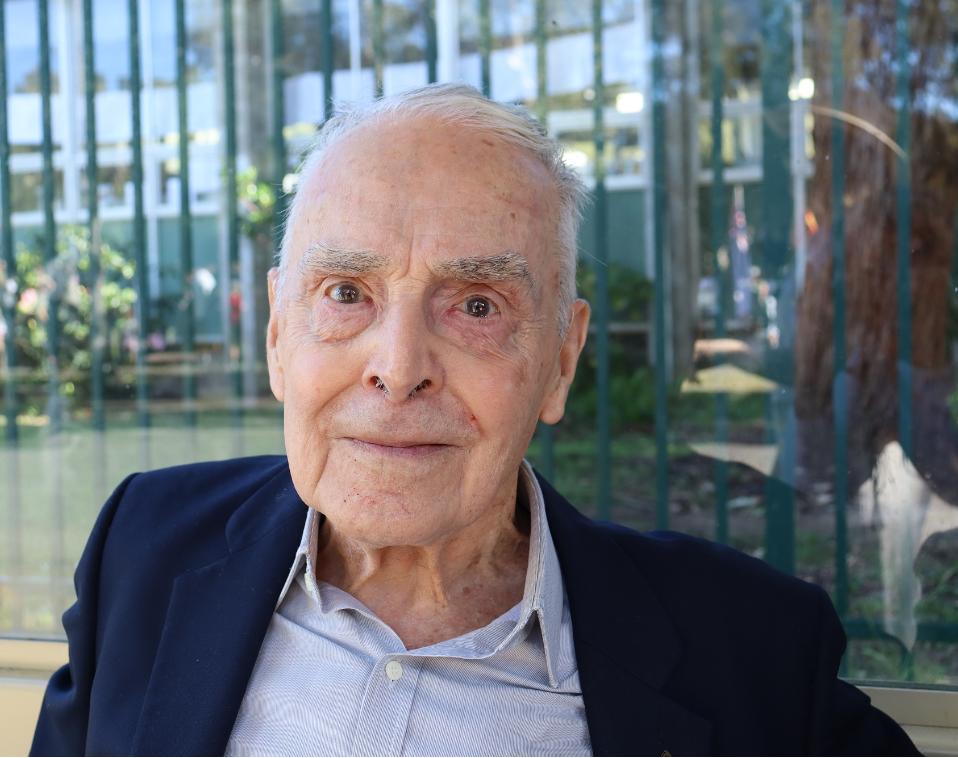
Neale 'Brian' Heal is a British WWII veteran who later migrated to Australia and worked on major hydro-electricity construction projects in Tasmania and New South Wales, including the historic Snowy Mountains Scheme.
Sub/LT Neale ‘Brian’ Heal is 101 years old today, August 16, and served on a mine sweeper with the Royal Navy, during World War Two, including during the D-Day landings.
During the week leading up to his 100th birthday, Brian received congratulation cards and letters from King Charles III and Queen Camilla; Anthony Albanese, Prime Minister of Australia; Samantha Mostyn AC, Governor General of Australia; Mayor Sue Heins and the offices of Dr Sophie Scamps MP and Jacqui Scruby MP. Brian thanked the Pittwater RSL Sub-Branch for organising his congratulation cards.
Service:
General on HMS DIOMEDE as ordinary seaman, training.
Served on HMS SPEEDY as Able Seaman minesweeping in English Channel and North Sea in support of invasion forces during D-Day and Operation Overlord.
Served at HMS LOCHINVAR as Sub-Lieutenant based at Edinburgh and being second in command of Mater Minesweeper.
HMS MMS 1061 clearing mines in North Sea and Norwegian waters and developing minesweeping technologies. Highlights were captive of a two-man German mini submarine in the North Sea and the rescue of two RAF flying crew who had crashed in the North Sea.
S/Lt Royal Navy Volunteer Reserve March 1944 - December 1946
Medals: 1939/45 Star; France and Germany Star; War Medal 1939-45; Atlantic Clasp
Brian joined the RSL in December 1956.
%20Brian%20Lean%20et%20Al%202026.jpg?timestamp=1786606817828)
Brian with President of Pittwater RSL Sub-Branch Deborah Carter and Michael and Inese Carrodus, Senior Vice President and Associate member respectively, at the 11am ANZAC Day March at Avalon Beach, 2026
This week, a few insights from Brian on a long and fruitful life.
When and where were you born, Brian?
August 16 1925. I was born in 76 Adelaide Road, Swiss Cottage in London, which is halfway between Hampstead and Camden Town, north-west London. It's within sound of Bowbells, so technically I'm a Cockney.
Did you grow up there?
We stayed there until I was about six, and in 1931 we moved to a new house in Hendon, north-west London also. Brand new estate that a big company built, and it was a much bigger house. The house at Adelaide Road was a semi-detached apartment block.
I think my grandfather built it, I'm not sure about that. But we moved into a new house in Hendon, and the whole family moved there. I've got pictures of that place.
Do you have any brothers or sisters?
I have three brothers and two sisters. All older, I was the youngest. My father was a master builder. He owned the building company, which I think my grandfather founded, but my grandfather may have inherited it, I just don't know that.
What was the name of the company, sir?
J.H. and W. Heal. J.H. and W. Heal. My father was the W, and J.H. was my uncle. It was a specialist firm. All the tradesmen working there were highly skilled artisans.
They weren't just mud labourers, they were the cream. We had painters who could paint a wooden fireplace that looked like a marble one. They spent most of their time doing up very rich people's apartments, judges and lawyers, and very wealthy people.
Dad was highly skilled and had three trades. He was a plumber, a carpenter, and a bricklayer. He had tickets for all of them, because his father bought him up that way. He could walk into an expensive Regent's Park apartment, with some judge that wanted this and that and that done, and he'd walk around, and he'd quote before he left the building. He didn't write anything down. That's it, take it all in, with a good margin, mostly.
Where did you go to school?
I went to school at a prep school in Hendon when I was about six. I think it was just boys. That was just around the corner, so I walked to school. I did pretty well there, particularly in mathematics. When I was 11, I went to Rydal School in North Wales, which was in Colwyn Bay, North Wales.
There's a long story here, but I'll try and cut it short. I was a sick kid when I went there. I had something wrong with me when I was very young. I had tonsillitis and mumps, all the usual things, but then I got something wrong with my tummy. When I was about eight, I was taken to Harley Street to see a specialist, and he put me on a diet. The only thing I ate was plain boiled rice, stewed apple, and some stuff called 'radio malt', which was a thick syrupy, you dealt it out with a thick spoon like molasses. That was very nice. I lived on that, and I wasn't allowed to eat anything else. Just what was happening, I don't know, but I was still on that when I went to school in North Wales.
The starting age at that school was 13, but my three brothers had all been there and done very well there. So we had a sort of good reputation. The headmaster was a mad lunatic who I disliked intensely, so did all the rest of the school, but the rest of the teachers were pretty good, they were all right. It was a boarding school, of course, and I think my mother bullied the headmaster to accepting me. I don't know how she did that. My next elder brother was still there when I went, so he was able to keep an eye on me. He was a senior young boy by then.
When did you sign up for the Royal Navy Volunteer Reserve?
March 1944. I was in the Home Guard prior to that. I was at college by then - and went to City and guilds College for my university.
Which university did you go to?
London University, but it was City and Guilds College, it was called, in Kensington. It was a branch of London University and you got a London University degree in engineering. I was doing engineering, civil engineering. Or I would have had, if I'd stayed long enough - I was there about two years.
I went to Rydal School and then in 1942 it was City and Guilds, and then after a while I was in the Home Guard. I was a very good shot because I lived in Callington for a while, in Cornwall, with my sister. There was a chicken farm at the end of our garden, and the bloke that ran it had got called up. His father, an old man, was running it with great difficulty. So they used to help him.
My brother-in-law was a preacher, and I'd get in the upstairs bedroom in the manse with a .22 rifle and shoot all the rats as they came out the gate. He paid for the ammunition.
So you must have been in London during the Blitz?
I was in London, yes, on and off. What happened was my sister Jean was at Callington in Cornwall, a lovely place, and living in this big manse, which had a huge garden - I dug up and grew vegetables, God knows what else. I was going to boarding school from there, and sometimes I went to London on holidays. Sometimes I went down to Jean's, it just depended. So I saw a lot of the Blitz and was used to that, as used to that as you could be.
When I went to college, of course, I had to stay in London, but I was only 14 when I commenced there. I got fed up with the engineering. I passed the exams in the first year with no trouble at all, but as the second year approached, I got fed up.
I had three brothers, all in the services. The oldest one was driving tanks in North Africa. The other one, John, was flying Sunderlands over the Atlantic, taking VIPs around. He was a skipper, a pilot with an all-Australian crew. That was my first contact with Australians. The third one, Harry, ended up as a ward officer, but in some disgrace, because he was a disgraceful bloke. He knew half the criminals in London. You had to be very careful with Harry. I was the only member of the family that really got on with him. We were great mates.
The one flying was also in a hut in Yorkshire, bending German radio waves, which were directing the Luftwaffe over England. They used to falsify these signals and send them out somewhere else. They'd crash in North Wales trying to get out when they were out of fuel. That was all very, very secret. He only did about a year of that. He wasn't allowed to write to anyone or let them know what he was doing. But the RAF wrote to us every month to say, your son is still on his special duties, and he's okay.
He was a football player and a referee, and actually was an accountant. After he was released from that, they immediately made him an officer because he was an accountant. He was then deployed to organising the transport and delivery of arms to guerrillas in Europe, dropping things to the French Résistance and the Czechoslovakian rebels who were fighting the Germans. They were dropping these from aircrafts or even landing aircrafts and unloading them, and he was organising all that.
At some stage, that simmered out, and he got sent to Burma, as it was then. He managed the rebuilding for the RAF of Mingaladon Airfield, which is the main airport in Rangoon. He also made friends with some very wealthy Chinese while he was doing that, which, I come to later, that was very important to me.
Anyhow, I was at college, and just wanted to get out there and help my brothers. I knew that if during the first year I passed all my exams, that made me reserved for military service. In the second year, as I approached the third year, I got worried about it, and I realised that I would probably get called up into the Royal Engineers, which I didn't really want to go around with.
I was always interested in sailing, and I had an uncle who was a skipper of a merchant ship, and who I liked very much. So I went along to the RNVR (Royal Naval Volunteer Reserve), and said, I'm reserved, and can I sign up? So they put me through all the exams and got everything done, except actually swearing me in. I went back to the college and said, I want to get de-reserved.
I faced a committee, which was chaired by a very bombastic engineer from World War I. He was a real arrogant so-and-so, you know? He demanded to know why I wanted to get de-reserved, and I said that was a private matter, and I wasn't going to tell him, but he got furious. When he demanded to know, he pushed a letter in front of me, ‘well sign that’.
This was about how to be volunteering for the Royal Engineers, and I said I'm not signing it, and he couldn't make me, I mean, he just got really mad. He said, ‘well, we'll de-reserve you, but you'll get called up for the engineers straight away. I'll see to it personally’. So I said, all right. I got into a taxi, and I went back to the RNVR, and signed it, said, ‘give me a shilling’ [That was the king's shilling] I swore in and they gave me a ticket to Portsmouth. So once I was in the Navy, that was it.
The dispatcher arrived at my house three days later. I was back there in uniform, and I answered the door. He said, ‘I've got your call-up post for the engineers’. I said, ‘look at me, mate. I'm already in the Navy’.
Yes, I was in.
I was sent to Excalibur, which is an inland training camp where they checked you out before they sent you on an officer's course at the RNVR. Commissioned on 2 December 1942, HMS Excalibur was a land-based Royal Navy "stone frigate" (shore training establishment) located inland at Alsager, near Stoke-on-Trent and Crewe in Staffordshire, England. Far from any sea, it served primarily as a New Entry Seaman Training and Royal Marine motor transport facility during World War II. You spent about six weeks there.
The place was in the Midlands, surrounded by aircraft factories, which was entirely run by young women whose husbands were out in the Middle East or somewhere else. You went into a pub and were about outnumbered four to one by young women. Lovely it was, really hectic.
I failed there for two reasons. One, I was too young, I was only 16, and you have to be 18 to be a civil lieutenant. So you're a midshipman, and they don't want midshipmen in the Navy, so I was too really young. The other thing was that one of the psychologists claimed she knew all about Conway, and she'd never been in a bloody life, and I told her that. She disliked that very much. I said, oh, do you know this guy? Oh, yeah, I know that. And I said, well, it's all there, mate. She got real mad.
The other thing, the boss of the RNVRs, a regular captain who was the senior man there, his daughter was a young WRNS officer, and she was a friend of my girlfriend in London. The Women's Royal Naval Service (WRNS) was popularly and officially known as the Wrens. So I took her out for a few drinks, and we got on very well together, and I think Daddy really approved of that. So I was told I was going to be a seaman.
That was it. They sent me off to Rosyth to learn to be a seaman, and that was on a ship called the HMS Diomede, which was a cruiser built in 1918, a very old ship. We dashed them out in the North Sea and fired guns and did all sorts of things to get you used to being on a ship and how to behave in the Navy, and then they sent you off somewhere else.
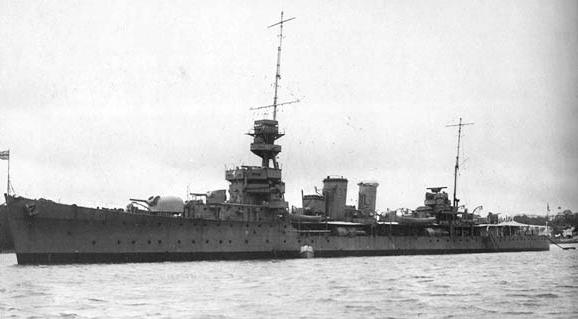
HMS Diomede in 1938
HMS Diomede was a Danae-class cruiser of the Royal Navy. Constructed at Vickers Armstrong, Barrow, she was constructed too late to take part in World War I and was completed at the Royal Dockyard, Portsmouth. Between the wars, she served on the China Station, Pacific waters, East Indies Waters and from 1936 onwards, in reserve. In World War II she performed four years of arduous war duty, during which time she captured the crew of the German blockade runner Idarwald after she had chased that ship and when the crew scuttled Idarwald. Between 22 July 1942 and 24 September 1943 she was converted to a training ship at Rosyth Dockyard.
I had no problems on Diomede, and about that time the old Diomede staggered down to the Channel.
We bombarded somebody or something until we just about ran out of ammunition. I was the communications in number one turret, big six-inch guns. We didn't know what we were bombarding, they just told us where to point the gun and fire them. I think we were shelling German tank regiments and throwing shells at Calais or somewhere to convince the Germans that they had to keep that manned, you know, to deceive them as to where the invasion was.
This was just before the invasion actually took place, you know, before D-Day. When I finished I was sent down to Portsmouth as an ordinary seaman and posted aboard HMS Speedy, which was a modern fast fleet minesweeper. They went in front of the fleet and cleared the mines to make sure the big ships didn't hit them.
HMS Speedy was one of 21 Halcyon-class minesweepers built for the Royal Navy in the 1930s. The Halcyon class designed as a replacement for the preceding Hunt class and varied in size and propulsion. Speedy displaced 815 long tons (828 t) at standard load and 1,330 long tons (1,350 t) at deep load. The ship had an overall length of 245 feet 3 inches (74.8 m), a beam of 33 feet 6 inches (10.2 m) and a draught of 8 feet 9 inches (2.7 m). The ship's complement consisted of 80 officers and ratings.
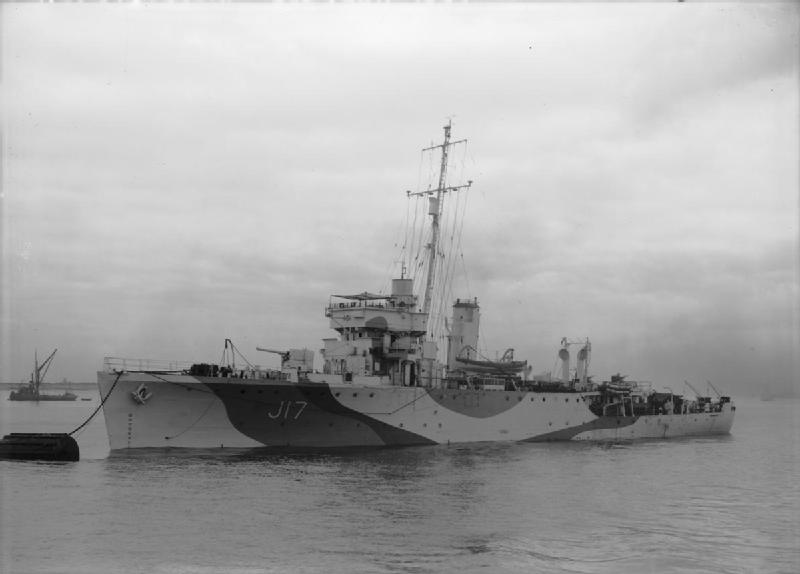
HMS Speedy in April 1944. Photo: from the collections of the Imperial War Museums
HMS Speedy and the whole flotilla of us, we were the boats that actually went to the invasion site and guided the ships from America through the minefields as we were also sweeping mines and German E-boats were coming. We shelled them. It was quite active, actually.
Were you aware that you were part of D-Day (June 6 1944) and what was going on?
We knew the invasion was going on, bloody hell, there were ships around us. It was just massive, I guess. I was still only an ordinary seaman at that stage, but the Chief Petty Officer, was Cornish and I'd been living in Cornwall. We got on rather well, so he appointed me as the sweeping seaman, which meant I didn't do the watches that normal seamen do. I had to rig all the sweeps up and do all the technical work on the deck, and that was fairly skilful work, but because I'd been on trawlers and navigating, I was fairly good at that sort of thing. So Chief appointed me the sweeping seaman. I'd get up early in the morning, get the sweeps all ready before they were streamed, and I had a big anti-tank rifle from World War I, and if a mine floated in the surface, I shot it and made it go down, you know.
The nasty part about that was hanging over the back of the sweeper, and you used to attach explosive cutters. They were a metal framework with a cutter that went like that with as the sweeping wire would go through the water... It would pick up the wire from the sweep, which would slide into one of these cutters. The cutters then went bang like that, and it cut the wire. The mine floated to the surface, and hopefully I sank it if someone else didn't sink it first.
Just on the D-Day landing and taking those ships through, were you scared at all?
No. You just didn't have time to think, just action, adrenaline? We had an almighty firm belief in the Royal Navy ourselves. We thought there was nothing the Germans could throw at us that we couldn't throw back. So we were convinced they were more afraid of us than we were of them, you know.
After a while, the Chief Petty Officer suggested I put in as leading seaman, because I was skilled and I was good at my job, and that went up to the officers.
They said, no, you're not. You're going to train as an officer. We're going to send you back to King Alfred II, which is a training centre, and you'll be trained so that when you become 18, you can become a lieutenant straight away.
I stayed on Speedy until it was time to go to King Alfred, which is where the officers were trained. It was an eight-week course there.
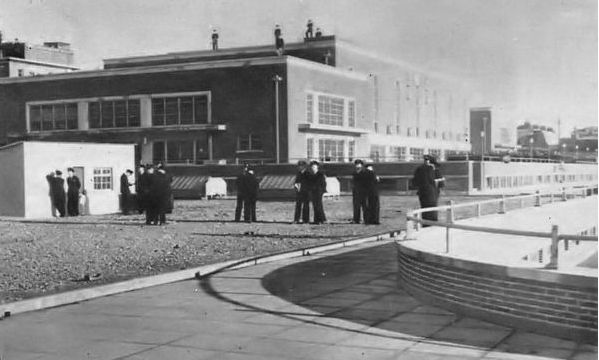
HMS King Alfred, the Royal Navy shore establishment at Hove, Sussex
I did that course very successfully, and right at the end of it was the end of the war. The Germans surrendered. We had a huge party there; Victory in Europe Day (VE Day) took place on May 8, 1945. It was a terrific, the Wrens and everyone rushing around. They kept me on there until I was 18. They commissioned me there.
I was kept on as an instructor, because I was still a seaman then. I was training them to use the twin engines to moor a ship. We had a flash motorcruiser that the government had pinched from some boat during the war.
They just took them, you know, and we'd drive it out and show them how to pick up a buoy and how to get alongside a wharf and use the ropes of the two engines to flatten it out and all that. I was a good seaman by that time, you know.
On my 18th birthday, they sent me up to HMS Lochinvar, a minesweeping training "stone frigate" (shore establishment) of the Royal Navy, sited at Port Edgar on the Firth of Forth. It was established in 1939. From 1943 to 1946 it was temporarily transferred to nearby Granton Harbour while Port Edgar became a training centre for the 1944 Normandy Landings.
So what rank were you then?
Sub-Lieutenant. I've got a lovely picture of myself as a sub-lieutenant —I was made a sub-lieutenant on my birthday, and they sent me straight up to Lochinvar.
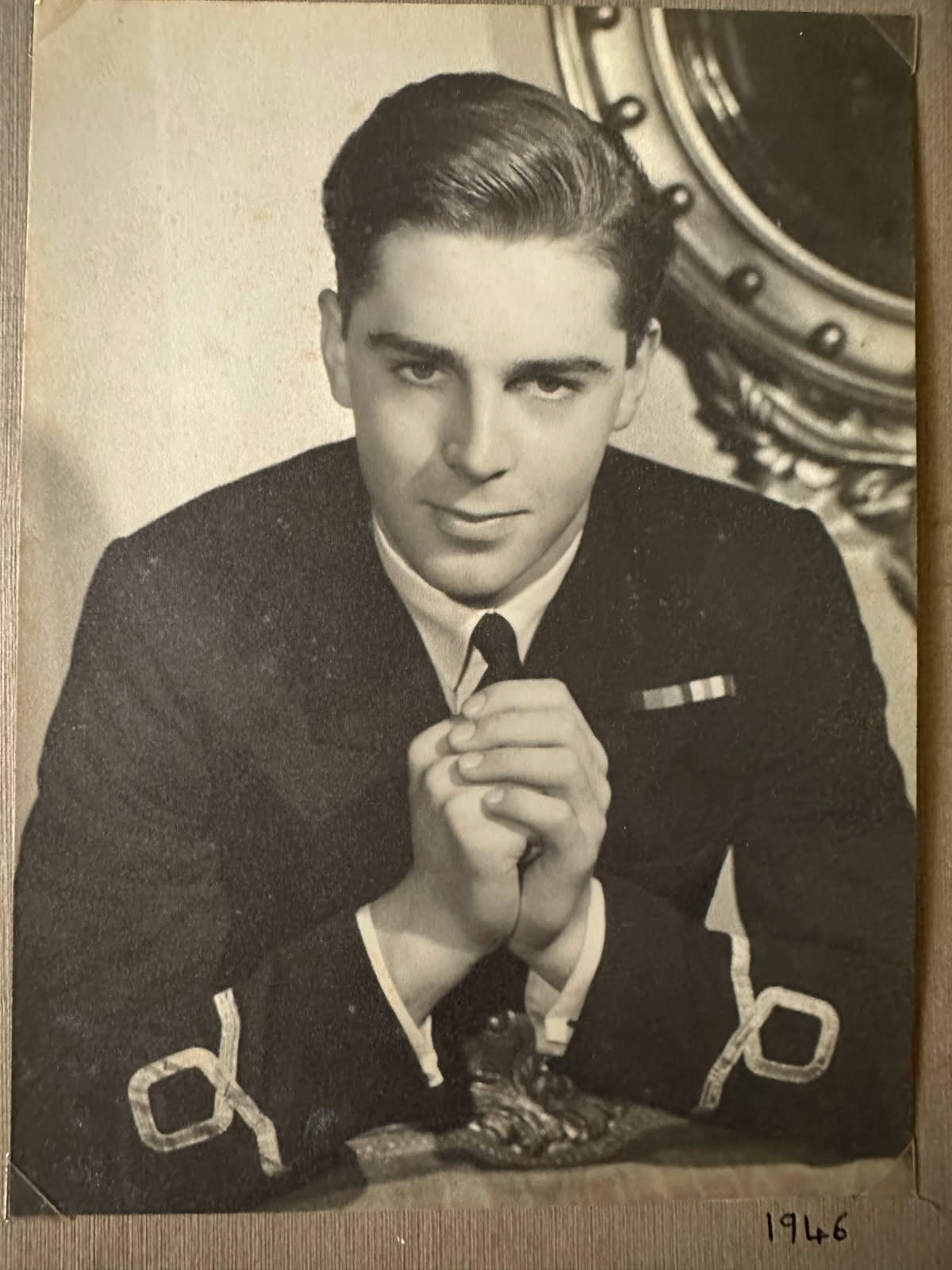
Sub-Lieutenant Heal, 1946
So you went up to HMS Lochinvar?
Yes, I went up to Lochinvar and was immediately appointed—Jimmy the One, that's the first lieutenant, of a motor-barn-sweeper, which is about 130 feet long, built in Canada, with a dirty great big diesel engine.
They were—double oil sweeping, they called it, for the magnetic mines. We had other sweeps, but that was the main job. There was a skipper who, before the war, had been an excise officer with the customs, going around all the Scottish breweries, checking the quality of the Scotch. He knew all the brewing industry. He was the skipper, and I was the sub-lieutenant. There were only two officers on board, and about 13 men, mostly Glasgow hooligans, that didn't want to be there at all.
By then the active war was over. We wandered around the North Sea, we went to Norway, sweeping. They called them Mickey Mouse, the Navy's gag, you know, slang name for the ships. They were very comfortable, but like yachts inside, they weren't like military vessels at all.
They had nice cabins, and we had a very, very good cook. Anyhow, and we were training the Royal Navy regulars who were going to stay on - we were all going to be demobbed, so they needed training before then. So we took them out, four ring captains, the lot, and that was very good, because they carried their wine allowance, which was paid on a daily basis.
Now, they'd be out for a week, and a captain's wine allowance was a lot bigger than a lieutenant's, you know. They don't drink at sea, the Royal Navy never has. We'd take them out for a week, and that would give the mess the right to their forty dollars worth of scotch, at seven dollars a bottle. So the skipper and I accumulated large quantities of whisky, and because he knew all the customs officers from his old days, he could just wave them through.
So, I was floating around, and I stayed there until I was demobbed out of Minesweepers in 1946.
What did you do then?
I went back to college and I stayed about a year. I was having a great time, had all the scotch at home and everything else, and again, I was working there quite happily, did all right, but I got restless. I had to travel around England in breaks in college to get experience in the field, and I noted that nearly all the engineers on the sites were either alcoholics or divorced.
I thought ‘Well, this isn't for me’. I didn't want to work in an office, I wanted to be a field engineer. And I didn't want to be an alcoholic or a divorcee. It was worrying me a bit; I thought, 'have I chosen the right profession?' I talked to my brother, John, who was in with my father and back at work working for us.
When John was demobbed they offered him a massive job as a pilot because he'd been to most of the international war sites. John was wounded very early on in the war. When they had him in hospital, they found that he'd cheated in his eyesight test. He reckoned he was the only pilot of the RAF that had prescription lenses in his goggles. And how he did that, I don't know. They also discovered that it was colour blindness. He saw colours differently to other people. They suddenly woke up to the fact that he could sort of see through the dazzle painting on ships, he could pick it, and he could see camouflaged things on shore that ordinary pilots couldn't see, because of the colour blindness.
I spoke to my father as one of the ideas was I'd get my civil engineering degree, go into the family business, and we'd expand it into doing heavier engineering than just decorating people's houses.
Anyhow, John had some friends from South Africa, and they came to stay with us. One of these, a young man, was talking about South Africa. He told me that I could be offered to go to South Africa, as they wanted more Brits to go into what was a largely Boer population, and the Brits didn't like it very much.
His friend said, when you're demobbed, you can come and work in Africa. Transfer. We'll put you on some land. I was thinking about that but I was pretty socialist, and I thought the blacks will take over soon after.
I was dead right.
In the course of these discussions, I met a man from a company called Oppenheimers. They were agents for a whole lot of aircraft and railway engines and bulldozers and all that stuff, all over the East, supplied from Britain and from Europe. They were an international company. He came to stay with us to see my brother John, and I told him I do want to go to Africa on a farm anyhow, he said, why don't you work for Oppenhoffs?
I said, well, what's it all about? They offered me a damn good salary to go into London in the head office, which is a very imposing business, they were a very wealthy company, and about six months training in England, to learn codes and business management and all that managers have to know.
The idea was, then I would go out to eat the East somewhere, and join their company and be one of their managers. I got on very well with all the companies I went to visit, with Perkins Diesels, Davlet Aircraft, one of our agencies, Coles Cranes, big companies. So I trained for six months, did alright, learnt all about visas and foreign management, and was quietly going about my business when Pakistan and India separated, that happened overnight almost. The two self-governing countries of India and Pakistan legally came into existence at midnight on 14–15 August 1947.
It was a bloody mess. I mean, there were truckloads of dead people around, just horrific. The management in Pakistan were all elderly men with wives and children. They left, they just got the first aircraft out.
Somebody came to me and said, 'can you use a gun?' I said, 'yes, of course I can'; I don't know to this day how to use a gun. I said, how big? 'Six inch or a revolver, you know'. I said, 'I can use them all'. So they said, 'well, we want somebody who's capable of looking after himself to go out to Pakistan and manage the office there'. Mostly Pakistanis are running it, but they wanted a white man to be in charge, ‘but it's a bit dicey, you know, there's riots in the streets of Karachi and all this sort of stuff’.
I said, I'll go on two conditions; a good salary, and at least half my salary is paid into a London bank and doesn't appear in the paperwork anywhere, so I don't have to pay taxes. And I'd like to get a body guard.
So they said, oh, that's all right. We can arrange that. They arranged for Haji, who was a Gurkha, a sergeant in the Gurkha regiment there, he just retired. Everybody was afraid of the Gurkhas, you know. They had a good reputation.
Haji met me at the airport in his sort of bits of uniform and curly tie. I said, 'can you use the Smith & Wesson?'. He said, yeas, I could use anything.
So he set me up at a hotel and I became the general manager for Oppenheimers in Karachi. I never had any trouble with anyone because Haji always walked just behind me. Any uptight native, they'd walk straight at you. Haji would just come around in front of me and they'd go around.
How long were you there?
Well, about a year. I bought a car there. We were agents for Citroën, so I had a Citroën car. All I did was go around all the big merchants to say, Oppenheimers are staying, they're not going anywhere, you can still buy your gear from us. Mainly we supplied textiles and newsprints and basic things like that, you know, whole shiploads of newspapers, newsprint, things they didn't have immediately after World War Two.
When things settled down and they sent out one of the older managers, I said it's safe for him to come back now, and they sent him over by himself. Unfortunately, he was an alcoholic and as soon as he got to Karachi, he got on the booze. I had to send a very discreet cable back to London to say, ‘look, this may not work out’.
I didn't say he was a drunk, I didn't want to do that. He's a nice guy, I got on all right with him, you know, but he'd get drunk every day. So I sent this very tactful cable back to say that he wasn't very well and they should reconsider recalling him. They didn't, they knew what was wrong, they knew they were sending out an alcoholic. So, they sent his wife out and that fixed that. He got off the drink straight away.
I was staying at the great North Western Hotel and I met some very interesting people. The Germans had an embassy in Karachi then and the boss of the embassy brought his daughter out, who'd married a Luftwaffe pilot who got himself killed just before the end of the war. Angie her name was, and she was staying at the same hotel, so I got to know her and a lot of Luftwaffe people through her.
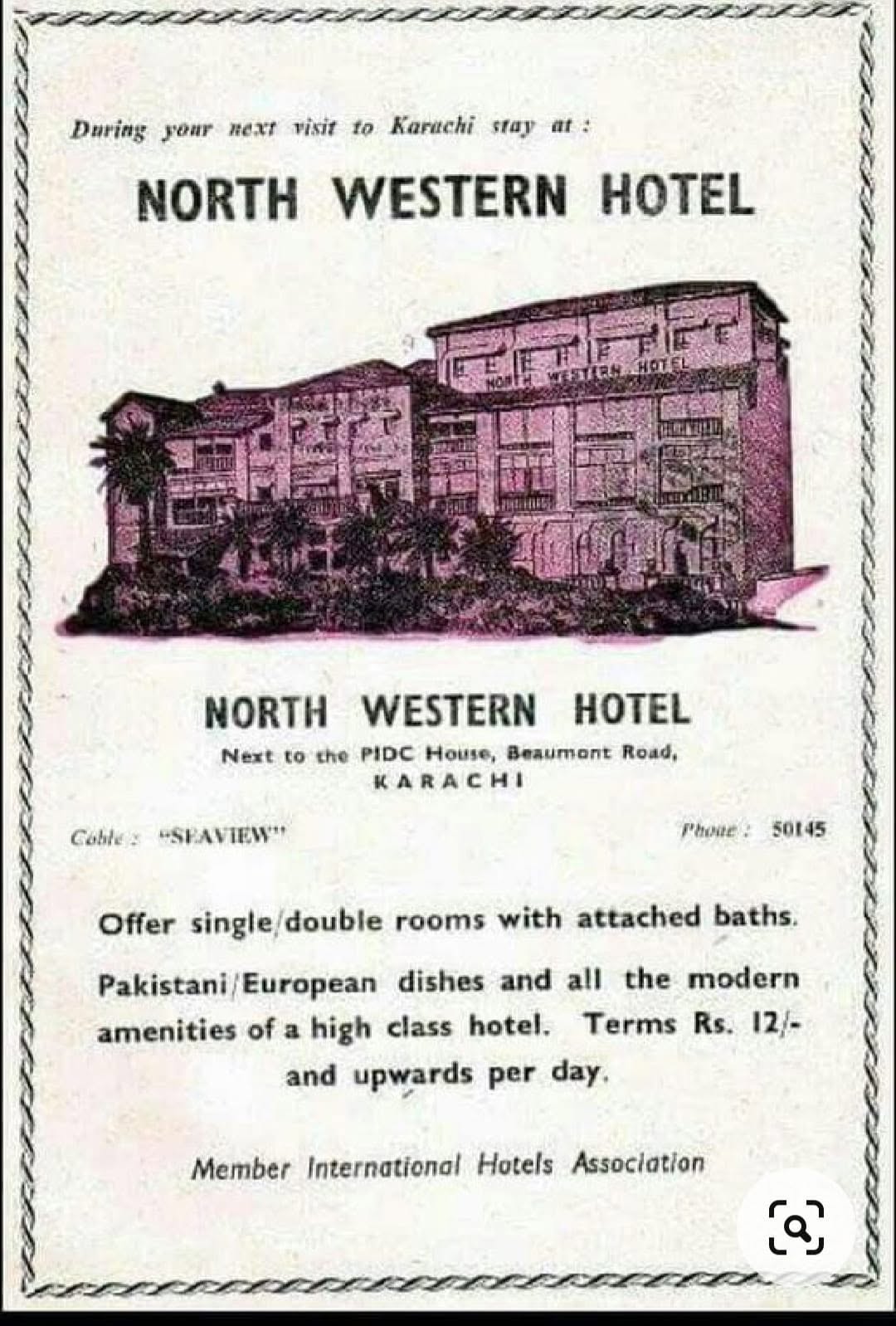
old ad of North Western Hotel, Karachi
Then we were in Calcutta, and a revolution took place in Burma, and all the cabinet were all killed. On July 19, 1947, Burmese nationalist leader Bogyoke Aung San and seven members of his interim executive council were assassinated by armed paramilitaries acting on the orders of U Saw, a conservative pre-war prime minister.
Well, that was one of Oppenheimer's big markets. So I immediately got sent to Burma; I said, yes, as long as Angie can come with me.
There was a Gurkha regiment in Rangoon, loyal to whatever government happened to be in power at the time. As long as they got paid, they stayed. So Hadji rang his mates there and spoke to them who said, yeah, come on over. So I went over there.
The Oppenheimer's manager in Rangoon, he'd fled back to England, quite sensibly, with his wife and daughter, and left his house. The local Burmese employees of Oppenheimer's had put some people in the house to get it manned, you know. So when I got there, I got a Burmese bloke meeting the plane Angie and I were flying it. They took us to this house. It was still in excellent conditions, a lovely house, on a place called Lake Inya. Inya Lake (formerly Lake Victoria) is the largest lake in Yangon (formerly Rangoon), Myanmar, located about 6 miles (10 km) north of the city centre. It is surrounded by upscale neighbourhoods and major roads like Pyay Road, Kaba Aye Pagoda Road, and University Avenue. It's a lovely suburb in Rangoon.
Burma gained independence from Britain on January 4, 1948. I moved in there, and I had a bodyguard. He sat on the verandah at night with a finger across his lap in case anyone touched the car, and he came in the car everywhere I went.
The Rangoon office was very well run. The local Burmese people were good business people, they had some great Chinese people there too, and they were running a business that didn't need me, really. But I think that, once again, head office wanted to have a white man in charge, a European there. I was pretty well paid there, but again the money was deposited into the account in London. I got civil income only for the tax purposes, and that went very well.
A Burmese pilot, who'd been a Spitfire pilot in the war, was the only Burmese with a flying licence. They decided to set up a government flying line, and so they bought six Dove aircraft, twin-engine de Havilland Doves, and the commission which I got was enormous. That was all paid into a bank in London. I was getting quite wealthy.
The six aircraft arrived. I helped to man them because of my contacts with the Luftwaffe, and this girl that I knew. I told her, look, have you got the old flying mates of your ex-husbands? So she did some discreet bucking about.
They flew out the Luftwaffe pilots. They were bloody happy to get out of Europe and get a flying job, you know. They were starving, back in Germany, and it was a good airline, it worked very well. The Union of Burma Airways was founded by the government after independence on 15 September 1948. So Oberhoffs gained a lot of good reputation from works like that.
Then various things happened. The Treasurer shot through, he locked all the government banks up, the Treasury where they stack the cash, the gold bars and all that. He changed all the codes, and shot through on an aircraft to Thailand. So the government couldn't open the door.
I had to use quite a bit of, oomph, to get the London office to send some guys who could open it. They didn't like to admit that they could be opened, but they had their experts who could, and they also knew the codes that were initially on them. Anyhow, they came out - it took them about three months to crack the door. I had nothing to do with it, but it worked.
We traded in quite a lot of things that whoever was in power wanted. They needed formula, powdered milk for babies - that came from Australia - and we brought all that in, and we got ammunitions and stuff for the police and all this sort of stuff.
So we were quite popular, but the government only controlled Rangoon itself, and a small area around, because they had this British Gurkha battalion there, the British left them, and they were being paid.
Anyhow, the government failed to pay them, and they marched out, flags flying, and in beautiful formation early in the morning, with all their guns and everything. Burma at that time was split up into Rangoon, the government there, whoever they were, they varied from time to time because they got killed or shot or something happened. There was also the Karen population, which had a big area, various drug gangs that ran different parts of Burma, and some just plain bloody gangsters.
Then this plane pranged, it landed on a beach up north, and I had to go out with two jeeps, with some mechanics who could fix the aircraft, as it was damaged. The pilot rang us up on his cell phone and told us he wasn't hurt. We had to go from the city to the Karens, with a letter for the bloke, the revolutionary Karen, a nice letter for him, and he wrote us a nice letter to the gangsters. I think we went through six sovereignties where you didn't go without permission. We had no problem; I had three mechanics, I had Haji with me, and we drove up there with two jeeps with all the bits and pieces in, managed to repair the aircraft and he took off and flew back down.
Another interesting thing happened there. One of the Luftwaffe pilots came out with his girlfriend and he was going to marry her in Burma, but they wouldn't let him off the ship and they wouldn't let her off the ship if they didn't get married first. The captain of the ship married them, I was present, but only trouble is they all got blood drunk after, and the pilot fell off the gangplank and broke his bloody leg, so I was left with his bride. I didn't quite know what to do with her, she didn't want to go in a hotel for some reason, she didn't speak any English, and so I said, well I'll tell you what, there's an empty house next to me, you move in there and I'll get a couple of Burmese girls to go and live in with you, because I had good connections with the Burmese. He only had to have his leg cast in plaster - two days later he was hobbling around and collected his wife. But, that was just one of the odd things that happened.
Anyhow, Burma slowly fell apart, and something upset Oppenheimers. They became convinced it wasn't a good idea to have a foreign company still operating in Burma. So they talked to me, and I talked to a Chinese billionaire, who my brother had met when he was building the airport. I asked around for him, there was sort of a hushed silence, and I said, 'what's wrong?', they said, 'he's in gaol', I said, 'oh hell, can I see him there?' It was all right, and he had lovely sofas and a TV set, in gaol, he wasn't worried at all. So he said, what did I want, and I said, well just between you and me, this is a private conversation, Oppenheimers are thinking of leaving Burma, and we would like to sell, we had go downs and warehouses, and we'd like to sell the shebang to somebody reliable, who's got some real money, and are you interested. He said, oh yes, very. He got his Chinese friends, and we had two discussions actually, and for a sum of money, near a million, we just signed on a page out of the notepaper, and wrote it up, and they put all this money in the suitcase, and I headed home.
Haji noticed that the home was being watched, so I said, 'oh they're going to steal it back again'. Some very complex organisation took place, involving the British Embassy, and I left the house and went to stay in a hotel in the city for a couple of days. I didn't go in my car, I rented a jeep, and drove into the city with Haji, moved into the hotel, and sent a coded message back to say where I was, and somebody arranged with an American, to fly an amphibious Catalina warplane, which could land on land or water, to Rangoon.
Now, then, the Karens owned the airport at night, the government only owned it during the day, and the Karen's used to all march out Burmese don't like killing people, and they used to fight miles apart. The English officers would write, 'oh we're going to raid that tomorrow', and the Burmese would all fall back, and let them raid it, come back again. It was like a bloody silly game of chess going on. Anyhow, I got on this plane, was accompanied with some gentlemen from Burmese treasury offices, all with big suitcases, I didn't ask what was in them, and we took off about two in the morning. Now the departure tax on anything that left Burma like that was about 40 percent, but of course there was no one there to pay it to, so we didn't pay, and I get to Thailand in this same aircraft. When you arrive there's a bloke at the desk who asks if you have anything to declare. I said no, not particularly, he said what's in the bazookas, I said money, and so he said well your passport hasn't got an exit stamp from Burma - he was a complete fake, he knew bloody well what was going on, he'd been bribed. I said there was no one at the airport when we got there to do it, we booked this flight, and all of a sudden he just laughed, and set up in the suitcase, and said welcome to Bangkok, and shut it again. The Oppenhoff's bankers were waiting at the exit gate for the suitcase that they took there, and that was the end of my time with Oppenhoff's.
I was staying in Thailand, wondering what to do next actually, and the general manager from Oppenhoff's flew up from England to see me. They were very pleased with me, getting all this money out, and he said well look, we can put you in Borneo, which is a pretty settled place; there's no bloody insurrections, no revolution there, and you'll do bloody well there. I really wasn't all that keen on that, and said 'no, look, I think I'd really rather go home, I've done a good job for you in Karachi, and a good job in Rangoon. If you'll just pay my fare home, that'll be it'. He said 'all right, I'll give you six months pay', I had a contract with them, 'and pay all your fares, business class, back to at London, and that's the end of the deal, and I said 'done'.
I arranged to go back to London, through Thailand, then Singapore, then Qantas to Darwin to start with, because it had to refuel there then. In 1948, Qantas operated the international link from Singapore through Darwin to Sydney as part of the famous Kangaroo Route to London on Lockheed L-749 Constellation aircraft. From Sydney I was booked to go to Honolulu, USA, and I had a private guess at the back of my mind, that I might get a good job in America, because of my Asian experience.
I set off, got to Singapore all right, stayed there a few days, met an Australian in the bar, I was in Raffles, bloody Australians, they're everywhere, they're all over the place, and I rather like them, because I met John's aircraft crew and they were all brilliant.
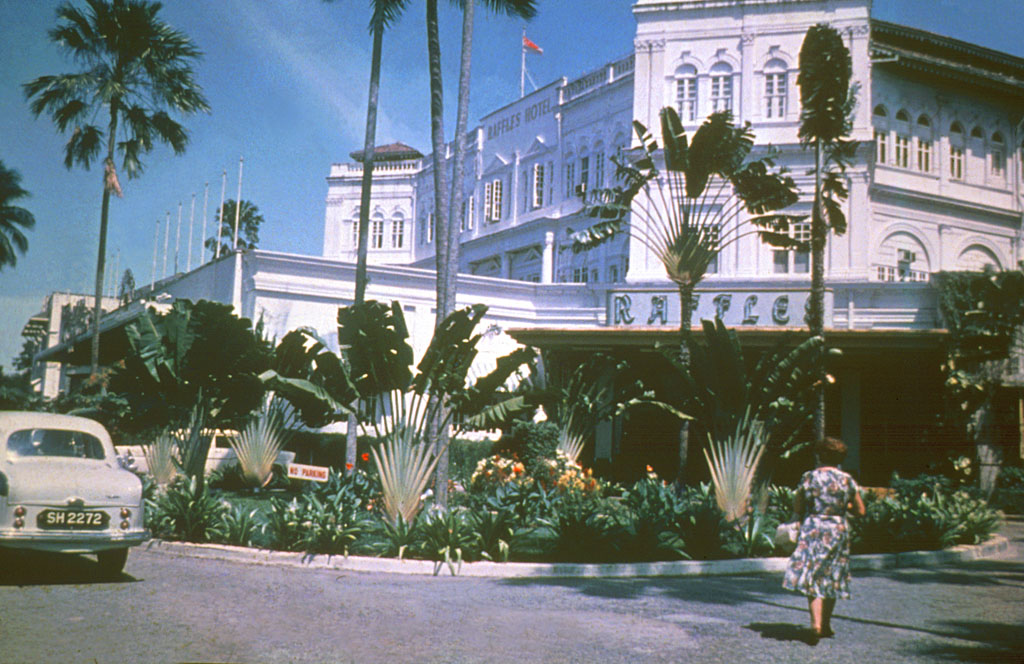
Raffles Hotel in 1965, January 1. Photo: Steve Swayne from Maleny, Queensland, Australia.
DARWIN-SINGAPORE IN 16 1/2 HOURS
SINGAPORE, Wednesday: A Qantas Constellation airliner arrived at Singapore this afternoon from Sydney, via Darwin, after making what is believed to be a record time for the flight of 16 hours: 35 minutes.
The Constellation is en route to Karachi to pick up 27 passengers from another Constellation which arrived tliere from the United Kingdom yesterday morning with one motor dead. A Liberator is expected to arrive from Australia tomorrow morning carrying a replacement motor for the grounded plane. DARWIN-SINGAPORE IN 16½ HOURS (1948, March 18). Tweed Daily (Murwillumbah, NSW : 1914 - 1949), p. 5. Retrieved from http://nla.gov.au/nla.news-article195497525
The chap I met told me his father was in South Australia, had two landing craft and had a licence to pick up war leftovers - copper cable, and stuff that the American army had left behind, and he was doing it very profitably. His son asked me if I could drive a landing craft, and I said, look mate, if it floats, I can drive it, which is true, because I'd been mucking around, and after and towards the end of the war, before I was de-mobbed, where my minesweeper was, and we used to go driving around, all these guys just waiting to be de-mobbed.
I thought, 'well, this will be all right, I might look the old boy up, you know, swan around New Guinea, picking up copper cable, making a fortune', so that was at the back of my mind, or I might get a job in America.
When we landed in Darwin to refuel, I was sick, I'd got some tummy wog from eating something in the street, and I thought I was immune, but I wasn't, and I was dehydrated. They got a doctor to me, and he said, oh, you're all right, just to go to Sydney, but he gave me some stuff.
By the time I got to Sydney, I was really ill. Qantas put me into a hostel they had at Potts Point, and where staff used to stay for a day or two, before they flew back to England. They had a doctor nearby who used to come and do their medicals if they needed a medical to keep their licence, and he came to see me. I was fine in two or three days, and I met a bloke who was also at this hostel, courtesy of Qantas, as he'd just sold a whole bunch of aircraft to the airlines.
What year are we talking now?
Left Burma …so it'll be later 1948 by then.
He'd just sold six big twin-engine passenger planes, and made a fortune, enough to live off the rest of his life. He wanted to celebrate this, and said, 'come up and have dinner with me to celebrate your safe arrival. We went to a place called the Mary Pumpkin in Double Bay, I don't know whether it still exists. We sat there, and were waited on by a bloke that had been a steward for the admiral on a battleship, you know, RN, so as soon as he heard I'd been there, he got very chatty, and I can remember walking out of there and saying to this guy, 'any country where you can get a dozen good oysters, a beautiful steak, a chocolate pudding, and something else for five quid is the place to live.' Yes, that was it.
That was it, you stayed in Sydney?
Well, it wasn't quite like that. This guy was trying to open the door of the car that we jointly had, and the key wouldn't fit, and the other car was just in front of us, he got the wrong car, and we spent about ten minutes trying to break into the wrong car.
I met an ex-navy bloke somewhere in Sydney, just a young man, and he said, 'did you know that the Australian government is looking for ex-service guys to assist them, to get qualified, and you might have a talk with them. So I went just casually, still thinking I had the tickets and everything, that I'll go and talk to them. They asked me what skills I had, I said I could use a level, I was a good surveyor, and I'd learnt quite a bit of civil engineering, and blah, blah, blah.
They told me about the Snowy scheme, which hadn't started, this was 1948. They said, 'look, we're desperate for people to start with the Snowy', and offered me a deal that I could start with Works and Housing, which was an existing department in Sydney, and in about six months, the Snowy would become legal, they hadn't got through the government yet, but I could work in Works and Housing, and if the Snowy starts, you'll be immediately transferred to them and would you like to do that? I thought, oh, gee, that'd be nice if I was to get the Snowy back in Wales, that would be nice, after all those bloody tropics, so they offered me a bloody good salary, and I took this on and worked for Works and Housing.
Then this story started, I was a 49er of course, one of the first employees. I was sent down to Cooma with Jimmy Glenn, who was the chief engineer and we moved into the Alpine Hotel.
I was doing a sleigh around Cooma setting out housing blocks for the staff when they came, and found a flat area for storage. As various staff arrived, I would take them off to the camp where it was, and I took the ABC, they came down, and I was taking a tour of the whole area. Luckily it was being built, there was no actual work going on.
All the people in Cooma thought the whole thing was just a bloody con. They thought it was just the government pinning themselves, you know. It wasn't until a huge convoy of trucks with all dilapidated, clonked out old bulldozers, they believed that it was fair dinkum.
I was in head office in Cooma, which was a tin shed just up in Vale Street, just a little shed. I've got pictures of it somewhere. When things started to actually happen, I ended up being appointed as the engineer, to the three-mile camp at Kiandra, I can't remember what they called it, but It was an old Chinese mining area. I was the engineer in charge of that camp, which was about a quarter built when I got there, half-built huts and local contractors building it. The camp was right by the lake the Chinese had created to wash the gold.
I was there about six or eight months. All sorts of interesting things happened there. The boss came out, Sir William, and we had to build a ladies toilet for his wife. He brought a whole press entourage with him. And I had a Dodge 4x4 weapon carrier and a band rubber, I had both. I took them down to the, uh, campsite down the track.
And Sir William asked me, he wasn't Sir William then, he was just Bill. He asked me,...
Sir William who?
William Hudson. He was the big kingpin of this story. First of all, I was going to give him trout for lunch, and I had to stop because he was a vegetarian and a greenie. I didn't know what it was to stop.
Sir William was very keen that you don't chop too many trees down. I said, I said, what about tickling trout? And he said, oh, no. So I had to ring the camp and tell them to take the trout off and get some cheese and biscuits. Anyhow, we drove down there, and then we drove back in an entourage with the press. And Sir William said, ‘how often do you go down to the river?’ I said, just about every day to make sure the boys down there were all right. He said, Christ - it was a real dangerous track, we just drove a bulldozer down. I learnt to drive a dozer myself.
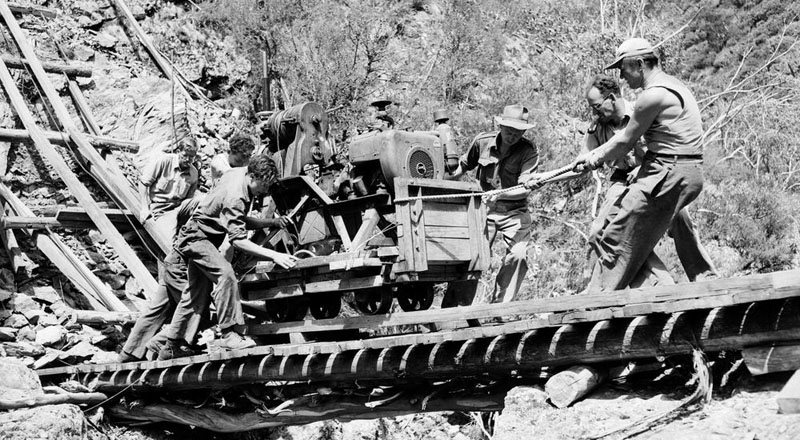
Men at work on the Snowy Mountains Scheme. Image: Snowy Scheme Museum
The Snowy Scheme Lures Men From All Over Australia
… Brian Heal, 26, who wears smoked glasses and leather leggings, and manages to look dapper in the snow and mud, met us at Kiandra. He is a former Royal Navy officer who came to Australia 18 months ago after working on a civil engineering job in Burma. "I became tired of my job in Sydney with the Department of Works and Housing, and thought I'd like to get back to engineering and have a look at the Snowy Scheme," he said.
….
I found that was not entirely true. Men like Brian Heal go there for experience; men like Dreise because they are lonely; men like Charles and Joyce because they are idealists; and men like Blackie-and this also applies to Charles and Joyce-be-cause they like their jobs. These are the modern "Men From Snowy
River, down by Kosciusko's side."
In the future, when you read about the Snowy River Scheme, re-member Bob Dreise keeping the giant machines going at the foot of the mountain; remember the men knee-deep in the mud at Island Bend; remember Blackie and his radio at Three Mile Camp; remember Brian Kirkpatrick setting out in his jeep with his axe, pick, and shovel; but most of all remember Bob Charles and his garden in the snow at Tumut Pond.
For that garden and Charles's faith in it are symbols of the whole vast enterprise. The plants are buried under a foot of snow now, but "they'll flower in the spring."
Charles knows they will, just as the hundreds of men making roads and building camps in icy, rugged country know that in time those snow-covered mountains will be transformed by cities with populations of more than a million, seven big dams, and 16 underground power stations supplying electricity to a bigger and safer Australia. The Snowy Scheme Lures Men From All Over Australia (1950, July 4). The Sydney Morning Herald (NSW : 1842 - 1954), p. 2. Retrieved from http://nla.gov.au/nla.news-article18160885
DEEP IN THE HEART OF THE SNOWY COUNTRY — HOW MEN LIVE AND WORK
VITAL CAMP NEAR RIDGE
…. At the top of the gorge, and past "Withering Heights," a particularly exposed ridge, is No. 3 Camp, a transport staging depot where material is re-loaded in powerful vehicles to take the steep incline to Tumut Pond.
It is erected on the banks of a dam, claimed to be built by Chinamen in the late 19th century to provide water for sluicing for gold. Entered through a hub-deep quagmire by a sign "cycling prohibited," the camp is key to roads and communications in the Adaminaby-Tumut link. It is in touch with Cooma by frequency modulation wireless, and will eventually be linked with Jindabyne.
It also controls communications between the road clearing station at Kiandra and Tumut Pond.
Telephone systems also con-verge at this point, whose function also is to rescue drivers stranded on the roadside by mechanical failures or weather conditions. To facilitate pick-up, numbered telephone boxes are attached to trees along the route. Drivers carry telephones which can be attached at these points to contact the camp.
The base accommodates approximately 130 men, comprising storemen, labourers, drivers, technicians and camp staff. It will eventually have its own workshop and garages to house 30 vehicles.
It is in charge of Brian, Heal, 26. an Englishman who served with the Royal Navy, but who on discharge accepted a job as civil engineer in Burma. Civil war concluded his appointment and he migrated to Australia approximately 18 months ago, taking a position with the Department of Works and Housing, Sydney, until November, when he transferred to the Snowy Authority for further experience.
His camp, which is three weeks ahead of that at Tumut Pond, is self-contained, with intercommunication systems to important camp centres, recreation hut, and power for lighting and room heaters.
The wireless officer is Mr. L. G. Blackie, formerly a member of a New Zealand signals unit in World War II. He joined the Authority before recruiting started in-New Zealand, after friends had written to him about the scheme. His station is continually manned with staff-ready-to rectify breakdowns as soon as they occur.
Approximately 60 miles south is Island Bend, an important link in the Snowy-Murray scheme and base for operations into the Mt. Kosciusko-Spencer's Creek area…. DEEP IN THE HEART OF THE SNOWY COUNTRY — HOW MEN LIVE AND WORK (1950, July 5). The Canberra Times (ACT : 1926 - 1995), p. 4. Retrieved from http://nla.gov.au/nla.news-article2787154
I stayed there for a while, and then the government decided they didn't want to proceed with the Tumut part of the scheme, they wanted to do the Murray side first. I was moved from there to go over to the Smiggin Holes in Kosciuszko.
By then Bob Cameron, my mate, a local engineer I met him when I was with Works of Housing, and we got on very well, turned up. His father was a journalist, Bob, who had a lovely house up Melbourne that overlooked the water, it was really beautiful, lovely. I used to stay there, and I was part of the family.
Bob was in charge of the Smiggin Holes works, so I went there and was doing the surveying for him, pegging out this road up to Guthega. We had a landslide or two and a few things went wrong. And I was there when the pub burnt down, the Kosciuszko pub.
HOTEL GUTTED AT KOSCUISKO
Guests, Staff Flee To Safety COOMA, Wednesday.
The wooden two-storey Hotel Kosciusko was gutted in a spectacular blaze at 4.30 a.m. today. About 100 guests and 92 employees fled to safety in their night attire and stood shivering and helpless in a drizzle of rain as flames roared through the hotel. Police estimate the damage at £58,000. Urgent calls have been made to nearby towns to rush in food clothing, blankets and medical supplies. Immigration and Tourist Minister (Mr. Clive Evatt) has ordered a Departmental officer to fly to the scene and provide everything the fire victims might need. 'Give them top priority on everything' he instructed his Department today. HOTEL GUTTED AT KOSCUISKO (1951, April 18). The Dubbo Liberal and Macquarie Advocate (NSW : 1894 - 1954), p. 1. Retrieved from http://nla.gov.au/nla.news-article131338695
The staff quarters was in a separate building, and that was the building that burnt to start with, but the whole lot went down in the end, in the middle of the night. We all drove down from Smigs and sort of rescued all the people and gave them jumpers to wear, it was cold, you know, they were all in their nightwear, everything. And the police asked us to bulldoze a safe out, because they'd heard a rumour that the manager of the Kosciuszko Hotel had been flicking the books, and that was why the hotel burnt it down. This was their story. I said, oh no, we're not putting bloody bulldozers in there, mate, it's too dangerous. I was sort of protecting the guy, I don't know whether he needed protecting or not, but I wasn't going to be doing that.
I stayed on that for quite a long time until I got fed up with it, and resigned.
I drove to Sydney with the idea that I might get a job with the Victorians at Eildon dam, or I might go down to Tasmania, join the Tasmanian hydro. The Victorians offered me a job, but it wasn't paying well enough, so I went down to Tasmania.
When I got to Tasmania, blokes I met in the pub, three of them, were buying a big old sailing boat, which had a boat in it, but it was basically a sailing vessel, like a diving vessel they used to use to get into pools. The three of them had bought this, or had paid a deposit on this boat, and were renovating it with the idea of going Trochus fishing. I'd never heard of Trochus, it's the stuff they make buttons of apparently.
This caught my fancy a bit. So I said, oh, I'll have a look at it. They were putting new cabins in it to make it more comfortable, and a deckhouse, and the boat was moored.
A bloke called, a young man who called himself Captain Gade, offered to sign me on, you know, as the fourth person to the other three. I wasn't suspicious at all, except that Captain Gade didn't seem to know too much about navigation when I spoke to him about it.
I went back to my friend who'd put me onto it in the first place, who was a young lawyer, and I said, you know, 'who's this Captain Gade guy?' He said, 'I don't know, I'll find out for you, I've got some friends in the coppers, you know'. Next thing I knew, Captain Gade was on an aircraft being pursued by the police back to Sydney. The other three, they'd paid several thousand dollars towards the funds, and the deposit on this boat, and all this expensive navigational gear they'd bought.
I'd worked with them for three or four days, but I hadn't given them any money at that stage, so I was dead lucky. I said, oh well, I'll help them take all their navigational gear back to the shop and persuade them to give us our money back, which they did, with a bit of help from the police, and everything sort of settled down.
These three, one was a wealthy Adelaide wheat farmer's son, the other was a driver of a Pioneer bus who'd been all over Australia, and the other one was a furniture maker or renovator or repairer; he was a very good carpenter because he was doing a beautiful job at all these cabins. Anyhow, we were stuck in Hobart, and they said, what are we going to do? I said, I don't know, so I went along and talked to the Tasmanian Hydro, and they were dead short of surveyors.
In 1951, Tasmania's Hydro-Electric Commission (HEC) commissioned the Butlers Gorge Power Station, built major infrastructure like the Pine Tier Dam, and expanded post-war migrant work camps into permanent regional communities to drive the massive Upper Derwent hydro expansion. The power station was commissioned in 1951 by the Hydro Electric Corporation (TAS) and officially opened on 22 November 1952.
I said, well, what's the pay? And they offered me about twice what the Victorians offered me. I said, well, look, I've got these three mates of mine, can they come as my chainmen? The Chief Surveyor said, yeah, yeah, we'll take the lot, you know. They were very helpful. They checked me out and made me work just up a road from their main camp to make sure I knew what to do. They were very happy. So we got appointed to the power station they were building at Nieterana in central Tasmania.
I was only there about a week or two and helped set out the pipelines and things. Then we moved to a place called Waratah, which is a little village and moved into a survey camp there. We got the job of climbing all the local mountains to put new trig stations on them.
Some of them were old convicts piles and had been there hundreds of years ago. We had to climb up to them, if necessary rebuild them, and then come down again. We were backpacking our way through the west coast bush of Tasmania, which is really thick, wild country - it's a real trail to walk down. But we climbed all the mountains in the southwest right to the coast. Some of them are big tourist places now, but they weren't those days. No, no. It's one of those places few European people had actually trodden in. We worked from this little camp. We used gelignite to blast the biggest trees, those too big for us to cut down; they all crashed down the mountainside. Talk about bloody vandals.
We had aircraft from Hobart dropping food to us. We were away for about 10 days at a time cutting the trail and getting up the mountain and doing all that and then have a few days in Hobart. The Tasmanians were quite happy with us.
And I still believe I saw a Tasmanian Tiger. Alive.
I'll put it this way. I'd never heard of them. We're going along a trail we'd previously cut and this dog ran across the front of me with funny stripes on its backside. I said to my three mates – look at that. They didn't know what it was. When I told the boss, he looked at me and said he didn't believe me. And I said, why? He said, you're telling me you've seen a Tasmanian tiger. I said, I'd never heard of a Tasmanian tiger. Well, the bush was thick enough there they could be there and no one would bloody know.
Then we had a particularly arduous trip. I said to them, could we go to one of the big construction sites and spend the night there recuperating and rebuilding? They said no. So I said, well, if you don't say yes, we'll be leaving.
And it was politely put, but in the end, we left. If they weren't going to play ball with us, we weren't going to play ball with them. So we all resigned at once.
The other three were all quite happy to go home. They'd got money in their pockets, and they just took off.
I stayed in Hobart.
By then, I'd met a racehorse trainer, who was a Mason who my father knew. My father was a very prominent Mason in London, a boss of the big London Lodge, and he'd written to me to say, if you're in Hobart, go and see this guy, just to give him my good wishes. I went. He had two daughters who were born about a year apart, but they looked like twins. I used to stay there. I'd go to Hobart for three days and instead of staying in a hotel, I'd go and stay there. I was quite happy.
He had a horse called 'English'. I don't know whether he bought it out or some owner did, but he had the horse, was racing it, and nobody knew about it except him, and I made a small fortune backing it on his advice. I was quite happy with that.
Then I met another man there who ran a market operation with two big Packards taking tourists to see the prison at Port Arthur. When I met him his son had just gone overseas, and so I arranged with him I could rent his son's bedroom to sleep in when I had my trips to Hobart. The second time I was there, he came into my room on a Sunday morning and said, 'Can you drive a Packard?' I said, 'I can drive anything', which I could. I've driven just about every motorcar in the world.
He said, 'Well, I've got this group and I'm going to take both cars. What if you drive one of them for me?' So he put me in his uniform and a big cap on, and off we went. I just trailed along behind, you know.
When we got back to Hobart, the American who was the leader of this gang that had the ride, gave me about a hundred pounds as a tip. I didn't refuse it. I gave it to the boss guy, and he said, No, keep it, mate, keep it. So after that, I used to drive quite often for him.
He drove the same car. He sent me on my own a few times. He said, Look, just tell them anything, they don't know anything about it. They won't believe you.
I stayed on in Hobart until late 1951.
I was in Jock Muir's while I was there. Jock Muir's a boatbuilder, a very good boatbuilder.
Yes, many here in Pittwater have heard of Jock Muir.
I was talking to him, considering him building me a yacht, a small yacht, not a very big one. We were just discussing this when I heard a loud voice swearing very loudly and shouting going on. I said, what's going on there? He said, oh, ‘that's Des Ashton’, his boat Lahara came down, I think they won the Hobart that year, or came second, ‘he can't find anyone to sail back with him to Sydney’.
Jock had built the Lahara and she was launched at Hobart on December 8 1951. Desmond wanted to get back to be among the starters for the yacht's inaugural Sydney to Hobart - then he was going to take part in the first Trans-Tasman from Hobert to Auckland that would start in January 1952.
I thought ‘Sydney?’ And I said, ‘oh, I'd better go’. I talked to him and we finally arranged that I would crew for him and we'd get Lahara back to Sydney. We filled the bottom of the hull with the Cascade beer because there was a beer shortage in Sydney then. I put all my luggage on and got a free ride back.
The 33.4-foot wooden sloop Lahara, owned and skippered by New Guinea/Papuan yachtsman Des (D.N.) Ashton, finished 2nd in the Sydney to Hobart in 1951 and came 13th overall in 1956.
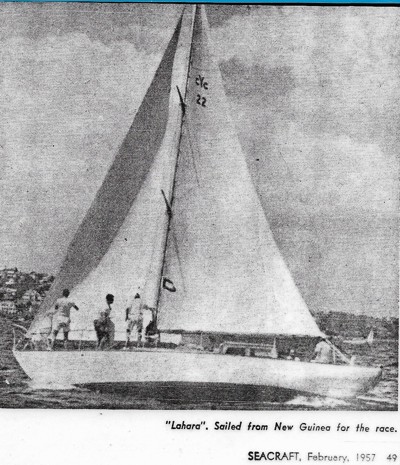
Image courtesy CYCA Archives
Ocean Yacht Race To Start From Hobart
By "Leeward"
THE first major ocean yacht race to begin from Hobart will start at 10.30 a.m. tomorrow.
The race is the 1,300-mile trans-Tasman classic, this year being sailed between Hobart and Auckland (N.Z.). The race formerly was from Auckland to Sydney.
The Royal Akarana Yacht Club of New Zealand, which controls the race, last year requested the Royal Yacht Club of Tasmania to start the race from Hobart after the finish of the Sydney-Hobart event.
They considered that by doing this, some of the starters in the Sydney-Hobart race would continue on and compete in the trans-Tasman event.
Four New Zealand craft originally were to have competed in the event, but one, Rangi, was wrecked while on her way to Sydney.
The three others are Bounty (Ken Furley), Lady Bird (John Woollacott), and Gesture (Colin Vincent). The boats have been in Hobart for some time, and all are in top condition for the crossing.
Three Australian representatives entered for the event, but one, the Melbourne ketch, Kurrewa III, withdrew because her skipper, Frank Livingstone, could not be discharged from hospital in time to start in the race.
The two other starters are the 44ft. Sydney yawl, Margaret Rintoul, which took line honours in the Sydney-Hobart race, and the Hobart-built sloop, Lahara, owned and sailed by Rabaul, New Guinea yachtsman, Des. Ashton.
R.Y.C.T. officials expect a large crowd to witness the start from Castray Esplanade. With average conditions, the first yacht should reach Auckland in about 12 days. Ocean Yacht Race To Start From Hobart (1952, January 4). The Mercury (Hobart, Tas. : 1860 - 1954), p. 13. Retrieved from http://nla.gov.au/nla.news-article27071658
He also came second in the 352-miles Montagu Island race of 1952.
I sailed with Des for many years after that. I used to crew for him. I was living on board for a while and remember when varnishing the woodwork some guy leaned over getting the ferry to go to work, saying, do you live on that thing? I said, yes. He said, what are you doing? I said, this is my job. And he said, God, you're doing this one with him (Sydney to Hobart). I was sitting in my shorts at the time.
I then got a job in Sydney with a firm called Parkinson, a civil engineering job. They had an office in Oxford Street. They were doing quite a big job running an open-cut coal mine for the joint coal board at Wallerawang.
They were widening the railway cuttings to Lithgow for the new electric train service. They had other jobs as well, quite a lot. I got a job measuring all the work that was done, making sure they got paid properly.
You're back in Sydney in late 1951, before Boxing Day and the start of the Sydney to Hobart. Where did you meet Sally's mother?
Shirley? That's a story. Shirley Grantham. I moved into digs that were very near the lighthouse. This was a house owned by a lady, not very old, but her husband had died. She was a widow. She supervised the food at one of Sydney's main hospitals, made sure they were not getting anything they weren't supposed to get. She took a tram in those days down. She had two rooms empty which she rented, bed and breakfast only. Didn't do any laundry or anything like that. I don't know how I found her, might have just answered an ad in the paper. But I was living there, working for Parkinson's, and then it got very complicated.
Some of my friends came out from England. Tom Halliwell, who went to school with me, and Stuart Marlowe, whose father's original name was Marquini, but they changed it at the beginning of the war to Marlowe. He was a top lady's dresser; $4,000 for a tweed suit at Bond Street premises, lots of models. Anyhow, Stuart moved into the second room. He bought an old Bugatti racing car and was rebuilding the VR.
Then Pam Crossing came out, and Tom Halliwell came out, he was living at Hunter's Hill, and he was an engineer, working for the Navy at Garden Island as an engineer, but not in the Navy.
Shirley was in a flat at the Cross, just opposite from where the fountain is, above the bank. Some of the units had been let to some rather undesirable young ladies. The bank management had got fed up with this, and kicked them all out, and Shirley was with Meredith Sinclair Potts, she and Shirley were mates. They moved into the flat just above the bank, because Meredith's father was a banker or something.
I don't quite know how, but that's where they were. I didn't know anything about this at the time. Anyhow, Pam Crossing came out with Stuart on the ship, and she knew the Haley's, the bloke that owned racehorses, that family. They had a big property up at Orange.
We went up to Orange and spent the weekend up there, and I remember thinking I was in gaol when I woke up, because they had Venetian blinds which I hadn't seen before. I woke up and said, What happened? Anyhow, we met the Haley's and got on all right with them.
They knew Meredith, and so we ended up with me escorting Shirley, and I used to go to the flat where Meredith and Shirley lived. Meredith had some medical problems. Shirley was a theatre sister already by then, and was specialising. She didn't work for a hospital, she specialised with certain surgeries. She was doing open-heart surgery, that sort of really advanced stuff, and the doctors took her with them. So, she did do some relief work at the big hospital, the Royal North Shore, she knew the matron there. Shirley turned up at Marrickville, she knew the matron from there, and used to relieve there when the other sisters were on holidays, and she'd go and work there for a few days. Anyhow, that's how I met Shirley there. I married her shortly after I went to meet her father and mother.
He was the shire clerk at Crookwell, in the sheep country of Crookwell, he was Bob Grantham, Robert Cluny Grantham. His is an interesting history; he was a Major in the Second World War in New Guinea, and he was in charge of that Japanese camp in Australia when they all revolted. So he had a big war record.
I got on very well with the old man, Grantham. When he moved to Crookwell, which I went to several times with Shirley, they had moved from Moruya - he was the shire clerk there. We went to a conference together in Tasmania. I remember he just took me along for the ride, really. And then we got married.
Robert Cluny Grantham (1899–1993) was an Australian farmer, community figure, and military veteran from New South Wales who served in both World War I and World War II.
HEAL-GRANTHAM -The Engagement is announced of Shirley, younger daughter of Mr. and Mrs R. C. Grantham of Moruya to Brian youngest son of the late Mrs. Heal and of Mr. W Heal of London. Family Notices (1952, December 20). The Sydney Morning Herald (NSW : 1842 - 1954), p. 30. Retrieved from http://nla.gov.au/nla.news-article18295777
SHIRE OF EUROBODALLA.—Notice is hereby given that Sergeant 3rd Class James Stewart Charles Derrick has been appointed as Inspector under the Cattle Slaughtering and Diseased Animals and Meat Act, 1902-47, in respect of the Moruya Police Patrol District. ROBT. C. GRANTHAM, Shire Clerk, Moruya, 10th April, 1952. 1172—10s. SHIRE OF EUROBODALLA.—Notice is hereby given that (1952, April 18). Government Gazette of the State of New South Wales (Sydney, NSW : 1901 - 2001), p. 1414. Retrieved from http://nla.gov.au/nla.news-article220105263
New Shire Clerk Commences Duty
Crookwells' new Shire Clerk, Mr. R. C. Grantham, arrived in Crookwell on Saturday last and commenced duty at the Shire Chambers yesterday morning. He was accompanied by his wife and they are already settling into their new home so recently vacated by Mr. and Mrs. L. Whalan. Mr. and Mrs. Grantham come to Crookwell from Moruya on the South Coast where he has been. Shire Clerk for the past .14 -years. The-"Gazette" extends a -warm welcome to them and trusts that their period in Crookwell will be a happy one enriched by the development of many lasting friendships. Mr. Grantham, who Is no 'stranger to many of the ex-servicemen of this district, faces several heavy administrative commitments during the concluding quarter of this year. A 'Council meeting and Bluett Memorial Award presentation awaits him in the first week of taking up the appointment and looming large on the horizon is the preparation of estimates for 1954 and the triennial elections early in December. Those In the Community, however, who have personal knowledge of the administrative capacity of Robert Grantham will have no fears as to his ability to cope with the task, no matter how heavy the going. New Shire Clerk Commences Duty (1953, October 7). Crookwell Gazette (NSW : 1885 - 1954), p. 1. Retrieved from http://nla.gov.au/nla.news-article221328090
NSW BDM’s Marriage: 814/1953 HEAL, NEAL BRIAN to GRANTHAM, SHIRLEY registered in SYDNEY
1966 OAM - Robert Cluny GRANTHAM, Esq., of Crookwell, New South Wales. For services to the community – from London Gazette, June 11 1966
Did you stay with the engineering firm?
Yes, for a while. I was still with the engineering firm when Shirley was around, and I used to take her with me sometimes. I'd drive up to Armidale or something to look at a job, and Shirley would come for the ride.
I decided that I couldn't really go on doing this all my life, and I'd better get qualified properly. I made some enquiries to the Institution of Engineers in Australia, and they said, because of your time at City and Guilds, all you've got to do is to sit an exam that we set, and if you pass that, you're an engineer, you're done.
They suggested that to do that, and should leave the job I had and go and join the newly formed Electricity Commission of New South Wales, which had taken over all the power stations in New South Wales at that time. Some of them were owned by the railways, some of them were owned by the city councils, a bloody shambles, actually.
The Electricity Commission of New South Wales was formed on 22 May 1950 under the Electricity Commission Act 1950. It was created as a state-owned statutory authority to fix severe post-World War II power shortages and blackouts by taking centralized control of bulk electricity generation and transmission across New South Wales.
They said, they'll give you a job as a technical officer, and it'll be a good environment for you to study and get ready for the exam.
So I did that, and I was working in a tin shed at Circular Quay, analysing the history of all the generating plants in Australia, and I managed to convince them to buy me a Facit worth calculating machine, and that went very well.
Then it was Warragamba, they were building a dam for the water supply, and the water board wanted to put a power station in. So they wrote to the newly formed Electricity Commission and said, we'll put this power station in, we'll get this much energy out of it, and that was the deal.
I was asked to check that. So I wrote a program which was called ‘Ambergora’, and it was the first big punch card, but the punch cards in those days didn't have tape. I got all the water records from the water board, as they got from each place down the river, and put it through the program on punch card, and it turned out that the plan they had was faulty to the extent that not only wouldn't they generate the energy they said they would, but they'd run dry the water for Sydney.
The boss of the Electricity Commission sent me and my particular boss, Bruce Kirkwood, off to the water board to explain this to them, and the news wasn't welcome at all. The boss of the water, a commissioner, he didn't believe us.
I said, well, look, here's the papers. Take them down yourself and have a look - and it was spot on.
They'd use archaic mathematical probability, and it was all bulls**t. This was hard fact, you know. Anyhow, that was all toned down and calmed over, and they changed their plan, and they actually did build the power station, but that was later.
Then, because I'd done the IBM course at the Sydney Tech, they had a computer, ZAC, and that was what I was using - and we were there all night, me and my mates, we used to fry bacon and eggs in our programs, and we were helping people like CSIRO, they were just starting too.
Well, their programmes didn't run, and we knew ways to make them run. And that was the day when anything went wrong, you went round with a little hammer and tapped all the valves to see which one was playing.
I remember taking the boss out there, the chief engineer of the commission, and someone was unwise enough to say, this is the brain of the computer. He said, it looks like a lot of coils to me. He wasn't impressed, but he was impressed by what it could do.
We ended up being sent on a course with Professor Harry Messel, who was working on computing at Sydney University. Sydney Uni set up the SILLIAC computer with the first program written by Bob May in June 1956.
Then we did the IBM course that they do for their own people. They used to sing the IBM hymn every morning. Alan Potter and I wouldn't sing it, we just sat at the back. But they introduced us to all their machines, hoping that we could sell them to the commission.
Then I was placed into this unit in the Electricity Commission, called the Power Development Division. We explored all the sites, did all the coal drilling, drilling for coal, new coal, if we could find it, and looking at the economics of each site. We would refer to the commission a report, which recommended that it should be at Newcastle or Lithgow or wherever. Every power station built in New South Wales, every one that exists now, every one of them, was picked by us.
What made a site ideal?
Access to water.
Bruce Kirkwood was my boss. James Bruce Kirkwood (1925–1991) was both an electrical and mechanical engineer who worked with the Snowy Mountains Hydro-Electric Authority in New South Wales from 1950 to 1958 during the early construction phase. In 1949 he was working as an engineer for the Sydney County Council, and in 1952 he became a construction engineer for the Richmond River (Electricity) County Council. He joined the Electricity Commission of NSW and by 1967 rose to the position of Power Development Engineer. He was promoted to Principal Engineer Power and Transmission Development in 1970, and Assistant Chief Engineer Power Design in 1972.
Bruce moved to Western Australia in 1973 as the Commissioner for Fuel and Power. In 1975 he was appointed inaugural Commissioner/CEO of the State Energy Commission WA which had been created by the amalgamation of the Fuel and Power Commission and the State Electricity Commission. He held this position until he resigned in 1987 to work as an energy consultant.
He only got the job because I saw the ad and told him and after he'd gone, he said, I know what you did that. So I got the job, you know.
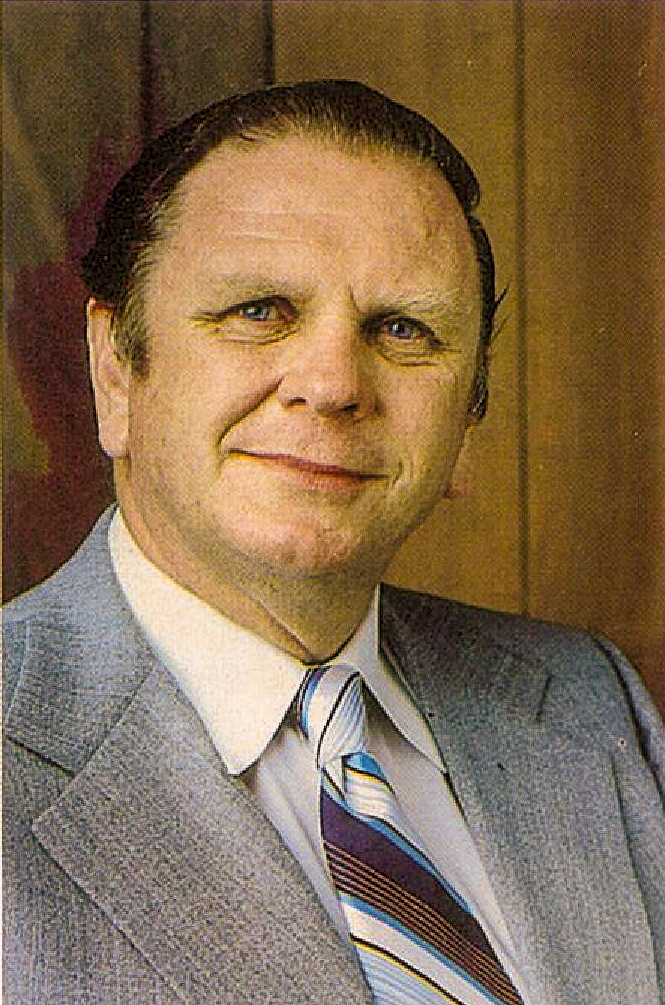
Bruce Kirkwood Source: 1977 State Energy Commission Annual Report
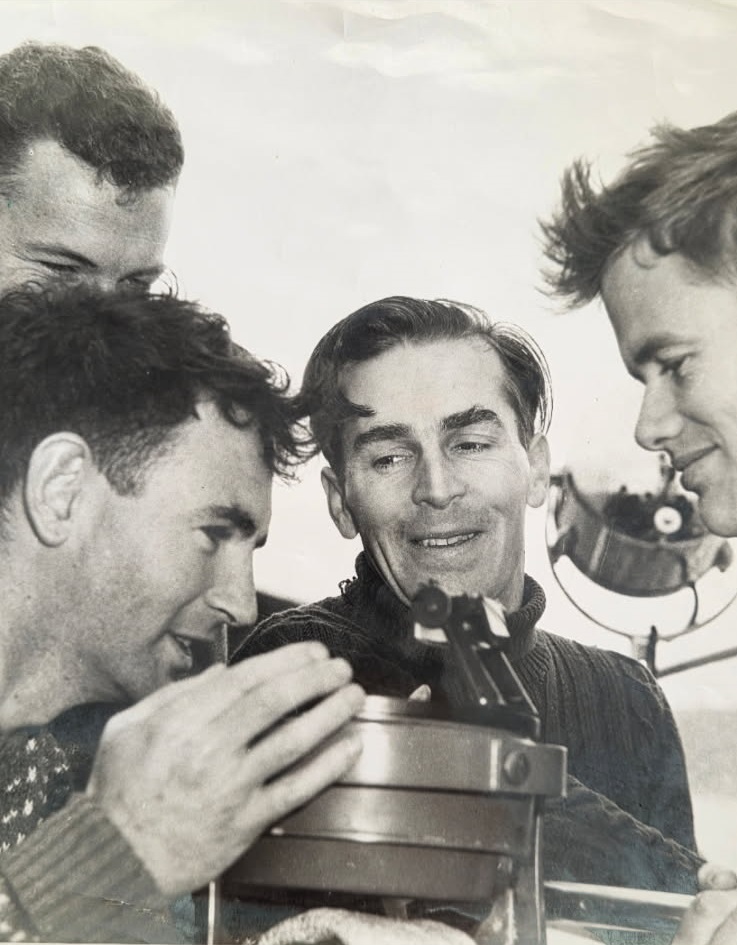
Brian (centre) in the late 1960's doing engineering regarding the Munmorah Power Station
Because I'd gone to a good school and I'd learnt English and French and some German and Bruce found this out, we had a mutual arrangement by which he would draft his report, give it to me, and I would make it make sense. He appreciated that. We got on very well. But anyhow, he went to Western Australia. Unfortunately he died while only 65, he got cancer. I went over to see him just before he died. But I stayed on at the Commission.
Where were you living now?
We built a house down the hill from Killara in De Burgh’s Road, just near the school. I bought a block and Shirley and I decided, let’s build.
We rented first of all, with a very rich old lady in Mosman, a lovely house. She was very nice; if we had guests, she insisted on us using the best room and put her silver out for us. But she started harping on about how she getting tired of the house and thinking of selling it. I spoke to her son, who put us into the house because he wanted to have a nurse living with his old mother, he wanted someone there. I knew the solicitor. We got on quite well with him. I went to see him and said, look, you know, mother keeps saying she's going to sell. He said, I think she is. So I said, well, we don't want to get turfed out, you know. And so he found us a block in de Burgh's Road.
The place at Mosman is still there, and it was, I think, six units or four, halfway down he hill. We did well there because all the other couples were pretty elderly. I ended up as a de facto handyman that fixed all the busted fuses and locks and stuff. That meant they didn't complain if we had a noisy party. We lived there for quite a long while. And it was a lovely walk for me; I would walk down from the unit to the Mosman ferry, take the ferry across and go to my job in Circular Quay. So it was really beautiful. Pretty easy.
I bought a block in St Ives to begin with, and a bulldozer ripped all the trees out of my block - he was supposed to do that next door. He made a mistake, and he ruined the site as far as I was concerned. I demanded my deposit back, which I got back by my friend, Bob Calmera's brother, who was a lawyer.
Then another block turned up and he had a block in West Killara down... It's a bush beyond that block, it still is. You can see the Lane Cove River, and it’s just near the golf course there. It was an empty block, the foundations had been dug on it, and he was departing for overseas in a hurry and he was prepared to sell it cheap for cash. So I got my lawyer friend, Bob Calmera's brother, along with me and we sat down with him and hammered out a piece of paper which made it all legal. I gave him the cash and he shot through to England on it.
I designed the house, drew all the plans, got the council to approve them. Shirley and I dug all the foundations with a pickaxe and everything, put all the steel in for the concrete, got the concrete in and then my brother-in-law, Shirley's sister's husband, he lived next door to a bricklayer, a man who had a squad of bricklayers. They hired themselves out to lay bricks by the thousand and he gave me a mate's price to do all the brick work and it's probably one of the best built houses in Sydney.
It's double brick all the way through because I built it like a London house that my father used to build. I did all the internal work, servicing the walls and wiring and everything else and I got the electricians from the Electricity Commission to come and sign off for the wiring. Shirley's father came down and he was a carpenter before he was a shire clerk, his father was a builder. So he came down and helped me with the roof which was a bit hard to do on my own.
It was a very nice house. I was very pleased with it. We stayed there until I moved up to Queensland many years later, after I left the Commission.
So you stayed with the Electricity Commission?
Yes, for many years. I ended up in the Commission as a top grade engineer. My real job was to be very friendly with the Commissioner. He was an accountant, a very able man, ex-Treasury, a really good guy. He would get conned by the engineers sometimes into doing things and he'd call me into his office and he'd shut the door and say, now why does so-and-so want to do it that way?
He trusted me and I trusted him. We really had a very good relationship. I got to know all the members of the Commission, who were certainly businessmen. I'd come into the meeting, not as part of the meeting but as a servant to the meeting, and if they wanted any further explanation or something to come in, it was my job to give it to them. It meant there was an engineer on the management floor of the Commission, that wasn't connected to any of the divisions. So when there were arguments between transmission and construction or power operating, I could talk to the Commissioner and say, well, look, that's really why they're doing that.
Then you moved to Queensland?
Yes, well, the stupid government then sold all the power stations to private enterprise, they privatised it all. Silliest thing they ever did. I was offered jobs in government. I didn't take it, I'd had enough of such stupidity.
I went to work for Mobil then, and that was in Victoria. They were running a mineral exploration company in Australia, searching for uranium, coal, anything but oil. Oil was a separate matter, but anything to do with energy.
That was run out of Melbourne, and the bloke that ran it, an American, had shot through somewhere else. When I went there, there was an American in charge who wasn't qualified at anything except business, and some very good geologists. They were Australian, mainly.
But it was a bit of turmoil, and it was a bit upsetting. I was appointed as the senior to the engineering staff there and had only been there about six months, and the American left, and they put me in charge of the whole thing.
We were fairly successful. We found quite a lot of coal, and quite a lot of uranium. Not all got mined, but we found it, and did some fairly good business. Then Mobil, at the head office level in the States, I'd gone to the States to get the job, came to see me, and said, look, the head office wants to get out of this venture; will you stay on and dispose of all the assets you've got? By that stage we had leaseholds of millions of dollars worth.
I thought about it, and said, I don't want to do that. I'll tell you what, I had a secretary, and she'd worked in a lawyer's office before she worked for me, she was very, very efficient, and she had a fair knowledge of the law. I said, well, why don't you let this lass do it, because she knows where all the papers are, and it's unwinding a job. They rather reluctantly said they would, and I shot through to Queensland, to work there.
Joh Bjelke-Peterson had placed the Electricity Commission in an impossible position. He'd placed orders for enough coal to sink a bloody battleship. They had mountains of it, they'd contracted to buy it, and they were really sunk. It was absurd, just ludicrous, actually - a lot of this was helped by the Treasury, because they were bad. So I went up there. I got on very well with the chief engineer.
He said, look, we've got to do this, and we've got to do that. I said, well, I knew all the mining engineers, I knew all the mining fraternity by then, I knew all the owners, and had contacts with them anyhow. I spent about a year disentangling this ridiculous commercial situation they'd got themselves in, and cancelling the orders.
What was the name of that bloke that shot through with all the money? The one that went to Spain, he had, like, really smooth hair. His wife passed away recently - …
Christopher Skase?
That’s him. Anyhow, he'd bought a mine for a ridiculous price, and then tried to charge us for the coal based on the price he'd paid for buying the mine, which wasn't worth five bob in the first place. So anyhow, I had to untangle all that, which I did quite happily.
I kept on doing it. I had a very small staff. I transferred half the staff as soon as I got there, because they gave me about ten people. I didn't want ten people and reduced the size of the office to something manageable.
I had to go around and have very private talks with some of the owners of these mines and say, look, you're going to have to fire half your blokes. How are we going to handle it? And certain payments were made, which no one else in the Queensland Electricity Commission would touch. They were frightened.
But I'm an honest guy. So I made it quite clear; I signed off with the money and where it was going to go, and put the envelope in my pocket and handed it to him, and that was it. We were offering to pay them to help them pay off these guys and the rest of it without upsetting the unions too much.
How did you end up back in Sydney?
Shirley died while we were up in Queensland. I'd finished working with the QEC. I was semi-retired, really. Somebody rang me up and said, what about doing some consulting? And I said, oh, I wouldn't know what to charge. They said, oh, well, so much a day, which is about 10 times what I thought I was going to get. So this was mainly sitting in with meetings with bankers, a buyer and a seller, and they were trying to settle deals of a contract.
I'd sit quietly there and advise whoever was paying me whether that was a good idea or not. A lot of people thought oil was like coal; they thought you could guarantee the quality of coal comes out. You can't. It's no good telling the miner he's got to meet certain quality standards, he's got no control over that.
I didn't really enjoy it, but I did end up doing some overseas trips for big-time miners who were exporting. I went to England and all over Indonesia, and there was one of the mining companies execs here who the Indonesians were asking him to come and run a mine in Indonesia. I went to Indonesia to look into it, there's all sorts of undercurrents there, it's a strange place then. I was told it was fairly dangerous at that time, 'but don't worry too much'.
I just stayed doing that. Then I stopped.
I lived on in Queensland for a while. I joined a railway club and we were running the annual showground. I joined the Coast Guard and was doing a lot of fishing, pretending to be a sailor.
So we moved down [with daughter Sally]. I liked this place, I saw it and I liked Mona Vale. It was well up on the North Shore out of harm’s way, and you can smell the sea.
What are your favourite places in Pittwater and why?
Well, it would be Pittwater itself, the estuary.
I had a yacht that I used to keep on Pittwater, she was called Gooba. I built it in Killara, in the yard. It's a Dutch design, 27 foot plywood racing yacht. I was still with the commission those days, so the apprentices did all the metal work for me because they were being trained, and the bloke running the apprentice school was always looking for jobs that were different to do instead of just making nuts and bolts.
He quite happily produced all the hardware for my mast and the rigging. She didn't have an engine, only an outboard. It was a lovely little yacht and ran very well. It won one race, only one, when I was a member down at Royal Prince Alfred. We used to race up and down from here to Sydney and back quite often. We went to Montague Island and up north to Swansea racing. It was lovely.
I also like to go up to the park near the hospital and sit on the bench. I can see the sea from there.
What is your motto for life or a favourite phrase that you try to live by?
March to your own drum – do what you want to do. Seize the day; it's grabbing opportunities that float past you. You know, it's just luck that they float past you. If you see an opportunity, grab it.
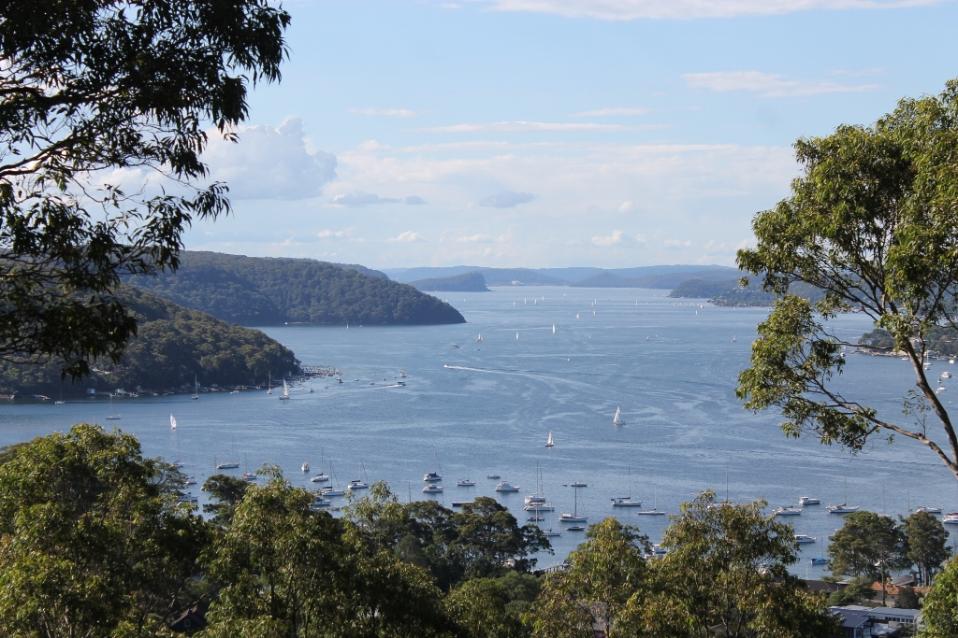
Notes
Normandy landings: World War Two
The Normandy landings were the landing operations and associated airborne operations on 6 June 1944 of the Allied invasion of Normandy in Operation Overlord during the Second World War. Codenamed Operation Neptune and often referred to as D-Day (after the military term), it is the largest seaborne invasion in history. The operation began the liberation of France and the rest of Western Europe, and laid the foundations for the Allied victory on the Western Front.
Planning for the operation began in 1943. In the months leading up to the invasion, the Allies conducted a substantial military deception, codenamed Operation Bodyguard, to mislead the Germans as to the date and location of the main Allied landings. The weather on the day selected for D-Day was not ideal, and the operation had to be delayed 24 hours; a further postponement would have meant a delay of at least two weeks, as the planners had requirements for the phase of the moon, the tides, and time of day, that meant only a few days each month were deemed suitable. German leader Adolf Hitler placed Field Marshal Erwin Rommel in command of German forces and developing fortifications along the Atlantic Wall in anticipation of an invasion. US president Franklin D. Roosevelt placed Major General Dwight D. Eisenhower in command of Allied forces.
Meeting of the Supreme Headquarters Allied Expeditionary Force (SHAEF), 1 February 1944. Front row: Air Chief Marshal Sir Arthur Tedder; General Dwight D. Eisenhower; General Sir Bernard Montgomery. Back row: Lieutenant General Omar Bradley; Admiral Sir Bertram Ramsay; Air Chief Marshal Sir Trafford Leigh-Mallory; Lieutenant General Walter Bedell Smith. Photo: British official photographer.
General Rommel believed that the Normandy coast could be a possible landing point for the invasion, so he ordered the construction of extensive defensive works along that shore. In addition to concrete gun emplacements at strategic points along the coast, he had ordered wooden stakes, metal tripods, mines, and large anti-tank obstacles to be placed on the beaches to delay the approach of landing craft and impede the movement of tanks. Expecting the Allies to land at high tide so that the infantry would spend less time exposed on the beach, he ordered many of these obstacles to be placed at the high water mark. Tangles of barbed wire, booby traps, and the removal of ground cover made the approach hazardous for infantry. On Rommel's order, the number of mines along the coast was tripled. The Allied air offensive over Germany had crippled the Luftwaffe and established air supremacy over western Europe, so Rommel knew he could not expect effective air support. The Luftwaffe could muster only 815 aircraft over Normandy in comparison to the Allies' 9,543.
For the Normandy landings on June 6, 1944, the Allies assembled a massive armada of 6,939 vessels under Operation Neptune. This total included 1,213 naval combat ships, 4,126 landing ships and landing craft, 736 ancillary craft, and 864 merchant vessels, mostly provided by the British Royal Navy and the U.S. Navy.
Czech hedgehogs deployed on the Atlantic Wall near Calais
The invasion began shortly after midnight on the morning of 6 June with extensive aerial and naval bombardment as well as an airborne assault—the landing of 24,000 American, British, and Canadian airborne troops. The early morning aerial assault was soon followed by Allied amphibious landings on the coast of France c. 06:30. The target 80-kilometre (50 mi) stretch of the Normandy coast was divided into five sectors: Utah, Omaha, Gold, Juno, and Sword. Strong winds blew the landing craft east of their intended positions, particularly at Utah and Omaha.
The men landed under heavy fire from gun emplacements overlooking the beaches, and the shore was mined and covered with obstacles such as wooden stakes, metal tripods, and barbed wire, making the work of the beach-clearing teams difficult and dangerous. The highest number of casualties was at Omaha, with its high cliffs. At Gold, Juno, and Sword, several fortified towns were cleared in house-to-house fighting, and two major gun emplacements at Gold were disabled using specialised tanks.
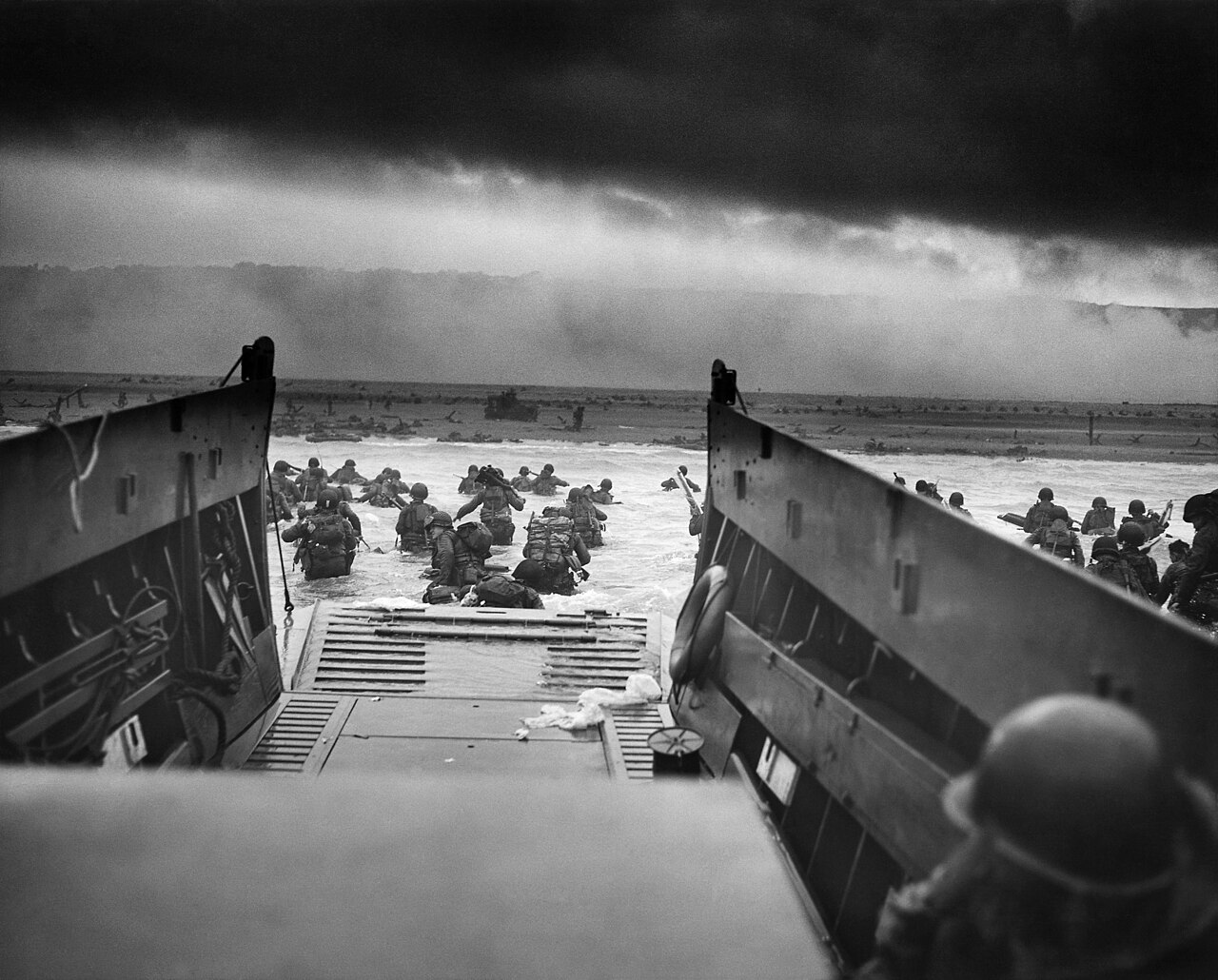
A LCVP (Landing Craft, Vehicle, Personnel) from the U.S. Coast Guard-manned USS Samuel Chase disembarks troops of Company A, 16th Infantry, 1st Infantry Division (the Big Red One) wading onto the Fox Green section of Omaha Beach (Calvados, Basse-Normandie, France) on the morning of June 6, 1944. American soldiers encountered the newly formed German 352nd Division when landing. During the initial landing two-thirds of Company E became casualties. Photo: Chief Photographer's Mate (CPHoM) Robert F. Sargent
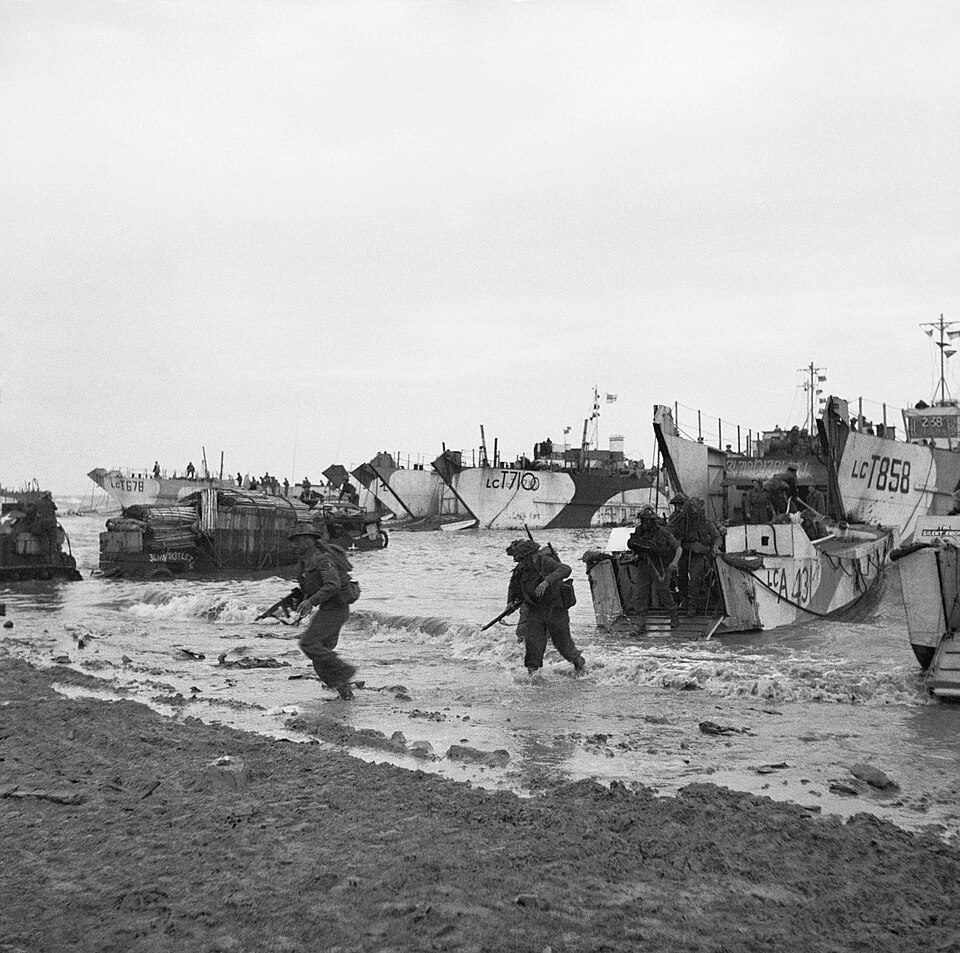
British troops come ashore at Jig Green sector, Gold Beach. Photo: No 5 Army Film & Photographic Unit, Midgley (Sgt).
The Allies were able to establish beachheads at each of the five landing sites on the first day, but Carentan, Saint-Lô, and Bayeux remained in German hands. Caen, a major objective, was not captured until 21 July. Only two of the beaches (Juno and Gold) were linked on the first day, and all five beachheads were not connected until 12 June.
The Normandy landings were the largest seaborne invasion in history, with nearly 5,000 landing and assault craft, 289 escort vessels, and 277 minesweepers participating.[200] Nearly 160,000 troops crossed the English Channel on D-Day, with 875,000 men disembarking by the end of June. Allied casualties on the first day were at least 10,000, with 4,414 confirmed dead and the Germans had 4,000–9,000 casualties (killed, wounded, missing, or captured). The Germans never achieved Hitler's stated aim of "throwing the Allies back into the sea" on D-Day or at any time thereafter.
William Hudson
Sir William Hudson (1896-1978), civil engineer, was born on 27 April 1896 at East Nelson, New Zealand, seventh of eleven children of James Hudson, a medical practitioner from London, and his New Zealand-born wife Beatrice Jane, née Andrew. Dr Hudson kept a tight rein on his family and expected Bill to study medicine. Bill enraged him when, in his matriculation year at Nelson College, he said that he wanted to be a civil engineer. In a classic case of parental misjudgement, the father told the son destined to become a world leader in his profession, 'Bill, that is about all you are bloody well good for'.
In 1914 Hudson left New Zealand to enter University College, University of London. A brilliant student, he won the Archibald Head medal, gained the college diploma with distinction and in 1920 graduated B.Sc.(Eng.) with first-class honours. His studies had been interrupted by service in World War I. A second lieutenant in the London Regiment, he was wounded in the thigh at Bullecourt, France, in April 1917. He emerged from hospital with a slight limp in his right leg, a limp which only became pronounced when he was tired. To further his interest in hydro-electric engineering, he took a postgraduate course at the University of Grenoble, France.
Hudson's first job was with Sir W. G. Armstrong, Whitworth & Co. Ltd, London, but he returned to New Zealand in 1922 to join the Public Works Department as an assistant-engineer. He was initially employed on railway construction and then on the Mangahao hydro-electric scheme. Between 1924 and 1927 he again worked with Armstrong, Whitworth as engineer-in-charge of construction of the Arapuni Dam. At St Columba's Presbyterian Church, Fairlie, on 28 December 1926 he married 21-year-old Annie Eileen Trotter.
In 1928 Hudson crossed the Tasman to work first for the New South Wales Department of Public Works and then for the Sydney Metropolitan Water, Sewerage and Drainage Board. Appointed an assistant-engineer, he later took charge of construction of the Nepean Dam. In 1931 the Depression abruptly halted the project and he found himself unemployed. 'Not a man to remain idle', he moved his family to New Zealand and set off to try his luck in Britain. He was instantly rewarded. Sir Alexander Gibb & Partners offered him the post of engineer-in-charge of construction on the Galloway hydro-electric scheme in a remote corner of south-west Scotland. The largest project of its kind in Britain, the undertaking was challenging and presented, albeit on a minor scale, some of the problems he was to face in the Snowy Mountains of Australia.
Hudson notified his wife of his success in typical fashion—by a telegrammed directive, 'Come to Scotland'. Arriving at Tilbury, England, with a child in hand, she found another summons, 'Can't get away. Come to Galloway'. Husband and wife finally met at a small railway-station in Scotland. The five years he spent on the Galloway scheme (which he completed a year ahead of schedule) enhanced his growing reputation as an efficient and dedicated leader. With J. K. Hunter, he presented a paper on the scheme to the Institution of Civil Engineers in London and won the Telford premium.
Returning to Sydney in 1937, Hudson was again recruited by the water board as resident engineer for the Woronora Dam project. By 1948 he was the board's engineer-in-chief. In the following year he applied for the post of commissioner of the newly established Snowy Mountains Hydro-electric Authority. Nelson Lemmon, the Federal minister for works and housing, was attracted by Hudson's reputation for building dams on time and at fixed prices, and by the opinion of union officials that, although a 'bit of a slavedriver', Hudson was decisive and fair. When cabinet demanded the usual three nominations, Lemmon handed Prime Minister J. B. Chifley a slip of paper which read 'Hudson, Hudson, Hudson'.
Appointed on 1 August 1949, at 53 he reached the pinnacle of his career as manager of the Snowy Mountains scheme, responsible for the biggest civil engineering project ever undertaken in Australia and one which the American Society of Civil Engineers would call an engineering wonder of the world. His starting salary was the princely sum of £5000 a year and he was given considerable powers, including direct access to the responsible minister.
Although classed as a statutory body, the S.M.H.E.A. had, to a substantial degree, the freedom of private enterprise, a necessary concomitant of the great task that lay before Hudson. That task, to be performed in a harsh terrain and climate, was to direct operations which would trap the seaward-flowing waters of the Snowy and Eucumbene rivers and drive them westward through long trans-mountain tunnels to irrigate the dry inland plains. In falling through the tunnel systems, the waters would generate electricity for the Australian Capital Territory, New South Wales and Victoria. Ultimately, the workforce (which peaked at 7300 in 1959) built 16 dams, 7 power stations, 50 miles (80 km) of aqueducts and 90 miles (145 km) of tunnels. Completed in 1974, ahead of schedule, and at a cost close to the 1953-54 estimate of £422 million, the scheme had a generating capacity of 3.74 million kilowatts of hydro-electric power and provided an annual average of 2.36 million megalitres of water for irrigation and other purposes.
To head this vast undertaking, Hudson was the ideal man. While reserved and even shy, he was driven by ambition, and knew how to choose men, how to inspire and how to lead them. Of middle height, lean and sharp featured, he had a full mouth, a prominent nose, bushy eyebrows and alert, steely eyes. He shouldered the responsibility with a crusading zeal which left no doubt that he saw it as the opportunity for which he had waited and prepared all his life.
Engineers and technical staff were in short supply in 1949. Hudson began at once to 'search the world' for skilled workers and found numbers of them in refugee camps in Europe. Two-thirds of all Snowy personnel were to come from overseas. The S.M.H.E.A. employed people of thirty-two nationalities on the job, some of whom had fought against each other in World War II. Hudson imbued them with an esprit de corps by extolling the overriding importance of the project—'You aren't any longer Czechs or Germans, you are men of the Snowy'. He won their respect by taking practical measures for their well-being, by ensuring that they had good pay, food and quarters, by providing housing for their families and by showing concern for their safety. To stir their pride and sense of camaraderie, he kept them informed, published a staff magazine and even promoted a song, Snowy River Roll. Alive to the problems likely to arise with an isolated army of men cut off from normal life, he encouraged sporting activity and camp concerts, and allowed wet canteens.
Hudson loved work and led from the front, showing stamina, drive and extraordinary industry. He toiled seven days a week, with lights shining in his office at Cooma until the early hours of the morning. He rarely took holidays and relaxed, when he felt the need, by bushwalking. There was something evangelical about his approach to the Snowy project, which may help to explain the success of his public-relations programme. People in the media found him pleasant, quiet and direct. Thousands of Australians came on tours arranged by the authority and the 'Snowy' became a household word. The project grew to be a source of national pride, a symbol of the burgeoning Australia of the 1960s.
In 1955 Hudson had been appointed K.B.E.; in 1964 he was elected a fellow of the Royal Society, London. Sir William's tenure as commissioner was extended twice and Menzies promised that he would be allowed to finish the task, provided his health held. Menzies' successor Harold Holt did not honour the pledge and Hudson was retired in 1967, on the eve of his 71st birthday. He moved to the suburb of Garran in Canberra. In 1974 he attended a ceremony to mark the twenty-fifth anniversary of the project which had changed the face of Australia.
Among many distinctions, Hudson received the (W. C.) Kernot memorial medal (1958), the James N. Kirby medal (1962), and the James Cook medal (1966) of the Royal Society of New South Wales. He was elected a fellow (1961) of University College, London, and was a foundation fellow (1975) of the Australian Academy of Technological Sciences. Accorded honorary memberships of the Australasian Institute of Mining and Metallurgy (1961) and of the Institution of Engineers, Australia (1962), he was also an honorary fellow (1967) of the Royal Australian Institute of Architects. He was awarded an honorary LL.D. by the Australian National University (1962) and an honorary D.Eng. by Monash University (1968). The Returned Services League of Australia conferred honorary life membership (1968) on him and the Braille Library of Victoria made him a life governor (1976).
Other countries sought Hudson's guidance on water-control undertakings. He gave advice on the Volta River project in Ghana and assisted the United Nations in deciding what money to allot for similar works elsewhere. The first chairman of the Australian committee of the International Commission on Large Dams, he had attended an executive-conference in Moscow in 1962. Such a man never retires. After leaving the Snowy, he held numerous engineering consultancies and presided over organizations whose concerns ranged from inland development and research into welding to combating drug dependence. He headed the National Safety Council of Australia and the New South Wales Road Safety Council (from 1968), and served as a Commonwealth arbitrator on disputes involving engineering.
Through it all, Hudson never forgot the Snowy. He loved attending meetings of the 'Old Hands'—those who had worked on the scheme from the first year—to whom he was known as 'King Billy' or simply 'the Old Man'. Grimly fighting the pain of arthritis as he grew older, Hudson walked the hills behind Garran every day until illness overtook him. Survived by his wife and two daughters, he died on 12 September 1978 at Red Hill, Canberra, and was buried with Anglican rites in Cooma cemetery, close to the project of which he had been 'the heart, soul and inspiration'.
Eric Sparke, 'Hudson, Sir William (1896–1978)', Australian Dictionary of Biography, National Centre of Biography, Australian National University, https://adb.anu.edu.au/biography/hudson-sir-william-10563/text18763, published first in hardcopy 1996
Superannuation Act 1922-1948.
IN pursuance of the provisions of sub-section (6.) of section 4 of the Superannuation Act 1922-1948, I, Richard Gardiner Casey, the Minister in charge of the Snowy Mountains Hydro-electric Authority, do hereby direct, on the recommendation of the Snowy Mountains Hydro-electric Authority, that the undermentioned employees of the Authority shall be deemed to be employees within the meaning of section 4 of the Superannuation Act 1922-1948:-—
Cecil Ivendrick Gray.
Leslie Robert Gray.
Neale Brian Heal.
John Simpson Murray.
Ian Hunter McRae.
Peter Myles Burton Pope.
R. G. CASEY
Minister in charge of Snowy Mountains Hydro-electric Authority. Superannuation Act 1922-1948. (1950, August 31). Commonwealth of Australia Gazette (National : 1901 - 1973), p. 2182. Retrieved from http://nla.gov.au/nla.news-article232783233