December 1 - 31, 2026: Issue 661


AI inquiry report courts State Sanctioned Theft of Copyrighted work: Still Not yours to take - Cross bench calls for data centres to be powered by 100% additional renewable energy

Artists, writers, media organisations, and the music sector have rallied behind the Not Theirs to Take campaign, stating AI firms must seek permission and pay agreed fees for the use of copyrighted materials. The Australian Recording Industry Association (ARIA) and other groups have rejected proposals that weaken existing copyright protections.

On November 24, 2026, the Joint Select Committee on Artificial Intelligence published 46 recommendations. It has broadly backed welcoming AI companies and infrastructure investment in Australia while urging copyright reforms to consider how rights holders and creators get paid.

However, the model mooted so far has sparked warnings that, just as with the Media Bargaining Code, smaller creatives will be excluded once more and have their work stolen without permission or compensation.

The Joint Select Committee on Artificial Intelligence released its report titled, 'Artificial Intelligence – the Australian way - In our interest. On our terms.' on November 24, making 46 recommendations on issues from datacentres to online safety rules.

In the ''early advice'' Letter of the committee to the Prime Minister dated 12 October 2026, which Independent Senator David Pocock alleged a senior adviser in Prime Minister Anthony Albanese's office edited and pre-vetted, claims of interference o the committee chair, Labor MP Jo Briskey and deputy chair Liberal Senator Jonno Duniam, rejected, while admitting consultation with Mr. Albanese's office, while Duniam stated there was “no guidance, no interference” with the committee’s work, a recommendation for a loosening of Australian copyright, directly reflecting earlier statements made by Prime Minister Albanese: 

2. Copyright

The JSCAI notes that current copyright arrangements are not facilitating licensing deals for Australian culture and content, particularly for Australian-headquartered companies, and that the status quo sees the work of Australian artists, musicians and media outlets used overseas without adequate control or payment. Frontier AI labs indicate existing copyright settings are a barrier to undertaking training in Australia. The JSCAI recommends that the Australian Government examine current copyright settings and prioritise ensuring that Australian creators retain control over how their works are used, that they are paid, and that AI systems reflect Australian values and culture. 

Senator Pocock said the letter ignored key concerns articulated by creatives about the global dangers from any changes to our copyright protections in Australia.

“It also fails to address the urgent need to immediately commence mandatory screening of genetic synthesis imports at all Australian borders,” he said.

“After this, I am increasingly concerned that the work of this committee is being used to serve a political purpose rather than provide genuine parliamentary scrutiny and policy input.

“We’ve seen enough major party stitch-ups. Regaining the community’s trust, especially on the issue of AI requires robust debate and committee work.”

In the report Copyright was listed at No.31-33  of the recommendations in the report, with the majority view of the committee – with some exceptions, including senator David Pocock – recommending the government “strengthen Australia’s copyright protections”, including designing a “mechanism to make it easier and fairer for Australian rights holders and creators to be paid by AI companies training frontier and other large language models in Australia”. 

The Joint Select Committee on Artificial Intelligence (JSCAI) recommendations regarding copyright were:

Recommendation 31: The JSCAI recommends the Australian Government strengthen Australia's copyright protections, including creating a mechanism to make it easier and fairer for Australian rights holders and creators to be paid by AI companies training frontier and other large language models in Australia. This examination should consider the operation of copyright protections globally. Improvements to copyright must also consider how individual rights holders and individual creators receive payment for the use of their work. Further, there should be strong penalties for failure to comply with the law, including breaches of technical protections.

Recommendation 32: The JSCAI recommends that in strengthening Australia's copyright framework that the Australian Government ensure that the value of creative labour is recognised and quantified in the distribution of payment to creative workers in the same way payment to rights holders is.

Recommendation 33: The JSCAI also recommends that the Australian Government ensure improvements to copyright strengthen the protection of Australian creatives against the specific use of generative AI to replicate or re-produce a 'likeness' of their creative work, through inference input or instruction to achieve a commercial gain.

Guardian Australia welcomed recognition by the parliamentary joint standing committee on AI that creatives and news media must retain control of their work and be paid fairly for its use.

In a statement, Danika Johnston, Guardian Australia’s interim managing director, said:

''Guardian Australia welcomes the committee’s recognition that the creative and news media sectors must retain control of their work and be paid fairly when it is used by AI companies.

But payment is not permission. A strong copyright regime preserves the fundamental right of copyright holders to authorise use of their work and negotiate the terms and price, or refuse use altogether. Any scheme that removes that choice would weaken copyright.''

The Australian Recording Industry Association (ARIA) stated it rejects the basis of copyright recommendations in the report of the Joint Select Committee on Artificial Intelligence.

ARIA CEO, Annabelle Herd, said: “The Committee has landed on a series of recommendations that propose wholesale changes to copyright law and the commercial agreements that underpin it. The recommendations appear detached from the strong and repeated evidence of rightsholders.

“We reject the notion expressed in the majority committee report that existing copyright law does not work and that we need a so-called ‘fairer way to ensure creators get paid.’ The notion that basic principles of copyright must be overturned to be ‘easier and fairer’ for rightsholders is paternalistic, disguising future concessions to foreign AI companies as a favour to creators.

“Australian copyright law already gives music rightsholders the ability to sue if an AI company infringes their copyright by training in Australia without a license. Those rights ensure AI companies must come to the table, ask permission and pay an agreed fee. Proposing to weaken the very right that gives creators commercial control and leverage and calling it additional protection is gaslighting,” she said.

“If the Committee wants to address unlawful scraping overseas, it should require AI companies to disclose what they took and help rightsholders enforce their rights. Giving those companies the benefit of a new commercial scheme to allow them to scrape music without explicit permission from rightsholders will no do nothing to recover a cent for illegal overseas theft. It will, however, undermine the growing, global AI music licensing market that will deliver control and value to Australian creators.

“Offshore infringement is an enforcement issue. It is being addressed in the jurisdictions where the illegal copying took place. There are currently more than 160 cases in the United States and other markets where AI companies are being sued for copyright infringement,” Ms Herd continued.

“Piracy on a mass scale in another jurisdiction is not a reason to legalise unlicensed copying in Australia. Domestic investment should be built through voluntary licences that preserve permission, market value, and territorial rights.

“Copyright owners have asked again and again for government to make AI companies come to the negotiating table. The Parliament must not overturn centuries of copyright law on the fallacy that the law doesn’t work. Polling has been unequivocal: Australians do not want this. The world’s creative community has been vocal: their work is not Australia’s to give away to American big tech. The Government must rule out any scheme that allows an AI developer to train on any type of copyright content without the rightsholder’s explicit prior permission,” she said.

ARIA thanks Senator David Pocock for his dissenting report issued today which puts the interest of creators and rightsholders first.' the statement closes

News Corp’s executive chair, Michael Miller, said in a statement that he wanted to see more detail on the ideas raised, and that:

''Encouraging commercial deals sounds right, but the report lacks the detail needed to give rights holders confidence they can set their own terms of trade and receive fair payment.

Any framework that lets trillion-dollar AI platforms scrape content without voluntary agreements isn’t innovation - it’s state-sanctioned theft.''

AI companies have argued it is ''too difficult'' to make individual licensing deals under existing copyright law, although their capacity for charging for it - to hundreds of millions of individuals - would indicate they can. 

AI companies have stated they need legal certainty on the copyright issue before investing and training models in Australia, with Anthropic putting forward an “opt-out” model to scrape creative works unless a rights holder objected.

Creatives and the media industry have stated it should be an 'opt-in' model, not the free-for-all having to 'opt-out' of having AI break into your home and steal everything infers.

In a 69-page dissenting report to the Joint Select Committee on Artificial Intelligence (AI), ACT Independent Senator David Pocock has set out the evidence presented to the inquiry for legislating more stringent safeguards and concrete mechanisms to capture long-term benefit in the face of multi-faceted AI risks and opportunities, and pushed back on proposals to change copyright laws to suit big tech.

Senator Pocock said the “bipartisan approach” adopted by the major parties puts the interests of multi-trillion foreign AI companies ahead of the best interests of Australians: an approach he said also risks repeating mistakes of times past. Senator Pocock said the Committee’s view and recommendations were in some cases completely silent, or in others insufficiently strong, on key issues of fundamental concern to people in the community.

“Labor and the Coalition seem hellbent on facilitating data centre investment and frontier training by multi-trillion dollar American AI companies. It would be totally negligent to do so by selling our creatives out and not having appropriate safeguards in place and due consideration to protecting our communities forced to live with the consequences,” Senator Pocock said.

“I’m really concerned that the major parties are not taking the risks of AI seriously, focusing too much on vaguely articulated benefits, opportunities and unrealistic promises of ‘leverage’. 

“We need to be making decisions that are good for Australians over the long term and ensure we don’t repeat the mistakes of the past by rushing for the investment sugar hit and short-term economic gains. These decisions must be based on hard evidence, not abstract or empty promises, enticing words, hype, or even hope.

“Australians are already losing their jobs to AI and are already shouldering the cost of data centre development, from increasing pressure on inflation and the interest rate rises that follow, to increased home building costs and decreased new housing supply at a time when we desperately need it. 

“If we don’t get the settings right those impacts have the potential to get much worse flowing through to power prices, gas prices, diesel prices, fuel security, higher emissions, pressure on drinking water supply and more people unemployed for longer.” 

Across 20 recommendations, Senator Pocock proposes measures to: legislate an overarching National AI Safety Act, consistent with jurisdictions like California and the EU; audit existing legislation for gaps, establish a statutory Expert Council on AI; strengthen weaknesses in the corporate taxation system; build and invest in true sovereign AI capability; adequately resource the new AI Safety Regulator; deepen global cooperation on AI safety; classify cybersecurity as a national security threat; directly invest more in upskilling and retraining workers displaced by AI; monitor the impact of AI on learning and cognitive function; and strengthen the Committee’s recommendations around data transparency, mandatory incident reporting, automated decision making, AI labelling, banning deepfakes in elections, protecting copyright of your own image - consistent with the private Senator’s bill he introduced in December last year. 

On data centres Senator Pocock called to legislate a 5% levy on data centre revenue and stringent rules with a pause on all data centre approvals until they are in place. This includes prohibiting gas from being used as a primary power source; minimising the use of diesel back up generators and stopping them from claiming the fuel tax credit, ensuring companies can’t game rules requiring net additional renewable energy, mandating genuine community consultation and preserving a role for local government decision making among other safeguards. He argues that transitional arrangements are needed so that the above rules capture data centres already in construction and/or operation. 

On copyright, Senator Pocock called on the government to: refrain from making any changes to existing Copyright Law; focus on enforcing existing protections; and facilitate licencing deals. He said the government should not make any changes to copyright law without full public consultation, the consent of the majority of rightsholders, and without undertaking extensive analysis and modelling about any potential impacts on the global copyright ecosystem.

“Australia must not become the copyright equivalent of the Cayman Islands,” Senator Pocock said. 

“These trillion-dollar technology companies have figured out how to charge for their product, now they can figure out how to pay the people whose work they stole to train on and livelihoods they have undermined.”

“Fierce lobbying efforts have sought to misrepresent and drown out the voices of Australia’s artists, actors, musicians, authors, journalists and other creatives. We must push back against the false narratives that have been created.”

Senator Pocock also raised concerns about AI’s long term impact on cognitive function, critical thinking, learning outcomes and what makes us human.

“We cannot allow AI to rob us and future generations of our fundamental humanity, of our ability to think critically, to create and, critically, to fail. Otherwise we risk it being just the machines that are capable of 'deep learning'.”

While not opposed to hosting frontier training, Senator Pocock was dubious about the leverage, access and control simply hosting them in Australia would confer and noted Anthropic’s evidence that frontier access would continue regardless of training arrangements.

Senator Pocock also raised concerns about Australia putting all its eggs in one American basket and failing to invest sufficiently in sovereign capability saying the pace at which BYD has overtaken Tesla as the world’s biggest seller of electric vehicles should serve as a cautionary tale for the Australian Government. 

The full report and dissenting report is available to read here.

Albanese government must protect political cartoonists from AI exploitation

Political cartooning is one of the oldest and most powerful methods of holding power to account. But as AI companies increasingly reproduce and exploit artists' work, the future of political cartooning is under threat.

Community Strong MP Zali Steggall on Monday November 23 2026 called on the Albanese government to protect the industry from AI, saying the work of political cartoonists should not be used to train and generate AI images without their permission or compensation.  

Warringah MP Steggall joined leading Australian political cartoonists and other crossbenchers at Parliament House on Monday. It comes as the Albanese Government prepares its omnibus AI Bill, and faces intense pressure to establish strong rules for AI companies using Australian creative work.

Ms Steggall said political cartoonists were vital to a healthy democracy. “They question those in power, highlight absurdity, deflate egos and give the public new ways to understand complex political debates,” Steggall said. "If news organisations stop employing cartoonists and replace their work with AI images, the standard of political discourse will suffer immensely.”

She called on the Albanese Government to give all Australian creatives, including political cartoonists, strong copyright protections and ensure artists have control over how their work is used. "That means consent, fair payment and transparency about what AI companies are taking and using. Anything else is theft," Steggall said.

Some Australian news outlets are already using AI-generated illustrations, raising concerns about the impact on artist employment and the low quality of cartoons produced by AI.

Overseas, AI-generated cartoons have copied the style of The New Yorker and even carried the signatures of real cartoonists who never created them. Other artists have had their work reproduced using AI without their permission.

Australian Cartoonist of the Year Cathy Wilcox said the AI threat meant she and her colleagues faced wholesale theft of their intellectual property and creative work.

“You wouldn’t just walk into a shop and take something because paying for it was too difficult. So why should tech companies be allowed to take artists’ work without permission or compensation?” she said. “Our work is our property. It has value, and we have the right to decide how it is used. The idea that artists should have to opt out rather than be consulted is ridiculous.”

Cartoonist and children's book author Eleri Harris said: “our creativity, our art, our cartoons, our intellectual property - they are not the government's to just give away. They're ours and we would like protection for that because our careers depend on it.”

Australian comic artists and cartoonists—led by creators Jessica Harwood and Eleri Harris—launched an open letter in late November 2026 urging the Australian Government and Arts Minister Tony Burke to protect copyright and reject AI training exemptions. Senator David Pocock agreed to table the letter in Parliament and did so on Friday November 27 2026 in the Australian Senate.

The open letter reads:

Dear Members of the Australian Parliament,

We are writing to you as representatives of the Australian cartoonist and comic art communities who have contributed to the cultural fabric of Australia for decades.

We are shocked that the Government is considering altering Australian copyright laws to permit Artificial Intelligence (AI) companies to use Australian art to train their AI models at their request.

Our art, our comics, our copyright is not the Government’s to give away.

Especially not to companies whose fundamental business model is to take, reproduce and profit from human artistic works, destroying creative industries in the process. Our Prime Minister has said, “not everything produced in Australia is up for grabs” and that “No company should use Australian books, music, art or news to build or train AI without the artist’s control.” We hold him to this statement.

Australia's world leading copyright laws have long protected our artists and made extensive, fruitful careers possible. We should not be watering down these laws in fear of being “left behind”. Allowing the artistic works of Australians to be scraped does not guarantee any benefit to our nation, only the shareholders of international companies.

This isn’t just about the wholesale and indiscriminate theft of intellectual property, it’s about the loss of jobs and source of income for artists; the devaluing of human creativity and ingenuity; the dumbing down of discourse and culture; as well as the catastrophic societal and climate implications from the proliferation of data centres. We call on the Australian Government to protect Australian artists from the multi-pronged threat of AI.

We already know that Australian artists have had their art scraped by AI language models without their permission, including prominent indigenous publisher Magabala Books, who support first nations cartoonists and comic artists. The opt out model for AI scraping creates complexity and confusion to the process as well being potentially exclusionary for older and vulnerable artists.

We are also dismayed to hear of the Government proposal to carve out a deal for select varieties of artists, ie those who create music. It doesn’t matter the material you use or the practice you engage in, Australian creatives and their works deserve strong copyright protection in the international arena.

Don’t capitulate to big tech. We are an artistic powerhouse of a nation, always punching well above our weight in the international arena, and our copyright laws should reflect this.

Not Theirs to Take

Pittwater Online News is a community news service, it is For, About and By the community of Pittwater, it runs news that is happening here or that will impact the people here if originating from further afield. Pittwater Online News runs community Notices and reports that focus on honouring and celebrating this community, the PON crew attend community events to make records, and take photos which are offered for free to community members, so they may keep a high res picture for their own family albums - but these are not for commercial use by others - that has always been made 100% clear. 

When others steal, without permission, credit or payment, these images, reports and ideas, they are doing so to make money from them - to attract 'hits' to pages that are loaded with advertisement. 

As 100% of any income Pittwater Online News generates is put back into the community, and the costs of running the news service are met by the proprietors, each and every time someone steals from Pittwater Online News without seeking permission or making a payment, theft from the community is taking place. They are breaking into a private home and stealing what is there.

They know where they have sourced those materials and copyrighted items from - so why haven't they asked for permission, why haven't they asked where to direct the fee for usage of same and agreed to a 'once-only' use as that item is copyrighted?

Why?: because; a) they want to make money from it without incurring any cost for the same; and b) they don't want to give any attention to a little local news service that may view itself as just an electronic Noticeboard, but c) still publishes 'just the facts' without the spin and is d) a known preferred source of news and service. You wouldn't that becoming 'common knowledge', more so as there's no paywall here.

Why is this the approach?; because all others are treated with contempt as the first, last and always 'policy' by those thieves.

These photos haven't appeared anywhere else until stolen because no one else turned up to take them. 

These news reports, these history pages, these pictorials haven't appeared anywhere else prior to PON running them because no one else was spending months doing the research to find, collect and collate those records, no one was recording those who spoke, or reading the whole 10 thousand page report and pulling out the deeply embedded obscured in wordform key points to run a 'facts only' report. 

Why spend 3 days putting a report or Profile together when you can spend 3 minutes lifting it from Pittwater Online News and simply remove the name of who did the work and insert your own - surrounded by advertisements? Why chase facts when you can spend all that time chasing money?

Just as with the 'media bargaining code' it will be Pittwater Online News and this community that will be excluded from any 'deal' and this community that will miss out as a result. That was the Coalition's version of state sanctioned theft of our work. This new version, a complete ignoring of the fact that it's Not Theirs to Take by both the Labor-Coalition federal poltical parties supporting this theft, comes once more with a price tag of selling us all out, completely, again. 

Staff will have to spend time, energy and money ensuring the news services assets are placed in the 'opt out' basket and then monitor where they turn up anyway - without permission, certainly without credit - and always without payment that can be directed back into the community - into saving wildlife, into paying for mental health workshops, into paying for surf lifesaving equipment, into paying for environmental rehabilitation projects, into training the next generation of aspiring journalists - into a list of recipients, local organisations and charities too long for this report. 

The committee’s findings are not official government policy, although these were framed by the government throughout the process, according to Senator Pocock. Thus they will inform the package of AI legislation scheduled to be tabled by Labor early in 2027.

At this stage the government is signalling an intention to AI that they welcome the theft of what is not the Australian Government's either - it's not yours to take.

If you want to support your local creatives; Musicians. Writers. Journalists. Photographers. Artists. Sound engineers. Producers. Broadcasters. Filmmakers. Publishers. Printers. Equipment suppliers. Venue workers. Chefs. etc. etc. etc., sign the petition here: nottheirstotake.com.au and use the form lower the page to send a letter to your federal MP.


Crossbench calls for data centres to be powered by 100% additional renewable energy

Crossbench Letter to PM, November 16 2026: (PDF 228kb)

Cold comfort on copyright for Australian creatives in new AI committee report

A person with orange nail polish writing on a computer.
Breakingpic/Pexels, CC BY-NC-ND
Alice Grundy, Australian National University

Australian artists will not find reassurance in the report, published today, from the Joint Select Committee on Artificial Intelligence.

The report, titled Artificial Intelligence – the Australian way, has 46 recommendations. It broadly supports the Australian government in welcoming AI companies to operate in Australia, train large language models (LLMs) on Australian content and “invest” in infrastructure. (This last point likely means building more data centres here.)

The report recommends that changes to copyright law must “consider how individual rights holders and individual creators receive payment for the use of their work”. But it doesn’t recognise the existing wholesale harvesting of Australian content for AI models. And it doesn’t adequately address the problematic use of First Nations culture by big tech.

Rights holders will be pleased to see a few recommendations in the report. One is for transparency from AI companies on their use of Australian content, which would represent a big change. Currently, creators generally cannot tell how their work has been used.

Another recommendation is for artists to be paid if their work is used by someone else for commercial gain.

A third recommendation artists will welcome is “strong penalties for failure to comply with the law, including breaches of technical protections”. This means there would be consequences for companies that fail to comply with copyright law.

But will these frameworks be overruled by competing demands – such as the economic gains or “sovereign capability” highlighted elsewhere in the report?

Another component that may unsettle copyright holders is the recommendation that “frontier AI companies” be given “the certainty necessary to train their AI models in Australia” (albeit, “in a way that reflects Australian values and culture”).

Every other copyright recommendation, however promising it may sound, needs to be read in the context of this recommendation.

Copyright changes

The report includes a chapter on copyright. It has several recommendations on revisions to copyright law and managing the relationship involved in AI training locally on Australian content – between the rights holders who made the work and the AI companies who use the work.

Australian copyright law is automatic: as soon as an artist creates a work, they have copyright. Payments from the Copyright Agency are a key component of artist income. The use of Australian content by AI models to create new work endangers artists’ livelihoods, while allowing big tech to profit without paying their share.

As it stands, training on Australian content in overseas data centres does not result in remuneration for Australian artists. But it does create the opportunity for AI users to replicate Australian content and potentially profit from it.

The committee recommends when making changes to copyright, the government should ensure creative workers are paid in the same way rights holders are.

A laptop, a bookshelf, a world map
Australian copyright law is automatic: as soon as an artist creates a work, they have copyright. Mike Swigunski/Unsplash

The report recommends the government “incentivise commercial deals between large rights holders and collective agencies”. This would mean artists could be paid – by large rights holders like publishers, record labels or collective agencies such as the Copyright Agency – for work used to train AI.

But a concern with this sort of model is that many smaller creators may miss out in negotiations.

Further, the idea the government would need to “incentivise deals” is like saying the government should subsidise foreign building companies by giving them bricks.

This report does not address the existing use of Australian content to train AI models around the world. When looking to the future, it recommends:

creating a mechanism to make it easier and fairer for Australian rights holders and creators to be paid by AI companies training frontier and other large language models in Australia.

Pocock: Australia at risk

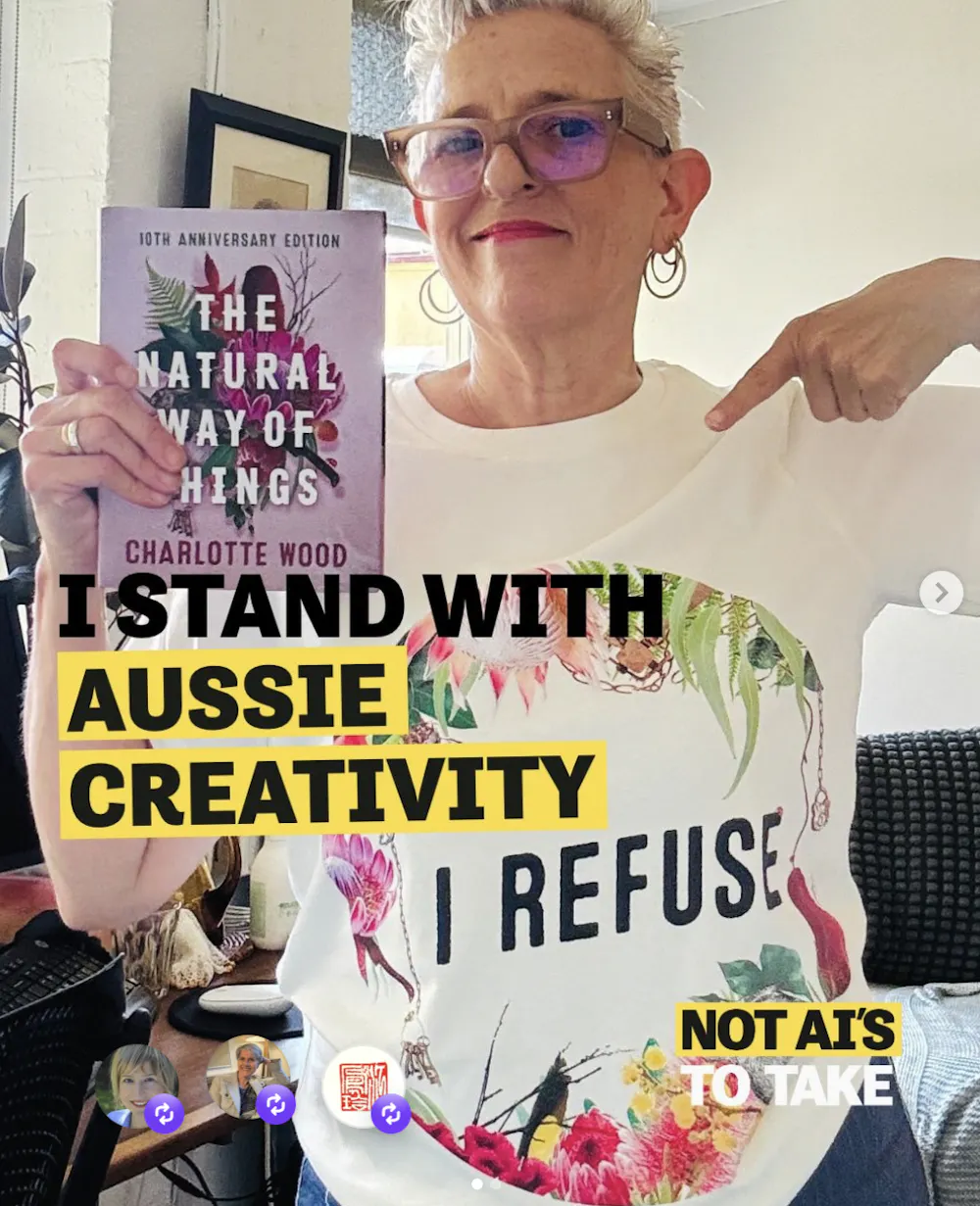
Australian author Charlotte Wood this week called out AI companies for “demanding that our Labor government greenlight the greatest wage theft in history”, while causing harm to the environment and democracies.

A woman holding a book behind text: 'I STAND WITH AUSSIE CREATIVITY. NOT AI'S TO TAKE.'
Charlotte Wood has called out AI companies for ‘wage theft’. Instagram

She’s one of many Australian writers taking part in a new campaign, Not Theirs to Take. It argues for the protection of Australia’s creative and media sector, which it says contributes $70.3 billion to the Australian economy and employs almost 600,000 workers.

A central message of the campaign is: “AI companies should not be able to use Australian creative work without permission and agreed payment.”

In a dissenting report to the Senate committee report, committee member and ACT Senator David Pocock addressed a range of concerns, including data centres and copyright.

On copyright, he called on the government to:

  • refrain from making any changes to existing copyright law
  • focus on enforcing existing protections
  • facilitate licensing deals.

If Australia creates conditions that are more relaxed than other jurisdictions, he says the country is at risk of becoming the “the copyright equivalent of the Cayman Islands”.

First Nations data sovereignty

The report’s chapter on copyright and First Nations data sovereignty is concerning.

Given the existing use of First Nations content to train AI models around the world, a recommendation for the government to “include consideration of the protection of the cultural authority of Australia’s Aboriginal and Torres Strait Islanders” rings hollow.

With the track record of these companies, does anyone really believe they will consult with all the different leaders from different language groups and peoples around Australia?

Organisations such as the National Library of Australia have been undertaking extensive programs to develop Indigenous cultural and intellectual property protocols. The work is time-consuming and highly laborious. It does not align with the economic imperatives driving big tech.

What economic gains?

In a broader sense, the report recommends the government “develop and implement whole-of-government procurement and adoption policies that leverage Commonwealth purchasing power to stimulate investment in Australian AI capabilities”.

In other words, it recommends government should spend on AI to encourage more AI companies to operate in Australia.

However, Australia has a poor track record of receiving adequate return on its resources. Journalists and advocates have raised concerns that incorporating AI into government processes without adequate guardrails creates risks equivalent to those from the Robodebt scandal.

In another chapter on sovereign capabilities, the report addresses data centres, energy and “sharing the economic gains”. The economic gains remain to be seen.

Companies have laid off staff and the recent Anthropic IPO has created some new billionaires – but the economic benefits to society as a whole are yet to manifest.

Australian art cannot be made anywhere else. This includes Australian writing. Yes, the arts contribute economically, but they are also critical social infrastructure.

Allowing the continued use of Australian art and writing by foreign big tech companies, without remuneration for the work they have already used to train AI models, will only make it even harder for local creatives to be fairly rewarded.The Conversation

Alice Grundy, Visiting Fellow, School of Literature, Language and Linguistics, Australian National University

This article is republished from The Conversation under a Creative Commons license. Read the original article.

Senator David Pocock states in his dissenting report - re; copyright of Australian's works:

The committee declined to incorporate some of the evidence about the ideology of some in Silicon Valley and people involved in AI companies. I think it's important for us to keep this in mind when looking at this technology and how Australia should regulate it.

International bestselling author and former senior counsel in the Office of International Law within the Commonwealth Attorney-General's Department, Professor Anna Funder, told the committee:

We must be very clear that the values of Silicon Valley are not democratic values. Big tech is against regulation and laws that protect people so that vast fortunes can be amassed, little tax paid, serious social consequences ignored and, as here, their supplies stolen with impunity. Australia is not terra nullius for American tech.[25]

Digital Rights Watch warned in their submission that 'AI, as rolled out by hyperscale AI corporations, is a technology to serve the hyperscale AI corporations and their billionaire owners . It is they who will reap the benefits, while the harms are felt by the rest of us'.[26] The Australian Council of Trade Unions warned the committee that, 'big decisions over our AI-infused future economy must not be left to a small number of powerful tech companies located overseas'.[27]

Bestselling author and award-winning reporter covering artificial intelligence, Karen Hao, after years investigating and reporting on AI, says:

Over the years, I've found only one metaphor that encapsulates the nature of what these AI power players are: empires. During the long era of European colonialism, empires seized and extracted resources that were not their own and exploited the labor of the people they subjugated to mine, cultivate, and refine those resources for the empires' enrichment … They justified their quest for power by the need to compete with other empires: In an arms race, all bets are off. All this ultimately served to entrench each empire's power and to drive its expansion and progress. In the simplest terms, empires amassed extraordinary riches across space and time, through imposing a colonial world order, at great expense to everyone else.[28]

What Karen's investigation into OpenAI's meteoric rise clearly shows is that this is a company wanting to be first at any cost, sidelining serious concerns around safety by their own staff in the process.

At the same time as the Australian Government courts investment from OpenAI, California's government is suing them 'alleging the company misled and endangered the public by knowingly developing and testing advanced artificial intelligence (AI) models without the safeguards and monitoring necessary to adequately protect the public'.[29]

The culture of tech exceptionalism that has been allowed to flourish in our government, our parliament and across some senior leaders in the Australian Public Service leadership, must end.

The debate over artificial intelligence is often cast as the 'doomers' versus the 'boosters'. We need to be making decisions that are good for Australians over the long term and ensure we don't repeat the mistakes of the past by rushing for the investment and short-term economic gains. I've heard loud and clear from people I represent that they expect policy makers to ensure we maximise genuine benefits, while at the same time safeguard against the risks and stand up to big tech. This position must be based on hard evidence, not abstract or empty promises, enticing words, hype, or even hope. We can not make major policy decisions based 'on the vibe of the thing' or in a confected rush that if we don't act now we will miss out.

As Karen Hao goes on to say,

There is a different way forward. Artificial intelligence doesn't have to be what it is today. We don't need to accept the logic of unprecedented scale and consumption to achieve advancement and progress. So much of what our society actually needs - better health care and education, clean air and clean water, a faster transition away from fossil fuels - can be assisted and advanced with, and sometimes even necessitates, significantly smaller AI models and a diversity of other approaches. AI alone won't be enough, either: We'll also need more social cohesion and global cooperation, some of the very things being challenged by the existing vision of AI development.[30]

In the face of tech oligarchs, supine leaders and technology that carries existential risks, we have a huge challenge to hang on to what makes us human, what truly matters, and how we protect the land that sustains us as we navigate the months and years ahead.

This is a challenge that requires very clear, human eyes, wisdom and the courage to chart our own course forward.

Protecting Australian creatives

Nowhere is this more apparent than in the debate over copyright.

First the argument from the American frontier labs was that they required greater 'legal certainty' around Australia's copyright laws if they were to undertake frontier model training here.

These are laws that have operated successfully for decades as part of a global copyright system. Any legal uncertainty has, arguably, been created by a failure of these companies to negotiate, seek consent and pay for the use of creatives' work. As a result, more than 160 copyright lawsuits have been filed against AI companies in the United States.

This is presumably also why the Productivity Commission recommended in its Harnessing data and digital technology inquiry report (Recommendation 2.1) that:

The Australian Government should monitor the development of AI and its interaction with copyright holders over the next three years. It should monitor the following areas:

    • licensing markets for open web materials
    • the effect of AI on creative incomes generated by copyright royalties
    • how overseas courts set limits to AI-related copyright exceptions, especially fair use.

If after three years the monitoring program shows that these issues have not resolved, the government could establish an Independent Review of Australian copyright settings and the impact of AI. The Review's scope could include, but not be limited to, consideration of whether:

    • copyright settings continue to be a barrier to the use of open material in AI training, and if so whether changes to copyright law could reduce these barriers
    • copyright continues to be the appropriate vehicle to incentivise creation of new works and if not, what alternatives could be pursued.[31]

We cannot afford to rush into changes to copyright and serious consideration must be given to the risks of making any changes to Australia's existing copyright laws, not just to our own creatives but globally.

We cannot allow Australia to become the copyright equivalent of the Cayman Islands.

As former Australian Competition and Consumer Commission Chair Rod Sims AO has warned, our government risks turning Australia into a copyright 'tax haven', also calling the suggestion that our copyright laws are somehow out of step with other countries 'a myth'.[32]

Ms Josephine Johnston, Chief Executive Officer of the Copyright Agency, told the committee Australia was at risk of being turned into 'the data-laundering centre of the world'. She told the committee, 'We must be cautious not to adopt any framework where laws that are uncomfortable or difficult or a little uncertain somewhere else miraculously get wiped clean in Australia...There is no justification for allowing it, because there is an available existing licensing pathway'.[33]

As the architect of the News Media Bargaining Incentive, Mr Sims knows that big companies can be made to pay for content and I believe that's what needs to happen here.

This was echoed in evidence from Ms Annabelle Herd, Chief Executive Officer of the Australian Recording Industry Association (ARIA) and Phonographic Performance Company of Australia (PPCA), who told the committee:

Around the world, major AI and tech companies like Spotify, Udio and ElevenLabs are entering into licensing arrangements with rights holders now, and music is easy to license at scale. We have efficient and sophisticated global frameworks that license music across all digital platforms around the world. You can license 90 per cent of the world's sound recordings with four global deals, one with each major label and one with Merlin, which represents independent labels. Even the smallest self-releasing artists in Australia license their music to Spotify and TikTok within this framework'.

But we are being asked to believe it is too hard for the world's smartest and richest companies. There is clearly no market failure - just two foreign companies, each valued at over $1 trillion, asking government for a free ride.[34]

This was a point reinforced by UNSW Laureate Fellow and Scientia Professor of Artificial Intelligence Toby Walsh who told the committee:

They can't claim to be a trillion-dollar industry that can't make nine phone calls. You've got lawyers that can cut deals. They are not short of money; they could pay for this stuff. They could get legal certainty.[35]

Even the Commonwealth Bank of Australia has shown licensing under existing laws can work:

... CBA recently became the first major Australian bank to sign a Copyright Agency Business Licence, allowing our people to use eligible Australian news content in prompts for approved workplace AI tools.[36]

And it stands in stark contrast to the claims made by big tech companies, notably Google's Head of IP and Media Policy, Mrs Roxanne Carter who claimed that:

If that is really the obligation, just a conservative estimate on the back of a napkin would show that to train a medium-sized large language model would take us around 200 years to be able to get the necessary authorisation.[37]

When the committee Chair put this to publishers at a subsequent public hearing, their response was categorical:

Ms Louise Stark (CEO, Hachette Australia): That is absolute nonsense.

Ms Lucy Hayward (CEO, Australian Society of Authors): Can I address that? These companies have managed to develop seamless systems to individually contract with millions of users around the world - to Louise's point - to charge subscription fees to use their tools. They obviously understand how to license on a large scale. They now can turn their attention to figuring out how to streamline permission and payment from their essential suppliers.[38]

In other words, if you can figure out how to charge for it, then you should also be able to figure out how to pay for it.

Second was the argument, taken up by some members of the committee, that existing copyright laws require 'strengthening' because they are 'not working' currently for Australian creatives who are not being compensated for, or having control, over the use of their work in artificial intelligence training or other settings.

Strikingly however, this argument to change our existing copyright laws is not being made by the vast majority of Australian artists, authors, journalists, musicians and other creatives. Quite the opposite. To again quote Ms Herd:


This concept that the status quo isn't working is being used as an argument by AI companies to change our copyright law. You don't address a systemic problem of mass piracy by changing the law to legalise that piracy on an ongoing basis.[39]


1.60This was reinforced by the Australian Writers' Guild who said in their submission:


Our view has always been that Australian copyright laws, to the extent that they deal with copyright infringement, are fit for purpose. The problem is that foreign tech companies have flaunted those laws without penalty. Australian creative workers are unable to afford legal action against the likes of Google, Meta and Amazon. This is purely a problem of resource rather than a flaw of our legal system that needs to be fixed with new laws. It is the enforcement of existing copyright laws that should be Government's priority. [emphasis added][40]


1.61So many other witnesses echoed this assessment. The problem is – clearly – one of enforcement, not the adequacy of the existing laws themselves. And Australian creatives and their representatives simply are not resourced to take on these multibillion dollar American AI companies to enforce their rights. It is this enforcement that should be the focus of the Albanese Government, as the old adage goes, if it ain't broke, don't fix it. And our laws aren't broken.


1.62As Ms Lucy Hayward, CEO of the Australian Society of Authors told the committee:


If AI developers' business model relies on breaking our laws, then there is something wrong with the business model.


The government is not powerless to address the offshore problem. Do not water down our copyright laws with an opt-out scheme or otherwise. Instead, uphold, enforce and reinforce our copyright law.[41]


1.63The lack of resourcing and power imbalance was highlighted by Screenrights Australia CEO James Dickinson:


I think one way to consider that question is that—and this touches on a question in the previous session—there is no uncertainty about Australian copyright law at the moment. At one level, in a legal sense, they have the capacity to enforce and exercise their rights now. It's more a question of commercial power and the ability to do so. There's obviously a very clear imbalance in that market power with these large multinational corporations versus increasingly smaller organisations.[42]


1.64Perhaps the most compelling articulation of this issue came from award-winning Australian author Dr Anna Funder, who told the committee:


'Training' is the tech euphemism for theft. Copyright makes training illegal because theft is illegal. Training is the process by which copyright works are illegally scanned or downloaded into AI computer programs.[43]


1.65And the consequences of making changes to our copyright lawyer are dire. Succinctly captured by Ms Herd when she warned the committee:


Australia's artists will be the roadkill in the rush to this AI deal.[44]


1.66Committee colleague and Nationals Senator Ross Caddell asked insightful questions that go to the heart of the broader implications of potential copyright changes at our final public hearing saying:


As the Luddite, I sit here and look at the effect that the social media platforms have had on our news articles - on regional journalism and on investigative journalism. It has an effect on democracy. I think our democracy is less without really effective journalism and money going there... What is the greater effect of us losing copyright and losing intellectual property rights and journalism becoming less attractive again? What is the effect on democracy? What is the cost? These are the prices. We need to see the ledger.[45]


1.67An analysis of submissions (refer Appendix B) is telling, and shows the clear divide that has emerged between those wanting change to our copyright laws (and who stand to benefit commercially) and those who do not, wanting their work protected or at the very least an opt-in rather than opt-out model.


1.68Multiple witnesses provided evidence that some form of copyright reform that involves an 'opt-out' model simply will not work. Screen Producers Australia (SPA) categorically state that, 'opt-out mechanisms for consent to the ingestion of copyrighted material for generative artificial intelligence (AI) purposes are not workable'.[46]


1.69A joint submission signed by Screen Producers Australia, Australian Recording Industry Association, Australasian Performing Right Association and Australasian Mechanical Copyright Owners Society, Copyright Agency Limited, Australian Society of Authors (ASA), Australian Writers' Guild, Australian Broadcasting Corporation, Special Broadcasting Service, Nine Entertainment Co. and News Corp Australia, Guardian Australia, and Free TV states:


We oppose measures that will shift the burden onto rightsholders to take active steps to protect their property rights. The burden should be on AI companies to seek permission, utilising their technology to identify the works they want to use and find the rightsholder to negotiate access.


Any framework that requires rightsholders to actively opt out of AI training creates an unreasonable burden. Rightsholders' works can be distributed and available across numerous platforms which the rightsholders may not have control over. There is no clear or reliable mechanism through which opt out instructions can be effectively transmitted to, and recognised by, web-scraping bots.[47]


1.70In an address that was as eloquent as it was direct at this year's ARIA Awards, comedian, actor, composer, songwriter, pianist and director Tim Minchin AM got to the heart of why this copyright debate has raged so fiercely and why getting it right matters so much. Because creatives capture our humanness, and that is priceless and not something that should ever be traded away.


Art is not just content; it's content plus intent.


Art is an offer made by a human struggling to reflect the experience of being human for the sake of other humans. And at the heart of what makes our art singular, unique, are our limitations.


Because our work, the music we make, is not just a result of our influences; it's born of what we've not listened to.


It isn't just the sum total of our excellence and craft. It is just as much a result of our flaws.


As much as anything, our music is a reflection of our imperfections, our self-doubt and self-loathing.


It's the endless hours. It's our shitty, fucked-up, striving, stumbling, needy, petty, hopeful, heartfelt, fucking humanness.


Art is the way we reach out to one another, and it is defined and made beautiful by the glorious messiness of its human creators.


This will only remain true if we assert it as true and act accordingly.[48]


1.71The third and final argument around changing copyright, also taken up by some members of the committee and multiple government departments, is that the only way to have 'leverage' (to presumably assert such control and payment) was to host frontier training here in Australia. Much effort appears to have been invested in generating a narrative that if we don't act now, we will miss out on some $200 billion in data centre investment and other 'benefits'. As former industry Minister Ed Husic recently put it, 'I am worried that we are attracted to the lure of a late night TV commercial: 'Act now or you will miss out'.[49]


1.72The scale of the potential investment is undeniably large. But even this comes with risk. I will discuss the specific energy and environmental risks of data centres in the next section. For now let us consider the impact they are having on an already stubborn inflation challenge and well in advancing any large-scale productivity gains. As the RBA's November 2026 Statement on Monetary Policy says, 'Strong AI-related investment activity could also push up input costs by more than expected, both directly and by adding to capacity pressures'.[50]


1.73Interrogating this even further, it's clear that despite the rhetoric around 'missing out', large scale investment in Australia continues, even without changes to our copyright laws. Notably, Anthropic's announcement of a $32 billion deal to anchor the proposed Western Downs Digital Park data centre hub in Queensland.[51] Amazon AWS announced a $20 billion investment over five years and Microsoft has announced $25 billion. Deloitte's November 2026 Investment Monitor identifies 37 data centre projects worth $141 billion.[52] That's hardly 'missing out'.


1.74When pressed, the AI labs are cagey at best about quantifying other benefits. Anthropic would not quantify how many researchers and technical experts would be based here, saying only, 'We are confident that we will bring existing researchers to Australia, and hire researchers in Australia, if we can undertake training here. Training-scale investment is more durable than inference capacity alone, and it would open up research capability and different types of jobs'.[53]


1.75Concerns have also been raised about the potential taxpayer liability. Allowing AI companies to use copyrighted material without permission could undermine creators' licensing income and trigger challenges under the Constitution's requirement for acquisition of property on just terms. Anthropic's Bartz settlement, totalling US$1.5 billion, creates a precedent Australian lawmakers need to properly explore and model. Figures cited in the media show a 2 per cent recovery assumption to extrapolated US claims, assuming equivalent claims fall on Australia, would trigger an immediate AUD$11 billion liability increasing to A$56 billion by 2028.


1.76The Attorney General's Department confirmed to me both that, 'It is possible that a change to Australia's copyright laws could apply to overseas copyright material where the activity covered by that change occurs in Australia' and that, 'the department has considered a range of issues in preparing advice to Government but has not undertaken this specific modelling'. This is a major gap in our policy making and advice to government.[54]


1.77National security is of course the other argument that is most often turned to as a last resort when other arguments are questioned and look shaky. The evidence is overwhelming and uncontested that artificial intelligence significantly elevates the threat environment.


1.78As Abigail Bradshaw, Director-General of the Australian Signals Directorate told the committee:


Our operators are literally engaged with highly capable malicious cyberactors utilising frontier capabilities on a daily basis. In that environment, capability is relative. If a digital adversary has access to newer, more capable models than we do, they may be able to identify and exploit vulnerabilities in systems and networks before we can identify them and patch them …


ASD cannot effectively assess threats or defend against technology it cannot see or understand.[55]


1.79The Five Eyes Cyber Security Agencies (Australian Signals Directorate, United States Cybersecurity and Infrastructure Security Agency, National Security Agency, Federal Bureau of Investigation, United Kingdom National Cyber Security Centre, Canadian Centre for Cyber Security, New Zealand National Cyber Security Centre) in a joint statement on Frontier AI and Cyber Security in June 2026 said:


Frontier AI models are anticipated to exceed current industry expectations, fundamentally transforming both offensive and defensive cyber capabilities. The timeline is not years, it is months.[56]


1.80And Chris Crozier, Chief Artificial Intelligence Officer at the Department of Defence, had perhaps the most prescient comments in the wake of the recent global Microsoft outage telling the committee:


There are two immediate risks. The first is leakage of national information. We do not want anyone offshore being aware of what we're doing, whether it's partners or adversaries ... The second one is, obviously - and people will talk about it - the kill switch. We simply can't be working with technology that's based offshore where someone can have a bad day and turn it off. We need, particularly when we're getting into a conflict, to be 100 per cent capable with our military.[57]


1.81These concerns are very real, but to borrow from the AI terminology, there is a misalignment with the solution. It seems to be naive to truly believe that hosting frontier training in Australia will somehow resolve national security concerns.


1.82Time and again we have heard the argument, regurgitated by the major parties and central agencies, that Australia must host frontier training on our shores if we are to have leverage and control over the pace and nature of frontier models and artificial general intelligence.


1.83The following witnesses made the argument almost word for word: the Australian Council on AI Strategy, Australian Signals Directorate, Department of the Prime Minister and Cabinet (PM&C) & DISR, AI Safety Institute, Good Ancestors, Ms Janet Egan, ASPI, Anthropic. Largely the same cohort pushing for copyright change, but with very little evidence to back up their claims around the supposed 'benefits'.


1.84As Professor Toby Walsh said:


Like other middle powers, Australia isn't going to be building frontier models. We'll have to depend on our alliances and open-weight models to provide that capability … We'll also get very little benefit from AI companies training frontier models here, and we certainly shouldn't sell out creators by watering down copyright laws. Don't kid yourselves that we'll have any leverage over the frontier AI companies.[58]


1.85Professor Walsh went on to say


Whenever people get pushed, I say, 'Exactly how are we going to get leverage?' I've never heard an adequate answer other than, 'We're going to get leverage'. I've never heard exactly in what way we get any leverage from that at all.[59]


1.86Dr Sue Keay of the UNSW AI Institute pointed out that when the US government issued export bans or cut off access to top models, 'that also demonstrates why there is a fallacy that just having frontier models being trained on Australian soil imparts some sort of control to us. It's hard to see how that would actually work short of us trying to take over a data centre facility and its GPUs. Even then, that wouldn't give us control of the model. All we can really do is test them once they've been developed'.[60]


1.87There's also no point having 'leverage' if we're not prepared to use it.


1.88Even if we did end up hosting 20 or 30 per cent of the world's compute on our shores, do we really think that Anthropic, OpenAI, Google Deepmind, SpaceX and others would give Australia any say over the pace or nature of frontier development? Or that the US Government would allow it?


1.89The sum total of our influence could end up being zero under both a hosting training and not-hosting-training scenario but the cost in terms of copyright, inflation and environmental damage energy would be so much higher under the second.


1.90In the national security context, and access to frontier models specifically, it is important to note Anthropic's response to my question:


If Australia doesn't have training data centres, will we still get access to so-called frontier models?


1.91The response:


Anthropic intends to provide ongoing access to frontier models to eligible Australian entities, regardless of whether training is permitted.[61]


Defending our Humanity and Guarding Against Cognitive Decline

1.92One of the areas where I was most concerned the committee does not go far enough in its recommendations is when it comes to the potential impact of AI on our cognitive functioning, including critical thinking and even basic literacy and numeracy skills.


1.93Earlier this year, in the course of a visit by a group of Year 12 students from a Canberra high school, I asked what most concerned them. One student told me she is most worried that AI will render future generations illiterate.


1.94Our schools and universities are grappling with how to ensure their students are AI literate and equipped for an AI future while at the same time ensuring that they still learn how to read, write, undertake mathematical calculations and think critically. My sense is that we are not responding with sufficient speed to these challenges given the pace at which AI is being adopted.


1.95Submissions by both the Australian Council of Trade Unions (ACTU) and the Independent Education Union of Australia (IEUA) touch on this point.